EP2582122A1 - Electronic apparatus and electronic system - Google Patents
Electronic apparatus and electronic system Download PDFInfo
- Publication number
- EP2582122A1 EP2582122A1 EP12187997.7A EP12187997A EP2582122A1 EP 2582122 A1 EP2582122 A1 EP 2582122A1 EP 12187997 A EP12187997 A EP 12187997A EP 2582122 A1 EP2582122 A1 EP 2582122A1
- Authority
- EP
- European Patent Office
- Prior art keywords
- image data
- electronic apparatus
- information terminal
- identification information
- application
- Prior art date
- Legal status (The legal status is an assumption and is not a legal conclusion. Google has not performed a legal analysis and makes no representation as to the accuracy of the status listed.)
- Granted
Links
Images






Classifications
-
- H—ELECTRICITY
- H04—ELECTRIC COMMUNICATION TECHNIQUE
- H04M—TELEPHONIC COMMUNICATION
- H04M1/00—Substation equipment, e.g. for use by subscribers
- H04M1/60—Substation equipment, e.g. for use by subscribers including speech amplifiers
- H04M1/6033—Substation equipment, e.g. for use by subscribers including speech amplifiers for providing handsfree use or a loudspeaker mode in telephone sets
- H04M1/6041—Portable telephones adapted for handsfree use
- H04M1/6075—Portable telephones adapted for handsfree use adapted for handsfree use in a vehicle
- H04M1/6083—Portable telephones adapted for handsfree use adapted for handsfree use in a vehicle by interfacing with the vehicle audio system
-
- G—PHYSICS
- G01—MEASURING; TESTING
- G01C—MEASURING DISTANCES, LEVELS OR BEARINGS; SURVEYING; NAVIGATION; GYROSCOPIC INSTRUMENTS; PHOTOGRAMMETRY OR VIDEOGRAMMETRY
- G01C21/00—Navigation; Navigational instruments not provided for in groups G01C1/00 - G01C19/00
- G01C21/26—Navigation; Navigational instruments not provided for in groups G01C1/00 - G01C19/00 specially adapted for navigation in a road network
- G01C21/34—Route searching; Route guidance
- G01C21/36—Input/output arrangements for on-board computers
- G01C21/3626—Details of the output of route guidance instructions
- G01C21/3661—Guidance output on an external device, e.g. car radio
-
- H—ELECTRICITY
- H04—ELECTRIC COMMUNICATION TECHNIQUE
- H04M—TELEPHONIC COMMUNICATION
- H04M1/00—Substation equipment, e.g. for use by subscribers
- H04M1/72—Mobile telephones; Cordless telephones, i.e. devices for establishing wireless links to base stations without route selection
- H04M1/724—User interfaces specially adapted for cordless or mobile telephones
- H04M1/72403—User interfaces specially adapted for cordless or mobile telephones with means for local support of applications that increase the functionality
- H04M1/72409—User interfaces specially adapted for cordless or mobile telephones with means for local support of applications that increase the functionality by interfacing with external accessories
- H04M1/72412—User interfaces specially adapted for cordless or mobile telephones with means for local support of applications that increase the functionality by interfacing with external accessories using two-way short-range wireless interfaces
-
- H—ELECTRICITY
- H04—ELECTRIC COMMUNICATION TECHNIQUE
- H04N—PICTORIAL COMMUNICATION, e.g. TELEVISION
- H04N21/00—Selective content distribution, e.g. interactive television or video on demand [VOD]
- H04N21/40—Client devices specifically adapted for the reception of or interaction with content, e.g. set-top-box [STB]; Operations thereof
- H04N21/41—Structure of client; Structure of client peripherals
- H04N21/4104—Peripherals receiving signals from specially adapted client devices
- H04N21/4122—Peripherals receiving signals from specially adapted client devices additional display device, e.g. video projector
-
- H—ELECTRICITY
- H04—ELECTRIC COMMUNICATION TECHNIQUE
- H04N—PICTORIAL COMMUNICATION, e.g. TELEVISION
- H04N21/00—Selective content distribution, e.g. interactive television or video on demand [VOD]
- H04N21/40—Client devices specifically adapted for the reception of or interaction with content, e.g. set-top-box [STB]; Operations thereof
- H04N21/41—Structure of client; Structure of client peripherals
- H04N21/414—Specialised client platforms, e.g. receiver in car or embedded in a mobile appliance
- H04N21/41407—Specialised client platforms, e.g. receiver in car or embedded in a mobile appliance embedded in a portable device, e.g. video client on a mobile phone, PDA, laptop
-
- H—ELECTRICITY
- H04—ELECTRIC COMMUNICATION TECHNIQUE
- H04N—PICTORIAL COMMUNICATION, e.g. TELEVISION
- H04N21/00—Selective content distribution, e.g. interactive television or video on demand [VOD]
- H04N21/40—Client devices specifically adapted for the reception of or interaction with content, e.g. set-top-box [STB]; Operations thereof
- H04N21/41—Structure of client; Structure of client peripherals
- H04N21/414—Specialised client platforms, e.g. receiver in car or embedded in a mobile appliance
- H04N21/41422—Specialised client platforms, e.g. receiver in car or embedded in a mobile appliance located in transportation means, e.g. personal vehicle
-
- H—ELECTRICITY
- H04—ELECTRIC COMMUNICATION TECHNIQUE
- H04N—PICTORIAL COMMUNICATION, e.g. TELEVISION
- H04N21/00—Selective content distribution, e.g. interactive television or video on demand [VOD]
- H04N21/40—Client devices specifically adapted for the reception of or interaction with content, e.g. set-top-box [STB]; Operations thereof
- H04N21/45—Management operations performed by the client for facilitating the reception of or the interaction with the content or administrating data related to the end-user or to the client device itself, e.g. learning user preferences for recommending movies, resolving scheduling conflicts
- H04N21/4508—Management of client data or end-user data
- H04N21/4524—Management of client data or end-user data involving the geographical location of the client
-
- H—ELECTRICITY
- H04—ELECTRIC COMMUNICATION TECHNIQUE
- H04N—PICTORIAL COMMUNICATION, e.g. TELEVISION
- H04N21/00—Selective content distribution, e.g. interactive television or video on demand [VOD]
- H04N21/40—Client devices specifically adapted for the reception of or interaction with content, e.g. set-top-box [STB]; Operations thereof
- H04N21/47—End-user applications
- H04N21/472—End-user interface for requesting content, additional data or services; End-user interface for interacting with content, e.g. for content reservation or setting reminders, for requesting event notification, for manipulating displayed content
- H04N21/47217—End-user interface for requesting content, additional data or services; End-user interface for interacting with content, e.g. for content reservation or setting reminders, for requesting event notification, for manipulating displayed content for controlling playback functions for recorded or on-demand content, e.g. using progress bars, mode or play-point indicators or bookmarks
-
- H—ELECTRICITY
- H04—ELECTRIC COMMUNICATION TECHNIQUE
- H04N—PICTORIAL COMMUNICATION, e.g. TELEVISION
- H04N21/00—Selective content distribution, e.g. interactive television or video on demand [VOD]
- H04N21/80—Generation or processing of content or additional data by content creator independently of the distribution process; Content per se
- H04N21/81—Monomedia components thereof
- H04N21/8106—Monomedia components thereof involving special audio data, e.g. different tracks for different languages
- H04N21/8113—Monomedia components thereof involving special audio data, e.g. different tracks for different languages comprising music, e.g. song in MP3 format
-
- H—ELECTRICITY
- H04—ELECTRIC COMMUNICATION TECHNIQUE
- H04M—TELEPHONIC COMMUNICATION
- H04M1/00—Substation equipment, e.g. for use by subscribers
- H04M1/72—Mobile telephones; Cordless telephones, i.e. devices for establishing wireless links to base stations without route selection
- H04M1/724—User interfaces specially adapted for cordless or mobile telephones
- H04M1/72403—User interfaces specially adapted for cordless or mobile telephones with means for local support of applications that increase the functionality
- H04M1/72442—User interfaces specially adapted for cordless or mobile telephones with means for local support of applications that increase the functionality for playing music files
Definitions
- the present invention relates to electronic apparatuses capable of outputting image information and/or audio information transferred from a portable information terminal, and particularly relates to control of the portable information terminal over a display screen in response to an interrupt occurring in the portable information terminal.
- a portable apparatus such as smart phones
- the portable apparatus is connected to an electronic apparatus mounted in a vehicle (hereinafter, referred to as a vehicle-mounted apparatus) so that a function implemented in the portable apparatus may become available to a vehicle-mounted apparatus.
- vehicle-mounted apparatus an electronic apparatus mounted in a vehicle
- JP 2009-281991A discloses, when a portable apparatus and a vehicle-mounted apparatus are connected through connecting means such as a USB cable, image data of an application shown on a display of a portable apparatus and audio data thereof are transferred to the vehicle-mounted apparatus. The transferred audio and image are output from the vehicle-mounted apparatus.
- the vehicle-mounted apparatus may be required to detect a factor causing interrupt in the portable apparatus (interrupt factor). For example, while the portable apparatus is executing a navigation function, the vehicle-mounted apparatus may be required to provide notification of an interrupt caused by an event such as guidance at an intersection. The same is true when an incoming telephone call or an electronic mail is received.
- interrupt factor a factor causing interrupt in the portable apparatus
- the vehicle-mounted apparatus may be required to provide notification of an interrupt caused by an event such as guidance at an intersection. The same is true when an incoming telephone call or an electronic mail is received.
- JP 2003-319020 A discloses a technique that provides a notification mode preferred by a user when an interrupt such as receiving an incoming telephone call or an electronic mail by a portable apparatus has occurred.
- Figs. 1A and 1B illustrate an interrupt detection method of related art.
- Fig. 1A illustrates an interrupt detection method with hardware having a dedicated interrupt signal line.
- a portable apparatus 10 and a vehicle-mounted apparatus 20 are connected through an audio/image signal line 30 for sending and receiving audio and image signals and an interrupt signal line 32 for sending and receiving an interrupt signal.
- the portable apparatus 10 changes the voltage level of the interrupt signal line 32 to a high or low level, and the vehicle-mounted apparatus 20 detects the start and end of the interrupt.
- Fig. 1B illustrates an interrupt detection method with software using a communication protocol for an interrupt.
- a portable apparatus 10 and a vehicle-mounted apparatus 20 are connected through an audio/image signal line 30 to send and receive a signal according to an audio transfer protocol, an image transfer protocol, or an interrupt protocol through the audio/image signal line 30.
- the portable apparatus 10 transfers an interrupt signal to the vehicle-mounted apparatus 20 in accordance with an interrupt protocol, and the vehicle-mounted apparatus 20 detects the start and end of the interrupt.
- the so-called terminal mode has been proposed in which when a portable apparatus that is a multifunction information terminal such as a smart phone is connected to a vehicle-mounted apparatus, screen data and audio data relating to an application started in the portable apparatus are transferred to the vehicle-mounted apparatus, and the screen data and audio data are output from the vehicle-mounted apparatus.
- a portable apparatus that is a multifunction information terminal is capable of starting two or more applications simultaneously, and may, for example, execute a music play application and a navigation application simultaneously.
- the portable apparatus handles a screen of one application in front (foreground screen) and a screen of the other application at the back (background screen).
- the portable apparatus is configured to transfer the front screen information thereof to the vehicle-mounted apparatus. If a music play screen is displayed in front and the navigation screen at the back in the portable apparatus, the music play screen is displayed in the vehicle-mounted apparatus. Audio data generated by music play is transferred from the portable apparatus, and music is output through a speaker of the vehicle-mounted apparatus.
- Fig. 2A illustrates an example that a music play screen is displayed on a display 22 of the vehicle-mounted apparatus 20.
- Fig. 2B illustrates a relationship between a display screen of the display 22 in a vehicle-mounted apparatus and output audio when such an interrupt as intersection guidance as described above occurs.
- interrupt detection technique illustrated in Fig. 1A hardware resources may be required for both the portable apparatus 10 and the vehicle-mounted apparatus 20, which increases the costs.
- the interrupt detection technique illustrated in Fig. 1B the implementation of a particular protocol for detecting the interrupt may be required, which also increases the costs for the software development.
- An electronic apparatus is capable of, when connected to a portable information terminal, receiving image data and/or audio data transferred from the portable information terminal which data preferably relating to an application executed in the portable information terminal and outputting the image data and audio data.
- the electronic apparatus includes receiving means configured for receiving data that includes image data and/or audio data transferred from the portable information terminal, output means configured for outputting the data received by the receiving means, determining means configured for determining the presence of an interrupt event in the portable information terminal on the basis of identification information added to the data received by the receiving means, and control means configured for transmitting a control signal for transferring image data relating to an application in which the interrupt event occurs to the portable information terminal if the determining means determines that the interrupt event is present.
- the identification information may be added to the image data and/or audio data received by the receiving means.
- the determining means may further include detecting means configured for detecting the identification information , and configured such that, when the identification information detected by the detecting means changes from first identification information to second identification information, determines that an interrupt event has occurred. Further, the detecting means may be configured such that when the identification information changes from the second identification information to the first identification information, determines that the interrupt event has ended.
- control means may be configured to transmit a first control signal for transferring image data relating to an application in which the interrupt event has occurred and may be configured to transmit a second control signal for transferring image data relating to the original application when it is determined that the interrupt event has ended.
- the output means preferably outputs image data relating to an application in which the interrupt event has occurred in response to a period from the transmission of the first control signal to the transmission of the second control signal.
- the control means may further include priority determining means for determining priority when interrupt events conflict, and the control means may be configured to cause the output means to output image data and audio data of high priority out of image data and audio data received from the receiving means in accordance with the priority determined by the priority determining means.
- the identification information preferably identifies an interrupt event included in an application.
- control signal and the first and second control signals are preferably signals that request the start of an application to the portable information terminal.
- the electronic apparatus may include executing means for executing an application, and the output means may be further configured to output selectively one of the image data received by the receiving means and image data relating to the application executed by the executing means.
- the determining means may be configured for determining the presence of an interrupt event in the portable information terminal on the basis of identification information added to the data received by the receiving means, and the control means may be configured for causing the output means to output the image data from the portable information terminal if the determining means determines that an interrupt event is present.
- control means may be configured to control a selection of image data by the output means such that image data being processed in the background is processed in the foreground when it is determined that an interrupt event has occurred and such that image data being processed in the foreground is processed in the background when it is determined that the interrupt event has ended.
- control means when it is determined that an interrupt event has occurred while the output means is processing image data received by the receiving means in the background and processing image data relating to an application executed by the executing means in the foreground, the control means preferably causes the image data received by the receiving means to be processed in the foreground and causes the image data relating to an application executed by the executing means to be processed in the background.
- An electronic system may include the electronic apparatus according to the invention and a portable information terminal connected to the electronic apparatus.
- the portable information terminal includes processing means for processing image data and audio data relating to a selected first application in the foreground and processing image data and audio data relating to another second application in the background when two or more applications are being executed, output means for outputting image data and audio data processed in the foreground to the electronic apparatus, and adding means for adding identification information to at least audio data output from the output means.
- the output means outputs the data, i.e. audio or image data, to which identification information by which the interrupt event is identifiable is added, to the electronic apparatus.
- the output means when receiving the control signal from the electronic apparatus, preferably processes image data relating to the first application in the foreground.
- the data to which identification information by which the interrupt event is identifiable is added may be audio data and/or image data transferred from the portable information terminal to the electronic apparatus.
- An output control method for an electronic apparatus may include the steps of receiving image data and audio data transferred from the portable information terminal, outputting the received image data and audio data, determining the presence of an interrupt event in the portable information terminal on the basis of identification information added to the received audio and/or image data, and transmitting a control signal for transferring image data relating to an application in which an interrupt event occurs to the portable information terminal if it is determined that an interrupt event is present.
- the output control method may further include outputting selectively one of the received image data and image data relating to an application executed in the electronic apparatus, and outputting the image data from the portable information terminal if it is determined that an interrupt event is present.
- the present invention may be implemented as a computer program, in particular as an output control program.
- the program comprises program code or instructions that when carried out by corresponding processing or control means of an electronic apparatus according to the present invention causes the electronic apparatus to carry out the method of the invention.
- an interrupt event is determined based on identification information added to audio data and/or image data. Accordingly, image data relating to the interrupt event may be displayed appropriately. This may reduce costs for hardware and/or software development, compared with interrupt detections of the related art.
- an electronic system may be provided in which a portable information terminal (hereinafter referred to as an information terminal) is connected to an electronic apparatus mounted in a vehicle that is a mobile unit.
- the information terminal may be a portable apparatus capable of processing information and preferably is a multifunction terminal having a communication function.
- the information terminal may be a cellular phone, a smart phone, a palmtop personal computer, a laptop computer, a notebook computer or the like.
- the information terminal may implement various functions by executing applications implemented therein, including an external network connection, a voice call, and storage of audio data and video data.
- the electronic apparatus mounted in a vehicle may include an audio/video play function, a television/radio broadcasting receiving function, a navigation function, and so on.
- the electronic apparatus may be connected to the information terminal through wired or wireless data communication means so that data may be exchanged between the apparatuses.
- the data communication means are not particularly limited. Data communication may be implemented by connection via a USB cable, short-distance wireless connection based on Bluetooth® technology, a wireless LAN, or Wi-Fi, for example.
- the electronic apparatus has an operation mode allowing remote control on an information terminal when connected to the information terminal.
- the information terminal transmits audio signal and/or video signal relating to an application started by a remote control to the electronic apparatus.
- the electronic apparatus outputs audio based on the received audio signal and displays the video signal on a screen.
- FIG. 3 illustrates a configuration of an electronic system according to a first embodiment of the present invention.
- An electronic system 100 includes an information terminal 110 and an electronic apparatus 130 connected to the information terminal 110 through connecting means 120.
- the information terminal 110 may be a multifunction smart phone having a communication function.
- the electronic apparatus 130 may include a television receiving function and a media play function for a CD, a DVD or the like and further includes a display and a speaker in a space within a vehicle.
- the connecting means 120 is a USB (Universal Serial Bus) cable.
- USB Universal Serial Bus
- the connecting means 120 includes signal lines for transmitting image data and audio data from the information terminal 110 to the electronic apparatus 130 and a signal line for exchanging control data between the information terminal 110 and the electronic apparatus 130.
- Each of the information terminal 110 and electronic apparatus 130 supports a communication protocol for communication control over image data, audio data, and control data in the specifications of a terminal mode.
- the electronic apparatus 130 is capable of operating in the terminal mode to remotely operate the information terminal 110.
- audio data is subject to communication control based on the Real-time Transport Protocol (RTP), and image data is subject to communication control based on the remote framebuffer (RFB) Protocol.
- RTP Real-time Transport Protocol
- RFID remote framebuffer
- These communication controls may allow the protocols extensible, and extension information may be added to audio data and image data.
- the extension information to be added to audio data and image data may be application identification information for identifying an application executed by the information terminal 110, identification information for identifying an operation form included therein, or identification information for identifying the general category of operations.
- identification information representative of a general or detailed type/meaning of audio data and image data may be included in an audio transfer protocol and image transfer protocol.
- Fig. 4A illustrates an example of identification information to be added to audio data and image data.
- identification information 0001, 0002, 0003, 0004, 0005, and 0006 are assigned to audio data and image data.
- the identification information 0001, 0002, 0003, 0004, 0005, and 0006 are used for identifying a menu, a navigation (normal), an intersection guidance, an incoming telephone call, an outgoing telephone call, and media play, respectively.
- the information terminal 110 in the terminal mode includes the identification information in the audio/image protocol when transferring audio data and image data to the electronic apparatus 130.
- Fig. 4B illustrates an aspect in which the identification information is added to audio data and image data.
- the electronic apparatus 130 detects the identification information included in the audio/image protocol received from the information terminal 110 and, on the basis of the identification information, controls output of the audio data and/or screen data.
- Fig. 5 is a block diagram illustrating a typical configuration of the information terminal.
- the information terminal 110 includes an input unit 200 which receives an input from a user, a communication connecting unit 210 which allows a connection to the electronic apparatus 130 through the connecting means 120, a display unit 220 which shows various images on a display thereof, an audio output unit 230 which outputs audio, a communication unit 240 which allows a data communication with an external network and a telephone call over a public wireless network, a control unit 250, a program memory 260 which stores an application, a program and/or the like held by the information terminal 110, a data memory 270 which stores audio data, image data, roadmap data and various other data, and a bus 280 which connects these units.
- the program memory 260 stores various kinds of application software and programs.
- the control unit 250 executes an application and/or a program stored in the program memory 260.
- the program memory 260 may store, for example, an application for reproducing audio data and/or image data stored in the data memory 270, an application for executing a game, an application for executing a navigation function, an application allowing a voice call, and/or an application for browsing information over the Internet through the communication unit 240.
- the program memory 260 may further store an extension program that controls the terminal mode when the information terminal 110 is connected to the electronic apparatus 130 through the connecting means 120.
- the extension program receives input operation information and other command information input by a user operation from the electronic apparatus 130 and, in response to that, starts or ends an application in the information terminal 110.
- the extension program transfers the identification information assigned to image data and audio data relating to the started application to the electronic apparatus 130 in accordance with the audio transfer protocol and image transfer protocol. In this case, the identification information of the application and/or identification information representative of a detailed type and meaning of the application, as illustrated in Fig. 4A , is added to the image data and audio data to be transferred.
- the control unit 250 processes image data relating to one application in the foreground and causes the display unit 220 to display the data and processes image data relating to the other application in the background and does not display the data of the other application.
- a music play screen is displayed on the display unit 220 while a navigation screen showing a roadmap of an area including and surrounding the vehicle is not displayed by the background processing.
- the audio output unit 230 outputs a reproduced tune. In the terminal mode, foreground image data and audio data are transferred to the electronic apparatus 130.
- control unit 250 When the control unit 250 receives a signal that requests the start of an application from the electronic apparatus 130 through the communication connecting unit 210, the control unit 250 processes the application in the foreground and displays the image data.
- the start of an application may be requested by, for example, a user by selecting an icon shown on the display of the electronic apparatus 130.
- the electronic apparatus 130 when it is determined that an interrupt event has occurred in the information terminal, as will be described below, the electronic apparatus 130 outputs a signal that requests the start of the application automatically.
- Fig. 6 is a block diagram illustrating a typical configuration of the electronic apparatus.
- the electronic apparatus 130 includes an input unit 300 which receives an input from a user, a communication connecting unit 310 which allows connection to the information terminal 110 through the connecting means 120, a display control unit 320 which causes image data to be shown on a display, an audio output unit 330 which outputs audio through a speaker, a multimedia unit 340 which plays various media, a control unit 350, a program memory 360 which stores various programs for executing applications, a data memory 370 which stores data such as audio data, video data, and map data, and a bus 380 which connects these units.
- the multimedia unit 240 has a function of reproducing audio data and/or image data recorded on or in a CD, a DVD, a Blu-ray Disc, and a memory medium, the data memory 270 or the like and a function of receiving and reproducing television broadcasting or radio broadcasting.
- the program memory 360 stores an application relating to a navigation function, a program which controls the multimedia unit 240, and a program which controls the terminal mode when the information terminal 110 is connected.
- the programs and applications stored in the program memory 360 are executed by the control unit 350.
- the electronic apparatus 130 may receive GPS information, vehicle speed information, direction information and so on that are necessary for a navigation operation.
- the program memory 360 further includes an output control program which controls output of audio data and/or image data transferred from the information terminal 110 in the terminal mode.
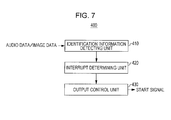
- Fig. 7 is a function block diagram of the output control program.
- An output control program 400 has an identification information detecting unit 410 which detects identification information added to audio data and image data received from the information terminal 110 through the communication connecting unit 310, an interrupt determining unit 420 which determines whether an interrupt event has occurred in the information terminal 110 or not on the basis of the identification information detected by the identification information detecting unit 410, and an output control unit 430 which outputs a signal that requests the start of an application to the information terminal 110 on the basis of the determination result by the interrupt determining unit 420.
- the output control unit 430 may control the display screen of the display control unit 320 in the electronic apparatus 130 and control audio output by the audio output unit 330.
- the terminal mode is an operation mode in which the electronic apparatus 130 may remotely control the information terminal 110 and output audio data and video data transferred from the information terminal 110.
- the electronic apparatus 130 inquires the information terminal 110 of whether the information terminal 110 supports the terminal mode or not (S102). If the electronic apparatus 130 receives a replay that the information terminal 110 supports the terminal mode from the information terminal 110 (S103), the electronic apparatus 130 starts operating in the terminal mode (S104). At the same time, the information terminal 110 is also allowed to operate in the terminal mode.
- the information terminal 110 may receive power supply from the electronic apparatus 130, and its battery becomes chargeable.
- image data on a display screen of the display of the information terminal 110 is transferred to the electronic apparatus 130, and the same display screen is output to the display of the electronic apparatus 130.
- the display shows an icon and/or a menu of an application in the information terminal 110, which may be remotely controlled from the electronic apparatus 130.
- a user input operation (coordinate information) is transmitted to the information terminal 110 through a touch panel, and the processing corresponding to the input operation is executed in the information terminal 110.
- a mouse a remote controller or other input interfaces.
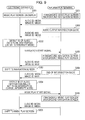
- FIG. 9 illustrates an operation sequence to be performed when an interrupt event has occurred in the information terminal 110 while the information terminal 110 is executing two or more, two in this case, applications at the same time.
- a navigation application and a music play application are being simultaneously executed, and a music play screen relating to the music play application is displayed as a foreground screen while a navigation screen as a background is not displayed (S201).
- the information terminal 110 may, for example, perform foreground processing on the application started last by a user.
- the information terminal 110 transfers image data on the music play screen that is a foreground screen and reproduced audio data to the electronic apparatus 130.
- identification information (0006: media play) indicative of a media play application is added.
- the music play screen transferred from the information terminal 110 is shown on the display, and the reproduced audio data is output from the speaker (S301).
- Fig. 10A illustrates an example in which a music play screen is shown on a display 322 of the electronic apparatus 130.
- an interrupt event of intersection guidance occurs at a certain timing in accordance with the movement of the vehicle or information terminal 110.
- audio output of intersection guidance interrupts the audio data being reproduced in the information terminal 110 (S202). This stops the transfer of audio data of the music play from the information terminal 110, and the audio data of intersection guidance subject to the interrupt processing is transferred to the electronic apparatus 130.
- identification information (0003: intersection guidance) for identifying the audio data is added to the audio data of intersection guidance.
- the identification information detecting unit 410 ( Fig. 7 ) in the electronic apparatus 130 detects the identification information added to the audio data and supplies it to the interrupt determining unit 420.
- the interrupt determining unit 420 determines that an interrupt event has occurred in the information terminal 110 on the basis of the fact that the identification information has changed, that is, the identification information has changed from "0006" to "0003".
- the output control unit 430 is notified of the determination result and outputs a signal that requests the start of a navigation function to the information terminal 110.
- the electronic apparatus 130 enters an interrupt mode (S302).
- the information terminal 110 receives the start signal for a navigation function through the communication connecting unit 210, the information terminal 110 in response to the start signal performs switching between the foreground screen and the background screen, resulting in a navigation screen as the foreground screen and a music play screen as the background screen (S203).
- the foreground navigation screen is transferred from the information terminal 110 to the electronic apparatus 130.
- identification information indicative of intersection guidance is added to the image data transferred as the foreground screen.
- the electronic apparatus 130 receives the navigation screen transferred from the information terminal 110 and causes the display to show it (S303). In this way, in response to the detection of audio data of intersection guidance, the display screen in the electronic apparatus 130 may be changed to a navigation screen including the intersection guidance.
- Fig. 10B illustrates an example in which the display screen of the display 322 of the electronic apparatus 130 changes from the music play screen to a navigation screen.
- the information terminal 110 again outputs reproduced audio data to the electronic apparatus 130.
- Identification information "0006" representing the media play is added to the audio data.
- the identification information detecting unit 410 in the electronic apparatus 130 detects identification information that is the media play added to the audio data.
- the interrupt determining unit 420 determines that the interrupt event has ended on the basis of the fact that the identification information has changed from "0003" to "0006". Then, with the determination result, the output control unit 430 outputs a signal to start a music play application to the information terminal 110 in order to cancel the interrupt mode (S304).
- the information terminal 110 If the information terminal 110 receives a start signal for the music play application, the information terminal 110 changes the music play screen to the foreground and the navigation screen to the background (S205). Thus, the information terminal 110 outputs image data on a music play screen and reproduced audio data to the electronic apparatus 130. The display screen of the display of the electronic apparatus 130 is shifted to the music play screen (S305).
- the output control unit 430 in the electronic apparatus 130 outputs a signal that requests switching of the display screen in the information terminal 110 in response to the change of the identification information of audio data transferred from the information terminal 110 as a trigger.
- an interrupt may be determined on the basis of the identification information added to image data.
- the image data may be required to undergo foreground processing in the information terminal 110. Thus it may be difficult to securely determine the occurrence of an interrupt event.
- the occurrence of an interrupt event is determined by adding the identification information to intersection guidance that is one operation form of a navigation function.
- a change of the identification information added to an application may be used to determine the occurrence of an interrupt event. For example, it may be determined that an interrupt event has occurred in a mobile terminal when identification information added to audio data is changed in applications, such as when identification information of a music play application has changed to identification information of a navigation application, when the identification information of a menu application has changed to identification information of a navigation application, or the identification information of a navigation application has changed to the identification information of an application for calls including an incoming telephone call and an outgoing call.
- the electronic apparatus when the occurrence of an interrupt event is determined, the electronic apparatus outputs a signal that requests the information terminal to start an application.
- the signal may be any signal depending on the specifications of the information terminal.
- the signal may only be required to be a control signal or a select signal so that the image data relating to an application determined as having an interrupt event in the information terminal is processed in the foreground and transferred to the electronic apparatus.
- Fig. 11 illustrates a flowchart in which a change of identification information of image data from the information terminal 110 triggers switching between a foreground screen and a background screen in an electronic apparatus.
- the information terminal 110 executes a navigation application.
- the information terminal 110 is taken into a vehicle, detects the position of the vehicle, and displays a navigation screen including a roadmap of an area including the vehicle position and its surroundings (S401).
- Image data and audio data relating to a navigation function is transferred from the information terminal 110 to the electronic apparatus 130.
- the multimedia unit 240 is operated to play a medium such as a CD or DVD.
- a music play screen is shown as a foreground screen on a display of the electronic apparatus 130.
- a navigation screen from the information terminal 110 undergoes background processing and is not displayed (S501).
- an interrupt for intersection guidance occurs (S402)
- image data and audio data on the intersection guidance are transferred to the electronic apparatus 130.
- Identification information (“0003" in Fig. 4A ) indicative of the intersection guidance is added to the image data.
- the identification information detecting unit 410 in the electronic apparatus 130 detects identification information of intersection guidance included in the image data.
- the interrupt determining unit 420 determines that an interrupt event has occurred on the basis of the fact that the identification information of the image data has changed (from "0002" to "0003").
- An interrupt mode then starts (S502).
- the output control unit 430 controls the switching of the display screen of the display control unit 320 in the electronic apparatus 130, instead of outputting a signal that requests the information terminal 110 to start an application.
- the output control unit 430 performs control such that a navigation screen is displayed as a foreground screen, and a music play screen as a background screen is not displayed (S503).
- the intersection guidance in the information terminal ends, and the screen is shifted to a normal navigation screen (S403).
- the identification information added to the image data is changed to a normal navigation "0002".
- the identification information "0002" of the normal navigation is detected, and the interrupt determining unit 420 determines that the interrupt event has ended.
- the interrupt mode is cancelled (S504).
- the output control unit 430 shifts the music play screen to the foreground screen and the navigation screen to the background screen (S505).
- the display screen of the electronic apparatus in response to the change of the identification information of image data, the display screen of the electronic apparatus is shifted.
- This allows display of an interrupt image without delay and may synchronize interrupt images and interrupt audio.
- a change of the identification information of audio data from the information terminal 110 may trigger switching the display screen in the electronic apparatus.
- the occurrence and end of an interrupt event are determined when the identification information of audio data and/or image data has changed.
- the determination of occurrence of an interrupt event on the basis of the change of the identification information may not required if the identification information may be recognized as an interrupt event.
- a determination table that defines a relationship between identification information and interrupt events may be prepared in memory, for example. If identification information "0003" is detected, the determination table is referred to. If the determination table contains the identification information "0003", the occurrence of an interrupt event may be determined.
- the third embodiment relates to output control over audio and image data when interrupt events conflict.
- the output control unit 430 stores priority information in which an application to be output by priority when interrupt events conflict is pre-defined in a memory.
- the priority information may be changeable by a user.
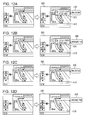
- Figs. 12A to 12D illustrate an output example when an incoming call as an interrupt is received from the information terminal in an interrupt mode while an enlarged intersection view relating to intersection guidance is being displayed in the electronic apparatus.
- Fig. 12A illustrates an example in which a telephone function is given priority for the image and audio.
- an intersection guidance image 510 is interrupt-displayed over a roadmap image 500 of an area including and surrounding the position of the vehicle on a display of the electronic apparatus 130.
- These image data are transferred from the information terminal 110 and are displayed in response to the determination by the interrupt determining unit 420 that an interrupt event has occurred.
- the information terminal 110 performs interrupt processing on the incoming call and interrupt-outputs an incoming call screen and a ringtone.
- the identification information is detected in the electronic apparatus 130.
- the interrupt determining unit 420 in the electronic apparatus 130 determines that an interrupt event has occurred and supplies the determination result to the output control unit 430.
- the output control unit 430 controls audio output and image output in the electronic apparatus 130 on the basis of the priority information.
- an incoming call image 520 is interrupt-displayed over the intersection guidance image 510 or roadmap image 500.
- the incoming call image 520 may include an indication of a caller's telephone number and so on.
- a ringtone 530 from the information terminal 110 is output from a speaker of the electronic apparatus 130, and audio data of the intersection guidance is filtered and is not output by the audio output unit 330.
- Fig. 12B illustrates an example in which an incoming call is given priority for the image, and a navigation function is given priority for the audio.
- an incoming call screen 520 is interrupt-displayed, but ringtone audio data is filtered and is not output from the audio output unit 33.
- An intersection guidance audio 540 is output from a speaker of the electronic apparatus 130.
- Fig. 12C illustrates an example in which the navigation function is given priority for the image, and an incoming telephone call is given priority for the audio.
- image data of an incoming call image transferred from the information terminal 110 is filtered and is not displayed by the display control unit 320.
- the ringtone 530 is audio output, and intersection guidance audio data is filtered and is not output.
- Fig. 12D illustrates an example in which the navigation function is given priority for both of the image and audio.
- the incoming call screen image data and ringtone audio data are filtered and are not output from the electronic apparatus 130.
- the incoming call image may be saved, and, when the display of an enlarged intersection view for the navigation function ends, the saved incoming call image or an image generated uniquely for indicating that an incoming call has arrived may be displayed.
- Fig. 13A illustrates a state where an intersection guidance image 510 and an intersection guidance audio 540 are output.
- Fig. 13B illustrates a unique incoming call screen 522 showing "Calling" prepared in the electronic apparatus 130 is displayed on an audio play screen 550 after the end of the intersection interrupt.
- the interrupt outputs for the image and audio may be controlled on the basis of the identification information added to the image data and audio data.
- the working period and costs for the software/hardware development may be reduced, compared with interrupt processing of the related art.
- audio output and screen changing may be implemented as desired without particular limitation, allowing an increase in the degree of freedom in the product specifications and thus providing products that are more attractive to users.
- Interrupts synchronized with the audio and image may be implemented in the electronic apparatus.
- identifying audio data and image data from the identification information allows blocking, in the electronic apparatus, screens and/or audios not preferred to give to a user under driving control, for example.
- applications such as an audio play, a navigation function, and an incoming telephone call are executed.
- the identification information is not required to add to both of an audio transfer protocol and an image transfer protocol, but identification information may be added to one of them.
- the identification information added to an audio transfer protocol may allow an interrupt with as much accuracy as the related art.
Landscapes
- Engineering & Computer Science (AREA)
- Signal Processing (AREA)
- Multimedia (AREA)
- Radar, Positioning & Navigation (AREA)
- Remote Sensing (AREA)
- Databases & Information Systems (AREA)
- Automation & Control Theory (AREA)
- Human Computer Interaction (AREA)
- Computer Networks & Wireless Communication (AREA)
- General Engineering & Computer Science (AREA)
- Physics & Mathematics (AREA)
- General Physics & Mathematics (AREA)
- Navigation (AREA)
- Information Transfer Between Computers (AREA)
- Controls And Circuits For Display Device (AREA)
Abstract
Description
- The present invention relates to electronic apparatuses capable of outputting image information and/or audio information transferred from a portable information terminal, and particularly relates to control of the portable information terminal over a display screen in response to an interrupt occurring in the portable information terminal.
- In recent years, multi-function portable apparatuses such as smart phones have been widely used. When such a portable apparatus is taken into a vehicle, the portable apparatus is connected to an electronic apparatus mounted in a vehicle (hereinafter, referred to as a vehicle-mounted apparatus) so that a function implemented in the portable apparatus may become available to a vehicle-mounted apparatus.
- For example,
JP 2009-281991A - While audio data and/or image data transferred from the portable apparatus is being output in the vehicle-mounted apparatus, the vehicle-mounted apparatus may be required to detect a factor causing interrupt in the portable apparatus (interrupt factor). For example, while the portable apparatus is executing a navigation function, the vehicle-mounted apparatus may be required to provide notification of an interrupt caused by an event such as guidance at an intersection. The same is true when an incoming telephone call or an electronic mail is received.
-
JP 2003-319020 A -
Figs. 1A and 1B illustrate an interrupt detection method of related art.Fig. 1A illustrates an interrupt detection method with hardware having a dedicated interrupt signal line. As illustrated inFig. 1A , aportable apparatus 10 and a vehicle-mountedapparatus 20 are connected through an audio/image signal line 30 for sending and receiving audio and image signals and aninterrupt signal line 32 for sending and receiving an interrupt signal. When an interrupt factor occurs, theportable apparatus 10 changes the voltage level of theinterrupt signal line 32 to a high or low level, and the vehicle-mountedapparatus 20 detects the start and end of the interrupt. -
Fig. 1B illustrates an interrupt detection method with software using a communication protocol for an interrupt. Aportable apparatus 10 and a vehicle-mountedapparatus 20 are connected through an audio/image signal line 30 to send and receive a signal according to an audio transfer protocol, an image transfer protocol, or an interrupt protocol through the audio/image signal line 30. When an interrupt factor occurs, theportable apparatus 10 transfers an interrupt signal to the vehicle-mountedapparatus 20 in accordance with an interrupt protocol, and the vehicle-mountedapparatus 20 detects the start and end of the interrupt. - The so-called terminal mode has been proposed in which when a portable apparatus that is a multifunction information terminal such as a smart phone is connected to a vehicle-mounted apparatus, screen data and audio data relating to an application started in the portable apparatus are transferred to the vehicle-mounted apparatus, and the screen data and audio data are output from the vehicle-mounted apparatus.
- A portable apparatus that is a multifunction information terminal is capable of starting two or more applications simultaneously, and may, for example, execute a music play application and a navigation application simultaneously. In this case, the portable apparatus handles a screen of one application in front (foreground screen) and a screen of the other application at the back (background screen). In the terminal mode, the portable apparatus is configured to transfer the front screen information thereof to the vehicle-mounted apparatus. If a music play screen is displayed in front and the navigation screen at the back in the portable apparatus, the music play screen is displayed in the vehicle-mounted apparatus. Audio data generated by music play is transferred from the portable apparatus, and music is output through a speaker of the vehicle-mounted apparatus.
Fig. 2A illustrates an example that a music play screen is displayed on adisplay 22 of the vehicle-mountedapparatus 20. - If an interrupt such as guidance at an intersection (intersection guidance) occurs in a navigation application being executed in the
portable apparatus 10, the portable apparatus temporarily stops the output of audio data for music play and starts the output of audio data for the intersection guidance. Thus, also in the vehicle-mounted apparatus, the audio output for music play is switched to the audio output for the intersection guidance. However, the music play screen of the portable apparatus remains in front. Thus, in the vehicle-mounted apparatus, the music play screen is displayed, preventing display of the intersection guidance screen.Fig. 2B illustrates a relationship between a display screen of thedisplay 22 in a vehicle-mounted apparatus and output audio when such an interrupt as intersection guidance as described above occurs. - Further, when the interrupt detection technique illustrated in
Fig. 1A is used, hardware resources may be required for both theportable apparatus 10 and the vehicle-mountedapparatus 20, which increases the costs. When the interrupt detection technique illustrated inFig. 1B is used, the implementation of a particular protocol for detecting the interrupt may be required, which also increases the costs for the software development. - Furthermore, there is a common problem to the methods illustrated in
Figs. 1A and 1B that since audio data/image data and interrupt information are transmitted via different signal lines and/or independent communication protocols, it is difficult to completely synchronize the transmission of interrupt with the transmissions of audio and image. Further, since an interrupt request is given unilaterally from the portable apparatus to the vehicle-mounted apparatus, it is difficult for the vehicle-mounted apparatus to output audio/images as required. - Thus, it may be one object to provide an electronic apparatus and an electronic system, which control output of image data and/or audio data in response to occurrence of an interrupt event in a portable information terminal.
- The object is solved by the features of the independent claims. Further embodiments and developments are defined in the respective dependent claims.
- An electronic apparatus according to the present invention is capable of, when connected to a portable information terminal, receiving image data and/or audio data transferred from the portable information terminal which data preferably relating to an application executed in the portable information terminal and outputting the image data and audio data.
- The electronic apparatus includes receiving means configured for receiving data that includes image data and/or audio data transferred from the portable information terminal, output means configured for outputting the data received by the receiving means, determining means configured for determining the presence of an interrupt event in the portable information terminal on the basis of identification information added to the data received by the receiving means, and control means configured for transmitting a control signal for transferring image data relating to an application in which the interrupt event occurs to the portable information terminal if the determining means determines that the interrupt event is present.
- The identification information may be added to the image data and/or audio data received by the receiving means.
- The determining means may further include detecting means configured for detecting the identification information , and configured such that, when the identification information detected by the detecting means changes from first identification information to second identification information, determines that an interrupt event has occurred. Further, the detecting means may be configured such that when the identification information changes from the second identification information to the first identification information, determines that the interrupt event has ended.
- Further, when it is determined that an interrupt event has occurred, the control means may be configured to transmit a first control signal for transferring image data relating to an application in which the interrupt event has occurred and may be configured to transmit a second control signal for transferring image data relating to the original application when it is determined that the interrupt event has ended.
- The output means preferably outputs image data relating to an application in which the interrupt event has occurred in response to a period from the transmission of the first control signal to the transmission of the second control signal.
- The control means may further include priority determining means for determining priority when interrupt events conflict, and the control means may be configured to cause the output means to output image data and audio data of high priority out of image data and audio data received from the receiving means in accordance with the priority determined by the priority determining means.
- The identification information preferably identifies an interrupt event included in an application.
- The control signal and the first and second control signals are preferably signals that request the start of an application to the portable information terminal.
- Further, the electronic apparatus may include executing means for executing an application, and the output means may be further configured to output selectively one of the image data received by the receiving means and image data relating to the application executed by the executing means. Thus, the determining means may be configured for determining the presence of an interrupt event in the portable information terminal on the basis of identification information added to the data received by the receiving means, and the control means may be configured for causing the output means to output the image data from the portable information terminal if the determining means determines that an interrupt event is present.
- Further, the control means may be configured to control a selection of image data by the output means such that image data being processed in the background is processed in the foreground when it is determined that an interrupt event has occurred and such that image data being processed in the foreground is processed in the background when it is determined that the interrupt event has ended.
- Furthermore, when it is determined that an interrupt event has occurred while the output means is processing image data received by the receiving means in the background and processing image data relating to an application executed by the executing means in the foreground, the control means preferably causes the image data received by the receiving means to be processed in the foreground and causes the image data relating to an application executed by the executing means to be processed in the background.
- An electronic system may include the electronic apparatus according to the invention and a portable information terminal connected to the electronic apparatus. Preferably, the portable information terminal includes processing means for processing image data and audio data relating to a selected first application in the foreground and processing image data and audio data relating to another second application in the background when two or more applications are being executed, output means for outputting image data and audio data processed in the foreground to the electronic apparatus, and adding means for adding identification information to at least audio data output from the output means. When an interrupt event occurs in the second application, the output means outputs the data, i.e. audio or image data, to which identification information by which the interrupt event is identifiable is added, to the electronic apparatus. Then, the output means, when receiving the control signal from the electronic apparatus, preferably processes image data relating to the first application in the foreground.
- As above, the data to which identification information by which the interrupt event is identifiable is added, may be audio data and/or image data transferred from the portable information terminal to the electronic apparatus.
- An output control method for an electronic apparatus according to the present invention may include the steps of receiving image data and audio data transferred from the portable information terminal, outputting the received image data and audio data, determining the presence of an interrupt event in the portable information terminal on the basis of identification information added to the received audio and/or image data, and transmitting a control signal for transferring image data relating to an application in which an interrupt event occurs to the portable information terminal if it is determined that an interrupt event is present.
- The output control method may further include outputting selectively one of the received image data and image data relating to an application executed in the electronic apparatus, and outputting the image data from the portable information terminal if it is determined that an interrupt event is present.
- Moreover, the present invention may be implemented as a computer program, in particular as an output control program. Accordingly, the program comprises program code or instructions that when carried out by corresponding processing or control means of an electronic apparatus according to the present invention causes the electronic apparatus to carry out the method of the invention.
- According to general concept of the present invention, an interrupt event is determined based on identification information added to audio data and/or image data. Accordingly, image data relating to the interrupt event may be displayed appropriately. This may reduce costs for hardware and/or software development, compared with interrupt detections of the related art.
-
-
Fig. 1A illustrates an interrupt detection method with hardware having an interrupt signal line; andFig. 1B illustrates an interrupt detection method with software using a communication protocol for an interrupt, according to the related art; -
Figs. 2A and 2B illustrate an example of a display screen of a vehicle-mounted apparatus when an interrupt occurs in a portable apparatus according to the related art; -
Fig. 3 illustrates a configuration of an electronic system according to an embodiment of the present invention; -
Figs. 4A and 4B illustrate an example of identification information to be added to audio data and image data according to an embodiment of the present invention; -
Fig. 5 is a block diagram illustrating a typical configuration of an information terminal illustrated inFig. 3 ; -
Fig. 6 is a block diagram illustrating a typical configuration of an electronic apparatus illustrated inFig. 3 ; -
Fig. 7 is a function block diagram of an output control program for an electronic apparatus according to an embodiment of the present invention; -
Fig. 8 is a flowchart describing a shift to a terminal mode in an electronic system of an embodiment of the present invention; -
Fig. 9 illustrates a sequence of an output control operation in an electronic apparatus when an interrupt event occurs in an information terminal according to a first embodiment of the present invention; -
Figs. 10A and 10B illustrate a transition example of a display screen of an electronic apparatus when an interrupt event occurs in an information terminal according to a first embodiment of the present invention; -
Fig. 11 illustrates a sequence of an output control operation in an electronic apparatus when an interrupt event occurs in an information terminal according to a second embodiment of the present invention; -
Figs. 12A to 12D illustrate output operations by an electronic apparatus when interrupt events conflict according to a third embodiment of the present invention; and -
Figs. 13A and 13B illustrate an output example by an electronic apparatus according to a variation example of the third embodiment. - Embodiments of the present invention will be described with reference to the attached drawings. According to a preferred embodiment of the present invention, an electronic system may be provided in which a portable information terminal (hereinafter referred to as an information terminal) is connected to an electronic apparatus mounted in a vehicle that is a mobile unit. The information terminal may be a portable apparatus capable of processing information and preferably is a multifunction terminal having a communication function. For example, the information terminal may be a cellular phone, a smart phone, a palmtop personal computer, a laptop computer, a notebook computer or the like. The information terminal may implement various functions by executing applications implemented therein, including an external network connection, a voice call, and storage of audio data and video data.
- On the other hand, the electronic apparatus mounted in a vehicle may include an audio/video play function, a television/radio broadcasting receiving function, a navigation function, and so on. The electronic apparatus may be connected to the information terminal through wired or wireless data communication means so that data may be exchanged between the apparatuses. The data communication means are not particularly limited. Data communication may be implemented by connection via a USB cable, short-distance wireless connection based on Bluetooth® technology, a wireless LAN, or Wi-Fi, for example.
- Preferably, the electronic apparatus has an operation mode allowing remote control on an information terminal when connected to the information terminal. The information terminal transmits audio signal and/or video signal relating to an application started by a remote control to the electronic apparatus. The electronic apparatus outputs audio based on the received audio signal and displays the video signal on a screen.
-
Fig. 3 illustrates a configuration of an electronic system according to a first embodiment of the present invention. Anelectronic system 100 according to this embodiment includes aninformation terminal 110 and anelectronic apparatus 130 connected to theinformation terminal 110 through connectingmeans 120. Preferably, theinformation terminal 110 may be a multifunction smart phone having a communication function. Theelectronic apparatus 130 may include a television receiving function and a media play function for a CD, a DVD or the like and further includes a display and a speaker in a space within a vehicle. - According to this embodiment, the connecting means 120 is a USB (Universal Serial Bus) cable. Instead of or in addition to this, any other radio communications such as implemented by the Bluetooth® technology may be used. The connecting means 120 includes signal lines for transmitting image data and audio data from the
information terminal 110 to theelectronic apparatus 130 and a signal line for exchanging control data between theinformation terminal 110 and theelectronic apparatus 130. Each of theinformation terminal 110 andelectronic apparatus 130 supports a communication protocol for communication control over image data, audio data, and control data in the specifications of a terminal mode. Theelectronic apparatus 130 is capable of operating in the terminal mode to remotely operate theinformation terminal 110. - Preferably, audio data is subject to communication control based on the Real-time Transport Protocol (RTP), and image data is subject to communication control based on the remote framebuffer (RFB) Protocol. These communication controls may allow the protocols extensible, and extension information may be added to audio data and image data. In the terminal mode according to this embodiment, the extension information to be added to audio data and image data may be application identification information for identifying an application executed by the
information terminal 110, identification information for identifying an operation form included therein, or identification information for identifying the general category of operations. Such identification information representative of a general or detailed type/meaning of audio data and image data may be included in an audio transfer protocol and image transfer protocol. -
Fig. 4A illustrates an example of identification information to be added to audio data and image data. In this case, the same identification information is added to audio data and image data. As illustrated inFig. 4A ,identification information identification information information terminal 110 in the terminal mode includes the identification information in the audio/image protocol when transferring audio data and image data to theelectronic apparatus 130.Fig. 4B illustrates an aspect in which the identification information is added to audio data and image data. Theelectronic apparatus 130 detects the identification information included in the audio/image protocol received from theinformation terminal 110 and, on the basis of the identification information, controls output of the audio data and/or screen data. -
Fig. 5 is a block diagram illustrating a typical configuration of the information terminal. Theinformation terminal 110 includes aninput unit 200 which receives an input from a user, acommunication connecting unit 210 which allows a connection to theelectronic apparatus 130 through the connecting means 120, adisplay unit 220 which shows various images on a display thereof, anaudio output unit 230 which outputs audio, acommunication unit 240 which allows a data communication with an external network and a telephone call over a public wireless network, acontrol unit 250, aprogram memory 260 which stores an application, a program and/or the like held by theinformation terminal 110, adata memory 270 which stores audio data, image data, roadmap data and various other data, and abus 280 which connects these units. - The
program memory 260 stores various kinds of application software and programs. Thecontrol unit 250 executes an application and/or a program stored in theprogram memory 260. Theprogram memory 260 may store, for example, an application for reproducing audio data and/or image data stored in thedata memory 270, an application for executing a game, an application for executing a navigation function, an application allowing a voice call, and/or an application for browsing information over the Internet through thecommunication unit 240. - The
program memory 260 may further store an extension program that controls the terminal mode when theinformation terminal 110 is connected to theelectronic apparatus 130 through the connectingmeans 120. The extension program receives input operation information and other command information input by a user operation from theelectronic apparatus 130 and, in response to that, starts or ends an application in theinformation terminal 110. The extension program transfers the identification information assigned to image data and audio data relating to the started application to theelectronic apparatus 130 in accordance with the audio transfer protocol and image transfer protocol. In this case, the identification information of the application and/or identification information representative of a detailed type and meaning of the application, as illustrated inFig. 4A , is added to the image data and audio data to be transferred. - When two or more applications are being executed in the information terminal, for example, when a music play application and a navigation application are being executed, the
control unit 250 processes image data relating to one application in the foreground and causes thedisplay unit 220 to display the data and processes image data relating to the other application in the background and does not display the data of the other application. For example, a music play screen is displayed on thedisplay unit 220 while a navigation screen showing a roadmap of an area including and surrounding the vehicle is not displayed by the background processing. Theaudio output unit 230 outputs a reproduced tune. In the terminal mode, foreground image data and audio data are transferred to theelectronic apparatus 130. When thecontrol unit 250 receives a signal that requests the start of an application from theelectronic apparatus 130 through thecommunication connecting unit 210, thecontrol unit 250 processes the application in the foreground and displays the image data. The start of an application may be requested by, for example, a user by selecting an icon shown on the display of theelectronic apparatus 130. Moreover, according to this embodiment, when it is determined that an interrupt event has occurred in the information terminal, as will be described below, theelectronic apparatus 130 outputs a signal that requests the start of the application automatically. -
Fig. 6 is a block diagram illustrating a typical configuration of the electronic apparatus. As illustrated inFig. 6 , theelectronic apparatus 130 includes aninput unit 300 which receives an input from a user, acommunication connecting unit 310 which allows connection to theinformation terminal 110 through the connecting means 120, adisplay control unit 320 which causes image data to be shown on a display, anaudio output unit 330 which outputs audio through a speaker, amultimedia unit 340 which plays various media, acontrol unit 350, aprogram memory 360 which stores various programs for executing applications, adata memory 370 which stores data such as audio data, video data, and map data, and abus 380 which connects these units. - The
multimedia unit 240 has a function of reproducing audio data and/or image data recorded on or in a CD, a DVD, a Blu-ray Disc, and a memory medium, thedata memory 270 or the like and a function of receiving and reproducing television broadcasting or radio broadcasting. Theprogram memory 360 stores an application relating to a navigation function, a program which controls themultimedia unit 240, and a program which controls the terminal mode when theinformation terminal 110 is connected. The programs and applications stored in theprogram memory 360 are executed by thecontrol unit 350. Theelectronic apparatus 130 may receive GPS information, vehicle speed information, direction information and so on that are necessary for a navigation operation. - The
program memory 360 further includes an output control program which controls output of audio data and/or image data transferred from theinformation terminal 110 in the terminal mode.Fig. 7 is a function block diagram of the output control program. Anoutput control program 400 has an identificationinformation detecting unit 410 which detects identification information added to audio data and image data received from theinformation terminal 110 through thecommunication connecting unit 310, an interrupt determiningunit 420 which determines whether an interrupt event has occurred in theinformation terminal 110 or not on the basis of the identification information detected by the identificationinformation detecting unit 410, and anoutput control unit 430 which outputs a signal that requests the start of an application to theinformation terminal 110 on the basis of the determination result by the interrupt determiningunit 420. According to one embodiment, theoutput control unit 430 may control the display screen of thedisplay control unit 320 in theelectronic apparatus 130 and control audio output by theaudio output unit 330. - Next, a shift of the
electronic apparatus 130 to the terminal mode will be described with reference to the flowchart inFig. 8 . The terminal mode is an operation mode in which theelectronic apparatus 130 may remotely control theinformation terminal 110 and output audio data and video data transferred from theinformation terminal 110. When theinformation terminal 110 is connected to theelectronic apparatus 130 via a USB cable, for example, (S101), both of the apparatus are mutually recognized with the USB plug and play. Next, theelectronic apparatus 130 inquires theinformation terminal 110 of whether theinformation terminal 110 supports the terminal mode or not (S102). If theelectronic apparatus 130 receives a replay that theinformation terminal 110 supports the terminal mode from the information terminal 110 (S103), theelectronic apparatus 130 starts operating in the terminal mode (S104). At the same time, theinformation terminal 110 is also allowed to operate in the terminal mode. When a USB connection is effective, theinformation terminal 110 may receive power supply from theelectronic apparatus 130, and its battery becomes chargeable. - In the terminal mode, image data on a display screen of the display of the
information terminal 110 is transferred to theelectronic apparatus 130, and the same display screen is output to the display of theelectronic apparatus 130. The display shows an icon and/or a menu of an application in theinformation terminal 110, which may be remotely controlled from theelectronic apparatus 130. When the display supports a touch panel input, a user input operation (coordinate information) is transmitted to theinformation terminal 110 through a touch panel, and the processing corresponding to the input operation is executed in theinformation terminal 110. The same is true for input operations from a mouse, a remote controller or other input interfaces. - Next, output control over image data when an interrupt occurs in an electronic apparatus in the terminal mode will be described.
Fig. 9 illustrates an operation sequence to be performed when an interrupt event has occurred in theinformation terminal 110 while theinformation terminal 110 is executing two or more, two in this case, applications at the same time. - In the
information terminal 110, a navigation application and a music play application are being simultaneously executed, and a music play screen relating to the music play application is displayed as a foreground screen while a navigation screen as a background is not displayed (S201). Theinformation terminal 110 may, for example, perform foreground processing on the application started last by a user. In the terminal mode, theinformation terminal 110 transfers image data on the music play screen that is a foreground screen and reproduced audio data to theelectronic apparatus 130. To the image data and audio data, identification information (0006: media play) indicative of a media play application is added. On the other hand, in theelectronic apparatus 130, the music play screen transferred from theinformation terminal 110 is shown on the display, and the reproduced audio data is output from the speaker (S301).Fig. 10A illustrates an example in which a music play screen is shown on adisplay 322 of theelectronic apparatus 130. - In the navigation application, when a route to a destination is set, an interrupt event of intersection guidance occurs at a certain timing in accordance with the movement of the vehicle or
information terminal 110. In this case, audio output of intersection guidance interrupts the audio data being reproduced in the information terminal 110 (S202). This stops the transfer of audio data of the music play from theinformation terminal 110, and the audio data of intersection guidance subject to the interrupt processing is transferred to theelectronic apparatus 130. In this case, identification information (0003: intersection guidance) for identifying the audio data is added to the audio data of intersection guidance. - The identification information detecting unit 410 (
Fig. 7 ) in theelectronic apparatus 130 detects the identification information added to the audio data and supplies it to the interrupt determiningunit 420. The interrupt determiningunit 420 determines that an interrupt event has occurred in theinformation terminal 110 on the basis of the fact that the identification information has changed, that is, the identification information has changed from "0006" to "0003". Theoutput control unit 430 is notified of the determination result and outputs a signal that requests the start of a navigation function to theinformation terminal 110. Thus, theelectronic apparatus 130 enters an interrupt mode (S302). - If the
information terminal 110 receives the start signal for a navigation function through thecommunication connecting unit 210, theinformation terminal 110 in response to the start signal performs switching between the foreground screen and the background screen, resulting in a navigation screen as the foreground screen and a music play screen as the background screen (S203). Thus, the foreground navigation screen is transferred from theinformation terminal 110 to theelectronic apparatus 130. In this case, identification information indicative of intersection guidance is added to the image data transferred as the foreground screen. - The
electronic apparatus 130 receives the navigation screen transferred from theinformation terminal 110 and causes the display to show it (S303). In this way, in response to the detection of audio data of intersection guidance, the display screen in theelectronic apparatus 130 may be changed to a navigation screen including the intersection guidance.Fig. 10B illustrates an example in which the display screen of thedisplay 322 of theelectronic apparatus 130 changes from the music play screen to a navigation screen. - After that, when the interrupt event of intersection guidance ends (S204), the
information terminal 110 again outputs reproduced audio data to theelectronic apparatus 130. Identification information "0006" representing the media play is added to the audio data. - The identification
information detecting unit 410 in theelectronic apparatus 130 detects identification information that is the media play added to the audio data. The interrupt determiningunit 420 determines that the interrupt event has ended on the basis of the fact that the identification information has changed from "0003" to "0006". Then, with the determination result, theoutput control unit 430 outputs a signal to start a music play application to theinformation terminal 110 in order to cancel the interrupt mode (S304). - If the
information terminal 110 receives a start signal for the music play application, theinformation terminal 110 changes the music play screen to the foreground and the navigation screen to the background (S205). Thus, theinformation terminal 110 outputs image data on a music play screen and reproduced audio data to theelectronic apparatus 130. The display screen of the display of theelectronic apparatus 130 is shifted to the music play screen (S305). - According to this embodiment, the
output control unit 430 in theelectronic apparatus 130 outputs a signal that requests switching of the display screen in theinformation terminal 110 in response to the change of the identification information of audio data transferred from theinformation terminal 110 as a trigger. However, an interrupt may be determined on the basis of the identification information added to image data. In this case, in order to detect the identification information of image data, the image data may be required to undergo foreground processing in theinformation terminal 110. Thus it may be difficult to securely determine the occurrence of an interrupt event. - According to the embodiment, the occurrence of an interrupt event is determined by adding the identification information to intersection guidance that is one operation form of a navigation function. Alternatively, a change of the identification information added to an application may be used to determine the occurrence of an interrupt event. For example, it may be determined that an interrupt event has occurred in a mobile terminal when identification information added to audio data is changed in applications, such as when identification information of a music play application has changed to identification information of a navigation application, when the identification information of a menu application has changed to identification information of a navigation application, or the identification information of a navigation application has changed to the identification information of an application for calls including an incoming telephone call and an outgoing call.
- It has further been described that when the occurrence of an interrupt event is determined, the electronic apparatus outputs a signal that requests the information terminal to start an application. However, the signal may be any signal depending on the specifications of the information terminal. In other words, the signal may only be required to be a control signal or a select signal so that the image data relating to an application determined as having an interrupt event in the information terminal is processed in the foreground and transferred to the electronic apparatus.
- Next, a second embodiment of the present invention will be described with reference to
Fig. 11. Fig. 11 illustrates a flowchart in which a change of identification information of image data from theinformation terminal 110 triggers switching between a foreground screen and a background screen in an electronic apparatus. In this case, in the terminal mode, theinformation terminal 110 executes a navigation application. Theinformation terminal 110 is taken into a vehicle, detects the position of the vehicle, and displays a navigation screen including a roadmap of an area including the vehicle position and its surroundings (S401). Image data and audio data relating to a navigation function is transferred from theinformation terminal 110 to theelectronic apparatus 130. - On the other hand, in the
electronic apparatus 130, themultimedia unit 240 is operated to play a medium such as a CD or DVD. A music play screen is shown as a foreground screen on a display of theelectronic apparatus 130. A navigation screen from theinformation terminal 110 undergoes background processing and is not displayed (S501). - In the
information terminal 110, when an interrupt for intersection guidance occurs (S402), image data and audio data on the intersection guidance are transferred to theelectronic apparatus 130. Identification information ("0003" inFig. 4A ) indicative of the intersection guidance is added to the image data. The identificationinformation detecting unit 410 in theelectronic apparatus 130 detects identification information of intersection guidance included in the image data. The interrupt determiningunit 420 determines that an interrupt event has occurred on the basis of the fact that the identification information of the image data has changed (from "0002" to "0003"). An interrupt mode then starts (S502). - The
output control unit 430 controls the switching of the display screen of thedisplay control unit 320 in theelectronic apparatus 130, instead of outputting a signal that requests theinformation terminal 110 to start an application. In other words, theoutput control unit 430 performs control such that a navigation screen is displayed as a foreground screen, and a music play screen as a background screen is not displayed (S503). After that, the intersection guidance in the information terminal ends, and the screen is shifted to a normal navigation screen (S403). Then, the identification information added to the image data is changed to a normal navigation "0002". In theelectronic apparatus 130, the identification information "0002" of the normal navigation is detected, and the interrupt determiningunit 420 determines that the interrupt event has ended. Then, the interrupt mode is cancelled (S504). Thus, theoutput control unit 430 shifts the music play screen to the foreground screen and the navigation screen to the background screen (S505). - In this way, according to the second embodiment, in response to the change of the identification information of image data, the display screen of the electronic apparatus is shifted. This allows display of an interrupt image without delay and may synchronize interrupt images and interrupt audio. According to the second embodiment, like the first embodiment, a change of the identification information of audio data from the
information terminal 110 may trigger switching the display screen in the electronic apparatus. - According to the first and second embodiments, the occurrence and end of an interrupt event are determined when the identification information of audio data and/or image data has changed. However, the determination of occurrence of an interrupt event on the basis of the change of the identification information may not required if the identification information may be recognized as an interrupt event. For example, in the electronic apparatus, a determination table that defines a relationship between identification information and interrupt events may be prepared in memory, for example. If identification information "0003" is detected, the determination table is referred to. If the determination table contains the identification information "0003", the occurrence of an interrupt event may be determined.
- Next, a third embodiment of the present invention will be described. The third embodiment relates to output control over audio and image data when interrupt events conflict. Preferably, the
output control unit 430 stores priority information in which an application to be output by priority when interrupt events conflict is pre-defined in a memory. The priority information may be changeable by a user.Figs. 12A to 12D illustrate an output example when an incoming call as an interrupt is received from the information terminal in an interrupt mode while an enlarged intersection view relating to intersection guidance is being displayed in the electronic apparatus. -
Fig. 12A illustrates an example in which a telephone function is given priority for the image and audio. As illustrated in the left part ofFig. 12A , anintersection guidance image 510 is interrupt-displayed over aroadmap image 500 of an area including and surrounding the position of the vehicle on a display of theelectronic apparatus 130. These image data are transferred from theinformation terminal 110 and are displayed in response to the determination by the interrupt determiningunit 420 that an interrupt event has occurred. In this case, when an incoming telephone call arrives at theinformation terminal 110, theinformation terminal 110 performs interrupt processing on the incoming call and interrupt-outputs an incoming call screen and a ringtone. This adds identification information "0004" of an incoming telephone call to the audio data and image data transferred from theinformation terminal 110. The identification information is detected in theelectronic apparatus 130. - On the basis of the detected identification information, the interrupt determining
unit 420 in theelectronic apparatus 130 determines that an interrupt event has occurred and supplies the determination result to theoutput control unit 430. Theoutput control unit 430 controls audio output and image output in theelectronic apparatus 130 on the basis of the priority information. In the example inFig. 12A , because an incoming telephone call has priority for the audio and image, anincoming call image 520 is interrupt-displayed over theintersection guidance image 510 orroadmap image 500. Theincoming call image 520 may include an indication of a caller's telephone number and so on. Aringtone 530 from theinformation terminal 110 is output from a speaker of theelectronic apparatus 130, and audio data of the intersection guidance is filtered and is not output by theaudio output unit 330. -
Fig. 12B illustrates an example in which an incoming call is given priority for the image, and a navigation function is given priority for the audio. In this case, anincoming call screen 520 is interrupt-displayed, but ringtone audio data is filtered and is not output from the audio output unit 33. Anintersection guidance audio 540 is output from a speaker of theelectronic apparatus 130. -
Fig. 12C illustrates an example in which the navigation function is given priority for the image, and an incoming telephone call is given priority for the audio. In this case, image data of an incoming call image transferred from theinformation terminal 110 is filtered and is not displayed by thedisplay control unit 320. On the other hand, theringtone 530 is audio output, and intersection guidance audio data is filtered and is not output. -
Fig. 12D illustrates an example in which the navigation function is given priority for both of the image and audio. In this case, even if it is determined that an interrupt event of an incoming telephone call has occurred, the incoming call screen image data and ringtone audio data are filtered and are not output from theelectronic apparatus 130. In this case, the incoming call image may be saved, and, when the display of an enlarged intersection view for the navigation function ends, the saved incoming call image or an image generated uniquely for indicating that an incoming call has arrived may be displayed.Fig. 13A illustrates a state where anintersection guidance image 510 and anintersection guidance audio 540 are output.Fig. 13B illustrates a uniqueincoming call screen 522 showing "Calling" prepared in theelectronic apparatus 130 is displayed on anaudio play screen 550 after the end of the intersection interrupt. - According to the third embodiment, the interrupt outputs for the image and audio may be controlled on the basis of the identification information added to the image data and audio data.
- According to the embodiments, the working period and costs for the software/hardware development may be reduced, compared with interrupt processing of the related art. In the electronic apparatus, audio output and screen changing may be implemented as desired without particular limitation, allowing an increase in the degree of freedom in the product specifications and thus providing products that are more attractive to users. Interrupts synchronized with the audio and image may be implemented in the electronic apparatus. Moreover, identifying audio data and image data from the identification information allows blocking, in the electronic apparatus, screens and/or audios not preferred to give to a user under driving control, for example.
- According to the aforementioned embodiments, applications such as an audio play, a navigation function, and an incoming telephone call are executed. However, there were examples, and the present invention is applicable to other applications. Furthermore, the identification information is not required to add to both of an audio transfer protocol and an image transfer protocol, but identification information may be added to one of them. For example, because interrupt audio of the navigation function is substantially in synchronism with an interrupt image, the identification information added to an audio transfer protocol may allow an interrupt with as much accuracy as the related art.
- Having described preferred embodiments of the present invention above, the present invention is not limited to the specific embodiments and may be variously modified or changed without departing from the spirit and scope of the claimed invention.
Claims (15)
- An electronic apparatus (130) capable of, when connected to a portable information terminal (110), receiving image data and audio data relating to an application executed in the portable information terminal (110) and outputting the image data and audio data, the electronic apparatus (130) comprising:receiving means configured for receiving the image data and the audio data transferred from the portable information terminal (110);output means configured for outputting the image data and the audio data received by the receiving means;determining means (420) configured for determining the presence of an interrupt event in the portable information terminal (110) on the basis of identification information added to the image or audio data received by the receiving means; andcontrol means configured for transmitting a control signal for transferring image data relating to an application in which the interrupt event occurs to the portable information terminal (110) if the determining means (420) determines that the interrupt event is present.
- The electronic apparatus (130) according to Claim 1, further including executing means for executing an application, and
the output means configured to output selectively one of the image data received by the receiving means and image data relating to the application executed by the executing means,
the determining means configured for determining the presence of an interrupt event in the portable information terminal on the basis of the identification information added to the data received by the receiving means, and
the control means configured for causing the output means to output the image data from the portable information terminal (110) if the determining means (420) determines that an interrupt event is present. - The electronic apparatus (130) according to Claim 1 or 2, wherein the determining means (420) includes detecting means for detecting the identification information , and wherein the determining means (420) are configured, when the identification information detected by the detecting means changes from first identification information to second identification information, to determine that an interrupt event has occurred, and when identification information changes from the second identification information to the first identification information, to determine that the interrupt event has ended.
- The electronic apparatus (130) according to one of the Claims 1 to 3, wherein the control means are configured, when it is determined that an interrupt event has occurred, to transmit a first control signal for transferring image data relating to an application in which the interrupt event has occurred and to transmit a second control signal for transferring image data relating to the original application when it is determined that the interrupt event has ended.
- The electronic apparatus (130) according to Claim 4, wherein the output means are configured to output image data relating to an application in which an interrupt event has occurred in response to a period from the transmission of the first control signal to the transmission of the second control signal.
- The electronic apparatus (130) according to any one of Claims 1 to 5, wherein the control means further includes priority determining means (420) for determining priority when interrupt events conflict, and the control means are configured to cause the output means to output image data and audio data of high priority out of image data and audio data received from the receiving means in accordance with the priority determined by the priority determining means (420).
- The electronic apparatus (130) according to any one of Claims 1 to 6, wherein the identification information identifies an interrupt event in an application.
- The electronic apparatus (130) according to any one of Claims 1 to 7, wherein the control signal is a signal adapted request the portable information terminal (110) to start an application.
- The electronic apparatus (130) according to any one of Claim 4, wherein the control signal and the first and second control signals are signals that are adapted to request the portable information terminal (110) to start an application.
- An electronic system (100) comprising the electronic apparatus (130) according to any one of Claims 1 to 9 and a mobile information terminal (110) connected to the electronic apparatus (130).
- The electronic system (100) according to Claim 10, wherein the portable information terminal (110) includes:processing means configured for processing image data and audio data relating to a selected first application in the foreground and processing image data and audio data relating to another second application in the background when a plurality of applications are being executed;output means configured for outputting image data and audio data processed in the foreground to the electronic apparatus (130); andadding means configured for adding identification information to at least audio data output from the output means; andwhen an interrupt event occurs in the second application, the output means outputs audio data to which identification information are added by which the interrupt event is identifiable to the electronic apparatus (130).
- The electronic system (100) according to Claim 11, wherein the output means are configured to process image data relating to the first application in the foreground, when receiving the control signal from the electronic apparatus (130).
- An output control method for an electronic apparatus (130), in particular according to one of the Claims 1 to 9, including the steps:receiving image data and audio data transferred from the portable information terminal (110),outputting the received image data and audio data,determining the presence of an interrupt event in the portable information terminal (110) on the basis of identification information added to the received audio and/or image data, andtransmitting a control signal for transferring image data relating to an application in which an interrupt event occurs to the portable information terminal if it is determined that an interrupt event is present.
- The output control method according to claim 13, further including
outputting selectively one of the received image data and image data relating to an application executed in the electronic apparatus (130), and
outputting the image data from the portable information terminal (110) if it is determined that an interrupt event is present. - Computer program product comprising program code for output control of an electronic apparatus (130) that program code when carried out by a processing means of the electronic apparatus (130) causes the electronic apparatus (130) to carry out the method of the invention.
Applications Claiming Priority (1)
| Application Number | Priority Date | Filing Date | Title |
|---|---|---|---|
| JP2011225076A JP6057504B2 (en) | 2011-10-12 | 2011-10-12 | Electronic device, output control method, and output control program |
Publications (2)
| Publication Number | Publication Date |
|---|---|
| EP2582122A1 true EP2582122A1 (en) | 2013-04-17 |
| EP2582122B1 EP2582122B1 (en) | 2014-10-08 |
Family
ID=47355797
Family Applications (1)
| Application Number | Title | Priority Date | Filing Date |
|---|---|---|---|
| EP12187997.7A Not-in-force EP2582122B1 (en) | 2011-10-12 | 2012-10-10 | Electronic apparatus and electronic system |
Country Status (3)
| Country | Link |
|---|---|
| US (1) | US9467543B2 (en) |
| EP (1) | EP2582122B1 (en) |
| JP (1) | JP6057504B2 (en) |
Families Citing this family (21)
| Publication number | Priority date | Publication date | Assignee | Title |
|---|---|---|---|---|
| JP6133993B2 (en) * | 2013-09-04 | 2017-05-24 | 本田技研工業株式会社 | Portable terminal, in-vehicle device, control method, and control program |
| US10163435B2 (en) | 2013-09-11 | 2018-12-25 | Denso Corporation | Voice output control device, voice output control method, and recording medium |
| JP6160393B2 (en) * | 2013-09-20 | 2017-07-12 | 日本精機株式会社 | Vehicle display device and in-vehicle system |
| JP6305826B2 (en) * | 2014-05-13 | 2018-04-04 | アルパイン株式会社 | In-vehicle device and device authentication method |
| JP6221945B2 (en) * | 2014-05-28 | 2017-11-01 | 株式会社デンソー | Display / audio output control device |
| US9302622B2 (en) * | 2014-06-10 | 2016-04-05 | Tinnos Inc. | Control device for changing screen and audio of AVN system based on mode of vehicle |
| JP6531288B2 (en) * | 2014-06-26 | 2019-06-19 | 株式会社ユピテル | Device and program |
| US9354074B2 (en) * | 2014-07-17 | 2016-05-31 | Google Inc. | Controlling media output during consecutive navigation interruptions |
| CN105530525B (en) * | 2014-09-28 | 2019-04-09 | 阿尔派株式会社 | The display control method of e-machine and its picture |
| WO2017117531A1 (en) * | 2015-12-30 | 2017-07-06 | Voxx International Corporation | Interchangeable rear seat infotainment system |
| JP7115068B2 (en) * | 2018-06-28 | 2022-08-09 | 株式会社デンソー | Display control device, display control method and display control program |
| US11365007B2 (en) * | 2019-10-24 | 2022-06-21 | Panasonic Avionics Corporation | Systems and methods for providing a wake-up user interface for a night mode on transportation vehicles |
| US11102519B2 (en) * | 2020-01-15 | 2021-08-24 | Panasonic Avionics Corporation | Centralized architecture for in-vehicle entertainment systems |
| US10972760B1 (en) * | 2020-03-05 | 2021-04-06 | Panasonic Avionics Corporation | Secure testing of vehicle entertainment systems for commercial passenger vehicles |
| US11492119B1 (en) * | 2021-06-23 | 2022-11-08 | Panasonic Avionics Corporation | Methods and systems for streaming content on a transportation vehicle |
| US11445231B1 (en) | 2021-06-23 | 2022-09-13 | Panasonic Avionics Corporation | Credential management systems and associated methods thereof for streaming content on a transportation vehicle |
| EP4424022A1 (en) * | 2021-10-25 | 2024-09-04 | Tesla, Inc. | Vehicle audio outputs |
| US12267978B2 (en) | 2022-05-12 | 2025-04-01 | Panasonic Avionics Corporation | Electronics box for in-flight entertainment system |
| US12432874B2 (en) | 2022-05-12 | 2025-09-30 | Panasonic Avionics Corporation | Electronics box for in-flight entertainment system |
| US11606583B1 (en) * | 2022-06-08 | 2023-03-14 | Panasonic Avionics Corporation | Distributed data storage for in-vehicle entertainment system |
| US20250310685A1 (en) * | 2024-03-29 | 2025-10-02 | Toyota Jidosha Kabushiki Kaisha | Suppression of noise caused by switching of audio source |
Citations (5)
| Publication number | Priority date | Publication date | Assignee | Title |
|---|---|---|---|---|
| JP2003319020A (en) | 2002-04-24 | 2003-11-07 | Kyocera Corp | Mobile device |
| US20060258406A1 (en) * | 2005-05-11 | 2006-11-16 | Kabushiki Kaisha Toshiba | Portable communication terminal |
| US7502686B1 (en) * | 2004-06-23 | 2009-03-10 | Garmin Ltd. | System and method utilizing non-GPS satellite content in real-time navigation |
| JP2009281991A (en) | 2008-05-26 | 2009-12-03 | Fujitsu Ten Ltd | On-board display control apparatus and on-board display control method |
| EP2299711A1 (en) * | 2008-06-20 | 2011-03-23 | Sharp Kabushiki Kaisha | Data output device, data providing device, data output system, data output device control method, and data providing device control method |
Family Cites Families (12)
| Publication number | Priority date | Publication date | Assignee | Title |
|---|---|---|---|---|
| JP3727382B2 (en) * | 1994-12-26 | 2005-12-14 | 三菱電機株式会社 | Control software execution system control method |
| KR100385331B1 (en) * | 2000-12-19 | 2003-05-27 | 주식회사 코스모탄 | Method of reproducing audio signal without causing tone variation upon fast or slow reproducing mode and reproducing apparatus for the same |
| JP2004251757A (en) * | 2003-02-20 | 2004-09-09 | Nissan Motor Co Ltd | Vehicle information presentation control device |
| US7711835B2 (en) * | 2004-09-30 | 2010-05-04 | Citrix Systems, Inc. | Method and apparatus for reducing disclosure of proprietary data in a networked environment |
| JP4270252B2 (en) * | 2006-09-15 | 2009-05-27 | ソニー株式会社 | Information processing apparatus, download method, download interruption method, download resume method, and program |
| JP4797903B2 (en) * | 2006-09-19 | 2011-10-19 | ソニー株式会社 | Mobile phone and mobile phone control method |
| JP4789206B2 (en) * | 2006-12-21 | 2011-10-12 | ルネサスエレクトロニクス株式会社 | Terrestrial digital broadcast receiver |
| JP4501991B2 (en) * | 2007-11-13 | 2010-07-14 | 株式会社カシオ日立モバイルコミュニケーションズ | Terminal device and program |
| US8938674B2 (en) * | 2009-04-20 | 2015-01-20 | Adobe Systems Incorporated | Managing media player sound output |
| US8289418B2 (en) * | 2009-06-30 | 2012-10-16 | Sandisk Technologies Inc. | Removable data storage device with interface to receive image content from a camera |
| WO2011140221A1 (en) * | 2010-05-04 | 2011-11-10 | Shazam Entertainment Ltd. | Methods and systems for synchronizing media |
| US8700021B2 (en) * | 2010-09-09 | 2014-04-15 | Kaseya International Limited | Method and apparatus of providing messaging service and callback feature to mobile stations |
-
2011
- 2011-10-12 JP JP2011225076A patent/JP6057504B2/en not_active Expired - Fee Related
-
2012
- 2012-08-13 US US13/572,936 patent/US9467543B2/en active Active
- 2012-10-10 EP EP12187997.7A patent/EP2582122B1/en not_active Not-in-force
Patent Citations (5)
| Publication number | Priority date | Publication date | Assignee | Title |
|---|---|---|---|---|
| JP2003319020A (en) | 2002-04-24 | 2003-11-07 | Kyocera Corp | Mobile device |
| US7502686B1 (en) * | 2004-06-23 | 2009-03-10 | Garmin Ltd. | System and method utilizing non-GPS satellite content in real-time navigation |
| US20060258406A1 (en) * | 2005-05-11 | 2006-11-16 | Kabushiki Kaisha Toshiba | Portable communication terminal |
| JP2009281991A (en) | 2008-05-26 | 2009-12-03 | Fujitsu Ten Ltd | On-board display control apparatus and on-board display control method |
| EP2299711A1 (en) * | 2008-06-20 | 2011-03-23 | Sharp Kabushiki Kaisha | Data output device, data providing device, data output system, data output device control method, and data providing device control method |
Also Published As
| Publication number | Publication date |
|---|---|
| US9467543B2 (en) | 2016-10-11 |
| JP2013083607A (en) | 2013-05-09 |
| JP6057504B2 (en) | 2017-01-11 |
| EP2582122B1 (en) | 2014-10-08 |
| US20130093958A1 (en) | 2013-04-18 |
Similar Documents
| Publication | Publication Date | Title |
|---|---|---|
| EP2582122B1 (en) | Electronic apparatus and electronic system | |
| EP2385689B1 (en) | Mobile terminal and controlling method thereof | |
| EP2659350B1 (en) | Method and system for adapting the usage of external display with mobile device | |
| JP4331233B2 (en) | Wireless communication device | |
| KR101416992B1 (en) | Mobile Terminal With Touch Input Device And Method Of Displaying Item Using Same | |
| EP2854130A1 (en) | Mobile terminal and controlling method thereof | |
| KR20150017177A (en) | Method for displaying and an electronic device thereof | |
| EP3035657B1 (en) | Method for controlling communication setting of mobile terminal and mobile terminal | |
| EP2575331A1 (en) | Electronic Apparatus and Media System Using Information Terminal | |
| JP2016085710A (en) | Electronic device, system, and operation mode selection program | |
| JP5618838B2 (en) | Electronic equipment | |
| US20130219309A1 (en) | Task performing method, system and computer-readable recording medium | |
| JP6282599B2 (en) | Information display control device and communication terminal | |
| KR101437572B1 (en) | Mobile terminal control method for voice talk | |
| JP5547766B2 (en) | COMMUNICATION DEVICE, COMMUNICATION METHOD, AND COMMUNICATION PROGRAM | |
| KR101366327B1 (en) | A method of multi-tasking in mobile communication terminal | |
| JP2012208044A (en) | Electronic device | |
| JP6218665B2 (en) | Information display control device and information display system | |
| JP5725867B2 (en) | Electronic equipment | |
| CN111866836A (en) | Call processing method and terminal | |
| JP2010263535A (en) | Remote control system | |
| JP5917264B2 (en) | COMMUNICATION DEVICE, COMMUNICATION METHOD, AND COMMUNICATION PROGRAM | |
| JP7193904B2 (en) | Electronic devices and systems | |
| JP6275942B2 (en) | COMMUNICATION DEVICE, COMMUNICATION METHOD, AND COMMUNICATION PROGRAM | |
| JP2013090115A (en) | Electronic device, operation sound output control method, and operation sound output control program |
Legal Events
| Date | Code | Title | Description |
|---|---|---|---|
| PUAI | Public reference made under article 153(3) epc to a published international application that has entered the european phase |
Free format text: ORIGINAL CODE: 0009012 |
|
| AK | Designated contracting states |
Kind code of ref document: A1 Designated state(s): AL AT BE BG CH CY CZ DE DK EE ES FI FR GB GR HR HU IE IS IT LI LT LU LV MC MK MT NL NO PL PT RO RS SE SI SK SM TR |
|
| AX | Request for extension of the european patent |
Extension state: BA ME |
|
| 17P | Request for examination filed |
Effective date: 20130918 |
|
| RBV | Designated contracting states (corrected) |
Designated state(s): AL AT BE BG CH CY CZ DE DK EE ES FI FR GB GR HR HU IE IS IT LI LT LU LV MC MK MT NL NO PL PT RO RS SE SI SK SM TR |
|
| 17Q | First examination report despatched |
Effective date: 20140403 |
|
| GRAP | Despatch of communication of intention to grant a patent |
Free format text: ORIGINAL CODE: EPIDOSNIGR1 |
|
| RIC1 | Information provided on ipc code assigned before grant |
Ipc: H04N 21/41 20110101ALN20140429BHEP Ipc: H04N 21/45 20110101ALI20140429BHEP Ipc: H04M 1/725 20060101AFI20140429BHEP Ipc: H04N 21/81 20110101ALI20140429BHEP Ipc: B60R 11/02 20060101ALN20140429BHEP Ipc: H04N 21/414 20110101ALI20140429BHEP Ipc: H04N 21/472 20110101ALI20140429BHEP Ipc: H04M 1/60 20060101ALI20140429BHEP Ipc: G01C 21/36 20060101ALI20140429BHEP |
|
| INTG | Intention to grant announced |
Effective date: 20140520 |
|
| RIN1 | Information on inventor provided before grant (corrected) |
Inventor name: YOSHIKAWA, SHINYA |
|
| GRAS | Grant fee paid |
Free format text: ORIGINAL CODE: EPIDOSNIGR3 |
|
| GRAA | (expected) grant |
Free format text: ORIGINAL CODE: 0009210 |
|
| AK | Designated contracting states |
Kind code of ref document: B1 Designated state(s): AL AT BE BG CH CY CZ DE DK EE ES FI FR GB GR HR HU IE IS IT LI LT LU LV MC MK MT NL NO PL PT RO RS SE SI SK SM TR |
|
| REG | Reference to a national code |
Ref country code: GB Ref legal event code: FG4D |
|
| REG | Reference to a national code |
Ref country code: CH Ref legal event code: EP Ref country code: AT Ref legal event code: REF Ref document number: 691154 Country of ref document: AT Kind code of ref document: T Effective date: 20141015 |
|
| REG | Reference to a national code |
Ref country code: IE Ref legal event code: FG4D |
|
| REG | Reference to a national code |
Ref country code: DE Ref legal event code: R096 Ref document number: 602012003333 Country of ref document: DE Effective date: 20141120 |
|
| REG | Reference to a national code |
Ref country code: NL Ref legal event code: VDEP Effective date: 20141008 |
|
| REG | Reference to a national code |
Ref country code: AT Ref legal event code: MK05 Ref document number: 691154 Country of ref document: AT Kind code of ref document: T Effective date: 20141008 |
|
| REG | Reference to a national code |
Ref country code: LT Ref legal event code: MG4D |
|
| PG25 | Lapsed in a contracting state [announced via postgrant information from national office to epo] |
Ref country code: NL Free format text: LAPSE BECAUSE OF FAILURE TO SUBMIT A TRANSLATION OF THE DESCRIPTION OR TO PAY THE FEE WITHIN THE PRESCRIBED TIME-LIMIT Effective date: 20141008 |
|
| PG25 | Lapsed in a contracting state [announced via postgrant information from national office to epo] |
Ref country code: FI Free format text: LAPSE BECAUSE OF FAILURE TO SUBMIT A TRANSLATION OF THE DESCRIPTION OR TO PAY THE FEE WITHIN THE PRESCRIBED TIME-LIMIT Effective date: 20141008 Ref country code: ES Free format text: LAPSE BECAUSE OF FAILURE TO SUBMIT A TRANSLATION OF THE DESCRIPTION OR TO PAY THE FEE WITHIN THE PRESCRIBED TIME-LIMIT Effective date: 20141008 Ref country code: NO Free format text: LAPSE BECAUSE OF FAILURE TO SUBMIT A TRANSLATION OF THE DESCRIPTION OR TO PAY THE FEE WITHIN THE PRESCRIBED TIME-LIMIT Effective date: 20150108 Ref country code: LT Free format text: LAPSE BECAUSE OF FAILURE TO SUBMIT A TRANSLATION OF THE DESCRIPTION OR TO PAY THE FEE WITHIN THE PRESCRIBED TIME-LIMIT Effective date: 20141008 Ref country code: IS Free format text: LAPSE BECAUSE OF FAILURE TO SUBMIT A TRANSLATION OF THE DESCRIPTION OR TO PAY THE FEE WITHIN THE PRESCRIBED TIME-LIMIT Effective date: 20150208 Ref country code: PT Free format text: LAPSE BECAUSE OF FAILURE TO SUBMIT A TRANSLATION OF THE DESCRIPTION OR TO PAY THE FEE WITHIN THE PRESCRIBED TIME-LIMIT Effective date: 20150209 |
|
| PG25 | Lapsed in a contracting state [announced via postgrant information from national office to epo] |
Ref country code: CY Free format text: LAPSE BECAUSE OF FAILURE TO SUBMIT A TRANSLATION OF THE DESCRIPTION OR TO PAY THE FEE WITHIN THE PRESCRIBED TIME-LIMIT Effective date: 20141008 Ref country code: SE Free format text: LAPSE BECAUSE OF FAILURE TO SUBMIT A TRANSLATION OF THE DESCRIPTION OR TO PAY THE FEE WITHIN THE PRESCRIBED TIME-LIMIT Effective date: 20141008 Ref country code: PL Free format text: LAPSE BECAUSE OF FAILURE TO SUBMIT A TRANSLATION OF THE DESCRIPTION OR TO PAY THE FEE WITHIN THE PRESCRIBED TIME-LIMIT Effective date: 20141008 Ref country code: LV Free format text: LAPSE BECAUSE OF FAILURE TO SUBMIT A TRANSLATION OF THE DESCRIPTION OR TO PAY THE FEE WITHIN THE PRESCRIBED TIME-LIMIT Effective date: 20141008 Ref country code: RS Free format text: LAPSE BECAUSE OF FAILURE TO SUBMIT A TRANSLATION OF THE DESCRIPTION OR TO PAY THE FEE WITHIN THE PRESCRIBED TIME-LIMIT Effective date: 20141008 Ref country code: HR Free format text: LAPSE BECAUSE OF FAILURE TO SUBMIT A TRANSLATION OF THE DESCRIPTION OR TO PAY THE FEE WITHIN THE PRESCRIBED TIME-LIMIT Effective date: 20141008 Ref country code: AT Free format text: LAPSE BECAUSE OF FAILURE TO SUBMIT A TRANSLATION OF THE DESCRIPTION OR TO PAY THE FEE WITHIN THE PRESCRIBED TIME-LIMIT Effective date: 20141008 Ref country code: GR Free format text: LAPSE BECAUSE OF FAILURE TO SUBMIT A TRANSLATION OF THE DESCRIPTION OR TO PAY THE FEE WITHIN THE PRESCRIBED TIME-LIMIT Effective date: 20150109 |
|
| PG25 | Lapsed in a contracting state [announced via postgrant information from national office to epo] |
Ref country code: BE Free format text: LAPSE BECAUSE OF NON-PAYMENT OF DUE FEES Effective date: 20141031 |
|
| REG | Reference to a national code |
Ref country code: DE Ref legal event code: R097 Ref document number: 602012003333 Country of ref document: DE |
|
| REG | Reference to a national code |
Ref country code: IE Ref legal event code: MM4A |
|
| PG25 | Lapsed in a contracting state [announced via postgrant information from national office to epo] |
Ref country code: SK Free format text: LAPSE BECAUSE OF FAILURE TO SUBMIT A TRANSLATION OF THE DESCRIPTION OR TO PAY THE FEE WITHIN THE PRESCRIBED TIME-LIMIT Effective date: 20141008 Ref country code: MC Free format text: LAPSE BECAUSE OF FAILURE TO SUBMIT A TRANSLATION OF THE DESCRIPTION OR TO PAY THE FEE WITHIN THE PRESCRIBED TIME-LIMIT Effective date: 20141008 Ref country code: EE Free format text: LAPSE BECAUSE OF FAILURE TO SUBMIT A TRANSLATION OF THE DESCRIPTION OR TO PAY THE FEE WITHIN THE PRESCRIBED TIME-LIMIT Effective date: 20141008 Ref country code: DK Free format text: LAPSE BECAUSE OF FAILURE TO SUBMIT A TRANSLATION OF THE DESCRIPTION OR TO PAY THE FEE WITHIN THE PRESCRIBED TIME-LIMIT Effective date: 20141008 Ref country code: CZ Free format text: LAPSE BECAUSE OF FAILURE TO SUBMIT A TRANSLATION OF THE DESCRIPTION OR TO PAY THE FEE WITHIN THE PRESCRIBED TIME-LIMIT Effective date: 20141008 Ref country code: RO Free format text: LAPSE BECAUSE OF FAILURE TO SUBMIT A TRANSLATION OF THE DESCRIPTION OR TO PAY THE FEE WITHIN THE PRESCRIBED TIME-LIMIT Effective date: 20141008 |
|
| PLBE | No opposition filed within time limit |
Free format text: ORIGINAL CODE: 0009261 |
|
| STAA | Information on the status of an ep patent application or granted ep patent |
Free format text: STATUS: NO OPPOSITION FILED WITHIN TIME LIMIT |
|
| PG25 | Lapsed in a contracting state [announced via postgrant information from national office to epo] |
Ref country code: IT Free format text: LAPSE BECAUSE OF FAILURE TO SUBMIT A TRANSLATION OF THE DESCRIPTION OR TO PAY THE FEE WITHIN THE PRESCRIBED TIME-LIMIT Effective date: 20141008 |
|
| 26N | No opposition filed |
Effective date: 20150709 |
|
| REG | Reference to a national code |
Ref country code: FR Ref legal event code: PLFP Year of fee payment: 4 |
|
| PG25 | Lapsed in a contracting state [announced via postgrant information from national office to epo] |
Ref country code: IE Free format text: LAPSE BECAUSE OF NON-PAYMENT OF DUE FEES Effective date: 20141010 |
|
| PG25 | Lapsed in a contracting state [announced via postgrant information from national office to epo] |
Ref country code: SI Free format text: LAPSE BECAUSE OF FAILURE TO SUBMIT A TRANSLATION OF THE DESCRIPTION OR TO PAY THE FEE WITHIN THE PRESCRIBED TIME-LIMIT Effective date: 20141008 |
|
| REG | Reference to a national code |
Ref country code: CH Ref legal event code: PL |
|
| PG25 | Lapsed in a contracting state [announced via postgrant information from national office to epo] |
Ref country code: BG Free format text: LAPSE BECAUSE OF FAILURE TO SUBMIT A TRANSLATION OF THE DESCRIPTION OR TO PAY THE FEE WITHIN THE PRESCRIBED TIME-LIMIT Effective date: 20141008 |
|
| PG25 | Lapsed in a contracting state [announced via postgrant information from national office to epo] |
Ref country code: TR Free format text: LAPSE BECAUSE OF FAILURE TO SUBMIT A TRANSLATION OF THE DESCRIPTION OR TO PAY THE FEE WITHIN THE PRESCRIBED TIME-LIMIT Effective date: 20141008 Ref country code: MT Free format text: LAPSE BECAUSE OF FAILURE TO SUBMIT A TRANSLATION OF THE DESCRIPTION OR TO PAY THE FEE WITHIN THE PRESCRIBED TIME-LIMIT Effective date: 20141008 Ref country code: CH Free format text: LAPSE BECAUSE OF NON-PAYMENT OF DUE FEES Effective date: 20151031 Ref country code: LU Free format text: LAPSE BECAUSE OF NON-PAYMENT OF DUE FEES Effective date: 20141010 Ref country code: HU Free format text: LAPSE BECAUSE OF FAILURE TO SUBMIT A TRANSLATION OF THE DESCRIPTION OR TO PAY THE FEE WITHIN THE PRESCRIBED TIME-LIMIT; INVALID AB INITIO Effective date: 20121010 Ref country code: LI Free format text: LAPSE BECAUSE OF NON-PAYMENT OF DUE FEES Effective date: 20151031 |
|
| REG | Reference to a national code |
Ref country code: FR Ref legal event code: PLFP Year of fee payment: 5 |
|
| PG25 | Lapsed in a contracting state [announced via postgrant information from national office to epo] |
Ref country code: SM Free format text: LAPSE BECAUSE OF FAILURE TO SUBMIT A TRANSLATION OF THE DESCRIPTION OR TO PAY THE FEE WITHIN THE PRESCRIBED TIME-LIMIT Effective date: 20141008 |
|
| REG | Reference to a national code |
Ref country code: DE Ref legal event code: R082 Ref document number: 602012003333 Country of ref document: DE Representative=s name: SCHMITT-NILSON SCHRAUD WAIBEL WOHLFROM PATENTA, DE |
|
| REG | Reference to a national code |
Ref country code: FR Ref legal event code: PLFP Year of fee payment: 6 |
|
| PG25 | Lapsed in a contracting state [announced via postgrant information from national office to epo] |
Ref country code: MK Free format text: LAPSE BECAUSE OF FAILURE TO SUBMIT A TRANSLATION OF THE DESCRIPTION OR TO PAY THE FEE WITHIN THE PRESCRIBED TIME-LIMIT Effective date: 20141008 |
|
| REG | Reference to a national code |
Ref country code: FR Ref legal event code: PLFP Year of fee payment: 7 |
|
| PG25 | Lapsed in a contracting state [announced via postgrant information from national office to epo] |
Ref country code: AL Free format text: LAPSE BECAUSE OF FAILURE TO SUBMIT A TRANSLATION OF THE DESCRIPTION OR TO PAY THE FEE WITHIN THE PRESCRIBED TIME-LIMIT Effective date: 20141008 |
|
| PGFP | Annual fee paid to national office [announced via postgrant information from national office to epo] |
Ref country code: GB Payment date: 20231020 Year of fee payment: 12 |
|
| PGFP | Annual fee paid to national office [announced via postgrant information from national office to epo] |
Ref country code: FR Payment date: 20231025 Year of fee payment: 12 Ref country code: DE Payment date: 20231020 Year of fee payment: 12 |
|
| REG | Reference to a national code |
Ref country code: DE Ref legal event code: R119 Ref document number: 602012003333 Country of ref document: DE |
|
| GBPC | Gb: european patent ceased through non-payment of renewal fee |
Effective date: 20241010 |
|
| PG25 | Lapsed in a contracting state [announced via postgrant information from national office to epo] |
Ref country code: DE Free format text: LAPSE BECAUSE OF NON-PAYMENT OF DUE FEES Effective date: 20250501 |
|
| PG25 | Lapsed in a contracting state [announced via postgrant information from national office to epo] |
Ref country code: GB Free format text: LAPSE BECAUSE OF NON-PAYMENT OF DUE FEES Effective date: 20241010 |
|
| PG25 | Lapsed in a contracting state [announced via postgrant information from national office to epo] |
Ref country code: FR Free format text: LAPSE BECAUSE OF NON-PAYMENT OF DUE FEES Effective date: 20241031 |