EP2581416A1 - Photocurable Organopolysiloxane Composition - Google Patents
Photocurable Organopolysiloxane Composition Download PDFInfo
- Publication number
- EP2581416A1 EP2581416A1 EP12187669.2A EP12187669A EP2581416A1 EP 2581416 A1 EP2581416 A1 EP 2581416A1 EP 12187669 A EP12187669 A EP 12187669A EP 2581416 A1 EP2581416 A1 EP 2581416A1
- Authority
- EP
- European Patent Office
- Prior art keywords
- group
- organopolysiloxane composition
- component
- composition
- photocurable organopolysiloxane
- Prior art date
- Legal status (The legal status is an assumption and is not a legal conclusion. Google has not performed a legal analysis and makes no representation as to the accuracy of the status listed.)
- Granted
Links
- 239000000203 mixture Substances 0.000 title claims abstract description 64
- 229920001296 polysiloxane Polymers 0.000 title claims abstract description 51
- 150000001875 compounds Chemical class 0.000 claims abstract description 26
- 229920005645 diorganopolysiloxane polymer Polymers 0.000 claims abstract description 18
- 125000002887 hydroxy group Chemical group [H]O* 0.000 claims abstract description 10
- XUIMIQQOPSSXEZ-UHFFFAOYSA-N Silicon Chemical group [Si] XUIMIQQOPSSXEZ-UHFFFAOYSA-N 0.000 claims abstract description 8
- 239000011248 coating agent Substances 0.000 claims abstract description 6
- 238000000576 coating method Methods 0.000 claims abstract description 6
- 239000000853 adhesive Substances 0.000 claims abstract description 5
- 230000001070 adhesive effect Effects 0.000 claims abstract description 5
- 239000003795 chemical substances by application Substances 0.000 claims abstract description 5
- 239000000463 material Substances 0.000 claims abstract description 5
- 238000007789 sealing Methods 0.000 claims abstract description 5
- BLRPTPMANUNPDV-UHFFFAOYSA-N Silane Chemical compound [SiH4] BLRPTPMANUNPDV-UHFFFAOYSA-N 0.000 claims description 24
- 229910000077 silane Inorganic materials 0.000 claims description 24
- 125000004432 carbon atom Chemical group C* 0.000 claims description 17
- 125000002496 methyl group Chemical group [H]C([H])([H])* 0.000 claims description 11
- 125000003545 alkoxy group Chemical group 0.000 claims description 6
- CVBUKMMMRLOKQR-UHFFFAOYSA-N 1-phenylbutane-1,3-dione Chemical compound CC(=O)CC(=O)C1=CC=CC=C1 CVBUKMMMRLOKQR-UHFFFAOYSA-N 0.000 claims description 5
- 125000004430 oxygen atom Chemical group O* 0.000 claims description 5
- 125000004435 hydrogen atom Chemical group [H]* 0.000 claims description 4
- 125000001183 hydrocarbyl group Chemical group 0.000 claims 4
- 239000000413 hydrolysate Substances 0.000 claims 1
- RTAQQCXQSZGOHL-UHFFFAOYSA-N Titanium Chemical compound [Ti] RTAQQCXQSZGOHL-UHFFFAOYSA-N 0.000 abstract description 4
- 239000010936 titanium Substances 0.000 abstract description 3
- 229910052719 titanium Inorganic materials 0.000 abstract description 3
- 238000000465 moulding Methods 0.000 abstract description 2
- -1 polysiloxane Polymers 0.000 description 35
- 150000002430 hydrocarbons Chemical group 0.000 description 11
- WHIVNJATOVLWBW-UHFFFAOYSA-N n-butan-2-ylidenehydroxylamine Chemical group CCC(C)=NO WHIVNJATOVLWBW-UHFFFAOYSA-N 0.000 description 10
- WYURNTSHIVDZCO-UHFFFAOYSA-N Tetrahydrofuran Chemical compound C1CCOC1 WYURNTSHIVDZCO-UHFFFAOYSA-N 0.000 description 8
- 238000001723 curing Methods 0.000 description 8
- 125000001495 ethyl group Chemical group [H]C([H])([H])C([H])([H])* 0.000 description 7
- VYPSYNLAJGMNEJ-UHFFFAOYSA-N Silicium dioxide Chemical compound O=[Si]=O VYPSYNLAJGMNEJ-UHFFFAOYSA-N 0.000 description 6
- NIXOWILDQLNWCW-UHFFFAOYSA-N acrylic acid group Chemical group C(C=C)(=O)O NIXOWILDQLNWCW-UHFFFAOYSA-N 0.000 description 6
- 230000000052 comparative effect Effects 0.000 description 5
- 125000001449 isopropyl group Chemical group [H]C([H])([H])C([H])(*)C([H])([H])[H] 0.000 description 5
- 125000001997 phenyl group Chemical group [H]C1=C([H])C([H])=C(*)C([H])=C1[H] 0.000 description 5
- 125000000391 vinyl group Chemical group [H]C([*])=C([H])[H] 0.000 description 5
- 125000000956 methoxy group Chemical group [H]C([H])([H])O* 0.000 description 4
- 238000002156 mixing Methods 0.000 description 4
- 125000003396 thiol group Chemical group [H]S* 0.000 description 4
- KOAUHLUAUFQHBM-UHFFFAOYSA-M 2-methylprop-2-enoate;propan-2-olate;titanium(4+) Chemical compound [Ti+4].CC(C)[O-].CC(C)[O-].CC(C)[O-].CC(=C)C([O-])=O KOAUHLUAUFQHBM-UHFFFAOYSA-M 0.000 description 3
- YXFVVABEGXRONW-UHFFFAOYSA-N Toluene Chemical compound CC1=CC=CC=C1 YXFVVABEGXRONW-UHFFFAOYSA-N 0.000 description 3
- PXAJQJMDEXJWFB-UHFFFAOYSA-N acetone oxime Chemical group CC(C)=NO PXAJQJMDEXJWFB-UHFFFAOYSA-N 0.000 description 3
- 239000000654 additive Substances 0.000 description 3
- 239000002318 adhesion promoter Substances 0.000 description 3
- 125000000217 alkyl group Chemical group 0.000 description 3
- 125000001797 benzyl group Chemical group [H]C1=C([H])C([H])=C(C([H])=C1[H])C([H])([H])* 0.000 description 3
- 230000015572 biosynthetic process Effects 0.000 description 3
- 230000000694 effects Effects 0.000 description 3
- 125000001301 ethoxy group Chemical group [H]C([H])([H])C([H])([H])O* 0.000 description 3
- 239000011521 glass Substances 0.000 description 3
- 239000007788 liquid Substances 0.000 description 3
- QSHDDOUJBYECFT-UHFFFAOYSA-N mercury Chemical compound [Hg] QSHDDOUJBYECFT-UHFFFAOYSA-N 0.000 description 3
- 238000000034 method Methods 0.000 description 3
- 125000004108 n-butyl group Chemical group [H]C([H])([H])C([H])([H])C([H])([H])C([H])([H])* 0.000 description 3
- NAQQTJZRCYNBRX-UHFFFAOYSA-N n-pentan-3-ylidenehydroxylamine Chemical group CCC(CC)=NO NAQQTJZRCYNBRX-UHFFFAOYSA-N 0.000 description 3
- 125000004123 n-propyl group Chemical group [H]C([H])([H])C([H])([H])C([H])([H])* 0.000 description 3
- 125000002924 primary amino group Chemical group [H]N([H])* 0.000 description 3
- 125000001436 propyl group Chemical group [H]C([*])([H])C([H])([H])C([H])([H])[H] 0.000 description 3
- 229920002379 silicone rubber Polymers 0.000 description 3
- 239000004945 silicone rubber Substances 0.000 description 3
- 238000003786 synthesis reaction Methods 0.000 description 3
- 125000000999 tert-butyl group Chemical group [H]C([H])([H])C(*)(C([H])([H])[H])C([H])([H])[H] 0.000 description 3
- YLQBMQCUIZJEEH-UHFFFAOYSA-N tetrahydrofuran Natural products C=1C=COC=1 YLQBMQCUIZJEEH-UHFFFAOYSA-N 0.000 description 3
- 238000009281 ultraviolet germicidal irradiation Methods 0.000 description 3
- WXWYJCSIHQKADM-ZNAKCYKMSA-N (e)-n-[bis[[(e)-butan-2-ylideneamino]oxy]-ethenylsilyl]oxybutan-2-imine Chemical compound CC\C(C)=N\O[Si](O\N=C(/C)CC)(O\N=C(/C)CC)C=C WXWYJCSIHQKADM-ZNAKCYKMSA-N 0.000 description 2
- PIZHFBODNLEQBL-UHFFFAOYSA-N 2,2-diethoxy-1-phenylethanone Chemical compound CCOC(OCC)C(=O)C1=CC=CC=C1 PIZHFBODNLEQBL-UHFFFAOYSA-N 0.000 description 2
- GQHTUMJGOHRCHB-UHFFFAOYSA-N 2,3,4,6,7,8,9,10-octahydropyrimido[1,2-a]azepine Chemical compound C1CCCCN2CCCN=C21 GQHTUMJGOHRCHB-UHFFFAOYSA-N 0.000 description 2
- 125000000094 2-phenylethyl group Chemical group [H]C1=C([H])C([H])=C(C([H])=C1[H])C([H])([H])C([H])([H])* 0.000 description 2
- 125000003903 2-propenyl group Chemical group [H]C([*])([H])C([H])=C([H])[H] 0.000 description 2
- GNKZMNRKLCTJAY-UHFFFAOYSA-N 4'-Methylacetophenone Chemical compound CC(=O)C1=CC=C(C)C=C1 GNKZMNRKLCTJAY-UHFFFAOYSA-N 0.000 description 2
- JVVRCYWZTJLJSG-UHFFFAOYSA-N 4-dimethylaminophenol Chemical compound CN(C)C1=CC=C(O)C=C1 JVVRCYWZTJLJSG-UHFFFAOYSA-N 0.000 description 2
- NTPLXRHDUXRPNE-UHFFFAOYSA-N 4-methoxyacetophenone Chemical compound COC1=CC=C(C(C)=O)C=C1 NTPLXRHDUXRPNE-UHFFFAOYSA-N 0.000 description 2
- UJOBWOGCFQCDNV-UHFFFAOYSA-N 9H-carbazole Chemical compound C1=CC=C2C3=CC=CC=C3NC2=C1 UJOBWOGCFQCDNV-UHFFFAOYSA-N 0.000 description 2
- KWOLFJPFCHCOCG-UHFFFAOYSA-N Acetophenone Chemical compound CC(=O)C1=CC=CC=C1 KWOLFJPFCHCOCG-UHFFFAOYSA-N 0.000 description 2
- 0 C*([N+]([N-])[N+]([O-])O*(*)*)I Chemical compound C*([N+]([N-])[N+]([O-])O*(*)*)I 0.000 description 2
- VTYYLEPIZMXCLO-UHFFFAOYSA-L Calcium carbonate Chemical compound [Ca+2].[O-]C([O-])=O VTYYLEPIZMXCLO-UHFFFAOYSA-L 0.000 description 2
- ZRALSGWEFCBTJO-UHFFFAOYSA-N Guanidine Chemical compound NC(N)=N ZRALSGWEFCBTJO-UHFFFAOYSA-N 0.000 description 2
- 239000006087 Silane Coupling Agent Substances 0.000 description 2
- XLOMVQKBTHCTTD-UHFFFAOYSA-N Zinc monoxide Chemical compound [Zn]=O XLOMVQKBTHCTTD-UHFFFAOYSA-N 0.000 description 2
- 230000000996 additive effect Effects 0.000 description 2
- 125000003342 alkenyl group Chemical group 0.000 description 2
- 150000001412 amines Chemical class 0.000 description 2
- 125000003710 aryl alkyl group Chemical group 0.000 description 2
- 125000003118 aryl group Chemical group 0.000 description 2
- HUMNYLRZRPPJDN-UHFFFAOYSA-N benzaldehyde Chemical compound O=CC1=CC=CC=C1 HUMNYLRZRPPJDN-UHFFFAOYSA-N 0.000 description 2
- ISAOCJYIOMOJEB-UHFFFAOYSA-N benzoin Chemical compound C=1C=CC=CC=1C(O)C(=O)C1=CC=CC=C1 ISAOCJYIOMOJEB-UHFFFAOYSA-N 0.000 description 2
- 125000004369 butenyl group Chemical group C(=CCC)* 0.000 description 2
- 125000000484 butyl group Chemical group [H]C([*])([H])C([H])([H])C([H])([H])C([H])([H])[H] 0.000 description 2
- 239000003054 catalyst Substances 0.000 description 2
- 239000013522 chelant Substances 0.000 description 2
- 238000006482 condensation reaction Methods 0.000 description 2
- 125000000753 cycloalkyl group Chemical group 0.000 description 2
- 125000000113 cyclohexyl group Chemical group [H]C1([H])C([H])([H])C([H])([H])C([H])(*)C([H])([H])C1([H])[H] 0.000 description 2
- 125000001511 cyclopentyl group Chemical group [H]C1([H])C([H])([H])C([H])([H])C([H])(*)C1([H])[H] 0.000 description 2
- 125000006038 hexenyl group Chemical group 0.000 description 2
- 125000004051 hexyl group Chemical group [H]C([H])([H])C([H])([H])C([H])([H])C([H])([H])C([H])([H])C([H])([H])* 0.000 description 2
- 238000004519 manufacturing process Methods 0.000 description 2
- 229910001507 metal halide Inorganic materials 0.000 description 2
- UAEPNZWRGJTJPN-UHFFFAOYSA-N methylcyclohexane Chemical compound CC1CCCCC1 UAEPNZWRGJTJPN-UHFFFAOYSA-N 0.000 description 2
- BFXIKLCIZHOAAZ-UHFFFAOYSA-N methyltrimethoxysilane Chemical compound CO[Si](C)(OC)OC BFXIKLCIZHOAAZ-UHFFFAOYSA-N 0.000 description 2
- HZCRFUPEBRNAAI-UHFFFAOYSA-N n-(3-methylbutan-2-ylidene)hydroxylamine Chemical compound CC(C)C(C)=NO HZCRFUPEBRNAAI-UHFFFAOYSA-N 0.000 description 2
- 150000003961 organosilicon compounds Chemical class 0.000 description 2
- 125000002255 pentenyl group Chemical group C(=CCCC)* 0.000 description 2
- 125000001147 pentyl group Chemical group C(CCCC)* 0.000 description 2
- BASFCYQUMIYNBI-UHFFFAOYSA-N platinum Chemical compound [Pt] BASFCYQUMIYNBI-UHFFFAOYSA-N 0.000 description 2
- 239000005871 repellent Substances 0.000 description 2
- 230000002940 repellent Effects 0.000 description 2
- 239000000377 silicon dioxide Substances 0.000 description 2
- INETXKGLHYNTHK-AQWWNALJSA-N tetrakis[(e)-butan-2-ylideneamino] silicate Chemical compound CC\C(C)=N\O[Si](O\N=C(/C)CC)(O\N=C(/C)CC)O\N=C(/C)CC INETXKGLHYNTHK-AQWWNALJSA-N 0.000 description 2
- 125000003944 tolyl group Chemical group 0.000 description 2
- JNELGWHKGNBSMD-UHFFFAOYSA-N xanthone Chemical compound C1=CC=C2C(=O)C3=CC=CC=C3OC2=C1 JNELGWHKGNBSMD-UHFFFAOYSA-N 0.000 description 2
- WYTZZXDRDKSJID-UHFFFAOYSA-N (3-aminopropyl)triethoxysilane Chemical compound CCO[Si](OCC)(OCC)CCCN WYTZZXDRDKSJID-UHFFFAOYSA-N 0.000 description 1
- VMFJVWPCRCAWBS-UHFFFAOYSA-N (3-methoxyphenyl)-phenylmethanone Chemical compound COC1=CC=CC(C(=O)C=2C=CC=CC=2)=C1 VMFJVWPCRCAWBS-UHFFFAOYSA-N 0.000 description 1
- OZDCBKYPNBVRSA-UHFFFAOYSA-N (4,4-dimethoxycyclohexa-1,5-dien-1-yl)-phenylmethanone Chemical compound C1=CC(OC)(OC)CC=C1C(=O)C1=CC=CC=C1 OZDCBKYPNBVRSA-UHFFFAOYSA-N 0.000 description 1
- KKVBXYFFCPVJIV-UHFFFAOYSA-N (4-benzyl-4-chlorocyclohexa-1,5-dien-1-yl)-phenylmethanone Chemical compound C1C=C(C(=O)C=2C=CC=CC=2)C=CC1(Cl)CC1=CC=CC=C1 KKVBXYFFCPVJIV-UHFFFAOYSA-N 0.000 description 1
- WXPWZZHELZEVPO-UHFFFAOYSA-N (4-methylphenyl)-phenylmethanone Chemical compound C1=CC(C)=CC=C1C(=O)C1=CC=CC=C1 WXPWZZHELZEVPO-UHFFFAOYSA-N 0.000 description 1
- IJEJLDJAZOPKKI-SWJSCKDZSA-L (z)-2,3-dibenzylbut-2-enedioate;dibutyltin(2+) Chemical compound CCCC[Sn+2]CCCC.C=1C=CC=CC=1C/C(C([O-])=O)=C(C(=O)[O-])\CC1=CC=CC=C1 IJEJLDJAZOPKKI-SWJSCKDZSA-L 0.000 description 1
- JYAQYXOVOHJRCS-UHFFFAOYSA-N 1-(3-bromophenyl)ethanone Chemical compound CC(=O)C1=CC=CC(Br)=C1 JYAQYXOVOHJRCS-UHFFFAOYSA-N 0.000 description 1
- SKBBQSLSGRSQAJ-UHFFFAOYSA-N 1-(4-acetylphenyl)ethanone Chemical compound CC(=O)C1=CC=C(C(C)=O)C=C1 SKBBQSLSGRSQAJ-UHFFFAOYSA-N 0.000 description 1
- HDMHXSCNTJQYOS-UHFFFAOYSA-N 1-(4-prop-2-enylphenyl)ethanone Chemical compound CC(=O)C1=CC=C(CC=C)C=C1 HDMHXSCNTJQYOS-UHFFFAOYSA-N 0.000 description 1
- NZZYRBJEGRIYIF-UHFFFAOYSA-N 1-propan-2-yloxyoctane-1,8-diol;titanium Chemical compound [Ti].CC(C)OC(O)CCCCCCCO NZZYRBJEGRIYIF-UHFFFAOYSA-N 0.000 description 1
- OPWQHYSPLFFRMU-UHFFFAOYSA-N 1-trimethoxysilylpropan-1-amine Chemical compound CCC(N)[Si](OC)(OC)OC OPWQHYSPLFFRMU-UHFFFAOYSA-N 0.000 description 1
- DZZAHLOABNWIFA-UHFFFAOYSA-N 2-butoxy-1,2-diphenylethanone Chemical compound C=1C=CC=CC=1C(OCCCC)C(=O)C1=CC=CC=C1 DZZAHLOABNWIFA-UHFFFAOYSA-N 0.000 description 1
- ZCDADJXRUCOCJE-UHFFFAOYSA-N 2-chlorothioxanthen-9-one Chemical compound C1=CC=C2C(=O)C3=CC(Cl)=CC=C3SC2=C1 ZCDADJXRUCOCJE-UHFFFAOYSA-N 0.000 description 1
- 125000001731 2-cyanoethyl group Chemical group [H]C([H])(*)C([H])([H])C#N 0.000 description 1
- KTXWGMUMDPYXNN-UHFFFAOYSA-N 2-ethylhexan-1-olate;titanium(4+) Chemical compound [Ti+4].CCCCC(CC)C[O-].CCCCC(CC)C[O-].CCCCC(CC)C[O-].CCCCC(CC)C[O-] KTXWGMUMDPYXNN-UHFFFAOYSA-N 0.000 description 1
- BQZJOQXSCSZQPS-UHFFFAOYSA-N 2-methoxy-1,2-diphenylethanone Chemical compound C=1C=CC=CC=1C(OC)C(=O)C1=CC=CC=C1 BQZJOQXSCSZQPS-UHFFFAOYSA-N 0.000 description 1
- HXLAEGYMDGUSBD-UHFFFAOYSA-N 3-[diethoxy(methyl)silyl]propan-1-amine Chemical compound CCO[Si](C)(OCC)CCCN HXLAEGYMDGUSBD-UHFFFAOYSA-N 0.000 description 1
- ZYAASQNKCWTPKI-UHFFFAOYSA-N 3-[dimethoxy(methyl)silyl]propan-1-amine Chemical compound CO[Si](C)(OC)CCCN ZYAASQNKCWTPKI-UHFFFAOYSA-N 0.000 description 1
- LEUJIOLEGDAICX-UHFFFAOYSA-N 3-chloroxanthen-9-one Chemical compound C1=CC=C2C(=O)C3=CC=C(Cl)C=C3OC2=C1 LEUJIOLEGDAICX-UHFFFAOYSA-N 0.000 description 1
- KMSYDDGPKBBSNA-UHFFFAOYSA-N 3-ethyl-1-phenylpentan-1-one Chemical compound CCC(CC)CC(=O)C1=CC=CC=C1 KMSYDDGPKBBSNA-UHFFFAOYSA-N 0.000 description 1
- 125000006201 3-phenylpropyl group Chemical group [H]C1=C([H])C([H])=C(C([H])=C1[H])C([H])([H])C([H])([H])C([H])([H])* 0.000 description 1
- SJECZPVISLOESU-UHFFFAOYSA-N 3-trimethoxysilylpropan-1-amine Chemical compound CO[Si](OC)(OC)CCCN SJECZPVISLOESU-UHFFFAOYSA-N 0.000 description 1
- UGVRJVHOJNYEHR-UHFFFAOYSA-N 4-chlorobenzophenone Chemical compound C1=CC(Cl)=CC=C1C(=O)C1=CC=CC=C1 UGVRJVHOJNYEHR-UHFFFAOYSA-N 0.000 description 1
- 229960000549 4-dimethylaminophenol Drugs 0.000 description 1
- DLGLWFGFEQRRCP-UHFFFAOYSA-N 6-chloro-1-nonylxanthen-9-one Chemical compound O1C2=CC(Cl)=CC=C2C(=O)C2=C1C=CC=C2CCCCCCCCC DLGLWFGFEQRRCP-UHFFFAOYSA-N 0.000 description 1
- 239000004925 Acrylic resin Substances 0.000 description 1
- 229920000178 Acrylic resin Polymers 0.000 description 1
- 241001674044 Blattodea Species 0.000 description 1
- XDTMQSROBMDMFD-UHFFFAOYSA-N Cyclohexane Chemical compound C1CCCCC1 XDTMQSROBMDMFD-UHFFFAOYSA-N 0.000 description 1
- AFCARXCZXQIEQB-UHFFFAOYSA-N N-[3-oxo-3-(2,4,6,7-tetrahydrotriazolo[4,5-c]pyridin-5-yl)propyl]-2-[[3-(trifluoromethoxy)phenyl]methylamino]pyrimidine-5-carboxamide Chemical compound O=C(CCNC(=O)C=1C=NC(=NC=1)NCC1=CC(=CC=C1)OC(F)(F)F)N1CC2=C(CC1)NN=N2 AFCARXCZXQIEQB-UHFFFAOYSA-N 0.000 description 1
- PMDCZENCAXMSOU-UHFFFAOYSA-N N-ethylacetamide Chemical group CCNC(C)=O PMDCZENCAXMSOU-UHFFFAOYSA-N 0.000 description 1
- CHJJGSNFBQVOTG-UHFFFAOYSA-N N-methyl-guanidine Natural products CNC(N)=N CHJJGSNFBQVOTG-UHFFFAOYSA-N 0.000 description 1
- CTQNGGLPUBDAKN-UHFFFAOYSA-N O-Xylene Chemical compound CC1=CC=CC=C1C CTQNGGLPUBDAKN-UHFFFAOYSA-N 0.000 description 1
- 239000004721 Polyphenylene oxide Substances 0.000 description 1
- 244000028419 Styrax benzoin Species 0.000 description 1
- 235000000126 Styrax benzoin Nutrition 0.000 description 1
- 235000008411 Sumatra benzointree Nutrition 0.000 description 1
- BOTDANWDWHJENH-UHFFFAOYSA-N Tetraethyl orthosilicate Chemical compound CCO[Si](OCC)(OCC)OCC BOTDANWDWHJENH-UHFFFAOYSA-N 0.000 description 1
- ATJFFYVFTNAWJD-UHFFFAOYSA-N Tin Chemical compound [Sn] ATJFFYVFTNAWJD-UHFFFAOYSA-N 0.000 description 1
- ISKQADXMHQSTHK-UHFFFAOYSA-N [4-(aminomethyl)phenyl]methanamine Chemical compound NCC1=CC=C(CN)C=C1 ISKQADXMHQSTHK-UHFFFAOYSA-N 0.000 description 1
- NOZAQBYNLKNDRT-UHFFFAOYSA-N [diacetyloxy(ethenyl)silyl] acetate Chemical compound CC(=O)O[Si](OC(C)=O)(OC(C)=O)C=C NOZAQBYNLKNDRT-UHFFFAOYSA-N 0.000 description 1
- TVJPBVNWVPUZBM-UHFFFAOYSA-N [diacetyloxy(methyl)silyl] acetate Chemical compound CC(=O)O[Si](C)(OC(C)=O)OC(C)=O TVJPBVNWVPUZBM-UHFFFAOYSA-N 0.000 description 1
- UKLDJPRMSDWDSL-UHFFFAOYSA-L [dibutyl(dodecanoyloxy)stannyl] dodecanoate Chemical compound CCCCCCCCCCCC(=O)O[Sn](CCCC)(CCCC)OC(=O)CCCCCCCCCCC UKLDJPRMSDWDSL-UHFFFAOYSA-L 0.000 description 1
- NBJODVYWAQLZOC-UHFFFAOYSA-L [dibutyl(octanoyloxy)stannyl] octanoate Chemical compound CCCCCCCC(=O)O[Sn](CCCC)(CCCC)OC(=O)CCCCCCC NBJODVYWAQLZOC-UHFFFAOYSA-L 0.000 description 1
- XQBCVRSTVUHIGH-UHFFFAOYSA-L [dodecanoyloxy(dioctyl)stannyl] dodecanoate Chemical compound CCCCCCCCCCCC(=O)O[Sn](CCCCCCCC)(CCCCCCCC)OC(=O)CCCCCCCCCCC XQBCVRSTVUHIGH-UHFFFAOYSA-L 0.000 description 1
- 125000003668 acetyloxy group Chemical group [H]C([H])([H])C(=O)O[*] 0.000 description 1
- 239000013543 active substance Substances 0.000 description 1
- 125000004423 acyloxy group Chemical group 0.000 description 1
- 238000007259 addition reaction Methods 0.000 description 1
- 125000003302 alkenyloxy group Chemical group 0.000 description 1
- 125000002947 alkylene group Chemical group 0.000 description 1
- 125000003368 amide group Chemical group 0.000 description 1
- 125000003277 amino group Chemical group 0.000 description 1
- 125000002344 aminooxy group Chemical group [H]N([H])O[*] 0.000 description 1
- PYKYMHQGRFAEBM-UHFFFAOYSA-N anthraquinone Natural products CCC(=O)c1c(O)c2C(=O)C3C(C=CC=C3O)C(=O)c2cc1CC(=O)OC PYKYMHQGRFAEBM-UHFFFAOYSA-N 0.000 description 1
- 150000004056 anthraquinones Chemical class 0.000 description 1
- 239000003242 anti bacterial agent Substances 0.000 description 1
- 229920005601 base polymer Polymers 0.000 description 1
- 150000007514 bases Chemical class 0.000 description 1
- 239000011324 bead Substances 0.000 description 1
- 229960002130 benzoin Drugs 0.000 description 1
- RWCCWEUUXYIKHB-UHFFFAOYSA-N benzophenone Chemical compound C=1C=CC=CC=1C(=O)C1=CC=CC=C1 RWCCWEUUXYIKHB-UHFFFAOYSA-N 0.000 description 1
- 239000012965 benzophenone Substances 0.000 description 1
- 125000001231 benzoyloxy group Chemical group C(C1=CC=CC=C1)(=O)O* 0.000 description 1
- 238000009835 boiling Methods 0.000 description 1
- 229910052794 bromium Inorganic materials 0.000 description 1
- FPCJKVGGYOAWIZ-UHFFFAOYSA-N butan-1-ol;titanium Chemical compound [Ti].CCCCO.CCCCO.CCCCO.CCCCO FPCJKVGGYOAWIZ-UHFFFAOYSA-N 0.000 description 1
- 125000006309 butyl amino group Chemical group 0.000 description 1
- 229910000019 calcium carbonate Inorganic materials 0.000 description 1
- 239000006229 carbon black Substances 0.000 description 1
- 230000003197 catalytic effect Effects 0.000 description 1
- 229910052801 chlorine Inorganic materials 0.000 description 1
- 239000003086 colorant Substances 0.000 description 1
- 238000009833 condensation Methods 0.000 description 1
- 230000005494 condensation Effects 0.000 description 1
- 238000005260 corrosion Methods 0.000 description 1
- 230000007797 corrosion Effects 0.000 description 1
- 125000004093 cyano group Chemical group *C#N 0.000 description 1
- 125000004122 cyclic group Chemical group 0.000 description 1
- 125000002704 decyl group Chemical group [H]C([H])([H])C([H])([H])C([H])([H])C([H])([H])C([H])([H])C([H])([H])C([H])([H])C([H])([H])C([H])([H])C([H])([H])* 0.000 description 1
- 239000012975 dibutyltin dilaurate Substances 0.000 description 1
- ZXDVQYBUEVYUCG-UHFFFAOYSA-N dibutyltin(2+);methanolate Chemical compound CCCC[Sn](OC)(OC)CCCC ZXDVQYBUEVYUCG-UHFFFAOYSA-N 0.000 description 1
- 125000001664 diethylamino group Chemical group [H]C([H])([H])C([H])([H])N(*)C([H])([H])C([H])([H])[H] 0.000 description 1
- 239000003085 diluting agent Substances 0.000 description 1
- 239000004205 dimethyl polysiloxane Substances 0.000 description 1
- 235000013870 dimethyl polysiloxane Nutrition 0.000 description 1
- 125000002147 dimethylamino group Chemical group [H]C([H])([H])N(*)C([H])([H])[H] 0.000 description 1
- SWSQBOPZIKWTGO-UHFFFAOYSA-N dimethylaminoamidine Natural products CN(C)C(N)=N SWSQBOPZIKWTGO-UHFFFAOYSA-N 0.000 description 1
- PWEVMPIIOJUPRI-UHFFFAOYSA-N dimethyltin Chemical compound C[Sn]C PWEVMPIIOJUPRI-UHFFFAOYSA-N 0.000 description 1
- KPUWHANPEXNPJT-UHFFFAOYSA-N disiloxane Chemical class [SiH3]O[SiH3] KPUWHANPEXNPJT-UHFFFAOYSA-N 0.000 description 1
- 239000000975 dye Substances 0.000 description 1
- 229920001971 elastomer Polymers 0.000 description 1
- 239000000806 elastomer Substances 0.000 description 1
- 238000005516 engineering process Methods 0.000 description 1
- FWDBOZPQNFPOLF-UHFFFAOYSA-N ethenyl(triethoxy)silane Chemical compound CCO[Si](OCC)(OCC)C=C FWDBOZPQNFPOLF-UHFFFAOYSA-N 0.000 description 1
- NKSJNEHGWDZZQF-UHFFFAOYSA-N ethenyl(trimethoxy)silane Chemical compound CO[Si](OC)(OC)C=C NKSJNEHGWDZZQF-UHFFFAOYSA-N 0.000 description 1
- WOXXJEVNDJOOLV-UHFFFAOYSA-N ethenyl-tris(2-methoxyethoxy)silane Chemical compound COCCO[Si](OCCOC)(OCCOC)C=C WOXXJEVNDJOOLV-UHFFFAOYSA-N 0.000 description 1
- 238000011156 evaluation Methods 0.000 description 1
- 239000000945 filler Substances 0.000 description 1
- 239000010408 film Substances 0.000 description 1
- FWQHNLCNFPYBCA-UHFFFAOYSA-N fluoran Chemical compound C12=CC=CC=C2OC2=CC=CC=C2C11OC(=O)C2=CC=CC=C21 FWQHNLCNFPYBCA-UHFFFAOYSA-N 0.000 description 1
- 239000006081 fluorescent whitening agent Substances 0.000 description 1
- 229910052731 fluorine Inorganic materials 0.000 description 1
- 229910021485 fumed silica Inorganic materials 0.000 description 1
- 125000000524 functional group Chemical group 0.000 description 1
- 230000000855 fungicidal effect Effects 0.000 description 1
- 239000000417 fungicide Substances 0.000 description 1
- 235000019382 gum benzoic Nutrition 0.000 description 1
- 125000005843 halogen group Chemical group 0.000 description 1
- 238000010438 heat treatment Methods 0.000 description 1
- 125000003187 heptyl group Chemical group [H]C([*])([H])C([H])([H])C([H])([H])C([H])([H])C([H])([H])C([H])([H])C([H])([H])[H] 0.000 description 1
- 238000006459 hydrosilylation reaction Methods 0.000 description 1
- 230000006872 improvement Effects 0.000 description 1
- 230000002401 inhibitory effect Effects 0.000 description 1
- 238000011835 investigation Methods 0.000 description 1
- 150000002576 ketones Chemical class 0.000 description 1
- FSPSELPMWGWDRY-UHFFFAOYSA-N m-Methylacetophenone Chemical compound CC(=O)C1=CC=CC(C)=C1 FSPSELPMWGWDRY-UHFFFAOYSA-N 0.000 description 1
- 229910052753 mercury Inorganic materials 0.000 description 1
- 229910052751 metal Inorganic materials 0.000 description 1
- 239000002184 metal Substances 0.000 description 1
- 229910000000 metal hydroxide Inorganic materials 0.000 description 1
- 150000004692 metal hydroxides Chemical class 0.000 description 1
- 229910044991 metal oxide Inorganic materials 0.000 description 1
- 150000004706 metal oxides Chemical class 0.000 description 1
- GYNNXHKOJHMOHS-UHFFFAOYSA-N methyl-cycloheptane Natural products CC1CCCCCC1 GYNNXHKOJHMOHS-UHFFFAOYSA-N 0.000 description 1
- QFWAHMAYYWUGTI-UHFFFAOYSA-N methyl-tris(prop-1-enoxy)silane Chemical compound CC=CO[Si](C)(OC=CC)OC=CC QFWAHMAYYWUGTI-UHFFFAOYSA-N 0.000 description 1
- OHLUUHNLEMFGTQ-AZXPZELESA-N n-methylacetamide Chemical group C[15NH]C(C)=O OHLUUHNLEMFGTQ-AZXPZELESA-N 0.000 description 1
- NCCHARWOCKOHIH-UHFFFAOYSA-N n-methylbenzamide Chemical group CNC(=O)C1=CC=CC=C1 NCCHARWOCKOHIH-UHFFFAOYSA-N 0.000 description 1
- 125000001400 nonyl group Chemical group [H]C([*])([H])C([H])([H])C([H])([H])C([H])([H])C([H])([H])C([H])([H])C([H])([H])C([H])([H])C([H])([H])[H] 0.000 description 1
- 125000002347 octyl group Chemical group [H]C([*])([H])C([H])([H])C([H])([H])C([H])([H])C([H])([H])C([H])([H])C([H])([H])C([H])([H])[H] 0.000 description 1
- 150000002894 organic compounds Chemical class 0.000 description 1
- 150000001451 organic peroxides Chemical class 0.000 description 1
- 239000003960 organic solvent Substances 0.000 description 1
- TWNQGVIAIRXVLR-UHFFFAOYSA-N oxo(oxoalumanyloxy)alumane Chemical compound O=[Al]O[Al]=O TWNQGVIAIRXVLR-UHFFFAOYSA-N 0.000 description 1
- QNGNSVIICDLXHT-UHFFFAOYSA-N para-ethylbenzaldehyde Natural products CCC1=CC=C(C=O)C=C1 QNGNSVIICDLXHT-UHFFFAOYSA-N 0.000 description 1
- 230000000704 physical effect Effects 0.000 description 1
- 239000000049 pigment Substances 0.000 description 1
- 239000004014 plasticizer Substances 0.000 description 1
- 229910052697 platinum Inorganic materials 0.000 description 1
- 229920000435 poly(dimethylsiloxane) Polymers 0.000 description 1
- 229920000570 polyether Polymers 0.000 description 1
- 229920000642 polymer Polymers 0.000 description 1
- 230000008569 process Effects 0.000 description 1
- KRIOVPPHQSLHCZ-UHFFFAOYSA-N propiophenone Chemical compound CCC(=O)C1=CC=CC=C1 KRIOVPPHQSLHCZ-UHFFFAOYSA-N 0.000 description 1
- 125000002572 propoxy group Chemical group [*]OC([H])([H])C(C([H])([H])[H])([H])[H] 0.000 description 1
- 238000007342 radical addition reaction Methods 0.000 description 1
- 239000012763 reinforcing filler Substances 0.000 description 1
- 239000011347 resin Substances 0.000 description 1
- 229920005989 resin Polymers 0.000 description 1
- 239000012508 resin bead Substances 0.000 description 1
- 150000004756 silanes Chemical class 0.000 description 1
- 229910052710 silicon Inorganic materials 0.000 description 1
- 239000007787 solid Substances 0.000 description 1
- 239000002904 solvent Substances 0.000 description 1
- 125000004079 stearyl group Chemical group [H]C([*])([H])C([H])([H])C([H])([H])C([H])([H])C([H])([H])C([H])([H])C([H])([H])C([H])([H])C([H])([H])C([H])([H])C([H])([H])C([H])([H])C([H])([H])C([H])([H])C([H])([H])C([H])([H])C([H])([H])C([H])([H])[H] 0.000 description 1
- 239000000126 substance Substances 0.000 description 1
- 125000001424 substituent group Chemical group 0.000 description 1
- 239000000758 substrate Substances 0.000 description 1
- 238000004381 surface treatment Methods 0.000 description 1
- ZQZCOBSUOFHDEE-UHFFFAOYSA-N tetrapropyl silicate Chemical compound CCCO[Si](OCCC)(OCCC)OCCC ZQZCOBSUOFHDEE-UHFFFAOYSA-N 0.000 description 1
- 239000010409 thin film Substances 0.000 description 1
- 239000012974 tin catalyst Substances 0.000 description 1
- KSBAEPSJVUENNK-UHFFFAOYSA-L tin(ii) 2-ethylhexanoate Chemical compound [Sn+2].CCCCC(CC)C([O-])=O.CCCCC(CC)C([O-])=O KSBAEPSJVUENNK-UHFFFAOYSA-L 0.000 description 1
- VXUYXOFXAQZZMF-UHFFFAOYSA-N titanium(IV) isopropoxide Chemical compound CC(C)O[Ti](OC(C)C)(OC(C)C)OC(C)C VXUYXOFXAQZZMF-UHFFFAOYSA-N 0.000 description 1
- CPUDPFPXCZDNGI-UHFFFAOYSA-N triethoxy(methyl)silane Chemical compound CCO[Si](C)(OCC)OCC CPUDPFPXCZDNGI-UHFFFAOYSA-N 0.000 description 1
- ODHXBMXNKOYIBV-UHFFFAOYSA-N triphenylamine Chemical compound C1=CC=CC=C1N(C=1C=CC=CC=1)C1=CC=CC=C1 ODHXBMXNKOYIBV-UHFFFAOYSA-N 0.000 description 1
- OLTVTFUBQOLTND-UHFFFAOYSA-N tris(2-methoxyethoxy)-methylsilane Chemical compound COCCO[Si](C)(OCCOC)OCCOC OLTVTFUBQOLTND-UHFFFAOYSA-N 0.000 description 1
- 239000008096 xylene Substances 0.000 description 1
- 125000005023 xylyl group Chemical group 0.000 description 1
- 239000011787 zinc oxide Substances 0.000 description 1
Classifications
-
- B—PERFORMING OPERATIONS; TRANSPORTING
- B82—NANOTECHNOLOGY
- B82Y—SPECIFIC USES OR APPLICATIONS OF NANOSTRUCTURES; MEASUREMENT OR ANALYSIS OF NANOSTRUCTURES; MANUFACTURE OR TREATMENT OF NANOSTRUCTURES
- B82Y10/00—Nanotechnology for information processing, storage or transmission, e.g. quantum computing or single electron logic
-
- C—CHEMISTRY; METALLURGY
- C08—ORGANIC MACROMOLECULAR COMPOUNDS; THEIR PREPARATION OR CHEMICAL WORKING-UP; COMPOSITIONS BASED THEREON
- C08F—MACROMOLECULAR COMPOUNDS OBTAINED BY REACTIONS ONLY INVOLVING CARBON-TO-CARBON UNSATURATED BONDS
- C08F30/00—Homopolymers or copolymers of compounds having one or more unsaturated aliphatic radicals, each having only one carbon-to-carbon double bond, and containing phosphorus, selenium, tellurium or a metal
- C08F30/04—Homopolymers or copolymers of compounds having one or more unsaturated aliphatic radicals, each having only one carbon-to-carbon double bond, and containing phosphorus, selenium, tellurium or a metal containing a metal
- C08F30/08—Homopolymers or copolymers of compounds having one or more unsaturated aliphatic radicals, each having only one carbon-to-carbon double bond, and containing phosphorus, selenium, tellurium or a metal containing a metal containing silicon
-
- B—PERFORMING OPERATIONS; TRANSPORTING
- B82—NANOTECHNOLOGY
- B82Y—SPECIFIC USES OR APPLICATIONS OF NANOSTRUCTURES; MEASUREMENT OR ANALYSIS OF NANOSTRUCTURES; MANUFACTURE OR TREATMENT OF NANOSTRUCTURES
- B82Y40/00—Manufacture or treatment of nanostructures
-
- C—CHEMISTRY; METALLURGY
- C08—ORGANIC MACROMOLECULAR COMPOUNDS; THEIR PREPARATION OR CHEMICAL WORKING-UP; COMPOSITIONS BASED THEREON
- C08G—MACROMOLECULAR COMPOUNDS OBTAINED OTHERWISE THAN BY REACTIONS ONLY INVOLVING UNSATURATED CARBON-TO-CARBON BONDS
- C08G77/00—Macromolecular compounds obtained by reactions forming a linkage containing silicon with or without sulfur, nitrogen, oxygen or carbon in the main chain of the macromolecule
- C08G77/04—Polysiloxanes
-
- C—CHEMISTRY; METALLURGY
- C08—ORGANIC MACROMOLECULAR COMPOUNDS; THEIR PREPARATION OR CHEMICAL WORKING-UP; COMPOSITIONS BASED THEREON
- C08K—Use of inorganic or non-macromolecular organic substances as compounding ingredients
- C08K5/00—Use of organic ingredients
- C08K5/0091—Complexes with metal-heteroatom-bonds
-
- C—CHEMISTRY; METALLURGY
- C08—ORGANIC MACROMOLECULAR COMPOUNDS; THEIR PREPARATION OR CHEMICAL WORKING-UP; COMPOSITIONS BASED THEREON
- C08K—Use of inorganic or non-macromolecular organic substances as compounding ingredients
- C08K5/00—Use of organic ingredients
- C08K5/56—Organo-metallic compounds, i.e. organic compounds containing a metal-to-carbon bond
-
- C—CHEMISTRY; METALLURGY
- C08—ORGANIC MACROMOLECULAR COMPOUNDS; THEIR PREPARATION OR CHEMICAL WORKING-UP; COMPOSITIONS BASED THEREON
- C08L—COMPOSITIONS OF MACROMOLECULAR COMPOUNDS
- C08L83/00—Compositions of macromolecular compounds obtained by reactions forming in the main chain of the macromolecule a linkage containing silicon with or without sulfur, nitrogen, oxygen or carbon only; Compositions of derivatives of such polymers
- C08L83/04—Polysiloxanes
-
- C—CHEMISTRY; METALLURGY
- C09—DYES; PAINTS; POLISHES; NATURAL RESINS; ADHESIVES; COMPOSITIONS NOT OTHERWISE PROVIDED FOR; APPLICATIONS OF MATERIALS NOT OTHERWISE PROVIDED FOR
- C09J—ADHESIVES; NON-MECHANICAL ASPECTS OF ADHESIVE PROCESSES IN GENERAL; ADHESIVE PROCESSES NOT PROVIDED FOR ELSEWHERE; USE OF MATERIALS AS ADHESIVES
- C09J183/00—Adhesives based on macromolecular compounds obtained by reactions forming in the main chain of the macromolecule a linkage containing silicon, with or without sulfur, nitrogen, oxygen, or carbon only; Adhesives based on derivatives of such polymers
- C09J183/04—Polysiloxanes
-
- G—PHYSICS
- G03—PHOTOGRAPHY; CINEMATOGRAPHY; ANALOGOUS TECHNIQUES USING WAVES OTHER THAN OPTICAL WAVES; ELECTROGRAPHY; HOLOGRAPHY
- G03F—PHOTOMECHANICAL PRODUCTION OF TEXTURED OR PATTERNED SURFACES, e.g. FOR PRINTING, FOR PROCESSING OF SEMICONDUCTOR DEVICES; MATERIALS THEREFOR; ORIGINALS THEREFOR; APPARATUS SPECIALLY ADAPTED THEREFOR
- G03F7/00—Photomechanical, e.g. photolithographic, production of textured or patterned surfaces, e.g. printing surfaces; Materials therefor, e.g. comprising photoresists; Apparatus specially adapted therefor
- G03F7/0002—Lithographic processes using patterning methods other than those involving the exposure to radiation, e.g. by stamping
-
- G—PHYSICS
- G03—PHOTOGRAPHY; CINEMATOGRAPHY; ANALOGOUS TECHNIQUES USING WAVES OTHER THAN OPTICAL WAVES; ELECTROGRAPHY; HOLOGRAPHY
- G03F—PHOTOMECHANICAL PRODUCTION OF TEXTURED OR PATTERNED SURFACES, e.g. FOR PRINTING, FOR PROCESSING OF SEMICONDUCTOR DEVICES; MATERIALS THEREFOR; ORIGINALS THEREFOR; APPARATUS SPECIALLY ADAPTED THEREFOR
- G03F7/00—Photomechanical, e.g. photolithographic, production of textured or patterned surfaces, e.g. printing surfaces; Materials therefor, e.g. comprising photoresists; Apparatus specially adapted therefor
- G03F7/004—Photosensitive materials
- G03F7/0042—Photosensitive materials with inorganic or organometallic light-sensitive compounds not otherwise provided for, e.g. inorganic resists
- G03F7/0043—Chalcogenides; Silicon, germanium, arsenic or derivatives thereof; Metals, oxides or alloys thereof
-
- G—PHYSICS
- G03—PHOTOGRAPHY; CINEMATOGRAPHY; ANALOGOUS TECHNIQUES USING WAVES OTHER THAN OPTICAL WAVES; ELECTROGRAPHY; HOLOGRAPHY
- G03F—PHOTOMECHANICAL PRODUCTION OF TEXTURED OR PATTERNED SURFACES, e.g. FOR PRINTING, FOR PROCESSING OF SEMICONDUCTOR DEVICES; MATERIALS THEREFOR; ORIGINALS THEREFOR; APPARATUS SPECIALLY ADAPTED THEREFOR
- G03F7/00—Photomechanical, e.g. photolithographic, production of textured or patterned surfaces, e.g. printing surfaces; Materials therefor, e.g. comprising photoresists; Apparatus specially adapted therefor
- G03F7/004—Photosensitive materials
- G03F7/038—Macromolecular compounds which are rendered insoluble or differentially wettable
-
- G—PHYSICS
- G03—PHOTOGRAPHY; CINEMATOGRAPHY; ANALOGOUS TECHNIQUES USING WAVES OTHER THAN OPTICAL WAVES; ELECTROGRAPHY; HOLOGRAPHY
- G03F—PHOTOMECHANICAL PRODUCTION OF TEXTURED OR PATTERNED SURFACES, e.g. FOR PRINTING, FOR PROCESSING OF SEMICONDUCTOR DEVICES; MATERIALS THEREFOR; ORIGINALS THEREFOR; APPARATUS SPECIALLY ADAPTED THEREFOR
- G03F7/00—Photomechanical, e.g. photolithographic, production of textured or patterned surfaces, e.g. printing surfaces; Materials therefor, e.g. comprising photoresists; Apparatus specially adapted therefor
- G03F7/004—Photosensitive materials
- G03F7/075—Silicon-containing compounds
- G03F7/0757—Macromolecular compounds containing Si-O, Si-C or Si-N bonds
-
- C—CHEMISTRY; METALLURGY
- C08—ORGANIC MACROMOLECULAR COMPOUNDS; THEIR PREPARATION OR CHEMICAL WORKING-UP; COMPOSITIONS BASED THEREON
- C08F—MACROMOLECULAR COMPOUNDS OBTAINED BY REACTIONS ONLY INVOLVING CARBON-TO-CARBON UNSATURATED BONDS
- C08F2/00—Processes of polymerisation
- C08F2/46—Polymerisation initiated by wave energy or particle radiation
-
- C—CHEMISTRY; METALLURGY
- C08—ORGANIC MACROMOLECULAR COMPOUNDS; THEIR PREPARATION OR CHEMICAL WORKING-UP; COMPOSITIONS BASED THEREON
- C08F—MACROMOLECULAR COMPOUNDS OBTAINED BY REACTIONS ONLY INVOLVING CARBON-TO-CARBON UNSATURATED BONDS
- C08F2/00—Processes of polymerisation
- C08F2/46—Polymerisation initiated by wave energy or particle radiation
- C08F2/48—Polymerisation initiated by wave energy or particle radiation by ultraviolet or visible light
- C08F2/50—Polymerisation initiated by wave energy or particle radiation by ultraviolet or visible light with sensitising agents
-
- C—CHEMISTRY; METALLURGY
- C08—ORGANIC MACROMOLECULAR COMPOUNDS; THEIR PREPARATION OR CHEMICAL WORKING-UP; COMPOSITIONS BASED THEREON
- C08L—COMPOSITIONS OF MACROMOLECULAR COMPOUNDS
- C08L83/00—Compositions of macromolecular compounds obtained by reactions forming in the main chain of the macromolecule a linkage containing silicon with or without sulfur, nitrogen, oxygen or carbon only; Compositions of derivatives of such polymers
- C08L83/04—Polysiloxanes
- C08L83/08—Polysiloxanes containing silicon bound to organic groups containing atoms other than carbon, hydrogen and oxygen
Definitions
- the present invention relates to photocurable organopolysiloxane compositions excellent in photocurability, capable of curing at room temperature and which will find use e.g. as sealing agents, adhesives and coating materials. More particularly, the present invention relates to photocurable organopolysiloxane compositions which do not need a special photofunctional organopolysiloxane.
- an organopolysiloxane turns into a silicone rubber excelling in heat resistance, cold resistance, weather resistance, and electrical properties by heating in the presence of an organic peroxide or by hydrosilylation reaction. It is also known well that the silicone rubber can be obtained as the result of curing at room temperature by condensation reaction.
- a UV (ultraviolet)-curable organopolysiloxane composition is disclosed in JP-B S52-40334 and JP-A S60-104158 (Patent Documents 1 and 2).
- the composition includes a vinyl group-containing polysiloxane and a mercapto group-containing polysiloxane and forms a cured product through photo-radical addition reaction.
- Another example is disclosed in JP-B S53-36515 , JP-A S60-215009 , and JP 2647285 (Patent Documents 3 to 5). It is a photocurable organopolysiloxane composition including an acrylic group-containing polysiloxane and a sensitizer and forms a cured product upon irradiation with light.
- composition containing a vinyl group-containing polysiloxane and a mercapto group-containing polysiloxane involves a problem with odor due to mercapto groups and corrosion on metal. Consequently, they are limited in applications.
- composition containing an acrylic group-containing polysiloxane and a sensitizer also suffers the disadvantage of requiring a high-molecular-weight linear polysiloxane as the acrylic group-containing polysiloxane for production of a rubbery elastic product.
- Another disadvantage is that the surface of the composition that is in contact with air cures very little due to inhibitive action by air.
- the compositions of this kind are not in practical use except for the one which contains a polysiloxane with a comparatively large content of acrylic groups and gives rise to a resinous cured product. None of them practically give rise to rubbery elastic products.
- the mercapto group-containing polysiloxane and the acrylic group-containing polysiloxane need a special synthetic route for their production.
- the resulting products are usually regarded as new chemical substances which are subject to legal regulations and disadvantageous costwise.
- the photocurable organopolysiloxane composition is advantageous in workability compared with the one of condensation type, heat-curable type, and addition reaction type using a platinum catalyst on account of its ability to cure in a short time upon UV irradiation.
- the resulting product (silicone rubber elastomer) obtained in this manner is poor in tensile strength and storage stability, which limits its applications.
- Non-Patent Document 1 Another technology in the past is concerned with the use of a complex compound composed of titanium-(meth)acrylate-trialkoxide and ⁇ -diketone for micropatterning of an organic-inorganic hybrid thin film of photosensitive sol-gel system which is formed from polyfunctional silsesquioxane of double-decker type, as disclosed in Chemistry Letters Vol. 35, No. 10 (2006), pp. 1130-1131 (Non-Patent Document 1).
- the complex compound functions as an adhesion promoter that improves adhesion to the coating film when incorporated into the high-solid acrylic resin composition (see JP-A 2001-240620 (Patent Document 6)).
- Patent Document 6 JP-A 2001-240620 (Patent Document 6)
- Patent Document 1 JP-B S52-40334
- Patent Document 2 JP-A S60-104158
- Patent Document 3 JP-B S53-36515
- Patent Document 4 JP-A S60-215009
- Patent Document 5 JP 2647285
- Patent Document 6 JP-A 2001-240620
- Non-Patent Document 1 Chemistry Letters Vol. 35, No. 10 (2006), pp. 1130-1131
- An aim herein is to provide new and useful photocurable organopolysiloxane compositions which avoid above-mentioned disadvantages of known photocurable organopolysiloxane compositions, and photocurable by UV irradiation preferably without photofunctional organopolysiloxane.
- a preferred aim is to enable cured products with good or excellent rubbery characteristics.
- the present invention covers the following photocurable organopolysiloxane composition.
- compositions and using them with curing are aspects herein, also the cured products.
- the photocurable organopolysiloxane compositions according to the present invention will find use as sealing agent, adhesive, and coating material in the application area of micro parts and precision molding on account of their good curability and very little cure shrinkage.
- the photocurable organopolysiloxane composition according to the present invention contains:
- Component (A) is a diorganopolysiloxane having at least two silicon atoms having a hydroxyl group and/or hydrolyzable group attached thereto in one molecule.
- This component is the base polymer of the photocurable organopolysiloxane composition according to the present invention. It has in its molecule at least two hydroxyl groups or hydrolysable groups attached to silicon atoms. It may be of linear type, branched type, or resinous type. The linear one is preferable.
- the molecule is blocked with hydroxyl group or hydrolysable group at each end.
- Typical examples of the diorganopolysiloxane are represented by formulae (1) and (2) below: wherein R is an unsubstituted or substituted monovalent hydrocarbon group having 1 to 12 carbon atoms; X is an oxygen atom or a divalent hydrocarbon group having 1 to 8 carbon atoms; Y is a hydrolysable group; b is 2 or 3; and m is a number satisfying that the diorganopolysiloxane has a viscosity of 100 to 1,000,000 mPa ⁇ s at 25°C.
- the unsubstituted or substituted monovalent hydrocarbon group represented by R is exemplified by alkyl groups (such as methyl group, ethyl group, propyl group, butyl group, pentyl group, hexyl group, heptyl group, octyl group, nonyl group, decyl group, and octadecyl group), cycloalkyl groups (such as cyclopentyl group and cyclohexyl group), alkenyl groups (such as vinyl group, allyl group, butenyl group, pentenyl group, and hexenyl group), aryl groups (such as phenyl group, tolyl group, xylyl group, ⁇ -naphthyl group, and ⁇ -naphthyl group), aralkyl groups (such as benzyl group, 2-phenylethyl group and 3-phenylpropyl
- X is an oxygen atom or a C 1-8 divalent hydrocarbon group such as an alkylene group.
- the latter is represented by -(CH 2 ) p - where p is 1 to 8.
- Preferable among them is an oxygen atom or -CH 2 CH 2 -.
- Y is a hydrolysable group at both ends of the molecular chain of the diorganopolysiloxane. It is exemplified by alkoxyl groups (such as methoxy group, ethoxy group, and propoxy group), alkoxyalkoxyl groups (such as methoxyethoxy group, ethoxyethoxy group, and methoxypropoxy group), acyloxy groups (such as acetoxy group, octanoyloxy group, and benzoyloxy group), alkenyloxy groups (such as vinyloxy group, isopropenyloxy group, and 1-ethyl-2-methylvinyloxy group), ketoxime groups (such as dimethylketoxime group, methylethylketoxime group, and diethylketoxime group), amino groups (such as dimethylamino group, diethylamino group, butylamino group, and cyclohexylamino group), aminoxy groups (
- the diorganopolysiloxane as component (A) should be one which has a viscosity (at 25°C) of 100 to 1,000,000 mPa ⁇ s, preferably 300 to 500,000 mPa ⁇ s, more preferably 500 to 100,000 mPa ⁇ s, and particularly 1,000 to 80,000 mPa ⁇ s.
- a viscosity at 25°C
- the resulting composition will not give a cured product excelling in physical properties and mechanical strength.
- an excessively high viscosity the resulting composition will be poor in workability.
- the viscosity is measured by using a rotational viscometer.
- the diorganopolysiloxane as component (A) is exemplified below: wherein m, R, and Y are defined as above, and b' is 0 or 1.
- the diorganopolysiloxane as component (A) may be used alone or in combination with at least two homologues thereof differing in structure and molecular weight.
- Component (B) is a complex compound of titanium-(meth)acrylate-trialkoxide and ⁇ -diketone, which is an essential component giving curability to the composition of the present invention and is desirably as represented by the formula (3) below: wherein R 1 is a hydrogen atom or methyl group; R 2 and R 3 each are an unsubstituted or substituted monovalent hydrocarbon group having 1 to 12 carbon atoms; and R 4 is an unsubstituted or substituted monovalent hydrocarbon group having 1 to 12 carbon atoms or an alkoxyl group having 1 to 8 carbon atoms.
- R 2 , R 3 and R 4 are selectable from the same substituent options as R above.
- Preferred R 2 include methyl, ethyl group, n-propyl group, isopropyl group, n-butyl group, t-butyl group, and 2-ethylhexyl group.
- Preferred examples of R 3 include methyl group, ethyl group, n-propyl group, isopropyl group, n-butyl group, t-butyl group, 2-ethylhexyl group, and benzyl group.
- R 4 examples include methyl group, ethyl group, n-propyl group, isopropyl group, n-butyl group, t-butyl group, 2-ethylhexyl group, methoxy group, and ethoxy group.
- the component (B) may be synthesized by the following step, which is given as a mere example.
- a synthesis as illustrated above is accomplished by mixing a solution of e.g. titanium-methacrylate-triisopropoxide in THF (tetrahydrofuran) with a solution of e.g. benzoylacetone in THF at room temperature. This process rapidly gives rise to a complex compound as the desired product, and is usable for a range of the complexes.
- THF tetrahydrofuran
- Typical examples of the complex compound are shown below, in which iPr stands for isopropyl group and Ph stands for phenyl group.
- the amount of component (B) for 100 parts by weight of component (A) should be 0.1 to 30 parts by weight, preferably 0.5 to 20 parts by weight, more preferably 1 to 15 parts by weight. With component (B) in an amount less than 0.1 parts by weight or more than 30 parts by weight, the resulting composition is poor in curability and unable to give a cured product with good resilience. An adequate amount ranges from 0.1 to 30 parts by weight.
- composition according to the present invention should optionally be incorporated with a silane having at least two hydrolysable groups in one molecule and/or a condensate of partial hydrolyzate thereof as component (C).
- Component (C) effectively improves the curability of the composition of the present invention. It should have at least two hydrolysable groups bonded to silicon atoms in one molecule.
- a typical example of such an organosilicon compound is a silane or a condensate of partial hydrolyzate thereof, which is represented by the formula below: R a SiZ 4-a wherein R is defined as above, Z independently denotes a hydrolyzable group, and a is an integer of 0 to 2.
- the hydrolyzable group (Z) may be the same one as the hydrolyzable group (Y).
- Preferable among those hydrolyzable groups mentioned above are alkoxyl groups, ketoxime groups, and isopropenoxy groups, particularly ketoxime groups.
- Component (C) which is a silane or a condensate of partial hydrolyzate thereof, should essentially have at least two hydrolyzable groups in one molecule as mentioned above, without any other restrictions. It should preferably have at least three hydrolyzable groups.
- the silicon atom in component (C) may have any other groups than hydrolyzable groups attached thereto. Moreover, it may have the molecular structure of silane or siloxane.
- the siloxane structure may be linear, branched, or cyclic.
- the group (R) mentioned above may be an unsubstituted or substituted monovalent hydrocarbon group having 1 to 12 carbon atoms, preferably 1 to 8 carbon atoms, as exemplified below: alkyl groups (such as methyl group, ethyl group, propyl group, butyl group, pentyl group, and hexyl group); cycloalkyl groups (such as cyclopentyl group and cyclohexyl group); aryl groups (such as phenyl group and tolyl group); aralkyl groups (such as benzyl group and 2-phenylethyl group); alkenyl groups (such as vinyl group, allyl group, butenyl group, pentenyl group, and hexenyl group); and halogenated alkyl groups (such as 3,3,3-trifluoropropyl group and 3-chloropropyl group).
- alkyl groups such as methyl group, ethyl group, propy
- component (C) is an organosilicon compound exemplified below:
- the amount of component (C) for 100 parts by weight of component (A) should be 0.1 to 30 parts by weight, preferably 0.5 to 20 parts by weight, more preferably 1 to 15 parts by weight. An amount less than 0.1 parts by weight is too small for component (C) to produce its effect. With component (C) in an amount more than 30 parts by weight, the resulting composition will have an excessive large cure shrinkage and will give a cured product poor in resilience.
- composition of the present invention should preferably be incorporated with a photoinitiator known well in the industry as component (D).
- photoinitiator examples include acetophenone, propiophenone, benzophenone, xanthone, fluoran, benzaldehyde, anthraquinone, triphenylamine, carbazole, 3-methylacetophenone, 4-methylacetophenone, 3-pentylacetophenone, 4-methoxyacetophenone, 2,2-diethoxyacetophenone, 3-bromoacetophenone, 4-allylacetophenone, p-diacetylbenzene, 3-methoxybenzophenone, 4-methylbenzophenone, 4-chlorobenzophenone, 4,4-dimethoxybenzophenone, 4-chloro-4-benzylbenzophenone, 3-chloroxanthone, 3,9-dichloroxanthone, 3-chloro-8-nonylxanthone, benzoin, benzoin methyl ether, benzoin butyl ether, bis(4-dimethylaminophenol)ketone
- composition of the present invention may be additionally incorporated with any known additive and filler in an amount not harmful to the effect of the present invention.
- composition of the present invention may be incorporated with one or more accelerators for condensation reaction.
- Another optional additive is any silane coupling agent of amine type as exemplified below:
- an organic amine having a primary amino group may be used as an organic compound, because of its corrosiveness and odor, it is desirable to use it in the form of polymer or oligomer containing a primary amino group or a silane coupling agent (or a partial hydrolyzate thereof) containing a primary amino group as a functional group.
- the amount of the adhesion promoter should preferably be 0.1 to 20 parts by weight for 100 parts by weight of component (A).
- composition of the present invention may be incorporated with other components (such as known additives for room temperature curable organopolysiloxane compositions) than mentioned above.
- They typically include reinforcing fillers (such as fumed silica, wet silica, precipitated silica, and calcium carbonate), metal oxides (such as aluminum oxide and zinc oxide), metal hydroxide, carbon black, glass beads, glass balloons, resin beads, and resin balloons, which may or may not have ordinary surface treatment.
- Additional examples include polyether (as a thixotropy improver), isoparaffin (as a plasticizer), and network polysiloxane composed of trimethylsiloxane units and SiO 2 units (as a crosslink density improver).
- colorants such as pigment, dye, and fluorescent whitening agent
- physiologically active substances such as fungicide, antibacterial agent, cockroach repellent, and marine organism repellent
- surface improvers such as organic liquid incompatible with silicone.
- composition may also be diluted for improvement in coatability.
- Diluents for this purpose include organic solvents (such as toluene, xylene, solvent gasoline, cyclohexane, methylcyclohexane, and low-boiling isoparaffin), and volatile silanes and siloxanes.
- the photocurable organopolysiloxane composition according to the present invention can be cured by ultraviolet irradiation.
- the UV light should preferably be near ultraviolet light with a wavelength ranging from 10 to 400 nm, particularly 200 to 380 nm, although not specifically restricted.
- a well known high-pressure mercury metal halide lamps can be used.
- the amount of irradiation should preferably be 100 to 10,000 mJ/cm 2 for the high-pressure mercury metal halide lamps, although not specifically restricted.
- Curing can be accomplished at room temperature within several seconds to one week.
- the photocurable organopolysiloxane composition according to the present invention will find use as a sealing agent, adhesive, coating material. It is capable of firm bonding to substrates.
- a solution was prepared which contains 3.02 g of titanium-methacrylate-triisopropoxide in 2 g of THF (tetrahydrofuran). It was a light-yellowish transparent liquid.
- Another solution was prepared which contains 1.63 g of benzoylacetone in 2.5 g of THF. The two solutions were mixed together at room temperature. They rapidly turned into an orange transparent liquid containing a complex which is the compound (A) represented by the formula below.
- a composition was prepared by uniform mixing from 100 parts by weight of dimethylpolysiloxane (blocked with hydroxyl groups at both ends) having a viscosity of 700 mPa ⁇ s and 4 parts by weight of the compound (A) in the form of solution in THF.
- a composition was prepared by uniform mixing from the composition obtained in Example 1 and 3 parts by weight of methyltrimethoxysilane.
- a composition was prepared by uniform mixing from the composition obtained in Example 1 and 0.3 parts by weight of 2,2-diethoxyacetophenone.
- a composition was prepared in the same manner as in Example 1 except that the compound (A) was not added.
- a composition was prepared in the same manner as in Example 1 except that the compound (A) was replaced by 1.6 parts by weight of benzoylacetone.
- a composition was prepared in the same manner as in Example 1 except that the compound (A) was replaced by 3.02 parts by weight of titanium-methacrylate-triisopropoxide.
- UV source one high-pressure mercury lamp (80 W/cm)
- Distance 10 cm Speed of transfer: 1 m/min (3 times), 1,500 mJ/cm 2
Landscapes
- Chemical & Material Sciences (AREA)
- Physics & Mathematics (AREA)
- Engineering & Computer Science (AREA)
- Organic Chemistry (AREA)
- General Physics & Mathematics (AREA)
- Chemical Kinetics & Catalysis (AREA)
- Health & Medical Sciences (AREA)
- Polymers & Plastics (AREA)
- Medicinal Chemistry (AREA)
- Nanotechnology (AREA)
- Crystallography & Structural Chemistry (AREA)
- Spectroscopy & Molecular Physics (AREA)
- Manufacturing & Machinery (AREA)
- Condensed Matter Physics & Semiconductors (AREA)
- Metallurgy (AREA)
- Mathematical Physics (AREA)
- Theoretical Computer Science (AREA)
- Compositions Of Macromolecular Compounds (AREA)
- Paints Or Removers (AREA)
Abstract
Description
- The present invention relates to photocurable organopolysiloxane compositions excellent in photocurability, capable of curing at room temperature and which will find use e.g. as sealing agents, adhesives and coating materials. More particularly, the present invention relates to photocurable organopolysiloxane compositions which do not need a special photofunctional organopolysiloxane.
- It is a well-known fact that an organopolysiloxane turns into a silicone rubber excelling in heat resistance, cold resistance, weather resistance, and electrical properties by heating in the presence of an organic peroxide or by hydrosilylation reaction. It is also known well that the silicone rubber can be obtained as the result of curing at room temperature by condensation reaction.
- On the other hand, there is known an organopolysiloxane that cures upon irradiation with light in the presence of a photoinitiator.
- A UV (ultraviolet)-curable organopolysiloxane composition is disclosed in
JP-B S52-40334 JP-A S60-104158 JP-B S53-36515 JP-A S60-215009 JP 2647285 - Unfortunately, the above-mentioned composition containing a vinyl group-containing polysiloxane and a mercapto group-containing polysiloxane involves a problem with odor due to mercapto groups and corrosion on metal. Consequently, they are limited in applications.
- The above-mentioned composition containing an acrylic group-containing polysiloxane and a sensitizer also suffers the disadvantage of requiring a high-molecular-weight linear polysiloxane as the acrylic group-containing polysiloxane for production of a rubbery elastic product. The higher the molecular weight the linear polysiloxane has, the less becomes the amount of the terminal acrylic group. This leads to poor curability. Another disadvantage is that the surface of the composition that is in contact with air cures very little due to inhibitive action by air. Thus, the compositions of this kind are not in practical use except for the one which contains a polysiloxane with a comparatively large content of acrylic groups and gives rise to a resinous cured product. None of them practically give rise to rubbery elastic products.
- Moreover, the mercapto group-containing polysiloxane and the acrylic group-containing polysiloxane need a special synthetic route for their production. The resulting products are usually regarded as new chemical substances which are subject to legal regulations and disadvantageous costwise.
- The photocurable organopolysiloxane composition is advantageous in workability compared with the one of condensation type, heat-curable type, and addition reaction type using a platinum catalyst on account of its ability to cure in a short time upon UV irradiation. However, the resulting product (silicone rubber elastomer) obtained in this manner is poor in tensile strength and storage stability, which limits its applications.
- Another technology in the past is concerned with the use of a complex compound composed of titanium-(meth)acrylate-trialkoxide and β-diketone for micropatterning of an organic-inorganic hybrid thin film of photosensitive sol-gel system which is formed from polyfunctional silsesquioxane of double-decker type, as disclosed in Chemistry Letters Vol. 35, No. 10 (2006), pp. 1130-1131 (Non-Patent Document 1).
- It is disclosed that the complex compound functions as an adhesion promoter that improves adhesion to the coating film when incorporated into the high-solid acrylic resin composition (see
JP-A 2001-240620 -
Patent Document 1: JP-B S52-40334 Patent Document 2: JP-A S60-104158 Patent Document 3: JP-B S53-36515 Patent Document 4: JP-A S60-215009 Patent Document 5: JP 2647285 Patent Document 6: JP-A 2001-240620 Non-Patent Document 1: Chemistry Letters Vol. 35, No. 10 (2006), pp. 1130-1131 - An aim herein is to provide new and useful photocurable organopolysiloxane compositions which avoid above-mentioned disadvantages of known photocurable organopolysiloxane compositions, and photocurable by UV irradiation preferably without photofunctional organopolysiloxane. A preferred aim is to enable cured products with good or excellent rubbery characteristics.
- As the result of extensive investigation to address the above problems, the present inventors have found that by incorporating a complex compound composed of titanium-(meth)acrylate-trialkoxide and β-diketone into a photocurable organopolysiloxane composition, catalytic activity increases upon UV irradiation, resulting in an excellent curability of the photocurable organopolysiloxane composition. This finding led to the present invention.
- The present invention covers the following photocurable organopolysiloxane composition.
- [1] A photocurable organopolysiloxane composition comprising:
- (A) 100 parts by weight of a diorganopolysiloxane having at least two silicon atoms having a hydroxyl group and/or hydrolyzable group attached thereto in one molecule; and
- (B) 0.1 to 30 parts by weight of a complex compound composed of titanium-(meth)acrylate-trialkoxide and β-diketone.
- [2] The photocurable organopolysiloxane composition of [1], wherein the complex compound composed of titanium-(meth)acrylate-trialkoxide and β-diketone of component (B) is a complex compound which is represented by the formula (3) below:

- [3] The photocurable organopolysiloxane composition of [2], wherein the complex compound composed of titanium-(meth)acrylate-trialkoxide and β-diketone of component (B) is a complex compound which is composed of titanium-(meth)acrylate-triisopropoxide and benzoylacetone.
- [4] The photocurable organopolysiloxane composition of any one of [1] to [3], wherein component (A) is a diorganopolysiloxane having its molecular chain blocked with hydroxyl groups and/or hydrolyzable groups at both ends.
- [5] The photocurable organopolysiloxane composition of [4] wherein component (A) is a diorganopolysiloxane having the following formula (1) or (2):


- [6] The photocurable organopolysiloxane composition of any one of [1] to [5], which further comprises a silane having at least two hydrolysable groups in one molecule and/or its partial hydrolyzate condensate as component (C).
- [7] The photocurable organopolysiloxane composition of any one of [1] to [6], which further comprises a photoinitiator.
- Methods of making the compositions and using them with curing are aspects herein, also the cured products.
- The photocurable organopolysiloxane compositions according to the present invention will find use as sealing agent, adhesive, and coating material in the application area of micro parts and precision molding on account of their good curability and very little cure shrinkage.
- The invention will be described below in more detail.
- The photocurable organopolysiloxane composition according to the present invention contains:
- component (A) in an amount of 100 parts by weight which is a diorganopolysiloxane having at least two silicon atoms having a hydroxyl group and/or hydrolyzable group attached thereto in one molecule;
- component (B) in an amount of 0.1 to 30 parts by weight which is a complex compound composed of titanium-(meth)acrylate-trialkoxide and β-diketone; and optionally
- component (C) which is a silane having at least two hydrolysable groups in one molecule and/or its partial hydrolyzate condensate; and/or
- component (D) which is a photoinitiator.
- Component (A) is a diorganopolysiloxane having at least two silicon atoms having a hydroxyl group and/or hydrolyzable group attached thereto in one molecule. This component is the base polymer of the photocurable organopolysiloxane composition according to the present invention. It has in its molecule at least two hydroxyl groups or hydrolysable groups attached to silicon atoms. It may be of linear type, branched type, or resinous type. The linear one is preferable.
- Desirably the molecule is blocked with hydroxyl group or hydrolysable group at each end. Typical examples of the diorganopolysiloxane are represented by formulae (1) and (2) below:


- In the formulae above, the unsubstituted or substituted monovalent hydrocarbon group represented by R is exemplified by alkyl groups (such as methyl group, ethyl group, propyl group, butyl group, pentyl group, hexyl group, heptyl group, octyl group, nonyl group, decyl group, and octadecyl group), cycloalkyl groups (such as cyclopentyl group and cyclohexyl group), alkenyl groups (such as vinyl group, allyl group, butenyl group, pentenyl group, and hexenyl group), aryl groups (such as phenyl group, tolyl group, xylyl group, α-naphthyl group, and β-naphthyl group), aralkyl groups (such as benzyl group, 2-phenylethyl group and 3-phenylpropyl group), and any one of the foregoing groups which has its hydrogen atoms partly or entirely replaced by a halogen atom (such as F, Cl, and Br) or a cyano group, as exemplified by 3-chloropropyl group, 3,3,3-trifluoropropyl group, and 2-cyanoethyl group. Preferable among these groups are methyl group, ethyl group, and phenyl group, with methyl group being most desirable.
- In the formulae above, X is an oxygen atom or a C1-8 divalent hydrocarbon group such as an alkylene group. The latter is represented by -(CH2)p- where p is 1 to 8. Preferable among them is an oxygen atom or -CH2CH2-.
- In the formulae above, Y is a hydrolysable group at both ends of the molecular chain of the diorganopolysiloxane. It is exemplified by alkoxyl groups (such as methoxy group, ethoxy group, and propoxy group), alkoxyalkoxyl groups (such as methoxyethoxy group, ethoxyethoxy group, and methoxypropoxy group), acyloxy groups (such as acetoxy group, octanoyloxy group, and benzoyloxy group), alkenyloxy groups (such as vinyloxy group, isopropenyloxy group, and 1-ethyl-2-methylvinyloxy group), ketoxime groups (such as dimethylketoxime group, methylethylketoxime group, and diethylketoxime group), amino groups (such as dimethylamino group, diethylamino group, butylamino group, and cyclohexylamino group), aminoxy groups (such as dimethylaminoxy group and diethylaminoxy group), and amide groups (such as N-methylacetamide group, N-ethylacetamide group, and N-methylbenzamide group). Preferable among these groups are alkoxyl groups. Methoxy and ethoxy are more desirable, particularly methoxy. These hydrolysable group options are generally applicable for compound (A).
- The diorganopolysiloxane as component (A) should be one which has a viscosity (at 25°C) of 100 to 1,000,000 mPa·s, preferably 300 to 500,000 mPa·s, more preferably 500 to 100,000 mPa·s, and particularly 1,000 to 80,000 mPa·s. With an excessively low viscosity, the resulting composition will not give a cured product excelling in physical properties and mechanical strength. With an excessively high viscosity, the resulting composition will be poor in workability. Incidentally, the viscosity is measured by using a rotational viscometer.
- The diorganopolysiloxane as component (A) is exemplified below:


- The diorganopolysiloxane as component (A) may be used alone or in combination with at least two homologues thereof differing in structure and molecular weight.
- Component (B) is a complex compound of titanium-(meth)acrylate-trialkoxide and β-diketone, which is an essential component giving curability to the composition of the present invention and is desirably as represented by the formula (3) below:

- R2, R3 and R4 are selectable from the same substituent options as R above. Preferred R2 include methyl, ethyl group, n-propyl group, isopropyl group, n-butyl group, t-butyl group, and 2-ethylhexyl group. Preferred examples of R3 include methyl group, ethyl group, n-propyl group, isopropyl group, n-butyl group, t-butyl group, 2-ethylhexyl group, and benzyl group. Preferred examples of R4 include methyl group, ethyl group, n-propyl group, isopropyl group, n-butyl group, t-butyl group, 2-ethylhexyl group, methoxy group, and ethoxy group.
- The component (B) may be synthesized by the following step, which is given as a mere example.

- A synthesis as illustrated above is accomplished by mixing a solution of e.g. titanium-methacrylate-triisopropoxide in THF (tetrahydrofuran) with a solution of e.g. benzoylacetone in THF at room temperature. This process rapidly gives rise to a complex compound as the desired product, and is usable for a range of the complexes.
- Typical examples of the complex compound are shown below, in which iPr stands for isopropyl group and Ph stands for phenyl group.
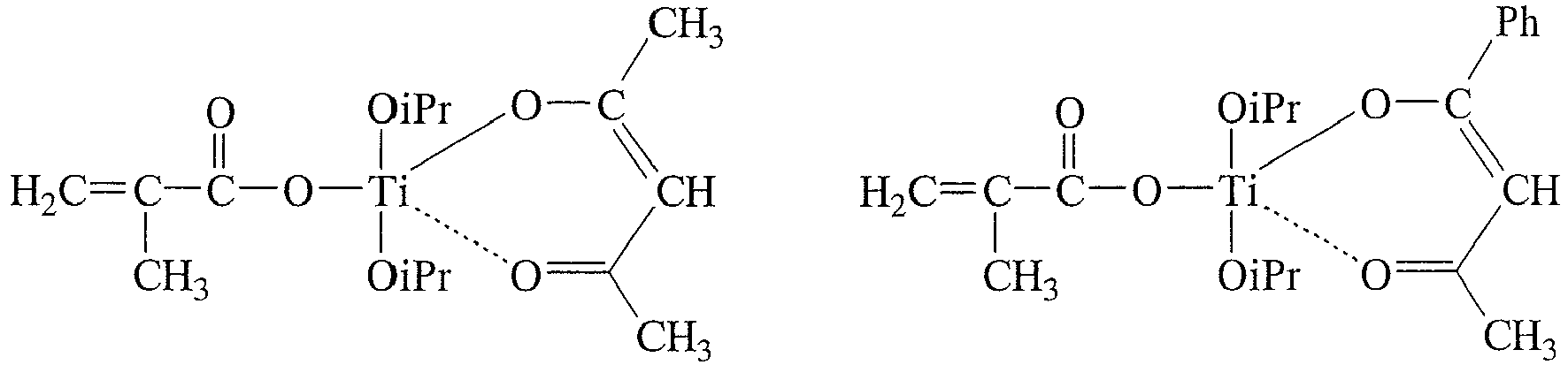


- The amount of component (B) for 100 parts by weight of component (A) should be 0.1 to 30 parts by weight, preferably 0.5 to 20 parts by weight, more preferably 1 to 15 parts by weight. With component (B) in an amount less than 0.1 parts by weight or more than 30 parts by weight, the resulting composition is poor in curability and unable to give a cured product with good resilience. An adequate amount ranges from 0.1 to 30 parts by weight.
- The composition according to the present invention should optionally be incorporated with a silane having at least two hydrolysable groups in one molecule and/or a condensate of partial hydrolyzate thereof as component (C). Component (C) effectively improves the curability of the composition of the present invention. It should have at least two hydrolysable groups bonded to silicon atoms in one molecule. A typical example of such an organosilicon compound is a silane or a condensate of partial hydrolyzate thereof, which is represented by the formula below:
RaSiZ4-a
wherein R is defined as above, Z independently denotes a hydrolyzable group, and a is an integer of 0 to 2. - The hydrolyzable group (Z) may be the same one as the hydrolyzable group (Y). Preferable among those hydrolyzable groups mentioned above are alkoxyl groups, ketoxime groups, and isopropenoxy groups, particularly ketoxime groups.
- Component (C), which is a silane or a condensate of partial hydrolyzate thereof, should essentially have at least two hydrolyzable groups in one molecule as mentioned above, without any other restrictions. It should preferably have at least three hydrolyzable groups. The silicon atom in component (C) may have any other groups than hydrolyzable groups attached thereto. Moreover, it may have the molecular structure of silane or siloxane. The siloxane structure may be linear, branched, or cyclic.
- The group (R) mentioned above, which excludes hydrolyzable groups, may be an unsubstituted or substituted monovalent hydrocarbon group having 1 to 12 carbon atoms, preferably 1 to 8 carbon atoms, as exemplified below: alkyl groups (such as methyl group, ethyl group, propyl group, butyl group, pentyl group, and hexyl group); cycloalkyl groups (such as cyclopentyl group and cyclohexyl group); aryl groups (such as phenyl group and tolyl group); aralkyl groups (such as benzyl group and 2-phenylethyl group); alkenyl groups (such as vinyl group, allyl group, butenyl group, pentenyl group, and hexenyl group); and halogenated alkyl groups (such as 3,3,3-trifluoropropyl group and 3-chloropropyl group). Preferable among these groups are methyl group, ethyl group, propyl group, phenyl group, and vinyl group.
- According to the present invention, component (C) is an organosilicon compound exemplified below:
- ethyl silicate, propyl silicate, methyltrimethoxysilane,
- methyltriethoxysilane, vinyltrimethoxysilane,
- vinyltriethoxysilane, methyltris(methoxyethoxy)silane,
- vinyltris(methoxyethoxy)silane, methyltripropenoxysilane,
- methyltriacetoxysilane, vinyltriacetoxysilane,
- methyltri(methylethylketoxime)silane,
- vinyltri(methylethylketoxime)silane,
- phenyltri(methylethylketoxime)silane,
- propyltri(methylethylketoxime)silane,
- tetra(methylethylketoxime)silane,
- 3,3,3-trifluoropropyltri(methylethylketoxime)silane,
- 3-chloropropyltri(methylethylketoxime)silane,
- methyltri(dimethylketoxime)silane,
- methyltri(diethylketoxime)silane,
- methyltri(methylisopropylketoxime)silane,
- tri(cyclohexanoxime)silane, and
- condensate of partial hydrolyzate thereof.
- Preferable among these examples are
- methyltri(methylethylketoxime)silane,
- vinyltri(methylethylketoxime)silane,
- phenyltri(methylethylketoxime)silane,
- propyltri(methylethylketoxime)silane,
- tetra(methylethylketoxime)silane,
- 3,3,3-trifluoropropyltri(methylethylketoxime)silane,
- methyltri(dimethylketoxime)silane,
- methyltri(diethylketoxime)silane,
- methyltri(methylisopropylketoxime)silane, and
- tri(cyclohexanoxime)silane.
- They may be used alone or in combination with one another.
- The amount of component (C) for 100 parts by weight of component (A) should be 0.1 to 30 parts by weight, preferably 0.5 to 20 parts by weight, more preferably 1 to 15 parts by weight. An amount less than 0.1 parts by weight is too small for component (C) to produce its effect. With component (C) in an amount more than 30 parts by weight, the resulting composition will have an excessive large cure shrinkage and will give a cured product poor in resilience.
- The composition of the present invention should preferably be incorporated with a photoinitiator known well in the industry as component (D).
- Examples of the photoinitiator are acetophenone, propiophenone, benzophenone, xanthone, fluoran, benzaldehyde, anthraquinone, triphenylamine, carbazole, 3-methylacetophenone, 4-methylacetophenone, 3-pentylacetophenone, 4-methoxyacetophenone, 2,2-diethoxyacetophenone, 3-bromoacetophenone, 4-allylacetophenone, p-diacetylbenzene, 3-methoxybenzophenone, 4-methylbenzophenone, 4-chlorobenzophenone, 4,4-dimethoxybenzophenone, 4-chloro-4-benzylbenzophenone, 3-chloroxanthone, 3,9-dichloroxanthone, 3-chloro-8-nonylxanthone, benzoin, benzoin methyl ether, benzoin butyl ether, bis(4-dimethylaminophenol)ketone, benzylmethoxyketal, and 2-chlorothioxanthone. The amount of component (D) should preferably be 0.01 to 5 parts by weight for 100 parts by weight of component (A).
- The composition of the present invention may be additionally incorporated with any known additive and filler in an amount not harmful to the effect of the present invention.
- The composition of the present invention may be incorporated with one or more accelerators for condensation reaction.
- Their examples include the following:
- tin catalysts (such as tin dioctoate, dimethyltin diversatate,
- dibutyldimethoxy tin, dibutyltin diacetate,
- dibutyltin dioctoate, dibutyltin dilaurate,
- dibutyltin dibenzylmaleate, dioctyltin dilaurate, and
- tin chelate), strongly basic compounds (such as guanidine and DBU (1,8-diazabicyclo[5.4.0]-7-undecene) and those compounds containing them including alkoxysilanes, titanate esters (such as tetraisopropoxytitanium, tetra-n-butoxytitanium, tetrakis(2-ethylhexoxy)titanium,
- dipropoxybis(acetylacetona)titanium, and
- titanium isopropoxyoctyleneglycol), and titanium chelate compounds. The amount of the accelerator should preferably be 0.001 to 20 parts by weight, particularly 0.01 to 10 parts by weight, for 100 parts by weight of component (A).
- Another optional additive is any silane coupling agent of amine type as exemplified below:
- γ-aminopropyltrimethoxysilane, γ-aminopropyltriethoxysilane,
- γ-aminopropylmethyldimethoxysilane,
- γ-aminopropylmethyldiethoxysilane,
- ethylenediaminopropyltrimethoxysilane,
- ethylenediaminopropyltriethoxysilane,
- ethylenediaminopropylmethyldimethoxysilane,
- ethylenediaminopropylmethyldiethoxysilane, and
- α-aminopropyltrimethoxysilane.
- Although an organic amine having a primary amino group may be used as an organic compound, because of its corrosiveness and odor, it is desirable to use it in the form of polymer or oligomer containing a primary amino group or a silane coupling agent (or a partial hydrolyzate thereof) containing a primary amino group as a functional group. The amount of the adhesion promoter should preferably be 0.1 to 20 parts by weight for 100 parts by weight of component (A).
- The composition of the present invention may be incorporated with other components (such as known additives for room temperature curable organopolysiloxane compositions) than mentioned above. They typically include reinforcing fillers (such as fumed silica, wet silica, precipitated silica, and calcium carbonate), metal oxides (such as aluminum oxide and zinc oxide), metal hydroxide, carbon black, glass beads, glass balloons, resin beads, and resin balloons, which may or may not have ordinary surface treatment. Additional examples include polyether (as a thixotropy improver), isoparaffin (as a plasticizer), and network polysiloxane composed of trimethylsiloxane units and SiO2 units (as a crosslink density improver). Further additional examples include colorants (such as pigment, dye, and fluorescent whitening agent), physiologically active substances (such as fungicide, antibacterial agent, cockroach repellent, and marine organism repellent), and surface improvers (such as organic liquid incompatible with silicone).
- The composition may also be diluted for improvement in coatability. Diluents for this purpose include organic solvents (such as toluene, xylene, solvent gasoline, cyclohexane, methylcyclohexane, and low-boiling isoparaffin), and volatile silanes and siloxanes.
- The photocurable organopolysiloxane composition according to the present invention can be cured by ultraviolet irradiation. The UV light should preferably be near ultraviolet light with a wavelength ranging from 10 to 400 nm, particularly 200 to 380 nm, although not specifically restricted. A well known high-pressure mercury metal halide lamps can be used. The amount of irradiation should preferably be 100 to 10,000 mJ/cm2 for the high-pressure mercury metal halide lamps, although not specifically restricted.
- Curing can be accomplished at room temperature within several seconds to one week.
- The photocurable organopolysiloxane composition according to the present invention will find use as a sealing agent, adhesive, coating material. It is capable of firm bonding to substrates.
- The following is the detailed description of the present invention which illustrates Synthesis Example, Examples, and Comparative Examples, without any intention to restrict the scope of the present invention. Incidentally, the viscosity given in the following examples is one which was measured at 25°C with a rotational viscometer.
- A solution was prepared which contains 3.02 g of titanium-methacrylate-triisopropoxide in 2 g of THF (tetrahydrofuran). It was a light-yellowish transparent liquid. Another solution was prepared which contains 1.63 g of benzoylacetone in 2.5 g of THF. The two solutions were mixed together at room temperature. They rapidly turned into an orange transparent liquid containing a complex which is the compound (A) represented by the formula below.

- A composition was prepared by uniform mixing from 100 parts by weight of dimethylpolysiloxane (blocked with hydroxyl groups at both ends) having a viscosity of 700 mPa·s and 4 parts by weight of the compound (A) in the form of solution in THF.
- A composition was prepared by uniform mixing from the composition obtained in Example 1 and 3 parts by weight of methyltrimethoxysilane.
- A composition was prepared by uniform mixing from the composition obtained in Example 1 and 0.3 parts by weight of 2,2-diethoxyacetophenone.
- A composition was prepared in the same manner as in Example 1 except that the compound (A) was not added.
- A composition was prepared in the same manner as in Example 1 except that the compound (A) was replaced by 1.6 parts by weight of benzoylacetone.
- A composition was prepared in the same manner as in Example 1 except that the compound (A) was replaced by 3.02 parts by weight of titanium-methacrylate-triisopropoxide.
- Each sample of the composition prepared as mentioned above was placed in a cylindrical glass dish (measuring about 30 mm in inside diameter and about 20 mm in depth). Then, it was cured by irradiation with ultraviolet light under the following conditions.
UV source: one high-pressure mercury lamp (80 W/cm) Distance: 10 cm Speed of transfer: 1 m/min (3 times), 1,500 mJ/cm2 - The state of curing was observed and the result was indicated in terms of the volume of cured portion (percentage), as shown in Table 1.
Table 1 Example Comparative Example 1 2 3 1 2 3 State of curing 85 90 90 0 0 20 - In respect of numerical ranges disclosed in the present description it will of course be understood that in the normal way the technical criterion for the upper limit is different from the technical criterion for the lower limit, i.e. the upper and lower limits are intrinsically distinct proposals.
Claims (9)
- A photocurable organopolysiloxane composition comprising:(A) 100 parts by weight of diorganopolysiloxane having in one molecule at least two silicon atoms having hydroxyl group and/or hydrolysable group attached thereto, and(B) 0.1 to 30 parts by weight of a complex compound composed of titanium-(meth)acrylate-trialkoxide and β-diketone.
- A photocurable organopolysiloxane composition of claim 1, wherein the complex compound of titanium-(meth)acrylate-trialkoxide and β-diketone of component (B) is a complex compound which is represented by formula (3) below:

- A photocurable organopolysiloxane composition of claim 1 or 2 wherein the complex compound of titanium-(meth)acrylate-trialkoxide and β-diketone of component (B) is a complex compound which is composed of titanium-(meth)acrylate-triisopropoxide and benzoylacetone.
- A photocurable organopolysiloxane composition of any one of claims 1 to 3, wherein component (A) is a diorganopolysiloxane having its molecular chain blocked with hydroxyl groups and/or hydrolyzable groups at both ends.
- A photocurable organopolysiloxane composition of claim 4 wherein component (A) is a diorganopolysiloxane having the following formula (1) or (2):


- A photocurable organopolysiloxane composition of any one of the preceding claims in which the diorganopolysiloxane of component (A) has a viscosity at 25°C of from 500 to 100,000 mPa.s.
- A photocurable organopolysiloxane composition of any one of claims 1 to 6 which further comprises(C) silane having at least two hydrolysable groups in one molecule, and/or a partial hydrolysate condensate thereof.
- A photocurable organopolysiloxane composition of any one of claims 1 to 7 which further comprises(D) a photoinitiator.
- Use of a composition of any one of claims 1 to 8 as a sealing agent, adhesive or coating material, in which use the composition is cured using UV light.
Applications Claiming Priority (1)
| Application Number | Priority Date | Filing Date | Title |
|---|---|---|---|
| JP2011223842A JP5640944B2 (en) | 2011-10-11 | 2011-10-11 | Curable organopolysiloxane composition |
Publications (2)
| Publication Number | Publication Date |
|---|---|
| EP2581416A1 true EP2581416A1 (en) | 2013-04-17 |
| EP2581416B1 EP2581416B1 (en) | 2014-06-11 |
Family
ID=47018867
Family Applications (1)
| Application Number | Title | Priority Date | Filing Date |
|---|---|---|---|
| EP12187669.2A Active EP2581416B1 (en) | 2011-10-11 | 2012-10-08 | Photocurable Organopolysiloxane Composition |
Country Status (6)
| Country | Link |
|---|---|
| US (1) | US8791170B2 (en) |
| EP (1) | EP2581416B1 (en) |
| JP (1) | JP5640944B2 (en) |
| KR (1) | KR101856788B1 (en) |
| CN (1) | CN103044921B (en) |
| TW (1) | TWI534206B (en) |
Families Citing this family (2)
| Publication number | Priority date | Publication date | Assignee | Title |
|---|---|---|---|---|
| JP5981577B2 (en) | 2014-12-08 | 2016-08-31 | 古河電気工業株式会社 | Resin composition for sealing electronic device and electronic device |
| KR102825352B1 (en) * | 2018-10-01 | 2025-06-26 | 다우 도레이 캄파니 리미티드 | Photo-curable organopolysiloxane composition and cured product thereof |
Citations (10)
| Publication number | Priority date | Publication date | Assignee | Title |
|---|---|---|---|---|
| JPS5240334B2 (en) | 1973-09-28 | 1977-10-12 | ||
| JPS5336515B1 (en) | 1971-07-19 | 1978-10-03 | ||
| JPS60104158A (en) | 1983-11-09 | 1985-06-08 | Shin Etsu Chem Co Ltd | Curable organopolysiloxane composition |
| JPS60215009A (en) | 1984-01-16 | 1985-10-28 | ロツクタイト コ−ポレ−シヨン | Uv curable silicone rubber composition |
| EP0539234A2 (en) * | 1991-10-23 | 1993-04-28 | Three Bond Co., Ltd. | Curable silicon composition |
| EP0610629A2 (en) * | 1992-12-14 | 1994-08-17 | Shin-Etsu Chemical Co., Ltd. | Curable organopolysiloxane compositions |
| JP2647285B2 (en) | 1991-07-23 | 1997-08-27 | 信越化学工業株式会社 | Acrylic-functional organopolysiloxane and method for producing the same |
| JP2001240620A (en) | 2000-02-25 | 2001-09-04 | Sanwha Paint Kogyo Kk | Raw material composition for high solid acrylic resin composition, high solid acrylic resin composition, coating material including high solid acrylic resin composition and method for producing high solid acrylic resin composition |
| US20030031958A1 (en) * | 2001-04-27 | 2003-02-13 | Noboru Tohge | Photosensitive composition and process for producing articles covered with a patterned film |
| EP2151480A1 (en) * | 2008-08-08 | 2010-02-10 | Shin-Etsu Chemical Co., Ltd. | Oily surface adhesive room temperature curing type organopolysiloxane composition and seal |
Family Cites Families (13)
| Publication number | Priority date | Publication date | Assignee | Title |
|---|---|---|---|---|
| US3619255A (en) * | 1969-11-10 | 1971-11-09 | Stauffer Wacker Silicone Corp | Substrate coated with an organopolysiloxane employing a primer comprising a titanate and an organopolysilicate |
| GB1323869A (en) | 1970-10-29 | 1973-07-18 | Dainippon Printing Co Ltd | Photopolymerizable compositions |
| JPS5240334A (en) | 1975-09-27 | 1977-03-29 | Mitsubishi Paper Mills Ltd | Method of processing color photographic elements |
| US4098155A (en) | 1976-09-17 | 1978-07-04 | The Fletcher-Terry Company | Self-compensating scoring head |
| US4921880A (en) * | 1988-08-15 | 1990-05-01 | Dow Corning Corporation | Adhesion promoter for UV curable siloxane compositions and compositions containing same |
| US5391677A (en) | 1991-07-23 | 1995-02-21 | Shin-Etsu Chemical Co., Ltd. | Acrylic-functional organopolysiloxane and method for the preparation thereof |
| JPH09255782A (en) * | 1996-03-25 | 1997-09-30 | Nippon Steel Corp | Photocurable inorganic / organic hybrid material and three-dimensional optical waveguide composed of it |
| JP3539167B2 (en) * | 1996-12-05 | 2004-07-07 | 信越化学工業株式会社 | Primer composition |
| US6512037B1 (en) * | 2001-06-06 | 2003-01-28 | Dow Corning Corporation | Silicone composition and cured silicone product |
| JP4864421B2 (en) * | 2005-11-08 | 2012-02-01 | マツモトファインケミカル株式会社 | Curable composition |
| DE102007038030B4 (en) * | 2007-08-10 | 2009-07-09 | Henkel Ag & Co. Kgaa | Curable compositions of dimethoxysilanes |
| US8385969B2 (en) | 2008-01-29 | 2013-02-26 | Telefonaktiebolaget Lm Ericsson (Publ) | Method of transmitting TPC commands |
| BR112013005450B1 (en) | 2010-09-10 | 2019-05-07 | Jfe Steel Corporation | ELECTRIC STEEL SHEET WITH ORIENTED GRAIN AND METHOD FOR PRODUCTION OF THE SAME. |
-
2011
- 2011-10-11 JP JP2011223842A patent/JP5640944B2/en active Active
-
2012
- 2012-10-04 US US13/644,774 patent/US8791170B2/en not_active Expired - Fee Related
- 2012-10-05 TW TW101136854A patent/TWI534206B/en active
- 2012-10-08 EP EP12187669.2A patent/EP2581416B1/en active Active
- 2012-10-10 KR KR1020120112269A patent/KR101856788B1/en active Active
- 2012-10-11 CN CN201210383083.8A patent/CN103044921B/en active Active
Patent Citations (10)
| Publication number | Priority date | Publication date | Assignee | Title |
|---|---|---|---|---|
| JPS5336515B1 (en) | 1971-07-19 | 1978-10-03 | ||
| JPS5240334B2 (en) | 1973-09-28 | 1977-10-12 | ||
| JPS60104158A (en) | 1983-11-09 | 1985-06-08 | Shin Etsu Chem Co Ltd | Curable organopolysiloxane composition |
| JPS60215009A (en) | 1984-01-16 | 1985-10-28 | ロツクタイト コ−ポレ−シヨン | Uv curable silicone rubber composition |
| JP2647285B2 (en) | 1991-07-23 | 1997-08-27 | 信越化学工業株式会社 | Acrylic-functional organopolysiloxane and method for producing the same |
| EP0539234A2 (en) * | 1991-10-23 | 1993-04-28 | Three Bond Co., Ltd. | Curable silicon composition |
| EP0610629A2 (en) * | 1992-12-14 | 1994-08-17 | Shin-Etsu Chemical Co., Ltd. | Curable organopolysiloxane compositions |
| JP2001240620A (en) | 2000-02-25 | 2001-09-04 | Sanwha Paint Kogyo Kk | Raw material composition for high solid acrylic resin composition, high solid acrylic resin composition, coating material including high solid acrylic resin composition and method for producing high solid acrylic resin composition |
| US20030031958A1 (en) * | 2001-04-27 | 2003-02-13 | Noboru Tohge | Photosensitive composition and process for producing articles covered with a patterned film |
| EP2151480A1 (en) * | 2008-08-08 | 2010-02-10 | Shin-Etsu Chemical Co., Ltd. | Oily surface adhesive room temperature curing type organopolysiloxane composition and seal |
Non-Patent Citations (1)
| Title |
|---|
| CHEMISTRY LETTERS, vol. 35, no. 10, 2006, pages 1130 - 1131 |
Also Published As
| Publication number | Publication date |
|---|---|
| JP5640944B2 (en) | 2014-12-17 |
| CN103044921A (en) | 2013-04-17 |
| KR101856788B1 (en) | 2018-05-10 |
| TW201331297A (en) | 2013-08-01 |
| US20130090408A1 (en) | 2013-04-11 |
| US8791170B2 (en) | 2014-07-29 |
| EP2581416B1 (en) | 2014-06-11 |
| JP2013082815A (en) | 2013-05-09 |
| CN103044921B (en) | 2017-03-01 |
| TWI534206B (en) | 2016-05-21 |
| KR20130039304A (en) | 2013-04-19 |
Similar Documents
| Publication | Publication Date | Title |
|---|---|---|
| CN104884461B (en) | Alkoxysilyl-ethylene-terminated silicon-containing compound, organopolysiloxane composition, and molded product obtained from the composition | |
| JP7557268B2 (en) | Method for producing room temperature curable organopolysiloxane composition, room temperature curable organopolysiloxane composition and article, and sealing material for automobile headlights | |
| US20170306099A1 (en) | Multicomponent room temperature-curable organopolysiloxane composition, cured product of said composition, and molded product comprising said cured product | |
| JP6747507B2 (en) | Room temperature curable composition, sealant and article | |
| CN101945951B (en) | Polyorganosiloxane composition solidifiable under room temperature | |
| JPWO2016117206A1 (en) | Room temperature curable organopolysiloxane composition | |
| JP2024117823A (en) | Two-component room temperature fast curing organopolysiloxane composition, cured product and article of said composition, and method for curing room temperature fast curing organopolysiloxane composition | |
| JP2006131824A (en) | Room temperature curable organopolysiloxane composition | |
| EP2581416B1 (en) | Photocurable Organopolysiloxane Composition | |
| WO2023068094A1 (en) | Room temperature-curable organopolysiloxane composition, adhesive, sealing agent, and coating agent | |
| JP6319168B2 (en) | Method for producing condensation reaction product, method for producing room temperature curable organopolysiloxane composition containing the condensation reaction product | |
| JP6217584B2 (en) | Room temperature curable organopolysiloxane composition | |
| CN115605545A (en) | Curable polyorganosiloxane composition and electronic part | |
| JP7770743B2 (en) | Two-component curable organopolysiloxane composition | |
| WO2014185276A1 (en) | Aluminium chelate compound, and room-temperature-curable resin composition including same | |
| KR102298513B1 (en) | Moisture-curable siloxanes composition | |
| JP2010120984A (en) | Flame-retardant polyorganosiloxane composition for sealing electronic component | |
| KR20220088709A (en) | Polyorganosiloxane composition for adhesion of polyphenylene sulfide resin | |
| US20220056326A1 (en) | Adhesive polyorganosiloxane composition | |
| JP2002348476A (en) | Room temperature curable polyorganosiloxane composition | |
| JP5569461B2 (en) | Articles bonded with room temperature curable organopolysiloxane compositions | |
| JP5734567B2 (en) | Room temperature curable polyorganosiloxane composition | |
| JP6690737B2 (en) | Novel arylene group-containing organopolysiloxane and curable organopolysiloxane composition using the same | |
| EP4328261A1 (en) | Room-temperature-curable silicone coating composition and article | |
| JP5915599B2 (en) | Room temperature curable resin composition |
Legal Events
| Date | Code | Title | Description |
|---|---|---|---|
| PUAI | Public reference made under article 153(3) epc to a published international application that has entered the european phase |
Free format text: ORIGINAL CODE: 0009012 |
|
| AK | Designated contracting states |
Kind code of ref document: A1 Designated state(s): AL AT BE BG CH CY CZ DE DK EE ES FI FR GB GR HR HU IE IS IT LI LT LU LV MC MK MT NL NO PL PT RO RS SE SI SK SM TR |
|
| AX | Request for extension of the european patent |
Extension state: BA ME |
|
| 17P | Request for examination filed |
Effective date: 20130724 |
|
| RBV | Designated contracting states (corrected) |
Designated state(s): AL AT BE BG CH CY CZ DE DK EE ES FI FR GB GR HR HU IE IS IT LI LT LU LV MC MK MT NL NO PL PT RO RS SE SI SK SM TR |
|
| RIC1 | Information provided on ipc code assigned before grant |
Ipc: C08K 5/00 20060101ALI20131015BHEP Ipc: G03F 7/26 20060101ALI20131015BHEP Ipc: C08L 83/04 20060101AFI20131015BHEP |
|
| GRAP | Despatch of communication of intention to grant a patent |
Free format text: ORIGINAL CODE: EPIDOSNIGR1 |
|
| INTG | Intention to grant announced |
Effective date: 20131125 |
|
| GRAP | Despatch of communication of intention to grant a patent |
Free format text: ORIGINAL CODE: EPIDOSNIGR1 |
|
| INTG | Intention to grant announced |
Effective date: 20140225 |
|
| GRAS | Grant fee paid |
Free format text: ORIGINAL CODE: EPIDOSNIGR3 |
|
| GRAA | (expected) grant |
Free format text: ORIGINAL CODE: 0009210 |
|
| AK | Designated contracting states |
Kind code of ref document: B1 Designated state(s): AL AT BE BG CH CY CZ DE DK EE ES FI FR GB GR HR HU IE IS IT LI LT LU LV MC MK MT NL NO PL PT RO RS SE SI SK SM TR |
|
| REG | Reference to a national code |
Ref country code: GB Ref legal event code: FG4D |
|
| REG | Reference to a national code |
Ref country code: CH Ref legal event code: EP |
|
| REG | Reference to a national code |
Ref country code: IE Ref legal event code: FG4D |
|
| REG | Reference to a national code |
Ref country code: AT Ref legal event code: REF Ref document number: 672252 Country of ref document: AT Kind code of ref document: T Effective date: 20140715 |
|
| REG | Reference to a national code |
Ref country code: DE Ref legal event code: R096 Ref document number: 602012002043 Country of ref document: DE Effective date: 20140724 |
|
| PG25 | Lapsed in a contracting state [announced via postgrant information from national office to epo] |
Ref country code: GR Free format text: LAPSE BECAUSE OF FAILURE TO SUBMIT A TRANSLATION OF THE DESCRIPTION OR TO PAY THE FEE WITHIN THE PRESCRIBED TIME-LIMIT Effective date: 20140912 Ref country code: FI Free format text: LAPSE BECAUSE OF FAILURE TO SUBMIT A TRANSLATION OF THE DESCRIPTION OR TO PAY THE FEE WITHIN THE PRESCRIBED TIME-LIMIT Effective date: 20140611 Ref country code: NO Free format text: LAPSE BECAUSE OF FAILURE TO SUBMIT A TRANSLATION OF THE DESCRIPTION OR TO PAY THE FEE WITHIN THE PRESCRIBED TIME-LIMIT Effective date: 20140911 Ref country code: LT Free format text: LAPSE BECAUSE OF FAILURE TO SUBMIT A TRANSLATION OF THE DESCRIPTION OR TO PAY THE FEE WITHIN THE PRESCRIBED TIME-LIMIT Effective date: 20140611 |
|
| REG | Reference to a national code |
Ref country code: NL Ref legal event code: VDEP Effective date: 20140611 |
|
| REG | Reference to a national code |
Ref country code: AT Ref legal event code: MK05 Ref document number: 672252 Country of ref document: AT Kind code of ref document: T Effective date: 20140611 |
|
| REG | Reference to a national code |
Ref country code: LT Ref legal event code: MG4D |
|
| PG25 | Lapsed in a contracting state [announced via postgrant information from national office to epo] |
Ref country code: SE Free format text: LAPSE BECAUSE OF FAILURE TO SUBMIT A TRANSLATION OF THE DESCRIPTION OR TO PAY THE FEE WITHIN THE PRESCRIBED TIME-LIMIT Effective date: 20140611 Ref country code: HR Free format text: LAPSE BECAUSE OF FAILURE TO SUBMIT A TRANSLATION OF THE DESCRIPTION OR TO PAY THE FEE WITHIN THE PRESCRIBED TIME-LIMIT Effective date: 20140611 Ref country code: RS Free format text: LAPSE BECAUSE OF FAILURE TO SUBMIT A TRANSLATION OF THE DESCRIPTION OR TO PAY THE FEE WITHIN THE PRESCRIBED TIME-LIMIT Effective date: 20140611 Ref country code: LV Free format text: LAPSE BECAUSE OF FAILURE TO SUBMIT A TRANSLATION OF THE DESCRIPTION OR TO PAY THE FEE WITHIN THE PRESCRIBED TIME-LIMIT Effective date: 20140611 |
|
| PG25 | Lapsed in a contracting state [announced via postgrant information from national office to epo] |
Ref country code: ES Free format text: LAPSE BECAUSE OF FAILURE TO SUBMIT A TRANSLATION OF THE DESCRIPTION OR TO PAY THE FEE WITHIN THE PRESCRIBED TIME-LIMIT Effective date: 20140611 Ref country code: PT Free format text: LAPSE BECAUSE OF FAILURE TO SUBMIT A TRANSLATION OF THE DESCRIPTION OR TO PAY THE FEE WITHIN THE PRESCRIBED TIME-LIMIT Effective date: 20141013 Ref country code: RO Free format text: LAPSE BECAUSE OF FAILURE TO SUBMIT A TRANSLATION OF THE DESCRIPTION OR TO PAY THE FEE WITHIN THE PRESCRIBED TIME-LIMIT Effective date: 20140611 Ref country code: EE Free format text: LAPSE BECAUSE OF FAILURE TO SUBMIT A TRANSLATION OF THE DESCRIPTION OR TO PAY THE FEE WITHIN THE PRESCRIBED TIME-LIMIT Effective date: 20140611 Ref country code: CZ Free format text: LAPSE BECAUSE OF FAILURE TO SUBMIT A TRANSLATION OF THE DESCRIPTION OR TO PAY THE FEE WITHIN THE PRESCRIBED TIME-LIMIT Effective date: 20140611 Ref country code: SK Free format text: LAPSE BECAUSE OF FAILURE TO SUBMIT A TRANSLATION OF THE DESCRIPTION OR TO PAY THE FEE WITHIN THE PRESCRIBED TIME-LIMIT Effective date: 20140611 |
|
| PG25 | Lapsed in a contracting state [announced via postgrant information from national office to epo] |
Ref country code: IS Free format text: LAPSE BECAUSE OF FAILURE TO SUBMIT A TRANSLATION OF THE DESCRIPTION OR TO PAY THE FEE WITHIN THE PRESCRIBED TIME-LIMIT Effective date: 20141011 Ref country code: NL Free format text: LAPSE BECAUSE OF FAILURE TO SUBMIT A TRANSLATION OF THE DESCRIPTION OR TO PAY THE FEE WITHIN THE PRESCRIBED TIME-LIMIT Effective date: 20140611 Ref country code: AT Free format text: LAPSE BECAUSE OF FAILURE TO SUBMIT A TRANSLATION OF THE DESCRIPTION OR TO PAY THE FEE WITHIN THE PRESCRIBED TIME-LIMIT Effective date: 20140611 Ref country code: PL Free format text: LAPSE BECAUSE OF FAILURE TO SUBMIT A TRANSLATION OF THE DESCRIPTION OR TO PAY THE FEE WITHIN THE PRESCRIBED TIME-LIMIT Effective date: 20140611 |
|
| REG | Reference to a national code |
Ref country code: DE Ref legal event code: R097 Ref document number: 602012002043 Country of ref document: DE |
|
| PLBE | No opposition filed within time limit |
Free format text: ORIGINAL CODE: 0009261 |
|
| STAA | Information on the status of an ep patent application or granted ep patent |
Free format text: STATUS: NO OPPOSITION FILED WITHIN TIME LIMIT |
|
| PG25 | Lapsed in a contracting state [announced via postgrant information from national office to epo] |
Ref country code: IT Free format text: LAPSE BECAUSE OF FAILURE TO SUBMIT A TRANSLATION OF THE DESCRIPTION OR TO PAY THE FEE WITHIN THE PRESCRIBED TIME-LIMIT Effective date: 20140611 Ref country code: DK Free format text: LAPSE BECAUSE OF FAILURE TO SUBMIT A TRANSLATION OF THE DESCRIPTION OR TO PAY THE FEE WITHIN THE PRESCRIBED TIME-LIMIT Effective date: 20140611 |
|
| 26N | No opposition filed |
Effective date: 20150312 |
|
| PG25 | Lapsed in a contracting state [announced via postgrant information from national office to epo] |
Ref country code: MC Free format text: LAPSE BECAUSE OF FAILURE TO SUBMIT A TRANSLATION OF THE DESCRIPTION OR TO PAY THE FEE WITHIN THE PRESCRIBED TIME-LIMIT Effective date: 20140611 Ref country code: LU Free format text: LAPSE BECAUSE OF FAILURE TO SUBMIT A TRANSLATION OF THE DESCRIPTION OR TO PAY THE FEE WITHIN THE PRESCRIBED TIME-LIMIT Effective date: 20141008 |
|
| REG | Reference to a national code |
Ref country code: DE Ref legal event code: R097 Ref document number: 602012002043 Country of ref document: DE Effective date: 20150312 |
|
| REG | Reference to a national code |
Ref country code: IE Ref legal event code: MM4A |
|
| PG25 | Lapsed in a contracting state [announced via postgrant information from national office to epo] |
Ref country code: SI Free format text: LAPSE BECAUSE OF FAILURE TO SUBMIT A TRANSLATION OF THE DESCRIPTION OR TO PAY THE FEE WITHIN THE PRESCRIBED TIME-LIMIT Effective date: 20140611 |
|
| PG25 | Lapsed in a contracting state [announced via postgrant information from national office to epo] |
Ref country code: IE Free format text: LAPSE BECAUSE OF NON-PAYMENT OF DUE FEES Effective date: 20141008 |
|
| REG | Reference to a national code |
Ref country code: CH Ref legal event code: PL |
|
| PG25 | Lapsed in a contracting state [announced via postgrant information from national office to epo] |
Ref country code: CY Free format text: LAPSE BECAUSE OF FAILURE TO SUBMIT A TRANSLATION OF THE DESCRIPTION OR TO PAY THE FEE WITHIN THE PRESCRIBED TIME-LIMIT Effective date: 20140611 Ref country code: BG Free format text: LAPSE BECAUSE OF FAILURE TO SUBMIT A TRANSLATION OF THE DESCRIPTION OR TO PAY THE FEE WITHIN THE PRESCRIBED TIME-LIMIT Effective date: 20140611 |
|
| PG25 | Lapsed in a contracting state [announced via postgrant information from national office to epo] |
Ref country code: CH Free format text: LAPSE BECAUSE OF NON-PAYMENT OF DUE FEES Effective date: 20151031 Ref country code: LI Free format text: LAPSE BECAUSE OF NON-PAYMENT OF DUE FEES Effective date: 20151031 Ref country code: MT Free format text: LAPSE BECAUSE OF FAILURE TO SUBMIT A TRANSLATION OF THE DESCRIPTION OR TO PAY THE FEE WITHIN THE PRESCRIBED TIME-LIMIT Effective date: 20140611 Ref country code: HU Free format text: LAPSE BECAUSE OF FAILURE TO SUBMIT A TRANSLATION OF THE DESCRIPTION OR TO PAY THE FEE WITHIN THE PRESCRIBED TIME-LIMIT; INVALID AB INITIO Effective date: 20121008 Ref country code: TR Free format text: LAPSE BECAUSE OF FAILURE TO SUBMIT A TRANSLATION OF THE DESCRIPTION OR TO PAY THE FEE WITHIN THE PRESCRIBED TIME-LIMIT Effective date: 20140611 Ref country code: BE Free format text: LAPSE BECAUSE OF FAILURE TO SUBMIT A TRANSLATION OF THE DESCRIPTION OR TO PAY THE FEE WITHIN THE PRESCRIBED TIME-LIMIT Effective date: 20140611 |
|
| REG | Reference to a national code |
Ref country code: FR Ref legal event code: PLFP Year of fee payment: 5 |
|
| PG25 | Lapsed in a contracting state [announced via postgrant information from national office to epo] |
Ref country code: SM Free format text: LAPSE BECAUSE OF FAILURE TO SUBMIT A TRANSLATION OF THE DESCRIPTION OR TO PAY THE FEE WITHIN THE PRESCRIBED TIME-LIMIT Effective date: 20140611 |
|
| REG | Reference to a national code |
Ref country code: FR Ref legal event code: PLFP Year of fee payment: 6 |
|
| PG25 | Lapsed in a contracting state [announced via postgrant information from national office to epo] |
Ref country code: MK Free format text: LAPSE BECAUSE OF FAILURE TO SUBMIT A TRANSLATION OF THE DESCRIPTION OR TO PAY THE FEE WITHIN THE PRESCRIBED TIME-LIMIT Effective date: 20140611 |
|
| REG | Reference to a national code |
Ref country code: FR Ref legal event code: PLFP Year of fee payment: 7 |
|
| PG25 | Lapsed in a contracting state [announced via postgrant information from national office to epo] |
Ref country code: AL Free format text: LAPSE BECAUSE OF FAILURE TO SUBMIT A TRANSLATION OF THE DESCRIPTION OR TO PAY THE FEE WITHIN THE PRESCRIBED TIME-LIMIT Effective date: 20140611 |
|
| PGFP | Annual fee paid to national office [announced via postgrant information from national office to epo] |
Ref country code: GB Payment date: 20240829 Year of fee payment: 13 |
|
| PGFP | Annual fee paid to national office [announced via postgrant information from national office to epo] |
Ref country code: FR Payment date: 20240909 Year of fee payment: 13 |
|
| PGFP | Annual fee paid to national office [announced via postgrant information from national office to epo] |
Ref country code: DE Payment date: 20240828 Year of fee payment: 13 |