EP2579136A1 - Vorrichtung mit benutzerdefinierbaren Steuerungen - Google Patents
Vorrichtung mit benutzerdefinierbaren Steuerungen Download PDFInfo
- Publication number
- EP2579136A1 EP2579136A1 EP11183882.7A EP11183882A EP2579136A1 EP 2579136 A1 EP2579136 A1 EP 2579136A1 EP 11183882 A EP11183882 A EP 11183882A EP 2579136 A1 EP2579136 A1 EP 2579136A1
- Authority
- EP
- European Patent Office
- Prior art keywords
- touchscreen
- input
- subset
- processor
- virtual keys
- Prior art date
- Legal status (The legal status is an assumption and is not a legal conclusion. Google has not performed a legal analysis and makes no representation as to the accuracy of the status listed.)
- Granted
Links
Images





Classifications
-
- G—PHYSICS
- G06—COMPUTING OR CALCULATING; COUNTING
- G06F—ELECTRIC DIGITAL DATA PROCESSING
- G06F3/00—Input arrangements for transferring data to be processed into a form capable of being handled by the computer; Output arrangements for transferring data from processing unit to output unit, e.g. interface arrangements
- G06F3/01—Input arrangements or combined input and output arrangements for interaction between user and computer
- G06F3/048—Interaction techniques based on graphical user interfaces [GUI]
- G06F3/0487—Interaction techniques based on graphical user interfaces [GUI] using specific features provided by the input device, e.g. functions controlled by the rotation of a mouse with dual sensing arrangements, or of the nature of the input device, e.g. tap gestures based on pressure sensed by a digitiser
- G06F3/0488—Interaction techniques based on graphical user interfaces [GUI] using specific features provided by the input device, e.g. functions controlled by the rotation of a mouse with dual sensing arrangements, or of the nature of the input device, e.g. tap gestures based on pressure sensed by a digitiser using a touch-screen or digitiser, e.g. input of commands through traced gestures
- G06F3/04886—Interaction techniques based on graphical user interfaces [GUI] using specific features provided by the input device, e.g. functions controlled by the rotation of a mouse with dual sensing arrangements, or of the nature of the input device, e.g. tap gestures based on pressure sensed by a digitiser using a touch-screen or digitiser, e.g. input of commands through traced gestures by partitioning the display area of the touch-screen or the surface of the digitising tablet into independently controllable areas, e.g. virtual keyboards or menus
-
- G—PHYSICS
- G06—COMPUTING OR CALCULATING; COUNTING
- G06F—ELECTRIC DIGITAL DATA PROCESSING
- G06F2203/00—Indexing scheme relating to G06F3/00 - G06F3/048
- G06F2203/048—Indexing scheme relating to G06F3/048
- G06F2203/04803—Split screen, i.e. subdividing the display area or the window area into separate subareas
Definitions
- the present invention relates generally to touchscreen devices, and more particularly to a touchscreen device with customizable controls and method therefor.
- a touchscreen device in accordance with another aspect of the invention, there is provided a touchscreen device.
- the touchscreen device includes a processor and a touchscreen.
- the processor is operably configured to receive input indicative of populating a subset from a set of given input elements.
- the subset is for providing application input data to a computer application.
- the subset is displayable on the touchscreen.
- the processor is further operably configured to render the subset on the touchscreen such that the subset is operably configured to receive the application input data.
- the processor may be operably configured to receive further input indicative of a selection of a display area.
- the display area is for rendering output from the computer application.
- the display area is smaller than the touchscreen.
- the processor may be operably configured to scale the output such that the output is completely rendered within the display area.
- the processor may be operably configured to receive further input indicative of a selection of a location on the touchscreen such that a selected input element of the subset is rendered at the location.
- the processor may be operably configured to receive input indicative of populating the subset may be further operably configured to receive data indicative of a selection from a list.
- the set of given input elements may include virtual keyboard keys rendered at the touchscreen.
- a method involving receiving, at a touchscreen device including a touchscreen, input indicative of populating a subset from a set of given input elements.
- the subset is for providing application input data to a computer application.
- the subset is displayable on the touchscreen.
- the method further involves rendering the subset on the touchscreen such that the subset is operably configured to receive the application input data.
- the method may involve receiving further input indicative of a selection of a display area.
- the display area is for rendering output from the computer application.
- the display area is smaller than the touchscreen.
- the method may also involve scaling the output such that the output is rendered within the display area.
- Rendering the subset of the input elements on the touchscreen may involve rendering the subset of the input elements outside the display area.
- the method may additionally involve receiving further input indicative of a selection of a location on the touchscreen such that a selected input element of the subset is rendered at the location.
- the input indicative of populating the subset may include data indicative of a drag-and-drop selection on the touchscreen.
- Receiving the input indicative of populating the subset may involve receiving data indicative of a selection from a list.
- the list may include input elements of the set of given input elements.
- the list may include combinations of the input elements of the set of given input elements.
- Receiving the input indicative of populating the subset may involve receiving data from an input device other than the touchscreen.
- the set of given input elements may include virtual keyboard keys rendered at the touchscreen.
- the method may further involve downloading the computer application into a memory of the touchscreen device through a network connection.
- the method may also involve executing the computer application on the touchscreen device.
- a touchscreen device in accordance with yet another aspect of the invention there is provided a touchscreen device.
- the touchscreen device includes a touchscreen and a processor.
- the touchscreen device further includes means for receiving input indicative of populating a subset from a set of given input elements.
- the subset is for providing application input data to a computer application.
- the subset is displayable on the touchscreen.
- the touchscreen device also includes means for rendering the subset on the touchscreen such that the subset is operably configured to receive the application input data.
- a non-transitory computer readable medium encoded with codes.
- the codes are for directing a processor to receive input indicative of populating a subset from a set of given input elements.
- the subset is for providing application input data to a computer application.
- the subset is displayable on the touchscreen.
- the codes are also for directing a processor to render the subset on the touchscreen such that the subset is operably configured to receive the application input data.
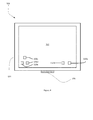
- Figure 1 is a front view of a touchscreen device with customizable controls, according to non-limiting implementations
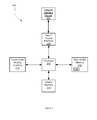
- Figure 2 is a schematic block diagram of the touchscreen device shown in Figure 1 ;
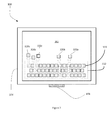
- Figure 3 is a front view of the touchscreen device shown in Figure 1 , with a screen shot of a virtual keyboard;
- Figure 4 is a front view of the touchscreen device shown in Figure 1 with a screen shot of a plurality of virtual keys;
- Figure 5 is a front view of the touchscreen device shown in Figure 1 with a screen shot of a plurality of virtual keys of different sizes and shapes;
- Figure 6 is a block diagram of a method for customizing controls at the touchscreen device of Figure. 1 ;
- Figure 7 is a front view of the touchscreen device shown in Figure 1 with a screen shot of a display area showing drag-and-drop function;
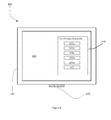
- Figure 8 is a front view of the touchscreen device shown in Figure 1 with a screen shot of a display area showing a list for selection;
- Figure 9 is a front view of the touchscreen device shown in Figure 1 with a screen shot of a display area
- Figure 10 is a block diagram of a method for rendering input elements at the touchscreen device of Figure 1 .
- a touchscreen device according to an implementation for providing customizable controls is shown generally at 100 .
- the device 100 includes a touchscreen 102 and a body 104 .
- the touchscreen device 100 also includes a connector 106 for connecting the touchscreen device 100 to another device (not shown).
- the other device may include a computer, an input device, an output device or another touchscreen device 100 .
- touchscreen technologies that are suitable for the touchscreen 102 of the touchscreen device 100 are resistive system touchscreens, capacitive system touchscreens and surface acoustic wave system touchscreens.
- other touchscreen technologies may be used with the touchscreen device 100 .
- alternative means by which input may be received over a screen can be suitably.
- the body 104 is a durable lightweight material.
- the material should be lightweight so that the touchscreen device 100 is light and easy to carry, making the device more portable.
- the material should also be durable to protect the internal components of the touchscreen device 100 .
- a suitable material to use for the body is plastic.
- Polycarbonate/Acrylonitrile Butadiene Styrene blends may be particularly suitable for the body 104 .
- other materials such as metal and metal alloys with suitable characteristics for an electronic device may be used.
- the touchscreen device 100 includes a battery (not shown) to power the device.
- the connector 106 is primarily for supplying power to charge the battery in the touchscreen device 100 when connected to a power source.
- the connector 106 may also be used to connect the touchscreen device 100 to another device for data sharing.
- the touchscreen device 100 may be connected to a personal computer through the connector 106 in order to download programs onto the device. Therefore, the connector 106 may be a standard USBTM connector; however, any other type of connector capable of charging the touchscreen device 100 or providing data sharing capabilities would be suitable.
- the touchscreen device 100 can be any type of touchscreen device that can be used in a self-contained manner.
- the touchscreen device 100 is enabled to perform various functions which include rendering information on the touchscreen 102 .
- the touchscreen device 100 is also enabled to receive input from the touchscreen 102 .
- the touchscreen device 100 comprises a tablet computing device.
- other implementations may comprise other types of touchscreen devices with a touchscreen, such as smart phones or personal gaming consoles.
- other implementations may even comprise a laptop computer, or a monitor set with a touchscreen interface.
- the touchscreen device 100 includes a processor 205 , a touchscreen display interface 210 , a non-volatile memory 212 , a volatile memory 214 , and an input / output interface 220 all in communication with the processor 205 .
- the structure in Figure 2 is purely exemplary, and contemplates a touchscreen device 100 that can be used for both wireless voice (e.g. telephony) and wireless data (e.g. email, web browsing, text) communications.
- the touchscreen display interface 210 is in communication with the processor 205 and the touchscreen 102 .
- Processor 205 is configured to communicate with non-volatile memory 212 and volatile memory 214 as needed during operation.
- non-volatile memory 212 include any type of non-transitory computer readable medium, Erasable Electronic Programmable Read Only Memory (“EEPROM”), Flash Memory, and as well as any other type of memory where the contents of the memory are preserved if the memory is powered off.
- Examples of volatile memory include random access memory (“RAM”) as well as any other type of memory where the contents are lost once the memory is powered off.
- non-volatile memory 212 and volatile memory 214 are examples of computer readable media that can store programming instructions executable on processor 205 .
- non-volatile memory 212 can store a computer application 230 , which can be processed by processor 205 .
- applications include games, educational programs, map applications, e-readers, and any other type of applications typically available for a touchscreen device.
- the Input / Output interface 220 is in communication with the processor 205 and a network interface device 225 .
- the network interface device 225 connects the touchscreen device 100 to a network for downloading the computer application 230 through the network into the non-volatile memory 212. Therefore, the network interface device 225 may be in communication with the connector 106. Alternatively, the network interface device 225 may also be connected to a network wirelessly using technologies such as Wi-FiTM, BluetoothTM, and cellular networks.
- a user input / output interface may connect a processor to other devices such as a display device (eg. cathode ray tube, liquid crystal display, plasma display, organic light emitting diode), speakers, microphones, buttons or keys on a touchscreen device, an external keyboard or a pointer device.
- a display device eg. cathode ray tube, liquid crystal display, plasma display, organic light emitting diode
- speakers e.g. cathode ray tube, liquid crystal display, plasma display, organic light emitting diode
- the touchscreen device 100 is shown with a virtual keyboard 310 rendered on the touchscreen 102 .
- the virtual keyboard 310 provides a set of given input elements where each input element is represented by a virtual key 320 .
- Each virtual key 320 is configured to receive input on the touchscreen through any suitable touchscreen mechanisms. The input from the touchscreen is then communicated via the touchscreen display interface 210 to the processor 205 .
- the virtual keyboard 310 may include a layout similar to one that is normally on a physical keyboard. It will be appreciated that the specific layout of a physical keyboard varies depending on the country where the keyboard is intended to be used. Furthermore, the virtual keyboard 310 may be compressed or otherwise slightly modified to allow it to fit on the touchscreen 102 . During operation of the touchscreen device 100 , the virtual keyboard 310 may appear on the touchscreen 102 when an application requests keyboard input. During periods where no keyboard input is requested, the virtual keyboard 310 may be hidden so that the keyboard does not obstruct the output rendered to the touchscreen 102 . Hiding of the virtual keyboard 310 may be initiated when an application no longer requires any input to be received from the touchscreen. In addition, the virtual keyboard may also be hidden after an automatic time-out indication is generated after a determined period of inactivity at the touchscreen 102 .
- a touchscreen device may allow for the use of a physical keyboard connected to the device through the connector.
- the physical keyboard may be directly connected to the connector, or it may be connected through a docking station.
- another type of touchscreen device may also include a physical keyboard permanently attached to the touchscreen device, for example as in a laptop. In both of these cases, the physical keyboard would provide a set of given input elements to a processor.
- the touchscreen device 100 is shown with a subset of input elements rendered at touchscreen 102 .
- the subset of input elements is a plurality of virtual keys 320 a-e.
- the plurality of virtual keys 320 a-e is configured to receive data corresponding to application input data requested during execution of the computer application 230 .
- Application input data includes input data that the computer application 230 may frequently request while it is running. For example, if the computer application 230 is a video game requiring input data corresponding to the arrow keys of a keyboard, the application input data would be data corresponding to the arrow keys of a keyboard.
- the plurality of virtual keys 320 a-e will remain on the touchscreen as long as the computer application 230 is running.
- the touchscreen device 100 is shown with a subset of input elements rendered at touchscreen 102 in accordance with another implementation.
- the subset of input elements is a plurality of virtual keys 325 a-e.
- the plurality of virtual keys 325 a-e is similar to the plurality of virtual keys 320 a-e discussed above in connection with Figure 4 and each virtual keys 325 a-e may correspond to each of the virtual keys 320 a-e respectively.
- the plurality of virtual keys 325 a-e is configured to receive data corresponding to application input data requested during execution of the computer application 230 .
- the processor 205 has changed the size and shape of the virtual keys 320 a-e into various sizes and shapes of the virtual keys 325 a-e. For example, once virtual keys 320a-3 are selected and/or populates, further input can be received at touchscreen device 102, the further input indicative that a shape and/or size virtual keys 320a-e are to be changes, resulting in virtual keys 325a-e.
- Any suitable method can be used to indicate that a change in shape and/or size of virtual keys 320a-e are to occur, including but not limited to choosing new shapes and/or sizes from a menu, touchscreen input, input indicative that a shape of a given side of a given virtual key 320a-e is to be changes, and the like.
- virtual keys 325 a and 325 c are rendered as an irregular polygon and circle respectively, for example. Further, virtual keys 325 d and 325 e are rendered in a larger size than corresponding virtual keys 320 d and 320 e and virtual key 325 b is rendered in a smaller size than corresponding virtual keys 320 b.
- shapes are not limited to squares, irregular, polygons and circles, and that any suitable shape and/or change in shape is within the scope of present implementations.
- a given virtual key 320a-3 can undergo any suitable combination of a change in shape and a change in size, which can be performed in any suitable order.
- a flowchart representing method for rendering customizable controls is shown generally at 400 .
- method 400 is performed using the touchscreen device 100 .
- the following discussion of method 400 will lead to a further understanding of touchscreen device 100 and its various components.
- touchscreen device 100 and/or method 400 can be varied, and need not work exactly as discussed herein in conjunction with each other, and that such variations are within the scope of present implementations. It is appreciated that in the following description, method 400 is implemented in touchscreen device 100 by processor 205 .
- the blocks generally represent codes read from the non-volatile memory 212 , for directing the processor 205 to manage input received from a user for the purpose of rendering input elements on the touchscreen 102 .
- the actual code to implement each block may be written in any suitable programming language, such as FlashTM, Java, Delphi ® , C, and/or C++.
- the method 400 begins at 405 when a request is received at the processor 205 to begin the method.
- This request can be received from the touchscreen 102 through the touchscreen display interface 210 as a result of input at the touchscreen. It will be appreciated that other types of input, such as a short-cut key on the touchscreen device 100 or input from another input device connected to the input/output interface 220 , may generate the request. Alternatively, the request may be generated internally by the computer application 230 while the application is being executed or automatically under predetermined conditions. It will be further appreciated that the origin of the request may be anything as long as the request triggers the processor 205 to begin method 400 .
- the processor 205 receives input indicating a selection and/or a populating of a subset of input elements. For example, after receiving the input, the processor 205 can populate the subset of input elements with the selected input elements. However, in other implementations, the processor 205 populates the subset of input elements when receiving the input.
- the subset of input elements is the plurality of virtual keys 320 a-e displayable on the touchscreen 102 . Furthermore, the plurality of virtual keys 320 a-e selected from the virtual keyboard 310 such that computer application 230 would generally only request application input data from the plurality of virtual keys 320 a-e.
- virtual keys of the virtual keyboard 310 which are not part of the plurality of virtual keys 320 a-e, are generally not requested for input when executing the computer application 230 .
- the plurality of virtual keys is not limited to exactly five virtual keys and that the subset may include more or less virtual keys depending on the requirements of the computer application 230 .
- the input indicating a selection of the plurality of virtual keys 320 a-e in the method 400 may include data of various types.
- one implementation of the input indicating a selection of the plurality of virtual keys 320 a-e may involve code directing the processor 205 to receive data indicative of a drag-and-drop selection process on the touchscreen 102 . This data may result from dragging a virtual key from the virtual keyboard 310 to a location off of the virtual keyboard to indicate the selection of the plurality of virtual keys 320 a-e, as represented by the arrows in Figure 7 .
- the plurality of virtual keys 320 a-e will automatically be repositioned as shown in Figure 4 .
- the plurality of virtual keys 320 a-e may be positioned at a location where the virtual key was "dropped". Furthermore, although this implementation renders the virtual keys in the format of the virtual keyboard 310 , it is contemplated that in other implementations that the virtual keys may be rendered on the touchscreen 102 in a format other than a virtual keyboard where the same drag-and-drop selection method can be used.
- the processor 205 may be directed to receive data indicative of a selection from a list 340 rendered on the touchscreen 102. It is contemplated that in other implementations, a list may be entirely separate from the touchscreen device 100 , such as in a manual. The data indicative of a selection from the list 340 may also be received from any input device capable of providing input to the processor 205 including the touchscreen 102 . In the present implementation, the list 340 is presented on the touchscreen 102 and includes list items 321 a-e, and 322 where list items 321 a-e correspond to virtual keys 320 a-e respectively.
- the list 340 may also include list items corresponding to pre-determined combinations of the virtual keys of the virtual keyboard 310 , such as keys used for the computer application 230 .
- list item 322 corresponds to the combination comprising the plurality of virtual keys 320 a-e. Therefore, when the processor 205 receives data indicative of list item 322 , the processor will render the plurality of virtual keys 320 a-e respectively.
- the selection process is more efficient compared with selecting individual virtual keys. It will be appreciated that in other implementations where the set of given input elements is something other than a virtual keyboard, the list may include the input elements of the set of given input elements and combinations of the input elements of the set of given input elements.
- a touchscreen device with a processor for carrying out method 400 where the set of given input elements is not a virtual keyboard it should be noted that the subset of input elements are still displayable on the touchscreen of the touchscreen device.
- the set of given input elements need not be limited to correspond to keys of a keyboard.
- receiving input indicating a selection of the plurality of virtual keys 320 a-e may involve receiving data from an input device other than the touchscreen 102 .
- input devices other than the touchscreen include an external keyboard, a joystick, a video game controller, or a mouse.
- a virtual key is still generated to represent the input of the input element. For example, if an input element corresponds to moving a joystick up, where the set of given input elements includes all possible input from a joystick, the subset of input elements would include a virtual key displayable on a touchscreen for receiving input corresponding to moving the joystick up.
- the processor 205 may further receive input indicative of a selection of a plurality of locations on the touchscreen 102 where the plurality of virtual keys 320 a-e are to be rendered.
- the input indicative of a selection of a plurality of locations on the touchscreen 102 where the plurality of virtual keys 320a-e are to be rendered can be received through the touchscreen display interface 210 as a result of input at the touchscreen 102.
- the drag-and-drop selection process described above can indicate the plurality of locations for the plurality of virtual keys 320a-e by using the "drop" location.
- input indicative of a selection of a plurality of locations may be received from another input device connected to the input/output interface 220.
- the input indicative of a selection of a plurality of locations may be generated internally by the computer application 230.
- the computer application 230 may have a predetermined list of locations for the plurality of virtual keys 320a-e which is automatically applied during method 400.
- the processor 205 renders the plurality of virtual keys 320a-e on the touchscreen 102.
- the plurality of virtual keys 320a- e are enabled to receive input at the touchscreen 102 corresponding to the application input data for the computer application 230 executed by the processor 205.
- the plurality of virtual keys is not limited to exactly five virtual keys and that the subset may include more or less virtual keys depending on the requirements of the computer application 230.
- the touchscreen device 100 is shown with a subset of input elements.
- the subset of input elements is a plurality of virtual keys 320a-e, which is identical to the plurality of virtual keys shown in Figure 4 .
- the plurality of virtual keys 320a-e is configured to receive data corresponding to application input data requested during execution of the computer application 230.
- Application input data includes input data that the computer application 230 may frequently request while it is running. For example, if the computer application 230 is a video game requiring input data corresponding to the arrow keys of a keyboard, the application input data would be data corresponding to the arrow keys of a keyboard.
- the plurality of virtual keys 320a-e will remain on the touchscreen as long as the computer application 230 is running.
- the touchscreen device 100 includes, a display area 350 is shown.
- the display area 350 is a portion of the touchscreen 102 for rendering output from the computer application 230. Therefore, it will be appreciated that the remaining area of the touchscreen 102 will not be available for rendering output from the computer application 230.
- the display area 350 is shown to be smaller than the full size of the touchscreen 102 in the present implementation, it should be appreciated that a display area can be equal to the full size of the touchscreen 102.
- the plurality of virtual keys 320 a-e may be rendered within the display area 350 such that a virtual key may overlap a small portion of the output from the computer application 230.
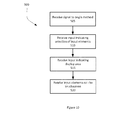
- a flowchart representing method for rendering customizable controls is shown generally at 500.
- method 500 is performed using the touchscreen device 100.
- the following discussion of method 500 will lead to a further understanding of touchscreen device 100 and its various components.
- touchscreen device 100 and/or method 500 can be varied, and need not work exactly as discussed herein in conjunction with each other, and that such variations are within the scope of present implementations. It is appreciated that in the following description, method 500 is implemented in touchscreen device 100 by processor 205.
- the blocks generally represent codes read from the non-volatile memory 212 , for directing the processor 205 to manage input received from a user for the purpose of rendering input elements on the touchscreen 102.
- the actual code to implement each block may be written in any suitable programming language, such as FlashTM, Java, Delphi®, C, and/or C++.
- the method 500 begins at 505 when a request is received at the processor 205 to begin the method.
- This request can be received from the touchscreen 102 through the touchscreen display interface 210 as a result of input at the touchscreen. It will be appreciated that other types of input, such as a short cut key on the touchscreen device 100 or input from another input device connected to the input/output interface 220 , may generate the request. Alternatively, the request may be generated internally by the computer application 230 while the application is being executed or automatically under predetermined conditions. It will be further appreciated that the origin of the request may be suitable origin such that the request triggers the processor 205 to begin method 500 .
- processor 205 receives input indicating a selection and/or populating of a subset of input elements. For example, after receiving the input, the processor 205 can populate the subset of input elements with the selected input elements. However, in other implementations, the processor 205 populates the subset of input elements when receiving the input.
- the subset of input elements is the plurality of virtual keys 320 a-e displayable on the touchscreen 102. Furthermore, the plurality of virtual keys 320 a-e are selected from the virtual keyboard 310 such that computer application 230 would generally only request application input data from the plurality of virtual keys 320 a-e.
- virtual keys of the virtual keyboard 310 which are not part of the plurality of virtual keys 320 a-e, are generally not requested for input when executing the computer application 230.
- the plurality of virtual keys is not limited to exactly five virtual keys and that the subset may include more or less virtual keys depending on the requirements of the computer application 230.
- the input indicating a selection of the plurality of virtual keys 320 a-e in the method 500 may include data of various types.
- one implementation of the input indicating a selection of the plurality of virtual keys 320 a-e may involve code directing the processor 205 to receive data indicative of a drag-and-drop selection process on the touchscreen 102. This data may result from dragging a virtual key from the virtual keyboard 310 to a location off of the virtual keyboard to indicate the selection of the plurality of virtual keys 320 a-e.
- the plurality of virtual keys 320 a-e will automatically be repositioned as shown in Figure 4 .
- the plurality of virtual keys 320 a-e may be positioned at a location where the virtual key was "dropped". Furthermore, although this implementation renders the virtual keys in the format of the virtual keyboard 310, it is contemplated that in other implementations that the virtual keys may be rendered on the touchscreen 102 in a format other than a virtual keyboard where the same drag-and-drop selection method can be used.
- the processor 205 can receive data indicative of a selection from a list 340 rendered on the touchscreen 102 . It is contemplated that in other implementations, a list may be entirely separate from the touchscreen device 100 , such as in a manual. The data indicative of a selection from the list 340 may also be received from any input device capable of providing input to the processor 205 including the touchscreen 102. In the present implementation, the list 340 is presented on the touchscreen 102 and includes list items 321 a-e, and 322 where list items 321 a-e correspond to virtual keys 320 a-e respectively.
- the list 340 may also include list items corresponding to pre-determined combinations of the virtual keys of the virtual keyboard 310 , such as keys used for the computer application 230.
- list item 322 corresponds to the combination comprising the plurality of virtual keys 320 a-e. Therefore, when the processor 205 receives data indicative of list item 322 , the processor will render the plurality of virtual keys 320 a-e respectively.
- the selection process is more efficient compared with selecting individual virtual keys. It will be appreciated that in other implementations where the set of given input elements is something other than a virtual keyboard, the list may include the input elements of the set of given input elements and combinations of the input elements of the set of given input elements.
- the processor 205 receives data indicative of a selection from a list.
- the list may be rendered on the touchscreen 102 or the list may be entirely separate from the touchscreen device 100 , such as in a manual.
- the data indicative of a selection from a list may also be received from any input device capable of providing input to the processor 205 including the touchscreen 102 .
- the list may be a list presented on the touchscreen of all the virtual keys of the virtual keyboard 310.
- the list may also include pre-determined combinations of the virtual keys of the virtual keyboard 310 , such as keys used for the computer application 230. By providing combinations of virtual keys, the selection process is more efficient compared with selecting individual virtual keys. It will be appreciated that in other implementations where the set of given input elements is something other than a virtual keyboard, the list may include the input elements of the set of given input elements and combinations of the input elements of the set of given input elements.
- a touchscreen device with a processor for carrying out method 500 where the set of given input elements is not a virtual keyboard it should be noted that the subset of input elements must still be displayable on the touchscreen of the touchscreen device.
- the set of given input elements need not be limited to correspond to keys of a keyboard.
- receiving input indicating a selection of the plurality of virtual keys 320 a-e may involve receiving data from an input device other than the touchscreen 102.
- input devices other than the touchscreen include an external keyboard, a joystick, a video game controller, or a mouse.
- a virtual key is still generated to represent the input of the input element. For example, if an input element corresponds to moving a joystick up, where the set of given input elements includes all possible input from a joystick, the subset of input elements would include a virtual key displayable on a touchscreen for receiving input corresponding to moving the joystick up.
- the processor 205 may further receive input indicative of a selection of a plurality of locations on the touchscreen 102 where the plurality of virtual keys 320 a-e are to be rendered.
- the input indicative of a selection of a plurality of locations on the touchscreen 102 where the plurality of virtual keys 320 a-e are to be rendered can be received through the touchscreen display interface 210 as a result of input at the touchscreen 102.
- the drag-and-drop selection process described above can indicate the plurality of locations for the plurality of virtual keys 320 a-e by using the "drop" location.
- the input indicative of a selection of a plurality of locations may be generated internally by the computer application 230.
- the computer application 230 may have a pre-determined list of locations for the plurality of virtual keys 320 a-e which is automatically applied during method 500.
- the plurality of virtual keys is not limited to exactly five virtual keys and that the subset may include more or less virtual keys depending on the requirements of the computer application 230.
- processor 205 receives input indicating a size and location of a display area 350 on the touchscreen 102.
- the input indicating the size and location of the display area 350 on the touchscreen 102 may include data received from the touchscreen display interface 210 as a result of input at the touchscreen. It will be appreciated that other types of input, such as a short cut key (not shown) on the touchscreen device 100 or input from another input device connected to the input/output interface 220, may be used to generate the input indicating the size and location of the display area 350 on the touchscreen 102. Alternatively, the input indicating the size and location of the display area 350 on the touchscreen 102 may be automatically generated internally when executing the computer application 230.
- the origin of the input indicating the size and location of the display area 350 on the touchscreen 102 may be suitable origin as long as the input triggers the processor 205 to create the display area 350 on the touchscreen 102 .
- the display area 350 is smaller than the touchscreen 102 .
- the display area 350 may also occupy the entire touchscreen 102 .
- the processor 205 may additionally scale the output from the computer application 230 such that the output is completely rendered within the display area 350. For example, if the output from the computer application 230 is coded to cause the processor 205 to render the application's output over the entire touchscreen 102 when method 500 is not being carried out, the processor 205 may scale the output to fit within the display area 350 when the method is carried out. It will be appreciated that if the processor 205 does not scale the output from the computer application 230, any output intended to be rendered outside of the display area 350 would simply be truncated.
- the processor 205 renders the plurality of virtual keys 320 a-e on the touchscreen 102.
- the plurality of virtual keys 320 a-e are enabled to receive input at the touchscreen 102 corresponding to the application input data for the computer application 230 executed by the processor 205.
- the plurality of virtual keys is not limited to exactly five virtual keys and that the subset may include more or less virtual keys depending on the requirements of the computer application 230.
- the processor 205 may further render the plurality of virtual keys 320 a-e outside of the display area 350.
- the plurality of virtual keys 320 a-e will not overlap with any portion of the output rendered from the computer application 230 . Therefore, this will prevent obscuring the output rendered from the computer application 230 since the plurality of virtual keys 320 a-e remain on the touchscreen 102 indefinitely.
- method 400 or method 500 provides a means to receive input efficiently from the touchscreen for the computer application 230 .
- placing the plurality of virtual keys 320 a-e allows for the output from the application to be rendered on the touchscreen 102 with minimal obstruction by the input elements.
Landscapes
- Engineering & Computer Science (AREA)
- General Engineering & Computer Science (AREA)
- Theoretical Computer Science (AREA)
- Human Computer Interaction (AREA)
- Physics & Mathematics (AREA)
- General Physics & Mathematics (AREA)
- User Interface Of Digital Computer (AREA)
- Input From Keyboards Or The Like (AREA)
Priority Applications (2)
| Application Number | Priority Date | Filing Date | Title |
|---|---|---|---|
| EP11183882.7A EP2579136B1 (de) | 2011-10-04 | 2011-10-04 | Vorrichtung mit benutzerdefinierbaren Steuerungen |
| CA2791591A CA2791591A1 (en) | 2011-10-04 | 2012-10-02 | Device with customizable controls |
Applications Claiming Priority (1)
| Application Number | Priority Date | Filing Date | Title |
|---|---|---|---|
| EP11183882.7A EP2579136B1 (de) | 2011-10-04 | 2011-10-04 | Vorrichtung mit benutzerdefinierbaren Steuerungen |
Publications (2)
| Publication Number | Publication Date |
|---|---|
| EP2579136A1 true EP2579136A1 (de) | 2013-04-10 |
| EP2579136B1 EP2579136B1 (de) | 2020-12-02 |
Family
ID=44905456
Family Applications (1)
| Application Number | Title | Priority Date | Filing Date |
|---|---|---|---|
| EP11183882.7A Active EP2579136B1 (de) | 2011-10-04 | 2011-10-04 | Vorrichtung mit benutzerdefinierbaren Steuerungen |
Country Status (2)
| Country | Link |
|---|---|
| EP (1) | EP2579136B1 (de) |
| CA (1) | CA2791591A1 (de) |
Citations (1)
| Publication number | Priority date | Publication date | Assignee | Title |
|---|---|---|---|---|
| US20100001132A1 (en) * | 2008-06-26 | 2010-01-07 | Airbus France | Device for interaction with a display system, in particular for an avionics display system |
Family Cites Families (2)
| Publication number | Priority date | Publication date | Assignee | Title |
|---|---|---|---|---|
| JPH07117868B2 (ja) * | 1991-04-30 | 1995-12-18 | インターナショナル・ビジネス・マシーンズ・コーポレイション | タツチ型作動キーボード定義方法及び装置 |
| US7602378B2 (en) * | 2006-10-26 | 2009-10-13 | Apple Inc. | Method, system, and graphical user interface for selecting a soft keyboard |
-
2011
- 2011-10-04 EP EP11183882.7A patent/EP2579136B1/de active Active
-
2012
- 2012-10-02 CA CA2791591A patent/CA2791591A1/en not_active Abandoned
Patent Citations (1)
| Publication number | Priority date | Publication date | Assignee | Title |
|---|---|---|---|---|
| US20100001132A1 (en) * | 2008-06-26 | 2010-01-07 | Airbus France | Device for interaction with a display system, in particular for an avionics display system |
Also Published As
| Publication number | Publication date |
|---|---|
| CA2791591A1 (en) | 2013-04-04 |
| EP2579136B1 (de) | 2020-12-02 |
Similar Documents
| Publication | Publication Date | Title |
|---|---|---|
| US12117872B2 (en) | Electronic device, storage medium, program, and displaying method | |
| US10275295B2 (en) | Method and apparatus for presenting clipboard contents on a mobile terminal | |
| EP2843536A2 (de) | Verfahren und Vorrichtung zur gemeinsamen Nutzung von Inhalten einer elektronischen Vorrichtung | |
| CN106371900B (zh) | 一种实现异步调用的数据处理方法及装置 | |
| US20130318449A2 (en) | Presenting context information in a computing device | |
| CN106354458B (zh) | 双屏显示方法及装置 | |
| EP2746924B1 (de) | Berührungseingabeverfahren und mobiles Endgerät | |
| CN108170500A (zh) | 下载进度刷新方法、终端设备及计算机可读存储介质 | |
| EP3721327B1 (de) | Dynamische interaktionsanpassung einer digitalfarbwerksvorrichtung | |
| CN107404572A (zh) | 一种充电提示方法及终端 | |
| JP2019510299A (ja) | 情報処理方法および電子デバイス | |
| CN105224318B (zh) | 一种信息处理方法及电子设备 | |
| US20130082940A1 (en) | Device with customizable controls | |
| CN105095259B (zh) | 瀑布流对象显示方法及装置 | |
| US20120249545A1 (en) | User interface apparatus for providing representation of 3d theme for cover page and method of operating the same | |
| EP2579136B1 (de) | Vorrichtung mit benutzerdefinierbaren Steuerungen | |
| CN107656670A (zh) | 一种图标显示的方法、终端设备及计算机可读介质 | |
| US9170669B2 (en) | Electronic device and method of controlling same | |
| CN108009172B (zh) | 一种文件立体显示方法、装置及终端 | |
| CN111966266A (zh) | 一种页面的布局方法及相关设备 | |
| Arora et al. | Mobile operating system | |
| CN105335046B (zh) | 界面切换方法、装置及终端 | |
| CN107943495A (zh) | 一种业务对象的设置方法、装置、服务器及存储介质 | |
| CN115793932A (zh) | 应用切换方法、装置、电子设备及存储介质 | |
| HK40018666B (zh) | 一种网页级程序的预加载方法和装置 |
Legal Events
| Date | Code | Title | Description |
|---|---|---|---|
| PUAI | Public reference made under article 153(3) epc to a published international application that has entered the european phase |
Free format text: ORIGINAL CODE: 0009012 |
|
| 17P | Request for examination filed |
Effective date: 20111004 |
|
| AK | Designated contracting states |
Kind code of ref document: A1 Designated state(s): AL AT BE BG CH CY CZ DE DK EE ES FI FR GB GR HR HU IE IS IT LI LT LU LV MC MK MT NL NO PL PT RO RS SE SI SK SM TR |
|
| AX | Request for extension of the european patent |
Extension state: BA ME |
|
| RAP1 | Party data changed (applicant data changed or rights of an application transferred) |
Owner name: BLACKBERRY LIMITED |
|
| RAP1 | Party data changed (applicant data changed or rights of an application transferred) |
Owner name: BLACKBERRY LIMITED |
|
| STAA | Information on the status of an ep patent application or granted ep patent |
Free format text: STATUS: EXAMINATION IS IN PROGRESS |
|
| 17Q | First examination report despatched |
Effective date: 20170606 |
|
| GRAP | Despatch of communication of intention to grant a patent |
Free format text: ORIGINAL CODE: EPIDOSNIGR1 |
|
| STAA | Information on the status of an ep patent application or granted ep patent |
Free format text: STATUS: GRANT OF PATENT IS INTENDED |
|
| INTG | Intention to grant announced |
Effective date: 20200706 |
|
| GRAS | Grant fee paid |
Free format text: ORIGINAL CODE: EPIDOSNIGR3 |
|
| GRAA | (expected) grant |
Free format text: ORIGINAL CODE: 0009210 |
|
| STAA | Information on the status of an ep patent application or granted ep patent |
Free format text: STATUS: THE PATENT HAS BEEN GRANTED |
|
| AK | Designated contracting states |
Kind code of ref document: B1 Designated state(s): AL AT BE BG CH CY CZ DE DK EE ES FI FR GB GR HR HU IE IS IT LI LT LU LV MC MK MT NL NO PL PT RO RS SE SI SK SM TR |
|
| REG | Reference to a national code |
Ref country code: GB Ref legal event code: FG4D |
|
| REG | Reference to a national code |
Ref country code: AT Ref legal event code: REF Ref document number: 1341658 Country of ref document: AT Kind code of ref document: T Effective date: 20201215 Ref country code: CH Ref legal event code: EP |
|
| REG | Reference to a national code |
Ref country code: DE Ref legal event code: R096 Ref document number: 602011069490 Country of ref document: DE |
|
| REG | Reference to a national code |
Ref country code: IE Ref legal event code: FG4D |
|
| PG25 | Lapsed in a contracting state [announced via postgrant information from national office to epo] |
Ref country code: RS Free format text: LAPSE BECAUSE OF FAILURE TO SUBMIT A TRANSLATION OF THE DESCRIPTION OR TO PAY THE FEE WITHIN THE PRESCRIBED TIME-LIMIT Effective date: 20201202 Ref country code: FI Free format text: LAPSE BECAUSE OF FAILURE TO SUBMIT A TRANSLATION OF THE DESCRIPTION OR TO PAY THE FEE WITHIN THE PRESCRIBED TIME-LIMIT Effective date: 20201202 Ref country code: NO Free format text: LAPSE BECAUSE OF FAILURE TO SUBMIT A TRANSLATION OF THE DESCRIPTION OR TO PAY THE FEE WITHIN THE PRESCRIBED TIME-LIMIT Effective date: 20210302 Ref country code: GR Free format text: LAPSE BECAUSE OF FAILURE TO SUBMIT A TRANSLATION OF THE DESCRIPTION OR TO PAY THE FEE WITHIN THE PRESCRIBED TIME-LIMIT Effective date: 20210303 |
|
| REG | Reference to a national code |
Ref country code: NL Ref legal event code: MP Effective date: 20201202 |
|
| REG | Reference to a national code |
Ref country code: AT Ref legal event code: MK05 Ref document number: 1341658 Country of ref document: AT Kind code of ref document: T Effective date: 20201202 |
|
| PG25 | Lapsed in a contracting state [announced via postgrant information from national office to epo] |
Ref country code: BG Free format text: LAPSE BECAUSE OF FAILURE TO SUBMIT A TRANSLATION OF THE DESCRIPTION OR TO PAY THE FEE WITHIN THE PRESCRIBED TIME-LIMIT Effective date: 20210302 Ref country code: LV Free format text: LAPSE BECAUSE OF FAILURE TO SUBMIT A TRANSLATION OF THE DESCRIPTION OR TO PAY THE FEE WITHIN THE PRESCRIBED TIME-LIMIT Effective date: 20201202 Ref country code: PL Free format text: LAPSE BECAUSE OF FAILURE TO SUBMIT A TRANSLATION OF THE DESCRIPTION OR TO PAY THE FEE WITHIN THE PRESCRIBED TIME-LIMIT Effective date: 20201202 Ref country code: SE Free format text: LAPSE BECAUSE OF FAILURE TO SUBMIT A TRANSLATION OF THE DESCRIPTION OR TO PAY THE FEE WITHIN THE PRESCRIBED TIME-LIMIT Effective date: 20201202 |
|
| PG25 | Lapsed in a contracting state [announced via postgrant information from national office to epo] |
Ref country code: NL Free format text: LAPSE BECAUSE OF FAILURE TO SUBMIT A TRANSLATION OF THE DESCRIPTION OR TO PAY THE FEE WITHIN THE PRESCRIBED TIME-LIMIT Effective date: 20201202 Ref country code: HR Free format text: LAPSE BECAUSE OF FAILURE TO SUBMIT A TRANSLATION OF THE DESCRIPTION OR TO PAY THE FEE WITHIN THE PRESCRIBED TIME-LIMIT Effective date: 20201202 |
|
| REG | Reference to a national code |
Ref country code: LT Ref legal event code: MG9D |
|
| PG25 | Lapsed in a contracting state [announced via postgrant information from national office to epo] |
Ref country code: EE Free format text: LAPSE BECAUSE OF FAILURE TO SUBMIT A TRANSLATION OF THE DESCRIPTION OR TO PAY THE FEE WITHIN THE PRESCRIBED TIME-LIMIT Effective date: 20201202 Ref country code: CZ Free format text: LAPSE BECAUSE OF FAILURE TO SUBMIT A TRANSLATION OF THE DESCRIPTION OR TO PAY THE FEE WITHIN THE PRESCRIBED TIME-LIMIT Effective date: 20201202 Ref country code: SM Free format text: LAPSE BECAUSE OF FAILURE TO SUBMIT A TRANSLATION OF THE DESCRIPTION OR TO PAY THE FEE WITHIN THE PRESCRIBED TIME-LIMIT Effective date: 20201202 Ref country code: LT Free format text: LAPSE BECAUSE OF FAILURE TO SUBMIT A TRANSLATION OF THE DESCRIPTION OR TO PAY THE FEE WITHIN THE PRESCRIBED TIME-LIMIT Effective date: 20201202 Ref country code: RO Free format text: LAPSE BECAUSE OF FAILURE TO SUBMIT A TRANSLATION OF THE DESCRIPTION OR TO PAY THE FEE WITHIN THE PRESCRIBED TIME-LIMIT Effective date: 20201202 Ref country code: PT Free format text: LAPSE BECAUSE OF FAILURE TO SUBMIT A TRANSLATION OF THE DESCRIPTION OR TO PAY THE FEE WITHIN THE PRESCRIBED TIME-LIMIT Effective date: 20210405 Ref country code: SK Free format text: LAPSE BECAUSE OF FAILURE TO SUBMIT A TRANSLATION OF THE DESCRIPTION OR TO PAY THE FEE WITHIN THE PRESCRIBED TIME-LIMIT Effective date: 20201202 |
|
| PG25 | Lapsed in a contracting state [announced via postgrant information from national office to epo] |
Ref country code: AT Free format text: LAPSE BECAUSE OF FAILURE TO SUBMIT A TRANSLATION OF THE DESCRIPTION OR TO PAY THE FEE WITHIN THE PRESCRIBED TIME-LIMIT Effective date: 20201202 |
|
| REG | Reference to a national code |
Ref country code: DE Ref legal event code: R097 Ref document number: 602011069490 Country of ref document: DE |
|
| PG25 | Lapsed in a contracting state [announced via postgrant information from national office to epo] |
Ref country code: IS Free format text: LAPSE BECAUSE OF FAILURE TO SUBMIT A TRANSLATION OF THE DESCRIPTION OR TO PAY THE FEE WITHIN THE PRESCRIBED TIME-LIMIT Effective date: 20210402 |
|
| PLBE | No opposition filed within time limit |
Free format text: ORIGINAL CODE: 0009261 |
|
| STAA | Information on the status of an ep patent application or granted ep patent |
Free format text: STATUS: NO OPPOSITION FILED WITHIN TIME LIMIT |
|
| PG25 | Lapsed in a contracting state [announced via postgrant information from national office to epo] |
Ref country code: IT Free format text: LAPSE BECAUSE OF FAILURE TO SUBMIT A TRANSLATION OF THE DESCRIPTION OR TO PAY THE FEE WITHIN THE PRESCRIBED TIME-LIMIT Effective date: 20201202 Ref country code: AL Free format text: LAPSE BECAUSE OF FAILURE TO SUBMIT A TRANSLATION OF THE DESCRIPTION OR TO PAY THE FEE WITHIN THE PRESCRIBED TIME-LIMIT Effective date: 20201202 |
|
| 26N | No opposition filed |
Effective date: 20210903 |
|
| PG25 | Lapsed in a contracting state [announced via postgrant information from national office to epo] |
Ref country code: SI Free format text: LAPSE BECAUSE OF FAILURE TO SUBMIT A TRANSLATION OF THE DESCRIPTION OR TO PAY THE FEE WITHIN THE PRESCRIBED TIME-LIMIT Effective date: 20201202 Ref country code: ES Free format text: LAPSE BECAUSE OF FAILURE TO SUBMIT A TRANSLATION OF THE DESCRIPTION OR TO PAY THE FEE WITHIN THE PRESCRIBED TIME-LIMIT Effective date: 20201202 Ref country code: DK Free format text: LAPSE BECAUSE OF FAILURE TO SUBMIT A TRANSLATION OF THE DESCRIPTION OR TO PAY THE FEE WITHIN THE PRESCRIBED TIME-LIMIT Effective date: 20201202 |
|
| REG | Reference to a national code |
Ref country code: CH Ref legal event code: PL |
|
| PG25 | Lapsed in a contracting state [announced via postgrant information from national office to epo] |
Ref country code: IS Free format text: LAPSE BECAUSE OF FAILURE TO SUBMIT A TRANSLATION OF THE DESCRIPTION OR TO PAY THE FEE WITHIN THE PRESCRIBED TIME-LIMIT Effective date: 20210402 |
|
| REG | Reference to a national code |
Ref country code: BE Ref legal event code: MM Effective date: 20211031 |
|
| PG25 | Lapsed in a contracting state [announced via postgrant information from national office to epo] |
Ref country code: MC Free format text: LAPSE BECAUSE OF FAILURE TO SUBMIT A TRANSLATION OF THE DESCRIPTION OR TO PAY THE FEE WITHIN THE PRESCRIBED TIME-LIMIT Effective date: 20201202 |
|
| PG25 | Lapsed in a contracting state [announced via postgrant information from national office to epo] |
Ref country code: LU Free format text: LAPSE BECAUSE OF NON-PAYMENT OF DUE FEES Effective date: 20211004 Ref country code: BE Free format text: LAPSE BECAUSE OF NON-PAYMENT OF DUE FEES Effective date: 20211031 |
|
| PG25 | Lapsed in a contracting state [announced via postgrant information from national office to epo] |
Ref country code: LI Free format text: LAPSE BECAUSE OF NON-PAYMENT OF DUE FEES Effective date: 20211031 Ref country code: CH Free format text: LAPSE BECAUSE OF NON-PAYMENT OF DUE FEES Effective date: 20211031 |
|
| PG25 | Lapsed in a contracting state [announced via postgrant information from national office to epo] |
Ref country code: IE Free format text: LAPSE BECAUSE OF NON-PAYMENT OF DUE FEES Effective date: 20211004 |
|
| PG25 | Lapsed in a contracting state [announced via postgrant information from national office to epo] |
Ref country code: HU Free format text: LAPSE BECAUSE OF FAILURE TO SUBMIT A TRANSLATION OF THE DESCRIPTION OR TO PAY THE FEE WITHIN THE PRESCRIBED TIME-LIMIT; INVALID AB INITIO Effective date: 20111004 Ref country code: CY Free format text: LAPSE BECAUSE OF FAILURE TO SUBMIT A TRANSLATION OF THE DESCRIPTION OR TO PAY THE FEE WITHIN THE PRESCRIBED TIME-LIMIT Effective date: 20201202 |
|
| PG25 | Lapsed in a contracting state [announced via postgrant information from national office to epo] |
Ref country code: MK Free format text: LAPSE BECAUSE OF FAILURE TO SUBMIT A TRANSLATION OF THE DESCRIPTION OR TO PAY THE FEE WITHIN THE PRESCRIBED TIME-LIMIT Effective date: 20201202 |
|
| REG | Reference to a national code |
Ref country code: DE Ref legal event code: R082 Ref document number: 602011069490 Country of ref document: DE Ref country code: DE Ref legal event code: R081 Ref document number: 602011069490 Country of ref document: DE Owner name: MALIKIE INNOVATIONS LTD., IE Free format text: FORMER OWNER: BLACKBERRY LIMITED, WATERLOO, ONTARIO, CA |
|
| PG25 | Lapsed in a contracting state [announced via postgrant information from national office to epo] |
Ref country code: TR Free format text: LAPSE BECAUSE OF FAILURE TO SUBMIT A TRANSLATION OF THE DESCRIPTION OR TO PAY THE FEE WITHIN THE PRESCRIBED TIME-LIMIT Effective date: 20201202 |
|
| REG | Reference to a national code |
Ref country code: GB Ref legal event code: 732E Free format text: REGISTERED BETWEEN 20240620 AND 20240627 |
|
| PG25 | Lapsed in a contracting state [announced via postgrant information from national office to epo] |
Ref country code: MT Free format text: LAPSE BECAUSE OF FAILURE TO SUBMIT A TRANSLATION OF THE DESCRIPTION OR TO PAY THE FEE WITHIN THE PRESCRIBED TIME-LIMIT Effective date: 20201202 |
|
| PGFP | Annual fee paid to national office [announced via postgrant information from national office to epo] |
Ref country code: DE Payment date: 20251028 Year of fee payment: 15 |
|
| PGFP | Annual fee paid to national office [announced via postgrant information from national office to epo] |
Ref country code: GB Payment date: 20251023 Year of fee payment: 15 |
|
| PGFP | Annual fee paid to national office [announced via postgrant information from national office to epo] |
Ref country code: FR Payment date: 20251027 Year of fee payment: 15 |