EP2578579A1 - Benzothiophene carboxamide compounds, composition and applications thereof - Google Patents
Benzothiophene carboxamide compounds, composition and applications thereof Download PDFInfo
- Publication number
- EP2578579A1 EP2578579A1 EP11173782.1A EP11173782A EP2578579A1 EP 2578579 A1 EP2578579 A1 EP 2578579A1 EP 11173782 A EP11173782 A EP 11173782A EP 2578579 A1 EP2578579 A1 EP 2578579A1
- Authority
- EP
- European Patent Office
- Prior art keywords
- compound
- carboxamide
- compounds
- thiophene
- malaria
- Prior art date
- Legal status (The legal status is an assumption and is not a legal conclusion. Google has not performed a legal analysis and makes no representation as to the accuracy of the status listed.)
- Withdrawn
Links
- 239000000203 mixture Substances 0.000 title claims abstract description 46
- GYSCBCSGKXNZRH-UHFFFAOYSA-N 1-benzothiophene-2-carboxamide Chemical class C1=CC=C2SC(C(=O)N)=CC2=C1 GYSCBCSGKXNZRH-UHFFFAOYSA-N 0.000 title abstract description 10
- 150000001875 compounds Chemical class 0.000 claims abstract description 189
- 239000003112 inhibitor Substances 0.000 claims abstract description 36
- 238000009472 formulation Methods 0.000 claims abstract description 30
- 238000000034 method Methods 0.000 claims abstract description 29
- 239000000651 prodrug Substances 0.000 claims abstract description 27
- 229940002612 prodrug Drugs 0.000 claims abstract description 27
- 150000003839 salts Chemical class 0.000 claims abstract description 21
- 239000012453 solvate Substances 0.000 claims abstract description 20
- 239000008194 pharmaceutical composition Substances 0.000 claims abstract description 8
- SCQIWUDDUXAWKC-UHFFFAOYSA-N 3-bromo-n-[(4-fluorophenyl)methyl]-1-benzothiophene-2-carboxamide Chemical compound C1=CC(F)=CC=C1CNC(=O)C1=C(Br)C2=CC=CC=C2S1 SCQIWUDDUXAWKC-UHFFFAOYSA-N 0.000 claims description 38
- 244000045947 parasite Species 0.000 claims description 37
- 238000011282 treatment Methods 0.000 claims description 31
- 201000004792 malaria Diseases 0.000 claims description 28
- 230000005764 inhibitory process Effects 0.000 claims description 27
- DENPQNAWGQXKCU-UHFFFAOYSA-N thiophene-2-carboxamide Chemical compound NC(=O)C1=CC=CS1 DENPQNAWGQXKCU-UHFFFAOYSA-N 0.000 claims description 22
- 241000223960 Plasmodium falciparum Species 0.000 claims description 15
- 241000224016 Plasmodium Species 0.000 claims description 13
- 102000004190 Enzymes Human genes 0.000 claims description 12
- 108090000790 Enzymes Proteins 0.000 claims description 12
- 229910052736 halogen Inorganic materials 0.000 claims description 11
- 150000002367 halogens Chemical group 0.000 claims description 11
- 229910052739 hydrogen Inorganic materials 0.000 claims description 10
- 230000002401 inhibitory effect Effects 0.000 claims description 10
- 125000001797 benzyl group Chemical group [H]C1=C([H])C([H])=C(C([H])=C1[H])C([H])([H])* 0.000 claims description 9
- DPMCNTKIPLJKFD-UHFFFAOYSA-N n-benzyl-3-bromo-1-benzothiophene-2-carboxamide Chemical compound S1C2=CC=CC=C2C(Br)=C1C(=O)NCC1=CC=CC=C1 DPMCNTKIPLJKFD-UHFFFAOYSA-N 0.000 claims description 8
- LXDKKSWDQSFUPF-UHFFFAOYSA-N 3-bromo-n-(2-phenylethyl)-1-benzothiophene-2-carboxamide Chemical compound S1C2=CC=CC=C2C(Br)=C1C(=O)NCCC1=CC=CC=C1 LXDKKSWDQSFUPF-UHFFFAOYSA-N 0.000 claims description 7
- LXJMCHQRGFYGRK-UHFFFAOYSA-N 3-bromo-n-(naphthalen-1-ylmethyl)-1-benzothiophene-2-carboxamide Chemical compound C1=CC=C2C(CNC(=O)C3=C(C4=CC=CC=C4S3)Br)=CC=CC2=C1 LXJMCHQRGFYGRK-UHFFFAOYSA-N 0.000 claims description 7
- -1 benzothiophene carboxamide compound Chemical class 0.000 claims description 7
- 125000004178 (C1-C4) alkyl group Chemical group 0.000 claims description 6
- 241000124008 Mammalia Species 0.000 claims description 6
- 125000001997 phenyl group Chemical group [H]C1=C([H])C([H])=C(*)C([H])=C1[H] 0.000 claims description 6
- 125000000882 C2-C6 alkenyl group Chemical group 0.000 claims description 5
- 125000001624 naphthyl group Chemical group 0.000 claims description 5
- 125000002924 primary amino group Chemical group [H]N([H])* 0.000 claims description 5
- 239000001257 hydrogen Substances 0.000 claims description 4
- 230000002147 killing effect Effects 0.000 claims description 4
- 125000000229 (C1-C4)alkoxy group Chemical group 0.000 claims description 3
- 125000003161 (C1-C6) alkylene group Chemical group 0.000 claims description 3
- 125000003903 2-propenyl group Chemical group [H]C([*])([H])C([H])=C([H])[H] 0.000 claims description 3
- NQAFFKHKVXEGDZ-UHFFFAOYSA-N 3-bromo-n-[(4-fluorophenyl)methyl]-n-prop-2-enyl-1-benzothiophene-2-carboxamide Chemical compound C1=CC(F)=CC=C1CN(CC=C)C(=O)C1=C(Br)C2=CC=CC=C2S1 NQAFFKHKVXEGDZ-UHFFFAOYSA-N 0.000 claims description 3
- 125000004093 cyano group Chemical group *C#N 0.000 claims description 3
- 125000001188 haloalkyl group Chemical group 0.000 claims description 3
- 125000000449 nitro group Chemical group [O-][N+](*)=O 0.000 claims description 3
- 239000000546 pharmaceutical excipient Substances 0.000 claims description 3
- ZAYGBDMUQBYXJN-UHFFFAOYSA-N 3-bromo-n-[(4-methoxyphenyl)methyl]-1-benzothiophene-2-carboxamide Chemical compound C1=CC(OC)=CC=C1CNC(=O)C1=C(Br)C2=CC=CC=C2S1 ZAYGBDMUQBYXJN-UHFFFAOYSA-N 0.000 claims description 2
- WKBOTKDWSSQWDR-UHFFFAOYSA-N Bromine atom Chemical compound [Br] WKBOTKDWSSQWDR-UHFFFAOYSA-N 0.000 claims description 2
- UFHFLCQGNIYNRP-UHFFFAOYSA-N Hydrogen Chemical compound [H][H] UFHFLCQGNIYNRP-UHFFFAOYSA-N 0.000 claims description 2
- GDTBXPJZTBHREO-UHFFFAOYSA-N bromine Substances BrBr GDTBXPJZTBHREO-UHFFFAOYSA-N 0.000 claims description 2
- 229910052794 bromium Inorganic materials 0.000 claims description 2
- 125000005010 perfluoroalkyl group Chemical group 0.000 claims description 2
- 206010061218 Inflammation Diseases 0.000 abstract description 19
- 230000004054 inflammatory process Effects 0.000 abstract description 18
- 208000002193 Pain Diseases 0.000 abstract description 16
- 230000000078 anti-malarial effect Effects 0.000 abstract description 15
- 230000036407 pain Effects 0.000 abstract description 14
- 239000003430 antimalarial agent Substances 0.000 abstract description 13
- 229940033495 antimalarials Drugs 0.000 abstract description 11
- 229940111134 coxibs Drugs 0.000 abstract description 9
- 239000003255 cyclooxygenase 2 inhibitor Substances 0.000 abstract description 9
- XEKOWRVHYACXOJ-UHFFFAOYSA-N Ethyl acetate Chemical compound CCOC(C)=O XEKOWRVHYACXOJ-UHFFFAOYSA-N 0.000 description 36
- FCEHBMOGCRZNNI-UHFFFAOYSA-N 1-benzothiophene Chemical class C1=CC=C2SC=CC2=C1 FCEHBMOGCRZNNI-UHFFFAOYSA-N 0.000 description 32
- 241001465754 Metazoa Species 0.000 description 27
- HEFNNWSXXWATRW-UHFFFAOYSA-N Ibuprofen Chemical compound CC(C)CC1=CC=C(C(C)C(O)=O)C=C1 HEFNNWSXXWATRW-UHFFFAOYSA-N 0.000 description 26
- 229960001680 ibuprofen Drugs 0.000 description 26
- 239000003814 drug Substances 0.000 description 23
- 230000003993 interaction Effects 0.000 description 23
- 239000003446 ligand Substances 0.000 description 23
- 229940079593 drug Drugs 0.000 description 22
- 229940021182 non-steroidal anti-inflammatory drug Drugs 0.000 description 22
- VLKZOEOYAKHREP-UHFFFAOYSA-N n-Hexane Chemical compound CCCCCC VLKZOEOYAKHREP-UHFFFAOYSA-N 0.000 description 18
- 230000003502 anti-nociceptive effect Effects 0.000 description 17
- 208000004454 Hyperalgesia Diseases 0.000 description 16
- HEDRZPFGACZZDS-MICDWDOJSA-N Trichloro(2H)methane Chemical compound [2H]C(Cl)(Cl)Cl HEDRZPFGACZZDS-MICDWDOJSA-N 0.000 description 16
- 230000015572 biosynthetic process Effects 0.000 description 16
- 238000006243 chemical reaction Methods 0.000 description 16
- 230000000694 effects Effects 0.000 description 16
- 230000004044 response Effects 0.000 description 16
- 230000037396 body weight Effects 0.000 description 15
- 238000003032 molecular docking Methods 0.000 description 15
- BAWFJGJZGIEFAR-NNYOXOHSSA-O NAD(+) Chemical compound NC(=O)C1=CC=C[N+]([C@H]2[C@@H]([C@H](O)[C@@H](COP(O)(=O)OP(O)(=O)OC[C@@H]3[C@H]([C@@H](O)[C@@H](O3)N3C4=NC=NC(N)=C4N=C3)O)O2)O)=C1 BAWFJGJZGIEFAR-NNYOXOHSSA-O 0.000 description 14
- YZXBAPSDXZZRGB-DOFZRALJSA-N arachidonic acid Chemical compound CCCCC\C=C/C\C=C/C\C=C/C\C=C/CCCC(O)=O YZXBAPSDXZZRGB-DOFZRALJSA-N 0.000 description 14
- 230000003110 anti-inflammatory effect Effects 0.000 description 13
- CGIGDMFJXJATDK-UHFFFAOYSA-N indomethacin Chemical compound CC1=C(CC(O)=O)C2=CC(OC)=CC=C2N1C(=O)C1=CC=C(Cl)C=C1 CGIGDMFJXJATDK-UHFFFAOYSA-N 0.000 description 13
- 239000011541 reaction mixture Substances 0.000 description 13
- 238000003786 synthesis reaction Methods 0.000 description 13
- 238000003556 assay Methods 0.000 description 12
- 239000000706 filtrate Substances 0.000 description 12
- 230000003389 potentiating effect Effects 0.000 description 12
- 239000000047 product Substances 0.000 description 12
- 230000004083 survival effect Effects 0.000 description 12
- 239000000679 carrageenan Substances 0.000 description 11
- 229940113118 carrageenan Drugs 0.000 description 11
- 229920001525 carrageenan Polymers 0.000 description 11
- IAZDPXIOMUYVGZ-UHFFFAOYSA-N Dimethylsulphoxide Chemical compound CS(C)=O IAZDPXIOMUYVGZ-UHFFFAOYSA-N 0.000 description 10
- 241000699670 Mus sp. Species 0.000 description 10
- 102100038277 Prostaglandin G/H synthase 1 Human genes 0.000 description 10
- QFLWZFQWSBQYPS-AWRAUJHKSA-N (3S)-3-[[(2S)-2-[[(2S)-2-[5-[(3aS,6aR)-2-oxo-1,3,3a,4,6,6a-hexahydrothieno[3,4-d]imidazol-4-yl]pentanoylamino]-3-methylbutanoyl]amino]-3-(4-hydroxyphenyl)propanoyl]amino]-4-[1-bis(4-chlorophenoxy)phosphorylbutylamino]-4-oxobutanoic acid Chemical compound CCCC(NC(=O)[C@H](CC(O)=O)NC(=O)[C@H](Cc1ccc(O)cc1)NC(=O)[C@@H](NC(=O)CCCCC1SC[C@@H]2NC(=O)N[C@H]12)C(C)C)P(=O)(Oc1ccc(Cl)cc1)Oc1ccc(Cl)cc1 QFLWZFQWSBQYPS-AWRAUJHKSA-N 0.000 description 9
- 241000700159 Rattus Species 0.000 description 9
- 235000010418 carrageenan Nutrition 0.000 description 9
- 238000002474 experimental method Methods 0.000 description 9
- 210000002683 foot Anatomy 0.000 description 9
- 238000001990 intravenous administration Methods 0.000 description 9
- 229930027945 nicotinamide-adenine dinucleotide Natural products 0.000 description 9
- 102000004169 proteins and genes Human genes 0.000 description 9
- 108090000623 proteins and genes Proteins 0.000 description 9
- 102000005962 receptors Human genes 0.000 description 9
- 108020003175 receptors Proteins 0.000 description 9
- UHVMMEOXYDMDKI-JKYCWFKZSA-L zinc;1-(5-cyanopyridin-2-yl)-3-[(1s,2s)-2-(6-fluoro-2-hydroxy-3-propanoylphenyl)cyclopropyl]urea;diacetate Chemical compound [Zn+2].CC([O-])=O.CC([O-])=O.CCC(=O)C1=CC=C(F)C([C@H]2[C@H](C2)NC(=O)NC=2N=CC(=CC=2)C#N)=C1O UHVMMEOXYDMDKI-JKYCWFKZSA-L 0.000 description 9
- WHTVZRBIWZFKQO-AWEZNQCLSA-N (S)-chloroquine Chemical compound ClC1=CC=C2C(N[C@@H](C)CCCN(CC)CC)=CC=NC2=C1 WHTVZRBIWZFKQO-AWEZNQCLSA-N 0.000 description 8
- 238000001644 13C nuclear magnetic resonance spectroscopy Methods 0.000 description 8
- 238000005160 1H NMR spectroscopy Methods 0.000 description 8
- 208000035154 Hyperesthesia Diseases 0.000 description 8
- 108050003243 Prostaglandin G/H synthase 1 Proteins 0.000 description 8
- XEFQLINVKFYRCS-UHFFFAOYSA-N Triclosan Chemical compound OC1=CC(Cl)=CC=C1OC1=CC=C(Cl)C=C1Cl XEFQLINVKFYRCS-UHFFFAOYSA-N 0.000 description 8
- 229960003677 chloroquine Drugs 0.000 description 8
- WHTVZRBIWZFKQO-UHFFFAOYSA-N chloroquine Natural products ClC1=CC=C2C(NC(C)CCCN(CC)CC)=CC=NC2=C1 WHTVZRBIWZFKQO-UHFFFAOYSA-N 0.000 description 8
- 229940125773 compound 10 Drugs 0.000 description 8
- 238000011161 development Methods 0.000 description 8
- 238000002330 electrospray ionisation mass spectrometry Methods 0.000 description 8
- 230000012010 growth Effects 0.000 description 8
- 239000007924 injection Substances 0.000 description 8
- 238000002347 injection Methods 0.000 description 8
- ZLVXBBHTMQJRSX-VMGNSXQWSA-N jdtic Chemical compound C1([C@]2(C)CCN(C[C@@H]2C)C[C@H](C(C)C)NC(=O)[C@@H]2NCC3=CC(O)=CC=C3C2)=CC=CC(O)=C1 ZLVXBBHTMQJRSX-VMGNSXQWSA-N 0.000 description 8
- BOPGDPNILDQYTO-NNYOXOHSSA-N nicotinamide-adenine dinucleotide Chemical compound C1=CCC(C(=O)N)=CN1[C@H]1[C@H](O)[C@H](O)[C@@H](COP(O)(=O)OP(O)(=O)OC[C@@H]2[C@H]([C@@H](O)[C@@H](O2)N2C3=NC=NC(N)=C3N=C2)O)O1 BOPGDPNILDQYTO-NNYOXOHSSA-N 0.000 description 8
- 239000000243 solution Substances 0.000 description 8
- 229960003500 triclosan Drugs 0.000 description 8
- UDLGTTKXEYIEMM-UHFFFAOYSA-N 3-bromo-1-benzothiophene-2-carboxylic acid Chemical compound C1=CC=C2C(Br)=C(C(=O)O)SC2=C1 UDLGTTKXEYIEMM-UHFFFAOYSA-N 0.000 description 7
- 102100022089 Acyl-[acyl-carrier-protein] hydrolase Human genes 0.000 description 7
- 238000009825 accumulation Methods 0.000 description 7
- 229940114079 arachidonic acid Drugs 0.000 description 7
- 235000021342 arachidonic acid Nutrition 0.000 description 7
- 235000014113 dietary fatty acids Nutrition 0.000 description 7
- 229930195729 fatty acid Natural products 0.000 description 7
- 239000000194 fatty acid Substances 0.000 description 7
- 150000004665 fatty acids Chemical class 0.000 description 7
- 210000000548 hind-foot Anatomy 0.000 description 7
- NPZTUJOABDZTLV-UHFFFAOYSA-N hydroxybenzotriazole Substances O=C1C=CC=C2NNN=C12 NPZTUJOABDZTLV-UHFFFAOYSA-N 0.000 description 7
- 229960000905 indomethacin Drugs 0.000 description 7
- 238000012360 testing method Methods 0.000 description 7
- IANQTJSKSUMEQM-UHFFFAOYSA-N 1-benzofuran Chemical compound C1=CC=C2OC=CC2=C1 IANQTJSKSUMEQM-UHFFFAOYSA-N 0.000 description 6
- 206010063094 Cerebral malaria Diseases 0.000 description 6
- RTZKZFJDLAIYFH-UHFFFAOYSA-N Diethyl ether Chemical compound CCOCC RTZKZFJDLAIYFH-UHFFFAOYSA-N 0.000 description 6
- 108010039731 Fatty Acid Synthases Proteins 0.000 description 6
- 241000283891 Kobus Species 0.000 description 6
- 108090000459 Prostaglandin-endoperoxide synthases Proteins 0.000 description 6
- 102000004005 Prostaglandin-endoperoxide synthases Human genes 0.000 description 6
- FAPWRFPIFSIZLT-UHFFFAOYSA-M Sodium chloride Chemical compound [Na+].[Cl-] FAPWRFPIFSIZLT-UHFFFAOYSA-M 0.000 description 6
- 230000000202 analgesic effect Effects 0.000 description 6
- 238000004440 column chromatography Methods 0.000 description 6
- KFWWCMJSYSSPSK-PAXLJYGASA-N crotonoyl-CoA Chemical compound O[C@@H]1[C@H](OP(O)(O)=O)[C@@H](COP(O)(=O)OP(O)(=O)OCC(C)(C)[C@@H](O)C(=O)NCCC(=O)NCCSC(=O)/C=C/C)O[C@H]1N1C2=NC=NC(N)=C2N=C1 KFWWCMJSYSSPSK-PAXLJYGASA-N 0.000 description 6
- 230000003247 decreasing effect Effects 0.000 description 6
- 230000002757 inflammatory effect Effects 0.000 description 6
- 238000007912 intraperitoneal administration Methods 0.000 description 6
- 210000004185 liver Anatomy 0.000 description 6
- 239000012299 nitrogen atmosphere Substances 0.000 description 6
- 239000003921 oil Substances 0.000 description 6
- 235000019198 oils Nutrition 0.000 description 6
- 239000007787 solid Substances 0.000 description 6
- 238000007920 subcutaneous administration Methods 0.000 description 6
- 239000000758 substrate Substances 0.000 description 6
- ADFXKUOMJKEIND-UHFFFAOYSA-N 1,3-dicyclohexylurea Chemical compound C1CCCCC1NC(=O)NC1CCCCC1 ADFXKUOMJKEIND-UHFFFAOYSA-N 0.000 description 5
- 101710198510 Enoyl-[acyl-carrier-protein] reductase [NADH] Proteins 0.000 description 5
- 241001505483 Plasmodium falciparum 3D7 Species 0.000 description 5
- BHELZAPQIKSEDF-UHFFFAOYSA-N allyl bromide Chemical compound BrCC=C BHELZAPQIKSEDF-UHFFFAOYSA-N 0.000 description 5
- 238000004458 analytical method Methods 0.000 description 5
- 238000002425 crystallisation Methods 0.000 description 5
- 230000008025 crystallization Effects 0.000 description 5
- 210000003743 erythrocyte Anatomy 0.000 description 5
- 239000012528 membrane Substances 0.000 description 5
- 230000036515 potency Effects 0.000 description 5
- 230000002829 reductive effect Effects 0.000 description 5
- 229910000104 sodium hydride Inorganic materials 0.000 description 5
- 230000001360 synchronised effect Effects 0.000 description 5
- 210000001519 tissue Anatomy 0.000 description 5
- 210000003812 trophozoite Anatomy 0.000 description 5
- XLYOFNOQVPJJNP-UHFFFAOYSA-N water Substances O XLYOFNOQVPJJNP-UHFFFAOYSA-N 0.000 description 5
- 206010003591 Ataxia Diseases 0.000 description 4
- 238000011740 C57BL/6 mouse Methods 0.000 description 4
- 206010065390 Inflammatory pain Diseases 0.000 description 4
- OUYCCCASQSFEME-QMMMGPOBSA-N L-tyrosine Chemical compound OC(=O)[C@@H](N)CC1=CC=C(O)C=C1 OUYCCCASQSFEME-QMMMGPOBSA-N 0.000 description 4
- 102100038280 Prostaglandin G/H synthase 2 Human genes 0.000 description 4
- XSQUKJJJFZCRTK-UHFFFAOYSA-N Urea Chemical compound NC(N)=O XSQUKJJJFZCRTK-UHFFFAOYSA-N 0.000 description 4
- 125000000217 alkyl group Chemical group 0.000 description 4
- 230000000052 comparative effect Effects 0.000 description 4
- 230000003111 delayed effect Effects 0.000 description 4
- 238000013461 design Methods 0.000 description 4
- 238000010494 dissociation reaction Methods 0.000 description 4
- 230000005593 dissociations Effects 0.000 description 4
- 231100000673 dose–response relationship Toxicity 0.000 description 4
- 238000000338 in vitro Methods 0.000 description 4
- 230000001939 inductive effect Effects 0.000 description 4
- 230000003040 nociceptive effect Effects 0.000 description 4
- 238000002360 preparation method Methods 0.000 description 4
- 230000009467 reduction Effects 0.000 description 4
- 210000001563 schizont Anatomy 0.000 description 4
- 239000011780 sodium chloride Substances 0.000 description 4
- 238000003756 stirring Methods 0.000 description 4
- 239000000126 substance Substances 0.000 description 4
- YYSVCCDAMLYSKP-UHFFFAOYSA-N 3-bromo-1-benzothiophene-2-carboxamide Chemical compound C1=CC=C2C(Br)=C(C(=O)N)SC2=C1 YYSVCCDAMLYSKP-UHFFFAOYSA-N 0.000 description 3
- GJOHLWZHWQUKAU-UHFFFAOYSA-N 5-azaniumylpentan-2-yl-(6-methoxyquinolin-8-yl)azanium;dihydrogen phosphate Chemical compound OP(O)(O)=O.OP(O)(O)=O.N1=CC=CC2=CC(OC)=CC(NC(C)CCCN)=C21 GJOHLWZHWQUKAU-UHFFFAOYSA-N 0.000 description 3
- BSYNRYMUTXBXSQ-UHFFFAOYSA-N Aspirin Chemical compound CC(=O)OC1=CC=CC=C1C(O)=O BSYNRYMUTXBXSQ-UHFFFAOYSA-N 0.000 description 3
- 206010010904 Convulsion Diseases 0.000 description 3
- 241000588724 Escherichia coli Species 0.000 description 3
- DHMQDGOQFOQNFH-UHFFFAOYSA-N Glycine Chemical class NCC(O)=O DHMQDGOQFOQNFH-UHFFFAOYSA-N 0.000 description 3
- 101000725401 Homo sapiens Cytochrome c oxidase subunit 2 Proteins 0.000 description 3
- 101000605127 Homo sapiens Prostaglandin G/H synthase 2 Proteins 0.000 description 3
- CMWTZPSULFXXJA-UHFFFAOYSA-N Naproxen Natural products C1=C(C(C)C(O)=O)C=CC2=CC(OC)=CC=C21 CMWTZPSULFXXJA-UHFFFAOYSA-N 0.000 description 3
- 208000009182 Parasitemia Diseases 0.000 description 3
- 208000030852 Parasitic disease Diseases 0.000 description 3
- 229960001138 acetylsalicylic acid Drugs 0.000 description 3
- 239000000730 antalgic agent Substances 0.000 description 3
- 239000002260 anti-inflammatory agent Substances 0.000 description 3
- 230000006399 behavior Effects 0.000 description 3
- 210000000988 bone and bone Anatomy 0.000 description 3
- 238000004364 calculation method Methods 0.000 description 3
- 235000013877 carbamide Nutrition 0.000 description 3
- 125000002915 carbonyl group Chemical group [*:2]C([*:1])=O 0.000 description 3
- 150000003857 carboxamides Chemical class 0.000 description 3
- 125000003178 carboxy group Chemical group [H]OC(*)=O 0.000 description 3
- 210000004027 cell Anatomy 0.000 description 3
- 238000002512 chemotherapy Methods 0.000 description 3
- 238000013270 controlled release Methods 0.000 description 3
- 230000036461 convulsion Effects 0.000 description 3
- 230000001419 dependent effect Effects 0.000 description 3
- 238000001647 drug administration Methods 0.000 description 3
- 230000009036 growth inhibition Effects 0.000 description 3
- 230000002209 hydrophobic effect Effects 0.000 description 3
- 230000002631 hypothermal effect Effects 0.000 description 3
- 238000001727 in vivo Methods 0.000 description 3
- 230000001965 increasing effect Effects 0.000 description 3
- 230000006698 induction Effects 0.000 description 3
- DKYWVDODHFEZIM-UHFFFAOYSA-N ketoprofen Chemical compound OC(=O)C(C)C1=CC=CC(C(=O)C=2C=CC=CC=2)=C1 DKYWVDODHFEZIM-UHFFFAOYSA-N 0.000 description 3
- 229960000991 ketoprofen Drugs 0.000 description 3
- 210000003734 kidney Anatomy 0.000 description 3
- 238000010172 mouse model Methods 0.000 description 3
- 229960002009 naproxen Drugs 0.000 description 3
- CMWTZPSULFXXJA-VIFPVBQESA-N naproxen Chemical compound C1=C([C@H](C)C(O)=O)C=CC2=CC(OC)=CC=C21 CMWTZPSULFXXJA-VIFPVBQESA-N 0.000 description 3
- 230000031990 negative regulation of inflammatory response Effects 0.000 description 3
- 239000000041 non-steroidal anti-inflammatory agent Substances 0.000 description 3
- 239000000902 placebo Substances 0.000 description 3
- 229940068196 placebo Drugs 0.000 description 3
- 229960005179 primaquine Drugs 0.000 description 3
- 229940095743 selective estrogen receptor modulator Drugs 0.000 description 3
- 239000000333 selective estrogen receptor modulator Substances 0.000 description 3
- 230000036967 uncompetitive effect Effects 0.000 description 3
- 108090000531 Amidohydrolases Proteins 0.000 description 2
- 102000004092 Amidohydrolases Human genes 0.000 description 2
- IJGRMHOSHXDMSA-UHFFFAOYSA-N Atomic nitrogen Chemical compound N#N IJGRMHOSHXDMSA-UHFFFAOYSA-N 0.000 description 2
- 229910014263 BrF3 Inorganic materials 0.000 description 2
- 101000919849 Homo sapiens Cytochrome c oxidase subunit 1 Proteins 0.000 description 2
- 101000605122 Homo sapiens Prostaglandin G/H synthase 1 Proteins 0.000 description 2
- 206010028980 Neoplasm Diseases 0.000 description 2
- DFPAKSUCGFBDDF-UHFFFAOYSA-N Nicotinamide Chemical group NC(=O)C1=CC=CN=C1 DFPAKSUCGFBDDF-UHFFFAOYSA-N 0.000 description 2
- 229910018828 PO3H2 Inorganic materials 0.000 description 2
- 206010033799 Paralysis Diseases 0.000 description 2
- 108091005804 Peptidases Proteins 0.000 description 2
- BHHGXPLMPWCGHP-UHFFFAOYSA-N Phenethylamine Chemical compound NCCC1=CC=CC=C1 BHHGXPLMPWCGHP-UHFFFAOYSA-N 0.000 description 2
- 239000004365 Protease Substances 0.000 description 2
- 102000001708 Protein Isoforms Human genes 0.000 description 2
- 108010029485 Protein Isoforms Proteins 0.000 description 2
- LOUPRKONTZGTKE-WZBLMQSHSA-N Quinine Chemical compound C([C@H]([C@H](C1)C=C)C2)C[N@@]1[C@@H]2[C@H](O)C1=CC=NC2=CC=C(OC)C=C21 LOUPRKONTZGTKE-WZBLMQSHSA-N 0.000 description 2
- 102100037486 Reverse transcriptase/ribonuclease H Human genes 0.000 description 2
- 239000002253 acid Substances 0.000 description 2
- 230000009471 action Effects 0.000 description 2
- 230000004913 activation Effects 0.000 description 2
- 230000001154 acute effect Effects 0.000 description 2
- 150000001408 amides Chemical class 0.000 description 2
- 150000001412 amines Chemical class 0.000 description 2
- 150000001413 amino acids Chemical class 0.000 description 2
- 230000036592 analgesia Effects 0.000 description 2
- 229940035676 analgesics Drugs 0.000 description 2
- 238000010171 animal model Methods 0.000 description 2
- 230000001760 anti-analgesic effect Effects 0.000 description 2
- 229940121363 anti-inflammatory agent Drugs 0.000 description 2
- 239000003416 antiarrhythmic agent Substances 0.000 description 2
- 230000009880 aromatic-aromatic interaction Effects 0.000 description 2
- MCGDSOGUHLTADD-UHFFFAOYSA-N arzoxifene Chemical compound C1=CC(OC)=CC=C1C1=C(OC=2C=CC(OCCN3CCCCC3)=CC=2)C2=CC=C(O)C=C2S1 MCGDSOGUHLTADD-UHFFFAOYSA-N 0.000 description 2
- 229950005529 arzoxifene Drugs 0.000 description 2
- 208000006673 asthma Diseases 0.000 description 2
- WGQKYBSKWIADBV-UHFFFAOYSA-N benzylamine Chemical compound NCC1=CC=CC=C1 WGQKYBSKWIADBV-UHFFFAOYSA-N 0.000 description 2
- 230000033228 biological regulation Effects 0.000 description 2
- 230000000740 bleeding effect Effects 0.000 description 2
- 239000012267 brine Substances 0.000 description 2
- 201000011510 cancer Diseases 0.000 description 2
- 239000004202 carbamide Substances 0.000 description 2
- 125000004432 carbon atom Chemical group C* 0.000 description 2
- 230000001413 cellular effect Effects 0.000 description 2
- 239000003153 chemical reaction reagent Substances 0.000 description 2
- 230000002860 competitive effect Effects 0.000 description 2
- 239000000470 constituent Substances 0.000 description 2
- DDRJAANPRJIHGJ-UHFFFAOYSA-N creatinine Chemical compound CN1CC(=O)NC1=N DDRJAANPRJIHGJ-UHFFFAOYSA-N 0.000 description 2
- 230000007423 decrease Effects 0.000 description 2
- 238000010828 elution Methods 0.000 description 2
- 150000002148 esters Chemical class 0.000 description 2
- OAYLNYINCPYISS-UHFFFAOYSA-N ethyl acetate;hexane Chemical compound CCCCCC.CCOC(C)=O OAYLNYINCPYISS-UHFFFAOYSA-N 0.000 description 2
- 238000011156 evaluation Methods 0.000 description 2
- 238000013265 extended release Methods 0.000 description 2
- 230000006870 function Effects 0.000 description 2
- 210000001035 gastrointestinal tract Anatomy 0.000 description 2
- 229930004094 glycosylphosphatidylinositol Natural products 0.000 description 2
- 244000144993 groups of animals Species 0.000 description 2
- 210000003494 hepatocyte Anatomy 0.000 description 2
- 239000012729 immediate-release (IR) formulation Substances 0.000 description 2
- 208000015181 infectious disease Diseases 0.000 description 2
- 238000006317 isomerization reaction Methods 0.000 description 2
- 150000002632 lipids Chemical class 0.000 description 2
- 230000007246 mechanism Effects 0.000 description 2
- 210000003936 merozoite Anatomy 0.000 description 2
- 229940094443 oxytocics prostaglandins Drugs 0.000 description 2
- 230000036961 partial effect Effects 0.000 description 2
- RGCLLPNLLBQHPF-HJWRWDBZSA-N phosphamidon Chemical compound CCN(CC)C(=O)C(\Cl)=C(/C)OP(=O)(OC)OC RGCLLPNLLBQHPF-HJWRWDBZSA-N 0.000 description 2
- 239000008363 phosphate buffer Substances 0.000 description 2
- 150000003180 prostaglandins Chemical class 0.000 description 2
- 230000002685 pulmonary effect Effects 0.000 description 2
- 230000000541 pulsatile effect Effects 0.000 description 2
- 238000010898 silica gel chromatography Methods 0.000 description 2
- HPALAKNZSZLMCH-UHFFFAOYSA-M sodium;chloride;hydrate Chemical compound O.[Na+].[Cl-] HPALAKNZSZLMCH-UHFFFAOYSA-M 0.000 description 2
- 239000002904 solvent Substances 0.000 description 2
- 125000001424 substituent group Chemical group 0.000 description 2
- 231100001274 therapeutic index Toxicity 0.000 description 2
- 150000007970 thio esters Chemical class 0.000 description 2
- 230000036964 tight binding Effects 0.000 description 2
- 230000000451 tissue damage Effects 0.000 description 2
- 231100000827 tissue damage Toxicity 0.000 description 2
- 230000001052 transient effect Effects 0.000 description 2
- 210000003932 urinary bladder Anatomy 0.000 description 2
- 238000001262 western blot Methods 0.000 description 2
- JIAARYAFYJHUJI-UHFFFAOYSA-L zinc dichloride Chemical compound [Cl-].[Cl-].[Zn+2] JIAARYAFYJHUJI-UHFFFAOYSA-L 0.000 description 2
- BIIBYWQGRFWQKM-JVVROLKMSA-N (2S)-N-[4-(cyclopropylamino)-3,4-dioxo-1-[(3S)-2-oxopyrrolidin-3-yl]butan-2-yl]-2-[[(E)-3-(2,4-dichlorophenyl)prop-2-enoyl]amino]-4,4-dimethylpentanamide Chemical compound CC(C)(C)C[C@@H](C(NC(C[C@H](CCN1)C1=O)C(C(NC1CC1)=O)=O)=O)NC(/C=C/C(C=CC(Cl)=C1)=C1Cl)=O BIIBYWQGRFWQKM-JVVROLKMSA-N 0.000 description 1
- ADCOUXIGWFEYJP-OBGWFSINSA-N (3e)-3-[1-[4-[(6-methoxyquinolin-8-yl)amino]pentylamino]ethylidene]oxolan-2-one Chemical compound C=12N=CC=CC2=CC(OC)=CC=1NC(C)CCCN\C(C)=C1/CCOC1=O ADCOUXIGWFEYJP-OBGWFSINSA-N 0.000 description 1
- KZGPUVUDTQWKDW-UHFFFAOYSA-N (7-bromo-3-methyl-4h-1,4-benzothiazin-2-yl)-(4-methoxyphenyl)methanone Chemical compound C1=CC(OC)=CC=C1C(=O)C1=C(C)NC2=CC=C(Br)C=C2S1 KZGPUVUDTQWKDW-UHFFFAOYSA-N 0.000 description 1
- IDPURXSQCKYKIJ-UHFFFAOYSA-N 1-(4-methoxyphenyl)methanamine Chemical compound COC1=CC=C(CN)C=C1 IDPURXSQCKYKIJ-UHFFFAOYSA-N 0.000 description 1
- OFFSPAZVIVZPHU-UHFFFAOYSA-N 1-benzofuran-2-carboxylic acid Chemical class C1=CC=C2OC(C(=O)O)=CC2=C1 OFFSPAZVIVZPHU-UHFFFAOYSA-N 0.000 description 1
- FRJNKYGTHPUSJR-UHFFFAOYSA-N 1-benzothiophene 1,1-dioxide Chemical compound C1=CC=C2S(=O)(=O)C=CC2=C1 FRJNKYGTHPUSJR-UHFFFAOYSA-N 0.000 description 1
- XUWWBNJGSFPWPZ-UHFFFAOYSA-N 1-benzothiophene;1,1'-biphenyl Chemical group C1=CC=C2SC=CC2=C1.C1=CC=CC=C1C1=CC=CC=C1 XUWWBNJGSFPWPZ-UHFFFAOYSA-N 0.000 description 1
- 150000008581 1H-indazole-3-carboxamides Chemical class 0.000 description 1
- 125000004201 2,4-dichlorophenyl group Chemical group [H]C1=C([H])C(*)=C(Cl)C([H])=C1Cl 0.000 description 1
- SMZOUWXMTYCWNB-UHFFFAOYSA-N 2-(2-methoxy-5-methylphenyl)ethanamine Chemical compound COC1=CC=C(C)C=C1CCN SMZOUWXMTYCWNB-UHFFFAOYSA-N 0.000 description 1
- NIXOWILDQLNWCW-UHFFFAOYSA-N 2-Propenoic acid Natural products OC(=O)C=C NIXOWILDQLNWCW-UHFFFAOYSA-N 0.000 description 1
- AXAVXPMQTGXXJZ-UHFFFAOYSA-N 2-aminoacetic acid;2-amino-2-(hydroxymethyl)propane-1,3-diol Chemical compound NCC(O)=O.OCC(N)(CO)CO AXAVXPMQTGXXJZ-UHFFFAOYSA-N 0.000 description 1
- WIFMYMXKTAVDSQ-UHFFFAOYSA-N 2-bromo-1-benzothiophene Chemical compound C1=CC=C2SC(Br)=CC2=C1 WIFMYMXKTAVDSQ-UHFFFAOYSA-N 0.000 description 1
- 125000000094 2-phenylethyl group Chemical group [H]C1=C([H])C([H])=C(C([H])=C1[H])C([H])([H])C([H])([H])* 0.000 description 1
- 108010019608 3-Oxoacyl-(Acyl-Carrier-Protein) Synthase Proteins 0.000 description 1
- 101710142619 3-hydroxyacyl-[acyl-carrier-protein] dehydratase FabZ Proteins 0.000 description 1
- 108010055468 3-oxoacyl-(acyl-carrier-protein) reductase Proteins 0.000 description 1
- 102000000157 3-oxoacyl-(acyl-carrier-protein) reductase Human genes 0.000 description 1
- 102100037149 3-oxoacyl-[acyl-carrier-protein] synthase, mitochondrial Human genes 0.000 description 1
- 125000004176 4-fluorobenzyl group Chemical group [H]C1=C([H])C(=C([H])C([H])=C1F)C([H])([H])* 0.000 description 1
- 125000004217 4-methoxybenzyl group Chemical group [H]C1=C([H])C(=C([H])C([H])=C1OC([H])([H])[H])C([H])([H])* 0.000 description 1
- RZVAJINKPMORJF-UHFFFAOYSA-N Acetaminophen Chemical compound CC(=O)NC1=CC=C(O)C=C1 RZVAJINKPMORJF-UHFFFAOYSA-N 0.000 description 1
- 241001535291 Analges Species 0.000 description 1
- 241000256186 Anopheles <genus> Species 0.000 description 1
- 239000004475 Arginine Chemical class 0.000 description 1
- 238000000035 BCA protein assay Methods 0.000 description 1
- 206010006002 Bone pain Diseases 0.000 description 1
- 206010006187 Breast cancer Diseases 0.000 description 1
- 208000026310 Breast neoplasm Diseases 0.000 description 1
- KSFOVUSSGSKXFI-GAQDCDSVSA-N CC1=C/2NC(\C=C3/N=C(/C=C4\N\C(=C/C5=N/C(=C\2)/C(C=C)=C5C)C(C=C)=C4C)C(C)=C3CCC(O)=O)=C1CCC(O)=O Chemical compound CC1=C/2NC(\C=C3/N=C(/C=C4\N\C(=C/C5=N/C(=C\2)/C(C=C)=C5C)C(C=C)=C4C)C(C)=C3CCC(O)=O)=C1CCC(O)=O KSFOVUSSGSKXFI-GAQDCDSVSA-N 0.000 description 1
- CURLTUGMZLYLDI-UHFFFAOYSA-N Carbon dioxide Chemical compound O=C=O CURLTUGMZLYLDI-UHFFFAOYSA-N 0.000 description 1
- 208000017667 Chronic Disease Diseases 0.000 description 1
- 208000000094 Chronic Pain Diseases 0.000 description 1
- 235000001258 Cinchona calisaya Nutrition 0.000 description 1
- 206010010774 Constipation Diseases 0.000 description 1
- 108010037462 Cyclooxygenase 2 Proteins 0.000 description 1
- 206010012735 Diarrhoea Diseases 0.000 description 1
- KCXVZYZYPLLWCC-UHFFFAOYSA-N EDTA Chemical compound OC(=O)CN(CC(O)=O)CCN(CC(O)=O)CC(O)=O KCXVZYZYPLLWCC-UHFFFAOYSA-N 0.000 description 1
- 108090000371 Esterases Proteins 0.000 description 1
- LYCAIKOWRPUZTN-UHFFFAOYSA-N Ethylene glycol Chemical compound OCCO LYCAIKOWRPUZTN-UHFFFAOYSA-N 0.000 description 1
- 206010059024 Gastrointestinal toxicity Diseases 0.000 description 1
- WQZGKKKJIJFFOK-GASJEMHNSA-N Glucose Natural products OC[C@H]1OC(O)[C@H](O)[C@@H](O)[C@@H]1O WQZGKKKJIJFFOK-GASJEMHNSA-N 0.000 description 1
- 239000004471 Glycine Chemical class 0.000 description 1
- 206010019233 Headaches Diseases 0.000 description 1
- 102000002812 Heat-Shock Proteins Human genes 0.000 description 1
- 108010004889 Heat-Shock Proteins Proteins 0.000 description 1
- 108010001336 Horseradish Peroxidase Proteins 0.000 description 1
- 241000694408 Isomeris Species 0.000 description 1
- 208000012659 Joint disease Diseases 0.000 description 1
- YQEZLKZALYSWHR-UHFFFAOYSA-N Ketamine Chemical compound C=1C=CC=C(Cl)C=1C1(NC)CCCCC1=O YQEZLKZALYSWHR-UHFFFAOYSA-N 0.000 description 1
- ONIBWKKTOPOVIA-BYPYZUCNSA-N L-Proline Chemical class OC(=O)[C@@H]1CCCN1 ONIBWKKTOPOVIA-BYPYZUCNSA-N 0.000 description 1
- ODKSFYDXXFIFQN-BYPYZUCNSA-P L-argininium(2+) Chemical class NC(=[NH2+])NCCC[C@H]([NH3+])C(O)=O ODKSFYDXXFIFQN-BYPYZUCNSA-P 0.000 description 1
- HNDVDQJCIGZPNO-YFKPBYRVSA-N L-histidine Chemical class OC(=O)[C@@H](N)CC1=CN=CN1 HNDVDQJCIGZPNO-YFKPBYRVSA-N 0.000 description 1
- KDXKERNSBIXSRK-YFKPBYRVSA-N L-lysine Chemical class NCCCC[C@H](N)C(O)=O KDXKERNSBIXSRK-YFKPBYRVSA-N 0.000 description 1
- FBOZXECLQNJBKD-ZDUSSCGKSA-N L-methotrexate Chemical compound C=1N=C2N=C(N)N=C(N)C2=NC=1CN(C)C1=CC=C(C(=O)N[C@@H](CCC(O)=O)C(O)=O)C=C1 FBOZXECLQNJBKD-ZDUSSCGKSA-N 0.000 description 1
- QIVBCDIJIAJPQS-VIFPVBQESA-N L-tryptophane Chemical class C1=CC=C2C(C[C@H](N)C(O)=O)=CNC2=C1 QIVBCDIJIAJPQS-VIFPVBQESA-N 0.000 description 1
- KDXKERNSBIXSRK-UHFFFAOYSA-N Lysine Chemical class NCCCCC(N)C(O)=O KDXKERNSBIXSRK-UHFFFAOYSA-N 0.000 description 1
- 239000004472 Lysine Chemical class 0.000 description 1
- LBHLFPGPEGDCJG-UHFFFAOYSA-N N(4)-{2,6-dimethoxy-4-methyl-5-[3-(trifluoromethyl)phenoxy]quinolin-8-yl}pentane-1,4-diamine Chemical compound COC=1C=C(NC(C)CCCN)C2=NC(OC)=CC(C)=C2C=1OC1=CC=CC(C(F)(F)F)=C1 LBHLFPGPEGDCJG-UHFFFAOYSA-N 0.000 description 1
- OVRNDRQMDRJTHS-UHFFFAOYSA-N N-acelyl-D-glucosamine Natural products CC(=O)NC1C(O)OC(CO)C(O)C1O OVRNDRQMDRJTHS-UHFFFAOYSA-N 0.000 description 1
- OVRNDRQMDRJTHS-FMDGEEDCSA-N N-acetyl-beta-D-glucosamine Chemical group CC(=O)N[C@H]1[C@H](O)O[C@H](CO)[C@@H](O)[C@@H]1O OVRNDRQMDRJTHS-FMDGEEDCSA-N 0.000 description 1
- 206010028813 Nausea Diseases 0.000 description 1
- 208000001294 Nociceptive Pain Diseases 0.000 description 1
- 206010030113 Oedema Diseases 0.000 description 1
- 229910019142 PO4 Inorganic materials 0.000 description 1
- 239000002033 PVDF binder Substances 0.000 description 1
- 241000224017 Plasmodium berghei Species 0.000 description 1
- 241000224021 Plasmodium berghei ANKA Species 0.000 description 1
- 206010035500 Plasmodium falciparum infection Diseases 0.000 description 1
- 201000009976 Plasmodium vivax malaria Diseases 0.000 description 1
- 229920001213 Polysorbate 20 Polymers 0.000 description 1
- 208000004550 Postoperative Pain Diseases 0.000 description 1
- ONIBWKKTOPOVIA-UHFFFAOYSA-N Proline Natural products OC(=O)C1CCCN1 ONIBWKKTOPOVIA-UHFFFAOYSA-N 0.000 description 1
- JUJWROOIHBZHMG-UHFFFAOYSA-N Pyridine Chemical group C1=CC=NC=C1 JUJWROOIHBZHMG-UHFFFAOYSA-N 0.000 description 1
- 241000700157 Rattus norvegicus Species 0.000 description 1
- 229940124639 Selective inhibitor Drugs 0.000 description 1
- KEAYESYHFKHZAL-UHFFFAOYSA-N Sodium Chemical compound [Na] KEAYESYHFKHZAL-UHFFFAOYSA-N 0.000 description 1
- 206010041349 Somnolence Diseases 0.000 description 1
- 201000002661 Spondylitis Diseases 0.000 description 1
- 208000010040 Sprains and Strains Diseases 0.000 description 1
- 244000269722 Thea sinensis Species 0.000 description 1
- 102000005488 Thioesterase Human genes 0.000 description 1
- 239000007983 Tris buffer Substances 0.000 description 1
- QIVBCDIJIAJPQS-UHFFFAOYSA-N Tryptophan Chemical class C1=CC=C2C(CC(N)C(O)=O)=CNC2=C1 QIVBCDIJIAJPQS-UHFFFAOYSA-N 0.000 description 1
- 108010089879 Type I Fatty Acid Synthase Proteins 0.000 description 1
- 108010018022 Type II Fatty Acid Synthase Proteins 0.000 description 1
- 208000025865 Ulcer Diseases 0.000 description 1
- 208000005469 Vivax Malaria Diseases 0.000 description 1
- 206010047700 Vomiting Diseases 0.000 description 1
- 208000027418 Wounds and injury Diseases 0.000 description 1
- HCHKCACWOHOZIP-UHFFFAOYSA-N Zinc Chemical class [Zn] HCHKCACWOHOZIP-UHFFFAOYSA-N 0.000 description 1
- XJLXINKUBYWONI-DQQFMEOOSA-N [[(2r,3r,4r,5r)-5-(6-aminopurin-9-yl)-3-hydroxy-4-phosphonooxyoxolan-2-yl]methoxy-hydroxyphosphoryl] [(2s,3r,4s,5s)-5-(3-carbamoylpyridin-1-ium-1-yl)-3,4-dihydroxyoxolan-2-yl]methyl phosphate Chemical compound NC(=O)C1=CC=C[N+]([C@@H]2[C@H]([C@@H](O)[C@H](COP([O-])(=O)OP(O)(=O)OC[C@@H]3[C@H]([C@@H](OP(O)(O)=O)[C@@H](O3)N3C4=NC=NC(N)=C4N=C3)O)O2)O)=C1 XJLXINKUBYWONI-DQQFMEOOSA-N 0.000 description 1
- 210000001015 abdomen Anatomy 0.000 description 1
- ZOIORXHNWRGPMV-UHFFFAOYSA-N acetic acid;zinc Chemical compound [Zn].CC(O)=O.CC(O)=O ZOIORXHNWRGPMV-UHFFFAOYSA-N 0.000 description 1
- 239000012190 activator Substances 0.000 description 1
- 125000002252 acyl group Chemical group 0.000 description 1
- 230000002411 adverse Effects 0.000 description 1
- 239000000556 agonist Substances 0.000 description 1
- 125000001931 aliphatic group Chemical group 0.000 description 1
- 125000003342 alkenyl group Chemical group 0.000 description 1
- 125000003545 alkoxy group Chemical group 0.000 description 1
- 239000005557 antagonist Substances 0.000 description 1
- 230000003288 anthiarrhythmic effect Effects 0.000 description 1
- 230000001093 anti-cancer Effects 0.000 description 1
- 230000003178 anti-diabetic effect Effects 0.000 description 1
- 230000002058 anti-hyperglycaemic effect Effects 0.000 description 1
- 230000002141 anti-parasite Effects 0.000 description 1
- 230000001754 anti-pyretic effect Effects 0.000 description 1
- 230000000259 anti-tumor effect Effects 0.000 description 1
- 239000004599 antimicrobial Substances 0.000 description 1
- ODKSFYDXXFIFQN-UHFFFAOYSA-N arginine Chemical class OC(=O)C(N)CCCNC(N)=N ODKSFYDXXFIFQN-UHFFFAOYSA-N 0.000 description 1
- 125000006615 aromatic heterocyclic group Chemical group 0.000 description 1
- 150000003975 aryl alkyl amines Chemical class 0.000 description 1
- 125000003118 aryl group Chemical group 0.000 description 1
- 230000004888 barrier function Effects 0.000 description 1
- 230000008901 benefit Effects 0.000 description 1
- WQZGKKKJIJFFOK-VFUOTHLCSA-N beta-D-glucose Chemical compound OC[C@H]1O[C@@H](O)[C@H](O)[C@@H](O)[C@@H]1O WQZGKKKJIJFFOK-VFUOTHLCSA-N 0.000 description 1
- 230000008436 biogenesis Effects 0.000 description 1
- 238000012925 biological evaluation Methods 0.000 description 1
- 230000031018 biological processes and functions Effects 0.000 description 1
- 230000002051 biphasic effect Effects 0.000 description 1
- 230000000903 blocking effect Effects 0.000 description 1
- 210000004369 blood Anatomy 0.000 description 1
- 239000008280 blood Substances 0.000 description 1
- 125000001246 bromo group Chemical group Br* 0.000 description 1
- 239000000872 buffer Substances 0.000 description 1
- 229950002664 bulaquine Drugs 0.000 description 1
- 125000004369 butenyl group Chemical group C(=CCC)* 0.000 description 1
- 125000000484 butyl group Chemical group [H]C([*])([H])C([H])([H])C([H])([H])C([H])([H])[H] 0.000 description 1
- 239000006227 byproduct Substances 0.000 description 1
- 239000002775 capsule Substances 0.000 description 1
- 150000004657 carbamic acid derivatives Chemical class 0.000 description 1
- 150000004649 carbonic acid derivatives Chemical class 0.000 description 1
- 150000001765 catechin Chemical class 0.000 description 1
- ADRVNXBAWSRFAJ-UHFFFAOYSA-N catechin Natural products OC1Cc2cc(O)cc(O)c2OC1c3ccc(O)c(O)c3 ADRVNXBAWSRFAJ-UHFFFAOYSA-N 0.000 description 1
- 235000005487 catechin Nutrition 0.000 description 1
- 239000013592 cell lysate Substances 0.000 description 1
- 239000003795 chemical substances by application Substances 0.000 description 1
- 210000000038 chest Anatomy 0.000 description 1
- 125000001309 chloro group Chemical group Cl* 0.000 description 1
- 230000001684 chronic effect Effects 0.000 description 1
- LOUPRKONTZGTKE-UHFFFAOYSA-N cinchonine Natural products C1C(C(C2)C=C)CCN2C1C(O)C1=CC=NC2=CC=C(OC)C=C21 LOUPRKONTZGTKE-UHFFFAOYSA-N 0.000 description 1
- 229940125898 compound 5 Drugs 0.000 description 1
- 238000010205 computational analysis Methods 0.000 description 1
- 238000009833 condensation Methods 0.000 description 1
- 230000005494 condensation Effects 0.000 description 1
- 230000021615 conjugation Effects 0.000 description 1
- 230000008602 contraction Effects 0.000 description 1
- 150000001907 coumarones Chemical class 0.000 description 1
- 229940109239 creatinine Drugs 0.000 description 1
- 239000013078 crystal Substances 0.000 description 1
- 230000001472 cytotoxic effect Effects 0.000 description 1
- 230000003013 cytotoxicity Effects 0.000 description 1
- 231100000135 cytotoxicity Toxicity 0.000 description 1
- 230000006378 damage Effects 0.000 description 1
- 230000018044 dehydration Effects 0.000 description 1
- 238000006297 dehydration reaction Methods 0.000 description 1
- 229960003964 deoxycholic acid Drugs 0.000 description 1
- USIUVYZYUHIAEV-UHFFFAOYSA-N diphenyl ether Chemical class C=1C=CC=CC=1OC1=CC=CC=C1 USIUVYZYUHIAEV-UHFFFAOYSA-N 0.000 description 1
- 229940042399 direct acting antivirals protease inhibitors Drugs 0.000 description 1
- 208000037265 diseases, disorders, signs and symptoms Diseases 0.000 description 1
- 208000035475 disorder Diseases 0.000 description 1
- 239000006185 dispersion Substances 0.000 description 1
- 238000013104 docking experiment Methods 0.000 description 1
- 238000012377 drug delivery Methods 0.000 description 1
- 239000003596 drug target Substances 0.000 description 1
- 238000002651 drug therapy Methods 0.000 description 1
- 210000004696 endometrium Anatomy 0.000 description 1
- 125000001495 ethyl group Chemical group [H]C([H])([H])C([H])([H])* 0.000 description 1
- 239000000284 extract Substances 0.000 description 1
- 210000003414 extremity Anatomy 0.000 description 1
- 235000013861 fat-free Nutrition 0.000 description 1
- 230000002349 favourable effect Effects 0.000 description 1
- 238000001914 filtration Methods 0.000 description 1
- 230000004992 fission Effects 0.000 description 1
- 239000000796 flavoring agent Substances 0.000 description 1
- 125000001153 fluoro group Chemical group F* 0.000 description 1
- 229940124307 fluoroquinolone Drugs 0.000 description 1
- 235000013305 food Nutrition 0.000 description 1
- 231100000414 gastrointestinal toxicity Toxicity 0.000 description 1
- 239000008103 glucose Substances 0.000 description 1
- 235000009569 green tea Nutrition 0.000 description 1
- 231100000869 headache Toxicity 0.000 description 1
- 150000002391 heterocyclic compounds Chemical class 0.000 description 1
- 210000003630 histaminocyte Anatomy 0.000 description 1
- HNDVDQJCIGZPNO-UHFFFAOYSA-N histidine Chemical class OC(=O)C(N)CC1=CN=CN1 HNDVDQJCIGZPNO-UHFFFAOYSA-N 0.000 description 1
- 238000002657 hormone replacement therapy Methods 0.000 description 1
- 125000002887 hydroxy group Chemical group [H]O* 0.000 description 1
- 208000013403 hyperactivity Diseases 0.000 description 1
- 230000003463 hyperproliferative effect Effects 0.000 description 1
- VKOBVWXKNCXXDE-UHFFFAOYSA-N icosanoic acid Chemical compound CCCCCCCCCCCCCCCCCCCC(O)=O VKOBVWXKNCXXDE-UHFFFAOYSA-N 0.000 description 1
- 238000003384 imaging method Methods 0.000 description 1
- 238000011534 incubation Methods 0.000 description 1
- 230000008595 infiltration Effects 0.000 description 1
- 238000001764 infiltration Methods 0.000 description 1
- 210000004969 inflammatory cell Anatomy 0.000 description 1
- 239000007972 injectable composition Substances 0.000 description 1
- 208000014674 injury Diseases 0.000 description 1
- 229910052500 inorganic mineral Inorganic materials 0.000 description 1
- 238000007918 intramuscular administration Methods 0.000 description 1
- 239000007927 intramuscular injection Substances 0.000 description 1
- 238000010255 intramuscular injection Methods 0.000 description 1
- 239000007928 intraperitoneal injection Substances 0.000 description 1
- 238000007913 intrathecal administration Methods 0.000 description 1
- 230000009545 invasion Effects 0.000 description 1
- 125000002346 iodo group Chemical group I* 0.000 description 1
- 125000000555 isopropenyl group Chemical group [H]\C([H])=C(\*)C([H])([H])[H] 0.000 description 1
- 125000001449 isopropyl group Chemical group [H]C([H])([H])C([H])(*)C([H])([H])[H] 0.000 description 1
- 210000001503 joint Anatomy 0.000 description 1
- 229960003299 ketamine Drugs 0.000 description 1
- 230000003907 kidney function Effects 0.000 description 1
- 231100000518 lethal Toxicity 0.000 description 1
- 230000001665 lethal effect Effects 0.000 description 1
- 210000003041 ligament Anatomy 0.000 description 1
- 239000007788 liquid Substances 0.000 description 1
- 230000003908 liver function Effects 0.000 description 1
- 210000003141 lower extremity Anatomy 0.000 description 1
- 210000004072 lung Anatomy 0.000 description 1
- 238000007726 management method Methods 0.000 description 1
- 230000002503 metabolic effect Effects 0.000 description 1
- 229910052751 metal Inorganic materials 0.000 description 1
- 239000002184 metal Substances 0.000 description 1
- 229960000485 methotrexate Drugs 0.000 description 1
- 125000002496 methyl group Chemical group [H]C([H])([H])* 0.000 description 1
- ZGEGCLOFRBLKSE-UHFFFAOYSA-N methylene hexane Natural products CCCCCC=C ZGEGCLOFRBLKSE-UHFFFAOYSA-N 0.000 description 1
- 235000013336 milk Nutrition 0.000 description 1
- 239000008267 milk Substances 0.000 description 1
- 210000004080 milk Anatomy 0.000 description 1
- 235000010755 mineral Nutrition 0.000 description 1
- 239000011707 mineral Substances 0.000 description 1
- 210000003205 muscle Anatomy 0.000 description 1
- 229950006780 n-acetylglucosamine Drugs 0.000 description 1
- NVSYANRBXPURRQ-UHFFFAOYSA-N naphthalen-1-ylmethanamine Chemical compound C1=CC=C2C(CN)=CC=CC2=C1 NVSYANRBXPURRQ-UHFFFAOYSA-N 0.000 description 1
- 230000008693 nausea Effects 0.000 description 1
- 230000017066 negative regulation of growth Effects 0.000 description 1
- HYWYRSMBCFDLJT-UHFFFAOYSA-N nimesulide Chemical compound CS(=O)(=O)NC1=CC=C([N+]([O-])=O)C=C1OC1=CC=CC=C1 HYWYRSMBCFDLJT-UHFFFAOYSA-N 0.000 description 1
- 229960000965 nimesulide Drugs 0.000 description 1
- 229910052757 nitrogen Inorganic materials 0.000 description 1
- HEGSGKPQLMEBJL-RKQHYHRCSA-N octyl beta-D-glucopyranoside Chemical compound CCCCCCCCO[C@@H]1O[C@H](CO)[C@@H](O)[C@H](O)[C@H]1O HEGSGKPQLMEBJL-RKQHYHRCSA-N 0.000 description 1
- 235000008390 olive oil Nutrition 0.000 description 1
- 239000004006 olive oil Substances 0.000 description 1
- 238000005457 optimization Methods 0.000 description 1
- 229940126701 oral medication Drugs 0.000 description 1
- 239000003960 organic solvent Substances 0.000 description 1
- 230000008520 organization Effects 0.000 description 1
- 210000001672 ovary Anatomy 0.000 description 1
- 230000004783 oxidative metabolism Effects 0.000 description 1
- 210000004197 pelvis Anatomy 0.000 description 1
- 239000000137 peptide hydrolase inhibitor Substances 0.000 description 1
- 230000003239 periodontal effect Effects 0.000 description 1
- 125000000286 phenylethyl group Chemical group [H]C1=C([H])C([H])=C(C([H])=C1[H])C([H])([H])C([H])([H])* 0.000 description 1
- 235000021317 phosphate Nutrition 0.000 description 1
- 125000001476 phosphono group Chemical group [H]OP(*)(=O)O[H] 0.000 description 1
- 150000003013 phosphoric acid derivatives Chemical class 0.000 description 1
- 230000035790 physiological processes and functions Effects 0.000 description 1
- 239000002504 physiological saline solution Substances 0.000 description 1
- 239000000256 polyoxyethylene sorbitan monolaurate Substances 0.000 description 1
- 235000010486 polyoxyethylene sorbitan monolaurate Nutrition 0.000 description 1
- 229920002981 polyvinylidene fluoride Polymers 0.000 description 1
- 208000001685 postmenopausal osteoporosis Diseases 0.000 description 1
- 150000003141 primary amines Chemical class 0.000 description 1
- 230000002062 proliferating effect Effects 0.000 description 1
- 125000004368 propenyl group Chemical group C(=CC)* 0.000 description 1
- 125000001436 propyl group Chemical group [H]C([*])([H])C([H])([H])C([H])([H])[H] 0.000 description 1
- 230000001681 protective effect Effects 0.000 description 1
- 230000017854 proteolysis Effects 0.000 description 1
- 230000005588 protonation Effects 0.000 description 1
- 229950003776 protoporphyrin Drugs 0.000 description 1
- 150000003217 pyrazoles Chemical class 0.000 description 1
- LOUPRKONTZGTKE-LHHVKLHASA-N quinidine Chemical class C([C@H]([C@H](C1)C=C)C2)C[N@@]1[C@H]2[C@@H](O)C1=CC=NC2=CC=C(OC)C=C21 LOUPRKONTZGTKE-LHHVKLHASA-N 0.000 description 1
- 229960000948 quinine Drugs 0.000 description 1
- 150000007660 quinolones Chemical class 0.000 description 1
- GZUITABIAKMVPG-UHFFFAOYSA-N raloxifene Chemical compound C1=CC(O)=CC=C1C1=C(C(=O)C=2C=CC(OCCN3CCCCC3)=CC=2)C2=CC=C(O)C=C2S1 GZUITABIAKMVPG-UHFFFAOYSA-N 0.000 description 1
- 229960004622 raloxifene Drugs 0.000 description 1
- 238000009790 rate-determining step (RDS) Methods 0.000 description 1
- 238000011160 research Methods 0.000 description 1
- 230000026416 response to pain Effects 0.000 description 1
- 239000000837 restrainer Substances 0.000 description 1
- 230000000717 retained effect Effects 0.000 description 1
- 150000004492 retinoid derivatives Chemical class 0.000 description 1
- 238000012552 review Methods 0.000 description 1
- 230000020341 sensory perception of pain Effects 0.000 description 1
- 238000004088 simulation Methods 0.000 description 1
- 210000003491 skin Anatomy 0.000 description 1
- FHHPUSMSKHSNKW-SMOYURAASA-M sodium deoxycholate Chemical compound [Na+].C([C@H]1CC2)[C@H](O)CC[C@]1(C)[C@@H]1[C@@H]2[C@@H]2CC[C@H]([C@@H](CCC([O-])=O)C)[C@@]2(C)[C@@H](O)C1 FHHPUSMSKHSNKW-SMOYURAASA-M 0.000 description 1
- 238000002415 sodium dodecyl sulfate polyacrylamide gel electrophoresis Methods 0.000 description 1
- 239000012312 sodium hydride Substances 0.000 description 1
- CMZUMMUJMWNLFH-UHFFFAOYSA-N sodium metavanadate Chemical compound [Na+].[O-][V](=O)=O CMZUMMUJMWNLFH-UHFFFAOYSA-N 0.000 description 1
- 239000007909 solid dosage form Substances 0.000 description 1
- 210000000952 spleen Anatomy 0.000 description 1
- 210000003046 sporozoite Anatomy 0.000 description 1
- 238000012289 standard assay Methods 0.000 description 1
- 150000003456 sulfonamides Chemical class 0.000 description 1
- 125000000472 sulfonyl group Chemical group *S(*)(=O)=O 0.000 description 1
- 239000006228 supernatant Substances 0.000 description 1
- 239000000829 suppository Substances 0.000 description 1
- 230000009897 systematic effect Effects 0.000 description 1
- 229950000856 tafenoquine Drugs 0.000 description 1
- 230000008685 targeting Effects 0.000 description 1
- 125000000999 tert-butyl group Chemical group [H]C([H])([H])C(*)(C([H])([H])[H])C([H])([H])[H] 0.000 description 1
- 108020002982 thioesterase Proteins 0.000 description 1
- QERYCTSHXKAMIS-UHFFFAOYSA-N thiophene-2-carboxylic acid Chemical compound OC(=O)C1=CC=CS1 QERYCTSHXKAMIS-UHFFFAOYSA-N 0.000 description 1
- 231100000331 toxic Toxicity 0.000 description 1
- 230000002588 toxic effect Effects 0.000 description 1
- 231100000419 toxicity Toxicity 0.000 description 1
- 230000001988 toxicity Effects 0.000 description 1
- 230000009466 transformation Effects 0.000 description 1
- 102000035160 transmembrane proteins Human genes 0.000 description 1
- 108091005703 transmembrane proteins Proteins 0.000 description 1
- LENZDBCJOHFCAS-UHFFFAOYSA-N tris Chemical compound OCC(N)(CO)CO LENZDBCJOHFCAS-UHFFFAOYSA-N 0.000 description 1
- 239000003656 tris buffered saline Substances 0.000 description 1
- OUYCCCASQSFEME-UHFFFAOYSA-N tyrosine Natural products OC(=O)C(N)CC1=CC=C(O)C=C1 OUYCCCASQSFEME-UHFFFAOYSA-N 0.000 description 1
- 231100000397 ulcer Toxicity 0.000 description 1
- 229930195735 unsaturated hydrocarbon Natural products 0.000 description 1
- 150000003672 ureas Chemical class 0.000 description 1
- 238000003828 vacuum filtration Methods 0.000 description 1
- 125000000391 vinyl group Chemical group [H]C([*])=C([H])[H] 0.000 description 1
- 230000008673 vomiting Effects 0.000 description 1
- 238000005406 washing Methods 0.000 description 1
- BPICBUSOMSTKRF-UHFFFAOYSA-N xylazine Chemical compound CC1=CC=CC(C)=C1NC1=NCCCS1 BPICBUSOMSTKRF-UHFFFAOYSA-N 0.000 description 1
- 229960001600 xylazine Drugs 0.000 description 1
- 150000003751 zinc Chemical class 0.000 description 1
- 229910052725 zinc Inorganic materials 0.000 description 1
- 239000011701 zinc Substances 0.000 description 1
- 239000004246 zinc acetate Substances 0.000 description 1
- 239000011592 zinc chloride Substances 0.000 description 1
- 235000005074 zinc chloride Nutrition 0.000 description 1
- 229910000166 zirconium phosphate Inorganic materials 0.000 description 1
Images






Classifications
-
- A—HUMAN NECESSITIES
- A61—MEDICAL OR VETERINARY SCIENCE; HYGIENE
- A61K—PREPARATIONS FOR MEDICAL, DENTAL OR TOILETRY PURPOSES
- A61K31/00—Medicinal preparations containing organic active ingredients
- A61K31/33—Heterocyclic compounds
- A61K31/38—Heterocyclic compounds having sulfur as a ring hetero atom
- A61K31/382—Heterocyclic compounds having sulfur as a ring hetero atom having six-membered rings, e.g. thioxanthenes
-
- A—HUMAN NECESSITIES
- A61—MEDICAL OR VETERINARY SCIENCE; HYGIENE
- A61P—SPECIFIC THERAPEUTIC ACTIVITY OF CHEMICAL COMPOUNDS OR MEDICINAL PREPARATIONS
- A61P29/00—Non-central analgesic, antipyretic or antiinflammatory agents, e.g. antirheumatic agents; Non-steroidal antiinflammatory drugs [NSAID]
-
- A—HUMAN NECESSITIES
- A61—MEDICAL OR VETERINARY SCIENCE; HYGIENE
- A61P—SPECIFIC THERAPEUTIC ACTIVITY OF CHEMICAL COMPOUNDS OR MEDICINAL PREPARATIONS
- A61P33/00—Antiparasitic agents
- A61P33/02—Antiprotozoals, e.g. for leishmaniasis, trichomoniasis, toxoplasmosis
- A61P33/06—Antimalarials
-
- Y—GENERAL TAGGING OF NEW TECHNOLOGICAL DEVELOPMENTS; GENERAL TAGGING OF CROSS-SECTIONAL TECHNOLOGIES SPANNING OVER SEVERAL SECTIONS OF THE IPC; TECHNICAL SUBJECTS COVERED BY FORMER USPC CROSS-REFERENCE ART COLLECTIONS [XRACs] AND DIGESTS
- Y02—TECHNOLOGIES OR APPLICATIONS FOR MITIGATION OR ADAPTATION AGAINST CLIMATE CHANGE
- Y02A—TECHNOLOGIES FOR ADAPTATION TO CLIMATE CHANGE
- Y02A50/00—TECHNOLOGIES FOR ADAPTATION TO CLIMATE CHANGE in human health protection, e.g. against extreme weather
- Y02A50/30—Against vector-borne diseases, e.g. mosquito-borne, fly-borne, tick-borne or waterborne diseases whose impact is exacerbated by climate change
Definitions
- the invention relates to benzothiophene carboxamide compounds of formula I, their polymorphs, stereoisomers, prodrugs, solvates, pharmaceutically acceptable salts and formulations thereof
- the compounds are useful as COX-2 inhibitors and PfENR inhibitors.
- the invention further relates to pharmaceutical compositions containing such compounds and methods for their application as PfENR inhibitors for use as anti-malarials, and COX-2 inhibitor for treating inflammation and pain.
- Non-steroidal anti-inflammatory drugs are among the most prescribed drugs that are used as treatment for pain and inflammation in acute or chronic conditions ( Wolfe, M.M.et al; Gastrointestinal toxicity of non-steroidal anti-inflammatory drugs. N Engl J Med. 1999, 340, 1888-1899 ; Ong, C.K. et al. Combining paracetamol (acetaminophen) with nonsteroidal antiinflammatory drugs: a qualitative systematic review of analgesic efficacy for acute postoperative pain, Anesth Analg. 2010, 110, 1170-9 ).
- NSAIDs act by blocking the action of an enzyme known as cyclo-oxygenase (COX) which produces prostaglandins.
- COX cyclo-oxygenase
- Prostaglandins are important biological mediators of inflammation, originating from biotrasformation of arachidonic acid catalyzed by COX. It is known that the enzyme exists in two isoforms, one constitutive (COX-1) and the other inducible (COX-2). COX-1 is involved in several physiological functions. Conventional NSAID inhibit COX-1 and thus can have adverse effects on gastrointestinal tract. COX-2 is primarily an inducible enzyme that is not found in most tissues under normal conditions but is produced in response to pain and inflammation.
- NSAIDs are non-selective in nature towards two forms of cyclo-oxygenases namely COX-1 and COX-2. Both forms perform same function except that one is inducible and inflammatory (COX-2) while as other is constitutive (COX-1) and protective in nature.
- COX-1 inducible and inflammatory
- COX-1 constitutive
- COX-2 constitutive
- Most of the side effects of NSAIDs are attributed to COX-1 inhibition and reflected commonly as ulcers and bleeding. The frequency of side effects varies among NSAIDs but most common include vomiting, nausea, constipation, drowsiness and diarrhea, among others.
- selective inhibitors of COX-2 have been investigated.
- the selective COX-2 inhibitors have anti-inflammatory action, pain-relieving action, and/or antipyretic action; with less side-effects such as bleeding in the gastrointestinal tract.
- COX-2 inhibitors may show anticancer activity and lower the induction of asthma in asthmatic patients who are sensitive to conventional NSAIDs.
- US7375130 refers to certain benzofuran and benzothiophene compounds having antidiabetic properties.
- US7351735 refers to certain benzofuran and benzothiophene derivatives useful in the treatment of hyperproliferative disorders.
- US7148240 , US6949583 and US6946483 refer to certain aminoalkoxybenzoyl-benzofuran or benzothiophene derivatives, method for preparing same and composition containing same.
- US4663347 , US4745127 , US4822803 , US4933351 and US4621091 refer to certain benzofuran-2-carboxylic acid derivatives as 5-lipoygenase inhibitors.
- US4548948 discloses certain benzothiophene and benzofuran derivatives as anti-inflammatory and analgesic agent. Also, US6433005 discloses certain benzofuran and benzothiophene derivatives as anti inflammatory agents.
- Fatty acids biosysnthesis enzymes are one of the important targets.
- Tremendous proliferative potential of Plasmodium makes it essentially dependent on abundant supply of fatty acids.
- Fatty acids are required for membrane synthesis, lipid biogenesis and glycosylphosphatidylinositol (GPI) anchors of its transmembrane proteins.
- GPI glycosylphosphatidylinositol
- Triclosan offers protection against blood-stages of malaria by inhibiting enoyl-ACP reductase of Plasmodium falciparum. Nat. Med. 2001, 7, 167-173 ; Heath, R. J.et al, Curr. Opin. InVestig. Drugs 2004, 5, 46-53 ).
- Type II FAS enzyme knock out parasite lines it has recently been shown to be indispensable for liver-stage parasite development which further strengthens its significance in the parasite biology ( Singh, A.P. et al, Triclosan inhibit the growth of the late liver-stage of Plasmodium. IUBMB life 2009, 61, 923-928 ; Vaughan, A. M. et al, Type II Fatty Acid Is Essential for Only Late Liver-stage Development. Cellular Microbiology, 2009, 11, 56-520 ).
- acetoacetyl-ACP enters the elongation cycle which involves four reactions: Decarboxylative condensation to condense the growing acyl chain with malonyl-ACP catalysed by ⁇ -ketoacyl-ACP synthase (FabF), NADPH dependent reduction by ⁇ -ketoacyl-ACP reductase (FabG), dehydration is catalysed by ⁇ -hydroxyacyl-ACP dehydratase (FabA or FabZ) and NADH dependent reduction by enoyl-ACP reductase (FabI or PfENR).
- ⁇ -ketoacyl-ACP synthase (FabF)
- F NADPH dependent reduction by ⁇ -ketoacyl-ACP reductase
- dehydration is catalysed by ⁇ -hydroxyacyl-ACP dehydratase (FabA or FabZ) and NADH dependent reduction by enoyl-ACP reductase (FabI
- PfENR catalyses the rate determining step of the elongation cycle and therefore has emerged as an important drug target
- Benzothiophene derivatives are heterocyclic aromatic compounds which have found extensive applications in the pharmaceutical industries. Benzothiophene biphenyl derivatives have been shown to have inhibitory activity against tyrosine phosphatase1B and anti-hyperglycaemic properties ( Carl, P. L.; Chakravarty, P. K.; Katzenellenbogen, J. A.; Weber, M. J. Protease activated "prodrugs" for cancer chemotherapy. Proc. Natl. Acad. Sci. U.S.A. 1980, 77, 2224-2228 ).
- Raloxifene and arzoxifene are benzothiophene derivatives which act as selective estrogen receptor modulators (SERMs) of clinical value in postmenopausal osteoporosis, treatment of breast cancer and potentially in hormone replacement therapy ( Qin, Z.; Kastrati, I.; Ashqodom, R. T.; Lantvit, D. D.; Overk, C. R.; Choi, Y.; van Breemen R. B.; Bolton, J. L.; Thatcher, G. R. Structural modulation of oxidative metabolism in design of improved benzothiophene selective estrogen receptor modulators. Drug Metab. Dispos.
- Benzothiophene class of compounds act as antagonist to retinoid X (RXR) receptors, activator of a TRPV4 (Transient Receptor Potential Vallinoid subtype IV) channel
- RXR retinoid X
- TRPV4 Transient Receptor Potential Vallinoid subtype IV channel
- Ther. 2008, 326, 432-442 and also have anti tumor properties ( Villar, R.; Encio, I.; Miqliaccio, M. Gil, M.J.; Martinez-Merino, V. Synthesis and cytotoxic activity of lipophillic sulphonamide derivatives of the benzo[b]thiophene 1,1 dioxide. Bioorg. Med. Chem. 2004, 12, 963-968 ).
- Plasmodium has a complex life cycle in the human host. Malarial sporozoites transmitted by anopheles mosquito enter the blood stream after crossing the cell barriers. It invades the hepatocytes and transforms into liver-stage parasites. These exoerythrocytic forms undergo multiple divisions to form thousands of merozoites ( Prudencio, M.; Rodriguez, A.; Mota, M.M. The silent path to thousands of merozoites: the Plasmodium liver-stage. Nat. Rev. Microbiol. 2006, 4, 849-856 ). Currently, primaquine is the only available drug against liver-stage of the parasite ( Valecha, N.
- US patent application US2005131058 refers to antimalarial agent having antimalarial activity with little side effects, in particular, having remarkable antimalarial activity against drug-resistant malaria parasites, and being capable of increasing solubility not only to organic solvent including olive oil, but also to water, and therefore, being usable not only as oral drugs but also as injectable solutions.
- CN101292983 refers to the pharmaceutical use of (1'-(7"-chlorine-quinoline-4"-radix) piperazine-4'-radix)-3-monoprop for inhibiting the growth of malaria parasites and the fission of the schizont thereof, and can be used for the preparation of anti-malarial drugs.
- US2005090480 provides the use of zinc complexes of selected amino acids from D or L isomers of proline, lysine, histidine, glycine, arginine and tryptophan or their various hydroxyl, amino, alkyl and carboxyl derivatives and zinc chloride, zinc acetate or other pharmacologically acceptable salts of zinc.
- the use of the compound comprises administering an effective amount of said compounds for inhibition of growth: of the malarial parasite, Plasmodium falciparum.
- the compound is lethal to the parasite in RBC cultures but have no effect on the RBCs.
- WO2005037290 refers to the use of phosphono derivatives of selected aliphatic acids represented by the structural formulae R-COOH, R being PO3H2 or CRIR2-PO3H2 where R1 / R2 are H, OH, COOH or alkyl groups for the treatment of malaria.
- US2006183167 describes a novel assay method of identifying candidate compounds as anti-malarials based on the property of binding to plasmodial parasite 90 kDa heat shock protein.
- US3764604 refers to a series of 4-pyridylcarbinolamines for the treatment of plasmodial infections.
- the compounds have substituted phenyl groups at positions 2- and 6- on the pyridine moiety, with the electronegative substituents (the same, or different) present on the phenyl nuclei.
- CH533123 refers to the use of Quinine and quinidine analogues as anti-malarials, antiarrhythmics and flavourings for drinks.
- GB1217427 refers to some pharmaceutical compositions with suitable excipients for oral or parenteral application as anti-malarials and anti-arrhythmic agents.
- US2011021467 relates to methods of treating or preventing malaria which comprises administering to a patient in need thereof, an effective amount of 1H-indazole-3-carboxamide derivatives.
- CA2726158 provides a class of compounds, pharmaceutical compositions comprising such compounds and methods of using such compounds to treat or prevent malaria.
- the present invention relates to benzothiophene carboxamide compounds of formula I, their polymorphs, stereoisomers, prodrugs, solvates, pharmaceutically acceptable salts and formulations thereof, which are useful as COX-2 inhibitor and a PfENR inhibitors, wherein
- the invention further relates to pharmaceutical compositions containing such compounds and their use as therapeutics agents as anti-malarials anti-inflammatory agent.
- Alkyl refers to straight or branched chain having 1 to 10 carbon atoms which is/are further substituted with one or more common substituents including, but are not limited to methyl, ethyl, propyl, isopropyl, butyl, t-butyl and the like.
- Halogen refers to chloro (Cl), fluoro (F), bromo (Br) and iodo (I).
- Alkenyl refers to a straight, branched, unsaturated hydrocarbon preferably containing 2 to 10 carbon atoms, and having 1 to 5 double bonds and preferably 1 double bond including, but are not limited to are ethenyl, propenyl, isopropenyl, butenyl, bicycle[2.2.1]heptene and the like.
- Aryl refers to phenyl or naphthyl.
- Alkoxy refers to -O-alkyl, wherein alkyl has the meaning as defined herein.
- Prodrug refers to a derivative of a drug molecule as, for example, esters, carbonates, carbamates, ureas, amides or phosphates that requires a transformation within the body to release the active drug. Prodrugs are frequently, although not necessarily, pharmacologically inactive until converted to the parent drug.
- the present invention provides a benzothiophene carboxamide compound of formula I, its polymorph, stereoisomer, prodrug, solvate or pharmaceutically acceptable salt and formulation thereof, wherein said compound is a COX-2 inhibitor or a PfENR inhibitors, wherein
- the compounds of formula I is wherein R 1 , R 2 , R 3 , and R 4 , are each H; X is Br; R 5 is C 2 -C 6 alkenyl; Y is CH 2 ; and R 6 is H, halogen or perfluoroalkyl.
- Another embodiment of the present invention provides compound of formula I for use in treatment of malaria.
- Yet another embodiment provides compound of formula I for use in the treatment of inflammation and pain.
- Still another embodiment provides compound of formula I wherein the compound has an IC50 value of no more than about 0.115 ⁇ 0.12 for PfENR inhibition.
- Yet another embodiment of the present invention provides a pharmaceutical composition
- a pharmaceutical composition comprising a therapeutically effective amount of a compound of formula I with pharmaceutically acceptable excipients.
- composition of compound of formula I wherein said composition is for the treatment of malaria.
- composition of compound of formula I wherein said composition is for the treatment of anti-inflammation and pain.
- Another embodiment further provides a method of treatment of inflammation or pain, said method comprising administering a therapeutically effective amount of compound of formula I its polymorph, stereoisomer, prodrug, solvate or pharmaceutically acceptable salt and formulation thereof.
- Still another embodiment provides a method of treatment of malaria, said method comprising administering a therapeutically effective amount of compound of formula I, its polymorph, stereoisomer, prodrug, solvate or pharmaceutically acceptable salt and formulation thereof.
- the method of treatment of malaria is by inhibiting PfENR enzyme of malaria parasite using compound of formula I, its polymorph, stereoisomer, prodrug, solvate or pharmaceutically acceptable salt and formulation thereof
- the said parasite is preferably a member of the Plasmodium genus, more preferably, Plasmodium falciparum.
- the method of treatment of malaria comprises contacting said parasite with an effective amount of a compound of formula I or its polymorph, stereoisomer, prodrug, solvate or pharmaceutically acceptable salt and formulation thereof.
- Another embodiment provides a method of killing Plasmodium falciparum parasites in a host mammal comprising administering to the host mammal in need thereof a therapeutically effective amount of a compound of formula I or its polymorph, stereoisomer, prodrug, solvate or pharmaceutically acceptable salt and formulation thereof
- Yet another embodiment provides formula I for use in treatment of liver stage malaria parasite.
- Previously triclosan was shown to inhibit the liver stage parasite development before invasion with an IC50 of 6.8 ⁇ M ( Singh A.P. et al Triclosan inhibit the growth of the liver stage of Plasmodium, IUBMB life,_61, 923-928 ).
- Still another embodiment provides a method of treatment of malaria wherein the malaria is treatable by inhibiting the PfENR enzyme of malaria parasite.
- An embodiment of the present invention further provides use of a compound of formula I, or its polymorph, stereoisomer, prodrug, solvate or pharmaceutically acceptable salt and formulation thereof, for treatment of malaria.
- Another embodiment of the present invention provides use of a compound of formula I, or its polymorph, stereoisomer, prodrug, solvate or pharmaceutically acceptable salt and formulation thereof, for use in the treatment of inflammation and pain.
- composition of compound of formula I or its polymorph, stereoisomer, prodrug, solvate or pharmaceutically acceptable salt and formulation thereof is administered by a route selected from the group consisting of: parenteral, oral, buccal, periodontal, rectal, nasal, pulmonary, transdermal, intravenous, intramuscular, subcutaneous, intradermal, intraoccular, intracerebral, intralymphatic, pulmonary, intraarcticular, intrathecal and intraperitoneal.
- composition of compound of formula I, or its polymorph, stereoisomer, prodrug, solvate or pharmaceutically acceptable salt and formulation thereof is formulated into a liquid dispersion form selected from the group consisting of injectable formulations, solutions, delayed release formulations, controlled release formulations, extended release formulations, pulsatile release formulations and immediate release.
- composition of compound of formula I is formulated into a solid dosage form selected from the group consisting of tablets, coated tablets, capsules, ampoules, suppositories, lyophilized formulations, delayed release formulations, controlled release formulations, extended release formulations, pulsatile release formulations, immediate release and controlled release formulations.
- compounds of formula I are potential COX-2 inhibitors.
- the present invention provides a method of treating mammal suffering from inflammation or pain, said method comprising the step of administering a therapeutically effective amount of a benzothiophene carboxamide compound of formula I, or its polymorph, stereoisomer, prodrug, solvate or pharmaceutically acceptable salt and formulation thereof, to said mammals.
- benzothiophene carboxamide compounds of formula I are used as anti-inflammatory, wherein the inflammation and pain is associated with bone pain, joint disease, skin, muscle, joints, bones, and ligaments, cuts and sprains, thorax (heart and lungs), abdomen (liver, kidneys, spleen and bowels), pelvis (bladder, womb, and ovaries), dental pain, headache and spondylitis.
- the compounds of the present invention are PfENR inhibitors. Since, PfENR is known to be highly expressed and indispensable for liver-stage of the parasite, benzothiophene carboxamide compounds, mentioned in the present invention, were tested on the liver-stages of malaria. Unlike most other drugs which are specific for either erythrocytic or liver-stage, these benzothiophene derivatives have potent anti-malarial activity with effective targets in both red blood cell stage as well as liver-stage. Hence, these compounds hold promise for the development of potent anti-malarials.
- the animals were housed in an animal house facility of National Institute of Immunology, India, with controlled temperature (22 ⁇ 2 °C) under a 12/12 h light/dark cycle. They had free access to food and water ad libitum. All experiments were conducted according to the guidelines of the international association for the study of pain and approved by the institutional ethical committee for animal research. All in vivo experiments were carried out on inbred male Wistrat rats ( ⁇ 200-320 g body weight). Same age and equal body weight of animals were used according to experiments. No animals were used for more than one experiment.
- Non-steroidal anti-inflammatory drugs which are widely use for treatment of chronic and inflammatory pain, such as Ibuprofen, Naproxen, Ketoprofen, Aspirin, Nimesulide, Indomethacine were purchased from Cayman Chemicals, USA and used to evaluate the efficacy of drugs in animal model. These drugs and different derivatives of Benzothiophene were dissolved in minimum volume of Dimethyl sulfoxide (DMSO) and further diluted in Phosphate buffer saline prior to use.
- DMSO Dimethyl sulfoxide
- Hot plate latency test was performed under red light on the metal surface of hot plate analgesia meter (IITC, Life science, CA). Animals were placed individually on the surface of hot plate maintained at a constant temperature 54 ⁇ 1°C. The anti-nociceptive response was latency recorded from the time when animal was placed on the heated surface until the behavior response show licking of hind paw to avoid thermal nociception. A maximum hot plate latency of 30 sec was used for each animal to prevent paw tissue damage.
- Base line nociceptive latency was obtained for each animal prior to any drug administration. Thereafter, groups of animals were treated with different concentration of different derivatives of benzothiophene and well known NSAIDs. These drugs were administered intra-peritonially to each animal and control group received normal saline in similar manner after exposure of thermal stimuli to evaluate baseline latency. Subsequent nociceptive response latency for each animal was determined at 30 and 60 min after drug administration. Furthermore, Anti-nociceptive efficacy of selective compounds was monitored at different time intervals up to 8 hrs. In continuation of tail flick latency assay, the anti-nociceptive effect of the compounds was monitored. Rats treated as described above were subjected to determination of thermal nociceptive pain.
- Rats were confined in restrainer and allowed to accommodate.
- the tail withdrawal test consisted of immersing the posterior 8-10 cm of the tail in hot water bath maintained at 54 ⁇ 1 °C. Withdrawal latency for tail flicking was measured. A maximum tail flick latency of 20 sec was permitted to minimize tissue damage.
- the nociceptive latencies were expressed by maximum possible effect in percent (% MPE) using following formula (Brady & Holtzman, 1984).
- % MPE Postdrug latency - Predrug latency Maximum latency - Predrug latency X 100
- NSAIDs is commonly evaluated by hot plate latency assay whereby animals are exposed to thermal stimulus (54 degree centrigrade) and the time for hind paw licking is measured as behavioural response for pain.
- NSAIDs i.e. Ibuprofen, Naproxen, Ketoprofen, Aspirin, Nimuslide, Indomethacin was evaluated by hot plate latency assay in wistar rats and it was observed that ibuprofen proved to be a better anti-nociceptive drug as compared to other NSAIDs 30 minutes post administration ( fig 1 ).
- the anti-nociceptive response of NSAIDs and synthesized derivatives of Benzothiophene was studied. Anti-nociceptive response is characterized by hot plate latency assay.
- some classic/standard NSAIDs 50 mg/kg b. wt.
- Ibuprofen, Naproxen, Ketoprofen, Aspirin, Nimuslide, Indomethacin by hot plate latency assay in 60 minutes post administration was evaluated and it was observed that ibuprofen showed a better anti-nociceptive effect compared to other NSAIDs.
- ibuprofen was chosen for comparison.
- the anti-nociceptive response of ibuprofen at dosage of 25 and 50 mg/kg b. wt. after 30 min and 60 min injection was studied. It was observed that dosage of 50mg/kg b. wt. of ibuprofen score effective anti-nociceptive response in intervals of 30 min and 60 min, indicating that 50 mg/kg b. wt is a suitable dose for the study.
- the anti-nociceptive potential of cmpounds 4-11 was also evaluated by Tail flick latency assay.
- the animals treated with different dosage of compounds 4-11 (5, 10 and 15 mg/kg b. wt.) and ibuprofen (50 mg/kg b. wt.) were subjected to tail flick latency assay at 30 min and 60 min of post injection. It was observed that compound 6, 7, 4, 9 and 8 at the dosage of 15 mg/kg b. wt. showed better anti-nociceptive response than the Ibuprofen (50 mg/kg b. wt.) ( Fig. 3 ).
- benzothiophene derivatives of the present invention are promising candidate molecules as analgesics. Further, their %MPE are much higher than ibuprofen at much lower dose, indicating that the side effects of the benzothiophene derivatives may be less which otherwise is a problem when drug is effective at higher dose. Higher dose means more stress environment on liver or kidneys to detoxify the drug and vice-versa.
- Anti-inflammatory activities of the compound 4 to compound 11 were evaluated by carrageenan induced inflammatory pain model (Hargreaves et al. 1988). Rats ( ⁇ 250-300 g body weight) were anesthetized by intra muscular injection of Ketamine (100mg/kg) and xylazine (10mg/kg). Inflammation was induced in right hind paw of rats by intraplantar injection of 0.1 ml of 1% (W/V) ⁇ -carrageenan (Sigma Aldrich Chemical, USA) freshly prepared in sterile saline. Contra lateral hind paws without injection were used as control. Paw volumes of both hind paws of each animal were measured using a plethysmometer (IITC Life Science, USA).
- mice were treated with doses of 5 mg/kg, 10 mg/kg and 15 mg/kg to each animal after 30 min injection of ⁇ -carrageenan.
- the efficacies of compounds were compared with best analgesic drug Ibuprofen (50mg/kg).
- Control group was received Phosphate buffer saline (pH 7.4) in similar manner.
- Paw volume of both hind paw were measured at 1, 2, 3, 4, and 5 hrs.
- the anti-inflammatory response of the test compounds is expressed in percent of paw edema.
- Anti-inflammatory potential of benzothiophene derivatives were evaluated in animal model of inflammatory pain.
- the intra-plantar injection of 1% carrageenan in right hind paw of animals cause robust inflammation, however; contra lateral left hind paw without injection of carrageenan remained unaffected and served as control.
- Example 13 Determine the activation of COX1 and COX2 in inflammatory pain:
- Resulting supernatant was collected and used to determine the level of COX2.
- the protein concentration in extracts was estimated using BCA protein assay reagent (Sigma Aldrich, USA).
- the proteins of cell lysates were fractionated on Tris-Glycine buffered 12% SDS PAGE and transferred to PVDF membrane (GE healthcare) by wet electro blotting (Biorad, USA).
- the membrane was blocked with Tris buffered saline and 0.05% Tween 20 (TBST) containing 5% nonfat milk for 3h at room temperature followed by incubation with primary antibody overnight at 4°C. After washing with TBST, the membrane was incubated with horseradish peroxidase conjugated secondary antibody for 2h at room temperature. Nonspecifically bound secondary antibody was removed from the membrane by several washes with TBST.
- Immunoreactive reactive protein was detected with chemiluminescence using X-ray film (Amersham Bioscience, USA) and analyzed using geldoc software.
- COX-2 At molecular level the expression of COX-2 was investigated by western blot to confirm whether the anti-inflammatory effect of benzothiophene compounds of the present invention involves COX-2. Immunochemistry of COX-2 clearly showed reduction in the level of COX-2 enzyme and the decrease was almost normalized to control. Carrageenan injected animals on the other hand showed high level of COX-2 ( figure 6 ). COX exists in two isoforms COX-1 and COX-2, out of which COX-2 is inducible form which is a major player in inflammation.
- Ligand molecules three dimensional structure were prepared using MOE-builder tool, part of MOE suite and were subjected to energy minimization to a gradient of 0.0001 using dielectric constant of 1 and forcefield partial charge were calculated by MMF94x forcefield. All the ligand molecules were saved into a database for molecular docking calculations.
- the atomic coordinates of COX-2 used for molecular docking were derived from 2.1 ⁇ X-ray crystal structure of arachidonic acid bound to the cyclooxygenase channel of cyclooxygenase-2 obtained from the RCSB Protein Data Bank (PDB entry:3HS5).
- the initial coordinates for docking was set in the sequence editor interface part of MOE suite by: (i) removing residues present in chain B [Amino acid sequence, ligands sequence (containing acrylic acid, B-octylglucoside, protoporphyrin IX, ethandiol, alfa-D-mannose and N-acetyl-D-glucosamine residues) and water molecules].
- the purpose of Molecular docking experiments was to search energetically favorable binding configurations between small flexible ligands and fixed receptor protein. Docking experiments was executed using Molecular docking structure-based design tool a part of MOE suite 2009.10(The Molecular Operating Environment Version 2009.10, software available from Chemical Computing Group Inc.,1010 Sherbrooke Street West, Suite 910, Montreal, Canada H3A 2R7. http://www.chemcomp.com).
- the molecular docking on COX-2 was carried out by superimposing the energy minimized ligands database on arachidonic acid in the receptor protein-ligand complex.
- the database were docked by default nonstochastic Triangle Matcher placement method using London dG scoring, followed by forcefield refinement using default configurations (parameters) of docking simulations.
- ligand interaction fingerprints were generated from output database of docking using PLIF: Protein Ligand Interaction Fingerprints a structure based design tool part of the MOE suite for summarizing the interactions between ligands and proteins using a fingerprint scheme.
- Benzothiophene carboxamide derivatives of the present invention were checked for their anti-parasitic activity against 3D7 (chloroquine sensitive strain) in an in vitro culture.
- the IC 50 value for growth inhibition of parasite was found to be 1 ⁇ 0.3 and 1.18 ⁇ 0.2 ⁇ M for compounds 6 and 7, respectively (Table Ia,).
- To find out parasite stage where these compounds act synchronised ring stage culture of P. falciparum was treated with 2.5 ⁇ M concentration of compounds 6 and 7. The growth of the parasite was noted to be arrested at the the trophozoite stage. Nearly 90% of the parasites were observed to be dead ( Fig. 11a , 11b and 11c ). When compounds 6 and 7 were added at the trophozoite stage the cells could not proceed to the schizont stage indicating the growth inhibition occurs at trophozoite stage.
- Example 16 In vitro inhibition of P. falciparum 3D7 blood-stage parasites by compounds 10 and 11
- Synchronised culture of P. falciparum 3D7 was treated with 2.5 ⁇ M compound 10 and 11 at the ring stage. Parasite growth was arrested after 48 hours at the trophozoite stage and could not proceed to the schizont stage. At 2.5 ⁇ M, 40% of the parasites treated with compound 10 were observed to be dead whereas after treatment with compound 11 around 70% of the parasites were dead ( Fig. 11c and d ). The IC 50 value for growth inhibition of parasite was found to be 2.93 ⁇ 1.2 and 1.3 ⁇ 0.1 ⁇ M for compounds 10 and 11, respectively (Table Ia).
- Example 18 Dose determination of compound 6 and 7 for treating experimental cerebral malaria in C57BL/6 mice
- mice were infected with blood-stage P. berghei ANKA as discussed in the experimental section. After 24 hours of infection mice were treated intravenously with various doses of inhibitors. It was observed that all control mice developed hypothermia by day 2, ataxia and convulsions by day 3 and died by day 6, whereas inhibitor treated groups had considerably higher longevity (11-24 days). Though each group of mice developed hypothermia by day 4, convulsions and ataxia development were delayed in case of treated mice. Groups treated with 5 mg/kg body weight of compound 6 showed longest survival till 24th day whereas the group treated with 10 mg/kg body weight of drug survived till day 20 ( Fig. 12a ).
- the Peter's test showed reduction in the parasitemia levels after day 6 and reached an undetectable level by Day 18.
- the inhibitor treatment significantly delayed the onset of hypothermia and prevented convulsions, ataxia, paralysis, etc.
- the mice treated with 2.5 mg/kg body weight survived for 18days. Even at or below 1 mg/kg body weight of inhibitor dose, the mice survived for 11 days, but paralysis and ataxia development occurred on Day 7. Since 5 mg/kg body weight dose of compound 6 had the longest survival and had normal kidney and liver functions (urea, creatinine and glucose levels) we used this dose for further studies.
- Example 19 Determination of route of administration of compound 6 and 7 in experimental cerebral malaria in C57BL/6 mice
- mice were treated for 6 days. Under compound 6 administration, it was observed that mice treated via intravenous route survived for longest period (survival 24 days, Fig. 12b and Table III), while those treated subcutaneously and intraperitoneally were less effective compared to intravenous route (survival 21 days). Although oral route was considerably less effective compared to other two routes, it still increased the longevity by 5 days. Compound 7 also showed comparative activity to compound 6. Chloroquine was used as the control drug. Chloroquine too was found to be more effective via intravenous and subcutaneous routes compared to oral administration.
- Example 20 Determination of route of administration of compound 10 and 11 in experimental cerebral malaria in C57BL/6 mice
- Compound 6 also has extensive van der Waal s interaction with NAD+. Benzyl ring of compound 6 makes H-II stacking interaction with nicotinamide ring of NAD+. Its carbonyl group interacts with N7 group of NAD+.
- Compound 7 has six hydrogen bonding interactions, twenty-nine hydrophobic interactions, eighteen aromatic-aromatic interactions and five hydrophobic-hydrophillic interactions ( Fig. 13b , and Table 3). There are ninety-nine other interactions like van der Waals. Compound 7 also has extensive van der Waal's interaction with NAD+ as well as ⁇ - ⁇ stacking interaction with nicotinamide ring of NAD+.
- PfENR activity was determined using standard assay described earlier.
- the IC 50 of the three best compounds were in nanomolar ranges and the remaining compounds were active at micromolar concentrations ( Fig. 14a, and 14b , Table Ia).
- Example 23 Cofactor potency assays NAD+ was shown to potentiate the binding of compound 6 to PfENR ( Fig. 15 ).
- the control reaction showed a linear increase in the accumulation of NAD+(curve a), whereas when the reaction was carried out in the presence of compound 6, accumulation of product decreased (curve b).
- the accumulation of product further decreased when compound 6 was preincubated with the enzyme (curve c).
- the rate of product accumulation further decreased (curve d). This also indicated that these are slow tight binding inhibitors of PfENR.
- Dissociation constant Dissociation constant, isomerization rate constant, dissociation rate constant of compounds 6 and 7 against purified PfENR.
- Compounds Dissociation constant (K i ) nM Isomerization rate constant (k 5 * 10 -2 ) (s -1 ) Dissociation rate constant (k 6 * 10 -3 ) (s -1 ) 6 48.87 1.19 ⁇ .045 1 ⁇ .0004 7 86.1 1.65 ⁇ .023 6.9 ⁇ .0003 Table II. Inhibitory potency of compound 6 on hepatic cell stages of P . berghei.
Landscapes
- Health & Medical Sciences (AREA)
- Veterinary Medicine (AREA)
- Chemical & Material Sciences (AREA)
- Medicinal Chemistry (AREA)
- Pharmacology & Pharmacy (AREA)
- Life Sciences & Earth Sciences (AREA)
- Animal Behavior & Ethology (AREA)
- General Health & Medical Sciences (AREA)
- Public Health (AREA)
- Epidemiology (AREA)
- Tropical Medicine & Parasitology (AREA)
- Chemical Kinetics & Catalysis (AREA)
- General Chemical & Material Sciences (AREA)
- Nuclear Medicine, Radiotherapy & Molecular Imaging (AREA)
- Organic Chemistry (AREA)
- Pain & Pain Management (AREA)
- Rheumatology (AREA)
- Pharmaceuticals Containing Other Organic And Inorganic Compounds (AREA)
Abstract
The present invention provides benzothiophene carboxamide compounds of formula I, their polymorphs, stereoisomers, prodrugs, solvates, pharmaceutically acceptable salts and formulations thereof, which are useful as COX-2 inhibitors and PfENR inhibitors.
The invention further relates to pharmaceutical compositions containing such compounds and methods for their application as COX-2 inhibitors for treating inflammation and pain and PfENR inhibitors for use as anti-malarials.
Description
- The invention relates to benzothiophene carboxamide compounds of formula I, their polymorphs, stereoisomers, prodrugs, solvates, pharmaceutically acceptable salts and formulations thereof The compounds are useful as COX-2 inhibitors and PfENR inhibitors.
- The invention further relates to pharmaceutical compositions containing such compounds and methods for their application as PfENR inhibitors for use as anti-malarials, and COX-2 inhibitor for treating inflammation and pain.
- Non-steroidal anti-inflammatory drugs (NSAIDs) are among the most prescribed drugs that are used as treatment for pain and inflammation in acute or chronic conditions (Wolfe, M.M.et al; Gastrointestinal toxicity of non-steroidal anti-inflammatory drugs. N Engl J Med. 1999, 340, 1888-1899; Ong, C.K. et al. Combining paracetamol (acetaminophen) with nonsteroidal antiinflammatory drugs: a qualitative systematic review of analgesic efficacy for acute postoperative pain, Anesth Analg. 2010, 110, 1170-9). NSAIDs act by blocking the action of an enzyme known as cyclo-oxygenase (COX) which produces prostaglandins. Prostaglandins are important biological mediators of inflammation, originating from biotrasformation of arachidonic acid catalyzed by COX. It is known that the enzyme exists in two isoforms, one constitutive (COX-1) and the other inducible (COX-2). COX-1 is involved in several physiological functions. Conventional NSAID inhibit COX-1 and thus can have adverse effects on gastrointestinal tract. COX-2 is primarily an inducible enzyme that is not found in most tissues under normal conditions but is produced in response to pain and inflammation.
- One of the major drawbacks of NSAIDs is that they are non-selective in nature towards two forms of cyclo-oxygenases namely COX-1 and COX-2. Both forms perform same function except that one is inducible and inflammatory (COX-2) while as other is constitutive (COX-1) and protective in nature. Most of the side effects of NSAIDs are attributed to COX-1 inhibition and reflected commonly as ulcers and bleeding. The frequency of side effects varies among NSAIDs but most common include vomiting, nausea, constipation, drowsiness and diarrhea, among others. To avoid the toxicity of NSAIDs due to the inhibition of coexisting COX-1, selective inhibitors of COX-2 have been investigated. The selective COX-2 inhibitors have anti-inflammatory action, pain-relieving action, and/or antipyretic action; with less side-effects such as bleeding in the gastrointestinal tract. COX-2 inhibitors may show anticancer activity and lower the induction of asthma in asthmatic patients who are sensitive to conventional NSAIDs.
-
US7375130 refers to certain benzofuran and benzothiophene compounds having antidiabetic properties. -
US7351735 refers to certain benzofuran and benzothiophene derivatives useful in the treatment of hyperproliferative disorders. -
-
-
- There is further a need for such heterocyclic compounds that are more potent in treatment and management of pain and inflammation.
- Current insights on the Plasmodium's metabolome have uncovered different targets for the development of novel anti-malarials. Fatty acids biosysnthesis enzymes are one of the important targets. Tremendous proliferative potential of Plasmodium makes it essentially dependent on abundant supply of fatty acids. Fatty acids are required for membrane synthesis, lipid biogenesis and glycosylphosphatidylinositol (GPI) anchors of its transmembrane proteins. In the case of Plasmodium, de novo synthesis of fatty acids occurs by Type II Fatty Acid Synthase (FAS) which is fundamentally different from Type I Fatty Acid Synthase system of humans (Smith, S. et al, Structural and functional organization of the animal fatty acid synthase. Prog. Lipid Res. 2003, 42, 289-317; Ralph, S. A. et al., Metabolic maps and functions of the Plasmodium falciparum apicoplast. Nat. ReV. Microbiol. 2004, 2, 23-216; Rock, C. O. et al, Escherichia coli as a model for the regulation of dissociable (type II) fatty acid biosynthesis. Biochim. Biophys. Acta 1996, 132, 1-16; Surolia, N. et al, Triclosan offers protection against blood-stages of malaria by inhibiting enoyl-ACP reductase of Plasmodium falciparum. Nat. Med. 2001, 7, 167-173; Heath, R. J.et al, Curr. Opin. InVestig. ). Using Type II FAS enzyme knock out parasite lines, it has recently been shown to be indispensable for liver-stage parasite development which further strengthens its significance in the parasite biology (Singh, A.P. et al, Triclosan inhibit the growth of the late liver-stage of Plasmodium. IUBMB life 2009, 61, 923-928; Vaughan, A. M. et al, Type II Fatty Acid Is Essential for Only Late Liver-stage Development. Cellular Microbiology, 2009, 11, 56-520).
- In Type II FAS acetoacetyl-ACP enters the elongation cycle which involves four reactions: Decarboxylative condensation to condense the growing acyl chain with malonyl-ACP catalysed by β-ketoacyl-ACP synthase (FabF), NADPH dependent reduction by β-ketoacyl-ACP reductase (FabG), dehydration is catalysed by β-hydroxyacyl-ACP dehydratase (FabA or FabZ) and NADH dependent reduction by enoyl-ACP reductase (FabI or PfENR). PfENR catalyses the rate determining step of the elongation cycle and therefore has emerged as an important drug target (Rock, C. O. et al; Escherichia coli as a model for the regulation of dissociable (type II) fatty acid biosynthesis. Biochim. Biophys. Acta 1996, 132, 1-16; Mahmoudi, N. et al; In vitro activities of 25 quinolones and fluoroquinolones against liver and blood-stage Plasmodium spp. Antimicrobial Agents and Chemotherapy. 2003, 47, 2636-2639; Surolia, A. et al; FAS t inhibition of malaria. Biochem. J. 2004, 383, 41-412; Chhibber, M. et al; Novel diphenyl ethers: Design, docking studies, synthesis, and inhibition of enoyl ACP reductase of Plasmodium falciparum and Escherichia coli. Bioorg. Med. Chem. 2006, 14, 886-898; Kumar, S. et al; Synthesis and evaluation of substituted pyrazoles: Potential anti-malarials targeting the enoyl ACP reductase of Plasmodium falciparum. Synth. Commun. 2006, 36, 215-226; Sharma, S. K. et al; Green tea catechins potentiate triclosan binding to enoyl-ACP reductase from Plasmodium falciparum (PfENR). J. Med. Chem. 2007, 50, 765-775).
- Benzothiophene derivatives are heterocyclic aromatic compounds which have found extensive applications in the pharmaceutical industries. Benzothiophene biphenyl derivatives have been shown to have inhibitory activity against tyrosine phosphatase1B and anti-hyperglycaemic properties (Carl, P. L.; Chakravarty, P. K.; Katzenellenbogen, J. A.; Weber, M. J. Protease activated "prodrugs" for cancer chemotherapy. Proc. Natl. Acad. Sci. U.S.A. 1980, 77, 2224-2228). Raloxifene and arzoxifene are benzothiophene derivatives which act as selective estrogen receptor modulators (SERMs) of clinical value in postmenopausal osteoporosis, treatment of breast cancer and potentially in hormone replacement therapy (Qin, Z.; Kastrati, I.; Ashqodom, R. T.; Lantvit, D. D.; Overk, C. R.; Choi, Y.; van Breemen R. B.; Bolton, J. L.; Thatcher, G. R. Structural modulation of oxidative metabolism in design of improved benzothiophene selective estrogen receptor modulators. Drug Metab. Dispos. 2009, 37, 161-169; Bolognese, M.; Krege, J.H.; Utian, W. H.; Feldman, R.; Broy, S.; Meats, D.L.; Alam, J.; Lakshmanan, M.; Omizo, M. Effects of arzoxifene on bone mineral density and endometrium in post menopausal women with normal or low bone mass. J. Clin. Endocrinol. Metab. 2009, 94, 2284-2289). Benzothiophene class of compounds act as antagonist to retinoid X (RXR) receptors, activator of a TRPV4 (Transient Receptor Potential Vallinoid subtype IV) channel (Thorneloe, K. S.; Sulpizio, A.C.; Lin, Z.; Fiqueroa, D.J.; Clouse, A. K.; McCafferty, G. P.; Chandrimada, T. P.; Lashinger, E.S.; Gordon, E.; Evans, L.; Misajet, B.A.; Demarini, D.J.; Nation, J. H.; Casillas, L.N.; Marquis, R. W.; Vota, B.J.; Sheardown, S.A.; Xu, X.; Brooks, D.P.; Lapping, N. J.; Westfall, T.D. N-((1S)-1-{[4-((2S)-2-[(2,4-Dichlorophenyl)sulfonyl]amino}-3-hydroxypropanoyl)-1-piperazinyl]carbonyl}-3-methylbutyl)-1-benzothiophene-2-carboxamide (GSK116790A), a Novel and Potent Transient ) and also have anti tumor properties (Villar, R.; Encio, I.; Miqliaccio, M. Gil, M.J.; Martinez-Merino, V. Synthesis and cytotoxic activity of lipophillic sulphonamide derivatives of the benzo[b]).
- Various biodegradable linkages like esters, thioesters, amides have long been used in the formation of prodrugs (Law, B. et al; Proteolysis: A biological process adapted in drug delivery, therapy and Imaging. Bioconjugate Chemistry. 2009, 20, 1683-95; Carl, P. L. et al; Protease activated "prodrugs" for cancer chemotherapy. Proc. Natl. Acad. Sci. U.S.A. 1980, 77, 2224-2228; Smal, M. A. et al; Activation and cytotoxicity of 2-alpha-aminoacyl prodrugs of methotrexate. Biochem. Pharmacol. 1995, 49, 567-574). These prodrugs get activated in presence of enzymes like esterases, thioesterases, amidases, respectively to generate active drugs. Since the active drugs are generated within the cellular milieu, the bioavailability of these compounds are significantly higher.
- Plasmodium has a complex life cycle in the human host. Malarial sporozoites transmitted by anopheles mosquito enter the blood stream after crossing the cell barriers. It invades the hepatocytes and transforms into liver-stage parasites. These exoerythrocytic forms undergo multiple divisions to form thousands of merozoites (Prudencio, M.; Rodriguez, A.; Mota, M.M. The silent path to thousands of merozoites: the Plasmodium liver-stage. Nat. Rev. Microbiol. 2006, 4, 849-856). Currently, primaquine is the only available drug against liver-stage of the parasite (Valecha, N. et al; Comparative antirelapse efficacy of ; Walsh, D. S. et al; Randomized trial of 3-dose regimens of tafenoquine (WR238605) versus low-dose primaquine for preventing Plasmodium vivax malaria relapse. Clin Infect Dis. 2004, 39, 1095-1103). Recently, triclosan, a known Type II FAS inhibitor, has also been shown to inhibit late liver-stages (Singh, A.P.; Surolia, N.; Surolia, A. Triclosan inhibit the growth of the late liver-stage of Plasmodium. IUBMB life 2009, 61, 923-928).
- US patent application
US2005131058 refers to antimalarial agent having antimalarial activity with little side effects, in particular, having remarkable antimalarial activity against drug-resistant malaria parasites, and being capable of increasing solubility not only to organic solvent including olive oil, but also to water, and therefore, being usable not only as oral drugs but also as injectable solutions. -
CN101292983 refers to the pharmaceutical use of (1'-(7"-chlorine-quinoline-4"-radix) piperazine-4'-radix)-3-monoprop for inhibiting the growth of malaria parasites and the fission of the schizont thereof, and can be used for the preparation of anti-malarial drugs. -
US2005090480 provides the use of zinc complexes of selected amino acids from D or L isomers of proline, lysine, histidine, glycine, arginine and tryptophan or their various hydroxyl, amino, alkyl and carboxyl derivatives and zinc chloride, zinc acetate or other pharmacologically acceptable salts of zinc. The use of the compound comprises administering an effective amount of said compounds for inhibition of growth: of the malarial parasite, Plasmodium falciparum. The compound is lethal to the parasite in RBC cultures but have no effect on the RBCs. -
WO2005037290 refers to the use of phosphono derivatives of selected aliphatic acids represented by the structural formulae R-COOH, R being PO3H2 or CRIR2-PO3H2 where R1 / R2 are H, OH, COOH or alkyl groups for the treatment of malaria. -
US2006183167 describes a novel assay method of identifying candidate compounds as anti-malarials based on the property of binding to plasmodial parasite 90 kDa heat shock protein. -
US3764604 refers to a series of 4-pyridylcarbinolamines for the treatment of plasmodial infections. The compounds have substituted phenyl groups at positions 2- and 6- on the pyridine moiety, with the electronegative substituents (the same, or different) present on the phenyl nuclei. -
CH533123 -
GB1217427 -
US2011021467 relates to methods of treating or preventing malaria which comprises administering to a patient in need thereof, an effective amount of 1H-indazole-3-carboxamide derivatives. -
CA2726158 provides a class of compounds, pharmaceutical compositions comprising such compounds and methods of using such compounds to treat or prevent malaria. - There remains a need in the art for effective and minimally toxic anti-malarials. There remains a need in the art for chemical compounds capable of inhibiting or killing Plasmodium. Further there remains a need in the art for pharmaceutical compositions for use in the treatment of malaria. Since, PfENR is known to be highly expressed and indispensable for liver-stage of the parasite, benzothiophene carboxamide compounds, mentioned in the present invention, were tested on the liver-stages of malaria. Unlike most other drugs which are specific for either erythrocytic or liver-stage, these benzothiophene derivatives have potent anti-malarial activity with effective targets in both red blood cell stage as well as liver-stage. Hence, these compounds hold promise for the development of potent anti-malarials.
- The present invention relates to benzothiophene carboxamide compounds of formula I, their polymorphs, stereoisomers, prodrugs, solvates, pharmaceutically acceptable salts and formulations thereof, which are useful as COX-2 inhibitor and a PfENR inhibitors,

- X is a halogen;
- Y is C1-C6 alkylene;
- Ar is phenyl or naphthyl;
- R6 is selected from the group consisting of H, C1-C4 alkyl, C1-C4 alkoxy, OH, halogen, haloalkyl, perfluroalkyl, nitro, cyano and amino; and
- R1, R2, R3, R4 and R5 are independently selected from a group consisting of H, C1-C4 alkyl, allyl and C2-C6 alkenyl.
- The invention further relates to pharmaceutical compositions containing such compounds and their use as therapeutics agents as anti-malarials anti-inflammatory agent.
- These and other features, aspects, and advantages of the present subject matter will become better understood with reference to the following description and appended claims. This summary is provided to introduce a selection of concepts in a simplified form. This summary is not intended to identify key features or essential features of the claimed subject matter, nor is it intended to be used to limit the scope of the claimed subject matter.
-
-
Figure 1 : Analgesic activity of known NSAID. -
Figure 2 : Comparison of analgesic activity of compound on hot plate model. -
Figure 3 : Comparison of analgesic activity of compound in Tail Flick Assay. -
Figure 4 : Mechanical allodynia. -
Figure 5 : Anti-Inflammatory activity. -
Figure 6 : Western blot analysis of COX-2 level in rat paw tissue homogenate after treatment withCompounds -
Figure 7 : Predicted docked energy (MM/GBVI Binding free energy) of the best scoring member of the large cluster obtained for each ligand. -
Figure 8 : Overlay of Indomethacin, Ibuprofen,Compound -
Figure 9 : Barcode PLIF and Population PLIF of the protein ligand interaction fingerprints. -
Figure 10 : The 3D binding mode and 2D ligand interaction map of two known inhibitor Indomethacin and Ibuprofen and twobest compounds -
Figure 11 a. Synchronised culture of Plasmodium falciparum was 3D7 treated without inhibitor, depicting normal schizont. b. and c. Synchronised culture of Plasmodium falciparum was 3D7 treated with 2.5 µM ofcompound 6 andcompound 7 at the ring stage. d. and e. Synchronised culture of Plasmodium falciparum 3D7 treated with 2.5 µM ofcompound 10 andcompound 11. Growth of the parasite got arrested at the trophozoite stage -
Figure 12a . Dose Kinetics ofcompound 6 for in vivo mice model of experimental cerebral malaria. Mice were treated with doses of 0.25 mg/Kg, 0.5 mg/Kg, 1 mg/Kg, 2.5 mg/Kg, 5 mg/Kg and 10 mg/Kg body weight for six days intravenously. Each group had five animals. Average number of days of survival (Y-axis) was plotted against the respective dose b. Percentage parasitemia (Y-axis) was plotted against mean days of survival (X-axis) in mice model of experimental cerebral malaria treated withcompounds compounds
Each point denotes the mean survival days of five mice. 5 mg/kg body weight of compound was administered daily for six days via intra venous route. Chloroquine was used as the control drug. -
Figure 13 . Compounds (a) 6 and (b) 7 docked with PfENR-NAD+ Complex. The inhibitors are shown in Balls and Sticks. NAD and active-site residues are shown in sticks.
Figures were generated using MOE v208.10. -
Figure 14a . Inhibition of PfENR at various concentrations (0-1 µM) ofcompound 6. The percentage activity was calculated from residual activity and was plotted against log concentration. -
Figure 14 b. Inhibition of PfENR at various concentrations (0-1 µM) ofcompound 7. The percentage activity was calculated from the residual enzyme activity and was plotted against log concentration. -
Figure 14c . Inhibition kinetics ofcompound 6 with respect to NADH .The effect of NADH on inhibition bycompound 6 was determined using Dixon plot. 30 nM PfENR was assayed in presence of 200 µM crotonoyl CoA and at two concentrations of NADH, 100 µM [A], 150 µM [●] with various concentrations ofcompound 6. Ki ofcompound 6 was calculated from the X-intercept using equation for competitive kinetics. Each data point indicates three different data sets and the error bar indicates the standard deviation of the data. -
Figure 14d . Inhibition of PfENR bycompound 6 with respect to crotonoyl CoA. PfENR was assayed at twofixed concentrations 200 µM [●] and 300 µM [▲] of crotonoyl CoA in presence of 100 µM of NADH and various concentrations ofcompound 6. Ki was calculated from the X-intercept of Dixon plot assuming uncompetitive kinetics. Each data point represents the three independent sets of experiments. -
Figure 15 . Potency assay ofcompound 6 for PfENR . The potency assay ofcompound 6 shows the slow onset of inhibition of PfENR by 6. Curve "a" is control reaction withoutcompound 6 but contained 1% DMSO, curve "b" is inhibition reaction in presence of 115 nM ofcompound 6, curve "c" shows further potentiation of inhibition whencompound 6 was pre incubated with 35 nM of PfENR for 20 minutes, curve "d" is the inhibition reaction bycompound 6 when 10 µM of NAD+ was added to the pre incubated mixture. The Y-axis represents the accumulation of product NAD+ in mM concentration with respect to time (in sec X-axis). -
Figure 16a . Progress curves ofcompound 6. For each concentration ofcompound 6 progress curve was generated using equation 2a. In the control, standard reaction was set (as described under methods), and contained 1% DMSO apart from other constituents.Compound 6 was added in the reaction mixtures at various concentrations (0-750 nM) as indicated in the figure. The Y-axis represents the accumulation of product NAD+ in mM concentration with respect to time (in sec X-axis). -
Figure 16 b. Progress curves ofcompound 7. For each concentration ofcompound 7 progress curve was generated using equation 2a. In the control, standard reaction was set (as described under methods), contained 1% DMSO apart from other constituents.Compound 7 was added in the reaction mixtures at various concentrations (0-750nM) as indicated in the figure. The Y-axis represents the accumulation of product NAD+ in mM concentration with respect to time (in sec X-axis). -
Figure 16c . Dependence of PfENR inhibition on different concentrations ofcompound 6. The initial inhibition rate constant (kobs) (Y-axis) for eachcompound 6 concentration added was calculated from the progress curves using 2a.The kobs thus calculated was fitted toequation 3 with respect torespective compound 6 concentrations and the best fit gave hyperbolic curve demonstrate two phase inhibition mechanism. The error bars represents the standard deviation of the data. -
Figure 16d . Dependence of PfENR inhibition on different concentrations of compound 7.The initial inhibition rate constant (kobs) (Y-axis) for eachcompound 7 concentration added was calculated from the progress curves using 2a. The kobs thus calculated was fitted toequation 3 with respect torespective compound 7 concentrations and the best fit gave hyperbolic curve demonstrate two phase inhibition mechanism. The error bars represents the standard deviation of the data. - The following terms as used herein and throughout the present disclosure, have the indicated meaning, unless specifically stated otherwise.
- "Alkyl" refers to straight or branched chain having 1 to 10 carbon atoms which is/are further substituted with one or more common substituents including, but are not limited to methyl, ethyl, propyl, isopropyl, butyl, t-butyl and the like.
- "Halogen", refers to chloro (Cl), fluoro (F), bromo (Br) and iodo (I).
- "Alkenyl" refers to a straight, branched, unsaturated hydrocarbon preferably containing 2 to 10 carbon atoms, and having 1 to 5 double bonds and preferably 1 double bond including, but are not limited to are ethenyl, propenyl, isopropenyl, butenyl, bicycle[2.2.1]heptene and the like.
- "Aryl" refers to phenyl or naphthyl.
- "Alkoxy" refers to -O-alkyl, wherein alkyl has the meaning as defined herein.
- "Prodrug" refers to a derivative of a drug molecule as, for example, esters, carbonates, carbamates, ureas, amides or phosphates that requires a transformation within the body to release the active drug. Prodrugs are frequently, although not necessarily, pharmacologically inactive until converted to the parent drug.
- The present invention provides a benzothiophene carboxamide compound of formula I, its polymorph, stereoisomer, prodrug, solvate or pharmaceutically acceptable salt and formulation thereof, wherein said compound is a COX-2 inhibitor or a PfENR inhibitors,

- X is a halogen;
- Y is C1-C6 alkylene;
- Ar is phenyl or naphthyl;
- R6 is selected from the group consisting of H, C1-C4 alkyl, C1-C4 alkoxy, OH, halogen, haloalkyl, perfluroalkyl, nitro, cyano and amino; and
- R1, R2, R3, R4 and R5 are independently selected from a group consisting of H, C1-C4 alkyl, allyl and C2-C6 alkenyl.
- In an embodiment of the present invention, it provodes compounds of formula I wherein R1, R2, R3 and R4 are hydrogen.
- In another embodiment it provides compounds of formula I wherein said halogen is bromine.
- In yet another embodiment, the compounds of formula I is wherein R1, R2, R3, and R4, are each H; X is Br; R5 is C2-C6 alkenyl; Y is CH2; and R6 is H, halogen or perfluoroalkyl.
- Specific embodiments of the present invention are:
- N-benzyl-3-bromobenzo[b]thiophene-2-carboxamide;
- N-(4-methoxybezyl)-3-bromobenzo[b]thiophene-2-carboxamide;
- N-(4-fluorobenzyl)-3-bromobenzo[b]thiophene-2-carboxamide;
- N-(4-trifluorobenzyl)-3-bromobenzo[b]thiophene-2-carboxamide;
- 3-bromo-N-(2-phenylethyl)-benzo[b]thiophene-2-carboxamide; or
- 3-bromo-N-(naphthalen-1-ylmethyl)-benzo[b]thlophene-2-carboxamide.
- Another preferred embodiment provides the compounds:
- 3-bromo-N-(4-fluorobenzyl)-N-(prop-2-en-1-yl)-benzo[b]thiophene-2-carboxamide; or
- 3-bromo-N-(prop-2-en-1-yl)-N-[4-(trifluoromethyl)benzyl]-1-benzo[b]thiophene-2-carboxamide.
- Another embodiment of the present invention provides compound of formula I for use in treatment of malaria.
- Yet another embodiment provides compound of formula I for use
in the treatment of inflammation and pain. - Still another embodiment provides compound of formula I wherein the compound has an IC50 value of no more than about 0.115 ± 0.12 for PfENR inhibition.
- Yet another embodiment of the present invention provides a pharmaceutical composition comprising a therapeutically effective amount of a compound of formula I with pharmaceutically acceptable excipients.
- In another embodiment of the present invention it provides a composition of compound of formula I wherein said composition is for the treatment of malaria.
- In yet another embodiment of the present invention it provides a composition of compound of formula I wherein said composition is for the treatment of anti-inflammation and pain.
- Another embodiment further provides a method of treatment of inflammation or pain, said method comprising administering a therapeutically effective amount of compound of formula I its polymorph, stereoisomer, prodrug, solvate or pharmaceutically acceptable salt and formulation thereof.
- Still another embodiment provides a method of treatment of malaria, said method comprising administering a therapeutically effective amount of compound of formula I, its polymorph, stereoisomer, prodrug, solvate or pharmaceutically acceptable salt and formulation thereof.
- In yet another embodiment, the method of treatment of malaria is by inhibiting PfENR enzyme of malaria parasite using compound of formula I, its polymorph, stereoisomer, prodrug, solvate or pharmaceutically acceptable salt and formulation thereof The said parasite is preferably a member of the Plasmodium genus, more preferably, Plasmodium falciparum.
- In yet another embodiment, the method of treatment of malaria comprises contacting said parasite with an effective amount of a compound of formula I or its polymorph, stereoisomer, prodrug, solvate or pharmaceutically acceptable salt and formulation thereof.
- Another embodiment provides a method of killing Plasmodium falciparum parasites in a host mammal comprising administering to the host mammal in need thereof a therapeutically effective amount of a compound of formula I or its polymorph, stereoisomer, prodrug, solvate or pharmaceutically acceptable salt and formulation thereof
- Yet another embodiment provides formula I for use in treatment of liver stage malaria parasite. Earlier triclosan was shown to inhibit the liver stage parasite development before invasion with an IC50 of 6.8 µM (Singh A.P. et al Triclosan inhibit the growth of the liver stage of Plasmodium, IUBMB life,_61, 923-928).
- Still another embodiment provides a method of treatment of malaria wherein the malaria is treatable by inhibiting the PfENR enzyme of malaria parasite.
- An embodiment of the present invention further provides use of a compound of formula I, or its polymorph, stereoisomer, prodrug, solvate or pharmaceutically acceptable salt and formulation thereof, for treatment of malaria.
- Another embodiment of the present invention provides use of a compound of formula I, or its polymorph, stereoisomer, prodrug, solvate or pharmaceutically acceptable salt and formulation thereof, for use in the treatment of inflammation and pain.
- In a further embodiment, said composition of compound of formula I or its polymorph, stereoisomer, prodrug, solvate or pharmaceutically acceptable salt and formulation thereof, is administered by a route selected from the group consisting of: parenteral, oral, buccal, periodontal, rectal, nasal, pulmonary, transdermal, intravenous, intramuscular, subcutaneous, intradermal, intraoccular, intracerebral, intralymphatic, pulmonary, intraarcticular, intrathecal and intraperitoneal.
- In another embodiment, said composition of compound of formula I, or its polymorph, stereoisomer, prodrug, solvate or pharmaceutically acceptable salt and formulation thereof, is formulated into a liquid dispersion form selected from the group consisting of injectable formulations, solutions, delayed release formulations, controlled release formulations, extended release formulations, pulsatile release formulations and immediate release.
- In another embodiment, said composition of compound of formula I is formulated into a solid dosage form selected from the group consisting of tablets, coated tablets, capsules, ampoules, suppositories, lyophilized formulations, delayed release formulations, controlled release formulations, extended release formulations, pulsatile release formulations, immediate release and controlled release formulations.
- In yet another embodiment of the present invention, compounds of formula I are potential COX-2 inhibitors.
- In another embodiment of the present invention it provides a method of treating mammal suffering from inflammation or pain, said method comprising the step of administering a therapeutically effective amount of a benzothiophene carboxamide compound of formula I, or its polymorph, stereoisomer, prodrug, solvate or pharmaceutically acceptable salt and formulation thereof, to said mammals.
- In another embodiment of the present invention, benzothiophene carboxamide compounds of formula I, or its polymorph, stereoisomer, prodrug, solvate or pharmaceutically acceptable salt and formulation thereof, are used as anti-inflammatory, wherein the inflammation and pain is associated with bone pain, joint disease, skin, muscle, joints, bones, and ligaments, cuts and sprains, thorax (heart and lungs), abdomen (liver, kidneys, spleen and bowels), pelvis (bladder, womb, and ovaries), dental pain, headache and spondylitis.
- Further, the compounds of the present invention are PfENR inhibitors. Since, PfENR is known to be highly expressed and indispensable for liver-stage of the parasite, benzothiophene carboxamide compounds, mentioned in the present invention, were tested on the liver-stages of malaria. Unlike most other drugs which are specific for either erythrocytic or liver-stage, these benzothiophene derivatives have potent anti-malarial activity with effective targets in both red blood cell stage as well as liver-stage. Hence, these compounds hold promise for the development of potent anti-malarials.
- In the present invention, the conjugation of carboxyl substituent of bromo-benzothiophene to the primary amine, linked to benzyl derivatives, to form carboxamide linkage is disclosed. Carboxamide linkage can be degraded by various amidases leading to generation of two independent moieties. Bromo-benzothiphene carboxamide class of compounds when further derivatised with benzyl, phenylethyl and naphthyl groups were shown to effectively inhibit the growth of Plasmodium.
- The following examples are intended as an illustration of and not a limitation upon the scope of the invention as defined in the appended claims. The compounds of this invention can be prepared by a variety of other synthetic routes known in the art.
- Reagents and conditions (i)Anhyd DMF, arylalkyl amine, DCC, HOBt, overnight (stirring under N2 atmosphere at RT) (ii) Anhy THF,NaH/60 °C /30min,CH2=CHCH2Br, 48hr (heat with stirring).


Compound R 04 benzyl 05 4-methoxybenzyl 06 4-fluorobenzyl 07 4-trifluorobenzyl 08 2-phenylethyl 09 naphthalene-1- ylmethyl 10 4- fuorobenzyl 11 4-trifluorobenzyl -

- To a cooled mixture (ice bath) of3-bromobenzo[b]thiophene-2-carboxylic acid (02) (0.60 g. 2.33 mmol), benzyl amine (0.24 g, 2.24 mmol), DCC (0.48 g, 2.33 mmol) and HOBt (0.31 g, 2.29 mmol) was added anhydrous DMF (15 mL). The reaction mixture was stirred overnight at room temperature under nitrogen atmosphere till completion of the reaction. The reaction mixture was vacuum filtered to remove precipitated dicyclohexylurea. The filtrate was then evaporated under reduced pressure to give dark oil which was dissolved in ethyl acetate (20 mL) and then re-filtered. The filtrate was vacuum evaporated and the oily residue was purified by column chromatography (30 % ethyl acetate: hexane). To prevent the product from crystallization in the column, a short column was run under pressure to yield N-benzyl-3-bromobenzo[b]thiophene-2-carboxamide (0.78 g, 98%) as a colourless, highly crystalline solid. Mp. 115-117 °C. ES-MS m/z: Cald for C16H12BrNOS: 346.24 [M+]; Obsd. 346. 1H-NMR (CDCl3, 300 MHz): 4.72 (d, 2H, CH2), 7.31-7.45 (m, 5H, ArH benzyl), 7.48 (m, 2H, ArH), 7.83 (dd, 2H, ArH).
13C-NMR: 44.5, 106.6, 122.9, 124.7, 125.8, 127.9, 128.0, 129.1, 137.7, 138.6, 138.7 and 161.1. -

- To a stirred solution of 3-bromobenzo[b]thiophene-2-carboxylic acid (02) (0.60 g. 2.33 mmol) in anhydrous DMF (15 mL) on ice bath, was added 4-methoxybenzyl amine (0.43 mL, 3.12 mmol), DCC (0.48 g, 2.33 mmol) and HOBt (0.31 g, 2.29 mmol). The reaction mixture was stirred overnight at room temperature under nitrogen and monitored on TLC. Dicyclohexylurea was removed from reaction mixture by vacuum filtration. The filtrate was vacuum evaporated to give dark oil which was dissolved in ethyl acetate (20 mL) and then re-filtered. The filtrate was vacuum evaporated and the oily residue was purified by column chromatography (30 % ethyl acetate: hexane). To prevent the product from crystallization in the column, a short column was run under pressure to yield N-(4-methoxybenzyl)-3-bromobenzo[b]thiophene-2-carboxamide (0.85 g, 3.30 mmol) as a colourless, highly crystalline solid. Mp. 123-124 °C. ES-MS m/z: Cald for C17H14BrNO2S: 376.27 [M+]; Obsd. 376.26. 1H-NMR (CDCl3, 300 MHz): 3.80 (s, 3H, OMe), 4.65 (d, 2H, CH2), 6.91 (m, 2H), 7.34 (m, 2H), 7.46 (m, 2H, ArH), 7.83 (d, 2H, ArH).
13C-NMR: 44.0, 55.5, 106.6, 114.4, 122.9, 124.7, 125.7, 125.7, 129.4, 135.1, 138.7, 159.4 and 161.0. -

- To a cooled mixture (ice bath) of the 3-bromo substituted acid (0.60 g. 2.33 mmol), 4 flurobenzyl amine (0.29 mL, 3.11 mmol) and DCC (0.48 g, 2.33 mmol) and HOBt (0.31 g, 2.29 mmol) was added anhydrous DMF (15 mL). The reaction mixture was stirred overnight at room temperature under nitrogen atmosphere till completion of the reaction. The reaction mixture was vacuum filtered to remove precipitated dicyclohexylurea. The filtrate was then evaporated under reduced pressure to give dark oil which was dissolved in ethyl acetate (20 mL) and then re-filtered. The filtrate was vacuum evaporated and the oily residue was purified by column chromatography (30 % ethyl acetate: hexane). To prevent the product from crystallization in the column, a short column was run under pressure to yield 3-bromo-N-(4-fluorobenzyl)-benzo[b]thiophene-2-carboxamide. Mp. 120-125° C. ES-MS m/z: Cald for C16H11BrNOSF; 364.23 [M+]; Obsd 364.20. 1H-NMR (CDCl3, 300MHz) 4.70 (d, 2H), 7.45 (m, 2H, ArH) 7.83 (dd, 2H, ArH) 7 (m, 2H), 7.36 (m, 2H).
13C-NMR 44.0, 106.6, 125.7, 124.7, 123.9, 124.5, 130, 138.7, 163.5 and 161.0. -

- To a cooled solution of 3-bromo substituted acid (.0.60 g. 2.33 mmol), in anhydrous DMF (15 mL) was added DCC (0.48 g, 2.33 mmol) and HOBt (0.31 g, 2.29 mmol). 4-triflurobenzyl amine (0.42 mL, 3.00 mmol) was added to the reaction mixture dropwise over 5minutes. The reaction mixture was brought to room temperature and stirred under nitrogen atmosphere till completion of the reaction. Dicyclohexylurea was vacuum filtered and the filtrate evaporated under reduced pressure to give dark oil which was dissolved in ethyl acetate (20 mL) and then re-filtered. The filtrate was vacuum evaporated and the oily residue was purified by column chromatography (30 % ethyl acetate: hexane). To prevent the product from crystallization in the column, a short column was run under pressure to yield the target compound.Mp. 128-130° C. ES-MS m/z: Cald for C17H11BrF3NOS 414.24 [M+], Obsd. 414. 1H-NMR (CDCl3, 300 MHz): 4.70 (d, 2H), 7.47 (m, 2H, ArH) 7.12 (m, 2H), 7.38 (m, 2H).
13C-NMR 44.0, 106.6, 125.7, 124.7, 123.9, 124.5, 130, 138.7 and 161.0. -
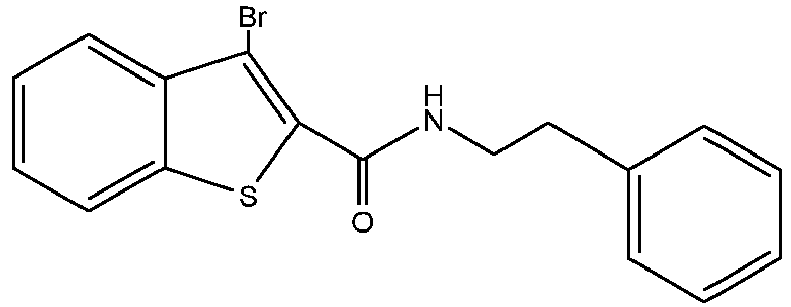
- 3-bromobenzo[b]thiophene-2-carboxylic acid (02) (0.60 g. 2.33 mmol) was dissolved in anhydrous DMF (15 mL) and cooled on an ice bath. To this stirred solution was added 2-Phenylethyl amine (0.37 mL, 3mmol), DCC (0.48 g, 2.33 mmol) and HOBt (0.31 g, 2.29 mmol). The reaction mixture was stirred overnight at room temperature under nitrogen atmosphere till completion of the reaction. The reaction mixture was vacuum filtered to remove precipitated urea byproduct. The filtrate was vacuum evaporated to give dark oil which was diluted in 20 mL ethyl acetate and then re-filtered. The filtrate was evaporated in vacuo and the oily residue was purified by column chromatography (30 % ethyl acetate: hexane). Since the compound had a tendency to crystallize in column, it was run on short column under pressure to yield the desired product as a colorless solid.ES-MS m/z: Cald for C17H14BrNOS 360.27 [M+]; Obsd 360. 1H-NMR (CDCl3, 300 MHz): 3.5 (d, 2H), 3.2 (d, 2H), 7.47 (m, 2H, ArH) 7.12 (m, 2H), 7.38 (m, 2H).
13C-NMR 42.9, 35.5, 106.6, 125.7, 124.7, 123.9, 124.5, 130, 138.7 and 161.0. -
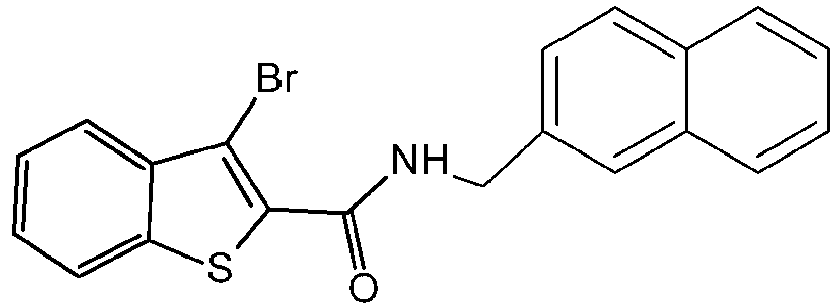
- DCC (0.48 g, 2.33 mmol), HOBt (0.31 g, 2.29 mmol) and 1-naphthalene-methylamine (0.431 mL, 3mmol), were added to a cooled solution of 3-bromobenzo[b]thiophene-2-carboxylic acid (02) (0.60 g. 2.33 mmol), in anhydrous DMF (15 mL).The reaction mixture was allowed to stir overnight at ambient temperature under nitrogen atmosphere. On completion of the reaction, dicyclohexylurea was removed by filtration. The filtrate was vacuum evaporated to give dark oil. The oily residue was dissolved in 20 ml ethyl acetate and then filtered. The filtrate was evaporated in vacuo. The residue was purified by silica gel chromatography (30 % ethyl acetate: hexane). To prevent the product from crystallization in the column, a short column was run under pressure to yield the target compound as a colorless solid. ES-MS m/z: Cald for C20H14BrNOS 396.30 [M+]; Obsd 396. 1H-NMR (CDCl3, 300 MHz): 4.9 (d, 2H), 7.47 (m, 2H, ArH), 7.12 (m, 2H), 7.38 (m, 2H), 7.1 (m, 2H), 7.3 (m, 2H), 7.6 (s, 1H).
13C-NMR (75 MHz): 44.0, 125.7, 124.7, 123.9, 124.5, 127.4, 127.5, 128.3, 128.2, 130, 138.7 and 161.0. -

- To a solution of N-(4-fluorobenzyl)-3-bromobenzo[b]thiophene-2-carboxamide (1mmol) in dry THF(2.5 ml) was added NaH (0.055 g, 2.29 mmol) and heated at 60°C for 30 min. Allyl bromide (1.2 mmol) was added to the resulting mixture and heated at 70 °C for 24 h. NaH(0.055 g, 2.29 mmol) and allyl bromide (0.17g, 1.41 mmol) were further added to the reaction mass and maintained at 70 °C for another 24 h. The solvent was vaccum evaporated, and the residue was extracted with diethyl ether, washed with brine, dried and evaporated under reduced pressure.The residue was purified by column chromatography (elution with 2% EtOAc-hexane) to give a colorless solid.ES-MS m/z: Cald for C19H15BrFNOS 404.30 [M+]; Obsd 403.0. 1H-NMR (CDCl3, 300 MHz): 4.70 (d, 2H), 5.18 (d, 2H), 7.45 (m, 2H, ArH), 7.83 (2H, ArH), 7 (m, 2H), 7.36 (m, 2H).
13C-NMR (75 MHz): 58.0, 106.6, 125.7, 124.7, 123.9, 124.5, 130, 138.7, 163.5, 136, 137.5 and 161.0. -

- Sodium hydride (0.055 g, 2.29 mmol) was added carefully to a stirred solution of N-(4-trifluorobenzyl)-3-bromobenzo[b]thiophene-2-carboxamide in dry THF(2.5 ml) and heated at 60 °C for 30 min. To the resulting mixture allyl bromide (1.2 mmol) was added and allowed to stir for 24 hrs at 70 °C. Another lot of NaH(0.055 g, 2.29 mmol) and allyl bromide (0.17g, 1.41 mmol) were added to the reaction mass and maintained at 70 °C for 24 hrs. The solvent was vacuum evaporated. The residue was diluted in diethyl ether, washed with brine, dried and evaporated in vacuo. The residue was purified by silica gel chromatography (elution with 2% EtOAc-hexane) to give a colorless solid.ES-MS m/z: Cald for C20H15BrF3NOS 454.30 [M+]; Obsd 454.4. 1H-NMR (CDCl3, 300 MHz): 4.70 (d, 2H), 5.18 (s, 2H), 7.47 (m, 2H, ArH) 7.12 (m, 2H), 7.38 (m, 2H).
13C-NMR 58.0, 106.6, 125.7, 124.7, 123.9, 124.5, 130, 136.4, 138.7, 142.2, and 161.0. - The animals were housed in an animal house facility of National Institute of Immunology, India, with controlled temperature (22± 2 °C) under a 12/12 h light/dark cycle. They had free access to food and water ad libitum. All experiments were conducted according to the guidelines of the international association for the study of pain and approved by the institutional ethical committee for animal research. All in vivo experiments were carried out on inbred male Wistrat rats (~ 200-320 g body weight). Same age and equal body weight of animals were used according to experiments. No animals were used for more than one experiment. Most popular non-steroidal anti-inflammatory drugs which are widely use for treatment of chronic and inflammatory pain, such as Ibuprofen, Naproxen, Ketoprofen, Aspirin, Nimesulide, Indomethacine were purchased from Cayman Chemicals, USA and used to evaluate the efficacy of drugs in animal model. These drugs and different derivatives of Benzothiophene were dissolved in minimum volume of Dimethyl sulfoxide (DMSO) and further diluted in Phosphate buffer saline prior to use.
- The anti-nociceptive efficacy of compounds with respect to acute thermal hyperalgesia is determined by using two established methods described an earlier (i) Hot plate latency test and (ii) Tail flick latency test. Hot plate latency test was performed under red light on the metal surface of hot plate analgesia meter (IITC, Life science, CA). Animals were placed individually on the surface of hot plate maintained at a constant temperature 54 ± 1°C. The anti-nociceptive response was latency recorded from the time when animal was placed on the heated surface until the behavior response show licking of hind paw to avoid thermal nociception. A maximum hot plate latency of 30 sec was used for each animal to prevent paw tissue damage. Base line nociceptive latency was obtained for each animal prior to any drug administration. Thereafter, groups of animals were treated with different concentration of different derivatives of benzothiophene and well known NSAIDs. These drugs were administered intra-peritonially to each animal and control group received normal saline in similar manner after exposure of thermal stimuli to evaluate baseline latency. Subsequent nociceptive response latency for each animal was determined at 30 and 60 min after drug administration. Furthermore, Anti-nociceptive efficacy of selective compounds was monitored at different time intervals up to 8 hrs. In continuation of tail flick latency assay, the anti-nociceptive effect of the compounds was monitored. Rats treated as described above were subjected to determination of thermal nociceptive pain. Rats were confined in restrainer and allowed to accommodate. The tail withdrawal test consisted of immersing the posterior 8-10 cm of the tail in hot water bath maintained at 54 ± 1 °C. Withdrawal latency for tail flicking was measured. A maximum tail flick latency of 20 sec was permitted to minimize tissue damage. The nociceptive latencies were expressed by maximum possible effect in percent (% MPE) using following formula (Brady & Holtzman, 1984).

- NSAIDs is commonly evaluated by hot plate latency assay whereby animals are exposed to thermal stimulus (54 degree centrigrade) and the time for hind paw licking is measured as behavioural response for pain.
- The anti-nociceptive response of various NSAIDs i.e. Ibuprofen, Naproxen, Ketoprofen, Aspirin, Nimuslide, Indomethacin was evaluated by hot plate latency assay in wistar rats and it was observed that ibuprofen proved to be a better anti-nociceptive drug as compared to
other NSAIDs 30 minutes post administration (fig 1 ). - The anti-nociceptive response of NSAIDs and synthesized derivatives of Benzothiophene was studied. Anti-nociceptive response is characterized by hot plate latency assay. First, the anti-nociceptive response of some classic/standard NSAIDs (50 mg/kg b. wt.) i.e. Ibuprofen, Naproxen, Ketoprofen, Aspirin, Nimuslide, Indomethacin by hot plate latency assay in 60 minutes post administration was evaluated and it was observed that ibuprofen showed a better anti-nociceptive effect compared to other NSAIDs. Hence, ibuprofen was chosen for comparison. The anti-nociceptive response of ibuprofen at dosage of 25 and 50 mg/kg b. wt. after 30 min and 60 min injection (i.p.) was studied. It was observed that dosage of 50mg/kg b. wt. of ibuprofen score effective anti-nociceptive response in intervals of 30 min and 60 min, indicating that 50 mg/kg b. wt is a suitable dose for the study. The anti-nocicetive response of benzothiophene derivatives (4-11,) individually at different dosages of 1-30 mg/kg b. wt. and found that the response was dose dependent, however no significant difference was observed for dosage > 15mg/kg b.wt.. It was observed that all the animals injected with
benzothiophene derivatives 15 mg/kg of b. wt exhibit significant increase MPE index except for compounds-10 and 11 which showed less latency in comparison to other derivatives. The results indicate that benzothiophene derivatives showed optimal anti-nociceptive response at 15mg/kg b. wt. at bothtime point Fig. 2 ). Interestingly, the comparative MPE index of Ibuprofin (50mg/kg b. wt.) alongwith our compounds (15mg/kg b. wt.) clearly show that compound-6 has preeminent analgesic activity compared to other compounds and this was further corroborated with the time course study. The above results reveal thatcompounds - the anti-nociceptive potential of cmpounds 4-11 was also evaluated by Tail flick latency assay. The animals treated with different dosage of compounds 4-11 (5, 10 and 15 mg/kg b. wt.) and ibuprofen (50 mg/kg b. wt.) were subjected to tail flick latency assay at 30 min and 60 min of post injection. It was observed that
compound Fig. 3 ). - The results have shown that benzothiophene derivatives of the present invention are promising candidate molecules as analgesics. Further, their %MPE are much higher than ibuprofen at much lower dose, indicating that the side effects of the benzothiophene derivatives may be less which otherwise is a problem when drug is effective at higher dose. Higher dose means more stress environment on liver or kidneys to detoxify the drug and vice-versa.
- Mechanical hyperalgesia was measured as hind limb withdrawal threshold in response to a mechanical stimulus applied to hind paws of rat using Randall-selitto meter, Randall and Selitto, 1957. To determine the mechanical hyperalgesia, the force was applied with increased pressure at a constant rate until the animal withdrew its limb. The base line nociceptive threshold was measured before induction of hyperalgesia. Moreover, hyperalgesia was induced by carrageenan and then groups of animal were treated with
compound 4,compound 6 and compound 8 (15mg/kg body weight) and Ibuprofen (50mg/kg body weight). Control group was treated with physiological saline. The threshold of pain was measured at 1, 2, 3, 4 and 5 h after induction of hyperalgesia. The anti-nociceptive efficacy of the compounds has been evaluated the efficacy with paw withdrawal threshold latency of animals. - Likewise animals were subjected to mechanical allodynia and threshold of analgesia induced by these
compounds compound 9 and 10) and ibuprofen was measured. Animals treated withcompounds Fig.4 ). The result indicates derivatives of Benzothiophene (6, 4 and 8) have better response than the Ibuprofen (50 mg/kg b. wt.). - Thus, results from the above experiments suggest that Benzothiophene derivatives attenuate the anti-nociceptive response effectively at lover dosage than the Ibuprofen.
- Anti-inflammatory activities of the
compound 4 to compound 11 were evaluated by carrageenan induced inflammatory pain model (Hargreaves et al. 1988). Rats (~250-300 g body weight) were anesthetized by intra muscular injection of Ketamine (100mg/kg) and xylazine (10mg/kg). Inflammation was induced in right hind paw of rats by intraplantar injection of 0.1 ml of 1% (W/V) λ-carrageenan (Sigma Aldrich Chemical, USA) freshly prepared in sterile saline. Contra lateral hind paws without injection were used as control. Paw volumes of both hind paws of each animal were measured using a plethysmometer (IITC Life Science, USA). To evaluate anti-inflammatory response of derivates of benzothiophene (compounds 4 to 6, andcompound 8 and compound 9) rats were treated with doses of 5 mg/kg, 10 mg/kg and 15 mg/kg to each animal after 30 min injection of λ-carrageenan. The efficacies of compounds were compared with best analgesic drug Ibuprofen (50mg/kg). Control group was received Phosphate buffer saline (pH 7.4) in similar manner. Paw volume of both hind paw were measured at 1, 2, 3, 4, and 5 hrs. The anti-inflammatory response of the test compounds is expressed in percent of paw edema. - To evaluate the anti-inflammatory effect of these compounds the animals received the intraperitoneal injection of these
compounds 30 minutes before carrageenan injection in hind paw. 1% carrageenan was found to induce maximal inflammation till 3 hours and the inflammation decreased drastically after 5 hours, so further studies with the compound were done till 5 hour study. - Anti-inflammatory potential of benzothiophene derivatives were evaluated in animal model of inflammatory pain. The intra-plantar injection of 1% carrageenan in right hind paw of animals cause robust inflammation, however; contra lateral left hind paw without injection of carrageenan remained unaffected and served as control. The inflammation crests at 1-5 h and reached basal level at 8 h . First the anti-inflammatory effect of ibuprofen (25 and 50mg/kg b.wt.) was evaluated in 1% carrageenan challenged animals by measuring the paw volume and found that of ibuprofen (50 mg/kg b.wt) significantly diminish inflammatory hyeralgesia by greater than 2 fold at 3 h compared to carrageenan challenged control group. We next studied the anti-inflammatory response of Benzothiophene derivetives compounds 4-11 at doses of 5-15 mg/kg b. wt. and compared with Ibuprofen (50 mg/kg b.wt.). The dose dependent study showed that the lowest dose (5 mg/kg) of Benzothiophene derivatives were unable to inhibit the inflammatory hyperalgesia, however 10 mg/kg and 15 mg/kg of doses significantly reduced the inflammatory hyperalgesia in dose dependent manner (
Fig. 5 ). Again the anti-inflammatory effect of these compounds were much better than classic NSAIDs ( Ibuprofen) even at lower dosage. Thus, our results clearly indicate that Benzothiophene compounds are more potent inhibitors of inflammatory hyperalgesia than the classic NSAID ibuprofen. Moreover, histological evaluation of inflamed tissues corroborated with the above results. Infiltration of inflammatory cells including macrophaases, mast cells, neutophills at the site of injury/inflammation decreased drastically after administration of compound 4-11 compared to caragenan control. - Level of COX1 and COX2 were determined in inflamed paw tissue of rats. Hyperalgesia was induced described as earlier. The animals were treated with
test compound 4,compound 6,compound 8 and compound 9 (15mg/kg body weight) and sacrificed after 3 hrs. Paw tissue was removed and homogenized in lyses buffer [20 mM Tris (pH-7.5), 150 mM NaCl, 1 mM EDTA, 1mM DTT, 1 mM Sodium vanadate, 1% NP-40, 0.025% SDS, 0.25% Sodium deoxycholate containing protease inhibitors cocktail (Sigma Aldrich, USA). Homogenate was centrifuged at 15,000 xg for 20 min at 4°C. Resulting supernatant was collected and used to determine the level of COX2. The protein concentration in extracts was estimated using BCA protein assay reagent (Sigma Aldrich, USA). The proteins of cell lysates were fractionated on Tris-Glycine buffered 12% SDS PAGE and transferred to PVDF membrane (GE healthcare) by wet electro blotting (Biorad, USA). The membrane was blocked with Tris buffered saline and 0.05% Tween 20 (TBST) containing 5% nonfat milk for 3h at room temperature followed by incubation with primary antibody overnight at 4°C. After washing with TBST, the membrane was incubated with horseradish peroxidase conjugated secondary antibody for 2h at room temperature. Nonspecifically bound secondary antibody was removed from the membrane by several washes with TBST. Immunoreactive reactive protein was detected with chemiluminescence using X-ray film (Amersham Bioscience, USA) and analyzed using geldoc software. - At molecular level the expression of COX-2 was investigated by western blot to confirm whether the anti-inflammatory effect of benzothiophene compounds of the present invention involves COX-2. Immunochemistry of COX-2 clearly showed reduction in the level of COX-2 enzyme and the decrease was almost normalized to control. Carrageenan injected animals on the other hand showed high level of COX-2 (
figure 6 ). COX exists in two isoforms COX-1 and COX-2, out of which COX-2 is inducible form which is a major player in inflammation. - All computational calculations and graphical manipulations were performed on Intel® Pentium®D CPU 2.8 GHz processor, 0.99GB RAM memory with Microsoft Windows XP professional operating system. Ligand molecule preparation, preparation of receptor protein, molecular docking and ligand interaction map generation were performed using software MOE (The Molecular Operating Environment Version 2009.10, software available from Chemical Computing Group Inc.,1010 Sherbrooke Street West, Suite 910, Montreal, Canada H3A 2R7. http://www.chemcomp.com).
- Ligand molecules three dimensional structure were prepared using MOE-builder tool, part of MOE suite and were subjected to energy minimization to a gradient of 0.0001 using dielectric constant of 1 and forcefield partial charge were calculated by MMF94x forcefield. All the ligand molecules were saved into a database for molecular docking calculations.
- The atomic coordinates of COX-2 used for molecular docking were derived from 2.1 Å X-ray crystal structure of arachidonic acid bound to the cyclooxygenase channel of cyclooxygenase-2 obtained from the RCSB Protein Data Bank (PDB entry:3HS5). The initial coordinates for docking was set in the sequence editor interface part of MOE suite by: (i) removing residues present in chain B [Amino acid sequence, ligands sequence (containing acrylic acid, B-octylglucoside, protoporphyrin IX, ethandiol, alfa-D-mannose and N-acetyl-D-glucosamine residues) and water molecules]. (ii) Water molecules and other ligand residues except arachidonic acid from chain A were also removed. (iii) Receptor protein was protonated by Protonate3D - Macromolecular Protonation State Assignment tool part of MOE suite. (iv) Partial Charge of the receptor was fixed.
- The purpose of Molecular docking experiments was to search energetically favorable binding configurations between small flexible ligands and fixed receptor protein. Docking experiments was executed using Molecular docking structure-based design tool a part of MOE suite 2009.10(The Molecular Operating Environment Version 2009.10, software available from Chemical Computing Group Inc.,1010 Sherbrooke Street West, Suite 910, Montreal, Canada H3A 2R7. http://www.chemcomp.com). The molecular docking on COX-2 was carried out by superimposing the energy minimized ligands database on arachidonic acid in the receptor protein-ligand complex. The database were docked by default nonstochastic Triangle Matcher placement method using London dG scoring, followed by forcefield refinement using default configurations (parameters) of docking simulations. Each ligand was docked in the receptor protein and top 100 pose were retained using arachidonic acid as a definition of binding site. The docked poses were exported and visualized in the main MOE window by database browser. The predicted docking score of best scoring member of each ligand was taken for further analysis and ligand interaction map was generated. Molecular Descriptors were calculated for analysis of ligand protein binding mode. Protein ligand interaction fingerprints (PLIF) were generated from output database of docking using PLIF: Protein Ligand Interaction Fingerprints a structure based design tool part of the MOE suite for summarizing the interactions between ligands and proteins using a fingerprint scheme.
- The purpose of molecular docking calculations and structural optimization of the complexes obtained was to investigating the possible interaction mode of compounds/inhibitors used in the present study within the COX-2 binding site and to validate the results obtained by in vivo experiments of anti-analgesic as well as anti-inflammatory activity of compounds. All molecular docking results were stored into output database, the best conformation docked energy (MM/GBVI Binding free energy) of all compounds were taken and comparative graph were generated along with known inhibitors of COX-2 (Indomethacin and Ibuprofen) (
Figure 7 ). Docking results suggested thatcompound 8,compound 4 andcompound 6 binds better than substrate arachidonic acid and known inhibitors and these compounds can be used as promising molecule for anti-analgesic as well as anti-inflammatory activity. The binding modes of these compounds in the active site pocket of COX-2 similar to substrate and known inhibitors. The ligand interaction maps of the compounds were generated and overlay of ligands with arachidonic acid was generated in LigX tool and is shown inFigure 8 . The protein ligand interaction fingerprints data revealed that most of the conformations of inhibitors interacted with Tyr 355, Tyr 385, Ser 353, Leu 352,Arg 120, Val 523, Ala 527 andSer 530, and shown inFigure 9 as barcode PLIF and Population PLIF. The 3D binding mode and 2D ligand interaction map of two known inhibitor Indomethacin and Ibuprofen and twobest compounds Figure 10 . - Benzothiophene carboxamide derivatives of the present invention were checked for their anti-parasitic activity against 3D7 (chloroquine sensitive strain) in an in vitro culture. The IC50 value for growth inhibition of parasite was found to be 1 ± 0.3 and 1.18 ± 0.2µM for
compounds compounds Fig. 11a ,11b and 11c ). When compounds 6 and 7 were added at the trophozoite stage the cells could not proceed to the schizont stage indicating the growth inhibition occurs at trophozoite stage. - Synchronised culture of P. falciparum 3D7 was treated with 2.5
µM compound compound 10 were observed to be dead whereas after treatment withcompound 11 around 70% of the parasites were dead (Fig. 11c and d ). The IC50 value for growth inhibition of parasite was found to be 2.93 ±1.2 and 1.3 ± 0.1 µM forcompounds - C57BL/6 mice were infected with blood-stage P. berghei ANKA as discussed in the experimental section. After 24 hours of infection mice were treated intravenously with various doses of inhibitors. It was observed that all control mice developed hypothermia by
day 2, ataxia and convulsions byday 3 and died byday 6, whereas inhibitor treated groups had considerably higher longevity (11-24 days). Though each group of mice developed hypothermia byday 4, convulsions and ataxia development were delayed in case of treated mice. Groups treated with 5 mg/kg body weight ofcompound 6 showed longest survival till 24th day whereas the group treated with 10 mg/kg body weight of drug survived till day 20 (Fig. 12a ). The Peter's test showed reduction in the parasitemia levels afterday 6 and reached an undetectable level byDay 18. The inhibitor treatment significantly delayed the onset of hypothermia and prevented convulsions, ataxia, paralysis, etc. The mice treated with 2.5 mg/kg body weight survived for 18days. Even at or below 1 mg/kg body weight of inhibitor dose, the mice survived for 11 days, but paralysis and ataxia development occurred onDay 7. Since 5 mg/kg body weight dose ofcompound 6 had the longest survival and had normal kidney and liver functions (urea, creatinine and glucose levels) we used this dose for further studies. - To determine the most effective route of administration, 5 mg/kg body weight of the compounds were administered through intraperitoneal, peroral, subcutaneous and intravenous routes. The mice were treated for 6 days. Under
compound 6 administration, it was observed that mice treated via intravenous route survived for longest period (survival 24 days,Fig. 12b and Table III), while those treated subcutaneously and intraperitoneally were less effective compared to intravenous route (survival 21 days). Although oral route was considerably less effective compared to other two routes, it still increased the longevity by 5 days.Compound 7 also showed comparative activity tocompound 6. Chloroquine was used as the control drug. Chloroquine too was found to be more effective via intravenous and subcutaneous routes compared to oral administration. - The dose response experiment for
compound 6 showed that 5mg/kg body was the optimum dosage. Therefore, compounds 10 and 11 were also administered at 5mg/Kg body weight. The compounds were administered through intraperitoneal, peroral, subcutaneous and intravenous routes.Compound compound 11, intravenous route was observed to be most effective. The mean survival days for this treatment group was 16 (Fig. 12c and Table III). Subcutaneous and intraperitoneal administration could prolong the longevity to 14 and 10 days respectively. Oral administration was the least effective but the treatment group still could outlive the control group.Compound 10 was also most effective when administered intravenously and could prolong the survival till 15th day. Chloroquine was used as the control drug. - Docked conformations of bromo-benzothiophene carboxamide derivativesof the present invention to PfENR reveals that these molecules occupy the hydrophobic pocket composed of Tyr 267, Ala 272, Tyr277, Gly 313, Pro 314,
Phe 368, and Ile 369. Benzyl group was observed to be surrounded by substrate binding loop residues Ala 319, Ala 320 and Ile 323 and another loop from Ala 217 to Val 222. Carbonyl group mimics the carbonyl oxygen of the thioester substrate.Compound 6 has two hydrogen bonding interactions, twenty-eight hydrophobic interactions, sixteen aromatic-aromatic interactions and twelve hydrophobic-hydrophillic interactions (Fig. 13a , Table 2). There are eighty-nine other interactions predominantly van der Waals.Compound 6 also has extensive van der Waal s interaction with NAD+. Benzyl ring ofcompound 6 makes H-II stacking interaction with nicotinamide ring of NAD+. Its carbonyl group interacts with N7 group of NAD+.Compound 7 has six hydrogen bonding interactions, twenty-nine hydrophobic interactions, eighteen aromatic-aromatic interactions and five hydrophobic-hydrophillic interactions (Fig. 13b , and Table 3). There are ninety-nine other interactions like van der Waals.Compound 7 also has extensive van der Waal's interaction with NAD+ as well as Π-Π stacking interaction with nicotinamide ring of NAD+. - PfENR activity was determined using standard assay described earlier. The IC50 of the three best compounds were in nanomolar ranges and the remaining compounds were active at micromolar concentrations (
Fig. 14a, and 14b , Table Ia). Compound 6 (IC50= 0.115 ± 0.12µM) was found to be most potent. The IC50 of other two potent compounds were also in the nanomolar range (Compounds 7 = 0.463 ± 0.1µM, 4 = 0.51 ± 0.33µM).Compounds compound 6 were determined individually against cofactor NADH and substrate crotonoyl CoA. It gave competitive kinetics with NADH and uncompetitive against crotonoyl CoA (Fig. 14c and 14d ). The Ki values are indicated in the Table Ib. Analysis of kinetic data showed that these inhibitors compete with NADH for binding to PfENR. On the other hand,compound 6 prefers to bind with PfENR in presence of crotonoyl-CoA, hence it is an uncompetitive inhibitor of the substrate. Example 23: Cofactor potency assays
NAD+ was shown to potentiate the binding ofcompound 6 to PfENR (Fig. 15 ). The control reaction showed a linear increase in the accumulation of NAD+(curve a), whereas when the reaction was carried out in the presence ofcompound 6, accumulation of product decreased (curve b). The accumulation of product further decreased whencompound 6 was preincubated with the enzyme (curve c). On addition of NAD+ to this reaction the rate of product accumulation further decreased (curve d). This also indicated that these are slow tight binding inhibitors of PfENR. - Progress curves for inhibition by varying concentrations of
compounds Fig. 16a and 16b ). From the progress curve analyses, it was inferred that for each concentration of the inhibitors the initial and the steady state velocity decreased exponentially with time. At higher inhibitor concentration, steady state is reached rapidly with a decrease in steady state velocity (vs). It indicates that initially a loose complex of inhibitor, NAD+, and PfENR is formed which slowly isomerises into a more stable tight complex. - Progress curves were analysed using equation 3a from which a series of Kobs values were obtained for each concentration of inhibitor. The determined Kobs values were plotted against respective concentrations of
compound Fig. 16c and 16d ). Hyperbolic curve indicated biphasic binding of inhibitors again reflecting slow tight binding behaviour of bromo-benzothiophene carboxamide derived inhibitors of PfENR.Table Ia. Inhibitory potencies of benzothiphene derivatives against purified PfENR and red blood cell stages of Plasmodium falciparum 3D7. Compound Structure Inhibition of PfENR (IC50µM) P.falciparum (IC50 µM) Triclosan 
0.089 ± .005 0.80 ± 0.1 1 
1.68 ± 0.045 2.1 ± 0.4 4 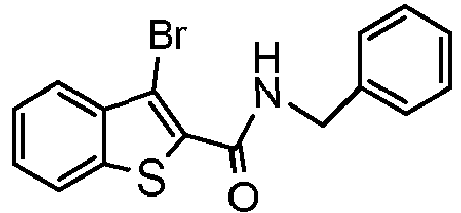
0.501±0.033 2.00 ± 0.5 5 
31.99 ± 0.23 5.93 ± 0.3 6 
0.115 ± .012 1.00 ± 0.3 7 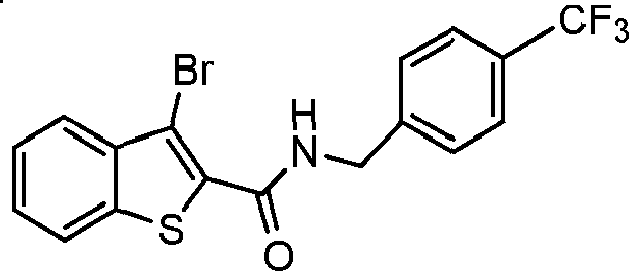
0.463 ± 0.01 1.18 ± 0.2 8 
54.98 ± 0.42 2.46 ± 0.7 9 
52.56 ± 0.33 2.45 ± 0.9 10 
51.98 ± 0.43 2.93 ± 1.2 11 
52.48 ± 0.22 1.3 ± 0.1 Table Ib. Dissociation constant, isomerization rate constant, dissociation rate constant of compounds Compounds Dissociation constant (Ki) nM Isomerization rate constant (k5 * 10-2) (s-1) Dissociation rate constant (k6* 10-3) (s-1) 6 48.87 1.19±.045 1±.0004 7 86.1 1.65±.023 6.9±.0003 Table II. Inhibitory potency of compound 6 on hepatic cell stages of P. berghei.IC50 for EEFs* TC50 for HepG2 cells ** Therapeutic Index (TI) [=TC50/IC50] 51 µM 2.0±0.2 mM 39.0±4 *value for two days treatment **value for one day treatment Table III. Mean survival days depending on different routes of inhibitor/drug administration Route of Administration Compound 6 Compound 7Compound10 Compound 11 Chloroquine Placebo Mean Survival Days (Observed for 25 days) Intraperitoneal 20 ± 0.9 21 ± 1.3 11 ± 0.8 10 ± 1.2 20 ± 1.5 6 ± 0.3 Per oral 12 ± 1.2 11 ± 0.9 7± 1.2 7± .6 17 ± 1.4 5 ± 0.2 Subcutaneous 18 ± 1.3 15 ± 1.2 12± 1.6 14± 1.2 21 ± 1.7 6 ± 0.3 Intravenous 24 ± 2.0 24 ± 2.1 15 ± 0.7 16 ± 1.5 25 ± 2.1 6 ± 0.4 - Although the subject matter has been described in considerable detail with reference to certain preferred embodiments thereof, other embodiments are possible. As such, the spirit and scope of the appended claims should not be limited to the description of the preferred embodiment contained therein.
Claims (18)
- A benzothiophene carboxamide compound of formula I, its polymorph, stereoisomer, prodrug, solvate or pharmaceutically acceptable salt and formulation thereof, wherein said compound is a PfENR inhibitor,
 X is a halogen;Y is C1-C6 alkylene;Ar is phenyl or naphthyl;R6 is selected from the group consisting of H, C1-C4 alkyl, C1-C4 alkoxy, OH, halogen, haloalkyl, perfluroalkyl, nitro, cyano and amino; andR1, R2, R3, R4 and R5 are independently selected from a group consisting of H, C1-C4 alkyl, allyl and C2-C6 alkenyl.
 - The compound as claimed in claim 1 wherein R1, R2, R3 and R4 are hydrogen.
- The compound as claimed in claim 1 wherein said halogen is bromine.
- The compound as claimed in claim 1 wherein R1, R2, R3, and R4, are each H; X is Br; R5 is C2-C6 alkenyl; Y is CH2; and R6 is H, halogen or perfluoroalkyl.
- The compound as claimed in claim 1, which is:N-benzyl-3-bromobenzo[b]thiophene-2-carboxamide;N-(4-methoxybenzyl)-3-bromobenzo[b]thiophene-2-carboxamide;N-(4-fluorobenzyl)-3-bromobenzo[b]thiophene-2-carboxamide;N-(4-trifluorobenzyl)-3-bromobenzo[b]thiophene-2-carboxamide;3-bromo-N-(2-phenylethyl)-benzo[b]thiophene-2-carboxamide; or3-bromo-N-(naphthalen-1-ylmethyl)-benzo[b]thiophene-2-carboxamide.
- The compound as claimed in claim 1 selected from:3-bromo-N-(4-fluorobenzyl)-N-(prop-2-en-1-yl)-benzo[b]thiophene-2-carboxamide; or3-bromo-N-(prop-2-en-1-yl)-N-[4-(trifluoromethyl)benzyl]-1-benzo[b]thiophene-2-carboxamide.
- The compound of formula I as claimed in any of the claims 1 to 6 for use in treatment of malaria.
- The compound of formula I as claimed in any of the claims 1 to 6, wherein the compound has an IC50 value of no more than about 0.115 ± 0.12 for PfENR inhibition.
- A pharmaceutical composition comprising a therapeutically effective amount of a compound of formula I as claimed in any of the claims 1 to 6 with pharmaceutically acceptable excipients.
- The composition of claim 9 wherein said composition is for the treatment of malaria.
- A method of treatment of malaria, said method comprising administering a therapeutically effective amount of compound as claimed in any of the claims 1 to 6, its polymorph, stereoisomer, prodrug, solvate or pharmaceutically acceptable salt and formulation thereof
- The method of claim 11 wherein said method is by inhibiting PfENR enzyme of malaria parasite using compound as claimed in any of the claims 1 to 6, its polymorph, stereoisomer, prodrug, solvate or pharmaceutically acceptable salt and formulation thereof
- The method of claim 11, wherein said parasite is a member of the Plasmodium genus.
- The method of claim 11, wherein the parasite is Plasmodium falciparum.
- A method of killing a Plasmodium falciparum parasite, said method comprising contacting said parasite with an effective amount of a compound as claimed in any of the claims 1 to 6 or its polymorph, stereoisomer, prodrug, solvate or pharmaceutically acceptable salt and formulation thereof.
- A method of killing Plasmodium falciparum parasites in a host mammal comprising administering to the host mammal in need thereof a therapeutically effective amount of a compound as claimed in any of the claims 1 to 6 or its polymorph, stereoisomer, prodrug, solvate or pharmaceutically acceptable salt and formulation thereof
- The method of claim 11, wherein the malaria is treatable by inhibiting the PfENR enzyme of malaria parasite.
- Use of a compound as claimed in any of the claims 1 to 6 for treatment of malaria.
Applications Claiming Priority (1)
| Application Number | Priority Date | Filing Date | Title |
|---|---|---|---|
| IN1646DE2010 | 2010-07-14 |
Publications (1)
| Publication Number | Publication Date |
|---|---|
| EP2578579A1 true EP2578579A1 (en) | 2013-04-10 |
Family
ID=45467438
Family Applications (1)
| Application Number | Title | Priority Date | Filing Date |
|---|---|---|---|
| EP11173782.1A Withdrawn EP2578579A1 (en) | 2010-07-14 | 2011-07-13 | Benzothiophene carboxamide compounds, composition and applications thereof |
Country Status (4)
| Country | Link |
|---|---|
| US (1) | US20120016014A1 (en) |
| EP (1) | EP2578579A1 (en) |
| AU (1) | AU2011202542A1 (en) |
| ZA (1) | ZA201105042B (en) |
Cited By (1)
| Publication number | Priority date | Publication date | Assignee | Title |
|---|---|---|---|---|
| KR102542698B1 (en) * | 2022-04-05 | 2023-06-14 | 주식회사 베노바이오 | Novel benzothiophene derivatives and use as BET inhibitors |
Families Citing this family (1)
| Publication number | Priority date | Publication date | Assignee | Title |
|---|---|---|---|---|
| JP6064531B2 (en) * | 2012-11-12 | 2017-01-25 | 住友化学株式会社 | Agrochemical composition and method for promoting plant growth |
Citations (26)
| Publication number | Priority date | Publication date | Assignee | Title |
|---|---|---|---|---|
| GB1217427A (en) | 1967-12-21 | 1970-12-31 | America Home Products Corp | Cinchona alkaloid derivatives |
| CH533123A (en) | 1968-07-02 | 1973-01-31 | Hoffmann La Roche | Quinine quininoine and analogues thereof useful as antimal |
| US3764604A (en) | 1968-12-17 | 1973-10-09 | Us Army | 4-pyridylcarbinolamine anti-malarials |
| US4548948A (en) | 1983-02-19 | 1985-10-22 | Beecham Group P.L.C. | Anti-inflammatory and analgesic benzothiophene and benzafuran derivatives, compositions, and method of use therefor |
| US4621091A (en) | 1984-10-09 | 1986-11-04 | Merck & Co., Inc. | 3-hydroxybenzo[b]thiophene-2-sulfide derivatives compositions, and method of use therefor |
| US4663347A (en) | 1983-10-31 | 1987-05-05 | Merck Frosst Canada, Inc. | Benzofuran 2-carboxylic acid esters useful as inhibitors of leukotriene biosynthesis |
| US4745127A (en) | 1983-10-31 | 1988-05-17 | Merck Frosst Canada, Inc. | Benzyl esters of benzofuran-2-carboxylic acids useful as inhibitors of leukotriene biosynthesis |
| US4822803A (en) | 1983-10-31 | 1989-04-18 | Merck Frosst Canada, Inc. | Benzofuran 2-carboxylic acid hydrazides useful as inhibitors of leukotriene biosynthesis |
| US4933351A (en) | 1983-10-31 | 1990-06-12 | Merck Frosst Canada, Inc. | Benzofuran 2-carbox amides useful as inhibitors of leukoriene biosynthesis |
| US6433005B1 (en) | 2000-12-05 | 2002-08-13 | Syntex (U.S.A.) Llc | Benzofuran and benzothiophene derivatives as anti-inflammatory agents |
| WO2005037290A1 (en) | 2003-10-20 | 2005-04-28 | Council Of Scientific And Industrial Research | Use of phosphono derivatives as anti-malarial |
| US20050090480A1 (en) | 2003-10-22 | 2005-04-28 | Council Of Scientific & Industrial Research | Use of selected amino acid-zinc complexes as anti-malarials |
| US20050131058A1 (en) | 2002-03-11 | 2005-06-16 | Yusuke Wataya | Novel compounds and antimalarials |
| US6946483B2 (en) | 2000-08-23 | 2005-09-20 | Sanofi-Aventis | Aminoalkenylbenzoyl-benzofuran or benzothiophene, method for preparing same and compositions containing same |
| US6949583B2 (en) | 2000-08-23 | 2005-09-27 | Sanofi-Synthelabo | Aminoalkoxybenzoyl-benzofuran or benzothiophene derivatives, method of preparing same and compositions containing same |
| US20060183167A1 (en) | 2002-12-20 | 2006-08-17 | Tatu Utpal | Novel assay to screen for anti-malarials |
| US7148240B2 (en) | 2000-08-23 | 2006-12-12 | Sanofi-Aventis | Aminoalkoxybenzoyl-benzofuran or benzothiophene derivatives, method for preparing same and compositions containing same |
| WO2007138112A2 (en) * | 2006-06-01 | 2007-12-06 | Devgen N.V. | Compounds that interact with ion channels, in particular with ion channels from the kv family |
| US7351735B2 (en) | 2002-02-22 | 2008-04-01 | Bayer Pharmaceuticals Corporation | Benzofuran and benzothiophene derivatives useful in the treatment of hyper-proliferative disorders |
| US7375130B2 (en) | 2003-11-20 | 2008-05-20 | Merck Patent Gesellschaft Mit Beschrankter Haftung | Antidiabetic compounds comprising benzofuran and benzothiophene derivatives |
| US20080200461A1 (en) * | 2007-02-20 | 2008-08-21 | Cropsolution, Inc. | Modulators of acetyl-coenzyme a carboxylase and methods of use thereof |
| CN101292983A (en) | 2008-06-17 | 2008-10-29 | 广州中医药大学 | Application of [1'-(7"-chloro-quinoline-4"-yl)piperazin-4'-yl]-3-propionic acid in the preparation of antimalarial drugs |
| US20090280483A1 (en) * | 2005-11-22 | 2009-11-12 | Toshio Kitamura | Methods for Screening Interleukin-6 (IL-6) Signal Transduction Inhibitors |
| CA2726158A1 (en) | 2008-06-11 | 2009-12-17 | Dana Farber Cancer Institute | Compounds and compositions useful for the treatment of malaria |
| US20110021467A1 (en) | 2004-03-16 | 2011-01-27 | Sanofi-Aventis | Indazolecarboxamide derivatives for the treatment and prevention of malaria |
| WO2011072275A2 (en) * | 2009-12-11 | 2011-06-16 | Nono, Inc. | Agents and methods for treating ischemic and other diseases |
Family Cites Families (5)
| Publication number | Priority date | Publication date | Assignee | Title |
|---|---|---|---|---|
| DE4317076A1 (en) * | 1993-05-21 | 1994-11-24 | Bayer Ag | Benzothiophene carboxamide S-oxide |
| AU6050500A (en) * | 1999-07-21 | 2001-02-13 | Eli Lilly And Company | Benzothiophene derivatives |
| EP1615698B1 (en) * | 2003-04-11 | 2010-09-29 | High Point Pharmaceuticals, LLC | New amide derivatives and pharmaceutical use thereof |
| WO2004089415A2 (en) * | 2003-04-11 | 2004-10-21 | Novo Nordisk A/S | COMBINATIONS OF AN 11β-HYDROXYSTEROID DEHYDROGENASE TYPE 1 INHIBITOR AND A GLUCOCORTICOID RECEPTOR AGONIST |
| JP2011507910A (en) * | 2007-12-21 | 2011-03-10 | ユニバーシティー オブ ロチェスター | Methods for changing the lifetime of eukaryotes |
-
2011
- 2011-05-31 AU AU2011202542A patent/AU2011202542A1/en not_active Abandoned
- 2011-07-08 ZA ZA2011/05042A patent/ZA201105042B/en unknown
- 2011-07-13 EP EP11173782.1A patent/EP2578579A1/en not_active Withdrawn
- 2011-07-14 US US13/183,024 patent/US20120016014A1/en not_active Abandoned
Patent Citations (26)
| Publication number | Priority date | Publication date | Assignee | Title |
|---|---|---|---|---|
| GB1217427A (en) | 1967-12-21 | 1970-12-31 | America Home Products Corp | Cinchona alkaloid derivatives |
| CH533123A (en) | 1968-07-02 | 1973-01-31 | Hoffmann La Roche | Quinine quininoine and analogues thereof useful as antimal |
| US3764604A (en) | 1968-12-17 | 1973-10-09 | Us Army | 4-pyridylcarbinolamine anti-malarials |
| US4548948A (en) | 1983-02-19 | 1985-10-22 | Beecham Group P.L.C. | Anti-inflammatory and analgesic benzothiophene and benzafuran derivatives, compositions, and method of use therefor |
| US4745127A (en) | 1983-10-31 | 1988-05-17 | Merck Frosst Canada, Inc. | Benzyl esters of benzofuran-2-carboxylic acids useful as inhibitors of leukotriene biosynthesis |
| US4663347A (en) | 1983-10-31 | 1987-05-05 | Merck Frosst Canada, Inc. | Benzofuran 2-carboxylic acid esters useful as inhibitors of leukotriene biosynthesis |
| US4822803A (en) | 1983-10-31 | 1989-04-18 | Merck Frosst Canada, Inc. | Benzofuran 2-carboxylic acid hydrazides useful as inhibitors of leukotriene biosynthesis |
| US4933351A (en) | 1983-10-31 | 1990-06-12 | Merck Frosst Canada, Inc. | Benzofuran 2-carbox amides useful as inhibitors of leukoriene biosynthesis |
| US4621091A (en) | 1984-10-09 | 1986-11-04 | Merck & Co., Inc. | 3-hydroxybenzo[b]thiophene-2-sulfide derivatives compositions, and method of use therefor |
| US6946483B2 (en) | 2000-08-23 | 2005-09-20 | Sanofi-Aventis | Aminoalkenylbenzoyl-benzofuran or benzothiophene, method for preparing same and compositions containing same |
| US7148240B2 (en) | 2000-08-23 | 2006-12-12 | Sanofi-Aventis | Aminoalkoxybenzoyl-benzofuran or benzothiophene derivatives, method for preparing same and compositions containing same |
| US6949583B2 (en) | 2000-08-23 | 2005-09-27 | Sanofi-Synthelabo | Aminoalkoxybenzoyl-benzofuran or benzothiophene derivatives, method of preparing same and compositions containing same |
| US6433005B1 (en) | 2000-12-05 | 2002-08-13 | Syntex (U.S.A.) Llc | Benzofuran and benzothiophene derivatives as anti-inflammatory agents |
| US7351735B2 (en) | 2002-02-22 | 2008-04-01 | Bayer Pharmaceuticals Corporation | Benzofuran and benzothiophene derivatives useful in the treatment of hyper-proliferative disorders |
| US20050131058A1 (en) | 2002-03-11 | 2005-06-16 | Yusuke Wataya | Novel compounds and antimalarials |
| US20060183167A1 (en) | 2002-12-20 | 2006-08-17 | Tatu Utpal | Novel assay to screen for anti-malarials |
| WO2005037290A1 (en) | 2003-10-20 | 2005-04-28 | Council Of Scientific And Industrial Research | Use of phosphono derivatives as anti-malarial |
| US20050090480A1 (en) | 2003-10-22 | 2005-04-28 | Council Of Scientific & Industrial Research | Use of selected amino acid-zinc complexes as anti-malarials |
| US7375130B2 (en) | 2003-11-20 | 2008-05-20 | Merck Patent Gesellschaft Mit Beschrankter Haftung | Antidiabetic compounds comprising benzofuran and benzothiophene derivatives |
| US20110021467A1 (en) | 2004-03-16 | 2011-01-27 | Sanofi-Aventis | Indazolecarboxamide derivatives for the treatment and prevention of malaria |
| US20090280483A1 (en) * | 2005-11-22 | 2009-11-12 | Toshio Kitamura | Methods for Screening Interleukin-6 (IL-6) Signal Transduction Inhibitors |
| WO2007138112A2 (en) * | 2006-06-01 | 2007-12-06 | Devgen N.V. | Compounds that interact with ion channels, in particular with ion channels from the kv family |
| US20080200461A1 (en) * | 2007-02-20 | 2008-08-21 | Cropsolution, Inc. | Modulators of acetyl-coenzyme a carboxylase and methods of use thereof |
| CA2726158A1 (en) | 2008-06-11 | 2009-12-17 | Dana Farber Cancer Institute | Compounds and compositions useful for the treatment of malaria |
| CN101292983A (en) | 2008-06-17 | 2008-10-29 | 广州中医药大学 | Application of [1'-(7"-chloro-quinoline-4"-yl)piperazin-4'-yl]-3-propionic acid in the preparation of antimalarial drugs |
| WO2011072275A2 (en) * | 2009-12-11 | 2011-06-16 | Nono, Inc. | Agents and methods for treating ischemic and other diseases |
Non-Patent Citations (30)
| Title |
|---|
| BOLOGNESE, M., KREGE, J. H., UTIAN, W. H., FELDMAN, R., BROY, S., MEATS, D.L., ALAM, J., LAKSHMANAN, M., OMIZO, M.: "Effects of arzoxifene on bone mineral density and endometrium in post menopausal women with normal or low bone mass", J. CLIN. ENDOCRINOL. METAB., vol. 94, 2009, pages 2284 - 2289 |
| CARL, P. L. ET AL.: "Protease activated "prodrugs" for cancer chemotherapy", PROC. NATL. ACAD. SCI. U.S.A., vol. 77, 1980, pages 2224 - 2228 |
| CARL, P. L., CHAKRAVARTY, P. K., KATZENELLENBOGEN, J. A., WEBER, M. J.: "Protease activated "prodrugs" for cancer chemotherapy", PROC. NATL. ACAD. SCI. U.S.A., vol. 77, 1980, pages 2224 - 2228 |
| CHHIBBER, M. ET AL.: "Novel diphenyl ethers: Design, docking studies, synthesis, and inhibition of enoyl ACP reductase of Plasmodium falciparum and Escherichia coli", BIOORG. MED. CHEM., vol. 14, 2006, pages 886 - 898 |
| FREUNDLICH J S ET AL: "Synthesis and biological activity of diaryl ether inhibitors of malarial enoyl acyl carrier protein reductase. Part 2: 2'-Substituted triclosan derivatives", BIOORGANIC & MEDICINAL CHEMISTRY LETTERS, PERGAMON, ELSEVIER SCIENCE, GB, vol. 16, no. 8, 15 April 2006 (2006-04-15), pages 2163 - 2169, XP025106931, ISSN: 0960-894X, [retrieved on 20060415], DOI: 10.1016/J.BMCL.2006.01.051 * |
| FREUNDLICH J S ET AL: "Synthesis, biological activity, and X-ray crystal structural analysis of diaryl ether inhibitors of malarial enoyl acyl carrier protein reductase. Part 1: 4'-Substituted triclosan derivatives", BIOORGANIC & MEDICINAL CHEMISTRY LETTERS, PERGAMON, ELSEVIER SCIENCE, GB, vol. 15, no. 23, 1 December 2005 (2005-12-01), pages 5247 - 5252, XP025313827, ISSN: 0960-894X, [retrieved on 20051201], DOI: 10.1016/J.BMCL.2005.08.044 * |
| HEATH, R. J. ET AL., CURR. OPIN. INVESTIG. DRUGS, vol. 5, 2004, pages 46 - 53 |
| KUMAR G ET AL: "Discovery of a Rhodanine Class of Compounds as Inhibitors of Plasmodium falciparum Enoyl-Acyl Carrier Protein Reductase", JOURNAL OF MEDICINAL CHEMISTRY, AMERICAN CHEMICAL SOCIETY, US, vol. 50, 31 May 2007 (2007-05-31), pages 2665 - 2675, XP002549914, ISSN: 0022-2623, [retrieved on 20070504], DOI: 10.1021/JM061257W * |
| KUMAR, S. ET AL.: "Synthesis and evaluation of substituted pyrazoles: Potential anti-malarials targeting the enoyl ACP reductase of Plasmodium falciparum", SYNTH. COMMUN., vol. 36, 2006, pages 215 - 226 |
| LAW, B. ET AL.: "Proteolysis: A biological process adapted in drug delivery, therapy and Imaging", BIOCONJUGATE CHEMISTRY, vol. 20, 2009, pages 1683 - 95 |
| MAHMOUDI, N. ET AL.: "In vitro activities of 25 quinolones and fluoroquinolones against liver and blood-stage Plasmodium spp", ANTIMICROBIAL AGENTS AND CHEMOTHERAPY, vol. 47, 2003, pages 2636 - 2639 |
| ONG, C.K. ET AL.: "Combining paracetamol (acetaminophen) with nonsteroidal antiinflammatory drugs: a qualitative systematic review of analgesic efficacy for acute postoperative pain", ANESTH ANALG., vol. 110, 2010, pages 1170 - 9 |
| PRUDENCIO, M., RODRIGUEZ, A., MOTA, M.M.: "The silent path to thousands of merozoites: the Plasmodium liver-stage", NAT. REV. MICROBIOL, vol. 4, 2006, pages 849 - 856 |
| QIN, Z., KASTRATI, I., ASHQODOM, R. T., LANTVIT, D. D., OVERK, C. R., CHOI, Y., VAN BREEMEN R. B., BOLTON, J. L., THATCHER, G. R.: "Structural modulation of oxidative metabolism in design of improved benzothiophene selective estrogen receptor modulators", DRUG METAB. DISPOS, vol. 37, 2009, pages 161 - 169 |
| RALPH, S. A. ET AL.: "Metabolic maps and functions of the Plasmodium falciparum apicoplast", NAT. REV. MICROBIOL., vol. 2, 2004, pages 23 - 216 |
| ROCK, C. O. ET AL.: "Escherichia coli as a model for the regulation of dissociable (type II) fatty acid biosynthesis", BIOCHIM. BIOPHYS. ACTA, vol. 132, 1996, pages 1 - 16 |
| SHARMA, S. K. ET AL.: "Green tea catechins potentiate triclosan binding to enoyl-ACP reductase from Plasmodium falciparum (PfENR", J. MED. CHEM., vol. S0, 2007, pages 765 - 775 |
| SINGH A.P. ET AL.: "Triclosan inhibit the growth of the liver stage of Plasmodium", IUBMB LIFE, vol. 61, pages 923 - 928 |
| SINGH, A.P. ET AL.: "Triclosan inhibit the growth of the late liver-stage of Plasmodium", IUBMB LIFE, vol. 61, 2009, pages 923 - 928 |
| SINGH, A.P., SUROLIA, N., SUROLIA, A.: "Triclosan inhibit the growth of the late liver-stage ofPlasmodium", IUBMB LIFE, vol. 61, 2009, pages 923 - 928 |
| SMAL, M. A. ET AL.: "Activation and cytotoxicity of 2-alpha-aminoacyl prodrugs of methotrexate", BIOCHEM. PHARMACOL., vol. 49, 1995, pages 567 - 574 |
| SMITH, S. ET AL.: "Structural and functional organization of the animal fatty acid synthase", PROG. LIPID RES., vol. 42, 2003, pages 289 - 317 |
| SUROLIA, A. ET AL.: "FAS t inhibition of malaria", BIOCHEM. J., vol. 383, 2004, pages 41 - 412 |
| SUROLIA, N. ET AL.: "Triclosan offers protection against blood-stages of malaria by inhibiting enoyl-ACP reductase of Plasmodium falciparum", NAT. MED., vol. 7, 2001, pages 167 - 173 |
| THORNELOE, K. S., SULPIZIO, A.C., LIN, Z., FIQUEROA, D.J., CLOUSE, A. K., MCCAFFERTY, G. P., CHANDRIMADA, T. P., LASHINGER, E.S.,: "N-((1S)-1-{[4-((2S)-2-[(2,4-Dichlorophenyl)sulfonyl]amino}-3-hydroxypropanoyl)-1-piperazinyl]carbonyl}-3-methylbutyl)-1-benzothiophene-2-carboxamide (GSK116790A), a Novel and Potent Transient Receptor Potential Vanilloid 4 Channel Agonist Induces Urinary Bladder Contraction and Hyperactivity: Part I", J. PHARMACOL. EXP. THER., vol. 326, 2008, pages 432 - 442 |
| VALECHA, N. ET AL.: "Comparative antirelapse efficacy of CDRI compound 80/53 (Bulaquine) vs primaquine in double blind clinical trial", CURR SCI., vol. 80, 2001, pages 561 - 563 |
| VAUGHAN, A. M. ET AL.: "Type II Fatty Acid Is Essential for Only Late Liver-stage Development", CELLULAR MICROBIOLOGY, vol. 11, 2009, pages 56 - 520 |
| VILLAR, R, ENCIO, I., MIQLIACCIO, M., GIL, M.J., MARTINEZ-MERINO, V.: "Synthesis and cytotoxic activity of lipophillic sulphonamide derivatives of the benzo[b]thiophene 1,1 dioxide", BIOORG. MED. CHEM., vol. 12, 2004, pages 963 - 968 |
| WALSH, D. S. ET AL.: "Randomized trial of 3-dose regimens of tafenoquine (WR238605) versus low-dose primaquine for preventing Plasmodium vivax malaria relapse", CLIN INFECT DIS., vol. 39, 2004, pages 1095 - 1103 |
| WOLFE, M.M. ET AL.: "Gastrointestinal toxicity of non-steroidal anti-inflammatory drugs", N ENGL J MED., vol. 340, 1999, pages 1888 - 1899 |
Cited By (2)
| Publication number | Priority date | Publication date | Assignee | Title |
|---|---|---|---|---|
| KR102542698B1 (en) * | 2022-04-05 | 2023-06-14 | 주식회사 베노바이오 | Novel benzothiophene derivatives and use as BET inhibitors |
| WO2023195669A1 (en) * | 2022-04-05 | 2023-10-12 | 주식회사 베노바이오 | Novel benzothiophene derivative and use thereof as bet inhibitor |
Also Published As
| Publication number | Publication date |
|---|---|
| AU2011202542A1 (en) | 2012-02-02 |
| ZA201105042B (en) | 2012-06-27 |
| US20120016014A1 (en) | 2012-01-19 |
Similar Documents
| Publication | Publication Date | Title |
|---|---|---|
| CN102482249B (en) | TOFA analogs for use in the treatment of skin disorders or disease states | |
| US20240277613A1 (en) | Solid Solution Compositions and Use in Chronic Inflammation | |
| AU2007354632B2 (en) | Pro-drugs of NSAIAs with very high skin and membranes penetration rates and their new medicinal uses | |
| JP5641054B2 (en) | Novel compound, kinesin spindle protein inhibitor and application thereof | |
| CA3005760C (en) | Compounds and methods for inhibiting production of trimethylamine | |
| US20040248983A1 (en) | N-arylphenylacetamide derivatives and medicinal compositions containing the same | |
| JP2002322096A (en) | Combination of medicine for therapy of attack and traumatic brain impediment | |
| CN101506161B (en) | Positively charged water-soluble prodrugs of aryl and heteroaryl propionic acids with fast skin penetration rate | |
| CA2897884A1 (en) | Solid solution compositions and use in chronic inflammation | |
| US5610192A (en) | Inhibitors of metazoan parasite proteases | |
| RS37603A (en) | Ortho-substituted and meta-substituted bis-aryl compounds, method for the production thereof, theis urse as a medicament and pharmaceutical preparations containing these compounds | |
| Maccari et al. | In vitro evaluation of 5-arylidene-2-thioxo-4-thiazolidinones active as aldose reductase inhibitors | |
| CN102838505B (en) | Amides, its preparation method and application | |
| EP2038251A1 (en) | Positively charged water-soluble prodrugs of aspirin | |
| JP5669729B2 (en) | Salicylate conjugates useful for treating metabolic disorders | |
| EP2756843A2 (en) | Positively charged water-soluble prodrugs of diclofenac with very fast skin penetration rate | |
| Chen et al. | Scaffold repurposing of old drugs towards new cancer drug discovery | |
| CN114181170B (en) | 10H-phenothiazine iron death inhibitor and preparation method and application thereof | |
| US20200207691A1 (en) | Class of HDAC Inhibitors Expands the Renal Progenitor Cells Population and Improves the Rate of Recovery from Acute Kidney Injury | |
| Sharma et al. | Novel antiplasmodial compounds leveraged with multistage potency against the parasite plasmodium falciparum: in vitro and in vivo evaluations and pharmacokinetic studies | |
| Reiter et al. | Potent, selective pyrimidinetrione-based inhibitors of MMP-13 | |
| EP2578579A1 (en) | Benzothiophene carboxamide compounds, composition and applications thereof | |
| EA015483B1 (en) | Use of a p38 kinase inhibitor for treating psychiatric disorders | |
| AU2016219617B2 (en) | Positively charged water-soluble prodrugs of aspirin | |
| Ratto et al. | Oxocarbon acids and their derivatives in biological and medicinal chemistry |
Legal Events
| Date | Code | Title | Description |
|---|---|---|---|
| PUAI | Public reference made under article 153(3) epc to a published international application that has entered the european phase |
Free format text: ORIGINAL CODE: 0009012 |
|
| 17P | Request for examination filed |
Effective date: 20110713 |
|
| AK | Designated contracting states |
Kind code of ref document: A1 Designated state(s): AL AT BE BG CH CY CZ DE DK EE ES FI FR GB GR HR HU IE IS IT LI LT LU LV MC MK MT NL NO PL PT RO RS SE SI SK SM TR |
|
| AX | Request for extension of the european patent |
Extension state: BA ME |
|
| STAA | Information on the status of an ep patent application or granted ep patent |
Free format text: STATUS: THE APPLICATION IS DEEMED TO BE WITHDRAWN |
|
| 18D | Application deemed to be withdrawn |
Effective date: 20131011 |