EP2576548B1 - THE USE OF sGC STIMULATORS, sGC ACTIVATORS, ALONE AND COMBINATIONS WITH PDE5 INHIBITORS FOR THE TREATMENT OF SYSTEMIC SCLEROSIS (SSc) - Google Patents
THE USE OF sGC STIMULATORS, sGC ACTIVATORS, ALONE AND COMBINATIONS WITH PDE5 INHIBITORS FOR THE TREATMENT OF SYSTEMIC SCLEROSIS (SSc) Download PDFInfo
- Publication number
- EP2576548B1 EP2576548B1 EP11722786.8A EP11722786A EP2576548B1 EP 2576548 B1 EP2576548 B1 EP 2576548B1 EP 11722786 A EP11722786 A EP 11722786A EP 2576548 B1 EP2576548 B1 EP 2576548B1
- Authority
- EP
- European Patent Office
- Prior art keywords
- systemic sclerosis
- treatment
- ssc
- prevention
- fibrosis
- Prior art date
- Legal status (The legal status is an assumption and is not a legal conclusion. Google has not performed a legal analysis and makes no representation as to the accuracy of the status listed.)
- Active
Links
- GTDUMDPQHXDMIF-UHFFFAOYSA-N CC(C)(c1c(N)nc(-[n]2nc(Cc(c(F)c(cc3)F)c3F)c3cc(Cl)ccc23)nc1N1)C1=O Chemical compound CC(C)(c1c(N)nc(-[n]2nc(Cc(c(F)c(cc3)F)c3F)c3cc(Cl)ccc23)nc1N1)C1=O GTDUMDPQHXDMIF-UHFFFAOYSA-N 0.000 description 2
- VMZULFAWLYUBHF-UHFFFAOYSA-N CC(C)(c1c(N)nc(-[n]2nc(Cc(c(F)c(cc3)F)c3F)c3c[s]cc23)nc1N1)C1=O Chemical compound CC(C)(c1c(N)nc(-[n]2nc(Cc(c(F)c(cc3)F)c3F)c3c[s]cc23)nc1N1)C1=O VMZULFAWLYUBHF-UHFFFAOYSA-N 0.000 description 1
- HJKUYOJSRJPURN-UHFFFAOYSA-N CC(C)(c1c(N)nc(-[n]2nc(Cc(c(F)ccc3F)c3F)c3c2[s]c(Cl)c3)nc1N1)C1=O Chemical compound CC(C)(c1c(N)nc(-[n]2nc(Cc(c(F)ccc3F)c3F)c3c2[s]c(Cl)c3)nc1N1)C1=O HJKUYOJSRJPURN-UHFFFAOYSA-N 0.000 description 1
- QDNUGBNDKRAXEF-UHFFFAOYSA-N CC(C)(c1c(N)nc(-c2c(ccc(F)c3)[n]3c(CC(C=CC=C3F)=C(C)C3F)n2)nc1N1)C1=O Chemical compound CC(C)(c1c(N)nc(-c2c(ccc(F)c3)[n]3c(CC(C=CC=C3F)=C(C)C3F)n2)nc1N1)C1=O QDNUGBNDKRAXEF-UHFFFAOYSA-N 0.000 description 1
- WXXSNCNJFUAIDG-UHFFFAOYSA-N CN(C(OC)=O)c1c(N)nc(-c2n[n](Cc(cccc3)c3F)c3ncccc23)nc1N Chemical compound CN(C(OC)=O)c1c(N)nc(-c2n[n](Cc(cccc3)c3F)c3ncccc23)nc1N WXXSNCNJFUAIDG-UHFFFAOYSA-N 0.000 description 1
- FTQHGWIXJSSWOY-UHFFFAOYSA-N COC(Nc1c(N)nc(-c2n[n](Cc(cccc3)c3F)c3ncccc23)nc1N)=O Chemical compound COC(Nc1c(N)nc(-c2n[n](Cc(cccc3)c3F)c3ncccc23)nc1N)=O FTQHGWIXJSSWOY-UHFFFAOYSA-N 0.000 description 1
- HFXJDFUTCVGWAQ-UHFFFAOYSA-N Cc1c(C[n]2ncc(C(O)=O)c2)nc(-c(cccc2C(F)(F)F)c2F)[s]1 Chemical compound Cc1c(C[n]2ncc(C(O)=O)c2)nc(-c(cccc2C(F)(F)F)c2F)[s]1 HFXJDFUTCVGWAQ-UHFFFAOYSA-N 0.000 description 1
- HSJHOTUQSLQXLL-UHFFFAOYSA-N Fc1cc(c(I)n[nH]2)c2nc1 Chemical compound Fc1cc(c(I)n[nH]2)c2nc1 HSJHOTUQSLQXLL-UHFFFAOYSA-N 0.000 description 1
- QHNLOUKOONWPRR-UHFFFAOYSA-N NC(c(c1c2)n[n](Cc(cccc3)c3F)c1ncc2F)=N Chemical compound NC(c(c1c2)n[n](Cc(cccc3)c3F)c1ncc2F)=N QHNLOUKOONWPRR-UHFFFAOYSA-N 0.000 description 1
- OQBDWBYZWRWNMG-UHFFFAOYSA-N OC(c1c(C(F)(F)F)[n](-c2cccc(-c(cc(cc3)Cl)c3OCc3ccc(C(CC4)CCC4C(F)(F)F)cc3)n2)nc1)=O Chemical compound OC(c1c(C(F)(F)F)[n](-c2cccc(-c(cc(cc3)Cl)c3OCc3ccc(C(CC4)CCC4C(F)(F)F)cc3)n2)nc1)=O OQBDWBYZWRWNMG-UHFFFAOYSA-N 0.000 description 1
Images













Classifications
-
- C—CHEMISTRY; METALLURGY
- C07—ORGANIC CHEMISTRY
- C07D—HETEROCYCLIC COMPOUNDS
- C07D495/00—Heterocyclic compounds containing in the condensed system at least one hetero ring having sulfur atoms as the only ring hetero atoms
- C07D495/02—Heterocyclic compounds containing in the condensed system at least one hetero ring having sulfur atoms as the only ring hetero atoms in which the condensed system contains two hetero rings
- C07D495/04—Ortho-condensed systems
-
- A—HUMAN NECESSITIES
- A61—MEDICAL OR VETERINARY SCIENCE; HYGIENE
- A61K—PREPARATIONS FOR MEDICAL, DENTAL OR TOILETRY PURPOSES
- A61K31/00—Medicinal preparations containing organic active ingredients
- A61K31/185—Acids; Anhydrides, halides or salts thereof, e.g. sulfur acids, imidic, hydrazonic or hydroximic acids
- A61K31/19—Carboxylic acids, e.g. valproic acid
- A61K31/195—Carboxylic acids, e.g. valproic acid having an amino group
- A61K31/197—Carboxylic acids, e.g. valproic acid having an amino group the amino and the carboxyl groups being attached to the same acyclic carbon chain, e.g. gamma-aminobutyric acid [GABA], beta-alanine, epsilon-aminocaproic acid or pantothenic acid
-
- A—HUMAN NECESSITIES
- A61—MEDICAL OR VETERINARY SCIENCE; HYGIENE
- A61K—PREPARATIONS FOR MEDICAL, DENTAL OR TOILETRY PURPOSES
- A61K31/00—Medicinal preparations containing organic active ingredients
- A61K31/33—Heterocyclic compounds
- A61K31/395—Heterocyclic compounds having nitrogen as a ring hetero atom, e.g. guanethidine or rifamycins
- A61K31/41—Heterocyclic compounds having nitrogen as a ring hetero atom, e.g. guanethidine or rifamycins having five-membered rings with two or more ring hetero atoms, at least one of which being nitrogen, e.g. tetrazole
- A61K31/425—Thiazoles
- A61K31/426—1,3-Thiazoles
-
- A—HUMAN NECESSITIES
- A61—MEDICAL OR VETERINARY SCIENCE; HYGIENE
- A61K—PREPARATIONS FOR MEDICAL, DENTAL OR TOILETRY PURPOSES
- A61K31/00—Medicinal preparations containing organic active ingredients
- A61K31/33—Heterocyclic compounds
- A61K31/395—Heterocyclic compounds having nitrogen as a ring hetero atom, e.g. guanethidine or rifamycins
- A61K31/41—Heterocyclic compounds having nitrogen as a ring hetero atom, e.g. guanethidine or rifamycins having five-membered rings with two or more ring hetero atoms, at least one of which being nitrogen, e.g. tetrazole
- A61K31/425—Thiazoles
- A61K31/427—Thiazoles not condensed and containing further heterocyclic rings
-
- A—HUMAN NECESSITIES
- A61—MEDICAL OR VETERINARY SCIENCE; HYGIENE
- A61K—PREPARATIONS FOR MEDICAL, DENTAL OR TOILETRY PURPOSES
- A61K31/00—Medicinal preparations containing organic active ingredients
- A61K31/33—Heterocyclic compounds
- A61K31/395—Heterocyclic compounds having nitrogen as a ring hetero atom, e.g. guanethidine or rifamycins
- A61K31/435—Heterocyclic compounds having nitrogen as a ring hetero atom, e.g. guanethidine or rifamycins having six-membered rings with one nitrogen as the only ring hetero atom
- A61K31/4353—Heterocyclic compounds having nitrogen as a ring hetero atom, e.g. guanethidine or rifamycins having six-membered rings with one nitrogen as the only ring hetero atom ortho- or peri-condensed with heterocyclic ring systems
- A61K31/437—Heterocyclic compounds having nitrogen as a ring hetero atom, e.g. guanethidine or rifamycins having six-membered rings with one nitrogen as the only ring hetero atom ortho- or peri-condensed with heterocyclic ring systems the heterocyclic ring system containing a five-membered ring having nitrogen as a ring hetero atom, e.g. indolizine, beta-carboline
-
- A—HUMAN NECESSITIES
- A61—MEDICAL OR VETERINARY SCIENCE; HYGIENE
- A61K—PREPARATIONS FOR MEDICAL, DENTAL OR TOILETRY PURPOSES
- A61K31/00—Medicinal preparations containing organic active ingredients
- A61K31/33—Heterocyclic compounds
- A61K31/395—Heterocyclic compounds having nitrogen as a ring hetero atom, e.g. guanethidine or rifamycins
- A61K31/435—Heterocyclic compounds having nitrogen as a ring hetero atom, e.g. guanethidine or rifamycins having six-membered rings with one nitrogen as the only ring hetero atom
- A61K31/44—Non condensed pyridines; Hydrogenated derivatives thereof
- A61K31/4427—Non condensed pyridines; Hydrogenated derivatives thereof containing further heterocyclic ring systems
- A61K31/4439—Non condensed pyridines; Hydrogenated derivatives thereof containing further heterocyclic ring systems containing a five-membered ring with nitrogen as a ring hetero atom, e.g. omeprazole
-
- A—HUMAN NECESSITIES
- A61—MEDICAL OR VETERINARY SCIENCE; HYGIENE
- A61K—PREPARATIONS FOR MEDICAL, DENTAL OR TOILETRY PURPOSES
- A61K31/00—Medicinal preparations containing organic active ingredients
- A61K31/33—Heterocyclic compounds
- A61K31/395—Heterocyclic compounds having nitrogen as a ring hetero atom, e.g. guanethidine or rifamycins
- A61K31/495—Heterocyclic compounds having nitrogen as a ring hetero atom, e.g. guanethidine or rifamycins having six-membered rings with two or more nitrogen atoms as the only ring heteroatoms, e.g. piperazine or tetrazines
- A61K31/505—Pyrimidines; Hydrogenated pyrimidines, e.g. trimethoprim
- A61K31/506—Pyrimidines; Hydrogenated pyrimidines, e.g. trimethoprim not condensed and containing further heterocyclic rings
-
- A—HUMAN NECESSITIES
- A61—MEDICAL OR VETERINARY SCIENCE; HYGIENE
- A61K—PREPARATIONS FOR MEDICAL, DENTAL OR TOILETRY PURPOSES
- A61K31/00—Medicinal preparations containing organic active ingredients
- A61K31/33—Heterocyclic compounds
- A61K31/395—Heterocyclic compounds having nitrogen as a ring hetero atom, e.g. guanethidine or rifamycins
- A61K31/495—Heterocyclic compounds having nitrogen as a ring hetero atom, e.g. guanethidine or rifamycins having six-membered rings with two or more nitrogen atoms as the only ring heteroatoms, e.g. piperazine or tetrazines
- A61K31/505—Pyrimidines; Hydrogenated pyrimidines, e.g. trimethoprim
- A61K31/519—Pyrimidines; Hydrogenated pyrimidines, e.g. trimethoprim ortho- or peri-condensed with heterocyclic rings
-
- A—HUMAN NECESSITIES
- A61—MEDICAL OR VETERINARY SCIENCE; HYGIENE
- A61K—PREPARATIONS FOR MEDICAL, DENTAL OR TOILETRY PURPOSES
- A61K31/00—Medicinal preparations containing organic active ingredients
- A61K31/33—Heterocyclic compounds
- A61K31/395—Heterocyclic compounds having nitrogen as a ring hetero atom, e.g. guanethidine or rifamycins
- A61K31/535—Heterocyclic compounds having nitrogen as a ring hetero atom, e.g. guanethidine or rifamycins having six-membered rings with at least one nitrogen and one oxygen as the ring hetero atoms, e.g. 1,2-oxazines
- A61K31/5375—1,4-Oxazines, e.g. morpholine
- A61K31/5377—1,4-Oxazines, e.g. morpholine not condensed and containing further heterocyclic rings, e.g. timolol
-
- A—HUMAN NECESSITIES
- A61—MEDICAL OR VETERINARY SCIENCE; HYGIENE
- A61K—PREPARATIONS FOR MEDICAL, DENTAL OR TOILETRY PURPOSES
- A61K45/00—Medicinal preparations containing active ingredients not provided for in groups A61K31/00 - A61K41/00
- A61K45/06—Mixtures of active ingredients without chemical characterisation, e.g. antiphlogistics and cardiaca
-
- A—HUMAN NECESSITIES
- A61—MEDICAL OR VETERINARY SCIENCE; HYGIENE
- A61P—SPECIFIC THERAPEUTIC ACTIVITY OF CHEMICAL COMPOUNDS OR MEDICINAL PREPARATIONS
- A61P1/00—Drugs for disorders of the alimentary tract or the digestive system
-
- A—HUMAN NECESSITIES
- A61—MEDICAL OR VETERINARY SCIENCE; HYGIENE
- A61P—SPECIFIC THERAPEUTIC ACTIVITY OF CHEMICAL COMPOUNDS OR MEDICINAL PREPARATIONS
- A61P11/00—Drugs for disorders of the respiratory system
-
- A—HUMAN NECESSITIES
- A61—MEDICAL OR VETERINARY SCIENCE; HYGIENE
- A61P—SPECIFIC THERAPEUTIC ACTIVITY OF CHEMICAL COMPOUNDS OR MEDICINAL PREPARATIONS
- A61P13/00—Drugs for disorders of the urinary system
- A61P13/12—Drugs for disorders of the urinary system of the kidneys
-
- A—HUMAN NECESSITIES
- A61—MEDICAL OR VETERINARY SCIENCE; HYGIENE
- A61P—SPECIFIC THERAPEUTIC ACTIVITY OF CHEMICAL COMPOUNDS OR MEDICINAL PREPARATIONS
- A61P15/00—Drugs for genital or sexual disorders; Contraceptives
-
- A—HUMAN NECESSITIES
- A61—MEDICAL OR VETERINARY SCIENCE; HYGIENE
- A61P—SPECIFIC THERAPEUTIC ACTIVITY OF CHEMICAL COMPOUNDS OR MEDICINAL PREPARATIONS
- A61P17/00—Drugs for dermatological disorders
-
- A—HUMAN NECESSITIES
- A61—MEDICAL OR VETERINARY SCIENCE; HYGIENE
- A61P—SPECIFIC THERAPEUTIC ACTIVITY OF CHEMICAL COMPOUNDS OR MEDICINAL PREPARATIONS
- A61P19/00—Drugs for skeletal disorders
- A61P19/04—Drugs for skeletal disorders for non-specific disorders of the connective tissue
-
- A—HUMAN NECESSITIES
- A61—MEDICAL OR VETERINARY SCIENCE; HYGIENE
- A61P—SPECIFIC THERAPEUTIC ACTIVITY OF CHEMICAL COMPOUNDS OR MEDICINAL PREPARATIONS
- A61P43/00—Drugs for specific purposes, not provided for in groups A61P1/00-A61P41/00
-
- A—HUMAN NECESSITIES
- A61—MEDICAL OR VETERINARY SCIENCE; HYGIENE
- A61P—SPECIFIC THERAPEUTIC ACTIVITY OF CHEMICAL COMPOUNDS OR MEDICINAL PREPARATIONS
- A61P9/00—Drugs for disorders of the cardiovascular system
-
- C—CHEMISTRY; METALLURGY
- C07—ORGANIC CHEMISTRY
- C07C—ACYCLIC OR CARBOCYCLIC COMPOUNDS
- C07C229/00—Compounds containing amino and carboxyl groups bound to the same carbon skeleton
- C07C229/38—Compounds containing amino and carboxyl groups bound to the same carbon skeleton having amino groups bound to acyclic carbon atoms and carboxyl groups bound to carbon atoms of six-membered aromatic rings of the same carbon skeleton
-
- C—CHEMISTRY; METALLURGY
- C07—ORGANIC CHEMISTRY
- C07D—HETEROCYCLIC COMPOUNDS
- C07D261/00—Heterocyclic compounds containing 1,2-oxazole or hydrogenated 1,2-oxazole rings
- C07D261/02—Heterocyclic compounds containing 1,2-oxazole or hydrogenated 1,2-oxazole rings not condensed with other rings
- C07D261/06—Heterocyclic compounds containing 1,2-oxazole or hydrogenated 1,2-oxazole rings not condensed with other rings having two or more double bonds between ring members or between ring members and non-ring members
- C07D261/10—Heterocyclic compounds containing 1,2-oxazole or hydrogenated 1,2-oxazole rings not condensed with other rings having two or more double bonds between ring members or between ring members and non-ring members with hetero atoms or with carbon atoms having three bonds to hetero atoms with at the most one bond to halogen, e.g. ester or nitrile radicals, directly attached to ring carbon atoms
-
- C—CHEMISTRY; METALLURGY
- C07—ORGANIC CHEMISTRY
- C07D—HETEROCYCLIC COMPOUNDS
- C07D277/00—Heterocyclic compounds containing 1,3-thiazole or hydrogenated 1,3-thiazole rings
- C07D277/02—Heterocyclic compounds containing 1,3-thiazole or hydrogenated 1,3-thiazole rings not condensed with other rings
- C07D277/20—Heterocyclic compounds containing 1,3-thiazole or hydrogenated 1,3-thiazole rings not condensed with other rings having two or three double bonds between ring members or between ring members and non-ring members
- C07D277/22—Heterocyclic compounds containing 1,3-thiazole or hydrogenated 1,3-thiazole rings not condensed with other rings having two or three double bonds between ring members or between ring members and non-ring members with only hydrogen atoms, hydrocarbon or substituted hydrocarbon radicals, directly attached to ring carbon atoms
- C07D277/30—Radicals substituted by carbon atoms having three bonds to hetero atoms with at the most one bond to halogen, e.g. ester or nitrile radicals
-
- C—CHEMISTRY; METALLURGY
- C07—ORGANIC CHEMISTRY
- C07D—HETEROCYCLIC COMPOUNDS
- C07D333/00—Heterocyclic compounds containing five-membered rings having one sulfur atom as the only ring hetero atom
- C07D333/02—Heterocyclic compounds containing five-membered rings having one sulfur atom as the only ring hetero atom not condensed with other rings
- C07D333/04—Heterocyclic compounds containing five-membered rings having one sulfur atom as the only ring hetero atom not condensed with other rings not substituted on the ring sulphur atom
- C07D333/26—Heterocyclic compounds containing five-membered rings having one sulfur atom as the only ring hetero atom not condensed with other rings not substituted on the ring sulphur atom with hetero atoms or with carbon atoms having three bonds to hetero atoms with at the most one bond to halogen, e.g. ester or nitrile radicals, directly attached to ring carbon atoms
- C07D333/30—Hetero atoms other than halogen
- C07D333/34—Sulfur atoms
-
- C—CHEMISTRY; METALLURGY
- C07—ORGANIC CHEMISTRY
- C07D—HETEROCYCLIC COMPOUNDS
- C07D401/00—Heterocyclic compounds containing two or more hetero rings, having nitrogen atoms as the only ring hetero atoms, at least one ring being a six-membered ring with only one nitrogen atom
- C07D401/02—Heterocyclic compounds containing two or more hetero rings, having nitrogen atoms as the only ring hetero atoms, at least one ring being a six-membered ring with only one nitrogen atom containing two hetero rings
- C07D401/04—Heterocyclic compounds containing two or more hetero rings, having nitrogen atoms as the only ring hetero atoms, at least one ring being a six-membered ring with only one nitrogen atom containing two hetero rings directly linked by a ring-member-to-ring-member bond
-
- C—CHEMISTRY; METALLURGY
- C07—ORGANIC CHEMISTRY
- C07D—HETEROCYCLIC COMPOUNDS
- C07D413/00—Heterocyclic compounds containing two or more hetero rings, at least one ring having nitrogen and oxygen atoms as the only ring hetero atoms
- C07D413/14—Heterocyclic compounds containing two or more hetero rings, at least one ring having nitrogen and oxygen atoms as the only ring hetero atoms containing three or more hetero rings
-
- C—CHEMISTRY; METALLURGY
- C07—ORGANIC CHEMISTRY
- C07D—HETEROCYCLIC COMPOUNDS
- C07D417/00—Heterocyclic compounds containing two or more hetero rings, at least one ring having nitrogen and sulfur atoms as the only ring hetero atoms, not provided for by group C07D415/00
- C07D417/02—Heterocyclic compounds containing two or more hetero rings, at least one ring having nitrogen and sulfur atoms as the only ring hetero atoms, not provided for by group C07D415/00 containing two hetero rings
- C07D417/06—Heterocyclic compounds containing two or more hetero rings, at least one ring having nitrogen and sulfur atoms as the only ring hetero atoms, not provided for by group C07D415/00 containing two hetero rings linked by a carbon chain containing only aliphatic carbon atoms
-
- C—CHEMISTRY; METALLURGY
- C07—ORGANIC CHEMISTRY
- C07D—HETEROCYCLIC COMPOUNDS
- C07D471/00—Heterocyclic compounds containing nitrogen atoms as the only ring hetero atoms in the condensed system, at least one ring being a six-membered ring with one nitrogen atom, not provided for by groups C07D451/00 - C07D463/00
- C07D471/02—Heterocyclic compounds containing nitrogen atoms as the only ring hetero atoms in the condensed system, at least one ring being a six-membered ring with one nitrogen atom, not provided for by groups C07D451/00 - C07D463/00 in which the condensed system contains two hetero rings
- C07D471/04—Ortho-condensed systems
-
- C—CHEMISTRY; METALLURGY
- C07—ORGANIC CHEMISTRY
- C07D—HETEROCYCLIC COMPOUNDS
- C07D487/00—Heterocyclic compounds containing nitrogen atoms as the only ring hetero atoms in the condensed system, not provided for by groups C07D451/00 - C07D477/00
- C07D487/02—Heterocyclic compounds containing nitrogen atoms as the only ring hetero atoms in the condensed system, not provided for by groups C07D451/00 - C07D477/00 in which the condensed system contains two hetero rings
- C07D487/04—Ortho-condensed systems
Definitions
- sGC stimulators for the prevention and treatment of fibrotic diseases, such as systemic sclerosis, scleroderma, and the concomitant fibrosis of internal organs.
- scleroderma is a non-inherited, noninfectious disease and thought to be an autoimmune disease.
- SSc has a broad variety of symptoms triggered by excessive deposition of extracellular matrix in the dermis resulting in skin fibrosis.
- SSc is characterized by progressive tissue fibrosis affecting other internal organs as the gut, the lung or the kidneys. Therefore scleroderma is the hallmark of the disease comprising also e.g. lung fibrosis, renal fibrosis, fibrosis of the heart, the gut or the blood vessels. It is suggested that inflammation, autoimmune disorders or vascular damage activates fibroblasts.
- Fibroproliferation is accompanied by excessive extracellular matrix production, dominated by Collagen type I resulting in progressive tissue fibrosis which can cause end organ failure and lead to high morbidity and mortality in patients with end-stage SSc ( Harris et al. 2005 - Kelley's Textbook of Rhematology 7th edition. Elsevier Saunders, Philadelphia PA ).
- cyclic nucleotides cyclic adenosine monophosphate (cAMP) and cyclic guanosine monophosphate (cGMP)
- cAMP cyclic adenosine monophosphate
- cGMP cyclic guanosine monophosphate
- PDE5 inhibitors are the gold-standard for the treatment of erectile dysfunction (ED) but it was shown that PDE5 inhibitors could be useful for the treatment of symptomatic BPH which is characterized by Overactive Bladder (OAB) and Lower Urinary Tract Symptoms (LUTS) ( Porst et al. 2008 - Curr. Urol. Rep. 9:295-301 ; . McVary et al. 2007 - J. Urol. 177:1071-1077 , J Urol. 177:1401-1407 , Kaplan and Gonzalez. 2007 - Rev. Urol. 9:73-77 ).
- OAB Overactive Bladder
- LUTS Lower Urinary Tract Symptoms
- sGC stimulators and sGC activators i.e. example 27 according to compound of the formula and combinations with PDE5 inhibitors thereof in vitro and in vivo in animal models for SSc.
- the in vivo experiments are including studies in bleomycin-induced skin and lung fibrosis in mice and studies on skin fibrosis in TSK-mice.
- the dose range tested on antifibrotic potential was also analyzed in mice with telemetric implants for blood-pressure and heart rate analysis.
- sGC stimulators or sGC activators i.e. example 27, prevent fibrosis and regress established fibrosis in different animal models of inflammatory and non-inflammatory SSc including bleomycin-induced fibrosis models and the TSK-mouse model.
- sGC stimulators and sGC activators could block TGF-beta induce collagen synthesis implying a broad antifibrotic effect in other fibrotic disorders beyond SSc.
- Fibrotic disorders addressed by therapeutic agents of the invention which in particular and with substantial advantage can be treated by the above mentioned sGC stimulators or sGC activators alone or in combination with PDE5 inhibitors comprise but are not limited to Systemic Sclerosis (SSc), Systemic Sclerosis (SSc) concomitant fibrosis and fibrotic diseases.
- SSc Systemic Sclerosis
- SSc Systemic Sclerosis
- SSc Systemic Sclerosis refers to but is not limited to diffuse Systemic Sclerosis (dSSc), limited Systemic Sclerosis (ISSc), overlap type of Systemic Sclerosis, undifferentiated type of Systemic Sclerosis, Systemic Sclerosis sine scleroderma, skin fibrosis, scleroderma, nephrogenic fibrosing dermopathy (NFD), nephrogenic systemic fibrosis (NSF), keloid formation.
- dSSc diffuse Systemic Sclerosis
- ISSc limited Systemic Sclerosis
- overlap type of Systemic Sclerosis undifferentiated type of Systemic Sclerosis
- Systemic Sclerosis sine scleroderma, skin fibrosis, scleroderma, nephrogenic fibrosing dermopathy (NFD), nephrogenic systemic fibrosis (NSF), keloid formation.
- dSSc diffuse Systemic Sclerosis
- ISSc limited Systemic Sclerosis
- overlap type of Systemic Sclerosis undifferentiated type of System
- SSc concomitant fibrosis refers to fibrosis of internal organs, comprising but not limited to the gut, the lung, the kidney and the blood vessels.
- Fibrotic diseases comprises but are not limited to a condition in which collagen excess - independent of the etiology i.e. autoimmune disorders, radiation therapy, intoxications, diabetes, surgery - lead to fibrosis of the skin, gut, liver, lung, heart, bladder, prostate, blood vessels or any other localized or generalized fibrotic condition in tissues.
- a preferred embodiment of the invention is compounds according to formulae (1)-(27) for the prevention and treatment of fibrotic diseases, such as systemic sclerosis, scleroderma, and the concomitant fibrosis of internal organs, as shown below:
- a further embodiment of the invention is the combination of stimulators and/or activators of the soluble guanylate cyclase with PDE5 inhibitors for the prevention and treatment of fibrotic diseases, such as Systemic Sclerosis, scleroderma, and the concomitant fibrosis of internal organs.
- PDE 5 inhibitors are preferred for the combination with sGC stimulators and/or activators:
- a further embodiment of the invention is the combination of stimulators and/or activators of the soluble guanylate cyclase with imunosupressant therapy (i.e. cyclophosphamide CYP, methotrexate MTX,), with kinase inhibitors, (i.e. sorafenib, regorafenib, imatinib, dasatinib), with glucocorticoids (i.e. prednisolon, methylprednisoln), with Anti-CD20 antibodies, with P144 beta-glycan, with abatacept
- imunosupressant therapy i.e. cyclophosphamide CYP, methotrexate MTX,
- kinase inhibitors i.e. sorafenib, regorafenib, imatinib, dasatinib
- glucocorticoids i.e. prednisolon,
- a further embodiement of the invention is the combination of stimulators and/or activators of the soluble guanylate cyclase with ACE-inhibitors (i.e. captopril, enalapril), calcium channel blockers (i.e. nifedipine), prostanoids (i.e. iloprost), endothelin antagonists (i.e. bosentan).
- ACE-inhibitors i.e. captopril, enalapril
- calcium channel blockers i.e. nifedipine
- prostanoids i.e. iloprost
- endothelin antagonists i.e. bosentan
- Another preferred embodiment of the invention are compounds and/or combinations indicated above for use in the prevention and/or treatment of Systemic Sclerosis (SSc), diffuse Systemic Sclerosis (dSSc), limited Systemic Sclerosis (lSSc), overlap type of Systemic Sclerosis, undifferentiated type of Systemic Sclerosis, Systemic Sclerosis sine scleroderma, skin fibrosis, scleroderma, nephrogenic fibrosing dermopathy (NFD), keloid formation.
- SSc Systemic Sclerosis
- dSSc diffuse Systemic Sclerosis
- lSSc limited Systemic Sclerosis
- overlap type of Systemic Sclerosis undifferentiated type of Systemic Sclerosis
- Systemic Sclerosis sine scleroderma, skin fibrosis, scleroderma, nephrogenic fibrosing dermopathy (NFD), keloid formation.
- Another preferred embodiment of the invention are compounds and/or combinations indicated above for use in the prevention and/or treatment of scleroderma.
- Another preferred embodiment of the invention are compounds and/or combinations indicated above for use in the prevention and/or treatment of Systemic Sclerosis SSc concomitant fibrosis of internal organs, comprising the gut, the lung, the kidney and the blood vessels.
- Another preferred embodiment of the invention is the use for the production of a medicament for prevention and/or treatment of Systemic Sclerosis (SSc) comprising an effective amount of a compound and/or a combination as indicated above.
- SSc Systemic Sclerosis
- Another preferred embodiment of the invention is the use for the production of a medicament for prevention and/or treatment of scleroderma comprising an effective amount of a compound and/or a combination as indicated above.
- Another preferred embodiment of the invention is the use for the production of a medicament for prevention and/or treatment of Systemic Sclerosis (SSc), diffuse Systemic Sclerosis (dSSc), limited Systemic Sclerosis (lSSc), overlap type of Systemic Sclerosis, undifferentiated type of Systemic Sclerosis, Systemic Sclerosis sine scleroderma, skin fibrosis, scleroderma, nephrogenic fibrosing dermopathy (NFD), keloid formation comprising an effective amount of a compound and/or a combination as indicated above.
- SSc Systemic Sclerosis
- dSSc diffuse Systemic Sclerosis
- lSSc limited Systemic Sclerosis
- overlap type of Systemic Sclerosis undifferentiated type of Systemic Sclerosis
- Systemic Sclerosis sine scleroderma skin fibrosis
- scleroderma nephrogenic fibrosing dermopathy (NFD)
- keloid formation comprising an effective amount of a compound and/or a combination as indicated above.
- Another preferred embodiment of the invention is the use for the production of a medicament for prevention and/or treatment of Systemic Sclerosis SSc concomitant fibrosis of internal organs, comprising the gut, the lung, the kidney and the blood vessels comprising an effective amount of a compound and/or a combination as indicated above.
- Another preferred embodiment of the invention is the pharmaceutical formulation comprising at least one compound or one combination as indicated above for the use in the prevention and/or treatment of Systemic Sclerosis (SSc).
- SSc Systemic Sclerosis
- Another preferred embodiment of the invention is the pharmaceutical formulation comprising at least one compound or one combination as indicated above for the use in the prevention and/or treatment of Systemic Sclerosis (SSc), diffuse Systemic Sclerosis (dSSc), limited Systemic Sclerosis (lSSc), overlap type of Systemic Sclerosis, undifferentiated type of Systemic Sclerosis, Systemic Sclerosis sine scleroderma, skin fibrosis, scleroderma, nephrogenic fibrosing dermopathy (NFD), keloid formation.
- SSc Systemic Sclerosis
- dSSc diffuse Systemic Sclerosis
- lSSc limited Systemic Sclerosis
- overlap type of Systemic Sclerosis undifferentiated type of Systemic Sclerosis
- Systemic Sclerosis sine scleroderma skin fibrosis
- scleroderma nephrogenic fibrosing dermopathy (NFD)
- keloid formation keloid formation.
- Another preferred embodiment of the invention is the pharmaceutical formulation comprising at least one compound or one combination as indicated above for the use in the prevention and/or treatment of Systemic Sclerosis (SSc).
- SSc Systemic Sclerosis
- Another preferred embodiment of the invention is the pharmaceutical formulation comprising at least one compound or one combination as indicated above for the use in the prevention and/or treatment of Systemic Sclerosis SSc concomitant fibrosis of internal organs, comprising the gut, the lung, the kidney and the blood vessels.
- kits comprising at least one sGC stimulator and/or activator as indicated above or a combination as indicated above for the use in the prevention and/or treatment of Systemic Sclerosis (SSc).
- SSc Systemic Sclerosis
- kits as indicated above for the use in the prevention and/or treatment of Systemic Sclerosis (SSc), diffuse Systemic Sclerosis (dSSc), limited Systemic Sclerosis (lSSc), overlap type of Systemic Sclerosis, undifferentiated type of Systemic Sclerosis, Systemic Sclerosis sine scleroderma, skin fibrosis, scleroderma, nephrogenic fibrosing dermopathy (NFD), keloid formation.
- SSc Systemic Sclerosis
- dSSc diffuse Systemic Sclerosis
- lSSc limited Systemic Sclerosis
- overlap type of Systemic Sclerosis undifferentiated type of Systemic Sclerosis
- Systemic Sclerosis sine scleroderma
- skin fibrosis skin fibrosis
- scleroderma nephrogenic fibrosing dermopathy (NFD)
- keloid formation keloid formation.
- kits comprising at least one sGC stimulator and/or activator as indicated above or a combination as indicated above for the use in the prevention and/or treatment of scleroderma.
- kits as indicated above for the use in the prevention and/or treatment of Systemic Sclerosis SSc concomitant fibrosis of internal organs, comprising the gut, the lung, the kidney and the blood vessels.
- a pharmaceutical composition of the invention is formulated to be compatible with its intended route of administration.
- routes of administration include parenteral e.g., intravenous, intradermal, subcutaneous' oral (e.g.' inhalation)' transdermal (topical) transmucosal and rectal administration.
- Pharmaceutical compositions suitable for injectable use include sterile aqueous solutions (where water soluble) or dispersions and sterile powders for the extemporaneous preparation of sterile injectable solutions or dispersions.
- the carrier can be a solvent or dispersion medium containing, for example, water, ethanol, a pharmaceutically acceptable polyol like glycerol, propylene glycol, liquid polyetheylene glycol, and suitable mixtures thereof.
- the proper fluidity can be maintained, for example, by the use of a coating such as lecithin, by the maintenance of the required particle size in the case of dispersion and by the use of surfactants.
- a coating such as lecithin
- surfactants Prevention of the action of microorganisms can be achieved by various antibacterial and antifungal agents for example, parabens, chlorobutanol, phenol, ascorbic acid, thimerosal, and the like.
- isotonic agents for example, sugars, polyalcohols such as maitol sorbitol sodium chloride in the composition.
- Oral compositions generally include an inert diluent or an edible carrier. They can be enclosed in gelatin capsules or compressed into tablets. For the purpose of oral therapeutic administration, the active compound can be incorporated with excipients and used in the form of tablets, troches, or capsules. Oral compositions can also be prepared using a fluid carrier for use as a mouthwash, wherein the compound in the fluid carrier is applied orally and swished and expectorated or swallowed.
- compositions can contain any of the following ingredients, or compounds of a similar nature: a binder such as microcrystalline cellulose, gum tragacanth or gelatin; an excipient such as starch or lactose, a disintegrating agent such as alginic acid, Primogel, or con1 starch; a lubricant such as magnesium stearate or sterotes; a glidant such as colloidal silicon dioxide; a sweetening agent such as sucrose or saccharin; or a flavoring agent such as peppermint, methyl salicylate, or orange flavoring.
- a binder such as microcrystalline cellulose, gum tragacanth or gelatin
- an excipient such as starch or lactose, a disintegrating agent such as alginic acid, Primogel, or con1 starch
- a lubricant such as magnesium stearate or sterotes
- a glidant such as colloidal silicon dioxide
- a sweetening agent such as sucrose or sac
- the compounds are delivered in the form of an aerosol spray from a pressurized container or dispenser which contains a suitable propellant, e.g.' a gas such as carbon dioxide, or a nebulizer.
- a suitable propellant e.g.' a gas such as carbon dioxide, or a nebulizer.
- Systemic administration can also be by transmucosal or transdermal means.
- penetrants appropriate to the barrier to be permeated are used in the formulation.
- penetrants are generally known in the art, and include, for example, for transmucosal administration, detergents, bile salts, and fusidic acid derivatives.
- Transmucosal administration can be accomplished through the use of nasal sprays or suppositories.
- the active compounds are formulated into ointments, salves, gels, or creams as generally known in the art.
- the compounds can also be prepared in the form of suppositories (e.g., with conventional suppository bases such as cocoa butter and other glycerides) or retention enemas for rectal delivery.
- the active compounds are prepared with carriers that will protect the compound against rapid elimination from the body, such as a controlled release formulation, including implants and microencapsulated delivery systems.
- Bio degradable, biocompatible polymers can be used, such as ethylene vinyl acetate, polyanhydrides, polyglycolic acid, collagen, polyorthoesters, and polylactic acid.
- Method 1 MS instrument: Waters ZQ; HPLC instrument: Agilent 1100 Series; UV DAD; Column: Thermo Hypersil GOLD 3 ⁇ 20 mm ⁇ 4 mm; Eluent A: 1 l water + 0.5 ml 50% formic acid, Eluent B: 1 l acetonitrile + 0.5 ml of 50% formic acid; Gradient: 0.0 min 100% A ⁇ 3.0 min 10% A ⁇ 4.0 min 10% A ⁇ 4.1 min 100% A (flow rate 2.5 ml/min); Oven: 55°C; Flow rate: 2 ml/min; UV detection: 210 nm.
- Method 2 Instrument: Waters ACQUITY SQD UPLC System; Column: Waters Acquity UPLC HSS T3 1.8 ⁇ 50 ⁇ 1 mm; Eluent A: 1 l water + 0.25 ml 99% formic acid, Eluent B: 1 l acetonitrile + 0.25 ml 99% formic acid; Gradient: 0.0 min 90% A ⁇ 1.2 min 5% A ⁇ 2.0 min 5% A; Oven: 50°C; Flow rate: 0.40 ml/min; UV detection: 210 - 400 nm.
- the reaction mixture was filtered with suction over kieselguhr and the filter product was washed three times with ethyl acetate (517 ml each time).
- the organic phase was separated off and the aqueous phase was washed with ethyl acetate (258 ml).
- the combined organic phases were washed once with saturated aqueous sodium hydrogen carbonate solution (414 ml), dried and concentrated under reduced pressure.
- the resulting crystals were admixed with dichloromethane (388 ml) and extractively stirred for 20 min. Filtration with suction was carried out again, and the filter product was washed with diethyl ether and sucked dry.
- Example 1 A quantity of 200 mg (0.469 mmol) of methyl ⁇ 4,6-diamino-2-[5-fluoro-1-(2-fluorobenzyl)-1H-pyrazolo[3,4-b]pyridin-3-yl]pyrimidin-5-yl ⁇ carbamate (Example 1) was introduced in THF (5 ml) at 0°C. Then 0.704 ml (0.704 mmol) of lithium hexamethyldisilazane solution (1M in THF) was added and the mixture was stirred at this temperature for 20 min. Subsequently 43.8 ⁇ l (0.704 mmol) of iodomethane were added and the mixture was warmed to RT.
- a quantity of 3.470 g (8.138 mmol) of the compound from Example 1 was suspended in 35 ml of THF, admixed at 0°C with 358 mg (8.952 mmol) of sodium hydride (60% suspension in mineral oil) and stirred at 0°C for 90 min, in the course of which a solution was formed.
- a quantity of 2.519 g (8.952 mmol) of 2,2,2-trifluoroethyl trichloromethanesulphonate was added and the mixture was stirred at RT for 48 h. It was then stirred with water and concentrated on a rotary evaporator.
- mice Local skin fibrosis was induced in 6-week-old, pathogen-free, female DBA/2 mice (Charles River, Sulzfeld, Germany) by repeated (every other day) subcutaneous injections of bleomycin (0,5 mg/ml in saline) in a defined area of the upper back. Control mice were injected in the same manner with saline only and served as reference. For all groups the injection volume was 100 ⁇ l. Concomitant to bleomycin treatment, the mice were treated orally with test drug or vehicle. Mice were treated a) with vehicle b) with 1mg/kg example 27, and c) with 3 mg/kg example 27, twice a day via gavage for 21 days. After this 3 weeks treatment period, the animals were sacrificed and skin samples were obtained for analysis.
- the injected skin areas were fixed in 4% formalin and embedded in paraffin. Histological sections were stained with hematoxylin and eosin for the determination of dermal thickness.
- the dermal thickness was determined by measuring the largest distance between the epidermal-dermal junction and the dermal-subcutaneous fat junction. The measurements were performed by an examiner blinded to the treatment of the mice.
- hydroxyproline assay was performed. After digestion of punch biopsies ( ⁇ 3mm) in 6M HCl for three hours at 120°C, chloramine T (0.06 M) was added and samples were mixed and incubated for 20 min at room temperature. 3.15 M perchloric acid and 20 % p-dimethylaminobenzaldehyde were added and samples were incubated for additional 20 min at 60 °C. The absorbance was determined at 557 nm.
- ⁇ -smooth muscle actin was analyzed in paraffin embedded sections. After deparaffinization, samples were incubated with 3% bovine serum albumin followed by incubation with 3% H 2 O 2 . ⁇ SMA positive cells in mouse sections were detected by incubation with monoclonal anti- ⁇ SMA antibodies (clone 1A4, Sigma-Aldrich, Steinheim, Germany). Irrelevant isotype antibodies in the same concentration were used for control (Santa Cruz Biotechnology, Santa Cruz, CA, USA). Antibodies labeled with horseradish peroxidase (Dako, Hamburg, Germany) were used as secondary antibodies.
- Tsk-1 the tight-skin (Tsk-1) mouse model of systemic sclerosis was used to evaluate the anti-fibrotic potential of test drugs.Due to a dominant mutation in fibrillin-1, the phenotype of Tsk-1 is characterized by an increased hypodermal thickness. Genotyping of Tsk-1 mice was performed by PCR with the following primers: mutated fibrillin-1/ Tsk-1 forward primer: 5' - GTTGGCAACTATACCTGCAT - 3', reverse primer: 5' - CCTTTCCTGGTAACATAGGA - 3'. Tsk-1 mice were treated daily with test drug or vehicle, respectively, by oral gavage. In addition, a group of corresponding wild type(pa/pa) mice was treated with vehicle. The treatment was started at an age of five weeks. After five weeks of treatment, mice were sacrificed by cervical dislocation and skin samples were obtained for analysis.
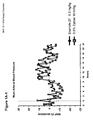
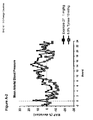
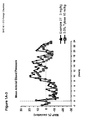
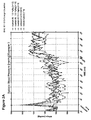
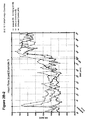
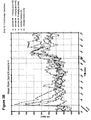
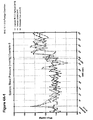
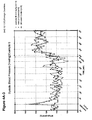
- mice received either placebo (tylose), 0.3 mg/kg example 27, 1mg/kg example 27, 3mg/kg example 27 ( Figure 1 ), 1.0 mg/kg example 3, 3.0 mg/kg example 3, 10.0 mg/kg example 3 ( Figure 2A , 2B ), 1.0 mg/kg example 4, 3.0 mg/kg example 4, 10.0 mg/kg example 4 ( figure 3A / 3B ), 0.3 mg/kg example 6, 1.0 mg/kg example 6, 3.0 mg/kg, 10.0 mg/kg example 6 ( figure 4A / 4B ).
- the blood pressure and heart rate was monitored before and after application of placebo or the compounds.
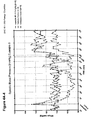
- Figure 1 shows effects of example 27 on blood pressure (left) and heart rate (right)
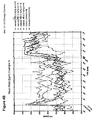
- figure 2 shows the effect of example 3 on blood pressure ( Figure 2A ) and heart rate ( Figure 2B )
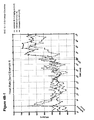
- figure 3 shows the effects of example 4 on blood pressure ( Figure 3A ) and heart rate ( Figure 3B )
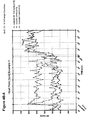
- figure 4 shows the effect of example 6 on blood pressure ( Figure 4A ) and heart rate ( figure 4B ).
- Example 27 The effects of example 27 and vardenafil as stand alone and in combination were analyzed in vitro in human dermal fibroblasts in vitro.
- Example 27, vardenafil and combinations thereof significantly blocked the TGFbeta-induced Collagen gene expression and Hydroxyproline (HP) deposition.
Landscapes
- Chemical & Material Sciences (AREA)
- Health & Medical Sciences (AREA)
- Organic Chemistry (AREA)
- Life Sciences & Earth Sciences (AREA)
- Veterinary Medicine (AREA)
- Public Health (AREA)
- General Health & Medical Sciences (AREA)
- Medicinal Chemistry (AREA)
- Animal Behavior & Ethology (AREA)
- Pharmacology & Pharmacy (AREA)
- Epidemiology (AREA)
- Engineering & Computer Science (AREA)
- Nuclear Medicine, Radiotherapy & Molecular Imaging (AREA)
- General Chemical & Material Sciences (AREA)
- Chemical Kinetics & Catalysis (AREA)
- Bioinformatics & Cheminformatics (AREA)
- Reproductive Health (AREA)
- Physical Education & Sports Medicine (AREA)
- Dermatology (AREA)
- Urology & Nephrology (AREA)
- Endocrinology (AREA)
- Heart & Thoracic Surgery (AREA)
- Biomedical Technology (AREA)
- Pulmonology (AREA)
- Cardiology (AREA)
- Pharmaceuticals Containing Other Organic And Inorganic Compounds (AREA)
- Acyclic And Carbocyclic Compounds In Medicinal Compositions (AREA)
- Nitrogen Condensed Heterocyclic Rings (AREA)
- Medicines That Contain Protein Lipid Enzymes And Other Medicines (AREA)
- Thiazole And Isothizaole Compounds (AREA)
- Plural Heterocyclic Compounds (AREA)
- Nitrogen And Oxygen Or Sulfur-Condensed Heterocyclic Ring Systems (AREA)
Description
- The use of sGC stimulators, sGC activators alone, or in combination with PDE5 inhibitors for the prevention and treatment of fibrotic diseases, such as systemic sclerosis, scleroderma, and the concomitant fibrosis of internal organs.
- The pathogenesis of Systemic Sclerosis (SSc) is still unclear and remains elusive. However, scleroderma is a non-inherited, noninfectious disease and thought to be an autoimmune disease. SSc has a broad variety of symptoms triggered by excessive deposition of extracellular matrix in the dermis resulting in skin fibrosis. In later stages SSc is characterized by progressive tissue fibrosis affecting other internal organs as the gut, the lung or the kidneys. Therefore scleroderma is the hallmark of the disease comprising also e.g. lung fibrosis, renal fibrosis, fibrosis of the heart, the gut or the blood vessels. It is suggested that inflammation, autoimmune disorders or vascular damage activates fibroblasts. Fibroproliferation is accompanied by excessive extracellular matrix production, dominated by Collagen type I resulting in progressive tissue fibrosis which can cause end organ failure and lead to high morbidity and mortality in patients with end-stage SSc (Harris et al. 2005 - Kelley's Textbook of Rhematology 7th edition. Elsevier Saunders, Philadelphia PA).
- There is still no causative treatment for Systemic Sclerosis (SSc) available and the current therapy is based on suppression of the immune system via corticosteroids, cyclophosphamide, methotrexate. More recently kinase inhibitors are under investigation as immunosuppressant and antifibrotic agents in SSc, but tolerability is limited in SSc patients (Khanna and Denton 2010 - Best. Pract. Res. Clin. Rheumatol. 24:387-400, Ong and Denton 2010 - Curr. Opin. Rheumatol. 22:264-272, Spiera 2011 - Ann. Rheum. Dis. Epub Mar 2011). These therapies either used as stand alone treatment or combined are of limited efficacy and exhibited considerable side effects. Therefore alternative treatment options in SSc which are efficacious and safe are urgently needed.
- The cyclic nucleotides, cyclic adenosine monophosphate (cAMP) and cyclic guanosine monophosphate (cGMP), were discovered decades ago and represent one of the most important second messenger pathway within cells. It is well established that the regulation of intra-cellular cGMP pools have substantial impact on physiology, and pathophysiology and is one basic principle of pharmacological intervention (Evgenov et al. 2006 - Nat. Rev. Drug. Discov. 5(9):755-768). Besides the treatment of cardiovascular, lung or CNS-disorders there is ample evidence that an increase in cGMP is a very effective treatment option for urological disorders as well (Sandner et al. 2009 - Handbook Exper. Pharmacol. 191:507-531). PDE5 inhibitors are the gold-standard for the treatment of erectile dysfunction (ED) but it was shown that PDE5 inhibitors could be useful for the treatment of symptomatic BPH which is characterized by Overactive Bladder (OAB) and Lower Urinary Tract Symptoms (LUTS) (Porst et al. 2008 - Curr. Urol. Rep. 9:295-301; .McVary et al. 2007 - J. Urol. 177:1071-1077, J Urol. 177:1401-1407, Kaplan and Gonzalez. 2007 - Rev. Urol. 9:73-77). The antifibrotic effects of Vardenafil, sGC stimulators and sGC activators is not understood yet. There are some descriptions about antifibrotic effects of Nitric-Oxide which are presumably mediated by cGMP in other organs and PDE5 inhibitors or guanylate cyclase stimulators have shown efficacy in penile fibrosis (Peyronie's disease) (Ferrini et al. 2006 - B. J. Urol. 97:625-633) and liver fibrosis (Knorr et al. 2008 - Arzneimittelforschung 58:71-80) respectively.
- It is not known if the NO/cGMP system is involved in SSc and if cGMP increase provides a treatment option for this disease. We hypothetized that - independent from endogenous NO/cGMP production - sGC stimulators and activators might be an effective treatment option for Systemic Sclerosis (SSc).
- We therefore investigated sGC stimulators and sGC activators, i.e. example 27 according to compound of the formula

- We found in vivo in our animal models that:
- sGC stimulators or sGC activators, i.e. example 27, example 3, example 6, significantly reduced dermal thickness, hydroxyproline content of the skin and the number of dermal myofibroblasts in bleomycin-induced SSc in mice when administered in a preventive dose-regimen. (Example A: Table 1, Table 2). These data suggest an antifibrotic effect in Systemic Sclerosis when these compounds are given preventively.
- sGC stimulators or sGC activators, i.e. example 27 significantly reduced dermal thickness, hydroxyproline content of the skin and the number of dermal myofibroblasts in bleomycin-induced SSc in mice when administered in a therapeutic dose-regimen after established fibrosis. (Example B: Table 3). These data suggest an antifibrotic effect and regression of established fibrosis in Systemic Sclerosis when the compounds are given therapeutically.
- sGC stimulators or sGC activators, i.e. example 27 significantly reduced dermal thickness, hydroxyproline content of the skin and the number of dermal myofibroblasts in TSK mice. Since TSK mice already exhibited established fibrosis before start of the treatment example 27 caused fibrosis-regression (Example C: Table 4). These data suggest an antifibrotic effect and regression of established fibrosis in Systemic Sclerosis when the compounds are given therapeutically.
- sGC stimulators of sGC activators, i.e. example 27, example 3, example 4, example 6 were investigated in conscious mice with telemetric implants and blood pressure and heart rate was monitored (Example D). Example 27, example 3, example 4, example 7 did not or only moderately, change the heamodynamic profile of the mice in dosages with antifibrotic properties (Example D:
Figures 1 ,2A ,2B ,3A ,3B ,4A ,4B ). These data suggest a direct antifibrotic mode of action of sGC stimulators and sGC activators independent of blood pressure reduction by these compounds. - sGC stimulators or sGC activators, i.e. example 27, alone and in combination with PDE5 inhibitors (i.e. Vardenafil) blocked TGF-induced collagen gene expression in vitro in human dermal fibroblasts(Example E). These data suggest a direct antifibrotic effect on the level of collagen production
- Thus, we found completely unexpected and for the first time that sGC stimulators or sGC activators i.e. example 27, prevent fibrosis and regress established fibrosis in different animal models of inflammatory and non-inflammatory SSc including bleomycin-induced fibrosis models and the TSK-mouse model.
- In addition there was no significant effect seen on systemic blood pressure which for the first time shows that these sGC stimulators have direct antifibrotic properties in SSc independent from blood pressure reduction.
- Moreover sGC stimulators and sGC activators could block TGF-beta induce collagen synthesis implying a broad antifibrotic effect in other fibrotic disorders beyond SSc.
- Taken together this data indicate for the first time that sGC stimulators and sGC activators, i.e. Example 27, example 3, example 4, example 6 could represent a future treatment option for SSc.
- Fibrotic disorders addressed by therapeutic agents of the invention which in particular and with substantial advantage can be treated by the above mentioned sGC stimulators or sGC activators alone or in combination with PDE5 inhibitors comprise but are not limited to Systemic Sclerosis (SSc), Systemic Sclerosis (SSc) concomitant fibrosis and fibrotic diseases.
- Systemic Sclerosis (SSc) refers to but is not limited to diffuse Systemic Sclerosis (dSSc), limited Systemic Sclerosis (ISSc), overlap type of Systemic Sclerosis, undifferentiated type of Systemic Sclerosis, Systemic Sclerosis sine scleroderma, skin fibrosis, scleroderma, nephrogenic fibrosing dermopathy (NFD), nephrogenic systemic fibrosis (NSF), keloid formation.
- SSc concomitant fibrosis refers to fibrosis of internal organs, comprising but not limited to the gut, the lung, the kidney and the blood vessels.
- Fibrotic diseases comprises but are not limited to a condition in which collagen excess - independent of the etiology i.e. autoimmune disorders, radiation therapy, intoxications, diabetes, surgery - lead to fibrosis of the skin, gut, liver, lung, heart, bladder, prostate, blood vessels or any other localized or generalized fibrotic condition in tissues.
- A preferred embodiment of the invention is compounds according to formulae (1)-(27) for the prevention and treatment of fibrotic diseases, such as systemic sclerosis, scleroderma, and the concomitant fibrosis of internal organs, as shown below:
- 2-[1-(2-Fluorbenzyl)-1H-pyrazolo[3,4-b]pyridine-3-yl]-5-(4-morpholinyl)-4,6-pyrimidine-diamine (1), disclosed as example 16 in
WO 00/06569 - 2-[1-(2-Fluorobenzyl)-1H-pyrazolo[3,4-b]pyridine-3-yl]-5-(4-pyridinyl)-4-pyrimidineamine (2), disclosed as example 1 in
WO 02/42301 - Methyl-4,6-diamino-2-[1-(2-fluorobenzyl)-1H-pyrazolo[3,4-b]pyridine-3-yl]-5-pyrimidinyl-(methyl)carbamate (3), disclosed as example 8 in
WO 03/095451 - Methyl-4,6-diamino-2-[1-(2-fluorobenzyl)-1H-pyrazolo[3,4-b]pyridine-3-yl]-5-pyrimidinyl-carbamate (4), disclosed as example 5 in
WO 03/095451 - 4-({(4-carboxybutyl)[2-(2-{[4-(2-phenylethyl)benzyl]oxy}phenyl)ethyl]amino{methyl) carboxylic acid (5), disclosed as example 8a in
WO 01/019780 - Methyl-{4,6-diamino-2-[5-fluoro-1-(2-fluorbenzyl)-1H-pyrazolo[3,4-b]pyridine-3-yl]pyrimidine-5-yl}carbamate (6),
- Methyl-{4,6-diamino-2-[5-fluoro-1-(2-fluorbenzyl)-1H-pyrazolo[3,4-b]pyridine-3-yl]pyrimidine-5-yl}methylcarbamate (7),
- Methyl-{4,6-diamino-2-[5-fluoro-1-(2-fluorbenzyl)-1H-pyrazolo[3,4-b]pyridine-3-yl]pyrimidine-5-yl}(2,2,2-trifluorethyl)carbamate (8),
- 5-Chloro-2-(5-chlorothiophene-2-sulfonylamino-N-(4-(morpholine-4-sulfonyl)-phenyl)-benzamid as sodium salt (9), disclosed in
WO00/02851 - 2-(4-Chloro-phenylsulfonylamino)-4,5-dimethoxy-N-(4-(thiomorpholine-4-sulfonyl)-phenyl)-benzamide (10), disclosed in
WO00/02851 - 1-{6-[5-Chloro-2-({4-trans-4-}trifluoromethyl)cyclohexyl]benzyl}oxy)phenyl]pyridine-2-yl}-5-(trifluoromethyl)-1H-pyrazol-4-carboxylic acid (11), disclosed in
WO 2009/032249 , - 1-[6-(2-(2-Methyl-4-(4-trifluoromethoxyphenyl)benzyloxy)-phenyl)pyridine-2-yl]-5-trifluoromethyl-pyrazol-4-carboxylic acid (12), disclosed in
WO 2009/071504 , - 1[6-(3,4-dichlorophenyl)-2-pyridinyl-5-(trifluoromethyl)-1H-pyrazole-4-caboxylic acid (13), disclosed in
WO 2009/068652 , - 1-({2-[3-Chlor-5-(trifluoromethyl)phenyl]-5-methyl-1,3-thiazole-4-yl}methyl)-1H-pyrazole-4-carboxylic acid (14), 4-({2-[3-(Trifluoromethyl)phenyl]-1,3-thiazole-4-yl}methyl)benzoic acid (15) and 1-({2-[2-Fluoro-3-(tritluoromethyl)phenyl]-5-methyl-1,3-thiazole-4-yllmethyl)-1H-pyrazole-4-carboxylic acid (16) disclosed in
WO 2009/123316 , - 4-Amino-2-[5-chloro-3(3,3,3-trifluororpropyl)-1H-indazol-lyl]-5,5-dimethyl-5,7-dihydro-6H-pyrrolo[2,3-d]pyrimidine-6-one (17), 4-Amino-2[5-chloro-3-(2,3,6-trifluorbenzyle)-1H-indazol-lyl]-5,5-dimethyl-5,7-dihydro-6H-pyrrolo[2,3-d]pyrimidine-6-one (18), 4-Amino-5,5-dimethyl-2-[3-(2,3,6-trifluorbenzyle)1H-thieno[3,4-c]pyrazol-1-yl]-5,7-dihydro-6H-pyrrolo[2,3-d]pyrimidine-6-one (19), 4-Amino-5,5-dimethyl-2-[3-(2,3,6-trifluorbenzyle)-1H-thieno[2,3-d]pyrazole-1-yl]-5,5-dimethyl-5,7-dihydro-6H-pyrrolo[2,3-d]pyrimidine-6-one (20), 4-Amino-5,5-dimethyl-2-[7-(2,3,6-trifluorobenzyle)imidazo[1,5-b]pyridazine-5-yl]-5,7-dihydro-6H-pyrrolo[2,3-d]pyrimidine-6-one (21), 4-Amino-2-[6-chloro-3-(2,3,6-trifluorobenzyle)imidazo[1,5-a]pyridine-1-yl]]-5,5-dimethyl-5,7-dihydro-6H-pyrrolo[2,3-d]pyrimidine-6-one (22), 4-Amino-2-[6-fluoro-3-(2,3,6-trifluorobenzyle)imidazo[1,5-a]pyridine-1-yl]]-5,5-dimethyl-5,7-dihydro-6H-pyrrolo[2,3-d]pyrimidine-6-one (23), 4-Amino-2-[6-fluoro-3-(2,3,6-trifluorobenzyl)6-fluoroimidazo[1,5-a]pyridine-1-yl]-5,5-dimethyl-5,7-dihydro-6H-pyrrolo[2,3-d]pyrimidine-6-one (24), 4-Amino-5,5-dimethyl-2-[3-(2,4,6-trifluorobenzyle)imidazo[1,5-a]pyridine-1-yl]]-5,7-dihydro-6H-pyrrolo[2,3-d]pyrimidine-6-one (25), 4-Amino-2-[3-(2-cyclopentylethyl)imidazo[1,5-a]pyridine-1-yl]-5,5-dimethyl-5,7-dihydro-6H-pyrrolo[2,3-d]pyrimidine-6-one (26), disclosed in
WO 2010/065275 , - 3-(4-Amino-5-cyclopropylpyrimidin-2-yl)-1-(2-fluorobenzyl)-1H-pyrazolo[3,4-b]pyridine (27) known as BAY 41-2272 disclosed as example 1 in
WO 00/06568 
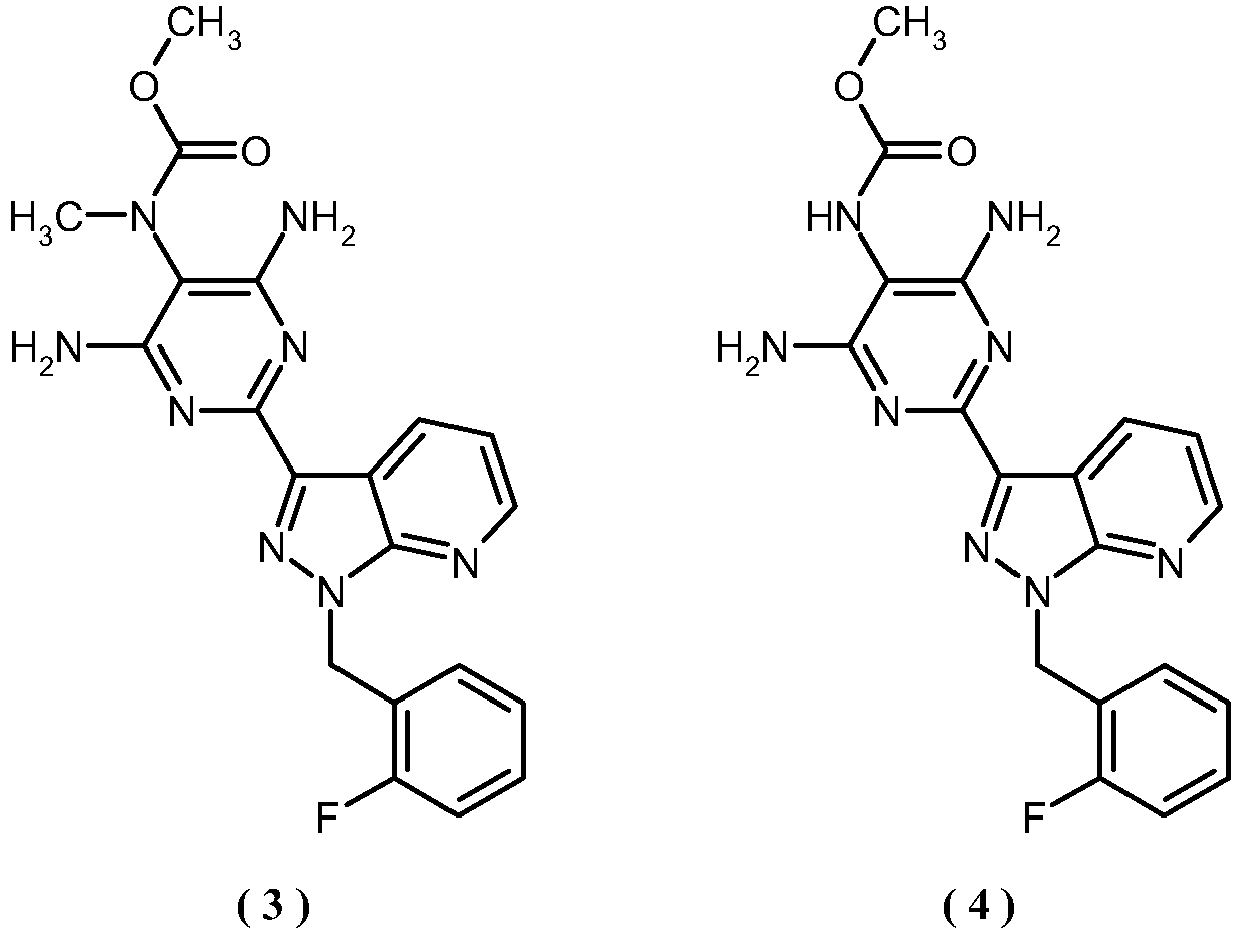


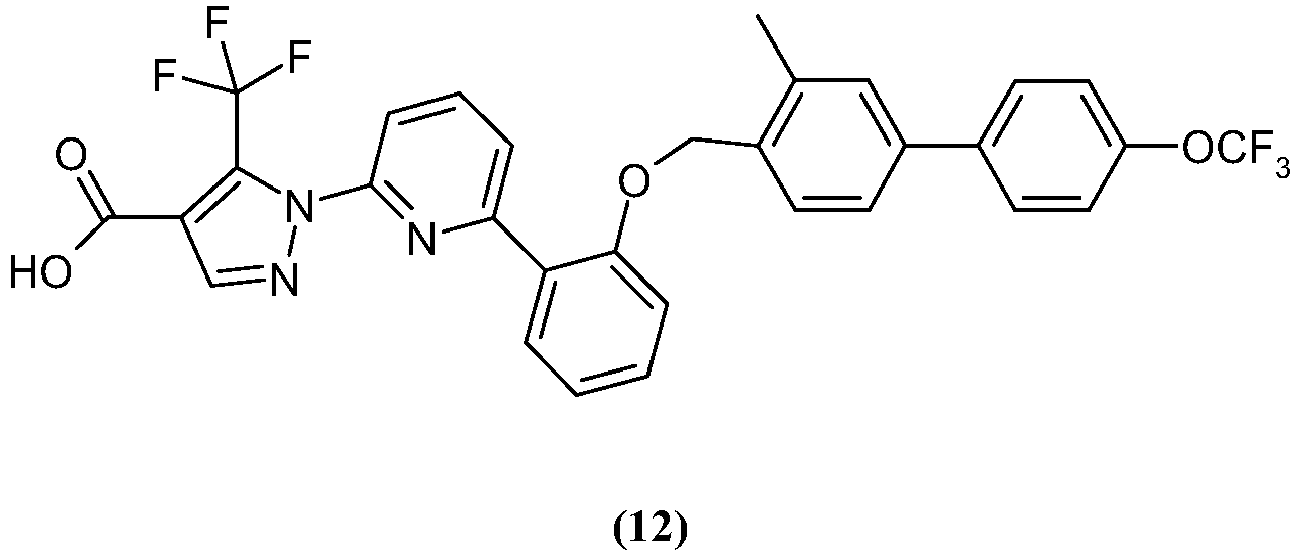


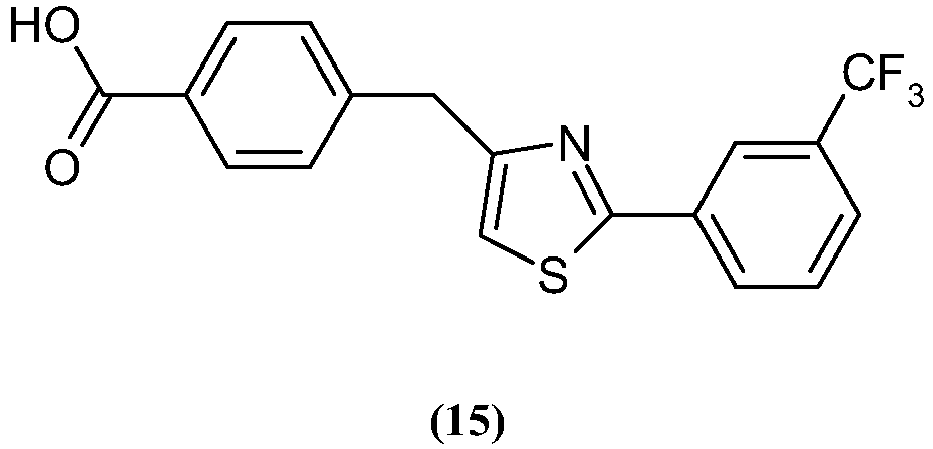


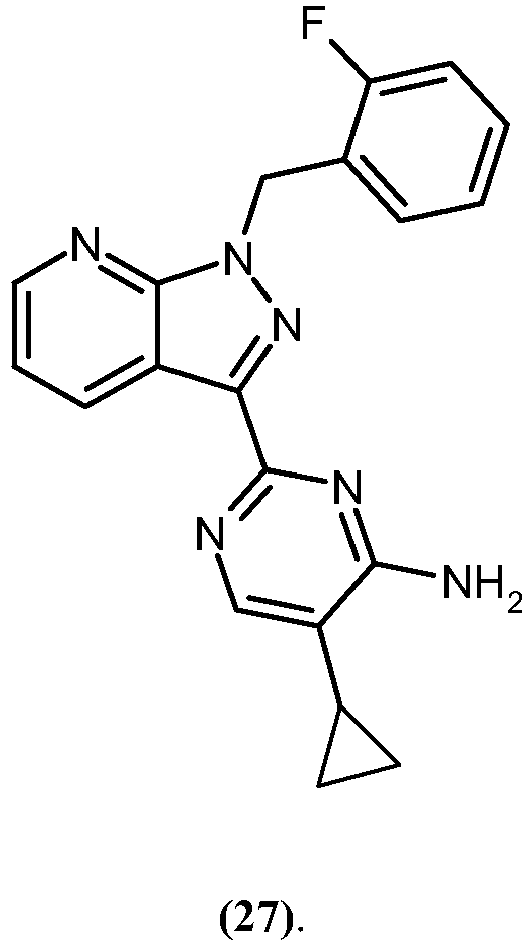
- Compounds according to formulae (1), (2), (3), (4), (6)-(8) and (17)-(27) are known as sGC stimulators. Preferred are compounds according to formulae (1), (2), (3), (4), (6), (7) and (27). Especially preferred are compounds according to formulae (3), (4), (6) und (7).
- Compounds according to formulae (5) und (9)-(16) are known as sGC activators. Preferred is the compound according to formula (5).
- A further embodiment of the invention is the combination of stimulators and/or activators of the soluble guanylate cyclase with PDE5 inhibitors for the prevention and treatment of fibrotic diseases, such as Systemic Sclerosis, scleroderma, and the concomitant fibrosis of internal organs. The following PDE 5 inhibitors are preferred for the combination with sGC stimulators and/or activators:
- Tadalafil ((6R,12aR) -2,3,6,7,12,12a - Hexahydro - 2 - methyl - 6 - (3,4-methylene -dioxyphenyl) pyrazino(1',2':1,6) pyrido(3,4-b)indole-1,4-dione), Vardenafil (2-(2-Ethoxy-5-(4-ethylpiperazin-1-yl-1-sulfonyl)phenyl)-5-methyl-7-propyl-3H-imidazo (5,1-f) (1,2,4)triazin-4-one), Sildenafil (3-[2-ethoxy-5-(4-methylpiperazin-1-yl)sulfonyl-phenyl]- 7- methy 1- 9- propy 1-2,4,7,8- tetrazabicyclo [4.3.0]nona -3,8,10-trien-5-one), Udenafil 5-[2-propyloxy-5-(1-methyl-2-pyrrolidinylethylamidosulfonyl)phenyl]-methyl-3-propyl-1,6-dihydro-7H-pyrazolo(4,3-d)pyrimidine-7-one, Dasantafil 7-(3-Bromo-4-methoxybenzyl)-1-ethyl-8-[[(1,2)-2-hydroxycyclopentyl]amino]-3-(2-hydroxyethyl)-3,7-dihydro-1-purine-2,6-dione, Avanafil 4-{[(3-chloro-4-methoxyphenyl)methyl]amino{-2-[(2S)-2-(hydroxymethyl)pyrrolidin-1-yl]-N-(pyrimidin-2-ylmethyl)pyrimidine-5-carboxamide, Mirodenafil, Lodenafil, UK 369.003, UK 371.800, SLx 2101 of Surface Logix, LAS 34179Triazolo[1,2-]xanthine,6-methyl-4-propyl-2-[2-propoxy-5-(4-methylpiperazino)sulfonyl]phenyl or salts, hydrates or hydrates of the salts.
- Especially preferred are combinations of compounds according to formulae (1), (2), (3), (4), (6), (7), (27) and /or (5) with vardenafil and/or sildenafil
- Especially preferred are combinations of compounds according to formulae (3), (4), (6), (7) and /or (5) with vardenafil and/or sildenafil for use in the prevention and/or treatment of Systemic Sclerosis (SSc).
- Especially preferred are compounds according to
formulae - Especially preferred are compounds according to
formulae - Especially preferred is at least one compound according to
formulae - A further embodiment of the invention is the combination of stimulators and/or activators of the soluble guanylate cyclase with imunosupressant therapy (i.e. cyclophosphamide CYP, methotrexate MTX,), with kinase inhibitors, (i.e. sorafenib, regorafenib, imatinib, dasatinib), with glucocorticoids (i.e. prednisolon, methylprednisoln), with Anti-CD20 antibodies, with P144 beta-glycan, with abatacept
- A further embodiement of the invention is the combination of stimulators and/or activators of the soluble guanylate cyclase with ACE-inhibitors (i.e. captopril, enalapril), calcium channel blockers (i.e. nifedipine), prostanoids (i.e. iloprost), endothelin antagonists (i.e. bosentan).
- Another preferred embodiment of the invention are compounds and/or combinations indicated above for use in the prevention and/or treatment of Systemic Sclerosis (SSc), diffuse Systemic Sclerosis (dSSc), limited Systemic Sclerosis (lSSc), overlap type of Systemic Sclerosis, undifferentiated type of Systemic Sclerosis, Systemic Sclerosis sine scleroderma, skin fibrosis, scleroderma, nephrogenic fibrosing dermopathy (NFD), keloid formation.
- Another preferred embodiment of the invention are compounds and/or combinations indicated above for use in the prevention and/or treatment of scleroderma.
- Another preferred embodiment of the invention are compounds and/or combinations indicated above for use in the prevention and/or treatment of Systemic Sclerosis SSc concomitant fibrosis of internal organs, comprising the gut, the lung, the kidney and the blood vessels.
- Another preferred embodiment of the invention is the use for the production of a medicament for prevention and/or treatment of Systemic Sclerosis (SSc) comprising an effective amount of a compound and/or a combination as indicated above.
- Another preferred embodiment of the invention is the use for the production of a medicament for prevention and/or treatment of scleroderma comprising an effective amount of a compound and/or a combination as indicated above.
- Another preferred embodiment of the invention is the use for the production of a medicament for prevention and/or treatment of Systemic Sclerosis (SSc), diffuse Systemic Sclerosis (dSSc), limited Systemic Sclerosis (lSSc), overlap type of Systemic Sclerosis, undifferentiated type of Systemic Sclerosis, Systemic Sclerosis sine scleroderma, skin fibrosis, scleroderma, nephrogenic fibrosing dermopathy (NFD), keloid formation comprising an effective amount of a compound and/or a combination as indicated above.
- Another preferred embodiment of the invention is the use for the production of a medicament for prevention and/or treatment of Systemic Sclerosis SSc concomitant fibrosis of internal organs, comprising the gut, the lung, the kidney and the blood vessels comprising an effective amount of a compound and/or a combination as indicated above.
- Another preferred embodiment of the invention is the pharmaceutical formulation comprising at least one compound or one combination as indicated above for the use in the prevention and/or treatment of Systemic Sclerosis (SSc).
- Another preferred embodiment of the invention is the pharmaceutical formulation comprising at least one compound or one combination as indicated above for the use in the prevention and/or treatment of Systemic Sclerosis (SSc), diffuse Systemic Sclerosis (dSSc), limited Systemic Sclerosis (lSSc), overlap type of Systemic Sclerosis, undifferentiated type of Systemic Sclerosis, Systemic Sclerosis sine scleroderma, skin fibrosis, scleroderma, nephrogenic fibrosing dermopathy (NFD), keloid formation.
- Another preferred embodiment of the invention is the pharmaceutical formulation comprising at least one compound or one combination as indicated above for the use in the prevention and/or treatment of Systemic Sclerosis (SSc).
- Another preferred embodiment of the invention is the pharmaceutical formulation comprising at least one compound or one combination as indicated above for the use in the prevention and/or treatment of Systemic Sclerosis SSc concomitant fibrosis of internal organs, comprising the gut, the lung, the kidney and the blood vessels.
- Another preferred embodiment of the invention is a kit comprising at least one sGC stimulator and/or activator as indicated above or a combination as indicated above for the use in the prevention and/or treatment of Systemic Sclerosis (SSc).
- Another preferred embodiment of the invention is a kit as indicated above for the use in the prevention and/or treatment of Systemic Sclerosis (SSc), diffuse Systemic Sclerosis (dSSc), limited Systemic Sclerosis (lSSc), overlap type of Systemic Sclerosis, undifferentiated type of Systemic Sclerosis, Systemic Sclerosis sine scleroderma, skin fibrosis, scleroderma, nephrogenic fibrosing dermopathy (NFD), keloid formation.
- Another preferred embodiment of the invention is a kit comprising at least one sGC stimulator and/or activator as indicated above or a combination as indicated above for the use in the prevention and/or treatment of scleroderma.
- Another preferred embodiment of the invention is a kit as indicated above for the use in the prevention and/or treatment of Systemic Sclerosis SSc concomitant fibrosis of internal organs, comprising the gut, the lung, the kidney and the blood vessels.
- A pharmaceutical composition of the invention is formulated to be compatible with its intended route of administration. Examples of routes of administration include parenteral e.g., intravenous, intradermal, subcutaneous' oral (e.g.' inhalation)' transdermal (topical) transmucosal and rectal administration. Pharmaceutical compositions suitable for injectable use include sterile aqueous solutions (where water soluble) or dispersions and sterile powders for the extemporaneous preparation of sterile injectable solutions or dispersions. The carrier can be a solvent or dispersion medium containing, for example, water, ethanol, a pharmaceutically acceptable polyol like glycerol, propylene glycol, liquid polyetheylene glycol, and suitable mixtures thereof. The proper fluidity can be maintained, for example, by the use of a coating such as lecithin, by the maintenance of the required particle size in the case of dispersion and by the use of surfactants. Prevention of the action of microorganisms can be achieved by various antibacterial and antifungal agents for example, parabens, chlorobutanol, phenol, ascorbic acid, thimerosal, and the like. In many cases, it will be preferable to include isotonic agents, for example, sugars, polyalcohols such as maitol sorbitol sodium chloride in the composition.
- Oral compositions generally include an inert diluent or an edible carrier. They can be enclosed in gelatin capsules or compressed into tablets. For the purpose of oral therapeutic administration, the active compound can be incorporated with excipients and used in the form of tablets, troches, or capsules. Oral compositions can also be prepared using a fluid carrier for use as a mouthwash, wherein the compound in the fluid carrier is applied orally and swished and expectorated or swallowed.
- Pharmaceutically compatible binding agents, and/or adjuvant materials can be included as part of the composition. The tablets, pills, capsules, troches and the like can contain any of the following ingredients, or compounds of a similar nature: a binder such as microcrystalline cellulose, gum tragacanth or gelatin; an excipient such as starch or lactose, a disintegrating agent such as alginic acid, Primogel, or con1 starch; a lubricant such as magnesium stearate or sterotes; a glidant such as colloidal silicon dioxide; a sweetening agent such as sucrose or saccharin; or a flavoring agent such as peppermint, methyl salicylate, or orange flavoring.
- For administration by inhalation, the compounds are delivered in the form of an aerosol spray from a pressurized container or dispenser which contains a suitable propellant, e.g.' a gas such as carbon dioxide, or a nebulizer.
- Systemic administration can also be by transmucosal or transdermal means. For transmucosal or transdermal administration, penetrants appropriate to the barrier to be permeated are used in the formulation. Such penetrants are generally known in the art, and include, for example, for transmucosal administration, detergents, bile salts, and fusidic acid derivatives. Transmucosal administration can be accomplished through the use of nasal sprays or suppositories. For transdermal administration, the active compounds are formulated into ointments, salves, gels, or creams as generally known in the art.
- The compounds can also be prepared in the form of suppositories (e.g., with conventional suppository bases such as cocoa butter and other glycerides) or retention enemas for rectal delivery. In one embodiment, the active compounds are prepared with carriers that will protect the compound against rapid elimination from the body, such as a controlled release formulation, including implants and microencapsulated delivery systems. Bio degradable, biocompatible polymers can be used, such as ethylene vinyl acetate, polyanhydrides, polyglycolic acid, collagen, polyorthoesters, and polylactic acid.
-
-
Figure 1 : Effects ofexqample 27 on mean arterial blood pressure (left) and heart rate (right). -
Figure 2A andFigure 2B : Effects of example 3 on systolic blood pressure (2A) and heart rate (2B) -
Figure 3A andFigure 3B : Effects of example 4 on systolic blood pressure (3A) and heart rate (3B) -
Figure 4A andFigure 4B : Effects of example 7 on systolic blood pressure (4A) and heart rate (4B) -
- aq.
- aqueous solution
- calc.
- calculated
- DCI
- direct chemical ionization (in MS)
- DMF
- dimethylformamide
- DMSO
- dimethyl sulfoxide
- of th.
- of theory (in yield)
- eq.
- equivalent(s)
- ESI
- electrospray ionization (in MS)
- Et
- ethyl
- fnd.
- found
- h
- hour(s)
- HPLC
- high-pressure, high-performance liquid chromatography
- HRMS
- high-resolution mass spectrometry
- conc.
- concentrated
- LC/MS
- liquid chromatography-coupled mass spectrometry
- LiHMDS
- lithium hexamethyldisilazide
- Me
- methyl
- min
- minute(s)
- MS
- mass spectrometry
- NMR
- nuclear magnetic resonance spectrometry
- Pd2dba3
- tris(dibenzylideneacetone)dipalladium
- Ph
- phenyl
- RT
- room temperature
- Rt
- retention time (in HPLC)
- THF
- tetrahydrofuran
- UV
- ultraviolet spectrometry
- v/v
- volume to volume ratio (of a solution)
- XPHOS
- dicyclohexyl(2',4',6'-triisopropylbiphenyl-2-yl)phosphine
- Method 1: MS instrument: Waters ZQ; HPLC instrument: Agilent 1100 Series; UV DAD; Column:
Thermo Hypersil GOLD 3µ 20 mm × 4 mm; Eluent A: 1 l water + 0.5 ml 50% formic acid, Eluent B: 1 l acetonitrile + 0.5 ml of 50% formic acid; Gradient: 0.0min 100% A → 3.0min 10% A → 4.0min 10% A → 4.1min 100% A (flow rate 2.5 ml/min); Oven: 55°C; Flow rate: 2 ml/min; UV detection: 210 nm. - Method 2: Instrument: Waters ACQUITY SQD UPLC System; Column: Waters Acquity UPLC HSS T3 1.8 µ 50 × 1 mm; Eluent A: 1 l water + 0.25 ml 99% formic acid, Eluent B: 1 l acetonitrile + 0.25 ml 99% formic acid; Gradient: 0.0
min 90% A → 1.2 min 5% A → 2.0 min 5% A; Oven: 50°C; Flow rate: 0.40 ml/min; UV detection: 210 - 400 nm. -

- A suspension of 25 g (130.90 mmol) of 2,6-dichloro-5-fluoro-3-cyanopyridine in conc. sulphuric acid (125 ml) was stirred at 60-65°C for 1 h. After cooling to RT, the contents of the flask were poured into ice-water and extracted three times with ethyl acetate (100 ml each time). The combined organic phases were washed with water (100 ml) and then with saturated aqueous sodium hydrogen carbonate solution (100 ml), dried and concentrated on a rotary evaporator. The material obtained was dried under a high vacuum.
Yield: 24.5 g (90% of theory)
1H NMR (400 MHz, DMSO-d6): δ = 7.95 (br s, 1H), 8.11 (br s, 1H), 8.24 (d, 1H). -

- A suspension of 21.9 g (335.35 mmol) of zinc in methanol (207 ml) was admixed at RT with 44 g (210.58 mmol) of 2,6-dichloro-5-fluoronicotinamide. Then acetic acid (18.5 ml) was added and the mixture was heated with stirring at reflux for 24 h. Thereafter the contents of the flask were decanted from the zinc, and ethyl acetate (414 ml) and saturated aqueous sodium hydrogen carbonate solution (414 ml) were added, followed by intense extractive stirring. Subsequently the reaction mixture was filtered with suction over kieselguhr and the filter product was washed three times with ethyl acetate (517 ml each time). The organic phase was separated off and the aqueous phase was washed with ethyl acetate (258 ml). The combined organic phases were washed once with saturated aqueous sodium hydrogen carbonate solution (414 ml), dried and concentrated under reduced pressure. The resulting crystals were admixed with dichloromethane (388 ml) and extractively stirred for 20 min. Filtration with suction was carried out again, and the filter product was washed with diethyl ether and sucked dry.
Yield: 20.2 g (53% of theory)
1H NMR (400 MHz, DMSO-d6): δ = 7.87 (br s, 1H), 7.99 (dd, 1H), 8.10 (br s, 1H), 8.52 (d, 1H). -

- A suspension of 46.2 g (264.66 mmol) of 2-chloro-5-fluoronicotinamide in dichloromethane (783 ml) was admixed with 81.2 ml (582.25 mmol) of triethylamine and cooled to 0°C. Then, with stirring, 41.12 ml (291.13 mmol) of trifluoroacetic anhydride were added slowly dropwise and the mixture was stirred at 0°C for 1.5 h. The reaction solution was subsequently washed twice with saturated aqueous sodium hydrogen carbon solution (391 ml each time), dried and concentrated under reduced pressure.
Yield: 42.1 g (90% of theory).
1H NMR (400 MHz, DMSO-d6): δ = 8.66 (dd, 1H), 8.82 (d, 1H). -

- A suspension of 38.5 g (245.93 mmol) of 2-chloro-5-fluoronicotinonitrile was introduced in 1,2-ethanediol (380 ml) and subsequently admixed with hydrazine hydrate (119.6 ml, 2.459 mol). The mixture was heated at reflux with stirring for 4 h. On cooling, the product precipitated. The yellow crystals were admixed with water (380 ml) and subjected to extractive stirring at RT for 10 min. Then the suspension was filtered with suction over a frit, and the filter product was washed with water (200 ml) and with -10°C cold THF (200 ml). The residue was dried under a high vacuum over phosphorus pentoxide.
Yield: 22.8 g (61 % of theory)
1H NMR (400 MHz, DMSO-d6): δ = 5.54 (s, 2H), 7.96 (dd, 1H), 8.38 (m, 1H), 12.07(m, 1H). -

- In THF (329 ml), 10 g (65.75 mmol) of 5-fluoro-1H-pyrazolo[3,4-b]pyridin-3-amine were introduced and cooled to 0°C. Then 16.65 ml (131.46 mmol) of boron trifluoride diethyl ether complex were slowly added. The reaction mixture was cooled further to -10°C. Then a solution of 10.01 g (85.45 mmol) of isopentyl nitrite in THF (24.39 ml) was added slowly, followed by stirring for a further 30 min. The mixture was diluted with cold diethyl ether (329 ml) and the resulting solid was isolated by filtration. The diazonium salt thus prepared was added in portions to a 0°C cold solution of 12.81 g (85.45 mmol) of sodium iodide in acetone (329 ml), and the mixture was stirred at RT for 30 min. The reaction mixture was poured into ice-water (1.8 1) and extracted twice with ethyl acetate (487 ml each time). The collected organic phases were washed with saturated aqueous sodium chloride solution (244 ml), dried, filtered and concentrated. This gave 12.1 g (86% purity, 60% of th.) of the desired compound in the form of a brown solid. The crude product was reacted without further purification.
LC-MS (Method 1): Rt = 1.68 min; MS (ESIpos): m/z = 264 (M+H)+ -

- In DMF (2538 ml), 141 g (462.11 mmol) of the compound from Example 5A were introduced and then 96.09 g (508.32 mmol) of 2-fluorobenzyl bromide and 165.62 g (508.32 mmol) of cesium carbonate were added. The mixture was stirred at RT for two hours. The reaction mixture was then poured into saturated aqueous sodium chloride solution (13 670 ml) and extracted twice with ethyl acetate (5858 ml) The collected organic phases were washed with saturated aqueous sodium chloride solution (3905 ml), dried, filtered and concentrated. The residue was chromatographed on silica gel (eluent: petroleum ether/ethyl acetate 97:3) and the product fractions were concentrated. The resulting solid was dissolved in dichloromethane and washed once with saturated aqueous sodium thiosulphate solution (500 ml) and then with saturated aqueous sodium chloride solution (500 ml). The product was concentrated to dryness and the residue was suspended with diethyl ether, isolated by filtration with suction and dried under a high vacuum. This gave 106.6 g (62% of theory) of the desired compound.
LC-MS (Method 1): Rt = 2.57 min
MS (ESIpos): m/z = 372 (M+H)+
1H NMR (400 MHz, DMSO-d6): δ = 5.73 (s, 2H), 7.13 - 7.26 (m, 3H), 7.33 - 7.41 (m, 1H), 7.94 (dd, 1H), 8.69 - 8.73 (m, 1H). -

- In 1,4-dioxane (86 ml), 860 mg (2.32 mmol) of the compound from Example 6A were introduced under argon and the reaction mixture was flushed with argon for 10 min. Then 3.51 ml (6.95 mmol) of hexabutylditin and 483 mg (2.55 mmol) of 2-chloro-5-nitropyrimidine-4,6-diamine (prepared by the method of Helvetica Chimica Acta (1951), 34, 835-40) were added. Subsequently 860 mg (0.744 mmol) of tetrakis(triphenylphosphine)palladium(0) were added and the reaction mixture was heated at reflux overnight. It was then cooled to RT, admixed with water and extracted twice with ethyl acetate. The collected organic phases were dried over sodium sulphate, filtered and concentrated. The residue was subjected to extractive stirring in ethyl acetate, and the solid was isolated by filtration and dried under a high vacuum. This gave 355 mg (62% purity, 24% of th.) of the desired compound. The crude product was reacted without further purification.
LC-MS (Method 2): Rt = 1.03 min
MS (ESIpos): m/z = 399 (M+H)+ -

- A suspension of 16.03 g (43.19 mmol) of 5-fluoro-1-(2-fluorobenzyl)-3-iodo-1H-pyrazolo[3,4-b]pyridine (Example 6A) and 4.25 g (47.51 mmol) of copper cyanide were introduced in DMSO (120 ml) and stirred at 150°C for 2 h. After cooling, the contents of the flask were cooled to about 40°C, poured into a solution of conc. aqueous ammonia (90 ml) and water (500 ml), admixed with ethyl acetate (200 ml) and subjected to brief extractive stirring. The aqueous phase was separated off and extracted twice more with ethyl acetate (200 ml each time). The combined organic phases were washed twice with 10% strength aqueous sodium chloride solution (100 ml each time), dried and concentrated under reduced pressure. The crude product was reacted without further purification.
Yield: 11.1 g (91 % of theory)
1H NMR (400 MHz, DMSO-d6): δ = 5.87 (s, 2H), 7.17 - 7.42 (m, 4H), 8.52 (dd, 1H), 8.87 (dd, 1H). -

- To 2.22 g (41.07 mmol) of sodium methoxide in methanol (270 ml) were added 11.1 g (41.07 mmol) of 5-fluoro-1-(2-fluorobenzyl)-1H-pyrazolo[3,4-b]pyridine-3-carbonitrile (Example 8A) and the mixture was stirred at RT for 2 h. Then 2.64 g (49.29 mmol) of ammonium chloride and acetic acid (9.17 ml) were added and the mixture was heated at reflux overnight. It was then concentrated to dryness and the residue was taken up in water (100 ml) and ethyl acetate (100 ml) and adjusted to a pH of 10 using 2N aqueous sodium hydroxide solution. It was stirred intensively at RT for about 1 h. The resulting suspension was filtered with suction and the filter product was washed with ethyl acetate (100 ml), with water (100 ml) und again with ethyl acetate (100 ml). The residue was dried under a high vacuum over phosphorus pentoxide.
Yield: 9.6 g (78% of th.)
MS (ESIpos): m/z = 288 (M+H)+
1H NMR (400 MHz, DMSO-d6): δ = 1.85 (s, 3H), 5.80 (s, 2H), 7.14 - 7.25 (m, 3H), 7.36 (m, 1H), 8.42 (dd, 1H), 8.72 (dd, 1H). -

- Water (40 ml) and concentrated hydrochloric acid (7.07 ml) were admixed with stirring with 3.85 g (41.34 mmol) of aniline and this mixture was cooled to 0°C. Then a solution of 2.85 g (41.34 mmol) of sodium nitrite in water (21 ml) was added dropwise at between 0°C and 5°C, followed by stirring at 0°C for 15 min. Thereafter, at 0°C, a solution of 4.28 g (52.25 mmol) of sodium acetate in water (19 ml) was added rapidly dropwise, and then, with thorough stirring, a solution of 2.73 g (41.34 mmol) of malononitrile in ethanol (10 ml) was added dropwise. After 2 h at 0°C, the resulting precipitate was isolated by filtration with suction and washed three times with water (50 ml each time) and with petroleum ether (50 ml). The residue, still moist, was dissolved in DMF (46 ml) and added dropwise at precisely 85°C to a solution of 9.5 g (33.07 mmol) of 5-fluoro-1-(2-fluorobenzyl)-1H-pyrazolo[3,4-b]pyridin-3-carboximidamide acetate (Example 9A) in DMF (46 ml) and triethylamine (5.76 ml). The mixture was then stirred at 100°C for 4 h and left to cool to RT overnight. The mixture was poured into water (480 ml) and subjected to extractive stirring at RT for 1 h. After the precipitate had been isolated by filtration with suction, it was washed twice with water (100 ml each time) and twice with methanol (50 ml each time) and then dried under a high vacuum.
Yield: 9.6 g (59% of theory)
LC-MS (Method 2): Rt = 1.21 min
MS (ESIpos): m/z = 458 (M+H)+ -

- In pyridine (30 ml), 378 mg (0.949 mmol) of the compound from Example 7A were introduced and then 143 mg (0.135 mmol) of palladium (10% on carbon) were added. The mixture was hydrogenated overnight at RT under standard hydrogen pressure. The suspension was then filtered through kieselguhr and the filtercake was washed with ethanol. The filtrate was concentrated and yielded 233 mg (81% purity, 51% of theory) of the desired compound, which was reacted without further purification.
- In DMF (800 ml), 39.23 g (85.75 mmol) of the compound from Example 10A were introduced and then 4 g of palladium (10% on carbon) were added. The mixture was hydrogenated with stirring overnight under standard hydrogen pressure. The batch was filtered over kieselguhr and the filter product was washed with a little DMF and then with a little methanol, and concentrated to dryness. The residue was admixed with ethyl acetate and stirred vigorously, and the precipitate was filtered off with suction, washed with ethyl acetate and diisopropyl ether and dried under a high vacuum over Sicapent.
Yield: 31.7 g (100% of theory)
LC-MS (Method 2): Rt+ = 0.81 min
MS (ESIpos): m/z = 369 (M+H)+ -

- In pyridine (600 ml), 31.75 g (86.20 mmol) of the compound from Example 11A were introduced under argon and cooled to 0°C. Then a solution of 6.66 ml (86.20 mmol) of methyl chloroformate in dichloromethane (10 ml) was added dropwise and the mixture was stirred at 0°C for 1 h. Thereafter the reaction mixture was brought to RT, concentrated under reduced pressure and co-distilled repeatedly with toluene. The residue was stirred with water/ethanol and then filtered off on a frit, after which it was washed with ethanol and ethyl acetate. Subsequently the residue was again stirred with diethyl ether, isolated by filtration with suction and then dried under a high vacuum.
Yield: 24.24 g (65% of theory)
LC-MS (Method 2): Rt = 0.79 min
MS (ESIpos): m/z = 427 (M+H)+
1H NMR (400 MHz, DMSO-d6): δ = 3.62 (br. s, 3H), 5.79 (s, 2H), 6.22 (br. s, 4H), 7.10 - 7.19 (m, 2H), 7.19 - 7.26 (m, 1H), 7.32 - 7.40 (m, 1H), 7.67 (br. s, 0.2H), 7.99 (br. s, 0.8H), 8.66 (m, 1H), 8.89 (d, 1H). -

- A quantity of 200 mg (0.469 mmol) of methyl {4,6-diamino-2-[5-fluoro-1-(2-fluorobenzyl)-1H-pyrazolo[3,4-b]pyridin-3-yl]pyrimidin-5-yl}carbamate (Example 1) was introduced in THF (5 ml) at 0°C. Then 0.704 ml (0.704 mmol) of lithium hexamethyldisilazane solution (1M in THF) was added and the mixture was stirred at this temperature for 20 min. Subsequently 43.8 µl (0.704 mmol) of iodomethane were added and the mixture was warmed to RT. After 1 h at this temperature, reaction was terminated with water (1 ml) and the reaction mixture was concentrated, the residue being separated by means of preparative RP-HPLC (water (+0.05% formic acid)-acetonitrile gradient).
Yield: 90 mg (44% of theory)
LC-MS (Method 2): Rt = 0.85 min
MS (ESIpos): m/z = 441 (M+H)+
1H NMR (400 MHz, DMSO-d6): δ = 3.00 (s, 3H), 3.53 (s, 2.2H), 3.66 (s, 0.8H), 5.81 (s, 2H), 6.57 (br. s, 4H), 7.13 (m, 2H), 7.22 (m, 1H), 7.35 (m, 1H), 8.67 (m, 1H), 8.87 (dd, 1H). -

- A quantity of 3.470 g (8.138 mmol) of the compound from Example 1 was suspended in 35 ml of THF, admixed at 0°C with 358 mg (8.952 mmol) of sodium hydride (60% suspension in mineral oil) and stirred at 0°C for 90 min, in the course of which a solution was formed. A quantity of 2.519 g (8.952 mmol) of 2,2,2-trifluoroethyl trichloromethanesulphonate was added and the mixture was stirred at RT for 48 h. It was then stirred with water and concentrated on a rotary evaporator. The residue was taken up in ethyl acetate, and the organic phase was washed twice with water and dried over sodium sulphate. This gave 5.005 g of the target compound (79% of th., purity by HPLC 65%). A quantity of 250 mg of the residue was purified by means of preparative HPLC (Eluent: methanol/water, gradient 30:70 → 90:10).
LC-MS (Method 2): Rt = 0.97 min; MS (EIpos): m/z = 509 [M+H]+.
1H NMR (400 MHz, DMSO-d6): δ [ppm] = 3.63 (s, 3H), 4.06-4.15 (m, 2H), 5.80 (s, 2H), 6.46 (s br, 4H) 7.11-7.15 (m, 2H), 7.20-7.25 (m, 1H), 7.33-7.38 (m, 1H), 8.66 (dd, 1H), 8.91 (dd, 1H). - Local skin fibrosis was induced in 6-week-old, pathogen-free, female DBA/2 mice (Charles River, Sulzfeld, Germany) by repeated (every other day) subcutaneous injections of bleomycin (0,5 mg/ml in saline) in a defined area of the upper back. Control mice were injected in the same manner with saline only and served as reference. For all groups the injection volume was 100 µl. Concomitant to bleomycin treatment, the mice were treated orally with test drug or vehicle. Mice were treated a) with vehicle b) with 1mg/kg example 27, and c) with 3 mg/kg example 27, twice a day via gavage for 21 days. After this 3 weeks treatment period, the animals were sacrificed and skin samples were obtained for analysis.
- The injected skin areas were fixed in 4% formalin and embedded in paraffin. Histological sections were stained with hematoxylin and eosin for the determination of dermal thickness. The dermal thickness was determined by measuring the largest distance between the epidermal-dermal junction and the dermal-subcutaneous fat junction. The measurements were performed by an examiner blinded to the treatment of the mice.
- To analyze the collagen content in skin samples, hydroxyproline assay was performed. After digestion of punch biopsies (∅ 3mm) in 6M HCl for three hours at 120°C, chloramine T (0.06 M) was added and samples were mixed and incubated for 20 min at room temperature. 3.15 M perchloric acid and 20 % p-dimethylaminobenzaldehyde were added and samples were incubated for additional 20 min at 60 °C. The absorbance was determined at 557 nm.
- The expression of α-smooth muscle actin (αSMA) was analyzed in paraffin embedded sections. After deparaffinization, samples were incubated with 3% bovine serum albumin followed by incubation with 3% H2O2. αSMA positive cells in mouse sections were detected by incubation with monoclonal anti-αSMA antibodies (clone 1A4, Sigma-Aldrich, Steinheim, Germany). Irrelevant isotype antibodies in the same concentration were used for control (Santa Cruz Biotechnology, Santa Cruz, CA, USA). Antibodies labeled with horseradish peroxidase (Dako, Hamburg, Germany) were used as secondary antibodies. The expression of the NICD and αSMA was visualized with DAB peroxidase substrate solution (Sigma-Aldrich). The number of myofibroblasts was counted from 4 different sections of lesional skin for each mouse by an examiner blinded to the treatment of the mice.
Table 1: Effects of example 27 on development of Bleomycin-induced skin fibrosis. a) Bleomycin + vehicle b) Bleomycin + 1 mg/kg example 27 c) Bleomycin + 3mg/kg example 27 Dermal thickness 1.70 1.37 1.19 Collagen content 1.31 1.19 1.11 Myofibroblast count 3.72 3.23 1.90 - These dose depenent and significant effects were seen with other exemples i.e. example 3, example 6 in a similar manner.
-
Table 2: Effects of example 3 and example 6 on development of Bleomycin-induced skin fibrosis. Fibrosis parameters expressed as x-fold change with respect to vehicle-treated control a) Bleomycin + vehicle b) Bleomycin + 1.0 mg/kg Example 3 c) Bleomycin + 0.3 mg/kg Example 6 d) Bleomycin + 1 mg/kg Example 6 e) Bleomycin + 3 mg/kg Example 6 Dermal thickness 1.71 1.38 1.41 1.24 1.19 Collagen content 1.56 1.38 1.41 1.28 1.20 Myofibroblast count 3.86 2.55 3.13 2.05 1.49 - Local skin fibrosis was induced in 6-week-old, pathogen-free, female DBA/2 mice (Charles River, Sulzfeld, Germany) by repeated (every other day) subcutaneous injections of bleomycin (0,5 mg/ml in saline) in a defined area of the upper back. Control mice were injected in the same manner with saline only. For all groups the injection volume was 100 µl. The study comprises 4 arms with
- a) mice receiving saline injection for 6 weeks (serving as reference)
- b) mice receiving Bleomycin injection for 6 weeks
- c) mice receiving Bleomycin injection for 6 weeks and additional treatment with example 27 (3 mg/kg) twice a day via gavage for the last 3 weeks
- d) mice receiving the first 3 weeks bleomycin injections and the second 3 weeks saline injection.
- After 6 weeks the animals were sacrificed and skin samples were obtained for analysis.
- Histological analysis, hydroxyproline assay and immunhistochemistry for α-smooth muscel actin were performed as described in the Example 1 section.
Table 3: Effects of example 27 (3mg/kg p.o.) on established Bleomycin-induced skin fibrosis Fibrosis parameters expressed as x-fold change with respect to vehicle-treated control (group a) b) Bleomycin 6 weeksc) Bleomycin 6 weeks + 3 weeks example 27d) Bleomycin 3 weeks + 3 weeks NaClDermal thickness 1.57 1.26 1.40 Myofibroblast count 3.87 1.68 3.50 - In addition to the mouse model of bleomycin-induced dermal fibrosis, the tight-skin (Tsk-1) mouse model of systemic sclerosis was used to evaluate the anti-fibrotic potential of test drugs.Due to a dominant mutation in fibrillin-1, the phenotype of Tsk-1 is characterized by an increased hypodermal thickness. Genotyping of Tsk-1 mice was performed by PCR with the following primers: mutated fibrillin-1/ Tsk-1 forward primer: 5' - GTTGGCAACTATACCTGCAT - 3', reverse primer: 5' - CCTTTCCTGGTAACATAGGA - 3'. Tsk-1 mice were treated daily with test drug or vehicle, respectively, by oral gavage. In addition, a group of corresponding wild type(pa/pa) mice was treated with vehicle. The treatment was started at an age of five weeks. After five weeks of treatment, mice were sacrificed by cervical dislocation and skin samples were obtained for analysis.
- Histological analysis, hydroxyproline assay and immunhistochemistry for α-smooth muscel actin were performed as described in the Example 1 section.
Table 4: Effects of example 27 on established skin fibrosis in Tsk-mice Fibrosis parameters expressed as x-fold change with respect to vehicle-treated wild type mice Tsk-1 + vehicle Tsk-1 + 1 mg/kg example 27 Tsk-1 + 3mg/kg example 27 hypodermal thickness 5.03 3.46 2.88 Collagen content 2.46 1.61 1.67 Myofibroblast count 2.64 2.12 1.70 - The haemodynamic effects of i.e. example, example 3, example 4, example 6 were analyzed in conscious mice. Telemetric implants (DSI®) were used. Signals were received with RMC1-DSI® receiver plates, compiled and analyzied with PONEMAH® physiology platform software.
- The mice received either placebo (tylose), 0.3 mg/kg example 27, 1mg/kg example 27, 3mg/kg example 27 (
Figure 1 ), 1.0 mg/kg example 3, 3.0 mg/kg example 3, 10.0 mg/kg example 3 (Figure 2A ,2B ), 1.0 mg/kg example 4, 3.0 mg/kg example 4, 10.0 mg/kg example 4 (figure 3A /3B ), 0.3 mg/kg example 6, 1.0 mg/kg example 6, 3.0 mg/kg, 10.0 mg/kg example 6 (figure 4A /4B ). The blood pressure and heart rate was monitored before and after application of placebo or the compounds.Figure 1 shows effects of example 27 on blood pressure (left) and heart rate (right),figure 2 shows the effect of example 3 on blood pressure (Figure 2A ) and heart rate (Figure 2B ),figure 3 shows the effects of example 4 on blood pressure (Figure 3A ) and heart rate (Figure 3B ),figure 4 shows the effect of example 6 on blood pressure (Figure 4A ) and heart rate (figure 4B ). - The effects of example 27 and vardenafil as stand alone and in combination were analyzed in vitro in human dermal fibroblasts in vitro. Example 27, vardenafil and combinations thereof significantly blocked the TGFbeta-induced Collagen gene expression and Hydroxyproline (HP) deposition.
-
- Evgenov OV, Pacher P, Schmidt PM et al. (2006): NO-independent stimulators and activators of soluble guanylate cyclase: discovery and therapeutic potential. Nat. Rev. Drug. Discov. 5(9):755-68
- Ferrini MG, Kovanecz I, Nolazco G (2006): Effects of long-term vardenafil treatment on the development of fibrotic plaques in a rat model of Peyronie's disease. B. J. U. 97:625-633.
- Harris ED, et al. (2005): Kelley's Textbook of Rhematology 7th edition. Elsevier Saunders, Philadelphia PA
- Kaplan SA, Gonzalez RR (2007): Phosphodiesterase type 5 inhibitors for the treatment of male lower urinary tract symptoms. Rev. Urol. 9(2):73-77
- Khanna D and Denton CP (2010) Evidence-based management of rapidly progressing systemic sclerosis. Best. Pract. Res. Clin. Rheumatol. 24:387-400
- Knorr A, Hirth-Dietrich C, Alonso-Alija C. et al. (2008): Nitric oxide-independent activation of soluble guanylate cyclase by BAY 60-2770 in experimental liver fibrosis. Arzneimittelforschung 58:71-80.
- MVary K K. T. McVary, W. Monnig, J. L. Camps, Jr., J. M. Young, L. J. Tseng and G. van den Ende (2007): Sildenafil citrate improves erectile function and ur inary symptoms in men with erectile dysfunction and lower urinary tract symptoms associated with benign prostatic hyperplasia: a randomized, double-blind trial. J. Urol. 177: 1071-1077.
- McVary KT, Roehrborn CG, Kaminetsky JC, Auerbach SM, Wachs B, Young JM, Esler A, Sides GD, Denes BS. (2007): Tadalafil relieves lower urinary tract symptoms secondary to benign prostatic hyperplasia. J Urol. 177:1401-1407.
- Ong VH and Denton CP (2010): Innovative therapies for systemic sclerosis Curr. Opin. Rheumatol. 22:264-272.
- Porst H, Sandner P, Ulbrich E. (2008): Vardenafil in the treatment of lower urinary tract symptoms secondary to benign prostatic hyperplasia. Curr. Urol. Rep. 9:295-301.
- Sandner P, Neuser D, Bischoff E (2009): Erectile dysfunction and lower urinary tract. Handb. Exp. Pharmacol. 191:507-531.
- Spiera R, Gordon J, Mersten J, Magro C, Mehta M, Wildmann H, Kloiber S, Kirou K, Lyman S, Crow M (2011): Imatinib mesylate (Gleevec) in the treatment of diffuse cutaneous systemic sclerosis: results of a 1year, phse IIa, single-arm open-label clinical trial. Ann. Rheum. Dis. Epub Mar 11,2011
-
- <110> Bayer Intellectual Property GmbH
- <120> The use of sGC stimulators, sGC activators, alone and combinations with PDE5 inhibitors for the treatment of systemic sclerosis (SSc)
- <130>
BHC 10 1 013 - <140>
EP11722786.8
<141> 2011-05-24 - <160> 2
- <170> PatentIn version 3.5
- <210> 1
<211> 20
<212> DNA
<213> Mouse - <400> 1
gttggcaact atacctgcat 20 - <210> 2
<211> 20
<212> DNA
<213> Mouse - <400> 2
cctttcctgg taacatagga 20
Claims (18)
- Compounds according to the formulae (1) to (27)


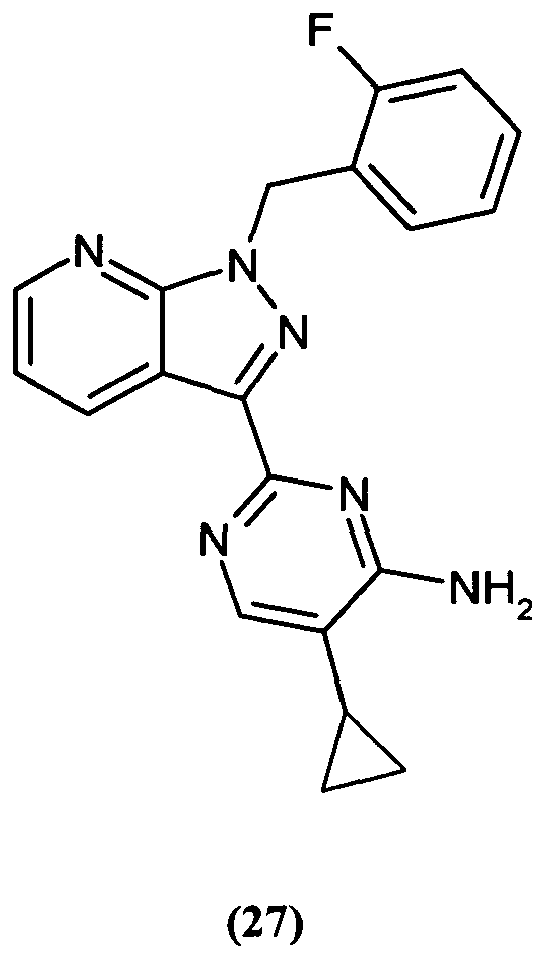
- Compounds according to formulae and (1), (2), (3), (4), (5), (6), (7) and (27) for use in the prevention and/or treatment of Systemic Sclerosis (SSc).
- Compound according to formula (3) for use in the prevention and/or treatment of Systemic Sclerosis.
- At least one compound according to claim 1 to 3 in combination with at least one PDE5 Inhibitor selected from the group of:Tadalafil ((6R,12aR) -2,3,6,7,12,12a - Hexahydro - 2 - methyl - 6 - (3,4-methylene - dioxyphenyl) pyrazino(1',2':1,6) pyrido(3,4-b)indole-1,4-dione), Vardenafil (2-(2-Ethoxy-5-(4-ethylpiperazin-1-yl-1-sulfonyl)phenyl)-5-methyl-7-propyl-3H-imidazo (5,1-f) (1,2,4)triazin-4-one), Sildenafil (3-[2-ethoxy-5-(4-methylpiperazin-1-yl)sulfonyl-phenyl]-7- methyl- 9- propy 1-2,4,7,8- tetrazabicyclo [4.3.0]nona -3,8,10-trien-5-one), Udenafil 5-[2-propyloxy-5-(1-methyl-2-pyrrolidinylethylamidosulfonyl)phenyl]-methyl-3-propyl-1,6-dihydro-7H-pyrazolo(4,3-d)pyrimidine-7-one, Dasantafil 7-(3-Bromo-4-methoxybenzyl)-1-ethyl-8-[[(1,2)-2-hydroxycyclopentyl]amino]-3-(2-hydroxyethyl)-3,7-dihydro-1-purine-2,6-dione, Avanafil 4-{[(3-chloro-4-methoxyphenyl)methyl]amino}-2-[(2S)-2-(hydroxymethyl)pyrrolidin-1-yl]-N-(pyrimidin-2-ylmethyl)pyrimidine-5-carboxamide, Mirodenafil, Lodenafil, UK 369.003, UK 371.800, SLx 2101 of Surface Logix, LAS 34179Triazolo[1,2-]xanthine,6-methyl-4-propyl-2-[2-propoxy-5-(4-methylpiperazino)sulfonyl]phenyl or salts, hydrates or hydrates of the salts for use in the prevention and/or treatment of Systemic Sclerosis (SSc).
- At least one compound according to claim 1 to 3 in combination with sildenafil or vardenafil for use in the prevention and/or treatment of Systemic Sclerosis (SSc).
- Compounds according to claim 1 to 5 for use in the prevention and/or treatment of Systemic Sclerosis (SSc), diffuse Systemic Sclerosis (dSSc), limited Systemic Sclerosis (lSSc), overlap type of Systemic Sclerosis, undifferentiated type of Systemic Sclerosis, Systemic Sclerosis sine scleroderma, skin fibrosis, scleroderma, nephrogenic fibrosing dermopathy (NFD), nephrogenic systemic fibrosis (NSF), keloid formation.
- Compounds according to claim 1 to 5 for use in the prevention and/or treatment of Systemic Sclerosis SSc concomitant fibrosis of internal organs, comprising the guts, the lungs, the kidneys and the blood vessels.
- Compounds according to formulae (3), (4), (6), and/or (7) for use in the prevention and/or treatment of Systemic Sclerosis SSc.
- At least one compound according to formulae (3), (4), (6) and/or (7) in combination with vardenafil or sildenafil for use in the prevention and/or treatment of Systemic Sclerosis SSc.
- Use of a compound according to claims 1-9 for the production of a medicament for prevention and/or treatment of Systemic Sclerosis (SSc) comprising an effective amount of a compound according to claims 1 to 9.
- Use of a compound according to claims 1-9 for the production of a medicament for prevention and/or treatment of Systemic Systemic Sclerosis (SSc), diffuse Systemic Sclerosis (dSSc), limited Systemic Sclerosis (ISSc), overlap type of Systemic Sclerosis, undifferentiated type of Systemic Sclerosis, Systemic Sclerosis sine scleroderma, skin fibrosis, scleroderma, nephrogenic fibrosing dermopathy (NFD), keloid formation comprising an effective amount of a compound according to claims 1 to 9.
- Use of a compound according to claims 1-9 for the production of a medicament for prevention and/or treatment of Systemic Sclerosis SSc concomitant fibrosis of internal organs, comprising the guts, the lungs, the kidneys and the blood vessels comprising an effective amount of a compound according to claims 1 to 9.
- Pharmaceutical formulation comprising at least one compound or one combination according to claims 1 to 9 for the use in the prevention and/or treatment of Systemic Sclerosis (SSc).
- Pharmaceutical formulation comprising at least one compound or one combination according to claims 1 to 9 for the use in the prevention and/or treatment of Systemic Sclerosis (SSc), diffuse Systemic Sclerosis (dSSc), limited Systemic Sclerosis (ISSc), overlap type of Systemic Sclerosis, undifferentiated type of Systemic Sclerosis, Systemic Sclerosis sine scleroderma, skin fibrosis, scleroderma, nephrogenic fibrosing dermopathy (NFD), keloid formation.
- Pharmaceutical formulation comprising at least one compound or one combination according to claims 1 to 9 for the use in the prevention and/or treatment of Systemic Sclerosis SSc concomitant fibrosis of internal organs, comprising the guts, the lungs, the kidneys and the blood vessels.
- Kit comprising at least one sGC stimulator and/or activator according to claims 1 to 3 or a combination according to claims 4 to 5 for the use in the prevention and/or treatment of Systemic Sclerosis (SSc).
- Kit according to claim 16 for the use in the prevention and/or treatment of Systemic Sclerosis (SSc), diffuse Systemic Sclerosis (dSSc), limited Systemic Sclerosis (lSSc), overlap type of Systemic Sclerosis, undifferentiated type of Systemic Sclerosis, Systemic Sclerosis sine scleroderma, skin fibrosis, scleroderma, nephrogenic fibrosing dermopathy (NFD), keloid formation.
- Kit according to claims 16 and 17 for the use in the prevention and/or treatment of Systemic Sclerosis SSc concomitant fibrosis of internal organs, comprising the guts, the lungs, the kidneys and the blood vessels.
Priority Applications (6)
| Application Number | Priority Date | Filing Date | Title |
|---|---|---|---|
| PL11722786T PL2576548T3 (en) | 2010-05-26 | 2011-05-24 | THE USE OF sGC STIMULATORS, sGC ACTIVATORS, ALONE AND COMBINATIONS WITH PDE5 INHIBITORS FOR THE TREATMENT OF SYSTEMIC SCLEROSIS (SSc) |
| SI201130602T SI2576548T1 (en) | 2010-05-26 | 2011-05-24 | THE USE OF sGC STIMULATORS, sGC ACTIVATORS, ALONE AND COMBINATIONS WITH PDE5 INHIBITORS FOR THE TREATMENT OF SYSTEMIC SCLEROSIS (SSc) |
| MEP-2015-147A ME02207B (en) | 2010-05-26 | 2011-05-24 | THE USE OF sGC STIMULATORS, sGC ACTIVATORS, ALONE AND COMBINATIONS WITH PDE5 INHIBITORS |
| HRP20150987TT HRP20150987T1 (en) | 2010-05-26 | 2011-05-24 | THE USE OF sGC STIMULATORS, sGC ACTIVATORS, ALONE AND COMBINATIONS WITH PDE5 INHIBITORS FOR THE TREATMENT OF SYSTEMIC SCLEROSIS (SSc). |
| EP11722786.8A EP2576548B1 (en) | 2010-05-26 | 2011-05-24 | THE USE OF sGC STIMULATORS, sGC ACTIVATORS, ALONE AND COMBINATIONS WITH PDE5 INHIBITORS FOR THE TREATMENT OF SYSTEMIC SCLEROSIS (SSc) |
| CY20151100818T CY1116703T1 (en) | 2010-05-26 | 2015-09-17 | USE OF SGC STIMULATORS, SGC ACTIVATORS, ONLY AND IN CONNECTION WITH PDE5 INHIBITORS FOR THERAPEUTIC SYSTEM TREATMENT |
Applications Claiming Priority (4)
| Application Number | Priority Date | Filing Date | Title |
|---|---|---|---|
| DE102010021637A DE102010021637A1 (en) | 2010-05-26 | 2010-05-26 | Substituted 5-fluoro-1H-pyrazolopyridines and their use |
| EP10170413 | 2010-07-22 | ||
| PCT/EP2011/058433 WO2011147810A1 (en) | 2010-05-26 | 2011-05-24 | THE USE OF sGC STIMULATORS, sGC ACTIVATORS, ALONE AND COMBINATIONS WITH PDE5 INHIBITORS FOR THE TREATMENT OF SYSTEMIC SCLEROSIS (SSc). |
| EP11722786.8A EP2576548B1 (en) | 2010-05-26 | 2011-05-24 | THE USE OF sGC STIMULATORS, sGC ACTIVATORS, ALONE AND COMBINATIONS WITH PDE5 INHIBITORS FOR THE TREATMENT OF SYSTEMIC SCLEROSIS (SSc) |
Publications (2)
| Publication Number | Publication Date |
|---|---|
| EP2576548A1 EP2576548A1 (en) | 2013-04-10 |
| EP2576548B1 true EP2576548B1 (en) | 2015-06-24 |
Family
ID=45003356
Family Applications (1)
| Application Number | Title | Priority Date | Filing Date |
|---|---|---|---|
| EP11722786.8A Active EP2576548B1 (en) | 2010-05-26 | 2011-05-24 | THE USE OF sGC STIMULATORS, sGC ACTIVATORS, ALONE AND COMBINATIONS WITH PDE5 INHIBITORS FOR THE TREATMENT OF SYSTEMIC SCLEROSIS (SSc) |
Country Status (31)
| Country | Link |
|---|---|
| US (1) | US10189856B2 (en) |
| EP (1) | EP2576548B1 (en) |
| JP (1) | JP5883852B2 (en) |
| KR (1) | KR101881174B1 (en) |
| CN (1) | CN103038232B (en) |
| AU (1) | AU2011257336B2 (en) |
| CA (2) | CA2800709C (en) |
| CL (1) | CL2012003281A1 (en) |
| CR (1) | CR20120597A (en) |
| CY (1) | CY1116703T1 (en) |
| DK (1) | DK2576548T3 (en) |
| EA (1) | EA030735B9 (en) |
| ES (1) | ES2549979T3 (en) |
| HR (1) | HRP20150987T1 (en) |
| HU (1) | HUE025162T2 (en) |
| IL (1) | IL223128A (en) |
| MA (1) | MA34249B1 (en) |
| ME (1) | ME02207B (en) |
| MX (1) | MX2012013574A (en) |
| MY (1) | MY170094A (en) |
| NZ (1) | NZ603799A (en) |
| PH (1) | PH12012502322A1 (en) |
| PL (1) | PL2576548T3 (en) |
| PT (1) | PT2576548E (en) |
| RS (1) | RS54261B1 (en) |
| SG (1) | SG185690A1 (en) |
| SI (1) | SI2576548T1 (en) |
| TN (1) | TN2012000550A1 (en) |
| UA (1) | UA116521C2 (en) |
| WO (1) | WO2011147810A1 (en) |
| ZA (1) | ZA201208824B (en) |
Families Citing this family (36)
| Publication number | Priority date | Publication date | Assignee | Title |
|---|---|---|---|---|
| DE102010021637A1 (en) * | 2010-05-26 | 2011-12-01 | Bayer Schering Pharma Aktiengesellschaft | Substituted 5-fluoro-1H-pyrazolopyridines and their use |
| CN103038232B (en) | 2010-05-26 | 2016-01-20 | 阿德弗里奥药品有限责任公司 | Independent and combined with PDE5 inhibitor sGC stimulant, sGC activator are used for the treatment of the purposes of systemic sclerosis (SSc) |
| NZ609955A (en) | 2010-11-09 | 2015-05-29 | Ironwood Pharmaceuticals Inc | Sgc stimulators |
| EP2594270A3 (en) * | 2011-11-18 | 2013-07-31 | BIP Patents | The use of sGC stimulators, sGC activators, alone and combinations with PDE5 inhibitors for the treatment of systemic sclerosis (SSc) |
| CN102491974B (en) | 2011-12-12 | 2013-08-07 | 南京药石药物研发有限公司 | Method for synthesizing 1-(2-fluorobenzyl)-1H-pyrazolo[3,4-b]pyridin-3-formamidine hydrochloride |
| CN104066731B (en) | 2011-12-27 | 2016-06-15 | 铁木医药有限公司 | 2-Benzyl, 3-(pyrimidin-2-yl)-substituted pyrazoles useful as SGC stimulators |
| ES2644781T3 (en) * | 2012-03-06 | 2017-11-30 | Bayer Intellectual Property Gmbh | Azabicycles substituted and their use |
| NZ703989A (en) * | 2012-09-07 | 2017-04-28 | Boehringer Ingelheim Int | Alkoxy pyrazoles as soluble guanylate cyclase activators |
| US9487508B2 (en) | 2012-09-19 | 2016-11-08 | Ironwood Pharmaceuticals, Inc. | SGC stimulators |
| AP2015008670A0 (en) | 2013-02-21 | 2015-08-31 | Adverio Pharma Gmbh | Forms of methyl {4,6-diamino-2-[1-(2-fluorobenzyl)-1H-pyrazolo[3,4-B]pyridino-3-yl]pyrimidino-5-yl} methyl carbamate |
| AU2014236719B2 (en) | 2013-03-15 | 2018-06-21 | The California Institute For Biomedical Research | Compounds and methods for inducing chondrogenesis |
| US10265314B2 (en) | 2013-07-25 | 2019-04-23 | Bayer Pharma Aktiengesellschaft | SGC stimulators in combination with additional treatment for the therapy of cystic fibrosis |
| CN105658621B (en) * | 2013-10-15 | 2018-05-29 | 东亚荣养株式会社 | 4-Aminomethylbenzoic acid derivatives |
| EP3094327A1 (en) | 2014-01-13 | 2016-11-23 | Ironwood Pharmaceuticals, Inc. | USE OF sGC STIMULATORS FOR THE TREATMENT OF NEUROMUSCULAR DISORDERS |
| RS59426B1 (en) | 2014-06-13 | 2019-11-29 | Inventiva | Ppar compounds for use in the treatment of fibrotic diseases |
| TW201625584A (en) | 2014-07-02 | 2016-07-16 | 諾華公司 | Indane and indoline derivatives and the use thereof as soluble guanylate cyclase activators |
| WO2016014463A1 (en) | 2014-07-22 | 2016-01-28 | Boehringer Ingelheim International Gmbh | Heterocyclic carboxylic acids as activators of soluble guanylate cyclase |
| US20180169095A1 (en) * | 2015-05-06 | 2018-06-21 | Bayer Pharma Aktiengesellschaft | The use of sgc stimulators, sgc activators, alone and combinations with pde5 inhibitors for the treatment of digital ulcers (du) concomitant to systemic sclerosis (ssc) |
| CN113750102A (en) * | 2015-07-23 | 2021-12-07 | 拜耳制药股份公司 | Stimulators and/or activators of soluble guanylate cyclase and uses thereof |
| CN108367165B (en) * | 2015-10-07 | 2022-03-04 | 艾葳生物科技有限公司 | Compositions and methods for treating skin fibrotic disorders |
| JP2019502686A (en) | 2015-12-14 | 2019-01-31 | アイアンウッド ファーマシューティカルズ インコーポレイテッド | Use of sGC stimulators to treat gastrointestinal sphincter dysfunction |
| WO2017103888A1 (en) | 2015-12-18 | 2017-06-22 | Novartis Ag | Indane derivatives and the use thereof as soluble guanylate cyclase activators |
| CA3012001A1 (en) | 2016-02-01 | 2017-08-10 | Ironwood Pharmaceuticals, Inc. | Use of sgc stimulators for the treatment of nonalcoholic steatohepatitis (nash) |
| US20190381039A1 (en) | 2016-12-13 | 2019-12-19 | Cyclerion Therapeutics, Inc. | USE OF sGC STIMULATORS FOR THE TREATMENT OF ESOPHAGEAL MOTILITY DISORDERS |
| US20190388407A1 (en) | 2017-02-12 | 2019-12-26 | Aiviva Biopharma, Inc. | Multikinase inhibitors of vegf and tfg beta and uses thereof |
| CN108690016B (en) * | 2017-04-11 | 2022-08-12 | 广东东阳光药业有限公司 | Pyrazolopyridine compounds and their uses |
| JP7090639B2 (en) | 2017-04-11 | 2022-06-24 | サンシャイン・レイク・ファーマ・カンパニー・リミテッド | Fluoride-substituted indazole compounds and their use |
| US11508483B2 (en) | 2018-05-30 | 2022-11-22 | Adverio Pharma Gmbh | Method of identifying a subgroup of patients suffering from dcSSc which benefits from a treatment with sGC stimulators and sGC activators in a higher degree than a control group |
| JP7542518B2 (en) | 2018-07-11 | 2024-08-30 | ティセント セラピューティクス インコーポレーテッド | Use of sGC stimulators for the treatment of mitochondrial disorders |
| CA3109703C (en) | 2018-08-15 | 2023-10-17 | Aiviva Biopharma, Inc. | Multi-kinase inhibitors of vegf and tgf beta and uses thereof |
| CN111638329B (en) * | 2020-06-09 | 2021-06-01 | 南方医科大学 | ELISPOT detection kit for detecting brucellosis and application thereof |
| EP3925953A1 (en) * | 2020-06-16 | 2021-12-22 | Adverio Pharma GmbH | Process for preparing methyl {4,6-diamino-2-[5-fluoro-1-(2-fluorobenzyl)-1h-pyrazolo[3,4-b]pyridin-3-yl]pyrimidin-5-yl}carbamate |
| CN115160312B (en) * | 2022-06-29 | 2023-12-26 | 常州制药厂有限公司 | Viridigdine key intermediate and preparation method thereof |
| KR102831482B1 (en) * | 2022-11-04 | 2025-07-07 | 한국타이어앤테크놀로지 주식회사 | A method for evaluating the wet grip performance of tire |
| WO2024097316A1 (en) | 2022-11-04 | 2024-05-10 | Boehringer Ingelheim International Gmbh | Soluble guanylate cyclase activators for treating systemic sclerosis |
| CN117462685A (en) * | 2023-04-14 | 2024-01-30 | 北京悦康科创医药科技股份有限公司 | Use of PDE5 inhibitors or compositions thereof in the preparation of drugs for treating urinary system diseases |
Family Cites Families (36)
| Publication number | Priority date | Publication date | Assignee | Title |
|---|---|---|---|---|
| US5380945A (en) | 1989-06-21 | 1995-01-10 | Abbott Laboratories | Guanidino compounds as regulators of nitric oxide synthase |
| DE19642255A1 (en) | 1996-10-14 | 1998-04-16 | Bayer Ag | Use of 1-benzyl-3- (substituted-hetaryl) fused pyrazole derivatives |
| US6331543B1 (en) | 1996-11-01 | 2001-12-18 | Nitromed, Inc. | Nitrosated and nitrosylated phosphodiesterase inhibitors, compositions and methods of use |
| KR100720844B1 (en) | 1998-07-08 | 2007-05-25 | 사노피-아벤티스 도이칠란트 게엠베하 | Sulfur substituted sulfonylaminocarboxylic acid N-arylamides, methods for preparing the same, and pharmaceutical preparations containing the same |
| DE19834047A1 (en) | 1998-07-29 | 2000-02-03 | Bayer Ag | Substituted pyrazole derivatives |
| DE19834044A1 (en) * | 1998-07-29 | 2000-02-03 | Bayer Ag | New substituted pyrazole derivatives |
| DE19943635A1 (en) * | 1999-09-13 | 2001-03-15 | Bayer Ag | Novel aminodicarboxylic acid derivatives with pharmaceutical properties |
| DE19943636A1 (en) | 1999-09-13 | 2001-03-15 | Bayer Ag | Novel dicarboxylic acid derivatives with pharmaceutical properties |
| DE19943634A1 (en) | 1999-09-13 | 2001-04-12 | Bayer Ag | Novel dicarboxylic acid derivatives with pharmaceutical properties |
| US6538023B1 (en) | 2000-09-15 | 2003-03-25 | Tsuyoshi Ohnishi | Therapeutic uses of green tea polyphenols for sickle cell disease |
| DE10054278A1 (en) * | 2000-11-02 | 2002-05-08 | Bayer Ag | Use of soluble guanylate cyclase stimulators for the treatment of osteoporosis |
| AR031176A1 (en) | 2000-11-22 | 2003-09-10 | Bayer Ag | NEW DERIVATIVES OF PIRAZOLPIRIDINA SUBSTITUTED WITH PIRIDINE |
| JP2004525904A (en) * | 2000-12-29 | 2004-08-26 | アルテオン インコーポレイテッド | Methods of treating fibrotic diseases or other indications IIIC |
| DE10110750A1 (en) | 2001-03-07 | 2002-09-12 | Bayer Ag | Novel aminodicarboxylic acid derivatives with pharmaceutical properties |
| DE10110749A1 (en) | 2001-03-07 | 2002-09-12 | Bayer Ag | Substituted aminodicarboxylic acid derivatives |
| GB0202254D0 (en) * | 2002-01-31 | 2002-03-20 | Pfizer Ltd | Prevention of scarring |
| DE10220570A1 (en) | 2002-05-08 | 2003-11-20 | Bayer Ag | Carbamate-substituted pyrazolopyridines |
| WO2005113490A1 (en) | 2004-05-21 | 2005-12-01 | Icagen, Inc. | Sulfone-containing prodrugs |
| DE102004038328A1 (en) * | 2004-08-06 | 2006-03-16 | Bayer Healthcare Ag | New uses of 2-phenyl-substituted imidazotriazinone derivatives |
| DE102005016345A1 (en) | 2005-04-09 | 2006-10-12 | Bayer Healthcare Ag | New use of 2-phenyl-substituted imidazotriazinone derivatives |
| DE102005047945A1 (en) * | 2005-07-16 | 2007-01-18 | Bayer Healthcare Ag | Use of soluble guanylate cyclase activators for the treatment of Raynaud's phenomena |
| CA2615426A1 (en) | 2005-07-18 | 2007-01-25 | Bayer Healthcare Ag | Novel use of activators and stimulators of soluble guanylate cyclase for the prevention or treatment of renal disorders |
| AU2008250643A1 (en) | 2007-05-12 | 2008-11-20 | Bayer Schering Pharma Aktiengesellschaft | sGC stimulators, sGC activators and combinations for the treatment of urological disorders |
| DE102007026392A1 (en) | 2007-06-06 | 2008-12-11 | Bayer Healthcare Ag | Solutions for the perfusion and preservation of organs and tissues |
| CA2698332C (en) | 2007-09-06 | 2012-08-21 | Merck Sharp & Dohme Corp. | Pyrazole derivatives as soluble guanylate cyclase activators |
| WO2009068652A1 (en) * | 2007-11-30 | 2009-06-04 | Smithkline Beecham Corporation | 2, 6-disubstituted pyridines and 2, 4-disubstituted pyrimidines as soluble guanylate cyclase activators |
| PE20091258A1 (en) | 2007-12-03 | 2009-09-12 | Smithkline Beecham Corp | PYRIDINE DERIVATIVES AS SOLUBLE GUANILATE CYCLASE ACTIVATORS |
| WO2009123316A1 (en) | 2008-04-04 | 2009-10-08 | 武田薬品工業株式会社 | Heterocyclic derivative and use thereof |
| US8158636B2 (en) | 2008-05-19 | 2012-04-17 | Plexxikon Inc. | Compounds and methods for kinase modulation, and indications therefor |
| EP2328895B1 (en) | 2008-09-16 | 2013-03-27 | Proximagen Limited | Pyrazolo[4,3-c]pyridine compounds and their use as inhibitors of SSAO |
| US8741910B2 (en) | 2008-11-25 | 2014-06-03 | Merck Sharp & Dohme Corp. | Soluble guanylate cyclase activators |
| BRPI1006869A2 (en) | 2009-01-17 | 2016-03-15 | Bayer Schering Pharma Ag | sgc stimulators or sgc activators in combination with pde5 inhibitors for the treatment of erectile dysfunction |
| ES2612948T3 (en) | 2009-04-23 | 2017-05-19 | Universität Zürich | NMDA receptor blockers for the treatment of sickle cell anemia |
| US20130053393A1 (en) * | 2009-12-18 | 2013-02-28 | Exodos Life Sciences Limited Partnership | Methods and compositions for treating peripheral vascular disease |
| KR101793304B1 (en) | 2010-02-05 | 2017-11-02 | 아드베리오 파마 게엠베하 | sGC STIMULATORS OR sGC ACTIVATORS ALONE AND IN COMBINATION WITH PDE5 INHIBITORS FOR THE TREATMENT OF CYSTIC FIBROSIS |
| CN103038232B (en) | 2010-05-26 | 2016-01-20 | 阿德弗里奥药品有限责任公司 | Independent and combined with PDE5 inhibitor sGC stimulant, sGC activator are used for the treatment of the purposes of systemic sclerosis (SSc) |
-
2011
- 2011-05-24 CN CN201180036565.XA patent/CN103038232B/en not_active Expired - Fee Related
- 2011-05-24 PH PH1/2012/502322A patent/PH12012502322A1/en unknown
- 2011-05-24 ES ES11722786.8T patent/ES2549979T3/en active Active
- 2011-05-24 MA MA35392A patent/MA34249B1/en unknown
- 2011-05-24 KR KR1020127033603A patent/KR101881174B1/en not_active Expired - Fee Related
- 2011-05-24 PT PT117227868T patent/PT2576548E/en unknown
- 2011-05-24 DK DK11722786.8T patent/DK2576548T3/en active
- 2011-05-24 MY MYPI2012701008A patent/MY170094A/en unknown
- 2011-05-24 SI SI201130602T patent/SI2576548T1/en unknown
- 2011-05-24 US US13/816,020 patent/US10189856B2/en not_active Expired - Fee Related
- 2011-05-24 UA UAA201214901A patent/UA116521C2/en unknown
- 2011-05-24 MX MX2012013574A patent/MX2012013574A/en active IP Right Grant
- 2011-05-24 CA CA2800709A patent/CA2800709C/en not_active Expired - Fee Related
- 2011-05-24 HU HUE11722786A patent/HUE025162T2/en unknown
- 2011-05-24 CA CA2955143A patent/CA2955143C/en not_active Expired - Fee Related
- 2011-05-24 WO PCT/EP2011/058433 patent/WO2011147810A1/en not_active Ceased
- 2011-05-24 HR HRP20150987TT patent/HRP20150987T1/en unknown
- 2011-05-24 NZ NZ603799A patent/NZ603799A/en not_active IP Right Cessation
- 2011-05-24 RS RS20150600A patent/RS54261B1/en unknown
- 2011-05-24 PL PL11722786T patent/PL2576548T3/en unknown
- 2011-05-24 AU AU2011257336A patent/AU2011257336B2/en not_active Ceased
- 2011-05-24 EA EA201291309A patent/EA030735B9/en not_active IP Right Cessation
- 2011-05-24 SG SG2012085767A patent/SG185690A1/en unknown
- 2011-05-24 ME MEP-2015-147A patent/ME02207B/en unknown
- 2011-05-24 JP JP2013511644A patent/JP5883852B2/en not_active Expired - Fee Related
- 2011-05-24 EP EP11722786.8A patent/EP2576548B1/en active Active
-
2012
- 2012-11-19 IL IL223128A patent/IL223128A/en active IP Right Grant
- 2012-11-22 ZA ZA2012/08824A patent/ZA201208824B/en unknown
- 2012-11-23 CL CL2012003281A patent/CL2012003281A1/en unknown
- 2012-11-23 TN TNP2012000550A patent/TN2012000550A1/en unknown
- 2012-11-26 CR CR20120597A patent/CR20120597A/en unknown
-
2015
- 2015-09-17 CY CY20151100818T patent/CY1116703T1/en unknown
Also Published As
Similar Documents
| Publication | Publication Date | Title |
|---|---|---|
| CA2800709C (en) | The use of sgc stimulators, sgc activators, alone and combinations with pde5 inhibitors for the treatment of systemic sclerosis (ssc) | |
| US9284284B2 (en) | Oxazine derivatives and their use in the treatment of disease | |
| US8975417B2 (en) | Pyrazolopyrrolidine derivatives and their use in the treatment of disease | |
| JP2023502662A (en) | Substituted 1,5-naphthyridines or quinolines as ALK5 inhibitors | |
| US20150210705A1 (en) | Substituted pyrrolopyridines and pyrrolopyrazines for treating cancer or inflammatory diseases | |
| BR112021011224A2 (en) | alk5 inhibitors | |
| JP2002524564A (en) | Carboline derivatives as cGMP phosphodiesterase inhibitors | |
| CA3250517A1 (en) | Certain chemical entities, compositions, and methods | |
| US10316038B2 (en) | Pyrrolopyrimidine ITK inhibitors for treating inflammation and cancer | |
| JP2018519259A (en) | Use of sGC stimulators, sGC activators, alone or in combination with PDE5 inhibitors, to treat finger ulcers (DU) associated with systemic sclerosis (SSc) | |
| KR20030027865A (en) | Pharmaceutical compositions and kits comprising a growth hormone secretagogue | |
| EP3728247B1 (en) | Oxadiazole derivatives as rho-kinase inhibitors | |
| HK1183868B (en) | The use of sgc stimulators, sgc activators, alone and combinations with pde5 inhibitors for the treatment of systemic sclerosis (ssc). | |
| WO2022135502A1 (en) | Multi-substituted uracil derivative and use thereof | |
| WO2022135534A1 (en) | Substituted nitrogen-containing bicyclic compound and use thereof | |
| US20250059175A1 (en) | Mutant Pi3k-Alpha Inhibitors And Their Use As Pharmaceuticals | |
| EP4735442A1 (en) | IMIDAZO[1,2-alpha]PYRIDINE COMPOUNDS FOR USE IN TREATING CANCER AND INFLAMMATORY DISEASES AND METHODS TO PREPARE SAID COMPOUNDS |
Legal Events
| Date | Code | Title | Description |
|---|---|---|---|
| PUAI | Public reference made under article 153(3) epc to a published international application that has entered the european phase |
Free format text: ORIGINAL CODE: 0009012 |
|
| 17P | Request for examination filed |
Effective date: 20130102 |
|
| AK | Designated contracting states |
Kind code of ref document: A1 Designated state(s): AL AT BE BG CH CY CZ DE DK EE ES FI FR GB GR HR HU IE IS IT LI LT LU LV MC MK MT NL NO PL PT RO RS SE SI SK SM TR |
|
| AX | Request for extension of the european patent |
Extension state: BA ME |
|
| GRAP | Despatch of communication of intention to grant a patent |
Free format text: ORIGINAL CODE: EPIDOSNIGR1 |
|
| INTG | Intention to grant announced |
Effective date: 20141211 |
|
| RAP1 | Party data changed (applicant data changed or rights of an application transferred) |
Owner name: ADVERIO PHARMA GMBH |
|
| GRAP | Despatch of communication of intention to grant a patent |
Free format text: ORIGINAL CODE: EPIDOSNIGR1 |
|
| GRAS | Grant fee paid |
Free format text: ORIGINAL CODE: EPIDOSNIGR3 |
|
| INTG | Intention to grant announced |
Effective date: 20150401 |
|
| GRAA | (expected) grant |
Free format text: ORIGINAL CODE: 0009210 |
|
| AK | Designated contracting states |
Kind code of ref document: B1 Designated state(s): AL AT BE BG CH CY CZ DE DK EE ES FI FR GB GR HR HU IE IS IT LI LT LU LV MC MK MT NL NO PL PT RO RS SE SI SK SM TR |
|
| AX | Request for extension of the european patent |
Extension state: BA ME |
|
| REG | Reference to a national code |
Ref country code: GB Ref legal event code: FG4D |
|
| REG | Reference to a national code |
Ref country code: CH Ref legal event code: EP |
|
| REG | Reference to a national code |
Ref country code: AT Ref legal event code: REF Ref document number: 732837 Country of ref document: AT Kind code of ref document: T Effective date: 20150715 |
|
| REG | Reference to a national code |
Ref country code: IE Ref legal event code: FG4D |
|
| REG | Reference to a national code |
Ref country code: DE Ref legal event code: R096 Ref document number: 602011017339 Country of ref document: DE |
|
| REG | Reference to a national code |
Ref country code: PT Ref legal event code: SC4A Free format text: AVAILABILITY OF NATIONAL TRANSLATION Effective date: 20150804 |
|
| REG | Reference to a national code |
Ref country code: HR Ref legal event code: TUEP Ref document number: P20150987 Country of ref document: HR |
|
| REG | Reference to a national code |
Ref country code: RO Ref legal event code: EPE |
|
| REG | Reference to a national code |
Ref country code: DK Ref legal event code: T3 Effective date: 20150923 |
|
| REG | Reference to a national code |
Ref country code: SE Ref legal event code: TRGR |
|
| REG | Reference to a national code |
Ref country code: HR Ref legal event code: T1PR Ref document number: P20150987 Country of ref document: HR |
|
| REG | Reference to a national code |
Ref country code: ES Ref legal event code: FG2A Ref document number: 2549979 Country of ref document: ES Kind code of ref document: T3 Effective date: 20151103 |
|
| REG | Reference to a national code |
Ref country code: EE Ref legal event code: FG4A Ref document number: E011010 Country of ref document: EE Effective date: 20150922 |
|
| REG | Reference to a national code |
Ref country code: NO Ref legal event code: T2 Effective date: 20150624 |
|
| REG | Reference to a national code |
Ref country code: PL Ref legal event code: T3 |
|
| REG | Reference to a national code |
Ref country code: NL Ref legal event code: FP |
|
| REG | Reference to a national code |
Ref country code: GR Ref legal event code: EP Ref document number: 20150401957 Country of ref document: GR Effective date: 20151022 |
|
| REG | Reference to a national code |
Ref country code: SK Ref legal event code: T3 Ref document number: E 19366 Country of ref document: SK |
|
| REG | Reference to a national code |
Ref country code: AT Ref legal event code: UEP Ref document number: 732837 Country of ref document: AT Kind code of ref document: T Effective date: 20150624 |
|
| REG | Reference to a national code |
Ref country code: DE Ref legal event code: R097 Ref document number: 602011017339 Country of ref document: DE |
|
| REG | Reference to a national code |
Ref country code: FR Ref legal event code: PLFP Year of fee payment: 6 |
|
| REG | Reference to a national code |
Ref country code: HU Ref legal event code: AG4A Ref document number: E025162 Country of ref document: HU |
|
| PLBE | No opposition filed within time limit |
Free format text: ORIGINAL CODE: 0009261 |
|
| STAA | Information on the status of an ep patent application or granted ep patent |
Free format text: STATUS: NO OPPOSITION FILED WITHIN TIME LIMIT |
|
| 26N | No opposition filed |
Effective date: 20160329 |
|
| REG | Reference to a national code |
Ref country code: FR Ref legal event code: PLFP Year of fee payment: 7 |
|
| REG | Reference to a national code |
Ref country code: FR Ref legal event code: PLFP Year of fee payment: 8 |
|
| REG | Reference to a national code |
Ref country code: HR Ref legal event code: ODRP Ref document number: P20150987 Country of ref document: HR Payment date: 20180509 Year of fee payment: 8 |
|
| PG25 | Lapsed in a contracting state [announced via postgrant information from national office to epo] |
Ref country code: SM Free format text: LAPSE BECAUSE OF FAILURE TO SUBMIT A TRANSLATION OF THE DESCRIPTION OR TO PAY THE FEE WITHIN THE PRESCRIBED TIME-LIMIT Effective date: 20150624 |
|
| PGFP | Annual fee paid to national office [announced via postgrant information from national office to epo] |
Ref country code: FI Payment date: 20180509 Year of fee payment: 8 Ref country code: EE Payment date: 20180427 Year of fee payment: 8 Ref country code: MC Payment date: 20180427 Year of fee payment: 8 Ref country code: PT Payment date: 20180516 Year of fee payment: 8 Ref country code: SK Payment date: 20180426 Year of fee payment: 8 Ref country code: DK Payment date: 20180514 Year of fee payment: 8 Ref country code: CZ Payment date: 20180426 Year of fee payment: 8 Ref country code: CH Payment date: 20180516 Year of fee payment: 8 Ref country code: LT Payment date: 20180507 Year of fee payment: 8 Ref country code: HR Payment date: 20180509 Year of fee payment: 8 Ref country code: LU Payment date: 20180508 Year of fee payment: 8 Ref country code: IE Payment date: 20180509 Year of fee payment: 8 Ref country code: NO Payment date: 20180509 Year of fee payment: 8 |
|
| PGFP | Annual fee paid to national office [announced via postgrant information from national office to epo] |
Ref country code: RO Payment date: 20180524 Year of fee payment: 8 Ref country code: BE Payment date: 20180424 Year of fee payment: 8 Ref country code: AT Payment date: 20180426 Year of fee payment: 8 Ref country code: LV Payment date: 20180427 Year of fee payment: 8 Ref country code: RO Payment date: 20180509 Year of fee payment: 8 Ref country code: TR Payment date: 20180523 Year of fee payment: 8 Ref country code: IS Payment date: 20180425 Year of fee payment: 8 Ref country code: PL Payment date: 20180509 Year of fee payment: 8 Ref country code: NL Payment date: 20180514 Year of fee payment: 8 Ref country code: BG Payment date: 20180427 Year of fee payment: 8 Ref country code: RS Payment date: 20180427 Year of fee payment: 8 |
|
| PGFP | Annual fee paid to national office [announced via postgrant information from national office to epo] |
Ref country code: HU Payment date: 20180508 Year of fee payment: 8 Ref country code: SE Payment date: 20180511 Year of fee payment: 8 Ref country code: MT Payment date: 20180517 Year of fee payment: 8 |
|
| PGFP | Annual fee paid to national office [announced via postgrant information from national office to epo] |
Ref country code: CY Payment date: 20180518 Year of fee payment: 8 |
|
| PGFP | Annual fee paid to national office [announced via postgrant information from national office to epo] |
Ref country code: MK Payment date: 20180425 Year of fee payment: 8 |
|
| REG | Reference to a national code |
Ref country code: HR Ref legal event code: PBON Ref document number: P20150987 Country of ref document: HR Effective date: 20190524 |
|
| REG | Reference to a national code |
Ref country code: LT Ref legal event code: MM4D Effective date: 20190524 |
|
| REG | Reference to a national code |
Ref country code: EE Ref legal event code: MM4A Ref document number: E011010 Country of ref document: EE Effective date: 20190531 |
|
| REG | Reference to a national code |
Ref country code: NO Ref legal event code: MMEP |
|
| REG | Reference to a national code |
Ref country code: CH Ref legal event code: PL |
|
| REG | Reference to a national code |
Ref country code: DK Ref legal event code: EBP Effective date: 20190531 |
|
| REG | Reference to a national code |
Ref country code: NL Ref legal event code: MM Effective date: 20190601 |
|
| REG | Reference to a national code |
Ref country code: AT Ref legal event code: MM01 Ref document number: 732837 Country of ref document: AT Kind code of ref document: T Effective date: 20190524 |
|
| PG25 | Lapsed in a contracting state [announced via postgrant information from national office to epo] |
Ref country code: CZ Free format text: LAPSE BECAUSE OF NON-PAYMENT OF DUE FEES Effective date: 20190524 Ref country code: NO Free format text: LAPSE BECAUSE OF NON-PAYMENT OF DUE FEES Effective date: 20190531 Ref country code: RO Free format text: LAPSE BECAUSE OF NON-PAYMENT OF DUE FEES Effective date: 20190524 Ref country code: EE Free format text: LAPSE BECAUSE OF NON-PAYMENT OF DUE FEES Effective date: 20190531 Ref country code: MC Free format text: LAPSE BECAUSE OF NON-PAYMENT OF DUE FEES Effective date: 20190531 Ref country code: BG Free format text: LAPSE BECAUSE OF NON-PAYMENT OF DUE FEES Effective date: 20191130 Ref country code: CH Free format text: LAPSE BECAUSE OF NON-PAYMENT OF DUE FEES Effective date: 20190531 Ref country code: PT Free format text: LAPSE BECAUSE OF NON-PAYMENT OF DUE FEES Effective date: 20191125 Ref country code: LI Free format text: LAPSE BECAUSE OF NON-PAYMENT OF DUE FEES Effective date: 20190531 Ref country code: FI Free format text: LAPSE BECAUSE OF NON-PAYMENT OF DUE FEES Effective date: 20190524 Ref country code: CY Free format text: LAPSE BECAUSE OF NON-PAYMENT OF DUE FEES Effective date: 20190524 Ref country code: HU Free format text: LAPSE BECAUSE OF NON-PAYMENT OF DUE FEES Effective date: 20190525 Ref country code: AT Free format text: LAPSE BECAUSE OF NON-PAYMENT OF DUE FEES Effective date: 20190524 Ref country code: SK Free format text: LAPSE BECAUSE OF NON-PAYMENT OF DUE FEES Effective date: 20190524 Ref country code: LT Free format text: LAPSE BECAUSE OF NON-PAYMENT OF DUE FEES Effective date: 20190524 Ref country code: SE Free format text: LAPSE BECAUSE OF NON-PAYMENT OF DUE FEES Effective date: 20190525 Ref country code: HR Free format text: LAPSE BECAUSE OF NON-PAYMENT OF DUE FEES Effective date: 20190524 |
|
| REG | Reference to a national code |
Ref country code: SK Ref legal event code: MM4A Ref document number: E 19366 Country of ref document: SK Effective date: 20190524 |
|
| REG | Reference to a national code |
Ref country code: BE Ref legal event code: MM Effective date: 20190531 |
|
| PG25 | Lapsed in a contracting state [announced via postgrant information from national office to epo] |
Ref country code: SI Free format text: LAPSE BECAUSE OF NON-PAYMENT OF DUE FEES Effective date: 20190525 Ref country code: LV Free format text: LAPSE BECAUSE OF NON-PAYMENT OF DUE FEES Effective date: 20190524 Ref country code: GR Free format text: LAPSE BECAUSE OF NON-PAYMENT OF DUE FEES Effective date: 20191205 Ref country code: RS Free format text: LAPSE BECAUSE OF NON-PAYMENT OF DUE FEES Effective date: 20191127 Ref country code: IS Free format text: LAPSE BECAUSE OF FAILURE TO SUBMIT A TRANSLATION OF THE DESCRIPTION OR TO PAY THE FEE WITHIN THE PRESCRIBED TIME-LIMIT Effective date: 20191201 Ref country code: LU Free format text: LAPSE BECAUSE OF NON-PAYMENT OF DUE FEES Effective date: 20190524 |
|
| PG25 | Lapsed in a contracting state [announced via postgrant information from national office to epo] |
Ref country code: DK Free format text: LAPSE BECAUSE OF NON-PAYMENT OF DUE FEES Effective date: 20190531 Ref country code: NL Free format text: LAPSE BECAUSE OF NON-PAYMENT OF DUE FEES Effective date: 20190601 Ref country code: IE Free format text: LAPSE BECAUSE OF NON-PAYMENT OF DUE FEES Effective date: 20190524 |
|
| REG | Reference to a national code |
Ref country code: SE Ref legal event code: EUG |
|
| PG25 | Lapsed in a contracting state [announced via postgrant information from national office to epo] |
Ref country code: BE Free format text: LAPSE BECAUSE OF NON-PAYMENT OF DUE FEES Effective date: 20190531 |
|
| PGFP | Annual fee paid to national office [announced via postgrant information from national office to epo] |
Ref country code: ES Payment date: 20200601 Year of fee payment: 10 Ref country code: FR Payment date: 20200505 Year of fee payment: 10 Ref country code: DE Payment date: 20200512 Year of fee payment: 10 |
|
| PGFP | Annual fee paid to national office [announced via postgrant information from national office to epo] |
Ref country code: GB Payment date: 20200513 Year of fee payment: 10 Ref country code: IT Payment date: 20200428 Year of fee payment: 10 |
|
| PG25 | Lapsed in a contracting state [announced via postgrant information from national office to epo] |
Ref country code: AL Free format text: LAPSE BECAUSE OF NON-PAYMENT OF DUE FEES Effective date: 20190524 |
|
| REG | Reference to a national code |
Ref country code: DE Ref legal event code: R119 Ref document number: 602011017339 Country of ref document: DE |
|
| GBPC | Gb: european patent ceased through non-payment of renewal fee |
Effective date: 20210524 |
|
| PG25 | Lapsed in a contracting state [announced via postgrant information from national office to epo] |
Ref country code: MT Free format text: LAPSE BECAUSE OF FAILURE TO SUBMIT A TRANSLATION OF THE DESCRIPTION OR TO PAY THE FEE WITHIN THE PRESCRIBED TIME-LIMIT Effective date: 20190524 |
|
| PG25 | Lapsed in a contracting state [announced via postgrant information from national office to epo] |
Ref country code: GB Free format text: LAPSE BECAUSE OF NON-PAYMENT OF DUE FEES Effective date: 20210524 Ref country code: DE Free format text: LAPSE BECAUSE OF NON-PAYMENT OF DUE FEES Effective date: 20211201 |
|
| PG25 | Lapsed in a contracting state [announced via postgrant information from national office to epo] |
Ref country code: FR Free format text: LAPSE BECAUSE OF NON-PAYMENT OF DUE FEES Effective date: 20210531 |
|
| PG25 | Lapsed in a contracting state [announced via postgrant information from national office to epo] |
Ref country code: TR Free format text: LAPSE BECAUSE OF NON-PAYMENT OF DUE FEES Effective date: 20190524 |
|
| REG | Reference to a national code |
Ref country code: ES Ref legal event code: FD2A Effective date: 20220805 |
|
| PG25 | Lapsed in a contracting state [announced via postgrant information from national office to epo] |
Ref country code: PL Free format text: LAPSE BECAUSE OF NON-PAYMENT OF DUE FEES Effective date: 20190524 |
|
| PG25 | Lapsed in a contracting state [announced via postgrant information from national office to epo] |
Ref country code: ES Free format text: LAPSE BECAUSE OF NON-PAYMENT OF DUE FEES Effective date: 20210525 |
|
| PG25 | Lapsed in a contracting state [announced via postgrant information from national office to epo] |
Ref country code: IT Free format text: LAPSE BECAUSE OF NON-PAYMENT OF DUE FEES Effective date: 20200524 |
|
| PG25 | Lapsed in a contracting state [announced via postgrant information from national office to epo] |
Ref country code: IT Free format text: LAPSE BECAUSE OF NON-PAYMENT OF DUE FEES Effective date: 20210524 |