EP2575229A2 - Photovoltaic generation system using parallel inverter connected grid - Google Patents
Photovoltaic generation system using parallel inverter connected grid Download PDFInfo
- Publication number
- EP2575229A2 EP2575229A2 EP20110187245 EP11187245A EP2575229A2 EP 2575229 A2 EP2575229 A2 EP 2575229A2 EP 20110187245 EP20110187245 EP 20110187245 EP 11187245 A EP11187245 A EP 11187245A EP 2575229 A2 EP2575229 A2 EP 2575229A2
- Authority
- EP
- European Patent Office
- Prior art keywords
- photovoltaic
- photovoltaic generation
- generation system
- inverter
- electrical energy
- Prior art date
- Legal status (The legal status is an assumption and is not a legal conclusion. Google has not performed a legal analysis and makes no representation as to the accuracy of the status listed.)
- Pending
Links
Images




Classifications
-
- H—ELECTRICITY
- H02—GENERATION; CONVERSION OR DISTRIBUTION OF ELECTRIC POWER
- H02J—ELECTRIC POWER NETWORKS; CIRCUIT ARRANGEMENTS OR SYSTEMS FOR SUPPLYING OR DISTRIBUTING ELECTRIC POWER; SYSTEMS FOR STORING ELECTRIC ENERGY
- H02J7/00—Circuit arrangements for charging or discharging batteries or for supplying loads from batteries
- H02J7/34—Parallel operation in networks using both storage and other DC sources, e.g. providing buffering
- H02J7/35—Parallel operation in networks using both storage and other DC sources, e.g. providing buffering with light sensitive cells
-
- H—ELECTRICITY
- H10—SEMICONDUCTOR DEVICES; ELECTRIC SOLID-STATE DEVICES NOT OTHERWISE PROVIDED FOR
- H10F—INORGANIC SEMICONDUCTOR DEVICES SENSITIVE TO INFRARED RADIATION, LIGHT, ELECTROMAGNETIC RADIATION OF SHORTER WAVELENGTH OR CORPUSCULAR RADIATION
- H10F77/00—Constructional details of devices covered by this subclass
- H10F77/95—Circuit arrangements
- H10F77/953—Circuit arrangements for devices having potential barriers
- H10F77/955—Circuit arrangements for devices having potential barriers for photovoltaic devices
-
- H—ELECTRICITY
- H02—GENERATION; CONVERSION OR DISTRIBUTION OF ELECTRIC POWER
- H02J—ELECTRIC POWER NETWORKS; CIRCUIT ARRANGEMENTS OR SYSTEMS FOR SUPPLYING OR DISTRIBUTING ELECTRIC POWER; SYSTEMS FOR STORING ELECTRIC ENERGY
- H02J3/00—Circuit arrangements for AC mains or AC distribution networks
- H02J3/38—Arrangements for feeding a single network from two or more generators or sources in parallel; Arrangements for feeding already energised networks from additional generators or sources in parallel
- H02J3/381—Dispersed generators
-
- H—ELECTRICITY
- H02—GENERATION; CONVERSION OR DISTRIBUTION OF ELECTRIC POWER
- H02M—APPARATUS FOR CONVERSION BETWEEN AC AND AC, BETWEEN AC AND DC, OR BETWEEN DC AND DC, AND FOR USE WITH MAINS OR SIMILAR POWER SUPPLY SYSTEMS; CONVERSION OF DC OR AC INPUT POWER INTO SURGE OUTPUT POWER; CONTROL OR REGULATION THEREOF
- H02M1/00—Details of apparatus for conversion
- H02M1/12—Arrangements for reducing harmonics from AC input or output
-
- H—ELECTRICITY
- H02—GENERATION; CONVERSION OR DISTRIBUTION OF ELECTRIC POWER
- H02M—APPARATUS FOR CONVERSION BETWEEN AC AND AC, BETWEEN AC AND DC, OR BETWEEN DC AND DC, AND FOR USE WITH MAINS OR SIMILAR POWER SUPPLY SYSTEMS; CONVERSION OF DC OR AC INPUT POWER INTO SURGE OUTPUT POWER; CONTROL OR REGULATION THEREOF
- H02M1/00—Details of apparatus for conversion
- H02M1/12—Arrangements for reducing harmonics from AC input or output
- H02M1/126—Arrangements for reducing harmonics from AC input or output using passive filters
-
- H—ELECTRICITY
- H02—GENERATION; CONVERSION OR DISTRIBUTION OF ELECTRIC POWER
- H02M—APPARATUS FOR CONVERSION BETWEEN AC AND AC, BETWEEN AC AND DC, OR BETWEEN DC AND DC, AND FOR USE WITH MAINS OR SIMILAR POWER SUPPLY SYSTEMS; CONVERSION OF DC OR AC INPUT POWER INTO SURGE OUTPUT POWER; CONTROL OR REGULATION THEREOF
- H02M7/00—Conversion of AC power input into DC power output; Conversion of DC power input into AC power output
- H02M7/42—Conversion of DC power input into AC power output without possibility of reversal
- H02M7/44—Conversion of DC power input into AC power output without possibility of reversal by static converters
- H02M7/48—Conversion of DC power input into AC power output without possibility of reversal by static converters using discharge tubes with control electrode or semiconductor devices with control electrode
-
- H—ELECTRICITY
- H02—GENERATION; CONVERSION OR DISTRIBUTION OF ELECTRIC POWER
- H02M—APPARATUS FOR CONVERSION BETWEEN AC AND AC, BETWEEN AC AND DC, OR BETWEEN DC AND DC, AND FOR USE WITH MAINS OR SIMILAR POWER SUPPLY SYSTEMS; CONVERSION OF DC OR AC INPUT POWER INTO SURGE OUTPUT POWER; CONTROL OR REGULATION THEREOF
- H02M7/00—Conversion of AC power input into DC power output; Conversion of DC power input into AC power output
- H02M7/42—Conversion of DC power input into AC power output without possibility of reversal
- H02M7/44—Conversion of DC power input into AC power output without possibility of reversal by static converters
- H02M7/48—Conversion of DC power input into AC power output without possibility of reversal by static converters using discharge tubes with control electrode or semiconductor devices with control electrode
- H02M7/493—Conversion of DC power input into AC power output without possibility of reversal by static converters using discharge tubes with control electrode or semiconductor devices with control electrode the static converters being arranged for operation in parallel
-
- H—ELECTRICITY
- H02—GENERATION; CONVERSION OR DISTRIBUTION OF ELECTRIC POWER
- H02J—ELECTRIC POWER NETWORKS; CIRCUIT ARRANGEMENTS OR SYSTEMS FOR SUPPLYING OR DISTRIBUTING ELECTRIC POWER; SYSTEMS FOR STORING ELECTRIC ENERGY
- H02J2101/00—Supply or distribution of decentralised, dispersed or local electric power generation
- H02J2101/20—Dispersed power generation using renewable energy sources
- H02J2101/22—Solar energy
- H02J2101/24—Photovoltaics
-
- H—ELECTRICITY
- H02—GENERATION; CONVERSION OR DISTRIBUTION OF ELECTRIC POWER
- H02M—APPARATUS FOR CONVERSION BETWEEN AC AND AC, BETWEEN AC AND DC, OR BETWEEN DC AND DC, AND FOR USE WITH MAINS OR SIMILAR POWER SUPPLY SYSTEMS; CONVERSION OF DC OR AC INPUT POWER INTO SURGE OUTPUT POWER; CONTROL OR REGULATION THEREOF
- H02M1/00—Details of apparatus for conversion
- H02M1/12—Arrangements for reducing harmonics from AC input or output
- H02M1/123—Suppression of common mode voltage or current
-
- Y—GENERAL TAGGING OF NEW TECHNOLOGICAL DEVELOPMENTS; GENERAL TAGGING OF CROSS-SECTIONAL TECHNOLOGIES SPANNING OVER SEVERAL SECTIONS OF THE IPC; TECHNICAL SUBJECTS COVERED BY FORMER USPC CROSS-REFERENCE ART COLLECTIONS [XRACs] AND DIGESTS
- Y02—TECHNOLOGIES OR APPLICATIONS FOR MITIGATION OR ADAPTATION AGAINST CLIMATE CHANGE
- Y02E—REDUCTION OF GREENHOUSE GAS [GHG] EMISSIONS, RELATED TO ENERGY GENERATION, TRANSMISSION OR DISTRIBUTION
- Y02E10/00—Energy generation through renewable energy sources
- Y02E10/50—Photovoltaic [PV] energy
- Y02E10/56—Power conversion systems, e.g. maximum power point trackers
Definitions
- the present invention relates to a photovoltaic generation system, and more particularly, to a photovoltaic generation system using grid-connected parallel inverters.
- the new energy field includes a fuel cell, coal liquefaction/gasification, and hydrogen energy
- the renewable field includes solar heat, photovoltaic generation, biomass, wind power, small hydro power, geothermy, ocean energy, and waste energy.
- the photovoltaic generation which is being the most actively studied, and is permanent enough to be used for five billion, differently from oil, coal, and natural gas, which may be exhausted within the next decades to centuries.
- the photovoltaic generation uses clean energy, it is possible to solve environmental pollution problems which may occur in using fossil energy, and to supply required places with energy required therein, differently from water power or atomic power generation.
- the photovoltaic generation system since most of a photovoltaic generation system is constituted with electronic elements, the photovoltaic generation system is long in lifetime, is easy in maintenance and repair, and has no mechanical noise.
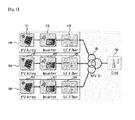
- the conventional parallel photovoltaic inverters are using multi-wiring MV transformers for electrical separation between inverters and isolation of a grid from inverters although a high unit price, a difficulty in design, and inefficiency are recognized.
- FIG. 2 is a circuit diagram illustrating the configuration of a conventional photovoltaic generation system using a double wiring transformer
- FIG. 3 is an equivalent circuit of FIG. 2
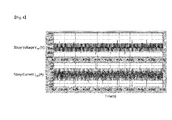
- FIG. 4 is a waveform view obtained through a simulation of a stray voltage and stray current in a conventional grid-connected parallel inverter.
- the conventional photovoltaic generation system using a double wiring transformer includes: a plurality of photovoltaic generation devices 110, 120, and 130; and a double wiring transformer 140 for transforming the output voltages of the photovoltaic generation devices 110, 120, and 130, wherein a grid 150 is connected with the output of the transformer 140.
- the photovoltaic generation devices 110, 120, and 130 include: photovoltaic modules 111, 121, and 131 for converting photovoltaic energy into DC electrical energy; inverters 112, 122, and 132 for converting the DC electrical energy into AC electrical energy; and LC filters 113, 123, and 133 for removing noise included in the AC electrical energy, respectively.
- an undesired stray capacitance Cst1 exists between the first photovoltaic module 111 and the ground G
- an undesired stray capacitance Cst2 exists between the second photovoltaic module 121 and the ground G. That is to say, a grounding impedance Zet1 and the undesired stray capacitance Cst1 exist between the first photovoltaic module 111 and the ground G, and a grounding impedance Zet2 and the undesired stray capacitance Cst2 exist between the second photovoltaic module 121 and the ground G, so that the first photovoltaic module 111 and second photovoltaic module 121 is at a connected state in a circuit.
- the plurality of photovoltaic generation devices operate in parallel, for example, a closed loop connected in order of "the first photovoltaic module 111, the first inverter 112, the first LC filter 113, the second LC filter 123, the second inverter 122, the second photovoltaic module 121, the second stray capacitor Cst2, and the first stray capacitor Cst1," and stray current flows along the closed loop.
- V cst - V sw ⁇ 12 - V sw ⁇ 22 - V sw ⁇ 32 - V sw ⁇ 11 - V sw ⁇ 21 - V sw ⁇ 31 3 - V pv
- the conventional photovoltaic generation system using a double wiring transformer causes undesired stray current, so that there is a danger of an electrical shock when the worker touches a photovoltaic module, the photovoltaic module is easily deteriorated and is easily broken due to the deterioration thereof, and high harmonic distortion appears in the output waveform of the inverter.
- the present invention has been made in an effort to address problems occurring in the related art.
- Embodiments provide a photovoltaic generation system using grid-connected parallel inverters which can significantly reduce stray current.
- Embodiments provide a photovoltaic generation system using grid-connected parallel inverters which can reduce deterioration of a photovoltaic module due to stray current.
- Embodiments provide a photovoltaic generation system using grid-connected parallel inverters which can reduce harmonic distortion in an output waveform.
- Embodiments provide a photovoltaic generation system using grid-connected parallel inverters which significantly reduces stray current using a Y-connected capacitor group and thus can use a double wiring transformer instead of a multi-wiring transformer.
- a photovoltaic generation system using grid-connected parallel inverters comprising: a plurality of photovoltaic generation devices connected in parallel with each other; and a transformer configured to transform and transfer output voltages of the photovoltaic generation devices to a grid
- the photovoltaic generation device comprises: a photovoltaic module configured to convert photovoltaic energy into DC electrical energy; an inverter configured to convert the DC electrical energy outputted from the photovoltaic module into AC electrical energy; an LC filter configured to remove noise included in the AC electrical energy which is outputted from the inverter; and a Y-connected capacitor group which is connected between one terminal of a reactor in the LC filter and one terminal of the photovoltaic module and is configured to reduce stray current.
- the LC filter further comprises a delta-connected capacitor group configured to filter noise at an output terminal of the inverter.
- a stray impedance value by a stray capacitance component between the photovoltaic module and a ground is larger than an impedance value by the Y-connected capacitor group.
- a frequency forming an impedance by the Y-connected capacitor group is a switching frequency of the inverter.
- stray current flowing between the photovoltaic module and a ground is dependent on a capacitance value of the Y-connected capacitor group and a switching frequency of the inverter.
- a resonance frequency by the LC filter and the Y-connected capacitor group is different from a switching frequency of the inverter.
- the transformer is any one of a double wiring transformer and a multi-wiring transformer.
- a photovoltaic generation system using grid-connected parallel inverters comprising: a photovoltaic module configured to convert photovoltaic energy into DC electrical energy; an inverter configured to convert the DC electrical energy outputted from the photovoltaic module into AC electrical energy; an LC filter configured to remove noise included in the AC electrical energy which is outputted from the inverter; a Y-connected capacitor group which is connected between one terminal of a reactor in the LC filter and one terminal of the photovoltaic module and is configured to reduce stray current; and an isolation transformer configured to block the output of a DC portion outputted from the LC filter.
- stray current flowing between the photovoltaic module and a ground is determined depending on a capacitance value of the Y-connected capacitor group and a switching frequency of the inverter.
- a photovoltaic generation system using grid-connected parallel inverters includes a plurality of photovoltaic generation devices 410 and 420 connected in parallel with each other, a transformer 440 for transforming the output voltages of the photovoltaic generation devices 410 and 420, and a grid 450 connected with the output of the transformer 440.
- a double wiring transformer or any of multi-wiring transformers may be used as the transformer 440.
- the photovoltaic generation devices 410 and 420 include: photovoltaic modules 411 and 421 for converting photovoltaic energy into DC electrical energy; inverters 412 and 422 for converting the DC electrical energy outputted from the photovoltaic modules 411 and 421 into AC electrical energy; LC filters 413 and 423 for removing noise included in the AC electrical energy which are outputted from the inverters 412 and 422; and Y-connected capacitor groups 414 and 424 which are connected between one terminals of reactors in the LC filters 413 and 423 and one terminals of the photovoltaic modules 411 and 421 and reduce stray current, respectively.
- each of the LC filters 413 and 423 includes a delta-connected capacitor group.
- Vcst - V sw ⁇ 12 - Lf A ⁇ 2 ⁇ di dt - V cf ⁇ 2 ⁇ A
- V cst - V sw ⁇ 22 - Lf B ⁇ 2 ⁇ di dt - V cf ⁇ 2 ⁇ B
- V cst - V sw ⁇ 32 - Lf C ⁇ 2 ⁇ di dt - V cf ⁇ 2 ⁇ C
- Equation 8 is expressed as Equation 9.
- V cst - V sw ⁇ 12 - V sw ⁇ 22 - V sw ⁇ 32 - V sw ⁇ 11 - V sw ⁇ 21 - V sw ⁇ 31 3 - V pv
- the voltage component Vcst may be regarded as a sine-wave form of each phase in which a switching frequency is reduced. Therefore, since a three-phase voltage is zero in parallel, the voltage applied to the stray capacitor has a value near to zero.
- the resonance frequency fr is expressed as Equation 10, wherein a reactance is a reactor value of an LC filter, and a capacitance is a value of a Y-connected capacitor group.
- f represents the switching frequency of the inverter.
- the present disclosure provides a photovoltaic generation system which can significantly reduce stray current, reduce the deterioration of the photovoltaic module by stray current, and reduce harmonic distortion in an output waveform.
- a Y-connected capacitor group is adopted to significantly reduce stray current, it is possible to use a double wiring transformer in an advantageous position for price, volume, weight, design, etc., as compared with multi-wiring transformers.
Landscapes
- Engineering & Computer Science (AREA)
- Power Engineering (AREA)
- Inverter Devices (AREA)
Abstract
Description
- The present invention relates to a photovoltaic generation system, and more particularly, to a photovoltaic generation system using grid-connected parallel inverters.
- It has been determined that fossil energy, such as oil, coal, and natural gas, is available for 30 years in case of oil, 80 years in case of coal, and 180 in case of natural gas. Due to the United Nations Framework Convention on Climate Change (UNFCCC), such as the Kyoto protocol, and so on, new & renewable energy has received an increasing amount of attention. The new energy field includes a fuel cell, coal liquefaction/gasification, and hydrogen energy, and the renewable field includes solar heat, photovoltaic generation, biomass, wind power, small hydro power, geothermy, ocean energy, and waste energy.
- Among the new & renewable energy, the photovoltaic generation, which is being the most actively studied, and is permanent enough to be used for five billion, differently from oil, coal, and natural gas, which may be exhausted within the next decades to centuries. In addition, since the photovoltaic generation uses clean energy, it is possible to solve environmental pollution problems which may occur in using fossil energy, and to supply required places with energy required therein, differently from water power or atomic power generation. In addition, since most of a photovoltaic generation system is constituted with electronic elements, the photovoltaic generation system is long in lifetime, is easy in maintenance and repair, and has no mechanical noise.
- Recently, the market for large-scale photovoltaic generation plants of several megawatts to several tens of megawatts or more has been rapidly grown. Accordingly, with respect to an inverter which is a power transformation device for grid-connected photovoltaic generation in the large-scale photovoltaic generation plants, a technology for producing a more efficient large-scale inverter with a lower unit price has been required. Now, most of photovoltaic generation systems use a parallel operating technology, in which a multi-wiring medium voltage (MV) transformer is used, a plurality of large-scale grid-connected photovoltaic inverters having individual capacities are connected in parallel with each other to increase the generation capacity.
- The reason why it is required to use a transformer having a structure of multi-wiring is that a stray capacitance exists between a photovoltaic module and the ground due to the structural characteristic of the photovoltaic module. When a Voltage of a harmonic component occurs at the stray capacitance, leakage current occurs through the ground, and several problems are accompanied.
- Therefore, as shown in
FIG. 1 , the conventional parallel photovoltaic inverters are using multi-wiring MV transformers for electrical separation between inverters and isolation of a grid from inverters although a high unit price, a difficulty in design, and inefficiency are recognized. -
FIG. 2 is a circuit diagram illustrating the configuration of a conventional photovoltaic generation system using a double wiring transformer,FIG. 3 is an equivalent circuit ofFIG. 2 , andFIG. 4 is a waveform view obtained through a simulation of a stray voltage and stray current in a conventional grid-connected parallel inverter. - Referring to
FIG. 2 , the conventional photovoltaic generation system using a double wiring transformer includes: a plurality ofphotovoltaic generation devices double wiring transformer 140 for transforming the output voltages of thephotovoltaic generation devices grid 150 is connected with the output of thetransformer 140. - The
photovoltaic generation devices photovoltaic modules inverters LC filters - Meanwhile, an undesired stray capacitance Cst1 exists between the first
photovoltaic module 111 and the ground G, and an undesired stray capacitance Cst2 exists between the secondphotovoltaic module 121 and the ground G. That is to say, a grounding impedance Zet1 and the undesired stray capacitance Cst1 exist between the firstphotovoltaic module 111 and the ground G, and a grounding impedance Zet2 and the undesired stray capacitance Cst2 exist between the secondphotovoltaic module 121 and the ground G, so that the firstphotovoltaic module 111 and secondphotovoltaic module 121 is at a connected state in a circuit. - Accordingly, when the plurality of photovoltaic generation devices operate in parallel, for example, a closed loop connected in order of "the first
photovoltaic module 111, thefirst inverter 112, thefirst LC filter 113, thesecond LC filter 123, thesecond inverter 122, the secondphotovoltaic module 121, the second stray capacitor Cst2, and the first stray capacitor Cst1," and stray current flows along the closed loop. - Referring to
FIG. 2 , a stray voltage is calculated as follows:


- In a three-phase balanced state, when Equations 1 to 3 are added to produce one equation, and then both sides of the produced equation are divided by three, the stray voltage Vcst can be obtained as Equation 4.

- That is to say, the stray capacitance appears in the form of a switching voltage between inverters, and the switching voltage between the inverters each of which is independently controlled cannot be same. Therefore, it can be understood that the stray capacitance appears in the form of a switching frequency, and very large stray current flows as expressed in the following equation.

- As described above, the conventional photovoltaic generation system using a double wiring transformer causes undesired stray current, so that there is a danger of an electrical shock when the worker touches a photovoltaic module, the photovoltaic module is easily deteriorated and is easily broken due to the deterioration thereof, and high harmonic distortion appears in the output waveform of the inverter.
- Accordingly, the present invention has been made in an effort to address problems occurring in the related art.
- Embodiments provide a photovoltaic generation system using grid-connected parallel inverters which can significantly reduce stray current.
- Embodiments provide a photovoltaic generation system using grid-connected parallel inverters which can reduce deterioration of a photovoltaic module due to stray current.
- Embodiments provide a photovoltaic generation system using grid-connected parallel inverters which can reduce harmonic distortion in an output waveform.
- Embodiments provide a photovoltaic generation system using grid-connected parallel inverters which significantly reduces stray current using a Y-connected capacitor group and thus can use a double wiring transformer instead of a multi-wiring transformer.
- In one aspect of the disclosure, there is provided a photovoltaic generation system using grid-connected parallel inverters, the photovoltaic generation system comprising: a plurality of photovoltaic generation devices connected in parallel with each other; and a transformer configured to transform and transfer output voltages of the photovoltaic generation devices to a grid, wherein the photovoltaic generation device comprises: a photovoltaic module configured to convert photovoltaic energy into DC electrical energy; an inverter configured to convert the DC electrical energy outputted from the photovoltaic module into AC electrical energy; an LC filter configured to remove noise included in the AC electrical energy which is outputted from the inverter; and a Y-connected capacitor group which is connected between one terminal of a reactor in the LC filter and one terminal of the photovoltaic module and is configured to reduce stray current.
- In an embodiment, the LC filter further comprises a delta-connected capacitor group configured to filter noise at an output terminal of the inverter.
- In an embodiment, a stray impedance value by a stray capacitance component between the photovoltaic module and a ground is larger than an impedance value by the Y-connected capacitor group.
- In an embodiment, a frequency forming an impedance by the Y-connected capacitor group is a switching frequency of the inverter.
- In an embodiment, stray current flowing between the photovoltaic module and a ground is dependent on a capacitance value of the Y-connected capacitor group and a switching frequency of the inverter.
- In an embodiment, a resonance frequency by the LC filter and the Y-connected capacitor group is different from a switching frequency of the inverter.
- In an embodiment, the transformer is any one of a double wiring transformer and a multi-wiring transformer.
- In another aspect of the present disclosure, there is provided a photovoltaic generation system using grid-connected parallel inverters, the photovoltaic generation system comprising: a photovoltaic module configured to convert photovoltaic energy into DC electrical energy; an inverter configured to convert the DC electrical energy outputted from the photovoltaic module into AC electrical energy; an LC filter configured to remove noise included in the AC electrical energy which is outputted from the inverter; a Y-connected capacitor group which is connected between one terminal of a reactor in the LC filter and one terminal of the photovoltaic module and is configured to reduce stray current; and an isolation transformer configured to block the output of a DC portion outputted from the LC filter.
- In an embodiment, stray current flowing between the photovoltaic module and a ground is determined depending on a capacitance value of the Y-connected capacitor group and a switching frequency of the inverter.
- In the drawings:
-
FIG. 1 is a circuit diagram illustrating the configuration of a conventional photovoltaic generation system using a multi-wiring transformer; -
FIG. 2 is a circuit diagram illustrating the configuration of a conventional photovoltaic generation system using a double wiring transformer; -
FIG. 3 is an equivalent circuit ofFIG. 2 ; -
FIG. 4 is a waveform view obtained through a simulation of a stray voltage and stray current in a conventional grid-connected parallel inverter; -
FIG. 5 is a circuit diagram of a photovoltaic generation system using grid-connected parallel inverters; -
FIG. 6 is an equivalent circuit ofFIG. 5 ; and -
FIG. 7 is a waveform diagram showing a result obtained by simulation of stray voltage and stray current of grid-connected parallel inverters. - Wherever possible in this description, the same reference numerals will be used throughout the drawings and the description to refer to the same or like parts.
- Referring to
figures 5 and6 , a photovoltaic generation system using grid-connected parallel inverters includes a plurality of photovoltaic generation devices 410 and 420 connected in parallel with each other, atransformer 440 for transforming the output voltages of the photovoltaic generation devices 410 and 420, and agrid 450 connected with the output of thetransformer 440. A double wiring transformer or any of multi-wiring transformers may be used as thetransformer 440. - According to an embodiment, the photovoltaic generation devices 410 and 420 include:
photovoltaic modules inverters photovoltaic modules LC filters inverters capacitor groups LC filters photovoltaic modules - In an embodiment, each of the
LC filters - With
FIG. 5 , the voltage component Vcst applied to a stray capacitor is calculated as follows:


- When Equations 5 to 7 are added to produce one equation, and then both sides of the produced equation are divided by three, a result thereof may be expressed as follows:

- When three phases are in parallel, a relation thereof may be expressed as follows:

- Therefore, in this case, Equation 8 is expressed as Equation 9.

- However, since each of the switching voltages passes through a closed circuit of a corresponding LC filter, the voltage component Vcst may be regarded as a sine-wave form of each phase in which a switching frequency is reduced. Therefore, since a three-phase voltage is zero in parallel, the voltage applied to the stray capacitor has a value near to zero. In this case, the resonance frequency fr is expressed as
Equation 10, wherein a reactance is a reactor value of an LC filter, and a capacitance is a value of a Y-connected capacitor group.
- In addition, when a stray impedance
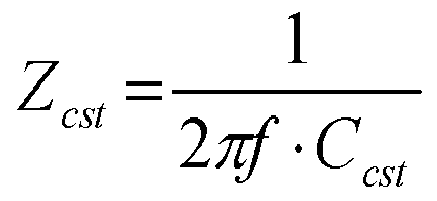

- That is to say, when an impedance value using the switching frequency "f" and the capacitance of the Y-connected capacitor group is appropriately selected so that the stray impedance value can be large enough to ignore the impedance value of the Y-connected capacitor group, it is possible to control the stray current to hardly flow.
- Compared with
FIG. 3 , it can be understood that, under the same condition, while stray current of +10 to -10 amperes flows in the conventional system, stray current hardly flows in the system ofFIG. 6 . - As is apparent from the above description, the present disclosure provides a photovoltaic generation system which can significantly reduce stray current, reduce the deterioration of the photovoltaic module by stray current, and reduce harmonic distortion in an output waveform. In addition, since a Y-connected capacitor group is adopted to significantly reduce stray current, it is possible to use a double wiring transformer in an advantageous position for price, volume, weight, design, etc., as compared with multi-wiring transformers.
- Although an embodiment has been described for illustrative purposes, those skilled in the art will appreciate that various modifications, additions and substitutions are possible, without departing from the scope of the invention as defined in the accompanying claims.
Claims (11)
- A photovoltaic generation system using grid-connected parallel inverters, the photovoltaic generation system comprising: a plurality of photovoltaic generation devices connected in parallel with each other; and a transformer configured to transform and transfer output voltages of the photovoltaic generation devices to a grid,
wherein the photovoltaic generation device comprises:a photovoltaic module configured to convert photovoltaic energy into DC electrical energy;an inverter configured to convert the DC electrical energy outputted from the photovoltaic module into AC electrical energy;an LC filter configured to remove noise included in the AC electrical energy which is outputted from the inverter; anda Y-connected capacitor group which is connected between one terminal of a reactor in the LC filter and one terminal of the photovoltaic module and is configured to reduce stray current. - The photovoltaic generation system according to claim 1, wherein the LC filter further comprises a delta-connected capacitor group configured to filter noise at an output terminal of the inverter.
- The photovoltaic generation system according to claim 1 or 2, wherein a stray impedance value by a stray capacitance component between the photovoltaic module and a ground is larger than an impedance value by the Y-connected capacitor group.
- The photovoltaic generation system according to claim 3, wherein the frequency forming an impedance by the Y-connected capacitor group is a switching frequency of the inverter.
- The photovoltaic generation system according to any preceding claim, wherein stray current flowing between the photovoltaic module and a ground is dependent on a capacitance value of the Y-connected capacitor group and a switching frequency of the inverter.
- The photovoltaic generation system according to any preceding claim, wherein the resonance frequency by the LC filter and the Y-connected capacitor group is different from a switching frequency of the inverter.
- The photovoltaic generation system according to any preceding claim, wherein the transformer is any one of a double wiring transformer and a multi-wiring transformer.
- The photovoltaic generation system according to any preceding claim, wherein the transformer is an isolation transformer configured to block the output of a DC portion outputted from the LC filter
- A photovoltaic generation system using grid-connected parallel inverters, the photovoltaic generation system comprising:a photovoltaic module configured to convert photovoltaic energy into DC electrical energy;an inverter configured to convert the DC electrical energy outputted from the photovoltaic module into AC electrical energy;an LC filter configured to remove noise included in the AC electrical energy which is outputted from the inverter;a Y-connected capacitor group which is connected between one terminal of a reactor in the LC filter and one terminal of the photovoltaic module and is configured to reduce stray current; andan isolation transformer configured to block the output of a DC portion outputted from the LC filter.
- The photovoltaic generation system according to claim 9, wherein stray current flowing between the photovoltaic module and a ground is determined depending on a capacitance value of the Y-connected capacitor group and a switching frequency of the inverter.
- The photovoltaic generation system according to claim 9 or 10, wherein the isolation transformer is any one of a double wiring transformer and a multi-wiring transformer.
Applications Claiming Priority (1)
| Application Number | Priority Date | Filing Date | Title |
|---|---|---|---|
| KR20110097363A KR101220230B1 (en) | 2011-09-27 | 2011-09-27 | Photovoltaic generation system using parallel inverter connected grid |
Publications (2)
| Publication Number | Publication Date |
|---|---|
| EP2575229A2 true EP2575229A2 (en) | 2013-04-03 |
| EP2575229A3 EP2575229A3 (en) | 2014-01-08 |
Family
ID=44862804
Family Applications (1)
| Application Number | Title | Priority Date | Filing Date |
|---|---|---|---|
| EP20110187245 Pending EP2575229A3 (en) | 2011-09-27 | 2011-10-31 | Photovoltaic generation system using parallel inverter connected grid |
Country Status (3)
| Country | Link |
|---|---|
| US (1) | US20130076151A1 (en) |
| EP (1) | EP2575229A3 (en) |
| KR (1) | KR101220230B1 (en) |
Cited By (3)
| Publication number | Priority date | Publication date | Assignee | Title |
|---|---|---|---|---|
| CN104124876A (en) * | 2013-04-29 | 2014-10-29 | 洛克威尔自动控制技术股份有限公司 | Method and apparatus for active front end filter capacitor degradation detection |
| WO2019215372A1 (en) * | 2018-05-09 | 2019-11-14 | Power Electronics S.L. | Modular solar photovoltaic inverter |
| WO2022170578A1 (en) * | 2021-02-10 | 2022-08-18 | 华为数字能源技术有限公司 | Inverter device and inverter system |
Families Citing this family (20)
| Publication number | Priority date | Publication date | Assignee | Title |
|---|---|---|---|---|
| US9653984B2 (en) | 2012-04-30 | 2017-05-16 | Rockwell Automation Technologies, Inc. | Filter capacitor degradation detection apparatus and method |
| KR101283554B1 (en) | 2013-02-25 | 2013-07-15 | 데스틴파워 주식회사 | Inverter system with filter automatically varying according to control mode |
| US10666047B2 (en) | 2013-03-14 | 2020-05-26 | Arda Power Inc. | Power management concept in DC distributed systems |
| US9898018B2 (en) * | 2013-03-14 | 2018-02-20 | Arda Power Inc. | Power clipping method and system |
| US9294005B2 (en) * | 2013-10-01 | 2016-03-22 | Rockwell Automation Technologies, Inc. | Method and apparatus for detecting AFE filter capacitor degradation |
| KR101346579B1 (en) * | 2013-10-08 | 2014-01-06 | 데스틴파워 주식회사 | Parallel inverter system connected grid for photovoltaic generation |
| US9651592B2 (en) | 2013-12-03 | 2017-05-16 | Rockwell Automation Technologies, Inc. | Impedance detector apparatus and method |
| US9488686B2 (en) | 2014-02-24 | 2016-11-08 | Rockwell Automation Technologies, Inc. | Filter capacitor degradation identification using computed current |
| US9490690B2 (en) | 2014-03-11 | 2016-11-08 | Rockwell Automation Technologies, Inc. | Filter capacitor degradation identification using computed power |
| US9389263B2 (en) | 2014-06-05 | 2016-07-12 | Rockwell Automation Technologies, Inc. | Filter capacitor degradation identification using measured and expected voltage |
| FR3031849B1 (en) * | 2015-01-16 | 2017-02-17 | Alstom Transp Tech | POWER SUPPLY CONVERTER AND / OR SUBSTATION FOR RECOVERING BRAKING ENERGY |
| US9735696B2 (en) | 2015-11-25 | 2017-08-15 | Rockwell Automation Technologies, Inc. | Filter capacitor degradation and calibration |
| CN106856332A (en) * | 2017-03-20 | 2017-06-16 | 国家电网公司 | A kind of distributed photovoltaic power generation grid-connected system |
| CN107634539A (en) * | 2017-10-17 | 2018-01-26 | 中国地质大学(武汉) | A grid-connected inverter |
| CN108521144A (en) * | 2018-04-24 | 2018-09-11 | 北京铂阳顶荣光伏科技有限公司 | Photovoltaic generating system and harmonic suppressing method and equipment |
| CN110380450B (en) * | 2019-08-13 | 2021-03-12 | 南方电网科学研究院有限责任公司 | A photovoltaic control method, device, device and computer-readable storage medium |
| CN110535369A (en) * | 2019-09-30 | 2019-12-03 | 深圳古瑞瓦特新能源股份有限公司 | A high power density non-isolated photovoltaic grid-connected inverter |
| CN113437758B (en) * | 2021-06-25 | 2022-07-26 | 安徽海螺建材设计研究院有限责任公司 | Photovoltaic grid-connected system and metering method for cement plant |
| CN217428000U (en) * | 2022-03-25 | 2022-09-13 | 阳光电源股份有限公司 | Inverter and inversion system |
| CN115642647A (en) * | 2022-11-08 | 2023-01-24 | 河北科技大学 | A photovoltaic power generation system with current source inverter input in series and output in parallel |
Family Cites Families (11)
| Publication number | Priority date | Publication date | Assignee | Title |
|---|---|---|---|---|
| US6586900B2 (en) * | 1999-02-08 | 2003-07-01 | Baker Hughes Incorporated | Method for boosting the output voltage of a variable frequency drive |
| US6404655B1 (en) * | 1999-12-07 | 2002-06-11 | Semikron, Inc. | Transformerless 3 phase power inverter |
| JP4052154B2 (en) | 2003-03-14 | 2008-02-27 | 株式会社明電舎 | Distributed power supply output stabilization device and control method thereof. |
| US7177165B2 (en) * | 2004-06-21 | 2007-02-13 | Ballard Power Systems Corporation | System and method for unbalanced independent AC phase voltage control of a 3-phase, 4-wire output DC/AC inverter |
| US7239113B2 (en) * | 2005-05-03 | 2007-07-03 | Caterpillar Inc | Method for reducing undesired currents in an electrical power generation system |
| US7365511B2 (en) * | 2006-09-12 | 2008-04-29 | Hamilton Sundstrand Corporation | Methods to control high speed electric machines having a front-end EMI filter attached |
| US8068352B2 (en) * | 2008-12-19 | 2011-11-29 | Caterpillar Inc. | Power inverter control for grid-tie transition |
| EP2219276B1 (en) * | 2009-02-11 | 2015-12-02 | SMA Solar Technology AG | Photovoltaic assembly for three-phase feeding into an electric energy supply network |
| US20100213768A1 (en) * | 2009-02-24 | 2010-08-26 | Alex Faveluke | Apparatus for photovoltaic power generation |
| KR100911122B1 (en) | 2009-05-21 | 2009-08-11 | (주)그린파워테크놀로지스 | Improved power conversion device for converting a plurality of DC power sources to AC |
| KR20100133792A (en) * | 2009-06-12 | 2010-12-22 | (주) 다쓰테크 | Solar system-linked three-phase inverter circuit |
-
2011
- 2011-09-27 KR KR20110097363A patent/KR101220230B1/en active Active
- 2011-10-21 US US13/278,962 patent/US20130076151A1/en not_active Abandoned
- 2011-10-31 EP EP20110187245 patent/EP2575229A3/en active Pending
Non-Patent Citations (1)
| Title |
|---|
| None |
Cited By (5)
| Publication number | Priority date | Publication date | Assignee | Title |
|---|---|---|---|---|
| CN104124876A (en) * | 2013-04-29 | 2014-10-29 | 洛克威尔自动控制技术股份有限公司 | Method and apparatus for active front end filter capacitor degradation detection |
| CN104124876B (en) * | 2013-04-29 | 2017-05-10 | 洛克威尔自动控制技术股份有限公司 | Method and apparatus for active front end filter capacitor degradation detection |
| WO2019215372A1 (en) * | 2018-05-09 | 2019-11-14 | Power Electronics S.L. | Modular solar photovoltaic inverter |
| US11552577B2 (en) | 2018-05-09 | 2023-01-10 | Power Electronics España, S.L. | Modular photovoltaic solar inverter |
| WO2022170578A1 (en) * | 2021-02-10 | 2022-08-18 | 华为数字能源技术有限公司 | Inverter device and inverter system |
Also Published As
| Publication number | Publication date |
|---|---|
| EP2575229A3 (en) | 2014-01-08 |
| KR101220230B1 (en) | 2013-01-09 |
| US20130076151A1 (en) | 2013-03-28 |
Similar Documents
| Publication | Publication Date | Title |
|---|---|---|
| EP2575229A2 (en) | Photovoltaic generation system using parallel inverter connected grid | |
| Ruddy et al. | Low Frequency AC transmission for offshore wind power: A review | |
| Reed et al. | Ship to grid: Medium-voltage DC concepts in theory and practice | |
| Xiao et al. | Review of grid‐tied converter topologies used in photovoltaic systems | |
| Islam et al. | A multilevel medium-voltage inverter for step-up-transformer-less grid connection of photovoltaic power plants | |
| Moḥ. Rabiula Isalāma et al. | Power converters for medium voltage networks | |
| Pharne et al. | A review on multilevel inverter topology | |
| Quan et al. | Reconsideration of grid-friendly low-order filter enabled by parallel converters | |
| Islam et al. | Performance and cost comparison of NPC, FC and SCHB multilevel converter topologies for high-voltage applications | |
| Hamdan et al. | Hosting capacity enhancement for photovoltaic systems at various conditions based on Volt-Var control | |
| KR101346579B1 (en) | Parallel inverter system connected grid for photovoltaic generation | |
| Id Bouhouch et al. | Comparative analysis of three-phase photovoltaic inverters control techniques | |
| Ahrabian et al. | Hybrid filter applications for power quality improvement of power distribution networks utilizing renewable energies | |
| Kumar et al. | PV-based shunt active power filter for improving power quality in accordance with the PQ theory | |
| Dybko et al. | Switching frequency circulating current analysis in parallel-connected multilevel NPC converters | |
| Esmaeili et al. | The effect of various types of distributed generations on ferroresonance | |
| Kirawanich et al. | Potential harmonic impact of a residential utility-interactive photovoltaic system | |
| Garipelly | Improvement of power quality of a distributed generation power system | |
| Islam et al. | A novel medium-voltage converter system for compact and light wind turbine generators | |
| Yousef et al. | The effect of grid connected photovoltaic location and penetration level on total harmonic distortion | |
| Dreidy et al. | Development of an Optimal Control Strategy of Three Phase Power Factor Correction System | |
| Pawar et al. | A Review on Harmonic Reduction Techniques in Three-Phase Power Generation in PV Solar Plants | |
| Almeida et al. | Analysis of a MMC-Based 12-MW Direct-Drive Wind Energy Conversion System With Level-Shifted and PS-PWM and NLM Strategies | |
| Wargiya | A study on the propagation of harmonics in a Power System | |
| Nathan | A Novel DC-DC Converter for Photovoltaic Applications |
Legal Events
| Date | Code | Title | Description |
|---|---|---|---|
| PUAI | Public reference made under article 153(3) epc to a published international application that has entered the european phase |
Free format text: ORIGINAL CODE: 0009012 |
|
| AK | Designated contracting states |
Kind code of ref document: A2 Designated state(s): AL AT BE BG CH CY CZ DE DK EE ES FI FR GB GR HR HU IE IS IT LI LT LU LV MC MK MT NL NO PL PT RO RS SE SI SK SM TR |
|
| AX | Request for extension of the european patent |
Extension state: BA ME |
|
| PUAL | Search report despatched |
Free format text: ORIGINAL CODE: 0009013 |
|
| AK | Designated contracting states |
Kind code of ref document: A3 Designated state(s): AL AT BE BG CH CY CZ DE DK EE ES FI FR GB GR HR HU IE IS IT LI LT LU LV MC MK MT NL NO PL PT RO RS SE SI SK SM TR |
|
| AX | Request for extension of the european patent |
Extension state: BA ME |
|
| RIC1 | Information provided on ipc code assigned before grant |
Ipc: H02J 13/00 20060101ALI20131203BHEP Ipc: H02M 7/42 20060101ALI20131203BHEP Ipc: H02J 3/38 20060101ALI20131203BHEP Ipc: F24J 2/52 20060101ALI20131203BHEP Ipc: H01L 31/0224 20060101ALI20131203BHEP Ipc: H02J 3/00 20060101AFI20131203BHEP |
|
| 17P | Request for examination filed |
Effective date: 20140708 |
|
| RBV | Designated contracting states (corrected) |
Designated state(s): AL AT BE BG CH CY CZ DE DK EE ES FI FR GB GR HR HU IE IS IT LI LT LU LV MC MK MT NL NO PL PT RO RS SE SI SK SM TR |
|
| 17Q | First examination report despatched |
Effective date: 20140801 |
|
| 18D | Application deemed to be withdrawn |
Effective date: 20150211 |
|
| D18D | Application deemed to be withdrawn (deleted) | ||
| STAA | Information on the status of an ep patent application or granted ep patent |
Free format text: STATUS: THE APPLICATION IS DEEMED TO BE WITHDRAWN |
|
| R18D | Application deemed to be withdrawn (corrected) |
Effective date: 20150212 |