EP2573157A1 - Flüssiges Reinigungsmittel mit Schleifpartikeln - Google Patents
Flüssiges Reinigungsmittel mit Schleifpartikeln Download PDFInfo
- Publication number
- EP2573157A1 EP2573157A1 EP11181970A EP11181970A EP2573157A1 EP 2573157 A1 EP2573157 A1 EP 2573157A1 EP 11181970 A EP11181970 A EP 11181970A EP 11181970 A EP11181970 A EP 11181970A EP 2573157 A1 EP2573157 A1 EP 2573157A1
- Authority
- EP
- European Patent Office
- Prior art keywords
- particles
- abrasive particles
- composition according
- composition
- nut shell
- Prior art date
- Legal status (The legal status is an assumption and is not a legal conclusion. Google has not performed a legal analysis and makes no representation as to the accuracy of the status listed.)
- Withdrawn
Links
Images
Classifications
-
- C—CHEMISTRY; METALLURGY
- C11—ANIMAL OR VEGETABLE OILS, FATS, FATTY SUBSTANCES OR WAXES; FATTY ACIDS THEREFROM; DETERGENTS; CANDLES
- C11D—DETERGENT COMPOSITIONS; USE OF SINGLE SUBSTANCES AS DETERGENTS; SOAP OR SOAP-MAKING; RESIN SOAPS; RECOVERY OF GLYCEROL
- C11D17/00—Detergent materials or soaps characterised by their shape or physical properties
- C11D17/0008—Detergent materials or soaps characterised by their shape or physical properties aqueous liquid non soap compositions
- C11D17/0013—Liquid compositions with insoluble particles in suspension
-
- C—CHEMISTRY; METALLURGY
- C11—ANIMAL OR VEGETABLE OILS, FATS, FATTY SUBSTANCES OR WAXES; FATTY ACIDS THEREFROM; DETERGENTS; CANDLES
- C11D—DETERGENT COMPOSITIONS; USE OF SINGLE SUBSTANCES AS DETERGENTS; SOAP OR SOAP-MAKING; RESIN SOAPS; RECOVERY OF GLYCEROL
- C11D3/00—Other compounding ingredients of detergent compositions covered in group C11D1/00
- C11D3/16—Organic compounds
- C11D3/38—Products with no well-defined composition, e.g. natural products
- C11D3/382—Vegetable products, e.g. soya meal, wood flour, sawdust
Definitions
- the present invention relates to a dishwashing composition
- a dishwashing composition comprising natural abrasive particles wherein said natural abrasive particles comprise pistachio nut shell particles, a method of washing dishes with such compositions and a use thereof.
- Scouring compositions such as particulate compositions or liquid (including gel, paste-type) compositions containing abrasive components are well known in the art. Such compositions are used for cleaning and/or cleansing a variety of surfaces; especially those surfaces that tend to become soiled with difficult to remove stains and soils.
- Natural particles such as those derived from apricot seeds, have been used before in liquid compositions for driving cleaning benefits and improving sensory attributes to the skin whilst washing dishes.
- An example being W02005/010138 .
- the present invention relates to a liquid hand dishwashing composition
- a liquid hand dishwashing composition comprising at least one surfactant, and natural abrasive particles comprising pistachio nut shell particles.
- the present invention relates to a method of washing dishes comprising the steps of treating a hard surface, preferably dishware, with a composition according to the present invention; optionally followed by a rinsing step.
- the present invention relates to a use of pistachio nut shell particles in a hand dishwashing composition, for delivering a benefit selected from the group consisting of mild skin exfoliation, grease or stubborn soil cleaning, product aesthetics, and mixtures thereof.
- greye means materials comprising at least in part (i.e., at least 0.5 wt% by weight of the grease) saturated and unsaturated fats and oils, preferably oils and fats derived from animal sources, such as beef and/or chicken; and/or vegetable sources.
- shelf stable means a neat hand dishwashing liquid detergent composition that under ambient conditions does not phase separate for at least two weeks, preferably for at least six months, and more preferably never.
- dish refers to a hard surface such as dishes, glasses, pots, pans, baking dishes and flatware made from ceramic, china, metal, glass, plastic (polyethylene, polypropylene, polystyrene, etc.), wood, enamel, Inox®, Teflon®, or any other material commonly used in the making of articles used for eating and/or cooking.
- plastic polyethylene, polypropylene, polystyrene, etc.
- wood wood, enamel, Inox®, Teflon®, or any other material commonly used in the making of articles used for eating and/or cooking.
- liquid dishwashing detergent composition refers to those compositions that are employed in manual (i.e. hand) dishwashing. Such compositions are generally high sudsing or foaming in nature and are shelf stable.
- hand skin care benefit means any benefit relating to hand skin appearance (such as smoothness, elasticity, absence of redness and absence of lines and wrinkles), skin feel (such as softness and suppleness), and skin moisture level.
- exfoliation or mild skin exfoliation means removal of dead skin cells from the outermost layer of the skin whilst minimizing the risk of over-exfoliating the skin, which may otherwise result in damaged and red hands.
- suds profile means amount of sudsing (high or low) and the persistence of sudsing (sustained or prevention) throughout the washing process resulting from the use of the liquid detergent composition of the present composition.
- tubborn soil means strongly adhering soils that are typically very difficult to remove. Such soils comprise but are not limited to burnt-on and/or baked-on food residues.
- polyurethane foam means a polyurethane structure having a lightweight cellular form resulting from the introduction of gas bubbles (or by other suitable means) during manufacture.
- polyurethane foam particles means particles formed by shearing, grinding, milling, and/or graining polyurethane foam.
- polymeric material foam means a polymeric structure having a lightweight cellular form resulting from the introduction of gas bubbles (or by other suitable means) during manufacture.
- natural abrasive particles means particles derived from materials readily found in nature. Such particles are selected from the group consisting of nut shell particles; particles derived from other plant sources; and mixtures thereof.
- the term "average degree of whiteness (L*)” means the whiteness value (L*) of pistachio nut shell particle population, not whiteness of a single pistachio nut shell particle, as measured using the method described herein.
- composition of the present invention is formulated as a liquid dishwashing detergent composition comprising abrasive particles comprising pistachio nut shell particles.
- Such compositions may be single phase and/or multiphase and be in liquid and/or gel form and/or may be provided in unit dose form.
- the compositions herein may comprise isotropic or non-lamellar phases, lamellar phases or mixtures thereof. It is generally accepted that lamellar phases are less preferred, however, in some embodiments, lamellar phases may be present.
- the liquid dishwashing compositions herein may further contain from 30% to 90% by weight of an aqueous liquid carrier that preferably comprises water, more preferably consists of water.
- the liquid dishwashing composition may have any suitable pH.
- the pH of the composition is adjusted to between 4 and 14.
- the composition has pH of between 6 and 13, preferably between 7 and 10, more preferably between 7 and 9, and most preferably between 8 and 9.
- the pH of the composition can be adjusted using pH modifying ingredients known in the art.
- compositions herein comprise natural abrasive particles, however may also further comprise other abrasive particles such as polymeric abrasive particles.
- the abrasive particle size may be important to achieve efficient cleaning performance whereas excessively abrasive population with small particle sizes e.g.: typically below 10 micrometers feature polishing action vs. cleaning despite featuring a high number of particles per particle weight load in cleaner inherent to the small particle size.
- abrasive population with excessively high particle size e.g.: above 1000 micrometers, do not deliver optimal cleaning efficiency, because the number of particles per particle weight load in cleaner, decreases significantly inherently to the large particle size.
- excessively small particle size are not desirable in cleaner / for cleaning task since in practice, small and numerous particles are often hard to remove from the various surface topologies which requires excessive effort by the user to remove, otherwise leaving the surface with visible particles residue.
- the abrasive particles have size defined by their area-equivalent diameter (ISO 9276-6:2008(E) section 7) also called Equivalent Circle Diameter ECD (ASTM F1877-05 Section 11.3.2).
- Mean ECD of particle population is calculated as the average of respective ECD of each particles of a particle population of at least 10 000 particles, preferably above 50 000 particles, more preferably above 100 000 particles after excluding from the measurement and calculation the data of particles having area-equivalent diameter (ECD) of below 10 micrometers.
- Mean data are extracted from volume-based vs. number-based measurements.
- the abrasive particles have a mean ECD from 10 ⁇ m to 1000 ⁇ m, preferably from 50 ⁇ m to 500 ⁇ m, more preferably from 100 ⁇ m to 400 ⁇ m and most preferably from 150 to 355 ⁇ m.
- the natural abrasive particles described herein comprise pistachio nut shell particles. Such natural abrasive particles may also comprise particles selected from the group consisting of other nut shell particles; particles derived from other plant sources, such as but not limited to stems, roots, leaves, seeds, fruits, and/or wood; and mixtures thereof.
- such natural abrasive particles are comprised at a level of greater than 0.5%, preferably greater or equal to 1%, more preferably greater or equal to 2%, even more preferably greater or equal to 2.5%, still more preferably from 2.5% to 10%, most preferably from 3% to 6%, by weight of the total composition.
- the natural abrasive particles are derived by shearing, graining, milling and/or grinding pistachio and/or other nut shells, preferably pistachio nut shells.
- Other suitable means include the use of eroding tools such as a high speed eroding wheel with dust collector wherein the surface of the wheel is engraved with a pattern or is coated with abrasive sandpaper or the like to form the abrasive cleaning particles herein.
- other nut shells are selected from the group consisting of walnut shell, almond shell, hazelnut shell, macadamia nut shell, pine nut shell and mixtures thereof. Most preferred other nut shell is walnut shell.
- abrasive particles When other plant sources are comprised in the natural abrasive particles used in the compositions herein, they are preferably derived from rice, corn cob, palm biomass, bamboo, kenaf, loofa, apple seeds, apricot stone, olive stone, cherry stone, peach stone, Tagua palm (Phyleteas genus) seed, Doum palm (Hyphaene genus) seed, Sago palm (Metroxylon genus) seed, wood and mixtures thereof. Preferred are particles derived from wood, olive stone, cherry stone, tagua palm seed endosperm (known as vegetable ivory), and mixtures thereof.
- the natural abrasive particles When the natural abrasive particles are derived from other nut shells or other plant sources, they may be coated, coloured, and/or bleached in any suitable manner available in the art to achieve particles with an appearance that can provide a more appealing product aesthetics. This may also help to inhibit bacterial, mold or fungus growth.
- the natural abrasive particles of the present invention provide a dual benefit to the user: Firstly, excellent removal of tough food soils from dishware without substantially damaging delicate surfaces such as stainless steel, Inox®, Teflon®, painted and or decorated ceramic, crystal, and plastics; and secondly, hand skin care benefits, mainly skin softness/smoothness and improved skin appearance, through mild skin exfoliation.
- the natural abrasive particles consist of pistachio nut shell particles.
- the pistachio nut shell attains the required cleaning, surface safety, and exfoliation requirements but also improves product aesthetics due to the whiteness of its shell. Thanks to such whiteness of the shell, coating and/or bleaching is no longer necessary in order to attain the desired product aesthetics, thus permitting savings in terms of both cost and manufacturing complexity.
- the natural abrasive particles used in compositions herein are preferably white having average degree of whiteness (L*) of greater than 65, preferably greater than 75, more preferably greater or equal to 80, measured under D 65 illumination.
- pistachio shell feedstock from which the natural abrasive particle are produced a number of pistachio species have been found suitable for compositions herein, such as Pistachia L.vera, Pistachia terebinthus, Pistachia altantica, Pistachia chinensis, Pistachia integerrima, Pistachia khinjuk, Pistachia mutica, Pistachia lentiscus, Pistachia acurainata, etc.
- the more preferred species are Pistachia L.vera, Pistachia terebinthus, Pistachia altantica and the most preferred species is Pistachia L.
- preferred cultivars are selected from the group consisting of Kerman, Muntaz, Pontikis, Sirora, Joley, Cerasola, Aegina, Bronte, Trabonella, Red Aleppo, Damghan, and Lassen due to their ability to produce higher yield of light or white shell featuring average degree of whiteness (L*) typically above 65 and most preferred cultivar is Kerman due to its ability to produce higher yield of shell with average degree of whiteness (L*) typically above 70.
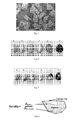
- Fig. 1 is an electron microscopy image showing pistachio nut shell particles. (from Pistachia L.vera, cultivar Kerman)
- the pistachio feedstock preferably undergo a sorting process in order to sort out pistachio shells not fitting with the whiteness requirement as well as other foreign bodies.
- the sorting process can be done manually, however, it is more effectively achieved with automatic sorting machinery e.g.: equipped with optical camera and digital imaging software compatible with the measurement of the degree of whiteness (L*) similarly to the method defined herein below, however this time in relation to the pistachio nut shell total surface rather than the particle population.
- suitable sorting equipment include Buhler Sortex #3 modified to measure (L*) value and compute surface area ratio based on (L*) value, and adapted to detect and discard individual pistachio nut shells having an (L*) value of less than 65, preferably less than 60, over more than 10% of the total surface area of the pistachio nut shell.
- the sorting can be executed before or after shelling the nut, however, prior to the grinding the shell into the abrasive particles. The shells, after being separated from the nuts, are used to produce the pistachio shell abrasive particles.
- Figure 2 illustrates sorting pistachio nut shells accordingly to degree of whiteness.
- Shells A, B and C are suitable for generating pistachio nut shell particles for use in the present invention.
- Shells D, E and F are not suitable to be used in the present invention.
- Figure 3 illustrates sorting pistachio nut shells according to degree of whiteness and to shell defect(s).
- Shells A, B, and C are suitable for generating pistachio nut shell particles for use in the present invention.
- Shells D, E and F, on the other hand, are not suitable to be used in the present invention.
- the selected pistachio nut shell particles feature an average degree of whiteness (L*) above 65, more preferably above 75 and most preferably of greater or equal to 80.
- Whiter particles are highly preferred as they deliver more pleasing product aesthetics to consumers. Particles derived from darker nut shells or other plant sources tend to give a brown aesthetics which is very undesirable for a cleaning product. Additionally, during cleaning, residual brown particles may be left on the surface and can be perceived as a dark residue that compromises the overall cleaning efficiency of the cleaning products.
- the pistachio shell material may be reduced to particles in several stages.
- First the bulk pistachio nut shell can be broken into pieces of a few mm dimensions by manually chopping or cutting, or using a mechanical tool such as a lump-breaker, for example the Model 2036 from S Howes, Inc. of Silver Creek, NY.
- a mechanical tool such as a lump-breaker, for example the Model 2036 from S Howes, Inc. of Silver Creek, NY.
- the lumps are agitated using a propeller or saw toothed disc dispersing tool, which causes the pistachio nut shells to release entrapped water and form liquid slurry of pistachio nut shell particles dispersed in aqueous phase.
- a high shear mixer such as the Ultra Turrax rotor stator mixer from IKA Works, Inc., Wilmington, NC
- a high shear mixer can be employed to reduce the particle size of the primary slurry to that required for cleaning particles.
- the reduction process of pistachio shell into particles is set to not reach excessive temperature which risk to discolor the abrasive particles.
- suitable color stabilizing agents can be used to stabilize desired color and/or whiteness.
- the whiteness value of pistachio nut shell particle population is measured using for instance Gretag machbeathTM 7000 a color-eye instrument or equivalent used in reflectance mode.
- Gretag machbeathTM 7000 a color-eye instrument or equivalent used in reflectance mode.
- This instrument provides a choice of light sources; “D65” represents roughly a mid-day sun in western and northern Europe, whilst “illuminant A” is intended to represent typical, domestic, tungsten-filament lighting and “CWF2" represents cool white fluorescent.
- the instrument thus provides a standard measure of whiteness (L*) that can be determined for daylight, tungsten and fluorescent lighting conditions. Under each set of lightning conditions L* is defined such that 100 is fully white and 0 has no white components.
- the "D65” illuminant is used to measure whiteness.
- Samples are prepared by filling pistachio nut shell particles in a holder to ensure good packing of the particle so to make a continuous layer of material, which is pelletized under pressure. Measurements are made by placing the pelletized pistachio shell particle population sample in the holder of the color-eye instrument. The view area is 3mm by 8mm with degree observer angle 10°. The specular component is included. Measurements are generally made duplicate and an average was taken.
- compositions herein may further comprise other abrasive particles such as polymeric abrasive particles.
- abrasive particles such as polymeric abrasive particles.
- all abrasive particles will have a Shore D hardness of below 90 according to a procedure described in ASTM D2240.
- Most preferably all abrasive particles have substantially the same degree of whiteness L* as the selected pistachio nut shell particle population.
- the ratio of natural abrasive particles to polymeric abrasive particles is from 50 to 1, preferably from 20 to 1, more preferably from 10 to 1, even more preferably from 5 to 1.
- the level of natural abrasive particles is from 2% to 6%, preferably from 2.5% to 5%, more preferably from 2.5% to 4%, most preferably from 2.5% to 3%, by weight of the composition
- the level of polymeric abrasive particles is from 0.1% to 2.5%, preferably from 0.1% to 1%, more preferably from 0.1% to 0.5%, even more preferably from 0.1% to 0.25%, by weight of the composition.
- the polymeric abrasive particles herein may be produced by shearing, graining, milling and/or grinding a polymeric material foam, preferably rigid in form.
- a polymeric material foam preferably rigid in form.
- effective cleaning synergy is achieved when mixing polymeric and natural abrasives both featuring effective shape for cleaning.
- grinding polymeric material foam is a particularly preferred process to produce polymeric abrasives with effective shape, although other less preferred processes are also possible such as printing, extruding, molding, etc.
- the polymeric material may be selected from the group consisting of polyurethane; polyhydroxy alkanoate derivatives (PHA) such as but not limited to polyhydroxy butyrate, polyhydroxy hexanoate, polyhydroxy valerate, polyhydroxy butyrate-valerate, polyhydroxy butyrate-hexanoate and mixtures thereof; aliphatic polyesters such as polybutylene succinate (PBS), polybutylene adipate (PBA), polybutylene succinate-co-adipate (PBSA) and mixtures thereof; polylactic acid derivatives (PLA); polystyrene; melamine-formaldehyde; polyacrylate; polyolefins such as polyethylene, polypropylene; polyvinyl chloride; and/or polyvinyl acetate. Most preferred is polyurethane.
- PHA polyhydroxy alkanoate derivatives
- PBA polybutylene succinate
- PBSA polybutylene succinate-co-adipate
- PLA polylactic acid derivatives
- the polymeric abrasive particles are made from a rigid polyurethane foam formed in the reaction between diisocyanate monomers and polyols.
- Natural abrasive particles suitable for use in the compositions described herein are preferably selected to have specific geometries and shapes. Such particles may be selected to feature effective shapes, e.g.: defined by circularity.
- the abrasive particles are non-rolling. e.g.: defined by circularity to promote effective sliding of the abrasive particles vs. typical abrasive particles, where rolling is rather promoted.
- the natural abrasive particles have a mean circularity from 0.1 to 0.7, preferably from 0.3 to 0.6 and more preferably from 0.4 to 0.5 typically for providing improved cleaning performance, surface safety and mild skin exfoliating benefits.
- Mean data are extracted from volume-based vs. number-based measurements according to the method described herein below.
- Polymeric abrasive cleaning particles having a mean circularity from 0.1 to 0.4, preferably from 0.15 to 0.35 and more preferably from 0.2 to 0.35 are particularly preferred as they typically provide the desired improved cleaning performance surface safety and mild skin exfoliating benefits.
- Mean data are extracted from volume-based vs. number-based measurements according to the method described herein below.
- polymeric abrasive particles further have a mean solidity from 0.4 to 0.75, preferably from 0.5 to 0.7 and more preferably from 0.55 to 0.65 are providing improved cleaning performance surface safety and mild skin exfoliating benefits.
- Mean data are extracted from volume-based vs. number-based measurements according to the method described herein below.
- the shape of an abrasive particle can be defined in a number of ways. Preferred is to define the abrasive particle shape in a form of particle, which reflects the geometrical proportions of a particle and more pragmatically of the particle population. Very recent analytical techniques allow an accurate simultaneous measurement of particle shapes from a large number of particles, typically greater than 10000 particles (preferably above 100 000). This enables accurate tuning and/or selection of average particle population shape with discriminative performance. These measurement analyses of particle shape are conducted using on Occhio Nano 500 Particle Characterisation Instrument with its accompanying software Callistro version 25 (Occhio s.a. Med, Belgium).
- the abrasive particles for use herein may be defined by quantitative description of a shape.
- shape descriptor is understood as numbers that can be calculated from particle images or physical particle properties via mathematical or numerical operations.
- particle shape can be defined in 3-dimension with dedicated analytical technique, the applicant has found, that the characterization of the particles shape in 2-dimension is most relevant and correlates with the abrasive performance of the abrasive particles.
- the particles are orientated toward the surface - via gravity deposition - similarly to the expected particle orientation during the cleaning process.
- it is preferred to characterize the 2-D shape of a particle/particle population as defined by the projection of its shape on the surface on which the particle/particle population is deposited.
- A projection area, which is 2D descriptor and P is the length of the perimeter of the particle.
- Solidity is a quantitative, 2-dimensional image analysis shape description, and is being measured according to ISO 9276-6:2008(E) section 8.2 as implemented via the Occhio Nano 500 Particle Characterisation Instrument with its accompanying software Callistro version 25 (Occhio s.a. Med, Belgium).
- the particle herein has preferably at least one edge or surface having a concave curvature.
- A is the area of the abrasive particle and Ac is the area of the convex hull (or convex envelope) bounding the abrasive particle.
- the area of the convex hull is better understood with the aid of Fig.4 .
- the convex hull is clearly identified by the dotted line that connects all outermost edges of the abrasive particle, and the area of the convex hull is the area enclosed therein.
- the applicant refers herein to the solidity measure expressed above by the Occhio Nano 500, as indicated above.
- mean circularity or "mean solidity”
- mean data are extracted from volume-based vs. number-based measurements.
- Preferred abrasive particles suitable for use herein are hard enough to provide good cleaning/cleansing performance, whilst providing a good surface safety profile, and highly desirable mild skin exfoliation.
- the present invention may comprise one or more suspending aids selected from the group consisting of crystalline wax suspending aids, amido-gellants, micro fibril cellulose (MFC) , di-benzylidene polyol acetal derivatives, and mixtures thereof.
- suspending aids may form a thread-like structuring system throughout the matrix of the composition that prevents the abrasive particles from sedimenting or creaming in the product, thereby providing excellent stability of a hand dishwashing liquid composition.
- Such stability allows formulating particles of densities different from that of the liquid composition, and of the preferred particle size (i.e. area-equivalent diameter) of 50 to 400 microns, more preferably 150 to 355 microns to deliver efficient cleaning without damaging delicate surfaces, and highly desirable mild skin exfoliation.
- said crystalline wax suspending aid When present, said crystalline wax suspending aid will typically be comprised at a level of from 0.02% to 5%, preferably 0.025% to 3%, more preferably from 0.05% to 2%, most preferably from 0.1% to 1.5% by weight of the total composition.
- Preferred crystalline wax suspending aids are hydroxyl-containing crystalline suspending aids such as a hydroxyl-containing fatty acid, fatty ester or fatty soap wax-like materials . Said crystalline hydroxyl-containing suspending aids are insoluble in water under ambient to near ambient conditions.
- the preferred crystalline hydroxyl-containing suspending aids are selected from the group consisting of suspending aids with formula (I), (II), or mixtures thereof.
- R 1 is the chemical moiety described below
- R 1 is R 2 is R 1 or H
- R 3 is R 1 or H
- R 4 is independently C 10 -C 22 alkyl or alkenyl comprising at least one hydroxyl group; wherein: R 7 is R 4 as defined above in (I), M is Na + , K + , Mg ++ or Al 3+ , or H,
- Some preferred hydroxyl-containing suspending aids include 12-hydroxystearic acid, 9,10-dihydroxystearic acid, tri-9,10-dihydroxystearin and tri-12-hydroxystearin. Tri-12-hydroxystearin is most preferred for use in the hand liquid dishwashing compositions herein.
- Castor wax or hydrogenated castor oil is produced by the hydrogenation (saturation of triglyceride fatty acids) of pure castor oil and is mainly composed of tri-12-hydroxistearin.
- Commercially available, castor oil-based, crystalline, hydroxyl-containing suspending aids include THIXCIN® from Rheox, Inc. (now Elementis).
- micro fibril cellulose such as described in US 2008/0108714 (CP Kelco) or US2010/0210501 (P&G): micro fibril cellulose, bacterially derived or otherwise, can be used to provide suspension of particulates in surfactant-thickened systems as well as in formulations with high surfactant concentrations.
- MFC micro fibril cellulose
- Such MFC is usually present at concentrations from about 0.01% to about 1%, but the concentration will depend on the desired product. For example, while from 0.02 to 0.05% is preferred for suspending small mica platelets in liquid detergent compositions, higher levels might be needed to suspend larger particles.
- MFC is used with co-agents and/or co-processing agents such as CMC, xanthan, and/or guar gum with the microfibrous.
- CMC co-agents and/or co-processing agents
- US2008/0108714 describes MFC in combination with xanthan gum, and CMC in a ratio of 6:3:1, and MFC, guar gum, and CMC in a ratio of 3:1:1.
- These blends allow to prepare MFC as a dry product which can be "activated” with high shear or high extensional mixing into water or other water-based solutions. "Activation" occurs when the MFC blends are added to water and the co-agents/co-processing agents are hydrated.
- MFC multi-dimensional functional network
- the suspending aid system may comprise a di-amido gellant having a molecular weight from 150g/mol to 1500g/mol, preferably between 500g/mol and 900g/mol.
- Such di-amido gellants may comprise at least two nitrogen atoms, wherein at least two of said nitrogen atoms form amido functional substitution groups.
- the amido groups are different.
- the amido functional groups are the same.
- the di-amido gellant has the following formula: wherein:
- L is a linking moeity of molecular weight from 14 to 500 g/mol.
- L may comprise a carbon chain comprising between 2 and 20 carbon atoms.
- L may comprise a pH-tuneable group.
- the pH tuneable group is a secondary amine.
- At least one of R1, R2 or L may comprise a pH-tuneable group.
- di-amido gellants are:
- the fluid detergent composition may comprise from 0.01% to 1% by weight of a dibenzylidene polyol acetal derivative (DBPA), preferably from 0.05% to 0.8%, more preferably from 0.1% to 0.6%, most preferably from 0.3% to 0.5%.
- DBPA derivative may comprise a dibenzylidene sorbitol acetal derivative (DBS), such as the ones described in U.S. 6,102,999 to Cobb et al. at col. 2, line 43 - col. 3, line 65.
- the DBPA derivative comprises a sorbitol derivative, a ribitol derivative, a xylitol derivative, a tartrate, or a mixture thereof.
- hydrophobic emollient The hydrophobic emollient
- the composition of present invention may comprise one or more hydrophobic emollients.
- Hydrophobic emollients are agents that soften or soothe the skin by slowing the evaporation of water. Hydrophobic emollients form an oily layer on the surface of the skin that slows water loss increasing skin moisture content and skin water holding capacity. Without wishing to be bound by theory, it is believed that the hydrophobic emollient complements the skin care benefit provided by the exfoliating particles of the present invention by soothing the exfoliated skin.
- said liquid dishwashing composition according to the present invention comprises high levels of hydrophobic emollient, typically up to 10% by weight.
- the hydrophobic emollient is preferably present from 0.25% to 10%, more preferably from 0.3% to 8%, most preferably from 0.5% to 6% by weight of the total composition.
- Hydrophobic emollients suitable for use in the compositions herein are hydrocarbon oils and waxes; silicones; fatty acid derivatives; glyceride esters, di and tri-glycerides, acetoglyceride esters; alkyl and alkenyl esters; cholesterol and cholesterol derivatives; vegetable oils, vegetable oil derivatives, liquid nondigestible oils, or blends of liquid digestible or nondigestible oils with solid polyol polyesters; natural waxes such as lanolin and its derivatives, beeswax and its derivatives, spermaceti, candelilla, and carnauba waxes; phospholipids such as lecithin and its derivatives; sphingolipids such as ceramide; and mixtures thereof.
- Preferred hydrophobic emollients are hydrocarbons like petrolatum, mineral oil and/or blends of petrolatum and mineral oil; tri-glycerides such as the ones derived from vegetable oils including castor oil, soy bean oil, safflower oil, cotton seed oil, corn oil, walnut oil, peanut oil, olive oil, almond oil, avocado oil, coconut oil, jojoba oil, cocoa butter, and the like; oily sugar derivatives such as esters of sucrose with fatty acids; beeswax; lanolin and its derivatives including but not restricted to lanolin oil, lanolin wax, lanolin alcohols, lanolin fatty acids, isopropyl lanolate, cetylated lanolin, acetylated lanolin alcohols, lanolin alcohol linoleate, lanolin alcohol riconoleate, and ethoxylated lanolin.
- tri-glycerides such as the ones derived from vegetable oils including castor oil, soy bean oil
- the present invention comprises at least one surfactant.
- Suitable surfactants are selected from the group consisting of nonionic, anionic, cationic surfactants, amphoteric, zwitterionic, semi-polar nonionic surfactants, and mixtures thereof.
- Surfactants may be comprised at a level of from about 1.0% to about 50% by weight, preferably from about 5% to about 40% by weight, more preferably about 10% to about 30% by weight and even more preferably from about 5% to about 20% by weight of the liquid detergent composition.
- suitable surfactants are discussed below.
- an efficient but mild to hands surfactant system will typically comprise about 4% to about 40%, preferably about 6% to about 32%, more preferably about 11% to about 25%, and most preferably about 11% to about 18% by weight of the total composition of an anionic surfactant and so preferably with no more than about 15%, preferably no more than about 10%, more preferably no more than about 5% by weight of the total composition, of a sulfonate surfactant.
- Suitable anionic surfactants to be used in the compositions and methods of the present invention are sulfate, sulfosuccinates, sulfonate, and/or sulfoacetate; preferably alkyl sulfate and/or alkyl ethoxy sulfates; more preferably a combination of alkyl sulfates and/or alkyl ethoxy sulfates with a combined ethoxylation degree less than about 5, preferably less than about 3, more preferably less than about 2.
- the surfactant system could be based on high levels of nonionic surfactant (Such as about 10% to about 45 %, preferably about 15 to about 40%, more preferably about 20 to about 35% by weight of the total composition), preferably combined with an amphoteric surfactant, and more preferably with a low level of anionic surfactant (such as less than 20%, preferably less than 10%, more preferably less than about 5% by weight of the total composition).
- Suitable surfactants for use in the compositions herein include water-soluble salts or acids of C 10 -C 14 alkyl or hydroxyalkyl, sulfate and/or ether sulfate.
- Suitable counterions include hydrogen, alkali metal cation or ammonium or substituted ammonium, but preferably sodium.
- hydrocarbyl chain is branched, it preferably comprises C 1-4 alkyl branching units.
- the average percentage branching of the sulfate surfactant is preferably greater than 30%, more preferably from 35% to 80% and most preferably from 40% to 60% of the total hydrocarbyl chains.
- the sulfate surfactants may be selected from C 8 -C 20 primary, branched-chain and random alkyl sulfates (AS); C 10 -C 18 secondary (2,3) alkyl sulfates; C 10 -C 18 alkyl alkoxy sulfates (AE x S) wherein preferably x is from 1-30; C 10 -C 18 alkyl alkoxy carboxylates preferably comprising 1-5 ethoxy units; mid-chain branched alkyl sulfates as discussed in US 6,020,303 and US 6,060,443 ; mid-chain branched alkyl alkoxy sulfates as discussed in US 6,008,181 and US 6,020,303 .
- alkyl preferably dialkyl, sulfosuccinates and/or sulfoacetate.
- the dialkyl sulfosuccinates may be a C 6-15 linear or branched dialkyl sulfosuccinate.
- the alkyl moieties may be symmetrical (i.e., the same alkyl moieties) or asymmetrical (i.e., different alkyl moiety.es).
- the alkyl moiety is symmetrical.
- compositions of the present invention will preferably comprise no more than 10% by weight, preferably no more than 8%, even more preferably no more than 5% by weight of the total composition, of a sulfonate surfactant.
- a sulfonate surfactant include water-soluble salts or acids of C 10 -C 14 alkyl or hydroxyalkyl, sulfonates; C 11 -C 18 alkyl benzene sulfonates (LAS), modified alkylbenzene sulfonate (MLAS) as discussed in WO 99/05243 , WO 99/05242 , WO 99/05244 , WO 99/05082 , WO 99/05084 , WO 99/05241 , WO 99/07656 , WO 00/23549 , and WO 00/23548 ; methyl ester sulfonate (MES); and alpha-olefin sulfonate (AOS).
- paraffin sulfonates may be monosulfonates and/or disulfonates, obtained by sulfonating paraffins of 10 to 20 carbon atoms.
- the sulfonate surfactants also include the alkyl glyceryl sulfonate surfactants.
- amphoteric and zwitterionic surfactant may be comprised at a level of from 0.01% to 20%, preferably from 0.2% to 15%, more preferably 0.5% to 12% by weight of the liquid detergent composition.
- Suitable amphoteric and zwitterionic surfactants are amine oxides and betaines.
- amine oxides especially coco dimethyl amine oxide or coco amido propyl dimethyl amine oxide.
- Amine oxide may have a linear or mid-branched alkyl moiety.
- Typical linear amine oxides include water-soluble amine oxides of formula R 1 - N(R 2 )(R 3 ) ⁇ O, wherein R 1 is a C 8-18 alkyl moiety; R 2 and R 3 are independently selected from the group consisting of C 1-3 alkyl groups and C 1-3 hydroxyalkyl groups and preferably include methyl, ethyl, propyl, isopropyl, 2-hydroxethyl, 2-hydroxypropyl and 3-hydroxypropyl.
- the linear amine oxide surfactants in particular may include linear C 10 -C 18 alkyl dimethyl amine oxides and linear C 8 -C 12 alkoxy ethyl dihydroxy ethyl amine oxides.
- Preferred amine oxides include linear C 10 , linear C 10 -C 12 , and linear C 12 -C 14 alkyl dimethyl amine oxides.
- mid-branched means that the amine oxide has one alkyl moiety having n 1 carbon atoms with one alkyl branch on the alkyl moiety having n 2 carbon atoms. The alkyl branch is located on the ⁇ carbon from the nitrogen on the alkyl moiety.
- n 1 and n 2 are from 10 to 24 carbon atoms, preferably from 12 to 20, and more preferably from 10 to 16.
- the number of carbon atoms for the one alkyl moiety (n 1 ) should be approximately the same number of carbon atoms as the one alkyl branch (n 2 ) such that the one alkyl moiety and the one alkyl branch are symmetric.
- symmetric means that
- the amine oxide further comprises two moieties, independently selected from a C 1-3 alkyl, a C 1-3 hydroxyalkyl group, or a polyethylene oxide group containing an average of from about 1 to about 3 ethylene oxide groups.
- the two moieties are selected from a C 1-3 alkyl, more preferably both are selected as a C 1 alkyl.
- surfactants include betaines such alkyl betaines, alkylamidobetaine, imidazoliniumbetaine, sulfobetaine (INCI Sultaines) , and phosphobetaine.
- betaines and sulfobetaine are the following [designated in accordance with INCI]: almondamidopropyl betaines, apricotamidopropyl betaines, avocadamidopropyl betaines, babassuamidopropyl betaines, behenamidopropyl betaines, behenyl betaines, canolamidopropyl betaines, capryl/capramidopropyl betaines, alkyl derivatives of carnitine, cetyl betaines, cocamidoethyl betaines, cocamidopropyl betaines, cocamidopropyl hydroxysultaine, coco betaines, coco hydroxysultaine, coco/oleamidopropyl betaines, coco sultaine, decyl betaines, dihydroxyethyl oleyl glycinate, dihydroxyethyl soy glycinate, dihydroxyethyl
- a preferred surfactant system is a mixture of anionic surfactant and amphoteric or zwiterionic surfactants in a ratio within the range of 1:1 to 5:1, preferably from 1:1 to 3.5:1.
- Nonionic surfactant when present as co-surfactant, is comprised in a typical amount of from 0.1% to 20%, preferably 0.5% to 15%, more preferably from 0.5% to 10% by weight of the liquid detergent composition. When present as main surfactant, it is comprised in a typical amount of from 0.1 to 45 %, preferably 15 to 40%, more preferably 20 to 35% by weight of the total composition.
- Suitable nonionic surfactants include the condensation products of aliphatic alcohols with from 1 to 25 moles of ethylene oxide. The alkyl chain of the aliphatic alcohol can either be straight or branched, primary or secondary, and generally contains from 8 to 22 carbon atoms.
- alkylpolyglycosides having the formula R 2 O(C n H 2n O) t (glycosyl) x (formula (III)), wherein R 2 of formula (III) is selected from the group consisting of alkyl, alkyl-phenyl, hydroxyalkyl, hydroxyalkylphenyl, and mixtures thereof in which the alkyl groups contain from 10 to 18, preferably from 12 to 14, carbon atoms; n of formula (III) is 2 or 3, preferably 2; t of formula (III) is from 0 to 10, preferably 0; and x of formula (III) is from 1.3 to 10, preferably from 1.3 to 3, most preferably from 1.3 to 2.7.
- the glycosyl is preferably derived from glucose.
- alkylglycerol ethers and sorbitan esters are also suitable.
- fatty acid amide surfactants having an alkyl group containing from 7 to 21, preferably from 9 to 17, carbon atoms and an amide group selected from C 8 -C 20 ammonia amides, monoethanolamides, diethanolamides, and isopropanolamides.
- Cationic surfactants when present in the composition, are present in an effective amount, more preferably from 0.1% to 20%, by weight of the liquid detergent composition.
- Suitable cationic surfactants are quaternary ammonium surfactants. Suitable quaternary ammonium surfactants are selected from the group consisting of mono C 6 -C 16 , preferably C 6 -C 10 N-alkyl or alkenyl ammonium surfactants, wherein the remaining N positions are substituted by methyl, hydroxyehthyl or hydroxypropyl groups.
- Another preferred cationic surfactant is an C 6 -C 18 alkyl or alkenyl ester of a quaternary ammonium alcohol, such as quaternary chlorine esters.
- the composition of the present invention may comprise either an organic and/or an inorganic pearlescent agent and/or an opacifier in order to provide a composition which is substantially opaque (not substantially clear).
- a composition is "substantially opaque” as intended herein, if it transmits at most 50% of light at any one wavelength in the visible region i.e. between 400 and 800nm, preferably 550-700nm, measured in a 1cm cuvette in absence of dyes and abrasive particles.
- the transmittance is at most 30%, more preferably at most 20%.
- Pearlescent agents and/or opacifiers may make the aesthetics of the particle-containing product more appealing to consumers.
- liquid detergent compositions herein can further comprise a number of other optional ingredients suitable for use in liquid detergent compositions such as Magnesium ions, solvents, hydrotropes, polymeric suds stabilizers, alkoxylated polyethyleneimine polymers, cationic polymers, polymeric rheology modifiers, linear or cyclic carboxylic acids, diamines, humectants, enzymes such as protease, perfume, dyes, chelants, skin rejuvenating agents, pH buffering means.
- suitable optional ingredients suitable for use in light-duty liquid detergent composition may be found in US 5,798,505 .
- the liquid hand dishwashing compositions herein have preferably a viscosity from 100 to 10000 mPa*s (100-10000 centipoises), more preferably from 200 to 8000 mPa*s (200-8000 centipoises), even more preferably from 400-6500 mPa*s (400-6500 centipoises), and most preferably from 800 to 5000 mPa*s (800-5000 centipoises) at 3.06s -1 and 20°C.
- Viscosity can be determined by conventional methods. Viscosity according to the present invention is measured using a Brookfield viscometer LVDV II with a cylindrical steel spindle (spindle number 31) according to the manufacturer instructions.
- the preferred rheology described therein may be achieved using internal existing structuring with detergent ingredients or by employing an external rheology modifier and/or a suspending aid, which provides the composition with a pseudoplastic or shear thinning rheology profile and with time-dependent recovery of viscosity after shearing (thixotropy).
- the method of washing dishes comprises the steps of treating a hard surface, preferably dishware, with a composition as described herein; optionally allowing the soil or stain to deposit and toughen; and optionally repeating the treating step, and optionally rinsing said surface prior or after allowing the soil or stain to deposit and toughen, and/or prior or after said treatment step.
- liquid composition in its neat form, it is meant herein that said liquid composition is applied directly onto the surface to be treated and/or onto a cleaning device or implement such as a dish cloth, a sponge or a dish brush without undergoing any dilution by the user (immediately) prior to the application.
- diluted form it is meant herein that said liquid composition is diluted by the user with an appropriate solvent, typically water.
- solvent typically water
- substantially quantities it is meant typically 5 to 20 liters.
- a benefit selected from the group consisting of mild skin exfoliation, grease or soil cleaning, product aesthetics, and mixtures thereof
- a surface preferably dishware, the skin, or a product
- product refers to the final composition as described herein, ready for placement in a suitable container.
- First time "neat” product cleaning performance may be evaluated by the following test method: Tiles, typically glossy, white, enamel 24cm x 4cm, are prepared by applying to them either 0.6 g pure vegetable oil mix (peanut, sunflower and corn oil at equal proportions) or 0.5 g Knorr white sauce mix (prepared according to the manufacturer instructions). Soils are spread using a paint roller to obtain a uniform layer on top of the tile. Tiles are baked in an oven at 145° C for 2 hours and 10 minutes (vegetable oil mix) or at 180° C for 45 minutes (white sauce) and kept in a constant temperature and humidity cabinet (25° C, 70% relative humidity) until used.
- the composition to remove soil is measured through the number of strokes needed to perfectly clean the surface, as determined by visual assessment.
- one stroke means a single movement of the carriage equipped with the four sponges comprising the cleaning product over the tile to be cleaned. The lower the number of strokes, the higher the cleaning ability of the composition.
- Example 1 The soil is regarded as having been removed fully when the operator can no longer see the soil with the naked eye. Eight soiled tiles are used per test and the product position is randomized so that each product is tested in the four different cleaning tracks of the wet Abrasion Scrub Tester at least once. Results are shown in Example 1.
- aqueous solutions comprising the particles of the present invention (3% - 5% wt particle in deionized water) are applied to new cellulose kitchen sponges (such as Spontex®) of dimensions 4cm x 8.5cm (and 4.5cm thick) wetted with 25 g of deionized water mounted on a Wet Abrasion Scrub Tester Instrument as described in the cleaning performance test method with the particle coated side facing the test surface.
- new cellulose kitchen sponges such as Spontex®
- Reference 1 is the same cellulose kitchen sponge wetted with 25 g deionized water and loaded with 4 g water no particles
- Reference 2 is a medium duty scrubbing sponge such as the ones sold by 3M under the trade mark of Scotch-Brite, placed in the Wet Abrasion Scrub tester sponge holder with the green scrubby side facing the test surface, wetted and loaded as Reference 1 sponge.
- the test surface to be used should be a new sheet of uncolored, transparent, virgin Poly(methyl methacrylate) (also known as PMMA , Plexiglass, Perspex, Lucite), having a Vickers HV Hardness Value of 25 kg / square mm (+/- 2) (as measured using standard test method ISO 14577).
- the abrasion tester should be configured to supply 600g of pressure and move the sponge over the test surface with a stroke length of 30cm, at a speed of 37 strokes per minute.
- the wet abrasion scrub tester should be allowed to execute 200 strokes (i.e., 200 single-direction displacements), then the sponge is re-loaded with an additional 4g of abrasive particles in water.
- the sponge is to be reloaded in this manner every 200 strokes, for five consecutive loadings (i.e., 1000 strokes in total per test surface). Assessment of damage to the test surface is conducted after 1000 strokes have been completed.
- Visual Damage Grade is the average of the grades given by 2 independent graders. Results are shown in Example 2.
- Dihydroxyacetone has the ability to stain only fully keratinized cells of the epidermis. Removal of the dihydroxyacetone-induced stain is linked to the removal of fully keratinized cells and therefore can provide an estimate of skin exfoliation.
- volar forearm area of both left and right arms of two volunteers is artificially tanned using a commercially available sunless tanner comprising dihydroxyacetone.
- the sunless tanner is applied once a day during a week according to the manufacturer instructions until a homogeneous artificial tan is obtained.
- Three treatment sites per arm are marked off using a water proof marker.
- the three treatments sites of each arm should be centered on the volar forearem between the wrist and inner elbow. Care should be taken not to use the area closest to inner elbow and wrist.
- One of the 3 treatment sites in each forearm is a non-particle control which is included to demonstrate the exfoliation benefits provided by the particles. The location of both the non-particle control site and the two particle treatment sites are randomized for each arm and each subject to minimize position effects.
- Product treatments 0.5 ml of each prototype is applied twice a day with at least four hours between product applications for a total of 4 times in their designated treatment site of each forearm.
- Product is dispensed on the skin using a 2 ml syringe and rubbed with a gloved finger for 10 secondss with circular motions, after all products have been applied in one forearm, skin is rinsed with warm tap water and patted dry with a soft paper tissue taking care not to rub the treatment sites.
- Skin color measurements are taken as L*,a*,b* values according to the CIELab color scale using a BYK spectro-guide gloss 6801 before each product application, and one hour after the last (4 th ) product application, according to the equipment instructions.
- the CIELab color scale is based on the Opponent-Colors Theory which assumes that the human eye perceives color as the following pairs of opposites: Light-Dark, Red-Green, Yellow-Blue.
- the L* value for each scale indicates the level of light or dark, the a* value the redness or greenness, and the b* value the yellowness or blueness.
- skin treated with the particle prototypes shows a b* value closer to that of not tanned (untreated) skin measured in the inner part of the upper arm and that has an average b* of 15.77, demonstrating that the prototypes with particles are more efficient in removing the layer of dead cells stained with the sunless tanner, and in returning the skin to its original color.
Landscapes
- Chemical & Material Sciences (AREA)
- Life Sciences & Earth Sciences (AREA)
- Engineering & Computer Science (AREA)
- Wood Science & Technology (AREA)
- Chemical Kinetics & Catalysis (AREA)
- Oil, Petroleum & Natural Gas (AREA)
- Organic Chemistry (AREA)
- Detergent Compositions (AREA)
Priority Applications (3)
| Application Number | Priority Date | Filing Date | Title |
|---|---|---|---|
| EP11181970A EP2573157A1 (de) | 2011-09-20 | 2011-09-20 | Flüssiges Reinigungsmittel mit Schleifpartikeln |
| US13/621,860 US20130072417A1 (en) | 2011-09-20 | 2012-09-18 | Liquid detergent composition with abrasive particles |
| PCT/US2012/055955 WO2013043620A1 (en) | 2011-09-20 | 2012-09-19 | Liquid detergent composition with abrasive particles |
Applications Claiming Priority (1)
| Application Number | Priority Date | Filing Date | Title |
|---|---|---|---|
| EP11181970A EP2573157A1 (de) | 2011-09-20 | 2011-09-20 | Flüssiges Reinigungsmittel mit Schleifpartikeln |
Publications (1)
| Publication Number | Publication Date |
|---|---|
| EP2573157A1 true EP2573157A1 (de) | 2013-03-27 |
Family
ID=46934732
Family Applications (1)
| Application Number | Title | Priority Date | Filing Date |
|---|---|---|---|
| EP11181970A Withdrawn EP2573157A1 (de) | 2011-09-20 | 2011-09-20 | Flüssiges Reinigungsmittel mit Schleifpartikeln |
Country Status (3)
| Country | Link |
|---|---|
| US (1) | US20130072417A1 (de) |
| EP (1) | EP2573157A1 (de) |
| WO (1) | WO2013043620A1 (de) |
Cited By (4)
| Publication number | Priority date | Publication date | Assignee | Title |
|---|---|---|---|---|
| EP2770044A1 (de) * | 2013-02-20 | 2014-08-27 | Unilever PLC | In Schichten aufgebautes Gel mit Aminoxid |
| EP2808380A1 (de) * | 2013-05-29 | 2014-12-03 | The Procter & Gamble Company | Flüssige Reinigungszusammensetzung mit Scheuermitteln |
| DE102016225902A1 (de) | 2016-12-21 | 2018-06-21 | Henkel Ag & Co. Kgaa | Reinigungsmittel mit abrasiven vulkanischem Glas |
| EP4574953A1 (de) | 2023-12-20 | 2025-06-25 | Henkel AG & Co. KGaA | Stabile reinigungsmittel mit hydrogelpartikeln und polysaccharid verdickungsmittel |
Families Citing this family (45)
| Publication number | Priority date | Publication date | Assignee | Title |
|---|---|---|---|---|
| WO2013003830A2 (en) | 2011-06-30 | 2013-01-03 | Saint-Gobain Ceramics & Plastics, Inc. | Abrasive articles including abrasive particles of silicon nitride |
| WO2013049239A1 (en) | 2011-09-26 | 2013-04-04 | Saint-Gobain Ceramics & Plastics, Inc. | Abrasive articles including abrasive particulate materials, coated abrasives using the abrasive particulate materials and methods of forming |
| EP2797715A4 (de) | 2011-12-30 | 2016-04-20 | Saint Gobain Ceramics | Geformte schleifpartikel und verfahren zu ihrer herstellung |
| EP2797716B1 (de) | 2011-12-30 | 2021-02-17 | Saint-Gobain Ceramics & Plastics, Inc. | Zusammengesetzte geformte schleifpartikel und verfahren zu ihrer herstellung |
| WO2013106602A1 (en) | 2012-01-10 | 2013-07-18 | Saint-Gobain Ceramics & Plastics, Inc. | Abrasive particles having particular shapes and methods of forming such particles |
| CA3056658C (en) | 2012-01-10 | 2023-07-04 | Doruk O. Yener | Abrasive particles having complex shapes and methods of forming same |
| CN104540639B (zh) | 2012-05-23 | 2019-01-29 | 圣戈本陶瓷及塑料股份有限公司 | 成形磨粒及其形成方法 |
| US10106714B2 (en) | 2012-06-29 | 2018-10-23 | Saint-Gobain Ceramics & Plastics, Inc. | Abrasive particles having particular shapes and methods of forming such particles |
| EP2719752B1 (de) | 2012-10-15 | 2016-03-16 | The Procter and Gamble Company | Flüssige reinigungsmittelzusammensetzung mit schleifpartikeln |
| EP4566756A3 (de) | 2012-10-15 | 2025-11-26 | Saint-Gobain Abrasives, Inc. | Schleifpartikel mit besonderen formen und verfahren zur formung solcher partikel |
| US9074119B2 (en) | 2012-12-31 | 2015-07-07 | Saint-Gobain Ceramics & Plastics, Inc. | Particulate materials and methods of forming same |
| PL2757145T5 (pl) * | 2013-01-21 | 2024-12-02 | The Procter & Gamble Company | Detergent |
| CA2907372C (en) | 2013-03-29 | 2017-12-12 | Saint-Gobain Abrasives, Inc. | Abrasive particles having particular shapes and methods of forming such particles |
| TW201502263A (zh) | 2013-06-28 | 2015-01-16 | Saint Gobain Ceramics | 包含成形研磨粒子之研磨物品 |
| CA3114978A1 (en) | 2013-09-30 | 2015-04-02 | Saint-Gobain Ceramics & Plastics, Inc. | Shaped abrasive particles and methods of forming same |
| US9566689B2 (en) | 2013-12-31 | 2017-02-14 | Saint-Gobain Abrasives, Inc. | Abrasive article including shaped abrasive particles |
| US9771507B2 (en) | 2014-01-31 | 2017-09-26 | Saint-Gobain Ceramics & Plastics, Inc. | Shaped abrasive particle including dopant material and method of forming same |
| JP2017505824A (ja) | 2014-02-17 | 2017-02-23 | ザ プロクター アンド ギャンブル カンパニー | 生分解性研磨材粒子を含む皮膚クレンジング組成物 |
| MX394721B (es) | 2014-04-14 | 2025-03-24 | Saint Gobain Ceramics | Articulo abrasivo que incluye particulas abrasivas conformadas. |
| CA3123554A1 (en) | 2014-04-14 | 2015-10-22 | Saint-Gobain Ceramics & Plastics, Inc. | Abrasive article including shaped abrasive particles |
| WO2015184355A1 (en) | 2014-05-30 | 2015-12-03 | Saint-Gobain Abrasives, Inc. | Method of using an abrasive article including shaped abrasive particles |
| US20160000292A1 (en) * | 2014-07-02 | 2016-01-07 | The Procter & Gamble Company | Nonwoven articles comprising abrasive particles |
| US20160000291A1 (en) * | 2014-07-02 | 2016-01-07 | The Procter & Gamble Company | Nonwoven articles comprising abrasive particles |
| US9707529B2 (en) | 2014-12-23 | 2017-07-18 | Saint-Gobain Ceramics & Plastics, Inc. | Composite shaped abrasive particles and method of forming same |
| US9914864B2 (en) | 2014-12-23 | 2018-03-13 | Saint-Gobain Ceramics & Plastics, Inc. | Shaped abrasive particles and method of forming same |
| US9676981B2 (en) | 2014-12-24 | 2017-06-13 | Saint-Gobain Ceramics & Plastics, Inc. | Shaped abrasive particle fractions and method of forming same |
| TWI634200B (zh) | 2015-03-31 | 2018-09-01 | 聖高拜磨料有限公司 | 固定磨料物品及其形成方法 |
| US10196551B2 (en) | 2015-03-31 | 2019-02-05 | Saint-Gobain Abrasives, Inc. | Fixed abrasive articles and methods of forming same |
| CA3118262C (en) | 2015-06-11 | 2023-09-19 | Saint-Gobain Ceramics & Plastics, Inc. | Abrasive article including shaped abrasive particles |
| US9957468B2 (en) * | 2015-11-06 | 2018-05-01 | The Procter & Gamble Company | Shaped particles |
| CN109415615A (zh) | 2016-05-10 | 2019-03-01 | 圣戈本陶瓷及塑料股份有限公司 | 磨料颗粒及其形成方法 |
| KR102313436B1 (ko) | 2016-05-10 | 2021-10-19 | 생-고뱅 세라믹스 앤드 플라스틱스, 인코포레이티드 | 연마 입자들 및 그 형성 방법 |
| EP4349896A3 (de) | 2016-09-29 | 2024-06-12 | Saint-Gobain Abrasives, Inc. | Feste schleifartikel und verfahren zur formung davon |
| JP7237837B2 (ja) | 2016-09-30 | 2023-03-13 | ノヴァフラックス・インコーポレイテッド | 洗浄および汚染除去用組成物 |
| WO2018067954A1 (en) * | 2016-10-06 | 2018-04-12 | The Procter & Gamble Company | Sponge for cleaning dish surfaces and method of manufacture |
| US10759024B2 (en) | 2017-01-31 | 2020-09-01 | Saint-Gobain Ceramics & Plastics, Inc. | Abrasive article including shaped abrasive particles |
| US10563105B2 (en) | 2017-01-31 | 2020-02-18 | Saint-Gobain Ceramics & Plastics, Inc. | Abrasive article including shaped abrasive particles |
| US10865148B2 (en) | 2017-06-21 | 2020-12-15 | Saint-Gobain Ceramics & Plastics, Inc. | Particulate materials and methods of forming same |
| EP3775133B1 (de) | 2018-04-03 | 2024-10-09 | Novaflux, Inc. | Reinigungszusammensetzung mit superabsorbierendem polymer |
| US12064495B2 (en) | 2019-10-03 | 2024-08-20 | Protegera, Inc. | Oral cavity cleaning composition, method, and apparatus |
| CA3156824A1 (en) | 2019-10-03 | 2021-04-08 | Novaflux Inc. | Oral cavity cleaning composition, method, and apparatus |
| CN119238386A (zh) | 2019-12-27 | 2025-01-03 | 圣戈本陶瓷及塑料股份有限公司 | 磨料制品及其形成方法 |
| US12129422B2 (en) | 2019-12-27 | 2024-10-29 | Saint-Gobain Ceramics & Plastics, Inc. | Abrasive articles and methods of forming same |
| EP4081370A4 (de) | 2019-12-27 | 2024-04-24 | Saint-Gobain Ceramics & Plastics Inc. | Schleifartikel und verfahren zur formung davon |
| JP2025500060A (ja) | 2021-12-30 | 2025-01-07 | サンーゴバン アブレイシブズ,インコーポレイティド | 研磨物品及びそれを形成する方法 |
Citations (20)
| Publication number | Priority date | Publication date | Assignee | Title |
|---|---|---|---|---|
| US5798505A (en) | 1995-10-07 | 1998-08-25 | Samsung Electronics Co., Ltd. | Microwave oven with upwardly directed air discharge duct |
| WO1999005241A1 (en) | 1997-07-21 | 1999-02-04 | The Procter & Gamble Company | Cleaning products comprising improved alkylarylsulfonate surfactants prepared via vinylidene olefins and processes for preparation thereof |
| WO1999005244A1 (en) | 1997-07-21 | 1999-02-04 | The Procter & Gamble Company | Improved alkyl aryl sulfonate surfactants |
| WO1999005243A1 (en) | 1997-07-21 | 1999-02-04 | The Procter & Gamble Company | Detergent compositions containing mixtures of crystallinity-disrupted surfactants |
| WO1999005084A1 (en) | 1997-07-21 | 1999-02-04 | The Procter & Gamble Company | Process for making alkylbenzenesulfonate surfactants from alcohols and products thereof |
| WO1999005242A1 (en) | 1997-07-21 | 1999-02-04 | The Procter & Gamble Company | Improved alkylbenzenesulfonate surfactants |
| WO1999005082A1 (en) | 1997-07-21 | 1999-02-04 | The Procter & Gamble Company | Improved processes for making alkylbenzenesulfonate surfactants and products thereof |
| WO1999007656A2 (en) | 1997-08-08 | 1999-02-18 | The Procter & Gamble Company | Improved processes for making surfactants via adsorptive separation and products thereof |
| US6008181A (en) | 1996-04-16 | 1999-12-28 | The Procter & Gamble Company | Mid-Chain branched Alkoxylated Sulfate Surfactants |
| US6020303A (en) | 1996-04-16 | 2000-02-01 | The Procter & Gamble Company | Mid-chain branched surfactants |
| WO2000023549A1 (en) | 1998-10-20 | 2000-04-27 | The Procter & Gamble Company | Laundry detergents comprising modified alkylbenzene sulfonates |
| WO2000023548A1 (en) | 1998-10-20 | 2000-04-27 | The Procter & Gamble Company | Laundry detergents comprising modified alkylbenzene sulfonates |
| US6060443A (en) | 1996-04-16 | 2000-05-09 | The Procter & Gamble Company | Mid-chain branched alkyl sulfate surfactants |
| US6102999A (en) | 1998-09-04 | 2000-08-15 | Milliken & Company | Liquid dispersion comprising dibenzylidene sorbital acetals and ethoxylated nonionic surfactants |
| WO2004035720A1 (de) * | 2002-10-16 | 2004-04-29 | Henkel Kommanditgesellschaft Auf Aktien | Transparentes abrasives reinigungsmittel, insbesondere handgeschirrspülmittel |
| WO2004071483A1 (de) * | 2003-02-12 | 2004-08-26 | Stockhausen Gmbh | Verfahren zur herstellung eines kosmetischen abrasivums |
| WO2005010138A1 (en) | 2003-07-23 | 2005-02-03 | Colgate-Palmolive Company | Light duty liquid cleaning composition with suspended solid particles |
| US20080108714A1 (en) | 2006-11-08 | 2008-05-08 | Swazey John M | Surfactant Thickened Systems Comprising Microfibrous Cellulose and Methods of Making Same |
| US20100210501A1 (en) | 2008-02-15 | 2010-08-19 | Marco Caggioni | Liquid detergent composition comprising an external structuring system comprising a bacterial cellulose network |
| DE102009046272A1 (de) * | 2009-11-02 | 2011-05-05 | Evonik Stockhausen Gmbh | Reibmittel auf natürlicher Rohstoffbasis mit die Rheologie verbessernden Eigenschaften |
Family Cites Families (5)
| Publication number | Priority date | Publication date | Assignee | Title |
|---|---|---|---|---|
| US6265363B1 (en) * | 1999-10-27 | 2001-07-24 | Gojo Industries, Inc. | Skin cleansing composition for removing ink |
| US20050176614A1 (en) * | 2002-10-16 | 2005-08-11 | Heinz-Dieter Soldanski | Transparent abrasive cleaning product, especially manual dishwashing liquid |
| EP2213715A1 (de) * | 2009-02-02 | 2010-08-04 | The Procter & Gamble Company | Flüssige Handspülmittelzusammensetzung |
| EP2431451A1 (de) * | 2010-09-21 | 2012-03-21 | The Procter & Gamble Company | Flüssige Reinigungsmittelzusammensetzung mit Schleifpartikeln |
| EP2431453B1 (de) * | 2010-09-21 | 2019-06-19 | The Procter & Gamble Company | Flüssigreinigungs- und/oder Reinigungszusammensetzung |
-
2011
- 2011-09-20 EP EP11181970A patent/EP2573157A1/de not_active Withdrawn
-
2012
- 2012-09-18 US US13/621,860 patent/US20130072417A1/en not_active Abandoned
- 2012-09-19 WO PCT/US2012/055955 patent/WO2013043620A1/en not_active Ceased
Patent Citations (20)
| Publication number | Priority date | Publication date | Assignee | Title |
|---|---|---|---|---|
| US5798505A (en) | 1995-10-07 | 1998-08-25 | Samsung Electronics Co., Ltd. | Microwave oven with upwardly directed air discharge duct |
| US6060443A (en) | 1996-04-16 | 2000-05-09 | The Procter & Gamble Company | Mid-chain branched alkyl sulfate surfactants |
| US6008181A (en) | 1996-04-16 | 1999-12-28 | The Procter & Gamble Company | Mid-Chain branched Alkoxylated Sulfate Surfactants |
| US6020303A (en) | 1996-04-16 | 2000-02-01 | The Procter & Gamble Company | Mid-chain branched surfactants |
| WO1999005241A1 (en) | 1997-07-21 | 1999-02-04 | The Procter & Gamble Company | Cleaning products comprising improved alkylarylsulfonate surfactants prepared via vinylidene olefins and processes for preparation thereof |
| WO1999005244A1 (en) | 1997-07-21 | 1999-02-04 | The Procter & Gamble Company | Improved alkyl aryl sulfonate surfactants |
| WO1999005243A1 (en) | 1997-07-21 | 1999-02-04 | The Procter & Gamble Company | Detergent compositions containing mixtures of crystallinity-disrupted surfactants |
| WO1999005084A1 (en) | 1997-07-21 | 1999-02-04 | The Procter & Gamble Company | Process for making alkylbenzenesulfonate surfactants from alcohols and products thereof |
| WO1999005242A1 (en) | 1997-07-21 | 1999-02-04 | The Procter & Gamble Company | Improved alkylbenzenesulfonate surfactants |
| WO1999005082A1 (en) | 1997-07-21 | 1999-02-04 | The Procter & Gamble Company | Improved processes for making alkylbenzenesulfonate surfactants and products thereof |
| WO1999007656A2 (en) | 1997-08-08 | 1999-02-18 | The Procter & Gamble Company | Improved processes for making surfactants via adsorptive separation and products thereof |
| US6102999A (en) | 1998-09-04 | 2000-08-15 | Milliken & Company | Liquid dispersion comprising dibenzylidene sorbital acetals and ethoxylated nonionic surfactants |
| WO2000023549A1 (en) | 1998-10-20 | 2000-04-27 | The Procter & Gamble Company | Laundry detergents comprising modified alkylbenzene sulfonates |
| WO2000023548A1 (en) | 1998-10-20 | 2000-04-27 | The Procter & Gamble Company | Laundry detergents comprising modified alkylbenzene sulfonates |
| WO2004035720A1 (de) * | 2002-10-16 | 2004-04-29 | Henkel Kommanditgesellschaft Auf Aktien | Transparentes abrasives reinigungsmittel, insbesondere handgeschirrspülmittel |
| WO2004071483A1 (de) * | 2003-02-12 | 2004-08-26 | Stockhausen Gmbh | Verfahren zur herstellung eines kosmetischen abrasivums |
| WO2005010138A1 (en) | 2003-07-23 | 2005-02-03 | Colgate-Palmolive Company | Light duty liquid cleaning composition with suspended solid particles |
| US20080108714A1 (en) | 2006-11-08 | 2008-05-08 | Swazey John M | Surfactant Thickened Systems Comprising Microfibrous Cellulose and Methods of Making Same |
| US20100210501A1 (en) | 2008-02-15 | 2010-08-19 | Marco Caggioni | Liquid detergent composition comprising an external structuring system comprising a bacterial cellulose network |
| DE102009046272A1 (de) * | 2009-11-02 | 2011-05-05 | Evonik Stockhausen Gmbh | Reibmittel auf natürlicher Rohstoffbasis mit die Rheologie verbessernden Eigenschaften |
Non-Patent Citations (1)
| Title |
|---|
| "Pistachio", Retrieved from the Internet <URL:http://en.wikipedia.org/w/index.php?title=Pistachio&oldid=446952027> * |
Cited By (7)
| Publication number | Priority date | Publication date | Assignee | Title |
|---|---|---|---|---|
| EP2770044A1 (de) * | 2013-02-20 | 2014-08-27 | Unilever PLC | In Schichten aufgebautes Gel mit Aminoxid |
| EP2808380A1 (de) * | 2013-05-29 | 2014-12-03 | The Procter & Gamble Company | Flüssige Reinigungszusammensetzung mit Scheuermitteln |
| WO2014193880A3 (en) * | 2013-05-29 | 2015-05-28 | The Procter & Gamble Company | Liquid cleaning composition with abrasives |
| DE102016225902A1 (de) | 2016-12-21 | 2018-06-21 | Henkel Ag & Co. Kgaa | Reinigungsmittel mit abrasiven vulkanischem Glas |
| WO2018114100A1 (de) | 2016-12-21 | 2018-06-28 | Henkel Ag & Co. Kgaa | Reinigungsmittel mit abrasiven vulkanischem glas |
| EP4112708A1 (de) | 2016-12-21 | 2023-01-04 | Henkel AG & Co. KGaA | Reinigungsmittel mit abrasiven vulkanischem glas |
| EP4574953A1 (de) | 2023-12-20 | 2025-06-25 | Henkel AG & Co. KGaA | Stabile reinigungsmittel mit hydrogelpartikeln und polysaccharid verdickungsmittel |
Also Published As
| Publication number | Publication date |
|---|---|
| US20130072417A1 (en) | 2013-03-21 |
| WO2013043620A1 (en) | 2013-03-28 |
Similar Documents
| Publication | Publication Date | Title |
|---|---|---|
| EP2573157A1 (de) | Flüssiges Reinigungsmittel mit Schleifpartikeln | |
| US8759270B2 (en) | Liquid detergent composition with abrasive particles | |
| US8546316B2 (en) | Liquid detergent composition with natural abrasive particles | |
| EP2594500A1 (de) | Verpackung für eine flüssige Reinigungsmittelzusammensetzung mit Schleifpartikeln | |
| EP2631286A1 (de) | Flüssigreinigungszusammensetzung | |
| EP2431452B1 (de) | Flüssigreinigungszusammensetzung | |
| EP2573156A1 (de) | Flüssiges Reinigungsmittel | |
| EP2431453B1 (de) | Flüssigreinigungs- und/oder Reinigungszusammensetzung | |
| EP2431454B1 (de) | Flüssigreinigungs- und/oder Reinigungszusammensetzung | |
| EP2338966B1 (de) | Flüssiges Reinigungs- und/oder Körperreinigungsmittel | |
| US8852643B2 (en) | Liquid cleaning and/or cleansing composition | |
| MX2013014785A (es) | Composicion liquida de limpieza y/o lavado. | |
| US20120321568A1 (en) | Liquid cleaning and/or cleansing composition | |
| RU2575241C2 (ru) | Жидкий моющий состав с абразивными частицами |
Legal Events
| Date | Code | Title | Description |
|---|---|---|---|
| PUAI | Public reference made under article 153(3) epc to a published international application that has entered the european phase |
Free format text: ORIGINAL CODE: 0009012 |
|
| AK | Designated contracting states |
Kind code of ref document: A1 Designated state(s): AL AT BE BG CH CY CZ DE DK EE ES FI FR GB GR HR HU IE IS IT LI LT LU LV MC MK MT NL NO PL PT RO RS SE SI SK SM TR |
|
| AX | Request for extension of the european patent |
Extension state: BA ME |
|
| RBV | Designated contracting states (corrected) |
Designated state(s): AL AT BE BG CH CY CZ DE DK EE ES FI FR GB GR HR HU IE IS IT LI LT LU LV MC MK MT NL NO PL PT RO RS SE SI SK SM TR |
|
| 17P | Request for examination filed |
Effective date: 20131127 |
|
| 17Q | First examination report despatched |
Effective date: 20140523 |
|
| STAA | Information on the status of an ep patent application or granted ep patent |
Free format text: STATUS: THE APPLICATION IS DEEMED TO BE WITHDRAWN |
|
| 18D | Application deemed to be withdrawn |
Effective date: 20141003 |