EP2572243B1 - Polymerizable composition - Google Patents
Polymerizable composition Download PDFInfo
- Publication number
- EP2572243B1 EP2572243B1 EP11783674.2A EP11783674A EP2572243B1 EP 2572243 B1 EP2572243 B1 EP 2572243B1 EP 11783674 A EP11783674 A EP 11783674A EP 2572243 B1 EP2572243 B1 EP 2572243B1
- Authority
- EP
- European Patent Office
- Prior art keywords
- group
- compound
- polymerizable composition
- light
- substrate
- Prior art date
- Legal status (The legal status is an assumption and is not a legal conclusion. Google has not performed a legal analysis and makes no representation as to the accuracy of the status listed.)
- Active
Links
- 239000000203 mixture Substances 0.000 title claims description 248
- -1 diisocyanate compound Chemical class 0.000 claims description 296
- 150000001875 compounds Chemical class 0.000 claims description 226
- 229910000679 solder Inorganic materials 0.000 claims description 90
- VYPSYNLAJGMNEJ-UHFFFAOYSA-N Silicium dioxide Chemical compound O=[Si]=O VYPSYNLAJGMNEJ-UHFFFAOYSA-N 0.000 claims description 80
- 229920005989 resin Polymers 0.000 claims description 71
- 239000011347 resin Substances 0.000 claims description 71
- 239000011230 binding agent Substances 0.000 claims description 66
- 125000001424 substituent group Chemical group 0.000 claims description 63
- 239000002253 acid Substances 0.000 claims description 59
- 238000004132 cross linking Methods 0.000 claims description 56
- 229910052751 metal Inorganic materials 0.000 claims description 51
- 239000002184 metal Substances 0.000 claims description 50
- 239000000377 silicon dioxide Substances 0.000 claims description 38
- JOYRKODLDBILNP-UHFFFAOYSA-N urethane group Chemical group NC(=O)OCC JOYRKODLDBILNP-UHFFFAOYSA-N 0.000 claims description 31
- 125000004435 hydrogen atom Chemical group [H]* 0.000 claims description 27
- 239000007787 solid Substances 0.000 claims description 27
- 150000003658 tungsten compounds Chemical class 0.000 claims description 27
- 239000000945 filler Substances 0.000 claims description 26
- 229920000728 polyester Polymers 0.000 claims description 26
- 239000002270 dispersing agent Substances 0.000 claims description 23
- 239000006087 Silane Coupling Agent Substances 0.000 claims description 19
- 229920000647 polyepoxide Polymers 0.000 claims description 18
- 239000003505 polymerization initiator Substances 0.000 claims description 18
- 125000002947 alkylene group Chemical group 0.000 claims description 17
- 239000003431 cross linking reagent Substances 0.000 claims description 16
- KWOLFJPFCHCOCG-UHFFFAOYSA-N Acetophenone Chemical group CC(=O)C1=CC=CC=C1 KWOLFJPFCHCOCG-UHFFFAOYSA-N 0.000 claims description 15
- 239000004925 Acrylic resin Substances 0.000 claims description 15
- 229920000178 Acrylic resin Polymers 0.000 claims description 15
- 239000003822 epoxy resin Substances 0.000 claims description 15
- 239000007795 chemical reaction product Substances 0.000 claims description 13
- 239000004721 Polyphenylene oxide Substances 0.000 claims description 11
- 229920000578 graft copolymer Polymers 0.000 claims description 11
- 229920000570 polyether Polymers 0.000 claims description 11
- 229910052721 tungsten Inorganic materials 0.000 claims description 10
- WFKWXMTUELFFGS-UHFFFAOYSA-N tungsten Chemical compound [W] WFKWXMTUELFFGS-UHFFFAOYSA-N 0.000 claims description 9
- 239000010937 tungsten Substances 0.000 claims description 9
- 125000004429 atom Chemical group 0.000 claims description 8
- 125000005647 linker group Chemical group 0.000 claims description 8
- 125000000962 organic group Chemical group 0.000 claims description 8
- 229920000058 polyacrylate Polymers 0.000 claims description 7
- 229910052783 alkali metal Inorganic materials 0.000 claims description 4
- 150000001340 alkali metals Chemical class 0.000 claims description 4
- QVGXLLKOCUKJST-UHFFFAOYSA-N atomic oxygen Chemical compound [O] QVGXLLKOCUKJST-UHFFFAOYSA-N 0.000 claims description 3
- 239000001301 oxygen Substances 0.000 claims description 3
- 229910052760 oxygen Inorganic materials 0.000 claims description 3
- SEEVRZDUPHZSOX-UHFFFAOYSA-N [1-[9-ethyl-6-(2-methylbenzoyl)carbazol-3-yl]ethylideneamino] acetate Chemical compound C=1C=C2N(CC)C3=CC=C(C(C)=NOC(C)=O)C=C3C2=CC=1C(=O)C1=CC=CC=C1C SEEVRZDUPHZSOX-UHFFFAOYSA-N 0.000 claims description 2
- 239000000758 substrate Substances 0.000 description 179
- 239000010408 film Substances 0.000 description 157
- 239000010410 layer Substances 0.000 description 136
- 238000000034 method Methods 0.000 description 84
- 238000003384 imaging method Methods 0.000 description 62
- 229920000642 polymer Polymers 0.000 description 60
- 239000000243 solution Substances 0.000 description 60
- 239000004593 Epoxy Substances 0.000 description 55
- 229910052799 carbon Inorganic materials 0.000 description 51
- 125000000217 alkyl group Chemical group 0.000 description 49
- OKTJSMMVPCPJKN-UHFFFAOYSA-N Carbon Chemical compound [C] OKTJSMMVPCPJKN-UHFFFAOYSA-N 0.000 description 48
- 238000000576 coating method Methods 0.000 description 42
- 125000003118 aryl group Chemical group 0.000 description 40
- 239000006185 dispersion Substances 0.000 description 40
- 239000011248 coating agent Substances 0.000 description 39
- 239000003513 alkali Substances 0.000 description 38
- 230000000694 effects Effects 0.000 description 38
- 239000000463 material Substances 0.000 description 37
- 238000011161 development Methods 0.000 description 36
- 230000018109 developmental process Effects 0.000 description 36
- 229920001971 elastomer Polymers 0.000 description 36
- 229920001577 copolymer Polymers 0.000 description 35
- 238000001723 curing Methods 0.000 description 33
- ARXJGSRGQADJSQ-UHFFFAOYSA-N 1-methoxypropan-2-ol Chemical compound COCC(C)O ARXJGSRGQADJSQ-UHFFFAOYSA-N 0.000 description 32
- XUIMIQQOPSSXEZ-UHFFFAOYSA-N Silicon Chemical compound [Si] XUIMIQQOPSSXEZ-UHFFFAOYSA-N 0.000 description 32
- 239000007788 liquid Substances 0.000 description 32
- 229910052710 silicon Inorganic materials 0.000 description 32
- 239000010703 silicon Substances 0.000 description 32
- 239000000126 substance Substances 0.000 description 32
- 239000000806 elastomer Substances 0.000 description 31
- 230000015572 biosynthetic process Effects 0.000 description 30
- 238000010438 heat treatment Methods 0.000 description 30
- 230000035945 sensitivity Effects 0.000 description 28
- 239000002245 particle Substances 0.000 description 27
- 239000004094 surface-active agent Substances 0.000 description 25
- IISBACLAFKSPIT-UHFFFAOYSA-N bisphenol A Chemical compound C=1C=C(O)C=CC=1C(C)(C)C1=CC=C(O)C=C1 IISBACLAFKSPIT-UHFFFAOYSA-N 0.000 description 24
- 239000012778 molding material Substances 0.000 description 24
- 239000002904 solvent Substances 0.000 description 24
- CERQOIWHTDAKMF-UHFFFAOYSA-N Methacrylic acid Chemical compound CC(=C)C(O)=O CERQOIWHTDAKMF-UHFFFAOYSA-N 0.000 description 23
- 125000000524 functional group Chemical group 0.000 description 23
- 239000011521 glass Substances 0.000 description 23
- 125000001931 aliphatic group Chemical group 0.000 description 22
- 230000000052 comparative effect Effects 0.000 description 21
- 238000004519 manufacturing process Methods 0.000 description 21
- VPXSRGLTQINCRV-UHFFFAOYSA-N dicesium;dioxido(dioxo)tungsten Chemical compound [Cs+].[Cs+].[O-][W]([O-])(=O)=O VPXSRGLTQINCRV-UHFFFAOYSA-N 0.000 description 20
- 239000000975 dye Substances 0.000 description 20
- 239000000178 monomer Substances 0.000 description 20
- 229920001296 polysiloxane Polymers 0.000 description 19
- 238000006243 chemical reaction Methods 0.000 description 18
- 125000002887 hydroxy group Chemical group [H]O* 0.000 description 18
- 238000006116 polymerization reaction Methods 0.000 description 18
- 238000002360 preparation method Methods 0.000 description 17
- LLHKCFNBLRBOGN-UHFFFAOYSA-N propylene glycol methyl ether acetate Chemical compound COCC(C)OC(C)=O LLHKCFNBLRBOGN-UHFFFAOYSA-N 0.000 description 17
- PPBRXRYQALVLMV-UHFFFAOYSA-N Styrene Chemical compound C=CC1=CC=CC=C1 PPBRXRYQALVLMV-UHFFFAOYSA-N 0.000 description 16
- MPIAGWXWVAHQBB-UHFFFAOYSA-N [3-prop-2-enoyloxy-2-[[3-prop-2-enoyloxy-2,2-bis(prop-2-enoyloxymethyl)propoxy]methyl]-2-(prop-2-enoyloxymethyl)propyl] prop-2-enoate Chemical compound C=CC(=O)OCC(COC(=O)C=C)(COC(=O)C=C)COCC(COC(=O)C=C)(COC(=O)C=C)COC(=O)C=C MPIAGWXWVAHQBB-UHFFFAOYSA-N 0.000 description 16
- 125000005843 halogen group Chemical group 0.000 description 16
- 239000000113 methacrylic resin Substances 0.000 description 16
- 239000010949 copper Substances 0.000 description 15
- 238000011156 evaluation Methods 0.000 description 15
- 125000002496 methyl group Chemical group [H]C([H])([H])* 0.000 description 15
- 229910052719 titanium Inorganic materials 0.000 description 15
- FBPFZTCFMRRESA-FSIIMWSLSA-N D-Glucitol Natural products OC[C@H](O)[C@H](O)[C@@H](O)[C@H](O)CO FBPFZTCFMRRESA-FSIIMWSLSA-N 0.000 description 14
- FBPFZTCFMRRESA-JGWLITMVSA-N D-glucitol Chemical compound OC[C@H](O)[C@@H](O)[C@H](O)[C@H](O)CO FBPFZTCFMRRESA-JGWLITMVSA-N 0.000 description 14
- 125000003700 epoxy group Chemical group 0.000 description 14
- IQPQWNKOIGAROB-UHFFFAOYSA-N isocyanate group Chemical group [N-]=C=O IQPQWNKOIGAROB-UHFFFAOYSA-N 0.000 description 14
- 239000000600 sorbitol Substances 0.000 description 14
- WGTYBPLFGIVFAS-UHFFFAOYSA-M tetramethylammonium hydroxide Chemical compound [OH-].C[N+](C)(C)C WGTYBPLFGIVFAS-UHFFFAOYSA-M 0.000 description 14
- 239000010936 titanium Substances 0.000 description 14
- XLYOFNOQVPJJNP-UHFFFAOYSA-N water Substances O XLYOFNOQVPJJNP-UHFFFAOYSA-N 0.000 description 14
- NIXOWILDQLNWCW-UHFFFAOYSA-M Acrylate Chemical compound [O-]C(=O)C=C NIXOWILDQLNWCW-UHFFFAOYSA-M 0.000 description 13
- LYCAIKOWRPUZTN-UHFFFAOYSA-N Ethylene glycol Chemical compound OCCO LYCAIKOWRPUZTN-UHFFFAOYSA-N 0.000 description 13
- 125000003710 aryl alkyl group Chemical group 0.000 description 13
- 229910052802 copper Inorganic materials 0.000 description 13
- 239000003999 initiator Substances 0.000 description 13
- 238000000206 photolithography Methods 0.000 description 13
- 150000003254 radicals Chemical class 0.000 description 13
- OFOBLEOULBTSOW-UHFFFAOYSA-N Propanedioic acid Natural products OC(=O)CC(O)=O OFOBLEOULBTSOW-UHFFFAOYSA-N 0.000 description 12
- RTAQQCXQSZGOHL-UHFFFAOYSA-N Titanium Chemical group [Ti] RTAQQCXQSZGOHL-UHFFFAOYSA-N 0.000 description 12
- 125000003545 alkoxy group Chemical group 0.000 description 12
- 239000002585 base Substances 0.000 description 12
- 125000003178 carboxy group Chemical group [H]OC(*)=O 0.000 description 12
- 125000000623 heterocyclic group Chemical group 0.000 description 12
- 238000002834 transmittance Methods 0.000 description 12
- VZSRBBMJRBPUNF-UHFFFAOYSA-N 2-(2,3-dihydro-1H-inden-2-ylamino)-N-[3-oxo-3-(2,4,6,7-tetrahydrotriazolo[4,5-c]pyridin-5-yl)propyl]pyrimidine-5-carboxamide Chemical compound C1C(CC2=CC=CC=C12)NC1=NC=C(C=N1)C(=O)NCCC(N1CC2=C(CC1)NN=N2)=O VZSRBBMJRBPUNF-UHFFFAOYSA-N 0.000 description 11
- RTZKZFJDLAIYFH-UHFFFAOYSA-N Diethyl ether Chemical compound CCOCC RTZKZFJDLAIYFH-UHFFFAOYSA-N 0.000 description 11
- GWEVSGVZZGPLCZ-UHFFFAOYSA-N Titan oxide Chemical compound O=[Ti]=O GWEVSGVZZGPLCZ-UHFFFAOYSA-N 0.000 description 11
- GTDPSWPPOUPBNX-UHFFFAOYSA-N ac1mqpva Chemical compound CC12C(=O)OC(=O)C1(C)C1(C)C2(C)C(=O)OC1=O GTDPSWPPOUPBNX-UHFFFAOYSA-N 0.000 description 11
- 125000002029 aromatic hydrocarbon group Chemical group 0.000 description 11
- 150000001732 carboxylic acid derivatives Chemical class 0.000 description 11
- 239000003795 chemical substances by application Substances 0.000 description 11
- 150000002148 esters Chemical class 0.000 description 11
- 230000001965 increasing effect Effects 0.000 description 11
- 238000012360 testing method Methods 0.000 description 11
- 229930185605 Bisphenol Natural products 0.000 description 10
- YCKRFDGAMUMZLT-UHFFFAOYSA-N Fluorine atom Chemical compound [F] YCKRFDGAMUMZLT-UHFFFAOYSA-N 0.000 description 10
- NIPNSKYNPDTRPC-UHFFFAOYSA-N N-[2-oxo-2-(2,4,6,7-tetrahydrotriazolo[4,5-c]pyridin-5-yl)ethyl]-2-[[3-(trifluoromethoxy)phenyl]methylamino]pyrimidine-5-carboxamide Chemical compound O=C(CNC(=O)C=1C=NC(=NC=1)NCC1=CC(=CC=C1)OC(F)(F)F)N1CC2=C(CC1)NN=N2 NIPNSKYNPDTRPC-UHFFFAOYSA-N 0.000 description 10
- AFCARXCZXQIEQB-UHFFFAOYSA-N N-[3-oxo-3-(2,4,6,7-tetrahydrotriazolo[4,5-c]pyridin-5-yl)propyl]-2-[[3-(trifluoromethoxy)phenyl]methylamino]pyrimidine-5-carboxamide Chemical compound O=C(CCNC(=O)C=1C=NC(=NC=1)NCC1=CC(=CC=C1)OC(F)(F)F)N1CC2=C(CC1)NN=N2 AFCARXCZXQIEQB-UHFFFAOYSA-N 0.000 description 10
- 239000002202 Polyethylene glycol Substances 0.000 description 10
- 150000001408 amides Chemical class 0.000 description 10
- 238000004140 cleaning Methods 0.000 description 10
- 150000002009 diols Chemical class 0.000 description 10
- 229910052731 fluorine Inorganic materials 0.000 description 10
- 239000011737 fluorine Substances 0.000 description 10
- 229920001223 polyethylene glycol Polymers 0.000 description 10
- 239000000047 product Substances 0.000 description 10
- RYGMFSIKBFXOCR-UHFFFAOYSA-N Copper Chemical compound [Cu] RYGMFSIKBFXOCR-UHFFFAOYSA-N 0.000 description 9
- 238000010521 absorption reaction Methods 0.000 description 9
- 125000003647 acryloyl group Chemical group O=C([*])C([H])=C([H])[H] 0.000 description 9
- 239000003086 colorant Substances 0.000 description 9
- 238000001035 drying Methods 0.000 description 9
- 239000011229 interlayer Substances 0.000 description 9
- QSHDDOUJBYECFT-UHFFFAOYSA-N mercury Chemical compound [Hg] QSHDDOUJBYECFT-UHFFFAOYSA-N 0.000 description 9
- 229910052753 mercury Inorganic materials 0.000 description 9
- SFMJNHNUOVADRW-UHFFFAOYSA-N n-[5-[9-[4-(methanesulfonamido)phenyl]-2-oxobenzo[h][1,6]naphthyridin-1-yl]-2-methylphenyl]prop-2-enamide Chemical compound C1=C(NC(=O)C=C)C(C)=CC=C1N1C(=O)C=CC2=C1C1=CC(C=3C=CC(NS(C)(=O)=O)=CC=3)=CC=C1N=C2 SFMJNHNUOVADRW-UHFFFAOYSA-N 0.000 description 9
- 229920001451 polypropylene glycol Polymers 0.000 description 9
- 230000008569 process Effects 0.000 description 9
- 150000001412 amines Chemical class 0.000 description 8
- 125000003277 amino group Chemical group 0.000 description 8
- AOJOEFVRHOZDFN-UHFFFAOYSA-N benzyl 2-methylprop-2-enoate Chemical compound CC(=C)C(=O)OCC1=CC=CC=C1 AOJOEFVRHOZDFN-UHFFFAOYSA-N 0.000 description 8
- 239000006229 carbon black Substances 0.000 description 8
- 230000002708 enhancing effect Effects 0.000 description 8
- ZFSLODLOARCGLH-UHFFFAOYSA-N isocyanuric acid Chemical compound OC1=NC(O)=NC(O)=N1 ZFSLODLOARCGLH-UHFFFAOYSA-N 0.000 description 8
- JDSHMPZPIAZGSV-UHFFFAOYSA-N melamine Chemical compound NC1=NC(N)=NC(N)=N1 JDSHMPZPIAZGSV-UHFFFAOYSA-N 0.000 description 8
- OKKJLVBELUTLKV-UHFFFAOYSA-N methanol Natural products OC OKKJLVBELUTLKV-UHFFFAOYSA-N 0.000 description 8
- 229920002647 polyamide Polymers 0.000 description 8
- 238000003786 synthesis reaction Methods 0.000 description 8
- RIOQSEWOXXDEQQ-UHFFFAOYSA-N triphenylphosphine Chemical compound C1=CC=CC=C1P(C=1C=CC=CC=1)C1=CC=CC=C1 RIOQSEWOXXDEQQ-UHFFFAOYSA-N 0.000 description 8
- 125000000391 vinyl group Chemical group [H]C([*])=C([H])[H] 0.000 description 8
- LWRBVKNFOYUCNP-UHFFFAOYSA-N 2-methyl-1-(4-methylsulfanylphenyl)-2-morpholin-4-ylpropan-1-one Chemical compound C1=CC(SC)=CC=C1C(=O)C(C)(C)N1CCOCC1 LWRBVKNFOYUCNP-UHFFFAOYSA-N 0.000 description 7
- 229920000877 Melamine resin Polymers 0.000 description 7
- HVVWZTWDBSEWIH-UHFFFAOYSA-N [2-(hydroxymethyl)-3-prop-2-enoyloxy-2-(prop-2-enoyloxymethyl)propyl] prop-2-enoate Chemical compound C=CC(=O)OCC(CO)(COC(=O)C=C)COC(=O)C=C HVVWZTWDBSEWIH-UHFFFAOYSA-N 0.000 description 7
- 239000000853 adhesive Substances 0.000 description 7
- 230000001070 adhesive effect Effects 0.000 description 7
- 125000004453 alkoxycarbonyl group Chemical group 0.000 description 7
- 125000004104 aryloxy group Chemical group 0.000 description 7
- PXKLMJQFEQBVLD-UHFFFAOYSA-N bisphenol F Chemical class C1=CC(O)=CC=C1CC1=CC=C(O)C=C1 PXKLMJQFEQBVLD-UHFFFAOYSA-N 0.000 description 7
- 150000001733 carboxylic acid esters Chemical class 0.000 description 7
- 239000010419 fine particle Substances 0.000 description 7
- QGLKJKCYBOYXKC-UHFFFAOYSA-N nonaoxidotritungsten Chemical compound O=[W]1(=O)O[W](=O)(=O)O[W](=O)(=O)O1 QGLKJKCYBOYXKC-UHFFFAOYSA-N 0.000 description 7
- 229920005749 polyurethane resin Polymers 0.000 description 7
- 238000000926 separation method Methods 0.000 description 7
- 238000004528 spin coating Methods 0.000 description 7
- LDHQCZJRKDOVOX-UHFFFAOYSA-N trans-crotonic acid Natural products CC=CC(O)=O LDHQCZJRKDOVOX-UHFFFAOYSA-N 0.000 description 7
- 229910001930 tungsten oxide Inorganic materials 0.000 description 7
- QGZKDVFQNNGYKY-UHFFFAOYSA-N Ammonia Chemical compound N QGZKDVFQNNGYKY-UHFFFAOYSA-N 0.000 description 6
- LFQSCWFLJHTTHZ-UHFFFAOYSA-N Ethanol Chemical compound CCO LFQSCWFLJHTTHZ-UHFFFAOYSA-N 0.000 description 6
- XEKOWRVHYACXOJ-UHFFFAOYSA-N Ethyl acetate Chemical compound CCOC(C)=O XEKOWRVHYACXOJ-UHFFFAOYSA-N 0.000 description 6
- ZMXDDKWLCZADIW-UHFFFAOYSA-N N,N-Dimethylformamide Chemical compound CN(C)C=O ZMXDDKWLCZADIW-UHFFFAOYSA-N 0.000 description 6
- MKYBYDHXWVHEJW-UHFFFAOYSA-N N-[1-oxo-1-(2,4,6,7-tetrahydrotriazolo[4,5-c]pyridin-5-yl)propan-2-yl]-2-[[3-(trifluoromethoxy)phenyl]methylamino]pyrimidine-5-carboxamide Chemical compound O=C(C(C)NC(=O)C=1C=NC(=NC=1)NCC1=CC(=CC=C1)OC(F)(F)F)N1CC2=C(CC1)NN=N2 MKYBYDHXWVHEJW-UHFFFAOYSA-N 0.000 description 6
- 229920003171 Poly (ethylene oxide) Polymers 0.000 description 6
- DNIAPMSPPWPWGF-UHFFFAOYSA-N Propylene glycol Chemical compound CC(O)CO DNIAPMSPPWPWGF-UHFFFAOYSA-N 0.000 description 6
- MCMNRKCIXSYSNV-UHFFFAOYSA-N Zirconium dioxide Chemical compound O=[Zr]=O MCMNRKCIXSYSNV-UHFFFAOYSA-N 0.000 description 6
- JAWMENYCRQKKJY-UHFFFAOYSA-N [3-(2,4,6,7-tetrahydrotriazolo[4,5-c]pyridin-5-ylmethyl)-1-oxa-2,8-diazaspiro[4.5]dec-2-en-8-yl]-[2-[[3-(trifluoromethoxy)phenyl]methylamino]pyrimidin-5-yl]methanone Chemical compound N1N=NC=2CN(CCC=21)CC1=NOC2(C1)CCN(CC2)C(=O)C=1C=NC(=NC=1)NCC1=CC(=CC=C1)OC(F)(F)F JAWMENYCRQKKJY-UHFFFAOYSA-N 0.000 description 6
- 238000007259 addition reaction Methods 0.000 description 6
- 150000001298 alcohols Chemical class 0.000 description 6
- 125000000732 arylene group Chemical group 0.000 description 6
- 239000012298 atmosphere Substances 0.000 description 6
- JHIVVAPYMSGYDF-UHFFFAOYSA-N cyclohexanone Chemical compound O=C1CCCCC1 JHIVVAPYMSGYDF-UHFFFAOYSA-N 0.000 description 6
- 210000001787 dendrite Anatomy 0.000 description 6
- MTHSVFCYNBDYFN-UHFFFAOYSA-N diethylene glycol Chemical compound OCCOCCO MTHSVFCYNBDYFN-UHFFFAOYSA-N 0.000 description 6
- 238000009413 insulation Methods 0.000 description 6
- 229910052757 nitrogen Inorganic materials 0.000 description 6
- 230000000149 penetrating effect Effects 0.000 description 6
- 125000001997 phenyl group Chemical group [H]C1=C([H])C([H])=C(*)C([H])=C1[H] 0.000 description 6
- 239000000049 pigment Substances 0.000 description 6
- 229920006124 polyolefin elastomer Polymers 0.000 description 6
- 238000012545 processing Methods 0.000 description 6
- 230000005855 radiation Effects 0.000 description 6
- 230000009467 reduction Effects 0.000 description 6
- 230000002829 reductive effect Effects 0.000 description 6
- 230000007261 regionalization Effects 0.000 description 6
- 230000035939 shock Effects 0.000 description 6
- 238000003756 stirring Methods 0.000 description 6
- 238000004381 surface treatment Methods 0.000 description 6
- 125000006158 tetracarboxylic acid group Chemical group 0.000 description 6
- 125000003396 thiol group Chemical group [H]S* 0.000 description 6
- 229920002554 vinyl polymer Polymers 0.000 description 6
- PUPZLCDOIYMWBV-UHFFFAOYSA-N (+/-)-1,3-Butanediol Chemical compound CC(O)CCO PUPZLCDOIYMWBV-UHFFFAOYSA-N 0.000 description 5
- 229940058015 1,3-butylene glycol Drugs 0.000 description 5
- YIWGJFPJRAEKMK-UHFFFAOYSA-N 1-(2H-benzotriazol-5-yl)-3-methyl-8-[2-[[3-(trifluoromethoxy)phenyl]methylamino]pyrimidine-5-carbonyl]-1,3,8-triazaspiro[4.5]decane-2,4-dione Chemical compound CN1C(=O)N(c2ccc3n[nH]nc3c2)C2(CCN(CC2)C(=O)c2cnc(NCc3cccc(OC(F)(F)F)c3)nc2)C1=O YIWGJFPJRAEKMK-UHFFFAOYSA-N 0.000 description 5
- 125000003903 2-propenyl group Chemical group [H]C([*])([H])C([H])=C([H])[H] 0.000 description 5
- XDLMVUHYZWKMMD-UHFFFAOYSA-N 3-trimethoxysilylpropyl 2-methylprop-2-enoate Chemical compound CO[Si](OC)(OC)CCCOC(=O)C(C)=C XDLMVUHYZWKMMD-UHFFFAOYSA-N 0.000 description 5
- VCUFZILGIRCDQQ-KRWDZBQOSA-N N-[[(5S)-2-oxo-3-(2-oxo-3H-1,3-benzoxazol-6-yl)-1,3-oxazolidin-5-yl]methyl]-2-[[3-(trifluoromethoxy)phenyl]methylamino]pyrimidine-5-carboxamide Chemical compound O=C1O[C@H](CN1C1=CC2=C(NC(O2)=O)C=C1)CNC(=O)C=1C=NC(=NC=1)NCC1=CC(=CC=C1)OC(F)(F)F VCUFZILGIRCDQQ-KRWDZBQOSA-N 0.000 description 5
- 229920000459 Nitrile rubber Polymers 0.000 description 5
- 239000004952 Polyamide Substances 0.000 description 5
- 239000005062 Polybutadiene Substances 0.000 description 5
- MBHRHUJRKGNOKX-UHFFFAOYSA-N [(4,6-diamino-1,3,5-triazin-2-yl)amino]methanol Chemical compound NC1=NC(N)=NC(NCO)=N1 MBHRHUJRKGNOKX-UHFFFAOYSA-N 0.000 description 5
- 230000002378 acidificating effect Effects 0.000 description 5
- 125000002252 acyl group Chemical group 0.000 description 5
- 239000012670 alkaline solution Substances 0.000 description 5
- 125000005161 aryl oxy carbonyl group Chemical group 0.000 description 5
- TZCXTZWJZNENPQ-UHFFFAOYSA-L barium sulfate Chemical compound [Ba+2].[O-]S([O-])(=O)=O TZCXTZWJZNENPQ-UHFFFAOYSA-L 0.000 description 5
- QGBSISYHAICWAH-UHFFFAOYSA-N dicyandiamide Chemical compound NC(N)=NC#N QGBSISYHAICWAH-UHFFFAOYSA-N 0.000 description 5
- 125000001495 ethyl group Chemical group [H]C([H])([H])C([H])([H])* 0.000 description 5
- VOZRXNHHFUQHIL-UHFFFAOYSA-N glycidyl methacrylate Chemical compound CC(=C)C(=O)OCC1CO1 VOZRXNHHFUQHIL-UHFFFAOYSA-N 0.000 description 5
- 239000001023 inorganic pigment Substances 0.000 description 5
- 239000004973 liquid crystal related substance Substances 0.000 description 5
- 239000011976 maleic acid Substances 0.000 description 5
- 125000003566 oxetanyl group Chemical group 0.000 description 5
- 230000002093 peripheral effect Effects 0.000 description 5
- 229920002857 polybutadiene Polymers 0.000 description 5
- 239000011164 primary particle Substances 0.000 description 5
- 239000005060 rubber Substances 0.000 description 5
- 238000003860 storage Methods 0.000 description 5
- VZCYOOQTPOCHFL-UHFFFAOYSA-N trans-butenedioic acid Natural products OC(=O)C=CC(O)=O VZCYOOQTPOCHFL-UHFFFAOYSA-N 0.000 description 5
- 239000004711 α-olefin Substances 0.000 description 5
- BTJPUDCSZVCXFQ-UHFFFAOYSA-N 2,4-diethylthioxanthen-9-one Chemical compound C1=CC=C2C(=O)C3=CC(CC)=CC(CC)=C3SC2=C1 BTJPUDCSZVCXFQ-UHFFFAOYSA-N 0.000 description 4
- SMZOUWXMTYCWNB-UHFFFAOYSA-N 2-(2-methoxy-5-methylphenyl)ethanamine Chemical compound COC1=CC=C(C)C=C1CCN SMZOUWXMTYCWNB-UHFFFAOYSA-N 0.000 description 4
- NIXOWILDQLNWCW-UHFFFAOYSA-N 2-Propenoic acid Natural products OC(=O)C=C NIXOWILDQLNWCW-UHFFFAOYSA-N 0.000 description 4
- HCLJOFJIQIJXHS-UHFFFAOYSA-N 2-[2-[2-(2-prop-2-enoyloxyethoxy)ethoxy]ethoxy]ethyl prop-2-enoate Chemical compound C=CC(=O)OCCOCCOCCOCCOC(=O)C=C HCLJOFJIQIJXHS-UHFFFAOYSA-N 0.000 description 4
- QTWJRLJHJPIABL-UHFFFAOYSA-N 2-methylphenol;3-methylphenol;4-methylphenol Chemical compound CC1=CC=C(O)C=C1.CC1=CC=CC(O)=C1.CC1=CC=CC=C1O QTWJRLJHJPIABL-UHFFFAOYSA-N 0.000 description 4
- IJGRMHOSHXDMSA-UHFFFAOYSA-N Atomic nitrogen Chemical compound N#N IJGRMHOSHXDMSA-UHFFFAOYSA-N 0.000 description 4
- 0 CCC(OCC(COC(CCC(OC(CC(F)(F)F)=C*)=O)=O)OC)=O Chemical compound CCC(OCC(COC(CCC(OC(CC(F)(F)F)=C*)=O)=O)OC)=O 0.000 description 4
- QUSNBJAOOMFDIB-UHFFFAOYSA-N Ethylamine Chemical compound CCN QUSNBJAOOMFDIB-UHFFFAOYSA-N 0.000 description 4
- IAYPIBMASNFSPL-UHFFFAOYSA-N Ethylene oxide Chemical compound C1CO1 IAYPIBMASNFSPL-UHFFFAOYSA-N 0.000 description 4
- UQSXHKLRYXJYBZ-UHFFFAOYSA-N Iron oxide Chemical compound [Fe]=O UQSXHKLRYXJYBZ-UHFFFAOYSA-N 0.000 description 4
- ISWSIDIOOBJBQZ-UHFFFAOYSA-N Phenol Chemical compound OC1=CC=CC=C1 ISWSIDIOOBJBQZ-UHFFFAOYSA-N 0.000 description 4
- NBIIXXVUZAFLBC-UHFFFAOYSA-N Phosphoric acid Chemical group OP(O)(O)=O NBIIXXVUZAFLBC-UHFFFAOYSA-N 0.000 description 4
- NQRYJNQNLNOLGT-UHFFFAOYSA-N Piperidine Chemical compound C1CCNCC1 NQRYJNQNLNOLGT-UHFFFAOYSA-N 0.000 description 4
- 239000004793 Polystyrene Substances 0.000 description 4
- KAESVJOAVNADME-UHFFFAOYSA-N Pyrrole Chemical compound C=1C=CNC=1 KAESVJOAVNADME-UHFFFAOYSA-N 0.000 description 4
- WYURNTSHIVDZCO-UHFFFAOYSA-N Tetrahydrofuran Chemical compound C1CCOC1 WYURNTSHIVDZCO-UHFFFAOYSA-N 0.000 description 4
- 125000002723 alicyclic group Chemical group 0.000 description 4
- 125000003368 amide group Chemical group 0.000 description 4
- WERYXYBDKMZEQL-UHFFFAOYSA-N butane-1,4-diol Chemical compound OCCCCO WERYXYBDKMZEQL-UHFFFAOYSA-N 0.000 description 4
- 125000001951 carbamoylamino group Chemical group C(N)(=O)N* 0.000 description 4
- 125000002843 carboxylic acid group Chemical group 0.000 description 4
- 239000003054 catalyst Substances 0.000 description 4
- 239000013065 commercial product Substances 0.000 description 4
- 229930003836 cresol Natural products 0.000 description 4
- 125000004093 cyano group Chemical group *C#N 0.000 description 4
- 125000005442 diisocyanate group Chemical group 0.000 description 4
- 238000013007 heat curing Methods 0.000 description 4
- 230000000977 initiatory effect Effects 0.000 description 4
- XEEYBQQBJWHFJM-UHFFFAOYSA-N iron Substances [Fe] XEEYBQQBJWHFJM-UHFFFAOYSA-N 0.000 description 4
- 239000012948 isocyanate Substances 0.000 description 4
- LVHBHZANLOWSRM-UHFFFAOYSA-N methylenebutanedioic acid Natural products OC(=O)CC(=C)C(O)=O LVHBHZANLOWSRM-UHFFFAOYSA-N 0.000 description 4
- 238000002156 mixing Methods 0.000 description 4
- PXHVJJICTQNCMI-UHFFFAOYSA-N nickel Substances [Ni] PXHVJJICTQNCMI-UHFFFAOYSA-N 0.000 description 4
- 229910052698 phosphorus Inorganic materials 0.000 description 4
- 229920002223 polystyrene Polymers 0.000 description 4
- 238000007142 ring opening reaction Methods 0.000 description 4
- 150000003839 salts Chemical class 0.000 description 4
- 239000004065 semiconductor Substances 0.000 description 4
- 229920003051 synthetic elastomer Polymers 0.000 description 4
- 239000004408 titanium dioxide Substances 0.000 description 4
- MYWOJODOMFBVCB-UHFFFAOYSA-N 1,2,6-trimethylphenanthrene Chemical compound CC1=CC=C2C3=CC(C)=CC=C3C=CC2=C1C MYWOJODOMFBVCB-UHFFFAOYSA-N 0.000 description 3
- JIHQDMXYYFUGFV-UHFFFAOYSA-N 1,3,5-triazine Chemical class C1=NC=NC=N1 JIHQDMXYYFUGFV-UHFFFAOYSA-N 0.000 description 3
- HMUNWXXNJPVALC-UHFFFAOYSA-N 1-[4-[2-(2,3-dihydro-1H-inden-2-ylamino)pyrimidin-5-yl]piperazin-1-yl]-2-(2,4,6,7-tetrahydrotriazolo[4,5-c]pyridin-5-yl)ethanone Chemical compound C1C(CC2=CC=CC=C12)NC1=NC=C(C=N1)N1CCN(CC1)C(CN1CC2=C(CC1)NN=N2)=O HMUNWXXNJPVALC-UHFFFAOYSA-N 0.000 description 3
- ZWEHNKRNPOVVGH-UHFFFAOYSA-N 2-Butanone Chemical compound CCC(C)=O ZWEHNKRNPOVVGH-UHFFFAOYSA-N 0.000 description 3
- TXBCBTDQIULDIA-UHFFFAOYSA-N 2-[[3-hydroxy-2,2-bis(hydroxymethyl)propoxy]methyl]-2-(hydroxymethyl)propane-1,3-diol Chemical compound OCC(CO)(CO)COCC(CO)(CO)CO TXBCBTDQIULDIA-UHFFFAOYSA-N 0.000 description 3
- UHFFVFAKEGKNAQ-UHFFFAOYSA-N 2-benzyl-2-(dimethylamino)-1-(4-morpholin-4-ylphenyl)butan-1-one Chemical compound C=1C=C(N2CCOCC2)C=CC=1C(=O)C(CC)(N(C)C)CC1=CC=CC=C1 UHFFVFAKEGKNAQ-UHFFFAOYSA-N 0.000 description 3
- YLZOPXRUQYQQID-UHFFFAOYSA-N 3-(2,4,6,7-tetrahydrotriazolo[4,5-c]pyridin-5-yl)-1-[4-[2-[[3-(trifluoromethoxy)phenyl]methylamino]pyrimidin-5-yl]piperazin-1-yl]propan-1-one Chemical compound N1N=NC=2CN(CCC=21)CCC(=O)N1CCN(CC1)C=1C=NC(=NC=1)NCC1=CC(=CC=C1)OC(F)(F)F YLZOPXRUQYQQID-UHFFFAOYSA-N 0.000 description 3
- CSCPPACGZOOCGX-UHFFFAOYSA-N Acetone Chemical compound CC(C)=O CSCPPACGZOOCGX-UHFFFAOYSA-N 0.000 description 3
- 229920002126 Acrylic acid copolymer Polymers 0.000 description 3
- UHOVQNZJYSORNB-UHFFFAOYSA-N Benzene Chemical compound C1=CC=CC=C1 UHOVQNZJYSORNB-UHFFFAOYSA-N 0.000 description 3
- 229920000089 Cyclic olefin copolymer Polymers 0.000 description 3
- YMWUJEATGCHHMB-UHFFFAOYSA-N Dichloromethane Chemical compound ClCCl YMWUJEATGCHHMB-UHFFFAOYSA-N 0.000 description 3
- RVGRUAULSDPKGF-UHFFFAOYSA-N Poloxamer Chemical compound C1CO1.CC1CO1 RVGRUAULSDPKGF-UHFFFAOYSA-N 0.000 description 3
- KWYUFKZDYYNOTN-UHFFFAOYSA-M Potassium hydroxide Chemical compound [OH-].[K+] KWYUFKZDYYNOTN-UHFFFAOYSA-M 0.000 description 3
- GOOHAUXETOMSMM-UHFFFAOYSA-N Propylene oxide Chemical compound CC1CO1 GOOHAUXETOMSMM-UHFFFAOYSA-N 0.000 description 3
- HEMHJVSKTPXQMS-UHFFFAOYSA-M Sodium hydroxide Chemical compound [OH-].[Na+] HEMHJVSKTPXQMS-UHFFFAOYSA-M 0.000 description 3
- YXFVVABEGXRONW-UHFFFAOYSA-N Toluene Chemical compound CC1=CC=CC=C1 YXFVVABEGXRONW-UHFFFAOYSA-N 0.000 description 3
- DAKWPKUUDNSNPN-UHFFFAOYSA-N Trimethylolpropane triacrylate Chemical compound C=CC(=O)OCC(CC)(COC(=O)C=C)COC(=O)C=C DAKWPKUUDNSNPN-UHFFFAOYSA-N 0.000 description 3
- FHLPGTXWCFQMIU-UHFFFAOYSA-N [4-[2-(4-prop-2-enoyloxyphenyl)propan-2-yl]phenyl] prop-2-enoate Chemical compound C=1C=C(OC(=O)C=C)C=CC=1C(C)(C)C1=CC=C(OC(=O)C=C)C=C1 FHLPGTXWCFQMIU-UHFFFAOYSA-N 0.000 description 3
- 239000006096 absorbing agent Substances 0.000 description 3
- VEBCLRKUSAGCDF-UHFFFAOYSA-N ac1mi23b Chemical compound C1C2C3C(COC(=O)C=C)CCC3C1C(COC(=O)C=C)C2 VEBCLRKUSAGCDF-UHFFFAOYSA-N 0.000 description 3
- 150000008065 acid anhydrides Chemical class 0.000 description 3
- 229920006243 acrylic copolymer Polymers 0.000 description 3
- 229920000800 acrylic rubber Polymers 0.000 description 3
- 230000009471 action Effects 0.000 description 3
- 230000032683 aging Effects 0.000 description 3
- 125000005907 alkyl ester group Chemical group 0.000 description 3
- 125000004419 alkynylene group Chemical group 0.000 description 3
- 229910052782 aluminium Inorganic materials 0.000 description 3
- 239000003945 anionic surfactant Substances 0.000 description 3
- 150000007860 aryl ester derivatives Chemical class 0.000 description 3
- 239000011324 bead Substances 0.000 description 3
- NTXGQCSETZTARF-UHFFFAOYSA-N buta-1,3-diene;prop-2-enenitrile Chemical compound C=CC=C.C=CC#N NTXGQCSETZTARF-UHFFFAOYSA-N 0.000 description 3
- 150000001721 carbon Chemical group 0.000 description 3
- 125000002915 carbonyl group Chemical group [*:2]C([*:1])=O 0.000 description 3
- 239000003093 cationic surfactant Substances 0.000 description 3
- 230000001413 cellular effect Effects 0.000 description 3
- 235000014113 dietary fatty acids Nutrition 0.000 description 3
- 238000010894 electron beam technology Methods 0.000 description 3
- 230000001747 exhibiting effect Effects 0.000 description 3
- 239000000194 fatty acid Substances 0.000 description 3
- 229930195729 fatty acid Natural products 0.000 description 3
- 125000003055 glycidyl group Chemical class C(C1CO1)* 0.000 description 3
- 229910052737 gold Inorganic materials 0.000 description 3
- 239000010931 gold Substances 0.000 description 3
- WGCNASOHLSPBMP-UHFFFAOYSA-N hydroxyacetaldehyde Natural products OCC=O WGCNASOHLSPBMP-UHFFFAOYSA-N 0.000 description 3
- RAXXELZNTBOGNW-UHFFFAOYSA-N imidazole Natural products C1=CNC=N1 RAXXELZNTBOGNW-UHFFFAOYSA-N 0.000 description 3
- 229910052742 iron Inorganic materials 0.000 description 3
- 150000002513 isocyanates Chemical class 0.000 description 3
- 229910052748 manganese Inorganic materials 0.000 description 3
- 239000011572 manganese Substances 0.000 description 3
- 239000012046 mixed solvent Substances 0.000 description 3
- 229910052759 nickel Inorganic materials 0.000 description 3
- 125000004433 nitrogen atom Chemical group N* 0.000 description 3
- 239000002736 nonionic surfactant Substances 0.000 description 3
- 150000002923 oximes Chemical class 0.000 description 3
- 125000000466 oxiranyl group Chemical group 0.000 description 3
- 125000004430 oxygen atom Chemical group O* 0.000 description 3
- NWVVVBRKAWDGAB-UHFFFAOYSA-N p-methoxyphenol Chemical compound COC1=CC=C(O)C=C1 NWVVVBRKAWDGAB-UHFFFAOYSA-N 0.000 description 3
- 230000036961 partial effect Effects 0.000 description 3
- 238000000059 patterning Methods 0.000 description 3
- 239000011574 phosphorus Substances 0.000 description 3
- IEQIEDJGQAUEQZ-UHFFFAOYSA-N phthalocyanine Chemical class N1C(N=C2C3=CC=CC=C3C(N=C3C4=CC=CC=C4C(=N4)N3)=N2)=C(C=CC=C2)C2=C1N=C1C2=CC=CC=C2C4=N1 IEQIEDJGQAUEQZ-UHFFFAOYSA-N 0.000 description 3
- 230000009257 reactivity Effects 0.000 description 3
- 238000004544 sputter deposition Methods 0.000 description 3
- 150000003440 styrenes Chemical class 0.000 description 3
- 125000005504 styryl group Chemical group 0.000 description 3
- 150000005846 sugar alcohols Polymers 0.000 description 3
- 229910052717 sulfur Inorganic materials 0.000 description 3
- 239000011135 tin Substances 0.000 description 3
- OGIDPMRJRNCKJF-UHFFFAOYSA-N titanium oxide Inorganic materials [Ti]=O OGIDPMRJRNCKJF-UHFFFAOYSA-N 0.000 description 3
- DVKJHBMWWAPEIU-UHFFFAOYSA-N toluene 2,4-diisocyanate Chemical compound CC1=CC=C(N=C=O)C=C1N=C=O DVKJHBMWWAPEIU-UHFFFAOYSA-N 0.000 description 3
- 125000003866 trichloromethyl group Chemical group ClC(Cl)(Cl)* 0.000 description 3
- NDKWCCLKSWNDBG-UHFFFAOYSA-N zinc;dioxido(dioxo)chromium Chemical compound [Zn+2].[O-][Cr]([O-])(=O)=O NDKWCCLKSWNDBG-UHFFFAOYSA-N 0.000 description 3
- NAWXUBYGYWOOIX-SFHVURJKSA-N (2s)-2-[[4-[2-(2,4-diaminoquinazolin-6-yl)ethyl]benzoyl]amino]-4-methylidenepentanedioic acid Chemical compound C1=CC2=NC(N)=NC(N)=C2C=C1CCC1=CC=C(C(=O)N[C@@H](CC(=C)C(O)=O)C(O)=O)C=C1 NAWXUBYGYWOOIX-SFHVURJKSA-N 0.000 description 2
- ORTVZLZNOYNASJ-OWOJBTEDSA-N (e)-but-2-ene-1,4-diol Chemical compound OC\C=C\CO ORTVZLZNOYNASJ-OWOJBTEDSA-N 0.000 description 2
- FFJCNSLCJOQHKM-CLFAGFIQSA-N (z)-1-[(z)-octadec-9-enoxy]octadec-9-ene Chemical compound CCCCCCCC\C=C/CCCCCCCCOCCCCCCCC\C=C/CCCCCCCC FFJCNSLCJOQHKM-CLFAGFIQSA-N 0.000 description 2
- MYRTYDVEIRVNKP-UHFFFAOYSA-N 1,2-Divinylbenzene Chemical compound C=CC1=CC=CC=C1C=C MYRTYDVEIRVNKP-UHFFFAOYSA-N 0.000 description 2
- LIKMAJRDDDTEIG-UHFFFAOYSA-N 1-hexene Chemical compound CCCCC=C LIKMAJRDDDTEIG-UHFFFAOYSA-N 0.000 description 2
- KJCVRFUGPWSIIH-UHFFFAOYSA-N 1-naphthol Chemical compound C1=CC=C2C(O)=CC=CC2=C1 KJCVRFUGPWSIIH-UHFFFAOYSA-N 0.000 description 2
- HECLRDQVFMWTQS-RGOKHQFPSA-N 1755-01-7 Chemical compound C1[C@H]2[C@@H]3CC=C[C@@H]3[C@@H]1C=C2 HECLRDQVFMWTQS-RGOKHQFPSA-N 0.000 description 2
- GQHTUMJGOHRCHB-UHFFFAOYSA-N 2,3,4,6,7,8,9,10-octahydropyrimido[1,2-a]azepine Chemical compound C1CCCCN2CCCN=C21 GQHTUMJGOHRCHB-UHFFFAOYSA-N 0.000 description 2
- LDXJRKWFNNFDSA-UHFFFAOYSA-N 2-(2,4,6,7-tetrahydrotriazolo[4,5-c]pyridin-5-yl)-1-[4-[2-[[3-(trifluoromethoxy)phenyl]methylamino]pyrimidin-5-yl]piperazin-1-yl]ethanone Chemical compound C1CN(CC2=NNN=C21)CC(=O)N3CCN(CC3)C4=CN=C(N=C4)NCC5=CC(=CC=C5)OC(F)(F)F LDXJRKWFNNFDSA-UHFFFAOYSA-N 0.000 description 2
- JAHNSTQSQJOJLO-UHFFFAOYSA-N 2-(3-fluorophenyl)-1h-imidazole Chemical compound FC1=CC=CC(C=2NC=CN=2)=C1 JAHNSTQSQJOJLO-UHFFFAOYSA-N 0.000 description 2
- HHOJVZAEHZGDRB-UHFFFAOYSA-N 2-(4,6-diamino-1,3,5-triazin-2-yl)ethyl 2-methylprop-2-enoate Chemical compound CC(=C)C(=O)OCCC1=NC(N)=NC(N)=N1 HHOJVZAEHZGDRB-UHFFFAOYSA-N 0.000 description 2
- INQDDHNZXOAFFD-UHFFFAOYSA-N 2-[2-(2-prop-2-enoyloxyethoxy)ethoxy]ethyl prop-2-enoate Chemical compound C=CC(=O)OCCOCCOCCOC(=O)C=C INQDDHNZXOAFFD-UHFFFAOYSA-N 0.000 description 2
- FDSUVTROAWLVJA-UHFFFAOYSA-N 2-[[3-hydroxy-2,2-bis(hydroxymethyl)propoxy]methyl]-2-(hydroxymethyl)propane-1,3-diol;prop-2-enoic acid Chemical compound OC(=O)C=C.OC(=O)C=C.OC(=O)C=C.OC(=O)C=C.OC(=O)C=C.OCC(CO)(CO)COCC(CO)(CO)CO FDSUVTROAWLVJA-UHFFFAOYSA-N 0.000 description 2
- ZVUNTIMPQCQCAQ-UHFFFAOYSA-N 2-dodecanoyloxyethyl dodecanoate Chemical compound CCCCCCCCCCCC(=O)OCCOC(=O)CCCCCCCCCCC ZVUNTIMPQCQCAQ-UHFFFAOYSA-N 0.000 description 2
- KUDUQBURMYMBIJ-UHFFFAOYSA-N 2-prop-2-enoyloxyethyl prop-2-enoate Chemical compound C=CC(=O)OCCOC(=O)C=C KUDUQBURMYMBIJ-UHFFFAOYSA-N 0.000 description 2
- UYEMGAFJOZZIFP-UHFFFAOYSA-N 3,5-dihydroxybenzoic acid Chemical compound OC(=O)C1=CC(O)=CC(O)=C1 UYEMGAFJOZZIFP-UHFFFAOYSA-N 0.000 description 2
- VVBLNCFGVYUYGU-UHFFFAOYSA-N 4,4'-Bis(dimethylamino)benzophenone Chemical compound C1=CC(N(C)C)=CC=C1C(=O)C1=CC=C(N(C)C)C=C1 VVBLNCFGVYUYGU-UHFFFAOYSA-N 0.000 description 2
- IRQWEODKXLDORP-UHFFFAOYSA-N 4-ethenylbenzoic acid Chemical compound OC(=O)C1=CC=C(C=C)C=C1 IRQWEODKXLDORP-UHFFFAOYSA-N 0.000 description 2
- WSSSPWUEQFSQQG-UHFFFAOYSA-N 4-methyl-1-pentene Chemical compound CC(C)CC=C WSSSPWUEQFSQQG-UHFFFAOYSA-N 0.000 description 2
- DGQOZCNCJKEVOA-UHFFFAOYSA-N 5-(2,5-dioxooxolan-3-yl)-7-methyl-3a,4,5,7a-tetrahydro-2-benzofuran-1,3-dione Chemical compound C1C(C(OC2=O)=O)C2C(C)=CC1C1CC(=O)OC1=O DGQOZCNCJKEVOA-UHFFFAOYSA-N 0.000 description 2
- HRPVXLWXLXDGHG-UHFFFAOYSA-N Acrylamide Chemical compound NC(=O)C=C HRPVXLWXLXDGHG-UHFFFAOYSA-N 0.000 description 2
- NLHHRLWOUZZQLW-UHFFFAOYSA-N Acrylonitrile Chemical compound C=CC#N NLHHRLWOUZZQLW-UHFFFAOYSA-N 0.000 description 2
- VHUUQVKOLVNVRT-UHFFFAOYSA-N Ammonium hydroxide Chemical compound [NH4+].[OH-] VHUUQVKOLVNVRT-UHFFFAOYSA-N 0.000 description 2
- KAKZBPTYRLMSJV-UHFFFAOYSA-N Butadiene Chemical compound C=CC=C KAKZBPTYRLMSJV-UHFFFAOYSA-N 0.000 description 2
- DKPFZGUDAPQIHT-UHFFFAOYSA-N Butyl acetate Natural products CCCCOC(C)=O DKPFZGUDAPQIHT-UHFFFAOYSA-N 0.000 description 2
- HEDRZPFGACZZDS-UHFFFAOYSA-N Chloroform Chemical compound ClC(Cl)Cl HEDRZPFGACZZDS-UHFFFAOYSA-N 0.000 description 2
- NIQCNGHVCWTJSM-UHFFFAOYSA-N Dimethyl phthalate Chemical compound COC(=O)C1=CC=CC=C1C(=O)OC NIQCNGHVCWTJSM-UHFFFAOYSA-N 0.000 description 2
- ROSDSFDQCJNGOL-UHFFFAOYSA-N Dimethylamine Chemical compound CNC ROSDSFDQCJNGOL-UHFFFAOYSA-N 0.000 description 2
- IAZDPXIOMUYVGZ-UHFFFAOYSA-N Dimethylsulphoxide Chemical compound CS(C)=O IAZDPXIOMUYVGZ-UHFFFAOYSA-N 0.000 description 2
- BRLQWZUYTZBJKN-UHFFFAOYSA-N Epichlorohydrin Chemical compound ClCC1CO1 BRLQWZUYTZBJKN-UHFFFAOYSA-N 0.000 description 2
- YNQLUTRBYVCPMQ-UHFFFAOYSA-N Ethylbenzene Chemical compound CCC1=CC=CC=C1 YNQLUTRBYVCPMQ-UHFFFAOYSA-N 0.000 description 2
- FPVVYTCTZKCSOJ-UHFFFAOYSA-N Ethylene glycol distearate Chemical compound CCCCCCCCCCCCCCCCCC(=O)OCCOC(=O)CCCCCCCCCCCCCCCCC FPVVYTCTZKCSOJ-UHFFFAOYSA-N 0.000 description 2
- RRHGJUQNOFWUDK-UHFFFAOYSA-N Isoprene Chemical compound CC(=C)C=C RRHGJUQNOFWUDK-UHFFFAOYSA-N 0.000 description 2
- KFZMGEQAYNKOFK-UHFFFAOYSA-N Isopropanol Chemical compound CC(C)O KFZMGEQAYNKOFK-UHFFFAOYSA-N 0.000 description 2
- CERQOIWHTDAKMF-UHFFFAOYSA-M Methacrylate Chemical compound CC(=C)C([O-])=O CERQOIWHTDAKMF-UHFFFAOYSA-M 0.000 description 2
- LRHPLDYGYMQRHN-UHFFFAOYSA-N N-Butanol Chemical compound CCCCO LRHPLDYGYMQRHN-UHFFFAOYSA-N 0.000 description 2
- UEEJHVSXFDXPFK-UHFFFAOYSA-N N-dimethylaminoethanol Chemical compound CN(C)CCO UEEJHVSXFDXPFK-UHFFFAOYSA-N 0.000 description 2
- 229910019142 PO4 Inorganic materials 0.000 description 2
- KFSLWBXXFJQRDL-UHFFFAOYSA-N Peracetic acid Chemical compound CC(=O)OO KFSLWBXXFJQRDL-UHFFFAOYSA-N 0.000 description 2
- OAICVXFJPJFONN-UHFFFAOYSA-N Phosphorus Chemical compound [P] OAICVXFJPJFONN-UHFFFAOYSA-N 0.000 description 2
- 206010034972 Photosensitivity reaction Diseases 0.000 description 2
- 229920002614 Polyether block amide Polymers 0.000 description 2
- 239000004372 Polyvinyl alcohol Substances 0.000 description 2
- ATUOYWHBWRKTHZ-UHFFFAOYSA-N Propane Chemical compound CCC ATUOYWHBWRKTHZ-UHFFFAOYSA-N 0.000 description 2
- UIIMBOGNXHQVGW-UHFFFAOYSA-M Sodium bicarbonate Chemical compound [Na+].OC([O-])=O UIIMBOGNXHQVGW-UHFFFAOYSA-M 0.000 description 2
- KKEYFWRCBNTPAC-UHFFFAOYSA-N Terephthalic acid Chemical compound OC(=O)C1=CC=C(C(O)=O)C=C1 KKEYFWRCBNTPAC-UHFFFAOYSA-N 0.000 description 2
- UWHCKJMYHZGTIT-UHFFFAOYSA-N Tetraethylene glycol, Natural products OCCOCCOCCOCCO UWHCKJMYHZGTIT-UHFFFAOYSA-N 0.000 description 2
- ZJCCRDAZUWHFQH-UHFFFAOYSA-N Trimethylolpropane Chemical compound CCC(CO)(CO)CO ZJCCRDAZUWHFQH-UHFFFAOYSA-N 0.000 description 2
- 239000007877 V-601 Substances 0.000 description 2
- QYKIQEUNHZKYBP-UHFFFAOYSA-N Vinyl ether Chemical group C=COC=C QYKIQEUNHZKYBP-UHFFFAOYSA-N 0.000 description 2
- VMKBJESZDNXQHG-UHFFFAOYSA-N [(9-oxothioxanthen-2-yl)methylideneamino] acetate Chemical compound C1=CC=C2C(=O)C3=CC(C=NOC(=O)C)=CC=C3SC2=C1 VMKBJESZDNXQHG-UHFFFAOYSA-N 0.000 description 2
- CQHKDHVZYZUZMJ-UHFFFAOYSA-N [2,2-bis(hydroxymethyl)-3-prop-2-enoyloxypropyl] prop-2-enoate Chemical compound C=CC(=O)OCC(CO)(CO)COC(=O)C=C CQHKDHVZYZUZMJ-UHFFFAOYSA-N 0.000 description 2
- YPCHGLDQZXOZFW-UHFFFAOYSA-N [2-[[4-methyl-3-[[3-prop-2-enoyloxy-2,2-bis(prop-2-enoyloxymethyl)propoxy]carbonylamino]phenyl]carbamoyloxymethyl]-3-prop-2-enoyloxy-2-(prop-2-enoyloxymethyl)propyl] prop-2-enoate Chemical compound CC1=CC=C(NC(=O)OCC(COC(=O)C=C)(COC(=O)C=C)COC(=O)C=C)C=C1NC(=O)OCC(COC(=O)C=C)(COC(=O)C=C)COC(=O)C=C YPCHGLDQZXOZFW-UHFFFAOYSA-N 0.000 description 2
- HSZUHSXXAOWGQY-UHFFFAOYSA-N [2-methyl-3-prop-2-enoyloxy-2-(prop-2-enoyloxymethyl)propyl] prop-2-enoate Chemical compound C=CC(=O)OCC(C)(COC(=O)C=C)COC(=O)C=C HSZUHSXXAOWGQY-UHFFFAOYSA-N 0.000 description 2
- KNSXNCFKSZZHEA-UHFFFAOYSA-N [3-prop-2-enoyloxy-2,2-bis(prop-2-enoyloxymethyl)propyl] prop-2-enoate Chemical class C=CC(=O)OCC(COC(=O)C=C)(COC(=O)C=C)COC(=O)C=C KNSXNCFKSZZHEA-UHFFFAOYSA-N 0.000 description 2
- DPKHZNPWBDQZCN-UHFFFAOYSA-N acridine orange free base Chemical compound C1=CC(N(C)C)=CC2=NC3=CC(N(C)C)=CC=C3C=C21 DPKHZNPWBDQZCN-UHFFFAOYSA-N 0.000 description 2
- 125000000641 acridinyl group Chemical group C1(=CC=CC2=NC3=CC=CC=C3C=C12)* 0.000 description 2
- 150000003926 acrylamides Chemical class 0.000 description 2
- 150000001252 acrylic acid derivatives Chemical class 0.000 description 2
- 125000005396 acrylic acid ester group Chemical group 0.000 description 2
- 125000004423 acyloxy group Chemical group 0.000 description 2
- 238000012644 addition polymerization Methods 0.000 description 2
- 239000000654 additive Substances 0.000 description 2
- WNLRTRBMVRJNCN-UHFFFAOYSA-N adipic acid Chemical compound OC(=O)CCCCC(O)=O WNLRTRBMVRJNCN-UHFFFAOYSA-N 0.000 description 2
- 238000004220 aggregation Methods 0.000 description 2
- 230000002776 aggregation Effects 0.000 description 2
- 125000003342 alkenyl group Chemical group 0.000 description 2
- 125000004450 alkenylene group Chemical group 0.000 description 2
- 125000005370 alkoxysilyl group Chemical group 0.000 description 2
- 125000004691 alkyl thio carbonyl group Chemical group 0.000 description 2
- 229910021529 ammonia Inorganic materials 0.000 description 2
- MWPLVEDNUUSJAV-UHFFFAOYSA-N anthracene Chemical compound C1=CC=CC2=CC3=CC=CC=C3C=C21 MWPLVEDNUUSJAV-UHFFFAOYSA-N 0.000 description 2
- 150000004056 anthraquinones Chemical class 0.000 description 2
- 125000005428 anthryl group Chemical group [H]C1=C([H])C([H])=C2C([H])=C3C(*)=C([H])C([H])=C([H])C3=C([H])C2=C1[H] 0.000 description 2
- 238000000149 argon plasma sintering Methods 0.000 description 2
- 125000005129 aryl carbonyl group Chemical group 0.000 description 2
- 239000010953 base metal Substances 0.000 description 2
- UMIVXZPTRXBADB-UHFFFAOYSA-N benzocyclobutene Chemical compound C1=CC=C2CCC2=C1 UMIVXZPTRXBADB-UHFFFAOYSA-N 0.000 description 2
- RWCCWEUUXYIKHB-UHFFFAOYSA-N benzophenone Chemical compound C=1C=CC=CC=1C(=O)C1=CC=CC=C1 RWCCWEUUXYIKHB-UHFFFAOYSA-N 0.000 description 2
- 239000012965 benzophenone Substances 0.000 description 2
- DZBUGLKDJFMEHC-UHFFFAOYSA-N benzoquinolinylidene Natural products C1=CC=CC2=CC3=CC=CC=C3N=C21 DZBUGLKDJFMEHC-UHFFFAOYSA-N 0.000 description 2
- 125000001797 benzyl group Chemical group [H]C1=C([H])C([H])=C(C([H])=C1[H])C([H])([H])* 0.000 description 2
- 230000008033 biological extinction Effects 0.000 description 2
- 229920001400 block copolymer Polymers 0.000 description 2
- 230000000903 blocking effect Effects 0.000 description 2
- 235000019437 butane-1,3-diol Nutrition 0.000 description 2
- GKRVGTLVYRYCFR-UHFFFAOYSA-N butane-1,4-diol;2-methylidenebutanedioic acid Chemical compound OCCCCO.OC(=O)CC(=C)C(O)=O.OC(=O)CC(=C)C(O)=O GKRVGTLVYRYCFR-UHFFFAOYSA-N 0.000 description 2
- 125000000484 butyl group Chemical group [H]C([*])([H])C([H])([H])C([H])([H])C([H])([H])[H] 0.000 description 2
- 239000004202 carbamide Substances 0.000 description 2
- 125000000609 carbazolyl group Chemical group C1(=CC=CC=2C3=CC=CC=C3NC12)* 0.000 description 2
- 238000005229 chemical vapour deposition Methods 0.000 description 2
- OEYIOHPDSNJKLS-UHFFFAOYSA-N choline Chemical compound C[N+](C)(C)CCO OEYIOHPDSNJKLS-UHFFFAOYSA-N 0.000 description 2
- 229960001231 choline Drugs 0.000 description 2
- 229910052804 chromium Inorganic materials 0.000 description 2
- 239000011651 chromium Substances 0.000 description 2
- PMOWTIHVNWZYFI-WAYWQWQTSA-N cis-2-coumaric acid Chemical compound OC(=O)\C=C/C1=CC=CC=C1O PMOWTIHVNWZYFI-WAYWQWQTSA-N 0.000 description 2
- 238000006482 condensation reaction Methods 0.000 description 2
- 239000004020 conductor Substances 0.000 description 2
- IPHJYJHJDIGARM-UHFFFAOYSA-M copper phthalocyaninesulfonic acid, dioctadecyldimethylammonium salt Chemical compound [Cu+2].CCCCCCCCCCCCCCCCCC[N+](C)(C)CCCCCCCCCCCCCCCCCC.C=1C(S(=O)(=O)[O-])=CC=C(C(=NC2=NC(C3=CC=CC=C32)=N2)[N-]3)C=1C3=NC([C]1C=CC=CC1=1)=NC=1N=C1[C]3C=CC=CC3=C2[N-]1 IPHJYJHJDIGARM-UHFFFAOYSA-M 0.000 description 2
- LDHQCZJRKDOVOX-NSCUHMNNSA-N crotonic acid Chemical compound C\C=C\C(O)=O LDHQCZJRKDOVOX-NSCUHMNNSA-N 0.000 description 2
- XLJMAIOERFSOGZ-UHFFFAOYSA-M cyanate group Chemical group [O-]C#N XLJMAIOERFSOGZ-UHFFFAOYSA-M 0.000 description 2
- 125000006165 cyclic alkyl group Chemical group 0.000 description 2
- 125000000113 cyclohexyl group Chemical group [H]C1([H])C([H])([H])C([H])([H])C([H])(*)C([H])([H])C1([H])[H] 0.000 description 2
- 125000004956 cyclohexylene group Chemical group 0.000 description 2
- BGTOWKSIORTVQH-UHFFFAOYSA-N cyclopentanone Chemical compound O=C1CCCC1 BGTOWKSIORTVQH-UHFFFAOYSA-N 0.000 description 2
- 229960002887 deanol Drugs 0.000 description 2
- 230000007547 defect Effects 0.000 description 2
- 230000001419 dependent effect Effects 0.000 description 2
- QDOXWKRWXJOMAK-UHFFFAOYSA-N dichromium trioxide Chemical compound O=[Cr]O[Cr]=O QDOXWKRWXJOMAK-UHFFFAOYSA-N 0.000 description 2
- HPNMFZURTQLUMO-UHFFFAOYSA-N diethylamine Chemical compound CCNCC HPNMFZURTQLUMO-UHFFFAOYSA-N 0.000 description 2
- 238000007865 diluting Methods 0.000 description 2
- 239000000539 dimer Substances 0.000 description 2
- 239000012972 dimethylethanolamine Substances 0.000 description 2
- 238000004090 dissolution Methods 0.000 description 2
- 125000003438 dodecyl group Chemical group [H]C([H])([H])C([H])([H])C([H])([H])C([H])([H])C([H])([H])C([H])([H])C([H])([H])C([H])([H])C([H])([H])C([H])([H])C([H])([H])C([H])([H])* 0.000 description 2
- 238000009713 electroplating Methods 0.000 description 2
- 125000004185 ester group Chemical group 0.000 description 2
- 238000005530 etching Methods 0.000 description 2
- 150000002170 ethers Chemical class 0.000 description 2
- MTZQAGJQAFMTAQ-UHFFFAOYSA-N ethyl benzoate Chemical compound CCOC(=O)C1=CC=CC=C1 MTZQAGJQAFMTAQ-UHFFFAOYSA-N 0.000 description 2
- FKRCODPIKNYEAC-UHFFFAOYSA-N ethyl propionate Chemical compound CCOC(=O)CC FKRCODPIKNYEAC-UHFFFAOYSA-N 0.000 description 2
- NVVZQXQBYZPMLJ-UHFFFAOYSA-N formaldehyde;naphthalene-1-sulfonic acid Chemical compound O=C.C1=CC=C2C(S(=O)(=O)O)=CC=CC2=C1 NVVZQXQBYZPMLJ-UHFFFAOYSA-N 0.000 description 2
- 229940100608 glycol distearate Drugs 0.000 description 2
- XXMIOPMDWAUFGU-UHFFFAOYSA-N hexane-1,6-diol Chemical compound OCCCCCCO XXMIOPMDWAUFGU-UHFFFAOYSA-N 0.000 description 2
- FUZZWVXGSFPDMH-UHFFFAOYSA-N hexanoic acid Chemical compound CCCCCC(O)=O FUZZWVXGSFPDMH-UHFFFAOYSA-N 0.000 description 2
- 150000002430 hydrocarbons Chemical group 0.000 description 2
- 239000001257 hydrogen Substances 0.000 description 2
- 229910052739 hydrogen Inorganic materials 0.000 description 2
- 125000002883 imidazolyl group Chemical group 0.000 description 2
- 239000003112 inhibitor Substances 0.000 description 2
- LDHQCZJRKDOVOX-IHWYPQMZSA-N isocrotonic acid Chemical compound C\C=C/C(O)=O LDHQCZJRKDOVOX-IHWYPQMZSA-N 0.000 description 2
- QQVIHTHCMHWDBS-UHFFFAOYSA-N isophthalic acid Chemical compound OC(=O)C1=CC=CC(C(O)=O)=C1 QQVIHTHCMHWDBS-UHFFFAOYSA-N 0.000 description 2
- VZCYOOQTPOCHFL-UPHRSURJSA-N maleic acid Chemical compound OC(=O)\C=C/C(O)=O VZCYOOQTPOCHFL-UPHRSURJSA-N 0.000 description 2
- 230000007246 mechanism Effects 0.000 description 2
- 150000007974 melamines Chemical class 0.000 description 2
- 239000000434 metal complex dye Substances 0.000 description 2
- 150000002736 metal compounds Chemical class 0.000 description 2
- 229920003145 methacrylic acid copolymer Polymers 0.000 description 2
- 229940117841 methacrylic acid copolymer Drugs 0.000 description 2
- 125000005395 methacrylic acid group Chemical group 0.000 description 2
- 239000011259 mixed solution Substances 0.000 description 2
- 229910052750 molybdenum Inorganic materials 0.000 description 2
- 125000001624 naphthyl group Chemical group 0.000 description 2
- 229920003986 novolac Polymers 0.000 description 2
- OTLDLKLSNZMTTA-UHFFFAOYSA-N octahydro-1h-4,7-methanoindene-1,5-diyldimethanol Chemical compound C1C2C3C(CO)CCC3C1C(CO)C2 OTLDLKLSNZMTTA-UHFFFAOYSA-N 0.000 description 2
- 229920002114 octoxynol-9 Polymers 0.000 description 2
- JRZJOMJEPLMPRA-UHFFFAOYSA-N olefin Chemical group CCCCCCCC=C JRZJOMJEPLMPRA-UHFFFAOYSA-N 0.000 description 2
- 230000003287 optical effect Effects 0.000 description 2
- 125000005375 organosiloxane group Chemical group 0.000 description 2
- 125000001037 p-tolyl group Chemical group [H]C1=C([H])C(=C([H])C([H])=C1*)C([H])([H])[H] 0.000 description 2
- 125000002080 perylenyl group Chemical group C1(=CC=C2C=CC=C3C4=CC=CC5=CC=CC(C1=C23)=C45)* 0.000 description 2
- YNPNZTXNASCQKK-UHFFFAOYSA-N phenanthrene Chemical compound C1=CC=C2C3=CC=CC=C3C=CC2=C1 YNPNZTXNASCQKK-UHFFFAOYSA-N 0.000 description 2
- 125000005561 phenanthryl group Chemical group 0.000 description 2
- 125000001791 phenazinyl group Chemical group C1(=CC=CC2=NC3=CC=CC=C3N=C12)* 0.000 description 2
- 125000001484 phenothiazinyl group Chemical group C1(=CC=CC=2SC3=CC=CC=C3NC12)* 0.000 description 2
- 239000010452 phosphate Substances 0.000 description 2
- 230000036211 photosensitivity Effects 0.000 description 2
- 239000001007 phthalocyanine dye Substances 0.000 description 2
- 230000000704 physical effect Effects 0.000 description 2
- 238000001020 plasma etching Methods 0.000 description 2
- 239000004014 plasticizer Substances 0.000 description 2
- 238000007747 plating Methods 0.000 description 2
- 229910052697 platinum Inorganic materials 0.000 description 2
- 238000005498 polishing Methods 0.000 description 2
- 229920000962 poly(amidoamine) Polymers 0.000 description 2
- 229920003192 poly(bis maleimide) Polymers 0.000 description 2
- 239000004417 polycarbonate Substances 0.000 description 2
- 229920000515 polycarbonate Polymers 0.000 description 2
- 229920000259 polyoxyethylene lauryl ether Polymers 0.000 description 2
- 229920000346 polystyrene-polyisoprene block-polystyrene Polymers 0.000 description 2
- 229920002635 polyurethane Polymers 0.000 description 2
- 239000004814 polyurethane Substances 0.000 description 2
- 229920002451 polyvinyl alcohol Polymers 0.000 description 2
- 238000007639 printing Methods 0.000 description 2
- 230000001681 protective effect Effects 0.000 description 2
- BBEAQIROQSPTKN-UHFFFAOYSA-N pyrene Chemical compound C1=CC=C2C=CC3=CC=CC4=CC=C1C2=C43 BBEAQIROQSPTKN-UHFFFAOYSA-N 0.000 description 2
- 229940030966 pyrrole Drugs 0.000 description 2
- WVIICGIFSIBFOG-UHFFFAOYSA-N pyrylium Chemical compound C1=CC=[O+]C=C1 WVIICGIFSIBFOG-UHFFFAOYSA-N 0.000 description 2
- 229920005604 random copolymer Polymers 0.000 description 2
- 239000002994 raw material Substances 0.000 description 2
- 239000005871 repellent Substances 0.000 description 2
- 239000011342 resin composition Substances 0.000 description 2
- 229910052707 ruthenium Inorganic materials 0.000 description 2
- 238000007650 screen-printing Methods 0.000 description 2
- CXMXRPHRNRROMY-UHFFFAOYSA-N sebacic acid Chemical compound OC(=O)CCCCCCCCC(O)=O CXMXRPHRNRROMY-UHFFFAOYSA-N 0.000 description 2
- 229910052709 silver Inorganic materials 0.000 description 2
- 239000010944 silver (metal) Substances 0.000 description 2
- 239000002356 single layer Substances 0.000 description 2
- 238000005507 spraying Methods 0.000 description 2
- 229920006132 styrene block copolymer Polymers 0.000 description 2
- 125000000542 sulfonic acid group Chemical group 0.000 description 2
- 125000004434 sulfur atom Chemical group 0.000 description 2
- 125000000999 tert-butyl group Chemical group [H]C([H])([H])C(*)(C([H])([H])[H])C([H])([H])[H] 0.000 description 2
- VZGDMQKNWNREIO-UHFFFAOYSA-N tetrachloromethane Chemical compound ClC(Cl)(Cl)Cl VZGDMQKNWNREIO-UHFFFAOYSA-N 0.000 description 2
- 229940073455 tetraethylammonium hydroxide Drugs 0.000 description 2
- LRGJRHZIDJQFCL-UHFFFAOYSA-M tetraethylazanium;hydroxide Chemical compound [OH-].CC[N+](CC)(CC)CC LRGJRHZIDJQFCL-UHFFFAOYSA-M 0.000 description 2
- YLQBMQCUIZJEEH-UHFFFAOYSA-N tetrahydrofuran Natural products C=1C=COC=1 YLQBMQCUIZJEEH-UHFFFAOYSA-N 0.000 description 2
- 238000012719 thermal polymerization Methods 0.000 description 2
- 239000010409 thin film Substances 0.000 description 2
- ANRHNWWPFJCPAZ-UHFFFAOYSA-M thionine Chemical compound [Cl-].C1=CC(N)=CC2=[S+]C3=CC(N)=CC=C3N=C21 ANRHNWWPFJCPAZ-UHFFFAOYSA-M 0.000 description 2
- 229910052718 tin Inorganic materials 0.000 description 2
- LLZRNZOLAXHGLL-UHFFFAOYSA-J titanic acid Chemical compound O[Ti](O)(O)O LLZRNZOLAXHGLL-UHFFFAOYSA-J 0.000 description 2
- ZIBGPFATKBEMQZ-UHFFFAOYSA-N triethylene glycol Chemical compound OCCOCCOCCO ZIBGPFATKBEMQZ-UHFFFAOYSA-N 0.000 description 2
- SRPWOOOHEPICQU-UHFFFAOYSA-N trimellitic anhydride Chemical compound OC(=O)C1=CC=C2C(=O)OC(=O)C2=C1 SRPWOOOHEPICQU-UHFFFAOYSA-N 0.000 description 2
- 239000012808 vapor phase Substances 0.000 description 2
- 238000005406 washing Methods 0.000 description 2
- 125000001834 xanthenyl group Chemical group C1=CC=CC=2OC3=CC=CC=C3C(C12)* 0.000 description 2
- 125000005023 xylyl group Chemical group 0.000 description 2
- 229910052725 zinc Inorganic materials 0.000 description 2
- 239000011701 zinc Substances 0.000 description 2
- PAPBSGBWRJIAAV-UHFFFAOYSA-N ε-Caprolactone Chemical compound O=C1CCCCCO1 PAPBSGBWRJIAAV-UHFFFAOYSA-N 0.000 description 2
- DNIAPMSPPWPWGF-VKHMYHEASA-N (+)-propylene glycol Chemical compound C[C@H](O)CO DNIAPMSPPWPWGF-VKHMYHEASA-N 0.000 description 1
- RRKODOZNUZCUBN-CCAGOZQPSA-N (1z,3z)-cycloocta-1,3-diene Chemical compound C1CC\C=C/C=C\C1 RRKODOZNUZCUBN-CCAGOZQPSA-N 0.000 description 1
- BJZYYSAMLOBSDY-QMMMGPOBSA-N (2s)-2-butoxybutan-1-ol Chemical compound CCCCO[C@@H](CC)CO BJZYYSAMLOBSDY-QMMMGPOBSA-N 0.000 description 1
- WYTZZXDRDKSJID-UHFFFAOYSA-N (3-aminopropyl)triethoxysilane Chemical compound CCO[Si](OCC)(OCC)CCCN WYTZZXDRDKSJID-UHFFFAOYSA-N 0.000 description 1
- RSHKWPIEJYAPCL-UHFFFAOYSA-N (3-ethyloxetan-3-yl)methyl 2-methylprop-2-enoate Chemical compound CC(=C)C(=O)OCC1(CC)COC1 RSHKWPIEJYAPCL-UHFFFAOYSA-N 0.000 description 1
- PYEYLPDXIYOCJK-UHFFFAOYSA-N (3-ethyloxetan-3-yl)methyl prop-2-enoate Chemical compound C=CC(=O)OCC1(CC)COC1 PYEYLPDXIYOCJK-UHFFFAOYSA-N 0.000 description 1
- CGILRHVKKLYKNE-UHFFFAOYSA-N (3-methyloxetan-3-yl)methyl 2-methylprop-2-enoate Chemical compound CC(=C)C(=O)OCC1(C)COC1 CGILRHVKKLYKNE-UHFFFAOYSA-N 0.000 description 1
- LQANLNZCIDSHKI-UHFFFAOYSA-N (3-methyloxetan-3-yl)methyl prop-2-enoate Chemical compound C=CC(=O)OCC1(C)COC1 LQANLNZCIDSHKI-UHFFFAOYSA-N 0.000 description 1
- KMOUUZVZFBCRAM-OLQVQODUSA-N (3as,7ar)-3a,4,7,7a-tetrahydro-2-benzofuran-1,3-dione Chemical compound C1C=CC[C@@H]2C(=O)OC(=O)[C@@H]21 KMOUUZVZFBCRAM-OLQVQODUSA-N 0.000 description 1
- OLQWMCSSZKNOLQ-ZXZARUISSA-N (3s)-3-[(3r)-2,5-dioxooxolan-3-yl]oxolane-2,5-dione Chemical compound O=C1OC(=O)C[C@H]1[C@@H]1C(=O)OC(=O)C1 OLQWMCSSZKNOLQ-ZXZARUISSA-N 0.000 description 1
- AKOGNYJNGMLDOA-UHFFFAOYSA-N (4-acetyloxyphenyl) acetate Chemical compound CC(=O)OC1=CC=C(OC(C)=O)C=C1 AKOGNYJNGMLDOA-UHFFFAOYSA-N 0.000 description 1
- OAKFFVBGTSPYEG-UHFFFAOYSA-N (4-prop-2-enoyloxycyclohexyl) prop-2-enoate Chemical compound C=CC(=O)OC1CCC(OC(=O)C=C)CC1 OAKFFVBGTSPYEG-UHFFFAOYSA-N 0.000 description 1
- PRBHEGAFLDMLAL-GQCTYLIASA-N (4e)-hexa-1,4-diene Chemical compound C\C=C\CC=C PRBHEGAFLDMLAL-GQCTYLIASA-N 0.000 description 1
- OJOWICOBYCXEKR-KRXBUXKQSA-N (5e)-5-ethylidenebicyclo[2.2.1]hept-2-ene Chemical compound C1C2C(=C/C)/CC1C=C2 OJOWICOBYCXEKR-KRXBUXKQSA-N 0.000 description 1
- DNIAPMSPPWPWGF-GSVOUGTGSA-N (R)-(-)-Propylene glycol Chemical class C[C@@H](O)CO DNIAPMSPPWPWGF-GSVOUGTGSA-N 0.000 description 1
- FGTUGLXGCCYKPJ-SPIKMXEPSA-N (Z)-but-2-enedioic acid 2-[2-(2-hydroxyethoxy)ethoxy]ethanol Chemical compound OC(=O)\C=C/C(O)=O.OC(=O)\C=C/C(O)=O.OCCOCCOCCO FGTUGLXGCCYKPJ-SPIKMXEPSA-N 0.000 description 1
- SORHAFXJCOXOIC-CCAGOZQPSA-N (z)-4-[2-[(z)-3-carboxyprop-2-enoyl]oxyethoxy]-4-oxobut-2-enoic acid Chemical compound OC(=O)\C=C/C(=O)OCCOC(=O)\C=C/C(O)=O SORHAFXJCOXOIC-CCAGOZQPSA-N 0.000 description 1
- ORTVZLZNOYNASJ-UPHRSURJSA-N (z)-but-2-ene-1,4-diol Chemical compound OC\C=C/CO ORTVZLZNOYNASJ-UPHRSURJSA-N 0.000 description 1
- UOCLXMDMGBRAIB-UHFFFAOYSA-N 1,1,1-trichloroethane Chemical compound CC(Cl)(Cl)Cl UOCLXMDMGBRAIB-UHFFFAOYSA-N 0.000 description 1
- WSLDOOZREJYCGB-UHFFFAOYSA-N 1,2-Dichloroethane Chemical compound ClCCCl WSLDOOZREJYCGB-UHFFFAOYSA-N 0.000 description 1
- GJZFGDYLJLCGHT-UHFFFAOYSA-N 1,2-diethylthioxanthen-9-one Chemical compound C1=CC=C2C(=O)C3=C(CC)C(CC)=CC=C3SC2=C1 GJZFGDYLJLCGHT-UHFFFAOYSA-N 0.000 description 1
- VZXTWGWHSMCWGA-UHFFFAOYSA-N 1,3,5-triazine-2,4-diamine Chemical compound NC1=NC=NC(N)=N1 VZXTWGWHSMCWGA-UHFFFAOYSA-N 0.000 description 1
- OUPZKGBUJRBPGC-UHFFFAOYSA-N 1,3,5-tris(oxiran-2-ylmethyl)-1,3,5-triazinane-2,4,6-trione Chemical compound O=C1N(CC2OC2)C(=O)N(CC2OC2)C(=O)N1CC1CO1 OUPZKGBUJRBPGC-UHFFFAOYSA-N 0.000 description 1
- VDYWHVQKENANGY-UHFFFAOYSA-N 1,3-Butyleneglycol dimethacrylate Chemical compound CC(=C)C(=O)OC(C)CCOC(=O)C(C)=C VDYWHVQKENANGY-UHFFFAOYSA-N 0.000 description 1
- YJTKZCDBKVTVBY-UHFFFAOYSA-N 1,3-Diphenylbenzene Chemical group C1=CC=CC=C1C1=CC=CC(C=2C=CC=CC=2)=C1 YJTKZCDBKVTVBY-UHFFFAOYSA-N 0.000 description 1
- RTTZISZSHSCFRH-UHFFFAOYSA-N 1,3-bis(isocyanatomethyl)benzene Chemical compound O=C=NCC1=CC=CC(CN=C=O)=C1 RTTZISZSHSCFRH-UHFFFAOYSA-N 0.000 description 1
- YPFDHNVEDLHUCE-UHFFFAOYSA-N 1,3-propanediol Substances OCCCO YPFDHNVEDLHUCE-UHFFFAOYSA-N 0.000 description 1
- OHLKMGYGBHFODF-UHFFFAOYSA-N 1,4-bis(isocyanatomethyl)benzene Chemical compound O=C=NCC1=CC=C(CN=C=O)C=C1 OHLKMGYGBHFODF-UHFFFAOYSA-N 0.000 description 1
- SBJCUZQNHOLYMD-UHFFFAOYSA-N 1,5-Naphthalene diisocyanate Chemical compound C1=CC=C2C(N=C=O)=CC=CC2=C1N=C=O SBJCUZQNHOLYMD-UHFFFAOYSA-N 0.000 description 1
- VZXPHDGHQXLXJC-UHFFFAOYSA-N 1,6-diisocyanato-5,6-dimethylheptane Chemical compound O=C=NC(C)(C)C(C)CCCCN=C=O VZXPHDGHQXLXJC-UHFFFAOYSA-N 0.000 description 1
- KWPXCLCPFNKINC-UHFFFAOYSA-N 1-(2-ethyl-4-methylimidazol-1-yl)-3-(3-trimethoxysilylpropoxy)propan-2-ol Chemical compound CCC1=NC(C)=CN1CC(O)COCCC[Si](OC)(OC)OC KWPXCLCPFNKINC-UHFFFAOYSA-N 0.000 description 1
- AZUXKVXMJOIAOF-UHFFFAOYSA-N 1-(2-hydroxypropoxy)propan-2-ol Chemical compound CC(O)COCC(C)O AZUXKVXMJOIAOF-UHFFFAOYSA-N 0.000 description 1
- OGBWMWKMTUSNKE-UHFFFAOYSA-N 1-(2-methylprop-2-enoyloxy)hexyl 2-methylprop-2-enoate Chemical compound CCCCCC(OC(=O)C(C)=C)OC(=O)C(C)=C OGBWMWKMTUSNKE-UHFFFAOYSA-N 0.000 description 1
- JGDCPHHIQQQSDB-UHFFFAOYSA-N 1-(4-ethenylimidazol-1-yl)-3-(3-trimethoxysilylpropoxy)propan-2-ol Chemical compound CO[Si](OC)(OC)CCCOCC(O)CN1C=NC(C=C)=C1 JGDCPHHIQQQSDB-UHFFFAOYSA-N 0.000 description 1
- WMWQTUBQTYZJRI-UHFFFAOYSA-N 1-(4-methoxyphenyl)-n,n-dimethylmethanamine Chemical compound COC1=CC=C(CN(C)C)C=C1 WMWQTUBQTYZJRI-UHFFFAOYSA-N 0.000 description 1
- HUDYANRNMZDQGA-UHFFFAOYSA-N 1-[4-(dimethylamino)phenyl]ethanone Chemical compound CN(C)C1=CC=C(C(C)=O)C=C1 HUDYANRNMZDQGA-UHFFFAOYSA-N 0.000 description 1
- YNSSPVZNXLACMW-UHFFFAOYSA-N 1-[4-[[4-(2,5-dioxopyrrol-1-yl)-3-ethyl-5-methylphenyl]methyl]-2-ethyl-6-methylphenyl]pyrrole-2,5-dione Chemical compound C=1C(C)=C(N2C(C=CC2=O)=O)C(CC)=CC=1CC(C=C1CC)=CC(C)=C1N1C(=O)C=CC1=O YNSSPVZNXLACMW-UHFFFAOYSA-N 0.000 description 1
- XQUPVDVFXZDTLT-UHFFFAOYSA-N 1-[4-[[4-(2,5-dioxopyrrol-1-yl)phenyl]methyl]phenyl]pyrrole-2,5-dione Chemical compound O=C1C=CC(=O)N1C(C=C1)=CC=C1CC1=CC=C(N2C(C=CC2=O)=O)C=C1 XQUPVDVFXZDTLT-UHFFFAOYSA-N 0.000 description 1
- VLDPXPPHXDGHEW-UHFFFAOYSA-N 1-chloro-2-dichlorophosphoryloxybenzene Chemical compound ClC1=CC=CC=C1OP(Cl)(Cl)=O VLDPXPPHXDGHEW-UHFFFAOYSA-N 0.000 description 1
- YNSNJGRCQCDRDM-UHFFFAOYSA-N 1-chlorothioxanthen-9-one Chemical compound S1C2=CC=CC=C2C(=O)C2=C1C=CC=C2Cl YNSNJGRCQCDRDM-UHFFFAOYSA-N 0.000 description 1
- OGNSDRMLWYNUED-UHFFFAOYSA-N 1-cyclohexyl-4-[4-[4-(4-cyclohexylcyclohexyl)cyclohexyl]cyclohexyl]cyclohexane Chemical group C1CCCCC1C1CCC(C2CCC(CC2)C2CCC(CC2)C2CCC(CC2)C2CCCCC2)CC1 OGNSDRMLWYNUED-UHFFFAOYSA-N 0.000 description 1
- VDNSZPNSUQRUMS-UHFFFAOYSA-N 1-cyclohexyl-4-ethenylbenzene Chemical compound C1=CC(C=C)=CC=C1C1CCCCC1 VDNSZPNSUQRUMS-UHFFFAOYSA-N 0.000 description 1
- JZHGRUMIRATHIU-UHFFFAOYSA-N 1-ethenyl-3-methylbenzene Chemical compound CC1=CC=CC(C=C)=C1 JZHGRUMIRATHIU-UHFFFAOYSA-N 0.000 description 1
- VVTGQMLRTKFKAM-UHFFFAOYSA-N 1-ethenyl-4-propylbenzene Chemical compound CCCC1=CC=C(C=C)C=C1 VVTGQMLRTKFKAM-UHFFFAOYSA-N 0.000 description 1
- 125000006219 1-ethylpentyl group Chemical group [H]C([H])([H])C([H])([H])C([H])([H])C([H])([H])C([H])(*)C([H])([H])C([H])([H])[H] 0.000 description 1
- 239000012956 1-hydroxycyclohexylphenyl-ketone Substances 0.000 description 1
- ICLCCFKUSALICQ-UHFFFAOYSA-N 1-isocyanato-4-(4-isocyanato-3-methylphenyl)-2-methylbenzene Chemical compound C1=C(N=C=O)C(C)=CC(C=2C=C(C)C(N=C=O)=CC=2)=C1 ICLCCFKUSALICQ-UHFFFAOYSA-N 0.000 description 1
- 125000001088 1-naphthoyl group Chemical group C1(=CC=CC2=CC=CC=C12)C(=O)* 0.000 description 1
- 125000001637 1-naphthyl group Chemical group [H]C1=C([H])C([H])=C2C(*)=C([H])C([H])=C([H])C2=C1[H] 0.000 description 1
- VOBUAPTXJKMNCT-UHFFFAOYSA-N 1-prop-2-enoyloxyhexyl prop-2-enoate Chemical compound CCCCCC(OC(=O)C=C)OC(=O)C=C VOBUAPTXJKMNCT-UHFFFAOYSA-N 0.000 description 1
- YIKSHDNOAYSSPX-UHFFFAOYSA-N 1-propan-2-ylthioxanthen-9-one Chemical compound S1C2=CC=CC=C2C(=O)C2=C1C=CC=C2C(C)C YIKSHDNOAYSSPX-UHFFFAOYSA-N 0.000 description 1
- QEDJMOONZLUIMC-UHFFFAOYSA-N 1-tert-butyl-4-ethenylbenzene Chemical compound CC(C)(C)C1=CC=C(C=C)C=C1 QEDJMOONZLUIMC-UHFFFAOYSA-N 0.000 description 1
- 125000005955 1H-indazolyl group Chemical group 0.000 description 1
- RNFJDJUURJAICM-UHFFFAOYSA-N 2,2,4,4,6,6-hexaphenoxy-1,3,5-triaza-2$l^{5},4$l^{5},6$l^{5}-triphosphacyclohexa-1,3,5-triene Chemical compound N=1P(OC=2C=CC=CC=2)(OC=2C=CC=CC=2)=NP(OC=2C=CC=CC=2)(OC=2C=CC=CC=2)=NP=1(OC=1C=CC=CC=1)OC1=CC=CC=C1 RNFJDJUURJAICM-UHFFFAOYSA-N 0.000 description 1
- JCTXKRPTIMZBJT-UHFFFAOYSA-N 2,2,4-trimethylpentane-1,3-diol Chemical compound CC(C)C(O)C(C)(C)CO JCTXKRPTIMZBJT-UHFFFAOYSA-N 0.000 description 1
- PTBDIHRZYDMNKB-UHFFFAOYSA-N 2,2-Bis(hydroxymethyl)propionic acid Chemical compound OCC(C)(CO)C(O)=O PTBDIHRZYDMNKB-UHFFFAOYSA-N 0.000 description 1
- SCBGJZIOPNAEMH-UHFFFAOYSA-N 2,2-bis(4-hydroxyphenyl)acetic acid Chemical compound C=1C=C(O)C=CC=1C(C(=O)O)C1=CC=C(O)C=C1 SCBGJZIOPNAEMH-UHFFFAOYSA-N 0.000 description 1
- JVYDLYGCSIHCMR-UHFFFAOYSA-N 2,2-bis(hydroxymethyl)butanoic acid Chemical compound CCC(CO)(CO)C(O)=O JVYDLYGCSIHCMR-UHFFFAOYSA-N 0.000 description 1
- PIZHFBODNLEQBL-UHFFFAOYSA-N 2,2-diethoxy-1-phenylethanone Chemical compound CCOC(OCC)C(=O)C1=CC=CC=C1 PIZHFBODNLEQBL-UHFFFAOYSA-N 0.000 description 1
- RICRAVHJCLFPFF-UHFFFAOYSA-N 2,4,6-tris(chloromethyl)-1,3,5-triazine Chemical compound ClCC1=NC(CCl)=NC(CCl)=N1 RICRAVHJCLFPFF-UHFFFAOYSA-N 0.000 description 1
- CCZNFGBAORROPB-UHFFFAOYSA-N 2,4,6-tris(dibromomethyl)-1,3,5-triazine Chemical compound BrC(Br)C1=NC(C(Br)Br)=NC(C(Br)Br)=N1 CCZNFGBAORROPB-UHFFFAOYSA-N 0.000 description 1
- LNRJBPCTMHMOFA-UHFFFAOYSA-N 2,4,6-tris(dichloromethyl)-1,3,5-triazine Chemical compound ClC(Cl)C1=NC(C(Cl)Cl)=NC(C(Cl)Cl)=N1 LNRJBPCTMHMOFA-UHFFFAOYSA-N 0.000 description 1
- URJAUSYMVIZTHC-UHFFFAOYSA-N 2,4,6-tris(tribromomethyl)-1,3,5-triazine Chemical compound BrC(Br)(Br)C1=NC(C(Br)(Br)Br)=NC(C(Br)(Br)Br)=N1 URJAUSYMVIZTHC-UHFFFAOYSA-N 0.000 description 1
- DXUMYHZTYVPBEZ-UHFFFAOYSA-N 2,4,6-tris(trichloromethyl)-1,3,5-triazine Chemical compound ClC(Cl)(Cl)C1=NC(C(Cl)(Cl)Cl)=NC(C(Cl)(Cl)Cl)=N1 DXUMYHZTYVPBEZ-UHFFFAOYSA-N 0.000 description 1
- BEVWMRQFVUOPJT-UHFFFAOYSA-N 2,4-dimethyl-1,3-thiazole-5-carboxamide Chemical compound CC1=NC(C)=C(C(N)=O)S1 BEVWMRQFVUOPJT-UHFFFAOYSA-N 0.000 description 1
- 150000003923 2,5-pyrrolediones Chemical class 0.000 description 1
- VJBPOYPFDHMOSM-UHFFFAOYSA-N 2-(2,2-dihydroxyethylsulfonyl)ethane-1,1-diol Chemical compound OC(O)CS(=O)(=O)CC(O)O VJBPOYPFDHMOSM-UHFFFAOYSA-N 0.000 description 1
- BQDBORJXHYJUIV-UHFFFAOYSA-N 2-(2-bromophenyl)-2-[2-(2-bromophenyl)-4,5-diphenylimidazol-2-yl]-4,5-diphenylimidazole Chemical compound BrC1=CC=CC=C1C1(C2(N=C(C(=N2)C=2C=CC=CC=2)C=2C=CC=CC=2)C=2C(=CC=CC=2)Br)N=C(C=2C=CC=CC=2)C(C=2C=CC=CC=2)=N1 BQDBORJXHYJUIV-UHFFFAOYSA-N 0.000 description 1
- MYSSRTPFZFYMLM-UHFFFAOYSA-N 2-(2-chlorophenyl)-2-[2-(2-chlorophenyl)-4,5-bis(3-methoxyphenyl)imidazol-2-yl]-4,5-bis(3-methoxyphenyl)imidazole Chemical compound COC1=CC=CC(C=2C(=NC(N=2)(C=2C(=CC=CC=2)Cl)C2(N=C(C(=N2)C=2C=C(OC)C=CC=2)C=2C=C(OC)C=CC=2)C=2C(=CC=CC=2)Cl)C=2C=C(OC)C=CC=2)=C1 MYSSRTPFZFYMLM-UHFFFAOYSA-N 0.000 description 1
- GBOJZXLCJZDBKO-UHFFFAOYSA-N 2-(2-chlorophenyl)-2-[2-(2-chlorophenyl)-4,5-diphenylimidazol-2-yl]-4,5-diphenylimidazole Chemical compound ClC1=CC=CC=C1C1(C2(N=C(C(=N2)C=2C=CC=CC=2)C=2C=CC=CC=2)C=2C(=CC=CC=2)Cl)N=C(C=2C=CC=CC=2)C(C=2C=CC=CC=2)=N1 GBOJZXLCJZDBKO-UHFFFAOYSA-N 0.000 description 1
- FPZWZCWUIYYYBU-UHFFFAOYSA-N 2-(2-ethoxyethoxy)ethyl acetate Chemical compound CCOCCOCCOC(C)=O FPZWZCWUIYYYBU-UHFFFAOYSA-N 0.000 description 1
- GYQVIILSLSOFDA-UHFFFAOYSA-N 2-(2-methylphenyl)-2-[2-(2-methylphenyl)-4,5-diphenylimidazol-2-yl]-4,5-diphenylimidazole Chemical compound CC1=CC=CC=C1C1(C2(N=C(C(=N2)C=2C=CC=CC=2)C=2C=CC=CC=2)C=2C(=CC=CC=2)C)N=C(C=2C=CC=CC=2)C(C=2C=CC=CC=2)=N1 GYQVIILSLSOFDA-UHFFFAOYSA-N 0.000 description 1
- FNHQLSVILKHZNI-UHFFFAOYSA-N 2-(2-nitrophenyl)-2-[2-(2-nitrophenyl)-4,5-diphenylimidazol-2-yl]-4,5-diphenylimidazole Chemical compound [O-][N+](=O)C1=CC=CC=C1C1(C2(N=C(C(=N2)C=2C=CC=CC=2)C=2C=CC=CC=2)C=2C(=CC=CC=2)[N+]([O-])=O)N=C(C=2C=CC=CC=2)C(C=2C=CC=CC=2)=N1 FNHQLSVILKHZNI-UHFFFAOYSA-N 0.000 description 1
- DQMOHZLFVGYNAN-UHFFFAOYSA-N 2-(2-phenylethenyl)-4,6-bis(trichloromethyl)-1,3,5-triazine Chemical compound ClC(Cl)(Cl)C1=NC(C(Cl)(Cl)Cl)=NC(C=CC=2C=CC=CC=2)=N1 DQMOHZLFVGYNAN-UHFFFAOYSA-N 0.000 description 1
- WJKHYAJKIXYSHS-UHFFFAOYSA-N 2-(4-chlorophenyl)-4,6-bis(trichloromethyl)-1,3,5-triazine Chemical compound C1=CC(Cl)=CC=C1C1=NC(C(Cl)(Cl)Cl)=NC(C(Cl)(Cl)Cl)=N1 WJKHYAJKIXYSHS-UHFFFAOYSA-N 0.000 description 1
- CTNICFBTUIFPOE-UHFFFAOYSA-N 2-(4-hydroxyphenoxy)ethane-1,1-diol Chemical compound OC(O)COC1=CC=C(O)C=C1 CTNICFBTUIFPOE-UHFFFAOYSA-N 0.000 description 1
- QRHHZFRCJDAUNA-UHFFFAOYSA-N 2-(4-methoxyphenyl)-4,6-bis(trichloromethyl)-1,3,5-triazine Chemical compound C1=CC(OC)=CC=C1C1=NC(C(Cl)(Cl)Cl)=NC(C(Cl)(Cl)Cl)=N1 QRHHZFRCJDAUNA-UHFFFAOYSA-N 0.000 description 1
- MPNIGZBDAMWHSX-UHFFFAOYSA-N 2-(4-methylphenyl)-4,6-bis(trichloromethyl)-1,3,5-triazine Chemical compound C1=CC(C)=CC=C1C1=NC(C(Cl)(Cl)Cl)=NC(C(Cl)(Cl)Cl)=N1 MPNIGZBDAMWHSX-UHFFFAOYSA-N 0.000 description 1
- XLQIRWWNVOTDQS-UHFFFAOYSA-N 2-(7-oxabicyclo[4.1.0]hepta-1(6),2,4-trien-4-yl)-4,6-bis(trichloromethyl)-1,3,5-triazine Chemical compound ClC(Cl)(Cl)C1=NC(C(Cl)(Cl)Cl)=NC(C=2C=C3OC3=CC=2)=N1 XLQIRWWNVOTDQS-UHFFFAOYSA-N 0.000 description 1
- PUBNJSZGANKUGX-UHFFFAOYSA-N 2-(dimethylamino)-2-[(4-methylphenyl)methyl]-1-(4-morpholin-4-ylphenyl)butan-1-one Chemical compound C=1C=C(N2CCOCC2)C=CC=1C(=O)C(CC)(N(C)C)CC1=CC=C(C)C=C1 PUBNJSZGANKUGX-UHFFFAOYSA-N 0.000 description 1
- XNWFRZJHXBZDAG-UHFFFAOYSA-N 2-METHOXYETHANOL Chemical compound COCCO XNWFRZJHXBZDAG-UHFFFAOYSA-N 0.000 description 1
- PTTPXKJBFFKCEK-UHFFFAOYSA-N 2-Methyl-4-heptanone Chemical compound CC(C)CC(=O)CC(C)C PTTPXKJBFFKCEK-UHFFFAOYSA-N 0.000 description 1
- APJRQJNSYFWQJD-GGWOSOGESA-N 2-[(e)-but-2-enoyl]oxyethyl (e)-but-2-enoate Chemical compound C\C=C\C(=O)OCCOC(=O)\C=C\C APJRQJNSYFWQJD-GGWOSOGESA-N 0.000 description 1
- APJRQJNSYFWQJD-GLIMQPGKSA-N 2-[(z)-but-2-enoyl]oxyethyl (z)-but-2-enoate Chemical compound C\C=C/C(=O)OCCOC(=O)\C=C/C APJRQJNSYFWQJD-GLIMQPGKSA-N 0.000 description 1
- NGNBDVOYPDDBFK-UHFFFAOYSA-N 2-[2,4-di(pentan-2-yl)phenoxy]acetyl chloride Chemical compound CCCC(C)C1=CC=C(OCC(Cl)=O)C(C(C)CCC)=C1 NGNBDVOYPDDBFK-UHFFFAOYSA-N 0.000 description 1
- MXPYJVUYLVNEBB-UHFFFAOYSA-N 2-[2-(2-carboxybenzoyl)oxycarbonylbenzoyl]oxycarbonylbenzoic acid Chemical compound OC(=O)C1=CC=CC=C1C(=O)OC(=O)C1=CC=CC=C1C(=O)OC(=O)C1=CC=CC=C1C(O)=O MXPYJVUYLVNEBB-UHFFFAOYSA-N 0.000 description 1
- MCNPOZMLKGDJGP-UHFFFAOYSA-N 2-[2-(4-methoxyphenyl)ethenyl]-4,6-bis(trichloromethyl)-1,3,5-triazine Chemical compound C1=CC(OC)=CC=C1C=CC1=NC(C(Cl)(Cl)Cl)=NC(C(Cl)(Cl)Cl)=N1 MCNPOZMLKGDJGP-UHFFFAOYSA-N 0.000 description 1
- HLUNXDCPKMLNMH-UHFFFAOYSA-N 2-[2-(4-propoxyphenyl)ethenyl]-4,6-bis(trichloromethyl)-1,3,5-triazine Chemical compound C1=CC(OCCC)=CC=C1C=CC1=NC(C(Cl)(Cl)Cl)=NC(C(Cl)(Cl)Cl)=N1 HLUNXDCPKMLNMH-UHFFFAOYSA-N 0.000 description 1
- HWSSEYVMGDIFMH-UHFFFAOYSA-N 2-[2-[2-(2-methylprop-2-enoyloxy)ethoxy]ethoxy]ethyl 2-methylprop-2-enoate Chemical compound CC(=C)C(=O)OCCOCCOCCOC(=O)C(C)=C HWSSEYVMGDIFMH-UHFFFAOYSA-N 0.000 description 1
- VIYWVRIBDZTTMH-UHFFFAOYSA-N 2-[4-[2-[4-[2-(2-methylprop-2-enoyloxy)ethoxy]phenyl]propan-2-yl]phenoxy]ethyl 2-methylprop-2-enoate Chemical compound C1=CC(OCCOC(=O)C(=C)C)=CC=C1C(C)(C)C1=CC=C(OCCOC(=O)C(C)=C)C=C1 VIYWVRIBDZTTMH-UHFFFAOYSA-N 0.000 description 1
- HEQOJEGTZCTHCF-UHFFFAOYSA-N 2-amino-1-phenylethanone Chemical compound NCC(=O)C1=CC=CC=C1 HEQOJEGTZCTHCF-UHFFFAOYSA-N 0.000 description 1
- PULOARGYCVHSDH-UHFFFAOYSA-N 2-amino-3,4,5-tris(oxiran-2-ylmethyl)phenol Chemical compound C1OC1CC1=C(CC2OC2)C(N)=C(O)C=C1CC1CO1 PULOARGYCVHSDH-UHFFFAOYSA-N 0.000 description 1
- QEMUVGKPNFMGAZ-UHFFFAOYSA-N 2-benzylsulfanyl-4,6-bis(trichloromethyl)-1,3,5-triazine Chemical compound ClC(Cl)(Cl)C1=NC(C(Cl)(Cl)Cl)=NC(SCC=2C=CC=CC=2)=N1 QEMUVGKPNFMGAZ-UHFFFAOYSA-N 0.000 description 1
- 125000003541 2-chlorobenzoyl group Chemical group ClC1=C(C(=O)*)C=CC=C1 0.000 description 1
- MLMGJTAJUDSUKA-UHFFFAOYSA-N 2-ethenyl-1h-imidazole Chemical group C=CC1=NC=CN1 MLMGJTAJUDSUKA-UHFFFAOYSA-N 0.000 description 1
- ZNQVEEAIQZEUHB-UHFFFAOYSA-N 2-ethoxyethanol Chemical compound CCOCCO ZNQVEEAIQZEUHB-UHFFFAOYSA-N 0.000 description 1
- FWWXYLGCHHIKNY-UHFFFAOYSA-N 2-ethoxyethyl prop-2-enoate Chemical compound CCOCCOC(=O)C=C FWWXYLGCHHIKNY-UHFFFAOYSA-N 0.000 description 1
- PQAMFDRRWURCFQ-UHFFFAOYSA-N 2-ethyl-1h-imidazole Chemical compound CCC1=NC=CN1 PQAMFDRRWURCFQ-UHFFFAOYSA-N 0.000 description 1
- LZDXRPVSAKWYDH-UHFFFAOYSA-N 2-ethyl-2-(prop-2-enoxymethyl)propane-1,3-diol Chemical compound CCC(CO)(CO)COCC=C LZDXRPVSAKWYDH-UHFFFAOYSA-N 0.000 description 1
- TZLVUWBGUNVFES-UHFFFAOYSA-N 2-ethyl-5-methylpyrazol-3-amine Chemical compound CCN1N=C(C)C=C1N TZLVUWBGUNVFES-UHFFFAOYSA-N 0.000 description 1
- NLGDWWCZQDIASO-UHFFFAOYSA-N 2-hydroxy-1-(7-oxabicyclo[4.1.0]hepta-1,3,5-trien-2-yl)-2-phenylethanone Chemical compound OC(C(=O)c1cccc2Oc12)c1ccccc1 NLGDWWCZQDIASO-UHFFFAOYSA-N 0.000 description 1
- QPXVRLXJHPTCPW-UHFFFAOYSA-N 2-hydroxy-2-methyl-1-(4-propan-2-ylphenyl)propan-1-one Chemical compound CC(C)C1=CC=C(C(=O)C(C)(C)O)C=C1 QPXVRLXJHPTCPW-UHFFFAOYSA-N 0.000 description 1
- XMLYCEVDHLAQEL-UHFFFAOYSA-N 2-hydroxy-2-methyl-1-phenylpropan-1-one Chemical compound CC(C)(O)C(=O)C1=CC=CC=C1 XMLYCEVDHLAQEL-UHFFFAOYSA-N 0.000 description 1
- OMIGHNLMNHATMP-UHFFFAOYSA-N 2-hydroxyethyl prop-2-enoate Chemical compound OCCOC(=O)C=C OMIGHNLMNHATMP-UHFFFAOYSA-N 0.000 description 1
- XYKPEDAFWPOVCY-UHFFFAOYSA-N 2-methoxy-4,6-bis(tribromomethyl)-1,3,5-triazine Chemical compound COC1=NC(C(Br)(Br)Br)=NC(C(Br)(Br)Br)=N1 XYKPEDAFWPOVCY-UHFFFAOYSA-N 0.000 description 1
- KXGFMDJXCMQABM-UHFFFAOYSA-N 2-methoxy-6-methylphenol Chemical compound [CH]OC1=CC=CC([CH])=C1O KXGFMDJXCMQABM-UHFFFAOYSA-N 0.000 description 1
- HFCUBKYHMMPGBY-UHFFFAOYSA-N 2-methoxyethyl prop-2-enoate Chemical compound COCCOC(=O)C=C HFCUBKYHMMPGBY-UHFFFAOYSA-N 0.000 description 1
- LXBGSDVWAMZHDD-UHFFFAOYSA-N 2-methyl-1h-imidazole Chemical compound CC1=NC=CN1 LXBGSDVWAMZHDD-UHFFFAOYSA-N 0.000 description 1
- GOTIJEQQGSMAIN-UHFFFAOYSA-N 2-methyl-4,6-bis(tribromomethyl)-1,3,5-triazine Chemical compound CC1=NC(C(Br)(Br)Br)=NC(C(Br)(Br)Br)=N1 GOTIJEQQGSMAIN-UHFFFAOYSA-N 0.000 description 1
- LETDRANQSOEVCX-UHFFFAOYSA-N 2-methyl-4,6-bis(trichloromethyl)-1,3,5-triazine Chemical compound CC1=NC(C(Cl)(Cl)Cl)=NC(C(Cl)(Cl)Cl)=N1 LETDRANQSOEVCX-UHFFFAOYSA-N 0.000 description 1
- TURITJIWSQEMDB-UHFFFAOYSA-N 2-methyl-n-[(2-methylprop-2-enoylamino)methyl]prop-2-enamide Chemical compound CC(=C)C(=O)NCNC(=O)C(C)=C TURITJIWSQEMDB-UHFFFAOYSA-N 0.000 description 1
- YBKWKURHPIBUEM-UHFFFAOYSA-N 2-methyl-n-[6-(2-methylprop-2-enoylamino)hexyl]prop-2-enamide Chemical compound CC(=C)C(=O)NCCCCCCNC(=O)C(C)=C YBKWKURHPIBUEM-UHFFFAOYSA-N 0.000 description 1
- IJSVVICYGLOZHA-UHFFFAOYSA-N 2-methyl-n-phenylprop-2-enamide Chemical compound CC(=C)C(=O)NC1=CC=CC=C1 IJSVVICYGLOZHA-UHFFFAOYSA-N 0.000 description 1
- GDHSRTFITZTMMP-UHFFFAOYSA-N 2-methylidenebutanedioic acid;propane-1,2-diol Chemical compound CC(O)CO.OC(=O)CC(=C)C(O)=O.OC(=O)CC(=C)C(O)=O GDHSRTFITZTMMP-UHFFFAOYSA-N 0.000 description 1
- XAADYWMRAXCFHY-UHFFFAOYSA-N 2-morpholin-4-ylprop-2-enamide Chemical compound NC(=O)C(=C)N1CCOCC1 XAADYWMRAXCFHY-UHFFFAOYSA-N 0.000 description 1
- 125000001216 2-naphthoyl group Chemical group C1=C(C=CC2=CC=CC=C12)C(=O)* 0.000 description 1
- 125000001622 2-naphthyl group Chemical group [H]C1=C([H])C([H])=C2C([H])=C(*)C([H])=C([H])C2=C1[H] 0.000 description 1
- MWDGNKGKLOBESZ-UHFFFAOYSA-N 2-oxooctanal Chemical compound CCCCCCC(=O)C=O MWDGNKGKLOBESZ-UHFFFAOYSA-N 0.000 description 1
- ZCUJYXPAKHMBAZ-UHFFFAOYSA-N 2-phenyl-1h-imidazole Chemical compound C1=CNC(C=2C=CC=CC=2)=N1 ZCUJYXPAKHMBAZ-UHFFFAOYSA-N 0.000 description 1
- HAZQZUFYRLFOLC-UHFFFAOYSA-N 2-phenyl-4,6-bis(trichloromethyl)-1,3,5-triazine Chemical compound ClC(Cl)(Cl)C1=NC(C(Cl)(Cl)Cl)=NC(C=2C=CC=CC=2)=N1 HAZQZUFYRLFOLC-UHFFFAOYSA-N 0.000 description 1
- RCUOAHPSDFRHOR-UHFFFAOYSA-N 2-phenylsulfanyl-4,6-bis(trichloromethyl)-1,3,5-triazine Chemical compound ClC(Cl)(Cl)C1=NC(C(Cl)(Cl)Cl)=NC(SC=2C=CC=CC=2)=N1 RCUOAHPSDFRHOR-UHFFFAOYSA-N 0.000 description 1
- VFZKVQVQOMDJEG-UHFFFAOYSA-N 2-prop-2-enoyloxypropyl prop-2-enoate Chemical compound C=CC(=O)OC(C)COC(=O)C=C VFZKVQVQOMDJEG-UHFFFAOYSA-N 0.000 description 1
- DOSGQNSHFPTAOA-UHFFFAOYSA-N 2-propyl-4,6-bis(trichloromethyl)-1,3,5-triazine Chemical compound CCCC1=NC(C(Cl)(Cl)Cl)=NC(C(Cl)(Cl)Cl)=N1 DOSGQNSHFPTAOA-UHFFFAOYSA-N 0.000 description 1
- RVBUGGBMJDPOST-UHFFFAOYSA-N 2-thiobarbituric acid Chemical class O=C1CC(=O)NC(=S)N1 RVBUGGBMJDPOST-UHFFFAOYSA-N 0.000 description 1
- WMRCTEPOPAZMMN-UHFFFAOYSA-N 2-undecylpropanedioic acid Chemical compound CCCCCCCCCCCC(C(O)=O)C(O)=O WMRCTEPOPAZMMN-UHFFFAOYSA-N 0.000 description 1
- CMLFRMDBDNHMRA-UHFFFAOYSA-N 2h-1,2-benzoxazine Chemical compound C1=CC=C2C=CNOC2=C1 CMLFRMDBDNHMRA-UHFFFAOYSA-N 0.000 description 1
- YMTYZTXUZLQUSF-UHFFFAOYSA-N 3,3'-Dimethylbisphenol A Chemical compound C1=C(O)C(C)=CC(C(C)(C)C=2C=C(C)C(O)=CC=2)=C1 YMTYZTXUZLQUSF-UHFFFAOYSA-N 0.000 description 1
- UIDDPPKZYZTEGS-UHFFFAOYSA-N 3-(2-ethyl-4-methylimidazol-1-yl)propanenitrile Chemical compound CCC1=NC(C)=CN1CCC#N UIDDPPKZYZTEGS-UHFFFAOYSA-N 0.000 description 1
- BVYPJEBKDLFIDL-UHFFFAOYSA-N 3-(2-phenylimidazol-1-yl)propanenitrile Chemical compound N#CCCN1C=CN=C1C1=CC=CC=C1 BVYPJEBKDLFIDL-UHFFFAOYSA-N 0.000 description 1
- LZMNXXQIQIHFGC-UHFFFAOYSA-N 3-[dimethoxy(methyl)silyl]propyl 2-methylprop-2-enoate Chemical compound CO[Si](C)(OC)CCCOC(=O)C(C)=C LZMNXXQIQIHFGC-UHFFFAOYSA-N 0.000 description 1
- UJTRCPVECIHPBG-UHFFFAOYSA-N 3-cyclohexylpyrrole-2,5-dione Chemical compound O=C1NC(=O)C(C2CCCCC2)=C1 UJTRCPVECIHPBG-UHFFFAOYSA-N 0.000 description 1
- DYJPQQUZBUUKAH-UHFFFAOYSA-N 3-ethyl-3-[(3-ethyloxetan-3-yl)methoxymethoxymethoxymethyl]oxetane Chemical compound C1OCC1(CC)COCOCOCC1(CC)COC1 DYJPQQUZBUUKAH-UHFFFAOYSA-N 0.000 description 1
- LMIOYAVXLAOXJI-UHFFFAOYSA-N 3-ethyl-3-[[4-[(3-ethyloxetan-3-yl)methoxymethyl]phenyl]methoxymethyl]oxetane Chemical compound C=1C=C(COCC2(CC)COC2)C=CC=1COCC1(CC)COC1 LMIOYAVXLAOXJI-UHFFFAOYSA-N 0.000 description 1
- ULMZOZMSDIOZAF-UHFFFAOYSA-N 3-hydroxy-2-(hydroxymethyl)propanoic acid Chemical compound OCC(CO)C(O)=O ULMZOZMSDIOZAF-UHFFFAOYSA-N 0.000 description 1
- CCTFMNIEFHGTDU-UHFFFAOYSA-N 3-methoxypropyl acetate Chemical compound COCCCOC(C)=O CCTFMNIEFHGTDU-UHFFFAOYSA-N 0.000 description 1
- AOXLOPQXIGICOF-UHFFFAOYSA-N 3-methyl-3-[(3-methyloxetan-3-yl)methoxymethoxymethoxymethyl]oxetane Chemical compound C1OCC1(C)COCOCOCC1(C)COC1 AOXLOPQXIGICOF-UHFFFAOYSA-N 0.000 description 1
- UVJGOUQARONWII-UHFFFAOYSA-N 3-methyl-3-[[4-[(3-methyloxetan-3-yl)methoxymethyl]phenyl]methoxymethyl]oxetane Chemical compound C=1C=C(COCC2(C)COC2)C=CC=1COCC1(C)COC1 UVJGOUQARONWII-UHFFFAOYSA-N 0.000 description 1
- FQMIAEWUVYWVNB-UHFFFAOYSA-N 3-prop-2-enoyloxybutyl prop-2-enoate Chemical compound C=CC(=O)OC(C)CCOC(=O)C=C FQMIAEWUVYWVNB-UHFFFAOYSA-N 0.000 description 1
- LJMPOXUWPWEILS-UHFFFAOYSA-N 3a,4,4a,7a,8,8a-hexahydrofuro[3,4-f][2]benzofuran-1,3,5,7-tetrone Chemical compound C1C2C(=O)OC(=O)C2CC2C(=O)OC(=O)C21 LJMPOXUWPWEILS-UHFFFAOYSA-N 0.000 description 1
- UPMLOUAZCHDJJD-UHFFFAOYSA-N 4,4'-Diphenylmethane Diisocyanate Chemical compound C1=CC(N=C=O)=CC=C1CC1=CC=C(N=C=O)C=C1 UPMLOUAZCHDJJD-UHFFFAOYSA-N 0.000 description 1
- VPWNQTHUCYMVMZ-UHFFFAOYSA-N 4,4'-sulfonyldiphenol Chemical class C1=CC(O)=CC=C1S(=O)(=O)C1=CC=C(O)C=C1 VPWNQTHUCYMVMZ-UHFFFAOYSA-N 0.000 description 1
- IICCLYANAQEHCI-UHFFFAOYSA-N 4,5,6,7-tetrachloro-3',6'-dihydroxy-2',4',5',7'-tetraiodospiro[2-benzofuran-3,9'-xanthene]-1-one Chemical compound O1C(=O)C(C(=C(Cl)C(Cl)=C2Cl)Cl)=C2C21C1=CC(I)=C(O)C(I)=C1OC1=C(I)C(O)=C(I)C=C21 IICCLYANAQEHCI-UHFFFAOYSA-N 0.000 description 1
- XOJWAAUYNWGQAU-UHFFFAOYSA-N 4-(2-methylprop-2-enoyloxy)butyl 2-methylprop-2-enoate Chemical compound CC(=C)C(=O)OCCCCOC(=O)C(C)=C XOJWAAUYNWGQAU-UHFFFAOYSA-N 0.000 description 1
- 125000001999 4-Methoxybenzoyl group Chemical group [H]C1=C([H])C(=C([H])C([H])=C1OC([H])([H])[H])C(*)=O 0.000 description 1
- UDGNCGOMVIKQOW-UHFFFAOYSA-N 4-[(dimethylamino)methyl]-n,n-dimethylaniline Chemical compound CN(C)CC1=CC=C(N(C)C)C=C1 UDGNCGOMVIKQOW-UHFFFAOYSA-N 0.000 description 1
- KTZOPXAHXBBDBX-FCXRPNKRSA-N 4-[(e)-but-2-enoyl]oxybutyl (e)-but-2-enoate Chemical compound C\C=C\C(=O)OCCCCOC(=O)\C=C\C KTZOPXAHXBBDBX-FCXRPNKRSA-N 0.000 description 1
- GEYAGBVEAJGCFB-UHFFFAOYSA-N 4-[2-(3,4-dicarboxyphenyl)propan-2-yl]phthalic acid Chemical compound C=1C=C(C(O)=O)C(C(O)=O)=CC=1C(C)(C)C1=CC=C(C(O)=O)C(C(O)=O)=C1 GEYAGBVEAJGCFB-UHFFFAOYSA-N 0.000 description 1
- HMMIRWHBSMBXTH-UHFFFAOYSA-N 4-[bis(2-hydroxyethyl)amino]-4-oxobutanoic acid Chemical compound OCCN(CCO)C(=O)CCC(O)=O HMMIRWHBSMBXTH-UHFFFAOYSA-N 0.000 description 1
- DBCAQXHNJOFNGC-UHFFFAOYSA-N 4-bromo-1,1,1-trifluorobutane Chemical compound FC(F)(F)CCCBr DBCAQXHNJOFNGC-UHFFFAOYSA-N 0.000 description 1
- JXNHGZAPOSHJMX-UHFFFAOYSA-N 4-ethenyl-1h-1,3,5-triazine-2,4-diamine Chemical compound NC1=NC=NC(N)(C=C)N1 JXNHGZAPOSHJMX-UHFFFAOYSA-N 0.000 description 1
- DNFUJUFGVPNZMP-UHFFFAOYSA-N 4-hydroxy-2-(2-hydroxyethyl)-2-methylbutanoic acid Chemical compound OCCC(C)(CCO)C(O)=O DNFUJUFGVPNZMP-UHFFFAOYSA-N 0.000 description 1
- JHWGFJBTMHEZME-UHFFFAOYSA-N 4-prop-2-enoyloxybutyl prop-2-enoate Chemical compound C=CC(=O)OCCCCOC(=O)C=C JHWGFJBTMHEZME-UHFFFAOYSA-N 0.000 description 1
- 125000002471 4H-quinolizinyl group Chemical group C=1(C=CCN2C=CC=CC12)* 0.000 description 1
- CDSULTPOCMWJCM-UHFFFAOYSA-N 4h-chromene-2,3-dione Chemical compound C1=CC=C2OC(=O)C(=O)CC2=C1 CDSULTPOCMWJCM-UHFFFAOYSA-N 0.000 description 1
- VQVIHDPBMFABCQ-UHFFFAOYSA-N 5-(1,3-dioxo-2-benzofuran-5-carbonyl)-2-benzofuran-1,3-dione Chemical compound C1=C2C(=O)OC(=O)C2=CC(C(C=2C=C3C(=O)OC(=O)C3=CC=2)=O)=C1 VQVIHDPBMFABCQ-UHFFFAOYSA-N 0.000 description 1
- FVCSARBUZVPSQF-UHFFFAOYSA-N 5-(2,4-dioxooxolan-3-yl)-7-methyl-3a,4,5,7a-tetrahydro-2-benzofuran-1,3-dione Chemical compound C1C(C(OC2=O)=O)C2C(C)=CC1C1C(=O)COC1=O FVCSARBUZVPSQF-UHFFFAOYSA-N 0.000 description 1
- QQGYZOYWNCKGEK-UHFFFAOYSA-N 5-[(1,3-dioxo-2-benzofuran-5-yl)oxy]-2-benzofuran-1,3-dione Chemical compound C1=C2C(=O)OC(=O)C2=CC(OC=2C=C3C(=O)OC(C3=CC=2)=O)=C1 QQGYZOYWNCKGEK-UHFFFAOYSA-N 0.000 description 1
- ZHBXLZQQVCDGPA-UHFFFAOYSA-N 5-[(1,3-dioxo-2-benzofuran-5-yl)sulfonyl]-2-benzofuran-1,3-dione Chemical compound C1=C2C(=O)OC(=O)C2=CC(S(=O)(=O)C=2C=C3C(=O)OC(C3=CC=2)=O)=C1 ZHBXLZQQVCDGPA-UHFFFAOYSA-N 0.000 description 1
- IDIMQYQWJLCKLC-UHFFFAOYSA-N 5-hydroxy-2-(3-hydroxypropyl)-2-methylpentanoic acid Chemical compound OCCCC(C)(CCCO)C(O)=O IDIMQYQWJLCKLC-UHFFFAOYSA-N 0.000 description 1
- XHLKOHSAWQPOFO-UHFFFAOYSA-N 5-phenyl-1h-imidazole Chemical compound N1C=NC=C1C1=CC=CC=C1 XHLKOHSAWQPOFO-UHFFFAOYSA-N 0.000 description 1
- ULKLGIFJWFIQFF-UHFFFAOYSA-N 5K8XI641G3 Chemical compound CCC1=NC=C(C)N1 ULKLGIFJWFIQFF-UHFFFAOYSA-N 0.000 description 1
- ZXLYUNPVVODNRE-UHFFFAOYSA-N 6-ethenyl-1,3,5-triazine-2,4-diamine Chemical compound NC1=NC(N)=NC(C=C)=N1 ZXLYUNPVVODNRE-UHFFFAOYSA-N 0.000 description 1
- GZVHEAJQGPRDLQ-UHFFFAOYSA-N 6-phenyl-1,3,5-triazine-2,4-diamine Chemical compound NC1=NC(N)=NC(C=2C=CC=CC=2)=N1 GZVHEAJQGPRDLQ-UHFFFAOYSA-N 0.000 description 1
- YXALYBMHAYZKAP-UHFFFAOYSA-N 7-oxabicyclo[4.1.0]heptan-4-ylmethyl 7-oxabicyclo[4.1.0]heptane-4-carboxylate Chemical compound C1CC2OC2CC1C(=O)OCC1CC2OC2CC1 YXALYBMHAYZKAP-UHFFFAOYSA-N 0.000 description 1
- ZCYVEMRRCGMTRW-UHFFFAOYSA-N 7553-56-2 Chemical compound [I] ZCYVEMRRCGMTRW-UHFFFAOYSA-N 0.000 description 1
- SPBDXSGPUHCETR-JFUDTMANSA-N 8883yp2r6d Chemical compound O1[C@@H](C)[C@H](O)[C@@H](OC)C[C@@H]1O[C@@H]1[C@@H](OC)C[C@H](O[C@@H]2C(=C/C[C@@H]3C[C@@H](C[C@@]4(O[C@@H]([C@@H](C)CC4)C(C)C)O3)OC(=O)[C@@H]3C=C(C)[C@@H](O)[C@H]4OC\C([C@@]34O)=C/C=C/[C@@H]2C)/C)O[C@H]1C.C1C[C@H](C)[C@@H]([C@@H](C)CC)O[C@@]21O[C@H](C\C=C(C)\[C@@H](O[C@@H]1O[C@@H](C)[C@H](O[C@@H]3O[C@@H](C)[C@H](O)[C@@H](OC)C3)[C@@H](OC)C1)[C@@H](C)\C=C\C=C/1[C@]3([C@H](C(=O)O4)C=C(C)[C@@H](O)[C@H]3OC\1)O)C[C@H]4C2 SPBDXSGPUHCETR-JFUDTMANSA-N 0.000 description 1
- RZVAJINKPMORJF-UHFFFAOYSA-N Acetaminophen Chemical compound CC(=O)NC1=CC=C(O)C=C1 RZVAJINKPMORJF-UHFFFAOYSA-N 0.000 description 1
- 229910002012 Aerosil® Inorganic materials 0.000 description 1
- 229910017944 Ag—Cu Inorganic materials 0.000 description 1
- 241000972773 Aulopiformes Species 0.000 description 1
- 238000004438 BET method Methods 0.000 description 1
- 229920001342 Bakelite® Polymers 0.000 description 1
- LSNNMFCWUKXFEE-UHFFFAOYSA-M Bisulfite Chemical compound OS([O-])=O LSNNMFCWUKXFEE-UHFFFAOYSA-M 0.000 description 1
- DKJOHIMWQYGXFU-UHFFFAOYSA-N C(N)(OCC1=CC(=C(C=C1CCO)CCO)COC(N)=O)=O Chemical compound C(N)(OCC1=CC(=C(C=C1CCO)CCO)COC(N)=O)=O DKJOHIMWQYGXFU-UHFFFAOYSA-N 0.000 description 1
- XDTMQSROBMDMFD-UHFFFAOYSA-N C1CCCCC1 Chemical compound C1CCCCC1 XDTMQSROBMDMFD-UHFFFAOYSA-N 0.000 description 1
- IIEWJVIFRVWJOD-UHFFFAOYSA-N CCC1CCCCC1 Chemical compound CCC1CCCCC1 IIEWJVIFRVWJOD-UHFFFAOYSA-N 0.000 description 1
- LAKGQRZUKPZJDH-GLIMQPGKSA-N C\C=C/C(=O)OCC(CO)(CO)COC(=O)\C=C/C Chemical compound C\C=C/C(=O)OCC(CO)(CO)COC(=O)\C=C/C LAKGQRZUKPZJDH-GLIMQPGKSA-N 0.000 description 1
- 229920003656 Daiamid® Polymers 0.000 description 1
- FEWJPZIEWOKRBE-JCYAYHJZSA-N Dextrotartaric acid Chemical compound OC(=O)[C@H](O)[C@@H](O)C(O)=O FEWJPZIEWOKRBE-JCYAYHJZSA-N 0.000 description 1
- VKOUCJUTMGHNOR-UHFFFAOYSA-N Diphenolic acid Chemical compound C=1C=C(O)C=CC=1C(CCC(O)=O)(C)C1=CC=C(O)C=C1 VKOUCJUTMGHNOR-UHFFFAOYSA-N 0.000 description 1
- VGGSQFUCUMXWEO-UHFFFAOYSA-N Ethene Chemical compound C=C VGGSQFUCUMXWEO-UHFFFAOYSA-N 0.000 description 1
- JIGUQPWFLRLWPJ-UHFFFAOYSA-N Ethyl acrylate Chemical compound CCOC(=O)C=C JIGUQPWFLRLWPJ-UHFFFAOYSA-N 0.000 description 1
- 239000005977 Ethylene Substances 0.000 description 1
- 229920003620 Grilon® Polymers 0.000 description 1
- 239000005057 Hexamethylene diisocyanate Substances 0.000 description 1
- WOBHKFSMXKNTIM-UHFFFAOYSA-N Hydroxyethyl methacrylate Chemical compound CC(=C)C(=O)OCCO WOBHKFSMXKNTIM-UHFFFAOYSA-N 0.000 description 1
- 241000692870 Inachis io Species 0.000 description 1
- 235000000177 Indigofera tinctoria Nutrition 0.000 description 1
- 239000005058 Isophorone diisocyanate Substances 0.000 description 1
- 229920002633 Kraton (polymer) Polymers 0.000 description 1
- PWHULOQIROXLJO-UHFFFAOYSA-N Manganese Chemical compound [Mn] PWHULOQIROXLJO-UHFFFAOYSA-N 0.000 description 1
- NTIZESTWPVYFNL-UHFFFAOYSA-N Methyl isobutyl ketone Chemical compound CC(C)CC(C)=O NTIZESTWPVYFNL-UHFFFAOYSA-N 0.000 description 1
- UIHCLUNTQKBZGK-UHFFFAOYSA-N Methyl isobutyl ketone Natural products CCC(C)C(C)=O UIHCLUNTQKBZGK-UHFFFAOYSA-N 0.000 description 1
- FXHOOIRPVKKKFG-UHFFFAOYSA-N N,N-Dimethylacetamide Chemical compound CN(C)C(C)=O FXHOOIRPVKKKFG-UHFFFAOYSA-N 0.000 description 1
- FSVCELGFZIQNCK-UHFFFAOYSA-N N,N-bis(2-hydroxyethyl)glycine Chemical compound OCCN(CCO)CC(O)=O FSVCELGFZIQNCK-UHFFFAOYSA-N 0.000 description 1
- 239000004677 Nylon Substances 0.000 description 1
- 229920000571 Nylon 11 Polymers 0.000 description 1
- 229920000299 Nylon 12 Polymers 0.000 description 1
- 229920002292 Nylon 6 Polymers 0.000 description 1
- CTQNGGLPUBDAKN-UHFFFAOYSA-N O-Xylene Chemical compound CC1=CC=CC=C1C CTQNGGLPUBDAKN-UHFFFAOYSA-N 0.000 description 1
- YDMUKYUKJKCOEE-SPIKMXEPSA-N OC(=O)\C=C/C(O)=O.OC(=O)\C=C/C(O)=O.OCC(CO)(CO)CO Chemical compound OC(=O)\C=C/C(O)=O.OC(=O)\C=C/C(O)=O.OCC(CO)(CO)CO YDMUKYUKJKCOEE-SPIKMXEPSA-N 0.000 description 1
- BEAWHIRRACSRDJ-UHFFFAOYSA-N OCC(CO)(CO)CO.OC(=O)CC(=C)C(O)=O.OC(=O)CC(=C)C(O)=O Chemical compound OCC(CO)(CO)CO.OC(=O)CC(=C)C(O)=O.OC(=O)CC(=C)C(O)=O BEAWHIRRACSRDJ-UHFFFAOYSA-N 0.000 description 1
- AMFGWXWBFGVCKG-UHFFFAOYSA-N Panavia opaque Chemical compound C1=CC(OCC(O)COC(=O)C(=C)C)=CC=C1C(C)(C)C1=CC=C(OCC(O)COC(=O)C(C)=C)C=C1 AMFGWXWBFGVCKG-UHFFFAOYSA-N 0.000 description 1
- 229920002035 Pluronic® L 10 Polymers 0.000 description 1
- 229920000616 Poly(1,4-butylene adipate) Polymers 0.000 description 1
- 239000004642 Polyimide Substances 0.000 description 1
- 229910052777 Praseodymium Inorganic materials 0.000 description 1
- 241000872198 Serjania polyphylla Species 0.000 description 1
- 229910020816 Sn Pb Inorganic materials 0.000 description 1
- 229910020836 Sn-Ag Inorganic materials 0.000 description 1
- 229910020888 Sn-Cu Inorganic materials 0.000 description 1
- 229910020922 Sn-Pb Inorganic materials 0.000 description 1
- 229910020988 Sn—Ag Inorganic materials 0.000 description 1
- 229910019204 Sn—Cu Inorganic materials 0.000 description 1
- 229910008783 Sn—Pb Inorganic materials 0.000 description 1
- CDBYLPFSWZWCQE-UHFFFAOYSA-L Sodium Carbonate Chemical compound [Na+].[Na+].[O-]C([O-])=O CDBYLPFSWZWCQE-UHFFFAOYSA-L 0.000 description 1
- 229920013623 Solprene Polymers 0.000 description 1
- 229910000831 Steel Inorganic materials 0.000 description 1
- FEWJPZIEWOKRBE-UHFFFAOYSA-N Tartaric acid Natural products [H+].[H+].[O-]C(=O)C(O)C(O)C([O-])=O FEWJPZIEWOKRBE-UHFFFAOYSA-N 0.000 description 1
- 229920002359 Tetronic® Polymers 0.000 description 1
- NRTOMJZYCJJWKI-UHFFFAOYSA-N Titanium nitride Chemical compound [Ti]#N NRTOMJZYCJJWKI-UHFFFAOYSA-N 0.000 description 1
- XSTXAVWGXDQKEL-UHFFFAOYSA-N Trichloroethylene Chemical group ClC=C(Cl)Cl XSTXAVWGXDQKEL-UHFFFAOYSA-N 0.000 description 1
- OKKRPWIIYQTPQF-UHFFFAOYSA-N Trimethylolpropane trimethacrylate Chemical compound CC(=C)C(=O)OCC(CC)(COC(=O)C(C)=C)COC(=O)C(C)=C OKKRPWIIYQTPQF-UHFFFAOYSA-N 0.000 description 1
- WGLPBDUCMAPZCE-UHFFFAOYSA-N Trioxochromium Chemical compound O=[Cr](=O)=O WGLPBDUCMAPZCE-UHFFFAOYSA-N 0.000 description 1
- SLGBZMMZGDRARJ-UHFFFAOYSA-N Triphenylene Natural products C1=CC=C2C3=CC=CC=C3C3=CC=CC=C3C2=C1 SLGBZMMZGDRARJ-UHFFFAOYSA-N 0.000 description 1
- 235000005811 Viola adunca Nutrition 0.000 description 1
- 240000009038 Viola odorata Species 0.000 description 1
- 235000013487 Viola odorata Nutrition 0.000 description 1
- 235000002254 Viola papilionacea Nutrition 0.000 description 1
- HCHKCACWOHOZIP-UHFFFAOYSA-N Zinc Chemical compound [Zn] HCHKCACWOHOZIP-UHFFFAOYSA-N 0.000 description 1
- ORLQHILJRHBSAY-UHFFFAOYSA-N [1-(hydroxymethyl)cyclohexyl]methanol Chemical compound OCC1(CO)CCCCC1 ORLQHILJRHBSAY-UHFFFAOYSA-N 0.000 description 1
- GQPVFBDWIUVLHG-UHFFFAOYSA-N [2,2-bis(hydroxymethyl)-3-(2-methylprop-2-enoyloxy)propyl] 2-methylprop-2-enoate Chemical compound CC(=C)C(=O)OCC(CO)(CO)COC(=O)C(C)=C GQPVFBDWIUVLHG-UHFFFAOYSA-N 0.000 description 1
- ULQMPOIOSDXIGC-UHFFFAOYSA-N [2,2-dimethyl-3-(2-methylprop-2-enoyloxy)propyl] 2-methylprop-2-enoate Chemical compound CC(=C)C(=O)OCC(C)(C)COC(=O)C(C)=C ULQMPOIOSDXIGC-UHFFFAOYSA-N 0.000 description 1
- JUDXBRVLWDGRBC-UHFFFAOYSA-N [2-(hydroxymethyl)-3-(2-methylprop-2-enoyloxy)-2-(2-methylprop-2-enoyloxymethyl)propyl] 2-methylprop-2-enoate Chemical compound CC(=C)C(=O)OCC(CO)(COC(=O)C(C)=C)COC(=O)C(C)=C JUDXBRVLWDGRBC-UHFFFAOYSA-N 0.000 description 1
- LAKGQRZUKPZJDH-GGWOSOGESA-N [2-[[(e)-but-2-enoyl]oxymethyl]-3-hydroxy-2-(hydroxymethyl)propyl] (e)-but-2-enoate Chemical compound C\C=C\C(=O)OCC(CO)(CO)COC(=O)\C=C\C LAKGQRZUKPZJDH-GGWOSOGESA-N 0.000 description 1
- SWHLOXLFJPTYTL-UHFFFAOYSA-N [2-methyl-3-(2-methylprop-2-enoyloxy)-2-(2-methylprop-2-enoyloxymethyl)propyl] 2-methylprop-2-enoate Chemical compound CC(=C)C(=O)OCC(C)(COC(=O)C(C)=C)COC(=O)C(C)=C SWHLOXLFJPTYTL-UHFFFAOYSA-N 0.000 description 1
- UESLMUVACQWFSB-UHFFFAOYSA-N [3-carbamoyloxy-4-(1,5-dihydroxypentan-3-yl)phenyl] carbamate Chemical compound NC(=O)OC1=CC=C(C(CCO)CCO)C(OC(N)=O)=C1 UESLMUVACQWFSB-UHFFFAOYSA-N 0.000 description 1
- BWVAOONFBYYRHY-UHFFFAOYSA-N [4-(hydroxymethyl)phenyl]methanol Chemical compound OCC1=CC=C(CO)C=C1 BWVAOONFBYYRHY-UHFFFAOYSA-N 0.000 description 1
- UKLDJPRMSDWDSL-UHFFFAOYSA-L [dibutyl(dodecanoyloxy)stannyl] dodecanoate Chemical compound CCCCCCCCCCCC(=O)O[Sn](CCCC)(CCCC)OC(=O)CCCCCCCCCCC UKLDJPRMSDWDSL-UHFFFAOYSA-L 0.000 description 1
- 238000002835 absorbance Methods 0.000 description 1
- 230000001133 acceleration Effects 0.000 description 1
- 125000004054 acenaphthylenyl group Chemical group C1(=CC2=CC=CC3=CC=CC1=C23)* 0.000 description 1
- NJYZCEFQAIUHSD-UHFFFAOYSA-N acetoguanamine Chemical compound CC1=NC(N)=NC(N)=N1 NJYZCEFQAIUHSD-UHFFFAOYSA-N 0.000 description 1
- 125000002777 acetyl group Chemical group [H]C([H])([H])C(*)=O 0.000 description 1
- PEJLNXHANOHNSU-UHFFFAOYSA-N acridine-3,6-diamine;10-methylacridin-10-ium-3,6-diamine;chloride Chemical compound [Cl-].C1=CC(N)=CC2=NC3=CC(N)=CC=C3C=C21.C1=C(N)C=C2[N+](C)=C(C=C(N)C=C3)C3=CC2=C1 PEJLNXHANOHNSU-UHFFFAOYSA-N 0.000 description 1
- 239000001361 adipic acid Substances 0.000 description 1
- 235000011037 adipic acid Nutrition 0.000 description 1
- 229920003232 aliphatic polyester Polymers 0.000 description 1
- 229910052784 alkaline earth metal Inorganic materials 0.000 description 1
- 150000001342 alkaline earth metals Chemical class 0.000 description 1
- 150000003973 alkyl amines Chemical class 0.000 description 1
- 125000004448 alkyl carbonyl group Chemical group 0.000 description 1
- 125000005196 alkyl carbonyloxy group Chemical group 0.000 description 1
- 125000004414 alkyl thio group Chemical group 0.000 description 1
- 125000005012 alkyl thioether group Chemical group 0.000 description 1
- 125000000304 alkynyl group Chemical group 0.000 description 1
- XYLMUPLGERFSHI-UHFFFAOYSA-N alpha-Methylstyrene Chemical compound CC(=C)C1=CC=CC=C1 XYLMUPLGERFSHI-UHFFFAOYSA-N 0.000 description 1
- XAGFODPZIPBFFR-UHFFFAOYSA-N aluminium Chemical compound [Al] XAGFODPZIPBFFR-UHFFFAOYSA-N 0.000 description 1
- 229910000147 aluminium phosphate Inorganic materials 0.000 description 1
- 229940072049 amyl acetate Drugs 0.000 description 1
- PYKYMHQGRFAEBM-UHFFFAOYSA-N anthraquinone Natural products CCC(=O)c1c(O)c2C(=O)C3C(C=CC=C3O)C(=O)c2cc1CC(=O)OC PYKYMHQGRFAEBM-UHFFFAOYSA-N 0.000 description 1
- 239000002518 antifoaming agent Substances 0.000 description 1
- 239000003963 antioxidant agent Substances 0.000 description 1
- 230000003078 antioxidant effect Effects 0.000 description 1
- 239000000010 aprotic solvent Substances 0.000 description 1
- 239000007864 aqueous solution Substances 0.000 description 1
- 150000004945 aromatic hydrocarbons Chemical class 0.000 description 1
- 239000002635 aromatic organic solvent Substances 0.000 description 1
- 125000005199 aryl carbonyloxy group Chemical group 0.000 description 1
- 125000005410 aryl sulfonium group Chemical group 0.000 description 1
- 125000005110 aryl thio group Chemical group 0.000 description 1
- 150000004832 aryl thioethers Chemical group 0.000 description 1
- 239000012752 auxiliary agent Substances 0.000 description 1
- 125000000751 azo group Chemical group [*]N=N[*] 0.000 description 1
- IRERQBUNZFJFGC-UHFFFAOYSA-L azure blue Chemical compound [Na+].[Na+].[Na+].[Na+].[Na+].[Na+].[Na+].[Na+].[Al+3].[Al+3].[Al+3].[Al+3].[Al+3].[Al+3].[S-]S[S-].[O-][Si]([O-])([O-])[O-].[O-][Si]([O-])([O-])[O-].[O-][Si]([O-])([O-])[O-].[O-][Si]([O-])([O-])[O-].[O-][Si]([O-])([O-])[O-].[O-][Si]([O-])([O-])[O-] IRERQBUNZFJFGC-UHFFFAOYSA-L 0.000 description 1
- 150000007656 barbituric acids Chemical class 0.000 description 1
- ZYGHJZDHTFUPRJ-UHFFFAOYSA-N benzo-alpha-pyrone Natural products C1=CC=C2OC(=O)C=CC2=C1 ZYGHJZDHTFUPRJ-UHFFFAOYSA-N 0.000 description 1
- IOJUPLGTWVMSFF-UHFFFAOYSA-N benzothiazole Chemical class C1=CC=C2SC=NC2=C1 IOJUPLGTWVMSFF-UHFFFAOYSA-N 0.000 description 1
- 125000003236 benzoyl group Chemical group [H]C1=C([H])C([H])=C(C([H])=C1[H])C(*)=O 0.000 description 1
- HTZCNXWZYVXIMZ-UHFFFAOYSA-M benzyl(triethyl)azanium;chloride Chemical compound [Cl-].CC[N+](CC)(CC)CC1=CC=CC=C1 HTZCNXWZYVXIMZ-UHFFFAOYSA-M 0.000 description 1
- 229910052790 beryllium Inorganic materials 0.000 description 1
- 125000006267 biphenyl group Chemical group 0.000 description 1
- 125000002529 biphenylenyl group Chemical group C1(=CC=CC=2C3=CC=CC=C3C12)* 0.000 description 1
- ULCGAWLDXLEIIR-UHFFFAOYSA-N bis(2-hydroxyethyl) benzene-1,3-dicarboxylate Chemical compound OCCOC(=O)C1=CC=CC(C(=O)OCCO)=C1 ULCGAWLDXLEIIR-UHFFFAOYSA-N 0.000 description 1
- DJUWPHRCMMMSCV-UHFFFAOYSA-N bis(7-oxabicyclo[4.1.0]heptan-4-ylmethyl) hexanedioate Chemical compound C1CC2OC2CC1COC(=O)CCCCC(=O)OCC1CC2OC2CC1 DJUWPHRCMMMSCV-UHFFFAOYSA-N 0.000 description 1
- JRPRCOLKIYRSNH-UHFFFAOYSA-N bis(oxiran-2-ylmethyl) benzene-1,2-dicarboxylate Chemical compound C=1C=CC=C(C(=O)OCC2OC2)C=1C(=O)OCC1CO1 JRPRCOLKIYRSNH-UHFFFAOYSA-N 0.000 description 1
- XFUOBHWPTSIEOV-UHFFFAOYSA-N bis(oxiran-2-ylmethyl) cyclohexane-1,2-dicarboxylate Chemical compound C1CCCC(C(=O)OCC2OC2)C1C(=O)OCC1CO1 XFUOBHWPTSIEOV-UHFFFAOYSA-N 0.000 description 1
- KBWLNCUTNDKMPN-UHFFFAOYSA-N bis(oxiran-2-ylmethyl) hexanedioate Chemical compound C1OC1COC(=O)CCCCC(=O)OCC1CO1 KBWLNCUTNDKMPN-UHFFFAOYSA-N 0.000 description 1
- MQDJYUACMFCOFT-UHFFFAOYSA-N bis[2-(1-hydroxycyclohexyl)phenyl]methanone Chemical compound C=1C=CC=C(C(=O)C=2C(=CC=CC=2)C2(O)CCCCC2)C=1C1(O)CCCCC1 MQDJYUACMFCOFT-UHFFFAOYSA-N 0.000 description 1
- 229910052797 bismuth Inorganic materials 0.000 description 1
- MTAZNLWOLGHBHU-UHFFFAOYSA-N butadiene-styrene rubber Chemical class C=CC=C.C=CC1=CC=CC=C1 MTAZNLWOLGHBHU-UHFFFAOYSA-N 0.000 description 1
- BTANRVKWQNVYAZ-UHFFFAOYSA-N butan-2-ol Chemical compound CCC(C)O BTANRVKWQNVYAZ-UHFFFAOYSA-N 0.000 description 1
- OZQCLFIWZYVKKK-UHFFFAOYSA-N butane-1,3-diol 2-methylidenebutanedioic acid Chemical compound CC(O)CCO.OC(=O)CC(=C)C(O)=O.OC(=O)CC(=C)C(O)=O OZQCLFIWZYVKKK-UHFFFAOYSA-N 0.000 description 1
- CQEYYJKEWSMYFG-UHFFFAOYSA-N butyl acrylate Chemical compound CCCCOC(=O)C=C CQEYYJKEWSMYFG-UHFFFAOYSA-N 0.000 description 1
- 125000004744 butyloxycarbonyl group Chemical group 0.000 description 1
- 125000004063 butyryl group Chemical group O=C([*])C([H])([H])C([H])([H])C([H])([H])[H] 0.000 description 1
- 229910052793 cadmium Inorganic materials 0.000 description 1
- 229910052792 caesium Inorganic materials 0.000 description 1
- VTJUKNSKBAOEHE-UHFFFAOYSA-N calixarene Chemical class COC(=O)COC1=C(CC=2C(=C(CC=3C(=C(C4)C=C(C=3)C(C)(C)C)OCC(=O)OC)C=C(C=2)C(C)(C)C)OCC(=O)OC)C=C(C(C)(C)C)C=C1CC1=C(OCC(=O)OC)C4=CC(C(C)(C)C)=C1 VTJUKNSKBAOEHE-UHFFFAOYSA-N 0.000 description 1
- 125000003917 carbamoyl group Chemical group [H]N([H])C(*)=O 0.000 description 1
- 239000011203 carbon fibre reinforced carbon Substances 0.000 description 1
- 239000001913 cellulose Substances 0.000 description 1
- 229920002678 cellulose Polymers 0.000 description 1
- 239000000919 ceramic Substances 0.000 description 1
- 239000012986 chain transfer agent Substances 0.000 description 1
- MVPPADPHJFYWMZ-UHFFFAOYSA-N chlorobenzene Chemical compound ClC1=CC=CC=C1 MVPPADPHJFYWMZ-UHFFFAOYSA-N 0.000 description 1
- 125000003016 chromanyl group Chemical group O1C(CCC2=CC=CC=C12)* 0.000 description 1
- 125000004230 chromenyl group Chemical group O1C(C=CC2=CC=CC=C12)* 0.000 description 1
- 229910000423 chromium oxide Inorganic materials 0.000 description 1
- 125000002676 chrysenyl group Chemical group C1(=CC=CC=2C3=CC=C4C=CC=CC4=C3C=CC12)* 0.000 description 1
- 125000000259 cinnolinyl group Chemical group N1=NC(=CC2=CC=CC=C12)* 0.000 description 1
- PMMYEEVYMWASQN-IMJSIDKUSA-N cis-4-Hydroxy-L-proline Chemical compound O[C@@H]1CN[C@H](C(O)=O)C1 PMMYEEVYMWASQN-IMJSIDKUSA-N 0.000 description 1
- 229910052681 coesite Inorganic materials 0.000 description 1
- 238000004040 coloring Methods 0.000 description 1
- 239000002131 composite material Substances 0.000 description 1
- XCJYREBRNVKWGJ-UHFFFAOYSA-N copper(II) phthalocyanine Chemical compound [Cu+2].C12=CC=CC=C2C(N=C2[N-]C(C3=CC=CC=C32)=N2)=NC1=NC([C]1C=CC=CC1=1)=NC=1N=C1[C]3C=CC=CC3=C2[N-]1 XCJYREBRNVKWGJ-UHFFFAOYSA-N 0.000 description 1
- 125000003336 coronenyl group Chemical group C1(=CC2=CC=C3C=CC4=CC=C5C=CC6=CC=C1C1=C6C5=C4C3=C21)* 0.000 description 1
- 235000001671 coumarin Nutrition 0.000 description 1
- AFYCEAFSNDLKSX-UHFFFAOYSA-N coumarin 460 Chemical compound CC1=CC(=O)OC2=CC(N(CC)CC)=CC=C21 AFYCEAFSNDLKSX-UHFFFAOYSA-N 0.000 description 1
- 150000004775 coumarins Chemical class 0.000 description 1
- 230000008878 coupling Effects 0.000 description 1
- 238000010168 coupling process Methods 0.000 description 1
- 238000005859 coupling reaction Methods 0.000 description 1
- 229910052906 cristobalite Inorganic materials 0.000 description 1
- 125000002592 cumenyl group Chemical group C1(=C(C=CC=C1)*)C(C)C 0.000 description 1
- 125000004122 cyclic group Chemical group 0.000 description 1
- QYQADNCHXSEGJT-UHFFFAOYSA-N cyclohexane-1,1-dicarboxylate;hydron Chemical compound OC(=O)C1(C(O)=O)CCCCC1 QYQADNCHXSEGJT-UHFFFAOYSA-N 0.000 description 1
- WOSVXXBNNCUXMT-UHFFFAOYSA-N cyclopentane-1,2,3,4-tetracarboxylic acid Chemical compound OC(=O)C1CC(C(O)=O)C(C(O)=O)C1C(O)=O WOSVXXBNNCUXMT-UHFFFAOYSA-N 0.000 description 1
- 125000001511 cyclopentyl group Chemical group [H]C1([H])C([H])([H])C([H])([H])C([H])(*)C1([H])[H] 0.000 description 1
- FOTKYAAJKYLFFN-UHFFFAOYSA-N decane-1,10-diol Chemical compound OCCCCCCCCCCO FOTKYAAJKYLFFN-UHFFFAOYSA-N 0.000 description 1
- 125000002704 decyl group Chemical group [H]C([H])([H])C([H])([H])C([H])([H])C([H])([H])C([H])([H])C([H])([H])C([H])([H])C([H])([H])C([H])([H])C([H])([H])* 0.000 description 1
- 230000018044 dehydration Effects 0.000 description 1
- 238000006297 dehydration reaction Methods 0.000 description 1
- 238000001514 detection method Methods 0.000 description 1
- 150000001989 diazonium salts Chemical class 0.000 description 1
- 239000012975 dibutyltin dilaurate Substances 0.000 description 1
- KORSJDCBLAPZEQ-UHFFFAOYSA-N dicyclohexylmethane-4,4'-diisocyanate Chemical compound C1CC(N=C=O)CCC1CC1CCC(N=C=O)CC1 KORSJDCBLAPZEQ-UHFFFAOYSA-N 0.000 description 1
- 150000001993 dienes Chemical class 0.000 description 1
- 238000009792 diffusion process Methods 0.000 description 1
- WHGNXNCOTZPEEK-UHFFFAOYSA-N dimethoxy-methyl-[3-(oxiran-2-ylmethoxy)propyl]silane Chemical compound CO[Si](C)(OC)CCCOCC1CO1 WHGNXNCOTZPEEK-UHFFFAOYSA-N 0.000 description 1
- FBSAITBEAPNWJG-UHFFFAOYSA-N dimethyl phthalate Natural products CC(=O)OC1=CC=CC=C1OC(C)=O FBSAITBEAPNWJG-UHFFFAOYSA-N 0.000 description 1
- 239000004205 dimethyl polysiloxane Substances 0.000 description 1
- XXBDWLFCJWSEKW-UHFFFAOYSA-N dimethylbenzylamine Chemical compound CN(C)CC1=CC=CC=C1 XXBDWLFCJWSEKW-UHFFFAOYSA-N 0.000 description 1
- 229960001826 dimethylphthalate Drugs 0.000 description 1
- CZZYITDELCSZES-UHFFFAOYSA-N diphenylmethane Chemical compound C=1C=CC=CC=1CC1=CC=CC=C1 CZZYITDELCSZES-UHFFFAOYSA-N 0.000 description 1
- SZXQTJUDPRGNJN-UHFFFAOYSA-N dipropylene glycol Chemical compound OCCCOCCCO SZXQTJUDPRGNJN-UHFFFAOYSA-N 0.000 description 1
- 230000008034 disappearance Effects 0.000 description 1
- 238000009826 distribution Methods 0.000 description 1
- 238000002296 dynamic light scattering Methods 0.000 description 1
- 230000001804 emulsifying effect Effects 0.000 description 1
- 238000005516 engineering process Methods 0.000 description 1
- YQGOJNYOYNNSMM-UHFFFAOYSA-N eosin Chemical compound [Na+].OC(=O)C1=CC=CC=C1C1=C2C=C(Br)C(=O)C(Br)=C2OC2=C(Br)C(O)=C(Br)C=C21 YQGOJNYOYNNSMM-UHFFFAOYSA-N 0.000 description 1
- JBKVHLHDHHXQEQ-UHFFFAOYSA-N epsilon-caprolactam Chemical compound O=C1CCCCCN1 JBKVHLHDHHXQEQ-UHFFFAOYSA-N 0.000 description 1
- IINNWAYUJNWZRM-UHFFFAOYSA-L erythrosin B Chemical compound [Na+].[Na+].[O-]C(=O)C1=CC=CC=C1C1=C2C=C(I)C(=O)C(I)=C2OC2=C(I)C([O-])=C(I)C=C21 IINNWAYUJNWZRM-UHFFFAOYSA-L 0.000 description 1
- 229940011411 erythrosine Drugs 0.000 description 1
- 239000004174 erythrosine Substances 0.000 description 1
- 235000012732 erythrosine Nutrition 0.000 description 1
- DAOJMFXILKTYRL-UHFFFAOYSA-N ethane-1,2-diol;2-methylidenebutanedioic acid Chemical compound OCCO.OC(=O)CC(=C)C(O)=O.OC(=O)CC(=C)C(O)=O DAOJMFXILKTYRL-UHFFFAOYSA-N 0.000 description 1
- 125000001033 ether group Chemical group 0.000 description 1
- 125000003754 ethoxycarbonyl group Chemical group C(=O)(OCC)* 0.000 description 1
- SYGAXBISYRORDR-UHFFFAOYSA-N ethyl 2-(hydroxymethyl)prop-2-enoate Chemical compound CCOC(=O)C(=C)CO SYGAXBISYRORDR-UHFFFAOYSA-N 0.000 description 1
- BHXIWUJLHYHGSJ-UHFFFAOYSA-N ethyl 3-ethoxypropanoate Chemical compound CCOCCC(=O)OCC BHXIWUJLHYHGSJ-UHFFFAOYSA-N 0.000 description 1
- UHESRSKEBRADOO-UHFFFAOYSA-N ethyl carbamate;prop-2-enoic acid Chemical class OC(=O)C=C.CCOC(N)=O UHESRSKEBRADOO-UHFFFAOYSA-N 0.000 description 1
- STVZJERGLQHEKB-UHFFFAOYSA-N ethylene glycol dimethacrylate Substances CC(=C)C(=O)OCCOC(=O)C(C)=C STVZJERGLQHEKB-UHFFFAOYSA-N 0.000 description 1
- 230000005496 eutectics Effects 0.000 description 1
- 150000004665 fatty acids Chemical class 0.000 description 1
- 238000001914 filtration Methods 0.000 description 1
- 239000003063 flame retardant Substances 0.000 description 1
- GVEPBJHOBDJJJI-UHFFFAOYSA-N fluoranthrene Natural products C1=CC(C2=CC=CC=C22)=C3C2=CC=CC3=C1 GVEPBJHOBDJJJI-UHFFFAOYSA-N 0.000 description 1
- 125000003983 fluorenyl group Chemical group C1(=CC=CC=2C3=CC=CC=C3CC12)* 0.000 description 1
- GNBHRKFJIUUOQI-UHFFFAOYSA-N fluorescein Chemical compound O1C(=O)C2=CC=CC=C2C21C1=CC=C(O)C=C1OC1=CC(O)=CC=C21 GNBHRKFJIUUOQI-UHFFFAOYSA-N 0.000 description 1
- 125000003838 furazanyl group Chemical group 0.000 description 1
- 125000002541 furyl group Chemical group 0.000 description 1
- 229910052733 gallium Inorganic materials 0.000 description 1
- 239000007789 gas Substances 0.000 description 1
- 238000004817 gas chromatography Methods 0.000 description 1
- YBMRDBCBODYGJE-UHFFFAOYSA-N germanium oxide Inorganic materials O=[Ge]=O YBMRDBCBODYGJE-UHFFFAOYSA-N 0.000 description 1
- 125000003827 glycol group Chemical group 0.000 description 1
- PCHJSUWPFVWCPO-UHFFFAOYSA-N gold Chemical compound [Au] PCHJSUWPFVWCPO-UHFFFAOYSA-N 0.000 description 1
- 238000000227 grinding Methods 0.000 description 1
- 229910052735 hafnium Inorganic materials 0.000 description 1
- 150000008282 halocarbons Chemical class 0.000 description 1
- LNEPOXFFQSENCJ-UHFFFAOYSA-N haloperidol Chemical compound C1CC(O)(C=2C=CC(Cl)=CC=2)CCN1CCCC(=O)C1=CC=C(F)C=C1 LNEPOXFFQSENCJ-UHFFFAOYSA-N 0.000 description 1
- 125000003824 heptacenyl group Chemical group C1(=CC=CC2=CC3=CC4=CC5=CC6=CC7=CC=CC=C7C=C6C=C5C=C4C=C3C=C12)* 0.000 description 1
- 125000002192 heptalenyl group Chemical group 0.000 description 1
- 125000001072 heteroaryl group Chemical group 0.000 description 1
- 125000005553 heteroaryloxy group Chemical group 0.000 description 1
- 150000002391 heterocyclic compounds Chemical class 0.000 description 1
- 125000001633 hexacenyl group Chemical group C1(=CC=CC2=CC3=CC4=CC5=CC6=CC=CC=C6C=C5C=C4C=C3C=C12)* 0.000 description 1
- IIRDTKBZINWQAW-UHFFFAOYSA-N hexaethylene glycol Chemical compound OCCOCCOCCOCCOCCOCCO IIRDTKBZINWQAW-UHFFFAOYSA-N 0.000 description 1
- RRAMGCGOFNQTLD-UHFFFAOYSA-N hexamethylene diisocyanate Chemical compound O=C=NCCCCCCN=C=O RRAMGCGOFNQTLD-UHFFFAOYSA-N 0.000 description 1
- 125000004051 hexyl group Chemical group [H]C([H])([H])C([H])([H])C([H])([H])C([H])([H])C([H])([H])C([H])([H])* 0.000 description 1
- 125000005935 hexyloxycarbonyl group Chemical group 0.000 description 1
- 230000007062 hydrolysis Effects 0.000 description 1
- 238000006460 hydrolysis reaction Methods 0.000 description 1
- 150000002460 imidazoles Chemical class 0.000 description 1
- 125000002632 imidazolidinyl group Chemical group 0.000 description 1
- 125000002636 imidazolinyl group Chemical group 0.000 description 1
- 230000001771 impaired effect Effects 0.000 description 1
- 230000006872 improvement Effects 0.000 description 1
- 239000012535 impurity Substances 0.000 description 1
- 125000003427 indacenyl group Chemical group 0.000 description 1
- 229940097275 indigo Drugs 0.000 description 1
- COHYTHOBJLSHDF-UHFFFAOYSA-N indigo powder Natural products N1C2=CC=CC=C2C(=O)C1=C1C(=O)C2=CC=CC=C2N1 COHYTHOBJLSHDF-UHFFFAOYSA-N 0.000 description 1
- 229910052738 indium Inorganic materials 0.000 description 1
- 125000003387 indolinyl group Chemical group N1(CCC2=CC=CC=C12)* 0.000 description 1
- 125000003406 indolizinyl group Chemical group C=1(C=CN2C=CC=CC12)* 0.000 description 1
- 125000001041 indolyl group Chemical group 0.000 description 1
- 239000011261 inert gas Substances 0.000 description 1
- 230000002401 inhibitory effect Effects 0.000 description 1
- 238000007641 inkjet printing Methods 0.000 description 1
- 150000002484 inorganic compounds Chemical class 0.000 description 1
- 229910010272 inorganic material Inorganic materials 0.000 description 1
- 229910052740 iodine Inorganic materials 0.000 description 1
- 239000011630 iodine Substances 0.000 description 1
- 229910052741 iridium Inorganic materials 0.000 description 1
- 125000001977 isobenzofuranyl group Chemical group C=1(OC=C2C=CC=CC12)* 0.000 description 1
- 125000000959 isobutyl group Chemical group [H]C([H])([H])C([H])(C([H])([H])[H])C([H])([H])* 0.000 description 1
- WFKAJVHLWXSISD-UHFFFAOYSA-N isobutyramide Chemical compound CC(C)C(N)=O WFKAJVHLWXSISD-UHFFFAOYSA-N 0.000 description 1
- 125000003384 isochromanyl group Chemical group C1(OCCC2=CC=CC=C12)* 0.000 description 1
- 125000004594 isoindolinyl group Chemical group C1(NCC2=CC=CC=C12)* 0.000 description 1
- 125000000904 isoindolyl group Chemical group C=1(NC=C2C=CC=CC12)* 0.000 description 1
- NIMLQBUJDJZYEJ-UHFFFAOYSA-N isophorone diisocyanate Chemical compound CC1(C)CC(N=C=O)CC(C)(CN=C=O)C1 NIMLQBUJDJZYEJ-UHFFFAOYSA-N 0.000 description 1
- 125000001449 isopropyl group Chemical group [H]C([H])([H])C([H])(*)C([H])([H])[H] 0.000 description 1
- 125000005956 isoquinolyl group Chemical group 0.000 description 1
- 125000001786 isothiazolyl group Chemical group 0.000 description 1
- 125000000842 isoxazolyl group Chemical group 0.000 description 1
- 150000002576 ketones Chemical class 0.000 description 1
- 239000005001 laminate film Substances 0.000 description 1
- 229910052745 lead Inorganic materials 0.000 description 1
- CDOSHBSSFJOMGT-UHFFFAOYSA-N linalool Chemical compound CC(C)=CCCC(C)(O)C=C CDOSHBSSFJOMGT-UHFFFAOYSA-N 0.000 description 1
- 125000000040 m-tolyl group Chemical group [H]C1=C([H])C(*)=C([H])C(=C1[H])C([H])([H])[H] 0.000 description 1
- 229910052749 magnesium Inorganic materials 0.000 description 1
- 239000011777 magnesium Substances 0.000 description 1
- 239000000395 magnesium oxide Substances 0.000 description 1
- CPLXHLVBOLITMK-UHFFFAOYSA-N magnesium oxide Inorganic materials [Mg]=O CPLXHLVBOLITMK-UHFFFAOYSA-N 0.000 description 1
- AXZKOIWUVFPNLO-UHFFFAOYSA-N magnesium;oxygen(2-) Chemical compound [O-2].[Mg+2] AXZKOIWUVFPNLO-UHFFFAOYSA-N 0.000 description 1
- FDZZZRQASAIRJF-UHFFFAOYSA-M malachite green Chemical compound [Cl-].C1=CC(N(C)C)=CC=C1C(C=1C=CC=CC=1)=C1C=CC(=[N+](C)C)C=C1 FDZZZRQASAIRJF-UHFFFAOYSA-M 0.000 description 1
- 238000002844 melting Methods 0.000 description 1
- 230000008018 melting Effects 0.000 description 1
- DZVCFNFOPIZQKX-LTHRDKTGSA-M merocyanine Chemical compound [Na+].O=C1N(CCCC)C(=O)N(CCCC)C(=O)C1=C\C=C\C=C/1N(CCCS([O-])(=O)=O)C2=CC=CC=C2O\1 DZVCFNFOPIZQKX-LTHRDKTGSA-M 0.000 description 1
- 229910000000 metal hydroxide Inorganic materials 0.000 description 1
- 150000004692 metal hydroxides Chemical class 0.000 description 1
- 229910044991 metal oxide Inorganic materials 0.000 description 1
- 150000004706 metal oxides Chemical class 0.000 description 1
- 150000002739 metals Chemical class 0.000 description 1
- 125000005641 methacryl group Chemical group 0.000 description 1
- 125000005397 methacrylic acid ester group Chemical group 0.000 description 1
- 125000001160 methoxycarbonyl group Chemical group [H]C([H])([H])OC(*)=O 0.000 description 1
- AYLRODJJLADBOB-QMMMGPOBSA-N methyl (2s)-2,6-diisocyanatohexanoate Chemical compound COC(=O)[C@@H](N=C=O)CCCCN=C=O AYLRODJJLADBOB-QMMMGPOBSA-N 0.000 description 1
- YDKNBNOOCSNPNS-UHFFFAOYSA-N methyl 1,3-benzoxazole-2-carboxylate Chemical compound C1=CC=C2OC(C(=O)OC)=NC2=C1 YDKNBNOOCSNPNS-UHFFFAOYSA-N 0.000 description 1
- OYWBQYZIJUAKIS-UHFFFAOYSA-N methyl 4-(2-methylprop-2-enoylamino)benzoate Chemical compound COC(=O)C1=CC=C(NC(=O)C(C)=C)C=C1 OYWBQYZIJUAKIS-UHFFFAOYSA-N 0.000 description 1
- JZMJDSHXVKJFKW-UHFFFAOYSA-M methyl sulfate(1-) Chemical compound COS([O-])(=O)=O JZMJDSHXVKJFKW-UHFFFAOYSA-M 0.000 description 1
- CXKWCBBOMKCUKX-UHFFFAOYSA-M methylene blue Chemical compound [Cl-].C1=CC(N(C)C)=CC2=[S+]C3=CC(N(C)C)=CC=C3N=C21 CXKWCBBOMKCUKX-UHFFFAOYSA-M 0.000 description 1
- 125000001570 methylene group Chemical group [H]C([H])([*:1])[*:2] 0.000 description 1
- SNVLJLYUUXKWOJ-UHFFFAOYSA-N methylidenecarbene Chemical compound C=[C] SNVLJLYUUXKWOJ-UHFFFAOYSA-N 0.000 description 1
- 229960000907 methylthioninium chloride Drugs 0.000 description 1
- 108091054466 miR-327 stem-loop Proteins 0.000 description 1
- 108091068952 miR-362 stem-loop Proteins 0.000 description 1
- 108091057188 miR-369 stem-loop Proteins 0.000 description 1
- 108091036633 miR-370 stem-loop Proteins 0.000 description 1
- 108091040651 miR-371 stem-loop Proteins 0.000 description 1
- 108091079015 miR-379 Proteins 0.000 description 1
- 108091086215 miR-379 stem-loop Proteins 0.000 description 1
- 238000002715 modification method Methods 0.000 description 1
- 238000012544 monitoring process Methods 0.000 description 1
- 125000002757 morpholinyl group Chemical group 0.000 description 1
- PHQOGHDTIVQXHL-UHFFFAOYSA-N n'-(3-trimethoxysilylpropyl)ethane-1,2-diamine Chemical compound CO[Si](OC)(OC)CCCNCCN PHQOGHDTIVQXHL-UHFFFAOYSA-N 0.000 description 1
- MQWFLKHKWJMCEN-UHFFFAOYSA-N n'-[3-[dimethoxy(methyl)silyl]propyl]ethane-1,2-diamine Chemical compound CO[Si](C)(OC)CCCNCCN MQWFLKHKWJMCEN-UHFFFAOYSA-N 0.000 description 1
- ZIUHHBKFKCYYJD-UHFFFAOYSA-N n,n'-methylenebisacrylamide Chemical compound C=CC(=O)NCNC(=O)C=C ZIUHHBKFKCYYJD-UHFFFAOYSA-N 0.000 description 1
- JAOPKYRWYXCGOQ-UHFFFAOYSA-N n,n-dimethyl-1-(4-methylphenyl)methanamine Chemical compound CN(C)CC1=CC=C(C)C=C1 JAOPKYRWYXCGOQ-UHFFFAOYSA-N 0.000 description 1
- 229940088644 n,n-dimethylacrylamide Drugs 0.000 description 1
- YLGYACDQVQQZSW-UHFFFAOYSA-N n,n-dimethylprop-2-enamide Chemical compound CN(C)C(=O)C=C YLGYACDQVQQZSW-UHFFFAOYSA-N 0.000 description 1
- VAUOPRZOGIRSMI-UHFFFAOYSA-N n-(oxiran-2-ylmethyl)aniline Chemical compound C1OC1CNC1=CC=CC=C1 VAUOPRZOGIRSMI-UHFFFAOYSA-N 0.000 description 1
- YQCFXPARMSSRRK-UHFFFAOYSA-N n-[6-(prop-2-enoylamino)hexyl]prop-2-enamide Chemical compound C=CC(=O)NCCCCCCNC(=O)C=C YQCFXPARMSSRRK-UHFFFAOYSA-N 0.000 description 1
- QNILTEGFHQSKFF-UHFFFAOYSA-N n-propan-2-ylprop-2-enamide Chemical compound CC(C)NC(=O)C=C QNILTEGFHQSKFF-UHFFFAOYSA-N 0.000 description 1
- KYTZHLUVELPASH-UHFFFAOYSA-N naphthalene-1,2-dicarboxylic acid Chemical compound C1=CC=CC2=C(C(O)=O)C(C(=O)O)=CC=C21 KYTZHLUVELPASH-UHFFFAOYSA-N 0.000 description 1
- DOBFTMLCEYUAQC-UHFFFAOYSA-N naphthalene-2,3,6,7-tetracarboxylic acid Chemical compound OC(=O)C1=C(C(O)=O)C=C2C=C(C(O)=O)C(C(=O)O)=CC2=C1 DOBFTMLCEYUAQC-UHFFFAOYSA-N 0.000 description 1
- YTVNOVQHSGMMOV-UHFFFAOYSA-N naphthalenetetracarboxylic dianhydride Chemical compound C1=CC(C(=O)OC2=O)=C3C2=CC=C2C(=O)OC(=O)C1=C32 YTVNOVQHSGMMOV-UHFFFAOYSA-N 0.000 description 1
- LKKPNUDVOYAOBB-UHFFFAOYSA-N naphthalocyanine Chemical compound N1C(N=C2C3=CC4=CC=CC=C4C=C3C(N=C3C4=CC5=CC=CC=C5C=C4C(=N4)N3)=N2)=C(C=C2C(C=CC=C2)=C2)C2=C1N=C1C2=CC3=CC=CC=C3C=C2C4=N1 LKKPNUDVOYAOBB-UHFFFAOYSA-N 0.000 description 1
- 125000004593 naphthyridinyl group Chemical group N1=C(C=CC2=CC=CN=C12)* 0.000 description 1
- SLCVBVWXLSEKPL-UHFFFAOYSA-N neopentyl glycol Chemical compound OCC(C)(C)CO SLCVBVWXLSEKPL-UHFFFAOYSA-N 0.000 description 1
- 229910052758 niobium Inorganic materials 0.000 description 1
- 150000004767 nitrides Chemical class 0.000 description 1
- 125000000449 nitro group Chemical group [O-][N+](*)=O 0.000 description 1
- 230000000269 nucleophilic effect Effects 0.000 description 1
- 229920001778 nylon Polymers 0.000 description 1
- 125000003261 o-tolyl group Chemical group [H]C1=C([H])C(*)=C(C([H])=C1[H])C([H])([H])[H] 0.000 description 1
- UPHWVVKYDQHTCF-UHFFFAOYSA-N octadecylazanium;acetate Chemical compound CC(O)=O.CCCCCCCCCCCCCCCCCCN UPHWVVKYDQHTCF-UHFFFAOYSA-N 0.000 description 1
- GLZWNFNQMJAZGY-UHFFFAOYSA-N octaethylene glycol Chemical compound OCCOCCOCCOCCOCCOCCOCCOCCO GLZWNFNQMJAZGY-UHFFFAOYSA-N 0.000 description 1
- 125000002347 octyl group Chemical group [H]C([*])([H])C([H])([H])C([H])([H])C([H])([H])C([H])([H])C([H])([H])C([H])([H])C([H])([H])[H] 0.000 description 1
- 150000001451 organic peroxides Chemical class 0.000 description 1
- 229920000620 organic polymer Polymers 0.000 description 1
- 239000003960 organic solvent Substances 0.000 description 1
- 229910052762 osmium Inorganic materials 0.000 description 1
- AHHWIHXENZJRFG-UHFFFAOYSA-N oxetane Chemical compound C1COC1 AHHWIHXENZJRFG-UHFFFAOYSA-N 0.000 description 1
- 150000002921 oxetanes Chemical class 0.000 description 1
- TWNQGVIAIRXVLR-UHFFFAOYSA-N oxo(oxoalumanyloxy)alumane Chemical compound O=[Al]O[Al]=O TWNQGVIAIRXVLR-UHFFFAOYSA-N 0.000 description 1
- PVADDRMAFCOOPC-UHFFFAOYSA-N oxogermanium Chemical compound [Ge]=O PVADDRMAFCOOPC-UHFFFAOYSA-N 0.000 description 1
- UFOIOXZLTXNHQH-UHFFFAOYSA-N oxolane-2,3,4,5-tetracarboxylic acid Chemical compound OC(=O)C1OC(C(O)=O)C(C(O)=O)C1C(O)=O UFOIOXZLTXNHQH-UHFFFAOYSA-N 0.000 description 1
- RVTZCBVAJQQJTK-UHFFFAOYSA-N oxygen(2-);zirconium(4+) Chemical compound [O-2].[O-2].[Zr+4] RVTZCBVAJQQJTK-UHFFFAOYSA-N 0.000 description 1
- 238000004806 packaging method and process Methods 0.000 description 1
- 229910052763 palladium Inorganic materials 0.000 description 1
- KDLHZDBZIXYQEI-UHFFFAOYSA-N palladium Substances [Pd] KDLHZDBZIXYQEI-UHFFFAOYSA-N 0.000 description 1
- 125000003933 pentacenyl group Chemical group C1(=CC=CC2=CC3=CC4=CC5=CC=CC=C5C=C4C=C3C=C12)* 0.000 description 1
- JLFNLZLINWHATN-UHFFFAOYSA-N pentaethylene glycol Chemical compound OCCOCCOCCOCCOCCO JLFNLZLINWHATN-UHFFFAOYSA-N 0.000 description 1
- BUZHLYBJNNZTPL-UHFFFAOYSA-N pentane-1,2,4,5-tetracarboxylic acid Chemical compound OC(=O)CC(C(O)=O)CC(C(O)=O)CC(O)=O BUZHLYBJNNZTPL-UHFFFAOYSA-N 0.000 description 1
- JQQSUOJIMKJQHS-UHFFFAOYSA-N pentaphenyl group Chemical group C1=CC=CC2=CC3=CC=C4C=C5C=CC=CC5=CC4=C3C=C12 JQQSUOJIMKJQHS-UHFFFAOYSA-N 0.000 description 1
- PNJWIWWMYCMZRO-UHFFFAOYSA-N pent‐4‐en‐2‐one Natural products CC(=O)CC=C PNJWIWWMYCMZRO-UHFFFAOYSA-N 0.000 description 1
- 125000005010 perfluoroalkyl group Chemical group 0.000 description 1
- 239000013500 performance material Substances 0.000 description 1
- 239000002304 perfume Substances 0.000 description 1
- 125000005327 perimidinyl group Chemical group N1C(=NC2=CC=CC3=CC=CC1=C23)* 0.000 description 1
- 230000035699 permeability Effects 0.000 description 1
- CSHWQDPOILHKBI-UHFFFAOYSA-N peryrene Natural products C1=CC(C2=CC=CC=3C2=C2C=CC=3)=C3C2=CC=CC3=C1 CSHWQDPOILHKBI-UHFFFAOYSA-N 0.000 description 1
- 239000012071 phase Substances 0.000 description 1
- 125000001828 phenalenyl group Chemical group C1(C=CC2=CC=CC3=CC=CC1=C23)* 0.000 description 1
- 125000004934 phenanthridinyl group Chemical group C1(=CC=CC2=NC=C3C=CC=CC3=C12)* 0.000 description 1
- 125000004625 phenanthrolinyl group Chemical group N1=C(C=CC2=CC=C3C=CC=NC3=C12)* 0.000 description 1
- 125000004624 phenarsazinyl group Chemical group C1(=CC=CC2=NC3=CC=CC=C3[As]=C12)* 0.000 description 1
- 229920001568 phenolic resin Polymers 0.000 description 1
- 239000005011 phenolic resin Substances 0.000 description 1
- 150000002989 phenols Chemical class 0.000 description 1
- 125000005954 phenoxathiinyl group Chemical group 0.000 description 1
- 125000001644 phenoxazinyl group Chemical group C1(=CC=CC=2OC3=CC=CC=C3NC12)* 0.000 description 1
- 125000006678 phenoxycarbonyl group Chemical group 0.000 description 1
- NBIIXXVUZAFLBC-UHFFFAOYSA-K phosphate Chemical compound [O-]P([O-])([O-])=O NBIIXXVUZAFLBC-UHFFFAOYSA-K 0.000 description 1
- ABLZXFCXXLZCGV-UHFFFAOYSA-N phosphonic acid group Chemical group P(O)(O)=O ABLZXFCXXLZCGV-UHFFFAOYSA-N 0.000 description 1
- 150000003009 phosphonic acids Chemical class 0.000 description 1
- 125000004437 phosphorous atom Chemical group 0.000 description 1
- 229920002120 photoresistant polymer Polymers 0.000 description 1
- 208000017983 photosensitivity disease Diseases 0.000 description 1
- 231100000434 photosensitization Toxicity 0.000 description 1
- 125000004592 phthalazinyl group Chemical group C1(=NN=CC2=CC=CC=C12)* 0.000 description 1
- 125000001388 picenyl group Chemical group C1(=CC=CC2=CC=C3C4=CC=C5C=CC=CC5=C4C=CC3=C21)* 0.000 description 1
- 125000004193 piperazinyl group Chemical group 0.000 description 1
- 125000005936 piperidyl group Chemical group 0.000 description 1
- BASFCYQUMIYNBI-UHFFFAOYSA-N platinum Substances [Pt] BASFCYQUMIYNBI-UHFFFAOYSA-N 0.000 description 1
- 229920000083 poly(allylamine) Polymers 0.000 description 1
- 229920001485 poly(butyl acrylate) polymer Polymers 0.000 description 1
- 229920000435 poly(dimethylsiloxane) Polymers 0.000 description 1
- 229920003229 poly(methyl methacrylate) Polymers 0.000 description 1
- 229920002037 poly(vinyl butyral) polymer Polymers 0.000 description 1
- 229920001921 poly-methyl-phenyl-siloxane Polymers 0.000 description 1
- 229920001610 polycaprolactone Polymers 0.000 description 1
- 239000004632 polycaprolactone Substances 0.000 description 1
- 229920005646 polycarboxylate Polymers 0.000 description 1
- 229920006149 polyester-amide block copolymer Polymers 0.000 description 1
- 229920001721 polyimide Polymers 0.000 description 1
- 229920001228 polyisocyanate Polymers 0.000 description 1
- 239000005056 polyisocyanate Substances 0.000 description 1
- 229920000193 polymethacrylate Polymers 0.000 description 1
- 239000004926 polymethyl methacrylate Substances 0.000 description 1
- 239000000244 polyoxyethylene sorbitan monooleate Substances 0.000 description 1
- 235000010482 polyoxyethylene sorbitan monooleate Nutrition 0.000 description 1
- 235000013824 polyphenols Nutrition 0.000 description 1
- 229920000053 polysorbate 80 Polymers 0.000 description 1
- 229920000166 polytrimethylene carbonate Polymers 0.000 description 1
- 229920000036 polyvinylpyrrolidone Polymers 0.000 description 1
- 239000001267 polyvinylpyrrolidone Substances 0.000 description 1
- 235000013855 polyvinylpyrrolidone Nutrition 0.000 description 1
- 150000004032 porphyrins Chemical class 0.000 description 1
- 239000011736 potassium bicarbonate Substances 0.000 description 1
- 229910000028 potassium bicarbonate Inorganic materials 0.000 description 1
- 235000015497 potassium bicarbonate Nutrition 0.000 description 1
- 239000000276 potassium ferrocyanide Substances 0.000 description 1
- TYJJADVDDVDEDZ-UHFFFAOYSA-M potassium hydrogencarbonate Chemical compound [K+].OC([O-])=O TYJJADVDDVDEDZ-UHFFFAOYSA-M 0.000 description 1
- 229940086066 potassium hydrogencarbonate Drugs 0.000 description 1
- 235000011118 potassium hydroxide Nutrition 0.000 description 1
- 239000000843 powder Substances 0.000 description 1
- PUDIUYLPXJFUGB-UHFFFAOYSA-N praseodymium atom Chemical compound [Pr] PUDIUYLPXJFUGB-UHFFFAOYSA-N 0.000 description 1
- 230000001376 precipitating effect Effects 0.000 description 1
- 238000001556 precipitation Methods 0.000 description 1
- 125000002924 primary amino group Chemical group [H]N([H])* 0.000 description 1
- KHJHBFLMOSTPIC-UHFFFAOYSA-N prop-2-enylidenechromium Chemical compound C(=C)C=[Cr] KHJHBFLMOSTPIC-UHFFFAOYSA-N 0.000 description 1
- BDERNNFJNOPAEC-UHFFFAOYSA-N propan-1-ol Chemical compound CCCO BDERNNFJNOPAEC-UHFFFAOYSA-N 0.000 description 1
- 239000001294 propane Substances 0.000 description 1
- 125000001325 propanoyl group Chemical group O=C([*])C([H])([H])C([H])([H])[H] 0.000 description 1
- 125000002572 propoxy group Chemical group [*]OC([H])([H])C(C([H])([H])[H])([H])[H] 0.000 description 1
- 125000001436 propyl group Chemical group [H]C([*])([H])C([H])([H])C([H])([H])[H] 0.000 description 1
- 125000004742 propyloxycarbonyl group Chemical group 0.000 description 1
- 125000001042 pteridinyl group Chemical group N1=C(N=CC2=NC=CN=C12)* 0.000 description 1
- 125000000561 purinyl group Chemical group N1=C(N=C2N=CNC2=C1)* 0.000 description 1
- 125000004309 pyranyl group Chemical group O1C(C=CC=C1)* 0.000 description 1
- IPEHBUMCGVEMRF-UHFFFAOYSA-N pyrazinecarboxamide Chemical compound NC(=O)C1=CN=CC=N1 IPEHBUMCGVEMRF-UHFFFAOYSA-N 0.000 description 1
- 125000003373 pyrazinyl group Chemical group 0.000 description 1
- 125000003072 pyrazolidinyl group Chemical group 0.000 description 1
- 125000002755 pyrazolinyl group Chemical group 0.000 description 1
- MCSKRVKAXABJLX-UHFFFAOYSA-N pyrazolo[3,4-d]triazole Chemical class N1=NN=C2N=NC=C21 MCSKRVKAXABJLX-UHFFFAOYSA-N 0.000 description 1
- 125000003226 pyrazolyl group Chemical group 0.000 description 1
- 125000001725 pyrenyl group Chemical group 0.000 description 1
- 239000005297 pyrex Substances 0.000 description 1
- 125000002098 pyridazinyl group Chemical group 0.000 description 1
- 125000004076 pyridyl group Chemical group 0.000 description 1
- 125000000714 pyrimidinyl group Chemical group 0.000 description 1
- 125000000719 pyrrolidinyl group Chemical group 0.000 description 1
- 125000001422 pyrrolinyl group Chemical group 0.000 description 1
- 125000000168 pyrrolyl group Chemical group 0.000 description 1
- 239000010453 quartz Substances 0.000 description 1
- 125000002294 quinazolinyl group Chemical group N1=C(N=CC2=CC=CC=C12)* 0.000 description 1
- 125000005493 quinolyl group Chemical group 0.000 description 1
- 125000004621 quinuclidinyl group Chemical group N12C(CC(CC1)CC2)* 0.000 description 1
- 238000010526 radical polymerization reaction Methods 0.000 description 1
- 230000001846 repelling effect Effects 0.000 description 1
- 229920003987 resole Polymers 0.000 description 1
- GHMLBKRAJCXXBS-UHFFFAOYSA-N resorcinol Chemical compound OC1=CC=CC(O)=C1 GHMLBKRAJCXXBS-UHFFFAOYSA-N 0.000 description 1
- 229960001755 resorcinol Drugs 0.000 description 1
- 230000027756 respiratory electron transport chain Effects 0.000 description 1
- 229910052702 rhenium Inorganic materials 0.000 description 1
- PYWVYCXTNDRMGF-UHFFFAOYSA-N rhodamine B Chemical compound [Cl-].C=12C=CC(=[N+](CC)CC)C=C2OC2=CC(N(CC)CC)=CC=C2C=1C1=CC=CC=C1C(O)=O PYWVYCXTNDRMGF-UHFFFAOYSA-N 0.000 description 1
- 229940043267 rhodamine b Drugs 0.000 description 1
- 229910052703 rhodium Inorganic materials 0.000 description 1
- 238000007151 ring opening polymerisation reaction Methods 0.000 description 1
- 229940081623 rose bengal Drugs 0.000 description 1
- 229930187593 rose bengal Natural products 0.000 description 1
- STRXNPAVPKGJQR-UHFFFAOYSA-N rose bengal A Natural products O1C(=O)C(C(=CC=C2Cl)Cl)=C2C21C1=CC(I)=C(O)C(I)=C1OC1=C(I)C(O)=C(I)C=C21 STRXNPAVPKGJQR-UHFFFAOYSA-N 0.000 description 1
- 229910052701 rubidium Inorganic materials 0.000 description 1
- 235000019515 salmon Nutrition 0.000 description 1
- 125000002914 sec-butyl group Chemical group [H]C([H])([H])C([H])([H])C([H])(*)C([H])([H])[H] 0.000 description 1
- 230000001235 sensitizing effect Effects 0.000 description 1
- 229910000077 silane Inorganic materials 0.000 description 1
- 229910052814 silicon oxide Inorganic materials 0.000 description 1
- 229920002379 silicone rubber Polymers 0.000 description 1
- 239000004945 silicone rubber Substances 0.000 description 1
- 229910000030 sodium bicarbonate Inorganic materials 0.000 description 1
- 235000017557 sodium bicarbonate Nutrition 0.000 description 1
- 235000011121 sodium hydroxide Nutrition 0.000 description 1
- 150000003413 spiro compounds Chemical class 0.000 description 1
- 239000007921 spray Substances 0.000 description 1
- 125000004079 stearyl group Chemical group [H]C([*])([H])C([H])([H])C([H])([H])C([H])([H])C([H])([H])C([H])([H])C([H])([H])C([H])([H])C([H])([H])C([H])([H])C([H])([H])C([H])([H])C([H])([H])C([H])([H])C([H])([H])C([H])([H])C([H])([H])C([H])([H])[H] 0.000 description 1
- 239000010959 steel Substances 0.000 description 1
- 229910052682 stishovite Inorganic materials 0.000 description 1
- 229920003048 styrene butadiene rubber Polymers 0.000 description 1
- 229920000468 styrene butadiene styrene block copolymer Polymers 0.000 description 1
- 125000000547 substituted alkyl group Chemical group 0.000 description 1
- 125000003107 substituted aryl group Chemical group 0.000 description 1
- 238000006467 substitution reaction Methods 0.000 description 1
- HXJUTPCZVOIRIF-UHFFFAOYSA-N sulfolane Chemical compound O=S1(=O)CCCC1 HXJUTPCZVOIRIF-UHFFFAOYSA-N 0.000 description 1
- 125000000565 sulfonamide group Chemical group 0.000 description 1
- 238000010301 surface-oxidation reaction Methods 0.000 description 1
- 229910052715 tantalum Inorganic materials 0.000 description 1
- 239000011975 tartaric acid Substances 0.000 description 1
- 235000002906 tartaric acid Nutrition 0.000 description 1
- 125000001935 tetracenyl group Chemical group C1(=CC=CC2=CC3=CC4=CC=CC=C4C=C3C=C12)* 0.000 description 1
- XOGGUFAVLNCTRS-UHFFFAOYSA-N tetrapotassium;iron(2+);hexacyanide Chemical compound [K+].[K+].[K+].[K+].[Fe+2].N#[C-].N#[C-].N#[C-].N#[C-].N#[C-].N#[C-] XOGGUFAVLNCTRS-UHFFFAOYSA-N 0.000 description 1
- 229910052716 thallium Inorganic materials 0.000 description 1
- 125000004627 thianthrenyl group Chemical group C1(=CC=CC=2SC3=CC=CC=C3SC12)* 0.000 description 1
- 150000004897 thiazines Chemical class 0.000 description 1
- 125000001544 thienyl group Chemical group 0.000 description 1
- 125000005000 thioaryl group Chemical group 0.000 description 1
- 125000000101 thioether group Chemical group 0.000 description 1
- YRHRIQCWCFGUEQ-UHFFFAOYSA-N thioxanthen-9-one Chemical compound C1=CC=C2C(=O)C3=CC=CC=C3SC2=C1 YRHRIQCWCFGUEQ-UHFFFAOYSA-N 0.000 description 1
- XJDNKRIXUMDJCW-UHFFFAOYSA-J titanium tetrachloride Chemical compound Cl[Ti](Cl)(Cl)Cl XJDNKRIXUMDJCW-UHFFFAOYSA-J 0.000 description 1
- 238000004448 titration Methods 0.000 description 1
- 229950003937 tolonium Drugs 0.000 description 1
- HNONEKILPDHFOL-UHFFFAOYSA-M tolonium chloride Chemical compound [Cl-].C1=C(C)C(N)=CC2=[S+]C3=CC(N(C)C)=CC=C3N=C21 HNONEKILPDHFOL-UHFFFAOYSA-M 0.000 description 1
- RUELTTOHQODFPA-UHFFFAOYSA-N toluene 2,6-diisocyanate Chemical compound CC1=C(N=C=O)C=CC=C1N=C=O RUELTTOHQODFPA-UHFFFAOYSA-N 0.000 description 1
- 125000005424 tosyloxy group Chemical group S(=O)(=O)(C1=CC=C(C)C=C1)O* 0.000 description 1
- IAQRGUVFOMOMEM-ONEGZZNKSA-N trans-but-2-ene Chemical compound C\C=C\C IAQRGUVFOMOMEM-ONEGZZNKSA-N 0.000 description 1
- OVTCUIZCVUGJHS-VQHVLOKHSA-N trans-dipyrrin Chemical class C=1C=CNC=1/C=C1\C=CC=N1 OVTCUIZCVUGJHS-VQHVLOKHSA-N 0.000 description 1
- 238000012546 transfer Methods 0.000 description 1
- 238000013519 translation Methods 0.000 description 1
- UBOXGVDOUJQMTN-UHFFFAOYSA-N trichloroethylene Natural products ClCC(Cl)Cl UBOXGVDOUJQMTN-UHFFFAOYSA-N 0.000 description 1
- 229910052905 tridymite Inorganic materials 0.000 description 1
- 125000004044 trifluoroacetyl group Chemical group FC(C(=O)*)(F)F 0.000 description 1
- 125000002023 trifluoromethyl group Chemical group FC(F)(F)* 0.000 description 1
- 239000013638 trimer Substances 0.000 description 1
- BPSIOYPQMFLKFR-UHFFFAOYSA-N trimethoxy-[3-(oxiran-2-ylmethoxy)propyl]silane Chemical compound CO[Si](OC)(OC)CCCOCC1CO1 BPSIOYPQMFLKFR-UHFFFAOYSA-N 0.000 description 1
- 125000005580 triphenylene group Chemical group 0.000 description 1
- 125000003960 triphenylenyl group Chemical group C1(=CC=CC=2C3=CC=CC=C3C3=CC=CC=C3C12)* 0.000 description 1
- AAAQKTZKLRYKHR-UHFFFAOYSA-N triphenylmethane Chemical compound C1=CC=CC=C1C(C=1C=CC=CC=1)C1=CC=CC=C1 AAAQKTZKLRYKHR-UHFFFAOYSA-N 0.000 description 1
- 235000013799 ultramarine blue Nutrition 0.000 description 1
- 238000000870 ultraviolet spectroscopy Methods 0.000 description 1
- 150000003673 urethanes Chemical class 0.000 description 1
- 125000003774 valeryl group Chemical group O=C([*])C([H])([H])C([H])([H])C([H])([H])C([H])([H])[H] 0.000 description 1
- 229910052720 vanadium Inorganic materials 0.000 description 1
- 150000003682 vanadium compounds Chemical class 0.000 description 1
- PSUYMGPLEJLSPA-UHFFFAOYSA-N vanadium zirconium Chemical compound [V].[V].[Zr] PSUYMGPLEJLSPA-UHFFFAOYSA-N 0.000 description 1
- ZTWTYVWXUKTLCP-UHFFFAOYSA-N vinylphosphonic acid Chemical compound OP(O)(=O)C=C ZTWTYVWXUKTLCP-UHFFFAOYSA-N 0.000 description 1
- 239000008096 xylene Substances 0.000 description 1
- 229910052845 zircon Inorganic materials 0.000 description 1
- 229910052726 zirconium Inorganic materials 0.000 description 1
- 229910001928 zirconium oxide Inorganic materials 0.000 description 1
- GFQYVLUOOAAOGM-UHFFFAOYSA-N zirconium(iv) silicate Chemical compound [Zr+4].[O-][Si]([O-])([O-])[O-] GFQYVLUOOAAOGM-UHFFFAOYSA-N 0.000 description 1
- 125000004933 β-carbolinyl group Chemical group C1(=NC=CC=2C3=CC=CC=C3NC12)* 0.000 description 1
Images
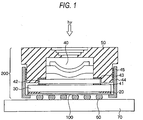


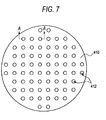

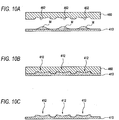
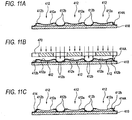
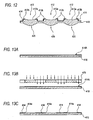

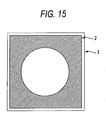
Classifications
-
- G—PHYSICS
- G03—PHOTOGRAPHY; CINEMATOGRAPHY; ANALOGOUS TECHNIQUES USING WAVES OTHER THAN OPTICAL WAVES; ELECTROGRAPHY; HOLOGRAPHY
- G03F—PHOTOMECHANICAL PRODUCTION OF TEXTURED OR PATTERNED SURFACES, e.g. FOR PRINTING, FOR PROCESSING OF SEMICONDUCTOR DEVICES; MATERIALS THEREFOR; ORIGINALS THEREFOR; APPARATUS SPECIALLY ADAPTED THEREFOR
- G03F7/00—Photomechanical, e.g. photolithographic, production of textured or patterned surfaces, e.g. printing surfaces; Materials therefor, e.g. comprising photoresists; Apparatus specially adapted therefor
- G03F7/004—Photosensitive materials
- G03F7/0047—Photosensitive materials characterised by additives for obtaining a metallic or ceramic pattern, e.g. by firing
-
- C—CHEMISTRY; METALLURGY
- C08—ORGANIC MACROMOLECULAR COMPOUNDS; THEIR PREPARATION OR CHEMICAL WORKING-UP; COMPOSITIONS BASED THEREON
- C08L—COMPOSITIONS OF MACROMOLECULAR COMPOUNDS
- C08L35/00—Compositions of homopolymers or copolymers of compounds having one or more unsaturated aliphatic radicals, each having only one carbon-to-carbon double bond, and at least one being terminated by a carboxyl radical, and containing at least one other carboxyl radical in the molecule, or of salts, anhydrides, esters, amides, imides or nitriles thereof; Compositions of derivatives of such polymers
- C08L35/02—Homopolymers or copolymers of esters
-
- B—PERFORMING OPERATIONS; TRANSPORTING
- B82—NANOTECHNOLOGY
- B82Y—SPECIFIC USES OR APPLICATIONS OF NANOSTRUCTURES; MEASUREMENT OR ANALYSIS OF NANOSTRUCTURES; MANUFACTURE OR TREATMENT OF NANOSTRUCTURES
- B82Y10/00—Nanotechnology for information processing, storage or transmission, e.g. quantum computing or single electron logic
-
- B—PERFORMING OPERATIONS; TRANSPORTING
- B82—NANOTECHNOLOGY
- B82Y—SPECIFIC USES OR APPLICATIONS OF NANOSTRUCTURES; MEASUREMENT OR ANALYSIS OF NANOSTRUCTURES; MANUFACTURE OR TREATMENT OF NANOSTRUCTURES
- B82Y40/00—Manufacture or treatment of nanostructures
-
- G—PHYSICS
- G03—PHOTOGRAPHY; CINEMATOGRAPHY; ANALOGOUS TECHNIQUES USING WAVES OTHER THAN OPTICAL WAVES; ELECTROGRAPHY; HOLOGRAPHY
- G03F—PHOTOMECHANICAL PRODUCTION OF TEXTURED OR PATTERNED SURFACES, e.g. FOR PRINTING, FOR PROCESSING OF SEMICONDUCTOR DEVICES; MATERIALS THEREFOR; ORIGINALS THEREFOR; APPARATUS SPECIALLY ADAPTED THEREFOR
- G03F7/00—Photomechanical, e.g. photolithographic, production of textured or patterned surfaces, e.g. printing surfaces; Materials therefor, e.g. comprising photoresists; Apparatus specially adapted therefor
- G03F7/004—Photosensitive materials
- G03F7/0042—Photosensitive materials with inorganic or organometallic light-sensitive compounds not otherwise provided for, e.g. inorganic resists
- G03F7/0043—Chalcogenides; Silicon, germanium, arsenic or derivatives thereof; Metals, oxides or alloys thereof
-
- G—PHYSICS
- G03—PHOTOGRAPHY; CINEMATOGRAPHY; ANALOGOUS TECHNIQUES USING WAVES OTHER THAN OPTICAL WAVES; ELECTROGRAPHY; HOLOGRAPHY
- G03F—PHOTOMECHANICAL PRODUCTION OF TEXTURED OR PATTERNED SURFACES, e.g. FOR PRINTING, FOR PROCESSING OF SEMICONDUCTOR DEVICES; MATERIALS THEREFOR; ORIGINALS THEREFOR; APPARATUS SPECIALLY ADAPTED THEREFOR
- G03F7/00—Photomechanical, e.g. photolithographic, production of textured or patterned surfaces, e.g. printing surfaces; Materials therefor, e.g. comprising photoresists; Apparatus specially adapted therefor
- G03F7/004—Photosensitive materials
- G03F7/0045—Photosensitive materials with organic non-macromolecular light-sensitive compounds not otherwise provided for, e.g. dissolution inhibitors
-
- G—PHYSICS
- G03—PHOTOGRAPHY; CINEMATOGRAPHY; ANALOGOUS TECHNIQUES USING WAVES OTHER THAN OPTICAL WAVES; ELECTROGRAPHY; HOLOGRAPHY
- G03F—PHOTOMECHANICAL PRODUCTION OF TEXTURED OR PATTERNED SURFACES, e.g. FOR PRINTING, FOR PROCESSING OF SEMICONDUCTOR DEVICES; MATERIALS THEREFOR; ORIGINALS THEREFOR; APPARATUS SPECIALLY ADAPTED THEREFOR
- G03F7/00—Photomechanical, e.g. photolithographic, production of textured or patterned surfaces, e.g. printing surfaces; Materials therefor, e.g. comprising photoresists; Apparatus specially adapted therefor
- G03F7/004—Photosensitive materials
- G03F7/027—Non-macromolecular photopolymerisable compounds having carbon-to-carbon double bonds, e.g. ethylenic compounds
-
- G—PHYSICS
- G03—PHOTOGRAPHY; CINEMATOGRAPHY; ANALOGOUS TECHNIQUES USING WAVES OTHER THAN OPTICAL WAVES; ELECTROGRAPHY; HOLOGRAPHY
- G03F—PHOTOMECHANICAL PRODUCTION OF TEXTURED OR PATTERNED SURFACES, e.g. FOR PRINTING, FOR PROCESSING OF SEMICONDUCTOR DEVICES; MATERIALS THEREFOR; ORIGINALS THEREFOR; APPARATUS SPECIALLY ADAPTED THEREFOR
- G03F7/00—Photomechanical, e.g. photolithographic, production of textured or patterned surfaces, e.g. printing surfaces; Materials therefor, e.g. comprising photoresists; Apparatus specially adapted therefor
- G03F7/004—Photosensitive materials
- G03F7/027—Non-macromolecular photopolymerisable compounds having carbon-to-carbon double bonds, e.g. ethylenic compounds
- G03F7/028—Non-macromolecular photopolymerisable compounds having carbon-to-carbon double bonds, e.g. ethylenic compounds with photosensitivity-increasing substances, e.g. photoinitiators
- G03F7/031—Organic compounds not covered by group G03F7/029
-
- G—PHYSICS
- G03—PHOTOGRAPHY; CINEMATOGRAPHY; ANALOGOUS TECHNIQUES USING WAVES OTHER THAN OPTICAL WAVES; ELECTROGRAPHY; HOLOGRAPHY
- G03F—PHOTOMECHANICAL PRODUCTION OF TEXTURED OR PATTERNED SURFACES, e.g. FOR PRINTING, FOR PROCESSING OF SEMICONDUCTOR DEVICES; MATERIALS THEREFOR; ORIGINALS THEREFOR; APPARATUS SPECIALLY ADAPTED THEREFOR
- G03F7/00—Photomechanical, e.g. photolithographic, production of textured or patterned surfaces, e.g. printing surfaces; Materials therefor, e.g. comprising photoresists; Apparatus specially adapted therefor
- G03F7/004—Photosensitive materials
- G03F7/027—Non-macromolecular photopolymerisable compounds having carbon-to-carbon double bonds, e.g. ethylenic compounds
- G03F7/032—Non-macromolecular photopolymerisable compounds having carbon-to-carbon double bonds, e.g. ethylenic compounds with binders
- G03F7/033—Non-macromolecular photopolymerisable compounds having carbon-to-carbon double bonds, e.g. ethylenic compounds with binders the binders being polymers obtained by reactions only involving carbon-to-carbon unsaturated bonds, e.g. vinyl polymers
-
- G—PHYSICS
- G03—PHOTOGRAPHY; CINEMATOGRAPHY; ANALOGOUS TECHNIQUES USING WAVES OTHER THAN OPTICAL WAVES; ELECTROGRAPHY; HOLOGRAPHY
- G03F—PHOTOMECHANICAL PRODUCTION OF TEXTURED OR PATTERNED SURFACES, e.g. FOR PRINTING, FOR PROCESSING OF SEMICONDUCTOR DEVICES; MATERIALS THEREFOR; ORIGINALS THEREFOR; APPARATUS SPECIALLY ADAPTED THEREFOR
- G03F7/00—Photomechanical, e.g. photolithographic, production of textured or patterned surfaces, e.g. printing surfaces; Materials therefor, e.g. comprising photoresists; Apparatus specially adapted therefor
- G03F7/004—Photosensitive materials
- G03F7/027—Non-macromolecular photopolymerisable compounds having carbon-to-carbon double bonds, e.g. ethylenic compounds
- G03F7/032—Non-macromolecular photopolymerisable compounds having carbon-to-carbon double bonds, e.g. ethylenic compounds with binders
- G03F7/035—Non-macromolecular photopolymerisable compounds having carbon-to-carbon double bonds, e.g. ethylenic compounds with binders the binders being polyurethanes
-
- G—PHYSICS
- G03—PHOTOGRAPHY; CINEMATOGRAPHY; ANALOGOUS TECHNIQUES USING WAVES OTHER THAN OPTICAL WAVES; ELECTROGRAPHY; HOLOGRAPHY
- G03F—PHOTOMECHANICAL PRODUCTION OF TEXTURED OR PATTERNED SURFACES, e.g. FOR PRINTING, FOR PROCESSING OF SEMICONDUCTOR DEVICES; MATERIALS THEREFOR; ORIGINALS THEREFOR; APPARATUS SPECIALLY ADAPTED THEREFOR
- G03F7/00—Photomechanical, e.g. photolithographic, production of textured or patterned surfaces, e.g. printing surfaces; Materials therefor, e.g. comprising photoresists; Apparatus specially adapted therefor
- G03F7/004—Photosensitive materials
- G03F7/038—Macromolecular compounds which are rendered insoluble or differentially wettable
-
- G—PHYSICS
- G03—PHOTOGRAPHY; CINEMATOGRAPHY; ANALOGOUS TECHNIQUES USING WAVES OTHER THAN OPTICAL WAVES; ELECTROGRAPHY; HOLOGRAPHY
- G03F—PHOTOMECHANICAL PRODUCTION OF TEXTURED OR PATTERNED SURFACES, e.g. FOR PRINTING, FOR PROCESSING OF SEMICONDUCTOR DEVICES; MATERIALS THEREFOR; ORIGINALS THEREFOR; APPARATUS SPECIALLY ADAPTED THEREFOR
- G03F7/00—Photomechanical, e.g. photolithographic, production of textured or patterned surfaces, e.g. printing surfaces; Materials therefor, e.g. comprising photoresists; Apparatus specially adapted therefor
- G03F7/004—Photosensitive materials
- G03F7/038—Macromolecular compounds which are rendered insoluble or differentially wettable
- G03F7/0388—Macromolecular compounds which are rendered insoluble or differentially wettable with ethylenic or acetylenic bands in the side chains of the photopolymer
-
- G—PHYSICS
- G03—PHOTOGRAPHY; CINEMATOGRAPHY; ANALOGOUS TECHNIQUES USING WAVES OTHER THAN OPTICAL WAVES; ELECTROGRAPHY; HOLOGRAPHY
- G03F—PHOTOMECHANICAL PRODUCTION OF TEXTURED OR PATTERNED SURFACES, e.g. FOR PRINTING, FOR PROCESSING OF SEMICONDUCTOR DEVICES; MATERIALS THEREFOR; ORIGINALS THEREFOR; APPARATUS SPECIALLY ADAPTED THEREFOR
- G03F7/00—Photomechanical, e.g. photolithographic, production of textured or patterned surfaces, e.g. printing surfaces; Materials therefor, e.g. comprising photoresists; Apparatus specially adapted therefor
- G03F7/0002—Lithographic processes using patterning methods other than those involving the exposure to radiation, e.g. by stamping
-
- G—PHYSICS
- G03—PHOTOGRAPHY; CINEMATOGRAPHY; ANALOGOUS TECHNIQUES USING WAVES OTHER THAN OPTICAL WAVES; ELECTROGRAPHY; HOLOGRAPHY
- G03F—PHOTOMECHANICAL PRODUCTION OF TEXTURED OR PATTERNED SURFACES, e.g. FOR PRINTING, FOR PROCESSING OF SEMICONDUCTOR DEVICES; MATERIALS THEREFOR; ORIGINALS THEREFOR; APPARATUS SPECIALLY ADAPTED THEREFOR
- G03F7/00—Photomechanical, e.g. photolithographic, production of textured or patterned surfaces, e.g. printing surfaces; Materials therefor, e.g. comprising photoresists; Apparatus specially adapted therefor
- G03F7/004—Photosensitive materials
- G03F7/075—Silicon-containing compounds
- G03F7/0755—Non-macromolecular compounds containing Si-O, Si-C or Si-N bonds
Definitions
- the present invention relates to a polymerizable composition and a use thereof. More specifically, the present invention relates to a polymerizable composition suitably usable for the formation of a solder resist.
- a coating film is formed and dried from a photosensitive composition in a liquid form by using a spin-coating method, a screen printing method and a spray printing method, or a method of applying and drying a photosensitive composition on a temporary support to obtain a laminate film having a photosensitive layer and transferring only the photosensitive layer onto a member by means of a vacuum laminator or a roll laminator.
- the method to form a permanent pattern such as solder resist
- a photosensitive layer is formed by the method above on a substrate such as a silicon wafer for formation of a permanent pattern, a silicon wafer having wiring thereon, or a copper-lined laminate board, and the photosensitive layer of the laminate is exposed, then developed to form a pattern and subjected to a curing treatment or the like, thereby forming a permanent pattern.
- This permanent pattern formation is also applied to a package substrate interposed between a semiconductor chip and a printed board.
- the package substrate higher density packaging is recently demanded, and reduction in the wiring pitch, increase in the strength of a solder resist layer, enhancement of the insulating property, thin film formation and the like are proceeding. In turn, resistance to repeated heat/cold shocks (thermal cycle test resistance, TCT resistance) is more keenly demanded. Also, reduction in the via diameter and in view of mounting, a rectangular pattern profile are required.
- the photosensitive composition for the formation of a permanent pattern represented by such a solder resist is demanded to ensure that even when a member having a permanent pattern is placed under high-temperature high-humidity conditions, deformation of the permanent pattern or separation of the permanent pattern from the base material does not occur.
- a defect is generated in a solder resist
- a wiring covered with the solder resist develops a dendrite and adjacent wirings are electrically conducted unintentionally. Therefore, it is also important that the solder resist has excellent durability to high temperature and high humidity.
- a solid-state imaging device used in cellular phones, digital cameras, digital videos, monitoring cameras and the like is a photoelectric conversion device having an integrated circuit formed using the production technique of a semiconductor device.
- the solid-state imaging device is required to be more downsized.
- JP-A-2009-194396 the term "JP-A” as used herein means an "unexamined published Japanese patent application”
- Downsizing can be realized by polishing and thereby thinning the silicon wafer, but due to thinning of the silicon wafer, light at a wavelength of 800 nm or more is liable to be transmitted, though the effect of blocking light at 800 nm or less is maintained.
- a photodiode used in the solid-state imaging device reacts also to light at 800 to 1,200 nm, and transparency to light at 800 nm or more is found to cause a new problem that the pictorial quality is deteriorated.
- the solid-state imaging device has a configuration that a color filter and a lens are provided adjacently to one side of a photodiode, an infrared cut filter is present in the vicinity of the color filter or lens to cut light at 800 to 1,200 nm, and a metal wiring, a solder resist and the like are present on the opposite side of the color filter.
- the space between metal wirings is filled with a solder resist in many cases, but there is a problem that infrared light such as leakage light intruding into the inside of a cellular phone, a digital camera or the like cannot be cut by the solder resist.
- the composition preferably exhibits photosensitivity and has a photolithography performance enabling patterning by exposure.
- the light-blocking photosensitive composition having a photolithography performance includes a black resist using carbon black employed for the formation of an LCD color filter.
- the carbon black has a high light-blocking effect in the visible region but exhibits a low light-blocking effect in the infrared region and in the case where such a black resist is applied as a solder resist, if carbon black is added in an amount large enough to ensure the required light-blocking effect in the infrared region, this causes a problem that the light-blocking effect in the visible region becomes excessively high, the exposure light at a shorter wavelength than the visible region, such as high-pressure mercury lamp, KrF and ArF, which is usually used for image formation, is also cut, failing in obtaining sufficient photo-curability, and an excellent pattern cannot be obtained even when passed through a development step using an alkali developer.
- an infrared-blocking layer is separately provided after forming a solder resist by a coating method and therefore, in the solder resist formation and the infrared-blocking layer formation, steps such as coating, exposure, development and post-heating must be performed a plurality of times, which leads to a cumbersome process and a rise in the cost. Therefore, improvements are required.
- US 6,806,028 B2 relates to a photosensitive conductive paste for forming patterns on substrate surfaces or ceramic layers.
- the photosensitive conductive paste comprises a powdered base metal processed by surface oxidation treatment, an organic binder having acidic groups, a photosensitive organic component and a material for forming microgels by reacting with metal hydroxides present on the surface of the powdered base metal.
- JP 2007 147854 A describes a photosensitive lithographic printing plate which has an optical polymerization photosensitive layer containing a radical generation agent and a polymerization compound on an aluminum support and a layer containing at least one compound selected from compounds including group IV to VIa elements.
- EP 2 508 947 A1 ( WO 2011/67998 ) constituting prior art under Art.
- 54(3) EPC for the present application relates to a photosensitive resin composition having insulating and specific light-shielding properties comprising an alkali soluble resin, a specific tungsten oxide and/or a specific composite tungsten oxide, a photopolymerizable compound having at least two polymerizable groups, an oxime-type photopolymerization initiator and a solvent.
- JP 6 251621 describes a photosensitive dielectric paste that allows formation of a fine pattern by means of a photolithography.
- the photosensitive dielectric paste is prepared by mixing a dielectric powder, an acrylic copolymer having a carboxyl group and an ethylenic unsaturated group at a side chain, a photo-reactive compound, and a photochemical polymerization initiator.
- JP 2007 248925 A describes a photosensitive composition which exhibits high sensitivity when exposed to a blue-violet laser.
- the photosensitive composition contains an alkali soluble photosensitive resin, a polymerizable compound, a photoinitiator, a crosslinkable resin and a specific pigment.
- an alignment mark in a protruded form is often provided at the predetermined position in the surface on the metal wiring and solder resist side (that is, the surface opposite the color filter or lens) of a semiconductor substrate of a solid-state imaging device.
- JP-A-2009-205029 discloses a technique of using an inorganic near infrared absorber-containing layer as a near infrared-absorbing layer for an image display device and, for example, a coating solution for near infrared-absorbing layer formation, containing a polymerizable compound, a polymerization initiator and a near infrared absorber, is described in working examples, but the layer obtained from this coating solution is not subjected to pattern formation through exposure and alkali development. Actually, this layer is, even in the unexposed region, insufficient in solubility for an alkali developer and has substantially no alkali developability.
- the present invention has been made by taking into consideration these current circumstances, and the task of the present invention is to solve those conventional problems and attain the following object.
- an object of the present invention is to provide a polymerizable composition exhibiting high light-blocking effect in the infrared region and high light transparency in the visible region and being capable of forming a pattern with desired profile and excellent durability (for example, durability to high temperature/high humidity, and adherence to substrate) by alkali development.
- the present invention has the following configurations, and the above-described object can be attained by these configurations.
- the polymerizable composition of the present invention is described in detail below.
- a group when a group (atomic group) is denoted without specifying whether substituted or unsubstituted, the group includes both a group having no substituent and a group having a substituent.
- an alkyl group includes not only an alkyl group having no substituent (unsubstituted alkyl group) but also an alkyl group having a substituent (substituted alkyl group).
- the viscosity value indicates the value at 25°C.
- the polymerizable composition of the present invention as defined in claim 1 may contain, if desired, an infrared-shielding material other than a tungsten compound, a dispersant, a sensitizer, a crosslinking agent, a curing accelerator an elastomer, a surfactant and other components.
- the polymerizable composition of the present invention is, for example, a negative composition and typically a negative resist composition.
- the configuration of this composition is described below.
- the range expressed as "(numerical value) to (numerical value)” means a range including the numerical values before and after "to" as the lower limit and the upper limit, respectively.
- the term “(meth)acrylate” indicates acrylate and methacrylate
- the term “(meth)acryl” indicates acryl and methacryl
- the term “(meth)acryloyl” indicates acryloyl and methacryloyl.
- the "monomeric substance” has the same meaning as “monomer”.
- the "monomeric substance” as used in the present invention is differentiated from an oligomer and a polymer and indicates a compound having a mass average molecular weight of 2,000 or less.
- the term “polymerizable compound” indicates a compound having a polymerizable group and may be either a monomeric substance or a polymer.
- the term “polymerizable group” indicates a group participating in polymerization reaction.
- the polymerization initiator for use in the polymerizable composition of the present invention is not particularly limited as long as it has an ability of initiating the polymerization of the polymerizable compound by either one or both of light and heat, and the initiator may be appropriately selected according to the purpose but is preferably a photopolymerizable compound.
- the initiator may be appropriately selected according to the purpose but is preferably a photopolymerizable compound.
- a compound having photosensitivity to light in the ultraviolet to visible regions is preferred.
- an initiator capable of decomposing at 150 to 250°C is preferred.
- the polymerization initiator which can be used in the present invention is preferably a compound having at least an aromatic group, and examples thereof include an acylphosphine-based compound, an acetophenone-based compound, an ⁇ -aminoketone compound, a benzophenone-based compound, a benzoin ether-based compound, a ketal derivative compound, a thioxanthone compound, an oxime compound, a hexaarylbiimidazole compound, a trihalomethyl compound, an azo compound, an organic peroxide, a diazonium compound, an iodonium compound, a sulfonium compound, an azinium compound, an onium salt compound such as metallocene compound, an organic boron salt compound, and a disulfone compound.
- an acylphosphine-based compound an acetophenone-based compound, an ⁇ -aminoketone compound, a benzophenone-based compound, a
- an oxime compound an acetophenone-based compound, an ⁇ -amino ketone compound, a trihalomethyl compound, a hexaarylbiimidazole compound, and a thiol compound are preferred.
- acetophenone-based compound examples include 2,2-diethoxyacetophenone, p-dimethylaminoacetophenone, 2-hydroxy-2-methyl-1-phenyl-propan-1 -one, 4'-isopropyl-2-hydroxy-2-methyl-propiophenone, 1-hydroxy-cyclohexyl-phenyl-ketone, 2-benzyl-2-dimethylamino-1-(4-morpholinophenyl)-butanone-1, 2-tolyl-2-dimethylamino-1-(4-morpholinophenyl)-butanone-1, 2-methyl-1-[4-(methylthio)phenyl]-2-morpholinopropanone-1, 2-methyl-1-(4-methylthiophenyl)-2-morpholinopropan-1-one, 2-benzyl-2-dimethylamino-1-(4-morpholinophenyl)-butanone-1, 2-(dimethylamino)-2-[(4-methylphenyl)methyl]
- the trihalomethyl compound is more preferably an s-triazine derivative where at least one mono-, di- or tri-halogen-substituted methyl group is bonded to an s-triazine ring, and specific examples thereof include 2,4,6-tris(monochloromethyl)-s-triazine, 2,4,6-tris(dichloromethyl)-s-triazine, 2,4,6-tris(trichloromethyl)-s-triazine, 2-methyl-4,6-bis(trichloromethyl)-s-triazine, 2-n-propyl-4,6-bis(trichloromethyl)-s-triazine, 2-( ⁇ , ⁇ , ⁇ -trichloroethyl)-4,6-bis(trichloromethyl)-s-triazine, 2-phenyl-4,6-bis(trichloromethyl)-s-triazine, 2-(p-methoxyphenyl)-4,6-bis(trichlor
- hexaarylbiimidazole compound examples include various compounds described in JP-B-6-29285 (the term "JP-B" as used herein means an "examined Japanese patent publication"), U.S. Patents 3,479,185 , 4,311,783 and 4,622,286 , specifically, 2,2'-bis(o-chlorophenyl)-4,4',5,5'-tetraphenylbiimidazole, 2,2'-bis(o-bromophenyl)-4,4',5,5'-tetraphenylbiimidazole, 2,2'-bis(o,p-dichlorophenyl)-4,4',5,5'-tetraphenylbiimidazole, 2,2'-bis(o-chlorophenyl)-4,4',5,5'-tetra(m-methoxyphenyl)biimidazole, 2,2'-bis(o,o'-dichlorophen
- Examples of the oxime compound include compounds described in J.C.S. Perkin II, 1653-1660 (1979 ), J.C.S. Perkin II, 156-162 (1979 ), Journal of Photopolymer Science and Technology, 202-232 (1995 ), JP-A-2000-66385 , JP-A-2000-80068 and JP-T-2004-534797 (the term "JP-T” as used herein means a published Japanese translation of a PCT patent application), IRGACURE OXE01 (1,2-octanedione, 1-[4-(phenylthio)-, 2-(O-benzoyloxime)]), IRGACURE OXE02 (ethanone, 1-[9-ethyl-6-(2-methylbenzoyl)-9H-carbazol-3-yl]-, 1-(O-acetyloxime)), both produced by BASF Japan, and 2-(acetyloxyiminomethyl)thioxanthen-9-one.
- cyclic oxime compounds described in JP-A-2007-231000 and JP-A-2007-322744 may be also preferably used.
- oxime compound having a specific substituent described in JP-A-2007-269779 and an oxime compound having a thioaryl group described in JP-A-2009-191061 .
- the oxime compound is preferably a compound represented by the following formula (1).
- the oxime compound may be a compound where the NO bond of oxime is (E) form, a compound where the bond is (Z) form, or a compound where the bond is a mixture of (E) form and (Z) form.
- R and B independently represents a monovalent substituent
- A represents a divalent organic group
- Ar represents an aryl group
- the monovalent substituent represented by R is preferably a monovalent nonmetallic atom group.
- the monovalent nonmetallic atom group include an alkyl group, an aryl group, an acyl group, an alkoxycarbonyl group, an aryloxycarbonyl group, a heterocyclic group, and an alkylthiocarbonyl group, an arylthiocarbonyl group. These groups may have one or more substituents. The substituent above may be further substituted with another substituent.
- substituents examples include a halogen atom, an aryloxy group, an alkoxycarbonyl group, an aryloxycarbonyl group, an acyloxy group, an acyl group, an alkyl group and an aryl group.
- the alkyl group which may have a substituent is preferably an alkyl group having a carbon number of 1 to 30, and specific examples thereof include a methyl group, an ethyl group, a propyl group, a butyl group, a hexyl group, an octyl group, a decyl group, a dodecyl group, an octadecyl group, an isopropyl group, an isobutyl group, a sec-butyl group, a tert-butyl group, a 1-ethylpentyl group, a cyclopentyl group, a cyclohexyl group, a trifluoromethyl group, a 2-ethylhexyl group, a phenacyl group, a 1-naphthoylmethyl group, a 2-naphthoylmethyl group, a 4-methylsulfanylphenacyl group, a 4-
- the aryl group which may have a substituent is preferably an aryl group having a carbon number of 6 to 30, and specific examples thereof include a phenyl group, a biphenyl group, a 1-naphthyl group, a 2-naphthyl group, a 9-anthryl group, a 9-phenanthryl group, a 1-pyrenyl group, a 5-naphthacenyl group, a 1-indenyl group, a 2-azulenyl group, a 9-fluorenyl group, a terphenyl group, a quaterphenyl group, an o-tolyl group, an m-tolyl group, a p-tolyl group, a xylyl group, an o-cumenyl group, an m-cumenyl group, a p-cumenyl group, a mesityl group, a pentalenyl group, a bin
- the acyl group which may have a substituent is preferably an acyl group having a carbon number of 2 to 20, and specific examples thereof include an acetyl group, a propanoyl group, a butanoyl group, a trifluoroacetyl group, a pentanoyl group, a benzoyl group, a 1-naphthoyl group, a 2-naphthoyl group, a 4-methylsulfanylbenzoyl group, a 4-phenylsulfanylbenzoyl group, a 4-dimethylaminobenzoyl group, a 4-diethylaminobenzoyl group, a 2-chlorobenzoyl group, a 2-methylbenzoyl group, a 2-methoxybenzoyl group, a 2-butoxybenzoyl group, a 3-chlorobenzoyl group, a 3-trifluoromethylbenzoyl group, a 3-cyano
- the alkoxycarbonyl group which may have a substituent is preferably an alkoxycarbonyl group having a carbon number of 2 to 20, and specific examples thereof include a methoxycarbonyl group, an ethoxycarbonyl group, a propoxycarbonyl group, a butoxycarbonyl group, a hexyloxycarbonyl group, an octyloxycarbonyl group, a decyloxycarbonyl group, an octadecyloxycarbonyl group, and a trifluoromethyloxycarbonyl group.
- the heterocyclic group which may have a substituent is preferably an aromatic or aliphatic heterocyclic ring containing a nitrogen atom, an oxygen atom, a sulfur atom or a phosphorus atom.
- thienyl group examples thereof include a thienyl group, a benzo[b]thienyl group, a naphtho[2,3-b]thienyl group, a thianthrenyl group, a furyl group, a pyranyl group, an isobenzofuranyl group, a chromenyl group, a xanthenyl group, a phenoxathiinyl group, a 2H-pyrrolyl group, a pyrrolyl group, an imidazolyl group, a pyrazolyl group, a pyridyl group, a pyrazinyl group, a pyrimidinyl group, a pyridazinyl group, an indolizinyl group, an isoindolyl group, a 3H-indolyl group, an indolyl group, a 1H-indazolyl group, a purinyl group, a
- alkylthiocarbonyl group which may have a substituent include a methylthiocarbonyl group, a propylthiocarbonyl group, a butylthiocarbonyl group, a hexylthiocarbonyl group, an octylthiocarbonyl group, a decylthiocarbonyl group, an octadecylthiocarbonyl group, and a trifluoromethylthiocarbonyl group.
- the monovalent substituent represented by B indicates an aryl group, a heterocyclic group, an arylcarbonyl group, or a heterocyclic carbonyl group. These groups may have one or more substituent. Examples of the substituent include the substituents described above. Also, each of the substituents described above may be further substituted with another substituent.
- Y, X and n have the same meanings as Y, X and n in formula (2) described later, respectively, and preferred examples thereof are also the same.
- the divalent organic group represented by A includes an alkylene group having a carbon number of 1 to 12, a cyclohexylene group, and an alkynylene group. These groups may have one or more substituents. Examples of the substituent include the substituents described above. Also, each of the substituents described above may be further substituted with another substituent.
- A is preferably an unsubstituted alkylene group, an alkylene group substituted with an alkyl group (e.g., methyl group, ethyl group, tert-butyl group, dodecyl group), an alkylene group substituted with an alkenyl group (e.g., vinyl group, allyl group), or an alkylene group substituted with an aryl group (e.g., phenyl group, p-tolyl group, xylyl group, cumenyl group, naphthyl group, anthryl group, phenanthryl group, styryl group).
- an alkyl group e.g., methyl group, ethyl group, tert-butyl group, dodecyl group
- an alkylene group substituted with an alkenyl group e.g., vinyl group, allyl group
- an alkylene group substituted with an aryl group e.g., phen
- the aryl group represented by Ar is preferably an aryl group having a carbon number of 6 to 30 and may have a substituent.
- Examples of the substituent are the same as those of the substituent introduced into the substituted aryl group that is described above as specific examples of the aryl group which may have a substituent.
- the structure "SAr" formed by Ar and S adjacent thereto is preferably a structure shown below.
- Me represents a methyl group
- Et represents an ethyl group.
- the oxime compound is preferably a compound represented by the following formula (2): (In formula (2), each of R and X independently represent a monovalent substituent, each of A and Y independently represent a divalent organic group, Ar represents an aryl group, and n is an integer of 0 to 5.)
- R, A and Ar in formula (2) have the same meanings as R, A and Ar in formula (1), and preferred examples thereof are also the same.
- Examples of the monovalent substituent represented by X include an alkyl group, an aryl group, an alkoxy group, an aryloxy group, an acyloxy group, an acyl group, an alkoxycarbonyl group, an amino group, a heterocyclic group, and a halogen group. These groups may have one or more substituents. Examples of the substituent include the substituents described above. Also, each of the substituents described above may be further substituted with another substituent.
- X is preferably an alkyl group.
- n represents an integer of 0 to 5 and is preferably an integer of 0 to 2.
- the divalent organic group represented by Y includes structures shown below. In the structures shown below, "*" indicates a bonding position to the carbon atom adjacent to Y in formula (2).
- the oxime compound is also preferably a compound represented by the following formula (3):
- R, X, A, Ar and n in formula (3) have the same meanings as R, X, A, Ar and n in formula (2), respectively, and preferred examples thereof are also the same.
- the oxime compound has a maximum absorption wavelength in the wavelength region of 350 to 500 nm.
- An oxime compound having an absorption wavelength in the wavelength region of 360 to 480 nm is preferred, and an oxime compound having high absorbance in 365 or 455 nm is more preferred.
- the molar extinction coefficient at 365 nm or 405 nm of the oxime compound is preferably from 3,000 to 300,000, more preferably from 5,000 to 300,000, still more preferably from 10,000 to 200,000.
- the molar extinction coefficient of the compounds can be measured by a known method but is preferably measured, for example, at a concentration of 0.01 g/L by using an ethyl acetate solvent by means of an ultraviolet-visible spectrophotometer (Carry-5 spectrophotometer, manufactured by Varian Inc.).
- the photopolymerization initiator is more preferably a compound selected from the group consisting of an oxime compound, an acetophenone-based compound and an acylphosphine compound. More specifically, for example, aminoacetophenone-based initiators described in JP-A-10-291969 , acylphosphine oxide-based initiators described in Japanese Patent No. 4,225,898 , oxime-based initiators described above, and compounds described in JP-A-2001-233842 as the oxime-based initiator may be also used.
- acetophenone-based initiator commercial products IRGACURE-907, IRGACURE-369 and IRGACURE-379 (trade names, all produced by BASF Japan) may be used. Also, as the acylphosphine-based initiator, commercial products IRGACURE-819 and DAROCUR-TPO (trade names, both produced by BASF Japan) may be used.
- One kind of a polymerization initiator may be used alone, or two or more kinds of polymerization initiators may be used in combination.
- the content of the polymerization initiator is preferably from 0.01 to 30 mass%, more preferably from 0.1 to 20 mass%, still more preferably from 0.1 to 15 mass%, based on the entire solid content by mass of the polymerizable composition of the present invention. (In this specification, mass ratio is equal to weight ratio.)
- the polymerizable composition of the present invention contains a polymerizable compound.
- the polymerizable compound used here may be any compound as long as it has, within the molecule, a functional group capable of undergoing a reaction by at least one of acid, radical and heat (in the description of the present invention, such a functional group is sometimes referred to as a "polymerizable group").
- a polyfunctional polymerizable compound having a plurality of polymerizable groups within the molecule is preferred.
- Examples of the polymerizable compound having a polymerizable functional group capable of undergoing a reaction by at least one of acid, radical and heat include an ethylenically unsaturated group-containing compound having an ethylenically unsaturated group such as unsaturated ester group, unsaturated amide group, vinyl ether group and allyl group, a methylol compound, a bismaleimide compound, a benzocyclobutene compound, a bisallylnadiimide compound and a benzoxazine compound.
- the polymerizable compound which can be preferably used in the present invention includes general radical polymerizable compounds, and compounds widely known as a compound having an ethylenically unsaturated double bond in this industrial field can be used without any particular limitation.
- These compounds have a chemical form such as a monomer, a prepolymer (that is, a dimer, a trimer or an oligomer) or a mixture or copolymer thereof.
- Examples of the monomer and the copolymer thereof include an unsaturated carboxylic acid (for example, an acrylic acid, a methacrylic acid, an itaconic acid, a crotonic acid, an isocrotonic acid and a maleic acid), its esters and amides, and copolymers thereof.
- unsaturated carboxylic acid esters, esters of unsaturated carboxylic acid with aliphatic polyhydric alcohol compound, and amides of unsaturated carboxylic acid with aliphatic polyvalent amine compound are preferably used.
- an ester of unsaturated carboxylic acid with aliphatic polyhydric alcohol compound can develop high hydrophobicity in the exposed area and is preferred from the standpoint that a pattern having a desired profile is easily formed by alkali development or a pattern having high durability is obtained (this effect is pronounced particularly when higher durability is required of a solder resist as in the case where a metal wiring covered with a solder resist has a high wiring density).
- suitable examples include an addition reaction product of unsaturated carboxylic acid esters or amides having a nucleophilic substituent such as hydroxyl group, amino group and mercapto group with monofunctional or polyfunctional isocyanates or epoxies, and a dehydration condensation reaction product with monofunctional or polyfunctional carboxylic acid.
- an addition reaction product of unsaturated carboxylic acid esters or amides having an electrophilic substituent such as isocyanate group and epoxy group with monofunctional or polyfunctional alcohols, amines or thiols, and a substitution reaction product of unsaturated carboxylic acid esters or amides having a leaving substituent such as halogen group and tosyloxy group with monofunctional or polyfunctional alcohols, amines or thiols are also suitable.
- compounds in which the unsaturated carboxyl acid above is replaced by an unsaturated phosphonic acid, styrene, vinyl ether or the like may be also used.
- a methacrylic acid ester is preferred, and examples thereof include tetramethylene glycol dimethacrylate, triethylene glycol dimethacrylate, neopentyl glycol dimethacrylate, trimethylolpropane trimethacrylate, trimethylolethane trimethacrylate, ethylene glycol dimethacrylate, 1,3-butanediol dimethacrylate, hexanediol dimethacrylate, pentaerythritol dimethacrylate, pentaerythritol trimethacrylate, pentaerythritol tetramethacrylate, dipentaerythritol dimethacrylate, dipentaerythritol hexamethacrylate, sorbitol trimethacrylate, sorbitol tetramethacrylate, bis[p-(3-methacryloxy-2-hydroxypropoxy
- an itaconic acid ester is also preferred, and examples thereof include ethylene glycol diitaconate, propylene glycol diitaconate, 1,3-butanediol diitaconate, 1,4-butanediol diitaconate, tetramethylene glycol diitaconate, pentaerythritol diitaconate and sorbitol tetraitaconate.
- the crotonic acid ester include ethylene glycol dicrotonate, tetramethylene glycol dicrotonate, pentaerythritol dicrotonate and sorbitol tetradicrotonate.
- Examples of the isocrotonic acid ester include ethylene glycol diisocrotonate, pentaerythritol diisocrotonate and sorbitol tetraisocrotonate.
- Examples of the maleic acid ester include ethylene glycol dimaleate, triethylene glycol dimaleate, pentaerythritol dimaleate and sorbitol tetramaleate.
- examples of the acrylic acid ester include ethylene glycol diacrylate, triethylene glycol diacrylate, 1,3-butanediol diacrylate, tetramethylene glycol diacrylate, propylene glycol diacrylate, neopentyl glycol diacrylate, trimethylolpropane triacrylate, trimethylolpropane tri(acryloyloxypropyl)ether, trimethylolethane triacrylate, hexanediol diacrylate, 1,4-cyclohexanediol diacrylate, tetraethylene glycol diacrylate, tricyclodecane dimethanol diacrylate, tricyclodecane dimethanol dimethacrylate, pentaerythritol diacrylate, pentaerythritol triacrylate, pentaerythritol tetraacrylate, dipent
- esters which are suitably used include aliphatic alcohol esters described in JP-B-51-47334 and JP-A-57-196231 , esters having an aromatic structure described in JP-A-59-5240 , JP-A-59-5241 , and JP-A-2-226149 , and esters having an amino group described in JP-A-1-165613 . These ester monomers may be also used as a mixture.
- amide monomer of an aliphatic polyvalent amine compound with an unsaturated carboxylic acid examples include methylenebis-acrylamide, methylenebis-methacrylamide, 1,6-hexamethylenebis-acrylamide, 1,6-hexamethylenebis-methacrylamide, diethylenetriaminetrisacrylamide, xylylenebisacrylamide, and xylylenebismethacrylamide.
- amide-based monomer examples include the amides having a cyclohexylene structure described in JP-B-54-21726 .
- a urethane-based addition-polymerizable compound produced using an addition reaction of an isocyanate with a hydroxyl group is also suitable, and specific examples thereof include a vinyl urethane compound having two or more polymerizable vinyl groups per molecule described in JP-B-48-41708 , which is obtained by adding a hydroxyl group-containing vinyl monomer represented by the following formula (E) to a polyisocyanate compound having two or more isocyanate groups per molecule.
- CH 2 C(R 4 )COOCH 2 CH(R 5 )OH (E) [wherein each of R 4 and R 5 independently represents H or CH 3 ].
- urethane acrylates described in JP-A-51-37193 , JP-B-2-32293 and JP-B-2-16765 and urethane compounds having an ethylene oxide-based structure described in JP-B-58-49860 , JP-B-56-17654 , JP-B-62-39417 and JP-B-62-39418 are suitable.
- use of addition-polymerizable compounds having an amino structure or a sulfide structure in the molecule described in JP-A-63-277653 , JP-A-63-260909 and JP-A-1-105238 enables obtaining a polymerizable composition exhibiting a very excellent photosensitization speed.
- Examples include a polyfunctional acrylate or methacrylate such as polyester acrylates described in JP-A-48-64183 , JP-B-49-43191 and JP-B-52-30490 and epoxy acrylates obtained by reacting epoxy resin with (meth)acrylic acid.
- Examples further include specific unsaturated compounds described in JP-B-46-43946 , JP-B-1-40337 and JP-B-1-40336 and vinylphosphonic acid-based compounds described in JP-A-2-25493 .
- a perfluoroalkyl group -containing structure described in JP-A-61-22048 is suitably used.
- those introduced as a photocurable monomer or oligomer in Journal of The Adhesion Society of Japan, Vol. 20, No. 7, pp. 300-308 (1984 ) can be also used.
- a radical polymerizable compound when added, in view of curing sensitivity, a polyfunctional polymerizable compound having 2 or more, preferably 3 or more, ethylenically unsaturated bonds is preferably used. Above all, it is preferred to contain 2 or more, more preferably 3 or more, most preferably 4 or more, (meth)acrylic acid ester structures.
- an EO-modified product-containing compound is preferably used, and in view of curing sensitivity and strength of the exposed area, a urethane bond-containing compound is preferably used. Furthermore, from the standpoint of developability at the pattern formation, a compound having an acid group is preferably used.
- preferred examples of the polymerizable compound for use in the present invention include bisphenol A diacrylate.
- urethane oligomers UAS-10, UAB-140 both produced by Sanyo Kokusaku Pulp Co., Ltd.
- DPHA-40H produced by Nippon Kayaku Co., Ltd.
- UA-306H, UA-306T, UA-306I, AH-600, T-600 and AI-600 all produced by Kyoeisha Chemical Co., Ltd.
- EO-modified bisphenol A diacrylate pentaerythritol triacrylate, pentaerythritol tetraacrylate, dipentaerythritol pentaacrylate, dipentaerythritol hexaacrylate, tri(acryloyloxyethyl)isocyanurate, EO-modified pentaerythritol tetraacrylate, EO-modified dipentaerythritol hexaacrylate, and commercial products DPHA-40H (produced by Nippon Kayaku Co., Ltd.), UA-306H, UA-306T, UA-306I, AH-600, T-600, and AI-600 (produced by Kyoeisha Chemical Co., Ltd.) are more preferred.
- Acid group-containing ethylenically unsaturated compounds are also suitable, and examples of the commercial product thereof include TO-756 as a carboxyl group-containing trifunctional acrylate and TO-1382 as a carboxyl group-containing pentafunctional acrylate, both produced by Toagosei CO., Ltd.
- examples of the highly heat-resistant polymerizable compound include benzocyclobutene (BCB), bisallylnadiimide (BANI), benzoxazine, melamine, and analogs thereof.
- polymerizable compounds may be used.
- the content of the polymerizable compound is preferably from 3 to 80 mass%, more preferably from 5 to 50 mass%, based on the entire solid content by mass of the polymerizable composition of the present invention.
- the polymerizable compound may be the same as or different from the alkali-soluble binder.
- the polymerizable compound when the polymerizable compound is a polymer, the polymerizable compound may be the same as or different from the alkali-soluble binder described in detail later (that is, the polymerizable compound may be composed of the same components as those of the alkali-soluble binder).
- the content of the polymerizable compound is preferably from 3 to 80 mass%, more preferably from 5 to 60 mass%, based on the entire solid content by mass of the polymerizable composition of the present invention.
- the polymerizable composition of the present invention contains a specific tungsten compound (a compound containing tungsten), namely, a tungsten compound as recited in claim 1.
- the tungsten compound is an infrared-shielding material having high absorption for infrared ray (light at a wavelength of approximately from 800 to 1,200 nm) (that is, the light-blocking effect (light-shielding property) for infrared ray is high) and low absorption for visible light.
- the polymerizable composition of the present invention contains a tungsten compound as defined in claim 1, so that a pattern having high light-blocking effect in the infrared region and high light transparency in the visible region can be formed.
- the tungsten compound as defined in claim 1 exhibits small absorption also for light shorter than the visible region, which is employed in exposure to high-pressure mercury lamp, KrF, ArF or the like used for image formation. Thanks to the combination of such a tungsten compound with a polymerization initiator, a polymerizable compound, an alkali-soluble binder, an excellent pattern is obtained.
- the tungsten compound is a tungsten oxide-based compound represented by the following formula (I): M x W y O z (I)
- the metal of M includes an alkali metal, an alkaline earth metal, Mg, Zr, Cr, Mn, Fe, Ru, Co, Rh, Ir, Ni, Pd, Pt, Cu, Ag, Au, Zn, Cd, Al, Ga, In, Tl, Sn, Pb, Ti, Nb, V, Mo, Ta, Re, Be, Hf, Os and Bi and is preferably an alkali metal.
- the metal of M may be one kind of a metal or two or more kinds of metals.
- M is preferably an alkali metal, more preferably Rb or Cs, still more preferably Cs.
- tungsten oxide-based compound represented by formula (I) examples include Cs 0.33 WO 3 , Rb 0.33 WO 3 , K 0.33 WO 3 and Ba 0.33 WO 3 .
- the tungsten oxide-based compound is preferably Cs 0.33 WO 3 or Rb 0.33 WO 3 , more preferably Cs 0.33 WO 3 .
- the tungsten compound is preferably a fine particle.
- the average particle diameter of the tungsten fine particle is preferably 800 nm or less, more preferably 400 nm or less, still more preferably 200 nm or less.
- the average particle diameter is in such a range, the tungsten fine particle can hardly cut visible light by light scattering and therefore, light transparency in the visible light region can be more successfully ensured.
- the average particle diameter is preferably smaller, but for reasons of easy handleability or the like at the production, the average particle diameter of the tungsten fine particle is usually 1 nm or more.
- the content of the tungsten compound is preferably from 3 to 20 mass%, more preferably from 5 to 10 mass%, based on the entire solid content by mass of the polymerizable composition of the present invention.
- tungsten compounds as specified in claim 1 may be used.
- the tungsten compound may be available as a commercial product, and the tungsten oxide-based compound of formula (I) may be obtained by a method of heat-treating a tungsten compound in an inert gas atmosphere or a reducing gas atmosphere (see, Japanese Patent No. 4,096,205 ).
- the tungsten oxide-based compound of formula (I) is also available, for example, as a dispersion of tungsten fine particle, such as YMF-02 produced by Sumitomo Metal Mining Co., Ltd.
- the polymerizable composition of the present invention contains an alkali-soluble binder (alkali-soluble resin). Thanks to this binder, when the film obtained from the polymerizable composition is exposed to form a pattern, the unexposed area can be removed with an alkali developer and an excellent pattern can be formed by alkali development.
- alkali-soluble binder alkali-soluble resin
- the alkali-soluble binder is not particularly limited as long as it is soluble in alkali, and the alkali-soluble binder can be appropriately selected according to the purpose.
- examples thereof include a (meth)acrylic resin, a urethane-based resin, a polyvinyl alcohol, a polyvinyl butyral, a polyvinyl formal, a polyamide and a polyester, with a (meth)acrylic resin and a urethane-based resin being preferred.
- the alkali-soluble binder is more preferably a urethane-based resin.
- the alkali-soluble binder preferably has an acid group.
- the acid group includes, for example, a carboxylic acid group, a sulfonic acid group, a phosphonic acid group, a phosphoric acid group and a sulfonamide group but is preferably a carboxylic acid group in view of availability of raw materials.
- the alkali-soluble binder having an acid group is not particularly limited but is preferably a polymer obtained using an acid group-containing polymerizable compound as a monomer component and in view of adjustment of acid value, more preferably a copolymer obtained by copolymerizing a polymerizable compound having an acid group and a polymerizable compound having no acid group.
- the polymerizable compound having an acid group is not particularly limited and may be appropriately selected according to the purpose.
- the acid group include an acrylic acid, a methacrylic acid, an itaconic acid, a crotonic acid, an isocrotonic acid, a maleic acid and a p-carboxylstyrene.
- an acrylic acid, a methacrylic acid and a p-carboxylstyrene are preferred.
- One of these compounds may be used alone, or two or more thereof may be used in combination.
- the polymerizable compound having no acid group is not particularly limited but suitable examples thereof include a (meth)acrylic acid ester (e.g., alkyl ester, aryl ester, aralkyl ester).
- a (meth)acrylic acid ester e.g., alkyl ester, aryl ester, aralkyl ester.
- the alkyl group in the alkyl ester moiety of the (meth)acrylic acid ester may be linear or branched and is preferably an alkyl group having a carbon number of 1 to 10, more preferably an alkyl group having a carbon number of 1 to 6.
- the aryl group in the aryl ester moiety of the (meth)acrylic acid ester is preferably an aryl group having a carbon number of 6 to 14, more preferably an aryl group having a carbon number of 6 to 10.
- the aralkyl group in the aralkyl ester moiety of the (meth)acrylic acid ester is preferably an aralkyl group having a carbon number of 7 to 20, more preferably an aralkyl group having a carbon number of 7 to 12.
- the molar ratio between the monomer corresponding to the polymerizable compound having an acid group and the monomer corresponding to the polymerizable compound having no acid group is usually from 1:99 to 99:1, preferably from 30:70 to 99:1, more preferably from 50:50 to 99:1.
- the content of the acid group in the alkali-soluble binder is not particularly limited but is preferably from 0.5 to 4.0 meq/g, more preferably from 0.5 to 3.0 meq/g.
- this content is 0.5 meq/g or more, sufficient alkali developability is obtained and an excellent pattern can be more successfully obtained, and when the content above is 4.0 meq/g or less, the risk of impairing the strength of the permanent pattern can be unfailingly avoided.
- the alkali-soluble binder preferably further has a crosslinking group and thanks to this crosslinking group, both curability of the exposed area and alkali developability of the unexposed area can be enhanced in particular. This is also preferred because a pattern with high durability is obtained (this effect is pronounced particularly when higher durability is required of a solder resist as in the case where a metal wiring covered with a solder resist has a high wiring density).
- the crosslinking group is a group capable of crosslinking the binder polymer in the course of a polymerization reaction occurring in the photosensitive layer when the photosensitive layer obtained from the polymerizable composition is exposed or heated.
- the crosslinking group is not particularly limited as long as it is a group having such a function, but examples of the functional group capable of undergoing an addition polymerization reaction include an ethylenically unsaturated bond group, an amino group and an epoxy group.
- the crosslinking group may be also a functional group capable of becoming a radical upon irradiation with light, and examples thereof include a thiol group and a halogen group. Among these, an ethylenically unsaturated bond group is preferred.
- the ethylenically unsaturated bond group is preferably a styryl group, a (meth)acryloyl group or an allyl and from the standpoint of satisfying both stability of the crosslinking group before exposure and strength of the permanent pattern, more preferably a (meth)acryloyl group.
- a free radical a polymerization initiating radical or a growing radical in the course of polymerization of the polymerizable compound
- a free radical is added to the crosslinking functional group to cause addition-polymerization between polymers directly or through a polymerization chain of the polymerizable compound, as a result, crosslinking is formed between polymer molecules to effect curing.
- an atom for example, a hydrogen atom on a carbon atom adjacent to the functional crosslinking group
- polymer radicals combine with each other to form crosslinking between polymer molecules, whereby curing is effected.
- the content of the crosslinking group in the alkali-soluble binder is not particularly limited but is preferably from 0.5 to 3.0 meq/g, more preferably from 1.0 to 3.0 meq/g, still more preferably from 1.5 to 2.8 meq/g.
- the content is 0.5 meq/g or more, a sufficient amount of curing reaction results and high sensitivity is obtained, and when it is 3.0 meq/g or less, the polymerizable composition can have high storage stability.
- the content (meq/g) above can be measured, for example, by iodine number titration.
- alkali-soluble binder having a crosslinking group is described in detail in JP-A-2003-262958 , and the compounds described therein can be also used in the present invention.
- the alkali-soluble binder having a crosslinking group is preferably an alkali-soluble binder having an acid group and a crosslinking group, and representative examples thereof are described below.
- the resins of (1) and (2) are preferred.
- examples of the alkali-soluble binder having an acid group and a crosslinking group include a polymer compound having an acidic group and an ethylenically unsaturated bond in the side chain and having a bisphenol A-type structure and a bisphenol F-type structure, a novolak resin having an acidic group and an ethylenically unsaturated bond, and a resol resin. These resins can be obtained by the method described in paragraphs [0008] to [0027] of JP-A-11-240930 .
- the alkali-soluble binder is preferably a (meth)acrylic resin or a urethane-based resin.
- the "(meth)acrylic resin” is preferably a copolymer having, as a polymerization component, a (meth)acrylic acid derivative such as (meth)acrylic acid, (meth)acrylic acid ester (e.g., alkyl ester, aryl ester, aralkyl ester), (meth)acrylamide and (meth)acrylamide derivative.
- the "urethane-based resin” is preferably a polymer produced by a condensation reaction between a compound having two or more isocyanate groups and a compound having two or more hydroxyl groups.
- Suitable examples of the (meth)acrylic resin include a copolymer having a repeating unit containing an acid group.
- Preferred examples of the acid group include those described above.
- the repeating unit containing an acid group is preferably a repeating unit derived from a (meth)acrylic acid or a repeating unit represented by the following formula (I):
- R 1 represents a hydrogen atom or a methyl group
- R 2 represents a single bond or an (n+1)-valent linking group
- A represents an oxygen atom or -NR 3 -
- R 3 represents a hydrogen atom or a monovalent hydrocarbon group having a carbon number of 1 to 10
- n represents an integer of 1 to 5.
- the linking group represented by R 2 is preferably composed of one or more kinds of atoms selected from the group consisting of a hydrogen atom, a carbon atom, an oxygen atom, a nitrogen atom, a sulfur atom and a halogen atom, and the number of atoms constituting the linking group represented by R 2 is preferably from 1 to 80.
- Specific examples of the linking group include an alkylene group and an arylene group, and the linking group may have a structure where a plurality of such divalent groups are connected by any of an amide bond, an ether bond, a urethane bond, a urea bond and an ester bond.
- R 2 is preferably a single bond, an alkylene group, or a structure where a plurality of alkylene groups are connected by at least any one of an amide bond, an ether bond, a urethane bond, a urea bond and ester bond.
- the carbon number of the alkylene group is preferably from 1 to 5, more preferably from 1 to 3.
- the carbon number of the arylene group is preferably from 6 to 14, more preferably from 6 to 10.
- the alkylene group and arylene group may further have a substituent, and such a substituent includes a monovalent nonmetallic atom group excluding a hydrogen atom.
- a substituent includes a monovalent nonmetallic atom group excluding a hydrogen atom.
- Examples thereof include a halogen atom (-F, -Br, -Cl, -I), a hydroxyl group, a cyano group, an alkoxy group, an aryloxy group, a mercapto group, an alkylthio group, an arylthio group, an alkylcarbonyl group, an arylcarbonyl group, a carboxyl group and its conjugate base group, an alkoxycarbonyl group, an aryloxycarbonyl group, a carbamoyl group, an aryl group, an alkenyl group, and an alkynyl group.
- the hydrocarbon group of R 3 preferably has a carbon number of 1 to 10, more preferably from 1 to 5, still more preferably from 1 to 3.
- R 3 is most preferably a hydrogen atom or a methyl group.
- n is preferably 1 to 3, more preferably 1 or 2, and most preferably 1.
- the ratio (mol%) of the acid group-containing repeating unit occupying in all repeating unit components of the (meth)acrylic resin is, in view of developability, preferably from 10 to 90%, and in consideration of satisfying both developability and strength of the permanent pattern, more preferably from 50 to 85%, still more preferably from 60 to 80%.
- the (meth)acrylic resin preferably further has a crosslinking group, and specific examples and the content of the crosslinking group are the same as those described above.
- the (meth)acrylic polymer for use in the present invention may contain, in addition to the polymerization unit having an acid group and the polymerization unit having a crosslinking group, a polymerization unit composed of an alkyl or aralkyl (meth)acrylate, a polymerization unit composed of a (meth)acrylamide or its derivative, a polymerization unit composed of an ⁇ -hydroxymethyl acrylate, and a polymerization unit composed of a styrene derivative.
- the alkyl group in the alkyl (meth)acrylate is preferably an alkyl group having a carbon number of 1 to 5 or an alkyl group having a carbon number of 2 to 8 and having the above-described substituent, more preferably a methyl group.
- Examples of the alkyl (meth)acrylate include benzyl (meth)acrylate.
- Examples of the (meth)acrylamide derivative include N-isopropylacrylamide, N-phenylmethacrylamide, N-(4-methoxycarbonylphenyl)methacrylamide, N,N-dimethylacrylamide and morpholinoacrylamide.
- Examples of the ⁇ -hydroxymethyl acrylate include ethyl ⁇ -hydroxymethyl acrylate and cyclohexyl ⁇ -hydroxymethyl acrylate.
- Examples of the styrene derivative include styrene and 4-tert-butylstyrene.
- the "urethane-based resin” is preferably a urethane-based resin having, as the basic structure, a structural unit represented by a reaction product between at least one diisocyanate compound represented by the following formula (1) and at least one diol compound represented by formula (2).
- OCN-X-NCO (1) HO-L'-OH (2)
- each of X and L 1 independently represent a divalent organic residue.
- the at least one diol compound represented by formula (2) preferably has an acid group. Thanks to this configuration, an alkali-soluble urethane-based resin having introduced thereinto an acid group can be suitably produced as a reaction product of the diisocyanate compound and the diol compound. According to such a method, an alkali-soluble urethane-based resin can be more easily produced than in the case of substituting and introducing an acid group in the desired side chain after the reaction and production of a urethane-based resin.
- At least one kind of a compound preferably has a crosslinking group.
- the crosslinking group include those described above. Thanks to this configuration, a crosslinking group is introduced as a reaction product of the diisocyanate compound and the diol compound, and an alkali-soluble urethane-based resin can be suitably produced. According to such a method, a crosslinking group-containing urethane-based resin can be more easily produced than in the case of substituting and introducing a crosslinking group in the desired side chain after the reaction and production of a urethane-based resin.
- X is preferably a divalent aliphatic group, an aromatic hydrocarbon group, or a combination thereof, and the carbon number is preferably from 1 to 20, more preferably from 1 to 15.
- the divalent aliphatic or aromatic hydrocarbon group may further has a substituent incapable of reacting with an isocyanate group.
- diisocyanate compound represented by formula (1) include the followings: an aromatic diisocyanate compound such as 2,4-tolylene diisocyanate, dimerized 2,4-tolylene diisocyanate, 2,6-tolylene diisocyanate, p-xylylene diisocyanate, m-xylylene diisocyanate, 4,4'-diphenylmethane diisocyanate, 1,5-naphthylene diisocyanate and 3,3'-dimethylbiphenyl-4,4'-diisocyanate; an aliphatic diisocyanate compound such as hexamethylene diisocyanate, trimethylhexamethylene diisocyanate, lysine diisocyanate and dimer acid diisocyanate; an alicyclic diisocyanate compound such as isophorone diisocyanate, 4,4'-methylenebis(cyclohexylisocyanate), methylcyclohexane
- examples of such a diisocyanate compound include a product obtained by addition-reacting a triisocyanate compound and 1 equivalent of a monofunctional alcohol or monofunctional amine compound having a crosslinking group (for example, an ethylenically unsaturated bond group).
- a monofunctional alcohol or monofunctional amine compound having a crosslinking group for example, an ethylenically unsaturated bond group.
- Specific examples of the triisocyanate compound and the monofunctional alcohol or monofunctional amine compound having a crosslinking group include, but are not limited to, those described in paragraphs [0034], [0035] and [0037] to [0040] of Japanese Patent No. 4,401,262 .
- diisocyanate compound having a crosslinking group examples include, but are not limited to, those described in paragraphs [0042] to [0049] of Japanese Patent No. 4,401,262 .
- Examples of the diol compound represented by formula (2) widely include a polyether diol compound, a polyester diol compound and a polycarbonate diol compound.
- the polyether diol compound includes compounds represented by the following formulae (3), (4), (5), (6) and (7), and an ethylene oxide-propylene oxide random copolymer having a hydroxyl group in the terminal. HO-(CH 2 CH 2 CH 2 CH 2 O) c -H (5)
- R 14 represents a hydrogen atom or a methyl group
- X 1 represents a group shown below.
- Each of a, b, c, d, e, f and g represents an integer of 2 or more and is preferably an integer of 2 to 100.
- Two d's may be the same or different.
- two X 1 's may be the same or different.
- polyether diol compounds represented by formulae (3) and (4) include the followings: that is, diethylene glycol, triethylene glycol, tetraethylene glycol, pentaethylene glycol, hexaethylene glycol, heptaethylene glycol, octaethylene glycol, di-1,2-propylene glycol, tri-1,2-propylene glycol, tetra-1,2-propylene glycol, hexa-1,2-propylene glycol, di-1,3-propylene glycol, tri-1,3-propylene glycol, tetra-1,3-propylene glycol, di-1,3-butylene glycol, tri-1,3-butylene glycol, hexa-1,3-butylene glycol, polyethylene glycol having a weight average molecular weight of 1,000, polyethylene glycol having a weight average molecular weight of 1,500, polyethylene glycol having a weight average molecular weight of 2,000, polyethylene glycol having a weight average molecular weight of
- polyether diol compound represented by formula (5) examples include the followings: that is, PTMG650, PTMG1000, PTMG2000 and PTMG3000 (trade names), all produced by Sanyo Chemical Industries, Ltd.
- polyether diol compound represented by formula (6) include the followings: that is, NEWPOL PE-61, NEWPOL PE-62, NEWPOL PE-64, NEWPOL PE-68, NEWPOL PE-71, NEWPOL PE-74, NEWPOL PE-75, NEWPOL PE-78, NEWPOL PE-108, NEWPOL PE-128 and NEWPOL PE-61 (trade names), all produced by Sanyo Chemical Ind., Ltd.
- polyether diol compound represented by formula (7) include the followings: that is, NEWPOL BPE-20, NEWPOL BPE-20F, NEWPOL BPE-20NK, NEWPOL BPE-20T, NEWPOL BPE-20G, NEWPOL BPE-40, NEWPOL BPE-60, NEWPOL BPE-100, NEWPOL BPE-180, NEWPOL BPE-2P, NEWPOL BPE-23P, NEWPOL BPE-3P and NEWPOL BPE-5P (trade names), all produced by Sanyo Chemical Ind., Ltd.
- ethylene oxide-propylene oxide random copolymer having a hydroxyl group in the terminal include the followings: that is, NEWPOL 50HB-100, NEWPOL 50HB-260, NEWPOL 50HB-400, NEWPOL 50HB-660, NEWPOL 50HB-2000 and NEWPOL 50HB-5100 (trade names), all produced by Sanyo Chemical Ind., Ltd.).
- the polyester diol compound includes compounds represented by formulae (8) and (9):
- each of L 2 , L 3 and L 4 represents a divalent aliphatic or aromatic hydrocarbon group
- L 5 represents a divalent aliphatic hydrocarbon group.
- L 2 , L 3 and L 5 may be the same as or different from each other.
- each of L 2 to L 4 represents an alkylene group, an alkenylene group, an alkynylene group or an arylene group
- L 5 preferably represents an alkylene group.
- n1 and n2 represents an integer of 2 or more, preferably an integer of 2 to 100.
- the polycarbonate diol compound includes a compound represented by formula (10):
- L 6 's may be the same as or different from each other and each represents a divalent aliphatic or aromatic hydrocarbon group.
- L 6 preferably represents an alkylene group, an alkenylene group, an alkynylene group or an arylene group.
- another bond or functional group incapable of reacting with an isocyanate group such as ether bond, carbonyl group, ester bond, cyano group, olefin bond, urethane bond, amide bond, ureido group and halogen atom, may be present.
- n3 represents an integer of 2 or more, preferably an integer of 2 to 100.
- n represents an integer of 2 or more.
- a diol compound having a substituent incapable of reacting with an isocyanate group may be also used in combination.
- a diol compound includes, for example, the followings: HO-L 7 -O-CO-L 8 -CO-O-L 7 -OH (11) HO-L 8 -CO-O-L 7 -OH (12)
- L 7 and L 8 may be the same as or different from each other and each represents a divalent aliphatic hydrocarbon group, an aromatic hydrocarbon group or a heterocyclic group.
- another bond or functional group incapable of reacting with an isocyanate group such as carbonyl bond, ester bond, urethane bond, amide bond and ureido group, may be present, if desired.
- L 7 and L 8 may form a ring.
- the divalent aliphatic hydrocarbon group, aromatic hydrocarbon group and heterocyclic group may have a substituent, and examples of the substituent include an alkyl group, an aralkyl group, an aryl group, an alkoxy group, an aryloxy group, and a halogen atom such as -F, -Cl, -Br and -I.
- At least one kind of a diol compound is preferably a diol compound having an acid group, as the above-described diol compound having a substituent incapable of reacting with an isocyanate group.
- Specific examples of the acid group include those described above, but the acid group is preferably a carboxylic acid group.
- the diol compound having a carboxylic acid group includes, for example, compounds represented by the following formulae (13) to (15):
- R 15 represents a hydrogen atom, an alkyl group, an aralkyl group, an aryl group, an alkoxy group or an aryloxy group, preferably a hydrogen atom, an alkyl group having a carbon number of 1 to 8, or an aryl group having a carbon number of 6 to 15.
- the alkyl group, aralkyl group, aryl group, alkoxy group and aryloxy group may have a substituent, and examples of the substituent include a cyano group, a nitro group, a halogen atom such as -F, -Cl, -Br and -I, -CONH 2 , -COOR 16 , -OR 16 , -NHCONHR 16 , -NHCOOR 16 , - NHCOR 16 , and -OCONHR 16 (wherein R 16 represents an alkyl group having a carbon number of 1 to 10 or an aralkyl group having a carbon number of 7 to 15).
- L 9 , L 10 , and L 11 may be the same as or different from each other and each represents a single bond or a divalent aliphatic or aromatic hydrocarbon group, preferably an alkylene group having a carbon number of 1 to 20 or an arylene group having a carbon number of 6 to 15, more preferably an alkylene group having a carbon number of 1 to 8.
- the divalent aliphatic or aromatic hydrocarbon group may have a substituent, and examples of the substituent include an alkyl group, an aralkyl group, an aryl group, an alkoxy group and a halogen atom.
- L 9 to L 11 may have another functional group incapable of reacting with an isocyanate group, for example, a group containing carbonyl, ester, urethane, amide, ureido or ether group. Two or three members out of R 15 , L 7 , L 8 and L 9 may form a ring.
- Ar represents a trivalent aromatic hydrocarbon group which may have a substituent, and preferably represents an aromatic group having a carbon number of 6 to 15.
- carboxyl group-containing diol compounds represented by formulae (13) to (15) include the followings: that is, 3,5-dihydroxybenzoic acid, 2,2-bis(hydroxymethyl)propionic acid, 2,2-bis(2-hydroxyethyl)propionic acid, 2,2-bis(3-hydroxypropyl)propionic acid, bis(hydroxymethyl)acetic acid, bis(4-hydroxyphenyl)acetic acid, 2,2-bis(hydroxymethyl)butyric acid, 4,4-bis(4-hydroxyphenyl)pentanoic acid, tartaric acid, N,N-dihydroxyethylglycine, and N,N-bis(2-hydroxyethyl)-3-carboxy-propionamide.
- the binder polymer for use in the present invention is preferably a polyurethane resin having a carboxyl group in an amount of 0.5 to 4.0 meq/g, more preferably from 1.0 to 3.0 meq/g.
- the diol compound represented by formula (2) has a crosslinking group
- a method using an unsaturated group-containing diol compound as a raw material in the production of a polyurethane resin is also suitable.
- Such a diol compound may be a commercially available product such as trimethylolpropane monoallyl ether or may be a compound easily produced by the reaction of a halogenated diol compound, a triol compound or an aminodiol compound with an unsaturated group-containing carboxylic acid, acid chloride, isocyanate, alcohol, amine, thiol or alkyl halide compound.
- Specific examples of the diol compound having a crosslinking group include, but are not limited to, compounds described in paragraphs [0057] to [0066] of Japanese Patent No. 4,401,262 .
- Compounds illustrated above as Compound Nos. 13 to 17 come under the diol compound represented by formula (8), (9) or (10) and are a diol compound having a crosslinking group.
- the binder polymer for use in the present invention is preferably a polyurethane resin having a crosslinking group (preferably an ethylenically unsaturated bond group) in an amount of 0.5 meq/g or more, more preferably from 1.0 to 3.0 meq/g.
- a crosslinking group preferably an ethylenically unsaturated bond group
- a compound obtained by ring-opening a tetracarboxylic acid dianhydride represented by any of the following formulae (16) to (18) with a diol compound may be also used in combination.
- L 12 represents a single bond, a divalent aliphatic or aromatic hydrocarbon group which may have a substituent (preferably, for example, an alkyl group, an aralkyl group, an aryl group, an alkoxy group, a halogeno group, an ester group or an amido group), -CO-, -SO-, -SO 2 -, -O- or -S-, and preferably represents a single bond, a divalent aliphatic hydrocarbon group having a carbon number of 1 to 15, -CO-, -SO 2 -, -O- or - S-.
- a substituent preferably, for example, an alkyl group, an aralkyl group, an aryl group, an alkoxy group, a halogeno group, an ester group or an amido group
- -CO- preferably, for example, an alkyl group, an aralkyl group, an aryl group, an alkoxy group, a halogen
- the divalent aliphatic or aromatic hydrocarbon group may have a substituent, and examples of the substituent include an alkyl group, an aralkyl group, an aryl group, an alkoxy group, a halogen atom, an ester bond-containing group (e.g., alkylcarbonyloxy group, alkyloxycarbonyl group, arylcarbonyloxy group, aryloxycarbonyl group), and an amido group.
- the substituent include an alkyl group, an aralkyl group, an aryl group, an alkoxy group, a halogen atom, an ester bond-containing group (e.g., alkylcarbonyloxy group, alkyloxycarbonyl group, arylcarbonyloxy group, aryloxycarbonyl group), and an amido group.
- R 17 and R 18 may be the same as or different from each other and each represents a hydrogen atom, an alkyl group, an aralkyl group, an aryl group, an alkoxy group or a halogeno group, preferably a hydrogen atom, an alkyl group having a carbon number of 1 to 8, an aryl group having a carbon number of 6 to 15, an alkoxy group having a carbon number of 1 to 8 or a halogeno group.
- Two members out of L 12 , R 17 and R 18 may combine to form a ring.
- R 19 and R 20 may be the same as or different from each other and each represents a hydrogen atom, an alkyl group, an aralkyl group, an aryl group or a halogeno group, preferably a hydrogen atom, an alkyl group having a carbon number of 1 to 8 or an aryl group having a carbon number of 6 to 15.
- Two members out of L 12 , R 19 and R 20 may combine to form a ring.
- L 13 and L 14 may be the same as or different from each other and each represents a single bond, a double bond or a divalent aliphatic hydrocarbon group, preferably a single bond, a double bond or a methylene group.
- A represents a mononuclear or polynuclear aromatic ring, preferably an aromatic ring having a carbon number of 6 to 18.
- the compounds represented by formulae (16), (17) and (18) specifically include the followings: that is, an aromatic tetracarboxylic dianhydride such as pyromellitic dianhydride, 3,3',4,4'-benzophenonetetracarboxylic dianhydride, 3,3',4,4'-diphenyltetracarboxylic dianhydride, 2,3,6,7-naphthalenetetracarboxylic dianhydride, 1,4,5,8-naphthalenetetracarboxylic dianhydride, 4,4'-sulfonyldiphthalic dianhydride, 2,2-bis(3,4-dicarboxyphenyl)propane dianhydride, bis(3,4-dicarboxyphenyl)ether dianhydride, 4,4'-[3,3'-(alkylphosphoryldiphenylene)-bis(iminocarbonyl)]diphthalic dianhydride, adduct of hydroquinone diacetate and trim
- Examples of the method for introducing a compound obtained by ring-opening such a tetracarboxylic dianhydride by a diol compound, into the polyurethane resin include the following methods:
- diol compound used for the ring-opening reaction include the followings: that is, ethylene glycol, diethylene glycol, triethylene glycol, tetraethylene glycol, propylene glycol, dipropylene glycol, polyethylene glycol, polypropylene glycol, neopentyl glycol, 1,3-butylene glycol, 1,6-hexanediol, 2-butene-1,4-diol, 2,2,4-trimethyl-1,3-pentanediol, 1,4-bis- ⁇ -hydroxyethoxycyclohexane, cyclohexanedimethanol, tricyclodecanedimethanol, hydrogenated bisphenol A, hydrogenated bisphenol F, an ethylene oxide adduct of bisphenol A, a propylene oxide adduct of bisphenol A, an ethylene oxide adduct of bisphenol F, a propylene oxide adduct of bisphenol F, an ethylene oxide adduct of hydrogenated bisphenol A,
- the urethane-based resin described above is synthesized by adding the diisocyanate compound and the diol compound together with a known catalyst having an activity according to the reactivity of respective compounds, in an aprotic solvent and heating the solution.
- the molar ratio (M a :M b ) between the diisocyanate compound and the diol compound used for the synthesis is preferably from 1:1 to 1.2:1. It is preferred that a reaction product having desired physical properties such as molecular weight and viscosity is treated with alcohols or amines and finally synthesized in the form of containing no residual isocyanate group.
- a urethane-based resin having a crosslinking group (for example, an unsaturated group) in the terminal or main chain of the polymer is also suitably used.
- a crosslinking group for example, an unsaturated group
- the unsaturated group used here preferably has a carbon-carbon double bond because a crosslinking reaction readily occurs.
- the method for introducing a crosslinking group into the polymer terminal include the following method. That is, the introduction may be attained by using crosslinking group-containing alcohols, amines or the like in the step of treating the residual isocyanate group in the polymer terminal with alcohols, amines or the like in the above-described process for the synthesis of a polyurethane resin.
- Specific examples of these compounds include the compounds described above as the crosslinking group-containing monofunctional alcohol or monofunctional amine compound.
- the crosslinking group is easy to control its introduction amount and from the standpoint that the introduction amount can be increased or the crosslinking reaction efficiency is enhanced, the crosslinking group is more preferably introduced into the polymer side chain than into the polymer terminal.
- the method for introducing a crosslinking group into the main chain includes a method where a diol compound having an unsaturated group in the main chain direction is used for the synthesis of the polyurethane resin.
- a diol compound having an unsaturated group in the main chain direction include the following compounds: that is, cis-2-butene-1,4-diol, trans-2-butene-1,4-diol and polybutadiene diol.
- alkali-soluble binder other than the (meth)acrylic resin and urethane-based resin acetal-modified polyvinyl alcohol-based binder polymers having an acid group described, for example, in European Patent Nos. 993,966 and 1,204,000 and JP-A-2001-318463 are preferred because of excellence balance between film strength and developability.
- polyvinylpyrrolidone, polyethylene oxide and the like are useful as the watersoluble linear organic polymer.
- alcohol-soluble nylon, a polyether of 2,2-bis-(4-hydroxyphenyl)-propane and epichlorohydrin, and the like are also useful.
- a [benzyl (meth)acrylate/(meth)acrylic acid/other addition-polymerizable vinyl monomers, if desired] copolymer and an [allyl (meth)acrylate/(meth)acrylic acid/other addition-polymerizable vinyl monomers, if desired] copolymer are particularly preferred in view of excellent balance among film strength, sensitivity and developability.
- the weight average molecular weight of the binder polymer which can be used in polymerizable composition of the present invention is preferably 3,000 or more, more preferably from 5,000 to 300,000, and most preferably from 10,000 to 30,000, and the number average molecular weight is preferably 1,000 or more, more preferably from 2,000 to 250,000.
- the polydispersity (weight average molecular weight/number average molecular weight) is preferably 1 or more, more preferably from 1.1 to 10.
- the alkali-soluble binder polymer may be any of a random polymer, a block polymer, a graft polymer and the like.
- the alkali-soluble binder can be synthesized by a conventionally known method.
- the solvent used at the synthesis include tetrahydrofuran, ethylene dichloride, cyclohexanone, propylene glycol monomethyl ether, propylene glycol monomethyl ether acetate and butyl acetate.
- One of these solvents is used alone, or a mixture of two or more thereof is used.
- One kind of an alkali-soluble binder may be used alone, or two or more kinds of alkali-soluble binders may be used in combination.
- the content of the alkali-soluble binder is preferably from 5 to 80 mass%, more preferably from 30 to 60 mass%, based on the entire solid content by mass of the polymerizable composition of the present invention.
- the content is in this range, the exposure sensitivity is good, the processing time can be short, and good TCT resistance is obtained.
- the polymerizable composition of the present invention may contain an infrared-shielding material other than the tungsten compound (hereinafter, sometimes referred to as "another infrared-shielding material") within the range not impairing the effects of the present invention.
- the another infrared-shielding material is preferably a compound having absorption in the range of 800 to 1,200 nm and exhibiting good transparency to light used for exposure. From such a standpoint, the another infrared-shielding material is preferably selected from an infrared absorbing dye and an infrared absorbing inorganic pigment.
- the infrared absorbing dye examples include a cyanine dye, a phthalocyanine dye, a naphthalocyanine dye, an immonium dye, an aminium dye, a quinolium dye, a pyrylium dye, and a metal complex dye such as Ni complex dye.
- the dye usable as the infrared-shielding material is also available as a commercial product, and preferred examples thereof include the following commercially available dyes:
- a phthalocyanine dye and a metal complex dye are preferred.
- One of these dyes may be used alone, or for the purpose of bringing out good light-blocking effect at 800 to 1,200 nm, two or more dyes selected from these dyes according to the purpose may be mixed and used.
- Examples of the infrared absorbing inorganic pigment usable as the another infrared-blocking material include zinc flower, lead white, lithopone, titanium oxide, chromium oxide, iron oxide, precipitating barium sulfate, barite powder, red lead, iron oxide red, lead yellow, zinc yellow (zinc yellow class 1, zinc yellow class 2), ultramarine blue, Prussia blue (iron/potassium ferrocyanide), zircon grey, praseodymium yellow, chrome-titanium yellow, chrome green, peacock, Victoria green, dark blue (irrelevant to Prussia blue), vanadium-zirconium blue, chrome-tin pink, manganese pink, and salmon pink.
- black pigment examples include a metal oxide, a metal nitride, or a mixture thereof, containing one metal element or two or more metal elements selected from the group consisting of Co, Cr, Cu, Mn, Ru, Fe, Ni, Sn, Ti and Ag.
- the black pigment is preferably titanium black which is a black pigment containing titanium nitride, because of its good shielding property in the infrared region at a wavelength of 800 to 1,200 nm.
- the titanium black can be obtained by a known method. Also, as the commercially available product, titanium black produced by, for example, Ishihara Sangyo Kaisha, Ltd., Ako Kasei Co., Ltd., JEMCO Inc., Mitsubishi Materials Corp., and Mitsubishi Materials Electronic Chemicals Co., Ltd. may be used.
- the titanium black indicates a black particle having titanium atom and is preferably low-order titanium oxide or titanium oxynitride or the like.
- a particle whose surface is modified for the purposes of, for example, enhancing the dispersibility or inhibiting aggregation may be used, if desired.
- the surface modification method includes a method of covering the surface with one or more oxides selected from silicon oxide, titanium oxide, germanium oxide, aluminum oxide, magnesium oxide and zirconium oxide. Also, the surface may be treated with a water-repellent substance such as those described in paragraphs [0010] to [0027] of JP-A-2007- 302836 .
- Examples of the method for producing titanium black include, but are not limited to, a method of heating and reducing a mixture of titanium dioxide and metal titanium in a reductive atmosphere (see, JP-A-49-5432 ), a method of reducing ultrafine titanium dioxide obtained by high-temperature hydrolysis of titanium tetrachloride, in a reductive atmosphere containing hydrogen (see, JP-A-57-205322 ), a method of reducing titanium dioxide or titanium hydroxide at high temperature in the presence of ammonia (see, JP-A-60-65069 and JP-A-61-201610 ), and a method of attaching a vanadium compound to titanium dioxide or titanium hydroxide and reducing it at high temperature in the presence of ammonia (see, JP-A-61-201610 ).
- the particle diameter of the titanium black particle is not particularly limited but in view of dispersibility and colorability, is preferably from 3 to 2,000 nm, more preferably from 10 to 500 nm.
- the specific surface area of titanium black is not particularly limited but in order to obtain a predetermined water-repellent performance after the surface treatment of titanium black with a water repelling agent, the value measured by the BET method is usually on the order of 5 to 150 m 2 /g, preferably on the order of 20 to 100 m 2 /g.
- the particle diameter of the inorganic pigment used as the another infrared-shielding material is, in terms of the average particle diameter, preferably from 3 nm to 0.01 mm, and in view of dispersibility, light-blocking effect and precipitation with aging, the average particle diameter is preferably from 10 nm to 1 ⁇ m.
- the polymerizable composition may or may not contain the another infrared-shielding material, but in the case of containing the another infrared-shielding material, the content thereof is preferably from 5 to 75 mass%, more preferably from 10 to 40 mass%, based on the mass of the tungsten compound.
- the fine particles may be dispersed using a known dispersant for the purpose of enhancing dispersibility and dispersion stability of the tungsten compound in the polymerizable composition.
- the dispersant which can be used in the present invention includes a polymer dispersant (for example, polyamidoamine and salts thereof, polycarboxylic acid and salts thereof, a high-molecular-weight unsaturated acid ester, a modified polyurethane, a modified polyester, a modified poly(meth)acrylate, a (meth)acrylic copolymer, and a naphthalenesulfonic acid-formalin condensate), and a surfactant such as polyoxyethylene alkyl phosphate ester, polyoxyethylene alkylamine and alkanolamine.
- a polymer dispersant for example, polyamidoamine and salts thereof, polycarboxylic acid and salts thereof, a high-molecular-weight unsaturated acid ester, a modified polyurethane, a modified polyester, a modified poly(meth)acrylate, a (meth)acrylic copolymer, and a naphthalenesulfonic
- the polymer dispersants can be further classified into a linear polymer, a terminal-modified polymer, a graft polymer, and a block polymer according to their structure.
- terminal-modified polymer having an anchor moiety to the surface examples include polymers having a phosphoric acid group at the terminal described in JP-A-3-112992 and JP-T-2003-533455 , polymers having a sulfonic acid group at the terminal described in JP-A-2002-273191 , polymers having an organic dye partial structure or a heterocyclic ring described in JP-A-9-77994 , and polymers produced by modifying an oligomer or polymer having a hydroxyl group or an amino group at one terminal, with an acid anhydride described in JP-A-2008-29901 .
- anchor moieties e.g., acid group, basic group, organic dye partial structure, heterocyclic ring
- Examples of the graft polymer having an anchor moiety to the surface include reaction products of a poly(lower alkylene imine) and a polyester described in JP-A-54-37082 , JP-T-8-507960 and JP-A-2009-258668 , reaction products of a polyallylamine and a polyester described in JP-A-9-169821 , amphoteric dispersant resins having a basic group and an acidic group described in JP-A-2009-203462 , copolymers of a macromonomer and a nitrogen atom-containing monomer described in JP-A-10-339949 and JP-A-2004-37986 , graft polymers having an organic dye partial structure or a heterocyclic ring described in JP-A-2003-238837 , JP-A-2008-9426 and JP-A-2008-81732 , and copolymers of a macromonomer and an acid group-containing monomer described in JP-A-2010-1062
- a known macromonomer may be used, and examples thereof include MACROMONOMER AA-6 (a polymethyl methacrylate with the terminal group being a methacryloyl group), AS-6 (a polystyrene with the terminal group being a methacryloyl group), AN-6S (a copolymer of an acrylonitrile and a styrene with the terminal group being a methacryloyl group) and AB-6 (a polybutyl acrylate with the terminal group being a methacryloyl group), all produced by Toagosei Ltd.; PLACCEL FM5 (a 5 molar equivalent adduct of ⁇ -caprolactone with 2-hydroxyethyl methacrylate) and FA10L (a 10 molar equivalent adduct of ⁇ -caprolactone with 2-hydroxyethyl acrylate), both
- a polyester-based macromonomer is flexible and excellent in solvent affinity and is preferred in view of dispersibility and dispersion stability of the infrared-shielding material in the polymerizable composition as well as developability of the polymerizable composition using the infrared-shielding material, and a polyester-based macromonomer represented by the polyester-based macromonomer described in JP-A-2-272009 is most preferred.
- block polymers having an anchor moiety to the surface block polymers described, for example, in JP-A-2003-49110 and JP-A-2009-52010 are preferred.
- the dispersant which can be used may be appropriately selected, for example, from known dispersants and surfactants.
- dispersants may be used alone, or two or more thereof may be used in combination.
- the terminal-modified polymer, graft polymer or block polymer having an anchor moiety to the surface of the infrared-shielding material may be also used in combination with an alkali-soluble resin.
- alkali-soluble resin examples include a (meth)acrylic acid copolymer, an itaconic acid copolymer, a crotonic acid copolymer, a maleic acid copolymer, a partially esterified maleic acid copolymer, an acidic cellulose derivative having a carboxylic acid in the side chain, and a resin obtained by modifying a hydroxyl group-containing polymer with an acid anhydride, and among these, a (meth)acrylic acid copolymer is preferred.
- N-position substituted maleimide monomer copolymers described in JP-A-10-300922 ether dimer copolymers described in JP-A-2004-300204 , and polymerizable group-containing alkali-soluble resins described in JP-A-7-319161 are preferred.
- a polymer dispersant having a polyester chain in the side chain is preferred in view of dispersibility
- a resin having an acid group and a polyester chain is preferred in view of dispersibility and resolution of a pattern formed by photolithography.
- the acid group in the dispersant in view of adsorptivity, an acid group having a pKa of 6 or less is preferred, and a carboxylic acid, a sulfonic acid and a phosphoric acid are more preferred.
- Dispersant resins described in JP-A-2010-106268 which are preferably used in the present invention, are described below.
- the dispersant is preferably a graft copolymer having a graft chain selected from a polyester structure, a polyether structure and a polyacrylate structure, in which the number of atoms excluding hydrogen atom is from 40 to 10,000, and the graft copolymer preferably contains at least a structural unit represented by any of the following formulae (1) to (5), more preferably contains at least a structural unit represented by any of the following formulae (1A), (2A), (3), (4) and (5).
- each of X 1 , X 2 , X 3 , X 4 , X 5 and X 6 independently represents a hydrogen atom or a monovalent organic group and, in view of restriction on the synthesis, is preferably a hydrogen atom or an alkyl group having a carbon number of 1 to 12, more preferably a hydrogen atom or a methyl group, still more preferably a methyl group.
- R' represents a branched or linear alkylene group (preferably having a carbon number of 1 to 10, more preferably 2 or 3) and in formula (3), is preferably a group represented by -CH 2 -CH(CH 3 )- and in formula (4), preferably a group represented by - CH(CH 3 )-CH 2 -.
- each of Y 1 , Y 2 , Y 3 , Y 4 and Y 5 independently represents a divalent linking group and is not particularly limited in its structure. Specific examples thereof include linking groups of the following formulae (Y-1) to (Y-20).
- a and B indicate, respectively, bonds to the left terminal group and the right terminal group in formulae (1) to (5).
- (Y-2) and (Y-13) are preferred.
- each of Z 1 , Z 2 , Z 3 , Z 4 and Z 5 independently represents a hydrogen atom or a monovalent substituent, and the structure of the substituent is not particularly limited. Specific examples thereof include an alkyl group, a hydroxyl group, an alkoxy group, an aryloxy group, a heteroaryloxy group, an alkylthioether group, an arylthioether group, a heteroarylthioether group and an amino group. Among these, from the standpoint of enhancing the dispersibility, those having a steric repulsion effect are preferred, and an alkyl group having a carbon number of 5 to 24 is preferred. Above all, a branched alkyl group having a carbon number of 5 to 24 or a cyclic alkyl group having a carbon number of 5 to 24 is preferred.
- each of n, m, p, q and r represents an integer of 1 to 500.
- each of j and k independently represents an integer of 2 to 8.
- each of j and k in formulae (1) and (2) is preferably an integer of 4 to 6, and most preferably 5.
- R represents a hydrogen atom or a monovalent organic group and is not particularly limited in its structure but is preferably a hydrogen atom, an alkyl group, an aryl group or a heteroaryl group, more preferably a hydrogen atom or an alkyl group.
- the alkyl group is preferably a linear alkyl group having a carbon number of 1 to 20, a branched alkyl group having a carbon number of 3 to 20, or a cyclic alkyl group having a carbon number of 5 to 20, more preferably a linear alkyl group having a carbon number of 1 to 20, still more preferably a linear alkyl group having a carbon number of 1 to 6.
- R in formula (5) two or more R's differing in the structure may be mixed and used in the specific resin.
- the structural unit represented by formula (1) is preferably a structural unit represented by the following formula (1A).
- the structural unit represented by formula (2) is preferably a structural unit represented by the following formula (2A).
- X 1 , Y 1 , Z 1 and n have the same meanings as X 1 , Y 1 , Z 1 and n in formula (1), and preferred ranges are also the same.
- X 2 , Y 2 , Z 2 and m have the same meanings as X 2 , Y 2 , Z 2 and m in formula (2), and preferred ranges are also the same.
- the numerical value put down with each structural unit indicates the content [% by mass, shown as (wt%)] of the structural unit.
- the numerical value put down with the repeating unit of the side chain indicates the number of repetitions of the repeating unit.
- a dispersant from the standpoint of enhancing the dispersibility, it is preferred to prepare a dispersion composition by using the tungsten compound (and the above-described another infrared-shielding material, if desired), the dispersant and an appropriate solvent and then blend the dispersion composition with the polymerizable composition.
- the polymerizable composition may or may not contain a dispersant, but in the case of containing a dispersant, its content in the dispersion composition is preferably from 1 to 90 mass%, more preferably from 3 to 70 mass%, based on the entire solid content by mass of the tungsten compound in the dispersion composition or in the case of using another infrared-shielding material and using an infrared absorbing inorganic pigment as the another infrared-shielding material, based on the sum of the entire solid content by mass of the tungsten compound and the entire solid content by mass of the infrared absorbing inorganic pigment.
- the polymerizable composition of the present invention may contain a sensitizer for the purpose of enhancing the radical generating efficiency of the polymerization initiator and making the photosensitive wavelength longer.
- the sensitizer which can be used in the present invention is preferably a compound capable of sensitizing the photopolymerization initiator described above by an electron transfer mechanism or an energy transfer mechanism.
- the sensitizer which can be used in the present invention includes compounds belonging to the compound groups enumerated below and having an absorption wavelength in the wavelength region of 300 to 450 nm.
- Preferred examples of the sensitizer include compounds belonging to the following compound groups and having an absorption wavelength in the wavelength region of 330 to 450 nm.
- preferred compounds include polynuclear aromatics (e.g., phenanthrene, anthracene, pyrene, perylene, triphenylene, 9,10-dialkoxyanthracene), xanthenes (e.g., fluorescein, eosin, erythrosine, Rhodamine B, rose Bengal), thioxanthones (2,4-diethylthioxanthone, isopropylthioxanthone, diethylthioxanthone, chlorothioxanthone), cyanines (e.g., thiacarbocyanine, oxacarbocyanine), merocyanines (e.g., merocyanine, carbomerocyanine), phthalocyanines, thiazines (e.g., thionine, methylene blue, toluidine blue), acridines (e.g., acridine orange, chlorofla),
- the polymerizable composition may or may not contain a sensitizer, but in the case of containing a sensitizer, the content thereof is preferably from 0.01 to 10 mass%, more preferably from 0.1 to 2 mass%, based on the entire solid content by mass of the polymerizable composition of the present invention.
- the polymerizable composition of the present invention may further contain a crosslinking agent for the purpose of increasing the strength of the permanent pattern.
- the crosslinking agent a compound having a crosslinking group is preferred, and a compound having two or more crosslinking groups is more preferred.
- Specific preferred examples of the crosslinking group include an oxetane group, a cyanate group and those groups described for the crosslinking group which the alkali-soluble binder may have.
- an epoxy group, an oxetane group and a cyanate group are preferred. That is, the crosslinking agent is preferably an epoxy compound, an oxetane compound or a cyanate compound.
- Examples of the epoxy compound which can be suitably used as a crosslinking agent in the present invention include an epoxy compound containing at least two oxirane groups per molecule, and an epoxy compound having an alkyl group at the ⁇ -position and containing at least two epoxy groups per molecule.
- Examples of the epoxy compound having at least two oxirane groups per molecule include, but are not limited to, a bixylenol or biphenol-type epoxy compound (such as "YX4000 produced by Japan Epoxy Resins Co., Ltd.") or a mixture thereof, a heterocyclic epoxy compound having an isocyanurate structure or the like (such as "TEPIC produced by Nissan Chemical Industries, Ltd.” and "Araldite PT810 produced by BASF Japan”), a bisphenol A-type epoxy compound, a novolak-type epoxy compound, a bisphenol F-type epoxy compound, a hydrogenated bisphenol A-type epoxy compound, a bisphenol S-type epoxy compound, a phenol novolak-type epoxy compound, a cresol novolak-type epoxy compound, a halogenated epoxy compound (such as low brominated epoxy compound, high halogenated epoxy compound and brominated phenol novolak-type epoxy compound), an allyl group-containing bisphenol A-type epoxy compound, a trisphenolme
- an epoxy compound having an alkyl group at the ⁇ -position and containing at least two epoxy groups per molecule may be used.
- a compound containing an epoxy group substituted with an alkyl group at the ⁇ -position is particularly preferred.
- epoxy compound having an alkyl group at the ⁇ -position and containing at least an epoxy group all of two or more epoxy groups contained per molecule may be a ⁇ -alkyl-substituted glycidyl group, or at least one epoxy group may be a ⁇ -alkyl-substituted glycidyl group.
- oxetane compound examples include an oxetane resin having at least two oxetanyl groups per molecule.
- polyfunctional oxetanes such as bis[(3-methyl-3-oxetanylmethoxy)methyl]ether, bis[(3-ethyl-3-oxetanylmethoxy)methyl]ether, 1,4-bis[(3-methyl-3-oxetanylmethoxy)methyl]benzene, 1,4-bis[(3-ethyl-3-oxetanylmethoxy)methyl]benzene, (3-methyl-3-oxetanyl)methyl acrylate, (3-ethyl-3-oxetanyl)methyl acrylate, (3-methyl-3-oxetanyl)methyl methacrylate, (3-ethyl-3-oxetanyl)methyl methacrylate, and oligomers or copolymers thereof; and ether compounds of a compound having an oxetane group and a hydroxyl group-containing compound such as novolak resin, poly(p-hydroxystyrene), cardo
- bismaleimide compound examples include 4,4'-diphenylmethanebismaleimide, bis-(3-ethyl-5-methyl-4-maleimidophenyl)methane and 2,2'-bis-[4-(4-maleimidophenoxy)phenyl]propane.
- cyanate compound examples include a bis A-type cyanate compound, a bis F-type cyanate compound, a cresol novolak-type cyanate compound and a phenol novolak-type cyanate compound.
- crosslinking agent melamine or a melamine derivative can be used.
- melamine derivative examples include methylolmelamine and an alkylated methylolmelamine (a compound obtained by etherifying a methylol group with methyl, ethyl, butyl or the like).
- crosslinking agent is preferably melamine or an alkylated methylolmelamine, more preferably a hexamethylated methylolmelamine, because these have good storage stability and are effective in enhancing the surface hardness of the photosensitive layer or the film strength itself of the cured film.
- the polymerizable composition may or may not contain a crosslinking agent but in the case of containing a crosslinking agent, the content thereof is preferably from 1 to 40 mass%, more preferably from 3 to 20 mass%, based on the entire solid content by mass of the polymerizable composition of the present invention.
- the polymerizable composition of the present invention may further contain a curing accelerator for the purpose of accelerating heat curing of the crosslinking agent such as epoxy compound and oxetane compound above.
- a curing accelerator for the purpose of accelerating heat curing of the crosslinking agent such as epoxy compound and oxetane compound above.
- the curing accelerator which can be used include an amine compound (e.g., dicyandiamide, benzyldimethylamine, 4-(dimethylamino)-N,N-dimethylbenzylamine, 4-methoxy-N,N-dimethylbenzylamine, 4-methyl-N,N-dimethylbenzylamine), a quaternary ammonium salt compound (e.g., triethylbenzylammonium chloride), a block isocyanate compound (e.g., dimethylamine), an imidazole derivative-containing bicyclic amidine compound or salt thereof (e.g., imidazole, 2-methylimidazole, 2-ethylimidazole, 2-ethyl-4-methylimidazole, 2-phenylimidazole, 4-phenylimidazole, 1-cyanoethyl-2-phenylimidazole, 1-(2-cyanoethyl)-2-ethyl-4-methylimidazo
- the curing accelerator is preferably melamine or dicyandiamide.
- One kind of a curing accelerator may be used alone, or two or more kinds of curing accelerators may be used in combination.
- the polymerizable composition may or may not contain a curing accelerator, but in the case of containing a curing accelerator, the content thereof is usually from 0.01 to 15 mass% based on the entire solid content of the polymerizable composition.
- the polymerizable composition of the present invention further contains a filler as defined in claim 1.
- the filler used in the present invention is a spherical silica surface-treated with a silane coupling agent.
- the polymerizable composition of the present invention contains a filler as defined in claim 1, a pattern with high durability is obtained (this effect is pronounced particularly when higher durability is required of a solder resist as in the case where a metal wiring covered with a solder resist has a high wiring density).
- the polymerizable composition is enhanced in the thermal cycle test resistance and storage stability and, for example, even after passing through a sever atmosphere such as thermal cycle test, the same good profile as that immediately after pattern formation can be maintained.
- the "spherical" in the spherical filler is sufficient if the particle is not in a needle, column or amorphous shape but is rounded, and the particle need not be necessarily “perfectly spherical", but a typical "spherical” shape is a "perfectly spherical” shape.
- the volume average particle diameter of the primary particle of the filler is not particularly limited and may be appropriately selected according to the purpose but is preferably from 0.05 to 3 ⁇ m, more preferably from 0.1 to 1 ⁇ m.
- the average particle diameter of the primary particle of the filler is in the range above, reduction in the processability due to development of thixotropy is suppressed and the maximum particle diameter is kept from increasing, which is advantageous in that defect generation due to attachment of an extraneous material to the cured film formed or non-uniformity of the coating film is prevented.
- the volume average particle diameter of the primary particle of the filler can be measured by a dynamic light scattering particle diameter distribution analyzer.
- the filler can be dispersed by using the above-described dispersant or binder.
- an alkali-soluble binder polymer having a crosslinking group in the side chain is particularly preferred.
- the polymerizable composition of the present invention further contains at least two kinds of fillers having different volume average particle diameters of primary particles.
- the surface treatment of the filler is described below.
- the surface treatment of the filler is a treatment of covering silica with a silane coupling agent.
- the silane coupling agent used for the surface treatment of the filler is not particularly limited and may be appropriately selected according to the purpose, but at least one functional group selected from an alkoxysilyl group, a chlorosilyl group and an acetoxysilyl group (hereinafter, sometimes referred to as a "first functional group”) and at least one functional group selected from a (meth)acryloyl group, an amino group and an epoxy group (hereinafter, sometimes referred to as a "second functional group”) are preferred. It is more preferred that the second functional group is a (meth)acryloyl group or an amino group. The second functional group is still more preferably a (meth)acryloyl group. When the second functional group is a (meth)acryloyl group, this is advantageous in view of storage stability and TCT resistance.
- a silane coupling agent described in JP-B-7-68256 containing, as the first functional group, at least one member selected from an alkoxysilyl group, a chlorosilyl group and an acetoxysilyl group, and, as the second functional group, at least one member selected from an imidazole group, an alkylimidazole group and a vinylimidazole group, can be also preferably used.
- the silane coupling agent is not particularly limited, but preferred examples thereof include a ⁇ -aminopropyltriethoxysilane, N-( ⁇ -aminoethyl)- ⁇ -aminopropyltrimethoxysilane, N-( ⁇ -aminoethyl)- ⁇ -aminopropylmethyldimethoxysilane, ⁇ -glycidoxypropyltrimethoxysilane, ⁇ -glycidoxypropylmethyldimethoxysilane, ⁇ -methacryloxypropyltrimethoxysilane, ⁇ -methacryloxypropylmethyldimethoxysilane, ⁇ -[[3-trimethoxysilyl)propoxy]methyl]-imidazole-1-ethanol described in JP-B-7-68256 , 2-ethyl-4-methyl- ⁇ -[[3-(trimethoxysilyl)propoxy]methyl]-imidazole-1-ethanol, 4-vinyl- ⁇
- the surface treatment of the spherical silica with the silane coupling agent above may be previously performed for only the spherical silica (in this case, hereinafter, the treatment is sometimes referred to as a "pretreatment") or may be formed together with a part or all of other fillers contained in the polymerizable composition.
- the method for performing the treatment is not particularly limited, and examples thereof include a dry method, an aqueous solution method, an organic solvent method and a spraying method.
- the temperature when performing the pretreatment is not particularly limited but is preferably from ordinary temperature to 200°C.
- the catalyst is not particularly limited, but examples thereof include an acid, a base, a metal compound and an organic metal compound.
- the amount added of the silane coupling agent when performing the pretreatment is not particularly limited but is preferably from 0.01 to 50 parts by mass, more preferably from 0.05 to 50 parts by mass, per 100 parts by mass of the spherical silica. When the amount added is in this range, a surface treatment sufficient to bring out the effect is attained and at the same time, reduction in the handleability due to aggregation of spherical silica after treatment is suppressed.
- the silane coupling agent has an action of enhancing the adherence between the substrate and the photosensitive layer, because the first functional group reacts with an active group on the substrate surface and spherical silica surface as well as in the binder, and the second functional group further reacts with a carboxyl group and an ethylenically unsaturated group in the binder.
- the silane coupling agent above has high reactivity and therefore, if the silane coupling agent itself is added to the polymerizable composition, due to its diffusing action, mainly the second functional group is reacted or deactivated during storage, giving rise to short shelf life or pot life.
- the diffusing action is suppressed, greatly improving the problem in the shelf life or pot life, and a one-liquid system can be also established.
- the pretreatment since the conditions such as stirring condition, temperature condition and use of a catalyst can be feely selected, the rate of reaction between the first functional group of the silane coupling agent and the active group in the spherical silica can be significantly increased as compared with the case of adding the spherical silica without performing the pretreatment.
- Examples of the spherical silica surface-treated with a silane coupling agent, which can be used in the present invention include FB and SFP Series of Denki Kagaku Kogyo Kabushiki Kaisha; 1-FX of Tatsumori Ltd.; HSP Series of Toagosei Co., Ltd.; and SP Series of Fuso Chemical Co., Ltd.
- the polymerizable composition contains a filler as defined in claim 1, and although the content of the filler is not particularly limited and may be appropriately selected according to the purpose, the content is preferably from 1 to 60 mass% based on the entire solid content by mass of the polymerizable composition. When the amount added is in this range, a sufficient reduction in the linear expansion coefficient is achieved and the cured film formed is prevented from embrittlement and in turn, can sufficiently exert its function as a protective film of wiring when wiring is formed using a permanent pattern.
- the polymerizable composition of the present invention may further contain an elastomer.
- the adherence to a conductive layer of a printed wiring board can be more enhanced and at the same time, the cured film can be more increased in the heat resistance, heat shock resistance, flexibility and toughness.
- the elastomer which can be used in the present invention is not particularly limited and may be appropriately selected according to the purpose, and examples thereof include a styrene-based elastomer, an olefin-based elastomer, a urethane-based elastomer, a polyester-based elastomer, a polyamide-based elastomer, an acrylic elastomer and a silicone-based elastomer.
- Such an elastomer is consists of a hard segment component and a soft segment component, where in general, the former contributes to heat resistance and strength and the latter contributes to flexibility and toughness.
- a polyester-based elastomer is advantageous in view of compatibility with other materials.
- styrene-based elastomer examples include a styrene-butadiene-styrene block copolymer, a styrene-isoprene-styrene block copolymer, a styrene-ethylene-butylene-styrene block copolymer and a styrene-ethylene-propylene-styrene block copolymer.
- styrene-based elastomer other than styrene, a styrene derivative such as ⁇ -methylstyrene, 3-methylstyrene, 4-propylstyrene and 4-cyclohexylstyrene can be used.
- Tufprene examples thereof include Tufprene, Solprene T, Asaprene T, Tuftec (all produced by Asahi Chemical Industry Co., Ltd.), Elastomer AR (produced by Aronkasei Co., Ltd.), Kraton G, Kaliflex (both produced by Shell Chemicals Japan Ltd.), JSR-TR, TSR-SIS, DYNARON (all produced by Japan Synthetic Rubber Co., Ltd.), Denka STR (produced by Denki Kagaku Kogyo Kabushiki Kaisha), Quintac (produced by ZEON Corp.), TPE-SB Series (produced by Sumitomo Chemical Co., Ltd.), RABALON (produced by Mitsubishi Chemical Corp.), SEPTON, HYBRAR (both produced by Kuraray Co., Ltd.), Sumiflex (produced Sumitomo Bakelite Co., Ltd.), LEOSTOMER and ACTYMER (both produced by Riken Vinyl Industry Co., Ltd.).
- the olefin-based elastomer is a copolymer of an ⁇ -olefin having a carbon number of 2 to 20 such as ethylene, propylene, 1-butene, 1-hexene and 4-methyl-pentene, and examples thereof include an ethylene-propylene copolymer (EPR) and an ethylene-propylene-diene copolymer (EPDM).
- EPR ethylene-propylene copolymer
- EPDM ethylene-propylene-diene copolymer
- the olefin-based elastomer examples include a copolymer of an ⁇ -olefin and a non-conjugated diene having a carbon number of 2 to 20, such as dicyclopentadiene, 1,4-hexadiene, cyclooctadiene, methylene norbornene, ethylidene norbornene, butadiene and isoprene, and an epoxidized polybutadiene.
- the olefin-based elastomer further includes, for example, a carboxyl-modified NBR obtained by copolymerizing a methacrylic acid with a butadiene-acrylonitrile copolymer.
- the olefin-based elastomer includes an ethylene- ⁇ -olefin copolymer rubber, an ethylene- ⁇ -olefin-non-conjugated diene copolymer rubber, a propylene- ⁇ -olefin copolymer rubber, a butene- ⁇ -olefin copolymer rubber, and the like.
- olefin-based elastomer examples include MILASTOMER (produced by Mitsui Petrochemical Industries, Ltd.), EXACT (produced by Exxon Chemical Corp.), ENGAGE (produced by Dow Chemical Co.), hydrogenated styrene-butadiene rubber "DYNABON HSBR” (produced by Japan Synthetic Rubber Co., Ltd.), butadiene-acrylonitrile copolymers "NBR Series” (produced by Japan Synthetic Rubber Co., Ltd.), crosslinking point-containing butadiene-acrylonitrile copolymer "XER Series” modified with carboxyl group at both terminals (produced by Japan Synthetic Rubber Co., Ltd.), and epoxidized polybutadiene "BF-1000" with polybutadiene being partially epoxidized (produced by Nippon Soda Co., Ltd.).
- the urethane-based elastomer consists of two structural units, that is, a hard segment composed of a low molecular (short chain) diol and a diisocyanate, and a soft segment composed of a polymer (long chain) diol and a diisocyanate.
- the polymer (long chain) diol include polypropylene glycol, polytetramethylene oxide, poly(1,4-butylene adipate), poly(ethylene-1,4-butylene adipate), polycaprolactone, poly(1,6-hexylene carbonate) and poly(1,6-hexylene-neopentylene adipate).
- the number average molecular weight of the polymer (long chain) diol is preferably from 500 to 10,000.
- Examples of the low molecular (short chain) diol include ethylene glycol, propylene glycol, 1,4-butanediol and bisphenol A.
- the number average molecular weight of the short chain diol is preferably from 48 to 500.
- Specific examples of the urethane-based elastomer include PANDEX T-2185, T-2983N (both produced by Dainippon Ink and Chemicals, Inc.), and Silactone E790.
- the polyester-based elastomer is obtained by polycondensing a dicarboxylic acid or a derivative thereof and a diol compound or a derivative thereof.
- the dicarboxylic acid include an aromatic dicarboxylic acid such as terephthalic acid, isophthalic acid and naphthalenedicarboxylic acid, an aromatic dicarboxylic acid formed by substituting for a hydrogen atom of the aromatic ring of the dicarboxylic acid above with a methyl group, an ethyl group, a phenyl group or the like, an aliphatic dicarboxylic acid having a carbon number of 2 to 20 such as adipic acid, sebacic acid and dodecanedicarboxylic acid, and an alicyclic dicarboxylic acid such as cyclohexanedicarboxylic acid.
- diol compound examples include an aliphatic diol and an alicyclic diol, such as ethylene glycol, 1,3-propanediol, 1,4-butanediol, 1,6-hexanediol, 1,10-decanediol and 1,4-cyclohexanediol; bisphenol A; bis-(4-hydroxyphenyl)methane; bis-(4-hydroxy-3-methylphenyl)propane; and resorcin.
- a multi-block copolymer where an aromatic polyester e.g.
- polybutylene terephthalate moiety works as the hard segment component and an aliphatic polyester (e.g. polytetramethylene glycol) moiety works as the soft segment component, may be used.
- polyester elastomers of various grades according to the kind, ratio, molecular weight difference or the like of the hard and soft segments. Specific examples of the polyester-based elastomer include Hytrel (produced by Du Pont-Toray Co., Ltd.), Pelprene (produced by Toyobo Co., Ltd.) and Espel (produced by Hitachi Chemical Co., Ltd.).
- the polyamide-based elastomer consists of a hard segment composed of polyamide and a soft segment composed of polyether or polyester and are roughly classified into two types, that is, a polyether block amide type and a polyether-ester block amide type.
- Examples of the polyamide include polyamide 6, polyamide 11 and polyamide 12.
- Examples of the polyether include polyoxyethylene, polyoxypropylene and polytetramethylene glycol.
- polyamide-based elastomer examples include UBE Polyamide Elastomer (produced by Ube Industries, Ltd.), DAIAMID (produced by Daicel-Huels Ltd.), PEBAX (produced by Toray Industries, Inc.), Grilon ELY (EMS-CHEMIE (Japan) Ltd.), Novamid (produced by Mitsubishi Chemical Corp.), Grilax (produced by Dainippon Ink and Chemicals, Inc.).
- the acrylic elastomer is obtained by copolymerizing an acrylic acid ester such as ethyl acrylate, butyl acrylate, methoxyethyl acrylate and ethoxyethyl acrylate, an epoxy group-containing monomer such as glycidyl methacrylate and alkyl glycidyl ether, and/or a vinyl-based monomer such as acrylonitrile and ethylene.
- an acrylic acid ester such as ethyl acrylate, butyl acrylate, methoxyethyl acrylate and ethoxyethyl acrylate
- an epoxy group-containing monomer such as glycidyl methacrylate and alkyl glycidyl ether
- a vinyl-based monomer such as acrylonitrile and ethylene.
- acrylic elastomer examples include an acrylonitrile-butyl acrylate copolymer, an acrylonitrile-butyl acrylate-ethyl acrylate copolymer, and an acrylonitrile-butyl acrylate-glycidyl methacrylate copolymer.
- the silicone-based elastomer is mainly composed of an organopolysiloxane and classified into a polydimethylsiloxane type, a polymethylphenylsiloxane type and a polydiphenylsiloxane type.
- An organopolysiloxane partially modified with a vinyl group, an alkoxy group or the like may be used.
- Specific examples of the silicone-based elastomer include KE Series (produced by Shin-Etsu Chemical Co., Ltd.), SE Series, CY Series and SH Series (all produced by Dow Corning Toray Silicone Co., Ltd.).
- a rubber-modified epoxy resin can be used.
- the rubber-modified epoxy resin can be obtained by modifying a part or all of epoxy groups of, for example, the above-described bisphenol F-type epoxy resin, bisphenol A-type epoxy resin, salicylaldehyde-type epoxy resin, phenol novolak-type epoxy resin or cresol novolak-type epoxy resin, with both-terminal carboxyl group-modified butadiene-acrylonitrile rubber, terminal amino-modified silicone rubber, or the like.
- a both-terminal carboxyl group-modified butadiene-acrylonitrile copolymer Espel which is a hydroxyl group-containing polyester-based elastomer (Espel 1612 and 1620, produced by Hitachi Chemical Co., Ltd.), and an epoxidized polybutadiene are preferred.
- the polymerizable composition of the present invention may or may not contain an elastomer, but in the case of containing an elastomer, the content thereof based on the entire solid content by mass of the polymerizable composition is not particularly limited and may be appropriately selected according to the purpose but is preferably from 0.5 to 30 mass%, more preferably from 1 to 10 mass%, still more preferably from 3 to 8 mass%, based on the solid content.
- the content is in the preferred range above, this is advantageous in that the shear adhesion and heat shock resistance can be more enhanced.
- various surfactants may be added.
- various surfactants such as fluorine-containing surfactant, nonionic surfactant, cationic surfactant, anionic surfactant and silicone-containing surfactant may be used.
- the liquid property (particularly fluidity) when the polymerizable composition of the present invention is prepared as a coating solution can be further enhanced and in turn, uniformity of the coating thickness and liquid saving efficiency can be more improved.
- the fluorine content in the fluorine-containing surfactant is preferably from 3 to 40 mass%, more preferably from 5 to 30 mass%, still more preferably from 7 to 25 mass%.
- a fluorine-containing surfactant whose fluorine content is in the range above is effective in view of uniformity of the coating film thickness or liquid saving efficiency and also exhibits good solubility in the polymerizable composition.
- fluorine-containing surfactant examples include MEGAFACE F171, MEGAFACE F172, MEGAFACE F173, MEGAFACE F176, MEGAFACE F177, MEGAFACE F141, MEGAFACE F142, MEGAFACE F143, MEGAFACE F144, MEGAFACE R30, MEGAFACE F437, MEGAFACE F475, MEGAFACE F479, MEGAFACE F482, MEGAFACE F554, MEGAFACE F780, MEGAFACE F781 (all produced by DIC Corporation), FLORAD FC430, FLORAD FC431, FLORAD FC171 (all produced by Sumitomo 3M Ltd.), SURFLON S-382, SURFLON SC-101, SURFLON SC-103, SURFLON SC-104, SURFLON SC-105, SURFLON SC-1068, SURFLON SC-381, SURFLON SC-383, SURFLON S-393, SURFLON KH-40 (all
- nonionic surfactant examples include polyoxyethylene lauryl ether, polyoxyethylene stearyl ether, polyoxyethylene oleyl ether, polyoxyethylene octylphenyl ether, polyoxyethylene nonylphenyl ether, polyethylene glycol dilaurate, polyethylene glycol distearate, and sorbitan fatty acid esters (such as Pluronic L10, L31, L61, L62, 10R5, 17R2 and 25R2, and Tetronic 304, 701, 704, 901, 904 and 150R1, all produced by BASF).
- Pluronic L10, L31, L61, L62, 10R5, 17R2 and 25R2 examples of the nonionic surfactant.
- cationic surfactant examples include a phthalocyanine derivative (EFKA-745, trade name, produced by Morishita Sangyo K.K.), Organosiloxane Polymer KP341 (produced by Shin-Etsu Chemical Co., Ltd.), (meth)acrylic acid (co)polymers Polyflow No. 75, No. 90 and No. 95 (produced by Kyoei Chemical Co., Ltd.), and W001 (produced by Yusho Co Ltd.).
- a phthalocyanine derivative EFKA-745, trade name, produced by Morishita Sangyo K.K.
- Organosiloxane Polymer KP341 produced by Shin-Etsu Chemical Co., Ltd.
- (meth)acrylic acid (co)polymers Polyflow No. 75, No. 90 and No. 95 produced by Kyoei Chemical Co., Ltd.
- W001 produced by Yusho Co Ltd.
- anionic surfactant examples include WO04, WO05 and WO17 (produced by Yusho Co Ltd.).
- silicone-containing surfactant examples include "TORAY SILICONE DC3PA”, “TORAY SILICONE SH7PA”, “TORAY SILICONE DC11PA”, “TORAY SILICONE SH21PA”, “TORAY SILICONE SH28PA”, “TORAY SILICONE SH29PA”, “TORAY SILICONE SH30PA” and “TORAY SILICONE SH8400” produced by Dow Corning Toray Silicone Co., Ltd.; "TSF-4440", “TSF-4300”, “TSF-4445”, “TSF-4460” and “TSF-4452” produced by Momentive Performance Materials Inc.; "KP341", “KF6001” and “KF6002” produced by Shin-Etsu Silicone; and “BYK-323” and “BYK-330” produced by Byk-Chemie.
- One of a surfactant may be used alone, or two or more kinds of surfactants may be combined.
- the polymerizable composition may or may not contain a surfactant, but in the case of containing a surfactant, the content thereof is preferably from 0.001 to 1 mass%, more preferably from 0.01 to 0.1 mass%, based on the entire solid content by mass of the polymerizable composition of the present invention.
- polymerizable composition of the present invention may contain, in addition to the above-described essential components and preferred additives, other components may be appropriately selected and used according to the purpose as long as the effects of the present invention are not impaired.
- Examples of other components which can be used in combination include a heat curing accelerator, a thermal polymerization inhibitor, a plasticizer and a coloring agent (coloring pigment or dye). Furthermore, an adherence accelerator to base material surface, and other auxiliary agents (such as electrically conductive particle, filler, defoaming agent, flame retardant, leveling agent, release accelerator, antioxidant, perfume, surface tension adjustor and chain transfer agent) may be used in combination.
- auxiliary agents such as electrically conductive particle, filler, defoaming agent, flame retardant, leveling agent, release accelerator, antioxidant, perfume, surface tension adjustor and chain transfer agent
- the properties of the objective solder resist such as stability, photographic effect and film physical property, can be adjusted.
- thermal polymerization inhibitor Details of the thermal polymerization inhibitor are described are described, for example, in paragraphs [0101] to [0102] of JP-A-2008-250074 .
- the solid content concentration is preferably from 5 to 90 mass%, more preferably from 20 to 80 mass%, and most preferably from 40 to 60 mass%.
- the usage of the polymerizable composition of the present invention is not particularly limited, but examples thereof include a solder resist, a light-blocking film for the back surface of a silicon substrate in a solid-stage imaging device, and a light-blocking film for a waver level lens, with a solder resist being preferred.
- the solid content concentration is preferably from 30 to 80 mass%, more preferably from 35 to 70 mass%, and most preferably from 40 to 60 mass%.
- the viscosity of the polymerizable composition of the present invention is preferably from 1 to 3,000 mPa ⁇ s, more preferably from 10 to 2,000 mPa ⁇ s, and most preferably from 100 to 1,500 mPa ⁇ s.
- the viscosity is preferably from 10 to 3,000 mPa ⁇ s, more preferably from 500 to 1,500 mPa ⁇ s, and most preferably from 700 to 1,400 mPa ⁇ s.
- a photosensitive layer can be formed using the polymerizable composition of the present invention.
- the photosensitive layer is formed of the polymerizable composition of the present invention and therefore, this photosensitive layer exhibits high light-blocking effect in the infrared region and high light transparency in the visible region and can form a pattern having a desired profile and being excellent in the durability (for example, durability to high temperature and high humidity, and adherence to substrate).
- a permanent pattern can be formed using the polymerizable composition of the present invention.
- the permanent pattern is obtained by subjecting the photosensitive layer formed of the polymerizable composition of the present invention to exposure and alkali development and thanks to use of the polymerizable composition of the present invention, this pattern exhibits high light-blocking effect in the infrared region and high light transparency in the visible region and has a desired profile as well as excellent durability (for example, durability to high temperature and high humidity, and adherence to substrate)
- the present specification also describes a pattern forming method comprising, in order, a step of forming a photosensitive layer by using the photopolymerizable composition of the present invention, a step of pattern-exposing the photosensitive layer to cure the exposed area, and a step of removing the unexposed area by alkali development to form a permanent pattern.
- the method for forming a permanent pattern is described in detail below by referring to a patterned solder resist formed using the polymerizable composition of the present invention.
- the descriptions relating to the kind and amount used of the solvent for preparation of a coating solution, the coating method of the coating solution, the thickness of the photosensitive layer, and the exposure and other steps are not limited to the solder resist.
- a case of forming a photosensitive layer (polymerizable composition layer) by using the polymerizable composition is described as an example.
- a photosensitive layer is formed using the polymerizable composition of the present invention
- the photosensitive layer is not particularly limited as long as it is a layer formed of the above-described polymerizable composition.
- the film thickness, multilayer structure and the like can be appropriate selected according to the purpose.
- the method for forming the photosensitive layer includes a method of dissolving, emulsifying or dispersing the polymerizable composition of the present invention in water or a solvent to prepare a coating solution, applying the coating solution directly, and drying the coating.
- the solvent for the preparation of the coating solution is not particularly limited, and a solvent capable of uniformly dissolving or dispersing each component of the polymerizable composition of the present invention may be appropriately selected according to the purpose.
- examples thereof include alcohols such as methanol, ethanol, normal-propanol, isopropanol, normal-butanol, secondary-butanol, and normal-hexanol; ketones such as acetone, methyl ethyl ketone, methyl isobutyl ketone, cyclohexanone, diisobutyl ketone, cyclohexanone and cyclopentanone; esters such as ethyl acetate, butyl acetate, normal-amyl acetate, methyl sulfate, ethyl propionate, dimethyl phthalate, ethyl benzoate, propylene glycol monomethyl ether acetate and methoxypropyl acetate; aromatic hydrocarbon
- the method for applying the coating solution on a support is not particularly limited and may be appropriately selected according to the purpose, and examples thereof include a method of applying the coating solution by using a spin coater, a slit spin coater, a roll coater, a die coater or a curtain coater.
- the drying conditions of the coating film vary depending on respective components, the kind of solvent, the amount used, and the like, but the drying is usually performed at a temperature of 60 to 150°C for 30 seconds to 15 minutes.
- the thickness of the photosensitive layer is not particularly limited and may be appropriately selected according to the purpose but, for example, is preferably from 1 to 100 ⁇ m, more preferably from 2 to 50 ⁇ m, still more preferably from 4 to 30 ⁇ m.
- the method for forming a solder resist permanent pattern by using the polymerizable composition for solder resist of the present invention comprises at least an exposure step and usually further contains a developing step and other steps, where appropriate conditions are selected as needed.
- the "exposure" of a photosensitive layer formed using the polymerizable composition according to the present invention includes not only exposure to light at various wavelengths but also irradiation with radiation such as electron beam and X-ray.
- the exposure step is a step of exposing the photosensitive layer formed of the polymerizable composition through a mask, and in this step, only the region irradiated with light is cured.
- the exposure is preferably performed by the irradiation with radiation, and as the radiation usable at the exposure, electron beam, KrF, ArF, ultraviolet light such as g-line, h-line and i-line, or visible light is preferably used.
- KrF, g-line, h-line and i-line are preferred.
- Examples of the exposure system include stepper exposure and exposure to a high-pressure mercury lamp.
- the exposure dose is preferably from 5 to 3,000 mJ/cm 2 , more preferably from 10 to 2,000 mJ/cm 2 , and most preferably from 50 to 1,000 mJ/cm 2 .
- steps are not particularly limited and can be appropriately selected according to the purpose. Examples thereof include a substrate surface treating step, a developing step, a curing treatment step and a post-exposure step.
- an alkali development processing (developing step) is performed to dissolve out the area not irradiated with light in the exposure step, whereby only the photocured area is allowed to remain and a patterned solder resist having light-blocking effect is formed.
- the developer an organic alkali developer causing no damage on the underlying circuit is preferred.
- the development temperature is usually from 20 to 40°C, and the development time is from 10 to 180 seconds.
- an aqueous alkaline solution obtained by diluting an organic alkaline compound such as aqueous ammonia, ethylamine, diethylamine, dimethylethanolamine, tetramethylammonium hydroxide, tetraethylammonium hydroxide, choline, pyrrole, piperidine and 1,8-diazabicyclo-[5,4,0]-7-undecene, with pure water to have a concentration of generally from 0.001 to 10 mass%, preferably from 0.01 to 1 mass%, is used.
- washing (rinsing) with pure water is generally performed after the development.
- the curing treatment step is a step of, if desired, applying a curing treatment to the photosensitive layer in the formed pattern, after the developing step. By performing this treatment, the mechanical strength of the permanent pattern is enhanced.
- the curing treatment step is not particularly limited and may be appropriately selected according to the purpose, and suitable examples thereof include an entire surface exposing treatment and an entire surface heating treatment.
- Examples of the method for the entire surface exposing treatment include a method where the entire surface of the laminate having formed therein the patterned photosensitive layer is exposed after the developing step. Thanks to entire surface exposure, curing of polymerization components in the polymerizable composition forming the photosensitive layer is accelerated and curing of the permanent pattern further proceeds, whereby the mechanical strength and durability are improved.
- the apparatus for performing the entire surface exposure is not particularly limited and may be appropriately selected according to the purpose, but preferred examples thereof include a UV exposing machine such as ultrahigh-pressure mercury lamp.
- the method for the entire surface heating treatment includes a method where the entire surface of the laminate having formed therein the patterned photosensitive layer is heated after the developing step. Thanks to the entire surface heating, the film strength of the pattern is enhanced.
- the heating temperature at the entire surface heating is preferably from 120 to 250°C, more preferably from 120 to 250°C.
- the heating temperature is 120°C or more, the film strength is increased by the heat treatment, and when the heating temperature is 250°C or less, the resin in the polymerizable composition can be prevented from decomposing to weaken and embrittle the film quality.
- the heating time in the entire surface heating is preferably from 3 to 180 minutes, more preferably from 5 to 120 minutes.
- the apparatus for performing the entire surface heating is not particularly limited and may be appropriately selected from conventional apparatuses according to the purpose, and examples thereof include a dry oven, a hot plate and an IR heater.
- the thus-formed patterned resist has excellent infrared-shielding property and therefore, its application range is wide.
- the polymerizable composition of the present invention is excellent in the light-shielding property in the infrared region and light transparency in the ultraviolet to visible regions, enabling formation of a pattern having an excellent profile, and the formed pattern (cured film) exhibits excellent infrared-shielding property. Therefore, the polymerizable composition is useful in forming a solder resist for a device with a photodiode having sensitivity even to the infrared region, particularly, a solid-state imaging device.
- the polymerizable composition of the present invention is useful in forming not only a solder resist but also a light-blocking film for the back surface of a silicon substrate in a solid-state imaging device or a light-blocking film for a wafer-level lens.
- a solid-state imaging device having a permanent pattern can be formed of the polymerizable composition of the present invention.
- the solid-state imaging device is described below by referring to Figs. 1 and 2 .
- top “above” and “upper side” indicate a side farther from the silicon substrate 10
- bottom “below” and “lower side” indicate a side closer to the silicon substrate 10.
- Fig. 1 is a schematic cross-sectional view showing a configuration of a camera module equipped with a solid-state imaging device according to a specific example of the device described above.
- a camera module 200 shown in Fig. 1 is connected to a circuit substrate 70 as a mounting substrate through a solder ball 60 as a connection member.
- the camera module 200 is configured to comprise a solid-state imaging device substrate 100 having an image-forming device part on a first major surface of a silicon substrate, a glass substrate 30 (light-transmitting substrate) disposed on the upper side of the first major surface of the solid-state imaging device substrate 100, an infrared cut filter 42 disposed above the glass substrate 30, a lens holder 50 having an imaging lens 40 and being disposed above the glass substrate 30 and the infrared cut filter 42, and a light-blocking and electromagnetic shield 44 disposed to surround the periphery of the solid-state imaging device substrate 100 and the glass substrate 30.
- Respective members are adhered using adhesives 20, 41, 43 and 45.
- incident light hv from the outside sequentially passes through the imaging lens 40, the infrared cut filter 42 and the glass substrate 30 and reaches the imaging device part of the solid-state imaging device substrate 100.
- the camera module 200 is connected to a circuit board 70 through a solder ball 60 (connection material) on the second major surface side of the solid-state imaging device substrate 100.
- Fig. 2 is an enlarged cross-sectional view of the solid-state imaging device substrate 100 in Fig. 1 .
- the solid-state imaging device substrate 100 is configured to comprise a silicon substrate 10 as a base body, an imaging device 12, an interlayer insulating film 13, a base layer 14, a red color filter 15R, a green color filter 15G, a blue color filter 15B, an overcoat 16, a microlens 17, a light-blocking film 18, an insulating film 22, a metal electrode 23, a solder resist layer 24, an internal electrode 26, and a device surface electrode 27.
- the solder resist layer 24 may be omitted.
- the configuration on the first major surface side of the solid-state imaging device substrate 100 is mainly described below.
- an imaging device part where a plurality of imaging devices 12 such as CCD and CMOS are two-dimensionally arrayed is provided on the first major surface side of a silicon substrate 10 which is the base body of the solid-state imaging device substrate 100.
- An interlayer insulating film 13 is formed on the imaging device 12 in the imaging device part, and a base layer 14 is formed on the interlayer insulating film 13. Furthermore, a red color filter 15R, a green color filter 15G and a blue color filter 15B (hereinafter, these are sometimes collectively referred to as a "color filter 15") corresponding to respective imaging devices 12 are disposed on the base layer 14.
- a light-blocking film not shown may be provided in the boundaries of the red color filter 15R, the green color filter 15G and the blue color filter 15B and in the periphery of the imaging device part.
- This light-blocking film can be produced, for example, using a known black color resist.
- An overcoat 16 is formed on the color filter 15, and a microlens 17 corresponding to the imaging device 12 (color filter 15) is formed on the overcoat 16.
- a peripheral circuit (not shown) and an internal electrode 26 are provided, and the internal electrode 26 is electrically connected to the imaging device 12 through the peripheral circuit.
- a device surface electrode 27 is formed on the internal electrode 26 through an interlayer insulating film 13.
- a contact plug (not shown) for electrically connecting these electrode is formed.
- the device surface electrode 27 is used for voltage application and signal reading though the contact plug and the internal electrode 26.
- a base layer 14 is formed on the device surface electrode 27, and an overcoat 16 is formed on the base layer 14.
- the base layer 14 and the overcoat 16 formed on the device surface electrode 27 are opened to form a pad opening and expose a part of the device surface electrode 27.
- an adhesive 20 is provided in the periphery of the imaging device part, and the solid-state imaging device substrate 100 and the glass substrate 30 are adhered through the adhesive 20.
- the silicon substrate 10 has a through-hole penetrating the silicon substrate 10, and a penetrating electrode defining a part of the metal electrode 23 is provided in the through-hole.
- the imaging device part and the circuit board 70 are electrically connected by the penetrating electrode.
- the configuration on the second major surface side of the solid-state imaging device substrate 100 is mainly described below.
- an insulating film 22 is formed from the second major surface to the inner wall of the through-hole.
- a metal electrode 23 patterned to extend from the region on the second major surface of the silicon substrate 10 to the inside of the through hole is provided.
- the metal electrode 23 is an electrode for connecting the imaging device part in the solid-state imaging device substrate 100 and the circuit board 70.
- the penetrating electrode is the portion formed inside the through hole, out of the metal electrode 23.
- the penetrating electrode penetrates the silicon substrate 10 and a part of the interlayer insulating film and reaches the lower side of the internal electrode 26 to be electrically connected to the internal electrode 26.
- solder resist layer 24 (protective insulating film) covering the second major surface on which the metal electrode 23 is formed, and having an opening to expose a part of the metal electrode 23 is provided.
- a light-blocking film 18 covering the second major surface on which the solder resist layer 24 is formed, and having an opening to expose a part of the metal electrode 23 is provided.
- a light-blocking solder resist layer where the light-blocking layer 18 and the solder resist layer 24 together define a single layer may be formed from the polymerizable composition of the present invention, or (2) the light-blocking film 18 and the solder resist layer 24 are separate layers and the light-blocking film 18 may be formed from the polymerizable composition of the present invention (in this case, the solder resist layer may be formed using a known solder resist composition).
- the light-blocking film 18 is patterned to cover a part of the metal electrode 23 and expose the remaining portion but may be patterned to expose the entirety of the metal electrode 23 (the same applies to the patterning of the solder resist layer 24).
- solder resist layer 24 may be omitted and a light-blocking film 18 may be formed directly on the second major surface where the metal electrode 23 is formed.
- a solder ball 60 as a connection member is provided on the exposed metal electrode 23, and the metal electrode 23 of the solid-state imaging device substrate 100 and a connection electrode not shown of the circuit board 70 are electrically connected through the solder ball 60.
- each part other than the light-blocking film 18 of the solid-state imaging device substrate 100 can be formed by a known method such as method described in paragraphs 0033 to 0068 of JP-A-2009-158863 and method described in paragraphs 0036 to 0065 of JP-A-2009-99591 .
- the light-blocking film 18 can be formed by the above-described production method for the light-blocking film.
- the interlayer insulating film 13 is formed as an SiO 2 film or an SiN film, for example, by sputtering or CVD (chemical vapor deposition).
- the color filter 15 is formed, for example, by photolithography using a known color resist.
- the overcoat 16 and the base layer 14 are formed, for example, by photolithography using a known resist for formation of an organic interlayer film.
- the microlens 17 is formed, for example, by photolithography using a styrene-based resin or the like.
- the layer is preferably formed using the polymerizable composition of the present invention.
- the solder resist layer 24 is a separate layer from the light-blocking film 18, the solder resist layer 24 is preferably formed, for example, by photolithography using a known solder resist containing a phenolic resin, a polyimide-based resin or an amine-based resin.
- the solder ball 60 is formed, for example, as Sn-Pb (eutectic), 95Pb-Sn (high-lead high melting point solder) or Pb-free solder by using Sn-Ag, Sn-Cu, Sn-Ag-Cu or the like.
- the solder ball 60 is formed, for example, as a sphere having a diameter of 100 to 1,000 ⁇ m (preferably a diameter of 150 to 700 ⁇ m).
- the internal electrode 26 and the device surface electrode 27 are formed, for example, as a metal electrode such as Cu by CMP (chemical mechanical polishing), photolithography or etching.
- CMP chemical mechanical polishing
- the metal electrode 23 is formed, for example, as a metal electrode such as Cu, Au, Al, Ni, W, Pt, Mo, Cu compound, W compound or Mo compound by sputtering, photolithography, etching or electrolytic plating.
- the metal electrode 23 may have a sing-layer configuration or a multilayer configuration consisting of two or more layers.
- the film thickness of the metal electrode 23 is, for example, from 0.1 to 20 ⁇ m (preferably from 0.1 to 10 ⁇ m).
- the silicon substrate 10 is not particularly limited, but a silicon substrate thinned by grinding the back surface of the substrate may be used.
- the thickness of the substrate is not limited, but a silicon wafer having a thickness of 20 to 200 ⁇ m (preferably from 30 to 150 ⁇ m) is used.
- the through-hole of the silicon substrate 10 is formed, for example, by photolithography or RIE (reactive ion etching).
- the solid-state imaging device substrate 100 as a specific example of the embodiment above is described by referring to Figs. 1 and 2 , but the embodiment above is not limited to the configuration mode of Figs. 1 and 2 , and the configuration of the device substrate is not particularly limited as long as it is a configuration having a metal electrode and a light-blocking film on the back surface side.
- Fig. 7 is a plan view showing one example of the wafer-level lens array having a plurality of wafer-level lenses.
- the wafer-level lens array comprises a substrate 410 and lenses 412 arrayed on the substrate 410.
- a plurality of lenses 412 are two-dimensionally arrayed with respect to the substrate 410 but may be one-dimensionally arrayed.
- Fig. 8 is a cross-sectional view along the line A-A in Fig. 7 .
- a light-blocking film 414 for preventing light permeation from portions other than the lens 412 is provided between the plurality of lenses 412 arrayed on the substrate 410.
- the wafer-level lens is composed of one lens 412 present on the substrate 410 and the light-blocking film 414 provided in the circumferential edge part of the lens.
- the polymerizable composition of the present invention is used for the formation of the light-blocking film 414.
- a wafer-level lens array where a plurality of lenses 412 are two-dimensionally arrayed with respect to a substrate 410 as shown in Fig. 7 is described below as an example.
- the lens 412 is generally composed of the same material as the substrate 410 and is a lens integrally molded on the substrate 410 or a lens molded as a separate structure and fixed on the substrate.
- the wafer-level lens is not limited to this and may for example, have a multilayer structure or be a lens module separated by dicing.
- Examples of the material for forming the lens 412 include glass. There are extensive types of glass, and since glass having a high refractive index can be selected, the glass is suitable as a material for a lens intended to have a large power. Also, the glass is excellent in the heat resistance and advantageously can withstand the reflow mounting in an imaging unit or the like.
- the material for forming the lens 412 include a resin.
- the resin is excellent in the processability and suitable to simply and inexpensively form a lens face by using a mold or the like.
- an energy-curable resin is preferably used for the formation of the lens 412.
- the energy-curable resin may be either a resin that is cured by heat, or a resin that is cured by irradiation with an actinic energy ray (for example, irradiation with heat, ultraviolet ray or electron beam).
- an energy-curable resin all of known resins may be used, but in consideration of reflow mounting in an imaging unit, a resin having a relatively high softening point, for example, a softening point of 200°C or more, is preferred, and a resin having a softening point of 250°C or more is more preferred.
- the production method of a wafer-level lens array is specifically described as an example by referring to Figs. 9 to 14 .
- Fig. 9 is a view showing how a molding material (denoted by M in Fig. 9 ) as a resin composition for lens formation is supplied to the substrate 410.
- Figs. 10A to 10C are views showing the procedure of forming a lens 412 on the substrate 410 by a mold 460.
- a molding material M is dropped on a lens 412-forming site of the substrate 410 by using a dispenser 450.
- a molding material M in an amount corresponding to one lens 412 is supplied to one site to be supplied with the material.
- a mold 460 for forming the lens 412 is disposed on the molding material M-supplied side of the substrate 410.
- concaves 462 for transferring the lens 412 shape are provided according to the desired number of lenses 412.
- the mold 460 is pressed to the molding material M on the substrate 410 and thereby, the molding material M is deformed to follow the concave 462 shape.
- the mold 460 is externally irradiated with heat or ultraviolet ray to cure the molding material M.
- the substrate 410 and the lens 412 are separated from the mold 460.
- Figs. 11A to 11C are schematic cross-sectional views showing the process of providing a light-blocking film 414 on the substrate 410 having formed thereon a lens 412.
- the method for forming a light-blocking film 414 comprises a light-blocking coated layer-forming step of coating the polymerizable composition of the present invention on a substrate 410 to form a light-blocking coated layer 414A (see, Fig. 11A ), an exposure step of pattern-exposing the light-blocking coated layer 414A through a mask 470 (see, Fig. 11B ), and a developing step of developing the light-blocking coated layer 414A after exposure to remove the uncured area and form a patterned light-blocking film 414 (see, Fig. 11C ).
- the formation of the light-blocking film 414 can be arbitrarily performed either before production of the lens 412 or after production of the lens 412. Here, the method for formation after production of the lens 412 is described in detail.
- the polymerizable composition is coated on the substrate 410 to form a light-blocking coated layer 414A with a low light reflectance composed of the polymerizable composition.
- the light-blocking coated layer 414A is formed to cover all of the surface of the substrate 410, the lens face 412a of the lens 412 and the lens edge part 412b.
- the substrate 410 usable in this step is not particularly limited, and examples thereof include soda glass, non-alkali glass, Pyrex (registered trademark) glass, quartz glass and transparent resin.
- the substrate 410 indicates a mode including both the lens 412 and the substrate 410.
- an undercoat layer may be provided for improving the adherence to a layer formed thereabove, preventing diffusion of a material or flattening the substrate 10 surface.
- various coating methods such as slit coating, spray coating, inkjet printing, spin coating, cast coating, roll coating and screen printing may be applied.
- the film thickness immediately after coating of the polymerizable composition is, in view of thickness uniformity of the coated film and easy drying of the coating solvent, preferably from 0.1 to 10 ⁇ m, more preferably from 0.2 to 5 ⁇ m, still more preferably from 0.2 to 3 ⁇ m.
- the drying (prebaking) of the light-blocking coated layer 414A applied on the substrate 410 can be performed at a temperature of 50 to 140°C for 10 to 300 seconds by using a hot plate, an oven or the like.
- the thickness of the coated film after drying of the polymerizable composition (hereinafter, sometimes referred to as a "dry film thickness”) may be arbitrarily selected according to the desired performance such as light-blocking effect and is generally from 0.1 ⁇ m to less than 50 ⁇ m.
- the light-blocking coated layer 414A formed in the light-blocking coated layer-forming step is patternwise exposed.
- the pattern exposure may be scanning exposure, but as shown in Fig. 11B , an embodiment of performing the exposure through a mask 70 having a predetermined mask pattern is preferred.
- the pattern exposure of the light-blocking coated layer 414A is performed by exposure through a predetermined mask pattern, and out of the light-blocking coated layer 414A, only the area irradiated with light is cured.
- a mask pattern allowing the surface of the lens edge part 412b and the surface of the substrate 410 between lenses 412 to be irradiated with light is used.
- the light-blocking coated layer 414A only in the region excluding the lens face 412a is cured by the irradiation with light, and this cured region forms a light-blocking film 414.
- the radiation which can be used for exposure is preferably an ultraviolet ray such as g-line, h-line and i-line.
- the radiation may be emitted from a light source having a single wavelength, or a light source containing all wavelengths, such as high-pressure mercury lamp, may be used.
- an alkali development processing (developing sep) is performed, whereby the portion non-irradiated with light in the exposure, that is, the uncured region of the light-blocking coated layer 414A, is dissolved out into an aqueous alkali solution and only the region cured by light irradiation is allowed to remain.
- the light-blocking coated layer 414A exposed as shown in Fig. 11B is developed, as a result, only the light-blocking coated layer 414A formed on the lens face 412a is removed and a cured light-blocking film 414 is formed in other regions as shown in Fig. 11C .
- an organic alkali agent is preferably used from the standpoint that the circuit or the like in the periphery is hardly damaged.
- alkali agent used in the developer examples include an organic alkaline compound (organic alkali agent) such as aqueous ammonia, ethylamine, diethylamine, dimethylethanolamine, tetramethylammonium hydroxide, tetraethylammonium hydroxide, choline, pyrrole, piperidine and 1,8-diazabicyclo-[5,4,0]-7-undecene, and an inorganic compound (inorganic alkali agent) such as sodium hydroxide, potassium hydroxide, sodium hydrogencarbonate and potassium hydrogencarbonate.
- the development temperature is usually from 20 to 30°C, and the development time is from 20 to 90 seconds.
- washing with pure water is generally performed after the unexposed area of the coated film is removed with the developer. That is, after the development processing, the film is thoroughly washed with pure water to remove excess developer and then subjected to a drying step.
- a curing step of curing the formed light-blocking film (light-blocking pattern) by heating (post-baking) and/or exposure may be provided, if desired.
- the post-baking is a heat treatment performed after development so as to complete curing, and a heat curing treatment at 100 to 250°C is usually performed.
- the conditions of post-baking can be appropriately set according to the material of the substrate 410 or lens 412. For example, when the substrate 412 is glass, a temperature of 180 to 240°C in the temperature range above is preferably used.
- This post-baking treatment may be performed continuously or batchwise by using a heating device such as hot plate, convection oven (hot air circulating dryer) and highfrequency heating machine so that the light-blocking film 414 formed after development can satisfy the above-described conditions.
- a heating device such as hot plate, convection oven (hot air circulating dryer) and highfrequency heating machine so that the light-blocking film 414 formed after development can satisfy the above-described conditions.
- the lens 412 has a concave shape
- the shape is not particularly limited and may be a convex or aspheric shape.
- a wafer-level lens where a plurality of lenses 412 are formed on one surface of the substrate 410 is described as an example, but a configuration where a plurality of lenses 412 are formed on both surfaces of the substrate 410 may be employed and in this case, a patterned light-blocking film 414 is formed in the region excluding the lens face on both surfaces.
- Fig. 12 is a view showing another configuration example of the wafer-level lens array.
- the wafer-level lens shown in Fig. 12 has a configuration (monolithic type) where a substrate 410 and a lens 412 are simultaneously formed using the same molding material.
- a plurality of concave lenses 412 are formed on one surface (in the Figure, the surface on the upper side) of the substrate 410, and a plurality of convex lenses 420 are formed on another surface (in the Figure, the surface on the lower side).
- a patterned light-blocking film 414 is formed in the region excluding the lens face 412a of the substrate 410, that is, on the surface of the substrate 410 and the surface of the lens edge part 412b.
- the patterning method when forming the light-blocking film 414 the procedure described above can be applied.
- Figs. 13A to 13C are schematic views showing another process of forming a patterned light-blocking film 414.
- Figs. 14A to 14C are schematic views showing the process of forming a patterned light-blocking film 414 and then forming a lens 412.
- a patterned light-blocking film 414 is formed on a substrate 410 on which a lens 412 is provided, but in the procedure described below, a patterned light-blocking film 414 is formed on a substrate 410 and then, a lens 412 is formed on the substrate 410.
- a light-blocking coated layer-forming step of coating the polymerizable composition on a substrate 410 to form a light-blocking coated layer 414A is performed.
- the light-blocking coated layer 414A coated on the substrate 410 is dried using a hot plate, an oven or the like at a temperature of 50 to 140°C for 10 to 300 seconds.
- the dry film thickness of the polymerizable composition may be arbitrarily selected according to the desired performance such as light-blocking effect and is generally from 0.1 ⁇ m to less than 50 ⁇ m.
- an exposure step of patternwise exposing the light-blocking coated layer 414A formed in the light-blocking coated layer-forming step through a mask 470 is performed.
- the mask 470 has a predetermined mask pattern.
- pattern exposure of the light-blocking coated layer 414A is performed, whereby out of the light-blocking coated layer 414A, only the area irradiated with light is cured.
- a mask pattern allowing the light-blocking coated layer 414A in the region excluding the site working out to a lens opening 414a of a lens 412 when the lens 412 is formed in the after-step, is used.
- the light-blocking coated layer 414A only in the region excluding the site working out to a lens opening 414a of a lens 412 is cured by the irradiation with light.
- the radiation which can be used for exposure is preferably an ultraviolet ray such as g-line, h-line and i-line, similarly to the procedure described above.
- an alkali development processing (developing sep) is performed, whereby the light-blocking coated layer 414A only in the region corresponding to a lens opening 414a of a lens 412, which is the uncured region of the light-blocking coated layer 414A in the pattern exposure above, is dissolved out into an aqueous alkali solution.
- the photo-cured light-blocking coated layer 414A in the region excluding the region for a lens opening 414a of a lens 412 remains on the substrate 410 and forms a light-blocking film 414.
- the alkali agent in the aqueous alkali solution as the developer the same as those described in the procedure above can be used.
- a curing step of curing the formed light-blocking film by post-baking and/or exposure may be provided, if desired.
- a layer formed of the polymerizable composition of the present invention can be easily cleaned and removed by using a known cleaning liquid even when the composition is attached to, for example, the nozzle of the jetting part of a coating apparatus, the piping part of a coating apparatus, or the inside of a coating apparatus.
- a solvent described above as the solvent contained in the polymerizable composition of the present invention is preferably used as the cleaning liquid.
- cleaning liquids described, for example, in JP-A-7-128867 , JP-A-7-146562 , JP-A-8-278637 , JP-A-2000-273370 , JP-A-2006-85140 , JP-A-2006-291191 , JP-A-2007-2101 , JP-A-2007-2102 and JP-A-2007-281523 can be suitably used as the cleaning liquid for cleaning and removing the polymerizable composition of the present invention.
- an alkylene glycol monoalkyl ether carboxylate or an alkylene glycol monoalkyl ether is preferably used.
- One of these solvents usable as the cleaning liquid may be used alone, or two or more thereof may be mixed and used.
- a mixed solvent of a solvent having a hydroxyl group and a solvent having no hydroxyl group is preferred.
- the mass ratio of the solvent having a hydroxyl group to the solvent having no hydroxyl group is from 1/99 to 99/1, preferably from 10/90 to 90/10, more preferably from 20/80 to 80/20.
- the mixed solvent is preferably a mixed solvent of propylene glycol monomethyl ether acetate (PGMEA, another name: 1-methoxy-2-acetoxypropane) and propylene glycol monomethyl ether (PGME, another name: 1-methoxy-2-propanol) in a mass ratio of 60/40.
- PGMEA propylene glycol monomethyl ether acetate
- PGME propylene glycol monomethyl ether
- the cleaning liquid may contain a surfactant described above as the surfactant which may be contained in the polymerizable composition.
- the step of forming a lens 412 after the formation of the light-blocking film 414 is described below.
- a molding material M constituting a lens 412 is dropped on the substrate 410 having formed thereon the patterned light-blocking film 414, by using a dispenser 450.
- the molding material M is supplied to include a part of the edge part of the light-blocking film 414 adjacent to an opening 414a of a lens 412 so as to thereby cover the region corresponding to the opening.
- a mold 480 for forming the lens is disposed on the molding material M-supplied side of the substrate 410.
- concaves 482 for transferring the lens 412 shape are provided according to the desired number of lenses 412.
- the mold 480 is pressed to the molding material M on the substrate 410 and thereby, the molding material M is deformed to follow the concave shape.
- the mold In the state of the mold 480 being pressed to the molding material M, in the case where the molding material M is a heat-curable resin or an ultraviolet-curable resin, the mold is externally irradiated with heat or ultraviolet ray to cure the molding material M.
- the substrate 410 and the lens 412 are separated from the mold 480 to obtain a wafer-level lens having a patterned light-blocking film 414 on a substrate 410.
- the wafer-level lens can prevent generation of reflected light in the region excluding the lens face 412a or lens opening 414a of a lens 412 while sufficiently blocking light by a light-blocking film 414 with a low light reflectance formed on a pattern of at least one surface of a substrate 410. Therefore, when the wafer-level lens is applied to an imaging module equipped with a solid-state imaging device, troubles such as ghost or flare ascribable to reflected light at the imaging can be prevented from occurring.
- the light-blocking film 414 is provided on a surface of the substrate, another light-blocking member or the like need not be fixed to the wafer-level lens and an increase in the production cost can be reduced.
- a 1,000 mL-volume three-neck flask was charged with 159 g of 1-methoxy-2-propanol and heated to 85°C in a nitrogen flow, and thereto, a solution obtained by adding 63.4 g of benzyl methacrylate, 72.3 g of methacrylic acid and 4.15 g of V-601 (produced by Wako Pure Chemical Industries, Ltd.) to 159 g of 1-methoxy-2-propanol was added dropwise over 2 hours. After the completion of dropwise addition, the reaction was further allowed to proceed under heating for 5 hours.
- Binder Solution A having an acid group content of 2 meq/g (acid value: 112 mgKOH/g), a crosslinking group content of 2.23 meq/g, a weight average molecular weight of 24,000 (in terms of polystyrene by GPC) and a solid content of 46 mass%.
- a diisocyanate compound shown below and two kinds of diol compounds shown below were dissolved in 100 ml of N,N-dimethylacetamide in a molar ratio shown below (total molar amount of the diisocyanate compound and two kinds of diol compounds: 0.152 mol).
- 0.1 g of dibutyltin dilaurate was added, and the mixture was heated with stirring at 100°C for 8 hours.
- the resulting solution was diluted with 100 ml of N,N-dimethylformamide and 200 ml of methyl alcohol and stirred for 30 minutes.
- a 1,000 mL-volume three-neck flask was charged with 159 g of 1-methoxy-2-propanol and heated to 85°C in a nitrogen stream and thereto, a solution prepared by adding 63.4 g of benzyl methacrylate, 72.3 g of methacrylic acid and 4.15 g of V-601 (produced by Wako Pure Chemical Industries, Ltd.) to 159 g of 1-methoxy-2-propanol was added dropwise over 2 hours. After the completion of dropwise addition, the reaction was further allowed to proceed for 5 hours under heating.
- the polymerizable composition solution of Reference Example 1-1 was obtained by mixing the following composition.
- the viscosity of this composition was 1,060 mPa ⁇ s (the solid content concentration of the composition was 50 mass%).
- Binder Solution A alkali-soluble binder 45.0 parts by mass Dipentaerythritol hexaacrylate (KAYARAD DPHA, trade name, produced by Nippon Kayaku Co., Ltd.) (polymerizable compound) 10.7 parts by mass Irgacure OXE02 (BASF Japan) (polymerization initiator) 1.50 parts by mass EPOTOHTO YDF-170 (produced by Tohto Kasei Co., Ltd., bisphenol F-type epoxy resin) (crosslinking agent) 5.00 parts by mass Liquid dispersion below (filler, alkali-soluble binder, curing accelerator) 35.7 parts by mass Megaface F-780 (produced by Dainippon Ink and Chemicals, Inc.) (surfactant) 0.13 parts by mass
- the liquid dispersion above was prepared by previously mixing 30 parts by mass of silica (SO-C2, produced by Admatechs Co., Ltd.), 48.2 parts by mass of Binder Solution A, 0.37 parts by mass of dicyandiamide (curing accelerator) and 59.0 parts by mass of propylene glycol monomethyl ether acetate, and dispersing the mixture at a peripheral speed of 9 m/s for 3 hours in a motor mill M-250 (manufactured by Eiger Machinery, Inc.) by using zirconia beads of 1.0 mm in diameter
- the composition of Reference Example 1-2 was obtained by formulating the same composition as in Reference Example 1-1 except for replacing Irgacure OXE02 by the following Compound B.
- the viscosity of the composition of Reference Example 1-2 was 1,100 mPa ⁇ s.
- the composition of Reference Example 1-3 was obtained by formulating the same composition as in Reference Example 1-1 except for replacing dipentaerythritol hexaacrylate by tricyclodecanedimethanol diacrylate (A-DCP, trade name, produced by Shin-Nakamura Chemical Co., Ltd.).
- the viscosity of the composition of Reference Example 1-3 was 900 mPa ⁇ s.
- the composition of Reference Example 1-4 was obtained by formulating the same composition as in Reference Example 1-1 except for replacing Irgacure OXE02 (produced by BASF Japan) by Compound B and replacing dipentaerythritol hexaacrylate by tricyclodecanedimethanol diacrylate (A-DCP, trade name, produced by Shin-Nakamura Chemical Co., Ltd.).
- the viscosity of the composition of Reference Example 1-4 was 920 mPa ⁇ s.
- the composition of Reference Example 1-5 was obtained by formulating the same composition as in Reference Example 1-4 except for changing the amount use of YMF-02 from 18.0 parts by mass to 24.0 parts by mass.
- the viscosity of the composition of Reference Example 1-5 was 800 mPa ⁇ s.
- the composition of Reference Example 1-6 was obtained by formulating the same composition as in Reference Example 1-5 except for replacing Binder Solution A (including Binder Solution A in the liquid dispersion) by Binder Solution B.
- the viscosity of the composition of Reference Example 1-6 was 700 mPa ⁇ s.
- the composition of Reference Example 1-7 was obtained by formulating the same composition as in Reference Example 1-5 except for not using EPOTOHTO YDF-170.
- the viscosity of the composition Reference of Example 1-7 was 700 mPa ⁇ s.
- the composition of Reference Example 1-8 was obtained by formulating the same composition as in Reference Example 1-5 except for not using dicyandiamide in the liquid dispersion.
- the viscosity of the composition of Reference Example 1-8 was 810 mPa ⁇ s.
- the composition of Reference Example 1-9 was obtained by formulating the same composition as in Reference Example 1-5 except for not using silica in the liquid dispersion.
- the viscosity of the composition of Reference Example 1-9 was 500 mPa ⁇ s.
- the composition of Reference Example 1-10 was obtained by formulating the same composition as in Reference Example 1-5 except for replacing dicyandiamide by melamine in the liquid dispersion above.
- the viscosity of the composition of Reference Example 1-10 was 780 mPa ⁇ s.
- the composition of Reference Example 1-11 was obtained by formulating the same composition as in Reference Example 1-8 except for replacing EPOTOHTO YDF-170 by hexamethylated methylolmelamine in the liquid dispersion above.
- the viscosity of the composition of Reference Example 1-11 was 800 mPa ⁇ s.
- the composition of Reference Example 1-12 was obtained by formulating the same composition as in Reference Example 1-11 except for replacing 1.50 parts by mass of Compound B by 0.3 parts by mass of IRGACURE-907 (produced by BASF Japan) (polymerization initiator), adding 0.1 parts by mass of KAYACURE DETX-S (2,4-diethylthioxanthone, produced by Nippon Kayaku Co., Ltd.) (sensitizer), and further replacing Binder Solution A by the following Binder Solution D.
- the viscosity of the composition of Reference Example 1-12 was 860 mPa ⁇ s.
- Binder Solution D having a solid content of 46 mass% was prepared by further adding PGME to (ACA)230AA [a propylene glycol monomethyl ether (PGME, another name: 1-methoxy-2-propanol) solution having a solid content of 55 mass% and containing an acid group-containing methacrylic resin (acid group content: 0.7 meq/g, crosslinking group content: 1.9 meq/g, weight average molecular weight: 14,000 (in terms of polystyrene by GPC)), produced by DAICEL-CYTEC Company Ltd.].
- ACA propylene glycol monomethyl ether
- the composition of Reference Example 1-13 was obtained by formulating the same composition as in Reference Example 1-12 except for adding 35.7 parts by mass of the following Silica Liquid Dispersion A.
- the viscosity of the composition of Reference Example 1-13 was 910 mPa ⁇ s.
- Example 1-14 was obtained by formulating the same composition as in Reference Example 1-13 except for adding 0.02 parts by mass of DPO (UV absorber produced by Fujifilm Finechemicals Co., Ltd.) and 0.60 parts by mass of KBM-503 (silane coupling agent produced by Shin-Etsu Silicones).
- the viscosity of the composition of Example 1-14 was 910 mPa ⁇ s.
- Comparative Example 1-1 was obtained by formulating the same composition as in Reference Example 1-5 except for replacing YMF-02 by Carbon Black Liquid Dispersion A shown below.
- Composition I below was subjected to a high viscosity dispersion treatment by using a two-roll mill to obtain a dispersion.
- the viscosity of this dispersion was 70,000 mPa ⁇ s.
- the mixture of Composition II below was added to the dispersion, and these were stirred for 3 hours by using a homogenizer under the conditions of 3,000 rpm.
- the mixed solution obtained was subjected to a fine dispersion treatment by a disperser (Dispermat, trade name, manufactured by GETZMANN) using zirconia beads having a particle diameter of 0.3 mm for 4 hours to prepare Carbon Black Liquid Dispersion A.
- the viscosity of the mixed solution was 37 mPa ⁇ s.
- a propylene glycol monomethyl ether acetate 45 mass% solution of benzyl methacrylate/methacrylic acid copolymer (benzyl methacrylate unit/methacrylic acid unit 67/33 (mol%), Mw: 28,000) 22 parts by mass
- the composition of Comparative Example 1-2 was obtained by formulating the same composition as in Reference Example 1-5 except for not using Binder Solution A (including Binder Solution A in the liquid dispersion).
- the viscosity of the composition of Comparative Example 1-2 was 80 mPa ⁇ s.
- the composition of Comparative Example 1-3 was obtained by formulating the same composition as in Reference Example 1-5 except for replacing Binder Solution A (including Binder Solution A in the liquid dispersion) by Binder Solution C.
- the viscosity of the composition of Comparative Example 1-3 was 950 mPa ⁇ s.
- Each of the polymerizable compositions obtained in Reference Examples 1-1 to 1-13, Example 1-14 and Comparative Examples 1-1 to 1-3 was coated by a spin coating method on a silicon wafer to a thickness of 25 ⁇ m and then heated on a hot plate at 120°C for 2 minutes to obtain a photosensitive layer.
- the obtained photosensitive layer was irradiated using an i-line stepper through a photomask having a pattern of 300 ⁇ m in diameter by changing the exposure dose in steps of 50 mJ/cm 2 in the exposure dose range of 50 to 2,000 mJ/cm 2 .
- the photosensitive layer after exposure was subjected to puddle development at 25°C for 40 seconds by using an aqueous 2.38 mass% tetramethylammonium hydroxide solution, then rinsed with a spin shower and further washed with pure water to obtain an infrared-shielding solder resist pattern.
- the minimum exposure dose when a circle pattern of 300 ⁇ m in diameter was obtained was measured and used as an index of pattern formability. A smaller numerical value indicates higher sensitivity and better pattern formability.
- the polymerizable composition was spin-coated on a glass substrate under the conditions above to form a photosensitive layer (polymerizable composition layer) coating film having a thickness of 25 ⁇ m, and the coating film was measured for the transmittance at a wavelength of 1,200 nm by using an ultraviolet-visible-near infrared spectrophotometer, UV-3600 (manufactured by Shimadzu Corporation). As the numerical value is lower, the infrared-shielding property is judged as excellent. When the transmittance is 2% or less, the film can be said to exhibit practically good infrared-shielding property.
- the coating film above was measured for the transmittance at a wavelength of 550 nm by using an ultraviolet-visible-near infrared spectrophotometer, UV-3600 (manufactured by Shimadzu Corporation). As the numerical value is higher, the visible light transparency is judged as excellent. When the visible light transmittance is 30% or more, the film can be said to exhibit practically good visible light transparency.
- Exposure using the minimum exposure dose and development were performed according to (Resist Pattern Formation) above to form a pattern.
- the pattern was evaluated according to the following criteria for judgment. However, with respect to Comparative Examples 1-1 to 1-3, the minimum exposure dose could not be calculated due to lack of sufficient resolution and therefore, exposure was performed with an exposure dose of 200 mJ/cm 2 .
- each of the polymerizable compositions of Reference Examples 1-1 to 1-13, Example 1-14 and Comparative Examples 1-1 to 1-3 was coated by a spin coating method to have a film thickness of 20 ⁇ m on the copper. The coating film was then heated on a hot plate at 100°C for 2 minutes to obtain a photosensitive layer.
- the obtained photosensitive layer was irradiated at 800 mJ/cm 2 by using a high-pressure mercury lamp.
- the photosensitive layer after exposure was subjected to puddle development at 25°C for 40 seconds by using an aqueous 2.38 mass% tetramethylammonium hydroxide solution, then rinsed with a spin shower, further washed with pure water and heat-treated (post-baking) at 150°C for 1 hour to form a solder resist pattern (permanent pattern).
- the formed permanent pattern was subjected to a HAST test to evaluate the dendrite and the insulation resistance ( ⁇ ).
- a high acceleration tester was used and after a voltage of 10 V was applied to an electronic module for 200 hours in an atmosphere of a temperature of 130°C and a relative humidity of 85%, the insulation resistance ( ⁇ ) of the conductor bump was measured under the same conditions. Thereafter, the conductor bump was observed for dendrite and evaluated as follows.
- each of the polymerizable compositions of Reference Examples 1-1 to 1-13, Example 1-14 and Comparative Examples 1-1 to 1-3 was coated by a spin coating method to have a film thickness of 20 ⁇ m on the copper. The coating film was then heated on a hot plate at 100°C for 2 minutes to obtain a photosensitive layer.
- the obtained photosensitive layer was irradiated at 800 mJ/cm 2 by using a high-pressure mercury lamp.
- the photosensitive layer after exposure was subjected to puddle development at 25°C for 40 seconds by using an aqueous 2.38 mass% tetramethylammonium hydroxide solution, then rinsed with a spin shower, further washed with pure water and heat-treated (post-baking) at 150°C for 1 hour to form a solder resist pattern (permanent pattern).
- the formed permanent pattern was subjected to a test using a vapor-phase heat/cold tester, where an electronic module was left standing in a vapor phase at a temperature of -55°C and a temperature of 125°C each for 30 minutes and this was taken as one cycle. The test was performed under the conditions of 300 cycles, and the permanent pattern in a region of 5 cm ⁇ 5 cm was evaluated for the heat/cold shock resistance according to the following criteria.
- Comparative Examples 1-1 to 1-3 a pattern having a desired profile and sufficient durability could not be obtained. Therefore, the compositions of Comparative Examples 1-1 to 1-3 could not be evaluated for the insulation reliability and TCT resistance.
- Infrared-Blocking Polymerizable Composition (B-2) was prepared in the same manner as Infrared-Blocking Polymerizable Composition (B-1) except that the amounts added of dipentaerythritol hexaacrylate and pentaerythritol triacrylate used in the preparation of Infrared-Blocking Polymerizable Composition (B-1) were changed to 0.5 parts by mass and the content of the polymerizable compound contained in the infrared-blocking polymerizable composition was set to 9 mass% by changing the amount added of the propylene glycol monomethyl ether acetate 30 mass% solution in Alkali-Soluble Resin (D-1) to 16.7 parts by mass.
- Substrate A was prepared as follows.
- a copper (Cu)-made circular metal electrode having a thickness of 5 ⁇ m and a diameter of 10 ⁇ m was obtained on a silicon substrate by using a microfabrication (photolithography) technique, a sputtering method and an electrolytic plating method.
- a microfabrication (photolithography) technique a sputtering method and an electrolytic plating method.
- Substrate A having a plurality of circular metal electrodes 310 on a silicon substrate 300, as shown in the schematic cross-sectional view of Fig. 3 was obtained.
- Substrate B was prepared as follows.
- solder resist layer having a circular pattern of 10 ⁇ m was formed by photolithography using a solder resist below.
- the pattern of the solder resist layer was a pattern having an opening to expose a part of the metal electrode, as shown in Fig. 5 .
- the components of the solder resist were as follows. Resin solution shown below 155 parts by mass 2-(Acetyloxyiminomethyl)thioxanthen-9-one (photopolymerization initiator) 2 parts by mass 2-Methyl-1-[4-(methylthiophenyl)]-2-morpholinopropan-1-one (photopolymerization initiator) 6 parts by mass 2,4-Diethylthioxanthone (sensitizer) 1 parts by mass C.I. Pigment Blue 15:6 (coloring agent) 0.9 parts by mass C.I.
- Pigment Yellow 199 (coloring agent) 2.3 parts by mass Dipentaerythritol hexaacrylate (polymerizable compound) 20 parts by mass Trimethylolpropane triacrylate (polymerizable compound) 10 parts by mass Barium sulfate (filler) 130 parts by mass Phenol novolak-type epoxy resin (EPPN-201, produced by Nippon Kayaku Co., Ltd.) (heat curing component) 15 parts by mass Bixylenol-type epoxy resin (YX-4000, produced by Japan Epoxy Resins Co., Ltd.) 30 parts by mass Melamine 3 parts by mass Propylene glycol monomethyl ether acetate 5 parts by mass Ipsol #150 (produced by Idemitsu PetroChemical Co., Ltd., aromatic organic solvent) 5 parts by mass
- Cresol novolak-type epoxy resin (EOCN-104S, produced by Nippon Kayaku Co., Ltd.) (660 g), 421.3 g of carbitol acetate and 180.6 g of solvent naphtha were charged, dissolved under heat with stirring at 90°C, and then cooled to 60°C. Subsequently, 216 g of acrylic acid, 4.0 g of triphenylphosphine and 1.3 g of p-methoxyphenol were added, and a reaction was performed at 100°C for 12 hours. The acid value at this time was 0.3 mgKOH/g. Thereto, 241.7 g of tetrahydrophthalic anhydride was charged, and a reaction was performed for 6 hours under heating at 90°C.
- the infrared-blocking polymerizable composition of Examples* prepared above was coated by a spin coating method on the metal electrode-formed surface side of each of Substrate A and Substrate B to a thickness of 3 ⁇ m and then heated on a hot plate at 120°C for 2 minutes to obtain an infrared-blocking polymerizable composition coated layer.
- the coated layer obtained was exposed using an i-line stepper through a photomask for formation of a circular pattern of 10 ⁇ m in diameter by changing the exposure dose in steps of 50 mJ/cm 2 to an exposure dose of 1,000 mJ/cm 2 from 100 mJ/cm 2 .
- the coated layer after exposure was subjected to puddle development at 23°C for 60 seconds by using an aqueous 0.3 mass% tetramethylammonium hydroxide solution, then rinsed with a spin shower and further washed with pure water to obtain a patterned infrared-blocking film.
- the light-blocking film on Substrate A had a pattern having an opening to expose a part of the metal electrode 310 as shown in Fig. 4 (light-blocking film 320 in Fig. 4 ).
- the light-blocking film on Substrate B had a pattern having an opening to expose a part of the metal electrode 310 as shown in Fig. 6 (more specifically, a pattern overlapping the solder resist layer when viewed from the substrate normal direction; light-blocking film 340 in Fig. 6 ).
- the minimum exposure dose causing no separation from the silicon substrate side was evaluated as the adhesion sensitivity.
- a smaller adhesion sensitivity value indicates higher adherence to substrate.
- the minimum exposure dose causing no separation when the exposure dose at the development was stepwise increased and the film was irradiated with an exposure dose corresponding to each step and when the region of 100 ⁇ m (length) ⁇ 100 ⁇ m (width) was observed by SEM, the time when all patterns could be formed without chipping was defined as "causing no separation” and the exposure dose irradiated at this time was taken as the "minimum exposure dose causing no separation".
- Each cross-section of 20 light-blocking films produced on each of Substrate A and Substrate B by performing development with the minimum exposure dose causing no separation of the light-blocking film from the silicon substrate side was observed by SEM, and the average of width of the step region (the region where the film thickness was 90% or less of the film thickness in the center part of the light-blocking film) in the light-blocking film was measured.
- the average of the width of the step region in 20 light-blocking films produced on each substrate is smaller, this indicates that a pattern having a desired profile is obtained and also indicates that the film has excellent light-blocking ability in the center part and the peripheral part.
- the light-blocking film before development produced on each of Substrate A and Substrate B was measured for the maximum transmittance in the wavelength region of 1,200 nm by using a spectrophotometer (UV-3600, manufactured by Shimadzu Corporation). A smaller numerical value indicates higher performance. When the maximum transmittance is less than 1%, this indicates that the infrared-shielding property is good.
- the light-blocking film above was measured for the transmittance at a wavelength of 550 nm by using a spectrophotometer (UV-3600, manufactured by Shimadzu Corporation). As the numerical value is higher, the visible light transparency is judged as excellent. When the visible light transmittance is 25% or more, the film can be said to exhibit practically good visible light transparency.
- the following composition was mixed with a stirrer to prepare an infrared-blocking curable composition.
- Each of the infrared-blocking polymerizable compositions of Reference Examples 3-1 and 3-2 was uniformly coated on a glass substrate of 5 cm ⁇ 5 cm (thickness: 1 mm, BK7, produced by Schott) to give a film thickness of 2.0 ⁇ m after heat treatment by adjusting the rotation speed during coating by spin coating and then heat-treated by a hot plate at a surface temperature of 120°C for 120 seconds. In this way, an infrared-blocking polymerizable composition coated layer having a film thickness of 2.0 ⁇ m was obtained.
- the coated layer obtained was exposed using a high-pressure mercury lamp through a photomask having a pattern shown in Fig. 15 by changing the exposure dose in steps of 50 mJ/cm 2 to an exposure dose of 1,000 mJ/cm 2 from 100 mJ/cm 2 .
- the portion denoted by 2 is a rectangular large pattern of 0.2 ⁇ 0.2 mm having a circular hole part with a diameter of 0.1 mm in the center part, and the portion denoted by 3 is a fine pattern as a line- and-space pattern of 10 ⁇ m.
- the coated layer after exposure was subjected to puddle development at 23°C for 60 seconds by using an aqueous 0.3 mass% tetramethylammonium hydroxide solution, then rinsed with a spin shower and further washed with pure water to obtain a patterned infrared-blocking film.
- the thus-obtained substrate with a light-blocking film formed on a glass substrate was subjected to the following evaluations.
- Adhesion Sensitivity A and Adhesion Sensitivity B The minimum exposure dose causing no separation at the development in the large pattern and that in the small pattern were designated as Adhesion Sensitivity A and Adhesion Sensitivity B, respectively.
- a lower adhesion sensitivity indicates higher adherence, and a smaller difference in the adhesion sensitivity between the large pattern and the fine pattern indicates better pattern formability.
- the thickness of the substrate having thereon the infrared-blocking polymerizable composition coated layer with a film thickness of 2.0 ⁇ m obtained in the coating step above was measured by a stylus thickness meter, DECTAC-3 (manufactured by ULVAC, Inc.), in the portion from the center part to 10 ⁇ m inside the edge part in the diagonal direction.
- the maximum transmittance in the wavelength region of 1,200 nm was measured by a spectrophotometer (UV-3600, manufactured by Shimadzu Corporation). A smaller numerical value indicates higher performance. When the maximum transmittance is less than 1%, this indicates that the infrared-shielding property is good.
- the coated layer above was measured for the transmittance at a wavelength of 550 nm by using a spectrophotometer (UV-3600, manufactured by Shimadzu Corporation). As the numerical value is higher, the visible light transparency is judged as excellent. When the visible light transmittance is 25% or more, the film can be said to exhibit practically good visible light transparency.
- Adhesion Sensitivity B (mJ/cm 2 ) Adhesion Sensitivity A (mJ/cm 2 ) Adhesion Sensitivity A - Adhesion Sensitivity B (mJ/cm 2 ) Film Thickness Uniformity (thickness unevenness) Infrared-Shielding Property (1200 nm) Visible Light Transparency (550 nm) Reference Example 3-1* 100 150 50 0% 0.8% 55% Reference Example 3-2* 80 100 20 0% 0.8% 53% *For reference and outside the scope of invention
- a curable resin layer was formed using a curable composition for lens (a composition prepared by adding 1 mass% of an arylsulfonium salt derivative (SP-172, produced by ADEKA) to an alicyclic epoxy resin (EHPE-3150, produced by Daicel Chemical Industries, Ltd.)) on a substrate where a patterned light-blocking film was formed in the same manner as in Example 3-1, and after transferring a lens shape by using a quartz mold having the shape, cured with an exposure dose of 400 mJ/cm 2 by means of a high-pressure mercury lamp, whereby a wafer-level lens array having a plurality of wafer-level lenses was produced.
- a curable composition for lens a composition prepared by adding 1 mass% of an arylsulfonium salt derivative (SP-172, produced by ADEKA) to an alicyclic epoxy resin (EHPE-3150, produced by Daicel Chemical Industries, Ltd.)
- the produced wafer-level lens array was cut and to the lens module obtained, an imaging device and a sensor substrate were fixed, whereby an imaging unit was manufactured.
- the light-blocking film of the wafer-level lens obtained in Reference Example 3-3 was high in the adherence to substrate, the film thickness uniformity, the infrared-shielding property and the visible light transparency.
- a pattern satisfying all of the conditions that (1) the light-blocking effect in the infrared region is high, (2) the light transparency in the visible region is high, and (3) a desired profile as well as excellent durability (adherence to substrate) are achieved, can be formed by alkali development.
- a polymerizable composition is an infrared-blocking polymerizable composition suitable for use in producing a light-blocking film for wafer-level lens.
- a polymerizable composition capable of forming a pattern with high light-blocking effect in the infrared region, high light transparency in the visible region, and desired profile and excellent durability (for example, durability to high temperature/high humidity, and adherence to substrate) by alkali development, is provided.
Landscapes
- Physics & Mathematics (AREA)
- Chemical & Material Sciences (AREA)
- General Physics & Mathematics (AREA)
- Engineering & Computer Science (AREA)
- Spectroscopy & Molecular Physics (AREA)
- Nanotechnology (AREA)
- Chemical Kinetics & Catalysis (AREA)
- Organic Chemistry (AREA)
- Crystallography & Structural Chemistry (AREA)
- Medicinal Chemistry (AREA)
- Health & Medical Sciences (AREA)
- Polymers & Plastics (AREA)
- Ceramic Engineering (AREA)
- Manufacturing & Machinery (AREA)
- Metallurgy (AREA)
- Condensed Matter Physics & Semiconductors (AREA)
- Mathematical Physics (AREA)
- Theoretical Computer Science (AREA)
- Materials For Photolithography (AREA)
- Compositions Of Macromolecular Compounds (AREA)
- Polymerisation Methods In General (AREA)
- Macromonomer-Based Addition Polymer (AREA)
- Dental Preparations (AREA)
- Organic Low-Molecular-Weight Compounds And Preparation Thereof (AREA)
- Addition Polymer Or Copolymer, Post-Treatments, Or Chemical Modifications (AREA)
Description
- The present invention relates to a polymerizable composition and a use thereof. More specifically, the present invention relates to a polymerizable composition suitably usable for the formation of a solder resist.
- Conventionally, in the case of forming a permanent pattern such as solder resist, at the time of forming a photosensitive layer on an objective member, a coating film is formed and dried from a photosensitive composition in a liquid form by using a spin-coating method, a screen printing method and a spray printing method, or a method of applying and drying a photosensitive composition on a temporary support to obtain a laminate film having a photosensitive layer and transferring only the photosensitive layer onto a member by means of a vacuum laminator or a roll laminator. As for the method to form a permanent pattern such as solder resist, there is known, for example, a method where a photosensitive layer is formed by the method above on a substrate such as a silicon wafer for formation of a permanent pattern, a silicon wafer having wiring thereon, or a copper-lined laminate board, and the photosensitive layer of the laminate is exposed, then developed to form a pattern and subjected to a curing treatment or the like, thereby forming a permanent pattern.
- This permanent pattern formation is also applied to a package substrate interposed between a semiconductor chip and a printed board. As for the package substrate, higher density packaging is recently demanded, and reduction in the wiring pitch, increase in the strength of a solder resist layer, enhancement of the insulating property, thin film formation and the like are proceeding. In turn, resistance to repeated heat/cold shocks (thermal cycle test resistance, TCT resistance) is more keenly demanded. Also, reduction in the via diameter and in view of mounting, a rectangular pattern profile are required.
- Furthermore, the photosensitive composition for the formation of a permanent pattern represented by such a solder resist is demanded to ensure that even when a member having a permanent pattern is placed under high-temperature high-humidity conditions, deformation of the permanent pattern or separation of the permanent pattern from the base material does not occur. For example, when such a defect is generated in a solder resist, there arises a problem that a wiring covered with the solder resist develops a dendrite and adjacent wirings are electrically conducted unintentionally. Therefore, it is also important that the solder resist has excellent durability to high temperature and high humidity.
- On the other hand, a solid-state imaging device (image sensor) used in cellular phones, digital cameras, digital videos, monitoring cameras and the like is a photoelectric conversion device having an integrated circuit formed using the production technique of a semiconductor device. In recent years, with reduction in size and weight of a cellular phone or a digital camera, the solid-state imaging device is required to be more downsized.
- For downsizing the solid-state imaging device, a technique of applying a penetrating electrode or thinning a silicon wafer has been proposed (see, for example,
JP-A-2009-194396 - The solid-state imaging device has a configuration that a color filter and a lens are provided adjacently to one side of a photodiode, an infrared cut filter is present in the vicinity of the color filter or lens to cut light at 800 to 1,200 nm, and a metal wiring, a solder resist and the like are present on the opposite side of the color filter. For example, the space between metal wirings is filled with a solder resist in many cases, but there is a problem that infrared light such as leakage light intruding into the inside of a cellular phone, a digital camera or the like cannot be cut by the solder resist. To cope with this problem, a technique of further providing an infrared-blocking layer on the outer side of the solder resist poor in the light-blocking effect for infrared light and thereby ensuring the infrared-blocking effect has been conventionally employed. However, a height difference due to wiring or the like is generally present on the solder resist and an infrared-blocking layer material can be hardly coated to a uniform thickness on a substrate surface having a height difference, which gives rise to a problem that if a thin portion exits, light is transmitted therethrough.
- In order to provide an infrared-blocking layer only in a desired portion, the composition preferably exhibits photosensitivity and has a photolithography performance enabling patterning by exposure. The light-blocking photosensitive composition having a photolithography performance includes a black resist using carbon black employed for the formation of an LCD color filter. The carbon black has a high light-blocking effect in the visible region but exhibits a low light-blocking effect in the infrared region and in the case where such a black resist is applied as a solder resist, if carbon black is added in an amount large enough to ensure the required light-blocking effect in the infrared region, this causes a problem that the light-blocking effect in the visible region becomes excessively high, the exposure light at a shorter wavelength than the visible region, such as high-pressure mercury lamp, KrF and ArF, which is usually used for image formation, is also cut, failing in obtaining sufficient photo-curability, and an excellent pattern cannot be obtained even when passed through a development step using an alkali developer.
- Also, at present, an infrared-blocking layer is separately provided after forming a solder resist by a coating method and therefore, in the solder resist formation and the infrared-blocking layer formation, steps such as coating, exposure, development and post-heating must be performed a plurality of times, which leads to a cumbersome process and a rise in the cost. Therefore, improvements are required.
- For meeting the requirement, it has been attempted to impart a light-blocking effect to the solder resist itself and, for example, a black solder resist composition containing a black colorant, a colorant other than black, and a polyfunctional epoxy compound have been proposed (see, for example,
JP-A-2008-257045 -
US 6,806,028 B2 relates to a photosensitive conductive paste for forming patterns on substrate surfaces or ceramic layers. The photosensitive conductive paste comprises a powdered base metal processed by surface oxidation treatment, an organic binder having acidic groups, a photosensitive organic component and a material for forming microgels by reacting with metal hydroxides present on the surface of the powdered base metal. -
JP 2007 147854 A -
EP 2 508 947 A1 (WO 2011/67998 -
JP 6 251621 -
JP 2007 248925 A - For the purpose of detecting the position of a semiconductor substrate by a visible light sensor in the process of producing a solid-state imaging device, an alignment mark in a protruded form is often provided at the predetermined position in the surface on the metal wiring and solder resist side (that is, the surface opposite the color filter or lens) of a semiconductor substrate of a solid-state imaging device.
- In the case of the above-described configuration where an infrared-blocking layer is further provided on the outer side of the solder resist lacking the light-blocking effect for infrared light, it is considered that even when the infrared-blocking layer is a layer having a light-blocking effect also for visible light, the thickness of this layer need not be so large for the infrared-blocking purpose (because, the infrared-blocking purpose can be achieved with a thinner film than the solder resist layer) and therefore, the detection by a visible light sensor is not caused to face a serious trouble by the covering of the alignment mark with the infrared-blocking layer. However, particularly in the configuration where, as in
JP-A-2008-257045 - Under these circumstances, a polymerizable composition ensuring excellent durability to high temperature/high humidity, high light-blocking effect in the infrared region, high light transparency in the visible region, and capability of forming an excellent pattern by alkali development is demanded at present.
- Incidentally,
JP-A-2009-205029 - The present invention has been made by taking into consideration these current circumstances, and the task of the present invention is to solve those conventional problems and attain the following object.
- That is, an object of the present invention is to provide a polymerizable composition exhibiting high light-blocking effect in the infrared region and high light transparency in the visible region and being capable of forming a pattern with desired profile and excellent durability (for example, durability to high temperature/high humidity, and adherence to substrate) by alkali development.
- The present invention has the following configurations, and the above-described object can be attained by these configurations.
- (1) A polymerizable composition, comprising:
- a polymerization initiator;
- a polymerizable compound;
- a tungsten compound; and
- an alkali-soluble binder;
- wherein the tungsten compound is represented by the following formula (I):
MxWyOz (I)
- wherein M represents a metal;
- W represents tungsten;
- O represents oxygen;
- 0.001 ≤ x/y ≤ 1.1; and
- 2.2 ≤ z/y ≤ 3.0, and wherein the polymerizable composition further comprises a filler, wherein the filler is a spherical silica surface-treated with a silane coupling agent. Preferred embodiments of the polymerizable composition are subject of the
dependent claims 2 to 10.
- (2) A use of the above polymerizable composition for forming a solder resist. A preferred embodiment of the use is defined in
dependent claim 12. -
-
Fig. 1 is a schematic cross-sectional view showing the configuration of a camera module equipped with a solid-state imaging device formed using the polymerizable composition according to an exemplary embodiment of the present invention; -
Fig. 2 is a schematic cross-sectional view showing a solid-state imaging device formed using the polymerizable composition according to an exemplary embodiment of the present invention; -
Fig. 3 is a schematic cross-sectional view of Substrate A used in Example 2-1 and Example 2-2; -
Fig. 4 is a schematic cross-sectional view showing how a light-blocking film is formed on Substrate A; -
Fig. 5 is a schematic cross-sectional view of Substrate B used in Example 2-1 and Example 2-2; -
Fig. 6 is a schematic cross-sectional view showing how a light-blocking film is formed on Substrate B; -
Fig. 7 is a plan view showing a wafer-level lens array; -
Fig. 8 is a cross-sectional view along the line A-A inFig. 7 ; -
Fig. 9 is a view showing how a molding material working out to a lens is supplied to the substrate; -
Figs. 10A to 10C are views showing a procedure of forming a lens on the substrate by a mold; -
Figs. 11A to 11C are schematic views showing the process of forming a patterned light-blocking film on the substrate having formed thereon a lens; -
Fig. 12 is a cross-sectional view showing one example of a wafer-level lens array; -
Figs. 13A to 13C are schematic views showing another example of a process of forming a light-blocking film; -
Figs. 14A to 14C are schematic views showing the process of forming a lens on the substrate having thereon a patterned light-blocking film; and -
Fig. 15 is a view of the pattern in exposure, - The polymerizable composition of the present invention is described in detail below.
- In the description of the present invention, when a group (atomic group) is denoted without specifying whether substituted or unsubstituted, the group includes both a group having no substituent and a group having a substituent. For example, "an alkyl group" includes not only an alkyl group having no substituent (unsubstituted alkyl group) but also an alkyl group having a substituent (substituted alkyl group). Also, in the description of the present invention, the viscosity value indicates the value at 25°C.
- The polymerizable composition of the present invention as defined in claim 1 may contain, if desired, an infrared-shielding material other than a tungsten compound, a dispersant, a sensitizer, a crosslinking agent, a curing accelerator an elastomer, a surfactant and other components.
- The polymerizable composition of the present invention is, for example, a negative composition and typically a negative resist composition. The configuration of this composition is described below.
- The configuration requirements are described below based on representative embodiments of the present invention, but the present invention is not limited to these embodiments. Incidentally, in the description of the present invention, the range expressed as "(numerical value) to (numerical value)" means a range including the numerical values before and after "to" as the lower limit and the upper limit, respectively.
- In the description of the present invention, the term "(meth)acrylate" indicates acrylate and methacrylate, the term "(meth)acryl" indicates acryl and methacryl, and the term "(meth)acryloyl" indicates acryloyl and methacryloyl. Also, in the description of the present invention, the "monomeric substance" has the same meaning as "monomer". The "monomeric substance" as used in the present invention is differentiated from an oligomer and a polymer and indicates a compound having a mass average molecular weight of 2,000 or less. In the description of the present invention, the term "polymerizable compound" indicates a compound having a polymerizable group and may be either a monomeric substance or a polymer. The term "polymerizable group" indicates a group participating in polymerization reaction.
- The polymerization initiator for use in the polymerizable composition of the present invention is not particularly limited as long as it has an ability of initiating the polymerization of the polymerizable compound by either one or both of light and heat, and the initiator may be appropriately selected according to the purpose but is preferably a photopolymerizable compound. In the case of initiating the polymerization by light, a compound having photosensitivity to light in the ultraviolet to visible regions is preferred.
- In the case of initiating the polymerization by heat, an initiator capable of decomposing at 150 to 250°C is preferred.
- The polymerization initiator which can be used in the present invention is preferably a compound having at least an aromatic group, and examples thereof include an acylphosphine-based compound, an acetophenone-based compound, an α-aminoketone compound, a benzophenone-based compound, a benzoin ether-based compound, a ketal derivative compound, a thioxanthone compound, an oxime compound, a hexaarylbiimidazole compound, a trihalomethyl compound, an azo compound, an organic peroxide, a diazonium compound, an iodonium compound, a sulfonium compound, an azinium compound, an onium salt compound such as metallocene compound, an organic boron salt compound, and a disulfone compound.
- In view of sensitivity, an oxime compound, an acetophenone-based compound, an α-amino ketone compound, a trihalomethyl compound, a hexaarylbiimidazole compound, and a thiol compound are preferred.
- Examples of the polymerization initiator suitable for the present invention are described below, but the present invention is not limited thereto.
- Examples of the acetophenone-based compound include 2,2-diethoxyacetophenone, p-dimethylaminoacetophenone, 2-hydroxy-2-methyl-1-phenyl-propan-1 -one, 4'-isopropyl-2-hydroxy-2-methyl-propiophenone, 1-hydroxy-cyclohexyl-phenyl-ketone, 2-benzyl-2-dimethylamino-1-(4-morpholinophenyl)-butanone-1, 2-tolyl-2-dimethylamino-1-(4-morpholinophenyl)-butanone-1, 2-methyl-1-[4-(methylthio)phenyl]-2-morpholinopropanone-1, 2-methyl-1-(4-methylthiophenyl)-2-morpholinopropan-1-one, 2-benzyl-2-dimethylamino-1-(4-morpholinophenyl)-butanone-1, 2-(dimethylamino)-2-[(4-methylphenyl)methyl]-1-[4-(4-morpholinyl)phenyl]-1-butanone, and 2-methyl-1-(4-methylthiophenyl)-2-morpholinopropan-1-one.
- The trihalomethyl compound is more preferably an s-triazine derivative where at least one mono-, di- or tri-halogen-substituted methyl group is bonded to an s-triazine ring, and specific examples thereof include 2,4,6-tris(monochloromethyl)-s-triazine, 2,4,6-tris(dichloromethyl)-s-triazine, 2,4,6-tris(trichloromethyl)-s-triazine, 2-methyl-4,6-bis(trichloromethyl)-s-triazine, 2-n-propyl-4,6-bis(trichloromethyl)-s-triazine, 2-(α,α,β-trichloroethyl)-4,6-bis(trichloromethyl)-s-triazine, 2-phenyl-4,6-bis(trichloromethyl)-s-triazine, 2-(p-methoxyphenyl)-4,6-bis(trichloromethyl)-s-triazine, 2-(3,4-epoxyphenyl)-4,6-bis(trichloromethyl)-s-triazine, 2-(p-chlorophenyl)-4,6-bis(trichloromethyl)-s-triazine, 2-[1-(p-methoxyphenyl)-2,4-butadienyl]-4,6-bis(trichloromethyl)-s-triazine, 2-styryl-4,6-bis(trichloromethyl)-s-triazine, 2-(p-methoxystyryl)-4,6-bis(trichloromethyl)-s-triazine, 2-(p-i-propyloxystyryl)-4,6-bis(trichloromethyl)-s-triazine, 2-(p-tolyl)-4,6-bis(trichloromethyl)-s-triazine, 2-(4-nathoxynaphthyl)-4,6-bis(trichloromethyl)-s-triazine, 2-phenylthio-4,6-bis(trichloromethyl)-s-triazine, 2-benzylthio-4,6-bis(trichloromethyl)-s-triazine, 2,4,6-tris(dibromomethyl)-s-triazine, 2,4,6-tris(tribromomethyl)-s-triazine, 2-methyl-4,6-bis(tribromomethyl)-s-triazine, and 2-methoxy-4,6-bis(tribromomethyl)-s-triazine.
- Examples of the hexaarylbiimidazole compound include various compounds described in
JP-B-6-29285 U.S. Patents 3,479,185 ,4,311,783 and4,622,286 , specifically, 2,2'-bis(o-chlorophenyl)-4,4',5,5'-tetraphenylbiimidazole, 2,2'-bis(o-bromophenyl)-4,4',5,5'-tetraphenylbiimidazole, 2,2'-bis(o,p-dichlorophenyl)-4,4',5,5'-tetraphenylbiimidazole, 2,2'-bis(o-chlorophenyl)-4,4',5,5'-tetra(m-methoxyphenyl)biimidazole, 2,2'-bis(o,o'-dichlorophenyl)-4,4',5,5'-tetraphenylbiimidazole, 2,2'-bis(o-nitrophenyl)-4,4',5,5'-tetraphenylbiimidazole, 2,2'-bis(o-methylphenyl)-4,4',5,5'-tetraphenylbiimidazole, and 2,2'-bis(o-trifluorophenyl)-4,4',5,5'-tetraphenylbiimidazole. - Examples of the oxime compound include compounds described in J.C.S. Perkin II, 1653-1660 (1979), J.C.S. Perkin II, 156-162 (1979), Journal of Photopolymer Science and Technology, 202-232 (1995),
JP-A-2000-66385 JP-A-2000-80068 JP-T-2004-534797 - Furthermore, cyclic oxime compounds described in
JP-A-2007-231000 JP-A-2007-322744 - Most preferred are an oxime compound having a specific substituent described in
JP-A-2007-269779 JP-A-2009-191061 - Specifically, the oxime compound is preferably a compound represented by the following formula (1). Incidentally, the oxime compound may be a compound where the NO bond of oxime is (E) form, a compound where the bond is (Z) form, or a compound where the bond is a mixture of (E) form and (Z) form.

- The monovalent substituent represented by R is preferably a monovalent nonmetallic atom group. Examples of the monovalent nonmetallic atom group include an alkyl group, an aryl group, an acyl group, an alkoxycarbonyl group, an aryloxycarbonyl group, a heterocyclic group, and an alkylthiocarbonyl group, an arylthiocarbonyl group. These groups may have one or more substituents. The substituent above may be further substituted with another substituent.
- Examples of the substituent include a halogen atom, an aryloxy group, an alkoxycarbonyl group, an aryloxycarbonyl group, an acyloxy group, an acyl group, an alkyl group and an aryl group.
- The alkyl group which may have a substituent is preferably an alkyl group having a carbon number of 1 to 30, and specific examples thereof include a methyl group, an ethyl group, a propyl group, a butyl group, a hexyl group, an octyl group, a decyl group, a dodecyl group, an octadecyl group, an isopropyl group, an isobutyl group, a sec-butyl group, a tert-butyl group, a 1-ethylpentyl group, a cyclopentyl group, a cyclohexyl group, a trifluoromethyl group, a 2-ethylhexyl group, a phenacyl group, a 1-naphthoylmethyl group, a 2-naphthoylmethyl group, a 4-methylsulfanylphenacyl group, a 4-phenylsulfanylphenacyl group, a 4-dimethylaminophenacyl group, a 4-cyanophenacyl group, a 4-methylphenacyl group, a 2-methylphenacyl group, a 3-fluorophenacyl group, a 3-trifluoromethylphenacyl group, and a 3-nitrophenacyl group.
- The aryl group which may have a substituent is preferably an aryl group having a carbon number of 6 to 30, and specific examples thereof include a phenyl group, a biphenyl group, a 1-naphthyl group, a 2-naphthyl group, a 9-anthryl group, a 9-phenanthryl group, a 1-pyrenyl group, a 5-naphthacenyl group, a 1-indenyl group, a 2-azulenyl group, a 9-fluorenyl group, a terphenyl group, a quaterphenyl group, an o-tolyl group, an m-tolyl group, a p-tolyl group, a xylyl group, an o-cumenyl group, an m-cumenyl group, a p-cumenyl group, a mesityl group, a pentalenyl group, a binaphthalenyl group, a ternaphthalenyl group, a quaternaphthalenyl group, a heptalenyl group, a biphenylenyl group, an indacenyl group, a fluorantenyl group, an acenaphthylenyl group, an aceanthrylenyl group, a phenalenyl group, a fluorenyl group, an anthryl group, a bianthracenyl group, a teranthracenyl group, a quateranthracenyl group, an anthraquinolyl group, a phenanthryl group, a triphenylenyl group, a pyrenyl group, a chrysenyl group, a naphthacenyl group, a pleiadenyl group, a picenyl group, a perylenyl group, a pentaphenyl group, a pentacenyl group, a tetraphenylenyl group, a hexaphenyl group, a hexacenyl group, a rubicenyl group, a coronenyl group, a trinaphthylenyl group, a heptaphenyl group, a heptacenyl group, a pyranthrenyl group, and an ovalenyl group.
- The acyl group which may have a substituent is preferably an acyl group having a carbon number of 2 to 20, and specific examples thereof include an acetyl group, a propanoyl group, a butanoyl group, a trifluoroacetyl group, a pentanoyl group, a benzoyl group, a 1-naphthoyl group, a 2-naphthoyl group, a 4-methylsulfanylbenzoyl group, a 4-phenylsulfanylbenzoyl group, a 4-dimethylaminobenzoyl group, a 4-diethylaminobenzoyl group, a 2-chlorobenzoyl group, a 2-methylbenzoyl group, a 2-methoxybenzoyl group, a 2-butoxybenzoyl group, a 3-chlorobenzoyl group, a 3-trifluoromethylbenzoyl group, a 3-cyanobenzoyl group, a 3-nitrobenzoyl group, a 4-fluorobenzoyl group, a 4-cyanobenzoyl group, and a 4-methoxybenzoyl group.
- The alkoxycarbonyl group which may have a substituent is preferably an alkoxycarbonyl group having a carbon number of 2 to 20, and specific examples thereof include a methoxycarbonyl group, an ethoxycarbonyl group, a propoxycarbonyl group, a butoxycarbonyl group, a hexyloxycarbonyl group, an octyloxycarbonyl group, a decyloxycarbonyl group, an octadecyloxycarbonyl group, and a trifluoromethyloxycarbonyl group.
- Specific examples of the aryloxycarbonyl group which may have a substituent include a phenoxycarbonyl group, a 1-naphthyloxycarbonyl group, a 2-naphthyloxycarbonyl group, a 4-methylsulfanylphenyloxycarbonyl group, a 4-phenylsulfanylphenyloxycarbonyl group, a 4-dimethylaminophenyloxycarbonyl group, a 4-diethylaminophenyloxycarbonyl group, a 2-chlorophenyloxycarbonyl group, a 2-methylphenyloxycarbonyl group, a 2-methoxyphenyloxycarbonyl group, a 2-butoxyphenyloxycarbonyl group, a 3-chlorophenyloxycarbonyl group, a 3-trifluoromethylphenyloxycarbonyl group, a 3-cyanophenyloxycarbonyl group, a 3-nitrophenyloxycarbonyl group, a 4-fluorophenyloxycarbonyl group, a 4-cyanophenyloxycarbonyl group, and a 4-methoxyphenyloxycarbonyl group.
- The heterocyclic group which may have a substituent is preferably an aromatic or aliphatic heterocyclic ring containing a nitrogen atom, an oxygen atom, a sulfur atom or a phosphorus atom.
- Specific examples thereof include a thienyl group, a benzo[b]thienyl group, a naphtho[2,3-b]thienyl group, a thianthrenyl group, a furyl group, a pyranyl group, an isobenzofuranyl group, a chromenyl group, a xanthenyl group, a phenoxathiinyl group, a 2H-pyrrolyl group, a pyrrolyl group, an imidazolyl group, a pyrazolyl group, a pyridyl group, a pyrazinyl group, a pyrimidinyl group, a pyridazinyl group, an indolizinyl group, an isoindolyl group, a 3H-indolyl group, an indolyl group, a 1H-indazolyl group, a purinyl group, a 4H-quinolizinyl group, an isoquinolyl group, a quinolyl group, a phthalazinyl group, a naphthyridinyl group, a quinoxanilyl group, a quinazolinyl group, a cinnolinyl group, a pteridinyl group, a 4aH-carbazolyl group, a carbazolyl group, a β-carbolinyl group, a phenanthridinyl group, an acridinyl group, a perimidinyl group, a phenanthrolinyl group, a phenazinyl group, a phenarsazinyl group, an isothiazolyl group, a phenothiazinyl group, an isoxazolyl group, a furazanyl group, a phenoxazinyl group, an isochromanyl group, a chromanyl group, a pyrrolidinyl group, a pyrrolinyl group, an imidazolidinyl group, an imidazolinyl group, a pyrazolidinyl group, a pyrazolinyl group, a piperidyl group, a piperazinyl group, an indolinyl group, an isoindolinyl group, a quinuclidinyl group, a morpholinyl group, and a thioxanthonyl group.
- Specific examples of the alkylthiocarbonyl group which may have a substituent include a methylthiocarbonyl group, a propylthiocarbonyl group, a butylthiocarbonyl group, a hexylthiocarbonyl group, an octylthiocarbonyl group, a decylthiocarbonyl group, an octadecylthiocarbonyl group, and a trifluoromethylthiocarbonyl group.
- Specific examples of the arylthiocarbonyl group which may have a substituent include a 1-naphthylthiocarbonyl group, a 2-naphthylthiocarbonyl group, a 4-methylsulfanylphenylthiocarbonyl group, a 4-phenylsulfanylphenylthiocarbonyl group, a 4-dimethylaminophenylthiocarbonyl group, a 4-diethylaminophenylthiocarbonyl group, a 2-chlorophenylthiocarbonyl group, a 2-methylphenylthiocarbonyl group, a 2-methoxyphenylthiocarbonyl group, a 2-butoxyphenylthiocarbonyl group, a 3-chlorophenylthiocarbonyl group, a 3-trifluoromethylphenylthiocarbonyl group, a 3-cyanophenylthiocarbonyl group, a 3-nitrophenylthiocarbonyl group, a 4-fluorophenylthiocarbonyl group, a 4-cyanophenylthiocarbonyl group, and a 4-methoxyphenylthiocarbonyl group.
- The monovalent substituent represented by B indicates an aryl group, a heterocyclic group, an arylcarbonyl group, or a heterocyclic carbonyl group. These groups may have one or more substituent. Examples of the substituent include the substituents described above. Also, each of the substituents described above may be further substituted with another substituent.
- Above all, the structures shown below are preferred.
- In the following structures, Y, X and n have the same meanings as Y, X and n in formula (2) described later, respectively, and preferred examples thereof are also the same.

- The divalent organic group represented by A includes an alkylene group having a carbon number of 1 to 12, a cyclohexylene group, and an alkynylene group. These groups may have one or more substituents. Examples of the substituent include the substituents described above. Also, each of the substituents described above may be further substituted with another substituent.
- Above all, from the standpoint of increasing the sensitivity and suppressing the coloration due to heating or aging, A is preferably an unsubstituted alkylene group, an alkylene group substituted with an alkyl group (e.g., methyl group, ethyl group, tert-butyl group, dodecyl group), an alkylene group substituted with an alkenyl group (e.g., vinyl group, allyl group), or an alkylene group substituted with an aryl group (e.g., phenyl group, p-tolyl group, xylyl group, cumenyl group, naphthyl group, anthryl group, phenanthryl group, styryl group).
- The aryl group represented by Ar is preferably an aryl group having a carbon number of 6 to 30 and may have a substituent. Examples of the substituent are the same as those of the substituent introduced into the substituted aryl group that is described above as specific examples of the aryl group which may have a substituent.
- Above all, from the standpoint of increasing the sensitivity and suppressing the coloration due to heating or aging, a substituted or unsubstituted phenyl group is preferred.
- In formula (1), in view of sensitivity, the structure "SAr" formed by Ar and S adjacent thereto is preferably a structure shown below. Here, Me represents a methyl group, and Et represents an ethyl group.


- The oxime compound is preferably a compound represented by the following formula (2):

- R, A and Ar in formula (2) have the same meanings as R, A and Ar in formula (1), and preferred examples thereof are also the same.
- Examples of the monovalent substituent represented by X include an alkyl group, an aryl group, an alkoxy group, an aryloxy group, an acyloxy group, an acyl group, an alkoxycarbonyl group, an amino group, a heterocyclic group, and a halogen group. These groups may have one or more substituents. Examples of the substituent include the substituents described above. Also, each of the substituents described above may be further substituted with another substituent.
- Above all, from the standpoint of enhancing the solvent solubility and absorption efficiency in the long wavelength region, X is preferably an alkyl group.
- In formula (2), n represents an integer of 0 to 5 and is preferably an integer of 0 to 2.
- The divalent organic group represented by Y includes structures shown below. In the structures shown below, "*" indicates a bonding position to the carbon atom adjacent to Y in formula (2).

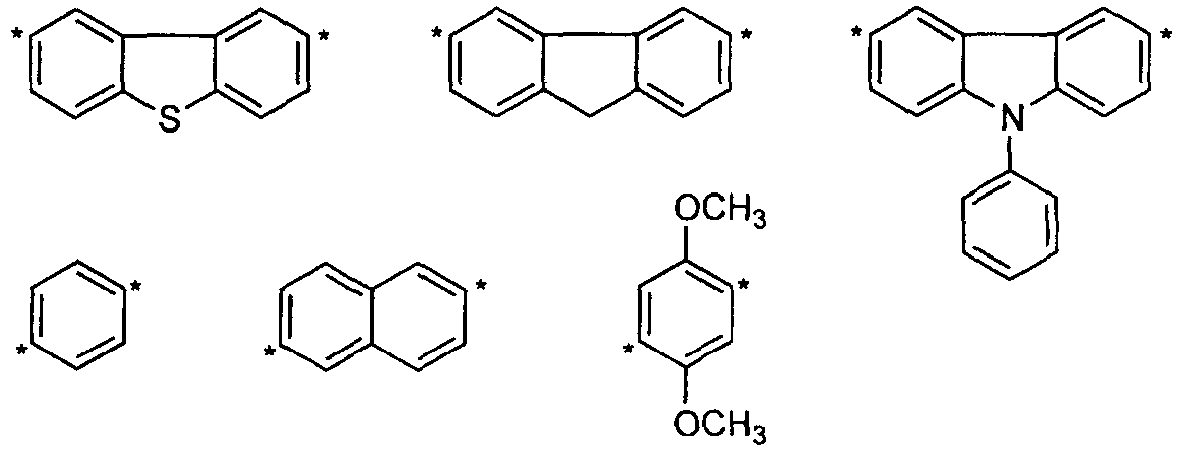
- Among these, in view of achieving high sensitivity, structures shown below are preferred.

- The oxime compound is also preferably a compound represented by the following formula (3):

- Specific examples (C-4) to (C-13) of the oxime compound which is suitably used are illustrated below, but the present invention is not limited thereto.


- The oxime compound has a maximum absorption wavelength in the wavelength region of 350 to 500 nm. An oxime compound having an absorption wavelength in the wavelength region of 360 to 480 nm is preferred, and an oxime compound having high absorbance in 365 or 455 nm is more preferred.
- In view of sensitivity, the molar extinction coefficient at 365 nm or 405 nm of the oxime compound is preferably from 3,000 to 300,000, more preferably from 5,000 to 300,000, still more preferably from 10,000 to 200,000.
- The molar extinction coefficient of the compounds can be measured by a known method but is preferably measured, for example, at a concentration of 0.01 g/L by using an ethyl acetate solvent by means of an ultraviolet-visible spectrophotometer (Carry-5 spectrophotometer, manufactured by Varian Inc.).
- The photopolymerization initiator is more preferably a compound selected from the group consisting of an oxime compound, an acetophenone-based compound and an acylphosphine compound. More specifically, for example, aminoacetophenone-based initiators described in
JP-A-10-291969 4,225,898 JP-A-2001-233842 - As the acetophenone-based initiator, commercial products IRGACURE-907, IRGACURE-369 and IRGACURE-379 (trade names, all produced by BASF Japan) may be used. Also, as the acylphosphine-based initiator, commercial products IRGACURE-819 and DAROCUR-TPO (trade names, both produced by BASF Japan) may be used.
- One kind of a polymerization initiator may be used alone, or two or more kinds of polymerization initiators may be used in combination.
- The content of the polymerization initiator is preferably from 0.01 to 30 mass%, more preferably from 0.1 to 20 mass%, still more preferably from 0.1 to 15 mass%, based on the entire solid content by mass of the polymerizable composition of the present invention. (In this specification, mass ratio is equal to weight ratio.)
- The polymerizable composition of the present invention contains a polymerizable compound. The polymerizable compound used here may be any compound as long as it has, within the molecule, a functional group capable of undergoing a reaction by at least one of acid, radical and heat (in the description of the present invention, such a functional group is sometimes referred to as a "polymerizable group"). A polyfunctional polymerizable compound having a plurality of polymerizable groups within the molecule is preferred.
- Examples of the polymerizable compound having a polymerizable functional group capable of undergoing a reaction by at least one of acid, radical and heat include an ethylenically unsaturated group-containing compound having an ethylenically unsaturated group such as unsaturated ester group, unsaturated amide group, vinyl ether group and allyl group, a methylol compound, a bismaleimide compound, a benzocyclobutene compound, a bisallylnadiimide compound and a benzoxazine compound.
- The polymerizable compound which can be preferably used in the present invention includes general radical polymerizable compounds, and compounds widely known as a compound having an ethylenically unsaturated double bond in this industrial field can be used without any particular limitation.
- These compounds have a chemical form such as a monomer, a prepolymer (that is, a dimer, a trimer or an oligomer) or a mixture or copolymer thereof.
- Examples of the monomer and the copolymer thereof include an unsaturated carboxylic acid (for example, an acrylic acid, a methacrylic acid, an itaconic acid, a crotonic acid, an isocrotonic acid and a maleic acid), its esters and amides, and copolymers thereof. Among these, unsaturated carboxylic acid esters, esters of unsaturated carboxylic acid with aliphatic polyhydric alcohol compound, and amides of unsaturated carboxylic acid with aliphatic polyvalent amine compound are preferably used.
- Above all, an ester of unsaturated carboxylic acid with aliphatic polyhydric alcohol compound can develop high hydrophobicity in the exposed area and is preferred from the standpoint that a pattern having a desired profile is easily formed by alkali development or a pattern having high durability is obtained (this effect is pronounced particularly when higher durability is required of a solder resist as in the case where a metal wiring covered with a solder resist has a high wiring density).
- Other suitable examples include an addition reaction product of unsaturated carboxylic acid esters or amides having a nucleophilic substituent such as hydroxyl group, amino group and mercapto group with monofunctional or polyfunctional isocyanates or epoxies, and a dehydration condensation reaction product with monofunctional or polyfunctional carboxylic acid.
- Furthermore, an addition reaction product of unsaturated carboxylic acid esters or amides having an electrophilic substituent such as isocyanate group and epoxy group with monofunctional or polyfunctional alcohols, amines or thiols, and a substitution reaction product of unsaturated carboxylic acid esters or amides having a leaving substituent such as halogen group and tosyloxy group with monofunctional or polyfunctional alcohols, amines or thiols are also suitable. Alternatively, compounds in which the unsaturated carboxyl acid above is replaced by an unsaturated phosphonic acid, styrene, vinyl ether or the like, may be also used.
- As the unsaturated carboxylic acid ester, a methacrylic acid ester is preferred, and examples thereof include tetramethylene glycol dimethacrylate, triethylene glycol dimethacrylate, neopentyl glycol dimethacrylate, trimethylolpropane trimethacrylate, trimethylolethane trimethacrylate, ethylene glycol dimethacrylate, 1,3-butanediol dimethacrylate, hexanediol dimethacrylate, pentaerythritol dimethacrylate, pentaerythritol trimethacrylate, pentaerythritol tetramethacrylate, dipentaerythritol dimethacrylate, dipentaerythritol hexamethacrylate, sorbitol trimethacrylate, sorbitol tetramethacrylate, bis[p-(3-methacryloxy-2-hydroxypropoxy)phenyl]dimethylmethane, bis-[p-(methacryloxyethoxy)phenyl]dimethylmethane, and EO-modified and PO-modified products thereof.
- As the unsaturated carboxylic acid ester, an itaconic acid ester is also preferred, and examples thereof include ethylene glycol diitaconate, propylene glycol diitaconate, 1,3-butanediol diitaconate, 1,4-butanediol diitaconate, tetramethylene glycol diitaconate, pentaerythritol diitaconate and sorbitol tetraitaconate. Examples of the crotonic acid ester include ethylene glycol dicrotonate, tetramethylene glycol dicrotonate, pentaerythritol dicrotonate and sorbitol tetradicrotonate. Examples of the isocrotonic acid ester include ethylene glycol diisocrotonate, pentaerythritol diisocrotonate and sorbitol tetraisocrotonate. Examples of the maleic acid ester include ethylene glycol dimaleate, triethylene glycol dimaleate, pentaerythritol dimaleate and sorbitol tetramaleate.
- As for specific examples of the ester monomer of an aliphatic polyhydric alcohol compound with an unsaturated carboxylic acid, examples of the acrylic acid ester include ethylene glycol diacrylate, triethylene glycol diacrylate, 1,3-butanediol diacrylate, tetramethylene glycol diacrylate, propylene glycol diacrylate, neopentyl glycol diacrylate, trimethylolpropane triacrylate, trimethylolpropane tri(acryloyloxypropyl)ether, trimethylolethane triacrylate, hexanediol diacrylate, 1,4-cyclohexanediol diacrylate, tetraethylene glycol diacrylate, tricyclodecane dimethanol diacrylate, tricyclodecane dimethanol dimethacrylate, pentaerythritol diacrylate, pentaerythritol triacrylate, pentaerythritol tetraacrylate, dipentaerythritol diacrylate, dipentaerythritol hexaacrylate, sorbitol triacrylate, sorbitol tetraacrylate, sorbitol pentaacrylate, sorbitol hexaacrylate, tri(acryloyloxyethyl)isocyanurate, polyester acrylate oligomer, and EO-modified and PO-modified products thereof.
- Examples of other esters which are suitably used include aliphatic alcohol esters described in
JP-B-51-47334 JP-A-57-196231 JP-A-59-5240 JP-A-59-5241 JP-A-2-226149 JP-A-1-165613 - Specific examples of the amide monomer of an aliphatic polyvalent amine compound with an unsaturated carboxylic acid include methylenebis-acrylamide, methylenebis-methacrylamide, 1,6-hexamethylenebis-acrylamide, 1,6-hexamethylenebis-methacrylamide, diethylenetriaminetrisacrylamide, xylylenebisacrylamide, and xylylenebismethacrylamide. Other preferred examples of the amide-based monomer include the amides having a cyclohexylene structure described in
JP-B-54-21726 - A urethane-based addition-polymerizable compound produced using an addition reaction of an isocyanate with a hydroxyl group is also suitable, and specific examples thereof include a vinyl urethane compound having two or more polymerizable vinyl groups per molecule described in
JP-B-48-41708
CH2=C(R4)COOCH2CH(R5)OH (E)
[wherein each of R4 and R5 independently represents H or CH3]. - Also, urethane acrylates described in
JP-A-51-37193 JP-B-2-32293 JP-B-2-16765 JP-B-58-49860 JP-B-56-17654 JP-B-62-39417 JP-B-62-39418 JP-A-63-277653 JP-A-63-260909 JP-A-1-105238 - Other examples include a polyfunctional acrylate or methacrylate such as polyester acrylates described in
JP-A-48-64183 JP-B-49-43191 JP-B-52-30490 JP-B-46-43946 JP-B-1-40337 JP-B-1-40336 JP-A-2-25493 JP-A-61-22048 - In the present invention, when a radical polymerizable compound is added, in view of curing sensitivity, a polyfunctional polymerizable compound having 2 or more, preferably 3 or more, ethylenically unsaturated bonds is preferably used. Above all, it is preferred to contain 2 or more, more preferably 3 or more, most preferably 4 or more, (meth)acrylic acid ester structures.
- Also, in view of curing sensitivity and developability of the unexposed area, an EO-modified product-containing compound is preferably used, and in view of curing sensitivity and strength of the exposed area, a urethane bond-containing compound is preferably used. Furthermore, from the standpoint of developability at the pattern formation, a compound having an acid group is preferably used.
- From these viewpoints, preferred examples of the polymerizable compound for use in the present invention include bisphenol A diacrylate. EO-modified bisphenol A diacrylate, trimethylolpropane triacrylate, trimethylolpropane tri(acryloyloxypropyl)ether, trimethylolethane triacrylate, tetraethylene glycol diacrylate, pentaerythritol diacrylate, pentaerythritol triacrylate, pentaerythritol tetraacrylate, dipentaerythritol tetraacrylate, dipentaerythritol pentaacrylate, dipentaerythritol hexaacrylate, sorbitol triacrylate, sorbitol tetraacrylate, sorbitol pentaacrylate, sorbitol hexaacrylate, tri(acryloyloxyethyl)isocyanurate, EO-modified pentaerythritol tetraacrylate, and EO-modified dipentaerythritol hexaacrylate. As the commercial product, urethane oligomers UAS-10, UAB-140 (both produced by Sanyo Kokusaku Pulp Co., Ltd.), DPHA-40H (produced by Nippon Kayaku Co., Ltd.), UA-306H, UA-306T, UA-306I, AH-600, T-600 and AI-600 (all produced by Kyoeisha Chemical Co., Ltd.) are preferred.
- Among these, EO-modified bisphenol A diacrylate, pentaerythritol triacrylate, pentaerythritol tetraacrylate, dipentaerythritol pentaacrylate, dipentaerythritol hexaacrylate, tri(acryloyloxyethyl)isocyanurate, EO-modified pentaerythritol tetraacrylate, EO-modified dipentaerythritol hexaacrylate, and commercial products DPHA-40H (produced by Nippon Kayaku Co., Ltd.), UA-306H, UA-306T, UA-306I, AH-600, T-600, and AI-600 (produced by Kyoeisha Chemical Co., Ltd.) are more preferred.
- Acid group-containing ethylenically unsaturated compounds are also suitable, and examples of the commercial product thereof include TO-756 as a carboxyl group-containing trifunctional acrylate and TO-1382 as a carboxyl group-containing pentafunctional acrylate, both produced by Toagosei CO., Ltd.
- In addition, examples of the highly heat-resistant polymerizable compound include benzocyclobutene (BCB), bisallylnadiimide (BANI), benzoxazine, melamine, and analogs thereof.
- Also, two or more kinds of polymerizable compounds may be used.
- The content of the polymerizable compound is preferably from 3 to 80 mass%, more preferably from 5 to 50 mass%, based on the entire solid content by mass of the polymerizable composition of the present invention.
- In this connection, the polymerizable compound may be the same as or different from the alkali-soluble binder.
- More specifically, when the polymerizable compound is a polymer, the polymerizable compound may be the same as or different from the alkali-soluble binder described in detail later (that is, the polymerizable compound may be composed of the same components as those of the alkali-soluble binder). In this embodiment, the content of the polymerizable compound is preferably from 3 to 80 mass%, more preferably from 5 to 60 mass%, based on the entire solid content by mass of the polymerizable composition of the present invention.
- The polymerizable composition of the present invention contains a specific tungsten compound (a compound containing tungsten), namely, a tungsten compound as recited in claim 1.
- The tungsten compound is an infrared-shielding material having high absorption for infrared ray (light at a wavelength of approximately from 800 to 1,200 nm) (that is, the light-blocking effect (light-shielding property) for infrared ray is high) and low absorption for visible light. The polymerizable composition of the present invention contains a tungsten compound as defined in claim 1, so that a pattern having high light-blocking effect in the infrared region and high light transparency in the visible region can be formed.
- Also, the tungsten compound as defined in claim 1 exhibits small absorption also for light shorter than the visible region, which is employed in exposure to high-pressure mercury lamp, KrF, ArF or the like used for image formation. Thanks to the combination of such a tungsten compound with a polymerization initiator, a polymerizable compound, an alkali-soluble binder, an excellent pattern is obtained.
- The tungsten compound is a tungsten oxide-based compound represented by the following formula (I):
MxWyOz (I)
- wherein M represents a metal, W represents tungsten, O represents oxygen,
- 0.001 ≤ x/y ≤ 1.1, and
- 2.2 ≤ z/y ≤ 3.0.
- The metal of M includes an alkali metal, an alkaline earth metal, Mg, Zr, Cr, Mn, Fe, Ru, Co, Rh, Ir, Ni, Pd, Pt, Cu, Ag, Au, Zn, Cd, Al, Ga, In, Tl, Sn, Pb, Ti, Nb, V, Mo, Ta, Re, Be, Hf, Os and Bi and is preferably an alkali metal. The metal of M may be one kind of a metal or two or more kinds of metals.
- M is preferably an alkali metal, more preferably Rb or Cs, still more preferably Cs.
- When x/y is 0.001 or more, infrared ray can be sufficiently cut, and when it is 1.1 or less, production of an impurity phase in the tungsten compound can be more unfailingly avoided.
- When z/y is 2.2 or more, chemical stability as the material can be more enhanced, and when it is 3.0 or less, infrared ray can be sufficiently cut.
- Specific examples of the tungsten oxide-based compound represented by formula (I) include Cs0.33WO3, Rb0.33WO3, K0.33WO3 and Ba0.33WO3. The tungsten oxide-based compound is preferably Cs0.33WO3 or Rb0.33WO3, more preferably Cs0.33WO3.
- The tungsten compound is preferably a fine particle. The average particle diameter of the tungsten fine particle is preferably 800 nm or less, more preferably 400 nm or less, still more preferably 200 nm or less. When the average particle diameter is in such a range, the tungsten fine particle can hardly cut visible light by light scattering and therefore, light transparency in the visible light region can be more successfully ensured. From the standpoint of avoiding light scattering, the average particle diameter is preferably smaller, but for reasons of easy handleability or the like at the production, the average particle diameter of the tungsten fine particle is usually 1 nm or more.
- The content of the tungsten compound is preferably from 3 to 20 mass%, more preferably from 5 to 10 mass%, based on the entire solid content by mass of the polymerizable composition of the present invention.
- Also, two or more kinds of tungsten compounds as specified in claim 1 may be used.
- The tungsten compound may be available as a commercial product, and the tungsten oxide-based compound of formula (I) may be obtained by a method of heat-treating a tungsten compound in an inert gas atmosphere or a reducing gas atmosphere (see, Japanese Patent No.
4,096,205 - The tungsten oxide-based compound of formula (I) is also available, for example, as a dispersion of tungsten fine particle, such as YMF-02 produced by Sumitomo Metal Mining Co., Ltd.
- The polymerizable composition of the present invention contains an alkali-soluble binder (alkali-soluble resin). Thanks to this binder, when the film obtained from the polymerizable composition is exposed to form a pattern, the unexposed area can be removed with an alkali developer and an excellent pattern can be formed by alkali development.
- The alkali-soluble binder is not particularly limited as long as it is soluble in alkali, and the alkali-soluble binder can be appropriately selected according to the purpose. Examples thereof include a (meth)acrylic resin, a urethane-based resin, a polyvinyl alcohol, a polyvinyl butyral, a polyvinyl formal, a polyamide and a polyester, with a (meth)acrylic resin and a urethane-based resin being preferred.
- Above all, from the standpoint that the thermal cycle test resistance (TCT) resistance can be more enhanced, the alkali-soluble binder is more preferably a urethane-based resin.
- The alkali-soluble binder preferably has an acid group.
- The acid group includes, for example, a carboxylic acid group, a sulfonic acid group, a phosphonic acid group, a phosphoric acid group and a sulfonamide group but is preferably a carboxylic acid group in view of availability of raw materials.
- The alkali-soluble binder having an acid group is not particularly limited but is preferably a polymer obtained using an acid group-containing polymerizable compound as a monomer component and in view of adjustment of acid value, more preferably a copolymer obtained by copolymerizing a polymerizable compound having an acid group and a polymerizable compound having no acid group.
- The polymerizable compound having an acid group is not particularly limited and may be appropriately selected according to the purpose. Examples of the acid group include an acrylic acid, a methacrylic acid, an itaconic acid, a crotonic acid, an isocrotonic acid, a maleic acid and a p-carboxylstyrene. Among these, an acrylic acid, a methacrylic acid and a p-carboxylstyrene are preferred. One of these compounds may be used alone, or two or more thereof may be used in combination.
- The polymerizable compound having no acid group is not particularly limited but suitable examples thereof include a (meth)acrylic acid ester (e.g., alkyl ester, aryl ester, aralkyl ester).
- The alkyl group in the alkyl ester moiety of the (meth)acrylic acid ester may be linear or branched and is preferably an alkyl group having a carbon number of 1 to 10, more preferably an alkyl group having a carbon number of 1 to 6.
- The aryl group in the aryl ester moiety of the (meth)acrylic acid ester is preferably an aryl group having a carbon number of 6 to 14, more preferably an aryl group having a carbon number of 6 to 10.
- The aralkyl group in the aralkyl ester moiety of the (meth)acrylic acid ester is preferably an aralkyl group having a carbon number of 7 to 20, more preferably an aralkyl group having a carbon number of 7 to 12.
- The molar ratio between the monomer corresponding to the polymerizable compound having an acid group and the monomer corresponding to the polymerizable compound having no acid group is usually from 1:99 to 99:1, preferably from 30:70 to 99:1, more preferably from 50:50 to 99:1.
- The content of the acid group in the alkali-soluble binder is not particularly limited but is preferably from 0.5 to 4.0 meq/g, more preferably from 0.5 to 3.0 meq/g. When this content is 0.5 meq/g or more, sufficient alkali developability is obtained and an excellent pattern can be more successfully obtained, and when the content above is 4.0 meq/g or less, the risk of impairing the strength of the permanent pattern can be unfailingly avoided.
- The alkali-soluble binder preferably further has a crosslinking group and thanks to this crosslinking group, both curability of the exposed area and alkali developability of the unexposed area can be enhanced in particular. This is also preferred because a pattern with high durability is obtained (this effect is pronounced particularly when higher durability is required of a solder resist as in the case where a metal wiring covered with a solder resist has a high wiring density). Here, the crosslinking group is a group capable of crosslinking the binder polymer in the course of a polymerization reaction occurring in the photosensitive layer when the photosensitive layer obtained from the polymerizable composition is exposed or heated. The crosslinking group is not particularly limited as long as it is a group having such a function, but examples of the functional group capable of undergoing an addition polymerization reaction include an ethylenically unsaturated bond group, an amino group and an epoxy group. The crosslinking group may be also a functional group capable of becoming a radical upon irradiation with light, and examples thereof include a thiol group and a halogen group. Among these, an ethylenically unsaturated bond group is preferred. The ethylenically unsaturated bond group is preferably a styryl group, a (meth)acryloyl group or an allyl and from the standpoint of satisfying both stability of the crosslinking group before exposure and strength of the permanent pattern, more preferably a (meth)acryloyl group.
- In the alkali-soluble binder, for example, a free radical (a polymerization initiating radical or a growing radical in the course of polymerization of the polymerizable compound) is added to the crosslinking functional group to cause addition-polymerization between polymers directly or through a polymerization chain of the polymerizable compound, as a result, crosslinking is formed between polymer molecules to effect curing. Alternatively, an atom (for example, a hydrogen atom on a carbon atom adjacent to the functional crosslinking group) in the polymer is abstracted by a free radical to produce a polymer radical, and polymer radicals combine with each other to form crosslinking between polymer molecules, whereby curing is effected.
- The content of the crosslinking group in the alkali-soluble binder is not particularly limited but is preferably from 0.5 to 3.0 meq/g, more preferably from 1.0 to 3.0 meq/g, still more preferably from 1.5 to 2.8 meq/g. When the content is 0.5 meq/g or more, a sufficient amount of curing reaction results and high sensitivity is obtained, and when it is 3.0 meq/g or less, the polymerizable composition can have high storage stability.
- Here, the content (meq/g) above can be measured, for example, by iodine number titration.
- The alkali-soluble binder having a crosslinking group is described in detail in
JP-A-2003-262958 - The alkali-soluble binder having a crosslinking group is preferably an alkali-soluble binder having an acid group and a crosslinking group, and representative examples thereof are described below.
- (1) A urethane-modified polymerizable double bond-containing acrylic resin, obtained by a reaction of a compound which has at least one (meth)acryloyl group and in which an isocyanate group and an OH group are previously reacted to leave one unreacted isocyanate group, with an acrylic resin having a carboxyl group.
- (2) An unsaturated group-containing acrylic resin obtained by reacting an acrylic resin containing a carboxyl group with a compound having both an epoxy group and a polymerizable double bond in the molecule.
- (3) A polymerizable double bond-containing acrylic resin obtained by reacting an acrylic resin containing an OH group with a dibasic acid anhydride having a polymerizable double bond.
- Among these, the resins of (1) and (2) are preferred.
- Also, examples of the alkali-soluble binder having an acid group and a crosslinking group include a polymer compound having an acidic group and an ethylenically unsaturated bond in the side chain and having a bisphenol A-type structure and a bisphenol F-type structure, a novolak resin having an acidic group and an ethylenically unsaturated bond, and a resol resin. These resins can be obtained by the method described in paragraphs [0008] to [0027] of
JP-A-11-240930 - As described above, the alkali-soluble binder is preferably a (meth)acrylic resin or a urethane-based resin. The "(meth)acrylic resin" is preferably a copolymer having, as a polymerization component, a (meth)acrylic acid derivative such as (meth)acrylic acid, (meth)acrylic acid ester (e.g., alkyl ester, aryl ester, aralkyl ester), (meth)acrylamide and (meth)acrylamide derivative. The "urethane-based resin" is preferably a polymer produced by a condensation reaction between a compound having two or more isocyanate groups and a compound having two or more hydroxyl groups.
- Suitable examples of the (meth)acrylic resin include a copolymer having a repeating unit containing an acid group. Preferred examples of the acid group include those described above. The repeating unit containing an acid group is preferably a repeating unit derived from a (meth)acrylic acid or a repeating unit represented by the following formula (I):

- In formula (I), the linking group represented by R2 is preferably composed of one or more kinds of atoms selected from the group consisting of a hydrogen atom, a carbon atom, an oxygen atom, a nitrogen atom, a sulfur atom and a halogen atom, and the number of atoms constituting the linking group represented by R2 is preferably from 1 to 80. Specific examples of the linking group include an alkylene group and an arylene group, and the linking group may have a structure where a plurality of such divalent groups are connected by any of an amide bond, an ether bond, a urethane bond, a urea bond and an ester bond. R2 is preferably a single bond, an alkylene group, or a structure where a plurality of alkylene groups are connected by at least any one of an amide bond, an ether bond, a urethane bond, a urea bond and ester bond.
- The carbon number of the alkylene group is preferably from 1 to 5, more preferably from 1 to 3.
- The carbon number of the arylene group is preferably from 6 to 14, more preferably from 6 to 10.
- The alkylene group and arylene group may further have a substituent, and such a substituent includes a monovalent nonmetallic atom group excluding a hydrogen atom. Examples thereof include a halogen atom (-F, -Br, -Cl, -I), a hydroxyl group, a cyano group, an alkoxy group, an aryloxy group, a mercapto group, an alkylthio group, an arylthio group, an alkylcarbonyl group, an arylcarbonyl group, a carboxyl group and its conjugate base group, an alkoxycarbonyl group, an aryloxycarbonyl group, a carbamoyl group, an aryl group, an alkenyl group, and an alkynyl group.
- The hydrocarbon group of R3 preferably has a carbon number of 1 to 10, more preferably from 1 to 5, still more preferably from 1 to 3.
- R3 is most preferably a hydrogen atom or a methyl group.
- n is preferably 1 to 3, more preferably 1 or 2, and most preferably 1.
- The ratio (mol%) of the acid group-containing repeating unit occupying in all repeating unit components of the (meth)acrylic resin is, in view of developability, preferably from 10 to 90%, and in consideration of satisfying both developability and strength of the permanent pattern, more preferably from 50 to 85%, still more preferably from 60 to 80%.
- As described above, the (meth)acrylic resin preferably further has a crosslinking group, and specific examples and the content of the crosslinking group are the same as those described above.
- The (meth)acrylic polymer for use in the present invention may contain, in addition to the polymerization unit having an acid group and the polymerization unit having a crosslinking group, a polymerization unit composed of an alkyl or aralkyl (meth)acrylate, a polymerization unit composed of a (meth)acrylamide or its derivative, a polymerization unit composed of an α-hydroxymethyl acrylate, and a polymerization unit composed of a styrene derivative. The alkyl group in the alkyl (meth)acrylate is preferably an alkyl group having a carbon number of 1 to 5 or an alkyl group having a carbon number of 2 to 8 and having the above-described substituent, more preferably a methyl group. Examples of the alkyl (meth)acrylate include benzyl (meth)acrylate. Examples of the (meth)acrylamide derivative include N-isopropylacrylamide, N-phenylmethacrylamide, N-(4-methoxycarbonylphenyl)methacrylamide, N,N-dimethylacrylamide and morpholinoacrylamide. Examples of the α-hydroxymethyl acrylate include ethyl α-hydroxymethyl acrylate and cyclohexyl α-hydroxymethyl acrylate. Examples of the styrene derivative include styrene and 4-tert-butylstyrene.
- The "urethane-based resin" is preferably a urethane-based resin having, as the basic structure, a structural unit represented by a reaction product between at least one diisocyanate compound represented by the following formula (1) and at least one diol compound represented by formula (2).
OCN-X-NCO (1)
HO-L'-OH (2)
- In formulae (1) and (2), each of X and L1 independently represent a divalent organic residue.
- The at least one diol compound represented by formula (2) preferably has an acid group. Thanks to this configuration, an alkali-soluble urethane-based resin having introduced thereinto an acid group can be suitably produced as a reaction product of the diisocyanate compound and the diol compound. According to such a method, an alkali-soluble urethane-based resin can be more easily produced than in the case of substituting and introducing an acid group in the desired side chain after the reaction and production of a urethane-based resin.
- Out of at least one compound of the diisocyanate compound represented by formula (1) and the diol compound represented by formula (2), at least one kind of a compound preferably has a crosslinking group. Examples of the crosslinking group include those described above. Thanks to this configuration, a crosslinking group is introduced as a reaction product of the diisocyanate compound and the diol compound, and an alkali-soluble urethane-based resin can be suitably produced. According to such a method, a crosslinking group-containing urethane-based resin can be more easily produced than in the case of substituting and introducing a crosslinking group in the desired side chain after the reaction and production of a urethane-based resin. (1) Diisocyanate Compound
- In formula (1), X is preferably a divalent aliphatic group, an aromatic hydrocarbon group, or a combination thereof, and the carbon number is preferably from 1 to 20, more preferably from 1 to 15. The divalent aliphatic or aromatic hydrocarbon group may further has a substituent incapable of reacting with an isocyanate group.
- Specific examples of the diisocyanate compound represented by formula (1) include the followings:
an aromatic diisocyanate compound such as 2,4-tolylene diisocyanate, dimerized 2,4-tolylene diisocyanate, 2,6-tolylene diisocyanate, p-xylylene diisocyanate, m-xylylene diisocyanate, 4,4'-diphenylmethane diisocyanate, 1,5-naphthylene diisocyanate and 3,3'-dimethylbiphenyl-4,4'-diisocyanate; an aliphatic diisocyanate compound such as hexamethylene diisocyanate, trimethylhexamethylene diisocyanate, lysine diisocyanate and dimer acid diisocyanate; an alicyclic diisocyanate compound such as isophorone diisocyanate, 4,4'-methylenebis(cyclohexylisocyanate), methylcyclohexane-2,4(or 2,6)-diisocyanate and 1,3-(isocyanatomethyl)cyclohexane; and a diisocyanate compound which are a reaction product of a diol with a diisocyanate, such as adduct of 1 mol of 1,3-butylene glycol and 2 mol of tolylene diisocyanate. - In the case where the diisocyanate compound represented by formula (1) has a crosslinking group, examples of such a diisocyanate compound include a product obtained by addition-reacting a triisocyanate compound and 1 equivalent of a monofunctional alcohol or monofunctional amine compound having a crosslinking group (for example, an ethylenically unsaturated bond group). Specific examples of the triisocyanate compound and the monofunctional alcohol or monofunctional amine compound having a crosslinking group include, but are not limited to, those described in paragraphs [0034], [0035] and [0037] to [0040] of Japanese Patent No.
4,401,262 - Specific examples of the diisocyanate compound having a crosslinking group include, but are not limited to, those described in paragraphs [0042] to [0049] of Japanese Patent No.
4,401,262 - Examples of the diol compound represented by formula (2) widely include a polyether diol compound, a polyester diol compound and a polycarbonate diol compound. The polyether diol compound includes compounds represented by the following formulae (3), (4), (5), (6) and (7), and an ethylene oxide-propylene oxide random copolymer having a hydroxyl group in the terminal.


HO-(CH2CH2CH2CH2O)c-H (5)


- In formulae (3) to (7), R14 represents a hydrogen atom or a methyl group, and X1 represents a group shown below. Each of a, b, c, d, e, f and g represents an integer of 2 or more and is preferably an integer of 2 to 100. Two d's may be the same or different. Also, two X1's may be the same or different.
-CH2CH2-

- Specific examples of the polyether diol compounds represented by formulae (3) and (4) include the followings: that is, diethylene glycol, triethylene glycol, tetraethylene glycol, pentaethylene glycol, hexaethylene glycol, heptaethylene glycol, octaethylene glycol, di-1,2-propylene glycol, tri-1,2-propylene glycol, tetra-1,2-propylene glycol, hexa-1,2-propylene glycol, di-1,3-propylene glycol, tri-1,3-propylene glycol, tetra-1,3-propylene glycol, di-1,3-butylene glycol, tri-1,3-butylene glycol, hexa-1,3-butylene glycol, polyethylene glycol having a weight average molecular weight of 1,000, polyethylene glycol having a weight average molecular weight of 1,500, polyethylene glycol having a weight average molecular weight of 2,000, polyethylene glycol having a weight average molecular weight of 3,000, polyethylene glycol having a weight average molecular weight of 7,500, polypropylene glycol having a weight average molecular weight of 400, polypropylene glycol having a weight average molecular weight of 700, polypropylene glycol having a weight average molecular weight of 1,000, polypropylene glycol having a weight average molecular weight of 2,000, polypropylene glycol having a weight average molecular weight of 3,000, and polypropylene glycol having a weight average molecular weight of 4,000.
- Specific examples of the polyether diol compound represented by formula (5) include the followings: that is, PTMG650, PTMG1000, PTMG2000 and PTMG3000 (trade names), all produced by Sanyo Chemical Industries, Ltd.
- Specific examples of the polyether diol compound represented by formula (6) include the followings: that is, NEWPOL PE-61, NEWPOL PE-62, NEWPOL PE-64, NEWPOL PE-68, NEWPOL PE-71, NEWPOL PE-74, NEWPOL PE-75, NEWPOL PE-78, NEWPOL PE-108, NEWPOL PE-128 and NEWPOL PE-61 (trade names), all produced by Sanyo Chemical Ind., Ltd.
- Specific examples of the polyether diol compound represented by formula (7) include the followings: that is, NEWPOL BPE-20, NEWPOL BPE-20F, NEWPOL BPE-20NK, NEWPOL BPE-20T, NEWPOL BPE-20G, NEWPOL BPE-40, NEWPOL BPE-60, NEWPOL BPE-100, NEWPOL BPE-180, NEWPOL BPE-2P, NEWPOL BPE-23P, NEWPOL BPE-3P and NEWPOL BPE-5P (trade names), all produced by Sanyo Chemical Ind., Ltd.
- Specific examples of the ethylene oxide-propylene oxide random copolymer having a hydroxyl group in the terminal include the followings:
that is, NEWPOL 50HB-100, NEWPOL 50HB-260, NEWPOL 50HB-400, NEWPOL 50HB-660, NEWPOL 50HB-2000 and NEWPOL 50HB-5100 (trade names), all produced by Sanyo Chemical Ind., Ltd.). - The polyester diol compound includes compounds represented by formulae (8) and (9):


- In formulae (8) and (9), each of L2, L3 and L4 represents a divalent aliphatic or aromatic hydrocarbon group, and L5 represents a divalent aliphatic hydrocarbon group. L2, L3 and L5 may be the same as or different from each other. Preferably, each of L2 to L4 represents an alkylene group, an alkenylene group, an alkynylene group or an arylene group, and L5 preferably represents an alkylene group. In L2 to L5, another bond or functional group incapable of reacting with an isocyanate group, such as ether bond, carbonyl bond, ester bond, cyano group, olefin bond, urethane bond, amide group, ureido group and halogen atom, may be present. Each of n1 and n2 represents an integer of 2 or more, preferably an integer of 2 to 100.
- The polycarbonate diol compound includes a compound represented by formula (10):

- In formula (10), L6's may be the same as or different from each other and each represents a divalent aliphatic or aromatic hydrocarbon group. L6 preferably represents an alkylene group, an alkenylene group, an alkynylene group or an arylene group. In L6, another bond or functional group incapable of reacting with an isocyanate group, such as ether bond, carbonyl group, ester bond, cyano group, olefin bond, urethane bond, amide bond, ureido group and halogen atom, may be present. n3 represents an integer of 2 or more, preferably an integer of 2 to 100.
- Specific examples of the diol compounds represented by formulae (8), (9) and (10) are illustrated below (Compound Nos. 1 to 18). In specific examples, n represents an integer of 2 or more.


- For the synthesis of the urethane-based resin, in addition to the diol compound above, a diol compound having a substituent incapable of reacting with an isocyanate group may be also used in combination. Such a diol compound includes, for example, the followings:
HO-L7-O-CO-L8-CO-O-L7-OH (11)
HO-L8-CO-O-L7-OH (12)
- In formulae (11) and (12), L7 and L8 may be the same as or different from each other and each represents a divalent aliphatic hydrocarbon group, an aromatic hydrocarbon group or a heterocyclic group. In L7 and L8, another bond or functional group incapable of reacting with an isocyanate group, such as carbonyl bond, ester bond, urethane bond, amide bond and ureido group, may be present, if desired. Incidentally, L7 and L8 may form a ring.
- The divalent aliphatic hydrocarbon group, aromatic hydrocarbon group and heterocyclic group may have a substituent, and examples of the substituent include an alkyl group, an aralkyl group, an aryl group, an alkoxy group, an aryloxy group, and a halogen atom such as -F, -Cl, -Br and -I.
- At least one kind of a diol compound is preferably a diol compound having an acid group, as the above-described diol compound having a substituent incapable of reacting with an isocyanate group. Specific examples of the acid group include those described above, but the acid group is preferably a carboxylic acid group. The diol compound having a carboxylic acid group includes, for example, compounds represented by the following formulae (13) to (15):


- In formulae (13) to (15), R15 represents a hydrogen atom, an alkyl group, an aralkyl group, an aryl group, an alkoxy group or an aryloxy group, preferably a hydrogen atom, an alkyl group having a carbon number of 1 to 8, or an aryl group having a carbon number of 6 to 15.
- The alkyl group, aralkyl group, aryl group, alkoxy group and aryloxy group may have a substituent, and examples of the substituent include a cyano group, a nitro group, a halogen atom such as -F, -Cl, -Br and -I, -CONH2, -COOR16, -OR16, -NHCONHR16, -NHCOOR16, - NHCOR16, and -OCONHR16 (wherein R16 represents an alkyl group having a carbon number of 1 to 10 or an aralkyl group having a carbon number of 7 to 15).
- L9, L10, and L11 may be the same as or different from each other and each represents a single bond or a divalent aliphatic or aromatic hydrocarbon group, preferably an alkylene group having a carbon number of 1 to 20 or an arylene group having a carbon number of 6 to 15, more preferably an alkylene group having a carbon number of 1 to 8.
- The divalent aliphatic or aromatic hydrocarbon group may have a substituent, and examples of the substituent include an alkyl group, an aralkyl group, an aryl group, an alkoxy group and a halogen atom. If desired, L9 to L11 may have another functional group incapable of reacting with an isocyanate group, for example, a group containing carbonyl, ester, urethane, amide, ureido or ether group. Two or three members out of R15, L7, L8 and L9 may form a ring.
- Ar represents a trivalent aromatic hydrocarbon group which may have a substituent, and preferably represents an aromatic group having a carbon number of 6 to 15.
- Specific examples of the carboxyl group-containing diol compounds represented by formulae (13) to (15) include the followings:
that is, 3,5-dihydroxybenzoic acid, 2,2-bis(hydroxymethyl)propionic acid, 2,2-bis(2-hydroxyethyl)propionic acid, 2,2-bis(3-hydroxypropyl)propionic acid, bis(hydroxymethyl)acetic acid, bis(4-hydroxyphenyl)acetic acid, 2,2-bis(hydroxymethyl)butyric acid, 4,4-bis(4-hydroxyphenyl)pentanoic acid, tartaric acid, N,N-dihydroxyethylglycine, and N,N-bis(2-hydroxyethyl)-3-carboxy-propionamide. - Thanks to the presence of such a carboxyl group, properties such as hydrogen bonding property and alkali solubility can be imparted to the polyurethane resin and this is preferred.
- The binder polymer for use in the present invention is preferably a polyurethane resin having a carboxyl group in an amount of 0.5 to 4.0 meq/g, more preferably from 1.0 to 3.0 meq/g.
- In the case where the diol compound represented by formula (2) has a crosslinking group, a method using an unsaturated group-containing diol compound as a raw material in the production of a polyurethane resin is also suitable. Such a diol compound may be a commercially available product such as trimethylolpropane monoallyl ether or may be a compound easily produced by the reaction of a halogenated diol compound, a triol compound or an aminodiol compound with an unsaturated group-containing carboxylic acid, acid chloride, isocyanate, alcohol, amine, thiol or alkyl halide compound. Specific examples of the diol compound having a crosslinking group include, but are not limited to, compounds described in paragraphs [0057] to [0066] of
Japanese Patent No. 4,401,262 - Compounds illustrated above as Compound Nos. 13 to 17 come under the diol compound represented by formula (8), (9) or (10) and are a diol compound having a crosslinking group.
- In particular, the binder polymer for use in the present invention is preferably a polyurethane resin having a crosslinking group (preferably an ethylenically unsaturated bond group) in an amount of 0.5 meq/g or more, more preferably from 1.0 to 3.0 meq/g.
- For the synthesis of the urethane-based resin, in addition to these diols, a compound obtained by ring-opening a tetracarboxylic acid dianhydride represented by any of the following formulae (16) to (18) with a diol compound may be also used in combination.

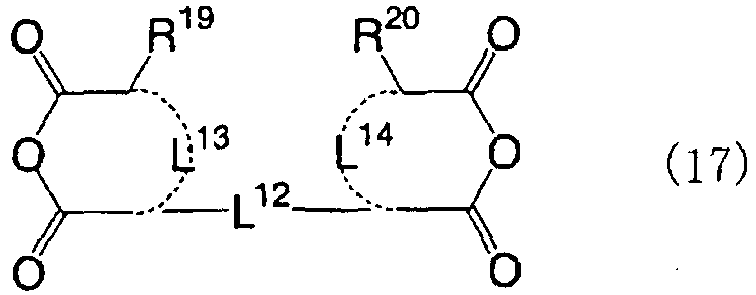

- In the formulae (16) to (18), L12 represents a single bond, a divalent aliphatic or aromatic hydrocarbon group which may have a substituent (preferably, for example, an alkyl group, an aralkyl group, an aryl group, an alkoxy group, a halogeno group, an ester group or an amido group), -CO-, -SO-, -SO2-, -O- or -S-, and preferably represents a single bond, a divalent aliphatic hydrocarbon group having a carbon number of 1 to 15, -CO-, -SO2-, -O- or - S-.
- The divalent aliphatic or aromatic hydrocarbon group may have a substituent, and examples of the substituent include an alkyl group, an aralkyl group, an aryl group, an alkoxy group, a halogen atom, an ester bond-containing group (e.g., alkylcarbonyloxy group, alkyloxycarbonyl group, arylcarbonyloxy group, aryloxycarbonyl group), and an amido group.
- R17 and R18 may be the same as or different from each other and each represents a hydrogen atom, an alkyl group, an aralkyl group, an aryl group, an alkoxy group or a halogeno group, preferably a hydrogen atom, an alkyl group having a carbon number of 1 to 8, an aryl group having a carbon number of 6 to 15, an alkoxy group having a carbon number of 1 to 8 or a halogeno group.
- Two members out of L12, R17 and R18 may combine to form a ring.
- R19 and R20 may be the same as or different from each other and each represents a hydrogen atom, an alkyl group, an aralkyl group, an aryl group or a halogeno group, preferably a hydrogen atom, an alkyl group having a carbon number of 1 to 8 or an aryl group having a carbon number of 6 to 15.
- Two members out of L12, R19 and R20 may combine to form a ring.
- L13 and L14 may be the same as or different from each other and each represents a single bond, a double bond or a divalent aliphatic hydrocarbon group, preferably a single bond, a double bond or a methylene group. A represents a mononuclear or polynuclear aromatic ring, preferably an aromatic ring having a carbon number of 6 to 18.
- The compounds represented by formulae (16), (17) and (18) specifically include the followings: that is, an aromatic tetracarboxylic dianhydride such as pyromellitic dianhydride, 3,3',4,4'-benzophenonetetracarboxylic dianhydride, 3,3',4,4'-diphenyltetracarboxylic dianhydride, 2,3,6,7-naphthalenetetracarboxylic dianhydride, 1,4,5,8-naphthalenetetracarboxylic dianhydride, 4,4'-sulfonyldiphthalic dianhydride, 2,2-bis(3,4-dicarboxyphenyl)propane dianhydride, bis(3,4-dicarboxyphenyl)ether dianhydride, 4,4'-[3,3'-(alkylphosphoryldiphenylene)-bis(iminocarbonyl)]diphthalic dianhydride,
adduct of hydroquinone diacetate and trimellitic anhydride, and adduct of diacetyldiamine and trimellitic anhydride; an alicyclic tetracarboxylic dianhydride such as 5-(2,5-dioxotetrahydrofuryl)-3-methyl-3-cyclohexene-1,2-dicarboxylic anhydride (EPICLON B-4400, produced by Dainippon Ink and Chemicals, Inc.), 1,2,3,4-cyclopentanetetracarboxylic dianhydride, 1,2,4,5-cyclohexanetetracarboxylic dianhydride and tetrahydrofurantetracarboxylic dianhydride; and an aliphatic tetracarboxylic dianhydride such as 1,2,3,4-butanetetracarboxylic dianhydride and 1,2,4,5-pentanetetracarboxylic dianhydride. - Examples of the method for introducing a compound obtained by ring-opening such a tetracarboxylic dianhydride by a diol compound, into the polyurethane resin include the following methods:
- a) a method of reacting a diisocyanate compound with an alcohol-terminated compound obtained by ring-opening the tetracarboxylic dianhydride by a diol compound, and
- b) a method of reacting the tetracarboxylic dianhydride with an alcohol-terminated urethane compound obtained by reacting a diisocyanate compound under diol compound-excess conditions.
- Specific examples of the diol compound used for the ring-opening reaction include the followings:
that is, ethylene glycol, diethylene glycol, triethylene glycol, tetraethylene glycol, propylene glycol, dipropylene glycol, polyethylene glycol, polypropylene glycol, neopentyl glycol, 1,3-butylene glycol, 1,6-hexanediol, 2-butene-1,4-diol, 2,2,4-trimethyl-1,3-pentanediol, 1,4-bis-β-hydroxyethoxycyclohexane, cyclohexanedimethanol, tricyclodecanedimethanol, hydrogenated bisphenol A, hydrogenated bisphenol F, an ethylene oxide adduct of bisphenol A, a propylene oxide adduct of bisphenol A, an ethylene oxide adduct of bisphenol F, a propylene oxide adduct of bisphenol F, an ethylene oxide adduct of hydrogenated bisphenol A, a propylene oxide adduct of hydrogenated bisphenol A, hydroquinone dihydroxyethyl ether, p-xylylene glycol, dihydroxyethylsulfone, bis(2-hydroxyethyl)-2,4-tolylene dicarbamate, 2,4-tolylene-bis(2-hydroxyethylcarbamide), bis(2-hydroxyethyl)-m-xylylene dicarbamate, and bis(2-hydroxyethyl)isophthalate. - The urethane-based resin described above is synthesized by adding the diisocyanate compound and the diol compound together with a known catalyst having an activity according to the reactivity of respective compounds, in an aprotic solvent and heating the solution. The molar ratio (Ma:Mb) between the diisocyanate compound and the diol compound used for the synthesis is preferably from 1:1 to 1.2:1. It is preferred that a reaction product having desired physical properties such as molecular weight and viscosity is treated with alcohols or amines and finally synthesized in the form of containing no residual isocyanate group.
- A urethane-based resin having a crosslinking group (for example, an unsaturated group) in the terminal or main chain of the polymer is also suitably used. By having a crosslinking group in the terminal or main chain of the polymer, the crosslinking reactivity between the polymerizable compound or between urethane-based resins is enhanced, and the strength of the permanent pattern is increased. The unsaturated group used here preferably has a carbon-carbon double bond because a crosslinking reaction readily occurs.
- The method for introducing a crosslinking group into the polymer terminal include the following method. That is, the introduction may be attained by using crosslinking group-containing alcohols, amines or the like in the step of treating the residual isocyanate group in the polymer terminal with alcohols, amines or the like in the above-described process for the synthesis of a polyurethane resin. Specific examples of these compounds include the compounds described above as the crosslinking group-containing monofunctional alcohol or monofunctional amine compound.
- The crosslinking group is easy to control its introduction amount and from the standpoint that the introduction amount can be increased or the crosslinking reaction efficiency is enhanced, the crosslinking group is more preferably introduced into the polymer side chain than into the polymer terminal.
- The method for introducing a crosslinking group into the main chain includes a method where a diol compound having an unsaturated group in the main chain direction is used for the synthesis of the polyurethane resin. Specific examples of the diol compound having an unsaturated group in the main chain direction include the following compounds: that is, cis-2-butene-1,4-diol, trans-2-butene-1,4-diol and polybutadiene diol.
- As the alkali-soluble binder other than the (meth)acrylic resin and urethane-based resin, acetal-modified polyvinyl alcohol-based binder polymers having an acid group described, for example, in European Patent Nos.
993,966 1,204,000 andJP-A-2001-318463 - Among these, a [benzyl (meth)acrylate/(meth)acrylic acid/other addition-polymerizable vinyl monomers, if desired] copolymer and an [allyl (meth)acrylate/(meth)acrylic acid/other addition-polymerizable vinyl monomers, if desired] copolymer are particularly preferred in view of excellent balance among film strength, sensitivity and developability.
- The weight average molecular weight of the binder polymer which can be used in polymerizable composition of the present invention is preferably 3,000 or more, more preferably from 5,000 to 300,000, and most preferably from 10,000 to 30,000, and the number average molecular weight is preferably 1,000 or more, more preferably from 2,000 to 250,000. The polydispersity (weight average molecular weight/number average molecular weight) is preferably 1 or more, more preferably from 1.1 to 10.
- The alkali-soluble binder polymer may be any of a random polymer, a block polymer, a graft polymer and the like.
- The alkali-soluble binder can be synthesized by a conventionally known method. Examples of the solvent used at the synthesis include tetrahydrofuran, ethylene dichloride, cyclohexanone, propylene glycol monomethyl ether, propylene glycol monomethyl ether acetate and butyl acetate. One of these solvents is used alone, or a mixture of two or more thereof is used.
- One kind of an alkali-soluble binder may be used alone, or two or more kinds of alkali-soluble binders may be used in combination.
- The content of the alkali-soluble binder is preferably from 5 to 80 mass%, more preferably from 30 to 60 mass%, based on the entire solid content by mass of the polymerizable composition of the present invention. When the content is in this range, the exposure sensitivity is good, the processing time can be short, and good TCT resistance is obtained.
- The polymerizable composition of the present invention may contain an infrared-shielding material other than the tungsten compound (hereinafter, sometimes referred to as "another infrared-shielding material") within the range not impairing the effects of the present invention. The another infrared-shielding material is preferably a compound having absorption in the range of 800 to 1,200 nm and exhibiting good transparency to light used for exposure. From such a standpoint, the another infrared-shielding material is preferably selected from an infrared absorbing dye and an infrared absorbing inorganic pigment.
- Examples of the infrared absorbing dye include a cyanine dye, a phthalocyanine dye, a naphthalocyanine dye, an immonium dye, an aminium dye, a quinolium dye, a pyrylium dye, and a metal complex dye such as Ni complex dye.
- The dye usable as the infrared-shielding material is also available as a commercial product, and preferred examples thereof include the following commercially available dyes:
- S0345, S0389, S0450, S0253, S0322, S0585, S0402, S0337, S0391, S0094, S0325, S0260, S0229, S0447, S0378, S0306 and S0484, all produced by FEW Chemicals;
- ADS795WS, ADS805WS, ADS819WS, ADS820WS, ADS823WS, ADS830WS, ADS850WS, ADS845MC, ADS870MC, ADS880MC, ADS890MC, ADS920MC, ADS990MC, ADS805PI, ADSW805PP, ADS810CO, ADS813MT, ADS815EI, ADS816EI, ADS818HT, ADS819MT, ADS819MT, ADS821NH, ADS822MT, ADS838MT, ADS840MT, ADS905AM, ADS956BP, ADS1040P, ADS1040T, ADS1045P, ADS1050P, ADS1065A, ADS1065P, ADS1100T and ADS1120F, all by American Dye Source, Inc.;
- YKR-4010, YKR-3030, YKR-3070, MIR-327, MIR-371, SIR-159, PA-1005, MIR-369, MIR-379, SIR-128, PA-1006, YKR-2080, MIR-370, YKR-3040, YKR-3081, SIR-130, MIR-362, YKR-3080, SIR-132 and PA-1001, all produced by Yamamoto Chemical Industry Co., Ltd.; and
- NK-123, NK-124, NK-1144, NK-2204, NK-2268, NK-3027, NKX-113, NKX-1199, NK-2674, NK-3508, NKX-114, NK-2545, NK-3555, NK-3509 and NK-3519, all produced by Hayashibara Biochemical Labs, Inc.
- Among these dyes, in view of heat resistance, a phthalocyanine dye and a metal complex dye are preferred.
- One of these dyes may be used alone, or for the purpose of bringing out good light-blocking effect at 800 to 1,200 nm, two or more dyes selected from these dyes according to the purpose may be mixed and used.
- Examples of the infrared absorbing inorganic pigment usable as the another infrared-blocking material include zinc flower, lead white, lithopone, titanium oxide, chromium oxide, iron oxide, precipitating barium sulfate, barite powder, red lead, iron oxide red, lead yellow, zinc yellow (zinc yellow class 1, zinc yellow class 2), ultramarine blue, Prussia blue (iron/potassium ferrocyanide), zircon grey, praseodymium yellow, chrome-titanium yellow, chrome green, peacock, Victoria green, dark blue (irrelevant to Prussia blue), vanadium-zirconium blue, chrome-tin pink, manganese pink, and salmon pink. Furthermore, examples of the black pigment which can be used include a metal oxide, a metal nitride, or a mixture thereof, containing one metal element or two or more metal elements selected from the group consisting of Co, Cr, Cu, Mn, Ru, Fe, Ni, Sn, Ti and Ag.
- The black pigment is preferably titanium black which is a black pigment containing titanium nitride, because of its good shielding property in the infrared region at a wavelength of 800 to 1,200 nm.
- The titanium black can be obtained by a known method. Also, as the commercially available product, titanium black produced by, for example, Ishihara Sangyo Kaisha, Ltd., Ako Kasei Co., Ltd., JEMCO Inc., Mitsubishi Materials Corp., and Mitsubishi Materials Electronic Chemicals Co., Ltd. may be used.
- The titanium black indicates a black particle having titanium atom and is preferably low-order titanium oxide or titanium oxynitride or the like. As the titanium black particle, a particle whose surface is modified for the purposes of, for example, enhancing the dispersibility or inhibiting aggregation may be used, if desired.
- The surface modification method includes a method of covering the surface with one or more oxides selected from silicon oxide, titanium oxide, germanium oxide, aluminum oxide, magnesium oxide and zirconium oxide. Also, the surface may be treated with a water-repellent substance such as those described in paragraphs [0010] to [0027] of
JP-A-2007- 302836 - Examples of the method for producing titanium black include, but are not limited to, a method of heating and reducing a mixture of titanium dioxide and metal titanium in a reductive atmosphere (see,
JP-A-49-5432 JP-A-57-205322 JP-A-60-65069 JP-A-61-201610 JP-A-61-201610 - The particle diameter of the titanium black particle is not particularly limited but in view of dispersibility and colorability, is preferably from 3 to 2,000 nm, more preferably from 10 to 500 nm.
- The specific surface area of titanium black is not particularly limited but in order to obtain a predetermined water-repellent performance after the surface treatment of titanium black with a water repelling agent, the value measured by the BET method is usually on the order of 5 to 150 m2/g, preferably on the order of 20 to 100 m2/g.
- The particle diameter of the inorganic pigment used as the another infrared-shielding material is, in terms of the average particle diameter, preferably from 3 nm to 0.01 mm, and in view of dispersibility, light-blocking effect and precipitation with aging, the average particle diameter is preferably from 10 nm to 1 µm.
- The polymerizable composition may or may not contain the another infrared-shielding material, but in the case of containing the another infrared-shielding material, the content thereof is preferably from 5 to 75 mass%, more preferably from 10 to 40 mass%, based on the mass of the tungsten compound.
- In the present invention, particularly when the tungsten compound is a tungsten fine particle, the fine particles may be dispersed using a known dispersant for the purpose of enhancing dispersibility and dispersion stability of the tungsten compound in the polymerizable composition.
- The dispersant which can be used in the present invention includes a polymer dispersant (for example, polyamidoamine and salts thereof, polycarboxylic acid and salts thereof, a high-molecular-weight unsaturated acid ester, a modified polyurethane, a modified polyester, a modified poly(meth)acrylate, a (meth)acrylic copolymer, and a naphthalenesulfonic acid-formalin condensate), and a surfactant such as polyoxyethylene alkyl phosphate ester, polyoxyethylene alkylamine and alkanolamine.
- The polymer dispersants can be further classified into a linear polymer, a terminal-modified polymer, a graft polymer, and a block polymer according to their structure.
- Examples of the terminal-modified polymer having an anchor moiety to the surface include polymers having a phosphoric acid group at the terminal described in
JP-A-3-112992 JP-T-2003-533455 JP-A-2002-273191 JP-A-9-77994 JP-A-2008-29901 JP-A-2007-277514 - Examples of the graft polymer having an anchor moiety to the surface include reaction products of a poly(lower alkylene imine) and a polyester described in
JP-A-54-37082 JP-T-8-507960 JP-A-2009-258668 JP-A-9-169821 JP-A-2009-203462 JP-A-10-339949 JP-A-2004-37986 JP-A-2003-238837 JP-A-2008-9426 JP-A-2008-81732 JP-A-2010-106268 - As for the macromonomer used when producing a graft polymer having an anchor moiety to the surface by radical polymerization, a known macromonomer may be used, and examples thereof include MACROMONOMER AA-6 (a polymethyl methacrylate with the terminal group being a methacryloyl group), AS-6 (a polystyrene with the terminal group being a methacryloyl group), AN-6S (a copolymer of an acrylonitrile and a styrene with the terminal group being a methacryloyl group) and AB-6 (a polybutyl acrylate with the terminal group being a methacryloyl group), all produced by Toagosei Ltd.; PLACCEL FM5 (a 5 molar equivalent adduct of ε-caprolactone with 2-hydroxyethyl methacrylate) and FA10L (a 10 molar equivalent adduct of ε-caprolactone with 2-hydroxyethyl acrylate), both produced by Daicel Chemical Industries, Ltd.; and a polyester-based macromonomer described in
JP-A-2-272009 JP-A-2-272009 - As for the block polymer having an anchor moiety to the surface, block polymers described, for example, in
JP-A-2003-49110 JP-A-2009-52010 - The dispersant which can be used may be appropriately selected, for example, from known dispersants and surfactants.
- Specific examples thereof include "Disperbyk-101 (polyamidoamine phosphate), 107 (carboxylic acid ester), 110 (copolymer containing acid group), 130 (polyamide), 161, 162, 163, 164, 165, 166, 170 (high-molecular-weight copolymer)", and "BYK-P104, P105 (high-molecular-weight unsaturated polycarboxylic acid)", all produced by Byk-Chemie; "EFKA 4047, 4050-4010-4165 (polyurethane-based), EFKA 4330-4340 (block copolymer), 4400-4402 (modified polyacrylate), 5010 (polyester amide), 5765 (high-molecular-weight polycarboxylate), 6220 (fatty acid polyester), and 6745 (phthalocyanine derivative)", all produced by EFKA; "Ajispur PB821, PB822, PB880, and PB881" produced by Ajinomoto Fine Techno Co., Inc.; "Flowlen TG-710 (urethane oligomer)" and "Polyflow No. 50E, and No. 300 (acrylic copolymer)", all produced by Kyoeisha Chemical Co., Ltd.; "Disperon KS-860, 873SN, 874, #2150 (aliphatic polyvalent carboxylic acid), #7004 (polyetherester), DA-703-50, DA-705, and DA-725" produced by Kusumoto Chemicals Ltd.; "Demol RN, N (naphthalenesulfonic acid-formalin polycondensate), MS, C, SN-B (aromatic sulfonic acid-formalin polycondensate)", "Homogenol L-18 (high-molecular-weight polycarboxylic acid)", "Emulgen 920, 930, 935, 985 (polyoxyethylene nonylphenyl ether)", and "Acetamine 86 (stearylamine acetate), all produced by Kao Corporation; "Solsperse 5000 (phthalocyanine derivative), 13240 (polyester amine), 3000, 17000, 27000 (polymer having a functional moiety in the end part), 24000, 28000, 32000, 38500 (graft polymer)", all produce by Lubrizol Japan Ltd.; "Nikkol T106 (polyoxyethylene sorbitan monooleate), MYS-IEX (polyoxyethylene monostearate)", both produced by Nikko Chemicals Co., Ltd.; Hinoact T-8000E, produced by Kawaken Fine Chemicals Co., Ltd.; Organosiloxane Polymer KP341, produced by Shin-Etsu Chemical Co., Ltd.; "W001, cationic surfactant", a nonionic surfactant such as polyoxyethylene lauryl ether, polyoxyethylene stearyl ether, polyoxyethylene oleyl ether, polyoxyethylene octyl phenyl ether, polyoxyethylene nonylphenyl ether, polyethylene glycol dilaurate, polyethylene glycol distearate and sorbitan fatty acid esters, and an anionic surfactant such as "W004, W005 and W017", all produced by Yusho Co., Ltd.); "EFKA-46, EFKA-47, EFKA-47EA, EFKA Polymer 100, EFKA Polymer 400, EFKA Polymer 401 and EFKA Polymer 450", all produced by Morishita & Co., Ltd.; a polymer dispersant such as "Disperse Aid 6, Disperse Aid 8, Disperse Aid 15 and Disperse Aid 9100", all produced by San Nopco Ltd.; "Adeka Pluronic L31, F38, L42, L44, L61, L64, F68, L72, P95, F77, P84, F87, P94, L101, P103, F108, L121 and P-123" all produced by ADEKA Corporation; and "IONET (trade name) S-20", produced by Sanyo Chemical Industries, Co., Ltd.
- One of these dispersants may be used alone, or two or more thereof may be used in combination. As for the dispersant of the present invention, the terminal-modified polymer, graft polymer or block polymer having an anchor moiety to the surface of the infrared-shielding material may be also used in combination with an alkali-soluble resin. Examples of the alkali-soluble resin include a (meth)acrylic acid copolymer, an itaconic acid copolymer, a crotonic acid copolymer, a maleic acid copolymer, a partially esterified maleic acid copolymer, an acidic cellulose derivative having a carboxylic acid in the side chain, and a resin obtained by modifying a hydroxyl group-containing polymer with an acid anhydride, and among these, a (meth)acrylic acid copolymer is preferred. Also, N-position substituted maleimide monomer copolymers described in
JP-A-10-300922 JP-A-2004-300204 JP-A-7-319161 - In view of dispersibility, developability and depositability, the following resins described in
JP-A-2010-106268 - Dispersant resins described in
JP-A-2010-106268 - The dispersant is preferably a graft copolymer having a graft chain selected from a polyester structure, a polyether structure and a polyacrylate structure, in which the number of atoms excluding hydrogen atom is from 40 to 10,000, and the graft copolymer preferably contains at least a structural unit represented by any of the following formulae (1) to (5), more preferably contains at least a structural unit represented by any of the following formulae (1A), (2A), (3), (4) and (5).


- In formulae (1) to (5), each of X1, X2, X3, X4, X5 and X6 independently represents a hydrogen atom or a monovalent organic group and, in view of restriction on the synthesis, is preferably a hydrogen atom or an alkyl group having a carbon number of 1 to 12, more preferably a hydrogen atom or a methyl group, still more preferably a methyl group.
- In formulae (3) and (4), R' represents a branched or linear alkylene group (preferably having a carbon number of 1 to 10, more preferably 2 or 3) and in formula (3), is preferably a group represented by -CH2-CH(CH3)- and in formula (4), preferably a group represented by - CH(CH3)-CH2-.
- In formulae (1) to (5), each of Y1, Y2, Y3, Y4 and Y5 independently represents a divalent linking group and is not particularly limited in its structure. Specific examples thereof include linking groups of the following formulae (Y-1) to (Y-20). In the structures below, A and B indicate, respectively, bonds to the left terminal group and the right terminal group in formulae (1) to (5). Among the structures shown below, in view of easy synthesis, (Y-2) and (Y-13) are preferred.


- In formulae (1) to (5), each of Z1, Z2, Z3, Z4 and Z5 independently represents a hydrogen atom or a monovalent substituent, and the structure of the substituent is not particularly limited. Specific examples thereof include an alkyl group, a hydroxyl group, an alkoxy group, an aryloxy group, a heteroaryloxy group, an alkylthioether group, an arylthioether group, a heteroarylthioether group and an amino group. Among these, from the standpoint of enhancing the dispersibility, those having a steric repulsion effect are preferred, and an alkyl group having a carbon number of 5 to 24 is preferred. Above all, a branched alkyl group having a carbon number of 5 to 24 or a cyclic alkyl group having a carbon number of 5 to 24 is preferred.
- In formulae (1) to (5), each of n, m, p, q and r represents an integer of 1 to 500.
- In formulae (1) and (2), each of j and k independently represents an integer of 2 to 8. In view of dispersion stability and developability, each of j and k in formulae (1) and (2) is preferably an integer of 4 to 6, and most preferably 5.
- In formula (5), R represents a hydrogen atom or a monovalent organic group and is not particularly limited in its structure but is preferably a hydrogen atom, an alkyl group, an aryl group or a heteroaryl group, more preferably a hydrogen atom or an alkyl group. When R is an alkyl group, the alkyl group is preferably a linear alkyl group having a carbon number of 1 to 20, a branched alkyl group having a carbon number of 3 to 20, or a cyclic alkyl group having a carbon number of 5 to 20, more preferably a linear alkyl group having a carbon number of 1 to 20, still more preferably a linear alkyl group having a carbon number of 1 to 6.
- As for R in formula (5), two or more R's differing in the structure may be mixed and used in the specific resin.
- In view of dispersion stability and developability, the structural unit represented by formula (1) is preferably a structural unit represented by the following formula (1A).
- Also, in view of dispersion stability and developability, the structural unit represented by formula (2) is preferably a structural unit represented by the following formula (2A).

- In formula (1A), X1, Y1, Z1 and n have the same meanings as X1, Y1, Z1 and n in formula (1), and preferred ranges are also the same.
- In formula (2A), X2, Y2, Z2 and m have the same meanings as X2, Y2, Z2 and m in formula (2), and preferred ranges are also the same.
- Specific examples thereof include compounds illustrated below. In the following compounds, the numerical value put down with each structural unit (the numerical value put down with the repeating unit of the main chain) indicates the content [% by mass, shown as (wt%)] of the structural unit. The numerical value put down with the repeating unit of the side chain indicates the number of repetitions of the repeating unit.


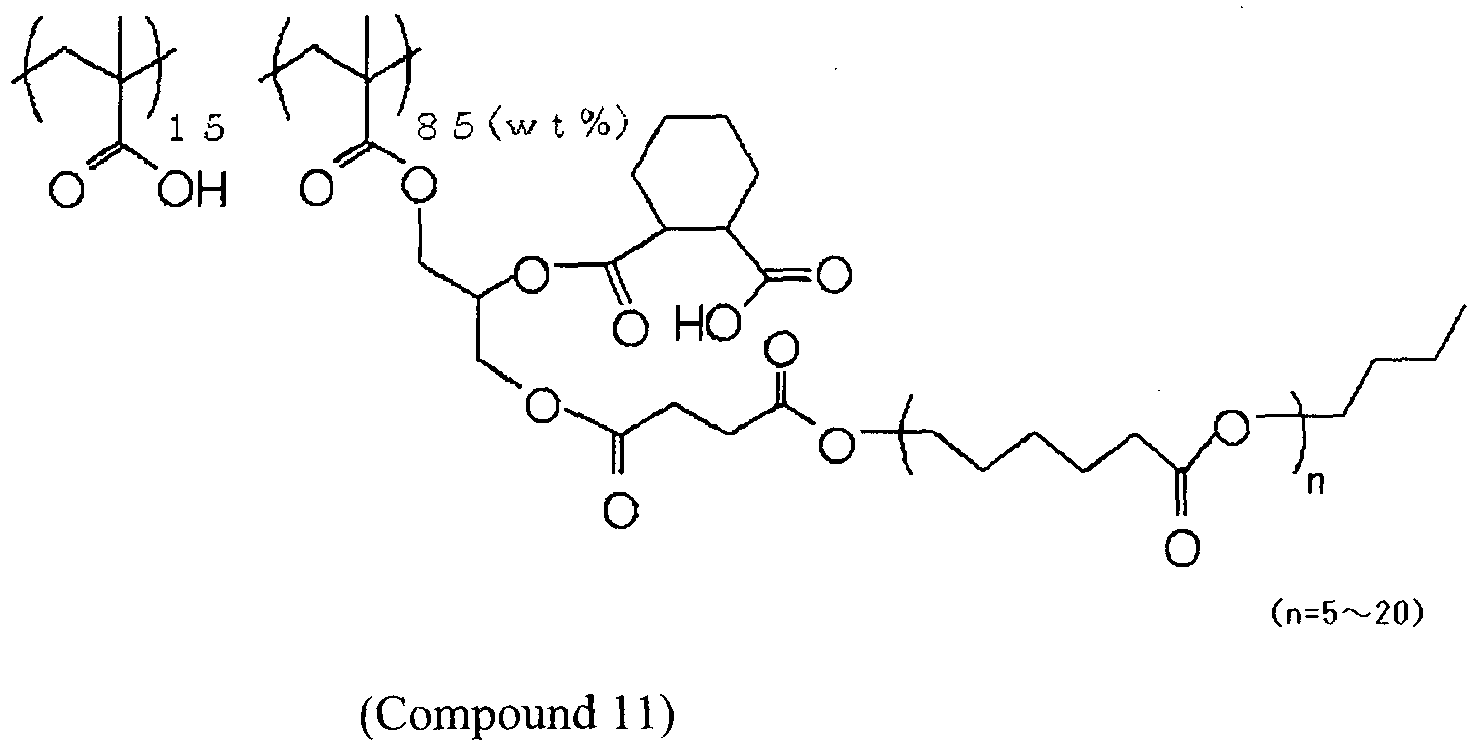


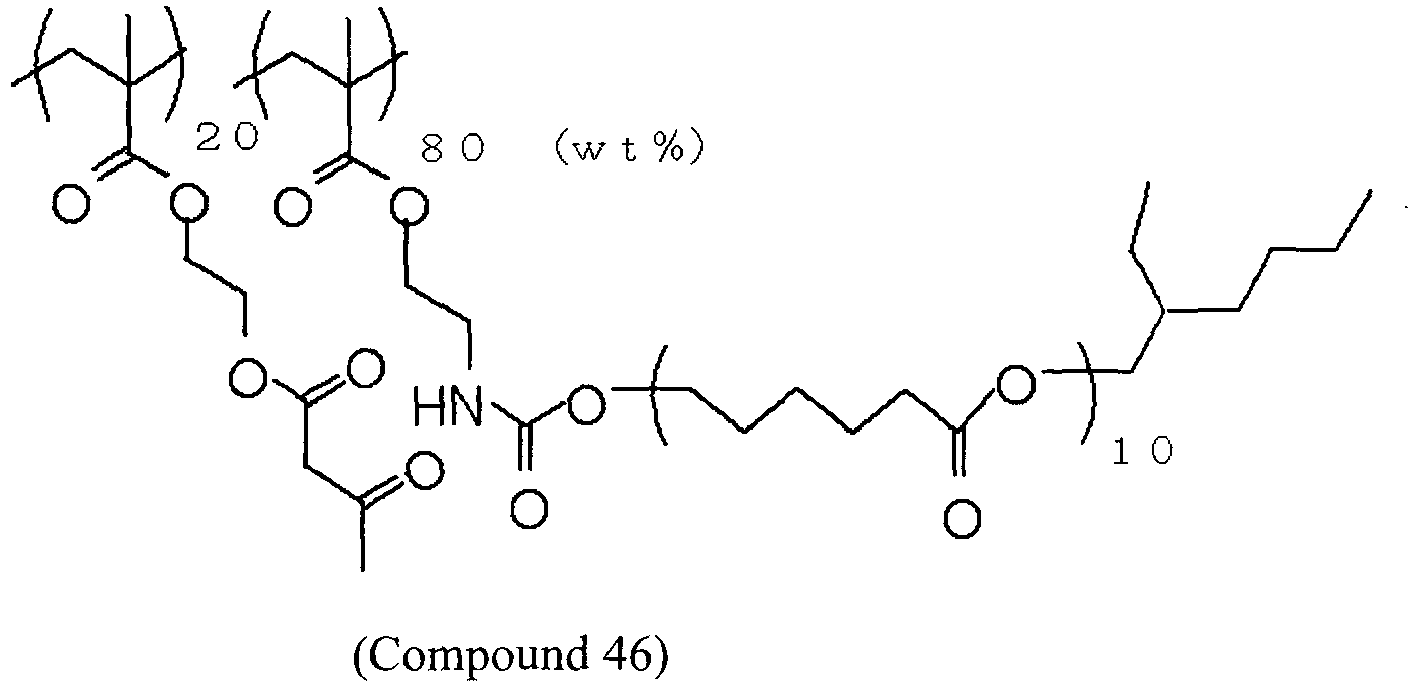


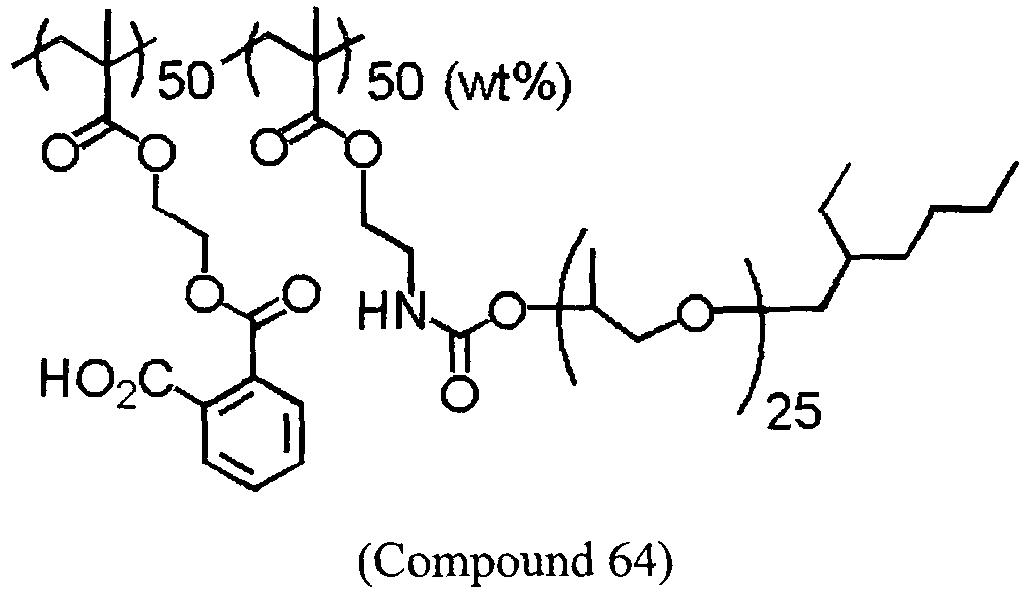


- In the case of using a dispersant, from the standpoint of enhancing the dispersibility, it is preferred to prepare a dispersion composition by using the tungsten compound (and the above-described another infrared-shielding material, if desired), the dispersant and an appropriate solvent and then blend the dispersion composition with the polymerizable composition.
- The polymerizable composition may or may not contain a dispersant, but in the case of containing a dispersant, its content in the dispersion composition is preferably from 1 to 90 mass%, more preferably from 3 to 70 mass%, based on the entire solid content by mass of the tungsten compound in the dispersion composition or in the case of using another infrared-shielding material and using an infrared absorbing inorganic pigment as the another infrared-shielding material, based on the sum of the entire solid content by mass of the tungsten compound and the entire solid content by mass of the infrared absorbing inorganic pigment.
- The polymerizable composition of the present invention may contain a sensitizer for the purpose of enhancing the radical generating efficiency of the polymerization initiator and making the photosensitive wavelength longer. The sensitizer which can be used in the present invention is preferably a compound capable of sensitizing the photopolymerization initiator described above by an electron transfer mechanism or an energy transfer mechanism. The sensitizer which can be used in the present invention includes compounds belonging to the compound groups enumerated below and having an absorption wavelength in the wavelength region of 300 to 450 nm.
- Preferred examples of the sensitizer include compounds belonging to the following compound groups and having an absorption wavelength in the wavelength region of 330 to 450 nm.
- For example, preferred compounds include polynuclear aromatics (e.g., phenanthrene, anthracene, pyrene, perylene, triphenylene, 9,10-dialkoxyanthracene), xanthenes (e.g., fluorescein, eosin, erythrosine, Rhodamine B, rose Bengal), thioxanthones (2,4-diethylthioxanthone, isopropylthioxanthone, diethylthioxanthone, chlorothioxanthone), cyanines (e.g., thiacarbocyanine, oxacarbocyanine), merocyanines (e.g., merocyanine, carbomerocyanine), phthalocyanines, thiazines (e.g., thionine, methylene blue, toluidine blue), acridines (e.g., acridine orange, chloroflavin, acriflavin), anthraquinones (e.g., anthraquinone), squaryliums (e.g., squarylium), acridine orange, coumarins (e.g., 7-diethylamino-4-methylcoumarin), ketocoumarin, phenothiazines, phenazines, styrylbenzenes, azo compounds, diphenylmethane, triphenylmethane, distyrylbenzenes, carbazoles, porphyrin, spiro compounds, quinacridones, indigo, styryl, pyrylium compounds, pyrromethene compounds, pyrazolotriazole compounds, benzothiazole compounds, barbituric acid derivatives, thiobarbituric acid derivatives, acetophenone, benzophenone, thioxanthone, aromatic ketone compounds such as Michler's ketone, and heterocyclic compounds such as N-aryl oxazolidinone.
- Other examples include compounds described in European Patent No.
568,993 U.S. Patent Nos. 4,508,811 and5,227,227 ,JP-A-2001-125255 JP-A-11-271969 - The polymerizable composition may or may not contain a sensitizer, but in the case of containing a sensitizer, the content thereof is preferably from 0.01 to 10 mass%, more preferably from 0.1 to 2 mass%, based on the entire solid content by mass of the polymerizable composition of the present invention.
- The polymerizable composition of the present invention may further contain a crosslinking agent for the purpose of increasing the strength of the permanent pattern.
- As for the crosslinking agent, a compound having a crosslinking group is preferred, and a compound having two or more crosslinking groups is more preferred. Specific preferred examples of the crosslinking group include an oxetane group, a cyanate group and those groups described for the crosslinking group which the alkali-soluble binder may have. Among these, an epoxy group, an oxetane group and a cyanate group are preferred. That is, the crosslinking agent is preferably an epoxy compound, an oxetane compound or a cyanate compound.
- Examples of the epoxy compound which can be suitably used as a crosslinking agent in the present invention include an epoxy compound containing at least two oxirane groups per molecule, and an epoxy compound having an alkyl group at the β-position and containing at least two epoxy groups per molecule.
- Examples of the epoxy compound having at least two oxirane groups per molecule include, but are not limited to, a bixylenol or biphenol-type epoxy compound (such as "YX4000 produced by Japan Epoxy Resins Co., Ltd.") or a mixture thereof, a heterocyclic epoxy compound having an isocyanurate structure or the like (such as "TEPIC produced by Nissan Chemical Industries, Ltd." and "Araldite PT810 produced by BASF Japan"), a bisphenol A-type epoxy compound, a novolak-type epoxy compound, a bisphenol F-type epoxy compound, a hydrogenated bisphenol A-type epoxy compound, a bisphenol S-type epoxy compound, a phenol novolak-type epoxy compound, a cresol novolak-type epoxy compound, a halogenated epoxy compound (such as low brominated epoxy compound, high halogenated epoxy compound and brominated phenol novolak-type epoxy compound), an allyl group-containing bisphenol A-type epoxy compound, a trisphenolmethane-type epoxy compound, a diphenyldimethanol-type epoxy compound, a phenol-biphenylene-type epoxy compound, a dicyclopentadiene-type epoxy compound (such as "HP-7200 and HP-7200H produced by Dainippon Ink and Chemicals, Inc."), a glycidylamine-type epoxy compound (such as diaminodiphenylmethane-type epoxy compound, glycidylaniline and triglycidylaminophenol), a glycidylester-type epoxy compound (such as diglycidyl phthalate, diglycidyl adipate, diglycidyl hexahydrophthalate and diglycidyl dimerate), a hydantoin-type epoxy compound, an alicyclic epoxy compound (such as 3,4-epoxycyclohexylmethyl-3',4'-epoxycyclohexane carboxylate,
bis(3,4-epoxycyclohexylmethyl)adipate, dicyclopentadiene diepoxide, and "GT-300, GT-400 and ZEHPE3150 produced by Daniel Chemical Industries, Ltd."), an imide alicyclic epoxy compound, a trihydroxyphenylmethane-type epoxy compound, a bisphenol A novolak-type epoxy compound, a tetraphenylolethane-type epoxy compound, a glycidyl phthalate compound, a tetraglycidyl xylenoylethane compound, a naphthalene group-containing epoxy compound (such as naphthol aralkyl-type epoxy compound, naphthol novolak-type epoxy compound, tetrafunctional naphthalene-type epoxy compound and, as commercially available products, "ESN-190 and ESN-360 produced by Nippon Steel Chemical Co., Ltd." and "HP-4032, EXA-4750 and EXA-4700 produced by Dainippon Ink and Chemicals, Inc."), a reaction product of epichlorohydrin and a polyphenol compound which is obtained by addition reaction between a phenol compound and a diolefin compound such as divinylbenzene and dicyclopentadiene, a 4-vinylcyclohexene-1-oxide compound subjected to ring-opening polymerization and then epoxidization with peracetic acid or the like, an epoxy compound having a linear phosphorus-containing structure, an epoxy compound having a cyclic phosphorus-containing structure, an α-methylstilbene-type liquid crystal epoxy compound, a dibenzoyloxybenzene-type liquid crystal epoxy compound, an azophenyl-type liquid crystal epoxy compound, an azomethine phenyl-type liquid crystal epoxy compound, a binaphthyl-type liquid crystal epoxy compound, an azine-type epoxy compound, a glycidyl methacrylate copolymer-based epoxy compound (such as "CP-50S and CP-50M produced by NOF Corporation"), a copolymerized epoxy compound of cyclohexylmaleimide and glycidyl methacrylate, a bis(glycidyloxyphenyl)fluorine-type epoxy compound, and a bis(glycidyloxyphenyl)adamantane-type epoxy compound. One of these epoxy resins may be used alone, or two or more thereof may be used in combination. - Other than the epoxy compound containing at least two oxirane groups per molecule, an epoxy compound having an alkyl group at the β-position and containing at least two epoxy groups per molecule may be used. A compound containing an epoxy group substituted with an alkyl group at the β-position (more specifically, a β-alkyl-substituted glycidyl group or the like) is particularly preferred.
- In the epoxy compound having an alkyl group at the β-position and containing at least an epoxy group, all of two or more epoxy groups contained per molecule may be a β-alkyl-substituted glycidyl group, or at least one epoxy group may be a β-alkyl-substituted glycidyl group.
- Examples of the oxetane compound include an oxetane resin having at least two oxetanyl groups per molecule.
- Specific examples thereof include polyfunctional oxetanes such as bis[(3-methyl-3-oxetanylmethoxy)methyl]ether, bis[(3-ethyl-3-oxetanylmethoxy)methyl]ether, 1,4-bis[(3-methyl-3-oxetanylmethoxy)methyl]benzene, 1,4-bis[(3-ethyl-3-oxetanylmethoxy)methyl]benzene, (3-methyl-3-oxetanyl)methyl acrylate, (3-ethyl-3-oxetanyl)methyl acrylate, (3-methyl-3-oxetanyl)methyl methacrylate, (3-ethyl-3-oxetanyl)methyl methacrylate, and oligomers or copolymers thereof; and ether compounds of a compound having an oxetane group and a hydroxyl group-containing compound such as novolak resin, poly(p-hydroxystyrene), cardo-type bisphenols, calixarenes, calixresorcinarenes and silsesquioxane. Other examples include a copolymer of an oxetane ring-containing unsaturated monomer and an alkyl (meth)acrylate.
- Examples of the bismaleimide compound include 4,4'-diphenylmethanebismaleimide, bis-(3-ethyl-5-methyl-4-maleimidophenyl)methane and 2,2'-bis-[4-(4-maleimidophenoxy)phenyl]propane.
- Examples of the cyanate compound include a bis A-type cyanate compound, a bis F-type cyanate compound, a cresol novolak-type cyanate compound and a phenol novolak-type cyanate compound.
- As the crosslinking agent, melamine or a melamine derivative can be used.
- Examples of the melamine derivative include methylolmelamine and an alkylated methylolmelamine (a compound obtained by etherifying a methylol group with methyl, ethyl, butyl or the like).
- One kind of a crosslinking agent may be used alone, or two or more kinds of crosslinking agents may be used in combination. The crosslinking agent is preferably melamine or an alkylated methylolmelamine, more preferably a hexamethylated methylolmelamine, because these have good storage stability and are effective in enhancing the surface hardness of the photosensitive layer or the film strength itself of the cured film.
- The polymerizable composition may or may not contain a crosslinking agent but in the case of containing a crosslinking agent, the content thereof is preferably from 1 to 40 mass%, more preferably from 3 to 20 mass%, based on the entire solid content by mass of the polymerizable composition of the present invention.
- The polymerizable composition of the present invention may further contain a curing accelerator for the purpose of accelerating heat curing of the crosslinking agent such as epoxy compound and oxetane compound above.
- Examples of the curing accelerator which can be used include an amine compound (e.g., dicyandiamide, benzyldimethylamine, 4-(dimethylamino)-N,N-dimethylbenzylamine, 4-methoxy-N,N-dimethylbenzylamine, 4-methyl-N,N-dimethylbenzylamine), a quaternary ammonium salt compound (e.g., triethylbenzylammonium chloride), a block isocyanate compound (e.g., dimethylamine), an imidazole derivative-containing bicyclic amidine compound or salt thereof (e.g., imidazole, 2-methylimidazole, 2-ethylimidazole, 2-ethyl-4-methylimidazole, 2-phenylimidazole, 4-phenylimidazole, 1-cyanoethyl-2-phenylimidazole, 1-(2-cyanoethyl)-2-ethyl-4-methylimidazole), a phosphorus compound (e.g., triphenylphosphine), a guanamine compound (e.g., melamine, guanamine, acetoguanamine, benzoguanamine), and an S-triazine derivative (e.g., 2,4-diamino-6-methacryloyloxyethyl-S-triazine, 2-vinyl-2,4-diamino-S-triazine, 2-vinyl-4,6-diamino-S-triazine·isocyanuric acid adduct, 2,4-diamino-6-methacryloyloxyethyl-S-triazine·isocyanuric acid adduct). One of these compounds may be used alone, or two or more thereof may be used in combination.
- The curing accelerator is preferably melamine or dicyandiamide.
- One kind of a curing accelerator may be used alone, or two or more kinds of curing accelerators may be used in combination.
- The polymerizable composition may or may not contain a curing accelerator, but in the case of containing a curing accelerator, the content thereof is usually from 0.01 to 15 mass% based on the entire solid content of the polymerizable composition.
- The polymerizable composition of the present invention further contains a filler as defined in claim 1. The filler used in the present invention is a spherical silica surface-treated with a silane coupling agent.
- As the polymerizable composition of the present invention contains a filler as defined in claim 1, a pattern with high durability is obtained (this effect is pronounced particularly when higher durability is required of a solder resist as in the case where a metal wiring covered with a solder resist has a high wiring density).
- By virtue of using a spherical silica surface-treated with a silane coupling agent, the polymerizable composition is enhanced in the thermal cycle test resistance and storage stability and, for example, even after passing through a sever atmosphere such as thermal cycle test, the same good profile as that immediately after pattern formation can be maintained.
- The "spherical" in the spherical filler is sufficient if the particle is not in a needle, column or amorphous shape but is rounded, and the particle need not be necessarily "perfectly spherical", but a typical "spherical" shape is a "perfectly spherical" shape.
- Whether the filler is spherical can be confirmed by the observation through a scanning electron microscope (SEM).
- The volume average particle diameter of the primary particle of the filler is not particularly limited and may be appropriately selected according to the purpose but is preferably from 0.05 to 3 µm, more preferably from 0.1 to 1 µm. When the average particle diameter of the primary particle of the filler is in the range above, reduction in the processability due to development of thixotropy is suppressed and the maximum particle diameter is kept from increasing, which is advantageous in that defect generation due to attachment of an extraneous material to the cured film formed or non-uniformity of the coating film is prevented.
- The volume average particle diameter of the primary particle of the filler can be measured by a dynamic light scattering particle diameter distribution analyzer.
- The filler can be dispersed by using the above-described dispersant or binder. As described above, in view of curability, an alkali-soluble binder polymer having a crosslinking group in the side chain is particularly preferred.
- It is preferred that the polymerizable composition of the present invention further contains at least two kinds of fillers having different volume average particle diameters of primary particles.
- The surface treatment of the filler is described below. The surface treatment of the filler is a treatment of covering silica with a silane coupling agent.
- The silane coupling agent used for the surface treatment of the filler is not particularly limited and may be appropriately selected according to the purpose, but at least one functional group selected from an alkoxysilyl group, a chlorosilyl group and an acetoxysilyl group (hereinafter, sometimes referred to as a "first functional group") and at least one functional group selected from a (meth)acryloyl group, an amino group and an epoxy group (hereinafter, sometimes referred to as a "second functional group") are preferred. It is more preferred that the second functional group is a (meth)acryloyl group or an amino group. The second functional group is still more preferably a (meth)acryloyl group. When the second functional group is a (meth)acryloyl group, this is advantageous in view of storage stability and TCT resistance.
- A silane coupling agent described in
JP-B-7-68256 - The silane coupling agent is not particularly limited, but preferred examples thereof include a γ-aminopropyltriethoxysilane, N-(β-aminoethyl)-γ-aminopropyltrimethoxysilane, N-(β-aminoethyl)-γ-aminopropylmethyldimethoxysilane, γ-glycidoxypropyltrimethoxysilane, γ-glycidoxypropylmethyldimethoxysilane, γ-methacryloxypropyltrimethoxysilane, γ-methacryloxypropylmethyldimethoxysilane, α-[[3-trimethoxysilyl)propoxy]methyl]-imidazole-1-ethanol described in
JP-B-7-68256 - The surface treatment of the spherical silica with the silane coupling agent above may be previously performed for only the spherical silica (in this case, hereinafter, the treatment is sometimes referred to as a "pretreatment") or may be formed together with a part or all of other fillers contained in the polymerizable composition.
- The method for performing the treatment is not particularly limited, and examples thereof include a dry method, an aqueous solution method, an organic solvent method and a spraying method. The temperature when performing the pretreatment is not particularly limited but is preferably from ordinary temperature to 200°C.
- At the pretreatment, it is also preferred to add a catalyst. The catalyst is not particularly limited, but examples thereof include an acid, a base, a metal compound and an organic metal compound.
- The amount added of the silane coupling agent when performing the pretreatment is not particularly limited but is preferably from 0.01 to 50 parts by mass, more preferably from 0.05 to 50 parts by mass, per 100 parts by mass of the spherical silica. When the amount added is in this range, a surface treatment sufficient to bring out the effect is attained and at the same time, reduction in the handleability due to aggregation of spherical silica after treatment is suppressed.
- The silane coupling agent has an action of enhancing the adherence between the substrate and the photosensitive layer, because the first functional group reacts with an active group on the substrate surface and spherical silica surface as well as in the binder, and the second functional group further reacts with a carboxyl group and an ethylenically unsaturated group in the binder. On the other hand, the silane coupling agent above has high reactivity and therefore, if the silane coupling agent itself is added to the polymerizable composition, due to its diffusing action, mainly the second functional group is reacted or deactivated during storage, giving rise to short shelf life or pot life.
- However, when a spherical silica which is pretreated with a silane coupling agent as above is used, the diffusing action is suppressed, greatly improving the problem in the shelf life or pot life, and a one-liquid system can be also established. Furthermore, when the pretreatment is applied to the spherical silica, since the conditions such as stirring condition, temperature condition and use of a catalyst can be feely selected, the rate of reaction between the first functional group of the silane coupling agent and the active group in the spherical silica can be significantly increased as compared with the case of adding the spherical silica without performing the pretreatment. In turn, very good results can be obtained particularly in terms of severe characteristics required, such as electroless gold plating, electroless solder plating and humidity resistance load test. Also, by performing the pretreatment, the amount of the silane coupling agent used can be reduced and the shelf life and pot life can be more improved.
- Examples of the spherical silica surface-treated with a silane coupling agent, which can be used in the present invention, include FB and SFP Series of Denki Kagaku Kogyo Kabushiki Kaisha; 1-FX of Tatsumori Ltd.; HSP Series of Toagosei Co., Ltd.; and SP Series of Fuso Chemical Co., Ltd.
- The polymerizable composition contains a filler as defined in claim 1, and although the content of the filler is not particularly limited and may be appropriately selected according to the purpose, the content is preferably from 1 to 60 mass% based on the entire solid content by mass of the polymerizable composition. When the amount added is in this range, a sufficient reduction in the linear expansion coefficient is achieved and the cured film formed is prevented from embrittlement and in turn, can sufficiently exert its function as a protective film of wiring when wiring is formed using a permanent pattern.
- The polymerizable composition of the present invention may further contain an elastomer.
- By virtue of containing an elastomer, when the polymerizable composition is used for a solder resist, the adherence to a conductive layer of a printed wiring board can be more enhanced and at the same time, the cured film can be more increased in the heat resistance, heat shock resistance, flexibility and toughness.
- The elastomer which can be used in the present invention is not particularly limited and may be appropriately selected according to the purpose, and examples thereof include a styrene-based elastomer, an olefin-based elastomer, a urethane-based elastomer, a polyester-based elastomer, a polyamide-based elastomer, an acrylic elastomer and a silicone-based elastomer. Such an elastomer is consists of a hard segment component and a soft segment component, where in general, the former contributes to heat resistance and strength and the latter contributes to flexibility and toughness. Among these elastomers, a polyester-based elastomer is advantageous in view of compatibility with other materials.
- Examples of the styrene-based elastomer include a styrene-butadiene-styrene block copolymer, a styrene-isoprene-styrene block copolymer, a styrene-ethylene-butylene-styrene block copolymer and a styrene-ethylene-propylene-styrene block copolymer. As the component constituting the styrene-based elastomer, other than styrene, a styrene derivative such as α-methylstyrene, 3-methylstyrene, 4-propylstyrene and 4-cyclohexylstyrene can be used. Specific examples thereof include Tufprene, Solprene T, Asaprene T, Tuftec (all produced by Asahi Chemical Industry Co., Ltd.), Elastomer AR (produced by Aronkasei Co., Ltd.), Kraton G, Kaliflex (both produced by Shell Chemicals Japan Ltd.), JSR-TR, TSR-SIS, DYNARON (all produced by Japan Synthetic Rubber Co., Ltd.), Denka STR (produced by Denki Kagaku Kogyo Kabushiki Kaisha), Quintac (produced by ZEON Corp.), TPE-SB Series (produced by Sumitomo Chemical Co., Ltd.), RABALON (produced by Mitsubishi Chemical Corp.), SEPTON, HYBRAR (both produced by Kuraray Co., Ltd.), Sumiflex (produced Sumitomo Bakelite Co., Ltd.), LEOSTOMER and ACTYMER (both produced by Riken Vinyl Industry Co., Ltd.).
- The olefin-based elastomer is a copolymer of an α-olefin having a carbon number of 2 to 20 such as ethylene, propylene, 1-butene, 1-hexene and 4-methyl-pentene, and examples thereof include an ethylene-propylene copolymer (EPR) and an ethylene-propylene-diene copolymer (EPDM). Other examples of the olefin-based elastomer include a copolymer of an α-olefin and a non-conjugated diene having a carbon number of 2 to 20, such as dicyclopentadiene, 1,4-hexadiene, cyclooctadiene, methylene norbornene, ethylidene norbornene, butadiene and isoprene, and an epoxidized polybutadiene. The olefin-based elastomer further includes, for example, a carboxyl-modified NBR obtained by copolymerizing a methacrylic acid with a butadiene-acrylonitrile copolymer. In addition, the olefin-based elastomer includes an ethylene-α-olefin copolymer rubber, an ethylene-α-olefin-non-conjugated diene copolymer rubber, a propylene-α-olefin copolymer rubber, a butene-α-olefin copolymer rubber, and the like.
- Specific examples of the olefin-based elastomer include MILASTOMER (produced by Mitsui Petrochemical Industries, Ltd.), EXACT (produced by Exxon Chemical Corp.), ENGAGE (produced by Dow Chemical Co.), hydrogenated styrene-butadiene rubber "DYNABON HSBR" (produced by Japan Synthetic Rubber Co., Ltd.), butadiene-acrylonitrile copolymers "NBR Series" (produced by Japan Synthetic Rubber Co., Ltd.), crosslinking point-containing butadiene-acrylonitrile copolymer "XER Series" modified with carboxyl group at both terminals (produced by Japan Synthetic Rubber Co., Ltd.), and epoxidized polybutadiene "BF-1000" with polybutadiene being partially epoxidized (produced by Nippon Soda Co., Ltd.).
- The urethane-based elastomer consists of two structural units, that is, a hard segment composed of a low molecular (short chain) diol and a diisocyanate, and a soft segment composed of a polymer (long chain) diol and a diisocyanate. Examples of the polymer (long chain) diol include polypropylene glycol, polytetramethylene oxide, poly(1,4-butylene adipate), poly(ethylene-1,4-butylene adipate), polycaprolactone, poly(1,6-hexylene carbonate) and poly(1,6-hexylene-neopentylene adipate). The number average molecular weight of the polymer (long chain) diol is preferably from 500 to 10,000. Examples of the low molecular (short chain) diol include ethylene glycol, propylene glycol, 1,4-butanediol and bisphenol A. The number average molecular weight of the short chain diol is preferably from 48 to 500. Specific examples of the urethane-based elastomer include PANDEX T-2185, T-2983N (both produced by Dainippon Ink and Chemicals, Inc.), and Silactone E790.
- The polyester-based elastomer is obtained by polycondensing a dicarboxylic acid or a derivative thereof and a diol compound or a derivative thereof. Specific examples of the dicarboxylic acid include an aromatic dicarboxylic acid such as terephthalic acid, isophthalic acid and naphthalenedicarboxylic acid, an aromatic dicarboxylic acid formed by substituting for a hydrogen atom of the aromatic ring of the dicarboxylic acid above with a methyl group, an ethyl group, a phenyl group or the like, an aliphatic dicarboxylic acid having a carbon number of 2 to 20 such as adipic acid, sebacic acid and dodecanedicarboxylic acid, and an alicyclic dicarboxylic acid such as cyclohexanedicarboxylic acid. One of these compounds may be used alone, or two or more thereof may be used. Specific examples of the diol compound include an aliphatic diol and an alicyclic diol, such as ethylene glycol, 1,3-propanediol, 1,4-butanediol, 1,6-hexanediol, 1,10-decanediol and 1,4-cyclohexanediol; bisphenol A; bis-(4-hydroxyphenyl)methane; bis-(4-hydroxy-3-methylphenyl)propane; and resorcin. One of these compounds may be used alone, or two or more thereof may be used. Also, a multi-block copolymer where an aromatic polyester (e.g. polybutylene terephthalate) moiety works as the hard segment component and an aliphatic polyester (e.g. polytetramethylene glycol) moiety works as the soft segment component, may be used. There are polyester elastomers of various grades according to the kind, ratio, molecular weight difference or the like of the hard and soft segments. Specific examples of the polyester-based elastomer include Hytrel (produced by Du Pont-Toray Co., Ltd.), Pelprene (produced by Toyobo Co., Ltd.) and Espel (produced by Hitachi Chemical Co., Ltd.).
- The polyamide-based elastomer consists of a hard segment composed of polyamide and a soft segment composed of polyether or polyester and are roughly classified into two types, that is, a polyether block amide type and a polyether-ester block amide type. Examples of the polyamide include polyamide 6, polyamide 11 and
polyamide 12. Examples of the polyether include polyoxyethylene, polyoxypropylene and polytetramethylene glycol. Specific examples of the polyamide-based elastomer include UBE Polyamide Elastomer (produced by Ube Industries, Ltd.), DAIAMID (produced by Daicel-Huels Ltd.), PEBAX (produced by Toray Industries, Inc.), Grilon ELY (EMS-CHEMIE (Japan) Ltd.), Novamid (produced by Mitsubishi Chemical Corp.), Grilax (produced by Dainippon Ink and Chemicals, Inc.). - The acrylic elastomer is obtained by copolymerizing an acrylic acid ester such as ethyl acrylate, butyl acrylate, methoxyethyl acrylate and ethoxyethyl acrylate, an epoxy group-containing monomer such as glycidyl methacrylate and alkyl glycidyl ether, and/or a vinyl-based monomer such as acrylonitrile and ethylene. Examples of the acrylic elastomer includes an acrylonitrile-butyl acrylate copolymer, an acrylonitrile-butyl acrylate-ethyl acrylate copolymer, and an acrylonitrile-butyl acrylate-glycidyl methacrylate copolymer.
- The silicone-based elastomer is mainly composed of an organopolysiloxane and classified into a polydimethylsiloxane type, a polymethylphenylsiloxane type and a polydiphenylsiloxane type. An organopolysiloxane partially modified with a vinyl group, an alkoxy group or the like may be used. Specific examples of the silicone-based elastomer include KE Series (produced by Shin-Etsu Chemical Co., Ltd.), SE Series, CY Series and SH Series (all produced by Dow Corning Toray Silicone Co., Ltd.).
- Other than these elastomers, a rubber-modified epoxy resin can be used. The rubber-modified epoxy resin can be obtained by modifying a part or all of epoxy groups of, for example, the above-described bisphenol F-type epoxy resin, bisphenol A-type epoxy resin, salicylaldehyde-type epoxy resin, phenol novolak-type epoxy resin or cresol novolak-type epoxy resin, with both-terminal carboxyl group-modified butadiene-acrylonitrile rubber, terminal amino-modified silicone rubber, or the like.
- Among elastomers, in view of shear adherence and heat shock resistance, a both-terminal carboxyl group-modified butadiene-acrylonitrile copolymer, Espel which is a hydroxyl group-containing polyester-based elastomer (Espel 1612 and 1620, produced by Hitachi Chemical Co., Ltd.), and an epoxidized polybutadiene are preferred.
- The polymerizable composition of the present invention may or may not contain an elastomer, but in the case of containing an elastomer, the content thereof based on the entire solid content by mass of the polymerizable composition is not particularly limited and may be appropriately selected according to the purpose but is preferably from 0.5 to 30 mass%, more preferably from 1 to 10 mass%, still more preferably from 3 to 8 mass%, based on the solid content. When the content is in the preferred range above, this is advantageous in that the shear adhesion and heat shock resistance can be more enhanced.
- In the polymerizable composition of the present invention, from the standpoint of more improving the coatability, various surfactants may be added. As the surfactant, various surfactants such as fluorine-containing surfactant, nonionic surfactant, cationic surfactant, anionic surfactant and silicone-containing surfactant may be used.
- In particular, by virtue of containing a fluorine-containing surfactant, the liquid property (particularly fluidity) when the polymerizable composition of the present invention is prepared as a coating solution can be further enhanced and in turn, uniformity of the coating thickness and liquid saving efficiency can be more improved.
- That is, in the case where a film is formed using a coating solution to which the polymerizable composition containing a fluorine-containing surfactant is applied, the interfacial tension between the coated surface and the coating solution is reduced, whereby wettability of the coated surface is improved and coatability on the coated surface is enhanced. Therefore, even when a thin film of about several µm is formed using a smaller amount of solution, film formation with reduced thickness unevenness and uniform thickness can be advantageously performed.
- The fluorine content in the fluorine-containing surfactant is preferably from 3 to 40 mass%, more preferably from 5 to 30 mass%, still more preferably from 7 to 25 mass%. A fluorine-containing surfactant whose fluorine content is in the range above is effective in view of uniformity of the coating film thickness or liquid saving efficiency and also exhibits good solubility in the polymerizable composition.
- Examples of the fluorine-containing surfactant include MEGAFACE F171, MEGAFACE F172, MEGAFACE F173, MEGAFACE F176, MEGAFACE F177, MEGAFACE F141, MEGAFACE F142, MEGAFACE F143, MEGAFACE F144, MEGAFACE R30, MEGAFACE F437, MEGAFACE F475, MEGAFACE F479, MEGAFACE F482, MEGAFACE F554, MEGAFACE F780, MEGAFACE F781 (all produced by DIC Corporation), FLORAD FC430, FLORAD FC431, FLORAD FC171 (all produced by Sumitomo 3M Ltd.), SURFLON S-382, SURFLON SC-101, SURFLON SC-103, SURFLON SC-104, SURFLON SC-105, SURFLON SC-1068, SURFLON SC-381, SURFLON SC-383, SURFLON S-393, SURFLON KH-40 (all produced by Asahi Glass Co., Ltd.), and Solsperse 20000 (produced by Zeneca Co., Ltd.).
- Specific examples of the nonionic surfactant include polyoxyethylene lauryl ether, polyoxyethylene stearyl ether, polyoxyethylene oleyl ether, polyoxyethylene octylphenyl ether, polyoxyethylene nonylphenyl ether, polyethylene glycol dilaurate, polyethylene glycol distearate, and sorbitan fatty acid esters (such as Pluronic L10, L31, L61, L62, 10R5, 17R2 and 25R2, and Tetronic 304, 701, 704, 901, 904 and 150R1, all produced by BASF).
- Specific examples of the cationic surfactant include a phthalocyanine derivative (EFKA-745, trade name, produced by Morishita Sangyo K.K.), Organosiloxane Polymer KP341 (produced by Shin-Etsu Chemical Co., Ltd.), (meth)acrylic acid (co)polymers Polyflow No. 75, No. 90 and No. 95 (produced by Kyoei Chemical Co., Ltd.), and W001 (produced by Yusho Co Ltd.).
- Specific examples of the anionic surfactant include WO04, WO05 and WO17 (produced by Yusho Co Ltd.).
- Examples of the silicone-containing surfactant include "TORAY SILICONE DC3PA", "TORAY SILICONE SH7PA", "TORAY SILICONE DC11PA", "TORAY SILICONE SH21PA", "TORAY SILICONE SH28PA", "TORAY SILICONE SH29PA", "TORAY SILICONE SH30PA" and "TORAY SILICONE SH8400" produced by Dow Corning Toray Silicone Co., Ltd.; "TSF-4440", "TSF-4300", "TSF-4445", "TSF-4460" and "TSF-4452" produced by Momentive Performance Materials Inc.; "KP341", "KF6001" and "KF6002" produced by Shin-Etsu Silicone; and "BYK-323" and "BYK-330" produced by Byk-Chemie.
- One of a surfactant may be used alone, or two or more kinds of surfactants may be combined.
- The polymerizable composition may or may not contain a surfactant, but in the case of containing a surfactant, the content thereof is preferably from 0.001 to 1 mass%, more preferably from 0.01 to 0.1 mass%, based on the entire solid content by mass of the polymerizable composition of the present invention.
- In the polymerizable composition of the present invention may contain, in addition to the above-described essential components and preferred additives, other components may be appropriately selected and used according to the purpose as long as the effects of the present invention are not impaired.
- Examples of other components which can be used in combination include a heat curing accelerator, a thermal polymerization inhibitor, a plasticizer and a coloring agent (coloring pigment or dye). Furthermore, an adherence accelerator to base material surface, and other auxiliary agents (such as electrically conductive particle, filler, defoaming agent, flame retardant, leveling agent, release accelerator, antioxidant, perfume, surface tension adjustor and chain transfer agent) may be used in combination.
- By appropriately incorporating such a component, the properties of the objective solder resist, such as stability, photographic effect and film physical property, can be adjusted.
- Details of the thermal polymerization inhibitor are described are described, for example, in paragraphs [0101] to [0102] of
JP-A-2008-250074 - Details of the plasticizer are described in paragraphs [0103] and [0104] of
JP-A-2008- 250074 - Details of the coloring agent are described are described, for example, in paragraphs [0105] and [0106] of
JP-A-2008-250074 JP-A-2009-205029 - Details of the adherence accelerator are described are described, for example, in paragraphs [0107] to [0109] of
JP-A-2008-250074 - Additives described in these publications all are usable in the polymerizable composition of the present invention.
- In the thus-obtained polymerizable composition, the solid content concentration is preferably from 5 to 90 mass%, more preferably from 20 to 80 mass%, and most preferably from 40 to 60 mass%.
- The usage of the polymerizable composition of the present invention is not particularly limited, but examples thereof include a solder resist, a light-blocking film for the back surface of a silicon substrate in a solid-stage imaging device, and a light-blocking film for a waver level lens, with a solder resist being preferred.
- In the case where the polymerizable composition of the present invention is used for a solder resist, in order to form a coating film having a relatively large thickness, the solid content concentration is preferably from 30 to 80 mass%, more preferably from 35 to 70 mass%, and most preferably from 40 to 60 mass%.
- Also, the viscosity of the polymerizable composition of the present invention is preferably from 1 to 3,000 mPa·s, more preferably from 10 to 2,000 mPa·s, and most preferably from 100 to 1,500 mPa·s.
- In the case where the polymerizable composition of the present invention is used for a solder resist, in view of thick film formability and uniform coatability, the viscosity is preferably from 10 to 3,000 mPa·s, more preferably from 500 to 1,500 mPa·s, and most preferably from 700 to 1,400 mPa·s.
- A photosensitive layer can be formed using the polymerizable composition of the present invention. The photosensitive layer is formed of the polymerizable composition of the present invention and therefore, this photosensitive layer exhibits high light-blocking effect in the infrared region and high light transparency in the visible region and can form a pattern having a desired profile and being excellent in the durability (for example, durability to high temperature and high humidity, and adherence to substrate).
- A permanent pattern can be formed using the polymerizable composition of the present invention. The permanent pattern is obtained by subjecting the photosensitive layer formed of the polymerizable composition of the present invention to exposure and alkali development and thanks to use of the polymerizable composition of the present invention, this pattern exhibits high light-blocking effect in the infrared region and high light transparency in the visible region and has a desired profile as well as excellent durability (for example, durability to high temperature and high humidity, and adherence to substrate)
- The present specification also describes a pattern forming method comprising, in order, a step of forming a photosensitive layer by using the photopolymerizable composition of the present invention, a step of pattern-exposing the photosensitive layer to cure the exposed area, and a step of removing the unexposed area by alkali development to form a permanent pattern.
- The method for forming a permanent pattern is described in detail below by referring to a patterned solder resist formed using the polymerizable composition of the present invention. However, the descriptions relating to the kind and amount used of the solvent for preparation of a coating solution, the coating method of the coating solution, the thickness of the photosensitive layer, and the exposure and other steps are not limited to the solder resist. Here, a case of forming a photosensitive layer (polymerizable composition layer) by using the polymerizable composition is described as an example.
- For forming a patterned solder resist (solder resist pattern), first, a photosensitive layer is formed using the polymerizable composition of the present invention, the photosensitive layer is not particularly limited as long as it is a layer formed of the above-described polymerizable composition. The film thickness, multilayer structure and the like can be appropriate selected according to the purpose.
- The method for forming the photosensitive layer includes a method of dissolving, emulsifying or dispersing the polymerizable composition of the present invention in water or a solvent to prepare a coating solution, applying the coating solution directly, and drying the coating.
- The solvent for the preparation of the coating solution is not particularly limited, and a solvent capable of uniformly dissolving or dispersing each component of the polymerizable composition of the present invention may be appropriately selected according to the purpose. Examples thereof include alcohols such as methanol, ethanol, normal-propanol, isopropanol, normal-butanol, secondary-butanol, and normal-hexanol; ketones such as acetone, methyl ethyl ketone, methyl isobutyl ketone, cyclohexanone, diisobutyl ketone, cyclohexanone and cyclopentanone; esters such as ethyl acetate, butyl acetate, normal-amyl acetate, methyl sulfate, ethyl propionate, dimethyl phthalate, ethyl benzoate, propylene glycol monomethyl ether acetate and methoxypropyl acetate; aromatic hydrocarbons such as toluene, xylene, benzene and ethylbenzene; halogenated hydrocarbons such as carbon tetrachloride, trichloroethylene, chloroform, 1,1,1-trichloroethane, methylene chloride and monochlorobenzene; ethers such as tetrahydrofuran, diethyl ether, ethylene glycol monomethyl ether, ethylene glycol monoethyl ether, 1-methoxy-2-propanol and propylene glycol monomethyl ether; dimethylformamide, dimethylacetoamide, dimethylsulfoxide, and sulfolane. One of these solvents may be used alone, or two or more thereof may be used in combination. Also, a known surfactant may be added.
- The method for applying the coating solution on a support is not particularly limited and may be appropriately selected according to the purpose, and examples thereof include a method of applying the coating solution by using a spin coater, a slit spin coater, a roll coater, a die coater or a curtain coater.
- The drying conditions of the coating film vary depending on respective components, the kind of solvent, the amount used, and the like, but the drying is usually performed at a temperature of 60 to 150°C for 30 seconds to 15 minutes.
- The thickness of the photosensitive layer is not particularly limited and may be appropriately selected according to the purpose but, for example, is preferably from 1 to 100 µm, more preferably from 2 to 50 µm, still more preferably from 4 to 30 µm.
- The method for forming a solder resist permanent pattern by using the polymerizable composition for solder resist of the present invention comprises at least an exposure step and usually further contains a developing step and other steps, where appropriate conditions are selected as needed. Incidentally, the "exposure" of a photosensitive layer formed using the polymerizable composition according to the present invention includes not only exposure to light at various wavelengths but also irradiation with radiation such as electron beam and X-ray.
- The exposure step is a step of exposing the photosensitive layer formed of the polymerizable composition through a mask, and in this step, only the region irradiated with light is cured.
- The exposure is preferably performed by the irradiation with radiation, and as the radiation usable at the exposure, electron beam, KrF, ArF, ultraviolet light such as g-line, h-line and i-line, or visible light is preferably used. In particular, KrF, g-line, h-line and i-line are preferred.
- Examples of the exposure system include stepper exposure and exposure to a high-pressure mercury lamp.
- The exposure dose is preferably from 5 to 3,000 mJ/cm2, more preferably from 10 to 2,000 mJ/cm2, and most preferably from 50 to 1,000 mJ/cm2.
- Other steps are not particularly limited and can be appropriately selected according to the purpose. Examples thereof include a substrate surface treating step, a developing step, a curing treatment step and a post-exposure step.
- Subsequent to the exposure step, an alkali development processing (developing step) is performed to dissolve out the area not irradiated with light in the exposure step, whereby only the photocured area is allowed to remain and a patterned solder resist having light-blocking effect is formed.
- As the developer, an organic alkali developer causing no damage on the underlying circuit is preferred. The development temperature is usually from 20 to 40°C, and the development time is from 10 to 180 seconds.
- As the alkali used for the developer, for example, an aqueous alkaline solution obtained by diluting an organic alkaline compound such as aqueous ammonia, ethylamine, diethylamine, dimethylethanolamine, tetramethylammonium hydroxide, tetraethylammonium hydroxide, choline, pyrrole, piperidine and 1,8-diazabicyclo-[5,4,0]-7-undecene, with pure water to have a concentration of generally from 0.001 to 10 mass%, preferably from 0.01 to 1 mass%, is used. Incidentally, when a developer composed of such an aqueous alkaline solution is used, washing (rinsing) with pure water is generally performed after the development.
- The curing treatment step is a step of, if desired, applying a curing treatment to the photosensitive layer in the formed pattern, after the developing step. By performing this treatment, the mechanical strength of the permanent pattern is enhanced.
- The curing treatment step is not particularly limited and may be appropriately selected according to the purpose, and suitable examples thereof include an entire surface exposing treatment and an entire surface heating treatment.
- Examples of the method for the entire surface exposing treatment include a method where the entire surface of the laminate having formed therein the patterned photosensitive layer is exposed after the developing step. Thanks to entire surface exposure, curing of polymerization components in the polymerizable composition forming the photosensitive layer is accelerated and curing of the permanent pattern further proceeds, whereby the mechanical strength and durability are improved.
- The apparatus for performing the entire surface exposure is not particularly limited and may be appropriately selected according to the purpose, but preferred examples thereof include a UV exposing machine such as ultrahigh-pressure mercury lamp.
- Also, the method for the entire surface heating treatment includes a method where the entire surface of the laminate having formed therein the patterned photosensitive layer is heated after the developing step. Thanks to the entire surface heating, the film strength of the pattern is enhanced.
- The heating temperature at the entire surface heating is preferably from 120 to 250°C, more preferably from 120 to 250°C. When the heating temperature is 120°C or more, the film strength is increased by the heat treatment, and when the heating temperature is 250°C or less, the resin in the polymerizable composition can be prevented from decomposing to weaken and embrittle the film quality.
- The heating time in the entire surface heating is preferably from 3 to 180 minutes, more preferably from 5 to 120 minutes.
- The apparatus for performing the entire surface heating is not particularly limited and may be appropriately selected from conventional apparatuses according to the purpose, and examples thereof include a dry oven, a hot plate and an IR heater.
- The thus-formed patterned resist has excellent infrared-shielding property and therefore, its application range is wide. The polymerizable composition of the present invention is excellent in the light-shielding property in the infrared region and light transparency in the ultraviolet to visible regions, enabling formation of a pattern having an excellent profile, and the formed pattern (cured film) exhibits excellent infrared-shielding property. Therefore, the polymerizable composition is useful in forming a solder resist for a device with a photodiode having sensitivity even to the infrared region, particularly, a solid-state imaging device.
- As described above, the polymerizable composition of the present invention is useful in forming not only a solder resist but also a light-blocking film for the back surface of a silicon substrate in a solid-state imaging device or a light-blocking film for a wafer-level lens.
- A solid-state imaging device having a permanent pattern can be formed of the polymerizable composition of the present invention.
- The solid-state imaging device is described below by referring to
Figs. 1 and2 . - Incidentally, portions common between
Fig. 1 andFig. 2 are indicated by a common reference numeral or sign. - Also, in the description, the "top", "above" and "upper side" indicate a side farther from the
silicon substrate 10, and "bottom", "below" and "lower side" indicate a side closer to thesilicon substrate 10. -
Fig. 1 is a schematic cross-sectional view showing a configuration of a camera module equipped with a solid-state imaging device according to a specific example of the device described above. - A
camera module 200 shown inFig. 1 is connected to acircuit substrate 70 as a mounting substrate through asolder ball 60 as a connection member. - More specifically, the
camera module 200 is configured to comprise a solid-stateimaging device substrate 100 having an image-forming device part on a first major surface of a silicon substrate, a glass substrate 30 (light-transmitting substrate) disposed on the upper side of the first major surface of the solid-stateimaging device substrate 100, aninfrared cut filter 42 disposed above theglass substrate 30, alens holder 50 having animaging lens 40 and being disposed above theglass substrate 30 and theinfrared cut filter 42, and a light-blocking andelectromagnetic shield 44 disposed to surround the periphery of the solid-stateimaging device substrate 100 and theglass substrate 30. Respective members are adhered usingadhesives - In the
camera module 200, incident light hv from the outside sequentially passes through theimaging lens 40, theinfrared cut filter 42 and theglass substrate 30 and reaches the imaging device part of the solid-stateimaging device substrate 100. - Also, the
camera module 200 is connected to acircuit board 70 through a solder ball 60 (connection material) on the second major surface side of the solid-stateimaging device substrate 100. -
Fig. 2 is an enlarged cross-sectional view of the solid-stateimaging device substrate 100 inFig. 1 . - The solid-state
imaging device substrate 100 is configured to comprise asilicon substrate 10 as a base body, animaging device 12, aninterlayer insulating film 13, abase layer 14, ared color filter 15R, agreen color filter 15G, ablue color filter 15B, anovercoat 16, amicrolens 17, a light-blockingfilm 18, an insulatingfilm 22, ametal electrode 23, a solder resistlayer 24, aninternal electrode 26, and adevice surface electrode 27. - The solder resist
layer 24 may be omitted. - First, the configuration on the first major surface side of the solid-state
imaging device substrate 100 is mainly described below. - As shown in
Fig. 2 , an imaging device part where a plurality ofimaging devices 12 such as CCD and CMOS are two-dimensionally arrayed is provided on the first major surface side of asilicon substrate 10 which is the base body of the solid-stateimaging device substrate 100. - An interlayer insulating
film 13 is formed on theimaging device 12 in the imaging device part, and abase layer 14 is formed on theinterlayer insulating film 13. Furthermore, ared color filter 15R, agreen color filter 15G and ablue color filter 15B (hereinafter, these are sometimes collectively referred to as a "color filter 15") corresponding torespective imaging devices 12 are disposed on thebase layer 14. - A light-blocking film not shown may be provided in the boundaries of the
red color filter 15R, thegreen color filter 15G and theblue color filter 15B and in the periphery of the imaging device part. This light-blocking film can be produced, for example, using a known black color resist. - An
overcoat 16 is formed on the color filter 15, and amicrolens 17 corresponding to the imaging device 12 (color filter 15) is formed on theovercoat 16. - In the periphery of the imaging device on the first major surface side, a peripheral circuit (not shown) and an
internal electrode 26 are provided, and theinternal electrode 26 is electrically connected to theimaging device 12 through the peripheral circuit. - Furthermore, a
device surface electrode 27 is formed on theinternal electrode 26 through aninterlayer insulating film 13. In theinterlayer insulating film 13 between theinternal electrode 26 and thedevice surface electrode 27, a contact plug (not shown) for electrically connecting these electrode is formed. Thedevice surface electrode 27 is used for voltage application and signal reading though the contact plug and theinternal electrode 26. - A
base layer 14 is formed on thedevice surface electrode 27, and anovercoat 16 is formed on thebase layer 14. Thebase layer 14 and theovercoat 16 formed on thedevice surface electrode 27 are opened to form a pad opening and expose a part of thedevice surface electrode 27. - This is the configuration on the first major side of the solid-state
imaging device substrate 100. - On the first major side of the solid-state
imaging device substrate 100, an adhesive 20 is provided in the periphery of the imaging device part, and the solid-stateimaging device substrate 100 and theglass substrate 30 are adhered through the adhesive 20. - The
silicon substrate 10 has a through-hole penetrating thesilicon substrate 10, and a penetrating electrode defining a part of themetal electrode 23 is provided in the through-hole. The imaging device part and thecircuit board 70 are electrically connected by the penetrating electrode. - The configuration on the second major surface side of the solid-state
imaging device substrate 100 is mainly described below. - On the second major surface side, an insulating
film 22 is formed from the second major surface to the inner wall of the through-hole. - On the insulating
film 22, ametal electrode 23 patterned to extend from the region on the second major surface of thesilicon substrate 10 to the inside of the through hole is provided. Themetal electrode 23 is an electrode for connecting the imaging device part in the solid-stateimaging device substrate 100 and thecircuit board 70. - The penetrating electrode is the portion formed inside the through hole, out of the
metal electrode 23. The penetrating electrode penetrates thesilicon substrate 10 and a part of the interlayer insulating film and reaches the lower side of theinternal electrode 26 to be electrically connected to theinternal electrode 26. - Also, on the second major surface side, a solder resist layer 24 (protective insulating film) covering the second major surface on which the
metal electrode 23 is formed, and having an opening to expose a part of themetal electrode 23 is provided. - Furthermore, on the second major surface side, a light-blocking
film 18 covering the second major surface on which the solder resistlayer 24 is formed, and having an opening to expose a part of themetal electrode 23 is provided. - In this configuration, (1) a light-blocking solder resist layer where the light-blocking
layer 18 and the solder resistlayer 24 together define a single layer may be formed from the polymerizable composition of the present invention, or (2) the light-blockingfilm 18 and the solder resistlayer 24 are separate layers and the light-blockingfilm 18 may be formed from the polymerizable composition of the present invention (in this case, the solder resist layer may be formed using a known solder resist composition). - In
Fig. 2 , the light-blockingfilm 18 is patterned to cover a part of themetal electrode 23 and expose the remaining portion but may be patterned to expose the entirety of the metal electrode 23 (the same applies to the patterning of the solder resist layer 24). - Also, the solder resist
layer 24 may be omitted and a light-blockingfilm 18 may be formed directly on the second major surface where themetal electrode 23 is formed. - A
solder ball 60 as a connection member is provided on the exposedmetal electrode 23, and themetal electrode 23 of the solid-stateimaging device substrate 100 and a connection electrode not shown of thecircuit board 70 are electrically connected through thesolder ball 60. - The configuration of the solid-state
imaging device substrate 100 is described above, and each part other than the light-blockingfilm 18 of the solid-stateimaging device substrate 100 can be formed by a known method such as method described in paragraphs 0033 to 0068 ofJP-A-2009-158863 JP-A-2009-99591 - The light-blocking
film 18 can be formed by the above-described production method for the light-blocking film. - The
interlayer insulating film 13 is formed as an SiO2 film or an SiN film, for example, by sputtering or CVD (chemical vapor deposition). - The color filter 15 is formed, for example, by photolithography using a known color resist.
- The
overcoat 16 and thebase layer 14 are formed, for example, by photolithography using a known resist for formation of an organic interlayer film. - The
microlens 17 is formed, for example, by photolithography using a styrene-based resin or the like. - In the case where the solder resist
layer 24 and the light-blockingfilm 18 are combined to form a single-layer light-blocking solder resist layer, the layer is preferably formed using the polymerizable composition of the present invention. - On the other hand, when the solder resist
layer 24 is a separate layer from the light-blockingfilm 18, the solder resistlayer 24 is preferably formed, for example, by photolithography using a known solder resist containing a phenolic resin, a polyimide-based resin or an amine-based resin. - The
solder ball 60 is formed, for example, as Sn-Pb (eutectic), 95Pb-Sn (high-lead high melting point solder) or Pb-free solder by using Sn-Ag, Sn-Cu, Sn-Ag-Cu or the like. Thesolder ball 60 is formed, for example, as a sphere having a diameter of 100 to 1,000 µm (preferably a diameter of 150 to 700 µm). - The
internal electrode 26 and thedevice surface electrode 27 are formed, for example, as a metal electrode such as Cu by CMP (chemical mechanical polishing), photolithography or etching. - The
metal electrode 23 is formed, for example, as a metal electrode such as Cu, Au, Al, Ni, W, Pt, Mo, Cu compound, W compound or Mo compound by sputtering, photolithography, etching or electrolytic plating. Themetal electrode 23 may have a sing-layer configuration or a multilayer configuration consisting of two or more layers. - The film thickness of the
metal electrode 23 is, for example, from 0.1 to 20 µm (preferably from 0.1 to 10 µm). Thesilicon substrate 10 is not particularly limited, but a silicon substrate thinned by grinding the back surface of the substrate may be used. The thickness of the substrate is not limited, but a silicon wafer having a thickness of 20 to 200 µm (preferably from 30 to 150 µm) is used. - The through-hole of the
silicon substrate 10 is formed, for example, by photolithography or RIE (reactive ion etching). - In the foregoing pages, the solid-state
imaging device substrate 100 as a specific example of the embodiment above is described by referring toFigs. 1 and2 , but the embodiment above is not limited to the configuration mode ofFigs. 1 and2 , and the configuration of the device substrate is not particularly limited as long as it is a configuration having a metal electrode and a light-blocking film on the back surface side. - An example where the permanent pattern obtained using the polymerizable composition of the present invention is applied to the light-blocking film of a wafer-level lens is described below by referring to the drawings.
-
Fig. 7 is a plan view showing one example of the wafer-level lens array having a plurality of wafer-level lenses. - As shown in
Fig. 7 , the wafer-level lens array comprises asubstrate 410 andlenses 412 arrayed on thesubstrate 410. InFig. 7 , a plurality oflenses 412 are two-dimensionally arrayed with respect to thesubstrate 410 but may be one-dimensionally arrayed. -
Fig. 8 is a cross-sectional view along the line A-A inFig. 7 . - As shown in
Fig. 8 , in the wafer-level lens array, a light-blockingfilm 414 for preventing light permeation from portions other than thelens 412 is provided between the plurality oflenses 412 arrayed on thesubstrate 410. - The wafer-level lens is composed of one
lens 412 present on thesubstrate 410 and the light-blockingfilm 414 provided in the circumferential edge part of the lens. The polymerizable composition of the present invention is used for the formation of the light-blockingfilm 414. - The configuration of a wafer-level lens array where a plurality of
lenses 412 are two-dimensionally arrayed with respect to asubstrate 410 as shown inFig. 7 is described below as an example. - The
lens 412 is generally composed of the same material as thesubstrate 410 and is a lens integrally molded on thesubstrate 410 or a lens molded as a separate structure and fixed on the substrate. Here, one example is described above, but the wafer-level lens is not limited to this and may for example, have a multilayer structure or be a lens module separated by dicing. - Examples of the material for forming the
lens 412 include glass. There are extensive types of glass, and since glass having a high refractive index can be selected, the glass is suitable as a material for a lens intended to have a large power. Also, the glass is excellent in the heat resistance and advantageously can withstand the reflow mounting in an imaging unit or the like. - Other examples of the material for forming the
lens 412 include a resin. The resin is excellent in the processability and suitable to simply and inexpensively form a lens face by using a mold or the like. - In this case, an energy-curable resin is preferably used for the formation of the
lens 412. The energy-curable resin may be either a resin that is cured by heat, or a resin that is cured by irradiation with an actinic energy ray (for example, irradiation with heat, ultraviolet ray or electron beam). - As for such an energy-curable resin, all of known resins may be used, but in consideration of reflow mounting in an imaging unit, a resin having a relatively high softening point, for example, a softening point of 200°C or more, is preferred, and a resin having a softening point of 250°C or more is more preferred.
- With respect to the mode and production of a wafer-level lens, the production method of a wafer-level lens array is specifically described as an example by referring to
Figs. 9 to 14 . - First, the method for forming a
lens 412 on asubstrate 410 is described by referring toFig. 9 andFigs. 10A to 10C . -
Fig. 9 is a view showing how a molding material (denoted by M inFig. 9 ) as a resin composition for lens formation is supplied to thesubstrate 410. -
Figs. 10A to 10C are views showing the procedure of forming alens 412 on thesubstrate 410 by amold 460. - As shown in
Fig. 9 , a molding material M is dropped on a lens 412-forming site of thesubstrate 410 by using adispenser 450. Here, a molding material M in an amount corresponding to onelens 412 is supplied to one site to be supplied with the material. - After supplying the molding material M to the
substrate 410, as shown inFig. 10A , amold 460 for forming thelens 412 is disposed on the molding material M-supplied side of thesubstrate 410. - In the
mold 460,concaves 462 for transferring thelens 412 shape are provided according to the desired number oflenses 412. - As shown in
Fig. 10B , themold 460 is pressed to the molding material M on thesubstrate 410 and thereby, the molding material M is deformed to follow the concave 462 shape. In the state of themold 460 being pressed to the molding material M, in the case where the molding material M is a heat-curable resin or an ultraviolet-curable resin, themold 460 is externally irradiated with heat or ultraviolet ray to cure the molding material M. - After curing the molding material M, as shown in
Fig. 10C , thesubstrate 410 and thelens 412 are separated from themold 460. - The method for forming a light-blocking
film 414 in the circumferential edge part of thelens 412 is described below by referring toFigs. 11A to 11C . -
Figs. 11A to 11C are schematic cross-sectional views showing the process of providing a light-blockingfilm 414 on thesubstrate 410 having formed thereon alens 412. - The method for forming a light-blocking
film 414 comprises a light-blocking coated layer-forming step of coating the polymerizable composition of the present invention on asubstrate 410 to form a light-blockingcoated layer 414A (see,Fig. 11A ), an exposure step of pattern-exposing the light-blockingcoated layer 414A through a mask 470 (see,Fig. 11B ), and a developing step of developing the light-blockingcoated layer 414A after exposure to remove the uncured area and form a patterned light-blocking film 414 (see,Fig. 11C ). - The formation of the light-blocking
film 414 can be arbitrarily performed either before production of thelens 412 or after production of thelens 412. Here, the method for formation after production of thelens 412 is described in detail. - Respective steps in the method for forming a light-blocking
film 414 are described below. - In the light-blocking coated layer-forming step, as shown in
Fig. 11A , the polymerizable composition is coated on thesubstrate 410 to form a light-blockingcoated layer 414A with a low light reflectance composed of the polymerizable composition. At this time, the light-blockingcoated layer 414A is formed to cover all of the surface of thesubstrate 410, thelens face 412a of thelens 412 and thelens edge part 412b. - The
substrate 410 usable in this step is not particularly limited, and examples thereof include soda glass, non-alkali glass, Pyrex (registered trademark) glass, quartz glass and transparent resin. - In the embodiment where the
lens 412 and thesubstrate 410 are integrally formed, thesubstrate 410 as used herein indicates a mode including both thelens 412 and thesubstrate 410. - On the
substrate 410, if desired, an undercoat layer may be provided for improving the adherence to a layer formed thereabove, preventing diffusion of a material or flattening thesubstrate 10 surface. - As the method for coating the polymerizable composition on the
substrate 410 and thelens 412, various coating methods such as slit coating, spray coating, inkjet printing, spin coating, cast coating, roll coating and screen printing may be applied. - The film thickness immediately after coating of the polymerizable composition is, in view of thickness uniformity of the coated film and easy drying of the coating solvent, preferably from 0.1 to 10 µm, more preferably from 0.2 to 5 µm, still more preferably from 0.2 to 3 µm.
- The drying (prebaking) of the light-blocking
coated layer 414A applied on thesubstrate 410 can be performed at a temperature of 50 to 140°C for 10 to 300 seconds by using a hot plate, an oven or the like. - The thickness of the coated film after drying of the polymerizable composition (hereinafter, sometimes referred to as a "dry film thickness") may be arbitrarily selected according to the desired performance such as light-blocking effect and is generally from 0.1 µm to less than 50 µm.
- In the exposure step, the light-blocking
coated layer 414A formed in the light-blocking coated layer-forming step is patternwise exposed. The pattern exposure may be scanning exposure, but as shown inFig. 11B , an embodiment of performing the exposure through amask 70 having a predetermined mask pattern is preferred. - At the exposure in this step, the pattern exposure of the light-blocking
coated layer 414A is performed by exposure through a predetermined mask pattern, and out of the light-blockingcoated layer 414A, only the area irradiated with light is cured. Here, a mask pattern allowing the surface of thelens edge part 412b and the surface of thesubstrate 410 betweenlenses 412 to be irradiated with light is used. By use of such a mask pattern, the light-blockingcoated layer 414A only in the region excluding thelens face 412a is cured by the irradiation with light, and this cured region forms a light-blockingfilm 414. - The radiation which can be used for exposure is preferably an ultraviolet ray such as g-line, h-line and i-line. The radiation may be emitted from a light source having a single wavelength, or a light source containing all wavelengths, such as high-pressure mercury lamp, may be used.
- Subsequently, an alkali development processing (developing sep) is performed, whereby the portion non-irradiated with light in the exposure, that is, the uncured region of the light-blocking
coated layer 414A, is dissolved out into an aqueous alkali solution and only the region cured by light irradiation is allowed to remain. - More specifically, the light-blocking
coated layer 414A exposed as shown inFig. 11B is developed, as a result, only the light-blockingcoated layer 414A formed on thelens face 412a is removed and a cured light-blockingfilm 414 is formed in other regions as shown inFig. 11C . - As for the alkali agent contained in the developer (aqueous alkaline solution) used in the developing step, all of organic or inorganic alkali agents and their combinations can be used. In the light-blocking film formation, an organic alkali agent is preferably used from the standpoint that the circuit or the like in the periphery is hardly damaged.
- Examples of the alkali agent used in the developer include an organic alkaline compound (organic alkali agent) such as aqueous ammonia, ethylamine, diethylamine, dimethylethanolamine, tetramethylammonium hydroxide, tetraethylammonium hydroxide, choline, pyrrole, piperidine and 1,8-diazabicyclo-[5,4,0]-7-undecene, and an inorganic compound (inorganic alkali agent) such as sodium hydroxide, potassium hydroxide, sodium hydrogencarbonate and potassium hydrogencarbonate. An aqueous alkaline solution obtained by diluting such an alkali agent with pure water to a concentration of 0.001 to 10 mass%, preferably from 0.01 to 1 mass%, is preferably used as the developer.
- The development temperature is usually from 20 to 30°C, and the development time is from 20 to 90 seconds.
- Incidentally, when a developer composed of such an aqueous alkaline solution is used, washing (rinsing) with pure water is generally performed after the unexposed area of the coated film is removed with the developer. That is, after the development processing, the film is thoroughly washed with pure water to remove excess developer and then subjected to a drying step.
- After the above-described light-blocking coated layer-forming step, exposure step and developing step are performed, a curing step of curing the formed light-blocking film (light-blocking pattern) by heating (post-baking) and/or exposure may be provided, if desired.
- The post-baking is a heat treatment performed after development so as to complete curing, and a heat curing treatment at 100 to 250°C is usually performed. The conditions of post-baking, such as temperature and time, can be appropriately set according to the material of the
substrate 410 orlens 412. For example, when thesubstrate 412 is glass, a temperature of 180 to 240°C in the temperature range above is preferably used. - This post-baking treatment may be performed continuously or batchwise by using a heating device such as hot plate, convection oven (hot air circulating dryer) and highfrequency heating machine so that the light-blocking
film 414 formed after development can satisfy the above-described conditions. - In the procedure above, an example where the
lens 412 has a concave shape is described, but the shape is not particularly limited and may be a convex or aspheric shape. Also, in the procedure, a wafer-level lens where a plurality oflenses 412 are formed on one surface of thesubstrate 410 is described as an example, but a configuration where a plurality oflenses 412 are formed on both surfaces of thesubstrate 410 may be employed and in this case, a patterned light-blockingfilm 414 is formed in the region excluding the lens face on both surfaces. -
Fig. 12 is a view showing another configuration example of the wafer-level lens array. - The wafer-level lens shown in
Fig. 12 has a configuration (monolithic type) where asubstrate 410 and alens 412 are simultaneously formed using the same molding material. - At the production of such a wafer-level lens, the same as those described above as the molding material can be used. Also, in this example, a plurality of
concave lenses 412 are formed on one surface (in the Figure, the surface on the upper side) of thesubstrate 410, and a plurality ofconvex lenses 420 are formed on another surface (in the Figure, the surface on the lower side). Furthermore, a patterned light-blockingfilm 414 is formed in the region excluding thelens face 412a of thesubstrate 410, that is, on the surface of thesubstrate 410 and the surface of thelens edge part 412b. As for the patterning method when forming the light-blockingfilm 414, the procedure described above can be applied. - A still another configuration example of the wafer-level lens array and the procedure for the publication thereof are described below by referring to
Figs. 13A to 13C andFigs. 14A to 14C . -
Figs. 13A to 13C are schematic views showing another process of forming a patterned light-blockingfilm 414. -
Figs. 14A to 14C are schematic views showing the process of forming a patterned light-blockingfilm 414 and then forming alens 412. - In the example of the wafer-level lens array shown in
Figs. 9 to 12 , a patterned light-blockingfilm 414 is formed on asubstrate 410 on which alens 412 is provided, but in the procedure described below, a patterned light-blockingfilm 414 is formed on asubstrate 410 and then, alens 412 is formed on thesubstrate 410. - First, as shown in
Fig. 13A , a light-blocking coated layer-forming step of coating the polymerizable composition on asubstrate 410 to form a light-blockingcoated layer 414A is performed. - Thereafter, the light-blocking
coated layer 414A coated on thesubstrate 410 is dried using a hot plate, an oven or the like at a temperature of 50 to 140°C for 10 to 300 seconds. The dry film thickness of the polymerizable composition may be arbitrarily selected according to the desired performance such as light-blocking effect and is generally from 0.1 µm to less than 50 µm. - Next, as shown in
Fig. 13B , an exposure step of patternwise exposing the light-blockingcoated layer 414A formed in the light-blocking coated layer-forming step through amask 470 is performed. Themask 470 has a predetermined mask pattern. - At the exposure in this step, pattern exposure of the light-blocking
coated layer 414A is performed, whereby out of the light-blockingcoated layer 414A, only the area irradiated with light is cured. Here, a mask pattern allowing the light-blockingcoated layer 414A in the region excluding the site working out to alens opening 414a of alens 412 when thelens 412 is formed in the after-step, is used. By this method, the light-blockingcoated layer 414A only in the region excluding the site working out to alens opening 414a of alens 412 is cured by the irradiation with light. The radiation which can be used for exposure is preferably an ultraviolet ray such as g-line, h-line and i-line, similarly to the procedure described above. - Subsequently, an alkali development processing (developing sep) is performed, whereby the light-blocking
coated layer 414A only in the region corresponding to alens opening 414a of alens 412, which is the uncured region of the light-blockingcoated layer 414A in the pattern exposure above, is dissolved out into an aqueous alkali solution. At this time, as shown inFig. 13C , the photo-cured light-blockingcoated layer 414A in the region excluding the region for alens opening 414a of alens 412 remains on thesubstrate 410 and forms a light-blockingfilm 414. - As for the alkali agent in the aqueous alkali solution as the developer, the same as those described in the procedure above can be used.
- After the development processing, excess developer is cleaned and removed and then, drying is applied.
- Also in this example, after the above-described light-blocking coated layer-forming step, exposure step and developing step are performed, a curing step of curing the formed light-blocking film by post-baking and/or exposure may be provided, if desired.
- A layer formed of the polymerizable composition of the present invention can be easily cleaned and removed by using a known cleaning liquid even when the composition is attached to, for example, the nozzle of the jetting part of a coating apparatus, the piping part of a coating apparatus, or the inside of a coating apparatus. In this case, for performing the cleaning and removal more effectively, a solvent described above as the solvent contained in the polymerizable composition of the present invention is preferably used as the cleaning liquid.
- Also, cleaning liquids described, for example, in
JP-A-7-128867 JP-A-7-146562 JP-A-8-278637 JP-A-2000-273370 JP-A-2006-85140 JP-A-2006-291191 JP-A-2007-2101 JP-A-2007-2102 JP-A-2007-281523 - As the cleaning liquid, an alkylene glycol monoalkyl ether carboxylate or an alkylene glycol monoalkyl ether is preferably used.
- One of these solvents usable as the cleaning liquid may be used alone, or two or more thereof may be mixed and used.
- In the case of mixing two or more kinds of solvents, a mixed solvent of a solvent having a hydroxyl group and a solvent having no hydroxyl group is preferred. The mass ratio of the solvent having a hydroxyl group to the solvent having no hydroxyl group is from 1/99 to 99/1, preferably from 10/90 to 90/10, more preferably from 20/80 to 80/20. In particular, the mixed solvent is preferably a mixed solvent of propylene glycol monomethyl ether acetate (PGMEA, another name: 1-methoxy-2-acetoxypropane) and propylene glycol monomethyl ether (PGME, another name: 1-methoxy-2-propanol) in a mass ratio of 60/40.
- In order to enhance the permeability of the cleaning liquid to the polymerizable composition, the cleaning liquid may contain a surfactant described above as the surfactant which may be contained in the polymerizable composition.
- The step of forming a
lens 412 after the formation of the light-blockingfilm 414 is described below. - As shown in
Fig. 14A , a molding material M constituting alens 412 is dropped on thesubstrate 410 having formed thereon the patterned light-blockingfilm 414, by using adispenser 450. The molding material M is supplied to include a part of the edge part of the light-blockingfilm 414 adjacent to anopening 414a of alens 412 so as to thereby cover the region corresponding to the opening. - After supplying the molding material M to the
substrate 410, as shown inFig. 14B , amold 480 for forming the lens is disposed on the molding material M-supplied side of thesubstrate 410. In themold 480,concaves 482 for transferring thelens 412 shape are provided according to the desired number oflenses 412. - The
mold 480 is pressed to the molding material M on thesubstrate 410 and thereby, the molding material M is deformed to follow the concave shape. In the state of themold 480 being pressed to the molding material M, in the case where the molding material M is a heat-curable resin or an ultraviolet-curable resin, the mold is externally irradiated with heat or ultraviolet ray to cure the molding material M. - After curing the molding material M, as shown in
Fig. 14C , thesubstrate 410 and thelens 412 are separated from themold 480 to obtain a wafer-level lens having a patterned light-blockingfilm 414 on asubstrate 410. - As described above, not only a configuration where the patterned light-blocking
film 414 equipped in the wafer-level lens is provided in the region excluding thelens face 412a of alens 412 as shown inFig. 11C but also a configuration where the light-blockingfilm 414 is provided in the region excluding thelens opening 414a of alens 412 as shown inFig. 14C may be employed. - The wafer-level lens can prevent generation of reflected light in the region excluding the
lens face 412a orlens opening 414a of alens 412 while sufficiently blocking light by a light-blockingfilm 414 with a low light reflectance formed on a pattern of at least one surface of asubstrate 410. Therefore, when the wafer-level lens is applied to an imaging module equipped with a solid-state imaging device, troubles such as ghost or flare ascribable to reflected light at the imaging can be prevented from occurring. - Also, since the light-blocking
film 414 is provided on a surface of the substrate, another light-blocking member or the like need not be fixed to the wafer-level lens and an increase in the production cost can be reduced. - Incidentally, in the case of a configuration where a structure with an uneven surface is provided in the periphery of a lens, light entering the structure may be reflected or spread to readily generate troubles such as ghost. In this regard, when a configuration where a patterned light-blocking
film 414 is provided in the region excluding thelens face 412a of alens 412 as shown inFig. 11C is employed, light can be blocked in the region except for thelens face 412a and the optical performance can be improved. - The present invention is described below by referring to Examples, but the present invention is not limited to these Examples by any means.
- A 1,000 mL-volume three-neck flask was charged with 159 g of 1-methoxy-2-propanol and heated to 85°C in a nitrogen flow, and thereto, a solution obtained by adding 63.4 g of benzyl methacrylate, 72.3 g of methacrylic acid and 4.15 g of V-601 (produced by Wako Pure Chemical Industries, Ltd.) to 159 g of 1-methoxy-2-propanol was added dropwise over 2 hours. After the completion of dropwise addition, the reaction was further allowed to proceed under heating for 5 hours.
- Subsequently, heating was stopped, and a copolymer of benzyl methacrylate/methacrylic acid (30/70 by mol) was obtained.
- Thereafter, a 120.0 g portion of the copolymer solution above was transferred to a 300 mL-volume three-neck flask, and 16.6 g of glycidyl methacrylate and 0.16 g of p-methoxyphenol were added thereto and dissolved with stirring. After the dissolution, 3.0 g of triphenylphosphine was added, and an addition reaction was performed under heating at 100°C. When disappearance of glycidyl methacrylate was confirmed by gas chromatography, heating was stopped, and 38 g of 1-methoxy-2-propanol was added to prepare Binder Solution A having an acid group content of 2 meq/g (acid value: 112 mgKOH/g), a crosslinking group content of 2.23 meq/g, a weight average molecular weight of 24,000 (in terms of polystyrene by GPC) and a solid content of 46 mass%.
- In a 500 ml-volume three-neck round-bottom flask equipped with a condenser and a stirrer, a diisocyanate compound shown below and two kinds of diol compounds shown below were dissolved in 100 ml of N,N-dimethylacetamide in a molar ratio shown below (total molar amount of the diisocyanate compound and two kinds of diol compounds: 0.152 mol). Thereto, 0.1 g of dibutyltin dilaurate was added, and the mixture was heated with stirring at 100°C for 8 hours. The resulting solution was diluted with 100 ml of N,N-dimethylformamide and 200 ml of methyl alcohol and stirred for 30 minutes. The obtained reaction solution was charged in 3 liters of water while stirring to precipitate a white polymer, and the polymer was separated by filtration, washed with water and dried in vacuum to obtain Urethane-Based Resin P-1. Subsequently, 1-methoxy-2-propanol was added to the urethane-based resin to prepare Binder Solution B having an acid group content of 1.3 meq/g, a crosslinking group content of 1.59 meq/g, a weight average molecular weight of 15,000 (in terms of polystyrene by GPC) and a solid content of 46 mass%.
Polymer No. Diisocyanate Compound Used (mol%) Diol Compounds Used (mol%) Weight Average Molecular Weight P-1 

15,000 - A 1,000 mL-volume three-neck flask was charged with 159 g of 1-methoxy-2-propanol and heated to 85°C in a nitrogen stream and thereto, a solution prepared by adding 63.4 g of benzyl methacrylate, 72.3 g of methacrylic acid and 4.15 g of V-601 (produced by Wako Pure Chemical Industries, Ltd.) to 159 g of 1-methoxy-2-propanol was added dropwise over 2 hours. After the completion of dropwise addition, the reaction was further allowed to proceed for 5 hours under heating.
- Subsequently, the heating was stopped, and a copolymer of benzyl methacrylate/methacrylic acid (in a ratio of 30/70 by mol) was obtained.
- Thereafter, a 120.0 g portion of the copolymer solution was transferred to a 300 mL-volume three-neck flask, and 48.6 g of glycidyl methacrylate and 0.16 g of p-methoxyphenol were added and dissolved with stirring. After the dissolution, 3.0 g of triphenylphosphine was added, and an addition reaction was performed under heating at 100°C. The progress of the reaction was confirmed by measuring the acid value, and when the acid value became 0, the heating was stopped. Furthermore, 1-methoxy-2-propanol was added to prepare Binder Solution C having an acid group content of 0 meq/g (acid value: 0 mgKOH/g) and a solid content of 46 mass%.
- The polymerizable composition solution of Reference Example 1-1 was obtained by mixing the following composition. The viscosity of this composition was 1,060 mPa·s (the solid content concentration of the composition was 50 mass%).
Binder Solution A (alkali-soluble binder) 45.0 parts by mass Dipentaerythritol hexaacrylate (KAYARAD DPHA, trade name, produced by Nippon Kayaku Co., Ltd.) (polymerizable compound) 10.7 parts by mass Irgacure OXE02 (BASF Japan) (polymerization initiator) 1.50 parts by mass EPOTOHTO YDF-170 (produced by Tohto Kasei Co., Ltd., bisphenol F-type epoxy resin) (crosslinking agent) 5.00 parts by mass Liquid dispersion below (filler, alkali-soluble binder, curing accelerator) 35.7 parts by mass Megaface F-780 (produced by Dainippon Ink and Chemicals, Inc.) (surfactant) 0.13 parts by mass YMF-02 (produced by Sumitomo Metal Mining Co., Ltd., a 18.5 mass% liquid dispersion of cesium tungsten oxide (Cs0.33WO3) (average dispersion particle diameter: 800 nm or less)) 18.0 parts by mass - The liquid dispersion above was prepared by previously mixing 30 parts by mass of silica (SO-C2, produced by Admatechs Co., Ltd.), 48.2 parts by mass of Binder Solution A, 0.37 parts by mass of dicyandiamide (curing accelerator) and 59.0 parts by mass of propylene glycol monomethyl ether acetate, and dispersing the mixture at a peripheral speed of 9 m/s for 3 hours in a motor mill M-250 (manufactured by Eiger Machinery, Inc.) by using zirconia beads of 1.0 mm in diameter
- The composition of Reference Example 1-2 was obtained by formulating the same composition as in Reference Example 1-1 except for replacing Irgacure OXE02 by the following Compound B. The viscosity of the composition of Reference Example 1-2 was 1,100 mPa·s.

- The composition of Reference Example 1-3 was obtained by formulating the same composition as in Reference Example 1-1 except for replacing dipentaerythritol hexaacrylate by tricyclodecanedimethanol diacrylate (A-DCP, trade name, produced by Shin-Nakamura Chemical Co., Ltd.). The viscosity of the composition of Reference Example 1-3 was 900 mPa·s.
- The composition of Reference Example 1-4 was obtained by formulating the same composition as in Reference Example 1-1 except for replacing Irgacure OXE02 (produced by BASF Japan) by Compound B and replacing dipentaerythritol hexaacrylate by tricyclodecanedimethanol diacrylate (A-DCP, trade name, produced by Shin-Nakamura Chemical Co., Ltd.). The viscosity of the composition of Reference Example 1-4 was 920 mPa·s.
- The composition of Reference Example 1-5 was obtained by formulating the same composition as in Reference Example 1-4 except for changing the amount use of YMF-02 from 18.0 parts by mass to 24.0 parts by mass. The viscosity of the composition of Reference Example 1-5 was 800 mPa·s.
- The composition of Reference Example 1-6 was obtained by formulating the same composition as in Reference Example 1-5 except for replacing Binder Solution A (including Binder Solution A in the liquid dispersion) by Binder Solution B. The viscosity of the composition of Reference Example 1-6 was 700 mPa·s.
- The composition of Reference Example 1-7 was obtained by formulating the same composition as in Reference Example 1-5 except for not using EPOTOHTO YDF-170. The viscosity of the composition Reference of Example 1-7 was 700 mPa·s.
- The composition of Reference Example 1-8 was obtained by formulating the same composition as in Reference Example 1-5 except for not using dicyandiamide in the liquid dispersion. The viscosity of the composition of Reference Example 1-8 was 810 mPa·s.
- The composition of Reference Example 1-9 was obtained by formulating the same composition as in Reference Example 1-5 except for not using silica in the liquid dispersion. The viscosity of the composition of Reference Example 1-9 was 500 mPa·s.
- The composition of Reference Example 1-10 was obtained by formulating the same composition as in Reference Example 1-5 except for replacing dicyandiamide by melamine in the liquid dispersion above. The viscosity of the composition of Reference Example 1-10 was 780 mPa·s.
- The composition of Reference Example 1-11 was obtained by formulating the same composition as in Reference Example 1-8 except for replacing EPOTOHTO YDF-170 by hexamethylated methylolmelamine in the liquid dispersion above. The viscosity of the composition of Reference Example 1-11 was 800 mPa·s.
- The composition of Reference Example 1-12 was obtained by formulating the same composition as in Reference Example 1-11 except for replacing 1.50 parts by mass of Compound B by 0.3 parts by mass of IRGACURE-907 (produced by BASF Japan) (polymerization initiator), adding 0.1 parts by mass of KAYACURE DETX-S (2,4-diethylthioxanthone, produced by Nippon Kayaku Co., Ltd.) (sensitizer), and further replacing Binder Solution A by the following Binder Solution D. The viscosity of the composition of Reference Example 1-12 was 860 mPa·s.
- Binder Solution D having a solid content of 46 mass% was prepared by further adding PGME to (ACA)230AA [a propylene glycol monomethyl ether (PGME, another name: 1-methoxy-2-propanol) solution having a solid content of 55 mass% and containing an acid group-containing methacrylic resin (acid group content: 0.7 meq/g, crosslinking group content: 1.9 meq/g, weight average molecular weight: 14,000 (in terms of polystyrene by GPC)), produced by DAICEL-CYTEC Company Ltd.].
- The composition of Reference Example 1-13 was obtained by formulating the same composition as in Reference Example 1-12 except for adding 35.7 parts by mass of the following Silica Liquid Dispersion A. The viscosity of the composition of Reference Example 1-13 was 910 mPa·s.
- 7 Parts by mass of silica (
Aerosil 50, produced by Nippon Aerosil Co., Ltd., filler, particle diameter: 17 nm) and 93 parts by mass of (ACA)230AA (produced by DAICEL-CYTEC Company Ltd., solid content: 55 mass%, solvent: PGME) were previously mixed and then dispersed by a motor mill, M-50 (manufactured by Eiger Japan Co., Ltd.), at a peripheral speed of 9 m/sec by using zirconia beads of 1.0 mm in diameter for 1.5 hours to prepare Silica Liquid Dispersion A. - The composition of Example 1-14 was obtained by formulating the same composition as in Reference Example 1-13 except for adding 0.02 parts by mass of DPO (UV absorber produced by Fujifilm Finechemicals Co., Ltd.) and 0.60 parts by mass of KBM-503 (silane coupling agent produced by Shin-Etsu Silicones). The viscosity of the composition of Example 1-14 was 910 mPa·s.
- The composition of Comparative Example 1-1 was obtained by formulating the same composition as in Reference Example 1-5 except for replacing YMF-02 by Carbon Black Liquid Dispersion A shown below.
- Composition I below was subjected to a high viscosity dispersion treatment by using a two-roll mill to obtain a dispersion. The viscosity of this dispersion was 70,000 mPa·s.
- Thereafter, the mixture of Composition II below was added to the dispersion, and these were stirred for 3 hours by using a homogenizer under the conditions of 3,000 rpm. The mixed solution obtained was subjected to a fine dispersion treatment by a disperser (Dispermat, trade name, manufactured by GETZMANN) using zirconia beads having a particle diameter of 0.3 mm for 4 hours to prepare Carbon Black Liquid Dispersion A. At this time, the viscosity of the mixed solution was 37 mPa·s.
-
Carbon black having an average primary particle diameter of 15 nm (Pigment Black 7) 23 parts by mass A propylene glycol monomethyl ether acetate 45 mass% solution of benzyl methacrylate/methacrylic acid copolymer (benzyl methacrylate unit/methacrylic acid unit = 67/33 (mol%), Mw: 28,000)22 parts by mass Solsperse 5000 (produced by Zeneca) 1.2 parts by mass -
A propylene glycol monomethyl ether acetate 45 mass% solution of benzyl methacrylate/methacrylic acid copolymer (benzyl methacrylate unit/methacrylic acid unit = 67/33 (mol%), Mw: 28,000)22 parts by mass Propylene glycol monomethyl ether acetate 200 parts by mass - The composition of Comparative Example 1-2 was obtained by formulating the same composition as in Reference Example 1-5 except for not using Binder Solution A (including Binder Solution A in the liquid dispersion). The viscosity of the composition of Comparative Example 1-2 was 80 mPa·s.
- The composition of Comparative Example 1-3 was obtained by formulating the same composition as in Reference Example 1-5 except for replacing Binder Solution A (including Binder Solution A in the liquid dispersion) by Binder Solution C. The viscosity of the composition of Comparative Example 1-3 was 950 mPa·s.
- The characteristics of each of polymerizable compositions (dispersions) of Reference Examples 1-1 to 1-13, Example 1-14 and Comparative Examples 1-1 to 1-3 are shown together in the Table below.
Table 1 Infrared-Shielding Material Alkali-Soluble Binder Polymerization Initiator Polymerizable Compound Crosslinking Agent Curing Accelerator Filler Reference Example 1-1* cesium tungsten oxide methacrylic resin Irgacure OXE02 DPHA used used silica Reference Example 1-2* cesium tungsten oxide methacrylic resin Compound B DPHA used used silica Reference Example 1-3* cesium tungsten oxide methacrylic resin Irgacure OXE02 A-DCP used used silica Reference Example 1-4* cesium tungsten oxide methacrylic resin Compound B A-DCP used used silica Reference Example 1-5* cesium tungsten oxide (high concentration) methacrylic resin Compound B A-DCP used used silica Reference Example 1-6* cesium tungsten oxide (high concentration) urethane-based resin Compound B A-DCP used used silica Reference Example 1-7* cesium tungsten oxide (high concentration) methacrylic resin Compound B A-DCP not used used silica Reference Example 1-8* cesium tungsten oxide (high concentration) methacrylic resin Compound B A-DCP used not used silica Reference Example 1-9* cesium tungsten oxide (high concentration) methacrylic resin Compound B A-DCP used used not used Reference Example 1-10* cesium tungsten oxide (high concentration) methacrylic resin Compound B A-DCP used used silica Reference Example 1-11* cesium tungsten oxide (high concentration) methacrylic resin Compound B A-DCP used not used silica Reference Example 1-12* cesium tungsten oxide (high concentration) methacrylic resin Irgacure 907 A-DCP used not used silica Reference Example 1-13* cesium tungsten oxide (high concentration) methacrylic resin Irgacure 907 A-DCP used not used silica Example 1-14 cesium tungsten oxide (high concentration) methacrylic resin Irgacure 907 A-DCP used not used silica Comparative Example 1-1 carbon black methacrylic resin Compound B A-DCP used used silica Comparative Example 1-2 cesium tungsten oxide (high concentration) not contained Compound B A-DCP used used silica Comparative Example 1-3 cesium tungsten oxide (high concentration) methacrylic resin having no alkali-soluble group Compound B A-DCP used used silica *For reference only and outside the scope of invention - Each of the polymerizable compositions obtained in Reference Examples 1-1 to 1-13, Example 1-14 and Comparative Examples 1-1 to 1-3 was coated by a spin coating method on a silicon wafer to a thickness of 25 µm and then heated on a hot plate at 120°C for 2 minutes to obtain a photosensitive layer.
- The obtained photosensitive layer was irradiated using an i-line stepper through a photomask having a pattern of 300 µm in diameter by changing the exposure dose in steps of 50 mJ/cm2 in the exposure dose range of 50 to 2,000 mJ/cm2.
- The photosensitive layer after exposure was subjected to puddle development at 25°C for 40 seconds by using an aqueous 2.38 mass% tetramethylammonium hydroxide solution, then rinsed with a spin shower and further washed with pure water to obtain an infrared-shielding solder resist pattern. At the time of performing the developing step for 60 seconds, the minimum exposure dose when a circle pattern of 300 µm in diameter was obtained, was measured and used as an index of pattern formability. A smaller numerical value indicates higher sensitivity and better pattern formability.
- The polymerizable composition was spin-coated on a glass substrate under the conditions above to form a photosensitive layer (polymerizable composition layer) coating film having a thickness of 25 µm, and the coating film was measured for the transmittance at a wavelength of 1,200 nm by using an ultraviolet-visible-near infrared spectrophotometer, UV-3600 (manufactured by Shimadzu Corporation). As the numerical value is lower, the infrared-shielding property is judged as excellent. When the transmittance is 2% or less, the film can be said to exhibit practically good infrared-shielding property.
- Furthermore, the coating film above was measured for the transmittance at a wavelength of 550 nm by using an ultraviolet-visible-near infrared spectrophotometer, UV-3600 (manufactured by Shimadzu Corporation). As the numerical value is higher, the visible light transparency is judged as excellent. When the visible light transmittance is 30% or more, the film can be said to exhibit practically good visible light transparency.
- Exposure using the minimum exposure dose and development were performed according to (Resist Pattern Formation) above to form a pattern. The pattern was evaluated according to the following criteria for judgment. However, with respect to Comparative Examples 1-1 to 1-3, the minimum exposure dose could not be calculated due to lack of sufficient resolution and therefore, exposure was performed with an exposure dose of 200 mJ/cm2.
-
- A: A pattern with sufficient adherence was formed on the substrate and the cross-sectional profile of the pattern had good rectangularity.
- B: A pattern-like thing was formed but adherence to the substrate was insufficient and a pattern stably adhering on the substrate could not be formed.
- C: A pattern could not be resolved.
- On a silicon wafer as a substrate where comb-like wiring was formed to a copper thickness of 12 µm and a copper line/space ratio of 50 µm/50 µm, each of the polymerizable compositions of Reference Examples 1-1 to 1-13, Example 1-14 and Comparative Examples 1-1 to 1-3 was coated by a spin coating method to have a film thickness of 20 µm on the copper. The coating film was then heated on a hot plate at 100°C for 2 minutes to obtain a photosensitive layer.
- The obtained photosensitive layer was irradiated at 800 mJ/cm2 by using a high-pressure mercury lamp.
- The photosensitive layer after exposure was subjected to puddle development at 25°C for 40 seconds by using an aqueous 2.38 mass% tetramethylammonium hydroxide solution, then rinsed with a spin shower, further washed with pure water and heat-treated (post-baking) at 150°C for 1 hour to form a solder resist pattern (permanent pattern). The formed permanent pattern was subjected to a HAST test to evaluate the dendrite and the insulation resistance (Ω). In the HAST test, a high acceleration tester was used and after a voltage of 10 V was applied to an electronic module for 200 hours in an atmosphere of a temperature of 130°C and a relative humidity of 85%, the insulation resistance (Ω) of the conductor bump was measured under the same conditions. Thereafter, the conductor bump was observed for dendrite and evaluated as follows.
- Also, a permanent pattern formed by the same method above on a substrate where a comb-like wiring is formed to a copper thickness of 12 µm and a copper line/space ratio of 25 µm/25 µm, was evaluated in the same manner.
-
- A: Wiring was not changed at all.
- B: Dendrite was not observed but anode wiring was slightly changed.
- C: Dendrite was not observed but anode wiring was unclear.
- D: Dendrite was present.
- On a silicon wafer as a substrate where comb-like wiring was formed to a copper thickness of 12 µm and a copper line/space ratio of 50 µm/50 µm, each of the polymerizable compositions of Reference Examples 1-1 to 1-13, Example 1-14 and Comparative Examples 1-1 to 1-3 was coated by a spin coating method to have a film thickness of 20 µm on the copper. The coating film was then heated on a hot plate at 100°C for 2 minutes to obtain a photosensitive layer.
- The obtained photosensitive layer was irradiated at 800 mJ/cm2 by using a high-pressure mercury lamp.
- The photosensitive layer after exposure was subjected to puddle development at 25°C for 40 seconds by using an aqueous 2.38 mass% tetramethylammonium hydroxide solution, then rinsed with a spin shower, further washed with pure water and heat-treated (post-baking) at 150°C for 1 hour to form a solder resist pattern (permanent pattern). The formed permanent pattern was subjected to a test using a vapor-phase heat/cold tester, where an electronic module was left standing in a vapor phase at a temperature of -55°C and a temperature of 125°C each for 30 minutes and this was taken as one cycle. The test was performed under the conditions of 300 cycles, and the permanent pattern in a region of 5 cm × 5 cm was evaluated for the heat/cold shock resistance according to the following criteria.
-
- A: Cracks were not generated.
- B: Cracks were generated but the number of cracks was less than 10.
- C: The number of cracks generated was 10 or more.
- As seen from the results in Table 2, according to the polymerizable composition of the present invention, when used for a solder resist, a pattern satisfying all of the conditions that (1) the light-blocking effect in the infrared region is high, (2) the light transparency in the visible region is high, and (3) a desired profile as well as excellent durability (durability to high temperature and high humidity, adherence to substrate) are achieved, can be formed by alkali development.
- On the other hand, in Comparative Examples 1-1 to 1-3, a pattern having a desired profile and sufficient durability could not be obtained. Therefore, the compositions of Comparative Examples 1-1 to 1-3 could not be evaluated for the insulation reliability and TCT resistance.
- The components of the following composition were mixed with a stirrer to prepare an infrared-blocking curable composition.
-
A propylene glycol monomethyl ether acetate 30 mass% solution of Alkali-Soluble Resin (D-1) (acid group content: 0.56 meq/g, crosslinking group content: 2.2 meq/g)10 parts by mass Dipentaerythritol hexaacrylate 2.0 parts by mass Pentaerythritol triacrylate 1.0 parts by mass Irgacure OXE01 (BASF Japan) 0.3 parts by mass A 18.5 mass% liquid dispersion of cesium tungsten oxide (Cs0.33WO3) (YMF-02, produced by Sumitomo Metal Mining Co., Ltd., average dispersion particle diameter: 800 nm or less) 24 parts by mass Propylene glycol monomethyl ether acetate 10 parts by mass Ethyl- 3-ethoxypropionate 8 parts by mass γ-Methacryloxypropyl trimethoxysilane 0.1 parts by mass - Infrared-Blocking Polymerizable Composition (B-2) was prepared in the same manner as Infrared-Blocking Polymerizable Composition (B-1) except that the amounts added of dipentaerythritol hexaacrylate and pentaerythritol triacrylate used in the preparation of Infrared-Blocking Polymerizable Composition (B-1) were changed to 0.5 parts by mass and the content of the polymerizable compound contained in the infrared-blocking polymerizable composition was set to 9 mass% by changing the amount added of the propylene glycol monomethyl
ether acetate 30 mass% solution in Alkali-Soluble Resin (D-1) to 16.7 parts by mass.
- In the solid-state imaging device described above (a device having no solder resist layer on the back surface), Substrate A was prepared as follows.
- That is, a copper (Cu)-made circular metal electrode having a thickness of 5 µm and a diameter of 10 µm was obtained on a silicon substrate by using a microfabrication (photolithography) technique, a sputtering method and an electrolytic plating method. In this way, Substrate A having a plurality of
circular metal electrodes 310 on asilicon substrate 300, as shown in the schematic cross-sectional view ofFig. 3 , was obtained. - In the solid-state imaging device described above (a device having a solder resist layer on the back surface), Substrate B was prepared as follows.
- On the circular metal electrode forming surface side of Substrate A, a solder resist layer having a circular pattern of 10 µm was formed by photolithography using a solder resist below.
- The pattern of the solder resist layer was a pattern having an opening to expose a part of the metal electrode, as shown in
Fig. 5 . - In this way, Substrate B of configuration having a plurality of
circular metal electrodes 310 and a plurality of solder resistlayers 330 on asilicon substrate 300, as shown in the schematic cross-sectional view ofFig. 5 , was obtained. - The components of the solder resist were as follows.
Resin solution shown below 155 parts by mass 2-(Acetyloxyiminomethyl)thioxanthen-9-one (photopolymerization initiator) 2 parts by mass 2-Methyl-1-[4-(methylthiophenyl)]-2-morpholinopropan-1-one (photopolymerization initiator) 6 parts by mass 2,4-Diethylthioxanthone (sensitizer) 1 parts by mass C.I. Pigment Blue 15:6 (coloring agent) 0.9 parts by mass C.I. Pigment Yellow 199 (coloring agent) 2.3 parts by mass Dipentaerythritol hexaacrylate (polymerizable compound) 20 parts by mass Trimethylolpropane triacrylate (polymerizable compound) 10 parts by mass Barium sulfate (filler) 130 parts by mass Phenol novolak-type epoxy resin (EPPN-201, produced by Nippon Kayaku Co., Ltd.) (heat curing component) 15 parts by mass Bixylenol-type epoxy resin (YX-4000, produced by Japan Epoxy Resins Co., Ltd.) 30 parts by mass Melamine 3 parts by mass Propylene glycol monomethyl ether acetate 5 parts by mass Ipsol #150 (produced by Idemitsu PetroChemical Co., Ltd., aromatic organic solvent) 5 parts by mass - Cresol novolak-type epoxy resin (EOCN-104S, produced by Nippon Kayaku Co., Ltd.) (660 g), 421.3 g of carbitol acetate and 180.6 g of solvent naphtha were charged, dissolved under heat with stirring at 90°C, and then cooled to 60°C. Subsequently, 216 g of acrylic acid, 4.0 g of triphenylphosphine and 1.3 g of p-methoxyphenol were added, and a reaction was performed at 100°C for 12 hours. The acid value at this time was 0.3 mgKOH/g. Thereto, 241.7 g of tetrahydrophthalic anhydride was charged, and a reaction was performed for 6 hours under heating at 90°C. In this way, a resin solution having a solid content concentration of 65 mass%, a solid content acid value of 77 mgKOH/g, a double-bond equivalent (weight in g of the resin per mol of unsaturated group) of 400 g/equivalent and a weight average molecular weight of 8,000 was obtained.
- The infrared-blocking polymerizable composition of Examples* prepared above was coated by a spin coating method on the metal electrode-formed surface side of each of Substrate A and Substrate B to a thickness of 3 µm and then heated on a hot plate at 120°C for 2 minutes to obtain an infrared-blocking polymerizable composition coated layer.
- The coated layer obtained was exposed using an i-line stepper through a photomask for formation of a circular pattern of 10 µm in diameter by changing the exposure dose in steps of 50 mJ/cm2 to an exposure dose of 1,000 mJ/cm2 from 100 mJ/cm2.
- The coated layer after exposure was subjected to puddle development at 23°C for 60 seconds by using an aqueous 0.3 mass% tetramethylammonium hydroxide solution, then rinsed with a spin shower and further washed with pure water to obtain a patterned infrared-blocking film.
- Here, the light-blocking film on Substrate A had a pattern having an opening to expose a part of the
metal electrode 310 as shown inFig. 4 (light-blockingfilm 320 inFig. 4 ). - The light-blocking film on Substrate B had a pattern having an opening to expose a part of the
metal electrode 310 as shown inFig. 6 (more specifically, a pattern overlapping the solder resist layer when viewed from the substrate normal direction; light-blockingfilm 340 inFig. 6 ). - The light-blocking films above were subjected to the following evaluations. The evaluation results are shown in Table 3.
- With respect to the light-blocking film, the minimum exposure dose causing no separation from the silicon substrate side was evaluated as the adhesion sensitivity. A smaller adhesion sensitivity value indicates higher adherence to substrate. As for the minimum exposure dose causing no separation, when the exposure dose at the development was stepwise increased and the film was irradiated with an exposure dose corresponding to each step and when the region of 100 µm (length) × 100 µm (width) was observed by SEM, the time when all patterns could be formed without chipping was defined as "causing no separation" and the exposure dose irradiated at this time was taken as the "minimum exposure dose causing no separation".
- Each cross-section of 20 light-blocking films produced on each of Substrate A and Substrate B by performing development with the minimum exposure dose causing no separation of the light-blocking film from the silicon substrate side was observed by SEM, and the average of width of the step region (the region where the film thickness was 90% or less of the film thickness in the center part of the light-blocking film) in the light-blocking film was measured. As the average of the width of the step region in 20 light-blocking films produced on each substrate is smaller, this indicates that a pattern having a desired profile is obtained and also indicates that the film has excellent light-blocking ability in the center part and the peripheral part.
- The light-blocking film before development produced on each of Substrate A and Substrate B was measured for the maximum transmittance in the wavelength region of 1,200 nm by using a spectrophotometer (UV-3600, manufactured by Shimadzu Corporation). A smaller numerical value indicates higher performance. When the maximum transmittance is less than 1%, this indicates that the infrared-shielding property is good.
- Furthermore, the light-blocking film above was measured for the transmittance at a wavelength of 550 nm by using a spectrophotometer (UV-3600, manufactured by Shimadzu Corporation). As the numerical value is higher, the visible light transparency is judged as excellent. When the visible light transmittance is 25% or more, the film can be said to exhibit practically good visible light transparency.
Table 3 Infrared-Blocking Polymerizable Composition Adhesion Sensitivity (mJ/cm2) Step (µm) Infrared-Shielding Property (1200 nm) Visible Light Transparency (550 nm) Substrate A Substrate B Substrate A Substrate B Substrate A Substrate B Substrate A Substrate B Reference Example 2-1* B-1 200 250 0.10 0.09 0.7% 0.7% 50% 49% Reference Example 2-2* B-2 150 200 0.10 0.11 0.7% 0.7% 52% 50% *For reference and outside the scope of invention - As seen from the results in Table 3, when a polymerizable composition is used as a light-blocking film for back surface of a silicon substrate, a pattern satisfying all of the conditions that (1) the light-blocking effect in the infrared region is high, (2) the light transparency in the visible region is high, and (3) a desired profile as well as excellent durability (adherence to substrate) are achieved, can be formed by alkali development.
- The following composition was mixed with a stirrer to prepare an infrared-blocking curable composition.
-
A 18.5 mass% liquid dispersion of cesium tungsten oxide (Cs0.33WO3) (YMF-02, produced by Sumitomo Metal Mining Co., Ltd., average dispersion particle diameter: 800 nm or less) 200 parts by mass A 30 mass% propylene glycol monomethyl ether acetate solution of Alkali-Soluble Resin (D-1') (acid group content: 0.80 meq/g, crosslinking group content: 1.2 meq/g) 15 parts by mass Dipentaerythritol hexaacrylate 15 parts by mass Pentaerythritol triacrylate 5.0 parts by mass Irgacure OXE01 (BASF Japan) 20.0 parts by mass Propylene glycol monomethyl ether acetate 50 parts by mass γ-Methacryloxypropyltrimethoxysilane 0.1 parts by mass Fluorine-containing surfactant (Megaface F171, produced by DIC) 0.05 parts by mass - The following composition was mixed with a stirrer to prepare an infrared-blocking curable composition.
A 18.5 mass% liquid dispersion of cesium tungsten oxide (CS0.33WO3) (YMF-02, produced by Sumitomo Metal Mining Co., Ltd., average dispersion particle diameter: 800 nm or less) 200 parts by mass A 30 mass% propylene glycol monomethyl ether acetate solution of Alkali-Soluble Resin (D-1') (acid group content: 0.80 meq/g, crosslinking group content: 1.2 meq/g) 18 parts by mass Dipentaerythritol hexaacrylate 16.5 parts by mass Pentaerythritol triacrylate 6.5 parts by mass Irgacure OXE01 (BASF Japan) 20.0 parts by mass Propylene glycol monomethyl ether acetate 50 parts by mass γ-Methacryloxypropyl trimethoxysilane 0.1 parts by mass Fluorine-containing surfactant (Megaface F171, produced by DIC) 0.05 parts by mass 
- Each of the infrared-blocking polymerizable compositions of Reference Examples 3-1 and 3-2 was uniformly coated on a glass substrate of 5 cm×5 cm (thickness: 1 mm, BK7, produced by Schott) to give a film thickness of 2.0 µm after heat treatment by adjusting the rotation speed during coating by spin coating and then heat-treated by a hot plate at a surface temperature of 120°C for 120 seconds. In this way, an infrared-blocking polymerizable composition coated layer having a film thickness of 2.0 µm was obtained.
- The coated layer obtained was exposed using a high-pressure mercury lamp through a photomask having a pattern shown in
Fig. 15 by changing the exposure dose in steps of 50 mJ/cm2 to an exposure dose of 1,000 mJ/cm2 from 100 mJ/cm2. InFig. 15 , the portion denoted by 2 is a rectangular large pattern of 0.2×0.2 mm having a circular hole part with a diameter of 0.1 mm in the center part, and the portion denoted by 3 is a fine pattern as a line- and-space pattern of 10 µm. - The coated layer after exposure was subjected to puddle development at 23°C for 60 seconds by using an aqueous 0.3 mass% tetramethylammonium hydroxide solution, then rinsed with a spin shower and further washed with pure water to obtain a patterned infrared-blocking film.
- The thus-obtained substrate with a light-blocking film formed on a glass substrate was subjected to the following evaluations.
- The minimum exposure dose causing no separation at the development in the large pattern and that in the small pattern were designated as Adhesion Sensitivity A and Adhesion Sensitivity B, respectively. A lower adhesion sensitivity indicates higher adherence, and a smaller difference in the adhesion sensitivity between the large pattern and the fine pattern indicates better pattern formability.
- The thickness of the substrate having thereon the infrared-blocking polymerizable composition coated layer with a film thickness of 2.0 µm obtained in the coating step above was measured by a stylus thickness meter, DECTAC-3 (manufactured by ULVAC, Inc.), in the portion from the center part to 10 µm inside the edge part in the diagonal direction. The thickness unevenness is represented by the following formula and expressed in "%". A smaller thickness unevenness indicates that a pattern having a desired profile was obtained.

- Using the substrate produced above in which an infrared-blocking polymerizable composition coated layer was formed on a glass wafer, the maximum transmittance in the wavelength region of 1,200 nm was measured by a spectrophotometer (UV-3600, manufactured by Shimadzu Corporation). A smaller numerical value indicates higher performance. When the maximum transmittance is less than 1%, this indicates that the infrared-shielding property is good.
- Furthermore, the coated layer above was measured for the transmittance at a wavelength of 550 nm by using a spectrophotometer (UV-3600, manufactured by Shimadzu Corporation). As the numerical value is higher, the visible light transparency is judged as excellent. When the visible light transmittance is 25% or more, the film can be said to exhibit practically good visible light transparency.
Table 4 Adhesion Sensitivity B (mJ/cm2) Adhesion Sensitivity A (mJ/cm2) Adhesion Sensitivity A - Adhesion Sensitivity B (mJ/cm2) Film Thickness Uniformity (thickness unevenness) Infrared-Shielding Property (1200 nm) Visible Light Transparency (550 nm) Reference Example 3-1* 100 150 50 0% 0.8% 55% Reference Example 3-2* 80 100 20 0% 0.8% 53% *For reference and outside the scope of invention - As seen from Table 4, in Reference Examples 3-1 and 3-2, the adhesion sensitivity of large pattern, adhesion sensitivity of fine pattern, infrared-shielding property, visible light transparency and film thickness uniformity are high.
- A curable resin layer was formed using a curable composition for lens (a composition prepared by adding 1 mass% of an arylsulfonium salt derivative (SP-172, produced by ADEKA) to an alicyclic epoxy resin (EHPE-3150, produced by Daicel Chemical Industries, Ltd.)) on a substrate where a patterned light-blocking film was formed in the same manner as in Example 3-1, and after transferring a lens shape by using a quartz mold having the shape, cured with an exposure dose of 400 mJ/cm2 by means of a high-pressure mercury lamp, whereby a wafer-level lens array having a plurality of wafer-level lenses was produced.
- The produced wafer-level lens array was cut and to the lens module obtained, an imaging device and a sensor substrate were fixed, whereby an imaging unit was manufactured.
- The light-blocking film of the wafer-level lens obtained in Reference Example 3-3 was high in the adherence to substrate, the film thickness uniformity, the infrared-shielding property and the visible light transparency.
- It is seen that when a polymerizable composition is used as a light-blocking film for wafer-level lens, a pattern satisfying all of the conditions that (1) the light-blocking effect in the infrared region is high, (2) the light transparency in the visible region is high, and (3) a desired profile as well as excellent durability (adherence to substrate) are achieved, can be formed by alkali development.
- In this way, a polymerizable composition is an infrared-blocking polymerizable composition suitable for use in producing a light-blocking film for wafer-level lens.
- According to the present invention, a polymerizable composition capable of forming a pattern with high light-blocking effect in the infrared region, high light transparency in the visible region, and desired profile and excellent durability (for example, durability to high temperature/high humidity, and adherence to substrate) by alkali development, is provided.
| Infrared - Shielding Property (1200 nm) | Visible Light Transmissibility (550 nm) | Minimum Exposure Dose (mJ/cm2) | Pattern Profile | Insulation Reliability L/S=50/50 (10 V, 200 hr) | Insulation Reliability L/S=25/25 (10 V, 200 hr) | TCT Resistance | |
| Reference Example 1-1* | <2% | 65% | 200 | A | B | C | B |
| Reference Example 1-2* | <2% | 65% | 100 | A | B | C | B |
| Reference Example 1-3* | <2% | 65% | 200 | A | A | B | B |
| Reference Example 1-4* | <2% | 65% | 100 | A | A | B | B |
| Reference Example 1-5* | <1% | 61% | 100 | A | A | B | B |
| Reference Example 1-6* | <1% | 61% | 100 | A | B | B | A |
| Reference Example 1-7* | <1% | 61% | 100 | A | B | C | B |
| Reference Example 1-8* | <1% | 61% | 100 | A | B | B | B |
| Reference Example 1-9* | <1% | 61% | 100 | A | B | C | B |
| Reference Example 1-10* | <2% | 65% | 200 | A | A | B | B |
| Reference Example 1-11* | <2% | 65% | 200 | A | A | B | B |
| Reference Example 1-12* | <2% | 61% | 100 | A | A | B | B |
| Reference Example 1-13* | <2% | 61% | 100 | A | A | A | B |
| Example 1-14 | <2% | 61% | 100 | A | A | A | A |
| Comparative Example 1-1 | <1% | <1% | 200 | B | could not be evaluated | could not be evaluated | could not be evaluated |
| Comparative Example 1-2 | <1% | 61% | 200 | C | could not be evaluated | could not be evaluated | could not be evaluated |
| Comparative Example 1-3 | <1% | 61% | 200 | C | could not be evaluated | could not be evaluated | could not be evaluated |
| * For reference only and outside the scope of invention |
Claims (12)
- A polymerizable composition, comprising:a polymerization initiator;a polymerizable compound;a tungsten compound; andan alkali-soluble binder;
wherein the tungsten compound is represented by the following formula (I):
MxWyOz (I)
wherein M represents a metal;W represents tungsten;O represents oxygen;0.001 ≤ x/y ≤ 1.1; and2.2 ≤ z/y ≤ 3.0; andwherein the polymerizable composition further comprises a filler,wherein the filler is a spherical silica surface-treated with a silane coupling agent. - The polymerizable composition according to claim 1,
wherein the alkali-soluble binder has an acid group and a crosslinking group. - The polymerizable composition according to claim 1,
wherein the alkali-soluble binder is a urethane-based resin. - The polymerizable composition according to claim 3,
wherein the urethane-based resin is a urethane-based resin having, as the basic structure, a structure unit represented by a reaction product between at least one diisocyanate compound represented by formula (1) and at least one diol compound represented by formula (2):
OCN-X-NCO (1)
HO-L1-OH (2)
wherein in formulae (1) and (2), each of X and L1 independently represents a divalent organic residue. - The polymerizable composition according to claim 1,
wherein the alkali-soluble binder is a (meth)acrylic resin. - The polymerizable composition according to claim 1,
wherein M is an alkali metal. - The polymerizable composition according to any one of claims 1 to 6,
wherein the polymerizable compound is a polyfunctional polymerizable compound having a plurality of polymerizable groups within a molecule. - The polymerizable composition according to any one of claims 1 to 7,
wherein the polymerization initiator is an acetophenone-based compound; or
wherein the polymerization initiator is an oxime compound represented by the group consisting of 1,2-octanedione,1-[4-(phenylthio)-,2-(O-benzoyloxime)] and ethanone,1-[9-ethyl-6-(2-methylbenzoyl)-9H-carbazol-3-yl]-,1-(O-acetyloxime). - The polymerizable composition according to any one of claims 1 to 8, further comprising a dispersant,
wherein the dispersant is a graft copolymer having a graft chain selected from a polyester structure, a polyether structure and a polyacrylate structure, in which the number of atoms excluding hydrogen atom is from 40 to 10,000, and the graft copolymer contains at least a structural unit represented by any one of formulae (1) to (5):

 wherein, in formulae (1) to (5), each of X1, X2, X3, X4, X5 and X6 independently represents a hydrogen atom or a monovalent organic group,each of Y1, Y2, Y3, Y4 and Y5 independently represents a divalent linking group,each of Z1, Z2, Z3, Z4 and Z5 independently represents a hydrogen atom or a monovalent substituent,each of n, m, p, q and r represents an integer of 1 to 500,in formulae (1) and (2), each of j and k independently represents an integer of 2 to 8,in formulae (3) and (4), R' represents a branched or linear alkylene group, andin formula (5), R represents a hydrogen atom or a monovalent organic group.
 - The polymerizable composition according to any one of claims 1 to 9, further comprising at least one of the following (i) to (iii):(i) a rubber-modified epoxy resin,(ii) a crosslinking agent,(iii) a curing accelerator.
- A use of the polymerizable composition according to any one of claims 1 to 10 for forming a solder resist.
- The use of claim 11, wherein the polymerizable composition has a solid content concentration of from 30 to 80 mass% and a viscosity at 25°C of from 500 to 1500 mPa·s.
Applications Claiming Priority (5)
| Application Number | Priority Date | Filing Date | Title |
|---|---|---|---|
| JP2010115841 | 2010-05-19 | ||
| US35140710P | 2010-06-04 | 2010-06-04 | |
| JP2010255380 | 2010-11-15 | ||
| JP2011040902A JP5757749B2 (en) | 2010-05-19 | 2011-02-25 | Polymerizable composition |
| PCT/JP2011/061706 WO2011145742A1 (en) | 2010-05-19 | 2011-05-17 | Polymerizable composition |
Publications (3)
| Publication Number | Publication Date |
|---|---|
| EP2572243A1 EP2572243A1 (en) | 2013-03-27 |
| EP2572243A4 EP2572243A4 (en) | 2014-01-22 |
| EP2572243B1 true EP2572243B1 (en) | 2021-04-07 |
Family
ID=46503829
Family Applications (1)
| Application Number | Title | Priority Date | Filing Date |
|---|---|---|---|
| EP11783674.2A Active EP2572243B1 (en) | 2010-05-19 | 2011-05-17 | Polymerizable composition |
Country Status (8)
| Country | Link |
|---|---|
| US (1) | US8735483B2 (en) |
| EP (1) | EP2572243B1 (en) |
| JP (1) | JP5757749B2 (en) |
| KR (1) | KR101830830B1 (en) |
| CN (1) | CN102893215B (en) |
| SG (1) | SG184984A1 (en) |
| TW (1) | TWI516861B (en) |
| WO (1) | WO2011145742A1 (en) |
Families Citing this family (49)
| Publication number | Priority date | Publication date | Assignee | Title |
|---|---|---|---|---|
| JP5544217B2 (en) * | 2010-05-19 | 2014-07-09 | 富士フイルム株式会社 | Polymerizable composition |
| JP5544239B2 (en) * | 2010-07-29 | 2014-07-09 | 富士フイルム株式会社 | Polymerizable composition |
| JP5674399B2 (en) * | 2010-09-22 | 2015-02-25 | 富士フイルム株式会社 | Polymerizable composition, photosensitive layer, permanent pattern, wafer level lens, solid-state imaging device, and pattern forming method |
| US8890191B2 (en) * | 2011-06-30 | 2014-11-18 | Chuan-Jin Shiu | Chip package and method for forming the same |
| JP5918938B2 (en) * | 2011-06-30 | 2016-05-18 | 日本板硝子株式会社 | Lens array plate and erecting equal-magnification lens array plate manufacturing method |
| TWI502692B (en) * | 2011-07-29 | 2015-10-01 | 精材科技股份有限公司 | Chip package and method of forming same |
| JP5693515B2 (en) | 2012-01-10 | 2015-04-01 | エイチズィーオー・インコーポレーテッド | Electronic device with internal water-resistant coating |
| JP5849011B2 (en) * | 2012-04-24 | 2016-01-27 | 富士フイルム株式会社 | Solder resist composition, cured film, and method for producing cured film |
| US8872296B2 (en) * | 2012-11-01 | 2014-10-28 | Lite-On Technology Corporation | Chip module structure for particles protection |
| KR20150097681A (en) | 2013-02-19 | 2015-08-26 | 후지필름 가부시키가이샤 | Near-infrared absorbing composition, near-infrared blocking filter, method for producing near-infrared blocking filter, camera module and method for manufacturing camera module |
| WO2014142259A1 (en) * | 2013-03-14 | 2014-09-18 | 富士フイルム株式会社 | Solid-state imaging element, manufacturing method for same, curable composition for forming infrared cutoff filter, and camera module |
| JP6097247B2 (en) | 2013-04-11 | 2017-03-15 | 富士フイルム株式会社 | Near-infrared absorbing composition, near-infrared cut filter using the same, and method for manufacturing the same, and camera module and method for manufacturing the same |
| JP6097128B2 (en) * | 2013-04-12 | 2017-03-15 | 富士フイルム株式会社 | Far infrared light shielding layer forming composition |
| CN104135814A (en) * | 2013-05-02 | 2014-11-05 | 鸿富锦精密工业(深圳)有限公司 | Printed circuit board |
| JP6143090B2 (en) * | 2013-07-01 | 2017-06-07 | 日立化成株式会社 | Photosensitive resin composition, photosensitive film using the same, permanent resist, and method for producing permanent resist |
| US9296879B2 (en) * | 2013-09-03 | 2016-03-29 | Rohm And Haas Electronic Materials Llc | Hardmask |
| CN103554844B (en) * | 2013-10-29 | 2016-02-17 | 广东生益科技股份有限公司 | A kind of compositions of thermosetting resin and uses thereof |
| JP6322985B2 (en) * | 2013-12-09 | 2018-05-16 | セイコーエプソン株式会社 | Inkjet recording method and inkjet recording apparatus |
| KR102055796B1 (en) * | 2013-12-26 | 2019-12-13 | 주식회사 다이셀 | Curable composition for lens, and lens and optical device |
| US9196591B2 (en) * | 2014-02-17 | 2015-11-24 | International Business Machines Corporation | Chip with shelf life |
| JP6318699B2 (en) * | 2014-02-27 | 2018-05-09 | 凸版印刷株式会社 | Black photosensitive resin composition, black matrix, black matrix substrate, color filter, liquid crystal display device, and organic electroluminescence display device |
| KR102344138B1 (en) * | 2014-03-31 | 2021-12-28 | 닛테츠 케미컬 앤드 머티리얼 가부시키가이샤 | Photosensitive resin composition for light shielding film, light shielding film using the same, and color filter including that film |
| US9622353B2 (en) | 2014-05-31 | 2017-04-11 | Rohm And Haas Electronic Materials Llc | Imaging on substrates with alkaline strippable UV blocking compositions and aqueous soluble UV transparent films |
| EP2950144B1 (en) * | 2014-05-31 | 2016-12-14 | Rohm and Haas Electronic Materials LLC | Imaging process on substrates with aqueous alkaline soluble uv blocking compositions and aqueous soluble uv transparent films |
| WO2016035633A1 (en) | 2014-09-01 | 2016-03-10 | 富士フイルム株式会社 | Infrared-light shielding composition, infrared-light cutoff filter, and solid-state imaging element |
| JP6577176B2 (en) * | 2014-10-14 | 2019-09-18 | 旭化成株式会社 | Negative photosensitive resin composition and transfer material |
| CN107250199B (en) * | 2015-02-26 | 2019-10-11 | Dic株式会社 | Unsaturated group-containing alkali-developable resin and resin material for solder resist |
| EP3274155B1 (en) * | 2015-03-23 | 2021-06-02 | Dow Global Technologies LLC | Photocurable compositions for three-dimensional printing |
| EP3313826B1 (en) | 2015-06-23 | 2020-01-08 | Covestro Deutschland AG | Substituted triazines and a method for their preparation |
| JP2018528987A (en) * | 2015-06-23 | 2018-10-04 | コベストロ、ドイチュラント、アクチエンゲゼルシャフトCovestro Deutschland Ag | Novel triazines and their preparation as photoinitiators |
| JP2017037116A (en) * | 2015-08-07 | 2017-02-16 | 三洋化成工業株式会社 | Photosensitive resin composition |
| JP6527052B2 (en) * | 2015-08-28 | 2019-06-05 | 富士フイルム株式会社 | Transfer film, electrode protective film of capacitance type input device, laminate, method of manufacturing laminate, and capacitance type input device |
| CN105517362A (en) * | 2015-11-24 | 2016-04-20 | 广州兴森快捷电路科技有限公司 | Selective gold immersion method of circuit board |
| US11048028B2 (en) | 2015-12-03 | 2021-06-29 | Sony Semiconductor Solutions Corporation | Semiconductor chip and electronic apparatus for suppressing degradation of semiconductor chip |
| JP6824261B2 (en) * | 2016-05-31 | 2021-02-03 | 富士フイルム株式会社 | Photosensitive resin compositions, transfer films, decorative patterns, and touch panels |
| US10424540B2 (en) * | 2016-10-06 | 2019-09-24 | Xintec Inc. | Chip package and method for forming the same |
| CN108778684B (en) | 2016-10-25 | 2020-10-20 | 惠普发展公司,有限责任合伙企业 | Three-dimensional (3D) printing |
| JP2019528190A (en) | 2016-10-25 | 2019-10-10 | ヒューレット−パッカード デベロップメント カンパニー エル.ピー.Hewlett‐Packard Development Company, L.P. | 3D printing method |
| EP3532294B1 (en) | 2016-10-25 | 2022-03-09 | Hewlett-Packard Development Company, L.P. | Jettable composition containing cesium tungsten oxide nanoparticles and a zwitterionic stabilizer |
| CN110337600B (en) | 2017-03-07 | 2021-12-14 | 富士胶片株式会社 | Filter, optical sensor, solid-state imaging device, and image display device |
| CN110536908B (en) * | 2017-06-06 | 2022-04-19 | 日本化药株式会社 | Photocurable composition and adhesive for electronic parts |
| KR102493958B1 (en) * | 2017-11-30 | 2023-01-31 | 롬엔드하스전자재료코리아유한회사 | Photosensitive resin composition and organic insulating film prepared therefrom |
| CN108670561A (en) * | 2018-05-28 | 2018-10-19 | 宁波市第医院 | A kind of development gauze and preparation method thereof |
| US10920144B2 (en) | 2018-12-03 | 2021-02-16 | Fujifilm Electronic Materials U.S.A., Inc. | Etching compositions |
| JP7255285B2 (en) * | 2019-03-28 | 2023-04-11 | 株式会社レゾナック | Photosensitive resin composition, photosensitive resin film, multilayer printed wiring board, semiconductor package, method for producing multilayer printed wiring board, and method for producing photosensitive resin composition |
| US11639398B2 (en) | 2019-12-30 | 2023-05-02 | Rohm And Haas Electronic Materials Llc | Photosensitive bismaleimide composition |
| JP2021157176A (en) * | 2020-03-27 | 2021-10-07 | 日鉄ケミカル&マテリアル株式会社 | Photosensitive resin composition, cured film, substrate with cured film, method for producing substrate with cured film and display device |
| US11835858B2 (en) * | 2020-06-19 | 2023-12-05 | Canon Kabushiki Kaisha | Photo-curable composition and methods for preparing cured film, optical component, circuit substrate, electrical component and replica mold using the same |
| JP2024513257A (en) * | 2021-04-08 | 2024-03-22 | スリーエム イノベイティブ プロパティズ カンパニー | Polydispersant metal oxide nanoparticle dispersion composition |
Family Cites Families (22)
| Publication number | Priority date | Publication date | Assignee | Title |
|---|---|---|---|---|
| JPH0768256B2 (en) | 1991-08-01 | 1995-07-26 | 株式会社ジャパンエナジー | Novel imidazole silane compound, method for producing the same, and metal surface treating agent using the same |
| JPH06251621A (en) * | 1993-02-26 | 1994-09-09 | Toray Ind Inc | Photosensitive dielectric paste |
| JP2000222940A (en) * | 2000-01-01 | 2000-08-11 | Toray Ind Inc | Photosensitive dielectric paste |
| JP4102014B2 (en) * | 2000-10-03 | 2008-06-18 | 富士フイルム株式会社 | Photosensitive planographic printing plate |
| JP3614152B2 (en) | 2001-08-07 | 2005-01-26 | 株式会社村田製作所 | Photosensitive conductive paste, circuit board using the same, and method for producing ceramic multilayer substrate |
| US7180149B2 (en) | 2003-08-28 | 2007-02-20 | Fujikura Ltd. | Semiconductor package with through-hole |
| EP1676890B1 (en) * | 2003-10-20 | 2019-06-26 | Sumitomo Metal Mining Co., Ltd. | Infrared shielding material microparticle dispersion, infrared shield, process for producing infrared shielding material microparticle, and infrared shielding material microparticle |
| JP4484612B2 (en) * | 2004-07-20 | 2010-06-16 | 富士フイルム株式会社 | Composition, coating composition, antireflection film, polarizing plate, image display device |
| JP2007147854A (en) * | 2005-11-25 | 2007-06-14 | Mitsubishi Paper Mills Ltd | Negative photosensitive lithographic printing plate |
| JP4668111B2 (en) * | 2005-12-26 | 2011-04-13 | 富士フイルム株式会社 | Polymerizable composition and planographic printing plate precursor using the same |
| JP2007248925A (en) * | 2006-03-16 | 2007-09-27 | Fujifilm Corp | Photosensitive composition, photosensitive film, permanent pattern forming method, and printed circuit board |
| JP2009014745A (en) * | 2006-03-16 | 2009-01-22 | Fujifilm Holdings Corp | Photosensitive composition, photosensitive film, photosensitive layered product, method of forming permanent pattern, and printed wiring board |
| JP4718374B2 (en) * | 2006-05-22 | 2011-07-06 | 岡本化学工業株式会社 | Planographic printing plate precursor |
| JP4994923B2 (en) | 2007-04-06 | 2012-08-08 | 太陽ホールディングス株式会社 | Black solder resist composition and cured product thereof |
| JP2009099591A (en) | 2007-10-12 | 2009-05-07 | Toshiba Corp | Solid-state imaging device and manufacturing method thereof |
| JP4799543B2 (en) | 2007-12-27 | 2011-10-26 | 株式会社東芝 | Semiconductor package and camera module |
| JP5358976B2 (en) * | 2008-02-29 | 2013-12-04 | 大日本印刷株式会社 | Near infrared absorbing material |
| JP2010002825A (en) * | 2008-06-23 | 2010-01-07 | Dainippon Printing Co Ltd | Antireflection material having near-infrared ray absorptivity |
| JP5340102B2 (en) | 2008-10-03 | 2013-11-13 | 富士フイルム株式会社 | Dispersion composition, polymerizable composition, light-shielding color filter, solid-state imaging device, liquid crystal display device, wafer level lens, and imaging unit |
| SG181464A1 (en) | 2009-12-04 | 2012-07-30 | Toray Industries | Photosensitive resin composition, laminate utilizing same, and solid-state imaging device |
| JP5544239B2 (en) * | 2010-07-29 | 2014-07-09 | 富士フイルム株式会社 | Polymerizable composition |
| JP5579035B2 (en) * | 2010-11-30 | 2014-08-27 | 富士フイルム株式会社 | Polymerizable composition, and photosensitive layer, permanent pattern, wafer level lens, solid-state imaging device, and pattern forming method using the same |
-
2011
- 2011-02-25 JP JP2011040902A patent/JP5757749B2/en active Active
- 2011-05-17 KR KR1020127030226A patent/KR101830830B1/en active Active
- 2011-05-17 WO PCT/JP2011/061706 patent/WO2011145742A1/en not_active Ceased
- 2011-05-17 CN CN201180024485.2A patent/CN102893215B/en active Active
- 2011-05-17 EP EP11783674.2A patent/EP2572243B1/en active Active
- 2011-05-17 SG SG2012078341A patent/SG184984A1/en unknown
- 2011-05-19 TW TW100117592A patent/TWI516861B/en active
-
2012
- 2012-11-19 US US13/680,477 patent/US8735483B2/en active Active
Non-Patent Citations (1)
| Title |
|---|
| None * |
Also Published As
| Publication number | Publication date |
|---|---|
| CN102893215A (en) | 2013-01-23 |
| CN102893215B (en) | 2015-10-21 |
| EP2572243A4 (en) | 2014-01-22 |
| KR20130084233A (en) | 2013-07-24 |
| JP5757749B2 (en) | 2015-07-29 |
| JP2012122045A (en) | 2012-06-28 |
| TWI516861B (en) | 2016-01-11 |
| TW201205190A (en) | 2012-02-01 |
| KR101830830B1 (en) | 2018-02-21 |
| WO2011145742A1 (en) | 2011-11-24 |
| US20130072615A1 (en) | 2013-03-21 |
| US8735483B2 (en) | 2014-05-27 |
| SG184984A1 (en) | 2012-11-29 |
| EP2572243A1 (en) | 2013-03-27 |
Similar Documents
| Publication | Publication Date | Title |
|---|---|---|
| US8735483B2 (en) | Polymerizable composition | |
| EP2598946B1 (en) | Polymerizable composition | |
| US9389505B2 (en) | Polymerizable composition for solder resist, and solder resist pattern formation method | |
| US9389507B2 (en) | Polymerizable composition, and photosensitive layer, permanent pattern, wafer-level lens, solid-state imaging device and pattern forming method each using the composition | |
| JP5723699B2 (en) | Light-shielding composition, method for producing light-shielding composition, solder resist, pattern forming method, and solid-state imaging device | |
| KR101730489B1 (en) | Polymerizable composition, and photosensitive layer, permanent pattern, wafer-level lens, solid-state imaging device and pattern forming method, each using the composition | |
| WO2013073714A1 (en) | Infrared ray shielding composition, infrared ray shielding film, pattern forming method and solid-state imaging device | |
| JP5544217B2 (en) | Polymerizable composition | |
| JP2012118295A (en) | Polymerizable composition, as well as photosensitive layer, permanent pattern, wafer level lens, solid state imaging element and patterning method using the same |
Legal Events
| Date | Code | Title | Description |
|---|---|---|---|
| PUAI | Public reference made under article 153(3) epc to a published international application that has entered the european phase |
Free format text: ORIGINAL CODE: 0009012 |
|
| 17P | Request for examination filed |
Effective date: 20121119 |
|
| AK | Designated contracting states |
Kind code of ref document: A1 Designated state(s): AL AT BE BG CH CY CZ DE DK EE ES FI FR GB GR HR HU IE IS IT LI LT LU LV MC MK MT NL NO PL PT RO RS SE SI SK SM TR |
|
| DAX | Request for extension of the european patent (deleted) | ||
| A4 | Supplementary search report drawn up and despatched |
Effective date: 20131220 |
|
| RIC1 | Information provided on ipc code assigned before grant |
Ipc: G03F 7/004 20060101AFI20131216BHEP Ipc: G03F 7/033 20060101ALI20131216BHEP Ipc: G03F 7/027 20060101ALI20131216BHEP Ipc: G03F 7/031 20060101ALI20131216BHEP Ipc: G03F 7/038 20060101ALI20131216BHEP Ipc: G03F 7/035 20060101ALI20131216BHEP |
|
| 17Q | First examination report despatched |
Effective date: 20160901 |
|
| STAA | Information on the status of an ep patent application or granted ep patent |
Free format text: STATUS: EXAMINATION IS IN PROGRESS |
|
| GRAP | Despatch of communication of intention to grant a patent |
Free format text: ORIGINAL CODE: EPIDOSNIGR1 |
|
| STAA | Information on the status of an ep patent application or granted ep patent |
Free format text: STATUS: GRANT OF PATENT IS INTENDED |
|
| INTG | Intention to grant announced |
Effective date: 20201120 |
|
| GRAS | Grant fee paid |
Free format text: ORIGINAL CODE: EPIDOSNIGR3 |
|
| GRAA | (expected) grant |
Free format text: ORIGINAL CODE: 0009210 |
|
| STAA | Information on the status of an ep patent application or granted ep patent |
Free format text: STATUS: THE PATENT HAS BEEN GRANTED |
|
| AK | Designated contracting states |
Kind code of ref document: B1 Designated state(s): AL AT BE BG CH CY CZ DE DK EE ES FI FR GB GR HR HU IE IS IT LI LT LU LV MC MK MT NL NO PL PT RO RS SE SI SK SM TR |
|
| REG | Reference to a national code |
Ref country code: GB Ref legal event code: FG4D |
|
| RAP3 | Party data changed (applicant data changed or rights of an application transferred) |
Owner name: FUJIFILM CORPORATION |
|
| REG | Reference to a national code |
Ref country code: AT Ref legal event code: REF Ref document number: 1380468 Country of ref document: AT Kind code of ref document: T Effective date: 20210415 Ref country code: CH Ref legal event code: EP |
|
| REG | Reference to a national code |
Ref country code: DE Ref legal event code: R096 Ref document number: 602011070621 Country of ref document: DE |
|
| REG | Reference to a national code |
Ref country code: IE Ref legal event code: FG4D |
|
| REG | Reference to a national code |
Ref country code: LT Ref legal event code: MG9D |
|
| REG | Reference to a national code |
Ref country code: NL Ref legal event code: MP Effective date: 20210407 Ref country code: AT Ref legal event code: MK05 Ref document number: 1380468 Country of ref document: AT Kind code of ref document: T Effective date: 20210407 |
|
| PG25 | Lapsed in a contracting state [announced via postgrant information from national office to epo] |
Ref country code: NL Free format text: LAPSE BECAUSE OF FAILURE TO SUBMIT A TRANSLATION OF THE DESCRIPTION OR TO PAY THE FEE WITHIN THE PRESCRIBED TIME-LIMIT Effective date: 20210407 Ref country code: LT Free format text: LAPSE BECAUSE OF FAILURE TO SUBMIT A TRANSLATION OF THE DESCRIPTION OR TO PAY THE FEE WITHIN THE PRESCRIBED TIME-LIMIT Effective date: 20210407 Ref country code: FI Free format text: LAPSE BECAUSE OF FAILURE TO SUBMIT A TRANSLATION OF THE DESCRIPTION OR TO PAY THE FEE WITHIN THE PRESCRIBED TIME-LIMIT Effective date: 20210407 Ref country code: BG Free format text: LAPSE BECAUSE OF FAILURE TO SUBMIT A TRANSLATION OF THE DESCRIPTION OR TO PAY THE FEE WITHIN THE PRESCRIBED TIME-LIMIT Effective date: 20210707 Ref country code: AT Free format text: LAPSE BECAUSE OF FAILURE TO SUBMIT A TRANSLATION OF THE DESCRIPTION OR TO PAY THE FEE WITHIN THE PRESCRIBED TIME-LIMIT Effective date: 20210407 Ref country code: HR Free format text: LAPSE BECAUSE OF FAILURE TO SUBMIT A TRANSLATION OF THE DESCRIPTION OR TO PAY THE FEE WITHIN THE PRESCRIBED TIME-LIMIT Effective date: 20210407 |
|
| PG25 | Lapsed in a contracting state [announced via postgrant information from national office to epo] |
Ref country code: SE Free format text: LAPSE BECAUSE OF FAILURE TO SUBMIT A TRANSLATION OF THE DESCRIPTION OR TO PAY THE FEE WITHIN THE PRESCRIBED TIME-LIMIT Effective date: 20210407 Ref country code: IS Free format text: LAPSE BECAUSE OF FAILURE TO SUBMIT A TRANSLATION OF THE DESCRIPTION OR TO PAY THE FEE WITHIN THE PRESCRIBED TIME-LIMIT Effective date: 20210807 Ref country code: LV Free format text: LAPSE BECAUSE OF FAILURE TO SUBMIT A TRANSLATION OF THE DESCRIPTION OR TO PAY THE FEE WITHIN THE PRESCRIBED TIME-LIMIT Effective date: 20210407 Ref country code: GR Free format text: LAPSE BECAUSE OF FAILURE TO SUBMIT A TRANSLATION OF THE DESCRIPTION OR TO PAY THE FEE WITHIN THE PRESCRIBED TIME-LIMIT Effective date: 20210708 Ref country code: ES Free format text: LAPSE BECAUSE OF FAILURE TO SUBMIT A TRANSLATION OF THE DESCRIPTION OR TO PAY THE FEE WITHIN THE PRESCRIBED TIME-LIMIT Effective date: 20210407 Ref country code: NO Free format text: LAPSE BECAUSE OF FAILURE TO SUBMIT A TRANSLATION OF THE DESCRIPTION OR TO PAY THE FEE WITHIN THE PRESCRIBED TIME-LIMIT Effective date: 20210707 Ref country code: PL Free format text: LAPSE BECAUSE OF FAILURE TO SUBMIT A TRANSLATION OF THE DESCRIPTION OR TO PAY THE FEE WITHIN THE PRESCRIBED TIME-LIMIT Effective date: 20210407 Ref country code: PT Free format text: LAPSE BECAUSE OF FAILURE TO SUBMIT A TRANSLATION OF THE DESCRIPTION OR TO PAY THE FEE WITHIN THE PRESCRIBED TIME-LIMIT Effective date: 20210809 |
|
| REG | Reference to a national code |
Ref country code: CH Ref legal event code: PL |
|
| REG | Reference to a national code |
Ref country code: DE Ref legal event code: R097 Ref document number: 602011070621 Country of ref document: DE |
|
| PG25 | Lapsed in a contracting state [announced via postgrant information from national office to epo] |
Ref country code: RO Free format text: LAPSE BECAUSE OF FAILURE TO SUBMIT A TRANSLATION OF THE DESCRIPTION OR TO PAY THE FEE WITHIN THE PRESCRIBED TIME-LIMIT Effective date: 20210407 Ref country code: LI Free format text: LAPSE BECAUSE OF NON-PAYMENT OF DUE FEES Effective date: 20210531 Ref country code: LU Free format text: LAPSE BECAUSE OF NON-PAYMENT OF DUE FEES Effective date: 20210517 Ref country code: MC Free format text: LAPSE BECAUSE OF FAILURE TO SUBMIT A TRANSLATION OF THE DESCRIPTION OR TO PAY THE FEE WITHIN THE PRESCRIBED TIME-LIMIT Effective date: 20210407 Ref country code: CH Free format text: LAPSE BECAUSE OF NON-PAYMENT OF DUE FEES Effective date: 20210531 Ref country code: SK Free format text: LAPSE BECAUSE OF FAILURE TO SUBMIT A TRANSLATION OF THE DESCRIPTION OR TO PAY THE FEE WITHIN THE PRESCRIBED TIME-LIMIT Effective date: 20210407 Ref country code: SM Free format text: LAPSE BECAUSE OF FAILURE TO SUBMIT A TRANSLATION OF THE DESCRIPTION OR TO PAY THE FEE WITHIN THE PRESCRIBED TIME-LIMIT Effective date: 20210407 Ref country code: CZ Free format text: LAPSE BECAUSE OF FAILURE TO SUBMIT A TRANSLATION OF THE DESCRIPTION OR TO PAY THE FEE WITHIN THE PRESCRIBED TIME-LIMIT Effective date: 20210407 Ref country code: EE Free format text: LAPSE BECAUSE OF FAILURE TO SUBMIT A TRANSLATION OF THE DESCRIPTION OR TO PAY THE FEE WITHIN THE PRESCRIBED TIME-LIMIT Effective date: 20210407 Ref country code: DK Free format text: LAPSE BECAUSE OF FAILURE TO SUBMIT A TRANSLATION OF THE DESCRIPTION OR TO PAY THE FEE WITHIN THE PRESCRIBED TIME-LIMIT Effective date: 20210407 |
|
| REG | Reference to a national code |
Ref country code: BE Ref legal event code: MM Effective date: 20210531 |
|
| PLBE | No opposition filed within time limit |
Free format text: ORIGINAL CODE: 0009261 |
|
| STAA | Information on the status of an ep patent application or granted ep patent |
Free format text: STATUS: NO OPPOSITION FILED WITHIN TIME LIMIT |
|
| 26N | No opposition filed |
Effective date: 20220110 |
|
| GBPC | Gb: european patent ceased through non-payment of renewal fee |
Effective date: 20210707 |
|
| PG25 | Lapsed in a contracting state [announced via postgrant information from national office to epo] |
Ref country code: IE Free format text: LAPSE BECAUSE OF NON-PAYMENT OF DUE FEES Effective date: 20210517 Ref country code: GB Free format text: LAPSE BECAUSE OF NON-PAYMENT OF DUE FEES Effective date: 20210707 |
|
| PG25 | Lapsed in a contracting state [announced via postgrant information from national office to epo] |
Ref country code: IS Free format text: LAPSE BECAUSE OF FAILURE TO SUBMIT A TRANSLATION OF THE DESCRIPTION OR TO PAY THE FEE WITHIN THE PRESCRIBED TIME-LIMIT Effective date: 20210807 Ref country code: AL Free format text: LAPSE BECAUSE OF FAILURE TO SUBMIT A TRANSLATION OF THE DESCRIPTION OR TO PAY THE FEE WITHIN THE PRESCRIBED TIME-LIMIT Effective date: 20210407 |
|
| PG25 | Lapsed in a contracting state [announced via postgrant information from national office to epo] |
Ref country code: IT Free format text: LAPSE BECAUSE OF FAILURE TO SUBMIT A TRANSLATION OF THE DESCRIPTION OR TO PAY THE FEE WITHIN THE PRESCRIBED TIME-LIMIT Effective date: 20210407 Ref country code: BE Free format text: LAPSE BECAUSE OF NON-PAYMENT OF DUE FEES Effective date: 20210531 |
|
| PGFP | Annual fee paid to national office [announced via postgrant information from national office to epo] |
Ref country code: FR Payment date: 20220408 Year of fee payment: 12 Ref country code: DE Payment date: 20220329 Year of fee payment: 12 |
|
| PG25 | Lapsed in a contracting state [announced via postgrant information from national office to epo] |
Ref country code: RS Free format text: LAPSE BECAUSE OF FAILURE TO SUBMIT A TRANSLATION OF THE DESCRIPTION OR TO PAY THE FEE WITHIN THE PRESCRIBED TIME-LIMIT Effective date: 20210407 Ref country code: HU Free format text: LAPSE BECAUSE OF FAILURE TO SUBMIT A TRANSLATION OF THE DESCRIPTION OR TO PAY THE FEE WITHIN THE PRESCRIBED TIME-LIMIT; INVALID AB INITIO Effective date: 20110517 Ref country code: CY Free format text: LAPSE BECAUSE OF FAILURE TO SUBMIT A TRANSLATION OF THE DESCRIPTION OR TO PAY THE FEE WITHIN THE PRESCRIBED TIME-LIMIT Effective date: 20210407 |
|
| P01 | Opt-out of the competence of the unified patent court (upc) registered |
Effective date: 20230515 |
|
| REG | Reference to a national code |
Ref country code: DE Ref legal event code: R119 Ref document number: 602011070621 Country of ref document: DE |
|
| PG25 | Lapsed in a contracting state [announced via postgrant information from national office to epo] |
Ref country code: MK Free format text: LAPSE BECAUSE OF FAILURE TO SUBMIT A TRANSLATION OF THE DESCRIPTION OR TO PAY THE FEE WITHIN THE PRESCRIBED TIME-LIMIT Effective date: 20210407 Ref country code: DE Free format text: LAPSE BECAUSE OF NON-PAYMENT OF DUE FEES Effective date: 20231201 |
|
| PG25 | Lapsed in a contracting state [announced via postgrant information from national office to epo] |
Ref country code: FR Free format text: LAPSE BECAUSE OF NON-PAYMENT OF DUE FEES Effective date: 20230531 |
|
| PG25 | Lapsed in a contracting state [announced via postgrant information from national office to epo] |
Ref country code: TR Free format text: LAPSE BECAUSE OF FAILURE TO SUBMIT A TRANSLATION OF THE DESCRIPTION OR TO PAY THE FEE WITHIN THE PRESCRIBED TIME-LIMIT Effective date: 20210407 |
|
| PG25 | Lapsed in a contracting state [announced via postgrant information from national office to epo] |
Ref country code: MT Free format text: LAPSE BECAUSE OF FAILURE TO SUBMIT A TRANSLATION OF THE DESCRIPTION OR TO PAY THE FEE WITHIN THE PRESCRIBED TIME-LIMIT Effective date: 20210407 |