EP2571908B1 - Polymerizable ionic liquid compositions - Google Patents
Polymerizable ionic liquid compositions Download PDFInfo
- Publication number
- EP2571908B1 EP2571908B1 EP11724481.4A EP11724481A EP2571908B1 EP 2571908 B1 EP2571908 B1 EP 2571908B1 EP 11724481 A EP11724481 A EP 11724481A EP 2571908 B1 EP2571908 B1 EP 2571908B1
- Authority
- EP
- European Patent Office
- Prior art keywords
- acid
- group
- meth
- acrylate
- parts
- Prior art date
- Legal status (The legal status is an assumption and is not a legal conclusion. Google has not performed a legal analysis and makes no representation as to the accuracy of the status listed.)
- Not-in-force
Links
- 239000000203 mixture Substances 0.000 title claims description 153
- 239000002608 ionic liquid Substances 0.000 title claims description 83
- 239000000178 monomer Substances 0.000 claims description 184
- -1 vinyl Chemical group 0.000 claims description 95
- NIXOWILDQLNWCW-UHFFFAOYSA-N Acrylic acid Chemical compound OC(=O)C=C NIXOWILDQLNWCW-UHFFFAOYSA-N 0.000 claims description 69
- 239000002253 acid Substances 0.000 claims description 68
- NIXOWILDQLNWCW-UHFFFAOYSA-M Acrylate Chemical compound [O-]C(=O)C=C NIXOWILDQLNWCW-UHFFFAOYSA-M 0.000 claims description 51
- 150000002148 esters Chemical class 0.000 claims description 40
- 125000001183 hydrocarbyl group Chemical group 0.000 claims description 32
- 150000001875 compounds Chemical class 0.000 claims description 26
- 229920001577 copolymer Polymers 0.000 claims description 26
- CERQOIWHTDAKMF-UHFFFAOYSA-N Methacrylic acid Chemical compound CC(=C)C(O)=O CERQOIWHTDAKMF-UHFFFAOYSA-N 0.000 claims description 24
- 238000000576 coating method Methods 0.000 claims description 23
- 125000000217 alkyl group Chemical group 0.000 claims description 18
- 125000005842 heteroatom Chemical group 0.000 claims description 18
- 239000000758 substrate Substances 0.000 claims description 18
- 125000004169 (C1-C6) alkyl group Chemical group 0.000 claims description 17
- 239000011248 coating agent Substances 0.000 claims description 15
- 125000000391 vinyl group Chemical group [H]C([*])=C([H])[H] 0.000 claims description 15
- 229920002554 vinyl polymer Polymers 0.000 claims description 15
- IEJPPSMHUUQABK-UHFFFAOYSA-N 2,4-diphenyl-4h-1,3-oxazol-5-one Chemical group O=C1OC(C=2C=CC=CC=2)=NC1C1=CC=CC=C1 IEJPPSMHUUQABK-UHFFFAOYSA-N 0.000 claims description 14
- 150000001408 amides Chemical class 0.000 claims description 14
- 125000002887 hydroxy group Chemical group [H]O* 0.000 claims description 13
- 125000004432 carbon atom Chemical group C* 0.000 claims description 12
- 150000002825 nitriles Chemical class 0.000 claims description 12
- 125000002947 alkylene group Chemical group 0.000 claims description 11
- 150000001450 anions Chemical class 0.000 claims description 9
- 150000001768 cations Chemical class 0.000 claims description 9
- 125000002883 imidazolyl group Chemical group 0.000 claims description 9
- 150000002576 ketones Chemical class 0.000 claims description 9
- 150000003509 tertiary alcohols Chemical class 0.000 claims description 9
- 150000003839 salts Chemical class 0.000 claims description 7
- 125000002993 cycloalkylene group Chemical group 0.000 claims description 6
- ABLZXFCXXLZCGV-UHFFFAOYSA-N phosphonic acid group Chemical group P(O)(O)=O ABLZXFCXXLZCGV-UHFFFAOYSA-N 0.000 claims description 4
- 230000002378 acidificating effect Effects 0.000 claims description 3
- 229910006069 SO3H Inorganic materials 0.000 claims description 2
- 125000003178 carboxy group Chemical group [H]OC(*)=O 0.000 claims description 2
- 125000002843 carboxylic acid group Chemical group 0.000 claims description 2
- 125000002467 phosphate group Chemical group [H]OP(=O)(O[H])O[*] 0.000 claims description 2
- QAOWNCQODCNURD-UHFFFAOYSA-L sulfate group Chemical group S(=O)(=O)([O-])[O-] QAOWNCQODCNURD-UHFFFAOYSA-L 0.000 claims description 2
- 125000000542 sulfonic acid group Chemical group 0.000 claims description 2
- SMZOUWXMTYCWNB-UHFFFAOYSA-N 2-(2-methoxy-5-methylphenyl)ethanamine Chemical compound COC1=CC=C(C)C=C1CCN SMZOUWXMTYCWNB-UHFFFAOYSA-N 0.000 description 56
- RAXXELZNTBOGNW-UHFFFAOYSA-N imidazole Natural products C1=CNC=N1 RAXXELZNTBOGNW-UHFFFAOYSA-N 0.000 description 55
- IJGRMHOSHXDMSA-UHFFFAOYSA-N Atomic nitrogen Chemical compound N#N IJGRMHOSHXDMSA-UHFFFAOYSA-N 0.000 description 51
- 230000001070 adhesive effect Effects 0.000 description 48
- 239000000853 adhesive Substances 0.000 description 43
- 238000001723 curing Methods 0.000 description 38
- 239000000463 material Substances 0.000 description 35
- 238000000034 method Methods 0.000 description 30
- 229910052757 nitrogen Inorganic materials 0.000 description 28
- 238000010998 test method Methods 0.000 description 25
- 229920000642 polymer Polymers 0.000 description 24
- 238000012360 testing method Methods 0.000 description 23
- LEJBBGNFPAFPKQ-UHFFFAOYSA-N 2-(2-prop-2-enoyloxyethoxy)ethyl prop-2-enoate Chemical compound C=CC(=O)OCCOCCOC(=O)C=C LEJBBGNFPAFPKQ-UHFFFAOYSA-N 0.000 description 17
- 238000009472 formulation Methods 0.000 description 17
- 239000000945 filler Substances 0.000 description 16
- 239000002904 solvent Substances 0.000 description 15
- DXPPIEDUBFUSEZ-UHFFFAOYSA-N 6-methylheptyl prop-2-enoate Chemical compound CC(C)CCCCCOC(=O)C=C DXPPIEDUBFUSEZ-UHFFFAOYSA-N 0.000 description 13
- 239000010408 film Substances 0.000 description 13
- 239000003999 initiator Substances 0.000 description 13
- 229910052760 oxygen Inorganic materials 0.000 description 13
- 230000003068 static effect Effects 0.000 description 13
- LFQSCWFLJHTTHZ-UHFFFAOYSA-N Ethanol Chemical compound CCO LFQSCWFLJHTTHZ-UHFFFAOYSA-N 0.000 description 12
- 125000003118 aryl group Chemical group 0.000 description 12
- QVGXLLKOCUKJST-UHFFFAOYSA-N atomic oxygen Chemical compound [O] QVGXLLKOCUKJST-UHFFFAOYSA-N 0.000 description 12
- 239000011521 glass Substances 0.000 description 12
- 150000001252 acrylic acid derivatives Chemical class 0.000 description 11
- 125000000524 functional group Chemical group 0.000 description 11
- 239000001301 oxygen Substances 0.000 description 11
- VYPSYNLAJGMNEJ-UHFFFAOYSA-N Silicium dioxide Chemical compound O=[Si]=O VYPSYNLAJGMNEJ-UHFFFAOYSA-N 0.000 description 10
- 125000003647 acryloyl group Chemical group O=C([*])C([H])=C([H])[H] 0.000 description 9
- 125000002496 methyl group Chemical group [H]C([H])([H])* 0.000 description 9
- 238000006116 polymerization reaction Methods 0.000 description 9
- 239000000243 solution Substances 0.000 description 9
- ZWEHNKRNPOVVGH-UHFFFAOYSA-N 2-Butanone Chemical compound CCC(C)=O ZWEHNKRNPOVVGH-UHFFFAOYSA-N 0.000 description 8
- 239000002245 particle Substances 0.000 description 8
- 239000000126 substance Substances 0.000 description 8
- GOXQRTZXKQZDDN-UHFFFAOYSA-N 2-Ethylhexyl acrylate Chemical compound CCCCC(CC)COC(=O)C=C GOXQRTZXKQZDDN-UHFFFAOYSA-N 0.000 description 7
- 239000003795 chemical substances by application Substances 0.000 description 7
- 230000000052 comparative effect Effects 0.000 description 7
- 125000004404 heteroalkyl group Chemical group 0.000 description 7
- 239000007788 liquid Substances 0.000 description 7
- 229920001296 polysiloxane Polymers 0.000 description 7
- SOGAXMICEFXMKE-UHFFFAOYSA-N Butylmethacrylate Chemical compound CCCCOC(=O)C(C)=C SOGAXMICEFXMKE-UHFFFAOYSA-N 0.000 description 6
- XEKOWRVHYACXOJ-UHFFFAOYSA-N Ethyl acetate Chemical compound CCOC(C)=O XEKOWRVHYACXOJ-UHFFFAOYSA-N 0.000 description 6
- 238000006845 Michael addition reaction Methods 0.000 description 6
- PPBRXRYQALVLMV-UHFFFAOYSA-N Styrene Chemical compound C=CC1=CC=CC=C1 PPBRXRYQALVLMV-UHFFFAOYSA-N 0.000 description 6
- DAKWPKUUDNSNPN-UHFFFAOYSA-N Trimethylolpropane triacrylate Chemical compound C=CC(=O)OCC(CC)(COC(=O)C=C)COC(=O)C=C DAKWPKUUDNSNPN-UHFFFAOYSA-N 0.000 description 6
- 238000004458 analytical method Methods 0.000 description 6
- 238000006243 chemical reaction Methods 0.000 description 6
- SJWFXCIHNDVPSH-UHFFFAOYSA-N octan-2-ol Chemical compound CCCCCCC(C)O SJWFXCIHNDVPSH-UHFFFAOYSA-N 0.000 description 6
- IUNVCWLKOOCPIT-UHFFFAOYSA-N 6-methylheptylsulfanyl 2-hydroxyacetate Chemical compound CC(C)CCCCCSOC(=O)CO IUNVCWLKOOCPIT-UHFFFAOYSA-N 0.000 description 5
- CSCPPACGZOOCGX-UHFFFAOYSA-N Acetone Chemical compound CC(C)=O CSCPPACGZOOCGX-UHFFFAOYSA-N 0.000 description 5
- 239000004593 Epoxy Substances 0.000 description 5
- LYCAIKOWRPUZTN-UHFFFAOYSA-N Ethylene glycol Chemical compound OCCO LYCAIKOWRPUZTN-UHFFFAOYSA-N 0.000 description 5
- KFZMGEQAYNKOFK-UHFFFAOYSA-N Isopropanol Chemical compound CC(C)O KFZMGEQAYNKOFK-UHFFFAOYSA-N 0.000 description 5
- LRHPLDYGYMQRHN-UHFFFAOYSA-N N-Butanol Chemical compound CCCCO LRHPLDYGYMQRHN-UHFFFAOYSA-N 0.000 description 5
- CQEYYJKEWSMYFG-UHFFFAOYSA-N butyl acrylate Chemical compound CCCCOC(=O)C=C CQEYYJKEWSMYFG-UHFFFAOYSA-N 0.000 description 5
- 238000010276 construction Methods 0.000 description 5
- 125000004386 diacrylate group Chemical group 0.000 description 5
- 230000009477 glass transition Effects 0.000 description 5
- 125000001072 heteroaryl group Chemical group 0.000 description 5
- 150000002460 imidazoles Chemical class 0.000 description 5
- 238000000465 moulding Methods 0.000 description 5
- 229920000139 polyethylene terephthalate Polymers 0.000 description 5
- 239000005020 polyethylene terephthalate Substances 0.000 description 5
- 239000011164 primary particle Substances 0.000 description 5
- 239000000047 product Substances 0.000 description 5
- 229910001220 stainless steel Inorganic materials 0.000 description 5
- 239000010935 stainless steel Substances 0.000 description 5
- 229920002799 BoPET Polymers 0.000 description 4
- JOYRKODLDBILNP-UHFFFAOYSA-N Ethyl urethane Chemical compound CCOC(N)=O JOYRKODLDBILNP-UHFFFAOYSA-N 0.000 description 4
- VZCYOOQTPOCHFL-OWOJBTEDSA-N Fumaric acid Chemical compound OC(=O)\C=C\C(O)=O VZCYOOQTPOCHFL-OWOJBTEDSA-N 0.000 description 4
- PEDCQBHIVMGVHV-UHFFFAOYSA-N Glycerine Chemical compound OCC(O)CO PEDCQBHIVMGVHV-UHFFFAOYSA-N 0.000 description 4
- 239000004820 Pressure-sensitive adhesive Substances 0.000 description 4
- MCMNRKCIXSYSNV-UHFFFAOYSA-N Zirconium dioxide Chemical compound O=[Zr]=O MCMNRKCIXSYSNV-UHFFFAOYSA-N 0.000 description 4
- IISBACLAFKSPIT-UHFFFAOYSA-N bisphenol A Chemical compound C=1C=C(O)C=CC=1C(C)(C)C1=CC=C(O)C=C1 IISBACLAFKSPIT-UHFFFAOYSA-N 0.000 description 4
- QMVPMAAFGQKVCJ-UHFFFAOYSA-N citronellol Chemical compound OCCC(C)CCC=C(C)C QMVPMAAFGQKVCJ-UHFFFAOYSA-N 0.000 description 4
- 125000003700 epoxy group Chemical group 0.000 description 4
- 229920001519 homopolymer Polymers 0.000 description 4
- 230000003993 interaction Effects 0.000 description 4
- 125000005641 methacryl group Chemical group 0.000 description 4
- 238000002156 mixing Methods 0.000 description 4
- 229920000647 polyepoxide Polymers 0.000 description 4
- 230000008569 process Effects 0.000 description 4
- BDERNNFJNOPAEC-UHFFFAOYSA-N propan-1-ol Chemical compound CCCO BDERNNFJNOPAEC-UHFFFAOYSA-N 0.000 description 4
- 230000005855 radiation Effects 0.000 description 4
- 238000010526 radical polymerization reaction Methods 0.000 description 4
- 239000000377 silicon dioxide Substances 0.000 description 4
- 239000006188 syrup Substances 0.000 description 4
- 235000020357 syrup Nutrition 0.000 description 4
- HJUGFYREWKUQJT-UHFFFAOYSA-N tetrabromomethane Chemical compound BrC(Br)(Br)Br HJUGFYREWKUQJT-UHFFFAOYSA-N 0.000 description 4
- VZCYOOQTPOCHFL-UHFFFAOYSA-N trans-butenedioic acid Natural products OC(=O)C=CC(O)=O VZCYOOQTPOCHFL-UHFFFAOYSA-N 0.000 description 4
- 238000009281 ultraviolet germicidal irradiation Methods 0.000 description 4
- XLYOFNOQVPJJNP-UHFFFAOYSA-N water Substances O XLYOFNOQVPJJNP-UHFFFAOYSA-N 0.000 description 4
- IAUGBVWVWDTCJV-UHFFFAOYSA-N 1-(prop-2-enoylamino)propane-1-sulfonic acid Chemical compound CCC(S(O)(=O)=O)NC(=O)C=C IAUGBVWVWDTCJV-UHFFFAOYSA-N 0.000 description 3
- VOBUAPTXJKMNCT-UHFFFAOYSA-N 1-prop-2-enoyloxyhexyl prop-2-enoate Chemical compound CCCCCC(OC(=O)C=C)OC(=O)C=C VOBUAPTXJKMNCT-UHFFFAOYSA-N 0.000 description 3
- KWVGIHKZDCUPEU-UHFFFAOYSA-N 2,2-dimethoxy-2-phenylacetophenone Chemical compound C=1C=CC=CC=1C(OC)(OC)C(=O)C1=CC=CC=C1 KWVGIHKZDCUPEU-UHFFFAOYSA-N 0.000 description 3
- HCLJOFJIQIJXHS-UHFFFAOYSA-N 2-[2-[2-(2-prop-2-enoyloxyethoxy)ethoxy]ethoxy]ethyl prop-2-enoate Chemical compound C=CC(=O)OCCOCCOCCOCCOC(=O)C=C HCLJOFJIQIJXHS-UHFFFAOYSA-N 0.000 description 3
- 125000000954 2-hydroxyethyl group Chemical group [H]C([*])([H])C([H])([H])O[H] 0.000 description 3
- QPRQEDXDYOZYLA-UHFFFAOYSA-N 2-methylbutan-1-ol Chemical compound CCC(C)CO QPRQEDXDYOZYLA-UHFFFAOYSA-N 0.000 description 3
- PRNCMAKCNVRZFX-UHFFFAOYSA-N 3,7-dimethyloctan-1-ol Chemical compound CC(C)CCCC(C)CCO PRNCMAKCNVRZFX-UHFFFAOYSA-N 0.000 description 3
- FIHBHSQYSYVZQE-UHFFFAOYSA-N 6-prop-2-enoyloxyhexyl prop-2-enoate Chemical compound C=CC(=O)OCCCCCCOC(=O)C=C FIHBHSQYSYVZQE-UHFFFAOYSA-N 0.000 description 3
- HRPVXLWXLXDGHG-UHFFFAOYSA-N Acrylamide Chemical compound NC(=O)C=C HRPVXLWXLXDGHG-UHFFFAOYSA-N 0.000 description 3
- CERQOIWHTDAKMF-UHFFFAOYSA-M Methacrylate Chemical group CC(=C)C([O-])=O CERQOIWHTDAKMF-UHFFFAOYSA-M 0.000 description 3
- OKKJLVBELUTLKV-UHFFFAOYSA-N Methanol Chemical compound OC OKKJLVBELUTLKV-UHFFFAOYSA-N 0.000 description 3
- ZMXDDKWLCZADIW-UHFFFAOYSA-N N,N-Dimethylformamide Chemical compound CN(C)C=O ZMXDDKWLCZADIW-UHFFFAOYSA-N 0.000 description 3
- WHNWPMSKXPGLAX-UHFFFAOYSA-N N-Vinyl-2-pyrrolidone Chemical compound C=CN1CCCC1=O WHNWPMSKXPGLAX-UHFFFAOYSA-N 0.000 description 3
- YXFVVABEGXRONW-UHFFFAOYSA-N Toluene Chemical compound CC1=CC=CC=C1 YXFVVABEGXRONW-UHFFFAOYSA-N 0.000 description 3
- 150000001298 alcohols Chemical class 0.000 description 3
- 229910052782 aluminium Inorganic materials 0.000 description 3
- XAGFODPZIPBFFR-UHFFFAOYSA-N aluminium Chemical compound [Al] XAGFODPZIPBFFR-UHFFFAOYSA-N 0.000 description 3
- BTANRVKWQNVYAZ-UHFFFAOYSA-N butan-2-ol Chemical compound CCC(C)O BTANRVKWQNVYAZ-UHFFFAOYSA-N 0.000 description 3
- 239000007795 chemical reaction product Substances 0.000 description 3
- ZUOUZKKEUPVFJK-UHFFFAOYSA-N diphenyl Chemical compound C1=CC=CC=C1C1=CC=CC=C1 ZUOUZKKEUPVFJK-UHFFFAOYSA-N 0.000 description 3
- 229920001971 elastomer Polymers 0.000 description 3
- 239000012632 extractable Substances 0.000 description 3
- ZSIAUFGUXNUGDI-UHFFFAOYSA-N hexan-1-ol Chemical class CCCCCCO ZSIAUFGUXNUGDI-UHFFFAOYSA-N 0.000 description 3
- TVFLFCXZLGULPU-UHFFFAOYSA-N imidazol-1-yl prop-2-enoate Chemical compound C=CC(=O)On1ccnc1 TVFLFCXZLGULPU-UHFFFAOYSA-N 0.000 description 3
- 239000011256 inorganic filler Substances 0.000 description 3
- 229910003475 inorganic filler Inorganic materials 0.000 description 3
- 239000010410 layer Substances 0.000 description 3
- 125000005647 linker group Chemical group 0.000 description 3
- 238000004519 manufacturing process Methods 0.000 description 3
- 238000002844 melting Methods 0.000 description 3
- 230000008018 melting Effects 0.000 description 3
- YDKNBNOOCSNPNS-UHFFFAOYSA-N methyl 1,3-benzoxazole-2-carboxylate Chemical compound C1=CC=C2OC(C(=O)OC)=NC2=C1 YDKNBNOOCSNPNS-UHFFFAOYSA-N 0.000 description 3
- AWGZKFQMWZYCHF-UHFFFAOYSA-N n-octylprop-2-enamide Chemical compound CCCCCCCCNC(=O)C=C AWGZKFQMWZYCHF-UHFFFAOYSA-N 0.000 description 3
- 230000003287 optical effect Effects 0.000 description 3
- 229920001223 polyethylene glycol Polymers 0.000 description 3
- 238000010926 purge Methods 0.000 description 3
- 150000003254 radicals Chemical class 0.000 description 3
- 229920005989 resin Polymers 0.000 description 3
- 239000011347 resin Substances 0.000 description 3
- 239000007787 solid Substances 0.000 description 3
- 229910052717 sulfur Inorganic materials 0.000 description 3
- 238000012546 transfer Methods 0.000 description 3
- 230000007704 transition Effects 0.000 description 3
- 150000003673 urethanes Chemical class 0.000 description 3
- PSGCQDPCAWOCSH-UHFFFAOYSA-N (4,7,7-trimethyl-3-bicyclo[2.2.1]heptanyl) prop-2-enoate Chemical compound C1CC2(C)C(OC(=O)C=C)CC1C2(C)C PSGCQDPCAWOCSH-UHFFFAOYSA-N 0.000 description 2
- PCLLJCFJFOBGDE-UHFFFAOYSA-N (5-bromo-2-chlorophenyl)methanamine Chemical compound NCC1=CC(Br)=CC=C1Cl PCLLJCFJFOBGDE-UHFFFAOYSA-N 0.000 description 2
- WRIDQFICGBMAFQ-UHFFFAOYSA-N (E)-8-Octadecenoic acid Natural products CCCCCCCCCC=CCCCCCCC(O)=O WRIDQFICGBMAFQ-UHFFFAOYSA-N 0.000 description 2
- 229920002818 (Hydroxyethyl)methacrylate Polymers 0.000 description 2
- QMVPMAAFGQKVCJ-SNVBAGLBSA-N (R)-(+)-citronellol Natural products OCC[C@H](C)CCC=C(C)C QMVPMAAFGQKVCJ-SNVBAGLBSA-N 0.000 description 2
- ARXKVVRQIIOZGF-UHFFFAOYSA-N 1,2,4-butanetriol Chemical compound OCCC(O)CO ARXKVVRQIIOZGF-UHFFFAOYSA-N 0.000 description 2
- MYWOJODOMFBVCB-UHFFFAOYSA-N 1,2,6-trimethylphenanthrene Chemical compound CC1=CC=C2C3=CC(C)=CC=C3C=CC2=C1C MYWOJODOMFBVCB-UHFFFAOYSA-N 0.000 description 2
- KBPLFHHGFOOTCA-UHFFFAOYSA-N 1-Octanol Chemical compound CCCCCCCCO KBPLFHHGFOOTCA-UHFFFAOYSA-N 0.000 description 2
- XFRVVPUIAFSTFO-UHFFFAOYSA-N 1-Tridecanol Chemical compound CCCCCCCCCCCCCO XFRVVPUIAFSTFO-UHFFFAOYSA-N 0.000 description 2
- JWYVGKFDLWWQJX-UHFFFAOYSA-N 1-ethenylazepan-2-one Chemical compound C=CN1CCCCCC1=O JWYVGKFDLWWQJX-UHFFFAOYSA-N 0.000 description 2
- PUGOMSLRUSTQGV-UHFFFAOYSA-N 2,3-di(prop-2-enoyloxy)propyl prop-2-enoate Chemical compound C=CC(=O)OCC(OC(=O)C=C)COC(=O)C=C PUGOMSLRUSTQGV-UHFFFAOYSA-N 0.000 description 2
- OZAIFHULBGXAKX-UHFFFAOYSA-N 2-(2-cyanopropan-2-yldiazenyl)-2-methylpropanenitrile Chemical compound N#CC(C)(C)N=NC(C)(C)C#N OZAIFHULBGXAKX-UHFFFAOYSA-N 0.000 description 2
- PRAMZQXXPOLCIY-UHFFFAOYSA-N 2-(2-methylprop-2-enoyloxy)ethanesulfonic acid Chemical compound CC(=C)C(=O)OCCS(O)(=O)=O PRAMZQXXPOLCIY-UHFFFAOYSA-N 0.000 description 2
- JAHNSTQSQJOJLO-UHFFFAOYSA-N 2-(3-fluorophenyl)-1h-imidazole Chemical compound FC1=CC=CC(C=2NC=CN=2)=C1 JAHNSTQSQJOJLO-UHFFFAOYSA-N 0.000 description 2
- 229920000536 2-Acrylamido-2-methylpropane sulfonic acid Polymers 0.000 description 2
- XHZPRMZZQOIPDS-UHFFFAOYSA-N 2-Methyl-2-[(1-oxo-2-propenyl)amino]-1-propanesulfonic acid Chemical compound OS(=O)(=O)CC(C)(C)NC(=O)C=C XHZPRMZZQOIPDS-UHFFFAOYSA-N 0.000 description 2
- INQDDHNZXOAFFD-UHFFFAOYSA-N 2-[2-(2-prop-2-enoyloxyethoxy)ethoxy]ethyl prop-2-enoate Chemical compound C=CC(=O)OCCOCCOCCOC(=O)C=C INQDDHNZXOAFFD-UHFFFAOYSA-N 0.000 description 2
- HWSSEYVMGDIFMH-UHFFFAOYSA-N 2-[2-[2-(2-methylprop-2-enoyloxy)ethoxy]ethoxy]ethyl 2-methylprop-2-enoate Chemical compound CC(=C)C(=O)OCCOCCOCCOC(=O)C(C)=C HWSSEYVMGDIFMH-UHFFFAOYSA-N 0.000 description 2
- KTBWDLBITVKIQS-UHFFFAOYSA-N 2-ethylhexyl 3-imidazol-1-ylpropanoate Chemical compound CCCCC(CC)COC(=O)CCN1C=CN=C1 KTBWDLBITVKIQS-UHFFFAOYSA-N 0.000 description 2
- PFNHSEQQEPMLNI-UHFFFAOYSA-N 2-methyl-1-pentanol Chemical compound CCCC(C)CO PFNHSEQQEPMLNI-UHFFFAOYSA-N 0.000 description 2
- SVTBMSDMJJWYQN-UHFFFAOYSA-N 2-methylpentane-2,4-diol Chemical compound CC(O)CC(C)(C)O SVTBMSDMJJWYQN-UHFFFAOYSA-N 0.000 description 2
- AGBXYHCHUYARJY-UHFFFAOYSA-N 2-phenylethenesulfonic acid Chemical compound OS(=O)(=O)C=CC1=CC=CC=C1 AGBXYHCHUYARJY-UHFFFAOYSA-N 0.000 description 2
- KUDUQBURMYMBIJ-UHFFFAOYSA-N 2-prop-2-enoyloxyethyl prop-2-enoate Chemical compound C=CC(=O)OCCOC(=O)C=C KUDUQBURMYMBIJ-UHFFFAOYSA-N 0.000 description 2
- LQJBNNIYVWPHFW-UHFFFAOYSA-N 20:1omega9c fatty acid Natural products CCCCCCCCCCC=CCCCCCCCC(O)=O LQJBNNIYVWPHFW-UHFFFAOYSA-N 0.000 description 2
- ZAWQXWZJKKICSZ-UHFFFAOYSA-N 3,3-dimethyl-2-methylidenebutanamide Chemical class CC(C)(C)C(=C)C(N)=O ZAWQXWZJKKICSZ-UHFFFAOYSA-N 0.000 description 2
- IWTBVKIGCDZRPL-UHFFFAOYSA-N 3-methylpentanol Chemical compound CCC(C)CCO IWTBVKIGCDZRPL-UHFFFAOYSA-N 0.000 description 2
- JHWGFJBTMHEZME-UHFFFAOYSA-N 4-prop-2-enoyloxybutyl prop-2-enoate Chemical compound C=CC(=O)OCCCCOC(=O)C=C JHWGFJBTMHEZME-UHFFFAOYSA-N 0.000 description 2
- BWDBEAQIHAEVLV-UHFFFAOYSA-N 6-methylheptan-1-ol Chemical compound CC(C)CCCCCO BWDBEAQIHAEVLV-UHFFFAOYSA-N 0.000 description 2
- QSBYPNXLFMSGKH-UHFFFAOYSA-N 9-Heptadecensaeure Natural products CCCCCCCC=CCCCCCCCC(O)=O QSBYPNXLFMSGKH-UHFFFAOYSA-N 0.000 description 2
- XKRFYHLGVUSROY-UHFFFAOYSA-N Argon Chemical compound [Ar] XKRFYHLGVUSROY-UHFFFAOYSA-N 0.000 description 2
- 239000004971 Cross linker Substances 0.000 description 2
- IAZDPXIOMUYVGZ-UHFFFAOYSA-N Dimethylsulphoxide Chemical compound CS(C)=O IAZDPXIOMUYVGZ-UHFFFAOYSA-N 0.000 description 2
- RZKSECIXORKHQS-UHFFFAOYSA-N Heptan-3-ol Chemical compound CCCCC(O)CC RZKSECIXORKHQS-UHFFFAOYSA-N 0.000 description 2
- WOBHKFSMXKNTIM-UHFFFAOYSA-N Hydroxyethyl methacrylate Chemical compound CC(=C)C(=O)OCCO WOBHKFSMXKNTIM-UHFFFAOYSA-N 0.000 description 2
- BAPJBEWLBFYGME-UHFFFAOYSA-N Methyl acrylate Chemical compound COC(=O)C=C BAPJBEWLBFYGME-UHFFFAOYSA-N 0.000 description 2
- SECXISVLQFMRJM-UHFFFAOYSA-N N-Methylpyrrolidone Chemical compound CN1CCCC1=O SECXISVLQFMRJM-UHFFFAOYSA-N 0.000 description 2
- AMQJEAYHLZJPGS-UHFFFAOYSA-N N-Pentanol Chemical compound CCCCCO AMQJEAYHLZJPGS-UHFFFAOYSA-N 0.000 description 2
- 238000005481 NMR spectroscopy Methods 0.000 description 2
- 239000005642 Oleic acid Substances 0.000 description 2
- ZQPPMHVWECSIRJ-UHFFFAOYSA-N Oleic acid Natural products CCCCCCCCC=CCCCCCCCC(O)=O ZQPPMHVWECSIRJ-UHFFFAOYSA-N 0.000 description 2
- 239000005062 Polybutadiene Substances 0.000 description 2
- 239000002202 Polyethylene glycol Substances 0.000 description 2
- 239000004743 Polypropylene Substances 0.000 description 2
- OFOBLEOULBTSOW-UHFFFAOYSA-N Propanedioic acid Natural products OC(=O)CC(O)=O OFOBLEOULBTSOW-UHFFFAOYSA-N 0.000 description 2
- FAPWRFPIFSIZLT-UHFFFAOYSA-M Sodium chloride Chemical compound [Na+].[Cl-] FAPWRFPIFSIZLT-UHFFFAOYSA-M 0.000 description 2
- WYURNTSHIVDZCO-UHFFFAOYSA-N Tetrahydrofuran Chemical compound C1CCOC1 WYURNTSHIVDZCO-UHFFFAOYSA-N 0.000 description 2
- FHLPGTXWCFQMIU-UHFFFAOYSA-N [4-[2-(4-prop-2-enoyloxyphenyl)propan-2-yl]phenyl] prop-2-enoate Chemical compound C=1C=C(OC(=O)C=C)C=CC=1C(C)(C)C1=CC=C(OC(=O)C=C)C=C1 FHLPGTXWCFQMIU-UHFFFAOYSA-N 0.000 description 2
- GUCYFKSBFREPBC-UHFFFAOYSA-N [phenyl-(2,4,6-trimethylbenzoyl)phosphoryl]-(2,4,6-trimethylphenyl)methanone Chemical compound CC1=CC(C)=CC(C)=C1C(=O)P(=O)(C=1C=CC=CC=1)C(=O)C1=C(C)C=C(C)C=C1C GUCYFKSBFREPBC-UHFFFAOYSA-N 0.000 description 2
- 239000000370 acceptor Substances 0.000 description 2
- 239000012790 adhesive layer Substances 0.000 description 2
- 125000003277 amino group Chemical group 0.000 description 2
- 125000004103 aminoalkyl group Chemical group 0.000 description 2
- 125000000129 anionic group Chemical group 0.000 description 2
- 230000008901 benefit Effects 0.000 description 2
- JGQFVRIQXUFPAH-UHFFFAOYSA-N beta-citronellol Natural products OCCC(C)CCCC(C)=C JGQFVRIQXUFPAH-UHFFFAOYSA-N 0.000 description 2
- 230000015572 biosynthetic process Effects 0.000 description 2
- 235000010290 biphenyl Nutrition 0.000 description 2
- 239000004305 biphenyl Substances 0.000 description 2
- 229940106691 bisphenol a Drugs 0.000 description 2
- 150000001735 carboxylic acids Chemical class 0.000 description 2
- 238000005266 casting Methods 0.000 description 2
- YCIMNLLNPGFGHC-UHFFFAOYSA-N catechol Chemical compound OC1=CC=CC=C1O YCIMNLLNPGFGHC-UHFFFAOYSA-N 0.000 description 2
- 239000012986 chain transfer agent Substances 0.000 description 2
- 230000008859 change Effects 0.000 description 2
- HNEGQIOMVPPMNR-IHWYPQMZSA-N citraconic acid Chemical compound OC(=O)C(/C)=C\C(O)=O HNEGQIOMVPPMNR-IHWYPQMZSA-N 0.000 description 2
- 229940018557 citraconic acid Drugs 0.000 description 2
- 235000000484 citronellol Nutrition 0.000 description 2
- 239000008199 coating composition Substances 0.000 description 2
- 238000005336 cracking Methods 0.000 description 2
- 238000004132 cross linking Methods 0.000 description 2
- LDHQCZJRKDOVOX-NSCUHMNNSA-N crotonic acid Chemical compound C\C=C\C(O)=O LDHQCZJRKDOVOX-NSCUHMNNSA-N 0.000 description 2
- 125000006165 cyclic alkyl group Chemical group 0.000 description 2
- PFURGBBHAOXLIO-UHFFFAOYSA-N cyclohexane-1,2-diol Chemical compound OC1CCCCC1O PFURGBBHAOXLIO-UHFFFAOYSA-N 0.000 description 2
- MWKFXSUHUHTGQN-UHFFFAOYSA-N decan-1-ol Chemical compound CCCCCCCCCCO MWKFXSUHUHTGQN-UHFFFAOYSA-N 0.000 description 2
- 239000011350 dental composite resin Substances 0.000 description 2
- 239000003085 diluting agent Substances 0.000 description 2
- 238000009826 distribution Methods 0.000 description 2
- LQZZUXJYWNFBMV-UHFFFAOYSA-N dodecan-1-ol Chemical compound CCCCCCCCCCCCO LQZZUXJYWNFBMV-UHFFFAOYSA-N 0.000 description 2
- 239000000806 elastomer Substances 0.000 description 2
- 239000000839 emulsion Substances 0.000 description 2
- 238000007720 emulsion polymerization reaction Methods 0.000 description 2
- UIWXSTHGICQLQT-UHFFFAOYSA-N ethenyl propanoate Chemical compound CCC(=O)OC=C UIWXSTHGICQLQT-UHFFFAOYSA-N 0.000 description 2
- 229940093476 ethylene glycol Drugs 0.000 description 2
- 239000001530 fumaric acid Substances 0.000 description 2
- 230000004927 fusion Effects 0.000 description 2
- 235000011187 glycerol Nutrition 0.000 description 2
- 238000010438 heat treatment Methods 0.000 description 2
- QNVRIHYSUZMSGM-UHFFFAOYSA-N hexan-2-ol Chemical compound CCCCC(C)O QNVRIHYSUZMSGM-UHFFFAOYSA-N 0.000 description 2
- 239000004615 ingredient Substances 0.000 description 2
- 230000005764 inhibitory process Effects 0.000 description 2
- PHTQWCKDNZKARW-UHFFFAOYSA-N isoamylol Chemical compound CC(C)CCO PHTQWCKDNZKARW-UHFFFAOYSA-N 0.000 description 2
- QXJSBBXBKPUZAA-UHFFFAOYSA-N isooleic acid Natural products CCCCCCCC=CCCCCCCCCC(O)=O QXJSBBXBKPUZAA-UHFFFAOYSA-N 0.000 description 2
- VZCYOOQTPOCHFL-UPHRSURJSA-N maleic acid Chemical compound OC(=O)\C=C/C(O)=O VZCYOOQTPOCHFL-UPHRSURJSA-N 0.000 description 2
- 239000011976 maleic acid Substances 0.000 description 2
- 239000008204 material by function Substances 0.000 description 2
- LVHBHZANLOWSRM-UHFFFAOYSA-N methylenebutanedioic acid Natural products OC(=O)CC(=C)C(O)=O LVHBHZANLOWSRM-UHFFFAOYSA-N 0.000 description 2
- RCLLINSDAJVOHP-UHFFFAOYSA-N n-ethyl-n',n'-dimethylprop-2-enehydrazide Chemical class CCN(N(C)C)C(=O)C=C RCLLINSDAJVOHP-UHFFFAOYSA-N 0.000 description 2
- 239000002105 nanoparticle Substances 0.000 description 2
- ZQPPMHVWECSIRJ-KTKRTIGZSA-N oleic acid Chemical compound CCCCCCCC\C=C/CCCCCCCC(O)=O ZQPPMHVWECSIRJ-KTKRTIGZSA-N 0.000 description 2
- 239000003960 organic solvent Substances 0.000 description 2
- 239000011236 particulate material Substances 0.000 description 2
- JYVLIDXNZAXMDK-UHFFFAOYSA-N pentan-2-ol Chemical compound CCCC(C)O JYVLIDXNZAXMDK-UHFFFAOYSA-N 0.000 description 2
- AQIXEPGDORPWBJ-UHFFFAOYSA-N pentan-3-ol Chemical compound CCC(O)CC AQIXEPGDORPWBJ-UHFFFAOYSA-N 0.000 description 2
- 125000001997 phenyl group Chemical group [H]C1=C([H])C([H])=C(*)C([H])=C1[H] 0.000 description 2
- 150000003009 phosphonic acids Chemical class 0.000 description 2
- 230000000704 physical effect Effects 0.000 description 2
- 229920003023 plastic Polymers 0.000 description 2
- 239000004033 plastic Substances 0.000 description 2
- 229920003229 poly(methyl methacrylate) Polymers 0.000 description 2
- 229920000058 polyacrylate Polymers 0.000 description 2
- 229920002857 polybutadiene Polymers 0.000 description 2
- 229920000728 polyester Polymers 0.000 description 2
- 229920006254 polymer film Polymers 0.000 description 2
- 230000000379 polymerizing effect Effects 0.000 description 2
- 239000004926 polymethyl methacrylate Substances 0.000 description 2
- 229920002635 polyurethane Polymers 0.000 description 2
- 239000004814 polyurethane Substances 0.000 description 2
- 229920002689 polyvinyl acetate Polymers 0.000 description 2
- 239000011118 polyvinyl acetate Substances 0.000 description 2
- USHAGKDGDHPEEY-UHFFFAOYSA-L potassium persulfate Chemical compound [K+].[K+].[O-]S(=O)(=O)OOS([O-])(=O)=O USHAGKDGDHPEEY-UHFFFAOYSA-L 0.000 description 2
- 238000002360 preparation method Methods 0.000 description 2
- WQGWDDDVZFFDIG-UHFFFAOYSA-N pyrogallol Chemical compound OC1=CC=CC(O)=C1O WQGWDDDVZFFDIG-UHFFFAOYSA-N 0.000 description 2
- GHMLBKRAJCXXBS-UHFFFAOYSA-N resorcinol Chemical compound OC1=CC=CC(O)=C1 GHMLBKRAJCXXBS-UHFFFAOYSA-N 0.000 description 2
- 150000004756 silanes Chemical class 0.000 description 2
- 125000006850 spacer group Chemical group 0.000 description 2
- 238000003860 storage Methods 0.000 description 2
- 150000003440 styrenes Chemical class 0.000 description 2
- 125000000547 substituted alkyl group Chemical group 0.000 description 2
- 150000003460 sulfonic acids Chemical class 0.000 description 2
- HLZKNKRTKFSKGZ-UHFFFAOYSA-N tetradecan-1-ol Chemical compound CCCCCCCCCCCCCCO HLZKNKRTKFSKGZ-UHFFFAOYSA-N 0.000 description 2
- LDHQCZJRKDOVOX-UHFFFAOYSA-N trans-crotonic acid Natural products CC=CC(O)=O LDHQCZJRKDOVOX-UHFFFAOYSA-N 0.000 description 2
- 229920001567 vinyl ester resin Polymers 0.000 description 2
- ZTWTYVWXUKTLCP-UHFFFAOYSA-N vinylphosphonic acid Chemical compound OP(O)(=O)C=C ZTWTYVWXUKTLCP-UHFFFAOYSA-N 0.000 description 2
- 239000012855 volatile organic compound Substances 0.000 description 2
- QGZHYFIQDSBZCB-UHFFFAOYSA-N (2-ethylphenyl)-(2,4,6-trimethylbenzoyl)phosphinic acid Chemical compound CCC1=CC=CC=C1P(O)(=O)C(=O)C1=C(C)C=C(C)C=C1C QGZHYFIQDSBZCB-UHFFFAOYSA-N 0.000 description 1
- ZODNDDPVCIAZIQ-UHFFFAOYSA-N (2-hydroxy-3-prop-2-enoyloxypropyl) 2-methylprop-2-enoate Chemical compound CC(=C)C(=O)OCC(O)COC(=O)C=C ZODNDDPVCIAZIQ-UHFFFAOYSA-N 0.000 description 1
- 239000001618 (3R)-3-methylpentan-1-ol Substances 0.000 description 1
- NMRPBPVERJPACX-UHFFFAOYSA-N (3S)-octan-3-ol Natural products CCCCCC(O)CC NMRPBPVERJPACX-UHFFFAOYSA-N 0.000 description 1
- OZXIZRZFGJZWBF-UHFFFAOYSA-N 1,3,5-trimethyl-2-(2,4,6-trimethylphenoxy)benzene Chemical compound CC1=CC(C)=CC(C)=C1OC1=C(C)C=C(C)C=C1C OZXIZRZFGJZWBF-UHFFFAOYSA-N 0.000 description 1
- BPXVHIRIPLPOPT-UHFFFAOYSA-N 1,3,5-tris(2-hydroxyethyl)-1,3,5-triazinane-2,4,6-trione Chemical compound OCCN1C(=O)N(CCO)C(=O)N(CCO)C1=O BPXVHIRIPLPOPT-UHFFFAOYSA-N 0.000 description 1
- VNQXSTWCDUXYEZ-UHFFFAOYSA-N 1,7,7-trimethylbicyclo[2.2.1]heptane-2,3-dione Chemical compound C1CC2(C)C(=O)C(=O)C1C2(C)C VNQXSTWCDUXYEZ-UHFFFAOYSA-N 0.000 description 1
- 239000005968 1-Decanol Substances 0.000 description 1
- ZDQNWDNMNKSMHI-UHFFFAOYSA-N 1-[2-(2-prop-2-enoyloxypropoxy)propoxy]propan-2-yl prop-2-enoate Chemical compound C=CC(=O)OC(C)COC(C)COCC(C)OC(=O)C=C ZDQNWDNMNKSMHI-UHFFFAOYSA-N 0.000 description 1
- 239000012956 1-hydroxycyclohexylphenyl-ketone Substances 0.000 description 1
- STCBHSHARMAIOM-UHFFFAOYSA-N 1-methyl-1h-imidazol-1-ium;chloride Chemical compound Cl.CN1C=CN=C1 STCBHSHARMAIOM-UHFFFAOYSA-N 0.000 description 1
- CFKBCVIYTWDYRP-UHFFFAOYSA-N 10-phosphonooxydecyl 2-methylprop-2-enoate Chemical compound CC(=C)C(=O)OCCCCCCCCCCOP(O)(O)=O CFKBCVIYTWDYRP-UHFFFAOYSA-N 0.000 description 1
- WABPVAXJJSNFLD-UHFFFAOYSA-N 2,3-bis(hydroxymethyl)butane-1,4-diol Chemical compound OCC(CO)C(CO)CO WABPVAXJJSNFLD-UHFFFAOYSA-N 0.000 description 1
- PQFVJOFSQGFPRW-UHFFFAOYSA-N 2,4-bis(hydroxymethyl)pentane-1,5-diol Chemical compound OCC(CO)CC(CO)CO PQFVJOFSQGFPRW-UHFFFAOYSA-N 0.000 description 1
- YMZIFDLWYUSZCC-UHFFFAOYSA-N 2,6-dibromo-4-nitroaniline Chemical compound NC1=C(Br)C=C([N+]([O-])=O)C=C1Br YMZIFDLWYUSZCC-UHFFFAOYSA-N 0.000 description 1
- AZUHIVLOSAPWDM-UHFFFAOYSA-N 2-(1h-imidazol-2-yl)-1h-imidazole Chemical compound C1=CNC(C=2NC=CN=2)=N1 AZUHIVLOSAPWDM-UHFFFAOYSA-N 0.000 description 1
- LCPVQAHEFVXVKT-UHFFFAOYSA-N 2-(2,4-difluorophenoxy)pyridin-3-amine Chemical compound NC1=CC=CN=C1OC1=CC=C(F)C=C1F LCPVQAHEFVXVKT-UHFFFAOYSA-N 0.000 description 1
- WOFPPJOZXUTRAU-UHFFFAOYSA-N 2-Ethyl-1-hexanol Natural products CCCCC(O)CCC WOFPPJOZXUTRAU-UHFFFAOYSA-N 0.000 description 1
- QNVRIHYSUZMSGM-LURJTMIESA-N 2-Hexanol Natural products CCCC[C@H](C)O QNVRIHYSUZMSGM-LURJTMIESA-N 0.000 description 1
- WYGWHHGCAGTUCH-UHFFFAOYSA-N 2-[(2-cyano-4-methylpentan-2-yl)diazenyl]-2,4-dimethylpentanenitrile Chemical compound CC(C)CC(C)(C#N)N=NC(C)(C#N)CC(C)C WYGWHHGCAGTUCH-UHFFFAOYSA-N 0.000 description 1
- YIJYFLXQHDOQGW-UHFFFAOYSA-N 2-[2,4,6-trioxo-3,5-bis(2-prop-2-enoyloxyethyl)-1,3,5-triazinan-1-yl]ethyl prop-2-enoate Chemical compound C=CC(=O)OCCN1C(=O)N(CCOC(=O)C=C)C(=O)N(CCOC(=O)C=C)C1=O YIJYFLXQHDOQGW-UHFFFAOYSA-N 0.000 description 1
- FIQBJLHOPOSODG-UHFFFAOYSA-N 2-[2-(2-methylprop-2-enoyloxy)ethoxycarbonyl]benzoic acid Chemical compound CC(=C)C(=O)OCCOC(=O)C1=CC=CC=C1C(O)=O FIQBJLHOPOSODG-UHFFFAOYSA-N 0.000 description 1
- TXBCBTDQIULDIA-UHFFFAOYSA-N 2-[[3-hydroxy-2,2-bis(hydroxymethyl)propoxy]methyl]-2-(hydroxymethyl)propane-1,3-diol Chemical compound OCC(CO)(CO)COCC(CO)(CO)CO TXBCBTDQIULDIA-UHFFFAOYSA-N 0.000 description 1
- FDSUVTROAWLVJA-UHFFFAOYSA-N 2-[[3-hydroxy-2,2-bis(hydroxymethyl)propoxy]methyl]-2-(hydroxymethyl)propane-1,3-diol;prop-2-enoic acid Chemical compound OC(=O)C=C.OC(=O)C=C.OC(=O)C=C.OC(=O)C=C.OC(=O)C=C.OCC(CO)(CO)COCC(CO)(CO)CO FDSUVTROAWLVJA-UHFFFAOYSA-N 0.000 description 1
- FWWXYLGCHHIKNY-UHFFFAOYSA-N 2-ethoxyethyl prop-2-enoate Chemical compound CCOCCOC(=O)C=C FWWXYLGCHHIKNY-UHFFFAOYSA-N 0.000 description 1
- TZYRSLHNPKPEFV-UHFFFAOYSA-N 2-ethyl-1-butanol Chemical compound CCC(CC)CO TZYRSLHNPKPEFV-UHFFFAOYSA-N 0.000 description 1
- GTELLNMUWNJXMQ-UHFFFAOYSA-N 2-ethyl-2-(hydroxymethyl)propane-1,3-diol;prop-2-enoic acid Chemical class OC(=O)C=C.OC(=O)C=C.OC(=O)C=C.CCC(CO)(CO)CO GTELLNMUWNJXMQ-UHFFFAOYSA-N 0.000 description 1
- YIWUKEYIRIRTPP-UHFFFAOYSA-N 2-ethylhexan-1-ol Chemical compound CCCCC(CC)CO YIWUKEYIRIRTPP-UHFFFAOYSA-N 0.000 description 1
- XMLYCEVDHLAQEL-UHFFFAOYSA-N 2-hydroxy-2-methyl-1-phenylpropan-1-one Chemical compound CC(C)(O)C(=O)C1=CC=CC=C1 XMLYCEVDHLAQEL-UHFFFAOYSA-N 0.000 description 1
- OMIGHNLMNHATMP-UHFFFAOYSA-N 2-hydroxyethyl prop-2-enoate Chemical compound OCCOC(=O)C=C OMIGHNLMNHATMP-UHFFFAOYSA-N 0.000 description 1
- YXYJVFYWCLAXHO-UHFFFAOYSA-N 2-methoxyethyl 2-methylprop-2-enoate Chemical compound COCCOC(=O)C(C)=C YXYJVFYWCLAXHO-UHFFFAOYSA-N 0.000 description 1
- LWRBVKNFOYUCNP-UHFFFAOYSA-N 2-methyl-1-(4-methylsulfanylphenyl)-2-morpholin-4-ylpropan-1-one Chemical compound C1=CC(SC)=CC=C1C(=O)C(C)(C)N1CCOCC1 LWRBVKNFOYUCNP-UHFFFAOYSA-N 0.000 description 1
- RUMACXVDVNRZJZ-UHFFFAOYSA-N 2-methylpropyl 2-methylprop-2-enoate Chemical compound CC(C)COC(=O)C(C)=C RUMACXVDVNRZJZ-UHFFFAOYSA-N 0.000 description 1
- BODRLKRKPXBDBN-UHFFFAOYSA-N 3,5,5-Trimethyl-1-hexanol Chemical compound OCCC(C)CC(C)(C)C BODRLKRKPXBDBN-UHFFFAOYSA-N 0.000 description 1
- LOSWWGJGSSQDKH-UHFFFAOYSA-N 3-ethoxypropane-1,2-diol Chemical compound CCOCC(O)CO LOSWWGJGSSQDKH-UHFFFAOYSA-N 0.000 description 1
- FQMIAEWUVYWVNB-UHFFFAOYSA-N 3-prop-2-enoyloxybutyl prop-2-enoate Chemical compound C=CC(=O)OC(C)CCOC(=O)C=C FQMIAEWUVYWVNB-UHFFFAOYSA-N 0.000 description 1
- VFXXTYGQYWRHJP-UHFFFAOYSA-N 4,4'-azobis(4-cyanopentanoic acid) Chemical compound OC(=O)CCC(C)(C#N)N=NC(C)(CCC(O)=O)C#N VFXXTYGQYWRHJP-UHFFFAOYSA-N 0.000 description 1
- ZEWLHMQYEZXSBH-UHFFFAOYSA-N 4-[2-(2-methylprop-2-enoyloxy)ethoxy]-4-oxobutanoic acid Chemical compound CC(=C)C(=O)OCCOC(=O)CCC(O)=O ZEWLHMQYEZXSBH-UHFFFAOYSA-N 0.000 description 1
- MTIZEALKIJNXNL-UHFFFAOYSA-N 9-oxabicyclo[5.5.0]dodeca-1,3,5,7,11-pentaene Chemical compound C1=CC=CC=C2C=CCOC=C21 MTIZEALKIJNXNL-UHFFFAOYSA-N 0.000 description 1
- NLHHRLWOUZZQLW-UHFFFAOYSA-N Acrylonitrile Chemical compound C=CC#N NLHHRLWOUZZQLW-UHFFFAOYSA-N 0.000 description 1
- 239000004342 Benzoyl peroxide Substances 0.000 description 1
- OMPJBNCRMGITSC-UHFFFAOYSA-N Benzoylperoxide Chemical compound C=1C=CC=CC=1C(=O)OOC(=O)C1=CC=CC=C1 OMPJBNCRMGITSC-UHFFFAOYSA-N 0.000 description 1
- VKNMACCCZFRPGT-UHFFFAOYSA-N C(C=C)(=O)O.C(C=C)(=O)O.C(C=C)(=O)O.C(=O)=CC(C=C=O)=C=O Chemical class C(C=C)(=O)O.C(C=C)(=O)O.C(C=C)(=O)O.C(=O)=CC(C=C=O)=C=O VKNMACCCZFRPGT-UHFFFAOYSA-N 0.000 description 1
- 0 CC(*)=CN=CN(C(*)(C(*)*)I)C=C Chemical compound CC(*)=CN=CN(C(*)(C(*)*)I)C=C 0.000 description 1
- 229920001747 Cellulose diacetate Polymers 0.000 description 1
- 229920002284 Cellulose triacetate Polymers 0.000 description 1
- FBPFZTCFMRRESA-FSIIMWSLSA-N D-Glucitol Natural products OC[C@H](O)[C@H](O)[C@@H](O)[C@H](O)CO FBPFZTCFMRRESA-FSIIMWSLSA-N 0.000 description 1
- FBPFZTCFMRRESA-JGWLITMVSA-N D-glucitol Chemical compound OC[C@H](O)[C@@H](O)[C@H](O)[C@H](O)CO FBPFZTCFMRRESA-JGWLITMVSA-N 0.000 description 1
- 238000006117 Diels-Alder cycloaddition reaction Methods 0.000 description 1
- RWSOTUBLDIXVET-UHFFFAOYSA-N Dihydrogen sulfide Chemical class S RWSOTUBLDIXVET-UHFFFAOYSA-N 0.000 description 1
- UNXHWFMMPAWVPI-UHFFFAOYSA-N Erythritol Natural products OCC(O)C(O)CO UNXHWFMMPAWVPI-UHFFFAOYSA-N 0.000 description 1
- VGGSQFUCUMXWEO-UHFFFAOYSA-N Ethene Chemical compound C=C VGGSQFUCUMXWEO-UHFFFAOYSA-N 0.000 description 1
- 239000005977 Ethylene Substances 0.000 description 1
- DGAQECJNVWCQMB-PUAWFVPOSA-M Ilexoside XXIX Chemical compound C[C@@H]1CC[C@@]2(CC[C@@]3(C(=CC[C@H]4[C@]3(CC[C@@H]5[C@@]4(CC[C@@H](C5(C)C)OS(=O)(=O)[O-])C)C)[C@@H]2[C@]1(C)O)C)C(=O)O[C@H]6[C@@H]([C@H]([C@@H]([C@H](O6)CO)O)O)O.[Na+] DGAQECJNVWCQMB-PUAWFVPOSA-M 0.000 description 1
- YIVJZNGAASQVEM-UHFFFAOYSA-N Lauroyl peroxide Chemical compound CCCCCCCCCCCC(=O)OOC(=O)CCCCCCCCCCC YIVJZNGAASQVEM-UHFFFAOYSA-N 0.000 description 1
- VVQNEPGJFQJSBK-UHFFFAOYSA-N Methyl methacrylate Chemical compound COC(=O)C(C)=C VVQNEPGJFQJSBK-UHFFFAOYSA-N 0.000 description 1
- FXHOOIRPVKKKFG-UHFFFAOYSA-N N,N-Dimethylacetamide Chemical compound CN(C)C(C)=O FXHOOIRPVKKKFG-UHFFFAOYSA-N 0.000 description 1
- CTQNGGLPUBDAKN-UHFFFAOYSA-N O-Xylene Chemical compound CC1=CC=CC=C1C CTQNGGLPUBDAKN-UHFFFAOYSA-N 0.000 description 1
- JPYHHZQJCSQRJY-UHFFFAOYSA-N Phloroglucinol Natural products CCC=CCC=CCC=CCC=CCCCCC(=O)C1=C(O)C=C(O)C=C1O JPYHHZQJCSQRJY-UHFFFAOYSA-N 0.000 description 1
- 229920002845 Poly(methacrylic acid) Polymers 0.000 description 1
- 239000004952 Polyamide Substances 0.000 description 1
- 239000004642 Polyimide Substances 0.000 description 1
- 239000004793 Polystyrene Substances 0.000 description 1
- ZLMJMSJWJFRBEC-UHFFFAOYSA-N Potassium Chemical compound [K] ZLMJMSJWJFRBEC-UHFFFAOYSA-N 0.000 description 1
- XBDQKXXYIPTUBI-UHFFFAOYSA-M Propionate Chemical compound CCC([O-])=O XBDQKXXYIPTUBI-UHFFFAOYSA-M 0.000 description 1
- 108091092920 SmY RNA Proteins 0.000 description 1
- 241001237710 Smyrna Species 0.000 description 1
- DWAQJAXMDSEUJJ-UHFFFAOYSA-M Sodium bisulfite Chemical compound [Na+].OS([O-])=O DWAQJAXMDSEUJJ-UHFFFAOYSA-M 0.000 description 1
- 229920002125 Sokalan® Polymers 0.000 description 1
- 229910000831 Steel Inorganic materials 0.000 description 1
- NINIDFKCEFEMDL-UHFFFAOYSA-N Sulfur Chemical group [S] NINIDFKCEFEMDL-UHFFFAOYSA-N 0.000 description 1
- 238000003917 TEM image Methods 0.000 description 1
- 238000003848 UV Light-Curing Methods 0.000 description 1
- XSQUKJJJFZCRTK-UHFFFAOYSA-N Urea Chemical compound NC(N)=O XSQUKJJJFZCRTK-UHFFFAOYSA-N 0.000 description 1
- XTXRWKRVRITETP-UHFFFAOYSA-N Vinyl acetate Chemical compound CC(=O)OC=C XTXRWKRVRITETP-UHFFFAOYSA-N 0.000 description 1
- IAXXETNIOYFMLW-COPLHBTASA-N [(1s,3s,4s)-4,7,7-trimethyl-3-bicyclo[2.2.1]heptanyl] 2-methylprop-2-enoate Chemical compound C1C[C@]2(C)[C@@H](OC(=O)C(=C)C)C[C@H]1C2(C)C IAXXETNIOYFMLW-COPLHBTASA-N 0.000 description 1
- NNLVGZFZQQXQNW-ADJNRHBOSA-N [(2r,3r,4s,5r,6s)-4,5-diacetyloxy-3-[(2s,3r,4s,5r,6r)-3,4,5-triacetyloxy-6-(acetyloxymethyl)oxan-2-yl]oxy-6-[(2r,3r,4s,5r,6s)-4,5,6-triacetyloxy-2-(acetyloxymethyl)oxan-3-yl]oxyoxan-2-yl]methyl acetate Chemical compound O([C@@H]1O[C@@H]([C@H]([C@H](OC(C)=O)[C@H]1OC(C)=O)O[C@H]1[C@@H]([C@@H](OC(C)=O)[C@H](OC(C)=O)[C@@H](COC(C)=O)O1)OC(C)=O)COC(=O)C)[C@@H]1[C@@H](COC(C)=O)O[C@@H](OC(C)=O)[C@H](OC(C)=O)[C@H]1OC(C)=O NNLVGZFZQQXQNW-ADJNRHBOSA-N 0.000 description 1
- HVVWZTWDBSEWIH-UHFFFAOYSA-N [2-(hydroxymethyl)-3-prop-2-enoyloxy-2-(prop-2-enoyloxymethyl)propyl] prop-2-enoate Chemical compound C=CC(=O)OCC(CO)(COC(=O)C=C)COC(=O)C=C HVVWZTWDBSEWIH-UHFFFAOYSA-N 0.000 description 1
- XDODWINGEHBYRT-UHFFFAOYSA-N [2-(hydroxymethyl)cyclohexyl]methanol Chemical compound OCC1CCCCC1CO XDODWINGEHBYRT-UHFFFAOYSA-N 0.000 description 1
- XRMBQHTWUBGQDN-UHFFFAOYSA-N [2-[2,2-bis(prop-2-enoyloxymethyl)butoxymethyl]-2-(prop-2-enoyloxymethyl)butyl] prop-2-enoate Chemical compound C=CC(=O)OCC(COC(=O)C=C)(CC)COCC(CC)(COC(=O)C=C)COC(=O)C=C XRMBQHTWUBGQDN-UHFFFAOYSA-N 0.000 description 1
- VZTQQYMRXDUHDO-UHFFFAOYSA-N [2-hydroxy-3-[4-[2-[4-(2-hydroxy-3-prop-2-enoyloxypropoxy)phenyl]propan-2-yl]phenoxy]propyl] prop-2-enoate Chemical compound C=1C=C(OCC(O)COC(=O)C=C)C=CC=1C(C)(C)C1=CC=C(OCC(O)COC(=O)C=C)C=C1 VZTQQYMRXDUHDO-UHFFFAOYSA-N 0.000 description 1
- KNSXNCFKSZZHEA-UHFFFAOYSA-N [3-prop-2-enoyloxy-2,2-bis(prop-2-enoyloxymethyl)propyl] prop-2-enoate Chemical class C=CC(=O)OCC(COC(=O)C=C)(COC(=O)C=C)COC(=O)C=C KNSXNCFKSZZHEA-UHFFFAOYSA-N 0.000 description 1
- ZZAGLMPBQOKGGT-UHFFFAOYSA-N [4-[4-(4-prop-2-enoyloxybutoxy)benzoyl]oxyphenyl] 4-(4-prop-2-enoyloxybutoxy)benzoate Chemical compound C1=CC(OCCCCOC(=O)C=C)=CC=C1C(=O)OC(C=C1)=CC=C1OC(=O)C1=CC=C(OCCCCOC(=O)C=C)C=C1 ZZAGLMPBQOKGGT-UHFFFAOYSA-N 0.000 description 1
- 239000002250 absorbent Substances 0.000 description 1
- 230000002745 absorbent Effects 0.000 description 1
- VEBCLRKUSAGCDF-UHFFFAOYSA-N ac1mi23b Chemical compound C1C2C3C(COC(=O)C=C)CCC3C1C(COC(=O)C=C)C2 VEBCLRKUSAGCDF-UHFFFAOYSA-N 0.000 description 1
- KXKVLQRXCPHEJC-UHFFFAOYSA-N acetic acid trimethyl ester Natural products COC(C)=O KXKVLQRXCPHEJC-UHFFFAOYSA-N 0.000 description 1
- 150000007513 acids Chemical class 0.000 description 1
- 150000003926 acrylamides Chemical class 0.000 description 1
- 150000001253 acrylic acids Chemical class 0.000 description 1
- 125000005073 adamantyl group Chemical group C12(CC3CC(CC(C1)C3)C2)* 0.000 description 1
- 239000000654 additive Substances 0.000 description 1
- 239000002313 adhesive film Substances 0.000 description 1
- 125000001931 aliphatic group Chemical group 0.000 description 1
- 238000005804 alkylation reaction Methods 0.000 description 1
- XYLMUPLGERFSHI-UHFFFAOYSA-N alpha-Methylstyrene Chemical compound CC(=C)C1=CC=CC=C1 XYLMUPLGERFSHI-UHFFFAOYSA-N 0.000 description 1
- 150000001412 amines Chemical class 0.000 description 1
- ROOXNKNUYICQNP-UHFFFAOYSA-N ammonium peroxydisulfate Substances [NH4+].[NH4+].[O-]S(=O)(=O)OOS([O-])(=O)=O ROOXNKNUYICQNP-UHFFFAOYSA-N 0.000 description 1
- VAZSKTXWXKYQJF-UHFFFAOYSA-N ammonium persulfate Chemical compound [NH4+].[NH4+].[O-]S(=O)OOS([O-])=O VAZSKTXWXKYQJF-UHFFFAOYSA-N 0.000 description 1
- 229910001870 ammonium persulfate Inorganic materials 0.000 description 1
- 150000003863 ammonium salts Chemical class 0.000 description 1
- 150000001449 anionic compounds Chemical class 0.000 description 1
- 229910052786 argon Inorganic materials 0.000 description 1
- 125000004429 atom Chemical group 0.000 description 1
- 125000000499 benzofuranyl group Chemical group O1C(=CC2=C1C=CC=C2)* 0.000 description 1
- 125000001164 benzothiazolyl group Chemical group S1C(=NC2=C1C=CC=C2)* 0.000 description 1
- 235000019400 benzoyl peroxide Nutrition 0.000 description 1
- AOJOEFVRHOZDFN-UHFFFAOYSA-N benzyl 2-methylprop-2-enoate Chemical compound CC(=C)C(=O)OCC1=CC=CC=C1 AOJOEFVRHOZDFN-UHFFFAOYSA-N 0.000 description 1
- 230000002902 bimodal effect Effects 0.000 description 1
- 125000006267 biphenyl group Chemical group 0.000 description 1
- CAKVXHUYTFYBPK-UHFFFAOYSA-N bis(2-hydroxyethyl) benzene-1,2-dicarboxylate Chemical compound OCCOC(=O)C1=CC=CC=C1C(=O)OCCO CAKVXHUYTFYBPK-UHFFFAOYSA-N 0.000 description 1
- MQDJYUACMFCOFT-UHFFFAOYSA-N bis[2-(1-hydroxycyclohexyl)phenyl]methanone Chemical compound C=1C=CC=C(C(=O)C=2C(=CC=CC=2)C2(O)CCCCC2)C=1C1(O)CCCCC1 MQDJYUACMFCOFT-UHFFFAOYSA-N 0.000 description 1
- 229920001400 block copolymer Polymers 0.000 description 1
- 210000000988 bone and bone Anatomy 0.000 description 1
- 229930006711 bornane-2,3-dione Natural products 0.000 description 1
- 230000001680 brushing effect Effects 0.000 description 1
- 239000006172 buffering agent Substances 0.000 description 1
- 238000012662 bulk polymerization Methods 0.000 description 1
- VXTQKJXIZHSXBY-UHFFFAOYSA-N butan-2-yl 2-methylprop-2-enoate Chemical compound CCC(C)OC(=O)C(C)=C VXTQKJXIZHSXBY-UHFFFAOYSA-N 0.000 description 1
- APHGILYSUOGICA-UHFFFAOYSA-N butyl 3-(4-methylimidazol-1-yl)propanoate Chemical compound CCCCOC(=O)CCN1C=NC(C)=C1 APHGILYSUOGICA-UHFFFAOYSA-N 0.000 description 1
- HSFJAOLKNJGQKK-UHFFFAOYSA-N butyl 3-(5-methylimidazol-1-yl)propanoate Chemical compound CCCCOC(=O)CCN1C=NC=C1C HSFJAOLKNJGQKK-UHFFFAOYSA-N 0.000 description 1
- 239000004202 carbamide Substances 0.000 description 1
- 125000005587 carbonate group Chemical group 0.000 description 1
- 150000001732 carboxylic acid derivatives Chemical class 0.000 description 1
- 125000002091 cationic group Chemical group 0.000 description 1
- 239000000919 ceramic Substances 0.000 description 1
- 238000012512 characterization method Methods 0.000 description 1
- 238000010382 chemical cross-linking Methods 0.000 description 1
- 239000003153 chemical reaction reagent Substances 0.000 description 1
- 239000003638 chemical reducing agent Substances 0.000 description 1
- PMMYEEVYMWASQN-IMJSIDKUSA-N cis-4-Hydroxy-L-proline Chemical compound O[C@@H]1CN[C@H](C(O)=O)C1 PMMYEEVYMWASQN-IMJSIDKUSA-N 0.000 description 1
- 230000001143 conditioned effect Effects 0.000 description 1
- 238000007796 conventional method Methods 0.000 description 1
- 238000001816 cooling Methods 0.000 description 1
- 238000003851 corona treatment Methods 0.000 description 1
- 239000013078 crystal Substances 0.000 description 1
- 238000002425 crystallisation Methods 0.000 description 1
- 230000008025 crystallization Effects 0.000 description 1
- 238000005520 cutting process Methods 0.000 description 1
- 125000000582 cycloheptyl group Chemical group [H]C1([H])C([H])([H])C([H])([H])C([H])([H])C([H])(*)C([H])([H])C1([H])[H] 0.000 description 1
- OIWOHHBRDFKZNC-UHFFFAOYSA-N cyclohexyl 2-methylprop-2-enoate Chemical compound CC(=C)C(=O)OC1CCCCC1 OIWOHHBRDFKZNC-UHFFFAOYSA-N 0.000 description 1
- 125000000113 cyclohexyl group Chemical group [H]C1([H])C([H])([H])C([H])([H])C([H])(*)C([H])([H])C1([H])[H] 0.000 description 1
- KBLWLMPSVYBVDK-UHFFFAOYSA-N cyclohexyl prop-2-enoate Chemical compound C=CC(=O)OC1CCCCC1 KBLWLMPSVYBVDK-UHFFFAOYSA-N 0.000 description 1
- 125000004956 cyclohexylene group Chemical group 0.000 description 1
- NUUPJBRGQCEZSI-UHFFFAOYSA-N cyclopentane-1,3-diol Chemical compound OC1CCC(O)C1 NUUPJBRGQCEZSI-UHFFFAOYSA-N 0.000 description 1
- 125000001511 cyclopentyl group Chemical group [H]C1([H])C([H])([H])C([H])([H])C([H])(*)C1([H])[H] 0.000 description 1
- XESDXQJJCYSFDV-UHFFFAOYSA-N decane-1,5,10-triol Chemical compound OCCCCCC(O)CCCCO XESDXQJJCYSFDV-UHFFFAOYSA-N 0.000 description 1
- 230000002950 deficient Effects 0.000 description 1
- 239000003479 dental cement Substances 0.000 description 1
- 230000001419 dependent effect Effects 0.000 description 1
- 239000010432 diamond Substances 0.000 description 1
- 229910003460 diamond Inorganic materials 0.000 description 1
- JBSLOWBPDRZSMB-FPLPWBNLSA-N dibutyl (z)-but-2-enedioate Chemical compound CCCCOC(=O)\C=C/C(=O)OCCCC JBSLOWBPDRZSMB-FPLPWBNLSA-N 0.000 description 1
- 238000007607 die coating method Methods 0.000 description 1
- 125000000118 dimethyl group Chemical group [H]C([H])([H])* 0.000 description 1
- 238000007598 dipping method Methods 0.000 description 1
- 239000006185 dispersion Substances 0.000 description 1
- 238000012674 dispersion polymerization Methods 0.000 description 1
- 238000006073 displacement reaction Methods 0.000 description 1
- 238000001035 drying Methods 0.000 description 1
- 239000000975 dye Substances 0.000 description 1
- 230000000694 effects Effects 0.000 description 1
- 238000005265 energy consumption Methods 0.000 description 1
- UNXHWFMMPAWVPI-ZXZARUISSA-N erythritol Chemical compound OC[C@H](O)[C@H](O)CO UNXHWFMMPAWVPI-ZXZARUISSA-N 0.000 description 1
- RTZKZFJDLAIYFH-UHFFFAOYSA-N ether Substances CCOCC RTZKZFJDLAIYFH-UHFFFAOYSA-N 0.000 description 1
- 125000001033 ether group Chemical group 0.000 description 1
- 238000007046 ethoxylation reaction Methods 0.000 description 1
- SUPCQIBBMFXVTL-UHFFFAOYSA-N ethyl 2-methylprop-2-enoate Chemical compound CCOC(=O)C(C)=C SUPCQIBBMFXVTL-UHFFFAOYSA-N 0.000 description 1
- UHESRSKEBRADOO-UHFFFAOYSA-N ethyl carbamate;prop-2-enoic acid Chemical class OC(=O)C=C.CCOC(N)=O UHESRSKEBRADOO-UHFFFAOYSA-N 0.000 description 1
- 125000001495 ethyl group Chemical group [H]C([H])([H])C([H])([H])* 0.000 description 1
- 230000001747 exhibiting effect Effects 0.000 description 1
- 239000000835 fiber Substances 0.000 description 1
- 238000011049 filling Methods 0.000 description 1
- 239000006260 foam Substances 0.000 description 1
- 238000010528 free radical solution polymerization reaction Methods 0.000 description 1
- 125000002541 furyl group Chemical group 0.000 description 1
- 230000020169 heat generation Effects 0.000 description 1
- 125000004836 hexamethylene group Chemical group [H]C([H])([*:2])C([H])([H])C([H])([H])C([H])([H])C([H])([H])C([H])([H])[*:1] 0.000 description 1
- AAYGSSGHJGVNSK-UHFFFAOYSA-N hexane-1,3,6-triol Chemical compound OCCCC(O)CCO AAYGSSGHJGVNSK-UHFFFAOYSA-N 0.000 description 1
- XXMIOPMDWAUFGU-UHFFFAOYSA-N hexane-1,6-diol Chemical compound OCCCCCCO XXMIOPMDWAUFGU-UHFFFAOYSA-N 0.000 description 1
- 239000012943 hotmelt Substances 0.000 description 1
- WJRBRSLFGCUECM-UHFFFAOYSA-N hydantoin Chemical group O=C1CNC(=O)N1 WJRBRSLFGCUECM-UHFFFAOYSA-N 0.000 description 1
- 229940091173 hydantoin Drugs 0.000 description 1
- 125000002768 hydroxyalkyl group Chemical group 0.000 description 1
- 125000005027 hydroxyaryl group Chemical group 0.000 description 1
- 150000004693 imidazolium salts Chemical class 0.000 description 1
- 238000010348 incorporation Methods 0.000 description 1
- 125000001041 indolyl group Chemical group 0.000 description 1
- 230000006698 induction Effects 0.000 description 1
- 239000003112 inhibitor Substances 0.000 description 1
- 229910001412 inorganic anion Inorganic materials 0.000 description 1
- 229910010272 inorganic material Inorganic materials 0.000 description 1
- 239000011147 inorganic material Substances 0.000 description 1
- 239000011229 interlayer Substances 0.000 description 1
- PNDPGZBMCMUPRI-UHFFFAOYSA-N iodine Chemical compound II PNDPGZBMCMUPRI-UHFFFAOYSA-N 0.000 description 1
- 150000002500 ions Chemical class 0.000 description 1
- 229940119545 isobornyl methacrylate Drugs 0.000 description 1
- 125000000959 isobutyl group Chemical group [H]C([H])([H])C([H])(C([H])([H])[H])C([H])([H])* 0.000 description 1
- 125000001449 isopropyl group Chemical group [H]C([H])([H])C([H])(*)C([H])([H])[H] 0.000 description 1
- 238000005259 measurement Methods 0.000 description 1
- QSHDDOUJBYECFT-UHFFFAOYSA-N mercury Chemical compound [Hg] QSHDDOUJBYECFT-UHFFFAOYSA-N 0.000 description 1
- 229910052753 mercury Inorganic materials 0.000 description 1
- SHOJXDKTYKFBRD-UHFFFAOYSA-N mesityl oxide Natural products CC(C)=CC(C)=O SHOJXDKTYKFBRD-UHFFFAOYSA-N 0.000 description 1
- HEBKCHPVOIAQTA-UHFFFAOYSA-N meso ribitol Natural products OCC(O)C(O)C(O)CO HEBKCHPVOIAQTA-UHFFFAOYSA-N 0.000 description 1
- 229910044991 metal oxide Inorganic materials 0.000 description 1
- 150000004706 metal oxides Chemical class 0.000 description 1
- XJRBAMWJDBPFIM-UHFFFAOYSA-N methyl vinyl ether Chemical compound COC=C XJRBAMWJDBPFIM-UHFFFAOYSA-N 0.000 description 1
- 239000011859 microparticle Substances 0.000 description 1
- 238000003801 milling Methods 0.000 description 1
- 229940088644 n,n-dimethylacrylamide Drugs 0.000 description 1
- YLGYACDQVQQZSW-UHFFFAOYSA-N n,n-dimethylprop-2-enamide Chemical compound CN(C)C(=O)C=C YLGYACDQVQQZSW-UHFFFAOYSA-N 0.000 description 1
- 125000004108 n-butyl group Chemical group [H]C([H])([H])C([H])([H])C([H])([H])C([H])([H])* 0.000 description 1
- QQZOPKMRPOGIEB-UHFFFAOYSA-N n-butyl methyl ketone Natural products CCCCC(C)=O QQZOPKMRPOGIEB-UHFFFAOYSA-N 0.000 description 1
- 125000003136 n-heptyl group Chemical group [H]C([H])([H])C([H])([H])C([H])([H])C([H])([H])C([H])([H])C([H])([H])C([H])([H])* 0.000 description 1
- 125000000740 n-pentyl group Chemical group [H]C([H])([H])C([H])([H])C([H])([H])C([H])([H])C([H])([H])* 0.000 description 1
- 125000004123 n-propyl group Chemical group [H]C([H])([H])C([H])([H])C([H])([H])* 0.000 description 1
- 125000001624 naphthyl group Chemical group 0.000 description 1
- SLCVBVWXLSEKPL-UHFFFAOYSA-N neopentyl glycol Chemical compound OCC(C)(C)CO SLCVBVWXLSEKPL-UHFFFAOYSA-N 0.000 description 1
- 125000004433 nitrogen atom Chemical group N* 0.000 description 1
- QJGQUHMNIGDVPM-UHFFFAOYSA-N nitrogen group Chemical group [N] QJGQUHMNIGDVPM-UHFFFAOYSA-N 0.000 description 1
- 125000002868 norbornyl group Chemical group C12(CCC(CC1)C2)* 0.000 description 1
- HMZGPNHSPWNGEP-UHFFFAOYSA-N octadecyl 2-methylprop-2-enoate Chemical compound CCCCCCCCCCCCCCCCCCOC(=O)C(C)=C HMZGPNHSPWNGEP-UHFFFAOYSA-N 0.000 description 1
- 239000012788 optical film Substances 0.000 description 1
- 150000002892 organic cations Chemical class 0.000 description 1
- 239000012766 organic filler Substances 0.000 description 1
- 125000000962 organic group Chemical group 0.000 description 1
- 239000011368 organic material Substances 0.000 description 1
- 238000006053 organic reaction Methods 0.000 description 1
- 125000002971 oxazolyl group Chemical group 0.000 description 1
- 230000033116 oxidation-reduction process Effects 0.000 description 1
- FZUGPQWGEGAKET-UHFFFAOYSA-N parbenate Chemical compound CCOC(=O)C1=CC=C(N(C)C)C=C1 FZUGPQWGEGAKET-UHFFFAOYSA-N 0.000 description 1
- WEAYWASEBDOLRG-UHFFFAOYSA-N pentane-1,2,5-triol Chemical compound OCCCC(O)CO WEAYWASEBDOLRG-UHFFFAOYSA-N 0.000 description 1
- 150000002978 peroxides Chemical class 0.000 description 1
- JRKICGRDRMAZLK-UHFFFAOYSA-L persulfate group Chemical group S(=O)(=O)([O-])OOS(=O)(=O)[O-] JRKICGRDRMAZLK-UHFFFAOYSA-L 0.000 description 1
- 125000005561 phenanthryl group Chemical group 0.000 description 1
- 229920001568 phenolic resin Polymers 0.000 description 1
- 239000005011 phenolic resin Substances 0.000 description 1
- QIWKUEJZZCOPFV-UHFFFAOYSA-N phenyl 2-methylprop-2-enoate Chemical compound CC(=C)C(=O)OC1=CC=CC=C1 QIWKUEJZZCOPFV-UHFFFAOYSA-N 0.000 description 1
- QCDYQQDYXPDABM-UHFFFAOYSA-N phloroglucinol Chemical compound OC1=CC(O)=CC(O)=C1 QCDYQQDYXPDABM-UHFFFAOYSA-N 0.000 description 1
- 229960001553 phloroglucinol Drugs 0.000 description 1
- 229910052698 phosphorus Inorganic materials 0.000 description 1
- 238000000016 photochemical curing Methods 0.000 description 1
- 239000000049 pigment Substances 0.000 description 1
- FSDNTQSJGHSJBG-UHFFFAOYSA-N piperidine-4-carbonitrile Chemical compound N#CC1CCNCC1 FSDNTQSJGHSJBG-UHFFFAOYSA-N 0.000 description 1
- 229920002285 poly(styrene-co-acrylonitrile) Polymers 0.000 description 1
- 229920002432 poly(vinyl methyl ether) polymer Polymers 0.000 description 1
- 229920002401 polyacrylamide Chemical class 0.000 description 1
- 239000004584 polyacrylic acid Substances 0.000 description 1
- 229920002647 polyamide Polymers 0.000 description 1
- 239000004417 polycarbonate Substances 0.000 description 1
- 229920000515 polycarbonate Polymers 0.000 description 1
- 229920000570 polyether Polymers 0.000 description 1
- 229920001721 polyimide Polymers 0.000 description 1
- 239000002861 polymer material Substances 0.000 description 1
- 239000003505 polymerization initiator Substances 0.000 description 1
- 229920000193 polymethacrylate Polymers 0.000 description 1
- 229920005862 polyol Polymers 0.000 description 1
- 229920000098 polyolefin Polymers 0.000 description 1
- 150000003077 polyols Chemical class 0.000 description 1
- 229920001155 polypropylene Polymers 0.000 description 1
- 229920002223 polystyrene Polymers 0.000 description 1
- 229910052700 potassium Inorganic materials 0.000 description 1
- 239000011591 potassium Substances 0.000 description 1
- BOQSSGDQNWEFSX-UHFFFAOYSA-N propan-2-yl 2-methylprop-2-enoate Chemical compound CC(C)OC(=O)C(C)=C BOQSSGDQNWEFSX-UHFFFAOYSA-N 0.000 description 1
- NHARPDSAXCBDDR-UHFFFAOYSA-N propyl 2-methylprop-2-enoate Chemical compound CCCOC(=O)C(C)=C NHARPDSAXCBDDR-UHFFFAOYSA-N 0.000 description 1
- QQONPFPTGQHPMA-UHFFFAOYSA-N propylene Natural products CC=C QQONPFPTGQHPMA-UHFFFAOYSA-N 0.000 description 1
- 125000004805 propylene group Chemical group [H]C([H])([H])C([H])([*:1])C([H])([H])[*:2] 0.000 description 1
- YLQLIQIAXYRMDL-UHFFFAOYSA-N propylheptyl alcohol Chemical compound CCCCCC(CO)CCC YLQLIQIAXYRMDL-UHFFFAOYSA-N 0.000 description 1
- 125000004076 pyridyl group Chemical group 0.000 description 1
- 229940079877 pyrogallol Drugs 0.000 description 1
- 125000000168 pyrrolyl group Chemical group 0.000 description 1
- 229920005604 random copolymer Polymers 0.000 description 1
- 239000012429 reaction media Substances 0.000 description 1
- 230000009257 reactivity Effects 0.000 description 1
- 238000011160 research Methods 0.000 description 1
- 238000012827 research and development Methods 0.000 description 1
- HEBKCHPVOIAQTA-ZXFHETKHSA-N ribitol Chemical compound OC[C@H](O)[C@H](O)[C@H](O)CO HEBKCHPVOIAQTA-ZXFHETKHSA-N 0.000 description 1
- 125000006413 ring segment Chemical group 0.000 description 1
- 239000005060 rubber Substances 0.000 description 1
- 229920006395 saturated elastomer Polymers 0.000 description 1
- 238000000926 separation method Methods 0.000 description 1
- 229910052708 sodium Inorganic materials 0.000 description 1
- 239000011734 sodium Substances 0.000 description 1
- 239000011780 sodium chloride Substances 0.000 description 1
- HRZFUMHJMZEROT-UHFFFAOYSA-L sodium disulfite Chemical compound [Na+].[Na+].[O-]S(=O)S([O-])(=O)=O HRZFUMHJMZEROT-UHFFFAOYSA-L 0.000 description 1
- 235000010267 sodium hydrogen sulphite Nutrition 0.000 description 1
- 229940001584 sodium metabisulfite Drugs 0.000 description 1
- 235000010262 sodium metabisulphite Nutrition 0.000 description 1
- CHQMHPLRPQMAMX-UHFFFAOYSA-L sodium persulfate Substances [Na+].[Na+].[O-]S(=O)(=O)OOS([O-])(=O)=O CHQMHPLRPQMAMX-UHFFFAOYSA-L 0.000 description 1
- 238000000638 solvent extraction Methods 0.000 description 1
- 239000000600 sorbitol Substances 0.000 description 1
- 241000894007 species Species 0.000 description 1
- 238000004528 spin coating Methods 0.000 description 1
- 238000005507 spraying Methods 0.000 description 1
- 239000003381 stabilizer Substances 0.000 description 1
- 239000010959 steel Substances 0.000 description 1
- 150000005846 sugar alcohols Polymers 0.000 description 1
- 239000011593 sulfur Chemical group 0.000 description 1
- 239000002344 surface layer Substances 0.000 description 1
- 239000000725 suspension Substances 0.000 description 1
- 238000010345 tape casting Methods 0.000 description 1
- SJMYWORNLPSJQO-UHFFFAOYSA-N tert-butyl 2-methylprop-2-enoate Chemical compound CC(=C)C(=O)OC(C)(C)C SJMYWORNLPSJQO-UHFFFAOYSA-N 0.000 description 1
- 125000000999 tert-butyl group Chemical group [H]C([H])([H])C(*)(C([H])([H])[H])C([H])([H])[H] 0.000 description 1
- ISXSCDLOGDJUNJ-UHFFFAOYSA-N tert-butyl prop-2-enoate Chemical compound CC(C)(C)OC(=O)C=C ISXSCDLOGDJUNJ-UHFFFAOYSA-N 0.000 description 1
- YLQBMQCUIZJEEH-UHFFFAOYSA-N tetrahydrofuran Natural products C=1C=COC=1 YLQBMQCUIZJEEH-UHFFFAOYSA-N 0.000 description 1
- 125000000383 tetramethylene group Chemical group [H]C([H])([*:1])C([H])([H])C([H])([H])C([H])([H])[*:2] 0.000 description 1
- 229920001169 thermoplastic Polymers 0.000 description 1
- 229920001187 thermosetting polymer Polymers 0.000 description 1
- 125000000335 thiazolyl group Chemical group 0.000 description 1
- 230000008719 thickening Effects 0.000 description 1
- 125000001544 thienyl group Chemical group 0.000 description 1
- 239000010409 thin film Substances 0.000 description 1
- 150000007970 thio esters Chemical class 0.000 description 1
- ZIBGPFATKBEMQZ-UHFFFAOYSA-N triethylene glycol Chemical compound OCCOCCOCCO ZIBGPFATKBEMQZ-UHFFFAOYSA-N 0.000 description 1
- 239000004034 viscosity adjusting agent Substances 0.000 description 1
- 239000000080 wetting agent Substances 0.000 description 1
- 239000002023 wood Substances 0.000 description 1
- 239000008096 xylene Substances 0.000 description 1
Classifications
-
- C—CHEMISTRY; METALLURGY
- C09—DYES; PAINTS; POLISHES; NATURAL RESINS; ADHESIVES; COMPOSITIONS NOT OTHERWISE PROVIDED FOR; APPLICATIONS OF MATERIALS NOT OTHERWISE PROVIDED FOR
- C09D—COATING COMPOSITIONS, e.g. PAINTS, VARNISHES OR LACQUERS; FILLING PASTES; CHEMICAL PAINT OR INK REMOVERS; INKS; CORRECTING FLUIDS; WOODSTAINS; PASTES OR SOLIDS FOR COLOURING OR PRINTING; USE OF MATERIALS THEREFOR
- C09D4/00—Coating compositions, e.g. paints, varnishes or lacquers, based on organic non-macromolecular compounds having at least one polymerisable carbon-to-carbon unsaturated bond ; Coating compositions, based on monomers of macromolecular compounds of groups C09D183/00 - C09D183/16
-
- C—CHEMISTRY; METALLURGY
- C08—ORGANIC MACROMOLECULAR COMPOUNDS; THEIR PREPARATION OR CHEMICAL WORKING-UP; COMPOSITIONS BASED THEREON
- C08F—MACROMOLECULAR COMPOUNDS OBTAINED BY REACTIONS ONLY INVOLVING CARBON-TO-CARBON UNSATURATED BONDS
- C08F226/00—Copolymers of compounds having one or more unsaturated aliphatic radicals, each having only one carbon-to-carbon double bond, and at least one being terminated by a single or double bond to nitrogen or by a heterocyclic ring containing nitrogen
- C08F226/06—Copolymers of compounds having one or more unsaturated aliphatic radicals, each having only one carbon-to-carbon double bond, and at least one being terminated by a single or double bond to nitrogen or by a heterocyclic ring containing nitrogen by a heterocyclic ring containing nitrogen
-
- A—HUMAN NECESSITIES
- A61—MEDICAL OR VETERINARY SCIENCE; HYGIENE
- A61K—PREPARATIONS FOR MEDICAL, DENTAL OR TOILETRY PURPOSES
- A61K6/00—Preparations for dentistry
- A61K6/30—Compositions for temporarily or permanently fixing teeth or palates, e.g. primers for dental adhesives
-
- A—HUMAN NECESSITIES
- A61—MEDICAL OR VETERINARY SCIENCE; HYGIENE
- A61K—PREPARATIONS FOR MEDICAL, DENTAL OR TOILETRY PURPOSES
- A61K6/00—Preparations for dentistry
- A61K6/80—Preparations for artificial teeth, for filling teeth or for capping teeth
- A61K6/884—Preparations for artificial teeth, for filling teeth or for capping teeth comprising natural or synthetic resins
- A61K6/887—Compounds obtained by reactions only involving carbon-to-carbon unsaturated bonds
-
- C—CHEMISTRY; METALLURGY
- C07—ORGANIC CHEMISTRY
- C07D—HETEROCYCLIC COMPOUNDS
- C07D233/00—Heterocyclic compounds containing 1,3-diazole or hydrogenated 1,3-diazole rings, not condensed with other rings
- C07D233/54—Heterocyclic compounds containing 1,3-diazole or hydrogenated 1,3-diazole rings, not condensed with other rings having two double bonds between ring members or between ring members and non-ring members
- C07D233/56—Heterocyclic compounds containing 1,3-diazole or hydrogenated 1,3-diazole rings, not condensed with other rings having two double bonds between ring members or between ring members and non-ring members with only hydrogen atoms or radicals containing only hydrogen and carbon atoms, attached to ring carbon atoms
- C07D233/58—Heterocyclic compounds containing 1,3-diazole or hydrogenated 1,3-diazole rings, not condensed with other rings having two double bonds between ring members or between ring members and non-ring members with only hydrogen atoms or radicals containing only hydrogen and carbon atoms, attached to ring carbon atoms with only hydrogen atoms or radicals containing only hydrogen and carbon atoms, attached to ring nitrogen atoms
-
- C—CHEMISTRY; METALLURGY
- C07—ORGANIC CHEMISTRY
- C07D—HETEROCYCLIC COMPOUNDS
- C07D233/00—Heterocyclic compounds containing 1,3-diazole or hydrogenated 1,3-diazole rings, not condensed with other rings
- C07D233/54—Heterocyclic compounds containing 1,3-diazole or hydrogenated 1,3-diazole rings, not condensed with other rings having two double bonds between ring members or between ring members and non-ring members
- C07D233/56—Heterocyclic compounds containing 1,3-diazole or hydrogenated 1,3-diazole rings, not condensed with other rings having two double bonds between ring members or between ring members and non-ring members with only hydrogen atoms or radicals containing only hydrogen and carbon atoms, attached to ring carbon atoms
- C07D233/60—Heterocyclic compounds containing 1,3-diazole or hydrogenated 1,3-diazole rings, not condensed with other rings having two double bonds between ring members or between ring members and non-ring members with only hydrogen atoms or radicals containing only hydrogen and carbon atoms, attached to ring carbon atoms with hydrocarbon radicals, substituted by oxygen or sulfur atoms, attached to ring nitrogen atoms
-
- C—CHEMISTRY; METALLURGY
- C07—ORGANIC CHEMISTRY
- C07D—HETEROCYCLIC COMPOUNDS
- C07D233/00—Heterocyclic compounds containing 1,3-diazole or hydrogenated 1,3-diazole rings, not condensed with other rings
- C07D233/54—Heterocyclic compounds containing 1,3-diazole or hydrogenated 1,3-diazole rings, not condensed with other rings having two double bonds between ring members or between ring members and non-ring members
- C07D233/56—Heterocyclic compounds containing 1,3-diazole or hydrogenated 1,3-diazole rings, not condensed with other rings having two double bonds between ring members or between ring members and non-ring members with only hydrogen atoms or radicals containing only hydrogen and carbon atoms, attached to ring carbon atoms
- C07D233/61—Heterocyclic compounds containing 1,3-diazole or hydrogenated 1,3-diazole rings, not condensed with other rings having two double bonds between ring members or between ring members and non-ring members with only hydrogen atoms or radicals containing only hydrogen and carbon atoms, attached to ring carbon atoms with hydrocarbon radicals, substituted by nitrogen atoms not forming part of a nitro radical, attached to ring nitrogen atoms
-
- C—CHEMISTRY; METALLURGY
- C07—ORGANIC CHEMISTRY
- C07D—HETEROCYCLIC COMPOUNDS
- C07D403/00—Heterocyclic compounds containing two or more hetero rings, having nitrogen atoms as the only ring hetero atoms, not provided for by group C07D401/00
- C07D403/02—Heterocyclic compounds containing two or more hetero rings, having nitrogen atoms as the only ring hetero atoms, not provided for by group C07D401/00 containing two hetero rings
- C07D403/12—Heterocyclic compounds containing two or more hetero rings, having nitrogen atoms as the only ring hetero atoms, not provided for by group C07D401/00 containing two hetero rings linked by a chain containing hetero atoms as chain links
-
- C—CHEMISTRY; METALLURGY
- C07—ORGANIC CHEMISTRY
- C07D—HETEROCYCLIC COMPOUNDS
- C07D413/00—Heterocyclic compounds containing two or more hetero rings, at least one ring having nitrogen and oxygen atoms as the only ring hetero atoms
- C07D413/02—Heterocyclic compounds containing two or more hetero rings, at least one ring having nitrogen and oxygen atoms as the only ring hetero atoms containing two hetero rings
- C07D413/06—Heterocyclic compounds containing two or more hetero rings, at least one ring having nitrogen and oxygen atoms as the only ring hetero atoms containing two hetero rings linked by a carbon chain containing only aliphatic carbon atoms
-
- C—CHEMISTRY; METALLURGY
- C08—ORGANIC MACROMOLECULAR COMPOUNDS; THEIR PREPARATION OR CHEMICAL WORKING-UP; COMPOSITIONS BASED THEREON
- C08F—MACROMOLECULAR COMPOUNDS OBTAINED BY REACTIONS ONLY INVOLVING CARBON-TO-CARBON UNSATURATED BONDS
- C08F220/00—Copolymers of compounds having one or more unsaturated aliphatic radicals, each having only one carbon-to-carbon double bond, and only one being terminated by only one carboxyl radical or a salt, anhydride ester, amide, imide or nitrile thereof
- C08F220/02—Monocarboxylic acids having less than ten carbon atoms; Derivatives thereof
- C08F220/10—Esters
- C08F220/12—Esters of monohydric alcohols or phenols
- C08F220/16—Esters of monohydric alcohols or phenols of phenols or of alcohols containing two or more carbon atoms
-
- C—CHEMISTRY; METALLURGY
- C08—ORGANIC MACROMOLECULAR COMPOUNDS; THEIR PREPARATION OR CHEMICAL WORKING-UP; COMPOSITIONS BASED THEREON
- C08F—MACROMOLECULAR COMPOUNDS OBTAINED BY REACTIONS ONLY INVOLVING CARBON-TO-CARBON UNSATURATED BONDS
- C08F220/00—Copolymers of compounds having one or more unsaturated aliphatic radicals, each having only one carbon-to-carbon double bond, and only one being terminated by only one carboxyl radical or a salt, anhydride ester, amide, imide or nitrile thereof
- C08F220/02—Monocarboxylic acids having less than ten carbon atoms; Derivatives thereof
- C08F220/10—Esters
- C08F220/20—Esters of polyhydric alcohols or phenols, e.g. 2-hydroxyethyl (meth)acrylate or glycerol mono-(meth)acrylate
-
- C—CHEMISTRY; METALLURGY
- C08—ORGANIC MACROMOLECULAR COMPOUNDS; THEIR PREPARATION OR CHEMICAL WORKING-UP; COMPOSITIONS BASED THEREON
- C08F—MACROMOLECULAR COMPOUNDS OBTAINED BY REACTIONS ONLY INVOLVING CARBON-TO-CARBON UNSATURATED BONDS
- C08F220/00—Copolymers of compounds having one or more unsaturated aliphatic radicals, each having only one carbon-to-carbon double bond, and only one being terminated by only one carboxyl radical or a salt, anhydride ester, amide, imide or nitrile thereof
- C08F220/02—Monocarboxylic acids having less than ten carbon atoms; Derivatives thereof
- C08F220/10—Esters
- C08F220/34—Esters containing nitrogen, e.g. N,N-dimethylaminoethyl (meth)acrylate
- C08F220/36—Esters containing nitrogen, e.g. N,N-dimethylaminoethyl (meth)acrylate containing oxygen in addition to the carboxy oxygen, e.g. 2-N-morpholinoethyl (meth)acrylate or 2-isocyanatoethyl (meth)acrylate
- C08F220/365—Esters containing nitrogen, e.g. N,N-dimethylaminoethyl (meth)acrylate containing oxygen in addition to the carboxy oxygen, e.g. 2-N-morpholinoethyl (meth)acrylate or 2-isocyanatoethyl (meth)acrylate containing further carboxylic moieties
-
- C—CHEMISTRY; METALLURGY
- C08—ORGANIC MACROMOLECULAR COMPOUNDS; THEIR PREPARATION OR CHEMICAL WORKING-UP; COMPOSITIONS BASED THEREON
- C08G—MACROMOLECULAR COMPOUNDS OBTAINED OTHERWISE THAN BY REACTIONS ONLY INVOLVING UNSATURATED CARBON-TO-CARBON BONDS
- C08G73/00—Macromolecular compounds obtained by reactions forming a linkage containing nitrogen with or without oxygen or carbon in the main chain of the macromolecule, not provided for in groups C08G12/00 - C08G71/00
- C08G73/06—Polycondensates having nitrogen-containing heterocyclic rings in the main chain of the macromolecule
Definitions
- the present disclosure is directed to novel polymerizable ionic liquid compositions, and uses thereof.
- Ionic liquids are salts in which the cation and anion are poorly coordinated. At least one of the ionic components is organic and one of the ions has a delocalized charge. This prevents the formation of a stable crystal lattice, and results in such materials existing as liquids, often at room temperature, and at least, by definition, at less than 100°C.
- sodium chloride a typical ionic salt, has a melting point of about 800°C
- the ionic liquid N-methylimidazolium chloride has a melting point of about 75°C.
- Ionic liquids typically comprise an organic cation, such as a substituted ammonium or a nitrogen-containing heterocycle, such as a substituted imidazolium, coupled with an inorganic anion.
- organic cation such as a substituted ammonium or a nitrogen-containing heterocycle, such as a substituted imidazolium
- species have also been described wherein the cation and anion are organic.
- the ionic liquid comprises at least one polymerizable group, it is a polymerizable ionic liquid ("PIL").
- ionic liquids Some of the features of ionic liquids that have caused the considerable research and development efforts in recent years include a broad liquid range and their high dissolving power - ionic liquids are excellent solvents for both organic and inorganic materials. Additionally, ionic liquids have high polarity, high thermal stability, high refractive indices, and high ionic conductivity. They are also non-flammable and have negligible vapor pressure. As a reaction medium, ionic liquids have been shown to accelerate many organic reactions including Diels-Alder cycloaddition reactions and alkylation reactions.
- the present disclosure provides polymerizable ionic liquid compositions that are useful in a variety of adhesive and coating applications.
- the compositions comprise an acid functional monomer or acid-functional copolymer (or conjugate base thereof), and an imidazole compound of formula I (or conjugate acid thereof).
- the composition is formed by acid-base interactions between the acid groups of the monomer and the imidazole compound, and by free radical polymerization of the ionic liquid monomer.
- Z is of the formula: where each R 9 is independently H, an alkyl group having 1 to 14 carbon atoms, and n is 0 or 1.
- Z is of the formula -C(O)-(X 1 ) a -R 10 , where R 10 is a (hetero)hydrocarbyl group, said (hetero)hydrocarbyl optionally substituted with one or more hydroxyl groups, and X 1 is - O- or -NR 6 -, where R 6 is H or a C 1 -C 6 alkyl, and a is 0 or 1.
- R 10 is a hydrocarbyl group, and more preferably R 10 is an alkyl group of 1 to 25 carbon atoms.
- R 10 is optionally substituted with a hydroxyl groups.
- the composition is a polymerizable ionic liquid comprising a polymerizable anion and a cation corresponding to the conjugate acid of the imidazole compound of Formula I.
- Such polymerizable compositions may further comprise an initiator and can provide an air to nitrogen curing exotherm ratio of at least 0.70.
- the multifunctional polymerizable ionic liquid has a sufficiently high air to nitrogen curing exotherm ratio, the polymerizable ionic liquid can be cured in air, rather than requiring curing in the absence of oxygen such as by curing in the presence of nitrogen.
- this disclosure provides a crosslinkable composition comprising an acid-functional copolymer and a compound of Formula I.
- Such compositions may comprise a syrup polymer composition comprising a solute acid functional copolymer, a solvent acid functional monomer and the imidazole compounds of Formula I, which form an acid-base interaction between the imidazole group(s) and the acid groups of the acid functional copolymer.
- the imidazole compounds of Formula I are Michael addition products of an imidazole compound and a Michael acceptor compound; i.e. a compound having an electron deficient double bond, and an electron-withdrawing functional group, including ⁇ , ⁇ - unsaturated esters, amides, ketones, nitriles and azlactones. Such compounds may be prepared as described in Scheme I. Where
- the imidazole compounds may be prepared by the Michael addition reaction of an imidazole compound to a poly(meth)acryloyl compound as illustrated in Scheme II: where
- the compounds of Formula II in Scheme II may have two or more imidazole groups, enabling crosslinking of acid-functional copolymers by acid-base interaction.
- compounds of Formula II may be provided having a (meth)acryloyl group which may be subsequently polymerized by free radical means to crosslink the composition.
- Compositions including compounds of Formula II may be combined with other monomer or acid-functional copolymers, as will be described further.
- the compounds of Formula II may be prepared by Michael addition of an imidazole compound to a polyacryloyl compound.
- R 4 may be a polyvalent organic group having a valence of at least 2.
- polyvalent groups R 4 include butylene; ethylene; propylene; and 4-oxaheptalene; hexylene; and 1,4-bis(methyl)cyclohexylene. All isomers or the alkylene groups are envisioned, such a 1,2-, 1,3- and 1,4- butylene isomers.
- the alkylene may be further substituted with a hydroxyl group, e.g. 2-hydroxy-1,3-propylene.
- Useful polyacryl compounds include, for example, acrylate monomers selected from the group consisting of (a) diacryl containing compounds such as ethylene glycol diacrylate, 1,3-butylene glycol diacrylate, 1,4-butanediol diacrylate, 1,6-hexanediol diacrylate, cyclohexane dimethanol diacrylate, alkoxylated hexanediol diacrylate, neopentyl glycol diacrylate, caprolactone modified neopentylglycol hydroxypivalate diacrylate, cyclohexanedimethanol diacrylate, diethylene glycol diacrylate, dipropylene glycol diacrylate, bisphenol-A diacrylate, ethoxylated bisphenol-A diacrylate, hydroxypivalaldehyde modified trimethylolpropane diacrylate, neopentyl glycol diacrylate, polyethylene glycol diacrylate, propoxylated neopen
- acrylate materials include hydantoin moiety-containing polyacrylates, for example, as described in U.S. 4,262,072 (Wendling et al. ).
- Other useful polyacryl compounds also include, for example, free-radically polymerizable acrylate oligomers and polymers having pendant (meth)acryl groups wherein at least two of the (meth)acryl groups are acryl groups.
- Michael-type addition typically occurs easily with acryl groups, but may occur only with difficulty if at all, in the case of methacryl groups.
- the polyacryl component typically has at least two acryl group (e.g., as part of acryloxy or acrylamido functionality), although the poly(meth)acryl compound may also have additional (meth)acryl groups (e.g., as part of methacrylate or methacrylamido functionality).
- composition may be prepared in which Michael addition occurs through the acryl groups, leaving methacryl groups unreacted. Such unreacted methacryl groups may be subsequently free-radically polymerized.
- the multifunctional ethylenically unsaturated monomer is preferably an ester of acrylic acid. It is more preferably selected from the group consisting of a difunctional ethylenically unsaturated ester of acrylic, a trifunctional ethylenically unsaturated ester of acrylic, a tetrafunctional ethylenically unsaturated ester of acrylic, and a combination thereof. Of these, difunctional and trifunctional ethylenically unsaturated esters of acrylic acid are more preferred.
- acrylated epoxies for example, diacrylated esters of epoxy-functional materials (e.g., diacrylated esters of bisphenol A epoxy-functional material) and acrylated urethanes.
- Useful acrylated epoxies include, for example, acrylated epoxies available under the trade designations "EBECRYL 3500", “EBECRYL 3600”, “EBECRYL 3700", and "EBECRYL 3720" from UCB Chemicals Corporation.
- Useful acrylated urethanes include, for example, acrylated urethanes available under the trade designations "EBECRYL 270", “EBECRYL 1290”, “EBECRYL 8301”, and “EBECRYL 8804" from UCB Chemicals Corporation.
- the multifunctional ethylenically unsaturated monomer is preferably an ester of acrylic acid. It is more preferably selected from the group consisting of a difunctional ethylenically unsaturated ester of acrylic, a trifunctional ethylenically unsaturated ester of acrylic, a tetrafunctional ethylenically unsaturated ester of acrylic, and a combination thereof. Of these, difunctional and trifunctional ethylenically unsaturated esters of acrylic acid are more preferred.
- Preferred multifunctional ethylenically unsaturated esters of acrylic acid can be described by the formula:
- suitable multifunctional ethylenically unsaturated esters of acrylic acid are the polyacrylic acid or polymethacrylic acid esters of polyhydric alcohols including, for example, the diacrylic acid and dimethylacrylic acid ester of aliphatic diols such as ethyleneglycol, triethyleneglycol, 2,2-dimethyl-1,3-propanediol, 1,3-cyclopentanediol, 1 -ethoxy-2,3-propanediol, 2-methyl-2,4-pentanediol, 1 ,4-cyclohexanediol, 1 ,6-hexamethylenediol, 1 ,2-cyclohexanediol, 1 ,6-cyclohexanedimethanol; the triacrylic acid acid esters of aliphatic triols such as glycerin, 1,2,3-propanetrimethanol, 1,2,4-butanetriol, 1,2,5pentanet
- the compounds of Formulas II function as reactive monomers and thus are substantially unpolymerized in the curable composition at the time the curable composition is applied to a substrate or formed into a (e.g. dental) article, such as a dental crown.
- the curable composition hardens upon curing via polymerization of the ethylenically unsaturated groups of the (e.g. multifunctional) polymerizable ionic liquid.
- Such curing generally results in a permanent bond.
- the curable composition is an adhesive, the bonded substrate typically cannot be separated without substrate damage.
- the compounds of Formulas II and IV are sufficiently low in viscosity that they act as a reactive diluent.
- the composition can advantageously be substantially free of solvents, especially organic solvents. This can result in increased efficiency with respect to manufacturing time as well as energy consumption by reducing or eliminating drying the composition prior to curing. This can also reduce the volatile organic content (VOC) emissions of the composition.
- VOC volatile organic content
- the anionic monomers of the polymerizable ionic liquid have an ethylenically unsaturated polymerizable groups and an acid group.
- the acid functional group may be an acid per se, such as a carboxylic acid, or a portion may be the conjugate base thereof. In the presence of the imidazole compound, these acid functional monomers form the conjugate base.
- Useful acid functional monomers include, but are not limited to, those selected from ethylenically unsaturated carboxylic acids, ethylenically unsaturated sulfonic acids, ethylenically unsaturated phosphonic acids, and mixtures thereof.
- examples of such compounds include those selected from acrylic acid, methacrylic acid, itaconic acid, fumaric acid, crotonic acid, citraconic acid, maleic acid, oleic acid, ⁇ -carboxyethyl (meth)acrylate, 2-sulfoethyl methacrylate, styrene sulfonic acid, 2-acrylamido-2-methylpropanesulfonic acid, vinylphosphonic acid, and mixtures thereof.
- acid functional monomers are generally selected from ethylenically unsaturated carboxylic acids, i.e. (meth)acrylic acids.
- acidic monomers include the ethylenically unsaturated sulfonic acids and ethylenically unsaturated phosphonic acids.
- the acid functional monomer may used in amounts of 5 molar equivalents or more relative to the molar equivalents of the imidazole groups. In some embodiments the molar ratio of acid groups to imidazole groups is approximately equimolar ⁇ 20%.
- Preferred polymerizable ionic liquids exhibit a high air to nitrogen curing exotherm ratio, as can be measured by photo DSC according to the test method described in the examples.
- the air to nitrogen curing ratio is typically at least 0.70.
- the air to nitrogen curing exotherm ratio is typically at least the 0.80 and preferably at least 0.90.
- the polymerizable ionic liquid can advantageously be substantially completely cured in air (i.e. an oxygen rich environment) rather than requiring curing in the absence of oxygen.
- a completely cured (i.e. hardened) polymerizable ionic liquid is solid at 25°C.
- the completely cured polymerizable ionic liquid may be a liquid at 25°C.
- the hardened composition is substantially free of uncured polymerizable ionic liquid, i.e. ⁇ 10% extractable. When significant uncured polymerizable ionic liquid is present it typically results as a surface residue exhibiting a "wet" appearance. Minimal surface inhibition not only provides more complete curing but also minimizes the formation of a less cured oxygen inhibited surface layer.
- the extent of curing can be determined by various methods known in art. One common method is to determine the amount of uncured material by solvent extraction. In preferred embodiments, the amount of uncured extractable polymerizable ionic liquid is less than 10%, more preferably less than 5%, and most preferably less than 1% by weight of the cured composition.
- the polymerizable ionic liquid may also comprise other conventional (e.g. (meth)acrylate) ethylenically unsaturated monomer(s), oligomer(s), or polymer(s).
- optional monomers is it meant an ethylenically unsaturated monomer that is not a polymerizable ionic liquid, and includes polar and nonpolar monomers and oligomers, as described more fully herein.
- conventional monomers are polymerizable and many are liquids at 25°C, conventional monomers are typically non-ionic, lacking a cation and an anion.
- Conventional (meth)acrylate monomers typically have an air to nitrogen curing exotherm ratio of no greater than 0.50, 0.40, 0.35, 0.20, or 0.25 or lower.
- TEGMA triethylene glycol dimethacrylate
- HEMA hydroxyethyl methacrylate
- the photocuring of conventional (meth)acrylate monomers and especially methacrylate monomers is typically inhibited by oxygen present in air, the inclusion of the (e.g.
- the multifunctional polymerizable ionic liquid can sufficiently increase the air to nitrogen curing exotherm of the mixture such that the mixture can advantageously be substantially completely cured in air.
- the air to oxygen curing exotherm ratio of the (e.g. multifunctional) polymerizable ionic liquid, described herein is at least 0.85, preferably at least 0.90, and more preferably at least 0.95.
- the total concentration of polymerizable ionic liquid(s) having a high air to nitrogen curing exotherm ratio is typically at least 30 wt-% and preferably at least 40 wt-% of the unfilled composition (the total polymerizable organic composition excluding inorganic filler).
- the total concentration of other ethylenically unsaturated (e.g. (meth)acrylate) monomer(s), oligomer(s), and polymer(s)) is typically at least 10 wt-%, 20 wt-%, 30 wt-%, 40 wt-%, 50 wt-%, or 65 wt-%.
- the concentration of other ethylenically unsaturated (e.g. (meth)acrylate) monomer(s), oligomer(s) provided that the air to oxygen curing ratio of the mixture is at least 0.75 and preferably at least 0.80, 0.85, 0.90 or greater.
- the polymerizable ionic liquid composition may further comprise (meth)acrylate ester monomers as an "optional" monomer.
- the (meth)acrylate ester monomer useful in preparing the acid functional (meth)acrylate adhesive copolymer is a monomeric (meth)acrylic ester of a non-tertiary alcohol, which alcohol contains from 1 to 14 carbon atoms and preferably an average of from 4 to 12 carbon atoms.
- Examples of monomers suitable for use as the (meth)acrylate ester monomer include the esters of either acrylic acid or methacrylic acid with non-tertiary alcohols such as ethanol, 1-propanol, 2-propanol, 1-butanol, 2-butanol, 1-pentanol, 2-pentanol, 3-pentanol, 2-methyl-1-butanol, 3-methyl-1-butanol, 1-hexanol, 2-hexanol, 2-methyl-1-pentanol, 3-methyl-1-pentanol, 2-ethyl-1-butanol, 3,5,5-trimethyl-1-hexanol, 3-heptanol, 1-octanol, 2-octanol, isooctylalcohol, 2-ethyl-1-hexanol, 1-decanol, 2-propylheptanol, 1-dodecanol, 1-tridecanol, 1-tetradecano
- the preferred (meth)acrylate ester monomer is the ester of (meth)acrylic acid with butyl alcohol or isooctyl alcohol, or a combination thereof, although combinations of two or more different (meth)acrylate ester monomer are suitable.
- the preferred (meth)acrylate ester monomer is the ester of (meth)acrylic acid with an alcohol derived from a renewable source, such as 2-octanol, citronellol, dihydrocitronellol.
- the (meth)acrylic acid ester monomer to include a high T g monomer, have a T g of at least 25°C, and preferably at least 50°C.
- Suitable high Tg monomers include Examples of suitable monomers useful in the present invention include, but are not limited to, t-butyl acrylate, methyl methacrylate, ethyl methacrylate, isopropyl methacrylate, n-butyl methacrylate, isobutyl methacrylate, s-butyl methacrylate, t-butyl methacrylate, stearyl methacrylate, phenyl methacrylate, cyclohexyl methacrylate, isobornyl acrylate, isobornyl methacrylate, benzyl methacrylate, 3,3,5 trimethylcyclohexyl acrylate, cyclohexyl acrylate, N-octyl acrylamide, and
- the (meth)acrylate ester monomer is present in an amount of 85 to 99.5 parts by weight based on 100 parts total "optional" monomer content used to prepare the polymer.
- (meth)acrylate ester monomer is present in an amount of 90 to 95 parts by weight based on 100 parts total monomer content.
- the copolymer may include up to 30 parts by weight, preferably up to 20 parts by weight of the 85 to 99.5 parts by weight of (meth)acrylate ester monomer component.
- the polymerizable ionic liquid may further comprise polar monomers as an optional "other monomer".
- polar monomers useful in preparing the copolymer are both somewhat oil soluble and water soluble, resulting in a distribution of the polar monomer between the aqueous and oil phases in an emulsion polymerization.
- polar monomers are exclusive of acid functional monomers.
- Suitable polar monomers include but are not limited to 2-hydroxyethyl (meth)acrylate; N-vinylpyrrolidone; N-vinylcaprolactam; acrylamide; mono- or di-N-alkyl substituted acrylamide; t-butyl acrylamide; dimethylaminoethyl acrylamide; N-octyl acrylamide; poly(alkoxyalkyl) (meth)acrylates including 2-(2-ethoxyethoxy)ethyl (meth)acrylate, 2-ethoxyethyl (meth)acrylate, 2-methoxyethoxyethyl (meth)acrylate, 2-methoxyethyl methacrylate, polyethylene glycol mono(meth)acrylates; alkyl vinyl ethers, including vinyl methyl ether; and mixtures thereof.
- Preferred polar monomers include those selected from the group consisting of 2-hydroxyethyl (meth)acrylate and N-vinylpyrrolidinone.
- the polar monomer may be present in amounts of 0 to 10 parts by weight, preferably 0.5 to 5 parts by weight, based on 100 parts by weight "optional" monomer.
- the polymerizable ionic liquid may further comprise vinyl monomers as the optional "optional" monomer, and includes vinyl esters (e.g., vinyl acetate and vinyl propionate), styrene, substituted styrene (e.g., ⁇ -methyl styrene), vinyl halide, and mixtures thereof.
- vinyl monomers are exclusive of acid functional monomers, acrylate ester monomers and polar monomers.
- Such vinyl monomers are generally used at 0 to 5 parts by weight, preferably 1 to 5 parts by weight, based on 100 parts by weight "optional" monomer.
- the polymerizable ionic liquid may further comprise a multifunctional poly(meth)acryloyl monomer incorporated into the blend of polymerizable monomers as a component of the "optional" monomers.
- Multifunctional acrylates are particularly useful for emulsion or UV polymerization.
- Examples of useful multifunctional (meth)acrylate include, but are not limited to, di(meth)acrylates, tri(meth)acrylates, and tetra(meth)acrylates, such as 1,6-hexanediol di(meth)acrylate, poly(ethylene glycol) di(meth)acrylates, polybutadiene di(meth)acrylate, polyurethane di(meth)acrylates, and propoxylated glycerin tri(meth)acrylate, and mixtures thereof.
- the amount and identity of multifunctional (meth)acrylate is tailored depending upon the particular application.
- the multifunctional (meth)acrylate is present in amounts less than 5 parts based on total dry weight of adhesive composition. More specifically, the crosslinker may be present in amounts from 0.01 to 50 parts, preferably 0.05 to 20 parts, most preferably 0.05 to 1 parts, based on 100 parts "optional" monomers of the adhesive composition.
- the "optional" monomer component may comprise:
- Some portion of the (meth)acrylic acid ester monomer units may be hydrolyzed after the copolymer is prepared.
- the composition may include filler.
- Such compositions may include at least 40 wt-%, more preferably at least 45 wt-%, and most preferably at least 50 wt-% filler, based on the total weight of the composition.
- the total amount of filler is at most 90 wt-%, preferably at most 80 wt-%, and more preferably at most 75 wt-% filler.
- the one or more polymerizable ionic liquids are typically present in an amount totaling at least 5 wt-%, preferably at least 10 wt-%, based on the total weight of the composition.
- the concentration of multifunctional polymerizable ionic liquids is generally no greater than about 60 wt-%.
- the total amount of multifunctional polymerizable ionic liquids is at most 40 wt-%, preferably at most 30 wt-%, and more preferably at most 25 wt-%.
- Fillers may be selected from one or more of a wide variety of materials, as known in the art, and include organic and inorganic filler.
- Inorganic filler particles include silica, submicron silica, zirconia, submicron zirconia, and non-vitreous microparticles of the type described in U.S. Pat. No. 4,503,169 (Randklev ).
- Nanofillers include nanosized silica particles, nanosized metal oxide particles, and combinations thereof. Nanofillers are also described in U.S. Pat. Nos. 7,090,721 (Craig et al. ), 7,090,722 (Budd et al. ), 7,156,911(Kangas et al. ), and 7,649,029 (Kolb et al. ).
- Fillers may be either particulate or fibrous in nature.
- Particulate fillers may generally be defined as having a length to width ratio, or aspect ratio, of 20:1 or less, and more commonly 10:1 or less.
- Fibers can be defined as having aspect ratios greater than 20:1, or more commonly greater than 100:1.
- the shape of the particles can vary, ranging from spherical to ellipsoidal, or more planar such as flakes or discs. The macroscopic properties can be highly dependent on the shape of the filler particles, in particular the uniformity of the shape.
- the composition preferably comprise a nanoscopic particulate filler (i.e., a filler that comprises nanoparticles) having an average primary particle size of less than about 0.100 micrometers (i.e., microns), and more preferably less than 0.075 microns.
- a nanoscopic particulate filler i.e., a filler that comprises nanoparticles
- the term "primary particle size” refers to the size of a non-associated single particle.
- the average primary particle size can be determined by cutting a thin sample of hardened composition and measuring the particle diameter of about 50-100 particles using a transmission electron micrograph at a magnification of 300,000 and calculating the average.
- the filler can have a unimodal or polymodal (e.g., bimodal) particle size distribution.
- the nanoscopic particulate material typically has an average primary particle size of at least about 2 nanometers (nm), and preferably at least about 7 nm.
- the nanoscopic particulate material has an average primary particle size of no greater than about 50 nm, and more preferably no greater than about 20 nm in size.
- the average surface area of such a filler is preferably at least about 20 square meters per gram (m 2 /g), more preferably, at least about 50 m 2 /g, and most preferably, at least about 100 m 2 /g.
- a combination of surface modifying agents can be useful, wherein at least one of the agents has a functional group co-polymerizable with a hardenable resin.
- Other surface modifying agents which do not generally react with hardenable resins can be included to enhance dispersibility or rheological properties.
- Examples of silanes of this type include, for example, aryl polyethers, alkyl, hydroxy alkyl, hydroxy aryl, or amino alkyl functional silanes.
- compositions may contain solvents (e.g., alcohols (e.g., propanol, ethanol), ketones (e.g., acetone, methyl ethyl ketone), esters (e.g., ethyl acetate), other nonaqueous solvents (e.g., dimethylformamide, dimethylacetamide, dimethylsulfoxide, 1-methyl-2-pyrrolidinone)), and water.
- solvents e.g., alcohols (e.g., propanol, ethanol), ketones (e.g., acetone, methyl ethyl ketone), esters (e.g., ethyl acetate), other nonaqueous solvents (e.g., dimethylformamide, dimethylacetamide, dimethylsulfoxide, 1-methyl-2-pyrrolidinone)
- solvents e.g., alcohols (e.g., propanol, ethanol), ketones (e.g.,
- compositions can contain additives such as indicators, dyes, pigments, inhibitors, accelerators, viscosity modifiers, wetting agents, buffering agents, radical and cationic stabilizers (for example BHT,), and other similar ingredients that will be apparent to those skilled in the art.
- additives such as indicators, dyes, pigments, inhibitors, accelerators, viscosity modifiers, wetting agents, buffering agents, radical and cationic stabilizers (for example BHT,), and other similar ingredients that will be apparent to those skilled in the art.
- the polymerizable mixture comprising the ionic polymerizable liquid and "optional" monomers may be polymerized by any conventional free radical polymerization method, including solution, radiation, bulk, dispersion, emulsion, and suspension processes. For optical applications, solution, UV and bulk processes are preferred.
- the resulting (co)polymers may be random or block (co)polymers.
- Initiators useful in preparing the (meth)acrylate adhesive copolymers used in the present invention are initiators that, on exposure to heat, generate free-radicals which initiate (co)polymerization of the monomer mixture.
- Water-soluble initiators are preferred for preparing the (meth)acrylate polymers by emulsion polymerization.
- Suitable water-soluble initiators include but are not limited to those selected from the group consisting of potassium persulfate, ammonium persulfate, sodium persulfate, and mixtures thereof; oxidation-reduction initiators such as the reaction product of the above-mentioned persulfates and reducing agents such as those selected from the group consisting of sodium metabisulfite and sodium bisulfite; and 4,4'-azobis(4-cyanopentanoic acid) and its soluble salts (e.g., sodium, potassium).
- the preferred water-soluble initiator is potassium persulfate.
- Suitable oil-soluble initiators include but are not limited to those selected from the group consisting of azo compounds such as VAZOTM 64 (2,2'-azobis(isobutyronitrile)) and VAZOTM 52 (2,2'-azobis(2,4-dimethylpentanenitrile)), both available from E.I. du Pont de Nemours Co., peroxides such as benzoyl peroxide and lauroyl peroxide, and mixtures thereof.
- the preferred oil-soluble thermal initiator is (2,2'-azobis(isobutyronitrile)).
- initiators may comprise from about 0.05 to about 1 part by weight, preferably about 0.1 to about 0.5 part by weight based on 100 parts by weight of monomer components in the pressure-sensitive adhesive.
- the mixture can be polymerized by techniques including, but not limited to, the conventional techniques of solvent polymerization, dispersion polymerization, and solventless bulk polymerization.
- the monomer mixture may comprise a polymerization initiator, especially a thermal initiator or a photoinitiator of a type and in an amount effective to polymerize the comonomers, as previously described.
- a typical solution polymerization method is carried out by adding the monomers, a suitable solvent, and an optional chain transfer agent to a reaction vessel, adding a free radical initiator, purging with nitrogen, and maintaining the reaction vessel at an elevated temperature, typically in the range of about 40 to 100°C until the reaction is completed, typically in about 1 to 20 hours, depending upon the batch size and temperature.
- the solvent are methanol, tetrahydrofuran, ethanol, isopropanol, acetone, methyl ethyl ketone, methyl acetate, ethyl acetate, toluene, xylene, and an ethylene glycol alkyl ether. Those solvents can be used alone or as mixtures thereof.
- a monomer mixture may be irradiated with ultraviolet (UV) rays in the presence of a photopolymerization initiator (i.e., photoinitiators).
- a photopolymerization initiator i.e., photoinitiators
- Preferred photoinitiators are those available under the trade designations IRGACURETM and DAROCURTM from Ciba Speciality Chemical Corp., Tarrytown, NY and include 1-hydroxy cyclohexyl phenyl ketone (IRGACURETM 184), 2,2-dimethoxy-1,2-diphenylethan-1-one (IRGACURE 651), bis (2,4,6-trimethylbenzoyl)phenylphosphineoxide (IRGACURETM 819), 1-[4-(2-hydroxyethoxy)phenyl]-2-hydroxy-2-methyl-1-propane-1-one (IRGACURETM 2959), 2-benzyl-2-dimethylamino-1-(4-morpholinophenyl
- Solventless polymerization methods such as the continuous free radical polymerization method described in U.S. Pat. Nos. 4,619,979 and 4,843,134(Kotnour et al. ), the essentially adiabatic polymerization methods using a batch reactor described in U.S. Pat. No. 5,637,646 (Ellis ), and, the methods described for polymerizing packaged pre-adhesive compositions described in U.S. Pat. No. 5,804,610 (Hamer et al. ) may also be utilized to prepare the polymers.
- Solventless polymerization methods such as the continuous free radical polymerization method described in U.S. Pat. Nos. 4,619,979 and 4,843,134(Kotnour et al. ), the essentially adiabatic polymerization methods using a batch reactor described in U.S. Pat. No. 5,637,646 (Ellis ), and, the methods described for polymerizing packaged pre-adhesive composition
- the imidazole compound of Formulas I or II may be added to a separately prepared, extant acid-functional copolymer comprising the acid functional and "optional" monomers described supra. It is believed that the amino groups of the imidazole compound of Formulas I and II interact with the pendent acid functional groups of the acid functional (meth)acrylate copolymer to form an ionic linkage, i.e. an imidazolium group.
- the polymer compositions can crosslink by forming a plurality of ionic bonds between the polymer chains.
- composition comprising the compounds of Formula II, having (meth)acryloyl groups may also crosslink the polymer by free radical polymerization.
- the copolymerizable mixture may optionally further comprise chain transfer agents to control the molecular weight of the resultant polymer.
- chain transfer agents include but are not limited to those selected from the group consisting of carbon tetrabromide, alcohols, mercaptans, and mixtures thereof. When present, the preferred chain transfer agents are isooctylthioglycolate and carbon tetrabromide.
- the polymerizable mixture may further comprise up to about 0.5 parts by weight of a chain transfer agent, typically about 0.01 to about 0.5 parts by weight, if used, preferably about 0.05 parts by weight to about 0.2 parts by weight, based upon 100 parts by weight of the total monomer mixture.
- the imidazole compound further comprises pendent (meth)acrylate polymerizable groups, as in Formula II, the pendent (meth)acrylate group may be subsequently free radically polymerized to crosslink the copolymer.
- curable blends of polymerizable ionic liquid in combination with the "other monomers” e.g. (meth)acrylate
- ethylenically unsaturated monomers can be used for a variety of other uses, particularly (e.g. photo) curable coatings.
- a coated article can be prepared by applying the composition described herein to a substrate and curing the composition.
- the curable composition can be applied to a variety of substrates.
- suitable substrate materials include inorganic substrates such as glass or ceramics, natural and synthetic organic substrates such as paper, wood, as well as thermosetting or thermoplastic polymers such as polycarbonate, poly(meth)acrylate (e.g., polymethyl methacrylate or "PMMA"), polyolefins (e.g., polypropylene or "PP”), polyurethane, polyesters (e.g., polyethylene terephthalate or "PET”), polyamides, polyimides, phenolic resins, cellulose diacetate, cellulose triacetate, polystyrene, styrene-acrylonitrile copolymers, epoxies, and the like.
- PMMA poly(meth)acrylate
- PP polyolefins
- PET polyethylene terephthalate
- PET polyamides
- polyimides polyimides
- phenolic resins cellulose diacetate, cellulose tri
- the substrate thickness typically also will depend on the intended use. For most applications, substrate thicknesses of less than about 0.5 mm are preferred, and more preferably about 0.02 to about 0.2 mm.
- the substrate can be treated to improve adhesion between the substrate and curable coating compositions, e.g., chemical treatment, corona treatment such as air or nitrogen corona, plasma, flame, or actinic radiation.
- an optional tie layer or (e.g. polymerizable ionic liquid based) primer can be applied to the substrate to increase the interlayer adhesion.
- the curable coating composition can be applied using a variety of conventional coating methods. Suitable coating methods include, for example, spin coating, knife coating, die coating, wire coating, flood coating, padding, spraying, roll coating, dipping, brushing, foam application, and the like.
- the coating is dried, typically using a forced air oven.
- the dried coating is at least partially and typically completely cured using an energy source.
- the polymerizable ionic liquid composition of this disclosure provides a pre-adhesive, curable syrup copolymer composition comprising the imidazole compounds of Formulas I or II, and a polymerizable anionic monomer, which when polymerized provides a pressure-sensitive adhesive composition.
- the adhesive may comprise up to 100% by weight of the polymerized ionic liquid compositions
- the pre-adhesive composition may further comprise the "optional" monomers previous described.
- the present disclosure provides an adhesive composition
- an adhesive composition comprising the imidazole compound of Formulas I and II and an acid-functional (meth)acrylate solute copolymer.
- the composition crosslinks by acid-base interactions between the acid groups of the copolymer and the nitrogen atoms of the imidazole compound.
- pre-adhesive refers to the syrup composition comprising an acid-functional (meth)acrylate solute copolymer, and an aminoalkyl (meth)acryloyl solvent monomer which may be crosslinked to form a pressure-sensitive adhesive.
- Syrup polymer refers to a solution of a solute polymer in one or more solvent monomers, the solution having a viscosity of from 500 to 10,000 cPs at 22°C.
- the pressure-sensitive adhesives of this disclosure i.e. the crosslinked compositions, provide the desired balance of tack, peel adhesion, and shear holding power, and further conform to the Dahlquist criteria; i.e. the modulus of the adhesive at the application temperature, typically room temperature, is less than 3 x 10 6 dynes/cm at a frequency of 1 Hz.
- the polymerizable ionic liquid composition provides curable dental compositions.
- the curable dental composition can be used to treat an oral surface such as tooth, as known in the art.
- the compositions can be hardened by curing after applying the dental composition.
- the method generally comprises applying the curable composition to an oral surface (e.g. cavity); and curing the composition.
- Dental adhesives are also hardened by curing after applying the dental composition to the tooth.
- the method of treating an oral surface may comprise providing a dental article and adhering the dental article to an oral (e.g. tooth) surface.
- the dental article may comprise a cured composition comprising a polymerizable ionic liquid as described herein.
- the dental article may be a conventional dental article (without a polymerizable ionic liquid) adhered with a conventional primer (without a polymerizable ionic liquid) and an adhesive comprising a polymerizable ionic liquid; a primer comprising a polymerizable ionic liquid and a conventional adhesive (without a polymerizable ionic liquid); or both a primer and adhesive, each comprising a polymerizable ionic liquid.
- the compositions can be hardened (e.g., polymerized) into dental articles prior to applying.
- a dental article such as a crown may be preformed from the hardenable dental composition described herein.
- Dental composite (e.g. crowns) articles can be made from the curable composition described herein by casting the curable composition in contact with a mold and curing the composition.
- dental composite (e.g. crowns) article can be made by first curing the composition forming a mill bland and then mechanically milling the composition into the desired article.
- Another method of treating a tooth surface comprises providing a dental composition as described herein wherein the composition is in the form of a (partially hardened) hardenable, self-supporting, malleable structure having a first semi-finished shape; placing the hardenable dental composition on a tooth surface in the mouth of a subject; customizing the shape of the hardenable dental composition; and hardening the hardenable dental composition.
- the customization can occur in the patient's mouth or on a model outside the patient mouth such as described in U.S. Patent No. 7,674,850 (Karim et al. ).
- the polymerizable ionic liquid compositions may also be used in the preparation of antistatic coatings.
- Some advantages include that the antistatic coatings disclosed herein (1) adhere well to a variety of optical films; (2) impart good antistatic properties to the resultant optical device; (3) can be durable so as to withstand handling and manipulation as the optical device is used, e.g., to manufacture a display device; and (4) are clear and colorless, making them well suited for various light management purposes as they can be used as is or have additional agents imparted therein to provide color selection, haze, or other desired effect.
- Useful antistatic coatings have a conductivity of ⁇ 5 x 10 13 ohm/square. Mono-imidazole compounds of formula 1 are most useful in preparing antistatic coatings.
- curable systems containing a significant amount of solvent, monomers and reactive diluents can give rise to a significant increase in density when transformed from the uncured to the cured state causing a net shrinkage in volume.
- shrinkage can cause unpredictable registration in precise molding operations such as those required in dental applications. Shrinkage can also create residual stress in such articles, which can subsequently lead to stress cracking.
- compositions of this disclosure minimizes shrinkage and stress cracking.
- the low shrinkage compositions of this invention are particularly useful in molding applications or in any applications where accurate molding and/or registration is required.
- the present disclosure provides compositions that exhibit less than 10% shrinkage, and preferably less than 8%.
- the compositions are low in viscosity and suitable for molding processes, including precision molding processes.
- Reagents used were obtained from Sigma-Aldrich Chemical Company, Milwaukee, WI, unless otherwise noted.
- Test method 1A Dynamic scanning calorimetric analysis of homopolymer films
- Each monomer was mixed with 0.1 wt% photoinitiator I-819TM (Ciba). Approximately 10 mg of each of sample was placed in the base of an open hermetic aluminum DSC pan (TA instruments TO91209). Pans were then placed in an enclosed chamber with a glass lid and ports to allow the chamber to be purged with nitrogen for 10 minutes. After purging, the chamber was placed directly under a UV lamp (365nm, ⁇ 5 mW/cm 2 ) for 10 minutes to fully cure each sample in their respective DSC pans. Polymerized samples were individually placed on one of the sample posts in a standard differential scanning calorimeter (DSC, TA instruments) along with an empty reference pan on the opposite post.
- DSC differential scanning calorimeter
- Tc crystallinity temperature
- Tg glass transition temperature
- Test Method 1B Dynamic mechanical analysis of polymer samples
- the glass transition temperature (Tg) of high Tg materials was analyzed using a Q800 series dynamic mechanical analyzer (DMA, TA instruments, New Castle, Delaware). 25.4 mm x 4mm x 0.5mm strips were cut from each cured square sample plaque using a low speed diamond saw. Samples were then placed in the thin film tensile clamps of the DMA instrument and oscillated at a constant frequency of 1 Hz with a displacement of 0.1 microns as the temperature was ramped from 25 to 200 °C. The glass transition temperature of each material was determined from the peak of the tan delta vs. temperature plot generated from these tests.
- DMA dynamic mechanical analyzer
- Dynamic mechanical analysis (DMA) of each of the homopolymers generated for Test method 1 was accomplished using an AR2000 parallel plate rheometer (TA Instruments) to characterize the thermal-mechanical properties of each sample as a function of temperature. Samples were generated by taking 2 g of each sample monomer premixed with 0.1 wt% photoinitiator (I-819TM) and transferring this solution to a clamped mold comprising of a 2 mm thick silicone spacer cavity between release liners and glass plates. The mold was placed in a vertical position so that only one edge of the mold was in contact with air and then cured for 10 minutes on each glass face side with UV irradiation (365nm, ⁇ 5 mW/cm 2 ). Post cure, the glass plates and silicone spacers were removed to leave the homopolymer film between release liners.
- AR2000 parallel plate rheometer TA Instruments
- Test Method 3A Determination of air to nitrogen curing exotherm ratio (UV polymerization)
- Each monomer was mixed with 0.1 wt% photoinitiator I-819 (BASF, Germany). Approximately 15 mg of each of sample was placed in open hermetic aluminum DSC pans (TA instruments TO91209). Pans were then placed on one of the posts of a differential photocalorimeter (DPC 2920, TA Instruments) while an empty DSC pan was placed on the reference post. A mask was placed over the DSC posts so that radiation coming from the overhead UV lamp would only directly contact the individual DSC pans. A Quartz glass panel was then placed over the mask to enclose the chamber which was then purged with either nitrogen or oxygen at a rate of 1000 cm 3 /min. The chamber door was closed and allowed to purge for 10 minutes. The UV lamp (14 mW/cm 2 ) was then switched on for exactly 10 minutes.
- the heat flow profile of each sample photopolymerization was integrated, after first subtracting the heat generated by the UV lamp baseline, to yield the total heat released from each sample. The total heat released was then normalized by dividing by the weight of the monomer initially placed in the DSC pan. The ratio of polymerization heat released per unit gram for the each monomer sample in air vs. nitrogen was then calculated.
- Test Method 3B Determination of air to nitrogen curing exotherm ratio (Vible light polymerization)
- the photo DSC was a TA instrument (New Castle, DE) with DSC module 2920.
- the light source was a mercury/argon lamp with an Oriel PN 59480 425 nm long pass light filter.
- the light intensity was 3mW/cm 2 , measured using an International Light light meter Model IL 1400 equipped with a Model XRL, 340A detector.
- the photo curable samples contained 0.5% camphorquinone, 1.0% ethyl 4-(N,N-dimethylamino)benzoate, and 1.0% diphenyl iodium hexafluorophosphate as the photoinitiator package.
- a 10 mg cured sample was used as a reference.
- Monomers were analyzed once under nitrogen, followed by an identical sample under air.
- the DSC recorded the heat generation from the curing sample during exposure, and the area under the curve was integrated to give total energy in Joules/gram.
- the heat generated when the sample was cured in air was divided by the heat generated when the sample was cured in nitrogen to give the curing ratio. A higher ratio represents less oxygen inhibition.
- Peel adhesion is the force required to remove a coated flexible sheet material from a test panel measured at a specific angle and rate of removal.
- the force is expressed in Newtons per width of coated sheet (Newton/dm).
- Newton/dm Newtons per width of coated sheet
- the stainless steel plate was then affixed to the platform of the instrument which is mechanized to move at a controlled rate (30.5 cm/min) away from the scale.
- the peel test was started soon after the adhesive was applied to the substrate without allowing for an induction time for adhesion to build.
- the scale reading in ounces was read during the test as an average of both the peak and minimum forces during the peel.
- Three peel tests were run for each sample and averaged to yield the peel adhesion value. Peel adhesion was also measured for each sample using the above procedure on test panels of either stainless steel clean glass.
- Shear strength of an adhesive material is directly related to the internal strength or cohesiveness of the sample and is typically quantified by the amount of force required to pull an adhesive strip from a standard flat surface with which the sample has been affixed to. Specifically, shear strength is measured in terms of the time required to pull a defined area of adhesive coated backing material from a stainless steel test panel under the stress of a constant or static load parallel to the test panel.
- Shear tests were conducted using adhesive coated PET material with approximately a 0.05 mm thick adhesive coating. Cut adhesive strips were applied to a clean stainless steel panel such that a 12.7 mm by 12.7 mm portion of each strip was in firm contact with the panel and one end portion of each strip was free. The panel with adhesive strip was held in a rack such that the panel forms a 180 degree angle with the extended free end which is then tensioned by applying a one kilogram hanging weight. The time elapsed for each tape example to separate from the test panel is recorded as the shear strength in minutes. Two shear tests were performed for each sample adhesive and the shear strength averaged.
- This shear test is the same as test method 5A except the cut adhesive strips were 25.4 mm by 25.4 mm in dimension.
- Average static decay was determined using the following method. Sheets of test materials were cut into 12 cm by 15 cm samples and conditioned at relative humidity (RH) of about 50% for at least 12 hours. The materials were tested at temperatures that ranged from 22-25 °C. The static charge dissipation time was measured according to MIL-STD 3010, Method 4046, formerly known as the Federal Test Method Standard 10113, Method 4046, "Antistatic Properties of Materials", using an ETS Model 406D Static Decay Test Unit (manufactured by Electro-Tech Systems, Inc., Glenside, Pa.).
- This apparatus induces an initial static charge (Average Induced Electrostatic Charge) on the surface of the flat test material by using high voltage (5000 volts), and a field meter allows observation of the decay time of the surface voltage from 5000 volts (or whatever the induced electrostatic charge was) to 10 percent of the initial induced charge. This is the static charge dissipation time. The lower the static charge dissipation time, the better the antistatic properties are of the test material. All reported values of the static charge dissipation times in this invention are averages (Average Static Decay Rate) over at least 3 separate determinations. Values reported as >60 seconds indicate that the sample tested has an initial static charge that cannot be removed by surface conduction and is not antistatic. When the sample tested did not accept a charge of about 3000 volts or more, it was not considered to have charged sufficiently to be antistatic.
- Dogbone samples were tested for tensile properties using a Sintech load frame with a gap of 63.5 mm between self-tightening grips and a test speed of 25.4 mm/min to elongate and break each sample. 4 replicates were prepared for each sample and the average was determined. Elongation was determined by the change in length upon elongation of the distance between grips divided by the original length of the grip separation distance. The peak load was recorded as the highest tensile force applied to the dogbone resulting in material failure. Finally, Young's Modulus was determined as the slope of the stress vs. strain curve taken over small (0-2%) strain values.
- volume shrinkage of the curable compositions was calculated based on the density change after curing.
- volume shrinkage % 100 ⁇ density of cured material ⁇ density of curable material before cure / density of curable material before cure .
- the imidazole-Michael adducts shown Table 1 were prepared by the same general procedure. In Preparatory Examples 16 and 17, the structure of the product is a representative average structure based on the molar equivalents of imidazole used. Table 1.
- Preparatory Example Starting Acrylate Imidazole-Michael Adduct 2 Isooctyl acrylate (IOA, 3M Company) 3a Butyl acrylate 3b Butyl acrylate 3c* Butyl acrylate 4 Methyl acrylate 5 Isobornyl acrylate 6 2-Hydroxyethyl acrylate 7 4-Hydroxybutyl acrylate 8 Tetradecyl acrylate (Hampford Research.
- the polymerizable ionic liquid monomers of the imidazole-acrylate Michael adducts were prepared by addition of a equimolar amount of a polymerizable acid functional monomer (acrylic acid (AA), methacrylic acid (MA), methacryloxydecyl phosphate (MDP, prepared according to US 7,452,924 ), methacryloxyethyl phthalate (MP), methacryloxyethyl succinate (MS), acrylamidopropane sulfonic acid (AMPS), or 2-sulfoethyl methacylate (SEM, Polysciences, Inc., Warrington, PA)) to the appropriate imidazole-acrylate Michael adduct preparatory example.
- a polymerizable acid functional monomer acrylic acid (AA), methacrylic acid (MA), methacryloxydecyl phosphate (MDP, prepared according to US 7,452,924 ), methacryloxyethyl phthalate (MP),
- Table 2 lists the monomers prepared and their polymer properties according to test methods 1A, 2, 3A, and 3B.
- C1-4 are comparative examples for monomers isooctyl acrylate (IOA), 2-ethyl hexyl acrylate (2-EHA), butyl acrylate (BA) and trimethylolpropane triacrylate (TMPTA).
- IOA isooctyl acrylate
- 2-EHA 2-ethyl hexyl acrylate
- BA butyl acrylate
- TMPTA trimethylolpropane triacrylate
- Acrylate based comparative formulations (C5-C8) were each mixed using the following procedure. 28.5 g of monomer, 0.02 g of IrgacureTM 819 (BASF), and 1.5 g of acrylic acid were mixed thoroughly in a clear glass vial. The glass vial was then purged with nitrogen for 5 minutes to remove dissolve oxygen and then placed in front of a UV light (365nm, ⁇ 5 mW/cm 2 ) until a coatable viscosity of about 3000 cP at room temperature and acrylic conversion of approximately 10%was achieved.
- a UV light 365nm, ⁇ 5 mW/cm 2
- PIL based formulations were generated using the following example procedure. 10 g of Preparatory Example 2, 3.5 g of acrylic acid, 0.018 g of IrgacureTM 651, 0.016 g of photocrosslinker XL-330TM, and optional 2.7 g (20 pph) ForalTM 85E tackifier were well mixed. Each PIL based formulation typically had high enough viscosity that the separate "thickening" step described above was not required. The formulation was mixed in an amber jar until completely dissolved and then coated onto primed PET film at a coating thickness of 0.05 mm and covered with a silicone treated release liner. This adhesive was then cured using approximately 600 mJ/cm 2 of UV irradiation.
- Adhesion performance of the films was tested by carrying out peel and shear tests on multiple substrates following the procedures outlined in Test Methods 4 and 5A.
- the failure (F) of each PSA sample is classified as adhesive failure (af), cohesive failure (cs), or partial cohesive failure (pcs). Table 3.
- PIL based adhesive formulations were prepared using hexanediol diacrylate (HDDA) as a crosslinker.
- HDDA hexanediol diacrylate
- a mixture of 6.00 g of the material from Preparatory Example 1, 2.12 g of acrylic acid, 0.016 g of IrgacureTM 651, and HDDA (Table 4) were well mixed in an amber jar until completely dissolved and then coated onto primed PET film at a coating thickness of 0.08 mm and covered with a silicone treated release liner. This adhesive was then cured using approximately 600 mJ/cm 2 of UV irradiation. Adhesion performance of the films was tested by carrying out peel and shear tests following the procedures outlined in Test Methods 4 and 5A. Table 4.
- Adhesives were prepared by first generating a plastic enclosed pouch of elastomer polymer. 216 g of isooctyl acrylate (IOA), 24 g of acrylic acid, 0.036 g of isooctylthioglycolate (IOTG), and 0.168 g of IrgacureTM 651 were mixed well in an amber bottle and then 26 g of this formulation was poured and heat-sealed in a clear polyvinyl acetate pouch such as to eliminate any air bubbles. The pouch was immersed in a constant temperature water bath at 17 °C and irradiated with ultraviolet light (365nm, 4 mw/cm ⁇ 2) for eight minutes on each side to polymerize the mixture.
- IOA isooctyl acrylate
- IOTG isooctylthioglycolate
- IrgacureTM 651 0.168 g
- the pouch was immersed in a constant temperature water bath at 17 °C
- a 26 g adhesive pouch was added to a BrabenderTM (Hackensack, NJ) high temperature compounder and allowed to mix for 5 min at 150 °C and 100 rpm. Once the polymer appeared uniformly melted, the preparatory example imidazole compound was slowly added and allowed to mix at 150 °C and 100 rpm for 10 minutes. The mixing chamber was then cooled to 100 °C and the rotation of the mixing paddles was reversed to expel and collect polymer material.
- BrabenderTM Heckensack, NJ
- PIL films were made by first preparing a plastic enclosed pouch of polymer. As indicated in Table 6, isooctyl acrylate (IOA), acrylic acid (AA), preparatory example imidazole compound, 0.004 g isooctyl thioglycolate (IOTG), and 0.02 g of IrgacureTM 651 were mixed in an amber bottle and then 26 g of this formulation was poured and heat-sealed in a clear polyvinyl acetate pouch such as to eliminate any air bubbles. The pouch was immersed in a constant temperature water bath at 17 °C and irradiated with ultraviolet light (365 nm, 4 mw/cm 2 ) for eight minutes on each side to polymerize the formulation.
- IOA isooctyl acrylate
- acrylic acid AA
- IOTG isooctyl thioglycolate
- IrgacureTM 651 0.02 g
- Pouches of polymer were made while varying the amount of the PIL monomer as described in Table 6 below.
- the IOA to AA ratio by weight is 98 / 2.
- acrylic acid was added in excess to the amount required to generate the PIL so that approximately 2 % of the overall monomer formulation comprised of acrylic acid that was not a salt with an imidazole group.
- Adhesive Compositions for Anti-Static Film Characterization Example IOA (g) AA (g) Preparatory example 2 (g) Film Thickness (mm) Appearance Static Decay Time (sec) Surface Resistivity (U/square) C10 29.4 0.6 0.0 0.16 Clear > 100 >10 E+14 41 29.4 1.2 3.6 0.18 Hazy > 100 >10 E+14 42 20.9 2.5 6.6 0.16 Hazy 0.28 3.4 E+13 43 12.8 4.3 12.9 0.16 Clear 0.02 1.2 E+13 44 6.3 5.7 18.0 0.16 Clear 0.01 5.0 E+12
- Preparatory Example imidazoles 16-18 were each mixed with diethylene glycol diacrylate (DEGDA), acrylic acid (AA), and 0.2 wt % photoinitiator ethyl-2,4,6-trimethylbenzoylphenylphosphinate (TPOL, BASF) in that order (Table 8). After each formulation was well mixed, samples were poured into either a glass mold with dimensions 25.4 mm x 25.4 mm x 4 mm or a steel dog bone shaped mold with dimensions 112 mm (length) x 7mm (neck) x 2 mm (depth). Each mold was covered with a transparent liner and then placed beneath a high intensity LED array with an output wavelength of 380 nm, 50 mW/cm 2 , for 10 minutes to cure each sample.
- DEGDA diethylene glycol diacrylate
- AA acrylic acid
- TPOL ethyl-2,4,6-trimethylbenzoylphenylphosphinate
Landscapes
- Chemical & Material Sciences (AREA)
- Organic Chemistry (AREA)
- Health & Medical Sciences (AREA)
- Life Sciences & Earth Sciences (AREA)
- Oral & Maxillofacial Surgery (AREA)
- Polymers & Plastics (AREA)
- Medicinal Chemistry (AREA)
- Chemical Kinetics & Catalysis (AREA)
- Animal Behavior & Ethology (AREA)
- Public Health (AREA)
- Epidemiology (AREA)
- General Health & Medical Sciences (AREA)
- Veterinary Medicine (AREA)
- Wood Science & Technology (AREA)
- Materials Engineering (AREA)
- Engineering & Computer Science (AREA)
- Plastic & Reconstructive Surgery (AREA)
- Addition Polymer Or Copolymer, Post-Treatments, Or Chemical Modifications (AREA)
- Application Of Or Painting With Fluid Materials (AREA)
- Laminated Bodies (AREA)
- Polymerisation Methods In General (AREA)
- Adhesives Or Adhesive Processes (AREA)
Description
- The present disclosure is directed to novel polymerizable ionic liquid compositions, and uses thereof.
- Ionic liquids (ILs) are salts in which the cation and anion are poorly coordinated. At least one of the ionic components is organic and one of the ions has a delocalized charge. This prevents the formation of a stable crystal lattice, and results in such materials existing as liquids, often at room temperature, and at least, by definition, at less than 100°C. For example, sodium chloride, a typical ionic salt, has a melting point of about 800°C, whereas the ionic liquid N-methylimidazolium chloride has a melting point of about 75°C.
- Ionic liquids typically comprise an organic cation, such as a substituted ammonium or a nitrogen-containing heterocycle, such as a substituted imidazolium, coupled with an inorganic anion. However, species have also been described wherein the cation and anion are organic. When the ionic liquid comprises at least one polymerizable group, it is a polymerizable ionic liquid ("PIL").
- Some of the features of ionic liquids that have caused the considerable research and development efforts in recent years include a broad liquid range and their high dissolving power - ionic liquids are excellent solvents for both organic and inorganic materials. Additionally, ionic liquids have high polarity, high thermal stability, high refractive indices, and high ionic conductivity. They are also non-flammable and have negligible vapor pressure. As a reaction medium, ionic liquids have been shown to accelerate many organic reactions including Diels-Alder cycloaddition reactions and alkylation reactions.
- The combination of polymerizable functionality, room temperature organic liquid salt characteristics, high refractive index, high ionic conductivity, and negligible vapor pressure may enable their incorporation into new high value functional materials. Because of their low volatility, non-flammability, high solvency attributes, and potential ability to be recycled, ionic liquids have been promoted as environmentally safe or "green" solvents to replace conventional organic solvents (volatile organic compounds, VOCs).
- The present disclosure provides polymerizable ionic liquid compositions that are useful in a variety of adhesive and coating applications. The compositions comprise an acid functional monomer or acid-functional copolymer (or conjugate base thereof), and an imidazole compound of formula I (or conjugate acid thereof). The composition is formed by acid-base interactions between the acid groups of the monomer and the imidazole compound, and by free radical polymerization of the ionic liquid monomer.

- Z comprises a ketone, ester, amide, nitrile, or azlactone functional group,
- R1 is H or a C1-C25 alkyl group,
- R2 is H, a C1-C25 alkyl group or -CO- X1-R5, where R5 is a H or a C1-C25 alkyl group and
- X1 is -O- or -NR6-, where R6 is H or a C1-C6 alkyl; and
- R3 is H or CH3, preferably H;
- R8 is a (hetero)hydrocarbyl group which may be substituted at the 2-, 4 or 5-position, and
- w is 0, 1, 2 or 3;
- with the proviso that when Z comprises nitrile or azlactone functional group, then R1 and R2 are H.
- In embodiments of Formula I where Z is an azlactone functional group, Z is of the formula:

each R9 is independently H, an alkyl group having 1 to 14 carbon atoms, and n is 0 or 1. - In other embodiments where Z comprises an ester, amide or ketone functional group Z is of the formula -C(O)-(X1)a-R10, where R10 is a (hetero)hydrocarbyl group, said (hetero)hydrocarbyl optionally substituted with one or more hydroxyl groups, and X1 is - O- or -NR6-, where R6 is H or a C1-C6 alkyl, and a is 0 or 1. Preferably R10 is a hydrocarbyl group, and more preferably R10 is an alkyl group of 1 to 25 carbon atoms. R10 is optionally substituted with a hydroxyl groups.
- In one embodiment, the composition is a polymerizable ionic liquid comprising a polymerizable anion and a cation corresponding to the conjugate acid of the imidazole compound of Formula I. Such polymerizable compositions may further comprise an initiator and can provide an air to nitrogen curing exotherm ratio of at least 0.70. When the multifunctional polymerizable ionic liquid has a sufficiently high air to nitrogen curing exotherm ratio, the polymerizable ionic liquid can be cured in air, rather than requiring curing in the absence of oxygen such as by curing in the presence of nitrogen.
- In another embodiment this disclosure provides a crosslinkable composition comprising an acid-functional copolymer and a compound of Formula I. Such compositions may comprise a syrup polymer composition comprising a solute acid functional copolymer, a solvent acid functional monomer and the imidazole compounds of Formula I, which form an acid-base interaction between the imidazole group(s) and the acid groups of the acid functional copolymer.
- As used herein:
- "acryloyl" is used in a generic sense and mean not only derivatives of acrylic acid, but also amine, and alcohol derivatives, respectively;
- "(meth)acryloyl" includes both acryloyl and methacryloyl groups; i.e. is inclusive of both esters and amides.
- "poly(meth)acryloyl" means a compound having two or more (meth)acryloyl groups that may function as Michael acceptors.
- "curable" means that a coatable material can be transformed into a solid, substantially non-flowing material by means of cooling (to solidity hot melts), heating (to dry and solidify materials in a solvent), chemical cross linking, radiation crosslinking, or the like.
- "alkyl" includes straight-chained, branched, and cyclic alkyl groups and includes both unsubstituted and substituted alkyl groups. Unless otherwise indicated, the alkyl groups typically contain from 1 to 20 carbon atoms. Examples of "alkyl" as used herein include, but are not limited to, methyl, ethyl, n-propyl, n-butyl, n-pentyl, isobutyl, t-butyl, isopropyl, n-octyl, n-heptyl, ethylhexyl, cyclopentyl, cyclohexyl, cycloheptyl, adamantyl, and norbornyl, and the like. Unless otherwise noted, alkyl groups may be mono- or polyvalent.
- "heteroalkyl" includes both straight-chained, branched, and cyclic alkyl groups with one or more heteroatoms independently selected from S, O, and N with both unsubstituted and substituted alkyl groups. Unless otherwise indicated, the heteroalkyl groups typically contain from 1 to 20 carbon atoms. "Heteroalkyl" is a subset of "hydrocarbyl containing one or more S, N, O, P, or Si atoms" described below. Examples of "heteroalkyl" as used herein include, but are not limited to, methoxy, ethoxy, propoxy, 3,6-dioxaheptyl, 3-(trimethylsilyl)-propyl, 4-dimethylaminobutyl, and the like. Unless otherwise noted, heteroalkyl groups may be mono- or polyvalent.
- "aryl" is an aromatic group containing 6-18 ring atoms and can contain optional fused rings, which may be saturated, unsaturated, or aromatic. Examples of an aryl groups include phenyl, naphthyl, biphenyl, phenanthryl, and anthracyl. Heteroaryl is aryl containing 1-3 heteroatoms such as nitrogen, oxygen, or sulfur and can contain fused rings. Some examples of heteroaryl groups are pyridyl, furanyl, pyrrolyl, thienyl, thiazolyl, oxazolyl, imidazolyl, indolyl, benzofuranyl, and benzthiazolyl. Unless otherwise noted, aryl and heteroaryl groups may be mono- or polyvalent.
- "(hetero)hydrocarbyl" is inclusive of hydrocarbyl alkyl and aryl groups, and heterohydrocarbyl heteroalkyl and heteroaryl groups, the later comprising one or more catenary oxygen heteroatoms such as ether or amino groups. Heterohydrocarbyl may optionally contain one or more catenary (in-chain) functional groups including ester, amide, urea, urethane, and carbonate functional groups. Unless otherwise indicated, the non-polymeric (hetero)hydrocarbyl groups typically contain from 1 to 60 carbon atoms. Some examples of such heterohydrocarbyls as used herein include, but are not limited to, methoxy, ethoxy, propoxy, 4-diphenylaminobutyl, 2-(2'-phenoxyethoxy)ethyl, 3,6-dioxaheptyl, 3,6-dioxahexyl-6-phenyl, in addition to those described for "alkyl", "heteroalkyl", "aryl", and "heteroaryl" supra.
- The imidazole compounds of Formula I are Michael addition products of an imidazole compound and a Michael acceptor compound; i.e. a compound having an electron deficient double bond, and an electron-withdrawing functional group, including α, β - unsaturated esters, amides, ketones, nitriles and azlactones. Such compounds may be prepared as described in Scheme I.

- Z comprises a ketone, ester, amide, nitrile, or azlactone functional group,
- R1 is H or a C1-C25 alkyl group,
- R2 is H or -CO- X1-R5, where R5 is a H or a C1-C25 alkyl group and X1 is -O- or -NR6-,
- where R6 is H or a C1-C6 alkyl; and
- R3 is H or CH3,
- R8 is a (hetero)hydrocarbyl group, including alkyl and aryl, preferably an alkyl group, and
- w is 0, 1, 2 or 3;
- In some embodiments, the imidazole compounds may be prepared by the Michael addition reaction of an imidazole compound to a poly(meth)acryloyl compound as illustrated in Scheme II:
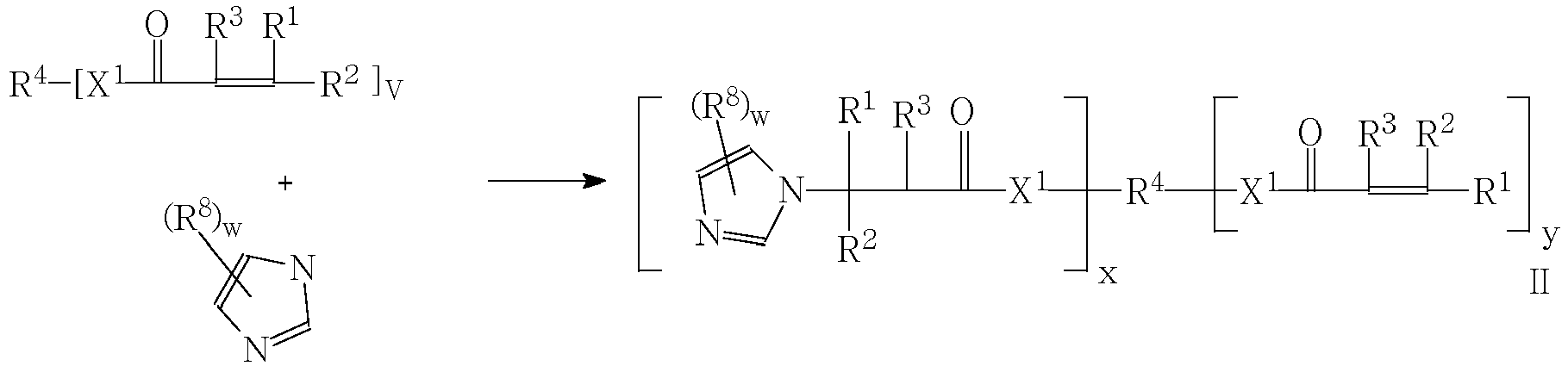
- R1 is H or a C1-C25 alkyl group,
- R2 is H or -CO- X1-R5, where R5 is a H or a C1-C25 alkyl group and X1 is -O- or -NR6-,
- where R6 is H or a C1-C6 alkyl; and
- R3 is H or CH3,
- R4 is a (hetero)hydrocarbyl linking groups that may further comprise one of more catenary (in-chain) functional groups, including ester, amide, urethane and other functional groups, and is preferably a hydrocarbyl group including alkylene, cycloalkylene, or combinations thereof, optionally substituted with one or more hydroxyl groups;
- R8 is a (hetero)hydrocarbyl group, and w is 0, 1, 2 or 3;
- X1 is -O- or -NR6-, where R6 is H or a C1-C6 alkyl;
- x is 1 to 6, preferably 1 to 4,
- y is 0 to 2, and
- v is x + y.
- As can be seen, the compounds of Formula II in Scheme II may have two or more imidazole groups, enabling crosslinking of acid-functional copolymers by acid-base interaction. Further, compounds of Formula II may be provided having a (meth)acryloyl group which may be subsequently polymerized by free radical means to crosslink the composition. Compositions including compounds of Formula II may be combined with other monomer or acid-functional copolymers, as will be described further.
- As illustrated supra, the compounds of Formula II may be prepared by Michael addition of an imidazole compound to a polyacryloyl compound. Useful polyacryloyl compounds include those of the general formula:
R4-(x1-C(O)-CR3=CR1R2)v III
- wherein each X1 is selected from alkylene, -O-, or -NR6- where each R6 independently represents H or an alkyl group having from 1 to 6 carbon atoms;
- R4 is a (hetero)hydrocarbyl linking groups that may further comprise one of more catenary (in-chain) functional groups, including ester, amide, urethane and other functional groups, and is preferably a hydrocarbyl group including alkylene, cycloalkylene, or combinations thereof, optionally substituted with one or more hydroxyl groups;
- v is greater than 1, preferably greater than or equal to 2 and is generally 2 to 6.
- In one embodiment, R4 may be a polyvalent organic group having a valence of at least 2. Examples of polyvalent groups R4 include butylene; ethylene; propylene; and 4-oxaheptalene; hexylene; and 1,4-bis(methyl)cyclohexylene. All isomers or the alkylene groups are envisioned, such a 1,2-, 1,3- and 1,4- butylene isomers. The alkylene may be further substituted with a hydroxyl group, e.g. 2-hydroxy-1,3-propylene.
- Useful polyacryl compounds include, for example, acrylate monomers selected from the group consisting of (a) diacryl containing compounds such as ethylene glycol diacrylate, 1,3-butylene glycol diacrylate, 1,4-butanediol diacrylate, 1,6-hexanediol diacrylate, cyclohexane dimethanol diacrylate, alkoxylated hexanediol diacrylate, neopentyl glycol diacrylate, caprolactone modified neopentylglycol hydroxypivalate diacrylate, cyclohexanedimethanol diacrylate, diethylene glycol diacrylate, dipropylene glycol diacrylate, bisphenol-A diacrylate, ethoxylated bisphenol-A diacrylate, hydroxypivalaldehyde modified trimethylolpropane diacrylate, neopentyl glycol diacrylate, polyethylene glycol diacrylate, propoxylated neopentyl glycol diacrylate, tetraethylene glycol diacrylate, tricyclodecanedimethanol diacrylate, triethylene glycol diacrylate, tripropylene glycol diacrylate; (b) triacryl containing compounds such as glycerol triacrylate, ethoxylated triacrylates (e.g., ethoxylated trimethylolpropane triacrylate, pentaerythritol triacrylate, propoxylated triacrylates (e.g., propoxylated glyceryl triacrylate, propoxylated trimethylolpropane triacrylate, tris(2-hydroxyethyl)isocyanurate triacrylate; (c) higher functionality acryl-containing compounds such as ditrimethylolpropane tetraacrylate, dipentaerythritol pentaacrylate, ethoxylated pentaerythritol tetraacrylate, pentaerythritol tetraacrylate, caprolactone modified dipentaerythritol hexaacrylate; (d) oligomeric acryl compounds such as, for example, urethane acrylates, polyester acrylates, epoxy acrylates; polyacrylamide analogues of the foregoing; and combinations thereof.
- Such compounds are available from vendors such as Sartomer Company, Exton, Pennsylvania; UCB Chemicals Corporation, Smyrna, Georgia; and Aldrich Chemical Company, Milwaukee, Wisconsin. Additional useful acrylate materials include hydantoin moiety-containing polyacrylates, for example, as described in
U.S. 4,262,072 (Wendling et al. ). - Other useful polyacryl compounds also include, for example, free-radically polymerizable acrylate oligomers and polymers having pendant (meth)acryl groups wherein at least two of the (meth)acryl groups are acryl groups. There is a differential reactivity between acryl and methacryl groups with respect to Michael-type addition. Michael-type addition typically occurs easily with acryl groups, but may occur only with difficulty if at all, in the case of methacryl groups. For this reason, the polyacryl component typically has at least two acryl group (e.g., as part of acryloxy or acrylamido functionality), although the poly(meth)acryl compound may also have additional (meth)acryl groups (e.g., as part of methacrylate or methacrylamido functionality). Advantageously, composition may be prepared in which Michael addition occurs through the acryl groups, leaving methacryl groups unreacted. Such unreacted methacryl groups may be subsequently free-radically polymerized.
- With respect to the useful polyacryl compounds presented above, it will be understood that the corresponding amides or thioesters are also useful. The multifunctional ethylenically unsaturated monomer is preferably an ester of acrylic acid. It is more preferably selected from the group consisting of a difunctional ethylenically unsaturated ester of acrylic, a trifunctional ethylenically unsaturated ester of acrylic, a tetrafunctional ethylenically unsaturated ester of acrylic, and a combination thereof. Of these, difunctional and trifunctional ethylenically unsaturated esters of acrylic acid are more preferred.
- Other useful acrylate oligomers include acrylated epoxies, for example, diacrylated esters of epoxy-functional materials (e.g., diacrylated esters of bisphenol A epoxy-functional material) and acrylated urethanes. Useful acrylated epoxies include, for example, acrylated epoxies available under the trade designations "EBECRYL 3500", "EBECRYL 3600", "EBECRYL 3700", and "EBECRYL 3720" from UCB Chemicals Corporation. Useful acrylated urethanes include, for example, acrylated urethanes available under the trade designations "EBECRYL 270", "EBECRYL 1290", "EBECRYL 8301", and "EBECRYL 8804" from UCB Chemicals Corporation.
- The multifunctional ethylenically unsaturated monomer is preferably an ester of acrylic acid. It is more preferably selected from the group consisting of a difunctional ethylenically unsaturated ester of acrylic, a trifunctional ethylenically unsaturated ester of acrylic, a tetrafunctional ethylenically unsaturated ester of acrylic, and a combination thereof. Of these, difunctional and trifunctional ethylenically unsaturated esters of acrylic acid are more preferred.
- Preferred multifunctional ethylenically unsaturated esters of acrylic acid and can be described by the formula:

- R11 is an alkylene, cycloalkylene, or combinations thereof, optionally substituted with a hydroxyl group, generally R10 is the residue of a polyol;
- v is greater than 1, preferably greater than or equal to 2 and is generally 2 to 6.
- Examples of suitable multifunctional ethylenically unsaturated esters of acrylic acid are the polyacrylic acid or polymethacrylic acid esters of polyhydric alcohols including, for example, the diacrylic acid and dimethylacrylic acid ester of aliphatic diols such as ethyleneglycol, triethyleneglycol, 2,2-dimethyl-1,3-propanediol, 1,3-cyclopentanediol, 1 -ethoxy-2,3-propanediol, 2-methyl-2,4-pentanediol, 1 ,4-cyclohexanediol, 1 ,6-hexamethylenediol, 1 ,2-cyclohexanediol, 1 ,6-cyclohexanedimethanol; the triacrylic acid acid esters of aliphatic triols such as glycerin, 1,2,3-propanetrimethanol, 1,2,4-butanetriol, 1,2,5pentanetriol, 1,3,6-hexanetriol, and 1,5,10-decanetriol; the triacrylic acid acid esters of tris(hydroxyethyl) isocyanurate; the tetraacrylic acid esters of aliphatic triols, such as 1,2,3,4-butanetetrol, 1,1,2,2-tetramethylolethane, 1,1,3,3-tetramethylolpropane, and pentaerythritol tetraacrylate; the pentaacrylic acid and pentamethacrylic acid esters of aliphatic pentols such as adonitol; the hexaacrylic acid acid esters of hexanols such as sorbitol and dipentaerythritol; the di acrylic acid acid esters of aromatic diols such as resorcinol, pyrocatechol, bisphenol A, and bis(2-hydroxyethyl) phthalate; the triacrylic acid ester of aromatic triols such as pyrogallol, phloroglucinol, and 2-phenyl-2,2-methylolethanol; and the hexaacrylic acid esters of dihydroxy ethyl hydantoin; and mixtures thereof.
- The compounds of Formulas II function as reactive monomers and thus are substantially unpolymerized in the curable composition at the time the curable composition is applied to a substrate or formed into a (e.g. dental) article, such as a dental crown. Hence, the curable composition hardens upon curing via polymerization of the ethylenically unsaturated groups of the (e.g. multifunctional) polymerizable ionic liquid. Such curing generally results in a permanent bond. For example, when the curable composition is an adhesive, the bonded substrate typically cannot be separated without substrate damage.
- In some favored embodiments, the compounds of Formulas II and IV are sufficiently low in viscosity that they act as a reactive diluent. In such embodiment, the composition can advantageously be substantially free of solvents, especially organic solvents. This can result in increased efficiency with respect to manufacturing time as well as energy consumption by reducing or eliminating drying the composition prior to curing. This can also reduce the volatile organic content (VOC) emissions of the composition.
- Compounds of Formula I, where Z is an azlactone functional group may be prepared by Michael addition of an imidazole compound to a azlactone compound as shown in Scheme III:
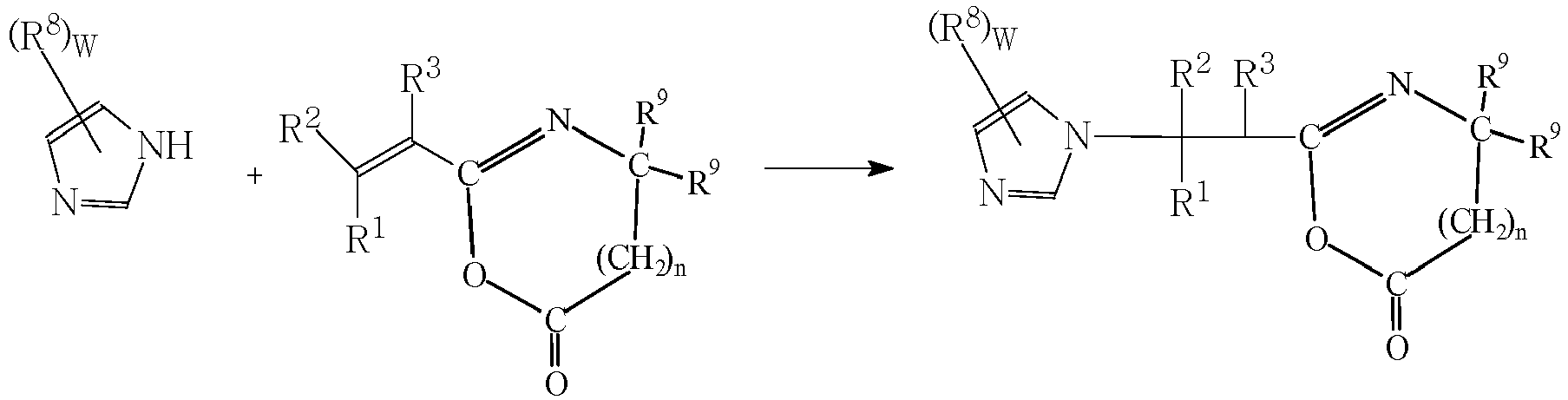
- R1 and R2 are H; and
- R3 is H or CH3,
- R8 is a (hetero)hydrocarbyl group, including alkyl and aryl, preferably an alkyl group, and w is 0, 1, 2 or 3;
- each R9 is independently H, an alkyl group having 1 to 14 carbon atoms, and n is 0 or 1.
- The anionic monomers of the polymerizable ionic liquid have an ethylenically unsaturated polymerizable groups and an acid group. The acid functional group may be an acid per se, such as a carboxylic acid, or a portion may be the conjugate base thereof. In the presence of the imidazole compound, these acid functional monomers form the conjugate base.
- Useful acid functional monomers include, but are not limited to, those selected from ethylenically unsaturated carboxylic acids, ethylenically unsaturated sulfonic acids, ethylenically unsaturated phosphonic acids, and mixtures thereof. Examples of such compounds include those selected from acrylic acid, methacrylic acid, itaconic acid, fumaric acid, crotonic acid, citraconic acid, maleic acid, oleic acid, β-carboxyethyl (meth)acrylate, 2-sulfoethyl methacrylate, styrene sulfonic acid, 2-acrylamido-2-methylpropanesulfonic acid, vinylphosphonic acid, and mixtures thereof.
- Due to their availability, acid functional monomers are generally selected from ethylenically unsaturated carboxylic acids, i.e. (meth)acrylic acids. When even stronger acids are desired, acidic monomers include the ethylenically unsaturated sulfonic acids and ethylenically unsaturated phosphonic acids. Depending on the desired end use and physical properties of the final composition, the acid functional monomer may used in amounts of 5 molar equivalents or more relative to the molar equivalents of the imidazole groups. In some embodiments the molar ratio of acid groups to imidazole groups is approximately equimolar ±20%.
- Preferred polymerizable ionic liquids exhibit a high air to nitrogen curing exotherm ratio, as can be measured by photo DSC according to the test method described in the examples. The air to nitrogen curing ratio is typically at least 0.70. In preferred embodiments, the air to nitrogen curing exotherm ratio is typically at least the 0.80 and preferably at least 0.90. For embodiments wherein the air to nitrogen curing ratio of the polymerizable ionic liquid is sufficiently high, the polymerizable ionic liquid can advantageously be substantially completely cured in air (i.e. an oxygen rich environment) rather than requiring curing in the absence of oxygen.
- In some embodiments, a completely cured (i.e. hardened) polymerizable ionic liquid is solid at 25°C. In other embodiments, particularly where low Tg optional monomers are used, the completely cured polymerizable ionic liquid may be a liquid at 25°C. In some embodiments the hardened composition is substantially free of uncured polymerizable ionic liquid, i.e. < 10% extractable. When significant uncured polymerizable ionic liquid is present it typically results as a surface residue exhibiting a "wet" appearance. Minimal surface inhibition not only provides more complete curing but also minimizes the formation of a less cured oxygen inhibited surface layer. This provides the benefit of reduced extractables and also less need to remove the uncured "wet" monomer layer by use of an absorbent wiping material with or without a solvent such as ethanol. The extent of curing can be determined by various methods known in art. One common method is to determine the amount of uncured material by solvent extraction. In preferred embodiments, the amount of uncured extractable polymerizable ionic liquid is less than 10%, more preferably less than 5%, and most preferably less than 1% by weight of the cured composition.
- The polymerizable ionic liquid may also comprise other conventional (e.g. (meth)acrylate) ethylenically unsaturated monomer(s), oligomer(s), or polymer(s). By "optional monomers" is it meant an ethylenically unsaturated monomer that is not a polymerizable ionic liquid, and includes polar and nonpolar monomers and oligomers, as described more fully herein. Although conventional monomers are polymerizable and many are liquids at 25°C, conventional monomers are typically non-ionic, lacking a cation and an anion.
- Conventional (meth)acrylate monomers typically have an air to nitrogen curing exotherm ratio of no greater than 0.50, 0.40, 0.35, 0.20, or 0.25 or lower. For example, triethylene glycol dimethacrylate (TEGMA) has been found to have an air to nitrogen curing exotherm ratio of about 0.36; whereas hydroxyethyl methacrylate (HEMA) has been found to have an air to nitrogen curing exotherm ratio of less than 0.25. Although the photocuring of conventional (meth)acrylate monomers and especially methacrylate monomers is typically inhibited by oxygen present in air, the inclusion of the (e.g. multifunctional) polymerizable ionic liquid can sufficiently increase the air to nitrogen curing exotherm of the mixture such that the mixture can advantageously be substantially completely cured in air. For embodiments wherein the composition is to be cured in air and the multifunctional polymerizable ionic liquid is combined with the "optional" polymerizable (meth)acrylate monomer, which exhibits a lower air to nitrogen curing exotherm ratio, the air to oxygen curing exotherm ratio of the (e.g. multifunctional) polymerizable ionic liquid, described herein, is at least 0.85, preferably at least 0.90, and more preferably at least 0.95.
- The total concentration of polymerizable ionic liquid(s) having a high air to nitrogen curing exotherm ratio, is typically at least 30 wt-% and preferably at least 40 wt-% of the unfilled composition (the total polymerizable organic composition excluding inorganic filler). In this embodiment, the total concentration of other ethylenically unsaturated (e.g. (meth)acrylate) monomer(s), oligomer(s), and polymer(s)) is typically at least 10 wt-%, 20 wt-%, 30 wt-%, 40 wt-%, 50 wt-%, or 65 wt-%.
- In many embodiments, it is preferred to maximize the concentration of other ethylenically unsaturated (e.g. (meth)acrylate) monomer(s), oligomer(s) provided that the air to oxygen curing ratio of the mixture is at least 0.75 and preferably at least 0.80, 0.85, 0.90 or greater.
- The polymerizable ionic liquid composition may further comprise (meth)acrylate ester monomers as an "optional" monomer. The (meth)acrylate ester monomer useful in preparing the acid functional (meth)acrylate adhesive copolymer is a monomeric (meth)acrylic ester of a non-tertiary alcohol, which alcohol contains from 1 to 14 carbon atoms and preferably an average of from 4 to 12 carbon atoms.
- Examples of monomers suitable for use as the (meth)acrylate ester monomer include the esters of either acrylic acid or methacrylic acid with non-tertiary alcohols such as ethanol, 1-propanol, 2-propanol, 1-butanol, 2-butanol, 1-pentanol, 2-pentanol, 3-pentanol, 2-methyl-1-butanol, 3-methyl-1-butanol, 1-hexanol, 2-hexanol, 2-methyl-1-pentanol, 3-methyl-1-pentanol, 2-ethyl-1-butanol, 3,5,5-trimethyl-1-hexanol, 3-heptanol, 1-octanol, 2-octanol, isooctylalcohol, 2-ethyl-1-hexanol, 1-decanol, 2-propylheptanol, 1-dodecanol, 1-tridecanol, 1-tetradecanol, citronellol, dihydrocitronellol, and the like. In some embodiments, the preferred (meth)acrylate ester monomer is the ester of (meth)acrylic acid with butyl alcohol or isooctyl alcohol, or a combination thereof, although combinations of two or more different (meth)acrylate ester monomer are suitable. In some embodiments, the preferred (meth)acrylate ester monomer is the ester of (meth)acrylic acid with an alcohol derived from a renewable source, such as 2-octanol, citronellol, dihydrocitronellol.
- In some embodiments it is desirable for the (meth)acrylic acid ester monomer to include a high Tg monomer, have a Tg of at least 25°C, and preferably at least 50°C. Suitable high Tg monomers include Examples of suitable monomers useful in the present invention include, but are not limited to, t-butyl acrylate, methyl methacrylate, ethyl methacrylate, isopropyl methacrylate, n-butyl methacrylate, isobutyl methacrylate, s-butyl methacrylate, t-butyl methacrylate, stearyl methacrylate, phenyl methacrylate, cyclohexyl methacrylate, isobornyl acrylate, isobornyl methacrylate, benzyl methacrylate, 3,3,5 trimethylcyclohexyl acrylate, cyclohexyl acrylate, N-octyl acrylamide, and propyl methacrylate or combinations.
- The (meth)acrylate ester monomer is present in an amount of 85 to 99.5 parts by weight based on 100 parts total "optional" monomer content used to prepare the polymer. Preferably (meth)acrylate ester monomer is present in an amount of 90 to 95 parts by weight based on 100 parts total monomer content. When high Tg monomers are included, the copolymer may include up to 30 parts by weight, preferably up to 20 parts by weight of the 85 to 99.5 parts by weight of (meth)acrylate ester monomer component.
- The polymerizable ionic liquid may further comprise polar monomers as an optional "other monomer". The polar monomers useful in preparing the copolymer are both somewhat oil soluble and water soluble, resulting in a distribution of the polar monomer between the aqueous and oil phases in an emulsion polymerization. As used herein the term "polar monomers" are exclusive of acid functional monomers.
- Representative examples of suitable polar monomers include but are not limited to 2-hydroxyethyl (meth)acrylate; N-vinylpyrrolidone; N-vinylcaprolactam; acrylamide; mono- or di-N-alkyl substituted acrylamide; t-butyl acrylamide; dimethylaminoethyl acrylamide; N-octyl acrylamide; poly(alkoxyalkyl) (meth)acrylates including 2-(2-ethoxyethoxy)ethyl (meth)acrylate, 2-ethoxyethyl (meth)acrylate, 2-methoxyethoxyethyl (meth)acrylate, 2-methoxyethyl methacrylate, polyethylene glycol mono(meth)acrylates; alkyl vinyl ethers, including vinyl methyl ether; and mixtures thereof. Preferred polar monomers include those selected from the group consisting of 2-hydroxyethyl (meth)acrylate and N-vinylpyrrolidinone. The polar monomer may be present in amounts of 0 to 10 parts by weight, preferably 0.5 to 5 parts by weight, based on 100 parts by weight "optional" monomer.
- The polymerizable ionic liquid may further comprise vinyl monomers as the optional "optional" monomer, and includes vinyl esters (e.g., vinyl acetate and vinyl propionate), styrene, substituted styrene (e.g., α-methyl styrene), vinyl halide, and mixtures thereof. As used herein vinyl monomers are exclusive of acid functional monomers, acrylate ester monomers and polar monomers. Such vinyl monomers are generally used at 0 to 5 parts by weight, preferably 1 to 5 parts by weight, based on 100 parts by weight "optional" monomer.
- The polymerizable ionic liquid may further comprise a multifunctional poly(meth)acryloyl monomer incorporated into the blend of polymerizable monomers as a component of the "optional" monomers. Multifunctional acrylates are particularly useful for emulsion or UV polymerization. Examples of useful multifunctional (meth)acrylate include, but are not limited to, di(meth)acrylates, tri(meth)acrylates, and tetra(meth)acrylates, such as 1,6-hexanediol di(meth)acrylate, poly(ethylene glycol) di(meth)acrylates, polybutadiene di(meth)acrylate, polyurethane di(meth)acrylates, and propoxylated glycerin tri(meth)acrylate, and mixtures thereof. The amount and identity of multifunctional (meth)acrylate is tailored depending upon the particular application.
- Typically, the multifunctional (meth)acrylate is present in amounts less than 5 parts based on total dry weight of adhesive composition. More specifically, the crosslinker may be present in amounts from 0.01 to 50 parts, preferably 0.05 to 20 parts, most preferably 0.05 to 1 parts, based on 100 parts "optional" monomers of the adhesive composition.
- In such embodiments, the "optional" monomer component may comprise:
- i. 85 to 99.5 parts by weight of an (meth)acrylic acid ester monomers;
- ii. 0.5 to 15 parts by weight of an acid functional ethylenically unsaturated monomer;
- iii. 0 to 10 parts by weight of a non-acid functional, ethylenically unsaturated polar monomer;
- iv. 0 to 5 parts vinyl monomer; and
- v. 0 to 50 parts of a multifunctional (meth)acrylate;
- Some portion of the (meth)acrylic acid ester monomer units may be hydrolyzed after the copolymer is prepared.
- In some embodiments the composition may include filler. Such compositions may include at least 40 wt-%, more preferably at least 45 wt-%, and most preferably at least 50 wt-% filler, based on the total weight of the composition. In some embodiments the total amount of filler is at most 90 wt-%, preferably at most 80 wt-%, and more preferably at most 75 wt-% filler.
- In such compositions comprising appreciable amounts of filler, the one or more polymerizable ionic liquids are typically present in an amount totaling at least 5 wt-%, preferably at least 10 wt-%, based on the total weight of the composition. The concentration of multifunctional polymerizable ionic liquids is generally no greater than about 60 wt-%. In some embodiments the total amount of multifunctional polymerizable ionic liquids is at most 40 wt-%, preferably at most 30 wt-%, and more preferably at most 25 wt-%.
- Fillers may be selected from one or more of a wide variety of materials, as known in the art, and include organic and inorganic filler. Inorganic filler particles include silica, submicron silica, zirconia, submicron zirconia, and non-vitreous microparticles of the type described in
U.S. Pat. No. 4,503,169 (Randklev ). - Filler components include nanosized silica particles, nanosized metal oxide particles, and combinations thereof. Nanofillers are also described in
U.S. Pat. Nos. 7,090,721 (Craig et al. ),7,090,722 (Budd et al. ),7,156,911(Kangas et al. ), and7,649,029 (Kolb et al. ). - Fillers may be either particulate or fibrous in nature. Particulate fillers may generally be defined as having a length to width ratio, or aspect ratio, of 20:1 or less, and more commonly 10:1 or less. Fibers can be defined as having aspect ratios greater than 20:1, or more commonly greater than 100:1. The shape of the particles can vary, ranging from spherical to ellipsoidal, or more planar such as flakes or discs. The macroscopic properties can be highly dependent on the shape of the filler particles, in particular the uniformity of the shape.
- In some embodiments, the composition preferably comprise a nanoscopic particulate filler (i.e., a filler that comprises nanoparticles) having an average primary particle size of less than about 0.100 micrometers (i.e., microns), and more preferably less than 0.075 microns. As used herein, the term "primary particle size" refers to the size of a non-associated single particle. The average primary particle size can be determined by cutting a thin sample of hardened composition and measuring the particle diameter of about 50-100 particles using a transmission electron micrograph at a magnification of 300,000 and calculating the average. The filler can have a unimodal or polymodal (e.g., bimodal) particle size distribution. The nanoscopic particulate material typically has an average primary particle size of at least about 2 nanometers (nm), and preferably at least about 7 nm. Preferably, the nanoscopic particulate material has an average primary particle size of no greater than about 50 nm, and more preferably no greater than about 20 nm in size. The average surface area of such a filler is preferably at least about 20 square meters per gram (m2/g), more preferably, at least about 50 m2/g, and most preferably, at least about 100 m2/g.
- In some embodiments, a combination of surface modifying agents can be useful, wherein at least one of the agents has a functional group co-polymerizable with a hardenable resin. Other surface modifying agents which do not generally react with hardenable resins can be included to enhance dispersibility or rheological properties. Examples of silanes of this type include, for example, aryl polyethers, alkyl, hydroxy alkyl, hydroxy aryl, or amino alkyl functional silanes.
- Optionally, compositions may contain solvents (e.g., alcohols (e.g., propanol, ethanol), ketones (e.g., acetone, methyl ethyl ketone), esters (e.g., ethyl acetate), other nonaqueous solvents (e.g., dimethylformamide, dimethylacetamide, dimethylsulfoxide, 1-methyl-2-pyrrolidinone)), and water.
- If desired, the compositions can contain additives such as indicators, dyes, pigments, inhibitors, accelerators, viscosity modifiers, wetting agents, buffering agents, radical and cationic stabilizers (for example BHT,), and other similar ingredients that will be apparent to those skilled in the art.
- The polymerizable mixture comprising the ionic polymerizable liquid and "optional" monomers may be polymerized by any conventional free radical polymerization method, including solution, radiation, bulk, dispersion, emulsion, and suspension processes. For optical applications, solution, UV and bulk processes are preferred. The resulting (co)polymers may be random or block (co)polymers.
- Initiators useful in preparing the (meth)acrylate adhesive copolymers used in the present invention are initiators that, on exposure to heat, generate free-radicals which initiate (co)polymerization of the monomer mixture. Water-soluble initiators are preferred for preparing the (meth)acrylate polymers by emulsion polymerization. Suitable water-soluble initiators include but are not limited to those selected from the group consisting of potassium persulfate, ammonium persulfate, sodium persulfate, and mixtures thereof; oxidation-reduction initiators such as the reaction product of the above-mentioned persulfates and reducing agents such as those selected from the group consisting of sodium metabisulfite and sodium bisulfite; and 4,4'-azobis(4-cyanopentanoic acid) and its soluble salts (e.g., sodium, potassium). The preferred water-soluble initiator is potassium persulfate. Suitable oil-soluble initiators include but are not limited to those selected from the group consisting of azo compounds such as VAZO™ 64 (2,2'-azobis(isobutyronitrile)) and VAZO™ 52 (2,2'-azobis(2,4-dimethylpentanenitrile)), both available from E.I. du Pont de Nemours Co., peroxides such as benzoyl peroxide and lauroyl peroxide, and mixtures thereof. The preferred oil-soluble thermal initiator is (2,2'-azobis(isobutyronitrile)). When used, initiators may comprise from about 0.05 to about 1 part by weight, preferably about 0.1 to about 0.5 part by weight based on 100 parts by weight of monomer components in the pressure-sensitive adhesive.
- Alternatively, the mixture can be polymerized by techniques including, but not limited to, the conventional techniques of solvent polymerization, dispersion polymerization, and solventless bulk polymerization. The monomer mixture may comprise a polymerization initiator, especially a thermal initiator or a photoinitiator of a type and in an amount effective to polymerize the comonomers, as previously described.
- A typical solution polymerization method is carried out by adding the monomers, a suitable solvent, and an optional chain transfer agent to a reaction vessel, adding a free radical initiator, purging with nitrogen, and maintaining the reaction vessel at an elevated temperature, typically in the range of about 40 to 100°C until the reaction is completed, typically in about 1 to 20 hours, depending upon the batch size and temperature. Examples of the solvent are methanol, tetrahydrofuran, ethanol, isopropanol, acetone, methyl ethyl ketone, methyl acetate, ethyl acetate, toluene, xylene, and an ethylene glycol alkyl ether. Those solvents can be used alone or as mixtures thereof.
- In a typical photopolymerization method, a monomer mixture may be irradiated with ultraviolet (UV) rays in the presence of a photopolymerization initiator (i.e., photoinitiators). Preferred photoinitiators are those available under the trade designations IRGACURE™ and DAROCUR™ from Ciba Speciality Chemical Corp., Tarrytown, NY and include 1-hydroxy cyclohexyl phenyl ketone (IRGACURE™ 184), 2,2-dimethoxy-1,2-diphenylethan-1-one (IRGACURE 651), bis(2,4,6-trimethylbenzoyl)phenylphosphineoxide (IRGACURE™ 819), 1-[4-(2-hydroxyethoxy)phenyl]-2-hydroxy-2-methyl-1-propane-1-one (IRGACURE™ 2959), 2-benzyl-2-dimethylamino-1-(4-morpholinophenyl)butanone (IRGACURE™ 369), 2-methyl-1-[4-(methylthio)phenyl]-2-morpholinopropan-1-one (IRGACURE™ 907), and 2-hydroxy-2-methyl-1-phenyl propan-1-one (DAROCUR™ 1173). Particularly preferred photoinitiators are IRGACURE™ 819, 651, 184 and 2959.
- Solventless polymerization methods, such as the continuous free radical polymerization method described in
U.S. Pat. Nos. 4,619,979 and4,843,134(Kotnour et al. ), the essentially adiabatic polymerization methods using a batch reactor described inU.S. Pat. No. 5,637,646 (Ellis ), and, the methods described for polymerizing packaged pre-adhesive compositions described inU.S. Pat. No. 5,804,610 (Hamer et al. ) may also be utilized to prepare the polymers. - As an alternative to adding the polymerizable ionic liquid to the "optional" monomers, and then polymerizing, the imidazole compound of Formulas I or II may be added to a separately prepared, extant acid-functional copolymer comprising the acid functional and "optional" monomers described supra. It is believed that the amino groups of the imidazole compound of Formulas I and II interact with the pendent acid functional groups of the acid functional (meth)acrylate copolymer to form an ionic linkage, i.e. an imidazolium group. In embodiments where the imidazole compound has two or more imidazole groups, the polymer compositions can crosslink by forming a plurality of ionic bonds between the polymer chains. In composition comprising the compounds of Formula II, having (meth)acryloyl groups, may also crosslink the polymer by free radical polymerization.
- The copolymerizable mixture may optionally further comprise chain transfer agents to control the molecular weight of the resultant polymer. Examples of useful chain transfer agents include but are not limited to those selected from the group consisting of carbon tetrabromide, alcohols, mercaptans, and mixtures thereof. When present, the preferred chain transfer agents are isooctylthioglycolate and carbon tetrabromide. The polymerizable mixture may further comprise up to about 0.5 parts by weight of a chain transfer agent, typically about 0.01 to about 0.5 parts by weight, if used, preferably about 0.05 parts by weight to about 0.2 parts by weight, based upon 100 parts by weight of the total monomer mixture.
- In embodiments where the imidazole compound further comprises pendent (meth)acrylate polymerizable groups, as in Formula II, the pendent (meth)acrylate group may be subsequently free radically polymerized to crosslink the copolymer.

- Macrylate represents polymerized (meth)acrylate monomer units derived from (meth)acrylic acid ester of non-tertiary alcohol having "a" polymerized monomer units,
- Macid represents polymerized monomer units derived from acid functional monomers having "b" polymerized monomer units, shown as the conjugate base although the acid may be present;
- Mpolar represents polymerized polar monomer units having "c' polymerized monomer units,
- Mvinyl represents polymerized vinyl monomer units derived from acid functional monomers having "d" polymerized monomer units, and
- Mmulti represents polymerized multifunctional (meth)acrylate monomer units having "e" polymerized monomer units, and
- wherein a and b are at least one and c, d, and e may be zero or non-zero, and R1 is H or a C1-C25 alkyl group,
- R2 is H or -CO- X1-R5, where R5 is a H or a C1-C25 alkyl group and X1 is -O- or -NR6-, where R6 is H or a C1-C6 alkyl; and
- R3 is H or CH3,
- R4 is a (hetero)hydrocarbyl linking groups that may further comprise one of more catenary (in-chain) functional groups, including ester, amide, urethane and other functional groups, and is preferably a hydrocarbyl group including alkylene, cycloalkylene, or combinations thereof, optionally substituted with one or more hydroxyl groups;
- R8 is a (hetero)hydrocarbyl group, including alkyl and aryl, preferably an alkyl group, and w is 0, 1, 2 or 3;
- X1 is -O- or -NR6-, where R6 is H or a C1-C6 alkyl;
- x is 1 to 6, preferably 1 to 4;
- y is 0 to 5, preferably 0 to 2.
- It will be understood that the values of subscripts a to e correspond to the amounts of the "optional" monomers in the polymerizable composition, i.e. 85 to 99.5 parts by weight of an (meth)acrylic acid ester monomer; and 0.5 to 15 parts by weight of an acid functional monomer. Other monomers may be present in the amounts previously recited.
- The curable blends of polymerizable ionic liquid in combination with the "other monomers" (e.g. (meth)acrylate) ethylenically unsaturated monomers can be used for a variety of other uses, particularly (e.g. photo) curable coatings. A coated article can be prepared by applying the composition described herein to a substrate and curing the composition.
- The curable composition can be applied to a variety of substrates. Suitable substrate materials include inorganic substrates such as glass or ceramics, natural and synthetic organic substrates such as paper, wood, as well as thermosetting or thermoplastic polymers such as polycarbonate, poly(meth)acrylate (e.g., polymethyl methacrylate or "PMMA"), polyolefins (e.g., polypropylene or "PP"), polyurethane, polyesters (e.g., polyethylene terephthalate or "PET"), polyamides, polyimides, phenolic resins, cellulose diacetate, cellulose triacetate, polystyrene, styrene-acrylonitrile copolymers, epoxies, and the like. The substrate thickness typically also will depend on the intended use. For most applications, substrate thicknesses of less than about 0.5 mm are preferred, and more preferably about 0.02 to about 0.2 mm. The substrate can be treated to improve adhesion between the substrate and curable coating compositions, e.g., chemical treatment, corona treatment such as air or nitrogen corona, plasma, flame, or actinic radiation. If desired, an optional tie layer or (e.g. polymerizable ionic liquid based) primer can be applied to the substrate to increase the interlayer adhesion.
- The curable coating composition can be applied using a variety of conventional coating methods. Suitable coating methods include, for example, spin coating, knife coating, die coating, wire coating, flood coating, padding, spraying, roll coating, dipping, brushing, foam application, and the like. The coating is dried, typically using a forced air oven. The dried coating is at least partially and typically completely cured using an energy source.
- The polymerizable ionic liquid composition of this disclosure provides a pre-adhesive, curable syrup copolymer composition comprising the imidazole compounds of Formulas I or II, and a polymerizable anionic monomer, which when polymerized provides a pressure-sensitive adhesive composition. The adhesive may comprise up to 100% by weight of the polymerized ionic liquid compositions The pre-adhesive composition may further comprise the "optional" monomers previous described.
- Alternatively, the present disclosure provides an adhesive composition comprising the imidazole compound of Formulas I and II and an acid-functional (meth)acrylate solute copolymer. In some embodiments the composition crosslinks by acid-base interactions between the acid groups of the copolymer and the nitrogen atoms of the imidazole compound.
- In this application "pre-adhesive" refers to the syrup composition comprising an acid-functional (meth)acrylate solute copolymer, and an aminoalkyl (meth)acryloyl solvent monomer which may be crosslinked to form a pressure-sensitive adhesive."Syrup polymer" refers to a solution of a solute polymer in one or more solvent monomers, the solution having a viscosity of from 500 to 10,000 cPs at 22°C.
- The pressure-sensitive adhesives of this disclosure, i.e. the crosslinked compositions, provide the desired balance of tack, peel adhesion, and shear holding power, and further conform to the Dahlquist criteria; i.e. the modulus of the adhesive at the application temperature, typically room temperature, is less than 3 x 10⁶ dynes/cm at a frequency of 1 Hz.
- The polymerizable ionic liquid composition provides curable dental compositions. The curable dental composition can be used to treat an oral surface such as tooth, as known in the art. In some embodiments, the compositions can be hardened by curing after applying the dental composition. For example, when the curable dental composition is used as a restorative such as a dental filling, the method generally comprises applying the curable composition to an oral surface (e.g. cavity); and curing the composition. Dental adhesives are also hardened by curing after applying the dental composition to the tooth. The method of treating an oral surface may comprise providing a dental article and adhering the dental article to an oral (e.g. tooth) surface. The dental article may comprise a cured composition comprising a polymerizable ionic liquid as described herein. Alternatively, the dental article may be a conventional dental article (without a polymerizable ionic liquid) adhered with a conventional primer (without a polymerizable ionic liquid) and an adhesive comprising a polymerizable ionic liquid; a primer comprising a polymerizable ionic liquid and a conventional adhesive (without a polymerizable ionic liquid); or both a primer and adhesive, each comprising a polymerizable ionic liquid.
- In other embodiments, the compositions can be hardened (e.g., polymerized) into dental articles prior to applying. For example, a dental article such as a crown may be preformed from the hardenable dental composition described herein. Dental composite (e.g. crowns) articles can be made from the curable composition described herein by casting the curable composition in contact with a mold and curing the composition. Alternatively, dental composite (e.g. crowns) article can be made by first curing the composition forming a mill bland and then mechanically milling the composition into the desired article.
- Another method of treating a tooth surface comprises providing a dental composition as described herein wherein the composition is in the form of a (partially hardened) hardenable, self-supporting, malleable structure having a first semi-finished shape; placing the hardenable dental composition on a tooth surface in the mouth of a subject; customizing the shape of the hardenable dental composition; and hardening the hardenable dental composition. The customization can occur in the patient's mouth or on a model outside the patient mouth such as described in
U.S. Patent No. 7,674,850 (Karim et al. ). - The polymerizable ionic liquid compositions may also be used in the preparation of antistatic coatings. Some advantages include that the antistatic coatings disclosed herein (1) adhere well to a variety of optical films; (2) impart good antistatic properties to the resultant optical device; (3) can be durable so as to withstand handling and manipulation as the optical device is used, e.g., to manufacture a display device; and (4) are clear and colorless, making them well suited for various light management purposes as they can be used as is or have additional agents imparted therein to provide color selection, haze, or other desired effect. Useful antistatic coatings have a conductivity of < 5 x 10¹³ ohm/square. Mono-imidazole compounds of formula 1 are most useful in preparing antistatic coatings.
- Generally, curable systems containing a significant amount of solvent, monomers and reactive diluents can give rise to a significant increase in density when transformed from the uncured to the cured state causing a net shrinkage in volume. As is well known, shrinkage can cause unpredictable registration in precise molding operations such as those required in dental applications. Shrinkage can also create residual stress in such articles, which can subsequently lead to stress cracking.
- In some embodiments, compositions of this disclosure minimizes shrinkage and stress cracking. The low shrinkage compositions of this invention are particularly useful in molding applications or in any applications where accurate molding and/or registration is required. In some embodiments the present disclosure provides compositions that exhibit less than 10% shrinkage, and preferably less than 8%. The compositions are low in viscosity and suitable for molding processes, including precision molding processes.
- Reagents used were obtained from Sigma-Aldrich Chemical Company, Milwaukee, WI, unless otherwise noted.
- Each monomer was mixed with 0.1 wt% photoinitiator I-819™ (Ciba). Approximately 10 mg of each of sample was placed in the base of an open hermetic aluminum DSC pan (TA instruments TO91209). Pans were then placed in an enclosed chamber with a glass lid and ports to allow the chamber to be purged with nitrogen for 10 minutes. After purging, the chamber was placed directly under a UV lamp (365nm, ∼5 mW/cm2) for 10 minutes to fully cure each sample in their respective DSC pans. Polymerized samples were individually placed on one of the sample posts in a standard differential scanning calorimeter (DSC, TA instruments) along with an empty reference pan on the opposite post. Temperature was raised to 55 °C, held for 10 minutes, and then cycled between -95 °C and 55 °C twice at 3 °C/min. Transitions such as the crystallinity temperature (Tc) and glass transition temperature (Tg) were identified as their respective peaks in the scanning profile of heat flow vs. temperature. Typically, crystallization and melting transitions show up as positive and negative heat flow peaks as the sample is cooled and heated, and the latent heat is given off or absorbed, respectively. Conversely a glass transition is generally represented by a shift in the profile slope upon heating as the heat capacity of the sample after the transition is altered. The glass transition temperature is recorded at the inflection point of the curve associated with this shift in heat flow profile.
- The glass transition temperature (Tg) of high Tg materials was analyzed using a Q800 series dynamic mechanical analyzer (DMA, TA instruments, New Castle, Delaware). 25.4 mm x 4mm x 0.5mm strips were cut from each cured square sample plaque using a low speed diamond saw. Samples were then placed in the thin film tensile clamps of the DMA instrument and oscillated at a constant frequency of 1 Hz with a displacement of 0.1 microns as the temperature was ramped from 25 to 200 °C. The glass transition temperature of each material was determined from the peak of the tan delta vs. temperature plot generated from these tests.
- Dynamic mechanical analysis (DMA) of each of the homopolymers generated for Test method 1 was accomplished using an AR2000 parallel plate rheometer (TA Instruments) to characterize the thermal-mechanical properties of each sample as a function of temperature. Samples were generated by taking 2 g of each sample monomer premixed with 0.1 wt% photoinitiator (I-819™) and transferring this solution to a clamped mold comprising of a 2 mm thick silicone spacer cavity between release liners and glass plates. The mold was placed in a vertical position so that only one edge of the mold was in contact with air and then cured for 10 minutes on each glass face side with UV irradiation (365nm, ∼5 mW/cm2). Post cure, the glass plates and silicone spacers were removed to leave the homopolymer film between release liners.
- For each sample, approximately 0.5 g of material was centered between 8 mm diameter parallel plates of the rheometer and compressed until the edges of the sample were uniform with the edges of the top and bottom plates. The furnace doors that surround the parallel plates and shafts of the rheometer were shut and the temperature was raised to 135 °C and held for 5 minutes. The temperature was then ramped from 135 °C to -80 °C at 3 °C/min while the parallel plates were oscillated at a frequency of 1 Hz and a constant % strain of 0.4%. Storage modulus (G') as a function of temperature was recorded for the temperature sweep.
- Each monomer was mixed with 0.1 wt% photoinitiator I-819 (BASF, Germany). Approximately 15 mg of each of sample was placed in open hermetic aluminum DSC pans (TA instruments TO91209). Pans were then placed on one of the posts of a differential photocalorimeter (DPC 2920, TA Instruments) while an empty DSC pan was placed on the reference post. A mask was placed over the DSC posts so that radiation coming from the overhead UV lamp would only directly contact the individual DSC pans. A Quartz glass panel was then placed over the mask to enclose the chamber which was then purged with either nitrogen or oxygen at a rate of 1000 cm3/min. The chamber door was closed and allowed to purge for 10 minutes. The UV lamp (14 mW/cm2) was then switched on for exactly 10 minutes.
- The heat flow profile of each sample photopolymerization was integrated, after first subtracting the heat generated by the UV lamp baseline, to yield the total heat released from each sample. The total heat released was then normalized by dividing by the weight of the monomer initially placed in the DSC pan. The ratio of polymerization heat released per unit gram for the each monomer sample in air vs. nitrogen was then calculated.
- The photo DSC was a TA instrument (New Castle, DE) with DSC module 2920. The light source was a mercury/argon lamp with an Oriel PN 59480 425 nm long pass light filter. The light intensity was 3mW/cm2, measured using an International Light light meter Model IL 1400 equipped with a Model XRL, 340A detector. The photo curable samples contained 0.5% camphorquinone, 1.0% ethyl 4-(N,N-dimethylamino)benzoate, and 1.0% diphenyl iodium hexafluorophosphate as the photoinitiator package. A 10 mg cured sample was used as a reference.
- About 10 mg of the sample was weighed accurately for the testing with a Hermetic Pan (aluminum sample pan) as the sample holder. The samples were equilibrated at 37 °C for 5 minutes, and then the light aperture was opened to irradiate the sample. During irradiation the sample temperature was held at 37°C. The total irradiation time was 30 minutes. After 30 minutes, the aperture was closed and the sample maintained at 37°C for another 5 minutes. The data was collected as heat output per unit weight (mW/g). T he data was analyzed using TA Thermal Solutions Universal Analysis software.
- Monomers were analyzed once under nitrogen, followed by an identical sample under air. The DSC recorded the heat generation from the curing sample during exposure, and the area under the curve was integrated to give total energy in Joules/gram. The heat generated when the sample was cured in air was divided by the heat generated when the sample was cured in nitrogen to give the curing ratio. A higher ratio represents less oxygen inhibition.
- Peel adhesion is the force required to remove a coated flexible sheet material from a test panel measured at a specific angle and rate of removal. In the examples of this invention, the force is expressed in Newtons per width of coated sheet (Newton/dm). For each test, a 12.7 mm width of the adhesive coated sheet material approximately 10-12 cm long was cut and the release layer peeled away from the coated adhesive. The adhesive strip was then applied to the clean face of a stainless steel test panel. A heavy rubber roller was used to apply the strip. The free end of the coated strip was doubled back so that the angel of removal was 180 degrees. The free end was attached to the horizontal arm of the adhesion tester scale. The stainless steel plate was then affixed to the platform of the instrument which is mechanized to move at a controlled rate (30.5 cm/min) away from the scale. The peel test was started soon after the adhesive was applied to the substrate without allowing for an induction time for adhesion to build. The scale reading in ounces was read during the test as an average of both the peak and minimum forces during the peel. Three peel tests were run for each sample and averaged to yield the peel adhesion value. Peel adhesion was also measured for each sample using the above procedure on test panels of either stainless steel clean glass.
- Shear strength of an adhesive material is directly related to the internal strength or cohesiveness of the sample and is typically quantified by the amount of force required to pull an adhesive strip from a standard flat surface with which the sample has been affixed to. Specifically, shear strength is measured in terms of the time required to pull a defined area of adhesive coated backing material from a stainless steel test panel under the stress of a constant or static load parallel to the test panel.
- Shear tests were conducted using adhesive coated PET material with approximately a 0.05 mm thick adhesive coating. Cut adhesive strips were applied to a clean stainless steel panel such that a 12.7 mm by 12.7 mm portion of each strip was in firm contact with the panel and one end portion of each strip was free. The panel with adhesive strip was held in a rack such that the panel forms a 180 degree angle with the extended free end which is then tensioned by applying a one kilogram hanging weight. The time elapsed for each tape example to separate from the test panel is recorded as the shear strength in minutes. Two shear tests were performed for each sample adhesive and the shear strength averaged.
- This shear test is the same as test method 5A except the cut adhesive strips were 25.4 mm by 25.4 mm in dimension.
- Average static decay was determined using the following method. Sheets of test materials were cut into 12 cm by 15 cm samples and conditioned at relative humidity (RH) of about 50% for at least 12 hours. The materials were tested at temperatures that ranged from 22-25 °C. The static charge dissipation time was measured according to MIL-STD 3010, Method 4046, formerly known as the Federal Test Method Standard 10113, Method 4046, "Antistatic Properties of Materials", using an ETS Model 406D Static Decay Test Unit (manufactured by Electro-Tech Systems, Inc., Glenside, Pa.). This apparatus induces an initial static charge (Average Induced Electrostatic Charge) on the surface of the flat test material by using high voltage (5000 volts), and a field meter allows observation of the decay time of the surface voltage from 5000 volts (or whatever the induced electrostatic charge was) to 10 percent of the initial induced charge. This is the static charge dissipation time. The lower the static charge dissipation time, the better the antistatic properties are of the test material. All reported values of the static charge dissipation times in this invention are averages (Average Static Decay Rate) over at least 3 separate determinations. Values reported as >60 seconds indicate that the sample tested has an initial static charge that cannot be removed by surface conduction and is not antistatic. When the sample tested did not accept a charge of about 3000 volts or more, it was not considered to have charged sufficiently to be antistatic.
- Dogbone samples were tested for tensile properties using a Sintech load frame with a gap of 63.5 mm between self-tightening grips and a test speed of 25.4 mm/min to elongate and break each sample. 4 replicates were prepared for each sample and the average was determined. Elongation was determined by the change in length upon elongation of the distance between grips divided by the original length of the grip separation distance. The peak load was recorded as the highest tensile force applied to the dogbone resulting in material failure. Finally, Young's Modulus was determined as the slope of the stress vs. strain curve taken over small (0-2%) strain values.
- The density of curable compositions and cured materials was measured using an AccuPyc II 1340 Pycnometer (Micromeritics, Norcross, GA). Ten measurements were run for each sample and the average density was determined. The volume shrinkage of the curable compositions was calculated based on the density change after curing.

- The following procedure was used for the preparation of the imidazole-Michael adduct of 2-ethylhexyl acrylate (3-imidazol-1-yl-propionic acid 2-ethylhexyl ester):

- An 8 oz. (236 mL) glass jar was charged with 2-ethylhexyl acrylate (2-EHA, 92.2 g, 0.50 mol, Aldrich) and imidazole (34.0 g, 0.50 mol, Alfa Aesar). The jar was heated briefly with a heat gun until the imidazole dissolved, then the jar was placed in a 70 °C oven for 18 hours. NMR analysis of an aliquot of the reaction product indicated that no residual starting acrylate was present and that the reaction was complete. The reaction product was a light yellow colored, low viscosity oil. NMR analysis confirmed the structure of the product.
- The imidazole-Michael adducts shown Table 1 were prepared by the same general procedure. In Preparatory Examples 16 and 17, the structure of the product is a representative average structure based on the molar equivalents of imidazole used.
Table 1. Preparatory Example Starting Acrylate Imidazole-Michael Adduct 2 Isooctyl acrylate (IOA, 3M Company) 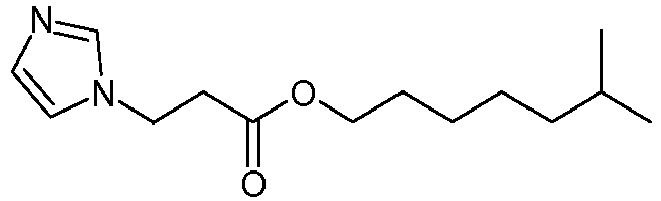
3a Butyl acrylate 
3b Butyl acrylate 
3c* Butyl acrylate 
4 Methyl acrylate 
5 Isobornyl acrylate 
6 2-Hydroxyethyl acrylate 
7 4-Hydroxybutyl acrylate 
8 Tetradecyl acrylate (Hampford Research. Stratford, CT) 
9 3-(Acryloyloxy)-2-hydroxypropyl methacrylate 
10 (2-Acryloxy)ethyl; methacrylate** 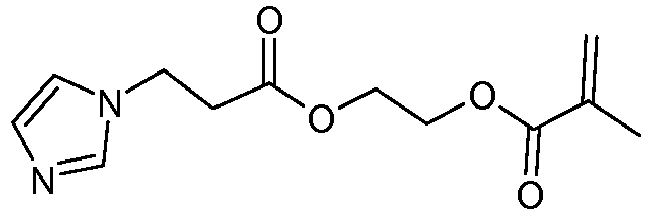
11a Tricyclo[5.2.1.0.2,6]de canedimethanol diacrylate 
11b Tricyclo[5.2.1.0.2,6]de canedimethanol diacrylate 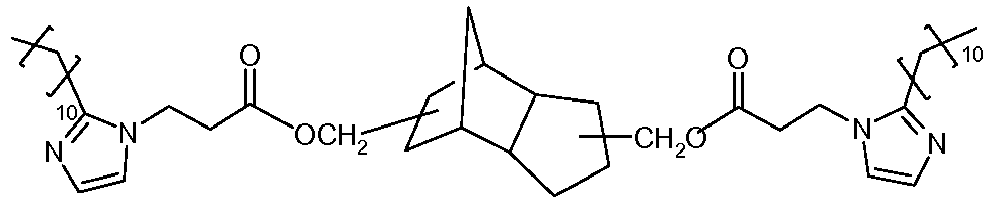
11c Tricyclo[5.2.1.0.2,6]de canedimethanol diacrylate 
12 Polybutadiene diacrylate (Sartomer CN-307, mw -2,700) 
13 1,6-Hexanediol diacrylate 
14 Ethoxylated bisphenol A acrylate (Sartomer SR601) 
15 Butanediol diacrylate (Sartomer SR213) 
16 Trimethylolpropane triacrylate 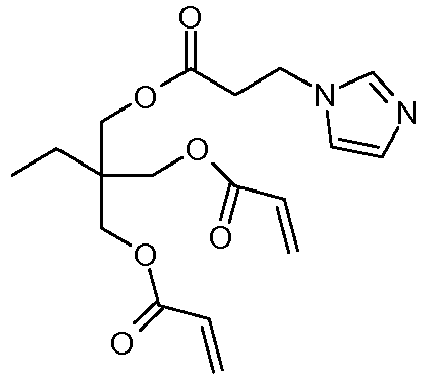
17 Trimethylolpropane triacrylate 
18 Trimethylolpropane triacrylate 
19 Mesityl oxide 
20 Acrylamide 
21 N, N-dimethylacrylamide 
22 Dibutyl maleate 
23 Acrylonitrile 
24*** Butyl methacrylate 
25 Vinyl dimethyl azlactone (3M Corporation)) 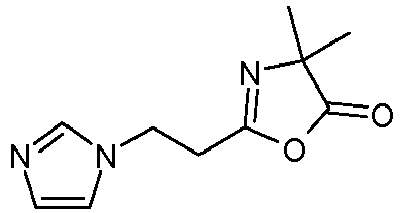
26 Tetra(ethyleneglycol) diacrylate 
* Product is a mixture of 3-(4-methyl-imidazol-1-yl) propionic acid butyl ester and and 3-(5-methyl-imidazol-1-yl) propionic acid butyl ester
** Prepared according to Klee, J.E., Neidhart, F., Flammersheim, H. J., and Mulhaupt, R., Macromol. Chem. Phys. 200, 517-523 (1999 ).
***Neat reaction of imidazole and butyl methacrylate at 100 °C for 5 days - The polymerizable ionic liquid monomers of the imidazole-acrylate Michael adducts were prepared by addition of a equimolar amount of a polymerizable acid functional monomer (acrylic acid (AA), methacrylic acid (MA), methacryloxydecyl phosphate (MDP, prepared according to
US 7,452,924 ), methacryloxyethyl phthalate (MP), methacryloxyethyl succinate (MS), acrylamidopropane sulfonic acid (AMPS), or 2-sulfoethyl methacylate (SEM, Polysciences, Inc., Warrington, PA)) to the appropriate imidazole-acrylate Michael adduct preparatory example.
- To an 8 oz. (236 mL) glass jar charged with 3-imidazol-1-yl-propionic acid 2-ethylhexyl ester (126.2 g, 0.50 mol, Preparatory Example 1) was added acrylic acid (36.0 g, 0.50 mol) and the jar was placed on a roller mill for 3 hours to mix. The product was a clear liquid.
- Table 2 lists the monomers prepared and their polymer properties according to test methods 1A, 2, 3A, and 3B. C1-4 are comparative examples for monomers isooctyl acrylate (IOA), 2-ethyl hexyl acrylate (2-EHA), butyl acrylate (BA) and trimethylolpropane triacrylate (TMPTA).
Table 2.: Properties of Acrylate and Imidazole Acrylate Monomers and Polymers Example Preparatory Example Acid Used Polymer Tc (°C) Polymer Tg (°C) Polymer Storage Modulus @ 25 °C (MPa) Curing Exotherm Ratio Test Method 3A Curing Exotherm Ratio Test Method 3B C1 - - -68 19,480 0.78 C2 - - -69 18,820 0.74 C3 -49 54,780 C4 - - 0.98 1 1 AA -37 6,910 0.99 2 2 AA -36 34,770 0.99 3a 3a AA -36 6,760 3b 3b AA 3c 3c AA 4 4 AA -14 0.97 5 5 AA 3 1.04 6 6 AA -27 0.94 7 7 AA -32 1.00 8 8 AA 14 0.96 9 9 AA 10 10 AA 10b 10 MA 0.87 10c 10 MDP 10d 10 MP 10e 10 MS 10f 10 AMPS 10g 10 SEM 0.92 11a 11a AA 11b 11b AA 11c 11c AA 12 12 AA 13a 13 AA 13b 13 MA 0.82 13c 13 MS 0.89 14 14 MA 0.84 15 15 MA 0.86 16* 16 AA 30 0.99 17* 17 AA 28 0.96 18a* 18 AA 3 1.04 18b 18 MA 0.96 19 19 AA 20 20 AA 21 21 AA 22 22 AA 23 23 AA 24 24 AA 25 25 AA 26 26 AA * PIL monomer was mixed with 20 wt% 2-ethoxyethyl acrylate to reduce the viscosity of the monomer mixture prior to photopolymerization and analysis. - Acrylate based comparative formulations (C5-C8) were each mixed using the following procedure. 28.5 g of monomer, 0.02 g of Irgacure™ 819 (BASF), and 1.5 g of acrylic acid were mixed thoroughly in a clear glass vial. The glass vial was then purged with nitrogen for 5 minutes to remove dissolve oxygen and then placed in front of a UV light (365nm, ∼5 mW/cm2) until a coatable viscosity of about 3000 cP at room temperature and acrylic conversion of approximately 10%was achieved.
- Each "thickened" sample was then formulated with tackifier Foral™ 85E (Eastman Chemical Co., Kingsport, TN) at 0 or 20 pph (parts per hundred relative to the resin). Additional Irgacure-651 (BASF), and photocrosslinker, XL-330 (2,4,-bis(trichloromethyl)-6-(4-methoxyphenyl)-triazine, 3M) was added at 0.09 pph and 0.08 pph respectively. As an example, 5 g of "thickened" monomer was added to an amber vial along with 1 g of Foral™ 85E tackifier (20 pph,), 0.0045 g (0.09 pph) of Irgacure™ 651, and 0.004 g (0.08 pph) of XL-330™. The amber vial was then rotated in the dark until the solid ingredients were completely dissolved. The adhesive formulation described above was coated onto primed PET film at a coating thickness of 0.05 mm and covered with a silicone treated release liner. This construction was then cured using approximately 600 mJ/cm2 of UV irradiation.
- PIL based formulations were generated using the following example procedure. 10 g of Preparatory Example 2, 3.5 g of acrylic acid, 0.018 g of Irgacure™ 651, 0.016 g of photocrosslinker XL-330™, and optional 2.7 g (20 pph) Foral™ 85E tackifier were well mixed. Each PIL based formulation typically had high enough viscosity that the separate "thickening" step described above was not required. The formulation was mixed in an amber jar until completely dissolved and then coated onto primed PET film at a coating thickness of 0.05 mm and covered with a silicone treated release liner. This adhesive was then cured using approximately 600 mJ/cm2 of UV irradiation.
- Adhesion performance of the films was tested by carrying out peel and shear tests on multiple substrates following the procedures outlined in Test Methods 4 and 5A. The failure (F) of each PSA sample is classified as adhesive failure (af), cohesive failure (cs), or partial cohesive failure (pcs).
Table 3. Adhesive Properties of Comparative and PIL Formulations Example Monomer Example Foral 85E Tackifier (pph) 180 Peel on S.Steel (N/dm) 180 Peel on Glass (N/dm) Shear on S.Steel (min) C5 IOA 0 29 af 24 af 450 C6 IOA 20 116 cs 110 cs NT C7 2-EHA 0 28 af 27 af NT C8 2-EHA 20 132 cs 136 cs NT 27 2 0 22 af 7 af 0 28 2 20 66 cs 66 cs NT 29 1 0 24 af 5 af NT 30 1 20 66 cs 65 cs NT *NT indicates that the film was not tested. - PIL based adhesive formulations were prepared using hexanediol diacrylate (HDDA) as a crosslinker. A mixture of 6.00 g of the material from Preparatory Example 1, 2.12 g of acrylic acid, 0.016 g of Irgacure™ 651, and HDDA (Table 4) were well mixed in an amber jar until completely dissolved and then coated onto primed PET film at a coating thickness of 0.08 mm and covered with a silicone treated release liner. This adhesive was then cured using approximately 600 mJ/cm2 of UV irradiation. Adhesion performance of the films was tested by carrying out peel and shear tests following the procedures outlined in Test Methods 4 and 5A.
Table 4. Adhesive Properties of PIL Formulations Example HDDA (g) 180° Peel on S. Steel (N/dm) Shear on S.Steel (min) 31 0.008 9 af 132 pcs 32 0.016 11 af 1610 af - Adhesives were prepared by first generating a plastic enclosed pouch of elastomer polymer. 216 g of isooctyl acrylate (IOA), 24 g of acrylic acid, 0.036 g of isooctylthioglycolate (IOTG), and 0.168 g of Irgacure™ 651 were mixed well in an amber bottle and then 26 g of this formulation was poured and heat-sealed in a clear polyvinyl acetate pouch such as to eliminate any air bubbles. The pouch was immersed in a constant temperature water bath at 17 °C and irradiated with ultraviolet light (365nm, 4 mw/cm^2) for eight minutes on each side to polymerize the mixture.
- A 26 g adhesive pouch was added to a Brabender™ (Hackensack, NJ) high temperature compounder and allowed to mix for 5 min at 150 °C and 100 rpm. Once the polymer appeared uniformly melted, the preparatory example imidazole compound was slowly added and allowed to mix at 150 °C and 100 rpm for 10 minutes. The mixing chamber was then cooled to 100 °C and the rotation of the mixing paddles was reversed to expel and collect polymer material.
- Once cooled, approximately 1 g of the compounded material was placed between a primed PET liner (Mitsubishi) and a silicone treated release liner (Silica Nature). This construction was placed between the plates of a Carver (Wabash, IN) heated press with plate temperatures of 80 °C. The construction was then compressed until the adhesive layer was approximately 0.05 mm in thickness. Shear adhesive tests of prepared adhesive films were performed following the procedures outlined in Test Method 5B.
Table 5. Adhesive Properties of Comparative and PIL Formulations Example Elastomer Polymer (g) Preparatory Example Preparatory Example (g) Shear on S.Steel (min) C9 26 None 0 2,500 33 26 13 0.13 2,830 34 26 13 0.26 3,260 35 26 11a 0.13 3,600 36 26 11a 0.26 5,000 37 26 11b 0.26 2,500 38 26 11c 0.26 2,900 39 26 12 0.83 2,990 40 26 12 1.66 4,620 - PIL films were made by first preparing a plastic enclosed pouch of polymer. As indicated in Table 6, isooctyl acrylate (IOA), acrylic acid (AA), preparatory example imidazole compound, 0.004 g isooctyl thioglycolate (IOTG), and 0.02 g of Irgacure™ 651 were mixed in an amber bottle and then 26 g of this formulation was poured and heat-sealed in a clear polyvinyl acetate pouch such as to eliminate any air bubbles. The pouch was immersed in a constant temperature water bath at 17 °C and irradiated with ultraviolet light (365 nm, 4 mw/cm2) for eight minutes on each side to polymerize the formulation. Pouches of polymer were made while varying the amount of the PIL monomer as described in Table 6 below. In comparative example 10, the IOA to AA ratio by weight is 98 / 2. In subsequent formulations with added preparatory example 2, acrylic acid was added in excess to the amount required to generate the PIL so that approximately 2 % of the overall monomer formulation comprised of acrylic acid that was not a salt with an imidazole group.
- Approximately 1 g of polymer was removed from each pouch and was placed between a PET liner (Mitsubishi) and a silicone treated release liner (Silica Nature). This construction was placed between the plates of a Carver heated press (Wabash, IN) with plate temperatures of 80 °C. The construction was then compressed until the adhesive layer was approximately 0.15 to 0.2 mm in thickness and approximately 15 cm in diameter. Each of the polymer films was tested for static decay according to Test Method 6 (Table 6).
Table 6. Adhesive Compositions for Anti-Static Film Characterization Example IOA (g) AA (g) Preparatory example 2 (g) Film Thickness (mm) Appearance Static Decay Time (sec) Surface Resistivity (U/square) C10 29.4 0.6 0.0 0.16 Clear > 100 >10 E+14 41 29.4 1.2 3.6 0.18 Hazy > 100 >10 E+14 42 20.9 2.5 6.6 0.16 Hazy 0.28 3.4 E+13 43 12.8 4.3 12.9 0.16 Clear 0.02 1.2 E+13 44 6.3 5.7 18.0 0.16 Clear 0.01 5.0 E+12 - In a mixing cup was placed the preparatory example imidazole and 1.44 grams acrylic acid in weights according to Table 7. The cup was speed mixed at 3000 rpm for 2 minutes for 3 cycles. 0.042 grams of Darocur™ 1173 (BASF) was added into the mixing cup and the cup was speed mixed at 3000 rpm for 2 minutes to give a clear solution.
- Each formulation was coated onto PET film (available from Dupont under the trade designation "Melinex 618") with a #14 wire wound Meyer rod, to give an average thickness of about 30 microns, UV cured in a nitrogen environment with single pass at 30 feet per minute on a 6 inch UV curing processor (Fusion UV Systems Inc) equipped with a Fusion UV H bulb (on high power 100% UV that provides 58 mJ/cm2 at the 30 feet per minute speed). The films were tested for anti-static decay time according to Test Method 6 (Table 7).
Table 7. Antistatic coatings Example Preparatory Example Preparatory Example (g) Static decay time (s) 44 2 5.047 0.01 45 9 5.646 >100 46 13 3.62 0.02 - Preparatory Example imidazoles 16-18 were each mixed with diethylene glycol diacrylate (DEGDA), acrylic acid (AA), and 0.2 wt % photoinitiator ethyl-2,4,6-trimethylbenzoylphenylphosphinate (TPOL, BASF) in that order (Table 8). After each formulation was well mixed, samples were poured into either a glass mold with dimensions 25.4 mm x 25.4 mm x 4 mm or a steel dog bone shaped mold with dimensions 112 mm (length) x 7mm (neck) x 2 mm (depth). Each mold was covered with a transparent liner and then placed beneath a high intensity LED array with an output wavelength of 380 nm, 50 mW/cm2, for 10 minutes to cure each sample.
- Acrylate based comparative examples (C11-13) were prepared using ethoxylated trimethyloylpropane triacrylates each with a varying degree of ethoxylation (SR454, SR499, SR502; Sartomer) mixed with DEGDA to give approximately the same overall acrylate functional group concentration compared to examples 47-49. 0.2 wt% TPOL photoinitiator was added to each solution. Comparative examples were cured using the same procedures and molds as described above and analyzed using Test Methods 1B, 7, and 8 (Table 9).
Table 8. Formulations for High Tg Materials Example Prep Example or monomer Prep Example or monomer (g) AA (g) DEGDA (g) TPOL (g) Acrylate Conc. (mol/g) 47 16 10 1.97 2 0.021 0.0072 48* 17 10 3.33 6 0.029 0.0065 49 18 10 4.32 8 0.033 0.0060 C11 SR454 10 1 0.017 0.0072 C12 SR499 10 4 0.021 0.0065 C13 SR502 10 5 0.023 0.0060 * Example 48 monomer solution was inhibited with 100 ppm Prostab 5415 (Ciba Specialty Chemicals) Table 9. Physical Properties of High Tg Generated Materials Example Tg (C) Young's Modulus (MPa) Elongation (%) Peak Load (N) Volume Shrinkage (%) 47 144 20,400 2.6 1,180 9.3 C11 116 8,200 3.2 470 11.0 48 103 15,400 3.5 930 8.4 C12 80 6,100 4.7 350 10.7 49 82 16,900 4.2 980 8.8 C13 58 3,500 7.5 233 10.4 - The following Illustrative Embodiments are further provided:
-
- 1. A polymerizable ionic liquid comprising a polymerizable anion and a cation of the formula:
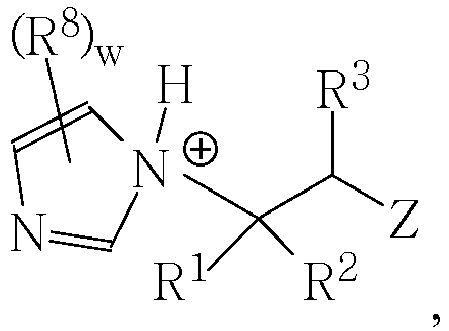
- Z comprises a ketone, ester, amide, nitrile, or azlactone functional group,
- R1 is H or a C1-C25 alkyl group,
- R2 is H or -CO- X1-R5, where R5 is a H or a C1-C25 alkyl group and X1 is -O- or -NR6-,
- where R6 is H or a C1-C6 alkyl; and
- R3 is H or CH3,
- R8 is a (hetero)hydrocarbyl group, and w is 0, 1, 2 or 3;
- with the proviso that when Z comprises a nitrile or azlactone functional group, then R1 and
- R2 is H.
- 2. The polymerizable ionic liquid of embodiment 1 comprising a cation of the formula:

- R1 is H or a C1-C25 alkyl group,
- R2 is H or -CO- X1-R5, where R5 is a H or a C1-C25 alkyl group and X1 is -O- or -NR6-,
- where R6 is H or a C1-C6 alkyl; and
- R3 is H or CH3,
- R4 is an alkylene, cycloalkylene, or combinations thereof, optionally substituted with a hydroxyl group;
- R8 is a (hetero)hydrocarbyl group, and w is 0, 1, 2 or 3;
and - X1 is -O- or -NR6-, where R6 is H or a C1-C6 alkyl;
- x is 1 to 6,
- y is 0 to 5.
- 3. The polymerizable ionic liquid of embodiment 2, wherein R4 is an alkylene having from 2 to 20 carbon atoms.
- 4. The polymerizable ionic liquid of embodiment 2, wherein R4 is a hydroxyl-substituted alkylene.
- 5. The polymerizable ionic liquid of any of embodiments 1 to 4 wherein Z is

each R9 is independently H, an alkyl group having 1 to 14 carbon atoms, and n is 0 or 1. - 6. The polymerizable ionic liquid of embodiment 1 wherein Z is
-C(O)-X1-R10, where R10 is a hydrocarbyl group, said hydrocarbyl optionally substituted with a hydroxyl group and X1 is -O- or -NR6-, where R6 is H or a C1-C6 alkyl. - 7. The polymerizable ionic liquid of embodiment 1 wherein Z is
-C(O)-R10, where R10 is a hydrocarbyl group, said hydrocarbyl optionally substituted with a hydroxyl group. - 8. The polymerizable ionic liquid of and of embodiments 1 to 7 wherein the polymerizable anion comprises an ethylenically unsaturated polymerizable group and an acidic group selected from a carboxylic acid group (-COOH), a sulfonic acid group (-SO3H), a sulfate group (-SO4H), a phosphonic acid group (-PO3H2), a phosphate group (-OPO3H), or a salts thereof.
- 9. The polymerizable ionic liquid of embodiment 2 wherein R4 is a hydrocarbyl group having a valence of x.
- 10. The polymerizable ionic liquid of any of embodiments 1 to 9 wherein said anion is a (meth)acrylate.
- 11. The polymerizable ionic liquid of any of embodiments 1 to 10 further comprising acid functional ethylenically unsaturated monomer.
- 12. The polymerizable ionic liquid of any of embodiments 1 to 11 further comprising non-acid functional, ethylenically unsaturated polar monomers.
- 13. The polymerizable ionic liquid of any of embodiments 1 to 12 further comprising multifunctional (meth)acrylate monomers.
- 14. The polymerizable ionic liquid of any of embodiments 1 to 13 comprising a polymerizable mixture of:
- i. 85 to 99.5 parts by weight of an (meth)acrylic acid ester of non-tertiary alcohol;
- ii. 0.5 to 15 parts by weight of an acid functional ethylenically unsaturated monomer;
- iii. 0 to 10 parts by weight of a non-acid functional, ethylenically unsaturated polar monomer;
- iv. 0 to 5 parts vinyl monomer; and
- v. 0 to 50 parts of a multifunctional (meth)acrylate;
based on 100 parts by weight total monomer.
- 15. The polymerizable ionic liquid of any of the previous embodiments having an air to nitrogen curing exotherm of at least 0.70.
- 16. The polymerizable ionic liquid of any of embodiments 11 or 14wherein the molar ratio of acid groups of the acid functional ethylenically unsaturated monomer to imidazole groups is approximately equimolar ±20%.
- 17. The polymerizable ionic liquid of any of the previous embodiments wherein the polymerizable ionic liquid further comprises a filler.
- 18. The polymerizable ionic liquid of embodiment 17 wherein the filler comprises inorganic nanoparticles.
- 19. The polymerizable ionic liquid of any of the previous embodiments wherein said cation is prepared by the Michael addition of imidazole to a (poly)acryloyl compound.
- 20. A method of making an article comprising:
- providing the curable composition of any of embodiments 1-19,
- casting the curable composition in contact with a mold; and
- curing the composition.
- 21. A method of coating a curable composition comprising:
- providing the curable composition of any of embodiments 1-19;
- applying the composition to a substrate; and
- curing the composition.
- 22. A coated article comprising a substrate, and a cured coating of any of the curable composition of any of embodiments 1-19.
- 23. The coated article of embodiments 22 wherein the cured coating has a conductivity of < 5 x 10¹³ ohm/square.
- 24. A curable composition comprising:
- a) an acid-functional (meth)acrylate copolymer, and
- b) a compound of the formula:

- Z comprises a ketone, ester, amide, nitrile, or azlactone functional group,
- R1 is H or a C1-C25 alkyl group,
- R2 is H or -CO- X1-R5, where R5 is a H or a C1-C25 alkyl group and X1 is -O- or - NR6-, where R6 is H or a C1-C6 alkyl; and
- R3 is H or CH3,
- R8 is a hydrocarbyl group, and w is 0, 1, 2 or 3;
- with the proviso that when Z comprises nitrile or azlactone functional group, then R1 and R2 is H.
- 25. The curable composition of embodiment 24 wherein the acid-functional (meth)acrylate copolymer comprises polymerized monomer units of:
- i. 85 to 99.5 parts by weight of an (meth)acrylic acid ester monomers;
- ii. 0.5 to 15 parts by weight of an acid functional ethylenically unsaturated monomers;
- iii. 0 to 10 parts by weight of a non-acid functional, ethylenically unsaturated polar monomers;
- iv. 0 to 5 parts vinyl monomers; and
- v. 0 to 5 parts of a multifunctional (meth)acrylate monomers;
based on 100 parts by weight total monomer.
- 26. The curable composition of embodiments 24 or 25 wherein said non-acid functional, ethylenically unsaturated polar monomer is selected from 2-hydroxyethyl (meth)acrylate; N-vinylpyrrolidone; N-vinylcaprolactam; acrylamide; t-butyl acrylamide; dimethylamino ethyl acrylamide; N-octyl acrylamide; poly(alkoxyalkyl) (meth)acrylates; poly(vinyl methyl ether); and mixtures thereof.
- 27. The curable composition of embodiments 24 to 26 wherein said copolymer comprises 0.5 to 5 parts by weight of acrylic acid and 1 to 5 parts by weight of a non-acid functional, ethylenically unsaturated monomer.
- 28. The curable composition of embodiments 24 to 27 wherein the acid functional monomer is selected from acrylic acid, methacrylic acid, itaconic acid, fumaric acid, crotonic acid, citraconic acid, maleic acid, oleic acid, β-carboxyethyl (meth)acrylate, 2-sulfoethyl methacrylate, styrene sulfonic acid, 2-acrylamido-2-methylpropane sulfonic acid, vinyl phosphonic acid, and mixtures thereof.
- 29. The curable composition of embodiments 24 to 28 comprising 1 to 5 parts of a vinyl monomer selected from vinyl esters, styrene, substituted styrene, vinyl halide, vinyl propionate, and mixtures thereof.
- 30. The curable composition of embodiments 24 to 29 wherein said non-tertiary alcohol of said (meth)acrylic acid ester of non-tertiary alcohol is selected from 2-octanol or dihydrocitronellol.
- 31. The curable composition of embodiments 24 to 30 wherein the acid-functional (meth)acrylate copolymer is of the formula:

- Macrylate represents polymerized multifunctional (meth)acrylate monomer units derived from (meth)acrylic acid ester of non-tertiary alcohol having "a" polymerized monomer units,
- Macid represents polymerized monomer units derived from acid functional monomers having "b" polymerized monomer units,
- Mpolar represents polymerized polar monomer units having "c' polymerized monomer units,
- Mvinyl represents polymerized vinyl monomer units derived from acid functional monomers having "d" polymerized monomer units, and
- Mmulti represents polymerized multifunctional (meth)acrylate monomer units having "e" polymerized monomer units, and
- wherein a and b are at least one and c, d, and e may be zero or non-zero.
Claims (11)
- A polymerizable ionic liquid comprising a polymerizable anion and a cation of the formula:
 Z comprises a ketone, ester, amide, nitrile, or azlactone functional group,R1 is H or a C1-C25 alkyl group,R2 is H or -CO- X1-R5 where R5 is a H or a C1-C25 alkyl group and X1 is -O- or -NR6-, where R6 is H or a C1-C6 alkyl; andR3 is H or CH3,R8 is a (hetero)hydrocarbyl group, and w is 0, 1, 2 or 3;with the proviso that when Z comprises a nitrile or azlactone functional group, then R1 and R2 is H.
 - The polymerizable ionic liquid of claim 1 comprising a cation of the formula:
 R1 is H or a C1-C25 alkyl group,R2 is H or -CO- X1-R5 where R5 is a H or a C1-C25 alkyl group and X1 is -O- or -NR6-, where R6 is H or a C1-C6 alkyl; andR3 is H or CH3,R4 is an alkylene, cycloalkylene, or combinations thereof, optionally substituted with a hydroxyl group;R8 is a (hetero)hydrocarbyl group, and w is 0, 1, 2 or 3;
andX1 is -O- or -NR6-, where R6 is H or a C1-C6 alkyl;x is 1 to 6,y is 0 to 5. - The polymerizable ionic liquid of claim 1 wherein Z is
 each R9 is independently H, an alkyl group having 1 to 14 carbon atoms, and n is 0 or 1 orwherein Z is -C(O)-X1-R10, where R10 is a hydrocarbyl group, said hydrocarbyl optionally substituted with a hydroxyl group and X1 is -O- or -NR6-, where R6 is H or a C1-C6 alkyl orwherein Z is -C(O)-R10, where R10 is a hydrocarbyl group, said hydrocarbyl optionally substituted with a hydroxyl group.
 - The polymerizable ionic liquid of claim 1 wherein the polymerizable anion comprises an ethylenically unsaturated polymerizable group and an acidic group selected from a carboxylic acid group (-COOH), a sulfonic acid group (-SO3H), a sulfate group (-SO4H), a phosphonic acid group (-PO3H2), a phosphate group (-OPO3H), or a salts thereof.
- The polymerizable ionic liquid of claim 1 comprising a polymerizable mixture of:i. 85 to 99.5 parts by weight of an (meth)acrylic acid ester of non-tertiary alcohol;ii. 0.5 to 15 parts by weight of an acid functional ethylenically unsaturated monomer;iii. 0 to 10 parts by weight of a non-acid functional, ethylenically unsaturated polar monomer;iv. 0 to 5 parts vinyl monomer; andv. 0 to 50 parts of a multifunctional (meth)acrylate;
based on 100 parts by weight total monomer. - The polymerizable ionic liquid of claim 5 wherein the molar ratio of acid groups of the acid functional ethylenically unsaturated monomer to imidazole groups is approximately equimolar ±20%.
- A coated article comprising a substrate, and a cured coating of any of the curable composition of any of claims 1-6.
- The coated article of claim 7 wherein the cured coating has a conductivity of < 5 x 10¹³ ohm/square.
- A curable composition comprising:a) an acid-functional (meth)acrylate copolymer, andb) a compound of the formula:
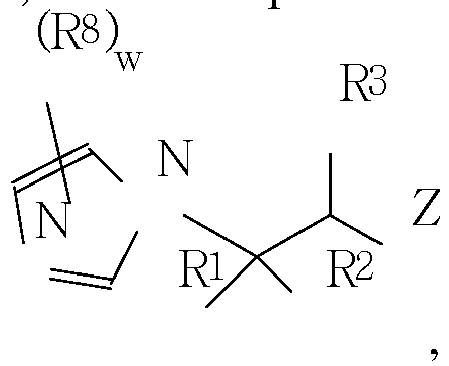 Z comprises a ketone, ester, amide, nitrile, or azlactone functional group,R1 is H or a C1-C25 alkyl group,R2 is H or -CO- X1-R5, where R5 is a H or a C1-C25 alkyl group and X1 is -O- or - NR6-, where R6 is H or a C1-C6 alkyl; andR3 is H or CH3,R8 is a hydrocarbyl group, and w is 0, 1, 2 or 3;with the proviso that when Z comprises nitrile or azlactone functional group, then R1 and R2 is H.
 - The curable composition of claim 9 wherein the acid-functional (meth)acrylate copolymer comprises polymerized monomer units of:i. 85 to 99.5 parts by weight of an (meth)acrylic acid ester monomers;ii. 0.5 to 15 parts by weight of an acid functional ethylenically unsaturated monomers;iii. 0 to 10 parts by weight of a non-acid functional, ethylenically unsaturated polar monomers;iv. 0 to 5 parts vinyl monomers; andv. 0 to 5 parts of a multifunctional (meth)acrylate monomers; based on 100 parts by weight total monomer.
- The curable composition of claim 9 wherein the acid-functional (meth)acrylate copolymer is of the formula:
 Macrylate represents polymerized multifunctional (meth)acrylate monomer units derived from (meth)acrylic acid ester of non-tertiary alcohol having "a" polymerized monomer units,Macid represents polymerized monomer units derived from acid functional monomers having "b" polymerized monomer units,Mpolar represents polymerized polar monomer units having "c' polymerized monomer units,Mvinyl represents polymerized vinyl monomer units derived from acid functional monomers having "d" polymerized monomer units, andMmulti represents polymerized multifunctional (meth)acrylate monomer units having "e" polymerized monomer units, andwherein a and b are at least one and c, d, and e may be zero or non-zero.
Applications Claiming Priority (2)
| Application Number | Priority Date | Filing Date | Title |
|---|---|---|---|
| US34562410P | 2010-05-18 | 2010-05-18 | |
| PCT/US2011/036370 WO2011146326A1 (en) | 2010-05-18 | 2011-05-13 | Polymerizable ionic liquid compositions |
Publications (2)
| Publication Number | Publication Date |
|---|---|
| EP2571908A1 EP2571908A1 (en) | 2013-03-27 |
| EP2571908B1 true EP2571908B1 (en) | 2017-04-26 |
Family
ID=44269286
Family Applications (1)
| Application Number | Title | Priority Date | Filing Date |
|---|---|---|---|
| EP11724481.4A Not-in-force EP2571908B1 (en) | 2010-05-18 | 2011-05-13 | Polymerizable ionic liquid compositions |
Country Status (6)
| Country | Link |
|---|---|
| US (1) | US8383721B2 (en) |
| EP (1) | EP2571908B1 (en) |
| JP (1) | JP6177126B2 (en) |
| KR (1) | KR101827588B1 (en) |
| CN (1) | CN102906133B (en) |
| WO (1) | WO2011146326A1 (en) |
Families Citing this family (26)
| Publication number | Priority date | Publication date | Assignee | Title |
|---|---|---|---|---|
| US8816029B2 (en) | 2009-08-28 | 2014-08-26 | 3M Innovative Properties Company | Compositions and articles comprising polymerizable ionic liquid mixture, and methods of curing |
| JP5781075B2 (en) | 2009-08-28 | 2015-09-16 | スリーエム イノベイティブ プロパティズ カンパニー | Polymerizable ionic liquids and antistatic coatings containing polyfunctional cations |
| WO2011087621A2 (en) | 2009-12-22 | 2011-07-21 | 3M Innovative Properties Company | Curable dental compositions and articles comprising polymerizable ionic liquids |
| EP2571909B1 (en) | 2010-05-18 | 2016-10-05 | 3M Innovative Properties Company | Polymerizable ionic liquid comprising aromatic carboxylate anion |
| US8779024B2 (en) * | 2012-02-28 | 2014-07-15 | Dentsply International Inc. | Acid-neutralizing resins and hardenable dental compositions thereof |
| GB2505397A (en) * | 2012-06-27 | 2014-03-05 | Surface Innovations Ltd | Method |
| CN102924382B (en) * | 2012-10-10 | 2014-11-19 | 淮海工学院 | Disalicylaldehyde functionalized imidazole-type gemini ionic liquid and preparation method thereof |
| JP6069784B2 (en) * | 2012-12-11 | 2017-02-01 | 国立大学法人神戸大学 | Ionic liquid polymer-containing composite fine particles and method for producing the same |
| MX386935B (en) | 2013-03-14 | 2025-03-04 | Alkermes Pharma Ireland Ltd | PRODRUGS OF FUMARATES AND THEIR USE IN THE TREATMENT OF DIFFERENT DISEASES. |
| US8669281B1 (en) | 2013-03-14 | 2014-03-11 | Alkermes Pharma Ireland Limited | Prodrugs of fumarates and their use in treating various diseases |
| GB201310350D0 (en) | 2013-06-11 | 2013-07-24 | Fujifilm Mfg Europe Bv | Curable compositions and membranes |
| JP6337135B2 (en) | 2014-02-24 | 2018-06-06 | アルカーメス ファーマ アイルランド リミテッド | Sulfonamide and sulfinamide prodrugs of fumarate and their use in the treatment of various diseases |
| EP3478666B1 (en) * | 2016-06-29 | 2020-07-29 | 3M Innovative Properties Company | Polymerizable ionic liquid compositions |
| CN111094361B (en) * | 2017-11-21 | 2023-01-10 | 日东电工株式会社 | Method for producing structure containing ionic liquid and structure containing ionic liquid |
| US20200157313A1 (en) * | 2018-11-20 | 2020-05-21 | Dentsply Sirona Inc. | Imidazolium/thiol polymerization initiation system |
| CN109913142B (en) * | 2019-03-01 | 2021-12-10 | 苏州格睿光电科技有限公司 | Antistatic organic silicon pressure-sensitive adhesive product |
| WO2021097532A1 (en) * | 2019-11-22 | 2021-05-27 | Deakin University | Organic corrosion inhibitors |
| WO2021097531A1 (en) * | 2019-11-22 | 2021-05-27 | Deakin University | Polyionic corrosion inhibitors |
| KR20240011732A (en) * | 2021-05-21 | 2024-01-26 | 닛토덴코 가부시키가이샤 | Adhesive composition, adhesive layer and adhesive sheet |
| JP2024522538A (en) * | 2021-06-04 | 2024-06-21 | スリーエム イノベイティブ プロパティズ カンパニー | Articles containing adhesive compositions that exhibit on-demand peel behavior |
| CN113501788A (en) * | 2021-06-21 | 2021-10-15 | 宁夏倬昱新材料科技有限公司 | Synthesis method of N-cyanoethylimidazole compound |
| WO2023007202A1 (en) * | 2021-07-29 | 2023-02-02 | The Regents Of The University Of Colorado, A Body Corporate | Mixed-matrix membranes, composition and method |
| CN113772957B (en) * | 2021-08-17 | 2023-03-21 | 浙江理工大学 | Preparation of modified carbonyl iron powder for magnetic control super-hydrophobic surface construction and application of modified carbonyl iron powder in blue light curing super-hydrophobic film |
| CN114316134B (en) * | 2022-01-28 | 2023-03-07 | 山西大学 | High-temperature retarder for geothermal cementing of hot dry rock and preparation method and application thereof |
| CN114835850B (en) * | 2022-05-19 | 2023-01-17 | 中国石油大学(华东) | A kind of polymerized ionic liquid inhibitor and its preparation method and application |
| CN119702073B (en) * | 2024-12-23 | 2026-04-21 | 浙江工业大学 | A catalyst coated with a self-curing ionic liquid film, its preparation method and application |
Family Cites Families (28)
| Publication number | Priority date | Publication date | Assignee | Title |
|---|---|---|---|---|
| US4049705A (en) | 1976-04-01 | 1977-09-20 | E. I. Du Pont De Nemours And Company | 2-Alkyl-1-naphthol-4-sulfonic acids |
| DE2750030A1 (en) | 1977-11-09 | 1979-05-10 | Basf Ag | INSECTICIDES |
| US4262072A (en) | 1979-06-25 | 1981-04-14 | Minnesota Mining And Manufacturing Company | Poly(ethylenically unsaturated alkoxy) heterocyclic protective coatings |
| US4843134A (en) | 1984-03-28 | 1989-06-27 | Minnesota Mining And Manufacturing Company | Acrylate pressure-sensitive adhesives containing insolubles |
| US4619979A (en) | 1984-03-28 | 1986-10-28 | Minnesota Mining And Manufacturing Company | Continuous free radial polymerization in a wiped-surface reactor |
| US4503169A (en) | 1984-04-19 | 1985-03-05 | Minnesota Mining And Manufacturing Company | Radiopaque, low visual opacity dental composites containing non-vitreous microparticles |
| US5804610A (en) | 1994-09-09 | 1998-09-08 | Minnesota Mining And Manufacturing Company | Methods of making packaged viscoelastic compositions |
| US5637646A (en) | 1995-12-14 | 1997-06-10 | Minnesota Mining And Manufacturing Company | Bulk radical polymerization using a batch reactor |
| JP3408689B2 (en) * | 1996-04-12 | 2003-05-19 | 住友ベークライト株式会社 | Thermosetting resin composition |
| DE10100455A1 (en) | 2001-01-08 | 2002-07-11 | Creavis Tech & Innovation Gmbh | Novel polymer binder systems with ionic liquids |
| CN100415198C (en) | 2001-08-15 | 2008-09-03 | 3M创新有限公司 | Hardenable self-supporting structures and methods |
| CN1255372C (en) * | 2003-08-11 | 2006-05-10 | 北京师范大学 | (Methyl) acrylic acid series ion liquid and its preparing method |
| US7452924B2 (en) | 2003-08-12 | 2008-11-18 | 3M Espe Ag | Self-etching emulsion dental compositions and methods |
| US7090722B2 (en) | 2004-05-17 | 2006-08-15 | 3M Innovative Properties Company | Acid-reactive dental fillers, compositions, and methods |
| US7649029B2 (en) | 2004-05-17 | 2010-01-19 | 3M Innovative Properties Company | Dental compositions containing nanozirconia fillers |
| US7156911B2 (en) | 2004-05-17 | 2007-01-02 | 3M Innovative Properties Company | Dental compositions containing nanofillers and related methods |
| US7090721B2 (en) | 2004-05-17 | 2006-08-15 | 3M Innovative Properties Company | Use of nanoparticles to adjust refractive index of dental compositions |
| WO2006053083A2 (en) * | 2004-11-10 | 2006-05-18 | University Of Wyoming | Polymers and copolymers of ionic liquids as radio frequency absorbing materials |
| JP2006282418A (en) * | 2005-03-31 | 2006-10-19 | Nisshinbo Ind Inc | Gel composition and method for producing the same |
| DE102006021200A1 (en) * | 2006-05-06 | 2007-11-15 | Byk-Chemie Gmbh | Use of copolymers as adhesion promoters in paints |
| EP2033626A3 (en) | 2007-09-05 | 2010-03-17 | Basf Se | Imidazoliumalkyl(meth)acrylate polymers |
| JP2009149828A (en) * | 2007-12-25 | 2009-07-09 | Sanyo Chem Ind Ltd | Microwave-curable composition |
| JP5260273B2 (en) * | 2007-12-27 | 2013-08-14 | 三洋化成工業株式会社 | Active energy ray-curable antistatic resin composition |
| JP5398992B2 (en) * | 2008-01-31 | 2014-01-29 | 三洋化成工業株式会社 | Active energy ray-curable antistatic resin composition |
| JP5214490B2 (en) | 2008-03-31 | 2013-06-19 | 三洋化成工業株式会社 | Active energy ray-curable antistatic resin composition |
| JP2009269974A (en) * | 2008-05-02 | 2009-11-19 | Three M Innovative Properties Co | Gel composition, method for producing the same, and shock absorbing material produced by using the same |
| CN101341872A (en) * | 2008-08-22 | 2009-01-14 | 集美大学 | Ionic liquid antibacterial and bactericidal agent and its synthesis method and application |
| US8816029B2 (en) | 2009-08-28 | 2014-08-26 | 3M Innovative Properties Company | Compositions and articles comprising polymerizable ionic liquid mixture, and methods of curing |
-
2011
- 2011-05-13 JP JP2013511234A patent/JP6177126B2/en not_active Expired - Fee Related
- 2011-05-13 EP EP11724481.4A patent/EP2571908B1/en not_active Not-in-force
- 2011-05-13 US US13/106,906 patent/US8383721B2/en active Active
- 2011-05-13 KR KR1020127032454A patent/KR101827588B1/en not_active Expired - Fee Related
- 2011-05-13 WO PCT/US2011/036370 patent/WO2011146326A1/en not_active Ceased
- 2011-05-13 CN CN201180024818.1A patent/CN102906133B/en not_active Expired - Fee Related
Non-Patent Citations (1)
| Title |
|---|
| None * |
Also Published As
| Publication number | Publication date |
|---|---|
| CN102906133A (en) | 2013-01-30 |
| KR101827588B1 (en) | 2018-03-22 |
| WO2011146326A1 (en) | 2011-11-24 |
| US8383721B2 (en) | 2013-02-26 |
| EP2571908A1 (en) | 2013-03-27 |
| US20110288227A1 (en) | 2011-11-24 |
| JP2013533329A (en) | 2013-08-22 |
| CN102906133B (en) | 2015-11-25 |
| JP6177126B2 (en) | 2017-08-09 |
| KR20130086148A (en) | 2013-07-31 |
Similar Documents
| Publication | Publication Date | Title |
|---|---|---|
| US8383721B2 (en) | Polymerizable ionic liquid compositions | |
| JP5818879B2 (en) | Polymerizable ionic liquids containing aromatic carboxylate anions | |
| US9127101B2 (en) | Compositions and articles comprising polymerizable ionic liquid mixture, and methods of curing | |
| CN103328437B (en) | Addition-fragmentation agent | |
| EP0346707B1 (en) | Dental materials | |
| EP2748206B1 (en) | Addition-fragmentation agents | |
| AU671509B2 (en) | Copolymers of (meth)acryloxy-alkyl-siloxysilane and alkyl(meth)acrylates and the use thereof as pressure sensitive adhesives | |
| US20240199920A1 (en) | Articles containing adhesive compositions exhibiting on-demand debonding behavior | |
| TW210348B (en) | ||
| CA3118092A1 (en) | Compositions and methods to antibacterial nanogel and hydrolytically stable antibacterial nanogel for dental compositions | |
| US10370322B2 (en) | Addition-fragmentation agents | |
| EP0508095A2 (en) | Dental materials based on (meth)-acrylates | |
| WO2020171071A1 (en) | Ultraviolet ray-absorbing polymer, molding resin composition, and molded body | |
| WO2025204426A1 (en) | Photocurable resin composition and cured product | |
| HK40046585B (en) | Compositions and methods to antibacterial nanogel and hydrolytically stable antibacterial nanogel for dental compositions | |
| JPS62230811A (en) | Copolymer composition |
Legal Events
| Date | Code | Title | Description |
|---|---|---|---|
| PUAI | Public reference made under article 153(3) epc to a published international application that has entered the european phase |
Free format text: ORIGINAL CODE: 0009012 |
|
| 17P | Request for examination filed |
Effective date: 20121107 |
|
| AK | Designated contracting states |
Kind code of ref document: A1 Designated state(s): AL AT BE BG CH CY CZ DE DK EE ES FI FR GB GR HR HU IE IS IT LI LT LU LV MC MK MT NL NO PL PT RO RS SE SI SK SM TR |
|
| DAX | Request for extension of the european patent (deleted) | ||
| GRAP | Despatch of communication of intention to grant a patent |
Free format text: ORIGINAL CODE: EPIDOSNIGR1 |
|
| STAA | Information on the status of an ep patent application or granted ep patent |
Free format text: STATUS: GRANT OF PATENT IS INTENDED |
|
| INTG | Intention to grant announced |
Effective date: 20170109 |
|
| GRAS | Grant fee paid |
Free format text: ORIGINAL CODE: EPIDOSNIGR3 |
|
| GRAA | (expected) grant |
Free format text: ORIGINAL CODE: 0009210 |
|
| STAA | Information on the status of an ep patent application or granted ep patent |
Free format text: STATUS: THE PATENT HAS BEEN GRANTED |
|
| AK | Designated contracting states |
Kind code of ref document: B1 Designated state(s): AL AT BE BG CH CY CZ DE DK EE ES FI FR GB GR HR HU IE IS IT LI LT LU LV MC MK MT NL NO PL PT RO RS SE SI SK SM TR |
|
| REG | Reference to a national code |
Ref country code: GB Ref legal event code: FG4D |
|
| REG | Reference to a national code |
Ref country code: CH Ref legal event code: EP |
|
| REG | Reference to a national code |
Ref country code: AT Ref legal event code: REF Ref document number: 887820 Country of ref document: AT Kind code of ref document: T Effective date: 20170515 |
|
| REG | Reference to a national code |
Ref country code: IE Ref legal event code: FG4D |
|
| REG | Reference to a national code |
Ref country code: DE Ref legal event code: R096 Ref document number: 602011037322 Country of ref document: DE |
|
| REG | Reference to a national code |
Ref country code: NL Ref legal event code: MP Effective date: 20170426 |
|
| REG | Reference to a national code |
Ref country code: LT Ref legal event code: MG4D |
|
| REG | Reference to a national code |
Ref country code: AT Ref legal event code: MK05 Ref document number: 887820 Country of ref document: AT Kind code of ref document: T Effective date: 20170426 |
|
| PG25 | Lapsed in a contracting state [announced via postgrant information from national office to epo] |
Ref country code: NL Free format text: LAPSE BECAUSE OF FAILURE TO SUBMIT A TRANSLATION OF THE DESCRIPTION OR TO PAY THE FEE WITHIN THE PRESCRIBED TIME-LIMIT Effective date: 20170426 |
|
| PG25 | Lapsed in a contracting state [announced via postgrant information from national office to epo] |
Ref country code: HR Free format text: LAPSE BECAUSE OF FAILURE TO SUBMIT A TRANSLATION OF THE DESCRIPTION OR TO PAY THE FEE WITHIN THE PRESCRIBED TIME-LIMIT Effective date: 20170426 Ref country code: NO Free format text: LAPSE BECAUSE OF FAILURE TO SUBMIT A TRANSLATION OF THE DESCRIPTION OR TO PAY THE FEE WITHIN THE PRESCRIBED TIME-LIMIT Effective date: 20170726 Ref country code: FI Free format text: LAPSE BECAUSE OF FAILURE TO SUBMIT A TRANSLATION OF THE DESCRIPTION OR TO PAY THE FEE WITHIN THE PRESCRIBED TIME-LIMIT Effective date: 20170426 Ref country code: ES Free format text: LAPSE BECAUSE OF FAILURE TO SUBMIT A TRANSLATION OF THE DESCRIPTION OR TO PAY THE FEE WITHIN THE PRESCRIBED TIME-LIMIT Effective date: 20170426 Ref country code: GR Free format text: LAPSE BECAUSE OF FAILURE TO SUBMIT A TRANSLATION OF THE DESCRIPTION OR TO PAY THE FEE WITHIN THE PRESCRIBED TIME-LIMIT Effective date: 20170727 Ref country code: AT Free format text: LAPSE BECAUSE OF FAILURE TO SUBMIT A TRANSLATION OF THE DESCRIPTION OR TO PAY THE FEE WITHIN THE PRESCRIBED TIME-LIMIT Effective date: 20170426 Ref country code: LT Free format text: LAPSE BECAUSE OF FAILURE TO SUBMIT A TRANSLATION OF THE DESCRIPTION OR TO PAY THE FEE WITHIN THE PRESCRIBED TIME-LIMIT Effective date: 20170426 |
|
| PG25 | Lapsed in a contracting state [announced via postgrant information from national office to epo] |
Ref country code: LV Free format text: LAPSE BECAUSE OF FAILURE TO SUBMIT A TRANSLATION OF THE DESCRIPTION OR TO PAY THE FEE WITHIN THE PRESCRIBED TIME-LIMIT Effective date: 20170426 Ref country code: SE Free format text: LAPSE BECAUSE OF FAILURE TO SUBMIT A TRANSLATION OF THE DESCRIPTION OR TO PAY THE FEE WITHIN THE PRESCRIBED TIME-LIMIT Effective date: 20170426 Ref country code: PL Free format text: LAPSE BECAUSE OF FAILURE TO SUBMIT A TRANSLATION OF THE DESCRIPTION OR TO PAY THE FEE WITHIN THE PRESCRIBED TIME-LIMIT Effective date: 20170426 Ref country code: BG Free format text: LAPSE BECAUSE OF FAILURE TO SUBMIT A TRANSLATION OF THE DESCRIPTION OR TO PAY THE FEE WITHIN THE PRESCRIBED TIME-LIMIT Effective date: 20170726 Ref country code: RS Free format text: LAPSE BECAUSE OF FAILURE TO SUBMIT A TRANSLATION OF THE DESCRIPTION OR TO PAY THE FEE WITHIN THE PRESCRIBED TIME-LIMIT Effective date: 20170426 Ref country code: IS Free format text: LAPSE BECAUSE OF FAILURE TO SUBMIT A TRANSLATION OF THE DESCRIPTION OR TO PAY THE FEE WITHIN THE PRESCRIBED TIME-LIMIT Effective date: 20170826 |
|
| REG | Reference to a national code |
Ref country code: CH Ref legal event code: PL |
|
| REG | Reference to a national code |
Ref country code: DE Ref legal event code: R097 Ref document number: 602011037322 Country of ref document: DE |
|
| PG25 | Lapsed in a contracting state [announced via postgrant information from national office to epo] |
Ref country code: RO Free format text: LAPSE BECAUSE OF FAILURE TO SUBMIT A TRANSLATION OF THE DESCRIPTION OR TO PAY THE FEE WITHIN THE PRESCRIBED TIME-LIMIT Effective date: 20170426 Ref country code: SK Free format text: LAPSE BECAUSE OF FAILURE TO SUBMIT A TRANSLATION OF THE DESCRIPTION OR TO PAY THE FEE WITHIN THE PRESCRIBED TIME-LIMIT Effective date: 20170426 Ref country code: MC Free format text: LAPSE BECAUSE OF FAILURE TO SUBMIT A TRANSLATION OF THE DESCRIPTION OR TO PAY THE FEE WITHIN THE PRESCRIBED TIME-LIMIT Effective date: 20170426 Ref country code: EE Free format text: LAPSE BECAUSE OF FAILURE TO SUBMIT A TRANSLATION OF THE DESCRIPTION OR TO PAY THE FEE WITHIN THE PRESCRIBED TIME-LIMIT Effective date: 20170426 Ref country code: CZ Free format text: LAPSE BECAUSE OF FAILURE TO SUBMIT A TRANSLATION OF THE DESCRIPTION OR TO PAY THE FEE WITHIN THE PRESCRIBED TIME-LIMIT Effective date: 20170426 Ref country code: DK Free format text: LAPSE BECAUSE OF FAILURE TO SUBMIT A TRANSLATION OF THE DESCRIPTION OR TO PAY THE FEE WITHIN THE PRESCRIBED TIME-LIMIT Effective date: 20170426 |
|
| REG | Reference to a national code |
Ref country code: IE Ref legal event code: MM4A |
|
| PG25 | Lapsed in a contracting state [announced via postgrant information from national office to epo] |
Ref country code: LI Free format text: LAPSE BECAUSE OF NON-PAYMENT OF DUE FEES Effective date: 20170531 Ref country code: IT Free format text: LAPSE BECAUSE OF FAILURE TO SUBMIT A TRANSLATION OF THE DESCRIPTION OR TO PAY THE FEE WITHIN THE PRESCRIBED TIME-LIMIT Effective date: 20170426 Ref country code: CH Free format text: LAPSE BECAUSE OF NON-PAYMENT OF DUE FEES Effective date: 20170531 Ref country code: SM Free format text: LAPSE BECAUSE OF FAILURE TO SUBMIT A TRANSLATION OF THE DESCRIPTION OR TO PAY THE FEE WITHIN THE PRESCRIBED TIME-LIMIT Effective date: 20170426 |
|
| PLBE | No opposition filed within time limit |
Free format text: ORIGINAL CODE: 0009261 |
|
| STAA | Information on the status of an ep patent application or granted ep patent |
Free format text: STATUS: NO OPPOSITION FILED WITHIN TIME LIMIT |
|
| GBPC | Gb: european patent ceased through non-payment of renewal fee |
Effective date: 20170726 |
|
| PG25 | Lapsed in a contracting state [announced via postgrant information from national office to epo] |
Ref country code: LU Free format text: LAPSE BECAUSE OF NON-PAYMENT OF DUE FEES Effective date: 20170513 |
|
| 26N | No opposition filed |
Effective date: 20180129 |
|
| REG | Reference to a national code |
Ref country code: BE Ref legal event code: MM Effective date: 20170531 |
|
| PG25 | Lapsed in a contracting state [announced via postgrant information from national office to epo] |
Ref country code: IE Free format text: LAPSE BECAUSE OF NON-PAYMENT OF DUE FEES Effective date: 20170513 Ref country code: GB Free format text: LAPSE BECAUSE OF NON-PAYMENT OF DUE FEES Effective date: 20170726 |
|
| REG | Reference to a national code |
Ref country code: FR Ref legal event code: ST Effective date: 20180411 |
|
| PG25 | Lapsed in a contracting state [announced via postgrant information from national office to epo] |
Ref country code: SI Free format text: LAPSE BECAUSE OF FAILURE TO SUBMIT A TRANSLATION OF THE DESCRIPTION OR TO PAY THE FEE WITHIN THE PRESCRIBED TIME-LIMIT Effective date: 20170426 |
|
| PG25 | Lapsed in a contracting state [announced via postgrant information from national office to epo] |
Ref country code: BE Free format text: LAPSE BECAUSE OF NON-PAYMENT OF DUE FEES Effective date: 20170531 Ref country code: FR Free format text: LAPSE BECAUSE OF NON-PAYMENT OF DUE FEES Effective date: 20170626 |
|
| PG25 | Lapsed in a contracting state [announced via postgrant information from national office to epo] |
Ref country code: MT Free format text: LAPSE BECAUSE OF NON-PAYMENT OF DUE FEES Effective date: 20170513 |
|
| PG25 | Lapsed in a contracting state [announced via postgrant information from national office to epo] |
Ref country code: HU Free format text: LAPSE BECAUSE OF FAILURE TO SUBMIT A TRANSLATION OF THE DESCRIPTION OR TO PAY THE FEE WITHIN THE PRESCRIBED TIME-LIMIT; INVALID AB INITIO Effective date: 20110513 |
|
| PG25 | Lapsed in a contracting state [announced via postgrant information from national office to epo] |
Ref country code: CY Free format text: LAPSE BECAUSE OF NON-PAYMENT OF DUE FEES Effective date: 20170426 |
|
| PG25 | Lapsed in a contracting state [announced via postgrant information from national office to epo] |
Ref country code: MK Free format text: LAPSE BECAUSE OF FAILURE TO SUBMIT A TRANSLATION OF THE DESCRIPTION OR TO PAY THE FEE WITHIN THE PRESCRIBED TIME-LIMIT Effective date: 20170426 |
|
| PG25 | Lapsed in a contracting state [announced via postgrant information from national office to epo] |
Ref country code: TR Free format text: LAPSE BECAUSE OF FAILURE TO SUBMIT A TRANSLATION OF THE DESCRIPTION OR TO PAY THE FEE WITHIN THE PRESCRIBED TIME-LIMIT Effective date: 20170426 |
|
| PG25 | Lapsed in a contracting state [announced via postgrant information from national office to epo] |
Ref country code: PT Free format text: LAPSE BECAUSE OF FAILURE TO SUBMIT A TRANSLATION OF THE DESCRIPTION OR TO PAY THE FEE WITHIN THE PRESCRIBED TIME-LIMIT Effective date: 20170426 |
|
| PG25 | Lapsed in a contracting state [announced via postgrant information from national office to epo] |
Ref country code: AL Free format text: LAPSE BECAUSE OF FAILURE TO SUBMIT A TRANSLATION OF THE DESCRIPTION OR TO PAY THE FEE WITHIN THE PRESCRIBED TIME-LIMIT Effective date: 20170426 |
|
| PGFP | Annual fee paid to national office [announced via postgrant information from national office to epo] |
Ref country code: DE Payment date: 20200428 Year of fee payment: 10 |
|
| REG | Reference to a national code |
Ref country code: DE Ref legal event code: R119 Ref document number: 602011037322 Country of ref document: DE |
|
| PG25 | Lapsed in a contracting state [announced via postgrant information from national office to epo] |
Ref country code: DE Free format text: LAPSE BECAUSE OF NON-PAYMENT OF DUE FEES Effective date: 20211201 |