EP2570979A1 - Verwaltung von Online-Inhalten in einem Netzwerk - Google Patents
Verwaltung von Online-Inhalten in einem Netzwerk Download PDFInfo
- Publication number
- EP2570979A1 EP2570979A1 EP12182306A EP12182306A EP2570979A1 EP 2570979 A1 EP2570979 A1 EP 2570979A1 EP 12182306 A EP12182306 A EP 12182306A EP 12182306 A EP12182306 A EP 12182306A EP 2570979 A1 EP2570979 A1 EP 2570979A1
- Authority
- EP
- European Patent Office
- Prior art keywords
- seed
- user
- network
- online
- content
- Prior art date
- Legal status (The legal status is an assumption and is not a legal conclusion. Google has not performed a legal analysis and makes no representation as to the accuracy of the status listed.)
- Ceased
Links
Images


Classifications
-
- G—PHYSICS
- G06—COMPUTING OR CALCULATING; COUNTING
- G06Q—INFORMATION AND COMMUNICATION TECHNOLOGY [ICT] SPECIALLY ADAPTED FOR ADMINISTRATIVE, COMMERCIAL, FINANCIAL, MANAGERIAL OR SUPERVISORY PURPOSES; SYSTEMS OR METHODS SPECIALLY ADAPTED FOR ADMINISTRATIVE, COMMERCIAL, FINANCIAL, MANAGERIAL OR SUPERVISORY PURPOSES, NOT OTHERWISE PROVIDED FOR
- G06Q30/00—Commerce
- G06Q30/02—Marketing; Price estimation or determination; Fundraising
-
- G—PHYSICS
- G06—COMPUTING OR CALCULATING; COUNTING
- G06Q—INFORMATION AND COMMUNICATION TECHNOLOGY [ICT] SPECIALLY ADAPTED FOR ADMINISTRATIVE, COMMERCIAL, FINANCIAL, MANAGERIAL OR SUPERVISORY PURPOSES; SYSTEMS OR METHODS SPECIALLY ADAPTED FOR ADMINISTRATIVE, COMMERCIAL, FINANCIAL, MANAGERIAL OR SUPERVISORY PURPOSES, NOT OTHERWISE PROVIDED FOR
- G06Q10/00—Administration; Management
- G06Q10/40—Business processes related to social networking or social networking services
-
- G—PHYSICS
- G06—COMPUTING OR CALCULATING; COUNTING
- G06Q—INFORMATION AND COMMUNICATION TECHNOLOGY [ICT] SPECIALLY ADAPTED FOR ADMINISTRATIVE, COMMERCIAL, FINANCIAL, MANAGERIAL OR SUPERVISORY PURPOSES; SYSTEMS OR METHODS SPECIALLY ADAPTED FOR ADMINISTRATIVE, COMMERCIAL, FINANCIAL, MANAGERIAL OR SUPERVISORY PURPOSES, NOT OTHERWISE PROVIDED FOR
- G06Q10/00—Administration; Management
- G06Q10/40—Business processes related to social networking or social networking services
- G06Q10/48—Business processes related to social networking or social networking services using social graphs
-
- G—PHYSICS
- G06—COMPUTING OR CALCULATING; COUNTING
- G06Q—INFORMATION AND COMMUNICATION TECHNOLOGY [ICT] SPECIALLY ADAPTED FOR ADMINISTRATIVE, COMMERCIAL, FINANCIAL, MANAGERIAL OR SUPERVISORY PURPOSES; SYSTEMS OR METHODS SPECIALLY ADAPTED FOR ADMINISTRATIVE, COMMERCIAL, FINANCIAL, MANAGERIAL OR SUPERVISORY PURPOSES, NOT OTHERWISE PROVIDED FOR
- G06Q30/00—Commerce
- G06Q30/02—Marketing; Price estimation or determination; Fundraising
- G06Q30/0241—Advertisements
Definitions
- the disclosure relates in general to the management of online content in a network environment, in particular in online communities or social networks. More specifically, the disclosure relates to a new data type or data structure enabling users to easily retrieve online content and to link, connect or commonly share online content with other users or friends of an online community or social network in a uniform, intuitive manner.
- a user retrieving online content encoded with the new data type or data structure will automatically cause or offers further interactions of other users or friends, to which the user is connected or linked to, and the type of these further interactions of these other users or friends is prescribed by the data included in the seed.
- online content is organized in seeds, be these videos, audio files, games, applications, blogs, comments, playlists, activities, chats, news, messages, communication media (video over ip), tv-shows, pictures or even users or group of users.
- All seeds are connected or linked to other seeds forming a network of seeds.
- Users of online communities and social networks are usually identified by their user-specific profiles, which include besides identifying data also information about their specific preferences. It is known from the prior art that these profiles are regularly monitored, maintained or modified based on user interactions. User interactions of users can also be analyzed and matched to the user profiles of other users or friends who are also a registered member of an online community or social network.
- the present invention is to provide a new data type or data structure enabling users to easily retrieve online content and to link, connect or commonly share online content with other users or friends of an online community or social network in a uniform, intuitive manner, to thereby establish a network of hitherto unknown functionality and vitality.
- the present invention provides a computer-implemented method for the management of online-content in a network, wherein all online-content is organized in a container, also referred to as a seed, that is accessible by users via said network and that consists of main data and at least one metadata attached to the main data.
- a container also referred to as a seed
- the main data is online-content, such as videos, audio files, games, applications, blogs, comments, playlists, activities, chats, news, messages, communication media (video over ip), TV-shows, pictures or users or groups of users, wherein the at least one metadata indicates how a seed shall be handled if retrieved by a user.
- online-content such as videos, audio files, games, applications, blogs, comments, playlists, activities, chats, news, messages, communication media (video over ip), TV-shows, pictures or users or groups of users, wherein the at least one metadata indicates how a seed shall be handled if retrieved by a user.
- the metadata offer predetermined actions to other users of the network retrieving a container or seed.
- containers or seeds are connected or linked to other containers or seeds to thereby form a network of containers or seeds.
- a further aspect of the present invention relates to a computer system for running a social network consisting of a plurality of members, said computer system being configured for performing the foregoing computer-implemented method as outlined in the following.
- a further aspect of the present invention relates to a computer readable storage medium tangibly embodied thereon a program of instructions executable by a processor for performing the foregoing computer-implemented method as outlined in the following.
- a seed is a core element of a new type of database in a cloud/server environment. All social media objects that are managed by the system are handled in the same way, no matter if the media object is a blog, a video file, a user or a group of users or others. At minimum (m) every seed has seed content, few basic parameters, and might have additional parameters.
- a seed can be a live, realtime content, seeds are persistant in time and grow.
- a seed can have a parent, child, neighbors or other hierarchical or technically organized, relationship structures.
- Seeds can be connected across many servers and clouds too, through multiple seed servers, from different seed-server operators.
- Fig. 1 is a schematic block diagram of an embodiment of a data container, named seed, including online content and specific metadata.
- the seed 100 contains an actual data file 102 (named seed content), which is retrievable via the network, and related metadata 104, which will be outlined below in more detail and of which Fig. 1 only lists a few exemplary ones.
- every seed has the following parameters. Yet, not all of the parameters are required in all of the embodiments depending on a seed type, as described below:
- Seed ID (basic parameter)
- Every seed has a unique ID created by the system to ensure a precise targeting of every single seed.
- the user (ID) who created the seed There is always a specific user who created a seed. This can be someone else than the current owner of the seed.
- Every seed this seed is addressed to is listed as recipient. This can be single seeds (individually target of one or more seeds), group of seeds, all seeds (e.g. public) or self (creator only).
- the public can be targeted by addressing it as public, all or similar synonyms, and in some cases leaving it blank, may address public. Further the recipient might be the creator's address itself, so it becomes a stored seed in his seed library.
- the date the seed was created online For example for a user this is not the birth date, but the date the user created his online User ID seed.
- Seed type (basic parameter)
- Each seed is of a specific type, e.g. a user, video, blog, etc. new types can be generated by the system developers at anytime. This will add a different set of parameters to the seed, and possibly create one or more types of new parameters.
- a seed type defines what actions the recipients(s) can perform. The seed type can also be transparent to the users who receive the seeds, but addressed by the system for defining the aforementioned action users can perform.
- a video-seed For example default actions on a video-seed might be to play the video-seed, but in cases of more advanced setups, a video-seed might require a "rent” action, to be consumed.
- the rent action implies that the user who wants to watch the video has to first pay for the content before he is permitted to watch it.
- Each seed has certain actions assigned to it, may this be social or content-based actions like but not limited to sharing, buying, playing, chatting or responding (to) the seed. These actions are triggered once a user retrieves the seed, e.g. by means of a pointing device, such as a computer mouse, stylus or by means of a touch on a touch-sensitive display.
- a pointing device such as a computer mouse
- stylus or by means of a touch on a touch-sensitive display.
- the current user managing the seed This doesn't have to be the creator.
- a group can be the creator, but one member of the group is in charge of managing the seeds.
- the owner can set permissions for the different user levels to link to the seed. E.g. which users (friends, followers, public) are able to link to this seed.
- the owner can set permissions for the different user levels to connect to the seed. E.g. which users (friends, followers, public) are able to connect to this seed.
- a short name of the seed doesn't have to be unique as the internal ID makes sure every seed has a unique ID.
- Every seed has a default icon, based on the system's setting this might be a default icon based on the type of seed. The owner of the seed can change this icon anytime. In default cases, the icon would be either the creator's icon or one icon defining all seeds and is merely a design choice, not a method.
- the seed has a status being either in-context, engaged, live, online, offline or scheduled, e.g. switching via a schedule automatically to on- or offline.
- In-context can be defined by various other seeds, such as a gamename-seed can modify another engaging seed into the context of in-gamename. For example, if somebody plays a game, that user can turn playing Crysis 3.
- the schedule of any seed is turned off.
- the owner can turn it on and enter certain dates so the seed will go online or offline at certain times.
- the schedule can be updated, changed or deleted anytime.
- Implicit data is collected for each seed, such as stars, votes, ratings, user-views, user-action telemetry that the creator might find interesting to allow new type of action on an online, live content seed.
- This date defines when the seed will be visible online, or expressing an intention of the seed, e.g. future activity intent, or future tv-show release. This date can change and can be reset by the owner.
- the tags of a seed help users to find and sort seeds and help the system to organize seeds into clouds called shared interest clouds.
- Each tag has also a weight that can change over time to show how useful this tag is in terms of its organization inside the cloud.
- Each seed can have more than one tag so it can be defined as precise as possible.
- the tag creation process can be automated and not explicitly done by User.
- the seed can have additional information about it. These data can be either gathered automatically or entered by the owner. For example a picture could have additional information about its size, resolution, color depths, layers, etc.
- Advertisements can also be assigned via the tags that are specific to advertisement targeting. Essentially the owner can define the ad space of the seed to anyone to deliver targeted advertisements based on these specific advertisement related tags.
- the creator or current owner can add a description to the seed. This is a simple text or could be a connection to another seed.
- Comments can be user-generated comments, independent from the creator, but either embedded or separate seed connection focused on comments.
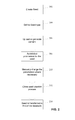
- Fig. 2 is a schematic flow diagram showing a process for creating a seed, and transferring the seed to an online database managing online retrieval of the seed by other users of a network.
- a user can login to the online community system where he wants to create a seed 202. He activates the creation process by defining a seed type (e.g. video file, a picture, etc.) 204. In case he wants to create a new user he doesn't have to login. But even a logged-in user can create a new user (which will also automatically create a connection between the two users).
- a seed type e.g. video file, a picture, etc.
- the system will prompt the user to add the specific content for the seed 206, e.g. uploading a video file, or entering a text and a design template for a blog entry.
- the parameters for the seed may be detected automatically 208, e.g. in order to provide a proposal to a user, who may then, in a subsequent step 210, manually change the parameters if necessary.
- the seed creation process is closed or terminated 212 and the seed is transferred to the online database of a server/cloud computing environment 214, from where it can be retrieved by other users of the network.
- the system makes a difference between linking to a seed and connecting to a seed.
- a user links to a seed he or she establishes a passive, asymmetrical link to the seed. He/she will be notified (although notification can be turned off or on) about any changes and or updates of and from the linked seed and can create a bookmark on the seed to find it again fast. However, the user does not require an agreement from the linked seed to perform a link. In other words he/she is following the linked seed as a follower. The linked seed can perform a query to see who and what is linked to itself.
- a user seed "A” may link to a content seed "C” and be notified about a content seed update over time, receiving an implicit update about seed changes.
- a user connects to a seed he establishes a symmetrical connection to the seed, where both seeds (the user connecting and the seed being connected) are aware of the connection.
- both owners of the two seeds have to agree to the connection, e.g. the owner of the seed that has been connected has to either agree to allow the connection or not allow the connection. Only if the connection is allowed the connection is actually established.
- a user can define for a seed to be shared to certain target seeds (friends, individual(s), groups, public, etc.) but also by connection or linked state.
- a user may desire to share his seed storage with linked public, in other words everyone that is linked to the user has access to the shared seed.
- the sharing status and the link or connect status are independent from each other, such as that a seed "A” that is connected to a group “B” can also be shared to group “C”. Group “B” and “C” might be completely different users, but can also overlap.
- a user can explicitly allow or block the linking, connecting or sharing to any other user or seed.
- Every seed allows certain actions for the user. These actions are organized in content actions, e.g. use the content of the seed, and social actions, e.g. create a social interaction with the seed.
- content actions e.g. use the content of the seed
- social actions e.g. create a social interaction with the seed.
- the owner of the seed can also connect advertisement seeds with the seed.
- Some actions create another seed, e.g. responding to a seed creates a seed connected to the original seed that contains a response in form of any media, video, audio, text, etc..
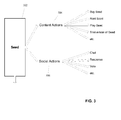
- Fig. 3 schematically shows how according to an embodiment a network is organized based on seeds that are retrievable by the users of the network online.
- the seeds 302 that are retrieved by other users e.g. users or friends, to which the original user may be connected or linked to, cause the other users to create new seeds that, if retrieved by other users, cause further seeds.
- Fig. 3 shows seeds for "content actions” 304, such as a “buy seed” for buying a good or service, a “rent seed” for renting a good or service, a “play seed” for playing e.g. a videogame, a "trialversion of seed” for requesting a trialversion etc., and for "social action” 306 in a network, such as chatting, responding to a message or request, voting about a topic in an online community or social network, e.g. via a vote button displayed on a graphical user interface of a user, etc.
- content actions such as a “buy seed” for buying a good or service, a “rent seed” for renting a good or service, a “play seed” for playing e.g. a videogame, a "trialversion of seed” for requesting a trialversion etc.
- social action 306 in a network, such as chatting, responding to a message or request, voting about a topic in an online community or social network, e
- All seeds of the network are indexed and categorized explicitly and implicitly by their tags and explicitly and implicitly by the connections or links to other seeds.
- Seeds that are created by friends, e.g. users that another user is connected to, will be automatically sent to the user. These automatically pushed seeds are displayed on an appropriate page of the user's profile.
- the seeds form a network of connected and linked seeds.
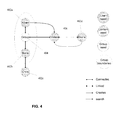
- the example shown in Fig. 4 explains the creation of such a network 400.
- the users Albert 402a and Boris 402b are sharing the membership of the same group 404.
- Boris 402b has another friend Chris 402c, who is not part of that group 404.
- Albert 402a is uploading a video and creating a content seed 406. This seed 406 is automatically connected to his user seed 402a.
- the video seed 406 gets also connected to Boris 402b, because he is in direct contact, aka connected, to Albert 402a.
- Chris 402c is not connected to the video 406, as he is neither connected to the group 404 nor Albert 402a.
- the user Diana 402d not connected to any mentioned users above, is able to search the network for videos and will find (among other content) the video seed 406 created by Albert 402a. With the search she is now linked to the video seed 406, but will not get any automatic links or connections to the already established network "behind" that video seed 406. Neither Albert 402a nor anyone in that group 404 will see the link to Diana 402d.
- XML Format is chosen as an example.
- a seed according to one embodiment can be of any format that can be read and interpreted by the system that is using the seeds.
- the present application describes the method and is not limited to the XML format.
- One example is a seed that is generated but not yet uploaded, so it is still without a unique reference ID, but contains already all other relevant information.
- a header may contain a name, comment, icon reference and such. As long as the seed is not uploaded it has no ID of its own.
- Creator and owner information may contain a reference targeting the ID of the creator/ owner, i.e. a link to a user seed.
- Typical groups can be defined, such as friends, public etc., as much as specific users.
- a possible shortcut may be specified, in case no other recipients are defined.
- parameters defining the actual content follow may be specified. These data are not parsed by the system, but relayed to whatever application can use the contained data.
- the example shows a video seed, thus parameters define the necessary information of the video, like length, format, size, codec, etc.
- Tags are needed to place the seed inside the interest cloud, including an optional weighting of each tag.
- the actions that are available with this seed may be specified in addition to the default ones.
- playback of the video is a default action to all permitted users, in addition all users can respond and vote on the seed.
- Permissions define who can do which social actions, such as linking the seed to other users.
- the seed may be closed with the history, like creation date and lifespan, and a schedule when the seed will be active or not.
- Another example refers to a typical seed that is already uploaded and can be accessed by users.
- the difference to the seed above is the already given ID, which is handed over to the seed the moment the seed is stored online.
- a user seed according to an example describes a user and the data stored with the user.
- the header may list such info like the Name, icon, etc. Most important is the ID that is the main link to his connected other seeds.
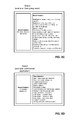
- a simple version of a seed is a video seed, as shown in Fig. 5A , which contains passive content that is played back.
- a user can upload a video.
- the uploading of the video creates a new seed.
- the user can automatically or manually define certain parameters.
- the user uploads a video showing his friends playing football. He names the video accordingly, sets it to "viewable by friends", assigns tags so his connected friends are enabled to automatically see the video seed in the correct context.
- Fig. 5B shows the moment a new user who isn't yet part of the community enters the system is asked to create a user account. This starts a creation process that generates a new seed according to one example, also called a user seed.
- the example bellows contains all standard data a user can enter to define his user seed.
- a user can create a user group seed by asking at least one other user if he wants to join a group. With at least two users a group seed is generated.
- the creator of the group can set several parameters to define the group, quite similar to creating a user account. More users can join the group depending on the settings, e.g. friends of members are automatic, others need confirmation of the owner, etc.
- a user uploads an application as a seed according to an example, also called a "commercial application” seed.
- Other users can use the seed/application. The moment the user wants to use it the system checks for the method how the payment is handled and unlocks the application after the payment is done.
- any user can add a comment (aka a new seed) to the application seed.
- the present disclosure relates to a method to handle all kinds of online content in the same container called a seed.
- a seed consists of the actual content or main data that is available online and of a number of metadata attached to it. This metadata defines who can interact with the seed, what the seed can do, who created the seed among other information.
- the system knows via the metadata what to do with the seed and automatically offers certain actions to other online users in conjunction with the seed.
- All seeds are connected or linked to other seeds forming a network of seeds.
- all online social media content and entities are organized in a unified flexible format that is extensible and hints the seed encoder to properly retrieve, process and action the seeds.
- the data structure or data type defines how these entities called seeds interact with each other, for example, in two different ways as either connected or linked seeds. These seeds and interactions basically form the network, such as an online community or social network. Users can interact within the network structure through content-based and social-based actions.
Landscapes
- Business, Economics & Management (AREA)
- Engineering & Computer Science (AREA)
- Strategic Management (AREA)
- Physics & Mathematics (AREA)
- General Physics & Mathematics (AREA)
- Marketing (AREA)
- Theoretical Computer Science (AREA)
- General Business, Economics & Management (AREA)
- Entrepreneurship & Innovation (AREA)
- Economics (AREA)
- Accounting & Taxation (AREA)
- Development Economics (AREA)
- Finance (AREA)
- Tourism & Hospitality (AREA)
- Quality & Reliability (AREA)
- Human Resources & Organizations (AREA)
- Operations Research (AREA)
- Game Theory and Decision Science (AREA)
- Information Transfer Between Computers (AREA)
- Computer Networks & Wireless Communication (AREA)
- Signal Processing (AREA)
- Computing Systems (AREA)
Applications Claiming Priority (1)
| Application Number | Priority Date | Filing Date | Title |
|---|---|---|---|
| US201161533842P | 2011-09-13 | 2011-09-13 |
Publications (1)
| Publication Number | Publication Date |
|---|---|
| EP2570979A1 true EP2570979A1 (de) | 2013-03-20 |
Family
ID=46801331
Family Applications (1)
| Application Number | Title | Priority Date | Filing Date |
|---|---|---|---|
| EP12182306A Ceased EP2570979A1 (de) | 2011-09-13 | 2012-08-30 | Verwaltung von Online-Inhalten in einem Netzwerk |
Country Status (3)
| Country | Link |
|---|---|
| US (1) | US8862717B2 (de) |
| EP (1) | EP2570979A1 (de) |
| CN (1) | CN103164502A (de) |
Families Citing this family (3)
| Publication number | Priority date | Publication date | Assignee | Title |
|---|---|---|---|---|
| US9451004B2 (en) | 2012-02-06 | 2016-09-20 | Crytek Gmbh | Timer-based initiation of server-based actions |
| US9811523B2 (en) | 2014-10-29 | 2017-11-07 | Leonard Morales, JR. | System and method for publishing online posts |
| CN110401659B (zh) * | 2019-07-25 | 2021-11-05 | 高新兴科技集团股份有限公司 | 一种业务系统的设备访问方法、设备访问装置和系统 |
Citations (6)
| Publication number | Priority date | Publication date | Assignee | Title |
|---|---|---|---|---|
| WO2008033840A2 (en) * | 2006-09-12 | 2008-03-20 | Eyespot Corporation | System and methods for creating, collecting, and using metadata |
| US20080120294A1 (en) * | 2006-11-17 | 2008-05-22 | X.Com.Inc | Computer-implemented systems and methods for media asset searching and access |
| US20080183694A1 (en) * | 2007-01-31 | 2008-07-31 | Daniel Cane | Method and system presenting search results using relationship information |
| US20100179874A1 (en) * | 2009-01-13 | 2010-07-15 | Yahoo! Inc. | Media object metadata engine configured to determine relationships between persons and brands |
| US20110078243A1 (en) * | 2009-09-30 | 2011-03-31 | Boopsie, Inc. | Leveraging Collaborative Cloud Services to Build and Share Apps |
| WO2011100264A2 (en) * | 2010-02-12 | 2011-08-18 | Microsoft Corporation | Social network media sharing with client library |
Family Cites Families (21)
| Publication number | Priority date | Publication date | Assignee | Title |
|---|---|---|---|---|
| US6632248B1 (en) | 1996-12-06 | 2003-10-14 | Microsoft Corporation | Customization of network documents by accessing customization information on a server computer using uniquie user identifiers |
| US7757168B1 (en) | 2000-04-07 | 2010-07-13 | Xerox Corporation | Meta-document and method of managing |
| US7689510B2 (en) * | 2000-09-07 | 2010-03-30 | Sonic Solutions | Methods and system for use in network management of content |
| US6976028B2 (en) * | 2001-06-15 | 2005-12-13 | Sony Corporation | Media content creating and publishing system and process |
| US8793073B2 (en) * | 2002-02-04 | 2014-07-29 | Ingenuity Systems, Inc. | Drug discovery methods |
| US20050083858A1 (en) * | 2003-10-09 | 2005-04-21 | Kanchei Loa | System and method of utilizing virtual ants in small world infrastructure communication networks |
| JP4729987B2 (ja) * | 2005-06-02 | 2011-07-20 | 富士ゼロックス株式会社 | データ管理システム及びデータサーバ |
| US20070067427A1 (en) * | 2005-08-26 | 2007-03-22 | Harris Corporation | System, methods, and program product to trace content genealogy |
| CN100527672C (zh) * | 2005-09-02 | 2009-08-12 | 腾讯科技(深圳)有限公司 | 实现文件下载的网络通信系统及方法 |
| CN100527695C (zh) * | 2006-06-30 | 2009-08-12 | 腾讯科技(深圳)有限公司 | 构建半固定p2p网络的方法及其系统 |
| CN101115285B (zh) * | 2006-07-24 | 2010-09-08 | 中兴通讯股份有限公司 | 支持IuFlex技术的核心网节点选择方法 |
| US20080040653A1 (en) * | 2006-08-14 | 2008-02-14 | Christopher Levine | System and methods for managing presentation and behavioral use of web display content |
| US8301658B2 (en) * | 2006-11-03 | 2012-10-30 | Google Inc. | Site directed management of audio components of uploaded video files |
| US8280978B2 (en) * | 2006-12-29 | 2012-10-02 | Prodea Systems, Inc. | Demarcation between service provider and user in multi-services gateway device at user premises |
| CN101072359A (zh) * | 2007-05-18 | 2007-11-14 | 腾讯科技(深圳)有限公司 | 实现网络媒体同步视听的方法、系统及用户端 |
| US20090276355A1 (en) * | 2007-09-23 | 2009-11-05 | Foundation For Lives And Minds, Inc. | Method and networked system of interactive devices and services offered for use at participating social venues to facilitate mutual discovery, self-selection, and interaction among users |
| CN101304514B (zh) * | 2008-06-30 | 2011-01-12 | 腾讯科技(深圳)有限公司 | 一种视频点播系统及其数据缓存方法和调度服务器 |
| US20100131346A1 (en) * | 2008-11-26 | 2010-05-27 | Morgan Robert J | Method And System For Associating A Seller With Purchased Digital Content |
| US20110035375A1 (en) | 2009-08-06 | 2011-02-10 | Ron Bekkerman | Building user profiles for website personalization |
| US8689142B2 (en) * | 2009-12-04 | 2014-04-01 | Nokia Corporation | Method and apparatus for providing media content searching capabilities |
| US20110191246A1 (en) * | 2010-01-29 | 2011-08-04 | Brandstetter Jeffrey D | Systems and Methods Enabling Marketing and Distribution of Media Content by Content Creators and Content Providers |
-
2012
- 2012-08-27 CN CN2012103088227A patent/CN103164502A/zh active Pending
- 2012-08-30 EP EP12182306A patent/EP2570979A1/de not_active Ceased
- 2012-09-10 US US13/609,046 patent/US8862717B2/en active Active
Patent Citations (6)
| Publication number | Priority date | Publication date | Assignee | Title |
|---|---|---|---|---|
| WO2008033840A2 (en) * | 2006-09-12 | 2008-03-20 | Eyespot Corporation | System and methods for creating, collecting, and using metadata |
| US20080120294A1 (en) * | 2006-11-17 | 2008-05-22 | X.Com.Inc | Computer-implemented systems and methods for media asset searching and access |
| US20080183694A1 (en) * | 2007-01-31 | 2008-07-31 | Daniel Cane | Method and system presenting search results using relationship information |
| US20100179874A1 (en) * | 2009-01-13 | 2010-07-15 | Yahoo! Inc. | Media object metadata engine configured to determine relationships between persons and brands |
| US20110078243A1 (en) * | 2009-09-30 | 2011-03-31 | Boopsie, Inc. | Leveraging Collaborative Cloud Services to Build and Share Apps |
| WO2011100264A2 (en) * | 2010-02-12 | 2011-08-18 | Microsoft Corporation | Social network media sharing with client library |
Also Published As
| Publication number | Publication date |
|---|---|
| US8862717B2 (en) | 2014-10-14 |
| US20130198356A1 (en) | 2013-08-01 |
| CN103164502A (zh) | 2013-06-19 |
Similar Documents
| Publication | Publication Date | Title |
|---|---|---|
| AU2022200234A1 (en) | Methods and systems for recommending media content | |
| US9396195B1 (en) | Community generated playlists | |
| US8688781B2 (en) | System and method for creating multimedia content channel customized for social network | |
| Robinson | “Journalism as process”: The organizational implications of participatory online news | |
| US20180012309A1 (en) | System and method for conversation discovery | |
| TWI570576B (zh) | 基於前後文之資訊加總系統、方法及處理器可讀儲存裝置 | |
| US8626837B2 (en) | Identity management for open overlay for social networks and online services | |
| US20150229683A1 (en) | Social network site including interactive digital objects | |
| US20200351561A1 (en) | Integrated social network and media streaming platform | |
| Ramakrishnan et al. | Toward a peopleweb | |
| KR101977768B1 (ko) | 미디어 콘텐츠의 선택적 기록 | |
| US20190173939A1 (en) | Sharing data links with devices based on connection of the devices to a same local network | |
| CN102971762A (zh) | 促进社交网络用户之间的交互 | |
| US20120036524A1 (en) | System and method for social networking using an internet television | |
| KR20190085932A (ko) | 도메인 기반의 네트워크를 통한 맞춤식 사용자 생성 컨텐츠의 수집 및 제공 | |
| US10909172B2 (en) | Adaptive recommendations of user-generated mediasets | |
| EP2570979A1 (de) | Verwaltung von Online-Inhalten in einem Netzwerk | |
| Aini et al. | Instagram reels as a new media in disseminating information | |
| CN103888507A (zh) | 统一的社交图表 | |
| Lampe | Ratings use in an online discussion system: The Slashdot case | |
| US20080250040A1 (en) | System and method for managing online networking information | |
| Acar | High School Students’ Social Media Usage: An Application on User Behaviors, Preferences and Reasons Based on the Uses and Gratifications Theory | |
| Kitsa | The Peculiarities of Popular Social Networks: Interface, Functionality, Content | |
| Kille | On context-aware news recommender systems | |
| US20250337973A1 (en) | Identifying candidate members for a channel on a content platform |
Legal Events
| Date | Code | Title | Description |
|---|---|---|---|
| PUAI | Public reference made under article 153(3) epc to a published international application that has entered the european phase |
Free format text: ORIGINAL CODE: 0009012 |
|
| AK | Designated contracting states |
Kind code of ref document: A1 Designated state(s): AL AT BE BG CH CY CZ DE DK EE ES FI FR GB GR HR HU IE IS IT LI LT LU LV MC MK MT NL NO PL PT RO RS SE SI SK SM TR |
|
| AX | Request for extension of the european patent |
Extension state: BA ME |
|
| 17P | Request for examination filed |
Effective date: 20130918 |
|
| RBV | Designated contracting states (corrected) |
Designated state(s): AL AT BE BG CH CY CZ DE DK EE ES FI FR GB GR HR HU IE IS IT LI LT LU LV MC MK MT NL NO PL PT RO RS SE SI SK SM TR |
|
| RAP1 | Party data changed (applicant data changed or rights of an application transferred) |
Owner name: CRYTEK GMBH |
|
| RAP1 | Party data changed (applicant data changed or rights of an application transferred) |
Owner name: CRYTEK IP HOLDING LLC |
|
| 17Q | First examination report despatched |
Effective date: 20150818 |
|
| STAA | Information on the status of an ep patent application or granted ep patent |
Free format text: STATUS: THE APPLICATION HAS BEEN REFUSED |
|
| 18R | Application refused |
Effective date: 20161110 |