EP2569378B1 - Printing process, polymer and ink - Google Patents
Printing process, polymer and ink Download PDFInfo
- Publication number
- EP2569378B1 EP2569378B1 EP11720844.7A EP11720844A EP2569378B1 EP 2569378 B1 EP2569378 B1 EP 2569378B1 EP 11720844 A EP11720844 A EP 11720844A EP 2569378 B1 EP2569378 B1 EP 2569378B1
- Authority
- EP
- European Patent Office
- Prior art keywords
- polymer
- independently
- group
- ink
- pigment
- Prior art date
- Legal status (The legal status is an assumption and is not a legal conclusion. Google has not performed a legal analysis and makes no representation as to the accuracy of the status listed.)
- Not-in-force
Links
- 0 CC(*)(N*NNC)O* Chemical compound CC(*)(N*NNC)O* 0.000 description 1
- JWFSJPLEWVTGGZ-UHFFFAOYSA-N CCC(C)(CC)c1nc(NCCCCCCNC(C)(CC)CC)nc(N(CC(O)=O)CC(O)=O)n1 Chemical compound CCC(C)(CC)c1nc(NCCCCCCNC(C)(CC)CC)nc(N(CC(O)=O)CC(O)=O)n1 JWFSJPLEWVTGGZ-UHFFFAOYSA-N 0.000 description 1
Classifications
-
- C—CHEMISTRY; METALLURGY
- C09—DYES; PAINTS; POLISHES; NATURAL RESINS; ADHESIVES; COMPOSITIONS NOT OTHERWISE PROVIDED FOR; APPLICATIONS OF MATERIALS NOT OTHERWISE PROVIDED FOR
- C09D—COATING COMPOSITIONS, e.g. PAINTS, VARNISHES OR LACQUERS; FILLING PASTES; CHEMICAL PAINT OR INK REMOVERS; INKS; CORRECTING FLUIDS; WOODSTAINS; PASTES OR SOLIDS FOR COLOURING OR PRINTING; USE OF MATERIALS THEREFOR
- C09D11/00—Inks
- C09D11/30—Inkjet printing inks
-
- C—CHEMISTRY; METALLURGY
- C08—ORGANIC MACROMOLECULAR COMPOUNDS; THEIR PREPARATION OR CHEMICAL WORKING-UP; COMPOSITIONS BASED THEREON
- C08G—MACROMOLECULAR COMPOUNDS OBTAINED OTHERWISE THAN BY REACTIONS ONLY INVOLVING UNSATURATED CARBON-TO-CARBON BONDS
- C08G73/00—Macromolecular compounds obtained by reactions forming a linkage containing nitrogen with or without oxygen or carbon in the main chain of the macromolecule, not provided for in groups C08G12/00 - C08G71/00
- C08G73/02—Polyamines
- C08G73/0273—Polyamines containing heterocyclic moieties in the main chain
-
- B—PERFORMING OPERATIONS; TRANSPORTING
- B41—PRINTING; LINING MACHINES; TYPEWRITERS; STAMPS
- B41J—TYPEWRITERS; SELECTIVE PRINTING MECHANISMS, i.e. MECHANISMS PRINTING OTHERWISE THAN FROM A FORME; CORRECTION OF TYPOGRAPHICAL ERRORS
- B41J2/00—Typewriters or selective printing mechanisms characterised by the printing or marking process for which they are designed
- B41J2/005—Typewriters or selective printing mechanisms characterised by the printing or marking process for which they are designed characterised by bringing liquid or particles selectively into contact with a printing material
- B41J2/01—Ink jet
- B41J2/21—Ink jet for multi-colour printing
- B41J2/2107—Ink jet for multi-colour printing characterised by the ink properties
-
- C—CHEMISTRY; METALLURGY
- C08—ORGANIC MACROMOLECULAR COMPOUNDS; THEIR PREPARATION OR CHEMICAL WORKING-UP; COMPOSITIONS BASED THEREON
- C08G—MACROMOLECULAR COMPOUNDS OBTAINED OTHERWISE THAN BY REACTIONS ONLY INVOLVING UNSATURATED CARBON-TO-CARBON BONDS
- C08G63/00—Macromolecular compounds obtained by reactions forming a carboxylic ester link in the main chain of the macromolecule
-
- C—CHEMISTRY; METALLURGY
- C08—ORGANIC MACROMOLECULAR COMPOUNDS; THEIR PREPARATION OR CHEMICAL WORKING-UP; COMPOSITIONS BASED THEREON
- C08G—MACROMOLECULAR COMPOUNDS OBTAINED OTHERWISE THAN BY REACTIONS ONLY INVOLVING UNSATURATED CARBON-TO-CARBON BONDS
- C08G65/00—Macromolecular compounds obtained by reactions forming an ether link in the main chain of the macromolecule
- C08G65/02—Macromolecular compounds obtained by reactions forming an ether link in the main chain of the macromolecule from cyclic ethers by opening of the heterocyclic ring
- C08G65/32—Polymers modified by chemical after-treatment
- C08G65/329—Polymers modified by chemical after-treatment with organic compounds
- C08G65/333—Polymers modified by chemical after-treatment with organic compounds containing nitrogen
- C08G65/33303—Polymers modified by chemical after-treatment with organic compounds containing nitrogen containing amino group
- C08G65/33317—Polymers modified by chemical after-treatment with organic compounds containing nitrogen containing amino group heterocyclic
-
- C—CHEMISTRY; METALLURGY
- C08—ORGANIC MACROMOLECULAR COMPOUNDS; THEIR PREPARATION OR CHEMICAL WORKING-UP; COMPOSITIONS BASED THEREON
- C08G—MACROMOLECULAR COMPOUNDS OBTAINED OTHERWISE THAN BY REACTIONS ONLY INVOLVING UNSATURATED CARBON-TO-CARBON BONDS
- C08G69/00—Macromolecular compounds obtained by reactions forming a carboxylic amide link in the main chain of the macromolecule
-
- C—CHEMISTRY; METALLURGY
- C08—ORGANIC MACROMOLECULAR COMPOUNDS; THEIR PREPARATION OR CHEMICAL WORKING-UP; COMPOSITIONS BASED THEREON
- C08G—MACROMOLECULAR COMPOUNDS OBTAINED OTHERWISE THAN BY REACTIONS ONLY INVOLVING UNSATURATED CARBON-TO-CARBON BONDS
- C08G73/00—Macromolecular compounds obtained by reactions forming a linkage containing nitrogen with or without oxygen or carbon in the main chain of the macromolecule, not provided for in groups C08G12/00 - C08G71/00
- C08G73/06—Polycondensates having nitrogen-containing heterocyclic rings in the main chain of the macromolecule
- C08G73/0622—Polycondensates containing six-membered rings, not condensed with other rings, with nitrogen atoms as the only ring hetero atoms
- C08G73/0638—Polycondensates containing six-membered rings, not condensed with other rings, with nitrogen atoms as the only ring hetero atoms with at least three nitrogen atoms in the ring
- C08G73/0644—Poly(1,3,5)triazines
-
- C—CHEMISTRY; METALLURGY
- C08—ORGANIC MACROMOLECULAR COMPOUNDS; THEIR PREPARATION OR CHEMICAL WORKING-UP; COMPOSITIONS BASED THEREON
- C08G—MACROMOLECULAR COMPOUNDS OBTAINED OTHERWISE THAN BY REACTIONS ONLY INVOLVING UNSATURATED CARBON-TO-CARBON BONDS
- C08G75/00—Macromolecular compounds obtained by reactions forming a linkage containing sulfur with or without nitrogen, oxygen, or carbon in the main chain of the macromolecule
- C08G75/02—Polythioethers
-
- C—CHEMISTRY; METALLURGY
- C08—ORGANIC MACROMOLECULAR COMPOUNDS; THEIR PREPARATION OR CHEMICAL WORKING-UP; COMPOSITIONS BASED THEREON
- C08G—MACROMOLECULAR COMPOUNDS OBTAINED OTHERWISE THAN BY REACTIONS ONLY INVOLVING UNSATURATED CARBON-TO-CARBON BONDS
- C08G75/00—Macromolecular compounds obtained by reactions forming a linkage containing sulfur with or without nitrogen, oxygen, or carbon in the main chain of the macromolecule
- C08G75/02—Polythioethers
- C08G75/0204—Polyarylenethioethers
- C08G75/0209—Polyarylenethioethers derived from monomers containing one aromatic ring
- C08G75/0213—Polyarylenethioethers derived from monomers containing one aromatic ring containing elements other than carbon, hydrogen or sulfur
- C08G75/0222—Polyarylenethioethers derived from monomers containing one aromatic ring containing elements other than carbon, hydrogen or sulfur containing nitrogen
-
- C—CHEMISTRY; METALLURGY
- C08—ORGANIC MACROMOLECULAR COMPOUNDS; THEIR PREPARATION OR CHEMICAL WORKING-UP; COMPOSITIONS BASED THEREON
- C08G—MACROMOLECULAR COMPOUNDS OBTAINED OTHERWISE THAN BY REACTIONS ONLY INVOLVING UNSATURATED CARBON-TO-CARBON BONDS
- C08G75/00—Macromolecular compounds obtained by reactions forming a linkage containing sulfur with or without nitrogen, oxygen, or carbon in the main chain of the macromolecule
- C08G75/12—Polythioether-ethers
-
- C—CHEMISTRY; METALLURGY
- C09—DYES; PAINTS; POLISHES; NATURAL RESINS; ADHESIVES; COMPOSITIONS NOT OTHERWISE PROVIDED FOR; APPLICATIONS OF MATERIALS NOT OTHERWISE PROVIDED FOR
- C09D—COATING COMPOSITIONS, e.g. PAINTS, VARNISHES OR LACQUERS; FILLING PASTES; CHEMICAL PAINT OR INK REMOVERS; INKS; CORRECTING FLUIDS; WOODSTAINS; PASTES OR SOLIDS FOR COLOURING OR PRINTING; USE OF MATERIALS THEREFOR
- C09D11/00—Inks
- C09D11/30—Inkjet printing inks
- C09D11/32—Inkjet printing inks characterised by colouring agents
- C09D11/324—Inkjet printing inks characterised by colouring agents containing carbon black
- C09D11/326—Inkjet printing inks characterised by colouring agents containing carbon black characterised by the pigment dispersant
-
- C—CHEMISTRY; METALLURGY
- C09—DYES; PAINTS; POLISHES; NATURAL RESINS; ADHESIVES; COMPOSITIONS NOT OTHERWISE PROVIDED FOR; APPLICATIONS OF MATERIALS NOT OTHERWISE PROVIDED FOR
- C09D—COATING COMPOSITIONS, e.g. PAINTS, VARNISHES OR LACQUERS; FILLING PASTES; CHEMICAL PAINT OR INK REMOVERS; INKS; CORRECTING FLUIDS; WOODSTAINS; PASTES OR SOLIDS FOR COLOURING OR PRINTING; USE OF MATERIALS THEREFOR
- C09D179/00—Coating compositions based on macromolecular compounds obtained by reactions forming in the main chain of the macromolecule a linkage containing nitrogen, with or without oxygen, or carbon only, not provided for in groups C09D161/00 - C09D177/00
- C09D179/02—Polyamines
-
- C—CHEMISTRY; METALLURGY
- C09—DYES; PAINTS; POLISHES; NATURAL RESINS; ADHESIVES; COMPOSITIONS NOT OTHERWISE PROVIDED FOR; APPLICATIONS OF MATERIALS NOT OTHERWISE PROVIDED FOR
- C09D—COATING COMPOSITIONS, e.g. PAINTS, VARNISHES OR LACQUERS; FILLING PASTES; CHEMICAL PAINT OR INK REMOVERS; INKS; CORRECTING FLUIDS; WOODSTAINS; PASTES OR SOLIDS FOR COLOURING OR PRINTING; USE OF MATERIALS THEREFOR
- C09D179/00—Coating compositions based on macromolecular compounds obtained by reactions forming in the main chain of the macromolecule a linkage containing nitrogen, with or without oxygen, or carbon only, not provided for in groups C09D161/00 - C09D177/00
- C09D179/04—Polycondensates having nitrogen-containing heterocyclic rings in the main chain; Polyhydrazides; Polyamide acids or similar polyimide precursors
-
- C—CHEMISTRY; METALLURGY
- C08—ORGANIC MACROMOLECULAR COMPOUNDS; THEIR PREPARATION OR CHEMICAL WORKING-UP; COMPOSITIONS BASED THEREON
- C08G—MACROMOLECULAR COMPOUNDS OBTAINED OTHERWISE THAN BY REACTIONS ONLY INVOLVING UNSATURATED CARBON-TO-CARBON BONDS
- C08G2650/00—Macromolecular compounds obtained by reactions forming an ether link in the main chain of the macromolecule
- C08G2650/28—Macromolecular compounds obtained by reactions forming an ether link in the main chain of the macromolecule characterised by the polymer type
- C08G2650/50—Macromolecular compounds obtained by reactions forming an ether link in the main chain of the macromolecule characterised by the polymer type containing nitrogen, e.g. polyetheramines or Jeffamines(r)
-
- Y—GENERAL TAGGING OF NEW TECHNOLOGICAL DEVELOPMENTS; GENERAL TAGGING OF CROSS-SECTIONAL TECHNOLOGIES SPANNING OVER SEVERAL SECTIONS OF THE IPC; TECHNICAL SUBJECTS COVERED BY FORMER USPC CROSS-REFERENCE ART COLLECTIONS [XRACs] AND DIGESTS
- Y10—TECHNICAL SUBJECTS COVERED BY FORMER USPC
- Y10T—TECHNICAL SUBJECTS COVERED BY FORMER US CLASSIFICATION
- Y10T428/00—Stock material or miscellaneous articles
- Y10T428/24—Structurally defined web or sheet [e.g., overall dimension, etc.]
- Y10T428/24802—Discontinuous or differential coating, impregnation or bond [e.g., artwork, printing, retouched photograph, etc.]
Definitions
- This invention relates to polymers containing a triazine chain structure, it further relates to dispersions and inks containing said polymer. It also relates to the process of ink jet printing said inks.
- Inks are often of one of two types, depending on the type of colorant used.
- Dye-based inks often comprise a dye dissolved in a liquid medium.
- Pigment inks comprise a pigment dispersed in a particulate form in a liquid medium. Pigment inks tend to have better ozone-fastness and light-fastness than dye-based inks.
- the pigment is in the form of fine particles there is a tendency for the particles to agglomerate or flocculate whilst the ink is being stored and/or whilst the ink is being used (e.g. printed).
- pigment inks which offer high optical density (OD), especially when printed onto plain paper.
- Pigment dispersions are often colloidally stabilised by means of a dispersant.
- dispersant stabilised pigment inks it is particularly difficult to prepare inks which simultaneously exhibit good colloidal stability and high OD on plain paper.
- dispersant stabilised pigment inks known in the art having a high colloidal stability provide a low OD when printed on to plain paper and vice versa.
- dispersant stabilised pigment inks which do provide inks exhibiting high OD when printed onto plain paper tend to also use dispersants which require significant and undesirably high amounts of organic solvent to assist in dissolving/dispersing the dispersant, for example in the pigment dispersion or comminution step.
- a dispersant is effective in the comminution process.
- Quicker comminution (e.g. milling) to submicron particles sizes saves substantial energy and it may also result in less pigment particles having a particles size markedly smaller than the target size. Particles much below the target size are often referred to as fines.
- a process for ink jet printing an image on a substrate comprising applying to the substrate a composition comprising a liquid medium, a pigment and a polymer comprising a chain of the Formula (1) or a salt thereof: wherein:
- the chain of Formula (1) is at least 50 wt% more preferably at least 70 wt% and especially at least 90 wt% relative to the total polymer composition. More preferably the chain is all of the polymer structure except the terminal groups. The remaining polymer chain when required to make things up to 100% may be a polyurethane or polyester chain.
- the polymer structure may be branched but is preferably linear.
- terminal groups may be attached to triazine rings and/or Q 2 groups.
- the chain of Formula (1) may be terminated in a number of ways.
- the terminal group may be any monovalent group.
- Typical terminal groups include H, OH, halogen, C 1-30 alkyl-NH-, C 1-30 alkylS-, C 1-30 -alkyl-O-, phenyl-NH-, phenyl-S- and phenyl-O-.
- examples of polymers having a chain of Formula (1) include those of Formulae (1 a), (1 b) and (1 c): wherein
- a molar excess of the compound HQ 1 AQ 2 H may be used to prepare the polymer, in which case the polymer is of the Formula (1 b).
- any remaining halo-triazine groups are allowed to hydrolyse with water to give OH groups. Accordingly, in one case all the T groups present are OH.
- the polymer chain has at least one water-dispersing group in its structure.
- Water-dispersing groups as defined herein mean those hydrophilic groups which aid in the dispersal or dissolution of the polymer in water.
- Preferred examples of water-dispersing groups include polyethyleneoxide ending in OH or C 1-6 alkyl, -SO 2 NH 2 , -OH, -SO 3 H, -CO 2 H groups or phosphorus containing acids.
- the acidic water dispersing groups -SO 3 H, -CO 2 H, and especially phosphorus containing acids are preferred.
- At least one of the water-dispersing groups present in the polymer chain is a phosphorus containing acid. In some cases all of the water-dispersing groups present in the polymer chain are phosphorus containing acids.
- Preferred phosphorus containing acids include phosphoric acids including mono esters and polyphosphoric acids and phosphonic acids including mono esters and polyphosphonic acids.
- phosphoric acids including mono esters and polyphosphoric acids
- phosphonic acids including mono esters and polyphosphonic acids.
- -OPO 3 H 2 (phosphoric acid) and most especially -PO 3 H 2 (phosphonic acid) including salts thereof are preferred.
- phosphonic acid groups in particular tend to make the polymer more effective as a pigment dispersant and result in final inks which when printed have improved optical density (OD).
- the polymer has from 0.1 to 10, more preferably from 0.2 to 5, even more preferably from 0.5 to 3 and especially from 1 to 2 water-dispersing groups for every triazine ring which is present in the polymer structure.
- Preferred sites for the attachment of water-dispersing groups include A, R 1 , X, more preferably A and X, and especially X.
- n is from 2 to 500, more preferably from 2 to 100 and especially from 2 to 50.
- n may be at least 3, more preferably at least 4 and even more preferably at least 5.
- n may be from 3 to 1000, from 4 to 1000 or from 5 to 1000.
- n may be measured by any suitable technique.
- Preferred techniques include gel permeation chromatography, viscometry, vapour pressure osmometry, mass spectrometry and multiple angle laser light scattering.
- a preferred technique is gel permeation chromatography. This is preferably performed using a water, THF or DMF solvent.
- the molecular weight is preferably established relative to polystyrene or more especially relative to poly(ethylene glycol) standards.
- n it is preferred to divide the number averaged molecular weight by the mass of the repeat unit expressed by formula (1) based on the specific monomers employed.
- the polymer used in the present invention comprises no chromophore groups.
- the polymers comprise no chromophores having an absorption peak in the 350 to 750nm wavelength range.
- the polymer does not comprise any dye groups which are covalently bonded into the polymer structure. Examples of groups preferably absent include azo, xanthene, anthraquinone, triaryl methane, azine, thiazine, acridine, rhodamine, phthalocyanine and nigrosine groups. This allows the polymers in present invention to be used with any particulate solid without potentially disrupting the desired shade.
- the polymer is not permanently associated with the pigment.
- the polymer is only physically adsorbed onto the pigment surface.
- the polymer is able to adsorb and desorb from the pigment surface.
- the polymer is not cross-linked.
- At least one, more preferably all of the groups Q 1 and Q 2 present in the polymer are of the Formula NR 1 .
- the same preference is true for the groups Q 4 and Q 5 when present.
- This linkage is preferably formed via an amine/halo-triazine coupling reaction which tends to be particularly effective.
- R 1 is optionally substituted alkyl, it is preferably optionally substituted C 1-20 alkyl.
- R 1 is an optionally substituted aryl group it is preferably an optionally substituted phenyl or naphthyl group.
- R 1 When R 1 is optionally substituted heterocyclyl it may be aromatic (heteroaryl) or non aromatic. When R 1 is heterocyclyl it is preferably a 5- or 6-membered ring containing from 1 to 3 atoms selected from N, S and O in the ring.
- Preferred examples of which include optionally substituted pyrrolyl, thiophenyl, furanyl, pyridyl, pyrimidyl, pyrazinyl, triazinyl, imidazolyl, thiazolyl, oxazolyl and pyrazolyl.
- R 1 When R 1 is not H, the optional substituents for R 1 include -NO 2 , CN, halo (especially Cl, F, Br and I), -NHC(O)C 1-6 alkyl, - SO 2 NHC 1-6 alkyl, -SO 2 C 1-6 alkyl, -C 1 - 6 alkyl optionally carrying an OH group, -OC 1-6 alkyl optionally carrying an OH group, -NHCONH 2 , -OC(O)C 1-6 alkyl, polypropyleneoxide ending in OH or a C 1 - 6 alkyl group, polyethyleneoxide ending in OH or a C 1-6 alkyl group, -OH, -SO 3 H, - PO 3 H 2 , -OPO 3 H 2 , -SO 2 NH 2 and -CO 2 H.
- halo especially Cl, F, Br and I
- R 1 may also be used as optional substituents for any other group which mentions the possibility of being optionally substituted.
- R 1 is H.
- the group Q 3 X m is preferably -NR 1 X or -NX 2 .
- R 1 when present in Q 3 may be any of the abovementioned groups but is preferably H.
- X may be any of the groups stated for R 1 including all of the substituents which may be present on R 1 .
- At least one, more preferably most or all of the X groups have attached water-dispersing group(s), wherein the water-dispersing groups are as hereinbefore mentioned.
- the word attached as used herein means covalently bonded.
- At least one of the X groups more preferably each X group independently has from 1 to 3, more preferably 1 or 2 water-dispersing groups.
- phosphonic acid groups in this location in the polymer structure result in particularly good dispersant properties and inks which when printed offer high optical density (OD).
- Preferred examples of X include phenyl, naphthyl, -C 1-20 alkyl and 5- or 6-membered heteroaromatic groups containing from 1 to 3 N, S or O atoms in the ring; each of which being preferably substituted with from 1 to 3 -PO 3 H 2 groups and optionally one or more substituents other than -PO 3 H 2 groups.
- X is C 1-20 alkyl it is preferred that X is of the formula C 1-6 alkyl-PO 3 H 2 .
- Suitable examples of X groups of this kind include *CH 2 PO 3 H 2 , *CH 2 CH 2 PO 3 H 2 , *CH 2 CH 2 CH 2 PO 3 H 2 , CH 3 CH-CH 2 PO 3 H 2 , *CH 2 CH 2 CH 2 CH 2 PO 3 H 2 wherein the asterisk (*) represents the point of attachment to the Q 3 group.
- X is phenyl it is preferably of the Formulae (4a, 4b or 4c): wherein the asterisk (*) represents the point of attachment to the Q 3 group.
- the group X may comprise both aromatic and aliphatic groups.
- X may be of the Formula (5a): wherein the asterisk (*) represents the point of attachment to the Q 3 group.
- the group X may also have two phosphonic acid groups. Suitable examples of which include those of Formulae (6a, 6b and 6c): wherein the asterisk (*) represents the point of attachment to the Q 3 group.
- the group X may also be of the Formulae (7a or 7b): wherein the asterisk (*) represents the point of attachment to the Q 3 group.
- At least one, more preferably all of the X groups is/are of the formula *CH 2 PO 3 H 2 where in the asterisk (*) represents the point of attachment to the Q 3 group.
- Q 3 is N
- m 2
- one of the X groups is *CH 2 CO 2 H and the other X group is *CH 2 PO 3 H 2 wherein the asterisks represent the point of attachment to the N atom (Q 3 ). This is the glyphosate residue.
- X may be of the formula *CH 2 CH 2 SO 3 H or *CH 2 CO 2 H wherein the asterisks represent the point of attachment to Q 3 group.
- X may be a polyethyleneoxy chain ending in C 1-6 alkyl or OH.
- At least one, more preferably most and especially all of the groups Q 3 (X) m are of the formula -NHCH 2 PO 3 H 2 or -N(CH 2 PO 3 H 2 ) 2 .
- the groups A and when present A' may be any divalent organic linking group.
- a and A' may independently be an alkylene, a cycloalkylene, aromatic, or heterocyclic group.
- the heterocyclic groups may be aromatic or non-aromatic.
- the groups A and A' may be combinations of these.
- the groups A and A' may be interrupted by groups such as -O-, -NH-, -S-, -CO 2 -, -NHCO-, -SO 2 - and NHSO 2 -.
- a and A' may be polymeric, for example A/A' may be an acrylic, styrenic, styrene-acrylic, polyester, polyurethane or polyether polymer.
- Preferably A and A' are an arylene, an alkylene or a combination thereof.
- a and A' may be optionally substituted with one of more or the optional substituents as mentioned for R 1 .
- the groups A and A' may have one or more water-dispersing groups as hereinbefore mentioned. In some embodiments A and/or A' is/are unsubstituted.
- a or A' is arylene it is preferably divalent naphthylene or phenylene.
- the linking groups to Q 1 and Q 2 may be arranged in an ortho, meta or para position. The same is possible for A' wherein the linking groups are now Q 4 and Q 5 .
- a or A' is an alkylene group it is preferably a C 2-30 alkylene, especially a C 2-10 alkylene and most especially a C 2-6 alkylene. Preferred examples are (CH 2 ) 4 and (CH 2 ) 6. These may be branched or linear.
- A is xylylene *(CH 2 -phenylene-CH 2 )*, preferably the CH 2 groups are in meta or para positions relative to each other.
- the asterisk (*) represents the point of attachment to the groups Q 1 and Q 2 .
- each A is independently selected from C 2-30 alkylene, a phenylene, a naphthylene and a xylylene group each of which may be optionally substituted.
- the resulting polymers exhibit good dispersant properties and provide inks which when printed have good optical density.
- at least one, more preferably most and especially all of the A groups are selected from (CH 2 ) 4 , (CH 2 ) 6 or p-xylylene.
- the polymer as defined in the first aspect of the present invention may be present in the form of the free acid, the salt or a mixture thereof.
- the polymer is at least partially, more preferably at least 50% in the form of the salt.
- Preferred salts include those with the alkali metals (especially lithium, sodium and potassium), ammonia, organic amines and alkanolamines. Salts with organic quaternary amines and pyridinium are also possible.
- a polymer comprising a chain of the Formula (2) or a salt thereof: wherein:
- This polymer chain may be terminated as previously mentioned.
- the phosphonic acid group(s) in the polymer tends to improve the optical density obtained from prints with inks containing a pigment, a liquid medium and the above polymer according to the second aspect of the present invention.
- all Q 1 and Q 2 groups are NR 1 wherein R 1 is H and at least one, more preferably all the Q 3 X m groups are of the formula -NHCH 2 PO 3 H 2 or - N(CH 2 PO 3 H 2 ) 2 . ,
- all the Q 1 and Q 2 groups are NR 1 wherein R 1 is H, at least one, more preferably all of the Q 3 X m groups are of the formula -NHCH 2 PO 3 H 2 or - N(CH 2 PO 3 H 2 ) 2 , all the A groups are selected from (CH 2 ) 4 , (CH 2 ) 6 or p-xylylene.
- A' when present at the polymer termini is preferably the same as A.
- T when present at the polymer termini is preferably -OH.
- preferred polymers include those having a chain of the Formulae (2a)-(2l):
- polymers of Formula (2a) to (21) may all be used in the first aspect of the present invention whilst only those having phosphonic acid groups are within the second aspect of the present invention.
- a process for preparing a polymer as defined in the second aspect of the present invention which comprises reacting in any order:
- the halogen atom for Z may be I, Br or F but is preferably Cl, accordingly the compound of Formula (3) is preferably cyanuric chloride.
- the polymer chain may be prepared by additionally reacting relatively minor amounts of dihalopyrimidine compounds and/or 1,3-dintro-4,6-difluorobenzene.
- the compound of formula HQ 3 X m preferably has at least one, more preferably 1 or 2 water-dispersing groups.
- water-dispersing groups are carboxylic and/or sulfonic acid groups
- preferred compounds of formula HQ 3 X m include taurine, sulfanilic acid, glycine and beta alanine.
- the compound of formula HQ 3 X m preferably has at least one (more preferably 1 or 2) acids containing a phosphorus atom (especially phosphoric acid and phosphonic acid) groups.
- Preferred examples of phosphonic acid containing compounds include aminomethylphosphonic acid, iminodi(methylphosphonic acid), N-methylaminomethylphosphonic acid, 2-aminoethylphosphonic acid, 3-aminopropylphosphonic acid, meta, ortho and para-aminophenylphosphonic acid, 4-aminobenzyl phosphonic acid, alendronic acid, pamidronic acid, neridronic acid, glyphosate, 2-amino-3-phospono propionic acid, 2-amino-4-phosophono butyric acid and the like. Of these aminomethylphosphonic acid and alendronic acid are preferred.
- the compound of formula HQ 3 X m has no water-dispersing groups.
- Examples include C 1-6 alkyl amines and optionally substituted aryl amines.
- the compound of the formula HQ 1 AQ 2 H is preferably a diamine of the formula H 2 N-ANH 2 .
- the A group may have no water-dispersing groups in which case suitable examples of HQ 1 AQ 2 H include ethylenediamine, 1,3-diaminopropane, 1,4-diaminobutane, 1,5-diaminopentane, 1,6-diaminohexane, 1,7-diaminoheptane, 1,8-diaminooctane, 1,9-diaminononane, 1,10-diaminodecane, 1,11-diaminoundecane, 1,12-diaminododecane, p-xylylenediamine, m-xylylenediamine, p-phenylenediamine, m-phenylenediamine, 4,4'-Diaminodiphenyl sulfone, piperazine, 1-(2-aminoethyl)piperazine, 2-methylpentamethylenediamine (DYTEK A), 1,3-
- Dihydrazides e.g. adipic acid dihydrazide
- urea may also be used.
- the compounds of Formula HQ 1 AQ 2 H may have water-dispersing groups in which case suitable examples of HQ 1 AQ 2 H include lysine, p-phenylenediaminesulphonic acid, m-phenylenediaminesulphonic acid, p-phenylenediaminedisulphonic acid, m-phenylenediameinedisulphonic acid and 4,4'-diaminodiphenylamine-2-sulphonic acid.
- the HQ 1 AQ 2 H compound may also be a polyetherdiamine such as those marketed as JEFFAMINE ® diamines (D, ED, EDR series) by Huntsman.
- the compound of Formula HQ 1 AQ 2 H may be a diol. Any diol may be used without limitation and preferred diols are those often used in the preparation of polyesters and polyurethanes. Low molecular weight diols may be used, examples of which include ethylene glycol; propylene glycol; 1,3-propanediol; 1,4-butanediol; 1,5-pentanediol; 1,6-hexanediol; 1,2-hexadecanediol, 1,2-dodecanediol, glycerol monoesters or diesters of fatty acids (such as glycerol monooleate, glycerol monostearate and the like), neopentyl glycol; diethylene glycol; dipropylene glycol; 2,2,4-trimethyl-1,3-pentanediol; 1,4-cyclohexanedimethanol; hydroquinone; resor
- Oligomeric diols may be used. Preferred examples of which include polyester diols, polyether diols, acrylic diols and polycarbonate diols.
- the compound of Formula HQ 1 AQ 2 H may be a dithiol.
- dithiols there can be mentioned 1,2-ethanedithiol, 1,2-propanedithiol, 1,3-propanedithiol, 1,10-decanedithiol, dipentene dimercaptan, ethylcyclohexyl dimercaptan, 1,4-benzenedithiol, 1,3-benzenedithiol, 3,6-dioxa-1,8-octanedithiol, 4,4'-thiobisbenzenethiol and 1,2-benzenedithiol.
- the process for preparing the polymer chain according to the third aspect of the present invention may be carried out in a number of ways, but three schemes are outlined below.
- the preferred temperatures for step i), ii) and iii) are 0 to 20°C, 20 to 40°C and 40 to 100°C respectively.
- the reaction is preferably carried out in a liquid vehicle which is preferably aqueous, more preferably consists only of water.
- a liquid vehicle which is preferably aqueous, more preferably consists only of water.
- Organic liquid vehicles may also be used, suitable examples of which include N-methyl pyrrolidone and sulfolane.
- reaction is preferably maintained at a pH of from 4 to 10.
- steps i) and ii) the pH is preferably from 4 to 8.
- step iii) the pH is preferably from 6 to 10.
- the end-capping reaction may be as hereinbefore described.
- Preferred endcapping agents are C- 1-20 alkyl or C- 1-20 cycloalkyl mercaptans, alcohols and especially amines.
- the amines are primary amines.
- Hydrolysis is preferably accomplished by choosing an aqueous liquid vehicle for the reaction (more preferably the liquid vehicle is only water) and heating the product of step iii) optionally whilst the liquid vehicle has an acidic or a basic pH.
- the hydrolysis is preferably performed by using water as the liquid vehicle for step iii), adjusting the pH to 9 to 10 and heating at 60 to 100°C.
- Ink jet printing in the process according to the first aspect of the present invention may be performed by any suitable ink jet printing technique.
- Preferred ink jet printers use thermal, piezo or acoustic heads to fire droplets of ink.
- the substrate used in the process according to the first aspect of the present invention may be of any kind without limitation.
- Preferred substrates include paper, plastic and textile materials.
- Preferred substrates are papers, e.g. plain or treated papers, which may have an acid, alkaline or neutral character.
- the paper may have an ink jet receptor layer.
- the receptor layer may be of the swellable or porous kind. Examples of commercially available papers are as described in International patent Application No. WO 2007/148035 , page 13, line 24 to the end of line 37, which are incorporated herein by reference thereto.
- the substrate is a plain paper.
- the substrate does not contain an ink fixative. Examples of ink fixatives which are preferably absent include cationic organic amines and cationic polymers.
- the liquid medium used in the first aspect of the present invention may be wholly organic but preferably is or comprises water (i.e. is aqueous).
- the liquid medium comprises water and one or more water-miscible organic liquids
- Preferred water-miscible organic liquids for inclusion into the liquid medium include C 1-6 -alkanols, preferably methanol, ethanol, n-propanol, isopropanol, n-butanol, sec-butanol, tert-butanol, n-pentanol, cyclopentanol and cyclohexanol; linear amides, preferably dimethylformamide or dimethylacetamide; water-miscible ethers, preferably tetrahydrofuran and dioxane; diols, preferably diols having from 2 to 12 carbon atoms, for example ethylene glycol, propylene glycol, butylene glycol, pentylene glycol, hexylene glycol and thiodiglycol and oligo- and polyalkyleneglycols, preferably diethylene glycol, triethylene glycol, polyethylene glycol and polypropylene glycol; triols, preferably
- the liquid medium comprises water and 1 or more, especially from 1 to 3, water-miscible organic liquids.
- the weight ratio of water to water-miscible organic liquid when both are present in the liquid medium is preferably from 99:1 to 5:95, more preferably 95:5 to 50:50, especially 95:5 to 70:30.
- the liquid medium has a viscosity of less than 30mPa.s, more preferably less than 20mPa.s and especially less than 10mPa.s.
- the viscosity is preferably at least 2mPa.s.
- the viscosity is Newtonian.
- the viscosity is measured at 25°C.
- the viscosity is measured using a shear rate of 100s -1 .
- the viscosity is preferably measured using a cone and plate geometry.
- a preferred apparatus for measuring the viscosity is a TA Instruments rheometer.
- composition in the first aspect of the present invention comprises the liquid medium, the polymer having a chain of the Formula (1) or a salt thereof and a pigment.
- the pigment may comprise and preferably is an inorganic or organic pigment material or mixture thereof which is insoluble in the liquid medium.
- insoluble we mean having a solubility of no more than 1%, more preferably no more than 0.1% by weight in the liquid medium.
- the solubility is preferably measured at a temperature of 25°C.
- the solubility is preferably measured at a pH of 8.
- the solubility is measured in water, more preferably deionized water.
- the pigment may be organic or inorganic.
- a preferred pigment is an organic pigment, for example any of the classes of pigments described in the Third Edition of the Colour Index (1971) and subsequent revisions of, and supplements thereto, under the chapter headed "Pigments”.
- organic pigments are those from the azo (including disazo and condensed azo), thioindigo, indanthrone, isoindanthrone, anthanthrone, anthraquinone, isodibenzanthrone, triphendioxazine, quinacridone and phthalocyanine series, especially copper phthalocyanine and its nuclear halogenated derivatives, and also lakes of acid, basic and mordant dyes.
- Preferred organic pigments are phthalocyanines, especially copper phthalocyanine pigments, azo pigments, indanthrones, anthanthrones, and quinacridones.
- Preferred inorganic pigments include carbon black (especially gas blacks), titanium dioxide, silicon dioxide, aluminium oxide, iron oxides and sulfides.
- the polymer having a chain of Formula (1) or salt thereof has been used to comminute the pigment. This results in a dispersion of the pigment in the liquid medium.
- the pigment particles are colloidally stabilised by the polymer. In this way the polymer is preferably at least partially adsorbed onto the pigment surface.
- any suitable pigment may be used without particular limitation.
- suitable pigments are carbon blacks, C.I. Pigment Red 122, C.I. Pigment Blue 15:3 and C.I. Pigment Yellow 74. Of course there are many alternative pigments.
- the pigment is preferably not surface treated so as to covalently bind water-dispersing groups onto its surface.
- the pigment is not dispersible in water without the aid of a dispersant.
- the pigment in the dispersion has an average particle size of less than 1 micron, more preferably from 10 to 500nm, especially from 30 to 300nm and most preferably from 50 to 200nm.
- the average particle size may be a Z or volume average size.
- the particle size may be measured by suitable techniques including laser light scattering.
- dispersions we include for example millbases, concentrated inks, inks, tints and diluted inks.
- the polymers as defined in the second aspect of the present invention are especially useful for preparing pigment dispersions.
- a dispersion comprising a polymer according to the second aspect of the present invention, a pigment and a liquid medium.
- Dispersions according to the fourth aspect of the present invention are preferably prepared by comminuting a mixture comprising the polymer according to the second aspect of the present invention, the pigment and the liquid medium.
- the dispersion comprises:
- the sum of the parts i) + ii) + iii) is 100 parts.
- the pigment may be any of those previously mentioned.
- the amount of polymer expressed as a percentage of the amount of pigment present in the dispersion is from 1 to 150%, more preferably from 5 to 100%, especially from 5 to 40% and most especially from 10 to 30%.
- Comminution as used herein means those dispersing processes which effectively reduce the particle size of the pigment particles.
- suitable comminution processes include microfluidizing, ultrasonication, homogenisation and especially milling. Bead milling is especially preferred.
- Comminution does not include for example stirring, blending and rolling which do not tend to reduce the pigment particle size to any appreciable extent.
- the average particle size of the pigment prior to comminution is greater than 1 micron.
- the average particle size of the pigment after comminution is from 10 to 500nm, more preferably from 20 to 300nm and especially from 50 to 200nm.
- the average particle size is preferably the Z or volume (Mv) average particle size.
- the average particle size may be measured by any suitable technique but laser light scattering is particularly preferred.
- Preferred apparatus for measuring the average particle size include the Zetasizer TM 3000 from Malvern and the Nanotrac 150 obtained from Honeywell-Microtrac.
- the only dispersant present during the comminution step is the polymer as defined in the first aspect of the present invention or according to the second aspect of the present invention.
- dispersants other than the polymer as defined in the first or according to the second aspect of the present invention, but preferably this is not done by further comminution process. Instead, such dispersants may be added by methods such as for example mixing, blending, stirring and the like.
- the polymer as defined in the first aspect or according to the second aspect of the present invention at least partially adsorbs onto the pigment surface.
- liquid medium during the comminution step may be as herein before described. That said, a particular advantage of the polymers according to the second aspect of the present invention is their ability to facilitate easy comminution without needing liquid media which contain large amounts of organic liquids.
- the liquid medium used for comminution comprises:
- liquid medium present during Comminution comprises only water.
- the dispersions according to the fourth aspect of the present invention are especially suited to the preparation of inks and especially ink jet printing inks.
- the inks and ink jet printing inks comprise a dispersion according to the fourth aspect of the present invention.
- dispersions are purified prior to being formulated into an ink.
- the purification can be by any suitable method including microfiltration, deionizer resins, centrifugation followed by decantation and washing.
- a preferred method is membrane filtration especially ultrafiltration.
- the ink comprises:
- the ink is an ink jet printing ink.
- an ink jet printer ink comprising:
- the sum of the parts i) + ii) + iii) is 100 parts.
- the inks are often prepared from the dispersions according to the fourth aspect of the present invention.
- the ink comprises a dispersion according to the fourth aspect of the present invention which has been prepared by the above mentioned comminution process.
- the ink has a viscosity of less than 50 mPa.s, more preferably less than 30 mPa.s and especially less than 15 mPa.s, when measured at a temperature of 25°C.
- the preferences for measuring the viscosity are as hereinbefore mentioned.
- the ink has a surface tension of 20 to 65 dynes/cm, more preferably 30 to 60 dynes/cm, when measured at a temperature of 25°C.
- the surface tension is preferably measured using a Kibron AquaPi.
- the pH of the ink is preferably from 4 to 11, more preferably from 7 to 10.
- the ink When the ink is to be used as ink jet printing ink, the ink preferably has a concentration of halide ions of less than 500 parts per million, more preferably less than 100 parts per million. It is especially preferred that the ink has less than 100, more preferably less than 50 parts per million of divalent and trivalent metals. Parts per million as used above refers to parts by weight relative to the total weight of the ink. These low concentrations of ions in the resultant ink can be achieved by the abovementioned purification step.
- the process for making the ink includes a step for removing particles having a particle size of more than 1 micron in diameter, for example by filtration or centrifugation.
- the ink has less than 10%, more preferably less than 2% and especially less than 1% by weight of particles having a size of greater than 1 micron in diameter.
- the liquid medium may be as herein before described. Again the liquid medium is preferably aqueous.
- the ink further comprises one or more additives selected from viscosity modifiers, pH buffers, metal chelating agents, surfactants, corrosion inhibitors, biocides, dyes, water miscible organic solvent(s) and/or kogation reducing additives.
- one or more additives selected from viscosity modifiers, pH buffers, metal chelating agents, surfactants, corrosion inhibitors, biocides, dyes, water miscible organic solvent(s) and/or kogation reducing additives.
- an ink jet printer cartridge comprising a chamber and an ink according to the fifth aspect of the present invention wherein the ink is present in the chamber.
- an ink jet printer comprising an ink jet printer cartridge according to the sixth aspect of the present invention.
- an ninth aspect of the present invention there is provided the use of a polymer according to the second aspect of the present invention for preparing an ink jet printing ink.
- the pH of the suspension was raised to 6.5 using saturated aqueous K 2 CO 3 .
- a suspension of p-xylylenediamine (13.6 g, 100 mmol) in water (30 mL) was added to the filtrate prepared above in step ii) at a temperature of from 0 to 5°C.
- the resulting mixture was stirred for 16 hours, during which it warmed up to 20°C.
- the pH of the mixture was raised to 9.5 using solid K 2 CO 3 and the mixture was stirred and heated at 70°C for 4 hours and then allowed to cool down to 20°C.
- the resulting suspension was dialysed to a conductivity of less than 100 microScm -1 and the volume was reduced to give Polymer Aqueous Solution (1) with a solids content of 10.4% by weight.
- Polymer aqueous solutions (2) to (11) were prepared in the same manner as Polymer Aqueous Solution (1) except that aminomethanephosphonic acid was replaced with an equimolar amount of the compound of Formula HQ 3 X m in Table 1, and p-xylylenediamine was replaced with an equimolar amount of the compound of Formula HQ 1 -A-Q 2 H. In some cases two compounds of the Formula HQ 3 X m were used in place of aminomethanephosphonic acid. In these cases the sum total molar amount of both compounds of the Formula HQ 3 X m is equivalent to the molar amount of aminomethanephosphonic acid used in preparing Polymer aqueous solution (1).
- Joncryl® 683 (BASF Performance Chemicals, 10 g) was ground to a fine powder and mixed with water (90 g). Solid KOH was added and the mixture was heated (50°C) and homogenised with a high-shear mixer (Ultra-turrax T25, lka) for 8 hours, with the pH maintained above 9 by the addition of small amounts of solid KOH. Water was also added occasionally to maintain the volume. The solution was filtered (Whatman GF/A) to give Comparative Polymer Aqueous Solution (1) with a total solids content of 6.6%.
- Pigment powder 60 parts of NIPex RTM 170IQ Carbon Black pigment, ex Evonik Degussa
- Polymer Aqueous Solution (1) 57.7 parts
- water 282.3 parts
- step i The premixture as prepared in 2.1, step i) was transferred to a vertical bead mill containing 1 mm ceramic beads. The mixture was then comminuted (milled) for 1 hour. The milling beads were then separated from the milled mixture. This resulted in Black Millbase (1).
- the pigment particles in Black Millbase (1) had a Z-Average particle size of 129nm.
- the Z-Average particle size was established for all dispersions (unless stated to the contrary) using a Zetasizer RTM 3000 obtained from Malvern.
- the proportion of polymer relative to the pigment in Black Millbase (1) was 10% by weight.
- Pigment powder (2.4 parts of NIPex RTM 170IQ Carbon Black pigment, ex Evonik Degussa), Polymer Aqueous Solution (1) (1.15 parts) and water (16.45 parts) were mixed together to form a premixture.
- the pigment particles in Black Millbase (2) had a Z-Average particle size of 128nm.
- the proportion of polymer relative to pigment in Black Millbase (2) is 5% by weight.
- Pigment powder (90 parts of NIPexRTM 170IQ Carbon Black pigment, ex Evonik Degussa), Polymer Aqueous Solution (1) (86.5 parts) and water (423.5 parts) were mixed together to form a premixture.
- step i) The premixture prepared in 2.3, step i) was transferred to a horizontal bead mill containing plastic milling beads and the mixture was milled for 3 hours.
- the milling beads were then separated from the milled mixture, which was finally purified by means of ultrafiltration using a membrane having a 50kD pore size. This resulted in Black Mill-base (3).
- the pigment particles in the resulting mill-base had a Z-Average particle size of 107nm.
- the proportion of polymer relative to pigment in Black Millbase (3) was 10% by weight.
- Black Millbases (4) to (25) were prepared according to Black Millbase (2) using the aqueous polymer solutions, the comminution methods and times as indicated in Table 2.
- Table 2 Black Millbase Polymer Aqueous Solution Comminution Method, Comminution Time Wt% Polymer relative to pigment Z-Average particle size (4) (1) B, 5 mins 10 108nm (5) (1) B, 10 mins 20 101nm (6) (2) B, 5 mins 5 98nm* (7) (2) B, 5 mins 10 101nm * (8) (2) B, 50 mins 20 86nm * (9) (3) B, 20 mins 10 115nm (10) (4) B, 20 mins 10 102nm (11) (5) B, 15 mins 10 96nm (12) (5) B, 15 mins 20 99nm (13) (6) B, 15 mins 10 92nm (14) (7) B, 15 mins 10 92nm (15) (7) B, 15 mins 15 96nm (16) (7) B, 15 mins 20 96nm (17
- Each of the Black Millbases was used to prepare an Ink having the following composition.
- Black Millbase (1) was used to prepare Black Ink (1), Black Millbase (2) prepared Black Ink (2) etc.
- Each of the Inks described above in point 3 were printed onto plain (untreated) paper, namely Xerox 4200 and Canon GF500 paper. Printing was performed by means of an Epson SX100 series ink jet printer printing 100% blocks of black.
- ROD Reflectance optical density
- the further inks described in Tables I and II may be prepared wherein Black Millbase (1) and Black Millbase (2) are as mentioned above and the ink additives are as defined below. Numbers quoted in the second column onwards refer to the number of parts of the relevant ingredient and all parts are by weight.
- the inks may be applied to paper by thermal, piezo or Memjet ink jet printing.
Landscapes
- Chemical & Material Sciences (AREA)
- Organic Chemistry (AREA)
- Chemical Kinetics & Catalysis (AREA)
- Health & Medical Sciences (AREA)
- Medicinal Chemistry (AREA)
- Polymers & Plastics (AREA)
- Life Sciences & Earth Sciences (AREA)
- Engineering & Computer Science (AREA)
- Materials Engineering (AREA)
- Wood Science & Technology (AREA)
- General Chemical & Material Sciences (AREA)
- Inks, Pencil-Leads, Or Crayons (AREA)
- Ink Jet Recording Methods And Recording Media Thereof (AREA)
- Ink Jet (AREA)
Description
- This invention relates to polymers containing a triazine chain structure, it further relates to dispersions and inks containing said polymer. It also relates to the process of ink jet printing said inks.
- Inks are often of one of two types, depending on the type of colorant used. Dye-based inks often comprise a dye dissolved in a liquid medium. Pigment inks comprise a pigment dispersed in a particulate form in a liquid medium. Pigment inks tend to have better ozone-fastness and light-fastness than dye-based inks. However, because the pigment is in the form of fine particles there is a tendency for the particles to agglomerate or flocculate whilst the ink is being stored and/or whilst the ink is being used (e.g. printed). Such agglomeration or flocculation before the ink has been printed onto a substrate is highly undesirable, particularly in ink jet printing inks where the printer nozzles are very small and are susceptible to blockage by any oversized particulate matter. Thus, in the ink jet field a great deal of effort has been spent attempting to provide sub micron sized pigment dispersions and increase the colloidal stability of these pigment dispersions.
- It is also desirable to provide pigment inks which offer high optical density (OD), especially when printed onto plain paper.
- Pigment dispersions are often colloidally stabilised by means of a dispersant.
- In our own studies on dispersant stabilised pigment inks we have found that it is particularly difficult to prepare inks which simultaneously exhibit good colloidal stability and high OD on plain paper. For example, we have found that dispersant stabilised pigment inks known in the art having a high colloidal stability provide a low OD when printed on to plain paper and vice versa.
- We have also found that the few dispersant stabilised pigment inks which do provide inks exhibiting high OD when printed onto plain paper tend to also use dispersants which require significant and undesirably high amounts of organic solvent to assist in dissolving/dispersing the dispersant, for example in the pigment dispersion or comminution step.
- Further it is desirable that a dispersant is effective in the comminution process. Quicker comminution (e.g. milling) to submicron particles sizes saves substantial energy and it may also result in less pigment particles having a particles size markedly smaller than the target size. Particles much below the target size are often referred to as fines.
- Commercially, there still remains a need for dispersants which can be used to prepare pigment inks and which solve, at least in part, one or more of the abovementioned problems.
- According to a first aspect of the present invention there is provided a process for ink jet printing an image on a substrate comprising applying to the substrate a composition comprising a liquid medium, a pigment and a polymer comprising a chain of the Formula (1) or a salt thereof:

- each X independently is an alkyl, aryl, or heterocyclyl group each of which may be optionally substituted;
- each Q1 and Q2 independently is NR1, O or S; wherein each R1 independently is H or an optionally substituted alkyl, aryl or heterocyclyl group;
- each A independently is an optionally substituted divalent organic linking group;
- n is from 2 to 1,000
- each m independently is 1 or 2;
- in each case when m is 1, Q3 independently is NR1, O or S and each R1 independently is H or an optionally substituted alkyl, aryl or heterocyclyl group; and when m is 2, Q3 is N; and
- the polymer having a chain of Formula (1) or salt thereof has been used to comminute the pigment.
- In this description the words "a" and "an" mean one or more unless indicated otherwise. Thus, for example, "a" polymer includes the possibility of there being more than one polymer, similarly "a" pigment includes the possibility of there being more than one kind of pigment.
- Preferably, the chain of Formula (1) is at least 50 wt% more preferably at least 70 wt% and especially at least 90 wt% relative to the total polymer composition. More preferably the chain is all of the polymer structure except the terminal groups. The remaining polymer chain when required to make things up to 100% may be a polyurethane or polyester chain.
- The polymer structure may be branched but is preferably linear.
- Depending on the method of preparation and the relative amounts of monomers used to prepare the polymer the terminal groups may be attached to triazine rings and/or Q2 groups.
- The chain of Formula (1) may be terminated in a number of ways.
- The terminal group may be any monovalent group.
- Typical terminal groups include H, OH, halogen, C1-30 alkyl-NH-, C1-30 alkylS-, C1-30-alkyl-O-, phenyl-NH-, phenyl-S- and phenyl-O-.
- Including terminal groups, examples of polymers having a chain of Formula (1) include those of Formulae (1 a), (1 b) and (1 c):

- T is a terminal group selected from OH, halogen, C1-30 alkyl-NH-, C1-30 alkylS-, C1-30-alkyl-O-, phenyl-NH-, phenyl-S- and phenyl-O-groups;

- Q4 and Q5 are each independently NR1, O or S; wherein each R1 independently is H an optionally substituted alkyl, aryl or heterocyclyl group;
- and A' is an optionally substituted divalent organic linking group;
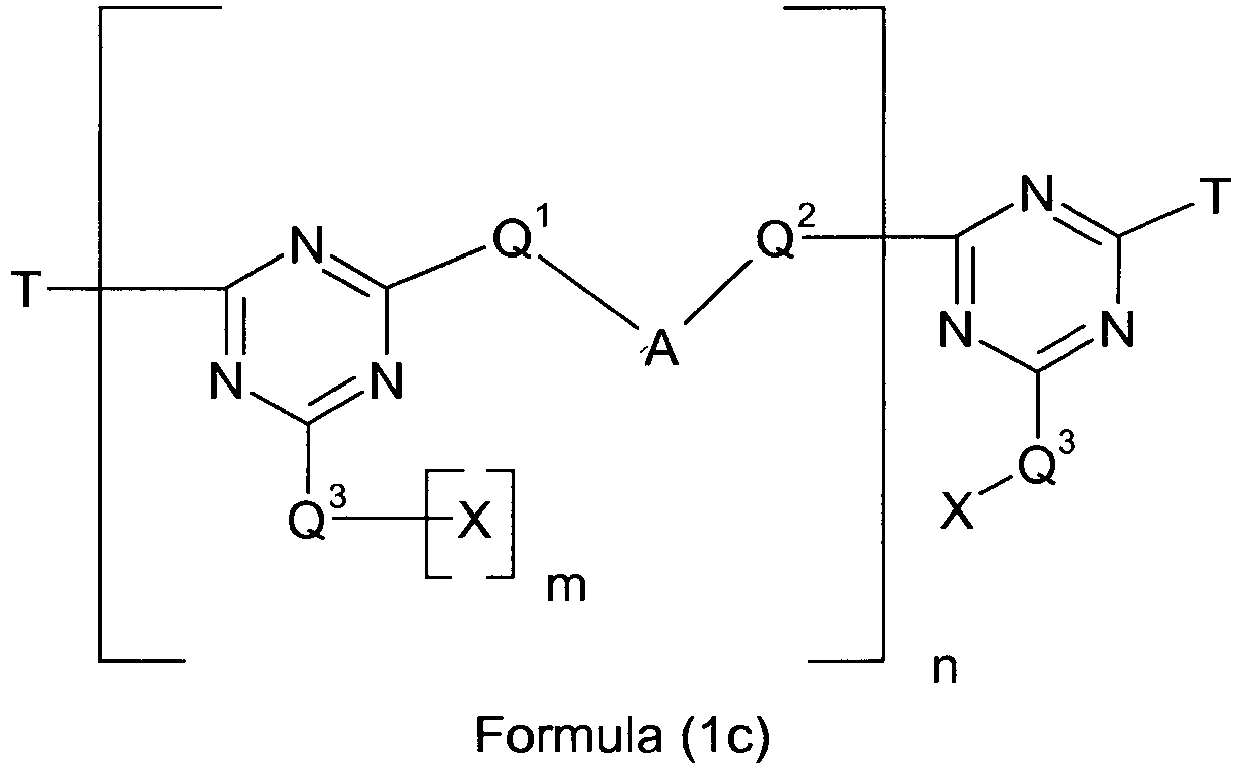
- In some cases it may be desirable to post react any halo-triazine groups which are used to prepare the polymer. Suitable post reaction agents include mono functional amines, thiols and alcohols. Of these mono-functional organic amines are preferred. In one preferred case mono thiols, mono alcohols and especially mono amines may be used as endcapping agents to provide the polymer of Formula (1c) wherein T = alkyl/aryl/cycloalkyl linked via an NR1, S or O group to the triazine ring, wherein R1 is as defined previously. Preferably T is C1-20 alkyl/cycloalkyl-NH-.
- In another preferred case a molar excess of the compound HQ1AQ2H may be used to prepare the polymer, in which case the polymer is of the Formula (1 b).
- In one case, any remaining halo-triazine groups are allowed to hydrolyse with water to give OH groups. Accordingly, in one case all the T groups present are OH.
- Preferably, the polymer chain has at least one water-dispersing group in its structure. Water-dispersing groups as defined herein mean those hydrophilic groups which aid in the dispersal or dissolution of the polymer in water. Preferred examples of water-dispersing groups include polyethyleneoxide ending in OH or C1-6alkyl, -SO2NH2, -OH, -SO3H, -CO2H groups or phosphorus containing acids.
- The acidic water dispersing groups -SO3H, -CO2H, and especially phosphorus containing acids are preferred.
- Preferably, at least one of the water-dispersing groups present in the polymer chain is a phosphorus containing acid. In some cases all of the water-dispersing groups present in the polymer chain are phosphorus containing acids.
- Preferred phosphorus containing acids include phosphoric acids including mono esters and polyphosphoric acids and phosphonic acids including mono esters and polyphosphonic acids. Of these -OPO3H2 (phosphoric acid) and most especially -PO3H2 (phosphonic acid) including salts thereof are preferred. We have found that phosphonic acid groups in particular tend to make the polymer more effective as a pigment dispersant and result in final inks which when printed have improved optical density (OD).
- Preferably, the polymer has from 0.1 to 10, more preferably from 0.2 to 5, even more preferably from 0.5 to 3 and especially from 1 to 2 water-dispersing groups for every triazine ring which is present in the polymer structure.
- Preferred sites for the attachment of water-dispersing groups include A, R1, X, more preferably A and X, and especially X. Preferably, at least one water-dispersing group present in the polymer is attached to X. In some cases all of the water-dispersing groups which are present in the polymer are attached to X groups.
- Preferably, n is from 2 to 500, more preferably from 2 to 100 and especially from 2 to 50.
- In some cases n may be at least 3, more preferably at least 4 and even more preferably at least 5. Thus for example n may be from 3 to 1000, from 4 to 1000 or from 5 to 1000.
- The value of n may be measured by any suitable technique. Preferred techniques include gel permeation chromatography, viscometry, vapour pressure osmometry, mass spectrometry and multiple angle laser light scattering.
- A preferred technique is gel permeation chromatography. This is preferably performed using a water, THF or DMF solvent. The molecular weight is preferably established relative to polystyrene or more especially relative to poly(ethylene glycol) standards. To establish the value of n it is preferred to divide the number averaged molecular weight by the mass of the repeat unit expressed by formula (1) based on the specific monomers employed.
- Preferably, the polymer used in the present invention comprises no chromophore groups. Preferably, the polymers comprise no chromophores having an absorption peak in the 350 to 750nm wavelength range. In particular it is preferred that the polymer does not comprise any dye groups which are covalently bonded into the polymer structure. Examples of groups preferably absent include azo, xanthene, anthraquinone, triaryl methane, azine, thiazine, acridine, rhodamine, phthalocyanine and nigrosine groups. This allows the polymers in present invention to be used with any particulate solid without potentially disrupting the desired shade.
- In some cases the polymer is not permanently associated with the pigment. For example, in some cases the polymer is only physically adsorbed onto the pigment surface. Thus, the polymer is able to adsorb and desorb from the pigment surface. In some cases the polymer is not cross-linked.
- At least one, more preferably all of the groups Q1 and Q2 present in the polymer are of the Formula NR1. The same preference is true for the groups Q4 and Q5 when present. This linkage is preferably formed via an amine/halo-triazine coupling reaction which tends to be particularly effective. When R1 is optionally substituted alkyl, it is preferably optionally substituted C1-20 alkyl.
- When R1 is an optionally substituted aryl group it is preferably an optionally substituted phenyl or naphthyl group.
- When R1 is optionally substituted heterocyclyl it may be aromatic (heteroaryl) or non aromatic. When R1 is heterocyclyl it is preferably a 5- or 6-membered ring containing from 1 to 3 atoms selected from N, S and O in the ring.
- Preferred examples of which include optionally substituted pyrrolyl, thiophenyl, furanyl, pyridyl, pyrimidyl, pyrazinyl, triazinyl, imidazolyl, thiazolyl, oxazolyl and pyrazolyl.
- When R1 is not H, the optional substituents for R1 include -NO2, CN, halo (especially Cl, F, Br and I), -NHC(O)C1-6alkyl, - SO2NHC1-6alkyl, -SO2C1-6alkyl, -C1-6alkyl optionally carrying an OH group, -OC1-6alkyl optionally carrying an OH group, -NHCONH2, -OC(O)C1-6alkyl, polypropyleneoxide ending in OH or a C1-6alkyl group, polyethyleneoxide ending in OH or a C1-6 alkyl group, -OH, -SO3H, - PO3H2, -OPO3H2, -SO2NH2 and -CO2H.
- The optional substituents for R1 may also be used as optional substituents for any other group which mentions the possibility of being optionally substituted.
- Most preferably R1 is H.
- Preferably, at least one, more preferably all of the Q3 groups are NH (m=1) or N (m=2). To put this another way the group Q3Xm is preferably -NR1X or -NX2.
- R1 when present in Q3 may be any of the abovementioned groups but is preferably H.
- Generally speaking X may be any of the groups stated for R1 including all of the substituents which may be present on R1.
- Preferably, at least one, more preferably most or all of the X groups have attached water-dispersing group(s), wherein the water-dispersing groups are as hereinbefore mentioned. Unless mentioned to the contrary the word attached as used herein means covalently bonded.
- Preferably, at least one of the X groups, more preferably each X group independently has from 1 to 3, more preferably 1 or 2 water-dispersing groups. Preferably these are phosphorus containing acid groups, more preferably - OPO3H2 or -PO3H2, most preferably -PO3H2 groups. We have found that phosphonic acid groups in this location in the polymer structure result in particularly good dispersant properties and inks which when printed offer high optical density (OD).
- Preferred examples of X include phenyl, naphthyl, -C1-20alkyl and 5- or 6-membered heteroaromatic groups containing from 1 to 3 N, S or O atoms in the ring; each of which being preferably substituted with from 1 to 3 -PO3H2 groups and optionally one or more substituents other than -PO3H2 groups.
- When X is C1-20 alkyl it is preferred that X is of the formula C1-6alkyl-PO3H2. Suitable examples of X groups of this kind include *CH2PO3H2, *CH2CH2PO3H2, *CH2CH2CH2PO3H2, CH3CH-CH2PO3H2, *CH2CH2CH2CH2PO3H2 wherein the asterisk (*) represents the point of attachment to the Q3 group.
- When X is phenyl it is preferably of the Formulae (4a, 4b or 4c):

- The group X may comprise both aromatic and aliphatic groups. For example X may be of the Formula (5a):

- The group X may also have two phosphonic acid groups. Suitable examples of which include those of Formulae (6a, 6b and 6c):

- The group X may also be of the Formulae (7a or 7b):

- Most preferably at least one, more preferably all of the X groups is/are of the formula *CH2PO3H2 where in the asterisk (*) represents the point of attachment to the Q3 group.
- In one case Q3 is N, m=2, one of the X groups is *CH2CO2H and the other X group is *CH2PO3H2 wherein the asterisks represent the point of attachment to the N atom (Q3). This is the glyphosate residue.
- X may be of the formula *CH2CH2SO3H or *CH2CO2H wherein the asterisks represent the point of attachment to Q3 group. X may be a polyethyleneoxy chain ending in C1-6 alkyl or OH.
- Preferably at least one, more preferably most and especially all of the groups Q3(X)m are of the formula -NHCH2PO3H2 or -N(CH2PO3H2)2.
- The groups A and when present A' may be any divalent organic linking group.
- A and A' may independently be an alkylene, a cycloalkylene, aromatic, or heterocyclic group. The heterocyclic groups may be aromatic or non-aromatic. The groups A and A' may be combinations of these. The groups A and A' may be interrupted by groups such as -O-, -NH-, -S-, -CO2-, -NHCO-, -SO2- and NHSO2-. A and A' may be polymeric, for example A/A' may be an acrylic, styrenic, styrene-acrylic, polyester, polyurethane or polyether polymer. Preferably A and A' are an arylene, an alkylene or a combination thereof. A and A' may be optionally substituted with one of more or the optional substituents as mentioned for R1. The groups A and A' may have one or more water-dispersing groups as hereinbefore mentioned. In some embodiments A and/or A' is/are unsubstituted.
- When A or A' is arylene it is preferably divalent naphthylene or phenylene. When A is phenylene the linking groups to Q1 and Q2 may be arranged in an ortho, meta or para position. The same is possible for A' wherein the linking groups are now Q4 and Q5.
- When A or A' is an alkylene group it is preferably a C2-30 alkylene, especially a C2-10 alkylene and most especially a C2-6 alkylene. Preferred examples are (CH2)4 and (CH2)6. These may be branched or linear.
- In one preferred embodiment A is xylylene *(CH2-phenylene-CH2)*, preferably the CH2 groups are in meta or para positions relative to each other. The asterisk (*) represents the point of attachment to the groups Q1 and Q2.
- In view of the foregoing, preferably each A is independently selected from C2-30 alkylene, a phenylene, a naphthylene and a xylylene group each of which may be optionally substituted.
- We have found that when A is (CH2)4, (CH2)6 or A is p-xylylene the resulting polymers exhibit good dispersant properties and provide inks which when printed have good optical density. Preferably at least one, more preferably most and especially all of the A groups are selected from (CH2)4, (CH2)6 or p-xylylene.
- The polymer as defined in the first aspect of the present invention may be present in the form of the free acid, the salt or a mixture thereof. Preferably, the polymer is at least partially, more preferably at least 50% in the form of the salt.
- Preferred salts include those with the alkali metals (especially lithium, sodium and potassium), ammonia, organic amines and alkanolamines. Salts with organic quaternary amines and pyridinium are also possible.
- Whilst the polymer as defined in the first aspect of the present invention has been drawn in one formula the polymers and the scope of the claims are also intended to cover several isomers thereof including: tautomers, optical isomers, isotopic isomers and geometric isomers.
- According to a second aspect of the present invention there is provided a polymer comprising a chain of the Formula (2) or a salt thereof:

- each X independently is an alkyl, aryl, or heterocyclyl group each of which may be optionally substituted;
- each Q1 and Q2 independently is NR1, O or S; wherein each R1 independently is H or an optionally substituted alkyl, aryl or heterocyclyl group;
- each A independently is an optionally substituted divalent organic linking group;
- n is from 2 to 1,000
- each m independently is 1 or 2; and
- in each case when m is 1, Q3 independently is NR1, O or S and each R1 independently is H or an optionally substituted alkyl, aryl or heterocyclyl
- group; and when m is 2, Q3 is N;
- The preferences for all these groups are as hereinbefore mentioned.
- This polymer chain may be terminated as previously mentioned.
- As mentioned above, we have found that the phosphonic acid group(s) in the polymer tends to improve the optical density obtained from prints with inks containing a pigment, a liquid medium and the above polymer according to the second aspect of the present invention.
- Preferably, all Q1 and Q2 groups are NR1 wherein R1 is H and at least one, more preferably all the Q3Xm groups are of the formula -NHCH2PO3H2 or - N(CH2PO3H2)2. ,
- More preferably, all the Q1 and Q2 groups are NR1 wherein R1 is H, at least one, more preferably all of the Q3Xm groups are of the formula -NHCH2PO3H2 or - N(CH2PO3H2)2, all the A groups are selected from (CH2)4, (CH2)6 or p-xylylene. A' when present at the polymer termini is preferably the same as A. T when present at the polymer termini is preferably -OH.
- Specific examples of preferred polymers include those having a chain of the Formulae (2a)-(2l):

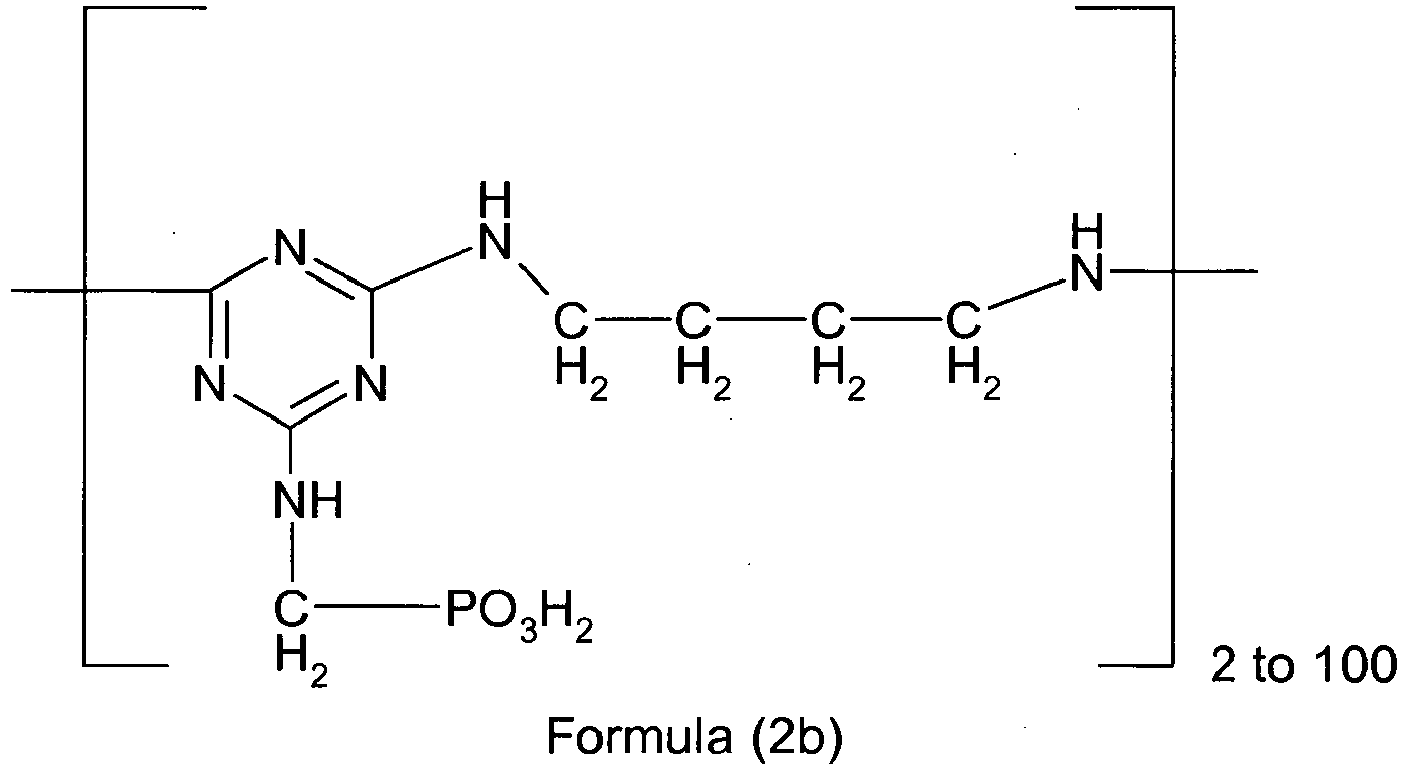


- The polymers of Formula (2a) to (21) may all be used in the first aspect of the present invention whilst only those having phosphonic acid groups are within the second aspect of the present invention.
- In a third aspect of the present invention there is provided a process for preparing a polymer as defined in the second aspect of the present invention which comprises reacting in any order:
- i) a compound of Formula (3);

- ii) a compound of the formula HQ3Xm; and
- iii) a compound of the formula HQ1AQ2H wherein A, X, Q1, Q2, Q3 and m are as previously defined except that at least one of the groups A and X has a phosphonic acid group. Preferably X has at least one phosphonic acid group as previously mentioned.
- The halogen atom for Z may be I, Br or F but is preferably Cl, accordingly the compound of Formula (3) is preferably cyanuric chloride.
- In addition to the compound of Formula (3) the polymer chain may be prepared by additionally reacting relatively minor amounts of dihalopyrimidine compounds and/or 1,3-dintro-4,6-difluorobenzene.
- The compound of formula HQ3Xm preferably has at least one, more preferably 1 or 2 water-dispersing groups.
- When the water-dispersing groups are carboxylic and/or sulfonic acid groups preferred compounds of formula HQ3Xm include taurine, sulfanilic acid, glycine and beta alanine.
- The compound of formula HQ3Xm preferably has at least one (more preferably 1 or 2) acids containing a phosphorus atom (especially phosphoric acid and phosphonic acid) groups.
- Preferred examples of phosphonic acid containing compounds include aminomethylphosphonic acid, iminodi(methylphosphonic acid), N-methylaminomethylphosphonic acid, 2-aminoethylphosphonic acid, 3-aminopropylphosphonic acid, meta, ortho and para-aminophenylphosphonic acid, 4-aminobenzyl phosphonic acid, alendronic acid, pamidronic acid, neridronic acid, glyphosate, 2-amino-3-phospono propionic acid, 2-amino-4-phosophono butyric acid and the like. Of these aminomethylphosphonic acid and alendronic acid are preferred.
- In some cases the compound of formula HQ3Xm has no water-dispersing groups. Examples include C1-6 alkyl amines and optionally substituted aryl amines.
- In one case it is possible to use both a combination of compounds of formula HQ3Xm, for example some of which contain no water-dispersing groups and some of which contain at least one water-dispersing groups. In this manner the hydrophilicity of the polymer can be tailored to provide best dispersant characteristics. When mixtures of compounds of formula HQ3Xm are used it is preferred that at least some of these compounds have at least one water-dispersing group.
- The compound of the formula HQ1AQ2H is preferably a diamine of the formula H2N-ANH2.
- The A group may have no water-dispersing groups in which case suitable examples of HQ1AQ2H include ethylenediamine, 1,3-diaminopropane, 1,4-diaminobutane, 1,5-diaminopentane, 1,6-diaminohexane, 1,7-diaminoheptane, 1,8-diaminooctane, 1,9-diaminononane, 1,10-diaminodecane, 1,11-diaminoundecane, 1,12-diaminododecane, p-xylylenediamine, m-xylylenediamine, p-phenylenediamine, m-phenylenediamine, 4,4'-Diaminodiphenyl sulfone, piperazine, 1-(2-aminoethyl)piperazine, 2-methylpentamethylenediamine (DYTEK A), 1,3-pentanediamine (DYTEK EP), bis(hexamethylene)triamine (DYTEK BHMT-HP), trimethylhexamethylenediamine, 1,2-diaminocyclohexane, 1,3-diaminocyclohexane, 1,4-diaminocyclohexane. Preferred examples of which include 1,4-diaminobutane, 1,6-diaminohexane and p-xylylene diamine.
- Dihydrazides (e.g. adipic acid dihydrazide) and urea may also be used.
- The compounds of Formula HQ1AQ2H may have water-dispersing groups in which case suitable examples of HQ1AQ2H include lysine, p-phenylenediaminesulphonic acid, m-phenylenediaminesulphonic acid, p-phenylenediaminedisulphonic acid, m-phenylenediameinedisulphonic acid and 4,4'-diaminodiphenylamine-2-sulphonic acid. The HQ1AQ2H compound may also be a polyetherdiamine such as those marketed as JEFFAMINE® diamines (D, ED, EDR series) by Huntsman.
- Of course, it is possible to prepare polymer chains containing mixtures of different A groups by using a mixture of different compounds of the formula HQ1AQ2H. In this manner the hydrophilicity of the polymer can be tailored to provide best dispersant characteristics.
- The compound of Formula HQ1AQ2H may be a diol. Any diol may be used without limitation and preferred diols are those often used in the preparation of polyesters and polyurethanes. Low molecular weight diols may be used, examples of which include ethylene glycol; propylene glycol; 1,3-propanediol; 1,4-butanediol; 1,5-pentanediol; 1,6-hexanediol; 1,2-hexadecanediol, 1,2-dodecanediol, glycerol monoesters or diesters of fatty acids (such as glycerol monooleate, glycerol monostearate and the like), neopentyl glycol; diethylene glycol; dipropylene glycol; 2,2,4-trimethyl-1,3-pentanediol; 1,4-cyclohexanedimethanol; hydroquinone; resorcinol; 4,4'-sulphonyldiphenol; bisphenol A; ethylene oxide and/or propylene oxide adducts of bisphenol A; and ethylene oxide and/or propylene oxide adduct of hydrogenated bisphenol A, trimethylolpropane, trimethylolethane, and mixtures thereof.
- Oligomeric diols may be used. Preferred examples of which include polyester diols, polyether diols, acrylic diols and polycarbonate diols.
- The compound of Formula HQ1AQ2H may be a dithiol. As examples of dithiols there can be mentioned 1,2-ethanedithiol, 1,2-propanedithiol, 1,3-propanedithiol, 1,10-decanedithiol, dipentene dimercaptan, ethylcyclohexyl dimercaptan, 1,4-benzenedithiol, 1,3-benzenedithiol, 3,6-dioxa-1,8-octanedithiol, 4,4'-thiobisbenzenethiol and 1,2-benzenedithiol.
- The process for preparing the polymer chain according to the third aspect of the present invention may be carried out in a number of ways, but three schemes are outlined below.
- In scheme I the process for preparing the polymer chain comprises the steps:
- i) reacting a compound of Formula (3) with a compound of Formula HQ3Xm;
- ii) reacting the product of step i) with a compound of Formula HQ1AQ2H;
- iii) heating the product of step ii) so as to cause polymerisation;
- iv) optionally end-capping or hydrolysing any remaining halotriazine groups.
- In scheme II the process for preparing the polymer chain comprises the steps:
- i) reacting a compound of Formula (3) with a compound of Formula HQ1AQ2H;
- ii) reacting the product of step i) with a compound of Formula HQ3Xm;
- iii) heating the product of step ii) so as to cause polymerisation;
- iv) optionally end-capping or hydrolysing any remaining halotriazine groups.
- In scheme III the process for preparing the polymer chain comprises the steps:
- i) reacting a compound of Formula (3) with a compound of Formula HQ1AQ2H;
- ii) heating the product of step i) so as to cause polymerisation;
- iii) reacting the product of step ii) with a compound of Formula HQ3Xm;
- iv) optionally end-capping or hydrolysing any remaining halotriazine groups.
- In schemes I, II and III the preferred temperatures for step i), ii) and iii) are 0 to 20°C, 20 to 40°C and 40 to 100°C respectively.
- In each step the reaction is preferably carried out in a liquid vehicle which is preferably aqueous, more preferably consists only of water. Organic liquid vehicles may also be used, suitable examples of which include N-methyl pyrrolidone and sulfolane.
- In each step the reaction is preferably maintained at a pH of from 4 to 10.
- In scheme I, steps i) and ii) the pH is preferably from 4 to 8. In scheme I, step iii) the pH is preferably from 6 to 10.
- In some cases it is preferable to use a molar excess of the compound of Formula HQ1AQ2H to the compound of the Formula HQ3Xm.
- The end-capping reaction may be as hereinbefore described.
- Preferred endcapping agents are C-1-20 alkyl or C-1-20 cycloalkyl mercaptans, alcohols and especially amines. Preferably the amines are primary amines.
- Hydrolysis is preferably accomplished by choosing an aqueous liquid vehicle for the reaction (more preferably the liquid vehicle is only water) and heating the product of step iii) optionally whilst the liquid vehicle has an acidic or a basic pH. In practice the hydrolysis is preferably performed by using water as the liquid vehicle for step iii), adjusting the pH to 9 to 10 and heating at 60 to 100°C.
- Ink jet printing in the process according to the first aspect of the present invention may be performed by any suitable ink jet printing technique. Preferred ink jet printers use thermal, piezo or acoustic heads to fire droplets of ink.
- The substrate used in the process according to the first aspect of the present invention may be of any kind without limitation. Preferred substrates include paper, plastic and textile materials.
- Preferred substrates are papers, e.g. plain or treated papers, which may have an acid, alkaline or neutral character. The paper may have an ink jet receptor layer. The receptor layer may be of the swellable or porous kind. Examples of commercially available papers are as described in International patent Application No.
WO 2007/148035 , page 13, line 24 to the end of line 37, which are incorporated herein by reference thereto. Preferably, the substrate is a plain paper. Preferably, the substrate does not contain an ink fixative. Examples of ink fixatives which are preferably absent include cationic organic amines and cationic polymers. - The liquid medium used in the first aspect of the present invention may be wholly organic but preferably is or comprises water (i.e. is aqueous). Preferably, the liquid medium comprises water and one or more water-miscible organic liquids
- Preferred water-miscible organic liquids for inclusion into the liquid medium include C1-6-alkanols, preferably methanol, ethanol, n-propanol, isopropanol, n-butanol, sec-butanol, tert-butanol, n-pentanol, cyclopentanol and cyclohexanol; linear amides, preferably dimethylformamide or dimethylacetamide; water-miscible ethers, preferably tetrahydrofuran and dioxane; diols, preferably diols having from 2 to 12 carbon atoms, for example ethylene glycol, propylene glycol, butylene glycol, pentylene glycol, hexylene glycol and thiodiglycol and oligo- and polyalkyleneglycols, preferably diethylene glycol, triethylene glycol, polyethylene glycol and polypropylene glycol; triols, preferably glycerol and 1,2,6-hexanetriol; mono-C1-4-alkyl ethers of diols, preferably mono-C1-4-alkyl ethers of diols having 2 to 12 carbon atoms, especially 2-methoxyethanol, 2-(2-methoxyethoxy)ethanol, 2-(2-ethoxyethoxy)-ethanol, 2-[2-(2-methoxyethoxy) ethoxy]ethanol, 2-[2-(2-ethoxyethoxy)-ethoxy]-ethanol and ethyleneglycol monoallylether; cyclic amides, preferably 2-pyrrolidone, N-methyl-2-pyrrolidone, N-ethyl-2-pyrrolidone, caprolactam and 1,3-dimethylimidazolidone.
- Preferably, the liquid medium comprises water and 1 or more, especially from 1 to 3, water-miscible organic liquids.
- The weight ratio of water to water-miscible organic liquid when both are present in the liquid medium is preferably from 99:1 to 5:95, more preferably 95:5 to 50:50, especially 95:5 to 70:30.
- Preferably, the liquid medium has a viscosity of less than 30mPa.s, more preferably less than 20mPa.s and especially less than 10mPa.s. The viscosity is preferably at least 2mPa.s. Preferably, the viscosity is Newtonian. Preferably, the viscosity is measured at 25°C. Preferably, the viscosity is measured using a shear rate of 100s-1. The viscosity is preferably measured using a cone and plate geometry. A preferred apparatus for measuring the viscosity is a TA Instruments rheometer.
- The composition in the first aspect of the present invention comprises the liquid medium, the polymer having a chain of the Formula (1) or a salt thereof and a pigment.
- The pigment may comprise and preferably is an inorganic or organic pigment material or mixture thereof which is insoluble in the liquid medium. By insoluble we mean having a solubility of no more than 1%, more preferably no more than 0.1% by weight in the liquid medium. The solubility is preferably measured at a temperature of 25°C. The solubility is preferably measured at a pH of 8. Preferably, the solubility is measured in water, more preferably deionized water.
- The pigment may be organic or inorganic.
- A preferred pigment is an organic pigment, for example any of the classes of pigments described in the Third Edition of the Colour Index (1971) and subsequent revisions of, and supplements thereto, under the chapter headed "Pigments". Examples of organic pigments are those from the azo (including disazo and condensed azo), thioindigo, indanthrone, isoindanthrone, anthanthrone, anthraquinone, isodibenzanthrone, triphendioxazine, quinacridone and phthalocyanine series, especially copper phthalocyanine and its nuclear halogenated derivatives, and also lakes of acid, basic and mordant dyes. Preferred organic pigments are phthalocyanines, especially copper phthalocyanine pigments, azo pigments, indanthrones, anthanthrones, and quinacridones.
- Preferred inorganic pigments include carbon black (especially gas blacks), titanium dioxide, silicon dioxide, aluminium oxide, iron oxides and sulfides.
- In the first aspect of the present invention the polymer having a chain of Formula (1) or salt thereof has been used to comminute the pigment. This results in a dispersion of the pigment in the liquid medium. The pigment particles are colloidally stabilised by the polymer. In this way the polymer is preferably at least partially adsorbed onto the pigment surface.
- Any suitable pigment may be used without particular limitation. For ink jet especially suitable pigments are carbon blacks, C.I. Pigment Red 122, C.I. Pigment Blue 15:3 and C.I. Pigment Yellow 74. Of course there are many alternative pigments.
- The pigment is preferably not surface treated so as to covalently bind water-dispersing groups onto its surface. Preferably, the pigment is not dispersible in water without the aid of a dispersant.
- Preferably, the pigment in the dispersion has an average particle size of less than 1 micron, more preferably from 10 to 500nm, especially from 30 to 300nm and most preferably from 50 to 200nm. The average particle size may be a Z or volume average size. The particle size may be measured by suitable techniques including laser light scattering.
- By the word dispersions we include for example millbases, concentrated inks, inks, tints and diluted inks.
- The polymers as defined in the second aspect of the present invention are especially useful for preparing pigment dispersions.
- According to a fourth aspect of the present invention there is provided a dispersion comprising a polymer according to the second aspect of the present invention, a pigment and a liquid medium.
- Dispersions according to the fourth aspect of the present invention are preferably prepared by comminuting a mixture comprising the polymer according to the second aspect of the present invention, the pigment and the liquid medium.
- Preferably, the dispersion comprises:
- i) 0.1 to 40 parts of polymer, more preferably from 0.5 to 20 parts of polymer, according to the second aspect of the present invention;
- ii) 0.1 to 40 parts, more preferably from 1 to 20 parts of pigment;
- iii) 50 to 99.8 parts, more preferably from 60 to 98.5 parts of liquid medium wherein all parts are by weight.
- Preferably, the sum of the parts i) + ii) + iii) is 100 parts. The pigment may be any of those previously mentioned.
- Preferably, the amount of polymer expressed as a percentage of the amount of pigment present in the dispersion is from 1 to 150%, more preferably from 5 to 100%, especially from 5 to 40% and most especially from 10 to 30%.
- Comminution as used herein means those dispersing processes which effectively reduce the particle size of the pigment particles. Examples of suitable comminution processes include microfluidizing, ultrasonication, homogenisation and especially milling. Bead milling is especially preferred. Comminution does not include for example stirring, blending and rolling which do not tend to reduce the pigment particle size to any appreciable extent.
- Preferably, the average particle size of the pigment prior to comminution is greater than 1 micron.
- Preferably, the average particle size of the pigment after comminution is from 10 to 500nm, more preferably from 20 to 300nm and especially from 50 to 200nm. The average particle size is preferably the Z or volume (Mv) average particle size. The average particle size may be measured by any suitable technique but laser light scattering is particularly preferred. Preferred apparatus for measuring the average particle size include the Zetasizer™ 3000 from Malvern and the Nanotrac 150 obtained from Honeywell-Microtrac.
- Preferably, the only dispersant present during the comminution step is the polymer as defined in the first aspect of the present invention or according to the second aspect of the present invention.
- After comminution, it is possible to post add dispersants other than the polymer as defined in the first or according to the second aspect of the present invention, but preferably this is not done by further comminution process. Instead, such dispersants may be added by methods such as for example mixing, blending, stirring and the like.
- Preferably, the polymer as defined in the first aspect or according to the second aspect of the present invention at least partially adsorbs onto the pigment surface.
- The liquid medium during the comminution step may be as herein before described. That said, a particular advantage of the polymers according to the second aspect of the present invention is their ability to facilitate easy comminution without needing liquid media which contain large amounts of organic liquids.
- Thus preferably, the liquid medium used for comminution comprises:
- i) 80 to 100, more preferably from 90 to 100, especially from 95 to 100 and more especially from 99 to 100 parts of water; and
- ii) 0 to 20, more preferably from 0 to 10, especially from 0 to 5 and more especially from 0 to 1 parts of one or more water-miscible organic liquids;
- Most preferably the liquid medium present during Comminution comprises only water.
- The dispersions according to the fourth aspect of the present invention are especially suited to the preparation of inks and especially ink jet printing inks. Thus, the inks and ink jet printing inks comprise a dispersion according to the fourth aspect of the present invention.
- Preferably, dispersions are purified prior to being formulated into an ink. The purification can be by any suitable method including microfiltration, deionizer resins, centrifugation followed by decantation and washing. A preferred method is membrane filtration especially ultrafiltration.
- Preferably, the ink comprises:
- i) 0.1 to 30 parts of polymer according to the second aspect of the present invention;
- ii) 1 to 30 parts of a pigment;
- iii) 60 to 98.8 parts of a liquid medium
- Preferably, the ink is an ink jet printing ink.
- According to a fifth aspect of the present invention there is provided an ink jet printer ink comprising:
- i) 0.1 to 15 parts of polymer according to the second aspect of the present invention;
- ii) 1 to 15 parts of pigment;
- iii) 70 to 98.8 parts of liquid medium
- Preferably, the sum of the parts i) + ii) + iii) is 100 parts.
- The inks are often prepared from the dispersions according to the fourth aspect of the present invention. Thus, it is preferable that the ink comprises a dispersion according to the fourth aspect of the present invention which has been prepared by the above mentioned comminution process.
- Preferably, the ink has a viscosity of less than 50 mPa.s, more preferably less than 30 mPa.s and especially less than 15 mPa.s, when measured at a temperature of 25°C. The preferences for measuring the viscosity are as hereinbefore mentioned.
- Preferably, the ink has a surface tension of 20 to 65 dynes/cm, more preferably 30 to 60 dynes/cm, when measured at a temperature of 25°C. The surface tension is preferably measured using a Kibron AquaPi.
- The pH of the ink is preferably from 4 to 11, more preferably from 7 to 10.
- When the ink is to be used as ink jet printing ink, the ink preferably has a concentration of halide ions of less than 500 parts per million, more preferably less than 100 parts per million. It is especially preferred that the ink has less than 100, more preferably less than 50 parts per million of divalent and trivalent metals. Parts per million as used above refers to parts by weight relative to the total weight of the ink. These low concentrations of ions in the resultant ink can be achieved by the abovementioned purification step.
- Preferably, the process for making the ink includes a step for removing particles having a particle size of more than 1 micron in diameter, for example by filtration or centrifugation. Preferably the ink has less than 10%, more preferably less than 2% and especially less than 1% by weight of particles having a size of greater than 1 micron in diameter.
- The liquid medium may be as herein before described. Again the liquid medium is preferably aqueous.
- Preferably, the ink further comprises one or more additives selected from viscosity modifiers, pH buffers, metal chelating agents, surfactants, corrosion inhibitors, biocides, dyes, water miscible organic solvent(s) and/or kogation reducing additives.
- According to a sixth aspect of the present invention there is provided an ink jet printer cartridge, comprising a chamber and an ink according to the fifth aspect of the present invention wherein the ink is present in the chamber.
- According to a seventh aspect of the present invention there is provided an ink jet printer comprising an ink jet printer cartridge according to the sixth aspect of the present invention.
- According to an eighth aspect of the present invention there is provided a substrate printed with an ink jet printing ink according to the fifth aspect of the present invention.
- According to an ninth aspect of the present invention there is provided the use of a polymer according to the second aspect of the present invention for preparing an ink jet printing ink.
- The present invention will now be illustrated by the following examples in which all parts are by weight unless stated to the contrary.
- A suspension of cyanuric chloride (20 g, 108 mmol) in water (300 mL) and calsolene oil (3 drops) was stirred for 30 minutes at a temperature of from 0 to 5°C in a reactor. The pH of the suspension was raised to 6.5 using saturated aqueous K2CO3.
- A solution of aminomethanephosphonic acid (11.4 g, 100 mmol) in water (80 mL) was added portionwise to the reactor over 10 minutes. The reactor contents were stirred at a temperature of from 0 to 5°C for a period of 4 hours whilst the pH was maintained in the range 6.5 to 7. The resulting mixture was filtered (Whatman GF/A) to remove any unwanted suspended solids.
- A suspension of p-xylylenediamine (13.6 g, 100 mmol) in water (30 mL) was added to the filtrate prepared above in step ii) at a temperature of from 0 to 5°C. The resulting mixture was stirred for 16 hours, during which it warmed up to 20°C. The pH of the mixture was raised to 9.5 using solid K2CO3 and the mixture was stirred and heated at 70°C for 4 hours and then allowed to cool down to 20°C.
- The resulting suspension was dialysed to a conductivity of less than 100 microScm-1 and the volume was reduced to give Polymer Aqueous Solution (1) with a solids content of 10.4% by weight.
- Polymer aqueous solutions (2) to (11) were prepared in the same manner as Polymer Aqueous Solution (1) except that aminomethanephosphonic acid was replaced with an equimolar amount of the compound of Formula HQ3Xm in Table 1, and p-xylylenediamine was replaced with an equimolar amount of the compound of Formula HQ1-A-Q2H. In some cases two compounds of the Formula HQ3Xm were used in place of aminomethanephosphonic acid. In these cases the sum total molar amount of both compounds of the Formula HQ3Xm is equivalent to the molar amount of aminomethanephosphonic acid used in preparing Polymer aqueous solution (1). Thus, a 1:1 molar ratio of two compounds of the formula HQ3Xm in essence used 0.5x and 0.5x the molar amount of aminomethanephosphonic acid as in Polymer aqueous solution (1).
Table 1 Polymer Aqueous Solution HQ3Xm HQ1-A-Q2H (2) Aminomethanephosphonic acid 1,4-Diaminobutane (3) Glycine p-Xylylenediamine (4) Taurine p-Xylylenediamine (5) Aminomethanephosphonic acid 1,6-Diaminohexane (6) Aminomethanephosphonic acid m-Xylylenediamine (7) Iminodiacetic acid 1,6-Diaminohexane (8) Aminomethanephosphonic acid Jeffamine ED-600 (9) Aminomethanephosphonic acid Jeffamine ED-900 (10) Aminomethanephosphonic acid 3,6-Dioxa-1,8-octanedithiol (11) Glycine 3,6-Dioxa-1,8-octanedithiol (12) Aminomethanephosphonic acid 4,4'-Thiobisbenzenethiol (13) Aminomethanephosphonic acid + Glycine (1:1 molar ratio) 1,6-Diaminohexane (14) Glycine 1,6-Diaminohexane (15) Aminomethanephosphonic acid + Sodium alendronate (1:4 molar ratio) 1,6-Diaminohexane (16) 4-Aminobenzoic acid 1,6-Diaminohexane - Joncryl® 683 (BASF Performance Chemicals, 10 g) was ground to a fine powder and mixed with water (90 g). Solid KOH was added and the mixture was heated (50°C) and homogenised with a high-shear mixer (Ultra-turrax T25, lka) for 8 hours, with the pH maintained above 9 by the addition of small amounts of solid KOH. Water was also added occasionally to maintain the volume. The solution was filtered (Whatman GF/A) to give Comparative Polymer Aqueous Solution (1) with a total solids content of 6.6%.
- Pigment powder (60 parts of NIPexRTM 170IQ Carbon Black pigment, ex Evonik Degussa), Polymer Aqueous Solution (1) (57.7 parts) and water (282.3 parts) were mixed together to form a premixture.
- The premixture as prepared in 2.1, step i) was transferred to a vertical bead mill containing 1 mm ceramic beads. The mixture was then comminuted (milled) for 1 hour. The milling beads were then separated from the milled mixture. This resulted in Black Millbase (1).
- The pigment particles in Black Millbase (1) had a Z-Average particle size of 129nm. The Z-Average particle size was established for all dispersions (unless stated to the contrary) using a ZetasizerRTM 3000 obtained from Malvern. The proportion of polymer relative to the pigment in Black Millbase (1) was 10% by weight.
- Pigment powder (2.4 parts of NIPexRTM 170IQ Carbon Black pigment, ex Evonik Degussa), Polymer Aqueous Solution (1) (1.15 parts) and water (16.45 parts) were mixed together to form a premixture.
- The premixture prepared above in 2.2, step i) was then treated with ultrasound (Branson Digital Sonifier operating at 60% amplitude) at 5°C for 10 minutes. This resulted in Black Millbase (2).
- The pigment particles in Black Millbase (2) had a Z-Average particle size of 128nm. The proportion of polymer relative to pigment in Black Millbase (2) is 5% by weight.
- Pigment powder (90 parts of NIPexRTM 170IQ Carbon Black pigment, ex Evonik Degussa), Polymer Aqueous Solution (1) (86.5 parts) and water (423.5 parts) were mixed together to form a premixture.
- The premixture prepared in 2.3, step i) was transferred to a horizontal bead mill containing plastic milling beads and the mixture was milled for 3 hours.
- The milling beads were then separated from the milled mixture, which was finally purified by means of ultrafiltration using a membrane having a 50kD pore size. This resulted in Black Mill-base (3).
- The pigment particles in the resulting mill-base had a Z-Average particle size of 107nm. The proportion of polymer relative to pigment in Black Millbase (3) was 10% by weight.
- Black Millbases (4) to (25) were prepared according to Black Millbase (2) using the aqueous polymer solutions, the comminution methods and times as indicated in Table 2.
Table 2 Black Millbase Polymer Aqueous Solution Comminution Method, Comminution Time Wt% Polymer relative to pigment Z-Average particle size (4) (1) B, 5 mins 10 108nm (5) (1) B, 10 mins 20 101nm (6) (2) B, 5 mins 5 98nm* (7) (2) B, 5 mins 10 101nm * (8) (2) B, 50 mins 20 86nm * (9) (3) B, 20 mins 10 115nm (10) (4) B, 20 mins 10 102nm (11) (5) B, 15 mins 10 96nm (12) (5) B, 15 mins 20 99nm (13) (6) B, 15 mins 10 92nm (14) (7) B, 15 mins 10 92nm (15) (7) B, 15 mins 15 96nm (16) (7) B, 15 mins 20 96nm (17) (8) B, 30 mins 10 99nm (18) (8) B, 30 mins 20 91 nm (19) (9) B, 30 mins 10 95nm (20) (9) B, 30 mins 20 117nm (21) (10) B, 30 mins 10 96nm (22) (11) B, 15 mins 10 102nm (23) (11) B, 15 mins 20 102nm (24) (12) B, 30 mins 10 144nm (25) (13) B, 15 mins 10 95nm (26) (13) B, 15 mins 20 96nm (27) (5) C, 40 mins 10 137nm (28) (5) C, 70 mins 10 120nm (29) (14) B, 15 mins 10 117nm * (30) (14) B, 15 mins 20 101nm * (31) (14) B, 15 mins 30 101nm * (32) (15) B, 15 mins 10 94nm * (33) (15) B, 15 mins 20 89nm* (34) (16) B, 30 mins 20 117nm (35) (5) A, 1 hour 10 122nm * (36) (5) A, 2.75 hours 20 122nm * Comparative Black Mill-base (1) Comparative Polymer Aqueous Solution (1) B, 15 mins 30 94 nm * *Indicates the Mv particle size as measured by a Nanotrac 150 obtained from Honeywell-Microtrac. - Each of the Black Millbases was used to prepare an Ink having the following composition.
-
Pigment (solids) 6 parts 2-Pyrrolidone 3.00 parts Glycerol 15.00 parts 1,2 Hexane diol 4.00 parts Ethylene glycol 5.00 parts Surfynol™ 465 0.50 parts Pure water sufficient to make 100 parts SurfynolRTM 465 is a surfactant available from Air Products. - 6 parts of black pigment on an active or solids basis were used in all cases (approximately 60 parts of Black Millbase when the solids content is 10% by weight).
- Using the above ink composition, for example, Black Millbase (1) was used to prepare Black Ink (1), Black Millbase (2) prepared Black Ink (2) etc.
- Each of the Inks described above in point 3 were printed onto plain (untreated) paper, namely Xerox 4200 and Canon GF500 paper. Printing was performed by means of an Epson SX100 series ink jet printer printing 100% blocks of black.
- For each print the Reflectance optical density (ROD) was measured using a Gretag Macbeth key wizard V2.5 Spectrolino photodensitometer instrument, illuminated using a D65 light source at an observer angle of 2° and with no filter fitted. Measurements were taken at at least two points along the print and were then averaged.
- The results of the ROD measurements are summarised below in Table 3.
Table 3 : ROD of Prints obtained from Inks Ink Polymer Aqueous solution ROD on Xerox 4200 ROD on Canon GF500 Black Ink (1) Polymer Aqueous solution (1) 1.35 1.35 Black Ink (2) Polymer Aqueous solution (1) 1.37 1.36 Black Ink (3) Polymer Aqueous solution (1) 1.31 1.31 Black Ink (4) Polymer Aqueous solution (1) 1.38 1.35 Black Ink (5) Polymer Aqueous solution (1) 1.28 1.26 Black Ink (6) Polymer Aqueous solution (2) 1.34 1.36 Black Ink (7) Polymer Aqueous solution (2) 1.30 1.28 Black Ink (8) Polymer Aqueous solution (2) 1.27 1.21 Black Ink (9) Polymer Aqueous solution (3) 1.27 1.28 Black Ink (10) Polymer Aqueous solution (4) 1.24 1.24 Black Ink (11) Polymer Aqueous solution (5) 1.34 1.32 Black Ink (12) Polymer Aqueous solution (5) 1.30 1.28 Black Ink (13) Polymer Aqueous solution (6) 1.34 1.33 Black Ink (14) Polymer Aqueous solution (7) 1.25 1.25 Black Ink (15) Polymer Aqueous solution (7) 1.24 1.24 Black Ink (16) Polymer Aqueous solution (7) 1.20 1.22 Black Ink (17) Polymer Aqueous solution (8) 1.29 1.29 Table 3 : ROD of Prints obtained from Inks (continued) Ink Polymer Aqueous solution ROD on Xerox 4200 ROD on Canon GF500 Black Ink (18) Polymer Aqueous solution (8) 1.23 1.24 Black Ink (19) Polymer Aqueous solution (9) 1.27 1.27 Black Ink (20) Polymer Aqueous solution (9) 1.23 1.25 Black Ink (21) Polymer Aqueous solution (10) 1.32 1.30 Black Ink (22) Polymer Aqueous solution (11) 1.27 1.28 Black Ink (23) Polymer Aqueous solution (11) 1.22 1.24 Black Ink (24) Polymer Aqueous solution (12) 1.31 1.33 Black Ink (25) Polymer Aqueous solution (13) 1.31 1.31 Black Ink (26) Polymer Aqueous solution (13) 1.26 1.23 Black Ink (27) Polymer Aqueous solution (5) 1.31 1.33 Black Ink (28) Polymer Aqueous solution (5) 1.29 1.31 Black Ink (29) Polymer Aqueous solution (14) 1.31 1.35 Black Ink (30) Polymer Aqueous solution (14) 1.25 1.30 Black Ink (31) Polymer Aqueous solution (14) 1.22 1.23 Black Ink (32) Polymer Aqueous solution (15) 1.32 1.30 Black Ink (33) Polymer Aqueous solution (15) 1.33 1.30 Black Ink (34) Polymer Aqueous solution (16) 1.32 1.37 Black Ink (35) Polymer Aqueous solution (5) 1.38 1.40 Black Ink (36) Polymer Aqueous solution (5) 1.36 1.30 Comparative Black Ink (1) Comparative Polymer Aqueous Solution (1) 1.19 1.18 - It was clearly seen from the results that the process according to the first aspect of the present invention and the dispersants according to the second aspect of the present invention facilitate prints having the same or higher optical densities as compared to previously known dispersants.
- The further inks described in Tables I and II may be prepared wherein Black Millbase (1) and Black Millbase (2) are as mentioned above and the ink additives are as defined below. Numbers quoted in the second column onwards refer to the number of parts of the relevant ingredient and all parts are by weight. The inks may be applied to paper by thermal, piezo or Memjet ink jet printing.
- The following abbreviations are used in Tables I and II:
- PG = propylene glycol
- DEG = diethylene glycol
- NMP = N-methyl pyrrolidone
- DMK = dimethylketone
- IPA = isopropanol
- MEOH = methanol
- 2P = 2-pyrrolidone
- MIBK = methylisobutyl ketone
- P12 = propane-1,2-diol
- BDL = butane-2,3-diol
- Surf = Surfynol™ 465 from Air Products
- PHO = Na2HPO4 and
- TBT = tertiary butanol
- TDG = thiodiglycol
- GLY = Glycerol
- nBDPG = mono-n-butyl ether of dipropylene glycol
- nBDEG = mono-n-butyl ether of diethylene glycol
- nBTEG = mono-n-butyl ether of triethylene glycol


Claims (19)
- A process for ink jet printing an image on a substrate comprising applying to the substrate a composition comprising a liquid medium, a pigment and a polymer comprising a chain of the Formula (1) or a salt thereof:
 each X independently is an alkyl, aryl, or heterocyclyl group each of which may be optionally substituted;each Q1 and Q2 independently is NR1, O or S; wherein each R1 independently is H or an optionally substituted alkyl, aryl or heterocyclyl group;each A independently is an optionally substituted divalent organic linking group;n is from 2 to 1,000each m independently is 1 or 2;in each case when m is 1, Q3 independently is NR1, O or S and each R1 independently is H or an optionally substituted alkyl, aryl or heterocyclyl group; and when m is 2, Q3 is N; andthe polymer having a chain of Formula (1) or salt thereof has been used to comminute the pigment.
 - A process according to claim 1 wherein each A is independently selected from C2-30 alkylene, a phenylene, a naphthylene and a xylylene group each of which may be optionally substituted.
- A process according to any one of the preceding claims wherein at least one A group is selected from (CH2)4, (CH2)6 or p-xylylene.
- A process according to any one of the preceding claims wherein all the groups represented by Q1 and Q2 are NR1.
- A process according to any one of the preceding claims wherein the chain has at least one water-dispersing group in its structure.
- A process according to claim 5 wherein at least one of the water-dispersing group(s) is a phosphorus containing acid.
- A process according to claim 6 wherein the phosphorus containing acid is selected from the group consisting of phosphoric acid and phosphonic acid or salts thereof.
- A process according to any one of claims 5 to 7 wherein at least one of the water-dispersing group(s) is attached to an X group.
- A process according to any one of the preceding claims wherein at least one of the groups represented by -Q3(X)m is of the formula -NHCH2PO3H2 or -N(CH2PO3H2)2.
- A process according to any one of the preceding claims wherein the comminution is by microfluidizing, ultrasonication, homogenisation or milling.
- A polymer comprising a chain of the Formula (2) or a salt thereof:
 each X independently is an alkyl, aryl, or heterocyclyl group each of which may be optionally substituted;each Q1 and Q2 independently is NR1, O or S; wherein each R1 independently is H or an optionally substituted alkyl, aryl or heterocyclyl group;each A independently is an optionally substituted divalent organic linking group;n is from 2 to 1,000each m independently is 1 or 2; andin each case when m is 1, Q3 independently is NR1, O or S and each R1 independently is H or an optionally substituted alkyl, aryl or heterocyclylgroup; and when m is 2, Q3 is N;said chain has one or more phosphonic acid groups in its structure.
 - A polymer according to claim 11 wherein at least one of the groups represented by Q3(X)m is of the formula -NHCH2PO3H2 or -N(CH2PO3H2)2.
- A polymer according to claim 11 or 12 wherein at least one A group is selected from (CH2)4, (CH2)6 or p-xylylene.
- A dispersion comprising a polymer according to any one of claims 11 to 13, a pigment and a liquid medium.
- An ink jet printer ink comprising:i) 0.1 to 15 parts of polymer according to any one of claims 11 to 13;ii) 1 to 15 parts of pigment; andiii) 70 to 98.8 parts of liquid mediumwherein all parts are by weight.
- An ink jet printer cartridge, comprising a chamber and an ink according to claim 15 wherein the ink is present in the chamber.
- An ink jet printer comprising an ink jet printer cartridge according to claim 16.
- A substrate printed with an ink jet printing ink according to claim 15.
- Use of a polymer according to any one of claims 11 to 13 for preparing an ink jet printing ink.
Applications Claiming Priority (3)
| Application Number | Priority Date | Filing Date | Title |
|---|---|---|---|
| GBGB1008081.0A GB201008081D0 (en) | 2010-05-14 | 2010-05-14 | Printing process,polymer and ink |
| GBGB1018702.9A GB201018702D0 (en) | 2010-11-05 | 2010-11-05 | Printing process, polymer and ink |
| PCT/GB2011/050910 WO2011141744A1 (en) | 2010-05-14 | 2011-05-12 | Printing process, polymer and ink |
Publications (2)
| Publication Number | Publication Date |
|---|---|
| EP2569378A1 EP2569378A1 (en) | 2013-03-20 |
| EP2569378B1 true EP2569378B1 (en) | 2014-10-01 |
Family
ID=44168189
Family Applications (1)
| Application Number | Title | Priority Date | Filing Date |
|---|---|---|---|
| EP11720844.7A Not-in-force EP2569378B1 (en) | 2010-05-14 | 2011-05-12 | Printing process, polymer and ink |
Country Status (7)
| Country | Link |
|---|---|
| US (1) | US8845086B2 (en) |
| EP (1) | EP2569378B1 (en) |
| JP (1) | JP2013531699A (en) |
| KR (1) | KR20130039736A (en) |
| CN (1) | CN102939348A (en) |
| MX (1) | MX2012012947A (en) |
| WO (1) | WO2011141744A1 (en) |
Families Citing this family (6)
| Publication number | Priority date | Publication date | Assignee | Title |
|---|---|---|---|---|
| KR20130120990A (en) * | 2010-05-14 | 2013-11-05 | 후지필름 이미징 컬러런츠 리미티드 | Depersion, process for preparing a dispersion and ink jet printing ink |
| GB201111585D0 (en) * | 2011-07-07 | 2011-08-24 | Fujifilm Imaging Colorants Ltd | Process for preparing polymers, polymers, dispersions, inks and uses |
| GB201222447D0 (en) * | 2012-12-13 | 2013-01-23 | Fujifilm Imaging Colorants Ltd | Dispersion ink and process |
| GB201300106D0 (en) * | 2013-01-04 | 2013-02-20 | Fujifilm Imaging Colorants Ltd | Process for preparing a polymer, polymer, dispersion, ink, and use |
| US10414865B2 (en) | 2015-05-15 | 2019-09-17 | Cabot Corporation | Amphoteric polymers and use in inkjet ink compositions |
| JP6758626B2 (en) * | 2015-06-30 | 2020-09-23 | 国立大学法人岩手大学 | Phosphorus-containing polymer |
Family Cites Families (44)
| Publication number | Priority date | Publication date | Assignee | Title |
|---|---|---|---|---|
| BE551712A (en) | 1955-10-12 | |||
| GB1227015A (en) | 1967-07-07 | 1971-03-31 | ||
| US4314001A (en) | 1980-03-03 | 1982-02-02 | Sterling Drug Inc. | Novel polymeric compounds, processes and methods of use |
| US4562246A (en) | 1982-04-08 | 1985-12-31 | American Cyanamid Company | Essentially linear, thermoplastic poly (amino-s-triazines)s and process for the production thereof |
| IT1163814B (en) * | 1983-07-19 | 1987-04-08 | Chimosa Chimica Organica Spa | POLYMERIC COMPOUNDS CONTAINING PIPERIDINIC AND TRIAZINIC RADICALS, PROCESS FOR THEIR PREPARATION AND USE AS STABILIZERS FOR SYNTHETIC POLYMERS |
| JPS60101539A (en) | 1983-11-08 | 1985-06-05 | Fuji Photo Film Co Ltd | Photosensitive lithographic plate |
| JPH0619046B2 (en) | 1985-12-06 | 1994-03-16 | 三菱化成株式会社 | Disazo compound and dye composition containing the same |
| JPH02115279A (en) | 1988-10-25 | 1990-04-27 | Mitsubishi Kasei Corp | Method for producing carbon black aqueous dispersion with improved dispersibility |
| IT1244440B (en) | 1990-09-13 | 1994-07-15 | Ministero Dall Uni E Della Ric | SELF-EXTINGUISHING POLYMERIC COMPOSITIONS |
| IT1244009B (en) | 1990-11-02 | 1994-06-28 | Mini Ricerca Scient Tecnolog | SELF-EXTINGUISHING POLYMERIC COMPOSITIONS. |
| US5240499A (en) | 1990-12-21 | 1993-08-31 | Hoechst Aktiengesellschaft | Surfactant triazine compounds and their use |
| IT1251687B (en) | 1991-10-11 | 1995-05-19 | Mini Ricerca Scient Tecnolog | SALTS OF TRIAZINIC COMPOUNDS WITH OXYGENATED ACIDS OF PHOSPHORUS, AND THEIR USE IN SELF-EXTINGUISHING POLYMERIC COMPOSITIONS. |
| JPH07113009A (en) * | 1993-10-18 | 1995-05-02 | Alps Electric Co Ltd | Solvent-soluble aromatic polyamine and production thereof |
| BE1009976A3 (en) | 1996-01-19 | 1997-11-04 | Dsm Nv | Highly branched polymers. |
| IT1293418B1 (en) * | 1996-07-09 | 1999-03-01 | Sumitomo Chemical Co | POLYAMINOTHRIAZINE, ITS PRODUCTION AND USE PROCESS |
| JP3025952B2 (en) * | 1997-04-16 | 2000-03-27 | 大塚化学株式会社 | Fluorine-containing resin |
| US6051164A (en) * | 1998-04-30 | 2000-04-18 | Cytec Technology Corp. | Methods and compositions for protecting polymers from UV light |
| AU1505300A (en) | 1998-11-24 | 2000-06-13 | Ciba Specialty Chemicals Holding Inc. | Piperazinone derivatives |
| US6376584B1 (en) * | 1999-02-25 | 2002-04-23 | Ciba Specialty Chemicals Corporation | Hydroxy-substituted N-alkoxy hindered amines and compositions stabilized therewith |
| US6316564B1 (en) | 1999-10-07 | 2001-11-13 | E. I. Du Pont De Nemours And Company | Acrylic block copolymer pigment dispersants containing heterocyclic groups |
| WO2001094482A1 (en) * | 2000-06-07 | 2001-12-13 | Seiko Epson Corporation | Ink set for ink-jet recording |
| JP2002053666A (en) * | 2000-08-08 | 2002-02-19 | Nippon Zeon Co Ltd | Polyguanamine, its production method and electrolyte |
| US6883908B2 (en) * | 2001-01-08 | 2005-04-26 | 3M Innovative Properties Company | Methods and compositions for ink jet printing of pressure sensitive adhesive patterns or films on a wide range of substrates |
| GB0102388D0 (en) | 2001-01-31 | 2001-03-14 | Secr Defence | Polymers |
| AU2002348236A1 (en) * | 2001-12-27 | 2003-07-24 | Cytec Technology Corp. | Uv stabilized thermoplastic olefins |
| US6869648B2 (en) | 2002-06-18 | 2005-03-22 | Hewlett-Packard Development Company, L.P. | Use of monomeric and oligomeric additives to stabilize dyes on porous ink jet media |
| JP2004315716A (en) | 2003-04-18 | 2004-11-11 | Toyo Ink Mfg Co Ltd | Pigment dispersant, pigment composition and pigment dispersion using the same |
| TW200510490A (en) * | 2003-06-12 | 2005-03-16 | Dainchiseika Color & Chemicals Mfg Co Ltd | Hydrophilic coloring matter for recording image, aqueous coloring agent for recording image, method and device for recording image |
| GB0316109D0 (en) | 2003-07-09 | 2003-08-13 | Dystar Textilfarben Gmbh & Co | Water-soluble macrocyclic azacalixarenes |
| KR101133459B1 (en) * | 2003-09-11 | 2012-04-12 | 시바 홀딩 인크 | Water based concentrated product forms of light stabilizers made by a heterophase polymerization technique |
| US20060132565A1 (en) * | 2004-12-16 | 2006-06-22 | Eastman Kodak Company | Mixtures of anionic and cationic inks |
| JP2006225428A (en) * | 2005-02-15 | 2006-08-31 | Tokyo Institute Of Technology | Copolymer having 1,3,5-triazine ring, production method thereof and use thereof |
| TWI383026B (en) | 2005-03-18 | 2013-01-21 | Toyo Ink Mfg Co | Pigment dispersing agent, pigment composition and pigment dispersion |
| EP1924661A1 (en) * | 2005-08-17 | 2008-05-28 | Printar Ltd. | A thermosetting ink formulation for ink-jet applications |
| JP5051635B2 (en) * | 2005-12-12 | 2012-10-17 | 山陽色素株式会社 | Pigment derivative, pigment dispersant using the same, and pigment dispersion and water-based ink containing the same |
| JP2007197567A (en) | 2006-01-26 | 2007-08-09 | Fujifilm Corp | Method for producing pigment fine particles having anthraquinone structure, pigment fine particles having anthraquinone structure obtained thereby, colored pigment dispersion composition containing the same, colored photosensitive resin composition, photosensitive resin transfer material, and color using them Filter and liquid crystal display device |
| GB0612029D0 (en) | 2006-06-17 | 2006-07-26 | Fujifilm Imaging Colorants Ltd | Compound, ink, process and use |
| GB0704335D0 (en) | 2007-03-07 | 2007-04-11 | Fujifilm Imaging Colorants Ltd | Process for preparing an encapsulated particulate solid |
| JP5054998B2 (en) * | 2007-03-23 | 2012-10-24 | 理想科学工業株式会社 | Non-aqueous pigment ink |
| US7618484B2 (en) | 2007-05-01 | 2009-11-17 | Canon Kabushiki Kaisha | Ink jet ink, ink jet recording method, ink cartridge, recording unit and ink jet recording apparatus |
| JP2009084345A (en) | 2007-09-28 | 2009-04-23 | Nippon Kayaku Co Ltd | Water-soluble azo compound or its salt, ink composition and colored material |
| JP2009215455A (en) | 2008-03-11 | 2009-09-24 | Fujifilm Corp | Inkjet ink composition, and inkjet recording method and printed material using the same |
| EP2428529B1 (en) * | 2009-05-07 | 2019-03-06 | Nissan Chemical Corporation | Triazine ring-containing polymer and film-forming composition comprising same |
| KR20130120990A (en) | 2010-05-14 | 2013-11-05 | 후지필름 이미징 컬러런츠 리미티드 | Depersion, process for preparing a dispersion and ink jet printing ink |
-
2011
- 2011-05-12 EP EP11720844.7A patent/EP2569378B1/en not_active Not-in-force
- 2011-05-12 MX MX2012012947A patent/MX2012012947A/en not_active Application Discontinuation
- 2011-05-12 JP JP2013509625A patent/JP2013531699A/en active Pending
- 2011-05-12 WO PCT/GB2011/050910 patent/WO2011141744A1/en not_active Ceased
- 2011-05-12 US US13/697,586 patent/US8845086B2/en active Active
- 2011-05-12 KR KR1020127032431A patent/KR20130039736A/en not_active Withdrawn
- 2011-05-12 CN CN2011800314338A patent/CN102939348A/en active Pending
Also Published As
| Publication number | Publication date |
|---|---|
| KR20130039736A (en) | 2013-04-22 |
| WO2011141744A1 (en) | 2011-11-17 |
| US8845086B2 (en) | 2014-09-30 |
| CN102939348A (en) | 2013-02-20 |
| MX2012012947A (en) | 2012-12-17 |
| EP2569378A1 (en) | 2013-03-20 |
| US20130059131A1 (en) | 2013-03-07 |
| JP2013531699A (en) | 2013-08-08 |
Similar Documents
| Publication | Publication Date | Title |
|---|---|---|
| US9434808B2 (en) | Process for preparing polymers, polymers, dispersions, inks and uses | |
| EP2569084B1 (en) | Dispersion, process for preparing a dispersion and ink jet printing ink | |
| US8845086B2 (en) | Printing process, polymer and ink | |
| US20120321863A1 (en) | Process for preparing encapsulated solid particles | |
| US9062228B2 (en) | Aqueous inkjet inks containing polyurethane binders with components to interact with cellulose | |
| US8227525B2 (en) | Process, composition and ink | |
| EP2432838B1 (en) | Process, pigment and ink | |
| EP2539065B1 (en) | Process for preparing encapsulated solid particles | |
| US9441121B2 (en) | Dispersions, process for preparing dispersions, inks and uses | |
| US9068092B2 (en) | Process for preparing polymers, polymers, dispersions, inks and uses | |
| WO2014106729A1 (en) | Process for preparing a polymer, polymer, dispersion, ink, and use | |
| WO2013098652A2 (en) | Aqueous pigment dispersions based on polyurethane dispersants having components to interact with cellulose | |
| US20140168333A1 (en) | Dispersion, Ink and Process | |
| HK1180999A (en) | Dispersion, process for preparing a dispersion and ink jet printing ink | |
| HK1182411A (en) | Printing process, polymer and ink |
Legal Events
| Date | Code | Title | Description |
|---|---|---|---|
| PUAI | Public reference made under article 153(3) epc to a published international application that has entered the european phase |
Free format text: ORIGINAL CODE: 0009012 |
|
| 17P | Request for examination filed |
Effective date: 20121204 |
|
| AK | Designated contracting states |
Kind code of ref document: A1 Designated state(s): AL AT BE BG CH CY CZ DE DK EE ES FI FR GB GR HR HU IE IS IT LI LT LU LV MC MK MT NL NO PL PT RO RS SE SI SK SM TR |
|
| DAX | Request for extension of the european patent (deleted) | ||
| GRAP | Despatch of communication of intention to grant a patent |
Free format text: ORIGINAL CODE: EPIDOSNIGR1 |
|
| INTG | Intention to grant announced |
Effective date: 20140602 |
|
| GRAS | Grant fee paid |
Free format text: ORIGINAL CODE: EPIDOSNIGR3 |
|
| GRAA | (expected) grant |
Free format text: ORIGINAL CODE: 0009210 |
|
| AK | Designated contracting states |
Kind code of ref document: B1 Designated state(s): AL AT BE BG CH CY CZ DE DK EE ES FI FR GB GR HR HU IE IS IT LI LT LU LV MC MK MT NL NO PL PT RO RS SE SI SK SM TR |
|
| REG | Reference to a national code |
Ref country code: GB Ref legal event code: FG4D |
|
| REG | Reference to a national code |
Ref country code: AT Ref legal event code: REF Ref document number: 689563 Country of ref document: AT Kind code of ref document: T Effective date: 20141015 Ref country code: CH Ref legal event code: EP |
|
| REG | Reference to a national code |
Ref country code: IE Ref legal event code: FG4D |
|
| REG | Reference to a national code |
Ref country code: DE Ref legal event code: R096 Ref document number: 602011010262 Country of ref document: DE Effective date: 20141113 |
|
| REG | Reference to a national code |
Ref country code: NL Ref legal event code: VDEP Effective date: 20141001 |
|
| REG | Reference to a national code |
Ref country code: AT Ref legal event code: MK05 Ref document number: 689563 Country of ref document: AT Kind code of ref document: T Effective date: 20141001 |
|
| REG | Reference to a national code |
Ref country code: LT Ref legal event code: MG4D |
|
| PG25 | Lapsed in a contracting state [announced via postgrant information from national office to epo] |
Ref country code: NL Free format text: LAPSE BECAUSE OF FAILURE TO SUBMIT A TRANSLATION OF THE DESCRIPTION OR TO PAY THE FEE WITHIN THE PRESCRIBED TIME-LIMIT Effective date: 20141001 |
|
| PG25 | Lapsed in a contracting state [announced via postgrant information from national office to epo] |
Ref country code: FI Free format text: LAPSE BECAUSE OF FAILURE TO SUBMIT A TRANSLATION OF THE DESCRIPTION OR TO PAY THE FEE WITHIN THE PRESCRIBED TIME-LIMIT Effective date: 20141001 Ref country code: NO Free format text: LAPSE BECAUSE OF FAILURE TO SUBMIT A TRANSLATION OF THE DESCRIPTION OR TO PAY THE FEE WITHIN THE PRESCRIBED TIME-LIMIT Effective date: 20150101 Ref country code: PT Free format text: LAPSE BECAUSE OF FAILURE TO SUBMIT A TRANSLATION OF THE DESCRIPTION OR TO PAY THE FEE WITHIN THE PRESCRIBED TIME-LIMIT Effective date: 20150202 Ref country code: CZ Free format text: LAPSE BECAUSE OF FAILURE TO SUBMIT A TRANSLATION OF THE DESCRIPTION OR TO PAY THE FEE WITHIN THE PRESCRIBED TIME-LIMIT Effective date: 20141001 Ref country code: ES Free format text: LAPSE BECAUSE OF FAILURE TO SUBMIT A TRANSLATION OF THE DESCRIPTION OR TO PAY THE FEE WITHIN THE PRESCRIBED TIME-LIMIT Effective date: 20141001 Ref country code: LT Free format text: LAPSE BECAUSE OF FAILURE TO SUBMIT A TRANSLATION OF THE DESCRIPTION OR TO PAY THE FEE WITHIN THE PRESCRIBED TIME-LIMIT Effective date: 20141001 Ref country code: IS Free format text: LAPSE BECAUSE OF FAILURE TO SUBMIT A TRANSLATION OF THE DESCRIPTION OR TO PAY THE FEE WITHIN THE PRESCRIBED TIME-LIMIT Effective date: 20150201 |
|
| PG25 | Lapsed in a contracting state [announced via postgrant information from national office to epo] |
Ref country code: CY Free format text: LAPSE BECAUSE OF FAILURE TO SUBMIT A TRANSLATION OF THE DESCRIPTION OR TO PAY THE FEE WITHIN THE PRESCRIBED TIME-LIMIT Effective date: 20141001 Ref country code: RS Free format text: LAPSE BECAUSE OF FAILURE TO SUBMIT A TRANSLATION OF THE DESCRIPTION OR TO PAY THE FEE WITHIN THE PRESCRIBED TIME-LIMIT Effective date: 20141001 Ref country code: AT Free format text: LAPSE BECAUSE OF FAILURE TO SUBMIT A TRANSLATION OF THE DESCRIPTION OR TO PAY THE FEE WITHIN THE PRESCRIBED TIME-LIMIT Effective date: 20141001 Ref country code: SE Free format text: LAPSE BECAUSE OF FAILURE TO SUBMIT A TRANSLATION OF THE DESCRIPTION OR TO PAY THE FEE WITHIN THE PRESCRIBED TIME-LIMIT Effective date: 20141001 Ref country code: GR Free format text: LAPSE BECAUSE OF FAILURE TO SUBMIT A TRANSLATION OF THE DESCRIPTION OR TO PAY THE FEE WITHIN THE PRESCRIBED TIME-LIMIT Effective date: 20150102 Ref country code: LV Free format text: LAPSE BECAUSE OF FAILURE TO SUBMIT A TRANSLATION OF THE DESCRIPTION OR TO PAY THE FEE WITHIN THE PRESCRIBED TIME-LIMIT Effective date: 20141001 Ref country code: HR Free format text: LAPSE BECAUSE OF FAILURE TO SUBMIT A TRANSLATION OF THE DESCRIPTION OR TO PAY THE FEE WITHIN THE PRESCRIBED TIME-LIMIT Effective date: 20141001 Ref country code: PL Free format text: LAPSE BECAUSE OF FAILURE TO SUBMIT A TRANSLATION OF THE DESCRIPTION OR TO PAY THE FEE WITHIN THE PRESCRIBED TIME-LIMIT Effective date: 20141001 |
|
| REG | Reference to a national code |
Ref country code: DE Ref legal event code: R097 Ref document number: 602011010262 Country of ref document: DE |
|
| PG25 | Lapsed in a contracting state [announced via postgrant information from national office to epo] |
Ref country code: SK Free format text: LAPSE BECAUSE OF FAILURE TO SUBMIT A TRANSLATION OF THE DESCRIPTION OR TO PAY THE FEE WITHIN THE PRESCRIBED TIME-LIMIT Effective date: 20141001 Ref country code: RO Free format text: LAPSE BECAUSE OF FAILURE TO SUBMIT A TRANSLATION OF THE DESCRIPTION OR TO PAY THE FEE WITHIN THE PRESCRIBED TIME-LIMIT Effective date: 20141001 Ref country code: EE Free format text: LAPSE BECAUSE OF FAILURE TO SUBMIT A TRANSLATION OF THE DESCRIPTION OR TO PAY THE FEE WITHIN THE PRESCRIBED TIME-LIMIT Effective date: 20141001 Ref country code: DK Free format text: LAPSE BECAUSE OF FAILURE TO SUBMIT A TRANSLATION OF THE DESCRIPTION OR TO PAY THE FEE WITHIN THE PRESCRIBED TIME-LIMIT Effective date: 20141001 |
|
| PLBE | No opposition filed within time limit |
Free format text: ORIGINAL CODE: 0009261 |
|
| STAA | Information on the status of an ep patent application or granted ep patent |
Free format text: STATUS: NO OPPOSITION FILED WITHIN TIME LIMIT |
|
| PG25 | Lapsed in a contracting state [announced via postgrant information from national office to epo] |
Ref country code: IT Free format text: LAPSE BECAUSE OF FAILURE TO SUBMIT A TRANSLATION OF THE DESCRIPTION OR TO PAY THE FEE WITHIN THE PRESCRIBED TIME-LIMIT Effective date: 20141001 |
|
| 26N | No opposition filed |
Effective date: 20150702 |
|
| PG25 | Lapsed in a contracting state [announced via postgrant information from national office to epo] |
Ref country code: MC Free format text: LAPSE BECAUSE OF FAILURE TO SUBMIT A TRANSLATION OF THE DESCRIPTION OR TO PAY THE FEE WITHIN THE PRESCRIBED TIME-LIMIT Effective date: 20141001 Ref country code: LU Free format text: LAPSE BECAUSE OF FAILURE TO SUBMIT A TRANSLATION OF THE DESCRIPTION OR TO PAY THE FEE WITHIN THE PRESCRIBED TIME-LIMIT Effective date: 20150512 |
|
| REG | Reference to a national code |
Ref country code: IE Ref legal event code: MM4A |
|
| REG | Reference to a national code |
Ref country code: FR Ref legal event code: ST Effective date: 20160129 |
|
| PG25 | Lapsed in a contracting state [announced via postgrant information from national office to epo] |
Ref country code: SI Free format text: LAPSE BECAUSE OF FAILURE TO SUBMIT A TRANSLATION OF THE DESCRIPTION OR TO PAY THE FEE WITHIN THE PRESCRIBED TIME-LIMIT Effective date: 20141001 |
|
| PG25 | Lapsed in a contracting state [announced via postgrant information from national office to epo] |
Ref country code: IE Free format text: LAPSE BECAUSE OF NON-PAYMENT OF DUE FEES Effective date: 20150512 |
|
| PG25 | Lapsed in a contracting state [announced via postgrant information from national office to epo] |
Ref country code: FR Free format text: LAPSE BECAUSE OF NON-PAYMENT OF DUE FEES Effective date: 20150601 |
|
| PG25 | Lapsed in a contracting state [announced via postgrant information from national office to epo] |
Ref country code: MT Free format text: LAPSE BECAUSE OF FAILURE TO SUBMIT A TRANSLATION OF THE DESCRIPTION OR TO PAY THE FEE WITHIN THE PRESCRIBED TIME-LIMIT Effective date: 20141001 |
|
| PG25 | Lapsed in a contracting state [announced via postgrant information from national office to epo] |
Ref country code: SM Free format text: LAPSE BECAUSE OF FAILURE TO SUBMIT A TRANSLATION OF THE DESCRIPTION OR TO PAY THE FEE WITHIN THE PRESCRIBED TIME-LIMIT Effective date: 20141001 Ref country code: BG Free format text: LAPSE BECAUSE OF FAILURE TO SUBMIT A TRANSLATION OF THE DESCRIPTION OR TO PAY THE FEE WITHIN THE PRESCRIBED TIME-LIMIT Effective date: 20141001 Ref country code: HU Free format text: LAPSE BECAUSE OF FAILURE TO SUBMIT A TRANSLATION OF THE DESCRIPTION OR TO PAY THE FEE WITHIN THE PRESCRIBED TIME-LIMIT; INVALID AB INITIO Effective date: 20110512 |
|
| PG25 | Lapsed in a contracting state [announced via postgrant information from national office to epo] |
Ref country code: TR Free format text: LAPSE BECAUSE OF FAILURE TO SUBMIT A TRANSLATION OF THE DESCRIPTION OR TO PAY THE FEE WITHIN THE PRESCRIBED TIME-LIMIT Effective date: 20141001 |
|
| PG25 | Lapsed in a contracting state [announced via postgrant information from national office to epo] |
Ref country code: BE Free format text: LAPSE BECAUSE OF FAILURE TO SUBMIT A TRANSLATION OF THE DESCRIPTION OR TO PAY THE FEE WITHIN THE PRESCRIBED TIME-LIMIT Effective date: 20141001 |
|
| PG25 | Lapsed in a contracting state [announced via postgrant information from national office to epo] |
Ref country code: MK Free format text: LAPSE BECAUSE OF FAILURE TO SUBMIT A TRANSLATION OF THE DESCRIPTION OR TO PAY THE FEE WITHIN THE PRESCRIBED TIME-LIMIT Effective date: 20141001 |
|
| PG25 | Lapsed in a contracting state [announced via postgrant information from national office to epo] |
Ref country code: AL Free format text: LAPSE BECAUSE OF FAILURE TO SUBMIT A TRANSLATION OF THE DESCRIPTION OR TO PAY THE FEE WITHIN THE PRESCRIBED TIME-LIMIT Effective date: 20141001 |
|
| PGFP | Annual fee paid to national office [announced via postgrant information from national office to epo] |
Ref country code: DE Payment date: 20190430 Year of fee payment: 9 |
|
| PGFP | Annual fee paid to national office [announced via postgrant information from national office to epo] |
Ref country code: CH Payment date: 20190516 Year of fee payment: 9 |
|
| REG | Reference to a national code |
Ref country code: DE Ref legal event code: R119 Ref document number: 602011010262 Country of ref document: DE |
|
| PG25 | Lapsed in a contracting state [announced via postgrant information from national office to epo] |
Ref country code: CH Free format text: LAPSE BECAUSE OF NON-PAYMENT OF DUE FEES Effective date: 20200531 Ref country code: LI Free format text: LAPSE BECAUSE OF NON-PAYMENT OF DUE FEES Effective date: 20200531 |
|
| PG25 | Lapsed in a contracting state [announced via postgrant information from national office to epo] |
Ref country code: DE Free format text: LAPSE BECAUSE OF NON-PAYMENT OF DUE FEES Effective date: 20201201 |
|
| PGFP | Annual fee paid to national office [announced via postgrant information from national office to epo] |
Ref country code: GB Payment date: 20240527 Year of fee payment: 14 |
|
| GBPC | Gb: european patent ceased through non-payment of renewal fee |
Effective date: 20250512 |
|
| PG25 | Lapsed in a contracting state [announced via postgrant information from national office to epo] |
Ref country code: GB Free format text: LAPSE BECAUSE OF NON-PAYMENT OF DUE FEES Effective date: 20250512 |