EP2565863A2 - Perforated, combined receipt and label roll - Google Patents
Perforated, combined receipt and label roll Download PDFInfo
- Publication number
- EP2565863A2 EP2565863A2 EP12174670A EP12174670A EP2565863A2 EP 2565863 A2 EP2565863 A2 EP 2565863A2 EP 12174670 A EP12174670 A EP 12174670A EP 12174670 A EP12174670 A EP 12174670A EP 2565863 A2 EP2565863 A2 EP 2565863A2
- Authority
- EP
- European Patent Office
- Prior art keywords
- web
- adhesive
- receipt
- disposed
- axis
- Prior art date
- Legal status (The legal status is an assumption and is not a legal conclusion. Google has not performed a legal analysis and makes no representation as to the accuracy of the status listed.)
- Granted
Links
Images




Classifications
-
- G—PHYSICS
- G09—EDUCATION; CRYPTOGRAPHY; DISPLAY; ADVERTISING; SEALS
- G09F—DISPLAYING; ADVERTISING; SIGNS; LABELS OR NAME-PLATES; SEALS
- G09F3/00—Labels, tag tickets, or similar identification or indication means; Seals; Postage or like stamps
- G09F3/08—Fastening or securing by means not forming part of the material of the label itself
- G09F3/10—Fastening or securing by means not forming part of the material of the label itself by an adhesive layer
-
- B—PERFORMING OPERATIONS; TRANSPORTING
- B41—PRINTING; LINING MACHINES; TYPEWRITERS; STAMPS
- B41M—PRINTING, DUPLICATING, MARKING, OR COPYING PROCESSES; COLOUR PRINTING
- B41M5/00—Duplicating or marking methods; Sheet materials for use therein
- B41M5/26—Thermography ; Marking by high energetic means, e.g. laser otherwise than by burning, and characterised by the material used
- B41M5/382—Contact thermal transfer or sublimation processes
-
- G—PHYSICS
- G09—EDUCATION; CRYPTOGRAPHY; DISPLAY; ADVERTISING; SEALS
- G09F—DISPLAYING; ADVERTISING; SIGNS; LABELS OR NAME-PLATES; SEALS
- G09F3/00—Labels, tag tickets, or similar identification or indication means; Seals; Postage or like stamps
- G09F3/02—Forms or constructions
- G09F3/0286—Forms or constructions provided with adaptations for labelling machines
-
- G—PHYSICS
- G09—EDUCATION; CRYPTOGRAPHY; DISPLAY; ADVERTISING; SEALS
- G09F—DISPLAYING; ADVERTISING; SIGNS; LABELS OR NAME-PLATES; SEALS
- G09F3/00—Labels, tag tickets, or similar identification or indication means; Seals; Postage or like stamps
- G09F3/02—Forms or constructions
- G09F3/0288—Labels or tickets consisting of more than one part, e.g. with address of sender or other reference on separate section to main label; Multi-copy labels
-
- G—PHYSICS
- G09—EDUCATION; CRYPTOGRAPHY; DISPLAY; ADVERTISING; SEALS
- G09F—DISPLAYING; ADVERTISING; SIGNS; LABELS OR NAME-PLATES; SEALS
- G09F3/00—Labels, tag tickets, or similar identification or indication means; Seals; Postage or like stamps
- G09F3/02—Forms or constructions
- G09F3/0297—Forms or constructions including a machine-readable marking, e.g. a bar code
-
- B—PERFORMING OPERATIONS; TRANSPORTING
- B41—PRINTING; LINING MACHINES; TYPEWRITERS; STAMPS
- B41M—PRINTING, DUPLICATING, MARKING, OR COPYING PROCESSES; COLOUR PRINTING
- B41M5/00—Duplicating or marking methods; Sheet materials for use therein
- B41M5/26—Thermography ; Marking by high energetic means, e.g. laser otherwise than by burning, and characterised by the material used
- B41M5/382—Contact thermal transfer or sublimation processes
- B41M5/38207—Contact thermal transfer or sublimation processes characterised by aspects not provided for in groups B41M5/385 - B41M5/395
- B41M5/38214—Structural details, e.g. multilayer systems
-
- G—PHYSICS
- G09—EDUCATION; CRYPTOGRAPHY; DISPLAY; ADVERTISING; SEALS
- G09F—DISPLAYING; ADVERTISING; SIGNS; LABELS OR NAME-PLATES; SEALS
- G09F3/00—Labels, tag tickets, or similar identification or indication means; Seals; Postage or like stamps
- G09F3/02—Forms or constructions
- G09F2003/0201—Label sheets intended to be introduced in a printer, e.g. laser printer
-
- G—PHYSICS
- G09—EDUCATION; CRYPTOGRAPHY; DISPLAY; ADVERTISING; SEALS
- G09F—DISPLAYING; ADVERTISING; SIGNS; LABELS OR NAME-PLATES; SEALS
- G09F3/00—Labels, tag tickets, or similar identification or indication means; Seals; Postage or like stamps
- G09F3/02—Forms or constructions
- G09F2003/0208—Indicia
- G09F2003/0211—Transfer or thermo-sensitive
-
- G—PHYSICS
- G09—EDUCATION; CRYPTOGRAPHY; DISPLAY; ADVERTISING; SEALS
- G09F—DISPLAYING; ADVERTISING; SIGNS; LABELS OR NAME-PLATES; SEALS
- G09F3/00—Labels, tag tickets, or similar identification or indication means; Seals; Postage or like stamps
- G09F3/02—Forms or constructions
- G09F2003/0225—Carrier web
- G09F2003/0229—Carrier roll
-
- G—PHYSICS
- G09—EDUCATION; CRYPTOGRAPHY; DISPLAY; ADVERTISING; SEALS
- G09F—DISPLAYING; ADVERTISING; SIGNS; LABELS OR NAME-PLATES; SEALS
- G09F3/00—Labels, tag tickets, or similar identification or indication means; Seals; Postage or like stamps
- G09F3/02—Forms or constructions
- G09F2003/023—Adhesive
- G09F2003/0248—Variable density of distribution of adhesive spots
-
- G—PHYSICS
- G09—EDUCATION; CRYPTOGRAPHY; DISPLAY; ADVERTISING; SEALS
- G09F—DISPLAYING; ADVERTISING; SIGNS; LABELS OR NAME-PLATES; SEALS
- G09F3/00—Labels, tag tickets, or similar identification or indication means; Seals; Postage or like stamps
- G09F3/02—Forms or constructions
- G09F2003/0264—Shapes or borders
- G09F2003/0269—Shapes or borders perforated
Definitions
- the present application relates to combined receipt and label rolls, and is particularly directed to a perforated, combined receipt and label roll.
- a known combined receipt and label roll 10 is shown in Figs. 1-3 .
- the combined roll 10 comprises a continuous web 12 of material wound in a spiral around a core 14.
- the web 12 includes a substrate 16 ( Fig. 3 ) having a front side 18 and a back side 20 opposite the front side.
- a pattern of adhesive spots or strips 22 are disposed on the back side 20 of the substrate 16.
- the adhesive pattern 22 covers a relatively small portion of the back side 20, and extends along a longitudinal running axis 24 ( Fig. 2 ) of the web 12.
- a thermal-sensitive coating 26 is disposed on the entire front side 18 of the substrate 16.
- a release coating 28 is disposed on the thermal sensitive coating 26, and is also disposed on the entire front side 18 of the substrate layer 16. The release coating 28 prevents adhesive 22 on the back side 20 of the substrate 16 from sticking to the front side 18 when the web 12 is wound on the core 14.
- the printer thermally images a portion of the thermal-sensitive coating layer 26 to provide receipt information on the thermally-imaged portion.
- a movable cutting blade of the printer then cuts the web 12 in cross-section to provide a combined receipt and label 30 as shown in Fig. 4 .
- the web 12 may be cut in cross-section by a user manually tearing it against a stationary cutting blade of the printer to provide the combined receipt and label 30.
- a retail merchant such as a fast food restaurant attaches the combined receipt and label 30 by way of the adhesive 22 to a purchased item (such as an order made by a retail customer in the fast food restaurant).
- the attached combined receipt and label 30 functions as a temporary label for the merchant to identify the order to be delivered to the particular customer.
- the customer removes the combined receipt and label 30 and keeps it as a permanent receipt of the order transaction.
- a limitation of the permanent receipt 30 shown in Fig. 4 is that it contains adhesive 22 which can stick to clothing, wallets or purses, other documents, and the like. Moreover, the permanent receipt 30 is unable to be folded without adhesive inside the folded receipt. Another limitation of the permanent receipt 30 is that the customer (or the merchant) is unable to write anything in ink onto the front side 18 ( Fig. 3 ) of the substrate 16 since the release coating 28 is not ink-receptive and is disposed on the entire front side of the substrate. It would be desirable to provide a permanent receipt in which such limitations are overcome.
- a receipt and label roll comprises a core and a web having a longitudinally-extending axis and wound on the core along the axis.
- the web includes (i) a substrate having a front side and a back side opposite the front side, (ii) a thermally-sensitive coating disposed on the front side of the substrate, (iii) adhesive disposed on a portion of the back side of the substrate along the web axis, and (iv) a release coating disposed on the front side of the substrate along the web axis to prevent the adhesive from sticking to the front side of the substrate when the web is wound on the core.
- the web further includes (v) a longitudinal weakened structure extending along a direction parallel to the web axis and dividing the web into a first web portion on which the adhesive is disposed and a second web portion which is substantially devoid of adhesive.
- a receipt and label roll comprising: a core; and a web having a longitudinally-extending axis and wound on the core along the axis, the web including (i) a substrate having a front side and a back side opposite the front side, (ii) a thermally-sensitive coating disposed on the front side of the substrate, (iii) adhesive disposed on a portion of the back side of the substrate along the web axis, (iv) a release coating disposed on the front side of the substrate along the web axis to prevent the adhesive from sticking to the front side of the substrate when the web is wound on the core, and (v) a longitudinal weakened structure extending along a direction parallel to the web axis and dividing the web into a first web portion on which the adhesive is disposed and a second web portion which is substantially devoid of adhesive.
- the longitudinal weakened structure optionally comprises at least one perforation which extends along the direction parallel to the web axis.
- the receipt and label roll optionally further comprises a plurality of transverse perforations spaced apart from each other along the web in a direction parallel to the web axis, wherein each transverse perforation extends along a direction transverse to the web axis.
- the adhesive includes spots or strips of adhesive disposed on the portion of the back side of the substrate along the web axis.
- the receipt and label roll further comprises a plurality of sense marks corresponding to locations between spots or strips of adhesive, and for indicating to a thermal printer where to cut.
- the second web portion is substantially devoid of release coating.
- a receipt and label roll comprising: a core; and a web having a longitudinally-extending axis and wound on the core along the axis, the web including (i) a substrate having a front side and a back side opposite the front side, (ii) a thermally-sensitive coating disposed on the front side of the substrate, (iii) adhesive disposed on a portion of the back side of the substrate along the web axis, and (iv) a release coating disposed on a portion of the front side of the substrate along the web axis and corresponding to location of the adhesive on the back side to prevent the adhesive from sticking to the front side of the substrate when the web is wound on the core, wherein at least part of that portion of the front side of the substrate devoid of release coating comprises ink-receptive material on which ink can be applied and adhered to.
- the receipt and label roll further comprises at least one longitudinal perforation extending along a direction parallel to the web axis and dividing the web into a first web portion on which the adhesive and the release coating are disposed and a second web portion which is substantially devoid of adhesive and release coating.
- the receipt and label roll further comprises a plurality of transverse perforations spaced apart from each other along the web in a direction parallel to the web axis, wherein each transverse perforation extends along a direction transverse to the web axis.
- the adhesive includes spots or strips of adhesive disposed on the portion of the back side of the substrate along the web axis.
- the receipt and label roll further comprises a plurality of sense marks corresponding to locations between spots or strips of adhesive, and for indicating to a thermal printer where to cut.
- a receipt and label roll comprising: a core; and a web having a longitudinally-extending axis and wound on the core along the axis, the web including (i) a substrate having a front side and a back side opposite the front side, (ii) a thermally-sensitive coating disposed on the front side of the substrate, (iii) adhesive disposed on a portion of the back side of the substrate along the web axis, (iv) a release coating disposed on the front side of the substrate along the web axis to prevent the adhesive from sticking to the front side of the substrate when the web is wound on the core, and (v) a plurality of longitudinally perforations extending along a direction parallel to the web axis and dividing the web into at least a first web portion, a second web portion which is different from the first web portion, and a third web portion which is different from the first and second web portions, wherein adhesive is disposed on at least one of the first, second, and
- the adhesive is disposed on at least two of the first, second, and third web portions.
- the receipt and label roll further comprises a plurality of transverse perforations spaced apart from each other along the web in a direction parallel to the web axis, wherein each transverse perforation extends along a direction transverse to the web axis.
- the adhesive includes spots or strips of adhesive disposed on the portion of the back side of the substrate along the web axis.
- the receipt and label roll further comprises a plurality of sense marks corresponding to locations between spots or strips of adhesive, and for indicating to a thermal printer where to cut.
- each of the number of sense marks is (i) disposed between a pair of transverse perforations, (ii) disposed between a pair of spots or strips of adhesive, and (iii) provided for indicating to a thermal printer where to cut.
- Fig. 1 is a perspective view of a known combined receipt and label roll, and showing front side of the roll;
- Fig. 2 is a perspective view, looking generally in the direction of arrow A shown in Fig. 1 , and showing back side of the known combined receipt and label roll;
- Fig. 3 is a cross-sectional view, taken approximately along line 3-3 shown in Fig. 2 , and showing layers of material of the known combined receipt and label roll;
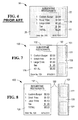
- Fig. 4 is a front view of a combined receipt and label which has been cut from the known combined receipt and label roll of Figs. 1-3 ;
- Fig. 5 is a perspective view similar to the perspective view of Fig. 2 , and showing a combined receipt and label roll constructed in accordance with one embodiment
- Fig. 6 is a cross-sectional view, taken approximately along line 6-6 shown in Fig. 5 , and showing layers of material of the combined receipt and label roll;
- Fig. 7 is a front view of a combined receipt and label cut from the combined receipt and label roll of Figs. 5 and 6 ;
- Fig. 8 is a front view similar to Fig. 7 , and showing the combined receipt and label separated into two portions;
- Fig. 9 is a perspective view similar to the perspective view of Fig. 5 , and showing a combined receipt and label roll constructed in accordance with another embodiment.
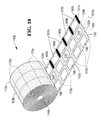
- Figs. 10-11 are perspective views similar to the perspective view of Fig. 9 , and showing other embodiments.
- an example combined receipt and label roll 110 includes a web 112 of material having a longitudinally-extending axis 124 along a longitudinally-running direction of the web.
- the web 112 of material is wound on core 114 along web axis 124.
- Web 112 includes substrate 116 having front side 118 and back side 120 opposite the front side.
- a pattern of adhesive 122 in the form of spots or strips for example, is disposed on a portion of the back side 120 of substrate 116 along web axis 124.
- Thermally-sensitive coating 126 is disposed on an area covering the entire front side 118 of substrate 116.
- the pattern of adhesive 122 as shown in Fig. 5 , is only an example pattern. It is conceivable that other adhesive patterns, or any combination of adhesive patterns, may be used.
- Release coating 128 is disposed on the front side 118 of substrate 116 along web axis 124 to prevent adhesive from sticking to the front side 118 of substrate 116 when web 112 is wound on core 114.
- Release coating 128 may be disposed on the entire front side 118 of substrate 116, or on only a portion of the front side 118 of substrate 116, such as shown in Figs. 5 and 6 .
- location of release coating 116 on the front side 118 of substrate 116 corresponds to location of adhesive spots or strips 122 on the back side 120 of substrate 116 to prevent adhesive from sticking to the front side 118 of substrate 116.
- a weakened structure 150 in the form of a longitudinal perforation extends along a direction parallel to web axis 124. Longitudinal perforation 150 divides web 112 into a first web portion 151 and a second web portion 152. Adhesive 122 and release coating 128 are disposed on first web portion 151. Second web portion 152 is substantially devoid of adhesive and release coating.
- longitudinal perforation 150 shown in Fig. 5 divides first and second web portions 151, 152 into unequal-sized portions. It is conceivable that longitudinal perforation 150 may be located at a position different from the position shown in Fig. 5 . As an example, longitudinal perforation 150 shown in Fig. 5 may be at a location which divides first and second web portions 151, 152 into equal-sized portions.
- the weakened structure 150 is described above as a longitudinally-extending perforation, it is conceivable that another type of weakened structures may be used.
- the weakened structure 150 may comprise a narrow portion of substrate which is relatively thinner in cross-section than the rest of the substrate.
- a direct thermal printer (not shown) thermally images a portion of thermal-sensitive coating 126 to provide receipt information on the thermally-imaged portion.
- a movable cutting blade (also not shown) of the printer then cuts web 112 in cross-section to provide combined receipt and label 130 as shown in Fig. 7 .
- web 112 may be cut in cross-section by a user (such as a retail merchant) manually tearing it against a stationary cutting blade of the printer to provide the combined receipt and label 130.
- the receipt information shown in Fig. 7 is printed in a position different from the position of the receipt information shown in Fig. 4 .
- the receipt information of Fig. 7 is printed such that all of the receipt information is printed to only the left (as viewed looking at Fig. 7 ) of the perforation 150.
- the surface portion of the front side 118 of the substrate 116 to the left of the perforation 150 is devoid of release coating material, and that the surface portion of the back side 120 of the substrate to the left of the perforation 150 is devoid of adhesive material.
- a retail merchant (such as a fast food restaurant) attaches combined receipt and label 130 by way of adhesive 122 to a purchased item (such as an order made by a retail customer in the fast food restaurant).
- the attached combined receipt and label 130 functions as a temporary label for the merchant to identify the order to be delivered to the particular customer.
- the customer After the customer receives the order from the merchant, the customer manually tears combined receipt and label 130 along longitudinal perforation 150 to separate apart the first and second web portions 151, 152 of the combined receipt and label, as shown in Fig. 8 .
- the customer keeps second web portion 152 of combined receipt and label 130 as a permanent receipt of the order transaction.
- the customer may leave first web portion 151 on the order. Alternatively, the customer may remove first web portion 151 from the order and discard it.
- the lettering-size of the receipt information to the left of the perforation 150 in Fig. 7 is the same lettering-size shown in Fig. 4 , it is conceivable that the lettering-size shown in Fig. 7 be either smaller or larger than that shown in Fig. 4 .
- the lettering-size on the left may be different from the lettering-size on the right.
- the lettering-sizes may be the same.
- the orientation of the text of the receipt information need not be restricted to the traditional orientation (i.e., across the narrow dimension of the receipt). It is conceivable that at least some (or all) of the text of the receipt information may be oriented parallel to the web axis 124.
- a single roll of web material provides a combined receipt and label in which a temporary label is initially provided and then a permanent receipt is provided.
- the first and second web portions 151, 152 initially function together as a "temporary label" which can be attached by the merchant by way of adhesive 122 to the order.
- the temporary label allows the merchant to identify the order to which the particular temporary label is attached.
- the second web portion 152 After the second web portion 152 is separated from the first web portion 151 (as shown in Fig. 8 ), the second web portion 152 functions as a "permanent receipt" which is free of adhesive.
- the permanent receipt By providing a permanent receipt which is free of adhesive, the permanent receipt does not stick to clothing, wallets or purses, other documents, and the like. Also, the permanent receipt can be folded without adhesive inside the folded receipt.
- longitudinal perforation 150 is a weakened part of the web 112 which allows the second web portion 152 to be easily separated by the customer (or by the merchant) from the first web portion 151.
- the permanent receipt can be signed using ink.
- portion of the front side 118 of the substrate 116 which is devoid of release coating comprises ink-receptive material on which ink can be applied and adhered to.
- Thermally-sensitive coating 126 may comprise ink-receptive material. Alternatively, ink-receptive material may be disposed on the thermally-sensitive coating 126.
- FIG. 9 Another embodiment is illustrated in Fig. 9 . Since the embodiment illustrated in Fig. 9 is generally similar to the embodiment illustrated in Fig. 5 , similar numerals are utilized to designate similar components, the suffix letter "a" being associated with the embodiment of Fig. 9 to avoid confusion.
- Thermally-sensitive coating 126a is disposed on an area covering the entire front side. Release coating 128a is disposed on a portion of the front side. Longitudinal perforation 150a extends between first and second web portions 151a, 152a.
- a number of cross-sectional perforations 170 extend across web 112a between spots or strips of adhesive 122a disposed on web 112a which is wound core 114a along web axis 124a of roll 110a as shown in Fig. 9 .
- Cross-sectional perforations 170 are spaced apart from each other along web 112a in a direction parallel to web axis 124a.
- Each of the cross-sectional perforations 170 extends along a cross-sectional direction which is transverse to the longitudinal-extending direction of web axis 124a.
- Sense marks 160 are printed on the back side 120a. Color of sense marks 160 may be black, for example. Sense marks 160 are disposed on cross-sectional perforations 170 as illustrated in Fig. 9 . Locations of sense marks 160 on the back side 120a correspond to locations between the spots or strips of adhesive 122a. Sense marks 160 indicate locations of cross-sectional perforations 170, and tell the printer where to cut. As an example, the printer may cut at a location where a cross-sectional perforation is not located. It is conceivable though that the printer may cut at a location on a cross-sectional perforation.
- sense marks 160 are shown in Fig. 9 as being on the back side 120a, it is conceivable that the sense marks 160 be on the front side. Also, sense marks 160 may be on the left edge or the right edge.
- sense marks 160 are shown in Fig. 9 as being located between all adhesive spots or strips 122a, it is conceivable sense marks be located between only some of the adhesive spots or strips 122a. Similarly, cross-sectional perforations 170 may be located between only some of the adhesive spots or strips 122a. Moreover, it is conceivable that locations of sense marks 160 between certain spots or strips 122a may be different from locations of cross-sectional perforations 170 between other adhesive spots or strips 122a.
- FIG. 9 includes both cross-sectional perforations 170 and sense marks 160, it is conceivable that other embodiments include only cross-sectional perforations or only sense marks.
- FIG. 10 Another embodiment is illustrated in Fig. 10 . Since the embodiment illustrated in Fig. 10 is generally similar to the embodiment illustrated in Fig. 9 , similar numerals are utilized to designate similar components, the suffix letter "b" being associated with the embodiment of Fig. 10 to avoid confusion.
- Thermally-sensitive coating (not shown) is disposed on an area covering the front side.
- Release coating 128b is disposed on the front side.
- First longitudinal perforation 150b extends between first web portion 151b and second web portion 152b.
- Second longitudinal perforation 180 extends between second web portion 152b and third web portion 153.
- Spots or strips of adhesive 122b are disposed on first web portion 151b. Spots or strips of adhesive 144 are disposed on second web portion 152b. Spots or strips of adhesive 166 are disposed on third web portion 153.
- First, second, and third web portions 151b, 152b, 153 form web 112b which is wound core 114b along web axis 124b of roll 110b as shown in Fig. 10 .
- the pattern of adhesive 122b, as shown in Fig. 10 is only an example pattern. It is conceivable that other adhesive patterns, or any combination of adhesive patterns, may be used.
- a number of cross-sectional perforations 170b extend across web 112b between adhesives 122b, 144, 166.
- Cross-sectional perforations 170b are spaced apart from each other along web 112b in a direction parallel to web axis 124b.
- Each of the cross-sectional perforations 170b extends along a cross-sectional direction which is transverse to the longitudinal-extending direction of web axis 124b.
- each of the first, second, and third web portions 151b, 152b, 153 shown in Fig. 10 includes adhesive thereon, it is conceivable that only some of the web portions include adhesive thereon.
- only one of the three web portions 151b, 152b, 153 may include adhesive thereon while the remaining two web portions are adhesive-free.
- only two of the three web portions 151b, 152b, 153 may include adhesive thereon, while the remaining web portion is adhesive-free.
- Sense marks 160b are printed on the back side. Color of sense marks 160b may be black, for example. Sense marks 160b are disposed on cross-sectional perforations 170b as illustrated in Fig. 10 . Locations of sense marks 160b on the back side correspond to locations between adhesives 122b, 144, 166. Sense marks 160b indicate locations of cross-sectional perforations 170b, and tell the printer where to cut. Although sense marks 160b are shown in Fig. 10 as being on the back side, it is conceivable that the sense marks 160b be on the front side. Also, sense marks 160b may be on the left edge or the right edge.
- sense marks 160b are shown in Fig. 10 as being located between all adhesive spots or strips, it is conceivable that sense marks be located between only some adhesive spots or strips. Similarly, cross-sectional perforations 170b may be located between only some adhesive spots or strips. Moreover, it is conceivable that locations of sense marks 160b between certain adhesive spots or strips may be different from locations of cross-sectional perforations 170b between other adhesive spots or strips.
- FIG. 10 includes both cross-sectional perforations 170b and sense marks 160b, it is conceivable that other embodiments include only cross-sectional perforations or only sense marks.
- FIG. 11 Another embodiment is illustrated in Fig. 11 . Since the embodiment illustrated in Fig. 11 is generally similar to the embodiment illustrated in Fig. 10 , similar numerals are utilized to designate similar components, the suffix letter "c" being associated with the embodiment of Fig. 11 to avoid confusion.
- Thermally-sensitive coating (not shown) is disposed on an area covering the front side.
- Release coating 128c is disposed on the front side.
- First longitudinal perforation 150c extends between first web portion 151c and second web portion 152c.
- Second longitudinal perforation 180c extends between second web portion 152c and third web portion 153c.
- a number of cross-sectional perforations 170c extend across web 112c between adhesives 122c, 144c, 166c.
- Cross-sectional perforations 170c are spaced apart from each other along web 112c in a direction parallel to web axis 124c.
- Each of the cross-sectional perforations 170c extends along a cross-sectional direction which is transverse to the longitudinal-extending direction of web axis 124c.
- each of the first, second, and third web portions 151c, 152c, 153c shown in Fig. 1c includes adhesive thereon, it is conceivable that only some of the web portions include adhesive thereon.
- only one of the three web portions 151c, 152c, 153c may include adhesive thereon while the remaining two web portions are adhesive-free.
- only two of the three web portions 151c, 152c, 153c may include adhesive thereon, while the remaining web portion is adhesive-free.
- Sense marks 160c are printed on the back side. Color of sense marks 160c may be black, for example. Sense marks 160c are disposed between cross-sectional perforations 170c as illustrated in Fig. 11 . Locations of sense marks 160c on the back side correspond to locations between certain adhesive spots or strips 122c on first web portion 151c. Sense marks 160c indicate locations of cross-sectional perforations 170c, and tell the printer where to cut. Although sense marks 160c are shown in Fig. 11 as being on the back side, it is conceivable that the sense marks 160c be on the front side. Also, sense marks 160c may be on the left edge or the right edge.
- FIG. 11 includes both cross-sectional perforations 170c and sense marks 160c, it is conceivable that other embodiments include only cross-sectional perforations or only sense marks.
Landscapes
- Physics & Mathematics (AREA)
- General Physics & Mathematics (AREA)
- Engineering & Computer Science (AREA)
- Theoretical Computer Science (AREA)
- Optics & Photonics (AREA)
- Making Paper Articles (AREA)
- Adhesive Tapes (AREA)
- Storage Of Web-Like Or Filamentary Materials (AREA)
- Heat Sensitive Colour Forming Recording (AREA)
Abstract
Description
- The present application relates to combined receipt and label rolls, and is particularly directed to a perforated, combined receipt and label roll.
- A known combined receipt and
label roll 10 is shown inFigs. 1-3 . The combinedroll 10 comprises acontinuous web 12 of material wound in a spiral around acore 14. Theweb 12 includes a substrate 16 (Fig. 3 ) having afront side 18 and aback side 20 opposite the front side. A pattern of adhesive spots orstrips 22 are disposed on theback side 20 of thesubstrate 16. Theadhesive pattern 22 covers a relatively small portion of theback side 20, and extends along a longitudinal running axis 24 (Fig. 2 ) of theweb 12. - A thermal-
sensitive coating 26 is disposed on the entirefront side 18 of thesubstrate 16. Arelease coating 28 is disposed on the thermalsensitive coating 26, and is also disposed on theentire front side 18 of thesubstrate layer 16. The release coating 28 prevents adhesive 22 on theback side 20 of thesubstrate 16 from sticking to thefront side 18 when theweb 12 is wound on thecore 14. - During use of the combined
roll 10 ofFigs. 1-3 in a direct thermal printer (not shown), the printer thermally images a portion of the thermal-sensitive coating layer 26 to provide receipt information on the thermally-imaged portion. A movable cutting blade of the printer then cuts theweb 12 in cross-section to provide a combined receipt andlabel 30 as shown inFig. 4 . Alternatively, theweb 12 may be cut in cross-section by a user manually tearing it against a stationary cutting blade of the printer to provide the combined receipt andlabel 30. - In an example use of the combined receipt and
label 30 ofFig. 4 , a retail merchant (such as a fast food restaurant) attaches the combined receipt andlabel 30 by way of theadhesive 22 to a purchased item (such as an order made by a retail customer in the fast food restaurant). The attached combined receipt andlabel 30 functions as a temporary label for the merchant to identify the order to be delivered to the particular customer. After the customer receives the order from the merchant, the customer removes the combined receipt andlabel 30 and keeps it as a permanent receipt of the order transaction. - A limitation of the
permanent receipt 30 shown inFig. 4 is that it containsadhesive 22 which can stick to clothing, wallets or purses, other documents, and the like. Moreover, thepermanent receipt 30 is unable to be folded without adhesive inside the folded receipt. Another limitation of thepermanent receipt 30 is that the customer (or the merchant) is unable to write anything in ink onto the front side 18 (Fig. 3 ) of thesubstrate 16 since therelease coating 28 is not ink-receptive and is disposed on the entire front side of the substrate. It would be desirable to provide a permanent receipt in which such limitations are overcome. - In accordance with one embodiment, a receipt and label roll comprises a core and a web having a longitudinally-extending axis and wound on the core along the axis. The web includes (i) a substrate having a front side and a back side opposite the front side, (ii) a thermally-sensitive coating disposed on the front side of the substrate, (iii) adhesive disposed on a portion of the back side of the substrate along the web axis, and (iv) a release coating disposed on the front side of the substrate along the web axis to prevent the adhesive from sticking to the front side of the substrate when the web is wound on the core. The web further includes (v) a longitudinal weakened structure extending along a direction parallel to the web axis and dividing the web into a first web portion on which the adhesive is disposed and a second web portion which is substantially devoid of adhesive.
- According to a first aspect of the invention there is provided a receipt and label roll comprising: a core; and a web having a longitudinally-extending axis and wound on the core along the axis, the web including (i) a substrate having a front side and a back side opposite the front side, (ii) a thermally-sensitive coating disposed on the front side of the substrate, (iii) adhesive disposed on a portion of the back side of the substrate along the web axis, (iv) a release coating disposed on the front side of the substrate along the web axis to prevent the adhesive from sticking to the front side of the substrate when the web is wound on the core, and (v) a longitudinal weakened structure extending along a direction parallel to the web axis and dividing the web into a first web portion on which the adhesive is disposed and a second web portion which is substantially devoid of adhesive.
- The longitudinal weakened structure optionally comprises at least one perforation which extends along the direction parallel to the web axis.
- The receipt and label roll optionally further comprises a plurality of transverse perforations spaced apart from each other along the web in a direction parallel to the web axis, wherein each transverse perforation extends along a direction transverse to the web axis.
- Optionally, the adhesive includes spots or strips of adhesive disposed on the portion of the back side of the substrate along the web axis.
- Optionally, the receipt and label roll further comprises a plurality of sense marks corresponding to locations between spots or strips of adhesive, and for indicating to a thermal printer where to cut.
- Optionally, the second web portion is substantially devoid of release coating.
- According to a second aspect of the invention there is provided a receipt and label roll comprising: a core; and a web having a longitudinally-extending axis and wound on the core along the axis, the web including (i) a substrate having a front side and a back side opposite the front side, (ii) a thermally-sensitive coating disposed on the front side of the substrate, (iii) adhesive disposed on a portion of the back side of the substrate along the web axis, and (iv) a release coating disposed on a portion of the front side of the substrate along the web axis and corresponding to location of the adhesive on the back side to prevent the adhesive from sticking to the front side of the substrate when the web is wound on the core, wherein at least part of that portion of the front side of the substrate devoid of release coating comprises ink-receptive material on which ink can be applied and adhered to.
- Optionally, the receipt and label roll further comprises at least one longitudinal perforation extending along a direction parallel to the web axis and dividing the web into a first web portion on which the adhesive and the release coating are disposed and a second web portion which is substantially devoid of adhesive and release coating.
- Optionally, the receipt and label roll further comprises a plurality of transverse perforations spaced apart from each other along the web in a direction parallel to the web axis, wherein each transverse perforation extends along a direction transverse to the web axis.
- Optionally, the adhesive includes spots or strips of adhesive disposed on the portion of the back side of the substrate along the web axis.
- Optionally, the receipt and label roll further comprises a plurality of sense marks corresponding to locations between spots or strips of adhesive, and for indicating to a thermal printer where to cut.
- According to a third aspect of the invention there is provided a receipt and label roll comprising: a core; and a web having a longitudinally-extending axis and wound on the core along the axis, the web including (i) a substrate having a front side and a back side opposite the front side, (ii) a thermally-sensitive coating disposed on the front side of the substrate, (iii) adhesive disposed on a portion of the back side of the substrate along the web axis, (iv) a release coating disposed on the front side of the substrate along the web axis to prevent the adhesive from sticking to the front side of the substrate when the web is wound on the core, and (v) a plurality of longitudinally perforations extending along a direction parallel to the web axis and dividing the web into at least a first web portion, a second web portion which is different from the first web portion, and a third web portion which is different from the first and second web portions, wherein adhesive is disposed on at least one of the first, second, and third web portions.
- Optionally, the adhesive is disposed on at least two of the first, second, and third web portions.
- Optionally, the receipt and label roll further comprises a plurality of transverse perforations spaced apart from each other along the web in a direction parallel to the web axis, wherein each transverse perforation extends along a direction transverse to the web axis.
- Optionally, the adhesive includes spots or strips of adhesive disposed on the portion of the back side of the substrate along the web axis.
- Optionally, the receipt and label roll further comprises a plurality of sense marks corresponding to locations between spots or strips of adhesive, and for indicating to a thermal printer where to cut.
- Optionally, each of the number of sense marks is (i) disposed between a pair of transverse perforations, (ii) disposed between a pair of spots or strips of adhesive, and (iii) provided for indicating to a thermal printer where to cut.
- These and other aspects of the present invention will be apparent from the following specific description, given by way of example, with reference to the accompanying drawings, in which:
-
Fig. 1 is a perspective view of a known combined receipt and label roll, and showing front side of the roll; -
Fig. 2 is a perspective view, looking generally in the direction of arrow A shown inFig. 1 , and showing back side of the known combined receipt and label roll; -
Fig. 3 is a cross-sectional view, taken approximately along line 3-3 shown inFig. 2 , and showing layers of material of the known combined receipt and label roll; -
Fig. 4 is a front view of a combined receipt and label which has been cut from the known combined receipt and label roll ofFigs. 1-3 ; -
Fig. 5 is a perspective view similar to the perspective view ofFig. 2 , and showing a combined receipt and label roll constructed in accordance with one embodiment; -
Fig. 6 is a cross-sectional view, taken approximately along line 6-6 shown inFig. 5 , and showing layers of material of the combined receipt and label roll; -
Fig. 7 is a front view of a combined receipt and label cut from the combined receipt and label roll ofFigs. 5 and 6 ; -
Fig. 8 is a front view similar toFig. 7 , and showing the combined receipt and label separated into two portions; -
Fig. 9 is a perspective view similar to the perspective view ofFig. 5 , and showing a combined receipt and label roll constructed in accordance with another embodiment; and -
Figs. 10-11 are perspective views similar to the perspective view ofFig. 9 , and showing other embodiments. - Referring to
Figs. 5 and 6 , an example combined receipt andlabel roll 110 includes aweb 112 of material having a longitudinally-extendingaxis 124 along a longitudinally-running direction of the web. Theweb 112 of material is wound oncore 114 alongweb axis 124. -
Web 112 includessubstrate 116 havingfront side 118 andback side 120 opposite the front side. A pattern ofadhesive 122, in the form of spots or strips for example, is disposed on a portion of theback side 120 ofsubstrate 116 alongweb axis 124. Thermally-sensitive coating 126 is disposed on an area covering the entirefront side 118 ofsubstrate 116. The pattern ofadhesive 122, as shown inFig. 5 , is only an example pattern. It is conceivable that other adhesive patterns, or any combination of adhesive patterns, may be used. -
Release coating 128 is disposed on thefront side 118 ofsubstrate 116 alongweb axis 124 to prevent adhesive from sticking to thefront side 118 ofsubstrate 116 whenweb 112 is wound oncore 114.Release coating 128 may be disposed on the entirefront side 118 ofsubstrate 116, or on only a portion of thefront side 118 ofsubstrate 116, such as shown inFigs. 5 and 6 . As shown in the embodiment ofFigs. 5 and 6 , location ofrelease coating 116 on thefront side 118 ofsubstrate 116 corresponds to location of adhesive spots orstrips 122 on theback side 120 ofsubstrate 116 to prevent adhesive from sticking to thefront side 118 ofsubstrate 116. - A weakened
structure 150 in the form of a longitudinal perforation extends along a direction parallel toweb axis 124.Longitudinal perforation 150 dividesweb 112 into afirst web portion 151 and asecond web portion 152. Adhesive 122 andrelease coating 128 are disposed onfirst web portion 151.Second web portion 152 is substantially devoid of adhesive and release coating. - It should be noted that the
longitudinal perforation 150 shown inFig. 5 divides first andsecond web portions longitudinal perforation 150 may be located at a position different from the position shown inFig. 5 . As an example,longitudinal perforation 150 shown inFig. 5 may be at a location which divides first andsecond web portions - Also, although the weakened
structure 150 is described above as a longitudinally-extending perforation, it is conceivable that another type of weakened structures may be used. For example, the weakenedstructure 150 may comprise a narrow portion of substrate which is relatively thinner in cross-section than the rest of the substrate. - During use of example combined receipt and
label roll 110 ofFigs. 5 and 6 , a direct thermal printer (not shown) thermally images a portion of thermal-sensitive coating 126 to provide receipt information on the thermally-imaged portion. A movable cutting blade (also not shown) of the printer then cutsweb 112 in cross-section to provide combined receipt andlabel 130 as shown inFig. 7 . Alternatively,web 112 may be cut in cross-section by a user (such as a retail merchant) manually tearing it against a stationary cutting blade of the printer to provide the combined receipt andlabel 130. - It should be noted that the receipt information shown in
Fig. 7 is printed in a position different from the position of the receipt information shown inFig. 4 . The receipt information ofFig. 7 is printed such that all of the receipt information is printed to only the left (as viewed looking atFig. 7 ) of theperforation 150. It should also be noted that the surface portion of thefront side 118 of thesubstrate 116 to the left of theperforation 150 is devoid of release coating material, and that the surface portion of theback side 120 of the substrate to the left of theperforation 150 is devoid of adhesive material. - In an example use of the combined receipt and
label 130 ofFig. 7 , a retail merchant (such as a fast food restaurant) attaches combined receipt andlabel 130 by way of adhesive 122 to a purchased item (such as an order made by a retail customer in the fast food restaurant). The attached combined receipt and label 130 functions as a temporary label for the merchant to identify the order to be delivered to the particular customer. - After the customer receives the order from the merchant, the customer manually tears combined receipt and
label 130 alonglongitudinal perforation 150 to separate apart the first andsecond web portions Fig. 8 . The customer keepssecond web portion 152 of combined receipt andlabel 130 as a permanent receipt of the order transaction. The customer may leavefirst web portion 151 on the order. Alternatively, the customer may removefirst web portion 151 from the order and discard it. - Although the above description describes receipt information being printed only to the left of the
perforation 150 and no information at all being printed to the right of the perforation 150 (i.e., the right remains blank), it is conceivable that at least some information be printed to the right. It is conceivable that all information to the right be different from the left, or that only some of the information be different. It is also conceivable that all information to the right be identical with information on the left. - Also, although the above description describes the lettering-size of the receipt information to the left of the
perforation 150 inFig. 7 as being the same lettering-size shown inFig. 4 , it is conceivable that the lettering-size shown inFig. 7 be either smaller or larger than that shown inFig. 4 . In the case where receipt information is printed to the left of theperforation 150 ofFig. 7 and at least some information is printed to the right of theperforation 150, the lettering-size on the left may be different from the lettering-size on the right. Alternatively, the lettering-sizes may be the same. - Moreover, the orientation of the text of the receipt information need not be restricted to the traditional orientation (i.e., across the narrow dimension of the receipt). It is conceivable that at least some (or all) of the text of the receipt information may be oriented parallel to the
web axis 124. - It should be apparent that a single roll of web material provides a combined receipt and label in which a temporary label is initially provided and then a permanent receipt is provided. In the example fast food order described above, the first and
second web portions - After the
second web portion 152 is separated from the first web portion 151 (as shown inFig. 8 ), thesecond web portion 152 functions as a "permanent receipt" which is free of adhesive. By providing a permanent receipt which is free of adhesive, the permanent receipt does not stick to clothing, wallets or purses, other documents, and the like. Also, the permanent receipt can be folded without adhesive inside the folded receipt. - It should also be apparent that the
longitudinal perforation 150 is a weakened part of theweb 112 which allows thesecond web portion 152 to be easily separated by the customer (or by the merchant) from thefirst web portion 151. - It should be apparent that the permanent receipt can be signed using ink. This feature is provided because that portion of the
front side 118 of thesubstrate 116 which is devoid of release coating (seeFig. 6 ) comprises ink-receptive material on which ink can be applied and adhered to. Thermally-sensitive coating 126 may comprise ink-receptive material. Alternatively, ink-receptive material may be disposed on the thermally-sensitive coating 126. - It should further be apparent that a merchant needs to have only one printer to use the combined receipt and
label roll 130. Two printers, one printer for printing a label and another printer for printing a receipt, are not needed. - Another embodiment is illustrated in
Fig. 9 . Since the embodiment illustrated inFig. 9 is generally similar to the embodiment illustrated inFig. 5 , similar numerals are utilized to designate similar components, the suffix letter "a" being associated with the embodiment ofFig. 9 to avoid confusion. - Thermally-
sensitive coating 126a is disposed on an area covering the entire front side.Release coating 128a is disposed on a portion of the front side.Longitudinal perforation 150a extends between first andsecond web portions - A number of
cross-sectional perforations 170 extend acrossweb 112a between spots or strips of adhesive 122a disposed onweb 112a which is woundcore 114a alongweb axis 124a ofroll 110a as shown inFig. 9 .Cross-sectional perforations 170 are spaced apart from each other alongweb 112a in a direction parallel toweb axis 124a. Each of thecross-sectional perforations 170 extends along a cross-sectional direction which is transverse to the longitudinal-extending direction ofweb axis 124a. - Sense marks 160 are printed on the
back side 120a. Color of sense marks 160 may be black, for example. Sense marks 160 are disposed oncross-sectional perforations 170 as illustrated inFig. 9 . Locations of sense marks 160 on theback side 120a correspond to locations between the spots or strips of adhesive 122a. Sense marks 160 indicate locations ofcross-sectional perforations 170, and tell the printer where to cut. As an example, the printer may cut at a location where a cross-sectional perforation is not located. It is conceivable though that the printer may cut at a location on a cross-sectional perforation. - Although sense marks 160 are shown in
Fig. 9 as being on theback side 120a, it is conceivable that the sense marks 160 be on the front side. Also, sense marks 160 may be on the left edge or the right edge. - Although corresponding sense marks 160 are shown in
Fig. 9 as being located between all adhesive spots orstrips 122a, it is conceivable sense marks be located between only some of the adhesive spots orstrips 122a. Similarly,cross-sectional perforations 170 may be located between only some of the adhesive spots orstrips 122a. Moreover, it is conceivable that locations of sense marks 160 between certain spots orstrips 122a may be different from locations ofcross-sectional perforations 170 between other adhesive spots orstrips 122a. - Although the embodiment shown in
Fig. 9 includes bothcross-sectional perforations 170 and sense marks 160, it is conceivable that other embodiments include only cross-sectional perforations or only sense marks. - Another embodiment is illustrated in
Fig. 10 . Since the embodiment illustrated inFig. 10 is generally similar to the embodiment illustrated inFig. 9 , similar numerals are utilized to designate similar components, the suffix letter "b" being associated with the embodiment ofFig. 10 to avoid confusion. - Thermally-sensitive coating (not shown) is disposed on an area covering the front side.
Release coating 128b is disposed on the front side. Firstlongitudinal perforation 150b extends betweenfirst web portion 151b andsecond web portion 152b. Secondlongitudinal perforation 180 extends betweensecond web portion 152b andthird web portion 153. - Spots or strips of adhesive 122b are disposed on
first web portion 151b. Spots or strips of adhesive 144 are disposed onsecond web portion 152b. Spots or strips of adhesive 166 are disposed onthird web portion 153. First, second, andthird web portions form web 112b which is woundcore 114b alongweb axis 124b ofroll 110b as shown inFig. 10 . The pattern of adhesive 122b, as shown inFig. 10 , is only an example pattern. It is conceivable that other adhesive patterns, or any combination of adhesive patterns, may be used. - A number of
cross-sectional perforations 170b extend acrossweb 112b betweenadhesives Cross-sectional perforations 170b are spaced apart from each other alongweb 112b in a direction parallel toweb axis 124b. Each of thecross-sectional perforations 170b extends along a cross-sectional direction which is transverse to the longitudinal-extending direction ofweb axis 124b. - Although only two
longitudinal perforations Fig. 10 , it is conceivable that there be more than two longitudinal perforations. Also, although each of the first, second, andthird web portions Fig. 10 includes adhesive thereon, it is conceivable that only some of the web portions include adhesive thereon. For example, only one of the threeweb portions web portions - Sense marks 160b are printed on the back side. Color of sense marks 160b may be black, for example. Sense marks 160b are disposed on
cross-sectional perforations 170b as illustrated inFig. 10 . Locations of sense marks 160b on the back side correspond to locations betweenadhesives cross-sectional perforations 170b, and tell the printer where to cut. Although sense marks 160b are shown inFig. 10 as being on the back side, it is conceivable that the sense marks 160b be on the front side. Also, sense marks 160b may be on the left edge or the right edge. - Although corresponding sense marks 160b are shown in
Fig. 10 as being located between all adhesive spots or strips, it is conceivable that sense marks be located between only some adhesive spots or strips. Similarly,cross-sectional perforations 170b may be located between only some adhesive spots or strips. Moreover, it is conceivable that locations of sense marks 160b between certain adhesive spots or strips may be different from locations ofcross-sectional perforations 170b between other adhesive spots or strips. - Although the embodiment shown in
Fig. 10 includes bothcross-sectional perforations 170b and sense marks 160b, it is conceivable that other embodiments include only cross-sectional perforations or only sense marks. - Another embodiment is illustrated in
Fig. 11 . Since the embodiment illustrated inFig. 11 is generally similar to the embodiment illustrated inFig. 10 , similar numerals are utilized to designate similar components, the suffix letter "c" being associated with the embodiment ofFig. 11 to avoid confusion. - Thermally-sensitive coating (not shown) is disposed on an area covering the front side.
Release coating 128c is disposed on the front side. Firstlongitudinal perforation 150c extends betweenfirst web portion 151c andsecond web portion 152c. Secondlongitudinal perforation 180c extends betweensecond web portion 152c andthird web portion 153c. - Spots or strips of adhesive 122c are disposed on
first web portion 151c. Spots or strips of adhesive 144c are disposed onsecond web portion 152c. Spots or strips of adhesive 166c are disposed onthird web portion 153c. First, second, andthird web portions form web 112c which is woundcore 114c along web axis 124c ofroll 110c as shown inFig. 11 . Each of the pattern of adhesive 122c, the pattern of adhesive 144c, and the pattern of adhesive 166c, as shown inFig. 11 , is only an example pattern. It is conceivable that each of the adhesive patterns may be a different adhesive pattern. - A number of
cross-sectional perforations 170c extend acrossweb 112c betweenadhesives Cross-sectional perforations 170c are spaced apart from each other alongweb 112c in a direction parallel to web axis 124c. Each of thecross-sectional perforations 170c extends along a cross-sectional direction which is transverse to the longitudinal-extending direction of web axis 124c. - Although only two
longitudinal perforations Fig. 11 , it is conceivable that there be more than two longitudinal perforations. Also, although each of the first, second, andthird web portions Fig. 1c includes adhesive thereon, it is conceivable that only some of the web portions include adhesive thereon. For example, only one of the threeweb portions web portions - Sense marks 160c are printed on the back side. Color of sense marks 160c may be black, for example. Sense marks 160c are disposed between
cross-sectional perforations 170c as illustrated inFig. 11 . Locations of sense marks 160c on the back side correspond to locations between certain adhesive spots or strips 122c onfirst web portion 151c. Sense marks 160c indicate locations ofcross-sectional perforations 170c, and tell the printer where to cut. Although sense marks 160c are shown inFig. 11 as being on the back side, it is conceivable that the sense marks 160c be on the front side. Also, sense marks 160c may be on the left edge or the right edge. - Although the embodiment shown in
Fig. 11 includes bothcross-sectional perforations 170c and sense marks 160c, it is conceivable that other embodiments include only cross-sectional perforations or only sense marks. - While the present invention has been illustrated by the description of example processes and system components, and while the various processes and components have been described in detail, applicant does not intend to restrict or in any limit the scope of the appended claims to such detail. Additional modifications will also readily appear to those skilled in the art. The invention in its broadest aspects is therefore not limited to the specific details, implementations, or illustrative examples shown and described. Accordingly, departures may be made from such details without departing from the scope of the following claims.
Claims (10)
- A receipt and label roll (110, 110a, 110b or 110c) comprising:a core (114, 114a, 114b, or 114c); anda web (112, 112a, 112b, or 112c) having a longitudinally-extending axis (124, 124a, 124b, or 124c) and wound on the core (114, 114a, 114b, or 114c) along the axis (124, 124a, 124b, or 124c), the web (112, 112a, 112b, or 112c) including (i) a substrate (116, 116a, 116b, or 116c) having a front side (118, 118a, 118b, or 118c) and a back side (120, 120a, 120b, or 120c) opposite the front side (118, 118a, 118b, or 118c), (ii) a thermally-sensitive coating (126, 126a, 126b, or 126c) disposed on the front side (118) of the substrate (116, 116a, 116b, or 116c), (iii) adhesive (122, 122a, 122b, or 122c) disposed on a portion of the back side (120, 120a, 120b, or 120c) of the substrate (116, 116a, 116b, or 116c) along the web axis (124, 124a, 124b, or 124c), (iv) a release coating (128, 128a, 128b, or 128c) disposed on the front side (118, 118a, 118b, or 118c) of the substrate (116, 116a, 116b, or 116c) along the web axis (124, 124a, 124b, or 124c) to prevent the adhesive (122, 122a, 122b, or 122c) from sticking to the front side (118, 118a, 118b, or 118c) of the substrate (116, 116a, 116b, or 116c) when the web (112, 112a, 112b, or 112c) is wound on the core (114, 114a, 114b, or 114c), and (v) a longitudinal weakened structure (150, 150a, 150b, or 150c) extending along a direction parallel to the web axis (124, 124a, 124b, or 124c) and dividing the web (112, 112a, 112b, or 112c) into a first web portion (151, 151a, 151b, or 151c) on which the adhesive (122, 122a, 122b, or 122c) is disposed and a second web portion (152, 152a, 152b, or 152c) which is substantially devoid of adhesive.
- A receipt and label roll according to claim 1, wherein the longitudinal weakened structure (150, 150a, 150b, or 150c) comprises at least one perforation which extends along the direction parallel to the web axis (124, 124a, 124b, or 124c).
- A receipt and label roll according to claim 1 or 2, further comprising a plurality of transverse perforations (170, 170b, or 170c) spaced apart from each other along the web (112, 112a, 112b, or 112c) in a direction parallel to the web axis (124, 124a, 124b, or 124c), wherein each transverse perforation (170, 170b, or 170c) extends along a direction transverse to the web axis (124, 124a, 124b, or 124c).
- A receipt and label roll according to any of claims 1 to 3, wherein the adhesive (122, 122a, 122b, or 122c) includes spots or strips of adhesive disposed on the portion of the back side (120, 120a, 120b, or 120c) of the substrate (116, 116a, 116b, or 116c) along the web axis (124, 124a, 124b, or 124c).
- A receipt and label roll according to claim 4, further comprising a plurality of sense marks (160, 160a, 160b, or 160c) corresponding to locations between spots or strips of adhesive (122, 122a, 122b, or 122c), and for indicating to a thermal printer where to cut.
- A receipt and label roll according to claim 5, wherein each of the plurality of sense marks is (i) disposed between a pair of transverse perforations, (ii) disposed between a pair of spots or strips of adhesive, and (iii) is provided for indicating to a thermal printer where to cut.
- A receipt and label roll according to any preceding claim, wherein the second web portion (152, 152b, 152c, or 152d) is substantially devoid of release coating.
- A receipt and label roll according to any preceding claim, wherein the second web portion (152, 152a, 152b, or 152c) comprises ink-receptive material on which ink can be applied and adhered to.
- A receipt and label roll according to any preceding claim, wherein the web (112a, 112b, or 112c) comprises a plurality of transversely-spaced, longitudinal weakened structures (150b and 180, or 150c and 180c) extending along a direction parallel to the web axis (124b or 124c) and instead of a first web portion (151, 151a, 151b, or 151c) on which the adhesive (122, 122a, 122b, or 122c) is disposed and a second web portion (152, 152a, 152b, or 152c) which is substantially devoid of adhesive, the plurality of transversely-spaced, longitudinal weakened structures (150b and 180, or 150c and 180c) divide the web (112b or 112c) into a first web portion (151b or 151c), a second web portion (152b or 152c) which is different from the first web portion (151b or 151c), and a third web portion (153 or 153c) which is different from the first and second web portions, wherein adhesive (122b, 122c, 144, 144c, 166, or 166c) is disposed on at least one of the first, second, and third web portions.
- A receipt and label roll according to claim 9, wherein the adhesive (122b, 122c, 144, 144c, 166, or 166c) is disposed on at least two of the first (151b or 151c), second (152b or 152c), and third (153 or 153c) web portions.
Applications Claiming Priority (1)
| Application Number | Priority Date | Filing Date | Title |
|---|---|---|---|
| US13/222,278 US9082321B2 (en) | 2011-08-31 | 2011-08-31 | Perforated, combined receipt and label roll |
Publications (3)
| Publication Number | Publication Date |
|---|---|
| EP2565863A2 true EP2565863A2 (en) | 2013-03-06 |
| EP2565863A3 EP2565863A3 (en) | 2013-11-06 |
| EP2565863B1 EP2565863B1 (en) | 2014-09-10 |
Family
ID=46508246
Family Applications (1)
| Application Number | Title | Priority Date | Filing Date |
|---|---|---|---|
| EP12174670.5A Active EP2565863B1 (en) | 2011-08-31 | 2012-07-02 | Perforated, combined receipt and label roll |
Country Status (3)
| Country | Link |
|---|---|
| US (6) | US9082321B2 (en) |
| EP (1) | EP2565863B1 (en) |
| CN (1) | CN103057300A (en) |
Cited By (2)
| Publication number | Priority date | Publication date | Assignee | Title |
|---|---|---|---|---|
| WO2018035464A1 (en) | 2016-08-19 | 2018-02-22 | Iconex Llc | Adhesive label and roll |
| WO2018127734A1 (en) * | 2017-01-03 | 2018-07-12 | Novum Hu | Underlying paper for transparent labels |
Families Citing this family (12)
| Publication number | Priority date | Publication date | Assignee | Title |
|---|---|---|---|---|
| US8716178B2 (en) * | 2009-12-22 | 2014-05-06 | Ncr Corporation | One-ply two-sided thermal imaging labels |
| US9082321B2 (en) * | 2011-08-31 | 2015-07-14 | Ncr Corporation | Perforated, combined receipt and label roll |
| US11958706B2 (en) | 2014-12-15 | 2024-04-16 | The Procter & Gamble Company | Non-uniform tail sealing and methods thereof |
| CA2971167A1 (en) * | 2014-12-15 | 2016-06-23 | The Procter & Gamble Company | Non-uniform tail sealing and methods thereof |
| JP6436020B2 (en) | 2015-08-31 | 2018-12-12 | ブラザー工業株式会社 | Printing device and tape |
| US10850937B2 (en) | 2015-12-15 | 2020-12-01 | The Procter & Gamble Company | Tail sealing apparatus |
| CN105427741A (en) * | 2015-12-17 | 2016-03-23 | 竹林伟业科技发展(天津)股份有限公司 | Partition-type logistics label scroll |
| JP2018146645A (en) | 2017-03-01 | 2018-09-20 | ブラザー工業株式会社 | Tape, tape roll, and tape cartridge |
| JP2018147058A (en) | 2017-03-01 | 2018-09-20 | ブラザー工業株式会社 | Label creation processing program, label creation processing method, and label printer |
| US20200098290A1 (en) * | 2018-09-24 | 2020-03-26 | Kenco Label & Tag Co., Llc | Rolled Label Web Releasably Attached To A Core |
| JP7167594B2 (en) * | 2018-09-25 | 2022-11-09 | マックス株式会社 | Label with mount and label printer |
| US20250148936A1 (en) * | 2023-11-08 | 2025-05-08 | Iconex Llc | Labels with Adhesive Patch Patterns Optimized for Printer Applications |
Family Cites Families (37)
| Publication number | Priority date | Publication date | Assignee | Title |
|---|---|---|---|---|
| US1756216A (en) * | 1927-06-25 | 1930-04-29 | Brown & Haley | Identification and price tag |
| US1949903A (en) * | 1929-06-14 | 1934-03-06 | Fales Chemical Company Inc | Label for students' unknown analysis sample packages |
| CA1117076A (en) * | 1977-01-10 | 1982-01-26 | Monarch Marking Systems, Inc. | Two-part sale label with adhesive on only one part |
| US4363685A (en) * | 1977-03-11 | 1982-12-14 | Njm, Inc. | Package label and manufacture of same |
| US4312523A (en) * | 1979-10-29 | 1982-01-26 | Paco Packaging Incorporated | Label for container having pharmaceutical product therein |
| US4521267A (en) * | 1984-06-21 | 1985-06-04 | Monarch Marking Systems, Inc. | Composite label web and method of labeling |
| US5056827A (en) * | 1989-01-25 | 1991-10-15 | Challenge Printing Company | Pharmaceutical label |
| US5254381A (en) * | 1991-05-24 | 1993-10-19 | Wallace Computer Services, Inc. | Label-equipped sheet |
| US5366087A (en) * | 1992-12-28 | 1994-11-22 | Moore Business Forms, Inc. | Resealable pressure sensitive closure label |
| US5578352A (en) | 1995-04-04 | 1996-11-26 | Moore Business Forms, Inc. | Strip coated adhesive products |
| US6074747A (en) * | 1995-06-06 | 2000-06-13 | Avery Dennison Corporation | Ink-imprintable release coatings, and pressure sensitive adhesive constructions |
| US6145423A (en) * | 1995-09-15 | 2000-11-14 | Moore Business Forms, Inc. | Semi-automatic dispenser for linerless labels |
| US5776571A (en) * | 1995-09-20 | 1998-07-07 | Transkrit Corporation | Combined form and label construction |
| US5782496A (en) * | 1995-11-03 | 1998-07-21 | Moore Business Forms, Inc. | Linerless label identification |
| US5914165A (en) * | 1996-07-29 | 1999-06-22 | Avery Dennison Corporation | Peelable label for articles for resale |
| FR2759306B1 (en) * | 1997-02-11 | 1999-03-12 | Plasto Sa | SELF-ADHESIVE STENCIL |
| US6268032B1 (en) * | 1997-10-03 | 2001-07-31 | 3M Innovative Properties Company | Repositionable note sheets and method of formation thereof |
| US6585437B1 (en) * | 1999-09-27 | 2003-07-01 | Intermec Ip Corp. | Method and apparatus for reliable printing on linerless label stock |
| US6364364B1 (en) * | 2000-02-11 | 2002-04-02 | Moore North America, Inc. | Combination shipping label/detachable packing slip/label |
| US6244629B1 (en) * | 2000-04-03 | 2001-06-12 | Moore North America, Inc. | Combination shipping label/invoice form |
| WO2001094126A1 (en) * | 2000-06-08 | 2001-12-13 | Kaufman Stacy R | Verification of prescription information and warning label |
| US6394500B1 (en) * | 2001-03-13 | 2002-05-28 | The Standard Register Company | Tuck label easy opening pull tab |
| GB0311791D0 (en) * | 2003-05-22 | 2003-06-25 | Ici Plc | Improvements in or relating to receiver medium for electronic printing |
| US7195689B2 (en) * | 2003-08-15 | 2007-03-27 | Nashua Corporation | Double-sided labels and methods of manufacture and use |
| US7588811B2 (en) * | 2004-03-19 | 2009-09-15 | Ncr Corporation | Columnar adhesive label roll |
| US20070095221A1 (en) * | 2005-11-03 | 2007-05-03 | Lee Stephanie R | Substrate having frangible stencil segments |
| WO2007136767A2 (en) * | 2006-05-18 | 2007-11-29 | Max International Converters, Inc. | Thermally printable adhesive label |
| US20090258116A1 (en) * | 2008-04-11 | 2009-10-15 | Arthur Peyton | Packaged food product and method of packaging and identifying packaged products |
| US8037628B2 (en) * | 2008-04-24 | 2011-10-18 | Stacy Kaufman | Medicine dosing compliance system |
| US8777271B2 (en) * | 2008-12-18 | 2014-07-15 | Premier Print & Services Group, Inc. | Linerless packing and shipping label system |
| US8846171B2 (en) * | 2009-01-06 | 2014-09-30 | Brady Worldwide, Inc. | Label media having a substrate and a two-sided releasable liner |
| JP5428892B2 (en) * | 2010-01-22 | 2014-02-26 | セイコーエプソン株式会社 | Barcode carrying label and method of using the same |
| US8602214B2 (en) * | 2011-03-14 | 2013-12-10 | Premier Print & Services Group, Inc. | Multiple ply label with adhesive layers |
| US9082321B2 (en) | 2011-08-31 | 2015-07-14 | Ncr Corporation | Perforated, combined receipt and label roll |
| US8857085B1 (en) * | 2012-12-21 | 2014-10-14 | Mark W. Lewis | Vehicle identification card |
| US9259891B2 (en) * | 2013-06-14 | 2016-02-16 | Electronic Imaging Services, Inc. | Pad of labels and labels for use on store shelves in a retail environment |
| US20150279242A1 (en) * | 2014-04-01 | 2015-10-01 | Kevin M. Parks | Continuous feed media with attached lamination layer |
-
2011
- 2011-08-31 US US13/222,278 patent/US9082321B2/en active Active
-
2012
- 2012-07-02 EP EP12174670.5A patent/EP2565863B1/en active Active
- 2012-08-24 CN CN2012103066340A patent/CN103057300A/en active Pending
-
2015
- 2015-06-17 US US14/741,850 patent/US9483962B2/en active Active
-
2016
- 2016-10-31 US US15/338,999 patent/US9852665B2/en active Active
-
2017
- 2017-09-20 US US15/710,487 patent/US10297172B2/en active Active
-
2019
- 2019-04-16 US US16/385,874 patent/US10861354B2/en active Active
-
2020
- 2020-11-10 US US17/093,905 patent/US11610516B2/en active Active
Non-Patent Citations (1)
| Title |
|---|
| None |
Cited By (8)
| Publication number | Priority date | Publication date | Assignee | Title |
|---|---|---|---|---|
| WO2018035464A1 (en) | 2016-08-19 | 2018-02-22 | Iconex Llc | Adhesive label and roll |
| EP3501020A4 (en) * | 2016-08-19 | 2019-06-26 | Iconex LLC | ADHESIVE LABEL AND ROLLER |
| US10854116B2 (en) | 2016-08-19 | 2020-12-01 | Iconex Llc | Adhesive label and roll |
| US11341870B2 (en) | 2016-08-19 | 2022-05-24 | Iconex Llc | Adhesive label and roll |
| US11663930B2 (en) | 2016-08-19 | 2023-05-30 | Iconex Llc | Adhesive label and roll |
| US12142168B2 (en) | 2016-08-19 | 2024-11-12 | Iconex Llc | Adhesive label and roll |
| US12437675B2 (en) | 2016-08-19 | 2025-10-07 | Iconex Llc | Adhesive label and roll |
| WO2018127734A1 (en) * | 2017-01-03 | 2018-07-12 | Novum Hu | Underlying paper for transparent labels |
Also Published As
| Publication number | Publication date |
|---|---|
| US9852665B2 (en) | 2017-12-26 |
| US10861354B2 (en) | 2020-12-08 |
| US9082321B2 (en) | 2015-07-14 |
| CN103057300A (en) | 2013-04-24 |
| US20180012522A1 (en) | 2018-01-11 |
| US20210056869A1 (en) | 2021-02-25 |
| US10297172B2 (en) | 2019-05-21 |
| US9483962B2 (en) | 2016-11-01 |
| US11610516B2 (en) | 2023-03-21 |
| US20190244549A1 (en) | 2019-08-08 |
| EP2565863B1 (en) | 2014-09-10 |
| US20150287347A1 (en) | 2015-10-08 |
| US20130051891A1 (en) | 2013-02-28 |
| US20170046987A1 (en) | 2017-02-16 |
| EP2565863A3 (en) | 2013-11-06 |
Similar Documents
| Publication | Publication Date | Title |
|---|---|---|
| EP2565863B1 (en) | Perforated, combined receipt and label roll | |
| US8068030B2 (en) | Deactivatable RFID labels and tags and methods of making same | |
| US8904686B2 (en) | Continuous strip of thermal wristband/label forms | |
| US8539704B2 (en) | Linerless price reduction continuous label, applying method and printing method of linerless price reduction continuous label | |
| JPH09114381A (en) | Strip label | |
| JP2003005648A (en) | Laminated label | |
| JP2004333740A (en) | Liner-less label | |
| JP4460413B2 (en) | Strip for label supply | |
| JP6792442B2 (en) | Baggage tag roll and baggage tag | |
| JP4750569B2 (en) | Label continuum | |
| JP2007233242A (en) | Continuous label paper for portable printers | |
| JP4675079B2 (en) | Partial tack sheet for printing | |
| JP2005215202A (en) | Label continuous body without mount. | |
| JP5596407B2 (en) | Compound label and its cutting method | |
| JP4878892B2 (en) | Small adhesive label sheet | |
| KR101192247B1 (en) | Label sheet for printing | |
| JP5022992B2 (en) | Fanfold label and its folding method | |
| JPH0668071U (en) | Print label | |
| JP2001239603A (en) | Continuous label sheet | |
| JP2016107539A (en) | Recording sheet for lottery |
Legal Events
| Date | Code | Title | Description |
|---|---|---|---|
| PUAI | Public reference made under article 153(3) epc to a published international application that has entered the european phase |
Free format text: ORIGINAL CODE: 0009012 |
|
| AK | Designated contracting states |
Kind code of ref document: A2 Designated state(s): AL AT BE BG CH CY CZ DE DK EE ES FI FR GB GR HR HU IE IS IT LI LT LU LV MC MK MT NL NO PL PT RO RS SE SI SK SM TR |
|
| AX | Request for extension of the european patent |
Extension state: BA ME |
|
| PUAL | Search report despatched |
Free format text: ORIGINAL CODE: 0009013 |
|
| AK | Designated contracting states |
Kind code of ref document: A3 Designated state(s): AL AT BE BG CH CY CZ DE DK EE ES FI FR GB GR HR HU IE IS IT LI LT LU LV MC MK MT NL NO PL PT RO RS SE SI SK SM TR |
|
| AX | Request for extension of the european patent |
Extension state: BA ME |
|
| RIC1 | Information provided on ipc code assigned before grant |
Ipc: G09F 3/10 20060101ALI20131001BHEP Ipc: G09F 3/02 20060101AFI20131001BHEP Ipc: G09F 3/00 20060101ALI20131001BHEP |
|
| GRAP | Despatch of communication of intention to grant a patent |
Free format text: ORIGINAL CODE: EPIDOSNIGR1 |
|
| 17P | Request for examination filed |
Effective date: 20140506 |
|
| RBV | Designated contracting states (corrected) |
Designated state(s): AL AT BE BG CH CY CZ DE DK EE ES FI FR GB GR HR HU IE IS IT LI LT LU LV MC MK MT NL NO PL PT RO RS SE SI SK SM TR |
|
| RIC1 | Information provided on ipc code assigned before grant |
Ipc: G09F 3/02 20060101AFI20140521BHEP Ipc: G09F 3/10 20060101ALI20140521BHEP Ipc: G09F 3/00 20060101ALI20140521BHEP |
|
| INTG | Intention to grant announced |
Effective date: 20140618 |
|
| GRAS | Grant fee paid |
Free format text: ORIGINAL CODE: EPIDOSNIGR3 |
|
| GRAA | (expected) grant |
Free format text: ORIGINAL CODE: 0009210 |
|
| AK | Designated contracting states |
Kind code of ref document: B1 Designated state(s): AL AT BE BG CH CY CZ DE DK EE ES FI FR GB GR HR HU IE IS IT LI LT LU LV MC MK MT NL NO PL PT RO RS SE SI SK SM TR |
|
| REG | Reference to a national code |
Ref country code: GB Ref legal event code: FG4D |
|
| REG | Reference to a national code |
Ref country code: DE Ref legal event code: R084 Ref document number: 602012003028 Country of ref document: DE |
|
| REG | Reference to a national code |
Ref country code: CH Ref legal event code: EP |
|
| REG | Reference to a national code |
Ref country code: IE Ref legal event code: FG4D |
|
| REG | Reference to a national code |
Ref country code: AT Ref legal event code: REF Ref document number: 687036 Country of ref document: AT Kind code of ref document: T Effective date: 20141015 |
|
| REG | Reference to a national code |
Ref country code: DE Ref legal event code: R096 Ref document number: 602012003028 Country of ref document: DE Effective date: 20141023 |
|
| REG | Reference to a national code |
Ref country code: GB Ref legal event code: 746 Effective date: 20141015 |
|
| REG | Reference to a national code |
Ref country code: DE Ref legal event code: R084 Ref document number: 602012003028 Country of ref document: DE Effective date: 20140912 |
|
| PG25 | Lapsed in a contracting state [announced via postgrant information from national office to epo] |
Ref country code: LT Free format text: LAPSE BECAUSE OF FAILURE TO SUBMIT A TRANSLATION OF THE DESCRIPTION OR TO PAY THE FEE WITHIN THE PRESCRIBED TIME-LIMIT Effective date: 20140910 Ref country code: SE Free format text: LAPSE BECAUSE OF FAILURE TO SUBMIT A TRANSLATION OF THE DESCRIPTION OR TO PAY THE FEE WITHIN THE PRESCRIBED TIME-LIMIT Effective date: 20140910 Ref country code: NO Free format text: LAPSE BECAUSE OF FAILURE TO SUBMIT A TRANSLATION OF THE DESCRIPTION OR TO PAY THE FEE WITHIN THE PRESCRIBED TIME-LIMIT Effective date: 20141210 Ref country code: ES Free format text: LAPSE BECAUSE OF FAILURE TO SUBMIT A TRANSLATION OF THE DESCRIPTION OR TO PAY THE FEE WITHIN THE PRESCRIBED TIME-LIMIT Effective date: 20140910 Ref country code: GR Free format text: LAPSE BECAUSE OF FAILURE TO SUBMIT A TRANSLATION OF THE DESCRIPTION OR TO PAY THE FEE WITHIN THE PRESCRIBED TIME-LIMIT Effective date: 20141211 Ref country code: FI Free format text: LAPSE BECAUSE OF FAILURE TO SUBMIT A TRANSLATION OF THE DESCRIPTION OR TO PAY THE FEE WITHIN THE PRESCRIBED TIME-LIMIT Effective date: 20140910 |
|
| REG | Reference to a national code |
Ref country code: NL Ref legal event code: VDEP Effective date: 20140910 |
|
| REG | Reference to a national code |
Ref country code: LT Ref legal event code: MG4D |
|
| PG25 | Lapsed in a contracting state [announced via postgrant information from national office to epo] |
Ref country code: RS Free format text: LAPSE BECAUSE OF FAILURE TO SUBMIT A TRANSLATION OF THE DESCRIPTION OR TO PAY THE FEE WITHIN THE PRESCRIBED TIME-LIMIT Effective date: 20140910 Ref country code: LV Free format text: LAPSE BECAUSE OF FAILURE TO SUBMIT A TRANSLATION OF THE DESCRIPTION OR TO PAY THE FEE WITHIN THE PRESCRIBED TIME-LIMIT Effective date: 20140910 Ref country code: HR Free format text: LAPSE BECAUSE OF FAILURE TO SUBMIT A TRANSLATION OF THE DESCRIPTION OR TO PAY THE FEE WITHIN THE PRESCRIBED TIME-LIMIT Effective date: 20140910 Ref country code: CY Free format text: LAPSE BECAUSE OF FAILURE TO SUBMIT A TRANSLATION OF THE DESCRIPTION OR TO PAY THE FEE WITHIN THE PRESCRIBED TIME-LIMIT Effective date: 20140910 |
|
| REG | Reference to a national code |
Ref country code: AT Ref legal event code: MK05 Ref document number: 687036 Country of ref document: AT Kind code of ref document: T Effective date: 20140910 |
|
| PG25 | Lapsed in a contracting state [announced via postgrant information from national office to epo] |
Ref country code: NL Free format text: LAPSE BECAUSE OF FAILURE TO SUBMIT A TRANSLATION OF THE DESCRIPTION OR TO PAY THE FEE WITHIN THE PRESCRIBED TIME-LIMIT Effective date: 20140910 |
|
| PG25 | Lapsed in a contracting state [announced via postgrant information from national office to epo] |
Ref country code: SK Free format text: LAPSE BECAUSE OF FAILURE TO SUBMIT A TRANSLATION OF THE DESCRIPTION OR TO PAY THE FEE WITHIN THE PRESCRIBED TIME-LIMIT Effective date: 20140910 Ref country code: EE Free format text: LAPSE BECAUSE OF FAILURE TO SUBMIT A TRANSLATION OF THE DESCRIPTION OR TO PAY THE FEE WITHIN THE PRESCRIBED TIME-LIMIT Effective date: 20140910 Ref country code: IS Free format text: LAPSE BECAUSE OF FAILURE TO SUBMIT A TRANSLATION OF THE DESCRIPTION OR TO PAY THE FEE WITHIN THE PRESCRIBED TIME-LIMIT Effective date: 20150110 Ref country code: PT Free format text: LAPSE BECAUSE OF FAILURE TO SUBMIT A TRANSLATION OF THE DESCRIPTION OR TO PAY THE FEE WITHIN THE PRESCRIBED TIME-LIMIT Effective date: 20150112 Ref country code: RO Free format text: LAPSE BECAUSE OF FAILURE TO SUBMIT A TRANSLATION OF THE DESCRIPTION OR TO PAY THE FEE WITHIN THE PRESCRIBED TIME-LIMIT Effective date: 20140910 Ref country code: CZ Free format text: LAPSE BECAUSE OF FAILURE TO SUBMIT A TRANSLATION OF THE DESCRIPTION OR TO PAY THE FEE WITHIN THE PRESCRIBED TIME-LIMIT Effective date: 20140910 |
|
| PG25 | Lapsed in a contracting state [announced via postgrant information from national office to epo] |
Ref country code: PL Free format text: LAPSE BECAUSE OF FAILURE TO SUBMIT A TRANSLATION OF THE DESCRIPTION OR TO PAY THE FEE WITHIN THE PRESCRIBED TIME-LIMIT Effective date: 20140910 Ref country code: AT Free format text: LAPSE BECAUSE OF FAILURE TO SUBMIT A TRANSLATION OF THE DESCRIPTION OR TO PAY THE FEE WITHIN THE PRESCRIBED TIME-LIMIT Effective date: 20140910 |
|
| REG | Reference to a national code |
Ref country code: DE Ref legal event code: R097 Ref document number: 602012003028 Country of ref document: DE |
|
| PLBE | No opposition filed within time limit |
Free format text: ORIGINAL CODE: 0009261 |
|
| STAA | Information on the status of an ep patent application or granted ep patent |
Free format text: STATUS: NO OPPOSITION FILED WITHIN TIME LIMIT |
|
| PG25 | Lapsed in a contracting state [announced via postgrant information from national office to epo] |
Ref country code: DK Free format text: LAPSE BECAUSE OF FAILURE TO SUBMIT A TRANSLATION OF THE DESCRIPTION OR TO PAY THE FEE WITHIN THE PRESCRIBED TIME-LIMIT Effective date: 20140910 |
|
| 26N | No opposition filed |
Effective date: 20150611 |
|
| PG25 | Lapsed in a contracting state [announced via postgrant information from national office to epo] |
Ref country code: IT Free format text: LAPSE BECAUSE OF FAILURE TO SUBMIT A TRANSLATION OF THE DESCRIPTION OR TO PAY THE FEE WITHIN THE PRESCRIBED TIME-LIMIT Effective date: 20140910 |
|
| PG25 | Lapsed in a contracting state [announced via postgrant information from national office to epo] |
Ref country code: SI Free format text: LAPSE BECAUSE OF FAILURE TO SUBMIT A TRANSLATION OF THE DESCRIPTION OR TO PAY THE FEE WITHIN THE PRESCRIBED TIME-LIMIT Effective date: 20140910 |
|
| PG25 | Lapsed in a contracting state [announced via postgrant information from national office to epo] |
Ref country code: MC Free format text: LAPSE BECAUSE OF FAILURE TO SUBMIT A TRANSLATION OF THE DESCRIPTION OR TO PAY THE FEE WITHIN THE PRESCRIBED TIME-LIMIT Effective date: 20140910 |
|
| REG | Reference to a national code |
Ref country code: CH Ref legal event code: PL |
|
| PG25 | Lapsed in a contracting state [announced via postgrant information from national office to epo] |
Ref country code: LU Free format text: LAPSE BECAUSE OF FAILURE TO SUBMIT A TRANSLATION OF THE DESCRIPTION OR TO PAY THE FEE WITHIN THE PRESCRIBED TIME-LIMIT Effective date: 20150702 |
|
| REG | Reference to a national code |
Ref country code: IE Ref legal event code: MM4A |
|
| PG25 | Lapsed in a contracting state [announced via postgrant information from national office to epo] |
Ref country code: LI Free format text: LAPSE BECAUSE OF NON-PAYMENT OF DUE FEES Effective date: 20150731 Ref country code: CH Free format text: LAPSE BECAUSE OF NON-PAYMENT OF DUE FEES Effective date: 20150731 |
|
| REG | Reference to a national code |
Ref country code: FR Ref legal event code: PLFP Year of fee payment: 5 |
|
| PG25 | Lapsed in a contracting state [announced via postgrant information from national office to epo] |
Ref country code: IE Free format text: LAPSE BECAUSE OF NON-PAYMENT OF DUE FEES Effective date: 20150702 Ref country code: BE Free format text: LAPSE BECAUSE OF FAILURE TO SUBMIT A TRANSLATION OF THE DESCRIPTION OR TO PAY THE FEE WITHIN THE PRESCRIBED TIME-LIMIT Effective date: 20140910 |
|
| REG | Reference to a national code |
Ref country code: DE Ref legal event code: R082 Ref document number: 602012003028 Country of ref document: DE Representative=s name: V. BEZOLD & PARTNER PATENTANWAELTE - PARTG MBB, DE Ref country code: DE Ref legal event code: R081 Ref document number: 602012003028 Country of ref document: DE Owner name: ICONEX LLC, DULUTH, US Free format text: FORMER OWNER: NCR CORP., DULUTH, GA., US |
|
| REG | Reference to a national code |
Ref country code: GB Ref legal event code: 732E Free format text: REGISTERED BETWEEN 20161110 AND 20161116 |
|
| PG25 | Lapsed in a contracting state [announced via postgrant information from national office to epo] |
Ref country code: MT Free format text: LAPSE BECAUSE OF FAILURE TO SUBMIT A TRANSLATION OF THE DESCRIPTION OR TO PAY THE FEE WITHIN THE PRESCRIBED TIME-LIMIT Effective date: 20140910 |
|
| PG25 | Lapsed in a contracting state [announced via postgrant information from national office to epo] |
Ref country code: BG Free format text: LAPSE BECAUSE OF FAILURE TO SUBMIT A TRANSLATION OF THE DESCRIPTION OR TO PAY THE FEE WITHIN THE PRESCRIBED TIME-LIMIT Effective date: 20140910 Ref country code: HU Free format text: LAPSE BECAUSE OF FAILURE TO SUBMIT A TRANSLATION OF THE DESCRIPTION OR TO PAY THE FEE WITHIN THE PRESCRIBED TIME-LIMIT; INVALID AB INITIO Effective date: 20120702 Ref country code: SM Free format text: LAPSE BECAUSE OF FAILURE TO SUBMIT A TRANSLATION OF THE DESCRIPTION OR TO PAY THE FEE WITHIN THE PRESCRIBED TIME-LIMIT Effective date: 20140910 |
|
| REG | Reference to a national code |
Ref country code: FR Ref legal event code: PLFP Year of fee payment: 6 |
|
| PG25 | Lapsed in a contracting state [announced via postgrant information from national office to epo] |
Ref country code: TR Free format text: LAPSE BECAUSE OF FAILURE TO SUBMIT A TRANSLATION OF THE DESCRIPTION OR TO PAY THE FEE WITHIN THE PRESCRIBED TIME-LIMIT Effective date: 20140910 |
|
| PG25 | Lapsed in a contracting state [announced via postgrant information from national office to epo] |
Ref country code: MK Free format text: LAPSE BECAUSE OF FAILURE TO SUBMIT A TRANSLATION OF THE DESCRIPTION OR TO PAY THE FEE WITHIN THE PRESCRIBED TIME-LIMIT Effective date: 20140910 |
|
| REG | Reference to a national code |
Ref country code: FR Ref legal event code: PLFP Year of fee payment: 7 |
|
| PG25 | Lapsed in a contracting state [announced via postgrant information from national office to epo] |
Ref country code: AL Free format text: LAPSE BECAUSE OF FAILURE TO SUBMIT A TRANSLATION OF THE DESCRIPTION OR TO PAY THE FEE WITHIN THE PRESCRIBED TIME-LIMIT Effective date: 20140910 |
|
| PGFP | Annual fee paid to national office [announced via postgrant information from national office to epo] |
Ref country code: GB Payment date: 20250604 Year of fee payment: 14 |
|
| PGFP | Annual fee paid to national office [announced via postgrant information from national office to epo] |
Ref country code: FR Payment date: 20250603 Year of fee payment: 14 |
|
| PGFP | Annual fee paid to national office [announced via postgrant information from national office to epo] |
Ref country code: DE Payment date: 20250603 Year of fee payment: 14 |