EP2565091A1 - Method and system for controlling brake fluid pressure - Google Patents
Method and system for controlling brake fluid pressure Download PDFInfo
- Publication number
- EP2565091A1 EP2565091A1 EP10848949A EP10848949A EP2565091A1 EP 2565091 A1 EP2565091 A1 EP 2565091A1 EP 10848949 A EP10848949 A EP 10848949A EP 10848949 A EP10848949 A EP 10848949A EP 2565091 A1 EP2565091 A1 EP 2565091A1
- Authority
- EP
- European Patent Office
- Prior art keywords
- pressure
- wheel cylinder
- vehicle
- hydraulic
- wheel
- Prior art date
- Legal status (The legal status is an assumption and is not a legal conclusion. Google has not performed a legal analysis and makes no representation as to the accuracy of the status listed.)
- Granted
Links
- 238000000034 method Methods 0.000 title claims abstract description 23
- 239000012530 fluid Substances 0.000 title description 10
- 230000003247 decreasing effect Effects 0.000 claims abstract description 45
- 239000007788 liquid Substances 0.000 claims abstract description 10
- 230000007423 decrease Effects 0.000 claims description 28
- 238000010586 diagram Methods 0.000 description 5
- 230000006866 deterioration Effects 0.000 description 2
- 230000001276 controlling effect Effects 0.000 description 1
- 125000004122 cyclic group Chemical group 0.000 description 1
- 238000005516 engineering process Methods 0.000 description 1
- 238000011056 performance test Methods 0.000 description 1
- 230000001105 regulatory effect Effects 0.000 description 1
- 239000004065 semiconductor Substances 0.000 description 1
Images
Classifications
-
- B—PERFORMING OPERATIONS; TRANSPORTING
- B60—VEHICLES IN GENERAL
- B60T—VEHICLE BRAKE CONTROL SYSTEMS OR PARTS THEREOF; BRAKE CONTROL SYSTEMS OR PARTS THEREOF, IN GENERAL; ARRANGEMENT OF BRAKING ELEMENTS ON VEHICLES IN GENERAL; PORTABLE DEVICES FOR PREVENTING UNWANTED MOVEMENT OF VEHICLES; VEHICLE MODIFICATIONS TO FACILITATE COOLING OF BRAKES
- B60T8/00—Arrangements for adjusting wheel-braking force to meet varying vehicular or ground-surface conditions, e.g. limiting or varying distribution of braking force
- B60T8/17—Using electrical or electronic regulation means to control braking
- B60T8/1701—Braking or traction control means specially adapted for particular types of vehicles
- B60T8/1706—Braking or traction control means specially adapted for particular types of vehicles for single-track vehicles, e.g. motorcycles
-
- B—PERFORMING OPERATIONS; TRANSPORTING
- B60—VEHICLES IN GENERAL
- B60T—VEHICLE BRAKE CONTROL SYSTEMS OR PARTS THEREOF; BRAKE CONTROL SYSTEMS OR PARTS THEREOF, IN GENERAL; ARRANGEMENT OF BRAKING ELEMENTS ON VEHICLES IN GENERAL; PORTABLE DEVICES FOR PREVENTING UNWANTED MOVEMENT OF VEHICLES; VEHICLE MODIFICATIONS TO FACILITATE COOLING OF BRAKES
- B60T8/00—Arrangements for adjusting wheel-braking force to meet varying vehicular or ground-surface conditions, e.g. limiting or varying distribution of braking force
- B60T8/17—Using electrical or electronic regulation means to control braking
- B60T8/176—Brake regulation specially adapted to prevent excessive wheel slip during vehicle deceleration, e.g. ABS
- B60T8/1763—Brake regulation specially adapted to prevent excessive wheel slip during vehicle deceleration, e.g. ABS responsive to the coefficient of friction between the wheels and the ground surface
- B60T8/17636—Microprocessor-based systems
Definitions
- the present invention relates to a method and system that control braking liquid pressure in a hydraulic brake device. More particularly, the present invention relates to a brake hydraulic control method that improves the braking feel of the driver during ABS operation and to a brake system for that purpose.
- Hydraulic brake devices equipped with an actuator that automatically regulates braking liquid pressure in wheel cylinders of a vehicle such as a two-wheeled motor vehicle or a passenger car without the intervention of an operation by the driver are known.
- ABS anti-lock braking systems
- An ABS generally includes wheel speed sensors, an electronic control unit (ECU), and a hydraulic unit such as a hydraulic circuit.
- An ABS automatically controls hydraulic pressure in the wheel cylinders, without the intervention of an operation by the driver, when it detects a tendency for the wheels to lock.
- EBD electronic brake-force distribution
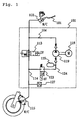
- FIG. 1 schematically shows a hydraulic circuit on the front wheel side of a two-wheeled motor vehicle.
- the front wheel hydraulic circuit of FIG. 1 is configured from a brake lever 101 that is operated by the driver, a master cylinder (M/C) 103 that is connected to the brake lever 101, a conduit 104 that is connected to the master cylinder 103, a charging valve (EV) 113 that is connected to the conduit 104 and is a normally open electromagnetic valve, a conduit 114 that is connected to the charging valve 113, and a wheel cylinder (W/C) 115 that is connected to the conduit 114 and operates the front wheel brake.
- M/C master cylinder
- EV charging valve
- W/C wheel cylinder
- a pressure decreasing valve (AV) 123 that is a normally closed electromagnetic valve is connected to the conduit 114. Further, a conduit 124 is connected to the pressure decreasing valve 123, and a reservoir 125 is connected to the conduit 124. Moreover, a suction port of a hydraulic pump 119 is connected via a check valve to the conduit 124, and a discharge port of the hydraulic pump 119 is connected to the conduit 104 via a check valve. The hydraulic pump 119 is driven by a DC motor 118.
- a hydraulic unit 100 operates when an unillustrated electronic control unit (ECU) detects a tendency for the front wheel to lock from the front wheel speed detected by an unillustrated front wheel speed sensor disposed in the front wheel at a time when the brake lever 101 is operated.
- ECU electronice control unit
- the ECU closes the charging valve 113 and opens the pressure decreasing valve 123 to allow the brake fluid in the wheel cylinder 115 to escape to the reservoir 125, whereby the ECU lowers the hydraulic pressure in the wheel cylinder 115 and eliminates the locking of the front wheel.
- the ECU closes the pressure decreasing valve 123 and opens the charging valve 113 to send the brake fluid to the wheel cylinder 115 and increase the pressure to the wheel cylinder 115.
- the ECU appropriately closes both the charging valve 113 and the pressure decreasing valve 123 to hold the wheel cylinder pressure at a constant. In this way, in the ABS operation, the ECU performs a pressure decreasing operation, a pressure increasing operation, and a holding operation several times.
- Patent Document 1 JP-A-2000-229563
- the slip state of the wheel continues longer than the ordinarily assumed time, such as when the vehicle has abruptly changed from a road surface whose frictional resistance coefficient ⁇ is large to a road surface whose frictional resistance coefficient ⁇ is small or when the drag torque of the engine is large.
- the pressure decreasing mode and the holding mode of the wheel cylinder become longer than the ordinarily assumed time.
- the brake fluid from the master cylinder does not flow to the wheel cylinder.
- the brake fluid in the wheel cylinder and in the reservoir is returned to the master cylinder by the ABS. For that reason, sometimes the brake pedal or the brake lever is strongly pushed back and becomes stiff, creating a sense of rejection in the driver.
- the holding mode continues longer than ordinarily assumed when the wheel has oscillated or when the slip ratio of the wheel is at an ideal slip ratio.
- the charging valve is closed, so the brake fluid from the master cylinder does not flow to the wheel cylinder. For that reason, sometimes the brake pedal or the brake lever becomes stiff, creating a sense of rejection in the driver.
- the technology described in patent document 1 changes the control cycle of the ABS on the basis of the friction coefficient of the road surface and the estimated vehicle body speed.
- the method does not invariably ensure a constant braking feel.
- this has an impact on the performance of the ABS control because the control cycle of the ABS is altered, so an appropriate performance test becomes necessary. Problems that can arise during ABS control have been described as an example, but problems relating to the same deterioration in the braking feel can also arise in EBD control and the like.
- a brake control method for a hydraulic brake device equipped with an actuator that automatically regulates braking liquid pressure in a wheel cylinder of a vehicle without the intervention of an operation by a driver At a time when the actuator of the hydraulic brake device operates automatically the method includes: (a) a step of detecting whether pressure to the wheel cylinder is being increased; (b) a step of calculating a time period in which pressure to the wheel cylinder is not being increased; and (c) a step of increasing pressure and decreasing pressure to the wheel cylinder to an extent that has no impact on the braking force of the vehicle after the time period that has been calculated has reached a predetermined time.
- the increasing of pressure and the decreasing of pressure to the wheel cylinder in step (c) are performed with the decreasing of pressure coming before the increasing of pressure.
- the predetermined time is determined depending on at least one of a vehicle body traveling state, a wheel state, and a road surface state.
- a hydraulic brake device equipped with an actuator that automatically regulates braking liquid pressure in a wheel cylinder of a vehicle without the intervention of an operation by a driver.
- the brake system of the present invention at a time when the actuator of the hydraulic brake device operates automatically the brake system includes: (a) means that detects whether pressure to the wheel cylinder is being increased; (b) means that calculates a time period in which pressure to the wheel cylinder is not being increased; and (c) means that increases pressure and decreases pressure to the wheel cylinder to an extent that has no impact on the braking force of the vehicle after the time period that has been calculated has reached a predetermined time.
- the increasing of pressure and the decreasing of pressure to the wheel cylinder in step (c) are performed with the decreasing of pressure coming before the increasing of pressure.
- the predetermined time is determined depending on at least one of a vehicle body traveling state, a wheel state, and a road surface state.
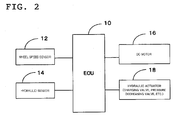
- FIG. 2 is a block diagram showing the configuration of the brake hydraulic control system according to the embodiment of the present invention.
- the brake hydraulic control system according to the embodiment is equipped with an electronic control unit (ECU) 10, a wheel speed sensor 12, a hydraulic sensor 14, a DC motor 16, and a hydraulic actuator 18.
- ECU electronice control unit
- the hydraulic sensor 14 is not required.
- the hardware configuration of the ECU 10 is publicly known in this technical field, so it will not be described in detail in this specification.
- an ECU with an arbitrary configuration equipped with a CPU, a memory, an input/output device, and so forth can be used.
- a control program for performing the brake hydraulic control according to the present invention and a control program that performs base ABS control are installed in the ECU 10.
- the base ABS control can be performed by an arbitrary ABS control program, like those known in this technical field, for controlling the slip ratio of a wheel to ensure the steerability of the vehicle and shorten the braking distance.
- the brake hydraulic control according to the present invention is executed in parallel with the base ABS control.
- the base ABS control can be arbitrary, so it will not be described in this specification.
- the ECU 10 is electrically connected to the later-described wheel speed sensor 12, hydraulic sensor 14, DC motor 16, and hydraulic actuator 18, supplies electrical power to the wheel speed sensor 12 and the hydraulic sensor 14, receives signals from these sensors, supplies electrical power to the DC motor 16, and controls the driving of the hydraulic actuator 18.
- the ECU 10 is equipped with a timer function that will be described later together with FIG. 3 .
- the wheel speed sensor 12 is placed in the vicinity of a wheel of a vehicle and detects the rotational speed of the wheel as is known in this technical field.
- the configuration and placement of the wheel speed sensor 12 itself are publicly known in this technical field, so they will not be described in detail in this specification.
- an arbitrary wheel speed sensor can be used.
- a wheel speed sensor that detects the rotational speed of the wheel of the vehicle electromagnetically or optically can be used.
- the wheel speed sensor 12 is connected to the ECU 10, and the ECU 10 supplies electrical power to the wheel speed sensor 12 and performs control of signal delivery and so forth with respect to the wheel speed sensor 12.
- the hydraulic sensor 14 detects the pressure in the wheel cylinder of the vehicle.
- the configuration and placement of the hydraulic sensor 14 itself are publicly known in this technical field, so they will not be described in detail in this specification.
- a pressure sensor with an arbitrary configuration can be used.
- a pressure sensor of the type that measures the deformation of a diaphragm with a strain gauge or a pressure sensor that utilizes a semiconductor can be utilized.
- the hydraulic sensor 14 is connected to the ECU 10, and the ECU 10 supplies electrical power to the hydraulic sensor 14 and performs control of signal delivery and so forth with respect to the pressure sensor 14. In the present invention, the hydraulic sensor 14 is not required.
- the DC motor 16 drives the hydraulic pump 119 (see FIG. 1 ) as is known in this technical field.
- the configuration of the DC motor itself and the configuration of the hydraulic pump are publicly known in this technical field, so they will not be described in detail in this specification.
- a DC motor and a hydraulic pump with arbitrary configurations can be used.
- the hydraulic actuator 18 is placed in the hydraulic circuit of the vehicle (see the charging valve 113 and the pressure decreasing valve 123 of FIG. 1 ), is driven in accordance with a command from the ECU 10, and controls the movement of brake fluid in the hydraulic circuit.
- the hydraulic actuator 18 can be configured by the electromagnetic valves 113 and 123 that are driven electromagnetically.
- the hydraulic actuator 18 is connected to the ECU 10, and the ECU 10 controls the operation of the hydraulic actuator 18. It is not an essential requirement that the hydraulic actuator 18 in the present invention be able to be driven electromagnetically, and an actuator that controls the brake fluid by another format may also be used.
- the hydraulic circuit can be configured by the same hydraulic circuit as in FIG. 1 .
- hydraulic circuits with other configurations can also be employed.
- the hydraulic circuit shown in FIG. 1 is a hydraulic circuit just for the front wheel of a two-wheeled motor vehicle, but the hydraulic circuit for the rear wheel can be configured in the same way except that the brake lever in the hydraulic circuit for the front wheel is replaced with a footbrake pedal.
- the present invention can be applied not only to the hydraulic brakes of a two-wheeled motor vehicle but also to the hydraulic brakes of a four-wheeled vehicle such as a passenger car.
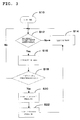
- FIG. 3 is a flowchart showing the operation of the brake hydraulic control system according to the embodiment of the present invention.
- the operational flow shown in FIG. 3 is controlled by the ECU 10.
- the operation of the ABS is started in step S10.
- the condition in which the operation of the ABS starts can be an arbitrary condition.
- the operation of the ABS can be started when the ECU 10 calculates the slip ratio from the wheel speed detected by the wheel speed sensor 12 and the slip ratio has exceeded a predetermined value.
- the base ABS control is started.
- the base ABS control is not the topic of the present invention, so it will not be described in this specification, but it can be generally known control that automatically controls the hydraulic pressure in the wheel cylinder in such a way that the slip ratio becomes optimum.
- the brake hydraulic control according to the embodiment of the present invention is executed in parallel with the base ABS control as described below.
- step S12 the ECU 10 judges whether the hydraulic unit is being driven to decrease pressure or is being driven to hold pressure.
- the judgment of whether the hydraulic unit is being driven to decrease pressure or is being driven to hold pressure can be made on the basis of the drive signals from the ECU 10 to the charging valve 113 and the pressure decreasing valve 123. That is, the ECU 10 can judge a state in which the ECU 10 has transmitted a signal that closes the charging valve 113 to the charging valve 113 and has transmitted a signal that opens the pressure decreasing valve 123 to the pressure decreasing valve 123 as meaning that the hydraulic unit is being driven to decrease pressure and can judge a state in which the ECU 10 has transmitted signals that close both the charging valve 113 and the pressure decreasing valve 123 to both as meaning that the hydraulic unit is being driven to hold pressure.
- the ECU 10 may also, without distinguishing between whether the hydraulic unit is being driven to decrease pressure or is being driven to hold pressure, simply judge a state in which the ECU 10 has transmitted a signal that closes the charging valve 113 to the charging valve 113 as meaning that the hydraulic unit is being driven to decrease pressure or is being driven to hold pressure (that is, at least that the hydraulic unit is not being driven to increase pressure).
- the ECU 10 may also use the hydraulic sensor 14 to judge whether the hydraulic unit is being driven to decrease pressure or is being driven to hold pressure. That is, the ECU 10 can judge whether the hydraulic unit is being driven to decrease pressure or is being driven to hold pressure by the time change in the hydraulic pressure value measured by the hydraulic sensor 14.
- step S14 the ECU 10 resets the timer in the ECU 10 in a case where the hydraulic unit is not being driven to decrease pressure or is not being driven to hold pressure.
- step S16 the ECU 10 increments the timer in the ECU 10 in a case where the hydraulic unit is being driven to decrease pressure or is being driven to hold pressure.
- step S18 the ECU 10 compares the timer value to a predetermined value. That is, the ECU 10 compares the elapsed time since the driving to decrease pressure or the driving to hold pressure is started to a predetermined time. In a case where the timer value is smaller than the predetermined value, the ECU 10 returns to step S12. That is, the elapsed time since the driving to decrease pressure or the driving to hold pressure is started is counted by step S12 to step S18.
- the predetermined time of the timer value can be configured in such a way that, for example, the drive frequency of forced driving to decrease pressure and driving to increase pressure described later becomes from about 2 Hz to about 4Hz.
- the predetermined value can be in a range of about 0.25 second (about 4 Hz) to about 0.5 second (about 2 Hz). In other embodiments, the predetermined value may be larger or smaller than this range. Further, the predetermined value can be a fixed value that is not changed during the driving of the vehicle. Of course, the predetermined value can also be a variable value that is changed during the driving of the vehicle. For example, the predetermined value can be configured in such a way that the drive frequency of the forced driving to decrease pressure and driving to increase pressure becomes larger together with the elapsed time since the first forced driving to decrease pressure and driving to increase pressure (or the drive frequency of the driving to decrease pressure and driving to increase pressure).
- the predetermined value may be configured in such a way that it is changed in accordance with the road surface state, the traveling state of the vehicle, or the wheel state during the driving of the vehicle.
- the predetermined value may be configured in such a way that the drive frequency is increased in a case where the road surface is a low-friction road surface and in such a way that the drive frequency is reduced in a case where the road surface is a high-friction road surface.
- the predetermined value may be configured in such a way that the drive frequency is increased in a case where the vehicle is traveling at a high speed and in such a way that the drive frequency is reduced in a case where the vehicle is traveling at a low speed.
- the predetermined value may be configured in such a way that the drive frequency is increased when the slip ratio of the wheel is large and in such a way that the drive frequency is reduced when the slip ratio of the wheel is small.
- the ECU 10 drives the hydraulic unit to decrease pressure in step S20. Specifically, the ECU 10 drives the hydraulic unit in such a way as to open the pressure decreasing valve 123 for a predetermined time.
- the predetermined drive time of the pressure decreasing valve 123 can be a fixed value that is not changed during the driving of the vehicle.
- the drive time of the pressure decreasing valve 123 can be 5 ms.
- the ECU 10 may also control the drive time of the pressure decreasing valve in such a way as to decrease pressure specifically about 1 bar in the shortest time that can be achieved by the performance of the hardware.
- the ECU 10 may also be configured to change the predetermined drive time of the pressure decreasing valve 123 in accordance with the road surface state or the traveling state of the vehicle during the driving of the vehicle.
- the ECU 10 may be configured in such a way as to increase the drive time of the pressure decreasing valve 123 in a case where the road surface is a low-friction road surface and in such a way as to reduce the drive time of the pressure decreasing valve 123 in a case where the road surface is a high-friction road surface.
- the ECU 10 may be configured in such a way as to increase the drive time of the pressure decreasing valve 123 in a case where the vehicle has a brake whose stiffness is low (whose fluid loss is large) and in such a way as to reduce the drive time of the pressure decreasing valve 123 in a case where the vehicle has a brake whose stiffness is high (whose fluid loss is small). Further, the ECU 10 may be configured in such a way as to reduce the drive time when the wheel hydraulic pressure is large and to increase the drive time when the wheel hydraulic pressure is small. Regardless of how the drive time of the pressure decreasing valve 123 is set, it is preferred that the drive time be set to a value that has substantially no impact on the operational performance of the base ABS.
- the drive time be set in such a way that a change in the braking force during the base ABS operation because of the driving of the pressure decreasing valve or the pressure increasing valve resulting from step S20 and step S22 falls in the range of about ⁇ 0.5%.
- the ECU 10 drives the hydraulic unit to increase pressure in step S22. Specifically, the ECU 10 closes the pressure decreasing valve 123 and opens the charging valve 113. For that reason, the brake fluid flows from the master cylinder 103 to the wheel cylinder 115, so the driver can obtain a braking feel.
- This driving to increase pressure is performed immediately after the driving to decrease pressure in step S20. Further, the amount of the driving to increase pressure matches the amount of the driving to decrease pressure in step S20. That is, pressure is increased by the amount that pressure is decreased in step S20.
- the order of step S20 and step S22 may be reversed so that pressure is increased and thereafter pressure is decreased.
- step S20 After the driving to decrease pressure and the driving to increase pressure in step S20 and step S22, the ECU 10 resets the timer in step S14.
- the brake hydraulic control system decreases pressure and increases pressure to the wheel cylinder in a predetermined cycle prescribed by the predetermined value of the timer, so the driver can obtain a braking feel, and a sense of security can be given to the driver. Further, the amount of the pressure decrease and the amount of the pressure increase have substantially no impact on the base ABS operational performance (e.g., braking distance).
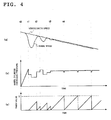
- FIG. 4 shows a condition in which the brake of the vehicle is operated by the driver and the base ABS and the brake hydraulic control according to the present invention operate.
- FIG. 4 shows a condition in which the optimum slip ratio is achieved during the operation of the base ABS and a long holding mode continues.
- FIG. 4(a) shows changes over time in the vehicle body speed and wheel speed
- FIG. 4(b) shows changes over time in the hydraulic pressure value in the wheel cylinder 115
- FIG. 4(c) shows changes over time in the timer value in the ECU 10.
- step S10 of the flowchart of FIG. 3 .
- pressure to the wheel cylinder 115 is automatically decreased, and the locking of the wheel begins to be eliminated (t 1 to t 2 ).
- the hydraulic unit is in the pressure decreasing mode or the holding mode, the elapsed time is counted by step S12 to step S18.
- the counter value of the timer does not reach the predetermined value T.
- forced pressure decrease and pressure increase are alternated between periodically, so the driver can obtain a braking feel, and this sense of rejection can be alleviated.
- the quantity of the pressure decrease and the quantity of the pressure increase are slight, so they have substantially no impact on the operational performance of the base ABS, and an optimum braking distance can be achieved while ensuring steerability.
- the brake hydraulic control system and the brake hydraulic control method of the present invention even when a long pressure decreasing mode or holding mode continues in an ABS operation, a cyclic braking feel is obtained, and a sense of security can be given to the driver.
- the system and the method are configured by simply adding the operational flow shown in FIG. 3 to the operation of the ABS without making any changes to the base ABS algorithm, so they are versatile. Further, the braking feel during ABS control can be improved also with respect to factors outside the ABS (such as engine drag).
- the present invention can be applied not only to ABS control but also generally to times when the function of automatically regulating braking liquid pressure in a wheel cylinder of a vehicle without the intervention of an operation by the driver is executed.
- the present invention can also be similarly applied to the aforementioned EBD control.
- the brake hydraulic control method according to the present invention does not have to operate all the time and may also be configured in such a way that the present invention's function of forcibly decreasing pressure and increasing pressure to the wheel cylinder is stopped in a case where a given condition is satisfied.
- the given condition is a case where the function of the base ABS or the function of the EBD is to be given overriding priority over the braking feel of the driver.
- the brake hydraulic control method can be configured in such a way that the present invention's function of forcibly decreasing pressure and increasing pressure to the wheel cylinder is stopped when the vehicle jumps from a road surface whose friction coefficient ⁇ is high to a road surface whose friction coefficient ⁇ is low and wheel slip equal to or greater than a given amount is occurring, or when the vehicle is traveling at a low speed equal to or lower than a given speed, or when the vehicle is traveling at a high speed equal to or higher than a given speed, or when the vehicle is traveling around a curve, etc.
Landscapes
- Engineering & Computer Science (AREA)
- Transportation (AREA)
- Mechanical Engineering (AREA)
- Microelectronics & Electronic Packaging (AREA)
- Regulating Braking Force (AREA)
- Hydraulic Control Valves For Brake Systems (AREA)
Abstract
Description
- The present invention relates to a method and system that control braking liquid pressure in a hydraulic brake device. More particularly, the present invention relates to a brake hydraulic control method that improves the braking feel of the driver during ABS operation and to a brake system for that purpose.
- Hydraulic brake devices equipped with an actuator that automatically regulates braking liquid pressure in wheel cylinders of a vehicle such as a two-wheeled motor vehicle or a passenger car without the intervention of an operation by the driver are known. For example, anti-lock braking systems (ABS) are coming to be used for brake control in two-wheeled motor vehicles. An ABS generally includes wheel speed sensors, an electronic control unit (ECU), and a hydraulic unit such as a hydraulic circuit. An ABS automatically controls hydraulic pressure in the wheel cylinders, without the intervention of an operation by the driver, when it detects a tendency for the wheels to lock. Further, in vehicles such as two-wheeled motor vehicles and passenger cars, electronic brake-force distribution (EBD) systems, which are systems that appropriately distribute the braking force applied to the front and rear wheels in accordance with driving conditions, are known.
- The operation of a general ABS will be briefly described with reference to the hydraulic circuit shown in
FIG. 1. FIG. 1 schematically shows a hydraulic circuit on the front wheel side of a two-wheeled motor vehicle. The front wheel hydraulic circuit ofFIG. 1 is configured from abrake lever 101 that is operated by the driver, a master cylinder (M/C) 103 that is connected to thebrake lever 101, aconduit 104 that is connected to themaster cylinder 103, a charging valve (EV) 113 that is connected to theconduit 104 and is a normally open electromagnetic valve, aconduit 114 that is connected to thecharging valve 113, and a wheel cylinder (W/C) 115 that is connected to theconduit 114 and operates the front wheel brake. Moreover, a pressure decreasing valve (AV) 123 that is a normally closed electromagnetic valve is connected to theconduit 114.
Further, aconduit 124 is connected to thepressure decreasing valve 123, and areservoir 125 is connected to theconduit 124. Moreover, a suction port of ahydraulic pump 119 is connected via a check valve to theconduit 124, and a discharge port of thehydraulic pump 119 is connected to theconduit 104 via a check valve. Thehydraulic pump 119 is driven by aDC motor 118. - In the hydraulic circuit of
FIG. 1 , ahydraulic unit 100 operates when an unillustrated electronic control unit (ECU) detects a tendency for the front wheel to lock from the front wheel speed detected by an unillustrated front wheel speed sensor disposed in the front wheel at a time when thebrake lever 101 is operated. - In this case, the ECU closes the
charging valve 113 and opens thepressure decreasing valve 123 to allow the brake fluid in thewheel cylinder 115 to escape to thereservoir 125, whereby the ECU lowers the hydraulic pressure in thewheel cylinder 115 and eliminates the locking of the front wheel. When the locking tendency is sufficiently eliminated, the ECU closes thepressure decreasing valve 123 and opens thecharging valve 113 to send the brake fluid to thewheel cylinder 115 and increase the pressure to thewheel cylinder 115. Further, the ECU appropriately closes both thecharging valve 113 and thepressure decreasing valve 123 to hold the wheel cylinder pressure at a constant. In this way, in the ABS operation, the ECU performs a pressure decreasing operation, a pressure increasing operation, and a holding operation several times. - Patent Document 1:
JP-A-2000-229563 - Incidentally, during the operation of the ABS described above, sometimes the slip state of the wheel continues longer than the ordinarily assumed time, such as when the vehicle has abruptly changed from a road surface whose frictional resistance coefficient µ is large to a road surface whose frictional resistance coefficient µ is small or when the drag torque of the engine is large. At times when wheel slip continues for a long time during the operation of the ABS, sometimes the pressure decreasing mode and the holding mode of the wheel cylinder become longer than the ordinarily assumed time. At this time, because the charging valve is closed as described above, the brake fluid from the master cylinder does not flow to the wheel cylinder. Further, at this time, the brake fluid in the wheel cylinder and in the reservoir is returned to the master cylinder by the ABS. For that reason, sometimes the brake pedal or the brake lever is strongly pushed back and becomes stiff, creating a sense of rejection in the driver.
- Further, sometimes the holding mode continues longer than ordinarily assumed when the wheel has oscillated or when the slip ratio of the wheel is at an ideal slip ratio. In this case, the charging valve is closed, so the brake fluid from the master cylinder does not flow to the wheel cylinder. For that reason, sometimes the brake pedal or the brake lever becomes stiff, creating a sense of rejection in the driver.
- In order to prevent as much as possible a deterioration in the braking feel of the driver, the technology described in patent document 1 changes the control cycle of the ABS on the basis of the friction coefficient of the road surface and the estimated vehicle body speed. However, according to this method, although the braking feel may be improved to some extent depending on conditions during driving, the method does not invariably ensure a constant braking feel. Further, for example, in the case of trying to improve the braking feel of a conventional ABS control system with the method described in patent document 1, this has an impact on the performance of the ABS control because the control cycle of the ABS is altered, so an appropriate performance test becomes necessary. Problems that can arise during ABS control have been described as an example, but problems relating to the same deterioration in the braking feel can also arise in EBD control and the like.
- Therefore, it is an object of the present invention to alleviate with a simple method the sense of rejection in a brake pedal or a brake lever that arises when a long pressure decreasing mode or a long holding mode has continued in a hydraulic brake device equipped with an actuator that automatically regulates braking liquid pressure in a wheel cylinder of a vehicle without the intervention of an operation by a driver like in an ABS function or an EBD function.
- According to the present invention, there is provided a brake control method for a hydraulic brake device equipped with an actuator that automatically regulates braking liquid pressure in a wheel cylinder of a vehicle without the intervention of an operation by a driver. At a time when the actuator of the hydraulic brake device operates automatically the method includes: (a) a step of detecting whether pressure to the wheel cylinder is being increased; (b) a step of calculating a time period in which pressure to the wheel cylinder is not being increased; and (c) a step of increasing pressure and decreasing pressure to the wheel cylinder to an extent that has no impact on the braking force of the vehicle after the time period that has been calculated has reached a predetermined time.
- According to an aspect of the method of the present invention, the increasing of pressure and the decreasing of pressure to the wheel cylinder in step (c) are performed with the decreasing of pressure coming before the increasing of pressure.
- According to an aspect of the method of the present invention, the predetermined time is determined depending on at least one of a vehicle body traveling state, a wheel state, and a road surface state.
- According to the present invention, there is provided a hydraulic brake device equipped with an actuator that automatically regulates braking liquid pressure in a wheel cylinder of a vehicle without the intervention of an operation by a driver. According to the brake system of the present invention, at a time when the actuator of the hydraulic brake device operates automatically the brake system includes: (a) means that detects whether pressure to the wheel cylinder is being increased; (b) means that calculates a time period in which pressure to the wheel cylinder is not being increased; and (c) means that increases pressure and decreases pressure to the wheel cylinder to an extent that has no impact on the braking force of the vehicle after the time period that has been calculated has reached a predetermined time.
- According to an aspect of the brake system of the present invention, the increasing of pressure and the decreasing of pressure to the wheel cylinder in step (c) are performed with the decreasing of pressure coming before the increasing of pressure.
- According to an aspect of the brake system of the present invention, the predetermined time is determined depending on at least one of a vehicle body traveling state, a wheel state, and a road surface state.
- According to the present invention, there is provided a vehicle equipped with the brake system according to the present invention.
-
-
FIG. 1 is a diagram showing a hydraulic circuit of an exemplary brake hydraulic control system; -
FIG. 2 is a block diagram showing the configuration of a brake hydraulic control system according to an embodiment of the present invention; -
FIG. 3 is a diagram showing the operational flow of the brake hydraulic control system according to the embodiment of the present invention; and -
FIG. 4 is a diagram showing a condition at a time when the brake hydraulic control system according to the embodiment of the present invention is operating. - An embodiment of a brake hydraulic control method and a brake hydraulic control system of the present invention will be described with reference to the drawings.
-
FIG. 2 is a block diagram showing the configuration of the brake hydraulic control system according to the embodiment of the present invention. As shown inFIG. 2 , the brake hydraulic control system according to the embodiment is equipped with an electronic control unit (ECU) 10, awheel speed sensor 12, ahydraulic sensor 14, aDC motor 16, and ahydraulic actuator 18. In the present invention, thehydraulic sensor 14 is not required. - The hardware configuration of the
ECU 10 is publicly known in this technical field, so it will not be described in detail in this specification. In the embodiment of the present invention, an ECU with an arbitrary configuration equipped with a CPU, a memory, an input/output device, and so forth can be used. In the embodiment of the present invention, a control program for performing the brake hydraulic control according to the present invention and a control program that performs base ABS control are installed in theECU 10. The base ABS control can be performed by an arbitrary ABS control program, like those known in this technical field, for controlling the slip ratio of a wheel to ensure the steerability of the vehicle and shorten the braking distance. The brake hydraulic control according to the present invention is executed in parallel with the base ABS control. The base ABS control can be arbitrary, so it will not be described in this specification. Further, the ECU 10 is electrically connected to the later-describedwheel speed sensor 12,hydraulic sensor 14,DC motor 16, andhydraulic actuator 18, supplies electrical power to thewheel speed sensor 12 and thehydraulic sensor 14, receives signals from these sensors, supplies electrical power to theDC motor 16, and controls the driving of thehydraulic actuator 18. Further, the ECU 10 is equipped with a timer function that will be described later together withFIG. 3 . - The
wheel speed sensor 12 is placed in the vicinity of a wheel of a vehicle and detects the rotational speed of the wheel as is known in this technical field. The configuration and placement of thewheel speed sensor 12 itself are publicly known in this technical field, so they will not be described in detail in this specification. In the embodiment of the present invention, an arbitrary wheel speed sensor can be used. For example, a wheel speed sensor that detects the rotational speed of the wheel of the vehicle electromagnetically or optically can be used. Thewheel speed sensor 12 is connected to theECU 10, and theECU 10 supplies electrical power to thewheel speed sensor 12 and performs control of signal delivery and so forth with respect to thewheel speed sensor 12. - The
hydraulic sensor 14 detects the pressure in the wheel cylinder of the vehicle. The configuration and placement of thehydraulic sensor 14 itself are publicly known in this technical field, so they will not be described in detail in this specification. In the embodiment of the present invention, a pressure sensor with an arbitrary configuration can be used. For example, a pressure sensor of the type that measures the deformation of a diaphragm with a strain gauge or a pressure sensor that utilizes a semiconductor can be utilized. Thehydraulic sensor 14 is connected to theECU 10, and theECU 10 supplies electrical power to thehydraulic sensor 14 and performs control of signal delivery and so forth with respect to thepressure sensor 14. In the present invention, thehydraulic sensor 14 is not required. - The
DC motor 16 drives the hydraulic pump 119 (seeFIG. 1 ) as is known in this technical field. The configuration of the DC motor itself and the configuration of the hydraulic pump are publicly known in this technical field, so they will not be described in detail in this specification. In the embodiment of the present invention, a DC motor and a hydraulic pump with arbitrary configurations can be used. - The
hydraulic actuator 18 is placed in the hydraulic circuit of the vehicle (see the chargingvalve 113 and thepressure decreasing valve 123 ofFIG. 1 ), is driven in accordance with a command from theECU 10, and controls the movement of brake fluid in the hydraulic circuit. In the present embodiment, thehydraulic actuator 18 can be configured by theelectromagnetic valves hydraulic actuator 18 is connected to theECU 10, and theECU 10 controls the operation of thehydraulic actuator 18. It is not an essential requirement that thehydraulic actuator 18 in the present invention be able to be driven electromagnetically, and an actuator that controls the brake fluid by another format may also be used. - In the embodiment of the present invention, the hydraulic circuit can be configured by the same hydraulic circuit as in
FIG. 1 . However, in other embodiments, hydraulic circuits with other configurations can also be employed. Further, the hydraulic circuit shown inFIG. 1 is a hydraulic circuit just for the front wheel of a two-wheeled motor vehicle, but the hydraulic circuit for the rear wheel can be configured in the same way except that the brake lever in the hydraulic circuit for the front wheel is replaced with a footbrake pedal. Further, the present invention can be applied not only to the hydraulic brakes of a two-wheeled motor vehicle but also to the hydraulic brakes of a four-wheeled vehicle such as a passenger car. - Next, the operation of the brake hydraulic control system according to the embodiment of the present invention will be described.
FIG. 3 is a flowchart showing the operation of the brake hydraulic control system according to the embodiment of the present invention. The operational flow shown inFIG. 3 is controlled by theECU 10. - First, the operation of the ABS is started in step S10. The condition in which the operation of the ABS starts can be an arbitrary condition. As is generally known, the operation of the ABS can be started when the
ECU 10 calculates the slip ratio from the wheel speed detected by thewheel speed sensor 12 and the slip ratio has exceeded a predetermined value. When the ABS operates in step S10, the base ABS control is started. The base ABS control is not the topic of the present invention, so it will not be described in this specification, but it can be generally known control that automatically controls the hydraulic pressure in the wheel cylinder in such a way that the slip ratio becomes optimum. When the base ABS control is started, the brake hydraulic control according to the embodiment of the present invention is executed in parallel with the base ABS control as described below. - In step S12, the
ECU 10 judges whether the hydraulic unit is being driven to decrease pressure or is being driven to hold pressure. The judgment of whether the hydraulic unit is being driven to decrease pressure or is being driven to hold pressure can be made on the basis of the drive signals from theECU 10 to the chargingvalve 113 and thepressure decreasing valve 123. That is, theECU 10 can judge a state in which theECU 10 has transmitted a signal that closes the chargingvalve 113 to the chargingvalve 113 and has transmitted a signal that opens thepressure decreasing valve 123 to thepressure decreasing valve 123 as meaning that the hydraulic unit is being driven to decrease pressure and can judge a state in which theECU 10 has transmitted signals that close both the chargingvalve 113 and thepressure decreasing valve 123 to both as meaning that the hydraulic unit is being driven to hold pressure. More simply, theECU 10 may also, without distinguishing between whether the hydraulic unit is being driven to decrease pressure or is being driven to hold pressure, simply judge a state in which theECU 10 has transmitted a signal that closes the chargingvalve 113 to the chargingvalve 113 as meaning that the hydraulic unit is being driven to decrease pressure or is being driven to hold pressure (that is, at least that the hydraulic unit is not being driven to increase pressure). As another embodiment, theECU 10 may also use thehydraulic sensor 14 to judge whether the hydraulic unit is being driven to decrease pressure or is being driven to hold pressure. That is, theECU 10 can judge whether the hydraulic unit is being driven to decrease pressure or is being driven to hold pressure by the time change in the hydraulic pressure value measured by thehydraulic sensor 14. - In step S14, the
ECU 10 resets the timer in theECU 10 in a case where the hydraulic unit is not being driven to decrease pressure or is not being driven to hold pressure. - In step S16, the
ECU 10 increments the timer in theECU 10 in a case where the hydraulic unit is being driven to decrease pressure or is being driven to hold pressure. - In step S18, the
ECU 10 compares the timer value to a predetermined value. That is, theECU 10 compares the elapsed time since the driving to decrease pressure or the driving to hold pressure is started to a predetermined time. In a case where the timer value is smaller than the predetermined value, theECU 10 returns to step S12. That is, the elapsed time since the driving to decrease pressure or the driving to hold pressure is started is counted by step S12 to step S18. The predetermined time of the timer value can be configured in such a way that, for example, the drive frequency of forced driving to decrease pressure and driving to increase pressure described later becomes from about 2 Hz to about 4Hz. That is, the predetermined value can be in a range of about 0.25 second (about 4 Hz) to about 0.5 second (about 2 Hz). In other embodiments, the predetermined value may be larger or smaller than this range. Further, the predetermined value can be a fixed value that is not changed during the driving of the vehicle. Of course, the predetermined value can also be a variable value that is changed during the driving of the vehicle. For example, the predetermined value can be configured in such a way that the drive frequency of the forced driving to decrease pressure and driving to increase pressure becomes larger together with the elapsed time since the first forced driving to decrease pressure and driving to increase pressure (or the drive frequency of the driving to decrease pressure and driving to increase pressure). Or, the predetermined value may be configured in such a way that it is changed in accordance with the road surface state, the traveling state of the vehicle, or the wheel state during the driving of the vehicle. For example, as an example of changing the predetermined value in accordance with the road surface state, the predetermined value may be configured in such a way that the drive frequency is increased in a case where the road surface is a low-friction road surface and in such a way that the drive frequency is reduced in a case where the road surface is a high-friction road surface. Further, as an example of changing the predetermined value in accordance with the traveling state of the vehicle, the predetermined value may be configured in such a way that the drive frequency is increased in a case where the vehicle is traveling at a high speed and in such a way that the drive frequency is reduced in a case where the vehicle is traveling at a low speed. Further, as an example of changing the predetermined value in accordance with the wheel state, the predetermined value may be configured in such a way that the drive frequency is increased when the slip ratio of the wheel is large and in such a way that the drive frequency is reduced when the slip ratio of the wheel is small. - In a case where it has been judged in step S18 that the timer value is equal to or greater than the predetermined value, the
ECU 10 drives the hydraulic unit to decrease pressure in step S20. Specifically, theECU 10 drives the hydraulic unit in such a way as to open thepressure decreasing valve 123 for a predetermined time. The predetermined drive time of thepressure decreasing valve 123 can be a fixed value that is not changed during the driving of the vehicle. For example, the drive time of thepressure decreasing valve 123 can be 5 ms. TheECU 10 may also control the drive time of the pressure decreasing valve in such a way as to decrease pressure specifically about 1 bar in the shortest time that can be achieved by the performance of the hardware. TheECU 10 may also be configured to change the predetermined drive time of thepressure decreasing valve 123 in accordance with the road surface state or the traveling state of the vehicle during the driving of the vehicle. For example, theECU 10 may be configured in such a way as to increase the drive time of thepressure decreasing valve 123 in a case where the road surface is a low-friction road surface and in such a way as to reduce the drive time of thepressure decreasing valve 123 in a case where the road surface is a high-friction road surface. Further, theECU 10 may be configured in such a way as to increase the drive time of thepressure decreasing valve 123 in a case where the vehicle has a brake whose stiffness is low (whose fluid loss is large) and in such a way as to reduce the drive time of thepressure decreasing valve 123 in a case where the vehicle has a brake whose stiffness is high (whose fluid loss is small). Further, theECU 10 may be configured in such a way as to reduce the drive time when the wheel hydraulic pressure is large and to increase the drive time when the wheel hydraulic pressure is small. Regardless of how the drive time of thepressure decreasing valve 123 is set, it is preferred that the drive time be set to a value that has substantially no impact on the operational performance of the base ABS. Specifically, it is desired that the drive time be set in such a way that a change in the braking force during the base ABS operation because of the driving of the pressure decreasing valve or the pressure increasing valve resulting from step S20 and step S22 falls in the range of about ±0.5%. - Next, the
ECU 10 drives the hydraulic unit to increase pressure in step S22. Specifically, theECU 10 closes thepressure decreasing valve 123 and opens the chargingvalve 113. For that reason, the brake fluid flows from themaster cylinder 103 to thewheel cylinder 115, so the driver can obtain a braking feel. This driving to increase pressure is performed immediately after the driving to decrease pressure in step S20. Further, the amount of the driving to increase pressure matches the amount of the driving to decrease pressure in step S20. That is, pressure is increased by the amount that pressure is decreased in step S20. As another embodiment, the order of step S20 and step S22 may be reversed so that pressure is increased and thereafter pressure is decreased. - After the driving to decrease pressure and the driving to increase pressure in step S20 and step S22, the
ECU 10 resets the timer in step S14. - In this way, the brake hydraulic control system according to the embodiment of the present invention decreases pressure and increases pressure to the wheel cylinder in a predetermined cycle prescribed by the predetermined value of the timer, so the driver can obtain a braking feel, and a sense of security can be given to the driver. Further, the amount of the pressure decrease and the amount of the pressure increase have substantially no impact on the base ABS operational performance (e.g., braking distance).
- A specific condition to which the above brake hydraulic control system and brake hydraulic control method are applied will be described below with reference to
FIG. 4 . -
FIG. 4 shows a condition in which the brake of the vehicle is operated by the driver and the base ABS and the brake hydraulic control according to the present invention operate. In particular,FIG. 4 shows a condition in which the optimum slip ratio is achieved during the operation of the base ABS and a long holding mode continues.FIG. 4(a) shows changes over time in the vehicle body speed and wheel speed,FIG. 4(b) shows changes over time in the hydraulic pressure value in thewheel cylinder 115, andFIG. 4(c) shows changes over time in the timer value in theECU 10. - When the handbrake lever 101 (see
FIG. 1 ) or a footbrake pedal is operated by the driver, the vehicle body speed begins to decrease together with the wheel speed (to). Then, the wheel begins to lock and the wheel speed drops sharply (t1). Here, the ABS operates and enters step S10 of the flowchart ofFIG. 3 . When the ABS operates, pressure to thewheel cylinder 115 is automatically decreased, and the locking of the wheel begins to be eliminated (t1 to t2). When the hydraulic unit is in the pressure decreasing mode or the holding mode, the elapsed time is counted by step S12 to step S18. However, at the stage of t1 to t3 inFIG. 4 , the counter value of the timer does not reach the predetermined value T. Thereafter, the optimum slip ratio is achieved at time t3 because of the operation of the ABS. Consequently, from t3 on, a long holding mode continues. As shown inFIG. 4(c) , when the timer value reaches the predetermined value T, pressure to thewheel cylinder 115 is forcibly decreased and increased by step S20 and step S22. In a state in which there is no forced decrease and increase of pressure to thewheel cylinder 115, the brake fluid in themaster cylinder 103 is not transmitted to thewheel cylinder 115, so the driver has a sense of rejection in which the brake lever and the footbrake pedal have become stiff. However, in the present invention, forced pressure decrease and pressure increase are alternated between periodically, so the driver can obtain a braking feel, and this sense of rejection can be alleviated. Further, the quantity of the pressure decrease and the quantity of the pressure increase are slight, so they have substantially no impact on the operational performance of the base ABS, and an optimum braking distance can be achieved while ensuring steerability. - As described above, according to the brake hydraulic control system and the brake hydraulic control method of the present invention, even when a long pressure decreasing mode or holding mode continues in an ABS operation, a cyclic braking feel is obtained, and a sense of security can be given to the driver. Further, the system and the method are configured by simply adding the operational flow shown in
FIG. 3 to the operation of the ABS without making any changes to the base ABS algorithm, so they are versatile. Further, the braking feel during ABS control can be improved also with respect to factors outside the ABS (such as engine drag). - In the above embodiment, an example of improving the braking feel during ABS control has been described, but the present invention can be applied not only to ABS control but also generally to times when the function of automatically regulating braking liquid pressure in a wheel cylinder of a vehicle without the intervention of an operation by the driver is executed. For example, the present invention can also be similarly applied to the aforementioned EBD control.
- Further, the brake hydraulic control method according to the present invention does not have to operate all the time and may also be configured in such a way that the present invention's function of forcibly decreasing pressure and increasing pressure to the wheel cylinder is stopped in a case where a given condition is satisfied. The given condition is a case where the function of the base ABS or the function of the EBD is to be given overriding priority over the braking feel of the driver. For example, the brake hydraulic control method can be configured in such a way that the present invention's function of forcibly decreasing pressure and increasing pressure to the wheel cylinder is stopped when the vehicle jumps from a road surface whose friction coefficient µ is high to a road surface whose friction coefficient µ is low and wheel slip equal to or greater than a given amount is occurring, or when the vehicle is traveling at a low speed equal to or lower than a given speed, or when the vehicle is traveling at a high speed equal to or higher than a given speed, or when the vehicle is traveling around a curve, etc.
Claims (7)
- A brake control method for a hydraulic brake device equipped with an actuator that automatically regulates braking liquid pressure in a wheel cylinder of a vehicle without the intervention of an operation by a driver, wherein at a time when the actuator of the hydraulic brake device operates automatically the method includes:(a) a step of detecting whether pressure to the wheel cylinder is being increased;(b) a step of calculating a time period in which pressure to the wheel cylinder is not being increased; and(c) a step of increasing pressure and decreasing pressure to the wheel cylinder to an extent that has no impact on the braking force of the vehicle after the time period that has been calculated has reached a predetermined time.
- The brake control method according to claim 1, wherein the increasing of pressure and the decreasing of pressure to the wheel cylinder in step (c) are performed with the decreasing of pressure coming before the increasing of pressure.
- The brake control method according to claim 1 or 2, wherein the predetermined time is determined depending on at least one of a vehicle body traveling state, a wheel state, and a road surface state.
- A hydraulic brake device equipped with an actuator that automatically regulates braking liquid pressure in a wheel cylinder of a vehicle without the intervention of an operation by a driver, wherein at a time when the actuator of the hydraulic brake device operates automatically the brake system includes:(a) means that detects whether pressure to the wheel cylinder is being increased;(b) means that calculates a time period in which pressure to the wheel cylinder is not being increased; and(c) means that increases pressure and decreases pressure to the wheel cylinder to an extent that has no impact on the braking force of the vehicle after the time period that has been calculated has reached a predetermined time.
- The brake system according to claim 4, wherein the increasing of pressure and the decreasing of pressure to the wheel cylinder in step (c) are performed with the decreasing of pressure coming before the increasing of pressure.
- The brake system according to claim 4 or 5, wherein the predetermined time is determined depending on at least one of a vehicle body traveling state, a wheel state, and a road surface state.
- A vehicle having the brake system according to any one of claims 4 to 6.
Applications Claiming Priority (1)
| Application Number | Priority Date | Filing Date | Title |
|---|---|---|---|
| PCT/JP2010/055904 WO2011121772A1 (en) | 2010-03-31 | 2010-03-31 | Method and system for controlling brake fluid pressure |
Publications (3)
| Publication Number | Publication Date |
|---|---|
| EP2565091A1 true EP2565091A1 (en) | 2013-03-06 |
| EP2565091A4 EP2565091A4 (en) | 2015-06-03 |
| EP2565091B1 EP2565091B1 (en) | 2018-09-05 |
Family
ID=44711558
Family Applications (1)
| Application Number | Title | Priority Date | Filing Date |
|---|---|---|---|
| EP10848949.3A Not-in-force EP2565091B1 (en) | 2010-03-31 | 2010-03-31 | Method and system for controlling brake fluid pressure |
Country Status (5)
| Country | Link |
|---|---|
| US (1) | US8831850B2 (en) |
| EP (1) | EP2565091B1 (en) |
| JP (1) | JP5384724B2 (en) |
| CN (1) | CN102811893B (en) |
| WO (1) | WO2011121772A1 (en) |
Cited By (1)
| Publication number | Priority date | Publication date | Assignee | Title |
|---|---|---|---|---|
| CN103941595A (en) * | 2014-05-14 | 2014-07-23 | 芜湖伯特利电子控制系统有限公司 | Vehicle data acquisition simulation system and method |
Families Citing this family (4)
| Publication number | Priority date | Publication date | Assignee | Title |
|---|---|---|---|---|
| DE102016102590B4 (en) * | 2016-02-15 | 2018-10-04 | Infineon Technologies Ag | DATA PROCESSING DEVICES AND METHOD FOR RECONSTRUCTING A PUF VALUE |
| JP2019209710A (en) * | 2018-05-31 | 2019-12-12 | ロベルト・ボッシュ・ゲゼルシャフト・ミト・ベシュレンクテル・ハフツングRobert Bosch Gmbh | Brake hydraulic pressure control device, saddle-riding type vehicle, and brake hydraulic pressure control method |
| JP2021030782A (en) * | 2019-08-20 | 2021-03-01 | ロベルト・ボッシュ・ゲゼルシャフト・ミト・ベシュレンクテル・ハフツングRobert Bosch Gmbh | Control device and control method |
| CN114572170A (en) * | 2020-11-30 | 2022-06-03 | 六和机械股份有限公司 | Anti-lock braking system and control method thereof |
Family Cites Families (13)
| Publication number | Priority date | Publication date | Assignee | Title |
|---|---|---|---|---|
| JPS60259B2 (en) * | 1977-06-02 | 1985-01-07 | アイシン精機株式会社 | Anti-skid brake control device for vehicles |
| JPS6099752A (en) * | 1983-11-04 | 1985-06-03 | Nippon Denso Co Ltd | Hydraulic control unit for antiskid device |
| US5249854A (en) * | 1990-04-25 | 1993-10-05 | Sumitomo Electric Industries, Ltd. | Braking circuit provided with antilocking apparatus |
| JPH0569808A (en) * | 1991-09-12 | 1993-03-23 | Hitachi Ltd | Anti-skidding control device |
| US6089681A (en) * | 1997-01-21 | 2000-07-18 | Denso Corporation | Antiskid control apparatus |
| JPH1120650A (en) * | 1997-06-30 | 1999-01-26 | Denso Corp | Anti-skid control device |
| DE19829203A1 (en) * | 1997-06-30 | 1999-01-07 | Denso Corp | Antiblocking brake system |
| JP3890696B2 (en) * | 1997-09-24 | 2007-03-07 | トヨタ自動車株式会社 | Automatic brake device |
| JP2000229563A (en) | 1999-02-12 | 2000-08-22 | Nissin Kogyo Co Ltd | Anti-lock brake control device for vehicle |
| JP4342175B2 (en) * | 2002-12-27 | 2009-10-14 | トヨタ自動車株式会社 | Braking system |
| DE602006018366D1 (en) * | 2006-01-24 | 2010-12-30 | Bayerische Motoren Werke Ag | BRAKE CONTROL METHOD AND DEVICE |
| US7597409B2 (en) * | 2006-04-03 | 2009-10-06 | Advics Co., Ltd. | Control unit of brake apparatus for vehicle |
| JP5641256B2 (en) * | 2012-01-30 | 2014-12-17 | 株式会社アドヴィックス | Brake control device for vehicle |
-
2010
- 2010-03-31 CN CN201080065885.3A patent/CN102811893B/en not_active Expired - Fee Related
- 2010-03-31 JP JP2012507990A patent/JP5384724B2/en not_active Expired - Fee Related
- 2010-03-31 US US13/638,354 patent/US8831850B2/en not_active Expired - Fee Related
- 2010-03-31 WO PCT/JP2010/055904 patent/WO2011121772A1/en not_active Ceased
- 2010-03-31 EP EP10848949.3A patent/EP2565091B1/en not_active Not-in-force
Non-Patent Citations (1)
| Title |
|---|
| See references of WO2011121772A1 * |
Cited By (1)
| Publication number | Priority date | Publication date | Assignee | Title |
|---|---|---|---|---|
| CN103941595A (en) * | 2014-05-14 | 2014-07-23 | 芜湖伯特利电子控制系统有限公司 | Vehicle data acquisition simulation system and method |
Also Published As
| Publication number | Publication date |
|---|---|
| JPWO2011121772A1 (en) | 2013-07-04 |
| WO2011121772A1 (en) | 2011-10-06 |
| US20130018561A1 (en) | 2013-01-17 |
| EP2565091B1 (en) | 2018-09-05 |
| CN102811893B (en) | 2015-09-30 |
| JP5384724B2 (en) | 2014-01-08 |
| CN102811893A (en) | 2012-12-05 |
| EP2565091A4 (en) | 2015-06-03 |
| US8831850B2 (en) | 2014-09-09 |
Similar Documents
| Publication | Publication Date | Title |
|---|---|---|
| US8788172B2 (en) | Method and device for controlling an electrohydraulic braking system for motor vehicles | |
| US8504273B2 (en) | Coefficient of friction based limitation of the torque of a vehicle control loop | |
| EP2039573B1 (en) | Vehicle behavior control apparatus | |
| JP6272203B2 (en) | Vehicle control device | |
| US20160264002A1 (en) | Braking force control method for vehicle | |
| US10293801B2 (en) | Method for the adaptive control of a driver operation-dependent actual vehicle deceleration | |
| CN112977378B (en) | Hydraulic brake system, method for operating a hydraulic brake system, and control unit | |
| US20100017088A1 (en) | Pressure, tire force and friction estimation during antilock control | |
| US20180072287A1 (en) | Method and device for electronically controlling a vehicle deceleration in dependence on a differential slip between two vehicle axles | |
| EP2565091B1 (en) | Method and system for controlling brake fluid pressure | |
| CN105459991A (en) | Vehicle control unit | |
| JP5884244B2 (en) | Brake hydraulic pressure control device for vehicles | |
| JP6460709B2 (en) | Vehicle control device | |
| US8868309B2 (en) | Vehicle behavior control apparatus | |
| US7448700B2 (en) | Anti-lock brake control device and brake control device | |
| US20100320833A1 (en) | Method and device for stabilizing a vehicle | |
| JP2010284990A (en) | Vehicle braking force control device | |
| US20040232764A1 (en) | Method for improving the regulation behavior of a slip control system | |
| KR20120030262A (en) | Control method for anti-lock brake system | |
| JP6387949B2 (en) | Brake control device for vehicle | |
| JP6547603B2 (en) | Vehicle braking force control device | |
| JP5797573B2 (en) | Vehicle control device | |
| JP2011102048A (en) | Brake hydraulic control device for vehicle | |
| JP2017178112A (en) | Vehicular brake fluid pressure control device |
Legal Events
| Date | Code | Title | Description |
|---|---|---|---|
| PUAI | Public reference made under article 153(3) epc to a published international application that has entered the european phase |
Free format text: ORIGINAL CODE: 0009012 |
|
| 17P | Request for examination filed |
Effective date: 20121031 |
|
| AK | Designated contracting states |
Kind code of ref document: A1 Designated state(s): AT BE BG CH CY CZ DE DK EE ES FI FR GB GR HR HU IE IS IT LI LT LU LV MC MK MT NL NO PL PT RO SE SI SK SM TR |
|
| DAX | Request for extension of the european patent (deleted) | ||
| RA4 | Supplementary search report drawn up and despatched (corrected) |
Effective date: 20150507 |
|
| RIC1 | Information provided on ipc code assigned before grant |
Ipc: B60T 8/1763 20060101ALI20150429BHEP Ipc: B60T 8/1764 20060101AFI20150429BHEP |
|
| GRAP | Despatch of communication of intention to grant a patent |
Free format text: ORIGINAL CODE: EPIDOSNIGR1 |
|
| STAA | Information on the status of an ep patent application or granted ep patent |
Free format text: STATUS: GRANT OF PATENT IS INTENDED |
|
| INTG | Intention to grant announced |
Effective date: 20180419 |
|
| GRAS | Grant fee paid |
Free format text: ORIGINAL CODE: EPIDOSNIGR3 |
|
| GRAA | (expected) grant |
Free format text: ORIGINAL CODE: 0009210 |
|
| STAA | Information on the status of an ep patent application or granted ep patent |
Free format text: STATUS: THE PATENT HAS BEEN GRANTED |
|
| AK | Designated contracting states |
Kind code of ref document: B1 Designated state(s): AT BE BG CH CY CZ DE DK EE ES FI FR GB GR HR HU IE IS IT LI LT LU LV MC MK MT NL NO PL PT RO SE SI SK SM TR |
|
| REG | Reference to a national code |
Ref country code: GB Ref legal event code: FG4D |
|
| REG | Reference to a national code |
Ref country code: CH Ref legal event code: EP |
|
| REG | Reference to a national code |
Ref country code: AT Ref legal event code: REF Ref document number: 1037436 Country of ref document: AT Kind code of ref document: T Effective date: 20180915 |
|
| REG | Reference to a national code |
Ref country code: IE Ref legal event code: FG4D |
|
| REG | Reference to a national code |
Ref country code: DE Ref legal event code: R096 Ref document number: 602010053442 Country of ref document: DE |
|
| REG | Reference to a national code |
Ref country code: NL Ref legal event code: MP Effective date: 20180905 |
|
| REG | Reference to a national code |
Ref country code: LT Ref legal event code: MG4D |
|
| PG25 | Lapsed in a contracting state [announced via postgrant information from national office to epo] |
Ref country code: BG Free format text: LAPSE BECAUSE OF FAILURE TO SUBMIT A TRANSLATION OF THE DESCRIPTION OR TO PAY THE FEE WITHIN THE PRESCRIBED TIME-LIMIT Effective date: 20181205 Ref country code: LT Free format text: LAPSE BECAUSE OF FAILURE TO SUBMIT A TRANSLATION OF THE DESCRIPTION OR TO PAY THE FEE WITHIN THE PRESCRIBED TIME-LIMIT Effective date: 20180905 Ref country code: SE Free format text: LAPSE BECAUSE OF FAILURE TO SUBMIT A TRANSLATION OF THE DESCRIPTION OR TO PAY THE FEE WITHIN THE PRESCRIBED TIME-LIMIT Effective date: 20180905 Ref country code: FI Free format text: LAPSE BECAUSE OF FAILURE TO SUBMIT A TRANSLATION OF THE DESCRIPTION OR TO PAY THE FEE WITHIN THE PRESCRIBED TIME-LIMIT Effective date: 20180905 Ref country code: NO Free format text: LAPSE BECAUSE OF FAILURE TO SUBMIT A TRANSLATION OF THE DESCRIPTION OR TO PAY THE FEE WITHIN THE PRESCRIBED TIME-LIMIT Effective date: 20181205 Ref country code: GR Free format text: LAPSE BECAUSE OF FAILURE TO SUBMIT A TRANSLATION OF THE DESCRIPTION OR TO PAY THE FEE WITHIN THE PRESCRIBED TIME-LIMIT Effective date: 20181206 |
|
| REG | Reference to a national code |
Ref country code: AT Ref legal event code: MK05 Ref document number: 1037436 Country of ref document: AT Kind code of ref document: T Effective date: 20180905 |
|
| PG25 | Lapsed in a contracting state [announced via postgrant information from national office to epo] |
Ref country code: HR Free format text: LAPSE BECAUSE OF FAILURE TO SUBMIT A TRANSLATION OF THE DESCRIPTION OR TO PAY THE FEE WITHIN THE PRESCRIBED TIME-LIMIT Effective date: 20180905 Ref country code: LV Free format text: LAPSE BECAUSE OF FAILURE TO SUBMIT A TRANSLATION OF THE DESCRIPTION OR TO PAY THE FEE WITHIN THE PRESCRIBED TIME-LIMIT Effective date: 20180905 |
|
| PG25 | Lapsed in a contracting state [announced via postgrant information from national office to epo] |
Ref country code: IS Free format text: LAPSE BECAUSE OF FAILURE TO SUBMIT A TRANSLATION OF THE DESCRIPTION OR TO PAY THE FEE WITHIN THE PRESCRIBED TIME-LIMIT Effective date: 20190105 Ref country code: AT Free format text: LAPSE BECAUSE OF FAILURE TO SUBMIT A TRANSLATION OF THE DESCRIPTION OR TO PAY THE FEE WITHIN THE PRESCRIBED TIME-LIMIT Effective date: 20180905 Ref country code: NL Free format text: LAPSE BECAUSE OF FAILURE TO SUBMIT A TRANSLATION OF THE DESCRIPTION OR TO PAY THE FEE WITHIN THE PRESCRIBED TIME-LIMIT Effective date: 20180905 Ref country code: EE Free format text: LAPSE BECAUSE OF FAILURE TO SUBMIT A TRANSLATION OF THE DESCRIPTION OR TO PAY THE FEE WITHIN THE PRESCRIBED TIME-LIMIT Effective date: 20180905 Ref country code: RO Free format text: LAPSE BECAUSE OF FAILURE TO SUBMIT A TRANSLATION OF THE DESCRIPTION OR TO PAY THE FEE WITHIN THE PRESCRIBED TIME-LIMIT Effective date: 20180905 Ref country code: IT Free format text: LAPSE BECAUSE OF FAILURE TO SUBMIT A TRANSLATION OF THE DESCRIPTION OR TO PAY THE FEE WITHIN THE PRESCRIBED TIME-LIMIT Effective date: 20180905 Ref country code: PL Free format text: LAPSE BECAUSE OF FAILURE TO SUBMIT A TRANSLATION OF THE DESCRIPTION OR TO PAY THE FEE WITHIN THE PRESCRIBED TIME-LIMIT Effective date: 20180905 Ref country code: ES Free format text: LAPSE BECAUSE OF FAILURE TO SUBMIT A TRANSLATION OF THE DESCRIPTION OR TO PAY THE FEE WITHIN THE PRESCRIBED TIME-LIMIT Effective date: 20180905 Ref country code: CZ Free format text: LAPSE BECAUSE OF FAILURE TO SUBMIT A TRANSLATION OF THE DESCRIPTION OR TO PAY THE FEE WITHIN THE PRESCRIBED TIME-LIMIT Effective date: 20180905 |
|
| PGFP | Annual fee paid to national office [announced via postgrant information from national office to epo] |
Ref country code: GB Payment date: 20190325 Year of fee payment: 10 Ref country code: FR Payment date: 20190326 Year of fee payment: 10 |
|
| PG25 | Lapsed in a contracting state [announced via postgrant information from national office to epo] |
Ref country code: SM Free format text: LAPSE BECAUSE OF FAILURE TO SUBMIT A TRANSLATION OF THE DESCRIPTION OR TO PAY THE FEE WITHIN THE PRESCRIBED TIME-LIMIT Effective date: 20180905 Ref country code: PT Free format text: LAPSE BECAUSE OF FAILURE TO SUBMIT A TRANSLATION OF THE DESCRIPTION OR TO PAY THE FEE WITHIN THE PRESCRIBED TIME-LIMIT Effective date: 20190105 Ref country code: SK Free format text: LAPSE BECAUSE OF FAILURE TO SUBMIT A TRANSLATION OF THE DESCRIPTION OR TO PAY THE FEE WITHIN THE PRESCRIBED TIME-LIMIT Effective date: 20180905 |
|
| REG | Reference to a national code |
Ref country code: DE Ref legal event code: R097 Ref document number: 602010053442 Country of ref document: DE |
|
| PLBE | No opposition filed within time limit |
Free format text: ORIGINAL CODE: 0009261 |
|
| STAA | Information on the status of an ep patent application or granted ep patent |
Free format text: STATUS: NO OPPOSITION FILED WITHIN TIME LIMIT |
|
| PG25 | Lapsed in a contracting state [announced via postgrant information from national office to epo] |
Ref country code: DK Free format text: LAPSE BECAUSE OF FAILURE TO SUBMIT A TRANSLATION OF THE DESCRIPTION OR TO PAY THE FEE WITHIN THE PRESCRIBED TIME-LIMIT Effective date: 20180905 |
|
| PGFP | Annual fee paid to national office [announced via postgrant information from national office to epo] |
Ref country code: DE Payment date: 20190520 Year of fee payment: 10 |
|
| 26N | No opposition filed |
Effective date: 20190606 |
|
| PG25 | Lapsed in a contracting state [announced via postgrant information from national office to epo] |
Ref country code: SI Free format text: LAPSE BECAUSE OF FAILURE TO SUBMIT A TRANSLATION OF THE DESCRIPTION OR TO PAY THE FEE WITHIN THE PRESCRIBED TIME-LIMIT Effective date: 20180905 |
|
| PG25 | Lapsed in a contracting state [announced via postgrant information from national office to epo] |
Ref country code: MC Free format text: LAPSE BECAUSE OF FAILURE TO SUBMIT A TRANSLATION OF THE DESCRIPTION OR TO PAY THE FEE WITHIN THE PRESCRIBED TIME-LIMIT Effective date: 20180905 |
|
| REG | Reference to a national code |
Ref country code: CH Ref legal event code: PL |
|
| PG25 | Lapsed in a contracting state [announced via postgrant information from national office to epo] |
Ref country code: LU Free format text: LAPSE BECAUSE OF NON-PAYMENT OF DUE FEES Effective date: 20190331 |
|
| REG | Reference to a national code |
Ref country code: BE Ref legal event code: MM Effective date: 20190331 |
|
| PG25 | Lapsed in a contracting state [announced via postgrant information from national office to epo] |
Ref country code: CH Free format text: LAPSE BECAUSE OF NON-PAYMENT OF DUE FEES Effective date: 20190331 Ref country code: LI Free format text: LAPSE BECAUSE OF NON-PAYMENT OF DUE FEES Effective date: 20190331 Ref country code: IE Free format text: LAPSE BECAUSE OF NON-PAYMENT OF DUE FEES Effective date: 20190331 |
|
| PG25 | Lapsed in a contracting state [announced via postgrant information from national office to epo] |
Ref country code: BE Free format text: LAPSE BECAUSE OF NON-PAYMENT OF DUE FEES Effective date: 20190331 |
|
| PG25 | Lapsed in a contracting state [announced via postgrant information from national office to epo] |
Ref country code: TR Free format text: LAPSE BECAUSE OF FAILURE TO SUBMIT A TRANSLATION OF THE DESCRIPTION OR TO PAY THE FEE WITHIN THE PRESCRIBED TIME-LIMIT Effective date: 20180905 |
|
| PG25 | Lapsed in a contracting state [announced via postgrant information from national office to epo] |
Ref country code: MT Free format text: LAPSE BECAUSE OF NON-PAYMENT OF DUE FEES Effective date: 20190331 |
|
| REG | Reference to a national code |
Ref country code: DE Ref legal event code: R119 Ref document number: 602010053442 Country of ref document: DE |
|
| PG25 | Lapsed in a contracting state [announced via postgrant information from national office to epo] |
Ref country code: FR Free format text: LAPSE BECAUSE OF NON-PAYMENT OF DUE FEES Effective date: 20200331 Ref country code: DE Free format text: LAPSE BECAUSE OF NON-PAYMENT OF DUE FEES Effective date: 20201001 |
|
| GBPC | Gb: european patent ceased through non-payment of renewal fee |
Effective date: 20200331 |
|
| PG25 | Lapsed in a contracting state [announced via postgrant information from national office to epo] |
Ref country code: GB Free format text: LAPSE BECAUSE OF NON-PAYMENT OF DUE FEES Effective date: 20200331 |
|
| PG25 | Lapsed in a contracting state [announced via postgrant information from national office to epo] |
Ref country code: CY Free format text: LAPSE BECAUSE OF FAILURE TO SUBMIT A TRANSLATION OF THE DESCRIPTION OR TO PAY THE FEE WITHIN THE PRESCRIBED TIME-LIMIT Effective date: 20180905 |
|
| PG25 | Lapsed in a contracting state [announced via postgrant information from national office to epo] |
Ref country code: HU Free format text: LAPSE BECAUSE OF FAILURE TO SUBMIT A TRANSLATION OF THE DESCRIPTION OR TO PAY THE FEE WITHIN THE PRESCRIBED TIME-LIMIT; INVALID AB INITIO Effective date: 20100331 |
|
| PG25 | Lapsed in a contracting state [announced via postgrant information from national office to epo] |
Ref country code: MK Free format text: LAPSE BECAUSE OF FAILURE TO SUBMIT A TRANSLATION OF THE DESCRIPTION OR TO PAY THE FEE WITHIN THE PRESCRIBED TIME-LIMIT Effective date: 20180905 |