EP2562974B1 - Verfahren, vorrichtung und system zur mehrfachsendung von nachrichten - Google Patents
Verfahren, vorrichtung und system zur mehrfachsendung von nachrichten Download PDFInfo
- Publication number
- EP2562974B1 EP2562974B1 EP12762783.4A EP12762783A EP2562974B1 EP 2562974 B1 EP2562974 B1 EP 2562974B1 EP 12762783 A EP12762783 A EP 12762783A EP 2562974 B1 EP2562974 B1 EP 2562974B1
- Authority
- EP
- European Patent Office
- Prior art keywords
- packet
- diversion
- slave device
- mpls header
- bit
- Prior art date
- Legal status (The legal status is an assumption and is not a legal conclusion. Google has not performed a legal analysis and makes no representation as to the accuracy of the status listed.)
- Not-in-force
Links
Images


Classifications
-
- H—ELECTRICITY
- H04—ELECTRIC COMMUNICATION TECHNIQUE
- H04L—TRANSMISSION OF DIGITAL INFORMATION, e.g. TELEGRAPHIC COMMUNICATION
- H04L45/00—Routing or path finding of packets in data switching networks
- H04L45/74—Address processing for routing
-
- H—ELECTRICITY
- H04—ELECTRIC COMMUNICATION TECHNIQUE
- H04L—TRANSMISSION OF DIGITAL INFORMATION, e.g. TELEGRAPHIC COMMUNICATION
- H04L45/00—Routing or path finding of packets in data switching networks
- H04L45/50—Routing or path finding of packets in data switching networks using label swapping, e.g. multi-protocol label switch [MPLS]
-
- H—ELECTRICITY
- H04—ELECTRIC COMMUNICATION TECHNIQUE
- H04L—TRANSMISSION OF DIGITAL INFORMATION, e.g. TELEGRAPHIC COMMUNICATION
- H04L69/00—Network arrangements, protocols or services independent of the application payload and not provided for in the other groups of this subclass
- H04L69/22—Parsing or analysis of headers
Definitions
- the present invention relates to the field of communication technologies, and in particular, to a method for diverting a packet multiple times, an apparatus, and a system.
- a network is controlled primarily by monitoring traffic and packets by using the network devices.
- Different network devices place emphasis on different aspects of packet processing, and support different bandwidths. Therefore, various network devices generally need to be grouped into a cluster at the time of deployment, so that each network device in a same cluster may meet a packet processing requirement by means of collaborative analysis between each other.
- a packet may need to be diverted between network devices in the same cluster, so that a specific analysis requirement is processed by a specific network device. If the packet needs to be processed by multiple network devices in the cluster in turn, the packet needs to be diverted multiple times. Diversion refers to delivering a packet from one network device to another network device for processing, so that the another network device returns the packet after completion of the processing.
- Vlan Virtual Local Area Network
- Vlan header is added to the original packet.
- each network device may. know, through performing parsing processing on the Vlan header, which device the packet is to be diverted to, and how to divert the packet, thereby implementing that the packet is diverted between the network devices multiple times.
- One layer of Vlan header may carry 12-bit (bit) information. If more multi-diversion information needs to be carried, another layer of Vlan header needs to be added.
- CN 101 984 598 A discloses a message forwarding method and a deep packet inspection (DPI) device.
- the method comprises the following steps: receiving a message which contains user identification; searching the service type corresponding to the user identification in the message according to the user identification and the preset first corresponding relation between the user identification and each service type; adding an inner-layer virtual local area network (Vlan) header for the message according to the service type, the preset second corresponding relation between each service type and secondary device identification and the preset third corresponding relation between the secondary device identification and each bit in a forwarding identification field, wherein the inner-layer Vlan header contains the forwarding identification field, and the forwarding identification field contains forwarding identification; forwarding the message with the inner-layer Vlan header to at least one corresponding secondary device according to the forwarding identification in the forwarding identification field; and indicating the forwarding of the message in the same cluster by adding the inner-layer Vlan header with the forwarding identification field in the message.
- Vlan virtual local area network
- the present invention provides a method for diverting a packet multiple times, an apparatus and a system, so that more multi-diversion information may be carried on the basis of compliance with an existing standard protocol.
- a method for diverting a packet multiple times includes:
- a network device includes:
- a communication system includes a master device and at least one slave device attached to the master device, where the master device is the foregoing network device;
- the slave device is configured to receive a packet sent by the master device, and send the packet to the master device, where the packet includes an MPLS header that carries multi-diversion information.
- the MPLS header carries the multi-diversion information to implement that the packet is diverted between network devices multiple times.
- the MPLS header may carry more information, and the existing standard protocol may also support 7 layers of MPLS header at most. Therefore, compared with an existing solution, the solution is more flexible, more convenient and more extensible, and more multi-diversion information may be carried on the basis of compliance with the existing standard protocol.
- each device cluster may include a master device and several slave devices.
- the master device is deployed in a network link, and the slave devices are attached to the master device. If in a master device link, there is a packet that needs to be processed by more than one slave device, the packet needs to be diverted multiple times within the cluster.
- FIG. 1a in this application scenario, the master device is deployed in the network link, a slave device 1, a slave device 2, and a slave device 3 are attached to the master device.
- the slave device 1, the slave device 2, and the slave device 3 may perform different processing on the packet.
- a procedure of diverting the packet B multiple times may be as follows:
- the embodiments of the present invention provide a method for diverting a packet multiple times, an apparatus, and a system, which are separately described in detail in the following.
- This embodiment gives description from the perspective of a master device.
- a method for diverting a packet multiple times includes: receiving a packet sent by a first slave device, where the packet includes an MPLS header that carries multi-diversion information, the multi-diversion information includes a multi-diversion identifier field, and the multi-diversion identifier field is used to indicate a slave device to which the packet needs to be diverted; determining, according to the multi-diversion identifier field, a second slave device to which the packet needs to be diverted; and sending the packet to the second slave device.
- the method may further include: receiving an original packet sent by an upstream device, and after adding an MPLS header that carries multi-diversion information to the original packet, sending the packet to the first slave device.
- the multi-diversion information may include a multi-diversion identifier field.
- the multi-diversion identifier field is used to indicate a slave device or a slave device group to which the packet needs to be diverted (that is, used to indicate which slave device or slave device group the packet needs to be diverted to); in addition, the multi-diversion information may further include a link number field, and the link number field is used to indicate a link which is for receiving the original packet and in the master device.
- the number M of bits (bit) of the multi-diversion identifier field and the number N of bits of the link number field may be set according to actual application requirements.
- the number M of bits of the multi-diversion identifier field may be set to 12, and the number of bits of the link number field may be set to 8; or the number M of bits of the multi-diversion identifier field may also be set to 14, and the number N of bits of the link number field may be set to 6, and so on.
- the MPLS header may further include a class of service (CoS, Class of Service) field, a stack (S, Stack) field, and a time-to-live (TTL, Time-to-Live) field.
- CoS class of service
- S stack
- TTL Time-to-Live
- the multi-diversion information may occupy idle bits which are in the MPLS header and specified in an existing MPLS protocol.
- the adding an MPLS header that carries multi-diversion information to the original packet may specifically be as follows:
- the number of bits which are in the multi-diversion identifier field and correspond to each slave device and the first value may be preset according to a policy of an operator. For example, when each slave device corresponds to 1 bit in the multi-diversion identifier field, the first value may be set to 0 or 1; when each slave device corresponds to 2 bits in the multi-diversion identifier field, the first value may be set to 00, 01, 10, or 11, and the rest may be deduced by analogy.
- the first value is specifically 0 or 1 and each slave device corresponds to one bit is taken as an example for description, which, for example, may be as follows:
- the identifying, according to the preset diversion order, all slave devices to which the packet needs to be diverted in the current device cluster in the multi-diversion identifier field of the MPLS header may specifically be:
- the identifying, according to the preset diversion order, all slave devices to which the packet needs to be diverted in the current device cluster in the multi-diversion identifier field of the MPLS header may specifically be:
- the packet with the MPLS header may be diverted to the first slave device according to the preset diversion order, which, for example, may be as follows:
- the diversion order refers to arrangement order of the slave devices in the current device cluster at the time of diverting, that is, the diversion order of all slave devices to which the packet needs to be diverted.
- the diversion order may be set according to a preset policy. For example, if in the master device, each slave device has a corresponding serial number, which is called a slave device serial number, in this case, the diversion order may be set to ascending order of the slave device serial number, or may be set to descending order of the slave device serial number, or may also be set to random order of the serial number. For example, N (N is a positive integer greater than 1) slave devices are connected to a master device, and serial numbers are 1, 2, ..., N.
- a packet needs to be diverted to 5 slave devices whose serial numbers are 1, 2, 5, 8, and N; preset diversion order is 5, 2, 8, N, 1, the total number of bits of a multi-diversion identifier field is also N, and one slave device corresponds to one bit.
- the searching may start from a left end (or a right end) of the multi-diversion identifier field.
- the MPLS header carried in the packet may have multiple layers, and the number of layers of the MPLS header may be determined according to an information amount that actually needs to be carried. For example, when the number of slave devices connected to the master device is large, the number of bits of the multi-diversion identifier field is also large correspondingly; when the total number of links in the master device is large, the number of bits of the link number field is also large correspondingly. In this case, if one MPLS header is not enough for carrying such information, two or more MPLS headers may be used to carry the multi-diversion information (including the multi-diversion identifier field and the link number field). Generally, an existing standard protocol may support 7 layers of MPLS header at most.
- the second slave device to which the packet needs to be diverted may specifically be determined according to the multi-diversion identifier field in the MPLS header, which is as follows:
- the method for diverting the packet multiple times may further include: if no next first value is found through searching subsequently, considering that the packet has been diverted to all slave devices to which the packet needs to be diverted, and therefore, determining the link indicated by the link number field; and after removing the MPLS header in the packet, sending, over the determined link, a packet in which the MPLS header has been removed.
- the second value may be set according to the policy of the operator, but the second value should not be the same as the first value. For example, when the first value is set to "1", the second value may be set to "0"; when the first value is set to "0”, the second value may be set to "1", and so on.
- the following uses examples to describe the two manners in step 102 accordingly.
- step 105 Send the packet to the second slave device, and return to step 103.
- the MPLS header carries the multi-diversion information to implement that the packet is diverted between network devices multiple times.
- the MPLS header may carry more information, and the existing standard protocol may also support 7 layers of MPLS header at most. Therefore, compared with an existing solution, the solution is more flexible, more convenient and more extensible, and more multi-diversion information may be carried on the basis of compliance with the existing standard protocol.
- a corresponding serial number is preset for each slave device in a master device, where the serial number is called a slave device serial number.
- diversion order needs to be specified. For example, a packet is diverted according to ascending order of the slave device serial number, or descending order of the slave device serial number, or random order of the serial number. Further, a corresponding bit also needs to be set for each slave device in a multi-diversion identifier field in an MPLS header according to the preset diversion order, that is, specify which bit in the multi-diversion identifier field corresponds to each slave device.
- the master device includes multiple links, and each link includes an uplink and a downlink. Therefore, a link used for receiving an original packet also needs to be specified in the MPLS header, that is, specify a link over which the original packet enters the master device, and specify whether a packet after completion of diversion multiple times is sent through an uplink port or a downlink port of the link. Therefore, a link number field may be defined in the MPLS header, and is used to indicate the link which is for receiving the original packet and in the master device.
- This field is mainly used to indicate how to perform diversion multiple times.
- Each slave device corresponds to one bit in the multi-diversion identifier field.
- a bit corresponding to a slave device to which the packet needs to be diverted is set to 1. In this way, slave devices to which the packet is to be diverted may be indicated.
- the bit corresponding to the slave device to which the packet needs to be diverted may be set to another value, such as 0.
- the bit corresponding to the slave device to which the packet needs to be diverted is set to 1 is taken as an example for description. It should be understood that, if the bit corresponding to the slave device to which the packet needs to be diverted is set to the another value, an implementation method is similar, and is not repeatedly described here.
- This field is mainly used to indicate the link which is for receiving the original packet and in the master device, that is, indicates which link of the master device the original packet enters over, because the packet after diversion needs to be sent from an egress port corresponding to an ingress port of the link for receiving the packet.
- the master device determines, according to the link number field, a link port from which the packet is to be sent.
- This field is mainly used to indicate a type of a service.
- This field is mainly used to indicate whether a label arrives at the bottom of a label stack currently. Generally, 1 indicates yes, and 0 indicates no.
- This field is mainly used to indicate time-to-live of the packet.
- the multi-diversion identifier field and the link number field are multi-diversion information.
- the master device When the packet is diverted from the master device to a slave device, and is diverted from the slave device back to the master device, starting from a left side (or a right side, according to pre-design) in the multi-diversion identifier field, the master device resets a first bit set to 1 to 0 according to the diversion order of the slave devices, and then searches for a next bit set to 1 in the multi-diversion identifier field according to the diversion order. If the next bit set to 1 is found through searching, the master device diverts the packet to a slave device corresponding to the next bit set to 1. If no bit set to 1 is found in the multi-diversion identifier field, the master device searches for a corresponding link in the master device according to the link number field in the MPLS header, and sends the packet over the link.
- a master device may be connected to 12 slave devices whose serial numbers are 1, 2, 3, ..., 12 in the master device; the master device has 200 links, which are a link 1, a link 2, ..., a link 63, ..., and a link 200; therefore, in this case, a structure of an MPLS header may be shown in FIG. 2a .
- a multi-diversion identifier field occupies 12 bits, each bit corresponds to one slave device.
- a slave device 1 corresponds to a 31 st bit in the MPLS header
- a slave device 2 corresponds to a 30 th bit in the MPLS header
- a slave device 3 corresponds to a 29 th bit in the MPLS header
- a slave device 4 corresponds to a 28 th bit in the MPLS header
- the multi-diversion identifier field may specifically be 110000000000; for another example, if slave devices to which the packet needs to be diverted are the slave device 1, the slave device 3, the slave device 4, and the slave device 8, the multi-diversion identifier field may specifically be 101100010000, and so on.
- the link number field may occupy 8 bits for recording a link number of the link for receiving the original packet. For example, if the link number of the link for receiving the original packet is 63, "00111111” may be recorded in the link number field, where "00111111” is a binary number corresponding to "63".
- the diversion order is the ascending order of the slave device serial number, that is, the packet is diverted to the slave device 1, the slave device 2, and the slave device 3 in turn, which specifically is: the master device -> the slave device 1 -> the master device -> the slave device 2 -> the master device -> the slave device 3 -> the master device.
- the slave device 1 corresponds to the 31 st bit in the MPLS header
- the slave device 2 corresponds to the 30 th bit in the MPLS header
- the slave device 3 corresponds the 29 th bit in the MPLS header.
- the master device continues searching for a next bit set to 1 in the multi-diversion identifier field, and finds that no bit is set to 1, and therefore, reads the link number "00111111" in the link number field, determines that a link corresponding to the link number is the link 63, removes the MPLS header of the packet A4' to obtain a packet A5, and sends the packet A5 from the port of the link 63 in the master device, for example, to a downstream device of the master device, referring to FIG. 2i and FIG. 2j .
- the number of bits of the multi-diversion identifier field is 12 and the number of bits of the link number field is 8 as an example for description. It should be understood that, their number of bits may also be adjusted according to actual application requirements. For example, if the master device is connected to 14 slave devices and has 60 links, the number of bits of the multi-diversion identifier field may be adjusted to 14, and the number of bits of the link number field may be adjusted to 6. If one layer of MPLS header is not enough for carrying the multi-diversion information, the number of layers of the MPLS header may also be increased according to an information amount of the multi-diversion information. Generally, an existing standard protocol may support 7 layers of MPLS header at most.
- the MPLS header carries the multi-diversion information to implement that the packet is diverted between network devices multiple times.
- the MPLS header may carry more information, and the existing standard protocol may also support 7 layers of MPLS header at most. Therefore, compared with an existing solution, the solution is more flexible, more convenient and more extensible, and more multi-diversion information may be carried on the basis of compliance with the existing standard protocol.
- Vlan header may be added for implementation on the original basis, which is not described in detail here.
- this embodiment of the present invention further provides a network device, which may serve as a master device in this embodiment of the present invention.
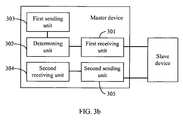
- the network device includes a first receiving unit 301, a determining unit 302, and a sending unit 303.
- the network device may further include a second receiving unit 304 and a second sending unit 305. It should be noted that FIG. 3b also illustrates a slave device for clarity of expression.
- the second receiving unit 304 is configured to receive an original packet sent by an upstream device before the first receiving unit 301 receives the packet sent by the first slave device.
- the second sending unit 305 is configured to send the packet to the first slave device after an MPLS header that carries multi-diversion information is added to the original packet received by the second receiving unit 304.
- the multi-diversion information further includes a link number field.
- the link number field is used to indicate a link which is for receiving the original packet and in the master device.
- the number M of bits (bit) of the multi-diversion identifier field and the number N of bits of the link number field may be set according to actual application requirements.
- the MPLS header may further include a CoS field, an S field, and a TTL field. Reference may be made to the foregoing method embodiments for details, which are not repeatedly described here.
- the second sending unit 305 may include a first identifier subunit, a second identifier subunit, and a sending subunit.
- the first identifier subunit is configured to add an identifier of the link for receiving the original packet by the second receiving unit 304 to the link number field of the MPLS header, where a link number may be used as the identifier of the link.
- the second identifier subunit is configured to identify, according to preset diversion order, all slave devices to which the packet needs to be diverted in the multi-diversion identifier field of the MPLS header, where the preset diversion order is used to indicate order of all the slave devices to which the packet needs to be diverted. Specifically, the second identifier subunit determines at least one bit corresponding to each slave device according to the preset diversion order, and sets the at least one bit corresponding to each slave device to which the packet needs to be diverted to a first value.
- the sending subunit is configured to divert the packet with the MPLS header to the first slave device according to the preset diversion order after the first identifier subunit and the second identifier subunit complete execution.
- the determining unit 302 is specifically configured to search, according to the preset diversion order, the multi-diversion identifier field for a second slave device (that is, a next slave device) to which the packet needs to be diverted. Specifically, after the first receiving unit 301 receives the packet sent by the first slave device, the determining unit 302 determines, according to the preset diversion order and the multi-diversion identifier field in the MPLS header of the received packet, the next slave device to which the packet needs to be diverted.
- each slave device attached to the master device corresponds to at least one bit in the multi-diversion identifier field, and it is set that when the at least one bit is the first value, it indicates that the packet needs to be diverted to a corresponding slave device.
- the sending subunit is specifically configured to start searching from one end of the multi-diversion identifier field according to the preset diversion order; and when a first first value is found through searching, divert the packet with the MPLS header to the first slave device, where the first slave device corresponds to a bit where the first first value is located.
- the determining unit 302 is specifically configured to start searching from one end of the multi-diversion identifier field according to the preset diversion order; when a first first value is found through searching, set a bit where the first first value found through searching is located to a second value; and then continue searching for a next first value; and if the next first value is found through searching, determine a slave device corresponding to a bit where the next first value is located as the second slave device.
- the first sending unit 303 is further configured to, when the determining unit 302 finds no next first value through searching, determine a link indicated by the link number field, remove the MPLS header in the packet, and send, over the determined link, a packet in which the MPLS header has been removed.
- the first value and the second value may be preset according to a policy of an operator, but the first value should not be the same as the second value.
- the first value may be set to "1", and in this case, the second value may be set to "0"; when the first value is set to "0", the second value may be set to "1”; in a case that each slave device corresponds to 2 bits in the multi-diversion identifier field, the first value may be set to "11", and in this case, the second value may be set to "00"; when the first value is set to "10", the second value may be set to "01", and the rest may be deduced by analogy.
- the setting may be as follows:
- the determining unit 302 may include a first resetting subunit, a first searching subunit, and a first determining subunit.
- the first resetting subunit is configured to reset a first bit set to 1 in the multi-diversion identifier field to 0 according to the preset diversion order.
- the first searching subunit is configured to search for a next bit set to 1 in the multi-diversion identifier field according to the preset diversion order.
- the first determining subunit is configured to, when the first searching subunit finds the next bit set to 1 through searching, determine a slave device corresponding to the next bit set to 1 as the second slave device to which the packet needs to be diverted (that is, the next slave device to which the packet needs to be diverted).
- the first sending unit 303 is further configured to, when the first searching subunit finds no next bit set to 1 through searching, search for a corresponding link in the master device according to the link number field, remove the MPLS header in the packet, and send, over the link found through searching, the packet in which the MPLS header has been removed.
- the determining unit 302 may include a second resetting subunit, a second searching subunit, and a second determining subunit.
- the second resetting subunit is configured to set a first bit set to 0 in the multi-diversion identifier field to 1 according to the preset diversion order.
- the second searching subunit is configured to search for a next bit set to 0 in the multi-diversion identifier field according to the preset diversion order.
- the second determining subunit is configured to, when the second searching subunit finds the next bit set to 0 through searching, determine a slave device corresponding to the next bit set to 0 as the second slave device to which the packet needs to be diverted (that is, the next slave device to which the packet needs to be diverted).
- the first sending unit 303 is further configured to, when the second searching subunit finds no next bit set to 0 through searching, search for a corresponding link in the master device according to the link number field, remove the MPLS header in the packet, and send, over the link found through searching, the packet in which the MPLS header has been removed.
- the foregoing units may work as independent entities, and may also be combined randomly into one or several entities.
- the second sending unit 305 of the network device in this embodiment may add the MPLS header that carries the multi-diversion information to the original packet. Therefore, after the packet returned by the slave device is received subsequently, the determining unit 302 may obtain the multi-diversion information by parsing the MPLS header, so as to determine the next slave device to which the packet needs to be diverted, thereby implementing that the packet is diverted between network devices multiple times.
- the MPLS header may carry more information, and an existing standard protocol may also support 7 layers of MPLS header at most. Therefore, compared with an existing solution, the solution is more flexible, more convenient and more extensible, and more multi-diversion information may be carried on the basis of compliance with the existing standard protocol.
- this embodiment of the present invention further provides a communication system (reference may be made to FIG. 1 for one instance).
- the communication system may serve as a device cluster, and includes a master device and at least one slave device attached to the master device, where the master device may be the network device in the foregoing Embodiment 3.
- the master device is configured to receive a packet sent by the slave device, where the packet includes an MPLS header that carries multi-diversion information, the multi-diversion information includes a multi-diversion identifier field, and the multi-diversion identifier field is used to indicate a slave device to which the packet needs to be diverted; according to the multi-diversion identifier field, determine a next slave device to which the packet needs to be diverted; and send the packet to the next slave device.
- the slave device is configured to receive a packet sent by the master device, and send the packet to the master device, where the packet includes an MPLS header that carries multi-diversion information.
- the master device is configured to receive the packet sent by the first slave device; according to the multi-diversion identifier field carried in the packet, determine a second slave device to which the packet needs to be diverted; and send the packet to the second slave device.
- the second slave device is configured to receive the packet sent by the master device.
- the master device is further configured to receive an original packet sent by an upstream device, add an MPLS header that carries multi-diversion information to the original packet, and send the packet to the first slave device.
- the MPLS header may include not only the multi-diversion identifier field used to indicate the slave device to which the packet needs to be diverted, but also a link number field.
- the link number field is used to indicate a link which is for receiving the original packet and in the master device.
- the number M of bits of the multi-diversion identifier field and the number N of bits of the link number field may be set according to actual application requirements.
- the MPLS header may further include a CoS field, an S field, and a TTL field. Reference may be made to the foregoing method embodiments for details, which are not repeatedly described here.
- the master device may specifically be configured to add an identifier of the link for receiving the original packet to the link number field of the MPLS header, and identify all slave devices to which the packet needs to be diverted in the multi-diversion identifier field according to preset diversion order.
- the identifier of the link may be an identifier such as a link number.
- the master device is specifically configured to determine, according to the multi-diversion identifier field, the second slave device to which the packet needs to be diverted. For example, it may be set that each slave device attached to the master device corresponds to at least one bit in the multi-diversion identifier field, and it is set that when the at least one bit is a first value, it indicates that the packet needs to be diverted to a corresponding slave device. For example, when each slave device corresponds to one bit in the multi-diversion identifier field, it may be specified that when a bit is set to 1 or 0, it indicates that the packet needs to be diverted to a corresponding slave device.
- the master device is specifically configured to reset a first bit set to 1 in the multi-diversion identifier field to 0 according to the preset diversion order, and then search for a next bit set to 1 in the multi-diversion identifier field according to the preset diversion order; and if the next bit set to 1 is found through searching, determine a slave device corresponding to the next bit set to 1 as the second slave device to which the packet needs to be diverted.
- the master device is further configured to, if no next bit set to 1 is found through searching, search for a corresponding link in the master device according to the link number field, remove the MPLS header in the packet, and send, over the link found through searching, a packet in which the MPLS header has been removed.
- the master device is specifically configured to set a first bit set to 0 in the multi-diversion identifier field to 1 according to the preset diversion order, and then search for a next bit set to 0 in the multi-diversion identifier field according to the preset diversion order; and if the next bit set to 0 is found through searching, determine a slave device corresponding to the next bit set to 0 as the second slave device to which the packet needs to be diverted.
- the master device is further configured to, if no next bit set to 0 is found through searching, search for a corresponding link in the master device according to the link number field, remove the MPLS header in the packet, and send, over the link found through searching, a packet in which the MPLS header has been removed.
- the master device adds the MPLS header to the received original packet.
- the MPLS header carries the multi-diversion information to implement that the packet is diverted between network devices multiple times.
- the MPLS header may carry more information, and an existing standard protocol may also support 7 layers of MPLS header at most. Therefore, compared with an existing solution, the solution is more flexible, more convenient and more extensible, and more multi-diversion information may be carried on the basis of compliance with the existing standard protocol.
- the program may be stored in a computer readable storage medium, and when the program is executed, the processes of the embodiments of the foregoing methods may be included.
- the storage medium may be a magnetic disk, an optical disk, a read-only memory (Read-Only Memory, ROM), a random access memory (Random Access Memory, RAM), and so on.
- the program may be stored in a computer readable storage medium, and the storage medium may include a read-only memory, a random access memory, a magnetic disk or an optical disk, and so on.
Landscapes
- Engineering & Computer Science (AREA)
- Computer Networks & Wireless Communication (AREA)
- Signal Processing (AREA)
- Computer Security & Cryptography (AREA)
- Data Exchanges In Wide-Area Networks (AREA)
- Small-Scale Networks (AREA)
- Communication Control (AREA)
Claims (9)
- Verfahren zur Umleitung eines Pakets mehrere Male in einem Vorrichtungs-Cluster, der eine Master-Vorrichtung und mindestens zwei Slave-Vorrichtungen aufweist, wobei das Verfahren von der Master-Vorrichtung vorgenommen wird und umfasst:Empfangen (101) eines ursprünglichen Pakets, das von einer stromaufwärtigen Vorrichtung gesendet wird; undnach einem Hinzufügen eines Multi-Protocol-Label-Switching-, MPLS-, Anfangsblocks, der Mehrfachumleitungsinformationen trägt, zu dem ursprünglichen Paket, Senden des Pakets an eine erste Slave-Vorrichtung;Empfangen (103) eines von der ersten Slave-Vorrichtung gesendeten Pakets, wobei das Paket einen MPLS-Anfangsblock umfasst, der Mehrfachumleitungsinformationen trägt, wobei der MPLS-Anfangsblock mehrere Schichten aufweist,wobei die Mehrfachumleitungsinformationen ein Mehrfachumleitungs-Identifikatorfeld umfassen, und das Mehrfachumleitungs-Identifikatorfeld verwendet wird, um eine zweite Slave-Vorrichtung anzuzeigen, zu der das Paket umgeleitet werden muss, wobei jede der mindestens zwei Slave-Vorrichtungen, die an die Master-Vorrichtung angeschlossen sind, mindestens einem Bit in dem Mehrfachumleitungs-Identifikatorfeld entspricht,wobei die Mehrfachumleitungsinformationen ferner ein Verknüpfungsnummernfeld umfassen, und das Verknüpfungsnummernfeld verwendet wird, um anzuzeigen, über welche Verknüpfung der Master-Vorrichtung das ursprüngliche Paket eintritt;wobei die Mehrfachumleitungsinformationen ungenutzte Bits einnehmen, die sich in dem MPLS-Anfangsblock befinden und in einem bestehenden MPLS-Protokoll spezifiziert werden, und jede Schicht des MPLS-Anfangsblocks allein ausgelegt ist, 20 Bit-Mehrfachumleitungsinformationen zu tragen; undwobei eine Anzahl M von Bits des Mehrfachumleitungs-Identifikatorfelds und eine Anzahl N von Bits des Verknüpfungsnummernfelds gemäß tatsächlichen Anwendungsanforderungen eingestellt werden, wobei die Summe von M und N 20 ist, wobei M und N auf folgende Weisen einstellbar sind: M wird auf 12 gesetzt, wenn N auf 8 gesetzt wird, oder M wird auf 14 gesetzt, wenn N auf 6 gesetzt wird;wobei, wenn eine Schicht des MPLS-Anfangsblocks nicht ausreichend ist, um die Mehrfachumleitungsinformationen zu tragen, die Anzahl von Schichten des MPLS-Anfangsblocks gemäß einer Informationsmenge der Mehrfachumleitungsinformationen erhöht wird;
Bestimmen (104), gemäß dem Mehrfachumleitungs-Identifikatorfeld, der zweiten Slave-Vorrichtung, zu der das Paket umgeleitet werden muss; und Senden (105) des Pakets an die zweite Slave-Vorrichtung. - Verfahren nach Anspruch 1, wobei, nach dem Hinzufügen eines MPLS-Anfangsblocks, der Mehrfachumleitungsinformationen trägt, zu dem ursprünglichen Paket, Senden des Pakets an die erste Slave-Vorrichtung umfasst:Hinzufügen eines Identifikators der Verknüpfung, um das ursprüngliche Paket zu empfangen, zu dem Verknüpfungsnummernfeld des MPLS-Anfangsblocks;Identifizieren, gemäß einer voreingestellten Umleitungsreihenfolge, aller Slave-Vorrichtungen, zu denen das Paket umgeleitet werden muss, in dem Mehrfachumleitungs-Identifikatorfeld des MPLS-Anfangsblocks, wobei die voreingestellte Umleitungsreihenfolge verwendet wird, um die Reihenfolge aller Slave-Vorrichtungen anzuzeigen, zu denen das Paket umgeleitet werden muss; undUmleiten des Pakets mit dem MPLS-Anfangsblock zu der ersten Slave-Vorrichtung gemäß der voreingestellten Umleitungsreihenfolge.
- Verfahren nach Anspruch 2, wobei, wenn das mindestens eine Bit auf einen ersten Wert gesetzt wird, dies anzeigt, dass das Paket zu einer entsprechenden Slave-Vorrichtung umgeleitet werden muss;
wobei der Schritt des Identifizierens, gemäß einer voreingestellten Umleitungsreihenfolge, aller Slave-Vorrichtungen, zu denen das Paket umgeleitet werden muss, in dem Mehrfachumleitungs-Identifikatorfeld des MPLS-Anfangsblocks umfasst: Bestimmen mindestens eines Bits, das jeder Slave-Vorrichtung entspricht, gemäß der voreingestellten Umleitungsreihenfolge, und Setzen des mindestens einen Bits, das jeder Slave-Vorrichtung entspricht, zu der das Paket umgeleitet werden muss, auf den ersten Wert;
wobei der Schritt des Umleitens des Pakets mit dem MPLS-Anfangsblock zu der ersten Slave-Vorrichtung gemäß der voreingestellten Umleitungsreihenfolge umfasst:Starten einer Suche von einem Ende des Mehrfachumleitungs-Identifikatorfelds gemäß der voreingestellten Umleitungsreihenfolge; und wenn ein erster erster Wert durch die Suche gefunden wird, Umleiten des Pakets mit dem MPLS-Anfangsblock zu der ersten Slave-Vorrichtung, wobei die erste Slave-Vorrichtung einem Bit entspricht, wo der erste erste Wert lokalisiert ist. - Verfahren nach einem der Ansprüche 1 bis 3, wobei jede Slave-Vorrichtung, die an die Master-Vorrichtung angeschlossen ist, mindestens einem Bit in dem Mehrfachumleitungs-Identifikatorfeld entspricht, und wenn das mindestens eine Bit auf einen ersten Wert gesetzt wird, dies anzeigt, dass das Paket zu einer entsprechenden Slave-Vorrichtung umgeleitet werden muss; und das Bestimmen, gemäß dem Mehrfachumleitungs-Identifikatorfeld, der zweiten Slave-Vorrichtung, zu der das Paket umgeleitet werden muss, umfasst:Starten einer Suche von einem Ende des Mehrfachumleitungs-Identifikatorfelds gemäß der voreingestellten Umleitungsreihenfolge;wenn der erste erste Wert durch die Suche gefunden wird, Setzen eines Bits, wo der erste erste Wert, der durch die Suche gefunden wird, lokalisiert ist, auf einen zweiten Wert; undFortsetzen der Suche nach einem nächsten ersten Wert; wenn der nächste erste Wert durch die Suche gefunden wird, Bestimmen einer Slave-Vorrichtung, die einem Bit entspricht, wo der nächste erste Wert lokalisiert ist, als zweite Slave-Vorrichtung.
- Verfahren nach Anspruch 4, ferner umfassend:wenn kein nächster erster Wert durch die Suche gefunden wird, Bestimmen einer Verknüpfung, die durch das Verknüpfungsnummernfeld angezeigt wird, Entfernen des MPLS-Anfangsblocks in dem Paket, und Senden, über die bestimmte Verknüpfung, eines Pakets, in dem der MPLS-Anfangsblock entfernt wurde.
- Netzvorrichtung, die in einem Vorrichtungs-Cluster angeordnet ist, der eine Master-Vorrichtung und mindestens zwei Slave-Vorrichtungen aufweist, wobei die Netzvorrichtung als Master-Vorrichtung ausgeführt ist und umfasst:eine erste Empfangseinheit (301), die ausgelegt ist, ein Paket zu empfangen, das von einer ersten Slave-Vorrichtung gesendet wird, wobei das Paket einen Multi-Protocoll-Label-Switching-, MPLS-, Anfangsblock umfasst, der Mehrfachumleitungsinformationen trägt, der MPLS-Anfangsblock mehrere Schichten aufweist, die Mehrfachumleitungsinformationen ein Mehrfachumleitungs-Identifikatorfeld umfassen, und das Mehrfachumleitungs-Identifikatorfeld verwendet wird, um eine Slave-Vorrichtung anzuzeigen, zu der das Paket umgeleitet werden muss, wobei jede der mindestens zwei Slave-Vorrichtungen, die an die Master-Vorrichtung angeschlossen sind, mindestens einem Bit in dem Mehrfachumleitungs-Identifikatorfeld entspricht, die Mehrfachumleitungsinformationen ungenutzte Bits einnehmen, die sich in dem MPLS-Anfangsblock befinden und in einem bestehenden MPLS-Protokoll spezifiziert sind, und jede Schicht des MPLS-Anfangsblocks allein ausgelegt ist, 20 Bit-Mehrfachumleitungsinformationen zu tragen;eine Bestimmungseinheit (302), die ausgelegt ist, gemäß dem Mehrfachumleitungs-Identifikatorfeld, die zweite Slave-Vorrichtung zu bestimmen, zu der das Paket umgeleitet werden muss; undeine erste Sendeeinheit (303), die ausgelegt ist, das Paket an die zweite Slave-Vorrichtung zu senden;eine zweite Empfangseinheit (304), die ausgelegt ist, ein ursprüngliches Paket zu empfangen, das von einer stromaufwärtigen Vorrichtung gesendet wird, bevor die erste Empfangseinheit das Paket empfängt, das von der ersten Slave-Vorrichtung gesendet wird; undeine zweite Sendeeinheit (305), die ausgelegt ist, das Paket an die erste Slave-Vorrichtung zu senden, nachdem ein MPLS-Anfangsblock, der Mehrfachumleitungsinformationen trägt, zu dem ursprünglichen Paket hinzugefügt wird;wobei die Mehrfachumleitungsinformationen ferner ein Verknüpfungsnummernfeld umfassen, wobei das Verknüpfungsnummernfeld verwendet wird, um anzuzeigen, über welche Verknüpfung der Master-Vorrichtung das ursprüngliche Paket eintritt, wobei eine Anzahl M von Bits des Mehrfachumleitungs-Identifikatorfelds und eine Anzahl N von Bits des Verknüpfungsnummernfelds gemäß tatsächlichen Anwendungsanforderungen eingestellt werden können, wobei die Summe von M und N 20 ist, wobei M und N auf folgende Weisen einstellbar sind: M wird auf 12 gesetzt, wenn N auf 8 gesetzt wird, oder M wird auf 14 gesetzt, wenn N auf 6 gesetzt wird;
wobei, wenn eine Schicht des MPLS-Anfangsblocks nicht ausreichend ist, um die Mehrfachumleitungsinformationen zu tragen, die Anzahl von Schichten des MPLS-Anfangsblocks gemäß einer Informationsmenge der Mehrfachumleitungsinformationen erhöht wird. - Netzvorrichtung nach Anspruch 6, wobei, wenn das mindestens eine Bit auf einen ersten Wert gesetzt wird, dies anzeigt, dass das Paket zu einer entsprechenden Slave-Vorrichtung umgeleitet werden muss, und daher die zweite Sendeeinheit (305) umfasst:eine erste Identifikatoruntereinheit, die ausgelegt ist, einen Identifikator der Verknüpfung, um das ursprüngliche Paket zu empfangen, zu dem Verknüpfungsnummernfeld des MPLS-Anfangsblocks hinzuzufügen;eine zweite Identifikatoruntereinheit, die ausgelegt ist, mindestens ein Bit, das jeder Slave-Vorrichtung entspricht, gemäß einer voreingestellten Umleitungsreihenfolge zu bestimmen; und mindestens ein Bit, das jeder Slave-Vorrichtung entspricht, zu der das Paket umgeleitet werden muss, auf einen ersten Wert zu setzen, wobei die voreingestellte Umleitungsreihenfolge verwendet wird, um die Reihenfolge aller Slave-Vorrichtungen anzuzeigen, zu denen das Paket umgeleitet werden muss; undeine Sendeuntereinheit, die ausgelegt ist, eine Suche von einem Ende des Mehrfachumleitungs-Identifikatorfelds gemäß der voreingestellten Umleitungsreihenfolge zu starten, nachdem die erste Identifikatoruntereinheit und die zweite Identifikatoruntereinheit die Ausführung vollenden; und wenn ein erster erster Wert durch die Suche gefunden wird, das Paket mit dem MPLS-Anfangsblock zu der ersten Slave-Vorrichtung umzuleiten, wobei die erste Slave-Vorrichtung einem Bit entspricht, wo der erste erste Wert lokalisiert ist.
- Netzvorrichtung nach Anspruch 7, wobei:die Bestimmungseinheit (302) spezifisch ausgelegt ist, die Suche von einem Ende des Mehrfachumleitungs-Identifikatorfelds gemäß der voreingestellten Umleitungsreihenfolge zu starten; wenn der erste erste Wert durch die Suche gefunden wird, das Bit, wo der erste erste Wert, der durch die Suche gefunden wird, lokalisiert ist, auf einen zweiten Wert zu setzen; und dann die Suche nach einem nächsten ersten Wert fortzusetzen; und wenn der nächste erste Wert durch die Suche gefunden wird, eine Slave-Vorrichtung, die einem Bit entspricht, wo der nächste erste Wert lokalisiert ist, als zweite Slave-Vorrichtung zu bestimmen; unddie erste Sendeeinheit (303) ferner ausgelegt ist, wenn die Bestimmungseinheit keinen nächsten ersten Wert durch die Suche findet, eine Verknüpfung zu bestimmen, die durch das Verknüpfungsnummernfeld angezeigt wird, den MPLS-Anfangsblock in dem Paket zu entfernen, und, über die bestimmte Verknüpfung, ein Paket zu senden, in dem der MPLS-Anfangsblock entfernt wurde.
- Kommunikationssystem, welches eine Master-Vorrichtung und mindestens eine Slave-Vorrichtung umfasst, die an die Master-Vorrichtung angeschlossen ist, wobei die Master-Vorrichtung die Netzvorrichtung nach einem der Ansprüche 6 bis 8 ist; und
wobei die Slave-Vorrichtung ausgelegt ist, ein Paket zu empfangen, das von der Master-Vorrichtung gesendet wird, und das Paket an die Master-Vorrichtung zu senden, wobei das Paket einen Multi-Protocol-Label-Switching-, MPLS-, Anfangsblock umfasst, der Mehrfachumleitungsinformationen trägt.
Applications Claiming Priority (2)
| Application Number | Priority Date | Filing Date | Title |
|---|---|---|---|
| CN201110080393.8A CN102143081B (zh) | 2011-03-31 | 2011-03-31 | 一种报文多次转向方法、装置和系统 |
| PCT/CN2012/072820 WO2012130084A1 (zh) | 2011-03-31 | 2012-03-22 | 一种报文多次转向方法、装置和系统 |
Publications (3)
| Publication Number | Publication Date |
|---|---|
| EP2562974A1 EP2562974A1 (de) | 2013-02-27 |
| EP2562974A4 EP2562974A4 (de) | 2013-05-29 |
| EP2562974B1 true EP2562974B1 (de) | 2016-09-14 |
Family
ID=44410316
Family Applications (1)
| Application Number | Title | Priority Date | Filing Date |
|---|---|---|---|
| EP12762783.4A Not-in-force EP2562974B1 (de) | 2011-03-31 | 2012-03-22 | Verfahren, vorrichtung und system zur mehrfachsendung von nachrichten |
Country Status (4)
| Country | Link |
|---|---|
| US (1) | US8687634B2 (de) |
| EP (1) | EP2562974B1 (de) |
| CN (1) | CN102143081B (de) |
| WO (1) | WO2012130084A1 (de) |
Families Citing this family (4)
| Publication number | Priority date | Publication date | Assignee | Title |
|---|---|---|---|---|
| CN102143081B (zh) | 2011-03-31 | 2014-02-19 | 华为技术有限公司 | 一种报文多次转向方法、装置和系统 |
| US20160057004A1 (en) * | 2014-08-21 | 2016-02-25 | Caterpillar Inc. | Systems and methods for machine-to-machine ad-hoc communication |
| CN114697402B (zh) * | 2020-12-29 | 2023-07-14 | 中移物联网有限公司 | 物联网协议序列化方法、装置及电子设备 |
| CN114205263B (zh) * | 2021-12-08 | 2023-10-13 | 中国信息通信研究院 | 用于Ether CAT网络的通信方法、系统和存储介质 |
Family Cites Families (9)
| Publication number | Priority date | Publication date | Assignee | Title |
|---|---|---|---|---|
| US9444785B2 (en) * | 2000-06-23 | 2016-09-13 | Cloudshield Technologies, Inc. | Transparent provisioning of network access to an application |
| US20080002669A1 (en) * | 2001-09-14 | 2008-01-03 | O'brien Ray | Packet voice gateway |
| DE10152011A1 (de) * | 2001-10-22 | 2003-05-08 | Siemens Ag | Verfahren und Vorrichtung zur Abbildung von Netzwerk-Headern auf MPLS-Header in Bearer-Architekturen |
| KR100694205B1 (ko) * | 2005-02-14 | 2007-03-14 | 삼성전자주식회사 | Mpls 패킷 처리 장치 및 방법 |
| EP2079189A1 (de) * | 2008-01-09 | 2009-07-15 | British Telecmmunications public limited campany | Schema und damit zusammenhängende Aspekte zum Aufrufen einer MPLS-Funktion |
| CN101764732B (zh) * | 2008-12-23 | 2012-11-07 | 华为技术有限公司 | 建立以太网虚拟连接的方法、网络和节点设备 |
| CN101568164B (zh) * | 2009-06-08 | 2011-01-05 | 北京邮电大学 | 一种Ad hoc网络机会路由的实现方法 |
| CN101984598B (zh) * | 2010-11-04 | 2012-11-07 | 成都市华为赛门铁克科技有限公司 | 一种报文转向的方法和深度包检测设备 |
| CN102143081B (zh) * | 2011-03-31 | 2014-02-19 | 华为技术有限公司 | 一种报文多次转向方法、装置和系统 |
-
2011
- 2011-03-31 CN CN201110080393.8A patent/CN102143081B/zh not_active Expired - Fee Related
-
2012
- 2012-03-22 EP EP12762783.4A patent/EP2562974B1/de not_active Not-in-force
- 2012-03-22 WO PCT/CN2012/072820 patent/WO2012130084A1/zh not_active Ceased
- 2012-12-21 US US13/724,174 patent/US8687634B2/en not_active Expired - Fee Related
Also Published As
| Publication number | Publication date |
|---|---|
| US8687634B2 (en) | 2014-04-01 |
| CN102143081B (zh) | 2014-02-19 |
| EP2562974A1 (de) | 2013-02-27 |
| US20130114603A1 (en) | 2013-05-09 |
| WO2012130084A1 (zh) | 2012-10-04 |
| EP2562974A4 (de) | 2013-05-29 |
| CN102143081A (zh) | 2011-08-03 |
Similar Documents
| Publication | Publication Date | Title |
|---|---|---|
| EP2568670B1 (de) | Nachrichtenweiterleitungsverfahren und vorrichtung für tiefgehende paketüberprüfung | |
| JP5813072B2 (ja) | Mplsネットワークにおいて完全な論理接続を提供するための方法および装置 | |
| CN103517264B (zh) | 用于切换网络的方法和装置 | |
| US9813342B2 (en) | Method and system for improved load balancing of received network traffic | |
| EP2701342A1 (de) | Verfahren und system zur implementierung einer elastischen netzwerkschnittstelle und einer vernetzung dafür | |
| CN108880899B (zh) | 一种网络拓扑图生成方法及服务器 | |
| WO2015109821A1 (zh) | 一种管理业务链的方法、系统及装置 | |
| CN100531101C (zh) | 一种实现端到端的QinQ业务标签自动分配的方法和装置 | |
| CN111935004B (zh) | 基于SR Policy的自动引流扩展方法、路由器及系统 | |
| CN106302351B (zh) | 收集访问控制列表的方法、装置及系统 | |
| EP3703316A1 (de) | Rahmenaggregationsverfahren, netzwerkaufbaurahmen-sendeverfahren und vorrichtung | |
| US8687634B2 (en) | Method for diverting packet multiple times, apparatus and system | |
| CN107306215A (zh) | 一种数据处理方法、系统及节点 | |
| CN105207909B (zh) | 一种发送信息的方法和网络装置 | |
| CN101631060B (zh) | 一种边缘端口的管理方法和装置 | |
| EP3244587A1 (de) | Verfahren, vorrichtung und system zur zeitsynchronisierung eines präzisionszeitprotokolls in einem aggregationsnetzwerk | |
| EP2928129B1 (de) | Verfahren und netzwerkvorrichtungen zur bestimmung einer administrativen domäne in einem virtuellen cluster | |
| CN101729420B (zh) | 一种数据处理方法及装置 | |
| CN101465714A (zh) | 一种混合复接和解复接的方法、装置及系统 | |
| CN109995649A (zh) | 一种用于获取跨域链路的方法及装置 | |
| US20130250962A1 (en) | Method and apparatus for label distribution | |
| CN107634907B (zh) | 一种二层虚拟专用网络l2vpn的数据转发方法和装置 | |
| CN101035089B (zh) | 一种提高分布式系统性能的方法及装置 | |
| CN114070746B (zh) | 一种用于多类型传输网络的电路串接方法及系统 | |
| EP4075739A1 (de) | Verfahren und vorrichtung zum steuern der weiterleitung einer dienstkette und dienstnetzwerk |
Legal Events
| Date | Code | Title | Description |
|---|---|---|---|
| PUAI | Public reference made under article 153(3) epc to a published international application that has entered the european phase |
Free format text: ORIGINAL CODE: 0009012 |
|
| 17P | Request for examination filed |
Effective date: 20121120 |
|
| AK | Designated contracting states |
Kind code of ref document: A1 Designated state(s): AL AT BE BG CH CY CZ DE DK EE ES FI FR GB GR HR HU IE IS IT LI LT LU LV MC MK MT NL NO PL PT RO RS SE SI SK SM TR |
|
| A4 | Supplementary search report drawn up and despatched |
Effective date: 20130429 |
|
| RIC1 | Information provided on ipc code assigned before grant |
Ipc: H04L 12/723 20130101ALN20130423BHEP Ipc: H04L 29/06 20060101AFI20130423BHEP |
|
| 17Q | First examination report despatched |
Effective date: 20140218 |
|
| DAX | Request for extension of the european patent (deleted) | ||
| REG | Reference to a national code |
Ref country code: DE Ref legal event code: R079 Ref document number: 602012022943 Country of ref document: DE Free format text: PREVIOUS MAIN CLASS: H04L0012560000 Ipc: H04L0029060000 |
|
| GRAP | Despatch of communication of intention to grant a patent |
Free format text: ORIGINAL CODE: EPIDOSNIGR1 |
|
| RIC1 | Information provided on ipc code assigned before grant |
Ipc: H04L 12/723 20130101ALI20160317BHEP Ipc: H04L 12/741 20130101ALI20160317BHEP Ipc: H04L 29/06 20060101AFI20160317BHEP |
|
| INTG | Intention to grant announced |
Effective date: 20160331 |
|
| GRAS | Grant fee paid |
Free format text: ORIGINAL CODE: EPIDOSNIGR3 |
|
| GRAA | (expected) grant |
Free format text: ORIGINAL CODE: 0009210 |
|
| AK | Designated contracting states |
Kind code of ref document: B1 Designated state(s): AL AT BE BG CH CY CZ DE DK EE ES FI FR GB GR HR HU IE IS IT LI LT LU LV MC MK MT NL NO PL PT RO RS SE SI SK SM TR |
|
| REG | Reference to a national code |
Ref country code: GB Ref legal event code: FG4D |
|
| REG | Reference to a national code |
Ref country code: CH Ref legal event code: EP |
|
| REG | Reference to a national code |
Ref country code: IE Ref legal event code: FG4D |
|
| REG | Reference to a national code |
Ref country code: AT Ref legal event code: REF Ref document number: 830071 Country of ref document: AT Kind code of ref document: T Effective date: 20161015 |
|
| REG | Reference to a national code |
Ref country code: DE Ref legal event code: R096 Ref document number: 602012022943 Country of ref document: DE |
|
| REG | Reference to a national code |
Ref country code: LT Ref legal event code: MG4D |
|
| REG | Reference to a national code |
Ref country code: NL Ref legal event code: MP Effective date: 20160914 |
|
| PG25 | Lapsed in a contracting state [announced via postgrant information from national office to epo] |
Ref country code: LT Free format text: LAPSE BECAUSE OF FAILURE TO SUBMIT A TRANSLATION OF THE DESCRIPTION OR TO PAY THE FEE WITHIN THE PRESCRIBED TIME-LIMIT Effective date: 20160914 Ref country code: HR Free format text: LAPSE BECAUSE OF FAILURE TO SUBMIT A TRANSLATION OF THE DESCRIPTION OR TO PAY THE FEE WITHIN THE PRESCRIBED TIME-LIMIT Effective date: 20160914 Ref country code: NO Free format text: LAPSE BECAUSE OF FAILURE TO SUBMIT A TRANSLATION OF THE DESCRIPTION OR TO PAY THE FEE WITHIN THE PRESCRIBED TIME-LIMIT Effective date: 20161214 Ref country code: RS Free format text: LAPSE BECAUSE OF FAILURE TO SUBMIT A TRANSLATION OF THE DESCRIPTION OR TO PAY THE FEE WITHIN THE PRESCRIBED TIME-LIMIT Effective date: 20160914 Ref country code: FI Free format text: LAPSE BECAUSE OF FAILURE TO SUBMIT A TRANSLATION OF THE DESCRIPTION OR TO PAY THE FEE WITHIN THE PRESCRIBED TIME-LIMIT Effective date: 20160914 |
|
| REG | Reference to a national code |
Ref country code: AT Ref legal event code: MK05 Ref document number: 830071 Country of ref document: AT Kind code of ref document: T Effective date: 20160914 |
|
| PG25 | Lapsed in a contracting state [announced via postgrant information from national office to epo] |
Ref country code: GR Free format text: LAPSE BECAUSE OF FAILURE TO SUBMIT A TRANSLATION OF THE DESCRIPTION OR TO PAY THE FEE WITHIN THE PRESCRIBED TIME-LIMIT Effective date: 20161215 Ref country code: SE Free format text: LAPSE BECAUSE OF FAILURE TO SUBMIT A TRANSLATION OF THE DESCRIPTION OR TO PAY THE FEE WITHIN THE PRESCRIBED TIME-LIMIT Effective date: 20160914 Ref country code: LV Free format text: LAPSE BECAUSE OF FAILURE TO SUBMIT A TRANSLATION OF THE DESCRIPTION OR TO PAY THE FEE WITHIN THE PRESCRIBED TIME-LIMIT Effective date: 20160914 Ref country code: NL Free format text: LAPSE BECAUSE OF FAILURE TO SUBMIT A TRANSLATION OF THE DESCRIPTION OR TO PAY THE FEE WITHIN THE PRESCRIBED TIME-LIMIT Effective date: 20160914 |
|
| PG25 | Lapsed in a contracting state [announced via postgrant information from national office to epo] |
Ref country code: EE Free format text: LAPSE BECAUSE OF FAILURE TO SUBMIT A TRANSLATION OF THE DESCRIPTION OR TO PAY THE FEE WITHIN THE PRESCRIBED TIME-LIMIT Effective date: 20160914 Ref country code: RO Free format text: LAPSE BECAUSE OF FAILURE TO SUBMIT A TRANSLATION OF THE DESCRIPTION OR TO PAY THE FEE WITHIN THE PRESCRIBED TIME-LIMIT Effective date: 20160914 |
|
| PG25 | Lapsed in a contracting state [announced via postgrant information from national office to epo] |
Ref country code: ES Free format text: LAPSE BECAUSE OF FAILURE TO SUBMIT A TRANSLATION OF THE DESCRIPTION OR TO PAY THE FEE WITHIN THE PRESCRIBED TIME-LIMIT Effective date: 20160914 Ref country code: BE Free format text: LAPSE BECAUSE OF FAILURE TO SUBMIT A TRANSLATION OF THE DESCRIPTION OR TO PAY THE FEE WITHIN THE PRESCRIBED TIME-LIMIT Effective date: 20160914 Ref country code: CZ Free format text: LAPSE BECAUSE OF FAILURE TO SUBMIT A TRANSLATION OF THE DESCRIPTION OR TO PAY THE FEE WITHIN THE PRESCRIBED TIME-LIMIT Effective date: 20160914 Ref country code: AT Free format text: LAPSE BECAUSE OF FAILURE TO SUBMIT A TRANSLATION OF THE DESCRIPTION OR TO PAY THE FEE WITHIN THE PRESCRIBED TIME-LIMIT Effective date: 20160914 Ref country code: SK Free format text: LAPSE BECAUSE OF FAILURE TO SUBMIT A TRANSLATION OF THE DESCRIPTION OR TO PAY THE FEE WITHIN THE PRESCRIBED TIME-LIMIT Effective date: 20160914 Ref country code: PL Free format text: LAPSE BECAUSE OF FAILURE TO SUBMIT A TRANSLATION OF THE DESCRIPTION OR TO PAY THE FEE WITHIN THE PRESCRIBED TIME-LIMIT Effective date: 20160914 Ref country code: BG Free format text: LAPSE BECAUSE OF FAILURE TO SUBMIT A TRANSLATION OF THE DESCRIPTION OR TO PAY THE FEE WITHIN THE PRESCRIBED TIME-LIMIT Effective date: 20161214 Ref country code: SM Free format text: LAPSE BECAUSE OF FAILURE TO SUBMIT A TRANSLATION OF THE DESCRIPTION OR TO PAY THE FEE WITHIN THE PRESCRIBED TIME-LIMIT Effective date: 20160914 Ref country code: PT Free format text: LAPSE BECAUSE OF FAILURE TO SUBMIT A TRANSLATION OF THE DESCRIPTION OR TO PAY THE FEE WITHIN THE PRESCRIBED TIME-LIMIT Effective date: 20170116 Ref country code: IS Free format text: LAPSE BECAUSE OF FAILURE TO SUBMIT A TRANSLATION OF THE DESCRIPTION OR TO PAY THE FEE WITHIN THE PRESCRIBED TIME-LIMIT Effective date: 20170114 |
|
| REG | Reference to a national code |
Ref country code: DE Ref legal event code: R097 Ref document number: 602012022943 Country of ref document: DE |
|
| PG25 | Lapsed in a contracting state [announced via postgrant information from national office to epo] |
Ref country code: IT Free format text: LAPSE BECAUSE OF FAILURE TO SUBMIT A TRANSLATION OF THE DESCRIPTION OR TO PAY THE FEE WITHIN THE PRESCRIBED TIME-LIMIT Effective date: 20160914 |
|
| PLBE | No opposition filed within time limit |
Free format text: ORIGINAL CODE: 0009261 |
|
| STAA | Information on the status of an ep patent application or granted ep patent |
Free format text: STATUS: NO OPPOSITION FILED WITHIN TIME LIMIT |
|
| PG25 | Lapsed in a contracting state [announced via postgrant information from national office to epo] |
Ref country code: DK Free format text: LAPSE BECAUSE OF FAILURE TO SUBMIT A TRANSLATION OF THE DESCRIPTION OR TO PAY THE FEE WITHIN THE PRESCRIBED TIME-LIMIT Effective date: 20160914 |
|
| 26N | No opposition filed |
Effective date: 20170615 |
|
| REG | Reference to a national code |
Ref country code: CH Ref legal event code: PL |
|
| PG25 | Lapsed in a contracting state [announced via postgrant information from national office to epo] |
Ref country code: MC Free format text: LAPSE BECAUSE OF FAILURE TO SUBMIT A TRANSLATION OF THE DESCRIPTION OR TO PAY THE FEE WITHIN THE PRESCRIBED TIME-LIMIT Effective date: 20160914 Ref country code: SI Free format text: LAPSE BECAUSE OF FAILURE TO SUBMIT A TRANSLATION OF THE DESCRIPTION OR TO PAY THE FEE WITHIN THE PRESCRIBED TIME-LIMIT Effective date: 20160914 |
|
| REG | Reference to a national code |
Ref country code: IE Ref legal event code: MM4A |
|
| REG | Reference to a national code |
Ref country code: FR Ref legal event code: ST Effective date: 20171130 |
|
| PG25 | Lapsed in a contracting state [announced via postgrant information from national office to epo] |
Ref country code: LU Free format text: LAPSE BECAUSE OF NON-PAYMENT OF DUE FEES Effective date: 20170322 Ref country code: FR Free format text: LAPSE BECAUSE OF NON-PAYMENT OF DUE FEES Effective date: 20170331 |
|
| PG25 | Lapsed in a contracting state [announced via postgrant information from national office to epo] |
Ref country code: LI Free format text: LAPSE BECAUSE OF NON-PAYMENT OF DUE FEES Effective date: 20170331 Ref country code: CH Free format text: LAPSE BECAUSE OF NON-PAYMENT OF DUE FEES Effective date: 20170331 Ref country code: IE Free format text: LAPSE BECAUSE OF NON-PAYMENT OF DUE FEES Effective date: 20170322 |
|
| PG25 | Lapsed in a contracting state [announced via postgrant information from national office to epo] |
Ref country code: MT Free format text: LAPSE BECAUSE OF NON-PAYMENT OF DUE FEES Effective date: 20170322 |
|
| PG25 | Lapsed in a contracting state [announced via postgrant information from national office to epo] |
Ref country code: AL Free format text: LAPSE BECAUSE OF FAILURE TO SUBMIT A TRANSLATION OF THE DESCRIPTION OR TO PAY THE FEE WITHIN THE PRESCRIBED TIME-LIMIT Effective date: 20160914 |
|
| PG25 | Lapsed in a contracting state [announced via postgrant information from national office to epo] |
Ref country code: HU Free format text: LAPSE BECAUSE OF FAILURE TO SUBMIT A TRANSLATION OF THE DESCRIPTION OR TO PAY THE FEE WITHIN THE PRESCRIBED TIME-LIMIT; INVALID AB INITIO Effective date: 20120322 |
|
| PG25 | Lapsed in a contracting state [announced via postgrant information from national office to epo] |
Ref country code: CY Free format text: LAPSE BECAUSE OF NON-PAYMENT OF DUE FEES Effective date: 20160914 |
|
| PG25 | Lapsed in a contracting state [announced via postgrant information from national office to epo] |
Ref country code: MK Free format text: LAPSE BECAUSE OF FAILURE TO SUBMIT A TRANSLATION OF THE DESCRIPTION OR TO PAY THE FEE WITHIN THE PRESCRIBED TIME-LIMIT Effective date: 20160914 |
|
| PG25 | Lapsed in a contracting state [announced via postgrant information from national office to epo] |
Ref country code: TR Free format text: LAPSE BECAUSE OF FAILURE TO SUBMIT A TRANSLATION OF THE DESCRIPTION OR TO PAY THE FEE WITHIN THE PRESCRIBED TIME-LIMIT Effective date: 20160914 |
|
| REG | Reference to a national code |
Ref country code: DE Ref legal event code: R079 Ref document number: 602012022943 Country of ref document: DE Free format text: PREVIOUS MAIN CLASS: H04L0029060000 Ipc: H04L0065000000 |
|
| PGFP | Annual fee paid to national office [announced via postgrant information from national office to epo] |
Ref country code: GB Payment date: 20230202 Year of fee payment: 12 Ref country code: DE Payment date: 20230131 Year of fee payment: 12 |
|
| REG | Reference to a national code |
Ref country code: DE Ref legal event code: R119 Ref document number: 602012022943 Country of ref document: DE |
|
| GBPC | Gb: european patent ceased through non-payment of renewal fee |
Effective date: 20240322 |
|
| PG25 | Lapsed in a contracting state [announced via postgrant information from national office to epo] |
Ref country code: DE Free format text: LAPSE BECAUSE OF NON-PAYMENT OF DUE FEES Effective date: 20241001 |
|
| PG25 | Lapsed in a contracting state [announced via postgrant information from national office to epo] |
Ref country code: GB Free format text: LAPSE BECAUSE OF NON-PAYMENT OF DUE FEES Effective date: 20240322 |
|
| PG25 | Lapsed in a contracting state [announced via postgrant information from national office to epo] |
Ref country code: GB Free format text: LAPSE BECAUSE OF NON-PAYMENT OF DUE FEES Effective date: 20240322 Ref country code: DE Free format text: LAPSE BECAUSE OF NON-PAYMENT OF DUE FEES Effective date: 20241001 |