EP2562144B1 - Procedure for obtaining a metallic effect on ceramic bases by ink injection - Google Patents
Procedure for obtaining a metallic effect on ceramic bases by ink injection Download PDFInfo
- Publication number
- EP2562144B1 EP2562144B1 EP12005662.7A EP12005662A EP2562144B1 EP 2562144 B1 EP2562144 B1 EP 2562144B1 EP 12005662 A EP12005662 A EP 12005662A EP 2562144 B1 EP2562144 B1 EP 2562144B1
- Authority
- EP
- European Patent Office
- Prior art keywords
- metallic
- oxides
- ink
- glaze
- procedure
- Prior art date
- Legal status (The legal status is an assumption and is not a legal conclusion. Google has not performed a legal analysis and makes no representation as to the accuracy of the status listed.)
- Active
Links
Images
Classifications
-
- C—CHEMISTRY; METALLURGY
- C03—GLASS; MINERAL OR SLAG WOOL
- C03C—CHEMICAL COMPOSITION OF GLASSES, GLAZES OR VITREOUS ENAMELS; SURFACE TREATMENT OF GLASS; SURFACE TREATMENT OF FIBRES OR FILAMENTS MADE FROM GLASS, MINERALS OR SLAGS; JOINING GLASS TO GLASS OR OTHER MATERIALS
- C03C8/00—Enamels; Glazes; Fusion seal compositions being frit compositions having non-frit additions
- C03C8/02—Frit compositions, i.e. in a powdered or comminuted form
- C03C8/08—Frit compositions, i.e. in a powdered or comminuted form containing phosphorus
-
- C—CHEMISTRY; METALLURGY
- C03—GLASS; MINERAL OR SLAG WOOL
- C03C—CHEMICAL COMPOSITION OF GLASSES, GLAZES OR VITREOUS ENAMELS; SURFACE TREATMENT OF GLASS; SURFACE TREATMENT OF FIBRES OR FILAMENTS MADE FROM GLASS, MINERALS OR SLAGS; JOINING GLASS TO GLASS OR OTHER MATERIALS
- C03C3/00—Glass compositions
- C03C3/04—Glass compositions containing silica
- C03C3/076—Glass compositions containing silica with 40% to 90% silica, by weight
- C03C3/097—Glass compositions containing silica with 40% to 90% silica, by weight containing phosphorus, niobium or tantalum
-
- C—CHEMISTRY; METALLURGY
- C04—CEMENTS; CONCRETE; ARTIFICIAL STONE; CERAMICS; REFRACTORIES
- C04B—LIME, MAGNESIA; SLAG; CEMENTS; COMPOSITIONS THEREOF, e.g. MORTARS, CONCRETE OR LIKE BUILDING MATERIALS; ARTIFICIAL STONE; CERAMICS; REFRACTORIES; TREATMENT OF NATURAL STONE
- C04B41/00—After-treatment of mortars, concrete, artificial stone or ceramics; Treatment of natural stone
- C04B41/009—After-treatment of mortars, concrete, artificial stone or ceramics; Treatment of natural stone characterised by the material treated
-
- C—CHEMISTRY; METALLURGY
- C04—CEMENTS; CONCRETE; ARTIFICIAL STONE; CERAMICS; REFRACTORIES
- C04B—LIME, MAGNESIA; SLAG; CEMENTS; COMPOSITIONS THEREOF, e.g. MORTARS, CONCRETE OR LIKE BUILDING MATERIALS; ARTIFICIAL STONE; CERAMICS; REFRACTORIES; TREATMENT OF NATURAL STONE
- C04B41/00—After-treatment of mortars, concrete, artificial stone or ceramics; Treatment of natural stone
- C04B41/45—Coating or impregnating, e.g. injection in masonry, partial coating of green or fired ceramics, organic coating compositions for adhering together two concrete elements
- C04B41/52—Multiple coating or impregnating multiple coating or impregnating with the same composition or with compositions only differing in the concentration of the constituents, is classified as single coating or impregnation
-
- C—CHEMISTRY; METALLURGY
- C04—CEMENTS; CONCRETE; ARTIFICIAL STONE; CERAMICS; REFRACTORIES
- C04B—LIME, MAGNESIA; SLAG; CEMENTS; COMPOSITIONS THEREOF, e.g. MORTARS, CONCRETE OR LIKE BUILDING MATERIALS; ARTIFICIAL STONE; CERAMICS; REFRACTORIES; TREATMENT OF NATURAL STONE
- C04B41/00—After-treatment of mortars, concrete, artificial stone or ceramics; Treatment of natural stone
- C04B41/80—After-treatment of mortars, concrete, artificial stone or ceramics; Treatment of natural stone of only ceramics
- C04B41/81—Coating or impregnation
- C04B41/89—Coating or impregnation for obtaining at least two superposed coatings having different compositions
-
- C—CHEMISTRY; METALLURGY
- C04—CEMENTS; CONCRETE; ARTIFICIAL STONE; CERAMICS; REFRACTORIES
- C04B—LIME, MAGNESIA; SLAG; CEMENTS; COMPOSITIONS THEREOF, e.g. MORTARS, CONCRETE OR LIKE BUILDING MATERIALS; ARTIFICIAL STONE; CERAMICS; REFRACTORIES; TREATMENT OF NATURAL STONE
- C04B2111/00—Mortars, concrete or artificial stone or mixtures to prepare them, characterised by specific function, property or use
- C04B2111/80—Optical properties, e.g. transparency or reflexibility
Definitions
- the present description relates, as its title indicates, to a procedure for obtaining a metallic effect on ceramic bases by ink jet printing, in which the known ceramic glaze formulation to obtain metallised finishes is broken down into two separate components: on the one hand, a glaze with part of the oxides needed to obtain the metallic effect, applying it in the conventional manner on the ceramic base, and on the other, a metallic ink with the other necessary part of the oxides, applying it by ink jet printing over the previous layer, finishing off with a firing process. As a result a decorated ceramic tile with a metallic effect is obtained.
- Metallic effects are chiefly achieved by applying layers of glaze with a weight per area unit of between 0.3 and 0.5 kg/m 2 , either by waterfall application, airbrush or disc.
- An ink jet printing head enables the supply of a weight of approximately 0.022 kg/m2 of applied solid, which is much less than that required, hence, a priori, it is not considered technically possible to obtain metallic effects on ceramic tiles by ink jet printing.
- Another important advantage of this procedure is that it enables considerable savings of the materials used in the manufacture given that, conventionally, the whole of the base was metallised and then covered with the decoration in the areas required, whilst with this procedure the metallised finish can be applied selectively, in a local manner, only to the areas in which it is necessary, thanks to the fact the same ink jet printing head that is used for the decoration is employed.
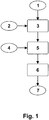
- figure -1- of the attached drawing shows a simplified block diagram of the process of obtaining the metallic effect on ceramic bases by injection.
- the procedure for obtaining the metallic effect on ceramic bases by ink jet printing which is the object of the present invention, basically comprises, as can be observed in the drawing attached, the separate use of a glaze (2) with part of the oxides needed to obtain the metallic effect, including Si and Al, and a metallic ink (4) with the necessary part of the oxides, including Fe as the majority element.
- This separate use is carried out by means of a first phase of application (3) of the glaze (2) on a ceramic base (1), followed by a second phase of ink jet printing (5) of the metallic ink (4) on the layer previously deposited on the ceramic base (1), completed by a third phase of firing (6).
- the application phase (3) of the glaze (2) on a ceramic base (1) is carried out by means of a process chosen from amongst the group of: bell, airbrush, rotary, disc or waterfall.
- the ink jet printing phase (5) of the metallic ink (4) is preferably carried out using an ink jet printing head capable of providing a thickness of between 6 and 200 pl per drop.
- the firing phase (6) is carried out by means of a normal ceramic cycle, from the traditional double firing at 900°C to high-temperature porcelain stoneware firing at 1300°C, with firing cycles of preferably between 0.5 and 24 h.
- the metallic ink (4) is formulated by selecting only some of the oxides needed to obtain the metallic effect, since the technique of ink jet printing only allows a very light weight to be applied. Depending on the type of metallic ink (4) chosen, glaze formulations will be used that provide the rest of the oxides.
- the metallic ink (4) is formed mainly by iron Fe inks in which an iron oxide raw material is used to provide the Fe in the metallic ink (4).
- This iron oxide raw material can be chosen from amongst iron salts or oxides, preferably haematite Fe 2 O 3 , black iron oxide FeO or magnetite Fe 3 O 4 .
- a particularly interesting use occurs when a ferrofluid is used as an ink, which is a suspension of nanoparticles of iron oxides of an average size of around 10 nm.
- the corresponding glaze (2) is formulated using, as essential elements, Si, Al, P and Li oxides to which other optional oxides of Na, K, Mg, Ca can be incorporated, an example not forming part of the present invention is given according to the composition: SiO 2 40 - 60% Al 2 O 3 10 - 30% P 2 O 5 10 - 30% R 2 O + RO 5 - 15% ZrO 2 + TiO 2 0 - 10% B 2 O 3 0 - 10% Where:
- the special ceramic glaze (2) due to its composition and in itself, is white and has a matt or gloss finish
- other decorating techniques which do not form part of the present invention can be incorporated to improve the final finish of the piece, such as pigmented inks or by colouring the glaze (2) with ceramic pigments, without interfering in the reaction that occurs between the glaze (2) and the overlaid metallic ink (4) that produces the metallic effect.
- the metallic effect finishes is matt or gloss.
- This suspension was used to glaze ceramic porcelain stoneware body tiles with a coating thickness of 300 g/m 2 .
- Glycol-based carrier for inks 60% Micronized magnetite (Fe 3 O 4 ): 40%
- the magnetite had been dispersed in the glycol-based carrier, it was milled in a horizontal microball mill to obtain an ink suspension with a grain size with D 99 heat of less than 700 nm.
- the ceramic tiles were fired at a temperature of 1200°C in a conventional ceramic roller kiln with a firing cycle of 60'.
Landscapes
- Chemical & Material Sciences (AREA)
- Engineering & Computer Science (AREA)
- Ceramic Engineering (AREA)
- Materials Engineering (AREA)
- Organic Chemistry (AREA)
- Structural Engineering (AREA)
- Life Sciences & Earth Sciences (AREA)
- Chemical Kinetics & Catalysis (AREA)
- General Chemical & Material Sciences (AREA)
- Geochemistry & Mineralogy (AREA)
- Ink Jet Recording Methods And Recording Media Thereof (AREA)
- Glass Compositions (AREA)
- Inks, Pencil-Leads, Or Crayons (AREA)
Description
- The present description relates, as its title indicates, to a procedure for obtaining a metallic effect on ceramic bases by ink jet printing, in which the known ceramic glaze formulation to obtain metallised finishes is broken down into two separate components: on the one hand, a glaze with part of the oxides needed to obtain the metallic effect, applying it in the conventional manner on the ceramic base, and on the other, a metallic ink with the other necessary part of the oxides, applying it by ink jet printing over the previous layer, finishing off with a firing process. As a result a decorated ceramic tile with a metallic effect is obtained.
- The technique for the digital printing of tiles using ink jet printing machines is increasingly widespread, this being a cost-effective system offering great flexibility of the process. It is commonly used to decorate ceramic tiles by applying ceramic pigments that give the tiles their colour once they have been fired.
- There are descriptions of several related procedures, such as, for example, that of Patent
ES 2131466 ES 2289916 - Some advances have been made in the incorporation of metallic particles in inks for injection on ceramic materials, as described, for example, in Patent P201031196 "Procedure for the production of a metallic suspension for printing ceramic elements", that provides a technique for adding noble metals to inks to obtain a chromatic range with more intense colours, but it does not allow metallic finishes to be obtained.
- Obtaining metallic finishes in ceramics is conventionally linked to the use of special, quite thick glazes, such as that described in patent P200401851 "Metallic glaze composition", which creates a metallised base of sufficient thickness, on to which the desired colour decoration can be subsequently applied. This procedure has the drawback that it is first necessary to cover the whole of the tile with the metallic glaze, and then cover it by decorating it with the desired colours, with the consequent waste of materials and resultant higher economic cost. Furthermore, these types of compositions require a great thickness in the metallised areas which makes these compositions unsuitable for injection. Indeed, the fact that a high minimum thickness is needed to obtain the metallic effect is incompatible with injection technology which can only achieve a very thin ink layer, with a maximum of 42 to 80 pl, which is insufficient to obtain a metallic effect.
- Metallic effects are chiefly achieved by applying layers of glaze with a weight per area unit of between 0.3 and 0.5 kg/m2, either by waterfall application, airbrush or disc. An ink jet printing head enables the supply of a weight of approximately 0.022 kg/m2 of applied solid, which is much less than that required, hence, a priori, it is not considered technically possible to obtain metallic effects on ceramic tiles by ink jet printing.
- Document FERRO SPAIN ET AL, "Tintas Ink-Jet para Decoracion 3D", BOLETÍN DE LA SOCIEDAD ESPAÑOLA DE CERÁMICA Y VIDRIO, vol. 50, no. 2, March/April 2011, pages XXVII - XXX, discloses ink-jet inks to be applied as a 3D object and extra-fine layers to protect the decoration made by ink-jet technology. This document acknowledges the limitations of current ink jet technology defined by the maximum amount of ink depositable by the ink-jet printing head. Therefore, it is suggested to provide new ink-jet inks obtained through the development of new frits based on monophasic crystal vitro structures that allow ceramic effects to be obtained.
- To solve the problems that currently exist in creating a metallic effect on tiles and other ceramic elements, improving the current state of the art by overcoming the technical problem of the ink thickness required, and in order to provide certain elements that facilitate and improve economic performance and efficacy, a procedure has been developed to obtain a metallic effect on ceramic bases by ink jet printing as defined in
claim 1 in which the known ceramic glaze formulation to obtain metallised finishes is broken down into two separate compounds: - On the one hand, a glaze with part of the oxides needed to obtain the metallic effect, applying it in the conventional manner over the ceramic base, and on the other hand, a metallic ink with the other necessary part of the oxides, applying it by ink injection over the previous layer and finishing off with a firing process. As a result a decorated ceramic tile with a metallic effect is obtained.
- This procedure affords multiple advantages over those currently available, the most important being that it permits the use of ink jet printing machines to create the metallic effect, with the consequent saving of process time, improvement in productivity and reduction in the economic cost of its manufacture.
- Another important advantage of this procedure is that it enables considerable savings of the materials used in the manufacture given that, conventionally, the whole of the base was metallised and then covered with the decoration in the areas required, whilst with this procedure the metallised finish can be applied selectively, in a local manner, only to the areas in which it is necessary, thanks to the fact the same ink jet printing head that is used for the decoration is employed.
- To gain a better understanding of the object of the present invention figure -1- of the attached drawing shows a simplified block diagram of the process of obtaining the metallic effect on ceramic bases by injection.
- The procedure for obtaining the metallic effect on ceramic bases by ink jet printing, which is the object of the present invention, basically comprises, as can be observed in the drawing attached, the separate use of a glaze (2) with part of the oxides needed to obtain the metallic effect, including Si and Al, and a metallic ink (4) with the necessary part of the oxides, including Fe as the majority element.
- This separate use is carried out by means of a first phase of application (3) of the glaze (2) on a ceramic base (1), followed by a second phase of ink jet printing (5) of the metallic ink (4) on the layer previously deposited on the ceramic base (1), completed by a third phase of firing (6).
- The application phase (3) of the glaze (2) on a ceramic base (1) is carried out by means of a process chosen from amongst the group of: bell, airbrush, rotary, disc or waterfall.
- The ink jet printing phase (5) of the metallic ink (4) is preferably carried out using an ink jet printing head capable of providing a thickness of between 6 and 200 pl per drop.
- The firing phase (6) is carried out by means of a normal ceramic cycle, from the traditional double firing at 900°C to high-temperature porcelain stoneware firing at 1300°C, with firing cycles of preferably between 0.5 and 24 h.
- The metallic ink (4) is formulated by selecting only some of the oxides needed to obtain the metallic effect, since the technique of ink jet printing only allows a very light weight to be applied. Depending on the type of metallic ink (4) chosen, glaze formulations will be used that provide the rest of the oxides.
A - In a preferred embodiment of the invention, the metallic ink (4) is formed mainly by iron Fe inks in which an iron oxide raw material is used to provide the Fe in the metallic ink (4). This iron oxide raw material can be chosen from amongst iron salts or oxides, preferably haematite Fe2O3, black iron oxide FeO or magnetite Fe3O4. A particularly interesting use occurs when a ferrofluid is used as an ink, which is a suspension of nanoparticles of iron oxides of an average size of around 10 nm. The corresponding glaze (2) is formulated using, as essential elements, Si, Al, P and Li oxides to which other optional oxides of Na, K, Mg, Ca can be incorporated, an example not forming part of the present invention is given according to the composition:SiO2 40 - 60% Al2O3 10 - 30% P2O5 10 - 30% R2O + RO 5 - 15% ZrO2 + TiO2 0 - 10% B2O3 0 - 10% - R2O: Li2O + Na2O + K2O
- RO: MgO + CaO + SrO + BaO
- R2O: Li2O + Na2O + K2O
- RO: MgO + CaO + SrO + BaO
- R2O: Li2O + Na2O + K2O
- RO: MgO + CaO + SrO + BaO
- These possible combinations of metallic ink (4) and glaze (2) can be summarised in the following table:
OPTION METALLIC INK (4) GLAZE (2) A Fe compounds (oxides or salts) Glazing of essential P - Si - Al - Li oxides B Fe- P oxide pigment Glazing of essential Si - Al - Li oxides C Fe - P - Li oxide pigment Glazing of essential Si - Al oxides - As a result a ceramic tile is obtained with a metallic effect decoration that can be measured using colorimetric techniques such as goniospectrophotometry.
- Given that the special ceramic glaze (2), due to its composition and in itself, is white and has a matt or gloss finish, other decorating techniques which do not form part of the present invention can be incorporated to improve the final finish of the piece, such as pigmented inks or by colouring the glaze (2) with ceramic pigments, without interfering in the reaction that occurs between the glaze (2) and the overlaid metallic ink (4) that produces the metallic effect. Furthermore, depending on the type of metallic ink (4) and glaze (2) used, the metallic effect finishes is matt or gloss.
- As an example of the application of this procedure, by way of an experiment, a water suspension of a glaze not forming part of the present invention was prepared, in line with the following composition:
SiO2 54.4% ZrO2 3.3% P2O5 16.1% Al2O3 19.1% Li2O 1.6% Na2O 2.7% K2O 0.9% MgO 1.2% CaO 0.2% - This suspension was used to glaze ceramic porcelain stoneware body tiles with a coating thickness of 300 g/m2.
- Two metallic inks were also prepared:
-
Glycol-based carrier for inks: 60% Micronized magnetite (Fe3O4): 40% - Once the magnetite had been dispersed in the glycol-based carrier, it was milled in a horizontal microball mill to obtain an ink suspension with a grain size with D99 heat of less than 700 nm.
- Ferrofluid with a concentration of 30% magnetite, with an average size of 10 nm dispersed in octane.
- Finally these inks were used to decorate the glazed tiles, using a ceramic printer equipped with an XAAR1001 head, capable of printing drop sizes of between 6 y 42 pl.
- Once the ceramic tiles had been decorated, they were fired at a temperature of 1200°C in a conventional ceramic roller kiln with a firing cycle of 60'.
- As a result, in both cases, ceramic tiles were obtained in which a clear metallic effect could be observed with a drop size of 30 pl onwards.
B - In an alternative embodiment of the invention, the metallic ink (4) is formed mainly by Fe and P oxide pigment inks, as the main oxides, said oxides being within the ranges of:
| P2O5 | 40 - 70% |
| Fe2O3 | 10 - 50% |
Furthermore, the glaze is formulated using, as essential elements, Si, Al, and Li oxides to which other optional oxides of Na, K, Mg, Ca can be incorporated, an example not forming part of the present invention is given according to the composition:
| SiO2 | 40 - 60% |
| Al2O3 | 10 - 30% |
| R2O + RO | 5 - 20% |
| ZrO2 + TiO2 | 0 - 10% |
| B2O3 | 0 - 10% |
C - In a second alternative embodiment of the invention, the metallic ink (4) is formed mainly by Fe, P and Li oxide pigment inks, as essential elements, according to the composition:
| P2O5 | 40 - 70% |
| Fe2O3 | 10 - 50% |
| Li2O | 0 - 30% |
The glaze, for its part, is formulated using Si and Al oxides as essential elements, to which other optional oxides of Li, Na, K, Mg, Ca, can be incorporated, an example not forming part of the present invention is given according to the composition
| SiO2 | 40 - 60% |
| Al2O3 | 10 - 30% |
| R2O + RO | 5 - 30% |
| ZrO2 + TiO2 | 0 - 10% |
| B2O3 | 0 - 10% |
Claims (7)
- Procedure for obtaining a metallic effect on ceramic bases by ink jet printing, of the type used in the manufacture of tiles and other ceramic items, characterized in that it uses, separately, a glaze (2) with part of the oxides needed to obtain the metallic effect, including Si and Al, and a metallic ink (4) with the other part of the oxides required, the metallic ink (4) consisting essentially of iron compounds being oxides or salts and combined with a glaze (2) consisting of P - Si - Al - Li oxides and optionally oxides of Na, K, Mg, Ca, or the metallic ink (4) consisting essentially of Fe - P oxide pigments and combined with a glaze (2) consisting of Si - Al - Li oxides and optionally oxides of Na, K, Mg, Ca, or the metallic ink (4) consisting essentially of Fe - P - Li oxide pigments and combined with a glaze (2) consisting of Si - Al oxides and optionally oxides of Li, Na, K, Mg, Ca, the procedure comprising carrying out a first phase of application (3) of the glaze (2) on a ceramic base (1), wherein the glaze (2) is white and has a matt or gloss finish, continuing with a second phase of ink jet printing (5) of the metallic ink (4) on the coat previously deposited on the ceramic base (1) and causing a reaction between the glaze (2) and the overlaid metallic ink (4) that produces the metallic effect, finishing off with a third phase of firing (6).
- Procedure for obtaining a metallic effect on ceramic bases by ink jet printing, according to claim 1, wherein the raw material of iron oxide, which is used mainly to provide the Fe in the metallic ink (4), is selected from the group: haematite Fe2O3, black iron oxide FeO, magnetite Fe3O4.
- Procedure for obtaining a metallic effect on ceramic bases by ink jet printing, according to claim 2, wherein the raw material of iron oxide that is used mainly to provide the Fe in the metallic ink (4) is in the form of a suspension of nanoparticles of iron oxides or ferrofluid.
- Procedure for obtaining a metallic effect on ceramic bases by ink jet printing, according to any of the preceding claims, wherein the glaze (2) incorporates, in the form of oxides, elements selected from the group formed by Na, K, Mg, Ca.
- Procedure for obtaining a metallic effect on ceramic bases by ink jet printing, according to claim 1, wherein the phase of application (3) of the glaze (2) on a ceramic base (1) is carried out by means of a process chosen from amongst the group formed by: bell, airbrush, rotary, disc or waterfall.
- Procedure for obtaining a metallic effect on ceramic bases by ink jet printing, according to claim 1, wherein the phase of ink jet printing (5) of the metallic ink (4) is performed using an injection head capable of providing a thickness of between 6 x 103 µm3 and 200 x 103 µm3 per drop.
- Procedure for obtaining a metallic effect on ceramic bases by ink jet printing, according to claim 1, wherein the firing phase (6) is carried out at temperatures of between 900 and 1300°C, in firing cycles of between 0.5 and 24 h.
Priority Applications (1)
| Application Number | Priority Date | Filing Date | Title |
|---|---|---|---|
| PL12005662T PL2562144T3 (en) | 2011-08-22 | 2012-08-03 | Procedure for obtaining a metallic effect on ceramic bases by ink injection |
Applications Claiming Priority (1)
| Application Number | Priority Date | Filing Date | Title |
|---|---|---|---|
| ES201131405A ES2396399B2 (en) | 2011-08-22 | 2011-08-22 | Procedure for obtaining metallic appearance on ceramic bases by injection |
Publications (3)
| Publication Number | Publication Date |
|---|---|
| EP2562144A2 EP2562144A2 (en) | 2013-02-27 |
| EP2562144A3 EP2562144A3 (en) | 2013-03-06 |
| EP2562144B1 true EP2562144B1 (en) | 2018-03-14 |
Family
ID=46982321
Family Applications (1)
| Application Number | Title | Priority Date | Filing Date |
|---|---|---|---|
| EP12005662.7A Active EP2562144B1 (en) | 2011-08-22 | 2012-08-03 | Procedure for obtaining a metallic effect on ceramic bases by ink injection |
Country Status (4)
| Country | Link |
|---|---|
| EP (1) | EP2562144B1 (en) |
| ES (2) | ES2396399B2 (en) |
| PL (1) | PL2562144T3 (en) |
| PT (1) | PT2562144T (en) |
Families Citing this family (3)
| Publication number | Priority date | Publication date | Assignee | Title |
|---|---|---|---|---|
| DE102014010335A1 (en) | 2014-07-14 | 2016-01-14 | Schott Ag | Ceramic ink-jet printing ink for glass and / or glass-ceramic, process for their preparation and use |
| ES2724448T3 (en) * | 2016-01-28 | 2019-09-11 | Sa Minera Catalano Aragonesa | Chemical reaction control procedure in multilayer ceramic decorations |
| EP3199594B1 (en) * | 2016-01-28 | 2019-03-13 | Sociedad Anónima Minera Catalano-Aragonesa | Pigment and ink for the decoration of ceramic objects |
Citations (1)
| Publication number | Priority date | Publication date | Assignee | Title |
|---|---|---|---|---|
| EP0665192A1 (en) * | 1994-01-31 | 1995-08-02 | COOKSON MATTHEY CERAMICS & MATERIALS LIMITED | Lead and cadmium free glass flux compositions |
Family Cites Families (10)
| Publication number | Priority date | Publication date | Assignee | Title |
|---|---|---|---|---|
| US3637435A (en) * | 1969-07-08 | 1972-01-25 | Gen Motors Corp | Metallizing process for glass-free ceramics bodies |
| EP0303402B1 (en) * | 1987-08-10 | 1993-01-07 | Inax Corporation | Method of producing tiles by single firing |
| ES2131466B1 (en) | 1997-04-23 | 2000-03-01 | Colorobbia Espana Sa | AUTOMATIC CERAMIC SUBSTRATE DECORATION PROCEDURE. |
| ES2269567T3 (en) * | 1998-05-27 | 2007-04-01 | Smaltochimica S.P.A. | COLORING PRODUCT LIQUID TO DECORATE TILES OR CERAMIC TILES. |
| GB9917953D0 (en) * | 1999-07-31 | 1999-09-29 | Lafarge Braas Res & Dev Ltd | Improvements in the coating of ceramic substrates |
| US6402823B1 (en) * | 2000-01-07 | 2002-06-11 | Ferro Corporation | Individual inks and an ink set for use in the color ink jet printing of glazed ceramic tiles and surfaces |
| EP1498402B8 (en) * | 2002-02-22 | 2006-05-03 | Fundaci N Tekniker | Method of producing ceramic tiles having a metallic finish and the tile thus produced |
| ES2246166B2 (en) * | 2004-07-27 | 2007-06-16 | Sociedad Anonima Minera Catalano-Aragonesa | OXIDE BASED COMPOSITION FOR OBTAINING CALCINATED PIGMENTS, PIGMENT SYNTHESIS PROCEDURE AND USE. |
| EP1921055B1 (en) * | 2005-08-12 | 2013-12-11 | Seiren Co., Ltd. | Method for ink jet printing on inorganic substrate |
| ES2289916B1 (en) | 2006-01-23 | 2008-12-16 | Ferro Spain, S.A. | COLLOIDAL DISPERSION OF CERAMIC PIGMENTS. |
-
2011
- 2011-08-22 ES ES201131405A patent/ES2396399B2/en active Active
-
2012
- 2012-08-03 ES ES12005662.7T patent/ES2666388T3/en active Active
- 2012-08-03 PL PL12005662T patent/PL2562144T3/en unknown
- 2012-08-03 PT PT120056627T patent/PT2562144T/en unknown
- 2012-08-03 EP EP12005662.7A patent/EP2562144B1/en active Active
Patent Citations (1)
| Publication number | Priority date | Publication date | Assignee | Title |
|---|---|---|---|---|
| EP0665192A1 (en) * | 1994-01-31 | 1995-08-02 | COOKSON MATTHEY CERAMICS & MATERIALS LIMITED | Lead and cadmium free glass flux compositions |
Also Published As
| Publication number | Publication date |
|---|---|
| ES2396399A1 (en) | 2013-02-21 |
| EP2562144A2 (en) | 2013-02-27 |
| PL2562144T3 (en) | 2018-11-30 |
| EP2562144A3 (en) | 2013-03-06 |
| ES2666388T3 (en) | 2018-05-04 |
| PT2562144T (en) | 2018-05-14 |
| ES2396399B2 (en) | 2013-09-02 |
Similar Documents
| Publication | Publication Date | Title |
|---|---|---|
| EP2843011B1 (en) | Digital enamel ink | |
| CN108715516B (en) | White glaze, whole body borderless ceramic tile containing white glaze and preparation method thereof | |
| CN103332968B (en) | Full-polishing glaze production process and prepared product | |
| CN107344814B (en) | Soft light brick surface glaze and soft light brick | |
| CN106116696B (en) | A kind of preparation method of three-dimensional cover-coat enamel | |
| CN106365694A (en) | Stereo pattern ceramic tile with combined ceramic ink and production method of stereo pattern ceramic tile with combined ceramic ink | |
| CN101880178B (en) | Ceramic glazed tile with gold metal effect and preparation method thereof | |
| CN110903080B (en) | Special blank large particle combined digital cloth ink-jet infiltration polished brick and preparation method thereof | |
| CN107200554A (en) | A kind of preparation technology of antifouling sheen Dali stone ceramic tile | |
| JP2008273808A (en) | Decorated ceramic article, method for producing the same, and ink for inkjet | |
| CN104661985B (en) | Method for Obtaining Optical Interference Effect by Digital Inkjet Technology | |
| CN110845252A (en) | Special blank large-particle combined digital cloth archaized brick and preparation method thereof | |
| CN118145975B (en) | Colorful marble tile with 3D digital die effect and preparation method thereof | |
| CN109502975A (en) | A kind of 3D seeps flower crystallization glaze and its application | |
| EP2562144A2 (en) | Procedure for obtaining a metallic effect on ceramic bases by ink injection | |
| CN115772026A (en) | Preparation method of colorful exquisite porcelain | |
| CN105801176A (en) | Once-fired metal glaze surface deep-processing method | |
| JP2010235416A (en) | Kiln modulation transfer paper and pottery having kiln modulation pattern | |
| CN111039697B (en) | Metal-color archaized brick and preparation method thereof | |
| CN113620603A (en) | Metal glaze rock plate ground coat and preparation method thereof | |
| CN117682766B (en) | Spot art colored glaze ceramic plate combining half-number glaze and preparation method thereof | |
| KR101191886B1 (en) | Red engobe | |
| EP4722185A1 (en) | Method for producing a ceramic tile with an iridescent effect and resulting ceramic tile according to the method | |
| BR102012019392A2 (en) | PROCESS FOR OBTAINING A METAL ASPECT ON INJECTION CERAMIC BASES | |
| CN120309175A (en) | A composite glaze layer, a ceramic tile with a gold velvet texture and a preparation method thereof |
Legal Events
| Date | Code | Title | Description |
|---|---|---|---|
| PUAL | Search report despatched |
Free format text: ORIGINAL CODE: 0009013 |
|
| PUAI | Public reference made under article 153(3) epc to a published international application that has entered the european phase |
Free format text: ORIGINAL CODE: 0009012 |
|
| AK | Designated contracting states |
Kind code of ref document: A2 Designated state(s): AL AT BE BG CH CY CZ DE DK EE ES FI FR GB GR HR HU IE IS IT LI LT LU LV MC MK MT NL NO PL PT RO RS SE SI SK SM TR |
|
| AX | Request for extension of the european patent |
Extension state: BA ME |
|
| AK | Designated contracting states |
Kind code of ref document: A3 Designated state(s): AL AT BE BG CH CY CZ DE DK EE ES FI FR GB GR HR HU IE IS IT LI LT LU LV MC MK MT NL NO PL PT RO RS SE SI SK SM TR |
|
| AX | Request for extension of the european patent |
Extension state: BA ME |
|
| RIC1 | Information provided on ipc code assigned before grant |
Ipc: C03C 8/08 20060101ALI20130129BHEP Ipc: C03C 3/097 20060101AFI20130129BHEP Ipc: C04B 41/89 20060101ALI20130129BHEP Ipc: C04B 41/52 20060101ALI20130129BHEP |
|
| 17P | Request for examination filed |
Effective date: 20130405 |
|
| 17Q | First examination report despatched |
Effective date: 20130809 |
|
| APBK | Appeal reference recorded |
Free format text: ORIGINAL CODE: EPIDOSNREFNE |
|
| APBN | Date of receipt of notice of appeal recorded |
Free format text: ORIGINAL CODE: EPIDOSNNOA2E |
|
| APBR | Date of receipt of statement of grounds of appeal recorded |
Free format text: ORIGINAL CODE: EPIDOSNNOA3E |
|
| APAF | Appeal reference modified |
Free format text: ORIGINAL CODE: EPIDOSCREFNE |
|
| APBX | Invitation to file observations in appeal sent |
Free format text: ORIGINAL CODE: EPIDOSNOBA2E |
|
| APBZ | Receipt of observations in appeal recorded |
Free format text: ORIGINAL CODE: EPIDOSNOBA4E |
|
| APAQ | Information on invitation to file observation in appeal modified |
Free format text: ORIGINAL CODE: EPIDOSCOBA2E |
|
| APBH | Information on receipt of observation in appeal deleted |
Free format text: ORIGINAL CODE: EPIDOSDOBA4E |
|
| APBZ | Receipt of observations in appeal recorded |
Free format text: ORIGINAL CODE: EPIDOSNOBA4E |
|
| APAQ | Information on invitation to file observation in appeal modified |
Free format text: ORIGINAL CODE: EPIDOSCOBA2E |
|
| APBH | Information on receipt of observation in appeal deleted |
Free format text: ORIGINAL CODE: EPIDOSDOBA4E |
|
| APAQ | Information on invitation to file observation in appeal modified |
Free format text: ORIGINAL CODE: EPIDOSCOBA2E |
|
| APAS | Information on receipt of observation in appeal modified |
Free format text: ORIGINAL CODE: EPIDOSCOBA4E |
|
| APBZ | Receipt of observations in appeal recorded |
Free format text: ORIGINAL CODE: EPIDOSNOBA4E |
|
| APBT | Appeal procedure closed |
Free format text: ORIGINAL CODE: EPIDOSNNOA9E |
|
| REG | Reference to a national code |
Ref country code: DE Ref legal event code: R079 Ref document number: 602012043910 Country of ref document: DE Free format text: PREVIOUS MAIN CLASS: C03C0003097000 Ipc: C04B0041520000 |
|
| GRAP | Despatch of communication of intention to grant a patent |
Free format text: ORIGINAL CODE: EPIDOSNIGR1 |
|
| RIC1 | Information provided on ipc code assigned before grant |
Ipc: C04B 41/89 20060101ALI20171009BHEP Ipc: C03C 8/08 20060101ALI20171009BHEP Ipc: C04B 111/80 20060101ALN20171009BHEP Ipc: C03C 3/097 20060101ALI20171009BHEP Ipc: C04B 41/52 20060101AFI20171009BHEP Ipc: C04B 41/00 20060101ALI20171009BHEP |
|
| INTG | Intention to grant announced |
Effective date: 20171027 |
|
| GRAS | Grant fee paid |
Free format text: ORIGINAL CODE: EPIDOSNIGR3 |
|
| GRAA | (expected) grant |
Free format text: ORIGINAL CODE: 0009210 |
|
| AK | Designated contracting states |
Kind code of ref document: B1 Designated state(s): AL AT BE BG CH CY CZ DE DK EE ES FI FR GB GR HR HU IE IS IT LI LT LU LV MC MK MT NL NO PL PT RO RS SE SI SK SM TR |
|
| REG | Reference to a national code |
Ref country code: GB Ref legal event code: FG4D |
|
| REG | Reference to a national code |
Ref country code: CH Ref legal event code: EP Ref country code: AT Ref legal event code: REF Ref document number: 978718 Country of ref document: AT Kind code of ref document: T Effective date: 20180315 |
|
| REG | Reference to a national code |
Ref country code: IE Ref legal event code: FG4D |
|
| REG | Reference to a national code |
Ref country code: DE Ref legal event code: R096 Ref document number: 602012043910 Country of ref document: DE |
|
| REG | Reference to a national code |
Ref country code: ES Ref legal event code: FG2A Ref document number: 2666388 Country of ref document: ES Kind code of ref document: T3 Effective date: 20180504 |
|
| REG | Reference to a national code |
Ref country code: PT Ref legal event code: SC4A Ref document number: 2562144 Country of ref document: PT Date of ref document: 20180514 Kind code of ref document: T Free format text: AVAILABILITY OF NATIONAL TRANSLATION Effective date: 20180426 |
|
| REG | Reference to a national code |
Ref country code: NL Ref legal event code: MP Effective date: 20180314 |
|
| REG | Reference to a national code |
Ref country code: LT Ref legal event code: MG4D |
|
| PG25 | Lapsed in a contracting state [announced via postgrant information from national office to epo] |
Ref country code: HR Free format text: LAPSE BECAUSE OF FAILURE TO SUBMIT A TRANSLATION OF THE DESCRIPTION OR TO PAY THE FEE WITHIN THE PRESCRIBED TIME-LIMIT Effective date: 20180314 Ref country code: LT Free format text: LAPSE BECAUSE OF FAILURE TO SUBMIT A TRANSLATION OF THE DESCRIPTION OR TO PAY THE FEE WITHIN THE PRESCRIBED TIME-LIMIT Effective date: 20180314 Ref country code: NO Free format text: LAPSE BECAUSE OF FAILURE TO SUBMIT A TRANSLATION OF THE DESCRIPTION OR TO PAY THE FEE WITHIN THE PRESCRIBED TIME-LIMIT Effective date: 20180614 Ref country code: FI Free format text: LAPSE BECAUSE OF FAILURE TO SUBMIT A TRANSLATION OF THE DESCRIPTION OR TO PAY THE FEE WITHIN THE PRESCRIBED TIME-LIMIT Effective date: 20180314 Ref country code: CY Free format text: LAPSE BECAUSE OF FAILURE TO SUBMIT A TRANSLATION OF THE DESCRIPTION OR TO PAY THE FEE WITHIN THE PRESCRIBED TIME-LIMIT Effective date: 20180314 |
|
| REG | Reference to a national code |
Ref country code: AT Ref legal event code: MK05 Ref document number: 978718 Country of ref document: AT Kind code of ref document: T Effective date: 20180314 |
|
| PG25 | Lapsed in a contracting state [announced via postgrant information from national office to epo] |
Ref country code: LV Free format text: LAPSE BECAUSE OF FAILURE TO SUBMIT A TRANSLATION OF THE DESCRIPTION OR TO PAY THE FEE WITHIN THE PRESCRIBED TIME-LIMIT Effective date: 20180314 Ref country code: SE Free format text: LAPSE BECAUSE OF FAILURE TO SUBMIT A TRANSLATION OF THE DESCRIPTION OR TO PAY THE FEE WITHIN THE PRESCRIBED TIME-LIMIT Effective date: 20180314 Ref country code: BG Free format text: LAPSE BECAUSE OF FAILURE TO SUBMIT A TRANSLATION OF THE DESCRIPTION OR TO PAY THE FEE WITHIN THE PRESCRIBED TIME-LIMIT Effective date: 20180614 Ref country code: RS Free format text: LAPSE BECAUSE OF FAILURE TO SUBMIT A TRANSLATION OF THE DESCRIPTION OR TO PAY THE FEE WITHIN THE PRESCRIBED TIME-LIMIT Effective date: 20180314 |
|
| PG25 | Lapsed in a contracting state [announced via postgrant information from national office to epo] |
Ref country code: RO Free format text: LAPSE BECAUSE OF FAILURE TO SUBMIT A TRANSLATION OF THE DESCRIPTION OR TO PAY THE FEE WITHIN THE PRESCRIBED TIME-LIMIT Effective date: 20180314 Ref country code: AL Free format text: LAPSE BECAUSE OF FAILURE TO SUBMIT A TRANSLATION OF THE DESCRIPTION OR TO PAY THE FEE WITHIN THE PRESCRIBED TIME-LIMIT Effective date: 20180314 Ref country code: NL Free format text: LAPSE BECAUSE OF FAILURE TO SUBMIT A TRANSLATION OF THE DESCRIPTION OR TO PAY THE FEE WITHIN THE PRESCRIBED TIME-LIMIT Effective date: 20180314 Ref country code: EE Free format text: LAPSE BECAUSE OF FAILURE TO SUBMIT A TRANSLATION OF THE DESCRIPTION OR TO PAY THE FEE WITHIN THE PRESCRIBED TIME-LIMIT Effective date: 20180314 |
|
| PG25 | Lapsed in a contracting state [announced via postgrant information from national office to epo] |
Ref country code: AT Free format text: LAPSE BECAUSE OF FAILURE TO SUBMIT A TRANSLATION OF THE DESCRIPTION OR TO PAY THE FEE WITHIN THE PRESCRIBED TIME-LIMIT Effective date: 20180314 Ref country code: SM Free format text: LAPSE BECAUSE OF FAILURE TO SUBMIT A TRANSLATION OF THE DESCRIPTION OR TO PAY THE FEE WITHIN THE PRESCRIBED TIME-LIMIT Effective date: 20180314 Ref country code: CZ Free format text: LAPSE BECAUSE OF FAILURE TO SUBMIT A TRANSLATION OF THE DESCRIPTION OR TO PAY THE FEE WITHIN THE PRESCRIBED TIME-LIMIT Effective date: 20180314 Ref country code: SK Free format text: LAPSE BECAUSE OF FAILURE TO SUBMIT A TRANSLATION OF THE DESCRIPTION OR TO PAY THE FEE WITHIN THE PRESCRIBED TIME-LIMIT Effective date: 20180314 |
|
| REG | Reference to a national code |
Ref country code: DE Ref legal event code: R097 Ref document number: 602012043910 Country of ref document: DE |
|
| PLBE | No opposition filed within time limit |
Free format text: ORIGINAL CODE: 0009261 |
|
| STAA | Information on the status of an ep patent application or granted ep patent |
Free format text: STATUS: NO OPPOSITION FILED WITHIN TIME LIMIT |
|
| PG25 | Lapsed in a contracting state [announced via postgrant information from national office to epo] |
Ref country code: DK Free format text: LAPSE BECAUSE OF FAILURE TO SUBMIT A TRANSLATION OF THE DESCRIPTION OR TO PAY THE FEE WITHIN THE PRESCRIBED TIME-LIMIT Effective date: 20180314 |
|
| 26N | No opposition filed |
Effective date: 20181217 |
|
| PG25 | Lapsed in a contracting state [announced via postgrant information from national office to epo] |
Ref country code: SI Free format text: LAPSE BECAUSE OF FAILURE TO SUBMIT A TRANSLATION OF THE DESCRIPTION OR TO PAY THE FEE WITHIN THE PRESCRIBED TIME-LIMIT Effective date: 20180314 |
|
| PG25 | Lapsed in a contracting state [announced via postgrant information from national office to epo] |
Ref country code: MC Free format text: LAPSE BECAUSE OF FAILURE TO SUBMIT A TRANSLATION OF THE DESCRIPTION OR TO PAY THE FEE WITHIN THE PRESCRIBED TIME-LIMIT Effective date: 20180314 |
|
| REG | Reference to a national code |
Ref country code: CH Ref legal event code: PL |
|
| GBPC | Gb: european patent ceased through non-payment of renewal fee |
Effective date: 20180803 |
|
| PG25 | Lapsed in a contracting state [announced via postgrant information from national office to epo] |
Ref country code: LU Free format text: LAPSE BECAUSE OF NON-PAYMENT OF DUE FEES Effective date: 20180803 Ref country code: CH Free format text: LAPSE BECAUSE OF NON-PAYMENT OF DUE FEES Effective date: 20180831 Ref country code: LI Free format text: LAPSE BECAUSE OF NON-PAYMENT OF DUE FEES Effective date: 20180831 |
|
| REG | Reference to a national code |
Ref country code: BE Ref legal event code: MM Effective date: 20180831 |
|
| REG | Reference to a national code |
Ref country code: IE Ref legal event code: MM4A |
|
| PG25 | Lapsed in a contracting state [announced via postgrant information from national office to epo] |
Ref country code: IE Free format text: LAPSE BECAUSE OF NON-PAYMENT OF DUE FEES Effective date: 20180803 |
|
| PG25 | Lapsed in a contracting state [announced via postgrant information from national office to epo] |
Ref country code: FR Free format text: LAPSE BECAUSE OF NON-PAYMENT OF DUE FEES Effective date: 20180831 Ref country code: BE Free format text: LAPSE BECAUSE OF NON-PAYMENT OF DUE FEES Effective date: 20180831 |
|
| PG25 | Lapsed in a contracting state [announced via postgrant information from national office to epo] |
Ref country code: GB Free format text: LAPSE BECAUSE OF NON-PAYMENT OF DUE FEES Effective date: 20180803 |
|
| PG25 | Lapsed in a contracting state [announced via postgrant information from national office to epo] |
Ref country code: MT Free format text: LAPSE BECAUSE OF NON-PAYMENT OF DUE FEES Effective date: 20180803 |
|
| PG25 | Lapsed in a contracting state [announced via postgrant information from national office to epo] |
Ref country code: HU Free format text: LAPSE BECAUSE OF FAILURE TO SUBMIT A TRANSLATION OF THE DESCRIPTION OR TO PAY THE FEE WITHIN THE PRESCRIBED TIME-LIMIT; INVALID AB INITIO Effective date: 20120803 |
|
| PG25 | Lapsed in a contracting state [announced via postgrant information from national office to epo] |
Ref country code: GR Free format text: LAPSE BECAUSE OF FAILURE TO SUBMIT A TRANSLATION OF THE DESCRIPTION OR TO PAY THE FEE WITHIN THE PRESCRIBED TIME-LIMIT Effective date: 20180314 Ref country code: MK Free format text: LAPSE BECAUSE OF NON-PAYMENT OF DUE FEES Effective date: 20180314 |
|
| PG25 | Lapsed in a contracting state [announced via postgrant information from national office to epo] |
Ref country code: IS Free format text: LAPSE BECAUSE OF FAILURE TO SUBMIT A TRANSLATION OF THE DESCRIPTION OR TO PAY THE FEE WITHIN THE PRESCRIBED TIME-LIMIT Effective date: 20180714 |
|
| P01 | Opt-out of the competence of the unified patent court (upc) registered |
Effective date: 20230529 |
|
| PGFP | Annual fee paid to national office [announced via postgrant information from national office to epo] |
Ref country code: PL Payment date: 20250625 Year of fee payment: 14 |
|
| PGFP | Annual fee paid to national office [announced via postgrant information from national office to epo] |
Ref country code: PT Payment date: 20250627 Year of fee payment: 14 |
|
| PGFP | Annual fee paid to national office [announced via postgrant information from national office to epo] |
Ref country code: TR Payment date: 20250624 Year of fee payment: 14 |
|
| PGFP | Annual fee paid to national office [announced via postgrant information from national office to epo] |
Ref country code: ES Payment date: 20250904 Year of fee payment: 14 |
|
| PGFP | Annual fee paid to national office [announced via postgrant information from national office to epo] |
Ref country code: DE Payment date: 20250819 Year of fee payment: 14 |
|
| PGFP | Annual fee paid to national office [announced via postgrant information from national office to epo] |
Ref country code: IT Payment date: 20250630 Year of fee payment: 14 |