EP2559676B1 - Kleber- oder putzmasse umfassend ein minerales bindemittel und ein schichtsilikat sowie beschichtungssystem und dämmsystem umfassend eine beschichtungsmasse - Google Patents
Kleber- oder putzmasse umfassend ein minerales bindemittel und ein schichtsilikat sowie beschichtungssystem und dämmsystem umfassend eine beschichtungsmasse Download PDFInfo
- Publication number
- EP2559676B1 EP2559676B1 EP11177663.9A EP11177663A EP2559676B1 EP 2559676 B1 EP2559676 B1 EP 2559676B1 EP 11177663 A EP11177663 A EP 11177663A EP 2559676 B1 EP2559676 B1 EP 2559676B1
- Authority
- EP
- European Patent Office
- Prior art keywords
- adhesive
- layer
- plaster
- coating
- silicate
- Prior art date
- Legal status (The legal status is an assumption and is not a legal conclusion. Google has not performed a legal analysis and makes no representation as to the accuracy of the status listed.)
- Active
Links
Images

Classifications
-
- C—CHEMISTRY; METALLURGY
- C04—CEMENTS; CONCRETE; ARTIFICIAL STONE; CERAMICS; REFRACTORIES
- C04B—LIME, MAGNESIA; SLAG; CEMENTS; COMPOSITIONS THEREOF, e.g. MORTARS, CONCRETE OR LIKE BUILDING MATERIALS; ARTIFICIAL STONE; CERAMICS; REFRACTORIES; TREATMENT OF NATURAL STONE
- C04B28/00—Compositions of mortars, concrete or artificial stone, containing inorganic binders or the reaction product of an inorganic and an organic binder, e.g. polycarboxylate cements
- C04B28/02—Compositions of mortars, concrete or artificial stone, containing inorganic binders or the reaction product of an inorganic and an organic binder, e.g. polycarboxylate cements containing hydraulic cements other than calcium sulfates
-
- C—CHEMISTRY; METALLURGY
- C04—CEMENTS; CONCRETE; ARTIFICIAL STONE; CERAMICS; REFRACTORIES
- C04B—LIME, MAGNESIA; SLAG; CEMENTS; COMPOSITIONS THEREOF, e.g. MORTARS, CONCRETE OR LIKE BUILDING MATERIALS; ARTIFICIAL STONE; CERAMICS; REFRACTORIES; TREATMENT OF NATURAL STONE
- C04B28/00—Compositions of mortars, concrete or artificial stone, containing inorganic binders or the reaction product of an inorganic and an organic binder, e.g. polycarboxylate cements
- C04B28/02—Compositions of mortars, concrete or artificial stone, containing inorganic binders or the reaction product of an inorganic and an organic binder, e.g. polycarboxylate cements containing hydraulic cements other than calcium sulfates
- C04B28/10—Lime cements or magnesium oxide cements
-
- C—CHEMISTRY; METALLURGY
- C04—CEMENTS; CONCRETE; ARTIFICIAL STONE; CERAMICS; REFRACTORIES
- C04B—LIME, MAGNESIA; SLAG; CEMENTS; COMPOSITIONS THEREOF, e.g. MORTARS, CONCRETE OR LIKE BUILDING MATERIALS; ARTIFICIAL STONE; CERAMICS; REFRACTORIES; TREATMENT OF NATURAL STONE
- C04B28/00—Compositions of mortars, concrete or artificial stone, containing inorganic binders or the reaction product of an inorganic and an organic binder, e.g. polycarboxylate cements
- C04B28/24—Compositions of mortars, concrete or artificial stone, containing inorganic binders or the reaction product of an inorganic and an organic binder, e.g. polycarboxylate cements containing alkyl, ammonium or metal silicates; containing silica sols
- C04B28/26—Silicates of the alkali metals
-
- C—CHEMISTRY; METALLURGY
- C09—DYES; PAINTS; POLISHES; NATURAL RESINS; ADHESIVES; COMPOSITIONS NOT OTHERWISE PROVIDED FOR; APPLICATIONS OF MATERIALS NOT OTHERWISE PROVIDED FOR
- C09D—COATING COMPOSITIONS, e.g. PAINTS, VARNISHES OR LACQUERS; FILLING PASTES; CHEMICAL PAINT OR INK REMOVERS; INKS; CORRECTING FLUIDS; WOODSTAINS; PASTES OR SOLIDS FOR COLOURING OR PRINTING; USE OF MATERIALS THEREFOR
- C09D1/00—Coating compositions, e.g. paints, varnishes or lacquers, based on inorganic substances
- C09D1/06—Coating compositions, e.g. paints, varnishes or lacquers, based on inorganic substances cement
-
- C—CHEMISTRY; METALLURGY
- C09—DYES; PAINTS; POLISHES; NATURAL RESINS; ADHESIVES; COMPOSITIONS NOT OTHERWISE PROVIDED FOR; APPLICATIONS OF MATERIALS NOT OTHERWISE PROVIDED FOR
- C09D—COATING COMPOSITIONS, e.g. PAINTS, VARNISHES OR LACQUERS; FILLING PASTES; CHEMICAL PAINT OR INK REMOVERS; INKS; CORRECTING FLUIDS; WOODSTAINS; PASTES OR SOLIDS FOR COLOURING OR PRINTING; USE OF MATERIALS THEREFOR
- C09D7/00—Features of coating compositions, not provided for in group C09D5/00; Processes for incorporating ingredients in coating compositions
- C09D7/40—Additives
- C09D7/60—Additives non-macromolecular
- C09D7/61—Additives non-macromolecular inorganic
-
- C—CHEMISTRY; METALLURGY
- C09—DYES; PAINTS; POLISHES; NATURAL RESINS; ADHESIVES; COMPOSITIONS NOT OTHERWISE PROVIDED FOR; APPLICATIONS OF MATERIALS NOT OTHERWISE PROVIDED FOR
- C09D—COATING COMPOSITIONS, e.g. PAINTS, VARNISHES OR LACQUERS; FILLING PASTES; CHEMICAL PAINT OR INK REMOVERS; INKS; CORRECTING FLUIDS; WOODSTAINS; PASTES OR SOLIDS FOR COLOURING OR PRINTING; USE OF MATERIALS THEREFOR
- C09D7/00—Features of coating compositions, not provided for in group C09D5/00; Processes for incorporating ingredients in coating compositions
- C09D7/40—Additives
- C09D7/66—Additives characterised by particle size
- C09D7/69—Particle size larger than 1000 nm
-
- C—CHEMISTRY; METALLURGY
- C09—DYES; PAINTS; POLISHES; NATURAL RESINS; ADHESIVES; COMPOSITIONS NOT OTHERWISE PROVIDED FOR; APPLICATIONS OF MATERIALS NOT OTHERWISE PROVIDED FOR
- C09D—COATING COMPOSITIONS, e.g. PAINTS, VARNISHES OR LACQUERS; FILLING PASTES; CHEMICAL PAINT OR INK REMOVERS; INKS; CORRECTING FLUIDS; WOODSTAINS; PASTES OR SOLIDS FOR COLOURING OR PRINTING; USE OF MATERIALS THEREFOR
- C09D7/00—Features of coating compositions, not provided for in group C09D5/00; Processes for incorporating ingredients in coating compositions
- C09D7/40—Additives
- C09D7/70—Additives characterised by shape, e.g. fibres, flakes or microspheres
-
- C—CHEMISTRY; METALLURGY
- C04—CEMENTS; CONCRETE; ARTIFICIAL STONE; CERAMICS; REFRACTORIES
- C04B—LIME, MAGNESIA; SLAG; CEMENTS; COMPOSITIONS THEREOF, e.g. MORTARS, CONCRETE OR LIKE BUILDING MATERIALS; ARTIFICIAL STONE; CERAMICS; REFRACTORIES; TREATMENT OF NATURAL STONE
- C04B2111/00—Mortars, concrete or artificial stone or mixtures to prepare them, characterised by specific function, property or use
- C04B2111/00474—Uses not provided for elsewhere in C04B2111/00
- C04B2111/00482—Coating or impregnation materials
Definitions
- the invention further relates to a coating composition comprising such a composition.
- the invention relates to a coating system and an insulation system comprising such a coating composition for forming a single or multi-layer adhesive or plaster layer.
- composition or coating composition according to the invention for forming an adhesive or plaster layer is preferably used indoors. This means that it is preferably applied on the inside of a building exterior wall or on an interior wall. The job can also be done on an interior ceiling. The same applies to the further claimed coating system and the further claimed insulation system.
- coating material is applied directly or indirectly to the supporting structure of a wall or ceiling.
- the load-bearing construction of the wall or ceiling can be solid or skeleton construction. In the latter case, a support plate, in particular a plaster base plate, is applied to the load-bearing construction, which is capable of receiving the coating mass for forming the single-layer or multi-layer adhesive or plaster layer.
- the application of the coating composition is provided on a component.
- the component can then be attached to an on-site support.
- a suitable for receiving the coating composition can be, for example, an insulating board or another preferably plate-shaped material.
- compositions or coating compositions of the type mentioned above for the construction industry are well known from the prior art. They may be part of interior coating systems or insulation systems. Depending on the particular use of the rooms, the systems may be exposed to special stresses due to the occasional high humidity in the room, which is reflected in the surfaces of the walls if there is insufficient ventilation. This can lead to moisture damage, especially mold. In order to avoid this, mixtures of substances as well as building materials produced therefrom have been specified, which have dynamic moisture storage properties. Such mixtures or building materials produced therefrom are capable of reacting to moisture loads by absorbing moisture, storing and then, when the room humidity decreases again due to ventilation processes, the stored moisture release to the room air again.
- the proposed substance mixture also comprises a mixture of at least one filler of a fumed silica and a binder in the form of liquid waterglass. Furthermore, it is proposed that the mixture contains pumice and expanded clay sand as further fillers.
- the moisture storage disk produced from such a substance mixture is characterized in that it further comprises at least one reinforcing agent in the form of reinforcing fibers. The reinforcing fibers serve to support and ensure the inherent stability of the moisture storage plates.
- the in the WO 2010/089136 A2 proposed moisture storage plates should not represent insulation material or have insulation-like properties. Due to the good thermal conductivity of the carbon contained they serve rather as a heat conductor, which gives off the heat to the surrounding components, in particular to massive ceiling or wall constructions. They are therefore preferably designed for direct ceiling or wall mounting.
- a moist thermal barrier coating has a significantly lower thermal insulation capability than a dry one, so that sufficient thermal insulation is no longer guaranteed.
- the first known system for internal insulation of a building exterior wall provides for the use of a vapor barrier.
- the vapor barrier is mounted directly or indirectly on the interior side of the thermal barrier coating, so that a diffusion of water vapor is prevented from the inside to the outside.
- the use of a vapor barrier is not without problems.
- with the use of a vapor barrier increases the cost of producing the building exterior wall, since the vapor barrier layer must be performed without interruption.
- the individual vapor barrier webs have to be adhesively bonded to one another in the region of the joints and in the region of their connections to adjacent components in order to form the vapor barrier layer. Furthermore, care must be taken that no subsequent damage to the vapor barrier layer takes place.
- Damage can for example already be caused by the impact of a nail, so that a permanent functioning of the vapor barrier can not be guaranteed. Because a vapor pressure equalization takes place even by the smallest gaps or holes, so that water vapor enters the structure of the building exterior wall.
- the second known system provides for the use of a capillary-active vapor-permeable thermal insulation board.
- Capillary-active thermal insulation panels have the property of being able to easily absorb moisture via the capillary and to be able to dissipate it again. Accordingly, capillary-active thermal insulation panels allow rapid dehydration of the system in case of condensation, so that a prolonged moisture penetration is avoided.
- the thermal insulation of the thermal insulation material decreases. This can only be compensated by the fact that the thermal insulation material is applied in a greater layer thickness. In the case of interior insulation, however, this is associated with a loss of space.
- a component in particular a thermal insulation board, which is impregnated or coated with an impregnating or coating agent.
- the thermal insulation panel is attached to a wall or ceiling such that the impregnation or coating faces the interior.
- the impregnation or coating has a greater water vapor transmission resistance than the thermal insulation panel.
- the arrangement of a vapor barrier should be dispensable.
- US 2003/010258 discloses a water vapor absorbing coating composition for indoor use containing a) a mineral binder selected from cement and hemihydrate gypsum and b) 5-70 wt% vermiculite. Vermiculite is part of the mineral class of phyllosilicates.
- the coating composition is applied with a layer thickness of 2 mm to a calcium silicate board.
- Object of the present invention is to provide a composition and composition comprising such a composition, which allows the formation of a moisture-regulating adhesive or plaster layer, that is serving as a moisture storage or buffer adhesive or plaster layer.
- a moisture-regulating adhesive or plaster layer is characterized by having a high sorption capacity.
- composition or coating composition for forming a moisture-regulating adhesive and / or plaster layer should be suitable as part of a coating or insulation system, preferably indoors used. Furthermore, an insulation system for internal insulation of external building walls should be specified.
- composition having the features of claim 1 and a coating composition having the features of claim 6 are proposed.
- Advantageous developments are specified in the subclaims.
- a coating system with the features of claim 7 and an insulation system with the features of claim 9 are proposed.
- the composition proposed for the formation of an adhesive or plaster layer on a component or an on-site substrate comprises a mineral binder and at least one filler and / or auxiliary substance. By adding water and / or another solvent, the composition can be processed to a pasty mass.
- the composition according to the invention comprises at least one layered silicate as filler.
- the proportion of the layered silicate is at least 3-15 wt .-%, preferably at least 5-10 wt .-%, more preferably at least 7 wt .-%, based on the dry matter.
- the phyllosilicate has an average particle size between 0.2 mm and 2 mm. That is, the phyllosilicate in the proposed composition is present as sand and not as fine flour.
- layered silicates in such compositions are known in the art. However, their proportion is well below 3 wt .-%, since they are used primarily as an excipient, especially as a thickener. However, it has been found that at a layered silicate content of at least 3 wt .-%, preferably 5 wt .-%, further preferably at least 7 wt .-%, the sorptive ability of a formed from the composition adhesive or plaster layer is substantially improved, so that the layer is able to take over the function of a moisture storage. However, the maximum proportion of the layered silicate should not exceed 15% by weight, preferably 10% by weight.
- a moisture-storing function is also attributed to the known lime and clay plasters.
- Lime plasters are relatively insensitive to moisture and therefore can be used in wet rooms, such as in domestic bathrooms.
- the moisture absorption is effected by the binder, namely hydrated lime or hydraulic lime.
- the binder namely hydrated lime or hydraulic lime.
- phyllosilicates are used as binders. Under the influence of moisture, however, the binder softens, so that the use of clay plaster in damp rooms is limited or not at all possible.
- an adhesive or plaster layer formed from a composition according to the invention has the advantage that the sorption capacity can be controlled via the fraction of the phyllosilicate.
- the layered silicate thus serves as a functional filler.
- a trained from a composition according to the invention adhesive or plaster layer is able to absorb significantly more moisture than a correspondingly strong trained layer of lime or clay plaster. This is attributed inter alia to the use of at least one layered silicate as filler.
- the composition of the invention is versatile, for example as an adhesive or as a plaster layer, wherein the term plaster layer may include both a reinforcing layer, as well as a topcoat.
- plaster layer covers all plaster-like intermediate layers, which serve to compensate for unevenness of the substrate and / or as a primer or bonding agent.
- a top coat layer formed from a composition according to the invention can also take up further coatings, such as, for example, a single-coat or multi-coat paint coat.
- the choice of usable paint materials is particularly limited in clay plaster.
- the composition preferably contains no or less than 5% by weight of organic constituents.
- the low proportion of organic components - if present at all - counteract mold infestation. Because the predominantly mineral or inorganic components of the composition contribute to a high pH of the formed from the composition adhesive or plaster layer and thus to a basic climate. Since the proliferation of mold requires a rather neutral climate, ie a pH value in the range of 7, the setting of the highest possible pH value can counteract mold infestation.
- the composition contains cement, preferably white cement, water glass, hydrated lime and / or hydraulic lime as a mineral binder.
- cement preferably white cement, water glass, hydrated lime and / or hydraulic lime as a mineral binder.
- the use of such binders contributes to a high pH, on the other hand - especially when using white cement - a very light plaster layer for receiving any further bright color paints are formed.
- the intended for the formation of the bright plaster layer coating composition can also be tinted arbitrarily by the addition of color pigments, so that a great deal of flexibility in terms of color design of a plaster layer, in particular a topcoat layer consists.
- the abovementioned mineral binders can each be used alone or in combination.
- sepiolite is contained as a layered silicate in the composition according to the invention.
- Sepiolite is a mineral that is very absorbent due to its porous structure. It is known as phyllosilicate and is assigned to the mineral classification of the mineral class of silicates and germanates.
- the mineral class includes the clay minerals bentonite and montmorillonite. Alternatively or additionally, these minerals may also be present as phyllosilicate in the composition according to the invention.
- a plaster layer made from a sepiolite sand-containing composition has a lower shrinkage behavior than a plaster layer made from a composition which also contains sepiolite but in the form of a fine flour.
- a mean grain size of 0.1 mm to 3 mm preferably of 0.2 mm to 2 mm is considered advantageous. Further preferably, the mean grain size is 0.25 mm to 1.3 mm.
- the layered silicate is contained in at least two fractions, wherein the fractions differ with regard to the average particle size of the layered silicate.
- a first fraction may, for example, a sheet silicate, such as sepiolite, having a mean grain size between 0.3 mm and 0.6 mm, while the second fraction is a sheet silicate with a mean grain size between 0.6 mm and 1.3 mm is used ,
- each fraction is present in equal parts by weight.
- the weight fraction of each fraction may be 5% by weight. be.
- a total of 10% by weight of one or more phyllosilicates of different particle size is contained in the composition.
- the coating composition further proposed for achieving the above-mentioned object for forming an adhesive or plaster layer on a component or an on-site substrate comprises a composition according to the invention and water and / or another solvent. Concrete examples of such a coating composition are mentioned below.
- the addition of water and / or another solvent from the dry composition is a pasty mass, which is then processed further.
- the pasty mass can be applied, for example, by means of spatulas, spraying, rolling or brushing onto a component and / or an on-site substrate.
- the order is preferably over the entire surface. Any unevenness of the ground is thereby compensated.
- the job can also be done in several layers or layers.
- the further proposed coating system comprises a coating composition according to the invention for forming a single-layer or multi-layer adhesive or plaster layer.
- the water vapor diffusion resistance coefficient ⁇ of an adhesive or plaster layer formed from the coating composition is preferably ⁇ 25, more preferably ⁇ 20. This ensures that the adhesive or plaster layer is able to assume the function of a moisture storage or buffer.
- the coating system is primarily intended for use in interiors, in particular in interiors with an at least temporarily high ambient humidity.
- the coating system can be used indoors to regulate the humidity of the room.
- the coating system is particularly suitable for use in moisture-sensitive rooms, such as archives, showrooms and the like.
- the proposed coating system may further comprise a water vapor diffusion-open paint, in particular a silicate paint, to form a final coating.
- a water vapor diffusion-open paint in particular silicate paint
- the moisture storage properties of the underlying serving as a moisture storage or buffer adhesive or plaster layer are not or only slightly changed.
- a corresponding final coating allows a versatile color design of the wall surface receiving the coating system.
- an insulation system comprising a coating composition according to the invention for forming a single-layer or multi-layer adhesive or plaster layer
- the insulation system further comprises at least one insulation board.
- the steam diffusion resistance coefficient ⁇ of the insulating board is preferably ⁇ 20, preferably ⁇ 10.
- Such an insulating board is permeable to water vapor so that water vapor from the room air can penetrate through the insulating board to an adhesive or plaster layer serving as a moisture storage or buffer. If the vapor pressure gradient reverses, that is to say the ambient air humidity decreases again over time, for example because of room ventilation, the water vapor diffuses in the reverse direction through the insulating panel and is finally released back into the room air.
- the coating composition can serve both to form an adhesive layer and to form a plaster layer.
- the insulation board can be glued by means of the coating material on an on-site substrate.
- the coating composition is preferably applied over the whole area to the insulating board and / or the on-site substrate.
- any unevenness of the on-site substrate before gluing the insulation board by applying a Plaster layer can be equalized from the coating composition of the invention.
- a single or multi-layer plaster layer can be applied to the bonded to the substrate insulation board.
- the multi-layer plaster layer may include a reinforcing plaster and a top coat, wherein the coating composition according to the invention can be used both for the formation of the reinforcing plaster, as well as for the formation of the top coat.
- insulation board is preferably a thermal insulation panel use, that is, the insulation board has primarily heat-insulating properties. Alternatively or additionally, the insulation board may also have sound insulating properties.
- the insulation board on hydrophobic properties. That is, a water absorption of the insulation board is largely excluded, while the selected water vapor diffusion resistance coefficient ⁇ ⁇ 20, preferably ⁇ ⁇ 10, further allows the required water vapor diffusion through the insulation board therethrough.
- the insulation board is therefore preferably kapillarinmod.
- the use of capillary active insulation boards is possible, if provided on the wall and / or the room side facing the insulation board, a moisture-regulating adhesive and / or plaster layer.
- the adhesive and / or plaster layer must be able to absorb moisture, especially precipitated condensate, to temporarily store and release it over time. This is ensured when using a composition or coating composition according to the invention for forming the adhesive and / or plaster layer.
- the insulation system comprises a water vapor diffusion-open paint, in particular a silicate paint, to form a final coating.
- a water vapor diffusion-open paint in particular silicate paint
- the water vapor diffusion-open paint applied to a single or multi-layer plaster layer, which is applied on the inside of the insulation board of the insulation system.
- At least one layer of the single-layer or multi-layer plaster layer is furthermore preferably reinforced by the insert of a reinforcement fabric.
- the final coating applied to the plaster layer closes the insulation system on the room side and gives the surface a visually appealing, colorful appearance.
- the advantages of the invention which comprises a composition and a coating composition for forming a moisture-regulating adhesive or plaster layer and a coating and insulating system with such an adhesive and / or plaster layer, are in particular that the use in indoor areas a healthy and pleasant Room climate creates. Because during the dew period moisture is removed via the moisture-regulating adhesive and / or plaster layer of the room air and fed back during the evaporation period. Humidity fluctuations can thus be compensated.
- the storage capacity of the moisture-regulating adhesive and / or plaster layer is adjusted such that over the duration of a dew period across the absorption capacity of moisture is ensured.
- the duration of a dew period depends on the individual case. The determinants of the individual case are the season, the time of day, the geographical position of the building, the orientation of the outer wall of the building in relation to the direction of the sky and the concrete use of the interior bounded by the building's outer wall or inner wall, to name but a few. All factors have an influence on the temperature and the moisture content of the boundary layers adjacent to the building's outer wall or inner wall.
- the dew period can last only one night or a whole winter.
- the ability of the adhesive or plaster layer to absorb moisture and temporarily store it is also adjustable via the layer thickness.
- the moisture-regulating adhesive or plaster layer is preferably applied in a layer thickness of from 1 mm to 20 mm, more preferably from 2 mm to 10 mm.
- the coating composition can be applied in one or more layers.
- the stated layer thicknesses therefore refers to a single or multi-layer adhesive or plaster layer.
- compositions according to the invention for forming moisture-regulating adhesive or plaster layers are mentioned below.
- a preferred composition according to the invention for forming a moisture-regulating adhesive layer has the following constituents: 22.0% by weight White cement and hydrated lime as mineral binders 65.5% by weight Fillers, for example limestone meal and / or quartz sand 10.0% by weight Sepiolite sand as a functional filler and 2.5% by weight Additives, in particular water retention agents, air entraining agents, redispersible powders and / or rheological agents.
- a preferred composition according to the invention for forming a moisture-regulating plaster layer has the following constituents: 23.0% by weight White cement and hydrated lime as mineral binders 68.0% by weight Fillers, for example limestone meal and / or quartz sand 7.0% by weight Sepiolite sand as a functional filler and 2.0% by weight Additives, in particular water retention agents, air entrainers and / or rheological agents.
- an adhesive layer formed from the composition according to embodiment 1 can absorb and store more than 20 g of air moisture from the ambient air as liquid water per kilogram of coating material under realistic conditions (90% relative humidity), so that it can later be released again to the ambient air. This is more than four times the amount of water which a conventional adhesive layer without sepiolite content is able to absorb.
- the result of such an attempt is in the graph of FIG. 2 shown.
- the graph shows the water uptake and delivery over the time of a first and a second layer of adhesive.
- the first adhesive layer was formed from a composition according to Embodiment 1 (upper curve).
- at the second adhesive layer is a conventional adhesive layer without sepiolite (lower curve).
- the stepped curve indicates the relative humidity.
- the adhesive layers were applied in the same thickness and dried at 40 ° C / 0% relative humidity. Thereafter, the temperature was lowered to 23 ° C and the relative humidity increased to 30%. Every 8 hours, the relative humidity was gradually increased by 10% to 90% (sorption phase). Thereafter, the relative humidity was gradually lowered again by 10% (desorption phase).
- the distance between the upper curve and the lower curve corresponds to a four times higher sorption capacity of the sepiolite-containing adhesive layer compared to a conventional adhesive layer without Sepiolithanteil.
- the graphic of the FIG. 1 shows the water absorption and water absorbency over the time of a sepiolite-containing sorption plaster compared to a commercial clay plaster or lime plaster of appropriate strength.
- the upper curve shows the water uptake and water release capacity of the sepiolite-containing sorption plaster, while the middle curve represents the property of a commercially available clay plaster and the lower curve the property of a commercial lime plaster.
- the stepped curve again indicates the relative humidity.
- a coating composition without active substance shows the lowest shrinkage. This is followed by a coating composition containing sepiolite sands. When using sepiolite flour (average particle size ⁇ 0.1 mm), the shrinkage increases significantly. A similar behavior shows a coating composition containing bentonite as the active substance. However, the most significant changes in length were measured on the sample containing montmorillonite as the active substance.
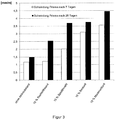
- Shrinkage behavior (measurement according to the Graf-Kaufmann method): without active substance 10% by weight Sephiolite sand 10% by weight of spiolite flour 10% by weight of bentonite 10% by weight of montmorillonite water requirements 26.9 34.3 35.4 37 37.7 propagation measure 16.4 16.1 16.5 16.3 17 Schwindg. n. 7 T. 1.17 1.22 2.01 3.1 3.56 Schwindg. n. 28 T. 1.48 2.54 3.7 3.76 4.46
- results are also available as a graph in the FIG. 3 shown, wherein the changes in length of the individual specimens after 7 and after 28 days were applied as a bar.
Landscapes
- Chemical & Material Sciences (AREA)
- Engineering & Computer Science (AREA)
- Organic Chemistry (AREA)
- Materials Engineering (AREA)
- Ceramic Engineering (AREA)
- Inorganic Chemistry (AREA)
- Wood Science & Technology (AREA)
- Life Sciences & Earth Sciences (AREA)
- Structural Engineering (AREA)
- Chemical Kinetics & Catalysis (AREA)
- Nanotechnology (AREA)
- Adhesives Or Adhesive Processes (AREA)
- Paints Or Removers (AREA)
- Curing Cements, Concrete, And Artificial Stone (AREA)
Description
- Die Erfindung betrifft eine Zusammensetzung zur Ausbildung einer Kleber- oder Putzschicht auf einem Bauelement oder einem bauseitigen Untergrund umfassend ein mineralisches Bindemittel sowie wenigstens einen Füll- und/oder Hilfsstoff. Die Zusammensetzung ist durch Zugabe von Wasser und/oder eines anderen Lösungsmittels zu einer pastösen Masse bzw. einer Beschichtungsmasse verarbeitbar.
- Die Erfindung betrifft ferner eine Beschichtungsmasse umfassend eine solche Zusammensetzung. Darüber hinaus betrifft die Erfindung ein Beschichtungssystem sowie ein Dämmsystem umfassend eine solche Beschichtungsmasse zur Ausbildung einer ein- oder mehrlagigen Kleber- oder Putzschicht.
- Die erfindungsgemäße Zusammensetzung bzw. Beschichtungsmasse zur Ausbildung einer Kleber- oder Putzschicht gelangt vorzugsweise in Innenräumen zur Anwendung. Das heißt, dass sie vorzugsweise auf der Innenseite einer Gebäudeaußenwand bzw. auf einer Innenwand aufgebracht wird. Der Auftrag kann zudem auf einer innenliegenden Decke erfolgen. Entsprechendes gilt für das ferner beanspruchte Beschichtungssystem sowie das ferner beanspruchte Dämmsystem. Die Beschichtungsmasse wird hierzu unmittelbar oder mittelbar auf die tragende Konstruktion einer Wand oder Decke aufgetragen. Die tragende Konstruktion der Wand oder Decke kann dabei massiv oder in Skelettbauweise ausgebildet sein. Im letztgenannten Fall ist auf die tragende Konstruktion zunächst eine Trägerplatte, insbesondere eine Putzträgerplatte, aufzubringen, welche die Beschichtungsmasse zur Ausbildung der ein- oder mehrlagigen Kleber- oder Putzschicht aufzunehmen vermag. Alternativ oder ergänzend zur Aufbringung der Beschichtungsmasse auf einem bauseitigen Untergrund ist die Aufbringung der Beschichtungsmasse auf einem Bauelement vorgesehen. Das Bauelement kann dann anschließend an einem bauseitigen Untergrund befestigt werden. Ein zur Aufnahme der Beschichtungsmasse geeignetes Bauelement kann beispielsweise eine Dämmplatte oder ein sonstiger vorzugsweise plattenförmiger Werkstoff sein.
- Zusammensetzungen bzw. Beschichtungsmassen der vorstehend genannten Art für das Baugewerbe sind aus dem Stand der Technik hinlänglich bekannt. Sie können Bestandteil von in Innenräumen anzubringenden Beschichtungssystemen oder Dämmsystemen sein. In Abhängigkeit von der jeweiligen Nutzung der Räume können die Systeme besonderen Belastungen durch zeitweise auftretende hohe Raumluftfeuchte ausgesetzt sein, welche sich bei nicht ausreichender Raumlüftung an den Oberflächen der Wände niederschlägt. Dies kann zu Feuchtigkeitsschäden, insbesondere zur Schimmelbildung führen. Um dies zu vermeiden, sind bereits Stoffgemische sowie hieraus hergestellte Bauwerkstoffe angegeben worden, welche dynamische Feuchtespeichereigenschaften besitzen. Derartige Stoffgemische bzw. hieraus hergestellte Bauwerkstoffe sind in der Lage, auf Feuchtelasten zu reagieren, indem sie Feuchtigkeit aufnehmen, speichern und anschließend, wenn die Raumluftfeuchte aufgrund von Lüftungsvorgängen wieder abnimmt, die gespeicherte Feuchtigkeit an die Raumluft wieder abgeben.
- Aus der
WO 2010/089136 A2 geht beispielsweise ein solches feuchtespeicherndes Stoffgemisch sowie eine hieraus hergestellte Feuchtespeicherplatte für das Baugewerbe, insbesondere zur Verwendung im Innenausbau, hervor. Das vorgeschlagene Stoffgemisch umfasst neben einem Bestandteil aus Luftaktivkohle ferner ein Gemisch mindestens eines Füllmittels aus einer pyrogenen Kieselsäure und ein Bindemittel in Form von flüssigem Wasserglas. Des Weiteren wird vorgeschlagen, dass das Stoffgemisch Bims und Blähtonsand als weitere Füllmittel enthält. Die aus einem solchen Stoffgemisch hergestellte Feuchtespeicherplatte zeichnet sich dadurch aus, dass sie ferner mindestens ein Verstärkungsmittel in Form von Armierungsfasern umfasst. Die Armierungsfasern dienen der Unterstützung und Sicherstellung der Eigenstabilität der Feuchtespeicherplatten. - Die in der
WO 2010/089136 A2 vorgeschlagenen Feuchtespeicherplatten sollen keinen Dämmstoff darstellen oder dämmstoffartige Eigenschaften aufweisen. Aufgrund der guten Wärmeleitfähigkeit des enthaltenen Kohlenstoffs dienen sie vielmehr als Wärmeleiter, welcher die Wärme an die umgebenden Bauteile, insbesondere an massive Decken- oder Wandkonstruktionen abgibt. Sie sind demnach bevorzugt für die direkte Decken- oder Wandbefestigung konzipiert. - An die Wärmedämmung von Gebäuden werden jedoch immer höhere Anforderungen gestellt. In der Regel werden die hierzu eingesetzten, meist plattenförmigen Wärmedämmstoffe außenseitig an die Gebäude angebracht, da dies zu Lösungen führt, die im Vergleich zu Innendämmsystemen unter bauphysikalischen Gesichtspunkten weniger schadensanfällig sind. Denn die durch eine Gebäudeaußenwand stattfindende Wasserdampfdiffusion zum Ausgleich eines regelmäßig vorhandenen Dampfdruckgefälles zwischen Innen und Außen kann, insbesondere bei einer innenliegend ausgeführten Wärmedämmung, zum Tauwasserausfall führen. Das Tauwasser fällt bei einer Wasserdampfdiffusion von innen nach außen üblicherweise hinter der Wärmedämmschicht aus, da hier der Wasserdampf - bei entsprechenden Außentemperaturen - auf eine deutlich kühlere Schicht trifft. Kann das ausgefallene Tauwasser über die Gebäudeaußenwand nicht nach außen abgeführt werden, dringt die Feuchtigkeit zurück in die Wärmedämmschicht ein. Eine feuchte Wärmedämmschicht weist gegenüber einer trockenen jedoch eine deutlich geringere Wärmedämmfähigkeit auf, so dass eine ausreichende Wärmedämmung nicht mehr gewährleistet ist.
- Ist die Ausbildung einer Außendämmung nicht möglich und/oder nicht erwünscht, wie dies beispielsweise bei denkmalgeschützten Fassaden der Fall sein kann, finden häufig Innendämmsysteme Einsatz. Um die vorstehend genannten Probleme im Zusammenhang mit einer Innendämmung zu vermeiden, gelangen regelmäßig zwei bekannte Systeme zum Einsatz.
- Das erste bekannte System zur Innendämmung einer Gebäudeaußenwand sieht die Verwendung einer Dampfsperre vor. Die Dampfsperre wird unmittelbar oder mittelbar innenraumseitig auf die Wärmedämmschicht angebracht, so dass eine Wasserdampfdiffusion von innen nach außen unterbunden wird. Die Verwendung einer Dampfsperre ist jedoch nicht unproblematisch. Insbesondere steigt mit Verwendung einer Dampfsperre der Aufwand zur Herstellung der Gebäudeaußenwand, da die Dampfsperrschicht unterbrechungsfrei ausgeführt werden muss. Insbesondere müssen die einzelnen Dampfsperrbahnen zur Ausbildung der Dampfsperrschicht untereinander im Bereich der Stöße sowie im Bereich ihrer Anschlüsse an angrenzende Bauteile dicht verklebt werden. Ferner ist darauf zu achten, dass keine nachträgliche Beschädigung der Dampfsperrschicht erfolgt. Eine Beschädigung kann beispielsweise bereits durch Einschlagen eines Nagels verursacht werden, so dass eine dauerhafte Funktionsfähigkeit der Dampfsperre nicht zu gewährleisten ist. Denn ein Dampfdruckausgleich findet selbst durch kleinste Spalte oder Löcher statt, so dass Wasserdampf in den Aufbau der Gebäudeaußenwand gelangt.
- Das zweite bekannte System sieht die Verwendung einer kapillaraktiven diffusionsoffenen Wärmedämmplatte vor. Kapillaraktive Wärmedämmplatten weisen die Eigenschaft auf, Feuchtigkeit über die Kapillare leicht aufnehmen und wieder abführen zu können. Demnach ermöglichen kapillaraktive Wärmedämmplatten bei Ausfall von Tauwasser eine schnelle Trocknung des Systems, so dass eine länger anhaltende Durchfeuchtung vermieden wird. Allerdings sinkt durch eine regelmäßig erhöhte Wasseraufnahme die Wärmedämmfähigkeit des Wärmedämmmaterials. Dies kann nur dadurch ausgeglichen werden, dass der Wärmedämmstoff in einer größeren Schichtstärke aufgebracht wird. Im Falle der Innendämmung geht damit jedoch ein Raumverlust einher.
- Aus der
DE 42 10 392 A1 ist ferner ein Bauelement, insbesondere eine Wärmedämmplatte, bekannt, welche mit einem Imprägnier- oder Beschichtungsmittel imprägniert bzw. beschichtet ist. Die Wärmedämmplatte wird derart an eine Wand oder Decke angebracht, dass die Imprägnierung bzw. Beschichtung dem Innenraum zugewandt ist. Die Imprägnierung bzw. Beschichtung weist einen größeren Wasserdampf-Durchlasswiderstand als die Wärmedämmplatte auf. Dadurch soll die Anordnung einer Dampfsperre entbehrlich sein.US 2003/010258 offenbart eine Wasserdampf absorbierendes Beschichtungszusammensetzung zur Anwendung in Innenräumen enthaltend a) ein mineralisches Bindemittel gewählt aus Zement und Halbhydratgips und b) 5-70 Gew. % Vermiculit. Vermiculit ist Bestandteil der Mineralklasse der Phyllosilikate. Die Beschichtungszusammensetzung wird mit einer Schichtdicke von 2 mm auf ein Kalziumsilikatplatte appliziert. - Aufgabe der vorliegenden Erfindung ist es, eine Zusammensetzung sowie eine solche Zusammensetzung umfassende Beschichtungsmasse anzugeben, welche die Ausbildung einer feuchtigkeitsregulierenden Kleber- oder Putzschicht, das heißt einer als Feuchtigkeitsspeicher bzw. -puffer dienenden Kleber- oder Putzschicht, ermöglicht. Eine feuchtigkeitsregulierende Kleber- oder Putzschicht zeichnet sich dadurch aus, dass sie eine hohe Sorptionsfähigkeit besitzt.
- Darüber hinaus soll die Zusammensetzung bzw. Beschichtungsmasse zur Ausbildung einer feuchtigkeitsregulierenden Kleber- und/oder Putzschicht als Bestandteil eines Beschichtungs- oder Dämmsystems geeignet sein, das vorzugsweise in Innenräumen zur Anwendung gelangt. Ferner soll ein Dämmsystem zur Innendämmung von Gebäudeaußenwänden angegeben werden.
- Zur Lösung der Aufgabe werden eine Zusammensetzung mit den Merkmalen des Anspruchs 1 und eine Beschichtungsmasse mit den Merkmalen des Anspruchs 6 vorgeschlagen. Vorteilhafte Weiterbildungen sind in den Unteransprüchen angegeben. Ferner werden ein Beschichtungssystem mit den Merkmalen des Anspruchs 7 und ein Dämmsystem mit den Merkmalen des Anspruchs 9 vorgeschlagen.
- Die zur Ausbildung einer Kleber- oder Putzschicht auf einem Bauelement oder einem bauseitigen Untergrund vorgeschlagene Zusammensetzung umfasst ein mineralisches Bindemittel sowie wenigstens einen Füll- und/oder Hilfsstoff. Durch Zugabe von Wasser und/oder einem anderen Lösungsmittel kann die Zusammensetzung zu einer pastösen Masse verarbeitet werden. Zur Verbesserung der Sorptionsfähigkeit einer aus der Zusammensetzung ausgebildeten Kleber- oder Putzschicht enthält die Zusammensetzung erfindungsgemäß wenigstens ein Schichtsilikat als Füllstoff. Der Anteil des Schichtsilikates beträgt dabei wenigstens 3-15 Gew.-%, vorzugsweise wenigstens 5-10 Gew.-%, weiterhin vorzugsweise wenigstens 7 Gew.-%, bezogen auf die Trockenmasse. Ferner weist das Schichtsilikat eine mittlere Korngröße zwischen 0,2 mm und 2 mm, auf. Das heißt, dass das Schichtsilikat in der vorgeschlagenen Zusammensetzung als Sand und nicht als feines Mehl vorliegt.
- Der Einsatz von Schichtsilikaten in derartigen Zusammensetzungen ist aus dem Stand der Technik bekannt. Allerdings liegt ihr Anteil deutlich unter 3 Gew.-%, da sie vorrangig als Hilfsstoff, insbesondere als Verdickungsmittel eingesetzt werden. Es wurde jedoch gefunden, dass bei einem Schichtsilikatanteil von wenigstens 3 Gew.-%, vorzugsweise 5 Gew.-%, weiterhin vorzugsweise wenigstens 7 Gew.-%, die Sorptionsfähigkeit einer aus der Zusammensetzung ausgebildeten Kleber- oder Putzschicht wesentlich verbessert wird, so dass die Schicht die Funktion eines Feuchtigkeitsspeichers zu übernehmen vermag. Der maximale Anteil des Schichtsilikates sollte jedoch 15 Gew.-%, vorzugsweise 10 Gew.-% nicht überschreiten.
- Eine feuchtigkeitsspeichernde Funktion wird darüber hinaus den bekannten Kalk- und Lehmputzen zugeschrieben. Kalkputze sind relativ unempfindlich in Bezug auf Feuchtigkeitseinwirkungen und können daher Einsatz in Feuchträumen, wie beispielsweise in häuslichen Bädern, finden. Die Feuchtesorption wird dabei durch das Bindemittel, nämlich Kalkhydrat oder hydraulischer Kalk, bewirkt. Als nachteilig erweist sich jedoch, dass sich die Sorptionsfähigkeit des Kalkputzes aufgrund fortschreitender Carbonatisierung im Laufe der Zeit verändert. Bei Lehmputzen dagegen werden Schichtsilikate als Bindemittel eingesetzt. Unter Feuchtigkeitseinfluss erweicht das Bindemittel jedoch, so dass der Einsatz von Lehmputzen in Feuchträumen nur bedingt bzw. gar nicht möglich ist.
- Gegenüber den bekannten Kalk- oder Lehmputzen weist eine aus einer erfindungsgemäßen Zusammensetzung ausgebildete Kleber- oder Putzschicht den Vorteil auf, dass die Sorptionsfähigkeit über den Anteil des Schichtsilikates steuerbar ist. Das Schichtsilikat dient somit als funktionaler Füllstoff. Darüber hinaus ist eine aus einer erfindungsgemäßen Zusammensetzung ausgebildete Kleber- oder Putzschicht in der Lage, deutlich mehr Feuchtigkeit aufzunehmen als eine entsprechend stark ausgebildete Schicht aus Kalk- oder Lehmputz. Dies wird unter anderem auf die Verwendung wenigstens eines Schichtsilikats als Füllstoff zurückgeführt. Zudem ist die erfindungsgemäße Zusammensetzung vielseitig einsetzbar, beispielsweise als Kleber- oder als Putzschicht, wobei der Begriff Putzschicht sowohl eine Armierungsschicht, als auch eine Oberputzschicht umfassen kann. Ferner fallen unter den Begriff Putzschicht alle putzartigen Zwischenschichten, welche dem Ausgleich von Unebenheiten des Untergrundes und/oder als Haftvermittler bzw. Haftbrücke dienen. Eine aus einer erfindungsgemäßen Zusammensetzung ausgebildete Oberputzschicht kann zudem weitere Beschichtungen, wie beispielsweise einen ein- oder mehrlagigen Farbanstrich, aufnehmen. Demgegenüber ist die Auswahl verwendbarer Anstrichmaterialien insbesondere bei Lehmputzen stark begrenzt.
- Bevorzugt enthält die Zusammensetzung keine oder weniger als 5 Gew.-% organische Bestandteile. Der geringe Anteil organischer Bestandteile - sofern überhaupt vorhanden - wirkt einem Schimmelpilzbefall entgegen. Denn die überwiegend mineralischen bzw. anorganischen Bestandteile der Zusammensetzung tragen zu einem hohen pH-Wert der aus der Zusammensetzung ausgebildeten Kleber- oder Putzschicht und damit zu einem basischen Klima bei. Da die Vermehrung von Schimmelpilzen ein eher neutrales Klima erfordert, das heißt einen pH-Wert im Bereich von 7, kann durch die Einstellung eines möglichst hohen pH-Wertes einem Schimmelpilzbefall entgegen gewirkt werden.
- Ferner wird vorgeschlagen, dass die Zusammensetzung Zement, vorzugsweise Weißzement, Wasserglas, Kalkhydrat und/oder hydraulischen Kalk als mineralisches Bindemittel enthält. Zum Einen trägt die Verwendung derartiger Bindemittel zu einem hohen pH-Wert bei, zum Anderen kann - insbesondere bei Verwendung von Weißzement - eine sehr helle Putzschicht zur Aufnahme etwaiger weiterer heller Farbanstriche ausgebildet werden. Die zur Ausbildung der hellen Putzschicht vorgesehene Beschichtungsmasse kann durch Zugabe von Farbpigmenten zudem beliebig abgetönt werden, so dass ein großer Spielraum hinsichtlich der farblichen Gestaltung einer Putzschicht, insbesondere einer Oberputzschicht, besteht. Die vorstehend genannten mineralischen Bindemittel können jeweils allein oder in Kombination zum Einsatz gelangen.
- Gemäß einer bevorzugten Ausführungsform ist Sepiolith als Schichtsilikat in der erfindungsgemäßen Zusammensetzung enthalten. Sepiolith ist ein Mineral, das wegen seiner porösen Struktur sehr saugfähig ist. Es ist als Schichtsilikat bekannt und wird nach der Mineralsystematik der Mineralklasse der Silikate und Germanate zugeordnet. Der Mineralklasse gehören unter anderem auch die Tonminerale Bentonit und Montmorillonit an. Alternativ oder ergänzend können auch diese Mineralien als Schichtsilikat in der erfindungsgemäßen Zusammensetzung enthalten sein. Versuche mit allen drei Mineralien (Sepiolith, Bentonit und Montmorillonit) haben jedoch gezeigt, dass bei Einsatz von Sepiolith, insbesondere von Sepiolithsanden, eine aus der Zusammensetzung ausgebildete Kleber- oder Putzschicht ein deutlich geringeres Schwindverhalten besitzt. Insofern finden bevorzugt Sepiolith als Schichtsilikat und weiterhin bevorzugt Sepiolithsande Verwendung. Denn einen wesentlichen Einfluss hat in diesem Zusammenhang nicht nur die Wahl des Schichtsilikats, sondern auch die Korngröße des gewählten Schichtsilikats. So weist eine aus einer Sepiolithsande enthaltenden Zusammensetzung hergestellte Putzschicht ein geringeres Schwindverhalten als eine Putzschicht auf, welche aus einer Zusammensetzung hergestellt wurde, die ebenfalls Sepiolith jedoch in Form eines feinen Mehls enthält. Wie bereits vorstehend erwähnt, wird insbesondere eine mittlere Korngröße von 0,1 mm bis 3 mm, vorzugsweise von 0,2 mm bis 2 mm als vorteilhaft angesehen. Weiterhin bevorzugt liegt die mittlere Korngröße bei 0,25 mm bis 1,3 mm.
- Gemäß einer weiteren bevorzugten Ausführungsform ist das Schichtsilikat in wenigstens zwei Fraktionen enthalten, wobei sich die Fraktionen hinsichtlich der mittleren Korngröße des Schichtsilikats unterscheiden. Eine erste Fraktion kann beispielsweise ein Schichtsilikat, wie beispielsweise Sepiolith, mit einer mittleren Korngröße zwischen 0,3 mm und 0,6 mm aufweisen, während als zweite Fraktion ein Schichtsilikat mit einer mittleren Korngröße zwischen 0,6 mm und 1,3 mm eingesetzt wird. Vorzugsweise ist jede Fraktion zu gleichen Gewichtsanteilen vorhanden. Beispielsweise kann der Gewichtsanteil jeder Fraktion 5 Gew.-% betragen. Bei zwei Fraktionen zu jeweils 5 Gew.-% sind in der Zusammensetzung insgesamt 10 Gew.-% eines oder mehrerer Schichtsilikate unterschiedlicher Korngröße enthalten.
- Die zur Lösung der eingangs genannten Aufgabe ferner vorgeschlagene Beschichtungsmasse zur Ausbildung einer Kleber- oder Putzschicht auf einem Bauelement oder einem bauseitigen Untergrund umfasst eine erfindungsgemäße Zusammensetzung sowie Wasser und/oder ein anderes Lösungsmittel. Konkrete Beispiele einer solchen Beschichtungsmasse werden nachfolgend genannt.
- Durch die Zugabe von Wasser und/oder eines anderen Lösungsmittels wird aus der trockenen Zusammensetzung eine pastöse Masse, die dann weiter verarbeitbar ist. Zur Ausbildung von Kleber- oder Putzschichten kann die pastöse Masse beispielsweise mittels Spachteln, Spritzen, Rollen oder Streichen auf ein Bauelement und/oder einen bauseitigen Untergrund aufgetragen werden. Der Auftrag erfolgt vorzugsweise vollflächig. Etwaige Unebenheiten des Untergrundes werden dabei ausgeglichen. Der Auftrag kann zudem in mehreren Schichten bzw. Lagen erfolgen.
- Das ferner vorgeschlagene Beschichtungssystem umfasst eine erfindungsgemäße Beschichtungsmasse zur Ausbildung einer ein- oder mehrlagigen Kleber- oder Putzschicht. Die Wasserdampfdiffusionswiderstandszahl µ einer aus der Beschichtungsmasse ausgebildeten Kleber- oder Putzschicht beträgt dabei vorzugsweise < 25, weiterhin vorzugsweise < 20. Dadurch ist sichergestellt, dass die Kleber- oder Putzschicht die Funktion eines Feuchtigkeitsspeichers bzw. -puffers zu übernehmen vermag. Das Beschichtungssystem ist vorrangig zur Verwendung in Innenräumen, insbesondere in Innenräumen mit einer zumindest zeitweise hohen Raumluftfeuchte, vorgesehen. Darüber hinaus ist das Beschichtungssystem in Innenräumen zur Regulierung der Raumluftfeuchte einsetzbar. Insofern ist das Beschichtungssystem insbesondere auch für den Einsatz in feuchteempfindlichen Räumen, wie Archiven, Ausstellungsräumen und dergleichen geeignet.
- Das vorgeschlagene Beschichtungssystem kann ferner eine wasserdampfdiffusionsoffene Farbe, insbesondere eine Silikatfarbe, zur Ausbildung einer Endbeschichtung umfassen. Durch Verwendung einer wasserdampfdiffusionsoffenen Farbe, insbesondere Silikatfarbe, werden die Feuchtigkeitsspeichereigenschaften der darunter liegenden als Feuchtigkeitsspeicher bzw. -puffer dienenden Kleber- oder Putzschicht nicht oder nur unwesentlich verändert. Zudem ermöglicht eine entsprechende Endbeschichtung eine vielseitige farbliche Gestaltung der das Beschichtungssystem aufnehmenden Wandoberfläche.
- Des Weiteren wird ein Dämmsystem umfassend eine erfindungsgemäße Beschichtungsmasse zur Ausbildung einer ein- oder mehrlagigen Kleber- oder Putzschicht vorgeschlagen, wobei das Dämmsystem ferner wenigstens eine Dämmplatte umfasst. Die Wasserdampfdiffusionswiderstandszahl µ der Dämmplatte beträgt dabei vorzugsweise < 20, weiterhin vorzugsweise < 10. Eine solche Dämmplatte ist wasserdampfdiffusionsoffen, so dass Wasserdampf aus der Raumluft durch die Dämmplatte hindurch bis zur einer als Feuchtigkeitsspeicher bzw. -puffer dienenden Kleber- oder Putzschicht vorzudringen vermag. Kehrt sich das Dampfdruckgefälle um, das heißt nimmt die Raumluftfeuchte über die Zeit wieder ab, beispielsweise aufgrund einer erfolgten Raumlüftung, diffundiert der Wasserdampf in umgekehrter Richtung durch die Dämmplatte hindurch und wird schließlich wieder an die Raumluft abgegeben.
- In einem solchen Dämmsystem kann die Beschichtungsmasse sowohl der Ausbildung einer Kleberschicht, als auch der Ausbildung einer Putzschicht dienen. Beispielsweise kann die Dämmplatte mittels der Beschichtungsmasse auf einem bauseitigen Untergrund verklebt werden. Die Beschichtungsmasse wird hierzu bevorzugt vollflächig auf die Dämmplatte und/oder den bauseitigen Untergrund aufgebracht. Darüber hinaus können etwaige Unebenheiten des bauseitigen Untergrundes vor dem Verkleben der Dämmplatte durch Aufbringen einer Putzschicht aus der erfindungsgemäßen Beschichtungsmasse egalisiert werden. Schließlich kann auf die mit dem Untergrund verklebte Dämmplatte eine ein- oder mehrlagige Putzschicht aufgebracht werden. Die mehrlagige Putzschicht kann einen Armierungsputz und einen Oberputz umfassen, wobei die erfindungsgemäße Beschichtungsmasse sowohl zur Ausbildung des Armierungsputzes, als auch zur Ausbildung des Oberputzes verwendet werden kann.
- Als Dämmplatte findet vorzugsweise eine Wärmedämmplatte Einsatz, das heißt, dass die Dämmplatte vorrangig wärmedämmende Eigenschaften besitzt. Alternativ oder ergänzend kann die Dämmplatte auch schalldämmende Eigenschaften aufweisen.
- Weiterhin vorzugsweise weist die Dämmplatte hydrophobe Eigenschaften auf. Das heißt, dass eine Wasseraufnahme der Dämmplatte weitgehend ausgeschlossen ist, während die gewählte Wasserdampfdiffusionswiderstandszahl µ < 20, vorzugsweise µ < 10, weiterhin die erforderliche Wasserdampfdiffusion durch die Dämmplatte hindurch ermöglicht. Die Dämmplatte ist demnach bevorzugt kapillarinaktiv.
- Darüber hinaus ist aber auch der Einsatz kapillaraktiver Dämmplatten möglich, sofern auf der der Wand und/oder dem Raum zugewandten Seite der Dämmplatte eine feuchtigkeitsregulierende Kleber- und/oder Putzschicht vorgesehen ist. Die Kleber- und/oder Putzschicht muss in der Lage sein, Feuchtigkeit, vor allem ausgefallenes Tauwasser, aufzunehmen, temporär zu speichern und im Laufe der Zeit wieder abzugeben. Dies ist bei Verwendung einer erfindungsgemäßen Zusammensetzung bzw. Beschichtungsmasse zur Ausbildung der Kleber- und/oder Putzschicht gewährleistet.
- Bei Ausbildung einer entsprechenden feuchtigkeitsregulierenden Kleber- und/oder Putzschicht kann auf die Anordnung einer Dampfsperre innerhalb des Dämmsystems vollständig verzichtet werden. Mit Verzicht auf eine Dampfsperre steigt die Verarbeitungssicherheit des Systems. Dies gilt im Übrigen unabhängig davon, welcher Dämmstoff als Dämmplatte zum Einsatz gelangt. Kommt es zum Tauwasserausfall, wird das Tauwasser nahezu vollständig von der feuchtigkeitsregulierenden Schicht aufgenommen und temporär gespeichert. Eine länger anhaltende Durchfeuchtung der Dämmung wird somit vermieden. Die Verwendung einer erfindungsgemäßen Zusammensetzung bzw. Beschichtungsmasse zur Ausbildung der feuchtigkeitsregulierenden Kleber- und/oder Putzschicht hat dabei ferner die Wirkung, dass der Bildung von Schimmelpilz entgegengewirkt wird. Dies ist - wie bereits erwähnt - auf den hohen pH-Wert der feuchtigkeitsregulierenden Kleber- oder Putzschicht zurückzuführen.
- Des Weiteren wird vorgeschlagen, dass das Dämmsystem eine wasserdampfdiffusionsoffene Farbe, insbesondere eine Silikatfarbe, zur Ausbildung einer Endbeschichtung umfasst. Vorzugsweise wird die wasserdampfdiffusionsoffene Farbe, insbesondere Silikatfarbe, auf einer ein- oder mehrlagigen Putzschicht aufgetragen, die innenraumseitig auf der Dämmplatte des Dämmsystems aufgebracht ist. Wenigstens eine Lage der ein- oder mehrlagigen Putzschicht ist zudem weiterhin bevorzugt durch die Einlage eines Armierungsgewebes verstärkt. Die auf die Putzschicht aufgetragene Endbeschichtung schließt das Dämmsystem raumseitig ab und verleiht der Oberfläche eine optisch ansprechende, farbige Erscheinung.
- Die Vorteile der Erfindung, welche eine Zusammensetzung und eine Beschichtungsmasse zur Ausbildung einer feuchtigkeitsregulierenden Kleber- oder Putzschicht sowie ein Beschichtungs- und Dämmsystem mit einer solchen Kleber- und/oder Putzschicht umfasst, sind insbesondere darin zusehen, dass die Verwendung in Innenräumen ein gesundes und angenehmes Raumklima schafft. Denn während der Tauperiode wird über die feuchtigkeitsregulierende Kleber- und/oder Putzschicht der Raumluft Feuchtigkeit entzogen und während der Verdunstungsperiode wieder zugeführt. Feuchteschwankungen können somit kompensiert werden.
- Vorteilhafterweise ist die Speicherfähigkeit der feuchtigkeitsregulierenden Kleber- und/oder Putzschicht derart eingestellt, dass über die Zeitdauer einer Tauperiode hinweg die Aufnahmefähigkeit von Feuchtigkeit gewährleistet ist. Die Zeitdauer einer Tauperiode ist einzelfallabhängig. Den Einzelfall bestimmende Einflussfaktoren bilden die Jahreszeit, die Tageszeit, die geographische Lage des Gebäudes, die Ausrichtung der Gebäudeaußenwand in Bezug auf die Himmelsrichtung und die konkrete Nutzung des von der Gebäudeaußenwand oder Innenwand begrenzten Innenraums, um nur einige zu nennen. Sämtliche Faktoren haben Einfluss auf die Temperatur und den Feuchtigkeitsgehalt der jeweils an die Gebäudeaußenwand bzw. Innenwand angrenzenden Grenzschichten. Die Tauperiode kann dabei lediglich eine Nacht oder einen ganzen Winter dauern.
- Die Fähigkeit der Kleber- oder Putzschicht, Feuchtigkeit aufzunehmen und temporär zu speichern ist ferner über die Schichtstärke einstellbar. Bevorzugt wird die feuchtigkeitsregulierende Kleber- oder Putzschicht in einer Schichtstärke von 1 mm bis 20 mm, weiterhin bevorzugt von 2 mm bis 10 mm, aufgetragen. Zur Ausbildung einer entsprechenden Schichtstärke kann die Beschichtungsmasse in einer oder mehreren Lagen aufgebracht werden. Die angegebenen Schichtstärken bezieht sich demnach auf eine ein- oder mehrlagige Kleber- oder Putzschicht.
- Nachfolgend werden konkrete Ausführungsbeispiele erfindungsgemäßer Zusammensetzungen zur Ausbildung feuchtigkeitsregulierender Kleber- oder Putzschichten genannt.
- Eine bevorzugte erfindungsgemäße Zusammensetzung zur Ausbildung einer feuchtigkeitsregulierenden Kleberschicht weist folgende Bestandteile auf:
22,0 Gew.-% Weißzement und Kalkhydrat als mineralische Bindemittel 65,5 Gew.-% Füllstoffe, beispielsweise Kalksteinmehl und/oder Quarzsand 10,0 Gew.-% Sepiolithsand als funktionaler Füllstoff und 2,5 Gew.-% Additive, insbesondere Wasserrückhaltemittel, Luftporenbildner, Redispersionspulver und/oder rheologische Mittel. - Eine bevorzugte erfindungsgemäße Zusammensetzung zur Ausbildung einer feuchtigkeitsregulierenden Putzschicht weist folgende Bestandteile auf:
23,0 Gew.-% Weißzement und Kalkhydrat als mineralische Bindemittel 68,0 Gew.-% Füllstoffe, beispielsweise Kalksteinmehl und/oder Quarzsand 7,0 Gew.-% Sepiolithsand als funktionaler Füllstoff und 2,0 Gew.-% Additive, insbesondere Wasserrückhaltemittel, Luftporenbildner und/oder rheologische Mittel. - Versuche haben gezeigt, dass eine aus der Zusammensetzung gemäß dem Ausführungsbeispiel 1 ausgebildete Kleberschicht unter realitätsnahen Bedingungen (90% Luftfeuchte) mehr als 20g Luftfeuchtigkeit aus der Umgebungsluft als flüssiges Wasser pro Kilogramm Beschichtungsmasse aufzunehmen und einzulagern vermag, um es später an die Umgebungsluft wieder abzugeben. Das ist mehr als die vierfache Menge Wasser, welche eine herkömmliche Kleberschicht ohne Sepiolithanteil aufzunehmen vermag.
- Das Ergebnis eines solchen Versuchs ist in der Grafik der
Figur 2 dargestellt. Die Grafik zeigt das Wasseraufnahme- und Wasserabgabevermögen über der Zeit einer ersten und einer zweiten Kleberschicht. Die erste Kleberschicht wurde aus einer Zusammensetzung gemäß dem Ausführungsbeispiel 1 ausgebildet (obere Kurve). Bei der zweiten Kleberschicht handelt es sich um eine herkömmliche Kleberschicht ohne Sepiolithanteil (untere Kurve). Die gestuft verlaufende Kurve gibt die relative Feuchte an. - Die Kleberschichten wurden in derselben Schichtstärke aufgetragen und bei 40°C / 0% relative Feuchte getrocknet. Danach wurde die Temperatur auf 23°C abgesenkt und die relative Feuchte auf 30% angehoben. Alle 8 Stunden wurde dann die relative Feuchte schrittweise um jeweils 10% bis auf 90% erhöht (Sorptionsphase). Danach wurde die relative Feuchte schrittweise um jeweils 10% wieder abgesenkt (Desorptionsphase). Der Abstand der oberen Kurve zur unteren Kurve entspricht einem vierfach höheren Sorptionsvermögen der Sepiolith enthaltenden Kleberschicht gegenüber einer herkömmlichen Kleberschicht ohne Sepiolithanteil.
- Die Grafik der
Figur 1 zeigt das Wasseraufnahme- und Wasserabgabevermögen über der Zeit eines Sepiolith enthaltenden Sorptionsputzes im Vergleich zu einem handelsüblichen Lehmputz bzw. Kalkputz entsprechender Stärke. Die obere Kurve zeigt das Wasseraufnahme- und Wasserabgabevermögen des Sepiolith enthaltenden Sorptionsputzes, während die mittlere Kurve das Vermögen eines handelsüblichen Lehmputzes und die untere Kurve das Vermögen eines handelsüblichen Kalkputzes wiedergibt. Die gestuft verlaufende Kurve gibt wiederum die relative Feuchte an. - Wie der Grafik der
Figur 1 zu entnehmen ist, liegt auch das Wasseraufnahme- und Wasserabgabevermögen eines Lehm- oder Kalkputzes deutlich unter dem eines Sepiolith enthaltenden Sorptionsputzes. - Ferner wurden Versuche durchgeführt, welche Aufschluss über das Schwindungsverhalten einer aus einer erfindungsgemäßen Zusammensetzung ausgebildeten Beschichtungsmasse geben. Die Versuche wurden an Beschichtungsmassen ohne und mit einem Schichtsilikat als Aktivsubstanz durchgeführt. Als Schichtsilikat bzw. Aktivsubstanz fanden zum Einen Sepiolithsande, zum Anderen Sepiolithmehl Einsatz. Ferner wurden Versuche mit Beschichtungsmassen durchgeführt, welche Bentonit und Montmorillonit als Aktivsubstanz enthielten. Die Schwindung wurde nach der Graf-Kaufmann-Methode bestimmt. Bei dieser Methode wird ein Prisma der Abmessungen 4 cm x 4 cm x 16 cm in einer Schalung hergestellt, nach einem Tag ausgeschalt und die Längenveränderungen beim Trocknen in vorgegebenen zeitlichen Abständen ermittelt. Die ermittelten Längenänderungen werden in mm/m angegeben. Nach DIN 52450 findet im mineralischen Bereich insbesondere der 28-Tage Wert Beachtung.
- Wie der nachfolgenden tabellarischen Gegenüberstellung der ermittelten Längenänderungen mit Blick auf den 28-Tage Wert zu entnehmen ist, zeigt eine Beschichtungsmasse ohne Aktivsubstanz die geringste Schwindung. Hierauf folgt eine Beschichtungsmasse, welche Sepiolithsande enthält. Bei Verwendung von Sepiolithmehl (mittlere Korngröße < 0,1 mm) nimmt das Schwinden deutlich zu. Ein ähnliches Verhalten zeigt eine Beschichtungsmasse, welche Bentonit als Aktivsubstanz enthält. Die deutlichsten Längenänderungen wurden allerdings an dem Probekörper gemessen, welcher Montmorillonit als Aktivsubstanz enthielt.
Schwindverhalten (Messung nach der Graf-Kaufmann Methode): ohne Aktivsubstanz 10 Gew.-% Sephiolithsand 10 Gew.-% Spiolithmehl 10 Gew.-% Bentonit 10 Gew.-% Montmorillonit Wasserbedarf 26,9 34,3 35,4 37 37,7 Ausbreitungsmaß 16,4 16,1 16,5 16,3 17 Schwindg. n. 7 T. 1,17 1,22 2,01 3,1 3,56 Schwindg. n. 28 T. 1,48 2,54 3,7 3,76 4,46 - Die Ergebnisse sind ferner als Grafik in der
Figur 3 dargestellt, wobei die Längenänderungen der einzelnen Probekörper nach 7 und nach 28 Tagen als Balken aufgetragen wurden.
Claims (9)
- Kleber- oder Putzmasse zur Ausbildung einer Kleber- oder Putzschicht auf einem Bauelement oder einem bauseitigen Untergrund, umfassend ein mineralisches Bindemittel sowie wenigstens einen Füll- und/oder Hilfsstoff, welche durch Zugabe von Wasser und/oder einem anderen Lösungsmittel zu einer pastösen Masse verarbeitet worden sind, wobei
die Kleber- oder Putzmasse zur Verbesserung der Sorptionsfähigkeit einer hieraus ausgebildeten Kleber- oder Putzschicht wenigstens ein Schichtsilikat als Füllstoff enthält, wobei der Anteil des Schichtsilikates 3 - 15 Gew.-%, vorzugsweise 5 - 10 Gew.-%, beträgt und wobei das Schichtsilikat eine mittlere Korngröße zwischen 0,2 mm und 2 mm aufweist. - Kleber- oder Putzmasse nach Anspruch 1,
dadurch gekennzeichnet, dass die Kleber- oder Putzmasse keine oder weniger als 5 Gew.-% organische Bestandteile enthält. - Kleber- oder Putzmasse nach Anspruch 1 oder 2,
dadurch gekennzeichnet, dass die Kleber- oder Putzmasse Zement, Weißzement, Wasserglas, Kalkhydrat und/oder hydraulischen Kalk als mineralisches Bindemittel enthält. - Kleber- oder Putzmasse nach einem der vorhergehenden Ansprüche,
dadurch gekennzeichnet, dass Sepiolith als Schichtsilikat enthalten ist. - Kleber- oder Putzmasse nach einem der vorhergehenden Ansprüche,
dadurch gekennzeichnet, dass das Schichtsilikat in wenigstens zwei Fraktionen enthalten ist, wobei sich die Fraktionen hinsichtlich der mittleren Korngröße des Schichtsilikats unterscheiden. - Beschichtungssystem umfassend eine Kleber- oder Putzmasse nach einem der vorhergehenden Ansprüche zur Ausbildung einer ein- oder mehrlagigen Kleber- oder Putzschicht, wobei die Wasserdampfdiffusionswiderstandszahl µ der hieraus ausgebildeten ein- oder mehrlagigen Kleber- oder Putzschicht < 25, vorzugsweise < 20 beträgt.
- Beschichtungssystem nach Anspruch 6,
dadurch gekennzeichnet, dass das Beschichtungssystem ferner eine wasserdampfdiffusionsoffene Farbe, insbesondere Silikatfarbe, zur Ausbildung einer Endbeschichtung umfasst. - Dämmsystem umfassend eine Kleber- oder Putzmasse nach einem der Ansprüche 1 bis 5 zur Ausbildung einer ein- oder mehrlagigen Kleber- oder Putzschicht sowie ferner umfassend wenigstens eine Dämmplatte, wobei die Wasserdampfdiffusionswiderstandszahl µ der Dämmplatte < 20, vorzugsweise < 10 beträgt.
- Dämmsystem nach Anspruch 8,
dadurch gekennzeichnet, dass das Dämmsystem ferner eine wasserdampfdiffusionsoffene Farbe, insbesondere Silikatfarbe, zur Ausbildung einer Endbeschichtung umfasst.
Priority Applications (1)
| Application Number | Priority Date | Filing Date | Title |
|---|---|---|---|
| EP11177663.9A EP2559676B1 (de) | 2011-08-16 | 2011-08-16 | Kleber- oder putzmasse umfassend ein minerales bindemittel und ein schichtsilikat sowie beschichtungssystem und dämmsystem umfassend eine beschichtungsmasse |
Applications Claiming Priority (1)
| Application Number | Priority Date | Filing Date | Title |
|---|---|---|---|
| EP11177663.9A EP2559676B1 (de) | 2011-08-16 | 2011-08-16 | Kleber- oder putzmasse umfassend ein minerales bindemittel und ein schichtsilikat sowie beschichtungssystem und dämmsystem umfassend eine beschichtungsmasse |
Publications (2)
| Publication Number | Publication Date |
|---|---|
| EP2559676A1 EP2559676A1 (de) | 2013-02-20 |
| EP2559676B1 true EP2559676B1 (de) | 2017-12-06 |
Family
ID=44674273
Family Applications (1)
| Application Number | Title | Priority Date | Filing Date |
|---|---|---|---|
| EP11177663.9A Active EP2559676B1 (de) | 2011-08-16 | 2011-08-16 | Kleber- oder putzmasse umfassend ein minerales bindemittel und ein schichtsilikat sowie beschichtungssystem und dämmsystem umfassend eine beschichtungsmasse |
Country Status (1)
| Country | Link |
|---|---|
| EP (1) | EP2559676B1 (de) |
Families Citing this family (1)
| Publication number | Priority date | Publication date | Assignee | Title |
|---|---|---|---|---|
| DE102023004258A1 (de) | 2023-10-23 | 2025-04-24 | Sto Se & Co. Kgaa | Trockenmörtelzusammensetzungen für Kleber und Putze |
Family Cites Families (6)
| Publication number | Priority date | Publication date | Assignee | Title |
|---|---|---|---|---|
| US5034160A (en) * | 1990-06-11 | 1991-07-23 | W.R. Grace & Co.-Conn. | Sprayable fireproofing composition |
| DE4210392C2 (de) | 1991-03-30 | 1996-08-29 | Werner Neu | Bauelement für den Hochbau |
| KR100272624B1 (ko) * | 1998-05-15 | 2000-12-01 | 손연호 | 내화 및 흡음용 피복 조성물 |
| CN1395548A (zh) * | 2000-11-10 | 2003-02-05 | 三菱商事建材株式会社 | 建筑材料组合物和建筑材料 |
| DE202004020646U1 (de) * | 2004-04-30 | 2005-10-27 | Zimmermann, Jürgen | Beschichtung von Wänden in Form eines Putzes |
| CH700397B1 (de) | 2009-02-09 | 2013-02-15 | Empa | Feuchtespeicherndes Stoffgemisch und dessen Herstellungsverfahren, Verwendung des Stoffgemisches in Feuchtespeicherplatten, sowie Herstellungsverfahren für Feuchtespeicherplatten. |
-
2011
- 2011-08-16 EP EP11177663.9A patent/EP2559676B1/de active Active
Non-Patent Citations (1)
| Title |
|---|
| None * |
Also Published As
| Publication number | Publication date |
|---|---|
| EP2559676A1 (de) | 2013-02-20 |
Similar Documents
| Publication | Publication Date | Title |
|---|---|---|
| EP3083522B1 (de) | Baustofftrockenmischung und daraus erhältlicher wärmedämmputz | |
| EP3084091B1 (de) | Wärmedämmplatte | |
| EP2205535B1 (de) | Putzmörtel für einen innenputz | |
| EP2277692B2 (de) | Dämmplatte | |
| EP2607330A1 (de) | Dämmsystem umfassend ein Dämmelement sowie eine auf das Dämmelement aufzutragende Putzmasse | |
| CH708688A2 (de) | Stabile Formkörper oder Platten als Leichtbaumaterial, zur Wärmedämmung und zur Verwendung als Brandschutz, das Verfahren zur ihrer Herstellung, ihre Verwendung, und ein damit ausgerüstetes Bauwerk. | |
| EP1981826B2 (de) | Bauplatte | |
| EP2860319A1 (de) | Wärmedämmverbund und Wärmedämmverbundareal sowie Wandaufbau, umfassend den Wärmedämmverbund oder das Wärmedämmverbundareal, und verfahren zur herstellung von Wandaufbauten | |
| DE102004049618B4 (de) | Hohlbaustein und Verwendung einer rieselfähigen Mischung | |
| DE202009000480U1 (de) | Plattenförmiges Dämmelement | |
| EP2559676A1 (de) | Beschichtungsmassezusammensetzung umfassend ein minerales Bindemittel und ein Schichtsilikat sowie Beschichtungssystem und Dämmsystem umfassend eine Beschichtungsmasse | |
| EP2522785B1 (de) | Verfahren und System zur Innendämmung von Gebäudeaußenwänden | |
| EP2374959A1 (de) | Sandwichelement für den Gebäudebau, Verfahren zur Erstellung eines solchen Sandwichelementes sowie die Verwendung einer Dämmplatte | |
| DE102015100583B4 (de) | Betonfertigteil, Verwendung eines Betonrezyklats und eines Viskosefasermaterials, Herstellungsverfahren für ein selbstkühlendes Betonfertigteil, Verfahren zur Verminderung des Effekts urbaner Wärmeinseln, Gebäude und Verwendung des Betonfertigteils | |
| WO2011147885A1 (de) | Beschichtungsmasse, insbesondere für decken und/oder wände | |
| DE102009038773B4 (de) | Innendämmpaneel mit einem hydrophilen, porösen Grundkörper | |
| DE102023101770A1 (de) | Naturbaustoffplatte und Verfahren zur Herstellung einer Naturbaustoffplatte | |
| DE4241534C1 (de) | Mineralwolle-Formkörper für die Dämmung von Bauteilen von Gebäuden sowie Verfahren zur Herstellung von Mineralwolle-Formkörpern | |
| DE4447886B4 (de) | Mauerwerk aus Hochlochsteinen | |
| EP1900884B1 (de) | Holzweichfaserplatte für die raumseitige Dämmung | |
| EP2289857A2 (de) | Feuchtigkeit und flüchtige organische Verbindungen speicherndes Baustoffgemisch und Verputz | |
| EP2039664B1 (de) | Mineralischer Wärmedämmstoff | |
| DE10260429B4 (de) | Sanierputz | |
| DE102004038447A1 (de) | Dämmelement aus Mineralfasern und Wärmedämmverbundsystem für Gebäudeflächen | |
| DE3612716C1 (de) | Verfahren zur Herstellung eines tafelfoermigen Bauelementes |
Legal Events
| Date | Code | Title | Description |
|---|---|---|---|
| PUAI | Public reference made under article 153(3) epc to a published international application that has entered the european phase |
Free format text: ORIGINAL CODE: 0009012 |
|
| 17P | Request for examination filed |
Effective date: 20120404 |
|
| AK | Designated contracting states |
Kind code of ref document: A1 Designated state(s): AL AT BE BG CH CY CZ DE DK EE ES FI FR GB GR HR HU IE IS IT LI LT LU LV MC MK MT NL NO PL PT RO RS SE SI SK SM TR |
|
| AX | Request for extension of the european patent |
Extension state: BA ME |
|
| RAP1 | Party data changed (applicant data changed or rights of an application transferred) |
Owner name: STO SE & CO. KGAA |
|
| 17Q | First examination report despatched |
Effective date: 20141113 |
|
| RAP1 | Party data changed (applicant data changed or rights of an application transferred) |
Owner name: EMPA Owner name: STO SE & CO. KGAA |
|
| GRAP | Despatch of communication of intention to grant a patent |
Free format text: ORIGINAL CODE: EPIDOSNIGR1 |
|
| STAA | Information on the status of an ep patent application or granted ep patent |
Free format text: STATUS: GRANT OF PATENT IS INTENDED |
|
| RIC1 | Information provided on ipc code assigned before grant |
Ipc: C04B 111/00 20060101ALN20170814BHEP Ipc: C04B 28/10 20060101ALI20170814BHEP Ipc: C09D 1/06 20060101ALI20170814BHEP Ipc: C04B 28/26 20060101ALI20170814BHEP Ipc: C04B 28/02 20060101AFI20170814BHEP Ipc: C09D 7/12 20060101ALI20170814BHEP |
|
| RIC1 | Information provided on ipc code assigned before grant |
Ipc: C04B 28/02 20060101AFI20170823BHEP Ipc: C04B 28/10 20060101ALI20170823BHEP Ipc: C04B 28/26 20060101ALI20170823BHEP Ipc: C09D 7/12 20060101ALI20170823BHEP Ipc: C09D 1/06 20060101ALI20170823BHEP Ipc: C04B 111/00 20060101ALN20170823BHEP |
|
| INTG | Intention to grant announced |
Effective date: 20170918 |
|
| GRAS | Grant fee paid |
Free format text: ORIGINAL CODE: EPIDOSNIGR3 |
|
| GRAA | (expected) grant |
Free format text: ORIGINAL CODE: 0009210 |
|
| STAA | Information on the status of an ep patent application or granted ep patent |
Free format text: STATUS: THE PATENT HAS BEEN GRANTED |
|
| AK | Designated contracting states |
Kind code of ref document: B1 Designated state(s): AL AT BE BG CH CY CZ DE DK EE ES FI FR GB GR HR HU IE IS IT LI LT LU LV MC MK MT NL NO PL PT RO RS SE SI SK SM TR |
|
| REG | Reference to a national code |
Ref country code: GB Ref legal event code: FG4D Free format text: NOT ENGLISH |
|
| REG | Reference to a national code |
Ref country code: AT Ref legal event code: REF Ref document number: 952214 Country of ref document: AT Kind code of ref document: T Effective date: 20171215 Ref country code: CH Ref legal event code: EP |
|
| REG | Reference to a national code |
Ref country code: IE Ref legal event code: FG4D Free format text: LANGUAGE OF EP DOCUMENT: GERMAN |
|
| REG | Reference to a national code |
Ref country code: DE Ref legal event code: R096 Ref document number: 502011013392 Country of ref document: DE |
|
| REG | Reference to a national code |
Ref country code: CH Ref legal event code: NV Representative=s name: GOTTSCHALK MAIWALD PATENTANWALTS- UND RECHTSAN, CH |
|
| REG | Reference to a national code |
Ref country code: NL Ref legal event code: MP Effective date: 20171206 |
|
| REG | Reference to a national code |
Ref country code: LT Ref legal event code: MG4D |
|
| PG25 | Lapsed in a contracting state [announced via postgrant information from national office to epo] |
Ref country code: FI Free format text: LAPSE BECAUSE OF FAILURE TO SUBMIT A TRANSLATION OF THE DESCRIPTION OR TO PAY THE FEE WITHIN THE PRESCRIBED TIME-LIMIT Effective date: 20171206 Ref country code: NO Free format text: LAPSE BECAUSE OF FAILURE TO SUBMIT A TRANSLATION OF THE DESCRIPTION OR TO PAY THE FEE WITHIN THE PRESCRIBED TIME-LIMIT Effective date: 20180306 Ref country code: ES Free format text: LAPSE BECAUSE OF FAILURE TO SUBMIT A TRANSLATION OF THE DESCRIPTION OR TO PAY THE FEE WITHIN THE PRESCRIBED TIME-LIMIT Effective date: 20171206 Ref country code: SE Free format text: LAPSE BECAUSE OF FAILURE TO SUBMIT A TRANSLATION OF THE DESCRIPTION OR TO PAY THE FEE WITHIN THE PRESCRIBED TIME-LIMIT Effective date: 20171206 Ref country code: LT Free format text: LAPSE BECAUSE OF FAILURE TO SUBMIT A TRANSLATION OF THE DESCRIPTION OR TO PAY THE FEE WITHIN THE PRESCRIBED TIME-LIMIT Effective date: 20171206 |
|
| PG25 | Lapsed in a contracting state [announced via postgrant information from national office to epo] |
Ref country code: RS Free format text: LAPSE BECAUSE OF FAILURE TO SUBMIT A TRANSLATION OF THE DESCRIPTION OR TO PAY THE FEE WITHIN THE PRESCRIBED TIME-LIMIT Effective date: 20171206 Ref country code: HR Free format text: LAPSE BECAUSE OF FAILURE TO SUBMIT A TRANSLATION OF THE DESCRIPTION OR TO PAY THE FEE WITHIN THE PRESCRIBED TIME-LIMIT Effective date: 20171206 Ref country code: LV Free format text: LAPSE BECAUSE OF FAILURE TO SUBMIT A TRANSLATION OF THE DESCRIPTION OR TO PAY THE FEE WITHIN THE PRESCRIBED TIME-LIMIT Effective date: 20171206 Ref country code: BG Free format text: LAPSE BECAUSE OF FAILURE TO SUBMIT A TRANSLATION OF THE DESCRIPTION OR TO PAY THE FEE WITHIN THE PRESCRIBED TIME-LIMIT Effective date: 20180306 Ref country code: GR Free format text: LAPSE BECAUSE OF FAILURE TO SUBMIT A TRANSLATION OF THE DESCRIPTION OR TO PAY THE FEE WITHIN THE PRESCRIBED TIME-LIMIT Effective date: 20180307 |
|
| PG25 | Lapsed in a contracting state [announced via postgrant information from national office to epo] |
Ref country code: NL Free format text: LAPSE BECAUSE OF FAILURE TO SUBMIT A TRANSLATION OF THE DESCRIPTION OR TO PAY THE FEE WITHIN THE PRESCRIBED TIME-LIMIT Effective date: 20171206 |
|
| PG25 | Lapsed in a contracting state [announced via postgrant information from national office to epo] |
Ref country code: SK Free format text: LAPSE BECAUSE OF FAILURE TO SUBMIT A TRANSLATION OF THE DESCRIPTION OR TO PAY THE FEE WITHIN THE PRESCRIBED TIME-LIMIT Effective date: 20171206 Ref country code: CZ Free format text: LAPSE BECAUSE OF FAILURE TO SUBMIT A TRANSLATION OF THE DESCRIPTION OR TO PAY THE FEE WITHIN THE PRESCRIBED TIME-LIMIT Effective date: 20171206 Ref country code: EE Free format text: LAPSE BECAUSE OF FAILURE TO SUBMIT A TRANSLATION OF THE DESCRIPTION OR TO PAY THE FEE WITHIN THE PRESCRIBED TIME-LIMIT Effective date: 20171206 |
|
| REG | Reference to a national code |
Ref country code: FR Ref legal event code: PLFP Year of fee payment: 8 |
|
| PG25 | Lapsed in a contracting state [announced via postgrant information from national office to epo] |
Ref country code: PL Free format text: LAPSE BECAUSE OF FAILURE TO SUBMIT A TRANSLATION OF THE DESCRIPTION OR TO PAY THE FEE WITHIN THE PRESCRIBED TIME-LIMIT Effective date: 20171206 Ref country code: RO Free format text: LAPSE BECAUSE OF FAILURE TO SUBMIT A TRANSLATION OF THE DESCRIPTION OR TO PAY THE FEE WITHIN THE PRESCRIBED TIME-LIMIT Effective date: 20171206 Ref country code: SM Free format text: LAPSE BECAUSE OF FAILURE TO SUBMIT A TRANSLATION OF THE DESCRIPTION OR TO PAY THE FEE WITHIN THE PRESCRIBED TIME-LIMIT Effective date: 20171206 |
|
| REG | Reference to a national code |
Ref country code: DE Ref legal event code: R097 Ref document number: 502011013392 Country of ref document: DE |
|
| PG25 | Lapsed in a contracting state [announced via postgrant information from national office to epo] |
Ref country code: MT Free format text: LAPSE BECAUSE OF FAILURE TO SUBMIT A TRANSLATION OF THE DESCRIPTION OR TO PAY THE FEE WITHIN THE PRESCRIBED TIME-LIMIT Effective date: 20171206 |
|
| PLBE | No opposition filed within time limit |
Free format text: ORIGINAL CODE: 0009261 |
|
| STAA | Information on the status of an ep patent application or granted ep patent |
Free format text: STATUS: NO OPPOSITION FILED WITHIN TIME LIMIT |
|
| 26N | No opposition filed |
Effective date: 20180907 |
|
| PG25 | Lapsed in a contracting state [announced via postgrant information from national office to epo] |
Ref country code: SI Free format text: LAPSE BECAUSE OF FAILURE TO SUBMIT A TRANSLATION OF THE DESCRIPTION OR TO PAY THE FEE WITHIN THE PRESCRIBED TIME-LIMIT Effective date: 20171206 Ref country code: DK Free format text: LAPSE BECAUSE OF FAILURE TO SUBMIT A TRANSLATION OF THE DESCRIPTION OR TO PAY THE FEE WITHIN THE PRESCRIBED TIME-LIMIT Effective date: 20171206 |
|
| PG25 | Lapsed in a contracting state [announced via postgrant information from national office to epo] |
Ref country code: MC Free format text: LAPSE BECAUSE OF FAILURE TO SUBMIT A TRANSLATION OF THE DESCRIPTION OR TO PAY THE FEE WITHIN THE PRESCRIBED TIME-LIMIT Effective date: 20171206 |
|
| GBPC | Gb: european patent ceased through non-payment of renewal fee |
Effective date: 20180816 |
|
| PG25 | Lapsed in a contracting state [announced via postgrant information from national office to epo] |
Ref country code: LU Free format text: LAPSE BECAUSE OF NON-PAYMENT OF DUE FEES Effective date: 20180816 |
|
| REG | Reference to a national code |
Ref country code: BE Ref legal event code: MM Effective date: 20180831 |
|
| REG | Reference to a national code |
Ref country code: IE Ref legal event code: MM4A |
|
| PG25 | Lapsed in a contracting state [announced via postgrant information from national office to epo] |
Ref country code: IE Free format text: LAPSE BECAUSE OF NON-PAYMENT OF DUE FEES Effective date: 20180816 |
|
| PG25 | Lapsed in a contracting state [announced via postgrant information from national office to epo] |
Ref country code: BE Free format text: LAPSE BECAUSE OF NON-PAYMENT OF DUE FEES Effective date: 20180831 |
|
| PG25 | Lapsed in a contracting state [announced via postgrant information from national office to epo] |
Ref country code: GB Free format text: LAPSE BECAUSE OF NON-PAYMENT OF DUE FEES Effective date: 20180816 |
|
| PG25 | Lapsed in a contracting state [announced via postgrant information from national office to epo] |
Ref country code: TR Free format text: LAPSE BECAUSE OF FAILURE TO SUBMIT A TRANSLATION OF THE DESCRIPTION OR TO PAY THE FEE WITHIN THE PRESCRIBED TIME-LIMIT Effective date: 20171206 |
|
| PG25 | Lapsed in a contracting state [announced via postgrant information from national office to epo] |
Ref country code: HU Free format text: LAPSE BECAUSE OF FAILURE TO SUBMIT A TRANSLATION OF THE DESCRIPTION OR TO PAY THE FEE WITHIN THE PRESCRIBED TIME-LIMIT; INVALID AB INITIO Effective date: 20110816 Ref country code: PT Free format text: LAPSE BECAUSE OF FAILURE TO SUBMIT A TRANSLATION OF THE DESCRIPTION OR TO PAY THE FEE WITHIN THE PRESCRIBED TIME-LIMIT Effective date: 20171206 |
|
| PG25 | Lapsed in a contracting state [announced via postgrant information from national office to epo] |
Ref country code: CY Free format text: LAPSE BECAUSE OF FAILURE TO SUBMIT A TRANSLATION OF THE DESCRIPTION OR TO PAY THE FEE WITHIN THE PRESCRIBED TIME-LIMIT Effective date: 20171206 Ref country code: MK Free format text: LAPSE BECAUSE OF NON-PAYMENT OF DUE FEES Effective date: 20171206 |
|
| PG25 | Lapsed in a contracting state [announced via postgrant information from national office to epo] |
Ref country code: AL Free format text: LAPSE BECAUSE OF FAILURE TO SUBMIT A TRANSLATION OF THE DESCRIPTION OR TO PAY THE FEE WITHIN THE PRESCRIBED TIME-LIMIT Effective date: 20171206 Ref country code: IS Free format text: LAPSE BECAUSE OF FAILURE TO SUBMIT A TRANSLATION OF THE DESCRIPTION OR TO PAY THE FEE WITHIN THE PRESCRIBED TIME-LIMIT Effective date: 20180406 |
|
| P01 | Opt-out of the competence of the unified patent court (upc) registered |
Effective date: 20230601 |
|
| PGFP | Annual fee paid to national office [announced via postgrant information from national office to epo] |
Ref country code: DE Payment date: 20250820 Year of fee payment: 15 |
|
| PGFP | Annual fee paid to national office [announced via postgrant information from national office to epo] |
Ref country code: IT Payment date: 20250825 Year of fee payment: 15 |
|
| PGFP | Annual fee paid to national office [announced via postgrant information from national office to epo] |
Ref country code: FR Payment date: 20250829 Year of fee payment: 15 Ref country code: AT Payment date: 20250821 Year of fee payment: 15 |
|
| PGFP | Annual fee paid to national office [announced via postgrant information from national office to epo] |
Ref country code: CH Payment date: 20250901 Year of fee payment: 15 |