EP2558266B1 - Processes for preparing composites having superior surface finish and high fiber consolidation - Google Patents
Processes for preparing composites having superior surface finish and high fiber consolidation Download PDFInfo
- Publication number
- EP2558266B1 EP2558266B1 EP11769389.5A EP11769389A EP2558266B1 EP 2558266 B1 EP2558266 B1 EP 2558266B1 EP 11769389 A EP11769389 A EP 11769389A EP 2558266 B1 EP2558266 B1 EP 2558266B1
- Authority
- EP
- European Patent Office
- Prior art keywords
- resin composition
- thermosetting resin
- preform
- mold
- acrylonitrile
- Prior art date
- Legal status (The legal status is an assumption and is not a legal conclusion. Google has not performed a legal analysis and makes no representation as to the accuracy of the status listed.)
- Not-in-force
Links
- 0 C*1C(*)(*)OC(*)=N*C1(*)* Chemical compound C*1C(*)(*)OC(*)=N*C1(*)* 0.000 description 1
Classifications
-
- C—CHEMISTRY; METALLURGY
- C08—ORGANIC MACROMOLECULAR COMPOUNDS; THEIR PREPARATION OR CHEMICAL WORKING-UP; COMPOSITIONS BASED THEREON
- C08J—WORKING-UP; GENERAL PROCESSES OF COMPOUNDING; AFTER-TREATMENT NOT COVERED BY SUBCLASSES C08B, C08C, C08F, C08G or C08H
- C08J9/00—Working-up of macromolecular substances to porous or cellular articles or materials; After-treatment thereof
- C08J9/22—After-treatment of expandable particles; Forming foamed products
- C08J9/228—Forming foamed products
-
- C—CHEMISTRY; METALLURGY
- C08—ORGANIC MACROMOLECULAR COMPOUNDS; THEIR PREPARATION OR CHEMICAL WORKING-UP; COMPOSITIONS BASED THEREON
- C08J—WORKING-UP; GENERAL PROCESSES OF COMPOUNDING; AFTER-TREATMENT NOT COVERED BY SUBCLASSES C08B, C08C, C08F, C08G or C08H
- C08J9/00—Working-up of macromolecular substances to porous or cellular articles or materials; After-treatment thereof
- C08J9/32—Working-up of macromolecular substances to porous or cellular articles or materials; After-treatment thereof from compositions containing microballoons, e.g. syntactic foams
-
- B—PERFORMING OPERATIONS; TRANSPORTING
- B29—WORKING OF PLASTICS; WORKING OF SUBSTANCES IN A PLASTIC STATE IN GENERAL
- B29C—SHAPING OR JOINING OF PLASTICS; SHAPING OF MATERIAL IN A PLASTIC STATE, NOT OTHERWISE PROVIDED FOR; AFTER-TREATMENT OF THE SHAPED PRODUCTS, e.g. REPAIRING
- B29C44/00—Shaping by internal pressure generated in the material, e.g. swelling or foaming ; Producing porous or cellular expanded plastics articles
- B29C44/02—Shaping by internal pressure generated in the material, e.g. swelling or foaming ; Producing porous or cellular expanded plastics articles for articles of definite length, i.e. discrete articles
- B29C44/12—Incorporating or moulding on preformed parts, e.g. inserts or reinforcements
-
- B—PERFORMING OPERATIONS; TRANSPORTING
- B29—WORKING OF PLASTICS; WORKING OF SUBSTANCES IN A PLASTIC STATE IN GENERAL
- B29C—SHAPING OR JOINING OF PLASTICS; SHAPING OF MATERIAL IN A PLASTIC STATE, NOT OTHERWISE PROVIDED FOR; AFTER-TREATMENT OF THE SHAPED PRODUCTS, e.g. REPAIRING
- B29C45/00—Injection moulding, i.e. forcing the required volume of moulding material through a nozzle into a closed mould; Apparatus therefor
- B29C45/0001—Injection moulding, i.e. forcing the required volume of moulding material through a nozzle into a closed mould; Apparatus therefor characterised by the choice of material
-
- B—PERFORMING OPERATIONS; TRANSPORTING
- B29—WORKING OF PLASTICS; WORKING OF SUBSTANCES IN A PLASTIC STATE IN GENERAL
- B29C—SHAPING OR JOINING OF PLASTICS; SHAPING OF MATERIAL IN A PLASTIC STATE, NOT OTHERWISE PROVIDED FOR; AFTER-TREATMENT OF THE SHAPED PRODUCTS, e.g. REPAIRING
- B29C45/00—Injection moulding, i.e. forcing the required volume of moulding material through a nozzle into a closed mould; Apparatus therefor
- B29C45/0005—Injection moulding, i.e. forcing the required volume of moulding material through a nozzle into a closed mould; Apparatus therefor using fibre reinforcements
-
- B—PERFORMING OPERATIONS; TRANSPORTING
- B29—WORKING OF PLASTICS; WORKING OF SUBSTANCES IN A PLASTIC STATE IN GENERAL
- B29C—SHAPING OR JOINING OF PLASTICS; SHAPING OF MATERIAL IN A PLASTIC STATE, NOT OTHERWISE PROVIDED FOR; AFTER-TREATMENT OF THE SHAPED PRODUCTS, e.g. REPAIRING
- B29C45/00—Injection moulding, i.e. forcing the required volume of moulding material through a nozzle into a closed mould; Apparatus therefor
- B29C45/02—Transfer moulding, i.e. transferring the required volume of moulding material by a plunger from a "shot" cavity into a mould cavity
-
- B—PERFORMING OPERATIONS; TRANSPORTING
- B29—WORKING OF PLASTICS; WORKING OF SUBSTANCES IN A PLASTIC STATE IN GENERAL
- B29C—SHAPING OR JOINING OF PLASTICS; SHAPING OF MATERIAL IN A PLASTIC STATE, NOT OTHERWISE PROVIDED FOR; AFTER-TREATMENT OF THE SHAPED PRODUCTS, e.g. REPAIRING
- B29C45/00—Injection moulding, i.e. forcing the required volume of moulding material through a nozzle into a closed mould; Apparatus therefor
- B29C45/17—Component parts, details or accessories; Auxiliary operations
- B29C45/72—Heating or cooling
- B29C45/73—Heating or cooling of the mould
-
- B—PERFORMING OPERATIONS; TRANSPORTING
- B29—WORKING OF PLASTICS; WORKING OF SUBSTANCES IN A PLASTIC STATE IN GENERAL
- B29C—SHAPING OR JOINING OF PLASTICS; SHAPING OF MATERIAL IN A PLASTIC STATE, NOT OTHERWISE PROVIDED FOR; AFTER-TREATMENT OF THE SHAPED PRODUCTS, e.g. REPAIRING
- B29C70/00—Shaping composites, i.e. plastics material comprising reinforcements, fillers or preformed parts, e.g. inserts
- B29C70/04—Shaping composites, i.e. plastics material comprising reinforcements, fillers or preformed parts, e.g. inserts comprising reinforcements only, e.g. self-reinforcing plastics
- B29C70/28—Shaping operations therefor
- B29C70/40—Shaping or impregnating by compression not applied
- B29C70/42—Shaping or impregnating by compression not applied for producing articles of definite length, i.e. discrete articles
- B29C70/46—Shaping or impregnating by compression not applied for producing articles of definite length, i.e. discrete articles using matched moulds, e.g. for deforming sheet moulding compounds [SMC] or prepregs
- B29C70/48—Shaping or impregnating by compression not applied for producing articles of definite length, i.e. discrete articles using matched moulds, e.g. for deforming sheet moulding compounds [SMC] or prepregs and impregnating the reinforcements in the closed mould, e.g. resin transfer moulding [RTM], e.g. by vacuum
-
- B—PERFORMING OPERATIONS; TRANSPORTING
- B29—WORKING OF PLASTICS; WORKING OF SUBSTANCES IN A PLASTIC STATE IN GENERAL
- B29C—SHAPING OR JOINING OF PLASTICS; SHAPING OF MATERIAL IN A PLASTIC STATE, NOT OTHERWISE PROVIDED FOR; AFTER-TREATMENT OF THE SHAPED PRODUCTS, e.g. REPAIRING
- B29C70/00—Shaping composites, i.e. plastics material comprising reinforcements, fillers or preformed parts, e.g. inserts
- B29C70/58—Shaping composites, i.e. plastics material comprising reinforcements, fillers or preformed parts, e.g. inserts comprising fillers only, e.g. particles, powder, beads, flakes, spheres
- B29C70/66—Shaping composites, i.e. plastics material comprising reinforcements, fillers or preformed parts, e.g. inserts comprising fillers only, e.g. particles, powder, beads, flakes, spheres the filler comprising hollow constituents, e.g. syntactic foam
-
- C—CHEMISTRY; METALLURGY
- C08—ORGANIC MACROMOLECULAR COMPOUNDS; THEIR PREPARATION OR CHEMICAL WORKING-UP; COMPOSITIONS BASED THEREON
- C08G—MACROMOLECULAR COMPOUNDS OBTAINED OTHERWISE THAN BY REACTIONS ONLY INVOLVING UNSATURATED CARBON-TO-CARBON BONDS
- C08G59/00—Polycondensates containing more than one epoxy group per molecule; Macromolecules obtained by polymerising compounds containing more than one epoxy group per molecule using curing agents or catalysts which react with the epoxy groups
- C08G59/18—Macromolecules obtained by polymerising compounds containing more than one epoxy group per molecule using curing agents or catalysts which react with the epoxy groups ; e.g. general methods of curing
- C08G59/40—Macromolecules obtained by polymerising compounds containing more than one epoxy group per molecule using curing agents or catalysts which react with the epoxy groups ; e.g. general methods of curing characterised by the curing agents used
- C08G59/4007—Curing agents not provided for by the groups C08G59/42 - C08G59/66
- C08G59/4014—Nitrogen containing compounds
-
- C—CHEMISTRY; METALLURGY
- C08—ORGANIC MACROMOLECULAR COMPOUNDS; THEIR PREPARATION OR CHEMICAL WORKING-UP; COMPOSITIONS BASED THEREON
- C08J—WORKING-UP; GENERAL PROCESSES OF COMPOUNDING; AFTER-TREATMENT NOT COVERED BY SUBCLASSES C08B, C08C, C08F, C08G or C08H
- C08J5/00—Manufacture of articles or shaped materials containing macromolecular substances
- C08J5/24—Impregnating materials with prepolymers which can be polymerised in situ, e.g. manufacture of prepregs
- C08J5/249—Impregnating materials with prepolymers which can be polymerised in situ, e.g. manufacture of prepregs characterised by the additives used in the prepolymer mixture
-
- C—CHEMISTRY; METALLURGY
- C08—ORGANIC MACROMOLECULAR COMPOUNDS; THEIR PREPARATION OR CHEMICAL WORKING-UP; COMPOSITIONS BASED THEREON
- C08L—COMPOSITIONS OF MACROMOLECULAR COMPOUNDS
- C08L61/00—Compositions of condensation polymers of aldehydes or ketones; Compositions of derivatives of such polymers
- C08L61/04—Condensation polymers of aldehydes or ketones with phenols only
- C08L61/06—Condensation polymers of aldehydes or ketones with phenols only of aldehydes with phenols
-
- C—CHEMISTRY; METALLURGY
- C08—ORGANIC MACROMOLECULAR COMPOUNDS; THEIR PREPARATION OR CHEMICAL WORKING-UP; COMPOSITIONS BASED THEREON
- C08L—COMPOSITIONS OF MACROMOLECULAR COMPOUNDS
- C08L79/00—Compositions of macromolecular compounds obtained by reactions forming in the main chain of the macromolecule a linkage containing nitrogen with or without oxygen or carbon only, not provided for in groups C08L61/00 - C08L77/00
- C08L79/04—Polycondensates having nitrogen-containing heterocyclic rings in the main chain; Polyhydrazides; Polyamide acids or similar polyimide precursors
-
- B—PERFORMING OPERATIONS; TRANSPORTING
- B29—WORKING OF PLASTICS; WORKING OF SUBSTANCES IN A PLASTIC STATE IN GENERAL
- B29K—INDEXING SCHEME ASSOCIATED WITH SUBCLASSES B29B, B29C OR B29D, RELATING TO MOULDING MATERIALS OR TO MATERIALS FOR MOULDS, REINFORCEMENTS, FILLERS OR PREFORMED PARTS, e.g. INSERTS
- B29K2063/00—Use of EP, i.e. epoxy resins or derivatives thereof, as moulding material
-
- B—PERFORMING OPERATIONS; TRANSPORTING
- B29—WORKING OF PLASTICS; WORKING OF SUBSTANCES IN A PLASTIC STATE IN GENERAL
- B29K—INDEXING SCHEME ASSOCIATED WITH SUBCLASSES B29B, B29C OR B29D, RELATING TO MOULDING MATERIALS OR TO MATERIALS FOR MOULDS, REINFORCEMENTS, FILLERS OR PREFORMED PARTS, e.g. INSERTS
- B29K2105/00—Condition, form or state of moulded material or of the material to be shaped
- B29K2105/04—Condition, form or state of moulded material or of the material to be shaped cellular or porous
-
- B—PERFORMING OPERATIONS; TRANSPORTING
- B29—WORKING OF PLASTICS; WORKING OF SUBSTANCES IN A PLASTIC STATE IN GENERAL
- B29K—INDEXING SCHEME ASSOCIATED WITH SUBCLASSES B29B, B29C OR B29D, RELATING TO MOULDING MATERIALS OR TO MATERIALS FOR MOULDS, REINFORCEMENTS, FILLERS OR PREFORMED PARTS, e.g. INSERTS
- B29K2105/00—Condition, form or state of moulded material or of the material to be shaped
- B29K2105/06—Condition, form or state of moulded material or of the material to be shaped containing reinforcements, fillers or inserts
- B29K2105/08—Condition, form or state of moulded material or of the material to be shaped containing reinforcements, fillers or inserts of continuous length, e.g. cords, rovings, mats, fabrics, strands or yarns
- B29K2105/0809—Fabrics
-
- B—PERFORMING OPERATIONS; TRANSPORTING
- B29—WORKING OF PLASTICS; WORKING OF SUBSTANCES IN A PLASTIC STATE IN GENERAL
- B29K—INDEXING SCHEME ASSOCIATED WITH SUBCLASSES B29B, B29C OR B29D, RELATING TO MOULDING MATERIALS OR TO MATERIALS FOR MOULDS, REINFORCEMENTS, FILLERS OR PREFORMED PARTS, e.g. INSERTS
- B29K2307/00—Use of elements other than metals as reinforcement
- B29K2307/04—Carbon
-
- B—PERFORMING OPERATIONS; TRANSPORTING
- B29—WORKING OF PLASTICS; WORKING OF SUBSTANCES IN A PLASTIC STATE IN GENERAL
- B29K—INDEXING SCHEME ASSOCIATED WITH SUBCLASSES B29B, B29C OR B29D, RELATING TO MOULDING MATERIALS OR TO MATERIALS FOR MOULDS, REINFORCEMENTS, FILLERS OR PREFORMED PARTS, e.g. INSERTS
- B29K2309/00—Use of inorganic materials not provided for in groups B29K2303/00 - B29K2307/00, as reinforcement
- B29K2309/08—Glass
-
- B—PERFORMING OPERATIONS; TRANSPORTING
- B29—WORKING OF PLASTICS; WORKING OF SUBSTANCES IN A PLASTIC STATE IN GENERAL
- B29K—INDEXING SCHEME ASSOCIATED WITH SUBCLASSES B29B, B29C OR B29D, RELATING TO MOULDING MATERIALS OR TO MATERIALS FOR MOULDS, REINFORCEMENTS, FILLERS OR PREFORMED PARTS, e.g. INSERTS
- B29K2995/00—Properties of moulding materials, reinforcements, fillers, preformed parts or moulds
- B29K2995/0018—Properties of moulding materials, reinforcements, fillers, preformed parts or moulds having particular optical properties, e.g. fluorescent or phosphorescent
-
- C—CHEMISTRY; METALLURGY
- C08—ORGANIC MACROMOLECULAR COMPOUNDS; THEIR PREPARATION OR CHEMICAL WORKING-UP; COMPOSITIONS BASED THEREON
- C08J—WORKING-UP; GENERAL PROCESSES OF COMPOUNDING; AFTER-TREATMENT NOT COVERED BY SUBCLASSES C08B, C08C, C08F, C08G or C08H
- C08J2203/00—Foams characterized by the expanding agent
- C08J2203/22—Expandable microspheres, e.g. Expancel®
-
- C—CHEMISTRY; METALLURGY
- C08—ORGANIC MACROMOLECULAR COMPOUNDS; THEIR PREPARATION OR CHEMICAL WORKING-UP; COMPOSITIONS BASED THEREON
- C08J—WORKING-UP; GENERAL PROCESSES OF COMPOUNDING; AFTER-TREATMENT NOT COVERED BY SUBCLASSES C08B, C08C, C08F, C08G or C08H
- C08J2363/00—Characterised by the use of epoxy resins; Derivatives of epoxy resins
-
- Y—GENERAL TAGGING OF NEW TECHNOLOGICAL DEVELOPMENTS; GENERAL TAGGING OF CROSS-SECTIONAL TECHNOLOGIES SPANNING OVER SEVERAL SECTIONS OF THE IPC; TECHNICAL SUBJECTS COVERED BY FORMER USPC CROSS-REFERENCE ART COLLECTIONS [XRACs] AND DIGESTS
- Y10—TECHNICAL SUBJECTS COVERED BY FORMER USPC
- Y10T—TECHNICAL SUBJECTS COVERED BY FORMER US CLASSIFICATION
- Y10T428/00—Stock material or miscellaneous articles
- Y10T428/249921—Web or sheet containing structurally defined element or component
-
- Y—GENERAL TAGGING OF NEW TECHNOLOGICAL DEVELOPMENTS; GENERAL TAGGING OF CROSS-SECTIONAL TECHNOLOGIES SPANNING OVER SEVERAL SECTIONS OF THE IPC; TECHNICAL SUBJECTS COVERED BY FORMER USPC CROSS-REFERENCE ART COLLECTIONS [XRACs] AND DIGESTS
- Y10—TECHNICAL SUBJECTS COVERED BY FORMER USPC
- Y10T—TECHNICAL SUBJECTS COVERED BY FORMER US CLASSIFICATION
- Y10T442/00—Fabric [woven, knitted, or nonwoven textile or cloth, etc.]
- Y10T442/30—Woven fabric [i.e., woven strand or strip material]
-
- Y—GENERAL TAGGING OF NEW TECHNOLOGICAL DEVELOPMENTS; GENERAL TAGGING OF CROSS-SECTIONAL TECHNOLOGIES SPANNING OVER SEVERAL SECTIONS OF THE IPC; TECHNICAL SUBJECTS COVERED BY FORMER USPC CROSS-REFERENCE ART COLLECTIONS [XRACs] AND DIGESTS
- Y10—TECHNICAL SUBJECTS COVERED BY FORMER USPC
- Y10T—TECHNICAL SUBJECTS COVERED BY FORMER US CLASSIFICATION
- Y10T442/00—Fabric [woven, knitted, or nonwoven textile or cloth, etc.]
- Y10T442/60—Nonwoven fabric [i.e., nonwoven strand or fiber material]
- Y10T442/643—Including parallel strand or fiber material within the nonwoven fabric
-
- Y—GENERAL TAGGING OF NEW TECHNOLOGICAL DEVELOPMENTS; GENERAL TAGGING OF CROSS-SECTIONAL TECHNOLOGIES SPANNING OVER SEVERAL SECTIONS OF THE IPC; TECHNICAL SUBJECTS COVERED BY FORMER USPC CROSS-REFERENCE ART COLLECTIONS [XRACs] AND DIGESTS
- Y10—TECHNICAL SUBJECTS COVERED BY FORMER USPC
- Y10T—TECHNICAL SUBJECTS COVERED BY FORMER US CLASSIFICATION
- Y10T442/00—Fabric [woven, knitted, or nonwoven textile or cloth, etc.]
- Y10T442/60—Nonwoven fabric [i.e., nonwoven strand or fiber material]
- Y10T442/643—Including parallel strand or fiber material within the nonwoven fabric
- Y10T442/644—Parallel strand or fiber material is glass
-
- Y—GENERAL TAGGING OF NEW TECHNOLOGICAL DEVELOPMENTS; GENERAL TAGGING OF CROSS-SECTIONAL TECHNOLOGIES SPANNING OVER SEVERAL SECTIONS OF THE IPC; TECHNICAL SUBJECTS COVERED BY FORMER USPC CROSS-REFERENCE ART COLLECTIONS [XRACs] AND DIGESTS
- Y10—TECHNICAL SUBJECTS COVERED BY FORMER USPC
- Y10T—TECHNICAL SUBJECTS COVERED BY FORMER US CLASSIFICATION
- Y10T442/00—Fabric [woven, knitted, or nonwoven textile or cloth, etc.]
- Y10T442/60—Nonwoven fabric [i.e., nonwoven strand or fiber material]
- Y10T442/643—Including parallel strand or fiber material within the nonwoven fabric
- Y10T442/645—Parallel strand or fiber material is inorganic [e.g., rock wool, mineral wool, etc.]
Definitions
- Resin transfer molding is a process by which a resin -- conventionally and predominately, epoxy-based resin systems and maleimide-based systems -- is pumped at low viscosities and under pressure into a closed mold die set containing a preform of dry fabric. The resin infuses into the preform to make a fiber-reinforced composite article.
- the RTM process can be used to produce at low cost composite parts that are complex in shape. These parts typically require continuous fiber reinforcement along with inside mold line and outside mold line controlled surfaces.
- Fiber-reinforced composite articles may be manufactured from vacuum assisted resin transfer molding ("VaRTM”), like RTM but with an applied vacuum.
- VaRTM typically employs an open mold and places the system under a vacuum to assist the resin infusion process.
- Resin film infusion like RTM, infuses a resin into a preform placed in a mold.
- the resin is in the form of a film, which is placed in the mold together with the preform.
- U.S. Patent No. 5,902,535 speaks to RFI molds and processes.
- the matrix resin used in the RTM and VaRTM advanced possesses a low injection viscosity to allow complete wetting and infusion of the preform.
- U.S. Patent Application Publication No. 2007/0007692 refers to resin transfer molding, vacuum assisted resin transfer molding and resin film infusion processes, using a heat curable composition having a benzoxazine component.
- a process for producing composite articles in processes such as RTM, VaRTM, RFI, prepreg and towpreg systems, using a thermosetting resin composition and an agent capable of expanding volume when exposed to elevated temperature conditions, such as expandable microspheres.
- VaRTM process according to claim 4 is provided.
- an agent provided as expandable microspheres capable of expanding volume either forms part of the thermosetting resin composition, is added to the preform or fibers, or in the case of RFI, RTM or VaRTM is added in a film or layer form, or combinations thereof.
- the agent expands during the curing process. This expansion seems to generate an additional pressure component during the cure process (applied external pressure together with pressure from microspheres), leading to a net increase of the system "fluid pressure" during cure. This offset at least to a degree the impact of volatile generation during the cure process.
- the additional fluid pressure seems to improve the surface quality of the composite laminate, together with and confers upon the laminate increased mechanical property performance.
- a binder composition useful in both the RTM and VaRTM processes -- which is partially cured by exposure to elevated temperature conditions over time sufficient to increase the melting point higher than the temperature at which a matrix resin composition is to be infused into a preform and lower than the point at which the partially cured binder composition and the matrix resin composition are miscible.
- a resin film molding tool which includes an outer mold tool, which includes a facing sheet supported by a support structure.
- Onto and/or about the preform may also be placed an agent capable of expanding volume for instance when exposed to elevated temperature conditions, provided as expandable microspheres.
- RTM systems are well known, such as those described in U.S. Patent Nos. 5,369,192 , 5,567,499 , 5,677,048 , 5,851,336 , and 6,156, 146 VaRTM systems are also well known, such as those described in U.S. Patent Nos. 5,315,462 , 5,480,603 and 5,439, 635 .
- RTM systems produce composite articles from resin impregnated preforms.
- the preform is placed in a cavity mold.
- Onto and/or about the preform is also placed expandable microspheres capable of expanding volume for instance when exposed to elevated temperature conditions
- a thermosetting resin composition is then injected into the mold to wet and infuse the fibers of the preform.
- the thermosetting resin composition is introduced into the cavity mold under pressure.
- the thermosetting resin composition-infused preform is cured under elevated temperature.
- the resulting solid article may be subjected to post curing operations to produce a final composite article, though this is not required.
- the preform used in the RTM process may include heat curable binder composition, tacked to the fibers which make up the preform.
- thermosetting resin composition is introduced, and allowed to infuse the preform.
- This introduction may occur under mildly elevated temperature conditions to improve flow characteristics of the thermosetting resin composition for a time sufficient to allow wetting of the preform.
- thermosetting resin composition includes expandable microspheres capable of expanding volume for instance when exposed to elevated temperature conditions
- thermosetting resin composition is injected into the mold, and allowed to wet and infuse the preform. This injection may again occur under a mildly elevated temperature, this time through and under vacuum for a period of time sufficient to allow the composition to wet and infuse the preform.
- the resulting solid article so made by the VaRTM process may be subjected to post curing operations to produce a final composite article.
- Prepregs formed from fibers, which may be laid up in a layer format, and infused with the thermosetting resin composition are also provided.
- the fiber may be constructed from unidirectional fibers, woven fibers, chopped fibers, non-woven fibers or long, discontinuous fibers.
- thermosetting resin composition should have a viscosity in the range of 10 to 5000 cps at resin injection temperature from 71.11 °C to 121,11 °C (160°F to 250°F) (10 to 3000 cps for RTM or VaRTM; 10-5000 cps for RFI; 1000 to 20000 cps at an impregnation temperature of 71.11 °C to 121,11 °C [160°F to 250°F] for matrix resin in prepreg or towpreg).
- the time within which the viscosity of the thermosetting resin composition increases by 100% under the process conditions is in the range of 30 minutes to 10 hours.
- the oxazine component may include the combination of multifunctional oxazines and monofunctional oxazines.
- monofunctional oxazines may be embraced by the following structure: where R is alkyl, such as methyl, ethyl, propyls and butyls.
- Suitable polyphenols therefor are, for example, resorcinol, pyrocatechol, hydroquinone, bisphenol A (bis(4-hydroxyphenyl)-2,2-propane), bisphenol F (bis(4-hydroxyphenyl)-methane), bisphenol S, biphenol, bis(4-hydroxyphenyl)-1,1-isobutane, 4,4'-dihydroxy-benzophenone, bis(4-hydroxyphenyl)-1,1-ethane, and 1,5-hydroxy-naphthalene.
- Other suitable polyphenols as the basis for the polyglycidyl ethers are the known condensation products of phenol and formaldehyde or acetaldehyde of the novolak resin-type.
- epoxides are derived from the epoxidation products of olefinically-unsaturated cycloaliphatic compounds or from natural oils and fats.
- thermosetting resin composition may contain from about 25 to about 55 weight percent, such as from about 30 to about 50 weight percent of epoxy.
- the composition may include as at least a portion of the epoxy component a reactive diluent such as a monoepoxide (e.g., monoglycidyl ethers of alkyl- and alkenyl-substituted phenols).
- a reactive diluent such as a monoepoxide (e.g., monoglycidyl ethers of alkyl- and alkenyl-substituted phenols).
- the resin component may also include one or more of cyanate ester, maleimide, nadimide, itaconimide, phenolic and/or thiophenolic.
- the resin component should be present in the thermosetting resin composition in an amount in the range of about 5 to about 60 percent by weight, such as about 10 to about 50 percent by weight, desirably about 15 to about 35 percent by weight, based on the total weight of the composition.
- 61128-46-9 is a polyetherimide having a molecular weight ("Mw") of about 30,000 ⁇ 10,000.
- Mw molecular weight
- Those available commercially from Zeon Chemicals under the tradename NIPOL are also desirable.
- NIPOL branded rubbers acrylonitrile polybutadiene rubbers are particularly desirable.
- modified amine compounds may be used, which include epoxy amine additives formed by the addition of an amine compound to an epoxy compound, for instance, novolac-type resin modified through reaction with aliphatic amines.
- the imidazole compounds may be selected from imidazole, isoimidazole, alkyl-substituted imidazoles, and combinations thereof. More specifically, the imidazole compounds are selected from 2-methyl imidazole, 2-ethyl-4-methylimidazole, 2,4-dimethylimidazole, butylimidazole, 2-heptadecenyl-4-methylimidazole, 2-undecenylimidazole, 1-vinyl-2-methylimidazole, 2-n-heptadecylimidazole, 2-undecylimidazole, 1-benzyl-2-methylimidazole, 1-propyl-2-methylimidazole, 1-cyanoethyl-2-methylimidazole, 1-cyanoethyl-2-ethyl-4-methylimidazole, 1-cyanoethyl-2-undecylimidazole, 1-cyanoethyl-2-phenylimidazole,
- Guanidines substituted guanidines, substituted ureas, melamine resins, guanamine derivatives, cyclic tertiary amines, aromatic amines and/or mixtures thereof.
- the hardeners may be involved stoichiometrically in the hardening reaction; they may, however, also be catalytically active.
- substituted guanidines are methyl-guanidine, dimethylguanidine, trimethylguanidine, tetra-methylguanidine, methylisobiguanidine, dimethylisobiguanidine, tetramethyliso-biguanidine, hexamethylisobiguanidine, heptamethylisobiguani-dine and cyanoguani-dine (dicyandiamide).
- Representative guanamine derivatives include alkylated benzoguan-amine resins, benzoguanamine resins and methoxymethylethoxy-methylbenzoguanamine.
- the amount of curing agent may depend upon a number of factors, including whether the curing agent acts as a catalyst or participates directly in crosslinking of the composition, the concentration of epoxy groups and other reactive groups in the composition, the desired curing rate and the like.
- Expandable microspheres capable of expanding volume when exposed to elevated temperature conditions. are also provided The microspheres may be included as a component in the thermosetting resin composition, or contacted with the fibers or preform, or both.
- U.S. Patent No. 7,368,167 is directed to and discloses expandable microspheres, more specifically dry, free-flowing expanded thermoplastic clad microspheres, where the thermoplastic is a polymer material, which functions as a vapor barrier to a blowing agent at the temperatures and pressure differentials of expansion of the microsphere, has Tg values of at least about 50°C and a density of from less than 0.0145 g/cm 3 to about 0.005 g/cm 3 . When exposed to elevated temperature conditions, expandable microspheres, rupture to release a blowing agent. See also U.S. Patent Nos. 5,180,752 and 5,580, 656 .
- Microspheres are made from polyvinylidene chloride homopolymer or a random copolymer of vinylidene chloride and acrylonitrile, or a random terpolymer of polyvinylidene chloride, acrylonitrile, and divinyl benzene.
- blowing agents can be employed in expandable microspheres.
- lower alkanes particularly propane, butane, pentane, and mixtures thereof may be used.
- Blowing agents such as the Freons, such as trichlorofluoromethane, hydrocarbons such as the pentanes or butanes, like n-pentane, i-pentane, neo-pentane, butane, i-butane are commonly found in these types of in situ-expandable particles.
- the unexpanded particles contain from about 3 to about 40 weight % blowing agent.
- the selection of the blowing agent is a function of the particular thermoplastic polymer employed. Isobutene is often used as the blowing agent with polyvinylidene chloride-acrylonitrile copolymer microspheres.
- the microspheres can be made in a variety of sizes, those readily available in commerce being most often on the order of 2 to 100 ⁇ m, particularly 10 to 30 ⁇ m. When expanded, these materials will have bead diameters on the order of about 10 to 300 ⁇ m, most commonly about 50 to 250 ⁇ m, and most often about 100 to 200 ⁇ m. Microspheres can be made from as small as about 0.1 ⁇ m, up to as large as about 1 millimeter, in diameter, before expansion.
- microspheres When the microspheres are expanded, they are typically enlarged in diameter by a factor of 7 to 15, and even 20 times the diameter of the unexpanded beads, giving rise to a displacement expanded density, when dry, as low as less than 0.015 g/cm 3 , preferably less than 0.0145 g/cm 3 , and down to 0.005 g/cm 3 .
- thermoplastic polymer used in forming the in situ-expandable thermoplastic particles are readily prepared from a wide variety of materials.
- Expandable thermoplastic resin microspheres (which can comprise, for example, volatile physical blowing agents such as hydrocarbons or halocarbons encapsulated in thermoplastic shells) may also be employed to render the resin foamable.
- the thermoplastic shells may be comprised of acrylic-type resins such as polymethylmethacrylate, acrylic-modified polystyrene, polyvinylidene chloride, styrene/MMA copolymers and the like.
- Particularly desirable expandable microspheres are available from Akzo Nobel, NL under the trademark EXPANCEL or from Henkel Corporation under the trademark DUALITE.
- the particle size of the unexpanded particles, as well as the expanded microspheres can vary widely. Particle sizes for the unexpanded particles can range, for example, from about 1 ⁇ m to about 1 mm, such as from about 2 ⁇ m to about 0.5 mm. For instance, DUALITE-branded expandable microspheres can range in unexpanded particle size from about 5 ⁇ m to about 50 ⁇ m. The particle diameters expand 2 to 5 times.
- the particles used have a mixed particle size of wide spread to achieve the best packing, on expansion, in the syntactic molded foam.
- a desirable in situ-expandable particle is EXPANCEL 091 DU, which is believed to be a terpolymer of vinylidene chloride, acrylonitrile and methacrylonitrile containing 10-18 weight % isopentane, and possesses the following properties: average unexpanded particle size of about 12 ⁇ m with a spread of about 5-50 ⁇ m, true density (expanded in water at 100°C, kg/m), ⁇ 20; TMA-T(start)°C, 125-130; T(max)°C, about 183; TMA-density,kg/m 3 , ⁇ 17.
- the microspheres as agent capable of expanding should be used in an amount of 0.0005% to 5%, such as 0.001% to 10%, like 0.1% to 5%, desirably 0.5% to 1% by weight of the fiber weight.
- the thermosetting resin composition is then infused into the fiber performs as a liquid or a solid film into the coated dry fiber performs, under pressure or vacuum into a mold or vacuum bag when the thermosetting resin composition applied to or contacted with the fibers or the preform.
- the agent can also be applied into a thermosetting matrix resin (such as one containing an epoxy, a phenolic or a benzoxazine), which is then impregnated into dry fibers tows or fabrics made with materials such as carbon and glass, to form a prepreg.
- a thermosetting matrix resin such as one containing an epoxy, a phenolic or a benzoxazine
- the agent can be pre-coated onto dry fiber tows or fabrics of materials such as carbon or glass before impregnation by the thermosetting matrix resin.
- the agent can also be applied directly onto the surface of the prepregs with the thermosetting matrix resin and fibers or fabrics.
- the weight percent of the agent in the prepreg should be in the range from 0.001% to 10% by weight of the fiber weight.
- the agent as noted may be mixed with the thermosetting resin composition or applied to or contacted with the fibers or the preform.
- the application at the fibers or preform may occur by mixing the agent with a carrier vehicle and then spraying the mixture onto the fibers or preform.
- the agent may also be coated onto a preform or into a mold as a separate layer.
- the agent provides positive pressure onto the laminate to enhance consolidation, reduce the effects of cure shrinkage, reduce cure stress, reduce imperfection and void volume, and increase fiber volume and improve resin-fiber wetting.
- consolidation pressure is provided by autoclave or a press, ordinarily in the range of up to 689,48 Kpa (100 psi) . Even when such external pressure is increased beyond 689,48 Kpa (100 psi), the resin may not see such pressure as the fibers begin to bear the load. And the resin fluid pressure can be further reduced as curing occurs and shrinkage is observed.
- the expandable layer may be in solid or flowable form, and contains an expandable agent in an amount of 0.1 up to nearly 100% based on the weight of the layer.
- the expandable agent in the expandable layer is temperature-activated, and capable of expanding from 1-10000% at activation temperature, which ordinarily is from 25-190°C.
- the form and the thickness of the layer is adjustable to accommodate various mold geometries.
- the expandable layer may be applied onto the fiber preform. After the laminate is cured, does not become a part thereof and can be removed. During cure of the laminate in a closed mold process (such as RTM), the agent in the expandable layer begins to expand (at a temperature below which the thermosetting resin composition starts to cure) and exerts positive pressure onto the resin (typically before the resin reaches gelation).
- the activation temperature of the expandable layer is typically below the temperature at which the resin begins to gel, a positive fluid pressure in the resin is maintained throughout the gelation of the resin. In this way, improved laminate fiber consolidation, fiber volume, fiber wetting, and laminate mechanical properties may be realized. The effects of resin cure shrinkage, laminate porosity, and void volume may also be reduced.
- a resin for use in an RTM process is set forth in the table below, with Sample No. 2 representing a resin in accordance with the invention (with expandable microspheres) and Sample No. 1 representing a control (without expandable microspheres).
- the formulation so formed may be used in a RTM process as follows:
- a resin for use in a prepregging process with fiber with the noted components in the specified amount is set forth in the table below.
- a film layer was made from a composition whose components include bisphenol-A based epoxy resins, epoxy adduct, hydrophobic fumed silica, 4,4-diaminodiphenyl sulfone and dicyandiamide, which were blended together and then cast into a film having a thickness of 0.1 mm was formed with 10% by weight of EXPANCEL 091 DU 80 as an expandable agent.
- the film layer so prepared was then coated onto a 0.02 mm thick TEFLON release substrate.
- the so prepared film (i.e., film layer/release substrate) was applied onto a dry fiber preform in a closed mold, prior to infusion by the RTM resin -- Sample No. 1. And a control run was made without the film.
- the dry fiber preform consists of 24 plies of dry standard modulus carbon fabrics, plain weave 3K.
- the RTM process was allowed to proceed, with the RTM resin infused into the mold and a curing temperature set at 180 °C (356 °F) for a period of time of 2 hours.
- the composite or laminate part formed without the film layer resulted in a part having a fiber volume of 55-58% with visually observable surface porosity along the edges of the cured composite or laminate part.
- the composite or laminate part formed with the film which was then removed resulted in a part having a fiber volume of 60% without observable surface porosity along the edges of the cured composite or laminate part, or anywhere on the part for that matter.
Landscapes
- Chemical & Material Sciences (AREA)
- Engineering & Computer Science (AREA)
- Health & Medical Sciences (AREA)
- Chemical Kinetics & Catalysis (AREA)
- Medicinal Chemistry (AREA)
- Polymers & Plastics (AREA)
- Organic Chemistry (AREA)
- Mechanical Engineering (AREA)
- Manufacturing & Machinery (AREA)
- Materials Engineering (AREA)
- Composite Materials (AREA)
- Reinforced Plastic Materials (AREA)
- Moulding By Coating Moulds (AREA)
- Casting Or Compression Moulding Of Plastics Or The Like (AREA)
- Compositions Of Macromolecular Compounds (AREA)
- Laminated Bodies (AREA)
Description
- Curable compositions, such as oxazine-based ones, are useful in applications within the aerospace industry, such as for example as a thermosetting resin composition for use as a matrix resin in processes, such as resin transfer molding, vacuum assisted transfer molding, resin film infusion, prepregging and towpregging, where the composites or laminates so prepared have superior surface finish and high fiber consolidation.
- Epoxy resins with various hardeners have been used extensively in the aerospace industry, both as adhesives and as matrix resins for use in prepreg assembly with a variety of substrates.
- Blends of epoxy resins with other resins are known.
- See e.g.
U.S. Patent Nos. 4,607,091 (Schreiber ),5,021,484 (Schreiber ),5,200,452 (Schreiber ), and5,445,911 (Schreiber ). These blends appear to be potentially useful in the electronics industry as the epoxy resins can reduce the melt viscosity of oxazines allowing for the use of higher filler loading while maintaining a processable viscosity. However, epoxy resins oftentimes undesirably increase the temperature at which oxazines polymerize. - Ternary blends of epoxy resins are also known. See
U.S. Patent No. 6,207,786 (Ishida ), and S. Rimdusit and H. Ishida, "Development of new class of electronic packaging materials based on ternary system of benzoxazine, epoxy, and phenolic resin," Polymer, 41, 7941-49 (2000). - Resin transfer molding ("RTM") is a process by which a resin -- conventionally and predominately, epoxy-based resin systems and maleimide-based systems -- is pumped at low viscosities and under pressure into a closed mold die set containing a preform of dry fabric. The resin infuses into the preform to make a fiber-reinforced composite article. The RTM process can be used to produce at low cost composite parts that are complex in shape. These parts typically require continuous fiber reinforcement along with inside mold line and outside mold line controlled surfaces.
- Fiber-reinforced composite articles may be manufactured from vacuum assisted resin transfer molding ("VaRTM"), like RTM but with an applied vacuum. VaRTM typically employs an open mold and places the system under a vacuum to assist the resin infusion process.
- Resin film infusion ("RFI"), like RTM, infuses a resin into a preform placed in a mold. Here, however, the resin is in the form of a film, which is placed in the mold together with the preform.
U.S. Patent No. 5,902,535 speaks to RFI molds and processes. - The matrix resin used in the RTM and VaRTM advanced possesses a low injection viscosity to allow complete wetting and infusion of the preform.
-
U.S. Patent Application Publication No. 2007/0007692 refers to resin transfer molding, vacuum assisted resin transfer molding and resin film infusion processes, using a heat curable composition having a benzoxazine component. - Notwithstanding the state of the technology, there is a need for new resin systems for advanced processes, particularly a resin system with improved performance properties.
- A process for producing composite articles in processes, such as RTM, VaRTM, RFI, prepreg and towpreg systems, using a thermosetting resin composition and an agent capable of expanding volume when exposed to elevated temperature conditions, such as expandable microspheres.
- In one aspect an RTM process : according to claim 1 is provided.
- In another aspect a VaRTM process according to claim 4 is provided.
- In yet another aspect, there is provided an RFI process according to claim 8.
- In yet another aspect a process according to claim 12 for producing a prepreg is also provided.
- In each of these processes, an agent provided as expandable microspheres capable of expanding volume, either forms part of the thermosetting resin composition, is added to the preform or fibers, or in the case of RFI, RTM or VaRTM is added in a film or layer form, or combinations thereof. The agent expands during the curing process. This expansion seems to generate an additional pressure component during the cure process (applied external pressure together with pressure from microspheres), leading to a net increase of the system "fluid pressure" during cure. This offset at least to a degree the impact of volatile generation during the cure process. The additional fluid pressure seems to improve the surface quality of the composite laminate, together with and confers upon the laminate increased mechanical property performance.
- Of course, products according to claims 3, 7, 11, 14 and 15 made by these processes are also provided.
- The present invention will be more fully understood by a reading of the following detailed description of the invention.
- In one aspect, it is provided a binder composition -- useful in both the RTM and VaRTM processes -- which is partially cured by exposure to elevated temperature conditions over time sufficient to increase the melting point higher than the temperature at which a matrix resin composition is to be infused into a preform and lower than the point at which the partially cured binder composition and the matrix resin composition are miscible.
- Complex three dimensional part geometries may be molded in some of the processes described herein as a single piece unit. RFI, for instance, is particularly useful for molding large composite parts, as it defines the entire geometry of the part in a single process cycle, thereby eliminating any subsequent assembly or bonding processes. In the aerospace industry, for one, it is not uncommon for parts to be up to 30.48m (100 feet) in length and up to : 9.144m (30 feet) in width, located on lofted surfaces with integral stiffening and attachment details. Using these processes to form such large parts, assembly and tooling costs normally associated with a mechanically fastened or bonded structure may be reduced. In addition, narrow engineering tolerances may be realized using these advanced processes to enable assembly of a large aircraft structure with minimal shimming, typically associated with non-monolithic components constructed from sub-assemblies.
- In an RFI process, a resin film molding tool is ordinarily used, which includes an outer mold tool, which includes a facing sheet supported by a support structure. A resin film prepared from a thermosetting resin composition with expandable microspheres capable of expanding volume for instance when exposed to elevated temperature conditions, such as expandable microspheres positioned on the facing sheet, and a preform is positioned on the resin film. Onto and/or about the preform may also be placed an agent capable of expanding volume for instance when exposed to elevated temperature conditions, provided as expandable microspheres.
- The preform is designed in the shape of a desired article to be fabricated from compositing materials, such as fibers made from carbon, aramid, ceramic and the like. The preform may include a preform skin, as described in
U.S. Patent No. 5,281, 388 - RTM systems are well known, such as those described in
U.S. Patent Nos. 5,369,192 ,5,567,499 ,5,677,048 ,5,851,336 , and6,156, 146 VaRTM systems are also well known, such as those described inU.S. Patent Nos. 5,315,462 ,5,480,603 and5,439, 635 . - RTM systems produce composite articles from resin impregnated preforms. The preform is placed in a cavity mold. Onto and/or about the preform : is also placed expandable microspheres capable of expanding volume for instance when exposed to elevated temperature conditions A thermosetting resin composition is then injected into the mold to wet and infuse the fibers of the preform. In an RTM process, the thermosetting resin composition is introduced into the cavity mold under pressure. The thermosetting resin composition-infused preform is cured under elevated temperature. The resulting solid article may be subjected to post curing operations to produce a final composite article, though this is not required.
- Thus, with the RTM process, the preform is placed, within the mold. The preform used in the RTM process may include heat curable binder composition, tacked to the fibers which make up the preform.
- In an RTM process, therefore, the mold is then closed and the thermosetting resin composition is introduced, and allowed to infuse the preform. This introduction may occur under mildly elevated temperature conditions to improve flow characteristics of the thermosetting resin composition for a time sufficient to allow wetting of the preform.
- The interior of the mold is then heated to, and maintained at, a temperature (ordinarily within the range of 121.11 °C to 176.67 °C [250 °F to 350 °F]) which is sufficient to cure the thermosetting resin composition, for a time sufficient to cure the thermosetting resin composition. This time is ordinarily within the 60 to 90 minute range, depending of course on the precise constituents of the thermosetting resin composition. After cure is complete, the temperature of the mold is allowed to cool and the RTM product made by the process is removed.
- In a VaRTM process, after providing the preform with expandable microspheres capable of expanding volume for instance when exposed to elevated temperature conditions, the expandable microspheres being disposed onto and/or about the preform, a dispersing medium may be disposed thereover. The dispersing medium is positioned on the surface of the prefrom in an envelope within the mold. The dispersing medium is oftentimes a flexible sheet or liner. A vacuum is applied to collapse the dispersing medium against the preform and assist in the introduction of the thermosetting resin composition into the mold to wet and infuse the preform. The thermosetting resin composition includes expandable microspheres capable of expanding volume for instance when exposed to elevated temperature conditions
- The thermosetting resin composition is injected into the mold, and allowed to wet and infuse the preform. This injection may again occur under a mildly elevated temperature, this time through and under vacuum for a period of time sufficient to allow the composition to wet and infuse the preform.
- The thermosetting resin composition is introduced under vacuum into the envelope to wet and infuse the preform. The vacuum is applied to the interior of the envelope via a vacuum line to collapse the flexible sheet against the preform. The vacuum draws the thermosetting resin composition through the preform and helps to avoid the formation of air bubbles or voids in the finished article. The thermosetting resin composition cures while being subjected to the vacuum.
- The mold is then exposed to an elevated temperature, ordinarily within the range at 121.11 °C to 176.67 °C (250 °F to 350 °F), while remaining under vacuum, for a period of time sufficient to cure the thermosetting resin composition-wetted preform within the mold. This time period again is ordinarily within the 60 to 90 minute range. The vacuum also draws off any fumes produced during the curing process. After cure is complete, the temperature of the mold is allowed to cool and the VaRTM product made by the process is removed.
- The resulting solid article so made by the VaRTM process may be subjected to post curing operations to produce a final composite article.
- The first step in either of the RTM/VaRTM processes is thus to fabricate a fiber preform in the shape of the desired article. The preform generally includes a number of fabric layers or plies made from these fibers that impart the desired reinforcing properties to a resulting composite article. Once the fiber preform has been fabricated, the preform is placed in a mold.
- Prepregs formed from fibers, which may be laid up in a layer format, and infused with the thermosetting resin composition are also provided.
- The fiber may be constructed from unidirectional fibers, woven fibers, chopped fibers, non-woven fibers or long, discontinuous fibers.
- The fiber chosen may selected from carbon, glass, aramid, boron, polyalkylene, quartz, polybenzimidazole, polyetheretherketone, polyphenylene sulfide, poly p-phenylene benzobisoaxazole, silicon carbide, phenolformaldehyde, phthalate and napthenoate.
- The carbon is selected from polyacrylonitrile, pitch and acrylic, and the glass is selected from S glass, S2 glass, E glass, R glass, A glass, AR glass, C glass, D glass, ECR glass, glass filament, staple glass, T glass and zirconium oxide glass.
- The preform may be constructed from the same list of materials of which the fibers may be constructed.
- The thermosetting resin composition should have a viscosity in the range of 10 to 5000 cps at resin injection temperature from 71.11 °C to 121,11 °C (160°F to 250°F) (10 to 3000 cps for RTM or VaRTM; 10-5000 cps for RFI; 1000 to 20000 cps at an impregnation temperature of 71.11 °C to 121,11 °C [160°F to 250°F] for matrix resin in prepreg or towpreg). In addition, the time within which the viscosity of the thermosetting resin composition increases by 100% under the process conditions is in the range of 30 minutes to 10 hours.
- The thermosetting resin composition includes an oxazine component and may further include oxazoline, epoxy, episulfide, cyanate ester, maleimide, nadimide, itaconimide, phenolic, thiophenolic and combinations thereof.
- The oxazine component may be embraced by the following structure:

- More specifically, the oxazine may be embraced by the following structure:

- The oxazine thus may be selected from any of the following exemplified structures:
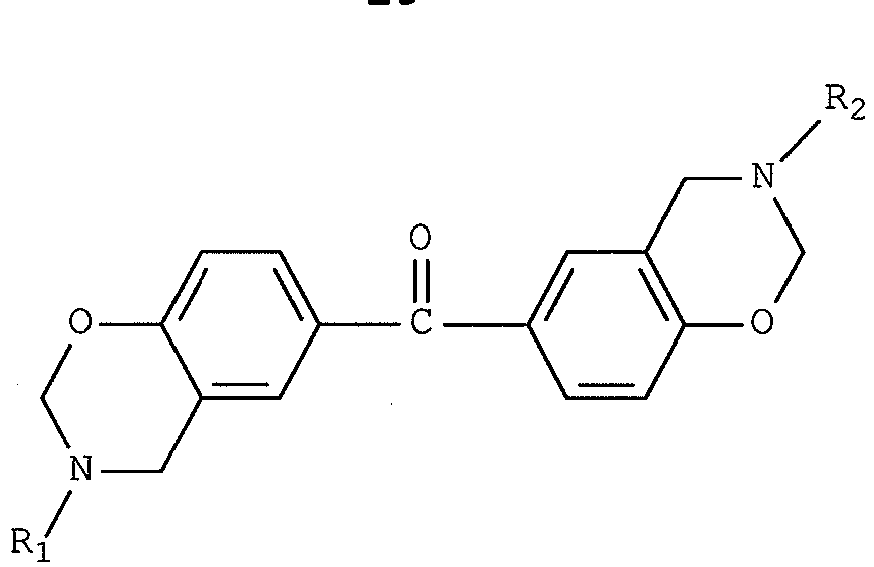


- Though not embraced by either of oxazine structures I or II additional oxazines may be embraced by the following structures:


- Specific examples of these oxazines therefore include:


- The oxazine component may include the combination of multifunctional oxazines and monofunctional oxazines. Examples of monofunctional oxazines may be embraced by the following structure:

- As the oxazoline, compounds embraced by the following structure are suitable,

- Exemplary compounds have the structure

- The oxazoline compounds include 4,4',5,5'-tetrahydro-2, 2'-bis-oxazole, 2,2'-bis(2-oxazoline); a 2,2'-(alkanediyl) bis [4,4-dihydrooxazole], e.g. , 2,2'-(2,4-butanediyl) bis [4,5-dihydrooxazole] and 2,2'-(1,2-ethanediyl) bis [4,5-dihydrooxazole]; a 2,2'-(arylene) bis [4,5-dihydrooxazole]; e.g. 2,2'-(1,4-phenylene)bis (4,5-dihydrooxazole], 2,2'-(1,5-naphthalenyl) bis (4,5-dihydrooxazole], 2,2'-(1,3-phenylene) bis [4, 5-dihydrooxazole), and 2,2'-(1,8-anthracenyl) bis [4,5-dihydrooxazole; a sulfonyl, oxy, thio or alkylene bis 2-(arylene) [4,5-dihydrooxazole, e.g. sulfonyl bis 2-(1,4-phenylene) [4,5-dihydrooxazole], thio bis 2,2'-(1, 4-phenylene) [4,5-dihydrooxazole] and methylene bis 2, 2'-(1,4-phenylene) [4,5-dihydrooxazole]; a 2,2',2"-(1,3,5-arylene) tris[4,5-dihydrooxazole], e.g., 2,2',2"-tris (4,5-dihydrooxazole]1,3,5-benzene; a poly [(2-alkenyl) 4,5-hydrooxazole], e.g., poly[2-(2-propenyl)4,5-dihydrooxazole], and others and mixtures thereof.
- In some embodiments, the oxazoline compounds will have the following structures.

- In general, a large number of polyepoxides having at least about two 1,2-epoxy groups per molecule are suitable for use herein. The polyepoxides may be saturated, unsaturated, cyclic or acyclic, alipha-tic, alicyclic, aromatic or heterocyclic polyepoxide compounds. Examples of suitable polyepoxides include the polyglycidyl ethers, which are prepared by reaction of epichlorohydrin or epibromohydrin with a polyphenol in the presence of alkali. Suitable polyphenols therefor are, for example, resorcinol, pyrocatechol, hydroquinone, bisphenol A (bis(4-hydroxyphenyl)-2,2-propane), bisphenol F (bis(4-hydroxyphenyl)-methane), bisphenol S, biphenol, bis(4-hydroxyphenyl)-1,1-isobutane, 4,4'-dihydroxy-benzophenone, bis(4-hydroxyphenyl)-1,1-ethane, and 1,5-hydroxy-naphthalene. Other suitable polyphenols as the basis for the polyglycidyl ethers are the known condensation products of phenol and formaldehyde or acetaldehyde of the novolak resin-type.
- Other polyepoxides that are in principle suitable for use herein are the polyglycidyl ethers of polyalcohols or diamines. Such polyglycidyl ethers are derived from polyalcohols, such as ethylene glycol, diethylene glycol, triethylene glycol, 1,2-propylene glycol, 1,4-butylene glycol, triethylene glycol, 1,5-pentanediol, 1,6-hexanediol or trimethylolpropane.
- Still other polyepoxides are polyglycidyl esters of polycarboxylic acids, for example, reaction products of glycidol or epichlorohydrin with aliphatic or aromatic polycarboxylic acids, such as oxalic acid, succinic acid, glutaric acid, terephthalic acid or a dimeric fatty acid.
- And still other epoxides are derived from the epoxidation products of olefinically-unsaturated cycloaliphatic compounds or from natural oils and fats.
- Particularly desirable are liquid epoxy resins derived from the reaction of bisphenol A or bisphenol F and epichlorohydrin. The epoxy resins that are liquid at room temperature generally have epoxy equivalent weights of from 150 to about 480.
- Typically, the thermosetting resin composition may contain from about 25 to about 55 weight percent, such as from about 30 to about 50 weight percent of epoxy.
- The composition may include as at least a portion of the epoxy component a reactive diluent such as a monoepoxide (e.g., monoglycidyl ethers of alkyl- and alkenyl-substituted phenols).
- In addition to epoxy, episulfide is desirable as well, whether they are full or partial episulfides, provided that they are in the solid state. Episulfides may be commercially available or readily prepared from the corresponding epoxy through known synthetic methods.
- The resin component may also include one or more of cyanate ester, maleimide, nadimide, itaconimide, phenolic and/or thiophenolic.
- The resin component should be present in the thermosetting resin composition in an amount in the range of about 5 to about 60 percent by weight, such as about 10 to about 50 percent by weight, desirably about 15 to about 35 percent by weight, based on the total weight of the composition.
- In one version, the thermosetting resin composition may also include a toughener. One such toughener is an acrylonitrile-butadiene co-polymer having secondary amine terminal groups. Other tougheners may include poly(propylene) oxide; polyether sulfone, such as PES 5003P, available commercially from Sumitomo Chemical Company, Japan; carboxy-terminated acrylonitrile butadienes; hydroxy-terminated acrylonitrile butadienes; core shell polymers; and BLENDEX 338, SILTEM STM 1500 and ULTEM 2000, which are available commercially from General Electric Company. ULTEM 2000 (CAS Reg. No. 61128-46-9) is a polyetherimide having a molecular weight ("Mw") of about 30,000 ± 10,000. Those available commercially from Zeon Chemicals under the tradename NIPOL are also desirable. Of the NIPOL branded rubbers, acrylonitrile polybutadiene rubbers are particularly desirable.
- When used, the toughener component should be present in the thermosetting resin component in an amount in the range of about 1 to about 90 percent by weight, such as about 10 to about 70 percent by weight, desirably about 15 to about 30 percent by weight, based on the total weight of the composition.
- The curing agent may be selected from nitrogen-containing compounds such as amine compounds, amide compounds, imidazole compounds, guanidine compounds, urea compounds and derivatives and combinations thereof.
- For instance, the amine compounds may be selected from, aliphatic polyamines, aromatic polyamines, alicyclic polyamines and combinations thereof.
- The amine compounds may be selected from diethylenetriamine, triethylenetetramine, diethylaminopropylamine, xylenediamine, diaminodiphenylamine, isophoronediamine, menthenediamine and combinations thereof.
- In addition, modified amine compounds, may be used, which include epoxy amine additives formed by the addition of an amine compound to an epoxy compound, for instance, novolac-type resin modified through reaction with aliphatic amines.
- The imidazole compounds may be selected from imidazole, isoimidazole, alkyl-substituted imidazoles, and combinations thereof. More specifically, the imidazole compounds are selected from 2-methyl imidazole, 2-ethyl-4-methylimidazole, 2,4-dimethylimidazole, butylimidazole, 2-heptadecenyl-4-methylimidazole, 2-undecenylimidazole, 1-vinyl-2-methylimidazole, 2-n-heptadecylimidazole, 2-undecylimidazole, 1-benzyl-2-methylimidazole, 1-propyl-2-methylimidazole, 1-cyanoethyl-2-methylimidazole, 1-cyanoethyl-2-ethyl-4-methylimidazole, 1-cyanoethyl-2-undecylimidazole, 1-cyanoethyl-2-phenylimidazole, 1-guanaminoethyl-2-methylimidazole and addition products of an imidazole and trimellitic acid, 2-n-heptadecyl-4-methylimidazole, aryl-substituted imidazoles, phenylimidazole, benzylimidazole, 2-methyl-4,5-diphenylimidazole, 2,3,5-triphenylimidazole, 2-styrylimidazole, 1-(dodecyl benzyl)-2-methylimidazole, 2-(2-hydroxyl-4-t-butylphenyl)-4,5-diphenylimidazole, 2-(2-methoxyphenyl)-4,5-diphenylimidazole, 2-(3-hydroxyphenyl)-4,5-diphenylimidazole, 2-(p-dimethylaminophenyl)-4,5-diphenylimidazole, 2-(2-hydroxyphenyl)-4,5-diphenylimidazole, di(4,5-diphenyl-2-imidazole)-benzene-1,4, 2-naphthyl-4,5-diphenylimidazole, 1-benzyl-2-methylimidazole, 2-p-methoxystyrylimidazole, and combinations thereof.
- Modified imidazole compounds may be used as well, which include imidazole adducts formed by the addition of an imidazole compound to an epoxy compound.
- Guanidines, substituted guanidines, substituted ureas, melamine resins, guanamine derivatives, cyclic tertiary amines, aromatic amines and/or mixtures thereof. The hardeners may be involved stoichiometrically in the hardening reaction; they may, however, also be catalytically active. Examples of substituted guanidines are methyl-guanidine, dimethylguanidine, trimethylguanidine, tetra-methylguanidine, methylisobiguanidine, dimethylisobiguanidine, tetramethyliso-biguanidine, hexamethylisobiguanidine, heptamethylisobiguani-dine and cyanoguani-dine (dicyandiamide). Representative guanamine derivatives include alkylated benzoguan-amine resins, benzoguanamine resins and methoxymethylethoxy-methylbenzoguanamine.
- In addition to or instead of the above-mentioned hardeners, catalytically-active substituted ureas may be used. For instance, p-chlorophenyl-N,N-dimethylurea (monuron), 3-phenyl-1,1-dimethylurea (fenuron) or 3,4-dichlorophenyl-N,N-dimethylurea (diuron) are representative examples.
- The amount of curing agent may depend upon a number of factors, including whether the curing agent acts as a catalyst or participates directly in crosslinking of the composition, the concentration of epoxy groups and other reactive groups in the composition, the desired curing rate and the like.
- The curing agent should be present in an amount in the range of about 0.01 to about 40 percent by weight, such as about 0.5 to about 20 percent by weight, desirably about 1 to about 15 percent by weight, based on the total weight of the composition.
- Expandable microspheres capable of expanding volume when exposed to elevated temperature conditions. are also provided The microspheres may be included as a component in the thermosetting resin composition, or contacted with the fibers or preform, or both.
- As regards expandable microspheres,
U.S. Patent No. 7,368,167 (Johnston ), is directed to and discloses expandable microspheres, more specifically dry, free-flowing expanded thermoplastic clad microspheres, where the thermoplastic is a polymer material, which functions as a vapor barrier to a blowing agent at the temperatures and pressure differentials of expansion of the microsphere, has Tg values of at least about 50°C and a density of from less than 0.0145 g/cm3 to about 0.005 g/cm3. When exposed to elevated temperature conditions, expandable microspheres, rupture to release a blowing agent. See alsoU.S. Patent Nos. 5,180,752 and5,580, 656 . A particularly desirable expandable microsphere is manufactured by Henkel Corporation, and is a polyvinylidene chloride-acrylonitrile copolymer or polyacrylonitrile homopolymer microsphere with an inclusion of iso-butane as the blowing agent. - Microspheres are made from polyvinylidene chloride homopolymer or a random copolymer of vinylidene chloride and acrylonitrile, or a random terpolymer of polyvinylidene chloride, acrylonitrile, and divinyl benzene.
- A wide variety of blowing agents can be employed in expandable microspheres. For instance, lower alkanes, particularly propane, butane, pentane, and mixtures thereof may be used. Blowing agents such as the Freons, such as trichlorofluoromethane, hydrocarbons such as the pentanes or butanes, like n-pentane, i-pentane, neo-pentane, butane, i-butane are commonly found in these types of in situ-expandable particles. Typically, the unexpanded particles contain from about 3 to about 40 weight % blowing agent. The selection of the blowing agent is a function of the particular thermoplastic polymer employed. Isobutene is often used as the blowing agent with polyvinylidene chloride-acrylonitrile copolymer microspheres.
- In unexpanded form, the microspheres can be made in a variety of sizes, those readily available in commerce being most often on the order of 2 to 100 µm, particularly 10 to 30 µm. When expanded, these materials will have bead diameters on the order of about 10 to 300 µm, most commonly about 50 to 250 µm, and most often about 100 to 200 µm. Microspheres can be made from as small as about 0.1 µm, up to as large as about 1 millimeter, in diameter, before expansion.
- When the microspheres are expanded, they are typically enlarged in diameter by a factor of 7 to 15, and even 20 times the diameter of the unexpanded beads, giving rise to a displacement expanded density, when dry, as low as less than 0.015 g/cm3, preferably less than 0.0145 g/cm3, and down to 0.005 g/cm3.
-
U.S. Patent No. 5,397,611 (Wong ) reports that the thermoplastic polymer used in forming the in situ-expandable thermoplastic particles are readily prepared from a wide variety of materials. - Expandable thermoplastic resin microspheres (which can comprise, for example, volatile physical blowing agents such as hydrocarbons or halocarbons encapsulated in thermoplastic shells) may also be employed to render the resin foamable. The thermoplastic shells may be comprised of acrylic-type resins such as polymethylmethacrylate, acrylic-modified polystyrene, polyvinylidene chloride, styrene/MMA copolymers and the like. Particularly desirable expandable microspheres are available from Akzo Nobel, NL under the trademark EXPANCEL or from Henkel Corporation under the trademark DUALITE.
- The particle size of the unexpanded particles, as well as the expanded microspheres can vary widely. Particle sizes for the unexpanded particles can range, for example, from about 1 µm to about 1 mm, such as from about 2 µm to about 0.5 mm. For instance, DUALITE-branded expandable microspheres can range in unexpanded particle size from about 5 µm to about 50 µm. The particle diameters expand 2 to 5 times.
- Preferably, the particles used have a mixed particle size of wide spread to achieve the best packing, on expansion, in the syntactic molded foam. A desirable in situ-expandable particle is EXPANCEL 091 DU, which is believed to be a terpolymer of vinylidene chloride, acrylonitrile and methacrylonitrile containing 10-18 weight % isopentane, and possesses the following properties: average unexpanded particle size of about 12 µm with a spread of about 5-50 µm, true density (expanded in water at 100°C, kg/m), <20; TMA-T(start)°C, 125-130; T(max)°C, about 183; TMA-density,kg/m3, <17.
- When mixed into thermosetting resin compositions the microspheres as agent capable of expanding should be used in an amount of 0.0005% to 5%, such as 0.001% to 10%, like 0.1% to 5%, desirably 0.5% to 1% by weight of the fiber weight. The thermosetting resin composition is then infused into the fiber performs as a liquid or a solid film into the coated dry fiber performs, under pressure or vacuum into a mold or vacuum bag when the thermosetting resin composition applied to or contacted with the fibers or the preform. The agent can also be applied into a thermosetting matrix resin (such as one containing an epoxy, a phenolic or a benzoxazine), which is then impregnated into dry fibers tows or fabrics made with materials such as carbon and glass, to form a prepreg. Or, the agent can be pre-coated onto dry fiber tows or fabrics of materials such as carbon or glass before impregnation by the thermosetting matrix resin. The agent can also be applied directly onto the surface of the prepregs with the thermosetting matrix resin and fibers or fabrics. The weight percent of the agent in the prepreg should be in the range from 0.001% to 10% by weight of the fiber weight.
- The agent as noted may be mixed with the thermosetting resin composition or applied to or contacted with the fibers or the preform. The application at the fibers or preform may occur by mixing the agent with a carrier vehicle and then spraying the mixture onto the fibers or preform.
- The agent may also be coated onto a preform or into a mold as a separate layer. As a separate layer onto the preform in a closed mold, the agent provides positive pressure onto the laminate to enhance consolidation, reduce the effects of cure shrinkage, reduce cure stress, reduce imperfection and void volume, and increase fiber volume and improve resin-fiber wetting. Typically consolidation pressure is provided by autoclave or a press, ordinarily in the range of up to 689,48 Kpa (100 psi) . Even when such external pressure is increased beyond 689,48 Kpa (100 psi), the resin may not see such pressure as the fibers begin to bear the load. And the resin fluid pressure can be further reduced as curing occurs and shrinkage is observed.
- In building a large composite part where one or more temperature gradient(s) exist(s) at various locations within the part, low fluid pressure at cure can occur at the temperature lagging areas, resulting in poor wetting and poor composite properties. In addition, when low viscosity and high volatile thermosetting resins (such as some liquid benzoxazines) are used in closed mold infusion, resin volatilization within the mold during the process may create imperfection/micro-voids in the formed laminate. Using a catalyst to control volatilization may adversely affect mechanical properties and injection process window.
- The expandable layer may be in solid or flowable form, and contains an expandable agent in an amount of 0.1 up to nearly 100% based on the weight of the layer. The expandable agent in the expandable layer is temperature-activated, and capable of expanding from 1-10000% at activation temperature, which ordinarily is from 25-190°C. The form and the thickness of the layer is adjustable to accommodate various mold geometries. The expandable layer may be applied onto the fiber preform. After the laminate is cured, does not become a part thereof and can be removed. During cure of the laminate in a closed mold process (such as RTM), the agent in the expandable layer begins to expand (at a temperature below which the thermosetting resin composition starts to cure) and exerts positive pressure onto the resin (typically before the resin reaches gelation). As the activation temperature of the expandable layer is typically below the temperature at which the resin begins to gel, a positive fluid pressure in the resin is maintained throughout the gelation of the resin. In this way, improved laminate fiber consolidation, fiber volume, fiber wetting, and laminate mechanical properties may be realized. The effects of resin cure shrinkage, laminate porosity, and void volume may also be reduced.
- In addition, out of autoclave cure (with a vacuum bag pressure or 95.53 Kpa [14.7 psi] of pressure) may be realized using the invention so described herein.
- In the performance hereof, better fiber consolidation and compaction; better resin and fiber adhesion leading to better mechanical performance, such as: impact toughness and interlaminar properties, improved thermal cycling and durability; reduced thermal stress; reduced cure shrinkage; and/or improved surfacing quality, may be observed.
- A resin for use in an RTM process is set forth in the table below, with Sample No. 2 representing a resin in accordance with the invention (with expandable microspheres) and Sample No. 1 representing a control (without expandable microspheres).
Component Sample No./ Amt. (Wt. %) 1 2 Oxazine 74 74 Epoxy Resin 25 24.5 Diethylamine salt of trifluoromethanesulfonic acid* 1 1 EXPANCEL 091 DU 80 -- 0.5 * NACURE SUPER A223 - The formulation so formed may be used in a RTM process as follows:
- Preheat the formulation to a temperature of 71,11 °C (160 °F)
- Insert a preform into a closed mold
- Preheat the mold to a temperature of 121,11 °C (250 °F)
- Apply vacuum to the mold for a period of time of 1 hour to remove volatile from the preform
- Preheat resin injector to a temperature of 112,78 °C (235 °F)
- Add the preheated formulation to the injector
- When the formulation equilibrates at a temperature of 121, 11 °C (250 °F), apply full vacuum for a period of time of 15 minutes to remove air
- Release the vacuum
- Inject the formulation at about the rate of 5 to 200 cc per minute using about 137.89 Kpa (20 psi) injection pressure, which may be increased, if desired throughout the injection to maintain the desired flow rate
- When the preform is fully impregnated, close the mold resin exit ports
- Pressurize the tool to 689,48 Kpa (100 psi) and hold at that pressure for a period of time of about 10 minutes
- Ramp the mold temperature to : 176, 67 °C (350 °F) at 3 °C (3 °F) per minute
- When formulation has gelled, remove the applied pressure
- Hold at a temperature of : 176,67 °C (350 °F) for a period of time of 3 hours
- Cool to a temperature of : 48,89 °C (120 °F)
- Open the mold and remove the cured part.
- A resin for use in a prepregging process with fiber with the noted components in the specified amount is set forth in the table below.
Component Sample No./ Amt. (Wt. %) 3 4 Oxazine 54 54 Epoxy Resin 18 18 Core Shell 5 5 Epoxy-terminated epoxy adduct* 10 10 Diethylamine salt of trifluoromethanesulfonic acid 0.5 0.5 EXPANCEL 091 DU 80 -- 0.5 Defoamer 0.5 -- RADEL 105 SFP 12 12 NIPOL 0.3 0.3 * epoxy terminated adduct of two different epoxy materials using bisphenol A as a linking portion. - Products formed by the so-described processes that use agents capable of expanding, show improved surface finished and decreased voiding.
- For RTM, compression after impact analysis showed CAI of 201 Mpa for Sample No. 1 (without expandable microspheres) as compared with 224 for Sample No. 2 (with 0.5% expandable microspheres).
- For prepreg, compression after impact analysis showed CAI of 253 Mpa for Sample No. 3 (without expandable microspheres) as compared with 276 for Sample No. 4 (with 0.5% expandable microspheres in the matrix resin). In addition, inplane shear strength ("IPS") of 125 Mpa for Sample No. 3 was observed as compared with 134 Mpa for Sample No. 4.
- Reduced residual stress of the cured composite (e.g., cured prepreg or RTM) is also seen.
- A film layer was made from a composition whose components include bisphenol-A based epoxy resins, epoxy adduct, hydrophobic fumed silica, 4,4-diaminodiphenyl sulfone and dicyandiamide, which were blended together and then cast into a film having a thickness of 0.1 mm was formed with 10% by weight of EXPANCEL 091 DU 80 as an expandable agent.
- The film layer so prepared was then coated onto a 0.02 mm thick TEFLON release substrate.
- The so prepared film (i.e., film layer/release substrate) was applied onto a dry fiber preform in a closed mold, prior to infusion by the RTM resin -- Sample No. 1. And a control run was made without the film. The dry fiber preform consists of 24 plies of dry standard modulus carbon fabrics, plain weave 3K. The RTM process was allowed to proceed, with the RTM resin infused into the mold and a curing temperature set at 180 °C (356 °F) for a period of time of 2 hours.
- The composite or laminate part formed without the film layer resulted in a part having a fiber volume of 55-58% with visually observable surface porosity along the edges of the cured composite or laminate part.
- In contrast, the composite or laminate part formed with the film which was then removed, resulted in a part having a fiber volume of 60% without observable surface porosity along the edges of the cured composite or laminate part, or anywhere on the part for that matter.
Claims (15)
- A resin transfer molding process, steps of which comprise:(a) providing a thermosetting resin composition into a closed mold containing a preform;(b) exposing the interior of the mold to a first elevated temperature and elevated pressure sufficient to wet the preform with the thermosetting resin composition; and(c) curing the thermosetting resin composition-impregnated preform within the mold at a second elevated temperature to form a resin transfer molded product,wherein the thermosetting resin composition comprises (i) an oxazine component, and wherein at least one of the thermosetting resin composition or the preform includes a plurality of expandable microspheres made from a homopolymer of polyvinylidene chloride, a random copolymer of vinylidene chloride and acrylonitrile, or a random terpolymer of polyvinylidene chloride, acrylonitrile, and divinyl benzene.
- The resin transfer molding process of Claim 1, wherein the thermosetting resin composition has a viscosity in the range of 10 to 3000 centipoise at the resin injection temperature.
- A resin transfer molded product made by the process of Claims 1 or 2.
- A vacuum assisted resin transfer molding process, steps of which comprise:(a) providing a preform into a mold;(b) providing a thermosetting resin composition into the mold under a first elevated temperature and under vacuum for a time sufficient to allow the composition to wet the preform; and(c) exposing the mold containing the composition wetted-preform to a second elevated temperature while under vacuum sufficient to cure the thermosetting resin composition wetted-preform within the mold to form a resin transfer molded product,wherein the thermosetting resin composition comprises (i) a oxazine component, and wherein at least one of the preform or the thermosetting resin composition includes a plurality of expandable microspheres made from a homopolymer of polyvinylidene chloride, a random copolymer of vinylidene chloride and acrylonitrile, or a random terpolymer of polyvinylidene chloride, acrylonitrile, and divinyl benzene.
- The vacuum assisted resin transfer molding process of Claim 4, wherein after providing the preform a dispersing medium is provided thereover.
- The vacuum assisted resin transfer molding process of Claim 4, wherein the thermosetting resin composition has a viscosity in the range of 10 to 2000 centipoise at transfer molding temperature.
- A vacuum assisted resin transfer molded product made by the process of Claims 4-6.
- A resin film infusion process, steps of which comprise:(a) providing a preform into a closed mold containing a thermosetting resin composition in film form;(b) exposing the interior of the mold to a first elevated temperature and optionally vacuum, while the exterior of the mold is exposed to an elevated pressure, for a time sufficient to infuse the preform with the thermosetting resin composition; and(c) curing the thermosetting resin composition- infused preform within the mold at a second elevated temperature to form a resin transfer molded product,wherein the thermosetting resin composition comprises (i) a oxazine component, and wherein each of the preform and the thermosetting resin composition in film form includes a plurality of expandable microspheres made from a homopolymer of polyvinylidene chloride, a random copolymer of vinylidene chloride and acrylonitrile, or a random terpolymer of polyvinylidene chloride, acrylonitrile, and divinyl benzene.
- The process of Claims 1, 4 or 8, wherein the thermosetting resin composition further comprises (ii) a toughener component.
- The resin film infusion process of Claim 8, wherein the thermosetting resin composition has a viscosity in the range of 10 to 5000 centipoise at the infusion temperature.
- A resin film infused product made by the process of Claims 8 to 10.
- A process for producing a prepreg, steps of which comprise:(a) providing a layer of fibers;(b) providing a thermosetting resin composition in liquid form;(c) passing the layer of fibers through the liquid thermosetting resin composition to infuse the layer of fibers with the thermosetting resin composition thereby forming a prepreg assembly; and(d) removing excess thermosetting resin composition from the prepreg assembly,wherein thermosetting resin composition comprises (i) a oxazine component, and wherein at least one of the layer of fibers or the thermosetting resin composition includes a plurality of expandable microspheres made from a homopolymer of polyvinylidene chloride, a random copolymer of vinylidene chloride and acrylonitrile, or a random terpolymer of polyvinylidene chloride, acrylonitrile, and divinyl benzene.
- The process of Claim 12, wherein the prepreg assembly is exposed to elevated temperature and pressure conditions.
- A prepreg made by the process of Claim 12.
- Cured reaction product of the prepreg of Claim 14.
Applications Claiming Priority (3)
| Application Number | Priority Date | Filing Date | Title |
|---|---|---|---|
| US32362910P | 2010-04-13 | 2010-04-13 | |
| US38579310P | 2010-09-23 | 2010-09-23 | |
| PCT/US2011/032003 WO2011130188A2 (en) | 2010-04-13 | 2011-04-12 | Curable compositions, processes for using such compositions to prepare composites and processes for preparing composites having superior surface finish and high fiber consolidation |
Publications (3)
| Publication Number | Publication Date |
|---|---|
| EP2558266A2 EP2558266A2 (en) | 2013-02-20 |
| EP2558266A4 EP2558266A4 (en) | 2017-09-06 |
| EP2558266B1 true EP2558266B1 (en) | 2020-10-21 |
Family
ID=44799265
Family Applications (1)
| Application Number | Title | Priority Date | Filing Date |
|---|---|---|---|
| EP11769389.5A Not-in-force EP2558266B1 (en) | 2010-04-13 | 2011-04-12 | Processes for preparing composites having superior surface finish and high fiber consolidation |
Country Status (6)
| Country | Link |
|---|---|
| US (2) | US9168703B2 (en) |
| EP (1) | EP2558266B1 (en) |
| JP (2) | JP6253979B2 (en) |
| CN (2) | CN103201079B (en) |
| ES (1) | ES2851010T3 (en) |
| WO (1) | WO2011130188A2 (en) |
Families Citing this family (16)
| Publication number | Priority date | Publication date | Assignee | Title |
|---|---|---|---|---|
| CN102876280A (en) * | 2012-08-31 | 2013-01-16 | 西北工业大学 | Cyanate ester/bis-oxazoline thermostable adhesive and preparation method thereof |
| US9427943B2 (en) * | 2013-03-15 | 2016-08-30 | Henkel IP & Holding GmbH | Prepreg curing process for preparing composites having superior surface finish and high fiber consolidation |
| EP3095577B1 (en) * | 2014-01-17 | 2023-07-26 | Toray Industries, Inc. | Process for producing a coated fiber-reinforced resin molded article |
| CN107108827B (en) * | 2014-12-29 | 2020-09-04 | 塞特工业公司 | Benzoxazine and composition containing benzoxazine |
| CN106317770A (en) * | 2015-07-08 | 2017-01-11 | 深圳光启创新技术有限公司 | Prepreg, preparation method of prepreg and composite material |
| DE102015012242B4 (en) * | 2015-09-18 | 2019-06-19 | Leonhard Kurz Stiftung & Co. Kg | Method and device for producing a laminated with a laminate 3D substrate |
| CN108368281B (en) | 2015-12-10 | 2021-10-26 | 三菱化学株式会社 | Tow prepreg, composite material-reinforced pressure vessel, and method for producing composite material-reinforced pressure vessel |
| US10279519B2 (en) | 2015-12-30 | 2019-05-07 | The United States Of America, As Represented By The Secretary Of The Navy | Mold assembly and method of molding a component |
| IT201700024675A1 (en) * | 2017-03-06 | 2018-09-06 | Tryonic Ltd | "Hot stamping method" |
| CN108819378A (en) * | 2018-06-28 | 2018-11-16 | 西安工程大学 | A method of cowboy's fibre reinforced composites are prepared using denim |
| FI130116B (en) | 2018-09-21 | 2023-03-03 | Woodio Oy | Process for the production of shaped products |
| WO2020198143A1 (en) * | 2019-03-25 | 2020-10-01 | Zephyros, Inc. | Dual expanding foam for closed mold composite manufacturing |
| CN114258414B (en) * | 2019-08-26 | 2024-07-23 | 阿克佐诺贝尔国际涂料股份有限公司 | In-mold composite mask |
| CN112519269A (en) * | 2019-09-19 | 2021-03-19 | 山东非金属材料研究所 | Method for forming fiber reinforced resin matrix composite material |
| JP7283435B2 (en) | 2020-04-27 | 2023-05-30 | トヨタ自動車株式会社 | High-pressure tank manufacturing method, high-pressure tank |
| EP4306577A1 (en) * | 2022-07-11 | 2024-01-17 | Fundación IMDEA Materiales | A composite with a vitrimer-based foaming core and its application in preparing recyclable and curved sandwich structures |
Family Cites Families (54)
| Publication number | Priority date | Publication date | Assignee | Title |
|---|---|---|---|---|
| US3674585A (en) * | 1969-10-07 | 1972-07-04 | Windecker Research Inc | Method of making an aircraft wing structure |
| US3676288A (en) * | 1970-05-04 | 1972-07-11 | Kendall & Co | Low-density bonded nonwoven fabrics and process therefor |
| JPS5941537U (en) * | 1982-09-10 | 1984-03-17 | 日立電線株式会社 | Fire prevention tape or sheet |
| DE3433851C2 (en) | 1984-09-14 | 1987-01-08 | Gurit-Essex Ag, Freienbach | Chemically curable resins from compounds containing 1-oxa-3-aza-tetralin groups and cycloaliphatic epoxy resins, processes for their preparation and use of such resins |
| NL8500242A (en) * | 1985-01-29 | 1986-08-18 | Firet Bv | METHOD FOR MANUFACTURING A FIBER FLUSH INCLUDING MICROBOLLES. |
| US4952135A (en) * | 1988-05-23 | 1990-08-28 | Shell Oil Company | Apparatus for reduction of mold cycle time |
| ES2088905T3 (en) | 1988-07-18 | 1996-10-01 | Gurit Essex Ag | HARDENABLE RESINS FOR FORMING PLASTICS HARDLY FLAMMABLE AND RESISTANT TO HIGH TEMPERATURES AND PROCEDURES FOR THEIR MANUFACTURE. |
| US5180752A (en) | 1990-03-08 | 1993-01-19 | Pierce & Stevens Corporation | Process for making dry microspheres |
| JPH0420650U (en) | 1990-06-04 | 1992-02-20 | ||
| EP0493310A1 (en) | 1990-12-21 | 1992-07-01 | Gurit-Essex AG | Curable resin compositions having flame resistant properties in the cured state and use thereof |
| JPH0772233B2 (en) * | 1991-02-19 | 1995-08-02 | 日本ゼオン株式会社 | Epoxy resin type foamable composition |
| US5234757A (en) | 1991-04-30 | 1993-08-10 | The Dexter Corporation | Expandable films and molded products therefrom |
| JP3148298B2 (en) * | 1991-09-02 | 2001-03-19 | 帝人株式会社 | Manufacturing method of lightweight composite molding |
| JP3274487B2 (en) * | 1992-01-30 | 2002-04-15 | 東レ・ダウコーニング・シリコーン株式会社 | Foamable silicone rubber composition and method for producing silicone rubber foam |
| JPH05329976A (en) * | 1992-05-27 | 1993-12-14 | Nippon Oil Co Ltd | Composite material and manufacturing method thereof |
| US5439635A (en) | 1993-02-18 | 1995-08-08 | Scrimp Systems, Llc | Unitary vacuum bag for forming fiber reinforced composite articles and process for making same |
| US5369192A (en) | 1993-06-28 | 1994-11-29 | Minnesota Mining And Manufacturing Company | Binder resin for resin transfer molding preforms |
| US5445911A (en) | 1993-07-28 | 1995-08-29 | Hewlett-Packard Company | Chelating positive charge director for liquid electrographic toner |
| US5783272A (en) * | 1993-08-10 | 1998-07-21 | Dexter Corporation | Expandable films and molded products therefrom |
| US5480603A (en) | 1994-05-19 | 1996-01-02 | The Dow Chemical Company | Method for preparing preforms for molding processes |
| US5773121A (en) * | 1994-07-29 | 1998-06-30 | Isorca Inc. | Syntactic foam core incorporating honeycomb structure for composites |
| US5569508A (en) | 1995-01-03 | 1996-10-29 | The Boeing Company | Resin transfer molding with honeycomb core and core filler |
| US5567499A (en) | 1995-01-03 | 1996-10-22 | The Boeing Company | Resin transfer molding in combination with honeycomb core |
| US5677048A (en) | 1996-03-04 | 1997-10-14 | Gateway Technologies, Inc. | Coated skived foam and fabric article containing energy absorbing phase change material |
| US5902535A (en) | 1997-07-30 | 1999-05-11 | Mcdonnell Douglas Corporation | Resin film infusion mold tooling and molding method |
| JPH11302614A (en) * | 1998-04-23 | 1999-11-02 | Nitto Denko Corp | Heat release adhesive sheet |
| US6207786B1 (en) | 1998-11-10 | 2001-03-27 | Edison Polymer Innovation Corporation | Ternary systems of benzoxazine, epoxy, and phenolic resins |
| ATE385525T1 (en) * | 1998-12-16 | 2008-02-15 | Lantor Bv | CORE MATERIAL FOR CLOSED MOLDING SYSTEMS |
| JP2000351947A (en) * | 1999-06-14 | 2000-12-19 | Nitto Denko Corp | Heat release adhesive sheet |
| JP2001150465A (en) * | 1999-11-30 | 2001-06-05 | Toyota Motor Corp | Method and apparatus for manufacturing hollow molded article |
| JP4734729B2 (en) * | 2000-02-23 | 2011-07-27 | 東レ株式会社 | Intermediate for molding composite material and fiber reinforced composite material |
| US7268190B2 (en) * | 2001-08-03 | 2007-09-11 | Toray Industries, Inc. | Resin composition comprising polylactic acid and polyacetal and a molded article, film, and fiber each comprising the same |
| JP4458739B2 (en) * | 2002-07-31 | 2010-04-28 | 東邦テナックス株式会社 | Manufacturing method of molded products |
| JP2004115638A (en) * | 2002-09-26 | 2004-04-15 | Sumitomo Bakelite Co Ltd | Resin composition, prepreg, and laminated sheet |
| CN1194848C (en) * | 2002-10-09 | 2005-03-30 | 天津大学 | Manufacture method of three-D weaved fibre reinforced polymer biological composite framework device |
| US20050042961A1 (en) * | 2003-08-18 | 2005-02-24 | Henkel Loctite Corporation | Curable compositions for advanced processes, and products made therefrom |
| JP4338550B2 (en) * | 2004-03-04 | 2009-10-07 | 東レ株式会社 | Method for manufacturing FRP structure |
| JP2005298713A (en) * | 2004-04-14 | 2005-10-27 | Toray Ind Inc | Epoxy resin composition for fiber reinforced composite material, prepreg and fiber reinforced composite material |
| US7368167B2 (en) | 2004-06-17 | 2008-05-06 | Henkel Corporation | Ultra low density thermally clad microspheres and method of making same |
| WO2006030951A1 (en) * | 2004-09-17 | 2006-03-23 | Toray Industries, Inc. | Resin composition and molded article comprising the same |
| JP2007016121A (en) * | 2005-07-07 | 2007-01-25 | Toray Ind Inc | Prepreg for composite material and composite material |
| CN101374910B (en) * | 2006-01-18 | 2012-02-22 | 帝人化成株式会社 | Resin composition, molded article and their production methods |
| CN100572037C (en) * | 2006-07-31 | 2009-12-23 | 中北大学 | Supercritical fluid assisted RTM resin injection machine |
| EP2081988B1 (en) * | 2006-11-13 | 2017-01-04 | Henkel IP & Holding GmbH | Benzoxazine compositions with core shell rubbers |
| CN101209588A (en) * | 2006-12-27 | 2008-07-02 | 积水化学工业株式会社 | Fiber-reinforced resin structure, its manufacturing device, and manufacturing method |
| JP2008239826A (en) * | 2007-03-27 | 2008-10-09 | Matsushita Electric Works Ltd | Method for producing resin film-laminated prepreg |
| JP2008246690A (en) * | 2007-03-29 | 2008-10-16 | Toho Tenax Co Ltd | Resin transfer molding method |
| ITBO20070506A1 (en) * | 2007-07-20 | 2009-01-21 | Delta Tech S R L | COMPOSITE MATERIAL AND METHOD FOR ITS REALIZATION |
| JP2009096874A (en) * | 2007-10-16 | 2009-05-07 | Japan Aerospace Exploration Agency | Thermosetting resin composition, cured product thereof and fiber-reinforced composite material |
| JP5171425B2 (en) * | 2007-10-22 | 2013-03-27 | 日東電工株式会社 | Heat-foaming type removable acrylic pressure-sensitive adhesive tape or sheet, and peeling method |
| KR20100126661A (en) * | 2008-02-04 | 2010-12-02 | 데이진 가부시키가이샤 | Resin composition and molded article |
| JP2009280669A (en) * | 2008-05-21 | 2009-12-03 | Toray Ind Inc | Rtm fiber-reinforced composite material and process for producing it |
| JP2010023317A (en) * | 2008-07-17 | 2010-02-04 | Toyota Motor Corp | Method and device for manufacturing hollow molded article |
| EP2323995B1 (en) * | 2008-08-14 | 2012-11-21 | Henkel AG & Co. KGaA | Polymerizable benzoxazine compositions |
-
2011
- 2011-04-12 WO PCT/US2011/032003 patent/WO2011130188A2/en not_active Ceased
- 2011-04-12 JP JP2013505025A patent/JP6253979B2/en active Active
- 2011-04-12 CN CN201180028937.4A patent/CN103201079B/en not_active Expired - Fee Related
- 2011-04-12 CN CN201510496363.3A patent/CN105108929B/en active Active
- 2011-04-12 EP EP11769389.5A patent/EP2558266B1/en not_active Not-in-force
- 2011-04-12 ES ES11769389T patent/ES2851010T3/en active Active
-
2012
- 2012-10-10 US US13/648,670 patent/US9168703B2/en active Active
-
2015
- 2015-08-03 JP JP2015153356A patent/JP6167145B2/en active Active
- 2015-09-21 US US14/859,586 patent/US20160009891A1/en not_active Abandoned
Non-Patent Citations (1)
| Title |
|---|
| None * |
Also Published As
| Publication number | Publication date |
|---|---|
| WO2011130188A2 (en) | 2011-10-20 |
| CN105108929B (en) | 2021-06-22 |
| EP2558266A4 (en) | 2017-09-06 |
| US20160009891A1 (en) | 2016-01-14 |
| US9168703B2 (en) | 2015-10-27 |
| JP2013527052A (en) | 2013-06-27 |
| JP6167145B2 (en) | 2017-07-19 |
| JP6253979B2 (en) | 2017-12-27 |
| JP2016026239A (en) | 2016-02-12 |
| US20130035013A1 (en) | 2013-02-07 |
| WO2011130188A3 (en) | 2012-04-19 |
| EP2558266A2 (en) | 2013-02-20 |
| CN105108929A (en) | 2015-12-02 |
| CN103201079B (en) | 2015-09-09 |
| ES2851010T3 (en) | 2021-09-02 |
| CN103201079A (en) | 2013-07-10 |
Similar Documents
| Publication | Publication Date | Title |
|---|---|---|
| US9168703B2 (en) | Curable compositions, processes for using such compositions to prepare composites and processes for preparing composites having superior surface finish and high fiber consolidation | |
| US6391436B1 (en) | Manufacture of void-free laminates and use thereof | |
| US8158724B2 (en) | Curable compositions for advanced processes, and products made therefrom | |
| JP6585027B2 (en) | Pre-preg curing method for preparing composite materials with excellent surface finish and high fiber compaction | |
| US20090209159A1 (en) | Toughened binder compositions for use in advanced processes | |
| JP2018517837A (en) | Rapid curing epoxy resin composition | |
| JP2018062669A (en) | Prepreg curing method for preparing composite material having excellent surface finish and high fiber consolidation | |
| JP7021216B2 (en) | Fiber reinforced plastic with serrated edges |
Legal Events
| Date | Code | Title | Description |
|---|---|---|---|
| PUAI | Public reference made under article 153(3) epc to a published international application that has entered the european phase |
Free format text: ORIGINAL CODE: 0009012 |
|
| 17P | Request for examination filed |
Effective date: 20121109 |
|
| AK | Designated contracting states |
Kind code of ref document: A2 Designated state(s): AL AT BE BG CH CY CZ DE DK EE ES FI FR GB GR HR HU IE IS IT LI LT LU LV MC MK MT NL NO PL PT RO RS SE SI SK SM TR |
|
| DAX | Request for extension of the european patent (deleted) | ||
| RAP1 | Party data changed (applicant data changed or rights of an application transferred) |
Owner name: HENKEL US IP LLC |
|
| RAP1 | Party data changed (applicant data changed or rights of an application transferred) |
Owner name: HENKEL IP & HOLDING GMBH |
|
| A4 | Supplementary search report drawn up and despatched |
Effective date: 20170803 |
|
| RIC1 | Information provided on ipc code assigned before grant |
Ipc: C08G 73/06 20060101ALI20170728BHEP Ipc: B29C 45/02 20060101AFI20170728BHEP Ipc: B29C 51/10 20060101ALI20170728BHEP |
|
| STAA | Information on the status of an ep patent application or granted ep patent |
Free format text: STATUS: REQUEST FOR EXAMINATION WAS MADE |
|
| STAA | Information on the status of an ep patent application or granted ep patent |
Free format text: STATUS: EXAMINATION IS IN PROGRESS |
|
| 17Q | First examination report despatched |
Effective date: 20190218 |
|
| REG | Reference to a national code |
Ref country code: DE Ref legal event code: R079 Ref document number: 602011069013 Country of ref document: DE Free format text: PREVIOUS MAIN CLASS: B29C0045020000 Ipc: B29C0070480000 |
|
| GRAP | Despatch of communication of intention to grant a patent |
Free format text: ORIGINAL CODE: EPIDOSNIGR1 |
|
| STAA | Information on the status of an ep patent application or granted ep patent |
Free format text: STATUS: GRANT OF PATENT IS INTENDED |
|
| RIC1 | Information provided on ipc code assigned before grant |
Ipc: B29C 44/12 20060101ALI20200225BHEP Ipc: C08L 9/04 20060101ALI20200225BHEP Ipc: B29C 70/48 20060101AFI20200225BHEP Ipc: C08G 59/40 20060101ALI20200225BHEP Ipc: B29C 70/66 20060101ALI20200225BHEP |
|
| INTG | Intention to grant announced |
Effective date: 20200318 |
|
| GRAJ | Information related to disapproval of communication of intention to grant by the applicant or resumption of examination proceedings by the epo deleted |
Free format text: ORIGINAL CODE: EPIDOSDIGR1 |
|
| STAA | Information on the status of an ep patent application or granted ep patent |
Free format text: STATUS: EXAMINATION IS IN PROGRESS |
|
| INTC | Intention to grant announced (deleted) | ||
| GRAR | Information related to intention to grant a patent recorded |
Free format text: ORIGINAL CODE: EPIDOSNIGR71 |
|
| GRAS | Grant fee paid |
Free format text: ORIGINAL CODE: EPIDOSNIGR3 |
|
| STAA | Information on the status of an ep patent application or granted ep patent |
Free format text: STATUS: GRANT OF PATENT IS INTENDED |
|
| GRAA | (expected) grant |
Free format text: ORIGINAL CODE: 0009210 |
|
| STAA | Information on the status of an ep patent application or granted ep patent |
Free format text: STATUS: THE PATENT HAS BEEN GRANTED |
|
| AK | Designated contracting states |
Kind code of ref document: B1 Designated state(s): AL AT BE BG CH CY CZ DE DK EE ES FI FR GB GR HR HU IE IS IT LI LT LU LV MC MK MT NL NO PL PT RO RS SE SI SK SM TR |
|
| INTG | Intention to grant announced |
Effective date: 20200915 |
|
| REG | Reference to a national code |
Ref country code: GB Ref legal event code: FG4D |
|
| REG | Reference to a national code |
Ref country code: CH Ref legal event code: EP |
|
| REG | Reference to a national code |
Ref country code: DE Ref legal event code: R096 Ref document number: 602011069013 Country of ref document: DE |
|
| REG | Reference to a national code |
Ref country code: IE Ref legal event code: FG4D |
|
| REG | Reference to a national code |
Ref country code: AT Ref legal event code: REF Ref document number: 1325414 Country of ref document: AT Kind code of ref document: T Effective date: 20201115 |
|
| REG | Reference to a national code |
Ref country code: DE Ref legal event code: R082 Ref document number: 602011069013 Country of ref document: DE Representative=s name: HOFFMANN - EITLE PATENT- UND RECHTSANWAELTE PA, DE |
|
| REG | Reference to a national code |
Ref country code: AT Ref legal event code: MK05 Ref document number: 1325414 Country of ref document: AT Kind code of ref document: T Effective date: 20201021 |
|
| REG | Reference to a national code |
Ref country code: NL Ref legal event code: MP Effective date: 20201021 |
|
| PG25 | Lapsed in a contracting state [announced via postgrant information from national office to epo] |
Ref country code: NL Free format text: LAPSE BECAUSE OF FAILURE TO SUBMIT A TRANSLATION OF THE DESCRIPTION OR TO PAY THE FEE WITHIN THE PRESCRIBED TIME-LIMIT Effective date: 20201021 Ref country code: NO Free format text: LAPSE BECAUSE OF FAILURE TO SUBMIT A TRANSLATION OF THE DESCRIPTION OR TO PAY THE FEE WITHIN THE PRESCRIBED TIME-LIMIT Effective date: 20210121 Ref country code: PT Free format text: LAPSE BECAUSE OF FAILURE TO SUBMIT A TRANSLATION OF THE DESCRIPTION OR TO PAY THE FEE WITHIN THE PRESCRIBED TIME-LIMIT Effective date: 20210222 Ref country code: RS Free format text: LAPSE BECAUSE OF FAILURE TO SUBMIT A TRANSLATION OF THE DESCRIPTION OR TO PAY THE FEE WITHIN THE PRESCRIBED TIME-LIMIT Effective date: 20201021 Ref country code: FI Free format text: LAPSE BECAUSE OF FAILURE TO SUBMIT A TRANSLATION OF THE DESCRIPTION OR TO PAY THE FEE WITHIN THE PRESCRIBED TIME-LIMIT Effective date: 20201021 Ref country code: GR Free format text: LAPSE BECAUSE OF FAILURE TO SUBMIT A TRANSLATION OF THE DESCRIPTION OR TO PAY THE FEE WITHIN THE PRESCRIBED TIME-LIMIT Effective date: 20210122 |
|
| REG | Reference to a national code |
Ref country code: LT Ref legal event code: MG4D |
|
| PG25 | Lapsed in a contracting state [announced via postgrant information from national office to epo] |
Ref country code: SE Free format text: LAPSE BECAUSE OF FAILURE TO SUBMIT A TRANSLATION OF THE DESCRIPTION OR TO PAY THE FEE WITHIN THE PRESCRIBED TIME-LIMIT Effective date: 20201021 Ref country code: LV Free format text: LAPSE BECAUSE OF FAILURE TO SUBMIT A TRANSLATION OF THE DESCRIPTION OR TO PAY THE FEE WITHIN THE PRESCRIBED TIME-LIMIT Effective date: 20201021 Ref country code: PL Free format text: LAPSE BECAUSE OF FAILURE TO SUBMIT A TRANSLATION OF THE DESCRIPTION OR TO PAY THE FEE WITHIN THE PRESCRIBED TIME-LIMIT Effective date: 20201021 Ref country code: IS Free format text: LAPSE BECAUSE OF FAILURE TO SUBMIT A TRANSLATION OF THE DESCRIPTION OR TO PAY THE FEE WITHIN THE PRESCRIBED TIME-LIMIT Effective date: 20210221 Ref country code: BG Free format text: LAPSE BECAUSE OF FAILURE TO SUBMIT A TRANSLATION OF THE DESCRIPTION OR TO PAY THE FEE WITHIN THE PRESCRIBED TIME-LIMIT Effective date: 20210121 Ref country code: AT Free format text: LAPSE BECAUSE OF FAILURE TO SUBMIT A TRANSLATION OF THE DESCRIPTION OR TO PAY THE FEE WITHIN THE PRESCRIBED TIME-LIMIT Effective date: 20201021 |
|
| PG25 | Lapsed in a contracting state [announced via postgrant information from national office to epo] |
Ref country code: HR Free format text: LAPSE BECAUSE OF FAILURE TO SUBMIT A TRANSLATION OF THE DESCRIPTION OR TO PAY THE FEE WITHIN THE PRESCRIBED TIME-LIMIT Effective date: 20201021 |
|
| REG | Reference to a national code |
Ref country code: DE Ref legal event code: R097 Ref document number: 602011069013 Country of ref document: DE |
|
| PG25 | Lapsed in a contracting state [announced via postgrant information from national office to epo] |
Ref country code: LT Free format text: LAPSE BECAUSE OF FAILURE TO SUBMIT A TRANSLATION OF THE DESCRIPTION OR TO PAY THE FEE WITHIN THE PRESCRIBED TIME-LIMIT Effective date: 20201021 Ref country code: RO Free format text: LAPSE BECAUSE OF FAILURE TO SUBMIT A TRANSLATION OF THE DESCRIPTION OR TO PAY THE FEE WITHIN THE PRESCRIBED TIME-LIMIT Effective date: 20201021 Ref country code: SK Free format text: LAPSE BECAUSE OF FAILURE TO SUBMIT A TRANSLATION OF THE DESCRIPTION OR TO PAY THE FEE WITHIN THE PRESCRIBED TIME-LIMIT Effective date: 20201021 Ref country code: CZ Free format text: LAPSE BECAUSE OF FAILURE TO SUBMIT A TRANSLATION OF THE DESCRIPTION OR TO PAY THE FEE WITHIN THE PRESCRIBED TIME-LIMIT Effective date: 20201021 Ref country code: EE Free format text: LAPSE BECAUSE OF FAILURE TO SUBMIT A TRANSLATION OF THE DESCRIPTION OR TO PAY THE FEE WITHIN THE PRESCRIBED TIME-LIMIT Effective date: 20201021 Ref country code: SM Free format text: LAPSE BECAUSE OF FAILURE TO SUBMIT A TRANSLATION OF THE DESCRIPTION OR TO PAY THE FEE WITHIN THE PRESCRIBED TIME-LIMIT Effective date: 20201021 |
|
| PLBE | No opposition filed within time limit |
Free format text: ORIGINAL CODE: 0009261 |
|
| STAA | Information on the status of an ep patent application or granted ep patent |
Free format text: STATUS: NO OPPOSITION FILED WITHIN TIME LIMIT |
|
| PG25 | Lapsed in a contracting state [announced via postgrant information from national office to epo] |
Ref country code: DK Free format text: LAPSE BECAUSE OF FAILURE TO SUBMIT A TRANSLATION OF THE DESCRIPTION OR TO PAY THE FEE WITHIN THE PRESCRIBED TIME-LIMIT Effective date: 20201021 |
|
| REG | Reference to a national code |
Ref country code: ES Ref legal event code: FG2A Ref document number: 2851010 Country of ref document: ES Kind code of ref document: T3 Effective date: 20210902 |
|
| 26N | No opposition filed |
Effective date: 20210722 |
|
| PG25 | Lapsed in a contracting state [announced via postgrant information from national office to epo] |
Ref country code: AL Free format text: LAPSE BECAUSE OF FAILURE TO SUBMIT A TRANSLATION OF THE DESCRIPTION OR TO PAY THE FEE WITHIN THE PRESCRIBED TIME-LIMIT Effective date: 20201021 |
|
| REG | Reference to a national code |
Ref country code: DE Ref legal event code: R119 Ref document number: 602011069013 Country of ref document: DE |
|
| PG25 | Lapsed in a contracting state [announced via postgrant information from national office to epo] |
Ref country code: MC Free format text: LAPSE BECAUSE OF FAILURE TO SUBMIT A TRANSLATION OF THE DESCRIPTION OR TO PAY THE FEE WITHIN THE PRESCRIBED TIME-LIMIT Effective date: 20201021 Ref country code: SI Free format text: LAPSE BECAUSE OF FAILURE TO SUBMIT A TRANSLATION OF THE DESCRIPTION OR TO PAY THE FEE WITHIN THE PRESCRIBED TIME-LIMIT Effective date: 20201021 |
|
| GBPC | Gb: european patent ceased through non-payment of renewal fee |
Effective date: 20210412 |
|
| PG25 | Lapsed in a contracting state [announced via postgrant information from national office to epo] |
Ref country code: LU Free format text: LAPSE BECAUSE OF NON-PAYMENT OF DUE FEES Effective date: 20210412 |
|
| REG | Reference to a national code |
Ref country code: BE Ref legal event code: MM Effective date: 20210430 |
|
| PG25 | Lapsed in a contracting state [announced via postgrant information from national office to epo] |
Ref country code: DE Free format text: LAPSE BECAUSE OF NON-PAYMENT OF DUE FEES Effective date: 20211103 Ref country code: GB Free format text: LAPSE BECAUSE OF NON-PAYMENT OF DUE FEES Effective date: 20210412 Ref country code: FR Free format text: LAPSE BECAUSE OF NON-PAYMENT OF DUE FEES Effective date: 20210430 Ref country code: LI Free format text: LAPSE BECAUSE OF NON-PAYMENT OF DUE FEES Effective date: 20210430 Ref country code: CH Free format text: LAPSE BECAUSE OF NON-PAYMENT OF DUE FEES Effective date: 20210430 |
|
| PG25 | Lapsed in a contracting state [announced via postgrant information from national office to epo] |
Ref country code: IE Free format text: LAPSE BECAUSE OF NON-PAYMENT OF DUE FEES Effective date: 20210412 |
|
| PG25 | Lapsed in a contracting state [announced via postgrant information from national office to epo] |
Ref country code: IS Free format text: LAPSE BECAUSE OF FAILURE TO SUBMIT A TRANSLATION OF THE DESCRIPTION OR TO PAY THE FEE WITHIN THE PRESCRIBED TIME-LIMIT Effective date: 20210221 |
|
| REG | Reference to a national code |
Ref country code: ES Ref legal event code: FD2A Effective date: 20220701 |
|
| PG25 | Lapsed in a contracting state [announced via postgrant information from national office to epo] |
Ref country code: ES Free format text: LAPSE BECAUSE OF NON-PAYMENT OF DUE FEES Effective date: 20210413 Ref country code: BE Free format text: LAPSE BECAUSE OF NON-PAYMENT OF DUE FEES Effective date: 20210430 |
|
| PG25 | Lapsed in a contracting state [announced via postgrant information from national office to epo] |
Ref country code: IT Free format text: LAPSE BECAUSE OF NON-PAYMENT OF DUE FEES Effective date: 20210412 |
|
| PG25 | Lapsed in a contracting state [announced via postgrant information from national office to epo] |
Ref country code: HU Free format text: LAPSE BECAUSE OF FAILURE TO SUBMIT A TRANSLATION OF THE DESCRIPTION OR TO PAY THE FEE WITHIN THE PRESCRIBED TIME-LIMIT; INVALID AB INITIO Effective date: 20110412 Ref country code: CY Free format text: LAPSE BECAUSE OF FAILURE TO SUBMIT A TRANSLATION OF THE DESCRIPTION OR TO PAY THE FEE WITHIN THE PRESCRIBED TIME-LIMIT Effective date: 20201021 |
|
| PG25 | Lapsed in a contracting state [announced via postgrant information from national office to epo] |
Ref country code: MK Free format text: LAPSE BECAUSE OF FAILURE TO SUBMIT A TRANSLATION OF THE DESCRIPTION OR TO PAY THE FEE WITHIN THE PRESCRIBED TIME-LIMIT Effective date: 20201021 |
|
| PG25 | Lapsed in a contracting state [announced via postgrant information from national office to epo] |
Ref country code: TR Free format text: LAPSE BECAUSE OF FAILURE TO SUBMIT A TRANSLATION OF THE DESCRIPTION OR TO PAY THE FEE WITHIN THE PRESCRIBED TIME-LIMIT Effective date: 20201021 |
|
| PG25 | Lapsed in a contracting state [announced via postgrant information from national office to epo] |
Ref country code: MT Free format text: LAPSE BECAUSE OF FAILURE TO SUBMIT A TRANSLATION OF THE DESCRIPTION OR TO PAY THE FEE WITHIN THE PRESCRIBED TIME-LIMIT Effective date: 20201021 |