EP2554512A1 - Hydrogen production apparatus and fuel cell system - Google Patents
Hydrogen production apparatus and fuel cell system Download PDFInfo
- Publication number
- EP2554512A1 EP2554512A1 EP11762650A EP11762650A EP2554512A1 EP 2554512 A1 EP2554512 A1 EP 2554512A1 EP 11762650 A EP11762650 A EP 11762650A EP 11762650 A EP11762650 A EP 11762650A EP 2554512 A1 EP2554512 A1 EP 2554512A1
- Authority
- EP
- European Patent Office
- Prior art keywords
- flow path
- unit
- reformed gas
- preferential oxidation
- gas
- Prior art date
- Legal status (The legal status is an assumption and is not a legal conclusion. Google has not performed a legal analysis and makes no representation as to the accuracy of the status listed.)
- Withdrawn
Links
Images



Classifications
-
- H—ELECTRICITY
- H01—ELECTRIC ELEMENTS
- H01M—PROCESSES OR MEANS, e.g. BATTERIES, FOR THE DIRECT CONVERSION OF CHEMICAL ENERGY INTO ELECTRICAL ENERGY
- H01M8/00—Fuel cells; Manufacture thereof
- H01M8/06—Combination of fuel cells with means for production of reactants or for treatment of residues
-
- B—PERFORMING OPERATIONS; TRANSPORTING
- B01—PHYSICAL OR CHEMICAL PROCESSES OR APPARATUS IN GENERAL
- B01J—CHEMICAL OR PHYSICAL PROCESSES, e.g. CATALYSIS OR COLLOID CHEMISTRY; THEIR RELEVANT APPARATUS
- B01J7/00—Apparatus for generating gases
-
- B—PERFORMING OPERATIONS; TRANSPORTING
- B01—PHYSICAL OR CHEMICAL PROCESSES OR APPARATUS IN GENERAL
- B01J—CHEMICAL OR PHYSICAL PROCESSES, e.g. CATALYSIS OR COLLOID CHEMISTRY; THEIR RELEVANT APPARATUS
- B01J8/00—Chemical or physical processes in general, conducted in the presence of fluids and solid particles; Apparatus for such processes
- B01J8/02—Chemical or physical processes in general, conducted in the presence of fluids and solid particles; Apparatus for such processes with stationary particles, e.g. in fixed beds
- B01J8/04—Chemical or physical processes in general, conducted in the presence of fluids and solid particles; Apparatus for such processes with stationary particles, e.g. in fixed beds the fluid passing successively through two or more beds
- B01J8/0446—Chemical or physical processes in general, conducted in the presence of fluids and solid particles; Apparatus for such processes with stationary particles, e.g. in fixed beds the fluid passing successively through two or more beds the flow within the beds being predominantly vertical
- B01J8/0461—Chemical or physical processes in general, conducted in the presence of fluids and solid particles; Apparatus for such processes with stationary particles, e.g. in fixed beds the fluid passing successively through two or more beds the flow within the beds being predominantly vertical in two or more cylindrical annular shaped beds
- B01J8/0465—Chemical or physical processes in general, conducted in the presence of fluids and solid particles; Apparatus for such processes with stationary particles, e.g. in fixed beds the fluid passing successively through two or more beds the flow within the beds being predominantly vertical in two or more cylindrical annular shaped beds the beds being concentric
-
- B—PERFORMING OPERATIONS; TRANSPORTING
- B01—PHYSICAL OR CHEMICAL PROCESSES OR APPARATUS IN GENERAL
- B01J—CHEMICAL OR PHYSICAL PROCESSES, e.g. CATALYSIS OR COLLOID CHEMISTRY; THEIR RELEVANT APPARATUS
- B01J8/00—Chemical or physical processes in general, conducted in the presence of fluids and solid particles; Apparatus for such processes
- B01J8/02—Chemical or physical processes in general, conducted in the presence of fluids and solid particles; Apparatus for such processes with stationary particles, e.g. in fixed beds
- B01J8/04—Chemical or physical processes in general, conducted in the presence of fluids and solid particles; Apparatus for such processes with stationary particles, e.g. in fixed beds the fluid passing successively through two or more beds
- B01J8/0446—Chemical or physical processes in general, conducted in the presence of fluids and solid particles; Apparatus for such processes with stationary particles, e.g. in fixed beds the fluid passing successively through two or more beds the flow within the beds being predominantly vertical
- B01J8/0461—Chemical or physical processes in general, conducted in the presence of fluids and solid particles; Apparatus for such processes with stationary particles, e.g. in fixed beds the fluid passing successively through two or more beds the flow within the beds being predominantly vertical in two or more cylindrical annular shaped beds
- B01J8/0469—Chemical or physical processes in general, conducted in the presence of fluids and solid particles; Apparatus for such processes with stationary particles, e.g. in fixed beds the fluid passing successively through two or more beds the flow within the beds being predominantly vertical in two or more cylindrical annular shaped beds the beds being superimposed one above the other
-
- B—PERFORMING OPERATIONS; TRANSPORTING
- B01—PHYSICAL OR CHEMICAL PROCESSES OR APPARATUS IN GENERAL
- B01J—CHEMICAL OR PHYSICAL PROCESSES, e.g. CATALYSIS OR COLLOID CHEMISTRY; THEIR RELEVANT APPARATUS
- B01J8/00—Chemical or physical processes in general, conducted in the presence of fluids and solid particles; Apparatus for such processes
- B01J8/02—Chemical or physical processes in general, conducted in the presence of fluids and solid particles; Apparatus for such processes with stationary particles, e.g. in fixed beds
- B01J8/04—Chemical or physical processes in general, conducted in the presence of fluids and solid particles; Apparatus for such processes with stationary particles, e.g. in fixed beds the fluid passing successively through two or more beds
- B01J8/0496—Heating or cooling the reactor
-
- C—CHEMISTRY; METALLURGY
- C01—INORGANIC CHEMISTRY
- C01B—NON-METALLIC ELEMENTS; COMPOUNDS THEREOF; METALLOIDS OR COMPOUNDS THEREOF NOT COVERED BY SUBCLASS C01C
- C01B3/00—Hydrogen; Gaseous mixtures containing hydrogen; Separation of hydrogen from mixtures containing it; Purification of hydrogen; Reversible storage of hydrogen
- C01B3/02—Production of hydrogen; Production of gaseous mixtures containing hydrogen
- C01B3/32—Production of hydrogen; Production of gaseous mixtures containing hydrogen by reaction of gaseous or liquid organic compounds with gasifying agents, e.g. water, carbon dioxide or air
- C01B3/34—Production of hydrogen; Production of gaseous mixtures containing hydrogen by reaction of gaseous or liquid organic compounds with gasifying agents, e.g. water, carbon dioxide or air by reaction of hydrocarbons with gasifying agents
- C01B3/38—Production of hydrogen; Production of gaseous mixtures containing hydrogen by reaction of gaseous or liquid organic compounds with gasifying agents, e.g. water, carbon dioxide or air by reaction of hydrocarbons with gasifying agents using catalysts
-
- C—CHEMISTRY; METALLURGY
- C01—INORGANIC CHEMISTRY
- C01B—NON-METALLIC ELEMENTS; COMPOUNDS THEREOF; METALLOIDS OR COMPOUNDS THEREOF NOT COVERED BY SUBCLASS C01C
- C01B3/00—Hydrogen; Gaseous mixtures containing hydrogen; Separation of hydrogen from mixtures containing it; Purification of hydrogen; Reversible storage of hydrogen
- C01B3/02—Production of hydrogen; Production of gaseous mixtures containing hydrogen
- C01B3/32—Production of hydrogen; Production of gaseous mixtures containing hydrogen by reaction of gaseous or liquid organic compounds with gasifying agents, e.g. water, carbon dioxide or air
- C01B3/34—Production of hydrogen; Production of gaseous mixtures containing hydrogen by reaction of gaseous or liquid organic compounds with gasifying agents, e.g. water, carbon dioxide or air by reaction of hydrocarbons with gasifying agents
- C01B3/48—Production of hydrogen; Production of gaseous mixtures containing hydrogen by reaction of gaseous or liquid organic compounds with gasifying agents, e.g. water, carbon dioxide or air by reaction of hydrocarbons with gasifying agents followed by reaction of water vapour with carbon monoxide
-
- C—CHEMISTRY; METALLURGY
- C01—INORGANIC CHEMISTRY
- C01B—NON-METALLIC ELEMENTS; COMPOUNDS THEREOF; METALLOIDS OR COMPOUNDS THEREOF NOT COVERED BY SUBCLASS C01C
- C01B3/00—Hydrogen; Gaseous mixtures containing hydrogen; Separation of hydrogen from mixtures containing it; Purification of hydrogen; Reversible storage of hydrogen
- C01B3/50—Separation of hydrogen or hydrogen-containing gases from gaseous mixtures, e.g. purification
- C01B3/56—Separation of hydrogen or hydrogen-containing gases from gaseous mixtures, e.g. purification by contacting with solids; Regeneration of used solids
- C01B3/58—Separation of hydrogen or hydrogen-containing gases from gaseous mixtures, e.g. purification by contacting with solids; Regeneration of used solids including a catalytic reaction
- C01B3/583—Separation of hydrogen or hydrogen-containing gases from gaseous mixtures, e.g. purification by contacting with solids; Regeneration of used solids including a catalytic reaction the reaction being the selective oxidation of carbon monoxide
-
- B—PERFORMING OPERATIONS; TRANSPORTING
- B01—PHYSICAL OR CHEMICAL PROCESSES OR APPARATUS IN GENERAL
- B01J—CHEMICAL OR PHYSICAL PROCESSES, e.g. CATALYSIS OR COLLOID CHEMISTRY; THEIR RELEVANT APPARATUS
- B01J2208/00—Processes carried out in the presence of solid particles; Reactors therefor
- B01J2208/00008—Controlling the process
- B01J2208/00017—Controlling the temperature
- B01J2208/00106—Controlling the temperature by indirect heat exchange
- B01J2208/00168—Controlling the temperature by indirect heat exchange with heat exchange elements outside the bed of solid particles
- B01J2208/00212—Plates; Jackets; Cylinders
-
- B—PERFORMING OPERATIONS; TRANSPORTING
- B01—PHYSICAL OR CHEMICAL PROCESSES OR APPARATUS IN GENERAL
- B01J—CHEMICAL OR PHYSICAL PROCESSES, e.g. CATALYSIS OR COLLOID CHEMISTRY; THEIR RELEVANT APPARATUS
- B01J2208/00—Processes carried out in the presence of solid particles; Reactors therefor
- B01J2208/00008—Controlling the process
- B01J2208/00017—Controlling the temperature
- B01J2208/00106—Controlling the temperature by indirect heat exchange
- B01J2208/00265—Part of all of the reactants being heated or cooled outside the reactor while recycling
- B01J2208/00283—Part of all of the reactants being heated or cooled outside the reactor while recycling involving reactant liquids
-
- B—PERFORMING OPERATIONS; TRANSPORTING
- B01—PHYSICAL OR CHEMICAL PROCESSES OR APPARATUS IN GENERAL
- B01J—CHEMICAL OR PHYSICAL PROCESSES, e.g. CATALYSIS OR COLLOID CHEMISTRY; THEIR RELEVANT APPARATUS
- B01J2208/00—Processes carried out in the presence of solid particles; Reactors therefor
- B01J2208/00008—Controlling the process
- B01J2208/00017—Controlling the temperature
- B01J2208/00504—Controlling the temperature by means of a burner
-
- C—CHEMISTRY; METALLURGY
- C01—INORGANIC CHEMISTRY
- C01B—NON-METALLIC ELEMENTS; COMPOUNDS THEREOF; METALLOIDS OR COMPOUNDS THEREOF NOT COVERED BY SUBCLASS C01C
- C01B2203/00—Integrated processes for the production of hydrogen or synthesis gas
- C01B2203/02—Processes for making hydrogen or synthesis gas
- C01B2203/0205—Processes for making hydrogen or synthesis gas containing a reforming step
- C01B2203/0227—Processes for making hydrogen or synthesis gas containing a reforming step containing a catalytic reforming step
- C01B2203/0233—Processes for making hydrogen or synthesis gas containing a reforming step containing a catalytic reforming step the reforming step being a steam reforming step
-
- C—CHEMISTRY; METALLURGY
- C01—INORGANIC CHEMISTRY
- C01B—NON-METALLIC ELEMENTS; COMPOUNDS THEREOF; METALLOIDS OR COMPOUNDS THEREOF NOT COVERED BY SUBCLASS C01C
- C01B2203/00—Integrated processes for the production of hydrogen or synthesis gas
- C01B2203/02—Processes for making hydrogen or synthesis gas
- C01B2203/0283—Processes for making hydrogen or synthesis gas containing a CO-shift step, i.e. a water gas shift step
- C01B2203/0288—Processes for making hydrogen or synthesis gas containing a CO-shift step, i.e. a water gas shift step containing two CO-shift steps
-
- C—CHEMISTRY; METALLURGY
- C01—INORGANIC CHEMISTRY
- C01B—NON-METALLIC ELEMENTS; COMPOUNDS THEREOF; METALLOIDS OR COMPOUNDS THEREOF NOT COVERED BY SUBCLASS C01C
- C01B2203/00—Integrated processes for the production of hydrogen or synthesis gas
- C01B2203/04—Integrated processes for the production of hydrogen or synthesis gas containing a purification step for the hydrogen or the synthesis gas
- C01B2203/0435—Catalytic purification
- C01B2203/044—Selective oxidation of carbon monoxide
-
- C—CHEMISTRY; METALLURGY
- C01—INORGANIC CHEMISTRY
- C01B—NON-METALLIC ELEMENTS; COMPOUNDS THEREOF; METALLOIDS OR COMPOUNDS THEREOF NOT COVERED BY SUBCLASS C01C
- C01B2203/00—Integrated processes for the production of hydrogen or synthesis gas
- C01B2203/04—Integrated processes for the production of hydrogen or synthesis gas containing a purification step for the hydrogen or the synthesis gas
- C01B2203/0465—Composition of the impurity
- C01B2203/047—Composition of the impurity the impurity being carbon monoxide
-
- C—CHEMISTRY; METALLURGY
- C01—INORGANIC CHEMISTRY
- C01B—NON-METALLIC ELEMENTS; COMPOUNDS THEREOF; METALLOIDS OR COMPOUNDS THEREOF NOT COVERED BY SUBCLASS C01C
- C01B2203/00—Integrated processes for the production of hydrogen or synthesis gas
- C01B2203/06—Integration with other chemical processes
- C01B2203/066—Integration with other chemical processes with fuel cells
-
- C—CHEMISTRY; METALLURGY
- C01—INORGANIC CHEMISTRY
- C01B—NON-METALLIC ELEMENTS; COMPOUNDS THEREOF; METALLOIDS OR COMPOUNDS THEREOF NOT COVERED BY SUBCLASS C01C
- C01B2203/00—Integrated processes for the production of hydrogen or synthesis gas
- C01B2203/08—Methods of heating or cooling
- C01B2203/0805—Methods of heating the process for making hydrogen or synthesis gas
- C01B2203/0811—Methods of heating the process for making hydrogen or synthesis gas by combustion of fuel
- C01B2203/0816—Heating by flames
-
- C—CHEMISTRY; METALLURGY
- C01—INORGANIC CHEMISTRY
- C01B—NON-METALLIC ELEMENTS; COMPOUNDS THEREOF; METALLOIDS OR COMPOUNDS THEREOF NOT COVERED BY SUBCLASS C01C
- C01B2203/00—Integrated processes for the production of hydrogen or synthesis gas
- C01B2203/08—Methods of heating or cooling
- C01B2203/0805—Methods of heating the process for making hydrogen or synthesis gas
- C01B2203/0811—Methods of heating the process for making hydrogen or synthesis gas by combustion of fuel
- C01B2203/0827—Methods of heating the process for making hydrogen or synthesis gas by combustion of fuel at least part of the fuel being a recycle stream
-
- C—CHEMISTRY; METALLURGY
- C01—INORGANIC CHEMISTRY
- C01B—NON-METALLIC ELEMENTS; COMPOUNDS THEREOF; METALLOIDS OR COMPOUNDS THEREOF NOT COVERED BY SUBCLASS C01C
- C01B2203/00—Integrated processes for the production of hydrogen or synthesis gas
- C01B2203/08—Methods of heating or cooling
- C01B2203/0872—Methods of cooling
- C01B2203/0888—Methods of cooling by evaporation of a fluid
- C01B2203/0894—Generation of steam
-
- C—CHEMISTRY; METALLURGY
- C01—INORGANIC CHEMISTRY
- C01B—NON-METALLIC ELEMENTS; COMPOUNDS THEREOF; METALLOIDS OR COMPOUNDS THEREOF NOT COVERED BY SUBCLASS C01C
- C01B2203/00—Integrated processes for the production of hydrogen or synthesis gas
- C01B2203/12—Feeding the process for making hydrogen or synthesis gas
- C01B2203/1258—Pre-treatment of the feed
- C01B2203/1264—Catalytic pre-treatment of the feed
- C01B2203/127—Catalytic desulfurisation
-
- C—CHEMISTRY; METALLURGY
- C01—INORGANIC CHEMISTRY
- C01B—NON-METALLIC ELEMENTS; COMPOUNDS THEREOF; METALLOIDS OR COMPOUNDS THEREOF NOT COVERED BY SUBCLASS C01C
- C01B2203/00—Integrated processes for the production of hydrogen or synthesis gas
- C01B2203/12—Feeding the process for making hydrogen or synthesis gas
- C01B2203/1288—Evaporation of one or more of the different feed components
- C01B2203/1294—Evaporation by heat exchange with hot process stream
-
- C—CHEMISTRY; METALLURGY
- C01—INORGANIC CHEMISTRY
- C01B—NON-METALLIC ELEMENTS; COMPOUNDS THEREOF; METALLOIDS OR COMPOUNDS THEREOF NOT COVERED BY SUBCLASS C01C
- C01B2203/00—Integrated processes for the production of hydrogen or synthesis gas
- C01B2203/80—Aspect of integrated processes for the production of hydrogen or synthesis gas not covered by groups C01B2203/02 - C01B2203/1695
- C01B2203/82—Several process steps of C01B2203/02 - C01B2203/08 integrated into a single apparatus
-
- H—ELECTRICITY
- H01—ELECTRIC ELEMENTS
- H01M—PROCESSES OR MEANS, e.g. BATTERIES, FOR THE DIRECT CONVERSION OF CHEMICAL ENERGY INTO ELECTRICAL ENERGY
- H01M8/00—Fuel cells; Manufacture thereof
- H01M8/06—Combination of fuel cells with means for production of reactants or for treatment of residues
- H01M8/0606—Combination of fuel cells with means for production of reactants or for treatment of residues with means for production of gaseous reactants
- H01M8/0612—Combination of fuel cells with means for production of reactants or for treatment of residues with means for production of gaseous reactants from carbon-containing material
- H01M8/0618—Reforming processes, e.g. autothermal, partial oxidation or steam reforming
-
- H—ELECTRICITY
- H01—ELECTRIC ELEMENTS
- H01M—PROCESSES OR MEANS, e.g. BATTERIES, FOR THE DIRECT CONVERSION OF CHEMICAL ENERGY INTO ELECTRICAL ENERGY
- H01M8/00—Fuel cells; Manufacture thereof
- H01M8/06—Combination of fuel cells with means for production of reactants or for treatment of residues
- H01M8/0662—Treatment of gaseous reactants or gaseous residues, e.g. cleaning
- H01M8/0675—Removal of sulfur
-
- Y—GENERAL TAGGING OF NEW TECHNOLOGICAL DEVELOPMENTS; GENERAL TAGGING OF CROSS-SECTIONAL TECHNOLOGIES SPANNING OVER SEVERAL SECTIONS OF THE IPC; TECHNICAL SUBJECTS COVERED BY FORMER USPC CROSS-REFERENCE ART COLLECTIONS [XRACs] AND DIGESTS
- Y02—TECHNOLOGIES OR APPLICATIONS FOR MITIGATION OR ADAPTATION AGAINST CLIMATE CHANGE
- Y02E—REDUCTION OF GREENHOUSE GAS [GHG] EMISSIONS, RELATED TO ENERGY GENERATION, TRANSMISSION OR DISTRIBUTION
- Y02E60/00—Enabling technologies; Technologies with a potential or indirect contribution to GHG emissions mitigation
- Y02E60/30—Hydrogen technology
- Y02E60/50—Fuel cells
Definitions
- the present invention relates to a hydrogen production apparatus and a fuel cell system.
- the one that includes a preferential oxidation unit for preferentially oxidizing carbon monoxide in a reformed gas generated by reforming a raw material such as hydrocarbon is known (see, for example, Patent Literature 1).
- An external heating unit such as a heater is generally used to control the temperature of the preferential oxidation unit.
- the temperature of the preferential oxidation unit can be controlled by the temperature of water supplied to the water vaporization unit, without using a heating unit.
- a flow path through which water or steam pass is provided at a position adjacent to the preferential oxidation unit.
- the temperature of a preferential oxidation catalyst in the preferential oxidation unit is decreased. If the temperature of the preferential oxidation catalyst becomes too low, oxidation of the preferential oxidation catalyst is degraded thereby reducing the lifetime of the catalyst. If a proper cooling structure for the preferential oxidation unit is not provided, the temperature of the preferential oxidation catalyst becomes high, so that a methanation reaction of carbon monoxide and carbon dioxide proceeds to abruptly increase the temperature above the heat-resistant temperature of the member. Thus, it has been demanded to keep the temperature of the preferential oxidation unit at an optimum temperature.
- An object of the present invention is therefore to provide a hydrogen production apparatus and a fuel cell system in which the temperature of a preferential oxidation unit can be kept at an optimum temperature with a simple structure without using an external heating unit such as a heater.
- a hydrogen production apparatus includes a preferential oxidation unit preferentially oxidizing carbon monoxide in a reformed gas containing hydrogen, a vaporization flow path passing water to generate steam, and a gas flow path through which the reformed gas passes.
- the gas flow path is arranged between the preferential oxidation unit and the vaporization flow path. The reformed gas passes through the gas flow path and thereafter flows into the preferential oxidation unit.
- the gas flow path through which the reformed gas passes is arranged between the vaporization flow path for passing water to generate steam and the preferential oxidation unit.
- the preferential oxidation unit is not in direct contact with the vaporization flow path through which water passes, and the gas flow path can function as a heating medium. This prevents the temperature of a preferential oxidation catalyst in the preferential oxidation unit from becoming too low.
- the gas flow path allows pass of the reformed gas to be supplied to the preferential oxidation unit, that is, the inlet gas of the preferential oxidation unit.
- the reformed gas as the inlet gas of the preferential oxidation unit supplies heat to water or steam in the vaporization flow path to be cooled if the reformed gas is hotter than necessary while being kept at a proper temperature with water or steam in the vaporization flow path so as not to be colder than necessary. Accordingly, the reformed gas that has passed through the gas flow path is supplied to the preferential oxidation unit in a state of being kept at an optimum temperature.
- the temperature of the preferential oxidation unit can be kept at an optimum temperature with a simple structure without using an external heating unit such as a heater, thereby prolonging the lifetime of the preferential oxidation catalyst.
- the hydrogen production apparatus may further include an exhaust gas flow path through which an exhaust gas from a burner for use to generate the reformed gas.
- the exhaust gas flow path may be arranged at a position adjacent to the vaporization flow path on a side opposite to the gas flow path. Since the exhaust gas flow path is arranged at a position adjacent to the vaporization flow path, water in the vaporization flow path can receive heat from the high-temperature exhaust gas and can vaporize efficiently. Furthermore, the vaporization flow path can keep the reformed gas at an optimum temperature reliably without overcooling the reformed gas in the gas flow path.
- the hydrogen production apparatus may further include a shift unit removing carbon monoxide in the reformed gas through a shift reaction, and an air supply unit supplying air to the reformed gas directed from the shift unit to the preferential oxidation unit.
- the shift unit may include an outlet discharging the reformed gas after the shift reaction.
- the air supply unit may supply the air to the reformed gas flowing out of the outlet from a direction that opposes a flow of the reformed gas.
- the reformed gas with carbon monoxide removed through the shift reaction is collected at the outlet when flowing out of the shift unit.
- the air supply unit can supply the air to the reformed gas collected at the outlet. Accordingly, the air and the reformed gas can be mixed efficiently. Furthermore, since the air supply unit supplies the air from the direction that opposes the flow of the reformed gas, the reformed gas collides against the air and mixes with the air even more efficiently.
- a fuel cell system includes the hydrogen production apparatus as described above and a fuel cell stack generating power using the reformed gas generated by the hydrogen production apparatus.
- the fuel cell system includes the hydrogen production apparatus as described above and therefore achieves the aforementioned effect of keeping the temperature of the preferential oxidation unit at an optimum temperature with a simple structure without using an external heating unit such as a heater.
- the temperature of the preferential oxidation unit can be kept at an optimum temperature with a simple structure without using an external heating unit such as a heater.
- Fig. 1 is a schematic block diagram partially illustrating a fuel cell system according to an embodiment.
- a hydrogen production apparatus fuel processing system (FPS)
- FPS fuel processing system
- the hydrogen production apparatus 1 here uses petroleum-derived hydrocarbon as a raw fuel and supplies a reformed gas containing hydrogen to a cell stack (fuel cell stack) 20.
- Examples of the raw fuel used include alcohols, ethers, biofuel, natural gas, and city gas.
- Examples of the petroleum-derived hydrocarbon used as a raw fuel include kerosene, LP gas, naphtha, and light oil.
- a variety of cells including a polymer electrolyte fuel cell, an alkaline cell, a phosphoric acid fuel cell, a molten carbonate fuel cell, and a solid oxide fuel cell can be used for the cell stack 20.
- Fig. 2 is a schematic front end view illustrating a hydrogen production apparatus in Fig. 1 .
- the hydrogen production apparatus 1 includes a desulfurization unit 2 having a cylindrical outer shape with an axis G as the center axis and a main unit 3 having a cylindrical outer shape with the axis G as the center axis.
- the desulfurization unit 2 and the main unit 3 are accommodated in a housing 4.
- a powdery heat insulator (not illustrated) is filled in the housing 4 around the desulfurization unit 2 and the main unit 3 to insulate them.
- the desulfurization unit 2 may be installed outside the housing 4.
- the desulfurization unit 2 desulfurizes a raw fuel externally introduced with a desulfurization catalyst to remove sulfur components and supplies the raw fuel thus desulfurized to a feed unit 5 described later.
- the desulfurization unit 2 is fixed to a side plate 4x of the housing 4 with a pipe 21 and is held to surround an upper portion of the main unit 3 with a predetermined gap.
- the main unit 3 includes the feed unit 5, a reforming unit 6, a shift unit 7, a preferential oxidation unit 8, and a vaporization unit 9, which are integrally assembled.
- the main unit 3 is fixed and held on a floor plate 4y of the housing 4 with a tubular stay 22.
- the feed unit 5 mixes the raw fuel desulfurized by the desulfurization unit 2 with steam and supplies the mixture to the reforming unit 6.
- the feed unit 5 includes a mixing unit 5x for combining and mixing the raw fuel and steam to generate a mixture gas (mixture fluid) and a mixture gas flow path 5y for passing the mixture gas to the reforming unit 6.
- the reforming (SR: Steam Reforming) unit 6 generates a reformed gas by steam-reforming the mixture gas supplied from the feed unit 5 with a reforming catalyst (reforming catalyst unit) 6x and supplies the reformed gas to the shift unit 7.
- the reforming unit 6 has a cylindrical outer shape with the axis G as the center axis and is provided at the upper end side of the main unit 3 so as to be located in the tube of the desulfurization unit 2.
- a burner 10 is used as a heat source for heating the reforming catalyst 6x of the reforming unit 6 because the reforming reaction requires high temperatures and is an endothermic reaction.
- a raw fuel is externally supplied as a burner fuel and burnt.
- the burner 10 is mounted such that flame by the burner 10 is surrounded with a combustion tube 11 provided at an upper end portion of the main unit 3 with the axis G as the center axis.
- part of the raw fuel desulfurized by the desulfurization unit 2 may be supplied as a burner fuel and burnt.
- the shift unit 7 is to reduce a carbon monoxide concentration (CO concentration) in the reformed gas supplied from the reforming unit 6, and converts carbon monoxide into hydrogen and carbon dioxide through a shift reaction of carbon monoxide in the reformed gas.
- the shift unit 7 here can perform the shift reaction in two separate stages and has a high temperature shift (HTS) unit 12 that performs a high temperature shift reaction that is a shift reaction at high temperatures (for example, from 400°C to 600°C), and a low temperature shift (LTS) unit 13 that performs a low temperature shift reaction that is a shift reaction at low temperatures (for example, from 150°C to 350°C) lower than the temperatures in the high temperature shift reaction.
- HTS high temperature shift
- LTS low temperature shift
- the high temperature shift unit 12 is not necessarily provided.
- the high temperature shift unit 12 subjects carbon monoxide in the reformed gas supplied from the reforming unit 6 to a high temperature shift reaction with a high temperature shift catalyst 12x to reduce the CO concentration in the reformed gas.
- the high temperature shift unit 12 has a cylindrical outer shape with the axis G as the center axis and is arranged adjacent to and radially outside the reforming unit 6 such that the high temperature shift catalyst 12x surrounds a lower end portion of the reforming catalyst 6x.
- the high temperature shift unit 12 supplies the reformed gas with a reduced CO concentration to the low temperature shift unit 13.
- the low temperature shift unit 13 subjects carbon monoxide in the reformed gas subjected to a high temperature shift reaction in the high temperature shift unit 12, to a low temperature shift reaction with a low temperature shift catalyst 13x to reduce the CO concentration in the reformed gas.
- the low temperature shift unit 13 has a cylindrical outer shape with the axis G as the center axis and is disposed on the lower end side of the main unit 3.
- the low temperature shift unit 13 supplies the reformed gas with a reduced CO concentration to the preferential oxidation unit 8 through a reformed gas piping 14x.
- the preferential oxidation (PROX) unit 8 further reduces the CO concentration in the reformed gas subjected to a low temperature shift reaction in the low temperature shift unit 13. This is because if high-concentration carbon monoxide is supplied to the cell stack 20, the catalyst in the cell stack 20 is poisoned and significantly degraded in performance. Specifically, the preferential oxidation unit 8 promotes a reaction between carbon monoxide in the reformed gas and the air introduced through an air piping 15 with a preferential oxidation catalyst 8x thereby to preferentially oxidize the carbon monoxide and convert it into carbon dioxide without oxidizing hydrogen in the reformed gas.
- the preferential oxidation unit 8 has a cylindrical outer shape with the axis G as the center axis and is disposed so as to form the outermost circumferential side of the main unit 3 from the lower end toward the upper end of the main unit 3 by a predetermined length.
- the preferential oxidation unit 8 discharges the reformed gas with a further reduced CO concentration to the outside through a reformed gas piping 14y provided with a heat exchange unit 16.
- the heat exchange unit 16 performs heat exchange between the reformed gas passing in the reformed gas piping 14y and water externally introduced through a water piping 17x and supplies the water to the vaporization unit 9 through a water piping 17y.
- the vaporization unit 9 stores therein the water supplied from the heat exchange unit 16 and generates steam by vaporizing the water with the heat moved from the low temperature shift unit 13 and the preferential oxidation unit 8 (obtained by cooling the low temperature shift unit 13 and the preferential oxidation unit 8) and with the heat of exhaust gas from the burner 10.
- the vaporization unit 9 is a jacket type and has a cylindrical shape with the axis G as the center axis.
- the vaporization unit 9 is disposed so as to be located radially outside the high temperature shift unit 12 and the low temperature shift unit 13 and radially inside the preferential oxidation unit 8 (in other words, between the shift unit 7 and the preferential oxidation unit 8).
- the vaporization unit 9 supplies the generated steam to the mixing unit 5x of the feed unit 5 through a steam piping 17z.
- this hydrogen production apparatus 1 first, at least one of the burner fuel and off gas from the cell stack 20 (residual gas not used for the reaction in the cell stack 20) and the air are supplied to the burner 10 and burnt. This combustion heats the reforming catalyst 6x. Then, the exhaust gas from the burner 10 passes through an exhaust gas flow path L1 and a gas piping 18 and exhausted to the outside.
- the raw fuel desulfurized in the desulfurization unit 2 and the steam from the vaporization unit 9 are mixed in the mixing unit 5x to generate a mixture gas.
- the mixture gas is supplied to the reforming unit 6 through the mixture gas flow path 5y and steam-reformed with the reforming catalyst 6x.
- a reformed gas is thus generated.
- the shift unit 7 reduces the carbon monoxide concentration of the generated reformed gas to, for example, about a few thousands of ppm and then the preferential oxidation unit 8 reduces the carbon monoxide concentration of the reformed gas to about 10 ppm or lower, and the resulting reformed gas is thereafter cooled by the heat exchange unit 16 and introduced to the cell stack 20 on the following stage.
- the temperature of each section is set as follows. Specifically, the temperature of the mixture gas flowing into the reforming unit 6 is set from about 300°C to 550°C. The temperature of the reformed gas flowing out of the reforming unit 6 is set from 550°C to 800°C. The temperature of the reformed gas flowing into the high temperature shift unit 12 is set from 400°C to 600°C. The temperature of the reformed gas flowing out of the high temperature shift unit 12 is set from 300°C to 500°C. The temperature of the reformed gas flowing into the low temperature shift unit 13 is set from 150°C to 350°C.
- the temperature of the reformed gas flowing out of the low temperature shift unit 13 is set from 150°C to 250°C.
- the temperature of the reformed gas flowing into the preferential oxidation unit 8 is set from 90°C to 210°C (from 120°C to 190°C).
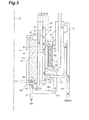
- Fig. 3 is an enlarged view of a configuration around the preferential oxidation unit illustrated in Fig. 2 .
- a carbon monoxide removal structure in the hydrogen production apparatus 1 in the present embodiment includes the low temperature shift unit 13, a shift reaction inlet gas flow path 31, an exhaust gas flow path 32, a water vaporization flow path 33, a preferential oxidation inlet gas flow path 34, and the preferential oxidation unit 8 in this order from the axis G toward the outer circumferential side.
- the low temperature shift unit 13, the shift reaction inlet gas flow path 31, the exhaust gas flow path 32, the water vaporization flow path 33, the preferential oxidation inlet gas flow path 34, and the preferential oxidation unit 8 are all formed in a cylindrical shape having the axis G as the center axis and arranged radially adjacent to each other.
- the low temperature shift unit 13 has a peripheral wall 41, a peripheral wall 42, a lower end wall 43, a punching plate 44, a punching plate 45, and a low temperature shift catalyst 13x.
- the peripheral wall 41 and the peripheral wall 42 have a cylindrical shape (circular tubular shape) with the axis G as the center axis.
- a gap to be filled with the low temperature shift catalyst 13x is formed between the peripheral wall 41 and the peripheral wall 42.
- the lower end wall 43 is shaped like a disk extending radially and is continuous to the respective lower ends of the peripheral wall 41 and the peripheral wall 42 to close the lower side of the low temperature shift unit 13.
- the peripheral wall 42 extends further above the peripheral wall 41.
- the punching plate 44 is shaped like a disk extending radially and is provided between the peripheral wall 41 and the peripheral wall 42 at a distance from the lower end wall 43 upward.
- the punching plate 45 is shaped like a disk extending radially and is provided between the peripheral wall 41 and the peripheral wall 42 at the upper end side of the peripheral wall 41.
- the low temperature shift catalyst 13x is filled in a space formed with the peripheral wall 41, the peripheral wall 42, and the punching plate 44, and the punching plate 45.
- the low temperature shift unit 13 has an outlet 52 for discharging the reformed gas after the shift reaction.
- the low temperature shift unit 13 may be configured without punching plates.
- This low temperature shift unit 13 has a mixing structure 50 on the lower side thereof for efficiently mixing the reformed gas after the shift reaction and the air.
- the mixing structure 50 is configured with an internal space 51, the out let 52, the reformed gas piping 14x, and the air piping (air supply unit) 15.
- the internal space 51 is an annular space formed between the lower end wall 43 and the punching plate 44.
- the internal space 51 can efficiently collect the reformed gas after the shift reaction at the outlet 52.
- the outlet 52 is a through hole formed at the lower end wall 43 of the low temperature shift unit 13.
- the outlet 52 can collect the reformed gas after the shift reaction in one place because the outlet 52 is formed only at one place in the lower end wall 43.
- the reformed gas piping 14x is a pipe connected to the outlet 52.
- the reformed gas piping 14x allows the reformed gas after the shift reaction to pass to the preferential oxidation inlet gas flow path 34.
- the reformed gas piping 14x extends from the lower side to the upper side of the low temperature shift unit 13 with the axis G as the center axis and includes a pipe portion 14a connected to the outlet 52.
- the air piping 15 has a tip end portion inserted into the reformed gas piping 14x.
- the tip end portion of the air piping 15 is arranged coaxially with the pipe portion 14a in the pipe portion 14a of the reformed gas piping 14x and extends upward toward the outlet 52.
- the outlet 52 can collect the reformed gas after the shift reaction in one place and discharge the reformed gas downward to the inside of the pipe portion 14a of the reformed gas piping 14x.
- the air piping 15 can supply the air, from the lower side to the upper side (that is, from the direction that opposes the flow of the reformed gas), to the reformed gas passing through the outlet 52.
- the mixing structure 50 can efficiently mix the reformed gas after the shift reaction and the air in the vicinity of the outlet 52.
- the location where the reformed gas and the air are mixed is not specifically limited and may be spaced apart from the outlet 52. However, the location closer to the outlet 52 is preferred because the flow rate of the reformed gas is high and the mixing efficiency is good.
- the shift reaction inlet gas flow path 31 is a flow path for passing the inlet gas to the low temperature shift unit 13 and is configured with the peripheral wall 42 and a peripheral wall 61.
- the peripheral wall 61 has a cylindrical shape (a circular tubular shape) with the axis G as the center axis.
- the shift reaction inlet gas flow path 31 is formed of a gap between the peripheral wall 41 and the peripheral wall 61.
- the peripheral wall 61 is connected to a lower end wall 62 arranged at a distance from the lower end wall 43 of the low temperature shift unit 13 downward.
- the reformed gas that passes through the shift reaction inlet gas flow path 31 flows so as to go around the outside of the lower end wall 43 and the peripheral wall 41 of the low temperature shift unit 13 and is supplied to the low temperature shift unit 13 from the upper side thereof.
- the reformed gas supplied to the low temperature shift unit 13 is not limited to such a flow, and the reformed gas may be supplied through any flow path to the low temperature shift unit 13. Therefore, the shift reaction inlet gas flow path 31 is not necessarily provided in such an arrangement.
- the exhaust gas flow path 32 is a flow path for passing the exhaust gas from the burner and is formed with the peripheral wall 61, a peripheral wall 63, a lower end wall 64, and an outer peripheral wall 66.
- the peripheral wall 63 has a cylindrical shape (circular tubular shape) with the axis G as the center axis.
- the exhaust gas flow path 32 is formed of a gap between the peripheral wall 61 and the peripheral wall 63.
- the lower end portion of the peripheral wall 63 is connected to the annular lower end wall 64 at a distance from the lower end wall 62 upward.
- the lower end wall 64 and the end portion of the outer circumferential side of the lower end wall 62 are closed by the cylindrical outer peripheral wall 66.
- the exhaust gas flow path 32 allows the exhaust gas supplied from the reforming unit 6 to pass from the upper side to the lower side.
- the water vaporization flow path 33 is a flow path for passing water or steam of the vaporization unit 9 and is configured with the peripheral wall 63, the lower end wall 64, a peripheral wall 67, and an upper end wall 68.
- the peripheral wall 67 has a cylindrical shape (circular tubular shape) with the axis G as the center axis.
- the water vaporization flow path 33 is formed of a gap between the peripheral wall 63 and the peripheral wall 67.
- the lower end portion of the peripheral wall 67 is connected to the lower end wall 64.
- the lower end wall 64 is shaped like a disk extending radially and is continuous to the respective lower ends of the peripheral wall 63 and the peripheral wall 67 to close the lower side of the water vaporization flow path 33.
- the upper end wall 68 is shaped like a disk extending radially and is continuous to the respective upper ends of the peripheral wall 63 and the peripheral wall 67 to close the upper side of the water vaporization flow path 33.
- the water piping 17y is connected in the vicinity of the lower end of the peripheral wall 67.
- the water vaporization flow path 33 allows water supplied from the water piping 17y to pass from the lower side to the upper side.
- the water vaporization flow path 33 has a water layer on the lower side and a steam layer on the upper side because water is vaporized in the water vaporization flow path 33.
- the position of the level of water in the water vaporization flow path 33 is not specifically limited but preferably is higher than the upper end position of the preferential oxidation catalyst 8x.
- the upper end of the water vaporization flow path 33, that is, the position of the upper end wall 68 is not specifically limited and may be arranged at a position even higher than the position illustrated in the drawing.
- the preferential oxidation inlet gas flow path 34 is a flow path for passing the inlet gas to the preferential oxidation unit 8 and is configured with the peripheral wall 67, a peripheral wall 69, a lower end wall 71, and an upper end wall 72.
- the lower end wall 71 is shaped like a disk extending radially and is provided on the outer circumferential surface of the peripheral wall 67.
- the lower end wall 71 is arranged above the connection position of the water piping 17y.
- the upper end wall 72 is shaped like a disk extending radially and is provided on the outer circumferential surface of the peripheral wall 67.
- the peripheral wall 69 has a cylindrical shape (circular tubular shape) with the axis G as the center axis and extends between the lower end wall 71 and the upper end wall 72.
- the lower end of the peripheral wall 69 is spaced apart from the lower end wall 71, and the upper end of the peripheral wall 69 is spaced apart from the upper end wall 72.
- the preferential oxidation inlet gas flow path 34 is formed of a gap between the peripheral wall 67 and the peripheral wall 69.
- the end portion on the outer circumferential side of the lower end wall 71 and the end portion on the outer circumferential side of the upper end wall 72 are coupled together with a peripheral wall 73.
- the peripheral wall 73 has a cylindrical shape (circular tubular shape) with the axis G as the center axis on the outer circumferential side of the peripheral wall 69.
- the reformed gas piping 14x is connected in the vicinity of the lower end of the peripheral wall 73.
- the preferential oxidation inlet gas flow path 34 allows the reformed gas supplied from the reformed gas piping 14x to pass from the lower side to the upper side.
- the positions of the upper end and the lower end of the preferential oxidation inlet gas flow path 34 that is, the positions of the upper end wall 72 and the lower end wall 71 are not limited to the positions illustrated in the drawing.
- the preferential oxidation unit 8 includes the peripheral wall 69, the peripheral wall 73, a punching plate 74, a punching plate 76, a lower end wall 77, and the preferential oxidation catalyst 8x.
- a gap to be filled with the preferential oxidation catalyst 8x is formed between the peripheral wall 69 and the peripheral wall 73.
- the punching plate 74 is shaped like a disk extending radially and is provided between the peripheral wall 69 and the peripheral wall 73 at a position on the lower end side of the peripheral wall 69.
- the punching plate 76 is shaped like a disk extending radially and is provided between the peripheral wall 69 and the peripheral wall 73 at a position on the upper end side of the peripheral wall 69.
- the preferential oxidation catalyst 8x is filled in a space formed with the peripheral wall 69, the peripheral wall 73, the punching plate 74, and the punching plate 76.
- the lower end wall 77 is shaped like a disk extending radially and is continuous to the lower end of the peripheral wall 69 and the inner circumferential surface of the peripheral wall 73 to close the lower end side of the preferential oxidation unit 8.
- the reformed gas piping 14y is connected to the peripheral wall 73 at a position between the lower end wall 77 and the punching plate 74.
- the preferential oxidation unit 8 may be configured without a punching plate.
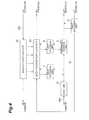
- Fig. 4 is a block diagram illustrating the flow of heat around the preferential oxidation unit 8 illustrated in Fig. 3 .
- the reformed gas RG passes through the shift reaction inlet gas flow path 31 to be supplied to the low temperature shift unit 13.
- the reformed gas RG having a carbon monoxide concentration reduced with the low temperature shift catalyst 13x is collected in one place toward the outlet 52 in the internal space 51.
- the temperature of the reformed gas RG that flows out of the low temperature shift unit 13 is 150°C to 250°C as described above.
- the reformed gas RG collected at the outlet 52 passes downward toward the pipe portion 14a of the reformed gas piping 14x.
- the reformed gas RG mixed with the air passes through the reformed gas piping 14x to be supplied to the preferential oxidation inlet gas flow path 34.
- the reformed gas RG supplied to the preferential oxidation inlet gas flow path 34 passes through the preferential oxidation inlet gas flow path 34 from the lower side to the upper side.
- the reformed gas RG is subjected to heat exchange with water (or steam) in the water vaporization flow path 33 adjacent to the inner circumferential side of the preferential oxidation inlet gas flow path 34.
- the reformed gas RG supplies heat to the water vaporization flow path 33 to be cooled, if it is hotter than necessary, while being kept at a proper temperature so as not to become colder than necessary.
- the preferential oxidation inlet gas flow path 34 can function as a heat exchange unit A that performs heat exchange with the water vaporization flow path 33.
- the temperature of the reformed gas RG is kept from 100°C to 200°C immediately before flowing into the preferential oxidation unit 8.
- the carbon monoxide in the reformed gas RG flowing into the preferential oxidation unit 8 is removed by the preferential oxidation catalyst 8x.
- heat is generated from the preferential oxidation catalyst 8x because the preferential oxidation reaction is an exothermic reaction.
- the preferential oxidation unit 8 can perform heat exchange with the water vaporization flow path 33 through the preferential oxidation inlet gas flow path 34. This prevents the vicinity of the inlet of the preferential oxidation unit 8 from becoming hotter than necessary.
- the preferential oxidation inlet gas flow path 34 can function as a heat exchange unit B that performs heat exchange between the preferential oxidation unit 8 and the water vaporization flow path 33.
- the temperature of the reformed gas RG is set from 100°C to 180°C immediately after flowing out of the preferential oxidation unit 8.
- the reformed gas RG flowing out of the preferential oxidation unit 8 is subjected to heat exchange by the heat exchange unit 16 with water supplied to the water vaporization flow path 33.
- the heat exchange unit 16 functions as a heat exchange unit C illustrated in Fig. 4 .
- the reformed gas RG is finally set from 80°C to 130°C.
- the preferential oxidation inlet gas flow path 34 can function as two heat exchange units A and B although it is a single flow path.
- Water W is supplied from the water piping 17x and receives the heat from the reformed gas RG by means of the heat exchange unit 16.
- the water W subjected to heat exchange in the heat exchange unit 16 flows into the water vaporization flow path 33 and flows from the lower side toward the upper side.
- the water W can receive heat from the exhaust gas EG in the exhaust gas flow path 32 adjacent to the water vaporization flow path 33 on the inner circumferential side.
- the water W can also receive the heat of the reformed gas RG from the preferential oxidation inlet gas flow path 34 functioning as the heat exchange unit A.
- the water W can receive heat resulting from the preferential oxidation reaction from the preferential oxidation inlet gas flow path 34 functioning as the heat exchange unit B.
- the temperature of the water W (or steam) is set from 80°C to 500°C in a region in contact with the preferential oxidation inlet gas flow path 34, in particular, from 100°C to 300°C in the vicinity of the inlet of the preferential oxidation unit 8.
- the water W is vaporized while passing through upward to become steam and is directed to the reforming unit 6.
- the preferential oxidation inlet gas flow path 34 through which the reformed gas RG passes is arranged between the preferential oxidation unit 8 and the water vaporization flow path 33.
- the preferential oxidation unit 8 is not in direct contact with the vaporization flow path 33 through which water or steam flows, and the preferential oxidation inlet gas flow path 34 can function as a heating medium. This prevents the temperature of the preferential oxidation catalyst 8x in the preferential oxidation unit 8 from becoming too low.
- the preferential oxidation inlet gas flow path 34 allows pass of the reformed gas RG supplied to the preferential oxidation unit 8, that is, the inlet gas of the preferential oxidation unit 8.
- the reformed gas RG as the inlet gas of the preferential oxidation unit 8 supplies heat to water or steam in the water vaporization flow path 33 to be cooled if the reformed gas RG is hotter than necessary while being kept at a proper temperature with water or steam in the water vaporization flow path 33 so as not to become colder than necessary. Accordingly, the reformed gas RG that has passed through the preferential oxidation inlet gas flow path 34 is supplied to the preferential oxidation unit 8 in a state of being kept at an optimum temperature.
- the temperature of the preferential oxidation unit 8 can be kept at an optimum temperature with a simple structure without using an external heating unit such as a heater, thereby prolonging the lifetime of the preferential oxidation catalyst.
- the exhaust gas flow path 32 is arranged at a position adjacent to the water vaporization flow path 33 on the side thereof opposite to the preferential oxidation inlet gas flow path 34. Since the exhaust gas flow path 32 is arranged at a position adjacent to the water vaporization flow path 33, water in the water vaporization flow path 33 can receive heat from the high-temperature exhaust gas EG and can vaporize efficiently. Furthermore, the water vaporization flow path 33 can keep the reformed gas RG at an optimum temperature reliably without overcooling the reformed gas RG in the preferential oxidation inlet gas flow path 34.
- the low temperature shift unit 13 has the outlet 52 through which the reformed gas RG after the shift reaction passes.
- the air piping 15 can supply the air to the reformed gas RG passing through the outlet 52 from the direction that opposes the flow of the reformed gas RG
- the reformed gas RG is collected at the outlet 52 when flowing out of the low temperature shift unit 13.
- the air piping 15 can supply the air to the reformed gas RG collected at the outlet 52. Accordingly, the air and the reformed gas RG can be mixed efficiently.
- the air piping 15 can supply the air from the direction that opposes the flow of the reformed gas RG, the reformed gas collides against the air and mixes with the air even more efficiently.
- the fuel cell system 100 includes the hydrogen production apparatus 1 described above and therefore achieves the aforementioned effect of keeping the temperature of the preferential oxidation unit 8 at an optimum temperature with a simple structure without using an external heating unit such as a heater.
- the hydrogen production apparatus and the fuel cell system according to the present invention are not limited to the hydrogen production apparatus 1 above and the fuel cell system 100 above according to the embodiment and may be modified or applied to any other system within a range that does not change the spirit of the invention described in each claim.
- the configuration of the hydrogen production apparatus depicted in the foregoing embodiment is illustrated by way of example.
- the configuration of a part excluding the positional relation between the preferential oxidation unit 8, the preferential oxidation inlet gas flow path 34, and the water vaporization flow path 33 is not specifically limited, and the positional relation or configuration of the flow paths, piping or the components may be modified as appropriate.
- a different structure of the reforming unit may be employed, or the desulfurization unit 2 may be eliminated.
- the foregoing embodiment includes the high temperature shift unit 12 and the low temperature shift unit 13 for a shift reaction of carbon monoxide in the reformed gas.
- the low temperature shift unit 13 may be included as illustrated in Fig. 5 .
- tubular shape in the foregoing description includes not only an approximately cylindrical shape but also an approximately polygonal tubular shape.
- the approximately cylindrical shape and the approximately polygonal tubular shape mean a cylindrical shape and a polygonal tubular shape in a broader sense, including the ones generally equal to a cylindrical shape and a polygonal tubular shape and the ones at least including part of a cylindrical shape and a polygonal tubular shape.
- the present invention is applicable to a hydrogen production apparatus and a fuel cell system.
- 1... hydrogen production apparatus 10... burner, 20... cell stack (fuel cell stack), 8,... preferential oxidation unit, 13... shift unit, 15 air piping (air supply unit), 32... exhaust gas flow path, 33... water vaporization flow path (vaporization flow path), 34... preferential oxidation inlet gas flow path (gas flow path), 52... outlet, 100... fuel cell system, G... axis.
Landscapes
- Chemical & Material Sciences (AREA)
- Chemical Kinetics & Catalysis (AREA)
- Organic Chemistry (AREA)
- Engineering & Computer Science (AREA)
- Combustion & Propulsion (AREA)
- Inorganic Chemistry (AREA)
- Health & Medical Sciences (AREA)
- General Health & Medical Sciences (AREA)
- Life Sciences & Earth Sciences (AREA)
- Manufacturing & Machinery (AREA)
- Sustainable Development (AREA)
- Sustainable Energy (AREA)
- Electrochemistry (AREA)
- General Chemical & Material Sciences (AREA)
- Hydrogen, Water And Hydrids (AREA)
- Fuel Cell (AREA)
Abstract
Description
- The present invention relates to a hydrogen production apparatus and a fuel cell system.
- As a conventional hydrogen production apparatus, the one that includes a preferential oxidation unit for preferentially oxidizing carbon monoxide in a reformed gas generated by reforming a raw material such as hydrocarbon is known (see, for example, Patent Literature 1). An external heating unit such as a heater is generally used to control the temperature of the preferential oxidation unit. However, for example, in a hydrogen production apparatus in which a water vaporization unit for generating steam is arranged at a position adjacent to an inner circumferential side of a tubular preferential oxidation unit, the temperature of the preferential oxidation unit can be controlled by the temperature of water supplied to the water vaporization unit, without using a heating unit.
-
- Patent Literature 1: Japanese Patent Application Laid-Open Publication
2009-280408 - Here, in the hydrogen production apparatus as described above, a flow path through which water or steam pass is provided at a position adjacent to the preferential oxidation unit. Thus, if the temperature of water in the flow path is low, the temperature of a preferential oxidation catalyst in the preferential oxidation unit is decreased. If the temperature of the preferential oxidation catalyst becomes too low, oxidation of the preferential oxidation catalyst is degraded thereby reducing the lifetime of the catalyst. If a proper cooling structure for the preferential oxidation unit is not provided, the temperature of the preferential oxidation catalyst becomes high, so that a methanation reaction of carbon monoxide and carbon dioxide proceeds to abruptly increase the temperature above the heat-resistant temperature of the member. Thus, it has been demanded to keep the temperature of the preferential oxidation unit at an optimum temperature.
- An object of the present invention is therefore to provide a hydrogen production apparatus and a fuel cell system in which the temperature of a preferential oxidation unit can be kept at an optimum temperature with a simple structure without using an external heating unit such as a heater.
- A hydrogen production apparatus includes a preferential oxidation unit preferentially oxidizing carbon monoxide in a reformed gas containing hydrogen, a vaporization flow path passing water to generate steam, and a gas flow path through which the reformed gas passes. The gas flow path is arranged between the preferential oxidation unit and the vaporization flow path. The reformed gas passes through the gas flow path and thereafter flows into the preferential oxidation unit.
- In the hydrogen production apparatus, the gas flow path through which the reformed gas passes is arranged between the vaporization flow path for passing water to generate steam and the preferential oxidation unit. In such a configuration, the preferential oxidation unit is not in direct contact with the vaporization flow path through which water passes, and the gas flow path can function as a heating medium. This prevents the temperature of a preferential oxidation catalyst in the preferential oxidation unit from becoming too low. Furthermore, the gas flow path allows pass of the reformed gas to be supplied to the preferential oxidation unit, that is, the inlet gas of the preferential oxidation unit. Accordingly, the reformed gas as the inlet gas of the preferential oxidation unit supplies heat to water or steam in the vaporization flow path to be cooled if the reformed gas is hotter than necessary while being kept at a proper temperature with water or steam in the vaporization flow path so as not to be colder than necessary. Accordingly, the reformed gas that has passed through the gas flow path is supplied to the preferential oxidation unit in a state of being kept at an optimum temperature. As described above, in the hydrogen production apparatus, the temperature of the preferential oxidation unit can be kept at an optimum temperature with a simple structure without using an external heating unit such as a heater, thereby prolonging the lifetime of the preferential oxidation catalyst.
- The hydrogen production apparatus may further include an exhaust gas flow path through which an exhaust gas from a burner for use to generate the reformed gas. The exhaust gas flow path may be arranged at a position adjacent to the vaporization flow path on a side opposite to the gas flow path. Since the exhaust gas flow path is arranged at a position adjacent to the vaporization flow path, water in the vaporization flow path can receive heat from the high-temperature exhaust gas and can vaporize efficiently. Furthermore, the vaporization flow path can keep the reformed gas at an optimum temperature reliably without overcooling the reformed gas in the gas flow path.
- The hydrogen production apparatus may further include a shift unit removing carbon monoxide in the reformed gas through a shift reaction, and an air supply unit supplying air to the reformed gas directed from the shift unit to the preferential oxidation unit. The shift unit may include an outlet discharging the reformed gas after the shift reaction. The air supply unit may supply the air to the reformed gas flowing out of the outlet from a direction that opposes a flow of the reformed gas. The reformed gas with carbon monoxide removed through the shift reaction is collected at the outlet when flowing out of the shift unit. Here, the air supply unit can supply the air to the reformed gas collected at the outlet. Accordingly, the air and the reformed gas can be mixed efficiently. Furthermore, since the air supply unit supplies the air from the direction that opposes the flow of the reformed gas, the reformed gas collides against the air and mixes with the air even more efficiently.
- A fuel cell system includes the hydrogen production apparatus as described above and a fuel cell stack generating power using the reformed gas generated by the hydrogen production apparatus.
- The fuel cell system includes the hydrogen production apparatus as described above and therefore achieves the aforementioned effect of keeping the temperature of the preferential oxidation unit at an optimum temperature with a simple structure without using an external heating unit such as a heater.
- According to the present invention, the temperature of the preferential oxidation unit can be kept at an optimum temperature with a simple structure without using an external heating unit such as a heater. Brief Description of Drawings
-
- [
Fig. 1] Fig. 1 is a schematic block diagram partially illustrating a fuel cell system according to an embodiment. - [
Fig. 2] Fig. 2 is a schematic front end view illustrating a hydrogen production apparatus inFig. 1 . - [
Fig. 3] Fig. 3 is an enlarged view of a configuration around a preferential oxidation unit illustrated inFig. 2 . - [
Fig. 4] Fig. 4 is a block diagram illustrating a flow of heat around the preferential oxidation unit illustrated inFig. 3 . - [
Fig. 5] Fig. 5 is a schematic front end view illustrating another example of the hydrogen production apparatus inFig. 1 . Description of Embodiments - In the following, preferred embodiments of the present invention will be described in detail with reference to the figures. It is noted that in the following description, the same or corresponding elements are denoted with the same reference signs, and an overlapping description is omitted. The terms "up" and "down" correspond to the upper and lower directions in the drawings and are given for the sake of convenience.
-
Fig. 1 is a schematic block diagram partially illustrating a fuel cell system according to an embodiment. As illustrated inFig. 1 , a hydrogen production apparatus (fuel processing system (FPS)) 1 is used, for example, as a hydrogen supply source in afuel cell system 100 for home use. Thehydrogen production apparatus 1 here uses petroleum-derived hydrocarbon as a raw fuel and supplies a reformed gas containing hydrogen to a cell stack (fuel cell stack) 20. - Examples of the raw fuel used include alcohols, ethers, biofuel, natural gas, and city gas. Examples of the petroleum-derived hydrocarbon used as a raw fuel include kerosene, LP gas, naphtha, and light oil. A variety of cells including a polymer electrolyte fuel cell, an alkaline cell, a phosphoric acid fuel cell, a molten carbonate fuel cell, and a solid oxide fuel cell can be used for the
cell stack 20. -
Fig. 2 is a schematic front end view illustrating a hydrogen production apparatus inFig. 1 . As illustrated inFigs. 1 and2 , thehydrogen production apparatus 1 includes adesulfurization unit 2 having a cylindrical outer shape with an axis G as the center axis and amain unit 3 having a cylindrical outer shape with the axis G as the center axis. Thedesulfurization unit 2 and themain unit 3 are accommodated in ahousing 4. A powdery heat insulator (not illustrated) is filled in thehousing 4 around thedesulfurization unit 2 and themain unit 3 to insulate them. Thedesulfurization unit 2 may be installed outside thehousing 4. - The
desulfurization unit 2 desulfurizes a raw fuel externally introduced with a desulfurization catalyst to remove sulfur components and supplies the raw fuel thus desulfurized to afeed unit 5 described later. Thedesulfurization unit 2 is fixed to aside plate 4x of thehousing 4 with apipe 21 and is held to surround an upper portion of themain unit 3 with a predetermined gap. Themain unit 3 includes thefeed unit 5, a reformingunit 6, ashift unit 7, apreferential oxidation unit 8, and avaporization unit 9, which are integrally assembled. Themain unit 3 is fixed and held on afloor plate 4y of thehousing 4 with atubular stay 22. - The
feed unit 5 mixes the raw fuel desulfurized by thedesulfurization unit 2 with steam and supplies the mixture to the reformingunit 6. Specifically, thefeed unit 5 includes amixing unit 5x for combining and mixing the raw fuel and steam to generate a mixture gas (mixture fluid) and a mixturegas flow path 5y for passing the mixture gas to the reformingunit 6. - The reforming (SR: Steam Reforming)
unit 6 generates a reformed gas by steam-reforming the mixture gas supplied from thefeed unit 5 with a reforming catalyst (reforming catalyst unit) 6x and supplies the reformed gas to theshift unit 7. The reformingunit 6 has a cylindrical outer shape with the axis G as the center axis and is provided at the upper end side of themain unit 3 so as to be located in the tube of thedesulfurization unit 2. In the reformingunit 6, aburner 10 is used as a heat source for heating the reformingcatalyst 6x of the reformingunit 6 because the reforming reaction requires high temperatures and is an endothermic reaction. - In the
burner 10, a raw fuel is externally supplied as a burner fuel and burnt. Theburner 10 is mounted such that flame by theburner 10 is surrounded with acombustion tube 11 provided at an upper end portion of themain unit 3 with the axis G as the center axis. In theburner 10, part of the raw fuel desulfurized by thedesulfurization unit 2 may be supplied as a burner fuel and burnt. - The
shift unit 7 is to reduce a carbon monoxide concentration (CO concentration) in the reformed gas supplied from the reformingunit 6, and converts carbon monoxide into hydrogen and carbon dioxide through a shift reaction of carbon monoxide in the reformed gas. Theshift unit 7 here can perform the shift reaction in two separate stages and has a high temperature shift (HTS)unit 12 that performs a high temperature shift reaction that is a shift reaction at high temperatures (for example, from 400°C to 600°C), and a low temperature shift (LTS)unit 13 that performs a low temperature shift reaction that is a shift reaction at low temperatures (for example, from 150°C to 350°C) lower than the temperatures in the high temperature shift reaction. However, the hightemperature shift unit 12 is not necessarily provided. - The high
temperature shift unit 12 subjects carbon monoxide in the reformed gas supplied from the reformingunit 6 to a high temperature shift reaction with a hightemperature shift catalyst 12x to reduce the CO concentration in the reformed gas. The hightemperature shift unit 12 has a cylindrical outer shape with the axis G as the center axis and is arranged adjacent to and radially outside the reformingunit 6 such that the hightemperature shift catalyst 12x surrounds a lower end portion of the reformingcatalyst 6x. The hightemperature shift unit 12 supplies the reformed gas with a reduced CO concentration to the lowtemperature shift unit 13. - The low
temperature shift unit 13 subjects carbon monoxide in the reformed gas subjected to a high temperature shift reaction in the hightemperature shift unit 12, to a low temperature shift reaction with a lowtemperature shift catalyst 13x to reduce the CO concentration in the reformed gas. The lowtemperature shift unit 13 has a cylindrical outer shape with the axis G as the center axis and is disposed on the lower end side of themain unit 3. The lowtemperature shift unit 13 supplies the reformed gas with a reduced CO concentration to thepreferential oxidation unit 8 through a reformedgas piping 14x. - The preferential oxidation (PROX)
unit 8 further reduces the CO concentration in the reformed gas subjected to a low temperature shift reaction in the lowtemperature shift unit 13. This is because if high-concentration carbon monoxide is supplied to thecell stack 20, the catalyst in thecell stack 20 is poisoned and significantly degraded in performance. Specifically, thepreferential oxidation unit 8 promotes a reaction between carbon monoxide in the reformed gas and the air introduced through anair piping 15 with apreferential oxidation catalyst 8x thereby to preferentially oxidize the carbon monoxide and convert it into carbon dioxide without oxidizing hydrogen in the reformed gas. Thepreferential oxidation unit 8 has a cylindrical outer shape with the axis G as the center axis and is disposed so as to form the outermost circumferential side of themain unit 3 from the lower end toward the upper end of themain unit 3 by a predetermined length. - The
preferential oxidation unit 8 discharges the reformed gas with a further reduced CO concentration to the outside through a reformedgas piping 14y provided with aheat exchange unit 16. Theheat exchange unit 16 performs heat exchange between the reformed gas passing in the reformedgas piping 14y and water externally introduced through awater piping 17x and supplies the water to thevaporization unit 9 through awater piping 17y. - The
vaporization unit 9 stores therein the water supplied from theheat exchange unit 16 and generates steam by vaporizing the water with the heat moved from the lowtemperature shift unit 13 and the preferential oxidation unit 8 (obtained by cooling the lowtemperature shift unit 13 and the preferential oxidation unit 8) and with the heat of exhaust gas from theburner 10. Thevaporization unit 9 is a jacket type and has a cylindrical shape with the axis G as the center axis. Thevaporization unit 9 is disposed so as to be located radially outside the hightemperature shift unit 12 and the lowtemperature shift unit 13 and radially inside the preferential oxidation unit 8 (in other words, between theshift unit 7 and the preferential oxidation unit 8). Thevaporization unit 9 supplies the generated steam to themixing unit 5x of thefeed unit 5 through asteam piping 17z. - In this
hydrogen production apparatus 1, first, at least one of the burner fuel and off gas from the cell stack 20 (residual gas not used for the reaction in the cell stack 20) and the air are supplied to theburner 10 and burnt. This combustion heats the reformingcatalyst 6x. Then, the exhaust gas from theburner 10 passes through an exhaust gas flow path L1 and agas piping 18 and exhausted to the outside. - Meanwhile, the raw fuel desulfurized in the
desulfurization unit 2 and the steam from thevaporization unit 9 are mixed in themixing unit 5x to generate a mixture gas. The mixture gas is supplied to the reformingunit 6 through the mixturegas flow path 5y and steam-reformed with the reformingcatalyst 6x. A reformed gas is thus generated. Then, theshift unit 7 reduces the carbon monoxide concentration of the generated reformed gas to, for example, about a few thousands of ppm and then thepreferential oxidation unit 8 reduces the carbon monoxide concentration of the reformed gas to about 10 ppm or lower, and the resulting reformed gas is thereafter cooled by theheat exchange unit 16 and introduced to thecell stack 20 on the following stage. - In the present embodiment, in order to suitably perform a catalytic reaction with each
catalyst unit 6 is set from about 300°C to 550°C. The temperature of the reformed gas flowing out of the reformingunit 6 is set from 550°C to 800°C. The temperature of the reformed gas flowing into the hightemperature shift unit 12 is set from 400°C to 600°C. The temperature of the reformed gas flowing out of the hightemperature shift unit 12 is set from 300°C to 500°C. The temperature of the reformed gas flowing into the lowtemperature shift unit 13 is set from 150°C to 350°C. The temperature of the reformed gas flowing out of the lowtemperature shift unit 13 is set from 150°C to 250°C. The temperature of the reformed gas flowing into thepreferential oxidation unit 8 is set from 90°C to 210°C (from 120°C to 190°C). - A peripheral configuration of the low
temperature shift unit 13 and thepreferential oxidation unit 8 in the present embodiment will now be described in more details. -
Fig. 3 is an enlarged view of a configuration around the preferential oxidation unit illustrated inFig. 2 . As illustrated inFig. 3 , a carbon monoxide removal structure in thehydrogen production apparatus 1 in the present embodiment includes the lowtemperature shift unit 13, a shift reaction inletgas flow path 31, an exhaustgas flow path 32, a watervaporization flow path 33, a preferential oxidation inletgas flow path 34, and thepreferential oxidation unit 8 in this order from the axis G toward the outer circumferential side. The lowtemperature shift unit 13, the shift reaction inletgas flow path 31, the exhaustgas flow path 32, the watervaporization flow path 33, the preferential oxidation inletgas flow path 34, and thepreferential oxidation unit 8 are all formed in a cylindrical shape having the axis G as the center axis and arranged radially adjacent to each other. - The low
temperature shift unit 13 has aperipheral wall 41, aperipheral wall 42, alower end wall 43, a punchingplate 44, a punchingplate 45, and a lowtemperature shift catalyst 13x. Theperipheral wall 41 and theperipheral wall 42 have a cylindrical shape (circular tubular shape) with the axis G as the center axis. A gap to be filled with the lowtemperature shift catalyst 13x is formed between theperipheral wall 41 and theperipheral wall 42. Thelower end wall 43 is shaped like a disk extending radially and is continuous to the respective lower ends of theperipheral wall 41 and theperipheral wall 42 to close the lower side of the lowtemperature shift unit 13. Theperipheral wall 42 extends further above theperipheral wall 41. The punchingplate 44 is shaped like a disk extending radially and is provided between theperipheral wall 41 and theperipheral wall 42 at a distance from thelower end wall 43 upward. The punchingplate 45 is shaped like a disk extending radially and is provided between theperipheral wall 41 and theperipheral wall 42 at the upper end side of theperipheral wall 41. The lowtemperature shift catalyst 13x is filled in a space formed with theperipheral wall 41, theperipheral wall 42, and the punchingplate 44, and the punchingplate 45. The lowtemperature shift unit 13 has anoutlet 52 for discharging the reformed gas after the shift reaction. The lowtemperature shift unit 13 may be configured without punching plates. This lowtemperature shift unit 13 has a mixingstructure 50 on the lower side thereof for efficiently mixing the reformed gas after the shift reaction and the air. - The mixing
structure 50 is configured with aninternal space 51, theout let 52, the reformedgas piping 14x, and the air piping (air supply unit) 15. Theinternal space 51 is an annular space formed between thelower end wall 43 and the punchingplate 44. Theinternal space 51 can efficiently collect the reformed gas after the shift reaction at theoutlet 52. Theoutlet 52 is a through hole formed at thelower end wall 43 of the lowtemperature shift unit 13. Theoutlet 52 can collect the reformed gas after the shift reaction in one place because theoutlet 52 is formed only at one place in thelower end wall 43. The reformedgas piping 14x is a pipe connected to theoutlet 52. The reformedgas piping 14x allows the reformed gas after the shift reaction to pass to the preferential oxidation inletgas flow path 34. The reformedgas piping 14x extends from the lower side to the upper side of the lowtemperature shift unit 13 with the axis G as the center axis and includes apipe portion 14a connected to theoutlet 52. Theair piping 15 has a tip end portion inserted into the reformedgas piping 14x. The tip end portion of the air piping 15 is arranged coaxially with thepipe portion 14a in thepipe portion 14a of the reformedgas piping 14x and extends upward toward theoutlet 52. - With such a configuration, the
outlet 52 can collect the reformed gas after the shift reaction in one place and discharge the reformed gas downward to the inside of thepipe portion 14a of the reformedgas piping 14x. Theair piping 15 can supply the air, from the lower side to the upper side (that is, from the direction that opposes the flow of the reformed gas), to the reformed gas passing through theoutlet 52. Accordingly, the mixingstructure 50 can efficiently mix the reformed gas after the shift reaction and the air in the vicinity of theoutlet 52. The location where the reformed gas and the air are mixed is not specifically limited and may be spaced apart from theoutlet 52. However, the location closer to theoutlet 52 is preferred because the flow rate of the reformed gas is high and the mixing efficiency is good. - The shift reaction inlet
gas flow path 31 is a flow path for passing the inlet gas to the lowtemperature shift unit 13 and is configured with theperipheral wall 42 and aperipheral wall 61. Theperipheral wall 61 has a cylindrical shape (a circular tubular shape) with the axis G as the center axis. The shift reaction inletgas flow path 31 is formed of a gap between theperipheral wall 41 and theperipheral wall 61. Theperipheral wall 61 is connected to alower end wall 62 arranged at a distance from thelower end wall 43 of the lowtemperature shift unit 13 downward. The reformed gas that passes through the shift reaction inletgas flow path 31 flows so as to go around the outside of thelower end wall 43 and theperipheral wall 41 of the lowtemperature shift unit 13 and is supplied to the lowtemperature shift unit 13 from the upper side thereof. The reformed gas supplied to the lowtemperature shift unit 13 is not limited to such a flow, and the reformed gas may be supplied through any flow path to the lowtemperature shift unit 13. Therefore, the shift reaction inletgas flow path 31 is not necessarily provided in such an arrangement. - The exhaust
gas flow path 32 is a flow path for passing the exhaust gas from the burner and is formed with theperipheral wall 61, aperipheral wall 63, alower end wall 64, and an outerperipheral wall 66. Theperipheral wall 63 has a cylindrical shape (circular tubular shape) with the axis G as the center axis. The exhaustgas flow path 32 is formed of a gap between theperipheral wall 61 and theperipheral wall 63. The lower end portion of theperipheral wall 63 is connected to the annularlower end wall 64 at a distance from thelower end wall 62 upward. Thelower end wall 64 and the end portion of the outer circumferential side of thelower end wall 62 are closed by the cylindrical outerperipheral wall 66. The exhaustgas flow path 32 allows the exhaust gas supplied from the reformingunit 6 to pass from the upper side to the lower side. - The water
vaporization flow path 33 is a flow path for passing water or steam of thevaporization unit 9 and is configured with theperipheral wall 63, thelower end wall 64, aperipheral wall 67, and anupper end wall 68. Theperipheral wall 67 has a cylindrical shape (circular tubular shape) with the axis G as the center axis. The watervaporization flow path 33 is formed of a gap between theperipheral wall 63 and theperipheral wall 67. The lower end portion of theperipheral wall 67 is connected to thelower end wall 64. Thelower end wall 64 is shaped like a disk extending radially and is continuous to the respective lower ends of theperipheral wall 63 and theperipheral wall 67 to close the lower side of the watervaporization flow path 33. Theupper end wall 68 is shaped like a disk extending radially and is continuous to the respective upper ends of theperipheral wall 63 and theperipheral wall 67 to close the upper side of the watervaporization flow path 33. Thewater piping 17y is connected in the vicinity of the lower end of theperipheral wall 67. The watervaporization flow path 33 allows water supplied from thewater piping 17y to pass from the lower side to the upper side. The watervaporization flow path 33 has a water layer on the lower side and a steam layer on the upper side because water is vaporized in the watervaporization flow path 33. The position of the level of water in the watervaporization flow path 33 is not specifically limited but preferably is higher than the upper end position of thepreferential oxidation catalyst 8x. The upper end of the watervaporization flow path 33, that is, the position of theupper end wall 68 is not specifically limited and may be arranged at a position even higher than the position illustrated in the drawing. - The preferential oxidation inlet
gas flow path 34 is a flow path for passing the inlet gas to thepreferential oxidation unit 8 and is configured with theperipheral wall 67, aperipheral wall 69, alower end wall 71, and anupper end wall 72. Thelower end wall 71 is shaped like a disk extending radially and is provided on the outer circumferential surface of theperipheral wall 67. Thelower end wall 71 is arranged above the connection position of thewater piping 17y. Theupper end wall 72 is shaped like a disk extending radially and is provided on the outer circumferential surface of theperipheral wall 67. Theperipheral wall 69 has a cylindrical shape (circular tubular shape) with the axis G as the center axis and extends between thelower end wall 71 and theupper end wall 72. The lower end of theperipheral wall 69 is spaced apart from thelower end wall 71, and the upper end of theperipheral wall 69 is spaced apart from theupper end wall 72. The preferential oxidation inletgas flow path 34 is formed of a gap between theperipheral wall 67 and theperipheral wall 69. The end portion on the outer circumferential side of thelower end wall 71 and the end portion on the outer circumferential side of theupper end wall 72 are coupled together with aperipheral wall 73. Theperipheral wall 73 has a cylindrical shape (circular tubular shape) with the axis G as the center axis on the outer circumferential side of theperipheral wall 69. The reformedgas piping 14x is connected in the vicinity of the lower end of theperipheral wall 73. The preferential oxidation inletgas flow path 34 allows the reformed gas supplied from the reformedgas piping 14x to pass from the lower side to the upper side. The positions of the upper end and the lower end of the preferential oxidation inletgas flow path 34, that is, the positions of theupper end wall 72 and thelower end wall 71 are not limited to the positions illustrated in the drawing. - The
preferential oxidation unit 8 includes theperipheral wall 69, theperipheral wall 73, a punchingplate 74, a punchingplate 76, alower end wall 77, and thepreferential oxidation catalyst 8x. A gap to be filled with thepreferential oxidation catalyst 8x is formed between theperipheral wall 69 and theperipheral wall 73. The punchingplate 74 is shaped like a disk extending radially and is provided between theperipheral wall 69 and theperipheral wall 73 at a position on the lower end side of theperipheral wall 69. The punchingplate 76 is shaped like a disk extending radially and is provided between theperipheral wall 69 and theperipheral wall 73 at a position on the upper end side of theperipheral wall 69. Thepreferential oxidation catalyst 8x is filled in a space formed with theperipheral wall 69, theperipheral wall 73, the punchingplate 74, and the punchingplate 76. Thelower end wall 77 is shaped like a disk extending radially and is continuous to the lower end of theperipheral wall 69 and the inner circumferential surface of theperipheral wall 73 to close the lower end side of thepreferential oxidation unit 8. The reformedgas piping 14y is connected to theperipheral wall 73 at a position between thelower end wall 77 and the punchingplate 74. Thepreferential oxidation unit 8 may be configured without a punching plate. - The flows of the reformed gas RG, water (or steam) W, the exhaust gas EG, and the flow of heat at the periphery of the
preferential oxidation unit 8 will now be described with reference toFig. 3 andFig. 4. Fig. 4 is a block diagram illustrating the flow of heat around thepreferential oxidation unit 8 illustrated inFig. 3 . - First, the reformed gas RG passes through the shift reaction inlet
gas flow path 31 to be supplied to the lowtemperature shift unit 13. The reformed gas RG having a carbon monoxide concentration reduced with the lowtemperature shift catalyst 13x is collected in one place toward theoutlet 52 in theinternal space 51. The temperature of the reformed gas RG that flows out of the lowtemperature shift unit 13 is 150°C to 250°C as described above. The reformed gas RG collected at theoutlet 52 passes downward toward thepipe portion 14a of the reformedgas piping 14x. Here, the reformed gas RG collides against the air supplied upward from theair piping 15 and mixes with the air efficiently. The reformed gas RG mixed with the air passes through the reformedgas piping 14x to be supplied to the preferential oxidation inletgas flow path 34. - The reformed gas RG supplied to the preferential oxidation inlet
gas flow path 34 passes through the preferential oxidation inletgas flow path 34 from the lower side to the upper side. Here, the reformed gas RG is subjected to heat exchange with water (or steam) in the watervaporization flow path 33 adjacent to the inner circumferential side of the preferential oxidation inletgas flow path 34. Accordingly, the reformed gas RG supplies heat to the watervaporization flow path 33 to be cooled, if it is hotter than necessary, while being kept at a proper temperature so as not to become colder than necessary. In other words, the preferential oxidation inletgas flow path 34 can function as a heat exchange unit A that performs heat exchange with the watervaporization flow path 33. The temperature of the reformed gas RG is kept from 100°C to 200°C immediately before flowing into thepreferential oxidation unit 8. - The carbon monoxide in the reformed gas RG flowing into the
preferential oxidation unit 8 is removed by thepreferential oxidation catalyst 8x. Here, heat is generated from thepreferential oxidation catalyst 8x because the preferential oxidation reaction is an exothermic reaction. Here, thepreferential oxidation unit 8 can perform heat exchange with the watervaporization flow path 33 through the preferential oxidation inletgas flow path 34. This prevents the vicinity of the inlet of thepreferential oxidation unit 8 from becoming hotter than necessary. Here, the preferential oxidation inletgas flow path 34 can function as a heat exchange unit B that performs heat exchange between thepreferential oxidation unit 8 and the watervaporization flow path 33. The temperature of the reformed gas RG is set from 100°C to 180°C immediately after flowing out of thepreferential oxidation unit 8. The reformed gas RG flowing out of thepreferential oxidation unit 8 is subjected to heat exchange by theheat exchange unit 16 with water supplied to the watervaporization flow path 33. Here, theheat exchange unit 16 functions as a heat exchange unit C illustrated inFig. 4 . The reformed gas RG is finally set from 80°C to 130°C. As described above, the preferential oxidation inletgas flow path 34 can function as two heat exchange units A and B although it is a single flow path. - Water W is supplied from the
water piping 17x and receives the heat from the reformed gas RG by means of theheat exchange unit 16. The water W subjected to heat exchange in theheat exchange unit 16 flows into the watervaporization flow path 33 and flows from the lower side toward the upper side. Here, the water W can receive heat from the exhaust gas EG in the exhaustgas flow path 32 adjacent to the watervaporization flow path 33 on the inner circumferential side. The water W can also receive the heat of the reformed gas RG from the preferential oxidation inletgas flow path 34 functioning as the heat exchange unit A. Furthermore, the water W can receive heat resulting from the preferential oxidation reaction from the preferential oxidation inletgas flow path 34 functioning as the heat exchange unit B. The temperature of the water W (or steam) is set from 80°C to 500°C in a region in contact with the preferential oxidation inletgas flow path 34, in particular, from 100°C to 300°C in the vicinity of the inlet of thepreferential oxidation unit 8. The water W is vaporized while passing through upward to become steam and is directed to the reformingunit 6. - The operation and effects of the
hydrogen production apparatus 1 and thefuel cell system 100 according to the present embodiment will now be described. - In the
hydrogen production apparatus 1 according to the present embodiment, the preferential oxidation inletgas flow path 34 through which the reformed gas RG passes is arranged between thepreferential oxidation unit 8 and the watervaporization flow path 33. With such a configuration, thepreferential oxidation unit 8 is not in direct contact with thevaporization flow path 33 through which water or steam flows, and the preferential oxidation inletgas flow path 34 can function as a heating medium. This prevents the temperature of thepreferential oxidation catalyst 8x in thepreferential oxidation unit 8 from becoming too low. The preferential oxidation inletgas flow path 34 allows pass of the reformed gas RG supplied to thepreferential oxidation unit 8, that is, the inlet gas of thepreferential oxidation unit 8. Accordingly, the reformed gas RG as the inlet gas of thepreferential oxidation unit 8 supplies heat to water or steam in the watervaporization flow path 33 to be cooled if the reformed gas RG is hotter than necessary while being kept at a proper temperature with water or steam in the watervaporization flow path 33 so as not to become colder than necessary. Accordingly, the reformed gas RG that has passed through the preferential oxidation inletgas flow path 34 is supplied to thepreferential oxidation unit 8 in a state of being kept at an optimum temperature. As described above, in thehydrogen production apparatus 1 according to the present embodiment, the temperature of thepreferential oxidation unit 8 can be kept at an optimum temperature with a simple structure without using an external heating unit such as a heater, thereby prolonging the lifetime of the preferential oxidation catalyst. - In the
hydrogen production apparatus 1 according to the present embodiment, the exhaustgas flow path 32 is arranged at a position adjacent to the watervaporization flow path 33 on the side thereof opposite to the preferential oxidation inletgas flow path 34. Since the exhaustgas flow path 32 is arranged at a position adjacent to the watervaporization flow path 33, water in the watervaporization flow path 33 can receive heat from the high-temperature exhaust gas EG and can vaporize efficiently. Furthermore, the watervaporization flow path 33 can keep the reformed gas RG at an optimum temperature reliably without overcooling the reformed gas RG in the preferential oxidation inletgas flow path 34. - In the
hydrogen production apparatus 1 according to the present embodiment, the lowtemperature shift unit 13 has theoutlet 52 through which the reformed gas RG after the shift reaction passes. Theair piping 15 can supply the air to the reformed gas RG passing through theoutlet 52 from the direction that opposes the flow of the reformed gas RG The reformed gas RG is collected at theoutlet 52 when flowing out of the lowtemperature shift unit 13. Here, the air piping 15 can supply the air to the reformed gas RG collected at theoutlet 52. Accordingly, the air and the reformed gas RG can be mixed efficiently. Furthermore, since the air piping 15 can supply the air from the direction that opposes the flow of the reformed gas RG, the reformed gas collides against the air and mixes with the air even more efficiently. - The
fuel cell system 100 includes thehydrogen production apparatus 1 described above and therefore achieves the aforementioned effect of keeping the temperature of thepreferential oxidation unit 8 at an optimum temperature with a simple structure without using an external heating unit such as a heater. - Although the preferred embodiment of the present invention has been described above, the hydrogen production apparatus and the fuel cell system according to the present invention are not limited to the
hydrogen production apparatus 1 above and thefuel cell system 100 above according to the embodiment and may be modified or applied to any other system within a range that does not change the spirit of the invention described in each claim. - For example, the configuration of the hydrogen production apparatus depicted in the foregoing embodiment is illustrated by way of example. The configuration of a part excluding the positional relation between the
preferential oxidation unit 8, the preferential oxidation inletgas flow path 34, and the watervaporization flow path 33 is not specifically limited, and the positional relation or configuration of the flow paths, piping or the components may be modified as appropriate. For example, a different structure of the reforming unit may be employed, or thedesulfurization unit 2 may be eliminated. - The foregoing embodiment includes the high
temperature shift unit 12 and the lowtemperature shift unit 13 for a shift reaction of carbon monoxide in the reformed gas. However, only the lowtemperature shift unit 13 may be included as illustrated inFig. 5 . - The "tubular shape" in the foregoing description includes not only an approximately cylindrical shape but also an approximately polygonal tubular shape. The approximately cylindrical shape and the approximately polygonal tubular shape mean a cylindrical shape and a polygonal tubular shape in a broader sense, including the ones generally equal to a cylindrical shape and a polygonal tubular shape and the ones at least including part of a cylindrical shape and a polygonal tubular shape.
- The present invention is applicable to a hydrogen production apparatus and a fuel cell system.
- 1... hydrogen production apparatus, 10... burner, 20... cell stack (fuel cell stack), 8,... preferential oxidation unit, 13... shift unit, 15 air piping (air supply unit), 32... exhaust gas flow path, 33... water vaporization flow path (vaporization flow path), 34... preferential oxidation inlet gas flow path (gas flow path), 52... outlet, 100... fuel cell system, G... axis.
Claims (4)
- A hydrogen production apparatus comprising:a preferential oxidation unit preferentially oxidizing carbon monoxide in a reformed gas containing hydrogen;a vaporization flow path passing water to generate steam; anda gas flow path through which the reformed gas passes, whereinthe gas flow path is arranged between the preferential oxidation unit and the vaporization flow path, andthe reformed gas passes through the gas flow path and thereafter flows into the preferential oxidation unit.
- The hydrogen production apparatus according to Claim 1 further comprising an exhaust gas flow path through which an exhaust gas from a burner for use to generate the reformed gas passes, wherein
the exhaust gas flow path is arranged at a position adjacent to the vaporization flow path on a side opposite to the gas flow path. - The hydrogen production apparatus according to Claim 1 or 2 further comprising:a shift unit removing carbon monoxide in the reformed gas through a shift reaction;, andan air supply unit supplying air to the reformed gas directed from the shift unit to the preferential oxidation unit, whereinthe shift unit includes an outlet discharging the reformed gas after the shift reaction, andthe air supply unit supplies the air to the reformed gas flowing out of the outlet from a direction that opposes a flow of the reformed gas.
- A fuel cell system comprising:the hydrogen production apparatus according to any one of Claims 1 to 3; anda fuel cell stack generating power using the reformed gas generated by the hydrogen production apparatus.
Applications Claiming Priority (2)
| Application Number | Priority Date | Filing Date | Title |
|---|---|---|---|
| JP2010078763A JP5600460B2 (en) | 2010-03-30 | 2010-03-30 | Hydrogen production apparatus and fuel cell system |
| PCT/JP2011/057013 WO2011122418A1 (en) | 2010-03-30 | 2011-03-23 | Hydrogen production apparatus and fuel cell system |
Publications (2)
| Publication Number | Publication Date |
|---|---|
| EP2554512A1 true EP2554512A1 (en) | 2013-02-06 |
| EP2554512A4 EP2554512A4 (en) | 2014-01-22 |
Family
ID=44712128
Family Applications (1)
| Application Number | Title | Priority Date | Filing Date |
|---|---|---|---|
| EP11762650.7A Withdrawn EP2554512A4 (en) | 2010-03-30 | 2011-03-23 | HYDROGEN PRODUCTION APPARATUS AND FUEL CELL SYSTEM |
Country Status (5)
| Country | Link |
|---|---|
| US (1) | US20130065144A1 (en) |
| EP (1) | EP2554512A4 (en) |
| JP (1) | JP5600460B2 (en) |
| CN (1) | CN102834349A (en) |
| WO (1) | WO2011122418A1 (en) |
Cited By (1)
| Publication number | Priority date | Publication date | Assignee | Title |
|---|---|---|---|---|
| GB2536997A (en) * | 2015-02-05 | 2016-10-05 | Johnson Matthey Plc | Process |
Families Citing this family (5)
| Publication number | Priority date | Publication date | Assignee | Title |
|---|---|---|---|---|
| JP5895241B2 (en) * | 2011-05-27 | 2016-03-30 | パナソニックIpマネジメント株式会社 | Hydrogen generator and fuel cell system |
| WO2013086190A1 (en) * | 2011-12-06 | 2013-06-13 | Hy9 Corporation | Catalyst-containing reactor system and associated methods |
| JP6089210B2 (en) * | 2013-03-19 | 2017-03-08 | パナソニックIpマネジメント株式会社 | Hydrogen generator |
| KR101771303B1 (en) * | 2015-02-16 | 2017-08-24 | 한국가스공사 | Fuel processor |
| JP7672036B2 (en) * | 2021-11-16 | 2025-05-07 | パナソニックIpマネジメント株式会社 | Hydrogen generation device and manufacturing method thereof |
Family Cites Families (8)
| Publication number | Priority date | Publication date | Assignee | Title |
|---|---|---|---|---|
| CA2259386C (en) * | 1996-06-28 | 2002-06-25 | Matsushita Electric Works, Ltd. | Modification apparatus |
| US7338644B2 (en) * | 2000-04-17 | 2008-03-04 | Shell Oil Company | Fuel processor |
| JP4366136B2 (en) * | 2002-10-10 | 2009-11-18 | パナソニック株式会社 | Hydrogen generator and fuel cell power generation system |
| JP2009280408A (en) | 2006-09-01 | 2009-12-03 | Panasonic Corp | Hydrogen generating apparatus and fuel cell system |
| JP5020002B2 (en) * | 2006-09-05 | 2012-09-05 | パナソニック株式会社 | Hydrogen generator and fuel cell system |
| US8257668B2 (en) * | 2006-09-05 | 2012-09-04 | Panasonic Corporation | Hydrogen generator and fuel cell system |
| WO2009144923A1 (en) * | 2008-05-30 | 2009-12-03 | パナソニック株式会社 | Fuel processor |
| JP2010001187A (en) * | 2008-06-20 | 2010-01-07 | Aisin Seiki Co Ltd | Reforming apparatus |
-
2010
- 2010-03-30 JP JP2010078763A patent/JP5600460B2/en not_active Expired - Fee Related
-
2011
- 2011-03-23 US US13/637,793 patent/US20130065144A1/en not_active Abandoned
- 2011-03-23 CN CN2011800164684A patent/CN102834349A/en active Pending
- 2011-03-23 WO PCT/JP2011/057013 patent/WO2011122418A1/en not_active Ceased
- 2011-03-23 EP EP11762650.7A patent/EP2554512A4/en not_active Withdrawn
Cited By (3)
| Publication number | Priority date | Publication date | Assignee | Title |
|---|---|---|---|---|
| GB2536997A (en) * | 2015-02-05 | 2016-10-05 | Johnson Matthey Plc | Process |
| GB2536997B (en) * | 2015-02-05 | 2017-08-09 | Johnson Matthey Plc | Process |
| US10435304B2 (en) | 2015-02-05 | 2019-10-08 | Johnson Matthey Public Limited Company | Process for making ammonia |
Also Published As
| Publication number | Publication date |
|---|---|
| WO2011122418A1 (en) | 2011-10-06 |
| JP2011207703A (en) | 2011-10-20 |
| CN102834349A (en) | 2012-12-19 |
| EP2554512A4 (en) | 2014-01-22 |
| US20130065144A1 (en) | 2013-03-14 |
| JP5600460B2 (en) | 2014-10-01 |
Similar Documents
| Publication | Publication Date | Title |
|---|---|---|
| US9012098B2 (en) | Hydrogen production apparatus and fuel cell system | |
| EP2554512A1 (en) | Hydrogen production apparatus and fuel cell system | |
| JP5476392B2 (en) | Fuel cell system | |
| JP5534900B2 (en) | Hydrogen production apparatus and fuel cell system | |
| JP4979354B2 (en) | Hydrogen generator and fuel cell system | |
| JP5534899B2 (en) | Hydrogen production apparatus and fuel cell system | |
| JP5534901B2 (en) | Hydrogen production apparatus and fuel cell system | |
| JP5634729B2 (en) | Hydrogen production apparatus and fuel cell system | |
| JP2011207726A (en) | Hydrogen production apparatus and fuel cell system | |
| WO2005077822A1 (en) | Fuel reforming apparatus and method for starting said fuel reforming apparatus | |
| JP5066472B2 (en) | Hydrogen production apparatus and fuel cell system | |
| JP5538025B2 (en) | Hydrogen production apparatus and fuel cell system | |
| JP5538028B2 (en) | Hydrogen production apparatus and fuel cell system | |
| JP2014009129A (en) | Hydrogen production apparatus and fuel cell system | |
| JP5462687B2 (en) | Hydrogen production apparatus and fuel cell system | |
| JP4712321B2 (en) | Reformer, hydrogen production system and fuel cell system | |
| JP5513210B2 (en) | Hydrogen production apparatus and fuel cell system | |
| JP2011207713A (en) | Hydrogen production apparatus and fuel cell system | |
| JP2011207729A (en) | Hydrogen production apparatus and fuel cell system | |
| JP2014009130A (en) | Hydrogen production apparatus, and fuel cell system | |
| JP5552323B2 (en) | Fuel cell system | |
| JP2024066791A (en) | Hydrogen Generator | |
| JP2011207707A (en) | Hydrogen production apparatus and fuel cell system | |
| JP2013234076A (en) | Hydrogen generation device | |
| JP2022116414A (en) | hydrogen generator |
Legal Events
| Date | Code | Title | Description |
|---|---|---|---|
| PUAI | Public reference made under article 153(3) epc to a published international application that has entered the european phase |
Free format text: ORIGINAL CODE: 0009012 |
|
| 17P | Request for examination filed |
Effective date: 20121029 |
|
| AK | Designated contracting states |
Kind code of ref document: A1 Designated state(s): AL AT BE BG CH CY CZ DE DK EE ES FI FR GB GR HR HU IE IS IT LI LT LU LV MC MK MT NL NO PL PT RO RS SE SI SK SM TR |
|
| DAX | Request for extension of the european patent (deleted) | ||
| A4 | Supplementary search report drawn up and despatched |
Effective date: 20131220 |
|
| RIC1 | Information provided on ipc code assigned before grant |
Ipc: B01J 7/00 20060101ALI20131216BHEP Ipc: H01M 8/06 20060101ALI20131216BHEP Ipc: C01B 3/58 20060101ALI20131216BHEP Ipc: B01J 8/04 20060101ALI20131216BHEP Ipc: C01B 3/48 20060101ALI20131216BHEP Ipc: C01B 3/38 20060101AFI20131216BHEP Ipc: H01M 8/04 20060101ALI20131216BHEP |
|
| STAA | Information on the status of an ep patent application or granted ep patent |
Free format text: STATUS: THE APPLICATION HAS BEEN WITHDRAWN |
|
| 18W | Application withdrawn |
Effective date: 20160216 |