EP2553339B1 - Verfahren und system zur verarbeitung von biomassehaltigem material - Google Patents
Verfahren und system zur verarbeitung von biomassehaltigem material Download PDFInfo
- Publication number
- EP2553339B1 EP2553339B1 EP11719847.3A EP11719847A EP2553339B1 EP 2553339 B1 EP2553339 B1 EP 2553339B1 EP 11719847 A EP11719847 A EP 11719847A EP 2553339 B1 EP2553339 B1 EP 2553339B1
- Authority
- EP
- European Patent Office
- Prior art keywords
- supplied
- combustible
- conveyor
- pieces
- data
- Prior art date
- Legal status (The legal status is an assumption and is not a legal conclusion. Google has not performed a legal analysis and makes no representation as to the accuracy of the status listed.)
- Not-in-force
Links
Images
Classifications
-
- B—PERFORMING OPERATIONS; TRANSPORTING
- B65—CONVEYING; PACKING; STORING; HANDLING THIN OR FILAMENTARY MATERIAL
- B65G—TRANSPORT OR STORAGE DEVICES, e.g. CONVEYORS FOR LOADING OR TIPPING, SHOP CONVEYOR SYSTEMS OR PNEUMATIC TUBE CONVEYORS
- B65G1/00—Storing articles, individually or in orderly arrangement, in warehouses or magazines
- B65G1/02—Storage devices
- B65G1/04—Storage devices mechanical
- B65G1/137—Storage devices mechanical with arrangements or automatic control means for selecting which articles are to be removed
-
- G—PHYSICS
- G01—MEASURING; TESTING
- G01N—INVESTIGATING OR ANALYSING MATERIALS BY DETERMINING THEIR CHEMICAL OR PHYSICAL PROPERTIES
- G01N33/00—Investigating or analysing materials by specific methods not covered by groups G01N1/00 - G01N31/00
- G01N33/46—Wood
-
- F—MECHANICAL ENGINEERING; LIGHTING; HEATING; WEAPONS; BLASTING
- F23—COMBUSTION APPARATUS; COMBUSTION PROCESSES
- F23G—CREMATION FURNACES; CONSUMING WASTE PRODUCTS BY COMBUSTION
- F23G5/00—Incineration of waste; Incinerator constructions; Details, accessories or control therefor
- F23G5/02—Incineration of waste; Incinerator constructions; Details, accessories or control therefor with pretreatment
-
- F—MECHANICAL ENGINEERING; LIGHTING; HEATING; WEAPONS; BLASTING
- F23—COMBUSTION APPARATUS; COMBUSTION PROCESSES
- F23G—CREMATION FURNACES; CONSUMING WASTE PRODUCTS BY COMBUSTION
- F23G5/00—Incineration of waste; Incinerator constructions; Details, accessories or control therefor
- F23G5/50—Control or safety arrangements
-
- F—MECHANICAL ENGINEERING; LIGHTING; HEATING; WEAPONS; BLASTING
- F23—COMBUSTION APPARATUS; COMBUSTION PROCESSES
- F23G—CREMATION FURNACES; CONSUMING WASTE PRODUCTS BY COMBUSTION
- F23G7/00—Incinerators or other apparatus for consuming industrial waste, e.g. chemicals
- F23G7/10—Incinerators or other apparatus for consuming industrial waste, e.g. chemicals of field or garden waste or biomasses
-
- B—PERFORMING OPERATIONS; TRANSPORTING
- B07—SEPARATING SOLIDS FROM SOLIDS; SORTING
- B07C—POSTAL SORTING; SORTING INDIVIDUAL ARTICLES, OR BULK MATERIAL FIT TO BE SORTED PIECE-MEAL, e.g. BY PICKING
- B07C5/00—Sorting according to a characteristic or feature of the articles or material being sorted, e.g. by control effected by devices which detect or measure such characteristic or feature; Sorting by manually actuated devices, e.g. switches
- B07C5/04—Sorting according to size
-
- B—PERFORMING OPERATIONS; TRANSPORTING
- B07—SEPARATING SOLIDS FROM SOLIDS; SORTING
- B07C—POSTAL SORTING; SORTING INDIVIDUAL ARTICLES, OR BULK MATERIAL FIT TO BE SORTED PIECE-MEAL, e.g. BY PICKING
- B07C5/00—Sorting according to a characteristic or feature of the articles or material being sorted, e.g. by control effected by devices which detect or measure such characteristic or feature; Sorting by manually actuated devices, e.g. switches
- B07C5/04—Sorting according to size
- B07C5/12—Sorting according to size characterised by the application to particular articles, not otherwise provided for
- B07C5/14—Sorting timber or logs, e.g. tree trunks, beams, planks or the like
-
- F—MECHANICAL ENGINEERING; LIGHTING; HEATING; WEAPONS; BLASTING
- F23—COMBUSTION APPARATUS; COMBUSTION PROCESSES
- F23G—CREMATION FURNACES; CONSUMING WASTE PRODUCTS BY COMBUSTION
- F23G2201/00—Pretreatment
- F23G2201/60—Separating
- F23G2201/601—Separating different calorific values
-
- F—MECHANICAL ENGINEERING; LIGHTING; HEATING; WEAPONS; BLASTING
- F23—COMBUSTION APPARATUS; COMBUSTION PROCESSES
- F23G—CREMATION FURNACES; CONSUMING WASTE PRODUCTS BY COMBUSTION
- F23G2201/00—Pretreatment
- F23G2201/60—Separating
- F23G2201/602—Separating different sizes
-
- F—MECHANICAL ENGINEERING; LIGHTING; HEATING; WEAPONS; BLASTING
- F23—COMBUSTION APPARATUS; COMBUSTION PROCESSES
- F23G—CREMATION FURNACES; CONSUMING WASTE PRODUCTS BY COMBUSTION
- F23G2207/00—Control
- F23G2207/20—Waste supply
-
- F—MECHANICAL ENGINEERING; LIGHTING; HEATING; WEAPONS; BLASTING
- F23—COMBUSTION APPARATUS; COMBUSTION PROCESSES
- F23G—CREMATION FURNACES; CONSUMING WASTE PRODUCTS BY COMBUSTION
- F23G2900/00—Special features of, or arrangements for incinerators
- F23G2900/50214—Separating non combustible matters
-
- F—MECHANICAL ENGINEERING; LIGHTING; HEATING; WEAPONS; BLASTING
- F23—COMBUSTION APPARATUS; COMBUSTION PROCESSES
- F23G—CREMATION FURNACES; CONSUMING WASTE PRODUCTS BY COMBUSTION
- F23G2900/00—Special features of, or arrangements for incinerators
- F23G2900/55—Controlling; Monitoring or measuring
- F23G2900/55006—Measuring material flow rates
-
- F—MECHANICAL ENGINEERING; LIGHTING; HEATING; WEAPONS; BLASTING
- F23—COMBUSTION APPARATUS; COMBUSTION PROCESSES
- F23G—CREMATION FURNACES; CONSUMING WASTE PRODUCTS BY COMBUSTION
- F23G2900/00—Special features of, or arrangements for incinerators
- F23G2900/55—Controlling; Monitoring or measuring
- F23G2900/55007—Sensors arranged in waste loading zone, e.g. feed hopper level
-
- F—MECHANICAL ENGINEERING; LIGHTING; HEATING; WEAPONS; BLASTING
- F23—COMBUSTION APPARATUS; COMBUSTION PROCESSES
- F23G—CREMATION FURNACES; CONSUMING WASTE PRODUCTS BY COMBUSTION
- F23G2900/00—Special features of, or arrangements for incinerators
- F23G2900/55—Controlling; Monitoring or measuring
- F23G2900/55011—Detecting the properties of waste to be incinerated, e.g. heating value, density
-
- F—MECHANICAL ENGINEERING; LIGHTING; HEATING; WEAPONS; BLASTING
- F23—COMBUSTION APPARATUS; COMBUSTION PROCESSES
- F23N—REGULATING OR CONTROLLING COMBUSTION
- F23N2221/00—Pretreatment or prehandling
- F23N2221/10—Analysing fuel properties, e.g. density, calorific
-
- Y—GENERAL TAGGING OF NEW TECHNOLOGICAL DEVELOPMENTS; GENERAL TAGGING OF CROSS-SECTIONAL TECHNOLOGIES SPANNING OVER SEVERAL SECTIONS OF THE IPC; TECHNICAL SUBJECTS COVERED BY FORMER USPC CROSS-REFERENCE ART COLLECTIONS [XRACs] AND DIGESTS
- Y02—TECHNOLOGIES OR APPLICATIONS FOR MITIGATION OR ADAPTATION AGAINST CLIMATE CHANGE
- Y02E—REDUCTION OF GREENHOUSE GAS [GHG] EMISSIONS, RELATED TO ENERGY GENERATION, TRANSMISSION OR DISTRIBUTION
- Y02E50/00—Technologies for the production of fuel of non-fossil origin
- Y02E50/30—Fuel from waste, e.g. synthetic alcohol or diesel
Definitions
- the invention relates to a method and a system for processing material that contains biomass.
- biomass in various further processing plants, for example in the production of biofuel or as fuel for a boiler, is an increasing trend.
- peat or other biomass that is relatively easy to process has been typically used in further processing plants.
- a favourable material for further processing is also so-called fuel wood, which has turned out to be more difficult to use than the materials used before.
- a delivery of stumps and other fuel wood also often contains material that is problematic for the processing of the material, such as rocks of various sizes, sand and clay, which may cause various problems in the further processing plants.
- the rocks, sand, clay, and other similar non-combustible material may be conveyed as loose material with the stumps and other combustible fuel wood, and furthermore, for example rocks may also be found partly or totally inside a stump.
- Said problematic materials also directly impair the production capacity; being non-combustible materials, they reduce the combustion capacity, for example, in boilers.
- Yet another problem in the utilization of biomass as a source of energy for the further processing plant lies in the fact that the dry matter content of the biomass supplied to the further processing plant may, at times, be so low that the utilization of said biofuel is no longer economically viable.
- the use of particularly moist fuel wood as the fuel is not economically viable in general, particularly in boilers.
- the present system in which the price paid for biomass is typically directly proportional to the total weight of a load, does not take into account the fact that the load of biomass also contains particularly heavy non-combustible or otherwise unsuitable material, such as wet wood material or rocks.
- EP1746145A2 discloses monitoring fuel on a conveyor. Fuel humidity is measured and non-combustibles are sorted out before entering to the gas generator.
- the method according to the prior art may lead to a situation in which the further utilization of biomass, particularly fuel wood, for example as fuel for boilers or in the preparation of biofuel, is not necessarily cost-effective or even economically viable.
- the quality of supplied biomass can be controlled more efficiently than in the prior art.
- the feedback obtained on the quality can also be used to give a more accurate estimate on the fee to be paid for the supplied material and as an incentive to improve the quality of material to be supplied.
- the supplied biomass is processed for further processing of the biomass, if needed, for example for the use of the biomass in the production of biofuel or as fuel for a boiler.
- the material is also analyzed in such a way that it is possible to find out properties of the material, among other things, for determining the energy content of the material and/or for quality control.
- non-combustible material refers to any material that is non-combustible in normal boilers, such as metal, demolition waste (for example concrete or asphalt), and mineral soil (for example rock, sand, gravel, or clay).
- metal for example concrete or asphalt
- mineral soil for example rock, sand, gravel, or clay.
- particularly problematic materials are normally rocks, because they may e.g. break devices, and clay which binds water to the material.
- Metal may also cause problems both in a crusher and in further processing, if it is not detected and removed from the incoming material.
- biomass refers to any materials of biologic origin, which are suitable for use in the production of biofuel or as fuel for a boiler.
- Biomass typically comprises virgin materials or waste materials originating from plants, such as wood or grass.
- biomass comprises wood-based materials, that is, so-called forest fuel.
- Forest fuels include, for example, wood, bark, wood chips, logging residue, stumps, branches, and brushwood.
- fuel wood is also used, both terms referring to the same concept in the present application.
- supplied material refers to material that contains at least partly biomass.
- upper heat value coefficient refers to the heat value coefficient of a material in a dry matter content of 100%.
- lower heat value coefficient refers to the heat value coefficient of supplied biomass in the moisture content in which the biomass was supplied.
- heat value coefficient refers, in this application, to the upper heat value coefficient, unless expressed otherwise.
- mechanical processing of the delivered material is applied, which refers particularly to a crusher or a chopper used for producing crushed or chopped material.
- One or more conveyors or conveyor parts which are placed upstream of said mechanical processing, conveying the material either directly or indirectly to the mechanical processing, are called the first conveyor 3 in the present application.
- One or more conveyors or conveyor parts which are placed downstream of said mechanical processing, conveying the material away from the mechanical processing, for example to a further processing plant, are called the second conveyor in the present application.
- Said conveyors, or at least part of them may include, for example, a belt conveyor.
- the loads of fuel wood supplied typically also contain harmful non-combustible material in addition to the fuel wood.
- loads of stumps that is, loads that comprise stumps
- loads that comprise stumps typically contain rocks of various sizes, which may be present both as loose rocks and possibly also in rocks left inside the stumps.
- Logging residue in turn, contains non-combustible material particularly for the reason that the logging residue is typically stored by roads to wait for transportation.
- the lowest layers of the storage of fuel wood are in contact with the soil material.
- rocks are placed as weights onto a pile of logging residue. Thus, these rocks placed as weights may end up in the delivery with the fuel wood.
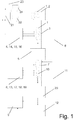
- Figure 1 shows an advantageous example system for receiving and processing material, also including the determination of the energy content of the material.
- the figure shows material 1 supplied, a storage 2 for the material supplied, a first conveyor 3, measurement and measuring devices 4, 14, 15, and 16, comprising one or more of the following: detection 4 of the size of pieces of non-combustible material, measurement 16 of the quantity of non-combustible material, measurement 15 of the quantity of combustible material, detection 14 of the size of pieces of combustible material.
- the system also comprises an apparatus for mechanical processing 5, first reject 6, a second conveyor 7, measurement and measuring devices 8, 17, 18, 19, comprising one or more of the following: measurement 8 of the quantity of non-combustible material, measurement 17 of the quantity of combustible material, detection 18 of the size of pieces of combustible material, detection 19 of the size of pieces of non-combustible material, measurement 13 of moisture content, as well as second reject 11, and finished crushed material or chips 10, or other side products.
- Figure 1 also shows a further processing plant 9 and the drying 12 of wet material. If necessary, the system also comprises an intermediate storage 20 for processed material.
- the system can be placed apart from the further processing plant, or in its vicinity in such a way that the material is transported to the system and the transport distance to the further processing is short.
- the system may be stationary, but it is also possible to apply movable systems functioning in the vicinity of the place where material is obtained from. In this way it is also possible to apply, for example, movable crusher or chopper systems which comprise said measurements and conveyors, or to which said measuring devices and conveyors can be connected.
- the material 1 supplied can be delivered, depending on the quality and type of the supplied material 1 and also on the needs of the further processing plant 9, for example either to the storage 2 of supplied material or to the first conveyor 3, or even past the mechanical processing 5 directly to the second conveyor 7.
- the number of storages 2 of supplied material in the system may be one or more, and each storage 2 of supplied material may be either a short-term intermediate storage or a storage intended for a longer term. It may also be possible that the supplied material 1 is always unloaded directly to a conveyor in such a way that there are no storages 2 for supplied material in the system.
- the supplied material 1 can be unloaded directly to the second conveyor 7, for example in the case that the supplied material load does not contain such material which would need to be led to mechanical processing 5 to secure the cost-effectiveness or the functioning of the further processing plant 9.
- Such material to be led directly to the second conveyor 7 may be, for example, wood chips or peat.
- Material is delivered to the system by, for example, truck or train.
- the delivered material load has to be weighed before the use of the material.
- the weighing of the load can be implemented, for example, in connection with the delivery of the material in such a way that the weight of the vehicle bringing the material load is weighed both with the load and without the load.
- devices for measuring the weight of the load can be provided either in a separate space or, for example, in connection with one or more of the material conveyors 3, 7.
- material is transferred by the conveyors in a continuous flow, for example, past the measuring devices, and necessary measurements are taken continuously on the biomass flowing by.
- material is led, for example, to a crusher or a chopper, and out of the mechanical processing.
- the rejects 6 and 11 can also be formed by means of conveyors and/or storages.
- the size of pieces and/or the quantity of non-combustible material, such as rocks, in the material 1 supplied onto the first conveyor is measured before the mechanical processing 5. At least the size of pieces of non-combustible material should be measured in order to detect large rocks and other large pieces which could break for example a crusher or a chopper.
- the detection 4 of non-combustible material before the mechanical processing 5 is preferably carried out substantially continuously.
- the measurement 4 for detecting non-combustible material is particularly necessary when fuel wood that contains stumps or the like, typically rock material, is utilized in the further processing plant 9. In addition to rocks, in some cases it may also be necessary to measure the quantity and/or the size of pieces of metal carried with the supplied material 1 before the mechanical processing 5.
- measurements 4 taken to detect non-combustible material it is possible to react to the harmful pieces in such a way that it is possible to reduce the burden and simultaneously the need for maintenance of the mechanical processing device, such as a crusher or a chopper.
- This can be done, for example, by guiding the detected material flow that contains harmful pieces, for example rocks, from the first conveyor 3 to the first reject 6, so that said rocks do not end up in the mechanical processing 5.
- This can be done to material that contains rocks or other pieces larger than a size set for pieces (that is, a predetermined limit value).
- the mechanical processing 5 can be stopped until the harmful pieces have bypassed the mechanical processing 5. Operating in this way, unfit material can be discharged from the system, for example, in connection with the measurement 8 of the quantity of non-combustible material.
- the quality of supplied material is measured by measurements on combustible material in addition to or instead of the measurements on non-combustible material.
- measurements on the size of pieces of combustible material it may be possible to detect, among other things, the size of stump pieces, for example the real size of pieces and/or the deviation in the size of pieces of pre-crushed stumps. This is useful for example in the case that the size of pieces of combustible material may affect the pricing of the delivered material, typically particularly for the stumps.
- the size of pieces of combustible material in the biomass 1 supplied onto the first conveyor 3 is measured by a measuring device 14 before the mechanical processing 5. It is thus possible to adjust, for example, the settings of the crusher or the chopper according to the size of pieces in such a way that the size of pieces of combustible material after the mechanical processing 5 would be as uniform as possible. In addition to large sizes of pieces, it is also useful to detect very small sizes of pieces before the mechanical processing 5, because too fine material may also hamper the functionality of the system.
- the size of pieces of combustible material measured before the mechanical processing can be utilized in the quality control system to report the size of pieces of supplied material to the material supplier. Furthermore, this data can be used as a parameter affecting the price of a delivered load.
- the size of pieces of combustible material is measured from the supplied material 1 also after the mechanical processing 5, preferably in connection with the second conveyor 7. It is thus possible to detect not only the size of pieces of the processed material but also the real size of pieces of material guided to bypass the processing. This size of pieces is important, for example, when the material is utilized in the production of biofuel or as fuel for a boiler, and it can be used as one of the control parameters.
- the size of pieces of non-combustible material is measured both before and after the mechanical processing 5.
- This makes it possible, among other things, to control effectively the operation of e.g. a crusher or a chopper, and/or to detect a possible need for maintenance.
- the apparatus can thus be maintained at more optimal intervals than at present, in such a way that the apparatus does not need to be stopped for maintenance as often as in the prior art, just to be on the safe side, but the apparatus can still be maintained each time when the efficiency is becoming poorer.
- the predictability of the operation of the apparatus of mechanical processing is also improved.
- the measurement of the moisture content 13 of the supplied material 1, the measurement of detection of the size of pieces of combustible material 18, the measurement of the quantity of combustible material 17, the measurement of detection of the size of the pieces of non-combustible material 19, or the measurement of the quantity of non-combustible material 8 is preferably taken in connection with the second conveyor 7. Most preferably, several of these measurements are taken.
- the measurements 8, 13, 17, 18, or 19 can be taken on the supplied material 1 in connection with the second conveyor 7, irrespective of whether the supplied material 1 has been passed through the mechanical processing 5 or if the supplied material 1 has been fed directly to the second conveyor 7.
- these measurements 8, 13, 17, 18, and 19 are taken for at least fuel wood to be supplied to a further processing plant, and in many cases said measurements are taken for all supplied material 1.
- the measurement 13 on the moisture content of the supplied material 1 is advantageously taken first at the above-mentioned stage, in connection with the second conveyor 7, because moisture measurements are typically most reliable when the moisture is measured from a fine fraction.
- too wet material such as for example too wet fuel wood
- Such particularly wet material typically includes, for example, branches of trees left for a relatively long time in the forest.
- the quantity of non-combustible material should often be measured at said stage in connection with the second conveyor 7, irrespective of whether the quantity of non-combustible material has already been measured before the mechanical processing 5 or whether the supplied material 1 has been led directly to the second conveyor 7.
- material of poor quality and with a particularly high content of non-combustible material whose burning is not economically viable can be passed to the side, for example to second reject 11 or, for example, as a side product.
- the measurements 13 on the moisture content of the supplied material 1 and the measurements 8 on the quantity of non-combustible material, or the measurements 17 on the quantity of combustible material are utilized in determining a moisture value and a quality value for the dry mass of the supplied material 1.
- the moisture value it is possible to use, for example, the dry matter content obtained from the moisture content measurement 13, for example as a percentage.
- the quality value for the dry mass it is possible to use, for example, the proportion of combustible material in the whole quantity of delivered biomass, as obtained from the measurements 8 on the quantity of non-combustible material, for example as a percentage.
- the quality value may also be given, for example, according to classes, wherein material that meets predetermined limit values is always classified in a given quality class.
- the moisture value By combining the moisture value with the quality value of the dry mass, and by combining both of these values to the weight data on the supplied material, it is possible to obtain, as feedback data, the energy content of the whole supplied material substantially in real time.
- the energy content can thus be defined separately for each material load entered in the system.
- the quality value of the dry mass of the material not only the content of non-combustible and/or combustible material detected after the mechanical processing, but also the quantity of combustible and/or non-combustible material led to the first reject 6 before the mechanical processing 5 are advantageously taken into account.
- One or more items of the measurement data obtained by the above-described measurements are stored in a computer system 21 where the measurement data can be processed and compiled into reports, for example a report 22 that contains quality feedback.
- the computer system also serves the rest of the system shown in Fig. 1 , and its control.
- measurement data are also transferred to a discrete computer system 23, in which the measurement data can be processed and compiled into reports, for example a report 24 that contains quality feedback.
- the quality feedback system comprising the computer system 21 and/or the computer system 23, may also be located physically detached from the rest of the system, utilizing communication links.
- the quality feedback system is provided with the measurement data and other collected data relating to the material load or the material, so that e.g.
- a report can be given to the material supplier.
- the report 22 is, for example, load-specific quality feedback
- the report 24 contains, for example, quality feedback values based on calculation algorithms, formulae or results obtained by combining measurement results.
- the computer system used may be, for example, a computer relating to the apparatus for mechanical processing, which is also provided with the measurement data obtained from the measuring devices and other information, such as identification data of the material load.
- material preferably fuel wood
- a transport vehicle such as truck or train
- an unloading conveyor onto which the delivered material 1 is unloaded, either in whole or in suitable lots, from said transport vehicle.
- the unloading conveyor may convey the load, for example, either to the first conveyor 3, to the second conveyor 7, or to a storage 2 of supplied material.
- the supplied material 1 can be transported either manually or in an automated way.
- the material supplied by the transport vehicles can also be kept in temporary storage, from where it is supplied into the system.
- a solution is applied, in which the supplied material 1 is automatically identified.
- the unit of identification data may be, for example, a micro chip containing the identification data of the load, such as a radio frequency remote identification (RFID tag) or a corresponding device.
- RFID tag radio frequency remote identification
- the system comprises one or more of the partial steps below, either in part or in whole:
- the price to be paid for the supplied material can be formed, for example, on the basis of the weight, the moisture value, the heat value coefficient, and the quality value for the dry mass of the load. It is also possible to take into account other factors, such as the size of pieces of the supplied material (combustible and/or non-combustible material).
- the price to be paid for the load it is possible to apply, for example, fees per MWh, wherein one or more of the above-mentioned quality feedback values are advantageously taken into account.
- the following factors are taken into account:
- all the above-mentioned quality feedback values can influence the price to be paid for a load; in an advantageous example, factors affecting the price to be paid include at least the weight (t) of the biomass, the quality value of the dry mass, the moisture value, and/or the effective heat value coefficient (MWh/t) of the biomass, advantageously also the size of material pieces.
- factors affecting the price to be paid include at least the weight (t) of the biomass, the quality value of the dry mass, the moisture value, and/or the effective heat value coefficient (MWh/t) of the biomass, advantageously also the size of material pieces.
- the quality feedback system is capable of giving, as feedback, any measured data entered in the system. Furthermore, the quality feedback system is capable of giving, as feedback, not only measurement results but also data produced by combining measurement data with other information. This data or at least some of it can be given as feedback via the quality feedback system to the biomass production end.
- feedback data can also be utilized to make sure that the measurements are correct.
- the value for the proportion of reject in a load can be any value agreed in advance.
- a suitable limit value for the reject may be, for example, a maximum of 10 to 12% of the quantity of the load.
- the lower heat value coefficient for the load can be formed, for example, if the upper heat value coefficient and the total moisture content of the material in the state as delivered are known.
- the measurements on the size of pieces can be taken in connection with one or more conveyors by measuring
- the size of pieces of both the non-combustible material and the combustible material is measured in such a way that both measurements are taken both before and after the mechanical processing.
- non-combustible material can be taken, for example, by means of acoustic interpretation, electromagnetic radiation and/or photo interpretation (interpretation of size of pieces).
- Metal can be measured for example by metal detectors and separated from other material for example in the same way as other non-combustible material, or for example by magnets.
- the moisture content can be measured, for example, by irradiating the material conveyed on the conveyor with a radioactive or infrared radiation source; as a result, the quantity of water molecules, that is, the moisture content of the material, can be obtained.
- the measurements can be taken by measuring devices and methods known as such, which are applied in the system and the method presented above. One or more measurements are advantageously taken as a continuous measurement of the material flow.
Landscapes
- Engineering & Computer Science (AREA)
- Mechanical Engineering (AREA)
- General Engineering & Computer Science (AREA)
- Life Sciences & Earth Sciences (AREA)
- Environmental & Geological Engineering (AREA)
- Sustainable Development (AREA)
- Sustainable Energy (AREA)
- Chemical & Material Sciences (AREA)
- Health & Medical Sciences (AREA)
- Food Science & Technology (AREA)
- General Physics & Mathematics (AREA)
- Medicinal Chemistry (AREA)
- Physics & Mathematics (AREA)
- Analytical Chemistry (AREA)
- Biochemistry (AREA)
- General Health & Medical Sciences (AREA)
- Wood Science & Technology (AREA)
- Immunology (AREA)
- Pathology (AREA)
- Processing Of Solid Wastes (AREA)
- Solid Fuels And Fuel-Associated Substances (AREA)
- Investigating Or Analyzing Materials By The Use Of Electric Means (AREA)
- Chemical And Physical Treatments For Wood And The Like (AREA)
Claims (16)
- Ein Verfahren zur Verarbeitung von Material, welches holzbasiertes Material enthält, bei welchem Verfahren Material zu einem Förderer (3, 7) und durch den Förderer zu einer Vorrichtung (5) zur mechanischen Verarbeitung oder zu einer Weiterverarbeitungsanlage geführt wird, wobei das Verfahren Folgendes umfasst:- den Feuchtigkeitsgehalt (13) zu messen,- die Größe der Stücke (4) aus nicht brennbarem Material zu messen, und- die Menge nicht brennbaren Materials in dem Materialfluss in Verbindung mit dem Förderer (3, 7) zu messen, und- Befördern, auf der Grundlage der Messungen, von Material zur Weiterverarbeitungsanlage (9) oder zu dem zur Vorrichtung (5) zur mechanischen Verarbeitung zu befördernden Material, oder anderswohin als zur Weiterverarbeitungsanlage (9) oder zur Vorrichtung (5) zur mechanischen Verarbeitung,wobei der Förderer mindestens einen ersten Förderer (3) aufweist, und das Verfahren darüber hinaus Folgendes umfasst:- Befördern von Material, das holzbasiertes Material enthält, zu der Vorrichtung (5) zur mechanischen Verarbeitung mittels des ersten Förderers (3),- Messen, stromaufwärts der Vorrichtung (5), der Größe von Stücken (4) von mindestens nicht brennbarem Material mit einer Messeinrichtung,- Bestimmen, auf Grundlage der Messung der Größe von Stücken (4), ob das gemessene Material vom ersten Förderer (3) wegzuführen ist oder ob es durch den ersten Förderer (3) der Vorrichtung (5) zur mechanischen Verarbeitung zuzuführen ist, um zerkleinert zu werden.
- Verfahren gemäß Anspruch 1, welches Folgendes umfasst:- Messen der Größe von Stücken und/oder der Menge an brennbarem Material in dem Materialfluss in Verbindung mit einem zweiten Förderer (7) derart, dass
mindestens ein Teil des gemessenen Materials zu einer Weiterverarbeitungsanlage geleitet wird, und- Einstellen der Funktionsparameter der Weiterverarbeitungsanlage und/oder Steuern der Qualität des Materials, das der Weiterverarbeitungsanlage auf der Basis der Messungen der Größe der Stücke und/oder der Menge an brennbarem Material zuzuführen ist. - Verfahren gemäß einem der Ansprüche 1 oder 2, wobei Material durch den ersten Förderer (3) zu der Vorrichtung zur mechanischen Verarbeitung (5) geführt wird, durch die mindestens ein Teil des Materials zerkleinert wird, bevor das Material von der Vorrichtung zur mechanischen Verarbeitung (5) zum zweiten Förderer (7) geführt wird.
- Verfahren gemäß einem der Ansprüche 1 bis 3, wobei, wenn die Messungen zeigen, dass die Größe der Stücke und/oder die Menge an nicht brennbarem Material einen vorbestimmten Grenzwert überschreiten, mindestens einer der folgenden Schritte erfolgt:- das gemessene Material wird einer Aussortierung (6) zugeführt,- die Vorrichtung (5) zur mechanischen Verarbeitung wird für einen Zeitraum angehalten, der lang genug ist, damit das schädliche Material aus dem ersten Förderer (3), der zur Vorrichtung (5) zur mechanischen Verarbeitung führt, ausgestoßen wird.
- Verfahren gemäß einem der Ansprüche 1 bis 4, welches Folgendes umfasst:- Bestimmen des Gewichts des Materials,- Bestimmen des Anteils an brennbarem und/oder nicht brennbarem Material in Verbindung mit dem Förderer (3, 7),- Bestimmen des Feuchtigkeitsgehalts des Materials in Verbindung mit dem Förderer (3, 7),wobei das Verfahren darüber hinaus Folgendes umfasst:- Bestimmen des Energiegehalts des Materials auf der Basis der in den vorhergehenden Schritten bestimmten Daten und des oberen Wärmewertkoeffizienten.
- Verfahren gemäß einem der Ansprüche 1 bis 5, welches umfasst:Bereitstellen von Qualitäts-Feedbackdaten über das Material, das zugeführt wird und holzbasiertes Material enthält, durch Eingeben charakteristischer Daten über das Material in das Qualitäts-Feedbacksystem, wobei auf der Basis dieser charakteristischen Daten das Qualitäts-Feedbacksystem einen Qualitäts-Feedback-Bericht erzeugt, der qualitätsbezogene Daten enthält, die auf der Basis der eingegebenen Daten bezüglich des Materials, das zugeführt wird und holzbasiertes Material enthält, erzeugt wurden.
- Verfahren gemäß Anspruch 6, welches das Eingeben eines oder mehrerer der folgenden Daten über das zugeführte Material in das Qualitäts-Feedbacksystem umfasst:- den Anteil brennbaren Materials im zugeführten Material,- den Anteil nicht brennbaren Materials im zugeführten Material,- die Größe der Stücke brennbaren Materials,- die Größe der Stücke nicht brennbaren Materials,- den Feuchtigkeitsgehalt oder den Trockensubstanzgehalt des zugeführten Materials,- den oberen Wärmewertkoeffizienten des brennbaren Materials,wobei das Verfahren das Bereitstellen von einem oder mehreren Datenelementen als qualitätsbezogene Feedbackdaten umfasst:- den monetären Wert des zugeführten Materials,- den Energiegehalt des zugeführten Materials im Anlieferungszustand,- den Energiegehalt des Materials, das zur weiteren Verarbeitung geeignet ist,- den Qualitätswert des zugeführten Materials,- die Größe der Stücke brennbaren Materials, oder- die Größe der Stücke nicht brennbaren Materials.
- Verfahren gemäß einem der Ansprüche 6 bis 7, welches das Eingeben, als Daten, von mindestens der Menge an brennbarem oder nicht brennbarem Material umfasst, wobei die qualitätsbezogenen Feedbackdaten mindestens die Daten über den Energiegehalt des zugeführten Materials umfassen.
- Verfahren gemäß einem der Ansprüche 6 bis 8, welches das Bestimmen und Einstellen von einer oder mehreren Größen der folgenden Daten als qualitätsbezogene Feedbackdaten umfasst:- den monetären Wert des zugeführten Materials,- den Energiegehalt des zugeführten Materials im Anlieferungszustand,- den Energiegehalt des Teils des zugeführten Materials, der zur weiteren Verarbeitung geeignet ist,- das Gewicht des zugeführten Materials,- den oberen Wärmewertkoeffizienten des zugeführten Materials,- den Qualitätswert des zugeführten Materials,- den Feuchtigkeitsgehalt des zugeführten Materials.
- Ein System zum Verarbeiten von Material, das holzbasiertes Material enthält, wobei das System mindestens einen Förderer (3, 7) und eine Vorrichtung (5) zur mechanischen Verarbeitung aufweist, wobei das System darüber hinaus Folgendes umfasst:- Messelemente (4, 8, 13) zum Messen des Feuchtigkeitsgehalts, der Menge an nicht brennbarem Material und der Größe der Stücke nicht brennbaren Materials in dem Materialfluss in Verbindung mit dem Förderer (3, 7),
wobei- mindestens einen Förderer (3, 7) zum Befördern des Materials, auf der Basis der Messungen, an eine Weiterverarbeitungsanlage (9) oder an die Vorrichtung (5) zur mechanischen Verarbeitung angeordnet ist, und eine Übertragungsvorrichtung zum Übertragen des Materials von dem Förderer (3, 7) an mindestens einen anderen Ort, wie z. b. zum Aussortieren (6) oder zum Trocknen (12) von nassem Material,wobei mindestens ein Förderer mindestens einen ersten Förderer (3) aufweist und das System darüber hinaus Folgendes aufweist:- den ersten Förderer (3), der angeordnet ist, um den Materialfluss an die Vorrichtung (5) zur mechanischen Verarbeitung zu befördern,- Messelemente (4) zum Messen der Größe der Stücke nicht brennbaren Materials von dem Materialfluss stromaufwärts der Vorrichtung (5) zur mechanischen Verarbeitung, und- die Übertragungsvorrichtung zum Übertragen des Materials von dem Förderer (3), auf der Basis der Messung der Größe von Stücken (4) nicht brennbaren Materials, zum Aussortieren (6) stromaufwärts der Vorrichtung (5) zur mechanischen Verarbeitung, wenn der Messwert (4) einen vorbestimmten Grenzwert überschreitet. - System gemäß Anspruch 10, wobei das System Folgendes aufweist:- Mittel zum Anhalten der Vorrichtung zur mechanischen Verarbeitung (5) auf der Grundlage von mindestens einer Messung, die an dem nicht brennbaren Material vorgenommen wird.
- System gemäß Anspruch 10 oder 11, wobei das System Folgendes aufweist:- einen zweiten Förderer (7) zum Fördern von Material an eine Weiterverarbeitungsanlage,- Messelemente zum Messen der Größe von Stücken und/oder der Menge brennbaren Materials in dem Materialfluss in Verbindung mit dem zweiten Förderer (7), und- Steuereinrichtungen zum Steuern der Funktionsparameter der Weiterverarbeitungsanlage oder zum Steuern der Qualität von Material, das zu der Weiterverarbeitungsanlage geführt werden soll, auf der Basis von mindestens einer vorgenommen Messung.
- System gemäß einem der Ansprüche 10 bis 12, wobei das System Folgendes aufweist:- Mittel zum Messen des Gewichts des Materials,- Mittel zum Messen der Menge an brennbarem und/oder nicht brennbarem Material in dem Material in Verbindung mit dem ersten und/oder zweiten Förderer (3, 7),- Mittel zum Messen des Feuchtigkeitsgehalts des Materials in Verbindung mit dem ersten und/oder zweiten Förderer (3, 7), und- Mittel zum Bestimmen des Energiegehalts auf der Basis des oberen Wärmewertkoeffizienten und den gemessenen Daten.
- System gemäß einem der Ansprüche 10 bis 13, wobei das System darüber hinaus ein Qualitäts-Feedbacksystem aufweist, das dazu gedacht ist, Qualitäts-Feedbackdaten über das zugeführte und holzbasiertes Material enthaltende Material zu erzeugen, in welches Qualitäts-Feedbacksystem charakteristische Daten über das zugeführte Material eingegeben werden sollen, wobei das Qualitäts-Feedbacksystem auf der Basis der eingegebenen Daten einen Qualitäts-Feedbackbericht erstellt, der qualitätsbezogene Daten über zugeführte und holzbasiertes Material enthaltende Material enthält, wobei die Daten auf der Basis der eingegebenen Daten erzeugt werden.
- System gemäß Anspruch 14, wobei eines oder mehrere der folgenden Datenelemente über zugeführtes Material angeordnet sind, um in das Qualitäts-Feedbacksystem eingetragen zu werden:- der Anteil brennbaren Materials im zugeführten Material,- der Anteil nicht brennbaren Materials im zugeführten Material,- die Größe der Stücke brennbaren Materials,- die Größe der Stücke nicht brennbaren Materials,- der Feuchtigkeitsgehalt oder der Trockensubstanzgehalt des zugeführten Materials,- der obere Wärmewertkoeffizient des brennbaren Materials,und dass die Qualitäts-Feedbackdaten ein oder mehrere der folgenden Datenelemente umfassen:- den monetären Wert des zugeführten Materials,- den Energiegehalt des zugeführten Materials im Anlieferungszustand,- den Energiegehalt des Materials, das zur weiteren Verarbeitung geeignet ist,- den Qualitätswert des zugeführten Materials,- die Größe der Stücke brennbaren Materials, oder- die Größe der Stücke nicht brennbaren Materials.
- System gemäß einem der Ansprüche 14 bis 15, wobei mindestens der Feuchtigkeitsgehalt des zugeführten Materials, die Menge an brennbarem oder nicht brennbarem Material und der obere Wärmewertkoeffizient des brennbaren Materials angeordnet sind, um als Daten in das System eingegeben zu werden, wobei das Qualitäts-Feedbacksystem mindestens die Daten über den Energiegehalt des zugeführten Materials aufweist.
Applications Claiming Priority (2)
| Application Number | Priority Date | Filing Date | Title |
|---|---|---|---|
| FI20105342A FI20105342L (fi) | 2010-04-01 | 2010-04-01 | Menetelmä ja järjestelmä biomassaa sisältävän materiaalin käsittelemiseksi, biomassaa sisältävän materiaalin laatupalautejärjestelmä, sekä menetelmä ja järjestelmä materiaalin eneregiasisällön määrittämiseksi |
| PCT/FI2011/050284 WO2011121187A2 (en) | 2010-04-01 | 2011-04-01 | A method and a system for processing material that contains biomass |
Publications (2)
| Publication Number | Publication Date |
|---|---|
| EP2553339A2 EP2553339A2 (de) | 2013-02-06 |
| EP2553339B1 true EP2553339B1 (de) | 2017-12-13 |
Family
ID=42133188
Family Applications (1)
| Application Number | Title | Priority Date | Filing Date |
|---|---|---|---|
| EP11719847.3A Not-in-force EP2553339B1 (de) | 2010-04-01 | 2011-04-01 | Verfahren und system zur verarbeitung von biomassehaltigem material |
Country Status (8)
| Country | Link |
|---|---|
| US (1) | US9580246B2 (de) |
| EP (1) | EP2553339B1 (de) |
| CN (1) | CN103038574B (de) |
| BR (1) | BR112012024504A2 (de) |
| CA (1) | CA2793982C (de) |
| FI (1) | FI20105342L (de) |
| RU (1) | RU2564309C2 (de) |
| WO (1) | WO2011121187A2 (de) |
Families Citing this family (4)
| Publication number | Priority date | Publication date | Assignee | Title |
|---|---|---|---|---|
| FI127810B (fi) | 2015-02-19 | 2019-03-15 | Inray Oy | Ohjausjärjestelmä ja -menetelmä kiinteän biopolttoaineen syötön ohjaamiseksi polttoprosessissa |
| CN106081456B (zh) * | 2016-08-01 | 2018-01-30 | 北京北控环保工程技术有限公司 | 危险废弃物智能存储配料系统 |
| TWI821503B (zh) * | 2020-01-15 | 2023-11-11 | 隆順綠能科技股份有限公司 | 固體回收燃料的原料分選系統及其方法 |
| DE102022122433A1 (de) * | 2022-09-05 | 2024-03-07 | WasteAnt GmbH | Heizwertermittlung |
Family Cites Families (21)
| Publication number | Priority date | Publication date | Assignee | Title |
|---|---|---|---|---|
| JP3011639B2 (ja) | 1995-05-18 | 2000-02-21 | 日立造船株式会社 | 破砕処理不適物の除去設備 |
| US5720165A (en) * | 1995-09-21 | 1998-02-24 | Bioten Gp | System for burning biomass to produce hot gas |
| US6182584B1 (en) * | 1999-11-23 | 2001-02-06 | Environmental Solutions & Technology, Inc. | Integrated control and destructive distillation of carbonaceous waste |
| FI107741B (fi) * | 2000-02-11 | 2001-09-28 | Metso Paper Inc | Menetelmä kuitumassan laadun ohjaamiseksi |
| FI111097B (fi) | 2001-11-06 | 2003-05-30 | Pekka Ahtila | Menetelmä biopolttoaineen vähintään kaksivaiheisen kuivausprosessin säätämiseksi |
| US20050276451A1 (en) | 2004-05-27 | 2005-12-15 | Hunking Maurice J | Method and apparatus for sorting |
| GB2412889B (en) * | 2004-05-29 | 2006-06-07 | Fairport Engineering Group Ltd | Biomass material |
| AT502148A1 (de) | 2005-06-24 | 2007-01-15 | Wito Waldviertler Innovations | Anlage zur erzeugung von energie aus brennbarem abfall |
| US7658155B2 (en) * | 2005-06-29 | 2010-02-09 | Advanced Plasma Power Limited | Waste treatment process and apparatus |
| US8634940B2 (en) * | 2006-10-31 | 2014-01-21 | Rockwell Automation Technologies, Inc. | Model predictive control of a fermentation feed in biofuel production |
| US20080163803A1 (en) | 2006-12-22 | 2008-07-10 | Covanta Energy Corporation | Method and systems to control municipal solid waste density and higher heating value for improved waste-to-energy boiler operation |
| US20100319595A1 (en) * | 2007-05-14 | 2010-12-23 | The Texas A&M University System | Method for the production of thermally advanced feedlot biomass (TAFB) for use as fuel |
| WO2009023557A2 (en) * | 2007-08-10 | 2009-02-19 | Warren Vanderpool | Waste processing process |
| EP2321104B1 (de) * | 2008-06-26 | 2013-10-09 | Re Community Energy, LLC | Verfahren für integrierte abfalllagerung |
| US20100017020A1 (en) | 2008-07-16 | 2010-01-21 | Bradley Hubbard-Nelson | Sorting system |
| CN101555429B (zh) | 2009-05-05 | 2013-01-30 | 农业部规划设计研究院 | 一种生物质固体成型燃料加工方法 |
| US8784514B1 (en) * | 2010-11-17 | 2014-07-22 | Columbia Insurance Company | Carpet fuel processing boiler |
| CN107513443A (zh) * | 2011-06-03 | 2017-12-26 | 谐和能源有限责任公司 | 由废物材料制备过程设计燃料原料的系统和方法 |
| WO2013147256A1 (ja) * | 2012-03-30 | 2013-10-03 | メタウォーター株式会社 | 有機性廃棄物の処理装置および処理方法並びに制御装置 |
| US20130304546A1 (en) * | 2012-05-11 | 2013-11-14 | Agni Corporation (Cayman Islands) | Novel systems and methods for optimizing profit or gross margin based on one of more values of process parameters for producing biofuel |
| WO2015011279A2 (de) * | 2013-07-25 | 2015-01-29 | Kotyk Energy Ag | Biomasseverarbeitungsvorrichtung und -verfahren |
-
2010
- 2010-04-01 FI FI20105342A patent/FI20105342L/fi not_active Application Discontinuation
-
2011
- 2011-04-01 WO PCT/FI2011/050284 patent/WO2011121187A2/en not_active Ceased
- 2011-04-01 US US13/638,784 patent/US9580246B2/en not_active Expired - Fee Related
- 2011-04-01 EP EP11719847.3A patent/EP2553339B1/de not_active Not-in-force
- 2011-04-01 RU RU2012146540/03A patent/RU2564309C2/ru not_active IP Right Cessation
- 2011-04-01 CA CA2793982A patent/CA2793982C/en active Active
- 2011-04-01 BR BR112012024504A patent/BR112012024504A2/pt not_active Application Discontinuation
- 2011-04-01 CN CN201180027021.7A patent/CN103038574B/zh not_active Expired - Fee Related
Also Published As
| Publication number | Publication date |
|---|---|
| WO2011121187A3 (en) | 2012-08-02 |
| BR112012024504A2 (pt) | 2016-07-05 |
| FI20105342A7 (fi) | 2011-06-30 |
| WO2011121187A2 (en) | 2011-10-06 |
| FI20105342L (fi) | 2011-06-30 |
| EP2553339A2 (de) | 2013-02-06 |
| CA2793982C (en) | 2017-02-28 |
| CN103038574A (zh) | 2013-04-10 |
| CN103038574B (zh) | 2015-11-25 |
| RU2564309C2 (ru) | 2015-09-27 |
| CA2793982A1 (en) | 2011-10-06 |
| US20130079922A1 (en) | 2013-03-28 |
| RU2012146540A (ru) | 2014-05-10 |
| US9580246B2 (en) | 2017-02-28 |
Similar Documents
| Publication | Publication Date | Title |
|---|---|---|
| Ilic et al. | On the challenges facing the handling of solid biomass feedstocks | |
| US20090266891A1 (en) | Tracking and properties control system for bulk materials | |
| US20120104123A1 (en) | Powdered fuel production methods and systems useful in farm to flame systems | |
| EP2553339B1 (de) | Verfahren und system zur verarbeitung von biomassehaltigem material | |
| Badger | Processing cost analysis for biomass feedstocks | |
| Sloss | Blending of coals to meet power station requirements | |
| Spinelli et al. | Performance of a mobile mechanical screen to improve the commercial quality of wood chips for energy | |
| Baruya | Losses in the coal supply chain | |
| CN109060406A (zh) | 生物质燃料自动采样分析系统 | |
| JP6539421B1 (ja) | ペレット状木質バイオマス燃料の受発注システム | |
| US20130192127A1 (en) | Process and System For Manufacturing Improved Heat Value Solid Fuel From Solid Waste | |
| Sandanayake et al. | A feasibility study of using coffee cup waste as a building material-Life cycle assessment and multi-objective optimisation | |
| Zhang et al. | Green transformation strategy of pallet logistics in China based on the life cycle analysis | |
| Sessions et al. | Pricing forest biomass for power generation | |
| Sundberg et al. | Traceability of bulk biomass: Application of radio frequency identification technology on a bulk pellet flow | |
| FI125974B (fi) | Menetelmä ja järjestelmä biomassaa sisältävän materiaalin käsittelemiseksi | |
| Roise et al. | Balancing biomass harvesting and drying tactics with delivered payment practice | |
| Beguedou et al. | Alternative Fuels Substitution in Cement Industries for Improved Energy Efficiency and Sustainability. Energies 2023, 16, 3533 | |
| Yancey et al. | Techno-Economic Analysis of Forest Concepts, LLC Crumbler® Operated at Proton Power To Process Crumbles from Hardwood Chips | |
| Smith et al. | Characteristics of forest-derived woody biomass collected and processed in Oregon | |
| Lindberg et al. | Best Available Techniques (BAT) in solid biomass fuel processing, handling, storage and production of pellets from biomass | |
| Jäävalli | Utilization of an online quality measurement system in a biomass power plant | |
| Eloka-Eboka et al. | Sustainable design of bagasse biomass flow reclamation control using bifurcated chute | |
| Hennessy | Review of wood fuel testing standards | |
| Gil et al. | Characterization of a biomass milling pilot plant |
Legal Events
| Date | Code | Title | Description |
|---|---|---|---|
| PUAI | Public reference made under article 153(3) epc to a published international application that has entered the european phase |
Free format text: ORIGINAL CODE: 0009012 |
|
| 17P | Request for examination filed |
Effective date: 20121029 |
|
| AK | Designated contracting states |
Kind code of ref document: A2 Designated state(s): AL AT BE BG CH CY CZ DE DK EE ES FI FR GB GR HR HU IE IS IT LI LT LU LV MC MK MT NL NO PL PT RO RS SE SI SK SM TR |
|
| DAX | Request for extension of the european patent (deleted) | ||
| 17Q | First examination report despatched |
Effective date: 20131218 |
|
| STAA | Information on the status of an ep patent application or granted ep patent |
Free format text: STATUS: EXAMINATION IS IN PROGRESS |
|
| GRAP | Despatch of communication of intention to grant a patent |
Free format text: ORIGINAL CODE: EPIDOSNIGR1 |
|
| STAA | Information on the status of an ep patent application or granted ep patent |
Free format text: STATUS: GRANT OF PATENT IS INTENDED |
|
| INTG | Intention to grant announced |
Effective date: 20170720 |
|
| GRAS | Grant fee paid |
Free format text: ORIGINAL CODE: EPIDOSNIGR3 |
|
| GRAA | (expected) grant |
Free format text: ORIGINAL CODE: 0009210 |
|
| STAA | Information on the status of an ep patent application or granted ep patent |
Free format text: STATUS: THE PATENT HAS BEEN GRANTED |
|
| AK | Designated contracting states |
Kind code of ref document: B1 Designated state(s): AL AT BE BG CH CY CZ DE DK EE ES FI FR GB GR HR HU IE IS IT LI LT LU LV MC MK MT NL NO PL PT RO RS SE SI SK SM TR |
|
| REG | Reference to a national code |
Ref country code: GB Ref legal event code: FG4D |
|
| REG | Reference to a national code |
Ref country code: AT Ref legal event code: REF Ref document number: 954760 Country of ref document: AT Kind code of ref document: T Effective date: 20171215 Ref country code: CH Ref legal event code: EP |
|
| REG | Reference to a national code |
Ref country code: IE Ref legal event code: FG4D |
|
| REG | Reference to a national code |
Ref country code: DE Ref legal event code: R096 Ref document number: 602011044139 Country of ref document: DE |
|
| REG | Reference to a national code |
Ref country code: NL Ref legal event code: MP Effective date: 20171213 |
|
| REG | Reference to a national code |
Ref country code: LT Ref legal event code: MG4D Ref country code: FR Ref legal event code: PLFP Year of fee payment: 8 |
|
| PG25 | Lapsed in a contracting state [announced via postgrant information from national office to epo] |
Ref country code: SE Free format text: LAPSE BECAUSE OF FAILURE TO SUBMIT A TRANSLATION OF THE DESCRIPTION OR TO PAY THE FEE WITHIN THE PRESCRIBED TIME-LIMIT Effective date: 20171213 Ref country code: NO Free format text: LAPSE BECAUSE OF FAILURE TO SUBMIT A TRANSLATION OF THE DESCRIPTION OR TO PAY THE FEE WITHIN THE PRESCRIBED TIME-LIMIT Effective date: 20180313 Ref country code: LT Free format text: LAPSE BECAUSE OF FAILURE TO SUBMIT A TRANSLATION OF THE DESCRIPTION OR TO PAY THE FEE WITHIN THE PRESCRIBED TIME-LIMIT Effective date: 20171213 Ref country code: FI Free format text: LAPSE BECAUSE OF FAILURE TO SUBMIT A TRANSLATION OF THE DESCRIPTION OR TO PAY THE FEE WITHIN THE PRESCRIBED TIME-LIMIT Effective date: 20171213 |
|
| REG | Reference to a national code |
Ref country code: AT Ref legal event code: MK05 Ref document number: 954760 Country of ref document: AT Kind code of ref document: T Effective date: 20171213 |
|
| PG25 | Lapsed in a contracting state [announced via postgrant information from national office to epo] |
Ref country code: RS Free format text: LAPSE BECAUSE OF FAILURE TO SUBMIT A TRANSLATION OF THE DESCRIPTION OR TO PAY THE FEE WITHIN THE PRESCRIBED TIME-LIMIT Effective date: 20171213 Ref country code: BG Free format text: LAPSE BECAUSE OF FAILURE TO SUBMIT A TRANSLATION OF THE DESCRIPTION OR TO PAY THE FEE WITHIN THE PRESCRIBED TIME-LIMIT Effective date: 20180313 Ref country code: HR Free format text: LAPSE BECAUSE OF FAILURE TO SUBMIT A TRANSLATION OF THE DESCRIPTION OR TO PAY THE FEE WITHIN THE PRESCRIBED TIME-LIMIT Effective date: 20171213 Ref country code: LV Free format text: LAPSE BECAUSE OF FAILURE TO SUBMIT A TRANSLATION OF THE DESCRIPTION OR TO PAY THE FEE WITHIN THE PRESCRIBED TIME-LIMIT Effective date: 20171213 Ref country code: GR Free format text: LAPSE BECAUSE OF FAILURE TO SUBMIT A TRANSLATION OF THE DESCRIPTION OR TO PAY THE FEE WITHIN THE PRESCRIBED TIME-LIMIT Effective date: 20180314 |
|
| PG25 | Lapsed in a contracting state [announced via postgrant information from national office to epo] |
Ref country code: NL Free format text: LAPSE BECAUSE OF FAILURE TO SUBMIT A TRANSLATION OF THE DESCRIPTION OR TO PAY THE FEE WITHIN THE PRESCRIBED TIME-LIMIT Effective date: 20171213 |
|
| PG25 | Lapsed in a contracting state [announced via postgrant information from national office to epo] |
Ref country code: CY Free format text: LAPSE BECAUSE OF FAILURE TO SUBMIT A TRANSLATION OF THE DESCRIPTION OR TO PAY THE FEE WITHIN THE PRESCRIBED TIME-LIMIT Effective date: 20171213 Ref country code: EE Free format text: LAPSE BECAUSE OF FAILURE TO SUBMIT A TRANSLATION OF THE DESCRIPTION OR TO PAY THE FEE WITHIN THE PRESCRIBED TIME-LIMIT Effective date: 20171213 Ref country code: SK Free format text: LAPSE BECAUSE OF FAILURE TO SUBMIT A TRANSLATION OF THE DESCRIPTION OR TO PAY THE FEE WITHIN THE PRESCRIBED TIME-LIMIT Effective date: 20171213 Ref country code: ES Free format text: LAPSE BECAUSE OF FAILURE TO SUBMIT A TRANSLATION OF THE DESCRIPTION OR TO PAY THE FEE WITHIN THE PRESCRIBED TIME-LIMIT Effective date: 20171213 Ref country code: CZ Free format text: LAPSE BECAUSE OF FAILURE TO SUBMIT A TRANSLATION OF THE DESCRIPTION OR TO PAY THE FEE WITHIN THE PRESCRIBED TIME-LIMIT Effective date: 20171213 |
|
| PG25 | Lapsed in a contracting state [announced via postgrant information from national office to epo] |
Ref country code: AT Free format text: LAPSE BECAUSE OF FAILURE TO SUBMIT A TRANSLATION OF THE DESCRIPTION OR TO PAY THE FEE WITHIN THE PRESCRIBED TIME-LIMIT Effective date: 20171213 Ref country code: IS Free format text: LAPSE BECAUSE OF FAILURE TO SUBMIT A TRANSLATION OF THE DESCRIPTION OR TO PAY THE FEE WITHIN THE PRESCRIBED TIME-LIMIT Effective date: 20180413 Ref country code: IT Free format text: LAPSE BECAUSE OF FAILURE TO SUBMIT A TRANSLATION OF THE DESCRIPTION OR TO PAY THE FEE WITHIN THE PRESCRIBED TIME-LIMIT Effective date: 20171213 Ref country code: SM Free format text: LAPSE BECAUSE OF FAILURE TO SUBMIT A TRANSLATION OF THE DESCRIPTION OR TO PAY THE FEE WITHIN THE PRESCRIBED TIME-LIMIT Effective date: 20171213 Ref country code: PL Free format text: LAPSE BECAUSE OF FAILURE TO SUBMIT A TRANSLATION OF THE DESCRIPTION OR TO PAY THE FEE WITHIN THE PRESCRIBED TIME-LIMIT Effective date: 20171213 Ref country code: RO Free format text: LAPSE BECAUSE OF FAILURE TO SUBMIT A TRANSLATION OF THE DESCRIPTION OR TO PAY THE FEE WITHIN THE PRESCRIBED TIME-LIMIT Effective date: 20171213 |
|
| REG | Reference to a national code |
Ref country code: DE Ref legal event code: R097 Ref document number: 602011044139 Country of ref document: DE |
|
| PLBE | No opposition filed within time limit |
Free format text: ORIGINAL CODE: 0009261 |
|
| STAA | Information on the status of an ep patent application or granted ep patent |
Free format text: STATUS: NO OPPOSITION FILED WITHIN TIME LIMIT |
|
| 26N | No opposition filed |
Effective date: 20180914 |
|
| PG25 | Lapsed in a contracting state [announced via postgrant information from national office to epo] |
Ref country code: MC Free format text: LAPSE BECAUSE OF FAILURE TO SUBMIT A TRANSLATION OF THE DESCRIPTION OR TO PAY THE FEE WITHIN THE PRESCRIBED TIME-LIMIT Effective date: 20171213 Ref country code: DK Free format text: LAPSE BECAUSE OF FAILURE TO SUBMIT A TRANSLATION OF THE DESCRIPTION OR TO PAY THE FEE WITHIN THE PRESCRIBED TIME-LIMIT Effective date: 20171213 |
|
| REG | Reference to a national code |
Ref country code: CH Ref legal event code: PL |
|
| REG | Reference to a national code |
Ref country code: BE Ref legal event code: MM Effective date: 20180430 |
|
| REG | Reference to a national code |
Ref country code: IE Ref legal event code: MM4A |
|
| PG25 | Lapsed in a contracting state [announced via postgrant information from national office to epo] |
Ref country code: LU Free format text: LAPSE BECAUSE OF NON-PAYMENT OF DUE FEES Effective date: 20180401 |
|
| PG25 | Lapsed in a contracting state [announced via postgrant information from national office to epo] |
Ref country code: BE Free format text: LAPSE BECAUSE OF NON-PAYMENT OF DUE FEES Effective date: 20180430 Ref country code: SI Free format text: LAPSE BECAUSE OF FAILURE TO SUBMIT A TRANSLATION OF THE DESCRIPTION OR TO PAY THE FEE WITHIN THE PRESCRIBED TIME-LIMIT Effective date: 20171213 Ref country code: LI Free format text: LAPSE BECAUSE OF NON-PAYMENT OF DUE FEES Effective date: 20180430 Ref country code: CH Free format text: LAPSE BECAUSE OF NON-PAYMENT OF DUE FEES Effective date: 20180430 |
|
| PG25 | Lapsed in a contracting state [announced via postgrant information from national office to epo] |
Ref country code: IE Free format text: LAPSE BECAUSE OF NON-PAYMENT OF DUE FEES Effective date: 20180401 |
|
| PG25 | Lapsed in a contracting state [announced via postgrant information from national office to epo] |
Ref country code: MT Free format text: LAPSE BECAUSE OF NON-PAYMENT OF DUE FEES Effective date: 20180401 |
|
| PG25 | Lapsed in a contracting state [announced via postgrant information from national office to epo] |
Ref country code: TR Free format text: LAPSE BECAUSE OF FAILURE TO SUBMIT A TRANSLATION OF THE DESCRIPTION OR TO PAY THE FEE WITHIN THE PRESCRIBED TIME-LIMIT Effective date: 20171213 |
|
| PG25 | Lapsed in a contracting state [announced via postgrant information from national office to epo] |
Ref country code: PT Free format text: LAPSE BECAUSE OF FAILURE TO SUBMIT A TRANSLATION OF THE DESCRIPTION OR TO PAY THE FEE WITHIN THE PRESCRIBED TIME-LIMIT Effective date: 20171213 Ref country code: HU Free format text: LAPSE BECAUSE OF FAILURE TO SUBMIT A TRANSLATION OF THE DESCRIPTION OR TO PAY THE FEE WITHIN THE PRESCRIBED TIME-LIMIT; INVALID AB INITIO Effective date: 20110401 |
|
| PG25 | Lapsed in a contracting state [announced via postgrant information from national office to epo] |
Ref country code: MK Free format text: LAPSE BECAUSE OF NON-PAYMENT OF DUE FEES Effective date: 20171213 |
|
| PG25 | Lapsed in a contracting state [announced via postgrant information from national office to epo] |
Ref country code: AL Free format text: LAPSE BECAUSE OF FAILURE TO SUBMIT A TRANSLATION OF THE DESCRIPTION OR TO PAY THE FEE WITHIN THE PRESCRIBED TIME-LIMIT Effective date: 20171213 |
|
| PGFP | Annual fee paid to national office [announced via postgrant information from national office to epo] |
Ref country code: GB Payment date: 20220427 Year of fee payment: 12 Ref country code: FR Payment date: 20220425 Year of fee payment: 12 Ref country code: DE Payment date: 20220427 Year of fee payment: 12 |
|
| REG | Reference to a national code |
Ref country code: DE Ref legal event code: R119 Ref document number: 602011044139 Country of ref document: DE |
|
| GBPC | Gb: european patent ceased through non-payment of renewal fee |
Effective date: 20230401 |
|
| PG25 | Lapsed in a contracting state [announced via postgrant information from national office to epo] |
Ref country code: GB Free format text: LAPSE BECAUSE OF NON-PAYMENT OF DUE FEES Effective date: 20230401 |
|
| PG25 | Lapsed in a contracting state [announced via postgrant information from national office to epo] |
Ref country code: GB Free format text: LAPSE BECAUSE OF NON-PAYMENT OF DUE FEES Effective date: 20230401 Ref country code: FR Free format text: LAPSE BECAUSE OF NON-PAYMENT OF DUE FEES Effective date: 20230430 Ref country code: DE Free format text: LAPSE BECAUSE OF NON-PAYMENT OF DUE FEES Effective date: 20231103 |