EP2552207B1 - Sweet flavor modifier - Google Patents
Sweet flavor modifier Download PDFInfo
- Publication number
- EP2552207B1 EP2552207B1 EP11763466.7A EP11763466A EP2552207B1 EP 2552207 B1 EP2552207 B1 EP 2552207B1 EP 11763466 A EP11763466 A EP 11763466A EP 2552207 B1 EP2552207 B1 EP 2552207B1
- Authority
- EP
- European Patent Office
- Prior art keywords
- amino
- substituted
- ethyl
- methylquinoline
- carboxylate
- Prior art date
- Legal status (The legal status is an assumption and is not a legal conclusion. Google has not performed a legal analysis and makes no representation as to the accuracy of the status listed.)
- Active
Links
- 0 CC(C)Nc(c(P)c(c(*)*1O)N)c1S(C)=C Chemical compound CC(C)Nc(c(P)c(c(*)*1O)N)c1S(C)=C 0.000 description 17
- RVKHTRQYEOAITD-UHFFFAOYSA-N CC(C)(C)CCc1c2c(N)c(C(O)=O)c(C)nc2ccc1 Chemical compound CC(C)(C)CCc1c2c(N)c(C(O)=O)c(C)nc2ccc1 RVKHTRQYEOAITD-UHFFFAOYSA-N 0.000 description 2
- ZYUKNZQCMHKBRJ-UHFFFAOYSA-N CC(COc1c2c(N)c(C(O)=O)c(C)nc2ccc1)NC(C1CCCCC1)=O Chemical compound CC(COc1c2c(N)c(C(O)=O)c(C)nc2ccc1)NC(C1CCCCC1)=O ZYUKNZQCMHKBRJ-UHFFFAOYSA-N 0.000 description 2
- YIIGBBMDSRCJPJ-UHFFFAOYSA-N CC(COc1c2c(N)c(C(O)=O)c(C)nc2ccc1)NC(c(cc1OCCO)ccc1OC)=O Chemical compound CC(COc1c2c(N)c(C(O)=O)c(C)nc2ccc1)NC(c(cc1OCCO)ccc1OC)=O YIIGBBMDSRCJPJ-UHFFFAOYSA-N 0.000 description 2
- YDFOFRCLWCBQGR-UHFFFAOYSA-N Cc1nc2cccc(-c3cc(OC)ccc3)c2c(N)c1C(O)=O Chemical compound Cc1nc2cccc(-c3cc(OC)ccc3)c2c(N)c1C(O)=O YDFOFRCLWCBQGR-UHFFFAOYSA-N 0.000 description 2
- NWWNOKZSLAWADK-UHFFFAOYSA-N Nc1c(ccc(F)c2)c2ncc1C(O)=O Chemical compound Nc1c(ccc(F)c2)c2ncc1C(O)=O NWWNOKZSLAWADK-UHFFFAOYSA-N 0.000 description 2
- PQHULRRMILJHQA-UHFFFAOYSA-N Nc1c(cccc2)c2nc(CC(O)=O)c1C(O)=O Chemical compound Nc1c(cccc2)c2nc(CC(O)=O)c1C(O)=O PQHULRRMILJHQA-UHFFFAOYSA-N 0.000 description 2
- MHQDDLXSMUGTJD-UHFFFAOYSA-N CC(C)(C)COc1c2c(N)c(C(O)=O)c(C)nc2ccc1 Chemical compound CC(C)(C)COc1c2c(N)c(C(O)=O)c(C)nc2ccc1 MHQDDLXSMUGTJD-UHFFFAOYSA-N 0.000 description 1
- ZSGNKMNJNCZRRF-GJVZYXNPSA-N CC(C)(CO/C1=C/C=C\C/N=C(/C)\C(\C(O)=O)=[I]/C1=C)NC(C(CC=C1)C=C1O)=O Chemical compound CC(C)(CO/C1=C/C=C\C/N=C(/C)\C(\C(O)=O)=[I]/C1=C)NC(C(CC=C1)C=C1O)=O ZSGNKMNJNCZRRF-GJVZYXNPSA-N 0.000 description 1
- AFGMJFCAEPCQNQ-UHFFFAOYSA-N CC(C)(COc1c2c(N)c(C(O)=O)c(C)nc2ccc1)NC(C1CCCC1)=O Chemical compound CC(C)(COc1c2c(N)c(C(O)=O)c(C)nc2ccc1)NC(C1CCCC1)=O AFGMJFCAEPCQNQ-UHFFFAOYSA-N 0.000 description 1
- LWKARMDEQJUQGM-UHFFFAOYSA-N CC(C)(COc1c2c(N)c(C(O)=O)c(C)nc2ccc1)NC(C1COCC1)=O Chemical compound CC(C)(COc1c2c(N)c(C(O)=O)c(C)nc2ccc1)NC(C1COCC1)=O LWKARMDEQJUQGM-UHFFFAOYSA-N 0.000 description 1
- JVOCECNAASRZKL-UHFFFAOYSA-N CC(C)(COc1c2c(N)c(C(O)=O)c(C)nc2ccc1)NC(c(cc1)ccc1O)=O Chemical compound CC(C)(COc1c2c(N)c(C(O)=O)c(C)nc2ccc1)NC(c(cc1)ccc1O)=O JVOCECNAASRZKL-UHFFFAOYSA-N 0.000 description 1
- XRBCHPVAXRXZBQ-UHFFFAOYSA-N CC(C)(COc1c2c(N)c(C(O)=O)c(C)nc2ccc1)NC(c(cc1)ccc1OC)=O Chemical compound CC(C)(COc1c2c(N)c(C(O)=O)c(C)nc2ccc1)NC(c(cc1)ccc1OC)=O XRBCHPVAXRXZBQ-UHFFFAOYSA-N 0.000 description 1
- PZJNNFMQZQAFTD-UHFFFAOYSA-N CC(C)(COc1c2c(N)c(C(O)=O)c(C)nc2ccc1)NC(c1cc(OC)ccc1)=O Chemical compound CC(C)(COc1c2c(N)c(C(O)=O)c(C)nc2ccc1)NC(c1cc(OC)ccc1)=O PZJNNFMQZQAFTD-UHFFFAOYSA-N 0.000 description 1
- LOXXAKXDAJOUNE-UHFFFAOYSA-N CC(C)(COc1c2c(N)c(C(O)=O)c(C)nc2ccc1)NC(c1ccc(CO)cc1)=O Chemical compound CC(C)(COc1c2c(N)c(C(O)=O)c(C)nc2ccc1)NC(c1ccc(CO)cc1)=O LOXXAKXDAJOUNE-UHFFFAOYSA-N 0.000 description 1
- QODIENRRZGYYKN-UHFFFAOYSA-N CC(C)(COc1c2c(N)c(C(O)=O)c(C)nc2ccc1)NC(c1ccc2OCCOc2c1)=O Chemical compound CC(C)(COc1c2c(N)c(C(O)=O)c(C)nc2ccc1)NC(c1ccc2OCCOc2c1)=O QODIENRRZGYYKN-UHFFFAOYSA-N 0.000 description 1
- LJPVPDXUPDTLQV-UHFFFAOYSA-N CC(C)(COc1c2c(N)c(C(O)=O)c(C)nc2ccc1)NC(c1cccc(F)c1)=O Chemical compound CC(C)(COc1c2c(N)c(C(O)=O)c(C)nc2ccc1)NC(c1cccc(F)c1)=O LJPVPDXUPDTLQV-UHFFFAOYSA-N 0.000 description 1
- YPJFVHWDUCCSFR-UHFFFAOYSA-N CC(C)(COc1c2c(N)c(C(O)=O)c(C)nc2ccc1)NC(c1cccc(O)c1)=O Chemical compound CC(C)(COc1c2c(N)c(C(O)=O)c(C)nc2ccc1)NC(c1cccc(O)c1)=O YPJFVHWDUCCSFR-UHFFFAOYSA-N 0.000 description 1
- CSOOFCRDMMFCAJ-UHFFFAOYSA-N CC(C)(COc1c2c(N)c(C(O)=O)c(C)nc2ccc1)NC(c1ccccc1F)=O Chemical compound CC(C)(COc1c2c(N)c(C(O)=O)c(C)nc2ccc1)NC(c1ccccc1F)=O CSOOFCRDMMFCAJ-UHFFFAOYSA-N 0.000 description 1
- MDVHDGSEQXRXOZ-UHFFFAOYSA-N CC(C)(COc1cccc2c1c(N)c(C(O)=O)c(C)n2)NC(C)=O Chemical compound CC(C)(COc1cccc2c1c(N)c(C(O)=O)c(C)n2)NC(C)=O MDVHDGSEQXRXOZ-UHFFFAOYSA-N 0.000 description 1
- VGLNHXBBTSSAIU-UHFFFAOYSA-N CC(C)C(COc1c2c(N)c(C(O)=O)c(C)nc2ccc1)NC(c(cc1OC)ccc1OCCCO)=O Chemical compound CC(C)C(COc1c2c(N)c(C(O)=O)c(C)nc2ccc1)NC(c(cc1OC)ccc1OCCCO)=O VGLNHXBBTSSAIU-UHFFFAOYSA-N 0.000 description 1
- JBWBQVQSSNCKIT-UHFFFAOYSA-N CC(C)C(COc1c2c(N)c(C(O)=O)c(C)nc2ccc1)NC(c(cccc1)c1O)=O Chemical compound CC(C)C(COc1c2c(N)c(C(O)=O)c(C)nc2ccc1)NC(c(cccc1)c1O)=O JBWBQVQSSNCKIT-UHFFFAOYSA-N 0.000 description 1
- AVKKUEBITXDDHV-UHFFFAOYSA-N CC(C)C(COc1c2c(N)c(C(O)=O)c(C)nc2ccc1)NC(c1cc(O)ccc1)=O Chemical compound CC(C)C(COc1c2c(N)c(C(O)=O)c(C)nc2ccc1)NC(c1cc(O)ccc1)=O AVKKUEBITXDDHV-UHFFFAOYSA-N 0.000 description 1
- PBIIXZBDUNOFEX-UHFFFAOYSA-N CC(C)COc1cccc2c1c(N)c(C(O)=O)c(C)n2 Chemical compound CC(C)COc1cccc2c1c(N)c(C(O)=O)c(C)n2 PBIIXZBDUNOFEX-UHFFFAOYSA-N 0.000 description 1
- OZOQUVWWEZKWNA-UHFFFAOYSA-N CC(C)Oc1cccc2c1c(N)c(C(O)=O)c(C)n2 Chemical compound CC(C)Oc1cccc2c1c(N)c(C(O)=O)c(C)n2 OZOQUVWWEZKWNA-UHFFFAOYSA-N 0.000 description 1
- JBWBQVQSSNCKIT-MRXNPFEDSA-N CC(C)[C@@H](COc1c2c(N)c(C(O)=O)c(C)nc2ccc1)NC(c1ccccc1O)=O Chemical compound CC(C)[C@@H](COc1c2c(N)c(C(O)=O)c(C)nc2ccc1)NC(c1ccccc1O)=O JBWBQVQSSNCKIT-MRXNPFEDSA-N 0.000 description 1
- WFCZLKQHAFTAHX-UHFFFAOYSA-N CC(C1C(O)=O)=Nc2cccc(OCC3CCCCC3)c2C1N Chemical compound CC(C1C(O)=O)=Nc2cccc(OCC3CCCCC3)c2C1N WFCZLKQHAFTAHX-UHFFFAOYSA-N 0.000 description 1
- GCWNFDWZLYJVCU-BGVDOXMASA-N CC(COC(C12C)=CC=C[C@H]1N=C(C)C(C(O)=O)=C2N)NC(C1=CC2OCCOC2C=C1)=O Chemical compound CC(COC(C12C)=CC=C[C@H]1N=C(C)C(C(O)=O)=C2N)NC(C1=CC2OCCOC2C=C1)=O GCWNFDWZLYJVCU-BGVDOXMASA-N 0.000 description 1
- QWLQXCWEGGYISS-UHFFFAOYSA-N CC(COc1c2c(N)c(C(O)=O)c(C)nc2ccc1)NC(c(cc1)cc2c1OCCO2)=O Chemical compound CC(COc1c2c(N)c(C(O)=O)c(C)nc2ccc1)NC(c(cc1)cc2c1OCCO2)=O QWLQXCWEGGYISS-UHFFFAOYSA-N 0.000 description 1
- TZMIVRDAJLSEJQ-UHFFFAOYSA-N CC(COc1c2c(N)c(C(O)=O)c(C)nc2ccc1)NC(c(cc1OC)ccc1OCCO)=O Chemical compound CC(COc1c2c(N)c(C(O)=O)c(C)nc2ccc1)NC(c(cc1OC)ccc1OCCO)=O TZMIVRDAJLSEJQ-UHFFFAOYSA-N 0.000 description 1
- XUCJOOQXQNMFHY-UHFFFAOYSA-N CC(COc1c2c(N)c(C(O)=O)c(C)nc2ccc1)NC(c1cc(O)ccc1)=O Chemical compound CC(COc1c2c(N)c(C(O)=O)c(C)nc2ccc1)NC(c1cc(O)ccc1)=O XUCJOOQXQNMFHY-UHFFFAOYSA-N 0.000 description 1
- UYOOOZBWMJNNDW-UHFFFAOYSA-N CC(COc1c2c(N)c(C(O)=O)c(C)nc2ccc1)NC(c1cccc2c1OCCO2)=O Chemical compound CC(COc1c2c(N)c(C(O)=O)c(C)nc2ccc1)NC(c1cccc2c1OCCO2)=O UYOOOZBWMJNNDW-UHFFFAOYSA-N 0.000 description 1
- CQKUBKJNLHIRSO-UHFFFAOYSA-N CC(COc1c2c(N)c(C(O)=O)c(C)nc2ccc1)NC(c1ccncc1)=O Chemical compound CC(COc1c2c(N)c(C(O)=O)c(C)nc2ccc1)NC(c1ccncc1)=O CQKUBKJNLHIRSO-UHFFFAOYSA-N 0.000 description 1
- DHGOLPIYEZKWHZ-NIOVVCQMSA-N CC([C@@H]([C@@H]12)OCC(CC3)CCC3NC(C3=CC=NCC3)=O)C=CC1N=C(C)C(C(O)=O)=C2N Chemical compound CC([C@@H]([C@@H]12)OCC(CC3)CCC3NC(C3=CC=NCC3)=O)C=CC1N=C(C)C(C(O)=O)=C2N DHGOLPIYEZKWHZ-NIOVVCQMSA-N 0.000 description 1
- WMDUZXBWTCTSPQ-UHFFFAOYSA-N CCC(CC)C(NC(C)(C)COc1c2c(N)c(C(O)=O)c(C)nc2ccc1)=O Chemical compound CCC(CC)C(NC(C)(C)COc1c2c(N)c(C(O)=O)c(C)nc2ccc1)=O WMDUZXBWTCTSPQ-UHFFFAOYSA-N 0.000 description 1
- DWDOBMKLVUGJNY-UHFFFAOYSA-N CCC(CC)COc1c2c(N)c(C(O)=O)c(C)nc2ccc1 Chemical compound CCC(CC)COc1c2c(N)c(C(O)=O)c(C)nc2ccc1 DWDOBMKLVUGJNY-UHFFFAOYSA-N 0.000 description 1
- KIUGKZWIXAZVKG-UHFFFAOYSA-N CCC(COc1c2c(N)c(C(O)=O)c(C)nc2ccc1)NC(c(cc1OC)ccc1OCCO)=O Chemical compound CCC(COc1c2c(N)c(C(O)=O)c(C)nc2ccc1)NC(c(cc1OC)ccc1OCCO)=O KIUGKZWIXAZVKG-UHFFFAOYSA-N 0.000 description 1
- JOXMURBYJDQBBG-UHFFFAOYSA-N CCC(COc1c2c(N)c(C(O)=O)c(C)nc2ccc1)NC(c(cccc1)c1O)=O Chemical compound CCC(COc1c2c(N)c(C(O)=O)c(C)nc2ccc1)NC(c(cccc1)c1O)=O JOXMURBYJDQBBG-UHFFFAOYSA-N 0.000 description 1
- PBYFZCXZGMUYEH-UHFFFAOYSA-N CCC(COc1c2c(N)c(C(O)=O)c(C)nc2ccc1)NC(c1cccc2c1OCCO2)=O Chemical compound CCC(COc1c2c(N)c(C(O)=O)c(C)nc2ccc1)NC(c1cccc2c1OCCO2)=O PBYFZCXZGMUYEH-UHFFFAOYSA-N 0.000 description 1
- KNGPRJXTLDXAIQ-UHFFFAOYSA-N CCCC(CCC)Oc1cccc2c1c(N)c(C(O)=O)c(C)n2 Chemical compound CCCC(CCC)Oc1cccc2c1c(N)c(C(O)=O)c(C)n2 KNGPRJXTLDXAIQ-UHFFFAOYSA-N 0.000 description 1
- DOAUMHYWVOLHOK-UHFFFAOYSA-N CCCC(NC(C)(C)COc1c2c(N)c(C(O)=O)c(C)nc2ccc1)=O Chemical compound CCCC(NC(C)(C)COc1c2c(N)c(C(O)=O)c(C)nc2ccc1)=O DOAUMHYWVOLHOK-UHFFFAOYSA-N 0.000 description 1
- MGEZLACCVBVIHF-ZDUSSCGKSA-N CC[C@@H](COc1c2c(N)c(C(O)=O)c(C)nc2ccc1)NC(c1cc(O)cc(O)c1)=O Chemical compound CC[C@@H](COc1c2c(N)c(C(O)=O)c(C)nc2ccc1)NC(c1cc(O)cc(O)c1)=O MGEZLACCVBVIHF-ZDUSSCGKSA-N 0.000 description 1
- XAVLVWQPMMHELK-UHFFFAOYSA-N Cc1nc(cccc2)c2c(N)c1C(O)=O Chemical compound Cc1nc(cccc2)c2c(N)c1C(O)=O XAVLVWQPMMHELK-UHFFFAOYSA-N 0.000 description 1
- UJWRAEDPTIJMHH-UHFFFAOYSA-N Cc1nc(cccc2Oc3ccccc3)c2c(N)c1C(O)=O Chemical compound Cc1nc(cccc2Oc3ccccc3)c2c(N)c1C(O)=O UJWRAEDPTIJMHH-UHFFFAOYSA-N 0.000 description 1
- JJOZNAYPTVCFLK-UHFFFAOYSA-N Cc1nc2cccc(C3CC3)c2c(N)c1C(O)=O Chemical compound Cc1nc2cccc(C3CC3)c2c(N)c1C(O)=O JJOZNAYPTVCFLK-UHFFFAOYSA-N 0.000 description 1
- WXXJAEICIMDSOD-UHFFFAOYSA-N Cc1nc2cccc(OC(CCCC3O)C3O)c2c(N)c1C(O)=O Chemical compound Cc1nc2cccc(OC(CCCC3O)C3O)c2c(N)c1C(O)=O WXXJAEICIMDSOD-UHFFFAOYSA-N 0.000 description 1
- CZAMKRZJDFWHCT-UHFFFAOYSA-N Cc1nc2cccc(OC3CCCC3)c2c(N)c1C(O)=O Chemical compound Cc1nc2cccc(OC3CCCC3)c2c(N)c1C(O)=O CZAMKRZJDFWHCT-UHFFFAOYSA-N 0.000 description 1
- IAQMVMIXOYQMMN-UHFFFAOYSA-N Cc1nc2cccc(OC3CCOCC3)c2c(N)c1C(O)=O Chemical compound Cc1nc2cccc(OC3CCOCC3)c2c(N)c1C(O)=O IAQMVMIXOYQMMN-UHFFFAOYSA-N 0.000 description 1
- SSNLYNQSAJJWFW-UHFFFAOYSA-N Cc1nc2cccc(OCC3(CO)CCCCC3)c2c(N)c1C(O)=O Chemical compound Cc1nc2cccc(OCC3(CO)CCCCC3)c2c(N)c1C(O)=O SSNLYNQSAJJWFW-UHFFFAOYSA-N 0.000 description 1
- OEZKDHQNGAMKEO-UHFFFAOYSA-N Cc1nc2cccc(OCC3CCCC3)c2c(N)c1C(O)=O Chemical compound Cc1nc2cccc(OCC3CCCC3)c2c(N)c1C(O)=O OEZKDHQNGAMKEO-UHFFFAOYSA-N 0.000 description 1
- OQFWANIGEYHTIS-UHFFFAOYSA-N Nc1c(C(O)=O)c(CC(O)=O)nc2cccc(CCC3CCCCC3)c12 Chemical compound Nc1c(C(O)=O)c(CC(O)=O)nc2cccc(CCC3CCCCC3)c12 OQFWANIGEYHTIS-UHFFFAOYSA-N 0.000 description 1
- IRVBHSIBEOLFJH-UHFFFAOYSA-N Nc1c(C(O)=O)c(CO)nc2c1c(OC1CCCCC1)ccc2 Chemical compound Nc1c(C(O)=O)c(CO)nc2c1c(OC1CCCCC1)ccc2 IRVBHSIBEOLFJH-UHFFFAOYSA-N 0.000 description 1
Classifications
-
- C—CHEMISTRY; METALLURGY
- C07—ORGANIC CHEMISTRY
- C07D—HETEROCYCLIC COMPOUNDS
- C07D495/00—Heterocyclic compounds containing in the condensed system at least one hetero ring having sulfur atoms as the only ring hetero atoms
- C07D495/02—Heterocyclic compounds containing in the condensed system at least one hetero ring having sulfur atoms as the only ring hetero atoms in which the condensed system contains two hetero rings
- C07D495/04—Ortho-condensed systems
-
- C—CHEMISTRY; METALLURGY
- C07—ORGANIC CHEMISTRY
- C07D—HETEROCYCLIC COMPOUNDS
- C07D215/00—Heterocyclic compounds containing quinoline or hydrogenated quinoline ring systems
- C07D215/02—Heterocyclic compounds containing quinoline or hydrogenated quinoline ring systems having no bond between the ring nitrogen atom and a non-ring member or having only hydrogen atoms or carbon atoms directly attached to the ring nitrogen atom
- C07D215/16—Heterocyclic compounds containing quinoline or hydrogenated quinoline ring systems having no bond between the ring nitrogen atom and a non-ring member or having only hydrogen atoms or carbon atoms directly attached to the ring nitrogen atom with hetero atoms or with carbon atoms having three bonds to hetero atoms with at the most one bond to halogen, e.g. ester or nitrile radicals, directly attached to ring carbon atoms
- C07D215/38—Nitrogen atoms
- C07D215/42—Nitrogen atoms attached in position 4
-
- A—HUMAN NECESSITIES
- A23—FOODS OR FOODSTUFFS; TREATMENT THEREOF, NOT COVERED BY OTHER CLASSES
- A23L—FOODS, FOODSTUFFS OR NON-ALCOHOLIC BEVERAGES, NOT OTHERWISE PROVIDED FOR; PREPARATION OR TREATMENT THEREOF
- A23L2/00—Non-alcoholic beverages; Dry compositions or concentrates therefor; Preparation or treatment thereof
- A23L2/52—Adding ingredients
- A23L2/56—Flavouring or bittering agents
-
- A—HUMAN NECESSITIES
- A23—FOODS OR FOODSTUFFS; TREATMENT THEREOF, NOT COVERED BY OTHER CLASSES
- A23L—FOODS, FOODSTUFFS OR NON-ALCOHOLIC BEVERAGES, NOT OTHERWISE PROVIDED FOR; PREPARATION OR TREATMENT THEREOF
- A23L2/00—Non-alcoholic beverages; Dry compositions or concentrates therefor; Preparation or treatment thereof
- A23L2/52—Adding ingredients
- A23L2/60—Sweeteners
-
- A—HUMAN NECESSITIES
- A23—FOODS OR FOODSTUFFS; TREATMENT THEREOF, NOT COVERED BY OTHER CLASSES
- A23L—FOODS, FOODSTUFFS OR NON-ALCOHOLIC BEVERAGES, NOT OTHERWISE PROVIDED FOR; PREPARATION OR TREATMENT THEREOF
- A23L27/00—Spices; Flavouring agents or condiments; Artificial sweetening agents; Table salts; Dietetic salt substitutes; Preparation or treatment thereof
- A23L27/20—Synthetic spices, flavouring agents or condiments
-
- A—HUMAN NECESSITIES
- A23—FOODS OR FOODSTUFFS; TREATMENT THEREOF, NOT COVERED BY OTHER CLASSES
- A23L—FOODS, FOODSTUFFS OR NON-ALCOHOLIC BEVERAGES, NOT OTHERWISE PROVIDED FOR; PREPARATION OR TREATMENT THEREOF
- A23L27/00—Spices; Flavouring agents or condiments; Artificial sweetening agents; Table salts; Dietetic salt substitutes; Preparation or treatment thereof
- A23L27/20—Synthetic spices, flavouring agents or condiments
- A23L27/205—Heterocyclic compounds
- A23L27/2054—Heterocyclic compounds having nitrogen as the only hetero atom
-
- A—HUMAN NECESSITIES
- A23—FOODS OR FOODSTUFFS; TREATMENT THEREOF, NOT COVERED BY OTHER CLASSES
- A23L—FOODS, FOODSTUFFS OR NON-ALCOHOLIC BEVERAGES, NOT OTHERWISE PROVIDED FOR; PREPARATION OR TREATMENT THEREOF
- A23L27/00—Spices; Flavouring agents or condiments; Artificial sweetening agents; Table salts; Dietetic salt substitutes; Preparation or treatment thereof
- A23L27/30—Artificial sweetening agents
-
- A—HUMAN NECESSITIES
- A23—FOODS OR FOODSTUFFS; TREATMENT THEREOF, NOT COVERED BY OTHER CLASSES
- A23L—FOODS, FOODSTUFFS OR NON-ALCOHOLIC BEVERAGES, NOT OTHERWISE PROVIDED FOR; PREPARATION OR TREATMENT THEREOF
- A23L27/00—Spices; Flavouring agents or condiments; Artificial sweetening agents; Table salts; Dietetic salt substitutes; Preparation or treatment thereof
- A23L27/88—Taste or flavour enhancing agents
-
- A—HUMAN NECESSITIES
- A61—MEDICAL OR VETERINARY SCIENCE; HYGIENE
- A61K—PREPARATIONS FOR MEDICAL, DENTAL OR TOILETRY PURPOSES
- A61K31/00—Medicinal preparations containing organic active ingredients
- A61K31/33—Heterocyclic compounds
- A61K31/395—Heterocyclic compounds having nitrogen as a ring hetero atom, e.g. guanethidine or rifamycins
- A61K31/435—Heterocyclic compounds having nitrogen as a ring hetero atom, e.g. guanethidine or rifamycins having six-membered rings with one nitrogen as the only ring hetero atom
- A61K31/44—Non condensed pyridines; Hydrogenated derivatives thereof
- A61K31/4427—Non condensed pyridines; Hydrogenated derivatives thereof containing further heterocyclic ring systems
-
- A—HUMAN NECESSITIES
- A61—MEDICAL OR VETERINARY SCIENCE; HYGIENE
- A61K—PREPARATIONS FOR MEDICAL, DENTAL OR TOILETRY PURPOSES
- A61K31/00—Medicinal preparations containing organic active ingredients
- A61K31/33—Heterocyclic compounds
- A61K31/395—Heterocyclic compounds having nitrogen as a ring hetero atom, e.g. guanethidine or rifamycins
- A61K31/435—Heterocyclic compounds having nitrogen as a ring hetero atom, e.g. guanethidine or rifamycins having six-membered rings with one nitrogen as the only ring hetero atom
- A61K31/47—Quinolines; Isoquinolines
- A61K31/4706—4-Aminoquinolines; 8-Aminoquinolines, e.g. chloroquine, primaquine
-
- A—HUMAN NECESSITIES
- A61—MEDICAL OR VETERINARY SCIENCE; HYGIENE
- A61K—PREPARATIONS FOR MEDICAL, DENTAL OR TOILETRY PURPOSES
- A61K31/00—Medicinal preparations containing organic active ingredients
- A61K31/33—Heterocyclic compounds
- A61K31/395—Heterocyclic compounds having nitrogen as a ring hetero atom, e.g. guanethidine or rifamycins
- A61K31/435—Heterocyclic compounds having nitrogen as a ring hetero atom, e.g. guanethidine or rifamycins having six-membered rings with one nitrogen as the only ring hetero atom
- A61K31/47—Quinolines; Isoquinolines
- A61K31/4709—Non-condensed quinolines and containing further heterocyclic rings
-
- A—HUMAN NECESSITIES
- A61—MEDICAL OR VETERINARY SCIENCE; HYGIENE
- A61K—PREPARATIONS FOR MEDICAL, DENTAL OR TOILETRY PURPOSES
- A61K47/00—Medicinal preparations characterised by the non-active ingredients used, e.g. carriers or inert additives; Targeting or modifying agents chemically bound to the active ingredient
- A61K47/06—Organic compounds, e.g. natural or synthetic hydrocarbons, polyolefins, mineral oil, petrolatum or ozokerite
- A61K47/22—Heterocyclic compounds, e.g. ascorbic acid, tocopherol or pyrrolidones
-
- A—HUMAN NECESSITIES
- A61—MEDICAL OR VETERINARY SCIENCE; HYGIENE
- A61P—SPECIFIC THERAPEUTIC ACTIVITY OF CHEMICAL COMPOUNDS OR MEDICINAL PREPARATIONS
- A61P1/00—Drugs for disorders of the alimentary tract or the digestive system
- A61P1/02—Stomatological preparations, e.g. drugs for caries, aphtae, periodontitis
-
- A—HUMAN NECESSITIES
- A61—MEDICAL OR VETERINARY SCIENCE; HYGIENE
- A61P—SPECIFIC THERAPEUTIC ACTIVITY OF CHEMICAL COMPOUNDS OR MEDICINAL PREPARATIONS
- A61P27/00—Drugs for disorders of the senses
-
- A—HUMAN NECESSITIES
- A61—MEDICAL OR VETERINARY SCIENCE; HYGIENE
- A61P—SPECIFIC THERAPEUTIC ACTIVITY OF CHEMICAL COMPOUNDS OR MEDICINAL PREPARATIONS
- A61P3/00—Drugs for disorders of the metabolism
- A61P3/04—Anorexiants; Antiobesity agents
-
- A—HUMAN NECESSITIES
- A61—MEDICAL OR VETERINARY SCIENCE; HYGIENE
- A61P—SPECIFIC THERAPEUTIC ACTIVITY OF CHEMICAL COMPOUNDS OR MEDICINAL PREPARATIONS
- A61P3/00—Drugs for disorders of the metabolism
- A61P3/08—Drugs for disorders of the metabolism for glucose homeostasis
- A61P3/10—Drugs for disorders of the metabolism for glucose homeostasis for hyperglycaemia, e.g. antidiabetics
-
- A—HUMAN NECESSITIES
- A61—MEDICAL OR VETERINARY SCIENCE; HYGIENE
- A61P—SPECIFIC THERAPEUTIC ACTIVITY OF CHEMICAL COMPOUNDS OR MEDICINAL PREPARATIONS
- A61P43/00—Drugs for specific purposes, not provided for in groups A61P1/00-A61P41/00
-
- C—CHEMISTRY; METALLURGY
- C07—ORGANIC CHEMISTRY
- C07D—HETEROCYCLIC COMPOUNDS
- C07D215/00—Heterocyclic compounds containing quinoline or hydrogenated quinoline ring systems
- C07D215/02—Heterocyclic compounds containing quinoline or hydrogenated quinoline ring systems having no bond between the ring nitrogen atom and a non-ring member or having only hydrogen atoms or carbon atoms directly attached to the ring nitrogen atom
- C07D215/16—Heterocyclic compounds containing quinoline or hydrogenated quinoline ring systems having no bond between the ring nitrogen atom and a non-ring member or having only hydrogen atoms or carbon atoms directly attached to the ring nitrogen atom with hetero atoms or with carbon atoms having three bonds to hetero atoms with at the most one bond to halogen, e.g. ester or nitrile radicals, directly attached to ring carbon atoms
- C07D215/38—Nitrogen atoms
-
- C—CHEMISTRY; METALLURGY
- C07—ORGANIC CHEMISTRY
- C07D—HETEROCYCLIC COMPOUNDS
- C07D215/00—Heterocyclic compounds containing quinoline or hydrogenated quinoline ring systems
- C07D215/02—Heterocyclic compounds containing quinoline or hydrogenated quinoline ring systems having no bond between the ring nitrogen atom and a non-ring member or having only hydrogen atoms or carbon atoms directly attached to the ring nitrogen atom
- C07D215/16—Heterocyclic compounds containing quinoline or hydrogenated quinoline ring systems having no bond between the ring nitrogen atom and a non-ring member or having only hydrogen atoms or carbon atoms directly attached to the ring nitrogen atom with hetero atoms or with carbon atoms having three bonds to hetero atoms with at the most one bond to halogen, e.g. ester or nitrile radicals, directly attached to ring carbon atoms
- C07D215/48—Carbon atoms having three bonds to hetero atoms with at the most one bond to halogen
- C07D215/54—Carbon atoms having three bonds to hetero atoms with at the most one bond to halogen attached in position 3
-
- C—CHEMISTRY; METALLURGY
- C07—ORGANIC CHEMISTRY
- C07D—HETEROCYCLIC COMPOUNDS
- C07D215/00—Heterocyclic compounds containing quinoline or hydrogenated quinoline ring systems
- C07D215/58—Heterocyclic compounds containing quinoline or hydrogenated quinoline ring systems with hetero atoms directly attached to the ring nitrogen atom
- C07D215/60—N-oxides
-
- C—CHEMISTRY; METALLURGY
- C07—ORGANIC CHEMISTRY
- C07D—HETEROCYCLIC COMPOUNDS
- C07D401/00—Heterocyclic compounds containing two or more hetero rings, having nitrogen atoms as the only ring hetero atoms, at least one ring being a six-membered ring with only one nitrogen atom
- C07D401/02—Heterocyclic compounds containing two or more hetero rings, having nitrogen atoms as the only ring hetero atoms, at least one ring being a six-membered ring with only one nitrogen atom containing two hetero rings
- C07D401/12—Heterocyclic compounds containing two or more hetero rings, having nitrogen atoms as the only ring hetero atoms, at least one ring being a six-membered ring with only one nitrogen atom containing two hetero rings linked by a chain containing hetero atoms as chain links
-
- C—CHEMISTRY; METALLURGY
- C07—ORGANIC CHEMISTRY
- C07D—HETEROCYCLIC COMPOUNDS
- C07D403/00—Heterocyclic compounds containing two or more hetero rings, having nitrogen atoms as the only ring hetero atoms, not provided for by group C07D401/00
- C07D403/02—Heterocyclic compounds containing two or more hetero rings, having nitrogen atoms as the only ring hetero atoms, not provided for by group C07D401/00 containing two hetero rings
- C07D403/12—Heterocyclic compounds containing two or more hetero rings, having nitrogen atoms as the only ring hetero atoms, not provided for by group C07D401/00 containing two hetero rings linked by a chain containing hetero atoms as chain links
-
- C—CHEMISTRY; METALLURGY
- C07—ORGANIC CHEMISTRY
- C07D—HETEROCYCLIC COMPOUNDS
- C07D405/00—Heterocyclic compounds containing both one or more hetero rings having oxygen atoms as the only ring hetero atoms, and one or more rings having nitrogen as the only ring hetero atom
- C07D405/02—Heterocyclic compounds containing both one or more hetero rings having oxygen atoms as the only ring hetero atoms, and one or more rings having nitrogen as the only ring hetero atom containing two hetero rings
- C07D405/12—Heterocyclic compounds containing both one or more hetero rings having oxygen atoms as the only ring hetero atoms, and one or more rings having nitrogen as the only ring hetero atom containing two hetero rings linked by a chain containing hetero atoms as chain links
-
- C—CHEMISTRY; METALLURGY
- C07—ORGANIC CHEMISTRY
- C07D—HETEROCYCLIC COMPOUNDS
- C07D407/00—Heterocyclic compounds containing two or more hetero rings, at least one ring having oxygen atoms as the only ring hetero atoms, not provided for by group C07D405/00
- C07D407/02—Heterocyclic compounds containing two or more hetero rings, at least one ring having oxygen atoms as the only ring hetero atoms, not provided for by group C07D405/00 containing two hetero rings
- C07D407/12—Heterocyclic compounds containing two or more hetero rings, at least one ring having oxygen atoms as the only ring hetero atoms, not provided for by group C07D405/00 containing two hetero rings linked by a chain containing hetero atoms as chain links
-
- C—CHEMISTRY; METALLURGY
- C07—ORGANIC CHEMISTRY
- C07D—HETEROCYCLIC COMPOUNDS
- C07D471/00—Heterocyclic compounds containing nitrogen atoms as the only ring hetero atoms in the condensed system, at least one ring being a six-membered ring with one nitrogen atom, not provided for by groups C07D451/00 - C07D463/00
- C07D471/02—Heterocyclic compounds containing nitrogen atoms as the only ring hetero atoms in the condensed system, at least one ring being a six-membered ring with one nitrogen atom, not provided for by groups C07D451/00 - C07D463/00 in which the condensed system contains two hetero rings
- C07D471/04—Ortho-condensed systems
-
- C—CHEMISTRY; METALLURGY
- C07—ORGANIC CHEMISTRY
- C07D—HETEROCYCLIC COMPOUNDS
- C07D491/00—Heterocyclic compounds containing in the condensed ring system both one or more rings having oxygen atoms as the only ring hetero atoms and one or more rings having nitrogen atoms as the only ring hetero atoms, not provided for by groups C07D451/00 - C07D459/00, C07D463/00, C07D477/00 or C07D489/00
- C07D491/02—Heterocyclic compounds containing in the condensed ring system both one or more rings having oxygen atoms as the only ring hetero atoms and one or more rings having nitrogen atoms as the only ring hetero atoms, not provided for by groups C07D451/00 - C07D459/00, C07D463/00, C07D477/00 or C07D489/00 in which the condensed system contains two hetero rings
- C07D491/04—Ortho-condensed systems
- C07D491/044—Ortho-condensed systems with only one oxygen atom as ring hetero atom in the oxygen-containing ring
- C07D491/048—Ortho-condensed systems with only one oxygen atom as ring hetero atom in the oxygen-containing ring the oxygen-containing ring being five-membered
-
- A—HUMAN NECESSITIES
- A23—FOODS OR FOODSTUFFS; TREATMENT THEREOF, NOT COVERED BY OTHER CLASSES
- A23V—INDEXING SCHEME RELATING TO FOODS, FOODSTUFFS OR NON-ALCOHOLIC BEVERAGES AND LACTIC OR PROPIONIC ACID BACTERIA USED IN FOODSTUFFS OR FOOD PREPARATION
- A23V2002/00—Food compositions, function of food ingredients or processes for food or foodstuffs
Definitions
- the invention relates to compounds useful as sweet flavor modifiers and/or tastants.
- the taste system provides sensory information about the chemical composition of the external world.
- Taste transduction is one of the most sophisticated forms of chemical-triggered sensation in animals. Signaling of taste is found throughout the animal kingdom, from simple metazoans to the most complex of vertebrates. Mammals are believed to have five basic taste modalities: sweet, bitter, sour, salty, and umami (the taste of monosodium glutamate, a.k.a. savory taste).
- Obesity, diabetes, and cardiovascular disease are health concerns on the rise globally, but are growing at alarming rates in the United States.
- Sugar and calories are key components that can be limited to render a positive nutritional effect on health.
- High-intensity sweeteners can provide the sweetness of sugar, with various taste qualities. Because they are many times sweeter than sugar, much less of the sweetener is required to replace the sugar.
- High-intensity sweeteners have a wide range of chemically distinct structures and hence possess varying properties, such as, without limitation, odor, flavor, mouthfeel, and aftertaste. These properties, particularly flavor and aftertaste, are well known to vary over the time of tasting, such that each temporal profile is sweetener-specific ( Tunaley, A., “Perceptual Characteristics of Sweeteners", Progress in Sweeteners, T. H. Grenby, Ed. Elsevier Applied Science, 1989 ).
- Sweeteners such as saccharin and 6-methyl-1,2,3-oxathiazin-4(3H)-one-2,2-dioxide potassium salt (acesulfame potassium) are commonly characterized as having bitter and/or metallic aftertastes. Products prepared with 2,4-dihydroxybenzoic acid are claimed to display reduced undesirable aftertastes associated with sweeteners, and do so at concentrations below those concentrations at which their own tastes are perceptible. Also, high intensity sweeteners such as sucralose and aspartame are reported to have sweetness delivery problems, i.e., delayed onset and lingering of sweetness ( S. G. Wiet, et al., J. Food Sci., 58(3):599-602, 666 (1993 )).
- an extra-cellular domain e.g., the Venus flytrap domain of a chemosensory receptor, especially one or more interacting sites within the Venus flytrap domain
- chemosensory receptor especially one or more interacting sites within the Venus flytrap domain
- Certain compounds have been reported to have superior sweet taste enhancing properties and are described in the four patent applications listed below.
- US 2008/0306053 A1 and US 2008/0306093 A1 disclose a chemosensory receptor ligand enhancer having structural formula (XI) wherein substituent D at the 2-position of Formula (XI) is defined to be either -OH or -SH.
- this compound had an EC 50 for activation of a hT1R1/hT1R3 umami receptor expressed in an HEK293 cell line of 15.8 ⁇ M.
- the present invention provides novel and inventive sweet taste enhancers as defined in the claims with desirable characteristics.
- the present invention provides an ingestible composition comprising a compound of the present invention as defined in the claims and an ingestibly acceptable excipient.
- the present invention provides a flavoring concentrate formulation comprising a compound of the present invention as defined in the claims and a carrier.
- the present invention provides a method of modulating the sweet taste of an ingestible composition comprising contacting the ingestible composition or precursors thereof with a compound of the present invention as defined in the claims to form a modified ingestible composition.
- the present description discloses a method for preparing a compound of the present invention.
- Alkyl by itself or as part of another substituent, refers to a saturated or unsaturated, branched, straight-chain or cyclic monovalent hydrocarbon radical derived by the removal of one hydrogen atom from a single carbon atom of a parent alkane, alkene or alkyne.
- alkyl includes “cycloalkyl” as defined herein below.
- Typical alkyl groups include, but are not limited to, methyl; ethyls such as ethanyl, ethenyl, ethynyl; propyls such as propan-1-yl, propan-2-yl, cyclopropan-1-yl, prop-1-en-1-yl, prop-1-en-2-yl, prop-2-en-1-yl (allyl), cycloprop-1-en-1-yl; cycloprop-2-en-1-yl, prop-1-yn-1-yl, prop-2-yn-1-yl, etc .; butyls such as butan-1-yl, butan-2-yl, 2-methyl-propan-1-yl, 2-methyl-propan-2-yl, cyclobutan-1-yl, but-1-en-1-yl, but-1-en-2-yl, 2-methyl-prop-1-en-1-yl, but-2-en-2-yl, buta-1
- alkyl is specifically intended to include groups having any degree or level of saturation, i . e ., groups having exclusively single carbon-carbon bonds, groups having one or more double carbon-carbon bonds, groups having one or more triple carbon-carbon bonds and groups having mixtures of single, double and triple carbon-carbon bonds. Where a specific level of saturation is intended, the expressions “alkanyl,” “alkenyl,” and “alkynyl” are used.
- an alkyl group comprises from 1 to 20 carbon atoms (C 1 -C 20 alkyl). In other embodiments, an alkyl group comprises from 1 to 10 carbon atoms (C 1 -C 10 alkyl).
- an alkyl group comprises from 1 to 6 carbon atoms (C 1 -C 6 alkyl). It is noted that when an alkyl group is further connected to another atom, it becomes an "alkylene” group.
- alkylene refers to a divalent alkyl. For example, -CH 2 CH 3 is an ethyl, while -CH 2 CH 2 - is an ethylene.
- Alkylene by itself or as part of another substituent, refers to a saturated or unsaturated, branched, straight-chain or cyclic divalent hydrocarbon radical derived by the removal of two hydrogen atoms from a single carbon atom or two different carbon atoms of a parent alkane, alkene or alkyne.
- alkylene includes “cycloalkylene” as defined herein below.
- alkylene is specifically intended to include groups having any degree or level of saturation, i.e., groups having exclusively single carbon-carbon bonds, groups having one or more double carbon-carbon bonds, groups having one or more triple carbon-carbon bonds and groups having mixtures of single, double and triple carbon-carbon bonds.
- an alkylene group comprises from 1 to 20 carbon atoms (C 1 -C 20 alkylene). In other embodiments, an alkylene group comprises from 1 to 10 carbon atoms (C 1 -C 10 alkylene). In still other embodiments, an alkylene group comprises from 1 to 6 carbon atoms (C 1 -C 6 alkylene).
- alkanyl by itself or as part of another substituent, refers to a saturated branched, straight-chain or cyclic alkyl radical derived by the removal of one hydrogen atom from a single carbon atom of a parent alkane.
- alkanyl includes "cycloakanyl” as defined herein below.
- Typical alkanyl groups include, but are not limited to, methanyl; ethanyl; propanyls such as propan-1-yl, propan-2-yl (isopropyl), cyclopropan-1-yl, etc.; butanyls such as butan-1-yl, butan-2-yl (sec-butyl), 2-methyl-propan-1-yl (isobutyl), 2-methyl-propan-2-yl ( t -butyl), cyclobutan-1-yl, etc .; and the like.
- alkenyl by itself or as part of another substituent, refers to an unsaturated branched, straight-chain or cyclic alkyl radical having at least one carbon-carbon double bond derived by the removal of one hydrogen atom from a single carbon atom of a parent alkene.
- alkenyl includes “cycloalkenyl” as defined herein below. The group may be in either the cis or trans conformation about the double bond(s).
- Typical alkenyl groups include, but are not limited to, ethenyl; propenyls such as prop-1-en-1-yl, prop-1-en-2-yl, prop-2-en-1-yl (allyl), prop-2-en-2-yl, cycloprop-1-en-1-yl; cycloprop-2-en-1-yl; butenyls such as but-1-en-1-yl, but-1-en-2-yl, 2-methyl-prop-1-en-1-yl, but-2-en-1-yl, but-2-en-1-yl, but-2-en-2-yl, buta-1,3-dien-1-yl, buta-1,3-dien-2-yl, cyclobut-1-en-1-yl, cyclobut-1-en-3-yl, cyclobuta-1,3-dien-1-yl, etc. ; and the like.
- Alkynyl by itself or as part of another substituent refers to an unsaturated branched, straight-chain or cyclic alkyl radical having at least one carbon-carbon triple bond derived by the removal of one hydrogen atom from a single carbon atom of a parent alkyne.
- Typical alkynyl groups include, but are not limited to, ethynyl; propynyls such as prop-1-yn-1-yl, prop-2-yn-1-yl, etc.; butynyls such as but-1-yn-1-yl, but-1-yn-3-yl, but-3-yn-1-yl, etc.; and the like.
- Alkoxy by itself or as part of another substituent, refers to a radical of the formula -O-R 199 , where R 199 is alkyl or substituted alkyl as defined herein.
- “Acyl” by itself or as part of another substituent refers to a radical -C(O)R 200 , where R 200 is hydrogen, alkyl, substituted alkyl, aryl, substituted aryl, arylalkyl, substituted arylalkyl, heteroalkyl, substituted heteroalkyl, heteroarylalkyl or substituted heteroarylalkyl as defined herein.
- Representative examples include, but are not limited to formyl, acetyl, cyclohexylcarbonyl, cyclohexylmethylcarbonyl, benzoyl, benzylcarbonyl and the like.
- Aryl by itself or as part of another substituent, refers to a monovalent aromatic hydrocarbon group derived by the removal of one hydrogen atom from a single carbon atom of a parent aromatic ring system, as defined herein.
- Typical aryl groups include, but are not limited to, groups derived from aceanthrylene, acenaphthylene, acephenanthrylene, anthracene, azulene, benzene, chrysene, coronene, fluoranthene, fluorene, hexacene, hexaphene, hexalene, as -indacene, s -indacene, indane, indene, naphthalene, octacene, octaphene, octalene, ovalene, penta-2,4-diene, pentacene, pentalene, pentaphene, perylene, phenalene,
- an aryl group comprises from 6 to 20 carbon atoms (C 6 -C 20 aryl). In other embodiments, an aryl group comprises from 6 to 15 carbon atoms (C 6 -C 15 aryl). In still other embodiments, an aryl group comprises from 6 to 15 carbon atoms (C 6 -C 10 aryl).
- Arylalkyl by itself or as part of another substituent, refers to an acyclic alkyl group in which one of the hydrogen atoms bonded to a carbon atom, typically a terminal or sp 3 carbon atom, is replaced with an aryl group as, as defined herein.
- Typical arylalkyl groups include, but are not limited to, benzyl, 2-phenylethan-1-yl, 2-phenylethen-1-yl, naphthylmethyl, 2-naphthylethan-1-yl, 2-naphthylethen-1-yl, naphthobenzyl, 2-naphthophenylethan-1-yl and the like.
- an arylalkyl group is (C 6 -C 30 ) arylalkyl, e.g ., the alkanyl, alkenyl or alkynyl moiety of the arylalkyl group is (C 1 -C 10 ) alkyl and the aryl moiety is (C 6 -C 20 ) aryl.
- an arylalkyl group is (C 6 -C 20 ) arylalkyl, e.g ., the alkanyl, alkenyl or alkynyl moiety of the arylalkyl group is (C 1 -C 8 ) alkyl and the aryl moiety is (C 6 -C 12 ) aryl.
- an arylalkyl group is (C 6 -C 15 ) arylalkyl, e.g ., the alkanyl, alkenyl or alkynyl moiety of the arylalkyl group is (C 1 -C 5 ) alkyl and the aryl moiety is (C 6 -C 10 ) aryl.
- Cycloalkyl or “Carbocyclyl,” by itself or as part of another substituent, refers to a saturated or unsaturated cyclic alkyl radical, as defined herein.
- Cycloalkylene or “Carbocyclylene,” by itself or as part of another substituent, refers to a saturated or unsaturated cyclic alkylene radical, as defined herein. Where a specific level of saturation is intended, the nomenclature “cycloalkanyl”, “cycloalkenyl”, or “cycloalkynyl” is used.
- Typical cycloalkyl groups include, but are not limited to, groups derived from cyclopropane, cyclobutane, cyclopentane, cyclohexane, and the like.
- the cycloalkyl group comprises from 3 to 10 ring atoms (C 3 -C 10 cycloalkyl).
- the cycloalkyl group comprises from 3 to 7 ring atoms (C 3 -C 7 cycloalkyl).
- the cycloalkyl may be further substituted by one or more heteroatoms including, but not limited to, N, P, O, S, and Si, which attach to the carbon atoms of the cycloalkyl via monovalent or multivalent bond.
- Heteroalkyl refers to alkyl, alkanyl, alkenyl and alkynyl groups, respectively, in which one or more of the carbon atoms (and optionally any associated hydrogen atoms), are each, independently of one another, replaced with the same or different heteroatoms or heteroatomic groups.
- Heteroalkylene refers to alkylene, alkanylene, alkenylene and alkynyenel groups, respectively, in which one or more of the carbon atoms (and optionally any associated hydrogen atoms), are each, independently of one another, replaced with the same or different heteroatoms or heteroatomic groups.
- Typical heteroatoms or heteroatomic groups which can replace the carbon atoms include, but are not limited to, -O-, -S-, -N-, -Si-, -NH-, -S(O)-, -S(O) 2 -, -S(O)NH-, -S(O) 2 NH- and the like and combinations thereof.
- the heteroatoms or heteroatomic groups may be placed at any interior position of the alkyl, alkenyl or alkynyl groups.
- Cycloheteroalkyl or “Heterocyclyl,”by itself or as part of another substituent, refers to a saturated or unsaturated cyclic alkyl radical in which one or more carbon atoms (and optionally any associated hydrogen atoms) are independently replaced with the same or different heteroatom.
- Cycloheteroalkylene or “Heterocyclylene,” by itself or as part of another substituent, refers to a saturated or unsaturated cyclic alkylene radical in which one or more carbon atoms (and optionally any associated hydrogen atoms) are independently replaced with the same or different heteroatom.
- the cycloheteroalkyl may be further substituted by one or more heteroatoms including, but not limited to, N, P, O, S, and Si, which attach to the carbon atoms of the cycloheteroalkyl via monovalent or multivalent bond.
- Typical heteroatoms to replace the carbon atom(s) include, but are not limited to, N, P, O, S, Si, etc.
- Typical cycloheteroalkyl groups include, but are not limited to, groups derived from epoxides, azirines, thiiranes, imidazolidine, morpholine, piperazine, piperidine, pyrazolidine, pyrrolidone, quinuclidine, and the like.
- the cycloheteroalkyl group comprises from 3 to 10 ring atoms (3-10 membered cycloheteroalkyl) In other examples, the cycloalkyl group comprise from 5 to 7 ring atoms (5-7 membered cycloheteroalkyl).
- a cycloheteroalkyl group may be substituted at a heteroatom, for example, a nitrogen atom, with a (C 1 -C 6 ) alkyl group.
- a heteroatom for example, a nitrogen atom
- N-methyl-imidazolidinyl, N-methyl-morpholinyl, N-methyl-piperazinyl, N-methyl-piperidinyl, N-methyl-pyrazolidinyl and N-methyl-pyrrolidinyl are included within the definition of "cycloheteroalkyl.”
- a cycloheteroalkyl group may be attached to the remainder of the molecule via a ring carbon atom or a ring heteroatom.
- Compounds refers to compounds encompassed by structural formulae disclosed herein, such as (I), (II), (IIa), (IIb), (III), (IIIa), (IIIb), (IIIc), and (IIId), and includes any specific compounds within these formulae whose structure is disclosed herein.
- Compounds may be identified either by their chemical structure and/or chemical name. When the chemical structure and chemical name conflict, the chemical structure is determinative of the identity of the compound.
- the compounds described herein may contain one or more chiral centers and/or double bonds and therefore, may exist as stereoisomers, such as double-bond isomers ( i . e ., geometric isomers), enantiomers or diastereomers.
- the chemical structures depicted herein encompass all possible enantiomers and stereoisomers of the illustrated compounds including the stereoisomerically pure form (e.g., geometrically pure, enantiomerically pure or diastereomerically pure) and enantiomeric and stereoisomeric mixtures.
- Enantiomeric and stereoisomeric mixtures can be resolved into their component enantiomers or stereoisomers using separation techniques or chiral synthesis techniques well known to the skilled artisan.
- the compounds may also exist in several tautomeric forms including the enol form, the keto form and mixtures thereof. Accordingly, the chemical structures depicted herein encompass all possible tautomeric forms of the illustrated compounds.
- tautomer refers to isomers that change into one another with great ease so that they can exist together in equilibrium.
- compounds may be hydrated, solvated or N-oxides.
- Certain compounds may exist in multiple crystalline or amorphous forms. In general, all physical forms are equivalent for the uses contemplated herein and are intended to be within the scope of the present invention. Further, it should be understood, when partial structures of the compounds are illustrated, that brackets indicate the point of attachment of the partial structure to the rest of the molecule.
- Halo by itself or as part of another substituent refers to a radical -F, -Cl, -Br or -I.
- Heteroaryl by itself or as part of another substituent, refers to a monovalent heteroaromatic radical derived by the removal of one hydrogen atom from a single atom of a parent heteroaromatic ring systems, as defined herein.
- Typical heteroaryl groups include, but are not limited to, groups derived from acridine, ⁇ -carboline, chromane, chromene, cinnoline, furan, imidazole, indazole, indole, indoline, indolizine, isobenzofuran, isochromene, isoindole, isoindoline, isoquinoline, isothiazole, isoxazole, naphthyridine, oxadiazole, oxazole, perimidine, phenanthridine, phenanthroline, phenazine, phthalazine, pteridine, purine, pyran, pyrazine, pyrazole,
- the heteroaryl group comprises from 5 to 20 ring atoms (5-20 membered heteroaryl). In other embodiments, the heteroaryl group comprises from 5 to 10 ring atoms (5-10 membered heteroaryl).
- Exemplary heteroaryl groups include those derived from furan, thiophene, pyrrole, benzothiophene, benzofuran, benzimidazole, indole, pyridine, pyrazole, quinoline, imidazole, oxazole, isoxazole and pyrazine.
- Heteroarylalkyl by itself or as part of another substituent refers to an acyclic alkyl group in which one of the hydrogen atoms bonded to a carbon atom, typically a terminal or sp 3 carbon atom, is replaced with a heteroaryl group. Where specific alkyl moieties are intended, the nomenclature heteroarylalkanyl, heteroarylakenyl and/or heteroarylalkynyl is used.
- the heteroarylalkyl group is a 6-21 membered heteroarylalkyl, e.g ., the alkanyl, alkenyl or alkynyl moiety of the heteroarylalkyl is (C 1 -C 6 ) alkyl and the heteroaryl moiety is a 5-15-membered heteroaryl.
- the heteroarylalkyl is a 6-13 membered heteroarylalkyl, e.g., the alkanyl, alkenyl or alkynyl moiety is (C 1 -C 3 ) alkyl and the heteroaryl moiety is a 5-10 membered heteroaryl.
- Protecting group refers to a grouping of atoms that when attached to a reactive functional group in a molecule masks, reduces or prevents reactivity of the functional group. Examples of protecting groups can be found in Green et al., “Protective Groups in Organic Chemistry", (Wiley, 2nd ed. 1991 ) and Harrison et al., “Compendium of Synthetic Organic Methods", Vols. 1-8 (John Wiley and Sons, 1971-1996 ).
- Representative amino protecting groups include, but are not limited to, formyl, acetyl, trifluoroacetyl, benzyl, benzyloxycarbonyl ("CBZ”), tert -butoxycarbonyl (“Boc”), trimethylsilyl (“TMS”), 2-trimethylsilyl-ethanesulfonyl (“SES”), trityl and substituted trityl groups, allyloxycarbonyl, 9-fluorenylmethyloxycarbonyl (“FMOC”), nitro-veratryloxycarbonyl (“NVOC”) and the like.
- hydroxy protecting groups include, but are not limited to, those where the hydroxy group is either acylated or alkylated such as benzyl, and trityl ethers as well as alkyl ethers, tetrahydropyranyl ethers, trialkylsilyl ethers and allyl ethers.
- Salt refers to a salt of a compound, which possesses the desired pharmacological activity of the parent compound.
- Such salts include: (1) acid addition salts, formed with inorganic acids such as hydrochloric acid, hydrobromic acid, sulfuric acid, nitric acid, phosphoric acid, and the like; or formed with organic acids such as acetic acid, propionic acid, hexanoic acid, cyclopentanepropionic acid, glycolic acid, pyruvic acid, lactic acid, malonic acid, succinic acid, malic acid, maleic acid, fumaric acid, tartaric acid, citric acid, benzoic acid, 3-(4-hydroxybenzoyl) benzoic acid, cinnamic acid, mandelic acid, methanesulfonic acid, ethanesulfonic acid, 1,2-ethane-disulfonic acid, 2-hydroxyethanesulfonic acid, benzenesulfonic acid, 4-chlorobenzenesul
- Solvate means a compound formed by solvation (the combination of solvent molecules with molecules or ions of the solute), or an aggregate that consists of a solute ion or molecule, i.e., a compound of the present invention, with one or more solvent molecules.
- solvation the combination of solvent molecules with molecules or ions of the solute
- aggregate that consists of a solute ion or molecule, i.e., a compound of the present invention, with one or more solvent molecules.
- water the solvent
- the corresponding solvate is "hydrate”.
- N-oxide also known as amine oxide or amine-N-oxide, means a compound that derives from a compound of the present invention via oxidation of an amine group of the compound of the present invention.
- Substituted when used to modify a specified group or radical, means that one or more hydrogen atoms of the specified group or radical are each, independently of one another, replaced with the same or different substituent(s).
- -NR c R c is meant to include -NH 2 , -NH-alkyl, N-pyrrolidinyl and N-morpholinyl.
- a substituted alkyl is meant to include -alkylene-O-alkyl, -alkylene-heteroaryl, -alkylene-cycloheteroalkyl, -alkylene-C(O)OR b , -alkylene-C(O)NR b R b , and -CH 2 -CH 2 -C(O)-CH 3 .
- the one or more substituent groups, taken together with the atoms to which they are bonded, may form a cyclic ring including cycloalkyl and cycloheteroalkyL
- substituent groups useful for substituting unsaturated carbon atoms in the specified group or radical include, but are not limited to, -R a , halo, -O - , -OR b , -SR b , -S - , -NR c R c , trihalomethyl, -CF 3 , -CN, -OCN, -SCN, -NO, -NO 2 , -N 3 , -S(O) 2 R b , -S(O) 2 O - , -S(O) 2 OR b , -OS(O) 2 R b , -OS(O) 2 O - , -OS(O) 2 OR b , -P(O)(O - ) 2 , -P(O)(OR b )(O - ), -P(O)(OR b )(OR b ), -C(O)R b ,
- Substituent groups useful for substituting nitrogen atoms in heteroalkyl and cycloheteroalkyl groups include, but are not limited to, -R a , -O - , -OR b , -SR b , -S - , -NR c R c , trihalomethyl, -CF 3 , -CN, -NO, -NO 2 , -S(O) 2 R b , -S(O) 2 O - , -S(O) 2 OR b , -OS(O) 2 R b , -OS(O) 2 O - , -OS(O) 2 OR b , -P(O)(O - ) 2 , -P(O)(OR b )(O - ), -P(O)(OR b )(OR b ), -C(O)R b , -C(S)R b ,
- the substituents used to substitute a specified group can be further substituted, typically with one or more of the same or different groups selected from the various groups specified above.
- Vehicle refers to a diluent, adjuvant, excipient or carrier with which a compound is administered.
- an "ingestible composition” includes any substance that, either alone or together with another substance, can be taken by mouth whether intended for consumption or not.
- the ingestible composition includes both "food or beverage products” and “non-edible products”.
- Food or beverage products it is meant any edible product intended for consumption by humans or animals, including solids, semi-solids, or liquids (e.g., beverages).
- non-edible products or “noncomestible composition” includes any product or composition that can be taken by humans or animals for purposes other than consumption or as food or beverage.
- the non-edible product or noncomestible composition includes supplements, nutraceuticals, functional food products (e.g., any fresh or processed food claimed to have a health-promoting and/or disease-preventing properties beyond the basic nutritional function of supplying nutrients), pharmaceutical and over the counter medications, oral care products such as dentifrices and mouthwashes, cosmetic products such as sweetened lip balms and other personal care products that may or may not contain any sweetener.
- functional food products e.g., any fresh or processed food claimed to have a health-promoting and/or disease-preventing properties beyond the basic nutritional function of supplying nutrients
- pharmaceutical and over the counter medications e.g., oral care products such as dentifrices and mouthwashes
- cosmetic products such as sweetened lip balms and other personal care products that may or may not contain any sweetener.
- a "ingestibly acceptable carrier or excipient” is a medium and/or composition that is used to prepare a desired dispersed dosage form of the inventive compound, in order to administer the inventive compound in a dispersed/diluted form, so that the biological effectiveness of the inventive compound is maximized.
- the medium and/or composition may be in any form depending on the intended use of a product, e.g., solid, semi-solid, liquid, paste, gel, lotion, cream, foamy material, suspension, solution, or any combinations thereof (such as a liquid containing solid contents).
- Ingestibly acceptable carriers includes many common food ingredients, such as water at neutral, acidic, or basic pH, fruit or vegetable juices, vinegar, marinades, beer, wine, natural water/fat emulsions such as milk or condensed milk, edible oils and shortenings, fatty acids and their alkyl esters, low molecular weight oligomers of propylene glycol, glyceryl esters of fatty acids, and dispersions or emulsions of such hydrophobic substances in aqueous media, salts such as sodium chloride, wheat flours, solvents such as ethanol, solid edible diluents such as vegetable powders or flours, or other liquid vehicles; dispersion or suspension aids; surface active agents; isotonic agents; thickening or emulsifying agents, preservatives; solid binders; lubricants and the like.
- common food ingredients such as water at neutral, acidic, or basic pH, fruit or vegetable juices, vinegar, marinades, beer, wine, natural water/fat
- an “enhancer” herein refers to a compound, or an ingestibly acceptable salt or solvate thereof, that modulates (increases) the activation of a particular receptor, preferably the chemosensory, e.g ., T1R2/T1R3 receptor.
- a particular receptor preferably the chemosensory, e.g ., T1R2/T1R3 receptor.
- enhancers will enhance the activation of a chemosensory receptor by its ligand.
- the “enhancer” will be specific to a particular ligand, i.e ., it will not enhance the activation of a chemosensory receptor by chemosensory ligands other than the particular chemosensory ligand or ligands closely related thereto.
- enhancers at its ligand enhancing concentration, do not result in substantial activation of the particular receptor by themselves.
- the ligand enhancing concentrations of an enhancer are concentration levels of the enhancer that increases or enhances the activation of a particular receptor by a ligand without substantially activating the particular receptor by the enhancer itself.
- certain enhancers when used at a concentration higher than the ligand enhancing concentration, can also activate a particular receptor by themselves in addition to modulating (e.g., increase or enhancement) the activation of the receptor.
- certain enhancers when used at a concentration higher than the ligand enhancing concentration, can be sweeteners (i.e., sweet flavoring agent/entity) as well.
- a “flavor” herein refers to the perception of taste in a subject, which include sweet, sour, salty, bitter and umami.
- the subject may be a human or an animal.
- flavoring agent herein refers to a compound or the ingestibly acceptable salt or solvate thereof that induces a flavor or taste in an animal or a human.
- the flavoring agent can be natural, semi-synthetic, or synthetic.
- flavor modifier or “flavor modifying agent” herein refers to a compound or the ingestibly acceptable salt or solvate thereof that modulates, including enhancing or potentiating, and/or inducing, the tastes of a flavoring agent in an animal or a human.
- flavor enhancer herein refers to a compound or ingestibly acceptable salt thereof that enhances and/or multiplies the tastes of a flavoring agent, or an ingestible composition comprising the flavoring agent.
- sweet flavor refers to the sweet taste typically induced by sugar, such as sucrose, in an animal or a human.
- a “sweet flavoring agent”, “sweet flavor entity”, “sweetener”, “sweet compound”, or “sweet receptor activating compound” herein refers to a compound or ingestibly acceptable salt thereof that elicits a detectable sweet flavor in a subject, e.g., sucrose or a compound that activates a T1R2/T1R3 receptor in vitro.
- the subject may be a human or an animal.
- sweet flavor modifier or “sweet flavor modifying agent”herein refers to a compound or ingestibly acceptable salt or solvate thereof that modulates, including enhancing or potentiating, inducing, or blocking, the sweet taste of a sweet flavoring agents in an animal or a human.
- the sweet flavor modifier includes both sweet flavor enhancer and sweet flavoring agent.
- sweet flavor enhancer or “sweet flavor enhancing agent” herein refers to an enhancer of a sweet flavor wherein the term enhancer is the same as defined above.
- a “sweet receptor activating compound” herein refers to a compound that activates a sweet receptor, such as a T1R2/T1R3 receptor.
- a sweet receptor activating compound is a sweetener, such as sucrose.
- a “sweet receptor modulating compound” herein refers to a compound that modulates (activates, block, or enhances/reduces activation of) a sweet receptor such as a T1R2/T1R3 receptor.
- sweet receptor enhancing compound herein refers to a compound that enhances or potentiates the effect of a sweet receptor activating compound, e.g., sucrose.
- sweet receptor enhancing compounds or sweet flavor enhancers at its ligand enhancing concentration of use, do not result in substantial activation of the particular receptor by themselves, some of the sweet receptor enhancing compounds or sweet flavor enhancers, when used at a concentration higher than its ligand enhancing concentration, can also activate a particular receptor by themselves in addition to modulating (increase) the activation of the receptor. For example, some of the sweet receptor enhancing compounds or sweet flavor enhancers, when used at a concentration higher than their ligand enhancing concentrations, can also activate a sweet receptor, such as a T1R2/T1R3 receptor, acting as the receptor agonists.
- a sweet receptor such as a T1R2/T1R3 receptor
- a “sweet flavor modulating amount” herein refers to an amount of a compound of Formula (I) that is sufficient to alter (either increase or decrease) sweet taste in an ingestible composition, or a precursor thereof, sufficiently to be perceived by a human subject.
- at least about 0.001 ppm of the present compound would need to be present in order for most human subjects to perceive a modulation of the sweet flavor of an ingestible composition comprising the present compound.
- a broad range of concentration that would typically be employed in order to economically provide a desirable degree of sweet flavor modulation can be from about 0.001 ppm to 100 ppm, or a narrow range from about 0.1 ppm to about 10 ppm.
- Alternative ranges of sweet flavor modulating amounts can be from about 0.01 ppm to about 30 ppm, from about 0.05 ppm to about 15 ppm, from about 0.1 ppm to about 5 ppm, or from about 0.1 ppm to about 3 ppm.
- sweet flavor enhancing amount refers to an amount of a compound that is sufficient to enhance the taste of flavoring agents, e.g., sucrose, in a ingestible composition, as perceived by an animal or a human.
- a broad range of a sweet flavor enhancing amount can be from about 0.001 ppm to 100 ppm, or a narrow range from about 0.1 ppm to about 10 ppm.
- Alternative ranges of sweet flavor enhancing amounts can be from about 0.01 ppm to about 30 ppm, from about 0.05 ppm to about 15 ppm, from about 0.1 ppm to about 5 ppm, or from about 0.1 ppm to about 3 ppm.
- sweet flavor enhancing amount is the amout corresponding to ligand enhancing concentration(s) of a sweet flavor enhancer of the present invention.
- a “sweet receptor modulating amount” herein refers to an amount of a compound that is sufficient to modulate (activate, enhance or block) a sweet taste receptor protein.
- a sweet receptor modulating amount is at least about 1 pM, or at least about 1 nM, or at least about 10 nM, or at least about 100nM (i.e. about 0.1 ⁇ M).
- a “T1R2/T1R3 receptor modulating or activating amount” is an amount of compound that is sufficient to modulate or activate a T1R2/T1R3 receptor.
- a “sweet receptor” is a taste receptor that can be modulated by a sweet compound.
- a sweet receptor is a G protein coupled receptor, and more preferably the sweet receptor is a T1R2/T1R3 receptor.
- the Formula (I) can be subject to the following provisos:
- the Formula (I) does not include the following compounds:
- R 1 and R 2 are independently hydrogen, alkyl, substituted alkyl, aryl, substituted aryl, arylalkyl, acyl, substituted acyl, heteroalkyl, substituted heteroalkyl, heteroaryl, substituted heteroaryl, heteroarylalkyl or substituted heteroarylalkyl; or alternatively, R 1 and R 2 , R 2 and R 3 , R 4 and R 5 , R 5 and R 6 , R 7 and R 8 , or R 8 and R 9 , together with the atoms to which they are bonded, form a cycloheteroalkyl or substituted cycloheteroalkyl ring.
- the compounds of Formula (I) or (I') have a structural Formula (II) or (II'), or a tautomer, salt, and/or solvate, wherein:
- the compounds of Formula (II) or (II') have a structural Formula (IIa) or (IIa'), or a tautomer, salt, and/or solvate, wherein, W is -C(R 10 )-, or -N-; Y is -C(R 12 )- or -N-; and Z is -S - , -N(R 14 )-, or -O-.
- the compounds of Formula (II) or (II') have a structural Formula (IIb) or (IIb'), or a tautomer, salt, and/or solvate, wherein, W is -S-, -N(R 11 )-, or -O-; Y is -C(R 12 )- or -N-; and Z is -C(R 13 )-, or -N-.
- the compounds of Formula (I) or (I') have a structural Formula (III) or (III'), or a tautomer, salt, and/or solvate thereof, wherein:
- one or two of H, I, J and K are -N-.
- H is -N-
- I is -C(R 22 )-
- J is -C(R 23 )-
- K is -C(R 24 )-.
- H is -C(R 21 )-
- I is -N-
- J is -C(R 23 )-
- K is -C(R 24 )-.
- H is -C(R 21 )-
- I is -C(R 22 )-
- J is -N-
- K is -C(R 24 )-.
- H is -C(R 21 )-
- I is -C(R 22 )
- J is -C(R 23 )-
- K is -N-.
- H and I are -N-.
- H and J are -N-.
- H and K are -N-.
- I and J are -N-.
- I and K are -N-.
- J and K are -N-.
- the compounds of Formula (III) or (III') have a structural Formula (IIIa) or (IIIa'), or a tautomer, salt, and/or solvate thereof.
- R 21 , R 22 , R 23 , and R 24 are hydrogen.
- R 21 is hydrogen;
- R 22 is hydrogen, alkyl, substituted alkyl, halo, -CN, or -OR 27 ;
- R 23 is hydrogen, alkyl, substituted alkyl, -CN, -OR 29 , -S(O) f R 29 , -OC(O)R 29 , -NR 29 R 30 , -C(O)NR 29 R 30 , -C(O)R 29 , -CO 2 R 29 , -SO 2 NR 29 R 30 , or -NR 29 SO 2 R 30 ;
- R 24 is hydrogen, alkyl, substituted alkyl, -CN, -OR 31 , -S(O) g R 31 , -OC(O)R 31 , -NR 31 R 32 , -C(O)NR 31 R 32 , -C(O)R 31 , -CO 2 R 31 , -SO 2 NR 31 R 32 , or -NR 31 SO 2 R 30
- R 21 and R 22 are all hydrogen.
- R 23 and R 24 taken together with the atom to which they are attached, form a cycloalkyl, substituted cycloalkyl, cycloheteroalkyl, or substituted cycloheteroalkyl ring.
- R 21 , R 22 , R 23 , and R 24 are all hydrogen.
- B is hydrogen, alkyl, substituted alkyl, aryl, substituted aryl, arylalkyl, substituted arylalkyl, acyl, substituted acyl, heteroalkyl, substituted heteroalkyl, heteroaryl, substituted heteroaryl, heteroarylalkyl, or substituted heteroarylalkyl.
- R 21 , R 22 , R 23 , and R 24 are hydrogen;
- the compounds of Formula (IIIa) or (IIIa') have a structural Formula (IIIb) or (IIIb'), or a tautomer, salt, and/or solvate thereof; wherein
- the compounds of Formula (IIIb) or (IIIb') have a structural Formula (IIIc), (IIIc'), (IIId), or (IIId'), or a tautomer, salt, and/or solvate thereof; wherein R 33 is alkyl, substituted alkyl, carbocyclyl, substituted carbocyclyl; aryl, substituted aryl, arylalkyl, substituted arylalkyl, heterocyclyl, substituted heterocyclyl, heteroalkyl, substituted heteroalkyl, heteroaryl, substituted heteroaryl, heteroarylalkyl, or substituted heteroarylalkyl.
- R 33 is alkyl, substituted alkyl, carbocyclyl, substituted carbocyclyl; heterocyclyl, substituted heterocyclyl, heteroalkyl, or substituted heteroalkyl.
- B is hydrogen, alkyl, substituted alkyl, aryl, substituted aryl, arylalkyl, substituted arylalkyl, acyl, substituted acyl, heteroalkyl, substituted heteroalkyl, heteroaryl, substituted heteroaryl, heteroarylalkyl, or substituted heteroarylalkyl.
- A is -OR 1 , -NHOR 1 , or -NR 1 R 2 ;
- B is hydrogen, alkyl, substituted alkyl, aryl, or substituted aryl;
- C is -SO 3 R 7 ,-C(O)NR 7 R 8 , -CO 2 R 7 , -SO 2 NR 7 R 8 , -B(OR 7 )(OR 8 ), -P(O)(OR 7 )(OR 8 ), or -P(O)(R 7 )(OR 8 );
- L 1 is alkylene or substituted alkylene;
- L 2 is -NR 34 -, -O-, -NR 34 -C(O)-, -C(O)-NR 34 -, -O-C(O)-, -C(O)-O-, hetercyclylene-C(O)-, or-(substituted hetercyclylene)-C(O)-;
- R 33
- A is -OR 1 , -NHOR 1 , or -NR 1 R 2 ;
- B is hydrogen, alkyl, substituted alkyl, aryl, or substituted aryl;
- C is -SO 3 R 7 ,-C(O)NR 7 R 8 , -CO 2 R 7 , -SO 2 NR 7 R 8 , -B(OR 7 )(OR 8 ), -P(O)(OR 7 )(OR 8 ), or -P(O)(R 7 )(OR 8 );
- R 33 is alkyl, substituted alkyl, carbocyclyl, substituted carbocyclyl; heterocyclyl, substituted heterocyclyl, heteroalkyl, or substituted heteroalkyl.
- the compound is selected from the group consisting of and
- the method comprises reacting a compound of Formula (IVa): with a compound of Formula (IVb): in the presence of a Lewis acid in an anhydrous and non-polar solvent; wherein R 7b is alkyl, substituted alkyl, aryl, substituted aryl, arylalkyl, substituted arylalkyl, heteroalkyl, substituted heteroalkyl, heteroaryl, substituted heteroaryl, heteroarylalkyl or substituted heteroarylalkyl; and R 21 , R 22 , R 23 , and R 24 , are the same as defined in Formula (IV).
- R 7 in Formula (IV) is hydrogen
- the compound may be obtained by hydrolyzing the corresponding compound where R 7 is alkyl or substituted alkyl, which in turn can be prepared from the reaction of the compounds of Formulae (IVa) and (IVb).
- Such a hydrolyzation condition may be basic, acidic, or any condition known to one skilled in the art.
- Lewis acid it is meant a compound that is an electron-pair acceptor and therefore able to react with a Lewis base to form a Lewis adduct, by sharing the electron pair furnished by the Lewis base.
- One illustrative example is that the reaction of trimethylboron (Lewis acid) and ammonia (Lewis base) to give the adduct Me 3 BNH 3 .
- the Lewis acid suitable for the reaction of compounds of Formulae (IVa) and (IVb) may be any Lewis acid known to one skilled in the art.
- the Lewis acid is a metal halide, for example, stannic chloride, boron trihalides, or aluminium chloride.
- Solvents for carrying out chemical reactions can be broadly classified into two categories: polar and nonpolar.
- the dielectric constant of the solvent provides a rough measure of a solvent's polarity.
- Solvents with a dielectric constant of less than 15 are generally considered to be nonpolar.
- nonpolar solvents include, but are not limited to, pentane, cyclopentane, hexane, cyclohexane, benzene, toluene, 1,4-dioxane, chloroform, diethyl ether, and a combination thereof.
- the reaction of the compound of Formula (IVa) and the compound of Formula (IVb) is conducted at least in part at a temperature of about 60°C or higher.
- the reaction may be conducted at the room temperature in part and at a temperature of about 60°C or higher in part.
- the temperature of about 60°C or higher is a temperature of about 70°C or higher; in another example, the temperature of about 60°C or higher is a temperature of about 80°C or higher; in another example, the temperature of about 60°C or higher is a temperature of about 90°C or higher; in another example, the temperature of about 60°C or higher is a temperature of about 100°C or higher; in another example, the temperature of about 60°C or higher is a temperature below about 130°C.
- R 1 , R 2 , and R 7 are hydrogen.
- B is alkyl or substituted alkyl.
- R 24 is -OR 31 , and R 31 is alkyl, substituted alkyl, carbocyclyl, substituted carbocyclyl; aryl, substituted aryl, arylalkyl, substituted arylalkyl, heterocyclyl, substituted heterocyclyl, heteroalkyl, substituted heteroalkyl, heteroaryl, substituted heteroaryl, heteroarylalkyl, or substituted heteroarylalkyl.
- the compound of Formula (IV) is represented by Formula (IVc):
- B is alkyl or substituted alkyl
- R 31 is alkyl, substituted alkyl, carbocyclyl, and substituted carbocyclyl.
- the present compounds can be used for one or more methods of the present invention, e.g., modulating or enhancing sweet flavor.
- the compounds of the present invention individually or in combination, can be provided in a composition, such as, e.g ., an ingestible composition.
- the compounds of Formula (I) and its various subgenuses, and their salts and/or solvates should preferably be comestibly acceptable, e.g., deemed suitable for consumption in food or drink from the perspective of giving unmodified comestible compositions an improved and/or pleasing sweet taste, and would not be significantly toxic or causes unpleasant or undesirable pharmacological or toxicological effects on an animal or human at the typical concentrations they are employed as flavoring agents for the comestible compositions.
- the typical method of demonstrating that a flavorant compound is comestibly acceptable is to have the compound tested and/or evaluated by an Expert Panel of the Flavor and Extract Manufacturers Association and declared as to be “Generally Recognized As Safe” ("GRAS").
- GRAS Generally Recognized As Safe
- the FEMA/GRAS evaluation process for flavorant compounds is complex but well known to those of ordinary skill in the food product preparation arts, as is discussed by Smith, et al. in an article entitled “GRAS Flavoring Substances 21," Food Technology, 57(5), pgs 46-59, May 2003 .
- the compounds of the present invention can be used at its ligand enhancing concentrations, e.g., very low concentrations on the order of a few parts per million, in combination with one or more known sweeteners, natural or artificial, so as to reduce the concentration of the known sweetener required to prepare an ingestible composition having the desired degree of sweetness.
- concentrations e.g., very low concentrations on the order of a few parts per million
- Commonly used known or artificial sweeteners for use in such combinations of sweeteners include but are not limited to the common saccharide sweeteners, e.g ., sucrose, fructose, glucose, and sweetener compositions comprising natural sugars, such as corn syrup (including high fructose corm syrup) or other syrups or sweetener concentrates derived from natural fruit and vegetable sources, semi-synthetic "sugar alcohol" sweeteners such as erythritol, isomalt, lactitol, mannitol, sorbitol, xylitol, maltodextrin, and the like, and artificial sweeteners such as aspartame, saccharin, acesulfame-K, cyclamate, sucralose, and alitame.
- natural sugars such as corn syrup (including high fructose corm syrup) or other syrups or sweetener concentrates derived from natural fruit and vegetable sources
- Sweeteners also include cyclamic acid, mogroside, tagatose, maltose, galactose, mannose, sucrose, fructose, lactose, neotame and other aspartame derivatives, glucose, D-tryptophan, glycine, maltitol, lactitol, isomalt, hydrogenated glucose syrup (HGS), hydrogenated starch hydrolyzate (HSH), stevioside, rebaudioside A and other sweet Stevia -based glycosides, carrelame and other guanidine-based sweeteners, etc.
- sweeteners also includes combinations of sweeteners as disclosed herein.
- the present compound is added to a noncomestible composition or non-edible product, such as supplements, nutraceuticals, functional food products (e.g., any fresh or processed food claimed to have a health-promoting and/or disease-preventing properties beyond the basic nutritional function of supplying nutrients), pharmaceutical and over the counter medications, oral care products such as dentifrices and mouthwashes, cosmetic products such as sweetened lip balms and other personal care products that use sucrose, sucralose and/or other sweeteners.
- a noncomestible composition or non-edible product such as supplements, nutraceuticals, functional food products (e.g., any fresh or processed food claimed to have a health-promoting and/or disease-preventing properties beyond the basic nutritional function of supplying nutrients), pharmaceutical and over the counter medications, oral care products such as dentifrices and mouthwashes, cosmetic products such as sweetened lip balms and other personal care products that use sucrose, sucralose and/or other sweeteners.
- over the counter (OTC) product and oral hygiene product generally refer to product for household and/or personal use which may be sold without a prescription and/or without a visit to a medical professional.
- OTC products include, but are not limited to Vitamins and dietary supplements; Topical analgesics and/or anesthetic; Cough, cold and allergy remedies; Antihistamines and/or allergy remedies; and combinations thereof.
- Vitamins and dietary supplements include, but are not limited to vitamins, dietary supplements, tonics/bottled nutritive drinks, child-specific vitamins, dietary supplements, any other products of or relating to or providing nutrition, and combinations thereof.
- Topical analgesics and/or anesthetic include any topical creams/ointments/gels used to alleviate superficial or deep-seated aches and pains, e.g. muscle pain; teething gel; patches with analgesic ingredient; and combinations thereof.
- Cough, cold and allergy remedies include, but are not limited to decongestants, cough remedies, pharyngeal preparations, medicated confectionery, antihistamines and child-specific cough, cold and allergy remedies; and combination products.
- Antihistamines and/or allergy remedies include, but are not limited to any systemic treatments for hay fever, nasal allergies, insect bites and stings.
- oral hygiene product include, but are not limited to mouth cleaning strips, toothpaste, toothbrushes, mouthwashes/dental rinses, denture care, mouth fresheners at-home teeth whiteners and dental floss.
- the present compounds are added to food or beverage products or formulations.
- food and beverage products or formulations include, but are not limited to sweet coatings, frostings, or glazes for comestible products or any entity included in the Soup category, the Dried Processed Food category, the Beverage category, the Ready Meal category, the Canned or Preserved Food category, the Frozen Processed Food category, the Chilled Processed Food category, the Snack Food category, the Baked Goods category, the Confectionary category, the Dairy Product category, the Ice Cream category, the Meal Replacement category, the Pasta and Noodle category, and the Sauces, Dressings, Condiments category, the Baby Food category, and/or the Spreads category.
- the Soup category refers to canned/preserved, dehydrated, instant, chilled, UHT and frozen soup.
- soup(s) means a food prepared from meat, poultry, fish, vegetables, grains, fruit and other ingredients, cooked in a liquid which may include visible pieces of some or all of these ingredients. It may be clear (as a broth) or thick (as a chowder), smooth, pureed or chunky, ready-to-serve, semi-condensed or condensed and may be served hot or cold, as a first course or as the main course of a meal or as a between meal snack (sipped like a beverage). Soup may be used as an ingredient for preparing other meal components and may range from broths (consommé) to sauces (cream or cheese-based soups).
- “Dehydrated and Culinary Food Category” usually means: (i) Cooking aid products such as: powders, granules, pastes, concentrated liquid products, including concentrated bouillon, bouillon and bouillon like products in pressed cubes, tablets or powder or granulated form, which are sold separately as a finished product or as an ingredient within a product, sauces and recipe mixes (regardless of technology); (ii) Meal solutions products such as: dehydrated and freeze dried soups, including dehydrated soup mixes, dehydrated instant soups, dehydrated ready-to-cook soups, dehydrated or ambient preparations of ready-made dishes, meals and single serve entrees including pasta, potato and rice dishes; and (iii) Meal embellishment products such as: condiments, marinades, salad dressings, salad toppings, dips, breading, batter mixes, shelf stable spreads, barbecue sauces, liquid recipe mixes, concentrates, sauces or sauce mixes, including recipe mixes for salad, sold as a finished product or as an ingredient within a product, whether dehydrated,
- the Beverage category usually means beverages, beverage mixes and concentrates, including but not limited to, carbonated and non-carbonated beverages, alcoholic and non-alcoholic beverages, ready to drink beverages, liquid concentrate formulations for preparing beverages such as sodas, and dry powdered beverage precursor mixes.
- the Beverage category also includes the alcoholic drinks, the soft drinks, sports drinks, isotonic beverages, and hot drinks.
- the alcoholic drinks include, but are not limited to beer, cider/perry, FABs, wine, and spirits.
- the soft drinks include, but are not limited to carbonates, such as colas and non-cola carbonates; fruit juice, such as juice, nectars, juice drinks and fruit flavored drinks; bottled water, which includes sparkling water, spring water and purified/table water; functional drinks, which can be carbonated or still and include sport, energy or elixir drinks; concentrates, such as liquid and powder concentrates in ready to drink measure.
- the drinks either hot or cold, include, but are not limited to coffee or ice coffee, such as fresh, instant, and combined coffee; tea or ice tea, such as black, green, white, oolong, and flavored tea; and other drinks including flavor-, malt- or plant-based powders, granules, blocks or tablets mixed with milk or water.
- the Snack Food category generally refers to any food that can be a light informal meal including, but not limited to Sweet and savory snacks and snack bars.
- snack food include, but are not limited to fruit snacks, chips/crisps, extruded snacks, tortilla/corn chips, popcorn, pretzels, nuts and other sweet and savory snacks.
- snack bars include, but are not limited to granola/muesli bars, breakfast bars, energy bars, fruit bars and other snack bars.
- the Baked Goods category generally refers to any edible product the process of preparing which involves exposure to heat or excessive sunlight.
- baked goods include, but are not limited to bread, buns, cookies, muffins, cereal, toaster pastries, pastries, waffles, tortillas, biscuits, pies, bagels, tarts, quiches, cake, any baked foods, and any combination thereof.
- the Ice Cream category generally refers to frozen dessert containing cream and sugar and flavoring.
- ice cream include, but are not limited to: impulse ice cream; take-home ice cream; frozen yoghurt and artisanal ice cream; soy, oat, bean (e.g., red bean and mung bean), and rice-based ice creams.
- the Confectionary category generally refers to edible product that is sweet to the taste.
- Examples of confectionary include, but are not limited to candies, gelatins, chocolate confectionery, sugar confectionery, gum, and the likes and any combination products.
- the Meal Replacement category generally refers to any food intended to replace the normal meals, particularly for people having health or fitness concerns. Examples of meal replacement include, but are not limited to slimming products and convalescence products.
- the Ready Meal category generally refers to any food that can be served as meal without extensive preparation or processing.
- the ready meal includes products that have had recipe "skills" added to them by the manufacturer, resulting in a high degree of readiness, completion and convenience.
- Examples of ready meal include, but are not limited to canned/preserved, frozen, dried, chilled ready meals; dinner mixes; frozen pizza; chilled pizza; and prepared salads.
- the Pasta and Noodle category includes any pastas and/or noodles including, but not limited to canned, dried and chilled/fresh pasta; and plain, instant, chilled, frozen and snack noodles.
- the Canned/Preserved Food category includes, but is not limited to canned/preserved meat and meat products, fish/seafood, vegetables, tomatoes, beans, fruit, ready meals, soup, pasta, and other canned/preserved foods.
- the Frozen Processed Food category includes, but is not limited to frozen processed red meat, processed poultry, processed fish/seafood, processed vegetables, meat substitutes, processed potatoes, bakery products, desserts, ready meals, pizza, soup, noodles, and other frozen food.
- the Dried Processed Food category includes, but is not limited to rice, dessert mixes, dried ready meals, dehydrated soup, instant soup, dried pasta, plain noodles, and instant noodles.
- the Chill Processed Food category includes, but is not limited to chilled processed meats, processed fish/seafood products, lunch kits, fresh cut fruits, ready meals, pizza, prepared salads, soup, fresh pasta and noodles.
- the Sauces, Dressings and Condiments category includes, but is not limited to tomato pastes and purees, bouillon/stock cubes, herbs and spices, monosodium glutamate (MSG), table sauces, soy based sauces, pasta sauces, wet/cooking sauces, dry sauces/powder mixes, ketchup, mayonnaise, mustard, salad dressings, vinaigrettes, dips, pickled products, and other sauces, dressings and condiments.
- MSG monosodium glutamate
- soy based sauces pasta sauces
- wet/cooking sauces dry sauces/powder mixes
- ketchup mayonnaise, mustard, salad dressings, vinaigrettes, dips, pickled products, and other sauces, dressings and condiments.
- the Baby Food category includes, but is note limited to milk- or soybean-based formula; and prepared, dried and other baby food.
- the Spreads category includes, but is not limited to jams and preserves, honey, chocolate spreads, nut based spreads, and yeast based spreads.
- the Dairy Product category generally refers to edible product produced from mammal's milk.
- dairy product include, but are not limited to drinking milk products, cheese, yoghurt and sour milk drinks, and other dairy products.
- comestible compositions include one or more confectioneries, chocolate confectionery, tablets, countlines, bagged selflines/softlines, boxed assortments, standard boxed assortments, twist wrapped miniatures, seasonal chocolate, chocolate with toys, alfajores, other chocolate confectionery, mints, standard mints, power mints, boiled sweets, pastilles, gums, jellies and chews, toffees, caramels and nougat, medicated confectionery, lollipops, liquorice, other sugar confectionery, gum, chewing gum, sugarized gum, sugar-free gum, functional gum, bubble gum, bread, packaged/industrial bread, unpackaged/artisanal bread, pastries, cakes, packaged/industrial cakes, unpackaged/artisanal cakes, cookies, chocolate coated biscuits, sandwich biscuits, filled biscuits, savory biscuits and crackers, bread substitutes, breakfast cereals, rte cereals, family breakfast cereals, flakes, muesli, other
- Exemplary comestible compositions also include confectioneries, bakery products, ice creams, dairy products, sweet and savory snacks, snack bars, meal replacement products, ready meals, soups, pastas, noodles, canned foods, frozen foods, dried foods, chilled foods, oils and fats, baby foods, or spreads or a mixture thereof.
- Exemplary comestible compositions also include breakfast cereals, sweet beverages or solid or liquid concentrate compositions for preparing beverages, ideally so as to enable the reduction in concentration of previously known saccharide sweeteners, or artificial sweeteners.
- At least a sweet receptor modulating amount, a sweet receptor ligand modulating amount, a sweet flavor modulating amount, a sweet flavoring agent amount, or a sweet flavor enhancing amount of one or more of the present compounds will be added to the ingestible composition, optionally in the presence of known sweeteners, e.g ., so that the sweet flavor modified ingestible composition has an increased sweet taste as compared to the ingestible composition prepared without the compounds of the present invention, as judged by human beings or animals in general, or in the case of formulations testing, as judged by a majority of a panel of at least eight human taste testers, via procedures commonly known in the field.
- the concentration of sweet flavoring agent needed to modulate or improve the flavor of the ingestible composition will of course depend on many variables, including the specific type of the ingestible composition and its various other ingredients, especially the presence of other known sweet flavoring agents and the concentrations thereof, the natural genetic variability and individual preferences and health conditions of various human beings tasting the compositions, and the subjective effect of the particular compound on the taste of such chemosensory compounds.
- One application of the present compounds is for modulating (inducing, enhancing or inhibiting) the sweet taste or other taste properties of other natural or synthetic sweet tastants, and ingestiable compositions made therefrom.
- the compounds of the present invention is used or provided in its ligand enhancing concentration(s).
- a broad but also low range of concentrations of the compounds or entities of the present invention would typically be required, i.e., from about 0.001 ppm to 100 ppm, or narrower alternative ranges from about 0.1 ppm to about 10 ppm, from about 0.01 ppm to about 30 ppm, from about 0.05 ppm to about 10 ppm, from about 0.01 ppm to about 5 ppm, or from about 0.02 ppm to about 2 ppm, or from about 0.01 ppm to about 1 ppm.
- the present invention provides a sweet enhancing composition.
- the sweet enhancing composition comprises a compound of the present invention in an amount effective to provide sweetening, e.g., sweet flavor enhancing amount in combination with a first amount of sweetener, wherein the sweetening is more than the sweetening provided by the first amount of sweetener without the compound.
- the present invention provides an ingestible composition which comprises the sweet enhancing composition of the present invention.
- the present ingestible composition is in the form of a food or beverage product, a pharmaceutical composition, a nutritional product, a dietary supplement, over-the-counter medication, or oral care product.
- the present invention provides a sweetener replacement composition which comprises one or more compounds of the present invention in an amount effective to provide sweetening, e.g., at a concentration higher than their ligand enhancing concentration in the absence of a sweetener, e.g., sucrose other than the present compound(s).
- the compounds of the present invention are provided in a flavoring concentrate formulation, e.g., suitable for subsequent processing to produce a ready-to-use (i.e., ready-to-serve) product.
- a flavoring concentrate formulation it is meant a formulation which should be reconstituted with one or more diluting medium to become a ready-to-use composition.
- ready-to-use composition is used herein interchangeably with “ingestible composition”, which denotes any substance that, either alone or together with another substance, can be taken by mouth whether intended for consumption or not.
- the ready-to-use composition includes a composition that can be directly consumed by a human or animal.
- the flavoring concentrate formulation is typically used by mixing with or diluted by one or more diluting medium, e.g., any consumable or ingestible ingredient or product, to impart or modify one or more flavors to the diluting medium.
- a use process is often referred to as reconstitution.
- the reconstitution can be conducted in a household setting or an industrial setting.
- a frozen fruit juice concentrate can be reconstituted with water or other aqueous medium by a consumer in a kitchen to obtain the ready-to-use fruit juice beverage.
- a soft drink syrup concentrate can be reconstituted with water or other aqueous medium by a manufacture in large industrial scales to produce the ready-to-use soft drinks.
- the flavoring concentrate formulation Since the flavoring concentrate formulation has the flavoring agent or flavor modifying agent in a concentration higher than the ready-to-use composition, the flavoring concentrate formulation is typically not suitable for being consumed directly without reconstitution. There are many benefits of using and producing a flavoring concentrate formulation. For example, one benefit is the reduction in weight and volume for transportation as the flavoring concentrate formulation can be reconstituted at the time of usage by the addition of suitable solvent, solid or liquid.
- the flavoring concentrate formulation comprises i) as flavor modifying ingredient, a compound of the present invention; ii) a carrier; and iii) optionally at least one adjuvant.
- flavor modifying ingredient denotes that the compound of the present invention acts as a flavoring agent or a flavor modifying agent (such as a flavor enhancer) in the formulation.
- carrier denotes a usually inactive accessory substance, such as solvents, binders, or other inert medium, which is used in combination with the present compound and one or more optional adjuvants to form the formulation.
- water or starch can be a carrier for a flavoring concentrate formulation.
- the carrier is the same as the diluting medium for reconstituting the flavoring concentrate formulation; and in other embodiments, the carrier is different from the diluting medium.
- carrier as used herein includes, but is not limited to, ingestibly acceptable carrier.
- the term “adjuvant” denotes an additive which supplements, stabilizes, maintains, or enhances the intended function or effectiveness of the active ingredient, such as the compound of the present invention.
- the at least one adjuvant comprises one or more flavoring agents.
- the flavoring agent may be of any flavor known to one skilled in the art or consumers, such as the flavor of chocolate, coffee, tea, mocha, French vanilla, peanut butter, chai, or combinations thereof.
- the at least one adjuvant comprises one or more sweeteners.
- the one or more sweeteners can be any of the sweeteners described in this application.
- the at least one adjuvant comprises one or more ingredients selected from the group consisting of a emulsifier, a stabilizer, an antimicrobial preservative, an antioxidant, vitamins, minerals, fats, starches, protein concentrates and isolates, salts, and combinations thereof.
- a emulsifier emulsifier, stabilizers, antimicrobial preservatives, antioxidants, vitamins, minerals, fats, starches, protein concentrates and isolates, salts, and combinations thereof.
- emulsifiers, stabilizers, antimicrobial preservatives, antioxidants, vitamins, minerals, fats, starches, protein concentrates and isolates, and salts are described in U.S. 6,468,576 ,
- the present flavoring concentrate formulation can be in a form selected from the group consisting of liquid including solution and suspension, solid, foamy material, paste, gel, cream, and a combination thereof, such as a liquid containing certain amount of solid contents.
- the flavoring concentrate formulation is in form of a liquid including aqueous-based and nonaqueous-based.
- the present flavoring concentrate formulation can be carbonated or non-carbonated.
- the flavoring concentrate formulation may further comprise a freezing point depressant, nucleating agent, or both as the at least one adjuvant.
- the freezing point depressant is a ingestibly acceptable compound or agent which can depress the freezing point of a liquid or solvent to which the compound or agent is added. That is, a liquid or solution containing the freezing point depressant has a lower freezing point than the liquid or solvent without the freezing point depressant.
- the freezing point depressant may also lower the water activity of the flavoring concentrate formulation.
- the examples of the freezing point depressant include, but are not limited to, carbohydrates, oils, ethyl alcohol, polyol, e.g., glycerol, and combinations thereof.
- the nucleating agent denotes a ingestibly acceptable compound or agent which is able to facilitate nucleation.
- the presence of nucleating agent in the flavoring concentrate formulation can improve the mouthfeel of the frozen slushes of a frozen slush and to help maintain the physical properties and performance of the slush at freezing temperatures by increasing the number of desirable ice crystallization centers.
- nucleating agents include, but are not limited to, calcium silicate, calcium carbonate, titanium dioxide, and combinations thereof.
- the flavoring concentrate formulation is formulated to have a low water activity for extended shelf life.
- Water activity is the ratio of the vapor pressure of water in a formulation to the vapor pressure of pure water at the same temperature.
- the flavoring concentrate formulation has a water activity of less than about 0.85.
- the flavoring concentrate formulation has a water activity of less than about 0.80.
- the flavoring concentrate formulation has a water activity of less than about 0.75.
- the flavoring concentrate formulation has the present compound in a concentration that is at least 2 times of the concentration of the compound in a ready-to-use composition. In one embodiment, the flavoring concentrate formulation has the present compound in a concentration that is at least 5 times of the concentration of the compound in a ready-to-use composition. In one embodiment, the flavoring concentrate formulation has the present compound in a concentration that is at least 10 times of the concentration of the compound in a ready-to-use composition. In one embodiment, the flavoring concentrate formulation has the present compound in a concentration that is at least 15 times of the concentration of the compound in a ready-to-use composition.
- the flavoring concentrate formulation has the present compound in a concentration that is at least 20 times of the concentration of the compound in a ready-to-use composition. In one embodiment, the flavoring concentrate formulation has the present compound in a concentration that is at least 30 times of the concentration of the compound in a ready-to-use composition. In one embodiment, the flavoring concentrate formulation has the present compound in a concentration that is at least 40 times of the concentration of the compound in a ready-to-use composition. In one embodiment, the flavoring concentrate formulation has the present compound in a concentration that is at least 50 times of the concentration of the compound in a ready-to-use composition.
- the flavoring concentrate formulation has the present compound in a concentration that is at least 60 times of the concentration of the compound in a ready-to-use composition. In one embodiment, the flavoring concentrate formulation has the present compound in a concentration that is up to 100 times of the concentration of the compound in a ready-to-use composition.
- the starting materials used in preparing the compounds of the invention i.e. the various structural subclasses and species of the compounds of the synthetic precursors of the present compounds of Formula (I), are often known compounds, or can be synthesized by known methods described in the literature, or are commercially available from various sources well known to those of ordinary skill in the art, such as for example, Sigma- Aldrich Corporation of St.
- substituted 4-aminoquinoline-3-carboxylate derivatives can be prepared by reacting the corresponding anilines I with 2-(alkoxymethylene)malonates II followed by cyclization of the intermediates III under elevated temperature to provide the hydroxyl intermediates IV that can be treated with POCl 3 or SO 2 Cl 2 to provide the corresponding chloride derivatives V that can be further treated with ammonia or amines to give the desired amino-quinolines VI .
- Kamal, A. et al. Bioorg. Med. Chem. 2005, 13, 2021-2029 Fryer, R. I. et al. J. Med. Chem. 1993, 36, 1669-1673 ; Bi, Y. et al. Bioorg.
- Substituted 4-aminoquinoline-3-carboxylate derivatives (VI) can also be prepared by reacting the corresponding 2-aminobenzoic acids VIII with phosgene or equivalent to provide the isatoic anhydrides IX that can be further reacted with X to give the derivatives IV ( Mai, A. et al. J. Med. Chem. 2006, 49, 6897-6907 . Beutner, G. L. et al. J. Org. Chem. 2007, 72, 7058-7061 , and references cited therein.), which can be converted to VI as described in Scheme 1.
- substituted 4-aminoquinoline-3-carboxylate derivatives can be prepared by reacting the corresponding amino benzonitriles XI with X to provide the amino derivatives XII ( Sestili, I. et al. Eur. J. Med. Chem. 2004, 39, 1047-1057 . Doucet-Personeni, C. et al. J. Med. Chem. 2001, 44, 3203-3215 . Veronese, A. C. et al. Tetrahedron 1995, 51, 12277-12284 , and the references cited therein.) that can be further alkylated to give the substituted aminoquinolines VI as shown in Scheme 3 .
- Amino quinolines XII can also be prepared via a Michael addition of the 2-amino benzonitriles XI to various ⁇ , ⁇ -unsaturated carboxylate derivatives XIII, XIV or XV to provide the adducts XVI ( MacNab, H. et al. Synthesis 2009, 2171-2174 . Vicario, J. L. Synthesis 2007, 2065-2092 , and references cited therein.) that can be further cyclized to give the amino quinolines XII ( Han, G. F. et al. Synth. Commun. 2009, 39, 2492-2505 . Tabarrini, O. et al. Bioorg. Med. Chem. 2001, 9, 2921-2928 . Shutske, G. M. et al. J. Med. Chem. 1989, 32, 1805-1813 , and references cited therein.).
- Example 1a ethyl 4-amino-6-methoxyquinoline-3-carboxylate
- Example 1b ethyl 4-chloro-6-methoxyquinoline-3-carboxylate
- Example 2a Prepared as in Example 1 from ethyl 4-amino-5-(2,2-dimethyl-3-oxo-3-(propylamino)-propoxy)-2-methylquinoline-3-carboxylate (Example 2a) as an off-white solid (41%).
- Example 2a ethyl 4-amino-5-(2,2-dimethyl-3-oxo-3-(propylamino)propoxy)-2-methylquinoline-3-carboxylate
- Example 3a Prepared as in Example 1 from ethyl 4-amino-6-methoxy-2-methylquinoline-3-carboxylate (Example 3a) as a white solid (87%).
- MS 233 (MH + ).
- Example 4a Prepared as in Example 1 from ethyl 4-amino-2-phenylquinoline-3-carboxylate (Example 4a) as an off-white solid (33%).
- MS 265 (MH + ).
- Example 5a Prepared as in Example 2 from methyl 4-amino-2-ethylquinoline-3-carboxylate (Example 5a) as a white solid (26%).
- MS 217 MH + ).
- Example 6a Prepared as in Example 1 from ethyl 4-amino-2-methylquinoline-3-carboxylate (Example 6a) as a off-white solid (41%).
- MS 203 (MH + ).
- Example 7a Prepared as in Example 1 from methyl 4-amino-5-(2,2-dimethyl-3-oxo-3-(propylamino)propoxy)-2-ethylquinoline-3-carboxylate (Example 7a) as a solid (75%).
- Example 7a methyl 4-amino-5-(2,2-dimethyl-3-oxo-3-(propylamino)propoxy)-2-ethylquinoline-3-carboxylate
- Example 2a Prepared as in Example 2a from 3-(3-amino-2-cyanophenoxy)-2,2-dimethyl-N-propylpropan-amide ( Tachdjian, C. et al. PCT Int. Appl. 2008, WO 2008154221 ) and methyl 3-oxopentanoate as a yellow solid (17%).
- Example 8a Prepared as in Example 1 from ethyl 4-amino-6-phenoxyquinoline-3-carboxylate (Example 8a) as a off-white solid (50%).
- MS 281 (MH + ).
- Example 8a ethyl 4-amino-6-phenoxyquinoline-3-carboxylate
- Example 8b Prepared as in Example 1a from ethyl 4-chloro-6-phenoxyquinoline-3-carboxylate (Example 8b) and ammonia as a off-white solid (82%).
- MS 309 MH + ).
- Example 8b ethyl 4-chloro-6-phenoxyquinoline-3-carboxylate
- Example 8c Prepared as in Example 1b from ethyl 4-hydroxy-6-phenoxyquinoline-3-carboxylate (Example 8c) and POCl 3 as a tan solid (96%).
- Example 9a Prepared as in Example 1 from ethyl 4-amino-7-fluoroquinoline-3-carboxylate (Example 9a) as an off white solid (66%).
- 1 H NMR (CD 3 OD, 400 MHz) ⁇ 7.49 (m, 2H), 8.50 (dd, J 10.0, 5.2 Hz, 1H), 8.94 (s, 1H).
- Example 9b Prepared as in Example 1a from ethyl 4-chloro-7-fluoroquinoline-3-carboxylate (Example 9b) and ammonia as an off white solid (99%). MS 235 (MH + ).
- Example 9c Prepared as in Example 1b from ethyl 7-fluoro-4-hydroxyquinoline-3-carboxylate (Example 9c) and POCl 3 as an off white solid (96%). MS 254, 256 (MH + ).
- Example 10a Prepared as in Example 1 from ethyl 4-amino-6-isopropoxyquinoline-3-carboxylate (Example 10a) as a an off white solid (94%).
- MS 247 (MH + ).
- Example 10a ethyl 4-amino-6-isopropoxyquinoline-3-carboxylate
- Example 10b Prepared as in Example 1a from ethyl 4-chloro-6-isopropoxyquinoline-3-carboxylate (Example 10b) and ammonia as an off white solid (75%). MS 275 (MH + ).
- Example 10b 4-chloro-6-isopropoxyquinoline-3 -carboxylate
- Example 11a Prepared as in Example 1 from ethyl 4-amino-6-methoxy-2-methyl-1,5-naphthyridine-3-carboxylate (Example 11a) as an off white solid (56%).
- MS 234 (MH + ).
- Example 11a ethyl 4-amino-6-methoxy-2-methyl-1,5-naphthyridine-3-carboxylate
- Ethyl 4-(4-methoxybenzylamino)-2,5-dimethylquinoline-3-carboxylate (Example 12a, 0.563 g, 1.54 mmol) was dissolved in TFA (8 mL) and the resultant solution was stirred at room temperature for 15 minutes, TFA was then removed under vacuum to give the crude ethyl 4-amino-2,5-dimethylquinoline-3-carboxylate product, which was dissolved in EtOH (4 mL). To this solution was added NaOH (4.0 N, 3.86 mL) and the reaction mixture was stirred at 100 °C for 1 hr.
- Example 12a ethyl 4-(4-methoxybenzylamino)-2,5-dimethylquinoline-3-carboxylate
- Example 12b ethyl 4-chloro-2,5-dimethylquinoline-3-carboxylate
- Example 13a Prepared as in Example 1 from ethyl 4-amino-6-ethoxyquinoline-3-carboxylate (Example 13a) as an off white solid (76%).
- MS 233 MH + ).
- Example 13a ethyl 4-amino-6-ethoxyquinoline-3-carboxylate
- Example 13b Prepared as in Example 1a from ethyl 4-chloro-6-ethoxyquinoline-3-carboxylate (Example 13b) and ammonia as an off white solid (77%).
- MS 261 (MH + ).
- Example 13b ethyl 4-chloro-6-ethoxyquinoline-3-carboxylate
- Example 13c Prepared as in Example 1b from ethyl 6-ethoxy-4-hydroxyquinoline-3-carboxylate (Example 13c) and POCl 3 as pale yellow solid (100%).
- MS 280, 282 (MH + ).
- Example 14a Prepared as in Example 1 from ethyl 4-amino-6-propoxyquinoline-3-carboxylate (Example 14a) as a white solid (56%).
- MS 247 (MH + ).
- Example 14b Prepared as in Example 1a from ethyl 4-chloro-6-propoxyquinoline-3-carboxylate (Example 14b) and ammonia as a white solid. MS 275 (MH + ).
- Example 14b ethyl 4-chloro-6-propoxyquinoline-3-carboxylate
- Example 15a Prepared as in Example 1 from ethyl 4-amino-5-methoxy-2-methylquinoline-3-carboxylate (Example 15a) as a off-white solid.
- MS 233 (MH + ).
- Example 16a Prepared as in Example 1 from ethyl 4-amino-2-methyl-5-(neopentyloxy)quinoline-3-carboxylate (Example 16a) as a white solid.
- MS 289 (MH + ).
- Example 16a ethyl 4-amino-2-methyl-5-(neopentyloxy)quinoline-3-carboxylate
- Example 17a Prepared as in Example 1 from ethyl 4-amino-2-(2-ethoxy-2-oxoethyl)quinoline-3-carboxylate (Example 17a) as a white solid (26%).
- MS 188 (MH + - CH 2 CO 2 H).
- Example 17a ethyl 4-amino-2-(2-ethoxy-2-oxoethyl)quinoline-3-carboxylate
- the resultant precipitate was collected by filtration, washed with water, re-dissolved in EtOH (500 mL) and water (30 mL), and treated with activated charcoal (650 mg) at 70 °C for 0.5 h. The charcoal was removed by filtration, and the filtrate was concentrated and stored at 4 °C overnight. The resulting precipitate was collected by filtration, washed with cold 25% EtOH in H 2 O, and dried under vacuum at 60°C overnight to give the title compound as an off-white solid (7.5 g, 49%).
- Example 19a Prepared as in Example 1 from ethyl 4-amino-5-(cyclopentyloxy)-2-methylquinoline-3-carboxylate (Example 19a) as a off white solid (83%).
- MS 287 (MH + ).
- Example 20a Prepared as in Example 1 from ethyl 4-amino-2,3-butylene-6-methylthieno[2,3-b]pyridine-5-carboxylate (Example 20a) as a solid.
- 1 H NMR 400 MHz, DMSO- d 6 ) ⁇ 1.78-1.79 (m, 4H), 2.53 (s, 3H), 2.71-2.72 (m, 2H), 2.94-2.96 (m, 2H), 6.86 (s, 2H).
- MS 263 (MH + ).
- Example 20a ethyl 4-amino-2,3-butylene-6-methylthieno[2,3-b]pyridine-5-carboxylate
- Example 21a Prepared as in Example 1 from ethyl 4-amino-5-(3,3-dimethylbutyl)-2-methylquinoline-3-carboxylate (Example 21a) as a white solid (88%).
- MS 287 MH + ).
- Example 21a ethyl 4-amino-5-(3,3-dimethylbutyl)-2-methylquinoline-3-carboxylate
- Example 22a Prepared as in Example 1 from ethyl 4-amino-5-(2-ethylbutoxy)-2-methylquinoline-3-carboxylate (Example 22a) as a white solid (45%). M.p.: 145-151 °C.
- Example 23a Prepared as in Example 1 from ethyl 4-amino-5-(heptan-4-yloxy)-2-methylquinoline-3-carboxylate (Example 23a) as a white solid (59%).
- Example 24a Prepared as in Example 1 from ethyl 4-amino-5-(2-(isonicotinamido)-2-methylpropoxy)-2-methylquinoline-3-carboxylate (Example 24a) as a white solid (67%). M.p.: 195-198 °C.
- Example 24a ethyl 4-amino-5-(2-(isonicotinamido)-2-methylpropoxy)-2-methylquinoline-3-carboxylate
- Example 24b ethyl 4-amino-5-(2-amino-2-methylpropoxy)-2-methylquinoline-3-carboxylate
- Example 24c benzyl 1-(3-amino-2-cyanophenoxy)-2-methylpropan-2-ylcarbamate (Example 24c) and ethyl 3-oxobutanoate as a yellow-brown solid (91%).
- Example 24c benzyl l-(3-amino-2-cyanophenoxy)-2-methylpropan-2-ylcarbamate
- Example 25a Prepared as in Example 1 from ethyl 4-amino-5-(2-(3-hydroxybenzamido)-2-methyl-propoxy)-2-methylquinoline-3-carboxylate (Example 25a) as a white solid (65%). M.p.: 195-198 °C.
- Example 25a ethyl 4-amino-5-(2-(3-hydroxybenzamido)-2-methylpropoxy)-2-methylquinoline-3-carboxylate
- Example 24a Prepared as in Example 24a from 4-amino-5-(2-amino-2-methylpropoxy)-2-methylquinoline-3-carboxylate (Example 24b) and 3-hydroxybenzoic acid as a yellow-brown solid (64%).
- MS 438 (MH + ).
- Example 26a Prepared as in Example 1 from ( S )-ethyl 4-amino-5-(2-(cyclohexanecarboxamido)-propoxy)-2-methylquinoline-3-carboxylate (Example 26a) as a white solid (53%).
- Example 26a ( S )-ethyl 4-amino-5-(2-(cyclohexanecarboxamido)propoxy)-2-methylquinoline-3-carboxylate
- Example 29a Prepared as in Example 1 from ethyl 4-amino-5-(3-(cyclopentylamino)-2,2-dimethyl-3-oxopropoxy)-2-methylquinoline-3-carboxylate (Example 29a) as a white powder (74%).
- Example 29a ethyl 4-amino-5-(3-(cyclopentylamino)-2,2-dimethyl-3-oxopropoxy)-2-methylquinoline-3-carboxylate
- Example 29b 3-(3-amino-2-cyanophenoxy)- N -cyclopentyl-2,2-dimethylpropanamide (Example 29b) and ethyl 3-oxobutanoate as a bright yellow solid (62%).
- Example 30a Prepared as in Example 1 from ethyl 4-amino-5-(cyclobutylmethoxy)-2-methylquinoline-3-carboxylate (Example 30a) as a white powder (51%).
- MS 287 MH + ).
- Example 31a Prepared as in Example 1 from ethyl 4-amino-5-(2-(cyclopentanecarboxamido)-2-methylpropoxy)-2-methylquinoline-3-carboxylate (Example 31a) as an off-white solid (68%).
- Example 31a ethyl 4-amino-5-(2-(cyclopentanecarboxamido)-2-methylpropoxy)-2-methylquinoline-3-carboxylate
- Example 24a Prepared as in Example 24a from ethyl 4-amino-5-(2-amino-2-methylpropoxy)-2-methylquinoline-3-carboxylate (Example 24b) and cyclopentane carboxylic acid as a yellow solid (33%).
- Example 32a Prepared as in Example 1 from ethyl 4-amino-5-(cycloheptyloxy)-2-methylquinoline-3-carboxylate (Example 32a) as a light yellow solid (34%).
- MS 315 MH + ).
- Example 32b 2-amino-6-(cycloheptyloxy)benzonitrile (Example 32b) and ethyl 3-oxobutanoate as a bright yellow solid (72%).
- Example 33a Prepared as in Example 1 from ethyl 4-amino-2-methyl-5-(3-phenoxypropoxy)quinoline-3-carboxylate (Example 33a) as a yellow solid (90%).
- MS 353 (MH + ).
- Example 33a ethyl 4-amino-2-methyl-5-(3-phenoxypropoxy)quinoline-3-carboxylate
- Example 34a Prepared as in Example 1 from ethyl 4-amino-5-((1-(3-hydroxybenzoyl)piperidin-4-yl)methoxy)-2-methylquinoline-3-carboxylate (Example 34a) as an orange powder (23%).
- Example 34a ethyl 4-amino-5-((1-(3-hydroxybenzoyl)piperidin-4-yl)methoxy)-2-methylquinoline-3-carboxylate
- Example 34b 2-amino-6-((1-(3-hydroxybenzoyl)piperidin-4-yl)methoxy)benzonitrile (Example 34b) and ethyl 3-oxobutanoate as a yellow solid (49%).
- Example 34d 2 tert -butyl 4-((3-amino-2-cyanophenoxy)methyl)piperidine-1-carboxylate
- Example 35a ethyl 4-amino-5-((1-butyrylpiperidin-4-yl)methoxy)-2-methylquinoline-3-carboxylate (Example 35a) as a white solid (61%).
- Example 35b ethyl 4-amino-2-methyl-5-(piperidin-4-ylmethoxy)quinoline-3-carboxylate
- Example 35c benzyl 4-((3-amino-2-cyanophenoxy)methyl)piperidine-1-carboxylate (Example 35c) and ethyl 3-oxobutanoate as an orange solid (25%).
- Example 36a ethyl 4-amino-5-(cyclohexyloxy)-2-methylquinoline-3-carboxylate
- Ammonium formate solution (75 mL) was added at room temperature, then the reaction was slowly heated to a maximum of 42 °C. The mixture was monitored carefully until initiation of the reaction was observed (an evolution of gas occurred with roughly a 10°C exotherm). Initiation of the reaction often took up to 40 minutes before starting. The remaining of the ammonium formate solution was then added at a rate which maintained an internal reaction temperature of 40 °C to 48 °C. After the addition was complete, the reaction mixture was stirred for another 10 minutes at 45 °C, then cooled down to room temperature. The Pd/C was filtered out using a Teflon filter, and the solvent was evaporated. Ice water (1 L) was added to the residue, then the water was decanted and discarded.
- the mixture was then poured into ice water (5 L) which contained citric acid (7.8 g, 0.041 mol), stirred for 15 minutes, and the precipitated product was collected by filtration.
- the crude product was recrystallized from isopropanol (750 mL, heated to boiling, then cooled down to 0 °C), filtered, washed with isopropanol (300 mL), then air dried to give 84.4 g yellow solid.
- the solid was dissolved in dichloromethane (169 mL) and filtered through a plug of alumina to give the title compound as a pale yellow solid (83.2 g, 83.2%).
- Example 37a Prepared as in Example 1 from ethyl 4-amino-5-(2-(cyclohexanecarboxamido)-2-methylpropoxy)-2-methylquinoline-3-carboxylate (Example 37a) as a white powder (78%).
- MS 400 (MH + ).
- Example 37a ethyl 4-amino-5-(2-(cyclohexanecarboxamido)-2-methylpropoxy)-2-methylquinoline-3-carboxylate
- Example 38a 4-amino-5-(2-(3-(2-(benzyloxy)ethoxy)-5-methoxybenzamido)-2-methylpropoxy)-2-methylquinoline-3-carboxylic acid
- Example 38b ethyl 4-amino-5-(2-(3-(2-hydroxyethoxy)-5-methoxy-benzamido)-2-methylpropoxy)-2-methylquinoline-3-carboxylate
- Example 24a Prepared as in Example 24a from 4-amino-5-(2-amino-2-methylpropoxy)-2-methylquinoline-3-carboxylate (Example 24b) and 3-(2-(benzyloxy)ethoxy)-5-methoxybenzoic acid (Example 39c) as a pale-brown solid (90%). MS 602 (MH + ).
- Example 38d Prepared as in Example 1 from methyl 3-(2-(benzyloxy)ethoxy)-5-methoxybenzoate (Example 38d) as a white solid (64%).
- Example 39a Prepared as in Example 1 from ethyl 4-amino-5-((2-isobutyramidocyclohexyl)oxy)-2-methylquinoline-3-carboxylate (Example 39a) as a white powder (90%).
- MS 386 (MH + ).
- Example 39a ethyl 4-amino-5-((2-isobutyramidocyclohexyl)oxy)-2-methylquinoline-3-carboxylate
- Example 40a Prepared as in Example 1 from ethyl 4-amino-5-((4-isodocyclohexyl)oxy)-2-methylquinoline-3-carboxylate (Example 40a) as a white powder (87%).
- MS 386 (MH + ).
- Example 40a ethyl 4-amino-5-((4-isobutyramidocyclohexyl)oxy)-2-methylquinoline-3-carboxylate
- Example 40b N -(4-(3-amino-2-cyanophenoxy)cyclohexyl)isobutyramide
- Example 42a Prepared as in Example 1 from ethyl 4-amino-5-isopropoxy-2-methylquinoline-3-carboxylate (Example 42a) as a white solid (71%).
- MS 261 (MH + ).
- Example 43a Prepared as in Example 1 from ethyl 4-amino-5-((1-(hydroxymethyl)cyclohexyl)-methoxy)-2-methylquinoline-3-carboxylate (Example 43a) as an off-white solid (49%).
- Example 43a ethyl 4-amino-5-((1-(hydroxymethyl)cyclohexyl)methoxy)-2-methylquinoline-3-carboxylate
- Example 44a Prepared as in Example 1 from ethyl 4-amino-5-(2-(3,5-dihydroxybenzamido)-2-methylpropoxy)-2-methylquinoline-3-carboxylate (Example 44a) as a white solid (73%).
- Example 44a ethyl 4-amino-5-(2-(3,5-dihydroxybenzamido)-2-methylpropoxy)-2-methylquinoline-3-carboxylate
- Example 24a Prepared as in Example 24a from 4-amino-5-(2-amino-2-methylpropoxy)-2-methylquinoline-3-carboxylate (Example 24b) and 3,5-dihydroxybenzoic acid as a yellow-brown solid (15%). MS 454 (MH + ).
- Example 45a Prepared as in Example 1 from ethyl 4-amino-5-((4-(isopropylcarbamoyl)cyclohexyl)-oxy)-2-methylquinoline-3-carboxylate (Example 45a) as a white powder (71%).
- Example 45a ethyl 4-amino-5-((4-(isopropylcarbamoyl)cyclohexyl)oxy)-2-methylquinoline-3-carboxylate
- Example 45b 4-(3-amino-2-cyanophenoxy)- N -isopropylcyclohexanecarboxamide (Example 45b) and ethyl 3-oxobutanoate as a yellow solid (56%). MS 414 (MH + ).
- Example 45b 4-(3-amino-2-cyanophenoxy)- N -isopropylcyclohexanecarboxamide
- Example 45c Prepared as in Example 22b from 4-hydroxy- N -isopropylcyclohexanecarboxamide (Example 45c) and 2-amino-6-fluorobenzonitrile as an off-white solid (17%).
- MS 302 (MH + ).
- Example 45c 4-hydroxy- N -isopropylcyclohexanecarboxamide
- Example 46a Prepared as in Example 1 from ethyl 4-amino-5-(3-((3-methoxybenzyl)amino)-2,2-dimethyl-3-oxopropoxy)-2-methylquinoline-3-carboxylate (Example 46a) as a white powder (58%). M.p.: 172 ⁇ 174 °C .
- Example 46a ethyl 4-amino-5-(3-((3-methoxybenzyl)amino)-2,2-dimethyl-3-oxopropoxy)-2-methylquinoline-3-carboxylate
- Example 46b 3-(3-amino-2-cyanophenoxy)- N -(3-methoxybenzyl)-2,2-dimethylpropanamide
- Example 47a ethyl 4-amino-5-(3-(cyclohexylamino)-2,2-dimethyl-3-oxopropoxy)-2-methylquinoline-3-carboxylate
- Example 48a Prepared as in Example 1 from ethyl 4-amino-5-(3-(cycloheptylamino)-2,2-dimethyl-3-oxopropoxy)-2-methylquinoline-3-carboxylate (Example 48a) as an off-white solid (12%). MS 414 (MH + ).
- Example 48a ethyl 4-amino-5-(3-(cycloheptylamino)-2,2-dimethyl-3-oxopropoxy)-2-methylquinoline-3-carboxylate
- Example 49a Prepared as in Example 1 from ethyl 4-amino-5-(3-(cyclooctylamino)-2,2-dimethyl-3-oxopropoxy)-2-methylquinoline-3-carboxylate (Example 49a) as an off-white solid (11%). MS 428 (MH + ).
- Example 49a ethyl 4-amino-5-(3-(cyclooctylamino)-2,2-dimethyl-3-oxopropoxy)-2-methylquinoline-3-carboxylate
- Example 50 4-amino-5-(3-((3-hydroxy-2,2-dimethylpropyl)amino)-2,2-dimethyl-3-oxopropoxy)-2-methylquinoline-3-carboxylic acid
- Example 50a Prepared as in Example 1 from ethyl 4-amino-5-(3-((3-hydroxy-2,2-dimethylpropyl)-amino)-2,2-dimethyl-3-oxopropoxy)-2-methylquinoline-3-carboxylate (Example 50a) as an off-white solid (87%).
- Example 50a ethyl 4-amino-5-(3-((3-hydroxy-2,2-dimethylpropyl)amino)-2,2-dimethyl-3-oxopropoxy)-2-methylquinoline-3-carboxylate
- Example 51a Prepared as in Example 1 from ethyl 4-amino-5-(3-(chroman-4-ylamino)-2,2-dimethyl-3-oxopropoxy)-2-methylquinoline-3-carboxylate (Example 51a) as an off-white solid (80%).
- Example 51a ethyl 4-amino-5-(3-(chroman-4-ylamino)-2,2-dimethyl-3-oxopropoxy)-2-methylquinoline-3-carboxylate
- Example 24a Prepared as in Example 24a from 3-((4-amino-3-(ethoxycarbonyl)-2-methylquinolin-5-yl)oxy)-2,2-dimethylpropanoic acid (Example 47b) and chroman-4-amine ( Lu, Y. et al. PCT Int. Appl. 2008, WO 2008043019 ) as a brown solid (37%). MS 478 (MH + ).
- Example 52 4-amino-5-(3-((5-methoxy-1,2,3,4-tetrahydronaphthalen-1-yl)amino)-2,2-dimethyl-3-oxopropoxy)-2-methylquinoline-3-carboxylic acid
- Example 52a Prepared as in Example 1 from ethyl 4-amino-5-(3-((5-methoxy-1,2,3,4-tetrahydronaphthalen-1-yl)amino)-2,2-dimethyl-3-oxopropoxy)-2-methylquinoline-3-carboxylate (Example 52a) as an off-white solid (69%).
- Example 52a ethyl 4-amino-5-(3-((5-methoxy-1,2,3,4-tetrahydronaphthalen-1-yl)amino) -2,2-dimethyl-3-oxopropoxy)-2-methylquinoline-3-carboxylate
- Example 53a ethyl. 4-amino-5-(2-(4-methoxybenzamido)-2-methylpropoxy)-2-methylquinoline-3-carboxylate
- Example 24a Prepared as in Example 24a from 4-amino-5-(2-amino-2-methylpropoxy)-2-methylquinoline-3-carboxylate (Example 24b) and 4-methoxybenzoic acid as a brown solid. MS 452 (MH + ).
- Example 54a ethyl 4-amino-5-(2-(2-hydroxybenzamido)-2-methylpropoxy)-2-methylquinoline-3-carboxylate
- Example 24a Prepared as in Example 24a from 4-amino-5-(2-amino-2-methylpropoxy)-2-methylquinoline-3-carboxylate (Example 24b) and 2-hydroxybenzoic acid as a brown solid. MS 438 (MH + ).
- Example 55a ethyl 4-amino-5-(2-(3-methoxybenzamido)-2-methylpropoxy)-2-methylquinoline-3-carboxylate
- Example 24a Prepared as in Example 24a from 4-amino-5-(2-amino-2-methylpropoxy)-2-methylquinoline-3-carboxylate (Example 24b) and 3-methoxybenzoic acid as a brown solid. MS 452 (MH + ).
- Example 56a ethyl 4-amino-5-(2-benzamido-2-methylpropoxy)-2-methylquinoline-3-carboxylate
- Example 24a Prepared as in Example 24a from 4-amino-5-(2-amino-2-methylpropoxy)-2-methylquinoline-3-carboxylate (Example 24b) and benzoic acid as a brown solid. MS 422 (MH + ).
- Example 24a Prepared as in Example 24a from 4-amino-5-(2-amino-2-methylpropoxy)-2-methylquinoline-3-carboxylate (Example 24b) and 4-hydroxybenzoic acid as a brown solid. MS 438 (MH + ).
- Example 58a Prepared as in Example 1 from ethyl 4-amino-5-(2-(2-fluorobenzamido)-2-methylpropoxy)-2-methylquinoline-3-carboxylate (Example 58a) as an off-white solid. MS 412 (MH + ).
- Example 58a ethyl 4-amino-5-(2-(2-fluorobenzamido)-2-methylpropoxy)-2-methylquinoline-3-carboxylate
- Example 24a Prepared as in Example 24a from 4-amino-5-(2-amino-2-methylpropoxy)-2-methylquinoline-3-carboxylate (Example 24b) and 2-fluorobenzoic acid as a brown solid. MS 440 (MH + ).
- Example 59a ethyl 4-amino-5-(2-(3-fluorobenzamido)-2-methylpropoxy)-2-methylquinoline-3-carboxylate
- Example 24a Prepared as in Example 24a from 4-amino-5-(2-amino-2-methylpropoxy)-2-methylquinoline-3-carboxylate (Example 24b) and 3-fluorobenzoic acid as a brown solid. MS 440 (MH + ).
- Example 60a ethyl 4-amino-5-(2-(3-hydroxy-4-methoxybenzamido)-2-methylpropoxy)-2-methylquinoline-3-carboxylate
- Example 24a Prepared as in Example 24a from 4-amino-5-(2-amino-2-methylpropoxy)-2-methylquinoline-3-carboxylate (Example 24b) and 3-hydroxy-4-methoxybenzoic acid as a brown solid. MS 468 (MH + ).
- Example 61a ethyl 4-amino-5-(2-(3-carbamoylbenzamido)-2-methylpropoxy)-2-methylquinoline-3-carboxylate
- Example 24a Prepared as in Example 24a from 4-amino-5-(2-amino-2-methylpropoxy)-2-methylquinoline-3-carboxylate (Example 24b) and 3-carbamoylbenzoic acid as a brown solid MS 465 (MH + ).
- Example 62a Prepared as in Example 1 from ethyl 4-amino-5-(2-(2,3-dihydrobenzo[b][1,4]dioxine-6-carboxamido)-2-methylpropoxy)-2-methylquinoline-3-carboxylate (Example 62a) as a pale-yellow solid (18%).
- Example 62a ethyl 4-amino-5-(2-(2,3-dihydrobenzo[b][1,4]dioxine-6-carboxamido)-2-methylpropoxy)-2-methylquinoline-3-carboxylate
- Example 24a Prepared as in Example 24a from 4-amino-5-(2-amino-2-methylpropoxy)-2-methylquinoline-3-carboxylate (Example 24b) and 2,3-dihydrobenzo[b][1,4]dioxine-6-carboxylic acid as a brown solid (60%). MS 480 (MH + ).
- Example 63a ethyl 4-amino-5-(2-(2-ethylbutanamido)-2-methylpropoxy)-2-methylquinoline-3-carboxylate
- Example 24a Prepared as in Example 24a from 4-amino-5-(2-amino-2-methylpropoxy)-2-methylquinoline-3-carboxylate (Example 24b) and 2-ethylbutanoic acid as a brown solid. MS 416 (MH + ).
- Example 64a ethyl 4-amino-5-(2-(3-methoxypropanamido)-2-methylpropoxy)-2-methylquinoline-3-carboxylate
- Example 24a Prepared as in Example 24a from 4-amino-5-(2-amino-2-methylpropoxy)-2-methylquinoline-3-carboxylate (Example 24b) and 3-methoxypropanoic acid as a brown solid. MS 404 (MH + ).
- Example 65a ethyl 4-amino-5-(2-butyramido-2-methylpropoxy)-2-methylquinoline-3-carboxylate (Example 65a) as an off-white solid. MS 360 (MH + ).
- Example 65a ethyl 4-amino-5-(2-butyramido-2-methylpropoxy)-2-methylquinoline-3-carboxylate
- Example 24a Prepared as in Example 24a from 4-amino-5-(2-amino-2-methylpropoxy)-2-methylquinoline-3-carboxylate (Example 24b) and butyric acid as a brown solid. MS 388 (MH + ).
- Example 66a ethyl 4-amino-2-methyl-5-(2-methyl-2-(tetrahydrofuran-3-carboxamido)-propoxy)quinoline-3-carboxylate
- Example 24a Prepared as in Example 24a from 4-amino-5-(2-amino-2-methylpropoxy)-2-methylquinoline-3-carboxylate (Example 24b) and tetrahydrofuran-3-carboxylic acid as a brown solid. MS 416 (MH + ).
- Example 24a Prepared as in Example 24a from 4-amino-5-(2-amino-2-methylpropoxy)-2-methylquinoline-3-carboxylate (Example 24b) and 4-(hydroxymethyl)benzoic acid as a brown solid. MS 452 (MH + ).
- Example 68a ethyl 4-amino-5-(2-(2-methoxyacetamido)-2-methylpropoxy)-2-methylquinoline-3-carboxylate
- Example 24a Prepared as in Example 24a from 4-amino-5-(2-amino-2-methylpropoxy)-2-methylquinoline-3-carboxylate (Example 24b) and 2-methoxyacetic acid as a brown solid. MS 390 (MH + ).
- Example 24a Prepared as in Example 24a from 4-amino-5-(2-amino-2-methylpropoxy)-2-methylquinoline-3-carboxylate (Example 24b) and acetic acid as a brown solid. MS 390 (MH + ).
- Example 70 4-amino-5-(2-(2,3-dihydrobenzo[b][1,4]dioxine-5-carboxamido)-2-methylpropoxy)-2-methylquinoline-3-carboxylic acid
- Example 70a ethyl 4-amino-5-(2-(2,3-dihydrobenzo[b][1,4]dioxine-5-carboxamido)-2-methylpropoxy)-2-methylquinoline-3-carboxylate (Example 70a) as an off-white solid. MS 452 (MH + ).
- Example 70a ethyl 4-amino-5-(2-(2,3-dihydrobenzo[b][1,4]dioxine-5-carboxamido)-2-methylpropoxy)-2-methylquinoline-3-carboxylate
- Example 24a Prepared as in Example 24a from 4-amino-5-(2-amino-2-methylpropoxy)-2-methylquinoline-3-carboxylate (Example 24b) and 2,3-dihydrobenzo[b][1,4]dioxine-5-carboxylic acid as a brown solid. MS 480 (MH + ).
- Example 71a ethyl 4-amino-5-(2-(3,5-dimethoxybenzamido)-2-methylpropoxy)-2-methylquinoline-3-carboxylate
- Example 24a Prepared as in Example 24a from 4-amino-5-(2-amino-2-methylpropoxy)-2-methylquinoline-3-carboxylate (Example 24b) and 3,5-dimethoxybenzoic acid as a brown solid. MS 482 (MH + ).
- Example 72a ethyl 4-amino-5-(2-(3,4-dimethoxybenzamido)-2-methylpropoxy)-2-methylquinoline-3-carboxylate
- Example 24a Prepared as in Example 24a from 4-amino-5-(2-amino-2-methylpropoxy)-2-methylquinoline-3-carboxylate (Example 24b) and 3,4-dimethoxybenzoic acid as a brown solid. MS 482 (MH + ).
- Example 73a Prepared as in Example 1 from ethyl 4-amino-5-(2-(2-(4-methoxyphenyl)acetamido)-2-methylpropoxy)-2-methylquinoline-3-carboxylate (Example 73a) as an off-white solid. MS 438 (MH + ).
- Example 73a ethyl 4-amino-5-(2-(2-(4-methoxyphenyl)acetamido)-2-methylpropoxy)-2-methylquinoline-3-carboxylate
- Example 24a Prepared as in Example 24a from 4-amino-5-(2-amino-2-methylpropoxy)-2-methylquinoline-3-carboxylate (Example 24b) and 2-(3,4-dimethoxyphenyl)acetic acid as a brown solid. MS 466 (MH + ).
- Example 74a ethyl 4-amino-5-(2-(4-fluoro-3-hydroxybenzamido)-2-methylpropoxy)-2-methylquinoline-3-carboxylate
- Example 24a Prepared as in Example 24a from 4-amino-5-(2-amino-2-methylpropoxy)-2-methylquinoline-3-carboxylate (Example 24b) and 4-fluoro-3-hydroxybenzoic acid as a brown solid. MS 456 (MH + ).
- Example 75a ethyl 4-amino-5-(2-(3-hydroxy-5-methoxybenzamido)-2-methylpropoxy)-2-methylquinoline-3-carboxylate
- Example 24a Prepared as in Example 24a from 4-amino-5-(2-amino-2-methylpropoxy)-2-methylquinoline-3-carboxylate (Example 24b) and 3-hydroxy-5-methoxybenzoic acid as a brown solid. MS 468 (MH + ).
- Example 76a ethyl 4-amino-5-(2-(4-(2-hydroxyethoxy)-3-methoxybenzamido)-2-methyl -propoxy)-2-methylquinoline-3-carboxylate
- Example 24a Prepared as in Example 24a from 4-amino-5-(2-amino-2-methylpropoxy)-2-methylquino-line-3-carboxylate (Example 24b) and 4-(2-hydroxyethoxy)-3-methoxybenzoic acid ( Uto, Y. et al. Bioorg. Med. Chem. Lett. 2009, 19, 4151 .) as a brown solid. MS 512 (MH + ).
- Example 77a ethyl 4-amino-5-(2-(3-(2-hydroxyethoxy)-4-methoxybenzamido)-2-methylpropoxy)-2-methylquinoline-3-carboxylate
- Example 24a Prepared as in Example 24a from 4-amino-5-(2-amino-2-methylpropoxy)-2-methylquinoline-3-carboxylate (Example 24b) and 3-(2-hydroxyethoxy)-4-methoxybenzoic acid as a brown solid. MS 512 (MH + ).
- Example 78a Prepared as in Example 1 from ethyl 4-amino-5-(2-(3-(3-hydroxypropoxy)-4-methoxy-benzamido)-2-methylpropoxy)-2-methylquinoline-3-carboxylate (Example 78a) as an off-white solid. MS 498 (MH + ).
- Example 78a ethyl 4-amino-5-(2-(3-(3-hydroxypropoxy)-4-methoxybenzamido)-2-methylpropoxy)-2-methylquinoline-3-carboxylate
- Example 24a Prepared as in Example 24a from 4-amino-5-(2-amino-2-methylpropoxy)-2-methylquino-line-3-carboxylate (Example 24b) and 3-(3-hydroxypropoxy)-4-methoxybenzoic acid as a brown solid. MS 526 (MH + ).
- Example 79a Prepared as in Example 1 from ethyl 4-amino-5-(2-(4-(3-hydroxypropoxy)-3-methoxy-benzamido)-2-methylpropoxy)-2-methylquinoline-3-carboxylate (Example 79a) as an off-white solid. MS 498 (MH + ).
- Example 79a ethyl 4-amino-5-(2-(4-(3-hydroxypropoxy)-3-methoxybenzamido)-2-methylpropoxy)-2-methylquinoline-3-carboxylate
- Example 24a Prepared as in Example 24a from 4-amino-5-(2-amino-2-methylpropoxy)-2-methylquinoline-3-carboxylate (Example 24b) and 4-(3-hydroxypropoxy)-3-methoxybenzoic acid ( Baraldi, P. G. et al. J. Med Chem. 1999, 42, 5131 .) as a brown solid. MS 526 (MH + ).
- Example 80a ( S )-ethyl 4-amino-5-(2-(2,3-dihydrobenzo[b][1,4]dioxine-6-carboxamido)-propoxy)-2-methylquinoline-3-carboxylate
- Example 81a ( S )-ethyl 4-amino-5-(2-(2,3-dihydrobenzo[b][1,4]dioxine-5-carboxamido)-propoxy)-2-methylquinoline-3-carboxylate
- Example 82a ( S )-ethyl 4-amino-5-(2-(4-(2-hydroxyethoxy)-3-methoxybenzamido)pro-poxy)-2-methylquinoline-3-carboxylate
- Example 24a Prepared as in Example 24a from ( S )-ethyl 4-amino-5-(2-aminopropoxy)-2-methyl-quinoline-3-carboxylate (Example 26b) and 4-(2-hydroxyethoxy)-3-methoxybenzoic acid ( Uto, Y. et al. Bioorg. Med. Chem. Lett. 2009, 19, 4151 .) as a brown solid. MS 498 (MH + ).
- Example 84a ( S )-ethyl 4-amino-5-(2-(3-(3-hydroxypropoxy)-4-methoxybenzamido)pro-poxy)-2-methylquinoline-3-carboxylate
- Example 85a ( S )-ethyl 4-amino-5-(2-(4-(3-hydroxypropoxy)-3-methoxybenzamido)pro-poxy)-2-methylquinoline-3-carboxylate
- Example 24a Prepared as in Example 24a from ( S )-ethyl 4-amino-5-(2-aminopropoxy)-2-methyl-quinoline-3-carboxylate (Example 26b) and 4-(3-hydroxypropoxy)-3-methoxybenzoic acid ( Baraldi, P. G. et al. J. Med. Chem. 1999, 42, 5131 .) as a brown solid. MS 512 (MH + ).
- Example 87a Prepared as in Example 1 from ( R )-ethyl 4-amino-5-(2-(isonicotinamido)propoxy)-2-methylquinoline-3-carboxylate (Example 87a) as an off-white solid (32%).
- Example 89a Prepared as in Example 1 from ( S )-ethyl 4-amino-5-((1-(cyclohexanecarbonyl)pyrrolidin-2-yl)methoxy)-2-methylquinoline-3-carboxylate (Example 89a) as an off-white solid (31%).
- Example 90a Prepared as in Example 1 from ( S )-ethyl 4-amino-5-((1-isobutyrylpyrrolidin-2-yl)-methoxy)-2-methylquinoline-3-carboxylate (Example 90a) as an off-white solid (39%).
- Example 90a ( S )-ethyl 4-amino-5-((1-isobutyrylpyrrolidin-2-yl)-methoxy)-2-methylquinoline-3-carboxylate
- Example 91a Prepared as in Example 1 from (S)-ethyl 5-((1-acetylpyrrolidin-2-yl)methoxy)-4-amino-2-methylquinoline-3-carboxylate (Example 91a) as an off-white solid (23%).
- Example 92a ( R )-ethyl 4-amino-5-((1-(cyclohexanecarbonyl)pyrrolidin-2-yl)methoxy)-2-methylquinoline-3-carboxylate
- Example 94a Prepared as in Example 1 from ( R )-ethyl 5-((1-acetylpyrrolidin-2-yl)methoxy)-4-amino-2-methylquinoline-3-carboxylate (Example 94a) as an off-white solid (19%).
- Example 24a Prepared as in Example 24a from ( S )-ethyl 4-amino-5-(2-aminobutoxy)-2-methylquino-line-3-carboxylate (Example 97b) and 4-(2-hydroxyethoxy)-3-methoxybenzoic acid ( Uto, Y. et al. Bioorg. Med. Chem. Lett. 2009, 19,4151 .) as brown solid (38%). MS 512 (MH + ).
- Example 99a ( S )-ethyl 4-amino-5-(2-(2,3-dihydrobenzo[b][1,4]dioxine-5-carboxamido)-butoxy)-2-methylquinoline-3-carboxylate
- Example 100a ( S )-ethyl 4-amino-5-(2-(4-(3-hydroxypropoxy)-3-methoxybenzamido)-butoxy)-2-methylquinoline-3-carboxylate
- Example 101a ( S )-ethyl 4-amino-5-(2-(3,5-dihydroxybenzamido)butoxy)-2-methyl-quinoline-3-carboxylate
- Example 102a ( S )-ethyl 4-amino-5-(2-(2,3-dihydrobenzo[b][1,4]dioxine-6-carboxamido) butoxy)-2-methylquinoline-3-carboxylate
- Example 104a ( S )-ethyl 4-amino-5-(2-(4-(3-hydroxypropoxy)-3-methoxybenzamido)-3-methylbutoxy)-2-methylquinoline-3-carboxylate
- Example 24a Prepared as in Example 24a from ( S )-ethyl 4-amino-5-(2-amino-3-methylbutoxy)-2-methylquinoline-3-carboxylate (Example 95b) and 4-(3-hydroxypropoxy)-3-methoxybenzoic acid ( Baraldi, P. G. et al. J. Med. Chem. 1999, 42, 5131 .) as brown solid (29%). MS 540 (MH + ).
- Example 105a ( S )-ethyl 4-amino-5-(2-(3,5-dihydroxybenzamido)-3-methylbutoxy)-2-methylquinoline-3-carboxylate
- Example 106a ( S )-ethyl 4-amino-5-(2-(2,3-dihydrobenzo[b][1,4]dioxine-5-carboxamido) -3-methylbutoxy)-2-methylquinoline-3-carboxylate
- Example 107a ( S )-ethyl 4-amino-5-(2-(2,3-dihydrobenzo[b][1,4]dioxine-6-carboxamido) -3-methylbutoxy)-2-methylquinoline-3-carboxylate
- Example 108a Prepared as in Example 1 from ethyl 4-amino-5-((4-(isonicotinamido)cyclohexyl)-methoxy)-2-methylquinoline-3-carboxylate (Example 108a) as an off-white solid (43%).
- Example 108a ethyl 4-amino-5-((4-(isonicotinamido)cyclohexyl)-methoxy)-2-methylquinoline-3-carboxylate
- Example 108b N -(4-((3-Amino-2-cyanophenoxy)methyl)cyclohexyl)isonicotinamide
- Example 108c N -(4-(Hydroxymethyl)cyclohexyl)isonicotinamide
- Example 109a Prepared as in Example 1 from ethyl 4-amino-5-((2-methoxycyclohexyl)oxy)-2-methylquinoline-3-carboxylate (Example 109a) as a white solid (79%).
- MS 331 (MH + ).
- Example 109a ethyl 4-amino-5-((2-methoxycyclohexyl)oxy)-2-methylquinoline-3-carboxylate
- Example 110 4-amino-5-((1-(3-hydroxybenzoyl)piperidin-3-yl)methoxy)-2-methylquinoline -3-carboxylic acid
- Example 110a Prepared as in Example 1 from ethyl 4-amino-5-((1-(3-hydroxybenzoyl)piperidin-3-yl)methoxy)-2-methylquinoline-3-carboxylate (Example 110a) as a white solid (35%). MS 436 (MH + ).
- Example 110a ethyl 4-amino-5-((1-(3-hydroxybenzoyl)piperidin-3-yl)methoxy)-2-methylquinoline-3-carboxylate
- Example 110b ethyl 4-amino-2-methyl-5-(piperidin-3-ylmethoxy)quinoline-3-carboxylate
- Example 110c benzyl 3-((3-amino-2-cyanophenoxy)methyl)piperidine-1-carboxylate
- Example 110d 2-amino-6-(piperidin-3-ylmethoxy)benzonitrile
- Example 111a Prepared as in Example 1 from ethyl 4-amino-5-((1-(3-hydroxybenzoyl)piperidin-2-yl)methoxy)-2-methylquinoline-3-carboxylate (Example 111a) as an off-white solid (35%).
- Example 111a ethyl 4-amino-5-((1-(3-hydroxybenzoyl)piperidin-2-yl)methoxy)-2-methylquinoline-3-carboxylate
- Example 111b ethyl 4-amino-2-methyl-5-(piperidin-2-ylmethoxy)quinoline-3-carboxylate
- Example 111c benzyl 2-((3-amino-2-cyanophenoxy)methyl)piperidine-1-carboxylate
- Example 112a Prepared as in Example 1 from ethyl 4-amino-5-cyclopropyl-2-methylquinoline-3-carboxylate (Example 112a) as a white solid (85%).
- 1 H NMR 400 MHz, MeOH- d 4 ) ⁇ 1.03 (m, 2H), 1.31 (m, 2H), 2.53 (m, 1H), 2.81 (s, 3H), 7.50 (m, 1H), 7.58 (m, 1H), 7.73 (m, 1H).
- MS 243 (MH + ).
- Example 112a ethyl 4-amino-5-cyclopropyl-2-methylquinoline-3-carboxylate
- Example 113a Prepared as in Example 1 from ethyl 4-amino-5-(2-cyclohexylethyl)-2-(2-ethoxy-2-oxoethyl)quinoline-3-carboxylate (Example 113a) as an orange solid (69%).
- Example 113a ethyl 4-amino-5-(2-cyclohexylethyl)-2-(2-ethoxy-2-oxoethyl)quinoline-3-carboxylate
Landscapes
- Chemical & Material Sciences (AREA)
- Organic Chemistry (AREA)
- Health & Medical Sciences (AREA)
- Life Sciences & Earth Sciences (AREA)
- Engineering & Computer Science (AREA)
- Medicinal Chemistry (AREA)
- Veterinary Medicine (AREA)
- Pharmacology & Pharmacy (AREA)
- Animal Behavior & Ethology (AREA)
- General Health & Medical Sciences (AREA)
- Public Health (AREA)
- Polymers & Plastics (AREA)
- Food Science & Technology (AREA)
- Nutrition Science (AREA)
- General Chemical & Material Sciences (AREA)
- Chemical Kinetics & Catalysis (AREA)
- Nuclear Medicine, Radiotherapy & Molecular Imaging (AREA)
- Bioinformatics & Cheminformatics (AREA)
- Epidemiology (AREA)
- Diabetes (AREA)
- Hematology (AREA)
- Obesity (AREA)
- Oil, Petroleum & Natural Gas (AREA)
- Child & Adolescent Psychology (AREA)
- Endocrinology (AREA)
- Emergency Medicine (AREA)
- Proteomics, Peptides & Aminoacids (AREA)
- Pharmaceuticals Containing Other Organic And Inorganic Compounds (AREA)
- Seasonings (AREA)
- Organic Low-Molecular-Weight Compounds And Preparation Thereof (AREA)
- Plural Heterocyclic Compounds (AREA)
- Nitrogen Condensed Heterocyclic Rings (AREA)
- Quinoline Compounds (AREA)
- Medicinal Preparation (AREA)
- Heterocyclic Carbon Compounds Containing A Hetero Ring Having Oxygen Or Sulfur (AREA)
- Coloring Foods And Improving Nutritive Qualities (AREA)
- Cosmetics (AREA)
Description
- The invention relates to compounds useful as sweet flavor modifiers and/or tastants.
- The taste system provides sensory information about the chemical composition of the external world. Taste transduction is one of the most sophisticated forms of chemical-triggered sensation in animals. Signaling of taste is found throughout the animal kingdom, from simple metazoans to the most complex of vertebrates. Mammals are believed to have five basic taste modalities: sweet, bitter, sour, salty, and umami (the taste of monosodium glutamate, a.k.a. savory taste).
- Obesity, diabetes, and cardiovascular disease are health concerns on the rise globally, but are growing at alarming rates in the United States. Sugar and calories are key components that can be limited to render a positive nutritional effect on health. High-intensity sweeteners can provide the sweetness of sugar, with various taste qualities. Because they are many times sweeter than sugar, much less of the sweetener is required to replace the sugar.
- High-intensity sweeteners have a wide range of chemically distinct structures and hence possess varying properties, such as, without limitation, odor, flavor, mouthfeel, and aftertaste. These properties, particularly flavor and aftertaste, are well known to vary over the time of tasting, such that each temporal profile is sweetener-specific (Tunaley, A., "Perceptual Characteristics of Sweeteners", Progress in Sweeteners, T. H. Grenby, Ed. Elsevier Applied Science, 1989).
- Sweeteners such as saccharin and 6-methyl-1,2,3-oxathiazin-4(3H)-one-2,2-dioxide potassium salt (acesulfame potassium) are commonly characterized as having bitter and/or metallic aftertastes. Products prepared with 2,4-dihydroxybenzoic acid are claimed to display reduced undesirable aftertastes associated with sweeteners, and do so at concentrations below those concentrations at which their own tastes are perceptible. Also, high intensity sweeteners such as sucralose and aspartame are reported to have sweetness delivery problems, i.e., delayed onset and lingering of sweetness (S. G. Wiet, et al., J. Food Sci., 58(3):599-602, 666 (1993)).
- It has been reported that an extra-cellular domain, e.g., the Venus flytrap domain of a chemosensory receptor, especially one or more interacting sites within the Venus flytrap domain, is a suitable target for compounds or other entities to modulate the chemosensory receptor and/or its ligands. Certain compounds have been reported to have superior sweet taste enhancing properties and are described in the four patent applications listed below.
- (1)
U.S. Patent Application Serial No. 11/760,592 U.S. Patent Application Serial No. 11/836,074 U.S. Patent Application Serial No. 61/027,410 PCT/US2008/065650 , entitled "Modulation of Chemosensory Receptors and Ligands Associated Therewith", filed June 3, 2008. -
US 2008/0306053 A1 andUS 2008/0306093 A1 disclose a chemosensory receptor ligand enhancer having structural formula (XI)
-
US 2005/0084506 A1 discloses the compound N-(heptan-4-yl)quinoline-3-carboxamide having the structural formula:
- It is disclosed that this compound had an EC50 for activation of a hT1R1/hT1R3 umami receptor expressed in an HEK293 cell line of 15.8 µM.
- The present invention provides novel and inventive sweet taste enhancers as defined in the claims with desirable characteristics.
- The present description discloses a compound having structural Formula (I) or (I'):

- A is -OR1, -NR1C(O)R2, -NHOR1, -NR1R2, -NR1CO2R2, -NR1C(O)NR2R3, -NR1C(S)NR2R3 or -NR1C(=NH)NR2R3;
- B is hydrogen, alkyl, substituted alkyl, aryl, substituted aryl, arylalkyl, substituted arylalkyl, acyl, substituted acyl, heteroalkyl, substituted heteroalkyl, heteroaryl, substituted heteroaryl, heteroarylalkyl, substituted heteroarylalkyl, -CN, -OR4, -S(O)aR4, -NR4R5, -C(O)NR4R5, -CO2R4, -NR4CO2R5, -NR4C(O)NR5R6, -NR4C(S)NR5R6, -NR4C(=NH)NR5R6, -SO2NR4R5, -NR4SO2R5, -NR4SO2NR5R6, -B(OR4)(OR5), -P(O)(OR4)(OR5), or -P(O)(R4)(OR5);
- C is -OR7,-S(O)bR7, SO3R7, -C(O)NR7R8, -CO2R7, -NR7CO2R8, -NR7C(O)NR8R9, -NR7C(=NH)NR8R9, -SO2NR7R8, -NR7SO2R8, -NR7SO2NR8R9, -B(OR7)(OR8), -P(O)(OR7)(OR8), -P(O)(R7)(OR8), or heteroaryl (for example, tetrazole);
- D is an aryl, substituted aryl, heteroaryl, substituted heteroaryl, cycloalkyl, substituted cycloalkyl, cycloheteroalkyl or substituted cycloheteroalkyl ring wherein the ring is optionally fused to another aryl, substituted aryl, heteroaryl, substituted heteroaryl, cycloalkyl, substituted cycloalkyl, cycloheteroalkyl, or substituted cycloheteroalkyl ring;
- a and b are independently 0, 1 or 2; and
- R1, R2, R3, R4, R5, R6, R7, R8, and R9 are independently hydrogen, alkyl, substituted alkyl, aryl, substituted aryl, arylalkyl, substituted arylalkyl, acyl, substituted acyl, heteroalkyl, substituted heteroalkyl, heteroaryl, substituted heteroaryl, heteroarylalkyl or substituted heteroarylalkyl; or alternatively, R1 and R2, R2 and R3, R4 and R5, R5 and R6, R7 and R8, or R8 and R9, together with the atoms to which they are bonded, form a cycloheteroalkyl or substituted cycloheteroalkyl ring.
- The present invention provides an ingestible composition comprising a compound of the present invention as defined in the claims and an ingestibly acceptable excipient.
- The present invention provides a flavoring concentrate formulation comprising a compound of the present invention as defined in the claims and a carrier.
- The present invention provides a method of modulating the sweet taste of an ingestible composition comprising contacting the ingestible composition or precursors thereof with a compound of the present invention as defined in the claims to form a modified ingestible composition.
- The present description discloses a method for preparing a compound of the present invention.
- These and other embodiments, advantages, and features of the present invention are provided in the sections below. Unless defined otherwise, all technical and scientific terms used herein have the same meaning as commonly understood by one of ordinary skill in the art to which this invention belongs.
- "Alkyl," by itself or as part of another substituent, refers to a saturated or unsaturated, branched, straight-chain or cyclic monovalent hydrocarbon radical derived by the removal of one hydrogen atom from a single carbon atom of a parent alkane, alkene or alkyne. The term "alkyl" includes "cycloalkyl" as defined herein below. Typical alkyl groups include, but are not limited to, methyl; ethyls such as ethanyl, ethenyl, ethynyl; propyls such as propan-1-yl, propan-2-yl, cyclopropan-1-yl, prop-1-en-1-yl, prop-1-en-2-yl, prop-2-en-1-yl (allyl), cycloprop-1-en-1-yl; cycloprop-2-en-1-yl, prop-1-yn-1-yl, prop-2-yn-1-yl, etc.; butyls such as butan-1-yl, butan-2-yl, 2-methyl-propan-1-yl, 2-methyl-propan-2-yl, cyclobutan-1-yl, but-1-en-1-yl, but-1-en-2-yl, 2-methyl-prop-1-en-1-yl, but-2-en-1-yl, but-2-en-2-yl, buta-1,3-dien-1-yl, buta-1,3-dien-2-yl, cyclobut-1-en-1-yl, cyclobut-1-en-3-yl, cyclobuta-1,3-dien-1-yl, but-1-yn-1-yl, but-1-yn-3-yl, but-3-yn-1-yl, etc.; and the like. The term "alkyl" is specifically intended to include groups having any degree or level of saturation, i.e., groups having exclusively single carbon-carbon bonds, groups having one or more double carbon-carbon bonds, groups having one or more triple carbon-carbon bonds and groups having mixtures of single, double and triple carbon-carbon bonds. Where a specific level of saturation is intended, the expressions "alkanyl," "alkenyl," and "alkynyl" are used. In some embodiments, an alkyl group comprises from 1 to 20 carbon atoms (C1-C20 alkyl). In other embodiments, an alkyl group comprises from 1 to 10 carbon atoms (C1-C10 alkyl). In still other embodiments, an alkyl group comprises from 1 to 6 carbon atoms (C1-C6 alkyl). It is noted that when an alkyl group is further connected to another atom, it becomes an "alkylene" group. In other words, the term "alkylene" refers to a divalent alkyl. For example, -CH2CH3 is an ethyl, while -CH2CH2- is an ethylene. That is, "Alkylene," by itself or as part of another substituent, refers to a saturated or unsaturated, branched, straight-chain or cyclic divalent hydrocarbon radical derived by the removal of two hydrogen atoms from a single carbon atom or two different carbon atoms of a parent alkane, alkene or alkyne. The term "alkylene" includes "cycloalkylene" as defined herein below. The term "alkylene" is specifically intended to include groups having any degree or level of saturation, i.e., groups having exclusively single carbon-carbon bonds, groups having one or more double carbon-carbon bonds, groups having one or more triple carbon-carbon bonds and groups having mixtures of single, double and triple carbon-carbon bonds. Where a specific level of saturation is intended, the expressions "alkanylene," "alkenylene," and "alkynylene" are used. In some embodiments, an alkylene group comprises from 1 to 20 carbon atoms (C1-C20 alkylene). In other embodiments, an alkylene group comprises from 1 to 10 carbon atoms (C1-C10 alkylene). In still other embodiments, an alkylene group comprises from 1 to 6 carbon atoms (C1-C6 alkylene).
- "Alkanyl," by itself or as part of another substituent, refers to a saturated branched, straight-chain or cyclic alkyl radical derived by the removal of one hydrogen atom from a single carbon atom of a parent alkane. The term "alkanyl" includes "cycloakanyl" as defined herein below. Typical alkanyl groups include, but are not limited to, methanyl; ethanyl; propanyls such as propan-1-yl, propan-2-yl (isopropyl), cyclopropan-1-yl, etc.; butanyls such as butan-1-yl, butan-2-yl (sec-butyl), 2-methyl-propan-1-yl (isobutyl), 2-methyl-propan-2-yl (t-butyl), cyclobutan-1-yl, etc.; and the like.
- "Alkenyl," by itself or as part of another substituent, refers to an unsaturated branched, straight-chain or cyclic alkyl radical having at least one carbon-carbon double bond derived by the removal of one hydrogen atom from a single carbon atom of a parent alkene. The term "alkenyl" includes "cycloalkenyl" as defined herein below. The group may be in either the cis or trans conformation about the double bond(s). Typical alkenyl groups include, but are not limited to, ethenyl; propenyls such as prop-1-en-1-yl, prop-1-en-2-yl, prop-2-en-1-yl (allyl), prop-2-en-2-yl, cycloprop-1-en-1-yl; cycloprop-2-en-1-yl; butenyls such as but-1-en-1-yl, but-1-en-2-yl, 2-methyl-prop-1-en-1-yl, but-2-en-1-yl, but-2-en-1-yl, but-2-en-2-yl, buta-1,3-dien-1-yl, buta-1,3-dien-2-yl, cyclobut-1-en-1-yl, cyclobut-1-en-3-yl, cyclobuta-1,3-dien-1-yl, etc.; and the like.
- "Alkynyl," by itself or as part of another substituent refers to an unsaturated branched, straight-chain or cyclic alkyl radical having at least one carbon-carbon triple bond derived by the removal of one hydrogen atom from a single carbon atom of a parent alkyne. Typical alkynyl groups include, but are not limited to, ethynyl; propynyls such as prop-1-yn-1-yl, prop-2-yn-1-yl, etc.; butynyls such as but-1-yn-1-yl, but-1-yn-3-yl, but-3-yn-1-yl, etc.; and the like. "Alkoxy," by itself or as part of another substituent, refers to a radical of the formula -O-R199, where R199 is alkyl or substituted alkyl as defined herein.
- "Acyl" by itself or as part of another substituent refers to a radical -C(O)R200, where R200 is hydrogen, alkyl, substituted alkyl, aryl, substituted aryl, arylalkyl, substituted arylalkyl, heteroalkyl, substituted heteroalkyl, heteroarylalkyl or substituted heteroarylalkyl as defined herein. Representative examples include, but are not limited to formyl, acetyl, cyclohexylcarbonyl, cyclohexylmethylcarbonyl, benzoyl, benzylcarbonyl and the like.
- "Aryl," by itself or as part of another substituent, refers to a monovalent aromatic hydrocarbon group derived by the removal of one hydrogen atom from a single carbon atom of a parent aromatic ring system, as defined herein. Typical aryl groups include, but are not limited to, groups derived from aceanthrylene, acenaphthylene, acephenanthrylene, anthracene, azulene, benzene, chrysene, coronene, fluoranthene, fluorene, hexacene, hexaphene, hexalene, as-indacene, s-indacene, indane, indene, naphthalene, octacene, octaphene, octalene, ovalene, penta-2,4-diene, pentacene, pentalene, pentaphene, perylene, phenalene, phenanthrene, picene, pleiadene, pyrene, pyranthrene, rubicene, triphenylene, trinaphthalene and the like. In some embodiments, an aryl group comprises from 6 to 20 carbon atoms (C6-C20 aryl). In other embodiments, an aryl group comprises from 6 to 15 carbon atoms (C6-C15 aryl). In still other embodiments, an aryl group comprises from 6 to 15 carbon atoms (C6-C10 aryl).
- "Arylalkyl," by itself or as part of another substituent, refers to an acyclic alkyl group in which one of the hydrogen atoms bonded to a carbon atom, typically a terminal or sp 3 carbon atom, is replaced with an aryl group as, as defined herein. Typical arylalkyl groups include, but are not limited to, benzyl, 2-phenylethan-1-yl, 2-phenylethen-1-yl, naphthylmethyl, 2-naphthylethan-1-yl, 2-naphthylethen-1-yl, naphthobenzyl, 2-naphthophenylethan-1-yl and the like. Where specific alkyl moieties are intended, the nomenclature arylalkanyl, arylalkenyl and/or arylalkynyl is used. In some embodiments, an arylalkyl group is (C6-C30) arylalkyl, e.g., the alkanyl, alkenyl or alkynyl moiety of the arylalkyl group is (C1-C10) alkyl and the aryl moiety is (C6-C20) aryl. In other embodiments, an arylalkyl group is (C6-C20) arylalkyl, e.g., the alkanyl, alkenyl or alkynyl moiety of the arylalkyl group is (C1-C8) alkyl and the aryl moiety is (C6-C12) aryl. In still other embodiments, an arylalkyl group is (C6-C15) arylalkyl, e.g., the alkanyl, alkenyl or alkynyl moiety of the arylalkyl group is (C1-C5) alkyl and the aryl moiety is (C6-C10) aryl.
- "Cycloalkyl," or "Carbocyclyl," by itself or as part of another substituent, refers to a saturated or unsaturated cyclic alkyl radical, as defined herein. Similarly, "Cycloalkylene," or "Carbocyclylene," by itself or as part of another substituent, refers to a saturated or unsaturated cyclic alkylene radical, as defined herein. Where a specific level of saturation is intended, the nomenclature "cycloalkanyl", "cycloalkenyl", or "cycloalkynyl" is used. Typical cycloalkyl groups include, but are not limited to, groups derived from cyclopropane, cyclobutane, cyclopentane, cyclohexane, and the like. In some examples, the cycloalkyl group comprises from 3 to 10 ring atoms (C3-C10 cycloalkyl). In other examples, the cycloalkyl group comprises from 3 to 7 ring atoms (C3-C7 cycloalkyl). The cycloalkyl may be further substituted by one or more heteroatoms including, but not limited to, N, P, O, S, and Si, which attach to the carbon atoms of the cycloalkyl via monovalent or multivalent bond.
- "Heteroalkyl," "Heteroalkanyl," "Heteroalkenyl" and "Heteroalkynyl," by themselves or as part of other substituents, refer to alkyl, alkanyl, alkenyl and alkynyl groups, respectively, in which one or more of the carbon atoms (and optionally any associated hydrogen atoms), are each, independently of one another, replaced with the same or different heteroatoms or heteroatomic groups. Similarly, "Heteroalkylene," "Heteroalkanylene," "Heteroalkenylene" and "Heteroalkynylene," by themselves or as part of other substituents, refer to alkylene, alkanylene, alkenylene and alkynyenel groups, respectively, in which one or more of the carbon atoms (and optionally any associated hydrogen atoms), are each, independently of one another, replaced with the same or different heteroatoms or heteroatomic groups. Typical heteroatoms or heteroatomic groups which can replace the carbon atoms include, but are not limited to, -O-, -S-, -N-, -Si-, -NH-, -S(O)-, -S(O)2-, -S(O)NH-, -S(O)2NH- and the like and combinations thereof. The heteroatoms or heteroatomic groups may be placed at any interior position of the alkyl, alkenyl or alkynyl groups. Typical heteroatomic groups which can be included in these groups include, but are not limited to, -O-, -S-, -O-O-, -S-S-, -O-S-, -NR201R202-, =N-N=, -N=N-, -N=N-NR203R204, -PR205-, -P(O)2-, -POR206-, -O-P(O)2-, -SO-, -SO2-, -SnR207R208- and the like, where R201, R202, R203, R204, R205, R206, R207 and R208 are independently hydrogen, alkyl, substituted alkyl, aryl, substituted aryl, arylalkyl, substituted arylalkyl, cycloalkyl, substituted cycloalkyl, cycloheteroalkyl, substituted cycloheteroalkyl, heteroalkyl, substituted heteroalkyl, heteroaryl, substituted heteroaryl, heteroarylalkyl or substituted heteroarylalkyl.
- "Cycloheteroalkyl," or "Heterocyclyl,"by itself or as part of another substituent, refers to a saturated or unsaturated cyclic alkyl radical in which one or more carbon atoms (and optionally any associated hydrogen atoms) are independently replaced with the same or different heteroatom. Similarly, "Cycloheteroalkylene," or "Heterocyclylene," by itself or as part of another substituent, refers to a saturated or unsaturated cyclic alkylene radical in which one or more carbon atoms (and optionally any associated hydrogen atoms) are independently replaced with the same or different heteroatom. The cycloheteroalkyl may be further substituted by one or more heteroatoms including, but not limited to, N, P, O, S, and Si, which attach to the carbon atoms of the cycloheteroalkyl via monovalent or multivalent bond. Typical heteroatoms to replace the carbon atom(s) include, but are not limited to, N, P, O, S, Si, etc. Where a specific level of saturation is intended, the nomenclature "cycloheteroalkanyl" or "cycloheteroalkenyl" is used. Typical cycloheteroalkyl groups include, but are not limited to, groups derived from epoxides, azirines, thiiranes, imidazolidine, morpholine, piperazine, piperidine, pyrazolidine, pyrrolidone, quinuclidine, and the like. In some examples, the cycloheteroalkyl group comprises from 3 to 10 ring atoms (3-10 membered cycloheteroalkyl) In other examples, the cycloalkyl group comprise from 5 to 7 ring atoms (5-7 membered cycloheteroalkyl). A cycloheteroalkyl group may be substituted at a heteroatom, for example, a nitrogen atom, with a (C1-C6) alkyl group. As specific examples, N-methyl-imidazolidinyl, N-methyl-morpholinyl, N-methyl-piperazinyl, N-methyl-piperidinyl, N-methyl-pyrazolidinyl and N-methyl-pyrrolidinyl are included within the definition of "cycloheteroalkyl." A cycloheteroalkyl group may be attached to the remainder of the molecule via a ring carbon atom or a ring heteroatom.
- "Compounds" refers to compounds encompassed by structural formulae disclosed herein, such as (I), (II), (IIa), (IIb), (III), (IIIa), (IIIb), (IIIc), and (IIId), and includes any specific compounds within these formulae whose structure is disclosed herein. Compounds may be identified either by their chemical structure and/or chemical name. When the chemical structure and chemical name conflict, the chemical structure is determinative of the identity of the compound. The compounds described herein may contain one or more chiral centers and/or double bonds and therefore, may exist as stereoisomers, such as double-bond isomers (i.e., geometric isomers), enantiomers or diastereomers. Accordingly, the chemical structures depicted herein encompass all possible enantiomers and stereoisomers of the illustrated compounds including the stereoisomerically pure form (e.g., geometrically pure, enantiomerically pure or diastereomerically pure) and enantiomeric and stereoisomeric mixtures. Enantiomeric and stereoisomeric mixtures can be resolved into their component enantiomers or stereoisomers using separation techniques or chiral synthesis techniques well known to the skilled artisan. The compounds may also exist in several tautomeric forms including the enol form, the keto form and mixtures thereof. Accordingly, the chemical structures depicted herein encompass all possible tautomeric forms of the illustrated compounds. The term "tautomer" as used herein refers to isomers that change into one another with great ease so that they can exist together in equilibrium. In general, compounds may be hydrated, solvated or N-oxides. Certain compounds may exist in multiple crystalline or amorphous forms. In general, all physical forms are equivalent for the uses contemplated herein and are intended to be within the scope of the present invention. Further, it should be understood, when partial structures of the compounds are illustrated, that brackets indicate the point of attachment of the partial structure to the rest of the molecule.
- "Halo," by itself or as part of another substituent refers to a radical -F, -Cl, -Br or -I.
- "Heteroaryl," by itself or as part of another substituent, refers to a monovalent heteroaromatic radical derived by the removal of one hydrogen atom from a single atom of a parent heteroaromatic ring systems, as defined herein. Typical heteroaryl groups include, but are not limited to, groups derived from acridine, β-carboline, chromane, chromene, cinnoline, furan, imidazole, indazole, indole, indoline, indolizine, isobenzofuran, isochromene, isoindole, isoindoline, isoquinoline, isothiazole, isoxazole, naphthyridine, oxadiazole, oxazole, perimidine, phenanthridine, phenanthroline, phenazine, phthalazine, pteridine, purine, pyran, pyrazine, pyrazole, pyridazine, pyridine, pyrimidine, pyrrole, pyrrolizine, quinazoline, quinoline, quinolizine, quinoxaline, tetrazole, thiadiazole, thiazole, thiophene, triazole, xanthene, and the like. In some embodiments, the heteroaryl group comprises from 5 to 20 ring atoms (5-20 membered heteroaryl). In other embodiments, the heteroaryl group comprises from 5 to 10 ring atoms (5-10 membered heteroaryl). Exemplary heteroaryl groups include those derived from furan, thiophene, pyrrole, benzothiophene, benzofuran, benzimidazole, indole, pyridine, pyrazole, quinoline, imidazole, oxazole, isoxazole and pyrazine.
- "Heteroarylalkyl" by itself or as part of another substituent refers to an acyclic alkyl group in which one of the hydrogen atoms bonded to a carbon atom, typically a terminal or sp3 carbon atom, is replaced with a heteroaryl group. Where specific alkyl moieties are intended, the nomenclature heteroarylalkanyl, heteroarylakenyl and/or heteroarylalkynyl is used. In some embodiments, the heteroarylalkyl group is a 6-21 membered heteroarylalkyl, e.g., the alkanyl, alkenyl or alkynyl moiety of the heteroarylalkyl is (C1-C6) alkyl and the heteroaryl moiety is a 5-15-membered heteroaryl. In other embodiments, the heteroarylalkyl is a 6-13 membered heteroarylalkyl, e.g., the alkanyl, alkenyl or alkynyl moiety is (C1-C3) alkyl and the heteroaryl moiety is a 5-10 membered heteroaryl.
- "Protecting group" refers to a grouping of atoms that when attached to a reactive functional group in a molecule masks, reduces or prevents reactivity of the functional group. Examples of protecting groups can be found in Green et al., "Protective Groups in Organic Chemistry", (Wiley, 2nd ed. 1991) and Harrison et al., "Compendium of Synthetic Organic Methods", Vols. 1-8 (John Wiley and Sons, 1971-1996). Representative amino protecting groups include, but are not limited to, formyl, acetyl, trifluoroacetyl, benzyl, benzyloxycarbonyl ("CBZ"), tert-butoxycarbonyl ("Boc"), trimethylsilyl ("TMS"), 2-trimethylsilyl-ethanesulfonyl ("SES"), trityl and substituted trityl groups, allyloxycarbonyl, 9-fluorenylmethyloxycarbonyl ("FMOC"), nitro-veratryloxycarbonyl ("NVOC") and the like. Representative hydroxy protecting groups include, but are not limited to, those where the hydroxy group is either acylated or alkylated such as benzyl, and trityl ethers as well as alkyl ethers, tetrahydropyranyl ethers, trialkylsilyl ethers and allyl ethers.
- "Salt" refers to a salt of a compound, which possesses the desired pharmacological activity of the parent compound. Such salts include: (1) acid addition salts, formed with inorganic acids such as hydrochloric acid, hydrobromic acid, sulfuric acid, nitric acid, phosphoric acid, and the like; or formed with organic acids such as acetic acid, propionic acid, hexanoic acid, cyclopentanepropionic acid, glycolic acid, pyruvic acid, lactic acid, malonic acid, succinic acid, malic acid, maleic acid, fumaric acid, tartaric acid, citric acid, benzoic acid, 3-(4-hydroxybenzoyl) benzoic acid, cinnamic acid, mandelic acid, methanesulfonic acid, ethanesulfonic acid, 1,2-ethane-disulfonic acid, 2-hydroxyethanesulfonic acid, benzenesulfonic acid, 4-chlorobenzenesulfonic acid, 2-naphthalenesulfonic acid, 4-toluenesulfonic acid, camphorsulfonic acid, 4-methylbicyclo[2.2.2]-oct-2-ene-1-carboxylic acid, glucoheptonic acid, 3-phenylpropionic acid, trimethylacetic acid, tertiary butylacetic acid, lauryl sulfuric acid, gluconic acid, glutamic acid, hydroxynaphthoic acid, salicylic acid, stearic acid, muconic acid, and the like; or (2) salts formed when an acidic proton present in the parent compound is replaced by a metal ion, e.g., an alkali metal ion, an alkaline earth ion, or an aluminum ion; or coordinates with an organic base such as ethanolamine, diethanolamine, triethanolamine, N-methylglucamine and the like.
- "Solvate" means a compound formed by solvation (the combination of solvent molecules with molecules or ions of the solute), or an aggregate that consists of a solute ion or molecule, i.e., a compound of the present invention, with one or more solvent molecules. When water is the solvent, the corresponding solvate is "hydrate".
- "N-oxide", also known as amine oxide or amine-N-oxide, means a compound that derives from a compound of the present invention via oxidation of an amine group of the compound of the present invention. An N-oxide typically contains the functional group R3N+-O- (sometimes written as R3N=O or R3N→O).
- "Substituted," when used to modify a specified group or radical, means that one or more hydrogen atoms of the specified group or radical are each, independently of one another, replaced with the same or different substituent(s). Substituent groups useful for substituting saturated carbon atoms in the specified group or radical include, but are not limited to -Ra, halo, -O-, =O, -ORb, -SRb, -S-, =S, -NRcRc, =NRb, =N-ORb, trihalomethyl, -CF3, -CN, -OCN, -SCN, -NO, -NO2, =N2, -N3, -S(O)2Rb, -S(O)2NRb, -S(O)2O-, -S(O)2ORb, -OS(O)2Rb, -OS(O)2O-, -OS(O)2ORb, -P(O)(O-)2, -P(O)(ORb)(O-), -P(O)(ORb)(ORb), -C(O)Rb, -C(S)Rb, -C(NRb)Rb, -C(O)O-, -C(O)ORb, -C(S)ORb, -C(O)NRcRc, -C(NRb)NRcRc, -OC(O)Rb, -OC(S)Rb, -OC(O)O-, -OC(O)ORb, -OC(S)ORb, -NRbC(O)Rb, -NRbC(S)Rb, -NRbC(O)O-, -NRbC(O)ORb, -NRbC(S)ORb, -NRbC(O)NRcRc, -NRbC(NRb)Rb and -NRbC(NRb)NRcRc, where Ra is selected from the group consisting of alkyl, cycloalkyl, heteroalkyl, cycloheteroalkyl, aryl, arylalkyl, heteroaryl and heteroarylalkyl; each Rb is independently hydrogen or Ra; and each Rc is independently Rb or alternatively, the two Rcs may be taken together with the nitrogen atom to which they are bonded form a 4-, 5-, 6- or 7-membered cycloheteroalkyl which may optionally include from 1 to 4 of the same or different additional heteroatoms selected from the group consisting of O, N and S. As specific examples, -NRcRc is meant to include -NH2, -NH-alkyl, N-pyrrolidinyl and N-morpholinyl. As another specific example, a substituted alkyl is meant to include -alkylene-O-alkyl, -alkylene-heteroaryl, -alkylene-cycloheteroalkyl, -alkylene-C(O)ORb, -alkylene-C(O)NRbRb, and -CH2-CH2-C(O)-CH3. The one or more substituent groups, taken together with the atoms to which they are bonded, may form a cyclic ring including cycloalkyl and cycloheteroalkyL
- Similarly, substituent groups useful for substituting unsaturated carbon atoms in the specified group or radical include, but are not limited to, -Ra, halo, -O-, -ORb, -SRb, -S-, -NRcRc, trihalomethyl, -CF3, -CN, -OCN, -SCN, -NO, -NO2, -N3, -S(O)2Rb, -S(O)2O-, -S(O)2ORb, -OS(O)2Rb, -OS(O)2O-, -OS(O)2ORb, -P(O)(O-)2, -P(O)(ORb)(O-), -P(O)(ORb)(ORb), -C(O)Rb, -C(S)Rb, -C(NRb)Rb, -C(O)O-, -C(O)ORb, -C(S)ORb, -C(O)NRcRc, -C(NRb)NRcRc, -OC(O)Rb, -OC(S)Rb, -OC(O)O-, -OC(O)ORb, -OC(S)ORb, -NRbC(O)Rb, -NRbC(S)Rb, -NRbC(O)O-, -NRbC(O)ORb, -NRbC(S)ORb, -NRbC(O)NRcRc, -NRbC(NRb)Rb and -NRbC(NRb)NRcRc, where Ra, Rb and Rc are as previously defined.
- Substituent groups useful for substituting nitrogen atoms in heteroalkyl and cycloheteroalkyl groups include, but are not limited to, -Ra, -O-, -ORb, -SRb, -S-, -NRcRc, trihalomethyl, -CF3, -CN, -NO, -NO2, -S(O)2Rb, -S(O)2O-, -S(O)2ORb, -OS(O)2Rb, -OS(O)2O-, -OS(O)2ORb, -P(O)(O-)2, -P(O)(ORb)(O-), -P(O)(ORb)(ORb), -C(O)Rb, -C(S)Rb, -C(NRb)Rb, -C(O)ORb, -C(S)ORb, -C(O)NRcRc, -C(NRb)NRcRc, -OC(O)Rb, -OC(S)Rb, -OC(O)ORb, -OC(S)ORb, -NRbC(O)Rb, -NRbC(S)Rb, -NRbC(O)ORb, -NRbC(S)ORb, -NRbC(O)NRcRc, -NRbC(NRb)Rb and -NRbC(NRb)NRcRc, where Ra, Rb and Rc are as previously defined. Substituent groups from the above lists useful for substituting other specified groups or atoms will be apparent to those of skill in the art.
- The substituents used to substitute a specified group can be further substituted, typically with one or more of the same or different groups selected from the various groups specified above.
- "Vehicle" refers to a diluent, adjuvant, excipient or carrier with which a compound is administered.
- As used herein, an "ingestible composition" includes any substance that, either alone or together with another substance, can be taken by mouth whether intended for consumption or not. The ingestible composition includes both "food or beverage products" and "non-edible products". By "Food or beverage products", it is meant any edible product intended for consumption by humans or animals, including solids, semi-solids, or liquids (e.g., beverages). The term "non-edible products" or "noncomestible composition" includes any product or composition that can be taken by humans or animals for purposes other than consumption or as food or beverage. For example, the non-edible product or noncomestible composition includes supplements, nutraceuticals, functional food products (e.g., any fresh or processed food claimed to have a health-promoting and/or disease-preventing properties beyond the basic nutritional function of supplying nutrients), pharmaceutical and over the counter medications, oral care products such as dentifrices and mouthwashes, cosmetic products such as sweetened lip balms and other personal care products that may or may not contain any sweetener.
- A "ingestibly acceptable carrier or excipient" is a medium and/or composition that is used to prepare a desired dispersed dosage form of the inventive compound, in order to administer the inventive compound in a dispersed/diluted form, so that the biological effectiveness of the inventive compound is maximized. The medium and/or composition may be in any form depending on the intended use of a product, e.g., solid, semi-solid, liquid, paste, gel, lotion, cream, foamy material, suspension, solution, or any combinations thereof (such as a liquid containing solid contents). Ingestibly acceptable carriers includes many common food ingredients, such as water at neutral, acidic, or basic pH, fruit or vegetable juices, vinegar, marinades, beer, wine, natural water/fat emulsions such as milk or condensed milk, edible oils and shortenings, fatty acids and their alkyl esters, low molecular weight oligomers of propylene glycol, glyceryl esters of fatty acids, and dispersions or emulsions of such hydrophobic substances in aqueous media, salts such as sodium chloride, wheat flours, solvents such as ethanol, solid edible diluents such as vegetable powders or flours, or other liquid vehicles; dispersion or suspension aids; surface active agents; isotonic agents; thickening or emulsifying agents, preservatives; solid binders; lubricants and the like.
- An "enhancer" herein refers to a compound, or an ingestibly acceptable salt or solvate thereof, that modulates (increases) the activation of a particular receptor, preferably the chemosensory, e.g., T1R2/T1R3 receptor. Herein such enhancers will enhance the activation of a chemosensory receptor by its ligand. Typically the "enhancer" will be specific to a particular ligand, i.e., it will not enhance the activation of a chemosensory receptor by chemosensory ligands other than the particular chemosensory ligand or ligands closely related thereto. Most enhancers, at its ligand enhancing concentration, do not result in substantial activation of the particular receptor by themselves. Usually the ligand enhancing concentrations of an enhancer are concentration levels of the enhancer that increases or enhances the activation of a particular receptor by a ligand without substantially activating the particular receptor by the enhancer itself. In some embodiments, certain enhancers, when used at a concentration higher than the ligand enhancing concentration, can also activate a particular receptor by themselves in addition to modulating (e.g., increase or enhancement) the activation of the receptor. For example, certain enhancers, when used at a concentration higher than the ligand enhancing concentration, can be sweeteners (i.e., sweet flavoring agent/entity) as well.
- A "flavor" herein refers to the perception of taste in a subject, which include sweet, sour, salty, bitter and umami. The subject may be a human or an animal.
- A "flavoring agent" herein refers to a compound or the ingestibly acceptable salt or solvate thereof that induces a flavor or taste in an animal or a human. The flavoring agent can be natural, semi-synthetic, or synthetic.
- A "flavor modifier" or "flavor modifying agent" herein refers to a compound or the ingestibly acceptable salt or solvate thereof that modulates, including enhancing or potentiating, and/or inducing, the tastes of a flavoring agent in an animal or a human.
- A "flavor enhancer" herein refers to a compound or ingestibly acceptable salt thereof that enhances and/or multiplies the tastes of a flavoring agent, or an ingestible composition comprising the flavoring agent.
- A "sweet flavor" refers to the sweet taste typically induced by sugar, such as sucrose, in an animal or a human.
- A "sweet flavoring agent", "sweet flavor entity", "sweetener", "sweet compound", or "sweet receptor activating compound" herein refers to a compound or ingestibly acceptable salt thereof that elicits a detectable sweet flavor in a subject, e.g., sucrose or a compound that activates a T1R2/T1R3 receptor in vitro. The subject may be a human or an animal.
- A "sweet flavor modifier" or "sweet flavor modifying agent"herein refers to a compound or ingestibly acceptable salt or solvate thereof that modulates, including enhancing or potentiating, inducing, or blocking, the sweet taste of a sweet flavoring agents in an animal or a human. The sweet flavor modifier includes both sweet flavor enhancer and sweet flavoring agent.
- A "sweet flavor enhancer" or "sweet flavor enhancing agent" herein refers to an enhancer of a sweet flavor wherein the term enhancer is the same as defined above.
- A "sweet receptor activating compound" herein refers to a compound that activates a sweet receptor, such as a T1R2/T1R3 receptor. One example of a sweet receptor activating compound is a sweetener, such as sucrose.
- A "sweet receptor modulating compound" herein refers to a compound that modulates (activates, block, or enhances/reduces activation of) a sweet receptor such as a T1R2/T1R3 receptor.
- A "sweet receptor enhancing compound" herein refers to a compound that enhances or potentiates the effect of a sweet receptor activating compound, e.g., sucrose.
- Although most sweet receptor enhancing compounds or sweet flavor enhancers, at its ligand enhancing concentration of use, do not result in substantial activation of the particular receptor by themselves, some of the sweet receptor enhancing compounds or sweet flavor enhancers, when used at a concentration higher than its ligand enhancing concentration, can also activate a particular receptor by themselves in addition to modulating (increase) the activation of the receptor. For example, some of the sweet receptor enhancing compounds or sweet flavor enhancers, when used at a concentration higher than their ligand enhancing concentrations, can also activate a sweet receptor, such as a T1R2/T1R3 receptor, acting as the receptor agonists.
- A "sweet flavor modulating amount" herein refers to an amount of a compound of Formula (I) that is sufficient to alter (either increase or decrease) sweet taste in an ingestible composition, or a precursor thereof, sufficiently to be perceived by a human subject. In many embodiments of the invention, at least about 0.001 ppm of the present compound would need to be present in order for most human subjects to perceive a modulation of the sweet flavor of an ingestible composition comprising the present compound. A broad range of concentration that would typically be employed in order to economically provide a desirable degree of sweet flavor modulation can be from about 0.001 ppm to 100 ppm, or a narrow range from about 0.1 ppm to about 10 ppm. Alternative ranges of sweet flavor modulating amounts can be from about 0.01 ppm to about 30 ppm, from about 0.05 ppm to about 15 ppm, from about 0.1 ppm to about 5 ppm, or from about 0.1 ppm to about 3 ppm.
- A "sweet flavor enhancing amount" herein refers to an amount of a compound that is sufficient to enhance the taste of flavoring agents, e.g., sucrose, in a ingestible composition, as perceived by an animal or a human. A broad range of a sweet flavor enhancing amount can be from about 0.001 ppm to 100 ppm, or a narrow range from about 0.1 ppm to about 10 ppm. Alternative ranges of sweet flavor enhancing amounts can be from about 0.01 ppm to about 30 ppm, from about 0.05 ppm to about 15 ppm, from about 0.1 ppm to about 5 ppm, or from about 0.1 ppm to about 3 ppm. In some embodiments, sweet flavor enhancing amount is the amout corresponding to ligand enhancing concentration(s) of a sweet flavor enhancer of the present invention.
- A "sweet receptor modulating amount" herein refers to an amount of a compound that is sufficient to modulate (activate, enhance or block) a sweet taste receptor protein. In many embodiments of the invention, a sweet receptor modulating amount is at least about 1 pM, or at least about 1 nM, or at least about 10 nM, or at least about 100nM (i.e. about 0.1 µM). A "T1R2/T1R3 receptor modulating or activating amount" is an amount of compound that is sufficient to modulate or activate a T1R2/T1R3 receptor. A "sweet receptor" is a taste receptor that can be modulated by a sweet compound. Preferably a sweet receptor is a G protein coupled receptor, and more preferably the sweet receptor is a T1R2/T1R3 receptor.
- The present description discloses a compound having structural Formula (I) or (I'):

- A is -OR1, -NR1C(O)R2, -NHOR1, -NR1R2, -NR1CO2R2, -NR1C(O)NR2R3, -NR1C(S)NR2R3 or -NR1C(=NH)NR2R3;
- B is hydrogen, alkyl, substituted alkyl, aryl, substituted aryl, arylalkyl, substituted arylalkyl, acyl, substituted acyl, heteroalkyl, substituted heteroalkyl, heteroaryl, substituted heteroaryl, heteroarylalkyl, substituted heteroarylalkyl, -CN, -OR4, -S(O)aR4, -NR4R5, -C(O)NR4R5, -CO2R4, -NR4CO2R5, -NR4C(O)NR5R6, -NR4C(S)NR5R6, -NR4C(=NH)NR5R6, -SO2NR4R5, -NR4SO2R5, -NR4SO2NR5R6, -B(OR4)(OR5), -P(O)(OR4)(OR5), or -P(O)(R4)(OR5);
- C is -OR7, -S(O)bR7, SO3R7, -C(O)NR7R8, -CO2R7, -NR7CO2R8, -NR7C(O)NR8R9, -NR7C(=NH)NR8R9, -SO2NR7R8, -NR7SO2R8, -NR7SO2NR8R9, -B(OR7)(OR8), -P(O)(OR7)(OR8), -P(O)(R7)(OR8), or heteroaryl (for example, tetrazole);
- D is an aryl, substituted aryl, heteroaryl, substituted heteroaryl, cycloalkyl, substituted cycloalkyl, cycloheteroalkyl or substituted cycloheteroalkyl ring wherein the ring is optionally fused to another aryl, substituted aryl, heteroaryl, substituted heteroaryl, cycloalkyl, substituted cycloalkyl, cycloheteroalkyl, or substituted cycloheteroalkyl ring;
- a and b are independently 0, 1 or 2; and
- R1, R2, R3, R4, R5, R6, R7, R8, and R9 are independently hydrogen, alkyl, substituted alkyl, aryl, substituted aryl, arylalkyl, substituted arylalkyl, acyl, substituted acyl, heteroalkyl, substituted heteroalkyl, heteroaryl, substituted heteroaryl, heteroarylalkyl or substituted heteroarylalkyl; or alternatively, R1 and R2, R2 and R3, R4 and R5, R5 and R6, R7 and R8, or R8 and R9, together with the atoms to which they are bonded, form a cycloheteroalkyl or substituted cycloheteroalkyl ring.
- The Formula (I) can be subject to the following provisos:
- (a) when D is substituted phenyl; B is hydrogen; C is -CO2R7; R7 is hydrogen or alkyl; A is -NR1R2; and one of R1 and R2 is hydrogen; then the other of R1 and R2 is not substituted arylalkyl; and
- (b) when D is phenyl or substituted phenyl; C is -CO2R7; R7 is alkyl; A is -NR1R2; and R1 and R2 are both hydrogen; then B is not -CO2R4; wherein R4 is alkyl.
- In one example , the Formula (I) does not include the following compounds:
- 8-Bromo-4-(4-methoxybenzyl)amino-5-methoxyquinoline-3-carboxylic acid ethyl ester;
- 4-(4-Methoxybenzyl)amino-5-methoxyquinoline-3-carboxylic acid ethyl ester;
- 4-(4-Methoxybenzyl)amino-5-methoxyquinoline-3-carboxylic acid;
- 4-(4-Methoxybenzyl)amino-8-methoxyquinoline-3-carboxylic acid ethyl ester;
- 4-(4-Methoxybenzyl)amino-8-methoxyquinoline-3-carboxylic acid;
- 4-Amino-3-ethoxycarbonyl-2-ethoxycarbonylmethylquinoline; and
- 4-Amino-3-ethoxycarbonyl-2-ethoxycarbonylmethyl-5-methoxyquinoline.
- In one example of Formula (I), R1 and R2 are independently hydrogen, alkyl, substituted alkyl, aryl, substituted aryl, arylalkyl, acyl, substituted acyl, heteroalkyl, substituted heteroalkyl, heteroaryl, substituted heteroaryl, heteroarylalkyl or substituted heteroarylalkyl; or alternatively, R1 and R2, R2 and R3, R4 and R5, R5 and R6, R7 and R8, or R8 and R9, together with the atoms to which they are bonded, form a cycloheteroalkyl or substituted cycloheteroalkyl ring.
- In one example of Formula (I), when B is substituted alkyl, then the substituent on the alkyl is not -C(O)ORb; where Rb is alkyl.
- In one example of Formula (I), when B is substituted alkyl, then the substituent on the alkyl is selected from the group consisting of -Ra, halo, -O-, =O, -ORb, -SRb, -S-, =S, -NRcRc, =NRb, =N-ORb, trihalomethyl, -CF3, -CN, -OCN, -SCN, -NO, -NO2, =N2, -N3, -S(O)2Rb, -S(O)2NRb, -S(O)2O-, -S(O)2ORb, -OS(O)2Rb, -OS(O)2O-, -OS(O)2ORb, -P(O)(O-)2, -P(O)(ORb)(O-), -P(O)(ORb)(ORb), -C(O)Rb, -C(S)Rb, -C(NRb)Rb, -C(O)O-, -C(S)ORb, -C(O)NRcRc, -C(NRb)NRcRc, -OC(O)Rb, -OC(S)Rb, -OC(O)O-, -OC(O)ORb, -OC(S)ORb, -NRbC(O)Rb, -NRbC(S)Rb, -NRbC(O)O-, -NRbC(O)ORb, -NRbC(S)ORb, -NRbC(O)NRcRc, -NRbC(NRb)Rb and -NRbC(NRb)NRcRc, where Ra is selected from the group consisting of alkyl, cycloalkyl, heteroalkyl, cycloheteroalkyl, aryl, arylalkyl, heteroaryl and heteroarylalkyl; each Rb is independently hydrogen or Ra; and each Rc is independently Rb or alternatively, the two Rcs may be taken together with the nitrogen atom to which they are bonded form a 4-, 5-, 6- or 7-membered cycloheteroalkyl which may optionally include from 1 to 4 of the same or different additional heteroatoms selected from the group consisting of O, N and S.
- In one example, the compounds of Formula (I) or (I') have a structural Formula (II) or (II'),
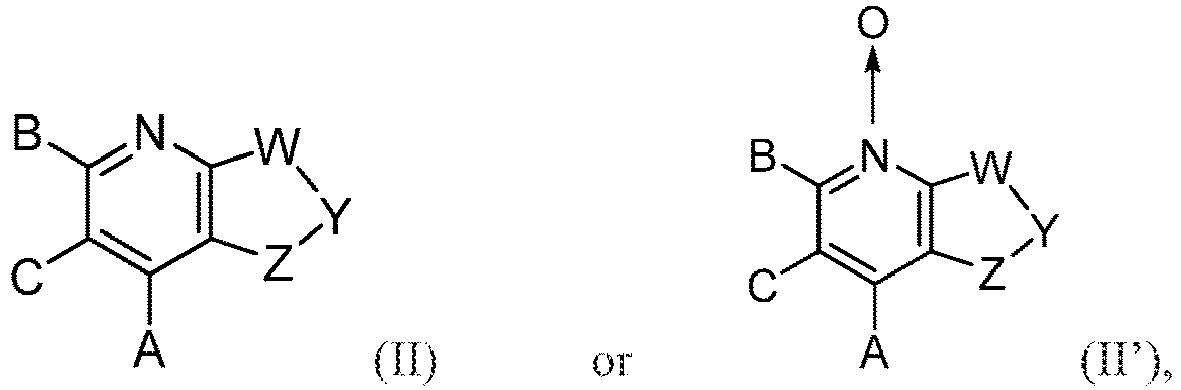
- Y forms a single bond with either W or Z and a double bond with the other of W or Z;
- W is -C(R10)-, -S-, -N-, -N(R11)-, or -O-;
- Y is -C(R12)- or -N-;
- Z is -C(R13)-, -S-, -N-, -N(R14)-, or -O-;
- R10 is hydrogen, alkyl, substituted alkyl, aryl, substituted aryl, arylalkyl, substituted arylalkyl, acyl, substituted acyl, heteroalkyl, substituted heteroalkyl, heteroaryl, substituted heteroaryl, heteroarylalkyl, substituted heteroarylalkyl, halo, -CN, -OR15, -S(O)cR15, -NR15R16, -C(O)NR15R16, -CO2R15, -SO2NR15R16, -NR15SO2R16, -P(O)(OR15)(OR16) or -P(O)(R15)(OR16);
- R12 is hydrogen, alkyl, substituted alkyl, aryl, substituted aryl, arylalkyl, substituted arylalkyl, acyl, substituted acyl, heteroalkyl, substituted heteroalkyl, heteroaryl, substituted heteroaryl, heteroarylalkyl, substituted heteroarylalkyl, halo, -CN, -OR17, -S(O)dR17, -OC(O)R17, -NR17R18, -C(O)NR17R18, -CO2R17, -SO2NR17R18, -NR17SO2R18, -P(O)(OR17)(OR18) or -P(O)(R17)(OR18);
- R13 is hydrogen, alkyl, substituted alkyl, aryl, substituted aryl, arylalkyl, substituted arylalkyl, acyl, substituted acyl, heteroalkyl, substituted heteroalkyl, heteroaryl, substituted heteroaryl, heteroarylalkyl, substituted heteroarylalkyl, halo, -CN, , -OR19, -S(O)eR19, -OC(O)R19, -NR19R20, -C(O)NR19R20, -C(O)R19, -CO2R19, -SO2NR19R20, -NR19SO2R20, -P(O)(OR19)(OR20) or -P(O)(R19)(OR20); or alternatively R10 and R12, or R12 and R13, together with the atoms to which they are attached, form a cycloalkyl, substituted cycloalkyl, cycloheteroalkyl or substituted cycloheteroalkyl ring;
- c, d and e are independently 0, 1, or 2;
- R11 and R14 are independently hydrogen, alkyl, substituted alkyl, aryl, substituted aryl, arylalkyl, substituted arylalkyl, acyl, substituted acyl, heteroalkyl, substituted heteroalkyl, heteroaryl, substituted heteroaryl, heteroarylalkyl or substituted heteroarylalkyl; and
- R15, R16, R17, R18, R19, and R20 are independently hydrogen, alkyl, substituted alkyl, aryl, substituted aryl, arylalkyl, substituted arylalkyl, acyl, substituted acyl, heteroalkyl, substituted heteroalkyl, heteroaryl, substituted heteroaryl, heteroarylalkyl or substituted heteroarylalkyl; or alternatively R15 and R16, R17 and R18, or R19 and R20, together with the atoms to which they are attached, form a cycloheteroalkyl or substituted cycloheteroalkyl ring; and
- with the following provisos:
- (a) when W is -O- or -S- or -NR11-, then Z is -C(R13)- or -N-;
- (b) when Z is -O- or -S- or -NR14-, then W is -C(R10)- or -N-; and
- (c) when W is -C(R10)- or -N-, then Z cannot be -C(R13)- or -N-.
- In one example , the compounds of Formula (II) or (II') have a structural Formula (IIa) or (IIa'),

- In one example , the compounds of Formula (II) or (II') have a structural Formula (IIb) or (IIb'),

- In one example , the compounds of Formula (I) or (I') have a structural Formula (III) or (III'),

- H is -C(R21)- or -N-;
- I is -C(R22) or -N-;
- J is -C(R23)- or -N-;
- K is -C(R24)- or -N-;
- R21 is hydrogen, alkyl, substituted alkyl, halo, -CN, -OR25;
- R22 is hydrogen, alkyl, substituted alkyl, halo, -CN, -OR27;
- R23 is hydrogen, alkyl, substituted alkyl, aryl, substituted aryl, arylalkyl, substituted arylalkyl, acyl, substituted acyl, halo, heteroalkyl, substituted heteroalkyl, heteroaryl, substituted heteroaryl, heteroarylalkyl, substituted heteroarylalkyl, -CN, -OR29, -S(O)fR29, -OC(O)R29, -NR29R30, -C(O)NR29R30, -CO2R29, -SO2NR29R30, -NR29SO2R30, -B(OR29)(OR30), -P(O)(OR29)(OR30) or -P(O)(R29)(OR30); R24 is hydrogen, alkyl, substituted alkyl, aryl, substituted aryl, arylalkyl, substituted arylalkyl, acyl, substituted acyl, halo, heteroalkyl, substituted heteroalkyl, heteroaryl, substituted heteroaryl, heteroarylalkyl, substituted heteroarylalkyl, -CN, -OR31, -S(O)gR31, -OC(O)R31, -NR31R32, -C(O)NR31R32, -C(O)R31, -CO2R31, -SO2NR31R32, -NR31SO2R32, -B(OR31)(OR32), -P(O)(OR31)(OR32) or -P(O)(R31)(OR32); or alternatively R23 and R24, taken together with the atom to which they are attached, form a cycloalkyl, substituted cycloalkyl, cycloheteroalkyl, or substituted cycloheteroalkyl ring;
- f and g are independently 0, 1 or 2; and
- R25, R26, R27, R28, R29, R30, R31, and R32 are independently hydrogen, alkyl, substituted alkyl, aryl, substituted aryl, arylalkyl, substituted arylalkyl, acyl, substituted acyl, heteroalkyl, substituted heteroalkyl, heteroaryl, substituted heteroaryl, heteroarylalkyl, or substituted heteroarylalkyl; or alternatively R25 and R26, R27 and R28, R29 and R30, or R31 and R32, together with the atoms to which they are attached, form a cycloheteroalkyl or substituted cycloheteroalkyl ring;
- with the proviso that at most, two of H, I, J and K are -N-.
- In one example of Formula (III), one or two of H, I, J and K are -N-.
- In one example of Formula (III), H is -N-, I is -C(R22)-, J is -C(R23)-, and K is -C(R24)-.
- In one example of Formula (III), H is -C(R21)-, I is -N-, J is -C(R23)-, and K is -C(R24)-.
- In one example of Formula (III), H is -C(R21)-, I is -C(R22)-, J is -N-, and K is -C(R24)-.
- In one example of Formula (III), H is -C(R21)-, I is -C(R22), J is -C(R23)-, and K is -N-.
- In one example of Formula (III), H and I are -N-.
- In one example of Formula (III), H and J are -N-.
- In one example of Formula (III), H and K are -N-.
- In one example of Formula (III), I and J are -N-.
- In one example of Formula (III), I and K are -N-.
- In one example of Formula (III), J and K are -N-.
- In one example, the compounds of Formula (III) or (III') have a structural Formula (IIIa) or (IIIa'),

- In one example of Formula (IIIa), two or three of R21, R22, R23, and R24 are hydrogen.
- In one example of Formula (IIIa), R21 is hydrogen; R22 is hydrogen, alkyl, substituted alkyl, halo, -CN, or -OR27; R23 is hydrogen, alkyl, substituted alkyl, -CN, -OR29, -S(O)fR29, -OC(O)R29, -NR29R30, -C(O)NR29R30, -C(O)R29, -CO2R29, -SO2NR29R30, or -NR29SO2R30; R24 is hydrogen, alkyl, substituted alkyl, -CN, -OR31, -S(O)gR31, -OC(O)R31, -NR31R32, -C(O)NR31R32, -C(O)R31, -CO2R31, -SO2NR31R32, or -NR31SO2R32; or alternatively R23 and R24, taken together with the atoms to which they are attached, form a cycloalkyl, substituted cycloalkyl, cycloheteroalkyl, or substituted cycloheteroalkyl ring; and R27, R29, R30, R31, and R32 are independently hydrogen, alkyl, substituted alkyl, aryl, substituted aryl, arylalkyl, substituted arylalkyl, acyl, substituted acyl, heteroalkyl, substituted heteroalkyl, heteroaryl, substituted heteroaryl, heteroarylalkyl, or substituted heteroarylalkyl; or alternatively R25 and R26, R27 and R28, R29 and R30, or R31 and R32, together with the atoms to which they are attached, form a cycloheteroalkyl or substituted cycloheteroalkyl ring.
- In one example of Formula (IIIa), R21 and R22 are all hydrogen.
- In one example : of Formula (IIIa), R23 and R24, taken together with the atom to which they are attached, form a cycloalkyl, substituted cycloalkyl, cycloheteroalkyl, or substituted cycloheteroalkyl ring.
- In one example of Formula (IIIa), R23 and R24, taken together with the atom to which they are attached, form a substituted cycloheteroalkyl ring containing one or more substituents selected from the group consisting of -Ra, halo, -O-, =O, -ORb, -SRb, -S-, =S, -NRcRc, =NRb, =N-ORb, trihalomethyl, -CF3, -CN, -OCN, -SCN, -NO, -NO2, =N2, -N3, -S(O)2Rb, -S(O)2NRb, -S(O)2O-, -S(O)2ORb, -OS(O)2Rb, -OS(O)2O-, -OS(O)2ORb, -P(O)(O-)2, -P(O)(ORb)(O-), -P(O)(ORb)(ORb), -C(O)Rb, -C(O)ORb, -C(S)Rb, -C(NRb)Rb, -C(O)O-, -C(S)ORb, -C(O)NRcRc, -C(NRb)NRcRc, -OC(O)Rb, -OC(S)Rb, -OC(O)O-, -OC(O)ORb, -OC(S)ORb, -NRbC(O)Rb, -NRbC(S)Rb, -NRbC(O)O-, -NRbC(O)ORb, -NRbC(S)ORb, -NRbC(O)NRcRc, -NRbC(NRb)Rb and -NRbC(NRb)NRcRc, where Ra is selected from the group consisting of alkyl, cycloalkyl, heteroalkyl, cycloheteroalkyl, aryl, arylalkyl, heteroaryl and heteroarylalkyl; each Rb is independently hydrogen or Ra; and each Rc is independently Rb or alternatively, the two Rcs may be taken together with the nitrogen atom to which they are bonded form a 4-, 5-, 6- or 7-membered cycloheteroalkyl which may optionally include from 1 to 4 of the same or different additional heteroatoms selected from the group consisting of O, N and S; or alternatively, two of the substituents on the cycloheteroalkyl ring, together with the atoms to which they are bonded, form a cycloalkyl, substituted cycloalkyl, cycloheteroalkyl, or substituted cycloheteroalkyl ring.
- In one example of Formula (IIIa), R21, R22, R23, and R24 are all hydrogen.
- In one example of Formula (IIIa), A is -OR1, -NR1C(O)R2, -NHOR1, -NR1R2, -NOR1, -NR1CO2R2, -NR1C(O)NR2R3, -NR1CSNR2R3, or -NR1C(=NH)NR2R3.
- In one example of Formula (IIIa), C is -S(O)bR7, SO3R7,-C(O)NR7R8, -CO2R7, -NR7CO2R8, -NR7C(O)NR8R9, -NR7C(S)NR8R9, -NR7C(=NH)NR8R9, -SO2NR7R8, -NR7SO2R8, -NR7SO2NR8R9, -B(OR7)(OR8), -P(O)(OR7)(OR8), or -P(O)(R7)(OR8).
- In one example of Formula (IIIa), B is hydrogen, alkyl, substituted alkyl, aryl, substituted aryl, arylalkyl, substituted arylalkyl, acyl, substituted acyl, heteroalkyl, substituted heteroalkyl, heteroaryl, substituted heteroaryl, heteroarylalkyl, or substituted heteroarylalkyl.
- In one example of Formula (IIIa), three of R21, R22, R23, and R24 are hydrogen; A is -OR1, -NR1C(O)R2, -NHOR1, -NR1R2, -NR1CO2R2, -NR1C(O)NR2R3, -NR1C(S)NR2R3, or -NR1C(=NH)NR2R3; C is -S(O)bR7, SO3R7,--C(O)NR7R8, -CO2R7, -NR7CO2R8, -NR7C(O)NR8R9, -NR7C(S)NR8R9, -NR7C(=NH)NR8R9, -SO2NR7R8, -NR7SO2R8, -NR7SO2NR8R9, -B(OR7)(OR8), -P(O)(OR7)(OR8), or -P(O)(R7)(OR8) or tetrazole; B is hydrogen, alkyl, substituted alkyl, aryl, substituted aryl, arylalkyl, substituted arylalkyl, acyl, substituted acyl, heteroalkyl, substituted heteroalkyl, heteroaryl, substituted heteroaryl, heteroarylalkyl, or substituted heteroarylalkyl.
- According to the present invention, the compounds of Formula (IIIa) or (IIIa') have a structural Formula (IIIb) or (IIIb'),
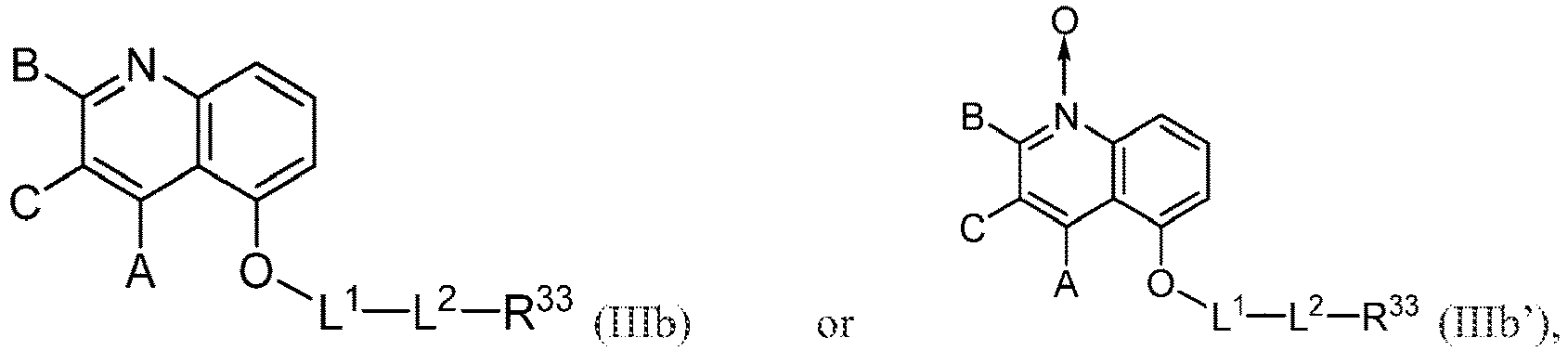
- A is -NR1R2;
- B is hydrogen, C1-C6 alkyl, or phenyl;
- C is -CO2R7;
- R1, R2, and R7 are independently hydrogen, alkyl, substituted alkyl, aryl, substituted aryl, arylalkyl, substituted arylalkyl, acyl, substituted acyl, heteroalkyl, substituted heteroalkyl, heteroaryl, substituted heteroaryl, heteroarylalkyl or substituted heteroarylalkyl;
- L1 is alkylene or substituted alkylene;
- L2 is -NR34-, -O-, -S-, -NR14-C(O)-, -C(O)-NR34-, -O-C(O)-, -C(O)-O-, -NR34-C(O)-O-, -O-C(O)-NR34-, -NNR34-C(O)-NR35-, -O-C(O)-O-, hetercyclyleno C(O)-, or -(substituted hetercyclylene)-C(O)-;
- R33 is alkyl, substituted alkyl, carbocyclyl, substituted carbocyclyl; aryl, substituted aryl, arylalkyl, substituted arylalkyl, heterocyclyl, substituted heterocyclyl, heteroalkyl, substituted heteroalkyl, heteroaryl, substituted heteroaryl, heteroarylalkyl, or substituted heteroarylalkyl; and
- R34 and R35 are independently hydrogen, alkyl, substituted alkyl, carbocyclyl, substituted carbocyclyl; aryl, substituted aryl, arylalkyl, substituted arylalkyl, heterocyclyl, substituted heterocyclyl, heteroalkyl, substituted heteroalkyl, heteroaryl, substituted heteroaryl, heteroarylalkyl, or substituted heteroarylalkyl.
- In one embodiment of the present invention, the compounds of Formula (IIIb) or (IIIb') have a structural Formula (IIIc), (IIIc'), (IIId), or (IIId'),


- In one embodiment of Formula (IIIc) or (IIId), R33 is alkyl, substituted alkyl, carbocyclyl, substituted carbocyclyl; heterocyclyl, substituted heterocyclyl, heteroalkyl, or substituted heteroalkyl.
- In one embodiment of Formula (IIIb), (IIIc), or (IIId), A is -OR1, -NR1C(O)R2, -NHOR1, -NR1R2, -NR1CO2R2, -NR1C(O)NR2R3, -NR1CSNR2R3, or -NR1C(=NH)NR2R3.
- In one embodiment of Formula (IIIb), (IIIc), or (IIId), C is -S(O)bR7, SO3R7,-C(O)NR7R8, -CO2R7, -NR7CO2R8, -NR7C(O)NR8R9, -NR7C(S)NR8R9, -NR7C(=NH)NR8R9, -SO2NR7R8, -NR7SO2R8, -NR7SO2R8R9, -B(OR7)(OR8), -P(O)(OR7)(OR8), or -P(O)(R7)(OR8).
- In one embodiment of Formula (IIIb), (IIIc), or (IIId),B is hydrogen, alkyl, substituted alkyl, aryl, substituted aryl, arylalkyl, substituted arylalkyl, acyl, substituted acyl, heteroalkyl, substituted heteroalkyl, heteroaryl, substituted heteroaryl, heteroarylalkyl, or substituted heteroarylalkyl.
- In one embodiment of Formula (IIIb), A is -OR1, -NHOR1, or -NR1R2; B is hydrogen, alkyl, substituted alkyl, aryl, or substituted aryl; C is -SO3R7,-C(O)NR7R8, -CO2R7, -SO2NR7R8, -B(OR7)(OR8), -P(O)(OR7)(OR8), or -P(O)(R7)(OR8); L1 is alkylene or substituted alkylene; L2 is -NR34-, -O-, -NR34-C(O)-, -C(O)-NR34-, -O-C(O)-, -C(O)-O-, hetercyclylene-C(O)-, or-(substituted hetercyclylene)-C(O)-; R33 is alkyl, substituted alkyl, carbocyclyl, substituted carbocyclyl; aryl, substituted aryl, arylalkyl, substituted arylalkyl, heterocyclyl, substituted heterocyclyl, heteroalkyl, substituted heteroalkyl, heteroaryl, substituted heteroaryl, heteroarylalkyl, or substituted heteroarylalkyl; and R34 and R35 are independently hydrogen, alkyl, or substituted alkyl.
- In one embodiment of Formula (IIIc) or (IIId), A is -OR1, -NHOR1, or -NR1R2; B is hydrogen, alkyl, substituted alkyl, aryl, or substituted aryl; C is -SO3R7,-C(O)NR7R8, -CO2R7, -SO2NR7R8, -B(OR7)(OR8), -P(O)(OR7)(OR8), or -P(O)(R7)(OR8); R33 is alkyl, substituted alkyl, carbocyclyl, substituted carbocyclyl; heterocyclyl, substituted heterocyclyl, heteroalkyl, or substituted heteroalkyl.
- In some specific examples, the compound is selected from the group consisting of


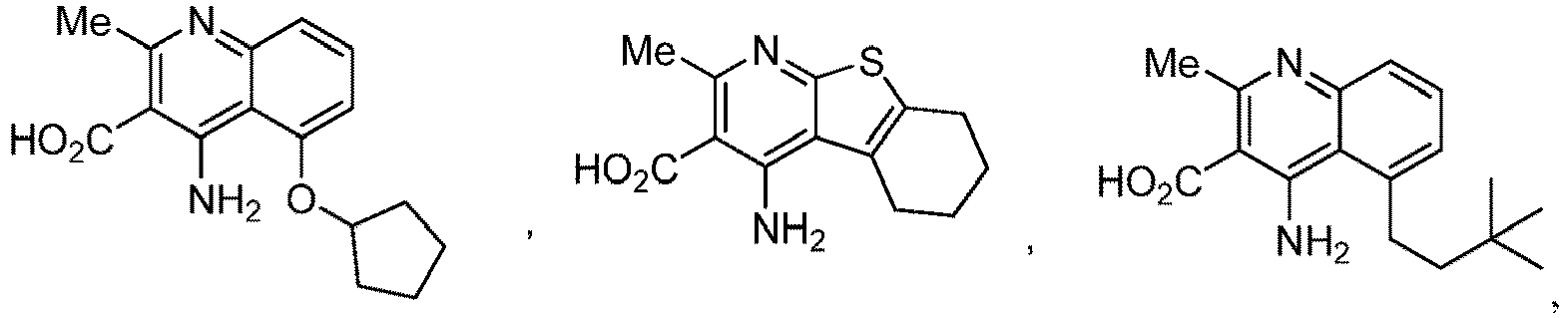





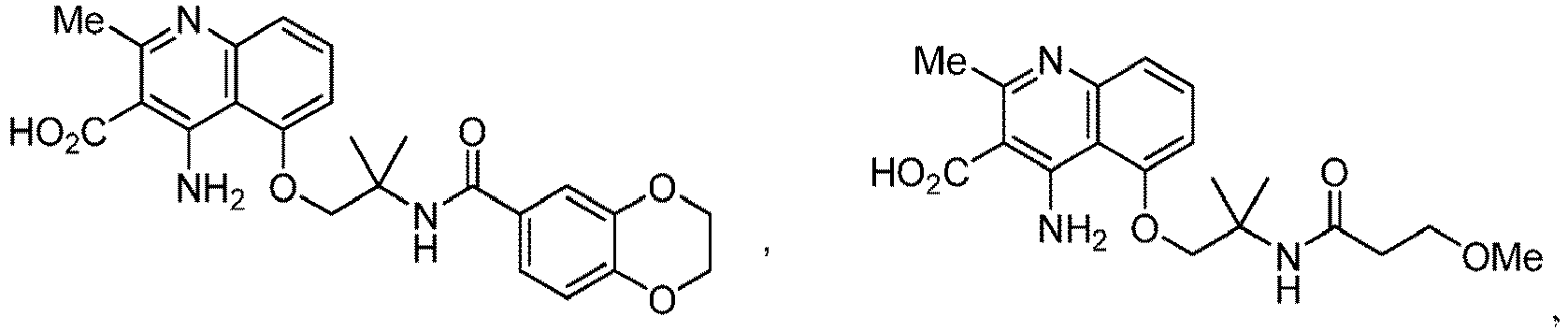


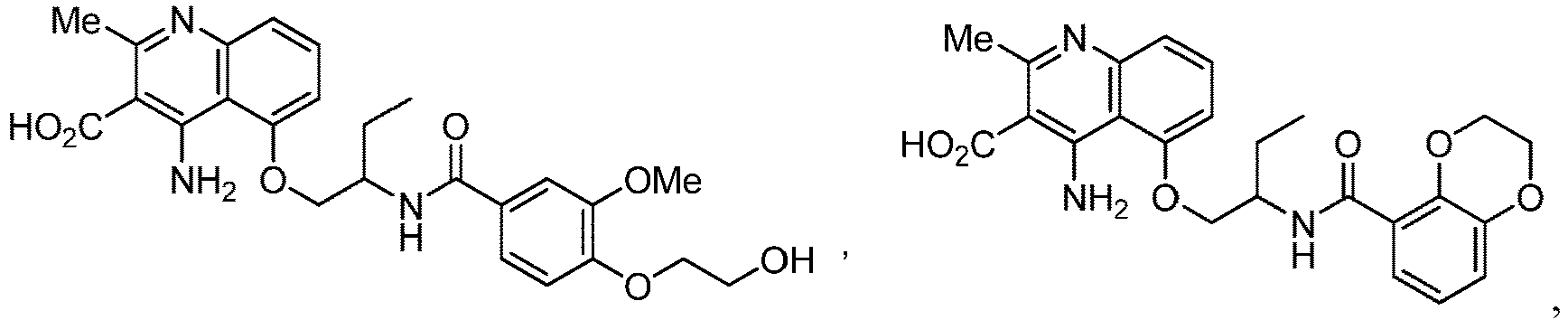


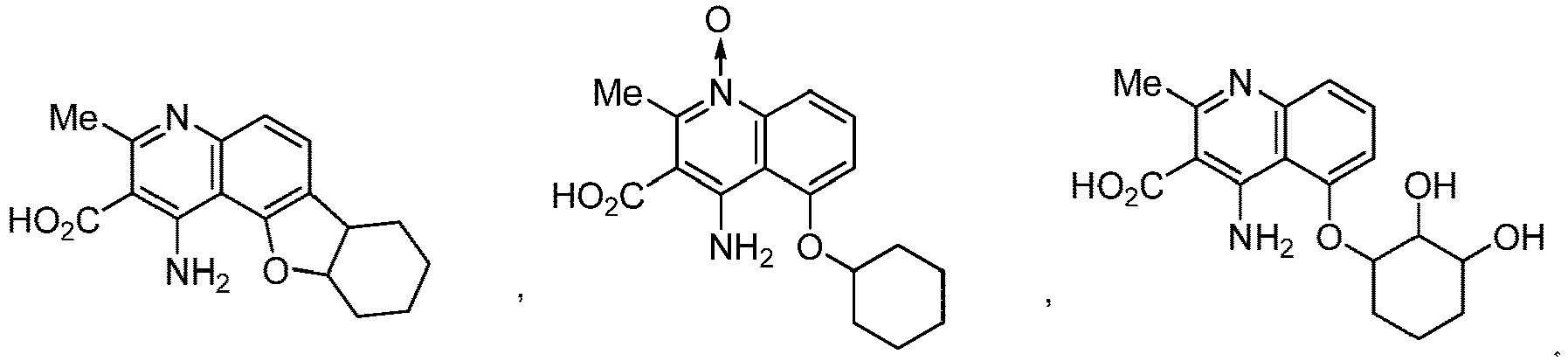
- Compounds not encompassed by the claims are for reference.
- The present description discloses a method for preparing a compound of Formula (IV):

- B is hydrogen, alkyl, substituted alkyl, aryl, substituted aryl, arylalkyl, substituted arylalkyl, acyl, substituted acyl, heteroalkyl, substituted heteroalkyl, heteroaryl, substituted heteroaryl, heteroarylalkyl, substituted heteroarylalkyl;
- R1, R2, and R7 are independently hydrogen, alkyl, substituted alkyl, aryl, substituted aryl, arylalkyl, substituted arylalkyl, heteroalkyl, substituted heteroalkyl, heteroaryl, substituted heteroaryl, heteroarylalkyl or substituted heteroarylalkyl; or alternatively, R1 and R2, together with the atoms to which they are bonded, form a cycloheteroalkyl or substituted cycloheteroalkyl ring;
- R21 is hydrogen, alkyl, substituted alkyl, halo, -CN, -OR25;
- R22 is hydrogen, alkyl, substituted alkyl, halo, -CN, -OR27;
- R23 is hydrogen, alkyl, substituted alkyl, aryl, substituted aryl, arylalkyl, substituted arylalkyl, acyl, substituted acyl, halo, heteroalkyl, substituted heteroalkyl, heteroaryl, substituted heteroaryl, heteroarylalkyl, substituted heteroarylalkyl, -OR29, -S(O)fR29, -OC(O)R29, -NR29R30, -C(O)NR29R30, -CO2R29, -SO2NR29R30, -NR29SO2R30, -B(OR29)(OR30), -P(O)(OR29)(OR30) or -P(O)(R29)(OR30);
- R24 is hydrogen, alkyl, substituted alkyl, aryl, substituted aryl, arylalkyl, substituted arylalkyl, acyl, substituted acyl, halo, heteroalkyl, substituted heteroalkyl, heteroaryl, substituted heteroaryl, heteroarylalkyl, substituted heteroarylalkyl, -OR31, -S(O)gR31, -OC(O)R31, -NR31R32, -C(O)NR31R32, -C(O)R31, -CO2R31, -SO2NR31R32, -NR31SO2R32, -B(OR31)(OR32), -P(O)(OR31)(OR32) or -P(O)(R31)(OR32); or alternatively R23 and R24, taken together with the atom to which they are attached, form a cycloalkyl, substituted cycloalkyl, cycloheteroalkyl, or substituted cycloheteroalkyl ring;
- f and g are independently 0, 1 or 2; and
- R25, R26, R27, R28, R29, R30, R31, and R32 are independently hydrogen, alkyl, substituted alkyl, aryl, substituted aryl, arylalkyl, substituted arylalkyl, acyl, substituted acyl, heteroalkyl, substituted heteroalkyl, heteroaryl, substituted heteroaryl, heteroarylalkyl, or substituted heteroarylalkyl; or alternatively R25 and R26, R27 and R28, R29 and R30, or R31 and R32, together with the atoms to which they are attached, form a cycloheteroalkyl or substituted cycloheteroalkyl ring.
- The method comprises reacting a compound of Formula (IVa):


- When R7 in Formula (IV) is hydrogen, then the compound may be obtained by hydrolyzing the corresponding compound where R7 is alkyl or substituted alkyl, which in turn can be prepared from the reaction of the compounds of Formulae (IVa) and (IVb). Such a hydrolyzation condition may be basic, acidic, or any condition known to one skilled in the art.
- By "Lewis acid", it is meant a compound that is an electron-pair acceptor and therefore able to react with a Lewis base to form a Lewis adduct, by sharing the electron pair furnished by the Lewis base. One illustrative example is that the reaction of trimethylboron (Lewis acid) and ammonia (Lewis base) to give the adduct Me3BNH3. The Lewis acid suitable for the reaction of compounds of Formulae (IVa) and (IVb) may be any Lewis acid known to one skilled in the art. In one specific embodiment, the Lewis acid is a metal halide, for example, stannic chloride, boron trihalides, or aluminium chloride.
- Solvents for carrying out chemical reactions can be broadly classified into two categories: polar and nonpolar. Generally, the dielectric constant of the solvent provides a rough measure of a solvent's polarity. Solvents with a dielectric constant of less than 15 are generally considered to be nonpolar. Examples of nonpolar solvents include, but are not limited to, pentane, cyclopentane, hexane, cyclohexane, benzene, toluene, 1,4-dioxane, chloroform, diethyl ether, and a combination thereof.
- In one example of the method, the reaction of the compound of Formula (IVa) and the compound of Formula (IVb) is conducted at least in part at a temperature of about 60°C or higher. For example, the reaction may be conducted at the room temperature in part and at a temperature of about 60°C or higher in part. In one example, the temperature of about 60°C or higher is a temperature of about 70°C or higher; in another example, the temperature of about 60°C or higher is a temperature of about 80°C or higher; in another example, the temperature of about 60°C or higher is a temperature of about 90°C or higher; in another example, the temperature of about 60°C or higher is a temperature of about 100°C or higher; in another example, the temperature of about 60°C or higher is a temperature below about 130°C.
- In one example of Formula (IV), R1, R2, and R7 are hydrogen.
- In one example of Formula (IV), B is alkyl or substituted alkyl.
- In one example of Formula (IV), R24 is -OR31, and R31 is alkyl, substituted alkyl, carbocyclyl, substituted carbocyclyl; aryl, substituted aryl, arylalkyl, substituted arylalkyl, heterocyclyl, substituted heterocyclyl, heteroalkyl, substituted heteroalkyl, heteroaryl, substituted heteroaryl, heteroarylalkyl, or substituted heteroarylalkyl.
- In one example, the compound of Formula (IV) is represented by Formula (IVc):

- Wherein B is alkyl or substituted alkyl; and R31 is alkyl, substituted alkyl, carbocyclyl, and substituted carbocyclyl.
- The present compounds can be used for one or more methods of the present invention, e.g., modulating or enhancing sweet flavor. In general, the compounds of the present invention, individually or in combination, can be provided in a composition, such as, e.g., an ingestible composition.
- The compounds of Formula (I) and its various subgenuses, and their salts and/or solvates, should preferably be comestibly acceptable, e.g., deemed suitable for consumption in food or drink from the perspective of giving unmodified comestible compositions an improved and/or pleasing sweet taste, and would not be significantly toxic or causes unpleasant or undesirable pharmacological or toxicological effects on an animal or human at the typical concentrations they are employed as flavoring agents for the comestible compositions.
- The typical method of demonstrating that a flavorant compound is comestibly acceptable is to have the compound tested and/or evaluated by an Expert Panel of the Flavor and Extract Manufacturers Association and declared as to be "Generally Recognized As Safe" ("GRAS"). The FEMA/GRAS evaluation process for flavorant compounds is complex but well known to those of ordinary skill in the food product preparation arts, as is discussed by Smith, et al. in an article entitled "GRAS Flavoring Substances 21," Food Technology, 57(5), pgs 46-59, May 2003.
- In one embodiment, the compounds of the present invention can be used at its ligand enhancing concentrations, e.g., very low concentrations on the order of a few parts per million, in combination with one or more known sweeteners, natural or artificial, so as to reduce the concentration of the known sweetener required to prepare an ingestible composition having the desired degree of sweetness.
- Commonly used known or artificial sweeteners for use in such combinations of sweeteners include but are not limited to the common saccharide sweeteners, e.g., sucrose, fructose, glucose, and sweetener compositions comprising natural sugars, such as corn syrup (including high fructose corm syrup) or other syrups or sweetener concentrates derived from natural fruit and vegetable sources, semi-synthetic "sugar alcohol" sweeteners such as erythritol, isomalt, lactitol, mannitol, sorbitol, xylitol, maltodextrin, and the like, and artificial sweeteners such as aspartame, saccharin, acesulfame-K, cyclamate, sucralose, and alitame. Sweeteners also include cyclamic acid, mogroside, tagatose, maltose, galactose, mannose, sucrose, fructose, lactose, neotame and other aspartame derivatives, glucose, D-tryptophan, glycine, maltitol, lactitol, isomalt, hydrogenated glucose syrup (HGS), hydrogenated starch hydrolyzate (HSH), stevioside, rebaudioside A and other sweet Stevia-based glycosides, carrelame and other guanidine-based sweeteners, etc. The term "sweeteners" also includes combinations of sweeteners as disclosed herein.
- In one embodiment, the present compound is added to a noncomestible composition or non-edible product, such as supplements, nutraceuticals, functional food products (e.g., any fresh or processed food claimed to have a health-promoting and/or disease-preventing properties beyond the basic nutritional function of supplying nutrients), pharmaceutical and over the counter medications, oral care products such as dentifrices and mouthwashes, cosmetic products such as sweetened lip balms and other personal care products that use sucrose, sucralose and/or other sweeteners.
- In general, over the counter (OTC) product and oral hygiene product generally refer to product for household and/or personal use which may be sold without a prescription and/or without a visit to a medical professional. Examples of the OTC products include, but are not limited to Vitamins and dietary supplements; Topical analgesics and/or anesthetic; Cough, cold and allergy remedies; Antihistamines and/or allergy remedies; and combinations thereof. Vitamins and dietary supplements include, but are not limited to vitamins, dietary supplements, tonics/bottled nutritive drinks, child-specific vitamins, dietary supplements, any other products of or relating to or providing nutrition, and combinations thereof. Topical analgesics and/or anesthetic include any topical creams/ointments/gels used to alleviate superficial or deep-seated aches and pains, e.g. muscle pain; teething gel; patches with analgesic ingredient; and combinations thereof. Cough, cold and allergy remedies include, but are not limited to decongestants, cough remedies, pharyngeal preparations, medicated confectionery, antihistamines and child-specific cough, cold and allergy remedies; and combination products. Antihistamines and/or allergy remedies include, but are not limited to any systemic treatments for hay fever, nasal allergies, insect bites and stings. Examples of oral hygiene product include, but are not limited to mouth cleaning strips, toothpaste, toothbrushes, mouthwashes/dental rinses, denture care, mouth fresheners at-home teeth whiteners and dental floss.
- In another embodiment, the present compounds are added to food or beverage products or formulations. Examples of food and beverage products or formulations include, but are not limited to sweet coatings, frostings, or glazes for comestible products or any entity included in the Soup category, the Dried Processed Food category, the Beverage category, the Ready Meal category, the Canned or Preserved Food category, the Frozen Processed Food category, the Chilled Processed Food category, the Snack Food category, the Baked Goods category, the Confectionary category, the Dairy Product category, the Ice Cream category, the Meal Replacement category, the Pasta and Noodle category, and the Sauces, Dressings, Condiments category, the Baby Food category, and/or the Spreads category.
- In general, the Soup category refers to canned/preserved, dehydrated, instant, chilled, UHT and frozen soup. For the purpose of this definition soup(s) means a food prepared from meat, poultry, fish, vegetables, grains, fruit and other ingredients, cooked in a liquid which may include visible pieces of some or all of these ingredients. It may be clear (as a broth) or thick (as a chowder), smooth, pureed or chunky, ready-to-serve, semi-condensed or condensed and may be served hot or cold, as a first course or as the main course of a meal or as a between meal snack (sipped like a beverage). Soup may be used as an ingredient for preparing other meal components and may range from broths (consommé) to sauces (cream or cheese-based soups).
- "Dehydrated and Culinary Food Category" usually means: (i) Cooking aid products such as: powders, granules, pastes, concentrated liquid products, including concentrated bouillon, bouillon and bouillon like products in pressed cubes, tablets or powder or granulated form, which are sold separately as a finished product or as an ingredient within a product, sauces and recipe mixes (regardless of technology); (ii) Meal solutions products such as: dehydrated and freeze dried soups, including dehydrated soup mixes, dehydrated instant soups, dehydrated ready-to-cook soups, dehydrated or ambient preparations of ready-made dishes, meals and single serve entrees including pasta, potato and rice dishes; and (iii) Meal embellishment products such as: condiments, marinades, salad dressings, salad toppings, dips, breading, batter mixes, shelf stable spreads, barbecue sauces, liquid recipe mixes, concentrates, sauces or sauce mixes, including recipe mixes for salad, sold as a finished product or as an ingredient within a product, whether dehydrated, liquid or frozen.
- The Beverage category usually means beverages, beverage mixes and concentrates, including but not limited to, carbonated and non-carbonated beverages, alcoholic and non-alcoholic beverages, ready to drink beverages, liquid concentrate formulations for preparing beverages such as sodas, and dry powdered beverage precursor mixes. The Beverage category also includes the alcoholic drinks, the soft drinks, sports drinks, isotonic beverages, and hot drinks. The alcoholic drinks include, but are not limited to beer, cider/perry, FABs, wine, and spirits. The soft drinks include, but are not limited to carbonates, such as colas and non-cola carbonates; fruit juice, such as juice, nectars, juice drinks and fruit flavored drinks; bottled water, which includes sparkling water, spring water and purified/table water; functional drinks, which can be carbonated or still and include sport, energy or elixir drinks; concentrates, such as liquid and powder concentrates in ready to drink measure. The drinks, either hot or cold, include, but are not limited to coffee or ice coffee, such as fresh, instant, and combined coffee; tea or ice tea, such as black, green, white, oolong, and flavored tea; and other drinks including flavor-, malt- or plant-based powders, granules, blocks or tablets mixed with milk or water.
- The Snack Food category generally refers to any food that can be a light informal meal including, but not limited to Sweet and savory snacks and snack bars. Examples of snack food include, but are not limited to fruit snacks, chips/crisps, extruded snacks, tortilla/corn chips, popcorn, pretzels, nuts and other sweet and savory snacks. Examples of snack bars include, but are not limited to granola/muesli bars, breakfast bars, energy bars, fruit bars and other snack bars.
- The Baked Goods category generally refers to any edible product the process of preparing which involves exposure to heat or excessive sunlight. Examples of baked goods include, but are not limited to bread, buns, cookies, muffins, cereal, toaster pastries, pastries, waffles, tortillas, biscuits, pies, bagels, tarts, quiches, cake, any baked foods, and any combination thereof.
- The Ice Cream category generally refers to frozen dessert containing cream and sugar and flavoring. Examples of ice cream include, but are not limited to: impulse ice cream; take-home ice cream; frozen yoghurt and artisanal ice cream; soy, oat, bean (e.g., red bean and mung bean), and rice-based ice creams.
- The Confectionary category generally refers to edible product that is sweet to the taste. Examples of confectionary include, but are not limited to candies, gelatins, chocolate confectionery, sugar confectionery, gum, and the likes and any combination products.
- The Meal Replacement category generally refers to any food intended to replace the normal meals, particularly for people having health or fitness concerns. Examples of meal replacement include, but are not limited to slimming products and convalescence products.
- The Ready Meal category generally refers to any food that can be served as meal without extensive preparation or processing. The ready meal includes products that have had recipe "skills" added to them by the manufacturer, resulting in a high degree of readiness, completion and convenience. Examples of ready meal include, but are not limited to canned/preserved, frozen, dried, chilled ready meals; dinner mixes; frozen pizza; chilled pizza; and prepared salads.
- The Pasta and Noodle category includes any pastas and/or noodles including, but not limited to canned, dried and chilled/fresh pasta; and plain, instant, chilled, frozen and snack noodles.
- The Canned/Preserved Food category includes, but is not limited to canned/preserved meat and meat products, fish/seafood, vegetables, tomatoes, beans, fruit, ready meals, soup, pasta, and other canned/preserved foods.
- The Frozen Processed Food category includes, but is not limited to frozen processed red meat, processed poultry, processed fish/seafood, processed vegetables, meat substitutes, processed potatoes, bakery products, desserts, ready meals, pizza, soup, noodles, and other frozen food.
- The Dried Processed Food category includes, but is not limited to rice, dessert mixes, dried ready meals, dehydrated soup, instant soup, dried pasta, plain noodles, and instant noodles.
- The Chill Processed Food category includes, but is not limited to chilled processed meats, processed fish/seafood products, lunch kits, fresh cut fruits, ready meals, pizza, prepared salads, soup, fresh pasta and noodles.
- The Sauces, Dressings and Condiments category includes, but is not limited to tomato pastes and purees, bouillon/stock cubes, herbs and spices, monosodium glutamate (MSG), table sauces, soy based sauces, pasta sauces, wet/cooking sauces, dry sauces/powder mixes, ketchup, mayonnaise, mustard, salad dressings, vinaigrettes, dips, pickled products, and other sauces, dressings and condiments.
- The Baby Food category includes, but is note limited to milk- or soybean-based formula; and prepared, dried and other baby food.
- The Spreads category includes, but is not limited to jams and preserves, honey, chocolate spreads, nut based spreads, and yeast based spreads.
- The Dairy Product category generally refers to edible product produced from mammal's milk. Examples of dairy product include, but are not limited to drinking milk products, cheese, yoghurt and sour milk drinks, and other dairy products.
- Additional examples for comestible composition, particularly food and beverage products or formulations, are provided as follows. Exemplary comestible compositions include one or more confectioneries, chocolate confectionery, tablets, countlines, bagged selflines/softlines, boxed assortments, standard boxed assortments, twist wrapped miniatures, seasonal chocolate, chocolate with toys, alfajores, other chocolate confectionery, mints, standard mints, power mints, boiled sweets, pastilles, gums, jellies and chews, toffees, caramels and nougat, medicated confectionery, lollipops, liquorice, other sugar confectionery, gum, chewing gum, sugarized gum, sugar-free gum, functional gum, bubble gum, bread, packaged/industrial bread, unpackaged/artisanal bread, pastries, cakes, packaged/industrial cakes, unpackaged/artisanal cakes, cookies, chocolate coated biscuits, sandwich biscuits, filled biscuits, savory biscuits and crackers, bread substitutes, breakfast cereals, rte cereals, family breakfast cereals, flakes, muesli, other cereals, children's breakfast cereals, hot cereals, ice cream, impulse ice cream, single portion dairy ice cream, single portion water ice cream, multi-pack dairy ice cream, multi-pack water ice cream, take-home ice cream, take-home dairy ice cream, ice cream desserts, bulk ice cream, take-home water ice cream, frozen yoghurt, artisanal ice cream, dairy products, milk, fresh/pasteurized milk, full fat fresh/pasteurized milk, semi skimmed fresh/pasteurized milk, long-life/uht milk, full fat long life/uht milk, semi skimmed long life/uht milk, fat-free long life/uht milk, goat milk, condensed/evaporated milk, plain condensed/evaporated milk, flavored, functional and other condensed milk, flavored milk drinks, dairy only flavored milk drinks, flavored milk drinks with fruit juice, soy milk, sour milk drinks, fermented dairy drinks, coffee whiteners, powder milk, flavored powder milk drinks, cream, cheese, processed cheese, spreadable processed cheese, unspreadable processed cheese, unprocessed cheese, spreadable unprocessed cheese, hard cheese, packaged hard cheese, unpackaged hard cheese, yoghurt, plain/natural yoghurt, flavored yoghurt, fruited yoghurt, probiotic yoghurt, drinking yoghurt, regular drinking yoghurt, probiotic drinking yoghurt, chilled and shelf-stable desserts, dairy-based desserts, soy-based desserts, chilled snacks, fromage frais and quark, plain fromage frais and quark, flavored fromage frais and quark, savory fromage frais and quark, sweet and savory snacks, fruit snacks, chips/crisps, extruded snacks, tortilla/corn chips, popcorn, pretzels, nuts, other sweet and savory snacks, snack bars, granola bars, breakfast bars, energy bars, fruit bars, other snack bars, meal replacement products, slimming products, convalescence drinks, ready meals, canned ready meals, frozen ready meals, dried ready meals, chilled ready meals, dinner mixes, frozen pizza, chilled pizza, soup, canned soup, dehydrated soup, instant soup, chilled soup, hot soup, frozen soup, pasta, canned pasta, dried pasta, chilled/fresh pasta, noodles, plain noodles, instant noodles, cups/bowl instant noodles, pouch instant noodles, chilled noodles, snack noodles, canned food, canned meat and meat products, canned fish/seafood, canned vegetables, canned tomatoes, canned beans, canned fruit, canned ready meals, canned soup, canned pasta, other canned foods, frozen food, frozen processed red meat, frozen processed poultry, frozen processed fish/seafood, frozen processed vegetables, frozen meat substitutes, frozen potatoes, oven baked potato chips, other oven baked potato products, non-oven frozen potatoes, frozen bakery products, frozen desserts, frozen ready meals, frozen pizza, frozen soup, frozen noodles, other frozen food, dried food, dessert mixes, dried ready meals, dehydrated soup, instant soup, dried pasta, plain noodles, instant noodles, cups/bowl instant noodles, pouch instant noodles, chilled food, chilled processed meats, chilled fish/seafood products, chilled processed fish, chilled coated fish, chilled smoked fish, chilled lunch kit, chilled ready meals, chilled pizza, chilled soup, chilled/fresh pasta, chilled noodles, oils and fats, olive oil, vegetable and seed oil, cooking fats, butter, margarine, spreadable oils and fats, functional spreadable oils and fats, sauces, dressings and condiments, tomato pastes and purees, bouillon/stock cubes, stock cubes, gravy granules, liquid stocks and fonds, herbs and spices, fermented sauces, soy based sauces, pasta sauces, wet sauces, dry sauces/powder mixes, ketchup, mayonnaise, regular mayonnaise, mustard, salad dressings, regular salad dressings, low fat salad dressings, vinaigrettes, dips, pickled products, other sauces, dressings and condiments, baby food, milk formula, standard milk formula, follow-on milk formula, toddler milk formula, hypoallergenic milk formula, prepared baby food, dried baby food, other baby food, spreads, jams and preserves, honey, chocolate spreads, nut-based spreads, and yeast-based spreads. Exemplary comestible compositions also include confectioneries, bakery products, ice creams, dairy products, sweet and savory snacks, snack bars, meal replacement products, ready meals, soups, pastas, noodles, canned foods, frozen foods, dried foods, chilled foods, oils and fats, baby foods, or spreads or a mixture thereof. Exemplary comestible compositions also include breakfast cereals, sweet beverages or solid or liquid concentrate compositions for preparing beverages, ideally so as to enable the reduction in concentration of previously known saccharide sweeteners, or artificial sweeteners.
- Typically at least a sweet receptor modulating amount, a sweet receptor ligand modulating amount, a sweet flavor modulating amount, a sweet flavoring agent amount, or a sweet flavor enhancing amount of one or more of the present compounds will be added to the ingestible composition, optionally in the presence of known sweeteners, e.g., so that the sweet flavor modified ingestible composition has an increased sweet taste as compared to the ingestible composition prepared without the compounds of the present invention, as judged by human beings or animals in general, or in the case of formulations testing, as judged by a majority of a panel of at least eight human taste testers, via procedures commonly known in the field.
- The concentration of sweet flavoring agent needed to modulate or improve the flavor of the ingestible composition will of course depend on many variables, including the specific type of the ingestible composition and its various other ingredients, especially the presence of other known sweet flavoring agents and the concentrations thereof, the natural genetic variability and individual preferences and health conditions of various human beings tasting the compositions, and the subjective effect of the particular compound on the taste of such chemosensory compounds.
- One application of the present compounds is for modulating (inducing, enhancing or inhibiting) the sweet taste or other taste properties of other natural or synthetic sweet tastants, and ingestiable compositions made therefrom. In one embodiment, the compounds of the present invention is used or provided in its ligand enhancing concentration(s). For example, a broad but also low range of concentrations of the compounds or entities of the present invention would typically be required, i.e., from about 0.001 ppm to 100 ppm, or narrower alternative ranges from about 0.1 ppm to about 10 ppm, from about 0.01 ppm to about 30 ppm, from about 0.05 ppm to about 10 ppm, from about 0.01 ppm to about 5 ppm, or from about 0.02 ppm to about 2 ppm, or from about 0.01 ppm to about 1 ppm.
- In one embodiment, the present invention provides a sweet enhancing composition. The sweet enhancing composition comprises a compound of the present invention in an amount effective to provide sweetening, e.g., sweet flavor enhancing amount in combination with a first amount of sweetener, wherein the sweetening is more than the sweetening provided by the first amount of sweetener without the compound.
- In one embodiment, the present invention provides an ingestible composition which comprises the sweet enhancing composition of the present invention. In certain embodiments, the present ingestible composition is in the form of a food or beverage product, a pharmaceutical composition, a nutritional product, a dietary supplement, over-the-counter medication, or oral care product.
- In one embodiment, the present invention provides a sweetener replacement composition which comprises one or more compounds of the present invention in an amount effective to provide sweetening, e.g., at a concentration higher than their ligand enhancing concentration in the absence of a sweetener, e.g., sucrose other than the present compound(s)..
- According to another aspect of the invention, the compounds of the present invention are provided in a flavoring concentrate formulation, e.g., suitable for subsequent processing to produce a ready-to-use (i.e., ready-to-serve) product. By "a flavoring concentrate formulation", it is meant a formulation which should be reconstituted with one or more diluting medium to become a ready-to-use composition. The term "ready-to-use composition" is used herein interchangeably with "ingestible composition", which denotes any substance that, either alone or together with another substance, can be taken by mouth whether intended for consumption or not. In one embodiment, the ready-to-use composition includes a composition that can be directly consumed by a human or animal. The flavoring concentrate formulation is typically used by mixing with or diluted by one or more diluting medium, e.g., any consumable or ingestible ingredient or product, to impart or modify one or more flavors to the diluting medium. Such a use process is often referred to as reconstitution. The reconstitution can be conducted in a household setting or an industrial setting. For example, a frozen fruit juice concentrate can be reconstituted with water or other aqueous medium by a consumer in a kitchen to obtain the ready-to-use fruit juice beverage. In another example, a soft drink syrup concentrate can be reconstituted with water or other aqueous medium by a manufacture in large industrial scales to produce the ready-to-use soft drinks. Since the flavoring concentrate formulation has the flavoring agent or flavor modifying agent in a concentration higher than the ready-to-use composition, the flavoring concentrate formulation is typically not suitable for being consumed directly without reconstitution. There are many benefits of using and producing a flavoring concentrate formulation. For example, one benefit is the reduction in weight and volume for transportation as the flavoring concentrate formulation can be reconstituted at the time of usage by the addition of suitable solvent, solid or liquid.
- In one embodiment, the flavoring concentrate formulation comprises i) as flavor modifying ingredient, a compound of the present invention; ii) a carrier; and iii) optionally at least one adjuvant. The term "as flavor modifying ingredient" denotes that the compound of the present invention acts as a flavoring agent or a flavor modifying agent (such as a flavor enhancer) in the formulation. The term "carrier" denotes a usually inactive accessory substance, such as solvents, binders, or other inert medium, which is used in combination with the present compound and one or more optional adjuvants to form the formulation. For example, water or starch can be a carrier for a flavoring concentrate formulation. In some embodiments, the carrier is the same as the diluting medium for reconstituting the flavoring concentrate formulation; and in other embodiments, the carrier is different from the diluting medium. The term "carrier" as used herein includes, but is not limited to, ingestibly acceptable carrier.
- The term "adjuvant" denotes an additive which supplements, stabilizes, maintains, or enhances the intended function or effectiveness of the active ingredient, such as the compound of the present invention. In one embodiment, the at least one adjuvant comprises one or more flavoring agents. The flavoring agent may be of any flavor known to one skilled in the art or consumers, such as the flavor of chocolate, coffee, tea, mocha, French vanilla, peanut butter, chai, or combinations thereof. In another embodiment, the at least one adjuvant comprises one or more sweeteners. The one or more sweeteners can be any of the sweeteners described in this application. In another embodiment, the at least one adjuvant comprises one or more ingredients selected from the group consisting of a emulsifier, a stabilizer, an antimicrobial preservative, an antioxidant, vitamins, minerals, fats, starches, protein concentrates and isolates, salts, and combinations thereof. Examples of emulsifiers, stabilizers, antimicrobial preservatives, antioxidants, vitamins, minerals, fats, starches, protein concentrates and isolates, and salts are described in
U.S. 6,468,576 , - In one embodiment, the present flavoring concentrate formulation can be in a form selected from the group consisting of liquid including solution and suspension, solid, foamy material, paste, gel, cream, and a combination thereof, such as a liquid containing certain amount of solid contents. In one embodiment, the flavoring concentrate formulation is in form of a liquid including aqueous-based and nonaqueous-based. The present flavoring concentrate formulation can be carbonated or non-carbonated.
- The flavoring concentrate formulation may further comprise a freezing point depressant, nucleating agent, or both as the at least one adjuvant. The freezing point depressant is a ingestibly acceptable compound or agent which can depress the freezing point of a liquid or solvent to which the compound or agent is added. That is, a liquid or solution containing the freezing point depressant has a lower freezing point than the liquid or solvent without the freezing point depressant. In addition to depress the onset freezing point, the freezing point depressant may also lower the water activity of the flavoring concentrate formulation. The examples of the freezing point depressant include, but are not limited to, carbohydrates, oils, ethyl alcohol, polyol, e.g., glycerol, and combinations thereof. The nucleating agent denotes a ingestibly acceptable compound or agent which is able to facilitate nucleation. The presence of nucleating agent in the flavoring concentrate formulation can improve the mouthfeel of the frozen slushes of a frozen slush and to help maintain the physical properties and performance of the slush at freezing temperatures by increasing the number of desirable ice crystallization centers. Examples of nucleating agents include, but are not limited to, calcium silicate, calcium carbonate, titanium dioxide, and combinations thereof.
- In one embodiment, the flavoring concentrate formulation is formulated to have a low water activity for extended shelf life. Water activity is the ratio of the vapor pressure of water in a formulation to the vapor pressure of pure water at the same temperature. In one embodiment, the flavoring concentrate formulation has a water activity of less than about 0.85. In another embodiment, the flavoring concentrate formulation has a water activity of less than about 0.80. In another embodiment, the flavoring concentrate formulation has a water activity of less than about 0.75.
- In one embodiment, the flavoring concentrate formulation has the present compound in a concentration that is at least 2 times of the concentration of the compound in a ready-to-use composition. In one embodiment, the flavoring concentrate formulation has the present compound in a concentration that is at least 5 times of the concentration of the compound in a ready-to-use composition. In one embodiment, the flavoring concentrate formulation has the present compound in a concentration that is at least 10 times of the concentration of the compound in a ready-to-use composition. In one embodiment, the flavoring concentrate formulation has the present compound in a concentration that is at least 15 times of the concentration of the compound in a ready-to-use composition. In one embodiment, the flavoring concentrate formulation has the present compound in a concentration that is at least 20 times of the concentration of the compound in a ready-to-use composition. In one embodiment, the flavoring concentrate formulation has the present compound in a concentration that is at least 30 times of the concentration of the compound in a ready-to-use composition. In one embodiment, the flavoring concentrate formulation has the present compound in a concentration that is at least 40 times of the concentration of the compound in a ready-to-use composition. In one embodiment, the flavoring concentrate formulation has the present compound in a concentration that is at least 50 times of the concentration of the compound in a ready-to-use composition. In one embodiment, the flavoring concentrate formulation has the present compound in a concentration that is at least 60 times of the concentration of the compound in a ready-to-use composition. In one embodiment, the flavoring concentrate formulation has the present compound in a concentration that is up to 100 times of the concentration of the compound in a ready-to-use composition.
- The starting materials used in preparing the compounds of the invention, i.e. the various structural subclasses and species of the compounds of the synthetic precursors of the present compounds of Formula (I), are often known compounds, or can be synthesized by known methods described in the literature, or are commercially available from various sources well known to those of ordinary skill in the art, such as for example, Sigma- Aldrich Corporation of St. Louis, Missouri USA and their subsidiaries Fluka and Riedel-de Haen, at their various other worldwide offices, and other well known chemical suppliers such as Fisher Scientific, TCI America of Philadelphia, PA, ChemDiv of San Diego, CA, Chembridge of San Diego, CA, Asinex of Moscow, Russia, SPECS/BIOSPECS of the Netherlands, Maybridge of Cornwall, England, Acros, TimTec of Russia, Comgenex of South San Francisco, CA, and ASDI Biosciences of Newark, DE.
- It is recognized that the skilled artisan in the art of organic chemistry can readily carry out the synthesis of many starting materials and subsequent manipulations without further direction, that is, it is well within the scope and practice of the skilled artisan to carry out many desired manipulations. These include reduction of carbonyl compounds to their corresponding alcohols, oxidations, acylations, aromatic substitutions, both electrophilic and nucleophilic, etherifications, esterification, saponification, nitrations, hydrogenations, reductive animation and the like. These manipulations are discussed in standard texts such as March's Advanced Organic Chemistry (3d Edition, 1985, Wiley-Interscience, New York), Feiser and Feiser's Reagents for Organic Synthesis, and in the various volumes and editions oïMethoden der Organischen Chemie (Houben-Weyl), and the like. Many general methods for preparation of starting materials comprising variously substituted heterocyclic, hetereoaryl, and aryl rings (the precursors of Ar, hAr1, and/or hAr2) can be found in Methoden der Organischen Chemie (Houben-Weyl), whose various volumes and editions are available from Georg Thieme Verlag, Stuttgart.
- The skilled artisan will also readily appreciate that certain reactions are best carried out when other functionality is masked or protected in the molecule, thus avoiding any undesirable side reactions and/or increasing the yield of the reaction. Often the skilled artisan utilizes protecting groups to accomplish such increased yields or to avoid the undesired reactions. These reactions are found in the literature and are also well within the scope of the skilled artisan. Examples of many of these manipulations can be found for example in T. Greene and P. Wuts, Protecting Groups in Organic Synthesis, 3r Ed., John Wiley & Sons (1999).
- Some exemplary synthetic methods for preparing the present compounds are illustrated in the Schemes 1 to 4 below.
- Schemes pertaining to compounds not encompassed by the claims are for reference.


- As shown in Scheme 1, substituted 4-aminoquinoline-3-carboxylate derivatives (VI) can be prepared by reacting the corresponding anilines I with 2-(alkoxymethylene)malonates II followed by cyclization of the intermediates III under elevated temperature to provide the hydroxyl intermediates IV that can be treated with POCl3 or SO2Cl2 to provide the corresponding chloride derivatives V that can be further treated with ammonia or amines to give the desired amino-quinolines VI. (Kamal, A. et al. Bioorg. Med. Chem. 2005, 13, 2021-2029; Fryer, R. I. et al. J. Med. Chem. 1993, 36, 1669-1673; Bi, Y. et al. Bioorg. Med. Chem. Lett. 2004, 14, 1577-1580; Li, S. Y. et al. Bioorg. Med. Chem. 2006, 14, 7370-7376. Koga, H. et al. J. Med. Chem. 1980, 23, 1358-1363.).

- Substituted 4-aminoquinoline-3-carboxylate derivatives (VI) can also be prepared by reacting the corresponding 2-aminobenzoic acids VIII with phosgene or equivalent to provide the isatoic anhydrides IX that can be further reacted with X to give the derivatives IV (Mai, A. et al. J. Med. Chem. 2006, 49, 6897-6907. Beutner, G. L. et al. J. Org. Chem. 2007, 72, 7058-7061, and references cited therein.), which can be converted to VI as described in Scheme 1.

- Alternatively, substituted 4-aminoquinoline-3-carboxylate derivatives (VI) can be prepared by reacting the corresponding amino benzonitriles XI with X to provide the amino derivatives XII (Sestili, I. et al. Eur. J. Med. Chem. 2004, 39, 1047-1057. Doucet-Personeni, C. et al. J. Med. Chem. 2001, 44, 3203-3215. Veronese, A. C. et al. Tetrahedron 1995, 51, 12277-12284, and the references cited therein.) that can be further alkylated to give the substituted aminoquinolines VI as shown in Scheme 3. Amino quinolines XII can also be prepared via a Michael addition of the 2-amino benzonitriles XI to various α,β-unsaturated carboxylate derivatives XIII, XIV or XV to provide the adducts XVI (MacNab, H. et al. Synthesis 2009, 2171-2174. Vicario, J. L. Synthesis 2007, 2065-2092, and references cited therein.) that can be further cyclized to give the amino quinolines XII (Han, G. F. et al. Synth. Commun. 2009, 39, 2492-2505. Tabarrini, O. et al. Bioorg. Med. Chem. 2001, 9, 2921-2928. Shutske, G. M. et al. J. Med. Chem. 1989, 32, 1805-1813, and references cited therein.).

- As described in Scheme 4, hydrolysis of 4-aminoquinoline-3-carboxylate derivatives VI or XII in the presence of NaOH provide 4-aminoquinoline-3-carboxylic acids XVII (Zhao, Y. L. et al. Eur. J. Med. Chem. 2005, 40, 792-797.) which can be further coupled with amines XXII under standard conditions to give 4-aminoquinoline-3-carboxamide derivatives XVIII. When R3 and/or R4 = H, 4-aminoquinoline-3-carboxylates VI or XII can be further functionalized by coupling with acids XXIII to give 4-carboxamidoquinoline-3-carboxylates XIX. Compound XIX can be further hydrolyzed to the acids XX that can be further coupled to the amines XXII to provide amide derivatives XXI.
- Having now generally described the invention, the same will be more readily understood by reference to the following examples, which are provided by way of illustration and are not intended as limiting.
- Examples pertaining to compounds not encompassed by the claims are for reference.
-
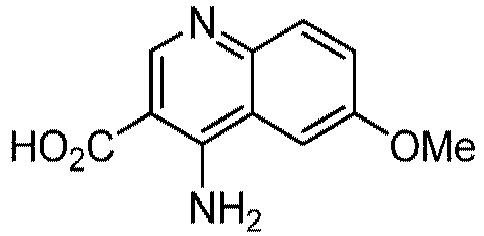
- To a stirred solution of ethyl 4-amino-6-methoxyquinoline-3-carboxylate (Example 1a, 1.23 g, 5.0 mmol) in EtOH (20.0 mL) was added aqueous NaOH (2.0 N, 5.0 mL) at room temperature. The reaction mixture was then refluxed for 3 hr. The solution was then filtered and washed with water. The filtrate was cooled to 0 °C and neutralized carefully with 1 N HCl to pH 7. Most of the EtOH was removed under reduced pressure, and the precipitate was collected by filtration, washed with cold water, and dried under vacuum to give the title compound as an off-white solid (1.01 g, 93%). 1H NMR (400 MHz, DMSO-d6 ) δ 3.89 (s, 3H), 7.40 (dd, J = 2.8, 9.4 Hz, 1H), 7.73 (d, J = 9.4 Hz, 1H), 7.77 (d, J = 2.8 Hz, 1H), 8.77 (s, 1H). MS 219 (MH+).
- A mixture of ethyl 4-chloro-6-methoxyquinoline-3-carboxylate (Example lb, 796 mg, 3.0 mmol) and ammonia (25% aqueous solution, 10 mL) in isopropanol (40 mL) was stirred at 110 °C in a pressure reactor overnight. Most of the solvent was then removed under reduced pressure, and the reaction mixture was diluted with water. The precipitate was collected by filtration, washed with cold water, and dried under vacuum to give the title compound as an off-white solid (680 mg, 92%). 1H NMR (400 MHz, DMSO-d6 ) δ 1.33 (t, J = 7.0 Hz, 3H), 3.88 (s, 3H), 4.32 (q, J = 7.0 Hz, 2H), 7.36 (dd, J = 2.8, 8.8 Hz, 1H), 7.72 (d, J = 8.8 Hz, 1H), 7.74 (d, J = 2.8 Hz, 1H), 8.23 (bs, 2H), 8.77 (s, 1H). MS 247 (MH+).
- A solution of ethyl 4-hydroxy-6-methoxyquinoline-3-carboxylate (Example 1c, 1.24 g, 5.0 mmol) in POCl3 was refluxed under nitrogen for 3 hrs. The solution was cooled to room temperature and evaporated under reduced pressure. The residue was carefully quenched with ice, and neutralized with 2.0 N NaOH to pH 7. The precipitate was collected by filtration, washed with cold water, and dried under vacuum to give the title compound as a pale-yellow solid (1.29 g, 97%). 1H NMR (400 MHz, DMSO-d6 ) δ 1.36 (t, J = 7.0 Hz, 3H), 3.96 (s, 3H), 4.41 (q, J = 7.0 Hz, 2H), 7.57 (d, J = 2.8 Hz, 1H), 7.61 (dd, J = 2.8, 8.8 Hz, 1H), 8.05 (d, J = 8.8 Hz, 1H), 8.97 (s, 1H). MS 266, 268 (MH+).
- A mixture of 4-methoxyaniline (12.3 g, 100 mmol) and diethyl 2-(ethoxymethylene)malonate (21.6 g, 100 mmol) was stirred at 120 °C under nitrogen for 4 hrs. The solution was cooled to room temperature and Ph2O (100 mL) was added. The reaction mixture was refluxed at 260 °C under nitrogen for 8 hrs. The solution was cooled to room temperature and diluted with hexanes. The resultant precipitate was collected by filtration, washed with 25% ethyl acetate in hexanes, and dried under vacuum to give ethyl 4-hydroxy-6-methoxyquinoline-3-carboxylate as a pale-yellow solid (4.21 g, 17%). 1H NMR (400 MHz, DMSO-d6 ) δ 1.26 (t, J = 7.0 Hz, 3H), 3.83 (s, 3H), 4.19 (q, J = 7.0 Hz, 2H), 7.32 (dd, J = 3.2, 9.6 Hz, 1H), 7.55 (d, J = 3.2 Hz, 1H), 7.56 (d, J = 9.6 Hz, 1H), 8.47 (s, 1H), 12.27 (s, 1H). MS 248 (MH+).
-

- Prepared as in Example 1 from ethyl 4-amino-5-(2,2-dimethyl-3-oxo-3-(propylamino)-propoxy)-2-methylquinoline-3-carboxylate (Example 2a) as an off-white solid (41%). 1H NMR (400 MHz, DMSO-d6 ) δ 0.73 (t, J = 7.6 Hz, 3H), 1.25 (s, 6H), 1.33-1.42 (m, 2H), 2.76 (s, 3H), 3.00-3.05 (m, 2H), 4.16 (s, 2H), 7.01 (d, J = 8.0 Hz, 1H), 7.29 (d, J = 8.0 Hz, 1H), 7.67 (t, J = 8.0 Hz, 1H), 7.89 (t, J = 5.8 Hz, 1H), 8.85 (bs, 1H), 12.28 (bs, 1H), 12.78 (bs, 1H). MS 360 (MH+).
- To a solution of 3-(3-amino-2-cyanophenoxy)-2,2-dimethyl-N-propylpropan-amide (
Tachdjian, C. et al. PCT Int. Appl. 2008, WO 2008154221 -

- Prepared as in Example 1 from ethyl 4-amino-6-methoxy-2-methylquinoline-3-carboxylate (Example 3a) as a white solid (87%). 1H NMR (400 MHz, DMSO-d6 ) δ 2.83 (s, 3H), 3.90 (s, 3H), 7.57 (dd, J = 2.4, 8.2 Hz, 1H), 8.09 (d, J = 8.2 Hz, 1H), 8.10 (d, J = 2.4 Hz, 1H), 9.39 (s, 1H), 9.67 (s, 1H). MS 233 (MH+).
- Prepared as in Example 2a from 2-amino-5-methoxybenzonitrile (Campbell, J. B. et al. Synth. Commun. 1989, 19, 2255-2263.) and ethyl acetoacetate as an off-white solid (92%). 1H NMR (400 MHz, DMSO-d6 ) δ 1.33 (t, J = 6.8 Hz, 3H), 2.57 (s, 3H), 3.86 (s, 3H), 4.33 (q, J = 6.8 Hz, 2H), 7.28 (dd, J = 2.8, 9.2 Hz, 1H), 7.59 (d, J = 9.2 Hz, 1H), 7.60 (bs, 2H), 7.63 (d, J = 2.8 Hz, 1H). MS 261 (MH+).
-

- Prepared as in Example 1 from ethyl 4-amino-2-phenylquinoline-3-carboxylate (Example 4a) as an off-white solid (33%). 1H NMR (400 MHz, DMSO-d6 ) δ 7.39-7.52 (m, 7H), 7.79 (m, 3H), 8.33 (d, J = 8.0 Hz, 1H), 12.63 (bs, 1H). MS 265 (MH+).
- Prepared as in Example 2a from 2-aminobenzonitrile and ethyl 3-oxo-3-phenylpropanoate as a yellow solid (45%). 1H NMR (400 MHz, DMSO-d6 ) δ 0.72 (t, J = 8.0 Hz, 3H), 3.92 (q, J = 8.0 Hz, 2H), 7.44 (m, 5H), 7.50 (m, 1H), 7.61 (bs, 2H), 7.73 (m, 1H), 7.83 (d, J = 8.0 Hz, 1H), 8.37 (d, J = 8.0 Hz, 1H). MS 293 (MH+).
-
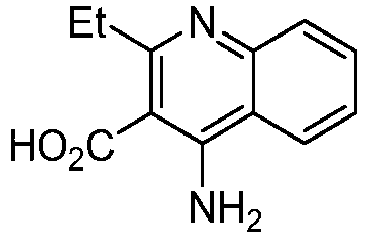
- Prepared as in Example 2 from methyl 4-amino-2-ethylquinoline-3-carboxylate (Example 5a) as a white solid (26%). 1H NMR (400 MHz, DMSO-d6 + 1 drop D2O) δ 1.24 (t, J = 8.0 Hz, 3H), 3.28 (q, J = 8.0 Hz, 2H), 7.56 (t, J = 8.0 Hz, 1H), 7.78 (d, J = 8.0 Hz, 1H), 7.83 (t, J = 8.0 Hz, 1H), 8.36 (d, J = 8.0 Hz, 1H).). MS 217 (MH+).
- Prepared as in Example 2a from 2-aminobenzonitrile and methyl 3-oxopentanoate as a solid (27%). 1H NMR (400 MHz, DMSO-d6 ) δ 1.18 (t, J = 8.0 Hz, 3H), 2.88 (q, J = 8.0 Hz, 2H), 3.86 (s, 3H), 7.40 (m, 1H), 7.44 (bs, 2H), 7.64 (m, 1H), 7.68 (m, 1H), 8.26 (d, J = 8.0 Hz, 1H). MS 231 (MH+).
-

- Prepared as in Example 1 from ethyl 4-amino-2-methylquinoline-3-carboxylate (Example 6a) as a off-white solid (41%). 1H NMR (400 MHz, DMSO-d6 ) δ 1.05 (t, J = 8.0 Hz, 3H), 2.84 (s, 3H), 7.56 (bs, 1H), 7.76 (m, 1H), 7.82 (bs, 1H), 8.39 (d, J = 8.0 Hz, 1H), 8.99 (bs, 1H), 12.00 (bs, 1H), 12.98 (bs, 1H). MS 203 (MH+).
- Prepared as in Example 2a from 2-aminobenzonitrile and ethyl 3-oxobutanoate as a yellow solid (32%). 1H NMR (400 MHz, DMSO-d6 ) δ 1.33 (t, J = 8.0 Hz, 3H), 2.61 (s, 3H), 4.34 (q, J = 8.0 Hz, 2H), 7.41 (m, 1H), 7.66 (m, 2H), 7.74 (bs, 2H), 8.27 (d, J = 8.0 Hz, 1H). MS 231 (MH+).
-

- Prepared as in Example 1 from methyl 4-amino-5-(2,2-dimethyl-3-oxo-3-(propylamino)propoxy)-2-ethylquinoline-3-carboxylate (Example 7a) as a solid (75%). 1H NMR (400 MHz, DMSO-d6 ) δ 0.75 (t, J = 8.0 Hz, 3H), 1.03 (t, J = 8.0 Hz, 3H), 1.27 (s, 6H), 1.39 (m, 2H), 3.04 (q, J = 4.0 Hz, 2H), 3.45 (q, J = 4.0 Hz, 2H), 4.17 (s, 2H), 7.04 (d, J = 8.0 Hz, 1H), 7.32 (d, J = 8.0 Hz, 1H), 7.69 (t, J = 8.0 Hz, 1H), 7.90 (t, J = 4.0 Hz, 1H), 8.89 (bs, 1H), 12.75 (bs, 1H). MS 374 (MH+).
- Prepared as in Example 2a from 3-(3-amino-2-cyanophenoxy)-2,2-dimethyl-N-propylpropan-amide (
Tachdjian, C. et al. PCT Int. Appl. 2008, WO 2008154221 -

- Prepared as in Example 1 from ethyl 4-amino-6-phenoxyquinoline-3-carboxylate (Example 8a) as a off-white solid (50%). 1H NMR (400 MHz, DMSO-d6 ) δ 7.07 (d, J = 8.0 Hz, 2H), 7.16 (t, J = 8.0 Hz, 1H), 7.42 (m, 2H), 7.49 (dd, J = 8.0 Hz, 1H), 7.87 (d, J = 8.0 Hz, 1H), 8.13 (d, J = 4.0 Hz, 1H), 8.86 (s, 1H). MS 281 (MH+).
- Prepared as in Example 1a from ethyl 4-chloro-6-phenoxyquinoline-3-carboxylate (Example 8b) and ammonia as a off-white solid (82%). 1H NMR (400 MHz, DMSO-d6 ) δ 1.35 (t, J = 8.0 Hz, 3H), 4.35 (q, J = 8.0 Hz, 2H), 7.05 (d, J = 8.0 Hz, 2H), 7.15 (t, J = 8.0 Hz, 1H), 7.40 (m, d, 2H), 7.46 (dd, J = 8.0 Hz, 1H), 7.87 (d, J = 8.0 Hz, 1 H), 8.13 (d, J = 4.0 Hz, 1H), 8.27 (bs, 2H), 8.87 (s, 1H). MS 309 (MH+).
- Prepared as in Example 1b from ethyl 4-hydroxy-6-phenoxyquinoline-3-carboxylate (Example 8c) and POCl3 as a tan solid (96%). 1H NMR (400 MHz, DMSO-d6 ) δ 1.36 (t, J = 8.0 Hz, 3H), 4.40 (q, J = 8.0 Hz, 2H), 7.23 (d, J = 8.0 Hz, 2H), 7.29 (t, J = 8.0 Hz, 1H), 7.50 (t, J = 8.0 Hz, 2H), 7.63 (d, J = 4.0 Hz, 1H), 7.76 (dd, J = 8.0 Hz, 1H), 8.21 (d, J = 8.0 Hz, 1H), 9.06 (s, 1H). MS 328, 330 (MH+).
- Prepared as in Example 1c from 4-phenoxyaniline and diethyl 2-(ethoxymethylene)malonate as a white solid (41%). 1H NMR (400 MHz, DMSO-d6 ) δ 1.24 (t, J = 8.0 Hz, 3H), 4.18 (q, J = 8.0 Hz, 2H), 7.07 (d, J = 8.0 Hz, 2H), 7.20 (t, J = 8.0 Hz, 1H), 7.43 (t, J = 8.0 Hz, 2H), 7.47 (m, 2H), 7.69 (d, J = 12.0 Hz, 1H), 12.39 (bs, 1H). MS 310 (MH+).
-

- Prepared as in Example 1 from ethyl 4-amino-7-fluoroquinoline-3-carboxylate (Example 9a) as an off white solid (66%). 1H NMR (CD3OD, 400 MHz) δ 7.49 (m, 2H), 8.50 (dd, J = 10.0, 5.2 Hz, 1H), 8.94 (s, 1H). MS 207 (MH+).
- Prepared as in Example 1a from ethyl 4-chloro-7-fluoroquinoline-3-carboxylate (Example 9b) and ammonia as an off white solid (99%). MS 235 (MH+).
- Prepared as in Example 1b from ethyl 7-fluoro-4-hydroxyquinoline-3-carboxylate (Example 9c) and POCl3 as an off white solid (96%). MS 254, 256 (MH+).
- Prepared as in Example 1c from 3-fluoroaniline and diethyl 2-(ethoxymethylene)malonate as a brown solid (51%). MS 236 (MH+).
-

- Prepared as in Example 1 from ethyl 4-amino-6-isopropoxyquinoline-3-carboxylate (Example 10a) as a an off white solid (94%). 1H NMR (400 MHz, DMSO-d6 ) δ 1.30 (s, 3H), 1.32 (s, 3H), 4.82 (m, 1H), 7.37 (d, J = 9.2 Hz, 1H), 7.72 (d, J = 9.2 Hz, 1H), 7.78 (s, 1H), 8.75 (s, 1H). MS 247 (MH+).
- Prepared as in Example 1a from ethyl 4-chloro-6-isopropoxyquinoline-3-carboxylate (Example 10b) and ammonia as an off white solid (75%). MS 275 (MH+).
- Prepared as in Example 1b from ethyl 4-hydroxy-6-isopropoxyquinoline-3-carboxylate (Example 10c) and POCl3 as a pale yellow solid (93%). MS 294,296 (MH+).
- Prepared as in Example 1c from 4-isopropoxyaniline and diethyl 2-(ethoxymethylene)malonate as a yellow solid (20%). MS 276 (MH+).
-
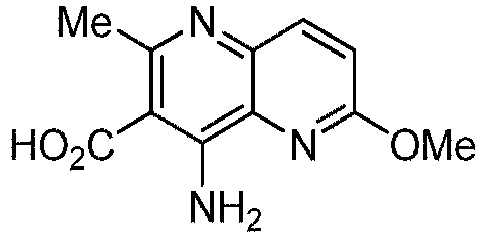
- Prepared as in Example 1 from ethyl 4-amino-6-methoxy-2-methyl-1,5-naphthyridine-3-carboxylate (Example 11a) as an off white solid (56%). 1H NMR (400 MHz, DMSO-d6 ) δ 2.68 (s, 3H), 4.02 (s, 3H), 7.21 (d, J = 8.8 Hz, 1H), 7.99 (d, J = 9.2 Hz, 1H). MS 234 (MH+).
- Prepared as in Example 2a from 3-amino-6-methoxypicolinonitrile (Example 11b) and ethyl 3-oxobutanoate as an off white solid (45%). MS 262 (MH+).
- To a solution of 6-methoxy-3-nitropicolinonitrile (Piersanti, G. et al. Org. Biomolecular Chem. 2007, 5, 2567-2571.) (2.0 g, 11.1 mmol) in diglyme (52 mL) was added dropwise a solution of SnCl2 (6.35 g, 33.5 mmol) in concentrated HCl solution (26 mL) at 0 °C. The solution was stirred at 0 °C for 1 hr, then the reaction mixture was neutralized with concentrated NaOH solution, and extracted with EtOAc (2X). The combined organic layers were washed with brine, and dried over Na2SO4. After evaporation of the solvent, the residue was purified by chromatography on silica gel (50% EtOAc in hexanes) to give 3-amino-6-methoxypicolinonitrile (966 mg, 58%) as a brown solid. 1H NMR (400 MHz, CDCl3) δ 3.81 (s, 3H), 4.10 (bs, 2H), 6.81 (d, J = 8.0 Hz, 1H), 7.08 (d, J = 8.0 Hz, 1H). MS 150 (MH+).
-

- Ethyl 4-(4-methoxybenzylamino)-2,5-dimethylquinoline-3-carboxylate (Example 12a, 0.563 g, 1.54 mmol) was dissolved in TFA (8 mL) and the resultant solution was stirred at room temperature for 15 minutes, TFA was then removed under vacuum to give the crude ethyl 4-amino-2,5-dimethylquinoline-3-carboxylate product, which was dissolved in EtOH (4 mL). To this solution was added NaOH (4.0 N, 3.86 mL) and the reaction mixture was stirred at 100 °C for 1 hr. Water (25 mL) was added, and the solvent was decanted away from insoluble material then acidified with AcOH to pH 5.5. The precipitate was collected by filtration to give the title compound (300 mg, 90%) as a white solid. 1H NMR (400 MHz, DMSO-d6 ) δ 2.78 (s, 3H), 2.88 (s, 3H), 7.30 (d, J = 7.2 Hz, 1H), 7.58 (d, J = 8.0 Hz, 1H), 7.65 (m, 1H), 7.8-8.0 (br, 1H), 12.2-12.9 (br, 2H). MS 217 (MH+).
- A solution of ethyl 4-chloro-2,5-dimethylquinoline-3-carboxylate (Example 12b, 0.518 g, 1.96 mmol) and (4-methoxyphenyl)methanamine (1.15 mL, 8.86 mmol) in toluene (10 mL) and DMF (5 mL) were stirred at 115 °C under nitrogen for 12 hrs. The solvent was removed under vacuum, and the residue was purified by chromatography on silica gel (0% to 50% EtOAc in hexanes) to give the title compound as an oil (563 mg, 79%). 1H NMR (400 MHz, DMSO-d6 ) δ 1.24 (t, J = 7.6 Hz, 3H), 2.45 (s, 3H), 2.78 (s, 3H), 3.73 (s, 3H), 4.2-4.3 (m, 4H), 6.27 (t, J = 6.0 Hz, 1H), 6.88 (d, J = 8.4 Hz, 2H), 7.19 (m, 3H), 7.48 (m, 1H), 7.58 (d, J= 8.4 Hz, 1H). MS 365 (MH+).
- A solution of 5-methyl-1H-benzo[d][1,3]oxazine-2,4-dione (Example 12c) (1.36 g, 7.68 mmol), ethyl 3-oxobutanoate (1.46 mL, 11.5 mmol), and NaOH (0.046 g, 1.15 mmol) in anhydrous dioxane (10 mL) were refluxed under nitrogen for 15 hrs. The solvent was then removed under vacuum, and the residue was re-dissolved in DMF (15 mL). To this solution was added POCl3 (1.41 mL, 15.4 mmol), and the reaction mixture was stirred at room temperature for 45 minutes. The reaction was carefully quenched with ice water (150 mL), and extracted with DCM (2 x 75 mL). The combined organic layers were washed with brine, and dried over Na2SO4. After evaporation of the solvent, the residue was purified by chromatography on silica gel eluting with 50% EtOAc in hexanes to give the title compound as red oil (520 mg, 26%). 1H NMR (400 MHz, DMSO-d6 ) δ 1.36 (t, J = 7.6 Hz, 3H), 2.58 (s, 3H), 2.97 (s, 3H), 4.46 (q, J = 7.6 Hz, 2H), 7.51 (d, J = 7.2 Hz, 1H), 7.71 (m, 1H), 7.87 (d, J = 7.6 Hz, 1H). MS 264, 266 (MH+)
- Trichloromethyl carbonochloridate (2.04 mL, 16.9 mmol) was added to 2-amino-6-methylbenzoic acid (2.13 g, 14.1 mmol) in anhydrous dioxane (32 mL) under nitrogen, then refluxed for 30 minutes. Diethyl ether (100 mL) was added, and the precipitated solid was collected by filtration to give 5-methyl-1H-benzo[d][1,3]oxazine-2,4-dione (1.4 g, 56%) which was used without further purification.
-

- Prepared as in Example 1 from ethyl 4-amino-6-ethoxyquinoline-3-carboxylate (Example 13a) as an off white solid (76%). 1H NMR (400 MHz, DMSO-d6 ) δ 1.39 (t, J = 7.2 Hz, 3H), 4.18 (q, J = 7.2 Hz, 2H), 7.50-7.53 (m, 1H), 7.86 (d, J = 8.8 Hz, 1H), 7.95 (d, J = 2.0 Hz, 1H), 8.86 (s, 1H), 9.26 (bs, 1H), 9.86 (bs, 1H). MS 233 (MH+).
- Prepared as in Example 1a from ethyl 4-chloro-6-ethoxyquinoline-3-carboxylate (Example 13b) and ammonia as an off white solid (77%). 1H NMR (400 MHz, DMSO-d6 ) δ 1.31-1.40 (m, 6H), 4.15 (q, J = 7.2 Hz, 2H), 4.31 (q, J = 6.8 Hz, 2H), 7.34 (q, J = 6.4 Hz, 1H), 7.69-7.74 (m, 2H), 8.21 (bs, 2H), 8.77 (s, 1H). MS 261 (MH+).
- Prepared as in Example 1b from ethyl 6-ethoxy-4-hydroxyquinoline-3-carboxylate (Example 13c) and POCl3 as pale yellow solid (100%). 1H NMR (400 MHz, DMSO-d6 ) δ 1.34-1.42 (m, 6H), 4.21 (q, J = 7.2 Hz, 2H), 4.40 (q, J = 7.2 Hz, 2H), 7.52 (d, J = 2.8 Hz, 1H), 7.56-7.59 (m, 1H), 8.02 (d, J = 8.8 Hz, 1H), 8.94 (s, 1H). MS 280, 282 (MH+).
- Prepared as in Example 1c from 4-ethoxyaniline and diethyl 2-(ethoxymethylene)malonate as a white solid (26%). 1H NMR (400 MHz, DMSO-d6 ) δ 1.24-1.37 (m, 6H), 4.09 (q, J = 6.8 Hz, 2H), 4.19 (q, J = 7.2 Hz, 2H), 7.29-7.32 (m, 1H), 7.52-7.56 (m, 2H), 8.47 (s, 1H), 12.27 (s, 1H). MS 262 (MH+).
-

- Prepared as in Example 1 from ethyl 4-amino-6-propoxyquinoline-3-carboxylate (Example 14a) as a white solid (56%). 1H NMR (400 MHz, DMSO-d6 ) δ 1.01 (t, J = 7.6 Hz, 3H), 1.77-1.82 (m, 2H), 4.06 (t, J = 6.8 Hz, 2H), 7.43 (d, J = 2.0 Hz, 1H), 7.71-7.78 (m, 2H), 8.77 (s, 1H). MS 247 (MH+).
- Prepared as in Example 1a from ethyl 4-chloro-6-propoxyquinoline-3-carboxylate (Example 14b) and ammonia as a white solid. MS 275 (MH+).
- Prepared as in Example 1b from ethyl 4-hydroxy-6-propoxyquinoline-3-carboxylate (Example 14c) and POCl3 as a pale yellow solid. MS 294, 296 (MH+).
- Prepared as in Example 1c from 4-propoxyaniline and diethyl 2-(ethoxymethylene)malonate as a white solid (65%). 1H NMR (400 MHz, DMSO-d6 ) δ 0.98 (t, J = 7.2 Hz, 3H), 1.25 (t, J = 7.2 Hz, 3H), 1.72-1.77 (m, 2H), 3.98 (t, J = 6.0 Hz, 2H), 4.16-4.21 (m, 2H), 6.97-6.99 (m, 1H), 7.53-7.56 (m, 2H), 8.47 (d, J = 5.2 Hz, 1H), 12.27 (s, 1H). MS 276 (MH+).
-
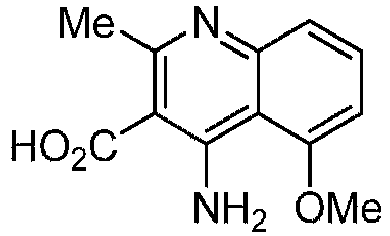
- Prepared as in Example 1 from ethyl 4-amino-5-methoxy-2-methylquinoline-3-carboxylate (Example 15a) as a off-white solid. 1H NMR (400 MHz, DMSO-d6 ) δ 2.49 (s, 3H), 4.05 (s, 3H), 7.19 (d, J = 7.6 Hz, 1H), 7.61 (d, J = 8.0 Hz, 1H), 7.85 (t, J = 8.0 Hz, 1H), 9.49 (s, 1H), 9.85 (s, 1H). MS 233 (MH+).
- Prepared as in Example 2a from 2-amino-6-methoxybenzonitrile and ethyl 3-oxobutanoate as a pale yellow solid. 1H NMR (400 MHz, DMSO-d6 ) δ 1.32 (t, J = 7.2 Hz, 3H), 2.55 (s, 3H), 3.96 (s, 3H), 4.30 (q, J = 7.2 Hz, 2H), 6.88 (d, J = 8.4 Hz, 1H), 7.22 (d, J = 7.6 Hz, 1H), 7.52 (t, J = 8.0 Hz, 1H), 8.15 (s, 2H). MS 261 (MH+).
-
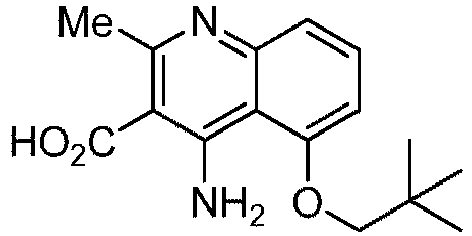
- Prepared as in Example 1 from ethyl 4-amino-2-methyl-5-(neopentyloxy)quinoline-3-carboxylate (Example 16a) as a white solid. 1H NMR (400 MHz, DMSO-d6 ) δ 1.06 (s, 9H), 2.76 (s, 3H), 3.93 (s, 2H), 7.05 (d, J = 8.4 Hz, 1H), 7.31 (d, J = 8.0 Hz, 1H), 7.66 (t, J = 8.0 Hz, 1H). MS 289 (MH+).
- Prepared as in Example 2a from 2-amino-6-(neopentyloxy)benzonitrile (
Tachdjian, C. et al. PCT Int. Appl. 2008, WO 2008154221 -

- Prepared as in Example 1 from ethyl 4-amino-2-(2-ethoxy-2-oxoethyl)quinoline-3-carboxylate (Example 17a) as a white solid (26%). 1H NMR (400 MHz, DMSO-d6 ) δ 3.76 (s, 2H), 7.36 (t, J = 8.0 Hz, 1H), 7.58 (t, J = 8.0 Hz, 1H), 7.64 (d, J = 12.0 Hz, 1H), 7.87 (bs, 2H), 8.17 (d, J = 8.0 Hz, 1H). MS 188 (MH+ - CH2CO2H).
- Prepared as in Example 2a from 2-aminobenzonitrile and diethyl 3-oxopentanedioate as a pale yellow solid (25%). 1H NMR (400 MHz, DMSO-d6 ) δ 1.19 (t, J = 8.0 Hz, 3H), 1.30 (t, J = 8.0 Hz, 3H),4.08 (m, 4H), 4.28 (q, J = 8.0 Hz, 2H), 7.50 (m, 1H), 7.73 (m, 2H), 8.10 (bs, 2H), 8.53 (d, J = 8.0 Hz, 1H). MS 303 (MH+).
-

- To a solution of ethyl 4-amino-5-(cyclopentylmethoxy)-2-methylquinoline-3-carboxylate (Example 18a, 16.8 g, 51.2 mmol) in EtOH (100 mL) was added NaOH (2 N, 64 mL) at room temperature. The reaction mixture was refluxed for 4 h. After it was cooled down to room temperature, the reaction solution was filtered to remove any possible solid residue. The filtrate was carefully neutralized with 2N HCl to pH 7 at 0 °C. The resultant precipitate was collected by filtration, washed with water, re-dissolved in EtOH (500 mL) and water (30 mL), and treated with activated charcoal (650 mg) at 70 °C for 0.5 h. The charcoal was removed by filtration, and the filtrate was concentrated and stored at 4 °C overnight. The resulting precipitate was collected by filtration, washed with cold 25% EtOH in H2O, and dried under vacuum at 60°C overnight to give the title compound as an off-white solid (7.5 g, 49%). 1H NMR (400 MHz, DMSO-d6 ) δ 1.31-1.37 (m, 2H), 1.53-1.64 (m, 4H), 1.79-1.85 (m, 2H), 2.47-2.50 (m, 1H), 2.75 (s, 3H), 4.11 (d, J = 8.8 Hz, 2H), 7.03 (d, J = 8.0 Hz, 1H), 7.26 (d, J = 8.4 Hz, 1H), 7.66 (t, J = 8.0 Hz, 1H), 8.77 (brs, 1H), 12.26 (brs, 1H), 12.75 (brs, 1H). 1H NMR (400 MHz, CD3OD) δ 1.39-1.49 (m, 2H), 1.63-1.77 (m, 4H), 1.91-1.98 (m, 2H), 2.51-2.61 (m, 1H), 2.78 (s, 3H), 4.16 (d, J = 8.0 Hz, 2H), 7.08 (d, J = 8.0 Hz, 1H), 7.23 (d, J = 8.0 Hz, 1H), 7.72 (t, J = 8.0 Hz, 1H). MS 301 (MH+).
- To a solution of 2-amino-6-(cyclopentylmethoxy)benzonitrile (
Tachdjian, C. et aL PCT Int. Appl. 2008, WO 2008154221 ) (21.63 g, 100.0 mmol) and ethyl acetoacetate (12.6 mL, 100.0 mmol) in anhydrous toluene (300 mL) was added SnCl4 (23.1 mL, 200.0 mmol) over a period of 25 minutes at room temperature under nitrogen. The stirred reaction mixture was then refluxed for 5 h under nitrogen. After it was cooled down to room temperature, the reaction solution was concentrated to remove most of the solvent under reduced pressure. The residue was re-dissolved in EtOAc (3.5 L) and carefully neutralized to pH 8 with aqueous NaOH solution (6.0 N, ∼130 mL) at 0 °C. The resultant mixture was stirred at room temperature overnight. The precipitate was filtered off, and the organic layer was separated and washed with brine (400 mL), dried over Na2SO4 and concentrated under reduced pressure. The residue was purified by column chromatography on silica gel eluting with 30% EtOAc in hexanes to give the title compound as a pale yellow solid (24.6 g, 75%). 1H NMR (400 MHz, DMSO-d6 ) δ 1.30-1.36 (m, 5H), 1.53-1.65 (m, 4H), 1.81-1.86 (m, 2H), 2.42-2.45 (m, 1H), 2.54 (s, 3H), 4.05 (d, J = 7.2 Hz, 2H), 4.31 (q, J = 7.2 Hz, 2H), 6.89 (d, J = 7.6 Hz, 1H), 7.21-7.23 (m, 1H), 7.50 (t, J = 8.0 Hz, 1H), 8.08 (s, 2H). MS 329 (MH+). -

- Prepared as in Example 1 from ethyl 4-amino-5-(cyclopentyloxy)-2-methylquinoline-3-carboxylate (Example 19a) as a off white solid (83%). 1H NMR (400 MHz, DMSO-d6 ) δ 1.56-1.60 (m, 2H), 1.67-1.70 (m, 2H), 1.83-1.87 (m, 2H), 1.92-1.96 (m, 2H), 2.67 (s, 3H), 5.05-5.07 (m, 1H), 6.93 (d, J = 8.4 Hz, 1H), 7.18 (d, J = 8.4 Hz, 1H), 7.57 (t, J = 8.4 Hz, 1H). MS 287 (MH+).
- Prepared as in Example 2a from 2-amino-6-(cyclopentyloxy)benzonitrile (
Tachdjian, C. et al. PCT Int. Appl. 2008, WO 2008154221 -

- Prepared as in Example 1 from ethyl 4-amino-2,3-butylene-6-methylthieno[2,3-b]pyridine-5-carboxylate (Example 20a) as a solid. 1H NMR (400 MHz, DMSO-d6 ) δ 1.78-1.79 (m, 4H), 2.53 (s, 3H), 2.71-2.72 (m, 2H), 2.94-2.96 (m, 2H), 6.86 (s, 2H). MS 263 (MH+).
- Prepared as in Example 2a from 2-amino-4,5,6,7-tetrahydrobenzo[b]thiophene-3-carbonitrile (
Tachdjian, C. et al. PCT Int. Appl. 2008, WO 2008154221 -

- Prepared as in Example 1 from ethyl 4-amino-5-(3,3-dimethylbutyl)-2-methylquinoline-3-carboxylate (Example 21a) as a white solid (88%). 1H NMR (400 MHz, DMSO-d6 ) δ 0.93 (s, 9H), 1.40 (t, J = 8.8 Hz, 2H), 2.75 (s, 3H), 3.17 (t, J = 8.4 Hz, 2H), 7.35 (d, J = 7.2 Hz, 1H), 7.57 (d, J = 8.4 Hz, 1H), 7.66 (t, J = 8.0 Hz, 1H), 12.78 (s, 1H). MS 287 (MH+).
- Prepared as in Example 2a from 2-amino-6-(3,3-dimethylbutyl)benzonitrile (Example 21b) and ethyl 3-oxobutanoate as a white solid (95%). 1H NMR (400 MHz, DMSO-d6 ) δ 0.93 (s, 9H), 1.32 (t, J = 7.2 Hz, 3H), 1.42-1.46 (m, 1H), 2.55 (s, 3H), 3.11-3.15 (m, 2H), 4.33 (q, J = 7.2 Hz, 2H), 7.12 (s, 2H), 7.19-7.21 (m, 1H), 7.46-7.52 (m, 2H). MS 315 (MH+).
- A suspension of 2-amino-6-(3,3-dimethylbut-1-ynyl)benzonitrile (Example 21c, 690 mg, 3.48 mmol) and 10% Pd/C (100 mg) in EtOAc/EtOH (1:1, 20 mL) was stirred under an atmosphere of H2 with a balloon at room temperature overnight. The Pd/C was removed by filtration, the filtrate was concentrated, and purified by chromatography on silica gel eluting with 20% EtOAc in hexanes to give the title compound as a light yellow oil (620 mg, 88%). 1H NMR (400 MHz, DMSO-d6 ) δ 0.92 (s, 9H), 1.36-1.40 (m, 2H), 2.52-2.56 (m, 2H), 5.88 (s, 2H), 6.45 (d, J = 7.6 Hz, 1H), 6.57 (d, J = 7.6 Hz, 1H), 7.15 (t, J = 8.0 Hz, 1H). MS 203 (MH+).
- To a solution of 2-amino-6-bromobenzonitrile (1.97 g, 10.0 mmol), 3,3-dimethylbut-1-yne (2.46 g, 30 mmol), K2CO3 (2.76 g, 20.0 mmol), and CuI (191 mg, 0.1 mmol) in DME/H2O (4:1, 50 mL) was added Pd(PPh3)4 (1.16 g, 0.1 mmol) at room temperature under nitrogen. The reaction mixture was refluxed under nitrogen overnight. After it was cooled down to room temperature, the reaction was quenched with brine, extracted with EtOAc. The organic layer was washed with brine, dried over Na2SO4, and concentrated. The residue was purified by chromatography on silica gel eluting with 20% EtOAc in hexanes to give the title compound as a light brown oil (1.84 g, 93%). 1H NMR (400 MHz, DMSO-d6 ) δ 1.27 (s, 9H), 6.10 (s, 2H), 6.59 (d, J = 7.2 Hz, 1H), 6.71 (d, J = 8.0 Hz, 1H), 7.18-7.22 (m, 1H). MS 199 (MH+).
-

- Prepared as in Example 1 from ethyl 4-amino-5-(2-ethylbutoxy)-2-methylquinoline-3-carboxylate (Example 22a) as a white solid (45%). M.p.: 145-151 °C. 1H NMR (400 MHz, DMSO-d6 ) δ 0.90 (t, J = 8 Hz, 6H), 1.48-1.41, (m, 4H), 1.84-1.78 (m, 1H), 2.73 (s, 3H), 4.11 (d, J = 8 Hz, 2H), 6.99 (d, J = 8 Hz, 1H), 7.32 (d, J = 8 Hz, 1H), 7.59 (t, J = 8 Hz, 1H), 8.40 (brs, 1H), 11.09 (brs, 1H), 13.91 (brs, 1H). MS 303 (MH+).
- Prepared as in Example 2a from 2-amino-6-(2-ethylbutoxy)benzonitrile (Example 22b) and ethyl 3-oxobutanoate as a white solid (89%). 1H NMR (400 MHz, DMSO-d6 ) δ 0.90 (t, J = 8 Hz, 6H), 1.32 (t, J = 8 Hz, 3H), 1.48-1.41 (m, 4H), 1.79-1.73 (m, 1H), 2.54 (s, 3H), 4.08 (d, J = 4 Hz, 2H), 4.31 (q, J = 8 Hz, 2H), 6.92 (dd, J = 2, 8 Hz, 1H), 7.23 (dd, J = 2, 8 Hz, 1H), 7.50 (t, J = 8 Hz, 1H), 8.04 (brs, 1H). MS 331 (MH+).
- To a solution of 2-ethylbutan-1-ol (1.02 g, 10.0 mmol) in dry THF (60 mL) was carefully added NaH (60% in mineral oil, 480 mg, 12.0 mmol) in small portions at 0 °C under nitrogen. The reaction mixture was stirred at 0 °C under nitrogen for 2 hrs. To this solution was added 2-amino-6-fluorobenzonitrile (1.36 g, 10.0 mmol), and the reaction solution was stirred at 0 °C - RT for 2 hrs, and then at 65 °C overnight under nitrogen. The reaction was cooled down to room temperature then quenched with brine, and extracted with EtOAc (3X). The combined organic layers were washed with brine, dried over Na2SO4. Filtered and evaporated under reduced pressure. The residue was purified by chromatography on silica gel (eluent: 20% EtOAc in hexanes) to give the title compound as colorless oil (1.29 g, 59%). 1H NMR (400 MHz, CDCl3) δ 0.93 (t, J = 8 Hz, 6H), 1.55-1.43 (m, 4H), 1.73- 1.65 (m, 1H), 3.90 (d, J = 4 Hz, 2H), 4.10 (brs, 2H), 6.25 (d, J = 8 Hz, 1H), 6.34 (d, J = 8 Hz, 1H), 7.20 (t, J = 8 Hz, 1H).
-

- Prepared as in Example 1 from ethyl 4-amino-5-(heptan-4-yloxy)-2-methylquinoline-3-carboxylate (Example 23a) as a white solid (59%). 1H NMR (400 MHz, DMSO-d6 ) δ 0.87 (t, J = 7.2 Hz, 6H), 1.49-1.25 (m, 4H), 1.84-1.60 (m 4H), 2.74 (s, 3H), 4.74-4.71 (m, 1H), 7.07 (d, J = 8.4 Hz, 1H), 7.24 (d, J = 8.0 Hz, 1H), 7.64 (t, J = 8.4 Hz, 1H), 8.82 (brs, 1H). MS 317(MH+).
- Prepared as in Example 2a from 2-amino-6-(heptan-4-yloxy)benzonitrile (Example 23b) and ethyl 3-oxobutanoate as a pale yellow solid (65%). 1H NMR (400 MHz, DMSO-d6 ) δ 0.87 (t, J = 7.2 Hz, 6H), 1.31 (t, J = 7.2 Hz, 3H), 1.47-1.33 (m, 4H), 1.77-1.59 (m, 4H), 2.54 (s, 3H), 4.30 (q, J = 7.2 Hz, 2H), 4.67-4.64 (m, 1H), 6.92 (d, J = 7.6 Hz, 1H), 7.19 (dd, J = 0.8, 8.4 Hz, 1H), 7.49 (t, J = 8.0 Hz, 1H), 8.13 (brs, 2H). MS 345 (MH+).
- Prepared as in Example 22b from heptan-4-ol and 2-amino-6-fluorobenzonitrile as a white solid (24%). 1H NMR (400 MHz, CDCl3) δ 0.92 (t, J = 7.2 Hz, 6H), 1.55-1.31 (m, 8H), 3.88 (s, br, 1H), 4.33-4.27 (m, 1H), 6.26 (d, J = 8.0 Hz, 1H), 6.35 (d, J = 8.0 Hz, 1H), 7.20 (t, J = 8.0 Hz, 1H).
-
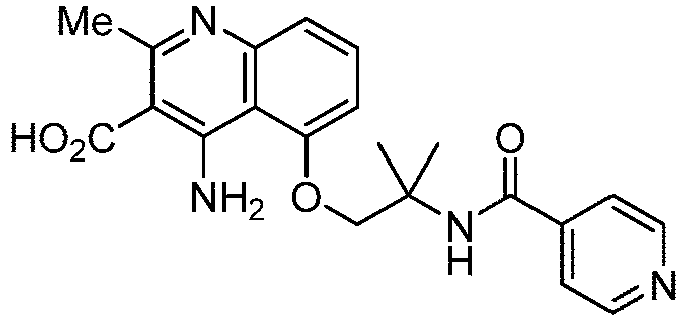
- Prepared as in Example 1 from ethyl 4-amino-5-(2-(isonicotinamido)-2-methylpropoxy)-2-methylquinoline-3-carboxylate (Example 24a) as a white solid (67%). M.p.: 195-198 °C. 1H NMR (400 MHz, DMSO-d6 ) δ 1.51 (s, 6H), 2.75 (s, 3H), 4.48 (s, 2H), 7.07 (d, J = 8 Hz, 1H), 7.31 (d, J = 8 Hz, 1H), 7.67 (t, J = 8 Hz, 1H), 7.70 (dd, J = 1, 8 Hz, 2H), 8.50 (s, 1H), 8.67 (dd, J = 1, 8 Hz, 2H), 8.76 (brs, 1H), 12.19 (brs, 1H), 12.85 (brs, 1H). MS 395 (MH+).
- To a solution of ethyl 4-amino-5-(2-amino-2-methylpropoxy)-2-methylquinoline-3-carboxylate (Example 24b, 1.0 g, 3.15 mmol) in dry DMF (20 mL) was added isonicotinic acid (504 mg, 4.10 mmol), followed by EDCI (783 mg, 4.10 mmol), HOBt (554 mg, 4.10 mmol), and triethylamine (414 mg, 4.10 mmol) at room temperature under nitrogen. After it was stirred at room temperature for 12 hrs, the reaction mixture was concentrated under reduced pressure. The residue was diluted with water, and extracted with EtOAc (3X). The aqueous layer was basified with 2N NaOH to pH 8 and extracted with EtOAc (3X). The combined organic layers were washed with brine, dried over MgSO4, filtered, concentrated, and purified by chromatography on silica gel eluting with 10% MeOH in dichloromethane to give the title compound as a yellow solid (1.1 g, 83%). 1H NMR (400 MHz, DMSO-d6 ) δ 1.29 (t, J = 4 Hz, 3H), 1.51 (s, 6H), 2.94 (s, 3H), 4.28 (q, J = 4 Hz, 2H), 4.42 (s, 2H), 6.93 (dd, J = 1, 8 Hz, 1H), 7.24 (dd, J = 1, 8 Hz, 2H), 7.52 (t, J = 8 Hz, 1H), 7.69 (dd, J = 2, 4 Hz, 2H), 8.14 (s, 2H), 8.37 (s, 1H), 8.67 (dd, J = 2, 4 Hz, 2H). MS 423 (MH+).
- Prepared as in Example 2a from benzyl 1-(3-amino-2-cyanophenoxy)-2-methylpropan-2-ylcarbamate (Example 24c) and ethyl 3-oxobutanoate as a yellow-brown solid (91%). 1H NMR (400 MHz, DMSO-d6 ) δ 1.15 (s, 6H), 1.31 (t, J = 4 Hz, 3H), 2.54 (s, 3H), 3.87 (s, 2H), 4.31 (q, J = 4 Hz, 2H), 6.85 (d, J = 4 Hz, 1H), 7.21 (d, J = 4 Hz, 1H), 7.49 (t, J = 8 Hz, 1H), 8.38 (brs, 2H). MS 318 (MH+).
- To a solution of 2-amino-6-(2-amino-2-methylpropoxy)benzonitrile (Example 24d, 30.5 g, 148.6 mmol) in THF/H2O (1:1, 400 mL) was added NaHCO3 (24.7 g, 294 mmol), followed by benzyl (2,5-dioxopyrrolidin-1-yl) carbonate (44.0 g, 176 mmol) at room temperature. The reaction was stirred at room temperature for 4 h then the organic layer was separated and the aqueous layer was extracted with EtOAc (2X). The combined organic layers were washed with brine and dried over MgSO4. After filtration, the solvent was evaporated and the crude oil was purified by chromatography on silica gel (eluent: 0-60% EtOAc in hexane) to give the title compound as yellow oil (44.8 g, 89%). 1H NMR (400 MHz, DMSO-d6 ) δ 1.30 (s, 6H), 4.02 (s, 2H), 4.96 (s, 2H), 5.98 (s, 2H), 6.14 (d, J = 8.0 Hz, 1H), 6.32 (dd, J = 0.8, 8.4 Hz, 1H), 7.12 (t, J = 8.4 Hz, 1H), 7.38-7.21 (m, 6H). MS 340 (MH+).
- To a solution of 2-amino-2-methylpropan-1-ol (14.4 g, 161 mmol) in anhydrous THF (150 mL) was added NaH (6.8 g, 161 mmol, 60% in mineral oil) in small portions at 0 °C under nitrogen. The mixture was stirred at 0 °C for 30 minutes and then stirred at room temperature for another 30 minutes. The solution was cooled down to 0 °C again, and to this solution was added dropwise a solution of 2-amino-6-fluorobenzonitrile (20.0 g, 147 mmol) in anhydrous THF (50 mL). The reaction mixture was then refluxed overnight under nitrogen. The reaction mixture was cooled down to room temperature and carefully quenched with aqueous NH4Cl solution and extracted with ethyl acetate (3X). The combined organic layers were washed with brine, dried over MgSO4, filtered and concentrated. The crude mixture was purified by chromatography on silica gel eluting with 10% MeOH in DCM to give the title compound as yellow solid (23.4 g 71%). 1H NMR (400 MHz, DMSO-d6 ) δ 1.08 (s, 6H), 3.15 (s, 2H), 3.64 (s, 2H), 5.98 (s, 2H), 6.13 (d, J = 8.0 Hz, 1H), 6.31 (d, J = 8.4 Hz, 1H), 7.15 (t, J = 8.4 Hz, 1H). MS 236 (MH+).
-

- Prepared as in Example 1 from ethyl 4-amino-5-(2-(3-hydroxybenzamido)-2-methyl-propoxy)-2-methylquinoline-3-carboxylate (Example 25a) as a white solid (65%). M.p.: 195-198 °C. 1H NMR (400 MHz, DMSO-d6 ) δ 1.48 (s, 6H), 2.75 (s, 3H), 4.47 (s, 2H), 6.87 (dt, J = 8, 4 Hz, 1H), 7.22-7.16 (m, 3H), 7.06 (d, J = 8 Hz, 1H), 7.27 (d, J = 8 Hz, 1H), 7.67 (t, J = 8 Hz, 1H), 8.08 (s, 1H), 8.84 (brs, 1H), 9.69 (s, 1H), 12.12 (brs, 1H), 12.78 (brs, 1H). MS 410 (MH+).
- Prepared as in Example 24a from 4-amino-5-(2-amino-2-methylpropoxy)-2-methylquinoline-3-carboxylate (Example 24b) and 3-hydroxybenzoic acid as a yellow-brown solid (64%). 1H NMR (400 MHz, DMSO-d6 ) δ 1.30 (t, J = 4 Hz, 3H), 1.48 (s, 6H), 2.55 (s, 3H), 4.30 (q, J = 4 Hz, 2H), 4.41 (s, 2H), 6.85-6.88 (m, 1H), 6.92 (d, J = 8 Hz, 1H), 7.25-7.15 (m, 4H), 7.52 (t, J = 8 Hz, 1H), 7.98 (s, 1H), 8.19 (s, 2H), 9.59 (s, 1H). MS 438 (MH+).
-

- Prepared as in Example 1 from (S)-ethyl 4-amino-5-(2-(cyclohexanecarboxamido)-propoxy)-2-methylquinoline-3-carboxylate (Example 26a) as a white solid (53%). 1H NMR (400 MHz, DMSO-d6 ) δ 1.25-1.10 (m, 5H), 1.34-1.31 (m, 2H), 1.69-1.62 (m, 5H), 2.11-2.05 (m, 1H), 2.69 (s, 3H), 3.93 (t, J = 9.2 Hz, 1H), 4.13 (dd, J = 4, 9.6 Hz, 1H), 4.14-4.11 (m, 1H), 6.86 (d, J = 8.0 Hz, 1H), 7.28 (d, J = 8.4 Hz, 1H), 7.49 (t, J = 8.0 Hz, 1H), 7.95 (d, J = 8.4 Hz, 1H). MS 386 (MH+).
- Prepared as in Example 24a from (S)-ethyl 4-amino-5-(2-aminopropoxy)-2-methylquinoline-3-carboxylate (Example 26b) and cyclohexanecarboxylic acid as brown solid (28%). MS 414 (MH+).
- Prepared as in Example 2a from (S)-benzyl (1-(3-amino-2-cyanophenoxy)propan-2-yl)-carbamate (Example 26c) and ethyl 3-oxobutanoate as brown solid. MS 304 (MH+).
- Prepared as in Example 24c from (S)-2-amino-6-(2-aminopropoxy)benzonitrite (Example 26d) as brown solid (86%). 1H NMR (400 MHz, DMSO-d 6) δ 1.12 (d, J = 6.4 Hz, 3H), 3.81 (d, J = 8.4 Hz, 1H), 3.95-3.92 (m, 1H), 4.99 (s, 2H), 5.36 (s, 2H), 5.96 (s, 2H), 6.20 (d, J = 8.0 Hz, 1H), 6.31 (d, J = 8.4 Hz, 1H), 7.13 (t, J = 8.4 Hz, 1H), 7.44-7.38 (m, 5H). MS 326 (MH+).
- Prepared as in Example 24d from (S)-2-aminopropan-1-ol and 2-amino-6-fluoro-benzonitrile as brown solid (73%). 1H NMR (400 MHz, DMSO-d6 ) δ 1.01 (d, J = 6.5 Hz, 3H), 3.08 (m, 1H), 3.71 (d, J = 6.1 Hz, 2H), 5.95 (s, 2H), 6.15 (d, J = 8.3 Hz, 1H), 6.2 (d, J = 8.3 Hz, 1H), 7.13 (t, J = 8.3 Hz, 1H). MS 192 (MH+).
-

- Prepared as in Example 1 from (S)-ethyl 4-amino-5-(2-(isonicotinamido)propoxy)-2-methylquinoline-3-carboxylate (Example 27a) as an off-white solid (42%). 1H NMR (400 MHz, DMSO-d6 ) δ 1.31 (d, J = 6.8 Hz, 3H), 2.66 (s, 3H), 4.14 (t, J = 9.2 Hz, 1H), 4.28 (dd, J = 3.6, 9.6 Hz, 1H), 4.70- 4.55 (m, 1H), 6.92 (d, J = 8.0 Hz, 1H), 7.26 (d, J = 8.4 Hz, 1H), 7.51 (t, J = 8.4 Hz, 1H), 7.75 (dd, J = 1.2, 6.0 Hz, 2H), 8.71 (dd, J = 1.2, 6.0 Hz, 2H), 8.95 (d, J = 8.0 Hz, 1H). MS 409 (MH+).
- Prepared as in Example 24a from (S)-ethyl 4-amino-5-(2-aminopropoxy)-2-methylquinoline-3-carboxylate (Example 26b) and isonicotinic acid as brown solid (36%). MS 409 (MH+).
-

- Prepared as in Example 1 from (S)-ethyl 4-amino-5-(2-(3-hydroxybenzamido)propoxy)-2-methylquinoline-3-carboxylate (Example 28a) as a white solid (58%). 1H NMR (400 MHz, DMSO-d6 ) δ 1.28 (d, J = 7.2 Hz, 3H), 2.65 (s, 3H), 4.11 (t, J = 8.8 Hz, 1H), 4.22 (dd, J = 4.0, 10 Hz, 1H), 4.65-4.55 (m, 1H), 6.88 (d, J = 8.0, 2H), 7.25-7.13 (m, 4H), 7.48 (t, J = 8.0 Hz, 1H), 8.49 (d, J = 8.0, 1H), 9.93 (brs, 1H). MS 396 (MH+).
- Prepared as in Example 24a from (S)-ethyl 4-amino-5-(2-aminopropoxy)-2-methylquinoline-3-carboxylate (Example 26b) and 3-hydroxybenzoic acid as brown solid (41%). MS 424 (MH+).
-

- Prepared as in Example 1 from ethyl 4-amino-5-(3-(cyclopentylamino)-2,2-dimethyl-3-oxopropoxy)-2-methylquinoline-3-carboxylate (Example 29a) as a white powder (74%). 1H NMR (400 MHz, DMSO-d6 ) δ 1.27 (s, 6H), 1.36-1.46 (m, 4H), 1.57-1.59 (m, 2H), 1.72-1.78 (m, 2H), 2.78 (s, 3H), 4.04 (m, 1H), 4.19 (s, 2H), 7.02 (d, J = 8.0 Hz, 1H), 7.33 (d, J = 8.0 Hz, 1H), 7.64-7.71 (m, 2H), 8.83 (brs, 1H), 12.25 (brs, 1H), 12.93 (brs, 1H). MS 386 (MH+).
- Prepared as in Example 2a from 3-(3-amino-2-cyanophenoxy)-N-cyclopentyl-2,2-dimethylpropanamide (Example 29b) and ethyl 3-oxobutanoate as a bright yellow solid (62%). 1H NMR (400 MHz, DMSO-d6 ) δ 1.26 (s, 6H), 1.34 (t, J = 8.0 Hz, 3H), 1.40-1.46 (m, 4H), 1.57-1.59 (m, 2H), 1.74-1.77 (m, 2H), 2.57 (s, 3H), 4.09 (q, J = 4.0 Hz, 1H), 4.15 (s, 2H), 4.33 (q, J = 8.0 Hz, 2H), 6.89 (d, J = 4.0 Hz, 1H), 7.26 (dd, J = 8.0 Hz, 1H), 7.53 (d, J = 8.0 Hz, 1H), 7.56 (s, 1H), 8.09 (brs, 2H). MS 414 (MH+).
- Prepared as in Example 22b from N-cyclopentyl-3-hydroxy-2,2-dimethylpropanamide (Example 29c) and 2-amino-6-fluorobenzonitrile as a white solid (45%). 1H NMR (400 MHz, DMSO-d6 ) δ 1.19 (s, 6H), 1.40-1.49 (m, 4H), 1.61-1.63 (m, 2H), 1.74-1.79 (m, 2H), 3.95 (s, 2H), 4.03 (m, 1H), 5.98 (s, 2H), 6.19 (d, J = 8.0 Hz, 1H), 6.33 (d, J = 8.0 Hz, 1H), 7.17 (t, J = 8.0 Hz, 1H), 7.23 (d, J = 8.0 Hz, 1H). MS 302 (MH+).
- Prepared as in Example 24a from hydroxypivalic acid and cyclopentyl amine as an orange oil (32%). 1H NMR (400 MHz, DMSO-d6 ) δ 1.00 (s, 6H), 1.32-1.40 (m, 2H), 1.43-1.49 (m, 2H), 1.57-1.65 (m, 2H), 1.73-1.81 (m, 2H), 3.34 (d, J = 4.0 Hz, 2H), 3.98 (m, 1H), 4.87 (t, J = 4.0 Hz, 1H), 7.22 (d, J = 4.0 Hz, 1H). MS 186 (MH+).
-

- Prepared as in Example 1 from ethyl 4-amino-5-(cyclobutylmethoxy)-2-methylquinoline-3-carboxylate (Example 30a) as a white powder (51%). 1H NMR (400 MHz, DMSO-d6 ) δ 1.84-1.99 (m, 4H), 2.10-2.15 (m, 2H), 2.77 (s, 3H), 2.92 (m, 1H), 4.23 (d, J = 8.0 Hz, 2H), 7.05 (d, J = 8.0 Hz, 1H), 7.29 (d, J = 8.0 Hz, 1H), 7.68 (t, J = 8.0 Hz, 1H), 8.71 (brs, 1H), 12.23 (brs, 1H), 12.81 (brs, 1H). MS 287 (MH+).
- Prepared as in Example 2a from 2-amino-6-(cyclobutylmethoxy)benzonitrile (
Tachdjian, C. et al. PCT Int. Appl. 2008, WO 2008154221 -

- Prepared as in Example 1 from ethyl 4-amino-5-(2-(cyclopentanecarboxamido)-2-methylpropoxy)-2-methylquinoline-3-carboxylate (Example 31a) as an off-white solid (68%). 1H NMR (400 MHz, DMSO-d6 ) δ 1.36 (s, 6H), 1.43-1.51 (m, 6H), 1.65-1.69 (m, 2H), 2.58 (m, 1H), 2.78 (m, 3H), 4.37 (s, 2H), 7.04 (m, 1H), 7.29 (d, J = 8.0 Hz, 1H), 7.68 (m, 1H), 7.80 (s, 1H), 8.84 (brs, 1H), 12.42 (brs, 1H), 12.73 (brs, 1H). MS 386 (MH+).
- Prepared as in Example 24a from ethyl 4-amino-5-(2-amino-2-methylpropoxy)-2-methylquinoline-3-carboxylate (Example 24b) and cyclopentane carboxylic acid as a yellow solid (33%). 1H NMR (400 MHz, DMSO-d6 ) δ 1.34 (t, J = 4.0 Hz, 3H), 1.37 (s, 6H), 1.42-1.53 (m, 6H), 1.64-1.69 (m, 2H), 2.58 (m, 1H), 2.62 (s, 3H), 4.32 (s, 2H), 4.35 (m, 2H), 6.96 (m, 1H), 7.28 (d, J = 8.0 Hz, 1H), 7.58 (m, 1H), 7.66 (s, 1H), 8.41 (d, 2H). MS 414 (MH+).
-

- Prepared as in Example 1 from ethyl 4-amino-5-(cycloheptyloxy)-2-methylquinoline-3-carboxylate (Example 32a) as a light yellow solid (34%). 1H NMR (400 MHz, DMSO-d6 ) δ 1.49-1.65 (m, 8H), 1.83-1.89 (m, 2H), 2.04-2.09 (m, 2H), 2.74 (s, 3H), 4.85 (m, 1H), 7.03 (d, J = 8.0 Hz, 1H), 7.23 (d, J = 8.0 Hz, 1H), 7.65 (t, J = 8.0 Hz, 1H), 8.82 (brs, 1H), 12.24 (brs, 1H), 12.64 (brs, 1H). MS 315 (MH+).
- Prepared as in Example 2a from 2-amino-6-(cycloheptyloxy)benzonitrile (Example 32b) and ethyl 3-oxobutanoate as a bright yellow solid (72%). 1H NMR (400 MHz, DMSO-d6 ) δ 1.32 (t, J = 8.0 Hz, 3H), 1.49-1.65 (m, 8H), 1.78-1.87 (m, 2H), 2.04-2.10 (m, 2H), 2.53 (s, 3H). 4.31 (q, J = 8.0 Hz, 2H), 4.79 (m, 1H), 6.89 (d, J = 8.0 Hz, 1H), 7.20 (d, J = 8.0 Hz, 1H), 7.49 (t, J = 8.0 Hz, 1H), 8.14 (brs, 2H). MS 343 (MH+).
- Prepared as in Example 22b from cycloheptanol and 2-amino-6-fluorobenzonitrile as yellow oil (11%). 1H NMR (400 MHz, DMSO-d6 ) δ 1.42-1.71 (m, 10H), 1.88-1.93 (m, 2H), 4.56 (m, 1H), 5.95 (s, 2H), 6.20 (d, J = 8.0 Hz, 1H), 6.30 (d, J = 8.0 Hz, 1H), 7.15 (t, J = 8.0 Hz, 1H). MS 231 (MH+).
-

- Prepared as in Example 1 from ethyl 4-amino-2-methyl-5-(3-phenoxypropoxy)quinoline-3-carboxylate (Example 33a) as a yellow solid (90%). 1H NMR (400 MHz, DMSO-d6 ) δ 2.35 (m, 2H), 2.77 (s, 3H), 4.19 (t, J = 4.0 Hz, 2H), 4.42 (t, J = 4.0 Hz, 2H), 6.91-6.96 (m, 3H), 7.09 (d, J = 8.0 Hz, 1H), 7.26-7.30 (m, 3H), 7.70 (t, J = 8.0 Hz, 1H), 8.96 (brs, 1H), 12.24 (brs, 1H), 12.75 (brs, 1H). MS 353 (MH+).
- Prepared as in Example 2a from 2-amino-6-(3-phenoxypropoxy)benzonitrile (Example 33b) and ethyl 3-oxobutanoate as a yellow solid (47%). 1H NMR (400 MHz, DMSO-d6 ) δ 1.33 (t, J = 8.0 Hz, 3H), 2.34 (m, 2H), 2.57 (s, 3H), 4.19 (t, J = 4.0 Hz, 2H), 4.33 (q, J = 8.0 Hz, 2H), 4.37 (t, J = 4.0 Hz, 2H), 6.91-6.97 (m, 4H), 7.24-7.29 (m, 3H), 7.53 (t, J = 8.0 Hz, 1H), 8.17 (s, 2H). MS 381 (MH+).
- Prepared as in Example 22b from 3-phenoxy-1-propanol and 2-amino-6-fluorobenzonitrile as a yellow oil (93%). 1H NMR (400 MHz, DMSO-d6 ) δ 2.14 (m, 2H), 4.10-4.16 (m, 4H), 5.98 (s, 2H), 6.23 (d, J = 8.0 Hz, 1H), 6.33 (d, J = 8.0 Hz, 1H), 6.89-6.94 (m, 5H), 7.16 (t, J = 8.0 Hz, 1H).
-

- Prepared as in Example 1 from ethyl 4-amino-5-((1-(3-hydroxybenzoyl)piperidin-4-yl)methoxy)-2-methylquinoline-3-carboxylate (Example 34a) as an orange powder (23%). 1H NMR (400 MHz, DMSO-d6 ) δ 1.24 (brs, 2H), 1.79-1.88 (m, 2H), 2.29 (m, 1H), 2.77 (s, 3H), 3.07 (brs, 2H), 3.65 (brs, 1H), 4.17 (d, J = 8.0 Hz, 2H), 4.50 (brs, 1H), 6.74-6.83 (m, 3H), 7.07 (d, J = 8.0 Hz, 1H), 7.23 (t, J = 8.0 Hz, 1H), 7.29 (d, J = 8.0 Hz, 1H), 7.69 (t, J = 8.0 Hz, 1H), 8.74 (brs, 1H), 9.75 (s, 1H), 12.25 (brs, 1H), 12.71 (brs, 1H). MS 436 (MH+).
- Prepared as in Example 2a from 2-amino-6-((1-(3-hydroxybenzoyl)piperidin-4-yl)methoxy)benzonitrile (Example 34b) and ethyl 3-oxobutanoate as a yellow solid (49%). 1H NMR (400 MHz, DMSO-d6 ) δ 1.24 (m, 2H), 1.31 (t, J = 4.0 Hz, 3H), 1.77-1.89 (m, 2H), 2.22 (brs, 1H), 2.55 (s, 3H), 2.79 (brs, 1H), 3.04 (brs, 1H), 3.64 (brs, 1H), 4.10 (m, 2H), 4.32 (q, J = 8.0 Hz, 2H), 4.49 (brs, 1H), 6.71-6.82 (m, 3H), 6.93 (d, J = 8.0 Hz, 1H), 7.19-7.25 (m, 2H), 7.52 (t, J = 8.0 Hz, 1H), 8.06 (brs, 2H), 9.64 (s, 1H). MS 464 (MH+).
- Prepared as in Example 24a from 2-amino-6-(piperidin-4-ylmethoxy)benzonitrile (Example 34c) and 3-hydroxybenzoic acid as an orange glass (66%). 1H NMR (400 MHz, DMSO-d6 ) δ 1.29 (m, 2H), 1.66∼1.92 (m, 2H), 2.06 (m, 1H), 2.80 (brs, 1H), 3.05 (brs, 1H), 3.62 (brs, 1H), 3.91 (d, J = 8.0 Hz, 2H), 4.49 (brs, 1H), 5.99 (s, 2H), 6.22 (d, J = 8.0 Hz, 1H), 6.34 (d, J = 8.0 Hz, 1H), 6.72-6.83 (m, 3H), 7.15-7.24 (m, 2H), 9.65 (s, 1H). MS 352 (MH+).
- To a solution of tert-butyl 4-((3-amino-2-cyanophenoxy)methyl)piperidine-1-carboxylate (Example 34d, 1.33 g, 4.0 mmol) in EtOAc (20 mL) was added dropwise aqueous HCl solution (12 N, 6.6 mL) at 0 °C. The reaction mixture was stirred at room temperature overnight. The solvent was removed under reduced pressure to give the title compound (100%) as a brown solid, which is pure enough and used directly in the next step without further purification. MS 232 (MH+).
- Prepared as in Example 22b from N-Boc-4-piperidinemethanol and 2-amino-6-fluoro-benzonitrile as an off-white solid (37%). 1H NMR (400 MHz, DMSO-d6 ) δ 1.15-1.21 (m, 2H), 1.40 (s, 9H), 1.74 (m, 2H), 1.99 (brs, 1H), 2.74 (brs, 2H), 3.87 (d, J = 4.0 Hz, 2H), 3.96 (m, 2H), 5.99 (s, 2H), 6.21 (d, J = 8.0 Hz, 1H), 6.33 (d, J = 8.0 Hz, 1H), 7.17 (t, J = 8.0 Hz, 1H). MS 232 (MH+-Boc).
-

- Prepared as in Example 1 ethyl 4-amino-5-((1-butyrylpiperidin-4-yl)methoxy)-2-methylquinoline-3-carboxylate (Example 35a) as a white solid (61%). 1H NMR (400 MHz, DMSO-d6 ) δ 0.87 (t, J = 8.0 Hz, 3H), 1.05-1.22 (m, 2H), 1.50 (m, 2H), 1.80 (m, 2H), 2.24-2.31 (m, 3H), 2.65 (s, 3H), 3.02 (2H), 3.88-3.92 (m, 1H), 4.11 (m, 2H), 4.44 (m, 1H), 7.05 (m, 1H), 7.26 (d, J = 8.0 Hz, 1H), 7.69 (m, 1H), 8.76 (brs, 1H), 12.33 (brs, 1H), 12.65 (brs, 1H). MS 386 (MH+).
- Prepared as in Example 24a from ethyl 4-amino-2-methyl-5-(piperidin-4-ylmethoxy)-quinoline-3-carboxylate (Example 35b) and butyric acid as a yellow oil (50%). MS 414 (MH+).
- Prepared as in Example 2a from benzyl 4-((3-amino-2-cyanophenoxy)methyl)piperidine-1-carboxylate (Example 35c) and ethyl 3-oxobutanoate as an orange solid (25%). 1H NMR (400 MHz, DMSO-d6 ) δ 1.29-1.37 (m, 5H), 1.77-1.80 (m, 2H), 2.07 (brs, 1H), 2.53 (s, 3H), 2.55-2.65 (m, 3H), 3.06-3.09 (m, 2H), 4.06 (d, J = 8.0 Hz, 2H), 4.32 (q, J = 8.0 Hz, 2H), 6.92 (d, J = 8.0 Hz, 1H), 7.24 (d, J = 8.0 Hz, 1H), 7.51 (t, J = 8.0 Hz, 1H), 8.08 (s, 2H). MS 344 (MH+).
- Prepared as in Example 22b from 1-N-Cbz-4-(hydroxymethyl)piperidine and 2-amino-6-fluoro-benzonitrile as a yellow oil (18%). 1H NMR (400 MHz, DMSO-d6 ) δ 1.20-1.25 (m, 2H), 1.75-1.78 (m, 2H), 1.96 (brs, 1H), 3.88 (d, J = 8.0 Hz, 2H), 3.99-4.04 (m, 4H), 5.07 (s, 2H), 5.99 (s, 2H), 6.21 (d, J = 8.0 Hz, 1H), 6.34 (d, J = 8.0 Hz, 1H), 7.17 (t, J = 8.0 Hz, 1H), 7.29-7.40 (m, 5H). MS 366 (MH+).
-

- To a solution of ethyl 4-amino-5-(cyclohexyloxy)-2-methylquinoline-3-carboxylate (Example 36a, 110 g, 0.335 mol) in EtOH (450 mL) was added a solution of NaOH (33.5 g, 0.837 mol) in water (200 mL) at room temperature. The reaction mixture was then refluxed overnight. The reaction solution was cooled down to 0 °C and carefully neutralized with 4N HCl to pH 7. The resultant solution was concentrated under reduced pressure to remove most of the EtOH. The precipitate was collected by filtration, and re-dissolved in EtOH (4 L) at 65 °C and treated with activated charcoal (5 g) for 0.5 h. The charcoal was removed by filtration over celite, and the filtrate was concentrated. The precipitate was collected by filtration, washed with cold water, and dried under vacuum at 60 °C overnight to give the title compound as a white solid (100 g, 99%). M.p.: 220.0-221.5 °C. 1H NMR (400 MHz, DMSO-d6 ) δ 1.28-1.72 (m, 8H), 2.00-2.04 (m, 2H), 2.75 (s, 3H), 4.69-4.71 (m, 1H), 7.10-7.12 (d, J = 8.0 Hz, 1H), 7.24-7.26 (d, J = 8.0 Hz, 1H), 7.65 (t, J = 8.0 Hz, 1H), 12.80 (brs, 1H). MS 301 (MH+). Elemental Analysis Calculated (Found) for C17H20N2O3: C, 67.98% (67.74%); H, 6.71% (7.01%); N, 9.33% (9.40%).
- A solution of ethyl 3-oxobutanoate (29.9 g, 0.230 mol) in anhydrous toluene (200 mL) was added to a solution of 2-amino-6-(cyclohexyloxy)benzonitrile (Example 36b, 49.8 g, 0.230 mol) in anhydrous toluene (1000 mL) under nitrogen in a 3 L round bottom flask sitting in an oil bath at room temperature. SnCl4 (53.9 mL, 0.461 mol) was added slowly over a period of approximately 1 h. The oil bath temperature was then raised to 110 °C and the reaction mixture was stirred at that temperature for 2.5 h. It was then cooled down to 5 °C, still under nitrogen, and the toluene was decanted away from the immiscible viscous oil at the bottom of the flask. The viscous oil was further concentrated under vacuum at 60 °C, re-dissolved in boiling ethyl acetate (1 L), and transferred to a 4 liter Erlenmeyer flask. The solution was diluted with more EtOAc (1.5 L), cooled down to -15 °C, and neutralized with NaOH (3 N, 500 mL). The organic layer was separated, and the aqueous emulsion was extracted once more with ethyl acetate. The insoluble tin salts were filtered out from the aqueous layer, then both the salts and aqueous filtrate were washed once more with ethyl acetate. The combined organic layers were dried over MgSO4, concentrated, and passed through a silica column using 0% to 60% ethyl acetate in hexanes. The product was purified by recrystallization from EtOAc to give the title compound as an off-white solid (64.3 g, 85%). 1H NMR (400 MHz, DMSO-d6 ) δ 1.28-1.34 (m, 1H), 1.32 (t, 3H), 1.37-1.45 (m, 2H), 1.51-1.63 (m, 3H), 1.67-1.71 (m, 2H), 1.99-2.03 (m, 2H), 2.54 (s, 3H), 4.28-4.33(q, J = 6.8 Hz, 2H), 4.64 (m, 1H), 6.95-6.97 (d, J = 7.6 Hz, 1H), 7.19-7.21 (d, J = 8.4 Hz, 1H), 7.65 (t, J = 8.4 Hz, 1H), 8.15 (brs, 2H). MS 329 (MH+).
- To a solution of cyclohexanol (19.1 g, 0.191 mol) in anhydrous THF (500 mL) was added NaH (7.6 g, 40% in mineral oil, 0.191 mol) in small portions at 0 °C under nitrogen. The mixture was stirred at room temperature for 1 h and a solution of 2-amino-6-fluorobenzonitrite (20.0 g, 0.15 mol) in anhydrous THF (150 mL) was added drop-wise at room temperature. The reaction mixture was heated to reflux overnight then cooled to room temperature and most of the THF removed under reduced pressure. Ice water (100 mL) was added to the concentrated reaction mixture followed by EtOAc (500 mL). The organic layer was separated and successively washed with water and brine, dried over Na2SO4, filtered and evaporated under reduced pressure. The residue was purified by chromatography on silica gel eluting with 25-30% EtOAc in hexanes to give 2-amino-6-(cyclohexyloxy)benzonitrile as a light yellow oil (17.9 g, 56%). 1H NMR (400 MHz, CDCl3) δ 1.32-1.43 (m, 3H), 1.51-1.55 (m, 1H), 1.62-1.69 (m, 2H), 1.79-1.95 (m, 4H), 4.31-4.36 (m, 3H), 6.23-6.27 (m, 2H), 7.18 (d, J = 8.0 Hz, 1H). MS 329 (MH+).
- Alternative Methode a): To a solution of 2-(cyclohexyloxy)-6-nitrobenzonitrile (Example 36c, 50.0 g, 0.20 mol) in THF/AcOH (1:1 by volume, 500 mL) was added iron powder (34.0 g, 0.61 mol) in one portion at room temperature under nitrogen. The reaction mixture was refluxed for 40 min under nitrogen and cooled down to room temperature and EtOAc (2 L) was added. The precipitate that formed was filtered off and washed with EtOAc. The organic layer was separated and washed successively with water (2 X 300 mL), aqueous NaOH (1.0 N, 2 X 300 mL), saturated Na2CO3 solution (300 mL), brine (300 mL), dried over Na2SO4 filtered and evaporated under reduced pressure. The residue was purified by chromatography on silica gel eluting with 25% EtOAc in hexanes to give 2-amino-6-(cyclohexyloxy)benzonitrile as a pale yellow oil (45.0 g, 94%), which solidified after storage overnight at room temperature.
- Alternative Methode b): A 3-L 3-neck round bottom flask was first purged with nitrogen. 10% Pd/C (2.81 g) was then added under nitrogen, followed successively by 2-(cyclohexyloxy)-6-nitrobenzonitrile (Example 36c, 43.2 g, 0.175 mol), anhydrous methanol (389 mL), and acetic acid (80.4 mL). A reflux condenser, a dropping funnel containing a solution of ammonium formate (49.8 g, 0.790 mol) in anhydrous methanol (498 mL), thermometer, nitrogen inlet and nitrogen outlet were attached. Ammonium formate solution (75 mL) was added at room temperature, then the reaction was slowly heated to a maximum of 42 °C. The mixture was monitored carefully until initiation of the reaction was observed (an evolution of gas occurred with roughly a 10°C exotherm). Initiation of the reaction often took up to 40 minutes before starting. The remaining of the ammonium formate solution was then added at a rate which maintained an internal reaction temperature of 40 °C to 48 °C. After the addition was complete, the reaction mixture was stirred for another 10 minutes at 45 °C, then cooled down to room temperature. The Pd/C was filtered out using a Teflon filter, and the solvent was evaporated. Ice water (1 L) was added to the residue, then the water was decanted and discarded. The residue was dissolved in diethyl ether, washed with water, then saturated sodium bicarbonate solution, then dried with magnesium sulfate and concentrated. The product was then purified on silica gel using isocratic DCM to give the product as a yellow oil (31.5 g, 83%).
- To a solution of cyclohexanol (46.8 grams, 0.467 mol) in anhydrous THF (1 L) was added sodium hydride (20.3 grams, 0.508 mol) at -40 °C under nitrogen. The reaction mixture was allowed to warm slowly to room temperature and stir for another 1 hour. It was then cooled down to -55 °C and 2,6-dinitrobenzonitrile (78.4 g, 0.406 mol) was added. The reaction was stirred at room temperature overnight, then cooled down to -20 °C, and citric acid (23.4 grams, 0.122 mol) was added. The mixture was then poured into ice water (5 L) which contained citric acid (7.8 g, 0.041 mol), stirred for 15 minutes, and the precipitated product was collected by filtration. The crude product was recrystallized from isopropanol (750 mL, heated to boiling, then cooled down to 0 °C), filtered, washed with isopropanol (300 mL), then air dried to give 84.4 g yellow solid. The solid was dissolved in dichloromethane (169 mL) and filtered through a plug of alumina to give the title compound as a pale yellow solid (83.2 g, 83.2%). 1H NMR (400 MHz, DMSO-d6 ) δ 1.4 (m, 4H), 1.6 (m, 2H), 1.7 (m, 2H), 1.9 (m, 2H), 4.75 (m, 1H), 7.79 (dd, J = 2.0, 8.0 Hz, 1H), 7.84-7.91 (m, 2H).
-

- Prepared as in Example 1 from ethyl 4-amino-5-(2-(cyclohexanecarboxamido)-2-methylpropoxy)-2-methylquinoline-3-carboxylate (Example 37a) as a white powder (78%). 1H NMR (400 MHz, DMSO-d6 ) δ 1.11-1.22 (m, 5H), 1.33 (s, 6H), 1.56-1.62 (m, 5H), 2.14 (m, 1H), 2.78 (s, 3H), 4.34 (s, 2H), 7.01 (d, J = 8.4 Hz, 1H), 7.30 (d, J = 8.4 Hz, 1H), 7.66 (t, J = 8.4 Hz, 1H), 7.74 (s, 1H). MS 400 (MH+).
- Prepared as in Example 2a from N-(1-(3-amino-2-cyanophenoxy)-2-methylpropan-2-yl)cyclohexanecarboxamide (Example 37b) and ethyl 3-oxobutanoate as a bright yellow solid (55%). MS 428 (MH+).
- Prepared as in Example 22b from N-(1-hydroxy-2-methylpropan-2-yl)cyclohexanecarboxamide (Example 37c) and 2-amino-6-fluorobenzonitrile as an off-white solid (29%). MS 316 (MH+).
- Prepared as in Example 24a from cyclohexanecarboxylic acid and 2-amino-2-methylpropan-1-ol as a colorless oil (15%). MS 200 (MH+).
-

- To a solution of 4-amino-5-(2-(3-(2-(benzyloxy)ethoxy)-5-methoxybenzamido)-2-methylpropoxy)-2-methylquinoline-3-carboxylic acid (Example 38a, 237 mg, 0.5 mmol) in EtOH/EtOAc (1:1, 20 mL) was added 10% Pd/C (wet, 50 mg). The suspension was then stirred under an atmosphere of hydrogen at room temperature overnight. The Pd/C was filtered off, and the filtrate was concentrated. The residue was purified by HPLC (eluent: 10-100% MeOH in H2O) to give the title compound as an off-white solid (152 mg, 63%). 1H NMR (400 MHz, DMSO-d6 ) δ 1.49 (s, 6H), 2.75 (s, 3H), 3.68 (t, J = 5.2 Hz, 2H), 3.73 (s, 3H), 3.99 (t, J = 5.2 Hz, 1H), 4.47 (s, 2H), 6.57 (s, 1H), 6.88 (s, 1H), 6.96 (s, 1H), 7.06 (d, J = 7.6 Hz, 1H), 7.28 (d, J = 8 Hz, 1H), 7.67 (t, J = 8 Hz, 1H), 8.14 (s, 1H). MS 484 (MH+).
- Prepared as in Example 1 from ethyl 4-amino-5-(2-(3-(2-hydroxyethoxy)-5-methoxybenzamido)-2-methylpropoxy)-2-methylquinoline-3-carboxylate (Example 38b) as a white powder (95%). MS 574 (MH+).
- Prepared as in Example 24a from 4-amino-5-(2-amino-2-methylpropoxy)-2-methylquinoline-3-carboxylate (Example 24b) and 3-(2-(benzyloxy)ethoxy)-5-methoxybenzoic acid (Example 39c) as a pale-brown solid (90%). MS 602 (MH+).
- Prepared as in Example 1 from methyl 3-(2-(benzyloxy)ethoxy)-5-methoxybenzoate (Example 38d) as a white solid (64%). 1H NMR (400 MHz, DMSO-d6 ) δ 3.83 (s, 3H), 3.84 (t, J = 4.8 Hz, 2H), 4.18 (t, J = 4.8 Hz, 2H), 4.65 (s, 2H), 6.74 (s, 1H), 7.25 - 7.37 (m, 7H).
- To a solution of methyl 3-hydroxy-5-methoxybenzoate (Chakraporty, T. K. and Reddy, G. V. J. Org. Chem, 57, 1992, 5462.) (3.3 g, 18.1 mmol) in dry DMF (30 mL) was added K2CO3 (6.3 g, 45.3 mmol) at room temperature. The reaction was stirred at room temperature for 10 minutes then ((2-bromoethoxy)methyl)benzene (3.4 mL, 21.7 mmol) was added and the mixture stirred at 160 °C for 2 hrs. The reaction was cooled down to room temperature and diluted with EtOAc, washed with water and brine, and dried over MgSO4, filtered and concentrated to give the crude product (90%) which was used in the next step without further purification.
-

- Prepared as in Example 1 from ethyl 4-amino-5-((2-isobutyramidocyclohexyl)oxy)-2-methylquinoline-3-carboxylate (Example 39a) as a white powder (90%). 1H NMR (400 MHz, DMSO-d6 ) δ 0.83 (d, J = 6.4 Hz, 3H), 0.93 (d, J = 6.4 Hz, 3H), 1.42 (m, 3H), 1.65 (m, 4H), 1.96 (m, 1H), 2.40 (m, 1H), 2.76 (s, 3H), 4.13 (m, 1H), 4.99 (m, 1H), 7.07 (d, J = 8.4 Hz, 1H), 7.25 (d, J = 8.4 Hz, 1H), 7.63 (t, J = 8 hz, 1H), 7.93 (d, J = 7.6 Hz, 1H). MS 386 (MH+).
- Prepared as in Example 2a from N-(2-(3-amino-2-cyanophenoxy)cyclohexyl)isobutyramide (Example 39b) and ethyl 3-oxobutanoate as a yellow solid (63%). MS 414 (MH+).
- Prepared as in Example 22b from N-(2-hydroxycyclohexyl)isobutyramide (Example 39c) and 2-amino-6-fluorobenzonitrile as a brown solid (70%). MS 302 (MH+).
- Prepared as in Example 24a from isobutyric acid and 2-aminocyclohexanol as a colorless oil (53%). MS 186 (MH+).
-

- Prepared as in Example 1 from ethyl 4-amino-5-((4-isodocyclohexyl)oxy)-2-methylquinoline-3-carboxylate (Example 40a) as a white powder (87%). 1H NMR (400 MHz, DMSO-d6 ) δ 0.97 (d, J = 7.2 Hz, 6H), 1.34-1.37 (m, 2H), 1.65-1.68 (m, 2H), 1.81-1.84 (m, 2H), 2.13-2.16 (m, 2H), 2.33 (m, 1H), 2.75 (s, 3H), 3.58 (m, 1H), 4.84 (m, 1H), 7.15 (d, J = 8.4 Hz, 1H), 7.23 (d, J = 8 Hz, 1H), 7.65 (d, J = 7.6 Hz, 2H). MS 386 (MH+).
- Prepared as in Example 2a from N-(4-(3-amino-2-cyanophenoxy)cyclohexyl)isobutyramide (Example 40b) and ethyl 3-oxobutanoate as a yellow solid (57%). MS 414 (MH+).
- Prepared as in Example 22b from N-(4-hydroxycyclohexyl)isobutyramide (Example 40c) and 2-amino-6-fluorobenzonitrile as an off-white solid (99%). MS 302 (MH+).
- Prepared as in Example 24a from isobutyric acid and 4-aminocyclohexanol as a colorless oil (44%). MS 186 (MH+).
-

- To a solution of ethyl 4-amino-5-isobutoxy-2-methylquinoline-3-carboxylate (Example 41a, 18.0 g, 59.53 mmol) in EtOH (150 mL) was added aqueous NaOH solution (3 N, 50 mL) and the reaction mixture was refluxed overnight. It was then cooled down to room temperature and the solution was filtered to remove any possible solid residue. The filtrate was carefully neutralized with 6N HCl to pH 7 at 0 °C. The resultant precipitate was collected by filtration, washed with water, re-dissolved in EtOH (700 mL) and water (20 mL), and treated with activated charcoal (650 mg) at 70 °C for 0.5 h. The charcoal was removed by filtration, and the filtrate was concentrated and stored at 4 °C overnight. The resulting precipitate was collected by filtration, washed with cold H2O, and dried under vacuum at 60 °C overnight to give the title compound as a white solid (4.24 g, 26%). M.p.: 203.7 °C. 1H NMR (400 MHz, DMSO-d6 ) δ 1.01-1.02 (m, 6H), 2.19-2.24 (m, 1H), 2.77 (s, 3H), 4.05 (d, J = 6.4 Hz, 2H), 7.08 (d, J = 8.0 Hz, 1H), 7.33 (d, J = 8.0 Hz, 1H), 7.71 (t, J = 8.0 Hz, 1H), 8.9 (brs, 1H), 11.45 (brs, 1H), 13.2 (brs, 1H). MS 275 (MH+). Elemental Analysis Calculated (Found) for C15H18N2O30.751-H2O: C, 62.59% (62.23%); H, 6.83% (7.25%); N, 9.76% (9.73%).
- To a solution of 2-amino-6-isobutoxybenzonitrile (Example 41b, 16.4 g, 86.32 mmol) and ethyl acetoacetate (10.9 mL, 86.32 mmol) in anhydrous toluene (200 mL) was added SnCl4 (19.9 mL, 172.63 mmol) over a period of 15 minutes at room temperature under nitrogen. The stirred reaction mixture was then refluxed for 3.5 h under nitrogen. After it was cooled down to room temperature, the reaction solution was concentrated to remove most of the solvent under reduced pressure. The residue was re-dissolved in EtOAc (3 L) and carefully neutralized to pH 8 with aqueous NaOH solution (6.0 N, ∼110 mL) at 0 °C. The resultant mixture was stirred at room temperature overnight. The precipitate was filtered off, and the organic layer was separated and washed with brine (400 mL), dried over Na2SO4 and concentrated under reduced pressure. The residue was purified by column chromatography on silica gel eluting with 50% EtOAc in hexanes to give the title compound as a white solid (18.0 g, 69%). MS 303 (MH+).
- To a solution of 2-isobutoxy-6-nitrobenzonitrile (Example 41c, 34.3 g, 0.156 mol) in AcOH/THF (1:1 by volume, 250 mL) was added iron powder (17.36 g, 0.311 mol) in one portion. The stirred suspension was heated to reflux for 30 minutes. After it was cooled down to room temperature, the reaction solution was diluted with EtOAc (1 L). The solid was removed by filtration, and the filtrate was washed subsequently with water (300 mL X 2), 1N NaOH (300 mL), saturated Na2CO3 aqueous solution (300 mL), brine (300 mL), and dried over Na2SO4. After evaporation of the solvent, the residue was purified by chromatography on silica gel eluting with 20 % EtOAc in hexanes to give the title compound as a yellow oil (16.4 g, 83%). 1H NMR (400 MHz, DMSO-d6 ) δ 0.96 (d, J = 6.8 Hz, 6H), 1.96-2.02 (m, 1H), 3.75 (d, J = 6.4 Hz, 2H), 5.96 (s, 2H), 6.17 (d, J = 8.4 Hz, 1H), 6.30 (d, J = 8.4 Hz, 1H), 7.15 (t, J = 8.8 Hz, 1H). MS 191 (MH+).
- Sodium hydride (60% suspension in oil, 25.0 g, 0.625 mol) was suspended in anhydrous THF (1000 mL) under nitrogen and heated to an internal temperature of 40°C to 45°C. 2-methylpropan-1-ol (61.2 mL, 0.661 mol) was then added slowly and portionwise. The mixture was heated at 40°C to 45°C for 1 hour, then cooled to 35°C. 2-amino-6-fluorobenzonitrile (50.0 g, 0.367 mol) was added and refluxed for 21 hours. The mixture was cooled to r.t., then ice (250 g), ice water (750 mL), and hexanes (1000 mL) was added. Insoluble solids were filtered out and the organic layer was separated. The aqueous layer was extracted once more with a mixture of diethyl ether (250 mL) and hexanes (250 mL). The combined organic layer was washed twice with a solution of citric acid (53 g) in water (500 mL), then washed with 80% brine (300 mL), then dried with magnesium sulfate, filtered and concentrated under reduced pressure. The residue was dissolved in methanol (500 mL), and the immiscible oil carried through from the sodium hydride suspension was separated off in a separatory funnel. The solvent was evaporated under vacuum, and the residue was washed with hexanes (250 mL), after which the product 2-amino-6-isobutoxybenzonitrile was obtained as a viscous oil (46 grams, yield: 66%). 1H NMR (400 MHz, DMSO-d6 ) δ 7.16 (t, J = 8.0 Hz, 1H), 6.33 (d, J = 8.0 Hz, 1H), 6.17 (d, J = 8.0 Hz, 1H), 5.97 (s, 2H), 3.75 (d, J = 7.2 Hz, 2H), 2.00 (m, 1H), 0.97 (d, J = 6.8 Hz, 6H) ppm. MS 191 (MH+).
- To a solution of 2-methylpropan-1-ol (9.6 mL, 0.104 mol) in anhydrous THF (200 mL) was added NaH (60% in mineral oil, 4.565 g, 0.114 mol) in small portions at 0 °C under N2. After it was stirred at room temperature for 30 min, the reaction mixture was cooled down to -70 °C and 2,6-dinitrobenzonitrile (20.0 g, 0.104 mol) was added portionwise. After the addition was complete, the reaction mixture was stirred at -70 °C - RT overnight, then poured into ice water (600 mL). The resultant precipitate was collected by filtration and rinsed with water, hexane, and air dried to provide 2-isobutoxy-6-nitrobenzonitrile as a light yellow solid (34.3g, 100%). 1H NMR (400 MHz, DMSO-d6 ) δ 1.0 (d, J = 6.8 Hz, 6H), 2.04-2.11 (m, 1H), 4.02 (d, J = 6.8 Hz, 2H), 7.69-7.71 (m, 1H), 7.84-7.90 (m, 2H). MS 221 (MH+).
-

- Prepared as in Example 1 from ethyl 4-amino-5-isopropoxy-2-methylquinoline-3-carboxylate (Example 42a) as a white solid (71%). 1H NMR (400 MHz, DMSO-d6 ) δ 1.4 (d, J = 6.4 Hz, 6H), 2.73 (s, 3H), 4.87-4.93 (m, 1H), 7.01 (d, J = 8.0 Hz, 1H), 7.27 (d, J = 8.0 Hz, 1H), 7.60 (t, J = 8.4 Hz, 1H). MS 261 (MH+).
- Prepared as in Example 2a from 2-amino-6-isopropoxybenzonitrile (
Tachdjian, C. et al. PCT Int. Appl. 2008, WO 2008154221 -

- Prepared as in Example 1 from ethyl 4-amino-5-((1-(hydroxymethyl)cyclohexyl)-methoxy)-2-methylquinoline-3-carboxylate (Example 43a) as an off-white solid (49%). 1H NMR (400 MHz, DMSO-d6 ) δ 1.37-1.48 (m, 10H), 2.75 (s, 3H), 3.50 (s, 2H), 4.03 (s, 2H), 5.08 (brs, 1H), 7.06 (d, J = 8.4 Hz, 1H), 7.25 (d, J = 8.8 Hz, 1H), 7.66 (t, J = 8.4 Hz, 1H), 9.39 (brs, 1H), 12.17 (brs, 1H), 12.74 (brs, 1H). MS 345 (MH+).
- Prepared as in Example 2a from (1-((3-amino-2-cyanophenoxy)methyl)cyclohexyl)-methyl acetate (
Tachdjian, C. et al. PCT Int. Appl. 2008, WO 2008154221 -

- Prepared as in Example 1 from ethyl 4-amino-5-(2-(3,5-dihydroxybenzamido)-2-methylpropoxy)-2-methylquinoline-3-carboxylate (Example 44a) as a white solid (73%). 1H NMR (400 MHz, DMSO-d6 ) δ 1.46 (s, 6H), 2.75 (s, 3H), 4.44 (s, 2H), 6.3-6.31 (m, 1H), 6.61 (s, 211), 7.04 (d, J = 8.0 Hz, 1H), 7.27 (d, J = 8.4 Hz, 1H), 7.66 (t, J = 8.0 Hz, 1H), 7.98 (s, 1H), 8.79 (brs, 1H), 9.48 (s, 2H). MS 426 (MH+).
- Prepared as in Example 24a from 4-amino-5-(2-amino-2-methylpropoxy)-2-methylquinoline-3-carboxylate (Example 24b) and 3,5-dihydroxybenzoic acid as a yellow-brown solid (15%). MS 454 (MH+).
-

- Prepared as in Example 1 from ethyl 4-amino-5-((4-(isopropylcarbamoyl)cyclohexyl)-oxy)-2-methylquinoline-3-carboxylate (Example 45a) as a white powder (71%). 1H NMR (400 MHz, DMSO-d6 ) δ 1.01(d, J = 6.4 Hz, 6H), 1.59-1.68 (m, 6H), 2.06-2.09 (m, 2H), 2.2-2.22 (m, 1H), 2.76 (s, 3H), 3.77-3.83 (m, 1H), 4.96 (s, 1H), 7.06 (d, J = 8.0 Hz, 1H), 7.26 (d, J = 8.4 Hz, 1H), 7.58 (d, J = 8.0 Hz, 1H), 7.65 (t, J = 8.4 Hz, 1H), 8.79 (brs, 1H), 12.84 (brs, 2H). MS 386 (MH+).
- Prepared as in Example 2a from 4-(3-amino-2-cyanophenoxy)-N-isopropylcyclohexanecarboxamide (Example 45b) and ethyl 3-oxobutanoate as a yellow solid (56%). MS 414 (MH+).
- Prepared as in Example 22b from 4-hydroxy-N-isopropylcyclohexanecarboxamide (Example 45c) and 2-amino-6-fluorobenzonitrile as an off-white solid (17%). 1H NMR (400 MHz, DMSO-d6 ) δ 1.01(d, J = 6.4 Hz, 6H), 1.47-1.57 (m, 4H), 1.67-1.77 (m, 2H), 1.89-1.93 (m, 2H), 2.08-2.15 (m, 1H), 3.75-3.84 (m, 1H), 4.57 (brs, 1H), 5.93 (s, 2H), 6.19 (d, J = 8.0 Hz, 1H), 6.28 (d, J = 8.0 Hz, 1H), 7.13 (t, J = 8.0 Hz, 1H), 7.48 (d, J = 8.0 Hz, 1H). MS 302 (MH+).
- Prepared as in Example 24a from 4-hydroxycyclohexanecarboxylic acid and propan-2-amine as a colorless oil (68%). MS 186 (MH+).
-

- Prepared as in Example 1 from ethyl 4-amino-5-(3-((3-methoxybenzyl)amino)-2,2-dimethyl-3-oxopropoxy)-2-methylquinoline-3-carboxylate (Example 46a) as a white powder (58%). M.p.: 172∼174 °C . 1H NMR (400 MHz, DMSO-d6 ) δ 1.31 (s, 6H), 2.76 (s, 3H), 3.53 (s, 3H), 4.21 (s, 2H), 4.27 (d, J = 5.6 Hz, 2H), 6.64 (dd, J = 8.0, 2.4 Hz, 1H), 6.69 (m, 1H), 6.72 (d, J = 8.0 Hz, 1H), 6.98-7.10 (m, 2H), 7.28 (d, J = 8.0 Hz, 1H), 7.66 (t, J = 8.0 Hz, 1H), 8.47 (t, J = 5.6 Hz, 1H), 8.77 (brs, 1H), 12.26 (brs, 1H), 12.79 (brs, 1H). MS 438 (MH+).
- Prepared as in Example 2a from 3-(3-amino-2-cyanophenoxy)-N-(3-methoxybenzyl)-2,2-dimethylpropanamide (Example 46b) and ethyl 3-oxobutanoate as a yellow solid (42%). MS 466 (MH+).
- Prepared as in Example 22b from 3-hydroxy-N-(3-methoxybenzyl)-2,2-dimethylpropanamide (Example 46c) and 2-amino-6-fluorobenzonitrile as a white solid (41%). MS 354 (MH+).
- Prepared as in Example 24a from 3-hydroxy-2,2-dimethylpropanoic acid and (3-methoxyphenyl)methanamine as an orange oil (41%). MS 238 (MH+).
-

- Prepared as in Example 1 from ethyl 4-amino-5-(3-(cyclohexylamino)-2,2-dimethyl-3-oxopropoxy)-2-methylquinoline-3-carboxylate (Example 47a) as an off-white solid (13%). MS 400 (MH+).
- Prepared as in Example 24a from 3-((4-amino-3-(ethoxycarbonyl)-2-methylquinolin-5-yl)oxy)-2,2-dimethylpropanoic acid (Example 47b) and cyclohexanamine as a yellow-brown solid (46%). MS 428 (MH+).
- Prepared as in Example 2a from benzyl 3-(3-amino-2-cyanophenoxy)-2,2-dimethylpropanoate (Example 47c) and ethyl 3-oxobutanoate as a brown solid (80%). MS 192 (MH+).
- To a solution of benzyl 3-(2-cyano-3-nitrophenoxy)-2,2-dimethylpropanoate (Example 47d, 200 mg, 0.56 mmol) in AcOH (5 mL) was added iron powder (158 mg, 2.82 mmol) at room temperature. The reaction mixture was then stirred at 90 °C for 1 h. The reaction mixture was was cooled to room temperature then diluted with AcOEt. The precipitate was filtered off and the filtrate was successively washed with 1 N NaOH and brine, then dried over Na2SO4, filtered and evaporated. The residue was purified by chromatography on silica gel (eluent: 40% EtOAc in hexanes) to give a title compound as a colorless oil (187 mg, 100%). MS 325 (MH+).
- To a solution of benzyl 3-hydroxy-2,2-dimethylpropanoate (Yang, D. et aL J. Am. Chem. Soc. 2002, 124, 9966. 6.68 g, 32.1 mmol) in dry THF (200 mL) was carefully added NaH (60% in mineral oil, 3.5 g, 87.5 mmol) in small portions at 0 °C under nitrogen. The reaction mixture was stirred at 0 °C under nitrogen for 2 hrs. To this solution was added 2,6-dinitrobenzonitrile (6.19 g, 32.1 mmol), and the reaction solution was stirred at 0 °C - RT under nitrogen overnight. The reaction mixture was quenched with brine, and extracted with EtOAc (3X). The combined organic layers were washed with brine, dried over Na2SO4. After evaporation of the solvent, the residue was purified by chromatography on silica gel eluting (Elunet: 20% EtOAc in hexanes) to give the title compound as a brown solid (10.0 g, 87%). MS 355 (MH+).
-

- Prepared as in Example 1 from ethyl 4-amino-5-(3-(cycloheptylamino)-2,2-dimethyl-3-oxopropoxy)-2-methylquinoline-3-carboxylate (Example 48a) as an off-white solid (12%). MS 414 (MH+).
- Prepared as in Example 24a from 3-((4-amino-3-(ethoxycarbonyl)-2-methylquinolin-5-yl)oxy)-2,2-dimethylpropanoic acid (Example 47b) and cycloheptanamine as a brown solid (43%). MS 456 (MH+).
-

- Prepared as in Example 1 from ethyl 4-amino-5-(3-(cyclooctylamino)-2,2-dimethyl-3-oxopropoxy)-2-methylquinoline-3-carboxylate (Example 49a) as an off-white solid (11%). MS 428 (MH+).
- Prepared as in Example 24a from 3-((4-amino-3-(ethoxycarbonyl)-2-methylquinolin-5-yl)oxy)-2,2-dimethylpropanoic acid (Example 47b) and cyclooctanamine as a brown solid (46%). MS 456 (MH+).
-

- Prepared as in Example 1 from ethyl 4-amino-5-(3-((3-hydroxy-2,2-dimethylpropyl)-amino)-2,2-dimethyl-3-oxopropoxy)-2-methylquinoline-3-carboxylate (Example 50a) as an off-white solid (87%). 1H NMR (400 MHz, DMSO-d6 ) δ 0.71 (s, 6H), 1.28 (s, 6H), 2.74 (s, 3H), 2.97 (d, J = 6.0 Hz, 2H), 3.0 (s, 2H), 4.57 (brs, 1H), 6.99 (d, J = 8.4 Hz, 1H), 7.27 (d, J = 8.0 Hz, 1H), 7.65 (t, J = 8.4 Hz, 1H), 7.77 (t, J = 6.4 Hz, 1H), 8.78 (brs, 1H), 12.04 (brs, 1H), 12.82 (brs, 1H). MS 404 (MH+).
- Prepared as in Example 24a from 3-((4-amino-3-(ethoxycarbonyl)-2-methylquinolin-5-yl)oxy)-2,2-dimethylpropanoic acid (Example 47b) and 3-amino-2,2-dimethylpropan-1-ol as a brown solid (40%). MS 432 (MH+).
-

- Prepared as in Example 1 from ethyl 4-amino-5-(3-(chroman-4-ylamino)-2,2-dimethyl-3-oxopropoxy)-2-methylquinoline-3-carboxylate (Example 51a) as an off-white solid (80%). 1H NMR (400 MHz, DMSO-d6 ) δ 1.31 (d, J = 4.0 Hz, 6H), 1.80-2.00 (m, 2H), 2.76 (s, 3H), 4.05-4.19 (m, 2H), 4.24 (s, 2H), 5.10 (q, J = 6.8 Hz, 1H), 6.51 (t, J = 7.6 Hz, 1H), 6.89 (d, J = 8.4 Hz, 1H), 6.94 (d, J = 8.0 Hz, 1H), 7.01 (dd, J = 15.0, 8.4 Hz, 2H), 7.30 (d, J = 8.8 Hz, 1H), 7.66 (t, J = 8.4 Hz, 1H), 8.26 (d, J = 8.8 Hz, 1H), 8.77 (brs, 1H), 12.31 (brs, 1H), 12.86 (brs, 1H). MS 450 (MH+).
- Prepared as in Example 24a from 3-((4-amino-3-(ethoxycarbonyl)-2-methylquinolin-5-yl)oxy)-2,2-dimethylpropanoic acid (Example 47b) and chroman-4-amine (
Lu, Y. et al. PCT Int. Appl. 2008, WO 2008043019 -

- Prepared as in Example 1 from ethyl 4-amino-5-(3-((5-methoxy-1,2,3,4-tetrahydronaphthalen-1-yl)amino)-2,2-dimethyl-3-oxopropoxy)-2-methylquinoline-3-carboxylate (Example 52a) as an off-white solid (69%). 1H NMR (400 MHz, DMSO-d6 ) δ 1.30 (d, J = 4.0 Hz, 6H), 1.52-1.87 (m, 4H), 2.75 (s, 3H), 4.22 (s, 2H), 4.95-5.05 (m, 1H), 6.59 (d, J = 7.2 Hz, 1H), 6.67-6.75 (m, 2H), 6.97 (d, J = 8.4 Hz, 1H), 7.28 (d, J = 8.0 Hz, 2H), 7.64 (t, J = 8.4 Hz, 1H), 8.13 (d, J = 8.8 Hz, 1H), 8.74 (brs, 1H), 12.22 (brs, 1H), 12.80 (brs, 1H). MS 478 (MH+).
- Prepared as in Example 24a from 3-((4-amino-3-(ethoxycarbonyl)-2-methylquinolin-5-yl)oxy)-2,2-dimethylpropanoic acid (Example 47b) and 5-methoxy-1,2,3,4-tetrahydronaphthalen-1-amine as a brown solid (40%). MS 506 (MH+).
-

- Prepared as in Example 1 from ethyl 4-amino-5-(2-(4-methoxybenzamido)-2-methylpropoxy)-2-methylquinoline-3-carboxylate (Example 53a) as a white solid. MS 424 (MH+).
- Prepared as in Example 24a from 4-amino-5-(2-amino-2-methylpropoxy)-2-methylquinoline-3-carboxylate (Example 24b) and 4-methoxybenzoic acid as a brown solid. MS 452 (MH+).
-

- Prepared as in Example 1 from ethyl 4-amino-5-(2-(2-hydroxybenzamido)-2-methylpropoxy)-2-methylquinoline-3-carboxylate (Example 54a) as an off-white solid. MS 410 (MH+).
- Prepared as in Example 24a from 4-amino-5-(2-amino-2-methylpropoxy)-2-methylquinoline-3-carboxylate (Example 24b) and 2-hydroxybenzoic acid as a brown solid. MS 438 (MH+).
-

- Prepared as in Example 1 from ethyl 4-amino-5-(2-(3-methoxybenzamido)-2-methylpropoxy)-2-methylquinoline-3-carboxylate (Example 55a) as a white solid. MS 424 (MH+).
- Prepared as in Example 24a from 4-amino-5-(2-amino-2-methylpropoxy)-2-methylquinoline-3-carboxylate (Example 24b) and 3-methoxybenzoic acid as a brown solid. MS 452 (MH+).
-

- Prepared as in Example 1 from ethyl 4-amino-5-(2-benzamido-2-methylpropoxy)-2-methylquinoline-3-carboxylate (Example 56a) as a white solid. MS 394 (MH+).
- Prepared as in Example 24a from 4-amino-5-(2-amino-2-methylpropoxy)-2-methylquinoline-3-carboxylate (Example 24b) and benzoic acid as a brown solid. MS 422 (MH+).
-

- Prepared as in Example 1 from ethyl 4-amino-5-(2-(4-hydroxybenzamido)-2-methylpropoxy)-2-methylquinoline-3-carboxylate (Example 57a) as an off-white solid. MS 410 (MH+).
- Prepared as in Example 24a from 4-amino-5-(2-amino-2-methylpropoxy)-2-methylquinoline-3-carboxylate (Example 24b) and 4-hydroxybenzoic acid as a brown solid. MS 438 (MH+).
-

- Prepared as in Example 1 from ethyl 4-amino-5-(2-(2-fluorobenzamido)-2-methylpropoxy)-2-methylquinoline-3-carboxylate (Example 58a) as an off-white solid. MS 412 (MH+).
- Prepared as in Example 24a from 4-amino-5-(2-amino-2-methylpropoxy)-2-methylquinoline-3-carboxylate (Example 24b) and 2-fluorobenzoic acid as a brown solid. MS 440 (MH+).
-

- Prepared as in Example 1 from ethyl 4-amino-5-(2-(3-fluorobenzamido)-2-methylpropoxy)-2-methylquinoline-3-carboxylate (Example 59a) as an off-white solid. MS 412 (MH+).
- Prepared as in Example 24a from 4-amino-5-(2-amino-2-methylpropoxy)-2-methylquinoline-3-carboxylate (Example 24b) and 3-fluorobenzoic acid as a brown solid. MS 440 (MH+).
-

- Prepared as in Example 1 from ethyl 4-amino-5-(2-(3-hydroxy-4-methoxybenzamido)-2-methylpropoxy)-2-methylquinoline-3-carboxylate (Example 60a) as an off-white solid. MS 440 (MH+).
- Prepared as in Example 24a from 4-amino-5-(2-amino-2-methylpropoxy)-2-methylquinoline-3-carboxylate (Example 24b) and 3-hydroxy-4-methoxybenzoic acid as a brown solid. MS 468 (MH+).
-

- Prepared as in Example 1 from ethyl 4-amino-5-(2-(3-carbamoylbenzamido)-2-methylpropoxy)-2-methylquinoline-3-carboxylate (Example 61a) as an off-white solid. MS 437 (MH+).
- Prepared as in Example 24a from 4-amino-5-(2-amino-2-methylpropoxy)-2-methylquinoline-3-carboxylate (Example 24b) and 3-carbamoylbenzoic acid as a brown solid MS 465 (MH+).
-

- Prepared as in Example 1 from ethyl 4-amino-5-(2-(2,3-dihydrobenzo[b][1,4]dioxine-6-carboxamido)-2-methylpropoxy)-2-methylquinoline-3-carboxylate (Example 62a) as a pale-yellow solid (18%). 1H NMR (400 MHz, DMSO-d6 ) δ 1.49 (s, 6H), 2.76 (s, 3H), 4.25 (m, 4H), 4.48 (s, 2H), 6.87 (d, J = 8.8 Hz, 1H), 7.06 (d, J = 7.6 Hz, 1H), 7.39-7.26 (m, 3H), 7.67 (t, J = 7.2 Hz, 1H), 7.99 (s, 1H), 8.83 (brs, 1H), 12.31 (brs, 1H), 12.71 (brs, 1H). MS 452 (MH+).
- Prepared as in Example 24a from 4-amino-5-(2-amino-2-methylpropoxy)-2-methylquinoline-3-carboxylate (Example 24b) and 2,3-dihydrobenzo[b][1,4]dioxine-6-carboxylic acid as a brown solid (60%). MS 480 (MH+).
-

- Prepared as in Example 1 from ethyl 4-amino-5-(2-(2-ethylbutanamido)-2-methylpropoxy)-2-methylquinoline-3-carboxylate (Example 63a) as an off-white solid. MS 388 (MH+).
- Prepared as in Example 24a from 4-amino-5-(2-amino-2-methylpropoxy)-2-methylquinoline-3-carboxylate (Example 24b) and 2-ethylbutanoic acid as a brown solid. MS 416 (MH+).
-

- Prepared as in Example 1 from ethyl 4-amino-5-(2-(3-methoxypropanamido)-2-methylpropoxy)-2-methylquinoline-3-carboxylate (Example 64a) as an off-white solid. MS 376 (MH+).
- Prepared as in Example 24a from 4-amino-5-(2-amino-2-methylpropoxy)-2-methylquinoline-3-carboxylate (Example 24b) and 3-methoxypropanoic acid as a brown solid. MS 404 (MH+).
-

- Prepared as in Example 1 from ethyl 4-amino-5-(2-butyramido-2-methylpropoxy)-2-methylquinoline-3-carboxylate (Example 65a) as an off-white solid. MS 360 (MH+).
- Prepared as in Example 24a from 4-amino-5-(2-amino-2-methylpropoxy)-2-methylquinoline-3-carboxylate (Example 24b) and butyric acid as a brown solid. MS 388 (MH+).
-

- Prepared as in Example 1 from ethyl 4-amino-2-methyl-5-(2-methyl-2-(tetrahydrofuran-3-carboxamido)propoxy)quinoline-3-carboxylate (Example 66a) as an off-white solid. MS 388 (MH+).
- Prepared as in Example 24a from 4-amino-5-(2-amino-2-methylpropoxy)-2-methylquinoline-3-carboxylate (Example 24b) and tetrahydrofuran-3-carboxylic acid as a brown solid. MS 416 (MH+).
-

- Prepared as in Example 1 from ethyl 4-amino-5-(2-(4-(hydroxymethyl)benzamido)-2-methylpropoxy)-2-methylquinoline-3-carboxylate (Example 67a) as an off-white solid. MS 424 (MH+).
- Prepared as in Example 24a from 4-amino-5-(2-amino-2-methylpropoxy)-2-methylquinoline-3-carboxylate (Example 24b) and 4-(hydroxymethyl)benzoic acid as a brown solid. MS 452 (MH+).
-

- Prepared as in Example 1 from ethyl 4-amino-5-(2-(2-methoxyacetamido)-2-methylpropoxy)-2-methylquinoline-3-carboxylate (Example 68a) as an off-white solid. MS 362 (MH+).
- Prepared as in Example 24a from 4-amino-5-(2-amino-2-methylpropoxy)-2-methylquinoline-3-carboxylate (Example 24b) and 2-methoxyacetic acid as a brown solid. MS 390 (MH+).
-

- Prepared as in Example 1 from ethyl 5-(2-acetamido-2-methylpropoxy)-4-amino-2-methylquinoline-3-carboxylate (Example 69a) as an off-white solid. MS 332 (MH+).
- Prepared as in Example 24a from 4-amino-5-(2-amino-2-methylpropoxy)-2-methylquinoline-3-carboxylate (Example 24b) and acetic acid as a brown solid. MS 390 (MH+).
-

- Prepared as in Example 1 from ethyl 4-amino-5-(2-(2,3-dihydrobenzo[b][1,4]dioxine-5-carboxamido)-2-methylpropoxy)-2-methylquinoline-3-carboxylate (Example 70a) as an off-white solid. MS 452 (MH+).
- Prepared as in Example 24a from 4-amino-5-(2-amino-2-methylpropoxy)-2-methylquinoline-3-carboxylate (Example 24b) and 2,3-dihydrobenzo[b][1,4]dioxine-5-carboxylic acid as a brown solid. MS 480 (MH+).
-

- Prepared as in Example 1 from ethyl 4-amino-5-(2-(3,5-dimethoxybenzamido)-2-methylpropoxy)-2-methylquinoline-3-carboxylate (Example 71a) as an off-white solid. MS 454 (MH+).
- Prepared as in Example 24a from 4-amino-5-(2-amino-2-methylpropoxy)-2-methylquinoline-3-carboxylate (Example 24b) and 3,5-dimethoxybenzoic acid as a brown solid. MS 482 (MH+).
-

- Prepared as in Example 1 from ethyl 4-amino-5-(2-(3,4-dimethoxybenzamido)-2-methylpropoxy)-2-methylquinoline-3-carboxylate (Example 72a) as an off-white solid. MS 454 (MH+).
- Prepared as in Example 24a from 4-amino-5-(2-amino-2-methylpropoxy)-2-methylquinoline-3-carboxylate (Example 24b) and 3,4-dimethoxybenzoic acid as a brown solid. MS 482 (MH+).
-

- Prepared as in Example 1 from ethyl 4-amino-5-(2-(2-(4-methoxyphenyl)acetamido)-2-methylpropoxy)-2-methylquinoline-3-carboxylate (Example 73a) as an off-white solid. MS 438 (MH+).
- Prepared as in Example 24a from 4-amino-5-(2-amino-2-methylpropoxy)-2-methylquinoline-3-carboxylate (Example 24b) and 2-(3,4-dimethoxyphenyl)acetic acid as a brown solid. MS 466 (MH+).
-

- Prepared as in Example 1 from ethyl 4-amino-5-(2-(4-fluoro-3-hydroxybenzamido)-2-methylpropoxy)-2-methylquinoline-3-carboxylate (Example 74a) as an off-white solid. MS 428 (MH+).
- Prepared as in Example 24a from 4-amino-5-(2-amino-2-methylpropoxy)-2-methylquinoline-3-carboxylate (Example 24b) and 4-fluoro-3-hydroxybenzoic acid as a brown solid. MS 456 (MH+).
-

- Prepared as in Example 1 from ethyl 4-amino-5-(2-(3-hydroxy-5-methoxybenzamido)-2-methylpropoxy)-2-methylquinoline-3-carboxylate (Example 75a) as an off-white solid. MS 440 (MH+).
- Prepared as in Example 24a from 4-amino-5-(2-amino-2-methylpropoxy)-2-methylquinoline-3-carboxylate (Example 24b) and 3-hydroxy-5-methoxybenzoic acid as a brown solid. MS 468 (MH+).
-
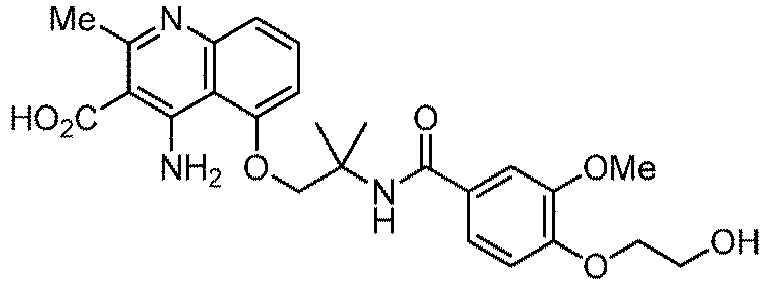
- Prepared as in Example 1 from ethyl 4-amino-5-(2-(4-(2-hydroxyethoxy)-3-methoxy-benzamido)-2-methylpropoxy)-2-methylquinoline-3-carboxylate (Example 76a) as an off-white solid. MS 484 (MH+).
- Prepared as in Example 24a from 4-amino-5-(2-amino-2-methylpropoxy)-2-methylquino-line-3-carboxylate (Example 24b) and 4-(2-hydroxyethoxy)-3-methoxybenzoic acid (Uto, Y. et al. Bioorg. Med. Chem. Lett. 2009, 19, 4151.) as a brown solid. MS 512 (MH+).
-

- Prepared as in Example 1 from ethyl 4-amino-5-(2-(3-(2-hydroxyethoxy)-4-methoxy-benzamido)-2-methylpropoxy)-2-methylquinoline-3-carboxylate (Example 77a) as an off-white solid. MS 484 (MH+).
- Prepared as in Example 24a from 4-amino-5-(2-amino-2-methylpropoxy)-2-methylquinoline-3-carboxylate (Example 24b) and 3-(2-hydroxyethoxy)-4-methoxybenzoic acid as a brown solid. MS 512 (MH+).
-

- Prepared as in Example 1 from ethyl 4-amino-5-(2-(3-(3-hydroxypropoxy)-4-methoxy-benzamido)-2-methylpropoxy)-2-methylquinoline-3-carboxylate (Example 78a) as an off-white solid. MS 498 (MH+).
- Prepared as in Example 24a from 4-amino-5-(2-amino-2-methylpropoxy)-2-methylquino-line-3-carboxylate (Example 24b) and 3-(3-hydroxypropoxy)-4-methoxybenzoic acid as a brown solid. MS 526 (MH+).
-

- Prepared as in Example 1 from ethyl 4-amino-5-(2-(4-(3-hydroxypropoxy)-3-methoxy-benzamido)-2-methylpropoxy)-2-methylquinoline-3-carboxylate (Example 79a) as an off-white solid. MS 498 (MH+).
- Prepared as in Example 24a from 4-amino-5-(2-amino-2-methylpropoxy)-2-methylquinoline-3-carboxylate (Example 24b) and 4-(3-hydroxypropoxy)-3-methoxybenzoic acid (Baraldi, P. G. et al. J. Med Chem. 1999, 42, 5131.) as a brown solid. MS 526 (MH+).
-

- Prepared as in Example 1 from (S)-ethyl 4-amino-5-(2-(2,3-dihydrobenzo[b][1,4]dioxine-6-carboxamido)propoxy)-2-methylquinoline-3-carboxylate (Example 80a) as an off-white solid. MS 438 (MH+).
- Prepared as in Example 24a from (S)-ethyl 4-amino-5-(2-aminopropoxy)-2-methylquinoline-3-carboxylate (Example 26b) and 2,3-dihydrobenzo[b][1,4]dioxine-6-carboxylic acid as brown solid. MS 466 (MH+).
-

- Prepared as in Example 1 from (S)-ethyl 4-amino-5-(2-(2,3-dihydrobenzo[b][1,4]dioxine-5-carboxamido)propoxy)-2-methylquinoline-3-carboxylate (Example 81a) as an off-white solid. MS 438 (MH+).
- Prepared as in Example 24a from (S)-ethyl 4-amino-5-(2-aminopropoxy)-2-methylquinoline-3-carboxylate (Example 26b) and 2,3-dihydrobenzo[b][1,4]dioxine-5-carboxylic acid as brown solid. MS 466 (MH+).
-

- Prepared as in Example 1 from (S)-ethyl 4-amino-5-(2-(4-(2-hydroxyethoxy)-3-methoxybenzamido)propoxy)-2-methylquinoline-3-carboxylate (Example 82a) as an off-white solid. MS 470 (MH+).
- Prepared as in Example 24a from (S)-ethyl 4-amino-5-(2-aminopropoxy)-2-methyl-quinoline-3-carboxylate (Example 26b) and 4-(2-hydroxyethoxy)-3-methoxybenzoic acid (Uto, Y. et al. Bioorg. Med. Chem. Lett. 2009, 19, 4151.) as a brown solid. MS 498 (MH+).
-

- Prepared as in Example 1 from (S)-ethyl 4-amino-5-(2-(3-(2-hydroxyethoxy)-4-methoxybenzamido)propoxy)-2-methylquinoline-3-carboxylate (Example 83a) as an off-white solid. MS 470 (MH+).
- Prepared as in Example 24a from (S)-ethyl 4-amino-5-(2-aminopropoxy)-2-methyl-quinoline-3-carboxylate (Example 26b) and 3-(2-hydroxyethoxy)-4-methoxybenzoic acid as a brown solid. MS 498 (MH+).
-

- Prepared as in Example 1 from (S)-ethyl 4-amino-5-(2-(3-(3-hydroxypropoxy)-4-methoxybenzamido)propoxy)-2-methylquinoline-3-carboxylate (Example 84a) as an off-white solid. MS 484 (MH+).
- Prepared as in Example 24a from (S)-ethyl 4-amino-5-(2-aminopropoxy)-2-methylquinoline-3-carboxylate (Example 26b) and 3-(3-hydroxypropoxy)-4-methoxybenzoic acid as a brown solid. MS 512 (MH+).
-

- Prepared as in Example 1 from (S)-ethyl 4-amino-5-(2-(4-(3-hydroxypropoxy)-3-methoxybenzamido)propoxy)-2-methylquinoline-3-carboxylate (Example 85a) as an off-white solid. MS 484 (MH+).
- Prepared as in Example 24a from (S)-ethyl 4-amino-5-(2-aminopropoxy)-2-methyl-quinoline-3-carboxylate (Example 26b) and 4-(3-hydroxypropoxy)-3-methoxybenzoic acid (Baraldi, P. G. et al. J. Med. Chem. 1999, 42, 5131.) as a brown solid. MS 512 (MH+).
-

- Prepared as in Example 1 from (R)-ethyl 4-amino-5-(2-(cyclohexanecarboxamido)-propoxy)-2-methylquinoline-3-carboxylate (Example 86a) as a white solid (43%). 1H NMR (400 MHz, DMSO-d6 ) δ 1.25-1.10 (m, 5H), 1.34-1.31 (m, 2H), 1.69-1.62 (m, 5H), 2.11-2.05 (m, 1H), 2.69 (s, 3H), 3.93 (t, J = 9.2 Hz, 1H), 4.13 (dd, J = 4, 9.6 Hz, 1H), 4.14-4.11 (m, 1H), 6.86 (d, J = 8.0 Hz, 1H), 7.28 (d, J = 8.4 Hz, 1H), 7.49 (t, J = 8.0 Hz, 1H), 7.95 (d, J = 8.4 Hz, 1H). MS 386 (MH+).
- Prepared as in Example 24a from (R)-ethyl 4-amino-5-(2-aminopropoxy)-2-methyl-quinoline-3-carboxylate (Example 86b) and cyclohexanecarboxylic acid as brown solid (31%). MS 414 (MH+).
- Prepared as in Example 2a from (R)-benzyl (1-(3-amino-2-cyanophenoxy)propan-2-yl)-carbamate (Example 86c) and ethyl 3-oxobutanoate as brown solid. MS 304 (MH+).
- Prepared as in Example 24c from (R)-2-amino-6-(2-aminopropoxy)benzonitrile (Example 86d) as brown solid (79%). 1H NMR (400 MHz, DMSO-d6 ) δ 1.12 (d, J = 6.4 Hz, 3H), 3.81 (d, J = 8.4 Hz, 1H), 3.95-3.92 (m, 1H), 4.99 (s, 2H), 5.36 (s, 2H), 5.96 (s, 2H), 6.20 (d, J = 8.0 Hz, 1H), 6.31 (d, J= 8.4 Hz, 1H), 7.13 (t, J = 8.4 Hz, 1H), 7.44-7.38 (m, 5H). MS 326 (MH+).
- Prepared as in Example 24d from (R)-2-aminopropan-1-ol and 2-amino-6-fluoro-benzonitrile as brown solid (81%). 1H NMR (400 MHz, DMSO-d6 ) δ 1.01 (d, J = 6.5 Hz, 3H), 3.08 (m, 1H), 3.71 (d, J = 6.1 Hz, 2H), 5.95 (s, 2H), 6.15 (d, J = 8.3 Hz, 1H), 6.2 (d, J = 8.3 Hz, 1H), 7.13 (t, J = 8.3 Hz, 1H). MS 192 (MH+).
-

- Prepared as in Example 1 from (R)-ethyl 4-amino-5-(2-(isonicotinamido)propoxy)-2-methylquinoline-3-carboxylate (Example 87a) as an off-white solid (32%). 1H NMR (400 MHz, DMSO-d6 ) δ 1.31 (d, J = 6.8 Hz, 3H), 2.66 (s, 3H), 4.14 (t, J = 9.2 Hz, 1H), 4.28 (dd, J = 3.6, 9.6 Hz, 1H), 4.70- 4.55 (m, 1H), 6.92 (d, J = 8.0 Hz, 1H), 7.26 (d, J = 8.4 Hz, 1H), 7.51 (t, J = 8.4 Hz, 1H), 7.75 (dd, J = 1.2, 6.0 Hz, 2H), 8.71 (dd, J = 1.2, 6.0 Hz, 2H), 8.95 (d, J = 8.0 Hz, 1H). MS 409 (MH+).
- Prepared as in Example 24a from (R)-ethyl 4-amino-5-(2-aminopropoxy)-2-methylquinoline-3-carboxylate (Example 86b) and isonicotinic acid as brown solid (41%). MS 409 (MH+).
-
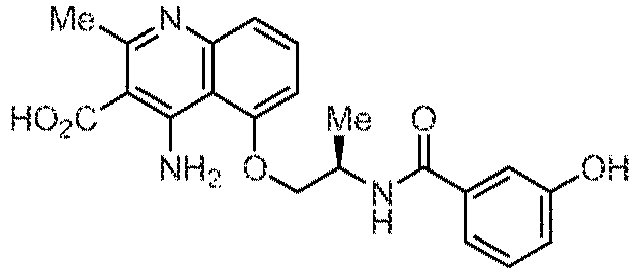
- Prepared as in Example 1 from (R)-ethyl 4-amino-5-(2-(3-hydroxybenzamido)propoxy)-2-methylquinoline-3-carboxylate (Example 88a) as a white solid (51%). 1H NMR (400 MHz, DMSO-d6 ) δ 1.28 (d, J = 7.2 Hz, 3H), 2.65 (s, 3H), 4.11 (t, J = 8.8 Hz, 1H), 4.22 (dd, J= 4.0, 10 Hz, 1H), 4.65-4.55 (m, 1H), 6.88 (d, J = 8.0, 2H), 7.25-7.13 (m, 4H), 7.48 (t, J = 8.0 Hz, 1H), 8.49 (d, J = 8.0, 1H), 9.93 (brs, 1H). MS 396 (MH+).
- Prepared as in Example 24a from (R)-ethyl 4-amino-5-(2-aminopropoxy)-2-methylquinoline-3-carboxylate (Example 86b) and 3-hydroxybenzoic acid as brown solid (36%). MS 424 (MH+).
-

- Prepared as in Example 1 from (S)-ethyl 4-amino-5-((1-(cyclohexanecarbonyl)pyrrolidin-2-yl)methoxy)-2-methylquinoline-3-carboxylate (Example 89a) as an off-white solid (31%). 1H NMR (400 MHz, DMSO-d6 ) δ 1.34-1.11 (m, 5H), 1.72-1.51 (m, 5H), 2.08-1.79 (m, 5H), 2.44-2.35 (m 1H), 2.52 (s, 3H), 3.55-3.45 (m, 2H), 4.02 (dd, J = 6.8, 9.2 Hz, 1H), 4.17 (dd, J = 4.8, 10.0 Hz, 1H), 4.45-4.38 (m, 1H), 6.75 (d, J = 7.2 Hz), 7.11 (d, J = 7.6 Hz, 1H), 7.27 (t, J = 8.0 Hz, 1H). MS 412 (MH+).
- Prepared as in Example 24a from (S)-ethyl 4-amino-2-methyl-5-(pyrrolidin-2-ylmethoxy) -quinoline-3-carboxylate (Example 89b) and cyclohexanecarboxylic acid as brown solid (46%). MS 440 (MH+).
- Prepared as in Example 2a from (S)-benzyl 2-((3-amino-2-cyanophenoxy)methyl)pyrrolidine-1-carboxylate (Example 89c) and ethyl 3-oxobutanoate as brown solid. MS 330 (MH+).
- Prepared as in Example 24c from (S)-2-amino-6-(pyrrolidin-2-ylmethoxy)benzonitrile (Example 89d) as brown solid (79%). MS 351 (MH+).
- Prepared as in Example 24d from (S)-pyrrolidin-2-ylmethanol and 2-amino-6-fluoro-benzonitrile as brown solid (51%). MS 218 (MH+).
-

- Prepared as in Example 1 from (S)-ethyl 4-amino-5-((1-isobutyrylpyrrolidin-2-yl)-methoxy)-2-methylquinoline-3-carboxylate (Example 90a) as an off-white solid (39%). 1H NMR (400 MHz, DMSO-d6 ) δ 0.99 (dd, J = 2.0, 6.8 Hz, 6H), 2.05-1.83 (m, 4H), 2.65 (s, 3H), 3.53 (t, J = 7.2 Hz, 2H), 4.08 (dd, J = 6.8, 10.0 Hz, 1H), 4.20 (dd, J = 6.0, 10.0 Hz, 1H), 4.54 (m, 1H), 6.99 (d, J = 8.0 Hz, 1H), 7.21 (d, J = 8.4 Hz, 1H), 7.50 (t, J = 8.0 Hz, 1H). MS 344 (MH+).
- Prepared as in Example 24a from (S)-ethyl 4-amino-2-methyl-5-(pyrrolidin-2-ylmethoxy) -quinoline-3-carboxylate (Example 89b) and isobutyric acid as brown solid (46%). MS 400 (MH+).
-

- Prepared as in Example 1 from (S)-ethyl 5-((1-acetylpyrrolidin-2-yl)methoxy)-4-amino-2-methylquinoline-3-carboxylate (Example 91a) as an off-white solid (23%). 1H NMR (400 MHz, DMSO-d6 ) δ 1.98 (s, 3H), 2.03-1.82 (m, 4H), 2.71 (s, 3H), 3.48 (t, J = 6.0 Hz, 2H), 4.05 (dd, J = 6.4, 10.0 Hz, 1H), 4.22 (dd, J = 6.8, 10.0 Hz, 1H), 4.54-4.46 (m, 1H), 6.99 (d, J = 8.0 Hz, 1H), 7.34 (d, J = 8.0 Hz, 1H), 7.54 (t, J = 10.0 Hz, 1H). MS 344 (MH+).
- Prepared as in Example 24a from (S)-ethyl 4-amino-2-methyl-5-(pyrrolidin-2-ylmethoxy) -quinoline-3-carboxylate (Example 89b) and acetic anhydride as brown solid (31%). MS 372 (MH+).
-
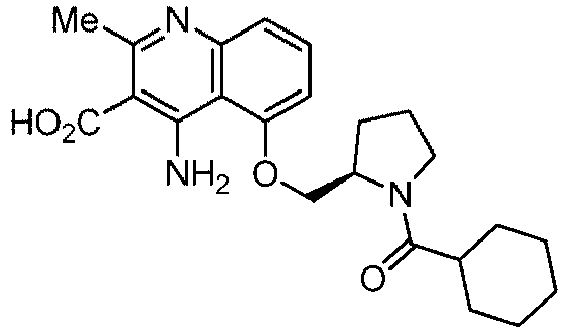
- Prepared as in Example 1 from (R)-ethyl 4-amino-5-((l-(cyclohexanecarbonyl)pyrrolidin -2-yl)methoxy)-2-methylquinoline-3-carboxylate (Example 92a) as an off-white solid (37%). 1H NMR (400 MHz, DMSO-d6 ) δ 1.34-1.11 (m, 5H), 1.72-1.51 (m, 5H), 2.08-1.79 (m, 5H), 2.44-2.35 (m 1H), 2.52 (s, 3H), 3.55-3.45 (m, 2H), 4.02 (dd, J = 6.8, 9.2 Hz, 1H), 4.17 (dd, J = 4.8, 10.0 Hz, 1H), 4.45-4.38 (m, 1H), 6.75 (d, J = 7.2 Hz), 7.11 (d, J = 7.6 Hz, 1H), 7.27 (t, J = 8.0 Hz, 1H). MS 412 (MH+).
- Prepared as in Example 24a from (R)-ethyl 4-amino-2-methyl-5-(pyrrolidin-2-ylmethoxy)-quinoline-3-carboxylate (Example 92b) and cyclohexanecarboxylic acid as brown solid (39%). MS 440 (MH+).
- Prepared as in Example 2a from (R)-benzyl 2-((3-amino-2-cyanophenoxy)methyl)pyrrolidine-1-carboxylate (Example 92c) and ethyl 3-oxobutanoate as brown solid. MS 330 (MH+).
- Prepared as in Example 24c from (R)-2-amino-6-(pyrrolidin-2-ylmethoxy)benzonitrile (Example 92d) as brown solid (71%). MS 351 (MH+).
- Prepared as in Example 24d from (R)-pyrrolidin-2-ylmethanol and 2-amino-6-fluoro-benzonitrile as brown solid (57%). MS 218 (MH+).
-

- Prepared as in Example 1 from (R)-ethyl 4-amino-5-((1-isobutyrylpyrrolidin-2-yl)-methoxy)-2-methylquinoline-3-carboxylate (Example 93a) as an off-white solid (44%). 1H NMR (400 MHz, DMSO-d6 ) δ 0.99 (dd, J = 2.0, 6.8 Hz, 6H), 2.05-1.83 (m, 4H), 2.65 (s, 3H), 3.53 (t, J = 7.2 Hz, 2H), 4.08 (dd, J = 6.8, 10.0 Hz, 1H), 4.20 (dd, J = 6.0, 10.0 Hz, 1H), 4.54 (m, 1H), 6.99 (d, J = 8.0 Hz, 1H), 7.21 (d, J = 8.4 Hz, 1H), 7.50 (t, J = 8.0 Hz, 1H). MS 344 (MH+).
- Prepared as in Example 24a from (R)-ethyl 4-amino-2-methyl-5-(pyrrolidin-2-ylmethoxy)quinoline-3-carboxylate (Example 92b) and isobutyric acid as brown solid (39%). MS 400 (MH+).
-

- Prepared as in Example 1 from (R)-ethyl 5-((1-acetylpyrrolidin-2-yl)methoxy)-4-amino-2-methylquinoline-3-carboxylate (Example 94a) as an off-white solid (19%). 1H NMR (400 MHz, DMSO-d6 ) δ 1.98 (s, 3H), 2.03-1.82 (m, 4H), 2.71 (s, 3H), 3.48 (t, J = 6.0 Hz, 2H), 4.05 (dd, J = 6.4, 10.0 Hz, 1H), 4.22 (dd, J = 6.8, 10.0 Hz, 1H), 4.54-4.46 (m, 1H), 6.99 (d, J = 8.0 Hz, 1H), 7.34 (d, J = 8.0 Hz, 1H), 7.54 (t, J = 10.0 Hz, 1H). MS 344 (MH+).
- Prepared as in Example 24a from (R)-ethyl 4-amino-2-methyl-5-(pyrrolidin-2-ylmethoxy)quinoline-3-carboxylate (Example 92b) and acetic anhydride as brown solid (28%). MS 372 (MH+).
-

- Prepared as in Example 1 from (S)-ethyl 4-amino-5-(2-(2-hydroxybenzamido)-3-methyl-butoxy)-2-methylquinoline-3-carboxylate (Example 95a) as a white solid (82%). MS 424 (MH+).
- Prepared as in Example 24a from (S)-ethyl 4-amino-5-(2-amino-3-methylbutoxy)-2-methylquinoline-3-carboxylate (Example 95b) and 2-hydroxybenzoic acid as brown solid (56%). MS 452 (MH+).
- Prepared as in Example 2a from (S)-benzyl 1-(3-amino-2-cyanophenoxy)-3-methylbutan-2-ylcarbamate (Example 95c) and ethyl 3-oxobutanoate as brown solid (79%). MS 332 (MH+).
- Prepared as in Example 24c from (S)-2-amino-6-(2-amino-3-methylbutoxy)benzonitrile (Example 95d) as brown solid (82%). MS 354 (MH+).
- Prepared as in Example 24d from (S)-2-amino-3-methylbutan-1-ol and 2-amino-6-fluoro-benzonitrile as brown solid (71%). MS 220 (MH+).
-

- Prepared as in Example 1 from (S)-ethyl 4-amino-5-(2-(3-hydroxybenzamido)-3-methyl-butoxy)-2-methylquinoline-3-carboxylate (Example 96a) as a white solid (83%). MS 424 (MH+).
- Prepared as in Example 24a from (S)-ethyl 4-amino-5-(2-amino-3-methylbutoxy)-2-methylquinoline-3-carboxylate (Example 95b) and 3-hydroxybenzoic acid as brown solid (35%). MS 452 (MH+).
-

- Prepared as in Example 1 from (S)-ethyl 4-amino-5-(2-(2-hydroxybenzamido)butoxy)-2-methylquinoline-3-carboxylate (Example 97a) as an off-white solid (78%). MS 410 (MH+).
- Prepared as in Example 24a from (S)-ethyl 4-amino-5-(2-aminobutoxy)-2-methylquino-line-3-carboxylate (Example 97b) and 2-hydroxybenzoic acid as brown solid (46%). MS 438 (MH+).
- Prepared as in Example 2a from (S)-benzyl 1-(3-amino-2-cyanophenoxy)butan-2-ylcarbamate (Example 97c) and ethyl 3-oxobutanoate as brown solid (75%). MS 318 (MH+).
- Prepared as in Example 24c from (S)-2-amino-6-(2-aminobutoxy)benzonitrile (Example 97d) as brown solid (87%). MS 340 (MH+).
- Prepared as in Example 24d from (S)-2-aminobutan-1-ol and 2-amino-6-fluoro-benzonitrile as brown solid (73%). MS 206 (MH+).
-

- Prepared as in Example 1 from (S)-ethyl 4-amino-5-(2-(4-(2-hydroxyethoxy)-3-methoxy-benzamido)butoxy)-2-methylquinoline-3-carboxylate (Example 98a) as an off-white solid (83%). MS 484 (MH+).
- Prepared as in Example 24a from (S)-ethyl 4-amino-5-(2-aminobutoxy)-2-methylquino-line-3-carboxylate (Example 97b) and 4-(2-hydroxyethoxy)-3-methoxybenzoic acid (Uto, Y. et al. Bioorg. Med. Chem. Lett. 2009, 19,4151.) as brown solid (38%). MS 512 (MH+).
-

- Prepared as in Example 1 from (S)-ethyl 4-amino-5-(2-(2,3-dihydrobenzo[b][1,4]dioxine-5-carboxamido)butoxy)-2-methylquinoline-3-carboxylate (Example 99a) as an off-white solid (78%). MS 452 (MH+).
- Prepared as in Example 24a from (S)-ethyl 4-amino-5-(2-aminobutoxy)-2-methylquinoline-3-carboxylate (Example 97b) and 2,3-dihydrobenzo[b][1,4]dioxine-5-carboxylic acid as brown solid (40%). MS 480 (MH+).
-

- Prepared as in Example 1 from (S)-ethyl 4-amino-5-(2-(4-(3-hydroxypropoxy)-3-methoxybenzamido)butoxy)-2-methylquinoline-3-carboxylate (Example 100a) as an off-white solid (79%). MS 498 (MH+).
- Prepared as in Example 24a from (S)-ethyl 4-amino-5-(2-aminobutoxy)-2-methylquino-line-3-carboxylate (Example 97b) and 4-(3-hydroxypropoxy)-3-methoxybenzoic acid (Baraldi, P. G. et al. J. Med. Chem. 1999, 42, 5131.) as brown solid (41%). MS 526 (MH+).
-
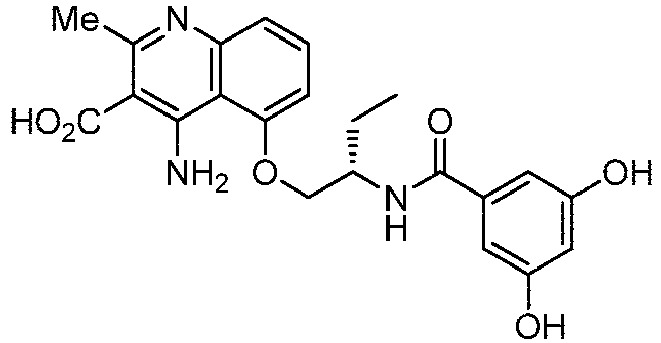
- Prepared as in Example 1 from (S)-ethyl 4-amino-5-(2-(3,5-dihydroxybenzamido)butoxy) -2-methylquinoline-3-carboxylate (Example 101a) as an off-white solid (69%). MS 426 (MH+).
- Prepared as in Example 24a from (S)-ethyl 4-amino-5-(2-aminobutoxy)-2-methylquino-line-3-carboxylate (Example 97b) and 3,5-dihydroxybenzoic acid as brown solid (37%). MS 454 (MH+).
-

- Prepared as in Example 1 from (S)-ethyl 4-amino-5-(2-(2,3-dihydrobenzo[b][1,4]dioxine-6-carboxamido)butoxy)-2-methylquinoline-3-carboxylate (Example 102a) as an off-white solid (71%). MS 452 (MH+).
- Prepared as in Example 24a from (S)-ethyl 4-amino-5-(2-aminobutoxy)-2-methylquinoline-3-carboxylate (Example 97b) and 2,3-dihydrobenzo[b][1,4]dioxine-6-carboxylic acid as brown solid (46%). MS 480 (MH+).
-

- Prepared as in Example 1 from (S)-ethyl 4-amino-5-(2-(3-hydroxybenzamido)butoxy)-2-methylquinoline-3-carboxylate (Example 103a) as an off-white solid (72%). MS 410 (MH+).
- Prepared as in Example 24a from (S)-ethyl 4-amino-5-(2-aminobutoxy)-2-methylquino-line-3-carboxylate (Example 97b) and 3-hydroxybenzoic acid as brown solid (49%). MS 438 (MH+).
-

- Prepared as in Example 1 from (S)-ethyl 4-amino-5-(2-(4-(3-hydroxypropoxy)-3-methoxybenzamido)-3-methylbutoxy)-2-methylquinoline-3-carboxylate (Example 104a) as an off-white solid (69%). MS 512 (MH+).
- Prepared as in Example 24a from (S)-ethyl 4-amino-5-(2-amino-3-methylbutoxy)-2-methylquinoline-3-carboxylate (Example 95b) and 4-(3-hydroxypropoxy)-3-methoxybenzoic acid (Baraldi, P. G. et al. J. Med. Chem. 1999, 42, 5131.) as brown solid (29%). MS 540 (MH+).
-

- Prepared as in Example 1 from (S)-ethyl 4-amino-5-(2-(3,5-dihydroxybenzamido)-3-methylbutoxy)-2-methylquinoline-3-carboxylate (Example 105a) as a white solid (72%). MS 440 (MH+).
- Prepared as in Example 24a from (S)-ethyl 4-amino-5-(2-amino-3-methylbutoxy)-2-methylquinoline-3-carboxylate (Example 95b) and 3,5-dhydroxybenzoic acid as brown solid (29%). MS 468 (MH+).
-

- Prepared as in Example 1 from (S)-ethyl 4-amino-5-(2-(2,3-dihydrobenzo[b][1,4]dioxine-5-carboxamido)-3-methylbutoxy)-2-methylquinoline-3-carboxylate (Example 106a) as a white solid (81%). MS 466 (MH+).
- Prepared as in Example 24a from (S)-ethyl 4-amino-5-(2-amino-3-methylbutoxy)-2-methylquinoline-3-carboxylate (Example 95b) and 2,3-dihydrobenzo[b][1,4]dioxine-5-carboxylic acid as brown solid (36%). MS 494 (MH+).
-

- Prepared as in Example 1 from (S)-ethyl 4-amino-5-(2-(2,3-dihydrobenzo[b][1,4]dioxine-6-carboxamido)-3-methylbutoxy)-2-methylquinoline-3-carboxylate (Example 107a) as an off-white solid (76%). MS 466 (MH+).
- Prepared as in Example 24a from (S)-ethyl 4-amino-5-(2-amino-3-methylbutoxy)-2-methylquinoline-3-carboxylate (Example 95b) and 2,3-dihydrobenzo[b][1,4]dioxine-6-carboxylic acid as brown solid (29%). MS 494 (MH+).
-

- Prepared as in Example 1 from ethyl 4-amino-5-((4-(isonicotinamido)cyclohexyl)-methoxy)-2-methylquinoline-3-carboxylate (Example 108a) as an off-white solid (43%). 1H NMR (400 MHz, DMSO-d6 ) δ 1.52 - 2.01 (m, 8H), 2.13 (m, 1H), 2.74 (s, 3H), 3.99 (m, 1H), 4.18 (d, J = 6.8 Hz, 2H), 7.05 (d, J = 8.0 Hz, 1H), 7.26 (d, J = 8.0 Hz, 1H), 7.66 (t, J = 8.4 Hz, 1H), 7.71 (d, J = 6.0 Hz, 2H), 8.40 (d, J = 6.8 Hz, 1H), 8.71 (d, J = 6.0 Hz, 2H), 12.70 (brs, 1H). MS 435 (MH+).
- Prepared as in Example 2a from N-(4-((3-Amino-2-cyanophenoxy)methyl)cyclohexyl)-isonicotinamide (Example 108b) and ethyl 3-oxobutanoate as a yellow solid (25%). MS 463 (MH+).
- Prepared as in Example 22b from N-(4-(Hydroxymethyl)cyclohexyl)isonicotinamide (Example 108c) and 2-amino-6-fluorobenzonitrile as a colorless oil (6%). MS 351 (MH+).
- Prepared as in Example 24a from (4-Aminocyclohexyl)methanol and isonicotinic acid as a yellow oil (100%). MS 235 (MH+).
-

- Prepared as in Example 1 from ethyl 4-amino-5-((2-methoxycyclohexyl)oxy)-2-methylquinoline-3-carboxylate (Example 109a) as a white solid (79%). 1H NMR (400 MHz, DMSO-d6 ) δ 1.20-1.68 (m, 6H), 2.16 (m, 2H), 2.78 (s, 3H), 3.34 (s, 3H), 3.58 (m, 1H), 4.50 (m, 1H), 7.17 (d, J = 8.4 Hz, 1H), 7.29 (d, J = 8.4 Hz, 1H), 7.67 (t, J = 8.8 Hz, 1H), 8.92 (brs, 1H), 12.14 (brs, 1H), 12.86 (brs, 1H). MS 331 (MH+).
- Prepared as in Example 2a from 2-Amino-6-(2-methoxycyclohexyloxy)benzonitrile (Example 109b) and ethyl 3-oxobutanoate as a pale yellow oil (16%). MS 359 (MH+).
- Prepared as in Example 22b from 2-methoxycyclohexanol and 2-amino-6-fluoro-benzonitrile as a yellow oil (34%). MS 247 (MH+).
-

- Prepared as in Example 1 from ethyl 4-amino-5-((1-(3-hydroxybenzoyl)piperidin-3-yl)methoxy)-2-methylquinoline-3-carboxylate (Example 110a) as a white solid (35%). MS 436 (MH+).
- Prepared as in Example 24a from ethyl 4-amino-2-methyl-5-(piperidin-3-ylmethoxy)-quinoline-3-carboxylate (Example 110b) and 3-hydroxybenzoic acid as a white solid (34%). MS 464 (MH+).
- Prepared as in Example 2a from benzyl 3-((3-amino-2-cyanophenoxy)methyl)piperidine-1-carboxylate (Example 110c) and ethyl 3-oxobutanoate as a yellow oil (21%). MS 344 (MH+).
- Prepared as in Example 24c from 2-amino-6-(piperidin-3-ylmethoxy)benzonitrile (Example 110d) as a yellow solid (70%).
- Prepared as in Example 24d from 3-piperidinemethanol and 2-amino-6-fluoro-benzo-nitrile as a light yellow solid (27%). MS 232 (MH+).
-

- Prepared as in Example 1 from ethyl 4-amino-5-((1-(3-hydroxybenzoyl)piperidin-2-yl)methoxy)-2-methylquinoline-3-carboxylate (Example 111a) as an off-white solid (35%). 1H NMR (400 MHz, DMSO-d6 ) δ 1.25-1.89 (m, 6H), 2.74 (s, 3H), 3.44 (m, 2H), 4.27 (m, 1H), 4.75 (m, 2H), 5.29 (m, 1H), 6.64 - 6.73 (m, 2H), 6.78 (d, J = 7.2 Hz, 1H), 7.18 (m, 2H), 7.26 (d, J = 8.4 Hz, 1H), 7.68 (m, 1H), 8.87 (brs, 1H), 9.73 (brs, 1H), 11.96 (brs, 1H), 12.70 (brs, 1H). MS 436 (MH+).
- Prepared as in Example 24a from ethyl 4-amino-2-methyl-5-(piperidin-2-ylmethoxy)-quinoline-3-carboxylate (Example 111b) and 3-hydroxybenzoic acid as a white solid (28%). MS 464 (MH+).
- Prepared as in Example 2a from benzyl 2-((3-amino-2-cyanophenoxy)methyl)piperidine-1-carboxylate (Example 111c) and ethyl 3-oxobutanoate as a colorless oil (13%). MS 344 (MH+).
- Prepared as in Example 24c from 2-amino-6-(piperidin-2-ylmethoxy)benzonitrile (Example 111d) as a yellow solid (100%). MS 366 (MH+).
- Prepared as in Example 24d from 2-piperidinemethanol and 2-amino-6-fluoro-benzonitrile as a light yellow solid (64%). MS 232 (MH+).
-

- Prepared as in Example 1 from ethyl 4-amino-5-cyclopropyl-2-methylquinoline-3-carboxylate (Example 112a) as a white solid (85%). 1H NMR (400 MHz, MeOH-d4 ) δ 1.03 (m, 2H), 1.31 (m, 2H), 2.53 (m, 1H), 2.81 (s, 3H), 7.50 (m, 1H), 7.58 (m, 1H), 7.73 (m, 1H). MS 243 (MH+).
- Prepared as in Example 2a from 2-amino-6-cyclopropylbenzonitrile (
Tachdjian, C. et al. PCT Int. Appl. 2008, WO 2008154221 -

- Prepared as in Example 1 from ethyl 4-amino-5-(2-cyclohexylethyl)-2-(2-ethoxy-2-oxoethyl)quinoline-3-carboxylate (Example 113a) as an orange solid (69%). 1H NMR (400 MHz, DMSO-d6 ) δ 0.89-0.92 (m, 2H), 1.14-1.29 (m, 4H), 1.44-1.49 (m, 2H), 1.56-1.66 (m, 4H), 1.73-1.76 (m, 1H), 3.15 (t, J = 8.0 Hz, 2H), 3.70 (s, 2H), 7.09-7.11 (m, 1H), 7.38-7.42 (m, 1H), 7.46-7.51 (m, 2H). MS 338 (MH+-H2O).
- Prepared as in Example 2a from 2-amino-6-(2-cyclohexylethyl)benzonitrile (Example 113b) and diethyl 3-oxopentanedioate as an orange solid (33%). 1H NMR (400 MHz, DMSO-d6 ) δ 0.87-0.96 (m, 2H), 1.14-1.22 (m, 7H), 1.27-1.32 (m, 4H), 1.47-1.52 (m, 2H), 1.61-1.68 (m, 4H), 1.74-1.77 (m, 2H), 3.21-3.25 (m, 2H), 4.03 (s, 2H), 4.09 (q, J = 8.0 Hz, 2H), 4.27 (q, J = 8.0 Hz, 2H), 7.27 (t, J = 4.0 Hz, 1H), 7.57 (d, J = 8.0 Hz, 2H), 7.63 (brs, 2H). MS 413 (MH+).
- Prepared as in Example 21b from 2-amino-6-(cyclohexylethynyl)benzonitrile (Example 113c) as an orange solid (36%). 1H NMR (400 MHz, DMSO-d6 ) δ 0.90-0.95 (m, 2H), 1.16-1.24 (m, 4H), 1.41-1.46 (m, 2H), 1.60-1.75 (m, 5H), 2.58-2.62 (m, 2H), 5.90 (s, 2H), 6.48 (d, J = 8.0 Hz, 1H), 6.61 (d, J = 8.0 Hz, 1H), 7.18 (t, J = 4.0 Hz, 1H). MS 229 (MH+).
- Prepared as in Example 21c from ethynylcyclohexane and 2-amino-6-bromobenzonitrile as a brown oil (100%). 1H NMR (400 MHz, DMSO-d6 ) δ 1.24-1.77 (m, 10H), 2.70 (m, 1H), 6.13 (s, 2H), 6.64 (d, J = 8.0 Hz, 1H), 6.74 (d, J = 8.0 Hz, 1H), 7.22 (t, J = 8.0 Hz, 1H). MS 225 MH+).
-
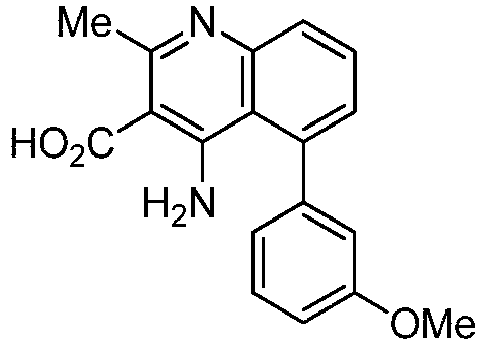
- Prepared as in Example 1 from ethyl 4-amino-5-(3-methoxyphenyl)-2-methylquinoline-3-carboxylate (Example 114a) as an off-white solid (38%). MS 309 (MH+).
- Prepared as in Example 2a from 3-amino-3'-methoxy-[1,1'-biphenyl]-2-carbonitrile (Example 114b) and ethyl 3-oxobutanoate as a pale yellow solid (55%). MS 337 (MH+).
- To a stirred solution of 2-amino-6-bromobenzonitrile (195 mg, 1.0 mmol) and (3-methoxyphenyl)boronic acid (300 mg, 2 mmol) in dioxane (2 mL) was added aqueous potassium carbonate (2.0 mmol, 0.7 mL). The reaction solution was degassed by bubbling N2 for 2 minutes. Palladium tetrakistriphenylphosphine (5% mol) was added to the reaction mixture and the reaction vessel was placed in a microwave reactor and irradiated at 165 °C for 20 minutes. The precipitate was removed by filtration and the filtrate concentrated. The residue was purified by HPLC (acetonitrile/water; 10-90% gradient, 25 minutes) to give the title compound as an off-white solid (180 mg, 80%). MS 225 (MH+).
-

- Prepared as in Example 1 from ethyl 4-amino-5-(cyclohexylmethoxy)-2-methylquino-line-3-carboxylate (Example 115a) as a white solid (84%). 1H NMR (400 MHz, DMSO-d6 ) δ 1.03-1.29 (m, 5H), 1.63-1.82(m, 5H), 1.94 (m, 1H), 2.75 (s, 3H), 4.06 (d, J = 6.4 Hz, 2H), 7.03 (d, J = 8.0 Hz, 1H), 7.26 (d, J = 8.4Hz, 1H), 7.66 (t, J = 8.4 Hz, 1H). MS 315 (MH+).
- Prepared as in Example 2a from 2-amino-6-(cyclohexylmethoxy)benzonitrile (Example 115b) and ethyl 3-oxobutanoate as a pale yellow solid (47%). 1H NMR (400 MHz, MeOD) δ 1.12-1.37 (m, 6H), 1.42 (t, J = 4.0 Hz, 3H), 1.73-2.01 (m, 5H), 2.68 (s, 3H), 4.06 (d, J = 4.0 Hz, 2H), 4.42 (q, J = 8.0 Hz, 2H), 6.96 (d, J = 8.0 Hz, 1H), 7.32 (d, J = 8.0 Hz, 1H), 7.58 (t, J = 8.0 Hz, 1H). MS 343 (MH+).
- Prepared as in Example 22b from cyclohexylmethanol and 2-amino-6-fluorobenzonitrile as a colorless oil (50%). 1H NMR (400 MHz, CDCl3) δ 1.07-1.09 (m, 2H), 1.28-1.32(m, 3H), 1.75-1.90 (m, 6H), 3.79 (d, J= 6.4 Hz, 2H), 4.37 (s, 2H), 6.20 (d, J = 8.4 Hz, 1H), 6.28 (d, J = 8.4Hz, 1H), 7.19 (t, J = 8.4 Hz, 1H). MS 231 (MH+).
-

- Prepared as in Example 1 from ethyl 4-amino-2-methyl-5-phenoxyquinoline-3-carboxylate (Example 116a) as an off-white solid (47%). 1H NMR (400 MHz, DMSO-d6 ) δ 2.77 (s, 3H), 6.60 (d, J = 4.0 Hz, 1H), 7.23 (d, J = 8.0 Hz, 2H), 7.30 (t, J = 8.0 Hz, 1H), 7.40 (dd, J = 8.0 Hz, 1H), 7.49 (t, J = 8.0 Hz, 2H), 7.60 (t, J = 8.0 Hz, 1H), 8.81 (brs, 1H), 12.20 (brs, 1H), 12.81 (brs, 1H). MS 295 (MH+).
- Prepared as in Example 2a from 2-amino-6-phenoxybenzonitrile and ethyl 3-oxobutanoate as a yellow oil (72%). 1H NMR (400 MHz, DMSO-d6 ) δ 1.32 (t, J = 8.0 Hz, 3H), 2.59 (s, 3H), 4.33 (q, J = 8.0 Hz, 2H), 6.61 (dd, J = 8.0 Hz, 1H), 7.16 (d, J = 4.0 Hz, 2H), 7.25 (t, J = 8.0 Hz, 1H), 7.39-7.52 (m, 4H), 7.93 (brs, 2H). MS 323 (MH+).
-

- Prepared as in Example 1 from ethyl 4-amino-5-(3-((4-methoxybenzyl)amino)-2,2-dimethyl-3-oxopropoxy)-2-methylquinoline-3-carboxylate (Example 117a) as an off-white solid (38%). MS 438 (MH+).
- Prepared as in Example 24a from 3-((4-amino-3-(ethoxycarbonyl)-2-methylquinolin-5-yl)oxy)-2,2-dimethylpropanoic acid (Example 47b) and (4-methoxyphenyl)methanamine as a yellow solid (100%). MS 466 (MH+).
-

- Prepared as in Example 1 from ethyl 4-amino-2-methyl-5-((tetrahydro-2H-pyran-4-yl)oxy)quinoline-3-carboxylate (Example 118a) as an off-white solid (80%). 1H NMR (400 MHz, DMSO-d6 ) δ 1.81 (m, 2H), 2.06 (m, 2H), 2.75 (s, 3H), 3.87 (m, 2H), 4.91 (m, 1H), 7.15 (d, J = 8.0 Hz, 1H), 7.26 (d, J = 8.0Hz, 1H), 7.65 (t, J = 8.0 Hz, 1H). MS 303 (MH+).
- Prepared as in Example 2a from 2-amino-6-((tetrahydro-2H-pyran-4-yl)oxy)benzonitrile (Example 118b) and ethyl 3-oxobutanoate as a pale yellow solid (51%). MS 331 (MH+).
- Prepared as in Example 22b from tetrahydro-2H-pyran-4-ol and 2-amino-6-fluorobenzonitrile as a colorless oil (48%). 1H NMR (400 MHz, CDCl3) δ 1.87 (m, 2H), 2.00(m, 2H), 3.63 (m, 2H), 4.00 (m, 2H), 4.42 (s, 2H), 4.58 (m, 1H), 6.23 (d, J = 8.4Hz, 1H), 6.30 (d, J=8.4 Hz, 1H), 7.20 (t, J = 8.4 Hz, 1H). MS 219 (MH+).
-

- Prepared as in Example 1 from ethyl 4-amino-5-(2,2-dimethyl-3-oxo-3-((pyridin-4-ylmethyl)amino)propoxy)-2-methylquinoline-3-carboxylate (Example 119a) as an off-white solid (44%). MS 409 (MH+).
- Prepared as in Example 24a from 3-((4-amino-3-(ethoxycarbonyl)-2-methylquinolin-5-yl)oxy)-2,2-dimethylpropanoic acid (Example 47b) and pyridin-4-ylmethanamine as a brown solid (43%). MS 437 (MH+).
-

- Prepared as in Example 1 from ethyl 4-amino-5-(3-hydroxy-2,2-dimethylpropoxy)-2-methylquinoline-3-carboxylate (Example 120a) as an off-white solid (33%). 1H NMR (400 MHz, DMSO-d6 ) δ 0.98 (s, 6H), 2.75 (s, 3H), 3.37 (s, 2H), 3.97 (s, 2H), 5.12 (brs, 1H), 7.01 (d, J = 8.4 Hz, 1H), 7.25 (d, J = 7.6 Hz, 1H), 7.66 (t, J = 8.0 Hz, 1H), 9.27 (brs, 1H), 12.23 (brs, 1H), 12.73 (brs, 1H). MS 305 (MH+).
- Prepared as in Example 2a from 3-(3-amino-2-cyanophenoxy)-2,2-dimethylpropyl acetate (
Tachdjian, C. et al. PCT Int. Appl. 2008, WO 2008154221 ) and ethyl 3-oxobutanoate as a pale yellow solid (26%). MS 333 (MH+). -

- Prepared as in Example 1 from ethyl 4-amino-5-((1-isobutyrylpiperidin-4-yl)methoxy)-2-methylquinoline-3-carboxylate (Example 121a) as a white solid (38%). 1H NMR (400 MHz, DMSO-d6 ) δ 0.99 (m, 6H), 1.13-1.23 (m, 2H), 1.78-1.89 (m, 2H), 2.26 (brs, 1H), 2.51 (m, 1H), 2.78 (brs, 3H), 2.88 (m, 1H), 3.06 (t, J = 12.0 Hz, 1H), 4.02 (d, J = 12.0 Hz, 1H), 4.41 (m, 2H), 4.44 (d, J = 12.0 Hz, 1H), 7.07 (brs, 1H), 7.28 (d, J = 8.0 Hz, 1H), 7.70 (brs, 1H), 8.76 (brs, 1H), 12.37 (brs, 1H), 12.67 (brs, 1H). MS 386 (MH+).
- Prepared as in Example 2a from 2-amino-6-((1-(4-methoxybenzyl)piperidin-4-yl)methoxy)benzonitrile (Example 121b) and ethyl 3-oxobutanoate as a yellow oil (36%). 1H NMR (400 MHz, DMSO-d6 ) δ 0.97 (m, 6H), 1.32 (t, J = 8.0 Hz, 3H), 1.79-1.88 (m, 3H), 2.15-2.18 (m, 2H), 2.55 (s, 3H), 2.86 (m, 1H), 3.04 (m, 1H), 4.00 (m, 2H), 4.07 (d, J = 4.0 Hz, 2H), 4.32 (q, J = 8.0 Hz, 2H), 4.46 (m, 1H), 6.91 (d, J = 8.0 Hz, 1H), 7.24 (d, J = 8.0 Hz, 1H), 7.51 (t, J = 8.0 Hz, 1H), 8.07 (brs, 2H). MS 414 (MH+).
- Prepared as in Example 22b from 1-(4-(hydroxymethyl)piperidin-1-yl)-2-methylpropan-1-one (Example 121c) and 2-amino-6-fluorobenzonitrile as a pale yellow solid (21%). 1H NMR (400 MHz, DMSO-d6 ) δ 0.99 (m, 6H), 1.13-1.24 (m, 2H), 1.74-1.81 (m, 2H), 1.99 (m, 1H), 2.55 (m, 1H), 2.84 (m, 1H), 3.01 (m, 1H), 3.88 (m, 2H), 4.02 (m, 1H), 4.46 (m, 1H), 5.99 (s, 2H), 6.22 (d, J = 8.0 Hz, 1H), 6.34 (d, J = 8.0 Hz, 1H), 7.17 (t, J = 8.0 Hz, 1H). MS 302 (MH+).
- Prepared as in Example 24a from isobutyric acid and piperidin-4-ylmethanol as a colorless oil (36%). MS 186 (MH+).
-

- Prepared as in Example 1 from ethyl 4-amino-5-(((1R,2S,5R)-2-isopropyl-5-methylcyclohexyl)oxy)-2-methylquinoline-3-carboxylate (Example 122a) as a white solid (64%). 1H NMR (400 MHz, DMSO-d6 ) δ 0.70 (d, J = 6.8 Hz, 3H), 0.89 (t, J = 7.6 Hz, 6H), 0.9-1.0 (m, 2H), 1.04 (m, 2H), 1.50-1.82 (m, 5H), 1.95-2.05 (m, 1H), 2.05-2.20 (m, 1H), 2.72 (s, 3H), 4.52 (t-d, J = 10.4,4.4 Hz, 1H), 7.13 (d, J = 8.0 Hz, 1H), 7.21 (d, J = 8.0 Hz, 1H), 7.61 (t, J = 8.0 Hz, 1H), 8.68 (brs, 1H), 11.72 (brs, 1H), 12.73 (brs, 1H). MS 357(MH+).
- Prepared as in Example 2a from 2-amino-6-(((1R,2S,5R)-2-isopropyl-5-methylcyclohexyl)oxy)benzonitrile (Example 122b) and ethyl 3-oxobutanoate as a pale yellow solid (43%). MS 385 (MH+).
- Prepared as in Example 22b from (1R,2S,5R)-2-isopropyl-5-methylcyclohexanol and 2-amino-6-fluorobenzonitrile as a white solid (51%). MS 273 (MH+).
-

- To a stirred suspension of 4-amino-5-(2-(3-(2-hydroxyethoxy)-5-methoxybenzamido)-2-methylpropoxy)-2-methylquinoline-3-carboxylic acid (Example 38, 263 mg, 0.544 mmol) in EtOH (2 mL) was added HCl in EtOH (1.25 N, 479 uL, 1.1 equiv.). The mixture was stirred at room temperature until it became a clear solution (0.5 h). The solution was concentrated under reduced pressure to give the title compound as a white solid, which was further purified by recrystallization from EtOH/H2O and dried under vacuum overnight (248 mg, 87%). 1H NMR (400 MHz, DMSO-d6 ) δ 1.51 (s, 6H), 2.80 (s, 3H), 3.68 (t, J = 5.2 Hz, 2H), 3.74 (s, 3H), 3.97 (t, J = 5.2 Hz, 1H), 4.53 (s, 2H), 6.59 (s, 1H), 6.92 (s, 1H), 6.94 (s, 1H), 7.27 (d, J = 8.0 Hz, 1H), 7.57 (d, J = 8.4 Hz, 1H), 7.86 (t, J = 8.4 Hz, 1H), 8.03 (s, 1H), 9.40 (s, 1H), 9.98 (s, 1H). 484 (MH+-HCl).
-

- Prepared as in Example 123 from 4-amino-5-(cyclopentylmethoxy)-2-methylquinoline-3-carboxylic acid (Example 18) as a white solid (100%). 1H NMR (400 MHz, DMSO-d6 ) δ 1.29-1.37 (m, 2H), 1.51-1.66 (m, 4H), 1.82-1.90 (m, 2H), 2.43-2.51 (m, 1H), 2.81 (s, 3H), 4.18 (d, J = 7.2 Hz, 2H), 7.24 (d, J = 8.4 Hz, 1H), 7.60 (d, J = 8.4 Hz, 1H), 7.84 (t, J = 8.4 Hz, 1H), 9.25 (brs, 1H), 9.86 (brs, 1H). MS 301 (MH+-HCl).
-

- Prepared as in Example 1 from ethyl 4-amino-5-((1-(4-methoxybenzyl)piperidin-4-yl)methoxy)-2-methylquinoline-3-carboxylate (Example 125a) as a white solid (23%). 1H NMR (400 MHz, DMSO-d6 ) δ 1.67 (brs, 2H), 2.09 (m, 2H), 2.31 (brs, 1H), 2.92 (brs, 2H), 3.48 (brs, 2H), 3.82 (s, 3H), 4.15 (brs, 2H), 4.25 (d, J = 8.0 Hz, 2H), 7.02 (d, J = 8.0 Hz, 2H), 7.14 (d, J = 8.0 Hz, 1H), 7.30 (d, J = 8.0 Hz, 1H), 7.42 (d, J = 8.0 Hz, 2H), 7.76 (t, J = 8.0 Hz, 1H). MS 436 (MH+).
- Prepared as in Example 2a from 2-amino-6-((1-(4-methoxybenzyl)piperidin-4-yl)methoxy)benzonitrile (Example 125b) and ethyl 3-oxobutanoate as an off-white solid (30%). 1H NMR (400 MHz, DMSO-d6 ) δ 1.29-1.33 (m, 5H), 1.74 (m, 2H), 1.92 (m, 3H), 2.54 (s, 3H), 2.83 (m, 2H), 3.38 (s, 2H), 3.71 (s, 3H), 4.04 (d, J = 8.0 Hz, 2H), 4.31 (q, J = 8.0 Hz, 2H), 6.86 (d, J = 8.0 Hz, 2H), 6.90 (d, J = 8.0 Hz, 1H), 7.19 (d, J = 8.0 Hz, 2H), 7.23 (d, J = 8.0 Hz, 1H), 7.50 (t, J = 8.0 Hz, 1H), 8.04 (brs, 2H). MS 464 (MH+).
- Prepared as in Example 22b from (1-(4-methoxybenzyl)piperidin-4-yl)methanol (Example 125c) and 2-amino-6-fluorobenzonitrile as an orange solid (19%). MS 352 (MH+).
- To a solution of 4-piperidinemethanol (2.28 g, 19.78 mmol) and 4-methoxybenzaldehyde (2.30 mL, 19.77 mmol) in THF/DCE (1:1 by volume, 100 mL) was added acetic acid (1 mL), followed by NaBH(OAc)3 (16.76 g, 79.08 mmol) in small portions. The reaction mixture was stirred at room temperature overnight under N2. The reaction was diluted with DCM and basified to pH = 10 with 2 N NaOH solution. The organic layer was separated, dried over Na2SO4, filtered and evaporated under reduced pressure. The residue was purified by chromatography on silica gel (Eluent: 60% EtOAc in hexanes) to give the title compound as a pale yellow oil (2.13 g, 46%). 1H NMR (400 MHz, DMSO-d6 ) δ 1.04-1.13 (m, 2H), 1.28-1.32 (m, 1H), 1.58-1.61 (m, 2H), 1.79-1.86 (m, 2H), 2.75-2.77 (m, 2H), 3.22 (t, J = 8.0 Hz, 2H), 3.34 (s, 2H), 3.72 (s, 3H), 4.38 (t, J = 4.0 Hz, 1H), 6.85 (d, J = 8.0 Hz, 2H), 7.16 (d, J = 8.0 Hz, 2H). MS 236 (MH+).
-

- Prepared as in Example 1 from ethyl 4-amino-5-((4-(isopropylcarbamoyl)cyclohexyl)-methoxy)-2-methylquinoline-3-carboxylate (Example 126a) as a yellow solid (76%). 1H NMR (400 MHz, DMSO-d6 ) δ 1.00 (d, J = 6.8 Hz, 6H), 1.15 - 2.32 (m, 10H), 2.75 (s, 3H), 3.82 (ο, J = 7.6 Hz, 1H), 4.16 (d, J = 6.8 Hz, 2H), 7.07 (br d, J = 7.2 Hz, 1H), 7.25 (d, J = 8.0 Hz, 1H), 7.49 (d, J = 7.6 Hz, 1H), 7.67 (br t, 1H), 8.77 (s, 1H), 12.23 (s, 1H), 12.66 (s, 1H). MS 400 (MH+).
- Prepared as in Example 2a from 4-((3-amino-2-cyanophenoxy)methyl)-N-isopropyl-cyclohexanecarboxamide (Example 126b) and ethyl 3-oxobutanoate as a pale yellow solid (37%). 1H NMR (400 MHz, DMSO-d6 ) δ 1.01 (d, J = 6.4 Hz, 6H), 1.32 (t, J = 7.2 Hz, 3H), 1.38-1.81 (m, 8H), 1.88 (m, 1H), 2.25 (m, 1H), 2.55 (s, 3H), 3.82 (bro, J = 7.6 Hz, 1H), 4.10 (d, J = 6.4 Hz, 2H), 4.31 (q, J = 7.6 Hz, 2H), 6.93 (d, J = 7.6 Hz, 1H), 7.22 (d, J = 8.8 Hz, 1H), 7.50 (m, 2H), 8.09 (s, 2H). MS 428 (MH+).
- Prepared as in Example 21b from 4-((2-cyano-3-nitrophenoxy)methyl)-N-isoproplycyclo-hexanecarboxamide (Example 126c) as a yellow solid (81%). 1H NMR (400 MHz, DMSO-d6 ) δ 0.99 (d, J = 5.6 Hz, 6H), 1.22 - 1.99 (m, 9H), 2.17 (m, 1H), 3.80 (m, 1H), 3.88 (d, J = 7.2 Hz, 2H), 5.94 (brs, 2H), 6.18 (t, J = 8.0 Hz, 1H), 6.23 (d, J = 8.0 Hz, 1H), 6.31 (d, J = 8.8 Hz, 1H), 7.44 (s, 1H). MS 316 (H+).
- To a solution of 4-(hydroxymethyl)-N-isopropylcyclohexanecarboxamide (Example 126d, 480 mg, 2.41 mmol) in dry THF (10 mL) was added NaH (60% in mineral oil, 116 mg, 4.82 mmol) in small portions at 0 °C under N2. The reaction mixture was stirred at 0 °C under N2 for 2 h. To this solution was added 2,6-dinitrobenzonitrile (465 mg, 2.41 mmol), and the reaction mixture was stirred at 0 °C - RT for another 2 h, and then at 60 °C overnight under N2 and cooled down to room temperature. The reaction was quenched with brine, and extracted with EtOAc (3X). The combined organic layers were washed with brine, dried over Na2SO4, filtered, and evaporated under reduced pressure. The residue was purified by chromatography on silica gel (eluent: 50% EtOAc in hexanes) to give the title compound as yellow solid (594 mg, 71%). 1H NMR (400 MHz, DMSO-d6 ) δ 1.00 (d, J = 7.6 Hz, 6H), 1.22-2.08 (m, 9H), 2.19 (m, 1H), 3.79 (m, 1H), 4.15 (d, J = 7.6 Hz, 2H), 7.45 (brs, 1H), 7.78 (d, J = 7.2 Hz, 1H), 7.88 (m, 2H). MS 346 (H+).
- Prepared as in Example 24a from 4-(hydroxymethyl)cyclohexanecarboxylic acid and propan-2-amine as a colorless oil (57%). 1H NMR (400 MHz, DMSO-d6 ) δ 1.00 (d, J = 7.6 Hz, 6H), 1.22-2.08 (m, 9H), 2.12 (m, 1H), 3.28 (t, J = 7.6 Hz, 2H), 3.79 (m,1H), 4.34 (s, 1H), 7.43 (s, 1H). MS 200 (MH+).
-

- To a suspension of 4-amino-5-(cyclohexyloxy)-2-methylquinoline-3-carboxylic acid (Example 36, 1.0 g, 3.33 mmol) in ethanol (10 mL) was added 1.25 M solution of HCl in ethanol (2.93 mL, 3.66 mmol). The clear solution was stirred for 30 minutes and evaporated to dryness to provide 4-amino-5-(cyclohexyloxy)-2-methylquinoline-3-carboxylic acid hydrochloride (1.12 g, 100%) as a white solid. 1H NMR (400 MHz, DMSO-d6 ) δ 1.30 (m, 1H), 1.39-1.47 (m, 2H), 1.53-1.72 (m, 5H), 2.01-2.05 (m, 2H), 2.82 (s, 3H), 4.78-4.82 (m, 1H), 7.29-7.31 (d, J = 8.0 Hz, 1H), 7.61-7.63 (d, J = 8.0 Hz, 1H), 7.82 (t, J = 8.4 Hz, 1H), 9.30 (bs, 1H), 9.93 (bs, 1H). MS 301 (MH+-HCl).
-

- To a solution of 4-amino-5-(cyclohexyloxy)-2-methylquinoline-3-carboxylic acid (Example 36, 1.0 g, 3.33 mmol) in ethanol (20 mL) was added a solution of NaHCO3 (294 mg, 3.50 mmol) in water (15 mL). The mixture was stirred and warmed up to 60 °C until the solution become clear then evaporated to dryness to provide sodium 4-amino-5-(cyclohexyloxy)-2-methylquinoline-3-carboxylate (1.07 g, 100%) as a white solid. 1H NMR (400 MHz, DMSO-d6 ) δ 1.25-1.45 (m, 3H), 1.50-1.70 (m, 5H), 1.53-1.72 (m, 5H), 1.98-2.00 (m, 2H), 2.64 (s, 3H), 4.59-4.63 (m, 1H), 6.87-6.89 (d, J = 7.6 Hz, 1H), 7.20-7.22 (d, J = 8.0 Hz, 1H), 7.42 (t, J = 8.0 Hz, 1H). MS 301 (MH++H-Na).
-

- Prepared as in Example 1 from (±)-ethyl 4-amino-5-((2-(5-(isopropylcarbamoyl)-2-methoxyphenoxy)cyclohexyl)oxy)-2-methylquinoline-3-carboxylate (Example 129a) as a white solid (34%). 1H NMR (400 MHz, DMSO-d6 ) δ 1.15 (d, J = 8.0 Hz, 6H), 1.35-1.51 (m, 3H), 1.63-1.73 (m, 3H), 2.09 (d, J = 12.0 Hz, 1H), 2.24 (d, J = 12.0 Hz, 1H), 2.72 (s, 3H), 3.56 (s, 3H), 3.99-4.07 (m, 1H), 4.71-4.78 (m, 2H), 6.85 (d, J = 8.0 Hz, 1H), 7.24 (d, J = 12.0 Hz, 2H), 7.42 (dd, J = 8.0 Hz, 1H), 7.46 (d, J = 8.0 Hz, 1H), 7.66 (t, J = 8.0 Hz, 1H), 8.03 (d, J = 8.0 Hz, 1H), 8.64 (brs, 1H), 12.00 (brs, 1H), 12.61 (brs, 1H). MS 508 (MH+).
- Prepared as in Example 2a from (±)-3-((2-(3-amino-2-cyanophenoxy)cyclohexyl)oxy)-N-isopropyl-4-methoxybenzamide (Example 129b) and ethyl 3-oxobutanoate as a yellow solid (78%). MS 536 (MH+).
- Prepared as in Example 21b from (±)-3-((2-(2-cyano-3-nitrophenoxy)cyclohexyl)oxy)-N-isopropyl-4-methoxybenzamide (Example 129c) as a brown oil (29%). 1H NMR (400 MHz, DMSO-d6 ) δ 1.13-1.19 (m, 6H), 1.42-1.66 (m, 6H), 2.02-2.07 (m, 2H), 3.74 (s, 3H), 4.08 (m, 1H), 4.47 (m, 1H), 4.57 (m, 1H), 5.93 (brs, 2H), 6.32 (d, J = 8.0 Hz, 1H), 6.38 (d, J = 8.0 Hz, 1H), 7.00 (d, J = 8.0 Hz, 1H), 7.17 (t, J = 8.0 Hz, 1H), 7.48-7.50 (m, 2H), 7.98 (d, J = 8.0 Hz, 1H). MS 424 (MH+).
- Prepared as in Example 126c from (±)-3-((2-hydroxycyclohexyl)oxy)-N-isopropyl-4-methoxybenzamide (Example 129d) and 2,6-dinitrobenzonitrile as a brown solid (100%). MS 454 (MH+).
- Prepared as in Example 24a from (±)-3-((2-hydroxycyclohexyl)oxy)-4-methoxybenzoic acid (Example 129e) and propan-2-amine as a white solid (80%). 1H NMR (400 MHz, DMSO-d6 ) δ 1.14 (d, J = 8.0 Hz, 6H), 1.25-1.30 (m, 4H), 1.61 (m, 2H), 1.85 (m, 2H), 3.56 (m, 1H), 3.79 (s, 3H), 4.03-4.12 (m, 2H), 4.81 (d, J = 4.0 Hz, 1H), 6.98 (d, J = 8.0 Hz, 1H), 7.45-7.49 (m, 2H), 8.01 (d, J = 8.0 Hz, 1H). MS 308 (MH+).
- Prepared as in Example 1 from (±)-ethyl 3-((2-hydroxycyclohexyl)oxy)-4-methoxybenzoate (Example 129f) as a white solid (100%). 1H NMR (400 MHz, DMSO-d6 ) δ 1.23-1.25 (m, 4H), 1.59 (brs, 2H), 1.88 (m, 2H), 3.53 (m, 1H), 3.72 (s, 3H), 3.92 (m, 1H), 4.73 (d, J = 4.0 Hz, 1H), 6.82 (d, J = 8.0 Hz, 1H), 7.39 (dd, J = 4.0 Hz, 1H), 7.48 (d, J = 4.0 Hz, 1H).
- To a solution of methyl 3-hydroxy-4-methoxybenzoate (210 mg, 1.15 mmol) and cyclohexane oxide (466 uL, 4.61 mmol) in ethanol (11 mL) was added K2CO3 (637 mg, 4.61 mmol) at room temperature. The reaction mixture was then refluxed overnight then cooled down to room temperature, and evapotreted under reduced pressure until a small amount of ethanol remained. The solution was diluted with DCM and successively washed with IN HCl and brine, dried over Na2SO4 filtered and evaporated under reduced pressure. The residue was purified by chromatography on silica gel (Eluent: 0-20% EtOAc/Hexanes) to afford (±)-ethyl 3-((2-hydroxycyclohexyl)oxy)-4-methoxy-benzoate as a colorless oil (307 mg, 91%). 1H NMR (400 MHz, DMSO-d6 ) δ 1.16-1.34 (m, 7H), 1.61 (m, 2H), 1.84-1.94 (m, 2H), 3.55 (m, 1H), 3.83 (s, 3H), 4.03 (m, 1H), 4.28 (q, J = 8.0 Hz, 2H), 4.85 (d, J = 4.0 Hz, 1H), 7.05 (d, J = 12.0 Hz, 1H), 7.55-7.58 (m, 2H).
-

- Prepared as in Example 1 from 9-amino-8-(cyclohexyloxy)furo[3,4-b]quinolin-1(3H)-one (Example 130a) as a tan powder (44%). 1H NMR (400 MHz, DMSO-d6 ) δ 1.27-1.46 (m, 2H), 1.53-1.71 (m, 6H), 2.00-2.04 (m, 2H), 4.70 (m, 1H), 4.87 (s, 2H), 7.10 (d, J = 8.0 Hz, 1H), 7.58 (d, J = 8.0 Hz, 1H), 7.64 (t, J = 8.0 Hz, 1H), 8.74 (brs, 1H), 11.90 (brs, 1H). MS 317 (MH+).
- Prepared as in Example 2a from 2-amino-6-(cyclohexyloxy)benzonitrile (Example 36b) and ethyl 4-chloro-3-oxobutanoate as an orange solid (29%). 1H NMR (400 MHz, DMSO-d6 ) δ 1.30-1.72 (m, 8H), 2.04-2.08 (m, 2H), 4.70 (m, 1H), 5.26 (s, 2H), 7.09 (d, J = 8.0 Hz, 1H), 7.36 (d, J = 8.0 Hz, 1H), 7.64 (m, 2H), 8.14 (brs, 1H). MS 299 (MH+).
-

- Prepared as in Example 1 from ethyl 1-amino-3-methyl-6b,7,8,9,10,10a-hexahydrobenzofuro[2,3-f]quinoline-2-carboxylate (Example 131a) as an off-white solid (28%). 1H NMR (400 MHz, DMSO-d6 ) δ 1.35-1.48 (m, 4H), 1.87-1.97 (m, 4H), 2.76 (s, 3H), 3.38 (m 1H), 5.03 (m 1H), 7.20 (d, J = 8 Hz, 1H), 7.61 (d, J = 8 Hz, 1H). MS 299 (MH+).
- Prepared as in Example 2a from 2-amino-6-(cyclohex-2-en-1-yloxy)benzonitrile (Example 131b) and ethyl 3-oxobutanoate as a pale yellow solid (11%). MS 327 (MH+).
- Prepared as in Example 22b from cyclohex-2-enol and 2-amino-6-fluorobenzonitrile as a colorless oil (78%). 1H NMR (400 MHz, CDCl3) δ 1.64 (m, 1H), 1.96 (m, 4H), 2.15 (m, 1H), 4.39 (s, 2H), 4.82 (m, 1H), 5.87 (m, 1H), 5.98 (m, 1H), 6.30 (d, 2H), 7.20 (t, 1H). MS 215 (MH+).
-

- Prepared as in Example 1 from 4-(N-acetylacetamido)-5-(cyclohexyloxy)-3-(ethoxycarbonyl)-2-methylquinoline 1-oxide (Example 132a) as a white solid (38%). 1H NMR (400 MHz, DMSO-d6 ) δ 1.31-1.68 (m, 8H), 1.98-2.04 (m, 2H), 2.69 (s, 3H), 4.71 (m, 1H), 7.20 (d, J = 8.0 Hz, 1H), 7.67 (t, J = 8.0 Hz, 1H), 7.87 (d, J = 8.0 Hz, 1H), 8.75 (brs, 2H). MS 317 (MH+).
- To a solution of ethyl 4-(N-acetylacetamido)-5-(cyclohexyloxy)-2-methylquinoline-3-carboxylate (Example 132b, 100 mg, 0.24 mmol) in DCE (5 mL) was added mCPBA (163 mg, 0.73 mmol). The reaction mixture was stirred at room temperature overnight under N2. The solvent was removed under reduce pressure, and the residue was purified by chromatography on silica gel eluting with 0-100% EtOAc/Hexanes gradient to give the title compound as an orange oil (100 mg, 97%). MS 429 (MH+).
- To a solution of ethyl 4-amino-5-(cyclohexyloxy)-2-methylquinoline-3-carboxylate (Example 36a, 700 mg, 2.13 mmol) and Et3N (891 uL, 6.39 mmol) in DCM (20 mL) was added acetyl chloride (455 uL, 6.39 mmol) at 0 °C, and the reaction mixture was stirred at 0 °C - RT overnight. The reaction was diluted with DCM and washed successively with 10% citric acid, saturated NaHCO3, H2O, and brine, dried over Na2SO4, filtered and evaporated under reduced pressure. The residue was purified by chromatography on silica gel eluting with 0-40% EtOAc/Hexanes gradient to afford the title compound as a yellow oil (100 mg, 11%). MS 413 (MH+).
-

- Prepared as in Example 1 from 3-((4-amino-3-(ethoxycarbonyl)-2-methylquinolin-5-yl)oxy)cyclohexane-1,2-diyl diacetate (Example 133a) as a white solid (74%). 1H NMR (400 MHz, DMSO-d6 ) δ 1.42-1.50 (m, 3H), 1.66-1.70 (m, 2H), 2.12-2.15 (m, 1H), 2.74 (s, 3H), 3.71-3.73 (m, 1H), 3.90 (s, 1H), 4.60-4.62 (m, 1H), 4.71 (brs, 1H), 5.18 (brs, 1H), 7.06 (d, J = 8 Hz, 1H), 7.24 (d, J = 8 Hz, 1H), 7.60 (t, J = 8.4 Hz, 1H). MS 333 (MH+).
- Prepared as in Example 2a from 3-(3-amino-2-cyanophenoxy)cyclohexane-1,2-diyl diacetate (Example 133b) and ethyl 3-oxobutanoate as a pale yellow solid (32%). MS 445 (MH+).
- Prepared as in Example 21b from 3-(2-cyano-3-nitrophenoxy)cyclohexane-1,2-diyl diacetate (Example 133c) as a white solid (84%). MS 333 (MH+).
- Prepared as in Example 132b from 2-((2,3-dihydroxycyclohexyl)oxy)-6-nitrobenzonitrile (Example 133d) and acetyl chloride as a white solid (19%). MS 363 (MH+).
- To a solution of 2-(cyclohex-2-en-1-yloxy)-6-nitrobenzonitrile (Example 133e, 5.3 g, 21.7 mmol) in THF/H2O (1:1 by volume, 110 mL) was added OsO4 (110.3 mg, 0.434 mmol) at room temperature. After it was stirred for 30 minutes, NaClO3 (2.71 g, 26.04 mmol) was added in small portions over a period of 1 h, and the reaction mixture was stirred at room temperature for 48 h. The reaction was carefully quenched with aqueous sodium bisulfite solution, and extracted with EtOAc (3X). The combined organic layers were washed with brine, dried over MgSO4, filtered, and evaporated. The residue was purified by chromatography on silica gel eluting with 80-100% EtOAc in hexanes to give the title compound as a brown solid (3.88 g, 64%). MS 279 (MH+).
- Prepared as in Example 126c from cyclohex-2-enol and 2,6-dinitrobenzonitrile as a brown solid (90%). MS 245 (MH+).
- hT1R2/R3-HEK293 Ga15 cells were seeded in 384-well-clear bottom plates (Fisher) at a density of ∼32,000 cells/well and grown overnight. On the day of the experiment, hT1R2/R3-HEK293 Ga15 were loaded with the calcium indicator Fluo3AM (4 mM) (Invitrogen, Carlsbad, CA) in D-PBS (Invitrogen, Carlsbad, CA) using a Multidrop. Cells were incubated for 1 hour at room temperature and excess dye was washed out with D-PBS using an EMBLA cell washer (Molecular Devices, Sunnyvale, CA), leaving a residual volume of 25 ml/well. Sweeteners and test compounds were prepared at 4X final concentration and mixed 1:1 in a 384-well Greiner plate (bringing the sweeteners and test compounds concentrations down to 2X final concentration). After 30 minutes of rest time at room temperature, Fluo3AM-loaded cell plates, and the sweetener/compound plate mixture were loaded into a Fluorometric Imaging Plate Reader (FLIPR) (Molecular Devices, Sunnyvale, CA). Imaging was performed using a 480 nm excitation and a 535 emission and was initiated with the acquisition of the baseline fluorescence for a period of 7 seconds. Then, the cells were stimulated on line with addition of 25 ml stimuli/well. Subsequent images were acquired every other second for a period of 2 minutes. Raw fluorescence counts were then normalized in each well (using custom made data import software) by calculating delta F/f values (maximum fluorescent count obtained after stimulation - minimal fluorescent count obtained before stimulation/minimal fluorescent count obtained before stimulation). EC50s were determined using a non-linear regression algorithm (GraphPad PRISM, San Diego, CA), where the Hill slope, bottom asymptotes and top asymptotes were allow to vary. Enhancement properties of test compounds were quantified by determining the magnitude of the leftward shift in the sweeteners EC50 values (or an EC50 ratio): the value of the EC50 measured in the absence of the enhancer divided by the value of the EC50 measured in the presence of the enhancer). The present compounds have been tested and shown sweet taste enhancing activities for sucrose as shown in Table A, Table B and C below. Specifically, the EC50 ratio of the test compounds for sucrose enhancement are all greater than about 2 at about 50 µM. The compounds listed in Table A, Table B and C below are Examples described above. For example, Compound Q in Table A is Example 7.
Table A. Compound EC50Ratio (50 µM) J 7.5 C 37.5 E 15.5 S 1.8 U 1.6 K 6.9 Q 3.4 I 9.7 N 5.1 O 5 T 1.7 L 6.7 F 13.6 M 5.7 H 9.9 D 21.5 P 4.2 A 43.6 (3 µM) B 37.9 R 2.5 G 10.7 Table B. Compound EC50Ratio (50 µM) Compound EC50Ratio (50 µM) V 21.5 E2 9.7 A1 10.2 E3 15.8 O1 25.2 H1 3.7 H3 60.4 W2 21.1 P1 45.9 U3 15.9 B1 22.8 L3 17.3 W 73.8 B3 9.9 I3 317.1 V1 21.6 K3 29.8 I1 4.7 C4 14.6 J1 13.7 R1 55.8 B2 7.7 D4 23.5 P2 24.7 Q1 45.2 C3 17.6 X 32.5 F4 23.7 C1 48.4 D3 173.0 E4 176.7 G4 49.2 R3 16.7 M3 13.1 J3 28.6 V2 20.4 G3 40.8 V3 51.0 B4 111.7 G2 6.7 Y2 23.3 W1 4.5 M2 13.4 K1 6.7 D1 19.7 F2 3.8 Y 21.7 X3 3.6 Z 6.4 N3 3.4 N2 25.7 W3 5.7 Q2 4.4 Q3 17.1 L1 6.4 T1 12.9 H2 3.2 E1 21.1 U2 93.8 S1 49.0 I2 6.0 L2 31.7 Z3 33.6 F3 5.2 X1 83.1 A3 88.3 M1 37.0 Z2 34.6 N1 56.7 F1 27.0 Y3 24.5 K2 63.1 A4 86.6 D2 21.2 P3 9.9 T3 23.9 R2 22.0 X2 55.5 Z1 50.9 J2 13.7 A2 21.9 G1 3.9 Y1 108.9 U1 8.1 T2 6.2 C2 19.1 O3 5.9 O2 11.3 S2 3.8 Table C. Compound Sucrose EC50Ratio (50 µM) L4 27.8 C5 23.8 M4 2.9 I4 0.9 B5 72.7 W4 6.0 K4 13.7 N4 3.4 X4 4.9 O4 23.0 J4 9.2 V4 27.9 Y4 103.2 P4 37.5 R4 9.3 H4 3.1 S4 5.6 Q4 17.4 T4 23.7 - The present compounds have been tested and shown sweet taste enhancing activities for sucralose as shown in Table D below. Specifically, the EC50 ratio of the test compounds for sucralose enhancement are all greater than about 2 at about 10 µM.
Table D. Compound Sucralose EC50 Ratio (10µm) Compound Sucralose EC50Ratio (10 µM) Compound Sucralose EC50 Ratio (10µm) C 2.0 T1 3.6 M3 4.3 D 4.0 E1 4.2 V2 3.1 A 17.0 S1 5.2 V3 5.9 B 2.5 L2 4.1 K1 2.0 G 2.2 F3 1.4 F2 2.2 V 6.7 A3 10.9 W3 2.1 A1 3.4 Z2 10.8 U2 5.0 O1 2.6 F1 4.3 Z3 3.1 H3 12.5 K2 7.6 X1 7.7 Compound Sucralose EC50Ratio (10 µM) Compound Sucralose EC50Ratio (10 µM) Compound Sucralose EC50Ratio (10 µM) P1 12.9 D2 2.9 M1 3.1 B1 4.2 T3 3.4 N1 4.4 W 9.9 X2 9.3 Y3 2.9 I3 12.9 J2 3.6 A4 6.0 K3 8.4 U1 2.0 P3 2.2 C4 6.0 C2 3.7 R2 3.4 R1 16.5 O2 2.8 Z1 3.6 D4 1.4 E2 4.0 A2 2.2 Q1 13.4 E3 3.4 Y1 19.1 X 5.9 H1 1.6 T2 2.4 C1 18.1 W2 5.7 L4 3.4 E4 10.7 U3 4.5 I4 6.8 R3 5.1 L3 7.2 B5 6.8 J3 5.9 B3 2.9 K4 3.4 G3 23.8 V1 6.1 O4 7.6 B4 8.0 I1 6.1 J4 2.2 Y2 2.6 J1 4.3 V4 6.0 M2 5.4 B2 3.6 Y4 10.3 D1 8.3 P2 3.4 U4 8.3 Y 4.6 C3 3.2 P4 11.4 N2 7.2 F4 4.1 S4 1.9 S3 6.8 D3 11.0 Q4 2.5 Q3 4.0 G4 7.5 T4 3.2 - Test samples containing experimental compounds were compared to a dose-response curve for perceived sweetness intensity of sweeteners (sucralose, sucrose, fructose and other sweeteners) concentrations to determine equivalent sweetness intensity.
- A group of eight or more panelists tasted solutions including sweeteners at various concentrations, as well as the experimental compound both with and without added sweetener. Panelists then rated sweetness intensity of all samples on a structured horizontal line scale, anchored from 0 to 15, where 0 equals no sweetness and 15 equals equivalent sweetness to a 15% sucrose sample. Scores for sweetness intensity were averaged across panelists. Then using the average scores and/or equation of the line for the sweetener dose-response curve, equivalent sweetness concentrations were determined for the samples containing experimental compounds.
- Subjects had been previously familiarized with the key attribute taste and were trained to use the 0 to 15 point line scale. Subjects refrained from eating or drinking (except water) for at least 1 hour prior to the test. Subjects ate a cracker and rinsed with water several times to clean the mouth.
- Sweetener solutions are provided at a wide range of concentrations such as 100 ppm, 200 ppm, 300 ppm, 400 ppm, and 500 ppm for sucralose, or between 0% and 12% for sucrose or fructose, in order to create a dose-response curve. Samples containing experimental compound were prepared both alone and in a 100 ppm sucralose solution or a 6% sucrose or fructose solution. All samples were made up in low sodium buffer pH 7.1. In order to aid dispersion, solutions can be made up in 0.1% ethanol.
- The solutions were dispensed in 20 ml volumes into 1 oz. sample cups and served to the subjects at room temperature. All samples were presented in randomized counterbalanced order to reduce response bias. Further, two sessions of testing may be used to check panel precision.
- Subjects tasted each sample individually and rate sweetness intensity on the line scale prior to tasting the next sample. All samples were expectorated. Subjects may retaste the samples but can only use the volume of sample given. Subjects must rinse with water between samples. Eating an unsalted cracker between samples may be required depending on the samples tasted.
- The scores for each sample were averaged across subjects and standard error was calculated. The dose-response curve was plotted graphically, and this may be used to ensure the panel is rating accurately; i.e., increasing the concentration of sucralose should correspond to increased average scores for sweetness. A 2-way ANOVA (factors being samples and panelists) and multiple comparison tests (such as Tukey's Honestly Significant Difference test) can be used to determine differences among samples and/or panelists. A 3-way ANOVA, with sessions as the third factor, can be used to determine if there is any difference in the ratings between sessions.
- The results of human taste tests with Compound J are found below. Compound J is one of the examples described above. Table 1 indicates that 45 µM Compound J in 6% sucrose has sweetness equivalent to about 9-10% sucrose.

- The results of human taste tests with Compound C are found below. Compound C is one of the examples described above. Table 1_1 indicates that 25 µM Compound C in 6% sucrose has sweetness equivalent to about 9-10% sucrose.

- The results of human taste tests with Compound O1 are found below. Compound O1 is one of the examples described above. Table 1_2 indicates that 25 µM Compound O1 in 6% sucrose has sweetness equivalent to about 10% sucrose.


- The results of human taste tests with Compound W are found below. Compound W is one of the examples described above. Table 1_3 indicates that 25 µM Compound W in 6% sucrose has sweetness equivalent to about 10% sucrose.

- The results of human taste tests with Compound I3 are found below. Compound I3 is one of the examples described above. Table 1_4 indicates that 21 µM Compound I3 in 6% sucrose has sweetness equivalent to about 10% sucrose.
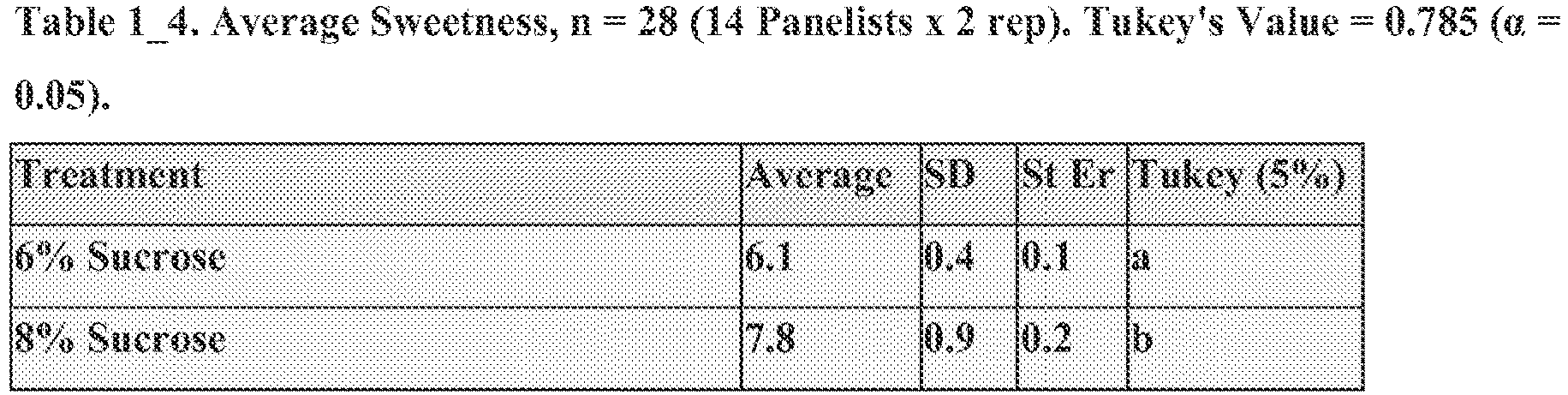

- The results of human taste tests with Compound C1 are found below. Compound C1 is one of the examples described above. Table 1_5 indicates that 13 µM Compound C1 in 6% sucrose has sweetness equivalent to about 10% sucrose and that 33 µM Compound C1 in 6% sucrose has sweetness equivalent to about 12% sucrose. Table 1_6 indicates that 33 µM Compound C1 in 50 ppm sucralose has sweetness equivalent to about between 100 ppm sucralose and 200ppm sucralose.


- The results of human taste tests with Compound B4 are found below. Compound B4 is one of the examples described above. Table 1_7 indicates that 36.5 µM Compound B4 in 6% sucrose has sweetness equivalent to about 10-12% sucrose. Table 1_8 indicates that 36.5 µM Compound B4 in 50 ppm sucralose has sweetness equivalent to about 100 ppm.


- Test samples containing experimental compounds are presented in pairs to the panelist and they are asked to determine which of the sample is sweeter. A group of 10-16 or more panelists participated in each test. Subjects refrained from eating or drinking (except water) for at least 1 hour prior to the test. Subjects rinsed with water several times to clean the mouth.
- All samples are prepared with ethanol to ensure dispersion of the compound in solution. This includes samples without compound; all solutions are balanced for 0.1% ethanol.
- Samples are also prepared with low sodium buffer (pH 7.1) in place of water. Buffer contains 0.952 g of KCl, 5.444 g of Na2HPO4, and 0.952 g of KH2PO4 in 40 L of DIUF water. Sample volumes are usually 20 ml.
- In one paired comparison test, the panelist is presented with two different samples and asked to identify the sample which is sweeter. The samples within a paired comparison test are presented in a randomized, counterbalanced order. Panelists have up to a 1 minute delay between taste tests to clear the mouth of any tastes.
- Binomial probability tables are used to determine the probability of the correct number of responses occurring for each test at alpha=0.05
The results of human taste tests with Compound J are found below. Table 2 indicates that panelists perceived 6% sucrose + 45 uM Compound J as being not significantly different in sweetness than a solution of 10% sucrose (p>0.05). Table 3 indicates that 45 µM Compound J alone has little or no sweetness on its own.


- The results of human taste tests with Compound A are found below. Table 2_1 indicates that panelists perceived 6% sucrose + 25 uM Compound A as being not significantly different in sweetness than a solution of 10% sucrose (p>0.05). Table 3_1 indicates that 25 µM Compound A alone has little or no sweetness on its own.


- The results of human taste tests with Compound C1 are found below. Table 2_2 indicates that panelists perceived 6% sucrose + 33 uM Compound C1 as being not significantly different in sweetness than a solution of 12% sucrose (p>0.05). Table 3_2 indicates that 33 µM Compound C1 alone has little or no sweetness on its own.


- The results of human taste tests with Compound I3 are found below. Table 2_3 indicates that panelists perceived 6% sucrose + 25 uM Compound I3 as being not significantly different in sweetness than a solution of 12% sucrose (p>0.05). Table 3_3 indicates that 25 µM Compound I3 alone has little or no sweetness on its own.


- The results of human taste tests with Compound B4 are found below. Table 2_4 indicates that panelists perceived 6% sucrose + 36.5 uM Compound B4 as being not significantly different in sweetness than a solution of 10% sucrose (p>0.05). Table 3_4 indicates that 36.5 µM Compound B4 alone has little or no sweetness on its own.


- The foregoing detailed description has been given for clearness of understanding only and no unnecessary limitations should be understood therefrom as modifications will be obvious to those skilled in the art. It is not an admission that any of the information provided herein is prior art or relevant to the presently claimed inventions, or that any publication specifically or implicitly referenced is prior art.
- Embodiments of this invention are described herein, including the best mode known to the inventors for carrying out the invention. Variations of those preferred embodiments may become apparent to those of ordinary skill in the art upon reading the foregoing description. The inventors expect skilled artisans to employ such variations as appropriate. Moreover, any combination of the above-described elements in all possible variations thereof is encompassed by the invention unless otherwise indicated herein or otherwise clearly contradicted by context.
Claims (12)
- A compound having a structural Formula (IIIb) or (IIIb'),
 A is -NR1R2;B is hydrogen, C1-C6 alkyl, or phenyl;C is -CO2R7;R1, R2, and R7 are independently hydrogen, alkyl, substituted alkyl, aryl, substituted aryl, arylalkyl, substituted arylalkyl, acyl, substituted acyl, heteroalkyl, substituted heteroalkyl, heteroaryl, substituted heteroaryl, heteroarylalkyl or substituted heteroarylalkyl;L1 is alkylene or substituted alkylene;L2 is -NR34-, -O-, -NR34-C(O)-, -C(O)-NR34-, -O-C(O)-, -C(O)-O-, -NR34-C(O)-O-, -O-C(O)-NR34-,-NR34-C(O)-NR35-, -O-C(O)-O-,-heterocyclylene-C(O)-, or -(substituted heterocyclylene)-C(O)-;R33 is alkyl, substituted alkyl, carbocyclyl, substituted carbocyclyl; aryl, substituted aryl, arylalkyl, substituted arylalkyl, heterocyclyl, substituted heterocyclyl, heteroalkyl, substituted heteroalkyl, heteroaryl, substituted heteroaryl, heteroarylalkyl, or substituted heteroarylalkyl; andR34 and R35 are independently hydrogen, alkyl, substituted alkyl, carbocyclyl, substituted carbocyclyl; aryl, substituted aryl, arylalkyl, substituted arylalkyl, heterocyclyl, substituted heterocyclyl, heteroalkyl, substituted heteroalkyl, heteroaryl, substituted heteroaryl, heteroarylalkyl, or substituted heteroarylalkyl.
 - The compound of claim 1, which is selected from the group consisting of


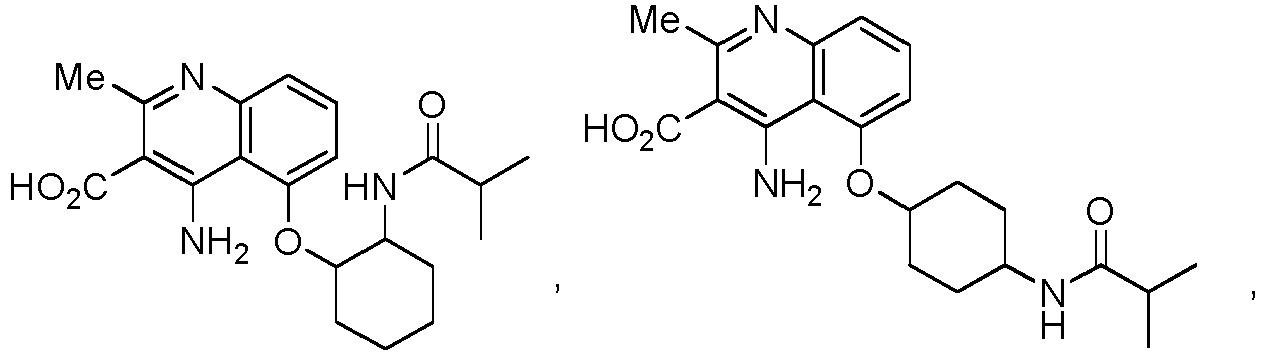





or a tautomer or salt thereof. - A compound having a structural Formula (IIIc) or (IIIc'),
 A is -NR1R2;B is hydrogen, C1-C6 alkyl, or phenyl;C is -CO2R7;
R1, R2, and R7 are independently hydrogen, alkyl, substituted alkyl, aryl, substituted aryl, arylalkyl, substituted arylalkyl, acyl, substituted acyl, heteroalkyl, substituted heteroalkyl, heteroaryl, substituted heteroaryl, heteroarylalkyl or substituted heteroarylalkyl;R33 is alkyl, substituted alkyl, carbocyclyl, substituted carbocyclyl; aryl, substituted aryl, arylalkyl, substituted arylalkyl, heterocyclyl, substituted heterocyclyl, heteroalkyl, substituted heteroalkyl, heteroaryl, substituted heteroaryl, heteroarylalkyl, or substituted heteroarylalkyl. - The compound of claim 3, wherein
R33 is alkyl, substituted alkyl, carbocyclyl, substituted carbocyclyl; heterocyclyl, substituted heterocyclyl, heteroalkyl, or substituted heteroalkyl. - The compound of claim 3, whereinB is hydrogen or C1-C6 alkyl; andR33 is alkyl, substituted alkyl, carbocyclyl, substituted carbocyclyl; heterocyclyl, substituted heterocyclyl, heteroalkyl, or substituted heteroalkyl.
- The compound of claim 3 selected from the group consisting of


- A compound selected from the group consisting of


- The compound of claim 1, selected from the group consisting of


- An ingestible composition comprising
a compound of any of claims 1 to 8; and
an ingestibly acceptable excipient. - A method of enhancing the sweet taste of an ingestible composition comprising contacting the ingestible composition thereof with a compound of any one of claims 1 to 8 to form a modified ingestible composition.
- A sweet enhancing composition, comprising a compound of any one of claims 1 to 8 in an amount effective to provide sweetening in combination with a first amount of sweetener, wherein the sweetening is more than the sweetening provided by the first amount of sweetener without the compound.
- A flavoring concentrate formulation comprisingi) as flavor modifying ingredient, a compound of any one of claims 1 to 8;ii) a carrier; andiii) optionally at least one adjuvant.
Applications Claiming Priority (3)
| Application Number | Priority Date | Filing Date | Title |
|---|---|---|---|
| US32052810P | 2010-04-02 | 2010-04-02 | |
| US42234110P | 2010-12-13 | 2010-12-13 | |
| PCT/US2011/030802 WO2011123693A1 (en) | 2010-04-02 | 2011-03-31 | Sweet flavor modifier |
Publications (3)
| Publication Number | Publication Date |
|---|---|
| EP2552207A1 EP2552207A1 (en) | 2013-02-06 |
| EP2552207A4 EP2552207A4 (en) | 2016-04-06 |
| EP2552207B1 true EP2552207B1 (en) | 2019-08-21 |
Family
ID=44710373
Family Applications (1)
| Application Number | Title | Priority Date | Filing Date |
|---|---|---|---|
| EP11763466.7A Active EP2552207B1 (en) | 2010-04-02 | 2011-03-31 | Sweet flavor modifier |
Country Status (22)
| Country | Link |
|---|---|
| US (4) | US8592592B2 (en) |
| EP (1) | EP2552207B1 (en) |
| JP (1) | JP5988506B2 (en) |
| KR (1) | KR101810265B1 (en) |
| CN (1) | CN102933081B (en) |
| AR (1) | AR081814A1 (en) |
| AU (1) | AU2011235069B2 (en) |
| BR (1) | BR112012025167B1 (en) |
| CA (1) | CA2792068A1 (en) |
| CL (1) | CL2012002477A1 (en) |
| CO (1) | CO6630147A2 (en) |
| ES (1) | ES2753523T3 (en) |
| IL (1) | IL222219A0 (en) |
| MX (1) | MX2012011386A (en) |
| MY (1) | MY175079A (en) |
| NZ (1) | NZ603332A (en) |
| PE (2) | PE20130211A1 (en) |
| PH (1) | PH12012501846A1 (en) |
| RU (1) | RU2605549C2 (en) |
| SG (2) | SG184156A1 (en) |
| TW (1) | TWI595838B (en) |
| WO (1) | WO2011123693A1 (en) |
Families Citing this family (121)
| Publication number | Priority date | Publication date | Assignee | Title |
|---|---|---|---|---|
| US9603848B2 (en) | 2007-06-08 | 2017-03-28 | Senomyx, Inc. | Modulation of chemosensory receptors and ligands associated therewith |
| MY153622A (en) | 2008-07-31 | 2015-02-27 | Senomyx Inc | Processes and intermediates for making sweet taste enhancers |
| WO2010014813A2 (en) | 2008-07-31 | 2010-02-04 | Senomyx, Inc. | Compositions comrpising sweetness enhancers and methods of making them |
| NZ603332A (en) | 2010-04-02 | 2014-11-28 | Senomyx Inc | Sweet flavor modifier |
| CN106107406B (en) | 2010-08-12 | 2020-06-09 | 弗门尼舍公司 | Methods of improving the stability of sweetness enhancers and compositions comprising stable sweetness enhancers |
| EP2742026B1 (en) * | 2011-08-12 | 2016-10-05 | Senomyx, Inc. | Sweet flavor modifier |
| JP6196235B2 (en) * | 2011-12-21 | 2017-09-13 | メルク パテント ゲゼルシャフト ミット ベシュレンクテル ハフツングMerck Patent Gesellschaft mit beschraenkter Haftung | Use of cyclohexanol derivatives as antibacterial active compounds |
| WO2013158928A2 (en) | 2012-04-18 | 2013-10-24 | Elcelyx Therapeutics, Inc. | Chemosensory receptor ligand-based therapies |
| NZ703926A (en) * | 2012-08-06 | 2018-04-27 | Senomyx Inc | Sweet flavor modifier |
| GB201222241D0 (en) | 2012-12-11 | 2013-01-23 | Morris George J | Control of ice formation |
| JO3155B1 (en) | 2013-02-19 | 2017-09-20 | Senomyx Inc | Sweet flavor modifier |
| CN103497151B (en) * | 2013-10-30 | 2015-07-15 | 山东铂源药业有限公司 | Synthetic method of 4-amidogen-6-methylnicotinicacid |
| US11339128B2 (en) | 2014-11-07 | 2022-05-24 | Firmenich Incorporated | Substituted 4-amino-5-(cyclohexyloxy)quinoline-3-carboxylic acids as sweet flavor modifiers |
| CA3003163A1 (en) | 2015-10-29 | 2017-05-04 | Senomyx, Inc. | High intensity sweeteners |
| SG11201811777RA (en) * | 2016-07-06 | 2019-01-30 | Mccormick & Co Inc | Method of predicting flavor performance |
| LT3322695T (en) | 2016-09-21 | 2020-11-10 | Celanese International Corporation | Acesulfame potassium compositions and processes for producing same |
| PL3319949T3 (en) | 2016-09-21 | 2021-01-11 | Celanese International Corporation | Acesulfame potassium compositions and processes for producing same |
| RS59840B8 (en) | 2016-09-21 | 2026-02-27 | Celanese Int Corp | Acesulfame potassium compositions and processes for producing same |
| US10029998B2 (en) | 2016-09-21 | 2018-07-24 | Celanese International Corporation | Acesulfame potassium compositions and processes for producing same |
| BR112019023104A2 (en) | 2017-05-03 | 2020-11-03 | Firmenich Incorporated | methods for making high intensity sweetener |
| WO2020033420A1 (en) | 2018-08-07 | 2020-02-13 | Firmenich Incorporated | 5-substituted 4-amino-1h-benzo[c][1,2,6]thiadiazine 2,2-dioxides and formulations and uses thereof |
| PT3860998T (en) | 2018-10-05 | 2024-04-02 | Annapurna Bio Inc | Compounds and compositions for treating conditions associated with apj receptor activity |
| MX2021005219A (en) | 2018-11-07 | 2021-06-18 | Firmenich Incorporated | Methods for making high intensity sweeteners. |
| US12338476B2 (en) | 2018-11-07 | 2025-06-24 | Firmenich Incorporated | Methods for making high intensity sweeteners |
| WO2020161939A1 (en) * | 2019-02-06 | 2020-08-13 | 株式会社Mizkan Holdings | Dried plant powder with increased sweet taste, and food and beverage |
| BR112021008782A2 (en) | 2019-03-28 | 2021-11-03 | Firmenich S/A | Flavor system |
| CN113661171B (en) | 2019-04-04 | 2024-04-12 | 弗门尼舍有限公司 | Mogroside compound and application thereof |
| CN113423287A (en) | 2019-06-28 | 2021-09-21 | 弗门尼舍有限公司 | Fat mixtures, emulsions thereof and related uses |
| EP4025071A1 (en) | 2019-09-05 | 2022-07-13 | Firmenich SA | Flavanone derivatives and their use as sweetness enhancers |
| WO2021094268A1 (en) | 2019-11-11 | 2021-05-20 | Firmenich Sa | Gingerol compounds and their use as flavor modifiers |
| BR112022009553A2 (en) | 2019-12-13 | 2022-08-02 | Firmenich Incorporated | FLAVOR MODIFYING COMPOSITIONS AND USES THEREOF |
| US20230028760A1 (en) | 2019-12-13 | 2023-01-26 | Firmenich Incorporated | Taste modifying compositions and uses thereof |
| KR20220114529A (en) | 2019-12-18 | 2022-08-17 | 피르메니히 인코포레이티드 | Taste modifying compositions and uses thereof |
| WO2021126569A1 (en) | 2019-12-18 | 2021-06-24 | Firmenich Incorporated | Taste modifying compositions and uses thereof |
| CN114127084B (en) | 2020-03-05 | 2024-08-06 | 弗门尼舍有限公司 | 11-Oxo-cucurbitane and its use as flavor improver |
| WO2021198199A1 (en) | 2020-03-31 | 2021-10-07 | Firmenich Sa | Flavor composition |
| EP4055006A1 (en) | 2020-04-17 | 2022-09-14 | Firmenich SA | Amino acid derivatives and their use as flavor modifiers |
| CN115279414A (en) | 2020-05-22 | 2022-11-01 | 弗门尼舍有限公司 | Composition for reducing salty taste and use thereof |
| BR112022016411A2 (en) | 2020-06-03 | 2022-10-11 | Firmenich & Cie | COMPOSITIONS TO REDUCE UNPLEASANT TASTES AND USES THEREOF |
| US11691971B2 (en) | 2020-06-19 | 2023-07-04 | Incyte Corporation | Naphthyridinone compounds as JAK2 V617F inhibitors |
| WO2021257863A1 (en) | 2020-06-19 | 2021-12-23 | Incyte Corporation | Pyrrolotriazine compounds as jak2 v617f inhibitors |
| EP4171266A1 (en) | 2020-06-24 | 2023-05-03 | Firmenich SA | Sweetening compositions and uses thereof |
| WO2022006456A1 (en) | 2020-07-02 | 2022-01-06 | Incyte Corporation | Tricyclic pyridone compounds as jak2 v617f inhibitors |
| BR112023000047A2 (en) | 2020-07-02 | 2023-03-14 | Incyte Corp | TRICYCLIC UREA COMPOUNDS AS JAK2 V617F INHIBITORS |
| WO2022013163A1 (en) | 2020-07-14 | 2022-01-20 | Firmenich Sa | Reduction of undesirable taste notes in oral care products |
| US20230276835A1 (en) | 2020-07-24 | 2023-09-07 | Firmenich Incorporated | Savory taste enhancement via transmembrane region binding |
| US11661422B2 (en) | 2020-08-27 | 2023-05-30 | Incyte Corporation | Tricyclic urea compounds as JAK2 V617F inhibitors |
| EP4125428A1 (en) | 2020-09-22 | 2023-02-08 | Firmenich SA | Wintergreen flavor compositions free of methyl salicylate |
| EP4228433A1 (en) | 2020-10-13 | 2023-08-23 | Firmenich SA | Malonyl steviol glycosides and their comestible use |
| EP4161292A1 (en) | 2020-10-27 | 2023-04-12 | Firmenich SA | Conjugated diynes and their use as flavor modifiers |
| WO2022115837A1 (en) | 2020-11-24 | 2022-06-02 | Firmenich Incorporated | Kokumi taste enhancement and related screening methods |
| WO2022112432A1 (en) | 2020-11-29 | 2022-06-02 | Firmenich Sa | Compositions that reduce peroxide off taste and uses thereof |
| WO2022140231A1 (en) | 2020-12-21 | 2022-06-30 | Incyte Corporation | Deazaguaine compounds as jak2 v617f inhibitors |
| US20230397627A1 (en) | 2020-12-23 | 2023-12-14 | Firmenich Sa | Uses of fat blends and emulsions thereof |
| EP4251122B1 (en) | 2021-01-13 | 2025-03-12 | Firmenich Incorporated | Compositions that enhance the cooling effect |
| US20240188613A1 (en) | 2021-01-15 | 2024-06-13 | Firmenich Incorporated | Sweetener compositions comprising mogrosides and uses thereof |
| US20240065302A1 (en) | 2021-01-15 | 2024-02-29 | Firmenich Incorporated | Sweetener compositions comprising mogrosides and uses thereof |
| EP4258895A1 (en) | 2021-01-15 | 2023-10-18 | Firmenich Incorporated | Sweetener compostions comprising siamenoside i and uses thereof |
| US20240074479A1 (en) | 2021-02-10 | 2024-03-07 | Firmenich Sa | Fiber blends, sweetened fiber blends, and their comestible use |
| AR125273A1 (en) | 2021-02-25 | 2023-07-05 | Incyte Corp | SPIROCYCLIC LACTAMS AS JAK2 INHIBITORS V617F |
| EP4258900A1 (en) | 2021-03-09 | 2023-10-18 | Firmenich SA | Hydroxy- and methoxy-substituted flavonoids and their use |
| EP4258899A1 (en) | 2021-03-09 | 2023-10-18 | Firmenich SA | Hydroxy- and methoxy-substituted flavones and their use |
| WO2022214275A1 (en) | 2021-04-06 | 2022-10-13 | Firmenich Sa | Use of gingerdiol compounds to enhance flavor |
| WO2022231908A1 (en) | 2021-04-26 | 2022-11-03 | Firmenich Incorporated | Amide compounds and their use as flavor modifiers |
| WO2022231918A1 (en) | 2021-04-26 | 2022-11-03 | Firmenich Incorporated | Amide compounds and their use as flavor modifiers |
| EP4307919A2 (en) | 2021-05-11 | 2024-01-24 | Firmenich SA | Process of making gingerol compounds and their use as flavor modifiers |
| WO2022248405A1 (en) | 2021-05-24 | 2022-12-01 | Firmenich Sa | Flavored fiber blends and their comestible use |
| JP2024522284A (en) | 2021-05-28 | 2024-06-13 | フィルメニッヒ インコーポレイテッド | Composition for enhancing cooling effect |
| BR112023022013A2 (en) | 2021-06-02 | 2023-12-26 | Firmenich & Cie | DEACETYLATION PROCESS, COMPOSITIONS AND USES THEREOF |
| WO2022268875A1 (en) | 2021-06-23 | 2022-12-29 | Firmenich Sa | Flavor-modifying compositions containing lactase |
| BR112023026922A2 (en) | 2021-06-28 | 2024-03-05 | Firmenich Incorporated | POLYCATIONIC SALTS OF PHENOLIC COMPOUNDS AND USES THEREOF |
| US20240225066A1 (en) | 2021-06-29 | 2024-07-11 | Firmenich Incorporated | Mogroside compounds and their comestible use |
| US20240237690A1 (en) | 2021-06-29 | 2024-07-18 | Firmenich Sa | Licorice Compounds and Their Use as Flavor Modifiers |
| US20250075155A1 (en) | 2021-09-27 | 2025-03-06 | Firmenich Incorporated | Use of Vanillyl Ethers to Modify Flavor of Distilled Spirits |
| WO2023046914A1 (en) | 2021-09-27 | 2023-03-30 | Firmenich Sa | Flavor compositions containing iron compounds and their use |
| WO2023072604A1 (en) | 2021-11-01 | 2023-05-04 | Firmenich Sa | Composition comprising a nutrient and a taste modulator |
| EP4404767A2 (en) | 2021-11-16 | 2024-07-31 | Firmenich Incorporated | Amide compounds and their use as flavor modifiers |
| US20250052739A1 (en) | 2021-12-07 | 2025-02-13 | Firmenich Incorporated | Reduction of bitter taste of plant proteins and related assays and screening methods |
| US20250040583A1 (en) | 2021-12-20 | 2025-02-06 | Firmenich Sa | Encapsulated metal compounds and comestible uses thereof |
| WO2023117643A1 (en) | 2021-12-23 | 2023-06-29 | Firmenich Sa | Antimicrobial composition having encapsulated colorant |
| WO2023165764A1 (en) | 2022-03-04 | 2023-09-07 | Firmenich Sa | Purification process for polymethoxylated flavonoids and compositions obtained therefrom |
| WO2023172415A1 (en) | 2022-03-07 | 2023-09-14 | Firmenich Incorporated | Sweetener compositions |
| JP2025507547A (en) | 2022-03-10 | 2025-03-21 | フイルメニツヒ ソシエテ アノニム | Sweetener Composition |
| JP2025509073A (en) | 2022-03-11 | 2025-04-11 | フィルメニッヒ インコーポレイテッド | Flavanone compounds and their use as flavour modifiers - Patents.com |
| EP4456737A1 (en) | 2022-03-11 | 2024-11-06 | Firmenich Incorporated | Amide compounds and their use as flavor modifiers |
| KR20240163688A (en) | 2022-03-17 | 2024-11-19 | 인사이트 코포레이션 | Tricyclic urea compounds as JAK2 V617F inhibitors |
| EP4472442A1 (en) | 2022-03-25 | 2024-12-11 | Firmenich SA | Fatty acid amides and their use as flavor modifiers |
| CN119212569A (en) | 2022-03-28 | 2024-12-27 | 弗门尼舍有限公司 | Non-animal protein compositions and uses thereof |
| US20250204564A1 (en) | 2022-04-06 | 2025-06-26 | Firmenich Incorporated | Taste modifying compositions and uses thereof |
| US20250331542A1 (en) | 2022-04-11 | 2025-10-30 | Firmenich Sa | Sweetener compositions |
| WO2023224812A1 (en) | 2022-05-16 | 2023-11-23 | Firmenich Incorporated | Unsaturated fatty acids and their use to modify taste |
| EP4492988A1 (en) | 2022-05-16 | 2025-01-22 | Firmenich Incorporated | Saturated fatty acids and their use to modify taste |
| WO2023232968A1 (en) | 2022-06-03 | 2023-12-07 | Firmenich Sa | Fat reduction in non-animal protein compositions |
| CN119325346A (en) | 2022-06-14 | 2025-01-17 | 弗门尼舍有限公司 | Polyelectrolyte complexes of proteins and uses thereof |
| EP4507522A1 (en) | 2022-06-24 | 2025-02-19 | Firmenich SA | Taste modifying compositions and uses thereof |
| CN119604269A (en) | 2022-07-07 | 2025-03-11 | 弗门尼舍公司 | Composition for enhancing cooling effect |
| WO2024041974A1 (en) | 2022-08-22 | 2024-02-29 | Firmenich Sa | Gel compositions and their use in seafood analogue products |
| EP4547034A1 (en) | 2022-10-26 | 2025-05-07 | Firmenich SA | Extrusion methods and flavored products formed thereby |
| EP4577059A1 (en) | 2022-10-26 | 2025-07-02 | Firmenich Incorporated | Taste modifying compositions and uses thereof |
| EP4580420A1 (en) | 2022-11-01 | 2025-07-09 | Firmenich SA | Low-calorie composition for flavor modification |
| EP4601483A1 (en) | 2022-12-23 | 2025-08-20 | Firmenich Incorporated | Beta-cyclodextrin and its use to modify flavor |
| CN120513026A (en) | 2023-01-09 | 2025-08-19 | 弗门尼舍有限公司 | Use of plant fibers for improving flavor of fermented products |
| EP4665157A1 (en) | 2023-02-15 | 2025-12-24 | Firmenich SA | Thermoresponsive gel composition and uses thereof |
| EP4630413A1 (en) | 2023-02-25 | 2025-10-15 | Firmenich Incorporated | Flavanone compounds and their use as flavor modifiers |
| WO2024196906A1 (en) | 2023-03-23 | 2024-09-26 | Firmenich Incorporated | Use of vanillyl ethers to modify flavor |
| JP2026509602A (en) | 2023-03-24 | 2026-03-19 | フイルメニツヒ ソシエテ アノニム | Microparticles containing algal protein and their use |
| EP4687492A1 (en) | 2023-03-29 | 2026-02-11 | Firmenich Incorporated | Use of fatty acids to modify flavor |
| WO2024208837A1 (en) | 2023-04-04 | 2024-10-10 | Firmenich Sa | Polysaccharide compositions and their comestible use |
| WO2024227789A1 (en) | 2023-05-03 | 2024-11-07 | Firmenich Sa | Encapsulated phenolic compounds and their comestible use |
| WO2024251755A1 (en) | 2023-06-09 | 2024-12-12 | Dsm-Firmenich Ag | Compositions for reducing off notes and uses thereof |
| EP4480319A1 (en) | 2023-06-22 | 2024-12-25 | DSM-Firmenich AG | Granola cluster |
| WO2025067974A1 (en) | 2023-09-26 | 2025-04-03 | Firmenich Sa | Vegan cheese compositions and methods of making the same |
| CN122028804A (en) | 2023-10-04 | 2026-05-12 | 弗门尼舍有限公司 | Flavanone compounds and their use as flavor modifiers |
| WO2025125286A1 (en) | 2023-12-13 | 2025-06-19 | Firmenich Sa | Biopolymer compositions and their use in foamed compositions |
| WO2025132821A1 (en) | 2023-12-19 | 2025-06-26 | Firmenich Sa | Comestible products having high fiber and low sugar |
| WO2025132803A1 (en) | 2023-12-20 | 2025-06-26 | Firmenich Sa | 3-hydroxybenzoic acid and its use as a flavor modifier |
| WO2025191050A1 (en) | 2024-03-15 | 2025-09-18 | Firmenich Sa | Lipid particles and their comestible use |
| WO2025221883A1 (en) | 2024-04-17 | 2025-10-23 | Firmenich Incorporated | Taste modifying compositions and uses thereof |
| WO2025230968A1 (en) | 2024-04-30 | 2025-11-06 | Firmenich Incorporated | Ketone compounds for enhancing alcohol perception |
| WO2026064099A1 (en) | 2024-09-17 | 2026-03-26 | Firmenich Incorporated | Dihydrochalcone compounds for enhancing alcohol perception |
| WO2026064098A1 (en) | 2024-09-17 | 2026-03-26 | Firmenich Incorporated | Flavonoid compounds for enhancing alcohol perception |
Family Cites Families (55)
| Publication number | Priority date | Publication date | Assignee | Title |
|---|---|---|---|---|
| DE2030899A1 (en) * | 1970-06-18 | 1971-12-23 | Schering Ag, 1000 Berlin Und 4619 Bergkamen | Quinoline carboxylic acid derivatives |
| FR2101004B2 (en) * | 1970-08-05 | 1974-02-01 | Bellon Labor Sa Roger | |
| JPS5833843B2 (en) * | 1974-10-24 | 1983-07-22 | 武田薬品工業株式会社 | Suisanyou Yakuzai |
| JPS52142098A (en) | 1976-05-20 | 1977-11-26 | Sumitomo Chem Co Ltd | 1-fluoroalkyl-491h)-oxo-3-quinolinecarboxylic acid derivatives |
| DE3111155A1 (en) * | 1981-03-21 | 1982-09-30 | Troponwerke GmbH & Co KG, 5000 Köln | 5,6-DIMETHYL-PYRROLO (2,3-B) PYRIDINE, METHOD FOR THE PRODUCTION THEREOF AND THEIR USE AS A MEDICINAL PRODUCT |
| US4552883A (en) * | 1982-06-15 | 1985-11-12 | Ici Americas Inc. | Pyrazolo[3,4-b]pyridine carboxylic acid esters and their pharmaceutical use |
| US4952584A (en) | 1986-01-11 | 1990-08-28 | Beecham Group P.L.C. | 9H-pyrido[2,B-8]indole-3-carboxylic acid ester compounds having useful pharmaceutical activity |
| GB8600651D0 (en) | 1986-01-11 | 1986-02-19 | Beecham Group Plc | Compounds |
| GB8610981D0 (en) | 1986-05-06 | 1986-06-11 | Ici America Inc | Quinoline amides |
| GB8804447D0 (en) * | 1988-02-25 | 1988-03-23 | Smithkline Beckman Intercredit | Compounds |
| JPH0676401B2 (en) * | 1990-10-19 | 1994-09-28 | エスエス製薬株式会社 | Quinoline derivative and medicament containing the same |
| US5240934A (en) * | 1990-10-19 | 1993-08-31 | Ss Pharmaceutical Co., Ltd. | Quinoline derivatives |
| GB9125485D0 (en) | 1991-11-29 | 1992-01-29 | Merck Sharp & Dohme | Therapeutic agents |
| GB9127252D0 (en) | 1991-12-23 | 1992-02-19 | Boots Co Plc | Therapeutic agents |
| JPH06199855A (en) * | 1992-12-31 | 1994-07-19 | Nippon Nohyaku Co Ltd | Pyrazolopyridine derivative and platelet aggregation inhibitor containing the same |
| US5776942A (en) | 1994-06-17 | 1998-07-07 | Nippon Zoki Pharmaceutical Co., Ltd. | Bronchodilating pyrido 2,3-d!pyrimidine derivatives |
| JPH083046A (en) * | 1994-06-17 | 1996-01-09 | Nippon Zoki Pharmaceut Co Ltd | Therapeutic agent for bronchial asthma |
| US5593997A (en) * | 1995-05-23 | 1997-01-14 | Pfizer Inc. | 4-aminopyrazolo(3-,4-D)pyrimidine and 4-aminopyrazolo-(3,4-D)pyridine tyrosine kinase inhibitors |
| AR016817A1 (en) * | 1997-08-14 | 2001-08-01 | Smithkline Beecham Plc | DERIVATIVES OF FENILUREA OR FENILTIOUREA, PROCEDURE FOR PREPARATION, COLLECTION OF COMPOUNDS, INTERMEDIARY COMPOUNDS, PHARMACEUTICAL COMPOSITION, METHOD OF TREATMENT AND USE OF SUCH COMPOUNDS FOR THE MANUFACTURE OF A MEDICINAL PRODUCT |
| DE19738616A1 (en) * | 1997-09-04 | 1999-03-11 | Clariant Gmbh | 4-hydroxyquinoline-3-carboxylic acid derivatives as light stabilizers |
| YU19302A (en) * | 1999-09-22 | 2004-11-25 | Aventis Pharma Deutschland Gmbh. | 4-benzylaminoquinoline conjugates with bile acid and their heteroanalogues, methods for producing the same, medicaments containing these compounds and their use |
| TW201022287A (en) | 2001-01-03 | 2010-06-16 | Senomyx Inc | T1R taste receptors and genes encoding same |
| EP1450802A2 (en) * | 2001-10-30 | 2004-09-01 | The General Hospital Corporation | Methods for the prevention or treatment of bacterial and fungal infections |
| EP1451156A4 (en) | 2001-11-27 | 2005-05-25 | Merck & Co Inc | 4-AMINOQUINOLINE COMPOUNDS |
| AU2003248921A1 (en) * | 2002-07-09 | 2004-01-23 | Point Therapeutics, Inc. | Boroproline compound combination therapy |
| US20080026077A1 (en) * | 2002-11-12 | 2008-01-31 | John Hilfinger | Methods and compositions of gene delivery agents for systemic and local therapy |
| JP2007512227A (en) * | 2003-08-06 | 2007-05-17 | セノミックス、インコーポレイテッド | T1R hetero-oligomer taste receptor, cell line expressing this receptor, and taste compound |
| EP1720856B1 (en) * | 2004-02-11 | 2013-08-14 | GlaxoSmithKline LLC | Hiv integrase inhibitors |
| CN1953979A (en) | 2004-03-11 | 2007-04-25 | 神经能质公司 | Substituted 5,12-diaza-benzoanthracene analogues |
| UY28953A1 (en) | 2004-06-09 | 2006-01-31 | Avanir Pharmaceuticals | HETEROCYCLIC DERIVATIVES FOR THE TREATMENT OF HYPERLIPIDEMIA AND RELATED DISEASES |
| CN101891680B (en) * | 2004-06-24 | 2014-10-29 | 沃泰克斯药物股份有限公司 | Modulators of ATP-binding cassette transporters |
| JP2006036762A (en) * | 2004-06-25 | 2006-02-09 | Taisho Pharmaceut Co Ltd | Pyrrolopyrimidine and pyrrolopyridine derivatives substituted with cyclic amino groups |
| UY29016A1 (en) * | 2004-07-20 | 2006-02-24 | Boehringer Ingelheim Int | ANALOGS OF INHIBITING DIPEPTIDES OF HEPATITIS C |
| US20060045953A1 (en) | 2004-08-06 | 2006-03-02 | Catherine Tachdjian | Aromatic amides and ureas and their uses as sweet and/or umami flavor modifiers, tastants and taste enhancers |
| GB0425572D0 (en) * | 2004-11-19 | 2004-12-22 | Glaxo Group Ltd | 1,7-Naphthyridines |
| MX2007007026A (en) | 2004-12-17 | 2007-07-04 | Hoffmann La Roche | Thieno-pyridine derivatives as gaba-b allosteric enhancers. |
| GB0505621D0 (en) * | 2005-03-18 | 2005-04-27 | Glaxo Group Ltd | Novel compounds |
| US7304074B2 (en) * | 2005-04-05 | 2007-12-04 | Hoffmann-La Roche Inc. | Substituted 1,5-naphthyridine azolinones |
| WO2006124944A1 (en) * | 2005-05-18 | 2006-11-23 | Wyeth | 4, 6-diamino-[1,7] naphthyridine-3-carbonitrile inhibitors of tpl2 kinase and methods of making and using the same |
| WO2006125974A1 (en) * | 2005-05-24 | 2006-11-30 | Astrazeneca Ab | Aminopiperidine quinolines and their azaisosteric analogues with antibacterial activity |
| AR055329A1 (en) | 2005-06-15 | 2007-08-15 | Senomyx Inc | BIS-AROMATIC AMIDAS AND ITS USES AS SWEET FLAVORS, FLAVORS, AND FLAVOR ENHANCERS |
| EP2007373A4 (en) | 2006-03-29 | 2012-12-19 | Foldrx Pharmaceuticals Inc | INHIBITION OF THE TOXICITY OF ALPHA-SYNUCLEIN |
| DE102006029446A1 (en) * | 2006-06-21 | 2007-12-27 | Bayer Schering Pharma Ag | New 3-substituted quinolines as kinase inhibitors |
| US7928111B2 (en) * | 2007-06-08 | 2011-04-19 | Senomyx, Inc. | Compounds including substituted thienopyrimidinone derivatives as ligands for modulating chemosensory receptors |
| US9603848B2 (en) * | 2007-06-08 | 2017-03-28 | Senomyx, Inc. | Modulation of chemosensory receptors and ligands associated therewith |
| US8076491B2 (en) | 2007-08-21 | 2011-12-13 | Senomyx, Inc. | Compounds that inhibit (block) bitter taste in composition and use thereof |
| JP5565841B2 (en) * | 2007-11-15 | 2014-08-06 | クラノテク・アクチボラグ | Quinoline derivatives and their use as tyrosine kinase inhibitors |
| DK2247196T3 (en) | 2008-02-06 | 2015-02-16 | Senomyx Inc | Sweetener FORMATIONS AND PROCESSES FOR PREPARING THEM |
| WO2011075559A1 (en) * | 2009-12-18 | 2011-06-23 | Glaxo Wellcome Manufacturing Pte Ltd. | Novel compounds |
| NZ603332A (en) | 2010-04-02 | 2014-11-28 | Senomyx Inc | Sweet flavor modifier |
| CN106107406B (en) | 2010-08-12 | 2020-06-09 | 弗门尼舍公司 | Methods of improving the stability of sweetness enhancers and compositions comprising stable sweetness enhancers |
| EP2742026B1 (en) | 2011-08-12 | 2016-10-05 | Senomyx, Inc. | Sweet flavor modifier |
| WO2013158928A2 (en) | 2012-04-18 | 2013-10-24 | Elcelyx Therapeutics, Inc. | Chemosensory receptor ligand-based therapies |
| US20140272068A1 (en) | 2013-03-14 | 2014-09-18 | Indra Prakash | Beverages containing rare sugars |
| JP6055730B2 (en) | 2013-07-17 | 2016-12-27 | 株式会社東海理化電機製作所 | Remote control system |
-
2011
- 2011-03-31 NZ NZ603332A patent/NZ603332A/en not_active IP Right Cessation
- 2011-03-31 CA CA2792068A patent/CA2792068A1/en not_active Abandoned
- 2011-03-31 JP JP2013502863A patent/JP5988506B2/en active Active
- 2011-03-31 PE PE2012001811A patent/PE20130211A1/en active IP Right Grant
- 2011-03-31 RU RU2012146608/04A patent/RU2605549C2/en active
- 2011-03-31 PE PE2017001251A patent/PE20171345A1/en unknown
- 2011-03-31 BR BR112012025167-8A patent/BR112012025167B1/en active IP Right Grant
- 2011-03-31 MX MX2012011386A patent/MX2012011386A/en active IP Right Grant
- 2011-03-31 KR KR1020127028793A patent/KR101810265B1/en not_active Expired - Fee Related
- 2011-03-31 SG SG2012069563A patent/SG184156A1/en unknown
- 2011-03-31 WO PCT/US2011/030802 patent/WO2011123693A1/en not_active Ceased
- 2011-03-31 CN CN201180016088.0A patent/CN102933081B/en active Active
- 2011-03-31 PH PH1/2012/501846A patent/PH12012501846A1/en unknown
- 2011-03-31 US US13/076,632 patent/US8592592B2/en active Active
- 2011-03-31 SG SG10201507846YA patent/SG10201507846YA/en unknown
- 2011-03-31 MY MYPI2012004157A patent/MY175079A/en unknown
- 2011-03-31 EP EP11763466.7A patent/EP2552207B1/en active Active
- 2011-03-31 AU AU2011235069A patent/AU2011235069B2/en not_active Ceased
- 2011-03-31 ES ES11763466T patent/ES2753523T3/en active Active
- 2011-04-01 AR ARP110101106A patent/AR081814A1/en unknown
- 2011-04-01 TW TW100111669A patent/TWI595838B/en not_active IP Right Cessation
-
2012
- 2012-09-06 CL CL2012002477A patent/CL2012002477A1/en unknown
- 2012-09-27 IL IL222219A patent/IL222219A0/en unknown
- 2012-10-23 CO CO12188315A patent/CO6630147A2/en unknown
-
2013
- 2013-10-23 US US14/061,013 patent/US9049878B2/en active Active
-
2015
- 2015-06-04 US US14/731,224 patent/US20150265711A1/en not_active Abandoned
-
2016
- 2016-03-02 US US15/059,142 patent/US9902737B2/en active Active
Non-Patent Citations (1)
| Title |
|---|
| None * |
Also Published As
Similar Documents
| Publication | Publication Date | Title |
|---|---|---|
| US9902737B2 (en) | Sweet flavor modifier | |
| EP2742026B1 (en) | Sweet flavor modifier | |
| AU2011235069A1 (en) | Sweet flavor modifier | |
| EP3593648B1 (en) | Sweet flavor modifier | |
| US9000151B2 (en) | Sweet flavor modifier | |
| HK1180900B (en) | Sweet flavor modifier | |
| HK1196129B (en) | Sweet flavor modifier |
Legal Events
| Date | Code | Title | Description |
|---|---|---|---|
| PUAI | Public reference made under article 153(3) epc to a published international application that has entered the european phase |
Free format text: ORIGINAL CODE: 0009012 |
|
| 17P | Request for examination filed |
Effective date: 20121024 |
|
| AK | Designated contracting states |
Kind code of ref document: A1 Designated state(s): AL AT BE BG CH CY CZ DE DK EE ES FI FR GB GR HR HU IE IS IT LI LT LU LV MC MK MT NL NO PL PT RO RS SE SI SK SM TR |
|
| DAX | Request for extension of the european patent (deleted) | ||
| RIC1 | Information provided on ipc code assigned before grant |
Ipc: A01N 43/42 20060101AFI20150918BHEP Ipc: A61K 31/47 20060101ALI20150918BHEP |
|
| RA4 | Supplementary search report drawn up and despatched (corrected) |
Effective date: 20160303 |
|
| RIC1 | Information provided on ipc code assigned before grant |
Ipc: A61K 31/47 20060101ALI20160226BHEP Ipc: A01N 43/42 20060101AFI20160226BHEP |
|
| STAA | Information on the status of an ep patent application or granted ep patent |
Free format text: STATUS: EXAMINATION IS IN PROGRESS |
|
| 17Q | First examination report despatched |
Effective date: 20170308 |
|
| REG | Reference to a national code |
Ref country code: DE Ref legal event code: R079 Ref document number: 602011061443 Country of ref document: DE Free format text: PREVIOUS MAIN CLASS: A01N0043420000 Ipc: A61K0031470000 |
|
| GRAP | Despatch of communication of intention to grant a patent |
Free format text: ORIGINAL CODE: EPIDOSNIGR1 |
|
| STAA | Information on the status of an ep patent application or granted ep patent |
Free format text: STATUS: GRANT OF PATENT IS INTENDED |
|
| RIC1 | Information provided on ipc code assigned before grant |
Ipc: C07D 215/54 20060101ALI20190129BHEP Ipc: A61K 31/47 20060101AFI20190129BHEP Ipc: A23L 27/20 20160101ALI20190129BHEP |
|
| INTG | Intention to grant announced |
Effective date: 20190306 |
|
| GRAS | Grant fee paid |
Free format text: ORIGINAL CODE: EPIDOSNIGR3 |
|
| GRAA | (expected) grant |
Free format text: ORIGINAL CODE: 0009210 |
|
| STAA | Information on the status of an ep patent application or granted ep patent |
Free format text: STATUS: THE PATENT HAS BEEN GRANTED |
|
| AK | Designated contracting states |
Kind code of ref document: B1 Designated state(s): AL AT BE BG CH CY CZ DE DK EE ES FI FR GB GR HR HU IE IS IT LI LT LU LV MC MK MT NL NO PL PT RO RS SE SI SK SM TR |
|
| RAP1 | Party data changed (applicant data changed or rights of an application transferred) |
Owner name: FIRMENICH INCORPORATED |
|
| REG | Reference to a national code |
Ref country code: GB Ref legal event code: FG4D |
|
| REG | Reference to a national code |
Ref country code: CH Ref legal event code: EP |
|
| REG | Reference to a national code |
Ref country code: DE Ref legal event code: R096 Ref document number: 602011061443 Country of ref document: DE |
|
| REG | Reference to a national code |
Ref country code: AT Ref legal event code: REF Ref document number: 1168926 Country of ref document: AT Kind code of ref document: T Effective date: 20190915 |
|
| REG | Reference to a national code |
Ref country code: IE Ref legal event code: FG4D |
|
| REG | Reference to a national code |
Ref country code: CH Ref legal event code: NV Representative=s name: FIRMENICH SA, CH |
|
| REG | Reference to a national code |
Ref country code: LT Ref legal event code: MG4D |
|
| REG | Reference to a national code |
Ref country code: NL Ref legal event code: MP Effective date: 20190821 |
|
| PG25 | Lapsed in a contracting state [announced via postgrant information from national office to epo] |
Ref country code: NL Free format text: LAPSE BECAUSE OF FAILURE TO SUBMIT A TRANSLATION OF THE DESCRIPTION OR TO PAY THE FEE WITHIN THE PRESCRIBED TIME-LIMIT Effective date: 20190821 Ref country code: FI Free format text: LAPSE BECAUSE OF FAILURE TO SUBMIT A TRANSLATION OF THE DESCRIPTION OR TO PAY THE FEE WITHIN THE PRESCRIBED TIME-LIMIT Effective date: 20190821 Ref country code: LT Free format text: LAPSE BECAUSE OF FAILURE TO SUBMIT A TRANSLATION OF THE DESCRIPTION OR TO PAY THE FEE WITHIN THE PRESCRIBED TIME-LIMIT Effective date: 20190821 Ref country code: SE Free format text: LAPSE BECAUSE OF FAILURE TO SUBMIT A TRANSLATION OF THE DESCRIPTION OR TO PAY THE FEE WITHIN THE PRESCRIBED TIME-LIMIT Effective date: 20190821 Ref country code: PT Free format text: LAPSE BECAUSE OF FAILURE TO SUBMIT A TRANSLATION OF THE DESCRIPTION OR TO PAY THE FEE WITHIN THE PRESCRIBED TIME-LIMIT Effective date: 20191223 Ref country code: HR Free format text: LAPSE BECAUSE OF FAILURE TO SUBMIT A TRANSLATION OF THE DESCRIPTION OR TO PAY THE FEE WITHIN THE PRESCRIBED TIME-LIMIT Effective date: 20190821 Ref country code: NO Free format text: LAPSE BECAUSE OF FAILURE TO SUBMIT A TRANSLATION OF THE DESCRIPTION OR TO PAY THE FEE WITHIN THE PRESCRIBED TIME-LIMIT Effective date: 20191121 Ref country code: BG Free format text: LAPSE BECAUSE OF FAILURE TO SUBMIT A TRANSLATION OF THE DESCRIPTION OR TO PAY THE FEE WITHIN THE PRESCRIBED TIME-LIMIT Effective date: 20191121 |
|
| PG25 | Lapsed in a contracting state [announced via postgrant information from national office to epo] |
Ref country code: IS Free format text: LAPSE BECAUSE OF FAILURE TO SUBMIT A TRANSLATION OF THE DESCRIPTION OR TO PAY THE FEE WITHIN THE PRESCRIBED TIME-LIMIT Effective date: 20191221 Ref country code: LV Free format text: LAPSE BECAUSE OF FAILURE TO SUBMIT A TRANSLATION OF THE DESCRIPTION OR TO PAY THE FEE WITHIN THE PRESCRIBED TIME-LIMIT Effective date: 20190821 Ref country code: AL Free format text: LAPSE BECAUSE OF FAILURE TO SUBMIT A TRANSLATION OF THE DESCRIPTION OR TO PAY THE FEE WITHIN THE PRESCRIBED TIME-LIMIT Effective date: 20190821 Ref country code: GR Free format text: LAPSE BECAUSE OF FAILURE TO SUBMIT A TRANSLATION OF THE DESCRIPTION OR TO PAY THE FEE WITHIN THE PRESCRIBED TIME-LIMIT Effective date: 20191122 Ref country code: RS Free format text: LAPSE BECAUSE OF FAILURE TO SUBMIT A TRANSLATION OF THE DESCRIPTION OR TO PAY THE FEE WITHIN THE PRESCRIBED TIME-LIMIT Effective date: 20190821 |
|
| REG | Reference to a national code |
Ref country code: AT Ref legal event code: MK05 Ref document number: 1168926 Country of ref document: AT Kind code of ref document: T Effective date: 20190821 |
|
| PG25 | Lapsed in a contracting state [announced via postgrant information from national office to epo] |
Ref country code: TR Free format text: LAPSE BECAUSE OF FAILURE TO SUBMIT A TRANSLATION OF THE DESCRIPTION OR TO PAY THE FEE WITHIN THE PRESCRIBED TIME-LIMIT Effective date: 20190821 |
|
| REG | Reference to a national code |
Ref country code: ES Ref legal event code: FG2A Ref document number: 2753523 Country of ref document: ES Kind code of ref document: T3 Effective date: 20200413 |
|
| PG25 | Lapsed in a contracting state [announced via postgrant information from national office to epo] |
Ref country code: DK Free format text: LAPSE BECAUSE OF FAILURE TO SUBMIT A TRANSLATION OF THE DESCRIPTION OR TO PAY THE FEE WITHIN THE PRESCRIBED TIME-LIMIT Effective date: 20190821 Ref country code: PL Free format text: LAPSE BECAUSE OF FAILURE TO SUBMIT A TRANSLATION OF THE DESCRIPTION OR TO PAY THE FEE WITHIN THE PRESCRIBED TIME-LIMIT Effective date: 20190821 Ref country code: EE Free format text: LAPSE BECAUSE OF FAILURE TO SUBMIT A TRANSLATION OF THE DESCRIPTION OR TO PAY THE FEE WITHIN THE PRESCRIBED TIME-LIMIT Effective date: 20190821 Ref country code: AT Free format text: LAPSE BECAUSE OF FAILURE TO SUBMIT A TRANSLATION OF THE DESCRIPTION OR TO PAY THE FEE WITHIN THE PRESCRIBED TIME-LIMIT Effective date: 20190821 Ref country code: RO Free format text: LAPSE BECAUSE OF FAILURE TO SUBMIT A TRANSLATION OF THE DESCRIPTION OR TO PAY THE FEE WITHIN THE PRESCRIBED TIME-LIMIT Effective date: 20190821 |
|
| PG25 | Lapsed in a contracting state [announced via postgrant information from national office to epo] |
Ref country code: SM Free format text: LAPSE BECAUSE OF FAILURE TO SUBMIT A TRANSLATION OF THE DESCRIPTION OR TO PAY THE FEE WITHIN THE PRESCRIBED TIME-LIMIT Effective date: 20190821 Ref country code: SK Free format text: LAPSE BECAUSE OF FAILURE TO SUBMIT A TRANSLATION OF THE DESCRIPTION OR TO PAY THE FEE WITHIN THE PRESCRIBED TIME-LIMIT Effective date: 20190821 Ref country code: CZ Free format text: LAPSE BECAUSE OF FAILURE TO SUBMIT A TRANSLATION OF THE DESCRIPTION OR TO PAY THE FEE WITHIN THE PRESCRIBED TIME-LIMIT Effective date: 20190821 Ref country code: IS Free format text: LAPSE BECAUSE OF FAILURE TO SUBMIT A TRANSLATION OF THE DESCRIPTION OR TO PAY THE FEE WITHIN THE PRESCRIBED TIME-LIMIT Effective date: 20200224 |
|
| REG | Reference to a national code |
Ref country code: DE Ref legal event code: R097 Ref document number: 602011061443 Country of ref document: DE |
|
| PLBE | No opposition filed within time limit |
Free format text: ORIGINAL CODE: 0009261 |
|
| STAA | Information on the status of an ep patent application or granted ep patent |
Free format text: STATUS: NO OPPOSITION FILED WITHIN TIME LIMIT |
|
| PG2D | Information on lapse in contracting state deleted |
Ref country code: IS |
|
| 26N | No opposition filed |
Effective date: 20200603 |
|
| PG25 | Lapsed in a contracting state [announced via postgrant information from national office to epo] |
Ref country code: SI Free format text: LAPSE BECAUSE OF FAILURE TO SUBMIT A TRANSLATION OF THE DESCRIPTION OR TO PAY THE FEE WITHIN THE PRESCRIBED TIME-LIMIT Effective date: 20190821 |
|
| REG | Reference to a national code |
Ref country code: CH Ref legal event code: PCAR Free format text: NEW ADDRESS: 7, RUE DE LA BERGERE, 1242 SATIGNY (CH) |
|
| PG25 | Lapsed in a contracting state [announced via postgrant information from national office to epo] |
Ref country code: MC Free format text: LAPSE BECAUSE OF FAILURE TO SUBMIT A TRANSLATION OF THE DESCRIPTION OR TO PAY THE FEE WITHIN THE PRESCRIBED TIME-LIMIT Effective date: 20190821 |
|
| REG | Reference to a national code |
Ref country code: BE Ref legal event code: MM Effective date: 20200331 |
|
| PG25 | Lapsed in a contracting state [announced via postgrant information from national office to epo] |
Ref country code: LU Free format text: LAPSE BECAUSE OF NON-PAYMENT OF DUE FEES Effective date: 20200331 |
|
| PG25 | Lapsed in a contracting state [announced via postgrant information from national office to epo] |
Ref country code: IE Free format text: LAPSE BECAUSE OF NON-PAYMENT OF DUE FEES Effective date: 20200331 |
|
| PG25 | Lapsed in a contracting state [announced via postgrant information from national office to epo] |
Ref country code: BE Free format text: LAPSE BECAUSE OF NON-PAYMENT OF DUE FEES Effective date: 20200331 |
|
| PG25 | Lapsed in a contracting state [announced via postgrant information from national office to epo] |
Ref country code: MT Free format text: LAPSE BECAUSE OF FAILURE TO SUBMIT A TRANSLATION OF THE DESCRIPTION OR TO PAY THE FEE WITHIN THE PRESCRIBED TIME-LIMIT Effective date: 20190821 Ref country code: CY Free format text: LAPSE BECAUSE OF FAILURE TO SUBMIT A TRANSLATION OF THE DESCRIPTION OR TO PAY THE FEE WITHIN THE PRESCRIBED TIME-LIMIT Effective date: 20190821 |
|
| PG25 | Lapsed in a contracting state [announced via postgrant information from national office to epo] |
Ref country code: MK Free format text: LAPSE BECAUSE OF FAILURE TO SUBMIT A TRANSLATION OF THE DESCRIPTION OR TO PAY THE FEE WITHIN THE PRESCRIBED TIME-LIMIT Effective date: 20190821 |
|
| P01 | Opt-out of the competence of the unified patent court (upc) registered |
Effective date: 20230518 |
|
| PGFP | Annual fee paid to national office [announced via postgrant information from national office to epo] |
Ref country code: ES Payment date: 20250411 Year of fee payment: 15 |
|
| PGFP | Annual fee paid to national office [announced via postgrant information from national office to epo] |
Ref country code: CH Payment date: 20250401 Year of fee payment: 15 |
|
| REG | Reference to a national code |
Ref country code: CH Ref legal event code: U11 Free format text: ST27 STATUS EVENT CODE: U-0-0-U10-U11 (AS PROVIDED BY THE NATIONAL OFFICE) Effective date: 20260401 |
|
| PGFP | Annual fee paid to national office [announced via postgrant information from national office to epo] |
Ref country code: GB Payment date: 20260319 Year of fee payment: 16 |
|
| PGFP | Annual fee paid to national office [announced via postgrant information from national office to epo] |
Ref country code: DE Payment date: 20260320 Year of fee payment: 16 |
|
| PGFP | Annual fee paid to national office [announced via postgrant information from national office to epo] |
Ref country code: IT Payment date: 20260320 Year of fee payment: 16 |
|
| PGFP | Annual fee paid to national office [announced via postgrant information from national office to epo] |
Ref country code: FR Payment date: 20260323 Year of fee payment: 16 |