EP2546243B1 - Method for preparing aliskiren - Google Patents
Method for preparing aliskiren Download PDFInfo
- Publication number
- EP2546243B1 EP2546243B1 EP10841850.0A EP10841850A EP2546243B1 EP 2546243 B1 EP2546243 B1 EP 2546243B1 EP 10841850 A EP10841850 A EP 10841850A EP 2546243 B1 EP2546243 B1 EP 2546243B1
- Authority
- EP
- European Patent Office
- Prior art keywords
- formula
- compound
- aliskiren
- preparing
- reaction
- Prior art date
- Legal status (The legal status is an assumption and is not a legal conclusion. Google has not performed a legal analysis and makes no representation as to the accuracy of the status listed.)
- Not-in-force
Links
- 229960004601 aliskiren Drugs 0.000 title claims description 42
- 238000000034 method Methods 0.000 title claims description 33
- UXOWGYHJODZGMF-QORCZRPOSA-N Aliskiren Chemical compound COCCCOC1=CC(C[C@@H](C[C@H](N)[C@@H](O)C[C@@H](C(C)C)C(=O)NCC(C)(C)C(N)=O)C(C)C)=CC=C1OC UXOWGYHJODZGMF-QORCZRPOSA-N 0.000 title claims description 27
- 150000001875 compounds Chemical class 0.000 claims description 129
- 238000006243 chemical reaction Methods 0.000 claims description 54
- WYURNTSHIVDZCO-UHFFFAOYSA-N Tetrahydrofuran Chemical compound C1CCOC1 WYURNTSHIVDZCO-UHFFFAOYSA-N 0.000 claims description 28
- 239000002904 solvent Substances 0.000 claims description 27
- YMWUJEATGCHHMB-UHFFFAOYSA-N Dichloromethane Chemical compound ClCCl YMWUJEATGCHHMB-UHFFFAOYSA-N 0.000 claims description 24
- -1 Aliskiren compound Chemical class 0.000 claims description 18
- ZMANZCXQSJIPKH-UHFFFAOYSA-N Triethylamine Chemical compound CCN(CC)CC ZMANZCXQSJIPKH-UHFFFAOYSA-N 0.000 claims description 18
- RTZKZFJDLAIYFH-UHFFFAOYSA-N Diethyl ether Chemical compound CCOCC RTZKZFJDLAIYFH-UHFFFAOYSA-N 0.000 claims description 16
- YLQBMQCUIZJEEH-UHFFFAOYSA-N tetrahydrofuran Natural products C=1C=COC=1 YLQBMQCUIZJEEH-UHFFFAOYSA-N 0.000 claims description 14
- JFSCCLJKKCRXSS-UHFFFAOYSA-N 4-bromo-1-methoxy-2-(3-methoxypropoxy)benzene Chemical compound COCCCOC1=CC(Br)=CC=C1OC JFSCCLJKKCRXSS-UHFFFAOYSA-N 0.000 claims description 12
- XTHFKEDIFFGKHM-UHFFFAOYSA-N Dimethoxyethane Chemical compound COCCOC XTHFKEDIFFGKHM-UHFFFAOYSA-N 0.000 claims description 10
- MZRVEZGGRBJDDB-UHFFFAOYSA-N N-Butyllithium Chemical compound [Li]CCCC MZRVEZGGRBJDDB-UHFFFAOYSA-N 0.000 claims description 10
- AMXOYNBUYSYVKV-UHFFFAOYSA-M lithium bromide Chemical compound [Li+].[Br-] AMXOYNBUYSYVKV-UHFFFAOYSA-M 0.000 claims description 10
- YXFVVABEGXRONW-UHFFFAOYSA-N Toluene Chemical compound CC1=CC=CC=C1 YXFVVABEGXRONW-UHFFFAOYSA-N 0.000 claims description 9
- 239000003054 catalyst Substances 0.000 claims description 9
- CSCPPACGZOOCGX-UHFFFAOYSA-N Acetone Chemical compound CC(C)=O CSCPPACGZOOCGX-UHFFFAOYSA-N 0.000 claims description 8
- DTQVDTLACAAQTR-UHFFFAOYSA-N Trifluoroacetic acid Chemical compound OC(=O)C(F)(F)F DTQVDTLACAAQTR-UHFFFAOYSA-N 0.000 claims description 8
- 150000002170 ethers Chemical class 0.000 claims description 8
- 239000012442 inert solvent Substances 0.000 claims description 8
- IUYHWZFSGMZEOG-UHFFFAOYSA-M magnesium;propane;chloride Chemical compound [Mg+2].[Cl-].C[CH-]C IUYHWZFSGMZEOG-UHFFFAOYSA-M 0.000 claims description 8
- UBQKCCHYAOITMY-UHFFFAOYSA-N pyridin-2-ol Chemical compound OC1=CC=CC=N1 UBQKCCHYAOITMY-UHFFFAOYSA-N 0.000 claims description 8
- 238000009903 catalytic hydrogenation reaction Methods 0.000 claims description 7
- AQBLLJNPHDIAPN-LNTINUHCSA-K iron(3+);(z)-4-oxopent-2-en-2-olate Chemical group [Fe+3].C\C([O-])=C\C(C)=O.C\C([O-])=C\C(C)=O.C\C([O-])=C\C(C)=O AQBLLJNPHDIAPN-LNTINUHCSA-K 0.000 claims description 7
- 125000001584 benzyloxycarbonyl group Chemical group C(=O)(OCC1=CC=CC=C1)* 0.000 claims description 6
- RBTARNINKXHZNM-UHFFFAOYSA-K iron trichloride Chemical compound Cl[Fe](Cl)Cl RBTARNINKXHZNM-UHFFFAOYSA-K 0.000 claims description 6
- 150000002576 ketones Chemical class 0.000 claims description 6
- 238000010992 reflux Methods 0.000 claims description 5
- 125000005931 tert-butyloxycarbonyl group Chemical group [H]C([H])([H])C(OC(*)=O)(C([H])([H])[H])C([H])([H])[H] 0.000 claims description 5
- ZWEHNKRNPOVVGH-UHFFFAOYSA-N 2-Butanone Chemical compound CCC(C)=O ZWEHNKRNPOVVGH-UHFFFAOYSA-N 0.000 claims description 4
- 239000000203 mixture Substances 0.000 claims description 4
- 229910021578 Iron(III) chloride Inorganic materials 0.000 claims description 3
- KDLHZDBZIXYQEI-UHFFFAOYSA-N Palladium on carbon Substances [Pd] KDLHZDBZIXYQEI-UHFFFAOYSA-N 0.000 claims description 3
- 230000008878 coupling Effects 0.000 claims description 3
- 238000010168 coupling process Methods 0.000 claims description 3
- 238000005859 coupling reaction Methods 0.000 claims description 3
- QAOWNCQODCNURD-UHFFFAOYSA-N sulfuric acid Substances OS(O)(=O)=O QAOWNCQODCNURD-UHFFFAOYSA-N 0.000 claims description 3
- VEXZGXHMUGYJMC-UHFFFAOYSA-N Hydrochloric acid Chemical compound Cl VEXZGXHMUGYJMC-UHFFFAOYSA-N 0.000 claims description 2
- 239000002253 acid Substances 0.000 claims description 2
- 230000002378 acidificating effect Effects 0.000 claims description 2
- 238000005804 alkylation reaction Methods 0.000 claims description 2
- 125000003277 amino group Chemical group 0.000 claims description 2
- 125000004170 methylsulfonyl group Chemical group [H]C([H])([H])S(*)(=O)=O 0.000 claims description 2
- RYHBNJHYFVUHQT-UHFFFAOYSA-N 1,4-Dioxane Chemical compound C1COCCO1 RYHBNJHYFVUHQT-UHFFFAOYSA-N 0.000 claims 1
- 238000002360 preparation method Methods 0.000 description 36
- IJGRMHOSHXDMSA-UHFFFAOYSA-N Atomic nitrogen Chemical compound N#N IJGRMHOSHXDMSA-UHFFFAOYSA-N 0.000 description 20
- 239000000543 intermediate Substances 0.000 description 18
- 239000007858 starting material Substances 0.000 description 15
- XLYOFNOQVPJJNP-UHFFFAOYSA-N water Chemical compound O XLYOFNOQVPJJNP-UHFFFAOYSA-N 0.000 description 15
- HEDRZPFGACZZDS-MICDWDOJSA-N Trichloro(2H)methane Chemical compound [2H]C(Cl)(Cl)Cl HEDRZPFGACZZDS-MICDWDOJSA-N 0.000 description 14
- XEKOWRVHYACXOJ-UHFFFAOYSA-N Ethyl acetate Chemical compound CCOC(C)=O XEKOWRVHYACXOJ-UHFFFAOYSA-N 0.000 description 12
- 239000011541 reaction mixture Substances 0.000 description 12
- 229910052757 nitrogen Inorganic materials 0.000 description 10
- 239000008367 deionised water Substances 0.000 description 9
- 229910021641 deionized water Inorganic materials 0.000 description 9
- 238000005160 1H NMR spectroscopy Methods 0.000 description 8
- 238000012544 monitoring process Methods 0.000 description 8
- 239000012074 organic phase Substances 0.000 description 8
- PMZURENOXWZQFD-UHFFFAOYSA-L Sodium Sulfate Chemical compound [Na+].[Na+].[O-]S([O-])(=O)=O PMZURENOXWZQFD-UHFFFAOYSA-L 0.000 description 7
- FAPWRFPIFSIZLT-UHFFFAOYSA-M Sodium chloride Chemical class [Na+].[Cl-] FAPWRFPIFSIZLT-UHFFFAOYSA-M 0.000 description 7
- 239000000463 material Substances 0.000 description 7
- 238000010898 silica gel chromatography Methods 0.000 description 7
- 238000003756 stirring Methods 0.000 description 7
- 239000005457 ice water Substances 0.000 description 6
- 238000001914 filtration Methods 0.000 description 5
- VLKZOEOYAKHREP-UHFFFAOYSA-N n-Hexane Chemical compound CCCCCC VLKZOEOYAKHREP-UHFFFAOYSA-N 0.000 description 5
- 239000012071 phase Substances 0.000 description 5
- HKQZJXVIXAPOPZ-UHFFFAOYSA-N 3-amino-2,2-dimethylpropanamide Chemical compound NCC(C)(C)C(N)=O HKQZJXVIXAPOPZ-UHFFFAOYSA-N 0.000 description 4
- 0 CC(C)[C@](C[C@](*)[C@@](*)C[C@@](C(C)C)*=O)Cc(cc1OCCCOC)ccc1OC Chemical compound CC(C)[C@](C[C@](*)[C@@](*)C[C@@](C(C)C)*=O)Cc(cc1OCCCOC)ccc1OC 0.000 description 4
- BZLVMXJERCGZMT-UHFFFAOYSA-N Methyl tert-butyl ether Chemical compound COC(C)(C)C BZLVMXJERCGZMT-UHFFFAOYSA-N 0.000 description 4
- 125000003118 aryl group Chemical group 0.000 description 4
- 239000006227 byproduct Substances 0.000 description 4
- DYHSDKLCOJIUFX-UHFFFAOYSA-N tert-butoxycarbonyl anhydride Chemical compound CC(C)(C)OC(=O)OC(=O)OC(C)(C)C DYHSDKLCOJIUFX-UHFFFAOYSA-N 0.000 description 4
- ICJBMWOVLFPLFP-HNNXBMFYSA-N 4-[(2r)-2-(bromomethyl)-3-methylbutyl]-1-methoxy-2-(3-methoxypropoxy)benzene Chemical compound COCCCOC1=CC(C[C@@H](CBr)C(C)C)=CC=C1OC ICJBMWOVLFPLFP-HNNXBMFYSA-N 0.000 description 3
- IAZDPXIOMUYVGZ-UHFFFAOYSA-N Dimethylsulphoxide Chemical compound CS(C)=O IAZDPXIOMUYVGZ-UHFFFAOYSA-N 0.000 description 3
- HEMHJVSKTPXQMS-UHFFFAOYSA-M Sodium hydroxide Chemical compound [OH-].[Na+] HEMHJVSKTPXQMS-UHFFFAOYSA-M 0.000 description 3
- 239000000047 product Substances 0.000 description 3
- 230000035484 reaction time Effects 0.000 description 3
- 239000000126 substance Substances 0.000 description 3
- 238000010189 synthetic method Methods 0.000 description 3
- NLXLAEXVIDQMFP-UHFFFAOYSA-N Ammonia chloride Chemical class [NH4+].[Cl-] NLXLAEXVIDQMFP-UHFFFAOYSA-N 0.000 description 2
- 238000003747 Grignard reaction Methods 0.000 description 2
- 239000007818 Grignard reagent Substances 0.000 description 2
- FYYHWMGAXLPEAU-UHFFFAOYSA-N Magnesium Chemical compound [Mg] FYYHWMGAXLPEAU-UHFFFAOYSA-N 0.000 description 2
- 150000001540 azides Chemical class 0.000 description 2
- AZWXAPCAJCYGIA-UHFFFAOYSA-N bis(2-methylpropyl)alumane Chemical compound CC(C)C[AlH]CC(C)C AZWXAPCAJCYGIA-UHFFFAOYSA-N 0.000 description 2
- 239000003153 chemical reaction reagent Substances 0.000 description 2
- SIPUZPBQZHNSDW-UHFFFAOYSA-N diisobutylaluminium hydride Substances CC(C)C[Al]CC(C)C SIPUZPBQZHNSDW-UHFFFAOYSA-N 0.000 description 2
- 238000004821 distillation Methods 0.000 description 2
- 150000004795 grignard reagents Chemical class 0.000 description 2
- 238000007245 halolactonization reaction Methods 0.000 description 2
- 238000005984 hydrogenation reaction Methods 0.000 description 2
- 229910052749 magnesium Inorganic materials 0.000 description 2
- 239000011777 magnesium Substances 0.000 description 2
- 238000004519 manufacturing process Methods 0.000 description 2
- JGTCEVIPQHREGH-BIHRQFPBSA-N (2s,4s,5s,7s)-5-amino-n-(3-amino-2,2-dimethyl-3-oxopropyl)-4-hydroxy-7-[[4-methoxy-3-(3-methoxypropoxy)phenyl]methyl]-2-propan-2-ylnonanamide Chemical compound NC(=O)C(C)(C)CNC(=O)[C@H](C(C)C)C[C@H](O)[C@@H](N)C[C@@H](CC)CC1=CC=C(OC)C(OCCCOC)=C1 JGTCEVIPQHREGH-BIHRQFPBSA-N 0.000 description 1
- NOPVMHYFCPFLOH-MZTFZBDOSA-N (e,2s)-5-chloro-2-propan-2-ylpent-4-enoic acid Chemical class CC(C)[C@@H](C(O)=O)C\C=C\Cl NOPVMHYFCPFLOH-MZTFZBDOSA-N 0.000 description 1
- LJXHJCMLJVLFOG-KHUIQGCPSA-N CC(C)[C@H](C[C@H](CN)[C@H](C[C@H]1C(C)C)OC1=O)Cc(cc1)cc(OCCCOC)c1OC Chemical compound CC(C)[C@H](C[C@H](CN)[C@H](C[C@H]1C(C)C)OC1=O)Cc(cc1)cc(OCCCOC)c1OC LJXHJCMLJVLFOG-KHUIQGCPSA-N 0.000 description 1
- ZAFNJMIOTHYJRJ-UHFFFAOYSA-N Diisopropyl ether Chemical compound CC(C)OC(C)C ZAFNJMIOTHYJRJ-UHFFFAOYSA-N 0.000 description 1
- 239000012359 Methanesulfonyl chloride Substances 0.000 description 1
- SECXISVLQFMRJM-UHFFFAOYSA-N N-Methylpyrrolidone Chemical compound CN1CCCC1=O SECXISVLQFMRJM-UHFFFAOYSA-N 0.000 description 1
- OZQXEOSNFMMMRD-UHFFFAOYSA-M [Cl-].CC(C)[Mg+].C1CCOC1 Chemical compound [Cl-].CC(C)[Mg+].C1CCOC1 OZQXEOSNFMMMRD-UHFFFAOYSA-M 0.000 description 1
- KLRSDBSKUSSCGU-KRQUFFFQSA-N aliskiren fumarate Chemical compound OC(=O)\C=C\C(O)=O.COCCCOC1=CC(C[C@@H](C[C@H](N)[C@@H](O)C[C@@H](C(C)C)C(=O)NCC(C)(C)C(N)=O)C(C)C)=CC=C1OC.COCCCOC1=CC(C[C@@H](C[C@H](N)[C@@H](O)C[C@@H](C(C)C)C(=O)NCC(C)(C)C(N)=O)C(C)C)=CC=C1OC KLRSDBSKUSSCGU-KRQUFFFQSA-N 0.000 description 1
- 229960004863 aliskiren hemifumarate Drugs 0.000 description 1
- 125000000852 azido group Chemical group *N=[N+]=[N-] 0.000 description 1
- HSDAJNMJOMSNEV-UHFFFAOYSA-N benzyl chloroformate Chemical compound ClC(=O)OCC1=CC=CC=C1 HSDAJNMJOMSNEV-UHFFFAOYSA-N 0.000 description 1
- 239000003795 chemical substances by application Substances 0.000 description 1
- 238000005906 dihydroxylation reaction Methods 0.000 description 1
- 125000000532 dioxanyl group Chemical group 0.000 description 1
- 230000008034 disappearance Effects 0.000 description 1
- 238000001035 drying Methods 0.000 description 1
- 239000000706 filtrate Substances 0.000 description 1
- 125000002485 formyl group Chemical class [H]C(*)=O 0.000 description 1
- 230000026030 halogenation Effects 0.000 description 1
- 238000005658 halogenation reaction Methods 0.000 description 1
- 125000002887 hydroxy group Chemical group [H]O* 0.000 description 1
- 229910052751 metal Inorganic materials 0.000 description 1
- 239000002184 metal Substances 0.000 description 1
- QARBMVPHQWIHKH-UHFFFAOYSA-N methanesulfonyl chloride Chemical compound CS(Cl)(=O)=O QARBMVPHQWIHKH-UHFFFAOYSA-N 0.000 description 1
- 239000000825 pharmaceutical preparation Substances 0.000 description 1
- 239000000843 powder Substances 0.000 description 1
- 239000002461 renin inhibitor Substances 0.000 description 1
- 230000036454 renin-angiotensin system Effects 0.000 description 1
- 229940086526 renin-inhibitors Drugs 0.000 description 1
- 238000007142 ring opening reaction Methods 0.000 description 1
- 230000003381 solubilizing effect Effects 0.000 description 1
Classifications
-
- C—CHEMISTRY; METALLURGY
- C07—ORGANIC CHEMISTRY
- C07C—ACYCLIC OR CARBOCYCLIC COMPOUNDS
- C07C231/00—Preparation of carboxylic acid amides
- C07C231/14—Preparation of carboxylic acid amides by formation of carboxamide groups together with reactions not involving the carboxamide groups
-
- C—CHEMISTRY; METALLURGY
- C07—ORGANIC CHEMISTRY
- C07D—HETEROCYCLIC COMPOUNDS
- C07D307/00—Heterocyclic compounds containing five-membered rings having one oxygen atom as the only ring hetero atom
- C07D307/02—Heterocyclic compounds containing five-membered rings having one oxygen atom as the only ring hetero atom not condensed with other rings
- C07D307/26—Heterocyclic compounds containing five-membered rings having one oxygen atom as the only ring hetero atom not condensed with other rings having one double bond between ring members or between a ring member and a non-ring member
- C07D307/28—Heterocyclic compounds containing five-membered rings having one oxygen atom as the only ring hetero atom not condensed with other rings having one double bond between ring members or between a ring member and a non-ring member with only hydrogen atoms, hydrocarbon or substituted hydrocarbon radicals, directly attached to ring carbon atoms
-
- C—CHEMISTRY; METALLURGY
- C07—ORGANIC CHEMISTRY
- C07C—ACYCLIC OR CARBOCYCLIC COMPOUNDS
- C07C231/00—Preparation of carboxylic acid amides
- C07C231/02—Preparation of carboxylic acid amides from carboxylic acids or from esters, anhydrides, or halides thereof by reaction with ammonia or amines
-
- C—CHEMISTRY; METALLURGY
- C07—ORGANIC CHEMISTRY
- C07C—ACYCLIC OR CARBOCYCLIC COMPOUNDS
- C07C231/00—Preparation of carboxylic acid amides
- C07C231/12—Preparation of carboxylic acid amides by reactions not involving the formation of carboxamide groups
-
- C—CHEMISTRY; METALLURGY
- C07—ORGANIC CHEMISTRY
- C07C—ACYCLIC OR CARBOCYCLIC COMPOUNDS
- C07C231/00—Preparation of carboxylic acid amides
- C07C231/16—Preparation of optical isomers
- C07C231/18—Preparation of optical isomers by stereospecific synthesis
-
- C—CHEMISTRY; METALLURGY
- C07—ORGANIC CHEMISTRY
- C07C—ACYCLIC OR CARBOCYCLIC COMPOUNDS
- C07C269/00—Preparation of derivatives of carbamic acid, i.e. compounds containing any of the groups, the nitrogen atom not being part of nitro or nitroso groups
- C07C269/06—Preparation of derivatives of carbamic acid, i.e. compounds containing any of the groups, the nitrogen atom not being part of nitro or nitroso groups by reactions not involving the formation of carbamate groups
-
- C—CHEMISTRY; METALLURGY
- C07—ORGANIC CHEMISTRY
- C07D—HETEROCYCLIC COMPOUNDS
- C07D307/00—Heterocyclic compounds containing five-membered rings having one oxygen atom as the only ring hetero atom
- C07D307/02—Heterocyclic compounds containing five-membered rings having one oxygen atom as the only ring hetero atom not condensed with other rings
- C07D307/26—Heterocyclic compounds containing five-membered rings having one oxygen atom as the only ring hetero atom not condensed with other rings having one double bond between ring members or between a ring member and a non-ring member
- C07D307/30—Heterocyclic compounds containing five-membered rings having one oxygen atom as the only ring hetero atom not condensed with other rings having one double bond between ring members or between a ring member and a non-ring member with hetero atoms or with carbon atoms having three bonds to hetero atoms with at the most one bond to halogen, e.g. ester or nitrile radicals, directly attached to ring carbon atoms
- C07D307/32—Oxygen atoms
- C07D307/33—Oxygen atoms in position 2, the oxygen atom being in its keto or unsubstituted enol form
Definitions
- the present invention is in the field of pharmaceutical preparation method. More particularly, it relates to a method of preparation for Aliskiren and its intermediates.
- Aliskiren (I) is a second generation renin inhibitor with renin-angiotensin system (RAS) as its target. It's used clinically in the form of Aliskiren hemifumarate (Rasilez®) and was approved by FDA in May, 2007.
- RAS renin-angiotensin system
- Aliskiren has the chemical name: (2S, 4S, 5S, 7S)-5-amino-N-(2-carbamoyl-2-methylpropyl)-4-hydroxy-2-isopropyl-7-[4-methoxy-3-(3-methoxypropoxy)benzyl]-8-methyloctanamide (CAS No.: 173334-57-1). Its chemical structure is illustrated with Formula I given below:
- the preparation of Aliskiren (I) comprises the following steps as described in reaction scheme 1: coupling 2-(3-methoxypropoxy)-4-((R)-2-(bromomethyl)-3-methylbutyl)-1-methoxybenzene (II) with (2S, 4E)-5-chloro-2-isopropyl-4-pentenoic acid derivative (III) to obtain the compound of formula IV; halolactonization of the compound of formula IV to obtain the compound of formula V; then substituting the compound of formula V with azide to obtain the compound of formula VI; ring-opening the compound of formula VI with 3-amino-2,2-dimethylpropionamide (VII) in the presence of 2-hydroxypyridine and triethylamine to obtain the compound of formula VIII and a final catalytic hydrogenation of the compound of formula VIII to obtain Aliskiren (I).
- This preparation process is illustrated in Reaction Scheme 1.
- the compound of formula XI prepared by reaction scheme 2 could then be converted into Aliskiren (I) after multiple catalytic hydrogenation, protection and de-protection.
- a stepwise catalytic hydrogenation, azido reduction and dehydroxylation were implemented to reduce by-products during the catalytic hydrogenation.
- This synthetic scheme has disadvantage of multiple synthetic steps, tedious operation, lengthy overall reaction duration, low yield and particularly high production cost for the starting compound of formula X.
- WO2007/045420 has reported an improved preparation method in which the starting material 4-bromo-1-methoxy-2-(3-methoxypropoxy)benzene (IX) firstly reacts with the compound of formula XIII via Grignard reaction to obtain the compound of formula XIV, and then followed by catalytic hydrogenation and ketone reduction to yield the compound of formula XV-A, as illustrated in Reaction Scheme 4:
- EP2062874A1 provides a method in preparing the compound of formula XVI.
- the compound of formula XVII is obtained from the compound of formula XVI via halogenation.
- a corresponding Grignard reagent is firstly prepared from the compound of formula IX or XVII reacting with magnesium, which is then couples with another chemical in the presence of the metal catalyst iron(III) acetylacetonate (Fe(acac)3) to obtain the compound of formula XVIII as described in Reaction Scheme 5:
- the present invention provides a novel method for preparing Aliskiren and its intermediates to overcome the disadvantages in the current existing methods which are high cost in starting materials, complicated reaction operations, difficulties in controlling by-products and lengthy reaction time.
- a method for preparing Aliskiren intermediate with the compound of formula XV comprises the following steps:
- the above technical embodiment for preparing the Aliskiren intermediate compound of formula XV wherein the ether class solvent employed in step (4) is either one or a mixture of any two of diethyl ether, tetrahydrofuran or 1,2-dimethoxyethane; the iron-contained catalyst is iron(III) acetylacetonate or Iron(III) chloride; the reaction temperature is -25°C. ⁇ 55 °C, the preferred temperature is -15°C ⁇ 20°C, and yet the particularly preferred temperature is 0°C ⁇ 20°C.
- Another technical embodiment shows a method for preparing the Aliskiren compound of formula I, wherein said method for preparing the Aliskiren compound of formula I comprises the method for preparing the Aliskiren intermediate compound of formula XV as described above, further comprises the following steps:
- step (a) for preparing the compound of formula XXIII from the compound of formula XV and the compound of formula VII is performed in an inert solvent.
- the catalytic hydrogenation to remove R 1 group is performed in the presence of Pd-C catalyst under temperature of 20°C ⁇ 60°C and atmospheric pressure of 1 to 10 atm; the preferred reaction conditions are 25°C. ⁇ 45°C and 2 to 7 atm; and yet the particularly preferred reaction conditions are 30°C. ⁇ 40°C and 4 to 6 atm.
- Step 1 preparation of [(1S, 3S)-3-hydroxymethyl-1-((2S, 4S)-4-isopropyl-5-oxo-furanidin-2-yl)-4-methyl-pentyl]-carbamic acid tert-butyl ester (XIX-A): The synthetic method in US5606078 example 7 is followed.
- Methanesulfonyl chloride (8.8 g, 77 mmol) is added slowly under such temperature and the reaction is allowed to continue for another hour; then the ice-water bath is removed and the reaction temperature is increased to room temperature. After 4 additional hours, TLC monitoring demonstrates the starting materials are almost depleted.
- the reaction mixture is transferred into a separatory funnel with addition of deionized water (50 ml) and is allowed to develop into water phase and organic phase; the water phase is extracted with methylene chloride (30 ml) twice.
- the organic phases are combined and washed with saturated saline (50 ml), deionized water (50 ml) and dried with anhydrous sodium sulfate. After filtration and removal of solvent under reduced pressure, the resulted residue is the compound of formula XX-A.
- the residue is dissolved in methylene chloride (100 ml) and deionized water (50 ml) and the mixture is allowed to develop into water phase and organic phase; the water phase is extracted with methylene chloride (30 ml) once and the organic phases are combined and sequentially washed with saturated saline (30 ml), deionized water (30 ml) and dried with anhydrous sodium sulfate. After filtration and removal of solvent under reduced pressure, the residue is purified with short column of silica gel chromatography to obtain the compound of formula XXI-A (26.8 g, overall two step yield of 91%) as a wax material.
- Step 3 preparation of ⁇ (1S, 3S)-1-((2S, 4S)-4-isopropyl-5-oxo-furanidin-2-yl)-3-[4-methoxy-3-(3-methoxy-propoxy)-benzyl]-4-methyl-pentyl ⁇ -carbamic acid tert-butyl ester (XV-A)
- reaction mixture is cooled down to -20 °C and the compound of formula XXII prepared from the previous reaction is added slowly. After addition, the reaction is maintained under the temperature for 3 hours and then reaction is allowed to reach room temperature and stirred for overnight. TLC monitoring demonstrates the starting materials are almost depleted.
- the reaction is then quenched with saturated ammonium chloride (50 ml) under an ice-water bath and the solvent is removed under reduced pressure. The residue is extracted with ethyl acetate (100 ml) twice and the combined organic phases are washed with saturated saline (30 ml), deionized water (30 ml) and dried with anhydrous sodium sulfate. After removal of solvent under reduced pressure, the residue is purified with short column of silica gel chromatography to obtain the compound of formula XV-A 8.1 g. The yield is 75% which is calculated from the compound of formula XXI-A.
- Example 2 Preparation of the intermediate ⁇ (1S, 3S)-1-((2S, 4S)-4-isopropyl-5-oxo-furanidin-2-yl)-3-[4-methoxy-3-(3-methoxy-propoxy)-benzyl]-4-methyl-pentyl ⁇ -carbamic acid tert-butyl ester (XV-A).
- Example 2 The protocol in Example 2 is same to the protocol listed in Example 1 with the exceptions below.
- Tetrahydrofuran instead of methylene chloride, is used as solvent in the preparation of the compound of formula XX-A from the compound of formula XIX-A in [Step 2] of this example.
- Ethyl ether instead of tetrahydrofuran, is used as solvent in the preparation of the compound of formula XXII from the compound of formula XXI-A in [Step 3] of this example.
- Step 1 Preparation of [(1S, 3S)-3-hydroxymethyl-1-((2S, 4S)-4-isopropyl-5-oxo-furanidin-2-yl)-4-methyl-pentyl]-carbamic acid benzyl ester (XIX-B):
- Step 3 Preparation of ⁇ (1S, 3S)-1-((2S, 4S)-4-isopropyl-5-oxo-furanidin-2-yl)-3-[4-methoxy-3-(3-methoxy-propoxy)-benzyl]-4-methyl-pentyl]-carbamic acid benzyl ester (XV-B):
- reaction is maintained under the temperature for 1 hour and then reaction is allowed to reach room temperature slowly and stirred for overnight. TLC monitoring demonstrated the starting materials are almost depleted.
- the reaction is then quenched with saturated ammonium chloride (50 ml) under an ice-water bath and the solvent is removed under reduced pressure.
- the residue is extracted with ethyl acetate (100 ml) twice and the combined organic phases are washed with saturated saline (30 ml), deionized water (30 ml) and dried with anhydrous sodium sulfate. After removal of solvent under reduced pressure, the residue is purified with short column of silica gel chromatography to obtain the compound of formula XV-A 5.6 g as a wax material. The yield was 55% as calculated from the compound of formula XXI-B.
- the compound of formula XV-A can be characterized by data collected from: MS (m/z): 570.4 (M+H) + ; 1 H-NMR (400 MHz, DMSO): ⁇ 7.25-7.14 (m, 5H), 6.87 (d, 1H), 6.77 (d, 1H), 6.71 (s, 1H), 6.71 (d, 1H), 5.41 (m, 1H), 5.21 (m, 1H), 4.35 (m, 2H), 3.92 (t, 2H), 3.78-3.57 (m, 3H), 3.45 (t, 2H), 3.35 (s, 3H), 2.72-2.61 (m, 1H), 2.51-2.45 (m, 1H), 2.32-2.22 (m, 1H), 1.85-2.10 (m, 5H), 1.57-1.50 (m, 2H), 1.23-1.10 (m, 1H), 1.01 (d, 3H), 0.90 (d, 3H), 0.81 (m, 6H) ppm.
- Step 1 Preparation of (1S, 2S, 4S)-4-(2-carbamoyl-2-methylpropylcarbamoyl)-2-hydroxy-1- ⁇ (S)-2-[4-methoxy-3-(3-methoxypropoxy)-benzyl]-3-methylbutyl ⁇ -5-methyl-hexyl)-carbamic acid tert-butyl ester (XXIII-A):
- reaction mixture is then neutralized with sodium hydroxide water solution (1 mol/L) with reaction temperature maintained below 0 °C.
- the organic phase is collected and the remained water phase is extracted with isopropyl ether (30 ml) for 3 times. All organic phases are combined and washed sequentially with saturated saline (30 ml), deionized water (30 ml) and dried with anhydrous sodium sulfate. After filtration and removal of solvent under reduced pressure, the residue is purified with short column of silica gel chromatography to obtain the Aliskiren compound of formula (I) (4.4 g) as a wax material. The yield is 75% as calculated from the compound of formula XXIII-A.
- Example 4 The same synthetic method in Example 4 is followed with the exception of concentrated sulfuric acid to replace the trifluoroacetic acid and - 25 °C of reaction temperature in [Step 2].
- 3-amino-2,2-dimethylpropionamide (the compound of formula VII) (2.1 g, 18mmol) is added and the reaction is heated up to reflux for 16 hours. After TLC monitoring demonstrates the starting materials are almost completely exhausted, the volume of the reaction mixture is minimized by distillation under reduced pressure. The resulted residue is cooled down and re-dissolved in ethyl acetate (100 ml) and then sequentiallywashed with saturated saline (30 ml), deionized water (30 ml) and dried with anhydrous sodium sulfate.
Landscapes
- Chemical & Material Sciences (AREA)
- Organic Chemistry (AREA)
- Chemical Kinetics & Catalysis (AREA)
- Organic Low-Molecular-Weight Compounds And Preparation Thereof (AREA)
Description
- The present invention is in the field of pharmaceutical preparation method. More particularly, it relates to a method of preparation for Aliskiren and its intermediates.
- Aliskiren (I) is a second generation renin inhibitor with renin-angiotensin system (RAS) as its target. It's used clinically in the form of Aliskiren hemifumarate (Rasilez®) and was approved by FDA in May, 2007.
- Aliskiren has the chemical name: (2S, 4S, 5S, 7S)-5-amino-N-(2-carbamoyl-2-methylpropyl)-4-hydroxy-2-isopropyl-7-[4-methoxy-3-(3-methoxypropoxy)benzyl]-8-methyloctanamide (CAS No.: 173334-57-1). Its chemical structure is illustrated with Formula I given below:

- The method of preparation for Aliskiren and its intermediates has been reported in
US7132569 ,WO0208172 US5559111 (equivalent patent toCN1266118 ),US5606078 ,CN101016253 ,WO2007/045420 ,EP2062874 , Helvetica ChimicaActa (2005, 3263-3273). - In
US7132569 ,WO0208172 
- In the patented preparation described above, chiral starting materials with the compounds of formula II and III are utilized to obtain the compound of formula IV. However, the reactions followed after the preparation of the compound of formula IV, such as the halolactonization and especially the substitutive reaction between the compound of formula V and azide, have problems of low yields and numerous by-products, which is not conducive to industrial scale production.
-
- In the patented preparation described above, there are multiple reaction steps in the preparation of the compound of formula X from the compound of formula XII. The key steps, as described in Reaction Scheme 3, involve selective reduction agents such as sodium tri-tert-butoxyaluminum hydride and diisobutylaluminium hydride to prepare aldehyde and the reaction conditions need to be very well-controlled.


- The compound of formula XI prepared by reaction scheme 2 could then be converted into Aliskiren (I) after multiple catalytic hydrogenation, protection and de-protection. In this method of preparation, a stepwise catalytic hydrogenation, azido reduction and dehydroxylation were implemented to reduce by-products during the catalytic hydrogenation. In addition, it is necessary to protect and de-protect the free hydroxyl group during the preparation. This synthetic scheme has disadvantage of multiple synthetic steps, tedious operation, lengthy overall reaction duration, low yield and particularly high production cost for the starting compound of formula X.
-
WO2007/045420 has reported an improved preparation method in which the starting material 4-bromo-1-methoxy-2-(3-methoxypropoxy)benzene (IX) firstly reacts with the compound of formula XIII via Grignard reaction to obtain the compound of formula XIV, and then followed by catalytic hydrogenation and ketone reduction to yield the compound of formula XV-A, as illustrated in Reaction Scheme 4:

- In the above preparation, expensive reagents, such as sodium tri-tert-butoxyaluminum hydride and diisobutylaluminium hydride were eliminated, but additional synthetic steps were introduced. In addition, the preparation of the compound of formula XV-A prepared from the compound of formula XIV via ketone reduction required extended reaction time, great amount of catalyst with multiple small addition and good operation skills.
-
EP2062874A1 provides a method in preparing the compound of formula XVI. In this method, the compound of formula XVII is obtained from the compound of formula XVI via halogenation. A corresponding Grignard reagent is firstly prepared from the compound of formula IX or XVII reacting with magnesium, which is then couples with another chemical in the presence of the metal catalyst iron(III) acetylacetonate (Fe(acac)3) to obtain the compound of formula XVIII as described in Reaction Scheme 5:

- In
EP2062874A1 , the compound of formula XVIII reacts with 3-amino-2,2-dimethylpropionamide (VII). The resulted product is then through reduction of the azio group to obtain Aliskiren (I). In this patent, detailed experimental protocol was not provided although N-methylpyrrolidone was mentioned as solvent. We found: 1) it is difficult to prepare the Grgnard reagent from the compound of formula IX; 2) the compounds of formula XVII and XVIII are not quite stable in the presence of iron(III) acetylacetonate. In addition, the yield in preparing the compound of formula XVIII was extremely low. - In summary, there are disadvantage among the current available methods in preparing Aliskiren, such as expensive starting materials, complicated reaction operations, difficulties in controlling by-products and lengthy reaction time. Therefore, it's necessary and technically meaningful to develop a novel method for Aliskiren and its intermediates preparation to avoid current disadvantage.
- The present invention provides a novel method for preparing Aliskiren and its intermediates to overcome the disadvantages in the current existing methods which are high cost in starting materials, complicated reaction operations, difficulties in controlling by-products and lengthy reaction time.
- The present invention with the technical embodiment below:
- A method for preparing Aliskiren intermediate with the compound of formula XV comprises the following steps:

- (1). reacting the compound of formula IX 4-bromo-1-methoxy-2-(3-methoxypropoxy)benzene with sequentially added isopropylmagnesium chloride and n-butyllithium in an ether class solvent under temperature of -25°C. ~ 20°C to obtain the intermediate as illustrated in compound of formula XXII;

- (2). methylsulfonylation of the compound of formula XIX in an inert solvent under temperature of -10°C. ~ 25°C to obtain the compound of formula XX as illustrated, where Ms is methylsulfonyl group;

- (3). substituting the intermediate compound of formula XX with anhydrous lithium bromide in a ketone class solvent under temperature of 35 °C to refluxing temperature to obtain the intermediate compound of formula XXI as shown;

- (4). coupling the intermediate compound of formula XXII in step (1) with the intermediate compound of formula XXI in step (3) in an ether class solvent under temperature of -25°C. ~ 55 °C in the presence of iron-contained catalyst to obtain the compound of formula XV;
- The above technical embodiment for preparing the Aliskiren intermediate compound of formula XV, wherein the ether class solvent employed in solubilizing 4-promo-1-methoxy-2-(3-methoxypropoxy)benzene in step (1) is selected from diethyl ether, tetrahydrofuran or 1,2-dimethoxyethane.
- The above technical embodiment for preparing the Aliskiren intermediate compound of formula XV, wherein the inert solvent employed in step (2) is methylene chloride or tetrahydrofuran.
- The above technical embodiment for preparing the Aliskiren intermediate compound of formula XV, wherein the said ketone class solvent is acetone or 2-butanone in step (3), and the molar ratio between lithium bromide and the compound of formula XIX is 1.1 to 5.
- The above technical embodiment for preparing the Aliskiren intermediate compound of formula XV, wherein the ether class solvent employed in step (4) is either one or a mixture of any two of diethyl ether, tetrahydrofuran or 1,2-dimethoxyethane; the iron-contained catalyst is iron(III) acetylacetonate or Iron(III) chloride; the reaction temperature is -25°C. ~ 55 °C, the preferred temperature is -15°C ~ 20°C, and yet the particularly preferred temperature is 0°C ~ 20°C.
- Another technical embodiment shows a method for preparing the Aliskiren compound of formula I, wherein said method for preparing the Aliskiren compound of formula I comprises the method for preparing the Aliskiren intermediate compound of formula XV as described above, further comprises the following steps:
- (a). reacting the compound of formula XV with the compound of formula VII, as both prepared from the above technical embodiment, in the presence of 2-hydroxypyridine and triethylamine to obtain the compound of formula XXIII;

- (b). removing the R1 group on the amino group in the compound of formula XXIII to obtain the Aliskiren compound of formula I;

- The above method in preparing the Aliskiren compound of formula I, wherein the reaction in step (a) for preparing the compound of formula XXIII from the compound of formula XV and the compound of formula VII is performed in an inert solvent.
- The above method for preparing the Aliskiren compound of formula I, wherein the inert solvent is dioxane or toluene.
- The above method for preparing the Aliskiren compound of formula I, wherein the acidic de-alkylation to remove R1 group is performed under -25°C. ~ 0 °C with the acid selected among trifluoroacetic acid, hydrochloride and concentrated sulfuric acid when R1 is tertbutoxycarbonyl group, and the preferred reaction temperature is -20°C. ~ -5 °C, and yet the particularly preferred reaction temperature is -15°C ~ -10°C.
- The above method for preparing the Aliskiren compound of formula I, when said R1 is benzyloxycarbonyl group, the catalytic hydrogenation to remove R1 group is performed in the presence of Pd-C catalyst under temperature of 20°C ~ 60°C and atmospheric pressure of 1 to 10 atm; the preferred reaction conditions are 25°C. ~ 45°C and 2 to 7 atm; and yet the particularly preferred reaction conditions are 30°C. ~ 40°C and 4 to 6 atm.
- The present invention provides the below advantages:
- 1. Compared to the current reported methods which have disadvantages such as instabilities of the compounds of formula XVIII and XVIII in the presence of iron(III) acetylacetonate and extreme low yield in preparing the target compound of formula XVIII from the compound of formula XVIII and the Grignard reagent from the compound of formula IX and magnesium, in the present invention, the compound of formula IX first reacts with isopropylmagnesium chloride and n-butyllithium to obtain the aromatic magnesiumlithium compound of formula XXII; then the resulted aromatic magnesiumlithium compound of formula XXII reacts with the compound of formula XXI under mild condition by following the protocol in step (4) to obtain the compound of formula XV.
- 2. Compared to the current reported methods in preparing Aliskiren, the present invention has advantages of low starting material cost, simple synthetic protocol and easy preparation for industrialization.
- To better elucidate the technical method in the present invention, detailed examples are given below to further explain the present invention. The yields are molar yields in the following examples.
- [Step 1]: preparation of [(1S, 3S)-3-hydroxymethyl-1-((2S, 4S)-4-isopropyl-5-oxo-furanidin-2-yl)-4-methyl-pentyl]-carbamic acid tert-butyl ester (XIX-A): The synthetic method in
US5606078 example 7 is followed. - [Step 2]: Preparation of [(1S, 3S)-3-bromomethyl-1-((2S, 4S)-4-isopropyl-5-oxo-furanidin-2-yl)-4-methyl-pentyl]-carbamic acid tert-butyl ester (XXI-A):

- Under nitrogen protection, in a 250 ml round bottom flask equipped with constant pressure funnel, mechanical stirrer and thermometer, [(1S, 3S)-3-hydroxymethyl-1-((2S, 4S)-4-isopropyl-5-oxo-furanidin-2-yl)-4-methyl-pentyl]-carbamic acid tert-butyl ester (the compound of formula XIX-A) (25.0 g, 70 mmol), triethylamine (9.2 g, 91 mmol) and methylene chloride (135 ml) are sequentially added and dissolved under stirring. The reaction mixture is cooled down to 0 - 5 °C with an ice-water bath. Methanesulfonyl chloride (8.8 g, 77 mmol) is added slowly under such temperature and the reaction is allowed to continue for another hour; then the ice-water bath is removed and the reaction temperature is increased to room temperature. After 4 additional hours, TLC monitoring demonstrates the starting materials are almost depleted. The reaction mixture is transferred into a separatory funnel with addition of deionized water (50 ml) and is allowed to develop into water phase and organic phase; the water phase is extracted with methylene chloride (30 ml) twice. The organic phases are combined and washed with saturated saline (50 ml), deionized water (50 ml) and dried with anhydrous sodium sulfate. After filtration and removal of solvent under reduced pressure, the resulted residue is the compound of formula XX-A.
- In a 250 ml round bottom flask equipped with reflux condenser (with drying tube at its end), mechanical stirrer and thermometer, the compound of formula XX-A prepared in the previous step, powder anhydrous lithium bromide (15.2 g, 175 mmol) and acetone (120 ml) are sequentially introduced. The reaction is heated to refluxing temperature under stirring and the TLC monitoring demonstrates the disappearance of starting materials after 15 hours. The reaction is cooled down and the solvent is removed under reduced pressure. The residue is dissolved in methylene chloride (100 ml) and deionized water (50 ml) and the mixture is allowed to develop into water phase and organic phase; the water phase is extracted with methylene chloride (30 ml) once and the organic phases are combined and sequentially washed with saturated saline (30 ml), deionized water (30 ml) and dried with anhydrous sodium sulfate. After filtration and removal of solvent under reduced pressure, the residue is purified with short column of silica gel chromatography to obtain the compound of formula XXI-A (26.8 g, overall two step yield of 91%) as a wax material. The compound of formula XXI-A can be characterized by data collected from: MS m/z: 421.1 (M+H)+; 1H NMR (400 MHz, CDCl3) δ 4.50-4.45 (m, 1H), 3.87 (m, 1H), 3.64-3.48 (m, 2H), 2.71-2.60 (m, 1H), 2.23-2.15 (m, 3H), 1.89-1.80 (m, 2H), 1.64-1.53 (m, 2H), 1.43 (s, 9H), 1.06 (d, J = 7.2 Hz, 3H), 0.99-0.91 (m, 9H) ppm.
- [Step 3]: preparation of {(1S, 3S)-1-((2S, 4S)-4-isopropyl-5-oxo-furanidin-2-yl)-3-[4-methoxy-3-(3-methoxy-propoxy)-benzyl]-4-methyl-pentyl}-carbamic acid tert-butyl ester (XV-A)

- Under nitrogen protection, a 150 ml reaction bottle is charged with 4-bromo-1-methoxy-2-(3-methoxypropoxy)benzene (the compound of formula IX) (8.3 g, 30 mmol) and anhydrous tetrahydrofuran (60 ml). The reaction is stirred for 10 minutes in an ice-water bath, followed by slow addition of isopropylmagnesium chloride in tetrahydrofuran (6.8 ml, 1.5 mol/L). The reaction is then stirred for another 15 minutes followed by addition of n-butyllithium in hexane (8.0 ml, 2.5 mol/L). After reacting for 4 more hours, the resulted aromatic magnesiumlithium compound of formula XXII is added direct into the next reaction step.
- Under nitrogen protection, a 250 ml reaction bottle is charged with [(1S, 3S)-3-bromomethyl-1-((2S, 4S)-4-isopropyl-5-oxo-furanidin-2-yl)-4-methyl-pentyl]-carbamic acid tert-butyl ester (the compound of formula XXI-A) (8.4 g, 20 mmol) and iron(III) acetylacetonate (356 mg, 1 mmol). After nitrogen replacement for 2 times, anhydrous tetrahydrofuran (60 ml) is added and the reaction mixture is dissolved under stirring. The reaction mixture is cooled down to -20 °C and the compound of formula XXII prepared from the previous reaction is added slowly. After addition, the reaction is maintained under the temperature for 3 hours and then reaction is allowed to reach room temperature and stirred for overnight. TLC monitoring demonstrates the starting materials are almost depleted. The reaction is then quenched with saturated ammonium chloride (50 ml) under an ice-water bath and the solvent is removed under reduced pressure. The residue is extracted with ethyl acetate (100 ml) twice and the combined organic phases are washed with saturated saline (30 ml), deionized water (30 ml) and dried with anhydrous sodium sulfate. After removal of solvent under reduced pressure, the residue is purified with short column of silica gel chromatography to obtain the compound of formula XV-A 8.1 g. The yield is 75% which is calculated from the compound of formula XXI-A.
- The compound of formula XV-A can be characterized by data collected from: mp: 77-78 °C; MS (m/z): 536.3 (M+H)+; 1H-NMR (400 MHz, CDCl3): δ 6.71 (d, 1H), 6.70 (s, 1H), 6.63 (d, J = 8.1 Hz, 1H), 4.37-4.29 (m, 2H), 4.05 (t, J = 6.3 Hz, 2H), 3.83-3.72 (m, 4H), 3.52 (t, J = 6.3 Hz, 2H), 3.3 (S, 3H), 2.60-2.52 (m, 1H), 2.53-2.47 (m, 1H), 2.51-2.39 (m, 1H), 2.21-1.99 (m, 5H), 1.67-1.53 (m, 2H), 1.41 (s, 9H), 1.25-1.17 (m, 1H), 0.96-0.98 (d, 3H), 0.89 (d, 3H), 0.81-0.76 (m, 6H) ppm.
- The protocol in Example 2 is same to the protocol listed in Example 1 with the exceptions below. Tetrahydrofuran, instead of methylene chloride, is used as solvent in the preparation of the compound of formula XX-A from the compound of formula XIX-A in [Step 2] of this example. Ethyl ether, instead of tetrahydrofuran, is used as solvent in the preparation of the compound of formula XXII from the compound of formula XXI-A in [Step 3] of this example. Mixture of Ethyl ether and tetrahydrofuran, instead of tetrahydrofuran, is used as solvent in the preparation of the compound of formula XV-A from the compound of formula XXI-A and the compound of formula XXII.
- [Step 1]: Preparation of [(1S, 3S)-3-hydroxymethyl-1-((2S, 4S)-4-isopropyl-5-oxo-furanidin-2-yl)-4-methyl-pentyl]-carbamic acid benzyl ester (XIX-B):

- The similar synthetic method in
US5606078 example 6 is followed with the only exception that chloroformic acid benzyl ester (17.1 g) is used to replace di-tert-butyl dicarbonate (Boc anhydride, 21.0 g) in preparing the [(1S, 3S)-3-hydroxymethyl-1-((2S, 4S)-4-isopropyl-5-oxo-furanidin-2-yl)-4-methyl-pentyl]-carbamic acid benzyl ester compound of formula (XIX-B) (29.2 g, yield of 86%). All other conditions remain the same. - The compound of formula XIX-B can be characterized by data collected from: mp: 117-119 °C; MS (m/z): 392.3 (M+H)+; 1H-NMR (400 MHz, CDCl3): δ 7.25-7.16 (m, 5H), 5.4 (m, 1H), 5.2 (m, 1H), 4.62-4.45 (m, 2H), 3.87 (m, 1H), 3.65 (m, 1H), 3.66 (m, 1H), 2.51 (m, 1H), 2.31-2.15 (m, 3H), 2.03 (m, 1H), 1.81 (m, 1H), 1.75-1.34 (m, 3H), 1.15 (d, J = 6.7Hz, 3H), 0.98 (d, J = 6.9Hz, 3H), 0.90 (d, J = 6.7Hz, 3H), 0.81 (d, J = 6.8Hz, 3H) ppm.
- [Step 2]: Preparation of [(1S, 3S)-3-bromomethyl-1-((2S, 4S)-4-isopropyl-5-oxo-furanidin-2-yl)-4-methyl-pentyl]-carbamic acid benzyl ester (XXI-B):

- The same method as described in in [Step 2] of Example 1 except using the [(1S, 3S)-3-hydroxymethyl-1-((2S, 4S)-4-isopropyl-5-oxo-furanidin-2-yl)-4-methyl-pentyl]-carbamic acid benzyl ester (the compound of formula XIX-B) (27.4 g, 70 mmol) to replace the compound of formula XIX-A, and butanone (110 ml) to replace acetone to obtain the target compound of formula XXI-B (28.6 g, 2 step overall yield of 89%) as a wax material. All other conditions are remained same.
- The compound of formula XXI-B can be characterized by data collected from: MS (m/z): 455.1 (M+H)+; 1H-NMR (400 MHz, CDCl3): δ 7.24-7.11 (m, 5H), 5.43 (m, 1H), 5.22 (m, 1H), 4.53-4.48 (m, 1H), 4.05-3.90 (m, 1H), 3.75-3.58 (m, 2H), 2.75-2.63 (m, 1H), 2.45-2.22 (m, 3H), 1.95-1.86 (m, 2H), 1.67-1.58 (m, 2H), 1.07 (d, J = 7.2Hz, 3H), 0.99 (d, J = 6.8Hz, 3H), 0.97-0.89 (m, 6H) ppm.
- [Step 3]: Preparation of {(1S, 3S)-1-((2S, 4S)-4-isopropyl-5-oxo-furanidin-2-yl)-3-[4-methoxy-3-(3-methoxy-propoxy)-benzyl]-4-methyl-pentyl]-carbamic acid benzyl ester (XV-B):

- Under nitrogen protection, a 150 ml reaction bottle is added with 4-bromo-1-methoxy-2-(3-methoxypropoxy)benzene (the compound of formula IX) (8. 3 g, 30 mmol) and anhydrous tetrahydrofuran (60 ml). The reaction mixture is stirred for 10 minutes in an ice-water bath, then isopropylmagnesium chloride tetrahydrofuran solution (6.8 ml, 1.5 mol/L) is introduced slowly. The reaction is stirred for an additional 15 minutes and n-butyllithium n-hexane solution (8.0 ml, 2.5 mol/L) is added followed by maintaining the reaction for additional 4 hours to obtain the aromatic magnesiumlithium compound of formula XXII which is used directly in the next step reaction.
- Under nitrogen protection, a 250 ml reaction bottle is charged with [(1S, 3S)-3-bromomethyl-1-((2S, 4S)-4-isopropyl-5-oxo-furanidin-2-yl)-4-methyl-pentyl]-carbamic acid benzyl ester (the compound of formula XXI-B) (8.2 g, 18 mmol) and iron(III) chloride (240 mg, 1.5 mmol). After nitrogen replacement for 2 times, anhydrous 1,2-dimethoxyethane (50 ml) is added and the reaction mixture is dissolved under stirring. The reaction mixture is cooled down to -15 °C and the compound of formula XXII prepared from the previous step is added slowly. After addition, the reaction is maintained under the temperature for 1 hour and then reaction is allowed to reach room temperature slowly and stirred for overnight. TLC monitoring demonstrated the starting materials are almost depleted. The reaction is then quenched with saturated ammonium chloride (50 ml) under an ice-water bath and the solvent is removed under reduced pressure. The residue is extracted with ethyl acetate (100 ml) twice and the combined organic phases are washed with saturated saline (30 ml), deionized water (30 ml) and dried with anhydrous sodium sulfate. After removal of solvent under reduced pressure, the residue is purified with short column of silica gel chromatography to obtain the compound of formula XV-A 5.6 g as a wax material. The yield was 55% as calculated from the compound of formula XXI-B.
- The compound of formula XV-A can be characterized by data collected from: MS (m/z): 570.4 (M+H)+; 1H-NMR (400 MHz, DMSO): δ 7.25-7.14 (m, 5H), 6.87 (d, 1H), 6.77 (d, 1H), 6.71 (s, 1H), 6.71 (d, 1H), 5.41 (m, 1H), 5.21 (m, 1H), 4.35 (m, 2H), 3.92 (t, 2H), 3.78-3.57 (m, 3H), 3.45 (t, 2H), 3.35 (s, 3H), 2.72-2.61 (m, 1H), 2.51-2.45 (m, 1H), 2.32-2.22 (m, 1H), 1.85-2.10 (m, 5H), 1.57-1.50 (m, 2H), 1.23-1.10 (m, 1H), 1.01 (d, 3H), 0.90 (d, 3H), 0.81 (m, 6H) ppm.
- [Step 1]: Preparation of (1S, 2S, 4S)-4-(2-carbamoyl-2-methylpropylcarbamoyl)-2-hydroxy-1-{(S)-2-[4-methoxy-3-(3-methoxypropoxy)-benzyl]-3-methylbutyl}-5-methyl-hexyl)-carbamic acid tert-butyl ester (XXIII-A):

- Under nitrogen protection, {(1S, 3S)-1-((2S, 4S)-4-isopropyl-5-oxo-furanidin-2-yl)-3-[4-methoxy-3-(3-methoxy-propoxy)-benzyl]-4-methyl-pentyl}-carbamic acid tert-butyl ester (the compound of formula XV-A) (5.4 g, 10 mmol), 2-hydroxypyridine (4.8 g, 5 mmol) and triethylamine (20 ml) are added sequentially into a 50 ml reaction bottle. After reaction mixture is dissolved under stirring, 3-amino-2,2-dimethylpropionamide (the compound of formula VII) (1.6 g, 14 mmol) is added and the reaction is warmed up to 80 °C for 18 hours. After TLC monitoring indicates the starting materials are almost completely exhausted, the volume of the reaction mixture is minimized by distillation under reduced pressure. The resulted residue is cooled down and re-dissolved in ethyl acetate (100 ml) and then sequentiallywashed with saturated saline (30 ml), deionized water (30 ml) and dried with anhydrous sodium sulfate. After filtration and removal of solvent under reduced pressure, the residue is purified with short column of silica gel chromatography to obtain the compound of formula XXIII-A (5.1 g) as a wax material. The yield is 78% as calculated from the compound of formula XV-A. The compound of formula XXIII-A can be characterized by data collected from: MS m/z: 652.6 (M+H)+; 1H-NMR (400 MHz, CDCl3) δ 6.76-6.67 (m, 3H), 6.55 (brs, 1H), 6.21 (brs, 1H), 5.82 (brs, 1H), 4.73 (m, 1H), 4.11-4.08 (t, J = 6.4Hz, 2H), 3.82 (s, 3H), 3.58-3.55 (t, J = 6.4Hz, 2H), 3.52-3.43 (m, 4H), 3.34 (s, 3H), 2.65 (m, 1H), 2.36 (m, 1H), 2.11-2.05 (m, 3H), 1.88 (m, 1H), 1.65 (m, 5H), 1.43 (s, 9H), 1.21 (s, 7H), 0.92 (m, 6H), 0.81 (m, 6H)ppm.
- [Step 2]: Preparation of Aliskiren.

- Under nitrogen protection, methylene chloride (40 ml) and trifluoroacetic acid (10 ml) are added into a 100 ml reaction bottle and the reaction mixture is cooled down to - 15 °C with ice-salt bath. under stirring, (1S, 2S, 4S)-4-(2-carbamoyl-2-methylpropyl- carbamoyl)-2-hydroxy-1-{(S)-2-[4-methoxy-3-(3-methoxypropoxy)-benzyl]-3-methylbutyl}-5-methyl-hexyl)-carbamic acid tert-butyl ester (the compound of formula XXIII-A) (6.5 g, 10 mmol) is added in one batch and the reaction is maintained until TLC monitoring indicates the starting materials are almost completely exhausted. The reaction mixture is then neutralized with sodium hydroxide water solution (1 mol/L) with reaction temperature maintained below 0 °C. The organic phase is collected and the remained water phase is extracted with isopropyl ether (30 ml) for 3 times. All organic phases are combined and washed sequentially with saturated saline (30 ml), deionized water (30 ml) and dried with anhydrous sodium sulfate. After filtration and removal of solvent under reduced pressure, the residue is purified with short column of silica gel chromatography to obtain the Aliskiren compound of formula (I) (4.4 g) as a wax material. The yield is 75% as calculated from the compound of formula XXIII-A. The Aliskiren compound of formula I can be characterized by data collected from: MS m/z: 552.6 (M+H)+; 1H-NMR (400 MHz, CDCl3) δ 6.88-6.75 (m, 3H), 4.08-4.04 (t, J = 6.3Hz, 2H), 3.79 (s, 3H), 3.60-3.55 (t, J = 6.3Hz, 2H), 3.30 (s, 3H), 3.30-3.25 (m, 3H), 2.69 (m, 2H), 2.49 (m, 1H), 2.27 (m, 1H), 2.04 (m, 2H), 1.78-1.35 (m, 7H), 1.10 (m, 6H), 0.90 (m, 12H) ppm.
- The same synthetic method in Example 4 is followed with the exception of concentrated sulfuric acid to replace the trifluoroacetic acid and - 25 °C of reaction temperature in [Step 2].
- [Step 1] Preparation of (1S, 2S, 4S)-4-(2-carbamoyl-2-methylpropyl- carbamoyl)-2-hydroxy-1-{(S)-2-[4-methoxy-3-(3-methoxypropoxy)-benzyl]-3-methylbutyl}-5-methylhexyl)-carbamic acid benzyl ester (XXIII-B):

- Under nitrogen protection, {(1S, 3S)-1-((2S, 4S)-4-isopropyl-5-oxo-furanidin-2-yl)-3-[4-methoxy-3-(3-methoxy-propoxy)-benzyl]-4-methyl-pentyl]-carbamic acid benzyl ester (the compound of formula XV-B) (5.7 g, 10 mmol), 2-hydroxpyridine (4.8 g, 5 mmol), toluene (20 ml) and triethylamine (10 ml) are sequentially added into a 50 ml reaction bottle and dissolved under stirring. 3-amino-2,2-dimethylpropionamide (the compound of formula VII) (2.1 g, 18mmol) is added and the reaction is heated up to reflux for 16 hours. After TLC monitoring demonstrates the starting materials are almost completely exhausted, the volume of the reaction mixture is minimized by distillation under reduced pressure. The resulted residue is cooled down and re-dissolved in ethyl acetate (100 ml) and then sequentiallywashed with saturated saline (30 ml), deionized water (30 ml) and dried with anhydrous sodium sulfate. After filtration and removal of solvent under reduced pressure, the residue is purified with short column of silica gel chromatography to obtain the compound of formula XXIII-B (5.6 g) as a wax material. The yield is 82% as calculated from the compound of formula XV-B. The compound of formula XXIII-B can be characterized by data collected from: MS m/z: 686.1(M+H)+; 1H-NMR (400 MHz, CDCl3) δ 7.25-7.14 (m, 5H), 6.85-6.76 (m, 3H), 6.41 (brs, 1H), 6.23 (brs, 1H), 5.78 (brs, 1H), 5.41 (m, 1H), 5.23 (m, 1H), 4.79 (m, 1H), 4.13-4.10 (t, J = 6.1 Hz, 2H), 3.90 (s, 3H), 3.61-3.57 (t, J = 6.1 Hz, 2H), 3.57 (s, 3H), 3.52-3.43 (m, 4H), 2.65 (m, 1H), 2.35 (m, 1H), 2.25-2.05 (m, 3H), 1.96 (m, 1H), 1.77-1.70 (m, 2H), 1.68-1.59 (m, 2H), 1.41 (m, 1H), 1.37 (m, 1H), 1.30 (s, 6H), 0.91 (m, 6H), 0.83 (m, 6H) ppm.
- In a hydrogenation kettle, (1S, 2S, 4S)-4-(2-carbamoyl-2-methylpropylcarbamoyl)-2-hydroxy-1-{(S)-2-[4-methoxy-3-(3-methoxypropoxy)-benzyl]-3-methylbutyl}-5-methyl-hexyl)-carbamic acid benzyl ester (the compound of formula XXIII-B) (6.8 g, 10 mmol) is dissolved in methyl tert-butyl ether (100 ml) along with 5% Pd-C (0.5 g) and the hydrogenation is taken place under 25 °C and 3 atm for 16 hours until the TLC monitoring demonstrates the starting materials are exhausted. The reaction solution is filtered and catalyst is washed with methyl tert-butyl ether (50 ml). The filtrates are combined and solvent is removed under reduced pressure. The residue is purified with short column of silica gel chromatography to obtainAliskiren (I) (4.8 g) as a wax material. The yield is 86% as calculated from the compound of formula XXIII-B. The resulted product has analytic data agree with the product obtained in Example 8.
- The embodiments described above are preferred embodiments of the present invention, and it should not be construed that the presentation is limited to the forms and contents of these particular embodiments.


Claims (10)
- A method for preparing the Aliskiren intermediate compound of formula XV comprising:
 (1). reacting the compound of formula IX 4-bromo-1-methoxy-2-(3-methoxypropoxy)benzene ()with sequentially added isopropylmagnesium chloride and n-butyllithium in an ether class solvent under temperature of -25°C ~ 20°C to obtain the intermediate compound of formula XXII;
 (2). methylsulfonylation of the compound of formula XIX in an inert solvent under temperature of -1°C ~ 25°C to obtain the compound of formula XX
 (3). substituting the intermediate compound of formula XX with anhydrous lithium bromide in a ketone class solvent under temperature of 35°C to refluxing temperature to obtain the intermediate compound of formula XXI;
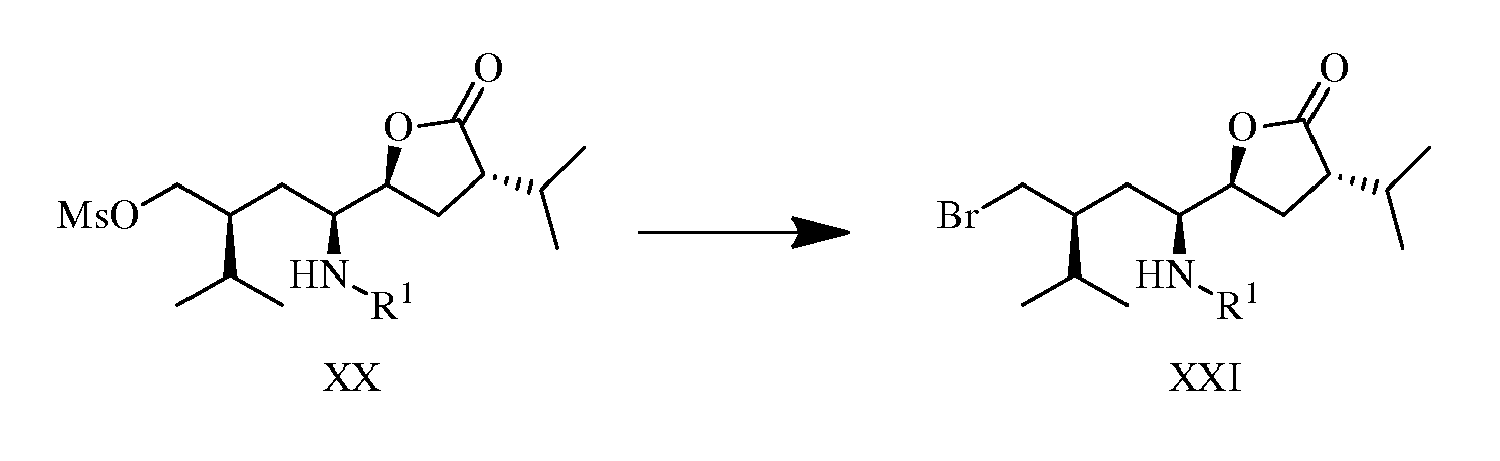 (4). coupling the intermediate compound of formula XXII in step (1) with the intermediate compound of formula XXI in step (3) in an ether class solvent under temperature of -25°C ~ 55°C with the presence of iron-contained catalyst to obtain the compound of formula XV;
- The method according to claim 1 wherein the ether class solvent in step (1) is one selected from diethyl ether, tetrahydrofuran or 1,2-dimethoxyethane.
- The method according to claim 1 wherein the inert solvent in step (2) is methylene chloride or tetrahydrofuran.
- The method according to claim 1 wherein the ketone class solvent in step (3) is acetone or 2-butanone; and the molar ratio between lithium bromide and the compound of formula XX is 1.1 to 5.
- The method according to claim 1 wherein the said ether class solvent in step (4) is either one or mixture of any two selected from diethyl ether, tetrahydrofuran or 1,2-dimethoxyethane; the said iron-contained catalyst is selected from iron(III) acetylacetonate or Iron(III) chloride; and the reaction temperature is -15°C ~ 20°C.
- A method for preparing the Aliskiren compound of formula I comprising any of claims 1 to 5, the method for preparing the Aliskiren compound of formula I further comprising the steps of:(a). preparing the compound of formula XXIII from the compounds of formula XV and VII according to any of claims 1 to 5 in the presence of 2-hydroxypyridine and triethylamine.
 (b). removing R1 on the amino group of the compound of formula XXIII to obtain the Aliskiren compound of formula I;
- The method according to claim 6 for preparing the Aliskiren compound of formula I, wherein the reaction in step (a) between the compound of formula XV and the compound of formula VII to obtain the compound of formula XXIII is implemented in an inert solvent.
- The method according to claim 7 for preparing the Aliskiren compound of formula I, wherein the inert solvent is one selected from dioxane or toluene.
- The method according to claim 6 for preparing the Aliskiren compound of formula I, wherein the acidic de-alkylation to remove R1 group is performed under -25°C ~ 0°C with the acid is one elected from trifluoroacetic acid, hydrochloride and concentrated sulfuric acid when said R1 is tertbutoxycarbony group.
- The method according to claim 6 for preparing the Aliskiren compound of formula I, wherein the catalytic hydrogenation to remove R1 group is performed in the presence of Pd-C catalyst under 20°C ~ 60°C and 1 to 10 atm when said R1 is benzyloxycarbonyl group.
Applications Claiming Priority (2)
| Application Number | Priority Date | Filing Date | Title |
|---|---|---|---|
| CN2010100000573A CN101774986B (en) | 2010-01-06 | 2010-01-06 | A method for preparing Alikren and its intermediates |
| PCT/CN2010/000526 WO2011082506A1 (en) | 2010-01-06 | 2010-04-19 | Method for preparing aliskiren and intermediate thereof |
Publications (3)
| Publication Number | Publication Date |
|---|---|
| EP2546243A1 EP2546243A1 (en) | 2013-01-16 |
| EP2546243A4 EP2546243A4 (en) | 2013-09-18 |
| EP2546243B1 true EP2546243B1 (en) | 2015-01-07 |
Family
ID=42511596
Family Applications (1)
| Application Number | Title | Priority Date | Filing Date |
|---|---|---|---|
| EP10841850.0A Not-in-force EP2546243B1 (en) | 2010-01-06 | 2010-04-19 | Method for preparing aliskiren |
Country Status (5)
| Country | Link |
|---|---|
| US (1) | US8664440B2 (en) |
| EP (1) | EP2546243B1 (en) |
| CN (1) | CN101774986B (en) |
| CA (1) | CA2802513C (en) |
| WO (1) | WO2011082506A1 (en) |
Families Citing this family (5)
| Publication number | Priority date | Publication date | Assignee | Title |
|---|---|---|---|---|
| CN102351734B (en) * | 2011-09-05 | 2014-02-26 | 浙江普洛医药科技有限公司 | A kind of preparation method of Aliskiren |
| US8703976B2 (en) | 2011-10-02 | 2014-04-22 | Milan Soukup | Manufacturing process for 8-aryloctanoic acids such as Aliskiren |
| CN103204834A (en) * | 2012-01-11 | 2013-07-17 | 南京欧信医药技术有限公司 | Aliskiren intermediate, and preparation method and application thereof |
| CN103130677B (en) * | 2013-03-12 | 2015-01-07 | 博瑞生物医药技术(苏州)有限公司 | Preparation method of aliskiren |
| CN103896794B (en) * | 2014-04-23 | 2015-10-07 | 中国科学院长春应用化学研究所 | The preparation method of aliskiren intermediate and aliskiren |
Family Cites Families (12)
| Publication number | Priority date | Publication date | Assignee | Title |
|---|---|---|---|---|
| MY119161A (en) | 1994-04-18 | 2005-04-30 | Novartis Ag | Delta-amino-gamma-hydroxy-omega-aryl-alkanoic acid amides with enzyme especially renin inhibiting activities |
| US5606078A (en) | 1994-04-18 | 1997-02-25 | Ciba-Geigy Corporation | 3,5-Disubstituted tetrahydrofuran-2-ones |
| TW498122B (en) | 1999-03-05 | 2002-08-11 | Hitachi Ltd | Fully automatic washing machine |
| ES2312346T3 (en) | 1999-07-29 | 2009-03-01 | Speedel Pharma Ag | PRODUCTION OF 2,7-DIALQUIL-4-HIDROXI-5-AMINO-8-ARIL-OCTANOILAMIDS N-SUBSTITUTED. |
| PT1303478E (en) | 2000-07-25 | 2004-10-29 | Speedel Pharma Ag | PROCESS FOR THE PREPARATION OF REPLACED ALCANOYLAMIDES |
| GB0419361D0 (en) * | 2004-08-31 | 2004-10-06 | Novartis Ag | Organic compounds |
| GB0519764D0 (en) * | 2005-09-28 | 2005-11-09 | Novartis Ag | Organic compounds |
| DE102005049589A1 (en) | 2005-10-17 | 2007-04-19 | Kenter, Herbert P. | Housing for a handgun |
| GB0521083D0 (en) * | 2005-10-17 | 2005-11-23 | Novartis Ag | Organic compounds |
| CN101016253A (en) | 2006-02-09 | 2007-08-15 | 上海药明康德新药开发有限公司 | Practical synthesis method for feritin inhibitor aliskiren |
| US20090076062A1 (en) * | 2007-09-13 | 2009-03-19 | Juergen Klaus Maibaum | Organic Compounds |
| EP2062874B1 (en) | 2007-11-20 | 2014-12-17 | KRKA, tovarna zdravil, d.d., Novo mesto | Process and intermediates for the preparation of aliskiren |
-
2010
- 2010-01-06 CN CN2010100000573A patent/CN101774986B/en active Active
- 2010-04-19 CA CA2802513A patent/CA2802513C/en not_active Expired - Fee Related
- 2010-04-19 US US13/639,144 patent/US8664440B2/en not_active Expired - Fee Related
- 2010-04-19 WO PCT/CN2010/000526 patent/WO2011082506A1/en not_active Ceased
- 2010-04-19 EP EP10841850.0A patent/EP2546243B1/en not_active Not-in-force
Also Published As
| Publication number | Publication date |
|---|---|
| CA2802513A1 (en) | 2011-07-14 |
| CN101774986B (en) | 2012-03-28 |
| US8664440B2 (en) | 2014-03-04 |
| US20130225841A1 (en) | 2013-08-29 |
| WO2011082506A1 (en) | 2011-07-14 |
| CN101774986A (en) | 2010-07-14 |
| EP2546243A1 (en) | 2013-01-16 |
| EP2546243A4 (en) | 2013-09-18 |
| CA2802513C (en) | 2015-02-24 |
Similar Documents
| Publication | Publication Date | Title |
|---|---|---|
| Dueholm et al. | An efficient synthesis of Boc-aminoacetaldehyde and its application to the synthesis of N-(2-Boc-aminoethyl) glycine esters | |
| US8664440B2 (en) | Method for preparing aliskiren and its intermediates thereof | |
| AU748360B2 (en) | Novel intermediates and processes for the preparation of optically active octanoic acid derivatives | |
| WO2006024501A1 (en) | Alternative synthesis of renin inhibitors and intermediates thereof | |
| EP2134673A1 (en) | Improved process for preparing o-chloromethylphenylglyoxylic esters, improved process for preparing (e)-2-(2-chloromethylphenyl)-2-alkoximinoacetic esters, and novel intermediates for their preparation | |
| Cabon et al. | Stereospecific preparation of glycidic esters from 2-chloro-3-hydroxyesters. Application to the synthesis of (2R, 3S)-3-phenylisoserine | |
| Cativiela et al. | A simple synthesis of (−)-(1S, 2R)-allocoronamic acid in its enantiomerically pure form | |
| JPH11501313A (en) | Catalytic enantioselective synthesis of spiro-fused azetidinones | |
| CA2524489A1 (en) | Method for the synthesis of 4-hydroxyisoleucine and the derivatives thereof | |
| EP1008590B1 (en) | Process for preparing optically active oxazolidinone derivatives | |
| JP6952974B2 (en) | Method for producing amide compound | |
| JP3999028B2 (en) | Process for producing optically active 2-acylated 1,2-diol compound derivative | |
| KR100915551B1 (en) | Method for efficiently preparing 3-hydroxy pyrrolidine and derivatives thereof | |
| US7122696B2 (en) | Processes for preparation of N-protected-β-amino alcohols and N-protected-β-amino epoxides | |
| CA2801126A1 (en) | Process for producing aliskiren | |
| KR940011899B1 (en) | Process for the synthesis of the n-methyl-3,4-dimethoxyphenyl ethyl amine | |
| JP3844112B2 (en) | 3,5,6-Trihydroxyhexanoic acid ammonium salt derivative and method for producing the same | |
| CN107827811B (en) | Method for preparing N-substituted-1, 2,3, 6-tetrahydropyridine | |
| CN109265385A (en) | A kind of synthesis technology of chiral catalyst | |
| US5200531A (en) | Process for the production of threo-4-alkoxy-5- (arylhydroxymethyl)-2(5h)-furanones | |
| WO1995014655A1 (en) | Diastereoselective synthesis of hydroxyethylene dipeptide isosteres | |
| KR100225534B1 (en) | Stereoselective Preparation of (2R, 3S) -beta-phenylisoserine Derivatives [Storcospecific process for preparing (2R, 3S) -β0phenylisoserine] | |
| JP3826425B2 (en) | Method for producing optically active 2-nitro-1,3-diol derivative | |
| KR100469944B1 (en) | Manufacturing Method of Hydroxytetrahydrofuran | |
| KR100250838B1 (en) | Method for preparing 3- (hydroxymethyl) tetrahydrofuran derivative |
Legal Events
| Date | Code | Title | Description |
|---|---|---|---|
| PUAI | Public reference made under article 153(3) epc to a published international application that has entered the european phase |
Free format text: ORIGINAL CODE: 0009012 |
|
| 17P | Request for examination filed |
Effective date: 20121102 |
|
| AK | Designated contracting states |
Kind code of ref document: A1 Designated state(s): AT BE BG CH CY CZ DE DK EE ES FI FR GB GR HR HU IE IS IT LI LT LU LV MC MK MT NL NO PL PT RO SE SI SK SM TR |
|
| DAX | Request for extension of the european patent (deleted) | ||
| RIN1 | Information on inventor provided before grant (corrected) |
Inventor name: CHENG, RONGDE Inventor name: PENG, LINGCHAO Inventor name: TU, YONGJUN Inventor name: ZHANG, YI |
|
| A4 | Supplementary search report drawn up and despatched |
Effective date: 20130816 |
|
| RIC1 | Information provided on ipc code assigned before grant |
Ipc: C07C 231/14 20060101ALI20130809BHEP Ipc: C07C 237/20 20060101ALI20130809BHEP Ipc: C07D 307/33 20060101AFI20130809BHEP |
|
| GRAP | Despatch of communication of intention to grant a patent |
Free format text: ORIGINAL CODE: EPIDOSNIGR1 |
|
| INTG | Intention to grant announced |
Effective date: 20140801 |
|
| GRAS | Grant fee paid |
Free format text: ORIGINAL CODE: EPIDOSNIGR3 |
|
| GRAA | (expected) grant |
Free format text: ORIGINAL CODE: 0009210 |
|
| AK | Designated contracting states |
Kind code of ref document: B1 Designated state(s): AT BE BG CH CY CZ DE DK EE ES FI FR GB GR HR HU IE IS IT LI LT LU LV MC MK MT NL NO PL PT RO SE SI SK SM TR |
|
| REG | Reference to a national code |
Ref country code: GB Ref legal event code: FG4D |
|
| REG | Reference to a national code |
Ref country code: CH Ref legal event code: EP |
|
| REG | Reference to a national code |
Ref country code: IE Ref legal event code: FG4D |
|
| REG | Reference to a national code |
Ref country code: AT Ref legal event code: REF Ref document number: 705612 Country of ref document: AT Kind code of ref document: T Effective date: 20150215 |
|
| REG | Reference to a national code |
Ref country code: DE Ref legal event code: R096 Ref document number: 602010021735 Country of ref document: DE Effective date: 20150226 |
|
| REG | Reference to a national code |
Ref country code: NL Ref legal event code: VDEP Effective date: 20150107 |
|
| REG | Reference to a national code |
Ref country code: AT Ref legal event code: MK05 Ref document number: 705612 Country of ref document: AT Kind code of ref document: T Effective date: 20150107 |
|
| REG | Reference to a national code |
Ref country code: LT Ref legal event code: MG4D |
|
| PG25 | Lapsed in a contracting state [announced via postgrant information from national office to epo] |
Ref country code: BG Free format text: LAPSE BECAUSE OF FAILURE TO SUBMIT A TRANSLATION OF THE DESCRIPTION OR TO PAY THE FEE WITHIN THE PRESCRIBED TIME-LIMIT Effective date: 20150407 Ref country code: SE Free format text: LAPSE BECAUSE OF FAILURE TO SUBMIT A TRANSLATION OF THE DESCRIPTION OR TO PAY THE FEE WITHIN THE PRESCRIBED TIME-LIMIT Effective date: 20150107 Ref country code: ES Free format text: LAPSE BECAUSE OF FAILURE TO SUBMIT A TRANSLATION OF THE DESCRIPTION OR TO PAY THE FEE WITHIN THE PRESCRIBED TIME-LIMIT Effective date: 20150107 Ref country code: HR Free format text: LAPSE BECAUSE OF FAILURE TO SUBMIT A TRANSLATION OF THE DESCRIPTION OR TO PAY THE FEE WITHIN THE PRESCRIBED TIME-LIMIT Effective date: 20150107 Ref country code: NO Free format text: LAPSE BECAUSE OF FAILURE TO SUBMIT A TRANSLATION OF THE DESCRIPTION OR TO PAY THE FEE WITHIN THE PRESCRIBED TIME-LIMIT Effective date: 20150407 Ref country code: FI Free format text: LAPSE BECAUSE OF FAILURE TO SUBMIT A TRANSLATION OF THE DESCRIPTION OR TO PAY THE FEE WITHIN THE PRESCRIBED TIME-LIMIT Effective date: 20150107 Ref country code: LT Free format text: LAPSE BECAUSE OF FAILURE TO SUBMIT A TRANSLATION OF THE DESCRIPTION OR TO PAY THE FEE WITHIN THE PRESCRIBED TIME-LIMIT Effective date: 20150107 |
|
| PG25 | Lapsed in a contracting state [announced via postgrant information from national office to epo] |
Ref country code: NL Free format text: LAPSE BECAUSE OF FAILURE TO SUBMIT A TRANSLATION OF THE DESCRIPTION OR TO PAY THE FEE WITHIN THE PRESCRIBED TIME-LIMIT Effective date: 20150107 Ref country code: GR Free format text: LAPSE BECAUSE OF FAILURE TO SUBMIT A TRANSLATION OF THE DESCRIPTION OR TO PAY THE FEE WITHIN THE PRESCRIBED TIME-LIMIT Effective date: 20150408 Ref country code: AT Free format text: LAPSE BECAUSE OF FAILURE TO SUBMIT A TRANSLATION OF THE DESCRIPTION OR TO PAY THE FEE WITHIN THE PRESCRIBED TIME-LIMIT Effective date: 20150107 Ref country code: PL Free format text: LAPSE BECAUSE OF FAILURE TO SUBMIT A TRANSLATION OF THE DESCRIPTION OR TO PAY THE FEE WITHIN THE PRESCRIBED TIME-LIMIT Effective date: 20150107 Ref country code: IS Free format text: LAPSE BECAUSE OF FAILURE TO SUBMIT A TRANSLATION OF THE DESCRIPTION OR TO PAY THE FEE WITHIN THE PRESCRIBED TIME-LIMIT Effective date: 20150507 Ref country code: LV Free format text: LAPSE BECAUSE OF FAILURE TO SUBMIT A TRANSLATION OF THE DESCRIPTION OR TO PAY THE FEE WITHIN THE PRESCRIBED TIME-LIMIT Effective date: 20150107 |
|
| REG | Reference to a national code |
Ref country code: DE Ref legal event code: R097 Ref document number: 602010021735 Country of ref document: DE |
|
| PG25 | Lapsed in a contracting state [announced via postgrant information from national office to epo] |
Ref country code: SK Free format text: LAPSE BECAUSE OF FAILURE TO SUBMIT A TRANSLATION OF THE DESCRIPTION OR TO PAY THE FEE WITHIN THE PRESCRIBED TIME-LIMIT Effective date: 20150107 Ref country code: EE Free format text: LAPSE BECAUSE OF FAILURE TO SUBMIT A TRANSLATION OF THE DESCRIPTION OR TO PAY THE FEE WITHIN THE PRESCRIBED TIME-LIMIT Effective date: 20150107 Ref country code: CZ Free format text: LAPSE BECAUSE OF FAILURE TO SUBMIT A TRANSLATION OF THE DESCRIPTION OR TO PAY THE FEE WITHIN THE PRESCRIBED TIME-LIMIT Effective date: 20150107 Ref country code: DK Free format text: LAPSE BECAUSE OF FAILURE TO SUBMIT A TRANSLATION OF THE DESCRIPTION OR TO PAY THE FEE WITHIN THE PRESCRIBED TIME-LIMIT Effective date: 20150107 Ref country code: RO Free format text: LAPSE BECAUSE OF FAILURE TO SUBMIT A TRANSLATION OF THE DESCRIPTION OR TO PAY THE FEE WITHIN THE PRESCRIBED TIME-LIMIT Effective date: 20150107 |
|
| PLBE | No opposition filed within time limit |
Free format text: ORIGINAL CODE: 0009261 |
|
| STAA | Information on the status of an ep patent application or granted ep patent |
Free format text: STATUS: NO OPPOSITION FILED WITHIN TIME LIMIT |
|
| PG25 | Lapsed in a contracting state [announced via postgrant information from national office to epo] |
Ref country code: LU Free format text: LAPSE BECAUSE OF FAILURE TO SUBMIT A TRANSLATION OF THE DESCRIPTION OR TO PAY THE FEE WITHIN THE PRESCRIBED TIME-LIMIT Effective date: 20150419 Ref country code: MC Free format text: LAPSE BECAUSE OF FAILURE TO SUBMIT A TRANSLATION OF THE DESCRIPTION OR TO PAY THE FEE WITHIN THE PRESCRIBED TIME-LIMIT Effective date: 20150107 |
|
| REG | Reference to a national code |
Ref country code: CH Ref legal event code: PL |
|
| 26N | No opposition filed |
Effective date: 20151008 |
|
| GBPC | Gb: european patent ceased through non-payment of renewal fee |
Effective date: 20150419 |
|
| PG25 | Lapsed in a contracting state [announced via postgrant information from national office to epo] |
Ref country code: CH Free format text: LAPSE BECAUSE OF NON-PAYMENT OF DUE FEES Effective date: 20150430 Ref country code: LI Free format text: LAPSE BECAUSE OF NON-PAYMENT OF DUE FEES Effective date: 20150430 Ref country code: GB Free format text: LAPSE BECAUSE OF NON-PAYMENT OF DUE FEES Effective date: 20150419 |
|
| REG | Reference to a national code |
Ref country code: FR Ref legal event code: ST Effective date: 20151231 |
|
| PG25 | Lapsed in a contracting state [announced via postgrant information from national office to epo] |
Ref country code: SI Free format text: LAPSE BECAUSE OF FAILURE TO SUBMIT A TRANSLATION OF THE DESCRIPTION OR TO PAY THE FEE WITHIN THE PRESCRIBED TIME-LIMIT Effective date: 20150107 Ref country code: FR Free format text: LAPSE BECAUSE OF NON-PAYMENT OF DUE FEES Effective date: 20150430 |
|
| PG25 | Lapsed in a contracting state [announced via postgrant information from national office to epo] |
Ref country code: BE Free format text: LAPSE BECAUSE OF FAILURE TO SUBMIT A TRANSLATION OF THE DESCRIPTION OR TO PAY THE FEE WITHIN THE PRESCRIBED TIME-LIMIT Effective date: 20150107 |
|
| PGFP | Annual fee paid to national office [announced via postgrant information from national office to epo] |
Ref country code: IE Payment date: 20160426 Year of fee payment: 7 Ref country code: DE Payment date: 20160511 Year of fee payment: 7 |
|
| PGFP | Annual fee paid to national office [announced via postgrant information from national office to epo] |
Ref country code: IT Payment date: 20160427 Year of fee payment: 7 |
|
| PG25 | Lapsed in a contracting state [announced via postgrant information from national office to epo] |
Ref country code: MT Free format text: LAPSE BECAUSE OF FAILURE TO SUBMIT A TRANSLATION OF THE DESCRIPTION OR TO PAY THE FEE WITHIN THE PRESCRIBED TIME-LIMIT Effective date: 20150107 |
|
| PG25 | Lapsed in a contracting state [announced via postgrant information from national office to epo] |
Ref country code: HU Free format text: LAPSE BECAUSE OF FAILURE TO SUBMIT A TRANSLATION OF THE DESCRIPTION OR TO PAY THE FEE WITHIN THE PRESCRIBED TIME-LIMIT; INVALID AB INITIO Effective date: 20100419 Ref country code: SM Free format text: LAPSE BECAUSE OF FAILURE TO SUBMIT A TRANSLATION OF THE DESCRIPTION OR TO PAY THE FEE WITHIN THE PRESCRIBED TIME-LIMIT Effective date: 20150107 |
|
| PG25 | Lapsed in a contracting state [announced via postgrant information from national office to epo] |
Ref country code: CY Free format text: LAPSE BECAUSE OF FAILURE TO SUBMIT A TRANSLATION OF THE DESCRIPTION OR TO PAY THE FEE WITHIN THE PRESCRIBED TIME-LIMIT Effective date: 20150107 |
|
| PG25 | Lapsed in a contracting state [announced via postgrant information from national office to epo] |
Ref country code: PT Free format text: LAPSE BECAUSE OF FAILURE TO SUBMIT A TRANSLATION OF THE DESCRIPTION OR TO PAY THE FEE WITHIN THE PRESCRIBED TIME-LIMIT Effective date: 20150507 |
|
| PG25 | Lapsed in a contracting state [announced via postgrant information from national office to epo] |
Ref country code: TR Free format text: LAPSE BECAUSE OF FAILURE TO SUBMIT A TRANSLATION OF THE DESCRIPTION OR TO PAY THE FEE WITHIN THE PRESCRIBED TIME-LIMIT Effective date: 20150107 |
|
| REG | Reference to a national code |
Ref country code: DE Ref legal event code: R119 Ref document number: 602010021735 Country of ref document: DE |
|
| REG | Reference to a national code |
Ref country code: IE Ref legal event code: MM4A |
|
| PG25 | Lapsed in a contracting state [announced via postgrant information from national office to epo] |
Ref country code: DE Free format text: LAPSE BECAUSE OF NON-PAYMENT OF DUE FEES Effective date: 20171103 |
|
| PG25 | Lapsed in a contracting state [announced via postgrant information from national office to epo] |
Ref country code: IE Free format text: LAPSE BECAUSE OF NON-PAYMENT OF DUE FEES Effective date: 20170419 |
|
| PG25 | Lapsed in a contracting state [announced via postgrant information from national office to epo] |
Ref country code: IT Free format text: LAPSE BECAUSE OF NON-PAYMENT OF DUE FEES Effective date: 20170419 |
|
| PG25 | Lapsed in a contracting state [announced via postgrant information from national office to epo] |
Ref country code: MK Free format text: LAPSE BECAUSE OF FAILURE TO SUBMIT A TRANSLATION OF THE DESCRIPTION OR TO PAY THE FEE WITHIN THE PRESCRIBED TIME-LIMIT Effective date: 20150107 |