EP2545985A1 - Composite membrane - Google Patents
Composite membrane Download PDFInfo
- Publication number
- EP2545985A1 EP2545985A1 EP11174236A EP11174236A EP2545985A1 EP 2545985 A1 EP2545985 A1 EP 2545985A1 EP 11174236 A EP11174236 A EP 11174236A EP 11174236 A EP11174236 A EP 11174236A EP 2545985 A1 EP2545985 A1 EP 2545985A1
- Authority
- EP
- European Patent Office
- Prior art keywords
- membrane
- porous membrane
- hydrophilic polymer
- solution
- methylimidazolium
- Prior art date
- Legal status (The legal status is an assumption and is not a legal conclusion. Google has not performed a legal analysis and makes no representation as to the accuracy of the status listed.)
- Withdrawn
Links
- 239000012528 membrane Substances 0.000 title claims abstract description 120
- 239000002131 composite material Substances 0.000 title claims abstract description 26
- 238000000034 method Methods 0.000 claims abstract description 41
- 229920001477 hydrophilic polymer Polymers 0.000 claims abstract description 29
- 239000007788 liquid Substances 0.000 claims abstract description 27
- 241000700605 Viruses Species 0.000 claims abstract description 15
- 239000002245 particle Substances 0.000 claims abstract description 14
- 238000004519 manufacturing process Methods 0.000 claims abstract description 6
- 230000008569 process Effects 0.000 claims description 30
- 238000001556 precipitation Methods 0.000 claims description 23
- 239000012510 hollow fiber Substances 0.000 claims description 20
- 238000001914 filtration Methods 0.000 claims description 13
- 239000001913 cellulose Substances 0.000 claims description 11
- 229920002678 cellulose Polymers 0.000 claims description 11
- 229920000642 polymer Polymers 0.000 claims description 11
- 239000002608 ionic liquid Substances 0.000 claims description 9
- 239000011148 porous material Substances 0.000 claims description 8
- XIYUIMLQTKODPS-UHFFFAOYSA-M 1-ethyl-3-methylimidazol-3-ium;acetate Chemical compound CC([O-])=O.CC[N+]=1C=CN(C)C=1 XIYUIMLQTKODPS-UHFFFAOYSA-M 0.000 claims description 7
- 239000000203 mixture Substances 0.000 claims description 7
- 229920006001 poly(vinyl alcohol-co-ethylene) Polymers 0.000 claims description 7
- 229920006393 polyether sulfone Polymers 0.000 claims description 7
- 229920002492 poly(sulfone) Polymers 0.000 claims description 6
- 229920002981 polyvinylidene fluoride Polymers 0.000 claims description 6
- 229920000036 polyvinylpyrrolidone Polymers 0.000 claims description 6
- 235000013855 polyvinylpyrrolidone Nutrition 0.000 claims description 6
- IQQRAVYLUAZUGX-UHFFFAOYSA-N 1-butyl-3-methylimidazolium Chemical compound CCCCN1C=C[N+](C)=C1 IQQRAVYLUAZUGX-UHFFFAOYSA-N 0.000 claims description 4
- NJMWOUFKYKNWDW-UHFFFAOYSA-N 1-ethyl-3-methylimidazolium Chemical compound CCN1C=C[N+](C)=C1 NJMWOUFKYKNWDW-UHFFFAOYSA-N 0.000 claims description 4
- QTBSBXVTEAMEQO-UHFFFAOYSA-M Acetate Chemical compound CC([O-])=O QTBSBXVTEAMEQO-UHFFFAOYSA-M 0.000 claims description 4
- 238000009295 crossflow filtration Methods 0.000 claims description 4
- 229920002239 polyacrylonitrile Polymers 0.000 claims description 4
- 229920001059 synthetic polymer Polymers 0.000 claims description 4
- -1 tetrachloroaluminate Chemical compound 0.000 claims description 4
- 150000001450 anions Chemical class 0.000 claims description 3
- 150000001768 cations Chemical class 0.000 claims description 3
- KCUGPPHNMASOTE-UHFFFAOYSA-N 1,2,3-trimethylimidazol-1-ium Chemical compound CC=1N(C)C=C[N+]=1C KCUGPPHNMASOTE-UHFFFAOYSA-N 0.000 claims description 2
- LUVWFPSHRWDXOS-UHFFFAOYSA-N 1,2,4-trimethylpyrazol-2-ium Chemical compound CC1=CN(C)[N+](C)=C1 LUVWFPSHRWDXOS-UHFFFAOYSA-N 0.000 claims description 2
- IRGDPGYNHSIIJJ-UHFFFAOYSA-N 1-ethyl-2,3-dimethylimidazol-3-ium Chemical compound CCN1C=C[N+](C)=C1C IRGDPGYNHSIIJJ-UHFFFAOYSA-N 0.000 claims description 2
- MCTWTZJPVLRJOU-UHFFFAOYSA-O 1-methylimidazole Chemical compound CN1C=C[NH+]=C1 MCTWTZJPVLRJOU-UHFFFAOYSA-O 0.000 claims description 2
- VEXZGXHMUGYJMC-UHFFFAOYSA-M Chloride anion Chemical compound [Cl-] VEXZGXHMUGYJMC-UHFFFAOYSA-M 0.000 claims description 2
- KIWBPDUYBMNFTB-UHFFFAOYSA-N Ethyl hydrogen sulfate Chemical compound CCOS(O)(=O)=O KIWBPDUYBMNFTB-UHFFFAOYSA-N 0.000 claims description 2
- ZMZDMBWJUHKJPS-UHFFFAOYSA-M Thiocyanate anion Chemical compound [S-]C#N ZMZDMBWJUHKJPS-UHFFFAOYSA-M 0.000 claims description 2
- ZMZDMBWJUHKJPS-UHFFFAOYSA-N hydrogen thiocyanate Natural products SC#N ZMZDMBWJUHKJPS-UHFFFAOYSA-N 0.000 claims description 2
- QAOWNCQODCNURD-UHFFFAOYSA-M hydrogensulfate Chemical compound OS([O-])(=O)=O QAOWNCQODCNURD-UHFFFAOYSA-M 0.000 claims description 2
- JZMJDSHXVKJFKW-UHFFFAOYSA-M methyl sulfate(1-) Chemical compound COS([O-])(=O)=O JZMJDSHXVKJFKW-UHFFFAOYSA-M 0.000 claims description 2
- 230000004048 modification Effects 0.000 claims description 2
- 238000012986 modification Methods 0.000 claims description 2
- 230000001376 precipitating effect Effects 0.000 claims description 2
- HJHUXWBTVVFLQI-UHFFFAOYSA-N tributyl(methyl)azanium Chemical compound CCCC[N+](C)(CCCC)CCCC HJHUXWBTVVFLQI-UHFFFAOYSA-N 0.000 claims description 2
- 239000000243 solution Substances 0.000 description 41
- 239000000835 fiber Substances 0.000 description 32
- XLYOFNOQVPJJNP-UHFFFAOYSA-N water Substances O XLYOFNOQVPJJNP-UHFFFAOYSA-N 0.000 description 20
- 238000012360 testing method Methods 0.000 description 11
- 239000002904 solvent Substances 0.000 description 9
- 238000007873 sieving Methods 0.000 description 8
- 230000035699 permeability Effects 0.000 description 7
- PEDCQBHIVMGVHV-UHFFFAOYSA-N Glycerine Chemical compound OCC(O)CO PEDCQBHIVMGVHV-UHFFFAOYSA-N 0.000 description 6
- SECXISVLQFMRJM-UHFFFAOYSA-N N-Methylpyrrolidone Chemical compound CN1CCCC1=O SECXISVLQFMRJM-UHFFFAOYSA-N 0.000 description 6
- PCHJSUWPFVWCPO-UHFFFAOYSA-N gold Chemical compound [Au] PCHJSUWPFVWCPO-UHFFFAOYSA-N 0.000 description 6
- 239000010931 gold Substances 0.000 description 6
- 229910052737 gold Inorganic materials 0.000 description 6
- 238000005259 measurement Methods 0.000 description 5
- 239000000706 filtrate Substances 0.000 description 4
- 239000012530 fluid Substances 0.000 description 4
- 230000004907 flux Effects 0.000 description 4
- 230000014759 maintenance of location Effects 0.000 description 4
- KFZMGEQAYNKOFK-UHFFFAOYSA-N Isopropanol Chemical compound CC(C)O KFZMGEQAYNKOFK-UHFFFAOYSA-N 0.000 description 3
- 241000125945 Protoparvovirus Species 0.000 description 3
- 230000008033 biological extinction Effects 0.000 description 3
- 239000012153 distilled water Substances 0.000 description 3
- 239000003960 organic solvent Substances 0.000 description 3
- 238000002360 preparation method Methods 0.000 description 3
- BDERNNFJNOPAEC-UHFFFAOYSA-N propan-1-ol Chemical compound CCCO BDERNNFJNOPAEC-UHFFFAOYSA-N 0.000 description 3
- XTEGARKTQYYJKE-UHFFFAOYSA-M Chlorate Chemical compound [O-]Cl(=O)=O XTEGARKTQYYJKE-UHFFFAOYSA-M 0.000 description 2
- IAZDPXIOMUYVGZ-UHFFFAOYSA-N Dimethylsulphoxide Chemical compound CS(C)=O IAZDPXIOMUYVGZ-UHFFFAOYSA-N 0.000 description 2
- VGGSQFUCUMXWEO-UHFFFAOYSA-N Ethene Chemical group C=C VGGSQFUCUMXWEO-UHFFFAOYSA-N 0.000 description 2
- 239000005977 Ethylene Substances 0.000 description 2
- 229910019142 PO4 Inorganic materials 0.000 description 2
- 229920012266 Poly(ether sulfone) PES Polymers 0.000 description 2
- 239000004695 Polyether sulfone Substances 0.000 description 2
- 239000007864 aqueous solution Substances 0.000 description 2
- 150000001875 compounds Chemical class 0.000 description 2
- 238000007872 degassing Methods 0.000 description 2
- 239000008367 deionised water Substances 0.000 description 2
- 239000012527 feed solution Substances 0.000 description 2
- 238000011010 flushing procedure Methods 0.000 description 2
- 239000011159 matrix material Substances 0.000 description 2
- 239000002105 nanoparticle Substances 0.000 description 2
- 235000021317 phosphate Nutrition 0.000 description 2
- 239000001267 polyvinylpyrrolidone Substances 0.000 description 2
- 238000003825 pressing Methods 0.000 description 2
- 238000009987 spinning Methods 0.000 description 2
- HVVRUQBMAZRKPJ-UHFFFAOYSA-N 1,3-dimethylimidazolium Chemical compound CN1C=C[N+](C)=C1 HVVRUQBMAZRKPJ-UHFFFAOYSA-N 0.000 description 1
- HCGMDEACZUKNDY-UHFFFAOYSA-N 1-butyl-3-methyl-1,2-dihydroimidazol-1-ium;acetate Chemical compound CC(O)=O.CCCCN1CN(C)C=C1 HCGMDEACZUKNDY-UHFFFAOYSA-N 0.000 description 1
- ZXLOSLWIGFGPIU-UHFFFAOYSA-N 1-ethyl-3-methyl-1,2-dihydroimidazol-1-ium;acetate Chemical compound CC(O)=O.CCN1CN(C)C=C1 ZXLOSLWIGFGPIU-UHFFFAOYSA-N 0.000 description 1
- 102000009027 Albumins Human genes 0.000 description 1
- 108010088751 Albumins Proteins 0.000 description 1
- 229920000742 Cotton Polymers 0.000 description 1
- 239000001856 Ethyl cellulose Substances 0.000 description 1
- ZZSNKZQZMQGXPY-UHFFFAOYSA-N Ethyl cellulose Chemical compound CCOCC1OC(OC)C(OCC)C(OCC)C1OC1C(O)C(O)C(OC)C(CO)O1 ZZSNKZQZMQGXPY-UHFFFAOYSA-N 0.000 description 1
- 229920000219 Ethylene vinyl alcohol Polymers 0.000 description 1
- 240000000731 Fagus sylvatica Species 0.000 description 1
- 235000010099 Fagus sylvatica Nutrition 0.000 description 1
- 229920003171 Poly (ethylene oxide) Polymers 0.000 description 1
- 241000702619 Porcine parvovirus Species 0.000 description 1
- QAOWNCQODCNURD-UHFFFAOYSA-L Sulfate Chemical compound [O-]S([O-])(=O)=O QAOWNCQODCNURD-UHFFFAOYSA-L 0.000 description 1
- LSNNMFCWUKXFEE-UHFFFAOYSA-N Sulfurous acid Chemical compound OS(O)=O LSNNMFCWUKXFEE-UHFFFAOYSA-N 0.000 description 1
- 230000009471 action Effects 0.000 description 1
- 239000000853 adhesive Substances 0.000 description 1
- 230000001070 adhesive effect Effects 0.000 description 1
- 150000005215 alkyl ethers Chemical class 0.000 description 1
- 230000008901 benefit Effects 0.000 description 1
- 229960000074 biopharmaceutical Drugs 0.000 description 1
- 239000008280 blood Substances 0.000 description 1
- 210000004369 blood Anatomy 0.000 description 1
- 150000007942 carboxylates Chemical class 0.000 description 1
- 229920002301 cellulose acetate Polymers 0.000 description 1
- 229920001577 copolymer Polymers 0.000 description 1
- 238000005520 cutting process Methods 0.000 description 1
- 238000009792 diffusion process Methods 0.000 description 1
- 238000001035 drying Methods 0.000 description 1
- 150000002148 esters Chemical class 0.000 description 1
- 229920001249 ethyl cellulose Polymers 0.000 description 1
- 235000019325 ethyl cellulose Nutrition 0.000 description 1
- 238000011049 filling Methods 0.000 description 1
- 150000004820 halides Chemical class 0.000 description 1
- 229920001480 hydrophilic copolymer Polymers 0.000 description 1
- 239000000155 melt Substances 0.000 description 1
- 238000002844 melting Methods 0.000 description 1
- 230000008018 melting Effects 0.000 description 1
- 238000005192 partition Methods 0.000 description 1
- VLTRZXGMWDSKGL-UHFFFAOYSA-M perchlorate Inorganic materials [O-]Cl(=O)(=O)=O VLTRZXGMWDSKGL-UHFFFAOYSA-M 0.000 description 1
- VLTRZXGMWDSKGL-UHFFFAOYSA-N perchloric acid Chemical compound OCl(=O)(=O)=O VLTRZXGMWDSKGL-UHFFFAOYSA-N 0.000 description 1
- 239000012466 permeate Substances 0.000 description 1
- NBIIXXVUZAFLBC-UHFFFAOYSA-K phosphate Chemical compound [O-]P([O-])([O-])=O NBIIXXVUZAFLBC-UHFFFAOYSA-K 0.000 description 1
- 239000010452 phosphate Substances 0.000 description 1
- 229920000098 polyolefin Polymers 0.000 description 1
- 229920002635 polyurethane Polymers 0.000 description 1
- 239000004814 polyurethane Substances 0.000 description 1
- 238000004382 potting Methods 0.000 description 1
- 102000004169 proteins and genes Human genes 0.000 description 1
- 108090000623 proteins and genes Proteins 0.000 description 1
- 125000002577 pseudohalo group Chemical group 0.000 description 1
- 238000000926 separation method Methods 0.000 description 1
- XFTALRAZSCGSKN-UHFFFAOYSA-M sodium;4-ethenylbenzenesulfonate Chemical compound [Na+].[O-]S(=O)(=O)C1=CC=C(C=C)C=C1 XFTALRAZSCGSKN-UHFFFAOYSA-M 0.000 description 1
- 238000001179 sorption measurement Methods 0.000 description 1
- 239000003381 stabilizer Substances 0.000 description 1
- 229910001220 stainless steel Inorganic materials 0.000 description 1
- 239000010935 stainless steel Substances 0.000 description 1
- 229910021642 ultra pure water Inorganic materials 0.000 description 1
- 239000012498 ultrapure water Substances 0.000 description 1
- 210000003934 vacuole Anatomy 0.000 description 1
- 238000004804 winding Methods 0.000 description 1
Images

Classifications
-
- B—PERFORMING OPERATIONS; TRANSPORTING
- B01—PHYSICAL OR CHEMICAL PROCESSES OR APPARATUS IN GENERAL
- B01D—SEPARATION
- B01D69/00—Semi-permeable membranes for separation processes or apparatus characterised by their form, structure or properties; Manufacturing processes specially adapted therefor
- B01D69/14—Dynamic membranes
- B01D69/141—Heterogeneous membranes, e.g. containing dispersed material; Mixed matrix membranes
-
- B—PERFORMING OPERATIONS; TRANSPORTING
- B01—PHYSICAL OR CHEMICAL PROCESSES OR APPARATUS IN GENERAL
- B01D—SEPARATION
- B01D67/00—Processes specially adapted for manufacturing semi-permeable membranes for separation processes or apparatus
- B01D67/0081—After-treatment of organic or inorganic membranes
- B01D67/0088—Physical treatment with compounds, e.g. swelling, coating or impregnation
-
- B—PERFORMING OPERATIONS; TRANSPORTING
- B01—PHYSICAL OR CHEMICAL PROCESSES OR APPARATUS IN GENERAL
- B01D—SEPARATION
- B01D67/00—Processes specially adapted for manufacturing semi-permeable membranes for separation processes or apparatus
- B01D67/0081—After-treatment of organic or inorganic membranes
- B01D67/0093—Chemical modification
-
- B—PERFORMING OPERATIONS; TRANSPORTING
- B01—PHYSICAL OR CHEMICAL PROCESSES OR APPARATUS IN GENERAL
- B01D—SEPARATION
- B01D69/00—Semi-permeable membranes for separation processes or apparatus characterised by their form, structure or properties; Manufacturing processes specially adapted therefor
- B01D69/02—Semi-permeable membranes for separation processes or apparatus characterised by their form, structure or properties; Manufacturing processes specially adapted therefor characterised by their properties
-
- B—PERFORMING OPERATIONS; TRANSPORTING
- B01—PHYSICAL OR CHEMICAL PROCESSES OR APPARATUS IN GENERAL
- B01D—SEPARATION
- B01D69/00—Semi-permeable membranes for separation processes or apparatus characterised by their form, structure or properties; Manufacturing processes specially adapted therefor
- B01D69/12—Composite membranes; Ultra-thin membranes
-
- B—PERFORMING OPERATIONS; TRANSPORTING
- B01—PHYSICAL OR CHEMICAL PROCESSES OR APPARATUS IN GENERAL
- B01D—SEPARATION
- B01D71/00—Semi-permeable membranes for separation processes or apparatus characterised by the material; Manufacturing processes specially adapted therefor
- B01D71/06—Organic material
- B01D71/30—Polyalkenyl halides
- B01D71/32—Polyalkenyl halides containing fluorine atoms
- B01D71/34—Polyvinylidene fluoride
-
- B—PERFORMING OPERATIONS; TRANSPORTING
- B01—PHYSICAL OR CHEMICAL PROCESSES OR APPARATUS IN GENERAL
- B01D—SEPARATION
- B01D71/00—Semi-permeable membranes for separation processes or apparatus characterised by the material; Manufacturing processes specially adapted therefor
- B01D71/06—Organic material
- B01D71/38—Polyalkenylalcohols; Polyalkenylesters; Polyalkenylethers; Polyalkenylaldehydes; Polyalkenylketones; Polyalkenylacetals; Polyalkenylketals
-
- B—PERFORMING OPERATIONS; TRANSPORTING
- B01—PHYSICAL OR CHEMICAL PROCESSES OR APPARATUS IN GENERAL
- B01D—SEPARATION
- B01D71/00—Semi-permeable membranes for separation processes or apparatus characterised by the material; Manufacturing processes specially adapted therefor
- B01D71/06—Organic material
- B01D71/40—Polymers of unsaturated acids or derivatives thereof, e.g. salts, amides, imides, nitriles, anhydrides, esters
- B01D71/42—Polymers of nitriles, e.g. polyacrylonitrile
- B01D71/421—Polyacrylonitrile
-
- B—PERFORMING OPERATIONS; TRANSPORTING
- B01—PHYSICAL OR CHEMICAL PROCESSES OR APPARATUS IN GENERAL
- B01D—SEPARATION
- B01D71/00—Semi-permeable membranes for separation processes or apparatus characterised by the material; Manufacturing processes specially adapted therefor
- B01D71/06—Organic material
- B01D71/66—Polymers having sulfur in the main chain, with or without nitrogen, oxygen or carbon only
- B01D71/68—Polysulfones; Polyethersulfones
-
- B—PERFORMING OPERATIONS; TRANSPORTING
- B01—PHYSICAL OR CHEMICAL PROCESSES OR APPARATUS IN GENERAL
- B01D—SEPARATION
- B01D71/00—Semi-permeable membranes for separation processes or apparatus characterised by the material; Manufacturing processes specially adapted therefor
- B01D71/06—Organic material
- B01D71/76—Macromolecular material not specifically provided for in a single one of groups B01D71/08 - B01D71/74
-
- B—PERFORMING OPERATIONS; TRANSPORTING
- B01—PHYSICAL OR CHEMICAL PROCESSES OR APPARATUS IN GENERAL
- B01D—SEPARATION
- B01D2323/00—Details relating to membrane preparation
- B01D2323/02—Hydrophilization
-
- B—PERFORMING OPERATIONS; TRANSPORTING
- B01—PHYSICAL OR CHEMICAL PROCESSES OR APPARATUS IN GENERAL
- B01D—SEPARATION
- B01D2323/00—Details relating to membrane preparation
- B01D2323/28—Pore treatments
- B01D2323/283—Reducing the pores
Definitions
- the invention relates to a method for the production of a composite membrane comprising a porous membrane modified with a membrane-forming hydrophilic polymer.
- the composite membrane can be used for removing virus particles from liquids.
- Virus removal by filtration techniques is known in the art.
- State-of-the-art virus removal filters in the biotech industry are manufactured from either (i) cellulose or (ii) synthetic polymers (PES, PSU, PVDF).
- the advantage of the commercially available filters based on synthetic polymers is the high flux achievable, but they generally show unsatisfactory rejection behavior for virus particles (expressed as LRV).
- the commercially available cellulose-based filters show excellent rejection of parvovirus and high passage of monoclonal antibodies (mAb) at high feed concentrations, however, the flux that can be achieved with these filters is limited.
- virus filter membrane which shows both excellent rejection of parvovirus and high passage of mAb at high feed concentrations and at the same time allows for high feed flux.
- US 5,084,173 discloses a method for the production of a plasma separation membrane comprising applying a solution of a water-insoluble hydrophilic copolymer, for example, an ethylene-vinyl alcohol copolymer, in an organic solvent or a mixture of an organic solvent and water onto an oriented polyolefin membranous matrix and subsequent drying to remove the solvent.
- a water-insoluble hydrophilic copolymer for example, an ethylene-vinyl alcohol copolymer
- the copolymer forms a coat covering substantially the overall surface of the matrix.
- the present disclosure provides a composite membrane which can be used for virus removal from liquids.
- the membrane shows (i) high rejection for gold nano-particles (having 20 nm diameter and simulating parvovirus), (ii) high passage of Mab feed solution (sieving coefficient for IgG ⁇ 1), (iii) high feed flux (which results in a high feed capacity for this type of membrane), and (iv) low protein adsorption and low fouling, which ensures a stable high filtration rate over time.
- the present disclosure also provides methods for production of the composite membrane and devices comprising the composite membrane.
- the process for preparing a composite porous membrane according to the invention comprises modifying a porous membrane with a membrane-forming hydrophilic polymer selected from the group consisting of cellulose, cellulose derivatives, and poly(vinyl alcohol-co-ethylene).
- the porous membrane can have any suitable geometry according to the needs of the intended use, e.g. it can take the form of a flat sheet, a hollow fiber, or be shaped to form chambers or other geometries needed.
- the porous membrane is a hollow fiber membrane.
- a hollow fiber membrane of the invention is further characterized by having an inner diameter of from 50 to 2,000 ⁇ m, preferably of from 50 to 1,000 ⁇ m, and more preferably from 100 to 500 ⁇ m.
- the wall thickness is generally from 3% to 30% of the external diameter, i.e. generally from 5 to 200 ⁇ m, for instance from 10 to 80 ⁇ m, or even from 20 to 70 ⁇ m.
- the porous membrane is a flat sheet membrane.
- the thickness of a flat sheet membrane according to the invention may vary between 10 ⁇ m and 200 ⁇ m. A thickness of 20 ⁇ m to 100 ⁇ m may be especially advantageous for most applications. Usually, several flat sheet membranes will be combined in the form of a stack to form a module for use in the present invention.
- the porous membrane is comprised of synthetic polymers selected from the group consisting of polysulfones (PSf); polyethersulfones (PES); polyvinylidene fluorides (PVDF); polyacrylonitriles (PAN); and blends of the individual polymers with polyvinylpyrrolidones.
- the porous membrane is comprised of a blend of a polyethersulfone and at least one polyvinylpyrrolidone.
- the porous membrane has a homogeneous, "symmetrical type" structure, which is uniform throughout its thickness.
- the porous membrane is generally free of vacuoles (empty spaces included in the wall and having a largest dimension of more than about 5 microns). It does not possess a skin or a dense layer on either surface (in the case of hollow fibers, neither on the inside nor on the outside).
- the membrane-forming hydrophilic polymer used to modify the porous membrane is selected from the group consisting of cellulose, cellulose derivatives, and poly(vinyl alcohol-co-ethylene).
- the composite membrane of the invention shows a retention of gold nano-particles having 20 nm diameter (simulating porcine parvovirus), GPR (gold particle retention, defined as log(A/F), A/F being the ratio of the gold particle concentration in the feed and in the filtrate), of > 1.4, preferably > 1.7, more preferably > 2.0, in particular > 2.3.
- the GPR is proportional to the rate of retention of virus particles by the membrane.
- the membrane of the present invention can thus be advantageously used for the removal of virus particles from liquids.
- Suitable types of cellulose for preparing the composite membrane of the invention include beech sulfite pulp or cotton linters.
- suitable cellulose derivatives include esters like cellulose acetate; water-insoluble alkyl ethers like ethylcellulose.
- Suitable poly(vinyl alcohol-co-ethylene)s are insoluble in water.
- a poly(Vinyl alcohol-co-ethylene) containing 25 to 50 mol-% of ethylene units is used to modify the porous membrane.
- the poly(vinyl alcohol-co-ethylene) has a number average molecular weight of at least 10,000 g/mol.
- the pore space of the porous membrane is modified with the hydrophilic polymer.
- one or both surfaces of the porous membrane are modified with the hydrophilic polymer.
- both the pore space and one or both surfaces of the porous membrane are modified with the hydrophilic polymer.
- the modification of the porous membrane is effected by precipitating the hydrophilic polymer from solution in the presence of the porous membrane.
- the solution of the hydrophilic polymer is prepared using a solvent which is able to dissolve the hydrophilic polymer but does not dissolve the porous membrane.
- suitable solvents include 1-propanol, 2-propanol and ionic liquids.
- dimethyl sulfoxide additionally may be used.
- water may also be present in the solution.
- the solvent for the hydrophilic polymer comprises an ionic liquid.
- ionic liquids are disclosed in WO 2003/029329 A2 and DE 10 2005 062 608 A1 , both incorporated herein by reference.
- the ionic liquids comprise cations selected from 1-ethyl-3-methylimidazolium, 1,3-dimethylimidazolium and 1-butyl-3-methylimidazolium, and anions selected from halides, perchlorate, pseudohalides, sulfate, phosphate, alkyl phosphates and C 1 -C 6 carboxylates.
- the ionic liquids are selected from the group consisting of 1-ethyl-3-methylimidazol acetate, 1-allyl-3-methylimidazol chlorate, 1-allyl-3-methylimidazol acetate, and 1-butyl-3-methylimidazol acetate.
- the ionic liquid comprises cations selected from methyl-tri-n-butylammonium, methylimidazolium, 1-ethyl-3-methylimidazolium, 1-butyl-3-methylimidazolium, 1-ethyl-2,3-dimethylimidazolium, 1,2,3-trimethylimidazolium, 1,2,4-trimethylpyrazolium, in particular 1-ethyl-3-methylimidazolium and 1-butyl-3-methylimidazolium; and anions selected from acetate, ethylsulfate, methylsulfate, thiocyanate, hydrogensulfate, tetrachloroaluminate, and chloride, in particular acetate.
- the solvent comprises 1-ethyl-3-methylimidazolium acetate (EMIM OAc).
- the concentration of the hydrophilic polymer in the solution generally is in the range of from 1 to 25 wt.-%, for instance 4 to 12 wt.-%. In one embodiment, the concentration of the hydrophilic polymer in the solution is 5 to 11 wt.-%.
- a commercially available solution of a hydrophilic polymer which can be used in the process is a 5 wt.-% solution of cellulose in 1-ethyl-3-methylimidazolium acetate, available from BASF Aktiengesellschaft under the trade name Cellionics TM .
- a solution of the hydrophilic polymer is provided on one side of the porous membrane, and a precipitation liquid is provided on the other side of the porous membrane.
- the solution of the hydrophilic polymer and the precipitation liquid are then allowed to permeate through the porous membrane by diffusion and/or convection, and the hydrophilic polymer is precipitated onto the porous membrane, forming a coat within the pore channels and/or the surfaces of the porous membrane.
- the porous membrane is soaked with a solution of the hydrophilic polymer, excess solution is removed from the soaked membrane, and the membrane is subsequently contacted with the precipitation liquid from one side or from both sides.
- the lumen of the fiber is filled with a solution of the hydrophilic polymer.
- the fiber wall is soaked with the solution either by capillary action, or in cases where this is insufficient to completely fill the pore space of the fiber with the solution, by applying a pressure gradient between the lumen and the outside of the fiber. Excess solution is purged from the lumen of the fiber, e.g., using pressurized air.
- Precipitation of the hydrophilic polymer is effected by applying the precipitation liquid to either or both sides of the membrane, i.e., by injecting precipitation liquid into the lumen of the fiber, by flushing the outside of the fiber with the precipitation liquid, by immersing the fiber into a bath containing the precipitation liquid, or by flushing the inside and the outside of the fiber with precipitation liquid.
- the precipitation liquid generally is water or a combination of water and a solvent for the hydrophilic polymer.
- the proportion of the solvent for the hydrophilic polymer in the precipitation liquid usually is in the range of from 0 to 90 wt%, for instance, from 20 to 70 wt%, e.g., from 40 to 60 wt%.
- the precipitation bath comprises water in an amount of from 40 to 50 wt.-%, and 1-ethyl-3-methylimidazolium acetate in an amount of from 50 to 60 wt.-%.
- the temperature of the precipitation liquid generally is in the range of from 0 to 50 °C. In many cases, ambient temperature will yield satisfactory results. Precipitation time can also be varied over a wide range. Normally, 5 to 30 minutes will be sufficient.
- the composite membrane obtained usually is washed with de-ionized water and, optionally, dried.
- the washed composite membrane is treated with a pore stabilizer, preferably glycerol or a mixture of water and glycerol, in order to stabilize the pores, and can then be stored in a non-solvent.
- the hydraulic permeability of the composite membrane usually is in the range of from 10 ⁇ 10 -4 to 500 ⁇ 10 -4 cm 3 /(cm 2 ⁇ bar ⁇ sec), for instance from 15 ⁇ 10 -4 to 250 ⁇ 10 -4 cm 3 /(cm 2 ⁇ bar ⁇ sec).
- the composite membrane has a sieving coefficient for IgG in aqueous solution of at least 0.8, e.g. at least 0.9, and in particular 1.0.
- the composite membrane also shows a sieving coefficient of 1.0 for albumin.
- the composite membrane has a hydraulic permeability of from 10 ⁇ 10 -4 to 500 ⁇ 10 -4 cm 3 /(cm 2 ⁇ bar ⁇ sec), preferably of from 15 ⁇ 10 -4 to 250 ⁇ 10 -4 cm 3 /(cm 2 ⁇ bar ⁇ sec), a sieving coefficient for IgG of greater than 0.8 and a GPR of greater than 1.4, for instance greater than 1.7, e.g., greater than 2.0, or even greater than 2.3.
- the composite membrane can be used for separating virus particles from a liquid by filtration of the liquid through the membrane.
- the filtration is normal-flow filtration (NFF), which is also called dead-ended or direct flow filtration.
- the filtration is tangential-flow filtration (TFF).
- a further aspect of the present invention is a device for removing virus particles from liquids, i.e. a virus filter comprising the composite membrane produced by the process of the invention.
- the composite membrane used in the device can take the form of a sheet or a plurality of sheets, e.g. a stack of planar membranes.
- the membrane used in the device can take the form of a hollow fiber or a plurality of hollow fibers, e.g. a bundle of hollow fiber membranes. Suitable sheets and fibers, respectively, their properties and preparation have been described above.
- the membrane forms an interface between two fluid compartments of the device.
- An exemplary device comprises two compartments separated by a semipermeable membrane mounted in a casing, a first internal compartment fitted with two accesses and a second external compartment comprising one or two accesses, both compartments being also separated by a potting compound, based on an appropriate adhesive compound, intended for forming as applicable (i) a cylindrical partition separating both compartments of said device containing a semipermeable membrane of the hollow fiber bundle type as defined above or (ii) a tight seal in said device including a semipermeable membrane of the sheet membrane type as defined above.
- Another exemplary device comprises a plurality of hollow fiber membranes, contained within an outer shell, and configured so that fluid within a space external to the hollow fibers (i.e., an extracapillary compartment) is segregated from fluid passing through the hollow fibers and their corresponding orifices.
- the device includes two manifold end chambers within the outer shell on opposite ends of the device. Each of the two orifices of the lumen of a hollow fiber connects to a different end chamber. The end chambers and the extracapillary compartment are separated by the semipermeable membranes of the hollow fibers.
- the membrane, the method, and the device of the invention can advantageously be used many processes in the biopharmaceutical industry which require removal of virus particles from a liquid.
- the hydraulic permeability of a membrane bundle is determined by pressing an exact defined volume of water under pressure through the membrane bundle, which has been sealed on one side, and measuring the required time.
- the hydraulic permeability can be calculated from the determined time, the effective membrane surface area, the applied pressure and the volume of water pressed through the membrane. From the number of fibers, the fiber length as well as the inner diameter of the fiber, the effective membrane surface area is calculated.
- the membrane bundle has to be wetted thirty minutes before the Lp-test is performed. For this purpose, the membrane bundle is put in a box containing 500 ml of ultrapure water. After 30 minutes, the membrane bundle is transferred into the testing system.
- the testing system consists of a water bath that is maintained at 37 °C and a device where the membrane bundle can be implemented mechanically.
- the filling height of the water bath has to ensure that the membrane bundle is located underneath the water surface in the designated device.
- an integrity test of the membrane bundle and the test system has to be carried out in advance.
- the integrity test is performed by pressing air through the membrane bundle that is closed on one side of the bundle. Air bubbles indicate a leakage of the membrane bundle or the test device. It has to be checked if the leakage can be associated with the wrong implementation of the membrane bundle in the test device or if a real membrane leakage is present.
- the membrane bundle has to be discarded if a leakage of the membrane is detected.
- the applied pressure of the integrity test has to be at least the same value as the applied pressure during the determination of the hydraulic permeability in order to ensure, that no leakage can occur during the measurement of the hydraulic permeability because of a too high applied pressure.
- the sieving coefficient of IgG is determined by dead-end filtration of a solution of 2.5 g/l IgG in PBS buffer.
- the module is flushed with distilled water and a volume of 30 mL distilled water is used. With the first 10 mL the blood side is flushed (flow adjusted for a pressure of 0.2-0.3 bar) and with the other 20 mL the filtrate side (dead-end filtration) is flushed. A flow is used that result in a pressure of 0.98 bar during the dead-end filtration procedure.
- a solution comprising gold particles having a diameter of approximately 20 nm (Plano) is diluted as follows: 100 mL of Plano solution is mixed with 203 mg of Polyoxyethylene ⁇ -naphtylether and 1227 mg of Poly(sodium 4-styrene-sulfonate homogeneously. The solution then is put in an ultrasonic bath for 15 minutes. This solution is pumped through the mini-module at a flow rate of 0.35 ml/min.
- the particle content in the feed and the filtrate is determined photometrically by measuring extinction at 530 nm, e.g. using a Ultrospec TM 3000 pro photometer.
- a polymer solution was prepared by dissolving 25.0 wt-% polyethersulfone (PES; BASF Ultrason 6020), 3.0 wt-% high molecular weight polyvinylpyrrolidone (PVP; BASF K85) in 72 wt-% N-Methylpyrrolidone (NMP).
- the viscosity of the polymer solution at room temperature was 116,800 mPa x s.
- viscosity in respect of the polymer solution of the present invention means the dynamic viscosity, if not otherwise indicated.
- a commercial Rheometer from Anton Paar GmbH MCR 101 was used. The polymer solution is placed between two temperature-controlled plates. The measurement is performed at 22 °C. All other measurement conditions are according to the manufacturer's instructions.
- NMP NMP was placed in a three neck-flask with finger-paddle agitator in the centre neck. Then, the PVP was added to the NMP and stirred at 50 °C until a homogeneous clear solution was formed. Finally, the polyethersulfone (PES) was added. The mixture was stirred at 50 °C until a clear high viscous solution was obtained. The warm solution was cooled down to 20 °C and degassed. To fully degas the solution, the highly viscous polymer solution was transferred into a stainless steel container, the container was closed tightly and vacuum was applied to the container. The solution was degassed at 50 mmHg for 6 hours. During this degassing procedure, the container was moved to create a larger surface and thinner film thickness of the polymer solution in the container to improve the degassing procedure.
- PVP polyethersulfone
- the polymer solution was kept at room temperature and passed through a spinning die into a precipitation bath As centre fluid a mixture of 30 wt% water and 70 wt% NMP was used. The temperature of the die was 25 °C. The hollow fiber membrane was formed at a spinning speed of 6 m/min. The liquid capillary leaving the die was passed into a precipitation bath consisting of 67 wt% NMP and 33 wt% water and having a temperature of 9 °C. The distance between the exit of the die and the precipitation bath was 1.5 cm. The formed hollow fiber membrane was guided through 5 different water baths having a temperature of 65 °C.
- the resulting hollow fiber membrane had an inner diameter of 341 ⁇ m, an outer diameter of 423 ⁇ m and a sponge like structure.
- Mini-modules comprising 7 fibers (corresponding to a membrane surface of about 10 cm 2 ) were prepared as described above, having a Lp of 11.1 ⁇ 10 -4 cm 3 /(cm 2 ⁇ bar ⁇ sec).
- the fibers of a mini module were filled with the solution by sucking the solution via a pressure gradient into the cross-section of the hollow fibers. Residual polymer solution was purged from the fibers by sparging with compressed air. A precipitation liquid comprising 50 wt% water and 50 wt% 1-ethyl-3-methylimidazolium acetate was injected into the mini-module on both sides of the fiber. After 30 minutes at room temperature, the precipitation liquid was removed and the fibers were washed with de-ionized water. The module had a Lp of 18.7 ⁇ 10 -4 cm 3 /(cm 2 ⁇ bar ⁇ sec). SEM pictures of the membrane are shown in Fig. 2 .
- Example 2 was repeated using a precipitation liquid comprising 40 wt% water and 60 wt% 1-ethyl-3-methylimidazolium acetate.
- the module had a Lp of 15.3.10 -4 cm 3 /(cm 2 ⁇ bar ⁇ sec). SEM pictures of the membrane are shown in Fig. 3 .
Landscapes
- Chemical & Material Sciences (AREA)
- Chemical Kinetics & Catalysis (AREA)
- Inorganic Chemistry (AREA)
- Engineering & Computer Science (AREA)
- Manufacturing & Machinery (AREA)
- Dispersion Chemistry (AREA)
- Separation Using Semi-Permeable Membranes (AREA)
Abstract
The present disclosure relates to a method for the production of a composite membrane comprising a porous membrane modified with a membrane-forming hydrophilic polymer. The composite membrane can be used for removing virus particles from liquids.
Description
- The invention relates to a method for the production of a composite membrane comprising a porous membrane modified with a membrane-forming hydrophilic polymer. The composite membrane can be used for removing virus particles from liquids.
- Virus removal by filtration techniques is known in the art. State-of-the-art virus removal filters in the biotech industry are manufactured from either (i) cellulose or (ii) synthetic polymers (PES, PSU, PVDF).
- The advantage of the commercially available filters based on synthetic polymers is the high flux achievable, but they generally show unsatisfactory rejection behavior for virus particles (expressed as LRV). The commercially available cellulose-based filters show excellent rejection of parvovirus and high passage of monoclonal antibodies (mAb) at high feed concentrations, however, the flux that can be achieved with these filters is limited.
- It would be desirable to provide a virus filter membrane which shows both excellent rejection of parvovirus and high passage of mAb at high feed concentrations and at the same time allows for high feed flux.
-
US 5,084,173 discloses a method for the production of a plasma separation membrane comprising applying a solution of a water-insoluble hydrophilic copolymer, for example, an ethylene-vinyl alcohol copolymer, in an organic solvent or a mixture of an organic solvent and water onto an oriented polyolefin membranous matrix and subsequent drying to remove the solvent. The copolymer forms a coat covering substantially the overall surface of the matrix. - The present disclosure provides a composite membrane which can be used for virus removal from liquids. The membrane shows (i) high rejection for gold nano-particles (having 20 nm diameter and simulating parvovirus), (ii) high passage of Mab feed solution (sieving coefficient for IgG ≈ 1), (iii) high feed flux (which results in a high feed capacity for this type of membrane), and (iv) low protein adsorption and low fouling, which ensures a stable high filtration rate over time. The present disclosure also provides methods for production of the composite membrane and devices comprising the composite membrane.
-
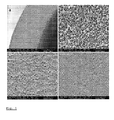
- Fig. 1
- shows SEM pictures of the cross section, the center of the cross section, the inner surface and the outer surface of an unmodified porous membrane suitable for use in the process of the invention;
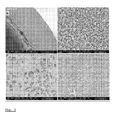
- Fig. 2
- shows SEM picture of the cross section, the center of the cross section, the inner surface and the outer surface of a composite membrane produced by the process of the invention;
- Fig. 3
- shows SEM pictures of the cross section, the center of the cross section, the inner surface and the outer surface of another composite membrane produced by the process of the invention.
- The process for preparing a composite porous membrane according to the invention comprises modifying a porous membrane with a membrane-forming hydrophilic polymer selected from the group consisting of cellulose, cellulose derivatives, and poly(vinyl alcohol-co-ethylene).
- The porous membrane can have any suitable geometry according to the needs of the intended use, e.g. it can take the form of a flat sheet, a hollow fiber, or be shaped to form chambers or other geometries needed.
- In a specific embodiment of the present invention, the porous membrane is a hollow fiber membrane. A hollow fiber membrane of the invention is further characterized by having an inner diameter of from 50 to 2,000 µm, preferably of from 50 to 1,000 µm, and more preferably from 100 to 500 µm. The wall thickness is generally from 3% to 30% of the external diameter, i.e. generally from 5 to 200 µm, for instance from 10 to 80 µm, or even from 20 to 70 µm.
- In another specific embodiment of the present invention, the porous membrane is a flat sheet membrane. The thickness of a flat sheet membrane according to the invention may vary between 10 µm and 200 µm. A thickness of 20 µm to 100 µm may be especially advantageous for most applications. Usually, several flat sheet membranes will be combined in the form of a stack to form a module for use in the present invention.
- The porous membrane is comprised of synthetic polymers selected from the group consisting of polysulfones (PSf); polyethersulfones (PES); polyvinylidene fluorides (PVDF); polyacrylonitriles (PAN); and blends of the individual polymers with polyvinylpyrrolidones. In one embodiment of the invention, the porous membrane is comprised of a blend of a polyethersulfone and at least one polyvinylpyrrolidone.
- The porous membrane has a homogeneous, "symmetrical type" structure, which is uniform throughout its thickness. The porous membrane is generally free of vacuoles (empty spaces included in the wall and having a largest dimension of more than about 5 microns). It does not possess a skin or a dense layer on either surface (in the case of hollow fibers, neither on the inside nor on the outside).
- The membrane-forming hydrophilic polymer used to modify the porous membrane is selected from the group consisting of cellulose, cellulose derivatives, and poly(vinyl alcohol-co-ethylene).
- The composite membrane of the invention shows a retention of gold nano-particles having 20 nm diameter (simulating porcine parvovirus), GPR (gold particle retention, defined as log(A/F), A/F being the ratio of the gold particle concentration in the feed and in the filtrate), of > 1.4, preferably > 1.7, more preferably > 2.0, in particular > 2.3. The GPR is proportional to the rate of retention of virus particles by the membrane. The membrane of the present invention can thus be advantageously used for the removal of virus particles from liquids.
- Examples of suitable types of cellulose for preparing the composite membrane of the invention include beech sulfite pulp or cotton linters. Examples of suitable cellulose derivatives include esters like cellulose acetate; water-insoluble alkyl ethers like ethylcellulose. Suitable poly(vinyl alcohol-co-ethylene)s are insoluble in water. In one embodiment of the invention, a poly(Vinyl alcohol-co-ethylene) containing 25 to 50 mol-% of ethylene units is used to modify the porous membrane. In one embodiment of the process, the poly(vinyl alcohol-co-ethylene) has a number average molecular weight of at least 10,000 g/mol.
- In one embodiment of the process, the pore space of the porous membrane is modified with the hydrophilic polymer. In another embodiment of the process, one or both surfaces of the porous membrane are modified with the hydrophilic polymer. In still another embodiment of the process, both the pore space and one or both surfaces of the porous membrane are modified with the hydrophilic polymer.
- In one embodiment of the process, the modification of the porous membrane is effected by precipitating the hydrophilic polymer from solution in the presence of the porous membrane.
- The solution of the hydrophilic polymer is prepared using a solvent which is able to dissolve the hydrophilic polymer but does not dissolve the porous membrane. When the porous membrane comprises polysulfone or polyethersulfone, suitable solvents include 1-propanol, 2-propanol and ionic liquids. In the case of PVDF, dimethyl sulfoxide additionally may be used. In addition to the organic solvents mentioned before, water may also be present in the solution.
- In one embodiment of the process, the solvent for the hydrophilic polymer comprises an ionic liquid. Suitable ionic liquids are disclosed in
WO 2003/029329 A2 andDE 10 2005 062 608 A1 , both incorporated herein by reference. In one embodiment of the invention, the ionic liquids comprise cations selected from 1-ethyl-3-methylimidazolium, 1,3-dimethylimidazolium and 1-butyl-3-methylimidazolium, and anions selected from halides, perchlorate, pseudohalides, sulfate, phosphate, alkyl phosphates and C1-C6 carboxylates. In another embodiment of the invention, the ionic liquids are selected from the group consisting of 1-ethyl-3-methylimidazol acetate, 1-allyl-3-methylimidazol chlorate, 1-allyl-3-methylimidazol acetate, and 1-butyl-3-methylimidazol acetate. In another embodiment, the ionic liquid comprises cations selected from methyl-tri-n-butylammonium, methylimidazolium, 1-ethyl-3-methylimidazolium, 1-butyl-3-methylimidazolium, 1-ethyl-2,3-dimethylimidazolium, 1,2,3-trimethylimidazolium, 1,2,4-trimethylpyrazolium, in particular 1-ethyl-3-methylimidazolium and 1-butyl-3-methylimidazolium; and anions selected from acetate, ethylsulfate, methylsulfate, thiocyanate, hydrogensulfate, tetrachloroaluminate, and chloride, in particular acetate. In a particular embodiment, the solvent comprises 1-ethyl-3-methylimidazolium acetate (EMIM OAc). - The concentration of the hydrophilic polymer in the solution generally is in the range of from 1 to 25 wt.-%, for instance 4 to 12 wt.-%. In one embodiment, the concentration of the hydrophilic polymer in the solution is 5 to 11 wt.-%.
- A commercially available solution of a hydrophilic polymer which can be used in the process is a 5 wt.-% solution of cellulose in 1-ethyl-3-methylimidazolium acetate, available from BASF Aktiengesellschaft under the trade name Cellionics™.
- In one embodiment of the process, a solution of the hydrophilic polymer is provided on one side of the porous membrane, and a precipitation liquid is provided on the other side of the porous membrane. The solution of the hydrophilic polymer and the precipitation liquid are then allowed to permeate through the porous membrane by diffusion and/or convection, and the hydrophilic polymer is precipitated onto the porous membrane, forming a coat within the pore channels and/or the surfaces of the porous membrane.
- In another embodiment of the process, the porous membrane is soaked with a solution of the hydrophilic polymer, excess solution is removed from the soaked membrane, and the membrane is subsequently contacted with the precipitation liquid from one side or from both sides. In an exemplary embodiment of the process involving a hollow fiber porous membrane, the lumen of the fiber is filled with a solution of the hydrophilic polymer. The fiber wall is soaked with the solution either by capillary action, or in cases where this is insufficient to completely fill the pore space of the fiber with the solution, by applying a pressure gradient between the lumen and the outside of the fiber. Excess solution is purged from the lumen of the fiber, e.g., using pressurized air. Precipitation of the hydrophilic polymer then is effected by applying the precipitation liquid to either or both sides of the membrane, i.e., by injecting precipitation liquid into the lumen of the fiber, by flushing the outside of the fiber with the precipitation liquid, by immersing the fiber into a bath containing the precipitation liquid, or by flushing the inside and the outside of the fiber with precipitation liquid.
- The precipitation liquid generally is water or a combination of water and a solvent for the hydrophilic polymer. The proportion of the solvent for the hydrophilic polymer in the precipitation liquid usually is in the range of from 0 to 90 wt%, for instance, from 20 to 70 wt%, e.g., from 40 to 60 wt%. In one embodiment of the process, the precipitation bath comprises water in an amount of from 40 to 50 wt.-%, and 1-ethyl-3-methylimidazolium acetate in an amount of from 50 to 60 wt.-%.
- The temperature of the precipitation liquid generally is in the range of from 0 to 50 °C. In many cases, ambient temperature will yield satisfactory results. Precipitation time can also be varied over a wide range. Normally, 5 to 30 minutes will be sufficient.
- After the precipitation has been completed, the composite membrane obtained usually is washed with de-ionized water and, optionally, dried. In another embodiment of the process, the washed composite membrane is treated with a pore stabilizer, preferably glycerol or a mixture of water and glycerol, in order to stabilize the pores, and can then be stored in a non-solvent.
- The hydraulic permeability of the composite membrane, measured at 37 °C, usually is in the range of from 10·10-4 to 500·10-4 cm3/(cm2·bar·sec), for instance from 15·10-4 to 250·10-4 cm3/(cm2·bar·sec).
- The composite membrane has a sieving coefficient for IgG in aqueous solution of at least 0.8, e.g. at least 0.9, and in particular 1.0. The composite membrane also shows a sieving coefficient of 1.0 for albumin.
- In one embodiment of the present invention, the composite membrane has a hydraulic permeability of from 10·10-4 to 500·10-4 cm3/(cm2·bar·sec), preferably of from 15·10-4 to 250·10-4 cm3/(cm2·bar·sec), a sieving coefficient for IgG of greater than 0.8 and a GPR of greater than 1.4, for instance greater than 1.7, e.g., greater than 2.0, or even greater than 2.3.
- The composite membrane can be used for separating virus particles from a liquid by filtration of the liquid through the membrane. In one embodiment of the invention, the filtration is normal-flow filtration (NFF), which is also called dead-ended or direct flow filtration. In another embodiment of the invention, the filtration is tangential-flow filtration (TFF).
- Thus, a further aspect of the present invention is a device for removing virus particles from liquids, i.e. a virus filter comprising the composite membrane produced by the process of the invention.
- The composite membrane used in the device can take the form of a sheet or a plurality of sheets, e.g. a stack of planar membranes. Alternatively, the membrane used in the device can take the form of a hollow fiber or a plurality of hollow fibers, e.g. a bundle of hollow fiber membranes. Suitable sheets and fibers, respectively, their properties and preparation have been described above.
- In one embodiment of the device, the membrane forms an interface between two fluid compartments of the device.
- An exemplary device comprises two compartments separated by a semipermeable membrane mounted in a casing, a first internal compartment fitted with two accesses and a second external compartment comprising one or two accesses, both compartments being also separated by a potting compound, based on an appropriate adhesive compound, intended for forming as applicable (i) a cylindrical partition separating both compartments of said device containing a semipermeable membrane of the hollow fiber bundle type as defined above or (ii) a tight seal in said device including a semipermeable membrane of the sheet membrane type as defined above.
- Another exemplary device comprises a plurality of hollow fiber membranes, contained within an outer shell, and configured so that fluid within a space external to the hollow fibers (i.e., an extracapillary compartment) is segregated from fluid passing through the hollow fibers and their corresponding orifices. Additionally, the device includes two manifold end chambers within the outer shell on opposite ends of the device. Each of the two orifices of the lumen of a hollow fiber connects to a different end chamber. The end chambers and the extracapillary compartment are separated by the semipermeable membranes of the hollow fibers.
- The membrane, the method, and the device of the invention can advantageously be used many processes in the biopharmaceutical industry which require removal of virus particles from a liquid.
- Mini-modules [= fiber bundles in a housing] are prepared by putting the fiber bundle in the mini-module housing and cutting them to a defined length of 20 cm. Then, the ends of the fibers are closed with a melting device. Then, the ends of the fiber bundle are potted with polyurethane. Subsequently, the ends of the fibers are cut open. The mini-modules ensure protection of the fibers.
- The number of fibers required is calculated for an effective surface A of 10 cm2 according to equation (1)

with - di = inner diameter of fiber [cm]
- n = amount of fibers
- 1 = effective fiber length [cm]
- The hydraulic permeability of a membrane bundle is determined by pressing an exact defined volume of water under pressure through the membrane bundle, which has been sealed on one side, and measuring the required time. The hydraulic permeability can be calculated from the determined time, the effective membrane surface area, the applied pressure and the volume of water pressed through the membrane. From the number of fibers, the fiber length as well as the inner diameter of the fiber, the effective membrane surface area is calculated. The membrane bundle has to be wetted thirty minutes before the Lp-test is performed. For this purpose, the membrane bundle is put in a box containing 500 ml of ultrapure water. After 30 minutes, the membrane bundle is transferred into the testing system. The testing system consists of a water bath that is maintained at 37 °C and a device where the membrane bundle can be implemented mechanically. The filling height of the water bath has to ensure that the membrane bundle is located underneath the water surface in the designated device. To avoid that a leakage of the membrane leads to a wrong test result, an integrity test of the membrane bundle and the test system has to be carried out in advance. The integrity test is performed by pressing air through the membrane bundle that is closed on one side of the bundle. Air bubbles indicate a leakage of the membrane bundle or the test device. It has to be checked if the leakage can be associated with the wrong implementation of the membrane bundle in the test device or if a real membrane leakage is present. The membrane bundle has to be discarded if a leakage of the membrane is detected. The applied pressure of the integrity test has to be at least the same value as the applied pressure during the determination of the hydraulic permeability in order to ensure, that no leakage can occur during the measurement of the hydraulic permeability because of a too high applied pressure.
- The sieving coefficient of IgG is determined by dead-end filtration of a solution of 2.5 g/l IgG in PBS buffer.
- The module is first washed with distilled water (10 ml at a flow rate of 0.04 to 1.5 ml/min).
- Then 100 ml of the IgG solution are filtered through the module at a flow rate of 0.7 ml/min.
- A sample of the ultrafiltrate is collected every 15 minutes and analyzed for IgG content using the UF-EW method.
- Overall filtration time is 2.5 hours.
- The module is flushed with distilled water and a volume of 30 mL distilled water is used. With the first 10 mL the blood side is flushed (flow adjusted for a pressure of 0.2-0.3 bar) and with the other 20 mL the filtrate side (dead-end filtration) is flushed. A flow is used that result in a pressure of 0.98 bar during the dead-end filtration procedure.
- A solution comprising gold particles having a diameter of approximately 20 nm (Plano) is diluted as follows: 100 mL of Plano solution is mixed with 203 mg of Polyoxyethylene β-naphtylether and 1227 mg of Poly(sodium 4-styrene-sulfonate homogeneously. The solution then is put in an ultrasonic bath for 15 minutes. This solution is pumped through the mini-module at a flow rate of 0.35 ml/min.
- The particle content in the feed and the filtrate is determined photometrically by measuring extinction at 530 nm, e.g. using a Ultrospec™ 3000 pro photometer.
- The GPR value is calculated according to equation (4)

with - A being the extinction of the feed solution;
- F being the extinction of the filtrate;
- A polymer solution was prepared by dissolving 25.0 wt-% polyethersulfone (PES; BASF Ultrason 6020), 3.0 wt-% high molecular weight polyvinylpyrrolidone (PVP; BASF K85) in 72 wt-% N-Methylpyrrolidone (NMP). The viscosity of the polymer solution at room temperature was 116,800 mPa x s.
- The term "viscosity" in respect of the polymer solution of the present invention means the dynamic viscosity, if not otherwise indicated. To measure the viscosity of the polymer solution, a commercial Rheometer from Anton Paar GmbH (MCR 101) was used. The polymer solution is placed between two temperature-controlled plates. The measurement is performed at 22 °C. All other measurement conditions are according to the manufacturer's instructions.
- To prepare the solution, NMP was placed in a three neck-flask with finger-paddle agitator in the centre neck. Then, the PVP was added to the NMP and stirred at 50 °C until a homogeneous clear solution was formed. Finally, the polyethersulfone (PES) was added. The mixture was stirred at 50 °C until a clear high viscous solution was obtained. The warm solution was cooled down to 20 °C and degassed. To fully degas the solution, the highly viscous polymer solution was transferred into a stainless steel container, the container was closed tightly and vacuum was applied to the container. The solution was degassed at 50 mmHg for 6 hours. During this degassing procedure, the container was moved to create a larger surface and thinner film thickness of the polymer solution in the container to improve the degassing procedure.
- To form a membrane, the polymer solution was kept at room temperature and passed through a spinning die into a precipitation bath As centre fluid a mixture of 30 wt% water and 70 wt% NMP was used. The temperature of the die was 25 °C. The hollow fiber membrane was formed at a spinning speed of 6 m/min. The liquid capillary leaving the die was passed into a precipitation bath consisting of 67 wt% NMP and 33 wt% water and having a temperature of 9 °C. The distance between the exit of the die and the precipitation bath was 1.5 cm. The formed hollow fiber membrane was guided through 5 different water baths having a temperature of 65 °C.
- The resulting hollow fiber membrane had an inner diameter of 341 µm, an outer diameter of 423 µm and a sponge like structure.
- After the winding of the fibers, they were rinsed to remove excessive solvent from the fibers. After the rinsing, the hollow fibers were dried with hot air flowing through the fiber bundle. Mini-modules comprising 7 fibers (corresponding to a membrane surface of about 10 cm2) were prepared as described above, having a Lp of 11.1·10-4 cm3/(cm2·bar·sec).
- SEM pictures of the membrane are shown in
Fig. 1 . Results of the measurement of the sieving coefficient (SC) for IgG are shown in Table 1. - An 8 wt.-% solution of poly(vinyl alcohol-co-ethylene) comprising 27 mol% ethylene, having a melt index of 3.9 g/10 min (210 °C) and a Tg of 72 °C (Sigma-Aldrich, Prod. No. 414077) in 1-ethyl-3-methylimidazolium acetate (Basionic® BC 01, BASF SE) was prepared. The solution had a viscosity of η = 8,200 mPa x s (22°C).
- The fibers of a mini module were filled with the solution by sucking the solution via a pressure gradient into the cross-section of the hollow fibers. Residual polymer solution was purged from the fibers by sparging with compressed air. A precipitation liquid comprising 50 wt% water and 50 wt% 1-ethyl-3-methylimidazolium acetate was injected into the mini-module on both sides of the fiber. After 30 minutes at room temperature, the precipitation liquid was removed and the fibers were washed with de-ionized water. The module had a Lp of 18.7·10-4 cm3/(cm2·bar·sec). SEM pictures of the membrane are shown in
Fig. 2 . Results of the measurement of the sieving coefficient (SC) for IgG are shown in Table 1. In comparison with the module of Example 1, the module comprising the composite fiber showed drastically lower IgG fouling.Table 1 Example Time [min] 15' 30' 45' 60' 75' 90' 105' 120' 1 Pressure [mmHg] 1455 2135 3041 End of the test SC [%] 94 96 96 2 Pressure [mmHg] 525 652 780 930 1125 1327 1500 1687 SC [%] 100 100 100 100 100 100 100 91 - Example 2 was repeated using a precipitation liquid comprising 40 wt% water and 60 wt% 1-ethyl-3-methylimidazolium acetate. The module had a Lp of 15.3.10-4 cm3/(cm2·bar·sec). SEM pictures of the membrane are shown in
Fig. 3 .
Claims (15)
- A process for preparing a composite porous membrane, comprising modifying a porous membrane comprised of synthetic polymers selected from the group consisting of polysulfones (PSf); polyethersulfones (PES); polyvinylidene fluorides (PVDF); polyacrylonitriles (PAN); and blends of the individual polymers with polyvinylpyrrolidones with a membrane-forming hydrophilic polymer selected from the group consisting of cellulose, cellulose derivatives, and poly(vinyl alcohol-co-ethylene).
- The process of claim 1, wherein the pore space of the porous membrane is modified with the hydrophilic polymer.
- The process of claim 1 or 2, wherein one or both surfaces of the porous membrane are modified with the hydrophilic polymer.
- The process of any one of claims 1 to 3, wherein the modification of the porous membrane is effected by precipitating the hydrophilic polymer from solution in the presence of the porous membrane.
- The process of claim 4, wherein the solution of the hydrophilic polymer comprises an ionic liquid.
- The process of claim 5, wherein the ionic liquid comprises cations selected from the group consisting of methyl-tri-n-butylammonium, methylimidazolium, 1-ethyl-3-methylimidazolium, 1-butyl-3-methylimidazolium, 1-ethyl-2,3-dimethylimidazolium, 1,2,3-trimethylimidazolium, and 1,2,4-trimethylpyrazolium, and anions selected from the group consisting of acetate, ethylsulfate, methylsulfate, thiocyanate, hydrogen sulfate, tetrachloroaluminate, and chloride.
- The process of claim 6, wherein the ionic liquid comprises 1-ethyl-3-methylimidazolium acetate.
- The process of any one of claims 4 to 7, wherein the solution of the hydrophilic polymer is provided on one side of the porous membrane, and a precipitation liquid is provided on the other side of the porous membrane.
- The process of any one of claims 4 to 7, wherein the pore space of the porous membrane is filled with the solution of the hydrophilic polymer and the porous membrane is subsequently contacted with a precipitation liquid from one side or from both sides.
- The process of any one of claims 1 to 9, wherein the porous membrane is a hollow fiber membrane.
- The process of any one of claims 1 to 9, wherein the porous membrane is a flat sheet membrane.
- The process of any one of claims 1 to 11, wherein the porous membrane has a GPR of greater than 1.4.
- A virus filter comprising a composite membrane prepared by the process of any one of claims 1 to 12.
- Use of the composite membrane prepared by the process of any one of claims 1 to 12 for removing virus particles from a liquid by filtration of the liquid through the membrane.
- Use according to claim 14, wherein the filtration is tangential-flow filtration (TFF).
Priority Applications (2)
| Application Number | Priority Date | Filing Date | Title |
|---|---|---|---|
| EP11174236A EP2545985A1 (en) | 2011-07-15 | 2011-07-15 | Composite membrane |
| PCT/EP2012/063521 WO2013010860A1 (en) | 2011-07-15 | 2012-07-11 | Composite membrane |
Applications Claiming Priority (1)
| Application Number | Priority Date | Filing Date | Title |
|---|---|---|---|
| EP11174236A EP2545985A1 (en) | 2011-07-15 | 2011-07-15 | Composite membrane |
Publications (1)
| Publication Number | Publication Date |
|---|---|
| EP2545985A1 true EP2545985A1 (en) | 2013-01-16 |
Family
ID=46506399
Family Applications (1)
| Application Number | Title | Priority Date | Filing Date |
|---|---|---|---|
| EP11174236A Withdrawn EP2545985A1 (en) | 2011-07-15 | 2011-07-15 | Composite membrane |
Country Status (2)
| Country | Link |
|---|---|
| EP (1) | EP2545985A1 (en) |
| WO (1) | WO2013010860A1 (en) |
Cited By (16)
| Publication number | Priority date | Publication date | Assignee | Title |
|---|---|---|---|---|
| CN104321133A (en) * | 2013-02-25 | 2015-01-28 | 甘布罗伦迪亚股份公司 | virus filter |
| CN104548962A (en) * | 2015-01-09 | 2015-04-29 | 王进 | Polyvinylidene fluoride hollow fiber ultra-filtration membrane and preparation method thereof |
| EP2881163A1 (en) * | 2013-12-05 | 2015-06-10 | Gambro Lundia AB | Composite membrane |
| CN104707487A (en) * | 2015-01-28 | 2015-06-17 | 复旦大学 | Polyionic liquid functionalized charged composite film and production method thereof |
| CN105013355A (en) * | 2015-06-30 | 2015-11-04 | 四川大学 | Heparan polyethersulfone hollow fiber membrane and preparation method and applications thereof |
| CN108159898A (en) * | 2015-12-11 | 2018-06-15 | 天津工业大学 | The method that thermally induced phase separation prepares polyacrylonitrile-radical microporous barrier |
| CN108752813A (en) * | 2018-05-25 | 2018-11-06 | 福州大学 | A kind of poly-dopamine/ionic liquid/plant fibre blending film and preparation method thereof |
| WO2018226466A1 (en) * | 2017-06-06 | 2018-12-13 | Uop Llc | Transport membranes for olefin/paraffin separations |
| CN109772182A (en) * | 2018-12-29 | 2019-05-21 | 清大国华环境集团股份有限公司 | A kind of preparation method of modified polyvinilidene fluoride film |
| US10328386B2 (en) | 2017-05-18 | 2019-06-25 | Uop Llc | Co-cast thin film composite flat sheet membranes for gas separations and olefin/paraffin separations |
| US10427997B2 (en) | 2017-12-27 | 2019-10-01 | Uop Llc | Modular membrane system and method for olefin separation |
| US10471381B2 (en) | 2016-06-09 | 2019-11-12 | Uop Llc | High selectivity facilitated transport membranes and their use for olefin/paraffin separations |
| CN110743392A (en) * | 2019-11-08 | 2020-02-04 | 杭州师范大学 | A PVDF hollow fiber membrane material that can be used for hemodialysis and has anticoagulant properties and its preparation method |
| CN111495207A (en) * | 2020-04-23 | 2020-08-07 | 北京赛诺膜技术有限公司 | Hydrophilic modification method of polymer ultrafiltration membrane |
| US10751670B2 (en) | 2017-08-24 | 2020-08-25 | Uop Llc | High selectivity facilitated transport membrane comprising polyethersulfone/polyethylene oxide-polysilsesquioxane blend membrane for olefin/paraffin separations |
| CN116036883A (en) * | 2022-12-28 | 2023-05-02 | 山东招金膜天股份有限公司 | Preparation method of fluoropolymer nanofiber-based composite nanofiltration membrane |
Families Citing this family (4)
| Publication number | Priority date | Publication date | Assignee | Title |
|---|---|---|---|---|
| WO2017004492A1 (en) * | 2015-07-01 | 2017-01-05 | 3M Innovative Properties Company | Pvp- and/or pvl-containing composite membranes and methods of use |
| JP6838819B2 (en) | 2015-07-01 | 2021-03-03 | スリーエム イノベイティブ プロパティズ カンパニー | Composite membranes with improved performance and / or durability and usage |
| WO2017004496A1 (en) | 2015-07-01 | 2017-01-05 | 3M Innovative Properties Company | Polymeric ionomer separation membranes and methods of use |
| CN107308822B (en) * | 2017-07-03 | 2020-02-14 | 青岛农业大学 | Method for analyzing dissolution kinetics of ultrafiltration membrane pore-forming agent |
Citations (6)
| Publication number | Priority date | Publication date | Assignee | Title |
|---|---|---|---|---|
| US5084173A (en) | 1985-05-27 | 1992-01-28 | Asahi Medical Co., Ltd. | Hydrophilic composite porous membrane, a method of producing the plasma separator |
| EP0665049A1 (en) * | 1994-01-26 | 1995-08-02 | Mitsubishi Rayon Co., Ltd. | Microporous membrane made of non-crystalline polymers and method of producing the same |
| WO2003029329A2 (en) | 2001-10-03 | 2003-04-10 | The University Of Alabama | Dissolution and processing of cellulose using ionic liquids |
| EP1775016A1 (en) * | 2005-10-14 | 2007-04-18 | Millipore Corporation | Ultrafiltration membranes rendered hydrophilic by hydroxyalkyl cellulose and method of making and use of such membranes |
| DE102005062608A1 (en) | 2005-12-23 | 2007-07-05 | Basf Ag | Solution system based on molten ionic liquid e.g. imidazolium salt for dissolving carbohydrate e.g. starch, cellulose or derivative and regeneration e.g. for fiber production also contains water and/or other protic solvent |
| EP2199319A1 (en) * | 2008-12-19 | 2010-06-23 | Gambro Lundia AB | Virus filter |
Family Cites Families (1)
| Publication number | Priority date | Publication date | Assignee | Title |
|---|---|---|---|---|
| US9393529B2 (en) * | 2008-06-30 | 2016-07-19 | 3M Innovative Properties Company | Method of forming a hydrophilic membrane |
-
2011
- 2011-07-15 EP EP11174236A patent/EP2545985A1/en not_active Withdrawn
-
2012
- 2012-07-11 WO PCT/EP2012/063521 patent/WO2013010860A1/en not_active Ceased
Patent Citations (6)
| Publication number | Priority date | Publication date | Assignee | Title |
|---|---|---|---|---|
| US5084173A (en) | 1985-05-27 | 1992-01-28 | Asahi Medical Co., Ltd. | Hydrophilic composite porous membrane, a method of producing the plasma separator |
| EP0665049A1 (en) * | 1994-01-26 | 1995-08-02 | Mitsubishi Rayon Co., Ltd. | Microporous membrane made of non-crystalline polymers and method of producing the same |
| WO2003029329A2 (en) | 2001-10-03 | 2003-04-10 | The University Of Alabama | Dissolution and processing of cellulose using ionic liquids |
| EP1775016A1 (en) * | 2005-10-14 | 2007-04-18 | Millipore Corporation | Ultrafiltration membranes rendered hydrophilic by hydroxyalkyl cellulose and method of making and use of such membranes |
| DE102005062608A1 (en) | 2005-12-23 | 2007-07-05 | Basf Ag | Solution system based on molten ionic liquid e.g. imidazolium salt for dissolving carbohydrate e.g. starch, cellulose or derivative and regeneration e.g. for fiber production also contains water and/or other protic solvent |
| EP2199319A1 (en) * | 2008-12-19 | 2010-06-23 | Gambro Lundia AB | Virus filter |
Cited By (28)
| Publication number | Priority date | Publication date | Assignee | Title |
|---|---|---|---|---|
| CN104321133A (en) * | 2013-02-25 | 2015-01-28 | 甘布罗伦迪亚股份公司 | virus filter |
| US20150367291A1 (en) * | 2013-02-25 | 2015-12-24 | Gambro Lundia Ab | Virus filter |
| CN104321133B (en) * | 2013-02-25 | 2017-03-08 | 甘布罗伦迪亚股份公司 | Virus filter |
| US10005044B2 (en) * | 2013-02-25 | 2018-06-26 | Gambro Lundia Ab | Virus filter |
| EP2881163A1 (en) * | 2013-12-05 | 2015-06-10 | Gambro Lundia AB | Composite membrane |
| CN104548962A (en) * | 2015-01-09 | 2015-04-29 | 王进 | Polyvinylidene fluoride hollow fiber ultra-filtration membrane and preparation method thereof |
| CN104707487A (en) * | 2015-01-28 | 2015-06-17 | 复旦大学 | Polyionic liquid functionalized charged composite film and production method thereof |
| CN104707487B (en) * | 2015-01-28 | 2017-03-01 | 复旦大学 | Charged composite membrane of a kind of poly ion liquid functionalization and preparation method thereof |
| CN105013355A (en) * | 2015-06-30 | 2015-11-04 | 四川大学 | Heparan polyethersulfone hollow fiber membrane and preparation method and applications thereof |
| CN105013355B (en) * | 2015-06-30 | 2017-06-16 | 四川大学 | Heparan polyether sulphone hollow fibre film and preparation method thereof and purposes |
| CN108159898A (en) * | 2015-12-11 | 2018-06-15 | 天津工业大学 | The method that thermally induced phase separation prepares polyacrylonitrile-radical microporous barrier |
| US10471381B2 (en) | 2016-06-09 | 2019-11-12 | Uop Llc | High selectivity facilitated transport membranes and their use for olefin/paraffin separations |
| US10328386B2 (en) | 2017-05-18 | 2019-06-25 | Uop Llc | Co-cast thin film composite flat sheet membranes for gas separations and olefin/paraffin separations |
| CN110719809A (en) * | 2017-06-06 | 2020-01-21 | 环球油品有限责任公司 | Transport membrane for olefin/paraffin separation |
| WO2018226466A1 (en) * | 2017-06-06 | 2018-12-13 | Uop Llc | Transport membranes for olefin/paraffin separations |
| CN110719809B (en) * | 2017-06-06 | 2022-03-04 | 环球油品有限责任公司 | Transport membrane for olefin/paraffin separation |
| US10569233B2 (en) | 2017-06-06 | 2020-02-25 | Uop Llc | High permeance and high selectivity facilitated transport membranes for olefin/paraffin separations |
| US10751670B2 (en) | 2017-08-24 | 2020-08-25 | Uop Llc | High selectivity facilitated transport membrane comprising polyethersulfone/polyethylene oxide-polysilsesquioxane blend membrane for olefin/paraffin separations |
| US10427997B2 (en) | 2017-12-27 | 2019-10-01 | Uop Llc | Modular membrane system and method for olefin separation |
| CN108752813A (en) * | 2018-05-25 | 2018-11-06 | 福州大学 | A kind of poly-dopamine/ionic liquid/plant fibre blending film and preparation method thereof |
| CN108752813B (en) * | 2018-05-25 | 2020-08-07 | 福州大学 | A kind of polydopamine/ionic liquid/plant fiber blend film and preparation method thereof |
| CN109772182A (en) * | 2018-12-29 | 2019-05-21 | 清大国华环境集团股份有限公司 | A kind of preparation method of modified polyvinilidene fluoride film |
| CN109772182B (en) * | 2018-12-29 | 2021-11-26 | 清大国华环境集团股份有限公司 | Preparation method of modified polyvinylidene fluoride membrane |
| CN110743392A (en) * | 2019-11-08 | 2020-02-04 | 杭州师范大学 | A PVDF hollow fiber membrane material that can be used for hemodialysis and has anticoagulant properties and its preparation method |
| CN110743392B (en) * | 2019-11-08 | 2022-10-18 | 杭州师范大学 | PVDF hollow fiber membrane material with anticoagulation property for hemodialysis and preparation method thereof |
| CN111495207A (en) * | 2020-04-23 | 2020-08-07 | 北京赛诺膜技术有限公司 | Hydrophilic modification method of polymer ultrafiltration membrane |
| CN116036883A (en) * | 2022-12-28 | 2023-05-02 | 山东招金膜天股份有限公司 | Preparation method of fluoropolymer nanofiber-based composite nanofiltration membrane |
| CN116036883B (en) * | 2022-12-28 | 2023-06-30 | 山东招金膜天股份有限公司 | Preparation method of fluoropolymer nanofiber-based composite nanofiltration membrane |
Also Published As
| Publication number | Publication date |
|---|---|
| WO2013010860A1 (en) | 2013-01-24 |
Similar Documents
| Publication | Publication Date | Title |
|---|---|---|
| WO2013010860A1 (en) | Composite membrane | |
| EP2253367B1 (en) | Membranes having improved performance | |
| US8596467B2 (en) | Hollow fiber membrane and method for manufacturing thereof | |
| EP2822676B1 (en) | Low cut-off ultrafiltration membranes | |
| EP1875957B1 (en) | Plasma separation membrane | |
| EP2253370B1 (en) | Hollow fibre membranes having improved performance | |
| EP3237100B1 (en) | Online drying of hollow fiber membranes | |
| CN113856495A (en) | Asymmetric polyether sulfone filter membrane for virus removal and preparation method thereof | |
| US8840788B2 (en) | Hollow fiber membrane, method for manufacturing the same, and blood purification module | |
| EP2199319A1 (en) | Virus filter | |
| EP2253369B1 (en) | Membranes having improved performance | |
| JP4725524B2 (en) | Cellulose acetate asymmetric hollow fiber membrane | |
| EP2881163A1 (en) | Composite membrane | |
| EP1875956B1 (en) | Plasma separation membrane | |
| EP2545984A1 (en) | Composite membrane | |
| US10005044B2 (en) | Virus filter | |
| EP2253368B1 (en) | Membranes having improved performance | |
| EP4635611A1 (en) | Porous membrane and purification method | |
| Schweiger | 19, United States i, Patent Application Publication |
Legal Events
| Date | Code | Title | Description |
|---|---|---|---|
| PUAI | Public reference made under article 153(3) epc to a published international application that has entered the european phase |
Free format text: ORIGINAL CODE: 0009012 |
|
| AK | Designated contracting states |
Kind code of ref document: A1 Designated state(s): AL AT BE BG CH CY CZ DE DK EE ES FI FR GB GR HR HU IE IS IT LI LT LU LV MC MK MT NL NO PL PT RO RS SE SI SK SM TR |
|
| AX | Request for extension of the european patent |
Extension state: BA ME |
|
| STAA | Information on the status of an ep patent application or granted ep patent |
Free format text: STATUS: THE APPLICATION IS DEEMED TO BE WITHDRAWN |
|
| 18D | Application deemed to be withdrawn |
Effective date: 20130717 |