EP2545006B1 - Removal of selenium from refinery wastewater - Google Patents
Removal of selenium from refinery wastewater Download PDFInfo
- Publication number
- EP2545006B1 EP2545006B1 EP11753993.2A EP11753993A EP2545006B1 EP 2545006 B1 EP2545006 B1 EP 2545006B1 EP 11753993 A EP11753993 A EP 11753993A EP 2545006 B1 EP2545006 B1 EP 2545006B1
- Authority
- EP
- European Patent Office
- Prior art keywords
- liquid
- selenium
- ferric
- water
- dithiocarbamate
- Prior art date
- Legal status (The legal status is an assumption and is not a legal conclusion. Google has not performed a legal analysis and makes no representation as to the accuracy of the status listed.)
- Active
Links
Images
Classifications
-
- C—CHEMISTRY; METALLURGY
- C02—TREATMENT OF WATER, WASTE WATER, SEWAGE, OR SLUDGE
- C02F—TREATMENT OF WATER, WASTE WATER, SEWAGE, OR SLUDGE
- C02F9/00—Multistage treatment of water, waste water or sewage
-
- C—CHEMISTRY; METALLURGY
- C02—TREATMENT OF WATER, WASTE WATER, SEWAGE, OR SLUDGE
- C02F—TREATMENT OF WATER, WASTE WATER, SEWAGE, OR SLUDGE
- C02F1/00—Treatment of water, waste water, or sewage
- C02F1/52—Treatment of water, waste water, or sewage by flocculation or precipitation of suspended impurities
-
- C—CHEMISTRY; METALLURGY
- C02—TREATMENT OF WATER, WASTE WATER, SEWAGE, OR SLUDGE
- C02F—TREATMENT OF WATER, WASTE WATER, SEWAGE, OR SLUDGE
- C02F1/00—Treatment of water, waste water, or sewage
- C02F1/52—Treatment of water, waste water, or sewage by flocculation or precipitation of suspended impurities
- C02F1/5236—Treatment of water, waste water, or sewage by flocculation or precipitation of suspended impurities using inorganic agents
-
- C—CHEMISTRY; METALLURGY
- C02—TREATMENT OF WATER, WASTE WATER, SEWAGE, OR SLUDGE
- C02F—TREATMENT OF WATER, WASTE WATER, SEWAGE, OR SLUDGE
- C02F1/00—Treatment of water, waste water, or sewage
- C02F1/52—Treatment of water, waste water, or sewage by flocculation or precipitation of suspended impurities
- C02F1/5236—Treatment of water, waste water, or sewage by flocculation or precipitation of suspended impurities using inorganic agents
- C02F1/5245—Treatment of water, waste water, or sewage by flocculation or precipitation of suspended impurities using inorganic agents using basic salts, e.g. of aluminium and iron
-
- C—CHEMISTRY; METALLURGY
- C02—TREATMENT OF WATER, WASTE WATER, SEWAGE, OR SLUDGE
- C02F—TREATMENT OF WATER, WASTE WATER, SEWAGE, OR SLUDGE
- C02F1/00—Treatment of water, waste water, or sewage
- C02F1/58—Treatment of water, waste water, or sewage by removing specified dissolved compounds
-
- C—CHEMISTRY; METALLURGY
- C02—TREATMENT OF WATER, WASTE WATER, SEWAGE, OR SLUDGE
- C02F—TREATMENT OF WATER, WASTE WATER, SEWAGE, OR SLUDGE
- C02F1/00—Treatment of water, waste water, or sewage
- C02F1/58—Treatment of water, waste water, or sewage by removing specified dissolved compounds
- C02F1/62—Heavy metal compounds
-
- C—CHEMISTRY; METALLURGY
- C02—TREATMENT OF WATER, WASTE WATER, SEWAGE, OR SLUDGE
- C02F—TREATMENT OF WATER, WASTE WATER, SEWAGE, OR SLUDGE
- C02F1/00—Treatment of water, waste water, or sewage
- C02F1/66—Treatment of water, waste water, or sewage by neutralisation; pH adjustment
-
- C—CHEMISTRY; METALLURGY
- C02—TREATMENT OF WATER, WASTE WATER, SEWAGE, OR SLUDGE
- C02F—TREATMENT OF WATER, WASTE WATER, SEWAGE, OR SLUDGE
- C02F1/00—Treatment of water, waste water, or sewage
- C02F1/72—Treatment of water, waste water, or sewage by oxidation
-
- C—CHEMISTRY; METALLURGY
- C02—TREATMENT OF WATER, WASTE WATER, SEWAGE, OR SLUDGE
- C02F—TREATMENT OF WATER, WASTE WATER, SEWAGE, OR SLUDGE
- C02F1/00—Treatment of water, waste water, or sewage
- C02F1/72—Treatment of water, waste water, or sewage by oxidation
- C02F1/76—Treatment of water, waste water, or sewage by oxidation with halogens or compounds of halogens
-
- C—CHEMISTRY; METALLURGY
- C02—TREATMENT OF WATER, WASTE WATER, SEWAGE, OR SLUDGE
- C02F—TREATMENT OF WATER, WASTE WATER, SEWAGE, OR SLUDGE
- C02F1/00—Treatment of water, waste water, or sewage
- C02F1/72—Treatment of water, waste water, or sewage by oxidation
- C02F1/722—Oxidation by peroxides
-
- C—CHEMISTRY; METALLURGY
- C02—TREATMENT OF WATER, WASTE WATER, SEWAGE, OR SLUDGE
- C02F—TREATMENT OF WATER, WASTE WATER, SEWAGE, OR SLUDGE
- C02F1/00—Treatment of water, waste water, or sewage
- C02F1/72—Treatment of water, waste water, or sewage by oxidation
- C02F1/78—Treatment of water, waste water, or sewage by oxidation with ozone
-
- C—CHEMISTRY; METALLURGY
- C02—TREATMENT OF WATER, WASTE WATER, SEWAGE, OR SLUDGE
- C02F—TREATMENT OF WATER, WASTE WATER, SEWAGE, OR SLUDGE
- C02F2101/00—Nature of the contaminant
- C02F2101/10—Inorganic compounds
- C02F2101/20—Heavy metals or heavy metal compounds
-
- C—CHEMISTRY; METALLURGY
- C02—TREATMENT OF WATER, WASTE WATER, SEWAGE, OR SLUDGE
- C02F—TREATMENT OF WATER, WASTE WATER, SEWAGE, OR SLUDGE
- C02F2103/00—Nature of the water, waste water, sewage or sludge to be treated
- C02F2103/18—Nature of the water, waste water, sewage or sludge to be treated from the purification of gaseous effluents
Definitions
- This invention relates to a method of removing selenium from a liquid.
- Selenium compounds are reported to comprise 0.9 ppm of the earth's crust.
- Selenium is an important as a trace mineral used to make the enzyme glutathione peroxidase, which is involved in fat metabolism and therefore is found in many living organisms. It is commonly found in various amounts in crude oil, coal, and other fossil fuels originating from the decomposed organic matter or leached out of the nearby minerals.
- Selenium compounds are also found naturally in ground waters and in agricultural runoffs from the use of selenium containing insecticides and herbicides.
- selenium is known to be highly toxic and it can cause harm even in small quantities. Harmful effects include dermatitis, central nervous system disturbance, nephrosis, hemorrhagic necrosis of the pancreas and adrenal cortex, and when in large enough dosages, death. As a result, many localities have limited the permissible amount of selenium in domestic supplies of water at 10 ppb. As a result, wastewater produced from activity involving selenium-containing materials is difficult to dispose of. In addition, because of its toxicity, even these strict standards may be uniformly further limited in the future.
- the invention is directed towards a method of removing selenium from a liquid according to claim 1.
- the liquid may be water.
- the water may be sour stripper water.
- the pH may be lowered by the addition of sulfuric acid, HCl, H 3 PO 4 , and any combination thereof.
- the ferric salt may be selected from the group consisting of ferric sulfate, ferric chloride, ferrous sulfate, ferrous chloride, and any combination thereof.
- the ferric salt is added in an amount of between 1-300 ppm.
- the dithiocarbamate material may be between 50% to 300% of the amount (in ppm) of ferric salt added to the liquid.
- the method may comprise adding a sulfur bearing coagulant to the liquid.
- the method may reduce the amount of selenium in the liquid from more than 1000 ppb to less than 40 ppb.
- the oxidant may be selected from the list consisting of hydrogen peroxide, ozone, KMnO 4 , NaClO, ClO 2 , peracetic acid, sodium percarbonate, carbamide peroxide, sodium persulfate, and any combination thereof.
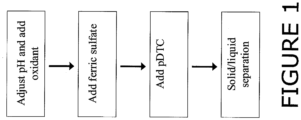
- FIG. 1 is a flowchart illustrating one embodiment of the inventive method.
- selenium is removed from a selenium containing liquid by a method comprising the steps of:
- the oxidant is selected from the list consisting of hydrogen peroxide ozone, KMnO 4 , NaClO, ClO 2 , peracetic acid, sodium percarbonate, carbamide peroxide, sodium persulfate, and any combination thereof.
- the pH is lowered by the addition of an acid selected from the list consisting of sulfuric acid HCl, H 3 PO 4 , and any combination thereof.
- the ferric salt is selected from the group consisting of ferric sulfate, ferric chloride, ferrous sulfate, ferrous chloride, and any combination thereof. The ferric salt is added in an amount of between 1-300 ppm.
- the pH, pE, voltage potential, and SHE standard hydrogen electrode
- the pH, pE, voltage potential, and SHE standard hydrogen electrode
- SHE standard hydrogen electrode
- the water is stripper sour water from an oil refinery.
- the selenium removal is a particular accomplishment as the repeated passage of the sour water through a distillation column results in an ever-increasing concentration of selenium in the sour water.
- sour stripper water is generally highly reducing so most of the selenium is in the form of selenite, selenocyanates and other organic selenium species. Successive experimentation has shown that the inventive method effectively removes more than 95% of the selenium in stripper sour water.
- the ratio of iron material to PDTC is important and must be tuned for each water source.
- the ratio of iron material to PDTC is 1:4 mols of iron sulfate to mols of dithiocarbamate functional groups (using a 10% actives iron sulfate solution).
- the ratio of iron material to PDTC is 1:2. The ideal range falls between the two examples and is entirely water dependant.
- the above methods are performed using DTC in the place of PDTC.
Landscapes
- Chemical & Material Sciences (AREA)
- Life Sciences & Earth Sciences (AREA)
- Hydrology & Water Resources (AREA)
- Engineering & Computer Science (AREA)
- Environmental & Geological Engineering (AREA)
- Water Supply & Treatment (AREA)
- Organic Chemistry (AREA)
- Inorganic Chemistry (AREA)
- Removal Of Specific Substances (AREA)
- Treatment Of Water By Oxidation Or Reduction (AREA)
- Separation Of Suspended Particles By Flocculating Agents (AREA)
- Paper (AREA)
Description
- This invention relates to a method of removing selenium from a liquid. Selenium compounds are reported to comprise 0.9 ppm of the earth's crust. Selenium is an important as a trace mineral used to make the enzyme glutathione peroxidase, which is involved in fat metabolism and therefore is found in many living organisms. It is commonly found in various amounts in crude oil, coal, and other fossil fuels originating from the decomposed organic matter or leached out of the nearby minerals. Selenium compounds are also found naturally in ground waters and in agricultural runoffs from the use of selenium containing insecticides and herbicides.
- Unfortunately, selenium is known to be highly toxic and it can cause harm even in small quantities. Harmful effects include dermatitis, central nervous system disturbance, nephrosis, hemorrhagic necrosis of the pancreas and adrenal cortex, and when in large enough dosages, death. As a result, many localities have limited the permissible amount of selenium in domestic supplies of water at 10 ppb. As a result, wastewater produced from activity involving selenium-containing materials is difficult to dispose of. In addition, because of its toxicity, even these strict standards may be uniformly further limited in the future.
- The chemical properties of selenium however make its removal from solutions difficult and complex. Although insoluble when in its elemental state, selenium has four oxidation states (-2, +2, +4, and +6), which allows it to readily form a number of compounds that are highly soluble and therefore very hard to remove from solution. (See Kapoor et al., Removal of Selenium from Water and Wastewater, Environmental Studies, Vol. 49, pp. 137-147 (1995)). As a result, prior art removal methods have been either disappointing or in some cases mostly ineffective. One prior art method, described in
US Patent 7,419,602 involves the use of a ferric salt, pH adjustment, and an oxidant but in practice is less than 70% effective. Another method described inUS Patent 5,510,040 describes a method using poly dithiocarbamate materials which while more effective also involves considerable expense. - Thus there is a clear need for and utility in an improved method of removing selenium from solution.
- The invention is directed towards a method of removing selenium from a liquid according to claim 1. The liquid may be water. The water may be sour stripper water. The pH may be lowered by the addition of sulfuric acid, HCl, H3PO4, and any combination thereof. The ferric salt may be selected from the group consisting of ferric sulfate, ferric chloride, ferrous sulfate, ferrous chloride, and any combination thereof. The ferric salt is added in an amount of between 1-300 ppm. The dithiocarbamate material may be between 50% to 300% of the amount (in ppm) of ferric salt added to the liquid.
- The method may comprise adding a sulfur bearing coagulant to the liquid. The method may reduce the amount of selenium in the liquid from more than 1000 ppb to less than 40 ppb. The oxidant may be selected from the list consisting of hydrogen peroxide, ozone, KMnO4, NaClO, ClO2, peracetic acid, sodium percarbonate, carbamide peroxide, sodium persulfate, and any combination thereof.
- A detailed description of the invention is hereafter described with specific reference being made to the drawings in which:
FIG. 1 is a flowchart illustrating one embodiment of the inventive method. - For purposes of this application the definition of these terms is as follows:
- "PDTC" means poly dithiocarbamate which includes all forms of polymers which have dithiocarbamate functional groups present.
- "DTC" means dithiocarbamate.
- "Selenite" means a selenium bearing composition of matter having a chemical formula of HSeO3 -.
- "Sour Water" means a liquid waste product produced as a byproduct of chemical, and more typically petrochemical, processing.
- "Stripping" refers to a process that removes byproducts, such as ammonia and hydrogen sulfide, along with a portion of water from a liquid stream. Stripping is commonly performed in a distillation column in which the liquid stream flows down the column and gas flows up the column to "strip" off contaminants from the liquid.
- "Stripper Sour Water" means sour water that has been run through a stripper process.
- "Wastewater" means water generated from any industrial plant or industrial process the byproducts therefrom.
- In the event that the above definitions or a definition stated elsewhere in this application is inconsistent with a meaning (explicit or implicit) which is commonly used or in a dictionary, the application and the claim terms in particular are understood to be construed according to the definition in this application, and not according to the common definition or dictionary definition.
- According to the invention selenium is removed from a selenium containing liquid by a method comprising the steps of:
- adding an oxidant to the liquid,
- adjusting the liquid's pH to the range of 6 to 7,
- adding ferric salt in an amount of between 1 to 300 ppm such that less than a quarter of selenium in the liquid precipitates, and
- adding a poly dithiocarbamate material comprising dithiocarbamate functional groups to the liquid in an amount such that the molar ratio of ferric salt to dithiocarbamate functional groups is in the range of 1:4 to 1:2.
- In at least one embodiment, the oxidant is selected from the list consisting of hydrogen peroxide ozone, KMnO4, NaClO, ClO2, peracetic acid, sodium percarbonate, carbamide peroxide, sodium persulfate, and any combination thereof. In at least one embodiment the pH is lowered by the addition of an acid selected from the list consisting of sulfuric acid HCl, H3PO4, and any combination thereof. In at least one embodiment the ferric salt is selected from the group consisting of ferric sulfate, ferric chloride, ferrous sulfate, ferrous chloride, and any combination thereof. The ferric salt is added in an amount of between 1-300 ppm.
- Without being limited to theory it is believed that the oxidizing and pH environment cause the selenium to convert into selenite which in turn forms a complex with the ferric salts that are efficiently coagulated by the poly dithiocarbamate material and removed from solution. Limiting the drop in pH prevents the selenium from forming other compounds that would be harder to remove. By forcing the SeO3 2- to convert into HSeO3 -selenite facilitates the best conditions for the ferric ions to bind with selenium and therefore smaller amounts of ferric ions can be used. The use of PDTC precipitates the ferric-selenite adduct which can be efficiently separated from solution. In contrast, the prior art depended on co-precipitation methods at higher pH (>8) that only operate with high concentrations of ferric ion. This co-precipitation method depends on using an excess of hydrolyzed iron-oxide material to absorb a relatively small amount of Se containing material.
- In at least one embodiment the pH, pE, voltage potential, and SHE (standard hydrogen electrode) (in volts) are modulated to conform with the conditions described in the textbook Pourbaix, M. Atlas of Electro Chemical Equilibria in Aqueous Solutions, NACE Cebelcor (1974) and in particular pp. 554-559, (Translated from French by James A. Franklin) as being optimal for the formation and maintenance of the selenium in the form of selenite.
- In at least one embodiment the water is stripper sour water from an oil refinery. In these embodiments the selenium removal is a particular accomplishment as the repeated passage of the sour water through a distillation column results in an ever-increasing concentration of selenium in the sour water. In addition, sour stripper water is generally highly reducing so most of the selenium is in the form of selenite, selenocyanates and other organic selenium species. Successive experimentation has shown that the inventive method effectively removes more than 95% of the selenium in stripper sour water.
- The ratio of iron material to PDTC is important and must be tuned for each water source. In at least one embodiment, the ratio of iron material to PDTC is 1:4 mols of iron sulfate to mols of dithiocarbamate functional groups (using a 10% actives iron sulfate solution). In another embodiment, the ratio of iron material to PDTC is 1:2. The ideal range falls between the two examples and is entirely water dependant.
- In a number of alternate embodiments, the above methods are performed using DTC in the place of PDTC.
- The foregoing may be better understood by reference to the following examples:
Numerous samples of stripper sour water were obtained from a refinery. These samples contained large amounts of selenium. The samples were then treated according to prior art and the inventive methods of removing selenium. The remaining water then underwent elemental analysis using an Inductively Coupled Plasma technique to determine how much selenium remained in the samples.Table 1: Comparative study of selenium removal methods from sour waste water Run# Test Liquid pH Oxidant (ppm) Ferric Sulfate (ppm) PDTC (ppm) Residual Se (ppb) Comments 1 Untreated Water ? 0 0 0 1400 - 2 Treated Water 6 0 500 200 1100 Not Very Effective 3 Treated Water 6 500 0 500 270 - 4 Treated Water 6 500 200 500 40 Good Treatment 5 Treated Water 7 500 200 200 30 Good Treatment - The data shows that the most effective application of this process occurs in the pH range 6-7 which is where there is a majority of HSeO3 - (selenite). This form is more easily complexable with the ferric ion and ultimately PDTCB. This aggregate forms large floe particles, which can be separated by some solid-liquid separation method. Typically refinery wastewater has a pH of >7 and thus needs to be adjusted lower through the addition of acid.
Claims (7)
- A method of removing selenium from a liquid comprising the steps of:adding an oxidant to the liquid,adjusting the liquid's pH to the range of 6 to 7,adding ferric salt in an amount of between 1 to 300 ppm such that less than a quarter of selenium in the liquid precipitates, andadding a poly dithiocarbamate material comprising dithiocarbamate functional groups to the liquid in an amount such that the molar ratio of ferric salt to dithiocarbamate functional groups is in the range of 1:4 to 1:2.
- The method of claim 1 in which the liquid is water , preferably sour stripper water.
- The method of claim 1 in which the pH is lowered by the addition of sulfuric acid HCl, H3PO4, and any combination thereof.
- The method of claim 1 in which the ferric salt is selected from the group consisting of ferric sulfate, ferric chloride, ferrous sulfate, ferrous chloride, and any combination thereof.
- The method of claim 1 in which the method further comprises adding a coagulant to the liquid.
- The method of claim 1 in which the method comprises adding a sulfur bearing coagulant to the liquid.
- The method of claim 1 in which the oxidant is selected from the list consisting of hydrogen peroxide ozone, KMnO4, NaClO, ClO2, peracetic acid, sodium percarbonate, carbamide peroxide, sodium persulfate, and any combination thereof.
Applications Claiming Priority (2)
| Application Number | Priority Date | Filing Date | Title |
|---|---|---|---|
| US12/721,139 US8282835B2 (en) | 2010-03-10 | 2010-03-10 | Removal of selenium from refinery wastewater |
| PCT/US2011/027711 WO2011112693A2 (en) | 2010-03-10 | 2011-03-09 | Removal of selenium from refinery wastewater |
Publications (4)
| Publication Number | Publication Date |
|---|---|
| EP2545006A2 EP2545006A2 (en) | 2013-01-16 |
| EP2545006A4 EP2545006A4 (en) | 2014-12-31 |
| EP2545006B1 true EP2545006B1 (en) | 2025-03-19 |
| EP2545006C0 EP2545006C0 (en) | 2025-03-19 |
Family
ID=44558954
Family Applications (1)
| Application Number | Title | Priority Date | Filing Date |
|---|---|---|---|
| EP11753993.2A Active EP2545006B1 (en) | 2010-03-10 | 2011-03-09 | Removal of selenium from refinery wastewater |
Country Status (15)
| Country | Link |
|---|---|
| US (1) | US8282835B2 (en) |
| EP (1) | EP2545006B1 (en) |
| JP (1) | JP5791639B2 (en) |
| KR (1) | KR101818954B1 (en) |
| CN (1) | CN102791638B (en) |
| AR (1) | AR080392A1 (en) |
| AU (1) | AU2011224425B2 (en) |
| BR (1) | BR112012022753B1 (en) |
| CA (1) | CA2792614C (en) |
| MX (1) | MX2012010442A (en) |
| NZ (1) | NZ602343A (en) |
| SG (1) | SG183994A1 (en) |
| TW (1) | TWI561477B (en) |
| WO (1) | WO2011112693A2 (en) |
| ZA (1) | ZA201206877B (en) |
Families Citing this family (17)
| Publication number | Priority date | Publication date | Assignee | Title |
|---|---|---|---|---|
| CN104053489B (en) * | 2012-02-06 | 2016-06-08 | 纳尔科公司 | Corrosion Control and Selenium Removal in Flue Gas Wet Scrubber Systems |
| CN105246839A (en) * | 2013-06-28 | 2016-01-13 | 三菱重工机电系统株式会社 | Selenium removal method and selenium removal device |
| WO2015048907A1 (en) | 2013-10-04 | 2015-04-09 | Bioteq Environmental Technologies Inc. | Removal of dissolved selenium from aqueous solutions |
| JP6204146B2 (en) | 2013-10-16 | 2017-09-27 | 三菱重工業株式会社 | Waste water treatment method and waste water treatment equipment |
| CN104556540B (en) * | 2013-10-22 | 2016-11-16 | 中国石油化工股份有限公司 | A kind of processing method of selenium-containing wastewater |
| CN104556543B (en) * | 2013-10-29 | 2017-02-08 | 中国石油化工股份有限公司 | Treatment method of selenium-containing wastewater |
| WO2015069403A1 (en) * | 2013-11-11 | 2015-05-14 | Nalco Company | Method of heavy metal removal from waste water streams |
| CN105712569B (en) * | 2014-12-05 | 2018-04-10 | 中国石油化工股份有限公司 | A kind of deep treatment method of selenium-containing wastewater |
| US11535537B2 (en) | 2015-01-06 | 2022-12-27 | Ecolab Usa Inc. | Process for removal of selenium from water by dithionite ions |
| CA3002594A1 (en) * | 2015-10-21 | 2017-04-27 | The Texas A&M University System | Method for removal of recalcitrant selenium species from wastewater |
| EP3365101A4 (en) | 2015-10-21 | 2019-04-03 | The Texas A&M University System | METHODS OF TREATING SELENOCYANATE IN WASTEWATER |
| PE20181932A1 (en) | 2016-05-20 | 2018-12-13 | Ecolab Usa Inc | METHOD OF SEPARATING MERCURY FROM A MINERAL LEACHATE |
| CN109415234A (en) * | 2016-06-30 | 2019-03-01 | Bl 科技公司 | Methods of removing selenium by biological, chemical and membrane treatments |
| CN106365244B (en) * | 2016-11-21 | 2019-07-19 | 南京大学 | A kind of suspended liquid Fe-contg complex reagent and preparation method thereof and the method for efficiently removing selenate in water removal |
| US10947142B2 (en) * | 2017-09-01 | 2021-03-16 | Suncor Energy Inc. | Apparatus and methods for treating wastewater |
| CN113058195B (en) * | 2021-03-29 | 2022-04-08 | 清华大学 | Wet desulphurization additive for reducing content of selenium pollutants in desulfurized gypsum and application thereof |
| CN113333177B (en) * | 2021-05-20 | 2022-11-18 | 中国恩菲工程技术有限公司 | Combined inhibitor for separating copper sulfide ore containing secondary copper and separation method |
Family Cites Families (21)
| Publication number | Priority date | Publication date | Assignee | Title |
|---|---|---|---|---|
| US4405464A (en) * | 1981-08-31 | 1983-09-20 | Kerr-Mcgee Nuclear Corporation | Process for the removal of selenium from aqueous systems |
| US5071568A (en) * | 1990-10-31 | 1991-12-10 | Union Oil Company Of California | Selenium removal process |
| US5200082A (en) * | 1991-07-02 | 1993-04-06 | Santina Water Company | Method for removing toxic substances from industrial and agricultural waste water |
| US5510040A (en) * | 1994-11-21 | 1996-04-23 | Nalco Chemical Company | Removal of selenium from water by complexation with polymeric dithiocarbamates |
| US5753125A (en) * | 1995-05-19 | 1998-05-19 | Kreisler; Lawrence | Method for recovering and separating metals from waste streams |
| JPH0975954A (en) * | 1995-09-19 | 1997-03-25 | Mitsui Mining & Smelting Co Ltd | Method for removing selenosulfate ion from waste liquid containing selenium |
| JP3530672B2 (en) * | 1996-03-13 | 2004-05-24 | 日鉱金属株式会社 | Treatment method for wastewater containing selenium |
| JP3587952B2 (en) * | 1996-07-31 | 2004-11-10 | ミヨシ油脂株式会社 | Treatment of wastewater containing selenium |
| JP2945960B2 (en) * | 1997-02-17 | 1999-09-06 | 工業技術院長 | Selenium separation material and method for selective separation and recovery of selenium using the same |
| US5993667A (en) * | 1997-10-20 | 1999-11-30 | Texaco Inc. | Process for removing selenium from refinery process water and waste water streams |
| JP3060013B1 (en) * | 1999-03-19 | 2000-07-04 | 工業技術院長 | Separation method of selenium ion |
| TWI230691B (en) * | 2000-07-07 | 2005-04-11 | Microbar Sysyems Inc | Process and apparatus for removal of heavy metals from wastewater |
| JP4534326B2 (en) * | 2000-09-13 | 2010-09-01 | 株式会社Ihi | Selenium-containing waste liquid treatment method and apparatus |
| US6802980B1 (en) * | 2001-06-20 | 2004-10-12 | Sandia Corporation | Arsenic removal in conjunction with lime softening |
| JP2003181467A (en) * | 2001-12-13 | 2003-07-02 | Mitsubishi Materials Corp | Treatment method for wastewater containing selenium |
| JP4035347B2 (en) * | 2002-02-28 | 2008-01-23 | 独立行政法人産業技術総合研究所 | Method for treating selenate-containing wastewater and treating agent used therefor |
| JP2006102559A (en) * | 2004-09-30 | 2006-04-20 | Dowa Mining Co Ltd | Treatment of selenium-containing wastewater |
| JP4670004B2 (en) * | 2004-11-15 | 2011-04-13 | Dowaメタルマイン株式会社 | Method for treating selenium-containing water |
| US7419602B2 (en) | 2005-11-22 | 2008-09-02 | Conocophillips Company | Selenium removal from water |
| JP5211320B2 (en) * | 2006-01-12 | 2013-06-12 | 国立大学法人 筑波大学 | Selenium-containing wastewater treatment method |
| JP4970972B2 (en) * | 2007-02-05 | 2012-07-11 | Dowaエコシステム株式会社 | Treatment of selenium-containing wastewater |
-
2010
- 2010-03-10 US US12/721,139 patent/US8282835B2/en active Active
-
2011
- 2011-03-04 TW TW100107257A patent/TWI561477B/en active
- 2011-03-09 EP EP11753993.2A patent/EP2545006B1/en active Active
- 2011-03-09 SG SG2012067039A patent/SG183994A1/en unknown
- 2011-03-09 CN CN201180013277.2A patent/CN102791638B/en active Active
- 2011-03-09 KR KR1020127023689A patent/KR101818954B1/en active Active
- 2011-03-09 MX MX2012010442A patent/MX2012010442A/en unknown
- 2011-03-09 WO PCT/US2011/027711 patent/WO2011112693A2/en not_active Ceased
- 2011-03-09 JP JP2012557207A patent/JP5791639B2/en active Active
- 2011-03-09 CA CA2792614A patent/CA2792614C/en active Active
- 2011-03-09 BR BR112012022753-0A patent/BR112012022753B1/en active IP Right Grant
- 2011-03-09 AR ARP110100734A patent/AR080392A1/en active IP Right Grant
- 2011-03-09 AU AU2011224425A patent/AU2011224425B2/en active Active
- 2011-03-09 NZ NZ602343A patent/NZ602343A/en unknown
-
2012
- 2012-09-13 ZA ZA2012/06877A patent/ZA201206877B/en unknown
Also Published As
| Publication number | Publication date |
|---|---|
| CA2792614C (en) | 2018-03-27 |
| TW201144236A (en) | 2011-12-16 |
| WO2011112693A2 (en) | 2011-09-15 |
| US8282835B2 (en) | 2012-10-09 |
| US20110220583A1 (en) | 2011-09-15 |
| SG183994A1 (en) | 2012-10-30 |
| NZ602343A (en) | 2013-08-30 |
| JP5791639B2 (en) | 2015-10-07 |
| EP2545006A2 (en) | 2013-01-16 |
| AU2011224425B2 (en) | 2015-09-03 |
| KR20130073867A (en) | 2013-07-03 |
| JP2013522008A (en) | 2013-06-13 |
| CN102791638B (en) | 2014-10-22 |
| WO2011112693A3 (en) | 2012-01-05 |
| AR080392A1 (en) | 2012-04-04 |
| BR112012022753B1 (en) | 2021-05-25 |
| CN102791638A (en) | 2012-11-21 |
| MX2012010442A (en) | 2013-02-26 |
| TWI561477B (en) | 2016-12-11 |
| EP2545006A4 (en) | 2014-12-31 |
| BR112012022753A2 (en) | 2019-09-10 |
| ZA201206877B (en) | 2013-05-29 |
| CA2792614A1 (en) | 2011-09-15 |
| KR101818954B1 (en) | 2018-01-17 |
| EP2545006C0 (en) | 2025-03-19 |
| AU2011224425A1 (en) | 2012-09-27 |
Similar Documents
| Publication | Publication Date | Title |
|---|---|---|
| US8282835B2 (en) | Removal of selenium from refinery wastewater | |
| Diver et al. | The potential and constraints of replacing conventional chemical coagulants with natural plant extracts in water and wastewater treatment | |
| BR112012022754A2 (en) | "lipohydrophilic glycerol based polymers as digestion aids for improving wood pulping processes | |
| Majumder et al. | Pharmaceutically active compounds in aqueous environment: A status, toxicity and insights of remediation | |
| Seibert et al. | Occurrence, statutory guideline values and removal of contaminants of emerging concern by Electrochemical Advanced Oxidation Processes: A review | |
| Abdel-Shafy | Chemical treatment for removal of heavy metals from industrial wastewater | |
| CN109641766B (en) | Compositions and methods for treating and remediating aqueous waste streams | |
| US20070138110A1 (en) | Removal and recovery of ammonium perfluorooctanoate (APFO) from contaminated water | |
| CN103043835A (en) | Livestock breeding waste disposal method | |
| KR101834438B1 (en) | Apparatus and method for treating desulfurization waste water | |
| Tang et al. | Aerated electrolysis for reducing impacts of shale gas production wastewater on water sources regarding disinfection byproduct formation | |
| US20180305229A1 (en) | Method for removal of recalcitrant selenium species from wastewater | |
| US7419602B2 (en) | Selenium removal from water | |
| CN103641205A (en) | Dielectric barrier discharge combined Fenton treatment process for aniline wastewater | |
| Hussein et al. | Comparative study on palm oil mill effluent (POME) treatment by electro-oxidation using catalyst and electrode | |
| CN101186409A (en) | Method for treating high-concentration organic sewage | |
| CN103991935A (en) | Method for efficiently removing copper ions from electroplating wastewater | |
| US10526215B2 (en) | Selenium and other contaminants removal process | |
| KR101794672B1 (en) | Method of treating phenol-containing water | |
| WO2020043813A1 (en) | Process for removing selenium from waste water streams | |
| TWI685470B (en) | Cyanide-containing wastewater treatment method and equipment therefor | |
| CN110563243A (en) | Method for advanced treatment of industrial wastewater by using biotechnology and membrane technology | |
| DE102006060485A1 (en) | Arsenic removal method from polluted water, particularly reduced arsenic contaminated groundwater, involves filtering of polluted water in two stage anaerobic method | |
| Rasheed | Ion Exchange Method for Sulphate Removal from Treated Wastewater of Al-Doura Refinery | |
| Ölmez-Hanci et al. | Treatment of aqueous dimethyl phythalate solution by Fenton and photo-Fenton processes |
Legal Events
| Date | Code | Title | Description |
|---|---|---|---|
| PUAI | Public reference made under article 153(3) epc to a published international application that has entered the european phase |
Free format text: ORIGINAL CODE: 0009012 |
|
| 17P | Request for examination filed |
Effective date: 20120910 |
|
| AK | Designated contracting states |
Kind code of ref document: A2 Designated state(s): AL AT BE BG CH CY CZ DE DK EE ES FI FR GB GR HR HU IE IS IT LI LT LU LV MC MK MT NL NO PL PT RO RS SE SI SK SM TR |
|
| DAX | Request for extension of the european patent (deleted) | ||
| A4 | Supplementary search report drawn up and despatched |
Effective date: 20141203 |
|
| RIC1 | Information provided on ipc code assigned before grant |
Ipc: C02F 1/52 20060101AFI20141127BHEP Ipc: C02F 1/72 20060101ALI20141127BHEP Ipc: C02F 101/10 20060101ALI20141127BHEP |
|
| STAA | Information on the status of an ep patent application or granted ep patent |
Free format text: STATUS: EXAMINATION IS IN PROGRESS |
|
| 17Q | First examination report despatched |
Effective date: 20181102 |
|
| GRAP | Despatch of communication of intention to grant a patent |
Free format text: ORIGINAL CODE: EPIDOSNIGR1 |
|
| STAA | Information on the status of an ep patent application or granted ep patent |
Free format text: STATUS: GRANT OF PATENT IS INTENDED |
|
| INTG | Intention to grant announced |
Effective date: 20241024 |
|
| GRAS | Grant fee paid |
Free format text: ORIGINAL CODE: EPIDOSNIGR3 |
|
| GRAA | (expected) grant |
Free format text: ORIGINAL CODE: 0009210 |
|
| STAA | Information on the status of an ep patent application or granted ep patent |
Free format text: STATUS: THE PATENT HAS BEEN GRANTED |
|
| AK | Designated contracting states |
Kind code of ref document: B1 Designated state(s): AL AT BE BG CH CY CZ DE DK EE ES FI FR GB GR HR HU IE IS IT LI LT LU LV MC MK MT NL NO PL PT RO RS SE SI SK SM TR |
|
| REG | Reference to a national code |
Ref country code: GB Ref legal event code: FG4D |
|
| REG | Reference to a national code |
Ref country code: CH Ref legal event code: EP |
|
| REG | Reference to a national code |
Ref country code: DE Ref legal event code: R096 Ref document number: 602011075261 Country of ref document: DE |
|
| REG | Reference to a national code |
Ref country code: IE Ref legal event code: FG4D |
|
| U01 | Request for unitary effect filed |
Effective date: 20250408 |
|
| U07 | Unitary effect registered |
Designated state(s): AT BE BG DE DK EE FI FR IT LT LU LV MT NL PT RO SE SI Effective date: 20250422 |
|
| PG25 | Lapsed in a contracting state [announced via postgrant information from national office to epo] |
Ref country code: RS Free format text: LAPSE BECAUSE OF FAILURE TO SUBMIT A TRANSLATION OF THE DESCRIPTION OR TO PAY THE FEE WITHIN THE PRESCRIBED TIME-LIMIT Effective date: 20250619 |
|
| PG25 | Lapsed in a contracting state [announced via postgrant information from national office to epo] |
Ref country code: NO Free format text: LAPSE BECAUSE OF FAILURE TO SUBMIT A TRANSLATION OF THE DESCRIPTION OR TO PAY THE FEE WITHIN THE PRESCRIBED TIME-LIMIT Effective date: 20250619 |
|
| PG25 | Lapsed in a contracting state [announced via postgrant information from national office to epo] |
Ref country code: HR Free format text: LAPSE BECAUSE OF FAILURE TO SUBMIT A TRANSLATION OF THE DESCRIPTION OR TO PAY THE FEE WITHIN THE PRESCRIBED TIME-LIMIT Effective date: 20250319 |
|
| PG25 | Lapsed in a contracting state [announced via postgrant information from national office to epo] |
Ref country code: GR Free format text: LAPSE BECAUSE OF FAILURE TO SUBMIT A TRANSLATION OF THE DESCRIPTION OR TO PAY THE FEE WITHIN THE PRESCRIBED TIME-LIMIT Effective date: 20250620 |
|
| PG25 | Lapsed in a contracting state [announced via postgrant information from national office to epo] |
Ref country code: SM Free format text: LAPSE BECAUSE OF FAILURE TO SUBMIT A TRANSLATION OF THE DESCRIPTION OR TO PAY THE FEE WITHIN THE PRESCRIBED TIME-LIMIT Effective date: 20250319 |
|
| PG25 | Lapsed in a contracting state [announced via postgrant information from national office to epo] |
Ref country code: ES Free format text: LAPSE BECAUSE OF FAILURE TO SUBMIT A TRANSLATION OF THE DESCRIPTION OR TO PAY THE FEE WITHIN THE PRESCRIBED TIME-LIMIT Effective date: 20250319 |
|
| PG25 | Lapsed in a contracting state [announced via postgrant information from national office to epo] |
Ref country code: PL Free format text: LAPSE BECAUSE OF FAILURE TO SUBMIT A TRANSLATION OF THE DESCRIPTION OR TO PAY THE FEE WITHIN THE PRESCRIBED TIME-LIMIT Effective date: 20250319 |
|
| PG25 | Lapsed in a contracting state [announced via postgrant information from national office to epo] |
Ref country code: CZ Free format text: LAPSE BECAUSE OF FAILURE TO SUBMIT A TRANSLATION OF THE DESCRIPTION OR TO PAY THE FEE WITHIN THE PRESCRIBED TIME-LIMIT Effective date: 20250319 |
|
| PG25 | Lapsed in a contracting state [announced via postgrant information from national office to epo] |
Ref country code: SK Free format text: LAPSE BECAUSE OF FAILURE TO SUBMIT A TRANSLATION OF THE DESCRIPTION OR TO PAY THE FEE WITHIN THE PRESCRIBED TIME-LIMIT Effective date: 20250319 |
|
| PG25 | Lapsed in a contracting state [announced via postgrant information from national office to epo] |
Ref country code: IS Free format text: LAPSE BECAUSE OF FAILURE TO SUBMIT A TRANSLATION OF THE DESCRIPTION OR TO PAY THE FEE WITHIN THE PRESCRIBED TIME-LIMIT Effective date: 20250719 |
|
| PLBE | No opposition filed within time limit |
Free format text: ORIGINAL CODE: 0009261 |
|
| STAA | Information on the status of an ep patent application or granted ep patent |
Free format text: STATUS: NO OPPOSITION FILED WITHIN TIME LIMIT |
|
| REG | Reference to a national code |
Ref country code: CH Ref legal event code: L10 Free format text: ST27 STATUS EVENT CODE: U-0-0-L10-L00 (AS PROVIDED BY THE NATIONAL OFFICE) Effective date: 20260128 |
|
| 26N | No opposition filed |
Effective date: 20251222 |
|
| U20 | Renewal fee for the european patent with unitary effect paid |
Year of fee payment: 16 Effective date: 20260209 |