EP2544277A1 - Positive electrode active material for lithium-ion batteries, positive electrode for lithium-ion batteries, and lithium-ion battery - Google Patents
Positive electrode active material for lithium-ion batteries, positive electrode for lithium-ion batteries, and lithium-ion battery Download PDFInfo
- Publication number
- EP2544277A1 EP2544277A1 EP11750765A EP11750765A EP2544277A1 EP 2544277 A1 EP2544277 A1 EP 2544277A1 EP 11750765 A EP11750765 A EP 11750765A EP 11750765 A EP11750765 A EP 11750765A EP 2544277 A1 EP2544277 A1 EP 2544277A1
- Authority
- EP
- European Patent Office
- Prior art keywords
- positive electrode
- ion battery
- lithium ion
- active material
- electrode active
- Prior art date
- Legal status (The legal status is an assumption and is not a legal conclusion. Google has not performed a legal analysis and makes no representation as to the accuracy of the status listed.)
- Withdrawn
Links
Images

Classifications
-
- H—ELECTRICITY
- H01—ELECTRIC ELEMENTS
- H01M—PROCESSES OR MEANS, e.g. BATTERIES, FOR THE DIRECT CONVERSION OF CHEMICAL ENERGY INTO ELECTRICAL ENERGY
- H01M4/00—Electrodes
- H01M4/02—Electrodes composed of, or comprising, active material
- H01M4/36—Selection of substances as active materials, active masses, active liquids
- H01M4/48—Selection of substances as active materials, active masses, active liquids of inorganic oxides or hydroxides
- H01M4/50—Selection of substances as active materials, active masses, active liquids of inorganic oxides or hydroxides of manganese
- H01M4/505—Selection of substances as active materials, active masses, active liquids of inorganic oxides or hydroxides of manganese of mixed oxides or hydroxides containing manganese for inserting or intercalating light metals, e.g. LiMn2O4 or LiMn2OxFy
-
- H—ELECTRICITY
- H01—ELECTRIC ELEMENTS
- H01M—PROCESSES OR MEANS, e.g. BATTERIES, FOR THE DIRECT CONVERSION OF CHEMICAL ENERGY INTO ELECTRICAL ENERGY
- H01M4/00—Electrodes
- H01M4/02—Electrodes composed of, or comprising, active material
- H01M4/13—Electrodes for accumulators with non-aqueous electrolyte, e.g. for lithium-accumulators; Processes of manufacture thereof
- H01M4/131—Electrodes based on mixed oxides or hydroxides, or on mixtures of oxides or hydroxides, e.g. LiCoOx
-
- C—CHEMISTRY; METALLURGY
- C01—INORGANIC CHEMISTRY
- C01G—COMPOUNDS CONTAINING METALS NOT COVERED BY SUBCLASSES C01D OR C01F
- C01G53/00—Compounds of nickel
- C01G53/40—Complex oxides containing nickel and at least one other metal element
- C01G53/42—Complex oxides containing nickel and at least one other metal element containing alkali metals, e.g. LiNiO2
- C01G53/44—Complex oxides containing nickel and at least one other metal element containing alkali metals, e.g. LiNiO2 containing manganese
- C01G53/50—Complex oxides containing nickel and at least one other metal element containing alkali metals, e.g. LiNiO2 containing manganese of the type (MnO2)n-, e.g. Li(NixMn1-x)O2 or Li(MyNixMn1-x-y)O2
-
- H—ELECTRICITY
- H01—ELECTRIC ELEMENTS
- H01M—PROCESSES OR MEANS, e.g. BATTERIES, FOR THE DIRECT CONVERSION OF CHEMICAL ENERGY INTO ELECTRICAL ENERGY
- H01M10/00—Secondary cells; Manufacture thereof
- H01M10/05—Accumulators with non-aqueous electrolyte
- H01M10/052—Li-accumulators
-
- H—ELECTRICITY
- H01—ELECTRIC ELEMENTS
- H01M—PROCESSES OR MEANS, e.g. BATTERIES, FOR THE DIRECT CONVERSION OF CHEMICAL ENERGY INTO ELECTRICAL ENERGY
- H01M10/00—Secondary cells; Manufacture thereof
- H01M10/05—Accumulators with non-aqueous electrolyte
- H01M10/052—Li-accumulators
- H01M10/0525—Rocking-chair batteries, i.e. batteries with lithium insertion or intercalation in both electrodes; Lithium-ion batteries
-
- H—ELECTRICITY
- H01—ELECTRIC ELEMENTS
- H01M—PROCESSES OR MEANS, e.g. BATTERIES, FOR THE DIRECT CONVERSION OF CHEMICAL ENERGY INTO ELECTRICAL ENERGY
- H01M10/00—Secondary cells; Manufacture thereof
- H01M10/05—Accumulators with non-aqueous electrolyte
- H01M10/056—Accumulators with non-aqueous electrolyte characterised by the materials used as electrolytes, e.g. mixed inorganic/organic electrolytes
- H01M10/0564—Accumulators with non-aqueous electrolyte characterised by the materials used as electrolytes, e.g. mixed inorganic/organic electrolytes the electrolyte being constituted of organic materials only
- H01M10/0566—Liquid materials
- H01M10/0569—Liquid materials characterised by the solvents
-
- H—ELECTRICITY
- H01—ELECTRIC ELEMENTS
- H01M—PROCESSES OR MEANS, e.g. BATTERIES, FOR THE DIRECT CONVERSION OF CHEMICAL ENERGY INTO ELECTRICAL ENERGY
- H01M4/00—Electrodes
- H01M4/02—Electrodes composed of, or comprising, active material
- H01M4/13—Electrodes for accumulators with non-aqueous electrolyte, e.g. for lithium-accumulators; Processes of manufacture thereof
- H01M4/139—Processes of manufacture
- H01M4/1391—Processes of manufacture of electrodes based on mixed oxides or hydroxides, or on mixtures of oxides or hydroxides, e.g. LiCoOx
-
- H—ELECTRICITY
- H01—ELECTRIC ELEMENTS
- H01M—PROCESSES OR MEANS, e.g. BATTERIES, FOR THE DIRECT CONVERSION OF CHEMICAL ENERGY INTO ELECTRICAL ENERGY
- H01M4/00—Electrodes
- H01M4/02—Electrodes composed of, or comprising, active material
- H01M4/36—Selection of substances as active materials, active masses, active liquids
- H01M4/48—Selection of substances as active materials, active masses, active liquids of inorganic oxides or hydroxides
- H01M4/52—Selection of substances as active materials, active masses, active liquids of inorganic oxides or hydroxides of nickel, cobalt or iron
- H01M4/525—Selection of substances as active materials, active masses, active liquids of inorganic oxides or hydroxides of nickel, cobalt or iron of mixed oxides or hydroxides containing iron, cobalt or nickel for inserting or intercalating light metals, e.g. LiNiO2, LiCoO2 or LiCoOxFy
-
- H—ELECTRICITY
- H01—ELECTRIC ELEMENTS
- H01M—PROCESSES OR MEANS, e.g. BATTERIES, FOR THE DIRECT CONVERSION OF CHEMICAL ENERGY INTO ELECTRICAL ENERGY
- H01M4/00—Electrodes
- H01M4/02—Electrodes composed of, or comprising, active material
- H01M4/62—Selection of inactive substances as ingredients for active masses, e.g. binders, fillers
- H01M4/624—Electric conductive fillers
-
- C—CHEMISTRY; METALLURGY
- C01—INORGANIC CHEMISTRY
- C01P—INDEXING SCHEME RELATING TO STRUCTURAL AND PHYSICAL ASPECTS OF SOLID INORGANIC COMPOUNDS
- C01P2002/00—Crystal-structural characteristics
- C01P2002/50—Solid solutions
- C01P2002/52—Solid solutions containing elements as dopants
- C01P2002/54—Solid solutions containing elements as dopants one element only
-
- C—CHEMISTRY; METALLURGY
- C01—INORGANIC CHEMISTRY
- C01P—INDEXING SCHEME RELATING TO STRUCTURAL AND PHYSICAL ASPECTS OF SOLID INORGANIC COMPOUNDS
- C01P2002/00—Crystal-structural characteristics
- C01P2002/80—Crystal-structural characteristics defined by measured data other than those specified in group C01P2002/70
- C01P2002/88—Crystal-structural characteristics defined by measured data other than those specified in group C01P2002/70 by thermal analysis data, e.g. TGA, DTA, DSC
-
- C—CHEMISTRY; METALLURGY
- C01—INORGANIC CHEMISTRY
- C01P—INDEXING SCHEME RELATING TO STRUCTURAL AND PHYSICAL ASPECTS OF SOLID INORGANIC COMPOUNDS
- C01P2006/00—Physical properties of inorganic compounds
- C01P2006/40—Electric properties
-
- H—ELECTRICITY
- H01—ELECTRIC ELEMENTS
- H01M—PROCESSES OR MEANS, e.g. BATTERIES, FOR THE DIRECT CONVERSION OF CHEMICAL ENERGY INTO ELECTRICAL ENERGY
- H01M4/00—Electrodes
- H01M4/02—Electrodes composed of, or comprising, active material
- H01M2004/021—Physical characteristics, e.g. porosity, surface area
-
- H—ELECTRICITY
- H01—ELECTRIC ELEMENTS
- H01M—PROCESSES OR MEANS, e.g. BATTERIES, FOR THE DIRECT CONVERSION OF CHEMICAL ENERGY INTO ELECTRICAL ENERGY
- H01M2300/00—Electrolytes
- H01M2300/0017—Non-aqueous electrolytes
- H01M2300/0025—Organic electrolyte
- H01M2300/0028—Organic electrolyte characterised by the solvent
- H01M2300/0037—Mixture of solvents
-
- Y—GENERAL TAGGING OF NEW TECHNOLOGICAL DEVELOPMENTS; GENERAL TAGGING OF CROSS-SECTIONAL TECHNOLOGIES SPANNING OVER SEVERAL SECTIONS OF THE IPC; TECHNICAL SUBJECTS COVERED BY FORMER USPC CROSS-REFERENCE ART COLLECTIONS [XRACs] AND DIGESTS
- Y02—TECHNOLOGIES OR APPLICATIONS FOR MITIGATION OR ADAPTATION AGAINST CLIMATE CHANGE
- Y02E—REDUCTION OF GREENHOUSE GAS [GHG] EMISSIONS, RELATED TO ENERGY GENERATION, TRANSMISSION OR DISTRIBUTION
- Y02E60/00—Enabling technologies; Technologies with a potential or indirect contribution to GHG emissions mitigation
- Y02E60/10—Energy storage using batteries
Definitions
- the present invention relates to a positive electrode active material for lithium ion battery, a positive electrode for lithium ion battery, and a lithium ion battery.
- a lithium ion battery using, as its material, lithium which has a small specific gravity and tends to enter into an electrochemical reaction can store energy two to three times that of a nickel-cadmium battery or nickel-metal hydride battery having the same weight.
- the lithium ion battery has such a superb advantage whereas it has a problem concerning safety.
- Patent document 1 describes that a positive electrode material for lithium secondary battery, which comprises a lithium-containing complex oxide and is superior in thermal safety, volumetric capacity density, and charge/d
- Patent document 2 discloses a positive electrode active material for nonaqueous electrolyte secondary battery comprising at least a lithium transition metal complex oxide having a spinel structure, wherein the exothermic onset temperature of the lithium transition metal complex oxide in the measurement using differential scanning calorimetry is 220°C or more and calorific value of the lithium transition metal complex oxide in the measurement using differential scanning calorimetry is 700 to 900 mJ/mg.
- Patent document 2 describes that a positive electrode active material for nonaqueous electrolyte secondary battery having excellent battery characteristics even in a severer working environment can be provided.
- Patent document 3 discloses a lithium secondary battery comprising a positive electrode using a lithium-manganese complex oxide having a spinel structure as a positive electrode active material and a negative electrode using a carbon material as a negative electrode active material which are impregnated with a nonaqueous electrolytic solution, wherein the total calorific value of the lithium-manganese complex oxide measured by a differential scanning calorimeter is 1.0 kJ/g or less.
- Patent document 3 describes that this structure can provide a nonaqueous electrolyte secondary battery being superior in safety.
- an object of the present invention is to provide a positive electrode material for lithium ion battery to attain a lithium ion battery being superior in safety.
- the inventor has made earnest studies, and as a result, found that there is a close correlation between the shape of the DSC (differential scanning calorific measurement) exothermic curve of a positive electrode active material and the safety of a battery to be produced. Specifically, the inventor has found that, when a difference between a first exothermic peak temperature and a temperature at which an exothermic strength is 1/2 of the first exothermic peak strength is a certain value or more in the DSC (differential scanning calorimetry) curve of the positive electrode active material to be measured, the battery generates heat so gently that thermal runaway can be well restrained.
- a positive electrode active material for lithium ion battery which has a layer structure represented by the compositional formula: Li x (Ni y M 1-y )O z (wherein M represents Mn and Co, x denotes a number of 0.9 to 1.2, y denotes a number of 0.8 ⁇ 0.025, and z denotes a number of 1.8 to 2.4), wherein, when a lithium ion battery using a positive electrode mix produced by the positive electrode active material, a binder, and a conductive material in a ratio by weight of 91%, 4.2%, and 4.8%, respectively, is charged to 4.3 V, and then an electrolytic solution prepared by dissolving 1 M-LiPF 6 in a mixture solvent of ethylene carbonate (EC)-dimethyl carbonate (DMC) (volume ratio 1 : 1) is used based on 1.0 mg of the positive electrode mix to measure the obtained lithium ion battery by differential
- EC ethylene carbonate
- DMC dimethyl carbonate
- ⁇ T satisfies the equation: ⁇ T ⁇ 15 (°C).
- ⁇ T satisfies the equation: ⁇ T ⁇ 18 (°C).
- T1 is 230°C or more.
- a positive electrode for lithium ion battery using the positive electrode active material for lithium ion battery according to the present invention.
- a lithium ion battery using the positive electrode for lithium ion battery according to the present invention there is provided a lithium ion battery using the positive electrode for lithium ion battery according to the present invention.
- a positive electrode active material for lithium ion battery which attains a lithium ion battery having high safety can be provided.
- lithium-containing transition metal oxide such as lithium cobaltate (LiCoO 2 ), lithium nickelate (LiNiO 2 ), and lithium manganate (LiMn 2 O 4 ).
- the positive electrode active material for lithium ion battery which is produced using materials like the above has a layer structure represented by the compositional formula: Li x (Ni y M 1-y )O z (wherein M represents Mn and Co, x denotes a number of 0.9 to 1.2, y denotes a number of 0.8 ⁇ 0.025, and z denotes a number of 1.8 to 2.4).
- the ratio of lithium to the total metals in the positive electrode active material for lithium ion battery is 0.9 to 1.2. It is because a stable crystal structure is scarcely kept when the ratio is less than 0.9 whereas high capacity of the battery cannot be ensured when the ratio exceeds 1.2.
- the positive electrode active material for lithium ion battery is constituted of primary particles, secondary particles formed from aggregated primary particles, or a mixture of primary particles and secondary particles.
- the average particle diameter of these primary and secondary particles of the positive electrode active material for lithium ion battery is preferably 2 to 15 ⁇ m. When the average particle diameter is less than 2 ⁇ m, the application to the current collector is made difficult. When the average particle diameter exceeds 15 ⁇ m, voids are easily produced when the active material particles are filled, leading to less fillability.
- the average particle diameter is more preferably 3 to 12 ⁇ m.
- the positive electrode for lithium ion battery according to an embodiment of the present invention has a structure in which a positive electrode mix prepared by blending, for example, a positive electrode active material for lithium ion battery which has the aforementioned structure, a conductive material, and a binder is applied to one or both surfaces of a current collector made of an aluminum foil or the like. Also, a lithium ion battery according to an embodiment of the present invention is provided with the positive electrode for lithium ion battery having such a structure.
- a lithium ion battery manufactured using the positive electrode active material for lithium ion battery according to the present invention is defined as follows by differential scanning calorimetry.
- the differential scanning calorimetry is used to measure a difference in calorific value along with temperature variation between a sample and a standard material as a function of temperature.
- a difference between a first exothermic peak temperature and a temperature at which an exothermic strength is 1/2 of the first exothermic peak strength in the curve (DSC exothermic curve) written according to values measured at this time is a predetermined value or more as will be mentioned later
- the battery generates heat so gently that thermal runaway can be well restrained. It is because the thermal runaway occurs when heat radiation does not exceed heat generation, and generally, there is a larger allowance for heat radiation as heat generation along with rise in temperature is increased more gently.
- an electrolytic solution prepared by dissolving 1 M-LiPF 6 in a mixture solvent of ethylene carbonate (EC) and dimethyl carbonate (DMC) (volume ratio 1 : 1) is used based on 1.0 mg of the positive electrode mix to measure the obtained lithium ion battery by differential scanning calorimetry (DSC) performed at a temperature rise rate of 5°C/min.
- a difference ⁇ T between a first exothermic peak temperature T1 (°C) and a temperature T2 at which an exothermic strength is 1/2 of the first exothermic peak strength (T2 ⁇ T1) satisfies the equation: ⁇ T ⁇ 13 (°C).
- ⁇ T preferably satisfies the equation: ⁇ T ⁇ 15 (°C) and more preferably satisfies the equation: ⁇ T ⁇ 18 (°C).
- the first exothermic peak temperature T1 (°C) is preferably 230°C or more.
- a metal salt solution is prepared.
- the metal is Ni, Co, or Mn.
- the metal salt is a sulfate, chloride, nitrate, acetate, or the like and, particularly, a nitrate is preferable. This is because the nitrate can be calcined as it is, so that a cleaning process can be omitted, even if the nitrate is mixed as impurities in the calcination raw material, and the nitrate functions as an oxidant to promote oxidation of metals in the calcination raw material.
- the metal salt is prepared such that each metal is contained in a desired molar ratio. The molar ratio of each metal in the positive electrode active material is thereby determined.
- lithium carbonate is suspended in pure water, and then, a metal salt solution of the above metal is poured into the mixture to produce a metal carbonate solution slurry. At this time, lithium-containing carbonate microparticles precipitate in the slurry.
- metal salt sulfate, chloride and the like
- the lithium compounds generated in precipitation are not used as lithium raw material at heat treatment, and slurry is washed with a saturated lithium carbonate solution and then separated by filtration.
- the lithium compounds generated in precipitation are used as lithium raw material at heat treatment, and slurry is not washed and separated as it is by filtration, followed by drying, thereby enabling the salt to be used as a calcination precursor. Next, the separated lithium-containing carbonate is dried to obtain a lithium salt composite (precursor of a positive electrode active material for lithium ion battery) powder.
- a calcinating container having a predetermined capacity is prepared and the powder of the precursor of a positive electrode active material for lithium ion battery is filled in the calcinating container.
- the calcinating container filled with the powder of the precursor of the positive electrode active material for lithium ion battery is transferred to a kiln to calcine.
- the calcination is performed by keeping the container with heating for a predetermined time in an oxygen atmosphere. Also, it is desirable that the calcination is performed under a pressure of 101 to 202 KPa because the quantity of oxygen in the composition is increased.
- the calcination temperature is appropriately set corresponding to the amount of Li in the positive electrode material precursor used as the raw material.
- the optimum value of calcination temperature is shifted to a lower temperature side as compared with the case where the amount of Li is small.
- the relation between the calcination temperature and the amount of Li contained in the positive electrode active material precursor affects the nature of a positive electrode active material for lithium ion battery and hence affects the battery characteristics of a lithium ion battery using the positive electrode active material.
- the powder is taken out of the calcinating container and ground to obtain a positive electrode active material powder.
- the positive electrode for lithium ion battery according to the present invention is manufactured by mixing the positive electrode active material manufactured in the above manner, a conductive material, and a binder to prepare a positive electrode mix, and by disposing the positive electrode mix on one or both surfaces of a current collector made of an aluminum foil or the like. Moreover, the lithium ion battery according to the present invention is manufactured using this positive electrode for lithium ion battery.
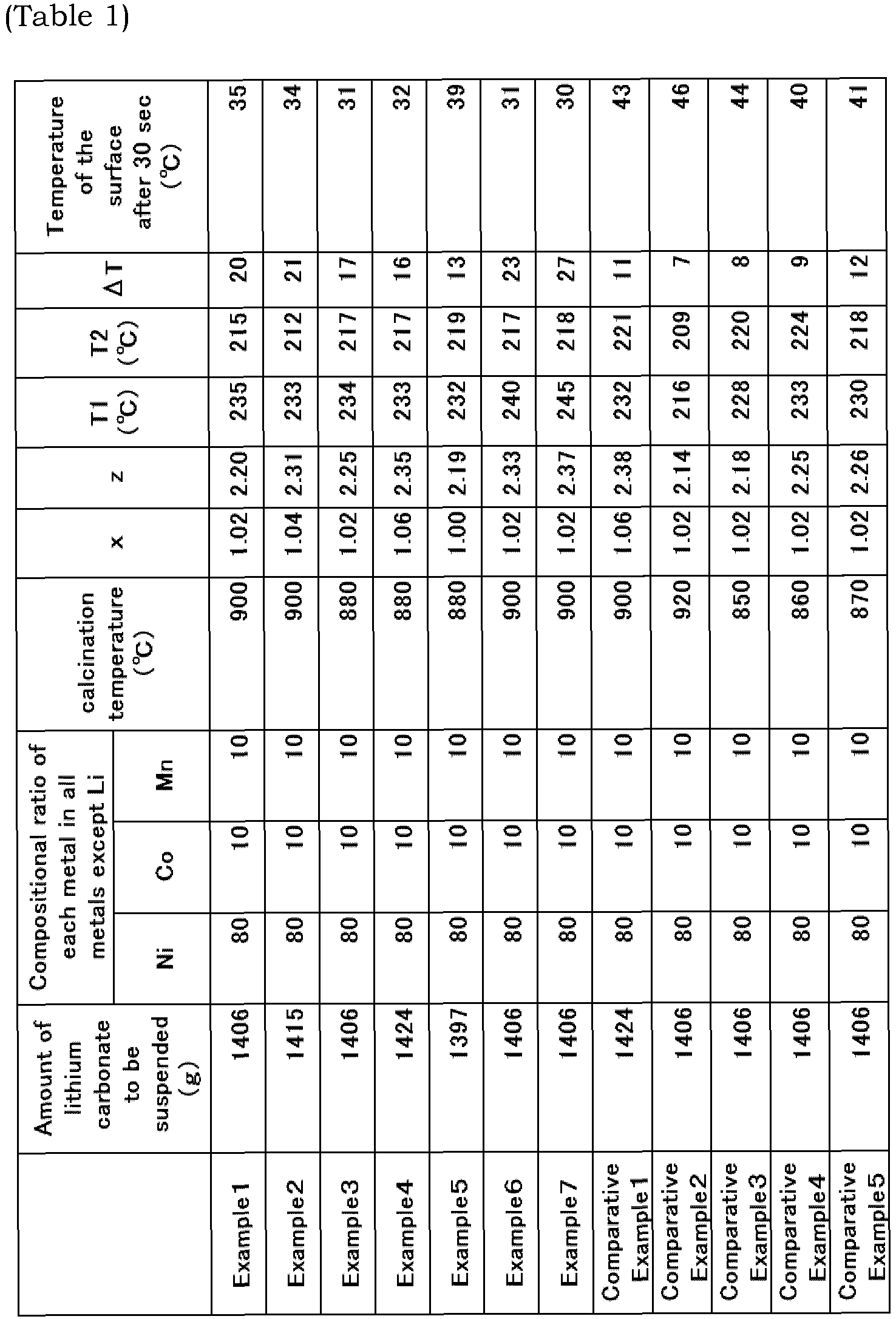
- lithium carbonate to be charged in an amount as described in Table 1 was suspended in 3.2 liter of pure water, and then, 4.8 liter of a metal salt solution was added to the mixture.
- the metal salt solution was prepared in such a manner that the compositional ratio of a hydrate of a nitrate of each metal was that described in Table 1 and the number of moles of all metals was 14.
- the amount of lithium carbonate to be suspended is a value at which x in the formula Li x (Ni y M 1-y )O z of a product (positive electrode for lithium ion secondary battery, that is, positive electrode active material) accords to that described in Table 1 and is calculated according to the following equation.
- W g 73.9 ⁇ 14 ⁇ 1 + 0.5 ⁇ X ⁇ A
- “A” is a value multiplied in order to subtract, in advance, the amount of lithium originated from a lithium compound other than lithium carbonate left in the raw material after filtration besides the amount required for the precipitation reaction.
- “A” is 0.9 when, like the case of using a nitrate or acetate, the lithium salt reacts as the calcination raw material, and 1.0 when, like the case of using a sulfate or chloride, the lithium salt does not react as the calcination raw material. Though lithium-containing carbonate microparticles were precipitated in the solution by this treatment, this precipitate was separated by filtration using a filter press.
- the precipitate was dried to obtain a lithium-containing carbonate (precursor of positive electrode active material for lithium ion battery).
- a calcinating container was prepared to fill the lithium-containing carbonate therein.
- the calcinating container was placed in an oxygen ambient furnace under atmospheric pressure and heated to the calcination temperature described in Table 1 for 6 hours. Then, the calcinating container was kept at this temperature under heating for 2 hours, and then, cooled to obtain an oxide. Then, the obtained oxide was pulverized to obtain a positive electrode active material powder for lithium ion battery.
- Example 6 the same procedures as in Examples 1 to 5 were carried out except that each metal of the raw material was altered to the composition shown in Table 1 and the calcination was performed not under an atmospheric pressure but under a pressure of 120 KPa.
- Example 7 the same procedures as in Example 6 were carried out except that each metal of the raw material was altered to the composition shown in Table 1 and the calcination was performed under a pressure of 180 KPa.
- Comparative Examples 1 to 5 the same procedures as in Examples 1 to 5 were carried out except that the amount of lithium carbonate to be suspended and calcination temperature were altered.
- each positive electrode active material was measured by induction coupling plasma atomic emission spectrometry (ICP-AES) to calculate the compositional ratio (molar ratio) of each metal. Also, the crystal structure was confirmed to be a layer structure by X-ray analysis. Then, the DSC exothermic curve of this positive electrode active material was measured as follows. First, 91 % of the positive electrode material, 4.2% of a binder, and 4.8% of a conductive material were weighed on weight basis.
- ICP-AES induction coupling plasma atomic emission spectrometry
- the positive electrode active material and the conductive material were mixed in a solution prepared by dissolving the binder in an organic solvent (N-methylpyrrolidone) into a slurry to obtain a positive electrode mix, which was then applied to the surface of an aluminum foil and pressed after dried to produce a positive electrode.
- This positive electrode was processed by punching such that the weight of the positive electrode mix was 10.0 to 10.2 mg.
- a 2032-type coin cell for evaluation in which Li was used as the counter electrode was manufactured and an electrolytic solution prepared by dissolving 1M-LiPF 6 in ethylene carbonate (EC)-dimethyl carbonate (DMC) (volume ratio 1 : 1) was used.
- the coin cell impregnated with the electrolytic solution was charged up to 4.3 V at a current density of 0.2C, then discharged down to 3.0 V, and then, charged up to 4.3 V again.
- the electrode was taken out of the coin cell, washed with dimethyl carbonate (DMC), and then, the positive electrode mix was cut from the positive electrode.
- 1.0 mg of the positive electrode mix and an electrolytic solution prepared by dissolving 1M-LiPF 6 in ethylene carbonate (EC)-dimethyl carbonate (DMC) (volume ratio 1: 1) were sealed together in a SUS sample pan, which was subjected to differential scanning calorimetry at a temperature rise rate of 5°C/min by using DSC6200 manufactured by Seiko Instruments Inc..
- a DSC exothermic curve was obtained from this measurement, and a peak temperature T1 (°C) of a first peak, a temperature T2 (°C) at which the exothermic strength was 1/2 of the peak height of the first peak, and a difference ⁇ T between these temperatures T1 and T2 (T2 ⁇ T1) were obtained from the DSC exothermic curve. Also, a nail having a diameter of 2 mm was allowed to penetrate through the battery in the direction of the thickness in a room kept at 25°C to generate heat, thereby measuring the temperature of the surface of the battery after 30 sec. These results are shown in Table 1. Also, FIGS. 1 and 2 show the DSC exothermic curve according to Example 3 and Comparative Example 4 shown in Table 1 respectively.
Landscapes
- Chemical & Material Sciences (AREA)
- Chemical Kinetics & Catalysis (AREA)
- Electrochemistry (AREA)
- General Chemical & Material Sciences (AREA)
- Engineering & Computer Science (AREA)
- Inorganic Chemistry (AREA)
- Materials Engineering (AREA)
- Manufacturing & Machinery (AREA)
- Organic Chemistry (AREA)
- Physics & Mathematics (AREA)
- Condensed Matter Physics & Semiconductors (AREA)
- General Physics & Mathematics (AREA)
- Battery Electrode And Active Subsutance (AREA)
- Secondary Cells (AREA)
Abstract
Description
- The present invention relates to a positive electrode active material for lithium ion battery, a positive electrode for lithium ion battery, and a lithium ion battery.
- A lithium ion battery using, as its material, lithium which has a small specific gravity and tends to enter into an electrochemical reaction can store energy two to three times that of a nickel-cadmium battery or nickel-metal hydride battery having the same weight. The lithium ion battery has such a superb advantage whereas it has a problem concerning safety.
- With regard to lithium ion batteries, there have been many reports concerning accidents caused by abnormal heat and ignition of batteries because materials constituting the batteries are burned for some reason. The phenomena of abnormal heat generation and ignition that occur in lithium ion batteries are called "thermal runaway". When the temperature of a battery is raised, materials contained in the battery are decomposed to generate heat. Then, if the rate of heat generation inside of the battery exceeds the rate of heat radiation from the battery, this induces thermal runaway, causing a fire.
- Various methods are conventionally used to improve the safety of a lithium ion battery. For example, Patent document 1 discloses a positive electrode material for lithium secondary battery comprising, as a lithium-containing complex oxide, a mixture of a lithium-containing complex oxide having a layer rock-salt structure and a lithium-containing complex oxide having a pseudo-spinel structure, wherein the lithium-containing complex oxide is represented by the general formula LipCoxMyOzFa (where M represents at least one element selected from the group consisting of transition metal elements other than Co, Al, Sn, and alkali earth metal elements, 0.9 ≤ p ≤ 1.1, 0.97 ≤ x ≤ 1.00, 0 ≤ y ≤ 0.03, 1.9 ≤ z ≤ 2.1, x + y = 1, and 0 ≤ a ≤ 0.02). Patent document 1 describes that a positive electrode material for lithium secondary battery, which comprises a lithium-containing complex oxide and is superior in thermal safety, volumetric capacity density, and charge/discharge cycle characteristics, can be provided.
- Also, Patent document 2 discloses a positive electrode active material for nonaqueous electrolyte secondary battery comprising at least a lithium transition metal complex oxide having a spinel structure, wherein the exothermic onset temperature of the lithium transition metal complex oxide in the measurement using differential scanning calorimetry is 220°C or more and calorific value of the lithium transition metal complex oxide in the measurement using differential scanning calorimetry is 700 to 900 mJ/mg. Patent document 2 describes that a positive electrode active material for nonaqueous electrolyte secondary battery having excellent battery characteristics even in a severer working environment can be provided.
- Further, Patent document 3 discloses a lithium secondary battery comprising a positive electrode using a lithium-manganese complex oxide having a spinel structure as a positive electrode active material and a negative electrode using a carbon material as a negative electrode active material which are impregnated with a nonaqueous electrolytic solution, wherein the total calorific value of the lithium-manganese complex oxide measured by a differential scanning calorimeter is 1.0 kJ/g or less. Patent document 3 describes that this structure can provide a nonaqueous electrolyte secondary battery being superior in safety.
-
- (Patent document 1) Japanese Patent Application Publication No.
2006-164758 - (Patent document 2) Japanese Patent Application Publication No.
2004-227790 - (Patent document 3) Japanese Patent Application Publication No.
2004-6264 - However, the safety of a lithium ion battery is an extremely important problem and there is a room for improvement of a high-quality positive electrode active material for lithium ion battery.
- In view of this situation, an object of the present invention is to provide a positive electrode material for lithium ion battery to attain a lithium ion battery being superior in safety.
- The inventor has made earnest studies, and as a result, found that there is a close correlation between the shape of the DSC (differential scanning calorific measurement) exothermic curve of a positive electrode active material and the safety of a battery to be produced. Specifically, the inventor has found that, when a difference between a first exothermic peak temperature and a temperature at which an exothermic strength is 1/2 of the first exothermic peak strength is a certain value or more in the DSC (differential scanning calorimetry) curve of the positive electrode active material to be measured, the battery generates heat so gently that thermal runaway can be well restrained.
- According to a first aspect of the present invention completed based on the above teachings, there is provided a positive electrode active material for lithium ion battery which has a layer structure represented by the compositional formula: Lix(NiyM1-y)Oz (wherein M represents Mn and Co, x denotes a number of 0.9 to 1.2, y denotes a number of 0.8 ± 0.025, and z denotes a number of 1.8 to 2.4), wherein, when a lithium ion battery using a positive electrode mix produced by the positive electrode active material, a binder, and a conductive material in a ratio by weight of 91%, 4.2%, and 4.8%, respectively, is charged to 4.3 V, and then an electrolytic solution prepared by dissolving 1 M-LiPF6 in a mixture solvent of ethylene carbonate (EC)-dimethyl carbonate (DMC) (volume ratio 1 : 1) is used based on 1.0 mg of the positive electrode mix to measure the obtained lithium ion battery by differential scanning calorimetry (DSC) performed at a temperature rise rate of 5°C/min, a difference ΔT between a first exothermic peak temperature T1 (°C) and a temperature T2 at which an exothermic strength is 1/2 of the first exothermic peak strength (T2 < T1) satisfies the equation: ΔT ≥ 13 (°C).
- In an embodiment of the positive electrode active material for lithium ion battery according to the present invention, ΔT satisfies the equation: ΔT ≥ 15 (°C).
- In another embodiment of the positive electrode active material for lithium ion battery according to the present invention, ΔT satisfies the equation: ΔT ≥ 18 (°C).
- In a further embodiment of the positive electrode active material for lithium ion battery according to the present invention, T1 is 230°C or more.
- According to another aspect of the present invention, there is provided a positive electrode for lithium ion battery using the positive electrode active material for lithium ion battery according to the present invention.
- According to another aspect of the present invention, there is provided a lithium ion battery using the positive electrode for lithium ion battery according to the present invention.
- According to the present invention, a positive electrode active material for lithium ion battery which attains a lithium ion battery having high safety can be provided.
-
-
FIG. 1 is a DSC exothermic curve in Example 3. -
FIG. 2 is a DSC exothermic curve in Comparative Example 4. - As the material of the positive electrode active material for lithium ion battery according to the present invention, compounds useful as the positive electrode active material for the positive electrode of usual lithium ion batteries may be widely used. It is particularly preferable to use a lithium-containing transition metal oxide such as lithium cobaltate (LiCoO2), lithium nickelate (LiNiO2), and lithium manganate (LiMn2O4). The positive electrode active material for lithium ion battery which is produced using materials like the above has a layer structure represented by the compositional formula: Lix(NiyM1-y)Oz (wherein M represents Mn and Co, x denotes a number of 0.9 to 1.2, y denotes a number of 0.8 ± 0.025, and z denotes a number of 1.8 to 2.4).
The ratio of lithium to the total metals in the positive electrode active material for lithium ion battery is 0.9 to 1.2. It is because a stable crystal structure is scarcely kept when the ratio is less than 0.9 whereas high capacity of the battery cannot be ensured when the ratio exceeds 1.2. - The positive electrode active material for lithium ion battery is constituted of primary particles, secondary particles formed from aggregated primary particles, or a mixture of primary particles and secondary particles. The average particle diameter of these primary and secondary particles of the positive electrode active material for lithium ion battery is preferably 2 to 15 µm.
When the average particle diameter is less than 2 µm, the application to the current collector is made difficult. When the average particle diameter exceeds 15 µm, voids are easily produced when the active material particles are filled, leading to less fillability. The average particle diameter is more preferably 3 to 12 µm. - The positive electrode for lithium ion battery according to an embodiment of the present invention has a structure in which a positive electrode mix prepared by blending, for example, a positive electrode active material for lithium ion battery which has the aforementioned structure, a conductive material, and a binder is applied to one or both surfaces of a current collector made of an aluminum foil or the like. Also, a lithium ion battery according to an embodiment of the present invention is provided with the positive electrode for lithium ion battery having such a structure.
- A lithium ion battery manufactured using the positive electrode active material for lithium ion battery according to the present invention is defined as follows by differential scanning calorimetry. Here, the differential scanning calorimetry is used to measure a difference in calorific value along with temperature variation between a sample and a standard material as a function of temperature. When a difference between a first exothermic peak temperature and a temperature at which an exothermic strength is 1/2 of the first exothermic peak strength in the curve (DSC exothermic curve) written according to values measured at this time is a predetermined value or more as will be mentioned later, the battery generates heat so gently that thermal runaway can be well restrained. It is because the thermal runaway occurs when heat radiation does not exceed heat generation, and generally, there is a larger allowance for heat radiation as heat generation along with rise in temperature is increased more gently.
- Specifically, after a lithium ion battery using a positive electrode mix produced using the positive electrode active material according to the present invention, a binder, and a conductive material in a ratio by weight of 91%, 4.2%, and 4.8% is charged to 4.3 V, an electrolytic solution prepared by dissolving 1 M-LiPF6 in a mixture solvent of ethylene carbonate (EC) and dimethyl carbonate (DMC) (volume ratio 1 : 1) is used based on 1.0 mg of the positive electrode mix to measure the obtained lithium ion battery by differential scanning calorimetry (DSC) performed at a temperature rise rate of 5°C/min. At this time, a difference ΔT between a first exothermic peak temperature T1 (°C) and a temperature T2 at which an exothermic strength is 1/2 of the first exothermic peak strength (T2 < T1) satisfies the equation: ΔT ≥ 13 (°C). ΔT preferably satisfies the equation: ΔT ≥ 15 (°C) and more preferably satisfies the equation: ΔT ≥ 18 (°C).
The first exothermic peak temperature T1 (°C) is preferably 230°C or more. - Next, a method for producing a positive electrode active material for lithium ion battery according to the embodiment of the present invention will be explained in detail.
First, a metal salt solution is prepared. The metal is Ni, Co, or Mn. Also, the metal salt is a sulfate, chloride, nitrate, acetate, or the like and, particularly, a nitrate is preferable. This is because the nitrate can be calcined as it is, so that a cleaning process can be omitted, even if the nitrate is mixed as impurities in the calcination raw material, and the nitrate functions as an oxidant to promote oxidation of metals in the calcination raw material. The metal salt is prepared such that each metal is contained in a desired molar ratio. The molar ratio of each metal in the positive electrode active material is thereby determined. - Next, lithium carbonate is suspended in pure water, and then, a metal salt solution of the above metal is poured into the mixture to produce a metal carbonate solution slurry. At this time, lithium-containing carbonate microparticles precipitate in the slurry. When sulfate, chloride and the like are employed as metal salt, the lithium compounds generated in precipitation are not used as lithium raw material at heat treatment, and slurry is washed with a saturated lithium carbonate solution and then separated by filtration. When nitrate and acetate are employed as metal salt, the lithium compounds generated in precipitation are used as lithium raw material at heat treatment, and slurry is not washed and separated as it is by filtration, followed by drying, thereby enabling the salt to be used as a calcination precursor.
Next, the separated lithium-containing carbonate is dried to obtain a lithium salt composite (precursor of a positive electrode active material for lithium ion battery) powder. - Next, a calcinating container having a predetermined capacity is prepared and the powder of the precursor of a positive electrode active material for lithium ion battery is filled in the calcinating container. Next, the calcinating container filled with the powder of the precursor of the positive electrode active material for lithium ion battery is transferred to a kiln to calcine. The calcination is performed by keeping the container with heating for a predetermined time in an oxygen atmosphere. Also, it is desirable that the calcination is performed under a pressure of 101 to 202 KPa because the quantity of oxygen in the composition is increased. The calcination temperature is appropriately set corresponding to the amount of Li in the positive electrode material precursor used as the raw material. Specifically, because the calcination tends to progress when the amount of Li is large, the optimum value of calcination temperature is shifted to a lower temperature side as compared with the case where the amount of Li is small. As mentioned above, the relation between the calcination temperature and the amount of Li contained in the positive electrode active material precursor affects the nature of a positive electrode active material for lithium ion battery and hence affects the battery characteristics of a lithium ion battery using the positive electrode active material.
Subsequently, the powder is taken out of the calcinating container and ground to obtain a positive electrode active material powder.
Also, the positive electrode for lithium ion battery according to the present invention is manufactured by mixing the positive electrode active material manufactured in the above manner, a conductive material, and a binder to prepare a positive electrode mix, and by disposing the positive electrode mix on one or both surfaces of a current collector made of an aluminum foil or the like. Moreover, the lithium ion battery according to the present invention is manufactured using this positive electrode for lithium ion battery. - Although examples are provided for facilitating understanding of the present invention and its advantage, the present invention is not limited to the following examples.
- First, lithium carbonate to be charged in an amount as described in Table 1 was suspended in 3.2 liter of pure water, and then, 4.8 liter of a metal salt solution was added to the mixture. Here, the metal salt solution was prepared in such a manner that the compositional ratio of a hydrate of a nitrate of each metal was that described in Table 1 and the number of moles of all metals was 14.
In this case, the amount of lithium carbonate to be suspended is a value at which x in the formula Lix(NiyM1-y)Oz of a product (positive electrode for lithium ion secondary battery, that is, positive electrode active material) accords to that described in Table 1 and is calculated according to the following equation.
In the above formula, "A" is a value multiplied in order to subtract, in advance, the amount of lithium originated from a lithium compound other than lithium carbonate left in the raw material after filtration besides the amount required for the precipitation reaction. "A" is 0.9 when, like the case of using a nitrate or acetate, the lithium salt reacts as the calcination raw material, and 1.0 when, like the case of using a sulfate or chloride, the lithium salt does not react as the calcination raw material.
Though lithium-containing carbonate microparticles were precipitated in the solution by this treatment, this precipitate was separated by filtration using a filter press.
Next, the precipitate was dried to obtain a lithium-containing carbonate (precursor of positive electrode active material for lithium ion battery).
Next, a calcinating container was prepared to fill the lithium-containing carbonate therein. Next, the calcinating container was placed in an oxygen ambient furnace under atmospheric pressure and heated to the calcination temperature described in Table 1 for 6 hours. Then, the calcinating container was kept at this temperature under heating for 2 hours, and then, cooled to obtain an oxide. Then, the obtained oxide was pulverized to obtain a positive electrode active material powder for lithium ion battery. - In Example 6, the same procedures as in Examples 1 to 5 were carried out except that each metal of the raw material was altered to the composition shown in Table 1 and the calcination was performed not under an atmospheric pressure but under a pressure of 120 KPa. In Example 7, the same procedures as in Example 6 were carried out except that each metal of the raw material was altered to the composition shown in Table 1 and the calcination was performed under a pressure of 180 KPa.
- In Comparative Examples 1 to 5, the same procedures as in Examples 1 to 5 were carried out except that the amount of lithium carbonate to be suspended and calcination temperature were altered.
- The contents of Li, Ni, Mn, and Co in each positive electrode active material were measured by induction coupling plasma atomic emission spectrometry (ICP-AES) to calculate the compositional ratio (molar ratio) of each metal. Also, the crystal structure was confirmed to be a layer structure by X-ray analysis.
Then, the DSC exothermic curve of this positive electrode active material was measured as follows. First, 91 % of the positive electrode material, 4.2% of a binder, and 4.8% of a conductive material were weighed on weight basis. The positive electrode active material and the conductive material were mixed in a solution prepared by dissolving the binder in an organic solvent (N-methylpyrrolidone) into a slurry to obtain a positive electrode mix, which was then applied to the surface of an aluminum foil and pressed after dried to produce a positive electrode. This positive electrode was processed by punching such that the weight of the positive electrode mix was 10.0 to 10.2 mg. Subsequently, a 2032-type coin cell for evaluation in which Li was used as the counter electrode was manufactured and an electrolytic solution prepared by dissolving 1M-LiPF6 in ethylene carbonate (EC)-dimethyl carbonate (DMC) (volume ratio 1 : 1) was used. Then, the coin cell impregnated with the electrolytic solution was charged up to 4.3 V at a current density of 0.2C, then discharged down to 3.0 V, and then, charged up to 4.3 V again.
Next, the electrode was taken out of the coin cell, washed with dimethyl carbonate (DMC), and then, the positive electrode mix was cut from the positive electrode. 1.0 mg of the positive electrode mix and an electrolytic solution prepared by dissolving 1M-LiPF6 in ethylene carbonate (EC)-dimethyl carbonate (DMC) (volume ratio 1: 1) were sealed together in a SUS sample pan, which was subjected to differential scanning calorimetry at a temperature rise rate of 5°C/min by using DSC6200 manufactured by Seiko Instruments Inc.. A DSC exothermic curve was obtained from this measurement, and a peak temperature T1 (°C) of a first peak, a temperature T2 (°C) at which the exothermic strength was 1/2 of the peak height of the first peak, and a difference ΔT between these temperatures T1 and T2 (T2 <T1) were obtained from the DSC exothermic curve. Also, a nail having a diameter of 2 mm was allowed to penetrate through the battery in the direction of the thickness in a room kept at 25°C to generate heat, thereby measuring the temperature of the surface of the battery after 30 sec.
These results are shown in Table 1. Also,FIGS. 1 and 2 show the DSC exothermic curve according to Example 3 and Comparative Example 4 shown in Table 1 respectively. -
Claims (6)
- A positive electrode active material for lithium ion battery which has a layer structure represented by the compositional formula:Lix(NiyM1-y)Oz (wherein M represents Mn and Co, x denotes a number of 0.9 to 1.2, y denotes a number of 0.8 ± 0.025, and z denotes a number of 1.8 to 2.4), wherein,when a lithium ion battery using a positive electrode mix produced by the positive electrode active material, a binder, and a conductive material in a ratio by weight of 91%, 4.2%, and 4.8%, respectively, is charged to 4.3V, and then an electrolytic solution prepared by dissolving 1 M-LiPF6 in a mixture solvent of ethylene carbonate (EC)-dimethyl carbonate (DMC) (volume ratio 1 : 1) is used based on 1.0 mg of the positive electrode mix to measure the obtained lithium ion battery by differential scanning calorimetry (DSC) performed at a temperature rise rate of 5°C/min, a difference ΔT between a first exothermic peak temperature T1 (°C) and a temperature T2 at which an exothermic strength is 1/2 of the first exothermic peak strength (T2 < T1) satisfies the equation: ΔT ≥ 13 (°C).
- The positive electrode active material for lithium ion battery of claim 1, wherein ΔT satisfies the equation: ΔT ≥ 15 (°C).
- The positive electrode active material for lithium ion battery of claim 2, wherein ΔT satisfies the equation: ΔT ≥ 18 (°C).
- The positive electrode active material for lithium ion battery of any one of claims 1 to 3, wherein T1 is 230°C or more.
- A positive electrode for lithium ion battery using the positive electrode active material for lithium ion battery of any one of claims 1 to 4.
- A lithium ion battery using the positive electrode for lithium ion battery of claim 5.
Applications Claiming Priority (2)
| Application Number | Priority Date | Filing Date | Title |
|---|---|---|---|
| JP2010048058 | 2010-03-04 | ||
| PCT/JP2011/054938 WO2011108656A1 (en) | 2010-03-04 | 2011-03-03 | Positive electrode active material for lithium-ion batteries, positive electrode for lithium-ion batteries, and lithium-ion battery |
Publications (2)
| Publication Number | Publication Date |
|---|---|
| EP2544277A1 true EP2544277A1 (en) | 2013-01-09 |
| EP2544277A4 EP2544277A4 (en) | 2014-12-31 |
Family
ID=44542303
Family Applications (1)
| Application Number | Title | Priority Date | Filing Date |
|---|---|---|---|
| EP11750765.7A Withdrawn EP2544277A4 (en) | 2010-03-04 | 2011-03-03 | ACTIVE MATERIAL FOR POSITIVE ELECTRODE FOR LITHIUM-ION BATTERIES, POSITIVE ELECTRODE FOR LITHIUM-ION BATTERIES AND LITHIUM-ION BATTERY |
Country Status (7)
| Country | Link |
|---|---|
| US (1) | US20120326102A1 (en) |
| EP (1) | EP2544277A4 (en) |
| JP (1) | JP5934089B2 (en) |
| KR (1) | KR20120132527A (en) |
| CN (2) | CN104600291B (en) |
| TW (1) | TWI423506B (en) |
| WO (1) | WO2011108656A1 (en) |
Families Citing this family (21)
| Publication number | Priority date | Publication date | Assignee | Title |
|---|---|---|---|---|
| JP5373889B2 (en) | 2009-03-31 | 2013-12-18 | Jx日鉱日石金属株式会社 | Cathode active material for lithium ion battery |
| KR101450978B1 (en) | 2009-12-18 | 2014-10-15 | 제이엑스 닛코 닛세키 킨조쿠 가부시키가이샤 | Positive electrode for lithium ion battery, method for producing said positive electrode, and lithium ion battery |
| WO2011077932A1 (en) | 2009-12-22 | 2011-06-30 | Jx日鉱日石金属株式会社 | Positive electrode active material for a lithium-ion battery, positive electrode for a lithium-ion battery, lithium-ion battery using same, and precursor to a positive electrode active material for a lithium-ion battery |
| EP2533334B1 (en) | 2010-02-05 | 2019-12-11 | JX Nippon Mining & Metals Corporation | Positive electrode active material for lithium ion battery, positive electrode for lithium ion battery, and lithium ion battery |
| US9118076B2 (en) | 2010-02-05 | 2015-08-25 | Jx Nippon Mining & Metals Corporation | Positive electrode active material for lithium ion battery, positive electrode for lithium ion battery and lithium ion battery |
| JPWO2011108596A1 (en) | 2010-03-04 | 2013-06-27 | Jx日鉱日石金属株式会社 | Positive electrode active material for lithium ion battery, positive electrode for lithium ion battery, and lithium ion battery |
| WO2011108658A1 (en) * | 2010-03-04 | 2011-09-09 | Jx日鉱日石金属株式会社 | Positive electrode active material for lithium-ion battery, positive electrode for lithium-ion battery, and lithium-ion battery |
| JP5313392B2 (en) | 2010-03-04 | 2013-10-09 | Jx日鉱日石金属株式会社 | Positive electrode active material for lithium ion battery, positive electrode for lithium ion battery, and lithium ion battery |
| US9240594B2 (en) | 2010-03-04 | 2016-01-19 | Jx Nippon Mining & Metals Corporation | Positive electrode active substance for lithium ion batteries, positive electrode for lithium ion batteries, and lithium ion battery |
| WO2011108598A1 (en) | 2010-03-04 | 2011-09-09 | Jx日鉱日石金属株式会社 | Positive electrode active substance for lithium ion batteries, positive electrode for lithium ion batteries, and lithium ion battery |
| JP5467144B2 (en) | 2010-03-05 | 2014-04-09 | Jx日鉱日石金属株式会社 | Positive electrode active material for lithium ion battery, positive electrode for lithium ion battery, and lithium ion battery |
| EP2648251B1 (en) | 2010-12-03 | 2018-04-25 | JX Nippon Mining & Metals Corporation | Positive electrode active material for lithium-ion battery, a positive electrode for lithium-ion battery, and lithium-ion battery |
| JP5808316B2 (en) | 2011-01-21 | 2015-11-10 | Jx日鉱日石金属株式会社 | Method for producing positive electrode active material for lithium ion battery |
| US9221693B2 (en) | 2011-03-29 | 2015-12-29 | Jx Nippon Mining & Metals Corporation | Method for producing positive electrode active material for lithium ion batteries and positive electrode active material for lithium ion batteries |
| US9214676B2 (en) | 2011-03-31 | 2015-12-15 | Jx Nippon Mining & Metals Corporation | Positive electrode active material for lithium ion batteries, positive electrode for lithium ion batteries, and lithium ion battery |
| JP6292739B2 (en) | 2012-01-26 | 2018-03-14 | Jx金属株式会社 | Positive electrode active material for lithium ion battery, positive electrode for lithium ion battery, and lithium ion battery |
| JP6292738B2 (en) | 2012-01-26 | 2018-03-14 | Jx金属株式会社 | Positive electrode active material for lithium ion battery, positive electrode for lithium ion battery, and lithium ion battery |
| TWI547001B (en) | 2012-09-28 | 2016-08-21 | Jx日鑛日石金屬股份有限公司 | A positive electrode active material for a lithium ion battery, a positive electrode for a lithium ion battery, and a lithium ion battery |
| JP6301619B2 (en) * | 2013-09-20 | 2018-03-28 | 株式会社東芝 | Non-aqueous electrolyte secondary battery, battery pack and car |
| CN111634961A (en) * | 2020-06-28 | 2020-09-08 | 蜂巢能源科技有限公司 | Cathode material for lithium ion battery and preparation method thereof |
| CN115117310A (en) * | 2021-03-18 | 2022-09-27 | 中国科学院宁波材料技术与工程研究所 | Preparation method of low-temperature lithium ion battery cathode material and lithium ion battery |
Family Cites Families (23)
| Publication number | Priority date | Publication date | Assignee | Title |
|---|---|---|---|---|
| US5393622A (en) * | 1992-02-07 | 1995-02-28 | Matsushita Electric Industrial Co., Ltd. | Process for production of positive electrode active material |
| JPH08138669A (en) * | 1994-11-02 | 1996-05-31 | Toray Ind Inc | Positive electrode active material, method for producing the same, and nonaqueous solvent-based secondary battery using the same |
| JPH11307094A (en) * | 1998-04-20 | 1999-11-05 | Chuo Denki Kogyo Co Ltd | Positive active material for lithium secondary battery and lithium secondary battery |
| JP3471244B2 (en) * | 1999-03-15 | 2003-12-02 | 株式会社東芝 | Manufacturing method of non-aqueous electrolyte secondary battery |
| JP2002063901A (en) * | 2000-08-14 | 2002-02-28 | Mitsui Chemicals Inc | Positive active material for lithium secondary battery, method for producing the same, and battery using the same |
| JP4280436B2 (en) * | 2000-09-25 | 2009-06-17 | 三星エスディアイ株式会社 | Positive electrode active material for lithium secondary battery and method for producing the same |
| EP2144314B1 (en) * | 2001-04-20 | 2015-01-28 | GS Yuasa International Ltd. | Positive active materials and process for producing the same, positive electrode for non-aqueous electrolyte secondary battery, and non-aqueous electrolyte secondary battery |
| JP2004006264A (en) | 2002-04-17 | 2004-01-08 | Shin Kobe Electric Mach Co Ltd | Lithium secondary battery |
| KR100437339B1 (en) * | 2002-05-13 | 2004-06-25 | 삼성에스디아이 주식회사 | A method of preparing active material for battery and active material prepared therefrom |
| JP2004227790A (en) * | 2003-01-20 | 2004-08-12 | Nichia Chem Ind Ltd | Cathode active material for non-aqueous electrolyte secondary batteries |
| TWI286849B (en) * | 2003-03-25 | 2007-09-11 | Nichia Corp | Positive electrode active material for nonaqueous electrolyte secondary battery and nonaqueous electrolyte secondary battery |
| KR100570616B1 (en) * | 2004-02-06 | 2006-04-12 | 삼성에스디아이 주식회사 | Cathode active material for lithium secondary battery, manufacturing method thereof, and lithium secondary battery comprising same |
| JP4504074B2 (en) * | 2004-04-15 | 2010-07-14 | 株式会社東芝 | Positive electrode active material for non-aqueous electrolyte battery, positive electrode and non-aqueous electrolyte battery |
| JP2005332707A (en) * | 2004-05-20 | 2005-12-02 | Toshiba Corp | Positive electrode for non-aqueous electrolyte battery and non-aqueous electrolyte battery |
| JP4954451B2 (en) * | 2004-07-05 | 2012-06-13 | 株式会社クレハ | Positive electrode material for lithium secondary battery and method for producing the same |
| JP2006156126A (en) * | 2004-11-29 | 2006-06-15 | Sumitomo Metal Mining Co Ltd | Cathode active material for non-aqueous secondary battery and method for producing the same |
| JP4582579B2 (en) | 2004-12-07 | 2010-11-17 | Agcセイミケミカル株式会社 | Positive electrode material for lithium secondary battery |
| WO2006070977A1 (en) | 2004-12-31 | 2006-07-06 | Iucf-Hyu (Industry-University Cooperation Foundation Hanyang University) | Double-layer cathode active materials for lithium secondary batteries, method for preparing the active materials, and lithium secondary batteries using the active materials |
| CN100362681C (en) * | 2005-03-23 | 2008-01-16 | 中南大学 | A kind of lithium ion battery cathode material lithium nickel cobalt manganese oxide and preparation method thereof |
| CN100466364C (en) * | 2005-12-15 | 2009-03-04 | 中国电子科技集团公司第十八研究所 | A kind of safe lithium-ion battery |
| WO2007129848A1 (en) * | 2006-05-10 | 2007-11-15 | Lg Chem, Ltd. | Material for lithium secondary battery of high performance |
| CN101281965A (en) * | 2008-05-29 | 2008-10-08 | 复旦大学 | A kind of positive electrode material of lithium ion battery and preparation method thereof |
| CN101308925B (en) * | 2008-07-04 | 2011-02-02 | 深圳市贝特瑞新能源材料股份有限公司 | Composite coated positive pole material of lithium ionic cell and preparing method thereof |
-
2011
- 2011-03-03 JP JP2012503255A patent/JP5934089B2/en active Active
- 2011-03-03 KR KR1020127025196A patent/KR20120132527A/en not_active Ceased
- 2011-03-03 CN CN201510009493.XA patent/CN104600291B/en active Active
- 2011-03-03 EP EP11750765.7A patent/EP2544277A4/en not_active Withdrawn
- 2011-03-03 US US13/582,067 patent/US20120326102A1/en not_active Abandoned
- 2011-03-03 TW TW100107074A patent/TWI423506B/en active
- 2011-03-03 WO PCT/JP2011/054938 patent/WO2011108656A1/en not_active Ceased
- 2011-03-03 CN CN2011800123260A patent/CN102782912A/en active Pending
Also Published As
| Publication number | Publication date |
|---|---|
| US20120326102A1 (en) | 2012-12-27 |
| JPWO2011108656A1 (en) | 2013-06-27 |
| TW201203675A (en) | 2012-01-16 |
| CN104600291A (en) | 2015-05-06 |
| EP2544277A4 (en) | 2014-12-31 |
| CN102782912A (en) | 2012-11-14 |
| TWI423506B (en) | 2014-01-11 |
| WO2011108656A1 (en) | 2011-09-09 |
| JP5934089B2 (en) | 2016-06-15 |
| KR20120132527A (en) | 2012-12-05 |
| CN104600291B (en) | 2017-05-10 |
Similar Documents
| Publication | Publication Date | Title |
|---|---|---|
| EP2544277A1 (en) | Positive electrode active material for lithium-ion batteries, positive electrode for lithium-ion batteries, and lithium-ion battery | |
| EP2544276A1 (en) | Positive electrode active material for lithium-ion batteries, positive electrode for lithium-ion batteries, and lithium-ion battery | |
| US20120326101A1 (en) | Positive Electrode Active Material For Lithium-Ion Batteries, Positive Electrode For Lithium-Ion Batteries,Lithium-Ion Battery | |
| EP2544278A1 (en) | Positive electrode active material for lithium-ion battery, positive electrode for lithium-ion battery, and lithium-ion battery | |
| EP2544279A1 (en) | Positive electrode active material for lithium ion battery, positive electrode for lithium ion battery, and lithium ion battery. | |
| JP2018037393A (en) | Method for evaluating thermal stability of positive electrode active material powder for non-aqueous electrolyte secondary battery containing Ni | |
| TWI492444B (en) | A positive electrode active material for a lithium ion battery, a positive electrode for a lithium ion battery, and a lithium ion battery | |
| TWI424607B (en) | A positive electrode active material for a lithium ion battery, a positive electrode for a lithium ion battery, and a lithium ion battery | |
| TWI424605B (en) | A positive electrode active material for a lithium ion battery, a positive electrode for a lithium ion battery, and a lithium ion battery |
Legal Events
| Date | Code | Title | Description |
|---|---|---|---|
| PUAI | Public reference made under article 153(3) epc to a published international application that has entered the european phase |
Free format text: ORIGINAL CODE: 0009012 |
|
| 17P | Request for examination filed |
Effective date: 20121004 |
|
| AK | Designated contracting states |
Kind code of ref document: A1 Designated state(s): AL AT BE BG CH CY CZ DE DK EE ES FI FR GB GR HR HU IE IS IT LI LT LU LV MC MK MT NL NO PL PT RO RS SE SI SK SM TR |
|
| DAX | Request for extension of the european patent (deleted) | ||
| A4 | Supplementary search report drawn up and despatched |
Effective date: 20141203 |
|
| RIC1 | Information provided on ipc code assigned before grant |
Ipc: H01M 4/131 20100101ALI20141127BHEP Ipc: H01M 4/505 20100101ALI20141127BHEP Ipc: H01M 4/525 20100101AFI20141127BHEP Ipc: C01G 53/00 20060101ALI20141127BHEP Ipc: H01M 10/052 20100101ALI20141127BHEP |
|
| STAA | Information on the status of an ep patent application or granted ep patent |
Free format text: STATUS: EXAMINATION IS IN PROGRESS |
|
| 17Q | First examination report despatched |
Effective date: 20180509 |
|
| STAA | Information on the status of an ep patent application or granted ep patent |
Free format text: STATUS: THE APPLICATION HAS BEEN WITHDRAWN |
|
| 18W | Application withdrawn |
Effective date: 20190510 |