EP2543039B1 - Quellcodedapation je nach kommunikationsverbindungsqualität und quellencodierungsverzögerung - Google Patents
Quellcodedapation je nach kommunikationsverbindungsqualität und quellencodierungsverzögerung Download PDFInfo
- Publication number
- EP2543039B1 EP2543039B1 EP10847113.7A EP10847113A EP2543039B1 EP 2543039 B1 EP2543039 B1 EP 2543039B1 EP 10847113 A EP10847113 A EP 10847113A EP 2543039 B1 EP2543039 B1 EP 2543039B1
- Authority
- EP
- European Patent Office
- Prior art keywords
- delay
- source coding
- communication link
- source
- coding
- Prior art date
- Legal status (The legal status is an assumption and is not a legal conclusion. Google has not performed a legal analysis and makes no representation as to the accuracy of the status listed.)
- Not-in-force
Links
- 238000004891 communication Methods 0.000 title claims description 64
- 230000005540 biological transmission Effects 0.000 claims description 101
- 238000000034 method Methods 0.000 claims description 36
- 230000001934 delay Effects 0.000 claims description 17
- 230000008569 process Effects 0.000 claims description 7
- 230000003044 adaptive effect Effects 0.000 claims description 5
- 230000008859 change Effects 0.000 claims description 4
- 230000008054 signal transmission Effects 0.000 claims description 3
- 230000003111 delayed effect Effects 0.000 claims description 2
- 230000001360 synchronised effect Effects 0.000 claims 2
- 239000010410 layer Substances 0.000 description 18
- 230000006978 adaptation Effects 0.000 description 11
- 230000001965 increasing effect Effects 0.000 description 9
- 230000003139 buffering effect Effects 0.000 description 4
- 239000012792 core layer Substances 0.000 description 3
- 238000005259 measurement Methods 0.000 description 3
- 238000007906 compression Methods 0.000 description 2
- 230000006835 compression Effects 0.000 description 2
- 238000001514 detection method Methods 0.000 description 2
- 238000010586 diagram Methods 0.000 description 2
- 230000000694 effects Effects 0.000 description 2
- 239000011229 interlayer Substances 0.000 description 2
- 230000000670 limiting effect Effects 0.000 description 2
- 238000012545 processing Methods 0.000 description 2
- 230000009467 reduction Effects 0.000 description 2
- 230000004044 response Effects 0.000 description 2
- 238000013459 approach Methods 0.000 description 1
- 230000008901 benefit Effects 0.000 description 1
- 238000004590 computer program Methods 0.000 description 1
- 238000013144 data compression Methods 0.000 description 1
- 238000011161 development Methods 0.000 description 1
- 238000005516 engineering process Methods 0.000 description 1
- 230000002708 enhancing effect Effects 0.000 description 1
- 230000014509 gene expression Effects 0.000 description 1
- 238000007689 inspection Methods 0.000 description 1
- 230000007774 longterm Effects 0.000 description 1
- 239000000203 mixture Substances 0.000 description 1
- 238000010295 mobile communication Methods 0.000 description 1
- 230000004048 modification Effects 0.000 description 1
- 238000012986 modification Methods 0.000 description 1
- 238000005070 sampling Methods 0.000 description 1
- 238000004904 shortening Methods 0.000 description 1
- 239000002699 waste material Substances 0.000 description 1
Images

Classifications
-
- H—ELECTRICITY
- H04—ELECTRIC COMMUNICATION TECHNIQUE
- H04L—TRANSMISSION OF DIGITAL INFORMATION, e.g. TELEGRAPHIC COMMUNICATION
- H04L65/00—Network arrangements, protocols or services for supporting real-time applications in data packet communication
- H04L65/60—Network streaming of media packets
- H04L65/70—Media network packetisation
-
- G—PHYSICS
- G10—MUSICAL INSTRUMENTS; ACOUSTICS
- G10L—SPEECH ANALYSIS TECHNIQUES OR SPEECH SYNTHESIS; SPEECH RECOGNITION; SPEECH OR VOICE PROCESSING TECHNIQUES; SPEECH OR AUDIO CODING OR DECODING
- G10L19/00—Speech or audio signals analysis-synthesis techniques for redundancy reduction, e.g. in vocoders; Coding or decoding of speech or audio signals, using source filter models or psychoacoustic analysis
- G10L19/04—Speech or audio signals analysis-synthesis techniques for redundancy reduction, e.g. in vocoders; Coding or decoding of speech or audio signals, using source filter models or psychoacoustic analysis using predictive techniques
- G10L19/08—Determination or coding of the excitation function; Determination or coding of the long-term prediction parameters
- G10L19/12—Determination or coding of the excitation function; Determination or coding of the long-term prediction parameters the excitation function being a code excitation, e.g. in code excited linear prediction [CELP] vocoders
-
- G—PHYSICS
- G10—MUSICAL INSTRUMENTS; ACOUSTICS
- G10L—SPEECH ANALYSIS TECHNIQUES OR SPEECH SYNTHESIS; SPEECH RECOGNITION; SPEECH OR VOICE PROCESSING TECHNIQUES; SPEECH OR AUDIO CODING OR DECODING
- G10L19/00—Speech or audio signals analysis-synthesis techniques for redundancy reduction, e.g. in vocoders; Coding or decoding of speech or audio signals, using source filter models or psychoacoustic analysis
- G10L19/04—Speech or audio signals analysis-synthesis techniques for redundancy reduction, e.g. in vocoders; Coding or decoding of speech or audio signals, using source filter models or psychoacoustic analysis using predictive techniques
- G10L19/16—Vocoder architecture
- G10L19/18—Vocoders using multiple modes
-
- G—PHYSICS
- G10—MUSICAL INSTRUMENTS; ACOUSTICS
- G10L—SPEECH ANALYSIS TECHNIQUES OR SPEECH SYNTHESIS; SPEECH RECOGNITION; SPEECH OR VOICE PROCESSING TECHNIQUES; SPEECH OR AUDIO CODING OR DECODING
- G10L19/00—Speech or audio signals analysis-synthesis techniques for redundancy reduction, e.g. in vocoders; Coding or decoding of speech or audio signals, using source filter models or psychoacoustic analysis
- G10L19/04—Speech or audio signals analysis-synthesis techniques for redundancy reduction, e.g. in vocoders; Coding or decoding of speech or audio signals, using source filter models or psychoacoustic analysis using predictive techniques
- G10L19/16—Vocoder architecture
- G10L19/18—Vocoders using multiple modes
- G10L19/22—Mode decision, i.e. based on audio signal content versus external parameters
-
- G—PHYSICS
- G10—MUSICAL INSTRUMENTS; ACOUSTICS
- G10L—SPEECH ANALYSIS TECHNIQUES OR SPEECH SYNTHESIS; SPEECH RECOGNITION; SPEECH OR VOICE PROCESSING TECHNIQUES; SPEECH OR AUDIO CODING OR DECODING
- G10L19/00—Speech or audio signals analysis-synthesis techniques for redundancy reduction, e.g. in vocoders; Coding or decoding of speech or audio signals, using source filter models or psychoacoustic analysis
- G10L19/04—Speech or audio signals analysis-synthesis techniques for redundancy reduction, e.g. in vocoders; Coding or decoding of speech or audio signals, using source filter models or psychoacoustic analysis using predictive techniques
- G10L19/16—Vocoder architecture
- G10L19/18—Vocoders using multiple modes
- G10L19/24—Variable rate codecs, e.g. for generating different qualities using a scalable representation such as hierarchical encoding or layered encoding
-
- H—ELECTRICITY
- H04—ELECTRIC COMMUNICATION TECHNIQUE
- H04L—TRANSMISSION OF DIGITAL INFORMATION, e.g. TELEGRAPHIC COMMUNICATION
- H04L1/00—Arrangements for detecting or preventing errors in the information received
- H04L1/0001—Systems modifying transmission characteristics according to link quality, e.g. power backoff
- H04L1/0014—Systems modifying transmission characteristics according to link quality, e.g. power backoff by adapting the source coding
-
- H—ELECTRICITY
- H04—ELECTRIC COMMUNICATION TECHNIQUE
- H04L—TRANSMISSION OF DIGITAL INFORMATION, e.g. TELEGRAPHIC COMMUNICATION
- H04L65/00—Network arrangements, protocols or services for supporting real-time applications in data packet communication
- H04L65/60—Network streaming of media packets
- H04L65/75—Media network packet handling
- H04L65/762—Media network packet handling at the source
-
- H—ELECTRICITY
- H04—ELECTRIC COMMUNICATION TECHNIQUE
- H04L—TRANSMISSION OF DIGITAL INFORMATION, e.g. TELEGRAPHIC COMMUNICATION
- H04L65/00—Network arrangements, protocols or services for supporting real-time applications in data packet communication
- H04L65/80—Responding to QoS
-
- H—ELECTRICITY
- H04—ELECTRIC COMMUNICATION TECHNIQUE
- H04M—TELEPHONIC COMMUNICATION
- H04M7/00—Arrangements for interconnection between switching centres
- H04M7/006—Networks other than PSTN/ISDN providing telephone service, e.g. Voice over Internet Protocol (VoIP), including next generation networks with a packet-switched transport layer
- H04M7/0072—Speech codec negotiation
Definitions
- the invention relates to source coding of voice data in conversational services in a communication system, and especially to delay introduced by a source codec.
- End-to-end delay has a limited time budget in conversational applications, such as telephony. An end-to-end delay exceeding a certain limit will have a negative effect on conversational quality. Therefore it is desirable to keep the end-to-end delay within said certain limit
- the end-to-end delay is the sum of a number of different delays, associated with different parts of the end-to-end communication chain
- the end-to-end communication chain typically comprises, besides the actual propagation through a medium, different successive elements, such as source coding, packetizing, channel coding, interleaving, retransmissions and jitter buffering.
- Each of these elements requires some processing time at their disposal, in order to achieve proper operation of the respective element, such as good source coding efficiency or a reliable transmission over a communication link with only few transmission errors or frame/ packet losses. Since end-to-end delay is a restricted resource, there is only a limited amount of time, which can be distributed among the different elements of the end-to-end communication chain.
- the voice data Before transmitting voice data over a communication link, the voice data is source coded.
- source coding is performed in order to compress a sequence of data, in order for it to require, e.g., less transmission bandwidth.
- Source coding of voice data introduces a source coding delay component in end-to-end delay in conversational services.
- the length of the source coding delay depends on the type of source codec used, and is typically in the range of 20ms, as e.g. in GSM EFR(Global System for Mobile Communications) (Enhanced Full Rate), to approximately 50ms, as e.g. in ITU-T standard G.718 (International Telecommunication Union-Telecommunication Standardization Sector).
- AMR Adaptive Multi Rate Multi-mode Multi-mode codec
- the AMR Multi-mode codec introduces a coding delay of 25ms, of which 5ms is a "lookahead" intended for enabling more efficient source coding.
- an AMR Multi-mode codec uses 25ms of the available end-to-end delay.
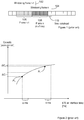
- Figure 1 illustrates the lookahead in an exemplary AMR codec.
- Each slot represents 5ms.
- a 30ms windowing frame 102, 104 is used.
- the windowing frame 104 extends 5ms into the next frame of speech data, which 5ms constitute the so-called lookahead 110.
- the transmission delay i.e. the part of an available end-to-end delay spent on the actual transmission through the communication system including, e.g. transmission through the radio access network and transport through the core network, depends largely on the access technology used and on the network configuration Typically, there is a distinct difference between CS transmissions and PS transmissions, in terms of transmission delay.
- CS transmissions the transmission delay is well defined and fixed for each transported frame throughout the connection.
- PS transmissions on the other hand, each packet is transmitted individually and hence associated with an individual transmission delay, which gives rise to the known packet delay jitter, i.e. variations, in PS transmissions. That is, the packets in PS transmissions arrive at the receiver with different delay, some may arrive early, some late.
- GSM EDGE Radio Access Network where EDGE stands for Enhanced Data rates for GSM Evolution
- UTRAN UMTS Terrestrial Radio Access Network
- PS transmission e.g. UIRAN PS bearers such as HSPA (High Speed locket Access) and LTE (Long Term Evolution), are available.
- HSPA High Speed locket Access
- LTE Long Term Evolution
- a method is provided in a network node according to claim 1, for adapting a property of source coding to the quality of a communication link in packet switched conversational services in a communication system.
- information related to the quality of said communication link is obtained.
- a source coding mode with an associated source coding delay is selected, based on the obtained information and the associated source coding delay.
- the selected source coding mode is to be used when source coding voice data to be transmitted over the communication link, and the source coding mode is selected from a set of source coding modes associated with different source coding delays.
- an arrangement in a network node according to claim 8, and adapted to adapt a property of source coding to the quality of a communication link in packet switched conversational services in a communication system.
- the arrangement comprises a functional unit adapted to obtain information related to the quality of a communication link.
- the arrangement further comprises a functional unit adapted to select a source coding mode with an associated source coding delay, based on the obtained information and the associated source coding delay.
- the selected source coding mode is to be used when source coding voice data to be transmitted over the communication link, and the source coding mode is selected from a set of source coding modes associated with different source coding delays.
- the above method and arrangement may be used for, when needed, extending an available transmission delay budget in packet switched conversational services, by adding time, which is gained by selection of a source coding mode associated with a reduced coding delay, when source coding voice data.
- the network node is a mobile terminal or other end-node, and in some embodiments, the network node is a central control node. In both cases, an indication of the selected source coding mode can be provided to one or more other network nodes.
- voice data to be transmitted over the communication link may be encoded in the network node using the selected source coding mode.
- the different selectable source coding modes may be associated with one source codec, and in other embodiments, some of the different selectable source coding modes may be associated with different source codecs, respectively.
- Atleast one of the different selectable source coding modes may be associated with an Adaptive Multi Rate, AMR, source codec, provided with at least one low-delay mode, wherein the encoding process in the at least one low-delay mode may be started without waiting for the lookahead buffer to be filled with valid samples.
- the at least one low-delay mode may be provided by modifying the shape of an IPC analysis window and/ or shifting an IPC analysis window in time.
- Atleast one of the different selectable source coding modes may be associated with a scalable codec with a core coding layer and at least one enhancement coding layer where the different coding layers are associated with different inherent delays.
- transmission of signals related to a layer being associated with a higher inherent delay is suspended, it may be refrained from delaying a signal related to a layer being associated with a low inherent delay, which is normally performed in order to synchronize it with signals related to a layer being associated with a higher inherent delay.
- different parameters may be determined based on the selected source coding mode, such as the duration of a time interval to be made available for retransmissions over the communication link; the number of retransmissions to be allowed over the communication link and/ or the size of a jitter buffer to be used in a receiver of signals transmitted over the communication link.
- the obtained information related to the quality of the communication link concerns atleast one of the parameters: the time spent on retransmissions over the communication link; the amount of retransmissions made of packets over the communication link; the amount of packets lost in transmission over the communication link; the amount of corrupt or unusable packets received over the communication link, and a predetermined change in one of the above listed parameters.
- a source coding mode associated with a relatively low source coding delay may be selected when the quality of the communication link is determined to be bad, and a source coding mode associated with a relatively high source coding delay may be selected when the quality of the communication link is determined to be good.
- a method and an arrangement are provided that can be used for extending an available transmission delay budget in packet switched conversational services, by adding time, which is gained from reducing a delay used for source coding of voice data.
- the source coding delay is reduced by providing a set of selectable source coding modes associated with different coding delays, and adaptively selecting a source coding mode associated with a coding delay that optimizes a tradeoff between source coding efficiency and transmission efficiency, given a certain estimated channel quality.
- the objective is to enable transmission capacity enhancements at a given average level of voice service quality, or, voice service quality enhancements at a given level of transmission capacity, or both.
- source coding delay refers to the amount of time a source coding algorithm for, e.g., voice data, requires for its operation.
- This algorithmic source coding delay is the time it takes for an input sample being fed into the encoder until it is reproduced by the decoder, excluding the time needed for computations or transmissions of coded speech data between encoder and decoder.
- This delay can be caused by the encoder for buffering a part of the input signal required for the coding algorithm to operate. It can also be caused by the decoder for e.g. buffering coded speech data before speech samples can be reconstructed.
- transmission delay generally refers to the time between source coding and source decoding, i.e. the time spent on, e.g. packetizing, channel coding, interleaving, retransmissions and jitter buffering.
- delay budget when referring to an allowed amount of delay, e.g. source coding delay or transmission delay, the term "delay budget, is used.
- codec is used in its conventional meaning, i.e. as referring to an encoder and/ or decoder.
- Channel conditions are referred to as being "good” or “bad”. There is no strict definition of a “good” or “bad” channel, since it depends, e.g. on what quality level is desired or could be accepted.
- the channel conditions typically relate to the transmission channel quality which can be described by e.g. packet or frame erasure rates, the amount of packet delay jitter, bit error rates, carrier to interference or noise ratios, etc..
- a “good channel” could be interpreted as a channel having a certain desired or acceptable quality
- a “bad channel” could be interpreted as a channel having an undesired, i.e. too low, or unacceptable quality.
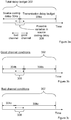
- source coding delay 304a is adapted 308 to channel conditions, and traded against transmission delay budget306a.
- channel conditions are determined to be good, a reliable transmission can be achieved without extending a transmission delay budget 306b.
- delay is better spent in a source codec, in order to improve the data compression ratio.
- channel conditions are determined to be bad, illustrated in figure 3c , relatively more gain can be achieved by spending more of an available end-to-end delay budget 302 on transmission, e.g.
- H-ARQ Hybrid Automatic Repeat reQuest
- a receiver deploys a jitter buffer that compensates for delay jitter of received speech data packets.
- a jitter buffer is also very suitable for compensating for changes in source coding delay.
- the jitter buffer if properly dimensioned, makes it possible to perform speech coding delay changes without causing discontinuities in the reconstructed speech signal. This is possible considering the Internet Engineering Task Force (IETF) Real Transport Protocol (RTP), RFC 3550 (Request For Comments), which is typically used for PS conversational voice transmissions.
- IETF Internet Engineering Task Force
- RTP Real Transport Protocol
- RFC 3550 Request For Comments
- This protocol provides each packet with a time stamp, which indicates the sampling instant of the first voice sample transported by the packet Hence, regardless of the delay spent on source coding or transmission, the time stamp information provides the exact time location of the reconstructed voice segment in relation to the voice segments represented by the other transported packets. If only the jitter buffer is sufficiently deep such that no buffer overflow or underflow occurs, then a change in coding delay is simply handled as any other delay jitter caused by the transmission.
- AMR Multi-mode codec in a PS scenario makes the same contribution of 25ms to an end-to-end delay for all codec modes, even though one of the modes, MR122, does not make use of all 25ms for source coding. While modes MR10.2 and downwards, i.e. lower coding rates, make use of the lookahead of 5ms, illustrated in figure 1 , for more efficient source coding, mode MR122 leaves the lookahead unused for source compression. In the mode MR122, the lookahead of 5ms is only used for VAD (Voice Activity Detection).
- VAD Voice Activity Detection
- Delay is an important attribute of efficient transmission and can either be used for more efficient source coding, i.e. a better compression efficiency, or for improved resilience to transmission errors, as previously mentioned. It can be considered suboptimal to keep the source coding delay, being a component of the end-to-end delay, fixed under all transmission conditions, as is the case in current speech transmission systems. This should be seen in view of the fact that many applications adapt the channel coding delay in response to the transmission system configuration and condition.
- the inventive concept can be applied to both traditional codecs, such as AMR codecs, and in the development of new codecs.
- the processing of an input signal speech frame is immediately started when a sufficient amount of input signal samples are available.
- the transmission can be started 5ms earlier than in conventional use.
- the 5ms thus obtained from the source coding can be used in a variety of ways for enhancing the transmission efficiency in real-time applications involving PS transmission of speech It should be noted that this approach may require a modification of the VAD algorithm in the AMRcodec, which however does not conflict with the general idea of the invention.
- a voice codec is provided with at least two modes.
- One of these modes is a low delay mode, with e.g. 20ms delay, typically operated at a low bit rate of e.g. 8 kbps. Given the low rate and delay, this mode provides decent but not extraordinary voice quality.
- a second mode, of the at least two modes is a high-rate high quality mode, operated at e.g. 16 or 24 kbps having a coding delay of e.g. 40ms.
- the channel conditions are estimated to be good, there is no need for an extended transmission delay budget, and the available delay is better spent on operating the high quality codec mode associated with the higher coding delay.
- the channel conditions degrade it is better to switch to the low-rate codec mode, which, due to the lower coding delay, allows for spending more delay for the transmissions, which in turn makes them more robust and more efficient
- the remaining part of the transmission chain i.e. after the source codec, is not modified at all.
- transmission gain will be obtained from the mere fact that there is more time available for the transmission of a speech packet to a receiver. Due to the increase in available transmission time, the likelihood of late losses, i.e. when a speech packet arrives too late at a receiver to be used for decoding, will be reduced, and hence the speech quality will be increased without spending any more transmission resources.
- an additional amount of milliseconds of transmission time e.g. the AMR related 5ms
- the AMR related 5ms can be used for increasing the delay budget for retransmissions and hence allow for an increased number of retransmissions.
- Such an increase will result in a more reliable transmission, given the same transmission resource usage, e.g. bandwidth
- the transmission resource usage can be reduced, while still keeping the same transmission reliability, e.g. QoS level (Quality of Service).
- the additional number of milliseconds can be used either for enhancement of speech quality, or for transmission system capacity enhancements, or both It is worth pointing out that the quality and/ or capacity gain is achieved without any increase in computational complexity.
- low-delay encoder operation modes could be provided in speech codecs, in addition to the conventional modes using lookahead in the encoding process.
- low-delay variants of the existing AMRmodes e.g. MR10.2
- IPC linear Predictive Coding
- the choice whether to use the regular or low-delay encoder variants could be either fixed, i.e. for some of the modes the low delay variants are used, or adaptive.
- One adaptation possibility is to decide at call setup which variant of a mode to use, e.g.
- the low-delay variant could be selected in order to help maximizing system capacity.
- a further adaptation possibility is to allow switching between a low-delay variant and the original version of a mode on-line during a call, based on actual channel condition estimates obtained from the receiving terminal or some control entity of the radio network.
- the low-delay operation mode alternatives can then be used for more efficient transmission at bad channel conditions, as outlined above.
- a shortening of the IPC analysis window will come at the price of slightly reduced intrinsic quality of the respective low-delay e.g. AMRcodec mode. However, this quality reduction will be compensated for by the quality gain due to the increased capability to deal with the bad channel conditions.
- the source coding delay i.e. the selection of source codec mode
- the source codec should be adapted to current channel conditions. For example, when channel conditions are determined to be relatively good, and when no extra delay for transmission enhancements is needed, the source codec may operate in a regular mode using encoder lookahead. However, when channel conditions are determined to be relatively bad, and when it is determined that a resulting gain from access to additional time for transmission exceeds a certain quality loss due to e.g. a reduction of the IPC analysis window, a low-delay source codec mode is selected. Such an adaptation would require the transmission of adaptation data from a receiving end to a transmitting end.
- the adaptation data could comprise channel measurement data, e.g.
- packet loss rates and/ or may comprise a request for a certain codec mode.
- the regular encoding mode with lookahead could be selected and/ or requested.
- the low-delay encoding mode could be selected and/ or requested.
- the allowed number of H-ARQ re-transmissions could be adapted in direct response to a selected coding delay, or to a selected encoding mode that is associated with a certain coding delay.
- the maximum number of allowed retransmissions in the H-ARQ protocol is preferably set to a higher number than when the encoder operates in a "high-delay” mode.
- Such a direct control of the H-ARQ protocol may not always be possible or desirable, as it requires that the MAC (Media Access Control) layer receives an indication of which delay or mode that is used by the encoder.
- inter-layer communication may be avoided by the use of feedback to the encoding-end from a receiving-end.
- an adaptation of the source codec mode to channel conditions will ensure that an original "high-delay" mode, with lookahead, is used in a source codec during good channel conditions.
- the delay caused by H-ARQ retransmissions will be short when channel conditions are good. Then, when the channel deteriorates, the delay caused by H-ARQ retransmissions will increase, which can be detected by the receiver.
- a certain detected increase of the time spent on retransmissions, and/ or the number of received re-transmissions, and/ or a certain detected increase of the amount of lost packets can be used as a criterion for deciding to use a low-delay encoder mode without lookahead.
- the number of allowed re-transmissions in the H-ARQ protocol could be set to a higher number, matching the low-delay source coding.
- the IETF RTP control protocol (RTCP) thatis specified as a part of the RFC 3550 provides the necessary protocol elements facilitating the transmission of feedback information to the encoding-end from a receiving-end.
- a similar codec delay adaptation strategy is possible with codecs that inherently have more than one coding delay option.
- An example of such a codec is a scalable codec such as G.718 with an ACELP (Algebraic Code Excited linear Prediction) core layer and an MDCT(Modified Discrete Cosine Transform) enhancement layer.
- the ACELP layer requires less coding delay than the MDCT enhancement layer.
- the ACELP layer signal is delayed in the decoder, such that it will have the same delay as the reconstructed MDCT enhancement layer signal.
- the above described codec and similar codec types may be adapted as follows:
- the configuration of when to use the different decoding delays could be made e.g. at setup, or be changed adaptively during a session.
- the described adaptation between source coding with a longer delay and a corresponding shorter transmission delay on good channels, and source coding with shorter delay and corresponding longer transmission delay on bad channels could also be generalized to switching between completely different source codecs, which are not related to each other.
- an audio codec associated with a long coding delay could be used when channel conditions are determined to be good
- a speech codec associated with a relatively shorter coding delay could be used when channel conditions are determined to be bad.
- the coding delay difference could then be made available for, e.g. channel coding when channel conditions are determined to be bad, or, as in the embodiment above, in the H-ARQ protocol, for enabling further retransmissions, or in the receiver jitter buffer, in which the buffer length can be increased accordingly.
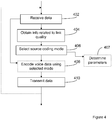
- step 402. data is received in a step 402.
- the received data could either be voice data to be source coded before transmission, or information related to voice data to be source coded.
- Information related to the quality of a communication link is obtained in a step 404.
- the information could be obtained e.g. by performing measurements on transmissions received over the communication link, receiving reports of the quality of the communication link from another network entity, or by using any other suitable method.
- a source coding mode is selected from a set of at least two source coding modes, in a step 406, based on the information obtained in step 404. This can be done by comparing a value representing the quality information obtained in step 404 with a predetermined threshold. The codec mode with low delay is selected when this value is below the threshold, otherwise, the other mode is selected.
- the different source coding modes in the set are associated with different source coding delays, and the selection of a source coding mode from the set concerns selecting a desired source coding delay in order to match the quality of the communication link.
- the procedure is applied in an end-node, which is to encode received voice data
- the received voice data is encoded, using the selected source coding mode, in a step 408, and the source encoded voice data is then transmitted to another network node in a step 410.
- an indication of the selected source coding mode is provided to one or more other network-nodes in the step 410.
- the procedure may further comprise a step 407 of determining e.g. a duration of a time interval to be made available for retransmissions, and/ or a number of retransmissions to be allowed over the communication link when using the selected source coding mode, and/ or a size of a jitter buffer to be used in a receiver of signals transmitted over the communication link, based on the selected source coding mode.
- the determined parameters are then provided to the network nodes concerned, for use during transmission of speech, source coded using the selected source coding mode, over the communication link in a conversational service.
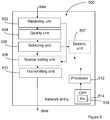
- the arrangement 500 comprises a receiving unit 502, which is adapted to receive signals transmitted from other network entities and/ or signals arriving to the network entity in the form of sound waves, depending on whether the arrangement 500 is provided in an end-node or in a central control node.
- the arrangement 500 further comprises a quality unit 504, adapted to obtain information related to the estimated quality of a communication link.
- the information could e.g. be derived from measurements on transmissions received over the communication link, or from reports of the quality of the communication link, received from another network entity, or by using any other suitable method.
- the arrangement 500 further comprises a selecting unit 506, adapted to select a source coding mode from a set of at least two source coding modes associated with different coding delays, based on information obtained in the quality unit 504.
- a selecting unit 506 adapted to select a source coding mode from a set of at least two source coding modes associated with different coding delays, based on information obtained in the quality unit 504.
- a source coding unit 508 adapted to source encode received voice data using the source coding mode selected by the selecting unit 506.
- the source coding unit 508 could comprise e.g. one or more source codecs or one codec with the above different codec modes, with different delays.
- the arrangement 500 further comprises a transmitting unit 510.
- the transmitting unit 510 is adapted to transmit encoded voice data over the communication link and/ or to provide an indication of the selected source coding mode to one or more other network nodes.
- the transmitting unit 510 is adapted to provide an indication of the selected source coding mode to one or more other network nodes.
- the arrangement 500 may further comprise a determining unit 507, adapted to determine e.g. at least one of: a duration of a time interval to be made available for retransmissions over the communication link; a number of retransmissions to be allowed over the communication link; and a size of a jitter buffer to be used in a receiver of signals transmitted over the communication link, based on the selected source coding mode.
- the determined parameters are then provided to the network nodes or functional units concerned, which is schematically illustrated by a dashed arrow from unit 507.
- FIG 5 is also illustrated a computer program product (CPP) 514 which comprises instructions 516, which when executed by a processor 512, or similar, will cause the units 504-510 to perform their tasks according to an embodiment of the described procedure.
- CPP computer program product
- Connections between the processor 512 and the units 504-510 are schematically illustrated by a dashed arrow from 512.
- figure 5 merely illustrates various functional units of the arrangement 500 in a logical sense.
- the skilled person is free to implement these functions in practice using any suitable software and/ or hardware means, such as e.g. ASICs (Application-Specific Integrated Circuit), FPG As (Field-Programmable Gate Array) and DSPs (Digital Signal Processor).
- ASICs Application-Specific Integrated Circuit
- FPG As Field-Programmable Gate Array
- DSPs Digital Signal Processor
- Figure 6a shows a codec according to one embodiment, having more than one codec mode per coding rate, at least one being associated with a high coding delay, and at least one being associated with a low coding delay.
- Figure 6b shows a codec according to one embodiment, where each codec mode is associated with a different coding rate and a different coding delay.
- Figure 6c shows an embodiment where different coding delays are associated with different codecs, each having modes with different coding rates.
- the illustrated embodiments could be varied and/ or combined in different ways. The number of possible selectable coding delays is obviously not limited to the two alternatives "high” and "low", which are used here for the sake of simplicity.
- An exemplary advantage of the above embodiments is that source coding delay can be traded for transmission delay, which enables making transmission over low quality channels more reliable than what is possible today and which in turn may lead to system capacity enhancements.
Landscapes
- Engineering & Computer Science (AREA)
- Multimedia (AREA)
- Signal Processing (AREA)
- Computer Networks & Wireless Communication (AREA)
- Health & Medical Sciences (AREA)
- Computational Linguistics (AREA)
- Audiology, Speech & Language Pathology (AREA)
- Human Computer Interaction (AREA)
- Physics & Mathematics (AREA)
- Acoustics & Sound (AREA)
- Quality & Reliability (AREA)
- Mobile Radio Communication Systems (AREA)
- Data Exchanges In Wide-Area Networks (AREA)
Claims (15)
- Verfahren in einem Netzwerkknoten zum Anpassen einer Eigenschaft der Quellencodierung an die Qualität einer Kommunikationsverbindung in paketvermittelten Gesprächsdiensten in einem Kommunikationssystem, wobei das Verfahren die folgenden Schritte umfasst:- Erlangen (404) von Information bezüglich der Qualität der Kommunikationsverbindung,- Auswählen (406) eines Quellencodiermodus mit einer assoziierten Quellencodierverzögerung auf der Grundlage der erlangten Information und der assoziierten Quellencodierverzögerung zum Optimieren eines Kompromisses zwischen Quellencodiereffizienz und Übertragungseffizienz,worin der ausgewählte Quellencodiermodus zu verwenden ist, wenn Sprachdaten quellencodiert werden, die über die Kommunikationsverbindung übertragen werden sollen, und worin der Quellencodiermodus aus einer Menge von Quellencodiermodi ausgewählt wird, die mit unterschiedlichen Quellencodierverzögerungen assoziiert sind.
- Verfahren nach Anspruch 1, worin mindestens einer der unterschiedlichen auswählbaren Quellencodiermodi mit einem Adaptiven Mehrraten-(AMR-)Codec assoziiert ist, der mit mindestens einem Modus mit geringer Verzögerung ausgestattet ist.
- Verfahren nach Anspruch 2, worin der Codierprozess in dem mindestens einen Modus mit geringer Verzögerung begonnen wird, ohne darauf zu warten, dass der Vorausschaupuffer mit gültigen Abtastwerten gefüllt wird.
- Verfahren nach Anspruch 2 oder 3, worin der mindestens eine Modus mit niedriger Verzögerung durch mindestens eines von Folgendem bereitgestellt wird: Modifizieren der Form eines Analysefensters der linearen vorausschauenden Codierung, LPC; und zeitliches Verschieben eines LPC-Analysefensters.
- Verfahren nach Anspruch 1, worin mindestens einer der unterschiedlichen auswählbaren Quellencodiermodi mit einem skalierbaren Codec mit einer Kerncodierschicht und mindestens einer Verbesserungscodierschicht assoziiert ist, wobei die unterschiedlichen Codierschichten mit unterschiedlichen Eigenverzögerungen assoziiert sind.
- Verfahren nach Anspruch 5, worin ein Signal, das sich auf eine Schicht bezieht, die mit einer niedrigen Eigenverzögerung assoziiert ist, nicht verzögert wird, um mit Signalen synchronisiert zu werden, die sich auf eine Schicht beziehen, die mit einer höheren Eigenverzögerung assoziiert ist, wenn die Übertragung von Signalen ausgesetzt wird, die sich auf eine Schicht beziehen, die mit einer höheren Eigenverzögerung assoziiert ist.
- Verfahren nach einem der vorhergehenden Ansprüche, ferner umfassend:- auf dem ausgewählten Quellencodiermodus beruhendes Bestimmen (407) von mindestens einem der folgenden Elemente:- die Dauer eines Zeitintervalls, das für Übertragungswiederholungen über die Kommunikationsverbindung zur Verfügung zu stellen ist,- die Anzahl der zu erlaubenden Übertragungswiederholungen über die Kommunikationsverbindung, und- die Größe eines Jitterpuffers, der in einem Empfänger von über die Kommunikationsverbindung übertragenen Signalen zu verwenden ist.
- Anordnung in einem Netzwerkknoten, die dafür eingerichtet ist, eine Eigenschaft der Quellencodierung an die Qualität einer Kommunikationsverbindung in paketvermittelten Gesprächsdiensten in einem Kommunikationssystem anzupassen, wobei die Anordnung umfasst:- eine Qualitätseinheit (502), die dafür eingerichtet ist, Information bezüglich der Qualität einer Kommunikationsverbindung zu erlangen,- eine Auswahleinheit (506), die dafür eingerichtet ist, auf der Grundlage der erlangten Information und der assoziierten Quellencodierverzögerung einen Quellencodiermodus mit einer assoziierten Quellencodierverzögerung auszuwählen, und zwar zum Optimieren eines Kompromisses zwischen Quellencodiereffizienz und Übertragungseffizienz,worin der ausgewählte Quellencodiermodus zu verwenden ist, wenn Sprachdaten, die über die Kommunikationsverbindung übertragen werden sollen, quellencodiert werden, und worin der Quellencodiermodus aus einer Menge von Quellencodiermodi ausgewählt wird, die mit unterschiedlichen Quellencodierverzögerungen assoziiert sind.
- Anordnung nach Anspruch 8, worin mindestens einer der unterschiedlichen auswählbaren Quellencodiermodi mit einem Adaptiven Mehrraten-(AMR-)Codec assoziiert ist, der mit mindestens einem Modus mit geringer Verzögerung ausgestattet ist.
- Anordnung nach Anspruch 9, worin der AMR-Quellencodec dafür eingerichtet ist, den Codierprozess in dem mindestens einen Modus mit geringer Verzögerung zu beginnen, ohne darauf zu warten, dass der Vorausschaupuffer mit gültigen Abtastwerten gefüllt wird.
- Anordnung nach Anspruch 9 oder 10, worin der mindestens eine Modus mit niedriger Verzögerung durch mindestens eines von Folgendem bereitgestellt wird: Modifizieren der Form eines Analysefensters der linearen vorausschauenden Codierung, LPC; und zeitliches Verschieben eines LPC-Analysefensters.
- Anordnung nach Anspruch 8, worin mindestens einer der unterschiedlichen auswählbaren Quellencodiermodi mit einem skalierbaren Codec mit einer Kerncodierschicht und mindestens einer Verbesserungscodierschicht assoziiert ist, wobei die unterschiedlichen Codierschichten mit unterschiedlichen Eigenverzögerungen assoziiert sind.
- Anordnung nach Anspruch 12, worin der skalierbare Quellencodec dafür eingerichtet ist, das Verzögern eines Signals zu unterlassen, das sich auf eine Schicht bezieht, die mit einer niedrigen Eigenverzögerung assoziiert ist, damit es mit Signalen synchronisiert wird, die sich auf eine Schicht beziehen, die mit einer höheren Eigenverzögerung assoziiert ist, wenn die Übertragung von Signalen ausgesetzt wird, die sich auf eine Schicht beziehen, die mit einer höheren Eigenverzögerung assoziiert ist.
- Anordnung nach einem der Ansprüche 8 bis 13, ferner umfassend:- eine Bestimmungseinheit (507), die dafür eingerichtet ist, auf der Grundlage des ausgewählten Quellencodiermodus mindestens eines von Folgendem zu bestimmen:- die Dauer eines Zeitintervalls, das für Übertragungswiederholungen über die Kommunikationsverbindung zur Verfügung zu stellen ist,- die Anzahl der zu erlaubenden Übertragungswiederholungen über die Kommunikationsverbindung, und- die Größe eines Jitterpuffers, der in einem Empfänger von über die Kommunikationsverbindung übertragenen Signalen zu verwenden ist.
- Anordnung nach einem der Ansprüche 8 bis 14, worin die Qualitätseinheit dafür eingerichtet ist, Information zu erlangen, die mindestens einen der folgenden Parameter betrifft:- die Zeit, die für Übertragungswiederholungen über die Kommunikationsverbindung aufgewendet wird,- die Anzahl der aus Paketen bestehenden Übertragungswiederholungen über die Kommunikationsverbindung,- die Anzahl der bei der Übertragung über die Kommunikationsverbindung verlorenen Pakete,- die Anzahl der über die Kommunikationsverbindung empfangenen beschädigten oder unbrauchbaren Pakete, und- eine vorbestimmte Änderung an einem der oben aufgeführten Parameter.
Applications Claiming Priority (1)
| Application Number | Priority Date | Filing Date | Title |
|---|---|---|---|
| PCT/SE2010/050241 WO2011108964A1 (en) | 2010-03-02 | 2010-03-02 | Source code adaption based on communication link quality and source coding delay. |
Publications (3)
| Publication Number | Publication Date |
|---|---|
| EP2543039A1 EP2543039A1 (de) | 2013-01-09 |
| EP2543039A4 EP2543039A4 (de) | 2017-03-15 |
| EP2543039B1 true EP2543039B1 (de) | 2018-11-28 |
Family
ID=44542429
Family Applications (1)
| Application Number | Title | Priority Date | Filing Date |
|---|---|---|---|
| EP10847113.7A Not-in-force EP2543039B1 (de) | 2010-03-02 | 2010-03-02 | Quellcodedapation je nach kommunikationsverbindungsqualität und quellencodierungsverzögerung |
Country Status (4)
| Country | Link |
|---|---|
| US (1) | US8898060B2 (de) |
| EP (1) | EP2543039B1 (de) |
| CN (1) | CN102792372B (de) |
| WO (1) | WO2011108964A1 (de) |
Cited By (1)
| Publication number | Priority date | Publication date | Assignee | Title |
|---|---|---|---|---|
| EP4258751A4 (de) * | 2021-01-12 | 2024-05-01 | Huawei Technologies Co., Ltd. | Uplink-ressourcen-voranwendungsverfahren und zugehörige vorrichtung |
Families Citing this family (12)
| Publication number | Priority date | Publication date | Assignee | Title |
|---|---|---|---|---|
| JP2012231445A (ja) * | 2011-04-11 | 2012-11-22 | Toshiba Corp | パケット配信装置およびパケット配信方法 |
| CN109448745B (zh) * | 2013-01-07 | 2021-09-07 | 中兴通讯股份有限公司 | 一种编码模式切换方法和装置、解码模式切换方法和装置 |
| ES2656343T3 (es) * | 2013-03-25 | 2018-02-26 | Altiostar Networks, Inc. | Sistemas y procedimientos para la planificación de paquetes de datos en base a la tolerancia al retardo de las aplicaciones |
| US9437205B2 (en) * | 2013-05-10 | 2016-09-06 | Tencent Technology (Shenzhen) Company Limited | Method, application, and device for audio signal transmission |
| KR102459010B1 (ko) | 2013-05-24 | 2022-10-27 | 돌비 인터네셔널 에이비 | 오디오 인코더 및 디코더 |
| RU2739718C2 (ru) * | 2016-10-12 | 2020-12-28 | Гуандун Оппо Мобайл Телекоммьюникейшнз Корп., Лтд. | Способ передачи данных, устройство приемной стороны и устройство передающей стороны |
| CN110351201B (zh) * | 2018-04-04 | 2021-09-14 | 华为技术有限公司 | 一种数据处理方法及装置 |
| US20210051737A1 (en) * | 2019-08-16 | 2021-02-18 | Qualcomm Incorporated | Communication resource selection in sidelink communication |
| US12236959B2 (en) * | 2021-05-27 | 2025-02-25 | Qualcomm Incorporated | Audio encoding based on link data |
| CN115549762B (zh) * | 2022-09-23 | 2023-09-01 | 广州爱浦路网络技术有限公司 | 卫星通信会话处理方法、计算机装置及存储介质 |
| CN115910078B (zh) * | 2022-10-20 | 2026-04-07 | 中国电子科技集团公司第三十研究所 | 自适应语音编解码调节方法、装置、设备及介质 |
| CN117155844B (zh) * | 2023-10-27 | 2024-01-09 | 北京华翔联信科技股份有限公司 | 一种通信链路选择方法、系统、电子设备及存储介质 |
Family Cites Families (12)
| Publication number | Priority date | Publication date | Assignee | Title |
|---|---|---|---|---|
| JP3849210B2 (ja) * | 1996-09-24 | 2006-11-22 | ヤマハ株式会社 | 音声符号化復号方式 |
| US6216107B1 (en) * | 1998-10-16 | 2001-04-10 | Ericsson Inc. | High-performance half-rate encoding apparatus and method for a TDM system |
| EP1059782A3 (de) * | 1999-06-10 | 2004-02-04 | Lucent Technologies Inc. | Verfahren und Vorrichtung zur dynamische benutzung der bandbreite in einem Packetfernsprechernetz |
| AU2000244000A1 (en) | 2000-04-11 | 2001-10-23 | Nokia Corporation | Application of rtp and rtcp in the amr transport in voice over ip networks |
| US7002992B1 (en) | 2001-03-07 | 2006-02-21 | Cisco Technology, Inc. | Codec selection to improve media communication |
| SE0102849D0 (sv) * | 2001-08-22 | 2001-08-22 | Ericsson Telefon Ab L M | Methods and arrangements in a telecommunicaton system |
| FI20011715A7 (fi) * | 2001-08-27 | 2003-02-28 | Nokia Corp | Koodekin toiminnallisen moodin valinta |
| WO2003084090A1 (en) * | 2002-04-03 | 2003-10-09 | Telefonaktiebolaget L M Ericsson (Publ) | Power control in mobile communication system |
| US7289451B2 (en) * | 2002-10-25 | 2007-10-30 | Telefonaktiebolaget Lm Ericsson (Publ) | Delay trading between communication links |
| CN1312946C (zh) * | 2004-11-11 | 2007-04-25 | 向为 | 话音的自适应多速率编码和传输方法 |
| US8842555B2 (en) * | 2005-10-21 | 2014-09-23 | Qualcomm Incorporated | Methods and systems for adaptive encoding of real-time information in packet-switched wireless communication systems |
| US20080103765A1 (en) * | 2006-11-01 | 2008-05-01 | Nokia Corporation | Encoder Delay Adjustment |
-
2010
- 2010-03-02 EP EP10847113.7A patent/EP2543039B1/de not_active Not-in-force
- 2010-03-02 WO PCT/SE2010/050241 patent/WO2011108964A1/en not_active Ceased
- 2010-03-02 CN CN201080065006.7A patent/CN102792372B/zh not_active Expired - Fee Related
- 2010-03-02 US US13/582,122 patent/US8898060B2/en active Active
Non-Patent Citations (1)
| Title |
|---|
| None * |
Cited By (1)
| Publication number | Priority date | Publication date | Assignee | Title |
|---|---|---|---|---|
| EP4258751A4 (de) * | 2021-01-12 | 2024-05-01 | Huawei Technologies Co., Ltd. | Uplink-ressourcen-voranwendungsverfahren und zugehörige vorrichtung |
Also Published As
| Publication number | Publication date |
|---|---|
| EP2543039A1 (de) | 2013-01-09 |
| US8898060B2 (en) | 2014-11-25 |
| US20120323568A1 (en) | 2012-12-20 |
| WO2011108964A1 (en) | 2011-09-09 |
| CN102792372A (zh) | 2012-11-21 |
| EP2543039A4 (de) | 2017-03-15 |
| CN102792372B (zh) | 2014-07-09 |
Similar Documents
| Publication | Publication Date | Title |
|---|---|---|
| EP2543039B1 (de) | Quellcodedapation je nach kommunikationsverbindungsqualität und quellencodierungsverzögerung | |
| CN105161114B (zh) | 用于多码率语音和音频编解码器的帧擦除隐藏 | |
| US10616123B2 (en) | Apparatus and method for adaptive de-jitter buffer | |
| TWI647614B (zh) | 增強編解碼引擎控制之方法 | |
| RU2404523C2 (ru) | УЛУЧШЕННОЕ КАЧЕСТВО ПОТОКА МЕДИАДАННЫХ VoIP ПОСРЕДСТВОМ АДАПТАЦИИ КОДИРОВАНИЯ РЕЧИ НА ОСНОВЕ ВЫБРАННОЙ СХЕМЫ МОДУЛЯЦИИ И КОДИРОВАНИЯ (MCS) | |
| EP3228037B1 (de) | Verfahren und vorrichtung zur entfernung von jitter in audiodatenübertragung | |
| US8208516B2 (en) | Encoder initialization and communications | |
| KR100902456B1 (ko) | 단 대 단 VoIP 매체 지연을 관리하는 방법 및 장치 | |
| JP5528811B2 (ja) | 効率的なメディアの扱いのための受信機の動作及び実装 | |
| CN111164946A (zh) | 用于适配互联网协议语音通信会话的请求的信令 | |
| WO2006096557A2 (en) | Restructuring data packets to improve voice quality at low bandwidth conditions in wireless networks | |
| EP2647241B1 (de) | Quellensignal-angepasste zusammensetzung von rahmen | |
| US20090043567A1 (en) | Variable frame offset coding | |
| US20120095760A1 (en) | Apparatus, a method and a computer program for coding | |
| CN101336450A (zh) | 在无线通信系统中用于语音编码的方法和装置 | |
| EP1775870A1 (de) | Verfahren und einrichtung, system und programm zur zweiseitigen kommunikation | |
| EP1739917B1 (de) | Vorrichtung, System und Verfahren zur Löschung von kodierten Teilen eines gesampelten Audiostromes | |
| JP2008193450A (ja) | 通信装置、パケット通信システム、プログラムおよび記録媒体 |
Legal Events
| Date | Code | Title | Description |
|---|---|---|---|
| PUAI | Public reference made under article 153(3) epc to a published international application that has entered the european phase |
Free format text: ORIGINAL CODE: 0009012 |
|
| 17P | Request for examination filed |
Effective date: 20120827 |
|
| AK | Designated contracting states |
Kind code of ref document: A1 Designated state(s): AT BE BG CH CY CZ DE DK EE ES FI FR GB GR HR HU IE IS IT LI LT LU LV MC MK MT NL NO PL PT RO SE SI SK SM TR |
|
| DAX | Request for extension of the european patent (deleted) | ||
| RA4 | Supplementary search report drawn up and despatched (corrected) |
Effective date: 20170209 |
|
| RIC1 | Information provided on ipc code assigned before grant |
Ipc: G10L 19/10 20130101AFI20170203BHEP Ipc: G10L 19/24 20130101ALI20170203BHEP Ipc: G10L 19/12 20130101ALI20170203BHEP Ipc: H04M 7/00 20060101ALI20170203BHEP Ipc: G10L 19/22 20130101ALI20170203BHEP Ipc: H04L 1/00 20060101ALI20170203BHEP Ipc: H04L 29/06 20060101ALI20170203BHEP Ipc: G10L 19/18 20130101ALI20170203BHEP |
|
| GRAP | Despatch of communication of intention to grant a patent |
Free format text: ORIGINAL CODE: EPIDOSNIGR1 |
|
| STAA | Information on the status of an ep patent application or granted ep patent |
Free format text: STATUS: GRANT OF PATENT IS INTENDED |
|
| INTG | Intention to grant announced |
Effective date: 20180911 |
|
| GRAS | Grant fee paid |
Free format text: ORIGINAL CODE: EPIDOSNIGR3 |
|
| GRAA | (expected) grant |
Free format text: ORIGINAL CODE: 0009210 |
|
| STAA | Information on the status of an ep patent application or granted ep patent |
Free format text: STATUS: THE PATENT HAS BEEN GRANTED |
|
| AK | Designated contracting states |
Kind code of ref document: B1 Designated state(s): AT BE BG CH CY CZ DE DK EE ES FI FR GB GR HR HU IE IS IT LI LT LU LV MC MK MT NL NO PL PT RO SE SI SK SM TR |
|
| REG | Reference to a national code |
Ref country code: GB Ref legal event code: FG4D |
|
| REG | Reference to a national code |
Ref country code: CH Ref legal event code: EP |
|
| REG | Reference to a national code |
Ref country code: DE Ref legal event code: R096 Ref document number: 602010055525 Country of ref document: DE |
|
| REG | Reference to a national code |
Ref country code: AT Ref legal event code: REF Ref document number: 1071153 Country of ref document: AT Kind code of ref document: T Effective date: 20181215 |
|
| REG | Reference to a national code |
Ref country code: IE Ref legal event code: FG4D |
|
| REG | Reference to a national code |
Ref country code: LT Ref legal event code: MG4D Ref country code: NL Ref legal event code: FP |
|
| REG | Reference to a national code |
Ref country code: AT Ref legal event code: MK05 Ref document number: 1071153 Country of ref document: AT Kind code of ref document: T Effective date: 20181128 |
|
| PG25 | Lapsed in a contracting state [announced via postgrant information from national office to epo] |
Ref country code: ES Free format text: LAPSE BECAUSE OF FAILURE TO SUBMIT A TRANSLATION OF THE DESCRIPTION OR TO PAY THE FEE WITHIN THE PRESCRIBED TIME-LIMIT Effective date: 20181128 Ref country code: LV Free format text: LAPSE BECAUSE OF FAILURE TO SUBMIT A TRANSLATION OF THE DESCRIPTION OR TO PAY THE FEE WITHIN THE PRESCRIBED TIME-LIMIT Effective date: 20181128 Ref country code: FI Free format text: LAPSE BECAUSE OF FAILURE TO SUBMIT A TRANSLATION OF THE DESCRIPTION OR TO PAY THE FEE WITHIN THE PRESCRIBED TIME-LIMIT Effective date: 20181128 Ref country code: BG Free format text: LAPSE BECAUSE OF FAILURE TO SUBMIT A TRANSLATION OF THE DESCRIPTION OR TO PAY THE FEE WITHIN THE PRESCRIBED TIME-LIMIT Effective date: 20190228 Ref country code: HR Free format text: LAPSE BECAUSE OF FAILURE TO SUBMIT A TRANSLATION OF THE DESCRIPTION OR TO PAY THE FEE WITHIN THE PRESCRIBED TIME-LIMIT Effective date: 20181128 Ref country code: AT Free format text: LAPSE BECAUSE OF FAILURE TO SUBMIT A TRANSLATION OF THE DESCRIPTION OR TO PAY THE FEE WITHIN THE PRESCRIBED TIME-LIMIT Effective date: 20181128 Ref country code: IS Free format text: LAPSE BECAUSE OF FAILURE TO SUBMIT A TRANSLATION OF THE DESCRIPTION OR TO PAY THE FEE WITHIN THE PRESCRIBED TIME-LIMIT Effective date: 20190328 Ref country code: LT Free format text: LAPSE BECAUSE OF FAILURE TO SUBMIT A TRANSLATION OF THE DESCRIPTION OR TO PAY THE FEE WITHIN THE PRESCRIBED TIME-LIMIT Effective date: 20181128 Ref country code: NO Free format text: LAPSE BECAUSE OF FAILURE TO SUBMIT A TRANSLATION OF THE DESCRIPTION OR TO PAY THE FEE WITHIN THE PRESCRIBED TIME-LIMIT Effective date: 20190228 |
|
| PG25 | Lapsed in a contracting state [announced via postgrant information from national office to epo] |
Ref country code: SE Free format text: LAPSE BECAUSE OF FAILURE TO SUBMIT A TRANSLATION OF THE DESCRIPTION OR TO PAY THE FEE WITHIN THE PRESCRIBED TIME-LIMIT Effective date: 20181128 Ref country code: PT Free format text: LAPSE BECAUSE OF FAILURE TO SUBMIT A TRANSLATION OF THE DESCRIPTION OR TO PAY THE FEE WITHIN THE PRESCRIBED TIME-LIMIT Effective date: 20190328 Ref country code: GR Free format text: LAPSE BECAUSE OF FAILURE TO SUBMIT A TRANSLATION OF THE DESCRIPTION OR TO PAY THE FEE WITHIN THE PRESCRIBED TIME-LIMIT Effective date: 20190301 |
|
| PG25 | Lapsed in a contracting state [announced via postgrant information from national office to epo] |
Ref country code: CZ Free format text: LAPSE BECAUSE OF FAILURE TO SUBMIT A TRANSLATION OF THE DESCRIPTION OR TO PAY THE FEE WITHIN THE PRESCRIBED TIME-LIMIT Effective date: 20181128 Ref country code: PL Free format text: LAPSE BECAUSE OF FAILURE TO SUBMIT A TRANSLATION OF THE DESCRIPTION OR TO PAY THE FEE WITHIN THE PRESCRIBED TIME-LIMIT Effective date: 20181128 Ref country code: IT Free format text: LAPSE BECAUSE OF FAILURE TO SUBMIT A TRANSLATION OF THE DESCRIPTION OR TO PAY THE FEE WITHIN THE PRESCRIBED TIME-LIMIT Effective date: 20181128 Ref country code: DK Free format text: LAPSE BECAUSE OF FAILURE TO SUBMIT A TRANSLATION OF THE DESCRIPTION OR TO PAY THE FEE WITHIN THE PRESCRIBED TIME-LIMIT Effective date: 20181128 |
|
| REG | Reference to a national code |
Ref country code: DE Ref legal event code: R097 Ref document number: 602010055525 Country of ref document: DE |
|
| PG25 | Lapsed in a contracting state [announced via postgrant information from national office to epo] |
Ref country code: SK Free format text: LAPSE BECAUSE OF FAILURE TO SUBMIT A TRANSLATION OF THE DESCRIPTION OR TO PAY THE FEE WITHIN THE PRESCRIBED TIME-LIMIT Effective date: 20181128 Ref country code: SM Free format text: LAPSE BECAUSE OF FAILURE TO SUBMIT A TRANSLATION OF THE DESCRIPTION OR TO PAY THE FEE WITHIN THE PRESCRIBED TIME-LIMIT Effective date: 20181128 Ref country code: EE Free format text: LAPSE BECAUSE OF FAILURE TO SUBMIT A TRANSLATION OF THE DESCRIPTION OR TO PAY THE FEE WITHIN THE PRESCRIBED TIME-LIMIT Effective date: 20181128 Ref country code: RO Free format text: LAPSE BECAUSE OF FAILURE TO SUBMIT A TRANSLATION OF THE DESCRIPTION OR TO PAY THE FEE WITHIN THE PRESCRIBED TIME-LIMIT Effective date: 20181128 |
|
| PLBE | No opposition filed within time limit |
Free format text: ORIGINAL CODE: 0009261 |
|
| STAA | Information on the status of an ep patent application or granted ep patent |
Free format text: STATUS: NO OPPOSITION FILED WITHIN TIME LIMIT |
|
| PG25 | Lapsed in a contracting state [announced via postgrant information from national office to epo] |
Ref country code: SI Free format text: LAPSE BECAUSE OF FAILURE TO SUBMIT A TRANSLATION OF THE DESCRIPTION OR TO PAY THE FEE WITHIN THE PRESCRIBED TIME-LIMIT Effective date: 20181128 Ref country code: MC Free format text: LAPSE BECAUSE OF FAILURE TO SUBMIT A TRANSLATION OF THE DESCRIPTION OR TO PAY THE FEE WITHIN THE PRESCRIBED TIME-LIMIT Effective date: 20181128 |
|
| REG | Reference to a national code |
Ref country code: CH Ref legal event code: PL |
|
| 26N | No opposition filed |
Effective date: 20190829 |
|
| PG25 | Lapsed in a contracting state [announced via postgrant information from national office to epo] |
Ref country code: LU Free format text: LAPSE BECAUSE OF NON-PAYMENT OF DUE FEES Effective date: 20190302 |
|
| REG | Reference to a national code |
Ref country code: BE Ref legal event code: MM Effective date: 20190331 |
|
| PG25 | Lapsed in a contracting state [announced via postgrant information from national office to epo] |
Ref country code: IE Free format text: LAPSE BECAUSE OF NON-PAYMENT OF DUE FEES Effective date: 20190302 Ref country code: LI Free format text: LAPSE BECAUSE OF NON-PAYMENT OF DUE FEES Effective date: 20190331 Ref country code: CH Free format text: LAPSE BECAUSE OF NON-PAYMENT OF DUE FEES Effective date: 20190331 |
|
| PG25 | Lapsed in a contracting state [announced via postgrant information from national office to epo] |
Ref country code: FR Free format text: LAPSE BECAUSE OF NON-PAYMENT OF DUE FEES Effective date: 20190331 Ref country code: BE Free format text: LAPSE BECAUSE OF NON-PAYMENT OF DUE FEES Effective date: 20190331 |
|
| PG25 | Lapsed in a contracting state [announced via postgrant information from national office to epo] |
Ref country code: TR Free format text: LAPSE BECAUSE OF FAILURE TO SUBMIT A TRANSLATION OF THE DESCRIPTION OR TO PAY THE FEE WITHIN THE PRESCRIBED TIME-LIMIT Effective date: 20181128 |
|
| PG25 | Lapsed in a contracting state [announced via postgrant information from national office to epo] |
Ref country code: MT Free format text: LAPSE BECAUSE OF NON-PAYMENT OF DUE FEES Effective date: 20190302 |
|
| PG25 | Lapsed in a contracting state [announced via postgrant information from national office to epo] |
Ref country code: CY Free format text: LAPSE BECAUSE OF FAILURE TO SUBMIT A TRANSLATION OF THE DESCRIPTION OR TO PAY THE FEE WITHIN THE PRESCRIBED TIME-LIMIT Effective date: 20181128 |
|
| PG25 | Lapsed in a contracting state [announced via postgrant information from national office to epo] |
Ref country code: HU Free format text: LAPSE BECAUSE OF FAILURE TO SUBMIT A TRANSLATION OF THE DESCRIPTION OR TO PAY THE FEE WITHIN THE PRESCRIBED TIME-LIMIT; INVALID AB INITIO Effective date: 20100302 |
|
| PG25 | Lapsed in a contracting state [announced via postgrant information from national office to epo] |
Ref country code: MK Free format text: LAPSE BECAUSE OF FAILURE TO SUBMIT A TRANSLATION OF THE DESCRIPTION OR TO PAY THE FEE WITHIN THE PRESCRIBED TIME-LIMIT Effective date: 20181128 |
|
| PGFP | Annual fee paid to national office [announced via postgrant information from national office to epo] |
Ref country code: GB Payment date: 20230327 Year of fee payment: 14 Ref country code: DE Payment date: 20230329 Year of fee payment: 14 |
|
| PGFP | Annual fee paid to national office [announced via postgrant information from national office to epo] |
Ref country code: NL Payment date: 20230326 Year of fee payment: 14 |
|
| REG | Reference to a national code |
Ref country code: DE Ref legal event code: R119 Ref document number: 602010055525 Country of ref document: DE |
|
| REG | Reference to a national code |
Ref country code: NL Ref legal event code: MM Effective date: 20240401 |
|
| GBPC | Gb: european patent ceased through non-payment of renewal fee |
Effective date: 20240302 |
|
| PG25 | Lapsed in a contracting state [announced via postgrant information from national office to epo] |
Ref country code: NL Free format text: LAPSE BECAUSE OF NON-PAYMENT OF DUE FEES Effective date: 20240401 |
|
| PG25 | Lapsed in a contracting state [announced via postgrant information from national office to epo] |
Ref country code: NL Free format text: LAPSE BECAUSE OF NON-PAYMENT OF DUE FEES Effective date: 20240401 |
|
| PG25 | Lapsed in a contracting state [announced via postgrant information from national office to epo] |
Ref country code: DE Free format text: LAPSE BECAUSE OF NON-PAYMENT OF DUE FEES Effective date: 20241001 |
|
| PG25 | Lapsed in a contracting state [announced via postgrant information from national office to epo] |
Ref country code: GB Free format text: LAPSE BECAUSE OF NON-PAYMENT OF DUE FEES Effective date: 20240302 |
|
| PG25 | Lapsed in a contracting state [announced via postgrant information from national office to epo] |
Ref country code: GB Free format text: LAPSE BECAUSE OF NON-PAYMENT OF DUE FEES Effective date: 20240302 Ref country code: DE Free format text: LAPSE BECAUSE OF NON-PAYMENT OF DUE FEES Effective date: 20241001 |