EP2540714A1 - Manufacturing method for episulphide compound - Google Patents
Manufacturing method for episulphide compound Download PDFInfo
- Publication number
- EP2540714A1 EP2540714A1 EP11747280A EP11747280A EP2540714A1 EP 2540714 A1 EP2540714 A1 EP 2540714A1 EP 11747280 A EP11747280 A EP 11747280A EP 11747280 A EP11747280 A EP 11747280A EP 2540714 A1 EP2540714 A1 EP 2540714A1
- Authority
- EP
- European Patent Office
- Prior art keywords
- ammonium
- compound
- bis
- reaction
- formula
- Prior art date
- Legal status (The legal status is an assumption and is not a legal conclusion. Google has not performed a legal analysis and makes no representation as to the accuracy of the status listed.)
- Granted
Links
- AHAZJELTVFZPFR-UHFFFAOYSA-N CC(CSCC1SC1)N1CC1 Chemical compound CC(CSCC1SC1)N1CC1 AHAZJELTVFZPFR-UHFFFAOYSA-N 0.000 description 1
- DTUGOIPKMWYVIU-UHFFFAOYSA-N C[O]1C(CN)C1 Chemical compound C[O]1C(CN)C1 DTUGOIPKMWYVIU-UHFFFAOYSA-N 0.000 description 1
Classifications
-
- C—CHEMISTRY; METALLURGY
- C07—ORGANIC CHEMISTRY
- C07D—HETEROCYCLIC COMPOUNDS
- C07D331/00—Heterocyclic compounds containing rings of less than five members, having one sulfur atom as the only ring hetero atom
- C07D331/02—Three-membered rings
-
- C—CHEMISTRY; METALLURGY
- C08—ORGANIC MACROMOLECULAR COMPOUNDS; THEIR PREPARATION OR CHEMICAL WORKING-UP; COMPOSITIONS BASED THEREON
- C08G—MACROMOLECULAR COMPOUNDS OBTAINED OTHERWISE THAN BY REACTIONS ONLY INVOLVING UNSATURATED CARBON-TO-CARBON BONDS
- C08G75/00—Macromolecular compounds obtained by reactions forming a linkage containing sulfur with or without nitrogen, oxygen, or carbon in the main chain of the macromolecule
- C08G75/02—Polythioethers
- C08G75/06—Polythioethers from cyclic thioethers
- C08G75/08—Polythioethers from cyclic thioethers from thiiranes
-
- C—CHEMISTRY; METALLURGY
- C08—ORGANIC MACROMOLECULAR COMPOUNDS; THEIR PREPARATION OR CHEMICAL WORKING-UP; COMPOSITIONS BASED THEREON
- C08L—COMPOSITIONS OF MACROMOLECULAR COMPOUNDS
- C08L81/00—Compositions of macromolecular compounds obtained by reactions forming in the main chain of the macromolecule a linkage containing sulfur with or without nitrogen, oxygen or carbon only; Compositions of polysulfones; Compositions of derivatives of such polymers
- C08L81/02—Polythioethers; Polythioether-ethers
Definitions
- the compounds having an aliphatic cyclic structure include compounds expressed by the following formula (5) or (6): (where p and q each represent an integer of 0 to 4). (where p and q each represent an integer of 0 to 4).
- the compounds having an aromatic structure include compounds expressed by the following formula (7): (where p and q each represent an integer of 0 to 4).
Landscapes
- Chemical & Material Sciences (AREA)
- Organic Chemistry (AREA)
- Health & Medical Sciences (AREA)
- Chemical Kinetics & Catalysis (AREA)
- Medicinal Chemistry (AREA)
- Polymers & Plastics (AREA)
- Polymers With Sulfur, Phosphorus Or Metals In The Main Chain (AREA)
- Epoxy Compounds (AREA)
Abstract
Description
- The present invention relates to a method for producing an episulfide compound, and specifically to a method for producing an episulfide compound preferable for an optical material such as a plastic lens, a prism, an optical fiber, an information recording substrate, a filter or the like, especially a plastic lens.
- Plastic materials are lightweight, highly tough and easy to be dyed, and therefore are widely used recently for various types of optical materials, especially eyeglass lenses. Optical materials, especially eyeglass lenses, are specifically required to have, as physical properties, low specific gravity, high transparency and low yellow index, high heat resistance, high strength and the like, and as optical properties, high refractive index and high Abbe number. A high refractive index allows a lens to be thinner, and a high Abbe number reduces the chromatic aberration of a lens. However, as the refractive index is increased, the Abbe number is decreased. Thus, it has been studied to improve both of the refractive index and the Abbe number. Among methods which have been proposed, a representative method uses an episulfide compound as described in Patent Documents 1 through 3.
However, an episulfide compound found in these patent documents is likely to generate an oligomer or a polymer depending on the reaction conditions, and as a result, the reaction yield is reduced. Therefore, optimization of the reaction conditions for producing an episulfide compound has been desired.
Regarding the reaction conditions for episulfidation, Patent Document 4 proposes a technique of allowing a reaction to proceed in a mixture solvent of a polar organic solvent and a non-polar organic solvent in the presence of an acid and/or an acid anhydride. - Patent Document 5 proposes a method of using only a polar solvent as a reaction solvent, and Patent Document 6 proposes a method of generating an isothiuronium salt as an intermediate substance in the presence of an acid. These methods both result in a low yield and are not practically usable. In addition, these methods require a large amount of acid and also a base for hydrolysis, and therefore require many steps and thus are disadvantageous also in the aspect of cost.
Patent Document 7 proposes a method of forming an epoxy compound into a corresponding isothiuronium salt and then performing hydrolysis thereon by use of ammonia or an ammonium salt. However, this method also requires a large amount of acid for generating the isothiuronium salt and a large amount of ammonia or ammonium salt for performing hydrolysis thereon. This complicates the production process, which is disadvantageous in the aspect of cost. In addition, since there is no description on the yield, it is not clear whether the method is practically usable or not.
As described above, for producing an episulfide compound, methods of adding an acid have been proposed. However, the methods described in these documents have been desired to be improved for the reasons that the acids used in these document mostly accompany a bad odor and thus require a measure against the odor, that the methods require a measure against corrosion, and that the methods may occasionally require a large amount of base for neutralization. -
- Patent Document 1: Japanese Laid-Open Patent Publication No.
Hei 9-71580 - Patent Document 2: Japanese Laid-Open Patent Publication No.
Hei 9-110979 - Patent Document 3: Japanese Laid-Open Patent Publication No.
Hei 9-255781 - Patent Document 4: Japanese Laid-Open Patent Publication No.
2000-186087 - Patent Document 5: Japanese Laid-Open Patent Publication No.
2001-163872 - Patent Document 6: Japanese Laid-Open Patent Publication No.
2001-163874 - Patent Document 7: Japanese Laid-Open Patent Publication No.
2001-163871 - A problem to be solved by the present invention is to provide an episulfide compound efficiently from an epoxy compound with no need of a measure against odor or corrosion, or a neutralization step.
- As a result of accumulating active studies in light of such circumstances, the present inventors solved the above-described problem by a method for producing an episulfide compound in which an epoxy compound and a thiourea are reacted with each other in the presence of an ammonium compound, and thus achieved the present invention.
Namely, the present invention is as follows. - <1> A method for producing an episulfide compound, wherein an epoxy compound having a structure expressed by the following formula (1) and a thiourea are reacted with each other in the presence of an ammonium salt to produce an episulfide compound having a structure expressed by the following formula (2).
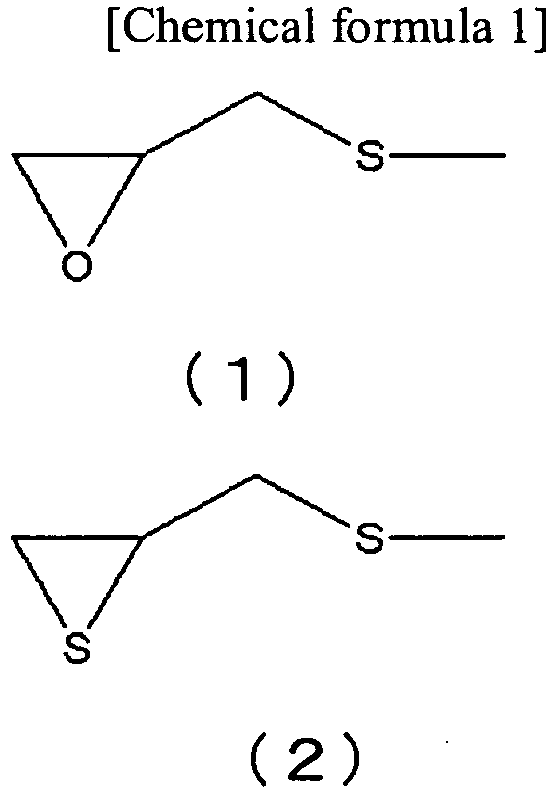
- <2> The method for producing an episulfide compound according to <1> above, wherein the compound of the formula (1) is expressed by the following formula (3), and the compound of the formula (2) is expressed by the following formula (4):


- <3> The method for producing an episulfide compound according to <1> or <2> above, wherein the ammonium salt is at least one selected from the group consisting of ammonium nitrate, ammonium sulfate and ammonium chloride.
- <4> The method for producing an episulfide compound according to any one of <1> through <3> above, wherein the episulfide compound and the thiourea are reacted with each other with no addition of an acid.
- According to the present invention, it has now become possible to provide an episulfide compound efficiently from an epoxy compound without using a measure against odor or corrosion, or acid required for a neutralization step, which are required in the conventional art.
- According to the present invention, any of all episulfide compounds having a structure expressed by formula (2) above are usable. Specific examples thereof will be described regarding each type of compounds, i.e., compounds having a chain aliphatic structure, compounds having an aliphatic cyclic structure, and compounds having an aromatic structure.
The compounds having a chain aliphatic structure include compounds expressed by the following formula (4):

- The compounds having an aliphatic cyclic structure include compounds expressed by the following formula (5) or (6):


The compounds having an aromatic structure include compounds expressed by the following formula (7):
- Among the above-shown compounds, the compounds expressed by formula (4) above having a chain aliphatic structure are preferable. Specific examples thereof include bis(β-epithiopropyl)sulfide, bis(β-epithiopropyl)disulfide, bis(β-epithiopropyl)trisulfide, bis(β-epithiopropylthio)methane, 1,2-bis(β-epithiopropylthio)ethane, 1,3-bis(β-epithiopropylthio)propane, 1,4-bis(β-epithiopropylthio)butane, and bis(β-epithiopropylthioethyl)sulfide. Bis(β-epithiopropyl)sulfide (in formula (4), n = 0) and bis(β-epithiopropyl)disulfide (in formula (4), m = 0, n = 1) are especially preferable. Bis(β-epithiopropyl)sulfide (in formula (4), n = 0) is most preferable.
Examples of the episulfide compounds having an aliphatic cyclic structure include 1,3- and 1,4-bis(β-epithiopropylthio)cyclohexane (in formula (5), p = 0, q = 0), 1,3- and 1,4-(β-epithiopropylthiomethyl)cyclohexane (in formula (5), p = 1, q = 1), bis[4-(β-epithiopropylthio)cyclohexyl]methane, 2,2-bis[4-(β-epithiopropylthio)cyclohexyl]propane, bis[4-(β-epithiopropylthio)cyclohexyl]sulfide, 2,5-bis(β-epithiopropylthio)-1,4-dithiane (in formula (6), p = 0, q = 0), 2,5-bis(β-epithiopropylthiomethyl)-1,4-dithiane (in formula (6), p = 1, q = 1), 2,5-bis(β-epithiopropylthioethylthiomethyl)-1,4-dithiane, and the like.
Examples of the episulfide compounds having an aromatic structure include 1,3-and 1,4-bis(β-epithiopropylthio)benzene (in formula (7), p = 0, q = 0), 1,3- and 1,4-bis(β-epithiopropylthiomethyl)benzene (in formula (7), p = 1, q = 1), bis[4-(β-epithiopropylthio)phenyl)]methane, 2,2-bis[4-(β-epithiopropylthio)phenyl]propane, bis[4-(β-epithiopropylthio)phenyl)]sulfide, bis[4-(β-epithiopropylthio)phenyl)]sulfine, 4,4-bis(β-epithiopropylthio)biphenyl, and the like. - An epoxy compound used as a material in the present invention is obtained as a result of substituting sulfur atoms in 3-membered rings in episulfide described above with oxygen atoms.
The amount of thiourea used in the present invention may be any amount which is equal to or greater than the stoichiometric amount. In consideration of economy, the amount of thiourea is usually 1.0 to 5.0 equivalent, preferably 1.0 to 2.0 equivalent, and most preferably 1.1 to 1.8 equivalent. - According to the present invention, any of all ammonium salts is usable. Preferably usable ammonium salts are ammonium chloride, ammonium bromide, ammonium iodide, ammonium formate, ammonium acetate, ammonium propionate, ammonium benzoate, ammonium sulfate, ammonium nitrate, ammonium carbonate, ammonium phosphate, and ammonium hydroxide. Ammonium nitrate, ammonium sulfate, and ammonium chloride are more preferable. Ammonium nitrate is most preferable.
The amount of the ammonium salt is usually 0.01 to 20% by weight with respect to the total amount of epoxy in consideration of economy. The amount is preferably 0.1 to 15% by weight, and most preferably 0.5 to 10% by weight. When the amount is less than 0.01% by weight, insoluble substances may be deposited at the time of extraction and washing. When the amount is more than 20% by weight, the number of times of washing required for removing the ammonium salt may be increased, and thus the amount of waste liquid may be increased. - For the reaction of the present invention, a solvent may or may not be used. Usually, a solvent is used. Preferably, a mixture solvent of a non-polar solvent in which the epoxy compound is soluble and a polar solvent in which the thiourea is soluble is used. The volumetric ratio of the polar solvent and the non-polar solvent is usually polar solvent/non-polar solvent = 0.1 to 10.0, and preferably 0.2 to 5.0. When the volumetric ratio is less than 0.1, the thiourea is not sufficiently dissolved and thus the reaction does not proceed sufficiently. When the volumetric ratio exceeds 10.0, the reaction proceeds excessively fast and it is difficult to control the reaction.
Examples of a usable non-polar solvent include aliphatic hydrocarbons such as pentane, hexane, heptane and the like; and aromatic hydrocarbons such as benzene, toluene and the like. Aromatic hydrocarbons are preferable, and toluene is most preferable.
Examples of a usable polar solvent include alcohols such as methanol, ethanol and the like; ethers such as diethylether, tetrahydrofuran, dioxane and the like; hydroxyethers such as methylcellosolve, ethylcellosolve, bitylcellosolve and the like; and ketones such as acetone, methylethylketone and the like. Alcohols are preferable, and methanol is most preferable.
Merely a polar solvent may be used. In this case also, the reaction of episulfidation can be caused to proceed by adding an epoxy compound little by little to the polar solvent while taking time. - The reaction is caused by mixing and stirring an epoxy compound, which is a material of the episulfide compound, and an ammonium salt and a reaction solvent used in the present invention. These components may be added in any order, or may be mixed at the same time.
The reaction temperature is usually 0 to 60°C, preferably 10 to 50°C, and most preferably 10 to 40°C. When the reaction temperature is lower than 0°C, the reaction rate is decreased. When the reaction temperature is higher than 60°C, the episulfide compound obtained may be colored. There is no specific limitation on the reaction time as long as the reaction is completed under the above-described conditions. The reaction time is usually 20 hours or less, and preferably 15 hours or less. Regarding the pressure, either reduced pressure, normal pressure or raised pressure may be used. Normal pressure is preferable. The reaction is preferably caused in a nitrogen atmosphere. - After the reaction is finished, the intended episulfide compound is obtained by extraction, washing and removal of the solvent by distillation. As a solvent for extraction, any of the non-polar solvents described above is usable. Aromatic hydrocarbons are preferable, and toluene is most preferable. Washing is performed with water or an aqueous solution of acid. Preferably, washing is first performed with an aqueous solution of acid and then with water. The removal of the solvent by distillation is usually performed at a reduced pressure.
The episulfide compound thus obtained can be refined by a refinement method of recrystallization, reprecipitation, column separation, processing with an adsorber, processing with an ion exchange resin or the like. The production of the episulfide compound can be performed in the air, but is preferably performed in a nitrogen atmosphere in order to guarantee that the components and the resultant compound are not oxidized or colored. - Hereinafter, the present invention will be specifically described by way of examples, but the present invention is not limited to the following examples.
- 305 g of thiourea, 1360 ml of methanol, 680 ml of toluene, 10 g of ammonium nitrate, and 146 g of bis(β-epoxypropyl)sulfide (in formula (3), n = 0) were mixed and reacted at 20°C for 9 hours in a nitrogen atmosphere. During the reaction, no polymer was deposited. After the reaction, 1720 ml of toluene and 210 ml of 10% aqueous solution of sulfuric acid were put to the reaction vessel to extract the reaction product. Then, the extracted product was washed with 130 ml of water four times, and toluene was removed by distillation. As a result, 137 g of bis(β-epithiopropyl)sulfide (in formula (4), n = 0) was obtained. The yield was 77%. The results are shown in Table 1.
- The procedure of Example 1 was repeated except that instead of ammonium nitrate, an ammonium salt shown in Table 1 was used in an equal weight amount to that of ammonium nitrate. The results are shown in Table 1.
- The procedure of Example 1 was repeated except that the amount of ammonium nitrate was 5 g. The results are shown in Table 1.
- The procedure of Example 1 was repeated except that ammonium nitrate was not used. During the reaction, polymer was deposited, and bis(β-epithiopropyl)sulfide was not obtained. The results are shown in Table 1.
- The procedure of Example 1 was repeated except that 18 g of acetic anhydride was used instead of ammonium nitrate. The results are shown in Table 1.
- The procedure of Example 1 was repeated except that 10 g of acetic anhydride was used instead of ammonium nitrate. The results are shown in Table 1.
- The procedure of Example 1 was repeated except that 10 g of acetic acid was used instead of ammonium nitrate. The results are shown in Table 1.
- 305 g of thiourea, 3000 ml of methanol, 1500 ml of toluene, 10 g of ammonium nitrate, and 325 g of 1,3-bis(β-epoxypropylthiomethyl)benzene were mixed and reacted at 20°C for 9 hours in a nitrogen atmosphere. During the reaction, no polymer was deposited. After the reaction, 3800 ml of toluene and 460 ml of 10% aqueous solution of sulfuric acid were put to the reaction vessel to extract the reaction product. Then, the extracted product was washed with 300 ml of water four times, and toluene was removed by distillation. As a result, 288 g of 1,3-bis(β-epithiopropylthiomethyl)benzene (in formula (7), p = 1, q = 1) was obtained. The yield was 81%. The results are shown in Table 2.
- The procedure of Example 6 was repeated except that instead of ammonium nitrate, ammonium sulfate was used in an equal weight amount to that of ammonium nitrate. The results are shown in Table 2.
- The procedure of Example 6 was repeated except that 18 g of acetic anhydride was used instead of ammonium nitrate. The results are shown in Table 2.
-
[Table 1] Example Added compound Amount (g) Odor Yield (%) Example 1 Ammonium nitrate 10 No 77 Example 2 Ammonium sulfate 10 No 76 Example 3 Ammonium chloride 10 No 76 Example 4 Ammonium acetate 10 No 75 Example 5 Ammonium nitrate 5 No 76 Comparative example 1 None - No 0 Comparative example 2 Acetic anhydride 18 Yes 75 Comparative example 3 Acetic anhydride 10 Yes 71 Comparative example 4 Acetic acid 10 Yes 66 -
[Table 2] Example Added compound Amount (g) Odor Yield (%) Example 6 Ammonium nitrate 10 No 81 Example 7 Ammonium sulfate 10 No 80 Comparative example 5 Acetic anhydride 18 Yes 62 - 305 g of thiourea, 3000 ml of methanol, 1500 ml of toluene, 10 g of ammonium nitrate, and 332 g of 1,4-bis(β-epoxypropylthiomethyl)cyclohexane were mixed and reacted at 20°C for 9 hours in a nitrogen atmosphere. During the reaction, no polymer was deposited. After the reaction, 3800 ml of toluene and 460 ml of 10% aqueous solution of sulfuric acid were put to the reaction vessel to extract the reaction product. Then, the extracted product was washed with 300 ml of water four times, and toluene was removed by distillation. As a result, 295 g of 1,4-bis(β-epithiopropylthiomethyl)cyclohexane (in formula (5), p = 1, q = 1) was obtained. The yield was 80%. The results are shown in Table 3.
- The procedure of Example 8 was repeated except that instead of ammonium nitrate, ammonium sulfate was used in an equal weight amount to that of ammonium nitrate. The results are shown in Table 3.
- The procedure of Example 8 was repeated except that 18 g of acetic anhydride was used instead of ammonium nitrate. The results are shown in Table 3.
-
[Table 3] Example Added compound Amount (g) Odor Yield (%) Example 8 Ammonium nitrate 10 No 80 Example 9 Ammonium sulfate 10 No 79 Comparative example 6 Acetic anhydride 18 Yes 64 - 305 g of thiourea, 3000 ml of methanol, 1500 ml of toluene, 10 g of ammonium nitrate, and 373g of 2,5-bis(β-epoxypropylthiomethyl)-1,4-dithiane were mixed and reacted at 20°C for 9 hours in a nitrogen atmosphere. During the reaction, no polymer was deposited. After the reaction, 3800 ml of toluene and 460 ml of 10% aqueous solution of sulfuric acid were put to the reaction vessel to extract the reaction product. Then, the extracted product was washed with 300 ml of water four times, and toluene was removed by distillation. As a result, 340 g of 2,5-bis(β-epithiopropylthiomethyl)-1,4-dithiane (in formula (6), p = 1, q = 1) was obtained. The yield was 83%. The results are shown in Table 4.
- The procedure of Example 10 was repeated except that instead of ammonium nitrate, ammonium sulfate was used in an equal weight amount to that of ammonium nitrate. The results are shown in Table 4.
- The procedure of Example 10 was repeated except that 18 g of acetic anhydride was used instead of ammonium nitrate. The results are shown in Table 4.
-
[Table 4] Example Added compound Amount (g) Odor Yield (%) Example 10 Ammonium nitrate 10 No 83 Example 11 Ammonium sulfate 10 No 81 Comparative example 7 Acetic anhydride 18 Yes 64 - As described above, in Examples 1 through 7, an epoxy compound and a thiourea were reacted with each other in the presence of an ammonium salt, and as a result, an episulfide compound was obtained at a high yield of 75% or higher. In addition, in each of the examples which do not require an acid, unlike in the comparative examples, generation of odor was prevented, and neither a measure against corrosion or a neutralization step is necessary. Therefore, the present invention can produce an episulfide compound efficiently and can also improve the work environment and simplify the production process.
Claims (4)
- A method for producing an episulfide compound, wherein an epoxy compound having a structure expressed by the following formula (1) and a thiourea are reacted with each other in the presence of an ammonium salt to produce an episulfide compound having a structure expressed by the following formula (2).

- The method for producing an episulfide compound according to claim 1, wherein the compound of the formula (1) is expressed by the following formula (3), and the compound of the formula (2) is expressed by the following formula (4):


- The method for producing an episulfide compound according to claim 1 or 2, wherein the ammonium salt is at least one selected from the group consisting of ammonium nitrate, ammonium sulfate and ammonium chloride.
- The method for producing an episulfide compound according to any one of claims 1 through 3, wherein the episulfide compound and the thiourea are reacted with each other with no addition of an acid.
Applications Claiming Priority (2)
| Application Number | Priority Date | Filing Date | Title |
|---|---|---|---|
| JP2010040407A JP5668296B2 (en) | 2010-02-25 | 2010-02-25 | Method for producing episulfide compound |
| PCT/JP2011/053649 WO2011105319A1 (en) | 2010-02-25 | 2011-02-21 | Manufacturing method for episulphide compound |
Publications (3)
| Publication Number | Publication Date |
|---|---|
| EP2540714A1 true EP2540714A1 (en) | 2013-01-02 |
| EP2540714A4 EP2540714A4 (en) | 2015-08-19 |
| EP2540714B1 EP2540714B1 (en) | 2018-06-13 |
Family
ID=44506727
Family Applications (1)
| Application Number | Title | Priority Date | Filing Date |
|---|---|---|---|
| EP11747280.3A Active EP2540714B1 (en) | 2010-02-25 | 2011-02-21 | Manufacturing method for episulphide compound |
Country Status (6)
| Country | Link |
|---|---|
| US (1) | US8586766B2 (en) |
| EP (1) | EP2540714B1 (en) |
| JP (1) | JP5668296B2 (en) |
| KR (1) | KR101798258B1 (en) |
| CN (1) | CN102770422A (en) |
| WO (1) | WO2011105319A1 (en) |
Families Citing this family (7)
| Publication number | Priority date | Publication date | Assignee | Title |
|---|---|---|---|---|
| JP2013142073A (en) * | 2012-01-11 | 2013-07-22 | Mitsubishi Gas Chemical Co Inc | Sulfur-containing epoxy compound and method for producing the same |
| US10077262B2 (en) | 2015-11-10 | 2018-09-18 | Flexterra, Inc. | Thienothiadiazole compounds and related semiconductor devices |
| CN107699177B (en) * | 2017-10-17 | 2020-07-10 | 烟台信友新材料有限公司 | A kind of low modulus and low water absorption photothermal dual solid adhesive and preparation method thereof |
| CN110156748A (en) * | 2019-06-18 | 2019-08-23 | 江苏可奥熙光学材料科技有限公司 | A kind of preparation method of high refractive index lens monomer |
| CN110776491B (en) * | 2019-11-25 | 2021-01-29 | 山东益丰生化环保股份有限公司 | Multi-branched thioether-type ring sulfur compound and preparation method and application thereof |
| EP4112772A1 (en) | 2021-06-28 | 2023-01-04 | Henkel AG & Co. KGaA | Organosulfur compound for corrosion protection coating of copper-containing metallic substrates |
| CN117567428A (en) * | 2023-11-21 | 2024-02-20 | 益丰新材料股份有限公司 | A kind of preparation method of bis(2,3-epithiopropyl) sulfide |
Family Cites Families (21)
| Publication number | Priority date | Publication date | Assignee | Title |
|---|---|---|---|---|
| JP3864998B2 (en) | 1995-09-08 | 2007-01-10 | 三菱瓦斯化学株式会社 | Novel branched alkyl sulfide type episulfide compounds |
| US5807975A (en) | 1995-08-16 | 1998-09-15 | Mitsubishi Gas Chemical Company,Inc. | Alkyl sulfide type episulfide compound |
| JP3491660B2 (en) | 1995-08-16 | 2004-01-26 | 三菱瓦斯化学株式会社 | Novel linear alkyl sulfide type episulfide compound |
| US5945504A (en) | 1996-01-17 | 1999-08-31 | Mitsubishi Gas Chemical Company, Inc. | Episulfide compound |
| JP2006257421A (en) * | 1996-01-17 | 2006-09-28 | Mitsubishi Gas Chem Co Inc | New episulfide compounds |
| JPH09255781A (en) | 1996-01-17 | 1997-09-30 | Mitsubishi Gas Chem Co Inc | New episulfide compound |
| EP0950905A3 (en) * | 1998-03-26 | 2002-02-13 | Mitsubishi Gas Chemical Company, Inc. | Process for producing a novel resin for optical materials having excellent color tone and transparency |
| JP2000186087A (en) | 1998-10-15 | 2000-07-04 | Mitsubishi Gas Chem Co Inc | Method for producing episulfide compound |
| EP1006374B1 (en) * | 1998-12-01 | 2009-01-07 | Mitsubishi Gas Chemical Company, Inc. | Process for producing a resin having a large refractive index |
| JP2005232464A (en) * | 1999-02-24 | 2005-09-02 | Mitsubishi Gas Chem Co Inc | Episulfide compound and method for producing high refractive index resin using the same |
| WO2002038558A1 (en) * | 2000-03-15 | 2002-05-16 | Mitsubishi Gas Chemical Company, Inc. | Method of storing episulfide compound |
| JP3457240B2 (en) * | 1999-12-08 | 2003-10-14 | 三井化学株式会社 | Method for producing episulfide compound |
| JP3366604B2 (en) | 1999-12-08 | 2003-01-14 | 三井化学株式会社 | Method for producing episulfide compound |
| JP3366603B2 (en) | 1999-12-08 | 2003-01-14 | 三井化学株式会社 | Method for producing episulfide compound |
| JP2001200058A (en) * | 2000-01-19 | 2001-07-24 | Mitsubishi Gas Chem Co Inc | Optical material manufacturing method |
| JP2001288181A (en) | 2000-04-07 | 2001-10-16 | Mitsubishi Gas Chem Co Inc | Episulfide compound and method for producing the same |
| JP4372990B2 (en) * | 2000-10-20 | 2009-11-25 | 三井化学株式会社 | Sulfur-containing (meth) acrylic acid thioester compounds and uses thereof |
| JP2003048883A (en) | 2001-05-29 | 2003-02-21 | Mitsubishi Gas Chem Co Inc | Method for producing episulfide compound |
| EP1564207B1 (en) * | 2004-02-17 | 2010-06-02 | Mitsubishi Gas Chemical Company, Inc. | Method for producing vicinal dithiol |
| TWI482814B (en) * | 2007-03-16 | 2015-05-01 | Mitsubishi Gas Chemical Co | Resin composition for optical materials and optical material obtained from the composition |
| EP2243798B1 (en) | 2008-02-13 | 2014-04-16 | Mitsubishi Gas Chemical Company, Inc. | Composition for resin and optical lens obtained therefrom |
-
2010
- 2010-02-25 JP JP2010040407A patent/JP5668296B2/en active Active
-
2011
- 2011-02-21 KR KR1020127024561A patent/KR101798258B1/en active Active
- 2011-02-21 US US13/577,298 patent/US8586766B2/en active Active
- 2011-02-21 CN CN2011800104109A patent/CN102770422A/en active Pending
- 2011-02-21 EP EP11747280.3A patent/EP2540714B1/en active Active
- 2011-02-21 WO PCT/JP2011/053649 patent/WO2011105319A1/en not_active Ceased
Also Published As
| Publication number | Publication date |
|---|---|
| US8586766B2 (en) | 2013-11-19 |
| EP2540714A4 (en) | 2015-08-19 |
| KR101798258B1 (en) | 2017-11-15 |
| US20120309987A1 (en) | 2012-12-06 |
| KR20120131189A (en) | 2012-12-04 |
| JP2011173845A (en) | 2011-09-08 |
| JP5668296B2 (en) | 2015-02-12 |
| WO2011105319A1 (en) | 2011-09-01 |
| EP2540714B1 (en) | 2018-06-13 |
| CN102770422A (en) | 2012-11-07 |
Similar Documents
| Publication | Publication Date | Title |
|---|---|---|
| EP2540714B1 (en) | Manufacturing method for episulphide compound | |
| DE69925322T2 (en) | Polymerizable composition | |
| EP3088441B1 (en) | Optical material composition and method for producing same | |
| WO2002023230A1 (en) | Composition for optical material | |
| EP2540762B1 (en) | Composition for optical materials, process for production thereof, and optical materials made from the composition | |
| EP1482002B1 (en) | Polymerizable composition containing novel cyclic sulfur compound and resin obtained by curing the polymerizable composition | |
| EP3257876B1 (en) | Polymerizable composition and novel alkyne compound | |
| JP6724780B2 (en) | Polythiol composition and method for producing the same | |
| CN115894296A (en) | A kind of isocyanate composition, modified isocyanate, polyurethane resin and optical material | |
| WO2025252160A1 (en) | High-refractive-index material based on biomass magnolol and magnolol | |
| JP2011231185A (en) | Method of manufacturing prepolymer for optical lens molding, and method of manufacturing optical lens | |
| JP5453085B2 (en) | Method for producing reaction product for producing plastic lens, method for producing plastic lens, and plastic lens | |
| JP5732749B2 (en) | Method for producing (poly) episulfide compound for optical material | |
| TWI633126B (en) | Composition for optical materials and optical materials using the same | |
| WO2024103321A1 (en) | Isocyanate composition, modified isocyanate, polyurethane resin and optical material | |
| WO2007052566A1 (en) | Composition for optical material, optical material and eyeglass lens | |
| JP4983343B2 (en) | Cyclic thiocarbonate, method for producing the same, polymerized cured product, and optical material | |
| EP1944329A1 (en) | Polythiocarbonate poly(thio)epoxide | |
| EP1953182A1 (en) | Polymerizable composition and polythiocarbonate polythioether | |
| JP5110263B2 (en) | Cyclic thiocarbonate, method for producing the same, polymerized cured product, and optical material | |
| US20180127550A1 (en) | Optical material composition and optical material |
Legal Events
| Date | Code | Title | Description |
|---|---|---|---|
| PUAI | Public reference made under article 153(3) epc to a published international application that has entered the european phase |
Free format text: ORIGINAL CODE: 0009012 |
|
| 17P | Request for examination filed |
Effective date: 20120823 |
|
| AK | Designated contracting states |
Kind code of ref document: A1 Designated state(s): AL AT BE BG CH CY CZ DE DK EE ES FI FR GB GR HR HU IE IS IT LI LT LU LV MC MK MT NL NO PL PT RO RS SE SI SK SM TR |
|
| DAX | Request for extension of the european patent (deleted) | ||
| RA4 | Supplementary search report drawn up and despatched (corrected) |
Effective date: 20150720 |
|
| RIC1 | Information provided on ipc code assigned before grant |
Ipc: C08G 75/08 20060101ALI20150714BHEP Ipc: C07D 331/02 20060101AFI20150714BHEP Ipc: C08L 81/02 20060101ALI20150714BHEP |
|
| STAA | Information on the status of an ep patent application or granted ep patent |
Free format text: STATUS: EXAMINATION IS IN PROGRESS |
|
| 17Q | First examination report despatched |
Effective date: 20170504 |
|
| GRAP | Despatch of communication of intention to grant a patent |
Free format text: ORIGINAL CODE: EPIDOSNIGR1 |
|
| STAA | Information on the status of an ep patent application or granted ep patent |
Free format text: STATUS: GRANT OF PATENT IS INTENDED |
|
| INTG | Intention to grant announced |
Effective date: 20180302 |
|
| RIN1 | Information on inventor provided before grant (corrected) |
Inventor name: KUBO, MINEKI Inventor name: HORIKOSHI, HIROSHI |
|
| GRAS | Grant fee paid |
Free format text: ORIGINAL CODE: EPIDOSNIGR3 |
|
| GRAA | (expected) grant |
Free format text: ORIGINAL CODE: 0009210 |
|
| STAA | Information on the status of an ep patent application or granted ep patent |
Free format text: STATUS: THE PATENT HAS BEEN GRANTED |
|
| AK | Designated contracting states |
Kind code of ref document: B1 Designated state(s): AL AT BE BG CH CY CZ DE DK EE ES FI FR GB GR HR HU IE IS IT LI LT LU LV MC MK MT NL NO PL PT RO RS SE SI SK SM TR |
|
| REG | Reference to a national code |
Ref country code: GB Ref legal event code: FG4D |
|
| REG | Reference to a national code |
Ref country code: CH Ref legal event code: EP Ref country code: AT Ref legal event code: REF Ref document number: 1008388 Country of ref document: AT Kind code of ref document: T Effective date: 20180615 |
|
| REG | Reference to a national code |
Ref country code: IE Ref legal event code: FG4D |
|
| REG | Reference to a national code |
Ref country code: DE Ref legal event code: R096 Ref document number: 602011049236 Country of ref document: DE |
|
| REG | Reference to a national code |
Ref country code: NL Ref legal event code: MP Effective date: 20180613 |
|
| REG | Reference to a national code |
Ref country code: LT Ref legal event code: MG4D |
|
| PG25 | Lapsed in a contracting state [announced via postgrant information from national office to epo] |
Ref country code: BG Free format text: LAPSE BECAUSE OF FAILURE TO SUBMIT A TRANSLATION OF THE DESCRIPTION OR TO PAY THE FEE WITHIN THE PRESCRIBED TIME-LIMIT Effective date: 20180913 Ref country code: NO Free format text: LAPSE BECAUSE OF FAILURE TO SUBMIT A TRANSLATION OF THE DESCRIPTION OR TO PAY THE FEE WITHIN THE PRESCRIBED TIME-LIMIT Effective date: 20180913 Ref country code: FI Free format text: LAPSE BECAUSE OF FAILURE TO SUBMIT A TRANSLATION OF THE DESCRIPTION OR TO PAY THE FEE WITHIN THE PRESCRIBED TIME-LIMIT Effective date: 20180613 Ref country code: SE Free format text: LAPSE BECAUSE OF FAILURE TO SUBMIT A TRANSLATION OF THE DESCRIPTION OR TO PAY THE FEE WITHIN THE PRESCRIBED TIME-LIMIT Effective date: 20180613 Ref country code: ES Free format text: LAPSE BECAUSE OF FAILURE TO SUBMIT A TRANSLATION OF THE DESCRIPTION OR TO PAY THE FEE WITHIN THE PRESCRIBED TIME-LIMIT Effective date: 20180613 Ref country code: CY Free format text: LAPSE BECAUSE OF FAILURE TO SUBMIT A TRANSLATION OF THE DESCRIPTION OR TO PAY THE FEE WITHIN THE PRESCRIBED TIME-LIMIT Effective date: 20180613 Ref country code: LT Free format text: LAPSE BECAUSE OF FAILURE TO SUBMIT A TRANSLATION OF THE DESCRIPTION OR TO PAY THE FEE WITHIN THE PRESCRIBED TIME-LIMIT Effective date: 20180613 |
|
| PG25 | Lapsed in a contracting state [announced via postgrant information from national office to epo] |
Ref country code: LV Free format text: LAPSE BECAUSE OF FAILURE TO SUBMIT A TRANSLATION OF THE DESCRIPTION OR TO PAY THE FEE WITHIN THE PRESCRIBED TIME-LIMIT Effective date: 20180613 Ref country code: HR Free format text: LAPSE BECAUSE OF FAILURE TO SUBMIT A TRANSLATION OF THE DESCRIPTION OR TO PAY THE FEE WITHIN THE PRESCRIBED TIME-LIMIT Effective date: 20180613 Ref country code: GR Free format text: LAPSE BECAUSE OF FAILURE TO SUBMIT A TRANSLATION OF THE DESCRIPTION OR TO PAY THE FEE WITHIN THE PRESCRIBED TIME-LIMIT Effective date: 20180914 Ref country code: RS Free format text: LAPSE BECAUSE OF FAILURE TO SUBMIT A TRANSLATION OF THE DESCRIPTION OR TO PAY THE FEE WITHIN THE PRESCRIBED TIME-LIMIT Effective date: 20180613 |
|
| REG | Reference to a national code |
Ref country code: AT Ref legal event code: MK05 Ref document number: 1008388 Country of ref document: AT Kind code of ref document: T Effective date: 20180613 |
|
| PG25 | Lapsed in a contracting state [announced via postgrant information from national office to epo] |
Ref country code: NL Free format text: LAPSE BECAUSE OF FAILURE TO SUBMIT A TRANSLATION OF THE DESCRIPTION OR TO PAY THE FEE WITHIN THE PRESCRIBED TIME-LIMIT Effective date: 20180613 |
|
| PG25 | Lapsed in a contracting state [announced via postgrant information from national office to epo] |
Ref country code: EE Free format text: LAPSE BECAUSE OF FAILURE TO SUBMIT A TRANSLATION OF THE DESCRIPTION OR TO PAY THE FEE WITHIN THE PRESCRIBED TIME-LIMIT Effective date: 20180613 Ref country code: PL Free format text: LAPSE BECAUSE OF FAILURE TO SUBMIT A TRANSLATION OF THE DESCRIPTION OR TO PAY THE FEE WITHIN THE PRESCRIBED TIME-LIMIT Effective date: 20180613 Ref country code: RO Free format text: LAPSE BECAUSE OF FAILURE TO SUBMIT A TRANSLATION OF THE DESCRIPTION OR TO PAY THE FEE WITHIN THE PRESCRIBED TIME-LIMIT Effective date: 20180613 Ref country code: IS Free format text: LAPSE BECAUSE OF FAILURE TO SUBMIT A TRANSLATION OF THE DESCRIPTION OR TO PAY THE FEE WITHIN THE PRESCRIBED TIME-LIMIT Effective date: 20181013 Ref country code: AT Free format text: LAPSE BECAUSE OF FAILURE TO SUBMIT A TRANSLATION OF THE DESCRIPTION OR TO PAY THE FEE WITHIN THE PRESCRIBED TIME-LIMIT Effective date: 20180613 Ref country code: CZ Free format text: LAPSE BECAUSE OF FAILURE TO SUBMIT A TRANSLATION OF THE DESCRIPTION OR TO PAY THE FEE WITHIN THE PRESCRIBED TIME-LIMIT Effective date: 20180613 Ref country code: SK Free format text: LAPSE BECAUSE OF FAILURE TO SUBMIT A TRANSLATION OF THE DESCRIPTION OR TO PAY THE FEE WITHIN THE PRESCRIBED TIME-LIMIT Effective date: 20180613 |
|
| PG25 | Lapsed in a contracting state [announced via postgrant information from national office to epo] |
Ref country code: SM Free format text: LAPSE BECAUSE OF FAILURE TO SUBMIT A TRANSLATION OF THE DESCRIPTION OR TO PAY THE FEE WITHIN THE PRESCRIBED TIME-LIMIT Effective date: 20180613 Ref country code: IT Free format text: LAPSE BECAUSE OF FAILURE TO SUBMIT A TRANSLATION OF THE DESCRIPTION OR TO PAY THE FEE WITHIN THE PRESCRIBED TIME-LIMIT Effective date: 20180613 |
|
| REG | Reference to a national code |
Ref country code: DE Ref legal event code: R097 Ref document number: 602011049236 Country of ref document: DE |
|
| PLBE | No opposition filed within time limit |
Free format text: ORIGINAL CODE: 0009261 |
|
| STAA | Information on the status of an ep patent application or granted ep patent |
Free format text: STATUS: NO OPPOSITION FILED WITHIN TIME LIMIT |
|
| 26N | No opposition filed |
Effective date: 20190314 |
|
| PG25 | Lapsed in a contracting state [announced via postgrant information from national office to epo] |
Ref country code: SI Free format text: LAPSE BECAUSE OF FAILURE TO SUBMIT A TRANSLATION OF THE DESCRIPTION OR TO PAY THE FEE WITHIN THE PRESCRIBED TIME-LIMIT Effective date: 20180613 Ref country code: DK Free format text: LAPSE BECAUSE OF FAILURE TO SUBMIT A TRANSLATION OF THE DESCRIPTION OR TO PAY THE FEE WITHIN THE PRESCRIBED TIME-LIMIT Effective date: 20180613 |
|
| REG | Reference to a national code |
Ref country code: CH Ref legal event code: PL |
|
| PG25 | Lapsed in a contracting state [announced via postgrant information from national office to epo] |
Ref country code: MC Free format text: LAPSE BECAUSE OF FAILURE TO SUBMIT A TRANSLATION OF THE DESCRIPTION OR TO PAY THE FEE WITHIN THE PRESCRIBED TIME-LIMIT Effective date: 20180613 Ref country code: LU Free format text: LAPSE BECAUSE OF NON-PAYMENT OF DUE FEES Effective date: 20190221 |
|
| REG | Reference to a national code |
Ref country code: BE Ref legal event code: MM Effective date: 20190228 |
|
| REG | Reference to a national code |
Ref country code: IE Ref legal event code: MM4A |
|
| PG25 | Lapsed in a contracting state [announced via postgrant information from national office to epo] |
Ref country code: AL Free format text: LAPSE BECAUSE OF FAILURE TO SUBMIT A TRANSLATION OF THE DESCRIPTION OR TO PAY THE FEE WITHIN THE PRESCRIBED TIME-LIMIT Effective date: 20180613 |
|
| PG25 | Lapsed in a contracting state [announced via postgrant information from national office to epo] |
Ref country code: CH Free format text: LAPSE BECAUSE OF NON-PAYMENT OF DUE FEES Effective date: 20190228 Ref country code: LI Free format text: LAPSE BECAUSE OF NON-PAYMENT OF DUE FEES Effective date: 20190228 |
|
| PG25 | Lapsed in a contracting state [announced via postgrant information from national office to epo] |
Ref country code: IE Free format text: LAPSE BECAUSE OF NON-PAYMENT OF DUE FEES Effective date: 20190221 |
|
| PG25 | Lapsed in a contracting state [announced via postgrant information from national office to epo] |
Ref country code: BE Free format text: LAPSE BECAUSE OF NON-PAYMENT OF DUE FEES Effective date: 20190228 |
|
| PG25 | Lapsed in a contracting state [announced via postgrant information from national office to epo] |
Ref country code: TR Free format text: LAPSE BECAUSE OF FAILURE TO SUBMIT A TRANSLATION OF THE DESCRIPTION OR TO PAY THE FEE WITHIN THE PRESCRIBED TIME-LIMIT Effective date: 20180613 |
|
| PG25 | Lapsed in a contracting state [announced via postgrant information from national office to epo] |
Ref country code: MT Free format text: LAPSE BECAUSE OF NON-PAYMENT OF DUE FEES Effective date: 20190221 Ref country code: PT Free format text: LAPSE BECAUSE OF FAILURE TO SUBMIT A TRANSLATION OF THE DESCRIPTION OR TO PAY THE FEE WITHIN THE PRESCRIBED TIME-LIMIT Effective date: 20181015 |
|
| PG25 | Lapsed in a contracting state [announced via postgrant information from national office to epo] |
Ref country code: HU Free format text: LAPSE BECAUSE OF FAILURE TO SUBMIT A TRANSLATION OF THE DESCRIPTION OR TO PAY THE FEE WITHIN THE PRESCRIBED TIME-LIMIT; INVALID AB INITIO Effective date: 20110221 |
|
| PG25 | Lapsed in a contracting state [announced via postgrant information from national office to epo] |
Ref country code: MK Free format text: LAPSE BECAUSE OF FAILURE TO SUBMIT A TRANSLATION OF THE DESCRIPTION OR TO PAY THE FEE WITHIN THE PRESCRIBED TIME-LIMIT Effective date: 20180613 |
|
| P01 | Opt-out of the competence of the unified patent court (upc) registered |
Effective date: 20230515 |
|
| PGFP | Annual fee paid to national office [announced via postgrant information from national office to epo] |
Ref country code: FR Payment date: 20251231 Year of fee payment: 16 |
|
| PGFP | Annual fee paid to national office [announced via postgrant information from national office to epo] |
Ref country code: GB Payment date: 20260106 Year of fee payment: 16 |
|
| PGFP | Annual fee paid to national office [announced via postgrant information from national office to epo] |
Ref country code: DE Payment date: 20251230 Year of fee payment: 16 |