EP2537950B1 - Method for limiting surface recrystallization - Google Patents
Method for limiting surface recrystallization Download PDFInfo
- Publication number
- EP2537950B1 EP2537950B1 EP12173006.3A EP12173006A EP2537950B1 EP 2537950 B1 EP2537950 B1 EP 2537950B1 EP 12173006 A EP12173006 A EP 12173006A EP 2537950 B1 EP2537950 B1 EP 2537950B1
- Authority
- EP
- European Patent Office
- Prior art keywords
- superalloy
- surface zone
- zone
- recrystallization
- article
- Prior art date
- Legal status (The legal status is an assumption and is not a legal conclusion. Google has not performed a legal analysis and makes no representation as to the accuracy of the status listed.)
- Active
Links
Images

Classifications
-
- C—CHEMISTRY; METALLURGY
- C22—METALLURGY; FERROUS OR NON-FERROUS ALLOYS; TREATMENT OF ALLOYS OR NON-FERROUS METALS
- C22F—CHANGING THE PHYSICAL STRUCTURE OF NON-FERROUS METALS AND NON-FERROUS ALLOYS
- C22F1/00—Changing the physical structure of non-ferrous metals or alloys by heat treatment or by hot or cold working
-
- C—CHEMISTRY; METALLURGY
- C22—METALLURGY; FERROUS OR NON-FERROUS ALLOYS; TREATMENT OF ALLOYS OR NON-FERROUS METALS
- C22C—ALLOYS
- C22C19/00—Alloys based on nickel or cobalt
- C22C19/03—Alloys based on nickel or cobalt based on nickel
-
- C—CHEMISTRY; METALLURGY
- C22—METALLURGY; FERROUS OR NON-FERROUS ALLOYS; TREATMENT OF ALLOYS OR NON-FERROUS METALS
- C22C—ALLOYS
- C22C19/00—Alloys based on nickel or cobalt
- C22C19/03—Alloys based on nickel or cobalt based on nickel
- C22C19/05—Alloys based on nickel or cobalt based on nickel with chromium
-
- C—CHEMISTRY; METALLURGY
- C22—METALLURGY; FERROUS OR NON-FERROUS ALLOYS; TREATMENT OF ALLOYS OR NON-FERROUS METALS
- C22C—ALLOYS
- C22C19/00—Alloys based on nickel or cobalt
- C22C19/03—Alloys based on nickel or cobalt based on nickel
- C22C19/05—Alloys based on nickel or cobalt based on nickel with chromium
- C22C19/051—Alloys based on nickel or cobalt based on nickel with chromium and Mo or W
-
- C—CHEMISTRY; METALLURGY
- C22—METALLURGY; FERROUS OR NON-FERROUS ALLOYS; TREATMENT OF ALLOYS OR NON-FERROUS METALS
- C22C—ALLOYS
- C22C19/00—Alloys based on nickel or cobalt
- C22C19/03—Alloys based on nickel or cobalt based on nickel
- C22C19/05—Alloys based on nickel or cobalt based on nickel with chromium
- C22C19/051—Alloys based on nickel or cobalt based on nickel with chromium and Mo or W
- C22C19/057—Alloys based on nickel or cobalt based on nickel with chromium and Mo or W with the maximum Cr content being less 10%
-
- C—CHEMISTRY; METALLURGY
- C22—METALLURGY; FERROUS OR NON-FERROUS ALLOYS; TREATMENT OF ALLOYS OR NON-FERROUS METALS
- C22C—ALLOYS
- C22C19/00—Alloys based on nickel or cobalt
- C22C19/07—Alloys based on nickel or cobalt based on cobalt
-
- C—CHEMISTRY; METALLURGY
- C22—METALLURGY; FERROUS OR NON-FERROUS ALLOYS; TREATMENT OF ALLOYS OR NON-FERROUS METALS
- C22F—CHANGING THE PHYSICAL STRUCTURE OF NON-FERROUS METALS AND NON-FERROUS ALLOYS
- C22F1/00—Changing the physical structure of non-ferrous metals or alloys by heat treatment or by hot or cold working
- C22F1/10—Changing the physical structure of non-ferrous metals or alloys by heat treatment or by hot or cold working of nickel or cobalt or alloys based thereon
-
- C—CHEMISTRY; METALLURGY
- C21—METALLURGY OF IRON
- C21D—MODIFYING THE PHYSICAL STRUCTURE OF FERROUS METALS; GENERAL DEVICES FOR HEAT TREATMENT OF FERROUS OR NON-FERROUS METALS OR ALLOYS; MAKING METAL MALLEABLE, e.g. BY DECARBURISATION OR TEMPERING
- C21D2201/00—Treatment for obtaining particular effects
- C21D2201/04—Single or very large crystals
-
- Y—GENERAL TAGGING OF NEW TECHNOLOGICAL DEVELOPMENTS; GENERAL TAGGING OF CROSS-SECTIONAL TECHNOLOGIES SPANNING OVER SEVERAL SECTIONS OF THE IPC; TECHNICAL SUBJECTS COVERED BY FORMER USPC CROSS-REFERENCE ART COLLECTIONS [XRACs] AND DIGESTS
- Y10—TECHNICAL SUBJECTS COVERED BY FORMER USPC
- Y10T—TECHNICAL SUBJECTS COVERED BY FORMER US CLASSIFICATION
- Y10T428/00—Stock material or miscellaneous articles
- Y10T428/12—All metal or with adjacent metals
- Y10T428/12493—Composite; i.e., plural, adjacent, spatially distinct metal components [e.g., layers, joint, etc.]
- Y10T428/12771—Transition metal-base component
- Y10T428/12861—Group VIII or IB metal-base component
- Y10T428/12944—Ni-base component
Definitions
- This disclosure relates to superalloy components, such as components that are used in turbine engines.
- Superalloy materials such as nickel or cobalt-based superalloys, are known and used to fabricate components that are subject to severe operating environments.
- airfoils that are used in the high temperature section of gas turbine engines may be made of superalloy material.
- the superalloy material is typically cast into the desired shape and subjected to post-cast processing steps, such as grinding, polishing and grit blasting, to finish the component.
- the present invention provides a method to limit surface zone recrystallization in a nickel-based superalloy article, the method comprising: limiting recrystallization in a surface zone of the superalloy article by treating the superalloy article at a treatment temperature of 800°C - 900°C in an oxygen-containing environment to introduce oxygen into the surface zone in an amount sufficient to produce fine oxide compounds that are discrete, discontinuous phases that pin any new grain boundaries in the surface zone.
- the recrystallization that occurs under a recrystallization condition of 1080°C/1976°F for 4 hours is limited by first treating the superalloy article in an oxygen-containing environment at a treatment temperature of 800-900°C/1472-1652°F to introduce the oxygen into the surface zone.
- the present invention also provides a superalloy article comprising: a nickel-based superalloy body that has a surface zone, the surface zone including oxygen in fine oxide compounds that are discrete, discontinuous phases that are present in an amount sufficient to pin any new grain boundaries in the surface zone that occur under a recrystallization condition of 1080°C/1976°F for 4 hours and the surface zone being free of any oxide scale on the surface thereof.
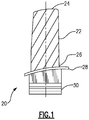
- Figure 1 illustrates selected portions of an example superalloy article 20.
- the superalloy article 20 is a blade for a gas turbine engine. It is to be understood, however, that the superalloy article 20 is not limited to blades, and other superalloy articles will benefit from the examples disclosed herein.
- the superalloy article 20 generally includes a blade section 22 that extends between a tip 24 and a base 26.
- the base 26 is connected to a platform 28 and root portion 30 for securing the compressor blade within an engine.
- the superalloy article 20 is formed from a superalloy material, such as by casting the superalloy material into the shape of the blade or other article.
- the superalloy material is a nickel-based or cobalt-based superalloy material, such as, but not limited to HASTELLOY, INCONEL, NIMONIC, Waspaloy, Rene alloys, HAYNES alloys, INCOLOY, or single crystal alloys.
- the superalloy article 20 is a single-crystal, nickel-based superalloy.
- the single-crystal, nickel-based superalloy has a nominal composition of 6.5 wt.% chromium, 9 wt.% cobalt, 0.6 wt.% molybdenum, 3 wt.% rhenium, 6 wt.% tungsten, 5.6 wt.% aluminum, 1 wt.% titanium, 6.5 wt.% tantalum, 0.1 wt. % hafnium and a balance of nickel and any incidental impurities.
- the superalloy article 20 is subjected to post-solidification processing steps, such as grinding, polishing and grit blasting, to finish the superalloy article 20.
- post-solidification processing steps such as grinding, polishing and grit blasting
- Such processing steps can produce residual stresses and/or increased defect density in the microstructure of the superalloy material of the superalloy article 20. Residual stress and/or increased defect density promotes recrystallization in the surface of a superalloy material upon exposure to elevated temperatures in subsequent processing steps, and particularly when the temperature exceeds the gamma prime phase solvus temperature.
- recrystallization at the surface debits creep and fatigue performance and can increase oxidation. Creep rupture life can be reduced by up to a 50%. The reduction in creep performance is thought to be a result of easier slip propagation in the recrystallized areas from a higher amount of slip systems favorably oriented relative to applied stresses, and to the degradation of the gamma prime distribution. Additionally, the grain boundaries of the recrystallized areas are also initiation points for void formation during creep, especially in the alloys of the last generations, in which content of so-called grain boundary strengthening elements (Zr, B, C) is low.
- creep failure can also initiate at the interface between the recrystallized area and the single crystal because of the different stiffness between the recrystallized area and the single crystal and precipitation compounds present along the interface.
- the oxidation rate increases because of oxygen diffusion along the recrystallized grain boundaries.
- the superalloy article 20 has been treated according to the disclosed method in order to limit surface recrystallization that might otherwise occur under recrystallization conditions. That is, the described treatment effectively increases the surface zone recrystallization temperature by doping the surface zone with an oxygen dopant.
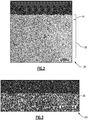
- Figure 2 shows a cross-section through a portion of the superalloy article 20 that is metallographically prepared to reveal the microstructure of the superalloy material.
- the superalloy article 20 includes a superalloy body 32 that has a surface zone 34 and a subsurface zone 36 below the surface zone 34. That is, the surface zone 34 includes a free surface that is directly exposed to the surrounding environment of the superalloy article 20 and a portion that extends below the free surface.
- the subsurface zone 36 is beneath the surface zone 34 and is not directly exposed to the surrounding environment.
- the surface zone 34 includes an oxygen dopant in an amount sufficient to pin any new grain boundaries in the surface zone 34 that occur under a recrystallization condition of 1080°C/1976°F for 4 hours.
- the amount of oxygen dopant that is needed to pin grain boundaries is a function of the material composition, treatment temperature to introduce the oxygen and level of mechanical stress at the surface zone 34 (e.g., from machining grit blasting, etc.), which, with the teachings of this disclosure, can all be easily experimentally determined.
- the subsurface zone 36 includes less oxygen than the surface zone 34.
- the amount of oxygen within the surface zone 34 is not so high as to produce a continuous oxide scale on the surface of the superalloy article 20. That is, the oxygen may be in solution (doped) within the microstructure of the superalloy material and forms fine oxide compounds that are discrete, discontinuous phases within the surface zone 34. Additionally, the amount of oxygen is not so high as to deplete the superalloy material of gamma prime phase 38. As an example, the amount of gamma prime phase 38 in the subsurface zone 36 in terms of volume percentage is equal before and after the introduction of oxygen into the surface zone 34.
- the superalloy article 20 is treated in an oxygen-containing environment to introduce, or dope, the oxygen into the surface zone 34 in an amount sufficient to pin any new grain boundaries in the surface zone 34 to thereby limit recrystallization in the surface zone 34.
- recrystallization occurs at a lower temperature in the surface zone 34 than in the subsurface zone 36, because of mechanical stress in the surface zone 34. That is, the surface zone 34 has a lower recrystallization temperature than the subsurface zone 36.
- the oxygen dopant effectively raises the recrystallization temperature of the surface zone 34 to thereby limit recrystallization.
- the recrystallization temperature of the surface zone may still be lower than the recrystallization temperature of the subsurface zone 36.
- the superalloy article 20 is treated in air at a treatment temperature of 800-900°C/1472-1652°F for two hours, although the time and temperature within the given range, and optionally pressure, can be varied depending on the composition of the superalloy material and processing history of the superalloy material with regard to mechanical processing.
- the treatment introduces oxygen into the surface zone 34, but not in such a high amount as to deplete the gamma prime phase 38 in the underlying subsurface zone 36. That is, the selected conditions for the disclosed method are insufficient for recrystallization and excessive oxidation.
- the treatment temperature is therefore lower than the recrystallization temperature of the surface zone 34, which as described above is lower than the recrystallization temperature of the subsurface zone 36.
- Figure 3 shows a microstructure of the superalloy material prior to any treatments
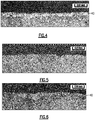
- Figure 4 shows an example of the microstructure of the superalloy material after annealing at 1080°C/1976°F for 4 hours under a pressure of 10 -3 Pascals, in which the microstructure forms a recrystallized layer 40.
- the superalloy material was annealed at a temperature of 870°-1040°C/1598-1904°F for 3 hours under a pressure of 10 -3 Pascals (vacuum condition), after which no recrystallization was evident.
- the sample was then treated under the recrystallization condition of 1080°C/1976°F for 4 hours.
- the recrystallization condition formed the recrystallization layer 40 on the sample, which indicates that annealing at sub-recrystallization temperatures under vacuum is generally ineffective to reduce recrystallization.
- Figure 7 shows the microstructure of the superalloy material of the superalloy article 20 after treatment at 800°C/1472°F for 2 hours in air. No recrystallization layer is evident.
- the superalloy article 20 was then subjected to the recrystallization condition of 1080°C/1976°F for 4 hours under a pressure of 10-3 Pascals.
- the prior treatment at 800°C/1472°F for 2 hours in air to introduce oxygen into the surface zone 34 limited the formation of a recrystallized layer at the recrystallization condition of 1080°C/1976°F for 4 hours.
- the same result is expected over the range 800-900°C/1472-1652°F for 2 hours in air.
- portions of the superalloy article 20 that are not to be treated may be masked to block oxygen from infiltrating into the superalloy material.
- the blade section 22 of the superalloy article 20 may be masked, as shown by the cross-hatched lines in Figure 1 . In such an example, the more complex shape of the root portion 30 is treated but the blade section 22 is not.
- portions that are less prone to recrystallization, such as areas with low residual stress and/or low defect density are masked off to prevent oxygen from infiltrating where the disclosed treatment is unneeded.
Landscapes
- Chemical & Material Sciences (AREA)
- Engineering & Computer Science (AREA)
- Materials Engineering (AREA)
- Mechanical Engineering (AREA)
- Metallurgy (AREA)
- Organic Chemistry (AREA)
- Physics & Mathematics (AREA)
- Thermal Sciences (AREA)
- Crystallography & Structural Chemistry (AREA)
- Turbine Rotor Nozzle Sealing (AREA)
- Solid-Phase Diffusion Into Metallic Material Surfaces (AREA)
Description
- This disclosure relates to superalloy components, such as components that are used in turbine engines.
- Superalloy materials, such as nickel or cobalt-based superalloys, are known and used to fabricate components that are subject to severe operating environments. As an example, airfoils that are used in the high temperature section of gas turbine engines may be made of superalloy material. The superalloy material is typically cast into the desired shape and subjected to post-cast processing steps, such as grinding, polishing and grit blasting, to finish the component.
- R. Bürgel, P.D. Portella, J. Preuhs: "Recrystallization in single crystals of nickel base superalloys", Superalloys 2000, 1 January 2000, pages 229-238, discloses an investigation into the recrystallization behaviour of some monocrystalline superalloys.
- The present invention provides a method to limit surface zone recrystallization in a nickel-based superalloy article, the method comprising: limiting recrystallization in a surface zone of the superalloy article by treating the superalloy article at a treatment temperature of 800°C - 900°C in an oxygen-containing environment to introduce oxygen into the surface zone in an amount sufficient to produce fine oxide compounds that are discrete, discontinuous phases that pin any new grain boundaries in the surface zone.
- In an embodiment, the recrystallization that occurs under a recrystallization condition of 1080°C/1976°F for 4 hours is limited by first treating the superalloy article in an oxygen-containing environment at a treatment temperature of 800-900°C/1472-1652°F to introduce the oxygen into the surface zone.
- The present invention also provides a superalloy article comprising: a nickel-based superalloy body that has a surface zone, the surface zone including oxygen in fine oxide compounds that are discrete, discontinuous phases that are present in an amount sufficient to pin any new grain boundaries in the surface zone that occur under a recrystallization condition of 1080°C/1976°F for 4 hours and the surface zone being free of any oxide scale on the surface thereof.
- The various features and advantages of the disclosed examples will become apparent to those skilled in the art from the following detailed description. The drawings that accompany the detailed description can be briefly described as follows.
-
-
Figure 1 shows an example superalloy article. -
Figure 2 shows a microstructure of a superalloy material after treatment according to the disclosed method followed by conditioning under a recrystallization condition. -
Figure 3 shows an initial microstructure of a superalloy material after formation of the article. -
Figure 4 shows a comparative microstructure of a superalloy material after annealing under a recrystallization condition and without treatment according to the disclosed method. -
Figure 5 illustrates a comparative microstructure of a superalloy material after an annealing step. -
Figure 6 illustrates a comparative microstructure of a superalloy material after the annealing ofFigure 5 followed by treatment under a recrystallization condition. -
Figure 7 shows a microstructure of a superalloy material after treatment according to the disclosed method at 800°C/1472°F for two hours in air. -
Figure 1 illustrates selected portions of an examplesuperalloy article 20. In the illustrated example, thesuperalloy article 20 is a blade for a gas turbine engine. It is to be understood, however, that thesuperalloy article 20 is not limited to blades, and other superalloy articles will benefit from the examples disclosed herein. - In the illustrated example, the
superalloy article 20 generally includes ablade section 22 that extends between atip 24 and abase 26. Thebase 26 is connected to aplatform 28 androot portion 30 for securing the compressor blade within an engine. - The
superalloy article 20 is formed from a superalloy material, such as by casting the superalloy material into the shape of the blade or other article. In some examples, the superalloy material is a nickel-based or cobalt-based superalloy material, such as, but not limited to HASTELLOY, INCONEL, NIMONIC, Waspaloy, Rene alloys, HAYNES alloys, INCOLOY, or single crystal alloys. - In one example, the
superalloy article 20 is a single-crystal, nickel-based superalloy. In a further example, the single-crystal, nickel-based superalloy has a nominal composition of 6.5 wt.% chromium, 9 wt.% cobalt, 0.6 wt.% molybdenum, 3 wt.% rhenium, 6 wt.% tungsten, 5.6 wt.% aluminum, 1 wt.% titanium, 6.5 wt.% tantalum, 0.1 wt. % hafnium and a balance of nickel and any incidental impurities. - The
superalloy article 20 is subjected to post-solidification processing steps, such as grinding, polishing and grit blasting, to finish thesuperalloy article 20. Such processing steps can produce residual stresses and/or increased defect density in the microstructure of the superalloy material of thesuperalloy article 20. Residual stress and/or increased defect density promotes recrystallization in the surface of a superalloy material upon exposure to elevated temperatures in subsequent processing steps, and particularly when the temperature exceeds the gamma prime phase solvus temperature. - For the
superalloy article 20, recrystallization at the surface debits creep and fatigue performance and can increase oxidation. Creep rupture life can be reduced by up to a 50%. The reduction in creep performance is thought to be a result of easier slip propagation in the recrystallized areas from a higher amount of slip systems favorably oriented relative to applied stresses, and to the degradation of the gamma prime distribution. Additionally, the grain boundaries of the recrystallized areas are also initiation points for void formation during creep, especially in the alloys of the last generations, in which content of so-called grain boundary strengthening elements (Zr, B, C) is low. In some examples, creep failure can also initiate at the interface between the recrystallized area and the single crystal because of the different stiffness between the recrystallized area and the single crystal and precipitation compounds present along the interface. The oxidation rate increases because of oxygen diffusion along the recrystallized grain boundaries. As will be described in further detail, thesuperalloy article 20 has been treated according to the disclosed method in order to limit surface recrystallization that might otherwise occur under recrystallization conditions. That is, the described treatment effectively increases the surface zone recrystallization temperature by doping the surface zone with an oxygen dopant. -
Figure 2 shows a cross-section through a portion of thesuperalloy article 20 that is metallographically prepared to reveal the microstructure of the superalloy material. As shown, thesuperalloy article 20 includes asuperalloy body 32 that has asurface zone 34 and asubsurface zone 36 below thesurface zone 34. That is, thesurface zone 34 includes a free surface that is directly exposed to the surrounding environment of thesuperalloy article 20 and a portion that extends below the free surface. Thesubsurface zone 36 is beneath thesurface zone 34 and is not directly exposed to the surrounding environment. - Through the disclosed method that will be described below, the
surface zone 34 includes an oxygen dopant in an amount sufficient to pin any new grain boundaries in thesurface zone 34 that occur under a recrystallization condition of 1080°C/1976°F for 4 hours. The amount of oxygen dopant that is needed to pin grain boundaries is a function of the material composition, treatment temperature to introduce the oxygen and level of mechanical stress at the surface zone 34 (e.g., from machining grit blasting, etc.), which, with the teachings of this disclosure, can all be easily experimentally determined. - In comparison, the
subsurface zone 36 includes less oxygen than thesurface zone 34. The amount of oxygen within thesurface zone 34, however, is not so high as to produce a continuous oxide scale on the surface of thesuperalloy article 20. That is, the oxygen may be in solution (doped) within the microstructure of the superalloy material and forms fine oxide compounds that are discrete, discontinuous phases within thesurface zone 34. Additionally, the amount of oxygen is not so high as to deplete the superalloy material of gammaprime phase 38. As an example, the amount of gammaprime phase 38 in thesubsurface zone 36 in terms of volume percentage is equal before and after the introduction of oxygen into thesurface zone 34. - Turning now to the disclosed method of treatment, the
superalloy article 20 is treated in an oxygen-containing environment to introduce, or dope, the oxygen into thesurface zone 34 in an amount sufficient to pin any new grain boundaries in thesurface zone 34 to thereby limit recrystallization in thesurface zone 34. In general, recrystallization occurs at a lower temperature in thesurface zone 34 than in thesubsurface zone 36, because of mechanical stress in thesurface zone 34. That is, thesurface zone 34 has a lower recrystallization temperature than thesubsurface zone 36. The oxygen dopant effectively raises the recrystallization temperature of thesurface zone 34 to thereby limit recrystallization. However, the recrystallization temperature of the surface zone may still be lower than the recrystallization temperature of thesubsurface zone 36. - As an example, the
superalloy article 20 is treated in air at a treatment temperature of 800-900°C/1472-1652°F for two hours, although the time and temperature within the given range, and optionally pressure, can be varied depending on the composition of the superalloy material and processing history of the superalloy material with regard to mechanical processing. The treatment introduces oxygen into thesurface zone 34, but not in such a high amount as to deplete the gammaprime phase 38 in theunderlying subsurface zone 36. That is, the selected conditions for the disclosed method are insufficient for recrystallization and excessive oxidation. The treatment temperature is therefore lower than the recrystallization temperature of thesurface zone 34, which as described above is lower than the recrystallization temperature of thesubsurface zone 36. - The following examples show microstructures of a superalloy material according to the disclosed method of treatment in comparison to microstructures of the same nominal composition of superalloy material for comparative treatments to show the effectiveness of the disclosed method.
Figure 3 shows a microstructure of the superalloy material prior to any treatments, andFigure 4 shows an example of the microstructure of the superalloy material after annealing at 1080°C/1976°F for 4 hours under a pressure of 10-3 Pascals, in which the microstructure forms arecrystallized layer 40. - In a further comparative example shown in
Figure 5 , the superalloy material was annealed at a temperature of 870°-1040°C/1598-1904°F for 3 hours under a pressure of 10-3 Pascals (vacuum condition), after which no recrystallization was evident. The sample was then treated under the recrystallization condition of 1080°C/1976°F for 4 hours. As shown inFigure 6 , the recrystallization condition formed therecrystallization layer 40 on the sample, which indicates that annealing at sub-recrystallization temperatures under vacuum is generally ineffective to reduce recrystallization. -
Figure 7 shows the microstructure of the superalloy material of thesuperalloy article 20 after treatment at 800°C/1472°F for 2 hours in air. No recrystallization layer is evident. Thesuperalloy article 20 was then subjected to the recrystallization condition of 1080°C/1976°F for 4 hours under a pressure of 10-3 Pascals. As shown inFigure 2 , there is no recrystallization in thesurface zone 34. Thus, the prior treatment at 800°C/1472°F for 2 hours in air to introduce oxygen into thesurface zone 34 limited the formation of a recrystallized layer at the recrystallization condition of 1080°C/1976°F for 4 hours. The same result is expected over the range 800-900°C/1472-1652°F for 2 hours in air. - In a further example, portions of the
superalloy article 20 that are not to be treated may be masked to block oxygen from infiltrating into the superalloy material. As an example, theblade section 22 of thesuperalloy article 20 may be masked, as shown by the cross-hatched lines inFigure 1 . In such an example, the more complex shape of theroot portion 30 is treated but theblade section 22 is not. Alternatively, portions that are less prone to recrystallization, such as areas with low residual stress and/or low defect density, are masked off to prevent oxygen from infiltrating where the disclosed treatment is unneeded.
Claims (12)
- A method to limit surface zone recrystallization in a superalloy article (20), the method comprising:limiting recrystallization in a surface zone (34) of the superalloy article by treating the superalloy article at a treatment temperature of 800°C - 900°C in an oxygen-containing environment to introduce oxygen into the surface zone in an amount to produce fine oxide compounds that are discrete, discontinuous phases that pin any new grain boundaries in the surface zone;wherein the superalloy article (20) comprises a nickel-based superalloy.
- The method as recited in claim 1, wherein the treating of the superalloy article (20) is conducted in air for 2 hours.
- The method of any preceding claim, wherein limiting recrystallization in the surface zone (34) of the superalloy article (20) comprises limiting recrystallization that occurs under a recrystallization condition of 1080°C/1976°F for 4 hours and wherein pinning any new grain boundaries comprises pinning any new grain boundaries in the surface zone that occur under the recrystallization condition.
- The method as recited in claim 1, 2 or 3, wherein the superalloy article (20) includes a subsurface zone (36) under the surface zone (34), and the subsurface zone includes a first volume percentage of gamma prime phase before the treating of the superalloy article that is equal to a second volume percentage of gamma prime phase after the treating.
- The method as recited in any preceding claim, wherein the superalloy article (20) includes a subsurface zone (36) under the surface zone (34), and the subsurface zone includes less oxygen than the surface zone after the treating.
- The method as recited in any preceding claim, wherein the superalloy article (20) is a single-crystal nickel-based superalloy.
- The method as recited in any preceding claim, wherein the nickel-based superalloy has a nominal composition of 6.5 wt% chromium, 9 wt% cobalt, 0.6 wt% molybdenum, 3 wt% rhenium, 6 wt% tungsten, 5.6 wt% aluminum, 1 wt% titanium, 6.5 wt% tantalum, 0.1 wt% hafnium, and a balance of nickel and any impurities.
- The method as recited in any preceding claim, including masking a portion of the superalloy article (20).
- A superalloy article (20) comprising:a superalloy body (32) that has a surface zone (34), the surface zone including oxygen in fine oxide compounds that are discrete, discontinuous phases that are present in an amount to pin any new grain boundaries in the surface zone that occur under a recrystallization condition of 1080°C/1976°F for 4 hours and the surface zone being free of any oxide scale on the surface thereof;wherein the superalloy body (32) comprises a nickel-based superalloy.
- The superalloy article as recited in claim 9, wherein the superalloy body (32) includes a subsurface zone (36) under the surface zone (34), and the subsurface zone includes less oxygen than the surface zone.
- The superalloy article as recited in claims 9 or 10, wherein the superalloy body (32) is a single-crystal nickel-based superalloy.
- The superalloy article as recited in claims 9, 10 or 11, wherein the nickel-based superalloy has a nominal composition of 6.5 wt% chromium, 9 wt% cobalt, 0.6 wt% molybdenum, 3 wt% rhenium, 6 wt% tungsten, 5.6 wt% aluminum, 1 wt% titanium, 6.5 wt% tantalum, 0.1 wt% hafnium, and a balance of nickel and any impurities.
Applications Claiming Priority (1)
| Application Number | Priority Date | Filing Date | Title |
|---|---|---|---|
| US13/167,233 US9551053B2 (en) | 2011-06-23 | 2011-06-23 | Method for limiting surface recrystallization |
Publications (2)
| Publication Number | Publication Date |
|---|---|
| EP2537950A1 EP2537950A1 (en) | 2012-12-26 |
| EP2537950B1 true EP2537950B1 (en) | 2017-02-01 |
Family
ID=46354048
Family Applications (1)
| Application Number | Title | Priority Date | Filing Date |
|---|---|---|---|
| EP12173006.3A Active EP2537950B1 (en) | 2011-06-23 | 2012-06-21 | Method for limiting surface recrystallization |
Country Status (3)
| Country | Link |
|---|---|
| US (1) | US9551053B2 (en) |
| EP (1) | EP2537950B1 (en) |
| UA (1) | UA106400C2 (en) |
Families Citing this family (1)
| Publication number | Priority date | Publication date | Assignee | Title |
|---|---|---|---|---|
| CN111593399B (en) * | 2020-05-22 | 2022-01-07 | 深圳市万泽航空科技有限责任公司 | Method for controlling recrystallization of single crystal high-temperature alloy |
Family Cites Families (12)
| Publication number | Priority date | Publication date | Assignee | Title |
|---|---|---|---|---|
| US2921878A (en) | 1958-02-12 | 1960-01-19 | Westinghouse Electric Corp | Heat treating nickel-iron alloys |
| US3660177A (en) | 1970-05-18 | 1972-05-02 | United Aircraft Corp | Processing of nickel-base alloys for improved fatigue properties |
| US4475980A (en) | 1982-06-01 | 1984-10-09 | United Technologies Corporation | Solid state production of multiple single crystal articles |
| US4895201A (en) * | 1987-07-07 | 1990-01-23 | United Technologies Corporation | Oxidation resistant superalloys containing low sulfur levels |
| US5534085A (en) | 1994-04-26 | 1996-07-09 | United Technologies Corporation | Low temperature forging process for Fe-Ni-Co low expansion alloys and product thereof |
| US5598968A (en) | 1995-11-21 | 1997-02-04 | General Electric Company | Method for preventing recrystallization after cold working a superalloy article |
| CN1280648A (en) | 1997-10-27 | 2001-01-17 | 西门子西屋动力公司 | Turbine components with skin bonded to substrates |
| US20020007877A1 (en) | 1999-03-26 | 2002-01-24 | John R. Mihalisin | Casting of single crystal superalloy articles with reduced eutectic scale and grain recrystallization |
| US6719853B2 (en) | 2001-04-27 | 2004-04-13 | Siemens Aktiengesellschaft | Method for restoring the microstructure of a textured article and for refurbishing a gas turbine blade or vane |
| JP2003293070A (en) | 2002-03-29 | 2003-10-15 | Japan Science & Technology Corp | High-strength and high-toughness Mo alloy processing material and its manufacturing method |
| EP1849879A1 (en) | 2006-04-26 | 2007-10-31 | Siemens Aktiengesellschaft | Cyclic heat treatment process for a superalloy |
| EP2322681A1 (en) | 2009-11-11 | 2011-05-18 | Siemens Aktiengesellschaft | Method to avoid recrystallisation through alitization |
-
2011
- 2011-06-23 US US13/167,233 patent/US9551053B2/en active Active
-
2012
- 2012-06-21 EP EP12173006.3A patent/EP2537950B1/en active Active
- 2012-06-22 UA UAA201207703A patent/UA106400C2/en unknown
Non-Patent Citations (1)
| Title |
|---|
| None * |
Also Published As
| Publication number | Publication date |
|---|---|
| US9551053B2 (en) | 2017-01-24 |
| UA106400C2 (en) | 2014-08-26 |
| EP2537950A1 (en) | 2012-12-26 |
| US20120328903A1 (en) | 2012-12-27 |
Similar Documents
| Publication | Publication Date | Title |
|---|---|---|
| JP3779778B2 (en) | Nickel-base superalloy with improved crack elongation resistance, object comprising the same, and method for producing them | |
| US9518310B2 (en) | Superalloys and components formed thereof | |
| US10767246B2 (en) | Enhanced superalloys by zirconium addition | |
| Huang et al. | Characteristics and mechanical properties of polycrystalline CM 247 LC superalloy casting | |
| EP2591135B1 (en) | Nickel-base alloy, processing therefor, and components formed thereof | |
| CA2276154C (en) | Nickel-based monocrystalline superalloy with a high .gamma.' solvus | |
| JPH0245694B2 (en) | ||
| WO2001064964A1 (en) | Nickel base superalloys and turbine components fabricated therefrom | |
| CN101790593A (en) | Nickel-based superalloy compositions substantially free of rhenium and superalloy articles | |
| JP4382244B2 (en) | Method for producing Ni-base alloy having excellent resistance to high-temperature sulfidation corrosion | |
| WO2003080882A1 (en) | Ni-BASE DIRECTIONALLY SOLIDIFIED SUPERALLOY AND Ni-BASE SINGLE CRYSTAL SUPERALLOY | |
| WO2015012888A1 (en) | Superalloys and components formed thereof | |
| CN101790592A (en) | Low-rhenium nickel-based superalloy composition and superalloy product | |
| Lavigne et al. | Relationships between microstructural instabilities and mechanical behaviour in new generation nickel-based single crystal superalloys | |
| US20120247626A1 (en) | Method of fabricating inconel 718 type nickel superalloys | |
| CA2612815A1 (en) | Low-density directionally solidified single-crystal superalloys | |
| JP4222540B2 (en) | Nickel-based single crystal superalloy, manufacturing method thereof, and gas turbine high-temperature component | |
| Belan | Study of advanced materials for aircraft jet engines using quantitative metallography | |
| JP5186215B2 (en) | Nickel-based superalloy | |
| US9551053B2 (en) | Method for limiting surface recrystallization | |
| CA2878711A1 (en) | Nickel-based superalloy, process therefor, and components formed therefrom | |
| CN102146538B (en) | Nickel-basis-superalloy with improved degradation behaviour | |
| CN117604411B (en) | Recovery heat treatment method for second-generation nickel-based single crystal superalloy | |
| CA2727105C (en) | Improved low sulfur nickel-base single crystal superalloy with ppm additions of lanthanum and yttrium | |
| Tin et al. | Linking the properties, processing and chemistry of advanced single crystal Ni-base superalloys |
Legal Events
| Date | Code | Title | Description |
|---|---|---|---|
| PUAI | Public reference made under article 153(3) epc to a published international application that has entered the european phase |
Free format text: ORIGINAL CODE: 0009012 |
|
| AK | Designated contracting states |
Kind code of ref document: A1 Designated state(s): AL AT BE BG CH CY CZ DE DK EE ES FI FR GB GR HR HU IE IS IT LI LT LU LV MC MK MT NL NO PL PT RO RS SE SI SK SM TR |
|
| AX | Request for extension of the european patent |
Extension state: BA ME |
|
| 17P | Request for examination filed |
Effective date: 20130626 |
|
| RBV | Designated contracting states (corrected) |
Designated state(s): AL AT BE BG CH CY CZ DE DK EE ES FI FR GB GR HR HU IE IS IT LI LT LU LV MC MK MT NL NO PL PT RO RS SE SI SK SM TR |
|
| 17Q | First examination report despatched |
Effective date: 20140624 |
|
| GRAP | Despatch of communication of intention to grant a patent |
Free format text: ORIGINAL CODE: EPIDOSNIGR1 |
|
| INTG | Intention to grant announced |
Effective date: 20160729 |
|
| RAP1 | Party data changed (applicant data changed or rights of an application transferred) |
Owner name: UNITED TECHNOLOGIES CORPORATION |
|
| GRAS | Grant fee paid |
Free format text: ORIGINAL CODE: EPIDOSNIGR3 |
|
| GRAJ | Information related to disapproval of communication of intention to grant by the applicant or resumption of examination proceedings by the epo deleted |
Free format text: ORIGINAL CODE: EPIDOSDIGR1 |
|
| GRAL | Information related to payment of fee for publishing/printing deleted |
Free format text: ORIGINAL CODE: EPIDOSDIGR3 |
|
| GRAR | Information related to intention to grant a patent recorded |
Free format text: ORIGINAL CODE: EPIDOSNIGR71 |
|
| GRAA | (expected) grant |
Free format text: ORIGINAL CODE: 0009210 |
|
| INTC | Intention to grant announced (deleted) | ||
| INTG | Intention to grant announced |
Effective date: 20161214 |
|
| AK | Designated contracting states |
Kind code of ref document: B1 Designated state(s): AL AT BE BG CH CY CZ DE DK EE ES FI FR GB GR HR HU IE IS IT LI LT LU LV MC MK MT NL NO PL PT RO RS SE SI SK SM TR |
|
| REG | Reference to a national code |
Ref country code: GB Ref legal event code: FG4D |
|
| REG | Reference to a national code |
Ref country code: CH Ref legal event code: EP Ref country code: AT Ref legal event code: REF Ref document number: 865664 Country of ref document: AT Kind code of ref document: T Effective date: 20170215 |
|
| REG | Reference to a national code |
Ref country code: IE Ref legal event code: FG4D |
|
| REG | Reference to a national code |
Ref country code: DE Ref legal event code: R096 Ref document number: 602012028173 Country of ref document: DE |
|
| REG | Reference to a national code |
Ref country code: NL Ref legal event code: MP Effective date: 20170201 |
|
| REG | Reference to a national code |
Ref country code: LT Ref legal event code: MG4D |
|
| REG | Reference to a national code |
Ref country code: AT Ref legal event code: MK05 Ref document number: 865664 Country of ref document: AT Kind code of ref document: T Effective date: 20170201 |
|
| REG | Reference to a national code |
Ref country code: DE Ref legal event code: R082 Ref document number: 602012028173 Country of ref document: DE Representative=s name: SCHMITT-NILSON SCHRAUD WAIBEL WOHLFROM PATENTA, DE |
|
| PG25 | Lapsed in a contracting state [announced via postgrant information from national office to epo] |
Ref country code: IS Free format text: LAPSE BECAUSE OF FAILURE TO SUBMIT A TRANSLATION OF THE DESCRIPTION OR TO PAY THE FEE WITHIN THE PRESCRIBED TIME-LIMIT Effective date: 20170601 Ref country code: NO Free format text: LAPSE BECAUSE OF FAILURE TO SUBMIT A TRANSLATION OF THE DESCRIPTION OR TO PAY THE FEE WITHIN THE PRESCRIBED TIME-LIMIT Effective date: 20170501 Ref country code: LT Free format text: LAPSE BECAUSE OF FAILURE TO SUBMIT A TRANSLATION OF THE DESCRIPTION OR TO PAY THE FEE WITHIN THE PRESCRIBED TIME-LIMIT Effective date: 20170201 Ref country code: HR Free format text: LAPSE BECAUSE OF FAILURE TO SUBMIT A TRANSLATION OF THE DESCRIPTION OR TO PAY THE FEE WITHIN THE PRESCRIBED TIME-LIMIT Effective date: 20170201 Ref country code: FI Free format text: LAPSE BECAUSE OF FAILURE TO SUBMIT A TRANSLATION OF THE DESCRIPTION OR TO PAY THE FEE WITHIN THE PRESCRIBED TIME-LIMIT Effective date: 20170201 Ref country code: GR Free format text: LAPSE BECAUSE OF FAILURE TO SUBMIT A TRANSLATION OF THE DESCRIPTION OR TO PAY THE FEE WITHIN THE PRESCRIBED TIME-LIMIT Effective date: 20170502 |
|
| PG25 | Lapsed in a contracting state [announced via postgrant information from national office to epo] |
Ref country code: SE Free format text: LAPSE BECAUSE OF FAILURE TO SUBMIT A TRANSLATION OF THE DESCRIPTION OR TO PAY THE FEE WITHIN THE PRESCRIBED TIME-LIMIT Effective date: 20170201 Ref country code: NL Free format text: LAPSE BECAUSE OF FAILURE TO SUBMIT A TRANSLATION OF THE DESCRIPTION OR TO PAY THE FEE WITHIN THE PRESCRIBED TIME-LIMIT Effective date: 20170201 Ref country code: PL Free format text: LAPSE BECAUSE OF FAILURE TO SUBMIT A TRANSLATION OF THE DESCRIPTION OR TO PAY THE FEE WITHIN THE PRESCRIBED TIME-LIMIT Effective date: 20170201 Ref country code: ES Free format text: LAPSE BECAUSE OF FAILURE TO SUBMIT A TRANSLATION OF THE DESCRIPTION OR TO PAY THE FEE WITHIN THE PRESCRIBED TIME-LIMIT Effective date: 20170201 Ref country code: BG Free format text: LAPSE BECAUSE OF FAILURE TO SUBMIT A TRANSLATION OF THE DESCRIPTION OR TO PAY THE FEE WITHIN THE PRESCRIBED TIME-LIMIT Effective date: 20170501 Ref country code: AT Free format text: LAPSE BECAUSE OF FAILURE TO SUBMIT A TRANSLATION OF THE DESCRIPTION OR TO PAY THE FEE WITHIN THE PRESCRIBED TIME-LIMIT Effective date: 20170201 Ref country code: PT Free format text: LAPSE BECAUSE OF FAILURE TO SUBMIT A TRANSLATION OF THE DESCRIPTION OR TO PAY THE FEE WITHIN THE PRESCRIBED TIME-LIMIT Effective date: 20170601 Ref country code: RS Free format text: LAPSE BECAUSE OF FAILURE TO SUBMIT A TRANSLATION OF THE DESCRIPTION OR TO PAY THE FEE WITHIN THE PRESCRIBED TIME-LIMIT Effective date: 20170201 Ref country code: LV Free format text: LAPSE BECAUSE OF FAILURE TO SUBMIT A TRANSLATION OF THE DESCRIPTION OR TO PAY THE FEE WITHIN THE PRESCRIBED TIME-LIMIT Effective date: 20170201 |
|
| PG25 | Lapsed in a contracting state [announced via postgrant information from national office to epo] |
Ref country code: RO Free format text: LAPSE BECAUSE OF FAILURE TO SUBMIT A TRANSLATION OF THE DESCRIPTION OR TO PAY THE FEE WITHIN THE PRESCRIBED TIME-LIMIT Effective date: 20170201 Ref country code: EE Free format text: LAPSE BECAUSE OF FAILURE TO SUBMIT A TRANSLATION OF THE DESCRIPTION OR TO PAY THE FEE WITHIN THE PRESCRIBED TIME-LIMIT Effective date: 20170201 Ref country code: CZ Free format text: LAPSE BECAUSE OF FAILURE TO SUBMIT A TRANSLATION OF THE DESCRIPTION OR TO PAY THE FEE WITHIN THE PRESCRIBED TIME-LIMIT Effective date: 20170201 Ref country code: SK Free format text: LAPSE BECAUSE OF FAILURE TO SUBMIT A TRANSLATION OF THE DESCRIPTION OR TO PAY THE FEE WITHIN THE PRESCRIBED TIME-LIMIT Effective date: 20170201 Ref country code: IT Free format text: LAPSE BECAUSE OF FAILURE TO SUBMIT A TRANSLATION OF THE DESCRIPTION OR TO PAY THE FEE WITHIN THE PRESCRIBED TIME-LIMIT Effective date: 20170201 |
|
| REG | Reference to a national code |
Ref country code: DE Ref legal event code: R097 Ref document number: 602012028173 Country of ref document: DE |
|
| PG25 | Lapsed in a contracting state [announced via postgrant information from national office to epo] |
Ref country code: SM Free format text: LAPSE BECAUSE OF FAILURE TO SUBMIT A TRANSLATION OF THE DESCRIPTION OR TO PAY THE FEE WITHIN THE PRESCRIBED TIME-LIMIT Effective date: 20170201 Ref country code: DK Free format text: LAPSE BECAUSE OF FAILURE TO SUBMIT A TRANSLATION OF THE DESCRIPTION OR TO PAY THE FEE WITHIN THE PRESCRIBED TIME-LIMIT Effective date: 20170201 |
|
| PLBE | No opposition filed within time limit |
Free format text: ORIGINAL CODE: 0009261 |
|
| STAA | Information on the status of an ep patent application or granted ep patent |
Free format text: STATUS: NO OPPOSITION FILED WITHIN TIME LIMIT |
|
| 26N | No opposition filed |
Effective date: 20171103 |
|
| PG25 | Lapsed in a contracting state [announced via postgrant information from national office to epo] |
Ref country code: MC Free format text: LAPSE BECAUSE OF FAILURE TO SUBMIT A TRANSLATION OF THE DESCRIPTION OR TO PAY THE FEE WITHIN THE PRESCRIBED TIME-LIMIT Effective date: 20170201 |
|
| REG | Reference to a national code |
Ref country code: CH Ref legal event code: PL |
|
| PG25 | Lapsed in a contracting state [announced via postgrant information from national office to epo] |
Ref country code: SI Free format text: LAPSE BECAUSE OF FAILURE TO SUBMIT A TRANSLATION OF THE DESCRIPTION OR TO PAY THE FEE WITHIN THE PRESCRIBED TIME-LIMIT Effective date: 20170201 |
|
| REG | Reference to a national code |
Ref country code: IE Ref legal event code: MM4A |
|
| REG | Reference to a national code |
Ref country code: FR Ref legal event code: ST Effective date: 20180228 |
|
| PG25 | Lapsed in a contracting state [announced via postgrant information from national office to epo] |
Ref country code: LI Free format text: LAPSE BECAUSE OF NON-PAYMENT OF DUE FEES Effective date: 20170630 Ref country code: IE Free format text: LAPSE BECAUSE OF NON-PAYMENT OF DUE FEES Effective date: 20170621 Ref country code: LU Free format text: LAPSE BECAUSE OF NON-PAYMENT OF DUE FEES Effective date: 20170621 Ref country code: CH Free format text: LAPSE BECAUSE OF NON-PAYMENT OF DUE FEES Effective date: 20170630 |
|
| PG25 | Lapsed in a contracting state [announced via postgrant information from national office to epo] |
Ref country code: FR Free format text: LAPSE BECAUSE OF NON-PAYMENT OF DUE FEES Effective date: 20170630 |
|
| REG | Reference to a national code |
Ref country code: BE Ref legal event code: MM Effective date: 20170630 |
|
| PG25 | Lapsed in a contracting state [announced via postgrant information from national office to epo] |
Ref country code: BE Free format text: LAPSE BECAUSE OF NON-PAYMENT OF DUE FEES Effective date: 20170630 |
|
| PG25 | Lapsed in a contracting state [announced via postgrant information from national office to epo] |
Ref country code: MT Free format text: LAPSE BECAUSE OF NON-PAYMENT OF DUE FEES Effective date: 20170621 |
|
| PG25 | Lapsed in a contracting state [announced via postgrant information from national office to epo] |
Ref country code: HU Free format text: LAPSE BECAUSE OF FAILURE TO SUBMIT A TRANSLATION OF THE DESCRIPTION OR TO PAY THE FEE WITHIN THE PRESCRIBED TIME-LIMIT; INVALID AB INITIO Effective date: 20120621 |
|
| PG25 | Lapsed in a contracting state [announced via postgrant information from national office to epo] |
Ref country code: CY Free format text: LAPSE BECAUSE OF NON-PAYMENT OF DUE FEES Effective date: 20170201 |
|
| PG25 | Lapsed in a contracting state [announced via postgrant information from national office to epo] |
Ref country code: MK Free format text: LAPSE BECAUSE OF FAILURE TO SUBMIT A TRANSLATION OF THE DESCRIPTION OR TO PAY THE FEE WITHIN THE PRESCRIBED TIME-LIMIT Effective date: 20170201 |
|
| PG25 | Lapsed in a contracting state [announced via postgrant information from national office to epo] |
Ref country code: TR Free format text: LAPSE BECAUSE OF FAILURE TO SUBMIT A TRANSLATION OF THE DESCRIPTION OR TO PAY THE FEE WITHIN THE PRESCRIBED TIME-LIMIT Effective date: 20170201 |
|
| PG25 | Lapsed in a contracting state [announced via postgrant information from national office to epo] |
Ref country code: AL Free format text: LAPSE BECAUSE OF FAILURE TO SUBMIT A TRANSLATION OF THE DESCRIPTION OR TO PAY THE FEE WITHIN THE PRESCRIBED TIME-LIMIT Effective date: 20170201 |
|
| REG | Reference to a national code |
Ref country code: DE Ref legal event code: R081 Ref document number: 602012028173 Country of ref document: DE Owner name: RAYTHEON TECHNOLOGIES CORPORATION (N.D.GES.D.S, US Free format text: FORMER OWNER: UNITED TECHNOLOGIES CORP., FARMINGTON, CONN., US Ref country code: DE Ref legal event code: R081 Ref document number: 602012028173 Country of ref document: DE Owner name: RTX CORPORATION (N.D.GES.D. STAATES DELAWARE),, US Free format text: FORMER OWNER: UNITED TECHNOLOGIES CORP., FARMINGTON, CONN., US |
|
| P01 | Opt-out of the competence of the unified patent court (upc) registered |
Effective date: 20230520 |
|
| PGFP | Annual fee paid to national office [announced via postgrant information from national office to epo] |
Ref country code: DE Payment date: 20250520 Year of fee payment: 14 |
|
| PGFP | Annual fee paid to national office [announced via postgrant information from national office to epo] |
Ref country code: GB Payment date: 20250520 Year of fee payment: 14 |
|
| REG | Reference to a national code |
Ref country code: DE Ref legal event code: R081 Ref document number: 602012028173 Country of ref document: DE Owner name: RTX CORPORATION (N.D.GES.D. STAATES DELAWARE),, US Free format text: FORMER OWNER: RAYTHEON TECHNOLOGIES CORPORATION (N.D.GES.D.STAATES DELAWARE), ARLINGTON, VA, US |