EP2532666A1 - Pharmaceutically acceptable salts of pyrrolo-nitrogenous heterocyclic derivatives, preparation method and medical use thereof - Google Patents
Pharmaceutically acceptable salts of pyrrolo-nitrogenous heterocyclic derivatives, preparation method and medical use thereof Download PDFInfo
- Publication number
- EP2532666A1 EP2532666A1 EP11739347A EP11739347A EP2532666A1 EP 2532666 A1 EP2532666 A1 EP 2532666A1 EP 11739347 A EP11739347 A EP 11739347A EP 11739347 A EP11739347 A EP 11739347A EP 2532666 A1 EP2532666 A1 EP 2532666A1
- Authority
- EP
- European Patent Office
- Prior art keywords
- acid
- salt
- methyl
- pyrrolo
- propyl
- Prior art date
- Legal status (The legal status is an assumption and is not a legal conclusion. Google has not performed a legal analysis and makes no representation as to the accuracy of the status listed.)
- Withdrawn
Links
- 150000003839 salts Chemical class 0.000 title claims abstract description 44
- 238000002360 preparation method Methods 0.000 title claims abstract description 15
- 239000003814 drug Substances 0.000 claims abstract description 8
- 239000003909 protein kinase inhibitor Substances 0.000 claims abstract description 5
- VZCYOOQTPOCHFL-UHFFFAOYSA-N trans-butenedioic acid Natural products OC(=O)C=CC(O)=O VZCYOOQTPOCHFL-UHFFFAOYSA-N 0.000 claims description 18
- MCTXSDCWFQAGFS-UEXNTNOUSA-N 2-[(z)-(5-fluoro-2-oxo-1h-indol-3-ylidene)methyl]-5-[(2r)-2-hydroxy-3-morpholin-4-ylpropyl]-3-methyl-1,6,7,8-tetrahydropyrrolo[3,2-c]azepin-4-one Chemical compound C([C@@H](O)CN1CCCC=2NC(\C=C/3C4=CC(F)=CC=C4NC\3=O)=C(C=2C1=O)C)N1CCOCC1 MCTXSDCWFQAGFS-UEXNTNOUSA-N 0.000 claims description 17
- VEXZGXHMUGYJMC-UHFFFAOYSA-N Hydrochloric acid Chemical compound Cl VEXZGXHMUGYJMC-UHFFFAOYSA-N 0.000 claims description 17
- VZCYOOQTPOCHFL-UPHRSURJSA-N maleic acid Chemical compound OC(=O)\C=C/C(O)=O VZCYOOQTPOCHFL-UPHRSURJSA-N 0.000 claims description 14
- 206010028980 Neoplasm Diseases 0.000 claims description 13
- BJEPYKJPYRNKOW-UHFFFAOYSA-N malic acid Chemical compound OC(=O)C(O)CC(O)=O BJEPYKJPYRNKOW-UHFFFAOYSA-N 0.000 claims description 13
- 238000000034 method Methods 0.000 claims description 13
- QTBSBXVTEAMEQO-UHFFFAOYSA-N Acetic acid Chemical compound CC(O)=O QTBSBXVTEAMEQO-UHFFFAOYSA-N 0.000 claims description 12
- 102000001253 Protein Kinase Human genes 0.000 claims description 12
- 208000037265 diseases, disorders, signs and symptoms Diseases 0.000 claims description 12
- 108060006633 protein kinase Proteins 0.000 claims description 12
- 201000010099 disease Diseases 0.000 claims description 11
- AFVFQIVMOAPDHO-UHFFFAOYSA-N Methanesulfonic acid Chemical compound CS(O)(=O)=O AFVFQIVMOAPDHO-UHFFFAOYSA-N 0.000 claims description 10
- 102000016971 Proto-Oncogene Proteins c-kit Human genes 0.000 claims description 8
- 108010014608 Proto-Oncogene Proteins c-kit Proteins 0.000 claims description 8
- 201000011510 cancer Diseases 0.000 claims description 8
- 239000008194 pharmaceutical composition Substances 0.000 claims description 8
- 206010006187 Breast cancer Diseases 0.000 claims description 6
- 208000026310 Breast neoplasm Diseases 0.000 claims description 6
- VZCYOOQTPOCHFL-OWOJBTEDSA-N Fumaric acid Chemical compound OC(=O)\C=C\C(O)=O VZCYOOQTPOCHFL-OWOJBTEDSA-N 0.000 claims description 6
- WPYMKLBDIGXBTP-UHFFFAOYSA-N benzoic acid Chemical compound OC(=O)C1=CC=CC=C1 WPYMKLBDIGXBTP-UHFFFAOYSA-N 0.000 claims description 6
- KRKNYBCHXYNGOX-UHFFFAOYSA-N citric acid Chemical compound OC(=O)CC(O)(C(O)=O)CC(O)=O KRKNYBCHXYNGOX-UHFFFAOYSA-N 0.000 claims description 6
- 102000052116 epidermal growth factor receptor activity proteins Human genes 0.000 claims description 6
- 108700015053 epidermal growth factor receptor activity proteins Proteins 0.000 claims description 6
- JVTAAEKCZFNVCJ-UHFFFAOYSA-N lactic acid Chemical compound CC(O)C(O)=O JVTAAEKCZFNVCJ-UHFFFAOYSA-N 0.000 claims description 6
- 229940049920 malate Drugs 0.000 claims description 6
- YOHYSYJDKVYCJI-UHFFFAOYSA-N n-[3-[[6-[3-(trifluoromethyl)anilino]pyrimidin-4-yl]amino]phenyl]cyclopropanecarboxamide Chemical compound FC(F)(F)C1=CC=CC(NC=2N=CN=C(NC=3C=C(NC(=O)C4CC4)C=CC=3)C=2)=C1 YOHYSYJDKVYCJI-UHFFFAOYSA-N 0.000 claims description 6
- BJEPYKJPYRNKOW-REOHCLBHSA-N (S)-malic acid Chemical compound OC(=O)[C@@H](O)CC(O)=O BJEPYKJPYRNKOW-REOHCLBHSA-N 0.000 claims description 4
- BJHCYTJNPVGSBZ-YXSASFKJSA-N 1-[4-[6-amino-5-[(Z)-methoxyiminomethyl]pyrimidin-4-yl]oxy-2-chlorophenyl]-3-ethylurea Chemical compound CCNC(=O)Nc1ccc(Oc2ncnc(N)c2\C=N/OC)cc1Cl BJHCYTJNPVGSBZ-YXSASFKJSA-N 0.000 claims description 4
- FEWJPZIEWOKRBE-JCYAYHJZSA-N Dextrotartaric acid Chemical compound OC(=O)[C@H](O)[C@@H](O)C(O)=O FEWJPZIEWOKRBE-JCYAYHJZSA-N 0.000 claims description 4
- 108091008794 FGF receptors Proteins 0.000 claims description 4
- 101001012157 Homo sapiens Receptor tyrosine-protein kinase erbB-2 Proteins 0.000 claims description 4
- JVTAAEKCZFNVCJ-UHFFFAOYSA-M Lactate Chemical compound CC(O)C([O-])=O JVTAAEKCZFNVCJ-UHFFFAOYSA-M 0.000 claims description 4
- 206010058467 Lung neoplasm malignant Diseases 0.000 claims description 4
- NBIIXXVUZAFLBC-UHFFFAOYSA-N Phosphoric acid Chemical compound OP(O)(O)=O NBIIXXVUZAFLBC-UHFFFAOYSA-N 0.000 claims description 4
- 102100030086 Receptor tyrosine-protein kinase erbB-2 Human genes 0.000 claims description 4
- QAOWNCQODCNURD-UHFFFAOYSA-N Sulfuric acid Chemical compound OS(O)(=O)=O QAOWNCQODCNURD-UHFFFAOYSA-N 0.000 claims description 4
- DTQVDTLACAAQTR-UHFFFAOYSA-N Trifluoroacetic acid Chemical compound OC(=O)C(F)(F)F DTQVDTLACAAQTR-UHFFFAOYSA-N 0.000 claims description 4
- 108010053099 Vascular Endothelial Growth Factor Receptor-2 Proteins 0.000 claims description 4
- 102100033177 Vascular endothelial growth factor receptor 2 Human genes 0.000 claims description 4
- 239000002253 acid Substances 0.000 claims description 4
- 102000052178 fibroblast growth factor receptor activity proteins Human genes 0.000 claims description 4
- PSZYNBSKGUBXEH-UHFFFAOYSA-N naphthalene-1-sulfonic acid Chemical compound C1=CC=C2C(S(=O)(=O)O)=CC=CC2=C1 PSZYNBSKGUBXEH-UHFFFAOYSA-N 0.000 claims description 4
- OFOBLEOULBTSOW-UHFFFAOYSA-N Propanedioic acid Natural products OC(=O)CC(O)=O OFOBLEOULBTSOW-UHFFFAOYSA-N 0.000 claims description 3
- 208000005718 Stomach Neoplasms Diseases 0.000 claims description 3
- 229940079593 drug Drugs 0.000 claims description 3
- 206010017758 gastric cancer Diseases 0.000 claims description 3
- 239000004310 lactic acid Substances 0.000 claims description 3
- 235000014655 lactic acid Nutrition 0.000 claims description 3
- 201000005202 lung cancer Diseases 0.000 claims description 3
- 208000020816 lung neoplasm Diseases 0.000 claims description 3
- 239000011976 maleic acid Substances 0.000 claims description 3
- 235000011090 malic acid Nutrition 0.000 claims description 3
- 229940098779 methanesulfonic acid Drugs 0.000 claims description 3
- 206010041823 squamous cell carcinoma Diseases 0.000 claims description 3
- 201000011549 stomach cancer Diseases 0.000 claims description 3
- BMYNFMYTOJXKLE-UHFFFAOYSA-N 3-azaniumyl-2-hydroxypropanoate Chemical compound NCC(O)C(O)=O BMYNFMYTOJXKLE-UHFFFAOYSA-N 0.000 claims description 2
- QTBSBXVTEAMEQO-UHFFFAOYSA-M Acetate Chemical compound CC([O-])=O QTBSBXVTEAMEQO-UHFFFAOYSA-M 0.000 claims description 2
- 239000005711 Benzoic acid Substances 0.000 claims description 2
- KRKNYBCHXYNGOX-UHFFFAOYSA-K Citrate Chemical compound [O-]C(=O)CC(O)(CC([O-])=O)C([O-])=O KRKNYBCHXYNGOX-UHFFFAOYSA-K 0.000 claims description 2
- CPELXLSAUQHCOX-UHFFFAOYSA-N Hydrogen bromide Chemical compound Br CPELXLSAUQHCOX-UHFFFAOYSA-N 0.000 claims description 2
- 229910002651 NO3 Inorganic materials 0.000 claims description 2
- NHNBFGGVMKEFGY-UHFFFAOYSA-N Nitrate Chemical compound [O-][N+]([O-])=O NHNBFGGVMKEFGY-UHFFFAOYSA-N 0.000 claims description 2
- GRYLNZFGIOXLOG-UHFFFAOYSA-N Nitric acid Chemical compound O[N+]([O-])=O GRYLNZFGIOXLOG-UHFFFAOYSA-N 0.000 claims description 2
- 229910019142 PO4 Inorganic materials 0.000 claims description 2
- KDYFGRWQOYBRFD-UHFFFAOYSA-N Succinic acid Natural products OC(=O)CCC(O)=O KDYFGRWQOYBRFD-UHFFFAOYSA-N 0.000 claims description 2
- QAOWNCQODCNURD-UHFFFAOYSA-L Sulfate Chemical compound [O-]S([O-])(=O)=O QAOWNCQODCNURD-UHFFFAOYSA-L 0.000 claims description 2
- FEWJPZIEWOKRBE-UHFFFAOYSA-N Tartaric acid Natural products [H+].[H+].[O-]C(=O)C(O)C(O)C([O-])=O FEWJPZIEWOKRBE-UHFFFAOYSA-N 0.000 claims description 2
- DTQVDTLACAAQTR-UHFFFAOYSA-M Trifluoroacetate Chemical compound [O-]C(=O)C(F)(F)F DTQVDTLACAAQTR-UHFFFAOYSA-M 0.000 claims description 2
- 229910000147 aluminium phosphate Inorganic materials 0.000 claims description 2
- 229940077388 benzenesulfonate Drugs 0.000 claims description 2
- SRSXLGNVWSONIS-UHFFFAOYSA-M benzenesulfonate Chemical compound [O-]S(=O)(=O)C1=CC=CC=C1 SRSXLGNVWSONIS-UHFFFAOYSA-M 0.000 claims description 2
- SRSXLGNVWSONIS-UHFFFAOYSA-N benzenesulfonic acid Chemical compound OS(=O)(=O)C1=CC=CC=C1 SRSXLGNVWSONIS-UHFFFAOYSA-N 0.000 claims description 2
- 229940092714 benzenesulfonic acid Drugs 0.000 claims description 2
- 235000010233 benzoic acid Nutrition 0.000 claims description 2
- KDYFGRWQOYBRFD-NUQCWPJISA-N butanedioic acid Chemical compound O[14C](=O)CC[14C](O)=O KDYFGRWQOYBRFD-NUQCWPJISA-N 0.000 claims description 2
- 239000003937 drug carrier Substances 0.000 claims description 2
- 239000001530 fumaric acid Substances 0.000 claims description 2
- 229940043355 kinase inhibitor Drugs 0.000 claims description 2
- 239000001630 malic acid Substances 0.000 claims description 2
- 150000007522 mineralic acids Chemical class 0.000 claims description 2
- 229910017604 nitric acid Inorganic materials 0.000 claims description 2
- 150000007524 organic acids Chemical class 0.000 claims description 2
- NBIIXXVUZAFLBC-UHFFFAOYSA-K phosphate Chemical compound [O-]P([O-])([O-])=O NBIIXXVUZAFLBC-UHFFFAOYSA-K 0.000 claims description 2
- 239000010452 phosphate Substances 0.000 claims description 2
- KDYFGRWQOYBRFD-UHFFFAOYSA-L succinate(2-) Chemical compound [O-]C(=O)CCC([O-])=O KDYFGRWQOYBRFD-UHFFFAOYSA-L 0.000 claims description 2
- 239000011975 tartaric acid Substances 0.000 claims description 2
- 235000002906 tartaric acid Nutrition 0.000 claims description 2
- 229940095064 tartrate Drugs 0.000 claims description 2
- 101000692455 Homo sapiens Platelet-derived growth factor receptor beta Proteins 0.000 claims 2
- 102100026547 Platelet-derived growth factor receptor beta Human genes 0.000 claims 2
- 229910017053 inorganic salt Inorganic materials 0.000 claims 2
- 229940045988 antineoplastic drug protein kinase inhibitors Drugs 0.000 abstract description 3
- 229940124597 therapeutic agent Drugs 0.000 abstract description 2
- 150000001875 compounds Chemical class 0.000 description 47
- YMWUJEATGCHHMB-UHFFFAOYSA-N Dichloromethane Chemical compound ClCCl YMWUJEATGCHHMB-UHFFFAOYSA-N 0.000 description 39
- OKKJLVBELUTLKV-UHFFFAOYSA-N Methanol Chemical compound OC OKKJLVBELUTLKV-UHFFFAOYSA-N 0.000 description 33
- 238000003756 stirring Methods 0.000 description 32
- 239000011541 reaction mixture Substances 0.000 description 30
- WEVYAHXRMPXWCK-UHFFFAOYSA-N Acetonitrile Chemical compound CC#N WEVYAHXRMPXWCK-UHFFFAOYSA-N 0.000 description 24
- 238000004949 mass spectrometry Methods 0.000 description 19
- LFQSCWFLJHTTHZ-UHFFFAOYSA-N Ethanol Chemical compound CCO LFQSCWFLJHTTHZ-UHFFFAOYSA-N 0.000 description 16
- XEKOWRVHYACXOJ-UHFFFAOYSA-N Ethyl acetate Chemical compound CCOC(C)=O XEKOWRVHYACXOJ-UHFFFAOYSA-N 0.000 description 15
- 239000007787 solid Substances 0.000 description 14
- WYURNTSHIVDZCO-UHFFFAOYSA-N Tetrahydrofuran Chemical compound C1CCOC1 WYURNTSHIVDZCO-UHFFFAOYSA-N 0.000 description 12
- 102000027426 receptor tyrosine kinases Human genes 0.000 description 12
- 108091008598 receptor tyrosine kinases Proteins 0.000 description 12
- 239000000243 solution Substances 0.000 description 11
- 241000700159 Rattus Species 0.000 description 9
- 108091008605 VEGF receptors Proteins 0.000 description 9
- 102000009484 Vascular Endothelial Growth Factor Receptors Human genes 0.000 description 9
- 229940124676 vascular endothelial growth factor receptor Drugs 0.000 description 9
- 210000003462 vein Anatomy 0.000 description 9
- IAZDPXIOMUYVGZ-WFGJKAKNSA-N Dimethyl sulfoxide Chemical group [2H]C([2H])([2H])S(=O)C([2H])([2H])[2H] IAZDPXIOMUYVGZ-WFGJKAKNSA-N 0.000 description 8
- 210000004027 cell Anatomy 0.000 description 7
- UGVGACHPGHZDMO-LMERLFCISA-N (z)-but-2-enedioic acid;2-[(z)-(5-fluoro-2-oxo-1h-indol-3-ylidene)methyl]-5-[(2r)-2-hydroxy-3-morpholin-4-ylpropyl]-3-methyl-1,6,7,8-tetrahydropyrrolo[3,2-c]azepin-4-one Chemical compound OC(=O)\C=C/C(O)=O.C([C@@H](O)CN1CCCC=2NC(\C=C/3C4=CC(F)=CC=C4NC\3=O)=C(C=2C1=O)C)N1CCOCC1 UGVGACHPGHZDMO-LMERLFCISA-N 0.000 description 6
- 238000005160 1H NMR spectroscopy Methods 0.000 description 6
- XICWWDCUNCSHPH-PIBGVMHZSA-N 2-[(z)-(5-fluoro-2-oxo-1h-indol-3-ylidene)methyl]-5-[(2r)-2-hydroxy-3-morpholin-4-ylpropyl]-3-methyl-1,6,7,8-tetrahydropyrrolo[3,2-c]azepin-4-one;2-hydroxypropanoic acid Chemical compound CC(O)C(O)=O.C([C@@H](O)CN1CCCC=2NC(\C=C/3C4=CC(F)=CC=C4NC\3=O)=C(C=2C1=O)C)N1CCOCC1 XICWWDCUNCSHPH-PIBGVMHZSA-N 0.000 description 6
- SPODYGLTBCPLJV-PIBGVMHZSA-N 2-[(z)-(5-fluoro-2-oxo-1h-indol-3-ylidene)methyl]-5-[(2r)-2-hydroxy-3-morpholin-4-ylpropyl]-3-methyl-1,6,7,8-tetrahydropyrrolo[3,2-c]azepin-4-one;methanesulfonic acid Chemical compound CS(O)(=O)=O.C([C@@H](O)CN1CCCC=2NC(\C=C/3C4=CC(F)=CC=C4NC\3=O)=C(C=2C1=O)C)N1CCOCC1 SPODYGLTBCPLJV-PIBGVMHZSA-N 0.000 description 6
- CSCPPACGZOOCGX-UHFFFAOYSA-N Acetone Chemical compound CC(C)=O CSCPPACGZOOCGX-UHFFFAOYSA-N 0.000 description 6
- 108091008606 PDGF receptors Proteins 0.000 description 6
- 102000011653 Platelet-Derived Growth Factor Receptors Human genes 0.000 description 6
- FAPWRFPIFSIZLT-UHFFFAOYSA-M Sodium chloride Chemical class [Na+].[Cl-] FAPWRFPIFSIZLT-UHFFFAOYSA-M 0.000 description 6
- HEMHJVSKTPXQMS-UHFFFAOYSA-M Sodium hydroxide Chemical compound [OH-].[Na+] HEMHJVSKTPXQMS-UHFFFAOYSA-M 0.000 description 6
- YXFVVABEGXRONW-UHFFFAOYSA-N Toluene Chemical compound CC1=CC=CC=C1 YXFVVABEGXRONW-UHFFFAOYSA-N 0.000 description 6
- 238000006243 chemical reaction Methods 0.000 description 6
- 239000012065 filter cake Substances 0.000 description 6
- 238000010992 reflux Methods 0.000 description 6
- QSSCMNSPWBCPSP-UHFFFAOYSA-N 2-o-tert-butyl 4-o-ethyl 5-(3-ethoxy-3-oxopropyl)-3-methyl-1h-pyrrole-2,4-dicarboxylate Chemical compound CCOC(=O)CCC=1NC(C(=O)OC(C)(C)C)=C(C)C=1C(=O)OCC QSSCMNSPWBCPSP-UHFFFAOYSA-N 0.000 description 5
- 238000010828 elution Methods 0.000 description 5
- 239000000284 extract Substances 0.000 description 5
- VLKZOEOYAKHREP-UHFFFAOYSA-N n-Hexane Chemical compound CCCCCC VLKZOEOYAKHREP-UHFFFAOYSA-N 0.000 description 5
- 210000002381 plasma Anatomy 0.000 description 5
- 239000002904 solvent Substances 0.000 description 5
- YLQBMQCUIZJEEH-UHFFFAOYSA-N tetrahydrofuran Natural products C=1C=COC=1 YLQBMQCUIZJEEH-UHFFFAOYSA-N 0.000 description 5
- YSGPOQDTHDLUGE-ZETCQYMHSA-N (2s)-1-amino-3-morpholin-4-ylpropan-2-ol Chemical compound NC[C@H](O)CN1CCOCC1 YSGPOQDTHDLUGE-ZETCQYMHSA-N 0.000 description 4
- JJWBFHQPLILUBS-UHFFFAOYSA-N 2-o-tert-butyl 4-o-methyl 5-(3-hydroxypropyl)-3-methyl-1h-pyrrole-2,4-dicarboxylate Chemical compound COC(=O)C=1C(C)=C(C(=O)OC(C)(C)C)NC=1CCCO JJWBFHQPLILUBS-UHFFFAOYSA-N 0.000 description 4
- CSNNHWWHGAXBCP-UHFFFAOYSA-L Magnesium sulfate Chemical compound [Mg+2].[O-][S+2]([O-])([O-])[O-] CSNNHWWHGAXBCP-UHFFFAOYSA-L 0.000 description 4
- 238000005481 NMR spectroscopy Methods 0.000 description 4
- 102000004022 Protein-Tyrosine Kinases Human genes 0.000 description 4
- 108090000412 Protein-Tyrosine Kinases Proteins 0.000 description 4
- 102000008022 Proto-Oncogene Proteins c-met Human genes 0.000 description 4
- 108010089836 Proto-Oncogene Proteins c-met Proteins 0.000 description 4
- 230000008901 benefit Effects 0.000 description 4
- 238000004128 high performance liquid chromatography Methods 0.000 description 4
- 238000010253 intravenous injection Methods 0.000 description 4
- 230000035755 proliferation Effects 0.000 description 4
- 230000019491 signal transduction Effects 0.000 description 4
- 238000010898 silica gel chromatography Methods 0.000 description 4
- 239000000126 substance Substances 0.000 description 4
- 125000000999 tert-butyl group Chemical group [H]C([H])([H])C(*)(C([H])([H])[H])C([H])([H])[H] 0.000 description 4
- HKWZGLSMHODVJC-INIZCTEOSA-N 2-O-tert-butyl 4-O-methyl 5-[3-[[(2S)-2-hydroxy-3-morpholin-4-ylpropyl]amino]propyl]-3-methyl-1H-pyrrole-2,4-dicarboxylate Chemical compound COC(=O)C=1C(=C(NC=1CCCNC[C@@H](CN1CCOCC1)O)C(=O)OC(C)(C)C)C HKWZGLSMHODVJC-INIZCTEOSA-N 0.000 description 3
- UQKQGDLTUFQJOK-UHFFFAOYSA-N 2-o-tert-butyl 4-o-ethyl 5-(3-ethoxy-3-oxoprop-1-enyl)-3-methyl-1h-pyrrole-2,4-dicarboxylate Chemical compound CCOC(=O)C=CC=1NC(C(=O)OC(C)(C)C)=C(C)C=1C(=O)OCC UQKQGDLTUFQJOK-UHFFFAOYSA-N 0.000 description 3
- QTMJEDDYIPEMIL-UHFFFAOYSA-N 2-o-tert-butyl 4-o-methyl 5-formyl-3-methyl-1h-pyrrole-2,4-dicarboxylate Chemical compound COC(=O)C=1C(C)=C(C(=O)OC(C)(C)C)NC=1C=O QTMJEDDYIPEMIL-UHFFFAOYSA-N 0.000 description 3
- AKGWLEDSSIBSPH-UHFFFAOYSA-N 3-[3-methoxycarbonyl-4-methyl-5-[(2-methylpropan-2-yl)oxycarbonyl]-1h-pyrrol-2-yl]propanoic acid Chemical compound COC(=O)C=1C(C)=C(C(=O)OC(C)(C)C)NC=1CCC(O)=O AKGWLEDSSIBSPH-UHFFFAOYSA-N 0.000 description 3
- KKWQCCPQBCHJBZ-SSDOTTSWSA-N 4-[[(2r)-oxiran-2-yl]methyl]morpholine Chemical compound C1COCCN1C[C@@H]1CO1 KKWQCCPQBCHJBZ-SSDOTTSWSA-N 0.000 description 3
- AOOVMUAEVRZCJJ-CYBMUJFWSA-N 5-[(2r)-2-hydroxy-3-morpholin-4-ylpropyl]-3-methyl-1,6,7,8-tetrahydropyrrolo[3,2-c]azepin-4-one Chemical compound C([C@@H](O)CN1CCCC=2NC=C(C=2C1=O)C)N1CCOCC1 AOOVMUAEVRZCJJ-CYBMUJFWSA-N 0.000 description 3
- QGZKDVFQNNGYKY-UHFFFAOYSA-N Ammonia Chemical compound N QGZKDVFQNNGYKY-UHFFFAOYSA-N 0.000 description 3
- 208000005623 Carcinogenesis Diseases 0.000 description 3
- 101001059454 Homo sapiens Serine/threonine-protein kinase MARK2 Proteins 0.000 description 3
- UFHFLCQGNIYNRP-UHFFFAOYSA-N Hydrogen Chemical compound [H][H] UFHFLCQGNIYNRP-UHFFFAOYSA-N 0.000 description 3
- 102000003746 Insulin Receptor Human genes 0.000 description 3
- 108010001127 Insulin Receptor Proteins 0.000 description 3
- WMFOQBRAJBCJND-UHFFFAOYSA-M Lithium hydroxide Chemical compound [Li+].[OH-] WMFOQBRAJBCJND-UHFFFAOYSA-M 0.000 description 3
- YNAVUWVOSKDBBP-UHFFFAOYSA-N Morpholine Chemical compound C1COCCN1 YNAVUWVOSKDBBP-UHFFFAOYSA-N 0.000 description 3
- 102100028904 Serine/threonine-protein kinase MARK2 Human genes 0.000 description 3
- ZMANZCXQSJIPKH-UHFFFAOYSA-N Triethylamine Chemical compound CCN(CC)CC ZMANZCXQSJIPKH-UHFFFAOYSA-N 0.000 description 3
- 230000004913 activation Effects 0.000 description 3
- 230000015572 biosynthetic process Effects 0.000 description 3
- 230000036952 cancer formation Effects 0.000 description 3
- 231100000504 carcinogenesis Toxicity 0.000 description 3
- 239000000706 filtrate Substances 0.000 description 3
- 239000001257 hydrogen Substances 0.000 description 3
- 229910052739 hydrogen Inorganic materials 0.000 description 3
- 239000000203 mixture Substances 0.000 description 3
- 239000003921 oil Substances 0.000 description 3
- 239000002504 physiological saline solution Substances 0.000 description 3
- 102000005962 receptors Human genes 0.000 description 3
- 108020003175 receptors Proteins 0.000 description 3
- 239000012086 standard solution Substances 0.000 description 3
- CJXJFSNESZDOGK-UHFFFAOYSA-N 2-o-tert-butyl 4-o-ethyl 3,5-dimethyl-1h-pyrrole-2,4-dicarboxylate Chemical compound CCOC(=O)C1=C(C)NC(C(=O)OC(C)(C)C)=C1C CJXJFSNESZDOGK-UHFFFAOYSA-N 0.000 description 2
- ZHTJUJKSWIABQE-UHFFFAOYSA-N 3-[3-ethoxycarbonyl-4-methyl-5-[(2-methylpropan-2-yl)oxycarbonyl]-1h-pyrrol-2-yl]propanoic acid Chemical compound CCOC(=O)C=1C(C)=C(C(=O)OC(C)(C)C)NC=1CCC(O)=O ZHTJUJKSWIABQE-UHFFFAOYSA-N 0.000 description 2
- IJGRMHOSHXDMSA-UHFFFAOYSA-N Atomic nitrogen Chemical compound N#N IJGRMHOSHXDMSA-UHFFFAOYSA-N 0.000 description 2
- 101100314454 Caenorhabditis elegans tra-1 gene Proteins 0.000 description 2
- 102000039653 Class III family Human genes 0.000 description 2
- 108091067908 Class III family Proteins 0.000 description 2
- RTZKZFJDLAIYFH-UHFFFAOYSA-N Diethyl ether Chemical compound CCOCC RTZKZFJDLAIYFH-UHFFFAOYSA-N 0.000 description 2
- 108010031794 IGF Type 1 Receptor Proteins 0.000 description 2
- 102100039688 Insulin-like growth factor 1 receptor Human genes 0.000 description 2
- 206010027476 Metastases Diseases 0.000 description 2
- 206010033128 Ovarian cancer Diseases 0.000 description 2
- 206010061902 Pancreatic neoplasm Diseases 0.000 description 2
- 102000003993 Phosphatidylinositol 3-kinases Human genes 0.000 description 2
- 108090000430 Phosphatidylinositol 3-kinases Proteins 0.000 description 2
- NQRYJNQNLNOLGT-UHFFFAOYSA-N Piperidine Chemical compound C1CCNCC1 NQRYJNQNLNOLGT-UHFFFAOYSA-N 0.000 description 2
- DKGAVHZHDRPRBM-UHFFFAOYSA-N Tert-Butanol Chemical compound CC(C)(C)O DKGAVHZHDRPRBM-UHFFFAOYSA-N 0.000 description 2
- 230000002491 angiogenic effect Effects 0.000 description 2
- 238000010171 animal model Methods 0.000 description 2
- 239000012300 argon atmosphere Substances 0.000 description 2
- 239000012298 atmosphere Substances 0.000 description 2
- GLZXFITXXAMCRJ-UHFFFAOYSA-N azepin-4-one Chemical compound O=C1C=CC=NC=C1 GLZXFITXXAMCRJ-UHFFFAOYSA-N 0.000 description 2
- 210000004369 blood Anatomy 0.000 description 2
- 239000008280 blood Substances 0.000 description 2
- 230000005907 cancer growth Effects 0.000 description 2
- 238000004440 column chromatography Methods 0.000 description 2
- 230000004069 differentiation Effects 0.000 description 2
- 238000006471 dimerization reaction Methods 0.000 description 2
- 239000002552 dosage form Substances 0.000 description 2
- 239000012458 free base Substances 0.000 description 2
- 239000005457 ice water Substances 0.000 description 2
- 230000002401 inhibitory effect Effects 0.000 description 2
- 238000001294 liquid chromatography-tandem mass spectrometry Methods 0.000 description 2
- 150000002688 maleic acid derivatives Chemical class 0.000 description 2
- 208000015486 malignant pancreatic neoplasm Diseases 0.000 description 2
- 230000001404 mediated effect Effects 0.000 description 2
- 201000001441 melanoma Diseases 0.000 description 2
- 230000009401 metastasis Effects 0.000 description 2
- 230000005012 migration Effects 0.000 description 2
- 238000013508 migration Methods 0.000 description 2
- 230000035772 mutation Effects 0.000 description 2
- 239000012299 nitrogen atmosphere Substances 0.000 description 2
- 201000002528 pancreatic cancer Diseases 0.000 description 2
- 208000008443 pancreatic carcinoma Diseases 0.000 description 2
- 230000036470 plasma concentration Effects 0.000 description 2
- 230000008569 process Effects 0.000 description 2
- 102000004169 proteins and genes Human genes 0.000 description 2
- 108090000623 proteins and genes Proteins 0.000 description 2
- 230000001105 regulatory effect Effects 0.000 description 2
- 230000004044 response Effects 0.000 description 2
- 238000001308 synthesis method Methods 0.000 description 2
- 238000004809 thin layer chromatography Methods 0.000 description 2
- 210000004881 tumor cell Anatomy 0.000 description 2
- 230000004614 tumor growth Effects 0.000 description 2
- 125000001493 tyrosinyl group Chemical group [H]OC1=C([H])C([H])=C(C([H])=C1[H])C([H])([H])C([H])(N([H])[H])C(*)=O 0.000 description 2
- BRLQWZUYTZBJKN-VKHMYHEASA-N (-)-Epichlorohydrin Chemical compound ClC[C@H]1CO1 BRLQWZUYTZBJKN-VKHMYHEASA-N 0.000 description 1
- MTCFGRXMJLQNBG-REOHCLBHSA-N (2S)-2-Amino-3-hydroxypropansäure Chemical compound OC[C@H](N)C(O)=O MTCFGRXMJLQNBG-REOHCLBHSA-N 0.000 description 1
- RYHBNJHYFVUHQT-UHFFFAOYSA-N 1,4-Dioxane Chemical compound C1COCCO1 RYHBNJHYFVUHQT-UHFFFAOYSA-N 0.000 description 1
- XAEBTCPOZVEMHR-UHFFFAOYSA-N 2-methylpropan-2-ol;potassium Chemical compound [K].CC(C)(C)O XAEBTCPOZVEMHR-UHFFFAOYSA-N 0.000 description 1
- XLNHZDPFAPVOOI-UHFFFAOYSA-N 2-o-tert-butyl 4-o-ethyl 3-methyl-5-(3-methylsulfonyloxypropyl)-1h-pyrrole-2,4-dicarboxylate Chemical compound CCOC(=O)C=1C(C)=C(C(=O)OC(C)(C)C)NC=1CCCOS(C)(=O)=O XLNHZDPFAPVOOI-UHFFFAOYSA-N 0.000 description 1
- RCRIMGYZNUKDIX-UHFFFAOYSA-N 2-o-tert-butyl 4-o-ethyl 5-(3-hydroxypropyl)-3-methyl-1h-pyrrole-2,4-dicarboxylate Chemical compound CCOC(=O)C=1C(C)=C(C(=O)OC(C)(C)C)NC=1CCCO RCRIMGYZNUKDIX-UHFFFAOYSA-N 0.000 description 1
- YMFYCQKOIKOXMH-KRWDZBQOSA-N 2-o-tert-butyl 4-o-ethyl 5-[3-[[(2s)-2-hydroxy-3-morpholin-4-ylpropyl]amino]propyl]-3-methyl-1h-pyrrole-2,4-dicarboxylate Chemical compound CC1=C(C(=O)OC(C)(C)C)NC(CCCNC[C@H](O)CN2CCOCC2)=C1C(=O)OCC YMFYCQKOIKOXMH-KRWDZBQOSA-N 0.000 description 1
- RMPWGAQBFRGTMF-UHFFFAOYSA-N 2-o-tert-butyl 4-o-ethyl 5-formyl-3-methyl-1h-pyrrole-2,4-dicarboxylate Chemical compound CCOC(=O)C=1C(C)=C(C(=O)OC(C)(C)C)NC=1C=O RMPWGAQBFRGTMF-UHFFFAOYSA-N 0.000 description 1
- YKUSYKDILXBPDG-UHFFFAOYSA-N 2-o-tert-butyl 4-o-methyl 3-methyl-5-(3-methylsulfonyloxypropyl)-1h-pyrrole-2,4-dicarboxylate Chemical compound COC(=O)C=1C(C)=C(C(=O)OC(C)(C)C)NC=1CCCOS(C)(=O)=O YKUSYKDILXBPDG-UHFFFAOYSA-N 0.000 description 1
- JTVRJMJDHYVDJM-UHFFFAOYSA-N 2-o-tert-butyl 4-o-methyl 5-(3-ethoxy-3-oxoprop-1-enyl)-3-methyl-1h-pyrrole-2,4-dicarboxylate Chemical compound CCOC(=O)C=CC=1NC(C(=O)OC(C)(C)C)=C(C)C=1C(=O)OC JTVRJMJDHYVDJM-UHFFFAOYSA-N 0.000 description 1
- GZFNORXUHDQNRN-UHFFFAOYSA-N 3-methyl-5-(3-methylsulfonyloxypropyl)-1h-pyrrole-2,4-dicarboxylic acid Chemical compound CC1=C(C(O)=O)NC(CCCOS(C)(=O)=O)=C1C(O)=O GZFNORXUHDQNRN-UHFFFAOYSA-N 0.000 description 1
- UAGBLXSAMJELRN-CYBMUJFWSA-N 5-[(2r)-2-hydroxy-3-morpholin-4-ylpropyl]-3-methyl-4-oxo-1,6,7,8-tetrahydropyrrolo[3,2-c]azepine-2-carbaldehyde Chemical compound C([C@@H](O)CN1CCCC=2NC(C=O)=C(C=2C1=O)C)N1CCOCC1 UAGBLXSAMJELRN-CYBMUJFWSA-N 0.000 description 1
- DDIIYGHHUMKDGI-UHFFFAOYSA-N 5-fluoro-1,3-dihydroindol-2-one Chemical compound FC1=CC=C2NC(=O)CC2=C1 DDIIYGHHUMKDGI-UHFFFAOYSA-N 0.000 description 1
- VHUUQVKOLVNVRT-UHFFFAOYSA-N Ammonium hydroxide Chemical compound [NH4+].[OH-] VHUUQVKOLVNVRT-UHFFFAOYSA-N 0.000 description 1
- 206010006417 Bronchial carcinoma Diseases 0.000 description 1
- 101100123850 Caenorhabditis elegans her-1 gene Proteins 0.000 description 1
- 102000004127 Cytokines Human genes 0.000 description 1
- 108090000695 Cytokines Proteins 0.000 description 1
- 102000001301 EGF receptor Human genes 0.000 description 1
- 108060006698 EGF receptor Proteins 0.000 description 1
- 206010017993 Gastrointestinal neoplasms Diseases 0.000 description 1
- 208000031448 Genomic Instability Diseases 0.000 description 1
- 101000801643 Homo sapiens Retinal-specific phospholipid-transporting ATPase ABCA4 Proteins 0.000 description 1
- 108091054455 MAP kinase family Proteins 0.000 description 1
- 102000043136 MAP kinase family Human genes 0.000 description 1
- 102100027754 Mast/stem cell growth factor receptor Kit Human genes 0.000 description 1
- 101710087603 Mast/stem cell growth factor receptor Kit Proteins 0.000 description 1
- 241001465754 Metazoa Species 0.000 description 1
- 102000009664 Microtubule-Associated Proteins Human genes 0.000 description 1
- 108010020004 Microtubule-Associated Proteins Proteins 0.000 description 1
- 206010029260 Neuroblastoma Diseases 0.000 description 1
- 206010061535 Ovarian neoplasm Diseases 0.000 description 1
- 108091007960 PI3Ks Proteins 0.000 description 1
- KDLHZDBZIXYQEI-UHFFFAOYSA-N Palladium on carbon Substances [Pd] KDLHZDBZIXYQEI-UHFFFAOYSA-N 0.000 description 1
- 108091000080 Phosphotransferase Proteins 0.000 description 1
- 206010060862 Prostate cancer Diseases 0.000 description 1
- 208000000236 Prostatic Neoplasms Diseases 0.000 description 1
- 102100033617 Retinal-specific phospholipid-transporting ATPase ABCA4 Human genes 0.000 description 1
- MTCFGRXMJLQNBG-UHFFFAOYSA-N Serine Natural products OCC(N)C(O)=O MTCFGRXMJLQNBG-UHFFFAOYSA-N 0.000 description 1
- VYPSYNLAJGMNEJ-UHFFFAOYSA-N Silicium dioxide Chemical compound O=[Si]=O VYPSYNLAJGMNEJ-UHFFFAOYSA-N 0.000 description 1
- CDBYLPFSWZWCQE-UHFFFAOYSA-L Sodium Carbonate Chemical class [Na+].[Na+].[O-]C([O-])=O CDBYLPFSWZWCQE-UHFFFAOYSA-L 0.000 description 1
- UIIMBOGNXHQVGW-UHFFFAOYSA-M Sodium bicarbonate Chemical class [Na+].OC([O-])=O UIIMBOGNXHQVGW-UHFFFAOYSA-M 0.000 description 1
- 102000005789 Vascular Endothelial Growth Factors Human genes 0.000 description 1
- 108010019530 Vascular Endothelial Growth Factors Proteins 0.000 description 1
- YBDDDSJTIVGUKW-UHFFFAOYSA-N [Cl-].C[NH2+]C.C=C.[Cl] Chemical compound [Cl-].C[NH2+]C.C=C.[Cl] YBDDDSJTIVGUKW-UHFFFAOYSA-N 0.000 description 1
- 230000001594 aberrant effect Effects 0.000 description 1
- 238000010521 absorption reaction Methods 0.000 description 1
- 229910021529 ammonia Inorganic materials 0.000 description 1
- 238000004458 analytical method Methods 0.000 description 1
- 230000033115 angiogenesis Effects 0.000 description 1
- 230000006907 apoptotic process Effects 0.000 description 1
- 239000007864 aqueous solution Substances 0.000 description 1
- 238000003556 assay Methods 0.000 description 1
- 238000013096 assay test Methods 0.000 description 1
- HKVFISRIUUGTIB-UHFFFAOYSA-O azanium;cerium;nitrate Chemical compound [NH4+].[Ce].[O-][N+]([O-])=O HKVFISRIUUGTIB-UHFFFAOYSA-O 0.000 description 1
- 239000002585 base Substances 0.000 description 1
- 230000009286 beneficial effect Effects 0.000 description 1
- 230000008827 biological function Effects 0.000 description 1
- 201000008275 breast carcinoma Diseases 0.000 description 1
- 208000003362 bronchogenic carcinoma Diseases 0.000 description 1
- 238000004364 calculation method Methods 0.000 description 1
- 230000003197 catalytic effect Effects 0.000 description 1
- 230000032823 cell division Effects 0.000 description 1
- 230000009087 cell motility Effects 0.000 description 1
- PBAYDYUZOSNJGU-UHFFFAOYSA-N chelidonic acid Natural products OC(=O)C1=CC(=O)C=C(C(O)=O)O1 PBAYDYUZOSNJGU-UHFFFAOYSA-N 0.000 description 1
- 239000012230 colorless oil Substances 0.000 description 1
- 238000011161 development Methods 0.000 description 1
- 208000035475 disorder Diseases 0.000 description 1
- 230000000694 effects Effects 0.000 description 1
- 210000002889 endothelial cell Anatomy 0.000 description 1
- 150000002148 esters Chemical class 0.000 description 1
- 238000002474 experimental method Methods 0.000 description 1
- 201000011243 gastrointestinal stromal tumor Diseases 0.000 description 1
- 231100000722 genetic damage Toxicity 0.000 description 1
- 239000003102 growth factor Substances 0.000 description 1
- 238000005734 heterodimerization reaction Methods 0.000 description 1
- IXCSERBJSXMMFS-UHFFFAOYSA-N hydrogen chloride Substances Cl.Cl IXCSERBJSXMMFS-UHFFFAOYSA-N 0.000 description 1
- 229910000041 hydrogen chloride Inorganic materials 0.000 description 1
- 230000006872 improvement Effects 0.000 description 1
- 238000001727 in vivo Methods 0.000 description 1
- 230000003834 intracellular effect Effects 0.000 description 1
- 230000031146 intracellular signal transduction Effects 0.000 description 1
- 230000009545 invasion Effects 0.000 description 1
- 229940116298 l- malic acid Drugs 0.000 description 1
- 239000003446 ligand Substances 0.000 description 1
- 238000012417 linear regression Methods 0.000 description 1
- 201000005296 lung carcinoma Diseases 0.000 description 1
- 229940099690 malic acid Drugs 0.000 description 1
- 239000000463 material Substances 0.000 description 1
- 238000005259 measurement Methods 0.000 description 1
- QARBMVPHQWIHKH-UHFFFAOYSA-N methanesulfonyl chloride Chemical compound CS(Cl)(=O)=O QARBMVPHQWIHKH-UHFFFAOYSA-N 0.000 description 1
- 239000012046 mixed solvent Substances 0.000 description 1
- 210000002569 neuron Anatomy 0.000 description 1
- 229910052757 nitrogen Inorganic materials 0.000 description 1
- 102000037979 non-receptor tyrosine kinases Human genes 0.000 description 1
- 108091008046 non-receptor tyrosine kinases Proteins 0.000 description 1
- 208000002154 non-small cell lung carcinoma Diseases 0.000 description 1
- 239000003208 petroleum Substances 0.000 description 1
- 230000026731 phosphorylation Effects 0.000 description 1
- 238000006366 phosphorylation reaction Methods 0.000 description 1
- 102000020233 phosphotransferase Human genes 0.000 description 1
- 230000001686 pro-survival effect Effects 0.000 description 1
- 230000009703 regulation of cell differentiation Effects 0.000 description 1
- 230000025053 regulation of cell proliferation Effects 0.000 description 1
- 230000008844 regulatory mechanism Effects 0.000 description 1
- 239000000741 silica gel Substances 0.000 description 1
- 229910002027 silica gel Inorganic materials 0.000 description 1
- 239000011734 sodium Substances 0.000 description 1
- 238000007921 solubility assay Methods 0.000 description 1
- 239000007858 starting material Substances 0.000 description 1
- 239000006228 supernatant Substances 0.000 description 1
- 239000000725 suspension Substances 0.000 description 1
- 230000002459 sustained effect Effects 0.000 description 1
- 238000012360 testing method Methods 0.000 description 1
- CZDYPVPMEAXLPK-UHFFFAOYSA-N tetramethylsilane Chemical compound C[Si](C)(C)C CZDYPVPMEAXLPK-UHFFFAOYSA-N 0.000 description 1
- 125000000341 threoninyl group Chemical group [H]OC([H])(C([H])([H])[H])C([H])(N([H])[H])C(*)=O 0.000 description 1
- JLTRXTDYQLMHGR-UHFFFAOYSA-N trimethylaluminium Chemical compound C[Al](C)C JLTRXTDYQLMHGR-UHFFFAOYSA-N 0.000 description 1
- IIHPVYJPDKJYOU-UHFFFAOYSA-N triphenylcarbethoxymethylenephosphorane Chemical compound C=1C=CC=CC=1P(C=1C=CC=CC=1)(=CC(=O)OCC)C1=CC=CC=C1 IIHPVYJPDKJYOU-UHFFFAOYSA-N 0.000 description 1
- 208000029729 tumor suppressor gene on chromosome 11 Diseases 0.000 description 1
- 238000002604 ultrasonography Methods 0.000 description 1
- 230000002792 vascular Effects 0.000 description 1
- 239000003643 water by type Substances 0.000 description 1
Classifications
-
- C—CHEMISTRY; METALLURGY
- C07—ORGANIC CHEMISTRY
- C07D—HETEROCYCLIC COMPOUNDS
- C07D487/00—Heterocyclic compounds containing nitrogen atoms as the only ring hetero atoms in the condensed system, not provided for by groups C07D451/00 - C07D477/00
- C07D487/02—Heterocyclic compounds containing nitrogen atoms as the only ring hetero atoms in the condensed system, not provided for by groups C07D451/00 - C07D477/00 in which the condensed system contains two hetero rings
- C07D487/04—Ortho-condensed systems
-
- A—HUMAN NECESSITIES
- A61—MEDICAL OR VETERINARY SCIENCE; HYGIENE
- A61K—PREPARATIONS FOR MEDICAL, DENTAL OR TOILETRY PURPOSES
- A61K31/00—Medicinal preparations containing organic active ingredients
- A61K31/33—Heterocyclic compounds
- A61K31/395—Heterocyclic compounds having nitrogen as a ring hetero atom, e.g. guanethidine or rifamycins
- A61K31/55—Heterocyclic compounds having nitrogen as a ring hetero atom, e.g. guanethidine or rifamycins having seven-membered rings, e.g. azelastine, pentylenetetrazole
-
- A—HUMAN NECESSITIES
- A61—MEDICAL OR VETERINARY SCIENCE; HYGIENE
- A61P—SPECIFIC THERAPEUTIC ACTIVITY OF CHEMICAL COMPOUNDS OR MEDICINAL PREPARATIONS
- A61P35/00—Antineoplastic agents
-
- A—HUMAN NECESSITIES
- A61—MEDICAL OR VETERINARY SCIENCE; HYGIENE
- A61P—SPECIFIC THERAPEUTIC ACTIVITY OF CHEMICAL COMPOUNDS OR MEDICINAL PREPARATIONS
- A61P43/00—Drugs for specific purposes, not provided for in groups A61P1/00-A61P41/00
-
- C—CHEMISTRY; METALLURGY
- C07—ORGANIC CHEMISTRY
- C07D—HETEROCYCLIC COMPOUNDS
- C07D413/00—Heterocyclic compounds containing two or more hetero rings, at least one ring having nitrogen and oxygen atoms as the only ring hetero atoms
- C07D413/02—Heterocyclic compounds containing two or more hetero rings, at least one ring having nitrogen and oxygen atoms as the only ring hetero atoms containing two hetero rings
- C07D413/06—Heterocyclic compounds containing two or more hetero rings, at least one ring having nitrogen and oxygen atoms as the only ring hetero atoms containing two hetero rings linked by a carbon chain containing only aliphatic carbon atoms
Definitions
- the present invention relates to pyrrolo-nitrogenous heterocyclic derivatives pharmaceutical salts, preparation processes and pharmaceutical use thereof. Specifically, the present invention relates to ( R , Z )-2-(5-fluoro-2-oxo-1,2-dihydro-indol-3-ylidenemethyl)-5-(2-hydroxy-3-morpholin-4-yl-propyl)-3-methyl-5,6,7,8-tetrahydro-1 H -pyrrolo[3,2-c]azepin-4-one pharmaceutical salts, preparation processes and the use as therapeutic agents, particularly as protein kinase inhibitors.
- PKs Protein kinases
- PKs protein kinases
- PTKs tyrosine kinases
- STKs serine/threonine kinases
- PTKs can phosphorylate tyrosine residue on a protein.
- STKs can phosphorylate serine and threonine residue.
- Tyrosine kinases can be divided into either the receptor-type (receptor tyrosine kinase, RTKs) or the non-receptor type (non-receptor tyrosine kinase).
- the receptor tyrosine kinases (RTKs) family can be divided into many subtribes, which mainly include: (1) the ErbB (Her) family such as the EGFR(Her-1), Her-2, Her-3 and Her-4; (2) the insulin receptor family such as the insulin receptor (IR), insulin-like growth factor-I receptor (IGF-IR) and the like; (3) the Class III family such as the platelet-derived growth factor receptor (PDGFR), the stern cell factor SCFR (c-Kit) and the like. Otherwise, hepatocyte growth factor receptor (HGFR) c-Met and vascular endothelial growth factor receptor (VEGFR) also belong to RTKs family. They play critical roles in the regulation of cell proliferation and differentiation as signal messenger ( Schlessinger and Ullrich, Neuron 1992, 9, 383 ).
- EGFR subtribe is one of the important members of the RTKs family. These RTKs can be activated by ligand-mediated homodimerization or heterodimerization among receptors. Dimerization results in phosphorylation of tyrosine residues in intracellular catalytic domain of the receptors, producing a future binding site for the subsequent signal molecules. This is followed by the activation of intracellular signaling pathways such as those involving the microtubule associated protein kinase (MAP kinase) and the phosphatidylinositol3-kinase (PI-3 kinase), leading to cell signal response ultimately.
- MAP kinase microtubule associated protein kinase
- PI-3 kinase phosphatidylinositol3-kinase
- the platelet derived growth factor receptor (PDGFR) and c-Kit transmit signals after activation through dimerization, which is similar to the ErbB family.
- the members of this family are closely related to the differentiation, proliferation and migration of tumor cell, as well the angiogenic process.
- a high expression or mutation of c-Kit could be found in small cell bronchial carcinoma, melanoma, breast cancer and neuroblastoma (see Sch ⁇ tte et al., innovartis 3/2001 ). Mutations can lead to sustained activation of c-Kit receptor, especially in gastrointestinal stromal tumor (GIST), and lead to a high cell division rate and possibly genomic instability.
- GIST gastrointestinal stromal tumor
- VEGFR vascular endothelial growth factor receptor
- VEGFR is directly involved in angiogenesis and can induce proliferation and migration of endothelial cell, which subsequently leads to the formation of capillary tubes that promote the formation of the hyperpermeable, immature vascular network which nourishs cancer growth.
- VEGFR and VEGF may promote tumor growth directly by pro-survival effects in tumor cells. It was observed that VEGFR is highly expressed in a variety of solid malignant tumors, such as lung carcinoma, breast carcinoma, ovarian carcinoma, pancreatic cancer and melanoma. Therefore, the development of tumors can be inhibited by inhibiting VEGFR activity. That is beneficial in the treatment of tumors.
- HGFR hepatocyte growth factor receptor c-Met
- Genomic damage leads to changing or losing biological function of key regulating proteins, and then damages the signal transduction pathways.
- the aberrant signal pathways make cancer cells live and proliferate continuously in the state of genetic damage.
- PTKs are closely related to oncogenesis and tumor growth, and became the important target for treating tumor. It is expected to ameliorate or treat physiological disorders produced by cell non-normal proliferation mediated by RTKs effectively through inhibiting one or more of the RTKs.
- WO2008/138232 disclosed a novel kind of pyrrolo-nitrogenous heterocyclic derivatives and the use as protein kinase inhibitors thereof, wherein the compound disclosed in Example 53 is ( R , Z )-2-(5-(fluoro-2-oxo-1,2-dihydro-indol-3-ylidenemethyl)-5-(2-hydroxy-3-morpholin-4-yl-propyl)-3-methyl-5,6,7,8-tetrahydro-1 H -pyrrolo[3,2-c]azepin-4-one of formula (1).
- the present invention is directed to provide pharmaceutically acceptable salts of the compound of formula (I), thereby improve their physical/chemical properties and pharmacokinetic characteristics.
- the present invention relates to the pharmaceutically acceptable salts of the compound of formula (I), and the preparation methods thereof.
- the maleate salt of the compound of formula (I) has advantages in solubility, bioavailability and pharmacokinetics compared with the compound of formula (I) itself and its other salts.
- the present invention relates to the pharmaceutically acceptable salts of ( R , Z )-2-(5-fluoro-2-oxo-1,2-dihydro-indol-3-ylidenemethyl)-5-(2-hydroxy-3-morpholin-4-yl-propyl)-3-methyl-5,6,7,8-tetrahydro-1 H -pyrrolo[3,2-c]azepin-4-one of formula (I), wherein said salts are conventional inorganic salts or organic salts in the art.
- said inorganic salts are selected from the group consisting of hydrochloride, hydrobromide, sulfate, nitrate or phosphate, preferably hydrochloride; said organic salts are selected from the group consisting of mesylate, maleate, tartrate, succinate, acetate, trifluoroacetate, fumarate, citrate, benzene sulfonate, benzoate, naphthalene sulphonate, lactate and malate, preferably malate, lactate, mesylate or maleate.
- the maleate salt of the compound of formula (I) which has advantages in solubility, bioavailability and pharmacokinetics compared with the compound of formula (I) itself and its other salts.
- the present invention relates to the preparation method for the pharmaceutically acceptable salts of ( R , Z )-2-(5-fluoro-2-oxo-1,2-dihydro-indol-3-ylidenemeth yl)-5-(2-hydroxy-3-morpholin-4-yl-propyl)-3-methyl-5,6,7,8-tetrahydro-1 H -pyrrolo[3,2-c]aze pin-4-one of formula (I), and the salts can be prepared according to conventional salt formation methods in the art.
- said method comprises the step of reacting ( R , Z )-2-(5-fluoro-2-oxo-1,2-dihydro-indol-3-ylidenemethyl)-5-(2-hydroxy-3-morpholin-4-yl-propyl)-3-methyl-5,6,7,8-tetrahydro-1 H -pyrrolo[3,2-c]azepin-4-one with a corresponding acid to prepare the salt, wherein said acid is an inorganic acid/organic acid selected from the group consisting of phosphoric acid, hydrochloric acid, sulfuric acid, nitric acid, hydrobromic acid, methanesulfonic acid, maleic acid, tartaric acid, succinic acid, acetic acid, trifluoroacetic acid, fumaric acid, citric acid, benzenesulfonic acid, benzoic acid, naphthalenesulfonic acid, lactic acid and malic acid.
- said acid is an inorganic acid/organic acid selected from the
- the present invention relates to a pharmaceutical composition
- a pharmaceutical composition comprising a therapeutically effective amount of the pharmaceutically acceptable salts of ( R , Z )-2-(5-fluoro-2-oxo-1,2-dihydro-indol-3-ylidenemethyl)-5-(2-hydroxy-3-morpholin-4-y]-propyl)-3-methyl-5,6,7,8-tetrahydro-1 H -pyrrolo[3,2-c]azepin-4-one of formula (I), and pharmaceutically acceptable carriers thereof.
- the present invention relates to a use of pharmaceutically acceptable salts or pharmaceutical compositions of ( R , Z )-2-(5-fluoro-2-oxo-1,2-dihydro-indol-3-ylidenemethyl)-5-(2-hydroxy-3-morpholin-4-yl-propyl)-3-methyl-5,6,7,8-tetrahydro-1 H- pyrrolo[3,2- c ]azepin-4-one of formula (I) in the preparation of a medicament for the treatment of protein kinases related diseases, wherein said protein kinases related diseases are selected from the group consisting of diseases related with VEGFR-2, EGFR, HER-2, PDGFR, c-Kit, c-Met and FGFR. Wherein said diseases are cancers selected from the group consisting of lung cancer, breast cancer, epidermal squamous cell carcinoma and gastric cancer.
- the present invention relates to a method for the treatment of protein kinases related diseases, comprising administrating the subject in need a therapeutically effective amount of pharmaceutically acceptable salts of ( R , Z ')-2-(5-fluoro-2-oxo-1,2-dihydro-indol-3-ylidenemethyl)-5-(2-hydroxy-3-morpholin-4-yl-propyl)-3-methyl-5,6,7,8-tetrahydro-1 H -pyrrolo[3,2-c]azepin-4-one of formula (I) and pharmaceutical compositions thereof.
- the present invention relates to a use of pharmaceutically acceptable salts of ( R , Z )-2-(5-fluoro-2-oxo-1,2-dihydro-indol-3-ylidenetnethyl)-5-(2-hydroxy-3-morpholin-4-yl-propyl)-3-methyl-5,6,7,8-tetrahydro-1 H -pyrrolo[3,2-c]azepin-4-one of formula (I) or pharmaceutical compositions thereof in the preparation of protein kinase inhibitor drugs, wherein said protein kinase is selected from the group consisting of VEGFR-2, VEGFR, HER-2, PDGFR, c-Kit, c-Met and FGFR.
- the present invention relates to a use of pharmaceutically acceptable salts of ( R , Z )-2-(5-fluoro-2-oxo-1,2-dihydro-indol-3-ylidenemethyl)-5-(2-hydroxy-3-morpholin-4-yl-propyl)-3-methyl-5,6,7,8-tetrahydro-1 H -pyrrolo[3,2,- c ]azepin-4-one of formula (I) or pharmaceutical compositions for use as a medicament for the treatment of protein kinases related diseases, wherein said diseases are cancer selected from the group consisting of lung cancer, breast cancer, epidermal squamous cell carcinoma and gastric cancer.
- NMR nuclear magnetic resonance
- MS mass spectrometry
- MS was determined on a FINNIGAN LCQAd (ESI) mass spectrometer (Thermo, Model: Finnigan LCQ advantage MAX).
- HPLC HPLC was determined on an Agilent 1200DAD high pressure liquid chromatography spectrometer (Sunfire C18 150 ⁇ 4.6 mm chromatographic column) and a Waters 2695-2996 high pressure liquid chromatography spectrometer (Gimini C18 150 ⁇ 4.6 mm chromatographic column).
- the starting materials of the present invention were known and can be purchased from ABCR GmbH & Co. KG, Acros Organics, Aldrich Chemical Company and so on. Or, they can be prepared by the conventional synthesis methods in the prior art.
- argon atmosphere or "nitrogen atmosphere” refers to that a reaction flask was equipped with a balloon filled about 1 L nitrogen.
- the solution used in Examples refers to an aqueous solution. Unless otherwise stated, the reaction temperature was room temperature.
- the reaction processes of the Examples were monitored by thin layer chromatography (TLC).
- the developing solvent systems comprised dichloromethane and methanol system, n-hexane and ethyl acetate system, petroleum ether and ethyl acetate system, and acetone. The ratio of the volume of the solvent was adjusted according to the polarity of the compounds.
- the elution systems of column chromatography comprised: A: dichloromethane, methanol and acetone system; B: hexane and ethyl acetate system.
- A dichloromethane, methanol and acetone system
- B hexane and ethyl acetate system.
- the ratio of the volume of the solvent was adjusted according to the polarity of the compounds, and sometimes a small amount of ammonia and acetic acid can also be added.
- Morpholine 1h (8.7 mL, 0.1 mol) was dissolved in 4.5 mL of tert -butanol under stirring, followed by addition of ( R )-(-)-epichlorohydrin (8.1 mL, 0.1 mol) in an ice bath. Then the reaction mixture was warmed up to room temperature and stirred for 24 hours. A solution of tert -butanol potassium (1.67 M) in tetrahydrofuran (60 mL) was added dropwise to the reaction mixture at 10 °C. After stirring for 30 minutes, the reaction mixture was concentrated under reduced pressure. The residue was added with 50 mL of H 2 O and extracted with dichloromethane (100 mL ⁇ 2).
- Chlorine ethylene dimethyl ammonium chloride (130 mg, 0.98 mmol) was dissolved in 3 mL of dichloromethane under stirring, followed by addition of a solution of ( R )-5-(2-hydroxy-3-morpholin-4-yl-propyl)-3-methyl-5,6,7,8-tetrahydro-1 H -pyrrolo[3,2-c]azepin-4-one 1m (300 mg, 0.98 mmol) in dichloromethane (2 mL) at 0 °C.
- reaction mixture was added with 50 mL of acetonitrile and heated to reflux for 20 minutes.
- the reaction mixture was cooled to room temperature, filtered to obtain ( R , Z )-2-(5-fluoro-2-oxo-1,2-dihydro-indol-3-ylidenemethyl)-5-(2-hydroxy-3-morpholin-4-yl-propyl)-3-methyl-5,6,7,8-tetrahydro-1 H -pyrrolo[3,2-c]azepin-4 -one maleate 1 (831 mg, yield 91.1%) as a yellow solid.
- Test Example 1 Pharmacokinetics assay of the compounds of the present invention
- the rats were used as experimental animals.
- the compound of formula (I) and other salts thereof were administrated intragastrically, the maleate of the compound of formula (I) was injected into the tail vein to determine the drug concentration in plasma at different time points by LC/MS/MS method.
- the pharmacokinetic behavior, characteristics and the oral absolute bioavailability of the compounds in the present invention were studied and evaluated in rats.
- the intravenous injection administration group the suitable amount of compounds were weighted, added into physiological saline and diluted to the final volume.
- the sample concentration was 1.0 mg/mL.
- the intragastrical administration group the suitable amount of compounds were weighted and added into 0.5% CMC-Na to prepare 1.0 mg/mL suspension by using ultrasound device.
- the sample should be prepared freshly away from light at the time of use.
- blood samples (0.2 mL) were taken from orbital sinus at pre administration and at 2 minutes, 15 minutes, 30 minutes, 1.0 hour, 2.0 hours, 4.0 hours, 6.0 hours, 8.0 hours, 12.0 hours, 24.0 hours and 36.0 hours post administration, stored in heparinized tubes and centrifuged for 10 minutes at 3,500 rpm.
- the plasma samples were stored at -20°C.
- blood samples were taken at pre administration and at 0.5, 1.0, 2.0, 3.0, 4.0, 6.0, 5.0, 12.0, 24.0 and 36.0 hours post administration.
- the method to treat the samples was the same with the intravenous injection administration group.
- the rats were fed 2 hours after administration.
- rat plasmas taken at various time points after administration were mixed with 20 ⁇ L of internal standard solution and 125 ⁇ L of methanol for 2 minutes by using a vortexer and the mixture was centrifuged for 10 minutes at 16,000 rpm. 10 ⁇ L of the supernatant was analyzed by LC-MS/MS.
- rat blank plasmas 25 ⁇ L were mixed with a series of standard solutions respectively to obtain plasma concentration of 1.00, 2.00, 5.00, 25.0, 100, 500, 2000 and 5000 ng/mL.
- 20 ⁇ L of internal standard solution and 150 ⁇ L of methanol were added and then the mixture was operated according to "plasma sample pretreatment" method.
- Compartment model fitting was carried out on the pharmacokinetic behavior of the tested compounds to calculate the main pharmacokinetic parameters, wherein the measured values were taken for C max and t max .
- Oral absolute bioavailability was calculated according to AUC 0-t after intragastrical administration and intravenous injection at tail vein.
Landscapes
- Chemical & Material Sciences (AREA)
- Organic Chemistry (AREA)
- Health & Medical Sciences (AREA)
- General Health & Medical Sciences (AREA)
- Public Health (AREA)
- Veterinary Medicine (AREA)
- Medicinal Chemistry (AREA)
- Animal Behavior & Ethology (AREA)
- Life Sciences & Earth Sciences (AREA)
- Pharmacology & Pharmacy (AREA)
- Epidemiology (AREA)
- Nuclear Medicine, Radiotherapy & Molecular Imaging (AREA)
- Chemical Kinetics & Catalysis (AREA)
- General Chemical & Material Sciences (AREA)
- Bioinformatics & Cheminformatics (AREA)
- Engineering & Computer Science (AREA)
- Pharmaceuticals Containing Other Organic And Inorganic Compounds (AREA)
- Nitrogen Condensed Heterocyclic Rings (AREA)
Abstract
Pharmaceutically acceptable salts of pyrrolo-nitrogenous heterocyclic derivatives, preparation method and medical use thereof are disclosed. More specifically, pharmaceutically acceptable salts of (R,Z)-2-(5-fluoro-2-oxo-1,2-dihydro-indol-3-methylene)-5-(2-hydroxy-3-morpholinyl-4-yl-propyl)-3-methyl-5,6,7,8-tetrahydro-1H-pyrrolo[3,2-c]azepin-4-one presented by formula (I), the preparation method and the use thereof as therapeutic agents, especially as protein kinase inhibitors, are disclosed.
Description
- The present invention relates to pyrrolo-nitrogenous heterocyclic derivatives pharmaceutical salts, preparation processes and pharmaceutical use thereof. Specifically, the present invention relates to (R,Z)-2-(5-fluoro-2-oxo-1,2-dihydro-indol-3-ylidenemethyl)-5-(2-hydroxy-3-morpholin-4-yl-propyl)-3-methyl-5,6,7,8-tetrahydro-1H-pyrrolo[3,2-c]azepin-4-one pharmaceutical salts, preparation processes and the use as therapeutic agents, particularly as protein kinase inhibitors.
- Signal transduction is a fundamental regulation mechanism whereby extracellular stimuli are relayed to the interior of cells. These signals regulate a wide variety of physical responses in the cell including proliferation, differentiation and apoptosis. Protein kinases (PKs) play critical roles in these processes. There are two classes of protein kinases (PKs): the tyrosine kinases (PTKs) and the serine/threonine kinases (STKs). PTKs can phosphorylate tyrosine residue on a protein. STKs can phosphorylate serine and threonine residue. Tyrosine kinases can be divided into either the receptor-type (receptor tyrosine kinase, RTKs) or the non-receptor type (non-receptor tyrosine kinase).
- The receptor tyrosine kinases (RTKs) family can be divided into many subtribes, which mainly include: (1) the ErbB (Her) family such as the EGFR(Her-1), Her-2, Her-3 and Her-4; (2) the insulin receptor family such as the insulin receptor (IR), insulin-like growth factor-I receptor (IGF-IR) and the like; (3) the Class III family such as the platelet-derived growth factor receptor (PDGFR), the stern cell factor SCFR (c-Kit) and the like. Otherwise, hepatocyte growth factor receptor (HGFR) c-Met and vascular endothelial growth factor receptor (VEGFR) also belong to RTKs family. They play critical roles in the regulation of cell proliferation and differentiation as signal messenger (Schlessinger and Ullrich, Neuron 1992, 9, 383).
- EGFR subtribe is one of the important members of the RTKs family. These RTKs can be activated by ligand-mediated homodimerization or heterodimerization among receptors. Dimerization results in phosphorylation of tyrosine residues in intracellular catalytic domain of the receptors, producing a future binding site for the subsequent signal molecules. This is followed by the activation of intracellular signaling pathways such as those involving the microtubule associated protein kinase (MAP kinase) and the phosphatidylinositol3-kinase (PI-3 kinase), leading to cell signal response ultimately. It has been identified that such mutated and overexpressed forms of tyrosine kinases, like EGFR and/or Her-2, are present in a large proportion of common human cancers such as breast cancer, prostate cancer, non-small cell lung cancer, gastrointestinal cancer, ovarian cancer and pancreatic cancer and the like. Thus the prevalence and relevance of tyrosine kinase are confirmed in the oncogenesis and cancer growth.
- As the Class III family of receptor tyrosine kinases, the platelet derived growth factor receptor (PDGFR) and c-Kit, transmit signals after activation through dimerization, which is similar to the ErbB family. The members of this family are closely related to the differentiation, proliferation and migration of tumor cell, as well the angiogenic process. For Example, a high expression or mutation of c-Kit could be found in small cell bronchial carcinoma, melanoma, breast cancer and neuroblastoma (see Schũtte et al., innovartis 3/2001). Mutations can lead to sustained activation of c-Kit receptor, especially in gastrointestinal stromal tumor (GIST), and lead to a high cell division rate and possibly genomic instability. Thus cancer is induced [see Weber et al., J. Clin. Oncol. 22(14S), 9642 (2004)].
- Another important member of RTKs is the vascular endothelial growth factor receptor (VEGFR). VEGFR is directly involved in angiogenesis and can induce proliferation and migration of endothelial cell, which subsequently leads to the formation of capillary tubes that promote the formation of the hyperpermeable, immature vascular network which nourishs cancer growth. In addition to its angiogenic activity, VEGFR and VEGF may promote tumor growth directly by pro-survival effects in tumor cells. It was observed that VEGFR is highly expressed in a variety of solid malignant tumors, such as lung carcinoma, breast carcinoma, ovarian carcinoma, pancreatic cancer and melanoma. Therefore, the development of tumors can be inhibited by inhibiting VEGFR activity. That is beneficial in the treatment of tumors.
- In addition, as one member of the RTKs, it was proved that the hepatocyte growth factor receptor c-Met (HGFR) are closely related to oncogenesis, invasion and metastasis of tumor, as well as to the enhancement of cell motility (see, Ma, P.C. et al. (2003b). Cancer Metastasis Rev, 22, 309-25; Maulik, G. et al. (2002b). Cytokine Growth Factor Rev, 13, 41-59).
- The main characteristics of cancer are genome damage and uncontrolled signal pathways. Genomic damage leads to changing or losing biological function of key regulating proteins, and then damages the signal transduction pathways. The aberrant signal pathways make cancer cells live and proliferate continuously in the state of genetic damage. As the foundation of achieving these regulating progress, PTKs are closely related to oncogenesis and tumor growth, and became the important target for treating tumor. It is expected to ameliorate or treat physiological disorders produced by cell non-normal proliferation mediated by RTKs effectively through inhibiting one or more of the RTKs.
-
WO2008/138232 disclosed a novel kind of pyrrolo-nitrogenous heterocyclic derivatives and the use as protein kinase inhibitors thereof, wherein the compound disclosed in Example 53 is (R,Z)-2-(5-(fluoro-2-oxo-1,2-dihydro-indol-3-ylidenemethyl)-5-(2-hydroxy-3-morpholin-4-yl-propyl)-3-methyl-5,6,7,8-tetrahydro-1H-pyrrolo[3,2-c]azepin-4-one of formula (1).
- The inventor finds that the compound of formula (I) is poorly soluble in conventional solvents and thus disadvantageous to be prepared into a medicinal dosage form, limiting their in vivo bioavailability. It is necessary to develop new forms of the compound of formula (I) to improve its solubility and pharmacokinetic absorption, which can be used in conventional preparation of dosage forms.
- The present invention is directed to provide pharmaceutically acceptable salts of the compound of formula (I), thereby improve their physical/chemical properties and pharmacokinetic characteristics.
- The present invention relates to the pharmaceutically acceptable salts of the compound of formula (I), and the preparation methods thereof. Preferably, the maleate salt of the compound of formula (I) has advantages in solubility, bioavailability and pharmacokinetics compared with the compound of formula (I) itself and its other salts.

- In the first aspect, the present invention relates to the pharmaceutically acceptable salts of (R,Z)-2-(5-fluoro-2-oxo-1,2-dihydro-indol-3-ylidenemethyl)-5-(2-hydroxy-3-morpholin-4-yl-propyl)-3-methyl-5,6,7,8-tetrahydro-1H-pyrrolo[3,2-c]azepin-4-one of formula (I), wherein said salts are conventional inorganic salts or organic salts in the art. Further, said inorganic salts are selected from the group consisting of hydrochloride, hydrobromide, sulfate, nitrate or phosphate, preferably hydrochloride; said organic salts are selected from the group consisting of mesylate, maleate, tartrate, succinate, acetate, trifluoroacetate, fumarate, citrate, benzene sulfonate, benzoate, naphthalene sulphonate, lactate and malate, preferably malate, lactate, mesylate or maleate. Especially the maleate salt of the compound of formula (I), which has advantages in solubility, bioavailability and pharmacokinetics compared with the compound of formula (I) itself and its other salts.
- In the second aspect, the present invention relates to the preparation method for the pharmaceutically acceptable salts of (R,Z)-2-(5-fluoro-2-oxo-1,2-dihydro-indol-3-ylidenemeth yl)-5-(2-hydroxy-3-morpholin-4-yl-propyl)-3-methyl-5,6,7,8-tetrahydro-1H-pyrrolo[3,2-c]aze pin-4-one of formula (I), and the salts can be prepared according to conventional salt formation methods in the art. Specifically, said method comprises the step of reacting (R,Z)-2-(5-fluoro-2-oxo-1,2-dihydro-indol-3-ylidenemethyl)-5-(2-hydroxy-3-morpholin-4-yl-propyl)-3-methyl-5,6,7,8-tetrahydro-1H-pyrrolo[3,2-c]azepin-4-one with a corresponding acid to prepare the salt, wherein said acid is an inorganic acid/organic acid selected from the group consisting of phosphoric acid, hydrochloric acid, sulfuric acid, nitric acid, hydrobromic acid, methanesulfonic acid, maleic acid, tartaric acid, succinic acid, acetic acid, trifluoroacetic acid, fumaric acid, citric acid, benzenesulfonic acid, benzoic acid, naphthalenesulfonic acid, lactic acid and malic acid.
- In the third aspect, the present invention relates to a pharmaceutical composition comprising a therapeutically effective amount of the pharmaceutically acceptable salts of (R,Z)-2-(5-fluoro-2-oxo-1,2-dihydro-indol-3-ylidenemethyl)-5-(2-hydroxy-3-morpholin-4-y]-propyl)-3-methyl-5,6,7,8-tetrahydro-1H-pyrrolo[3,2-c]azepin-4-one of formula (I), and pharmaceutically acceptable carriers thereof.
- In the fourth aspect, the present invention relates to a use of pharmaceutically acceptable salts or pharmaceutical compositions of (R,Z)-2-(5-fluoro-2-oxo-1,2-dihydro-indol-3-ylidenemethyl)-5-(2-hydroxy-3-morpholin-4-yl-propyl)-3-methyl-5,6,7,8-tetrahydro-1H-pyrrolo[3,2-c]azepin-4-one of formula (I) in the preparation of a medicament for the treatment of protein kinases related diseases, wherein said protein kinases related diseases are selected from the group consisting of diseases related with VEGFR-2, EGFR, HER-2, PDGFR, c-Kit, c-Met and FGFR. Wherein said diseases are cancers selected from the group consisting of lung cancer, breast cancer, epidermal squamous cell carcinoma and gastric cancer.
- In the fifth aspect, the present invention relates to a method for the treatment of protein kinases related diseases, comprising administrating the subject in need a therapeutically effective amount of pharmaceutically acceptable salts of (R,Z')-2-(5-fluoro-2-oxo-1,2-dihydro-indol-3-ylidenemethyl)-5-(2-hydroxy-3-morpholin-4-yl-propyl)-3-methyl-5,6,7,8-tetrahydro-1H-pyrrolo[3,2-c]azepin-4-one of formula (I) and pharmaceutical compositions thereof.
- In the sixth aspect, the present invention relates to a use of pharmaceutically acceptable salts of (R,Z)-2-(5-fluoro-2-oxo-1,2-dihydro-indol-3-ylidenetnethyl)-5-(2-hydroxy-3-morpholin-4-yl-propyl)-3-methyl-5,6,7,8-tetrahydro-1H-pyrrolo[3,2-c]azepin-4-one of formula (I) or pharmaceutical compositions thereof in the preparation of protein kinase inhibitor drugs, wherein said protein kinase is selected from the group consisting of VEGFR-2, VEGFR, HER-2, PDGFR, c-Kit, c-Met and FGFR.
- In the seventh aspect, the present invention relates to a use of pharmaceutically acceptable salts of (R,Z)-2-(5-fluoro-2-oxo-1,2-dihydro-indol-3-ylidenemethyl)-5-(2-hydroxy-3-morpholin-4-yl-propyl)-3-methyl-5,6,7,8-tetrahydro-1H-pyrrolo[3,2,-c]azepin-4-one of formula (I) or pharmaceutical compositions for use as a medicament for the treatment of protein kinases related diseases, wherein said diseases are cancer selected from the group consisting of lung cancer, breast cancer, epidermal squamous cell carcinoma and gastric cancer.
- It has been identified through experiment results that maleate of the compound of formula (I) has better solubility, bioavailability and pharmacokinetics than the compound of formula (I) itself and other salts thereof.
- The preparation method of (R,Z)-2-(5-fluoro-2-oxo-1,2-dihydro-indol-3-ylidenemethyl)-5-(2-hydroxy-3-morpholin-4-yl-propyl)-3-methyl-5,6,7,8-tetrahydro-1H-pyrrolo[3,2-c]azepin n -4-one of formula (I) is according to the Example 53 disclosed by
WO2008/138232 , therefore this disclosed content is incorporated by reference. - The present invention is further described by the following Examples which are not intended to limit the scope of the invention.
- The structures of all compounds were identified by nuclear magnetic resonance (NMR) and/or mass spectrometry (MS). NMR chemical shifts (δ) were recorded as ppm (10-6) . NMR was performed on a Bruker AVANCE-400 spectrometer. The detective solvent is deuterated-dimethyl sulfoxide (d-DMSO) with tetramethylsilane (TMS) as the internal standard, and chemical shifts were recorded as ppm (10-6).
- MS was determined on a FINNIGAN LCQAd (ESI) mass spectrometer (Thermo, Model: Finnigan LCQ advantage MAX).
- HPLC was determined on an Agilent 1200DAD high pressure liquid chromatography spectrometer (Sunfire C18 150×4.6 mm chromatographic column) and a Waters 2695-2996 high pressure liquid chromatography spectrometer (Gimini C18 150×4.6 mm chromatographic column).
- Column chromatography generally used Yantai Huanghai 200∼300 mesh silica gel as carrier.
- The starting materials of the present invention were known and can be purchased from ABCR GmbH & Co. KG, Acros Organics, Aldrich Chemical Company and so on. Or, they can be prepared by the conventional synthesis methods in the prior art.
- Unless otherwise stated, the following reactions were placed under argon atmosphere or nitrogen atmosphere.
- The term "argon atmosphere" or "nitrogen atmosphere" refers to that a reaction flask was equipped with a balloon filled about 1 L nitrogen.
- The term "hydrogen atmosphere'' refers to that a reaction flask was equipped with a balloon filled about 1 L hydrogen.
- Unless otherwise stated, the solution used in Examples refers to an aqueous solution. Unless otherwise stated, the reaction temperature was room temperature.
- Room temperature was the most proper reaction temperature, which was 20 °C-30 °C.
- The reaction processes of the Examples were monitored by thin layer chromatography (TLC). The developing solvent systems comprised dichloromethane and methanol system, n-hexane and ethyl acetate system, petroleum ether and ethyl acetate system, and acetone. The ratio of the volume of the solvent was adjusted according to the polarity of the compounds.
- The elution systems of column chromatography comprised: A: dichloromethane, methanol and acetone system; B: hexane and ethyl acetate system. The ratio of the volume of the solvent was adjusted according to the polarity of the compounds, and sometimes a small amount of ammonia and acetic acid can also be added.
-

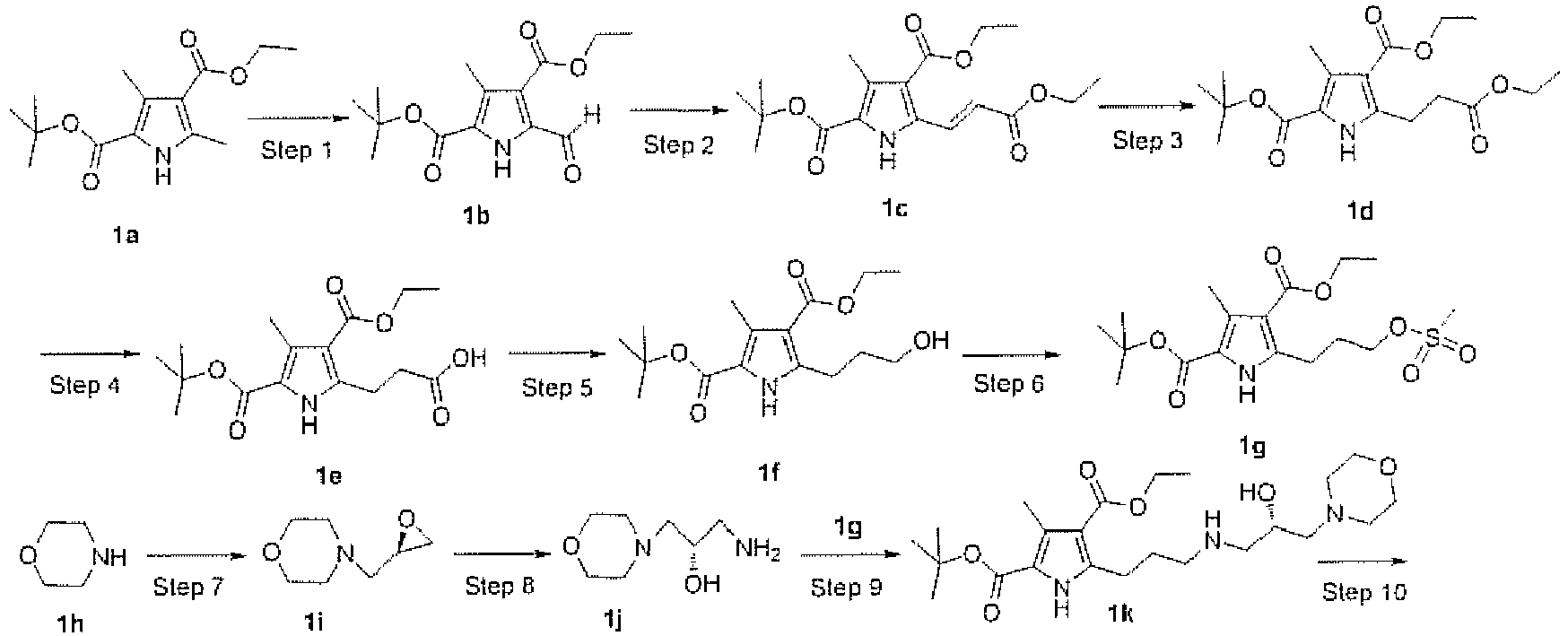

- 3,5-Dimethyl-1H-pyrrole-2,4-dicarboxylic acid 2-tert-butyl ester 4-ethyl ester 1a (30 g, 0.11 mol) was dissolved in 300 mL of tetrahydrofuran under stirring, followed by addition of 360 mL of acetic acid and 300 mL of H2O. The mixture was homogeneously stirred and added with ammonium cerium nitrate (246 g, 0.45 mol) in one portion. After stirring for 0.5 hour, the reaction mixture was poured into 800 mL of ice-water, stirred for another 0.5 hour and filtered. The filter cake was dried under vacuum to obtain the title compound 5-formyl-3-methyl-1H-pyrrole-2,4-dicarboxylic acid 2-tert-butyl ester 4-methyl ester 1b (31.13 g, yield 98%) as a pale yellow solid. MS m/z (ESI): 282.0[M+1]
- 5-Formyl-3-methyl-1H-pyrrole-2,4-dicarboxylic acid 2-tert-butyl ester 4-ethyl ester 1b (23 g, 81.7 mmol) and (carbethoxymethylene)triphenylphosphorane (34.66 g, 99.4 mmol) were dissolved in 450 mL of tetrahydrofuran under stirring. After stirring for 12 hours, the reaction mixture was concentrated under reduced pressure and the resulting residue was purified by silica gel column chromatography with elution system B to obtain the title compound 5-(2-ethoxycarbonyl-vinyl)-3-methyl-1H-pyrrole-2,4-dicarboxylic acid 2-tert-butyl ester 4-ethyl ester 1c (24 g, yield 84%) as a pale yellow solid.
MS m/z (ESI): 352.1 [M+1] - Under hydrogen atmosphere, 5-(2-ethoxycarbonyl-vinyl)-3-methyl-1H-pyl-role-2,4-dicar boxylic acid 2-tert-butyl ester 4-ethyl ester 1c (24 g, 68.3 mmol) was dissolved in 180 mL of anhydrous ethanol under stirring, followed by addition of 2.44 g 10% Pd/C. After stirring for 12 hours, the reaction mixture was filtered. The filter cake was washed with a small amount of ethanol before the filtrate was collected and concentrated under reduced pressure to obtain the title compound 5-(2-ethoxycarbonyl-ethyl)-3-methyl-1H-pyrrole-2,4-dicarboxylic acid 2-tert-butyl ester 4-ethyl ester 1d (23 g, yield 95%) as a white solid.
MS m/z (ESI): 354.4[M+1] - 5-(2-Ethoxycarbonyl-ethyl)-3-methyl-1H-pyrrole-2,4-dicarboxylic acid 2-tert-butyl ester 4-ethyl ester 1d (23.6 g, 66.8 mmol) was dissolved in 190 mL of tetrahydrofuran and 90 mL of methanol under stirring, followed by dropwise addition of lithium hydroxide solution (10M, 80 mL). After stirring for 1 hour, the reaction mixture was concentrated under reduced pressure. The resulting residue was adjusted to pH 2 with hydrochloric acid (2 M), filtered and the filter cake was dried under vacuum to obtain the title compound 5-(2-carboxy-ethyl)-3-methyl-1H-pyrrole-2,4-dicarboxylic acid 2-tert-butyl ester 4-methyl ester 1e (24 g, yield 98%) as a white solid.
MS m/z (ESI): 326.1[M+1] - 5-(2-Carboxy-ethyl)-3-methyl-1H-pyrrole-2,4-dicarboxylic acid 2-tert-butyl ester 4-ethyl ester 1e (9.75 g, 30 mmol) was dissolved in 90 mL of anhydrous tetrahydrofuran under stirring. A solution of BH3 (1 M) in THF (90 mL) was added slowly to the reaction mixture between -10∼-5 °C. After stirring for 2∼3 hours at room temperature, the reaction mixture was concentrated under reduced pressure. The reaction mixture was added with 100 mL of saturated sodium bicarbonate solution and 100 mL of ethyl acetate, and extracted with ethyl acetate (100 mL×3). The organic extracts were combined, washed with saturated saline solution (100 mL), dried over anhydrous magnesium sulfate, filtered and concentrated to obtain the title compound 5-(3-hydroxy-propyl)-3-methyl-1H-pyrrole-2,4-dicarboxylic acid 2-tert-butyl ester 4-methyl ester 1f (9.2 g, yield 98%) as a pale yellow oil.
MS m/z (ESI): 312.3[M+1] - 5-(3-Hydroxy-propyl)-3-methyl-1H-pyrrole-2,4-dicarboxylic acid 2-tert-butyl ester 4-ethyl ester 1f (9.20 g, 30 mmol) was dissolved in 150 mL of dichloromethane under stirring, followed by addition of triethylamine (7 mL, 50 mmol) and methyl sulfonyl chloride (3.5 mL, 45 mmol) successively at -10 °C. After stirring for 4 hours, the reaction mixture was added with a small amount of ice-water, washed with 0.5 M hydrochloric acid (80 mL×2), saturated sodium carbonate solution (80 mL × 2) and saturated saline solution (80 mL) successively, dried over anhydrous magnesium sulfate, filtered and concentrated under reduced pressure to obtain the title compound 5-(3-methanesulfonyloxy-propyl)-3-methyl-1H-pyrrole-2,4-dicarboxylic acid 2-tert-butyl ester 4-methyl ester 1g (11.4 g, yield 99%) as a brown oil.
MS m/z (ESI): 390.5[M+1] - Morpholine 1h (8.7 mL, 0.1 mol) was dissolved in 4.5 mL of tert-butanol under stirring, followed by addition of (R)-(-)-epichlorohydrin (8.1 mL, 0.1 mol) in an ice bath. Then the reaction mixture was warmed up to room temperature and stirred for 24 hours. A solution of tert-butanol potassium (1.67 M) in tetrahydrofuran (60 mL) was added dropwise to the reaction mixture at 10 °C. After stirring for 30 minutes, the reaction mixture was concentrated under reduced pressure. The residue was added with 50 mL of H2O and extracted with dichloromethane (100 mL×2). The organic extracts were combined, washed with saturated saline solution (100 mL), dried over anhydrous magnesium sulfate, filtered. The filtrate was concentrated under reduced pressure to obtain the title compound (R)-4-oxiranylmethyl-morpholine 1i (12.7 g, yield 88.8%) as a yellow oil.
MS m/z (ESI): 144.4[M+1] - (R)-4-Oxiranylmethyl-morpholine 1i (6.3 g, 44 mmol) was dropped slowly into 450 mL of 25% aqueous ammonia in an ice bath. After stirring for 18 hours, the reaction mixture was concentrated under reduced pressure to obtain the title compound (S)-1-amino-3-morpholin-4-yl-propan-2-01 1j (7 g, yield 99%) as a white solid.
MS m/z (ESI): 161.1[M+1] - 5-(3-Methanesulfonyloxy-propyl)-3-methyl-1H-pyrrole-2,4-dicarboxylic acid 2-tert-butyl 1 ester 4-ethyl ester 1g (1.13 g, 2.9 mmol) was dissolved in 5.6 mL of dichloromethane under stirring, followed by addition of (S)-1-amino-3-morpholin-4-yl-propan-2-ol 1j (0.93 g, 5.8 mmol). After stirring for 12 hours, the reaction mixture was heated to 45°C for 14 hours. The reaction mixture was added with 15 mL of saturated saline solution and extracted with dichloromethane (20 mL×3). The organic extracts were combined and concentrated under reduced pressure. The resulting residue was purified by silica gel column chromatography with elution system A to obtain the title compound (S)-5-[3-(2-hydroxy-3-morpholin-4-yl-propylamino)-propyl]-3-methy]-1H-pyrrole-2,4-dicarboxylic acid 2-tert-butyl ester 4-ethyl ester 1k (600 mg, yield 72.5%) as a colorless oil.
MS m/z (ESI): 454.2[M+1] - (S)-5-[3-(2-hydroxy-3-morpholin-4-yl-propylamino)-propyl]-3-methyl-1H-pyrrole-2,4-dicarboxylic acid 2-tert-butyl ester 4-methyl ester 1k (580 mg, 1.28 mmol) was dissolved in 6 mL of toluene under stirring, followed by dropwise addition of a solution of trimethylaluminium (2 M) in toluene (1.9 mL) in an ice bath. The reaction mixture was heated to reflux for 24 hours. The reaction mixture was concentrated under reduced pressure, added with 20 mL of hydrochloric acid (6 M) and stirred for 20 minutes. The resulting reaction mixture was adjusted to pH 12 with sodium hydroxide solution (12 M) and extracted with dichloromethane (50 mL×2). The organic extracts were combined and concentrated under reduced pressure. The resulting residue was purified by silica gel column chromatography with elution system A to obtain the title compound (R)- 5-(2-hydroxy-3-morpholin-4-yl-propyl)-3-methyl-5,6,7,8-tetrahydro-1H-pyrrolo[3,2-c]azepin-4-one 1m (300 mg, yield 57.6%) as a white solid.
MS m/z (ESI): 308.2[M+1] - Chlorine ethylene dimethyl ammonium chloride (130 mg, 0.98 mmol) was dissolved in 3 mL of dichloromethane under stirring, followed by addition of a solution of (R)-5-(2-hydroxy-3-morpholin-4-yl-propyl)-3-methyl-5,6,7,8-tetrahydro-1H-pyrrolo[3,2-c]azepin-4-one 1m (300 mg, 0.98 mmol) in dichloromethane (2 mL) at 0 °C. After stirring for 20 minutes at room temperature, the reaction mixture was added with 10 mL of sodium hydroxide solution (12 M) and 10 mL of saturated saline solution successively, extracted with a mixed solvent of dichloromethane and methanol (100 mL×3, V/V=10/1). The organic extracts were combined, washed with 100 mL of saturated saline solution, dried over anhydrous magnesium sulfate, filtered and concentrated under reduced pressure. The resulting residue was purified by silica gel column chromatography with elution system A to obtain the title compound (R)-5-(2-hydroxy-3-morphoiin-4-yl-propyl)-3-methyl-4-oxo-1,4,5,6,7,8-hexahydro-pyrrolo[3,2-c]azepine-2-carbaldehyde 1n (200 mg, yield 61%) as a white solid.
MS m/z (ESI): 336.2[M+1] - (R)-5-(2-hydroxy-3-morpholin-4-yl-propyl)-3-methyl-4-oxo-1,4,5,6,7,8-hexahydro-pyrro lo[3,2-c]azepine-2-carbaldehyde 1n (50 mg, 0.15 mmol) was dissolved in 261 µL of ethanol under stirring, followed by addition of 5-fluoro-1,3-dihydro-indol-2-one (20 mg, 0.13 mmol) and piperidine (7.3 µL, 0.074 mmol). After stirring for 2 hours at 80 °C in dark, the reaction mixture was cooled to room temperature, filtered and dried under vacuum to obtain the title compound (R,Z)-2-(5-fluoro-2-oxo-1,2-dihydro-indol-3-ylidenemethyl)-5-(2-hydroxy-3-morp holin-4-yl-propyl)-3-methyl-5,6,7,8,-tetrahydro-1H-pyrrolo[3,2-c]azepin-4-one 1p (40 mg, yield 57%) as a yellow solid.
MS m/z (ESI): 469.2[M+1]
1H NMR(400MHz, d-DMSO, ppm): δ13.73(s, 1H), 10.91(s, 1H), 7.76∼7.78(m, 1H), 7.75(s, 1H), 6.91∼6.94(m, 1H), 6.84∼6.87(m, 1H), 4.72∼4.73(d, 1H), 3.90(m, 1H), 3.75∼3.79(dd, 1H), 3.57∼3.59(1, 4H), 3.38∼3.35(t, 2H), 3.14∼3.19(dd, 1H), 2.92∼2.95(t, 2H), 2.46(s, 3H), 2.42∼2.51(m, 4H), 2.29∼2.31(t, 2H), 2.08(m, 2H) - (R,Z)-2-fluoro-2-oxo-1,2-dihydro-indol-3-ylidenemethyl)-5-(2-hydroxy-3-ylidenethyl)-5-(2-hydroxy-3-morpholin-4-yl-propyl)-3-methyl-5,6,7,8-tetrahydro-1H-pyrrolo[3,2-c]azepin-4-one 1p (731 mg, 1.56 mmol) and maleic acid (217 mg, 1.87 mmol) was dissolved in 150 mL of methanol under stirring. After stirring for 20 minutes at 40°C, the reaction mixture was filtered and the filtrate was concentrated under reduced pressure. The reaction mixture was added with 50 mL of acetonitrile and heated to reflux for 20 minutes. The reaction mixture was cooled to room temperature, filtered to obtain (R,Z)-2-(5-fluoro-2-oxo-1,2-dihydro-indol-3-ylidenemethyl)-5-(2-hydroxy-3-morpholin-4-yl-propyl)-3-methyl-5,6,7,8-tetrahydro-1H-pyrrolo[3,2-c]azepin-4 -one maleate 1 (831 mg, yield 91.1%) as a yellow solid.
MS m/z (ESI): 469.2[M+1]
1H NMR(400MHz, d-DMSO, ppm): δ13.76(s, 1H), 10.93(s, 1H), 7.77∼7,80(m, 1H), 7.76(s, 1H), 6.93∼6.98(m, 1H), 6.85∼6.88(m, 1H), 6.05(s, 2H), 4.19(d, 1H), 3.63∼3.84(m, 4H), 3.60∼3.61(m, 1H.), 3.43∼3.46(m, 4H), 3.31(m, 2H), 3.13∼3.18(m, 3H), 2.96∼3.011(m, 3H), 2.48(s, 3H), 2.10∼2.13(m, 2H) -

- (R,Z)-2-(5-fluoro-2-oxo-1,2-dihydro-indol-3-ylidenemethyl)-5-(2-hydroxy-3-mor-pholin-4-yl-propyl)-3-methyl-5,6,7,8-tetrahydro-1H-pyrrolo-[3,2-c]azepin-4-one 1p (469 mg, 1 mmol) was dissolved in 15 mL of methanol under stirring, followed by addition of L-malic acid (147 mg, 1.1 mmol). After stirring for 30 minutes, the reaction mixture was concentrated under reduced pressure, added with 120 mL of acetonitrile and heated to reflux for 1.5 hours. The reaction mixture was cooled to room temperature and filtered. The filter cake was washed with acetonitrile (1 mL×3) and ethanol (1 mL×3) (both ice-cooled) successively to obtain (R,Z)-2-(5-fluoro-2-oxo-1,2-dihydro-indol-3-ylidenemethyl)-5-(2-hydroxy-3-morpholin-4-y]-propyl)-3-methyl-5,6,7,8-tetrahydro-1H-pyrrolo[3,2-c]azepin-4-one malate 2 (535 mg, yield 88.8%) as a yellow solid.
MS m/z (ESI): 469.2[M+1]
1H NMR(400MHz, d-DMSO, ppm): δ13.73(s, 1H), 10.92(s, 1H), 7.75∼7.79(m, 2H), 6.83∼6.96(m, 2H), 4.91(s, 1H), 4.17∼4.20(m, 1H), 3.95(m, 1H), 3.72∼3.77(dd, 1H), 3.61(s, 3H), 3.20∼3.37(m, 4H), 2.92∼2.96(m, 2H), 2.39∼2.62(m, 14H), 2.25(m, 2H) -

- (R,Z)-2-(5-fluora-2-oxa-1,2-dihydro-indol-3-ylidenemethyl)-5-(2-hydroxy-3-morpholin-4-yl-propyl)-3-methyl-5,6,7,8-tetrahydro-1H-pyrrolo[3,2-c]azepin-4-one 1p (471 mg, 1 mmol) was dissolved in 17 mL of methanol and 34 mL of dichloromethane under stirring, followed by addition of lactic acid (90 mg, 1 mmol). After stirring for 30 minutes, the reaction mixture was concentrated under reduced pressure, added with 20 mL of acetonitrile and heated to reflux for 45 minutes. The reaction mixture was cooled to room temperature and filtered. The filter cake was washed with acetonitrile (1 mLx3) and ethanol (1 mLx3) (both ice-cooled) successively to obtain (R,Z)-2-(5-fluoro-2-oxo-1,2-dihydro-indol-3-ylidenemethyl)-5-(2-hydroxy-3-morpholin-4-yl-propyl)-3-methyl-5,6,7,8-tetrahydro-1H-pyrrolo[3,2-c] azepin-4-one lactate 3 (502 mg, yield 90%) as a yellow solid.
MS m/z (ESI): 469.2[M+1]
1H NMR(400MHz, d-DMSO, ppm): δ13.73(s, 1H), 10.92(s, 1H), 7.75∼7.79(m, 2H), 6.92∼6.94(m, 1H), 6.84∼6.87(m, 1H), 4.74(d, 1H), 3.79∼3.90(m, 1H), 3.75(dd, 1H), 3.59(s, 3H), 3.58(m, 1H), 3.32(m, 2H), 3.19(m, 1H), 2.95(m, 2H), 2.46(m, 4H), 2.45(m, 8H), 2.33(m, 2H), 2.26(m, 2H) -

- (R,Z)-2-(5-fluoro-2-oxo-1,2-dihydro-indol-3-ylidenemethyl)-5-(2-hydroxy-3-morpholin-4-yl-propyl)-3-methyl-5,6,7,8-tetrahydro-1H-pyrrolo[3,2-c]azepin-4-one 1p (470 mg, 1 mmol) was dissolved in 8 mL of methanol and 16 mL of dichloromethane under stirring, followed by addition of methanesulfonic acid (96 mg, 1 mmol). After stirring for 30 minutes, the reaction mixture was concentrated under reduced pressure, added with 10 mL of acetonitrile and heated to reflux for 30 minutes. The reaction mixture was cooled to room temperature and filtered. The filter cake was washed with acetonitrile (1 mL×3) and ethanol (1 mL×3) (both ice-cooled) successively to obtain (R,Z)-2-(5-fluoro-2-oxo-1,2-dihydro-indol-3-ylidenemethyl)-5-(2-hydroxy-3-morpholin-4-yl-propyl)-3-methyl-5,6,7,8-tetrahydro-1H-pyrrolo[3,2-c]azepin-4-one mesylate 4 (519 mg, yield 92%) as a yellow solid.
MS m/z (ESI): 469.2[M+1]
1H NMR(400MHz, d-DMSO, ppm): δ13.77(s, 1H), 10.94(s, 1H), 9.66(s, 1H), 7.76∼7.80(m, 2H), 6.85∼6.97(m, 2H), 5.82(s, 1H), 4.22(s, 1H), 4.00(m, 2H), 3.83(m, 3H), 3.77(m. 2H), 3.58∼3.61(m, 3H), 3.21∼3.35(m, 4H), 3.13(m, 2H), 2.51(s, 3H), 2.33(s, 3H), 2.10(m, 2H), 1.1(m, 2H) -

- (R,Z)-2-(5-fluoro-2-oxo-1,2-dihydro-indol-3-ylidenemethyl)-5-(2-hydroxy-3-morpholoin-4-yl-propyl)-3-methyl-5,6,7,8-tetrahydro-1H-pyrrolo-[3,2-c]azepin-4-one 1p (486 mg, 1 mmol) was dissolved in 5 mL of methanol and 8 mL of dichloromethane under stirring, followed by addition of a solution of hydrogen chloride (5M) in 1,4-dioxane (2 mL). After stirring for 1 hour, the reaction mixture was concentrated under reduced pressure, added with 50 mL of acetonitrile and heated to reflux for 1 hour. The reaction mixture was cooled to room temperature and filtered to obtain (R,Z)-2-(5-fluoro-2-oxo-1,2-dihydro-indol-3-ylidenemthyl-5-(2-hydroxy-3-morpholin-4-yl-propyl)-3-methyl-5,6,7,8-tetrahydro-1H-pyrrolo[3,2-c]azepin -4-one hydrochloride 5 (459 mg, yield 91%) as a yellow solid.
MS m/z (ESI): 469.2[M+1]
1H NMR(400MHz, d-DMSO, ppm): δ13.73(s, 1H), 10.91(s, 1H), 7.76∼7.78(m, 1H), 7.75(s, 1H), 6.91∼6.94(m, 1H), 6.84∼6.87(m, 1H), 4.72∼4.73(d, 1H), 3.90(m, 1H), 3.75∼3.79(dd, 1H). 3.57∼3.59(t, 4H), 3.38̃∼3.35(t, 2H), 3.14∼3.19(dd, 1H), 2.92∼2.95(t, 2H), 2.46(s, 3H), 2.42∼2.51(m, 4H), 2.29∼2.31(t, 2H), 2.08(m, 2H) - According to the conventional solubility measurement, the solubility of the compound of formula (1) and salts thereof were determined in physiological saline. The results were shown in table 1:
Table 1: The form of salt Physiological saline The compound of formula (I) 0.00186 Example 1 0.1214 Example 2 0.0227 Example 3 0.00124 Example 4 0.0131 Example 5 0.0294 - Conclusion: Compared with free base and other salts of the compound of formula (1), the solubility of maleate of the compound of formula (I) has significantly improved.
- The rats were used as experimental animals. The compound of formula (I) and other salts thereof were administrated intragastrically, the maleate of the compound of formula (I) was injected into the tail vein to determine the drug concentration in plasma at different time points by LC/MS/MS method. The pharmacokinetic behavior, characteristics and the oral absolute bioavailability of the compounds in the present invention were studied and evaluated in rats.
- The compound of formula (I), compounds of Example 1∼5.
- 28 healthy adult SD rats, male and female in half, were divided into 7 groups (4 rats in each group) and purchased from SINO-BRITSH SIPPR/BK LAB. ANIMAL LTD., CO, License number: SCXK (Shanghai) 2008-0016.
- TSQ Quantum Ultra AM triple quadrupole mass spectrometer, Thermo Finnigan (American);
Agilent 1200 high performance liquid chromatography system, Agilent (American). - The intravenous injection administration group: the suitable amount of compounds were weighted, added into physiological saline and diluted to the final volume. The sample concentration was 1.0 mg/mL.
- The intragastrical administration group: the suitable amount of compounds were weighted and added into 0.5% CMC-Na to prepare 1.0 mg/mL suspension by using ultrasound device. The sample should be prepared freshly away from light at the time of use.
- 28 healthy adult SD rats, male and female in half, were divided into 7 groups (4 rats in each group). After an overnight fast, the compound of Example 1, at a dose of 10 mg/kg (calculated by the base part), at a volume of 10 mL/kg, was administered intragastrically or injected into the tail vein.
- For the intravenous injection administration group, blood samples (0.2 mL) were taken from orbital sinus at pre administration and at 2 minutes, 15 minutes, 30 minutes, 1.0 hour, 2.0 hours, 4.0 hours, 6.0 hours, 8.0 hours, 12.0 hours, 24.0 hours and 36.0 hours post administration, stored in heparinized tubes and centrifuged for 10 minutes at 3,500 rpm. The plasma samples were stored at -20°C.
- For the intragastrical administration group, blood samples were taken at pre administration and at 0.5, 1.0, 2.0, 3.0, 4.0, 6.0, 5.0, 12.0, 24.0 and 36.0 hours post administration. The method to treat the samples was the same with the intravenous injection administration group. The rats were fed 2 hours after administration.
- 25 µL of rat plasmas taken at various time points after administration were mixed with 20 µL of internal standard solution and 125 µL of methanol for 2 minutes by using a vortexer and the mixture was centrifuged for 10 minutes at 16,000 rpm. 10 µL of the supernatant was analyzed by LC-MS/MS.
- 25 µL of rat blank plasmas were mixed with a series of standard solutions respectively to obtain plasma concentration of 1.00, 2.00, 5.00, 25.0, 100, 500, 2000 and 5000 ng/mL. 20 µL of internal standard solution and 150 µL of methanol were added and then the mixture was operated according to "plasma sample pretreatment" method. Plasma concentration was used as the abscissa, the ratio of chromatographic peak area between the sample and internal standard was used as the ordinate, the linear regression was carried out by the weighted least square method (w=1/x2) to obtain the typical standard curve equation.
- Compartment model fitting was carried out on the pharmacokinetic behavior of the tested compounds to calculate the main pharmacokinetic parameters, wherein the measured values were taken for Cmax and tmax. Oral absolute bioavailability was calculated according to AUC0-t after intragastrical administration and intravenous injection at tail vein.
- Pharmacokinetic parameters of the compounds of the present invention were shown as table 2.
- Conclusion: Compared with free base and other salts of the compound of formula (I), maleate of the compound of formula (I) had significant improvement in pharmacokinetic characteristics and bioavailability, and had obvious pharmacokinetic advantage.
Table 2: Compound F (%) C max (µg/mL) A UC0-1 (µg-h/mL) t 1/2 (h) Tmax (h) MRT (h) CL/F (mL/min/kg) The compound of formula (I) 27.9 0.64 ± 0.24 4.49 ±2.79 3.31 ± 0.57 2.00 ± 1.41 5.24 ± 2.23 1.84 ± 1.20 Vein 16.12 ± 3.97 5.97 ± 2.50 — 1.40 ± 0.35 0.65 ± 0.161 Example 1 48.2 0.95 ±0.37 7.77 ± 2.99 3.01 ± 0.60 5.75 ± 2.06 6.66 ± 2.05 1.44 ± 0.55 Vein 16.12 ±3.97 5.97 ± 2.50 — 1.40 ± 0.35 0.65 ± 0.161 Example 2 30.4 0.85 ± 0.39 4.90 ± 2.79 3.13 ± 0.97 1.75 ± 1.66 4.29 ± 1.87 1.79 ± 0.67 Vein 16.12 ±3.97 5.97 ± 2.50 — 1.40 ± 0.35 0.65 ± 0.161 Example 3 36.6 0.81 ± 0.45 5.90 ± 3.35 3.06 ± 1.21 2.50 ± 1.00 6.28 ±1.56 1.64 ± 0.70 36.6 Vein 16.12 ±3.97 5.97 ± 2.50 — 1.40 ± 0.35 0.65 ± 0.161 Example 4 45.3 0.77 ± 0.39 7.30 ± 5.87 3.41 ± 0.85 3.75 ± 1.71 6.68 ± 1.58 1.49 ± 0.69 Vein 16.12 ±3.97 5.97 ±2.50 — 1.40 ± 0.35 0.65 ± 0.161 Example 5 25.2 0.50 ± 0.10 4.07 ±1.63 3.60 ± 0.52 4.25 ± 2.06 6.80 ± 1.58 2.03 ± 0.51 Vein 16.12 ± 3.97 5.97 ± 2.50 — 1.40 ± ().35 0.65 ± 0.161
Claims (13)
- A pharmaceutically acceptable salt of (R,Z)-2-(5-fluoro-2-oxo-1,2-dihydro-indol-3-ylidenemethyl)-5-(2-hydroxy-3-morpholin-4-yl-propyl)-3-methyl-5,6,7,8-tetrahydro-1H-pyrrolo[3,2-c]azepin-4-one of formula (I):

- The salt according to claim 1, wherein the salt is an inorganic salt.
- The salt according to claim 2, wherein the inorganic salt is selected from the group consisting of phosphate, hydrochloride, sulfate, nitrate and hydrobromide, preferably hydrochloride.
- The salt according to claim 1, wherein the salt is an organic salt.
- The salt according to claim 4, wherein the organic salt is selected from the group consisting of mesylate, maleate, tartrate, succinate, acetate, trifluoroacetate, fumarate, citrate, benzene sulfonate, benzoate, naphthalene sulphonate, lactate and malate; preferably malate, lactate, mesylate or maleate, most preferably maleate.
- A method of preparing the salt according to any one of claims 1. to 5, wherein the method comprises a step of reacting (R,Z)-2-(5-fluoro-2-oxo-1,2-dihydro-indol-3-ylidenemethyl)-5-(2-hydroxy-3-morpholin-4-yl-propyl)-3-methyl-5,6,7,8-tetrahydro-1H -pyrrolo[3,2-c]azepin-4-one with a corresponding acid to prepare the salt.
- The method according to claim 6, wherein the acid is an inorganic acid/organic acid selected from the group consisting of phosphoric acid, hydrochloric acid, sulfuric acid, nitric acid, hydrobromic acid, methanesulfonic acid, maleic acid, tartaric acid, succinic acid, acetic acid, trifluoroacetic acid, fumaric acid, citric acid, benzenesulfonic acid, benzoic acid, naphthalenesulfonic acid, lactic acid and malic acid.
- A pharmaceutical composition comprising a therapeutically effective amount of the salt according to any one of claims 1 to 5 and a pharmaceutically acceptable carrier.
- A use of the salt according to any one of claims 1 to 5 or the pharmaceutical composition according to claims 8 in the preparation of a medicament for the treatment of a protein kinase related disease.
- The use according to claim 9, wherein the protein kinase related disease is selected from the group consisting of a disease related with VEGFR-2, EGFR, HER-2, PDGFR, c-Kit, c-Met and FGFR.
- The use according to claim 10, wherein the disease is cancer.
- The use according to claim 11, wherein the cancer is selected from the group consisting of lung cancer, breast cancer, epidermal squamous cell carcinoma and gastric cancer.
- A use of the salt according to any one of claims 1 to 5 or the pharmaceutical composition according to claim 8 in the preparation of a protein kinase inhibitor drug, wherein the protein kinase is selected from the group consisting of VEGFR-2, EGFR, HER-2, PDGFR, c-Kit, c-Met and FGFR.
Applications Claiming Priority (2)
| Application Number | Priority Date | Filing Date | Title |
|---|---|---|---|
| CN2010101090685A CN102146082A (en) | 2010-02-04 | 2010-02-04 | Medicinal salts of pyrrolo-nitrogenous heterocyclic derivatives, and preparation method and application thereof to medicines |
| PCT/CN2011/070076 WO2011095068A1 (en) | 2010-02-04 | 2011-01-07 | Pharmaceutically acceptable salts of pyrrolo-nitrogenous heterocyclic derivatives, preparation method and medical use thereof |
Publications (1)
| Publication Number | Publication Date |
|---|---|
| EP2532666A1 true EP2532666A1 (en) | 2012-12-12 |
Family
ID=44354948
Family Applications (1)
| Application Number | Title | Priority Date | Filing Date |
|---|---|---|---|
| EP11739347A Withdrawn EP2532666A1 (en) | 2010-02-04 | 2011-01-07 | Pharmaceutically acceptable salts of pyrrolo-nitrogenous heterocyclic derivatives, preparation method and medical use thereof |
Country Status (11)
| Country | Link |
|---|---|
| US (1) | US20120295887A1 (en) |
| EP (1) | EP2532666A1 (en) |
| JP (1) | JP2013518828A (en) |
| KR (1) | KR20120130089A (en) |
| CN (2) | CN102146082A (en) |
| AU (1) | AU2011213440A1 (en) |
| BR (1) | BR112012018658A2 (en) |
| CA (1) | CA2786927A1 (en) |
| MX (1) | MX2012008611A (en) |
| RU (1) | RU2012136378A (en) |
| WO (1) | WO2011095068A1 (en) |
Families Citing this family (2)
| Publication number | Priority date | Publication date | Assignee | Title |
|---|---|---|---|---|
| GB201402071D0 (en) * | 2014-02-07 | 2014-03-26 | Galapagos Nv | Novel salts and pharmaceutical compositions thereof for the treatment of inflammatory disorders |
| CN112778187B (en) * | 2021-01-06 | 2022-10-28 | 烟台舜康生物科技有限公司 | Synthesis method of Hainatinib intermediate and Hainatinib intermediate obtained by synthesis method |
Family Cites Families (4)
| Publication number | Priority date | Publication date | Assignee | Title |
|---|---|---|---|---|
| EP1259514B9 (en) * | 2000-02-28 | 2005-11-09 | Sugen, Inc. | 3-(pyrolyllactone)-2-indolinone compounds as kinase inhibitors |
| DK1973910T3 (en) * | 2006-01-27 | 2013-08-12 | Shanghai Hengrui Pharm Co Ltd | Pyrrolo [3,2-c] pyridin-4-one-2-indolinone protein kinase inhibitors |
| WO2008138184A1 (en) * | 2007-05-14 | 2008-11-20 | Shanghai Hengrui Pharmaceutical Co.Ltd. | Derivatives of pyrroloazacycles, the method of making them and the use thereof as inhibitors of protein kinases |
| WO2008138232A1 (en) | 2007-05-14 | 2008-11-20 | Shanghai Hengrui Pharmaceutical Co., Ltd. | Pyrrolo-nitrogenous heterocyclic derivatives, the preparation and the pharmaceutical use thereof |
-
2010
- 2010-02-04 CN CN2010101090685A patent/CN102146082A/en active Pending
-
2011
- 2011-01-07 BR BR112012018658A patent/BR112012018658A2/en not_active Application Discontinuation
- 2011-01-07 EP EP11739347A patent/EP2532666A1/en not_active Withdrawn
- 2011-01-07 US US13/574,272 patent/US20120295887A1/en not_active Abandoned
- 2011-01-07 AU AU2011213440A patent/AU2011213440A1/en not_active Abandoned
- 2011-01-07 KR KR1020127019373A patent/KR20120130089A/en not_active Withdrawn
- 2011-01-07 WO PCT/CN2011/070076 patent/WO2011095068A1/en not_active Ceased
- 2011-01-07 RU RU2012136378/04A patent/RU2012136378A/en not_active Application Discontinuation
- 2011-01-07 MX MX2012008611A patent/MX2012008611A/en not_active Application Discontinuation
- 2011-01-07 JP JP2012551483A patent/JP2013518828A/en active Pending
- 2011-01-07 CA CA2786927A patent/CA2786927A1/en not_active Abandoned
- 2011-01-07 CN CN2011800020688A patent/CN102421781A/en active Pending
Non-Patent Citations (1)
| Title |
|---|
| See references of WO2011095068A1 * |
Also Published As
| Publication number | Publication date |
|---|---|
| JP2013518828A (en) | 2013-05-23 |
| CN102146082A (en) | 2011-08-10 |
| BR112012018658A2 (en) | 2016-05-03 |
| RU2012136378A (en) | 2014-03-10 |
| WO2011095068A1 (en) | 2011-08-11 |
| US20120295887A1 (en) | 2012-11-22 |
| MX2012008611A (en) | 2012-08-15 |
| CN102421781A (en) | 2012-04-18 |
| AU2011213440A1 (en) | 2012-08-09 |
| CA2786927A1 (en) | 2011-08-11 |
| KR20120130089A (en) | 2012-11-28 |
Similar Documents
| Publication | Publication Date | Title |
|---|---|---|
| EP2684877B1 (en) | Pharmaceutically acceptable salt of (e)-n-[4-[[3-chloro-4-(2-pyridylmethoxy)phenyl]amino]-3-cyano-7-ethoxy-6-quinolyl]-3-[(2r)-1-methylpyrrolidin-2-yl]prop-2-enamide, preparation method therefor, and medical use thereof | |
| CN117534684A (en) | A pan-KRAS inhibitor compound | |
| CA2949160C (en) | 1-((3s,4r)-4-(3-fluorophenyl)-1-(2-methoxyethyl)pyrrolidin-3-yl)-3-(4-methyl-3-(2-methylpyrimidin-5-yl)-1-phenyl-1h-pyrazol-5-yl)urea as a trka kinase inhibitor | |
| CN117534687A (en) | A pan-KRAS inhibitor compound | |
| CN117534685A (en) | pan-KRAS inhibitor compound | |
| CA3157361A1 (en) | Bicyclic heterocycles as fgfr inhibitors | |
| IL277518B2 (en) | Inhibitors of PRMT5 | |
| TW201444838A (en) | Pyridino pyrimidine derivatives, preparation method and medical use thereof | |
| EP3755694A1 (en) | New benzimidazole compounds and derivatives as egfr inhibitors | |
| EP2966076A1 (en) | Novel tyrosine kinase inhibitors | |
| KR20230019110A (en) | 4-amino-5-(6-(4-methylpiperazin-1-yl)-1H-benzo[D]imidazol-2-yl)thieno[2,3-b]pyridine-6(7H)- Salts and Crystalline Forms of One | |
| WO2018167019A1 (en) | Tosylacetate based compounds and derivatives thereof as phgdh inhibitors | |
| EP2532666A1 (en) | Pharmaceutically acceptable salts of pyrrolo-nitrogenous heterocyclic derivatives, preparation method and medical use thereof | |
| WO2021020585A1 (en) | Heterocyclic compound | |
| TW202408502A (en) | Heteroaryl derivative compounds, and uses thereof | |
| US9249147B2 (en) | Tyrosine kinase inhibitors | |
| CN108117551B (en) | Substituted (1H-pyrazolo [3,4-b ] pyridine) urea compound and anti-tumor application thereof | |
| RU2792626C1 (en) | New pan-raf kinase inhibitor and applications thereof | |
| CA2997359A1 (en) | 1-(4-(2-((1-(3,4-difluorophenyl)-1h-pyrazol-3-yl)methoxy)ethyl) piperazin-1-yl)ethanone salts | |
| WO2021020586A1 (en) | Heterocyclic compound | |
| HK40072079B (en) | Heterocyclic compound | |
| BR112016026672B1 (en) | COMPOUND 1-((3S,4R)-4-(3-FLUOROPHENYL)-1-(2-METHOXYETHYL)PYRROLIDIN-3-IL)-3-(4-METHYL-3-(2-METHYLPYRIMIDIN-5-IL) -1-PHENYL-1H-PYRAZOL-5-YL)UREA, ITS USE, PROCESSES FOR THE PREPARATION OF THE SAME AND ITS RACEMIC MIXTURE AND PHARMACEUTICAL COMPOSITION THAT COMPRISES IT | |
| TW201228664A (en) | Pyrrolo-nitrogenous heterocyclic derivatives pharmaceutical salts, preparation process and pharmaceutical use thereof |
Legal Events
| Date | Code | Title | Description |
|---|---|---|---|
| PUAI | Public reference made under article 153(3) epc to a published international application that has entered the european phase |
Free format text: ORIGINAL CODE: 0009012 |
|
| 17P | Request for examination filed |
Effective date: 20120710 |
|
| AK | Designated contracting states |
Kind code of ref document: A1 Designated state(s): AL AT BE BG CH CY CZ DE DK EE ES FI FR GB GR HR HU IE IS IT LI LT LU LV MC MK MT NL NO PL PT RO RS SE SI SK SM TR |
|
| STAA | Information on the status of an ep patent application or granted ep patent |
Free format text: STATUS: THE APPLICATION HAS BEEN WITHDRAWN |
|
| 18W | Application withdrawn |
Effective date: 20130218 |