EP2531487B1 - Aryl benzylamine compounds - Google Patents
Aryl benzylamine compounds Download PDFInfo
- Publication number
- EP2531487B1 EP2531487B1 EP11701825.9A EP11701825A EP2531487B1 EP 2531487 B1 EP2531487 B1 EP 2531487B1 EP 11701825 A EP11701825 A EP 11701825A EP 2531487 B1 EP2531487 B1 EP 2531487B1
- Authority
- EP
- European Patent Office
- Prior art keywords
- chloro
- methyl
- phenyl
- carboxylic acid
- propylamino
- Prior art date
- Legal status (The legal status is an assumption and is not a legal conclusion. Google has not performed a legal analysis and makes no representation as to the accuracy of the status listed.)
- Not-in-force
Links
- -1 Aryl benzylamine compounds Chemical class 0.000 title claims description 85
- 150000001875 compounds Chemical class 0.000 claims description 283
- 229910052736 halogen Inorganic materials 0.000 claims description 132
- 125000004169 (C1-C6) alkyl group Chemical group 0.000 claims description 122
- OKKJLVBELUTLKV-UHFFFAOYSA-N Methanol Chemical compound OC OKKJLVBELUTLKV-UHFFFAOYSA-N 0.000 claims description 114
- YMWUJEATGCHHMB-UHFFFAOYSA-N Dichloromethane Chemical compound ClCCl YMWUJEATGCHHMB-UHFFFAOYSA-N 0.000 claims description 96
- 150000003839 salts Chemical class 0.000 claims description 87
- 150000002367 halogens Chemical group 0.000 claims description 83
- 150000001412 amines Chemical class 0.000 claims description 78
- 125000005843 halogen group Chemical group 0.000 claims description 76
- XLYOFNOQVPJJNP-UHFFFAOYSA-N water Substances O XLYOFNOQVPJJNP-UHFFFAOYSA-N 0.000 claims description 71
- 229910052739 hydrogen Inorganic materials 0.000 claims description 69
- 239000001257 hydrogen Substances 0.000 claims description 69
- 208000037265 diseases, disorders, signs and symptoms Diseases 0.000 claims description 62
- 125000004191 (C1-C6) alkoxy group Chemical group 0.000 claims description 57
- VEXZGXHMUGYJMC-UHFFFAOYSA-N Hydrochloric acid Chemical compound Cl VEXZGXHMUGYJMC-UHFFFAOYSA-N 0.000 claims description 57
- 125000004435 hydrogen atom Chemical group [H]* 0.000 claims description 54
- 239000002904 solvent Substances 0.000 claims description 40
- 125000004432 carbon atom Chemical group C* 0.000 claims description 36
- 125000002887 hydroxy group Chemical group [H]O* 0.000 claims description 36
- 239000002253 acid Substances 0.000 claims description 33
- 201000010099 disease Diseases 0.000 claims description 32
- 125000004093 cyano group Chemical group *C#N 0.000 claims description 31
- 208000035475 disorder Diseases 0.000 claims description 30
- WMFOQBRAJBCJND-UHFFFAOYSA-M Lithium hydroxide Chemical compound [Li+].[OH-] WMFOQBRAJBCJND-UHFFFAOYSA-M 0.000 claims description 28
- 238000006243 chemical reaction Methods 0.000 claims description 28
- 239000003814 drug Substances 0.000 claims description 27
- 125000001997 phenyl group Chemical group [H]C1=C([H])C([H])=C(*)C([H])=C1[H] 0.000 claims description 27
- 230000001404 mediated effect Effects 0.000 claims description 26
- 238000006268 reductive amination reaction Methods 0.000 claims description 26
- 206010028980 Neoplasm Diseases 0.000 claims description 24
- 150000002576 ketones Chemical class 0.000 claims description 23
- 210000004698 lymphocyte Anatomy 0.000 claims description 22
- 125000002496 methyl group Chemical group [H]C([H])([H])* 0.000 claims description 21
- 239000008194 pharmaceutical composition Substances 0.000 claims description 21
- 125000001424 substituent group Chemical group 0.000 claims description 21
- 125000002023 trifluoromethyl group Chemical group FC(F)(F)* 0.000 claims description 21
- ZMXDDKWLCZADIW-UHFFFAOYSA-N N,N-dimethylformamide Substances CN(C)C=O ZMXDDKWLCZADIW-UHFFFAOYSA-N 0.000 claims description 20
- 125000003118 aryl group Chemical group 0.000 claims description 20
- 239000002585 base Substances 0.000 claims description 20
- 239000007787 solid Substances 0.000 claims description 20
- 238000011282 treatment Methods 0.000 claims description 19
- 210000001519 tissue Anatomy 0.000 claims description 18
- 210000004027 cell Anatomy 0.000 claims description 17
- 239000003795 chemical substances by application Substances 0.000 claims description 17
- 230000002757 inflammatory effect Effects 0.000 claims description 17
- HTOUTHAMTVBNNO-LCQOSCCDSA-N 1-[[5-chloro-2-[[(1r)-1-(4-chloro-3-methylphenyl)propyl]amino]pyridin-4-yl]methyl]-3-methylpyrrolidine-3-carboxylic acid Chemical compound N([C@H](CC)C=1C=C(C)C(Cl)=CC=1)C(N=CC=1Cl)=CC=1CN1CCC(C)(C(O)=O)C1 HTOUTHAMTVBNNO-LCQOSCCDSA-N 0.000 claims description 16
- KDLHZDBZIXYQEI-UHFFFAOYSA-N Palladium Chemical compound [Pd] KDLHZDBZIXYQEI-UHFFFAOYSA-N 0.000 claims description 15
- 125000004178 (C1-C4) alkyl group Chemical group 0.000 claims description 14
- 125000000229 (C1-C4)alkoxy group Chemical group 0.000 claims description 14
- 125000005913 (C3-C6) cycloalkyl group Chemical group 0.000 claims description 14
- 230000003993 interaction Effects 0.000 claims description 14
- 229910052799 carbon Inorganic materials 0.000 claims description 13
- 230000001684 chronic effect Effects 0.000 claims description 13
- 201000001320 Atherosclerosis Diseases 0.000 claims description 12
- XBDQKXXYIPTUBI-UHFFFAOYSA-N Propionic acid Substances CCC(O)=O XBDQKXXYIPTUBI-UHFFFAOYSA-N 0.000 claims description 12
- 125000004429 atom Chemical group 0.000 claims description 12
- 150000002148 esters Chemical class 0.000 claims description 12
- 125000002924 primary amino group Chemical group [H]N([H])* 0.000 claims description 12
- WSXROYCURUCMMP-SFHVURJKSA-N 1-[[3-[[(1s)-1-(4-chloro-3-methylphenyl)-2,2,2-trifluoroethyl]amino]phenyl]methyl]azetidine-3-carboxylic acid Chemical compound C1=C(Cl)C(C)=CC([C@H](NC=2C=C(CN3CC(C3)C(O)=O)C=CC=2)C(F)(F)F)=C1 WSXROYCURUCMMP-SFHVURJKSA-N 0.000 claims description 10
- GLVBNJIIWFDYHK-LJQANCHMSA-N 3-[[2-chloro-5-[[(1r)-1-(4-chloro-3,5-dimethylphenyl)propyl]amino]phenyl]methylamino]propanoic acid Chemical compound N([C@H](CC)C=1C=C(C)C(Cl)=C(C)C=1)C1=CC=C(Cl)C(CNCCC(O)=O)=C1 GLVBNJIIWFDYHK-LJQANCHMSA-N 0.000 claims description 10
- 201000004681 Psoriasis Diseases 0.000 claims description 10
- 206010039073 rheumatoid arthritis Diseases 0.000 claims description 10
- PLSYQTORNNGTNA-HXUWFJFHSA-N 1-[[3-[[(1r)-1-(4-chloro-3,5-dimethylphenyl)propyl]amino]phenyl]methyl]azetidine-3-carboxylic acid Chemical compound N([C@H](CC)C=1C=C(C)C(Cl)=C(C)C=1)C(C=1)=CC=CC=1CN1CC(C(O)=O)C1 PLSYQTORNNGTNA-HXUWFJFHSA-N 0.000 claims description 9
- 239000003153 chemical reaction reagent Substances 0.000 claims description 9
- 208000027866 inflammatory disease Diseases 0.000 claims description 9
- 125000000449 nitro group Chemical group [O-][N+](*)=O 0.000 claims description 9
- 210000000056 organ Anatomy 0.000 claims description 9
- CYPYTURSJDMMMP-WVCUSYJESA-N (1e,4e)-1,5-diphenylpenta-1,4-dien-3-one;palladium Chemical compound [Pd].[Pd].C=1C=CC=CC=1\C=C\C(=O)\C=C\C1=CC=CC=C1.C=1C=CC=CC=1\C=C\C(=O)\C=C\C1=CC=CC=C1.C=1C=CC=CC=1\C=C\C(=O)\C=C\C1=CC=CC=C1 CYPYTURSJDMMMP-WVCUSYJESA-N 0.000 claims description 8
- 208000024827 Alzheimer disease Diseases 0.000 claims description 8
- 206010040070 Septic Shock Diseases 0.000 claims description 8
- 208000006673 asthma Diseases 0.000 claims description 8
- 125000002837 carbocyclic group Chemical group 0.000 claims description 8
- 208000028867 ischemia Diseases 0.000 claims description 8
- 208000023275 Autoimmune disease Diseases 0.000 claims description 7
- UFHFLCQGNIYNRP-UHFFFAOYSA-N Hydrogen Chemical compound [H][H] UFHFLCQGNIYNRP-UHFFFAOYSA-N 0.000 claims description 7
- 239000007788 liquid Substances 0.000 claims description 7
- 238000006722 reduction reaction Methods 0.000 claims description 7
- WRIKHQLVHPKCJU-UHFFFAOYSA-N sodium bis(trimethylsilyl)amide Chemical compound C[Si](C)(C)N([Na])[Si](C)(C)C WRIKHQLVHPKCJU-UHFFFAOYSA-N 0.000 claims description 7
- ZLCVWXMTJUXWJQ-YLJYHZDGSA-N (3r)-1-[[3-[[(1r)-1-(4-chloro-3-methylphenyl)propyl]amino]-4-fluorophenyl]methyl]pyrrolidine-3-carboxylic acid Chemical compound N([C@H](CC)C=1C=C(C)C(Cl)=CC=1)C(C(=CC=1)F)=CC=1CN1CC[C@@H](C(O)=O)C1 ZLCVWXMTJUXWJQ-YLJYHZDGSA-N 0.000 claims description 6
- RZCQLHXZPSKQQV-DYESRHJHSA-N (3r)-1-[[5-[[(1r)-1-(4-chloro-3-methylphenyl)propyl]amino]-2-methylpyridin-3-yl]methyl]pyrrolidine-3-carboxylic acid Chemical compound N([C@H](CC)C=1C=C(C)C(Cl)=CC=1)C(C=1)=CN=C(C)C=1CN1CC[C@@H](C(O)=O)C1 RZCQLHXZPSKQQV-DYESRHJHSA-N 0.000 claims description 6
- UQYIOJPPPFWLQO-UZLBHIALSA-N (3r)-1-[[5-[[(1s)-1-(4-chloro-3-methylphenyl)-2,2,2-trifluoroethyl]amino]-2-methylphenyl]methyl]pyrrolidine-3-carboxylic acid Chemical compound C1=C(Cl)C(C)=CC([C@H](NC=2C=C(CN3C[C@@H](CC3)C(O)=O)C(C)=CC=2)C(F)(F)F)=C1 UQYIOJPPPFWLQO-UZLBHIALSA-N 0.000 claims description 6
- GVEGGTAYNLRKGK-GOSISDBHSA-N 1-[[2-[[(1r)-1-(4-chloro-3-methylphenyl)propyl]amino]-5-fluoropyridin-4-yl]methyl]azetidine-3-carboxylic acid Chemical compound N([C@H](CC)C=1C=C(C)C(Cl)=CC=1)C(N=CC=1F)=CC=1CN1CC(C(O)=O)C1 GVEGGTAYNLRKGK-GOSISDBHSA-N 0.000 claims description 6
- NHEYCGCCKUOVNF-UHFFFAOYSA-N 1-[[3-[1-(4-chloro-3-methylphenyl)ethylamino]phenyl]methyl]azetidine-3-carboxylic acid Chemical compound C=1C=C(Cl)C(C)=CC=1C(C)NC(C=1)=CC=CC=1CN1CC(C(O)=O)C1 NHEYCGCCKUOVNF-UHFFFAOYSA-N 0.000 claims description 6
- ANHBAXBXTSPASS-HXUWFJFHSA-N 1-[[3-[[(1r)-1-(4-chloro-3-methylphenyl)propyl]amino]phenyl]methyl]-3-methylazetidine-3-carboxylic acid Chemical compound N([C@H](CC)C=1C=C(C)C(Cl)=CC=1)C(C=1)=CC=CC=1CN1CC(C)(C(O)=O)C1 ANHBAXBXTSPASS-HXUWFJFHSA-N 0.000 claims description 6
- YKRQNKJYXWNCCR-HXUWFJFHSA-N 1-[[3-[[(1r)-1-(4-chloro-3-methylphenyl)propyl]amino]phenyl]methyl]azetidine-3-carboxylic acid Chemical compound N([C@H](CC)C=1C=C(C)C(Cl)=CC=1)C(C=1)=CC=CC=1CN1CC(C(O)=O)C1 YKRQNKJYXWNCCR-HXUWFJFHSA-N 0.000 claims description 6
- RAUQWKZAXLZHLZ-LJQANCHMSA-N 1-[[4-[[(1r)-1-(4-chloro-3-methylphenyl)propyl]amino]pyridin-2-yl]methyl]azetidine-3-carboxylic acid Chemical compound N([C@H](CC)C=1C=C(C)C(Cl)=CC=1)C(C=1)=CC=NC=1CN1CC(C(O)=O)C1 RAUQWKZAXLZHLZ-LJQANCHMSA-N 0.000 claims description 6
- OODMBQCOKXWQJQ-UHFFFAOYSA-N 1-[[5-[1-(4-chloro-3-methylphenyl)propylamino]-2-methylphenyl]methyl]azetidine-3-carboxylic acid Chemical compound C=1C=C(Cl)C(C)=CC=1C(CC)NC(C=1)=CC=C(C)C=1CN1CC(C(O)=O)C1 OODMBQCOKXWQJQ-UHFFFAOYSA-N 0.000 claims description 6
- NZVNEIUXDRQDQL-JOCHJYFZSA-N 1-[[5-[[(1r)-1-(4-chloro-3-methylphenyl)propyl]amino]-2-ethylphenyl]methyl]azetidine-3-carboxylic acid Chemical compound N([C@H](CC)C=1C=C(C)C(Cl)=CC=1)C(C=1)=CC=C(CC)C=1CN1CC(C(O)=O)C1 NZVNEIUXDRQDQL-JOCHJYFZSA-N 0.000 claims description 6
- BTNIDAJCECCZLC-GOSISDBHSA-N 1-[[6-[[(1r)-1-(4-chloro-3-methylphenyl)propyl]amino]pyridin-2-yl]methyl]azetidine-3-carboxylic acid Chemical compound N([C@H](CC)C=1C=C(C)C(Cl)=CC=1)C(N=1)=CC=CC=1CN1CC(C(O)=O)C1 BTNIDAJCECCZLC-GOSISDBHSA-N 0.000 claims description 6
- 206010006187 Breast cancer Diseases 0.000 claims description 6
- 208000026310 Breast neoplasm Diseases 0.000 claims description 6
- 208000022559 Inflammatory bowel disease Diseases 0.000 claims description 6
- 201000011510 cancer Diseases 0.000 claims description 6
- 239000003054 catalyst Substances 0.000 claims description 6
- 230000008878 coupling Effects 0.000 claims description 6
- 238000010168 coupling process Methods 0.000 claims description 6
- 238000005859 coupling reaction Methods 0.000 claims description 6
- 125000004122 cyclic group Chemical group 0.000 claims description 6
- NKLCNNUWBJBICK-UHFFFAOYSA-N dess–martin periodinane Chemical compound C1=CC=C2I(OC(=O)C)(OC(C)=O)(OC(C)=O)OC(=O)C2=C1 NKLCNNUWBJBICK-UHFFFAOYSA-N 0.000 claims description 6
- 208000032839 leukemia Diseases 0.000 claims description 6
- UBJFKNSINUCEAL-UHFFFAOYSA-N lithium;2-methylpropane Chemical compound [Li+].C[C-](C)C UBJFKNSINUCEAL-UHFFFAOYSA-N 0.000 claims description 6
- 201000006417 multiple sclerosis Diseases 0.000 claims description 6
- 201000000596 systemic lupus erythematosus Diseases 0.000 claims description 6
- RZIWBAYBSONRSN-LAUBAEHRSA-N (2s)-3-[[5-[[(1r)-1-(4-chloro-3,5-dimethylphenyl)propyl]amino]-2-methylphenyl]methylamino]-2-methylpropanoic acid Chemical compound N([C@H](CC)C=1C=C(C)C(Cl)=C(C)C=1)C1=CC=C(C)C(CNC[C@H](C)C(O)=O)=C1 RZIWBAYBSONRSN-LAUBAEHRSA-N 0.000 claims description 5
- HDLYYBMNXKXSHE-YLJYHZDGSA-N (3r)-1-[[2-[[(1r)-1-(4-chloro-3-methylphenyl)propyl]amino]-5-methylpyridin-4-yl]methyl]pyrrolidine-3-carboxylic acid Chemical compound N([C@H](CC)C=1C=C(C)C(Cl)=CC=1)C(N=CC=1C)=CC=1CN1CC[C@@H](C(O)=O)C1 HDLYYBMNXKXSHE-YLJYHZDGSA-N 0.000 claims description 5
- UEOZRXPTALKHHO-HZPDHXFCSA-N (3r)-1-[[2-chloro-5-[[(1r)-1-(4-chloro-3,5-dimethylphenyl)ethyl]amino]phenyl]methyl]pyrrolidine-3-carboxylic acid Chemical compound N([C@H](C)C=1C=C(C)C(Cl)=C(C)C=1)C(C=1)=CC=C(Cl)C=1CN1CC[C@@H](C(O)=O)C1 UEOZRXPTALKHHO-HZPDHXFCSA-N 0.000 claims description 5
- OYGNRJYNZBHNCE-IIBYNOLFSA-N (3r)-1-[[2-chloro-5-[[(1r)-1-(4-chloro-3-methylphenyl)propyl]amino]phenyl]methyl]pyrrolidine-3-carboxylic acid Chemical compound N([C@H](CC)C=1C=C(C)C(Cl)=CC=1)C(C=1)=CC=C(Cl)C=1CN1CC[C@@H](C(O)=O)C1 OYGNRJYNZBHNCE-IIBYNOLFSA-N 0.000 claims description 5
- MXWAWASBGVBAMV-KUHUBIRLSA-N (3r)-1-[[2-chloro-5-[[(1s)-1-(4-chloro-3-methylphenyl)-2,2,2-trifluoroethyl]amino]phenyl]methyl]pyrrolidine-3-carboxylic acid Chemical compound C1=C(Cl)C(C)=CC([C@H](NC=2C=C(CN3C[C@@H](CC3)C(O)=O)C(Cl)=CC=2)C(F)(F)F)=C1 MXWAWASBGVBAMV-KUHUBIRLSA-N 0.000 claims description 5
- JRPSBEQHUGSUPV-YMBRHYMPSA-N (3r)-1-[[3-[1-(4-chloro-3-methylphenyl)propylamino]-2-methylphenyl]methyl]pyrrolidine-3-carboxylic acid Chemical compound C=1C=C(Cl)C(C)=CC=1C(CC)NC(C=1C)=CC=CC=1CN1CC[C@@H](C(O)=O)C1 JRPSBEQHUGSUPV-YMBRHYMPSA-N 0.000 claims description 5
- NYZGJMYTLPWXPH-DENIHFKCSA-N (3r)-1-[[3-[[(1r)-1-(4-chloro-3-methylphenyl)propyl]amino]-2,6-dimethylphenyl]methyl]pyrrolidine-3-carboxylic acid Chemical compound N([C@H](CC)C=1C=C(C)C(Cl)=CC=1)C(C=1C)=CC=C(C)C=1CN1CC[C@@H](C(O)=O)C1 NYZGJMYTLPWXPH-DENIHFKCSA-N 0.000 claims description 5
- GUISQJKZLWKAHH-IEBWSBKVSA-N (3r)-1-[[3-[[(1r)-1-(4-chloro-3-methylphenyl)propyl]amino]-2-fluorophenyl]methyl]pyrrolidine-3-carboxylic acid Chemical compound N([C@H](CC)C=1C=C(C)C(Cl)=CC=1)C(C=1F)=CC=CC=1CN1CC[C@@H](C(O)=O)C1 GUISQJKZLWKAHH-IEBWSBKVSA-N 0.000 claims description 5
- YVVFCUVKVYOOBO-WIYYLYMNSA-N (3r)-1-[[3-[[(1r)-1-(4-chloro-3-methylphenyl)propyl]amino]phenyl]methyl]pyrrolidine-3-carboxylic acid Chemical compound N([C@H](CC)C=1C=C(C)C(Cl)=CC=1)C(C=1)=CC=CC=1CN1CC[C@@H](C(O)=O)C1 YVVFCUVKVYOOBO-WIYYLYMNSA-N 0.000 claims description 5
- LDTLKRAZKQLFKD-UTKZUKDTSA-N (3r)-1-[[3-[[(1s)-1-(4-chloro-3-methylphenyl)-2,2,2-trifluoroethyl]amino]-2,6-dimethylphenyl]methyl]pyrrolidine-3-carboxylic acid Chemical compound C1=C(Cl)C(C)=CC([C@H](NC=2C(=C(CN3C[C@@H](CC3)C(O)=O)C(C)=CC=2)C)C(F)(F)F)=C1 LDTLKRAZKQLFKD-UTKZUKDTSA-N 0.000 claims description 5
- SDDKYJHBUXMPKD-QZTJIDSGSA-N (3r)-1-[[5-[[(1r)-1-(4-chloro-3,5-dimethylphenyl)ethyl]amino]-2-methylphenyl]methyl]pyrrolidine-3-carboxylic acid Chemical compound N([C@H](C)C=1C=C(C)C(Cl)=C(C)C=1)C(C=1)=CC=C(C)C=1CN1CC[C@@H](C(O)=O)C1 SDDKYJHBUXMPKD-QZTJIDSGSA-N 0.000 claims description 5
- UURBHGPZIXVMPH-AUSIDOKSSA-N (3r)-1-[[5-[[(1r)-1-(4-chloro-3-methylphenyl)propyl]amino]-2-ethylphenyl]methyl]pyrrolidine-3-carboxylic acid Chemical compound N([C@H](CC)C=1C=C(C)C(Cl)=CC=1)C(C=1)=CC=C(CC)C=1CN1CC[C@@H](C(O)=O)C1 UURBHGPZIXVMPH-AUSIDOKSSA-N 0.000 claims description 5
- XAOUTVUTAJAOPM-XMSQKQJNSA-N (3r)-1-[[5-[[(1r)-1-(4-chloro-3-methylphenyl)propyl]amino]-2-methylphenyl]methyl]pyrrolidine-3-carboxylic acid Chemical compound N([C@H](CC)C=1C=C(C)C(Cl)=CC=1)C(C=1)=CC=C(C)C=1CN1CC[C@@H](C(O)=O)C1 XAOUTVUTAJAOPM-XMSQKQJNSA-N 0.000 claims description 5
- MIEDPOILSJSDPI-UTKZUKDTSA-N (3r)-1-[[5-[[(1s)-1-(4-chloro-3-methylphenyl)-2,2,2-trifluoroethyl]amino]-2-ethylphenyl]methyl]pyrrolidine-3-carboxylic acid Chemical compound C1([C@H](NC2=CC=C(C(=C2)CN2C[C@@H](CC2)C(O)=O)CC)C(F)(F)F)=CC=C(Cl)C(C)=C1 MIEDPOILSJSDPI-UTKZUKDTSA-N 0.000 claims description 5
- DBLJRQAZMRZYPH-DNVCBOLYSA-N (3r)-1-[[5-chloro-2-[[(1r)-1-(4-chloro-3,5-dimethylphenyl)propyl]amino]pyridin-4-yl]methyl]pyrrolidine-3-carboxylic acid Chemical compound N([C@H](CC)C=1C=C(C)C(Cl)=C(C)C=1)C(N=CC=1Cl)=CC=1CN1CC[C@@H](C(O)=O)C1 DBLJRQAZMRZYPH-DNVCBOLYSA-N 0.000 claims description 5
- QNSKFSYNLGLARS-ACJLOTCBSA-N (3r)-1-[[5-chloro-2-[[(1s)-1-(4-chloro-3-methylphenyl)-2,2,2-trifluoroethyl]amino]pyridin-4-yl]methyl]pyrrolidine-3-carboxylic acid Chemical compound C1=C(Cl)C(C)=CC([C@H](NC=2N=CC(Cl)=C(CN3C[C@@H](CC3)C(O)=O)C=2)C(F)(F)F)=C1 QNSKFSYNLGLARS-ACJLOTCBSA-N 0.000 claims description 5
- YVVFCUVKVYOOBO-GHTZIAJQSA-N (3s)-1-[[3-[[(1r)-1-(4-chloro-3-methylphenyl)propyl]amino]phenyl]methyl]pyrrolidine-3-carboxylic acid Chemical compound N([C@H](CC)C=1C=C(C)C(Cl)=CC=1)C(C=1)=CC=CC=1CN1CC[C@H](C(O)=O)C1 YVVFCUVKVYOOBO-GHTZIAJQSA-N 0.000 claims description 5
- NIUJDBRJKGSSHO-JOCHJYFZSA-N 1-[[2-chloro-5-[[(1r)-1-(4-chloro-3,5-dimethylphenyl)-2-methylpropyl]amino]phenyl]methyl]azetidine-3-carboxylic acid Chemical compound N([C@H](C(C)C)C=1C=C(C)C(Cl)=C(C)C=1)C(C=1)=CC=C(Cl)C=1CN1CC(C(O)=O)C1 NIUJDBRJKGSSHO-JOCHJYFZSA-N 0.000 claims description 5
- DVFPSSYDAZXNIR-HXUWFJFHSA-N 1-[[2-chloro-5-[[(1r)-1-(4-chloro-3,5-dimethylphenyl)propyl]amino]phenyl]methyl]-3-methylazetidine-3-carboxylic acid Chemical compound N([C@H](CC)C=1C=C(C)C(Cl)=C(C)C=1)C(C=1)=CC=C(Cl)C=1CN1CC(C)(C(O)=O)C1 DVFPSSYDAZXNIR-HXUWFJFHSA-N 0.000 claims description 5
- GGOKHPBBDPDXLV-HXUWFJFHSA-N 1-[[2-chloro-5-[[(1r)-1-(4-chloro-3,5-dimethylphenyl)propyl]amino]phenyl]methyl]azetidine-3-carboxylic acid Chemical compound N([C@H](CC)C=1C=C(C)C(Cl)=C(C)C=1)C(C=1)=CC=C(Cl)C=1CN1CC(C(O)=O)C1 GGOKHPBBDPDXLV-HXUWFJFHSA-N 0.000 claims description 5
- KNMIOAVOLCHEST-OAQYLSRUSA-N 1-[[2-chloro-5-[[(1r)-1-(4-chloro-3-methylphenyl)-2-methylpropyl]amino]phenyl]methyl]azetidine-3-carboxylic acid Chemical compound N([C@H](C(C)C)C=1C=C(C)C(Cl)=CC=1)C(C=1)=CC=C(Cl)C=1CN1CC(C(O)=O)C1 KNMIOAVOLCHEST-OAQYLSRUSA-N 0.000 claims description 5
- DHZNVEVZQFYGJN-HXUWFJFHSA-N 1-[[2-chloro-5-[[(1r)-1-(4-chloro-3-methylphenyl)propyl]amino]phenyl]methyl]azetidine-3-carboxylic acid Chemical compound N([C@H](CC)C=1C=C(C)C(Cl)=CC=1)C(C=1)=CC=C(Cl)C=1CN1CC(C(O)=O)C1 DHZNVEVZQFYGJN-HXUWFJFHSA-N 0.000 claims description 5
- UWKCXYHMPHREHN-UHFFFAOYSA-N 1-[[3-[1-(4-chloro-3-methylphenyl)propylamino]-2-methylphenyl]methyl]azetidine-3-carboxylic acid Chemical compound C=1C=C(Cl)C(C)=CC=1C(CC)NC(C=1C)=CC=CC=1CN1CC(C(O)=O)C1 UWKCXYHMPHREHN-UHFFFAOYSA-N 0.000 claims description 5
- MHPWAWIOOOHSHP-UHFFFAOYSA-N 1-[[3-[1-(4-chloro-3-methylphenyl)propylamino]-4-methylphenyl]methyl]azetidine-3-carboxylic acid Chemical compound C=1C=C(Cl)C(C)=CC=1C(CC)NC(C(=CC=1)C)=CC=1CN1CC(C(O)=O)C1 MHPWAWIOOOHSHP-UHFFFAOYSA-N 0.000 claims description 5
- XZKTZIQYJMCHLM-UHFFFAOYSA-N 1-[[3-[1-(4-chloro-3-methylphenyl)propylamino]-5-methylphenyl]methyl]azetidine-3-carboxylic acid Chemical compound C=1C=C(Cl)C(C)=CC=1C(CC)NC(C=1)=CC(C)=CC=1CN1CC(C(O)=O)C1 XZKTZIQYJMCHLM-UHFFFAOYSA-N 0.000 claims description 5
- YKRQNKJYXWNCCR-UHFFFAOYSA-N 1-[[3-[1-(4-chloro-3-methylphenyl)propylamino]phenyl]methyl]azetidine-3-carboxylic acid Chemical compound C=1C=C(Cl)C(C)=CC=1C(CC)NC(C=1)=CC=CC=1CN1CC(C(O)=O)C1 YKRQNKJYXWNCCR-UHFFFAOYSA-N 0.000 claims description 5
- LHTHMFCDLKNEQL-OAQYLSRUSA-N 1-[[3-[[(1r)-1-(4-chloro-3-methylphenyl)propyl]amino]-2,6-dimethylphenyl]methyl]azetidine-3-carboxylic acid Chemical compound N([C@H](CC)C=1C=C(C)C(Cl)=CC=1)C(C=1C)=CC=C(C)C=1CN1CC(C(O)=O)C1 LHTHMFCDLKNEQL-OAQYLSRUSA-N 0.000 claims description 5
- YMMUKEFENYKPSG-GOSISDBHSA-N 1-[[3-[[(1r)-1-(4-chloro-3-methylphenyl)propyl]amino]-2-fluorophenyl]methyl]azetidine-3-carboxylic acid Chemical compound N([C@H](CC)C=1C=C(C)C(Cl)=CC=1)C(C=1F)=CC=CC=1CN1CC(C(O)=O)C1 YMMUKEFENYKPSG-GOSISDBHSA-N 0.000 claims description 5
- FCSZPSIMGQIIML-OAQYLSRUSA-N 1-[[3-[[(1r)-1-(4-chloro-3-methylphenyl)propyl]amino]phenyl]methyl]-3-ethylazetidine-3-carboxylic acid Chemical compound N([C@H](CC)C=1C=C(C)C(Cl)=CC=1)C(C=1)=CC=CC=1CN1CC(CC)(C(O)=O)C1 FCSZPSIMGQIIML-OAQYLSRUSA-N 0.000 claims description 5
- SZAHUFAMLJREFI-HSZRJFAPSA-N 1-[[3-[[(1r)-1-(5-chloronaphthalen-2-yl)propyl]amino]phenyl]methyl]azetidine-3-carboxylic acid Chemical compound N([C@H](CC)C=1C=C2C=CC=C(Cl)C2=CC=1)C(C=1)=CC=CC=1CN1CC(C(O)=O)C1 SZAHUFAMLJREFI-HSZRJFAPSA-N 0.000 claims description 5
- YCHMWUDAWFCXDT-FQEVSTJZSA-N 1-[[3-[[(1s)-1-(4-chloro-3-methylphenyl)-2,2,2-trifluoroethyl]amino]-2,6-dimethylphenyl]methyl]azetidine-3-carboxylic acid Chemical compound C1=C(Cl)C(C)=CC([C@H](NC=2C(=C(CN3CC(C3)C(O)=O)C(C)=CC=2)C)C(F)(F)F)=C1 YCHMWUDAWFCXDT-FQEVSTJZSA-N 0.000 claims description 5
- YBXVSFJFQRRNRN-UHFFFAOYSA-N 1-[[3-[[1-(4-chloro-3-methylphenyl)-2-methylpropyl]amino]phenyl]methyl]azetidine-3-carboxylic acid Chemical compound C=1C=C(Cl)C(C)=CC=1C(C(C)C)NC(C=1)=CC=CC=1CN1CC(C(O)=O)C1 YBXVSFJFQRRNRN-UHFFFAOYSA-N 0.000 claims description 5
- UIWDKTWFCKATJC-OAQYLSRUSA-N 1-[[5-[[(1r)-1-(4-chloro-3,5-dimethylphenyl)propyl]amino]-2-methylphenyl]methyl]azetidine-3-carboxylic acid Chemical compound N([C@H](CC)C=1C=C(C)C(Cl)=C(C)C=1)C(C=1)=CC=C(C)C=1CN1CC(C(O)=O)C1 UIWDKTWFCKATJC-OAQYLSRUSA-N 0.000 claims description 5
- RTVWTKQTQHWWAY-OAQYLSRUSA-N 1-[[5-[[(1r)-1-(4-chloro-3-methylphenyl)propyl]amino]-2-methylphenyl]methyl]-3-methylazetidine-3-carboxylic acid Chemical compound N([C@H](CC)C=1C=C(C)C(Cl)=CC=1)C(C=1)=CC=C(C)C=1CN1CC(C)(C(O)=O)C1 RTVWTKQTQHWWAY-OAQYLSRUSA-N 0.000 claims description 5
- OODMBQCOKXWQJQ-OAQYLSRUSA-N 1-[[5-[[(1r)-1-(4-chloro-3-methylphenyl)propyl]amino]-2-methylphenyl]methyl]azetidine-3-carboxylic acid Chemical compound N([C@H](CC)C=1C=C(C)C(Cl)=CC=1)C(C=1)=CC=C(C)C=1CN1CC(C(O)=O)C1 OODMBQCOKXWQJQ-OAQYLSRUSA-N 0.000 claims description 5
- MTDZRNKKWAYXFM-SFHVURJKSA-N 1-[[5-[[(1s)-1-(4-chloro-3-methylphenyl)-2,2,2-trifluoroethyl]amino]-2-(trifluoromethyl)phenyl]methyl]azetidine-3-carboxylic acid Chemical compound C1=C(Cl)C(C)=CC([C@H](NC=2C=C(CN3CC(C3)C(O)=O)C(=CC=2)C(F)(F)F)C(F)(F)F)=C1 MTDZRNKKWAYXFM-SFHVURJKSA-N 0.000 claims description 5
- GRNQOYNUMBGWFL-SFHVURJKSA-N 1-[[5-[[(1s)-1-(4-chloro-3-methylphenyl)-2,2,2-trifluoroethyl]amino]-2-fluorophenyl]methyl]azetidine-3-carboxylic acid Chemical compound C1=C(Cl)C(C)=CC([C@H](NC=2C=C(CN3CC(C3)C(O)=O)C(F)=CC=2)C(F)(F)F)=C1 GRNQOYNUMBGWFL-SFHVURJKSA-N 0.000 claims description 5
- ITWPTRRHRUZION-AIBWNMTMSA-N 1-[[5-[[(1s)-1-(4-chloro-3-methylphenyl)-2,2,2-trifluoroethyl]amino]-2-methylphenyl]methyl]-3-methylpyrrolidine-3-carboxylic acid Chemical compound C1=C(Cl)C(C)=CC([C@H](NC=2C=C(CN3CC(C)(CC3)C(O)=O)C(C)=CC=2)C(F)(F)F)=C1 ITWPTRRHRUZION-AIBWNMTMSA-N 0.000 claims description 5
- KLOFFWZDIHMYLJ-IBGZPJMESA-N 1-[[5-[[(1s)-1-(4-chloro-3-methylphenyl)-2,2,2-trifluoroethyl]amino]-2-methylphenyl]methyl]azetidine-3-carboxylic acid Chemical compound C1([C@H](NC2=CC=C(C(=C2)CN2CC(C2)C(O)=O)C)C(F)(F)F)=CC=C(Cl)C(C)=C1 KLOFFWZDIHMYLJ-IBGZPJMESA-N 0.000 claims description 5
- UDQOAJHRNGNHEH-GOSISDBHSA-N 1-[[5-chloro-2-[[(1r)-1-(4-chloro-3-methylphenyl)propyl]amino]pyridin-4-yl]methyl]azetidine-3-carboxylic acid Chemical compound N([C@H](CC)C=1C=C(C)C(Cl)=CC=1)C(N=CC=1Cl)=CC=1CN1CC(C(O)=O)C1 UDQOAJHRNGNHEH-GOSISDBHSA-N 0.000 claims description 5
- YONRYDZZTDEDLC-IBGZPJMESA-N 3-[[2-chloro-5-[[(1s)-1-(4-chloro-3,5-dimethylphenyl)-2,2,2-trifluoroethyl]amino]phenyl]methylamino]propanoic acid Chemical compound CC1=C(Cl)C(C)=CC([C@H](NC=2C=C(CNCCC(O)=O)C(Cl)=CC=2)C(F)(F)F)=C1 YONRYDZZTDEDLC-IBGZPJMESA-N 0.000 claims description 5
- SLOHFFVVOYEWDV-SFHVURJKSA-N 3-[[2-chloro-5-[[(1s)-1-(4-chloro-3-methylphenyl)-2,2,2-trifluoroethyl]amino]phenyl]methylamino]propanoic acid Chemical compound C1=C(Cl)C(C)=CC([C@H](NC=2C=C(CNCCC(O)=O)C(Cl)=CC=2)C(F)(F)F)=C1 SLOHFFVVOYEWDV-SFHVURJKSA-N 0.000 claims description 5
- ZDMSJKNDAJGDOQ-MRXNPFEDSA-N 3-[[5-[[(1r)-1-(4-chloro-3,5-dimethylphenyl)ethyl]amino]-2-methylphenyl]methylamino]propanoic acid Chemical compound N([C@H](C)C=1C=C(C)C(Cl)=C(C)C=1)C1=CC=C(C)C(CNCCC(O)=O)=C1 ZDMSJKNDAJGDOQ-MRXNPFEDSA-N 0.000 claims description 5
- WOASQXWLDNSMOJ-QGZVFWFLSA-N 3-[[5-chloro-2-[[(1r)-1-(4-chloro-3-methylphenyl)propyl]amino]pyridin-4-yl]methylamino]propanoic acid Chemical compound N([C@H](CC)C=1C=C(C)C(Cl)=CC=1)C1=CC(CNCCC(O)=O)=C(Cl)C=N1 WOASQXWLDNSMOJ-QGZVFWFLSA-N 0.000 claims description 5
- 230000001154 acute effect Effects 0.000 claims description 5
- 230000006806 disease prevention Effects 0.000 claims description 5
- 238000004519 manufacturing process Methods 0.000 claims description 5
- 229910052751 metal Inorganic materials 0.000 claims description 5
- 239000002184 metal Substances 0.000 claims description 5
- 238000007254 oxidation reaction Methods 0.000 claims description 5
- RZIWBAYBSONRSN-DYESRHJHSA-N (2r)-3-[[5-[[(1r)-1-(4-chloro-3,5-dimethylphenyl)propyl]amino]-2-methylphenyl]methylamino]-2-methylpropanoic acid Chemical compound N([C@H](CC)C=1C=C(C)C(Cl)=C(C)C=1)C1=CC=C(C)C(CNC[C@@H](C)C(O)=O)=C1 RZIWBAYBSONRSN-DYESRHJHSA-N 0.000 claims description 4
- IWRCWTWEYRBNIH-IIBYNOLFSA-N (3r)-1-[[2-chloro-5-[[(1r)-1-(4-chloro-3,5-dimethylphenyl)propyl]amino]phenyl]methyl]pyrrolidine-3-carboxylic acid Chemical compound N([C@H](CC)C=1C=C(C)C(Cl)=C(C)C=1)C(C=1)=CC=C(Cl)C=1CN1CC[C@@H](C(O)=O)C1 IWRCWTWEYRBNIH-IIBYNOLFSA-N 0.000 claims description 4
- PKDAZZGPBPTDAM-DNVCBOLYSA-N (3r)-1-[[5-chloro-2-[[(1r)-1-(4-chloro-3-methylphenyl)propyl]amino]pyridin-4-yl]methyl]pyrrolidine-3-carboxylic acid Chemical compound N([C@H](CC)C=1C=C(C)C(Cl)=CC=1)C(N=CC=1Cl)=CC=1CN1CC[C@@H](C(O)=O)C1 PKDAZZGPBPTDAM-DNVCBOLYSA-N 0.000 claims description 4
- LGJYHPUYXMVQCB-GOSISDBHSA-N 1-[[2-[[(1r)-1-(4-chloro-3-methylphenyl)propyl]amino]pyridin-4-yl]methyl]azetidine-3-carboxylic acid Chemical compound N([C@H](CC)C=1C=C(C)C(Cl)=CC=1)C(N=CC=1)=CC=1CN1CC(C(O)=O)C1 LGJYHPUYXMVQCB-GOSISDBHSA-N 0.000 claims description 4
- VGTFMTHTPBCABR-SFHVURJKSA-N 1-[[2-chloro-5-[[(1s)-1-(4-chloro-3-methylphenyl)-2,2,2-trifluoroethyl]amino]phenyl]methyl]-3-methylazetidine-3-carboxylic acid Chemical compound C1=C(Cl)C(C)=CC([C@H](NC=2C=C(CN3CC(C)(C3)C(O)=O)C(Cl)=CC=2)C(F)(F)F)=C1 VGTFMTHTPBCABR-SFHVURJKSA-N 0.000 claims description 4
- MXWAWASBGVBAMV-PKDNWHCCSA-N 1-[[2-chloro-5-[[(1s)-1-(4-chloro-3-methylphenyl)-2,2,2-trifluoroethyl]amino]phenyl]methyl]pyrrolidine-3-carboxylic acid Chemical compound C1=C(Cl)C(C)=CC([C@H](NC=2C=C(CN3CC(CC3)C(O)=O)C(Cl)=CC=2)C(F)(F)F)=C1 MXWAWASBGVBAMV-PKDNWHCCSA-N 0.000 claims description 4
- PKKBXFYVGQEQHE-LJQANCHMSA-N 1-[[3-[[(1r)-1-(4-chloro-3-methylphenyl)propyl]amino]-4-fluorophenyl]methyl]azetidine-3-carboxylic acid Chemical compound N([C@H](CC)C=1C=C(C)C(Cl)=CC=1)C(C(=CC=1)F)=CC=1CN1CC(C(O)=O)C1 PKKBXFYVGQEQHE-LJQANCHMSA-N 0.000 claims description 4
- KOCMMWDHKKQTBG-IBGZPJMESA-N 1-[[3-[[(1s)-1-(4-chloro-3-methylphenyl)-2,2,2-trifluoroethyl]amino]-2-methylphenyl]methyl]azetidine-3-carboxylic acid Chemical compound C1=C(Cl)C(C)=CC([C@H](NC=2C(=C(CN3CC(C3)C(O)=O)C=CC=2)C)C(F)(F)F)=C1 KOCMMWDHKKQTBG-IBGZPJMESA-N 0.000 claims description 4
- KVKZAGDNXSHWOJ-FQEVSTJZSA-N 1-[[5-[[(1s)-1-(4-chloro-3-methylphenyl)-2,2,2-trifluoroethyl]amino]-2-ethylphenyl]methyl]azetidine-3-carboxylic acid Chemical compound C1([C@H](NC2=CC=C(C(=C2)CN2CC(C2)C(O)=O)CC)C(F)(F)F)=CC=C(Cl)C(C)=C1 KVKZAGDNXSHWOJ-FQEVSTJZSA-N 0.000 claims description 4
- SDTMFDGELKWGFT-UHFFFAOYSA-N 2-methylpropan-2-olate Chemical compound CC(C)(C)[O-] SDTMFDGELKWGFT-UHFFFAOYSA-N 0.000 claims description 4
- AHYQDEDNSLOHBC-FQEVSTJZSA-N 3-[[3-[[(1s)-1-(4-chloro-3-methylphenyl)-2,2,2-trifluoroethyl]amino]-2,6-dimethylphenyl]methylamino]propanoic acid Chemical compound C1=C(Cl)C(C)=CC([C@H](NC=2C(=C(CNCCC(O)=O)C(C)=CC=2)C)C(F)(F)F)=C1 AHYQDEDNSLOHBC-FQEVSTJZSA-N 0.000 claims description 4
- MBPDMEVLUBJDGF-OAQYLSRUSA-N 3-[[5-[[(1r)-1-(4-chloro-3,5-dimethylphenyl)propyl]amino]-2-methylphenyl]methyl-methylamino]propanoic acid Chemical compound N([C@H](CC)C=1C=C(C)C(Cl)=C(C)C=1)C1=CC=C(C)C(CN(C)CCC(O)=O)=C1 MBPDMEVLUBJDGF-OAQYLSRUSA-N 0.000 claims description 4
- YCXYVWVPLORNNX-OAQYLSRUSA-N 3-[[5-[[(1r)-1-(4-chloro-3,5-dimethylphenyl)propyl]amino]-2-methylphenyl]methylamino]-2,2-dimethylpropanoic acid Chemical compound N([C@H](CC)C=1C=C(C)C(Cl)=C(C)C=1)C1=CC=C(C)C(CNCC(C)(C)C(O)=O)=C1 YCXYVWVPLORNNX-OAQYLSRUSA-N 0.000 claims description 4
- ZRPBPYRKQUTICT-FQEVSTJZSA-N 3-[[5-[[(1s)-1-(4-chloro-3,5-dimethylphenyl)-2,2,2-trifluoroethyl]amino]-2-methylphenyl]methylamino]propanoic acid Chemical compound C1=C(CNCCC(O)=O)C(C)=CC=C1N[C@H](C(F)(F)F)C1=CC(C)=C(Cl)C(C)=C1 ZRPBPYRKQUTICT-FQEVSTJZSA-N 0.000 claims description 4
- FXDMHLGLBQXSMG-KRWDZBQOSA-N 3-[[5-chloro-2-[[(1s)-1-(4-chloro-3-methylphenyl)-2,2,2-trifluoroethyl]amino]pyridin-4-yl]methylamino]propanoic acid Chemical compound C1=C(Cl)C(C)=CC([C@H](NC=2N=CC(Cl)=C(CNCCC(O)=O)C=2)C(F)(F)F)=C1 FXDMHLGLBQXSMG-KRWDZBQOSA-N 0.000 claims description 4
- 208000030507 AIDS Diseases 0.000 claims description 4
- 206010001052 Acute respiratory distress syndrome Diseases 0.000 claims description 4
- 206010002556 Ankylosing Spondylitis Diseases 0.000 claims description 4
- 208000035143 Bacterial infection Diseases 0.000 claims description 4
- 208000009137 Behcet syndrome Diseases 0.000 claims description 4
- KZMGYPLQYOPHEL-UHFFFAOYSA-N Boron trifluoride etherate Chemical compound FB(F)F.CCOCC KZMGYPLQYOPHEL-UHFFFAOYSA-N 0.000 claims description 4
- 206010009900 Colitis ulcerative Diseases 0.000 claims description 4
- 208000035473 Communicable disease Diseases 0.000 claims description 4
- 206010010744 Conjunctivitis allergic Diseases 0.000 claims description 4
- 208000011231 Crohn disease Diseases 0.000 claims description 4
- 208000021709 Delayed Graft Function Diseases 0.000 claims description 4
- 201000004624 Dermatitis Diseases 0.000 claims description 4
- 206010012438 Dermatitis atopic Diseases 0.000 claims description 4
- 206010012442 Dermatitis contact Diseases 0.000 claims description 4
- 206010012689 Diabetic retinopathy Diseases 0.000 claims description 4
- 201000009273 Endometriosis Diseases 0.000 claims description 4
- 208000009329 Graft vs Host Disease Diseases 0.000 claims description 4
- 208000003084 Graves Ophthalmopathy Diseases 0.000 claims description 4
- 239000007818 Grignard reagent Substances 0.000 claims description 4
- 206010018823 Haemangioma of skin Diseases 0.000 claims description 4
- 208000005176 Hepatitis C Diseases 0.000 claims description 4
- 206010019799 Hepatitis viral Diseases 0.000 claims description 4
- 239000002841 Lewis acid Substances 0.000 claims description 4
- 206010067125 Liver injury Diseases 0.000 claims description 4
- 208000004852 Lung Injury Diseases 0.000 claims description 4
- 101000686985 Mouse mammary tumor virus (strain C3H) Protein PR73 Proteins 0.000 claims description 4
- 208000009525 Myocarditis Diseases 0.000 claims description 4
- 206010029113 Neovascularisation Diseases 0.000 claims description 4
- 208000013901 Nephropathies and tubular disease Diseases 0.000 claims description 4
- 208000031845 Pernicious anaemia Diseases 0.000 claims description 4
- 208000001647 Renal Insufficiency Diseases 0.000 claims description 4
- 206010038460 Renal haemorrhage Diseases 0.000 claims description 4
- 206010063837 Reperfusion injury Diseases 0.000 claims description 4
- 208000013616 Respiratory Distress Syndrome Diseases 0.000 claims description 4
- 206010062106 Respiratory tract infection viral Diseases 0.000 claims description 4
- 206010038923 Retinopathy Diseases 0.000 claims description 4
- 206010039085 Rhinitis allergic Diseases 0.000 claims description 4
- 206010039793 Seborrhoeic dermatitis Diseases 0.000 claims description 4
- 206010039966 Senile dementia Diseases 0.000 claims description 4
- 208000021386 Sjogren Syndrome Diseases 0.000 claims description 4
- 208000000389 T-cell leukemia Diseases 0.000 claims description 4
- 206010042971 T-cell lymphoma Diseases 0.000 claims description 4
- 206010044248 Toxic shock syndrome Diseases 0.000 claims description 4
- 231100000650 Toxic shock syndrome Toxicity 0.000 claims description 4
- 206010069363 Traumatic lung injury Diseases 0.000 claims description 4
- 206010044541 Traumatic shock Diseases 0.000 claims description 4
- 201000006704 Ulcerative Colitis Diseases 0.000 claims description 4
- 206010046851 Uveitis Diseases 0.000 claims description 4
- 206010047115 Vasculitis Diseases 0.000 claims description 4
- 230000001594 aberrant effect Effects 0.000 claims description 4
- 208000011341 adult acute respiratory distress syndrome Diseases 0.000 claims description 4
- 201000000028 adult respiratory distress syndrome Diseases 0.000 claims description 4
- 206010064930 age-related macular degeneration Diseases 0.000 claims description 4
- 201000009961 allergic asthma Diseases 0.000 claims description 4
- 208000002205 allergic conjunctivitis Diseases 0.000 claims description 4
- 208000002029 allergic contact dermatitis Diseases 0.000 claims description 4
- 208000026935 allergic disease Diseases 0.000 claims description 4
- 201000010105 allergic rhinitis Diseases 0.000 claims description 4
- 208000004631 alopecia areata Diseases 0.000 claims description 4
- 206010002026 amyotrophic lateral sclerosis Diseases 0.000 claims description 4
- 230000033115 angiogenesis Effects 0.000 claims description 4
- 206010003246 arthritis Diseases 0.000 claims description 4
- 208000024998 atopic conjunctivitis Diseases 0.000 claims description 4
- 201000008937 atopic dermatitis Diseases 0.000 claims description 4
- 208000010668 atopic eczema Diseases 0.000 claims description 4
- 208000022362 bacterial infectious disease Diseases 0.000 claims description 4
- 210000001185 bone marrow Anatomy 0.000 claims description 4
- 208000023819 chronic asthma Diseases 0.000 claims description 4
- 206010061811 demyelinating polyneuropathy Diseases 0.000 claims description 4
- 230000002074 deregulated effect Effects 0.000 claims description 4
- 206010012601 diabetes mellitus Diseases 0.000 claims description 4
- 239000003085 diluting agent Substances 0.000 claims description 4
- 208000030533 eye disease Diseases 0.000 claims description 4
- 208000024908 graft versus host disease Diseases 0.000 claims description 4
- 150000004795 grignard reagents Chemical class 0.000 claims description 4
- 210000002216 heart Anatomy 0.000 claims description 4
- 201000002222 hemangioblastoma Diseases 0.000 claims description 4
- 201000011066 hemangioma Diseases 0.000 claims description 4
- 231100000753 hepatic injury Toxicity 0.000 claims description 4
- 208000006454 hepatitis Diseases 0.000 claims description 4
- 231100000283 hepatitis Toxicity 0.000 claims description 4
- 208000002672 hepatitis B Diseases 0.000 claims description 4
- 201000010659 intrinsic asthma Diseases 0.000 claims description 4
- 208000001875 irritant dermatitis Diseases 0.000 claims description 4
- 210000004153 islets of langerhan Anatomy 0.000 claims description 4
- 206010023332 keratitis Diseases 0.000 claims description 4
- 201000010666 keratoconjunctivitis Diseases 0.000 claims description 4
- 210000003734 kidney Anatomy 0.000 claims description 4
- 201000006370 kidney failure Diseases 0.000 claims description 4
- 150000007517 lewis acids Chemical class 0.000 claims description 4
- 210000004185 liver Anatomy 0.000 claims description 4
- 210000004072 lung Anatomy 0.000 claims description 4
- 231100000515 lung injury Toxicity 0.000 claims description 4
- 208000002780 macular degeneration Diseases 0.000 claims description 4
- 206010028417 myasthenia gravis Diseases 0.000 claims description 4
- 208000010125 myocardial infarction Diseases 0.000 claims description 4
- 230000001537 neural effect Effects 0.000 claims description 4
- 208000004296 neuralgia Diseases 0.000 claims description 4
- 230000004770 neurodegeneration Effects 0.000 claims description 4
- 208000015122 neurodegenerative disease Diseases 0.000 claims description 4
- 208000021722 neuropathic pain Diseases 0.000 claims description 4
- 125000001979 organolithium group Chemical group 0.000 claims description 4
- 201000008482 osteoarthritis Diseases 0.000 claims description 4
- 210000000496 pancreas Anatomy 0.000 claims description 4
- 208000005987 polymyositis Diseases 0.000 claims description 4
- 238000010791 quenching Methods 0.000 claims description 4
- 230000000171 quenching effect Effects 0.000 claims description 4
- 208000008742 seborrheic dermatitis Diseases 0.000 claims description 4
- 230000036303 septic shock Effects 0.000 claims description 4
- 230000035939 shock Effects 0.000 claims description 4
- 239000012279 sodium borohydride Substances 0.000 claims description 4
- 229910000033 sodium borohydride Inorganic materials 0.000 claims description 4
- 210000000130 stem cell Anatomy 0.000 claims description 4
- 231100000617 superantigen Toxicity 0.000 claims description 4
- 210000003437 trachea Anatomy 0.000 claims description 4
- 238000002054 transplantation Methods 0.000 claims description 4
- 201000001862 viral hepatitis Diseases 0.000 claims description 4
- 230000009385 viral infection Effects 0.000 claims description 4
- LKPUXKNNLDAMDV-XMSQKQJNSA-N (3r)-1-[[5-[[(1r)-1-(4-chloro-3,5-dimethylphenyl)propyl]amino]-2-methylphenyl]methyl]pyrrolidine-3-carboxylic acid Chemical compound N([C@H](CC)C=1C=C(C)C(Cl)=C(C)C=1)C(C=1)=CC=C(C)C=1CN1CC[C@@H](C(O)=O)C1 LKPUXKNNLDAMDV-XMSQKQJNSA-N 0.000 claims description 3
- RFSPCEJTXAVJPJ-HXUWFJFHSA-N 3-[[5-[[(1r)-1-(4-chloro-3,5-dimethylphenyl)propyl]amino]-2-methylphenyl]methylamino]propanoic acid Chemical compound N([C@H](CC)C=1C=C(C)C(Cl)=C(C)C=1)C1=CC=C(C)C(CNCCC(O)=O)=C1 RFSPCEJTXAVJPJ-HXUWFJFHSA-N 0.000 claims description 3
- BMYNFMYTOJXKLE-UHFFFAOYSA-N 3-azaniumyl-2-hydroxypropanoate Chemical compound NCC(O)C(O)=O BMYNFMYTOJXKLE-UHFFFAOYSA-N 0.000 claims description 3
- DHKHKXVYLBGOIT-UHFFFAOYSA-N acetaldehyde Diethyl Acetal Natural products CCOC(C)OCC DHKHKXVYLBGOIT-UHFFFAOYSA-N 0.000 claims description 3
- 230000002924 anti-infective effect Effects 0.000 claims description 3
- 230000002519 immonomodulatory effect Effects 0.000 claims description 3
- 239000003018 immunosuppressive agent Substances 0.000 claims description 3
- 239000012678 infectious agent Substances 0.000 claims description 3
- VHMYBWIOLGKSHO-UHFFFAOYSA-N 2-methylidene-1,3-dioxolane Chemical compound C=C1OCCO1 VHMYBWIOLGKSHO-UHFFFAOYSA-N 0.000 claims description 2
- 238000007125 Buchwald synthesis reaction Methods 0.000 claims description 2
- 229910021626 Tin(II) chloride Inorganic materials 0.000 claims description 2
- 125000002777 acetyl group Chemical class [H]C([H])([H])C(*)=O 0.000 claims description 2
- 150000001252 acrylic acid derivatives Chemical class 0.000 claims description 2
- 150000001298 alcohols Chemical class 0.000 claims description 2
- 230000003110 anti-inflammatory effect Effects 0.000 claims description 2
- 239000000010 aprotic solvent Substances 0.000 claims description 2
- 125000001797 benzyl group Chemical group [H]C1=C([H])C([H])=C(C([H])=C1[H])C([H])([H])* 0.000 claims description 2
- 239000003638 chemical reducing agent Substances 0.000 claims description 2
- 230000000973 chemotherapeutic effect Effects 0.000 claims description 2
- 125000005283 haloketone group Chemical group 0.000 claims description 2
- 238000005984 hydrogenation reaction Methods 0.000 claims description 2
- 229960003444 immunosuppressant agent Drugs 0.000 claims description 2
- 230000001861 immunosuppressant effect Effects 0.000 claims description 2
- 125000000468 ketone group Chemical group 0.000 claims description 2
- 229940073584 methylene chloride Drugs 0.000 claims description 2
- 125000004430 oxygen atom Chemical group O* 0.000 claims description 2
- AXZWODMDQAVCJE-UHFFFAOYSA-L tin(II) chloride (anhydrous) Chemical compound [Cl-].[Cl-].[Sn+2] AXZWODMDQAVCJE-UHFFFAOYSA-L 0.000 claims description 2
- ILJSQTXMGCGYMG-UHFFFAOYSA-N triacetic acid Chemical compound CC(=O)CC(=O)CC(O)=O ILJSQTXMGCGYMG-UHFFFAOYSA-N 0.000 claims description 2
- 150000002431 hydrogen Chemical group 0.000 claims 8
- 125000002485 formyl group Chemical class [H]C(*)=O 0.000 claims 3
- 125000006272 (C3-C7) cycloalkyl group Chemical group 0.000 claims 1
- 238000000034 method Methods 0.000 description 210
- 239000000203 mixture Substances 0.000 description 169
- XEKOWRVHYACXOJ-UHFFFAOYSA-N Ethyl acetate Chemical compound CCOC(C)=O XEKOWRVHYACXOJ-UHFFFAOYSA-N 0.000 description 157
- 238000004895 liquid chromatography mass spectrometry Methods 0.000 description 110
- 239000000243 solution Substances 0.000 description 102
- HEDRZPFGACZZDS-MICDWDOJSA-N Trichloro(2H)methane Chemical compound [2H]C(Cl)(Cl)Cl HEDRZPFGACZZDS-MICDWDOJSA-N 0.000 description 88
- 235000019439 ethyl acetate Nutrition 0.000 description 77
- 238000005160 1H NMR spectroscopy Methods 0.000 description 75
- IAZDPXIOMUYVGZ-WFGJKAKNSA-N Dimethyl sulfoxide Chemical compound [2H]C([2H])([2H])S(=O)C([2H])([2H])[2H] IAZDPXIOMUYVGZ-WFGJKAKNSA-N 0.000 description 61
- YXFVVABEGXRONW-UHFFFAOYSA-N Toluene Chemical compound CC1=CC=CC=C1 YXFVVABEGXRONW-UHFFFAOYSA-N 0.000 description 57
- UIIMBOGNXHQVGW-UHFFFAOYSA-M Sodium bicarbonate Chemical compound [Na+].OC([O-])=O UIIMBOGNXHQVGW-UHFFFAOYSA-M 0.000 description 54
- VYPSYNLAJGMNEJ-UHFFFAOYSA-N Silicium dioxide Chemical compound O=[Si]=O VYPSYNLAJGMNEJ-UHFFFAOYSA-N 0.000 description 53
- WYURNTSHIVDZCO-UHFFFAOYSA-N Tetrahydrofuran Chemical group C1CCOC1 WYURNTSHIVDZCO-UHFFFAOYSA-N 0.000 description 52
- 239000012044 organic layer Substances 0.000 description 48
- 239000012267 brine Substances 0.000 description 46
- HPALAKNZSZLMCH-UHFFFAOYSA-M sodium;chloride;hydrate Chemical compound O.[Na+].[Cl-] HPALAKNZSZLMCH-UHFFFAOYSA-M 0.000 description 46
- 239000000741 silica gel Substances 0.000 description 41
- 229910002027 silica gel Inorganic materials 0.000 description 41
- PMZURENOXWZQFD-UHFFFAOYSA-L Sodium Sulfate Chemical compound [Na+].[Na+].[O-]S([O-])(=O)=O PMZURENOXWZQFD-UHFFFAOYSA-L 0.000 description 40
- 229910052938 sodium sulfate Inorganic materials 0.000 description 40
- 235000011152 sodium sulphate Nutrition 0.000 description 40
- RTZKZFJDLAIYFH-UHFFFAOYSA-N Diethyl ether Chemical compound CCOCC RTZKZFJDLAIYFH-UHFFFAOYSA-N 0.000 description 37
- LFQSCWFLJHTTHZ-UHFFFAOYSA-N Ethanol Chemical compound CCO LFQSCWFLJHTTHZ-UHFFFAOYSA-N 0.000 description 37
- IMNFDUFMRHMDMM-UHFFFAOYSA-N N-Heptane Chemical compound CCCCCCC IMNFDUFMRHMDMM-UHFFFAOYSA-N 0.000 description 37
- CSNNHWWHGAXBCP-UHFFFAOYSA-L Magnesium sulfate Chemical compound [Mg+2].[O-][S+2]([O-])([O-])[O-] CSNNHWWHGAXBCP-UHFFFAOYSA-L 0.000 description 36
- 238000004587 chromatography analysis Methods 0.000 description 36
- 229920006395 saturated elastomer Polymers 0.000 description 35
- WEVYAHXRMPXWCK-UHFFFAOYSA-N Acetonitrile Chemical compound CC#N WEVYAHXRMPXWCK-UHFFFAOYSA-N 0.000 description 33
- 239000011541 reaction mixture Substances 0.000 description 33
- XDTMQSROBMDMFD-UHFFFAOYSA-N Cyclohexane Chemical compound C1CCCCC1 XDTMQSROBMDMFD-UHFFFAOYSA-N 0.000 description 27
- 229910000030 sodium bicarbonate Inorganic materials 0.000 description 27
- YLQBMQCUIZJEEH-UHFFFAOYSA-N tetrahydrofuran Natural products C=1C=COC=1 YLQBMQCUIZJEEH-UHFFFAOYSA-N 0.000 description 26
- QTBSBXVTEAMEQO-UHFFFAOYSA-N Acetic acid Chemical compound CC(O)=O QTBSBXVTEAMEQO-UHFFFAOYSA-N 0.000 description 23
- 241000699670 Mus sp. Species 0.000 description 22
- 102000011011 Sphingosine 1-phosphate receptors Human genes 0.000 description 22
- 238000004704 ultra performance liquid chromatography Methods 0.000 description 22
- NLXLAEXVIDQMFP-UHFFFAOYSA-N Ammonia chloride Chemical compound [NH4+].[Cl-] NLXLAEXVIDQMFP-UHFFFAOYSA-N 0.000 description 20
- 108050001083 Sphingosine 1-phosphate receptors Proteins 0.000 description 20
- 230000015572 biosynthetic process Effects 0.000 description 20
- 239000010410 layer Substances 0.000 description 19
- 238000003786 synthesis reaction Methods 0.000 description 19
- RYHBNJHYFVUHQT-UHFFFAOYSA-N 1,4-Dioxane Chemical compound C1COCCO1 RYHBNJHYFVUHQT-UHFFFAOYSA-N 0.000 description 18
- 229910052943 magnesium sulfate Inorganic materials 0.000 description 18
- 239000004480 active ingredient Substances 0.000 description 17
- 229910052805 deuterium Inorganic materials 0.000 description 16
- BDAGIHXWWSANSR-UHFFFAOYSA-N methanoic acid Natural products OC=O BDAGIHXWWSANSR-UHFFFAOYSA-N 0.000 description 16
- HEMHJVSKTPXQMS-UHFFFAOYSA-M Sodium hydroxide Chemical compound [OH-].[Na+] HEMHJVSKTPXQMS-UHFFFAOYSA-M 0.000 description 15
- 150000001299 aldehydes Chemical class 0.000 description 15
- GFZWHAAOIVMHOI-UHFFFAOYSA-N azetidine-3-carboxylic acid Chemical class OC(=O)C1CNC1 GFZWHAAOIVMHOI-UHFFFAOYSA-N 0.000 description 15
- AEIRTGXFCRBUMJ-HNCPQSOCSA-N (1r)-1-(4-chloro-3-methylphenyl)propan-1-amine;hydrochloride Chemical compound Cl.CC[C@@H](N)C1=CC=C(Cl)C(C)=C1 AEIRTGXFCRBUMJ-HNCPQSOCSA-N 0.000 description 14
- 0 CCCC(C)C*(C)(**)N(C)* Chemical compound CCCC(C)C*(C)(**)N(C)* 0.000 description 14
- YZCKVEUIGOORGS-OUBTZVSYSA-N Deuterium Chemical compound [2H] YZCKVEUIGOORGS-OUBTZVSYSA-N 0.000 description 14
- 125000001309 chloro group Chemical group Cl* 0.000 description 14
- 238000010511 deprotection reaction Methods 0.000 description 14
- 229940124597 therapeutic agent Drugs 0.000 description 14
- 239000000543 intermediate Substances 0.000 description 12
- 239000000047 product Substances 0.000 description 12
- 235000017557 sodium bicarbonate Nutrition 0.000 description 12
- 239000003643 water by type Substances 0.000 description 12
- BDQGTEDGJRPDRM-QRPNPIFTSA-N (1s)-1-(4-chloro-3-methylphenyl)-2,2,2-trifluoroethanamine;hydrochloride Chemical compound Cl.CC1=CC([C@H](N)C(F)(F)F)=CC=C1Cl BDQGTEDGJRPDRM-QRPNPIFTSA-N 0.000 description 11
- IAZDPXIOMUYVGZ-UHFFFAOYSA-N Dimethylsulphoxide Chemical compound CS(C)=O IAZDPXIOMUYVGZ-UHFFFAOYSA-N 0.000 description 11
- 239000012043 crude product Substances 0.000 description 11
- XKRFYHLGVUSROY-UHFFFAOYSA-N Argon Chemical compound [Ar] XKRFYHLGVUSROY-UHFFFAOYSA-N 0.000 description 10
- JGFZNNIVVJXRND-UHFFFAOYSA-N N,N-Diisopropylethylamine (DIPEA) Chemical compound CCN(C(C)C)C(C)C JGFZNNIVVJXRND-UHFFFAOYSA-N 0.000 description 10
- DTQVDTLACAAQTR-UHFFFAOYSA-N Trifluoroacetic acid Chemical class OC(=O)C(F)(F)F DTQVDTLACAAQTR-UHFFFAOYSA-N 0.000 description 10
- 238000007257 deesterification reaction Methods 0.000 description 10
- 239000000706 filtrate Substances 0.000 description 10
- 238000003818 flash chromatography Methods 0.000 description 10
- 150000002466 imines Chemical class 0.000 description 10
- 238000010348 incorporation Methods 0.000 description 10
- KJIFKLIQANRMOU-UHFFFAOYSA-N oxidanium;4-methylbenzenesulfonate Chemical compound O.CC1=CC=C(S(O)(=O)=O)C=C1 KJIFKLIQANRMOU-UHFFFAOYSA-N 0.000 description 10
- 229940095574 propionic acid Drugs 0.000 description 10
- 238000012360 testing method Methods 0.000 description 10
- UHOVQNZJYSORNB-UHFFFAOYSA-N Benzene Chemical compound C1=CC=CC=C1 UHOVQNZJYSORNB-UHFFFAOYSA-N 0.000 description 9
- 229910004373 HOAc Inorganic materials 0.000 description 9
- 125000003545 alkoxy group Chemical group 0.000 description 9
- 125000000217 alkyl group Chemical group 0.000 description 9
- UCMIRNVEIXFBKS-UHFFFAOYSA-N beta-alanine Chemical class NCCC(O)=O UCMIRNVEIXFBKS-UHFFFAOYSA-N 0.000 description 9
- 238000000746 purification Methods 0.000 description 9
- 239000000725 suspension Substances 0.000 description 9
- 239000003826 tablet Substances 0.000 description 9
- SCHBQPIVMBDOQF-UHFFFAOYSA-N (5-bromo-2-chlorophenyl)methanol Chemical compound OCC1=CC(Br)=CC=C1Cl SCHBQPIVMBDOQF-UHFFFAOYSA-N 0.000 description 8
- OSWFIVFLDKOXQC-UHFFFAOYSA-N 4-(3-methoxyphenyl)aniline Chemical compound COC1=CC=CC(C=2C=CC(N)=CC=2)=C1 OSWFIVFLDKOXQC-UHFFFAOYSA-N 0.000 description 8
- PAYRUJLWNCNPSJ-UHFFFAOYSA-N Aniline Chemical compound NC1=CC=CC=C1 PAYRUJLWNCNPSJ-UHFFFAOYSA-N 0.000 description 8
- HEDRZPFGACZZDS-UHFFFAOYSA-N Chloroform Chemical compound ClC(Cl)Cl HEDRZPFGACZZDS-UHFFFAOYSA-N 0.000 description 8
- MUALRAIOVNYAIW-UHFFFAOYSA-N binap Chemical compound C1=CC=CC=C1P(C=1C(=C2C=CC=CC2=CC=1)C=1C2=CC=CC=C2C=CC=1P(C=1C=CC=CC=1)C=1C=CC=CC=1)C1=CC=CC=C1 MUALRAIOVNYAIW-UHFFFAOYSA-N 0.000 description 8
- 238000001816 cooling Methods 0.000 description 8
- 239000013078 crystal Substances 0.000 description 8
- 235000019253 formic acid Nutrition 0.000 description 8
- 125000000623 heterocyclic group Chemical group 0.000 description 8
- 238000000926 separation method Methods 0.000 description 8
- MFRIHAYPQRLWNB-UHFFFAOYSA-N sodium tert-butoxide Chemical compound [Na+].CC(C)(C)[O-] MFRIHAYPQRLWNB-UHFFFAOYSA-N 0.000 description 8
- 238000002560 therapeutic procedure Methods 0.000 description 8
- JAEIBKXSIXOLOL-SCSAIBSYSA-N (3r)-pyrrolidin-1-ium-3-carboxylate Chemical compound OC(=O)[C@@H]1CCNC1 JAEIBKXSIXOLOL-SCSAIBSYSA-N 0.000 description 7
- ZMANZCXQSJIPKH-UHFFFAOYSA-N Triethylamine Chemical compound CCN(CC)CC ZMANZCXQSJIPKH-UHFFFAOYSA-N 0.000 description 7
- 125000002252 acyl group Chemical group 0.000 description 7
- 239000005557 antagonist Substances 0.000 description 7
- 125000003917 carbamoyl group Chemical group [H]N([H])C(*)=O 0.000 description 7
- 238000004128 high performance liquid chromatography Methods 0.000 description 7
- 238000001727 in vivo Methods 0.000 description 7
- 239000000843 powder Substances 0.000 description 7
- 238000002360 preparation method Methods 0.000 description 7
- 238000002953 preparative HPLC Methods 0.000 description 7
- 239000003755 preservative agent Substances 0.000 description 7
- 238000003756 stirring Methods 0.000 description 7
- CPELXLSAUQHCOX-UHFFFAOYSA-M Bromide Chemical compound [Br-] CPELXLSAUQHCOX-UHFFFAOYSA-M 0.000 description 6
- NBIIXXVUZAFLBC-UHFFFAOYSA-N Phosphoric acid Chemical compound OP(O)(O)=O NBIIXXVUZAFLBC-UHFFFAOYSA-N 0.000 description 6
- CDBYLPFSWZWCQE-UHFFFAOYSA-L Sodium Carbonate Chemical compound [Na+].[Na+].[O-]C([O-])=O CDBYLPFSWZWCQE-UHFFFAOYSA-L 0.000 description 6
- 229940024606 amino acid Drugs 0.000 description 6
- 150000001413 amino acids Chemical class 0.000 description 6
- 235000019270 ammonium chloride Nutrition 0.000 description 6
- 238000001514 detection method Methods 0.000 description 6
- 239000002552 dosage form Substances 0.000 description 6
- 230000000694 effects Effects 0.000 description 6
- 125000001153 fluoro group Chemical group F* 0.000 description 6
- 125000001072 heteroaryl group Chemical group 0.000 description 6
- 239000000546 pharmaceutical excipient Substances 0.000 description 6
- 239000007921 spray Substances 0.000 description 6
- 125000000472 sulfonyl group Chemical group *S(*)(=O)=O 0.000 description 6
- 238000000825 ultraviolet detection Methods 0.000 description 6
- LYCAIKOWRPUZTN-UHFFFAOYSA-N Ethylene glycol Chemical compound OCCO LYCAIKOWRPUZTN-UHFFFAOYSA-N 0.000 description 5
- 241001465754 Metazoa Species 0.000 description 5
- 239000000556 agonist Substances 0.000 description 5
- 229910052786 argon Inorganic materials 0.000 description 5
- 238000003556 assay Methods 0.000 description 5
- 239000000872 buffer Substances 0.000 description 5
- FJDQFPXHSGXQBY-UHFFFAOYSA-L caesium carbonate Chemical compound [Cs+].[Cs+].[O-]C([O-])=O FJDQFPXHSGXQBY-UHFFFAOYSA-L 0.000 description 5
- 239000011575 calcium Substances 0.000 description 5
- 229910052791 calcium Inorganic materials 0.000 description 5
- 125000003178 carboxy group Chemical group [H]OC(*)=O 0.000 description 5
- 125000000753 cycloalkyl group Chemical group 0.000 description 5
- 238000001704 evaporation Methods 0.000 description 5
- 230000008020 evaporation Effects 0.000 description 5
- XMBWDFGMSWQBCA-UHFFFAOYSA-N hydrogen iodide Chemical compound I XMBWDFGMSWQBCA-UHFFFAOYSA-N 0.000 description 5
- 238000000338 in vitro Methods 0.000 description 5
- 238000011694 lewis rat Methods 0.000 description 5
- FRIJBUGBVQZNTB-UHFFFAOYSA-M magnesium;ethane;bromide Chemical compound [Mg+2].[Br-].[CH2-]C FRIJBUGBVQZNTB-UHFFFAOYSA-M 0.000 description 5
- OFBQJSOFQDEBGM-UHFFFAOYSA-N n-pentane Natural products CCCCC OFBQJSOFQDEBGM-UHFFFAOYSA-N 0.000 description 5
- 230000003287 optical effect Effects 0.000 description 5
- 230000009467 reduction Effects 0.000 description 5
- 238000010992 reflux Methods 0.000 description 5
- 239000003381 stabilizer Substances 0.000 description 5
- ZJXHVYSDMUKUCA-UHFFFAOYSA-N tert-butyl 3-aminopropanoate Chemical compound CC(C)(C)OC(=O)CCN ZJXHVYSDMUKUCA-UHFFFAOYSA-N 0.000 description 5
- 150000003573 thiols Chemical class 0.000 description 5
- 230000000699 topical effect Effects 0.000 description 5
- MWKJTNBSKNUMFN-UHFFFAOYSA-N trifluoromethyltrimethylsilane Chemical compound C[Si](C)(C)C(F)(F)F MWKJTNBSKNUMFN-UHFFFAOYSA-N 0.000 description 5
- CMEDZQAIDUYNGV-LCQOSCCDSA-N (3r)-1-[[3-[1-(4-chloro-3-methylphenyl)propylamino]-5-methylphenyl]methyl]pyrrolidine-3-carboxylic acid Chemical compound C=1C=C(Cl)C(C)=CC=1C(CC)NC(C=1)=CC(C)=CC=1CN1CC[C@@H](C(O)=O)C1 CMEDZQAIDUYNGV-LCQOSCCDSA-N 0.000 description 4
- HBAQYPYDRFILMT-UHFFFAOYSA-N 8-[3-(1-cyclopropylpyrazol-4-yl)-1H-pyrazolo[4,3-d]pyrimidin-5-yl]-3-methyl-3,8-diazabicyclo[3.2.1]octan-2-one Chemical class C1(CC1)N1N=CC(=C1)C1=NNC2=C1N=C(N=C2)N1C2C(N(CC1CC2)C)=O HBAQYPYDRFILMT-UHFFFAOYSA-N 0.000 description 4
- 125000004399 C1-C4 alkenyl group Chemical group 0.000 description 4
- OYPRJOBELJOOCE-UHFFFAOYSA-N Calcium Chemical compound [Ca] OYPRJOBELJOOCE-UHFFFAOYSA-N 0.000 description 4
- VTYYLEPIZMXCLO-UHFFFAOYSA-L Calcium carbonate Chemical compound [Ca+2].[O-]C([O-])=O VTYYLEPIZMXCLO-UHFFFAOYSA-L 0.000 description 4
- QNAYBMKLOCPYGJ-UHFFFAOYSA-N D-alpha-Ala Natural products CC([NH3+])C([O-])=O QNAYBMKLOCPYGJ-UHFFFAOYSA-N 0.000 description 4
- XTHFKEDIFFGKHM-UHFFFAOYSA-N Dimethoxyethane Chemical compound COCCOC XTHFKEDIFFGKHM-UHFFFAOYSA-N 0.000 description 4
- 101000997832 Homo sapiens Tyrosine-protein kinase JAK2 Proteins 0.000 description 4
- GUBGYTABKSRVRQ-QKKXKWKRSA-N Lactose Natural products OC[C@H]1O[C@@H](O[C@H]2[C@H](O)[C@@H](O)C(O)O[C@@H]2CO)[C@H](O)[C@@H](O)[C@H]1O GUBGYTABKSRVRQ-QKKXKWKRSA-N 0.000 description 4
- JOOXLOJCABQBSG-UHFFFAOYSA-N N-tert-butyl-3-[[5-methyl-2-[4-[2-(1-pyrrolidinyl)ethoxy]anilino]-4-pyrimidinyl]amino]benzenesulfonamide Chemical compound N1=C(NC=2C=C(C=CC=2)S(=O)(=O)NC(C)(C)C)C(C)=CN=C1NC(C=C1)=CC=C1OCCN1CCCC1 JOOXLOJCABQBSG-UHFFFAOYSA-N 0.000 description 4
- MUBZPKHOEPUJKR-UHFFFAOYSA-N Oxalic acid Chemical compound OC(=O)C(O)=O MUBZPKHOEPUJKR-UHFFFAOYSA-N 0.000 description 4
- GLUUGHFHXGJENI-UHFFFAOYSA-N Piperazine Chemical compound C1CNCCN1 GLUUGHFHXGJENI-UHFFFAOYSA-N 0.000 description 4
- 241000700159 Rattus Species 0.000 description 4
- UIIMBOGNXHQVGW-DEQYMQKBSA-M Sodium bicarbonate-14C Chemical compound [Na+].O[14C]([O-])=O UIIMBOGNXHQVGW-DEQYMQKBSA-M 0.000 description 4
- 229920002472 Starch Polymers 0.000 description 4
- DKGAVHZHDRPRBM-UHFFFAOYSA-N Tert-Butanol Chemical compound CC(C)(C)O DKGAVHZHDRPRBM-UHFFFAOYSA-N 0.000 description 4
- 102100033444 Tyrosine-protein kinase JAK2 Human genes 0.000 description 4
- 150000001241 acetals Chemical class 0.000 description 4
- 125000005153 alkyl sulfamoyl group Chemical group 0.000 description 4
- 125000004397 aminosulfonyl group Chemical group NS(=O)(=O)* 0.000 description 4
- WGQKYBSKWIADBV-UHFFFAOYSA-N benzylamine Chemical compound NCC1=CC=CC=C1 WGQKYBSKWIADBV-UHFFFAOYSA-N 0.000 description 4
- 238000004296 chiral HPLC Methods 0.000 description 4
- 239000006071 cream Substances 0.000 description 4
- 229940079593 drug Drugs 0.000 description 4
- 239000000284 extract Substances 0.000 description 4
- 238000009472 formulation Methods 0.000 description 4
- 210000001035 gastrointestinal tract Anatomy 0.000 description 4
- 239000000499 gel Substances 0.000 description 4
- 230000001506 immunosuppresive effect Effects 0.000 description 4
- 230000002401 inhibitory effect Effects 0.000 description 4
- 230000000155 isotopic effect Effects 0.000 description 4
- 229940043355 kinase inhibitor Drugs 0.000 description 4
- 239000008101 lactose Substances 0.000 description 4
- 239000000314 lubricant Substances 0.000 description 4
- NXPHGHWWQRMDIA-UHFFFAOYSA-M magnesium;carbanide;bromide Chemical compound [CH3-].[Mg+2].[Br-] NXPHGHWWQRMDIA-UHFFFAOYSA-M 0.000 description 4
- ZVHNDZWQTBEVRY-UHFFFAOYSA-N momelotinib Chemical compound C1=CC(C(NCC#N)=O)=CC=C1C1=CC=NC(NC=2C=CC(=CC=2)N2CCOCC2)=N1 ZVHNDZWQTBEVRY-UHFFFAOYSA-N 0.000 description 4
- 125000001624 naphthyl group Chemical group 0.000 description 4
- 229910052760 oxygen Inorganic materials 0.000 description 4
- 239000003757 phosphotransferase inhibitor Substances 0.000 description 4
- 229920001223 polyethylene glycol Polymers 0.000 description 4
- BWHMMNNQKKPAPP-UHFFFAOYSA-L potassium carbonate Chemical compound [K+].[K+].[O-]C([O-])=O BWHMMNNQKKPAPP-UHFFFAOYSA-L 0.000 description 4
- 239000011734 sodium Substances 0.000 description 4
- 229910052708 sodium Inorganic materials 0.000 description 4
- 239000012453 solvate Substances 0.000 description 4
- 235000019698 starch Nutrition 0.000 description 4
- 229910052717 sulfur Inorganic materials 0.000 description 4
- 208000024891 symptom Diseases 0.000 description 4
- 239000000454 talc Substances 0.000 description 4
- 235000012222 talc Nutrition 0.000 description 4
- 229910052623 talc Inorganic materials 0.000 description 4
- WGTYBPLFGIVFAS-UHFFFAOYSA-M tetramethylammonium hydroxide Chemical compound [OH-].C[N+](C)(C)C WGTYBPLFGIVFAS-UHFFFAOYSA-M 0.000 description 4
- VZCYOOQTPOCHFL-UHFFFAOYSA-N trans-butenedioic acid Natural products OC(=O)C=CC(O)=O VZCYOOQTPOCHFL-UHFFFAOYSA-N 0.000 description 4
- PYOKUURKVVELLB-UHFFFAOYSA-N trimethyl orthoformate Chemical compound COC(OC)OC PYOKUURKVVELLB-UHFFFAOYSA-N 0.000 description 4
- KZPYGQFFRCFCPP-UHFFFAOYSA-N 1,1'-bis(diphenylphosphino)ferrocene Chemical compound [Fe+2].C1=CC=C[C-]1P(C=1C=CC=CC=1)C1=CC=CC=C1.C1=CC=C[C-]1P(C=1C=CC=CC=1)C1=CC=CC=C1 KZPYGQFFRCFCPP-UHFFFAOYSA-N 0.000 description 3
- SUISZCALMBHJQX-UHFFFAOYSA-N 3-bromobenzaldehyde Chemical compound BrC1=CC=CC(C=O)=C1 SUISZCALMBHJQX-UHFFFAOYSA-N 0.000 description 3
- DPEDRJBEARRWRA-QGZVFWFLSA-N 5-[[(1r)-1-(4-chloro-3-methylphenyl)propyl]amino]-2-methylpyridine-3-carbaldehyde Chemical compound N([C@H](CC)C=1C=C(C)C(Cl)=CC=1)C1=CN=C(C)C(C=O)=C1 DPEDRJBEARRWRA-QGZVFWFLSA-N 0.000 description 3
- USFZMSVCRYTOJT-UHFFFAOYSA-N Ammonium acetate Chemical compound N.CC(O)=O USFZMSVCRYTOJT-UHFFFAOYSA-N 0.000 description 3
- 239000005695 Ammonium acetate Substances 0.000 description 3
- OKTJSMMVPCPJKN-UHFFFAOYSA-N Carbon Chemical compound [C] OKTJSMMVPCPJKN-UHFFFAOYSA-N 0.000 description 3
- CURLTUGMZLYLDI-UHFFFAOYSA-N Carbon dioxide Chemical compound O=C=O CURLTUGMZLYLDI-UHFFFAOYSA-N 0.000 description 3
- FEWJPZIEWOKRBE-JCYAYHJZSA-N Dextrotartaric acid Chemical compound OC(=O)[C@H](O)[C@@H](O)C(O)=O FEWJPZIEWOKRBE-JCYAYHJZSA-N 0.000 description 3
- 102000008016 Eukaryotic Initiation Factor-3 Human genes 0.000 description 3
- 108010089790 Eukaryotic Initiation Factor-3 Proteins 0.000 description 3
- VZCYOOQTPOCHFL-OWOJBTEDSA-N Fumaric acid Chemical compound OC(=O)\C=C\C(O)=O VZCYOOQTPOCHFL-OWOJBTEDSA-N 0.000 description 3
- DGAQECJNVWCQMB-PUAWFVPOSA-M Ilexoside XXIX Chemical compound C[C@@H]1CC[C@@]2(CC[C@@]3(C(=CC[C@H]4[C@]3(CC[C@@H]5[C@@]4(CC[C@@H](C5(C)C)OS(=O)(=O)[O-])C)C)[C@@H]2[C@]1(C)O)C)C(=O)O[C@H]6[C@@H]([C@H]([C@@H]([C@H](O6)CO)O)O)O.[Na+] DGAQECJNVWCQMB-PUAWFVPOSA-M 0.000 description 3
- UIARLYUEJFELEN-LROUJFHJSA-N LSM-1231 Chemical compound C12=C3N4C5=CC=CC=C5C3=C3C(=O)NCC3=C2C2=CC=CC=C2N1[C@]1(C)[C@](CO)(O)C[C@H]4O1 UIARLYUEJFELEN-LROUJFHJSA-N 0.000 description 3
- AFVFQIVMOAPDHO-UHFFFAOYSA-N Methanesulfonic acid Chemical compound CS(O)(=O)=O AFVFQIVMOAPDHO-UHFFFAOYSA-N 0.000 description 3
- BZLVMXJERCGZMT-UHFFFAOYSA-N Methyl tert-butyl ether Chemical compound COC(C)(C)C BZLVMXJERCGZMT-UHFFFAOYSA-N 0.000 description 3
- 101100446506 Mus musculus Fgf3 gene Proteins 0.000 description 3
- 101100348848 Mus musculus Notch4 gene Proteins 0.000 description 3
- 101100317378 Mus musculus Wnt3 gene Proteins 0.000 description 3
- 229910019142 PO4 Inorganic materials 0.000 description 3
- 239000002202 Polyethylene glycol Substances 0.000 description 3
- OFOBLEOULBTSOW-UHFFFAOYSA-N Propanedioic acid Natural products OC(=O)CC(O)=O OFOBLEOULBTSOW-UHFFFAOYSA-N 0.000 description 3
- RWRDLPDLKQPQOW-UHFFFAOYSA-N Pyrrolidine Chemical compound C1CCNC1 RWRDLPDLKQPQOW-UHFFFAOYSA-N 0.000 description 3
- 101000767160 Saccharomyces cerevisiae (strain ATCC 204508 / S288c) Intracellular protein transport protein USO1 Proteins 0.000 description 3
- VMHLLURERBWHNL-UHFFFAOYSA-M Sodium acetate Chemical compound [Na+].CC([O-])=O VMHLLURERBWHNL-UHFFFAOYSA-M 0.000 description 3
- 239000002671 adjuvant Substances 0.000 description 3
- 229910000147 aluminium phosphate Inorganic materials 0.000 description 3
- 229940043376 ammonium acetate Drugs 0.000 description 3
- 235000019257 ammonium acetate Nutrition 0.000 description 3
- 239000007864 aqueous solution Substances 0.000 description 3
- 150000001540 azides Chemical class 0.000 description 3
- 230000008901 benefit Effects 0.000 description 3
- WPYMKLBDIGXBTP-UHFFFAOYSA-N benzoic acid Chemical compound OC(=O)C1=CC=CC=C1 WPYMKLBDIGXBTP-UHFFFAOYSA-N 0.000 description 3
- 125000002619 bicyclic group Chemical group 0.000 description 3
- 239000011230 binding agent Substances 0.000 description 3
- 125000001246 bromo group Chemical group Br* 0.000 description 3
- 229910000024 caesium carbonate Inorganic materials 0.000 description 3
- 235000011089 carbon dioxide Nutrition 0.000 description 3
- KRKNYBCHXYNGOX-UHFFFAOYSA-N citric acid Chemical compound OC(=O)CC(O)(C(O)=O)CC(O)=O KRKNYBCHXYNGOX-UHFFFAOYSA-N 0.000 description 3
- 238000002425 crystallisation Methods 0.000 description 3
- 230000008025 crystallization Effects 0.000 description 3
- AXAZMDOAUQTMOW-UHFFFAOYSA-N dimethylzinc Chemical compound C[Zn]C AXAZMDOAUQTMOW-UHFFFAOYSA-N 0.000 description 3
- 239000003937 drug carrier Substances 0.000 description 3
- 239000000839 emulsion Substances 0.000 description 3
- 238000000605 extraction Methods 0.000 description 3
- 229960000556 fingolimod Drugs 0.000 description 3
- KKGQTZUTZRNORY-UHFFFAOYSA-N fingolimod Chemical compound CCCCCCCCC1=CC=C(CCC(N)(CO)CO)C=C1 KKGQTZUTZRNORY-UHFFFAOYSA-N 0.000 description 3
- 235000003599 food sweetener Nutrition 0.000 description 3
- 239000007903 gelatin capsule Substances 0.000 description 3
- 125000001188 haloalkyl group Chemical group 0.000 description 3
- 125000005842 heteroatom Chemical group 0.000 description 3
- 150000002430 hydrocarbons Chemical group 0.000 description 3
- 239000003112 inhibitor Substances 0.000 description 3
- 230000005764 inhibitory process Effects 0.000 description 3
- 125000002346 iodo group Chemical group I* 0.000 description 3
- 230000000670 limiting effect Effects 0.000 description 3
- 239000011777 magnesium Substances 0.000 description 3
- 229910052749 magnesium Inorganic materials 0.000 description 3
- 239000002609 medium Substances 0.000 description 3
- LVNACXVGLUFTBL-UHFFFAOYSA-N methyl 3-methylazetidine-3-carboxylate;hydrochloride Chemical compound Cl.COC(=O)C1(C)CNC1 LVNACXVGLUFTBL-UHFFFAOYSA-N 0.000 description 3
- 239000002808 molecular sieve Substances 0.000 description 3
- 125000002950 monocyclic group Chemical group 0.000 description 3
- 229910052757 nitrogen Inorganic materials 0.000 description 3
- QIQXTHQIDYTFRH-UHFFFAOYSA-N octadecanoic acid Chemical compound CCCCCCCCCCCCCCCCCC(O)=O QIQXTHQIDYTFRH-UHFFFAOYSA-N 0.000 description 3
- 239000002674 ointment Substances 0.000 description 3
- 230000003647 oxidation Effects 0.000 description 3
- HWXVIOGONBBTBY-ONEGZZNKSA-N pacritinib Chemical compound C=1C=C(C=2)NC(N=3)=NC=CC=3C(C=3)=CC=CC=3COC\C=C\COCC=2C=1OCCN1CCCC1 HWXVIOGONBBTBY-ONEGZZNKSA-N 0.000 description 3
- 239000006072 paste Substances 0.000 description 3
- 230000000144 pharmacologic effect Effects 0.000 description 3
- 239000010452 phosphate Substances 0.000 description 3
- NBIIXXVUZAFLBC-UHFFFAOYSA-K phosphate Chemical compound [O-]P([O-])([O-])=O NBIIXXVUZAFLBC-UHFFFAOYSA-K 0.000 description 3
- 239000003380 propellant Substances 0.000 description 3
- HFNKQEVNSGCOJV-OAHLLOKOSA-N ruxolitinib Chemical compound C1([C@@H](CC#N)N2N=CC(=C2)C=2C=3C=CNC=3N=CN=2)CCCC1 HFNKQEVNSGCOJV-OAHLLOKOSA-N 0.000 description 3
- URGAHOPLAPQHLN-UHFFFAOYSA-N sodium aluminosilicate Chemical compound [Na+].[Al+3].[O-][Si]([O-])=O.[O-][Si]([O-])=O URGAHOPLAPQHLN-UHFFFAOYSA-N 0.000 description 3
- 229910000029 sodium carbonate Inorganic materials 0.000 description 3
- 241000894007 species Species 0.000 description 3
- 239000008107 starch Substances 0.000 description 3
- 239000000126 substance Substances 0.000 description 3
- 239000003765 sweetening agent Substances 0.000 description 3
- 125000001712 tetrahydronaphthyl group Chemical group C1(CCCC2=CC=CC=C12)* 0.000 description 3
- 230000001225 therapeutic effect Effects 0.000 description 3
- VXUYXOFXAQZZMF-UHFFFAOYSA-N titanium(IV) isopropoxide Chemical compound CC(C)O[Ti](OC(C)C)(OC(C)C)OC(C)C VXUYXOFXAQZZMF-UHFFFAOYSA-N 0.000 description 3
- UJLAWZDWDVHWOW-YPMHNXCESA-N tofacitinib Chemical compound C[C@@H]1CCN(C(=O)CC#N)C[C@@H]1N(C)C1=NC=NC2=C1C=CN2 UJLAWZDWDVHWOW-YPMHNXCESA-N 0.000 description 3
- 239000003981 vehicle Substances 0.000 description 3
- UGOMMVLRQDMAQQ-UHFFFAOYSA-N xphos Chemical compound CC(C)C1=CC(C(C)C)=CC(C(C)C)=C1C1=CC=CC=C1P(C1CCCCC1)C1CCCCC1 UGOMMVLRQDMAQQ-UHFFFAOYSA-N 0.000 description 3
- CKQYITILEZTMQL-SNVBAGLBSA-N (1r)-1-(4-chloro-3-methylphenyl)propan-1-amine Chemical compound CC[C@@H](N)C1=CC=C(Cl)C(C)=C1 CKQYITILEZTMQL-SNVBAGLBSA-N 0.000 description 2
- QBYIENPQHBMVBV-HFEGYEGKSA-N (2R)-2-hydroxy-2-phenylacetic acid Chemical compound O[C@@H](C(O)=O)c1ccccc1.O[C@@H](C(O)=O)c1ccccc1 QBYIENPQHBMVBV-HFEGYEGKSA-N 0.000 description 2
- MPWRITRYGLHZBT-VAWYXSNFSA-N (e)-n-benzyl-3-phenylprop-2-enamide Chemical compound C=1C=CC=CC=1/C=C/C(=O)NCC1=CC=CC=C1 MPWRITRYGLHZBT-VAWYXSNFSA-N 0.000 description 2
- WSLDOOZREJYCGB-UHFFFAOYSA-N 1,2-Dichloroethane Chemical compound ClCCCl WSLDOOZREJYCGB-UHFFFAOYSA-N 0.000 description 2
- WQADWIOXOXRPLN-UHFFFAOYSA-N 1,3-dithiane Chemical compound C1CSCSC1 WQADWIOXOXRPLN-UHFFFAOYSA-N 0.000 description 2
- LOZWAPSEEHRYPG-UHFFFAOYSA-N 1,4-dithiane Chemical compound C1CSCCS1 LOZWAPSEEHRYPG-UHFFFAOYSA-N 0.000 description 2
- NCADHSLPNSTDMJ-UHFFFAOYSA-N 1-[(2-methylpropan-2-yl)oxycarbonyl]azetidine-3-carboxylic acid Chemical compound CC(C)(C)OC(=O)N1CC(C(O)=O)C1 NCADHSLPNSTDMJ-UHFFFAOYSA-N 0.000 description 2
- XAQIVCGULNSIQB-MZVUKIKXSA-N 1-[1-[3-[[(1r)-1-(4-chloro-3-methylphenyl)propyl]amino]phenyl]ethyl]azetidine-3-carboxylic acid Chemical compound N([C@H](CC)C=1C=C(C)C(Cl)=CC=1)C(C=1)=CC=CC=1C(C)N1CC(C(O)=O)C1 XAQIVCGULNSIQB-MZVUKIKXSA-N 0.000 description 2
- VBICKXHEKHSIBG-UHFFFAOYSA-N 1-monostearoylglycerol Chemical compound CCCCCCCCCCCCCCCCCC(=O)OCC(O)CO VBICKXHEKHSIBG-UHFFFAOYSA-N 0.000 description 2
- SECFRXGVLMVUPD-UHFFFAOYSA-N 1-o-tert-butyl 3-o-methyl azetidine-1,3-dicarboxylate Chemical compound COC(=O)C1CN(C(=O)OC(C)(C)C)C1 SECFRXGVLMVUPD-UHFFFAOYSA-N 0.000 description 2
- YVCXQRVVNQMZEI-UHFFFAOYSA-N 2,6-dibromo-4-[(6,7-dimethoxy-4-quinazolinyl)amino]phenol Chemical compound C=12C=C(OC)C(OC)=CC2=NC=NC=1NC1=CC(Br)=C(O)C(Br)=C1 YVCXQRVVNQMZEI-UHFFFAOYSA-N 0.000 description 2
- RTSXKQPTCVOBNU-UHFFFAOYSA-N 2-(4-chloro-3-methylphenyl)propan-2-amine Chemical compound CC1=CC(C(C)(C)N)=CC=C1Cl RTSXKQPTCVOBNU-UHFFFAOYSA-N 0.000 description 2
- ZBUKRFKBVUBEKC-UHFFFAOYSA-N 2-bromo-4-(1,3-dioxolan-2-yl)-5-fluoropyridine Chemical compound FC1=CN=C(Br)C=C1C1OCCO1 ZBUKRFKBVUBEKC-UHFFFAOYSA-N 0.000 description 2
- CBIAKDAYHRWZCU-UHFFFAOYSA-N 2-bromo-4-[(6,7-dimethoxyquinazolin-4-yl)amino]phenol Chemical compound C=12C=C(OC)C(OC)=CC2=NC=NC=1NC1=CC=C(O)C(Br)=C1 CBIAKDAYHRWZCU-UHFFFAOYSA-N 0.000 description 2
- OBHVMEJUYJSWKS-UHFFFAOYSA-N 2-bromo-5-chloropyridine-4-carbaldehyde Chemical compound ClC1=CN=C(Br)C=C1C=O OBHVMEJUYJSWKS-UHFFFAOYSA-N 0.000 description 2
- TUCIOBMMDDOEMM-UHFFFAOYSA-N 2-cyano-3-(3,4-dihydroxyphenyl)-N-(phenylmethyl)-2-propenamide Chemical compound C1=C(O)C(O)=CC=C1C=C(C#N)C(=O)NCC1=CC=CC=C1 TUCIOBMMDDOEMM-UHFFFAOYSA-N 0.000 description 2
- IZHVBANLECCAGF-UHFFFAOYSA-N 2-hydroxy-3-(octadecanoyloxy)propyl octadecanoate Chemical compound CCCCCCCCCCCCCCCCCC(=O)OCC(O)COC(=O)CCCCCCCCCCCCCCCCC IZHVBANLECCAGF-UHFFFAOYSA-N 0.000 description 2
- CESUXLKAADQNTB-ZETCQYMHSA-N 2-methylpropane-2-sulfinamide Chemical compound CC(C)(C)[S@@](N)=O CESUXLKAADQNTB-ZETCQYMHSA-N 0.000 description 2
- CMWKITSNTDAEDT-UHFFFAOYSA-N 2-nitrobenzaldehyde Chemical compound [O-][N+](=O)C1=CC=CC=C1C=O CMWKITSNTDAEDT-UHFFFAOYSA-N 0.000 description 2
- OUAZPCKRSSEQKB-UHFFFAOYSA-N 3-bromo-2-fluorobenzaldehyde Chemical compound FC1=C(Br)C=CC=C1C=O OUAZPCKRSSEQKB-UHFFFAOYSA-N 0.000 description 2
- IILVSKMKMOJHMA-UHFFFAOYSA-N 3-bromo-2-methylaniline Chemical compound CC1=C(N)C=CC=C1Br IILVSKMKMOJHMA-UHFFFAOYSA-N 0.000 description 2
- FAHZIKXYYRGSHF-UHFFFAOYSA-N 3-bromo-4-fluorobenzaldehyde Chemical compound FC1=CC=C(C=O)C=C1Br FAHZIKXYYRGSHF-UHFFFAOYSA-N 0.000 description 2
- YIZRPAWCIFTHNA-UHFFFAOYSA-N 3-bromo-5-methylaniline Chemical compound CC1=CC(N)=CC(Br)=C1 YIZRPAWCIFTHNA-UHFFFAOYSA-N 0.000 description 2
- DHYHYLGCQVVLOQ-UHFFFAOYSA-N 3-bromoaniline Chemical compound NC1=CC=CC(Br)=C1 DHYHYLGCQVVLOQ-UHFFFAOYSA-N 0.000 description 2
- JXNPHMVNQPDXQI-UHFFFAOYSA-N 3-methylpyrrolidin-1-ium-3-carboxylate Chemical compound OC(=O)C1(C)CCNC1 JXNPHMVNQPDXQI-UHFFFAOYSA-N 0.000 description 2
- QVESRHVXQZDONP-UHFFFAOYSA-N 4-(2-amino-6,7-dimethoxyquinazolin-4-yl)-2-bromophenol Chemical compound C=12C=C(OC)C(OC)=CC2=NC(N)=NC=1C1=CC=C(O)C(Br)=C1 QVESRHVXQZDONP-UHFFFAOYSA-N 0.000 description 2
- WIYNWLBOSGNXEH-UHFFFAOYSA-N 4-(2-amino-6,7-dimethoxyquinazolin-4-yl)phenol Chemical compound C=12C=C(OC)C(OC)=CC2=NC(N)=NC=1C1=CC=C(O)C=C1 WIYNWLBOSGNXEH-UHFFFAOYSA-N 0.000 description 2
- HOZUXBLMYUPGPZ-UHFFFAOYSA-N 4-[(6,7-dimethoxyquinazolin-4-yl)amino]phenol Chemical compound C=12C=C(OC)C(OC)=CC2=NC=NC=1NC1=CC=C(O)C=C1 HOZUXBLMYUPGPZ-UHFFFAOYSA-N 0.000 description 2
- YCEPDQODIYNDRQ-UHFFFAOYSA-N 4-chloro-3,5-dimethylbenzaldehyde Chemical compound CC1=CC(C=O)=CC(C)=C1Cl YCEPDQODIYNDRQ-UHFFFAOYSA-N 0.000 description 2
- ORYLHBCOOJPTRE-UHFFFAOYSA-N 4-hydroxy-3-prop-2-enylbenzonitrile Chemical compound OC1=CC=C(C#N)C=C1CC=C ORYLHBCOOJPTRE-UHFFFAOYSA-N 0.000 description 2
- YILPAIKZHXATHY-UHFFFAOYSA-N 5-bromo-2-methylbenzaldehyde Chemical compound CC1=CC=C(Br)C=C1C=O YILPAIKZHXATHY-UHFFFAOYSA-N 0.000 description 2
- GAWRKNPQQVNDOH-MRXNPFEDSA-N 5-chloro-n-[(1r)-1-(4-chloro-3-methylphenyl)propyl]-4-(dimethoxymethyl)pyridin-2-amine Chemical compound N([C@H](CC)C=1C=C(C)C(Cl)=CC=1)C1=CC(C(OC)OC)=C(Cl)C=N1 GAWRKNPQQVNDOH-MRXNPFEDSA-N 0.000 description 2
- GODKPWYLLOOFQL-KDURUIRLSA-N 7-[3,5-difluoro-4-(morpholin-4-ylmethyl)phenyl]-n-[6-[(3r,5s)-3,5-dimethylpiperazin-1-yl]pyridin-3-yl]pyrrolo[2,3-d]pyrimidin-2-amine Chemical compound C1[C@@H](C)N[C@@H](C)CN1C(N=C1)=CC=C1NC1=NC=C(C=CN2C=3C=C(F)C(CN4CCOCC4)=C(F)C=3)C2=N1 GODKPWYLLOOFQL-KDURUIRLSA-N 0.000 description 2
- GUBGYTABKSRVRQ-XLOQQCSPSA-N Alpha-Lactose Chemical compound O[C@@H]1[C@@H](O)[C@@H](O)[C@@H](CO)O[C@H]1O[C@@H]1[C@@H](CO)O[C@H](O)[C@H](O)[C@H]1O GUBGYTABKSRVRQ-XLOQQCSPSA-N 0.000 description 2
- QGZKDVFQNNGYKY-UHFFFAOYSA-N Ammonia Chemical compound N QGZKDVFQNNGYKY-UHFFFAOYSA-N 0.000 description 2
- QGZKDVFQNNGYKY-UHFFFAOYSA-O Ammonium Chemical compound [NH4+] QGZKDVFQNNGYKY-UHFFFAOYSA-O 0.000 description 2
- CIWBSHSKHKDKBQ-JLAZNSOCSA-N Ascorbic acid Chemical compound OC[C@H](O)[C@H]1OC(=O)C(O)=C1O CIWBSHSKHKDKBQ-JLAZNSOCSA-N 0.000 description 2
- 241000416162 Astragalus gummifer Species 0.000 description 2
- IJGRMHOSHXDMSA-UHFFFAOYSA-N Atomic nitrogen Chemical group N#N IJGRMHOSHXDMSA-UHFFFAOYSA-N 0.000 description 2
- BVKZGUZCCUSVTD-UHFFFAOYSA-M Bicarbonate Chemical compound OC([O-])=O BVKZGUZCCUSVTD-UHFFFAOYSA-M 0.000 description 2
- WKBOTKDWSSQWDR-UHFFFAOYSA-N Bromine atom Chemical compound [Br] WKBOTKDWSSQWDR-UHFFFAOYSA-N 0.000 description 2
- 125000003830 C1- C4 alkylcarbonylamino group Chemical group 0.000 description 2
- 241000282472 Canis lupus familiaris Species 0.000 description 2
- BVKZGUZCCUSVTD-UHFFFAOYSA-L Carbonate Chemical compound [O-]C([O-])=O BVKZGUZCCUSVTD-UHFFFAOYSA-L 0.000 description 2
- 206010009944 Colon cancer Diseases 0.000 description 2
- 208000001333 Colorectal Neoplasms Diseases 0.000 description 2
- 102100039498 Cytotoxic T-lymphocyte protein 4 Human genes 0.000 description 2
- OKKJLVBELUTLKV-MZCSYVLQSA-N Deuterated methanol Chemical compound [2H]OC([2H])([2H])[2H] OKKJLVBELUTLKV-MZCSYVLQSA-N 0.000 description 2
- AOJJSUZBOXZQNB-TZSSRYMLSA-N Doxorubicin Chemical compound O([C@H]1C[C@@](O)(CC=2C(O)=C3C(=O)C=4C=CC=C(C=4C(=O)C3=C(O)C=21)OC)C(=O)CO)[C@H]1C[C@H](N)[C@H](O)[C@H](C)O1 AOJJSUZBOXZQNB-TZSSRYMLSA-N 0.000 description 2
- 108010010803 Gelatin Proteins 0.000 description 2
- AEMRFAOFKBGASW-UHFFFAOYSA-N Glycolic acid Chemical compound OCC(O)=O AEMRFAOFKBGASW-UHFFFAOYSA-N 0.000 description 2
- 239000012981 Hank's balanced salt solution Substances 0.000 description 2
- 101000889276 Homo sapiens Cytotoxic T-lymphocyte protein 4 Proteins 0.000 description 2
- 101000934996 Homo sapiens Tyrosine-protein kinase JAK3 Proteins 0.000 description 2
- XEEYBQQBJWHFJM-UHFFFAOYSA-N Iron Chemical compound [Fe] XEEYBQQBJWHFJM-UHFFFAOYSA-N 0.000 description 2
- KFZMGEQAYNKOFK-UHFFFAOYSA-N Isopropanol Chemical compound CC(C)O KFZMGEQAYNKOFK-UHFFFAOYSA-N 0.000 description 2
- 229940121730 Janus kinase 2 inhibitor Drugs 0.000 description 2
- 229940123241 Janus kinase 3 inhibitor Drugs 0.000 description 2
- 238000000023 Kugelrohr distillation Methods 0.000 description 2
- 239000002144 L01XE18 - Ruxolitinib Substances 0.000 description 2
- FYYHWMGAXLPEAU-UHFFFAOYSA-N Magnesium Chemical compound [Mg] FYYHWMGAXLPEAU-UHFFFAOYSA-N 0.000 description 2
- 241000124008 Mammalia Species 0.000 description 2
- 238000006845 Michael addition reaction Methods 0.000 description 2
- YNAVUWVOSKDBBP-UHFFFAOYSA-N Morpholine Chemical compound C1COCCN1 YNAVUWVOSKDBBP-UHFFFAOYSA-N 0.000 description 2
- MPWRITRYGLHZBT-UHFFFAOYSA-N N-Benzyl-zimtsaeureamid Natural products C=1C=CC=CC=1C=CC(=O)NCC1=CC=CC=C1 MPWRITRYGLHZBT-UHFFFAOYSA-N 0.000 description 2
- NQRYJNQNLNOLGT-UHFFFAOYSA-N Piperidine Chemical compound C1CCNCC1 NQRYJNQNLNOLGT-UHFFFAOYSA-N 0.000 description 2
- ZLMJMSJWJFRBEC-UHFFFAOYSA-N Potassium Chemical compound [K] ZLMJMSJWJFRBEC-UHFFFAOYSA-N 0.000 description 2
- 241000288906 Primates Species 0.000 description 2
- OGBPBDMDXNFPCS-UHFFFAOYSA-N Prodigiosin-25C Natural products C1=CC(CCCCCCCCCCC)=NC1=CC1=C(OC)C=C(C=2NC=CC=2)N1 OGBPBDMDXNFPCS-UHFFFAOYSA-N 0.000 description 2
- ATUOYWHBWRKTHZ-UHFFFAOYSA-N Propane Chemical compound CCC ATUOYWHBWRKTHZ-UHFFFAOYSA-N 0.000 description 2
- IWYDHOAUDWTVEP-UHFFFAOYSA-N R-2-phenyl-2-hydroxyacetic acid Natural products OC(=O)C(O)C1=CC=CC=C1 IWYDHOAUDWTVEP-UHFFFAOYSA-N 0.000 description 2
- PXIPVTKHYLBLMZ-UHFFFAOYSA-N Sodium azide Chemical compound [Na+].[N-]=[N+]=[N-] PXIPVTKHYLBLMZ-UHFFFAOYSA-N 0.000 description 2
- 235000021355 Stearic acid Nutrition 0.000 description 2
- QAOWNCQODCNURD-UHFFFAOYSA-N Sulfuric acid Chemical compound OS(O)(=O)=O QAOWNCQODCNURD-UHFFFAOYSA-N 0.000 description 2
- FEWJPZIEWOKRBE-UHFFFAOYSA-N Tartaric acid Natural products [H+].[H+].[O-]C(=O)C(O)C(O)C([O-])=O FEWJPZIEWOKRBE-UHFFFAOYSA-N 0.000 description 2
- 229920001615 Tragacanth Polymers 0.000 description 2
- 102100025387 Tyrosine-protein kinase JAK3 Human genes 0.000 description 2
- 208000008383 Wilms tumor Diseases 0.000 description 2
- XLOMVQKBTHCTTD-UHFFFAOYSA-N Zinc monoxide Chemical compound [Zn]=O XLOMVQKBTHCTTD-UHFFFAOYSA-N 0.000 description 2
- 238000010521 absorption reaction Methods 0.000 description 2
- 230000002378 acidificating effect Effects 0.000 description 2
- 239000008186 active pharmaceutical agent Substances 0.000 description 2
- 239000000443 aerosol Substances 0.000 description 2
- 239000000783 alginic acid Substances 0.000 description 2
- 235000010443 alginic acid Nutrition 0.000 description 2
- 229920000615 alginic acid Polymers 0.000 description 2
- 229960001126 alginic acid Drugs 0.000 description 2
- 150000004781 alginic acids Chemical class 0.000 description 2
- VSCWAEJMTAWNJL-UHFFFAOYSA-K aluminium trichloride Chemical compound Cl[Al](Cl)Cl VSCWAEJMTAWNJL-UHFFFAOYSA-K 0.000 description 2
- 238000004458 analytical method Methods 0.000 description 2
- 239000002246 antineoplastic agent Substances 0.000 description 2
- 239000003963 antioxidant agent Substances 0.000 description 2
- 235000006708 antioxidants Nutrition 0.000 description 2
- 210000004369 blood Anatomy 0.000 description 2
- 239000008280 blood Substances 0.000 description 2
- GDTBXPJZTBHREO-UHFFFAOYSA-N bromine Substances BrBr GDTBXPJZTBHREO-UHFFFAOYSA-N 0.000 description 2
- 229910052794 bromium Inorganic materials 0.000 description 2
- 125000000484 butyl group Chemical group [H]C([*])([H])C([H])([H])C([H])([H])C([H])([H])[H] 0.000 description 2
- 229910000019 calcium carbonate Inorganic materials 0.000 description 2
- 239000001506 calcium phosphate Substances 0.000 description 2
- 229910000389 calcium phosphate Inorganic materials 0.000 description 2
- 235000011010 calcium phosphates Nutrition 0.000 description 2
- 239000002775 capsule Substances 0.000 description 2
- 239000000969 carrier Substances 0.000 description 2
- 239000001913 cellulose Substances 0.000 description 2
- 235000010980 cellulose Nutrition 0.000 description 2
- 229920002678 cellulose Polymers 0.000 description 2
- 239000000460 chlorine Substances 0.000 description 2
- 238000000576 coating method Methods 0.000 description 2
- 239000003086 colorant Substances 0.000 description 2
- 201000010989 colorectal carcinoma Diseases 0.000 description 2
- 238000002648 combination therapy Methods 0.000 description 2
- 230000001276 controlling effect Effects 0.000 description 2
- 238000007796 conventional method Methods 0.000 description 2
- 229940127089 cytotoxic agent Drugs 0.000 description 2
- 238000013461 design Methods 0.000 description 2
- 150000001975 deuterium Chemical group 0.000 description 2
- 238000011161 development Methods 0.000 description 2
- 125000006009 dihaloalkoxy group Chemical group 0.000 description 2
- 125000004982 dihaloalkyl group Chemical group 0.000 description 2
- LOKCTEFSRHRXRJ-UHFFFAOYSA-I dipotassium trisodium dihydrogen phosphate hydrogen phosphate dichloride Chemical compound P(=O)(O)(O)[O-].[K+].P(=O)(O)([O-])[O-].[Na+].[Na+].[Cl-].[K+].[Cl-].[Na+] LOKCTEFSRHRXRJ-UHFFFAOYSA-I 0.000 description 2
- 229940088679 drug related substance Drugs 0.000 description 2
- 125000001301 ethoxy group Chemical group [H]C([H])([H])C([H])([H])O* 0.000 description 2
- 125000001495 ethyl group Chemical group [H]C([H])([H])C([H])([H])* 0.000 description 2
- 239000000796 flavoring agent Substances 0.000 description 2
- 230000004907 flux Effects 0.000 description 2
- 239000011888 foil Substances 0.000 description 2
- 238000001640 fractional crystallisation Methods 0.000 description 2
- 239000008273 gelatin Substances 0.000 description 2
- 229920000159 gelatin Polymers 0.000 description 2
- 235000019322 gelatine Nutrition 0.000 description 2
- 235000011852 gelatine desserts Nutrition 0.000 description 2
- 239000008187 granular material Substances 0.000 description 2
- 229940093915 gynecological organic acid Drugs 0.000 description 2
- 150000004677 hydrates Chemical class 0.000 description 2
- 239000003701 inert diluent Substances 0.000 description 2
- 150000007529 inorganic bases Chemical class 0.000 description 2
- NNPPMTNAJDCUHE-UHFFFAOYSA-N isobutane Chemical compound CC(C)C NNPPMTNAJDCUHE-UHFFFAOYSA-N 0.000 description 2
- 229950001845 lestaurtinib Drugs 0.000 description 2
- 239000006210 lotion Substances 0.000 description 2
- HQKMJHAJHXVSDF-UHFFFAOYSA-L magnesium stearate Chemical compound [Mg+2].CCCCCCCCCCCCCCCCCC([O-])=O.CCCCCCCCCCCCCCCCCC([O-])=O HQKMJHAJHXVSDF-UHFFFAOYSA-L 0.000 description 2
- LVKCSZQWLOVUGB-UHFFFAOYSA-M magnesium;propane;bromide Chemical compound [Mg+2].[Br-].C[CH-]C LVKCSZQWLOVUGB-UHFFFAOYSA-M 0.000 description 2
- IUYHWZFSGMZEOG-UHFFFAOYSA-M magnesium;propane;chloride Chemical compound [Mg+2].[Cl-].C[CH-]C IUYHWZFSGMZEOG-UHFFFAOYSA-M 0.000 description 2
- VZCYOOQTPOCHFL-UPHRSURJSA-N maleic acid Chemical compound OC(=O)\C=C/C(O)=O VZCYOOQTPOCHFL-UPHRSURJSA-N 0.000 description 2
- BJEPYKJPYRNKOW-UHFFFAOYSA-N malic acid Chemical compound OC(=O)C(O)CC(O)=O BJEPYKJPYRNKOW-UHFFFAOYSA-N 0.000 description 2
- 229960002510 mandelic acid Drugs 0.000 description 2
- NUJOXMJBOLGQSY-UHFFFAOYSA-N manganese dioxide Chemical compound O=[Mn]=O NUJOXMJBOLGQSY-UHFFFAOYSA-N 0.000 description 2
- 239000000463 material Substances 0.000 description 2
- 230000002503 metabolic effect Effects 0.000 description 2
- UOCWTLBPYROHEF-UHFFFAOYSA-N methyl azetidine-3-carboxylate;hydrochloride Chemical compound Cl.COC(=O)C1CNC1 UOCWTLBPYROHEF-UHFFFAOYSA-N 0.000 description 2
- 150000007522 mineralic acids Chemical class 0.000 description 2
- 238000002156 mixing Methods 0.000 description 2
- 229950008814 momelotinib Drugs 0.000 description 2
- 239000001788 mono and diglycerides of fatty acids Substances 0.000 description 2
- 125000006682 monohaloalkyl group Chemical group 0.000 description 2
- MXQZHOSEGSOIPC-UHFFFAOYSA-N n-[2-(4-chloro-3-methylphenyl)propan-2-yl]-3-iodoaniline Chemical compound C1=C(Cl)C(C)=CC(C(C)(C)NC=2C=C(I)C=CC=2)=C1 MXQZHOSEGSOIPC-UHFFFAOYSA-N 0.000 description 2
- 125000001971 neopentyl group Chemical group [H]C([*])([H])C(C([H])([H])[H])(C([H])([H])[H])C([H])([H])[H] 0.000 description 2
- 201000008026 nephroblastoma Diseases 0.000 description 2
- OQCDKBAXFALNLD-UHFFFAOYSA-N octadecanoic acid Natural products CCCCCCCC(C)CCCCCCCCC(O)=O OQCDKBAXFALNLD-UHFFFAOYSA-N 0.000 description 2
- 239000003921 oil Substances 0.000 description 2
- 235000019198 oils Nutrition 0.000 description 2
- 150000007524 organic acids Chemical class 0.000 description 2
- 235000005985 organic acids Nutrition 0.000 description 2
- 150000007530 organic bases Chemical class 0.000 description 2
- 239000003960 organic solvent Substances 0.000 description 2
- CTSLXHKWHWQRSH-UHFFFAOYSA-N oxalyl chloride Chemical compound ClC(=O)C(Cl)=O CTSLXHKWHWQRSH-UHFFFAOYSA-N 0.000 description 2
- 239000007800 oxidant agent Substances 0.000 description 2
- 238000004806 packaging method and process Methods 0.000 description 2
- YJVFFLUZDVXJQI-UHFFFAOYSA-L palladium(ii) acetate Chemical compound [Pd+2].CC([O-])=O.CC([O-])=O YJVFFLUZDVXJQI-UHFFFAOYSA-L 0.000 description 2
- 125000002071 phenylalkoxy group Chemical group 0.000 description 2
- 239000002953 phosphate buffered saline Substances 0.000 description 2
- 229960005141 piperazine Drugs 0.000 description 2
- 125000006684 polyhaloalkyl group Polymers 0.000 description 2
- 229920000642 polymer Polymers 0.000 description 2
- 238000002600 positron emission tomography Methods 0.000 description 2
- 239000011591 potassium Substances 0.000 description 2
- 229910052700 potassium Inorganic materials 0.000 description 2
- CHKVPAROMQMJNQ-UHFFFAOYSA-M potassium bisulfate Chemical compound [K+].OS([O-])(=O)=O CHKVPAROMQMJNQ-UHFFFAOYSA-M 0.000 description 2
- 229910000343 potassium bisulfate Inorganic materials 0.000 description 2
- 229910000027 potassium carbonate Inorganic materials 0.000 description 2
- 230000008569 process Effects 0.000 description 2
- 230000002285 radioactive effect Effects 0.000 description 2
- 229940044551 receptor antagonist Drugs 0.000 description 2
- 239000002464 receptor antagonist Substances 0.000 description 2
- 102000005962 receptors Human genes 0.000 description 2
- 108020003175 receptors Proteins 0.000 description 2
- 230000002441 reversible effect Effects 0.000 description 2
- 125000006413 ring segment Chemical group 0.000 description 2
- 229960000215 ruxolitinib Drugs 0.000 description 2
- RMAQACBXLXPBSY-UHFFFAOYSA-N silicic acid Chemical compound O[Si](O)(O)O RMAQACBXLXPBSY-UHFFFAOYSA-N 0.000 description 2
- 235000012239 silicon dioxide Nutrition 0.000 description 2
- 238000002603 single-photon emission computed tomography Methods 0.000 description 2
- 239000002002 slurry Substances 0.000 description 2
- DUYSYHSSBDVJSM-KRWOKUGFSA-N sphingosine 1-phosphate Chemical compound CCCCCCCCCCCCC\C=C\[C@@H](O)[C@@H](N)COP(O)(O)=O DUYSYHSSBDVJSM-KRWOKUGFSA-N 0.000 description 2
- 230000006641 stabilisation Effects 0.000 description 2
- 238000011105 stabilization Methods 0.000 description 2
- 239000007858 starting material Substances 0.000 description 2
- 239000008117 stearic acid Substances 0.000 description 2
- 125000005420 sulfonamido group Chemical group S(=O)(=O)(N*)* 0.000 description 2
- 239000000829 suppository Substances 0.000 description 2
- 239000011975 tartaric acid Substances 0.000 description 2
- 235000002906 tartaric acid Nutrition 0.000 description 2
- JLRFMCRDXPACMV-UHFFFAOYSA-N tert-butyl 1-[(5-bromo-2-chlorophenyl)methyl]azetidine-3-carboxylate Chemical compound C1C(C(=O)OC(C)(C)C)CN1CC1=CC(Br)=CC=C1Cl JLRFMCRDXPACMV-UHFFFAOYSA-N 0.000 description 2
- JROLDIFBZMRPMP-UHFFFAOYSA-N tert-butyl azetidine-3-carboxylate;hydrochloride Chemical compound Cl.CC(C)(C)OC(=O)C1CNC1 JROLDIFBZMRPMP-UHFFFAOYSA-N 0.000 description 2
- FYSNRJHAOHDILO-UHFFFAOYSA-N thionyl chloride Chemical compound ClS(Cl)=O FYSNRJHAOHDILO-UHFFFAOYSA-N 0.000 description 2
- 239000000196 tragacanth Substances 0.000 description 2
- 235000010487 tragacanth Nutrition 0.000 description 2
- 229940116362 tragacanth Drugs 0.000 description 2
- QORWJWZARLRLPR-UHFFFAOYSA-H tricalcium bis(phosphate) Chemical compound [Ca+2].[Ca+2].[Ca+2].[O-]P([O-])([O-])=O.[O-]P([O-])([O-])=O QORWJWZARLRLPR-UHFFFAOYSA-H 0.000 description 2
- TUCIOBMMDDOEMM-RIYZIHGNSA-N tyrphostin B42 Chemical compound C1=C(O)C(O)=CC=C1\C=C(/C#N)C(=O)NCC1=CC=CC=C1 TUCIOBMMDDOEMM-RIYZIHGNSA-N 0.000 description 2
- HIYSWASSDOXZLC-HKOYGPOVSA-N undecylprodigiosin Chemical compound N1C(CCCCCCCCCCC)=CC=C1\C=C\1C(OC)=CC(C=2NC=CC=2)=N/1 HIYSWASSDOXZLC-HKOYGPOVSA-N 0.000 description 2
- 238000005406 washing Methods 0.000 description 2
- 239000000080 wetting agent Substances 0.000 description 2
- DNIAPMSPPWPWGF-VKHMYHEASA-N (+)-propylene glycol Chemical compound C[C@H](O)CO DNIAPMSPPWPWGF-VKHMYHEASA-N 0.000 description 1
- WWUZIQQURGPMPG-UHFFFAOYSA-N (-)-D-erythro-Sphingosine Natural products CCCCCCCCCCCCCC=CC(O)C(N)CO WWUZIQQURGPMPG-UHFFFAOYSA-N 0.000 description 1
- JZUGAYFAIFSEFI-UTONKHPSSA-N (1r)-1-(4-chloro-3,5-dimethylphenyl)-2-methylpropan-1-amine;hydrochloride Chemical compound Cl.CC(C)[C@@H](N)C1=CC(C)=C(Cl)C(C)=C1 JZUGAYFAIFSEFI-UTONKHPSSA-N 0.000 description 1
- IJGHZGUROHWLBT-MRVPVSSYSA-N (1r)-1-(4-chloro-3,5-dimethylphenyl)ethanamine Chemical compound C[C@@H](N)C1=CC(C)=C(Cl)C(C)=C1 IJGHZGUROHWLBT-MRVPVSSYSA-N 0.000 description 1
- FKUDZMHFFQOQIK-SNVBAGLBSA-N (1r)-1-(4-chloro-3,5-dimethylphenyl)propan-1-amine Chemical compound CC[C@@H](N)C1=CC(C)=C(Cl)C(C)=C1 FKUDZMHFFQOQIK-SNVBAGLBSA-N 0.000 description 1
- CKABXHQEEROQBE-LLVKDONJSA-N (1r)-1-(4-chloro-3-methylphenyl)-2-methylpropan-1-amine Chemical compound CC(C)[C@@H](N)C1=CC=C(Cl)C(C)=C1 CKABXHQEEROQBE-LLVKDONJSA-N 0.000 description 1
- LIBZHYLTOAGURM-LURJTMIESA-N (1s)-1-(3-bromophenyl)ethanamine Chemical compound C[C@H](N)C1=CC=CC(Br)=C1 LIBZHYLTOAGURM-LURJTMIESA-N 0.000 description 1
- XFDGFQFRUHMGKI-VIFPVBQESA-N (1s)-1-(4-chloro-3,5-dimethylphenyl)-2,2,2-trifluoroethanamine Chemical compound CC1=CC([C@H](N)C(F)(F)F)=CC(C)=C1Cl XFDGFQFRUHMGKI-VIFPVBQESA-N 0.000 description 1
- DNISEZBAYYIQFB-PHDIDXHHSA-N (2r,3r)-2,3-diacetyloxybutanedioic acid Chemical compound CC(=O)O[C@@H](C(O)=O)[C@H](C(O)=O)OC(C)=O DNISEZBAYYIQFB-PHDIDXHHSA-N 0.000 description 1
- JAEIBKXSIXOLOL-BYPYZUCNSA-N (3s)-pyrrolidin-1-ium-3-carboxylate Chemical compound OC(=O)[C@H]1CCNC1 JAEIBKXSIXOLOL-BYPYZUCNSA-N 0.000 description 1
- DISIQLYDFLXXTR-UHFFFAOYSA-N (4-cyano-2-prop-2-enylphenyl) 2,2,2-trichloroacetate Chemical compound ClC(Cl)(Cl)C(=O)OC1=CC=C(C#N)C=C1CC=C DISIQLYDFLXXTR-UHFFFAOYSA-N 0.000 description 1
- CXASFBKJNJSOAI-UHFFFAOYSA-N (5-bromo-2-methylphenyl)methanol Chemical compound CC1=CC=C(Br)C=C1CO CXASFBKJNJSOAI-UHFFFAOYSA-N 0.000 description 1
- QCHPKSFMDHPSNR-VKHMYHEASA-N (S)-3-aminoisobutyric acid Chemical compound [NH3+]C[C@H](C)C([O-])=O QCHPKSFMDHPSNR-VKHMYHEASA-N 0.000 description 1
- MIOPJNTWMNEORI-GMSGAONNSA-N (S)-camphorsulfonic acid Chemical compound C1C[C@@]2(CS(O)(=O)=O)C(=O)C[C@@H]1C2(C)C MIOPJNTWMNEORI-GMSGAONNSA-N 0.000 description 1
- BJEPYKJPYRNKOW-REOHCLBHSA-N (S)-malic acid Chemical compound OC(=O)[C@@H](O)CC(O)=O BJEPYKJPYRNKOW-REOHCLBHSA-N 0.000 description 1
- RSSRUANFBRBZLG-BXUGYJKXSA-N (ne)-n-[(4-chloro-3,5-dimethylphenyl)methylidene]-2-methylpropane-2-sulfinamide Chemical compound CC1=CC(\C=N\[S@@](=O)C(C)(C)C)=CC(C)=C1Cl RSSRUANFBRBZLG-BXUGYJKXSA-N 0.000 description 1
- LNVNAYPROZUCIM-GFCCVEGCSA-N (r)-(4-chloro-3-methylphenyl)-cyclobutylmethanamine Chemical compound C1=C(Cl)C(C)=CC([C@H](N)C2CCC2)=C1 LNVNAYPROZUCIM-GFCCVEGCSA-N 0.000 description 1
- LNVNAYPROZUCIM-LBPRGKRZSA-N (s)-(4-chloro-3-methylphenyl)-cyclobutylmethanamine Chemical compound C1=C(Cl)C(C)=CC([C@@H](N)C2CCC2)=C1 LNVNAYPROZUCIM-LBPRGKRZSA-N 0.000 description 1
- SCYULBFZEHDVBN-UHFFFAOYSA-N 1,1-Dichloroethane Chemical compound CC(Cl)Cl SCYULBFZEHDVBN-UHFFFAOYSA-N 0.000 description 1
- LNUDOSLAIDZLGW-UHFFFAOYSA-L 1,3-bis[2,6-di(propan-2-yl)phenyl]imidazolidin-2-ide;3-chloropyridine;palladium(2+);dichloride Chemical compound [Cl-].[Cl-].[Pd+2].ClC1=CC=CN=C1.CC(C)C1=CC=CC(C(C)C)=C1N1[CH-]N(C=2C(=CC=CC=2C(C)C)C(C)C)CC1 LNUDOSLAIDZLGW-UHFFFAOYSA-L 0.000 description 1
- SFPQFQUXAJOWNF-UHFFFAOYSA-N 1,3-diiodobenzene Chemical compound IC1=CC=CC(I)=C1 SFPQFQUXAJOWNF-UHFFFAOYSA-N 0.000 description 1
- VDFVNEFVBPFDSB-UHFFFAOYSA-N 1,3-dioxane Chemical compound C1COCOC1 VDFVNEFVBPFDSB-UHFFFAOYSA-N 0.000 description 1
- WNXJIVFYUVYPPR-UHFFFAOYSA-N 1,3-dioxolane Chemical compound C1COCO1 WNXJIVFYUVYPPR-UHFFFAOYSA-N 0.000 description 1
- IMLSAISZLJGWPP-UHFFFAOYSA-N 1,3-dithiolane Chemical compound C1CSCS1 IMLSAISZLJGWPP-UHFFFAOYSA-N 0.000 description 1
- YPFDHNVEDLHUCE-UHFFFAOYSA-N 1,3-propanediol Substances OCCCO YPFDHNVEDLHUCE-UHFFFAOYSA-N 0.000 description 1
- GAXFTMINTMKYLF-UHFFFAOYSA-N 1-(4-chloro-3,5-dimethylphenyl)propan-1-one Chemical compound CCC(=O)C1=CC(C)=C(Cl)C(C)=C1 GAXFTMINTMKYLF-UHFFFAOYSA-N 0.000 description 1
- XAVFTNCTNWXSMN-UHFFFAOYSA-N 1-(4-chloro-3-methylphenyl)-2-methylpropan-1-one Chemical compound CC(C)C(=O)C1=CC=C(Cl)C(C)=C1 XAVFTNCTNWXSMN-UHFFFAOYSA-N 0.000 description 1
- XOIGZLJCLDWTQH-UHFFFAOYSA-N 1-(4-chloro-3-methylphenyl)ethanone Chemical compound CC(=O)C1=CC=C(Cl)C(C)=C1 XOIGZLJCLDWTQH-UHFFFAOYSA-N 0.000 description 1
- GLACWDSQAVVCAU-UHFFFAOYSA-N 1-(4-chloro-3-methylphenyl)propan-1-one Chemical compound CCC(=O)C1=CC=C(Cl)C(C)=C1 GLACWDSQAVVCAU-UHFFFAOYSA-N 0.000 description 1
- HMRDPBKPNHBYLQ-UHFFFAOYSA-N 1-(5-chloronaphthalen-2-yl)propan-1-one Chemical compound ClC1=CC=CC2=CC(C(=O)CC)=CC=C21 HMRDPBKPNHBYLQ-UHFFFAOYSA-N 0.000 description 1
- OSFWACRLEHRCFE-ZMFCMNQTSA-N 1-[1-[3-[[(1r)-1-(4-chloro-3-methylphenyl)propyl]amino]phenyl]propyl]azetidine-3-carboxylic acid Chemical compound N([C@H](CC)C=1C=C(C)C(Cl)=CC=1)C(C=1)=CC=CC=1C(CC)N1CC(C(O)=O)C1 OSFWACRLEHRCFE-ZMFCMNQTSA-N 0.000 description 1
- HNPHZIORYCGVDZ-UHFFFAOYSA-N 1-[1-[5-[1-(4-chloro-3-methylphenyl)propylamino]-2-methylphenyl]ethyl]azetidine-3-carboxylic acid Chemical compound C=1C=C(Cl)C(C)=CC=1C(CC)NC(C=1)=CC=C(C)C=1C(C)N1CC(C(O)=O)C1 HNPHZIORYCGVDZ-UHFFFAOYSA-N 0.000 description 1
- IQIWOZYBWXMYHS-PQJIZZRHSA-N 1-[3-[[(1r)-1-(4-chloro-3-methylphenyl)propyl]amino]phenyl]ethanol Chemical compound N([C@H](CC)C=1C=C(C)C(Cl)=CC=1)C1=CC=CC(C(C)O)=C1 IQIWOZYBWXMYHS-PQJIZZRHSA-N 0.000 description 1
- KJVDQHIVFPYYGK-GOSISDBHSA-N 1-[3-[[(1r)-1-(4-chloro-3-methylphenyl)propyl]amino]phenyl]ethanone Chemical compound N([C@H](CC)C=1C=C(C)C(Cl)=CC=1)C1=CC=CC(C(C)=O)=C1 KJVDQHIVFPYYGK-GOSISDBHSA-N 0.000 description 1
- HGCWYGPGVVXFQI-JOCHJYFZSA-N 1-[[3-[[(r)-(4-chloro-3-methylphenyl)-cyclobutylmethyl]amino]phenyl]methyl]azetidine-3-carboxylic acid Chemical compound C1=C(Cl)C(C)=CC([C@H](NC=2C=C(CN3CC(C3)C(O)=O)C=CC=2)C2CCC2)=C1 HGCWYGPGVVXFQI-JOCHJYFZSA-N 0.000 description 1
- HGCWYGPGVVXFQI-QFIPXVFZSA-N 1-[[3-[[(s)-(4-chloro-3-methylphenyl)-cyclobutylmethyl]amino]phenyl]methyl]azetidine-3-carboxylic acid Chemical compound C1=C(Cl)C(C)=CC([C@@H](NC=2C=C(CN3CC(C3)C(O)=O)C=CC=2)C2CCC2)=C1 HGCWYGPGVVXFQI-QFIPXVFZSA-N 0.000 description 1
- LNETULKMXZVUST-UHFFFAOYSA-N 1-naphthoic acid Chemical compound C1=CC=C2C(C(=O)O)=CC=CC2=C1 LNETULKMXZVUST-UHFFFAOYSA-N 0.000 description 1
- PRWCITKRUVKOEQ-UHFFFAOYSA-N 1-o-tert-butyl 3-o-methyl 3-methylazetidine-1,3-dicarboxylate Chemical compound COC(=O)C1(C)CN(C(=O)OC(C)(C)C)C1 PRWCITKRUVKOEQ-UHFFFAOYSA-N 0.000 description 1
- JKTCBAGSMQIFNL-UHFFFAOYSA-N 2,3-dihydrofuran Chemical compound C1CC=CO1 JKTCBAGSMQIFNL-UHFFFAOYSA-N 0.000 description 1
- HCBHQDKBSKYGCK-UHFFFAOYSA-N 2,6-dimethylbenzoic acid Chemical compound CC1=CC=CC(C)=C1C(O)=O HCBHQDKBSKYGCK-UHFFFAOYSA-N 0.000 description 1
- KRCTWYYYVTWQRH-UHFFFAOYSA-N 2-(4-chloro-3-methylphenyl)propan-2-ol Chemical compound CC1=CC(C(C)(C)O)=CC=C1Cl KRCTWYYYVTWQRH-UHFFFAOYSA-N 0.000 description 1
- LJGFWRSTEUSTNL-UHFFFAOYSA-N 2-(5-bromo-2-methylphenyl)-1,3-dioxolane Chemical compound CC1=CC=C(Br)C=C1C1OCCO1 LJGFWRSTEUSTNL-UHFFFAOYSA-N 0.000 description 1
- LBLYYCQCTBFVLH-UHFFFAOYSA-N 2-Methylbenzenesulfonic acid Chemical compound CC1=CC=CC=C1S(O)(=O)=O LBLYYCQCTBFVLH-UHFFFAOYSA-N 0.000 description 1
- OJVIFZJZCTUSDY-OAHLLOKOSA-N 2-[[(1r)-1-(4-chloro-3-methylphenyl)propyl]amino]-5-fluoropyridine-4-carbaldehyde Chemical compound N([C@H](CC)C=1C=C(C)C(Cl)=CC=1)C1=CC(C=O)=C(F)C=N1 OJVIFZJZCTUSDY-OAHLLOKOSA-N 0.000 description 1
- APVQEEFQCGVZET-MRXNPFEDSA-N 2-[[(1r)-1-(4-chloro-3-methylphenyl)propyl]amino]-5-methylpyridine-4-carbaldehyde Chemical compound N([C@H](CC)C=1C=C(C)C(Cl)=CC=1)C1=CC(C=O)=C(C)C=N1 APVQEEFQCGVZET-MRXNPFEDSA-N 0.000 description 1
- PZHAUNFTBKQNIM-UHFFFAOYSA-M 2-[[3-(pyridin-2-ylmethyl)imidazol-1-ium-1-yl]methyl]pyridine;chloride Chemical compound [Cl-].C1=C[N+](CC=2N=CC=CC=2)=CN1CC1=CC=CC=N1 PZHAUNFTBKQNIM-UHFFFAOYSA-M 0.000 description 1
- WXHLLJAMBQLULT-UHFFFAOYSA-N 2-[[6-[4-(2-hydroxyethyl)piperazin-1-yl]-2-methylpyrimidin-4-yl]amino]-n-(2-methyl-6-sulfanylphenyl)-1,3-thiazole-5-carboxamide;hydrate Chemical compound O.C=1C(N2CCN(CCO)CC2)=NC(C)=NC=1NC(S1)=NC=C1C(=O)NC1=C(C)C=CC=C1S WXHLLJAMBQLULT-UHFFFAOYSA-N 0.000 description 1
- KMGUEILFFWDGFV-UHFFFAOYSA-N 2-benzoyl-2-benzoyloxy-3-hydroxybutanedioic acid Chemical compound C=1C=CC=CC=1C(=O)C(C(C(O)=O)O)(C(O)=O)OC(=O)C1=CC=CC=C1 KMGUEILFFWDGFV-UHFFFAOYSA-N 0.000 description 1
- FYCXRRYRNRDSRM-UHFFFAOYSA-N 2-bromo-1-fluoro-3-methylbenzene Chemical compound CC1=CC=CC(F)=C1Br FYCXRRYRNRDSRM-UHFFFAOYSA-N 0.000 description 1
- FBXKQNSMXGEWSF-UHFFFAOYSA-N 2-bromo-5-chloro-4-(dimethoxymethyl)pyridine Chemical compound COC(OC)C1=CC(Br)=NC=C1Cl FBXKQNSMXGEWSF-UHFFFAOYSA-N 0.000 description 1
- YNKIUZCYHSSMBL-UHFFFAOYSA-N 2-bromo-5-chloropyridine-3-carbaldehyde Chemical compound ClC1=CN=C(Br)C(C=O)=C1 YNKIUZCYHSSMBL-UHFFFAOYSA-N 0.000 description 1
- DDLSIOQASXKYHW-UHFFFAOYSA-N 2-bromo-5-fluoropyridine-4-carbaldehyde Chemical compound FC1=CN=C(Br)C=C1C=O DDLSIOQASXKYHW-UHFFFAOYSA-N 0.000 description 1
- RTWLIQFKXMWEJY-UHFFFAOYSA-N 2-bromopyridine-4-carbaldehyde Chemical compound BrC1=CC(C=O)=CC=N1 RTWLIQFKXMWEJY-UHFFFAOYSA-N 0.000 description 1
- NTWBHJYRDKBGBR-UHFFFAOYSA-N 2-ethylbenzaldehyde Chemical compound CCC1=CC=CC=C1C=O NTWBHJYRDKBGBR-UHFFFAOYSA-N 0.000 description 1
- 125000002941 2-furyl group Chemical group O1C([*])=C([H])C([H])=C1[H] 0.000 description 1
- CSGQJHQYWJLPKY-UHFFFAOYSA-M 2-hydroxy-6-oxo-1h-pyridine-4-carboxylate Chemical compound OC1=CC(C([O-])=O)=CC(=O)N1 CSGQJHQYWJLPKY-UHFFFAOYSA-M 0.000 description 1
- CESUXLKAADQNTB-SSDOTTSWSA-N 2-methylpropane-2-sulfinamide Chemical compound CC(C)(C)[S@](N)=O CESUXLKAADQNTB-SSDOTTSWSA-N 0.000 description 1
- 125000004105 2-pyridyl group Chemical group N1=C([*])C([H])=C([H])C([H])=C1[H] 0.000 description 1
- RSEBUVRVKCANEP-UHFFFAOYSA-N 2-pyrroline Chemical compound C1CC=CN1 RSEBUVRVKCANEP-UHFFFAOYSA-N 0.000 description 1
- 125000000389 2-pyrrolyl group Chemical group [H]N1C([*])=C([H])C([H])=C1[H] 0.000 description 1
- 125000000175 2-thienyl group Chemical group S1C([*])=C([H])C([H])=C1[H] 0.000 description 1
- VVOYROSONSLQQK-UHFFFAOYSA-N 3-[2-[2-cyclopentyl-6-(4-dimethylphosphorylanilino)purin-9-yl]ethyl]phenol Chemical compound C1=CC(P(C)(=O)C)=CC=C1NC1=NC(C2CCCC2)=NC2=C1N=CN2CCC1=CC=CC(O)=C1 VVOYROSONSLQQK-UHFFFAOYSA-N 0.000 description 1
- IGXRQZAARLTEGS-QGZVFWFLSA-N 3-[[(1r)-1-(4-chloro-3-methylphenyl)propyl]amino]benzaldehyde Chemical compound N([C@H](CC)C=1C=C(C)C(Cl)=CC=1)C1=CC=CC(C=O)=C1 IGXRQZAARLTEGS-QGZVFWFLSA-N 0.000 description 1
- SKYYWSWIUKISCX-UHFFFAOYSA-N 3-[[2-[4-phenyl-3-(trifluoromethyl)phenyl]-1-benzothiophen-5-yl]methylamino]propanoic acid Chemical compound C=1C2=CC(CNCCC(=O)O)=CC=C2SC=1C(C=C1C(F)(F)F)=CC=C1C1=CC=CC=C1 SKYYWSWIUKISCX-UHFFFAOYSA-N 0.000 description 1
- DGNHGRLDBKAPEH-UHFFFAOYSA-N 3-azaniumyl-2,2-dimethylpropanoate Chemical compound NCC(C)(C)C(O)=O DGNHGRLDBKAPEH-UHFFFAOYSA-N 0.000 description 1
- KSSHISAHZOMUES-UHFFFAOYSA-N 3-bromo-2,6-dimethylbenzoic acid Chemical compound CC1=CC=C(Br)C(C)=C1C(O)=O KSSHISAHZOMUES-UHFFFAOYSA-N 0.000 description 1
- BJGKVCKGUBYULR-UHFFFAOYSA-N 3-bromo-2-methylbenzoic acid Chemical compound CC1=C(Br)C=CC=C1C(O)=O BJGKVCKGUBYULR-UHFFFAOYSA-N 0.000 description 1
- GRXMMIBZRMKADT-UHFFFAOYSA-N 3-bromo-4-methylaniline Chemical compound CC1=CC=C(N)C=C1Br GRXMMIBZRMKADT-UHFFFAOYSA-N 0.000 description 1
- NLWOQCPLEGANRW-MRXNPFEDSA-N 3-bromo-n-[(1r)-1-(4-chloro-3,5-dimethylphenyl)propyl]aniline Chemical compound N([C@H](CC)C=1C=C(C)C(Cl)=C(C)C=1)C1=CC=CC(Br)=C1 NLWOQCPLEGANRW-MRXNPFEDSA-N 0.000 description 1
- QYYGCMUMKBRSSR-MRXNPFEDSA-N 3-bromo-n-[(1r)-1-(4-chloro-3-methylphenyl)propyl]aniline Chemical compound N([C@H](CC)C=1C=C(C)C(Cl)=CC=1)C1=CC=CC(Br)=C1 QYYGCMUMKBRSSR-MRXNPFEDSA-N 0.000 description 1
- NLWOQCPLEGANRW-UHFFFAOYSA-N 3-bromo-n-[1-(4-chloro-3,5-dimethylphenyl)propyl]aniline Chemical compound C=1C(C)=C(Cl)C(C)=CC=1C(CC)NC1=CC=CC(Br)=C1 NLWOQCPLEGANRW-UHFFFAOYSA-N 0.000 description 1
- HUQIGTNJRAWQSH-UHFFFAOYSA-N 3-bromo-n-[1-(4-chloro-3-methylphenyl)propyl]-4-methylaniline Chemical compound C=1C=C(Cl)C(C)=CC=1C(CC)NC1=CC=C(C)C(Br)=C1 HUQIGTNJRAWQSH-UHFFFAOYSA-N 0.000 description 1
- 125000003682 3-furyl group Chemical group O1C([H])=C([*])C([H])=C1[H] 0.000 description 1
- ZETIVVHRRQLWFW-UHFFFAOYSA-N 3-nitrobenzaldehyde Chemical compound [O-][N+](=O)C1=CC=CC(C=O)=C1 ZETIVVHRRQLWFW-UHFFFAOYSA-N 0.000 description 1
- 125000003349 3-pyridyl group Chemical group N1=C([H])C([*])=C([H])C([H])=C1[H] 0.000 description 1
- 125000001397 3-pyrrolyl group Chemical group [H]N1C([H])=C([*])C([H])=C1[H] 0.000 description 1
- 125000001541 3-thienyl group Chemical group S1C([H])=C([*])C([H])=C1[H] 0.000 description 1
- IKTFQBSCSBSPJT-UHFFFAOYSA-N 4-(2-azidopropan-2-yl)-1-chloro-2-methylbenzene Chemical compound CC1=CC(C(C)(C)N=[N+]=[N-])=CC=C1Cl IKTFQBSCSBSPJT-UHFFFAOYSA-N 0.000 description 1
- CKVQWOKUEZYWRQ-UHFFFAOYSA-N 4-bromopyridine-2-carbaldehyde Chemical compound BrC1=CC=NC(C=O)=C1 CKVQWOKUEZYWRQ-UHFFFAOYSA-N 0.000 description 1
- LZOSJVOQBLCSHF-UHFFFAOYSA-N 4-chloro-3,5-dimethylbenzonitrile Chemical compound CC1=CC(C#N)=CC(C)=C1Cl LZOSJVOQBLCSHF-UHFFFAOYSA-N 0.000 description 1
- XEBIOIKLNGZROU-UHFFFAOYSA-N 4-chloro-3-methylbenzaldehyde Chemical compound CC1=CC(C=O)=CC=C1Cl XEBIOIKLNGZROU-UHFFFAOYSA-N 0.000 description 1
- MRUKIIWRMSYKML-UHFFFAOYSA-N 4-chloro-3-methylbenzoic acid Chemical compound CC1=CC(C(O)=O)=CC=C1Cl MRUKIIWRMSYKML-UHFFFAOYSA-N 0.000 description 1
- SQISNVXBYZWWBC-UHFFFAOYSA-N 4-chloro-3-methylbenzonitrile Chemical compound CC1=CC(C#N)=CC=C1Cl SQISNVXBYZWWBC-UHFFFAOYSA-N 0.000 description 1
- CVNOWLNNPYYEOH-UHFFFAOYSA-N 4-cyanophenol Chemical compound OC1=CC=C(C#N)C=C1 CVNOWLNNPYYEOH-UHFFFAOYSA-N 0.000 description 1
- NEFWHNGRRGVCEW-UHFFFAOYSA-N 4-prop-2-enoxybenzonitrile Chemical compound C=CCOC1=CC=C(C#N)C=C1 NEFWHNGRRGVCEW-UHFFFAOYSA-N 0.000 description 1
- 125000000339 4-pyridyl group Chemical group N1=C([H])C([H])=C([*])C([H])=C1[H] 0.000 description 1
- KDDQRKBRJSGMQE-UHFFFAOYSA-N 4-thiazolyl Chemical compound [C]1=CSC=N1 KDDQRKBRJSGMQE-UHFFFAOYSA-N 0.000 description 1
- 125000002373 5 membered heterocyclic group Chemical group 0.000 description 1
- OPWAIJJHGYPBGO-UHFFFAOYSA-N 5-[1-(4-chloro-3-methylphenyl)propylamino]-2-methylbenzaldehyde Chemical compound C=1C=C(Cl)C(C)=CC=1C(CC)NC1=CC=C(C)C(C=O)=C1 OPWAIJJHGYPBGO-UHFFFAOYSA-N 0.000 description 1
- VVXMCKMMWRPNBW-INIZCTEOSA-N 5-[[(1s)-1-(4-chloro-3-methylphenyl)-2,2,2-trifluoroethyl]amino]-2-methylbenzaldehyde Chemical compound C1=C(Cl)C(C)=CC([C@H](NC=2C=C(C=O)C(C)=CC=2)C(F)(F)F)=C1 VVXMCKMMWRPNBW-INIZCTEOSA-N 0.000 description 1
- NXUPENSPQULNNP-UHFFFAOYSA-N 5-bromo-2-chloro-3-(dimethoxymethyl)pyridine Chemical compound COC(OC)C1=CC(Br)=CN=C1Cl NXUPENSPQULNNP-UHFFFAOYSA-N 0.000 description 1
- DPKKRQAEYWOISP-UHFFFAOYSA-N 5-bromo-2-chlorobenzaldehyde Chemical compound ClC1=CC=C(Br)C=C1C=O DPKKRQAEYWOISP-UHFFFAOYSA-N 0.000 description 1
- YGPYNLZCNDPHTQ-UHFFFAOYSA-N 5-bromo-2-chloropyridine-3-carbaldehyde Chemical compound ClC1=NC=C(Br)C=C1C=O YGPYNLZCNDPHTQ-UHFFFAOYSA-N 0.000 description 1
- UMGJVMRBOMDAMJ-UHFFFAOYSA-N 5-bromo-2-ethylbenzaldehyde Chemical compound CCC1=CC=C(Br)C=C1C=O UMGJVMRBOMDAMJ-UHFFFAOYSA-N 0.000 description 1
- MMFGGDVQLQQQRX-UHFFFAOYSA-N 5-bromo-2-fluorobenzaldehyde Chemical compound FC1=CC=C(Br)C=C1C=O MMFGGDVQLQQQRX-UHFFFAOYSA-N 0.000 description 1
- RXQNKKRGJJRMKD-UHFFFAOYSA-N 5-bromo-2-methylaniline Chemical compound CC1=CC=C(Br)C=C1N RXQNKKRGJJRMKD-UHFFFAOYSA-N 0.000 description 1
- SEENCYZQHCUTSB-UHFFFAOYSA-N 5-bromo-2-methylbenzoic acid Chemical compound CC1=CC=C(Br)C=C1C(O)=O SEENCYZQHCUTSB-UHFFFAOYSA-N 0.000 description 1
- CVRLMVFONQYBOC-UHFFFAOYSA-N 5-chloro-2-(trifluoromethyl)benzaldehyde Chemical compound FC(F)(F)C1=CC=C(Cl)C=C1C=O CVRLMVFONQYBOC-UHFFFAOYSA-N 0.000 description 1
- KUOUXFRSMZDZFR-UHFFFAOYSA-N 5-chloronaphthalene-2-carbonitrile Chemical compound N#CC1=CC=C2C(Cl)=CC=CC2=C1 KUOUXFRSMZDZFR-UHFFFAOYSA-N 0.000 description 1
- CWDWFSXUQODZGW-UHFFFAOYSA-N 5-thiazolyl Chemical group [C]1=CN=CS1 CWDWFSXUQODZGW-UHFFFAOYSA-N 0.000 description 1
- QWFHFNGMCPMOCD-UHFFFAOYSA-N 6-bromopyridine-2-carbaldehyde Chemical compound BrC1=CC=CC(C=O)=N1 QWFHFNGMCPMOCD-UHFFFAOYSA-N 0.000 description 1
- SWXVSUAQHCHIMS-MRXNPFEDSA-N 6-chloro-n-[(1r)-1-(4-chloro-3-methylphenyl)propyl]-5-(dimethoxymethyl)pyridin-3-amine Chemical compound N([C@H](CC)C=1C=C(C)C(Cl)=CC=1)C1=CN=C(Cl)C(C(OC)OC)=C1 SWXVSUAQHCHIMS-MRXNPFEDSA-N 0.000 description 1
- BUROJSBIWGDYCN-GAUTUEMISA-N AP 23573 Chemical compound C1C[C@@H](OP(C)(C)=O)[C@H](OC)C[C@@H]1C[C@@H](C)[C@H]1OC(=O)[C@@H]2CCCCN2C(=O)C(=O)[C@](O)(O2)[C@H](C)CC[C@H]2C[C@H](OC)/C(C)=C/C=C/C=C/[C@@H](C)C[C@@H](C)C(=O)[C@H](OC)[C@H](O)/C(C)=C/[C@@H](C)C(=O)C1 BUROJSBIWGDYCN-GAUTUEMISA-N 0.000 description 1
- QTBSBXVTEAMEQO-UHFFFAOYSA-M Acetate Chemical compound CC([O-])=O QTBSBXVTEAMEQO-UHFFFAOYSA-M 0.000 description 1
- 241000251468 Actinopterygii Species 0.000 description 1
- 229920001817 Agar Polymers 0.000 description 1
- 239000005995 Aluminium silicate Substances 0.000 description 1
- 206010002091 Anaesthesia Diseases 0.000 description 1
- 241000271566 Aves Species 0.000 description 1
- 239000005711 Benzoic acid Substances 0.000 description 1
- 241000283690 Bos taurus Species 0.000 description 1
- 102100024217 CAMPATH-1 antigen Human genes 0.000 description 1
- RGOLSKLTOFZJPD-XNUZUHMRSA-N CC(C)C(c(cc1C)cc(C)c1Cl)Nc1cc(CNC[C@H](C)C(O)=O)c(C)cc1 Chemical compound CC(C)C(c(cc1C)cc(C)c1Cl)Nc1cc(CNC[C@H](C)C(O)=O)c(C)cc1 RGOLSKLTOFZJPD-XNUZUHMRSA-N 0.000 description 1
- KEIQZMRGGYXASW-UHFFFAOYSA-N CCC(c(cc1C)ccc1Cl)NC1=CCC(C)C(Br)=C1 Chemical compound CCC(c(cc1C)ccc1Cl)NC1=CCC(C)C(Br)=C1 KEIQZMRGGYXASW-UHFFFAOYSA-N 0.000 description 1
- FAGGXZFLEAOJQE-UHFFFAOYSA-N CCC(c(cc1C)ccc1Cl)Nc1cccc(CN(C2)CC2(C)C(OC)=O)c1 Chemical compound CCC(c(cc1C)ccc1Cl)Nc1cccc(CN(C2)CC2(C)C(OC)=O)c1 FAGGXZFLEAOJQE-UHFFFAOYSA-N 0.000 description 1
- 102000017420 CD3 protein, epsilon/gamma/delta subunit Human genes 0.000 description 1
- 108050005493 CD3 protein, epsilon/gamma/delta subunit Proteins 0.000 description 1
- 101150013553 CD40 gene Proteins 0.000 description 1
- 108010065524 CD52 Antigen Proteins 0.000 description 1
- 108010021064 CTLA-4 Antigen Proteins 0.000 description 1
- 102000008203 CTLA-4 Antigen Human genes 0.000 description 1
- 229940122739 Calcineurin inhibitor Drugs 0.000 description 1
- 101710192106 Calcineurin-binding protein cabin-1 Proteins 0.000 description 1
- 102100024123 Calcineurin-binding protein cabin-1 Human genes 0.000 description 1
- 241000283707 Capra Species 0.000 description 1
- CGYGUUXRWJJISC-UHFFFAOYSA-N Cc1cc(CNc(nc2)cc(CNCCC(O)=O)c2Cl)ccc1Cl Chemical compound Cc1cc(CNc(nc2)cc(CNCCC(O)=O)c2Cl)ccc1Cl CGYGUUXRWJJISC-UHFFFAOYSA-N 0.000 description 1
- 241000282693 Cercopithecidae Species 0.000 description 1
- 206010008342 Cervix carcinoma Diseases 0.000 description 1
- VEXZGXHMUGYJMC-UHFFFAOYSA-M Chloride anion Chemical compound [Cl-] VEXZGXHMUGYJMC-UHFFFAOYSA-M 0.000 description 1
- KZBUYRJDOAKODT-UHFFFAOYSA-N Chlorine Chemical compound ClCl KZBUYRJDOAKODT-UHFFFAOYSA-N 0.000 description 1
- ZAMOUSCENKQFHK-UHFFFAOYSA-N Chlorine atom Chemical group [Cl] ZAMOUSCENKQFHK-UHFFFAOYSA-N 0.000 description 1
- KRKNYBCHXYNGOX-UHFFFAOYSA-K Citrate Chemical compound [O-]C(=O)CC(O)(CC([O-])=O)C([O-])=O KRKNYBCHXYNGOX-UHFFFAOYSA-K 0.000 description 1
- RYGMFSIKBFXOCR-UHFFFAOYSA-N Copper Chemical compound [Cu] RYGMFSIKBFXOCR-UHFFFAOYSA-N 0.000 description 1
- 229910021591 Copper(I) chloride Inorganic materials 0.000 description 1
- 229920002261 Corn starch Polymers 0.000 description 1
- CMSMOCZEIVJLDB-UHFFFAOYSA-N Cyclophosphamide Chemical compound ClCCN(CCCl)P1(=O)NCCCO1 CMSMOCZEIVJLDB-UHFFFAOYSA-N 0.000 description 1
- 229930105110 Cyclosporin A Natural products 0.000 description 1
- PMATZTZNYRCHOR-CGLBZJNRSA-N Cyclosporin A Chemical compound CC[C@@H]1NC(=O)[C@H]([C@H](O)[C@H](C)C\C=C\C)N(C)C(=O)[C@H](C(C)C)N(C)C(=O)[C@H](CC(C)C)N(C)C(=O)[C@H](CC(C)C)N(C)C(=O)[C@@H](C)NC(=O)[C@H](C)NC(=O)[C@H](CC(C)C)N(C)C(=O)[C@H](C(C)C)NC(=O)[C@H](CC(C)C)N(C)C(=O)CN(C)C1=O PMATZTZNYRCHOR-CGLBZJNRSA-N 0.000 description 1
- 108010036949 Cyclosporine Proteins 0.000 description 1
- FBPFZTCFMRRESA-FSIIMWSLSA-N D-Glucitol Natural products OC[C@H](O)[C@H](O)[C@@H](O)[C@H](O)CO FBPFZTCFMRRESA-FSIIMWSLSA-N 0.000 description 1
- FBPFZTCFMRRESA-KVTDHHQDSA-N D-Mannitol Chemical compound OC[C@@H](O)[C@@H](O)[C@H](O)[C@H](O)CO FBPFZTCFMRRESA-KVTDHHQDSA-N 0.000 description 1
- FBPFZTCFMRRESA-JGWLITMVSA-N D-glucitol Chemical compound OC[C@H](O)[C@@H](O)[C@H](O)[C@H](O)CO FBPFZTCFMRRESA-JGWLITMVSA-N 0.000 description 1
- RGHNJXZEOKUKBD-SQOUGZDYSA-M D-gluconate Chemical compound OC[C@@H](O)[C@@H](O)[C@H](O)[C@@H](O)C([O-])=O RGHNJXZEOKUKBD-SQOUGZDYSA-M 0.000 description 1
- AEMOLEFTQBMNLQ-AQKNRBDQSA-N D-glucopyranuronic acid Chemical compound OC1O[C@H](C(O)=O)[C@@H](O)[C@H](O)[C@H]1O AEMOLEFTQBMNLQ-AQKNRBDQSA-N 0.000 description 1
- BUDQDWGNQVEFAC-UHFFFAOYSA-N Dihydropyran Chemical compound C1COC=CC1 BUDQDWGNQVEFAC-UHFFFAOYSA-N 0.000 description 1
- 206010061818 Disease progression Diseases 0.000 description 1
- 101100347633 Drosophila melanogaster Mhc gene Proteins 0.000 description 1
- 102000004190 Enzymes Human genes 0.000 description 1
- 108090000790 Enzymes Proteins 0.000 description 1
- 241000283086 Equidae Species 0.000 description 1
- HKVAMNSJSFKALM-GKUWKFKPSA-N Everolimus Chemical compound C1C[C@@H](OCCO)[C@H](OC)C[C@@H]1C[C@@H](C)[C@H]1OC(=O)[C@@H]2CCCCN2C(=O)C(=O)[C@](O)(O2)[C@H](C)CC[C@H]2C[C@H](OC)/C(C)=C/C=C/C=C/[C@@H](C)C[C@@H](C)C(=O)[C@H](OC)[C@H](O)/C(C)=C/[C@@H](C)C(=O)C1 HKVAMNSJSFKALM-GKUWKFKPSA-N 0.000 description 1
- 241000282326 Felis catus Species 0.000 description 1
- PXGOKWXKJXAPGV-UHFFFAOYSA-N Fluorine Chemical group FF PXGOKWXKJXAPGV-UHFFFAOYSA-N 0.000 description 1
- GHASVSINZRGABV-UHFFFAOYSA-N Fluorouracil Chemical compound FC1=CNC(=O)NC1=O GHASVSINZRGABV-UHFFFAOYSA-N 0.000 description 1
- WQZGKKKJIJFFOK-GASJEMHNSA-N Glucose Natural products OC[C@H]1OC(O)[C@H](O)[C@@H](O)[C@@H]1O WQZGKKKJIJFFOK-GASJEMHNSA-N 0.000 description 1
- DHMQDGOQFOQNFH-UHFFFAOYSA-N Glycine Chemical compound NCC(O)=O DHMQDGOQFOQNFH-UHFFFAOYSA-N 0.000 description 1
- XLYOFNOQVPJJNP-ZSJDYOACSA-N Heavy water Chemical compound [2H]O[2H] XLYOFNOQVPJJNP-ZSJDYOACSA-N 0.000 description 1
- 241000282412 Homo Species 0.000 description 1
- 101001057504 Homo sapiens Interferon-stimulated gene 20 kDa protein Proteins 0.000 description 1
- 101001055144 Homo sapiens Interleukin-2 receptor subunit alpha Proteins 0.000 description 1
- 101001063392 Homo sapiens Lymphocyte function-associated antigen 3 Proteins 0.000 description 1
- 101100236683 Homo sapiens MBTPS1 gene Proteins 0.000 description 1
- 101000738771 Homo sapiens Receptor-type tyrosine-protein phosphatase C Proteins 0.000 description 1
- 101000693265 Homo sapiens Sphingosine 1-phosphate receptor 1 Proteins 0.000 description 1
- 101000914496 Homo sapiens T-cell antigen CD7 Proteins 0.000 description 1
- 101000934346 Homo sapiens T-cell surface antigen CD2 Proteins 0.000 description 1
- 101000716102 Homo sapiens T-cell surface glycoprotein CD4 Proteins 0.000 description 1
- 101000946843 Homo sapiens T-cell surface glycoprotein CD8 alpha chain Proteins 0.000 description 1
- 101000914514 Homo sapiens T-cell-specific surface glycoprotein CD28 Proteins 0.000 description 1
- 101000914484 Homo sapiens T-lymphocyte activation antigen CD80 Proteins 0.000 description 1
- CPELXLSAUQHCOX-UHFFFAOYSA-N Hydrogen bromide Chemical compound Br CPELXLSAUQHCOX-UHFFFAOYSA-N 0.000 description 1
- WRYCSMQKUKOKBP-UHFFFAOYSA-N Imidazolidine Chemical compound C1CNCN1 WRYCSMQKUKOKBP-UHFFFAOYSA-N 0.000 description 1
- 108010008212 Integrin alpha4beta1 Proteins 0.000 description 1
- 102100025390 Integrin beta-2 Human genes 0.000 description 1
- 108010064593 Intercellular Adhesion Molecule-1 Proteins 0.000 description 1
- 108010064600 Intercellular Adhesion Molecule-3 Proteins 0.000 description 1
- 102100037877 Intercellular adhesion molecule 1 Human genes 0.000 description 1
- 102100037871 Intercellular adhesion molecule 3 Human genes 0.000 description 1
- 102100027268 Interferon-stimulated gene 20 kDa protein Human genes 0.000 description 1
- 102000010781 Interleukin-6 Receptors Human genes 0.000 description 1
- 108010038501 Interleukin-6 Receptors Proteins 0.000 description 1
- PIWKPBJCKXDKJR-UHFFFAOYSA-N Isoflurane Chemical compound FC(F)OC(Cl)C(F)(F)F PIWKPBJCKXDKJR-UHFFFAOYSA-N 0.000 description 1
- CKLJMWTZIZZHCS-REOHCLBHSA-N L-aspartic acid Chemical compound OC(=O)[C@@H](N)CC(O)=O CKLJMWTZIZZHCS-REOHCLBHSA-N 0.000 description 1
- KDXKERNSBIXSRK-YFKPBYRVSA-N L-lysine Chemical compound NCCCC[C@H](N)C(O)=O KDXKERNSBIXSRK-YFKPBYRVSA-N 0.000 description 1
- FBOZXECLQNJBKD-ZDUSSCGKSA-N L-methotrexate Chemical compound C=1N=C2N=C(N)N=C(N)C2=NC=1CN(C)C1=CC=C(C(=O)N[C@@H](CCC(O)=O)C(O)=O)C=C1 FBOZXECLQNJBKD-ZDUSSCGKSA-N 0.000 description 1
- JVTAAEKCZFNVCJ-UHFFFAOYSA-M Lactate Chemical compound CC(O)C([O-])=O JVTAAEKCZFNVCJ-UHFFFAOYSA-M 0.000 description 1
- 235000010643 Leucaena leucocephala Nutrition 0.000 description 1
- 240000007472 Leucaena leucocephala Species 0.000 description 1
- 229910010084 LiAlH4 Inorganic materials 0.000 description 1
- 108010064548 Lymphocyte Function-Associated Antigen-1 Proteins 0.000 description 1
- 102100030984 Lymphocyte function-associated antigen 3 Human genes 0.000 description 1
- 239000004472 Lysine Substances 0.000 description 1
- KDXKERNSBIXSRK-UHFFFAOYSA-N Lysine Natural products NCCCCC(N)C(O)=O KDXKERNSBIXSRK-UHFFFAOYSA-N 0.000 description 1
- OFOBLEOULBTSOW-UHFFFAOYSA-L Malonate Chemical compound [O-]C(=O)CC([O-])=O OFOBLEOULBTSOW-UHFFFAOYSA-L 0.000 description 1
- 229930195725 Mannitol Natural products 0.000 description 1
- HZQDCMWJEBCWBR-UUOKFMHZSA-N Mizoribine Chemical compound OC1=C(C(=O)N)N=CN1[C@H]1[C@H](O)[C@H](O)[C@@H](CO)O1 HZQDCMWJEBCWBR-UUOKFMHZSA-N 0.000 description 1
- QIAFMBKCNZACKA-UHFFFAOYSA-N N-benzoylglycine Chemical compound OC(=O)CNC(=O)C1=CC=CC=C1 QIAFMBKCNZACKA-UHFFFAOYSA-N 0.000 description 1
- VDIPNVCWMXZNFY-UHFFFAOYSA-N N-methyl-beta-alanine Chemical compound CNCCC(O)=O VDIPNVCWMXZNFY-UHFFFAOYSA-N 0.000 description 1
- MBBZMMPHUWSWHV-BDVNFPICSA-N N-methylglucamine Chemical compound CNC[C@H](O)[C@@H](O)[C@H](O)[C@H](O)CO MBBZMMPHUWSWHV-BDVNFPICSA-N 0.000 description 1
- HIEKJRVYXXINKH-ADVKXBNGSA-N N1([C@H]2CC[C@H](C[C@H]2OC)/C=C(\C)[C@H]2OC(=O)[C@@H]3CCCCN3C(=O)C(=O)[C@]3(O)O[C@@H]([C@H](C[C@H]3C)OC)[C@@H](OC)C[C@@H](C)C/C(C)=C/[C@H](C(C[C@H](O)[C@H]2C)=O)CC)C=NN=N1 Chemical compound N1([C@H]2CC[C@H](C[C@H]2OC)/C=C(\C)[C@H]2OC(=O)[C@@H]3CCCCN3C(=O)C(=O)[C@]3(O)O[C@@H]([C@H](C[C@H]3C)OC)[C@@H](OC)C[C@@H](C)C/C(C)=C/[C@H](C(C[C@H](O)[C@H]2C)=O)CC)C=NN=N1 HIEKJRVYXXINKH-ADVKXBNGSA-N 0.000 description 1
- 238000005481 NMR spectroscopy Methods 0.000 description 1
- 229910002651 NO3 Inorganic materials 0.000 description 1
- PVNIIMVLHYAWGP-UHFFFAOYSA-N Niacin Chemical compound OC(=O)C1=CC=CN=C1 PVNIIMVLHYAWGP-UHFFFAOYSA-N 0.000 description 1
- NHNBFGGVMKEFGY-UHFFFAOYSA-N Nitrate Chemical compound [O-][N+]([O-])=O NHNBFGGVMKEFGY-UHFFFAOYSA-N 0.000 description 1
- GRYLNZFGIOXLOG-UHFFFAOYSA-N Nitric acid Chemical compound O[N+]([O-])=O GRYLNZFGIOXLOG-UHFFFAOYSA-N 0.000 description 1
- 241000283973 Oryctolagus cuniculus Species 0.000 description 1
- 229930012538 Paclitaxel Natural products 0.000 description 1
- 235000019483 Peanut oil Nutrition 0.000 description 1
- 241001494479 Pecora Species 0.000 description 1
- 239000004952 Polyamide Substances 0.000 description 1
- XBDQKXXYIPTUBI-UHFFFAOYSA-M Propionate Chemical compound CCC([O-])=O XBDQKXXYIPTUBI-UHFFFAOYSA-M 0.000 description 1
- 102000003923 Protein Kinase C Human genes 0.000 description 1
- 102100037422 Receptor-type tyrosine-protein phosphatase C Human genes 0.000 description 1
- 108010017324 STAT3 Transcription Factor Proteins 0.000 description 1
- 102100024040 Signal transducer and activator of transcription 3 Human genes 0.000 description 1
- BQCADISMDOOEFD-UHFFFAOYSA-N Silver Chemical compound [Ag] BQCADISMDOOEFD-UHFFFAOYSA-N 0.000 description 1
- 208000000453 Skin Neoplasms Diseases 0.000 description 1
- FAPWRFPIFSIZLT-UHFFFAOYSA-M Sodium chloride Chemical compound [Na+].[Cl-] FAPWRFPIFSIZLT-UHFFFAOYSA-M 0.000 description 1
- 101710155454 Sphingosine 1-phosphate receptor 1 Proteins 0.000 description 1
- 102100025750 Sphingosine 1-phosphate receptor 1 Human genes 0.000 description 1
- KDYFGRWQOYBRFD-UHFFFAOYSA-N Succinic acid Natural products OC(=O)CCC(O)=O KDYFGRWQOYBRFD-UHFFFAOYSA-N 0.000 description 1
- CZMRCDWAGMRECN-UGDNZRGBSA-N Sucrose Chemical compound O[C@H]1[C@H](O)[C@@H](CO)O[C@@]1(CO)O[C@@H]1[C@H](O)[C@@H](O)[C@H](O)[C@@H](CO)O1 CZMRCDWAGMRECN-UGDNZRGBSA-N 0.000 description 1
- 229930006000 Sucrose Natural products 0.000 description 1
- QAOWNCQODCNURD-UHFFFAOYSA-L Sulfate Chemical compound [O-]S([O-])(=O)=O QAOWNCQODCNURD-UHFFFAOYSA-L 0.000 description 1
- 102100027208 T-cell antigen CD7 Human genes 0.000 description 1
- 102100025237 T-cell surface antigen CD2 Human genes 0.000 description 1
- 102100036011 T-cell surface glycoprotein CD4 Human genes 0.000 description 1
- 102100034922 T-cell surface glycoprotein CD8 alpha chain Human genes 0.000 description 1
- 102100027213 T-cell-specific surface glycoprotein CD28 Human genes 0.000 description 1
- 102100027222 T-lymphocyte activation antigen CD80 Human genes 0.000 description 1
- QJJXYPPXXYFBGM-LFZNUXCKSA-N Tacrolimus Chemical compound C1C[C@@H](O)[C@H](OC)C[C@@H]1\C=C(/C)[C@@H]1[C@H](C)[C@@H](O)CC(=O)[C@H](CC=C)/C=C(C)/C[C@H](C)C[C@H](OC)[C@H]([C@H](C[C@H]2C)OC)O[C@@]2(O)C(=O)C(=O)N2CCCC[C@H]2C(=O)O1 QJJXYPPXXYFBGM-LFZNUXCKSA-N 0.000 description 1
- CBPNZQVSJQDFBE-FUXHJELOSA-N Temsirolimus Chemical compound C1C[C@@H](OC(=O)C(C)(CO)CO)[C@H](OC)C[C@@H]1C[C@@H](C)[C@H]1OC(=O)[C@@H]2CCCCN2C(=O)C(=O)[C@](O)(O2)[C@H](C)CC[C@H]2C[C@H](OC)/C(C)=C/C=C/C=C/[C@@H](C)C[C@@H](C)C(=O)[C@H](OC)[C@H](O)/C(C)=C/[C@@H](C)C(=O)C1 CBPNZQVSJQDFBE-FUXHJELOSA-N 0.000 description 1
- DHXVGJBLRPWPCS-UHFFFAOYSA-N Tetrahydropyran Chemical compound C1CCOCC1 DHXVGJBLRPWPCS-UHFFFAOYSA-N 0.000 description 1
- 102100040245 Tumor necrosis factor receptor superfamily member 5 Human genes 0.000 description 1
- HCHKCACWOHOZIP-UHFFFAOYSA-N Zinc Chemical compound [Zn] HCHKCACWOHOZIP-UHFFFAOYSA-N 0.000 description 1
- 230000002159 abnormal effect Effects 0.000 description 1
- 239000002250 absorbent Substances 0.000 description 1
- 230000002745 absorbent Effects 0.000 description 1
- 239000003070 absorption delaying agent Substances 0.000 description 1
- 239000000370 acceptor Substances 0.000 description 1
- DPXJVFZANSGRMM-UHFFFAOYSA-N acetic acid;2,3,4,5,6-pentahydroxyhexanal;sodium Chemical compound [Na].CC(O)=O.OCC(O)C(O)C(O)C(O)C=O DPXJVFZANSGRMM-UHFFFAOYSA-N 0.000 description 1
- CSCPPACGZOOCGX-WFGJKAKNSA-N acetone d6 Chemical compound [2H]C([2H])([2H])C(=O)C([2H])([2H])[2H] CSCPPACGZOOCGX-WFGJKAKNSA-N 0.000 description 1
- TUCNEACPLKLKNU-UHFFFAOYSA-N acetyl Chemical compound C[C]=O TUCNEACPLKLKNU-UHFFFAOYSA-N 0.000 description 1
- QOMNQGZXFYNBNG-UHFFFAOYSA-N acetyloxymethyl 2-[2-[2-[5-[3-(acetyloxymethoxy)-2,7-difluoro-6-oxoxanthen-9-yl]-2-[bis[2-(acetyloxymethoxy)-2-oxoethyl]amino]phenoxy]ethoxy]-n-[2-(acetyloxymethoxy)-2-oxoethyl]-4-methylanilino]acetate Chemical compound CC(=O)OCOC(=O)CN(CC(=O)OCOC(C)=O)C1=CC=C(C)C=C1OCCOC1=CC(C2=C3C=C(F)C(=O)C=C3OC3=CC(OCOC(C)=O)=C(F)C=C32)=CC=C1N(CC(=O)OCOC(C)=O)CC(=O)OCOC(C)=O QOMNQGZXFYNBNG-UHFFFAOYSA-N 0.000 description 1
- 150000007513 acids Chemical class 0.000 description 1
- 239000003463 adsorbent Substances 0.000 description 1
- 239000008272 agar Substances 0.000 description 1
- 235000010419 agar Nutrition 0.000 description 1
- 230000008484 agonism Effects 0.000 description 1
- BHELZAPQIKSEDF-UHFFFAOYSA-N allyl bromide Chemical compound BrCC=C BHELZAPQIKSEDF-UHFFFAOYSA-N 0.000 description 1
- WNROFYMDJYEPJX-UHFFFAOYSA-K aluminium hydroxide Chemical compound [OH-].[OH-].[OH-].[Al+3] WNROFYMDJYEPJX-UHFFFAOYSA-K 0.000 description 1
- 235000012211 aluminium silicate Nutrition 0.000 description 1
- SNAAJJQQZSMGQD-UHFFFAOYSA-N aluminum magnesium Chemical compound [Mg].[Al] SNAAJJQQZSMGQD-UHFFFAOYSA-N 0.000 description 1
- 150000001408 amides Chemical class 0.000 description 1
- 229910021529 ammonia Inorganic materials 0.000 description 1
- 150000003863 ammonium salts Chemical class 0.000 description 1
- 230000037005 anaesthesia Effects 0.000 description 1
- 230000008485 antagonism Effects 0.000 description 1
- 239000003242 anti bacterial agent Substances 0.000 description 1
- 239000002260 anti-inflammatory agent Substances 0.000 description 1
- 229940121363 anti-inflammatory agent Drugs 0.000 description 1
- 230000001028 anti-proliverative effect Effects 0.000 description 1
- 239000003429 antifungal agent Substances 0.000 description 1
- 229940121375 antifungal agent Drugs 0.000 description 1
- 239000012300 argon atmosphere Substances 0.000 description 1
- 125000002029 aromatic hydrocarbon group Chemical group 0.000 description 1
- 125000004104 aryloxy group Chemical group 0.000 description 1
- ZDQSOHOQTUFQEM-PKUCKEGBSA-N ascomycin Chemical compound C/C([C@H]1OC(=O)[C@@H]2CCCCN2C(=O)C(=O)[C@]2(O)O[C@@H]([C@H](C[C@H]2C)OC)[C@@H](OC)C[C@@H](C)C\C(C)=C/[C@H](C(C[C@H](O)[C@H]1C)=O)CC)=C\[C@@H]1CC[C@@H](O)[C@H](OC)C1 ZDQSOHOQTUFQEM-PKUCKEGBSA-N 0.000 description 1
- ZDQSOHOQTUFQEM-XCXYXIJFSA-N ascomycin Natural products CC[C@H]1C=C(C)C[C@@H](C)C[C@@H](OC)[C@H]2O[C@@](O)([C@@H](C)C[C@H]2OC)C(=O)C(=O)N3CCCC[C@@H]3C(=O)O[C@H]([C@H](C)[C@@H](O)CC1=O)C(=C[C@@H]4CC[C@@H](O)[C@H](C4)OC)C ZDQSOHOQTUFQEM-XCXYXIJFSA-N 0.000 description 1
- 235000010323 ascorbic acid Nutrition 0.000 description 1
- 229960005070 ascorbic acid Drugs 0.000 description 1
- 239000011668 ascorbic acid Substances 0.000 description 1
- 229940009098 aspartate Drugs 0.000 description 1
- QVGXLLKOCUKJST-UHFFFAOYSA-N atomic oxygen Chemical group [O] QVGXLLKOCUKJST-UHFFFAOYSA-N 0.000 description 1
- 230000004888 barrier function Effects 0.000 description 1
- 150000007514 bases Chemical class 0.000 description 1
- 230000009286 beneficial effect Effects 0.000 description 1
- 235000012216 bentonite Nutrition 0.000 description 1
- JUHORIMYRDESRB-UHFFFAOYSA-N benzathine Chemical compound C=1C=CC=CC=1CNCCNCC1=CC=CC=C1 JUHORIMYRDESRB-UHFFFAOYSA-N 0.000 description 1
- SRSXLGNVWSONIS-UHFFFAOYSA-M benzenesulfonate Chemical compound [O-]S(=O)(=O)C1=CC=CC=C1 SRSXLGNVWSONIS-UHFFFAOYSA-M 0.000 description 1
- 235000010233 benzoic acid Nutrition 0.000 description 1
- 125000000440 benzylamino group Chemical group [H]N(*)C([H])([H])C1=C([H])C([H])=C([H])C([H])=C1[H] 0.000 description 1
- 125000000051 benzyloxy group Chemical group [H]C1=C([H])C([H])=C(C([H])=C1[H])C([H])([H])O* 0.000 description 1
- WQZGKKKJIJFFOK-VFUOTHLCSA-N beta-D-glucose Chemical compound OC[C@H]1O[C@@H](O)[C@H](O)[C@@H](O)[C@@H]1O WQZGKKKJIJFFOK-VFUOTHLCSA-N 0.000 description 1
- 230000004071 biological effect Effects 0.000 description 1
- 239000012620 biological material Substances 0.000 description 1
- 230000031018 biological processes and functions Effects 0.000 description 1
- 230000037396 body weight Effects 0.000 description 1
- MCQRPQCQMGVWIQ-UHFFFAOYSA-N boron;methylsulfanylmethane Chemical compound [B].CSC MCQRPQCQMGVWIQ-UHFFFAOYSA-N 0.000 description 1
- 239000006172 buffering agent Substances 0.000 description 1
- 239000001273 butane Substances 0.000 description 1
- KDYFGRWQOYBRFD-NUQCWPJISA-N butanedioic acid Chemical compound O[14C](=O)CC[14C](O)=O KDYFGRWQOYBRFD-NUQCWPJISA-N 0.000 description 1
- 125000004106 butoxy group Chemical group [*]OC([H])([H])C([H])([H])C(C([H])([H])[H])([H])[H] 0.000 description 1
- 235000010216 calcium carbonate Nutrition 0.000 description 1
- 159000000007 calcium salts Chemical class 0.000 description 1
- 235000012241 calcium silicate Nutrition 0.000 description 1
- MIOPJNTWMNEORI-UHFFFAOYSA-N camphorsulfonic acid Chemical compound C1CC2(CS(O)(=O)=O)C(=O)CC1C2(C)C MIOPJNTWMNEORI-UHFFFAOYSA-N 0.000 description 1
- 239000001768 carboxy methyl cellulose Substances 0.000 description 1
- 230000015556 catabolic process Effects 0.000 description 1
- 230000001413 cellular effect Effects 0.000 description 1
- 208000019065 cervical carcinoma Diseases 0.000 description 1
- 230000008859 change Effects 0.000 description 1
- 239000012069 chiral reagent Substances 0.000 description 1
- 229910052801 chlorine Inorganic materials 0.000 description 1
- 150000005827 chlorofluoro hydrocarbons Chemical class 0.000 description 1
- 125000004218 chloromethyl group Chemical group [H]C([H])(Cl)* 0.000 description 1
- 229960001265 ciclosporin Drugs 0.000 description 1
- 235000015165 citric acid Nutrition 0.000 description 1
- 238000011260 co-administration Methods 0.000 description 1
- 238000003181 co-melting Methods 0.000 description 1
- 239000013066 combination product Substances 0.000 description 1
- 229940127555 combination product Drugs 0.000 description 1
- 239000000470 constituent Substances 0.000 description 1
- 239000012050 conventional carrier Substances 0.000 description 1
- 229910052802 copper Inorganic materials 0.000 description 1
- 239000010949 copper Substances 0.000 description 1
- OXBLHERUFWYNTN-UHFFFAOYSA-M copper(I) chloride Chemical compound [Cu]Cl OXBLHERUFWYNTN-UHFFFAOYSA-M 0.000 description 1
- 239000008120 corn starch Substances 0.000 description 1
- 239000003246 corticosteroid Substances 0.000 description 1
- 229960001334 corticosteroids Drugs 0.000 description 1
- 239000002537 cosmetic Substances 0.000 description 1
- 125000000000 cycloalkoxy group Chemical group 0.000 description 1
- 125000001995 cyclobutyl group Chemical group [H]C1([H])C([H])([H])C([H])(*)C1([H])[H] 0.000 description 1
- 125000000113 cyclohexyl group Chemical group [H]C1([H])C([H])([H])C([H])([H])C([H])(*)C([H])([H])C1([H])[H] 0.000 description 1
- 125000001511 cyclopentyl group Chemical group [H]C1([H])C([H])([H])C([H])([H])C([H])(*)C1([H])[H] 0.000 description 1
- 229960004397 cyclophosphamide Drugs 0.000 description 1
- 125000001559 cyclopropyl group Chemical group [H]C1([H])C([H])([H])C1([H])* 0.000 description 1
- 230000000093 cytochemical effect Effects 0.000 description 1
- 238000006731 degradation reaction Methods 0.000 description 1
- 230000001419 dependent effect Effects 0.000 description 1
- 230000036576 dermal application Effects 0.000 description 1
- 239000008121 dextrose Substances 0.000 description 1
- WMKGGPCROCCUDY-PHEQNACWSA-N dibenzylideneacetone Chemical compound C=1C=CC=CC=1\C=C\C(=O)\C=C\C1=CC=CC=C1 WMKGGPCROCCUDY-PHEQNACWSA-N 0.000 description 1
- 125000006003 dichloroethyl group Chemical group 0.000 description 1
- 125000004774 dichlorofluoromethyl group Chemical group FC(Cl)(Cl)* 0.000 description 1
- 125000004772 dichloromethyl group Chemical group [H]C(Cl)(Cl)* 0.000 description 1
- ZBCBWPMODOFKDW-UHFFFAOYSA-N diethanolamine Chemical compound OCCNCCO ZBCBWPMODOFKDW-UHFFFAOYSA-N 0.000 description 1
- HPNMFZURTQLUMO-UHFFFAOYSA-N diethylamine Chemical compound CCNCC HPNMFZURTQLUMO-UHFFFAOYSA-N 0.000 description 1
- 125000006001 difluoroethyl group Chemical group 0.000 description 1
- 125000001028 difluoromethyl group Chemical group [H]C(F)(F)* 0.000 description 1
- SPGAMGILENUIOF-UHFFFAOYSA-N dioxoplatinum;hydrate Chemical compound O.O=[Pt]=O SPGAMGILENUIOF-UHFFFAOYSA-N 0.000 description 1
- 230000005750 disease progression Effects 0.000 description 1
- 239000007884 disintegrant Substances 0.000 description 1
- 239000002612 dispersion medium Substances 0.000 description 1
- MOTZDAYCYVMXPC-UHFFFAOYSA-N dodecyl hydrogen sulfate Chemical compound CCCCCCCCCCCCOS(O)(=O)=O MOTZDAYCYVMXPC-UHFFFAOYSA-N 0.000 description 1
- 229940043264 dodecyl sulfate Drugs 0.000 description 1
- 231100000673 dose–response relationship Toxicity 0.000 description 1
- 229960004679 doxorubicin Drugs 0.000 description 1
- 229940112141 dry powder inhaler Drugs 0.000 description 1
- 239000000975 dye Substances 0.000 description 1
- 230000000212 effect on lymphocytes Effects 0.000 description 1
- 239000003995 emulsifying agent Substances 0.000 description 1
- 238000003821 enantio-separation Methods 0.000 description 1
- 239000003623 enhancer Substances 0.000 description 1
- AFAXGSQYZLGZPG-UHFFFAOYSA-L ethanedisulfonate group Chemical group C(CS(=O)(=O)[O-])S(=O)(=O)[O-] AFAXGSQYZLGZPG-UHFFFAOYSA-L 0.000 description 1
- CCIVGXIOQKPBKL-UHFFFAOYSA-M ethanesulfonate Chemical compound CCS([O-])(=O)=O CCIVGXIOQKPBKL-UHFFFAOYSA-M 0.000 description 1
- MPEUOPWWEODARH-UHFFFAOYSA-N ethyl pyrrolidine-3-carboxylate Chemical compound CCOC(=O)C1CCNC1 MPEUOPWWEODARH-UHFFFAOYSA-N 0.000 description 1
- 239000003885 eye ointment Substances 0.000 description 1
- 239000012065 filter cake Substances 0.000 description 1
- 235000019634 flavors Nutrition 0.000 description 1
- 239000011737 fluorine Chemical group 0.000 description 1
- 229910052731 fluorine Inorganic materials 0.000 description 1
- 125000004785 fluoromethoxy group Chemical group [H]C([H])(F)O* 0.000 description 1
- 125000004216 fluoromethyl group Chemical group [H]C([H])(F)* 0.000 description 1
- 229960002949 fluorouracil Drugs 0.000 description 1
- 235000013355 food flavoring agent Nutrition 0.000 description 1
- 239000012458 free base Substances 0.000 description 1
- 229940050411 fumarate Drugs 0.000 description 1
- 239000001530 fumaric acid Substances 0.000 description 1
- 235000011087 fumaric acid Nutrition 0.000 description 1
- 239000007789 gas Substances 0.000 description 1
- SDUQYLNIPVEERB-QPPQHZFASA-N gemcitabine Chemical compound O=C1N=C(N)C=CN1[C@H]1C(F)(F)[C@H](O)[C@@H](CO)O1 SDUQYLNIPVEERB-QPPQHZFASA-N 0.000 description 1
- 229960005277 gemcitabine Drugs 0.000 description 1
- 229960001731 gluceptate Drugs 0.000 description 1
- KWMLJOLKUYYJFJ-VFUOTHLCSA-N glucoheptonic acid Chemical compound OC[C@@H](O)[C@@H](O)[C@H](O)[C@@H](O)[C@@H](O)C(O)=O KWMLJOLKUYYJFJ-VFUOTHLCSA-N 0.000 description 1
- 229940050410 gluconate Drugs 0.000 description 1
- 229940097042 glucuronate Drugs 0.000 description 1
- 229940074045 glyceryl distearate Drugs 0.000 description 1
- 229940075507 glyceryl monostearate Drugs 0.000 description 1
- 238000000227 grinding Methods 0.000 description 1
- 125000004438 haloalkoxy group Chemical group 0.000 description 1
- 239000007902 hard capsule Substances 0.000 description 1
- 238000010438 heat treatment Methods 0.000 description 1
- 125000006343 heptafluoro propyl group Chemical group 0.000 description 1
- 125000005553 heteroaryloxy group Chemical group 0.000 description 1
- IPCSVZSSVZVIGE-UHFFFAOYSA-M hexadecanoate Chemical compound CCCCCCCCCCCCCCCC([O-])=O IPCSVZSSVZVIGE-UHFFFAOYSA-M 0.000 description 1
- BHEPBYXIRTUNPN-UHFFFAOYSA-N hydridophosphorus(.) (triplet) Chemical group [PH] BHEPBYXIRTUNPN-UHFFFAOYSA-N 0.000 description 1
- 229930195733 hydrocarbon Natural products 0.000 description 1
- 150000003840 hydrochlorides Chemical class 0.000 description 1
- QAOWNCQODCNURD-UHFFFAOYSA-M hydrogensulfate Chemical compound OS([O-])(=O)=O QAOWNCQODCNURD-UHFFFAOYSA-M 0.000 description 1
- USZLCYNVCCDPLQ-UHFFFAOYSA-N hydron;n-methoxymethanamine;chloride Chemical compound Cl.CNOC USZLCYNVCCDPLQ-UHFFFAOYSA-N 0.000 description 1
- XLYOFNOQVPJJNP-UHFFFAOYSA-M hydroxide Chemical compound [OH-] XLYOFNOQVPJJNP-UHFFFAOYSA-M 0.000 description 1
- 239000005457 ice water Substances 0.000 description 1
- 238000003384 imaging method Methods 0.000 description 1
- MTNDZQHUAFNZQY-UHFFFAOYSA-N imidazoline Chemical compound C1CN=CN1 MTNDZQHUAFNZQY-UHFFFAOYSA-N 0.000 description 1
- 239000002955 immunomodulating agent Substances 0.000 description 1
- 230000006872 improvement Effects 0.000 description 1
- 239000004615 ingredient Substances 0.000 description 1
- 239000007972 injectable composition Substances 0.000 description 1
- 230000003834 intracellular effect Effects 0.000 description 1
- HVTICUPFWKNHNG-UHFFFAOYSA-N iodoethane Chemical compound CCI HVTICUPFWKNHNG-UHFFFAOYSA-N 0.000 description 1
- 239000003456 ion exchange resin Substances 0.000 description 1
- 229920003303 ion-exchange polymer Polymers 0.000 description 1
- 229910052742 iron Inorganic materials 0.000 description 1
- SUMDYPCJJOFFON-UHFFFAOYSA-N isethionic acid Chemical compound OCCS(O)(=O)=O SUMDYPCJJOFFON-UHFFFAOYSA-N 0.000 description 1
- 125000000959 isobutyl group Chemical group [H]C([H])([H])C([H])(C([H])([H])[H])C([H])([H])* 0.000 description 1
- 229960002725 isoflurane Drugs 0.000 description 1
- 125000004491 isohexyl group Chemical group C(CCC(C)C)* 0.000 description 1
- 125000001449 isopropyl group Chemical group [H]C([H])([H])C([H])(*)C([H])([H])[H] 0.000 description 1
- JJWLVOIRVHMVIS-UHFFFAOYSA-N isopropylamine Chemical compound CC(C)N JJWLVOIRVHMVIS-UHFFFAOYSA-N 0.000 description 1
- 239000000644 isotonic solution Substances 0.000 description 1
- 239000007951 isotonicity adjuster Substances 0.000 description 1
- NLYAJNPCOHFWQQ-UHFFFAOYSA-N kaolin Chemical compound O.O.O=[Al]O[Si](=O)O[Si](=O)O[Al]=O NLYAJNPCOHFWQQ-UHFFFAOYSA-N 0.000 description 1
- 229940001447 lactate Drugs 0.000 description 1
- 229940099584 lactobionate Drugs 0.000 description 1
- JYTUSYBCFIZPBE-AMTLMPIISA-N lactobionic acid Chemical compound OC(=O)[C@H](O)[C@@H](O)[C@@H]([C@H](O)CO)O[C@@H]1O[C@H](CO)[C@H](O)[C@H](O)[C@H]1O JYTUSYBCFIZPBE-AMTLMPIISA-N 0.000 description 1
- 229960000681 leflunomide Drugs 0.000 description 1
- VHOGYURTWQBHIL-UHFFFAOYSA-N leflunomide Chemical compound O1N=CC(C(=O)NC=2C=CC(=CC=2)C(F)(F)F)=C1C VHOGYURTWQBHIL-UHFFFAOYSA-N 0.000 description 1
- 210000000265 leukocyte Anatomy 0.000 description 1
- 239000003446 ligand Substances 0.000 description 1
- 229940057995 liquid paraffin Drugs 0.000 description 1
- 239000012280 lithium aluminium hydride Substances 0.000 description 1
- 239000007937 lozenge Substances 0.000 description 1
- 229960003646 lysine Drugs 0.000 description 1
- 229940124302 mTOR inhibitor Drugs 0.000 description 1
- 159000000003 magnesium salts Chemical class 0.000 description 1
- 235000019359 magnesium stearate Nutrition 0.000 description 1
- KBMKSMGEPGPCPV-UHFFFAOYSA-M magnesium;cyclobutane;chloride Chemical compound [Mg+2].[Cl-].C1C[CH-]C1 KBMKSMGEPGPCPV-UHFFFAOYSA-M 0.000 description 1
- 230000014759 maintenance of location Effects 0.000 description 1
- 229940049920 malate Drugs 0.000 description 1
- 239000011976 maleic acid Substances 0.000 description 1
- 239000001630 malic acid Substances 0.000 description 1
- 235000011090 malic acid Nutrition 0.000 description 1
- 230000003211 malignant effect Effects 0.000 description 1
- 239000003628 mammalian target of rapamycin inhibitor Substances 0.000 description 1
- IWYDHOAUDWTVEP-UHFFFAOYSA-M mandelate Chemical compound [O-]C(=O)C(O)C1=CC=CC=C1 IWYDHOAUDWTVEP-UHFFFAOYSA-M 0.000 description 1
- 239000000594 mannitol Substances 0.000 description 1
- 235000010355 mannitol Nutrition 0.000 description 1
- 238000004949 mass spectrometry Methods 0.000 description 1
- 238000001819 mass spectrum Methods 0.000 description 1
- 239000011159 matrix material Substances 0.000 description 1
- 238000005259 measurement Methods 0.000 description 1
- 238000010907 mechanical stirring Methods 0.000 description 1
- 229960003194 meglumine Drugs 0.000 description 1
- 239000012528 membrane Substances 0.000 description 1
- 150000002739 metals Chemical class 0.000 description 1
- 229940098779 methanesulfonic acid Drugs 0.000 description 1
- 229960000485 methotrexate Drugs 0.000 description 1
- BXGDNKQFNQZCLG-SCSAIBSYSA-N methyl (2r)-3-amino-2-methylpropanoate Chemical compound COC(=O)[C@H](C)CN BXGDNKQFNQZCLG-SCSAIBSYSA-N 0.000 description 1
- XGYOZYPASPCHQV-UHFFFAOYSA-N methyl 1-[(3-aminophenyl)methyl]azetidine-3-carboxylate Chemical compound C1C(C(=O)OC)CN1CC1=CC=CC(N)=C1 XGYOZYPASPCHQV-UHFFFAOYSA-N 0.000 description 1
- LHTJOSWGJLXEHT-UHFFFAOYSA-N methyl 1-[(3-nitrophenyl)methyl]azetidine-3-carboxylate Chemical compound C1C(C(=O)OC)CN1CC1=CC=CC([N+]([O-])=O)=C1 LHTJOSWGJLXEHT-UHFFFAOYSA-N 0.000 description 1
- AXIVMJJBMOGKQG-UHFFFAOYSA-N methyl 1-[[3-[1-(4-chloro-3-methylphenyl)ethylamino]phenyl]methyl]azetidine-3-carboxylate Chemical compound C1C(C(=O)OC)CN1CC1=CC=CC(NC(C)C=2C=C(C)C(Cl)=CC=2)=C1 AXIVMJJBMOGKQG-UHFFFAOYSA-N 0.000 description 1
- FAGGXZFLEAOJQE-OAQYLSRUSA-N methyl 1-[[3-[[(1r)-1-(4-chloro-3-methylphenyl)propyl]amino]phenyl]methyl]-3-methylazetidine-3-carboxylate Chemical compound N([C@H](CC)C=1C=C(C)C(Cl)=CC=1)C(C=1)=CC=CC=1CN1CC(C)(C(=O)OC)C1 FAGGXZFLEAOJQE-OAQYLSRUSA-N 0.000 description 1
- 229920000609 methyl cellulose Polymers 0.000 description 1
- JZMJDSHXVKJFKW-UHFFFAOYSA-M methyl sulfate(1-) Chemical compound COS([O-])(=O)=O JZMJDSHXVKJFKW-UHFFFAOYSA-M 0.000 description 1
- 239000001923 methylcellulose Substances 0.000 description 1
- 235000010981 methylcellulose Nutrition 0.000 description 1
- HPNSFSBZBAHARI-UHFFFAOYSA-N micophenolic acid Natural products OC1=C(CC=C(C)CCC(O)=O)C(OC)=C(C)C2=C1C(=O)OC2 HPNSFSBZBAHARI-UHFFFAOYSA-N 0.000 description 1
- 229950000844 mizoribine Drugs 0.000 description 1
- 230000004048 modification Effects 0.000 description 1
- 238000012986 modification Methods 0.000 description 1
- RTGDFNSFWBGLEC-SYZQJQIISA-N mycophenolate mofetil Chemical compound COC1=C(C)C=2COC(=O)C=2C(O)=C1C\C=C(/C)CCC(=O)OCCN1CCOCC1 RTGDFNSFWBGLEC-SYZQJQIISA-N 0.000 description 1
- 229960004866 mycophenolate mofetil Drugs 0.000 description 1
- HPNSFSBZBAHARI-RUDMXATFSA-N mycophenolic acid Chemical compound OC1=C(C\C=C(/C)CCC(O)=O)C(OC)=C(C)C2=C1C(=O)OC2 HPNSFSBZBAHARI-RUDMXATFSA-N 0.000 description 1
- 229960000951 mycophenolic acid Drugs 0.000 description 1
- OJVJRRLQEJKMRK-FOIQADDNSA-N n-[(1r)-1-(4-chloro-3,5-dimethylphenyl)-2-methylpropyl]-2-methylpropane-2-sulfinamide Chemical compound CC(C)(C)[S@@](=O)N[C@H](C(C)C)C1=CC(C)=C(Cl)C(C)=C1 OJVJRRLQEJKMRK-FOIQADDNSA-N 0.000 description 1
- BQASKRXCVMEAKA-ZMZPIMSZSA-N n-[(1r)-1-(4-chloro-3,5-dimethylphenyl)ethyl]-2-methylpropane-2-sulfinamide Chemical compound CC(C)(C)[S@](=O)N[C@H](C)C1=CC(C)=C(Cl)C(C)=C1 BQASKRXCVMEAKA-ZMZPIMSZSA-N 0.000 description 1
- SEOLRNWEJFGBDH-BFUOFWGJSA-N n-[(1r)-1-(4-chloro-3,5-dimethylphenyl)propyl]-2-methylpropane-2-sulfinamide Chemical compound CC(C)(C)[S@@](=O)N[C@H](CC)C1=CC(C)=C(Cl)C(C)=C1 SEOLRNWEJFGBDH-BFUOFWGJSA-N 0.000 description 1
- LZJPPCRIVBTWRT-KUHUBIRLSA-N n-[(1r)-1-(4-chloro-3-methylphenyl)-2-methylpropyl]-2-methylpropane-2-sulfinamide Chemical compound CC(C)(C)[S@](=O)N[C@H](C(C)C)C1=CC=C(Cl)C(C)=C1 LZJPPCRIVBTWRT-KUHUBIRLSA-N 0.000 description 1
- SJQBIKURSVUZIH-MRXNPFEDSA-N n-[(1r)-1-(4-chloro-3-methylphenyl)propyl]-4-(1,3-dioxolan-2-yl)-5-fluoropyridin-2-amine Chemical compound N([C@H](CC)C=1C=C(C)C(Cl)=CC=1)C(N=CC=1F)=CC=1C1OCCO1 SJQBIKURSVUZIH-MRXNPFEDSA-N 0.000 description 1
- IKQSFEWNVOORJS-GOSISDBHSA-N n-[(1r)-1-(4-chloro-3-methylphenyl)propyl]-5-(dimethoxymethyl)-6-methylpyridin-3-amine Chemical compound N([C@H](CC)C=1C=C(C)C(Cl)=CC=1)C1=CN=C(C)C(C(OC)OC)=C1 IKQSFEWNVOORJS-GOSISDBHSA-N 0.000 description 1
- FVBAISFNXHFJMY-LAJNKCICSA-N n-[(1s)-1-(4-chloro-3,5-dimethylphenyl)-2,2,2-trifluoroethyl]-2-methylpropane-2-sulfinamide Chemical compound CC1=CC([C@H](N[S@](=O)C(C)(C)C)C(F)(F)F)=CC(C)=C1Cl FVBAISFNXHFJMY-LAJNKCICSA-N 0.000 description 1
- XCCRSUXIGWUPPT-KRWDZBQOSA-N n-[(1s)-1-(4-chloro-3-methylphenyl)-2,2,2-trifluoroethyl]-3-(1,3-dioxolan-2-yl)-4-methylaniline Chemical compound C1=C(Cl)C(C)=CC([C@H](NC=2C=C(C(C)=CC=2)C2OCCO2)C(F)(F)F)=C1 XCCRSUXIGWUPPT-KRWDZBQOSA-N 0.000 description 1
- XTPZGUHLVPWRRJ-INIZCTEOSA-N n-[(5-fluoro-2-hydroxyphenyl)methyl]-2-methylpropane-2-sulfinamide Chemical compound CC(C)(C)[S@](=O)NCC1=CC(F)=CC=C1O XTPZGUHLVPWRRJ-INIZCTEOSA-N 0.000 description 1
- ZMNAXTVPFVZBEY-QRWLVFNGSA-N n-[(r)-(4-chloro-3-methylphenyl)-cyclobutylmethyl]-2-methylpropane-2-sulfinamide Chemical compound C1=C(Cl)C(C)=CC([C@H](N[S@@](=O)C(C)(C)C)C2CCC2)=C1 ZMNAXTVPFVZBEY-QRWLVFNGSA-N 0.000 description 1
- ZMNAXTVPFVZBEY-YWZLYKJASA-N n-[(s)-(4-chloro-3-methylphenyl)-cyclobutylmethyl]-2-methylpropane-2-sulfinamide Chemical compound C1=C(Cl)C(C)=CC([C@@H](N[S@@](=O)C(C)(C)C)C2CCC2)=C1 ZMNAXTVPFVZBEY-YWZLYKJASA-N 0.000 description 1
- SYSQUGFVNFXIIT-UHFFFAOYSA-N n-[4-(1,3-benzoxazol-2-yl)phenyl]-4-nitrobenzenesulfonamide Chemical class C1=CC([N+](=O)[O-])=CC=C1S(=O)(=O)NC1=CC=C(C=2OC3=CC=CC=C3N=2)C=C1 SYSQUGFVNFXIIT-UHFFFAOYSA-N 0.000 description 1
- MNPXTRXFUMGQLK-UHFFFAOYSA-N n-[5-(furan-2-yl)-1,3,4-oxadiazol-2-yl]-2-phenylquinoline-4-carboxamide Chemical compound C=1C(C=2C=CC=CC=2)=NC2=CC=CC=C2C=1C(=O)NC(O1)=NN=C1C1=CC=CO1 MNPXTRXFUMGQLK-UHFFFAOYSA-N 0.000 description 1
- IJDNQMDRQITEOD-UHFFFAOYSA-N n-butane Chemical compound CCCC IJDNQMDRQITEOD-UHFFFAOYSA-N 0.000 description 1
- 125000001280 n-hexyl group Chemical group C(CCCCC)* 0.000 description 1
- 125000000740 n-pentyl group Chemical group [H]C([H])([H])C([H])([H])C([H])([H])C([H])([H])C([H])([H])* 0.000 description 1
- 125000001326 naphthylalkyl group Chemical group 0.000 description 1
- 239000013642 negative control Substances 0.000 description 1
- 235000001968 nicotinic acid Nutrition 0.000 description 1
- 239000011664 nicotinic acid Substances 0.000 description 1
- 229910017604 nitric acid Inorganic materials 0.000 description 1
- 125000006574 non-aromatic ring group Chemical group 0.000 description 1
- 239000012457 nonaqueous media Substances 0.000 description 1
- 231100000252 nontoxic Toxicity 0.000 description 1
- 230000003000 nontoxic effect Effects 0.000 description 1
- QIQXTHQIDYTFRH-UHFFFAOYSA-M octadecanoate Chemical compound CCCCCCCCCCCCCCCCCC([O-])=O QIQXTHQIDYTFRH-UHFFFAOYSA-M 0.000 description 1
- 229940049964 oleate Drugs 0.000 description 1
- ZQPPMHVWECSIRJ-KTKRTIGZSA-N oleic acid Chemical compound CCCCCCCC\C=C/CCCCCCCC(O)=O ZQPPMHVWECSIRJ-KTKRTIGZSA-N 0.000 description 1
- 239000004006 olive oil Substances 0.000 description 1
- 235000008390 olive oil Nutrition 0.000 description 1
- 125000002524 organometallic group Chemical group 0.000 description 1
- 230000003204 osmotic effect Effects 0.000 description 1
- 235000006408 oxalic acid Nutrition 0.000 description 1
- IVMHDOBGNQOUHO-UHFFFAOYSA-N oxathiane Chemical compound C1CCSOC1 IVMHDOBGNQOUHO-UHFFFAOYSA-N 0.000 description 1
- OOFGXDQWDNJDIS-UHFFFAOYSA-N oxathiolane Chemical compound C1COSC1 OOFGXDQWDNJDIS-UHFFFAOYSA-N 0.000 description 1
- LVSJDHGRKAEGLX-UHFFFAOYSA-N oxolane;2,2,2-trifluoroacetic acid Chemical compound C1CCOC1.OC(=O)C(F)(F)F LVSJDHGRKAEGLX-UHFFFAOYSA-N 0.000 description 1
- 239000001301 oxygen Chemical group 0.000 description 1
- 239000006174 pH buffer Substances 0.000 description 1
- 229960001592 paclitaxel Drugs 0.000 description 1
- 238000007911 parenteral administration Methods 0.000 description 1
- 239000002245 particle Substances 0.000 description 1
- 239000000312 peanut oil Substances 0.000 description 1
- 235000019371 penicillin G benzathine Nutrition 0.000 description 1
- 125000006340 pentafluoro ethyl group Chemical group FC(F)(F)C(F)(F)* 0.000 description 1
- 230000000737 periodic effect Effects 0.000 description 1
- 230000002093 peripheral effect Effects 0.000 description 1
- 229940021222 peritoneal dialysis isotonic solution Drugs 0.000 description 1
- 125000003884 phenylalkyl group Chemical group 0.000 description 1
- 150000003904 phospholipids Chemical class 0.000 description 1
- 239000006187 pill Substances 0.000 description 1
- KASDHRXLYQOAKZ-ZPSXYTITSA-N pimecrolimus Chemical compound C/C([C@H]1OC(=O)[C@@H]2CCCCN2C(=O)C(=O)[C@]2(O)O[C@@H]([C@H](C[C@H]2C)OC)[C@@H](OC)C[C@@H](C)C/C(C)=C/[C@H](C(C[C@H](O)[C@H]1C)=O)CC)=C\[C@@H]1CC[C@@H](Cl)[C@H](OC)C1 KASDHRXLYQOAKZ-ZPSXYTITSA-N 0.000 description 1
- 229960005330 pimecrolimus Drugs 0.000 description 1
- 239000004033 plastic Substances 0.000 description 1
- 229920003023 plastic Polymers 0.000 description 1
- 229920002647 polyamide Polymers 0.000 description 1
- 229920001296 polysiloxane Polymers 0.000 description 1
- 229920000166 polytrimethylene carbonate Polymers 0.000 description 1
- 239000001267 polyvinylpyrrolidone Substances 0.000 description 1
- 229920000036 polyvinylpyrrolidone Polymers 0.000 description 1
- 235000013855 polyvinylpyrrolidone Nutrition 0.000 description 1
- 239000013641 positive control Substances 0.000 description 1
- LPNYRYFBWFDTMA-UHFFFAOYSA-N potassium tert-butoxide Chemical compound [K+].CC(C)(C)[O-] LPNYRYFBWFDTMA-UHFFFAOYSA-N 0.000 description 1
- 239000002244 precipitate Substances 0.000 description 1
- 230000002265 prevention Effects 0.000 description 1
- 150000003141 primary amines Chemical class 0.000 description 1
- DBABZHXKTCFAPX-UHFFFAOYSA-N probenecid Chemical compound CCCN(CCC)S(=O)(=O)C1=CC=C(C(O)=O)C=C1 DBABZHXKTCFAPX-UHFFFAOYSA-N 0.000 description 1
- 229940002612 prodrug Drugs 0.000 description 1
- 239000000651 prodrug Substances 0.000 description 1
- 230000002035 prolonged effect Effects 0.000 description 1
- 239000001294 propane Substances 0.000 description 1
- 230000000069 prophylactic effect Effects 0.000 description 1
- 235000019260 propionic acid Nutrition 0.000 description 1
- 125000001436 propyl group Chemical group [H]C([*])([H])C([H])([H])C([H])([H])[H] 0.000 description 1
- 230000004952 protein activity Effects 0.000 description 1
- 102000004169 proteins and genes Human genes 0.000 description 1
- 108090000623 proteins and genes Proteins 0.000 description 1
- 238000000425 proton nuclear magnetic resonance spectrum Methods 0.000 description 1
- 125000004307 pyrazin-2-yl group Chemical group [H]C1=C([H])N=C(*)C([H])=N1 0.000 description 1
- 125000002206 pyridazin-3-yl group Chemical group [H]C1=C([H])C([H])=C(*)N=N1 0.000 description 1
- 125000004940 pyridazin-4-yl group Chemical group N1=NC=C(C=C1)* 0.000 description 1
- 125000000246 pyrimidin-2-yl group Chemical group [H]C1=NC(*)=NC([H])=C1[H] 0.000 description 1
- 125000004527 pyrimidin-4-yl group Chemical group N1=CN=C(C=C1)* 0.000 description 1
- 125000004528 pyrimidin-5-yl group Chemical group N1=CN=CC(=C1)* 0.000 description 1
- ZVJHJDDKYZXRJI-UHFFFAOYSA-N pyrroline Natural products C1CC=NC1 ZVJHJDDKYZXRJI-UHFFFAOYSA-N 0.000 description 1
- IUVKMZGDUIUOCP-BTNSXGMBSA-N quinbolone Chemical compound O([C@H]1CC[C@H]2[C@H]3[C@@H]([C@]4(C=CC(=O)C=C4CC3)C)CC[C@@]21C)C1=CCCC1 IUVKMZGDUIUOCP-BTNSXGMBSA-N 0.000 description 1
- 150000003254 radicals Chemical class 0.000 description 1
- ZAHRKKWIAAJSAO-UHFFFAOYSA-N rapamycin Natural products COCC(O)C(=C/C(C)C(=O)CC(OC(=O)C1CCCCN1C(=O)C(=O)C2(O)OC(CC(OC)C(=CC=CC=CC(C)CC(C)C(=O)C)C)CCC2C)C(C)CC3CCC(O)C(C3)OC)C ZAHRKKWIAAJSAO-UHFFFAOYSA-N 0.000 description 1
- 229940075993 receptor modulator Drugs 0.000 description 1
- 230000002829 reductive effect Effects 0.000 description 1
- 230000001105 regulatory effect Effects 0.000 description 1
- 230000004044 response Effects 0.000 description 1
- 229960001302 ridaforolimus Drugs 0.000 description 1
- MOODSJOROWROTO-UHFFFAOYSA-N salicylsulfuric acid Chemical compound OC(=O)C1=CC=CC=C1OS(O)(=O)=O MOODSJOROWROTO-UHFFFAOYSA-N 0.000 description 1
- 150000003335 secondary amines Chemical class 0.000 description 1
- 239000000377 silicon dioxide Substances 0.000 description 1
- 229910052709 silver Inorganic materials 0.000 description 1
- 239000004332 silver Substances 0.000 description 1
- 229960002930 sirolimus Drugs 0.000 description 1
- QFJCIRLUMZQUOT-HPLJOQBZSA-N sirolimus Chemical compound C1C[C@@H](O)[C@H](OC)C[C@@H]1C[C@@H](C)[C@H]1OC(=O)[C@@H]2CCCCN2C(=O)C(=O)[C@](O)(O2)[C@H](C)CC[C@H]2C[C@H](OC)/C(C)=C/C=C/C=C/[C@@H](C)C[C@@H](C)C(=O)[C@H](OC)[C@H](O)/C(C)=C/[C@@H](C)C(=O)C1 QFJCIRLUMZQUOT-HPLJOQBZSA-N 0.000 description 1
- 201000000849 skin cancer Diseases 0.000 description 1
- 239000001632 sodium acetate Substances 0.000 description 1
- 235000017281 sodium acetate Nutrition 0.000 description 1
- 229910001467 sodium calcium phosphate Inorganic materials 0.000 description 1
- 235000019812 sodium carboxymethyl cellulose Nutrition 0.000 description 1
- 229920001027 sodium carboxymethylcellulose Polymers 0.000 description 1
- 239000011780 sodium chloride Substances 0.000 description 1
- 239000001488 sodium phosphate Substances 0.000 description 1
- 159000000000 sodium salts Chemical class 0.000 description 1
- AKHNMLFCWUSKQB-UHFFFAOYSA-L sodium thiosulfate Chemical compound [Na+].[Na+].[O-]S([O-])(=O)=S AKHNMLFCWUSKQB-UHFFFAOYSA-L 0.000 description 1
- 239000012321 sodium triacetoxyborohydride Substances 0.000 description 1
- 239000007901 soft capsule Substances 0.000 description 1
- 239000000600 sorbitol Substances 0.000 description 1
- 235000010356 sorbitol Nutrition 0.000 description 1
- WWUZIQQURGPMPG-KRWOKUGFSA-N sphingosine Chemical compound CCCCCCCCCCCCC\C=C\[C@@H](O)[C@@H](N)CO WWUZIQQURGPMPG-KRWOKUGFSA-N 0.000 description 1
- VNFWTIYUKDMAOP-UHFFFAOYSA-N sphos Chemical compound COC1=CC=CC(OC)=C1C1=CC=CC=C1P(C1CCCCC1)C1CCCCC1 VNFWTIYUKDMAOP-UHFFFAOYSA-N 0.000 description 1
- 230000000087 stabilizing effect Effects 0.000 description 1
- 238000010186 staining Methods 0.000 description 1
- 229940114926 stearate Drugs 0.000 description 1
- 230000001954 sterilising effect Effects 0.000 description 1
- 238000004659 sterilization and disinfection Methods 0.000 description 1
- 238000006467 substitution reaction Methods 0.000 description 1
- 239000000758 substrate Substances 0.000 description 1
- 229940086735 succinate Drugs 0.000 description 1
- KDYFGRWQOYBRFD-UHFFFAOYSA-L succinate(2-) Chemical compound [O-]C(=O)CCC([O-])=O KDYFGRWQOYBRFD-UHFFFAOYSA-L 0.000 description 1
- 239000005720 sucrose Substances 0.000 description 1
- 229940071103 sulfosalicylate Drugs 0.000 description 1
- 230000001629 suppression Effects 0.000 description 1
- 239000004094 surface-active agent Substances 0.000 description 1
- 230000002459 sustained effect Effects 0.000 description 1
- 239000006188 syrup Substances 0.000 description 1
- 235000020357 syrup Nutrition 0.000 description 1
- 229940095064 tartrate Drugs 0.000 description 1
- RCINICONZNJXQF-MZXODVADSA-N taxol Chemical compound O([C@@H]1[C@@]2(C[C@@H](C(C)=C(C2(C)C)[C@H](C([C@]2(C)[C@@H](O)C[C@H]3OC[C@]3([C@H]21)OC(C)=O)=O)OC(=O)C)OC(=O)[C@H](O)[C@@H](NC(=O)C=1C=CC=CC=1)C=1C=CC=CC=1)O)C(=O)C1=CC=CC=C1 RCINICONZNJXQF-MZXODVADSA-N 0.000 description 1
- 229960000235 temsirolimus Drugs 0.000 description 1
- ZCMWXQBULZBPAD-UHFFFAOYSA-N tert-butyl 1-[(4-bromopyridin-2-yl)methyl]azetidine-3-carboxylate Chemical compound C1C(C(=O)OC(C)(C)C)CN1CC1=CC(Br)=CC=N1 ZCMWXQBULZBPAD-UHFFFAOYSA-N 0.000 description 1
- MPUCLRBNWQIMHU-HSZRJFAPSA-N tert-butyl 1-[[2-chloro-5-[[(1r)-1-(4-chloro-3,5-dimethylphenyl)propyl]amino]phenyl]methyl]azetidine-3-carboxylate Chemical compound N([C@H](CC)C=1C=C(C)C(Cl)=C(C)C=1)C(C=1)=CC=C(Cl)C=1CN1CC(C(=O)OC(C)(C)C)C1 MPUCLRBNWQIMHU-HSZRJFAPSA-N 0.000 description 1
- HGUDNLPLNFKPLR-NSHDSACASA-N tert-butyl 3-[[(1s)-1-(3-bromophenyl)ethyl]amino]propanoate Chemical compound CC(C)(C)OC(=O)CCN[C@@H](C)C1=CC=CC(Br)=C1 HGUDNLPLNFKPLR-NSHDSACASA-N 0.000 description 1
- DOMTZTVJNZKUNX-UHFFFAOYSA-N tert-butyl 3-aminopropanoate;hydrochloride Chemical compound Cl.CC(C)(C)OC(=O)CCN DOMTZTVJNZKUNX-UHFFFAOYSA-N 0.000 description 1
- ISXSCDLOGDJUNJ-UHFFFAOYSA-N tert-butyl prop-2-enoate Chemical compound CC(C)(C)OC(=O)C=C ISXSCDLOGDJUNJ-UHFFFAOYSA-N 0.000 description 1
- 125000005931 tert-butyloxycarbonyl group Chemical group [H]C([H])([H])C(OC(*)=O)(C([H])([H])[H])C([H])([H])[H] 0.000 description 1
- 150000003512 tertiary amines Chemical class 0.000 description 1
- DZLFLBLQUQXARW-UHFFFAOYSA-N tetrabutylammonium Chemical compound CCCC[N+](CCCC)(CCCC)CCCC DZLFLBLQUQXARW-UHFFFAOYSA-N 0.000 description 1
- 125000003831 tetrazolyl group Chemical group 0.000 description 1
- 231100001274 therapeutic index Toxicity 0.000 description 1
- BRNULMACUQOKMR-UHFFFAOYSA-N thiomorpholine Chemical compound C1CSCCN1 BRNULMACUQOKMR-UHFFFAOYSA-N 0.000 description 1
- 238000003354 tissue distribution assay Methods 0.000 description 1
- 229960003989 tocilizumab Drugs 0.000 description 1
- 229960001350 tofacitinib Drugs 0.000 description 1
- JOXIMZWYDAKGHI-UHFFFAOYSA-N toluene-4-sulfonic acid Chemical compound CC1=CC=C(S(O)(=O)=O)C=C1 JOXIMZWYDAKGHI-UHFFFAOYSA-N 0.000 description 1
- 239000012443 tonicity enhancing agent Substances 0.000 description 1
- 230000037317 transdermal delivery Effects 0.000 description 1
- 238000011269 treatment regimen Methods 0.000 description 1
- PVFOMCVHYWHZJE-UHFFFAOYSA-N trichloroacetyl chloride Chemical compound ClC(=O)C(Cl)(Cl)Cl PVFOMCVHYWHZJE-UHFFFAOYSA-N 0.000 description 1
- 125000003866 trichloromethyl group Chemical group ClC(Cl)(Cl)* 0.000 description 1
- ZDHXKXAHOVTTAH-UHFFFAOYSA-N trichlorosilane Chemical compound Cl[SiH](Cl)Cl ZDHXKXAHOVTTAH-UHFFFAOYSA-N 0.000 description 1
- 239000005052 trichlorosilane Substances 0.000 description 1
- 125000004952 trihaloalkoxy group Chemical group 0.000 description 1
- ONDSBJMLAHVLMI-UHFFFAOYSA-N trimethylsilyldiazomethane Chemical compound C[Si](C)(C)[CH-][N+]#N ONDSBJMLAHVLMI-UHFFFAOYSA-N 0.000 description 1
- LENZDBCJOHFCAS-UHFFFAOYSA-N tris Chemical compound OCC(N)(CO)CO LENZDBCJOHFCAS-UHFFFAOYSA-N 0.000 description 1
- RYFMWSXOAZQYPI-UHFFFAOYSA-K trisodium phosphate Chemical compound [Na+].[Na+].[Na+].[O-]P([O-])([O-])=O RYFMWSXOAZQYPI-UHFFFAOYSA-K 0.000 description 1
- 229960000281 trometamol Drugs 0.000 description 1
- 235000019871 vegetable fat Nutrition 0.000 description 1
- 210000003462 vein Anatomy 0.000 description 1
- 239000001993 wax Substances 0.000 description 1
- 238000009736 wetting Methods 0.000 description 1
- 229910052725 zinc Inorganic materials 0.000 description 1
- 239000011701 zinc Substances 0.000 description 1
- 235000016804 zinc Nutrition 0.000 description 1
- 239000011787 zinc oxide Substances 0.000 description 1
- 235000014692 zinc oxide Nutrition 0.000 description 1
- CGTADGCBEXYWNE-JUKNQOCSSA-N zotarolimus Chemical compound N1([C@H]2CC[C@@H](C[C@@H](C)[C@H]3OC(=O)[C@@H]4CCCCN4C(=O)C(=O)[C@@]4(O)[C@H](C)CC[C@H](O4)C[C@@H](/C(C)=C/C=C/C=C/[C@@H](C)C[C@@H](C)C(=O)[C@H](OC)[C@H](O)/C(C)=C/[C@@H](C)C(=O)C3)OC)C[C@H]2OC)C=NN=N1 CGTADGCBEXYWNE-JUKNQOCSSA-N 0.000 description 1
- 229950009819 zotarolimus Drugs 0.000 description 1
Classifications
-
- C—CHEMISTRY; METALLURGY
- C07—ORGANIC CHEMISTRY
- C07D—HETEROCYCLIC COMPOUNDS
- C07D205/00—Heterocyclic compounds containing four-membered rings with one nitrogen atom as the only ring hetero atom
- C07D205/02—Heterocyclic compounds containing four-membered rings with one nitrogen atom as the only ring hetero atom not condensed with other rings
- C07D205/04—Heterocyclic compounds containing four-membered rings with one nitrogen atom as the only ring hetero atom not condensed with other rings having no double bonds between ring members or between ring members and non-ring members
-
- A—HUMAN NECESSITIES
- A61—MEDICAL OR VETERINARY SCIENCE; HYGIENE
- A61P—SPECIFIC THERAPEUTIC ACTIVITY OF CHEMICAL COMPOUNDS OR MEDICINAL PREPARATIONS
- A61P1/00—Drugs for disorders of the alimentary tract or the digestive system
-
- A—HUMAN NECESSITIES
- A61—MEDICAL OR VETERINARY SCIENCE; HYGIENE
- A61P—SPECIFIC THERAPEUTIC ACTIVITY OF CHEMICAL COMPOUNDS OR MEDICINAL PREPARATIONS
- A61P1/00—Drugs for disorders of the alimentary tract or the digestive system
- A61P1/04—Drugs for disorders of the alimentary tract or the digestive system for ulcers, gastritis or reflux esophagitis, e.g. antacids, inhibitors of acid secretion, mucosal protectants
-
- A—HUMAN NECESSITIES
- A61—MEDICAL OR VETERINARY SCIENCE; HYGIENE
- A61P—SPECIFIC THERAPEUTIC ACTIVITY OF CHEMICAL COMPOUNDS OR MEDICINAL PREPARATIONS
- A61P1/00—Drugs for disorders of the alimentary tract or the digestive system
- A61P1/16—Drugs for disorders of the alimentary tract or the digestive system for liver or gallbladder disorders, e.g. hepatoprotective agents, cholagogues, litholytics
-
- A—HUMAN NECESSITIES
- A61—MEDICAL OR VETERINARY SCIENCE; HYGIENE
- A61P—SPECIFIC THERAPEUTIC ACTIVITY OF CHEMICAL COMPOUNDS OR MEDICINAL PREPARATIONS
- A61P11/00—Drugs for disorders of the respiratory system
-
- A—HUMAN NECESSITIES
- A61—MEDICAL OR VETERINARY SCIENCE; HYGIENE
- A61P—SPECIFIC THERAPEUTIC ACTIVITY OF CHEMICAL COMPOUNDS OR MEDICINAL PREPARATIONS
- A61P11/00—Drugs for disorders of the respiratory system
- A61P11/02—Nasal agents, e.g. decongestants
-
- A—HUMAN NECESSITIES
- A61—MEDICAL OR VETERINARY SCIENCE; HYGIENE
- A61P—SPECIFIC THERAPEUTIC ACTIVITY OF CHEMICAL COMPOUNDS OR MEDICINAL PREPARATIONS
- A61P11/00—Drugs for disorders of the respiratory system
- A61P11/06—Antiasthmatics
-
- A—HUMAN NECESSITIES
- A61—MEDICAL OR VETERINARY SCIENCE; HYGIENE
- A61P—SPECIFIC THERAPEUTIC ACTIVITY OF CHEMICAL COMPOUNDS OR MEDICINAL PREPARATIONS
- A61P13/00—Drugs for disorders of the urinary system
- A61P13/12—Drugs for disorders of the urinary system of the kidneys
-
- A—HUMAN NECESSITIES
- A61—MEDICAL OR VETERINARY SCIENCE; HYGIENE
- A61P—SPECIFIC THERAPEUTIC ACTIVITY OF CHEMICAL COMPOUNDS OR MEDICINAL PREPARATIONS
- A61P15/00—Drugs for genital or sexual disorders; Contraceptives
-
- A—HUMAN NECESSITIES
- A61—MEDICAL OR VETERINARY SCIENCE; HYGIENE
- A61P—SPECIFIC THERAPEUTIC ACTIVITY OF CHEMICAL COMPOUNDS OR MEDICINAL PREPARATIONS
- A61P17/00—Drugs for dermatological disorders
-
- A—HUMAN NECESSITIES
- A61—MEDICAL OR VETERINARY SCIENCE; HYGIENE
- A61P—SPECIFIC THERAPEUTIC ACTIVITY OF CHEMICAL COMPOUNDS OR MEDICINAL PREPARATIONS
- A61P17/00—Drugs for dermatological disorders
- A61P17/06—Antipsoriatics
-
- A—HUMAN NECESSITIES
- A61—MEDICAL OR VETERINARY SCIENCE; HYGIENE
- A61P—SPECIFIC THERAPEUTIC ACTIVITY OF CHEMICAL COMPOUNDS OR MEDICINAL PREPARATIONS
- A61P17/00—Drugs for dermatological disorders
- A61P17/08—Antiseborrheics
-
- A—HUMAN NECESSITIES
- A61—MEDICAL OR VETERINARY SCIENCE; HYGIENE
- A61P—SPECIFIC THERAPEUTIC ACTIVITY OF CHEMICAL COMPOUNDS OR MEDICINAL PREPARATIONS
- A61P17/00—Drugs for dermatological disorders
- A61P17/14—Drugs for dermatological disorders for baldness or alopecia
-
- A—HUMAN NECESSITIES
- A61—MEDICAL OR VETERINARY SCIENCE; HYGIENE
- A61P—SPECIFIC THERAPEUTIC ACTIVITY OF CHEMICAL COMPOUNDS OR MEDICINAL PREPARATIONS
- A61P19/00—Drugs for skeletal disorders
- A61P19/02—Drugs for skeletal disorders for joint disorders, e.g. arthritis, arthrosis
-
- A—HUMAN NECESSITIES
- A61—MEDICAL OR VETERINARY SCIENCE; HYGIENE
- A61P—SPECIFIC THERAPEUTIC ACTIVITY OF CHEMICAL COMPOUNDS OR MEDICINAL PREPARATIONS
- A61P19/00—Drugs for skeletal disorders
- A61P19/08—Drugs for skeletal disorders for bone diseases, e.g. rachitism, Paget's disease
-
- A—HUMAN NECESSITIES
- A61—MEDICAL OR VETERINARY SCIENCE; HYGIENE
- A61P—SPECIFIC THERAPEUTIC ACTIVITY OF CHEMICAL COMPOUNDS OR MEDICINAL PREPARATIONS
- A61P21/00—Drugs for disorders of the muscular or neuromuscular system
-
- A—HUMAN NECESSITIES
- A61—MEDICAL OR VETERINARY SCIENCE; HYGIENE
- A61P—SPECIFIC THERAPEUTIC ACTIVITY OF CHEMICAL COMPOUNDS OR MEDICINAL PREPARATIONS
- A61P21/00—Drugs for disorders of the muscular or neuromuscular system
- A61P21/04—Drugs for disorders of the muscular or neuromuscular system for myasthenia gravis
-
- A—HUMAN NECESSITIES
- A61—MEDICAL OR VETERINARY SCIENCE; HYGIENE
- A61P—SPECIFIC THERAPEUTIC ACTIVITY OF CHEMICAL COMPOUNDS OR MEDICINAL PREPARATIONS
- A61P25/00—Drugs for disorders of the nervous system
-
- A—HUMAN NECESSITIES
- A61—MEDICAL OR VETERINARY SCIENCE; HYGIENE
- A61P—SPECIFIC THERAPEUTIC ACTIVITY OF CHEMICAL COMPOUNDS OR MEDICINAL PREPARATIONS
- A61P25/00—Drugs for disorders of the nervous system
- A61P25/04—Centrally acting analgesics, e.g. opioids
-
- A—HUMAN NECESSITIES
- A61—MEDICAL OR VETERINARY SCIENCE; HYGIENE
- A61P—SPECIFIC THERAPEUTIC ACTIVITY OF CHEMICAL COMPOUNDS OR MEDICINAL PREPARATIONS
- A61P25/00—Drugs for disorders of the nervous system
- A61P25/28—Drugs for disorders of the nervous system for treating neurodegenerative disorders of the central nervous system, e.g. nootropic agents, cognition enhancers, drugs for treating Alzheimer's disease or other forms of dementia
-
- A—HUMAN NECESSITIES
- A61—MEDICAL OR VETERINARY SCIENCE; HYGIENE
- A61P—SPECIFIC THERAPEUTIC ACTIVITY OF CHEMICAL COMPOUNDS OR MEDICINAL PREPARATIONS
- A61P27/00—Drugs for disorders of the senses
- A61P27/02—Ophthalmic agents
-
- A—HUMAN NECESSITIES
- A61—MEDICAL OR VETERINARY SCIENCE; HYGIENE
- A61P—SPECIFIC THERAPEUTIC ACTIVITY OF CHEMICAL COMPOUNDS OR MEDICINAL PREPARATIONS
- A61P29/00—Non-central analgesic, antipyretic or antiinflammatory agents, e.g. antirheumatic agents; Non-steroidal antiinflammatory drugs [NSAID]
-
- A—HUMAN NECESSITIES
- A61—MEDICAL OR VETERINARY SCIENCE; HYGIENE
- A61P—SPECIFIC THERAPEUTIC ACTIVITY OF CHEMICAL COMPOUNDS OR MEDICINAL PREPARATIONS
- A61P3/00—Drugs for disorders of the metabolism
- A61P3/08—Drugs for disorders of the metabolism for glucose homeostasis
- A61P3/10—Drugs for disorders of the metabolism for glucose homeostasis for hyperglycaemia, e.g. antidiabetics
-
- A—HUMAN NECESSITIES
- A61—MEDICAL OR VETERINARY SCIENCE; HYGIENE
- A61P—SPECIFIC THERAPEUTIC ACTIVITY OF CHEMICAL COMPOUNDS OR MEDICINAL PREPARATIONS
- A61P31/00—Antiinfectives, i.e. antibiotics, antiseptics, chemotherapeutics
- A61P31/04—Antibacterial agents
-
- A—HUMAN NECESSITIES
- A61—MEDICAL OR VETERINARY SCIENCE; HYGIENE
- A61P—SPECIFIC THERAPEUTIC ACTIVITY OF CHEMICAL COMPOUNDS OR MEDICINAL PREPARATIONS
- A61P31/00—Antiinfectives, i.e. antibiotics, antiseptics, chemotherapeutics
- A61P31/12—Antivirals
-
- A—HUMAN NECESSITIES
- A61—MEDICAL OR VETERINARY SCIENCE; HYGIENE
- A61P—SPECIFIC THERAPEUTIC ACTIVITY OF CHEMICAL COMPOUNDS OR MEDICINAL PREPARATIONS
- A61P31/00—Antiinfectives, i.e. antibiotics, antiseptics, chemotherapeutics
- A61P31/12—Antivirals
- A61P31/14—Antivirals for RNA viruses
-
- A—HUMAN NECESSITIES
- A61—MEDICAL OR VETERINARY SCIENCE; HYGIENE
- A61P—SPECIFIC THERAPEUTIC ACTIVITY OF CHEMICAL COMPOUNDS OR MEDICINAL PREPARATIONS
- A61P31/00—Antiinfectives, i.e. antibiotics, antiseptics, chemotherapeutics
- A61P31/12—Antivirals
- A61P31/14—Antivirals for RNA viruses
- A61P31/18—Antivirals for RNA viruses for HIV
-
- A—HUMAN NECESSITIES
- A61—MEDICAL OR VETERINARY SCIENCE; HYGIENE
- A61P—SPECIFIC THERAPEUTIC ACTIVITY OF CHEMICAL COMPOUNDS OR MEDICINAL PREPARATIONS
- A61P31/00—Antiinfectives, i.e. antibiotics, antiseptics, chemotherapeutics
- A61P31/12—Antivirals
- A61P31/20—Antivirals for DNA viruses
-
- A—HUMAN NECESSITIES
- A61—MEDICAL OR VETERINARY SCIENCE; HYGIENE
- A61P—SPECIFIC THERAPEUTIC ACTIVITY OF CHEMICAL COMPOUNDS OR MEDICINAL PREPARATIONS
- A61P35/00—Antineoplastic agents
-
- A—HUMAN NECESSITIES
- A61—MEDICAL OR VETERINARY SCIENCE; HYGIENE
- A61P—SPECIFIC THERAPEUTIC ACTIVITY OF CHEMICAL COMPOUNDS OR MEDICINAL PREPARATIONS
- A61P35/00—Antineoplastic agents
- A61P35/02—Antineoplastic agents specific for leukemia
-
- A—HUMAN NECESSITIES
- A61—MEDICAL OR VETERINARY SCIENCE; HYGIENE
- A61P—SPECIFIC THERAPEUTIC ACTIVITY OF CHEMICAL COMPOUNDS OR MEDICINAL PREPARATIONS
- A61P37/00—Drugs for immunological or allergic disorders
-
- A—HUMAN NECESSITIES
- A61—MEDICAL OR VETERINARY SCIENCE; HYGIENE
- A61P—SPECIFIC THERAPEUTIC ACTIVITY OF CHEMICAL COMPOUNDS OR MEDICINAL PREPARATIONS
- A61P37/00—Drugs for immunological or allergic disorders
- A61P37/02—Immunomodulators
-
- A—HUMAN NECESSITIES
- A61—MEDICAL OR VETERINARY SCIENCE; HYGIENE
- A61P—SPECIFIC THERAPEUTIC ACTIVITY OF CHEMICAL COMPOUNDS OR MEDICINAL PREPARATIONS
- A61P37/00—Drugs for immunological or allergic disorders
- A61P37/02—Immunomodulators
- A61P37/06—Immunosuppressants, e.g. drugs for graft rejection
-
- A—HUMAN NECESSITIES
- A61—MEDICAL OR VETERINARY SCIENCE; HYGIENE
- A61P—SPECIFIC THERAPEUTIC ACTIVITY OF CHEMICAL COMPOUNDS OR MEDICINAL PREPARATIONS
- A61P37/00—Drugs for immunological or allergic disorders
- A61P37/08—Antiallergic agents
-
- A—HUMAN NECESSITIES
- A61—MEDICAL OR VETERINARY SCIENCE; HYGIENE
- A61P—SPECIFIC THERAPEUTIC ACTIVITY OF CHEMICAL COMPOUNDS OR MEDICINAL PREPARATIONS
- A61P43/00—Drugs for specific purposes, not provided for in groups A61P1/00-A61P41/00
-
- A—HUMAN NECESSITIES
- A61—MEDICAL OR VETERINARY SCIENCE; HYGIENE
- A61P—SPECIFIC THERAPEUTIC ACTIVITY OF CHEMICAL COMPOUNDS OR MEDICINAL PREPARATIONS
- A61P5/00—Drugs for disorders of the endocrine system
- A61P5/14—Drugs for disorders of the endocrine system of the thyroid hormones, e.g. T3, T4
-
- A—HUMAN NECESSITIES
- A61—MEDICAL OR VETERINARY SCIENCE; HYGIENE
- A61P—SPECIFIC THERAPEUTIC ACTIVITY OF CHEMICAL COMPOUNDS OR MEDICINAL PREPARATIONS
- A61P7/00—Drugs for disorders of the blood or the extracellular fluid
-
- A—HUMAN NECESSITIES
- A61—MEDICAL OR VETERINARY SCIENCE; HYGIENE
- A61P—SPECIFIC THERAPEUTIC ACTIVITY OF CHEMICAL COMPOUNDS OR MEDICINAL PREPARATIONS
- A61P7/00—Drugs for disorders of the blood or the extracellular fluid
- A61P7/04—Antihaemorrhagics; Procoagulants; Haemostatic agents; Antifibrinolytic agents
-
- A—HUMAN NECESSITIES
- A61—MEDICAL OR VETERINARY SCIENCE; HYGIENE
- A61P—SPECIFIC THERAPEUTIC ACTIVITY OF CHEMICAL COMPOUNDS OR MEDICINAL PREPARATIONS
- A61P7/00—Drugs for disorders of the blood or the extracellular fluid
- A61P7/06—Antianaemics
-
- A—HUMAN NECESSITIES
- A61—MEDICAL OR VETERINARY SCIENCE; HYGIENE
- A61P—SPECIFIC THERAPEUTIC ACTIVITY OF CHEMICAL COMPOUNDS OR MEDICINAL PREPARATIONS
- A61P9/00—Drugs for disorders of the cardiovascular system
-
- A—HUMAN NECESSITIES
- A61—MEDICAL OR VETERINARY SCIENCE; HYGIENE
- A61P—SPECIFIC THERAPEUTIC ACTIVITY OF CHEMICAL COMPOUNDS OR MEDICINAL PREPARATIONS
- A61P9/00—Drugs for disorders of the cardiovascular system
- A61P9/04—Inotropic agents, i.e. stimulants of cardiac contraction; Drugs for heart failure
-
- A—HUMAN NECESSITIES
- A61—MEDICAL OR VETERINARY SCIENCE; HYGIENE
- A61P—SPECIFIC THERAPEUTIC ACTIVITY OF CHEMICAL COMPOUNDS OR MEDICINAL PREPARATIONS
- A61P9/00—Drugs for disorders of the cardiovascular system
- A61P9/10—Drugs for disorders of the cardiovascular system for treating ischaemic or atherosclerotic diseases, e.g. antianginal drugs, coronary vasodilators, drugs for myocardial infarction, retinopathy, cerebrovascula insufficiency, renal arteriosclerosis
-
- C—CHEMISTRY; METALLURGY
- C07—ORGANIC CHEMISTRY
- C07C—ACYCLIC OR CARBOCYCLIC COMPOUNDS
- C07C229/00—Compounds containing amino and carboxyl groups bound to the same carbon skeleton
- C07C229/02—Compounds containing amino and carboxyl groups bound to the same carbon skeleton having amino and carboxyl groups bound to acyclic carbon atoms of the same carbon skeleton
- C07C229/04—Compounds containing amino and carboxyl groups bound to the same carbon skeleton having amino and carboxyl groups bound to acyclic carbon atoms of the same carbon skeleton the carbon skeleton being acyclic and saturated
- C07C229/06—Compounds containing amino and carboxyl groups bound to the same carbon skeleton having amino and carboxyl groups bound to acyclic carbon atoms of the same carbon skeleton the carbon skeleton being acyclic and saturated having only one amino and one carboxyl group bound to the carbon skeleton
- C07C229/10—Compounds containing amino and carboxyl groups bound to the same carbon skeleton having amino and carboxyl groups bound to acyclic carbon atoms of the same carbon skeleton the carbon skeleton being acyclic and saturated having only one amino and one carboxyl group bound to the carbon skeleton the nitrogen atom of the amino group being further bound to acyclic carbon atoms or to carbon atoms of rings other than six-membered aromatic rings
- C07C229/16—Compounds containing amino and carboxyl groups bound to the same carbon skeleton having amino and carboxyl groups bound to acyclic carbon atoms of the same carbon skeleton the carbon skeleton being acyclic and saturated having only one amino and one carboxyl group bound to the carbon skeleton the nitrogen atom of the amino group being further bound to acyclic carbon atoms or to carbon atoms of rings other than six-membered aromatic rings to carbon atoms of hydrocarbon radicals substituted by amino or carboxyl groups, e.g. ethylenediamine-tetra-acetic acid, iminodiacetic acids
-
- C—CHEMISTRY; METALLURGY
- C07—ORGANIC CHEMISTRY
- C07D—HETEROCYCLIC COMPOUNDS
- C07D207/00—Heterocyclic compounds containing five-membered rings not condensed with other rings, with one nitrogen atom as the only ring hetero atom
- C07D207/02—Heterocyclic compounds containing five-membered rings not condensed with other rings, with one nitrogen atom as the only ring hetero atom with only hydrogen or carbon atoms directly attached to the ring nitrogen atom
- C07D207/04—Heterocyclic compounds containing five-membered rings not condensed with other rings, with one nitrogen atom as the only ring hetero atom with only hydrogen or carbon atoms directly attached to the ring nitrogen atom having no double bonds between ring members or between ring members and non-ring members
- C07D207/10—Heterocyclic compounds containing five-membered rings not condensed with other rings, with one nitrogen atom as the only ring hetero atom with only hydrogen or carbon atoms directly attached to the ring nitrogen atom having no double bonds between ring members or between ring members and non-ring members with hetero atoms or with carbon atoms having three bonds to hetero atoms with at the most one bond to halogen, e.g. ester or nitrile radicals, directly attached to ring carbon atoms
- C07D207/16—Carbon atoms having three bonds to hetero atoms with at the most one bond to halogen, e.g. ester or nitrile radicals
-
- C—CHEMISTRY; METALLURGY
- C07—ORGANIC CHEMISTRY
- C07D—HETEROCYCLIC COMPOUNDS
- C07D401/00—Heterocyclic compounds containing two or more hetero rings, having nitrogen atoms as the only ring hetero atoms, at least one ring being a six-membered ring with only one nitrogen atom
- C07D401/02—Heterocyclic compounds containing two or more hetero rings, having nitrogen atoms as the only ring hetero atoms, at least one ring being a six-membered ring with only one nitrogen atom containing two hetero rings
- C07D401/06—Heterocyclic compounds containing two or more hetero rings, having nitrogen atoms as the only ring hetero atoms, at least one ring being a six-membered ring with only one nitrogen atom containing two hetero rings linked by a carbon chain containing only aliphatic carbon atoms
Definitions
- the present invention relates to substituted aryl-benzylamine compounds, to processes for their production, to their use as pharmaceuticals and to pharmaceutical compositions comprising them.
- the compounds of formula (I) in free form or in pharmaceutically acceptable salt form exhibit valuable pharmacological properties, for example for preventing or treating diseases or disorders which are mediated by lymphocyte interactions, or for example as S1 P receptor modulators, e.g. S1 P1 receptor antagonists and hence are useful for therapy susceptible thereto.
- EP 1,661,881 describes sphingosine S1P receptor modulators which carry beta-alanines and azetidine-3-carboxylic acids, which are N-substituted by a phenylalkyl or a naphthylalkyl group, and wherein said phenyl or naphthyl is being further substituted by a phenylalkoxy group.
- the compounds of the present invention deviate from EP 1,661,881 in that the N-phenylalkyl group is substituted by a benzylamino-group rather than a phenylalkoxy group. This structural modification had not been suggested in EP 1,661,881 .
- the present invention provides a compound of formula (I) or a salt thereof; wherein,
- the invention provides a compound of formula (II) or a salt thereof, wherein
- the invention provides compounds in accordance to formula (I) and or formula (II) or a salt thereof wherein R1 and R stand for hydrogen, wherein the other variables are as defined above.
- the invention provides compounds in accordance to formula (I) and or formula (II) or a salt thereof wherein n is 2, and wherein the other variables are as defined above.
- the invention provides compounds in accordance to formula (I) and or formula (II) or a salt thereof wherein any of X 3 and X 4 are each CR11 and wherein R11 stands for methyl, wherein the other variables are as defined above.
- the invention provides compounds in accordance to formula (I) and or formula (II) or a salt thereof wherein X 3 is CR11 and wherein R11 stands for methyl, wherein the other variables are as defined above.
- the invention provides compounds in accordance to formula (I) and or formula (II) or a salt thereof wherein R4 is trifluoromethyl and R5 is hydrogen, wherein the other variables are as defined above.
- the invention provides compounds in accordance to formula (I) and or formula (II) or a salt thereof wherein R2 is chloro, R3 is methyl, R4 is trifluoromethyl and R is hydrogen, wherein the other variables are as defined above.
- the invention provides compounds in accordance to formula (I) and or formula (II) or a salt thereof wherein X 1 , X 2 , X 3 and X 4 , are each independently CR11, R11 is hydrogen, R2 is chloro, R3 is methyl, R4 is trifluoromethyl and R is hydrogen, wherein the other variables are as defined above.
- the invention provides any one of compounds in accordance to the working examples 1 - 87 as described in the experimental section or a pharmaceutically acceptable salt thereof.
- the invention provides any one of compounds in accordance to the working examples 1 - 87 as described in the experimental section or a pharmaceutically acceptable salt thereof as a racemate or as a diastereomeric mixture as applicable, in each case.
- the invention provides a compound of the formula (I), which is selected from:
- alkyl may be a linear or branched hydrocarbon moiety having 1 to 20 carbon atoms. Unless otherwise provided, alkyl refers to hydrocarbon moieties having 1 to 16 carbon atoms, 1 to 10 carbon atoms, 1 to 6 carbon atoms, or 1 to 4 carbon atoms.
- C 1 -C 6 alkyl represents, for example: methyl, ethyl, propyl, butyl, isopropyl, isobutyl, tertiary butyl, 2,2-dimethylpropyl, n-pentyl, neo-pentyl, n-hexyl, iso-hexyl and the like.
- cycloalkyl represents a cyclic hydrocarbon containing from 3 to 12 ring atoms preferably from 3 to 6 ring atoms.
- Cycloalkyl represents, for example: cyclopropyl, cyclobutyl, cyclopentyl, or cyclohexyl.
- a cycloalkyl may optionally be substituted by C 1 -C 6 alkyl, trifluoromethyl, C 3 -C 6 cycloalkyl, halogen, hydroxy, C 1 -C 6 alkoxy, acyl, C 1 -C 6 alkyl-C(O)-O-, aryl-O-, heteroaryl-O-, amino, thiol, C 1 -C 6 alkyl-S-, aryl-S-, nitro, cyano, carboxy, C 1 -C 6 alkyl-O-C(O)-, carbamoyl, C 1 -C 6 alkyl-S(O)-, sulfonyl, sulfonamido, or phenyl.
- acyl is a radical R d CO wherein R d is H, C 1-6 alkyl, C 3-6 cycloalkyl, C 3-6 cycloalkyloxy, C 1-6 alkoxy, phenyl, phenyloxy, benzyl or benzyloxy; in particular acyl is C 1-6 alkyl-CO, C 1-6 alkoxy-CO, benzyloxy-CO or benzyl-CO; especially acyl is C 1-6 alkyl-CO or C 1-4 alkoxy-CO, particularly C 1-4 alkyl-CO, C 1-4 alkoxy-CO, t-butoxycarbonyl or acetyl (CH 3 CO).
- alkoxy refers to alkyl-O-, wherein alkyl is defined herein above.
- An alkoxy group may be branched or unbranched.
- C 1 -C 6 alkoxy represents, for example: methoxy, ethoxy, propoxy, butoxy, isopropoxy, isobutoxy or tertiary butoxy.
- Alkoxy includes C 3 -C 6 cycloalkyloxy and C 3 -C 6 cycloalkyl - C 1 -C 6 alkyloxy.
- Halo or halogen represents chloro, fluoro, bromo or iodo.
- halo or halogen represents chloro or fluoro.
- Alkyl as defined herein may be substituted by one or more halo groups as defined herein and may also be named haloalkyl.
- the haloalkyl can be monohaloalkyl, dihaloalkyl or polyhaloalkyl including perhaloalkyl.
- a monohaloalkyl can have one iodo, bromo, chloro or fluoro within the alkyl group.
- Dihaloalkyl and polyhaloalkyl groups can have two or more of the same halo atoms or a combination of different halo groups within the alkyl.
- Alkyl is for example C 1 -C 6 alkyl, and halo is for example fluoro and/or chloro.
- Non-limiting examples of haloalkyl include fluoromethyl, difluoromethyl, trifluoromethyl, chloromethyl, dichloromethyl, trichloromethyl, pentafluoroethyl, heptafluoropropyl, difluorochloromethyl, dichlorofluoromethyl, difluoroethyl, difluoropropyl, dichloroethyl and dichloropropyl.
- Alkoxy as defined herein may be substituted by one or more halo groups as defined herein.
- Alkoxy substituted by halo may be monohaloalkoxy, dihaloalkoxy, trihaloalkoxy or polyhaloalkoxy.
- a monohaloalkoxy may have one iodo, bromo, chloro or fluoro within the alkoxy group.
- Dihaloalkoxy and polyhaloalkoxy groups can have two or more of the same halo atoms or a combination of different halo groups within the alkoxy.
- Alkoxy is for example C 1 -C 6 alkoxy, and halo is for example fluoro and/or chloro.
- Non-limiting examples of haloalkoxy include fluoromethoxy, difluoromethoxy, trifluoromethoxy, chloromethoxy, dichloromethoxy, trichloromethoxy, pentafluoroethoxy, heptafluoropropoxy, difluorochloromethoxy, dichlorofluoromethoxy, difluoroethoxy, difluoropropoxy, dichloroethoxy and dichloropropoxy.
- aryl refers to an aromatic hydrocarbon group having 5-20 carbon atoms in the ring portion. Typically, aryl is monocyclic, bicyclic or tricyclic aryl having 5-20 carbon atoms, also monocyclic or bicyclic having from 6 -10 carbon atoms.
- aryl refers to an aromatic substituent which can be a single aromatic ring, or multiple aromatic rings that are fused together.
- the term “aryl” further refers to an aromatic ring as defined herein substituted with 1 to 5 substituents independently selected from the groups consisting of hydroxyl, thiol, cyano, nitro, C 1 -C 4 -alkyl, C 1 -C 4 -alkenyl , C 1 -C 4 -alkynyl, C 1 -C 4 -alkoxy, C 1 -C 4 -thioalkyl, C 1 -C 4 -alkenyloxy, C 1 -C 4 -alkynyloxy, halogen, trifluoromethyl, C 1 -C 4 -alkylcarbonyl, carboxy, C 1 -C 4 -alkoxycarbonyl, amino, C 1 -C 4 -alkylamino, di- C 1 -C 4 -
- Non-limiting examples include phenyl, naphthyl or tetrahydronaphthyl, each of which may optionally be substituted by 1-4 substituents, such as hydroxyl, cyano, C 1 -C 4 -alkyl, trifluoromethyl, C 1 -C 4 -alkenyl, C 1 -C 4 -alkynyl , C 1 -C 4 -alkoxy, halogen, C 1 -C 4 -alkylcarbonyl, carboxy, C 1 -C 4 -alkoxycarbonyl, carbamoyl, sulfonyl, sulfamoyl, alkylsulfamoyl, C 1 -C 4 -alkylaminosulfonyl.
- substituents such as hydroxyl, cyano, C 1 -C 4 -alkyl, trifluoromethyl, C 1 -C 4 -alkenyl, C 1 -C
- Non-limiting examples include phenyl, naphthyl or tetrahydronaphthyl, which may optionally be substituted by 1-4 substituents selected from cyano, C 1 -C 4 -alkyl, C 1 -C 4 -alkoxy, and halogen.
- heterocyclyl or “heterocyclo” or “heterocyclic ring” refers to a saturated or unsaturated non-aromatic ring or ring system, e.g., which is a 4-, 5-, 6-, or 7-membered monocyclic, 7-, 8-, 9-, 10-, 11-, or 12-membered bicyclic or 10-, 11-, 12-, 13-, 14- or 15-membered tricyclic ring system and contains at least one heteroatom selected from O, S and N, where the N and S can also optionally be oxidized to various oxidation states.
- the heterocyclic group can be attached at a heteroatom or a carbon atom.
- the heterocyclyl may include fused or bridged rings as well as spirocyclic rings.
- heterocycles include tetrahydrofuran (THF), dihydrofuran, 1, 4-dioxane, morpholine, 1,4-dithiane, piperazine, piperidine, 1,3-dioxolane, imidazolidine, imidazoline, pyrroline, pyrrolidine, tetrahydropyran, dihydropyran, oxathiolane, dithiolane, 1,3-dioxane, 1,3-dithiane, oxathiane, thiomorpholine, and the like.
- heterocyclyl further refers to heterocyclic groups as defined herein substituted with 1 to 5 substituents independently selected from the groups consisting of C 1 -C 6 -alkyl, trifluoromethyl, C 3 -C 6 cycloalkyl, halogen, hydroxy, C 1 -C 6 alkoxy, acyl, C 1 -C 6 alkyl-C(O)-O-, aryl-O-, heteroaryl-O-, amino, thiol, C 1 -C 6 alkyl-S-, aryl-S-, nitro, cyano, carboxy, C 1 -C 6 alkyl-O-C(O)-, carbamoyl, C 1 -C 6 alkyl-S(O)-, sulfonyl, sulfonamido, and phenyl.
- Heterocyclyl may be optionally substituted one or more times by C 1 -C 6 -alkyl, trifluoromethyl, C 3 -C 6 cycloalkyl, halogen, hydroxy, C 1 -C 6 alkoxy, acyl, C 1 -C 6 alkyl-C(O)-O-, aryl-O-, heteroaryl-O-, amino, thiol, C 1 -C 6 alkyl-S-, aryl-S-, nitro, cyano, carboxy, C 1 -C 6 alkyl-O-C(O)- or carbamoyl, especially optionally substituted one or more times by C 1 -C 6 -alkyl, trifluoromethyl, C 3 -C 6 cycloalkyl, halogen, hydroxy, C 1 -C 6 alkoxy, or acyl.
- heteroaryl refers to a 5-14 membered monocyclic- or bicyclic- or tricyclic-aromatic ring system, having 1 to 8 heteroatoms selected from N, O or S.
- the heteroaryl is a 5-10 membered ring system (e.g., 5-7 membered monocycle or an 8-10 membered bicycle) or a 5-7 membered ring system.
- heteroaryl may further refer to heteroaryl groups as defined herein substituted with 1 to 5 substituents independently selected from the groups consisting of hydroxyl, thiol, cyano, nitro, C 1 -C 4 -alkyl, C 1 -C 4 -alkenyl, C 1 -C 4 -alkynyl, C 1 -C 4 -alkoxy, C 1 -C 4 -thioalkyl, C 1 -C 4 -alkenyloxy, C 1 -C 4 -alkynyloxy, halogen, C 1 -C 4 -alkylcarbonyl, carboxy, C 1 -C 4 -alkoxycarbonyl, amino, C 1 -C 4 -alkylamino, di- C 1 -C 4 -alkylamino, C 1 -C 4 -alkylaminocarbonyl, di- C 1 -C 4 -alkylaminocarbonyl, C 1 -C 4
- Typical heteroaryl groups include 2- or 3-thienyl, 2- or 3-furyl, 2- or 3-pyrrolyl, 2-, 4-, or 5-imidazolyl, 3-, 4-, or 5- pyrazolyl, 2-, 4-, or 5-thiazolyl, 3-, 4-, or 5-isothiazolyl, 2-, 4-, or 5-oxazolyl, 3-, 4-, or 5-isoxazolyl, 3- or 5-1 ,2,4-triazolyl, 4- or 5-1,2, 3-triazolyl, tetrazolyl, 2-, 3-, or 4-pyridyl, 3- or 4-pyridazinyl, 3-, 4-, or 5-pyrazinyl, 2-pyrazinyl, and 2-, 4-, or 5-pyrimidinyl, which may be optionally substituted by 1 to 4 substituents selected from hydroxyl, cyano, C 1 -C 4 -alkyl, C 1 -C 4 -alkenyl, C 1 -C 4 -alkynyl
- aryloxy refers to an -O-aryl wherein aryl is defined herein.
- heteroaryloxy refers to an -O-heteroaryl group, wherein heteroaryl is defined herein.
- the term “isomers” refers to different compounds that have the same molecular formula but differ in arrangement and configuration of the atoms.
- an optical isomer or “a stereoisomer” refers to any of the various stereo isomeric configurations which may exist for a given compound of the present invention and includes geometric isomers. It is understood that a substituent may be attached at a chiral center of for example a carbon atom. Therefore, the invention includes enantiomers, diastereomers or racemates of the compound. "Enantiomers” are a pair of stereoisomers that are non- superimposable mirror images of each other.
- a 1:1 mixture of a pair of enantiomers is a "racemic” mixture.
- the term is used to designate a racemic mixture where appropriate.
- “Diastereoisomers” are stereoisomers that have at least two asymmetric atoms, but which are not mirror-images of each other. The absolute stereochemistry is specified according to the Cahn- Ingold- Prelog R-S system.
- stereochemistry at each chiral carbon may be specified by either R or S .
- Resolved compounds whose absolute configuration is unknown can be designated (+) or (-) depending on the direction (dextro- or levorotatory) which they rotate plane polarized light at the wavelength of the sodium D line.
- Certain of the compounds described herein contain one or more asymmetric centers or axes and may thus give rise to enantiomers, diastereomers, and other stereoisomeric forms that may be defined, in terms of absolute stereochemistry, as ( R )- or ( S ).
- the present invention is meant to include all such possible isomers, including racemic mixtures, optically pure forms and intermediate mixtures.
- Optically active ( R )- and ( S )- isomers may be prepared using chiral synthons or chiral reagents, or resolved using conventional techniques. If the compound contains a double bond, the substituent may be E or Z configuration. If the compound contains a disubstituted cycloalkyl, the cycloalkyl substituent may have a cis- or trans-configuration. All tautomeric forms are also intended to be included.
- salt refers to an acid addition or base addition salt of a compound of the invention.
- Salts include in particular “pharmaceutical acceptable salts”.
- pharmaceutically acceptable salts refers to salts that retain the biological effectiveness and properties of the compounds of this invention and, which typically are not biologically or otherwise undesirable effective.
- the compounds of the present invention are capable of forming acid and/or base salts by virtue of the presence of amino and/or carboxyl groups or groups similar thereto.
- Pharmaceutically acceptable acid addition salts can be formed with inorganic acids and organic acids, e.g., acetate, aspartate, benzoate, besylate, bromidelhydrobromide, bicarbonate/carbonate, bisulfate/sulfate, camphorsulfonate, chloride/hydrochloride, chlortheophyllonate, citrate, ethandisulfonate, fumarate, gluceptate, gluconate, glucuronate, hippurate, hydroiodide/iodide, isethionate, lactate, lactobionate, laurylsulfate, malate, maleate, malonate, mandelate, mesylate, methylsulphate, naphthoate, napsylate, nicotinate, nitrate, octadecanoate, oleate, oxalate, palmitate, pamoate, phosphate/hydrogen, phosphate/dihydr
- Inorganic acids from which salts can be derived include, for example, hydrochloric acid, hydrobromic acid, sulfuric acid, nitric acid, phosphoric acid, and the like.
- Organic acids from which salts can be derived include, for example, acetic acid, propionic acid, glycolic acid, oxalic acid, maleic acid, malonic acid, succinic acid, fumaric acid, tartaric acid, citric acid, benzoic acid, mandelic acid, methanesulfonic acid, ethanesulfonic acid, toluenesulfonic acid, sulfosalicylic acid, and the like.
- Pharmaceutically acceptable base addition salts can be formed with inorganic and organic bases.
- Inorganic bases from which salts can be derived include, for example, ammonium salts and metals from columns I to XII of the periodic table.
- the salts are derived from sodium, potassium, ammonium, calcium, magnesium, iron, silver, zinc, and copper; particularly suitable salts include ammonium, potassium, sodium, calcium and magnesium salts.
- Organic bases from which salts can be derived include, for example, primary, secondary, and tertiary amines, substituted amines including naturally occurring substituted amines, cyclic amines, basic ion exchange resins, and the like.
- Certain organic amines include isopropylamine, benzathine, cholinate, diethanolamine, diethylamine, lysine, meglumine, piperazine and tromethamine.
- the pharmaceutically acceptable salts of the present invention can be synthesized from a parent compound, a basic or acidic moiety, by conventional chemical methods.
- such salts can be prepared by reacting free acid forms of these compounds with a stoichiometric amount of the appropriate base (such as Na, Ca, Mg, or K hydroxide, carbonate, bicarbonate or the like), or by reacting free base forms of these compounds with a stoichiometric amount of the appropriate acid.
- a stoichiometric amount of the appropriate base such as Na, Ca, Mg, or K hydroxide, carbonate, bicarbonate or the like
- Such reactions are typically carried out in water or in an organic solvent, or in a mixture of the two.
- use of non-aqueous media like ether, ethyl acetate, ethanol, isopropanol, or acetonitrile is desirable, where practicable.
- any formula given herein is also intended to represent unlabeled forms as well as isotopically labeled forms of the compounds.
- Isotopically labeled compounds have structures depicted by the formulas given herein except that one or more atoms are replaced by an atom having a selected atomic mass or mass number.
- isotopes that can be incorporated into compounds of the invention include isotopes of hydrogen, carbon, nitrogen, oxygen, phosphorous, fluorine, and chlorine, such as 2 H , 3 H, 11 C, 13 C, 14 C, 15 N, 18 F 31 P, 32 P, 35 S, 36 Cl, 125 I respectively.
- the invention includes various isotopically labeled compounds as defined herein, for example those into which radioactive isotopes, such as 3 H, 13 C, and 14 C, are present.
- isotopically labelled compounds are useful in metabolic studies (with 14 C), reaction kinetic studies (with, for example 2 H or 3 H), detection or imaging techniques, such as positron emission tomography (PET) or single-photon emission computed tomography (SPECT) including drug or substrate tissue distribution assays, or in radioactive treatment of patients.
- PET positron emission tomography
- SPECT single-photon emission computed tomography
- an 18 F or labeled compound may be particularly desirable for PET or SPECT studies.
- Isotopically labeled compounds of this invention and prodrugs thereof can generally be prepared by carrying out the procedures disclosed in the schemes or in the examples and preparations described below by substituting a readily available isotopically labeled reagent for a non-isotopically labeled reagent.
- isotopic enrichment factor means the ratio between the isotopic abundance and the natural abundance of a specified isotope.
- a substituent in a compound of this invention is denoted deuterium, such compound has an isotopic enrichment factor for each designated deuterium atom of at least 3500 (52.5% deuterium incorporation at each designated deuterium atom), at least 4000 (60% deuterium incorporation), at least 4500 (67.5% deuterium incorporation), at least 5000 (75% deuterium incorporation), at least 5500 (82.5% deuterium incorporation), at least 6000 (90% deuterium incorporation), at least 6333.3 (95% deuterium incorporation), at least 6466.7 (97% deuterium incorporation), at least 6600 (99% deuterium incorporation), or at least 6633.3 (99.5% deuterium incorporation).
- Isotopically-labeled compounds of formula (I) can generally be prepared by conventional techniques known to those skilled in the art or by processes analogous to those described in the accompanying Examples and Preparations using an appropriate isotopically-labeled reagents in place of the non-labeled reagent previously employed.
- solvates in accordance with the invention include those wherein the solvent of crystallization may be isotopically substituted, e.g. D 2 O, d 6 -acetone, d 6 -DMSO.
- Compounds of the invention i.e. compounds of formula (I) that contain groups capable of acting as donors and/or acceptors for hydrogen bonds may be capable of forming co-crystals with suitable co-crystal formers.
- These co-crystals may be prepared from compounds of formula (I) by known co-crystal forming procedures. Such procedures include grinding, heating, co-subliming, co-melting, or contacting in solution compounds of formula (I) with the co-crystal former under crystallization conditions and isolating co-crystals thereby formed.
- Suitable co-crystal formers include those described in WO 2004/078163 .
- the invention further provides co-crystals comprising a compound of formula (I).
- the term "pharmaceutically acceptable carrier” includes any and all solvents, dispersion media, coatings, surfactants, antioxidants, preservatives (e.g., antibacterial agents, antifungal agents), isotonic agents, absorption delaying agents, salts, preservatives, drugs, drug stabilizers, binders, excipients, disintegration agents, lubricants, sweetening agents, flavoring agents, dyes, and the like and combinations thereof, as would be known to those skilled in the art (see, for example, Remington's Pharmaceutical Sciences, 18th Ed. Mack Printing Company, 1990, pp. 1289- 1329 ). Except insofar as any conventional carrier is incompatible with the active ingredient, its use in the therapeutic or pharmaceutical compositions is contemplated.
- a therapeutically effective amount of a compound of the present invention refers to an amount of the compound of the present invention that will elicit the biological or medical response of a subject, for example, reduction or inhibition of an enzyme or a protein activity, or ameliorate symptoms, alleviate conditions, slow or delay disease progression, or prevent a disease, etc.
- a therapeutically effective amount refers to the amount of the compound of the present invention that, when administered to a subject, is effective to (1) at least partially alleviating, inhibiting, preventing and/or ameliorating a condition, or a disorder or a disease (i) mediated by lymphocytes interactions or sphingosine-1-phosphate receptors, or (ii) associated with lymphocytes interactions or sphingosine-1-phosphate receptors activity, or (iii) characterized by activity (normal or abnormal) of lymphocytes interactions or sphingosine-1-phosphate receptors; or (2) reducing or inhibiting the activity of lymphocytes interactions or sphingosine-1-phosphate receptors.
- a therapeutically effective amount refers to the amount of the compound of the present invention that, when administered to a cell, or a tissue, or a non-cellular biological material, or a medium, is effective to at least partially reducing or inhibiting the activity of lymphocytes interactions or sphingosine-1-phosphate receptors.
- the term "subject" refers to an animal. Typically the animal is a mammal. A subject also refers to for example, primates ( e.g., humans, male or female), cows, sheep, goats, horses, dogs, cats, rabbits, rats, mice, fish, birds and the like. In certain embodiments, the subject is a primate. In yet other embodiments, the subject is a human.
- primates e.g., humans, male or female
- the subject is a primate.
- the subject is a human.
- the term “inhibit”, “inhibition” or “inhibiting” refers to the reduction or suppression of a given condition, symptom, or disorder, or disease, or a significant decrease in the baseline activity of a biological activity or process.
- the term “treat”, “treating” or “treatment” of any disease or disorder refers in one embodiment, to ameliorating the disease or disorder (i.e., slowing or arresting or reducing the development of the disease or at least one of the clinical symptoms thereof).
- “treat”, “treating” or “treatment” refers to alleviating or ameliorating at least one physical parameter including those which may not be discernible by the patient.
- “treat”, “treating” or “treatment” refers to modulating the disease or disorder, either physically, ( e.g., stabilization of a discernible symptom), physiologically, ( e.g., stabilization of a physical parameter), or both.
- “treat”, “treating” or “treatment” refers to preventing or delaying the onset or development or progression of the disease or disorder.
- a subject is "in need of” a treatment if such subject would benefit biologically, medically or in quality of life from such treatment.
- any asymmetric atom (e.g., carbon or the like) of the compound(s) of the present invention can be present in racemic or enantiomerically enriched, for example the ( R )-, ( S )- or ( R, S )- configuration.
- each asymmetric atom has at least 50 % enantiomeric excess, at least 60 % enantiomeric excess, at least 70 % enantiomeric excess, at least 80 % enantiomeric excess, at least 90 % enantiomeric excess, at least 95 % enantiomeric excess, or at least 99 % enantiomeric excess in the ( R )- or ( S )- configuration.
- Substituents at atoms with unsaturated bonds may, if possible, be present in cis - ( Z )- or trans- ( E )- form.
- a compound of the present invention can be in the form of one of the possible isomers, rotamers, atropisomers, tautomers or mixtures thereof, for example, as substantially pure geometric ( cis or trans ) isomers, diastereomers, optical isomers (antipodes), racemates or mixtures thereof.
- Any resulting mixtures of isomers can be separated on the basis of the physicochemical differences of the constituents, into the pure or substantially pure geometric or optical isomers, diastereomers, racemates, for example, by chromatography and/or fractional crystallization.
- any resulting racemates of final products or intermediates can be resolved into the optical antipodes by known methods, e.g., by separation of the diastereomeric salts thereof, obtained with an optically active acid or base, and liberating the optically active acidic or basic compound.
- a basic moiety may thus be employed to resolve the compounds of the present invention into their optical antipodes, e.g., by fractional crystallization of a salt formed with an optically active acid, e.g., tartaric acid, dibenzoyl tartaric acid, diacetyl tartaric acid, di- O,O'-p -toluoyl tartaric acid, mandelic acid, malic acid or camphor-10-sulfonic acid.
- Racemic products can also be resolved by chiral chromatography, e,g., high pressure liquid chromatography (HPLC) using a chiral adsorbent.
- the compounds of the present invention may also form internal salts, e.g., zwitterionic molecules.
- the compounds of the present invention can also be obtained in the form of their hydrates, or include other solvents used for their crystallization.
- the compounds of the present invention may inherently or by design form solvates with pharmaceutically acceptable solvents (including water); therefore, it is intended that the invention embrace both solvated and unsolvated forms.
- solvate refers to a molecular complex of a compound of the present invention (including pharmaceutically acceptable salts thereof) with one or more solvent molecules.
- solvent molecules are those commonly used in the pharmaceutical art, which are known to be innocuous to the recipient, e.g., water, ethanol, and the like.
- hydrate refers to the complex where the solvent molecule is water.
- the compounds of the present invention including salts, hydrates and solvates thereof, may inherently or by design form polymorphs.
- Compounds of the invention may be prepared by a reaction sequence involving for example a reductive amination of an appropriate nitro-benzaldehyde with an appropriate amine, reduction of the aromatic nitro group, and reductive amination of the aniline with an appropriate ketone followed by a deprotection step as shown in Scheme 1 below:
- compounds of the invention may be prepared by a reaction sequence involving reductive amination of an appropriate ketone with an appropriate aniline followed by halogen metal exchange with an appropriate organolithium reagent and subsequent quenching with DMF, and either reductive amination with an appropriate amino ester or amino acid followed by an optional deprotection step or alkyl addition using an appropriate Grignard reagent, oxidation of the alcohol with an appropriate oxidizing agent, and reductive amination with an appropriate amino ester or amino acid followed by an optional deprotection step as shown in Scheme 2 below:
- compounds of the invention may be prepared by a reaction sequence involving Buchwald coupling of an appropriate amine with an appropriate protected halobenzaldehyde or halo-pyridyl-carbaldehyde, deprotection, reductive amination with an appropriate amino ester or amino acid followed by an optional deprotection step as shown in Scheme 3 below:
- compounds of the invention may be prepared by a reaction sequence involving either reductive amination of an appropriate halo-benzaldehyde or halo-pyridyl-carbaldehyde with an appropriate amino ester or Lewis acid catalyzed Michael addition of an appropriate benzylamine with an appropriate ⁇ , ⁇ -unsaturated ester followed by Buchwald coupling with an appropriate amine and an optional deprotection step as shown in Scheme 4 below:
- the present invention provides a pharmaceutical composition
- a pharmaceutical composition comprising a compound of the present invention and a pharmaceutically acceptable carrier.
- the pharmaceutical composition can be formulated for particular routes of administration such as oral administration, parenteral administration, and rectal administration, etc.
- the pharmaceutical compositions of the present invention can be made up in a solid form (including without limitation capsules, tablets, pills, granules, powders or suppositories), or in a liquid form (including without limitation solutions, suspensions or emulsions).
- compositions can be subjected to conventional pharmaceutical operations such as sterilization and/or can contain conventional inert diluents, lubricating agents, or buffering agents, as well as adjuvants, such as preservatives, stabilizers, wetting agents, emulsifers and buffers, etc.
- the pharmaceutical compositions are tablets or gelatin capsules comprising the active ingredient together with
- Tablets may be either film coated or enteric coated according to methods known in the art.
- compositions for oral administration include an effective amount of a compound of the invention in the form of tablets, lozenges, aqueous or oily suspensions, dispersible powders or granules, emulsion, hard or soft capsules, or syrups or elixirs.
- Compositions intended for oral use are prepared according to any method known in the art for the manufacture of pharmaceutical compositions and such compositions can contain one or more agents selected from the group consisting of sweetening agents, favoring agents, coloring agents and preserving agents in order to provide pharmaceutically elegant and palatable preparations. Tablets may contain the active ingredient in admixture with nontoxic pharmaceutically acceptable excipients which are suitable for the manufacture of tablets.
- excipients are, for example, inert diluents, such as calcium carbonate, sodium carbonate, lactose, calcium phosphate or sodium phosphate; granulating and disintegrating agents, for example, corn starch, or alginic acid; binding agents, for example, starch, gelatin or acacia; and lubricating agents, for example magnesium stearate, stearic acid or talc.
- the tablets are uncoated or coated by known techniques to delay disintegration and absorption in the gastrointestinal tract and thereby provide a sustained action over a longer period.
- a time delay material such as glyceryl monostearate or glyceryl distearate can be employed.
- Formulations for oral use can be presented as hard gelatin capsules wherein the active ingredient is mixed with an inert solid diluent, for example, calcium carbonate, calcium phosphate or kaolin, or as soft gelatin capsules wherein the active ingredient is mixed with water or an oil medium, for example, peanut oil, liquid paraffin or olive oil.
- an inert solid diluent for example, calcium carbonate, calcium phosphate or kaolin
- water or an oil medium for example, peanut oil, liquid paraffin or olive oil.
- compositions are aqueous isotonic solutions or suspensions, and suppositories are advantageously prepared from fatty emulsions or suspensions.
- Said compositions may be sterilized and/or contain adjuvants, such as preserving, stabilizing, wetting or emulsifying agents, solution promoters, salts for regulating the osmotic pressure and/or buffers. In addition, they may also contain other therapeutically valuable substances.
- Said compositions are prepared according to conventional mixing, granulating or coating methods, respectively, and contain about 0.1-75%, or contain about 1-50%, of the active ingredient.
- compositions for transdermal application include an effective amount of a compound of the invention with a suitable carrier.
- Carriers suitable for transdermal delivery include absorbable pharmacologically acceptable solvents to assist passage through the skin of the host.
- transdermal devices are in the form of a bandage comprising a backing member, a reservoir containing the compound optionally with carriers, optionally a rate controlling barrier to deliver the compound of the skin of the host at a controlled and predetermined rate over a prolonged period of time, and means to secure the device to the skin.
- compositions for topical application include aqueous solutions, suspensions, ointments, creams, gels or sprayable formulations, e.g., for delivery by aerosol or the like.
- topical delivery systems will in particular be appropriate for dermal application, e.g., for the treatment of skin cancer, e.g., for prophylactic use in sun creams, lotions, sprays and the like. They are thus particularly suited for use in topical, including cosmetic, formulations well-known in the art.
- Such may contain solubilizers, stabilizers, tonicity enhancing agents, buffers and preservatives.
- a topical application may also pertain to an inhalation or to an intranasal application. They may be conveniently delivered in the form of a dry powder (either alone, as a mixture, for example a dry blend with lactose, or a mixed component particle, for example with phospholipids) from a dry powder inhaler or an aerosol spray presentation from a pressurised container, pump, spray, atomizer or nebuliser, with or without the use of a suitable propellant.
- a dry powder either alone, as a mixture, for example a dry blend with lactose, or a mixed component particle, for example with phospholipids
- Dosage forms for the topical or transdermal administration of a compound of this invention include powders, sprays, ointments, pastes, creams, lotions, gels, solutions, patches and inhalants.
- the active compound may be mixed under sterile conditions with a pharmaceutically acceptable carrier, and with any preservatives, buffers, or propellants that may be desirable.
- the ointments, pastes, creams and gels may contain, in addition to an active compound of this invention, excipients, such as animal and vegetable fats, oils, waxes, paraffins, starch, tragacanth, cellulose derivatives, polyethylene glycols, silicones, bentonites, silicic acid, talc and zinc oxide, or mixtures thereof.
- excipients such as animal and vegetable fats, oils, waxes, paraffins, starch, tragacanth, cellulose derivatives, polyethylene glycols, silicones, bentonites, silicic acid, talc and zinc oxide, or mixtures thereof.
- Powders and sprays can contain, in addition to a compound of this invention, excipients such as lactose, talc, silicic acid, aluminum hydroxide, calcium silicates and polyamide powder, or mixtures of these substances.
- Sprays can additionally contain customary propellants, such as chlorofluorohydrocarbons and volatile unsubstituted hydrocarbons, such as butane and propane.
- Transdermal patches have the added advantage of providing controlled delivery of a compound of the present invention to the body.
- dosage forms can be made by dissolving or dispersing the compound in the proper medium.
- Absorption enhancers can also be used to increase the flux of the compound across the skin. The rate of such flux can be controlled by either providing a rate controlling membrane or dispersing the active compound in a polymer matrix or gel.
- Ophthalmic formulations are also contemplated as being within the scope of this invention.
- the present invention further provides anhydrous pharmaceutical compositions and dosage forms comprising the compounds of the present invention as active ingredients, since water may facilitate the degradation of certain compounds.
- Anhydrous pharmaceutical compositions and dosage forms of the invention can be prepared using anhydrous or low moisture containing ingredients and low moisture or low humidity conditions.
- An anhydrous pharmaceutical composition may be prepared and stored such that its anhydrous nature is maintained. Accordingly, anhydrous compositions are packaged using materials known to prevent exposure to water such that they can be included in suitable formulary kits. Examples of suitable packaging include, but are not limited to, hermetically sealed foils, plastics, unit dose containers (e. g., vials), blister packs, and strip packs.
- compositions and dosage forms that comprise one or more agents that reduce the rate by which the compound of the present invention as an active ingredient will decompose.
- agents which are referred to herein as “stabilizers,” include, but are not limited to, antioxidants such as ascorbic acid, pH buffers, or salt buffers, etc.
- LC/MS Method 1 Waters Acquity UPLC instrument equipped with diode array detector, Waters SQD Single Stage Quadrupole mass spectrometer or Waters ZQ2000 mass spectrometer and ASCENTIS FusedCore (2.7 ⁇ m) 2.1 x 100mm column. Peak detection is reported at 210 nm wavelength.
- Solvent A Water containing 3 mM ammonium acetate and 0.05% formic acid.
- Solvent B Acetonitrile containing 0.04% formic acid.
- Solvent A water (1800 mL), acetonitrile (200 mL), tetramethylammonium hydroxide (40 mL, 10% in water), phosphoric acid (4 mL)
- Solvent B water (500 mL), acetonitrile (1500 mL), tetramethylammonium hydroxide (40 mL, 10% in water), phosphoric acid (4 mL) Flow rate at 0.75 mL/minute Gradient: Time [minutes] Solvent A [%] Solvent B [%] 0 95 5 2 5 95 2.7 5 95 3 5 95 Preparative chiral separation:
- Example 1 To a solution of INT 4 (85 mg, 0.23 mmol) in THF (2.2 mL) was added 1 M LiOH (1.1 mL, 1.14 mmol). The resulting mixture was stirred at room temperature for 19 hours. The mixture was acidified to pH 5 with 1 M HCl. The organic solvent was removed. More 1 M HCl was added to adjust the pH to 3. The mixture was extracted with EtOAc (3x). The combined organic layers were dried over MgSO 4 , filtered and concentrated. The residue was purified by chromatography on silica gel (CH 2 Cl 2 /MeOH) to give Example 1 .
- compounds of the invention may be prepared by a reaction sequence involving reductive amination of an appropriate ketone with an appropriate aniline followed by halogen metal exchange with an appropriate organolithium reagent and subsequent quenching with DMF, and either reductive amination with an appropriate amino ester or amino acid followed by an optional deprotection step or alkyl addition using an appropriate Grignard reagent, oxidation of the alcohol with an appropriate oxidizing agent, and reductive amination with an appropriate amino ester or amino acid followed by an optional deprotection step as shown in Scheme 2 below:
- Trichlorosilane (302 g, 2.233 mol) was added dropwise within 20 minutes and the resulting mixture was stirred overnight keeping the temperature between -25 °C and -22 °C.
- the mixture was poured onto saturated aqueous NaHCO 3 (7 L) and extracted with EtOAc. The combined organic layers were washed with brine and dried over sodium sulfate, filtered and concentrated. The residue was purified by chromatography on silica gel (cyclohexane/EtOAc). The resulting product was further purified by formation of the HCl salt and washing it with Et 2 O.
- the resulting solid was dissolved in hot EtOH and cooled to room temperature while stirring. The resulting solid was filtered off and dried in vacuum.
- ketone INT 17 910 mg, 4.63 mmol
- 3-bromoaniline 0.504 mL, 4.63 mmol
- MeOH 25 mL
- decaborane 283 mg, 2.313 mmol
- Methyl 4-chloro-3-methylbenzoate (12 g, 65 mmol) was dissolved in THF (250 mL) and cooled in an ice-bath. A solution of methylmagnesium bromide (3 M Et 2 O, 87 mL, 260 mmol) was added slowly, then the ice bath was removed and the mixture was stirred at room temperature for 2 hours. To complete the reaction, the Et 2 O was distilled off and the mixture was heated under reflux for 14 hours. The reaction was then cooled and quenched with MeOH and water, acidified with 2 M HCl and extracted twice with Et 2 O. The organic layers were combined, dried over sodium sulfate, filtered and concentrated.
- INT 25 (10.0 g, 62.8 mmol) in dichoromethane (450 mL) was added triethylamine (7.98 g, 79 mmol), followed by dropwise addition of trichloroacetyl chloride (14.42 g, 79 mmol) and the resulting mixture was stirred at room temperature overnight. The mixture was washed with saturated aqueous ammonium chloride and saturated aqueous sodium bicarbonate. The organic layer was dried over sodium sulfate, filtered and concentrated to give INT 26 which was used in the next step without further purification.
- agents of the invention may be prepared by a reaction sequence involving Buchwald coupling of an appropriate amine with an appropriate protected halobenzaldehyde or halo-pyridyl-carbaldehyde, deprotection, reductive amination with an appropriate amino ester or amino acid followed by an optional deprotection step as shown in Scheme 3 below:
- acetal INT 32 (4.91 g, 12.73 mmol) in THF (127 mL) at 0 °C was added HCl (2 M in H 2 O, 25.5 mL, 50.92 mmol). The reaction mixture was stirred at room temperature for 100 minutes. The mixture was diluted with EtOAc and washed with saturated aqueous NaHCO 3 (2x), water (2x) and brine (1x). The organic layer was dried over MgSO 4 , filtered and concentrated to give INT 33.
- the cold reaction mixture was quenched with saturated ammonium chloride solution.
- the organic layer was separated and the aqueous layer was extracted with EtOAc (250 mL).
- the combined organic extracts were washed with 5% ammonium chloride solution, water, 10% sodium bicarbonate solution and brine, dried over sodium sulfate, filtered and concentrated.
- the crude was purified by chromatography on silica gel (cyclohexane/EtOAc).
- Oxalyl chloride (0.232 mL, 2.70 mmol) was dissolved in CH 2 Cl 2 (15 mL) and the solution was cooled to -78 °C. A solution of DMSO (0.383 mL, 5.40 mmol) in CH 2 Cl 2 (3 mL) was added dropwise and the mixture was stirred for 10 minutes at this temperature. Then, a solution of INT 55 (329 mg, 1.079 mmol) in CH 2 Cl 2 (3 mL) was added dropwise and the mixture was stirred for 1 hour at this temperature. NEt 3 (0.932 mL, 6.69 mmol) was added and the mixture was stirred further at -78 °C for 1 hour and the mixture was quenched with water.
- agents of the invention may be prepared by a reaction sequence involving either reductive amination of an appropriate halo-benzaldehyde or halo-pyridyl-carbaldehyde with an appropriate amino ester or Lewis acid catalyzed Michael addition of an appropriate benzylamine with an appropriate ⁇ , ⁇ -unsaturated ester followed by Buchwald coupling with an appropriate amine and an optional deprotection step as shown in Scheme 4 below:
- the compounds of formula (I) and/or formula (II) in free form or in salt form exhibit valuable pharmacological properties, e.g. properties susceptible to lymphocytes interactions or sphingosine-1-phosphate receptor (S1P) modulating properties, in particular S1P-antagonistic efficacy, especially S1P1-antagonistic efficacy, e.g. as indicated in in vitro and in vivo tests as provided in the next sections and are therefore indicated for therapy.
- pharmacological properties e.g. properties susceptible to lymphocytes interactions or sphingosine-1-phosphate receptor (S1P) modulating properties, in particular S1P-antagonistic efficacy, especially S1P1-antagonistic efficacy, e.g. as indicated in in vitro and in vivo tests as provided in the next sections and are therefore indicated for therapy.
- the assay measures intracellular changes of Ca 2+ mediated by the synthetic probing agonist 3- ⁇ [2-(2-Trifluoromethyl-biphenyl-4-yl)-benzo[b]thiophen-5-ylmethyl]-amino ⁇ -propionic acid (GNF-AC-1) in the HeLa-S1P1/G ⁇ 16 cell clone 1: HeLa (human cervix carcinoma, ATCC CCL2) cells stably expressing N-terminally myc-tagged human S1P1 receptors ⁇ GenBankTM accession No.
- NM_001400; UNIPROT P21453) and promiscuous G ⁇ 16 protein are cultured at 37°C, 5 % CO2, and 95 % relative humidity.
- the cells are plated in 384 well black plates (10'000 cells per well). After 24 hours the cells are loaded with Fluo4-AM (1.6 ⁇ M in HBSS and 2.5 mM probenicid) for 1 hour at 37°C. After washing, the cells are transferred to the FLIPR.
- the test compounds are added at different concentrations ( ⁇ 100 ⁇ M) in HBSS in the presence of 0.1% BSA and changes in fluorescence are recorded (indication of agonism).
- the probing agonist is added 20-30 minutes afterwards to the wells at a concentration giving 80% of the maximal activity (EC 80 ). After each addition, time points are collected as follows: 20 time points (2 seconds) before the addition of the agonist (Fmin) and 60 time points (1 or 2 seconds) after the addition of the probing agonist. This allows the determination of the maximal fluorescence (Fmax).
- the ratio (Fmax-Fmin)/Fmin is plotted against the log of the concentration of the test compounds and the IC 50 (relative antagonism) is calculated using the XLfit-4 software. Compounds with an inhibition ⁇ 20% are usually considered "inactive".
- a concentration-response curve of the probing agonist is determined on each plate in parallel.
- IC 50 values of compounds of formula (I) in the above described Human S1P Receptor Calcium FLIPR Antagonist Assay are displayed in Table 1.
- Table 1 Example No. IC 50 [nM] 1 14.7 2 3.5 3 0.9 4 0.2 6 0.5 7 1.2 8 1.5 9 0.4 10 1.6 11 4.0 13 4.7 14 1.5 15 2.3 17 1.6 18 1.9 20 2.0 21 1.0 22 0.8 23 1.0 24 1.9 25 3.3 26 2.1 27 10.6 28 0.8 29 0.4 30 0.9 31 1.0 32 0.8 33 0.6 34 0.8 35 1.8 36 3.7 37 2.5 38 0.8 39 0.8 40 0.4 41 1.3 42 1.0 43 0.8 44 6.7 45 1.2 46 1.3 47 1.6 48 2.4 49 2.4 52 0.9 53 1.2 54 0.9 55 0.5 57 2.4 58 0.1 59 1.2 60 2.1 61 1.6 62 0.9 63 1.1 64 1.7 65 0.2 66 1.2 67 0.8 68 0.7 69 0.8 70 0.1 71 0.1 72 1.1 73
- the compounds of the invention e.g. compounds of formula (I) typically induce the depletion of blood lymphocyte as may be determined in the assay described below.
- compounds of the invention e.g. compounds of formula (I) are typically efficacious in the said assay also when administered via the per oral route of administration.
- test compounds are dissolved in a vehicle such as water, saline, PEG (polyethylene glycol) 200, or PBS (phosphate buffered saline).
- a vehicle such as water, saline, PEG (polyethylene glycol) 200, or PBS (phosphate buffered saline).
- Adult mice C57BL/6NCrl strain, female, 18-20 g or rats (Lewis strain, male, 6-12 weeks old) are administered up to 60 mg/kg of the test compounds in 10 ml/kg (C57BL/6NCrl mice) or 2 ml/kg (Lewis rats) vehicle via per oral application.
- the vehicle or a reference salt and FTY720 are used as negative and positive controls, respectively.
- Blood is collected from the sublingual vein at single time points, e.g.
- Table 2 shows the effect on lymphocyte counts at the indicated time points in hours after oral administration of a given dose in mg/kg of some compounds of formula (I) to the indicated species, as compared to the mean lymphocyte counts of untreated animals.
- Table 2 Example No Species Dose (mg/kg) Time point (hours) Residual Lymphocyte Counts 24 hours after p.o.
- the compounds of the invention e.g. compounds of formula (I) in free form or in pharmaceutically acceptable salt form, exhibit valuable pharmacological properties, e.g. as S1P1 receptor antagonists, e.g. as indicated in the above in vitro and in vivo tests and are therefore indicated for therapy.
- Compounds of the invention may be useful in the treatment of an indication selected from:
- the present invention provides the use of a compound of the invention, e.g. a compound of formula (I) or a salt thereof in therapy.
- the therapy is selected from a disease which may be treated by an antagonist of sphingosine-1-phosphate.
- the disease is selected from the afore-mentioned list, suitably diseases or disorders mediated by lymphocytes interactions, e.g. in transplantation, such as acute or chronic rejection of cell, tissue or organ allo- or xenografts or delayed graft function, graft versus host disease, autoimmune diseases, e.g.
- rheumatoid arthritis systemic lupus erythematosus, hashimoto's thyroidis, multiple sclerosis, myasthenia gravis, neuropathic pain, Behcet's disease, Wegener's granulamatosis, ankylosing spondylitis, polymyositis, CIDP (Chronic Idiopathic Demyelinating Polyneuropathy), diabetes type I or II and the disorders associated therewith, vasculitis, pernicious anemia, Sjoegren syndrome, uveitis, psoriasis, Graves ophthalmopathy, alopecia areata and others, allergic diseases, e.g.
- allergic asthma atopic dermatitis, allergic rhinitis/conjunctivitis, allergic contact dermatitis
- inflammatory diseases optionally with underlying aberrant reactions, e.g. inflammatory bowel disease, Crohn's disease or ulcerative colitis, intrinsic asthma, inflammatory lung injury, inflammatory liver injury, inflammatory glomerular injury, atherosclerosis, osteoarthritis, irritant contact dermatitis and further eczematous dermatitises, seborrhoeic dermatitis, cutaneous manifestations of immunologically-mediated disorders, inflammatory eye disease, keratoconjunctivitis, myocarditis or hepatitis, ischemia/reperfusion injury, e.g.
- infectious diseases e.g. toxic shock (e.g. superantigen induced), septic shock, adult respiratory distress syndrome or viral infections, e.g. AIDS, viral hepatitis, e.g. hepatitis B or C, chronic bacterial infection, or neurodegenerative diseases, e.g. Alzheimer disease, amyotrophic lateral sclerosis or senile dementia.
- retinopathies diabetic retinopathy, age-related macular degeneration
- haemangioblastomas such as
- the invention also describes a method of treating a disease which is treated by the modulation of the S1P receptor comprising administration of a therapeutically acceptable amount of a compound of formula (I) or a salt thereof, wherein the disease is selected from the afore-mentioned lists
- the pharmaceutical composition or combination of the present invention can be in unit dosage of about 1-1000 mg of active ingredient(s) for a subject of about 50-70 kg, or about 1-500 mg or about 1-250 mg or about 1-150 mg or about 0.5-100 mg, or about 1-50 mg of active ingredients.
- the therapeutically effective dosage of a compound, the pharmaceutical composition, or the combinations thereof is dependent on the species of the subject, the body weight, age and individual condition, the disorder or disease or the severity thereof being treated. A physician, clinician or veterinarian of ordinary skill can readily determine the effective amount of each of the active ingredients necessary to prevent, treat or inhibit the progress of the disorder or disease.
- the above-cited dosage properties are demonstrable in vitro and in vivo tests using advantageously mammals, e.g ., mice, rats, dogs, monkeys or isolated organs, tissues and preparations thereof.
- the compounds of the present invention can be applied in vitro in the form of solutions, e.g ., aqueous solutions, and in vivo either enterally, parenterally, advantageously intravenously, e.g ., as a suspension or in aqueous solution.
- the dosage in vitro may range between about 10 -3 molar and 10 -9 molar concentrations.
- a therapeutically effective amount in vivo may range depending on the route of administration, between about 0.1-500 mg/kg, or between about 1-100 mg/kg.
- the compound of the present invention may be administered either simultaneously with, or before or after, one or more other therapeutic agent.
- the compound of the present invention may be administered separately, by the same or different route of administration, or together in the same pharmaceutical composition as the other agents.
- the compounds of formula (I) or formula (II) may be administered as the sole active ingredient or in conjunction with, e.g. as an adjuvant to, other drugs e.g. immunosuppressive or immunomodulating agents or other anti-inflammatory agents, e.g. for the treatment or prevention of allo- or xenograft acute or chronic rejection or inflammatory or autoimmune disorders, or a chemotherapeutic agent, e.g a malignant cell anti-proliferative agent.
- the compounds of formula (I) or formula (II) may be used in combination with a calcineurin inhibitor, e.g. cyclosporin A or FK 506; a mTOR inhibitor, e.g. rapamycin, 40-O-(2-hydroxyethyl)-rapamycin, CCI779, ABT578, AP23573, AP23464, AP23675, AP23841, TAFA-93, biolimus-7 or biolimus-9; an ascomycin having immunosuppressive properties, e.g.
- ABT-281, ASM981 (Pimecrolimus), etc. corticosteroids; cyclophosphamide; azathioprene; methotrexate; leflunomide; mizoribine; mycophenolic acid or salt; mycophenolate mofetil; 15-deoxyspergualine or an immunosuppressive homologue, analogue or derivative thereof; a PKC inhibitor, e.g. as disclosed in WO 02/38561 or WO 03/82859 , e.g. the compound of Example 56 or 70; a JAK3 kinase inhibitor, e.g.
- JAK2 kinase inhibitor e.g. [7-(3,5-Difluoro-4-morpholin-4-ylmethyl-phenyl)-7H-pyrrolo[2,3-d]pyrimidin-2-yl]-[6-(cis-3,5-dimethyl-piperazin-1-yl)-pyridin-3-yl]-amine (example 267 in WO2009098236 ), ⁇ -Cyclopentyl-4-(7H-pyrrolo[2, 3-d]pyrimidin-4-yl)-( ⁇ R)-1H-pyrazole-1-propanenitrile (INCB018424), lestaurtinib (CEP701), (N-tert-butyl-3-(5-methyl-2-(4-(2-(pyrrolidin-1-yl
- a recombinant binding molecule having at least a portion of the extracellular domain of CTLA4 or a mutant thereof, e.g. an at least extracellular portion of CTLA4 or a mutant thereof joined to a non-CTLA4 protein sequence, e.g. CTLA4lg (for ex. designated ATCC 68629) or a mutant thereof, e.g. LEA29Y; adhesion molecule inhibitors, e.g. LFA-1 antagonists, ICAM-1 or -3 antagonists, VCAM-4 antagonists or VLA-4 antagonists; or a chemotherapeutic agent, e.g. paclitaxel, gemcitabine, cisplatinum, doxorubicin or 5-fluorouracil; or an anti-infectious agent.
- a recombinant binding molecule having at least a portion of the extracellular domain of CTLA4 or a mutant thereof, e.g. an at least extracellular portion of CTLA4 or a mutant thereof joined to a non-
- the present invention relates to a combination comprising a compound of formula (I) or formula (II) or a salt thereof as described in any of the embodiments and at least another drug substance selected from a a JAK2 kinase inhibitor, e.g.
- the present invention relates to a combination comprising a compound of formula (I) or formula (II) or a salt thereof as described in any of the embodiments and at least another drug substance selected from a a JAK3 kinase inhibitor, e.g. e.g.
- a combination of a compound of formula (I) or formula (II) and at least another compound selected from a JAK2 and/or JAK3 inhibitor may be beneficial in the treatment of cancer such as breast cancer, colorectal carcinoma, Wilms tumor, or the like.
- the present invention relates to the use of a combination as described above, e.g. a compound of formula (I) or formula (II) and at least another compound, e.g. selected from a JAK2 and/or JAK3 inhibitor for use in the treatment of cancer, in particular breast cancer, colorectal carcinoma, or Wilms tumor.
- a combination as described above e.g. a compound of formula (I) or formula (II) and at least another compound, e.g. selected from a JAK2 and/or JAK3 inhibitor for use in the treatment of cancer, in particular breast cancer, colorectal carcinoma, or Wilms tumor.
- co-administration or “combined administration” or the like as utilized herein are meant to encompass administration of the selected therapeutic agents to a single patient, and are intended to include treatment regimens in which the agents are not necessarily administered by the same route of administration or at the same time.
- pharmaceutical combination means a product that results from the mixing or combining of more than one active ingredient and includes both fixed and non-fixed combinations of the active ingredients.
- fixed combination means that the active ingredients, e.g. a compound of formula (I) or formula (II) and a co-agent, are both administered to a patient simultaneously in the form of a single entity or dosage.
- non-fixed combination means that the active ingredients, e.g. a compound of formula (I) or formula (II) and a co-agent, are both administered to a patient as separate entities either simultaneously, concurrently or sequentially with no specific time limits, wherein such administration provides therapeutically effective levels of the 2 compounds in the body of the patient.
- cocktail therapy e.g. the administration of 3 or more active ingredients.
- the invention provides a product comprising a compound of formula (I) or formula (II) and at least one other therapeutic agent as a combined preparation for simultaneous, separate or sequential use in therapy.
- the therapy is the treatment of a disease or condition mediated by sphingosine-1-phosphate receptors.
- Products provided as a combined preparation include a composition comprising the compound of formula (I) or formula (II) and the other therapeutic agent(s) together in the same pharmaceutical composition, or the compound of formula (I) or formula (II) and the other therapeutic agent(s) in separate form, e.g. in the form of a kit.
- the invention provides a pharmaceutical composition
- a pharmaceutical composition comprising a compound of formula (I) or formula (II) and another therapeutic agent(s).
- the pharmaceutical composition may comprise a pharmaceutically acceptable excipient, as described above.
- the invention provides a kit comprising two or more separate pharmaceutical compositions, at least one of which contains a compound of formula (I) or formula (II).
- the kit comprises means for separately retaining said compositions, such as a container, divided bottle, or divided foil packet.
- a container, divided bottle, or divided foil packet An example of such a kit is a blister pack, as typically used for the packaging of tablets, capsules and the like.
- the kit of the invention may be used for administering different dosage forms, for example, oral and parenteral, for administering the separate compositions at different dosage intervals, or for titrating the separate compositions against one another.
- the kit of the invention typically comprises directions for administration.
- the compound of the invention and the other therapeutic agent may be manufactured and/or formulated by the same or different manufacturers. Moreover, the compound of the invention and the other therapeutic may be brought together into a combination therapy: (i) prior to release of the combination product to physicians (e.g . in the case of a kit comprising the compound of the invention and the other therapeutic agent); (ii) by the physician themselves (or under the guidance of the physician) shortly before administration; (iii) in the patient themselves, e.g. during sequential administration of the compound of the invention and the other therapeutic agent.
- the invention provides the use of a compound of formula (I) or formula (II) for treating a disease or condition mediated by sphingosine-1-phosphate receptors, wherein the medicament is prepared for administration with another therapeutic agent.
- the invention also provides the use of another therapeutic agent for treating a disease or condition mediated by sphingosine-1-phosphate receptors, wherein the medicament is administered with a compound of formula (I) or formula (II).
- the invention also describes a compound of formula (I) or formula (II) for use in a method of treating a disease or condition mediated by sphingosine-1-phosphate receptors, wherein the compound of formula (I) or formula (II) is prepared for administration with another therapeutic agent.
- the invention also describes another therapeutic agent for use in a method of treating a disease or condition mediated by sphingosine-1-phosphate receptors, wherein the other therapeutic agent is prepared for administration with a compound of formula (I) or formula (II).
- the invention also describes a compound of formula (I) or formula (II) for use in a method of treating a disease or condition mediated by sphingosine-1-phosphate receptors, wherein the compound of formula (I) or formula (II) is administered with another therapeutic agent.
- the invention also describes another therapeutic agent for use in a method of treating a disease or condition mediated by sphingosine-1-phosphate receptors, wherein the other therapeutic agent is administered with a compound of formula (I) or formula (II).
Landscapes
- Health & Medical Sciences (AREA)
- Organic Chemistry (AREA)
- Chemical & Material Sciences (AREA)
- Life Sciences & Earth Sciences (AREA)
- General Chemical & Material Sciences (AREA)
- Pharmacology & Pharmacy (AREA)
- Veterinary Medicine (AREA)
- Public Health (AREA)
- General Health & Medical Sciences (AREA)
- Chemical Kinetics & Catalysis (AREA)
- Animal Behavior & Ethology (AREA)
- Medicinal Chemistry (AREA)
- Nuclear Medicine, Radiotherapy & Molecular Imaging (AREA)
- Engineering & Computer Science (AREA)
- Bioinformatics & Cheminformatics (AREA)
- Immunology (AREA)
- Diabetes (AREA)
- Virology (AREA)
- Neurology (AREA)
- Oncology (AREA)
- Pulmonology (AREA)
- Communicable Diseases (AREA)
- Physical Education & Sports Medicine (AREA)
- Hematology (AREA)
- Dermatology (AREA)
- Orthopedic Medicine & Surgery (AREA)
- Cardiology (AREA)
- Neurosurgery (AREA)
- Biomedical Technology (AREA)
- Rheumatology (AREA)
- Molecular Biology (AREA)
- Heart & Thoracic Surgery (AREA)
- Endocrinology (AREA)
- Urology & Nephrology (AREA)
- Hospice & Palliative Care (AREA)
- Pain & Pain Management (AREA)
- Obesity (AREA)
- Reproductive Health (AREA)
- Psychiatry (AREA)
- AIDS & HIV (AREA)
Description
- The present invention relates to substituted aryl-benzylamine compounds, to processes for their production, to their use as pharmaceuticals and to pharmaceutical compositions comprising them. The compounds of formula (I) in free form or in pharmaceutically acceptable salt form, exhibit valuable pharmacological properties, for example for preventing or treating diseases or disorders which are mediated by lymphocyte interactions, or for example as S1 P receptor modulators, e.g. S1 P1 receptor antagonists and hence are useful for therapy susceptible thereto.
-
EP 1,661,881 describes sphingosine S1P receptor modulators which carry beta-alanines and azetidine-3-carboxylic acids, which are N-substituted by a phenylalkyl or a naphthylalkyl group, and wherein said phenyl or naphthyl is being further substituted by a phenylalkoxy group. The compounds of the present invention deviate fromEP 1,661,881 in that the N-phenylalkyl group is substituted by a benzylamino-group rather than a phenylalkoxy group. This structural modification had not been suggested inEP 1,661,881 . - More particularly, the present invention provides a compound of formula (I) or a salt thereof;

- R1 is hydrogen, halogen or C1-C6 alkyl optionally substituted by halogen;
- R2 is halogen, C1-C6 alkyl optionally substituted by halogen, cyano, or C1-C6 alkoxy optionally substituted by halogen;
- or R1 and R2 together with the C-atoms to which they are attached form an aryl ring with 6-10 carbon atoms, which may optionally be substituted by 1-4 substituents selected from cyano, C1-C4-alkyl optionally substituted by halogen, C1-C4-alkoxy optionally substituted by halogen, halogen;
- R3 is hydrogen, halogen or C1-C6 alkyl optionally substituted by halogen;
- R4 is hydrogen, C3-C6 cycloalkyl or C1-C6 alkyl optionally substituted by halogen;
- R5 is hydrogen or C1-C6 alkyl;
- R6 and R7 are independently selected from H and C1-C6 alkyl or they may form together with the carbon atom to which they are attached a 3 - 7 membered saturated carbocyclic ring;
- R8 and R9 are independently selected from H and C1-C6 alkyl, or they may form together with the atoms to which they are attached a 4 - 7 membered heterocyclic ring optionally substituted one or more times by C1-C6-alkyl optionally substituted by halogen, trifluoromethyl, hydroxy, C1-C6 alkoxy, amino;
- n = 1, 2, 3 or 4 ;
- R10 is hydrogen, C1-C6 alkyl, amino, hydroxy, or C1-C6 alkoxy;
- R is selected from H ; phenyl being optionally substituted by C1-C6 alkyl, C1-C6 alkoxy, halogen or hydroxy ; and C1-C6 alkyl optionally substituted by C1-C6 alkoxy, halogen, hydroxy, or phenyl optionally substituted by C1-C6 alkyl, C1-C6 alkoxy, halogen or hydroxy,
- X1, X2, X3 and X4, are each independently selected from N or CR11,
- R11 in each case being independently selected from H, halo, cyano, C1-C6 alkoxy, C1-C6 alkyl optionally substituted by halo; or -SO2-C1-C6 alkyl; and
- Y stands in each occurrence independently for CR12R13 wherein R12 and R13 are independently selected from H and C1-C6 alkyl.
- In another embodiment the invention provides a compound of formula (II) or a salt thereof,

- R1 is hydrogen, halogen or C1-C6 alkyl optionally substituted by halogen;
- R2 is halogen, C1-C6 alkyl optionally substituted by halogen, cyano, or C1-C6 alkoxy optionally substituted by halogen;
- or R1 and R2 together with the C-atoms to which they are attached form an aryl ring with 6-10 carbon atoms, which may optionally be substituted by 1-4 substituents selected from cyano, C1-C4-alkyl optionally substituted by halogen, C1-C4-alkoxy optionally substituted by halogen, and halogen;
- R3 is hydrogen, halogen or C1-C6 alkyl optionally substituted by halogen;
- R4 is hydrogen, C3-C6 cycloalkyl or C1-C6 alkyl optionally substituted by halogen;
- R5 is hydrogen or C1-C6 alkyl;
- R6 and R7 are independently selected from H and C1-C6 alkyl, or they may form together with the carbon atom to which they are attached a 3 - 7 membered saturated carbocyclic ring;
- n = 1, 2, 3 or 4;
- R10 is hydrogen, C1-C6 alkyl, amino, hydroxy, or C1-C6 alkoxy;
- R is selected from H; phenyl being optionally substituted by C1-C6 alkyl, C1-C6 alkoxy, halogen or hydroxy; and C1-C6 alkyl optionally substituted by C1-C6 alkoxy, halogen, hydroxy, or phenyl, said phenyl being optionally substituted by C1-C6 alkyl, C1-C6 alkoxy, halogen or hydroxy;
- X1, X2, X3 and X4, are each independently selected from N or CR11,
- R11 in each case being independently selected from H, halo, cyano, C1-C6 alkoxy, C1-C6 alkyl optionally substituted by halo; or -SO2-C1-C6 alkyl; and
- Y stands in each occurrence independently for CR12R13 wherein R12 and R13 are independently selected from H and C1-C6 alkyl optionally substituted by halogen.
- With regard to a compound of formula (I) and/or formula (II), to the extent the substituents can be present in a corresponding formula, the following significances represent further embodiments of the invention independently, collectively or in any combination or in any sub-combination thereof:
- 1. R1 is H or methyl;
- 2. R2 is chloro;
- 3. R1 and R3 are both methyl;
- 4. R3 is methyl;
- 5. R4 is methyl or C1-C6 alkyl optionally substituted by halogen, or R4 is in particular trifluoromethyl;
- 6. R5 is H;
- 7. R6 is H;
- 8. R7 is H;
- 9. R8 is H or methyl; in particular H;
- 10. R8 and R9 form together with the atoms to which they are attached a 5 membered heterocyclic ring;
- 11. R10 is H, methyl or ethyl;
- 12. R10 is hydrogen;
- 13. R11 is H;
- 14. R11 is methyl;
- 15. R11 is chloro or cyano;
- 16. R12 is H;
- 17. R13 is H;
- 18. X3 and X4, are each CR11 and R11 stands for methyl;
- 19. X3 stands for N;
- 20. Y stands for CH2;
- 21.RisH;
- 22. n stands for 1 or 2, especially 2;
- 23. X3 is CR11 and R11 stands for methyl;
- 24. R2 is chloro and R3 is methyl;
- 25. R2 is chloro, R3 is methyl and R4 is trifluoromethyl;
- 26. X1 stands for N;
- 27. X1, X2, X3 and X4, are each independently CR11
- 28. R1 and R2 together with the C-atoms to which they are attached form an aryl ring with 6-10 carbon atoms, especially phenyl, naphthyl or tetrahydronaphthyl, which may optionally be substituted by 1-4 substituents selected from cyano, C1-C4-alkyl optionally substituted by halogen, C1-C4-alkoxy optionally substituted by halogen, and halogen;
- In another embodiment the invention provides compounds in accordance to formula (I) and or formula (II) or a salt thereof wherein R1 and R stand for hydrogen, wherein the other variables are as defined above.
- In another embodiment the invention provides compounds in accordance to formula (I) and or formula (II) or a salt thereof wherein n is 2, and wherein the other variables are as defined above.
- In another embodiment the invention provides compounds in accordance to formula (I) and or formula (II) or a salt thereof wherein any of X3 and X4 are each CR11 and wherein R11 stands for methyl, wherein the other variables are as defined above.
- In another embodiment the invention provides compounds in accordance to formula (I) and or formula (II) or a salt thereof wherein X3 is CR11 and wherein R11 stands for methyl, wherein the other variables are as defined above.
- In another embodiment the invention provides compounds in accordance to formula (I) and or formula (II) or a salt thereof wherein R4 is trifluoromethyl and R5 is hydrogen, wherein the other variables are as defined above.
- In another embodiment the invention provides compounds in accordance to formula (I) and or formula (II) or a salt thereof wherein R2 is chloro, R3 is methyl, R4 is trifluoromethyl and R is hydrogen, wherein the other variables are as defined above.
- In another embodiment the invention provides compounds in accordance to formula (I) and or formula (II) or a salt thereof wherein X1, X2, X3 and X4, are each independently CR11, R11 is hydrogen, R2 is chloro, R3 is methyl, R4 is trifluoromethyl and R is hydrogen, wherein the other variables are as defined above.
- In another embodiment the invention provides compounds in accordance to formula (I) and or formula (II) or a salt thereof wherein X1, X2, X3 and X4, are each independently CR11, R11 is hydrogen, R2 is chloro, R3 is methyl, R4 is trifluoromethyl, R is hydrogen, and n = 2, and wherein the other variables are as defined above.
- In another embodiment the invention provides compounds in accordance to formula (I) and or formula (II) or a salt thereof wherein X1, X2, X3 and X4, are each independently CR11, R11 is hydrogen, R2 is chloro, R3 is methyl, R4 is trifluoromethyl, R is hydrogen, n = 2, R6 is hydrogen, R7 is hydrogen, and wherein the other variables are as defined above.
- In another embodiment individual compounds according to the invention are those described in the Examples section below.
- In another embodiment the invention provides any one of compounds in accordance to the working examples 1 - 87 as described in the experimental section or a pharmaceutically acceptable salt thereof.
- In another embodiment the invention provides any one of compounds in accordance to the working examples 1 - 87 as described in the experimental section or a pharmaceutically acceptable salt thereof as a racemate or as a diastereomeric mixture as applicable, in each case.
- In another embodiment the invention provides a compound of the formula (I), which is selected from:
- 1-{3-[1-(4-Chloro-3-methyl-phenyl)-ethylamino]-benzyl}-azetidine-3-carboxylic acid,
- 1-{3-[1-(4-Chloro-3-methyl-phenyl)-propylamino]-benzyl}-azetidine-3-carboxylic acid,
- 1-{3-[(R)-1-(4-Chloro-3-methyl-phenyl)-propylamino]-benzyl}-azetidine-3-carboxylic acid,
- 1-{5-[1-(4-Chloro-3-methyl-phenyl)-propylamino]-2-methyl-benzyl}-azetidine-3-carboxylic acid,
- 1-{3-[1-(4-Chloro-3-methyl-phenyl)-propylamino]-4-methyl-benzyl}-azetidine-3-carboxylic acid,
- 1-((1-{3-[(R)-1-(4-Chloro-3-methyl-phenyl)-propylamino]-phenyl}-ethyl)-azetidine-3-carboxylic acid,
- 1-{3-[1-(4-Chloro-3-methyl-phenyl)-propylamino]-2-methyl-benzyl}-azetidine-3-carboxylic acid,
- 1-{3-[(R)-1-(4-Chloro-3-methyl-phenyl)-propylamino]-benzyl}-3-methyl-azetidine-3-carboxylic acid,
- 1-{3-[1-(4-Chloro-3-methyl-phenyl)-propylamino]-5-methyl-benzyl}-azetidine-3-carboxylic acid,
- 1-((1-{5-[1-(4-Chloro-3-methyl-phenyl)-propylamino]-2-methyl-phenyl}-ethyl)-azetidine-3-carboxylic acid,
- (R)-1-{3-[(R)-1-(4-Chloro-3-methyl-phenyl)-propylamino]-benzyl}-pyrrolidine-3-carboxylic acid,
- (S)-1-(3-[(R)-1-(4-Chloro-3-methyl-phenyl)-propylamino]-benzyl}-pyrrolidine-3-carboxylic acid,
- 1-((1-(3-[(R)-1-(4-Chloro-3-methyl-phenyl)-propylamino]-phenyl}-propyl)-azetidine-3-carboxylic acid,
- (R)-1-{3-[1-(4-Chloro-3-methyl-phenyl)-propylamino]-2-methyl-benzyl}-pyrrolidine-3-carboxylic acid,
- (R)-1-{3-[1-(4-Chloro-3-methyl-phenyl)-propylamino]-5-methyl-benzyl}-pyrrolidine-3-carboxylic acid,
- 1-{3-[(R)-1-(4-Chloro-3-methyl-phenyl)-propylamino]-benzyl}-3-ethyl-azetidine-3-carboxylic acid,
- 1-{3-[1-(4-Chloro-3-methyl-phenyl)-2-methyl-propylamino]-benzyl}-azetidine-3-carboxylic acid,
- 1-{3-[(R)-1-(4-Chloro-3,5-dimethyl-phenyl)-propylamino]-benzyl}-azetidine-3-carboxylic acid,
- 1-{3-[(R)-1-(4-Chloro-3,5-dimethyl-phenyl)-propylamino]-benzyl}-azetidine-3-carboxylic acid,
- 1-{3-[(R)-1-(5-Chloro-naphthalen-2-yl)-propylamino]-benzyl}-azetidine-3-carboxylic acid, (R)-1-{5-[(S)-1-(4-Chloro-3-methyl-phenyl)-2,2,2-trifluoro-ethylamino]-2-methyl-benzyl}-pyrrolidine-3-carboxylic acid,
- 1-{5-[(R)-1-(4-Chloro-3-methyl-phenyl)-propylamino]-2-methyl-benzyl}-azetidine-3-carboxylic acid,
- (R)-1-{5-[(R)-1-(4-Chloro-3-methyl-phenyl)-propylamino]-2-methyl-benzyl}-pyrrolidine-3-carboxylic acid,
- 1-{3-[(R)-1-(4-Chloro-3-methyl-phenyl)-propylamino]-2-fluoro-benzyl}-azetidine-3-carboxylic acid,
- (R)-1-{3-[(R)-1-(4-Chloro-3-methyl-phenyl)-propylamino]-2-fluoro-benzyl}-pyrrolidine-3-carboxylic acid,
- 1-{3-[(R)-1-(4-Chloro-3-methyl-phenyl)-propylamino]-4-fluoro-benzyl}-azetidine-3-carboxylic acid,
- (R)-1-{3-[(R)-1-(4-Chloro-3-methyl-phenyl)-propylamino]-4-fluoro-benzyl}-pyrrolidine-3-carboxylic acid,
- 1-{5-[(R)-1-(4-Chloro-3-methyl-phenyl)-propylamino]-2-methyl-benzyl}-3-methyl-azetidine-3-carboxylic acid,
- (R)-1-{2-Chloro-5-[(S)-1-(4-chloro-3-methyl-phenyl)-2,2,2-trifluoro-ethylamino]-benzyl}-pyrrolidine-3-carboxylic acid,
- (R)-1-{3-[(S)-1-(4-Chloro-3-methyl-phenyl)-2,2,2-trifluoro-ethylamino]-2,6-dimethyl-benzyl}-pyrrolidine-3-carboxylic acid,
- 1-{3-[(S)-1-(4-Chloro-3-methyl-phenyl)-2,2,2-trifluoro-ethylamino]-2,6-dimethyl-benzyl}-azetidine-3-carboxylic acid,
- (R)-1-{3-[(R)-1-(4-Chloro-3-methyl-phenyl)-propylamino]-2,6-dimethyl-benzyl}-pyrrolidine-3-carboxylic acid,
- 1-{3-[(R)-1-(4-Chloro-3-methyl-phenyl)-propylamino]-2,6-dimethyl-benzyl}-azetidine-3-carboxylic acid,
- (R)-1-{5-[(S)-1-(4-Chloro-3-methyl-phenyl)-2,2,2-trifluoro-ethylamino]-2-ethyl-benzyl}-pyrrolidine-3-carboxylic acid,
- 1-((5-[(S)-1-(4-Chloro-3-methyl-phenyl)-2,2,2-trifluoro-ethylamino]-2-ethyl-benzyl}-azetidine-3-carboxylic acid,
- (R)-1-{5-[(R)-1-(4-Chloro-3-methyl-phenyl)-propylamino]-2-ethyl-benzyl}-pyrrolidine-3-carboxylic acid,
- 1-{5-[(R)-1-(4-Chloro-3-methyl-phenyl)-propylamino]-2-ethyl-benzyl}-azetidine-3-carboxylic acid,
- (R)-1-{2-Chloro-5-[(R)-1-(4-chloro-3-methyl-phenyl)-propylamino]-benzyl}-pyrrolidine-3-carboxylic acid,
- 1-((3-[(S)-1-(4-Chloro-3-methyl-phenyl)-2,2,2-trifluoro-ethylamino]-2-methyl-benzyl)-azetidine-3-carboxylic acid,
- 3-{3-[(S)-1-(4-Chloro-3-methyl-phenyl)-2,2,2-trifluoro-ethylamino]-2,6-dimethyl-benzylamino}-propionic acid,
- 1-{5-[(R)-1-(4-Chloro-3,5-dimethyl-phenyl)-propylamino]-2-methyl-benzyl}-azetidine-3-carboxylic acid,
- (R)-1-{5-[(R)-1-(4-Chloro-3,5-dimethyl-phenyl)-propylamino]-2-methyl-benzyl}-pyrrolidine-3-carboxylic acid,
- (R)-1-{2-Chloro-5-[(R)-1-(4-chloro-3,5-dimethyl-phenyl)-propylamino]-benzyl}-pyrrolidine-3-carboxylic acid,
- (R)-1-{5-[(R)-1-(4-Chloro-3,5-dimethyl-phenyl)-ethylamino]-2-methyl-benzyl}-pyrrolidine-3-carboxylic acid,
- 3-{5-[(R)-1-(4-Chloro-3,5-dimethyl-phenyl)-propylamino]-2-methyl-benzylamino}-propionic acid,
- (R)-1-{2-Chloro-5-[(R)-1-(4-chloro-3,5-dimethyl-phenyl)-ethylamino]-benzyl}-pyrrolidine-3-carboxylic acid,
- 3-{5-[(R)-1-(4-Chloro-3,5-dimethyl-phenyl)-ethylamino]-2-methyl-benzylamino}-propionic acid,
- 3-{2-Chloro-5-[(R)-1-(4-chloro-3,5-dimethyl-phenyl)-propylamino]-benzylamino}-propionic acid,
- (R)-3-{5-[(R)-1-(4-Chloro-3,5-dimethyl-phenyl)-propylamino]-2-methyl-benzylamino}-2-methyl-propionic acid,
- 3-{5-[(S)-1-(4-Chloro-3,5-dimethyl-phenyl)-2,2,2-trifluoro-ethylamino]-2-methyl-benzylamino}-propionic acid,
- 3-{2-Chloro-5-[(S)-1-(4-chloro-3,5-dimethyl-phenyl)-2,2,2-trifluoro-ethylamino]-benzylamino}-propionic acid,
- 3-{2-Chloro-5-[(S)-1-(4-chloro-3-methyl-phenyl)-2,2,2-trifluoro-ethylamino]-benzylamino}-propionic acid,
- 3-{2-Chloro-5-[(R)-1-(4-chloro-3,5-dimethyl-phenyl)-propylamino]-benzylamino}-propionic acid,
- 1-{2-[(R)-1-(4-Chloro-3-methyl-phenyl)-propylamino]-5-fluoro-pyridin-4-ylmethyl}-azetidine-3-carboxylic acid,
- (R)-1-{5-Chloro-2-[(R)-1-(4-chloro-3-methyl-phenyl)-propylamino]-pyridin-4-ylmethyl}-pyrrolidine-3-carboxylic acid,
- (R)-1-{5-[(R)-1-(4-Chloro-3-methyl-phenyl)-propylamino]-2-methyl-pyridin-3-ylmethyl}-pyrrolidine-3-carboxylic acid,
- 1-{5-Chloro-2-[(R)-1-(4-chloro-3-methyl-phenyl)-propylamino]-pyridin-4-ylmethyl}-3-methyl-pyrrolidine-3-carboxylic acid,
- 3-({5-Chloro-2-[(R)-1-(4-chloro-3-methyl-phenyl)-propylamino]-pyridin-4-ylmethyl}-amino)-propionic acid,
- (R)-1-{5-Chloro-2-[(R)-1-(4-chloro-3,5-dimethyl-phenyl)-propylamino]-pyridin-4-ylmethyl}-pyrrolidine-3-carboxylic acid,
- (R)-1-{2-[(R)-1-(4-Chloro-3-methyl-phenyl)-propylamino]-5-methyl-pyridin-4-ylmethyl}-pyrrolidine-3-carboxylic acid,
- 1-{2-Chloro-5-[(R)-1-(4-chloro-3,5-dimethyl-phenyl)-propylamino]-benzyl}-azetidine-3-carboxylic acid,
- 1-{2-Chloro-5-[(R)-1-(4-chloro-3-methyl-phenyl)-propylamino]-benzyl}azetidine-3-carboxylic acid,
- 1-{2-Chloro-5-[(R)-1-(4-chloro-3-methyl-phenyl)-2-methyl-propylamino]-benzyl}-azetidine-3-carboxylic acid,
- 1-{2-Chloro-5-[(R)-1-(4-chloro-3,5-dimethyl-phenyl)-2-methyl-propylamino]-benzyl}-azetidine-3-carboxylic acid,
- 1-{2-Chloro-5-[(S)-1-(4-chloro-3-methyl-phenyl)-2,2,2-trifluoro-ethylamino]-benzyl}-3-methyl-azetidine-3-carboxylic acid,
- 1-{2-Chloro-5-[(R)-1-(4-chloro-3,5-dimethyl-phenyl)-propylamino]-benzyl}-3-methyl-azetidine-3-carboxylic acid,
- 1-{3-[(S)-1-(4-Chloro-3-methyl-phenyl)-2,2,2-trifluoro-ethylamino]-benzyl}-azetidine-3-carboxylic acid,
- 1-{3-[(S)-1-(4-Chloro-3-methyl-phenyl)-2,2,2-trifluoro-ethylamino]-benzyl}-azetidine-3-carboxylic acid,
- 1-{5-[(S)-1-(4-Chloro-3-methyl-phenyl)-2,2,2-trifluoro-ethylamino]-2-trifluoromethyl-benzyl}-azetidine-3-carboxylic acid,
- 1-{5-[(S)-1-(4-Chloro-3-methyl-phenyl)-2,2,2-trifluoro-ethylamino]-2-methyl-benzyl}-azetidine-3-carboxylic acid,
- 1-{5-[(S)-1-(4-Chloro-3-methyl-phenyl)-2,2,2-trifluoro-ethylamino]-2-fluoro-benzyl}-azetidine-3-carboxylic acid,
- 1-{2-Chloro-5-[(S)-1-(4-chloro-3-methyl-phenyl)-2,2,2-trifluoro-ethylamino]-benzyl}-pyrrolidine-3-carboxylic acid,
- 3-(((S)-1-{3-[(S)-1-(4-Chloro-3-methyl-phenyl)-2,2,2-trifluoro-ethylamino]-phenyl}-ethylamino)-propionic acid
- 1-{6-[(R)-1-(4-Chloro-3-methyl-phenyl)-propylamino]-pyridin-2-ylmethyl}-azetidine-3-carboxylic acid,
- 1-{2-[(R)-1-(4-Chloro-3-methyl-phenyl)-propylamino]-pyridin-4-ylmethyl}-azetidine-3-carboxylic acid,
- 1-((3-{[(R)-(4-Chloro-3-methyl-phenyl)-cyclobutyl-methyl]-amino}-benzyl)-azetidine-3-carboxylic acid,
- 1-((3-{[(S)-(4-Chloro-3-methyl-phenyl)-cyclobutyl-methyl]-amino}-benzyl)-azetidine-3-carboxylic acid,
- 1-{4-[(R)-1-(4-Chloro-3-methyl-phenyl)-propylamino]-pyridin-2-ylmethyl}-azetidine-3-carboxylic acid,
- 1-{5-Chloro-2-[(R)-1-(4-chloro-3-methyl-phenyl)-propylamino]-pyridin-4-ylmethyl}-azetidine-3-carboxylic acid,
- 3-{5-[(R)-1-(4-Chloro-3,5-dimethyl-phenyl)-propylamino]-2-methyl-benzylamino}-2,2-dimethyl-propionic acid,
- (S)-3-{5-[(R)-1-(4-Chloro-3,5-dimethyl-phenyl)-propylamino]-2-methyl-benzylamino}-2-methyl-propionic acid,
- 3-({5-[(R)-1-(4-Chloro-3,5-dimethyl-phenyl)-propylamino]-2-methyl-benzyl}-methyl-amino)-propionic acid,
- 1-{5-[(S)-1-(4-Chloro-3-methyl-phenyl)-2,2,2-trifluoro-ethylamino]-2-methyl-benzyl}-3-methyl-pyrrolidine-3-carboxylic acid,
- (R)-1-{5-Chloro-2-[(S)-1-(4-chloro-3-methyl-phenyl)-2,2,2-trifluoro-ethylamino]-pyridin-4-ylmethyl}-pyrrolidine-3-carboxylic acid,
- 3-({5-Chloro-2-[(S)-1-(4-chloro-3-methyl-phenyl)-2,2,2-trifluoro-ethylamino]-pyridin-4-ylmethyl}-amino)-propionic acid,
- 1-{5-Chloro-2-[(R)-1-(4-chloro-3-methyl-phenyl)-propylamino]-pyridin-4-ylmethyl}-3-methyl-pyrrolidine-3-carboxylic acid (single stereoisomer A), and
- 1-{5-Chloro-2-[(R)-1-(4-chloro-3-methyl-phenyl)-propylamino]-pyridin-4-ylmethyl}-3-methyl-pyrrolidine-3-carboxylic acid (single stereoisomer B).
- As used herein "alkyl" may be a linear or branched hydrocarbon moiety having 1 to 20 carbon atoms. Unless otherwise provided, alkyl refers to hydrocarbon moieties having 1 to 16 carbon atoms, 1 to 10 carbon atoms, 1 to 6 carbon atoms, or 1 to 4 carbon atoms. C1-C6 alkyl represents, for example: methyl, ethyl, propyl, butyl, isopropyl, isobutyl, tertiary butyl, 2,2-dimethylpropyl, n-pentyl, neo-pentyl, n-hexyl, iso-hexyl and the like.
- As used herein "cycloalkyl" represents a cyclic hydrocarbon containing from 3 to 12 ring atoms preferably from 3 to 6 ring atoms. Cycloalkyl represents, for example: cyclopropyl, cyclobutyl, cyclopentyl, or cyclohexyl. A cycloalkyl may optionally be substituted by C1-C6 alkyl, trifluoromethyl, C3-C6 cycloalkyl, halogen, hydroxy, C1-C6 alkoxy, acyl, C1-C6 alkyl-C(O)-O-, aryl-O-, heteroaryl-O-, amino, thiol, C1-C6 alkyl-S-, aryl-S-, nitro, cyano, carboxy, C1-C6 alkyl-O-C(O)-, carbamoyl, C1-C6 alkyl-S(O)-, sulfonyl, sulfonamido, or phenyl.
- As used herein acyl is a radical RdCO wherein Rd is H, C1-6alkyl, C3-6cycloalkyl, C3-6cycloalkyloxy, C1-6alkoxy, phenyl, phenyloxy, benzyl or benzyloxy; in particular acyl is C1-6alkyl-CO, C1-6alkoxy-CO, benzyloxy-CO or benzyl-CO; especially acyl is C1-6alkyl-CO or C1-4alkoxy-CO, particularly C1-4alkyl-CO, C1-4alkoxy-CO, t-butoxycarbonyl or acetyl (CH3CO).
- As used herein, the term "alkoxy" refers to alkyl-O-, wherein alkyl is defined herein above. An alkoxy group may be branched or unbranched. C1-C6 alkoxy represents, for example: methoxy, ethoxy, propoxy, butoxy, isopropoxy, isobutoxy or tertiary butoxy. Alkoxy includes C3-C6 cycloalkyloxy and C3-C6 cycloalkyl - C1-C6 alkyloxy.
- Halo or halogen represents chloro, fluoro, bromo or iodo. Preferably halo or halogen represents chloro or fluoro.
- Alkyl as defined herein may be substituted by one or more halo groups as defined herein and may also be named haloalkyl. Preferably the haloalkyl can be monohaloalkyl, dihaloalkyl or polyhaloalkyl including perhaloalkyl. A monohaloalkyl can have one iodo, bromo, chloro or fluoro within the alkyl group. Dihaloalkyl and polyhaloalkyl groups can have two or more of the same halo atoms or a combination of different halo groups within the alkyl. Alkyl is for example C1-C6 alkyl, and halo is for example fluoro and/or chloro. Non-limiting examples of haloalkyl include fluoromethyl, difluoromethyl, trifluoromethyl, chloromethyl, dichloromethyl, trichloromethyl, pentafluoroethyl, heptafluoropropyl, difluorochloromethyl, dichlorofluoromethyl, difluoroethyl, difluoropropyl, dichloroethyl and dichloropropyl.
- Alkoxy as defined herein may be substituted by one or more halo groups as defined herein. Alkoxy substituted by halo may be monohaloalkoxy, dihaloalkoxy, trihaloalkoxy or polyhaloalkoxy. A monohaloalkoxy may have one iodo, bromo, chloro or fluoro within the alkoxy group. Dihaloalkoxy and polyhaloalkoxy groups can have two or more of the same halo atoms or a combination of different halo groups within the alkoxy. Alkoxy is for example C1-C6 alkoxy, and halo is for example fluoro and/or chloro. Non-limiting examples of haloalkoxy include fluoromethoxy, difluoromethoxy, trifluoromethoxy, chloromethoxy, dichloromethoxy, trichloromethoxy, pentafluoroethoxy, heptafluoropropoxy, difluorochloromethoxy, dichlorofluoromethoxy, difluoroethoxy, difluoropropoxy, dichloroethoxy and dichloropropoxy.
- The term "aryl" refers to an aromatic hydrocarbon group having 5-20 carbon atoms in the ring portion. Typically, aryl is monocyclic, bicyclic or tricyclic aryl having 5-20 carbon atoms, also monocyclic or bicyclic having from 6 -10 carbon atoms.
- Furthermore, the term "aryl" as used herein, refers to an aromatic substituent which can be a single aromatic ring, or multiple aromatic rings that are fused together. The term "aryl" further refers to an aromatic ring as defined herein substituted with 1 to 5 substituents independently selected from the groups consisting of hydroxyl, thiol, cyano, nitro, C1-C4-alkyl, C1-C4-alkenyl , C1-C4-alkynyl, C1-C4-alkoxy, C1-C4-thioalkyl, C1-C4-alkenyloxy, C1-C4-alkynyloxy, halogen, trifluoromethyl, C1-C4-alkylcarbonyl, carboxy, C1-C4-alkoxycarbonyl, amino, C1-C4-alkylamino, di- C1-C4-alkylamino, C1-C4-alkylaminocarbonyl, di- C1-C4-alkylaminocarbonyl, C1-C4-alkylcarbonylamino, C1-C4-alkylcarbonyl(C1-C4-alkyl)amino, carbamoyl, sulfonyl, sulfamoyl, alkylsulfamoyl, C1-C4-alkylaminosulfonyl.
- Non-limiting examples include phenyl, naphthyl or tetrahydronaphthyl, each of which may optionally be substituted by 1-4 substituents, such as hydroxyl, cyano, C1-C4-alkyl, trifluoromethyl, C1-C4-alkenyl, C1-C4-alkynyl , C1-C4-alkoxy, halogen, C1-C4-alkylcarbonyl, carboxy, C1-C4-alkoxycarbonyl, carbamoyl, sulfonyl, sulfamoyl, alkylsulfamoyl, C1-C4-alkylaminosulfonyl.
- Further non-limiting examples include phenyl, naphthyl or tetrahydronaphthyl, which may optionally be substituted by 1-4 substituents selected from cyano, C1-C4-alkyl, C1-C4-alkoxy, and halogen.
- As used herein, the term "heterocyclyl" or "heterocyclo" or "heterocyclic ring" refers to a saturated or unsaturated non-aromatic ring or ring system, e.g., which is a 4-, 5-, 6-, or 7-membered monocyclic, 7-, 8-, 9-, 10-, 11-, or 12-membered bicyclic or 10-, 11-, 12-, 13-, 14- or 15-membered tricyclic ring system and contains at least one heteroatom selected from O, S and N, where the N and S can also optionally be oxidized to various oxidation states. The heterocyclic group can be attached at a heteroatom or a carbon atom. The heterocyclyl may include fused or bridged rings as well as spirocyclic rings. Examples of heterocycles include tetrahydrofuran (THF), dihydrofuran, 1, 4-dioxane, morpholine, 1,4-dithiane, piperazine, piperidine, 1,3-dioxolane, imidazolidine, imidazoline, pyrroline, pyrrolidine, tetrahydropyran, dihydropyran, oxathiolane, dithiolane, 1,3-dioxane, 1,3-dithiane, oxathiane, thiomorpholine, and the like.
- The term "heterocyclyl" further refers to heterocyclic groups as defined herein substituted with 1 to 5 substituents independently selected from the groups consisting of C1-C6-alkyl, trifluoromethyl, C3-C6 cycloalkyl, halogen, hydroxy, C1-C6 alkoxy, acyl, C1-C6 alkyl-C(O)-O-, aryl-O-, heteroaryl-O-, amino, thiol, C1-C6 alkyl-S-, aryl-S-, nitro, cyano, carboxy, C1-C6 alkyl-O-C(O)-, carbamoyl, C1-C6 alkyl-S(O)-, sulfonyl, sulfonamido, and phenyl. "Heterocyclyl" may be optionally substituted one or more times by C1-C6-alkyl, trifluoromethyl, C3-C6 cycloalkyl, halogen, hydroxy, C1-C6 alkoxy, acyl, C1-C6 alkyl-C(O)-O-, aryl-O-, heteroaryl-O-, amino, thiol, C1-C6 alkyl-S-, aryl-S-, nitro, cyano, carboxy, C1-C6 alkyl-O-C(O)- or carbamoyl, especially optionally substituted one or more times by C1-C6-alkyl, trifluoromethyl, C3-C6 cycloalkyl, halogen, hydroxy, C1-C6 alkoxy, or acyl.
- As used herein, the term "heteroaryl" refers to a 5-14 membered monocyclic- or bicyclic- or tricyclic-aromatic ring system, having 1 to 8 heteroatoms selected from N, O or S. Typically, the heteroaryl is a 5-10 membered ring system (e.g., 5-7 membered monocycle or an 8-10 membered bicycle) or a 5-7 membered ring system. The term "heteroaryl" may further refer to heteroaryl groups as defined herein substituted with 1 to 5 substituents independently selected from the groups consisting of hydroxyl, thiol, cyano, nitro, C1-C4-alkyl, C1-C4-alkenyl, C1-C4-alkynyl, C1-C4-alkoxy, C1-C4-thioalkyl, C1-C4-alkenyloxy, C1-C4-alkynyloxy, halogen, C1-C4-alkylcarbonyl, carboxy, C1-C4-alkoxycarbonyl, amino, C1-C4-alkylamino, di- C1-C4-alkylamino, C1-C4-alkylaminocarbonyl, di- C1-C4-alkylaminocarbonyl, C1-C4-alkylcarbonylamino, C1-C4-alkylcarbonyl(C1-C4-alkyl)amino, carbamoyl, sulfonyl, sulfamoyl, alkylsulfamoyl, and C1-C4-alkylaminosulfonyl.
- Typical heteroaryl groups include 2- or 3-thienyl, 2- or 3-furyl, 2- or 3-pyrrolyl, 2-, 4-, or 5-imidazolyl, 3-, 4-, or 5- pyrazolyl, 2-, 4-, or 5-thiazolyl, 3-, 4-, or 5-isothiazolyl, 2-, 4-, or 5-oxazolyl, 3-, 4-, or 5-isoxazolyl, 3- or 5-1 ,2,4-triazolyl, 4- or 5-1,2, 3-triazolyl, tetrazolyl, 2-, 3-, or 4-pyridyl, 3- or 4-pyridazinyl, 3-, 4-, or 5-pyrazinyl, 2-pyrazinyl, and 2-, 4-, or 5-pyrimidinyl, which may be optionally substituted by 1 to 4 substituents selected from hydroxyl, cyano, C1-C4-alkyl, C1-C4-alkenyl, C1-C4-alkynyl, C1-C4-alkoxy, halogen, C1-C4-alkylcarbonyl , carboxy, C1-C4-alkoxycarbonyl, carbamoyl, sulfonyl, sulfamoyl, alkylsulfamoyl, and C1-C4-alkylaminosulfonyl.
- As used herein, the term "aryloxy" refers to an -O-aryl wherein aryl is defined herein.
- As used herein, the term "heteroaryloxy" refers to an -O-heteroaryl group, wherein heteroaryl is defined herein.
- As used herein, the term "isomers" refers to different compounds that have the same molecular formula but differ in arrangement and configuration of the atoms. Also as used herein, the term "an optical isomer" or "a stereoisomer" refers to any of the various stereo isomeric configurations which may exist for a given compound of the present invention and includes geometric isomers. It is understood that a substituent may be attached at a chiral center of for example a carbon atom. Therefore, the invention includes enantiomers, diastereomers or racemates of the compound. "Enantiomers" are a pair of stereoisomers that are non- superimposable mirror images of each other. A 1:1 mixture of a pair of enantiomers is a "racemic" mixture. The term is used to designate a racemic mixture where appropriate. "Diastereoisomers" are stereoisomers that have at least two asymmetric atoms, but which are not mirror-images of each other. The absolute stereochemistry is specified according to the Cahn- Ingold- Prelog R-S system.
- When a compound is a pure enantiomer the stereochemistry at each chiral carbon may be specified by either R or S. Resolved compounds whose absolute configuration is unknown can be designated (+) or (-) depending on the direction (dextro- or levorotatory) which they rotate plane polarized light at the wavelength of the sodium D line. Certain of the compounds described herein contain one or more asymmetric centers or axes and may thus give rise to enantiomers, diastereomers, and other stereoisomeric forms that may be defined, in terms of absolute stereochemistry, as (R)- or (S). The present invention is meant to include all such possible isomers, including racemic mixtures, optically pure forms and intermediate mixtures. Optically active (R)- and (S)- isomers may be prepared using chiral synthons or chiral reagents, or resolved using conventional techniques. If the compound contains a double bond, the substituent may be E or Z configuration. If the compound contains a disubstituted cycloalkyl, the cycloalkyl substituent may have a cis- or trans-configuration. All tautomeric forms are also intended to be included.
- As used herein, the terms "salt" or "salts" refers to an acid addition or base addition salt of a compound of the invention. "Salts" include in particular "pharmaceutical acceptable salts". The term "pharmaceutically acceptable salts" refers to salts that retain the biological effectiveness and properties of the compounds of this invention and, which typically are not biologically or otherwise undesirable effective. In many cases, the compounds of the present invention are capable of forming acid and/or base salts by virtue of the presence of amino and/or carboxyl groups or groups similar thereto.
- Pharmaceutically acceptable acid addition salts can be formed with inorganic acids and organic acids, e.g., acetate, aspartate, benzoate, besylate, bromidelhydrobromide, bicarbonate/carbonate, bisulfate/sulfate, camphorsulfonate, chloride/hydrochloride, chlortheophyllonate, citrate, ethandisulfonate, fumarate, gluceptate, gluconate, glucuronate, hippurate, hydroiodide/iodide, isethionate, lactate, lactobionate, laurylsulfate, malate, maleate, malonate, mandelate, mesylate, methylsulphate, naphthoate, napsylate, nicotinate, nitrate, octadecanoate, oleate, oxalate, palmitate, pamoate, phosphate/hydrogen, phosphate/dihydrogen, phosphate, polygalacturonate, propionate, stearate, succinate, sulfosalicylate, tartrate, tosylate and trifluoroacetate salts.
Inorganic acids from which salts can be derived include, for example, hydrochloric acid, hydrobromic acid, sulfuric acid, nitric acid, phosphoric acid, and the like.
Organic acids from which salts can be derived include, for example, acetic acid, propionic acid, glycolic acid, oxalic acid, maleic acid, malonic acid, succinic acid, fumaric acid, tartaric acid, citric acid, benzoic acid, mandelic acid, methanesulfonic acid, ethanesulfonic acid, toluenesulfonic acid, sulfosalicylic acid, and the like. Pharmaceutically acceptable base addition salts can be formed with inorganic and organic bases.
Inorganic bases from which salts can be derived include, for example, ammonium salts and metals from columns I to XII of the periodic table. In certain embodiments, the salts are derived from sodium, potassium, ammonium, calcium, magnesium, iron, silver, zinc, and copper; particularly suitable salts include ammonium, potassium, sodium, calcium and magnesium salts. - Organic bases from which salts can be derived include, for example, primary, secondary, and tertiary amines, substituted amines including naturally occurring substituted amines, cyclic amines, basic ion exchange resins, and the like. Certain organic amines include isopropylamine, benzathine, cholinate, diethanolamine, diethylamine, lysine, meglumine, piperazine and tromethamine.
- The pharmaceutically acceptable salts of the present invention can be synthesized from a parent compound, a basic or acidic moiety, by conventional chemical methods. Generally, such salts can be prepared by reacting free acid forms of these compounds with a stoichiometric amount of the appropriate base (such as Na, Ca, Mg, or K hydroxide, carbonate, bicarbonate or the like), or by reacting free base forms of these compounds with a stoichiometric amount of the appropriate acid. Such reactions are typically carried out in water or in an organic solvent, or in a mixture of the two. Generally, use of non-aqueous media like ether, ethyl acetate, ethanol, isopropanol, or acetonitrile is desirable, where practicable. Lists of additional suitable salts can be found, e.g., in "Remington's Pharmaceutical Sciences", 20th ed., Mack Publishing Company, Easton, Pa., (1985); and in "Handbook of Pharmaceutical Salts: Properties, Selection, and Use" by Stahl and Wermuth (Wiley-VCH, Weinheim, Germany, 2002).
- Any formula given herein is also intended to represent unlabeled forms as well as isotopically labeled forms of the compounds. Isotopically labeled compounds have structures depicted by the formulas given herein except that one or more atoms are replaced by an atom having a selected atomic mass or mass number. Examples of isotopes that can be incorporated into compounds of the invention include isotopes of hydrogen, carbon, nitrogen, oxygen, phosphorous, fluorine, and chlorine, such as 2H , 3H, 11C, 13C, 14C, 15N, 18F 31P, 32P, 35S, 36Cl, 125I respectively. The invention includes various isotopically labeled compounds as defined herein, for example those into which radioactive isotopes, such as 3H, 13C, and 14C, are present. Such isotopically labelled compounds are useful in metabolic studies (with 14C), reaction kinetic studies (with, for example 2H or 3H), detection or imaging techniques, such as positron emission tomography (PET) or single-photon emission computed tomography (SPECT) including drug or substrate tissue distribution assays, or in radioactive treatment of patients. In particular, an 18F or labeled compound may be particularly desirable for PET or SPECT studies. Isotopically labeled compounds of this invention and prodrugs thereof can generally be prepared by carrying out the procedures disclosed in the schemes or in the examples and preparations described below by substituting a readily available isotopically labeled reagent for a non-isotopically labeled reagent.
- Further, substitution with heavier isotopes, particularly deuterium (i.e., 2H or D) may afford certain therapeutic advantages resulting from greater metabolic stability, for example increased in vivo half-life or reduced dosage requirements or an improvement in therapeutic index. It is understood that deuterium in this context is regarded as a substituent of a compound of the formula (I). The concentration of such a heavier isotope, specifically deuterium, may be defined by the isotopic enrichment factor. The term "isotopic enrichment factor" as used herein means the ratio between the isotopic abundance and the natural abundance of a specified isotope. If a substituent in a compound of this invention is denoted deuterium, such compound has an isotopic enrichment factor for each designated deuterium atom of at least 3500 (52.5% deuterium incorporation at each designated deuterium atom), at least 4000 (60% deuterium incorporation), at least 4500 (67.5% deuterium incorporation), at least 5000 (75% deuterium incorporation), at least 5500 (82.5% deuterium incorporation), at least 6000 (90% deuterium incorporation), at least 6333.3 (95% deuterium incorporation), at least 6466.7 (97% deuterium incorporation), at least 6600 (99% deuterium incorporation), or at least 6633.3 (99.5% deuterium incorporation).
- Isotopically-labeled compounds of formula (I) can generally be prepared by conventional techniques known to those skilled in the art or by processes analogous to those described in the accompanying Examples and Preparations using an appropriate isotopically-labeled reagents in place of the non-labeled reagent previously employed.
- Pharmaceutically acceptable solvates in accordance with the invention include those wherein the solvent of crystallization may be isotopically substituted, e.g. D2O, d6-acetone, d6-DMSO.
- Compounds of the invention, i.e. compounds of formula (I) that contain groups capable of acting as donors and/or acceptors for hydrogen bonds may be capable of forming co-crystals with suitable co-crystal formers. These co-crystals may be prepared from compounds of formula (I) by known co-crystal forming procedures. Such procedures include grinding, heating, co-subliming, co-melting, or contacting in solution compounds of formula (I) with the co-crystal former under crystallization conditions and isolating co-crystals thereby formed. Suitable co-crystal formers include those described in
WO 2004/078163 . Hence the invention further provides co-crystals comprising a compound of formula (I). - As used herein, the term "pharmaceutically acceptable carrier" includes any and all solvents, dispersion media, coatings, surfactants, antioxidants, preservatives (e.g., antibacterial agents, antifungal agents), isotonic agents, absorption delaying agents, salts, preservatives, drugs, drug stabilizers, binders, excipients, disintegration agents, lubricants, sweetening agents, flavoring agents, dyes, and the like and combinations thereof, as would be known to those skilled in the art (see, for example, Remington's Pharmaceutical Sciences, 18th Ed. Mack Printing Company, 1990, pp. 1289- 1329). Except insofar as any conventional carrier is incompatible with the active ingredient, its use in the therapeutic or pharmaceutical compositions is contemplated.
- The term "a therapeutically effective amount" of a compound of the present invention refers to an amount of the compound of the present invention that will elicit the biological or medical response of a subject, for example, reduction or inhibition of an enzyme or a protein activity, or ameliorate symptoms, alleviate conditions, slow or delay disease progression, or prevent a disease, etc. In one non-limiting embodiment, the term "a therapeutically effective amount" refers to the amount of the compound of the present invention that, when administered to a subject, is effective to (1) at least partially alleviating, inhibiting, preventing and/or ameliorating a condition, or a disorder or a disease (i) mediated by lymphocytes interactions or sphingosine-1-phosphate receptors, or (ii) associated with lymphocytes interactions or sphingosine-1-phosphate receptors activity, or (iii) characterized by activity (normal or abnormal) of lymphocytes interactions or sphingosine-1-phosphate receptors; or (2) reducing or inhibiting the activity of lymphocytes interactions or sphingosine-1-phosphate receptors. In another non-limiting embodiment, the term "a therapeutically effective amount" refers to the amount of the compound of the present invention that, when administered to a cell, or a tissue, or a non-cellular biological material, or a medium, is effective to at least partially reducing or inhibiting the activity of lymphocytes interactions or sphingosine-1-phosphate receptors.
- As used herein, the term "subject" refers to an animal. Typically the animal is a mammal. A subject also refers to for example, primates (e.g., humans, male or female), cows, sheep, goats, horses, dogs, cats, rabbits, rats, mice, fish, birds and the like. In certain embodiments, the subject is a primate. In yet other embodiments, the subject is a human.
- As used herein, the term "inhibit", "inhibition" or "inhibiting" refers to the reduction or suppression of a given condition, symptom, or disorder, or disease, or a significant decrease in the baseline activity of a biological activity or process.
- As used herein, the term "treat", "treating" or "treatment" of any disease or disorder refers in one embodiment, to ameliorating the disease or disorder (i.e., slowing or arresting or reducing the development of the disease or at least one of the clinical symptoms thereof). In another embodiment "treat", "treating" or "treatment" refers to alleviating or ameliorating at least one physical parameter including those which may not be discernible by the patient. In yet another embodiment, "treat", "treating" or "treatment" refers to modulating the disease or disorder, either physically, (e.g., stabilization of a discernible symptom), physiologically, (e.g., stabilization of a physical parameter), or both. In yet another embodiment, "treat", "treating" or "treatment" refers to preventing or delaying the onset or development or progression of the disease or disorder.
- As used herein, a subject is "in need of" a treatment if such subject would benefit biologically, medically or in quality of life from such treatment.
- As used herein, the term "a," "an," "the" and similar terms used in the context of the present invention (especially in the context of the claims) are to be construed to cover both the singular and plural unless otherwise indicated herein or clearly contradicted by the context.
- All methods described herein can be performed in any suitable order unless otherwise indicated herein or otherwise clearly contradicted by context. The use of any and all examples, or exemplary language (e.g. "such as") provided herein is intended merely to better illuminate the invention and does not pose a limitation on the scope of the invention otherwise claimed.
- Any asymmetric atom (e.g., carbon or the like) of the compound(s) of the present invention can be present in racemic or enantiomerically enriched, for example the (R)-, (S)- or (R, S)- configuration. In certain embodiments, each asymmetric atom has at least 50 % enantiomeric excess, at least 60 % enantiomeric excess, at least 70 % enantiomeric excess, at least 80 % enantiomeric excess, at least 90 % enantiomeric excess, at least 95 % enantiomeric excess, or at least 99 % enantiomeric excess in the (R)- or (S)- configuration. Substituents at atoms with unsaturated bonds may, if possible, be present in cis- (Z)- or trans- (E)- form.
- Accordingly, as used herein a compound of the present invention can be in the form of one of the possible isomers, rotamers, atropisomers, tautomers or mixtures thereof, for example, as substantially pure geometric (cis or trans) isomers, diastereomers, optical isomers (antipodes), racemates or mixtures thereof.
- Any resulting mixtures of isomers can be separated on the basis of the physicochemical differences of the constituents, into the pure or substantially pure geometric or optical isomers, diastereomers, racemates, for example, by chromatography and/or fractional crystallization.
- Any resulting racemates of final products or intermediates can be resolved into the optical antipodes by known methods, e.g., by separation of the diastereomeric salts thereof, obtained with an optically active acid or base, and liberating the optically active acidic or basic compound. In particular, a basic moiety may thus be employed to resolve the compounds of the present invention into their optical antipodes, e.g., by fractional crystallization of a salt formed with an optically active acid, e.g., tartaric acid, dibenzoyl tartaric acid, diacetyl tartaric acid, di-O,O'-p-toluoyl tartaric acid, mandelic acid, malic acid or camphor-10-sulfonic acid. Racemic products can also be resolved by chiral chromatography, e,g., high pressure liquid chromatography (HPLC) using a chiral adsorbent.
- Compounds of the present invention are either obtained in the free form, or as a salt thereof.
- When both a basic group and an acid group are present in the same molecule, the compounds of the present invention may also form internal salts, e.g., zwitterionic molecules.
- Furthermore, the compounds of the present invention, including their salts, can also be obtained in the form of their hydrates, or include other solvents used for their crystallization. The compounds of the present invention may inherently or by design form solvates with pharmaceutically acceptable solvents (including water); therefore, it is intended that the invention embrace both solvated and unsolvated forms. The term "solvate" refers to a molecular complex of a compound of the present invention (including pharmaceutically acceptable salts thereof) with one or more solvent molecules. Such solvent molecules are those commonly used in the pharmaceutical art, which are known to be innocuous to the recipient, e.g., water, ethanol, and the like. The term "hydrate" refers to the complex where the solvent molecule is water.
- The compounds of the present invention, including salts, hydrates and solvates thereof, may inherently or by design form polymorphs.
- Compounds of the invention may be prepared by the reaction sequences outlined and described below for Schemes 1, 2, 3 and /or 4 and hence these represent further embodiments of the invention, i.e. for preparing a compound according to formula (I) and/or formula (II) as defined above.
- Compounds of the invention may be prepared by a reaction sequence involving for example a reductive amination of an appropriate nitro-benzaldehyde with an appropriate amine, reduction of the aromatic nitro group, and reductive amination of the aniline with an appropriate ketone followed by a deprotection step as shown in Scheme 1 below:


- Alternatively, compounds of the invention may be prepared by a reaction sequence involving Buchwald coupling of an appropriate amine with an appropriate protected halobenzaldehyde or halo-pyridyl-carbaldehyde, deprotection, reductive amination with an appropriate amino ester or amino acid followed by an optional deprotection step as shown in Scheme 3 below:


- Alternatively, compounds of the invention may be prepared by a reaction sequence involving either reductive amination of an appropriate halo-benzaldehyde or halo-pyridyl-carbaldehyde with an appropriate amino ester or Lewis acid catalyzed Michael addition of an appropriate benzylamine with an appropriate α,β-unsaturated ester followed by Buchwald coupling with an appropriate amine and an optional deprotection step as shown in Scheme 4 below:

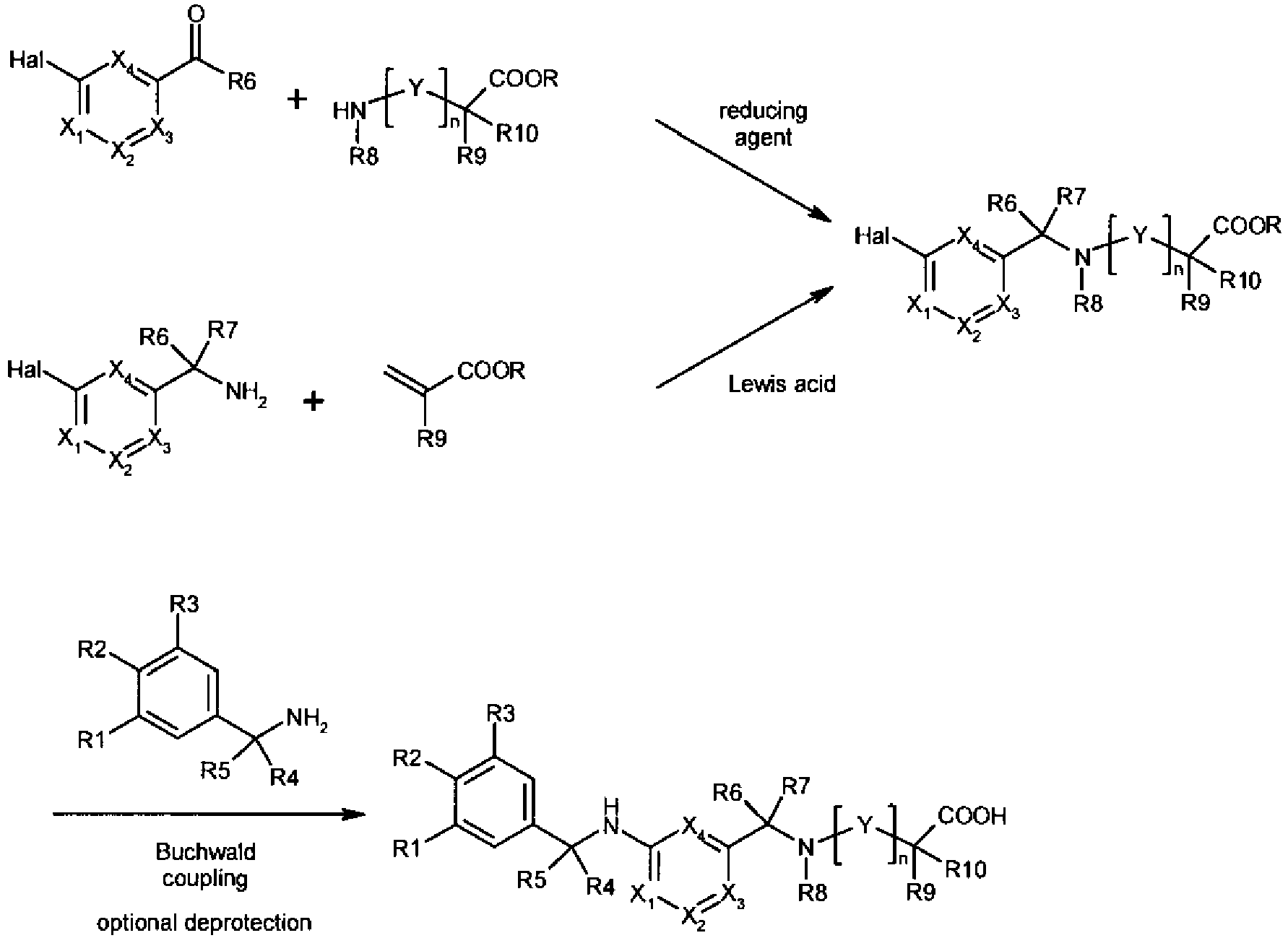
- In another aspect, the present invention provides a pharmaceutical composition comprising a compound of the present invention and a pharmaceutically acceptable carrier. The pharmaceutical composition can be formulated for particular routes of administration such as oral administration, parenteral administration, and rectal administration, etc. In addition, the pharmaceutical compositions of the present invention can be made up in a solid form (including without limitation capsules, tablets, pills, granules, powders or suppositories), or in a liquid form (including without limitation solutions, suspensions or emulsions). The pharmaceutical compositions can be subjected to conventional pharmaceutical operations such as sterilization and/or can contain conventional inert diluents, lubricating agents, or buffering agents, as well as adjuvants, such as preservatives, stabilizers, wetting agents, emulsifers and buffers, etc.
- Typically, the pharmaceutical compositions are tablets or gelatin capsules comprising the active ingredient together with
- a) diluents, e.g., lactose, dextrose, sucrose, mannitol, sorbitol, cellulose and/or glycine;
- b) lubricants, e.g., silica, talcum, stearic acid, its magnesium or calcium salt and/or polyethyleneglycol; for tablets also
- c) binders, e.g., magnesium aluminum silicate, starch paste, gelatin, tragacanth, methylcellulose, sodium carboxymethylcellulose and/or polyvinylpyrrolidone; if desired
- d) disintegrants, e.g., starches, agar, alginic acid or its sodium salt, or effervescent mixtures; and/or
- e) absorbents, colorants, flavors and sweeteners.
- Tablets may be either film coated or enteric coated according to methods known in the art.
- Suitable compositions for oral administration include an effective amount of a compound of the invention in the form of tablets, lozenges, aqueous or oily suspensions, dispersible powders or granules, emulsion, hard or soft capsules, or syrups or elixirs. Compositions intended for oral use are prepared according to any method known in the art for the manufacture of pharmaceutical compositions and such compositions can contain one or more agents selected from the group consisting of sweetening agents, favoring agents, coloring agents and preserving agents in order to provide pharmaceutically elegant and palatable preparations. Tablets may contain the active ingredient in admixture with nontoxic pharmaceutically acceptable excipients which are suitable for the manufacture of tablets. These excipients are, for example, inert diluents, such as calcium carbonate, sodium carbonate, lactose, calcium phosphate or sodium phosphate; granulating and disintegrating agents, for example, corn starch, or alginic acid; binding agents, for example, starch, gelatin or acacia; and lubricating agents, for example magnesium stearate, stearic acid or talc. The tablets are uncoated or coated by known techniques to delay disintegration and absorption in the gastrointestinal tract and thereby provide a sustained action over a longer period. For example, a time delay material such as glyceryl monostearate or glyceryl distearate can be employed. Formulations for oral use can be presented as hard gelatin capsules wherein the active ingredient is mixed with an inert solid diluent, for example, calcium carbonate, calcium phosphate or kaolin, or as soft gelatin capsules wherein the active ingredient is mixed with water or an oil medium, for example, peanut oil, liquid paraffin or olive oil.
- Certain injectable compositions are aqueous isotonic solutions or suspensions, and suppositories are advantageously prepared from fatty emulsions or suspensions. Said compositions may be sterilized and/or contain adjuvants, such as preserving, stabilizing, wetting or emulsifying agents, solution promoters, salts for regulating the osmotic pressure and/or buffers. In addition, they may also contain other therapeutically valuable substances. Said compositions are prepared according to conventional mixing, granulating or coating methods, respectively, and contain about 0.1-75%, or contain about 1-50%, of the active ingredient.
- Suitable compositions for transdermal application include an effective amount of a compound of the invention with a suitable carrier. Carriers suitable for transdermal delivery include absorbable pharmacologically acceptable solvents to assist passage through the skin of the host. For example, transdermal devices are in the form of a bandage comprising a backing member, a reservoir containing the compound optionally with carriers, optionally a rate controlling barrier to deliver the compound of the skin of the host at a controlled and predetermined rate over a prolonged period of time, and means to secure the device to the skin.
- Suitable compositions for topical application, e.g., to the skin and eyes, include aqueous solutions, suspensions, ointments, creams, gels or sprayable formulations, e.g., for delivery by aerosol or the like. Such topical delivery systems will in particular be appropriate for dermal application, e.g., for the treatment of skin cancer, e.g., for prophylactic use in sun creams, lotions, sprays and the like. They are thus particularly suited for use in topical, including cosmetic, formulations well-known in the art. Such may contain solubilizers, stabilizers, tonicity enhancing agents, buffers and preservatives.
- As used herein a topical application may also pertain to an inhalation or to an intranasal application. They may be conveniently delivered in the form of a dry powder (either alone, as a mixture, for example a dry blend with lactose, or a mixed component particle, for example with phospholipids) from a dry powder inhaler or an aerosol spray presentation from a pressurised container, pump, spray, atomizer or nebuliser, with or without the use of a suitable propellant.
- Dosage forms for the topical or transdermal administration of a compound of this invention include powders, sprays, ointments, pastes, creams, lotions, gels, solutions, patches and inhalants. The active compound may be mixed under sterile conditions with a pharmaceutically acceptable carrier, and with any preservatives, buffers, or propellants that may be desirable.
- The ointments, pastes, creams and gels may contain, in addition to an active compound of this invention, excipients, such as animal and vegetable fats, oils, waxes, paraffins, starch, tragacanth, cellulose derivatives, polyethylene glycols, silicones, bentonites, silicic acid, talc and zinc oxide, or mixtures thereof.
- Powders and sprays can contain, in addition to a compound of this invention, excipients such as lactose, talc, silicic acid, aluminum hydroxide, calcium silicates and polyamide powder, or mixtures of these substances. Sprays can additionally contain customary propellants, such as chlorofluorohydrocarbons and volatile unsubstituted hydrocarbons, such as butane and propane.
- Transdermal patches have the added advantage of providing controlled delivery of a compound of the present invention to the body. Such dosage forms can be made by dissolving or dispersing the compound in the proper medium. Absorption enhancers can also be used to increase the flux of the compound across the skin. The rate of such flux can be controlled by either providing a rate controlling membrane or dispersing the active compound in a polymer matrix or gel.
- Ophthalmic formulations, eye ointments, powders, solutions and the like, are also contemplated as being within the scope of this invention.
- The present invention further provides anhydrous pharmaceutical compositions and dosage forms comprising the compounds of the present invention as active ingredients, since water may facilitate the degradation of certain compounds.
- Anhydrous pharmaceutical compositions and dosage forms of the invention can be prepared using anhydrous or low moisture containing ingredients and low moisture or low humidity conditions. An anhydrous pharmaceutical composition may be prepared and stored such that its anhydrous nature is maintained. Accordingly, anhydrous compositions are packaged using materials known to prevent exposure to water such that they can be included in suitable formulary kits. Examples of suitable packaging include, but are not limited to, hermetically sealed foils, plastics, unit dose containers (e. g., vials), blister packs, and strip packs.
- The invention further provides pharmaceutical compositions and dosage forms that comprise one or more agents that reduce the rate by which the compound of the present invention as an active ingredient will decompose. Such agents, which are referred to herein as "stabilizers," include, but are not limited to, antioxidants such as ascorbic acid, pH buffers, or salt buffers, etc.
-
- Boc:
- tert-Butyloxycarbonyl
- BINAP:
- 2,2'-Bis(diphenylphosphino)-1,1'-binaphthalene
- dba:
- Dibenzylideneacetone
- dppf:
- 1,1'-Bis(diphenylphosphino)ferrocene
- DIPEA:
- Ethyl-diisopropyl-amine, Hünig's base, DIEA
- DME:
- 1,2-Dimethoxy-ethane
- DMF:
- N,N-Dimethylformamide
- DMP:
- Dess-Martin periodinane
- DMSO:
- Dimethylsulfoxide
- EtOAc:
- Acetic acid ethyl ester
- EtOH:
- Ethanol
- HOAc:
- Acetic acid
- HPLC:
- High pressure liquid chromatography
- L:
- Liter
- M:
- Molar
- MeOH:
- Methanol
- min:
- Minutes
- mL:
- Milliliter
- NaHMDS:
- Sodium hexamethyldisilazane
- NaOAc:
- Sodium acetate
- PBPPSI-IPr:
- (1,3-Bis(2,6-diisopropylphenyl)imidazolidene)(3-chloropyridyl) palladium(II) dichloride
- Pd-C:
- Palladium on carbon
- PS-CNBH3:
- Polymer supported cyanoborohydride
- rt:
- Retention time
- TBAT:
- Tetrabutylammonium triphenyldifluorosilicate
- TBME:
- tert-Butylmethylether
- TFA:
- Trifluoro-acetic acid
- THF:
- Tetrahydrofuran
- TMS-CF3:
- (Trimethylsilyl)trifluoromethane (Ruppert's Reagent)
- TMSCHN2:
- Diazomethyl-trimethyl-silane
- Xphos:
- 2-Dicyclohexylphosphino-2',6'-triisopropylbiphenyl
- 1H-NMR spectra were recorded on a Bruker 400 MHz or a Bruker 500 MHz NMR spectrometer. Significant peaks are tabulated in the order: multiplicity (s, singlet; d, doublet; t, triplet; q, quartet; m, multiplet; br, broad; v, very) and number of protons. Electron Spray Ionization (ESI) mass spectra were recorded on an Agilent 1100 Series mass spectrometer. Mass spectrometry results are reported as the ratio of mass over charge.
Detailed analytical HPLC and UPLC chromatography methods referred to in the preparations and Examples below are outlined as follows:
LC/MS Method 1:
Waters Acquity UPLC instrument equipped with diode array detector, Waters SQD Single Stage Quadrupole mass spectrometer or Waters ZQ2000 mass spectrometer and ASCENTIS FusedCore (2.7 µm) 2.1 x 100mm column. Peak detection is reported at 210 nm wavelength.
Solvent A: Water containing 3 mM ammonium acetate and 0.05% formic acid.
Solvent B: Acetonitrile containing 0.04% formic acid.
Flow rate at 1.4 mL/minuteGradient: Time [minutes] Solvent A [%] Solvent B [%] 0 98 2 5 2 98 5.5 2 98 5.6 98 2 6 98 2
LC/MS Method 2:
Waters Acquity UPLC instrument equipped with diode array detector, Waters SQD Single Stage Quadrupole mass spectrometer or Waters ZQ2000 mass spectrometer and Waters Acquity HSS T3 (1.8 µm) 2.1 x 50mm column. Peak detection is reported at 210 nm wavelength.
Solvent A: Water containing 3 mM ammonium acetate and 0.05% formic acid.
Solvent B: Acetonitrile containing 0.04% formic acid.
Flow rate at 0.6 mL/minuteGradient: Time [minutes] Solvent A [%] Solvent B [%] 0 98 2 5 2 98 5.5 2 98 5.6 98 2 6 98 2
LC/MS Method 3:
HP1100 Agilent HPLC instrument equipped with PDA UV detector, Waters ZQ2000 mass spectrometer and Waters XBridge C18 (2.5 µm) 3 x 30mm column. Peak detection is reported at 210 nm wavelength.
Solvent A: Water containing 5 % (acetonitrile with 0.05% formic acid).
Solvent B: Acetonitrile containing 0.05% formic acid.Gradient: Time [minutes] Solvent A [%] Solvent B [%] Flow rate [mL/min] 0 90 10 0.6 1.5 5 95 0.7 2 5 95 0.7 3.0 90 10 0.6
LC/MS Method 4:
HP1100 Agilent HPLC instrument equipped with PDA UV detector, Waters ZQ2000 mass spectrometer and ASCENTIS FusedCore (2.7 µm) 2.1 x 100mm column. Peak detection is reported at 210 nm wavelength.
Solvent A: Water containing 3.75 mM ammonium acetate and 0.05% formic acid.
Solvent B: Acetonitrile containing 0.04% formic acid.
Flow rate at 1.2 mL/minuteGradient: Time [minutes] Solvent A [%] Solvent B [%] 0 98 2 1.40 2 98 2.15 2 98 2.19 98 2
UPLC Method:
Waters Acquity UPLC instrument equipped with diode array detector and Waters Acquity UPLC® BEH C18 (1.7 µm) 2.1 x 50mm column. Peak detection is reported at 210 nm wavelength.
Solvent A: water (1800 mL), acetonitrile (200 mL), tetramethylammonium hydroxide (40 mL, 10% in water), phosphoric acid (4 mL)
Solvent B: water (500 mL), acetonitrile (1500 mL), tetramethylammonium hydroxide (40 mL, 10% in water), phosphoric acid (4 mL)
Flow rate at 0.75 mL/minuteGradient: Time [minutes] Solvent A [%] Solvent B [%] 0 95 5 2 5 95 2.7 5 95 3 5 95
Preparative chiral separation: - Method A: Separation was performed using a Chiralcel OJ 10 x 50 cm (20 µm) and n-heptane/EtOH as mobile phase with a flow of 100 mL/min and UV detection (220 nm).
- Method B: Analysis was performed using a Chiralcel OJ 250 x 4.6 mm (5 µm) and n-heptane/EtOH/MeOH as mobile phase with a flow of 0.9 mL/min and UV detection (220 nm).
- All reagents, starting materials and intermediates utilized in these examples are available from commercial sources or are readily prepared by methods known to those skilled in the art.
- Compounds of the invention may be prepared by a reaction sequence involving for example a reductive amination of an appropriate nitro-benzaldehyde with an appropriate amine, reduction of the aromatic nitro group, and reductive amination of the aniline with an appropriate ketone followed by a deprotection step as shown in Scheme 1 below:


- The following compounds were made in accordance to the above indicated reaction Scheme 1:
-

-

- To a solution of 1-(tert butoxycarbonyl)azetidine-3-carboxylic acid (8.00 g, 39.8 mmol) in MeOH (60 mL) was added 4 M HCl in dioxane (60 mL, 240.0 mmol). The mixture was refluxed for 2 hours. The mixture was concentrated to afford INT 1.
MS (ESI): 116 [M+H]+, 1H-NMR (DMSO-d6): δ (ppm) 9.61 (br s, 1H), 9.28 (br s, 1 H), 4.13-3.95 (m, 4H), 3.76-3.60 (m, 1 H), 3.68 (s, 3H). -

- To a solution of amine INT 1 (6.00 g, 39.6 mmol) in CH2Cl2 (396 mL) and MeOH (50 mL) was added DIPEA (6.9 mL, 39.6 mmol). HOAc was added to adjust the pH of the solution to 4-5. 3-Nitrobenzaldehyde (6.58 g, 43.5 mmol) was added and the mixture was stirred at 40 °C for 1 hour. After cooling to room temperature, NaBH(OAc)3 (16.78 g, 79.2 mmol) was added and the mixture was stirred at room temperature overnight. The mixture was quenched with saturated aqueous NaHCO3. The aqueous layer was extracted with CH2Cl2 (2x). The combined organic layers were washed with brine, dried over MgSO4, filtered and concentrated. The residue was purified by flash chromatography on silica gel (CH2Cl2/MeOH) to afford INT 2.
MS (ESI): 251 [M+H]+, 1H-NMR (CDCl3): δ (ppm) 8.18 (s, 1H), 8.13 (d, 1H), 7.65 (d, 1H), 7.50 (dd, 1 H), 3.77-3.70 (m, 2H), 3.74 (s, 3H), 3.65-3.55 (m, 2H), 3.45-3.33 (m, 3H). -

- To a solution of INT 2 (250 mg, 0.99 mmol) in EtOH (10 mL) was added Pd-C 10% (25 mg). The mixture was stirred under 1 atm of H2 for 1 hour. The mixture was quenched with CH2Cl2 and filtered through a pad of Celite. The filtrate was concentrated to give INT 3.
MS (ESI): 221 [M+H]+, 1H-NMR (DMSO-d6): δ (ppm) 6.92 (dd, 1H), 6.47 (s, 1H), 6.41 (d, 1 H), 6.37 (d, 1 H), 4.96 (s, 2H), 3.63 (s, 3H), 3.40-3.25 (m, 5H), 3.18-3.13 (m, 2H). -

- To a solution of INT 3 (220 mg, 0.99 mmol) and 1-(4-chloro-3-methyl-phenyl)-ethanone (202 mg, 1.20 mmol) in MeOH (10 mL) was added decaborane (85 mg, 0.70 mmol). The mixture was stirred at 60 °C overnight. More decaborane (85 mg, 0.70 mmol) was added and the mixture was stirred at 60 °C for an additional 3 hours. The mixture was concentrated. The residue was purified by chromatography on silica gel (CH2Cl2/MeOH) to afford INT 4.
MS (ESI): 373 [M+H]+, 1H-NMR (CDCl3): δ (ppm) 7.18 (d, 1H), 7.15 (d, 1H), 7.05 (dd, 1 H), 6.98 (dd, 1 H), 6.50 (d, 1H), 6.44 (s, 1H), 6.35 (dd, 1 H), 4.36 (q, 1 H), 4.07 (br s, 1 H), 3.82-3.70 (m, 2H), 3.68 (s, 2H), 3.67 (s, 3H), 3.55-3.45 (m, 2H), 3.42-3.34 (m, 1 H), 2.27 (s, 3H), 1.40 (d, 3H). - To a solution of INT 4 (85 mg, 0.23 mmol) in THF (2.2 mL) was added 1 M LiOH (1.1 mL, 1.14 mmol). The resulting mixture was stirred at room temperature for 19 hours. The mixture was acidified to pH 5 with 1 M HCl. The organic solvent was removed. More 1 M HCl was added to adjust the pH to 3. The mixture was extracted with EtOAc (3x). The combined organic layers were dried over MgSO4, filtered and concentrated. The residue was purified by chromatography on silica gel (CH2Cl2/MeOH) to give Example 1.
MS (ESI): 359 [M+H]+, 1H-NMR (DMSO-d6): δ (ppm) 7.33 (s, 1 H), 7.29 (d, 1 H), 7.18 (d, 1H), 6.87 (dd, 1 H), 6.43 (s, 1 H), 6.33 (d, 1 H), 6.28 (d, 1H), 6.08 (d, 1 H), 4.39 (m, 1 H), 3.38-3.20 (m, 4H), 3.10-3.00 (m, 3H), 2.27 (s, 3H), 1.36 (d, 3H). -

- The title compound was prepared according to Scheme 1 following a procedure analogous to Example 1 using ketone INT 5 (synthesis below) in step 4.
LC/MS method 2: MS (ESI): 373 [M+H]+, rt = 1.99 min. -

- To a solution of 4-chloro-3-methylbenzoic acid (8.31 g, 48.7 mmol) in CH2Cl2 (50 mL) was added DMF (175 µL) and thionyl chloride (35.5 mL, 487 mmol) and the resulting mixture was refluxed for 1 hour. After cooling down, the mixture was evaporated to dryness and taken up in THF (50 mL). The resulting solution was cooled to 0 °C and triethylamine (13.5 mL, 97 mmol) was added followed by N,O-dimethylhydroxyl-amine hydrochloride (5.7 g, 58.4 mmol) and the resulting mixture was stirred at room temperature overnight. The mixture was diluted with CH2Cl2 and washed with 1 M KHSO4, saturated aqueous NaHCO3 and brine. The organic layer was dried over sodium sulfate, filtered and concentrated. The resulting crude Weinreb amide (10.4 g, 48.7 mmol) was taken up in THF (440 mL) and cooled to 0 °C under an argon atmosphere. Ethylmagnesium bromide (1 M in TBME, 97 ml, 97 mmol) was then slowly added and the resulting mixture was stirred for 2 hours at 0 °C. The mixture was quenched with a saturated aqueous ammonium chloride solution. The THF was evaporated and the product was extracted with EtOAc. The organic layer was washed with brine, dried over sodium sulfate, filtered and concentrated. The residue was purified by chromatography on silica gel (cyclohexane/EtOAc) to give INT 5.
1H-NMR (CDCl3): δ (ppm) 7.93 (d, 1H), 7.76 (dd, 1H), 7.55 (d, 1H), 3.01 (q, 2H), 2.39 (s, 3H) 1.06 (t, 3H). - Alternatively, compounds of the invention may be prepared by a reaction sequence involving reductive amination of an appropriate ketone with an appropriate aniline followed by halogen metal exchange with an appropriate organolithium reagent and subsequent quenching with DMF, and either reductive amination with an appropriate amino ester or amino acid followed by an optional deprotection step or alkyl addition using an appropriate Grignard reagent, oxidation of the alcohol with an appropriate oxidizing agent, and reductive amination with an appropriate amino ester or amino acid followed by an optional deprotection step as shown in Scheme 2 below:

- The following compounds were made in accordance to the above indicated reaction Scheme 2:
-

-

- To a solution of INT 5 (360 g, 1.941 mol) and 3-bromoaniline (509 g, 2.957 mol) in toluene (3.5 L) was added p-toluenesulfonic acid monohydrate (18.8 g, 0.099 mol). The mixture, equipped with a Dean stark trap, was refluxed overnight. After 1.5 hours, 300 mL of turbid toluene was removed from the Dean stark trap. After 5 hours 150 mL of turbid toluene was removed from the Dean stark trap and dry toluene and molecular sieves 4 A (20 g) were added. On the next day, more molecular sieves 4 Å (60 g) were added and the reaction mixture was refluxed for an additional 4 hours. The molecular sieves were filtered off and the filtrate was concentrated. The crude imine and (S)-N-(5-fluoro-2-hydroxybenzyl)-2-methylpropane-2-sulfinamide (68.5 g, 0.279 mol, prepared according to: Pei, Dong; Wang, Zhouyu; Wei, Siyu; Zhang, Yu; Sun, Jian. Org. Lett. (2006), 8 (25), 5913-5915.) were dissolved in CH2Cl2 (6.6 L) and the mixture was cooled to -26 °C. Trichlorosilane (302 g, 2.233 mol) was added dropwise within 20 minutes and the resulting mixture was stirred overnight keeping the temperature between -25 °C and -22 °C. The mixture was poured onto saturated aqueous NaHCO3 (7 L) and extracted with EtOAc. The combined organic layers were washed with brine and dried over sodium sulfate, filtered and concentrated. The residue was purified by chromatography on silica gel (cyclohexane/EtOAc). The resulting product was further purified by formation of the HCl salt and washing it with Et2O. The resulting solid was dissolved in hot EtOH and cooled to room temperature while stirring. The resulting solid was filtered off and dried in vacuum. The salt was then liberated to give INT 6.
MS (ESI): 338 [M*H]+, 1H-NMR (DMSO-d6): δ (ppm) 7.35-7.31 (m, 2H), 7.18 (dd, 1 H), 6.91 (dd, 1H), 6.70-6.68 (m, 1 H), 6.58 (dd, 1H), 6.49-6.44 (m, 2H), 4.20 (q, 1 H), 2.29 (s, 3H), 1.80-1.69 (m, 1 H), 1.69-1.60 (m, 1H), 0.89 (t, 3H). -

- To a solution of INT 6 (5.00 g, 14.8 mmol) in Et2O (148 mL) at -78 °C was added tBuLi (1.7 M in pentane, 34.7 mL, 59.0 mmol) dropwise. The mixture was stirred at -78 °C for 40 minutes and DMF (2.5 mL) was added. The reaction mixture was stirred at -78 °C for an additional 30 minutes. The mixture was quenched with saturated aqueous NH4Cl and extracted with Et2O (2x). The combined organic layers were washed with brine, dried over MgSO4, filtered and concentrated. The residue was purified by chromatography on silica gel (heptane/EtOAc) to afford INT 7.
MS (ESI): 288 [M+H]+, 1H-NMR (CDCl3): δ (ppm) 9.87 (s, 1H), 7.29 (d, 1H), 7.25 (d, 1H), 7.21 (s, 1 H), 7.18 (d, 1H), 7.12 (d, 1H), 7.04 (s, 1H), 6.78 (d, 1 H), 4.55 (br s, 1 H), 4.24 (t, 1H), 2.37 (s, 3H), 1.92-1.75 (m, 2H), 0.98 (t, 3H). - To a solution of INT 7 (700 mg, 2.43 mmol) and azetidine-3-carboxylic acid (248 mg, 2.92 mmol) in MeOH (24 mL) was added HOAc (0.14 mL, 2.43 mmol) followed by PS-CNBH3 (2.5 mmol/g, 1.95 g, 4.86 mmol). The reaction mixture was stirred at room temperature for 3 days. The mixture was filtered over Celite. The filtrate was concentrated. The residue was purified by preparative HPLC (H2O/CH3CN) to give the title compound Example 3.
MS (ESI): 373 [M+H]+, 1H-NMR (DMSO-d6): δ (ppm) 7.33 (s, 1H), 7.30 (d, 1H), 7.19 (d, 1 H), 6.88 (dd, 1 H), 6.47 (s, 1 H), 6.33 (d, 2H), 6.03 (d, 1 H), 4.17 (m, 1 H), 3.34 (s, 2H), 3.30-3.25 (m, 2H), 3.18-3.06 (m, 3H), 2.29 (s, 3H), 1.82-1.70 (m, 1H), 1.70-1.58 (m, 1H), 0.89 (t, 3H). -

-

- To a solution of INT 5 (3.00 g, 16.4 mmol) and 3-bromo-4-methylaniline (3.06 g, 16.4 mmol) in MeOH (164 mL) was added decaborane (1.00 g, 8.2 mmol). The reaction mixture was stirred at room temperature overnight. More decaborane (0.50 g, 4.1 mmol) was added. The mixture was stirred at 60 °C for 2 hours. The mixture was concentrated. The residue was purified by chromatography on silica gel (heptane/EtOAc) to afford INT 8.
MS (ESI): 352 [M+H]+, 1H-NMR (CDCl3): δ (ppm) 7.29 (d, 1H), 7.19 (s, 1 H), 7.10 (d, 1 H), 6.93 (d, 1 H), 6.78 (s, 1 H), 6.39 (d, 1 H), 4.12 (t, 1 H), 2.37 (s, 3H), 2.25 (s, 3H), 1.90-1.75 (m, 2H), 0.94 (t, 3H). -

- To a solution of INT 8 (2.20 g, 14.7 mmol) in Et2O (147 mL) at -78 °C was added tBuLi (1.7 M in pentane, 34.7 mL, 59.0 mmol) dropwise. The mixture was stirred at -78 °C for 40 min, then DMF (2.5 mL) was added. The reaction mixture was stirred at -78 °C for an additional 20 minutes. The mixture was quenched with saturated aqueous NH4Cl and extracted with Et2O (2x). The combined organic layers were washed with brine, dried over MgSO4, filtered and concentrated. The residue was purified by chromatography on silica gel (heptane/EtOAc) to afford INT 9.
MS (ESI): 302 [M+H]+, 1H-NMR (CDCl3): δ (ppm) 10.17 (s, 1 H), 7.28 (d, 1H), 7.21 (s, 1H), 7.11 (d, 1 H), 7.02 (s, 1H), 6.99 (d, 1H), 6.68 (d, 1H), 4.21 (t, 1H), 2.51 (s, 3H), 2.36 (s, 3H), 1.93-1.78 (m, 2H), 0.96 (t, 3H). - To a solution of INT 9 (200 mg, 0.66 mmol) and azetidine-3-carboxylic acid (67 mg, 0.66 mmol) in MeOH (6.5 mL) was added HOAc (0.038 mL, 0.66 mmol) followed by NaCNBH3 (42 mg, 0.66 mmol). The reaction mixture was stirred at room temperature for 1 hour. The mixture was diluted with saturated aqueous NaHCO3 and extracted with CH2Cl2 (2x). The combined organic layers were washed with brine, dried over MgSO4, filtered and concentrated. The residue was purified by preparative HPLC (H2O/CH3CN) to afford the title compound Example 4.
LC/MS method 2: MS (ESI): 387 [M+H]+, rt = 2.06 min. 1H-NMR (DMSO-d6): δ (ppm) 7.30 (s, 1 H), 7.27 (d, 1H), 6.69 (d, 1H), 6.45 (s, 1 H), 6.23 (d, 1 H), 5.84 (d, 1 H), 4.18-4.11 (m, 1H), 3.33 (s, 2H), 3.32-3.23 (m, 2H), 3.18-3.08 (m, 2H), 2.28 (s, 3H), 2.01 (s, 3H), 1.81-1.71 (m, 1H), 1.69-1.59 (m, 1H), 0.88 (t, 3H). -

- The title compound was prepared according to Scheme 2 following a procedure analogous to Example 4 using 5-bromo-2-methylaniline in step 1.
LC/MS method 2: MS (ESI): 387 [M+H]+, rt = 2.06 min. -

-

- To a solution of INT 7 (600 mg, 2.09 mmol) in THF (7 mL) at -20 °C was added methylmagnesium bromide (3 M in Et2O, 0.83 mL, 2.50 mmol) dropwise. The reaction mixture was stirred at -20 °C for 1 hour. The mixture was quenched with saturated aqueous NH4Cl and extracted with Et2O (3x). The combined organic layers were washed with brine (2x), dried over MgSO4, filtered and concentrated. The residue was purified by chromatography on silica gel (heptane/EtOAc) to give INT 10.
MS (ESI): 304 [M+H]+, 1H-NMR (CDCl3): δ (ppm) 7.29 (d, 1H), 7.22 (d, 1H), 7.12 (dd, 1H), 7.08 (dd, 1H), 6.66 (d, 1H), 6.62-6.58 (m, 1H), 6.41-6.38 (m, 1H), 4.80-4.73 (m, 1H), 4.20 (t, 1H), 4.14 (br s, 1H), 2.37 (s, 3H), 1.88-1.75 (m, 2H), 1.80 (br s, 1H), 1.44 (t, 3H), 0.97 (t, 3H). -

- To a solution of INT 10 (446 mg, 1.47 mmol) in CH2Cl2 was added DMP (747 mg, 1.76 mmol). The reaction mixture was stirred at room temperature for 1 hour. The mixture was quenched with saturated aqueous NaHCO3/saturated aqueous Na2S2O3 5/1 and diluted with CH2Cl2. The mixture was stirred vigorously until the organic layer was clear. The organic layer was washed with saturated aqueous NaHCO3 and brine, dried over MgSO4, filtered and concentrated. The residue was purified by chromatography on silica gel (heptane/CH2Cl2) to afford INT 11.
MS (ESI): 302 [M+H]+, 1H-NMR (CDCl3): δ (ppm) 7.19 (d, 1H), 7.15-7.11 (m, 2H), 7.07 (dd, 1H), 7.06-7.04 (m, 1H), 7.02 (dd, 1H), 6.59-6.55 (m, 1H), 4.16-4.11 (m, 2H), 2.42 (s, 3H), 2.27 (s, 3H), 1.80-1.67 (m, 2H), 0.88 (t, 3H). - To a solution of INT 11 (213 mg, 0.71 mmol) and azetidine-3-carboxylic acid (75 mg, 0.74 mmol) in MeOH (7 mL) was added HOAc (0.040 mL, 0.71 mmol) followed by NaCNBH3 (44 mg, 0.71 mmol). The reaction mixture was stirred at room temperature for 40 hours. More azetidine-3-carboxylic acid (10 mg, 0.099 mol) and NaCNBH3 (10 mg, 0.16 mmol) were added and the mixture was stirred at room temperature for an additional 4 hours. The mixture was concentrated. The residue was taken up in CH2Cl2 and washed with brine. The aqueous layer was extracted with CH2Cl2 and EtOAc. The combined organic layers were dried over MgSO4, filtered and concentrated. The residue was purified by preparative HPLC (H2O/CH3CN) to afford the title compound Example 6. LC/MS method 2: MS (ESI): 387 [M+H]+, rt = 5.92 and 5.98 min (diastereomers). 1H-NMR (DMSO-d6): δ (ppm) 11.97 (br s, 1H), 7.31 (s, 1H), 7.29 (d, 1 H), 7.17 (d, 1H), 6.85 (dd, 1H), 6.50 (d, 1H), 6.39-6.27 (m, 2H), 6.04 (t, 1H), 4.20-4.10 (m, 1 H), 3.38-3.29 (m, 1H), 3.13-2.92 (m, 5H), 2.27 (s, 3H), 1.83-1.72 (m, 1H), 1.70-1.60 (m, 1H), 0.98 (d, 3H), 0.86 (t, 3H).
-

- The title compound was prepared according to Scheme 2 following a procedure analogous to Example 4 using 3-bromo-2-methylaniline in step 1.
LC/MS method 2: MS (ESI): 387 [M+H]+, rt = 2.15 min. -

-

- To a solution of Boc-azetidine-3-carboxylic acid (10.00 g, 49.7 mmol) in toluene (170 mL) and MeOH (85 mL) was added TMSCHN2 (2.0 M in Et2O, 32.3 mL, 64.6 mmol) dropwise. The reaction mixture was stirred at room temperature for 50 minutes. The mixture was concentrated to afford INT 12.
MS (ESI): 160 [M+H-tBu]+. 1H-NMR (CDCl3): δ (ppm) 4.08 (d, 4H), 3.73 (s, 3H), 3.37-3.29 (m, 1 H), 1.42 (s, 9H). -

- To a solution of INT 12 (2.50 g, 11.6 mmol) in THF (100 mL) at -78 °C was added NaHMDS (1.0 M in THF, 15.1 mL, 15.1 mmol). The mixture was stirred at -78 °C for 30 minutes. Mel (2.14 g, 15.1 mmol) was added and the reaction mixture was stirred at -78 °C for 2 hours. The mixture was quenched with saturated aqueous NH4Cl and extracted with Et2O (2x). The combined organic layers were washed with brine (2x), dried over MgSO4, filtered and concentrated. The residue was purified by chromatography on silica gel (heptane/EtOAc) to give INT 13.
MS (ESI): 174 [M+H-tBu]+. 1H-NMR (CDCl3): δ (ppm) 4.13 (d, 2H), 3.66 (s, 3H), 3.58 (d, 2H), 1.45 (s, 3H), 1.36 (s, 9H). -

- To a solution of INT 13 (1.66 g, 7.24 mmol) in CH2Cl2 was added HCl (2.0 M in Et2O, 36.2 mL, 72.4 mmol). The reaction mixture was stirred at room temperature for 20 hours. The mixture was concentrated to afford INT 14.
MS (ESI): 130 [M+H]+, 1H-NMR (DMSO-d6): δ (ppm) 9.95 (br s, 1H), 9.27 (br s, 1H), 4.12 (d, 2H), 3.69-3.59 (m, 5H), 1.47 (s, 3H). -

- To a mixture of INT 7 (250 mg, 0.87 mmol) and INT 14 (158 mg, 0.88 mmol) in MeOH (8.6 mL) was added DIPEA (0.18 mL, 1.04 mmol). Then HOAc (0.099 mL, 1.74 mmol) was added followed by NaCNBH3 (55 mg, 0.87 mmol). The reaction mixture was stirred at room temperature for 4 hours. A solution of INT 14 (50 mg, 0.091 mmol), DIPEA (0.060 mL, 0.021 mmol) and HOAc (0.040 mL, 0.70 mmol) in MeOH (1.0 mL) was added. The mixture was stirred at room temperature for another hour. The mixture was concentrated. The residue was taken up in CH2Cl2 and washed with saturated aqueous NaHCO3 and brine. The organic layer was dried over MgSO4, filtered and concentrated. The residue was purified by chromatography on silica gel (heptane/EtOAc) to give INT 15.
MS (ESI): 401 [M+H]+, 1H-NMR (CDCl3): δ (ppm) 7.18 (d, 1H), 7.11 (s, 1H), 7.01 (d, 1H), 6.92 (dd, 1H), 6.45 (d, 1H), 6.35 (s, 1H), 6.28 (d, 1H), 4.09 (t, 1H), 3.63 (s, 3H), 3.43 (d, 1H), 3.37 (d, 1H), 3.34 (d, 1H), 3.30 (d, 1H), 2.99 (d, 1H), 2.92 (d, 1H), 2.26 (s, 3H), 1.76-1.64 (m, 2H), 1.43 (s, 3H), 0.86 (t, 3H). - To a solution of INT 15 (158 mg, 0.39 mmol) in THF (3.9 mL) at 0 °C was added LiOH (1.0 M in H2O, 1.97 mL, 1.97 mmol). The reaction mixture was stirred at room temperature for 5 hours. The mixture was acidified with 1 M HCl and concentrated. The residue was taken up in CH2Cl2/EtOAc and washed with brine. The aqueous layer was extracted with CH2Cl2/EtOAc (3x). The combined organic layers were dried over MgSO4 and concentrated. The residue was purified by preparative HPLC (H2O/CH3CN) to afford the title compound Example 8.
MS (ESI): 387 [M+H]+, 1H-NMR (CD3OD): δ (ppm) 7.18-7.12 (m, 2H), 7.05 (dd, 1H), 6.96 (t, 1H), 6.52 (dd, 1H), 6.46-6.41 (m, 2H), 4.15-4.10 (m, 2H), 4.07 (d, 1 H), 4.00 (s, 2H), 3.62-3.53 (m, 2H), 2.21 (s, 3H), 1.79-1.69 (m, 1H), 1.69-1.60 (m, 1 H), 1.33 (s, 3H), 0.86 (t, 3H). -

- The title compound was prepared according to Scheme 2 following a procedure analogous to Example 4 using 3-bromo-5-methylaniline in step 1.
LC/MS method 2: MS (ESI): 387 [M+H]+, rt = 2.07 min. -

- The title compound was prepared according to Scheme 2 following a procedure analogous to Example 6 using INT 9 in step 1.
LC/MS method 2: MS (ESI): 401 [M+H]+, rt = 6.28 and 6.30 min (diastereomers). -

- The title compound was prepared according to Scheme 2 following a procedure analogous to Example 3 using (R)-pyrrolidine-3-carboxylic acid in step 3.
LC/MS method 2: MS (ESI): 387 [M+H]+, rt = 2.03 min. -

- The title compound was prepared according to Scheme 2 following a procedure analogous to Example 3 using (S)-pyrrolidine-3-carboxylic acid in step 3.
LC/MS method 2: MS (ESI): 387 [M+H]+, rt = 2.03 min. -
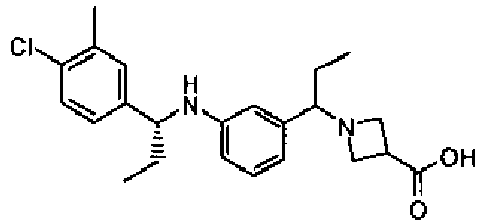
- The title compound was prepared according to Scheme 2 following a procedure analogous to Example 6 using ethylmagnesium bromide in step 1.
LC/MS method 2: MS (ESI): 401 [M+H]+. rt = 2.17 min. -

- The title compound was prepared according to Scheme 2 following a procedure analogous to Example 4 using 3-bromo-2-methylaniline in step 1 and (R)-pyrrolidine carboxylic acid in step 3.
LC/MS method 2: MS (ESI): 401 [M+H]+, rt = 2.17 min. -

- The title compound was prepared according to Scheme 2 following a procedure analogous to Example 4 using 3-bromo-5-methylaniline in step 1 and (R)-pyrrolidine carboxylic acid in step 3.
LC/MS method 2: MS (ESI): 401 [M+H]+, rt = 2.09 min. -

- The title compound was prepared according to Scheme 2 following a procedure analogous to Example 8 using iodoethane in step 2.
LC/MS method 2: MS (ESI): 401 [M+H]+, rt = 2.08 min. -

- The title compound was prepared according to Scheme 2 following a procedure analogous to Example 4 using ketone INT 16 (synthesis below) in step 1.
LC/MS method 2: MS (ESI): 387 [M+H]+, rt = 2.13 min. -

- To a solution of 4-chloro-3-methyl-benzonitrile (5 g, 33 mmol) in benzene (100 mL) was slowly added isopropylmagnesium bromide (1 M in THF, 66 mL, 66 mmol) at room temperature. The solution was then heated to reflux for 3 hours. After cooling in an ice bath, the reaction mixture was carefully treated with 6 M HCl (52 mL). It was then heated to reflux for 2 hours with vigorous mechanical stirring. The mixture was allowed to cool to room temperature, diluted with Et2O (100 mL) and washed with water and brine. The organic layer was dried over sodium sulfate, filtered and concentrated. The crude was purified by Kugelrohr distillation (110-130 °C / 0.1 Torr). Contaminated fractions were further purified by chromatography on silica gel (cyclohexane/EtOAc).
MS (ESI): 197 [M+H]+, 1H-NMR (CDCl3): δ (ppm) 7.84 (br s, 1H), 7.73 (d, 1H), 7.44 (d, 1H), 3.52 (m, 1H), 2.45 (s, 3H), 1.23 (d, 6H). -

- The title compound was prepared from bromide INT 19 (synthesis below) following a procedure analogous to steps 2 and 3 of Example 4.
LC/MS method 2: MS (ESI): 387 [M+H]+, rt = 2.31 min. -

- Ethylmagnesium bromide (3 M in Et2O, 3.20 mL, 9.60 mmol) was slowly added to a solution of 4-chloro-3,5-dimethyl-benzonitrile (795 mg, 4.80 mmol) in benzene (20 mL) at room temperature. The mixture was then heated under reflux for 3 hours, cooled in an ice bath and carefully treated with 6 M HCl (7.68 mL, 46.1 mmol). This mixture was heated again under reflux for 2 hours. It was then allowed to cool to room temperature and extracted with EtOAc. The organic layer was washed with brine, dried over sodium sulfate, filtered and concentrated.
MS (ESI): 197 [M+H]+, 1H-NMR (CDCl3): δ (ppm) 7.67 (s, 2H), 2.96 (q, 2H), 2.43 (s, 6H), 1.21 (t, 3H). -

- To a solution of ketone INT 17 (910 mg, 4.63 mmol) and 3-bromoaniline (0.504 mL, 4.63 mmol) in MeOH (25 mL) was added decaborane (283 mg, 2.313 mmol) and the resulting mixture was stirred at room temperature overnight. The mixture was concentrated and purified by chromatography on silica gel (cyclohexane/EtOAc).
-

- The title compound was obtained by preparative chiral separation of intermediate INT 18 (Method A). Chiral HPLC method B: rt = 6.28 min, n-heptane/EtOH/MeOH (80:10:10).
MS (ESI): 350 [M-H]-, 1H-NMR (CDCl3): δ (ppm) 7.0 (s, 2H), 6.91 (t, 1H), 6.74 (d, 1H), 6.66 (s, 1H), 6.38 (d, 1 H), 4.07 (br m, 2H), 2.35 (s, 6H), 1.76 (m, 2H), 0.93 (t, 3H). -

- The title compound was prepared from iodide INT 23 (synthesis below) following a procedure analogous to steps 2 and 3 of Example 4.
LC/MS method 2: MS (ESI): 373 [M+H]+, rt = 1.94 min. -

- Methyl 4-chloro-3-methylbenzoate (12 g, 65 mmol) was dissolved in THF (250 mL) and cooled in an ice-bath. A solution of methylmagnesium bromide (3 M Et2O, 87 mL, 260 mmol) was added slowly, then the ice bath was removed and the mixture was stirred at room temperature for 2 hours. To complete the reaction, the Et2O was distilled off and the mixture was heated under reflux for 14 hours. The reaction was then cooled and quenched with MeOH and water, acidified with 2 M HCl and extracted twice with Et2O. The organic layers were combined, dried over sodium sulfate, filtered and concentrated. The crude was purified by chromatography on silica gel (cyclohexane/EtOAc).
1H-NMR (CDCl3): δ (ppm) 7.34 (d, 1H), 7.28 (d, 1H), 7.21 (dd, 1H), 2.37 (s, 3H), 1.54 (s, 6H). -

- A flask was charged with sodium azide (4.22 g, 65 mmol) and chloroform (250 mL). The mixture was cooled in an ice-salt bath to -5 °C. TFA (12.52 mL, 162 mmol) was added over 3 minutes, followed by a solution of the alcohol INT 20 (6 g, 32.5 mmol) in chloroform (10 mL) while the temperature was kept below 0 °C. The formed slurry was stirred for one hour, then allowed to warm up to room temperature overnight. After that time, the thick slurry had turned into a cloudy solution. The mixture was treated with concentrated ammonia (25 mL) and water (50 mL). The chloroform layer was separated and the aqueous layer was extracted once more with chloroform. The combined organic extracts were washed with water and brine, dried over sodium sulfate, filtered and concentrated. The crude was purified by chromatography on silica gel (cyclohexane/CH2Cl2).
UPLC: rt = 2.34 min. 1H-NMR (CDCl3): δ (ppm) 7.31 (d, 1H), 7.29 (s, 1H), 7.19 (dd, 1H), 2.39 (s, 3H), 1.60 (d, 6H). -

- A solution of azide INT 21 (4.58 g, 21.84 mmol) in MeOH (100 mL) was hydrogenated at room temperature under atmospheric pressure for 6 hours in the presence of platinum dioxide hydrate (268 mg, 1.1 mmol). The mixture was filtered through Celite and concentrated. The crude was used without further purification.
UPLC: rt = 0.75 min. 1H-NMR (CDCl3): δ (ppm) 7.37 (d, 1H), 7.25 (m, 2H), 2.37 (s, 3H), 1.93 (br s, 2H), 1.47 (s, 6H). -

- A suspension of amine INT 22 (2.8 g, 15.24 mmol) and potassium tert-butoxide (5.99 g, 53.4 mmol) in DME (25 mL) was purged with argon for 5 minutes. Then, PEPPSI-IPr® (207 mg, 0.305 mmol) and 1,3-diiodobenzene (5.03 g, 15.24 mmol) were added and the flask was closed. The mixture was stirred at room temperature over the weekend. The crude reaction mixture was treated with Et2O (50 mL) and filtered. The residue was washed with more Et2O (30 mL) and the combined filtrates were concentrated. The crude was purified by chromatography on silica gel (cyclohexane/CH2Cl2).
UPLC: rt = 2.87 min. 1H-NMR (DMSO-d6)' δ (ppm) 7.15-7.35 (m, 3H), 6.93 (m, 1H), 6.78 (m, 1H), 6.67 (t, 1H), 6.16 (dd, 1H), 4.02 (br s, 1H), 2.36 (s, 3H), 1.59 (s, 6H). -

- The title compound was prepared according to Scheme 2 following a procedure analogous to Example 3 using INT 28 (synthesis below) in step 1.
LC/MS method 2: MS (ESI): 409 [M+H]+, rt = 2.15 min. -

- To a solution of 4-hydroxybenzonitrile (20.7 g, 169 mmol) and allyl bromide (27.1 g, 220 mmol) in DMF (620 mL) was added Cs2CO3 (66.7 g, 203 mmol) and water (0.67 mL). The resulting mixture was stirred at room temperature overnight and concentrated. The residue was partitioned between water and EtOAc and the aqueous layer was further extracted with EtOAc. The combined organic layers were washed with brine, dried over sodium sulfate, filtered and concentrated to give INT 24 which was used in the next step without further purification.
LC/MS method 3: MS (ESI): 160 [M+H]+, rt = 1.23 min. 1H-NMR (CDCl3): δ (ppm) 7.58 (d, 2H), 6.96 (d, 2H), 6.08-5.98 (m, 1H), 5.42 (dd, 1H), 5.33 (dd, 1H), 4.59 (d, 1H). -

- INT 24 (26.9 g, 169 mmol) was heated neat at 200 °C for 20 hours. After cooling down, the residue was purified by chromatography on silica gel (cyclohexane/EtOAc) to give INT 25.
LC/MS method 3: MS (ESI): 160 [M+H]+, rt = 1.11 min. 1H-NMR (CDCl3): δ (ppm) 7.46-7.43 (m, 1H), 7.43 (s,1H), 6.88 (d, 2H), 5.98 (m, 1H), 5.89 (s, 1H), 5.25-5.13 (m, 2H), (dd, 1H), 3.42 (d, 1H). -

- To a solution of INT 25 (10.0 g, 62.8 mmol) in dichoromethane (450 mL) was added triethylamine (7.98 g, 79 mmol), followed by dropwise addition of trichloroacetyl chloride (14.42 g, 79 mmol) and the resulting mixture was stirred at room temperature overnight. The mixture was washed with saturated aqueous ammonium chloride and saturated aqueous sodium bicarbonate. The organic layer was dried over sodium sulfate, filtered and concentrated to give INT 26 which was used in the next step without further purification.
1H-NMR (CDCl3): δ (ppm) 7.65-7.62 (m, 2H), 7.33 (d,1H), 5.89 (m, 1 H), 5.89 (s, 1H), 5.21-5.18 (m, 1H), 5.14-5.08 (m, 1H), (dd, 1H), 3.42 (d, 1H). -

- A solution of INT 26 (1.01 g, 3.6 mmol) in degassed 1,2-dichloroethane (20 mL) containing CuCl (14.3 mg, 0.144 mmol) and 1,3-bis(pyridin-2-ylmethyl)-1H-imidazol-3-ium chloride (41.3 mg, 0.144 mmol, prepared according to: Journal of Organometallic Chemistry (2001), Vol. 617-618, 546-560.) was irradiated in the microwave for 2 hours at 200 °C and concentrated. The residue was purified by flash chromatography on silica gel (cyclohexane/EtOAc) to give INT 27.
1H-NMR (DMSO-d6): δ (ppm) 8.72 (s, 1H), 8.32 (d, 1H), 8.10 (d, 1H), 7.97 (d, 1H), 7.93 (d, 1H), 7.69 (t, 1H). -

- To a solution of INT 27 (2.27 g, 12.1 mmol) in benzene (37 mL) was added dropwise ethylmagnesium bromide (3 M in Et2O, 8.07 mL, 24.2 mmol) and the resulting mixture was refluxed for 3 hours. The mixture was cooled to 0 °C and 6 M HCl (19.4 mL) was added dropwise and the mixture was refluxed for 2 hours. After cooling down, the organic layer was separated and the aqueous layer was extracted with EtOAc. The combined organic layers were washed with brine, dried over sodium sulfate, filtered and concentrated. The residue was purified by flash chromatography on silica gel (cyclohexane/EtOAc) to give INT 28.
LC/MS method 2: MS (ESI): 219 [M+H]+, rt = 2.85 min. 1H-NMR (DMSO-d6): δ (ppm) 8.76 (s, 1H), 8.24 (d, 1H), 8.15 (t, 1H), 8.14 (t, 1H), 7.84 (d, 1H), 7.61 (t, 1H). - Alternatively, agents of the invention may be prepared by a reaction sequence involving Buchwald coupling of an appropriate amine with an appropriate protected halobenzaldehyde or halo-pyridyl-carbaldehyde, deprotection, reductive amination with an appropriate amino ester or amino acid followed by an optional deprotection step as shown in Scheme 3 below:


- The following compounds were made in accordance to the above indicated reaction Scheme 3:
-
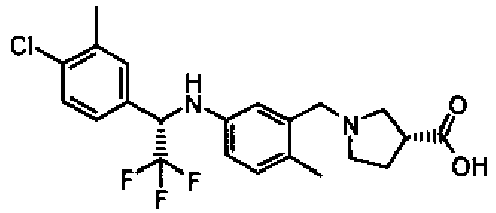
-

- To a solution of 5-bromo-2-methylbenzoic acid (25.00 g, 116 mmol) in THF (250 mL) at 0 °C was added borane dimethyl sulfide complex (2.0 M in THF, 87 mL, 174 mmol) dropwise. The reaction mixture was stirred at room temperature for 16 hours. The mixture was cooled to 0 °C and quenched by dropwise addition of MeOH (100 mL) within 15 minutes. The mixture was stirred at 0 °C for 15 minutes and concentrated. The residue was taken up in EtOAc and washed with 1 M HCl, saturated aqueous NaHCO3 and brine. The organic layer was dried over MgSO4, filtered and concentrated to give INT 29.
MS (ESI): 199 [M-H]-. 1H-NMR (CDCl3): δ (ppm) 7.53 (d, 1H), 7.33 (dd, 1H), 7.04 (d, 1H), 4.65 (s, 2H), 2.28 (s, 3H), 2.00 (s, 1H). -

- To a solution of INT 29 (19.3 g, 96 mmol) in dioxane (800 mL) was added manganese dioxide (50.2 g, 577 mmol). The reaction mixture was stirred at 80 °C for 3 h. The mixture was filtered over Celite and the filtrate was concentrated to give INT 30.
MS (ESI): 197 [M-H]-. 1H-NMR (CDCl3): δ (ppm) 10.23 (s, 1H), 7.92 (d, 1H), 7.60 (dd, 1H), 7.16 (d, 1H), 2.63 (s, 3H). -
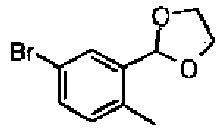
- To a solution of INT 30 (17.3 g, 87 mmol) in toluene (505 mL) was added ethane-1,2-diol (24.3 mL, 436 mmol) followed by p-toluenesulfonic acid monohydrate (0.83 g, 4.36 mmol). The reaction mixture was stirred at 130 °C for 21 hours. The mixture was washed with saturated aqueous NaHCO3 (2x) and brine (2x). The organic layer was dried over MgSO4, filtered and concentrated. The residue was purified by Kugelrohr distillation to give INT 31.
MS (ESI): 243 [M+H]+, 1H-NMR (CDCl3): δ (ppm) 7.70 (d, 1H), 7.39 (dd, 1H), 7.06 (d, 1H), 5.91 (s, 1H), 4.18-4.03 (m, 4H), 2.38 (s, 3H). -

- (S)-1-(4-Chloro-3-methyl-phenyl)-2,2,2-trifluoro-ethylamine hydrochloride (5.00 g, 19.22 mmol) was taken up in EtOAc and washed with saturated aqueous NaHCO3, water (3x) and brine (2x). The organic layer was dried over MgSO4, filtered and concentrated. To a solution of the residue and bromide INT 31 (6.08 g, 24.99 mmol) in toluene (83 mL) and tert-butanol (33 mL) was added XPhos (1.83 g, 3.84 mmol) followed by Cs2CO3 (18.79 g, 57.67 mmol). The mixture was degassed for 10 minutes and Pd(OAc)2 (0.43 g, 1.92 mmol) was added. The reaction mixture was stirred at 100 °C for 4 hours. The mixture was diluted with EtOAc and washed with H2O (3x). The aqueous layer was extracted with EtOAc. The combined organic layers were washed with brine (2x), dried over MgSO4, filtered and concentrated. The residue was purified by chromatography on silica gel (heptane/EtOAc) to afford INT 32.
MS (ESI): 386 [M+H]+, 1H-NMR (CDCl3): δ (ppm) 7.37-7.32 (m, 2H), 7.22 (br d, 1H), 6.98 (d, 1H), 6.93 (d, 1H), 6.50 (dd, 1 H), 5.90 (s, 1H), 4.87 (q, 1H), 4.30 (br s, 1H), 4.12-4.00 (m, 4H), 2.40 (s, 3H), 2.30 (s, 3H). -

- To a solution of acetal INT 32 (4.91 g, 12.73 mmol) in THF (127 mL) at 0 °C was added HCl (2 M in H2O, 25.5 mL, 50.92 mmol). The reaction mixture was stirred at room temperature for 100 minutes. The mixture was diluted with EtOAc and washed with saturated aqueous NaHCO3 (2x), water (2x) and brine (1x). The organic layer was dried over MgSO4, filtered and concentrated to give INT 33.
MS (ESI): 342 [M+H]+, 1H-NMR (CDCl3): δ (ppm) 10.23 (s, 1H), 7.38 (d, 1H), 7.34 (s, 1H), 7.25 (d, 1H), 7.11 (d, 1H), 7.08 (d, 1H), 6.80 (dd, 1H), 4.92 (q, 1H), 4.43 (br s, 1H), 2.55 (s, 3H), 2.40 (s, 3H). - To a solution of aldehyde INT 33 (2.50 g, 7.32 mmol) and (R)-pyrrolidine-3-carboxylic acid (0.93 g, 8.05 mmol) in MeOH (74 mL) was added HOAc (0.42 mL, 7.32 mmol) followed by PS-CNBH3 (2.5 mmol/g, 2.93 g, 7.32 mmol). The reaction mixture was stirred at room temperature overnight. The mixture was filtered through Celite. The filtrate was concentrated. The residue was taken up in EtOAc and washed with saturated aqueous NaHCO3 and water. The aqueous layers were extracted with EtOAc (2x). The combined organic layers were washed with brine, dried over MgSO4, filtered and concentrated. The residue was purified by chromatography on silica gel (CH2Cl2/MeOH) to afford the title compound Example 21.
LC/MS method 2: MS (ESI): 441 [M+H]+, rt = 1.93 min. 1H-NMR (DMSO-d6): δ (ppm) 11.65 (br s, 1H), 7.59 (s, 1H), 7.48-7.40 (m, 2H), 6.83 (d, 1H), 6.80 (s, 1H), 6.62 (dd, 1H), 6.46 (d, 1H), 5.50-5.40 (m, 1H), 3.44 (br s, 2H), 2.97-2.87 (m, 1 H), 2.74-2.66 (m, 1H), 2.63-2.54 (m, 1H), 2.49-2.42 (m, 2H), 2.31 (s, 3H), 2.10 (s, 3H), 1.98-1.91 (m, 2H). -

- The title compound was prepared according to Scheme 3 following a procedure analogous to Example 21 using (R)-1-(4-chloro-3-methyl-phenyl)-propylamine hydrochloride in step 4 and azetidine-3-carboxylic acid in step 6.
LC/MS method 2: MS (ESI): 387 [M+H]+, rt = 2.05 min. -

- The title compound was prepared according to Scheme 3 following a procedure analogous to Example 21 using (R)-1-(4-chloro-3-methyl-phenyl)-propylamine hydrochloride in step 4.
LC/MS method 2: MS (ESI): 401 [M+H]+, rt = 2.07 min. -

- The title compound was prepared according to Scheme 3 following a procedure analogous to steps 3 to 6 of Example 21 using 3-bromo-2-fluoro-benzaldehyde in step 3, (R)-1-(4-chloro-3-methyl-phenyl)-propylamine hydrochloride in step 4 and azetidine-3-carboxylic acid in step 6.
LC/MS method 2: MS (ESI): 391 [M+H]+, rt = 2.08 min. -

- The title compound was prepared according to Scheme 3 following a procedure analogous to steps 3 to 6 of Example 21 using 3-bromo-2-fluoro-benzaldehyde in step 3 and (R)-1-(4-chloro-3-methyl-phenyl)-propylamine hydrochloride in step 4.
LC/MS method 2: MS (ESI): 405 [M+H]+, rt = 2.12 min. -

- The title compound was prepared according to Scheme 3 following a procedure analogous to steps 3 to 6 of Example 21 using 3-bromo-4-fluoro-benzaldehyde in step 3, (R)-1-(4-chloro-3-methyl-phenyl)-propylamine hydrochloride in step 4 and azetidine-3-carboxylic acid in step 6.
LC/MS method 2: MS (ESI): 391 [M+H]+, rt = 2.00 min. -

- The title compound was prepared according to Scheme 3 following a procedure analogous to steps 3 to 6 of Example 21 using 3-bromo-4-fluoro-benzaldehyde in step 3 and (R)-1-(4-chloro-3-methyl-phenyl)-propylamine hydrochloride in step 4.
LC/MS method 2: MS (ESI): 405 [M+H]+, rt = 2.02 min. -

- The title compound was prepared according to Scheme 3 following a procedure analogous to Example 21 using (R)-1-(4-chloro-3-methyl-phenyl)-propylamine hydrochloride in step 4 and INT 14 in step 6 followed by a LiOH-mediated deprotection.
LC/MS method 2: MS (ESI): 401 [M+H]+, rt = 2.11 min. -

- The title compound was prepared according to Scheme 3 following a procedure analogous to steps 2 to 6 of Example 21 using 5-bromo-2-chloro-benzylalcohol in step 2.
LC/MS method 2: MS (ESI): 461 [M+H]+, rt = 2.07 min. -
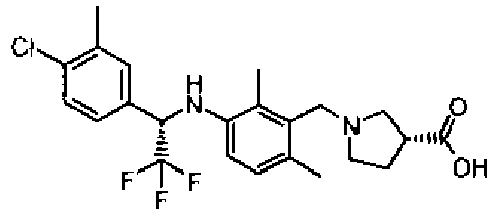
- The title compound was prepared according to Scheme 3 following a procedure analogous to Example 21 using INT 34 (synthesis below) in step 1.
LC/MS method 2: MS (ESI): 455 [M+H]+, rt = 2.17 min. -

- To a solution of 2,6-dimethylbenzoic acid (25.00 g, 166 mmol) in HOAc (432 mL) was added NaOAc (16.39 g, 200 mmol) followed by bromine (11.2 mL, 216 mmol). The reaction mixture was stirred at room temperature overnight. The mixture was poured onto ice water (800 mL) and stirred for 20 minutes. The solid was filtered off, washed with H2O and dried at 50 °C under vacuum to give INT 34.
MS (ESI): 227 [M-H]-. 1H-NMR (DMSO-d6): δ (ppm) 13.40 (br s, 1H), 7.53 (d, 1H), 7.05 (d, 1H), 2.31 (s, 3H), 2.23 (s, 3H). -

- The title compound was prepared according to Scheme 3 following a procedure analogous to Example 21 using INT 34 in step 1 and azetidine-3-carboxylic acid in step 6.
LC/MS method 2: MS (ESI): 441 [M+H]+, rt = 2.15 min. -

- The title compound was prepared according to Scheme 3 following a procedure analogous to Example 21 using INT 34 in step 1 and (R)-1-(4-chloro-3-methyl-phenyl)-propylamine hydrochloride in step 4.
LC/MS method 2: MS (ESI): 415 [M+H]+, rt = 2.32 min. -

- The title compound was prepared according to Scheme 3 following a procedure analogous to Example 21 using INT 34 in step 1, (R)-1-(4-chloro-3-methyl-phenyl)-propylamine hydrochloride in step 4 and azetidine-3-carboxylic acid in step 6.
LC/MS method 2: MS (ESI): 401 [M+H]+, rt = 2.26 min. -

- The title compound was prepared according to Scheme 3 following a procedure analogous to steps 3 to 6 of Example 21 using aldehyde INT 35 (synthesis below) in step 3.
LC/MS method 2: MS (ESI): 455 [M+H]+, rt = 2.19 min. -

- To a solution of 2-ethyl-benzaldehyde (5.00 g, 37.3 mmol) in CH2Cl2 (23 mL) was carefully added AlCl3 (8.70 g, 65.2 mmol). The mixture was cooled to 0 °C and a solution of bromine (1.9 mL, 37.2 mmol) in CH2Cl2 (23 mL) was added over 6 hours. The reaction mixture was stirred at room temperature overnight. The mixture was poured onto an ice/water mixture and stirred for 10 minutes. The aqueous layer was extracted with EtOAc (2x). The combined organic layers were washed with 2 M HCl, saturated aqueous NaHCO3 and brine, dried over MgSO4, filtered and concentrated. The residue was purified by chromatography on silica gel (heptane/EtOAc) to afford INT 35.
MS (ESI): 211 [M-H]-. 1H-NMR (CDCl3): δ (ppm) 10.24 (s, 1H), 7.95 (d, 1H), 7.63 (dd, 1H), 7.20 (d, 1H), 3.01 (q, 2H), 1.28 (t, 3H). -

- The title compound was prepared according to Scheme 3 following a procedure analogous to steps 3 to 6 of Example 21 using aldehyde INT 35 in step 3 and azetidine-3-carboxylic acid in step 6.
LC/MS method 2: MS (ESI): 441 [M+H]+, rt = 2.16 min. -

- The title compound was prepared according to Scheme 3 following a procedure analogous to steps 3 to 6 of Example 21 using aldehyde INT 35 in step 3 and (R)-1-(4-chloro-3-methyl-phenyl)-propylamine hydrochloride in step 4.
LC/MS method 2: MS (ESI): 415 [M+H]+, rt = 2.22 min. -

- The title compound was prepared according to Scheme 3 following a procedure analogous to steps 3 to 6 of Example 21 using aldehyde INT 35 in step 3, (R'4-chloro-3-methyl-phenyl)-propylamine hydrochloride in step 4 and azetidine-3-carboxylic acid in step 6.
LC/MS method 2: MS (ESI): 401 [M+H]+, rt = 2.20 min. -

- The title compound was prepared according to Scheme 3 following a procedure analogous to steps 2 to 6 of Example 21 using 5-bromo-2-chloro-benzylalcohol in step 2 and (R)-1-(4-chloro-3-methyl-phenyl)-propylamine hydrochloride in step 4.
LC/MS method 2: MS (ESI): 421 [M+H]+, rt = 2.13 min. -

- The title compound was prepared according to Scheme 3 following a procedure analogous to Example 21 using 3-bromo-2-methylbenzoic acid in step 1 and azetidine-3-carboxylic acid in step 6.
LC/MS method 2: MS (ESI): 427 [M+H]+, rt = 2.03 min. -

- The title compound was prepared according to Scheme 3 following a procedure analogous to Example 21 using INT 34 in step 1 and 3-aminopropionic acid in step 6.
LC/MS method 2: MS (ESI): 429 [M+H]+, rt = 2.13 min. -

- The title compound was prepared according to Scheme 3 following a procedure analogous to Example 21 using amine INT 38 (synthesis below) in step 4 and azetidine-3-carboxylic acid in step 6.
LC/MS method 2: MS (ESI): 401 [M+H]+, rt = 2.20 min. -

- A solution of 4-chloro-3,5-dimethyl-benzaldehyde (6.04 g, 35.8 mmol) and (R)-2-methylpropane-2-sulfinamide (4.78 g, 39.4 mmol) in toluene (110 mL) was treated with titanium(IV) isopropoxide (15.74 mL, 53.7 mmol). The mixture was stirred at 50 °C for 24 hours. It was then quenched with 10% aqueous sodium bicarbonate solution (100 mL) and filtered through Celite. The filter cake was washed with Et2O (250 mL). The organic layers were washed with water and brine, dried over sodium sulfate, filtered and concentrated. The crude was purified by chromatography on silica gel (cyclohexane/EtOAc).
UPLC: rt = 2.32 min. 1H-NMR (CDCl3): δ (ppm) 8.49 (s, 1H), 7.56 (s, 2H), 2.44 (s, 6H), 1.26 (s, 9H). -

- To a solution of dimethylzinc (1.7 M in toluene, 10.95 mL, 21.89 mmol) was added dropwise a solution of ethylmagnesium bromide (3 M Et2O, 6.44 mL, 19.32 mmol) at room temperature and the mixture was stirred for 15 minutes.
In a separate flask a solution of INT 36 (3.5 g, 12.88 mmol) in THF (100 mL) was cooled in a dry ice bath under argon to -78 °C. At this temperature the organozincate solution from above was added dropwise over a period of about 30 minutes. Stirring was continued for another 90 minutes before the resulting mixture was first quenched carefully with 10% ammonium chloride solution (40 mL), then water (50 mL). The reaction mixture was allowed to warm up to room temperature and was then extracted with Et2O (200 mL). The organic layer was washed with water and brine, dried over sodium sulfate, filtered and concentrated. The crude was purified by chromatography on silica gel (cyclohexane/EtOAc).
UPLC: rt = 2.06 min. 1H-NMR (CDCl3): δ (ppm) 7.01 (s, 2H), 4.16 (m, 1 H), 3.30 (br d, 1H), 2.37 (s, 6H), 2.01 (m, 1H), 1.70 (m, 1H), 1.22 (s, 9H), 0.80 (t, 3H). -

- A solution of intermediate INT 37 (3.4 g, 11.26 mmol) in MeOH (75 mL) was treated with HCl (4 M in dioxane, 5.63 mL, 22.53 mmol) and stirred overnight. After evaporation of the solvents, a white solid was obtained which was washed with Et2O. The solid was then dissolved in water, slightly acidified with 2 M HCl and washed with EtOAc. The aqueous layer was separated and the pH adjusted to about 11 using 2 M NaOH followed by extraction with Et2O (3x). The Et2O layers were combined, dried over sodium sulfate, filtered and concentrated.
UPLC: rt = 1.00 min. 1H-NMR (CDCl3): δ (ppm) 7.05 (s, 2H), 3.75 (m, 1H), 2.39 (s, 6H), 2.06 (br s, 2H), 1.69 (m, 2H), 0.88 (t, 3H). -

- The title compound was prepared according to Scheme 3 following a procedure analogous to Example 21 using amine INT 38 in step 4.
LC/MS method 2: MS (ESI): 415 [M+H]+, rt = 2.25 min. -

- The title compound was prepared according to Scheme 3 following a procedure analogous to steps 2 to 6 of Example 21 using 5-bromo-2-chlorobenzylalcohol in step 2 and amine INT 38 in step 4.
LC/MS method 2: MS (ESI): 435 [M+H]+, rt = 2.28 min. -

- The title compound was prepared according to Scheme 3 following a procedure analogous to Example 21 using amine INT 41 (synthesis below) in step 4.
LC/MS method 2: MS (ESI): 401 [M+H]+, rt = 2.07 min. -

- A solution of 4-chloro-3,5-dimethyl-benzaldehyde (2 g, 11.86 mmol) and (S)-2-methylpropane-2-sulfinamide (1.58 g, 13.05 mmol) in toluene (35 mL) was treated with titanium(IV) isopropoxide (5.27 mL, 17.79 mmol). The mixture was stirred at 50 °C for 24 hours. It was then quenched with 10% sodium bicarbonate solution (50 mL) and extracted twice with EtOAc. The organic layers were washed with water and brine, dried over sodium sulfate, filtered and concentrated. The crude was purified by chromatography on silica gel (cyclohexane/EtOAc).
UPLC: rt = 2.29 min. 1H-NMR (CDCl3): δ (ppm) 8.49 (s, 1H), 7.56 (s, 2H), 2.44 (s, 6H), 1.26 (s, 9H). -

- A solution of INT 39 (4 g, 14.72 mmol) in CH2Cl2 (150 mL) was cooled to -50 °C. To this solution was added methylmagnesium bromide (3 M Et2O, 9.8 mL, 29.4 mmol) at a rate that the temperature did not exceed -48 °C. Stirring at this temperature was continued for 6 hours.
UPLC showed conversion of about 30%. The mixture was stored in a freezer at -25 °C for 3 days. Conversion was about 60%. Another portion of methylmagnesium bromide (3 M in Et2O, 9.8 mL, 29.4 mmol) was added and the mixture was kept another 24 hours in the freezer. Hardly any change in conversion could be detected. Thus, the cold reaction mixture was quenched with saturated ammonium chloride solution. The organic layer was separated and the aqueous layer was extracted with EtOAc (250 mL). The combined organic extracts were washed with 5% ammonium chloride solution, water, 10% sodium bicarbonate solution and brine, dried over sodium sulfate, filtered and concentrated. The crude was purified by chromatography on silica gel (cyclohexane/EtOAc).
MS(ESI): 288.3 [M+H]+, 1H-NMR (CDCl3): δ (ppm) 7.03 (s, 2H), 4.47 (m, 1H), 3.28 (br s, 1H), 2.36 (s, 6H), 1.49 (d, 3H), 1.20 (s, 9H). -

- A solution of intermediate INT 40 (2.3 g, 8 mmol) in MeOH (50 mL) was treated with HCl (4 M in dioxane, 4 mL, 16 mmol) and stirred overnight. After evaporation of the solvents, a solid was obtained which was washed with Et2O. The solid was then dissolved in water, slightly acidified with 2 M HCl and washed with EtOAc. The aqueous layer was separated and the pH adjusted to about 11 using 2 M NaOH followed by extraction with Et2O (3x). The Et2O layers were combined, dried over sodium sulfate, filtered and concentrated.
UPLC: rt = 0.87 min. 1H-NMR (CDCl3): δ (ppm) 7.10 (s, 2H), 4.08 (m, 1 H), 2.39 (s, 6H), 2.33 (br s, 2H), 1.41 (d, 3H). -
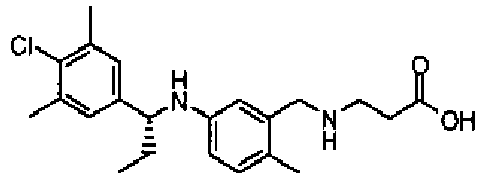
- The title compound was prepared according to Scheme 3 following a procedure analogous to Example 21 using amine INT 38 in step 4 and 3-amino-propionic acid tert-butyl ester in step 6, followed by a HCl/dioxane-induced ester cleavage.
LC/MS method 2: MS (ESI): 389 [M+H]+, rt = 2.21 min. -

- The title compound was prepared according to Scheme 3 following a procedure analogous to steps 2 to 6 of Example 21 using 5-bromo-2-chlorobenzylalcohol in step 2 and amine INT 41 in step 4.
LC/MS method 2: MS (ESI): 421 [M+H]+, rt = 2.09 min. -

- The title compound was prepared according to Scheme 3 following a procedure analogous to Example 21 using amine INT 41 in step 4 and 3-amino-propionic acid tert-butyl ester in step 6, followed by a HCl/dioxane-induced ester cleavage.
LC/MS method 2: MS (ESI): 375 [M+H]+, rt = 2.08 min. -

- The title compound was prepared according to Scheme 3 following a procedure analogous to steps 2 to 6 of Example 21 using 5-bromo-2-chlorobenzylalcohol in step 2, amine INT 38 in step 4 and 3-amino-propionic acid tert-butyl ester in step 6, followed by a HCl/dioxane-induced ester cleavage.
LC/MS method 2: MS (ESI): 395 [M+H]+, rt = 2.08 min. -

- The title compound was prepared according to Scheme 3 following a procedure analogous to Example 21 using amine INT 38 in step 4 and (R)-3-amino-2-methyl-propionic acid methyl ester in step 6, followed by a LiOH-induced ester cleavage.
LC/MS method 1: MS (ESI): 403 [M+H]+, rt = 2.42 min. -

- The title compound was prepared according to Scheme 3 following a procedure analogous to Example 21 using amine INT 43 (synthesis below) in step 4 and 3-amino-propionic acid tert-butyl ester in step 6, followed by an HCl/dioxane-induced ester cleavage.
LC/MS method 1: MS (ESI): 429.1 [M+H]+, rt = 2.27 min. -

- A solution of TMS-CF3 (0.737 mL, 4.99 mmol) in THF (15 mL) was added to a solution of TBAT (2.469 g, 4.57 mmol) and INT 36 (1.13 g, 4.16 mmol) in THF (60.0 mL) at -65 °C. Stirring was continued for 3 hours. Another portion of TBAT (200 mg, 0.37 mmol) was added. After 2 more hours, more TMS-CF3 (0.369 ml, 2.50 mmol) was added. The suspension became a clear solution which was quenched with saturated ammonium chloride solution, diluted with EtOAc and washed with water. The organic layer was dried over sodium sulfate, filtered and concentrated. The crude was purified by chromatography on silica gel (cyclohexane/EtOAc).
MS(ESI): 342 [M+H]+, UPLC: rt = 2.06 min. -
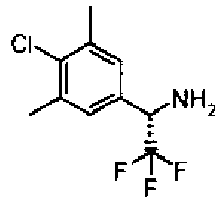
- A solution of intermediate INT 42 (860 mg, 2.52 mmol) in MeOH (40 mL) was treated with HCl (4 M in dioxane, 1.26 mL, 5.04 mmol) and stirred over the weekend. After evaporation of the solvents, a solid was obtained which was triturated with Et2O. The solid was then dissolved in water and the pH was adjusted to ~9 using 10% sodium carbonate solution. It was extracted twice with EtOAc. The combined extracts were dried over sodium sulfate, filtered and concentrated.
MS(ESI): 238 [M+H]+, UPLC: rt = 1.36 min. -

- The title compound was prepared according to Scheme 3 following a procedure analogous to steps 2 to 6 of Example 21 using 5-bromo-2-chlorobenzylalcohol in step 2, amine INT 43 in step 4 and 3-amino-propionic acid tert-butyl ester in step 6, followed by a HCl/dioxane-induced ester cleavage.
LC/MS method 2: MS (ESI): 448.9 [M+H]+, rt = 2.19 min. -

- The title compound was prepared according to Scheme 3 following a procedure analogous to steps 2 to 6 of Example 21 using 5-bromo-2-chlorobenzylalcohol in step 2 and 3-amino-propionic acid in step 6.
LC/MS method 2: MS (ESI): 435 [M+H]+, rt = 2.09 min. -

- The title compound was prepared according to Scheme 3 following a procedure analogous to steps 2 to 6 of Example 21 using 5-bromo-2-chlorobenzylalcohol in step 2, amine INT 38 in step 4 and 3-amino-propionic acid in step 6.
LC/MS method 2: MS (ESI): 409 [M+H]+, rt = 2.24 min. -

-

- A mixture of 2-bromo-5-fluoroisonicotinaldehyde (495 mg, 2.43 mmol), ethylene glycol (0.27 mL, 4.85 mmol) and p-toluenesulfonic acid monohydrate (508 mg, 2.67 mmol) in toluene (13.5 mL) was refluxed for 4 hours. The mixture was concentrated and taken up in CH2Cl2, washed with 1 M NaOH, dried over sodium sulfate, filtered and concentrated. The crude product was purified by flash chromatography on silica gel (cyclohexane/EtOAc) to give INT 44.
LC/MS method 4: MS (ESI): 249 [M+H]+, rt = 0.89 min. 1H-NMR (CDCl3): δ (ppm) 8.25 (s, 1H), 7.62 (d, 1H), 6.04 (s, 1H), 4.18-4.09 (m, 4H). -

- To a solution of INT 44 (370 mg, 1.492 mmol), (R)-1-(4-chloro-3-methyl-phenyl)-propylamine hydrochloride (394 mg, 1.790 mmol) and sodium tert-butoxide (344 mg, 3.58 mmol) in degassed toluene (5.8 mL) was added Pd2(dba)3 (68.3 mg, 0.075 mmol) and BINAP (93 mg, 0.149 mmol) and the resulting mixture was stirred at 80 °C for 5 hours. The mixture was diluted in EtOAc, washed with saturated aqueous sodium bicarbonate, water and brine, dried over sodium sulfate, filtered and concentrated. The crude product was purified by flash chromatography on silica gel (cyclohexane/EtOAc) to give INT 45.
LC/MS method 4: MS (ESI): 351 [M+H]+, rt = 1.31 min. 1H-NMR (CDCl3): δ (ppm) 7.91 (d, 1H), 7.26 (d, 1H), 7.19-7.17 (m, 1 H), 7.08 (dd, 1 H), 6.32 (d, 1H), 5.93 (s, 1H), 4.83 (d, 1H), 4.43 (q, 1H), 4.01-3.91 (m, 4H), 2.34 (s, 3H), 1.90-1.73 (m, 2H), 0.94 (t, 3H). -

- INT 45 (500 mg, 1.43 mmol) was dissolved in THF (20 mL) and HBr (33% in AcOH, 15 eq) was added. The resulting mixture was stirred at 70 °C until completion of the reaction. The mixture was quenched with saturated aqueous sodium bicarbonate and extracted with EtOAc. The organic layer was washed with saturated aqueous sodium bicarbonate, water and brine, dried over sodium sulfate and concentrated. The crude product was purified by flash chromatography on silica gel (cyclohexane/EtOAc) to give INT 46.
LC/MS method 4: MS (ESI). 307 [M+H]+, rt = 1.36 min. 1H-NMR (CDCl3): δ (ppm) 10.23 (s, 1H), 8.13 (d, 1H), 7.27 (d, 1H), 7.17 (d, 1H), 7.08 (dd, 1H), 6.53 (d, 1 H), 5.00 (d, 1H), 4.44 (q, 1H), 2.35 (s, 3H), 1.89-1.75 (m, 2H), 0.95 (t, 3H). - To a solution of INT 46 (288 mg, 0.94 mmol) and azetidine-3-carboxylic acid (114 mg, 1.13 mmol) in MeOH (9 mL) was added AcOH (0.054 mL, 0.989 mmol) followed by PS-CNBH3 (3.5 mmol/g, 540 mg, 1.88 mmol). The reaction mixture was stirred at room temperature for 16 hours. The mixture was filtered through Celite. The filtrate was concentrated and the residue was purified by preparative HPLC (H2O/CH3CN) to give 54.
LC/MS method 2: MS (ESI): 392 [M+H]+, rt = 1.80 min. 1H-NMR (DMSO-d6): δ (ppm) 7.72 (s, 1 H), 7.28 (d, 1H), 7.27 (s, 1H), 7.15 (d, 1H), 6.93 (d, 1 H), 6.49 (d, 1H), 4.62 (q, 1H), 3.37 (m, 2H), 3.22 (m, 2H), 2.27 (s, 3H), 1.73 (m, 1 H), 1.64 (m, 1H), 0.84 (t, 3H). -

- The title compound was prepared following a procedure analogous to Example 54 using 2-bromo-5-chloroisonicotinaldehyde and 1,3-propanediol in step 1 and (R)-pyrrolidine-3-carboxylic acid in step 4.
LC/MS method 2: MS (ESI): 422 [M+H]+, rt = 1.96 min. -

-

- A mixture of 5-bromo-2-chloronicotinaldehyde (981 mg, 2.43 mmol), trimethylorthoformate (1.46 mL, 13.4 mmol) and p-toluenesulfonic acid monohydrate (42.3 mg, 0.222 mmol) in MeOH (18 mL) was refluxed for 16 hours. The mixture was diluted in CH2Cl2 and washed with 10 % aqueous potassium carbonate and brine, dried over sodium sulfate, filtered and concentrated. The crude product was used in the next step without further purification.
LC/MS method 2: MS (ESI): 267 [M+H]+, rt = 2.23 min. 1H-NMR (DMSO-d6): δ (ppm) 8.59 (d, 1 H), 8.06 (d, 1H), 5.50 (s, 1H), 3.32 (2d, 6H). -

- The title compound was prepared by a similar procedure to INT 45 starting from INT 47.
LC/MS method 2: MS (ESI): 369 [M+H]+, rt = 3.10 min. 1H-NMR (DMSO-d6): δ (ppm) 7.59 (d, 1 H), 7.32 (m, 2H), 7.32 (s, 1H), 7.18 (dd, 1H), 7.09 (d, 1H), 5.30 (s, 1H), 4.25 (t, 1 H), 4.72 (q, 1 H), 3.29 (s, 3H), 3.12 (s, 3H), 2.28 (s, 3H), 1.83-1.58 (m, 2H), 0.88 (t, 3H). -

- A mixture of INT 48 (250 mg, 0.677 mmol) and Pd(dppf)Cl2·CH2Cl2 (16.6 mg, 0.020 mmol) was dissolved in degassed dioxane (7 mL) and ZnMe2 (2 M in toluene, 1.02 mL, 2.04 mmol) was added. The mixture was stirred in a sealed vessel at 100 °C overnight. After cooling down, the mixture was quenched with a few drops of MeOH and the mixture was diluted with EtOAc, washed with saturated aqueous sodium bicarbonate and brine, dried over sodium sulfate and concentrated. The crude product was purified by flash chromatography (cyclohexane/EtOAc) to give INT 49.
LC/MS method 4: MS (ESI): 349 [M+H]+, rt = 1.09 min. 1H-NMR (CDCl3): 6 (ppm) 7.76 (d, 1H), 7.27 (d, 1H), 7.16 (d, 1 H), 7.08-7.02 (m, 1H), 7.00 (d, 1 H), 5.30 (s, 1H), 4.18 (q, 1 H), 3.96 (d, 1H), 3.32 (s, 3H), 3.14 (s, 3H), 2.38 (s, 3H), 2.33 (s, 3H), 1.90-1.72 (m, 2H), 0.94 (t, 3H). -

- INT 49 (184 mg, 0.527 mmol) was heated at 80 °C in 1 M HCl (2.6 mL) for 2 hours. The mixture was cooled down and diluted with saturated aqueous sodium bicarbonate. The mixture was extracted with EtOAc and the organic layer was washed with brine, dried over sodium sulfate and concentrated. The product was used in the next step without further purification.
LC/MS method 4: MS (ESI): 303 [M+H]+, rt = 1.17 min. - The title compound was prepared from INT 50 by a procedure analogous to step 4 of 54 using (R)-pyrrolidine-3-carboxylic acid.
LC/MS method 2: MS (ESI): 402 [M+H]+, rt = 1.41 min. -

-

- A mixture of 2-bromo-5-chloronicotinaldehyde (3.00 g, 13.6 mmol), trimethylorthoformate (4.48 mL, 40.8 mmol) and p-toluenesulfonic acid monohydrate (129 mg, 0.680 mmol) in MeOH (55 mL) was refluxed for 16 hours. The mixture was diluted in CH2Cl2 and washed with 10 % aqueous potassium carbonate and brine, dried over sodium sulfate, filtered and concentrated. The crude product was used in the next step without further purification. LC/MS method 2: MS (ESI): 267 [M+H]+, rt = 2.22 min. 1H-NMR (DMSO-d6): δ (ppm) 8.53 (s, 1 H), 7.65 (S, 1 H), 5.53 (s, 1 H), 3.31 (2d, 6H).
-

- The title compound was prepared by a procedure analogous to INT 45 starting from INT 51.
LC/MS method 2: MS (ESI): 369 [M+H]+, rt = 3.07 min. 1H-NMR (DMSO-d6): δ (ppm) 7.86 (s, 1 H), 7.26 (d, 1H), 7.30 (m, 2H), 7.28 (s, 1 H), 7.14 (d, 1H), 6.74 (s, 1H), 5.32 (s, 1H), 4.72 (q, 1 H), 3.28 (s, 3H), 3.24 (s, 3H), 2.27 (s, 3H), 1.75-1.62 (m, 2H), 0.84 (t, 3H). -

- INT 52 (200 mg, 0.542 mmol) was heated at 80 °C in 1 M HCl (2.7 mL) for 2 hours. The mixture was cooled down and diluted with saturated aqueous sodium bicarbonate. The mixture was extracted with EtOAc and the organic layer was washed with brine, dried over sodium sulfate and concentrated. The product was used in the next step without further purification.
LC/MS method 2: MS (ESI): 323 [M+H]+, rt = 3.07 min. - To a solution of INT 53 (263 mg, 0.814 mmol) and 3-methyl-pyrrolidine-3-carboxylic acid (105 mg, 0.814 mmol) in MeOH (7 mL) was added AcOH (48.9 mg, 0.814 mmol) followed by PS-CNBH3 (3.5 mmol/g, 462 mg, 1.62 mmol). The reaction mixture was stirred at room temperature for 16 hours. The mixture was filtered through Celite. The filtrate was concentrated and the residue was purified by preparative HPLC (H2O/CH3CN) to give 57.
LC/MS method 2: MS (ESI): 436 [M+H]+, rt = 2.13 min. 1H-NMR (DMSO-d6): δ (ppm) 12.35 (br s, 1 H), 7.81 (2s, 1 H), 7.30 (d, 1 H), 7.29 (dd, 1 H), 7.29 (d, 1 H), 7.16 (m, 1 H), 7.14 (m, 1H), 6.61 (2s, 1 H), 4.63 (m, 1 H), 3.48 (d, 1H), 2.91 (dd, 1H), 2.59-2.39 (m, 2H), 2.36-2.22 (m, 2H), 2.27 (s, 3H), 1.79-1.70 (m, 1 H), 1.70-1.62 (m, 1 H), 1.57-1.50 (m, 1H), 1.26 (2s, 3H), 0.85 (t, 3H). -
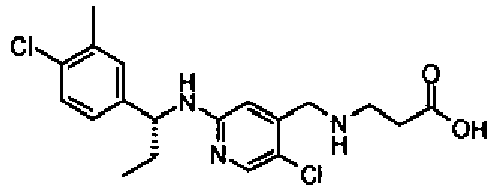
- The title compound was prepared by a procedure analogous to Example 57 using 3-amino-propionic acid tert-butyl ester hydrochloride in step 4 and with an additional HCl-induced deprotection step.
LC/MS method 2: MS (ESI): 396 [M+H]+, rt = 1.94 min. 1H-NMR (DMSO-d6): δ (ppm) 9.16 (br s, 2H), 7.97 (s, 1H), 7.52 (d, 1H), 7.31 (s, 1H), 7.30 (d, 1H), 7.17 (dd, 1H), 6.70 (s, 1H), 4.73 (m, 1H), 4.12 (t, 2H), 3.20 (m, 2H), 2.71 (t, 2H), 2.28 (s, 3H), 1.81-1.65 (m, 2H), 0.86 (t, 3H). -

- The title compound was prepared by a procedure analogous to Example 57 using INT 38 in step 2 and (R)-pyrrolidine-3-carboxylic acid in step 4.
LC/MS method 2: MS (ESI): 436 [M+H]+, rt = 2.13 min. -

-

- To a solution of 2-chloro-5-methylpyridine-4-carboxylic acid ethyl ester (750 mg, 3.76 mmol), (R)-1-(4-chloro-3-methyl-phenyl)-propylamine hydrochloride (992 mg, 4.51 mmol) and sodium tert-butoxide (867 mg, 9.02 mmol) in degassed toluene (54 mL) was added Pd2(dba)3 (172 mg, 0.188 mmol) and BINAP (234 mg, 0.378 mmol) and the resulting mixture was stirred at 50 °C for 5 hours. The mixture was diluted with EtOAc, washed with saturated aqueous sodium bicarbonate, water and brine, dried over sodium sulfate, filtered and concentrated. The crude product was purified by flash chromatography on silica gel (cyclohexane/EtOAc) to give INT 54.
LC/MS method 4: MS (ESI): 347 [M+H]+, rt = 1.36 min. 1H-NMR (CDCl3): δ (ppm) 7.96 (s, 1 H), 7.26 (d, 1H), 7.19 (d, 1 H), 7.09 (dd, 1 H), 6.67 (s, 1H), 4.85 (t, 1H), 4.46 (q, 1H), 2.34 (s, 3H), 2.32 (s, 3H), 1.91-1.75 (m, 2H), 1.34 (t, 3H), 0.95 (t, 3H). -

- INT 54 (380 mg, 1.096 mmol) was dissolved in THF and cooled to 0 °C. LiAlH4 (1 M in THF, 3.29 mL, 3.29 mmol) was added dropwise and the mixture was stirred at the same temperature for 1 hour. The mixture was quenched with water and 1 M NaOH. The mixture was extracted with EtOAc, washed with saturated aqueous sodium bicarbonate and brine, dried over sodium sulfate, filtered and concentrated. The product was used in the next step without further purification.
LC/MS method 2: MS (ESI): 305 [M+H]+, rt = 1.69 min. 1H-NMR (DMSO-d6): δ (ppm) 7.55 (s, 1H), 7.30 (d, 1H), 7.28 (d, 1H), 7.15 (dd, 1H), 6.71 (d, 1H), 6.61 (s, 1 H), 4.72 (q, 1 H), 4.32 (s, 2H), 2.28 (s, 3H), 1.92 (s, 3H), 1.74-1.62 (m, 2H), 0.86 (t, 3H). -

- Oxalyl chloride (0.232 mL, 2.70 mmol) was dissolved in CH2Cl2 (15 mL) and the solution was cooled to -78 °C. A solution of DMSO (0.383 mL, 5.40 mmol) in CH2Cl2 (3 mL) was added dropwise and the mixture was stirred for 10 minutes at this temperature. Then, a solution of INT 55 (329 mg, 1.079 mmol) in CH2Cl2 (3 mL) was added dropwise and the mixture was stirred for 1 hour at this temperature. NEt3 (0.932 mL, 6.69 mmol) was added and the mixture was stirred further at -78 °C for 1 hour and the mixture was quenched with water. The mixture was poured onto 10% aqueous KHSO4 and extracted with EtOAc. The organic layer was washed with saturated aqueous sodium bicarbonate solution and brine, dried over sodium sulfate, filtered and concentrated. The product was used in the next step without further purification.
LC/MS method 4: MS (ESI): 303 [M+H]+, rt = 1.26 min. - The title compound was prepared following a procedure analogous to step 4 of Example 54 using INT 56 and (R)-pyrrolidine-3-carboxylic acid.
LC/MS method 2: MS (ESI): 402 [M+H]+, rt = 1.48 min. - Alternatively, agents of the invention may be prepared by a reaction sequence involving either reductive amination of an appropriate halo-benzaldehyde or halo-pyridyl-carbaldehyde with an appropriate amino ester or Lewis acid catalyzed Michael addition of an appropriate benzylamine with an appropriate α,β-unsaturated ester followed by Buchwald coupling with an appropriate amine and an optional deprotection step as shown in Scheme 4 below:

- The following compounds were made in accordance to the above indicated reaction Scheme 4:
-

-

- A mixture of 5-bromo-2-chloro-benzaldehyde (2 g, 9.11 mmol) and azetidine-3-carboxylic acid tert-butyl ester hydrochloride (1.765 g, 9.11 mmol) in dichloroethane (50 mL) was stirred at room temperature for 10 minutes. To this mixture was added sodium triacetoxy-borohydride (3.86 g, 18.23 mmol) in 3 portions over a period of 10 minutes and the cloudy mixture was stirred overnight. The reaction mixture was diluted with CH2Cl2 (100 mL) and washed twice with 10% sodium bicarbonate solution, twice with water then brine. The organic layer was dried over sodium sulfate, filtered and concentrated. The crude was purified by chromatography on silica gel (cyclohexane/EtOAc).
MS (ESI): 360 [M+H]+, UPLC: rt = 1.17 min. 1H-NMR (CDCl3): 6 (ppm) 7.55 (s, 1H), 7.29 (d, 1H), 7.18 (d, 1 H), 3.68 (s, 2H), 3.61 (t, 2H), 3.35 (t, 2H), 3.28 (m, 1 H), 1.46 (s, 9H). -

- A mixture of INT 57 (250 mg, 0.693 mmol), amine INT 38 (137 mg, 0.693 mmol) and cesium carbonate (678 mg, 2.079 mmol) in toluene (4.5 mL) and tert-butanol (1.8 mL) was purged with argon for 10 minutes. Then, XPhos (66.1 mg, 0.139 mmol) and palladium acetate (15.56 mg, 0.069 mmol) were added, the vial was closed and heated at 100 °C for 3 hours. The reaction mixture was then diluted with EtOAc (35 mL) and washed with water and brine. The organic layer was dried over sodium sulfate, filtered and concentrated.
The crude was purified by chromatography on silica gel (cyclohexane/EtOAc).
LC/MS method 2: MS (ESI): 477 [M+H]+. rt = 2.91 min. 1H-NMR (DMSO-d6): δ (ppm) 7.14 (s, 2H), 6.94 (d, 1H), 6.52 (s, 1H), 6.37 (d, 1H), 6.25 (d, 1H), 4.08 (m, 1H), 3.39 (s, 2H), 3.29 (overlapping m, 1H), 3.1-3.25 (m, 3H), 2.98 (m, 1H), 2.27 (s, 6H), 1.74 (m, 1H), 1.62 (m, 1H), 1.40 (s, 9H), 0.86 (t, 3H). - A solution of INT 58 (206 mg, 0.431 mmol) in CH2Cl2 (5 mL) was treated with HCl (4 M in dioxane, 0.43 mL, 1.726 mmol) and stirred at room temperature overnight. The mixture contained some starting material, so another portion of HCl (4 M in dioxane, 0.50 ml, 2.00 mmol) was added and stirring continued for 4 hours. Excess of HCl gas was removed by a stream of argon. The mixture was neutralized with 10% sodium bicarbonate solution then treated with 10% ammonium chloride solution and extracted first with CH2Cl2 then with EtOAc. The combined organic layers were dried over sodium sulfate, filtered and concentrated. The title compound was purified by preparative HPLC (H2O/CH3CN).
LC/MS method 2: MS (ESI): 421 [M+H]+, rt = 2.25 min. 1H-NMR (DMSO-d6): δ (ppm) 7.13 (s, 2H), 6.94 (d, 1 H), 6.56 (s, 1H), 6.35 (d, 1H), 6.27 (d, 1H), 4.08 (m, 1H), 3.41 (s, 2H), 3.05-3.4 (overlapping m, 5H), 2.26 (s, 6H), 1.75 (m, 1H), 1.63 (m, 1H), 0.86 (t, 3H). -

- The title compound was prepared according to Scheme 4 following a procedure analogous to Example 61 using (R)-1-(4-chloro-3-methyl-phenyl)-propylamine hydrochloride in step 2.
LC/MS method 2: MS (ESI): 407 [M+H]+, rt = 2.10 min. -

- The title compound was prepared according to Scheme 4 following a procedure analogous to Example 61 using amine INT 60 (synthesis below) in step 2.
LC/MS method 2: MS (ESI): 421 [M+H]+, rt = 2.24 min. -

- A solution of the imine INT 65 (1.33 g, 5.16 mmol) in CH2Cl2 (30 mL) was cooled to -50 °C. To this solution was added isopropylmagnesium bromide (2 M in THF, 5.16 mL, 10.32 mmol) at a rate that the temperature did not exceed -48 °C and stirring at this temperature was continued for 1 hour. The cooling bath was removed and the reaction mixture was allowed to warm up to room temperature overnight. It was quenched with saturated ammonium chloride solution and extracted with EtOAc. The organic layer was washed with water and brine, dried over sodium sulfate, filtered and concentrated. The crude mixture of diastereomers was purified by chromatography on silica gel (cyclohexane/EtOAc). The (S,S)-isomer eluted first, followed by the desired (S,R)-isomer.
MS (ESI): 302 [M+H]+, 1H-NMR (CDCl3): δ (ppm) 7.28 (d, 1 H), 7.03 (s, 1H), 7.01 (d, 1 H), 4.09 (br d, 1 H), 3.45 (br s, 1 H), 2.36 (s, 3H), 1.94 (m, 1H), 1.19 (s, 9H), 0.98 (d, 3H), 0.80 (d, 3H). -

- A solution of intermediate INT 59 (330 mg, 1.09 mmol) in MeOH (8 mL) was treated with HCl (4 M in dioxane, 0.55 mL, 2.2 mmol) and stirred overnight. After evaporation of the solvents, a solid was obtained. The solid was then dissolved in 2 M HCl (30 mL) and washed with EtOAc. The aqueous layer was separated and the pH adjusted to about 11 using 2 M NaOH followed by extraction with CH2Cl2 (3x). The organic extracts were combined, dried over sodium sulfate, filtered and concentrated.
UPLC: rt = 0.93 min. 1H-NMR (CDCl3): δ (ppm) 7.27 (d, 1H), 7.18 (s, 1H), 7.07 (d, 1H), 3.60 (d, 1H), 3.07 (v br s, 2H), 2.36 (s, 3H), 1.90 (m, 1H), 0.98 (d, 3H), 0.77 (d, 3H). -

- The title compound was prepared according to Scheme 4 following a procedure analogous to Example 61 using amine INT 62 (synthesis below) in step 2.
LC/MS method 2: MS (ESI): 435 [M+H]+, rt = 2.41 min. -
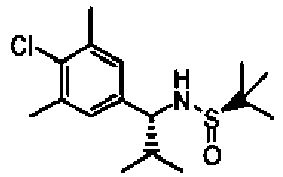
- To a solution of dimethylzinc (1.7 M in toluene, 20.69 mL, 41.4 mmol) was added dropwise a solution of isopropylmagnesium chloride (2 M in THF, 18.4 mL, 36.8 mmol) at room temperature and the mixture was stirred for 1 hour.
In a separate flask a solution of imine INT 36 (5 g, 18.4 mmol) in THF (140 mL) was cooled in a dry ice bath under argon to -78 °C. At this temperature the organozincate
solution from above was added dropwise over a period of about 30 minutes. Stirring was continued for another hour before the resulting mixture was first quenched carefully with 10% ammonium chloride solution (40 mL), then water (50 mL). The reaction mixture was allowed to warm up to room temperature and was then extracted with Et2O (3x). The organic layers were washed with water and brine, dried over sodium sulfate, filtered and concentrated. The crude was purified by chromatography on silica gel (cyclohexane/EtOAc).
UPLC: rt = 2.28 min. -

- A solution of intermediate INT 61 (4.53 g, 14.34 mmol) in MeOH (75 mL) was treated with HCl (4 M in dioxane, 7.17 mL, 28.7 mmol) and stirred overnight. After evaporation of the solvents, a solid was obtained which was washed with Et2O. The solid was then dissolved in 10% sodium carbonate solution and extracted twice with EtOAc. The combined organic layers were dried over sodium sulfate, filtered and concentrated. The crude amine was dissolved in Et2O and treated with an excess of an ethereal solution of HCl (2 M). The suspension was concentrated to yield the title compound.
UPLC: rt = 1.05 min. 1H-NMR (CDCl3): δ (ppm) 7.02 (s, 2H), 3.54 (d, 1H), 2.76 (v br s, 3H) 2.36 (s, 6H), 1.87 (m, 1H), 0.97 (d, 3H), 0.77 (d, 3H). -

- The title compound was prepared according to Scheme 4 following a procedure analogous to Example 61 using 3-methyl-azetidine-3-carboxylic acid methyl ester hydrochloride (INT 14) in step 1 and (S)-1-(4-chloro-3-methyl-phenyl)-2,2,2-trifluoro-ethylamine hydrochloride in step 2, followed by a LiOH-mediated ester cleavage.
LC/MS method 2: MS (ESI): 461 [M+H]+, rt = 2.09 min. -

- The title compound was prepared according to Scheme 4 following a procedure analogous to Example 61 using 3-methyl-azetidine-3-carboxylic acid methyl ester hydrochloride (INT 14) in step 1 and INT 38 in step 2, followed by a LiOH-mediated ester cleavage.
LC/MS method 2: MS (ESI): 435 [M+H]+, rt = 2.29 min. -

- The title compound was prepared according to Scheme 4 following a procedure analogous to Example 61 using 3-bromobenzaldehyde in step 1 and (S)-1-(4-chloro-3-methyl-phenyl)-2,2,2-trifluoro-ethylamine hydrochloride in step 2.
LC/MS method 2: MS (ESI): 413 [M+H]+, rt = 2.11 min. -

- The title compound was prepared according to Scheme 4 following a procedure analogous to Example 61 using (S)-1-(4-chloro-3-methyl-phenyl)-2,2,2-trifluoro-ethylamine hydrochloride in step 2.
LC/MS method 2: MS (ESI): 447 [M+H]+, rt = 2.03 min. -
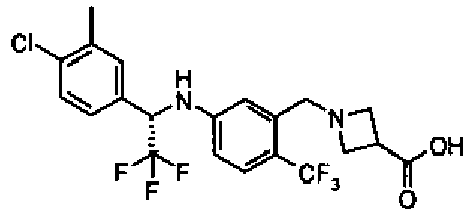
- The title compound was prepared according to Scheme 4 following a procedure analogous to Example 61 using 5-chloro-2-trifluoromethyl-benzaldehyde in step 1 and (S)-1-(4-chloro-3-methyl-phenyl)-2,2,2-trifluoro-ethylamine hydrochloride in step 2.
LC/MS method 2: MS (ESI): 481 [M+H]+, rt = 2.21 min. -

- The title compound was prepared according to Scheme 4 following a procedure analogous to Example 61 using 5-bromo-2-methyl-benzaldehyde (INT 30) in step 1 and (S)-1-(4-chloro-3-methyl-phenyl)-2,2,2-trifluoro-ethylamine hydrochloride in step 2.
LC/MS method 2: MS (ESI): 427 [M+H]+, rt = 2.01 min. -

- The title compound was prepared according to Scheme 4 following a procedure analogous to Example 61 using 5-bromo-2-fluoro-benzaldehyde in step 1 and (S)-1-(4-chloro-3-methyl-phenyl)-2,2,2-trifluoro-ethylamine hydrochloride in step 2.
LC/MS method 2: MS (ESI): 427 [M+H]+, rt = 2.01 min. -

- The title compound was prepared according to Scheme 4 following a procedure analogous to Example 61 using pyrrolidine-3-carboxylic acid ethyl ester in step 1 and (S)-1-(4-chloro-3-methyl-phenyl)-2,2,2-trifluoro-ethylamine hydrochloride in step 2, followed by a LiOH-mediated ester cleavage.
LC/MS method 2: MS (ESI): 461 [M+H]+, rt = 2.08 min. -

- The title compound was prepared according to Scheme 4 following a procedure analogous to steps 2 and 3 of Example 61 using INT 63 (synthesis below) and (S)-1-(4-chloro-3-methyl-phenyl)-2,2,2-trifluoro-ethylamine hydrochloride in step 2 followed by a TFA-mediated ester cleavage.
-

- A solution of (S)-1-(3-bromo-phenyl)-ethylamine (0.3 g, 1.5 mmol) and acrylic acid tert-butyl ester (0.19 g, 1.50 mmol) in ethanol (1.3 mL) was stirred at 55 °C for 2.5 hours. The solvent was concentrated and the crude residue was purified by chromatography on silica gel (heptane/EtOAc).
LC/MS method 2: MS (ESI): 415 [M+H]+, rt = 5.87 min. UPLC: rt = 1.14 min. 1H-NMR (DMSO-d6): δ (ppm) 7.53 (s, 1 H), 7.40 (d, 1H), 7.32 (d, 1 H), 3.68 (q, 1 H), .2.34-2.08 m (4H), 1.21 (d, 3H). -
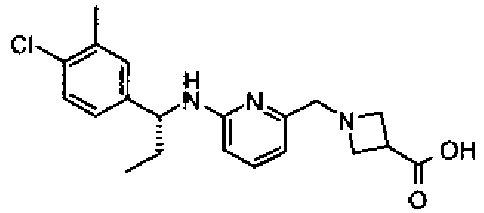
-

- To a mixture of 6-bromopyridine-2-carbaldehyde (368 mg, 1.98 mmol) and azetidine-3-carboxylic acid methyl ester hydrochloride (300 mg, 1.98 mmol) in MeOH (10 mL) was added AcOH (0.113 mL, 1.98 mmol) followed by PS-CNBH3 (3.5 mmol/g, 1.13 g, 3.96 mmol). The reaction mixture was stirred at room temperature for 48 hours. The mixture was filtered through Celite. The filtrate was concentrated and purified by chromatography on silica gel (cyclohexane/EtOAc) to give INT 64.
LC/MS method 2: MS (ESI): 285 [M+H]+, rt = 0.77 min. 1H-NMR (DMSO-d6): 6 (ppm) 7.70 (t, 1 H), 7.49 (d, 1H), 7.35 (d, 1H), 3.62 (s, 3H), 3.62 (s, 2H), 3.46 (t, 2H), 3.34-3.28 (m, 3H). - To a solution of INT 64 (300 mg, 1.052 mmol), (R)-1-(4-chloro-3-methyl-phenyl)-propylamine (232 mg, 1.263 mmol) and sodium tert-butoxide (243 mg, 2.53 mmol) in degassed toluene (5 mL) were added Pd2(dba)3 (19.27 mg, 0.021 mmol) and BINAP (26.2 mg, 0.042 mmol) and the resulting mixture was stirred at 70 °C for 16 hours. Another portion of Pd2(dba)3 (19.27 mg, 0.021 mmol) and BINAP (26.2 mg, 0.042 mmol) were added and the mixture was further stirred at 70 °C overnight. After cooling down, EtOH (2 mL) and water (5 mL) were then added, followed by LiOH (25.2 mg, 1.052 mmol) and the mixture was stirred at room temperature for 30 min. The pH was set to 5-6 and the mixture was extracted with CH2Cl2. The organic layer was dried over sodium sulfate, filtered and concentrated. The crude product was purified by flash chromatography (Reverse phase C18, H2O/CH3CN) to give 74.
LC/MS method 2: MS (ESI): 374 [M+H]+, rt = 1.85 min. 1H-NMR (DMSO-d6): δ (ppm) 7.31 (s, 1H), 7.28 (d, 1 H), 7.24 (d, 1H), 7.17 (d, 1 H), 6.86 (d, 1 H), 6.34 (d, 1H), 6.28 (d, 1 H), 4.65 (q, 1H), 3.44-3.30 (m, 4H), 3.24-3.10 (m, 3H), 2.27 (s, 3H), 1.80-1.71 (m, 1H). 1.70-1.61 (m, 1 H), 0.84 (t, 3H). -

- The title compound was prepared following a procedure analogous to Example 74 using 2-bromoisonicotinaldehyde in step 1.
LC/MS method 2: MS (ESI): 374 [M+H]+, rt = 1.41 min. -

- The title compound was prepared following a procedure analogous to Example 74 using 3-bromobenzaldehyde in step 1 and INT 68 (synthesis below) in step 2.
LC/MS method 4: MS (ESI): 399 [M+H]+, rt = 1.00 min. -

- A mixture of 4-chloro-3-methylbenzaldehyde (10.7 g, 69.2 mmol), (S)-2-methylpropane-2-sulfinamide (9.23 g, 76 mmol) and Ti(OiPr)4 (29.5 g, 104 mmol) in toluene (180 mL) was stirred at 50 °C overnight. The reaction was cooled down and quenched with saturated aqueous NaHCO3. The resulting precipitate was filtered over Celite and washed with EtOAc. The organic layer was washed with saturated aqueous NaHCO3 and the aqueous layers extracted with EtOAc. The combined organic layers were washed with brine, dried over sodium sulfate, filtered and concentrated to give the crude product which was purified by chromatography on silica gel (cyclohexane/EtOAc) to give INT 65.
LC/MS method 2: MS (ESI): 285 [M+H]+, rt = 0.77 min. 1H-NMR (CDCl3): 6 (ppm) 8.52 (s, 1H), 7.71 (d, 1H), 7.61 (dd, 1H), 7.44 (d, 1 H), 2.44 (s, 3H), 1.26 (s, 9H). -

- To a solution of INT 65 (1 g, 3.88 mmol) in CH2Cl2 (25 mL) at -50 °C was added dropwise cyclobutylmagnesium chloride (0.5 M in THF) (15.52 mL, 7.76 mmol) and the resulting mixture was allowed to warm up slowly to room temperature overnight. The mixture was then quenched with saturated aqueous NH4Cl and extracted with EtOAc. The organic layer was washed with brine, dried over sodium sulfate, filtered and concentrated. The crude product was purified by chromatography on silica gel (cyclohexane/EtOAc) to give INT 66 and INT 67.
INT 66 : LC/MS method 3: MS (ESI): 314 [M+H]+, rt = 1.55 min. 1H-NMR (CDCl3): 6 (ppm) 7.27 (d, 1H), 7.12 (d, 1H), 7.03 (dd, 1H), 4.21 (d, 1H), 3.28 (s, 1H), 2.55 (m, 1H), 2.35 (s, 3H), 2.13 (m, 1H), 1.94-1.78 (m, 3H), 1.76-1.67 (m, 2H), 1.17 (s, 9H).
INT 67 : LC/MS method 3: MS (ESI): 314 [M+H]+, rt = 1.55 min. 1H-NMR (CDCl3): δ (ppm) 7.28 (d, 1H), 7.14 (d, 1H), 7.05 (dd, 1H), 4.18 (dd, 1 H), 3.32 (d, 1H), 2.70 (m, 1H), 2.36 (s, 3H), 2.62-2.14 (m, 1H), 2.00-1.89 (m, 1 H), 1.89-1.79 (m, 1 H), 1.80-1.68 (m, 2H), 1.64 (q, 1 H), 1.20 (s, 9H). -

- To a solution of INT 66 (94 mg, 0.299 mmol) in MeOH (1 mL) was added HCl (4 M in dioxane, 0.150 mL, 0.600 mmol) and the mixture was stirred at room temperature overnight. The mixture was then concentrated and the INT 68 was crystallized from Et2O.
1H-NMR (DMSO-d6): δ (ppm) 8.48 (br s, 3H), 7.48 (d, 1H), 7.46 (d, 1 H), 7.33 (dd, 1H), 4.17 (d, 1H), 2.78 (m, 1H), 2.34 (s, 3H), 2.14-2.04 (m, 1H), 2.04-1.95 (m, 1H), 1.86-1.70 (m, 2H), 1.65 (q, 2H). -

- To a solution of INT 67 (260 mg, 0.828 mmol) in MeOH (1 mL) was added HCl (4 M in dioxane, 0.414 mL, 1.66 mmol) and the mixture was stirred at room temperature overnight. The mixture was then concentrated and the INT 69 was crystallized from Et2O.
1H-NMR (DMSO-d6): δ (ppm) 8.48 (brs, 3H), 7.48 (d, 1H), 7.46 (d, 1H), 7.33 (dd, 1H), 4.17 (d, 1 H), 2.78 (m, 1 H), 2.34 (s, 3H), 2.14-2.04 (m, 1 H), 2.04-1.95 (m, 1 H), 1.86-1.70 (m, 2H), 1.65 (q, 2H). -

- The title compound was prepared following a procedure analogous to Example 74 using 3-bromobenzaldehyde in step 1 and INT 69 in step 2.
LC/MS method 2: MS (ESI): 399 [M+H]+, rt = 2.19 min. -

-

- A mixture of 4-bromopyridine-2-carbaldehyde (768 mg, 3.51 mmol) and azetidine-3-carboxylic acid tert-butyl ester hydrochloride (680 mg, 3.51 mmol) in 1,2-dichloroethane (35 mL) was stirred at room temperature for 45 minutes. NaBH(OAc)3 (1.49 g, 7.02 mmol) was then added and the mixture was stirred at room temperature for 18 hours. The mixture was diluted in CH2Cl2 and washed with saturated aqueous sodium bicarbonate, water and brine, dried over sodium sulfate, filtered and concentrated. The crude was purified by chromatography on silica gel (heptane/EtOAc) to give INT 70.
LC/MS method 3: MS (ESI): 328 [M+H]+, rt = 0.89 min. 1H-NMR (DMSO-d6): δ (ppm) 8.37 (d, 1 H), 7.55 (m, 2H), 7.53 (m, 2H), 3.65 (s, 2H), 3.45 (t, 2H), 3.25 (q, 2H), 2.50 (m, 1H), 1.41 (s, 9H). - To a solution of INT 70 (200 mg, 0.611 mmol), (R)-1-(4-chloro-3-methyl-phenyl)-propylamine (135 mg, 0.733 mmol) and sodium tert-butoxide (141 mg, 1.467 mmol) in degassed toluene (3 mL) were added Pd2(dba)3 (28.0 mg, 0.031 mmol) and BINAP (38.1 mg, 0.061 mmol) and the resulting mixture was stirred at 70 °C overnight. Another portion of Pd2(dba)3 (28.0 mg, 0.031 mmol) and BINAP (38.1 mg, 0.061 mmol) were added and the mixture was further stirred at 70 °C overnight. The solvent was evaporated and the crude product treated with TFA (2 ml) and the resulting mixture stirred at room temperature for 1 hour. The TFA was evaporated, water was added and the pH was set to 7. The aqueous layer was extracted with CH2Cl2. The aqueous layer containing the product was lyophilized. The mixture obtained was suspended in DMSO and the solid was filtered off. The filtrate was purified by flash chromatography (Reverse phase C18, H2O/CH3CN) to give 78.
LC/MS method 2: MS (ESI): 374 [M+H]+, rt = 1.42 min. 1H-NMR (DMSO-d6): δ (ppm) 7.81 (d, 1H), 7.31 (d, 1H), 7.30 (s, 1 H), 7.15 (d, 1H), 7.01 (d, 1 H), 6.43 (s, 1 H), 6.26 (s, 1 H), 4.26 (q, 1 H), 3.40 (AB, 2H), 3.37-3.10 (m, 5H), 2.28 (s, 3H), 1.79-1.70 (m, 1 H), 1.69-1.61 (m, 1 H), 1.087 (t, 3H). -

- The title compound was prepared following a procedure analogous Example 78 using 2-bromo-5-chloropyridine-4-carboxaldehyde in step 1.
LC/MS method 2: MS (ESI): 408 [M+H]+, rt = 1.94 min. -

- The title compound was prepared according to Scheme 3 following a procedure analogous to Example 21 using amine INT 38 (synthesis see Example 41) in step 4 and 3-amino-2,2-dimethyl-propionic acid in step 6.
LC/MS method 2: MS (ESI): 417 [M+H]+, rt = 2.19 min. -

- The title compound was prepared according to Scheme 3 following a procedure analogous to Example 21 using amine INT 38 (synthesis see Example 41) in step 4 and (S)-3-amino-2-methyl-propionic acid in step 6.
LC/MS method 2: MS (ESI): 403 [M+H]+, rt = 2.18 min. -

- The title compound was prepared according to Scheme 3 following a procedure analogous to Example 21 using amine INT 38 (synthesis see Example 41) in step 4 and 3-methylamino-propionic acid in step 6.
LC/MS method 2: MS (ESI): 403 [M+H]+, rt = 2.58 min. -

- The title compound was prepared according to Scheme 3 following a procedure analogous to Example 21 using 3-methyl-pyrrolidine-3-carboxylic acid in step 6.
LC/MS method 2: MS (ESI): 455 [M+H]+, rt = 2.34 min. -

- The title compound was prepared according to Scheme 3 following a procedure analogous to Example 57 using INT51 and (S)-1-(4-Chloro-3-methyl-phenyl)-2,2,2-trifluoro-ethylamine hydrochloride in step 2 and (R)-pyrrolidine-3-carboxylic acid in step 4.
LC/MS method 4: MS (ESI): 462 [M+H]+, rt = 0.95 min. -

- The title compound was prepared according to Scheme 3 following a procedure analogous to Example 57 using INT51 and (S)-1-(4-Chloro-3-methyl-phenyl)-2,2,2-trifluoro-ethylamine hydrochloride in step 2 and 3-amino-propionic acid in step 4.
LC/MS method 4: MS (ESI): 436 [M+H]+, rt = 0.91 min. -

- The title compound (single stereoisomer A) was obtained by preparative chiral separation of Example 57. Separation was performed using a Chiralpak AD-i 5 x 20 cm (20 µM) column and heptanel CH2O2/EtOH/TFA (75:22:3:0.05) as mobile phase with a flow of 40 ml/min and UV detection (254 nM).
Chiral HPLC (Chiralpak AD-i 4.6 x 250 mm (20 µM), heptane/ CH2Cl2/EtOH/TFA (75:22:3:0.05), 0.7 ml/min. UV detection (254 nm)): rt = 9.74 min.
LC/MS method 2: MS (ESI): 436 [M+H]+, rt = 1.85 min. -

- The title compound (single stereoisomer B) was obtained by preparative chiral separation of Example 57. Separation was performed using a Chiralpak AD-i 5 x 20 cm (20 µM) column and heptane/ CH2Cl2/EtOH/TFA (75:22:3:0.05) as mobile phase with a flow of 40 ml/min and UV detection (254 nM).
Chiral HPLC (Chiralpak AD-i 4.6 x 250 mm (20 µM), heptane/CH2Cl2/EtOH/TFA (75:22:3:0.05), 0.7 ml/min. UV detection (254 nm)): rt = 13.44 min.
LC/MS method 2: MS (ESI): 436 [M+H]+, rt = 1.91 min. - The compounds of formula (I) and/or formula (II) in free form or in salt form, exhibit valuable pharmacological properties, e.g. properties susceptible to lymphocytes interactions or sphingosine-1-phosphate receptor (S1P) modulating properties, in particular S1P-antagonistic efficacy, especially S1P1-antagonistic efficacy, e.g. as indicated in in vitro and in vivo tests as provided in the next sections and are therefore indicated for therapy.
- The assay measures intracellular changes of Ca2+ mediated by the synthetic probing agonist 3-{[2-(2-Trifluoromethyl-biphenyl-4-yl)-benzo[b]thiophen-5-ylmethyl]-amino}-propionic acid (GNF-AC-1) in the HeLa-S1P1/Gα16 cell clone 1: HeLa (human cervix carcinoma, ATCC CCL2) cells stably expressing N-terminally myc-tagged human S1P1 receptors {GenBank™ accession No. NM_001400; UNIPROT P21453) and promiscuous Gα16 protein (GenBank™ accession number M63904, Swissprot P30679) are cultured at 37°C, 5 % CO2, and 95 % relative humidity. The cells are plated in 384 well black plates (10'000 cells per well). After 24 hours the cells are loaded with Fluo4-AM (1.6 µM in HBSS and 2.5 mM probenicid) for 1 hour at 37°C. After washing, the cells are transferred to the FLIPR. The test compounds are added at different concentrations (≤100 µM) in HBSS in the presence of 0.1% BSA and changes in fluorescence are recorded (indication of agonism). The probing agonist is added 20-30 minutes afterwards to the wells at a concentration giving 80% of the maximal activity (EC80). After each addition, time points are collected as follows: 20 time points (2 seconds) before the addition of the agonist (Fmin) and 60 time points (1 or 2 seconds) after the addition of the probing agonist. This allows the determination of the maximal fluorescence (Fmax). The ratio (Fmax-Fmin)/Fmin is plotted against the log of the concentration of the test compounds and the IC50 (relative antagonism) is calculated using the XLfit-4 software. Compounds with an inhibition <20% are usually considered "inactive". A concentration-response curve of the probing agonist is determined on each plate in parallel.
- The IC50 values of compounds of formula (I) in the above described Human S1P Receptor Calcium FLIPR Antagonist Assay are displayed in Table 1.
Table 1: Example No. IC50 [nM] 1 14.7 2 3.5 3 0.9 4 0.2 6 0.5 7 1.2 8 1.5 9 0.4 10 1.6 11 4.0 13 4.7 14 1.5 15 2.3 17 1.6 18 1.9 20 2.0 21 1.0 22 0.8 23 1.0 24 1.9 25 3.3 26 2.1 27 10.6 28 0.8 29 0.4 30 0.9 31 1.0 32 0.8 33 0.6 34 0.8 35 1.8 36 3.7 37 2.5 38 0.8 39 0.8 40 0.4 41 1.3 42 1.0 43 0.8 44 6.7 45 1.2 46 1.3 47 1.6 48 2.4 49 2.4 52 0.9 53 1.2 54 0.9 55 0.5 57 2.4 58 0.1 59 1.2 60 2.1 61 1.6 62 0.9 63 1.1 64 1.7 65 0.2 66 1.2 67 0.8 68 0.7 69 0.8 70 0.1 71 0.1 72 1.1 73 1.2 74 14.1 75 2.8 76 5.7 78 0.8 79 0.6 80 24.5 81 3.9 82 3.0 83 2.9 84 0.4 85 0.9 86 1.2 87 0.7 - The compounds of the invention, e.g. compounds of formula (I) typically induce the depletion of blood lymphocyte as may be determined in the assay described below. Moreover, compounds of the invention, e.g. compounds of formula (I) are typically efficacious in the said assay also when administered via the per oral route of administration.
- The test compounds (or salts thereof) are dissolved in a vehicle such as water, saline, PEG (polyethylene glycol) 200, or PBS (phosphate buffered saline). Adult mice (C57BL/6NCrl strain, female, 18-20 g) or rats (Lewis strain, male, 6-12 weeks old) are administered up to 60 mg/kg of the test compounds in 10 ml/kg (C57BL/6NCrl mice) or 2 ml/kg (Lewis rats) vehicle via per oral application. The vehicle or a reference salt and FTY720 (0.3 mg/kg) are used as negative and positive controls, respectively. Blood is collected from the sublingual vein at single time points, e.g. 14 or 24 hours after the test compound administration, under short isoflurane anesthesia. Two to three animals are used in each group. Whole blood samples are subjected to hematology analysis. Peripheral lymphocyte counts are determined using an automated analyzer. The Haemathology System uses a combination of light scatter, cytochemical staining and nuclear density on two independent channels to measure the total and differential white cell counts. The reduction of lymphocytes provoked by each test compound is calculated by comparing the lymphocyte counts measured after each treatment to the mean lymphocyte counts measured in five to eight untreated mice or rats, respectively. The data are presented as mean ± STDEV.
As an example, Table 2 shows the effect on lymphocyte counts at the indicated time points in hours after oral administration of a given dose in mg/kg of some compounds of formula (I) to the indicated species, as compared to the mean lymphocyte counts of untreated animals.Table 2: Example No Species Dose (mg/kg) Time point (hours) Residual Lymphocyte Counts 24 hours after p.o. dosing 21 C57BL/6NCrl mice 30 24 17.8 % ± 2.3 55 C57BL/6NCrl mice 30 24 43.6 % ± 4.6 43 C57BL/6NCrl mice 30 24 21.8% ± 3.4 29 C57BL/6NCrl mice 30 24 35.6 % ± 4.6 34 C57BL/6NCrl mice 30 24 24.2 % ± 2.3 62 C57BL/6NCrl mice 30 24 31.5 % ± 8.0 42 C57BL/6NCrl mice 30 24 19.4 % ± 2.3 42 Lewis rats 30 24 22.2 % ± 6.7 65 C57BL/6NCrl mice 30 24 22.6%±11.4 66 C57BL/6NCrl mice 30 24 19.4 % ± 2.3 41 C57BL/6NCrl mice 30 24 20.2 % ± 8.0 30 C57BL/6NCrl mice 30 24 19.4 % ± 2.3 30 Lewis rats 30 24 26.9 ± 13.0 32 C57BL/6NCrl mice 30 24 17.0 % ± 3.4 33 C57BL/6NCrl mice 30 24 16.2 % ± 2.3 23 C57BL/6NCrl mice 30 24 25.1 % ± 3.4 70 C57BL/6NCrl mice 30 24 20.2 % ± 5.7 31 C57BU6NCrl mice 30 24 23.4 % ± 3.4 61 C57BU6NCrl mice 30 24 16.2 % ± 4.6 84 Lewis rats 30 24 16.8 % ± 7.2 85 Lewis rats 30 24 11.6% ± 0.3 - The compounds of the invention, e.g. compounds of formula (I) in free form or in pharmaceutically acceptable salt form, exhibit valuable pharmacological properties, e.g. as S1P1 receptor antagonists, e.g. as indicated in the above in vitro and in vivo tests and are therefore indicated for therapy.
- Compounds of the invention may be useful in the treatment of an indication selected from:
- Diseases or disorders mediated by lymphocytes interactions, e.g. in transplantation, such as acute or chronic rejection of cell, tissue or organ allo- or xenografts or delayed graft function, graft versus host disease, autoimmune diseases, e.g. rheumatoid arthritis, systemic lupus erythematosus, hashimoto's thyroidis, multiple sclerosis, myasthenia gravis, neuropathic pain, Behcet's disease, Wegener's granulamatosis, ankylosing spondylitis, polymyositis, CIDP (Chronic Idiopathic Demyelinating Polyneuropathy), diabetes type I or II and the disorders associated therewith, vasculitis, pernicious anemia, Sjoegren syndrome, uveitis, psoriasis, Graves ophthalmopathy, alopecia areata and others, allergic diseases, e.g. allergic asthma, atopic dermatitis, allergic rhinitis/conjunctivitis, allergic contact dermatitis, inflammatory diseases optionally with underlying aberrant reactions, e.g. inflammatory bowel disease, Crohn's disease or ulcerative colitis, intrinsic asthma, inflammatory lung injury, inflammatory liver injury, inflammatory glomerular injury, atherosclerosis, osteoarthritis, irritant contact dermatitis and further eczematous dermatitises, seborrhoeic dermatitis, cutaneous manifestations of immunologically-mediated disorders, inflammatory eye disease, keratoconjunctivitis, myocarditis or hepatitis, ischemia/reperfusion injury, e.g. myocardial infarction, stroke, gut ischemia, renal failure or hemorrhage shock, traumatic shock, cancer, e.g. breast cancer, T cell lymphomas or T cell leukemias, infectious diseases, e.g. toxic shock (e.g. superantigen induced), septic shock, adult respiratory distress syndrome or viral infections, e.g. AIDS, viral hepatitis, e.g. hepatitis B or C, chronic bacterial infection, or neurodegenerative diseases, e.g. Alzheimer disease, amyotrophic lateral sclerosis or senile dementia. Examples of cell, tissue or solid organ transplants include e.g. pancreatic islets, stem cells, bone marrow, corneal tissue, neuronal tissue, heart, lung, combined heart-lung, kidney, liver, bowel, pancreas, trachea or oesophagus.
- Furthermore, the compounds of the invention, e.g. compounds of formula (I) are useful in the treatment and/or prevention of diseases or disorders associated with deregulated angiogenesis for example diseases caused by ocular neovascularisation, especially retinopathies (diabetic retinopathy, age-related macular degeneration); psoriasis; haemangioblastomas, such as "strawberry-marks" (=haemangioma); various inflammatory diseases, such as arthritis, especially rheumatoid arthritis, arterial atherosclerosis and atherosclerosis occurring after transplants, endometriosis or chronic asthma; and, especially, tumor diseases (solid tumors, but also leukemias and other liquid tumors).
- Thus, as a further embodiment, the present invention provides the use of a compound of the invention, e.g. a compound of formula (I) or a salt thereof in therapy.
- In a further embodiment, the therapy is selected from a disease which may be treated by an antagonist of sphingosine-1-phosphate.
- In another embodiment, the disease is selected from the afore-mentioned list, suitably diseases or disorders mediated by lymphocytes interactions, e.g. in transplantation, such as acute or chronic rejection of cell, tissue or organ allo- or xenografts or delayed graft function, graft versus host disease, autoimmune diseases, e.g. rheumatoid arthritis, systemic lupus erythematosus, hashimoto's thyroidis, multiple sclerosis, myasthenia gravis, neuropathic pain, Behcet's disease, Wegener's granulamatosis, ankylosing spondylitis, polymyositis, CIDP (Chronic Idiopathic Demyelinating Polyneuropathy), diabetes type I or II and the disorders associated therewith, vasculitis, pernicious anemia, Sjoegren syndrome, uveitis, psoriasis, Graves ophthalmopathy, alopecia areata and others, allergic diseases, e.g. allergic asthma, atopic dermatitis, allergic rhinitis/conjunctivitis, allergic contact dermatitis, inflammatory diseases optionally with underlying aberrant reactions, e.g. inflammatory bowel disease, Crohn's disease or ulcerative colitis, intrinsic asthma, inflammatory lung injury, inflammatory liver injury, inflammatory glomerular injury, atherosclerosis, osteoarthritis, irritant contact dermatitis and further eczematous dermatitises, seborrhoeic dermatitis, cutaneous manifestations of immunologically-mediated disorders, inflammatory eye disease, keratoconjunctivitis, myocarditis or hepatitis, ischemia/reperfusion injury, e.g. myocardial infarction, stroke, gut ischemia, renal failure or hemorrhage shock, traumatic shock, cancer, e.g. breast cancer, T cell lymphomas or T cell leukemias, infectious diseases, e.g. toxic shock (e.g. superantigen induced), septic shock, adult respiratory distress syndrome or viral infections, e.g. AIDS, viral hepatitis, e.g. hepatitis B or C, chronic bacterial infection, or neurodegenerative diseases, e.g. Alzheimer disease, amyotrophic lateral sclerosis or senile dementia. Examples of cell, tissue or solid organ transplants include e.g. pancreatic islets, stem cells, bone marrow, corneal tissue, neuronal tissue, heart, lung, combined heart-lung, kidney, liver, bowel, pancreas, trachea or oesophagus;
also suitably in the treatment and/or prevention of diseases or disorders associated with deregulated angiogenesis for example diseases caused by ocular neovascularisation, especially retinopathies (diabetic retinopathy, age-related macular degeneration); psoriasis; haemangioblastomas, such as "strawberry-marks" (=haemangioma); various inflammatory diseases, such as arthritis, especially rheumatoid arthritis, arterial atherosclerosis and atherosclerosis occurring after transplants, endometriosis or chronic asthma; and, especially, tumor diseases (solid tumors, but also leukemias and other liquid tumors). - The invention also describes a method of treating a disease which is treated by the modulation of the S1P receptor comprising administration of a therapeutically acceptable amount of a compound of formula (I) or a salt thereof, wherein the disease is selected from the afore-mentioned lists
- The pharmaceutical composition or combination of the present invention can be in unit dosage of about 1-1000 mg of active ingredient(s) for a subject of about 50-70 kg, or about 1-500 mg or about 1-250 mg or about 1-150 mg or about 0.5-100 mg, or about 1-50 mg of active ingredients. The therapeutically effective dosage of a compound, the pharmaceutical composition, or the combinations thereof, is dependent on the species of the subject, the body weight, age and individual condition, the disorder or disease or the severity thereof being treated. A physician, clinician or veterinarian of ordinary skill can readily determine the effective amount of each of the active ingredients necessary to prevent, treat or inhibit the progress of the disorder or disease.
- The above-cited dosage properties are demonstrable in vitro and in vivo tests using advantageously mammals, e.g., mice, rats, dogs, monkeys or isolated organs, tissues and preparations thereof. The compounds of the present invention can be applied in vitro in the form of solutions, e.g., aqueous solutions, and in vivo either enterally, parenterally, advantageously intravenously, e.g., as a suspension or in aqueous solution. The dosage in vitro may range between about 10-3 molar and 10-9 molar concentrations. A therapeutically effective amount in vivo may range depending on the route of administration, between about 0.1-500 mg/kg, or between about 1-100 mg/kg.
- The compound of the present invention may be administered either simultaneously with, or before or after, one or more other therapeutic agent. The compound of the present invention may be administered separately, by the same or different route of administration, or together in the same pharmaceutical composition as the other agents. The compounds of formula (I) or formula (II) may be administered as the sole active ingredient or in conjunction with, e.g. as an adjuvant to, other drugs e.g. immunosuppressive or immunomodulating agents or other anti-inflammatory agents, e.g. for the treatment or prevention of allo- or xenograft acute or chronic rejection or inflammatory or autoimmune disorders, or a chemotherapeutic agent, e.g a malignant cell anti-proliferative agent. For example, the compounds of formula (I) or formula (II) may be used in combination with a calcineurin inhibitor, e.g. cyclosporin A or FK 506; a mTOR inhibitor, e.g. rapamycin, 40-O-(2-hydroxyethyl)-rapamycin, CCI779, ABT578, AP23573, AP23464, AP23675, AP23841, TAFA-93, biolimus-7 or biolimus-9; an ascomycin having immunosuppressive properties, e.g. ABT-281, ASM981 (Pimecrolimus), etc.; corticosteroids; cyclophosphamide; azathioprene; methotrexate; leflunomide; mizoribine; mycophenolic acid or salt; mycophenolate mofetil; 15-deoxyspergualine or an immunosuppressive homologue, analogue or derivative thereof; a PKC inhibitor, e.g. as disclosed in
WO 02/38561 WO 03/82859 WO 04/052359 WO 05/066156 WO2009098236 ), β-Cyclopentyl-4-(7H-pyrrolo[2, 3-d]pyrimidin-4-yl)-(βR)-1H-pyrazole-1-propanenitrile (INCB018424), lestaurtinib (CEP701), (N-tert-butyl-3-(5-methyl-2-(4-(2-(pyrrolidin-1-yl)ethoxy)phenylamino)pyrimidin-4-ylamino)benzenesulfonamide (TG101348), 11-[2-(1-pyrrolidinyl)ethoxy]-14,19-dioxa-5,7,27-triazatetra-cyclo[19.3.1.1(2,6).1(8,12)]heptacosa-1(25),2(27),3,5,8(26),9,11,16,21,23-decaene (SB1518 or ONX-0803), N-(cyanomethyl)-4-[2-[4-(4-morpholinyl)phenylamino]pyrimidin-4-yl]benzamide (CYT387) ; a STAT3 inhibitor such as N-[5-(2-Furyl)-1,3,4-oxadiazol-2-yl]-2-phenylquinoline-4-carboxamide (STX-0119); an IL-6 receptor antibody such as atlizumab; a sphingosine-1-phosphate receptor modulator such as FTY720 (fingolimod), or compounds disclosed inWO 2005/000833 ; immunosuppressive monoclonal antibodies, e.g., monoclonal antibodies to leukocyte receptors, e.g., MHC, CD2, CD3, CD4, CD7, CD8, CD25, CD28, CD40, CD45, CD52, CD58, CD80, CD86 or their ligands; other immunomodulatory compounds, e.g. a recombinant binding molecule having at least a portion of the extracellular domain of CTLA4 or a mutant thereof, e.g. an at least extracellular portion of CTLA4 or a mutant thereof joined to a non-CTLA4 protein sequence, e.g. CTLA4lg (for ex. designated ATCC 68629) or a mutant thereof, e.g. LEA29Y; adhesion molecule inhibitors, e.g. LFA-1 antagonists, ICAM-1 or -3 antagonists, VCAM-4 antagonists or VLA-4 antagonists; or a chemotherapeutic agent, e.g. paclitaxel, gemcitabine, cisplatinum, doxorubicin or 5-fluorouracil; or an anti-infectious agent. - In another embodiment the present invention relates to a combination comprising a compound of formula (I) or formula (II) or a salt thereof as described in any of the embodiments and at least another drug substance selected from a a JAK2 kinase inhibitor, e.g. [7-(3,5-Difluoro-4-morpholin-4-ylmethyl-phenyl)-7H-pyrrolo[2,3-d]pyrimidin-2-yl]-[6-(cis-3,5-dimethyl-piperazin-1-yl)-pyridin-3-yl]-amine (example 267 in
WO2009098236 ), β-Cyclopentyl-4-(7H-pyrrolo[2,3-d]pyrimidin-4-yl)-(PR)-1H-pyrazole-1-propanenitrile (INCB018424), lestaurtinib (EP701), (N-tert-butyl-3-(5-methyl-2-(4-(2-(pyrrolidin-1-yl)ethoxy)phenylamino)pyrimidin-4-ylamino)-benzene-sulfonamide (TG101348), tasocitinib (CP690550), 11-[2-(1-pyrrolidinyl)ethoxy]-14,19-dioxa-5,7,27-triazatetra-cyclo[19.3.1.1 (2,6).1 (8, 12)]heptacosa-1 (25),2(27),3,5,8(26),9,11,16,21,23-decaene (ski 51 8 or ONX-0803), N-(cyanomethyl)-4-[2-[4-(4-morpholinyl)phenylamino]pyrimidin-4-yl]benzamide (CYT387), in free form or in a pharmaceutically acceptable salt form. - In another embodiment the present invention relates to a combination comprising a compound of formula (I) or formula (II) or a salt thereof as described in any of the embodiments and at least another drug substance selected from a a JAK3 kinase inhibitor, e.g. e.g. N-benzyl-3,4-dihydroxy-benzylidene-cyanoacetamide α-cyano-(3,4-dihydroxy)-]N-benzylcinnamamide (Tyrphostin AG 490), prodigiosin 25-C (PNU156804), [4-(4'-hydroxyphenyl)-amino-6,7-dimethoxyquinazoline] (WHI-P131 [4-(3'-bromo-4'-hydroxylphenyl)-amino-6,7-dimethoxyquinazoline] (WHI-P154), [4-(3',5'-dibromo-4'-hydroxylphenyl)-amino-6,7-dimethoxyquinazoline] WHI-P97, KRX-211, in free form or in a pharmaceutically acceptable salt form.
- A combination of a compound of formula (I) or formula (II) and at least another compound selected from a JAK2 and/or JAK3 inhibitor may be beneficial in the treatment of cancer such as breast cancer, colorectal carcinoma, Wilms tumor, or the like.
- In another embodiment the present invention relates to the use of a combination as described above, e.g. a compound of formula (I) or formula (II) and at least another compound, e.g. selected from a JAK2 and/or JAK3 inhibitor for use in the treatment of cancer, in particular breast cancer, colorectal carcinoma, or Wilms tumor.
- The terms "co-administration" or "combined administration" or the like as utilized herein are meant to encompass administration of the selected therapeutic agents to a single patient, and are intended to include treatment regimens in which the agents are not necessarily administered by the same route of administration or at the same time.
- The term "pharmaceutical combination" as used herein means a product that results from the mixing or combining of more than one active ingredient and includes both fixed and non-fixed combinations of the active ingredients. The term "fixed combination" means that the active ingredients, e.g. a compound of formula (I) or formula (II) and a co-agent, are both administered to a patient simultaneously in the form of a single entity or dosage. The term "non-fixed combination" means that the active ingredients, e.g. a compound of formula (I) or formula (II) and a co-agent, are both administered to a patient as separate entities either simultaneously, concurrently or sequentially with no specific time limits, wherein such administration provides therapeutically effective levels of the 2 compounds in the body of the patient. The latter also applies to cocktail therapy, e.g. the administration of 3 or more active ingredients.
- In one embodiment, the invention provides a product comprising a compound of formula (I) or formula (II) and at least one other therapeutic agent as a combined preparation for simultaneous, separate or sequential use in therapy. In one embodiment, the therapy is the treatment of a disease or condition mediated by sphingosine-1-phosphate receptors. Products provided as a combined preparation include a composition comprising the compound of formula (I) or formula (II) and the other therapeutic agent(s) together in the same pharmaceutical composition, or the compound of formula (I) or formula (II) and the other therapeutic agent(s) in separate form, e.g. in the form of a kit.
- In one embodiment, the invention provides a pharmaceutical composition comprising a compound of formula (I) or formula (II) and another therapeutic agent(s). Optionally, the pharmaceutical composition may comprise a pharmaceutically acceptable excipient, as described above.
- In one embodiment, the invention provides a kit comprising two or more separate pharmaceutical compositions, at least one of which contains a compound of formula (I) or formula (II). In one embodiment, the kit comprises means for separately retaining said compositions, such as a container, divided bottle, or divided foil packet. An example of such a kit is a blister pack, as typically used for the packaging of tablets, capsules and the like.
- The kit of the invention may be used for administering different dosage forms, for example, oral and parenteral, for administering the separate compositions at different dosage intervals, or for titrating the separate compositions against one another. To assist compliance, the kit of the invention typically comprises directions for administration.
- In the combination therapies of the invention, the compound of the invention and the other therapeutic agent may be manufactured and/or formulated by the same or different manufacturers. Moreover, the compound of the invention and the other therapeutic may be brought together into a combination therapy: (i) prior to release of the combination product to physicians (e.g. in the case of a kit comprising the compound of the invention and the other therapeutic agent); (ii) by the physician themselves (or under the guidance of the physician) shortly before administration; (iii) in the patient themselves, e.g. during sequential administration of the compound of the invention and the other therapeutic agent.
Accordingly, the invention provides the use of a compound of formula (I) or formula (II) for treating a disease or condition mediated by sphingosine-1-phosphate receptors, wherein the medicament is prepared for administration with another therapeutic agent. The invention also provides the use of another therapeutic agent for treating a disease or condition mediated by sphingosine-1-phosphate receptors, wherein the medicament is administered with a compound of formula (I) or formula (II). - The invention also describes a compound of formula (I) or formula (II) for use in a method of treating a disease or condition mediated by sphingosine-1-phosphate receptors, wherein the compound of formula (I) or formula (II) is prepared for administration with another therapeutic agent. The invention also describes another therapeutic agent for use in a method of treating a disease or condition mediated by sphingosine-1-phosphate receptors, wherein the other therapeutic agent is prepared for administration with a compound of formula (I) or formula (II). The invention also describes a compound of formula (I) or formula (II) for use in a method of treating a disease or condition mediated by sphingosine-1-phosphate receptors, wherein the compound of formula (I) or formula (II) is administered with another therapeutic agent. The invention also describes another therapeutic agent for use in a method of treating a disease or condition mediated by sphingosine-1-phosphate receptors, wherein the other therapeutic agent is administered with a compound of formula (I) or formula (II).
-
- Embodiment 1 describes a compound of formula (I) or a pharmaceutically acceptable salt thereof;

- R1 is hydrogen, halogen or C1-C6 alkyl optionally substituted by halogen;
- R2 is halogen, C1-C6 alkyl optionally substituted by halogen, cyano, or C1-C6 alkoxy optionally substituted by halogen;
- or R1 and R2 together with the C-atoms to which they are attached form an aryl ring with 6-10 carbon atoms, which may optionally be substituted by 1-4 substituents selected from cyano, C1-C4-alkyl optionally substituted by halogen, C1-C4-alkoxy optionally substituted by halogen, and halogen;
- R3 is hydrogen, halogen or C1-C6 alkyl optionally substituted by halogen;
- R4 is hydrogen, C3-C6 cycloalkyl or C1-C6 alkyl optionally substituted by halogen;
- R5 is hydrogen or C1-C6 alkyl;
- R6 and R7 are independently selected from H and C1-C6 alkyl or they may form together with the carbon atom to which they are attached a 3 - 7 membered saturated carbocyclic ring;
- R8 and R9 are independently selected from H and C1-C6 alkyl, or R8 and R9 may form together with the atoms to which they are attached a 4 - 7 membered heterocyclic ring, optionally substituted one or more times by C1-C6-alkyl optionally substituted by halogen, trifluoromethyl, hydroxy, or amino;
- n=1,2,3or4;
- R10 is hydrogen, C1-C6 alkyl, amino, hydroxy or C1-C6 alkoxy;
- R is selected from H ; phenyl being optionally substituted by C1-C6 alkyl, C1-C6 alkoxy, halogen or hydroxy ; and C1-C6 alkyl optionally substituted by C1-C6 alkoxy, halogen, hydroxy, or phenyl optionally substituted by C1-C6 alkyl, C1-C6 alkoxy, halogen or hydroxy,
- X1, X2, X3 and X4, are each independently selected from N or CR11,
- R11 in each case being independently selected from H, halo, cyano, C1-C6 alkoxy, C1-C6 alkyl optionally substituted by halo; or -SO2-C1-C6 alkyl; and
- Y stands in each occurrence independently for CR12R13 wherein R12 and R13 are independently selected from H and C1-C6 alkyl.
- Embodiment 2 describes a compound of formula (II) or a pharmaceutically acceptable salt thereof,

- R1 is hydrogen, halogen or C1-C6 alkyl optionally substituted by halogen;
- R2 is halogen, C1-C6 alkyl optionally substituted by halogen, cyano, or C1-C6 alkoxy optionally substituted by halogen;
- or R1 and R2 together with the C-atoms to which they are attached form an aryl ring with 6-10 carbon atoms, which may optionally be substituted by 1-4 substituents selected from cyano, C1-C4-alkyl optionally substituted by halogen, C1-C4-alkoxy optionally substituted by halogen, and halogen;
- R3 is hydrogen, halogen or C1-C6 alkyl optionally substituted by halogen;
- R4 is hydrogen, C3-C6 cycloalkyl or C1-C6 alkyl optionally substituted by halogen;
- R5 is hydrogen or C1-C6 alkyl;
- R6 and R7 are independently selected from H and C1-C6 alkyl, or they may form together with the carbon atom to which they are attached a 3 - 7 membered saturated carbocyclic ring;
- n = 1, 2, 3 or 4;
- R10 is hydrogen, C1-C6 alkyl, amino, hydroxy or C1-C6 alkoxy;
- R is selected from H; phenyl) being optionally substituted by C1-C6 alkyl, C1-C6 alkoxy, halogen or hydroxy; and C1-C6 alkyl optionally substituted by C1-C6 alkoxy, halogen, hydroxy, or phenyl, said phenyl, being optionally substituted by C1-C6 alkyl, C1-C6 alkoxy, halogen or hydroxy;
- X1, X2, X3 and X4, are each independently selected from N or CR11,
- R11 in each case being independently selected from H, halo, cyano, C1-C6 alkoxy, C1-C6 alkyl optionally substituted by halo; or -SO2-C1-C6 alkyl; and
- Y stands in each occurrence independently for CR12R13 wherein R12 and R13 are independently selected from H and C1-C6 alkyl optionally substituted by halogen.
- Embodiment 3 describes a compound of embodiment 1 or 2 or a pharmaceutically acceptable salt thereof, wherein R1 and R stand for hydrogen.
- Embodiment 4 describes a compound of any of the preceding enumerated embodiments or a pharmaceutically acceptable salt thereof, wherein n is 2.
- Embodiment 5 describes a compound of any of the preceding enumerated embodiments, wherein X3 is CR11 and wherein R11 stands for methyl.
- Embodiment 6 describes a compound in accordance to any of the preceding enumerated embodiments or a pharmaceutically acceptable salt thereof, wherein R4 is trifluoromethyl and R5 is hydrogen.
- Embodiment 7 describes a compound of embodiment 1 or 2 or a pharmaceutically acceptable salt thereof, which is selected from:
- 1-{3-[1-(4-Chloro-3-methyl-phenyl)-ethylamino]-benzyl)-azetidine-3-carboxylic acid,
- 1-{3-[1-(4-Chloro-3-methyl-phenyl)-propylamino]-benzyl}-azetidine-3-carboxylic acid,
- 1-{3-[(R)-1-(4-Chloro-3-methyl-phenyl)-propylamino]-benzyl}-azetidine-3-carboxylic acid,
- 1-{5-[1-(4-Chloro-3-methyl-phenyl)-propylamino]-2-methyl-benzyl}-azetidine-3-carboxylic acid,
- 1-{3-[1-(4-Chloro-3-methyl-phenyl)-propylamino]-4-methyl-benzyl}-azetidine-3-carboxylic acid,
- 1-((1-{3-[(R)-1-(4-Chloro-3-methyl-phenyl)-propylamino]-phenyl}-ethyl)-azetidine-3-carboxylic acid,
- 1-{3-[1-(4-Chloro-3-methyl-phenyl)-propylamino]-2-methyl-benzyl}-azetidine-3-carboxylic acid,
- 1-{3-[(R)-1-(4-Chloro-3-methyl-phenyl)-propylamino]-benzyl}-3-methyl-azetidine-3-carboxylic acid,
- 1-{3-[1-(4-Chloro-3-methyl-phenyl)-propylamino]-5-methyl-benzyl}-azetidine-3-carboxylic acid,
- 1-((1-{5-[1-(4-Chloro-3-methyl-phenyl)-propylamino]-2-methyl-phenyl}-ethyl)-azetidine-3-carboxylic acid,
- (R)-1-{3-[(R)-1-(4-Chloro-3-methyl-phenyl)-propylamino]-benzyl}-pyrrolidine-3-carboxylic acid,
- (S)-1-{3-[(R)-1-(4-Chloro-3-methyl-phenyl)-propylamino]-benzyl}pyrrolidine-3-carboxylic acid,
- 1-((1-{3-[(R)-1-(4-Chloro-3-methyl-phenyl)-propylamino]-phenyl}-propyl)-azetidine-3-carboxylic acid,
- (R)-1-{3-[1-(4-Chloro-3-methyl-phenyl)-propylamino]-2-methyl-benzyl}pyrrolidine-3-carboxylic acid,
- (R)-1-{3-[1-(4-Chloro-3-methyl-phenyl)-propylamino]-5-methyl-benzyl}-pyrrolidine-3-carboxylic acid,
- 1-{3-[(R)-1-(4-Chloro-3-methyl-phenyl)-propylamino]-benzyl}-3-ethyl-azetidine-3-carboxylic acid,
- 1-{3-[1-(4-Chloro-3-methyl-phenyl)-2-methyl-propylamino]-benzyl}-azetidine-3-carboxylic acid,
- 1-((3-[(R)-1-(4-Chloro-3,5-dimethyl-phenyl)-propylamino]-benzyl}-azetidine-3-carboxylic acid,
- 1-{3-[(R)-1-(4-Chloro-3,5-dimethyl-phenyl)-propylamino]-benzyl}-azetidine-3-carboxylic acid,
- 1-{3-[(R)-1-(5-Chloro-naphthalen-2-yl)-propylamino]-benzyl}-azetidine-3-carboxylic acid, (R)-1-{5-[(S)-1-(4-Chloro-3-methyl-phenyl)-2,2,2-trifluoro-ethylamino]-2-methyl-benzyl}-pyrrolidine-3-carboxylic acid,
- 1-{5-[(R)-1-(4-Chloro-3-methyl-phenyl)-propylamino]-2-methyl-benzyl}-azetidine-3-carboxylic acid,
- (R)-1-{5-[(R)-1-(4-Chloro-3-methyl-phenyl)-propylamino]-2-methyl-benzyl}-pyrrolidine-3-carboxylic acid,
- 1-{3-[(R)-1-(4-Chloro-3-methyl-phenyl)-propylamino]-2-fluoro-benzyl}-azetidine-3-carboxylic acid,
- (R)-1-{3-[(R)-1-(4-Chloro-3-methyl-phenyl)-propylamino]-2-fluoro-benzyl}pyrrolidine-3-carboxylic acid,
- 1-{3-[(R)-1-(4-Chloro-3-methyl-phenyl)-propylamino]-4-fluoro-benzyl}-azetidine-3-carboxylic acid,
- (R)-1-{3-[(R)-1-(4-Chloro-3-methyl-phenyl)-propylamino]-4-fluoro-benzyl}-pyrrolidine-3-carboxylic acid,
- 1-{5-[(R)-1-(4-Chloro-3-methyl-phenyl)-propylamino]-2-methyl-benzyl}-3-methyl-azetidine-3-carboxylic acid,
- (R)-1-{2-Chloro-5-[(S)-1-(4-chloro-3-methyl-phenyl)-2,2,2-trifluoro-ethylamino]-benzyl}-pyrrolidine-3-carboxylic acid,
- (R)-1-{3-[(S)-1-(4-Chloro-3-methyl-phenyl)-2,2,2-trifluoro-ethylamino]-2,6-dimethyl-benzyl}-pyrrolidine-3-carboxylic acid,
- 1-{3-[(S)-1-(4-Chloro-3-methyl-phenyl)-2,2,2-trifluoro-ethylamino]-2,6-dimethyl-benzyl}-azetidine-3-carboxylic acid,
- (R)-1-{3-[(R)-1-(4-Chloro-3-methyl-phenyl)-propylamino]-2,6-dimethyl-benzyl}-pyrrolidine-3-carboxylic acid,
- 1-{3-[(R)-1-(4-Chloro-3-methyl-phenyl)-propylamino]-2,6-dimethyl-benzyl}-azetidine-3-carboxylic acid,
- (R)-1-{5-[(S)-1-(4-Chloro-3-methyl-phenyl)-2,2,2-trifluoro-ethylamino]-2-ethyl-benzyl}-pyrrolidine-3-carboxylic acid,
- 1-{5-[(S)-1-(4-Chloro-3-methyl-phenyl)-2,2,2-trifluoro-ethylamino]-2-ethyl-benzyl}-azetidine-3-carboxylic acid,
- (R)-1-{5-[(R)-1-(4-Chloro-3-methyl-phenyl)-propylamino]-2-ethyl-benzyl}-pyrrolidine-3-carboxylic acid,
- 1-{5-[(R)-1-(4-Chloro-3-methyl-phenyl)-propylamino]-2-ethyl-benzyl}-azetidine-3-carboxylic acid,
- (R)-1-{2-Chloro-5-[(R)-1-(4-chloro-3-methyl-phenyl)-propylamino]-benzyl}-pyrrolidine-3-carboxylic acid,
- 1-{3-[(S)-1-(4-Chloro-3-methyl-phenyl)-2,2,2-trifluoro-ethylamino]-2-methyl-benzyl}-azetidine-3-carboxylic acid,
- 3-{3-[(S)-1-(4-Chloro-3-methyl-phenyl)-2,2,2-trifluoro-ethylamino]-2,6-dimethyl-benzylamino}-propionic acid,
- 1-{5-[(R)-1-(4-Chloro-3,5-dimethyl-phenyl)-propylamino]-2-methyl-benzyl}-azetidine-3-carboxylic acid,
- (R)-1-{5-[(R)-1-(4-Chioro-3,5-dimethyl-phenyl)-propylamino]-2-methyl-benzyl}-pyrrolidine-3-carboxylic acid,
- (R)-1-{2-Chloro-5-[(R)-1-(4-chloro-3,5-dimethyl-phenyl)-propyiamino]-benzyl}-pyrrolidine-3-carboxylic acid,
- {R)-1-{5-[(R)-1-(4-Chloro-3,5-dimethyl-phenyl)-ethylamino]-2-methyl-benzyl}-pyrrolidine-3-carboxylic acid,
- 3-((5-[(R)-1-(4-Chloro-3,5-dimethyl-phenyl)-propylamino]-2-methyl-benzylamino)-propionic acid,
- (R)-1-{2-Chloro-5-[(R)-1-(4-chloro-3,5-dimethyl-phenyl)-ethylamino]-benzyl}-pyrrolidine-3-carboxylic acid,
- 3-{5-[(R)-1-(4-Chloro-3,5-dimethyl-phenyl)-ethylamino]-2-methyl-benzylamino}propionic acid,
- 3-{2-Chloro-5-[(R)-1-(4-chloro-3,5-dimethyl-phenyl)-propylamino]-benzylamino}-propionic acid,
- (R)-3-{5-[(R)-1-(4-Chloro-3,5-dimethyl-phenyl)-propylamino]-2-methyl-benzylamino}-2-methyl-propionic acid,
- 3-{5-[(S)-1-(4-Chloro-3,5-dimethyl-phenyl)-2,2,2-trifluoro-ethylamino]-2-methyl-benzylamino}-propionic acid,
- 3-{2-Chloro-5-[(S)-1-(4-chloro-3,5-dimethyl-phenyl)-2,2,2-trifluoro-ethylamino]-benzylamino}-propionic acid,
- 3-{2-Chloro-5-[(S)-1-(4-chloro-3-methyl-phenyl)-2,2,2-trifluoro-ethylamino]-benzylamino}-propionic acid,
- 3-{2-Chloro-5-[(R)-1-(4-chloro-3,5-dimethyl-phenyl)-propylamino]-benzylamino}-propionic acid,
- 1-{2-[(R)-1-(4-Chloro-3-methyl-phenyl)-propylamino]-5-fluoro-pyridin-4-ylmethyl}-azetidine-3-carboxylic acid,
- (R)-1-{5-Chloro-2-[(R)-1-(4-chloro-3-methyl-phenyl)-propylamino]-pyridin-4-ylmethyl}-pyrrolidine-3-carboxylic acid,
- (R)-1-{5-[(R)-1-(4-Chloro-3-methyl-phenyl)-propylamino]-2-methyl-pyridin-3-ylmethyl}-pyrrolidine-3-carboxylic acid,
- 1-{5-Chloro-2-[(R)-1-(4-chloro-3-methyl-phenyl)-propylamino]-pyridin-4-ylmethyl}-3-methyl-pyrrolidine-3-carboxylic acid,
- 3-({5-Chloro-2-[(R)-1-(4-chloro-3-methyl-phenyl)-propylamino]-pyridin-4-ylmethyl}-amino)-propionic acid,
- (R)-1-{5-Chloro-2-[(R)-1-(4-chloro-3,5-dimethyl-phenyl)-propylamino]-pyridin-4-ylmethyl}-pyrrolidine-3-carboxylic acid,
- (R)-1-{2-[(R)-1-(4-Chloro-3-methyl-phenyl)-propylamino]-5-methyl-pyridin-4-ylmethyl}-pyrrolidine-3-carboxylic acid,
- 1-{2-Chloro-5-[(R)-1-(4-chloro-3,5-dimethyl-phenyl)-propylamino]-benzyl}-azetidine-3-carboxylic acid,
- 1-{2-Chloro-5-[(R)-1-(4-chloro-3-methyl-phenyl)-propylamino]-benzyl}-azetidine-3-carboxylic acid,
- 1-{2-Chloro-5-[(R)-1-(4-chloro-3-methyl-phenyl)-2-methyl-propylamino]-benzyl}-azetidine-3-carboxylic acid,
- 1-{2-Chloro-5-[(R)-1-(4-chloro-3,5-dimethyl-phenyl)-2-methyl-propylamino]-benzyl}-azetidine-3-carboxylic acid,
- 1-{2-Chloro-5-[(S)-1-(4-chloro-3-methyl-phenyl)-2,2,2-trifluoro-ethylamino]-benzyl}-3-methyl-azetidine-3-carboxylic acid,
- 1-{2-Chloro-5-[(R)-1-(4-chloro-3,5-dimethyl-phenyl)-propylamino]-benzyl}-3-methyl-azetidine-3-carboxylic acid,
- 1-{3-[(S)-1-(4-Chloro-3-methyl-phenyl)-2,2,2-trifluoro-ethylamino]-benzyl}-azetidine-3-carboxylic acid,
- 1-{3-[(S)-1-(4-Chloro-3-methyl-phenyl)-2,2,2-trifluoro-ethylamino]-benzyl}-azetidine-3-carboxylic acid,
- 1-{5-[(S)-1-(4-Chloro-3-methyl-phenyl)-2,2,2-trifluoro-ethylamino]-2-trifluoromethyl-benzyl}-azetidine-3-carboxylic acid,
- 1-{5-[(S)-1-(4-Chloro-3-methyl-phenyl)-2,2,2-trifluoro-ethylamino]-2-methyl-benzyl}-azetidine-3-carboxylic acid,
- 1-{5-[(S)-1-(4-Chloro-3-methyl-phenyl)-2,2,2-trifluoro-ethylamino]-2-fluoro-benzyl}-azetidine-3-carboxylic acid,
- 1-{2-Chloro-5-[(S)-1-(4-chloro-3-methyl-phenyl)-2,2,2-trifluoro-ethylamino]-benxyl}-pyrrolidine-3-carboxylic acid,
- 3-(((S)-1-{3-[(S)-1-(4-Chloro-3-methyl-phenyl)-2,2,2-trifluoro-ethylamino]-phenyl}-ethylamino)-propionic acid
- 1-{6-[(R)-1-(4-Chloro-3-methyl-phenyl)-propylamino]-pyridin-2-ylmethyl}-azetidine-3-carboxylic acid,
- 1-{2-[(R)-1-(4-Chloro-3-methyl-phenyl)-propylamino]-pyridin-4-ylmethyl}-azetidine-3-carboxylic acid,
- 1-((3-{[(R)-(4-Chloro-3-methyl-phenyl)-cyclobutyl-methyl]-amino}-benzyl)-azetidine-3-carboxylic acid,
- 1-((3-{[(S)-(4-Chloro-3-methyl-phenyl)-cyclobutyl-methyl]-amino}-benzyl)-azetidine-3-carboxylic acid,
- 1-{4-[(R)-1-(4-Chloro-3-methyl-phenyl)-propylamino]-pyridin-2-ylmethyl}-azetidine-3-carboxylic acid,
- 1-{5-Chloro-2-[(R)-1-(4-chloro-3-methyl-phenyl)-propylamino]-pyridin-4-ylmethyl}-azetidine-3-carboxylic acid,
- 3-{5-[(R)-1-(4-Chloro-3,5-dimethyl-phenyl)-propylamino]-2-methyl-benzylamino}-2,2-dimethyl-propionic acid,
- (S)-3-{5-[(R)-1-(4-Chloro-3,5-dimethyl-phenyl)-propylamino]-2-methyl-benzylamino}-2-methyl-propionic acid,
- 3-({5-[(R)-1-(4-Chloro-3,5-dimethyl-phenyl)-propylamino]-2-methyl-benzyl}-methyl-amino)-propionic acid,
- 1-{5-[(S)-1-(4-Chloro-3-methyl-phenyl)-2,2,2-trifluoro-ethylamino]-2-methyl-benzyl}-3-methyl-pyrrolidine-3-carboxylic acid,
- (R)-1-{5-Chloro-2-[(S)-1-(4-chloro-3-methyl-phenyl)-2,2,2-trifluoro-ethylamino]-pyridin-4-ylmethyl}-pyrrolidine-3-carboxylic acid,
- 3-({5-Chloro-2-[(S)-1-(4-chloro-3-methyl-phenyl)-2,2,2-trifluoro-ethylamino]-pyridin-4-ylmethyl}-amino)-propionic acid,
- 1-{5-Chloro-2-[(R)-1-(4-chloro-3-methyl-phenyl)-propylamino]-pyridin-4-ylmethyl}-3-methyl-pyrrolidine-3-carboxylic acid (single stereoisomer A), and
- 1-{5-Chloro-2-[(R)-1-(4-chloro-3-methyl-phenyl)-propylamino]-pyridin-4-ylmethyl}-3-methyl-pyrrolidine-3-carboxylic acid (single stereoisomer B).
- Embodiment 10 describes a compound of formula (I) or a compound of formula (II) according to embodiment 1 or 2 or a pharmaceutically acceptable salt thereof for use as a medicament, in particular for use in the treatment and/or prevention of diseases or disorders mediated by lymphocytes interactions.
- Embodiment 11 describes a compound for use of the preceding enumerated embodiments, wherein said diseases or disorders mediated by lymphocytes interactions pertain to transplantation, such as acute or chronic rejection of cell, tissue or organ allo- or xenografts or delayed graft function, graft versus host disease, autoimmune diseases, e.g. rheumatoid arthritis, systemic lupus erythematosus, hashimoto's thyroidis, multiple sclerosis, myasthenia gravis, neuropathic pain, Behcet's disease, Wegener's granulamatosis, ankylosing spondylitis, polymyositis, CIDP (Chronic Idiopathic Demyelinating Polyneuropathy), diabetes type I or II and the disorders associated therewith, vasculitis, pernicious anemia, Sjoegren syndrome, uveitis, psoriasis, Graves ophthalmopathy, alopecia areata and others, allergic diseases, e.g. allergic asthma, atopic dermatitis, allergic rhinitis/conjunctivitis, allergic contact dermatitis, inflammatory diseases optionally with underlying aberrant reactions, e.g. inflammatory bowel disease, Crohn's disease or ulcerative colitis, intrinsic asthma, inflammatory lung injury, inflammatory liver injury, inflammatory glomerular injury, atherosclerosis, osteoarthritis, irritant contact dermatitis and further eczematous dermatitises, seborrhoeic dermatitis, cutaneous manifestations of immunologically-mediated disorders, inflammatory eye disease, keratoconjunctivitis, myocarditis or hepatitis, ischemia/reperfusion injury, e.g. myocardial infarction, stroke, gut ischemia, renal failure or hemorrhage shock, traumatic shock, cancer, e.g. breast cancer, T cell lymphomas or T cell leukemias, infectious diseases, e.g. toxic shock (e.g. superantigen induced), septic shock, adult respiratory distress syndrome or viral infections, e.g. AIDS, viral hepatitis, e.g. hepatitis B or C, chronic bacterial infection, or neurodegenerative diseases, e.g. Alzheimer disease, amyotrophic lateral sclerosis, or senile dementia, wherein examples of cell, tissue or solid organ transplants include e.g. pancreatic islets, stem cells, bone marrow, corneal tissue, neuronal tissue, heart, lung, combined heart-lung, kidney, liver, bowel, pancreas, trachea or oesophagus, deregulated angiogenesis e.g. diseases caused by ocular neovascularisation, especially retinopathies (diabetic retinopathy, age-related macular degeneration); psoriasis; haemangioblastomas, such as "strawberry-marks" (=haemangioma); various inflammatory diseases, such as arthritis, especially rheumatoid arthritis, arterial atherosclerosis and atherosclerosis occurring after transplants, endometriosis or chronic asthma; and, especially, tumor diseases (solid tumors, but also leukemias and other liquid tumors).
- Embodiment 12 describes a compound for use of the preceding enumerated embodiments 10 - 11, wherein said disease or said disorder is selected from an autoimmune disease, such as rheumatoid arthritis, systemic lupus erythematosus, inflammatory bowel disease, psoriasis, or multiple sclerosis; or wherein said disorder is a tumor disease such as solid tumors, but also leukemias and other liquid tumors.
- Embodiment 13 describes a combination, e.g. a pharmaceutical combination or a kit, comprising a) a first agent which is a compound of formula (I) or formula (II) as disclosed in embodiment 1 or embodiment 2, or a salt thereof, in particular a pharmaceutically acceptable salt thereof, and b) at least one co-agent, e.g. an immunosuppressant, immunomodulatory, anti-inflammatory, chemotherapeutic or anti-infectious agent.
- Embodiment 14 describes a pharmaceutical composition, comprising a compound of formula (I) or a compound of formula (II) of embodiment 1 or embodiment 2 or a pharmaceutically acceptable salt thereof in association with a pharmaceutically acceptable diluent or carrier therefore.
- Embodiment 15 describes a method of manufacturing a compound of formula (I) in accordance to embodiment 1, comprising reacting:
- (A) a nitro aldehyde derivative of formula (i) with an amine of formula (ii) under reductive amination conditions, e.g. with a sodium borohydride such as sodium borohydride triacetate in the presence of a base, such as Hünig's base, to furnish the nitro intermediate (iii),


- (B) a keto derivative of formula (v) with an amine derivative of formula (vii) under reductive amination conditions e.g. with a decaborane in the presence of a solvent, e.g. methanol to yield the halo-derivative of formula (viii),


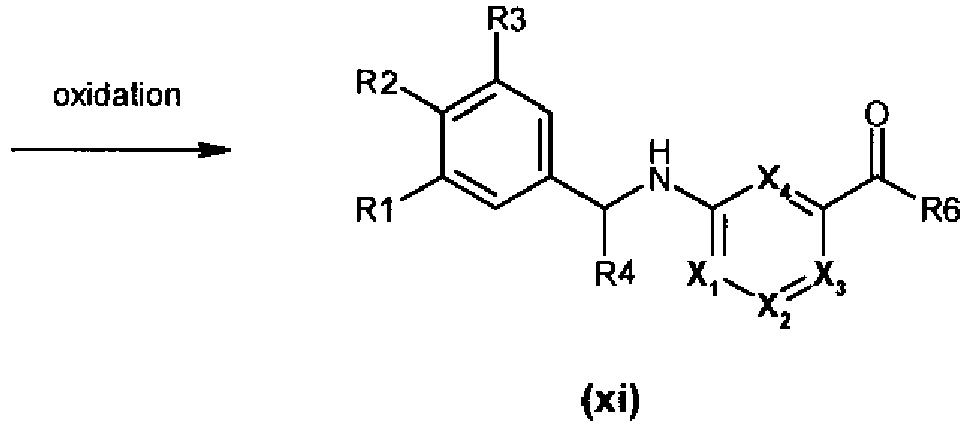

- (C) an amine of formula (xiii) with the halo-derivative (xiv) under Buchwald coupling conditions for example with a catalyst e.g. tris(dibenzylideneacetone)dipalladium(0) in the presence of a base such as sodium bis(trimethylsilyl)amide or a tert-butoxide, to furnish acetal derivative (xv), wherein each R' independently represents a C1-6alkyl, C37cycloalkyl, benzyl, or wherein both R' with the oxygen atoms to which they are attached form a 5, 6 or 7 membered ring system, such as methylenedioxolane, ethylenedioxolane, propylenedioxolane,


- (D) a haloketone of formula (xviii) and an amine of formula (ii) under reductive amination conditions as described hereinbefore to furnish halo-ester intermediate of formula (xix),


- (A) a nitro aldehyde derivative of formula (i) with an amine of formula (ii) under reductive amination conditions, e.g. with a sodium borohydride such as sodium borohydride triacetate in the presence of a base, such as Hünig's base, to furnish the nitro intermediate (iii),
- Embodiment 16 describes a compound of formula (I) or a pharmaceutically acceptable salt thereof;

- R1 is hydrogen, halogen or C1-C6 alkyl optionally substituted by halogen;
- R2 is halogen, C1-C6 alkyl optionally substituted by halogen, cyano, or C1-C6 alkoxy;
- or R1 and R2 together with the C-atoms to which they are attached form an aryl ring with 6-10 carbon atoms, which may optionally be substituted by 1-4 substituents selected from cyano, C1-C4-alkyl, C1-C4-alkoxy, and halogen;
- R3 is hydrogen, halogen or C1-C6 alkyl optionally substituted by halogen;
- R4 is hydrogen, C3-C6 cycloalkyl or C1-C6 alkyl optionally substituted by halogen;
- R5 is hydrogen or C1-C6 alkyl;
- R6 and R7 are independently selected from H and C1-C6 alkyl or they may form together with the carbon atom to which they are attached a 3 - 7 membered saturated carbocyclic ring;
- R8 and R9 are independently selected from H and C1-C6 alkyl, or R8 and R9 may form together with the atoms to which they are attached a 4 - 7 membered heterocyclic ring, optionally substituted one or more times by C1-C6-alkyl, trifluoromethyl, hydroxy, C1-C6 alkoxy, or amino;
- n=1,2,3or4;
- R10 is hydrogen, C1-C6 alkyl, amino, hydroxy or C1-C6 alkoxy;
- R is selected from H ; phenyl being optionally substituted by C1-C6 alkyl, C1-C6 alkoxy, halogen or hydroxy ; and C1-C6 alkyl optionally substituted by C1-C6 alkoxy, halogen, hydroxy, or phenyl optionally substituted by C1-C6 alkyl, C1-C6 alkoxy, halogen or hydroxy,
- X1, X2, X3 and X4, are each independently selected from N or CR11,
- R11 in each case being independently selected from H, halo, cyano, C1-C6 alkoxy, C1-C6 alkyl optionally substituted by halo; or -SO2-C1-C6 alkyl; and
- Y stands in each occurrence independently for CR12R13 wherein R12 and R13 are independently selected from H and C1-C6 alkyl.
- Embodiment 17 describes a compound of formula (II) or a pharmaceutically acceptable salt thereof,

- R1 is hydrogen, halogen or C1-C6 alkyl optionally substituted by halogen;
- R2 is halogen, C1-C6 alkyl optionally substituted by halogen, cyano, or C1-C6 alkoxy;
- or R1 and R2 together with the C-atoms to which they are attached form an aryl ring with 6-10 carbon atoms, which may optionally be substituted by 1-4 substituents selected from cyano, C1-C4-alkyl, C1-C4-alkoxy, and halogen;
- R3 is hydrogen, halogen or C1-C6 alkyl optionally substituted by halogen;
- R4 is hydrogen, C3-C6 cycloalkyl or C1-C6 alkyl optionally substituted by halogen;
- R5 is hydrogen or C1-C6 alkyl;
- R6 and R7 are independently selected from H and C1-C6 alkyl, or they may form together with the carbon atom to which they are attached a 3 - 7 membered saturated carbocyclic ring;
- n = 1, 2, 3 or 4 ;
- R10 is hydrogen, C1-C6 alkyl, amino, hydroxy or C1-C6 alkoxy;
- R is selected from H; phenyl being optionally substituted by C1-C6 alkyl, C1-C6 alkoxy, halogen or hydroxy; and C1-C6 alkyl optionally substituted by C1-C6 alkoxy, halogen, hydroxy, or phenyl, said phenyl being optionally substituted by C1-C6 alkyl, C1-C6 alkoxy, halogen or hydroxy;
- X1, X2, X3 and X4, are each independently selected from N or CR11,
- R11 in each case being independently selected from H, halo, cyano, C1-C6 alkoxy, C1-C6 alkyl optionally substituted by halo; or -SO2-C1-C6 alkyl; and
- Y stands in each occurrence independently for CR12R13 wherein R12 and R13 are independently selected from H and C1-C6 alkyl optionally sustituted by halogen.
- Embodiment 18 describes a compound of embodiment 16 or 17 or a pharmaceutically acceptable salt thereof, wherein R1 and R stand for hydrogen.
- Embodiment 19 describes a compound of embodiment 16 or 17 or a pharmaceutically acceptable salt thereof, wherein n is 2.
- Embodiment 20 describes a compound of embodiment 16 or 17 or a pharmaceutically acceptable salt thereof, wherein X3 is CR11 and wherein R11 stands for methyl.
- Embodiment 21 describes a compound of embodiment 16 or 17 or a pharmaceutically acceptable salt thereof, wherein R24 is trifluoromethyl and R5 is hydrogen.
- Embodiment 22 describes a compound of embodiment 16 or 17 or a pharmaceutically acceptable salt thereof, which is selected from:
- 1-{3-[1-(4-Chloro-3-methyl-phenyl)-ethylamino]-benzyl}-azetidine-3-carboxylic acid,
- 1-{3-[1-(4-Chloro-3-methyl-phenyl)-propylamino]-benzyl}-azetidine-3-carboxylic acid,
- 1-{3-[(R)-1-(4-Chloro-3-methyl-phenyl)-propylamino]-benzyl}-azetidine-3-carboxylic acid,
- 1-{5-[1-(4-Chloro-3-methyl-phenyl)-propylamino]-2-methyl-benzyl}-azetidine-3-carboxylic acid,
- 1-{3-[1-(4-Chloro-3-methyl-phenyl)-propylamino]-4-methyl-benzyl}-azetidine-3-carboxylic acid,
- 1-((1-{3-[(R)-1-(4-Chloro-3-methyl-phenyl)-propylamino]-phenyl}-ethyl)-azetidine-3-carboxylic acid,
- 1-{3-[1-(4-Chloro-3-methyl-phenyl)-propylamino]-2-methyl-benzyl}-azetidine-3-carboxylic acid,
- 1-{3-[(R)-1-(4-Chloro-3-methyl-phenyl)-propylamino]-benzyl}-3-methyl-azetidine-3-carboxylic acid,
- 1-{3-[1-(4-Chloro-3-methyl-phenyl)-propylamino]-5-methyl-benzyl}-azetidine-3-carboxylic acid,
- 1-((1-{5-[1-(4-Chloro-3-methyl-phenyl)-propylamino]-2-methyl-phenyl}-ethyl)-azetidine-3-carboxylic acid,
- (R)-1-{3-[(R)-1-(4-Chloro-3-methyl-phenyl)-propylamino]-benzyl}-pyrrolidine-3-carboxylic acid,
- (S)-1-{3-[(R)-1-(4-Chloro-3-methyl-phenyl)-propylamino]-benzyl}-pyrrolidine-3-carboxylic acid,
- 1-((1-{3-[(R)-1-(4-Chloro-3-methyl-phenyl)-propylamino]-phenyl}-propyl)-azetidine-3-carboxylic acid,
- (R)-1-{3-[1-(4-Chloro-3-methyl-phenyl)-propylamino]-2-methyl-benzyl}-pyrrolidine-3-carboxylic acid,
- (R)-1-{3-[1-(4-Chloro-3-methyl-phenyl)-propylamino]-5-methyl-benzyl}-pyrrolidine-3-carboxylic acid,
- 1-{3-[(R)-1-(4-Chloro-3-methyl-phenyl)-propylamino]-benzyl}-3-ethyl-azetidine-3-carboxylic acid,
- 1-{3-[1-(4-Chloro-3-methyl-phenyl)-2-methyl-propylamino]-benzyl}-azetidine-3-carboxylic acid,
- 1-{3-[(R)-1-(4-Chloro-3,5-dimethyl-phenyl)-propylamino]-benzyl}-azetidine-3-carboxylic acid,
- 1-{3-[(R)-1-(4-Chloro-3,5-dimethyl-phenyl)-propylamino]-benzyl}azetidine-3-carboxylic acid,
- 1-{3-[(R)-1-(5-Chloro-naphthalen-2-yl)-propylamino]-benzyl}-azetidine-3-carboxylic acid, (R)-1-{5-[(S)-1-(4-Chloro-3-methyl-phenyl)-2,2,2-trifluoro-ethylamino]-2-methyl-benzyl}-pyrrolidine-3-carboxylic acid,
- 1-{5-[(R)-1-(4-Chloro-3-methyl-phenyl)-propylamino]-2-methyl-benzyl}-azetidine-3-carboxylic acid,
- (R)-1-{5-[(R)-1-(4-Chloro-3-methyl-phenyl)-propylamino]-2-methyl-benzyl}-pyrrolidine-3-carboxylic acid,
- 1-{3-[(R)-1-(4-Chloro-3-methyl-phenyl)-propylamino]-2-fluoro-benzyl}-azetidine-3-carboxylic acid,
- (R)-1-{3-[(R)-1-(4-Chloro-3-methyl-phenyl)-propylamino]-2-fluoro-benzyl}pyrrolidine-3-carboxylic acid,
- 1-{3-[(R)-1-(4-Chloro-3-methyl-phenyl)-propylamino]-4-fluoro-benzyl}-azetidine-3-carboxylic acid, and
- (R)-1-{3-[(R)-1-(4-Chloro-3-methyl-phenyl)-propylamino]-4-fluoro-benzyl}pyrrolidine-3-carboxylic acid.
- Embodiment 23 describes a compound of embodiment 16 or 17 or a pharmaceutically acceptable salt thereof, which is selected from:
- (R)-1-{3-[(R)-1-(4-Chloro-3-methyl-phenyl)-propylamino]-4-fluoro-benzyl}-pyrrolidine-3-carboxylic acid,
- 1-{5-[(R)-1-(4-Chloro-3-methyl-phenyl)-propylamino]-2-methyl-benzyl}-3-methyl-azetidine-3-carboxylic acid,
- (R)-1-{2-Chloro-5-[(S)-1-(4-chloro-3-methyl-phenyl)-2,2,2-trifluoro-ethylamino]-benzyl}-pyrrolidine-3-carboxylic acid,
- (R)-1-{3-[(S)-1-(4-Chloro-3-methyl-phenyl)-2,2,2-trifluoro-ethylamino]-2,6-dimethyl-benzyl}-pyrrolidine-3-carboxylic acid,
- 1-{3-[(S)-1-(4-Chloro-3-methyl-phenyl)-2,2,2-trifluoro-ethylamino]-2,6-dimethyl-benzyl}-azetidine-3-carboxylic acid,
- (R)-1-{3-[(R)-1-(4-Chloro-3-methyl-phenyl)-propylamino]-2,6-dimethyl-benzyl}-pyrrolidine-3-carboxylic acid,
- 1-{3-[(R)-1-(4-Chloro-3-methyl-phenyl)-propylamino]-2,6-dimethyl-benzyl}-azetidine-3-carboxylic acid,
- (R)-1-{5-[(S)-1-(4-Chloro-3-methyl-phenyl)-2,2,2-trifluoro-ethylamino]-2-ethyl-benzyl}-pyrrolidine-3-carboxylic acid,
- 1-{5-[(S)-1-(4-Chloro-3-methyl-phenyl)-2,2,2-trifluoro-ethylamino]-2-ethyl-benzyl}-azetidine-3-carboxylic acid,
- (R)-1-{5-[(R)-1-(4-Chloro-3-methyl-phenyl)-propylamino]-2-ethyl-benzyl}-pyrrolidine-3-carboxylic acid,
- 1-{5-[(R)-1-(4-Chloro-3-methyl-phenyl)-propylamino]-2-ethyl-benzyl}-azetidine-3-carboxylic acid,
- (R)-1-{2-Chloro-5-[(R)-1-(4-chloro-3-methyl-phenyl)-propylamino]-benzyl}-pyrrolidine-3-carboxylic acid,
- 1-{3-[(S)-1-(4-Chloro-3-methyl-phenyl)-2,2,2-trifluoro-ethylamino]-2-methyl-benzyl}-azetidine-3-carboxylic acid,
- 3-{3-[(S)-1-(4-Chloro-3-methyl-phenyl)-2,2,2-trifiuoro-ethylamino]-2,6-dimethyl-benzylamino}-propionic acid,
- 1-{5-[(R)-1-(4-Chloro-3,5-dimethyl-phenyl)-propylamino]-2-methyl-benzyl}-azetidine-3-carboxylic acid,
- (R)-1-{5-[(R)-1-(4-Chloro-3,5-dimethyl-phenyl)-propylamino]-2-methyl-benzyl}-pyrrolidine-3-carboxylic acid,
- (R)-1-{2-Chloro-5-[(R)-1-(4-chloro-3,5-dimethyl-phenyl)-propylamino]-benzyl}-pyrrolidine-3-carboxylic acid,
- (R)-1-{5-[(R)-1-(4-Chloro-3,5-dimethyl-phenyl)-ethylamino]-2-methyl-benzyl}-pyrrolidine-3-carboxylic acid,
- 3-{5-[(R)-1-(4-Chloro-3,5-dimethyl-phenyl)-propylamino]-2-methyl-benzylamino}-propionic acid,
- (R)-1-{2-Chloro-5-[(R)-1-(4-chloro-3,5-dimethyl-phenyl)-ethylamino]-benzyl}-pyrrolidine-3-carboxylic acid,
- 3-{5-[(R)-1-(4-Chloro-3,5-dimethyl-phenyl)-ethylamino]-2-methyl-benzylamino}-propionic acid,
- 3-{2-Chloro-5-[(R)-1-(4-chloro-3,5-dimethyl-phenyl)-propylamino]-benzylamino}-propionic acid,
- (R)-3-{5-[(R)-1-(4-Chloro-3,5-dimethyl-phenyl)-propylamino]-2-methyl-benzylamino}-2-methyl-propionic acid,
- 3-{5-[(S)-1-(4-Chloro-3,5-dimethyl-phenyl)-2,2,2-trifluoro-ethylamino]-2-methyl-benzylamino}-propionic acid,
- 3-{2-Chloro-5-[(S)-1-(4-chloro-3,5-dimethyl-phenyl)-2,2,2-trifluoro-ethylamino]-benzylamino}-propionic acid,
- 3-{2-Chloro-5-[(S)-1-(4-chloro-3-methyl-phenyl)-2,2,2-trifluoro-ethylamino]-benzylamino}-propionic acid,
- 3-{2-Chloro-5-[(R)-1-(4-chloro-3,5-dimethyl-phenyl)-propylamino]-benzylamino}-propionic acid,
- 1-{2-[(R)-1-(4-Chloro-3-methyl-phenyl)-propylamino]-5-fluoro-pyridin-4-ylmethyl)-azetidine-3-carboxylic acid,
- (R)-1-{5-Chloro-2-[(R)-1-(4-chloro-3-methyl-phenyl)-propylamino]-pyridin-4-ylmethyl}-pyrrolidine-3-carboxylic acid,
- (R)-1-{5-[(R)-1-(4-Chloro-3-methyl-phenyl)-propylamino]-2-methyl-pyridin-3-ylmethyl}-pyrrolidine-3-carboxylic acid, and
- 1-{5-Chloro-2-[(R)-1-(4-chloro-3-methyl-phenyl)-propylamino]-pyridin-4-ylmethyl}-3-methyl-pyrrolidine-3-carboxylic acid,
- Embodiment 24 describes a compound of embodiment 16 or 17 or a pharmaceutically acceptable salt thereof, which is selected from:
- 3-({5-Chloro-2-[(R)-1-(4-chloro-3-methyl-phenyl)-propylamino]-pyridin-4-ylmethyl)-amino)-propionic acid,
- (R)-1-{5-Chloro-2-[(R)-1-(4-chloro-3,5-dimethyl-phenyl)-propylamino]-pyridin-4-ylmethyl)-pyrrolidine-3-carboxylic acid,
- (R)-1-{2-[(R)-1-(4-Chloro-3-methyl-phenyl)-propylamino]-5-methyl-pyridin-4-ylmethyl}-pyrrolidine-3-carboxylic acid,
- 1-{2-Chloro-5-[(R)-1-(4-chloro-3,5-dimethyl-phenyl)-propylamino]-benzyl}-azetidine-3-carboxylic acid,
- 1-{2-Chloro-5-[(R)-1-(4-chloro-3-methyl-phenyl)-propylamino]-benzyl}-azetidine-3-carboxylic acid,
- 1-{2-Chloro-5-[(R)-1-(4-chloro-3-methyl-phenyl)-2-methyl-propylamino]-benzyl}-azetidine-3-carboxylic acid,
- 1-{2-Chloro-5-[(R)-1-(4-chloro-3,5-dimethyl-phenyl)-2-methyl-propylamino]-benzyl}-azetidine-3-carboxylic acid,
- 1-{2-Chloro-5-[(S)-1-(4chloro-3-methyl-phenyl)-2,2,2-trifluoro-ethylamino]-benzyl}-3-methyl-azetidine-3-carboxylic acid,
- 1-{2-Chloro-5-[(R)-1-(4-chloro-3,5-dimethyl-phenyl)-propylamino]-benzyl}-3-methyl-azetidine-3-carboxylic acid,
- 1-{3-[(S)-1-(4-Chloro-3-methyl-phenyl)-2,2,2-trifluoro-ethylamino]-benzyl}-azetidine-3-carboxylic acid,
- 1-{3-[(S)-1-(4-Chloro-3-methyl-phenyl)-2,2,2-trifluoro-ethylamino]-benzyl}-azetidine-3-carboxylic acid,
- 1-{5-[(S)-1-(4-Chloro-3-methyl-phenyl)-2,2,2-trifluoro-ethylamino]-2-trifluoromethyl-benzyl}-azetidine-3-carboxylic acid,
- 1-{5-[(S)-1-(4-Chloro-3-methyl-phenyl)-2,2,2-trifluoro-ethylamino]-2-methyl-benzyl}-azetidine-3-carboxylic acid,
- 1-{5-[(S)-1-(4-Chloro-3-methyl-phenyl)-2,2,2-trifluoro-ethylamino]-2-fluoro-benzyl}-azetidine-3-carboxylic acid,
- 1-{2-Chloro-5-[(S)-1-(4-chloro-3-methyl-phenyl)-2,2,2-trifluoro-ethylamino]-benzyl}-pyrrolidine-3-carboxylic acid,
- 3-(((S)-1-{3-[(S)-1-(4-Chloro-3-methyl-phenyl)-2,2,2-trifluoro-ethylamino]-phenyl}-ethylamino)-propionic acid
- 1-{6-[(R)-1-(4-Chloro-3-methyl-phenyl)-propylamino]-pyridin-2-ylmethyl}-azetidine-3-carboxylic acid,
- 1-{2-[(R)-1-(4-Choro-3-methyl-phenyl)-propylamino]-pyridin-4-ylmethyl}-azetidine-3-carboxylic acid,
- 1-((3-{[(R)-(4-Chloro-3-methyl-phenyl)-cyclobutyl-methyl]-amino}-benzyl)-azetidine-3-carboxylic acid,
- 1-((3-{[(S)-(4-Chloro-3-methyl-phenyl)-cyclobutyl-methyl]-amino}-benzyl)-azetidine-3-carboxylic acid,
- 1-{4-[(R)-1-(4-Chloro-3-methyl-phenyl)-propylamino]-pyridin-2-ylmethyl}-azetidine-3-carboxylic acid,
- 1-{5-Chloro-2-[(R)-1-(4-chloro-3-methyl-phenyl)-propylamino]-pyridin-4-ylmethyl}-azetidine-3-carboxylic acid,
- 3-{5-[(R)-1-(4-Chloro-3,5-dimethyl-phenyl)-pfopyiamino]-2-methyl-benzylamino}-2,2-dimethyl-propionic acid,
- (S)-3-{5-[(R)-1-(4-Chloro-3,5-dimethyl-phenyl)-propylamino]-2-methyl-benzylamino}-2-methyl-propionic acid,
- 3-(((5-[(R)-1-(4-Chloro-3,5-dimethyl-phenyl)-propylamino]-2-methyl-benzyl}-methyl-amino)-propionic acid,
- 1-{5-[(S)-1-(4-Chloro-3-methyl-phenyl)-2,2,2-trifluoro-ethylamino]-2-methyl-benzyl}-3-methyl-pyrrolidine-3-carboxylic acid,
- (R)-1-{5-Chloro-2-[(S)-1-(4-chloro-3-methyl-phenyl)-2,2,2-trifluoro-ethylamino]-pyridin-4-ylmethyl}-pyrrolidine-3-carboxylic acid,
- 3-({5-Chloro-2-[(S)-1-(4-chloro-3-methyl-phenyl)-2,2,2-trifluoro-ethylamino]-pyridin-4-ylmethyl}-amino)-propionic acid,
- 1-{5-Chloro-2-[(R)-1-(4-chloro-3-methyl-phenyl)-propylamino]-pyridin-4-ylmethyl}-3-methyl-pyrrolidine-3-carboxylic acid (single stereoisomer A), and
- 1-{5-Chloro-2-[(R)-1-(4-chloro-3-methyl-phenyl)-propylamino]-pyridin-4-ylmethyl}-3-methyl-pyrrolidine-3-carboxylic acid (single stereoisomer B).
- Embodiment 25 describes a compound of formula (I) or a compound of formula (II) according to embodiment 16 or 17 or a pharmaceutically acceptable salt thereof for use as a medicament, in particular for use in the treatment and/or prevention of diseases or disorders mediated by lymphocytes interactions.
Analytical chiral HPLC:
Claims (13)
- A compound of formula (I) or a pharmaceutically acceptable salt thereof;
 R1 is hydrogen, halogen or C1-C6 alkyl optionally substituted by halogen;R2 is halogen, C1-C6 alkyl optionally substituted by halogen, cyano, or C1-C6 alkoxy optionally substituted by halogen;or R1 and R2 together with the C-atoms to which they are attached form an aryl ring with 6-10 carbon atoms, which may optionally be substituted by 1-4 substituents selected from cyano, C1-C4-alkyl optionally substituted by halogen, C1-C4-alkoxy optionally substituted by halogen, and halogen;R3 is hydrogen, halogen or C1-C6 alkyl optionally substituted by halogen;R4 is hydrogen, C3-C6 cycloalkyl or C1-C6 alkyl optionally substituted by halogen;R5 is hydrogen or C1-C6 alkyl;R6 and R7 are independently selected from H and C1-C6 alkyl or they may form together with the carbon atom to which they are attached a 3 - 7 membered saturated carbocyclic ring;R8 and R9 are independently selected from H and C1-C6 alkyl, or R8 and R9 may form together with the atoms to which they are attached a 4 - 7 membered heterocyclic ring, optionally substituted one or more times by C1-C6-alkyl optionally substituted by halogen, trifluoromethyl, hydroxy, or amino;n = 1, 2, 3 or 4;R10 is hydrogen, C1-C6 alkyl, amino, hydroxy or C1-C6 alkoxy;R is selected from H ; phenyl being optionally substituted by C1-C6 alkyl, C1-C6 alkoxy, halogen or hydroxy ; and C1-C6 alkyl optionally substituted by C1-C6 alkoxy, halogen, hydroxy, or phenyl optionally substituted by C1-C6 alkyl, C1-C6 alkoxy, halogen or hydroxy,X1, X2, X3 and X4, are each independently selected from N or CR11,R11 in each case being independently selected from H, halo, cyano, C1-C6 alkoxy, C1-C6 alkyl optionally substituted by halo, or -SO2-C1-C6 alkyl; andY stands in each occurrence independently for CR12R13 wherein R12 and R13 are independently selected from H and C1-C6 alkyl.
 - A compound of formula (II) or a pharmaceutically acceptable salt thereof,
 R1 is hydrogen, halogen or C1-C6 alkyl optionally substituted by halogen;R2 is halogen, C1-C6 alkyl optionally substituted by halogen, cyano, or C1-C6 alkoxy optionally substituted by halogen;or R1 and R2 together with the C-atoms to which they are attached form an aryl ring with 6-10 carbon atoms, which may optionally be substituted by 1-4 substituents selected from cyano, C1-C4-alkyl optionally substituted by halogen, C1-C4-alkoxy optionally substituted by halogen, and halogen;R3 is hydrogen, halogen or C1-C6 alkyl optionally substituted by halogen;R4 is hydrogen, C3-C6 cycloalkyl or C1-C6 alkyl optionally substituted by halogen;R5 is hydrogen or C1-C6 alkyl;R6 and R7 are independently selected from H and C1-C6 alkyl, or they may form together with the carbon atom to which they are attached a 3 - 7 membered saturated carbocyclic ring;n = 1, 2, 3 or 4 ;R10 is hydrogen, C1-C6 alkyl, amino, hydroxy or C1-C6 alkoxy;R is selected from H; phenyl being optionally substituted by C1-C6 alkyl, C1-C6 alkoxy, halogen or hydroxy; and C1-C6 alkyl optionally substituted by C1-C6 alkoxy, halogen, hydroxy, or phenyl, said phenyl being optionally substituted by C1-C6 alkyl, C1-C6 alkoxy, halogen or hydroxy;X1, X2, X3 and X4, are each independently selected from N or CR11,R11 in each case being independently selected from H, halo, cyano, C1-C6 alkoxy, C1-C6 alkyl optionally substituted by halo, or -SO2-C1-C6 alkyl; andY stands in each occurrence independently for CR12R13 wherein R12 and R13 are independently selected from H and C1-C6 alkyl optionally substituted by halogen.
 - A compound of claim 1 or 2 or a pharmaceutically acceptable salt thereof, wherein R1 and R stand for hydrogen.
- A compound of any of the preceding claims or a pharmaceutically acceptable salt thereof, wherein n is 2.
- A compound of any of the preceding claims, wherein X3 is CR11 and wherein R11 stands for methyl.
- A compound in accordance to any of the preceding claims or a pharmaceutically acceptable salt thereof, wherein R4 is trifluoromethyl and R5 is hydrogen.
- A compound of claim 1 or 2 or a pharmaceutically acceptable salt thereof, which is selected from:1-{3-[1-(4-Chloro-3-methyl-phenyl)-ethylamino]-benzyl}-azetidine-3-carboxylic acid,1-{3-[1-(4-Chloro-3-methyl-phenyl)-propylamino]-benzyl}-azetidine-3-carboxylic acid,1-{3-[(R)-1-(4-Chloro-3-methyl-phenyl)-propylamino]-benzyl}-azetidine-3-carboxylic acid,1-{5-[1-(4-Chloro-3-methyl-phenyl)-propylamino]-2-methyl-benzyl}-azetidine-3-carboxylic acid,1-{3-[1-(4-Chloro-3-methyl-phenyl)-propylamino]-4-methyl-benzyl}-azetidine-3-carboxylic acid,1-((1-{3-[(R)-1-(4-Chloro-3-methyl-phenyl)-propylamino]-phenyl}-ethyl)-azetidine-3-carboxylic acid,1-{3-[1-(4-Chloro-3-methyl-phenyl)-propylamino]-2-methyl-benzyl}-azetidine-3-carboxylic acid,1-{3-[(R)-1-(4-Chloro-3-methyl-phenyl)-propylamino]-benzyl}-3-methyl-azetidine-3-carboxylic acid,1-{3-[1-(4-Chloro-3-methyl-phenyl)-propylamino]-5-methyl-benzyl}-azetidine-3-carboxylic acid,1-((1-{5-[1-(4-Chloro-3-methyl-phenyl)-propylamino]-2-methyl-phenyl}-ethyl)-azetidine-3-carboxylic acid,(R)-1-{3-[(R)-1-(4-Chloro-3-methyl-phenyl)-propylamino]-benzyl}-pyrrolidine-3-carboxylic acid,(S)-1-{3-[(R)-1-(4-Chloro-3-methyl-phenyl)-propylamino]-benzyl}-pyrrolidine-3-carboxylic acid,1-((1-{3-[(R)-1-(4-Chloro-3-methyl-phenyl)-propylamino]-phenyl}-propyl)-azetidine-3-carboxylic acid,(R)-1-{3-[1-(4-Chloro-3-methyl-phenyl)-propylamino]-2-methyl-benzyl}-pyrrolidine-3-carboxylic acid,(R)-1-{3-[1-(4-Chloro-3-methyl-phenyl)-propylamino]-5-methyl-benzyl}-pyrrolid i ne-3-carboxyl ic acid,1-{3-[(R)-1-(4-Chloro-3-methyl-phenyl)-propylamino]-benzyl}-3-ethyl-azetidine-3-carboxylic acid,1-{3-[1-(4-Chloro-3-methyl-phenyl)-2-methyl-propylamino]-benzyl}-azetidine-3-carboxylic acid, 1-{3-[(R)-1-(4-Chloro-3,5-dimethyl-phenyl)-propylamino]-benzyl}-azetidine-3-carboxylic acid, 1-{3-[(R)-1-(4-Chloro-3,5-dimethyl-phenyl)-propylamino]-benzyl}-azetidine-3-carboxylic acid,1-{3-[(R)-1-(5-Chloro-naphthalen-2-yl)-propylamino]-benzyl}-azetidine-3-carboxylic acid, (R)-1-{5-[(S)-1-(4-Chloro-3-methyl-phenyl)-2,2,2-trifluoro-ethylamino]-2-methyl-benzyl}-pyrrolidine-3-carboxylic acid,1-{5-[(R)-1-(4-Chloro-3-methyl-phenyl)-propylamino]-2-methyl-benzyl}-azetidine-3-carboxylic acid,(R)-1-{5-[(R)-1-(4-Chloro-3-methyl-phenyl)-propylamino]-2-methyl-benzyl}-pyrrolidine-3-carboxylic acid,1-{3-[(R)-1-(4-Chloro-3-methyl-phenyl)-propylamino]-2-fluoro-benzyl}-azetidine-3-carboxylic acid,(R)-1-{3-[(R)-1-(4-Chloro-3-methyl-phenyl)-propylamino]-2-fluoro-benzyl}-pyrrolidine-3-carboxylic acid,1-{3-[(R)-1-(4-Chloro-3-methyl-phenyl)-propylamino]-4-fluoro-benzyl}-azetidine-3-carboxylic acid,(R)-1-{3-[(R)-1-(4-Chloro-3-methyl-phenyl)-propylamino]-4-fluoro-benzyl}-pyrrolidine-3-carboxylic acid,1-{5-[(R)-1-(4-Chloro-3-methyl-phenyl)-propylamino]-2-methyl-benzyl}-3-methyl-azetidine-3-carboxylic acid,(R)-1-{2-Chloro-5-[(S)-1-(4-chloro-3-methyl-phenyl)-2,2,2-trifluoro-ethylamino]-benzyl}-pyrrolidine-3-carboxylic acid,(R)-1-{3-[(S)-1-(4-Chloro-3-methyl-phenyl)-2,2,2-trifluoro-ethylamino]-2,6-dimethyl-benzyl}-pyrrolidine-3-carboxylic acid,1-{3-[(S)-1-(4-Chloro-3-methyl-phenyl)-2,2,2-trifluoro-ethylamino]-2,6-dimethyl-benzyl}-azetidine-3-carboxylic acid,(R)-1-{3-[(R)-1-(4-Chloro-3-methyl-phenyl)-propylamino]-2,6-dimethyl-benzyl}-pyrrolidine-3-carboxylic acid,1-{3-[(R)-1-(4-Chloro-3-methyl-phenyl)-propylamino]-2,6-dimethyl-benzyl}-azetidine-3-carboxylic acid,(R)-1-{5-[(S)-1-(4-Chloro-3-methyl-phenyl)-2,2,2-trifluoro-ethylamino]-2-ethyl-benzyl}-pyrrolidine-3-carboxylic acid,1-{5-[(S)-1-(4-Chloro-3-methyl-phenyl)-2,2,2-trifluoro-ethylamino]-2-ethyl-benzyl}-azetidine-3-carboxylic acid,(R)-1-{5-[(R)-1-(4-Chloro-3-methyl-phenyl)-propylamino]-2-ethyl-benzyl}-pyrrolidine-3-carboxylic acid,1-{5-[(R)-1-(4-Chloro-3-methyl-phenyl)-propylamino]-2-ethyl-benzyl}-azetidine-3-carboxylic acid,(R)-1-{2-Chloro-5-[(R)-1-(4-chloro-3-methyl-phenyl)-propylamino]-benzyl}-pyrrolidine-3-carboxylic acid,1-{3-[(S)-1-(4-Chloro-3-methyl-phenyl)-2,2,2-trifluoro-ethylamino]-2-methyl-benzyl}-azetidine-3-carboxylic acid,3-{3-[(S)-1-(4-Chloro-3-methyl-phenyl)-2,2,2-trifluoro-ethylamino]-2,6-dimethyl-benzylamino}-propionic acid,1-{5-[(R)-1-(4-Chloro-3,5-dimethyl-phenyl)-propylamino]-2-methyl-benzyl}-azetidine-3-carboxylic acid,(R)-1-{5-[(R)-1-(4-Chloro-3,5-dimethyl-phenyl)-propylamino]-2-methyl-benzyl}-pyrrolidine-3-carboxylic acid,(R)-1-{2-Chloro-5-[(R)-1-(4-chloro-3,5-dimethyl-phenyl)-propylamino]-benzyl}-pyrrolidine-3-carboxylic acid,(R)-1-{5-[(R)-1-(4-Chloro-3,5-dimethyl-phenyl)-ethylamino]-2-methyl-benzyl}-pyrrolidine-3-carboxylic acid,3-{5-[(R)-1-(4-Chloro-3,5-dimethyl-phenyl)-propylamino]-2-methyl-benzylamino}-propionic acid,(R)-1-{2-Chloro-5-[(R)-1-(4-chloro-3,5-dimethyl-phenyl)-ethylamino]-benzyl}-pyrrolidine-3-carboxylic acid,3-{5-[(R)-1-(4-Chloro-3,5-dimethyl-phenyl)-ethylamino]-2-methyl-benzylamino}-propionic acid,3-{2-Chloro-5-[(R)-1-(4-chloro-3,5-dimethyl-phenyl)-propylamino]-benzylamino}-propionic acid,(R)-3-{5-[(R)-1-(4-Chloro-3,5-dimethyl-phenyl)-propylamino]-2-methyl-benzylamino}-2-methyl-propionic acid,3-{5-[(S)-1-(4-Chloro-3,5-dimethyl-phenyl)-2,2,2-trifluoro-ethylamino]-2-methyl-benzylamino}-propionic acid,3-{2-Chloro-5-[(S)-1-(4-chloro-3,5-dimethyl-phenyl)-2,2,2-trifluoro-ethylamino]-benzylamino}-propionic acid,3-{2-Chloro-5-[(S)-1-(4-chloro-3-methyl-phenyl)-2,2,2-trifluoro-ethylamino]-benzylamino}-propionic acid,3-{2-Chloro-5-[(R)-1-(4-chloro-3,5-dimethyl-phenyl)-propylamino]-benzylamino}-propionic acid,1-{2-[(R)-1-(4-Chloro-3-methyl-phenyl)-propylamino]-5-fluoro-pyridin-4-ylmethyl}-azetidine-3-carboxylic acid,(R)-1-{5-Chloro-2-[(R)-1-(4-chloro-3-methyl-phenyl)-propylamino]-pyridin-4-ylmethyl}-pyrrolidine-3-carboxylic acid,(R)-1-{5-[(R)-1-(4-Chloro-3-methyl-phenyl)-propylamino]-2-methyl-pyridin-3-ylmethyl}-pyrrolidine-3-carboxylic acid,1-{5-Chloro-2-[(R)-1-(4-chloro-3-methyl-phenyl)-propylamino]-pyridin-4-ylmethyl}-3-methyl-pyrrolidine-3-carboxylic acid,3-({5-Chloro-2-[(R)-1-(4-chloro-3-methyl-phenyl)-propylamino]-pyridin-4-ylmethyl}-amino)-propionic acid,(R)-1-{5-Chloro-2-[(R)-1-(4-chloro-3,5-dimethyl-phenyl)-propylamino]-pyridin-4-ylmethyl}-pyrrolidine-3-carboxylic acid,(R)-1-{2-[(R)-1-(4-Chloro-3-methyl-phenyl)-propylamino]-5-methyl-pyridin-4-ylmethyl}-pyrrolidine-3-carboxylic acid,1-{2-Chloro-5-[(R)-1-(4-chloro-3,5-dimethyl-phenyl)-propylamino]-benzyl}-azetidine-3-carboxylic acid,1-{2-Chloro-5-[(R)-1-(4-chloro-3-methyl-phenyl)-propylamino]-benzyl}-azetidine-3-carboxylic acid,1-{2-Chloro-5-[(R)-1-(4-chloro-3-methyl-phenyl)-2-methyl-propylamino]-benzyl}-azetidine-3-carboxylic acid,1-{2-Chloro-5-[(R)-1-(4-chloro-3,5-dimethyl-phenyl)-2-methyl-propylamino]-benzyl}-azetidine-3-carboxylic acid,1-{2-Chloro-5-[(S)-1-(4-chloro-3-methyl-phenyl)-2,2,2-trifluoro-ethylamino]-benzyl}-3-methyl-azetidine-3-carboxylic acid,1-{2-Chloro-5-[(R)-1-(4-chloro-3,5-dimethyl-phenyl)-propylamino]-benzyl}-3-methyl-azetidine-3-carboxylic acid,1-{3-[(S)-1-(4-Chloro-3-methyl-phenyl)-2,2,2-trifluoro-ethylamino]-benzyl}-azetidine-3-carboxylic acid,1-{3-[(S)-1-(4-Chloro-3-methyl-phenyl)-2,2,2-trifluoro-ethylamino]-benzyl}-azetidine-3-carboxylic acid,1-{5-[(S)-1-(4-Chloro-3-methyl-phenyl)-2,2,2-trifluoro-ethylamino]-2-trifluoromethyl-benzyl}-azetidine-3-carboxylic acid,1-{5-[(S)-1-(4-Chloro-3-methyl-phenyl)-2,2,2-trifluoro-ethylamino]-2-methyl-benzyl}-azetidine-3-carboxylic acid,1-{5-[(S)-1-(4-Chloro-3-methyl-phenyl)-2,2,2-trifluoro-ethylamino]-2-fluoro-benzyl}-azetidine-3-carboxylic acid,1-{2-Chloro-5-[(S)-1-(4-chloro-3-methyl-phenyl)-2,2,2-trifluoro-ethylamino]-benzyl}-pyrrolidine-3-carboxylic acid,3-(((S)-1-{3-[(S)-1-(4-Chloro-3-methyl-phenyl)-2,2,2-trifluoro-ethylamino]-phenyl}-ethylamino)-propionic acid1-{6-[(R)-1-(4-Chloro-3-methyl-phenyl)-propylamino]-pyridin-2-ylmethyl}-azetidine-3-carboxylic acid,1-{2-[(R)-1-(4-Chloro-3-methyl-phenyl)-propylamino]-pyridin-4-ylmethyl}-azetidine-3-carboxylic acid,1-((3-{[(R)-(4-Chloro-3-methyl-phenyl)-cyclobutyl-methyl]-amino}-benzyl)-azetidine-3-carboxylic acid,1-((3-{[(S)-(4-Chloro-3-methyl-phenyl)-cyclobutyl-methyl]-amino}-benzyl)-azetidine-3-carboxylic acid,1-{4-[(R)-1-(4-Chloro-3-methyl-phenyl)-propylamino]-pyridin-2-ylmethyl}-azetidine-3-carboxylic acid,1-{5-Chloro-2-[(R)-1-(4-chloro-3-methyl-phenyl)-propylamino]-pyridin-4-ylmethyl}-azetidine-3-carboxylic acid,3-{5-[(R)-1-(4-Chloro-3,5-dimethyl-phenyl)-propylamino]-2-methyl-benzylamino}-2,2-dimethyl-propionic acid,(S)-3-{5-[(R)-1-(4-Chloro-3,5-dimethyl-phenyl)-propylamino]-2-methyl-benzylamino}-2-methyl-propionic acid,3-({5-[(R)-1-(4-Chloro-3,5-dimethyl-phenyl)-propylamino]-2-methyl-benzyl}-methyl-amino)-propionic acid,1-{5-[(S)-1-(4-Chloro-3-methyl-phenyl)-2,2,2-trifluoro-ethylamino]-2-methyl-benzyl}-3-methyl-pyrrolidine-3-carboxylic acid,(R)-1-{5-Chloro-2-[(S)-1-(4-chloro-3-methyl-phenyl)-2,2,2-trifluoro-ethylamino]-pyridin-4-ylmethyl}-pyrrolidine-3-carboxylic acid,3-({5-Chloro-2-[(S)-1-(4-chloro-3-methyl-phenyl)-2,2,2-trifluoro-ethylamino]-pyridin-4-ylmethyl}-amino)-propionic acid,1-{5-Chloro-2-[(R)-1-(4-chloro-3-methyl-phenyl)-propylamino]-pyridin-4-ylmethyl}-3-methyl-pyrrolidine-3-carboxylic acid (single stereoisomer A), and1-{5-Chloro-2-[(R)-1-(4-chloro-3-methyl-phenyl)-propylamino]-pyridin-4-ylmethyl}-3-methyl-pyrrolidine-3-carboxylic acid (single stereoisomer B).
- A compound of formula (I) or a compound of formula (II) according to claim 1 or 2 or a pharmaceutically acceptable salt thereof for use as a medicament, in particular for use in the treatment and/or prevention of diseases or disorders mediated by lymphocytes interactions.
- The compound for use of claim 8, wherein said diseases or disorders mediated by lymphocytes interactions pertain to transplantation, such as acute or chronic rejection of cell, tissue or organ allo- or xenografts or delayed graft function, graft versus host disease, autoimmune diseases, e.g. rheumatoid arthritis, systemic lupus erythematosus, hashimoto's thyroidis, multiple sclerosis, myasthenia gravis, neuropathic pain, Behcet's disease, Wegener's granulamatosis, ankylosing spondylitis, polymyositis, CIDP (Chronic Idiopathic Demyelinating Polyneuropathy), diabetes type I or II and the disorders associated therewith, vasculitis, pernicious anemia, Sjoegren syndrome, uveitis, psoriasis, Graves ophthalmopathy, alopecia areata and others, allergic diseases, e.g. allergic asthma, atopic dermatitis, allergic rhinitis/conjunctivitis, allergic contact dermatitis, inflammatory diseases optionally with underlying aberrant reactions, e.g. inflammatory bowel disease, Crohn's disease or ulcerative colitis, intrinsic asthma, inflammatory lung injury, inflammatory liver injury, inflammatory glomerular injury, atherosclerosis, osteoarthritis, irritant contact dermatitis and further eczematous dermatitises, seborrhoeic dermatitis, cutaneous manifestations of immunologically-mediated disorders, inflammatory eye disease, keratoconjunctivitis, myocarditis or hepatitis, ischemia/reperfusion injury, e.g. myocardial infarction, stroke, gut ischemia, renal failure or hemorrhage shock, traumatic shock, cancer, e.g. breast cancer, T cell lymphomas or T cell leukemias, infectious diseases, e.g. toxic shock (e.g. superantigen induced), septic shock, adult respiratory distress syndrome or viral infections, e.g. AIDS, viral hepatitis, e.g. hepatitis B or C, chronic bacterial infection, or neurodegenerative diseases, e.g. Alzheimer disease, amyotrophic lateral sclerosis, or senile dementia, wherein examples of cell, tissue or solid organ transplants include e.g. pancreatic islets, stem cells, bone marrow, corneal tissue, neuronal tissue, heart, lung, combined heart-lung, kidney, liver, bowel, pancreas, trachea or oesophagus, deregulated angiogenesis e.g. diseases caused by ocular neovascularisation, especially retinopathies (diabetic retinopathy, age-related macular degeneration); psoriasis; haemangioblastomas, such as "strawberry-marks" (=haemangioma); various inflammatory diseases, such as arthritis, especially rheumatoid arthritis, arterial atherosclerosis and atherosclerosis occurring after transplants, endometriosis or chronic asthma, and, especially, tumor diseases (solid tumors, but also leukemias and other liquid tumors).
- The compound for use of any of the claims 8 - 9, wherein said disease or said disorder is selected from an autoimmune disease, such as rheumatoid arthritis, systemic lupus erythematosus, inflammatory bowel disease, psoriasis, or multiple sclerosis; or wherein said disorder is a tumor disease such as solid tumors, but also leukemias and other liquid tumors.
- A combination, e.g. a pharmaceutical combination or a kit, comprising a) a first agent which is a compound of formula (I) or formula (II) as disclosed in claim 1 or claim 2, or a salt thereof, in particular a pharmaceutically acceptable salt thereof, and b) at least one co-agent, e.g. an immunosuppressant, immunomodulatory, anti-inflammatory, chemotherapeutic or anti-infectious agent.
- A pharmaceutical composition, comprising a compound of formula (I) or a compound of formula (II) of claim 1 or claim 2 or a pharmaceutically acceptable salt thereof in association with a pharmaceutically acceptable diluent or carrier therefore.
- A method of manufacturing a compound of formula (I) in accordance to claim 1, comprising reacting:(A) a nitro aldehyde derivative of formula (i) with an amine of formula (ii) under reductive amination conditions, e.g. with a sodium borohydride such as sodium borohydride triacetate in the presence of a base, such as Hünig's base, to furnish the nitro intermediate (iii),


 (B) a keto derivative of formula (v) with an amine derivative of formula (vii) under reductive amination conditions e.g. with a decaborane in the presence of a solvent, e.g. methanol to yield the halo-derivative of formula (viii),


 (C) an amine of formula (xiii) with the halo-derivative (xiv) under Buchwald coupling conditions for example with a catalyst e.g. tris(dibenzylideneacetone)dipalladium(0) in the presence of a base such as sodium bis(trimethylsilyl)amide or a tert-butoxide, to furnish acetal derivative (xv), wherein each R' independently represents a C1-6alkyl, C3-7cycloalkyl, benzyl, or wherein both R' with the oxygen atoms to which they are attached form a 5, 6 or 7 membered ring system, such as methylenedioxolane, ethylenedioxolane, propylenedioxolane,

 (D) a haloketone of formula (xviii) and an amine of formula (ii) under reductive amination conditions as described hereinbefore to furnish halo-ester intermediate of formula (xix),


Applications Claiming Priority (2)
| Application Number | Priority Date | Filing Date | Title |
|---|---|---|---|
| US30060710P | 2010-02-02 | 2010-02-02 | |
| PCT/EP2011/051296 WO2011095452A1 (en) | 2010-02-02 | 2011-01-31 | Aryl benzylamine compounds |
Publications (2)
| Publication Number | Publication Date |
|---|---|
| EP2531487A1 EP2531487A1 (en) | 2012-12-12 |
| EP2531487B1 true EP2531487B1 (en) | 2014-06-18 |
Family
ID=43734141
Family Applications (1)
| Application Number | Title | Priority Date | Filing Date |
|---|---|---|---|
| EP11701825.9A Not-in-force EP2531487B1 (en) | 2010-02-02 | 2011-01-31 | Aryl benzylamine compounds |
Country Status (9)
| Country | Link |
|---|---|
| US (1) | US8791100B2 (en) |
| EP (1) | EP2531487B1 (en) |
| JP (1) | JP5876419B2 (en) |
| CN (1) | CN102741227B (en) |
| AR (1) | AR080102A1 (en) |
| ES (1) | ES2504090T3 (en) |
| TW (1) | TW201130811A (en) |
| UY (1) | UY33214A (en) |
| WO (1) | WO2011095452A1 (en) |
Families Citing this family (2)
| Publication number | Priority date | Publication date | Assignee | Title |
|---|---|---|---|---|
| WO2015129859A1 (en) | 2014-02-28 | 2015-09-03 | キッセイ薬品工業株式会社 | Novel aniline derivative, pharmaceutical composition containing same, and use thereof |
| CN111548257B (en) * | 2020-05-28 | 2022-11-15 | 安道麦马克西姆有限公司 | Preparation method of (4-isopropoxy-2-methyl) phenyl isopropyl ketone |
Family Cites Families (54)
| Publication number | Priority date | Publication date | Assignee | Title |
|---|---|---|---|---|
| PT72878B (en) | 1980-04-24 | 1983-03-29 | Merck & Co Inc | Process for preparing mannich-base hydroxamic acid pro-drugs for the improved delivery of non-steroidal anti-inflammatory agents |
| AU7686891A (en) | 1990-04-05 | 1991-10-30 | American National Red Cross, The | A protein family related to immediate-early protein expressed by human endothelial cells during differentiation |
| US5869486A (en) * | 1995-02-24 | 1999-02-09 | Ono Pharmaceutical Co., Ltd. | Fused pyrimidines and pyriazines as pharmaceutical compounds |
| US6060272A (en) | 1997-05-07 | 2000-05-09 | Human Genome Sciences, Inc. | Human G-protein coupled receptors |
| US6310078B1 (en) | 1998-04-20 | 2001-10-30 | Ortho-Mcneil Pharmaceutical, Inc. | Substituted amino acids as erythropoietin mimetics |
| JP2002531057A (en) | 1998-08-19 | 2002-09-24 | ミレニアム・ファーマシューティカルズ・インコーポレイテッド | 14274 receptor, a G protein-coupled receptor related to the EDG receptor family |
| DE19846979A1 (en) | 1998-09-11 | 2000-03-23 | Max Delbrueck Centrum | New human and murine G-coupled receptor EDG (endothelial differentiation gene) 6, useful for modulating inflammatory and immune reactions and for treatment of allergy or tumors |
| WO2000022131A2 (en) | 1998-10-13 | 2000-04-20 | Arena Pharmaceuticals, Inc. | Non-endogenous, constitutively activated human g protein-coupled receptors |
| DK1133559T3 (en) | 1998-11-20 | 2006-04-10 | Arena Pharm Inc | Human G protein-coupled orphan receptor RUP3 |
| US6323333B1 (en) | 1999-04-05 | 2001-11-27 | Smithkline Beecham Corporation | Mouse EDG1 |
| WO2001004139A2 (en) | 1999-07-13 | 2001-01-18 | Smithkline Beecham Corporation | Human axor29 receptor |
| GB9923890D0 (en) | 1999-10-08 | 1999-12-08 | Pfizer Ltd | Novel polypeptide |
| AU2001240019A1 (en) | 2000-03-03 | 2001-09-17 | Incyte Genomics, Inc. | G-protein coupled receptors |
| AU4251301A (en) | 2000-03-24 | 2001-10-03 | Bayer Aktiengesellschaft | Regulation of human nerve growth factor-elated g protein-coupled receptor |
| WO2001073021A1 (en) | 2000-03-28 | 2001-10-04 | Takeda Chemical Industries, Ltd. | Novel g protein-coupled receptor protein and dna thereof |
| AU7048901A (en) | 2000-04-26 | 2001-11-07 | Aventis Pharma Gmbh | Edg8 receptor, its preparation and use |
| DE10028901A1 (en) | 2000-06-10 | 2001-12-20 | Michael Brues | New human gene hEDG-8 encoding G-protein coupled receptor, useful for developing treatments and diagnoses for e.g. multiple sclerosis |
| AU2001273541A1 (en) | 2000-07-17 | 2002-01-30 | Genaissance Pharmaceuticals, Inc. | Haplotypes of the edg6 gene |
| WO2002017899A2 (en) | 2000-08-31 | 2002-03-07 | University Of Connecticut | Regulation of angiogenesis via modulation of edg receptor mediated signal transduction comprising sphingosine-1-phosphate administration |
| SG159378A1 (en) | 2000-11-07 | 2010-03-30 | Novartis Ag | Indolylmaleimide derivatives as protein kinase c inhibitors |
| US7521192B2 (en) | 2001-04-18 | 2009-04-21 | Rigel Pharmaceuticals, Inc. | EDG: modulators of lymphocyte activation and migration |
| EP1425023A1 (en) | 2001-08-10 | 2004-06-09 | Wyeth | G protein-coupled receptor assay |
| ATE441654T1 (en) | 2002-01-18 | 2009-09-15 | Merck & Co Inc | EDG RECEPTOR AGONISTS |
| PE20040079A1 (en) | 2002-04-03 | 2004-04-19 | Novartis Ag | INDOLYLMALEIMIDE DERIVATIVES |
| US20030225288A1 (en) | 2002-04-12 | 2003-12-04 | Millennium Pharmaceuticals, Inc. | Imidazolidine compounds |
| JP2005533852A (en) | 2002-07-18 | 2005-11-10 | セレテック エルエルシー | Method for treating symptoms associated with Edg-1 receptor |
| JP2006508061A (en) | 2002-09-20 | 2006-03-09 | ファイザー・プロダクツ・インク | Amide and sulfonamide ligands for estrogen receptors |
| WO2004035538A1 (en) | 2002-10-15 | 2004-04-29 | Merck & Co., Inc. | Process for making azetidine-3-carboxylic acid |
| WO2004052359A1 (en) | 2002-12-09 | 2004-06-24 | The Board Of Regents Of The University Of Texas System | Methods for selectively inhibiting janus tyrosine kinase 3 (jak3) |
| CA2514733A1 (en) | 2003-02-28 | 2004-09-16 | Transform Pharmaceuticals, Inc. | Pharmaceutical co-crystal compositions of drugs such as carbamazepine, celecoxib, olanzapine, itraconazole, topiramate, modafinil, 5-fluorouracil, hydrochlorothiazide, acetaminophen, aspirin, flurbiprofen, phenytoin and ibuprofen |
| AU2004251146A1 (en) | 2003-05-19 | 2005-01-06 | Irm, Llc | Immunosuppressant compounds and compositions |
| US7501538B2 (en) | 2003-08-08 | 2009-03-10 | Transtech Pharma, Inc. | Aryl and heteroaryl compounds, compositions and methods of use |
| BRPI0413923A (en) | 2003-08-29 | 2006-11-07 | Ono Pharmaceutical Co | compound capable of binding the s1p receptor and pharmaceutical use thereof |
| US7825109B2 (en) * | 2003-08-29 | 2010-11-02 | Ono Pharmaceutical Co., Ltd. | Compound capable of binding S1P receptor and pharmaceutical use thereof |
| WO2005028667A1 (en) | 2003-09-19 | 2005-03-31 | Riken | Drug targeting g protein-coupled receptor expressed in human mast cells and method of screening the same |
| EP1524265A1 (en) | 2003-10-15 | 2005-04-20 | Newron Pharmaceuticals S.p.A. | Prolinamide derivatives as sodium and/or calcium channel blockers or selective MAO-B inhibitors |
| RU2006120084A (en) | 2003-11-10 | 2008-01-10 | Шеринг Акциенгезельшафт (De) | BENZYLETHYRAMINES USEFUL AS ANTAGONISTS CCR-5 |
| US20080207613A1 (en) | 2004-01-12 | 2008-08-28 | Cytopia Research Pty Ltd | Selective Kinase Inhibitors |
| US20060057559A1 (en) | 2004-06-23 | 2006-03-16 | Rigel Pharmaceuticals, Inc. | High-throughput cell migration screening assay |
| US7611851B2 (en) | 2004-07-27 | 2009-11-03 | Merck & Co., Inc. | Canis sphingosine 1-phosphate receptor isoform 1 |
| SG187468A1 (en) | 2004-11-29 | 2013-02-28 | Novartis Ag | Dosage regimen of an s1p receptor agonist |
| CN101119714A (en) * | 2005-02-14 | 2008-02-06 | 弗吉尼亚大学专利基金会 | Sphingosine-1-phosphate agonists containing cycloalkyl and 5-membered heterocycles substituted by amino and phenyl groups |
| EP1947943A4 (en) | 2005-10-21 | 2009-11-25 | Univ Alabama | SMALL MOLECULE INHIBITORS OF HIV-1 CAPSID ASSEMBLY |
| WO2007139946A2 (en) | 2006-05-25 | 2007-12-06 | University Of Tennessee Research Foundation | Gpcr ligands identified by computational modeling |
| US7655396B1 (en) | 2006-09-29 | 2010-02-02 | Allergan, Inc. | Methods for detecting receptor modulator activity |
| US20080108077A1 (en) | 2006-11-07 | 2008-05-08 | Stephanie Chissoe | Genes associated with rheumatoid arthritis |
| JP2009007341A (en) * | 2007-06-01 | 2009-01-15 | Mitsubishi Tanabe Pharma Corp | Pharmaceutical composition |
| ES2360929T3 (en) * | 2007-09-20 | 2011-06-10 | Amgen Inc. | ACID DERIVATIVES 1- (4- (4-BENCILBENZAMIDO) -BENCIL) AZETIDIN-3-CARBOXYL AND RELATED COMPOUNDS AS MODULATORS OF THE S1P RECEPTOR FOR THE TREATMENT OF IMMUNE DISORDERS. |
| WO2009053481A1 (en) | 2007-10-25 | 2009-04-30 | Institut National De La Sante Et De La Recherche Medicale (Inserm) | Compositions and methods for modulating nk and t cell trafficking |
| GB0723794D0 (en) | 2007-12-05 | 2008-01-16 | Lectus Therapeutics Ltd | Potassium ion channel modulators and uses thereof |
| BRPI0908433A2 (en) | 2008-02-06 | 2019-09-24 | Novartis Ag | pyrrolo [2,3-d] pyridines and their use as tyrosine kinase inhibitors |
| US20100324086A1 (en) | 2008-02-19 | 2010-12-23 | Novasaid Ab | Compounds and methods |
| WO2009137081A2 (en) | 2008-05-07 | 2009-11-12 | Massachusetts Institute Of Technology | Small molecule inhibitors of plasmodium falciparum dihydroorotate dehydrogenase |
| US20100168079A1 (en) | 2008-12-23 | 2010-07-01 | Daniela Angst | Biaryl Benzylamine Derivatives |
-
2011
- 2011-01-28 US US13/015,919 patent/US8791100B2/en active Active
- 2011-01-31 JP JP2012551587A patent/JP5876419B2/en not_active Expired - Fee Related
- 2011-01-31 WO PCT/EP2011/051296 patent/WO2011095452A1/en not_active Ceased
- 2011-01-31 CN CN201180008071.0A patent/CN102741227B/en not_active Expired - Fee Related
- 2011-01-31 ES ES11701825.9T patent/ES2504090T3/en active Active
- 2011-01-31 EP EP11701825.9A patent/EP2531487B1/en not_active Not-in-force
- 2011-02-01 AR ARP110100336A patent/AR080102A1/en unknown
- 2011-02-01 TW TW100104005A patent/TW201130811A/en unknown
- 2011-02-02 UY UY0001033214A patent/UY33214A/en not_active Application Discontinuation
Also Published As
| Publication number | Publication date |
|---|---|
| CN102741227A (en) | 2012-10-17 |
| UY33214A (en) | 2011-08-31 |
| JP5876419B2 (en) | 2016-03-02 |
| WO2011095452A1 (en) | 2011-08-11 |
| US8791100B2 (en) | 2014-07-29 |
| TW201130811A (en) | 2011-09-16 |
| US20110190258A1 (en) | 2011-08-04 |
| EP2531487A1 (en) | 2012-12-12 |
| CN102741227B (en) | 2014-07-30 |
| AR080102A1 (en) | 2012-03-14 |
| ES2504090T3 (en) | 2014-10-08 |
| JP2013518846A (en) | 2013-05-23 |
Similar Documents
| Publication | Publication Date | Title |
|---|---|---|
| US12240849B2 (en) | Nitrogen-containing spiro derivative as RET inhibitor | |
| AU2014356069B2 (en) | Novel amino pyrimidine derivatives | |
| CN111936498B (en) | N-(3-(7H-pyrrolo[2,3-d]pyrimidin-4-yl)phenyl)benzamide derivatives | |
| CN121270581A (en) | Macrocyclic derivatives and their use | |
| JP7208931B2 (en) | Substituted cyanopyrrolidines with activity as DUB inhibitors | |
| EP3986566A1 (en) | New egfr inhibitors | |
| AU2022258377A1 (en) | Ring-modified proline short peptide compound and use thereof | |
| JP2021519266A (en) | 3-Hydroxy-N- (3- (7H-pyrrolo [2,3-d] pyrimidin-4-yl) phenyl) pyrrolidine-1-carboxamide derivative | |
| AU2020408107B2 (en) | Compounds active towards nuclear receptors | |
| KR20160101065A (en) | Heteroaryl butanoic acid derivatives as lta4h inhibitors | |
| WO2022247757A1 (en) | Fluorine-substituted pyrimidopyridine compound and use thereof | |
| KR20230104191A (en) | Bicyclic compounds and their uses for the treatment of diseases | |
| JP2023502857A (en) | N-(heteroaryl)quinazolin-2-amine derivatives, pharmaceutical compositions and uses thereof as LRRK2 inhibitors | |
| EA031041B1 (en) | 2,3,4,5-tetrahydropyridin-6-amine and 3,4-dihydro-2h-pyrrol-5-amine compound inhibitors of beta-secretase | |
| KR20190133703A (en) | Isoxazole Carboxamide Compounds and Uses thereof | |
| CN114286813A (en) | Substituted urea dihydroorotate dehydrogenase inhibitors | |
| US8791100B2 (en) | Aryl benzylamine compounds | |
| KR20230083276A (en) | autotaxin inhibitor compounds | |
| WO2021240429A1 (en) | Benzofuran and benzopyran dihydroorotate dehydrogenase inhibitors | |
| US20100168079A1 (en) | Biaryl Benzylamine Derivatives | |
| US20250214995A1 (en) | Condensed bicyclic heteroaromatic compounds and their use in the treatment of cancer | |
| HK40089302B (en) | Method of preparing amino pyrimidine derivatives | |
| HK40072763A (en) | Substituted urea dihydroorotate dehydrogenase inhibitors | |
| HK40088882A (en) | Autotaxin inhibitor compounds | |
| HK40014240B (en) | Heteroarylphenoxy benzamide kappa opioid ligands |
Legal Events
| Date | Code | Title | Description |
|---|---|---|---|
| PUAI | Public reference made under article 153(3) epc to a published international application that has entered the european phase |
Free format text: ORIGINAL CODE: 0009012 |
|
| 17P | Request for examination filed |
Effective date: 20120903 |
|
| AK | Designated contracting states |
Kind code of ref document: A1 Designated state(s): AL AT BE BG CH CY CZ DE DK EE ES FI FR GB GR HR HU IE IS IT LI LT LU LV MC MK MT NL NO PL PT RO RS SE SI SK SM TR |
|
| DAX | Request for extension of the european patent (deleted) | ||
| 17Q | First examination report despatched |
Effective date: 20130827 |
|
| GRAP | Despatch of communication of intention to grant a patent |
Free format text: ORIGINAL CODE: EPIDOSNIGR1 |
|
| INTG | Intention to grant announced |
Effective date: 20140307 |
|
| GRAS | Grant fee paid |
Free format text: ORIGINAL CODE: EPIDOSNIGR3 |
|
| GRAA | (expected) grant |
Free format text: ORIGINAL CODE: 0009210 |
|
| AK | Designated contracting states |
Kind code of ref document: B1 Designated state(s): AL AT BE BG CH CY CZ DE DK EE ES FI FR GB GR HR HU IE IS IT LI LT LU LV MC MK MT NL NO PL PT RO RS SE SI SK SM TR |
|
| REG | Reference to a national code |
Ref country code: GB Ref legal event code: FG4D |
|
| REG | Reference to a national code |
Ref country code: CH Ref legal event code: EP |
|
| REG | Reference to a national code |
Ref country code: AT Ref legal event code: REF Ref document number: 673266 Country of ref document: AT Kind code of ref document: T Effective date: 20140715 |
|
| REG | Reference to a national code |
Ref country code: IE Ref legal event code: FG4D |
|
| REG | Reference to a national code |
Ref country code: DE Ref legal event code: R096 Ref document number: 602011007754 Country of ref document: DE Effective date: 20140731 |
|
| REG | Reference to a national code |
Ref country code: ES Ref legal event code: FG2A Ref document number: 2504090 Country of ref document: ES Kind code of ref document: T3 Effective date: 20141008 |
|
| PG25 | Lapsed in a contracting state [announced via postgrant information from national office to epo] |
Ref country code: LT Free format text: LAPSE BECAUSE OF FAILURE TO SUBMIT A TRANSLATION OF THE DESCRIPTION OR TO PAY THE FEE WITHIN THE PRESCRIBED TIME-LIMIT Effective date: 20140618 Ref country code: NO Free format text: LAPSE BECAUSE OF FAILURE TO SUBMIT A TRANSLATION OF THE DESCRIPTION OR TO PAY THE FEE WITHIN THE PRESCRIBED TIME-LIMIT Effective date: 20140918 Ref country code: FI Free format text: LAPSE BECAUSE OF FAILURE TO SUBMIT A TRANSLATION OF THE DESCRIPTION OR TO PAY THE FEE WITHIN THE PRESCRIBED TIME-LIMIT Effective date: 20140618 Ref country code: CY Free format text: LAPSE BECAUSE OF FAILURE TO SUBMIT A TRANSLATION OF THE DESCRIPTION OR TO PAY THE FEE WITHIN THE PRESCRIBED TIME-LIMIT Effective date: 20140618 Ref country code: GR Free format text: LAPSE BECAUSE OF FAILURE TO SUBMIT A TRANSLATION OF THE DESCRIPTION OR TO PAY THE FEE WITHIN THE PRESCRIBED TIME-LIMIT Effective date: 20140919 |
|
| REG | Reference to a national code |
Ref country code: NL Ref legal event code: VDEP Effective date: 20140618 |
|
| REG | Reference to a national code |
Ref country code: AT Ref legal event code: MK05 Ref document number: 673266 Country of ref document: AT Kind code of ref document: T Effective date: 20140618 |
|
| REG | Reference to a national code |
Ref country code: LT Ref legal event code: MG4D |
|
| PG25 | Lapsed in a contracting state [announced via postgrant information from national office to epo] |
Ref country code: SE Free format text: LAPSE BECAUSE OF FAILURE TO SUBMIT A TRANSLATION OF THE DESCRIPTION OR TO PAY THE FEE WITHIN THE PRESCRIBED TIME-LIMIT Effective date: 20140618 Ref country code: HR Free format text: LAPSE BECAUSE OF FAILURE TO SUBMIT A TRANSLATION OF THE DESCRIPTION OR TO PAY THE FEE WITHIN THE PRESCRIBED TIME-LIMIT Effective date: 20140618 Ref country code: RS Free format text: LAPSE BECAUSE OF FAILURE TO SUBMIT A TRANSLATION OF THE DESCRIPTION OR TO PAY THE FEE WITHIN THE PRESCRIBED TIME-LIMIT Effective date: 20140618 Ref country code: LV Free format text: LAPSE BECAUSE OF FAILURE TO SUBMIT A TRANSLATION OF THE DESCRIPTION OR TO PAY THE FEE WITHIN THE PRESCRIBED TIME-LIMIT Effective date: 20140618 |
|
| PG25 | Lapsed in a contracting state [announced via postgrant information from national office to epo] |
Ref country code: PT Free format text: LAPSE BECAUSE OF FAILURE TO SUBMIT A TRANSLATION OF THE DESCRIPTION OR TO PAY THE FEE WITHIN THE PRESCRIBED TIME-LIMIT Effective date: 20141020 Ref country code: CZ Free format text: LAPSE BECAUSE OF FAILURE TO SUBMIT A TRANSLATION OF THE DESCRIPTION OR TO PAY THE FEE WITHIN THE PRESCRIBED TIME-LIMIT Effective date: 20140618 Ref country code: SK Free format text: LAPSE BECAUSE OF FAILURE TO SUBMIT A TRANSLATION OF THE DESCRIPTION OR TO PAY THE FEE WITHIN THE PRESCRIBED TIME-LIMIT Effective date: 20140618 Ref country code: RO Free format text: LAPSE BECAUSE OF FAILURE TO SUBMIT A TRANSLATION OF THE DESCRIPTION OR TO PAY THE FEE WITHIN THE PRESCRIBED TIME-LIMIT Effective date: 20140618 Ref country code: EE Free format text: LAPSE BECAUSE OF FAILURE TO SUBMIT A TRANSLATION OF THE DESCRIPTION OR TO PAY THE FEE WITHIN THE PRESCRIBED TIME-LIMIT Effective date: 20140618 |
|
| PG25 | Lapsed in a contracting state [announced via postgrant information from national office to epo] |
Ref country code: PL Free format text: LAPSE BECAUSE OF FAILURE TO SUBMIT A TRANSLATION OF THE DESCRIPTION OR TO PAY THE FEE WITHIN THE PRESCRIBED TIME-LIMIT Effective date: 20140618 Ref country code: AT Free format text: LAPSE BECAUSE OF FAILURE TO SUBMIT A TRANSLATION OF THE DESCRIPTION OR TO PAY THE FEE WITHIN THE PRESCRIBED TIME-LIMIT Effective date: 20140618 Ref country code: IS Free format text: LAPSE BECAUSE OF FAILURE TO SUBMIT A TRANSLATION OF THE DESCRIPTION OR TO PAY THE FEE WITHIN THE PRESCRIBED TIME-LIMIT Effective date: 20141018 Ref country code: NL Free format text: LAPSE BECAUSE OF FAILURE TO SUBMIT A TRANSLATION OF THE DESCRIPTION OR TO PAY THE FEE WITHIN THE PRESCRIBED TIME-LIMIT Effective date: 20140618 |
|
| REG | Reference to a national code |
Ref country code: DE Ref legal event code: R097 Ref document number: 602011007754 Country of ref document: DE |
|
| PLBE | No opposition filed within time limit |
Free format text: ORIGINAL CODE: 0009261 |
|
| STAA | Information on the status of an ep patent application or granted ep patent |
Free format text: STATUS: NO OPPOSITION FILED WITHIN TIME LIMIT |
|
| PG25 | Lapsed in a contracting state [announced via postgrant information from national office to epo] |
Ref country code: DK Free format text: LAPSE BECAUSE OF FAILURE TO SUBMIT A TRANSLATION OF THE DESCRIPTION OR TO PAY THE FEE WITHIN THE PRESCRIBED TIME-LIMIT Effective date: 20140618 |
|
| 26N | No opposition filed |
Effective date: 20150319 |
|
| PG25 | Lapsed in a contracting state [announced via postgrant information from national office to epo] |
Ref country code: BE Free format text: LAPSE BECAUSE OF FAILURE TO SUBMIT A TRANSLATION OF THE DESCRIPTION OR TO PAY THE FEE WITHIN THE PRESCRIBED TIME-LIMIT Effective date: 20140618 |
|
| PG25 | Lapsed in a contracting state [announced via postgrant information from national office to epo] |
Ref country code: SI Free format text: LAPSE BECAUSE OF FAILURE TO SUBMIT A TRANSLATION OF THE DESCRIPTION OR TO PAY THE FEE WITHIN THE PRESCRIBED TIME-LIMIT Effective date: 20140618 |
|
| REG | Reference to a national code |
Ref country code: CH Ref legal event code: PL |
|
| PG25 | Lapsed in a contracting state [announced via postgrant information from national office to epo] |
Ref country code: LU Free format text: LAPSE BECAUSE OF FAILURE TO SUBMIT A TRANSLATION OF THE DESCRIPTION OR TO PAY THE FEE WITHIN THE PRESCRIBED TIME-LIMIT Effective date: 20150131 |
|
| PG25 | Lapsed in a contracting state [announced via postgrant information from national office to epo] |
Ref country code: MC Free format text: LAPSE BECAUSE OF FAILURE TO SUBMIT A TRANSLATION OF THE DESCRIPTION OR TO PAY THE FEE WITHIN THE PRESCRIBED TIME-LIMIT Effective date: 20140618 |
|
| PG25 | Lapsed in a contracting state [announced via postgrant information from national office to epo] |
Ref country code: LI Free format text: LAPSE BECAUSE OF NON-PAYMENT OF DUE FEES Effective date: 20150131 Ref country code: CH Free format text: LAPSE BECAUSE OF NON-PAYMENT OF DUE FEES Effective date: 20150131 |
|
| REG | Reference to a national code |
Ref country code: IE Ref legal event code: MM4A |
|
| REG | Reference to a national code |
Ref country code: FR Ref legal event code: PLFP Year of fee payment: 6 |
|
| PG25 | Lapsed in a contracting state [announced via postgrant information from national office to epo] |
Ref country code: IE Free format text: LAPSE BECAUSE OF NON-PAYMENT OF DUE FEES Effective date: 20150131 |
|
| REG | Reference to a national code |
Ref country code: FR Ref legal event code: PLFP Year of fee payment: 7 |
|
| PG25 | Lapsed in a contracting state [announced via postgrant information from national office to epo] |
Ref country code: MT Free format text: LAPSE BECAUSE OF FAILURE TO SUBMIT A TRANSLATION OF THE DESCRIPTION OR TO PAY THE FEE WITHIN THE PRESCRIBED TIME-LIMIT Effective date: 20140618 |
|
| PG25 | Lapsed in a contracting state [announced via postgrant information from national office to epo] |
Ref country code: SM Free format text: LAPSE BECAUSE OF FAILURE TO SUBMIT A TRANSLATION OF THE DESCRIPTION OR TO PAY THE FEE WITHIN THE PRESCRIBED TIME-LIMIT Effective date: 20140618 Ref country code: BG Free format text: LAPSE BECAUSE OF FAILURE TO SUBMIT A TRANSLATION OF THE DESCRIPTION OR TO PAY THE FEE WITHIN THE PRESCRIBED TIME-LIMIT Effective date: 20140618 Ref country code: HU Free format text: LAPSE BECAUSE OF FAILURE TO SUBMIT A TRANSLATION OF THE DESCRIPTION OR TO PAY THE FEE WITHIN THE PRESCRIBED TIME-LIMIT; INVALID AB INITIO Effective date: 20110131 |
|
| PG25 | Lapsed in a contracting state [announced via postgrant information from national office to epo] |
Ref country code: TR Free format text: LAPSE BECAUSE OF FAILURE TO SUBMIT A TRANSLATION OF THE DESCRIPTION OR TO PAY THE FEE WITHIN THE PRESCRIBED TIME-LIMIT Effective date: 20140618 |
|
| REG | Reference to a national code |
Ref country code: FR Ref legal event code: PLFP Year of fee payment: 8 |
|
| PG25 | Lapsed in a contracting state [announced via postgrant information from national office to epo] |
Ref country code: MK Free format text: LAPSE BECAUSE OF FAILURE TO SUBMIT A TRANSLATION OF THE DESCRIPTION OR TO PAY THE FEE WITHIN THE PRESCRIBED TIME-LIMIT Effective date: 20140618 |
|
| PG25 | Lapsed in a contracting state [announced via postgrant information from national office to epo] |
Ref country code: AL Free format text: LAPSE BECAUSE OF FAILURE TO SUBMIT A TRANSLATION OF THE DESCRIPTION OR TO PAY THE FEE WITHIN THE PRESCRIBED TIME-LIMIT Effective date: 20140618 |
|
| PGFP | Annual fee paid to national office [announced via postgrant information from national office to epo] |
Ref country code: FR Payment date: 20201222 Year of fee payment: 11 |
|
| PGFP | Annual fee paid to national office [announced via postgrant information from national office to epo] |
Ref country code: IT Payment date: 20201229 Year of fee payment: 11 |
|
| PGFP | Annual fee paid to national office [announced via postgrant information from national office to epo] |
Ref country code: GB Payment date: 20210120 Year of fee payment: 11 Ref country code: ES Payment date: 20210204 Year of fee payment: 11 Ref country code: DE Payment date: 20210119 Year of fee payment: 11 |
|
| REG | Reference to a national code |
Ref country code: DE Ref legal event code: R119 Ref document number: 602011007754 Country of ref document: DE |
|
| GBPC | Gb: european patent ceased through non-payment of renewal fee |
Effective date: 20220131 |
|
| PG25 | Lapsed in a contracting state [announced via postgrant information from national office to epo] |
Ref country code: GB Free format text: LAPSE BECAUSE OF NON-PAYMENT OF DUE FEES Effective date: 20220131 Ref country code: DE Free format text: LAPSE BECAUSE OF NON-PAYMENT OF DUE FEES Effective date: 20220802 |
|
| PG25 | Lapsed in a contracting state [announced via postgrant information from national office to epo] |
Ref country code: FR Free format text: LAPSE BECAUSE OF NON-PAYMENT OF DUE FEES Effective date: 20220131 |
|
| PG25 | Lapsed in a contracting state [announced via postgrant information from national office to epo] |
Ref country code: IT Free format text: LAPSE BECAUSE OF NON-PAYMENT OF DUE FEES Effective date: 20220131 |
|
| REG | Reference to a national code |
Ref country code: ES Ref legal event code: FD2A Effective date: 20230331 |
|
| PG25 | Lapsed in a contracting state [announced via postgrant information from national office to epo] |
Ref country code: ES Free format text: LAPSE BECAUSE OF NON-PAYMENT OF DUE FEES Effective date: 20220201 |