EP2527327A1 - Method for producing 2-amino-4-(trifluoromethyl)pyridine - Google Patents
Method for producing 2-amino-4-(trifluoromethyl)pyridine Download PDFInfo
- Publication number
- EP2527327A1 EP2527327A1 EP11734728A EP11734728A EP2527327A1 EP 2527327 A1 EP2527327 A1 EP 2527327A1 EP 11734728 A EP11734728 A EP 11734728A EP 11734728 A EP11734728 A EP 11734728A EP 2527327 A1 EP2527327 A1 EP 2527327A1
- Authority
- EP
- European Patent Office
- Prior art keywords
- formula
- compound
- amino
- reaction
- producing
- Prior art date
- Legal status (The legal status is an assumption and is not a legal conclusion. Google has not performed a legal analysis and makes no representation as to the accuracy of the status listed.)
- Withdrawn
Links
- RWGBXAQMUBGGKQ-UHFFFAOYSA-N 4-(trifluoromethyl)pyridin-2-amine Chemical compound NC1=CC(C(F)(F)F)=CC=N1 RWGBXAQMUBGGKQ-UHFFFAOYSA-N 0.000 title claims abstract description 16
- 238000004519 manufacturing process Methods 0.000 title description 4
- RTZKZFJDLAIYFH-UHFFFAOYSA-N Diethyl ether Chemical compound CCOCC RTZKZFJDLAIYFH-UHFFFAOYSA-N 0.000 claims abstract description 45
- 150000001875 compounds Chemical class 0.000 claims abstract description 42
- QGZKDVFQNNGYKY-UHFFFAOYSA-N Ammonia Chemical compound N QGZKDVFQNNGYKY-UHFFFAOYSA-N 0.000 claims abstract description 39
- 238000000034 method Methods 0.000 claims abstract description 24
- 150000003839 salts Chemical class 0.000 claims abstract description 20
- 229910021529 ammonia Inorganic materials 0.000 claims abstract description 19
- 238000005695 dehalogenation reaction Methods 0.000 claims abstract description 13
- 229910052801 chlorine Inorganic materials 0.000 claims abstract description 7
- 125000001309 chloro group Chemical group Cl* 0.000 claims abstract description 7
- WKBOTKDWSSQWDR-UHFFFAOYSA-N Bromine atom Chemical group [Br] WKBOTKDWSSQWDR-UHFFFAOYSA-N 0.000 claims abstract description 4
- WYURNTSHIVDZCO-UHFFFAOYSA-N Tetrahydrofuran Chemical compound C1CCOC1 WYURNTSHIVDZCO-UHFFFAOYSA-N 0.000 claims description 34
- XTHFKEDIFFGKHM-UHFFFAOYSA-N Dimethoxyethane Chemical compound COCCOC XTHFKEDIFFGKHM-UHFFFAOYSA-N 0.000 claims description 15
- 239000002253 acid Substances 0.000 claims description 6
- YLQBMQCUIZJEEH-UHFFFAOYSA-N tetrahydrofuran Natural products C=1C=COC=1 YLQBMQCUIZJEEH-UHFFFAOYSA-N 0.000 claims description 6
- LJPCNSSTRWGCMZ-UHFFFAOYSA-N 3-methyloxolane Chemical compound CC1CCOC1 LJPCNSSTRWGCMZ-UHFFFAOYSA-N 0.000 claims description 4
- 238000006243 chemical reaction Methods 0.000 description 37
- 239000013078 crystal Substances 0.000 description 21
- VLKZOEOYAKHREP-UHFFFAOYSA-N n-Hexane Chemical compound CCCCCC VLKZOEOYAKHREP-UHFFFAOYSA-N 0.000 description 19
- XEKOWRVHYACXOJ-UHFFFAOYSA-N Ethyl acetate Chemical compound CCOC(C)=O XEKOWRVHYACXOJ-UHFFFAOYSA-N 0.000 description 18
- 238000003756 stirring Methods 0.000 description 13
- KDLHZDBZIXYQEI-UHFFFAOYSA-N Palladium Chemical compound [Pd] KDLHZDBZIXYQEI-UHFFFAOYSA-N 0.000 description 12
- 239000012044 organic layer Substances 0.000 description 12
- 239000001257 hydrogen Substances 0.000 description 11
- 229910052739 hydrogen Inorganic materials 0.000 description 11
- UFHFLCQGNIYNRP-UHFFFAOYSA-N Hydrogen Chemical compound [H][H] UFHFLCQGNIYNRP-UHFFFAOYSA-N 0.000 description 10
- 230000000694 effects Effects 0.000 description 10
- YXFVVABEGXRONW-UHFFFAOYSA-N Toluene Chemical compound CC1=CC=CC=C1 YXFVVABEGXRONW-UHFFFAOYSA-N 0.000 description 9
- 239000002904 solvent Substances 0.000 description 9
- VHUUQVKOLVNVRT-UHFFFAOYSA-N Ammonium hydroxide Chemical compound [NH4+].[OH-] VHUUQVKOLVNVRT-UHFFFAOYSA-N 0.000 description 7
- 235000011114 ammonium hydroxide Nutrition 0.000 description 7
- XLYOFNOQVPJJNP-UHFFFAOYSA-N water Substances O XLYOFNOQVPJJNP-UHFFFAOYSA-N 0.000 description 7
- OKKJLVBELUTLKV-UHFFFAOYSA-N Methanol Chemical compound OC OKKJLVBELUTLKV-UHFFFAOYSA-N 0.000 description 6
- 239000002585 base Substances 0.000 description 6
- 239000003054 catalyst Substances 0.000 description 6
- 230000000052 comparative effect Effects 0.000 description 6
- KVNQWVYYVLCZKK-UHFFFAOYSA-N 2,6-dichloro-4-(trifluoromethyl)pyridine Chemical compound FC(F)(F)C1=CC(Cl)=NC(Cl)=C1 KVNQWVYYVLCZKK-UHFFFAOYSA-N 0.000 description 5
- PMZURENOXWZQFD-UHFFFAOYSA-L Sodium Sulfate Chemical compound [Na+].[Na+].[O-]S([O-])(=O)=O PMZURENOXWZQFD-UHFFFAOYSA-L 0.000 description 5
- FAPWRFPIFSIZLT-UHFFFAOYSA-M Sodium chloride Chemical class [Na+].[Cl-] FAPWRFPIFSIZLT-UHFFFAOYSA-M 0.000 description 5
- 238000001914 filtration Methods 0.000 description 5
- 229910052938 sodium sulfate Inorganic materials 0.000 description 5
- 235000011152 sodium sulphate Nutrition 0.000 description 5
- JWUJQDFVADABEY-UHFFFAOYSA-N 2-methyltetrahydrofuran Chemical compound CC1CCCO1 JWUJQDFVADABEY-UHFFFAOYSA-N 0.000 description 4
- CREQAXQASINAFR-UHFFFAOYSA-N 6-chloro-4-(trifluoromethyl)pyridin-2-amine Chemical compound NC1=CC(C(F)(F)F)=CC(Cl)=N1 CREQAXQASINAFR-UHFFFAOYSA-N 0.000 description 4
- VYPSYNLAJGMNEJ-UHFFFAOYSA-N Silicium dioxide Chemical compound O=[Si]=O VYPSYNLAJGMNEJ-UHFFFAOYSA-N 0.000 description 4
- 239000006227 byproduct Substances 0.000 description 4
- 238000010531 catalytic reduction reaction Methods 0.000 description 4
- 238000000605 extraction Methods 0.000 description 4
- 239000000706 filtrate Substances 0.000 description 4
- 238000004128 high performance liquid chromatography Methods 0.000 description 4
- OISVCGZHLKNMSJ-UHFFFAOYSA-N 2,6-dimethylpyridine Chemical compound CC1=CC=CC(C)=N1 OISVCGZHLKNMSJ-UHFFFAOYSA-N 0.000 description 3
- QTBSBXVTEAMEQO-UHFFFAOYSA-N Acetic acid Chemical compound CC(O)=O QTBSBXVTEAMEQO-UHFFFAOYSA-N 0.000 description 3
- WEVYAHXRMPXWCK-UHFFFAOYSA-N Acetonitrile Chemical compound CC#N WEVYAHXRMPXWCK-UHFFFAOYSA-N 0.000 description 3
- UHOVQNZJYSORNB-UHFFFAOYSA-N Benzene Chemical compound C1=CC=CC=C1 UHOVQNZJYSORNB-UHFFFAOYSA-N 0.000 description 3
- LFQSCWFLJHTTHZ-UHFFFAOYSA-N Ethanol Chemical compound CCO LFQSCWFLJHTTHZ-UHFFFAOYSA-N 0.000 description 3
- ZMXDDKWLCZADIW-UHFFFAOYSA-N N,N-Dimethylformamide Chemical compound CN(C)C=O ZMXDDKWLCZADIW-UHFFFAOYSA-N 0.000 description 3
- SJRJJKPEHAURKC-UHFFFAOYSA-N N-Methylmorpholine Chemical compound CN1CCOCC1 SJRJJKPEHAURKC-UHFFFAOYSA-N 0.000 description 3
- KWYUFKZDYYNOTN-UHFFFAOYSA-M Potassium hydroxide Chemical compound [OH-].[K+] KWYUFKZDYYNOTN-UHFFFAOYSA-M 0.000 description 3
- HEMHJVSKTPXQMS-UHFFFAOYSA-M Sodium hydroxide Chemical compound [OH-].[Na+] HEMHJVSKTPXQMS-UHFFFAOYSA-M 0.000 description 3
- ZMANZCXQSJIPKH-UHFFFAOYSA-N Triethylamine Chemical compound CCN(CC)CC ZMANZCXQSJIPKH-UHFFFAOYSA-N 0.000 description 3
- -1 for example Chemical compound 0.000 description 3
- 238000010438 heat treatment Methods 0.000 description 3
- BASFCYQUMIYNBI-UHFFFAOYSA-N platinum Chemical compound [Pt] BASFCYQUMIYNBI-UHFFFAOYSA-N 0.000 description 3
- 238000005406 washing Methods 0.000 description 3
- 238000005160 1H NMR spectroscopy Methods 0.000 description 2
- VHYFNPMBLIVWCW-UHFFFAOYSA-N 4-Dimethylaminopyridine Chemical compound CN(C)C1=CC=NC=C1 VHYFNPMBLIVWCW-UHFFFAOYSA-N 0.000 description 2
- IAZDPXIOMUYVGZ-UHFFFAOYSA-N Dimethylsulphoxide Chemical compound CS(C)=O IAZDPXIOMUYVGZ-UHFFFAOYSA-N 0.000 description 2
- VEXZGXHMUGYJMC-UHFFFAOYSA-N Hydrochloric acid Chemical compound Cl VEXZGXHMUGYJMC-UHFFFAOYSA-N 0.000 description 2
- XEEYBQQBJWHFJM-UHFFFAOYSA-N Iron Chemical compound [Fe] XEEYBQQBJWHFJM-UHFFFAOYSA-N 0.000 description 2
- BZLVMXJERCGZMT-UHFFFAOYSA-N Methyl tert-butyl ether Chemical compound COC(C)(C)C BZLVMXJERCGZMT-UHFFFAOYSA-N 0.000 description 2
- JGFZNNIVVJXRND-UHFFFAOYSA-N N,N-Diisopropylethylamine (DIPEA) Chemical compound CCN(C(C)C)C(C)C JGFZNNIVVJXRND-UHFFFAOYSA-N 0.000 description 2
- LRHPLDYGYMQRHN-UHFFFAOYSA-N N-Butanol Chemical compound CCCCO LRHPLDYGYMQRHN-UHFFFAOYSA-N 0.000 description 2
- IMNFDUFMRHMDMM-UHFFFAOYSA-N N-Heptane Chemical compound CCCCCCC IMNFDUFMRHMDMM-UHFFFAOYSA-N 0.000 description 2
- OFBQJSOFQDEBGM-UHFFFAOYSA-N Pentane Chemical compound CCCCC OFBQJSOFQDEBGM-UHFFFAOYSA-N 0.000 description 2
- JUJWROOIHBZHMG-UHFFFAOYSA-N Pyridine Chemical compound C1=CC=NC=C1 JUJWROOIHBZHMG-UHFFFAOYSA-N 0.000 description 2
- CDBYLPFSWZWCQE-UHFFFAOYSA-L Sodium Carbonate Chemical compound [Na+].[Na+].[O-]C([O-])=O CDBYLPFSWZWCQE-UHFFFAOYSA-L 0.000 description 2
- UIIMBOGNXHQVGW-UHFFFAOYSA-M Sodium bicarbonate Chemical compound [Na+].OC([O-])=O UIIMBOGNXHQVGW-UHFFFAOYSA-M 0.000 description 2
- DKGAVHZHDRPRBM-UHFFFAOYSA-N Tert-Butanol Chemical compound CC(C)(C)O DKGAVHZHDRPRBM-UHFFFAOYSA-N 0.000 description 2
- HEDRZPFGACZZDS-MICDWDOJSA-N Trichloro(2H)methane Chemical compound [2H]C(Cl)(Cl)Cl HEDRZPFGACZZDS-MICDWDOJSA-N 0.000 description 2
- 238000001816 cooling Methods 0.000 description 2
- GGSUCNLOZRCGPQ-UHFFFAOYSA-N diethylaniline Chemical compound CCN(CC)C1=CC=CC=C1 GGSUCNLOZRCGPQ-UHFFFAOYSA-N 0.000 description 2
- 150000002170 ethers Chemical class 0.000 description 2
- 150000003840 hydrochlorides Chemical class 0.000 description 2
- 239000013067 intermediate product Substances 0.000 description 2
- 238000002844 melting Methods 0.000 description 2
- 230000008018 melting Effects 0.000 description 2
- UKVIEHSSVKSQBA-UHFFFAOYSA-N methane;palladium Chemical compound C.[Pd] UKVIEHSSVKSQBA-UHFFFAOYSA-N 0.000 description 2
- BDAGIHXWWSANSR-UHFFFAOYSA-N methanoic acid Natural products OC=O BDAGIHXWWSANSR-UHFFFAOYSA-N 0.000 description 2
- 239000000203 mixture Substances 0.000 description 2
- 238000000655 nuclear magnetic resonance spectrum Methods 0.000 description 2
- BWHMMNNQKKPAPP-UHFFFAOYSA-L potassium carbonate Chemical compound [K+].[K+].[O-]C([O-])=O BWHMMNNQKKPAPP-UHFFFAOYSA-L 0.000 description 2
- 230000035484 reaction time Effects 0.000 description 2
- 150000003467 sulfuric acid derivatives Chemical class 0.000 description 2
- GETQZCLCWQTVFV-UHFFFAOYSA-N trimethylamine Chemical compound CN(C)C GETQZCLCWQTVFV-UHFFFAOYSA-N 0.000 description 2
- RYHBNJHYFVUHQT-UHFFFAOYSA-N 1,4-Dioxane Chemical compound C1COCCO1 RYHBNJHYFVUHQT-UHFFFAOYSA-N 0.000 description 1
- PZHIWRCQKBBTOW-UHFFFAOYSA-N 1-ethoxybutane Chemical compound CCCCOCC PZHIWRCQKBBTOW-UHFFFAOYSA-N 0.000 description 1
- GQHTUMJGOHRCHB-UHFFFAOYSA-N 2,3,4,6,7,8,9,10-octahydropyrimido[1,2-a]azepine Chemical compound C1CCCCN2CCCN=C21 GQHTUMJGOHRCHB-UHFFFAOYSA-N 0.000 description 1
- GBNPVXZNWBWNEN-UHFFFAOYSA-N 2-chloro-4-(trifluoromethyl)pyridine Chemical compound FC(F)(F)C1=CC=NC(Cl)=C1 GBNPVXZNWBWNEN-UHFFFAOYSA-N 0.000 description 1
- OSWFIVFLDKOXQC-UHFFFAOYSA-N 4-(3-methoxyphenyl)aniline Chemical compound COC1=CC=CC(C=2C=CC(N)=CC=2)=C1 OSWFIVFLDKOXQC-UHFFFAOYSA-N 0.000 description 1
- HSJXBBISBKAWAL-UHFFFAOYSA-N 4-(trifluoromethyl)pyridine-2,6-diamine Chemical compound NC1=CC(C(F)(F)F)=CC(N)=N1 HSJXBBISBKAWAL-UHFFFAOYSA-N 0.000 description 1
- RGUKYNXWOWSRET-UHFFFAOYSA-N 4-pyrrolidin-1-ylpyridine Chemical compound C1CCCN1C1=CC=NC=C1 RGUKYNXWOWSRET-UHFFFAOYSA-N 0.000 description 1
- KWSLGOVYXMQPPX-UHFFFAOYSA-N 5-[3-(trifluoromethyl)phenyl]-2h-tetrazole Chemical compound FC(F)(F)C1=CC=CC(C2=NNN=N2)=C1 KWSLGOVYXMQPPX-UHFFFAOYSA-N 0.000 description 1
- RYGMFSIKBFXOCR-UHFFFAOYSA-N Copper Chemical compound [Cu] RYGMFSIKBFXOCR-UHFFFAOYSA-N 0.000 description 1
- XDTMQSROBMDMFD-UHFFFAOYSA-N Cyclohexane Chemical compound C1CCCCC1 XDTMQSROBMDMFD-UHFFFAOYSA-N 0.000 description 1
- YCKRFDGAMUMZLT-UHFFFAOYSA-N Fluorine atom Chemical compound [F] YCKRFDGAMUMZLT-UHFFFAOYSA-N 0.000 description 1
- FXHOOIRPVKKKFG-UHFFFAOYSA-N N,N-Dimethylacetamide Chemical compound CN(C)C(C)=O FXHOOIRPVKKKFG-UHFFFAOYSA-N 0.000 description 1
- SECXISVLQFMRJM-UHFFFAOYSA-N N-Methylpyrrolidone Chemical compound CN1CCCC1=O SECXISVLQFMRJM-UHFFFAOYSA-N 0.000 description 1
- CTQNGGLPUBDAKN-UHFFFAOYSA-N O-Xylene Chemical compound CC1=CC=CC=C1C CTQNGGLPUBDAKN-UHFFFAOYSA-N 0.000 description 1
- XBDQKXXYIPTUBI-UHFFFAOYSA-M Propionate Chemical compound CCC([O-])=O XBDQKXXYIPTUBI-UHFFFAOYSA-M 0.000 description 1
- 239000007868 Raney catalyst Substances 0.000 description 1
- 229910000564 Raney nickel Inorganic materials 0.000 description 1
- NPXOKRUENSOPAO-UHFFFAOYSA-N Raney nickel Chemical compound [Al].[Ni] NPXOKRUENSOPAO-UHFFFAOYSA-N 0.000 description 1
- KJTLSVCANCCWHF-UHFFFAOYSA-N Ruthenium Chemical compound [Ru] KJTLSVCANCCWHF-UHFFFAOYSA-N 0.000 description 1
- KXKVLQRXCPHEJC-UHFFFAOYSA-N acetic acid trimethyl ester Natural products COC(C)=O KXKVLQRXCPHEJC-UHFFFAOYSA-N 0.000 description 1
- 239000003905 agrochemical Substances 0.000 description 1
- 150000001298 alcohols Chemical class 0.000 description 1
- 150000001338 aliphatic hydrocarbons Chemical class 0.000 description 1
- 229910052783 alkali metal Inorganic materials 0.000 description 1
- 229910000288 alkali metal carbonate Inorganic materials 0.000 description 1
- 150000008041 alkali metal carbonates Chemical class 0.000 description 1
- 150000008044 alkali metal hydroxides Chemical class 0.000 description 1
- PNEYBMLMFCGWSK-UHFFFAOYSA-N aluminium oxide Inorganic materials [O-2].[O-2].[O-2].[Al+3].[Al+3] PNEYBMLMFCGWSK-UHFFFAOYSA-N 0.000 description 1
- VZTDIZULWFCMLS-UHFFFAOYSA-N ammonium formate Chemical compound [NH4+].[O-]C=O VZTDIZULWFCMLS-UHFFFAOYSA-N 0.000 description 1
- 150000004945 aromatic hydrocarbons Chemical class 0.000 description 1
- 230000015572 biosynthetic process Effects 0.000 description 1
- 229910052799 carbon Inorganic materials 0.000 description 1
- 229910052802 copper Inorganic materials 0.000 description 1
- 239000010949 copper Substances 0.000 description 1
- 150000004292 cyclic ethers Chemical class 0.000 description 1
- 238000001514 detection method Methods 0.000 description 1
- 239000003814 drug Substances 0.000 description 1
- 150000002148 esters Chemical class 0.000 description 1
- 229910052731 fluorine Inorganic materials 0.000 description 1
- 239000011737 fluorine Substances 0.000 description 1
- 235000019253 formic acid Nutrition 0.000 description 1
- 239000007789 gas Substances 0.000 description 1
- GNOIPBMMFNIUFM-UHFFFAOYSA-N hexamethylphosphoric triamide Chemical compound CN(C)P(=O)(N(C)C)N(C)C GNOIPBMMFNIUFM-UHFFFAOYSA-N 0.000 description 1
- 150000002431 hydrogen Chemical class 0.000 description 1
- IXCSERBJSXMMFS-UHFFFAOYSA-N hydrogen chloride Substances Cl.Cl IXCSERBJSXMMFS-UHFFFAOYSA-N 0.000 description 1
- 229910000041 hydrogen chloride Inorganic materials 0.000 description 1
- 238000009776 industrial production Methods 0.000 description 1
- 239000000543 intermediate Substances 0.000 description 1
- 238000011835 investigation Methods 0.000 description 1
- 229910052742 iron Inorganic materials 0.000 description 1
- 239000010410 layer Substances 0.000 description 1
- 238000012986 modification Methods 0.000 description 1
- 230000004048 modification Effects 0.000 description 1
- YKYONYBAUNKHLG-UHFFFAOYSA-N n-Propyl acetate Natural products CCCOC(C)=O YKYONYBAUNKHLG-UHFFFAOYSA-N 0.000 description 1
- PPHQUIPUBYPZLD-UHFFFAOYSA-N n-ethyl-n-methylaniline Chemical compound CCN(C)C1=CC=CC=C1 PPHQUIPUBYPZLD-UHFFFAOYSA-N 0.000 description 1
- TVMXDCGIABBOFY-UHFFFAOYSA-N octane Chemical compound CCCCCCCC TVMXDCGIABBOFY-UHFFFAOYSA-N 0.000 description 1
- MUMZUERVLWJKNR-UHFFFAOYSA-N oxoplatinum Chemical compound [Pt]=O MUMZUERVLWJKNR-UHFFFAOYSA-N 0.000 description 1
- 229910052763 palladium Inorganic materials 0.000 description 1
- 229910052697 platinum Inorganic materials 0.000 description 1
- 229910003446 platinum oxide Inorganic materials 0.000 description 1
- 239000003880 polar aprotic solvent Substances 0.000 description 1
- 229910000028 potassium bicarbonate Inorganic materials 0.000 description 1
- 235000015497 potassium bicarbonate Nutrition 0.000 description 1
- 239000011736 potassium bicarbonate Substances 0.000 description 1
- 229910000027 potassium carbonate Inorganic materials 0.000 description 1
- 235000011181 potassium carbonates Nutrition 0.000 description 1
- TYJJADVDDVDEDZ-UHFFFAOYSA-M potassium hydrogencarbonate Chemical compound [K+].OC([O-])=O TYJJADVDDVDEDZ-UHFFFAOYSA-M 0.000 description 1
- BDERNNFJNOPAEC-UHFFFAOYSA-N propan-1-ol Chemical compound CCCO BDERNNFJNOPAEC-UHFFFAOYSA-N 0.000 description 1
- FVSKHRXBFJPNKK-UHFFFAOYSA-N propionitrile Chemical compound CCC#N FVSKHRXBFJPNKK-UHFFFAOYSA-N 0.000 description 1
- 229940090181 propyl acetate Drugs 0.000 description 1
- UMJSCPRVCHMLSP-UHFFFAOYSA-N pyridine Natural products COC1=CC=CN=C1 UMJSCPRVCHMLSP-UHFFFAOYSA-N 0.000 description 1
- 239000002994 raw material Substances 0.000 description 1
- 230000009257 reactivity Effects 0.000 description 1
- 229910052703 rhodium Inorganic materials 0.000 description 1
- 239000010948 rhodium Substances 0.000 description 1
- MHOVAHRLVXNVSD-UHFFFAOYSA-N rhodium atom Chemical compound [Rh] MHOVAHRLVXNVSD-UHFFFAOYSA-N 0.000 description 1
- 229910052707 ruthenium Inorganic materials 0.000 description 1
- 229910000030 sodium bicarbonate Inorganic materials 0.000 description 1
- 235000017557 sodium bicarbonate Nutrition 0.000 description 1
- 229910000029 sodium carbonate Inorganic materials 0.000 description 1
- 229910001379 sodium hypophosphite Inorganic materials 0.000 description 1
- HXJUTPCZVOIRIF-UHFFFAOYSA-N sulfolane Chemical compound O=S1(=O)CCCC1 HXJUTPCZVOIRIF-UHFFFAOYSA-N 0.000 description 1
- 238000003786 synthesis reaction Methods 0.000 description 1
- 150000003512 tertiary amines Chemical class 0.000 description 1
- PTMFUWGXPRYYMC-UHFFFAOYSA-N triethylazanium;formate Chemical compound OC=O.CCN(CC)CC PTMFUWGXPRYYMC-UHFFFAOYSA-N 0.000 description 1
- IMNIMPAHZVJRPE-UHFFFAOYSA-N triethylenediamine Chemical compound C1CN2CCN1CC2 IMNIMPAHZVJRPE-UHFFFAOYSA-N 0.000 description 1
- RKBCYCFRFCNLTO-UHFFFAOYSA-N triisopropylamine Chemical compound CC(C)N(C(C)C)C(C)C RKBCYCFRFCNLTO-UHFFFAOYSA-N 0.000 description 1
- NQPDZGIKBAWPEJ-UHFFFAOYSA-N valeric acid Chemical compound CCCCC(O)=O NQPDZGIKBAWPEJ-UHFFFAOYSA-N 0.000 description 1
- 239000003643 water by type Substances 0.000 description 1
- 239000008096 xylene Substances 0.000 description 1
Classifications
-
- C—CHEMISTRY; METALLURGY
- C07—ORGANIC CHEMISTRY
- C07D—HETEROCYCLIC COMPOUNDS
- C07D213/00—Heterocyclic compounds containing six-membered rings, not condensed with other rings, with one nitrogen atom as the only ring hetero atom and three or more double bonds between ring members or between ring members and non-ring members
- C07D213/02—Heterocyclic compounds containing six-membered rings, not condensed with other rings, with one nitrogen atom as the only ring hetero atom and three or more double bonds between ring members or between ring members and non-ring members having three double bonds between ring members or between ring members and non-ring members
- C07D213/04—Heterocyclic compounds containing six-membered rings, not condensed with other rings, with one nitrogen atom as the only ring hetero atom and three or more double bonds between ring members or between ring members and non-ring members having three double bonds between ring members or between ring members and non-ring members having no bond between the ring nitrogen atom and a non-ring member or having only hydrogen or carbon atoms directly attached to the ring nitrogen atom
- C07D213/60—Heterocyclic compounds containing six-membered rings, not condensed with other rings, with one nitrogen atom as the only ring hetero atom and three or more double bonds between ring members or between ring members and non-ring members having three double bonds between ring members or between ring members and non-ring members having no bond between the ring nitrogen atom and a non-ring member or having only hydrogen or carbon atoms directly attached to the ring nitrogen atom with hetero atoms or with carbon atoms having three bonds to hetero atoms with at the most one bond to halogen, e.g. ester or nitrile radicals, directly attached to ring carbon atoms
- C07D213/72—Nitrogen atoms
- C07D213/73—Unsubstituted amino or imino radicals
Definitions
- the present invention relates to a process for producing 2-amino-4-trifluoromethylpyridines which are useful as intermediates for pharmaceuticals or agrochemicals.
- Non-Patent Document 1 Journal of Fluorine Chemistry (1999),93, 153 to 157
- a process for producing 2-amino-4-trifluoromethylpyridines in a high purity for a short period of time is provided.
- each of X 1 and X 2 independently represents a chlorine atom or a bromine atom
- a hydrophilic ether is allowed to react with ammonia in the presence of a hydrophilic ether, thereby producing a compound represented by the formula (I):
- the present invention relates to a process for producing a compound of the formula (I) or a salt thereof comprising allowing a compound of the formula (II) to react with ammonia in the presence of a hydrophilic ether; and also relates to a process for producing 2-amino-4-trifluoromethylpyridine or a salt thereof comprising subjecting the compound of the formula (1) as produced by the foregoing process to dehalogenation.
- 2-amino-4-trfluoromethylpyridines can be produced under industrially advantageous conditions.
- the compound of the formula (I) can be produced by allowing the compound of the formula (II) to react with ammonia in the presence or a hydrophilic ether.
- X 1 and X 2 are the same as described above.
- Examples of the salt of the compound of the formula (I) include acid addition salts and the like.
- Examples of the acid addition salt include acid addition salts such as hydrochlorides and sulfates.
- the salt of the compound of the formula (I) can be produced in accordance with a known salt forming reaction.
- X 1 and X 2 are preferably a chlorine atom.
- Examples of ammonia include ammonia water and ammonia gas. Ammonia can be used in an amount of preferably from 3 to 15 times by mole, and more preferably from 5 to 12 times by mole per one mole of the compound of the formula (11). However, an amount falling outside this range can also be adopted, depending upon reaction conditions.
- the hydrophilic ether is not particularly limited so far as it is inert to the reaction.
- examples of the hydrophilic ether include cyclic ethers such as tetrahydrofuran, 2-methyltetrahydrofuran, 3-methyltetrahydrofuran, and 1,4-dioxane; straight-chain ethers such as 1,2-dimethoxyethane; and the like.
- cyclic ethers such as tetrahydrofuran, 2-methyltetrahydrofuran, 3-methyltetrahydrofuran, and 1,4-dioxane
- straight-chain ethers such as 1,2-dimethoxyethane
- the hydrophilic ether for example, tetrahydrofuran, 2-methyltetrahydrofuran, 3-methyltetrahydrofuran, 1,2-dimethoxyethane, and the like are preferable.
- the hydrophilic ether can be used in an amount of preferably from 1 to 10 times by volume (V/W), and more preferably from 1 to 5 times by volume (V/W) relative to the weight of the compound of the formula (II). However, an amount falling outside this range can also be adopted, depending upon reaction conditions.
- the present reaction can also be conducted in the presence of a solvent.
- the solvent is not particularly limited so far as it is inert to the reaction.
- the solvent include aliphatic hydrocarbons such as pentane, hexane, heptane, octane, and cyclohexane; aromatic hydrocarbons such as benzene, toluene, and xylene; ethers such as diethyl ether, butyl ethyl ether, and methyl tert-butyl ether; polar aprotic solvents such as acetonitrile, propionitrile, N,N-dimethylformamide, dimethyl sulfoxide, hexamethylphosphoric triamide, sulfolane, N,N-dimethylacetamide, and N-methylpyrrolidone; esters such as methyl acetate, ethyl acetate, and propyl acetate; alcohols such as methanol,
- a reaction temperature is preferably from about 100 to about 200 °C, and more preferably from about 130 to about 160 °C; and a reaction time is preferably from about 2 to about 24 hours, and more preferably from about 4 to about 7 hours.
- 2-amino-4-trifluoromethylpyridine can be produced by allowing the compound of the formula (II) to react with ammonia in the presence of a hydrophilic ether to produce the compound of the formula (I) and subsequently subjecting the obtained compound of the formula (I) to dehalogenation.
- X 1 and X 2 have the same meanings as those in X 1 and X 2 in the Reaction (A).
- the dehalogenation reaction can be conducted without isolating or purifying the compound of the formula (I).
- examples of the salt of 2-amino-4-trifluoromethylpyridine include acid addition salts and the like. Examples of the acid addition salt include hydrochlorides, sulfates, and the like.
- the salt of 2-amino-4-trifluoromethylpyridine can be produced in accordance with a known salt forming reaction.
- X 1 and X 2 are preferably a chlorine atom.
- the reaction between the compound of the formula (II) and ammonia can be conducted in the same manner as that in the foregoing Reaction (A).
- ammonia can also serve as a base in the dehalogenation step, its use amount may be increased, if desired.
- the amount can be set to preferably from 3 to 20 times by mole, and more preferably from 5 to 15 times by mole per one mole of the compound of the formula (II).
- an amount falling outside this range can also be adopted, depending upon reaction conditions.
- the dehalogenation can be, for example, conducted by means of catalytic reduction.
- the catalytic reduction can be conducted by allowing the desired compound to react with a hydrogen source in the presence of a catalyst and a solvent.
- the hydrogen source include hydrogen, ammonium formate, formic acid, triethylammonium formate, and sodium hypophosphite; mixtures of two or more members properly selected from these compounds; and the like. Of these, hydrogen is preferable as the hydrogen source.
- the catalyst include platinum, platinum oxide, platinum black, Raney nickel, palladium, palladium-carbon, rhodium, rhodium-alumina, ruthenium, iron, copper, and the like. Of these, palladium-carbon and the like are desirable as the catalyst.
- the catalyst may be used alone or in combination of two or more kinds thereof.
- the hydrogen source can be used in an amount of preferably from 1 to 10 times by mole, and more preferably from 1 to 5 times by mole per one mole of the compound of the formula (I).
- the catalyst can be used in an amount of preferably from 0.01 to 1 % by mole, and more preferably from 0.05 to 0.5 % by mole per one mole of the compound of the formula (I).
- an amount falling outside those ranges can also be adopted, depending upon reaction conditions.
- the hydrogen source or the catalyst may be used in the same proportion as described above per one mole of the compound of the formula (II).
- a solvent which is usually used for catalytic reduction can be used as the solvent
- the solvent include the same solvents as those in the foregoing step.
- the solvent used in the reaction between the compound of the formula (II) and ammonia can be used as it is.
- the dehalogenation is conducted in the presence of a base.
- the base include ammonia; alkali metal hydroxides such as sodium hydroxide and potassium hydroxide; alkali metal carbonates such as sodium carbonate and potassium carbonate; alkali metal bicarbonates such as sodium bicarbonate and potassium bicarbonate; tertiary amines such as trimethylamine, triethylamine, triisopropylamine, diisopropylethylamine, pyridine, 4-dimethylaminopyridine, 2,6-dimethylpyridine, 4-pyrrolidinopyridine, N-methylmorpholine, NN-dimethylaniline, N,N-diethylaniline, N-ethyl-N-methylaniline, 1,8-diazabicyclo[5.4.0]-7-undecene, and 1,4-diazabicyclo[2.2.2]octane; and the like.
- ammonia used in the preceding step also serve as
- the base can be used in an amount of preferably from 1 to 2 equivalents, and more preferably from 1 to 1.5 equivalents per one mole of the compound of the formula (I). However, an amount falling outside this range can also be adopted, depending upon reaction conditions. Incidentally, in the case of conducting the dehalogenation without isolating or purifying the compound of the formula (I), the base may also be used in the same proportion as described above per one mole of the compound of the formula (II).
- a reaction temperature of the dehalogenation is preferably from about 20 to about 150 °C, and more preferably from about 60 to about 130 °C; and a reaction time is preferably from about 0.5 to about 10 hours, and more preferably from about 1 to about 5 hours.
- 2,6,4-ACTF was obtained by conducting the reaction in the same manner as that in Example 1, except for not using THF.
- Example 1 As for each of Example 1 and Comparative Example 1, the reaction solution was analyzed by high performance liquid chromatography (HPLC). HPLC-PA % of each of 2,6,4-DCTF as a raw material compound, 2,6,4-ACTF as a desired compound, and 2,6,4-DATF as a by-product is described in Table 1.
- Example 5 the obtained white crystal was analyzed by high performance liquid chromatography (HPLC). HPLC-PA % of each of 2,6,4-ACTF as an intermediate product, 2,4-ATF as a desired compound, and 2,6,4-DATF as a by-product and the yield of 2,4-ATF are described in Table 3.
- a hydrogen chloride gas was gradually blown into a mixture of 6 g of 2,4-ATF and 80 mL of dry toluene at from 10 to 20 °C while stirring, After stirring at room temperature for 30 minutes, filtration was conducted, and a crystal was subjected to washing with dry toluene three times. The obtained crystal was dried under reduced pressure to obtain 7.1 g of 2,4-ATF hydrochloride as a white crystal (yield: 96.6 %, melting point: 218 °C).
- an NMR spectrum data of the obtained crystal is as follows.
- 2-amino-4-trfluoromethylpyridines can be produced under industrially advantageous conditions.
Landscapes
- Chemical & Material Sciences (AREA)
- Organic Chemistry (AREA)
- Health & Medical Sciences (AREA)
- Pyridine Compounds (AREA)
- Life Sciences & Earth Sciences (AREA)
- Epidemiology (AREA)
- Pharmacology & Pharmacy (AREA)
- Animal Behavior & Ethology (AREA)
- General Health & Medical Sciences (AREA)
- Public Health (AREA)
- Veterinary Medicine (AREA)
- Medicinal Chemistry (AREA)
- Organic Low-Molecular-Weight Compounds And Preparation Thereof (AREA)
Abstract
Description
- The present invention relates to a process for producing 2-amino-4-trifluoromethylpyridines which are useful as intermediates for pharmaceuticals or agrochemicals.
- As a production process of 2-amino-4-trifluoromethylpyridines, for example, a process for producing 2-amino-6-chloro-4-trifluoromethylpyridine by allowing 2,6-dichloro-4-trifluoromethylpyridine to react with ammonia is known (Patent Document 1). In addition, a process for producing 2-amino-4-trifluoromethylpyridine by allowing 2-chloro-4-trifluoromethylpyridine to react with ammonia is known (Patent Document 2 and Non-Patent Document 1).
However, from the standpoint of industrial production, the conventional processes have such problems that the reactivity is not sufficient, a long-time reaction is required, a proportion of by-products is high, and the like. -
- Patent Document 1:
JP-A-63-48268 - Patent Document 2: European Patent No.
228846 - Non-Patent Document 1: Journal of Fluorine Chemistry (1999),93, 153 to 157
- A process for producing 2-amino-4-trifluoromethylpyridines in a high purity for a short period of time is provided.
- As a result of extensive and intensive investigations for the purpose of solving the foregoing problem, a process in which a compound represented by the formula (II):
-

- (in the formula, each of X1 and X2 independently represents a chlorine atom or a bromine atom) is allowed to react with ammonia in the presence of a hydrophilic ether, thereby producing a compound represented by the formula (I):
-
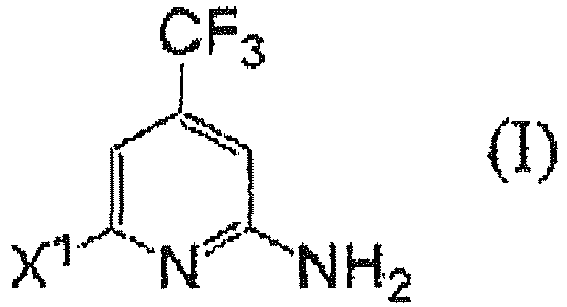
- (in the formula, X1 is the same as X1 in the formula (II)) in a high purity for a short period of time, has been found. Furthermore, a process in which the obtained compound of the formula (I) is subjected to dehalogenation, thereby producing 2-amino-4-trifluoromethylpyridine in a high purity for a short period of time, has been found.
Thus, the present invention relates to a process for producing a compound of the formula (I) or a salt thereof comprising allowing a compound of the formula (II) to react with ammonia in the presence of a hydrophilic ether; and also relates to a process for producing 2-amino-4-trifluoromethylpyridine or a salt thereof comprising subjecting the compound of the formula (1) as produced by the foregoing process to dehalogenation. - According to the production process of the present invention, 2-amino-4-trfluoromethylpyridines can be produced under industrially advantageous conditions.
- As shown in the following Reaction (A), the compound of the formula (I) can be produced by allowing the compound of the formula (II) to react with ammonia in the presence or a hydrophilic ether.
- Reaction (A):
-

- (In the formulae (I) and (II), X1 and X2 are the same as described above.)
Examples of the salt of the compound of the formula (I) include acid addition salts and the like. Examples of the acid addition salt include acid addition salts such as hydrochlorides and sulfates. The salt of the compound of the formula (I) can be produced in accordance with a known salt forming reaction.
X1 and X2 are preferably a chlorine atom.
Examples of ammonia include ammonia water and ammonia gas.
Ammonia can be used in an amount of preferably from 3 to 15 times by mole, and more preferably from 5 to 12 times by mole per one mole of the compound of the formula (11). However, an amount falling outside this range can also be adopted, depending upon reaction conditions. - The hydrophilic ether is not particularly limited so far as it is inert to the reaction. Examples of the hydrophilic ether include cyclic ethers such as tetrahydrofuran, 2-methyltetrahydrofuran, 3-methyltetrahydrofuran, and 1,4-dioxane; straight-chain ethers such as 1,2-dimethoxyethane; and the like. As the hydrophilic ether, for example, tetrahydrofuran, 2-methyltetrahydrofuran, 3-methyltetrahydrofuran, 1,2-dimethoxyethane, and the like are preferable.
- The hydrophilic ether can be used in an amount of preferably from 1 to 10 times by volume (V/W), and more preferably from 1 to 5 times by volume (V/W) relative to the weight of the compound of the formula (II). However, an amount falling outside this range can also be adopted, depending upon reaction conditions.
- The present reaction can also be conducted in the presence of a solvent. The solvent is not particularly limited so far as it is inert to the reaction. Examples of the solvent include aliphatic hydrocarbons such as pentane, hexane, heptane, octane, and cyclohexane; aromatic hydrocarbons such as benzene, toluene, and xylene; ethers such as diethyl ether, butyl ethyl ether, and methyl tert-butyl ether; polar aprotic solvents such as acetonitrile, propionitrile, N,N-dimethylformamide, dimethyl sulfoxide, hexamethylphosphoric triamide, sulfolane, N,N-dimethylacetamide, and N-methylpyrrolidone; esters such as methyl acetate, ethyl acetate, and propyl acetate; alcohols such as methanol, ethanol, propanol, n-butanol, and tert-butanol; water; and the like.
- A reaction temperature is preferably from about 100 to about 200 °C, and more preferably from about 130 to about 160 °C; and a reaction time is preferably from about 2 to about 24 hours, and more preferably from about 4 to about 7 hours.
- As shown in the following Reaction (B), 2-amino-4-trifluoromethylpyridine can be produced by allowing the compound of the formula (II) to react with ammonia in the presence of a hydrophilic ether to produce the compound of the formula (I) and subsequently subjecting the obtained compound of the formula (I) to dehalogenation.
- Reaction (B):
-

- (In the formulae (I) and (II), X1 and X2 have the same meanings as those in X1 and X2 in the Reaction (A).)
In the foregoing reaction, the dehalogenation reaction can be conducted without isolating or purifying the compound of the formula (I).
In addition, examples of the salt of 2-amino-4-trifluoromethylpyridine include acid addition salts and the like. Examples of the acid addition salt include hydrochlorides, sulfates, and the like. The salt of 2-amino-4-trifluoromethylpyridine can be produced in accordance with a known salt forming reaction.
X1 and X2 are preferably a chlorine atom.
The reaction between the compound of the formula (II) and ammonia can be conducted in the same manner as that in the foregoing Reaction (A). However, since ammonia can also serve as a base in the dehalogenation step, its use amount may be increased, if desired. In the case of increasing the use amount of ammonia, the amount can be set to preferably from 3 to 20 times by mole, and more preferably from 5 to 15 times by mole per one mole of the compound of the formula (II). However, an amount falling outside this range can also be adopted, depending upon reaction conditions. - The dehalogenation can be, for example, conducted by means of catalytic reduction. In general, the catalytic reduction can be conducted by allowing the desired compound to react with a hydrogen source in the presence of a catalyst and a solvent. Examples of the hydrogen source include hydrogen, ammonium formate, formic acid, triethylammonium formate, and sodium hypophosphite; mixtures of two or more members properly selected from these compounds; and the like. Of these, hydrogen is preferable as the hydrogen source. Examples of the catalyst include platinum, platinum oxide, platinum black, Raney nickel, palladium, palladium-carbon, rhodium, rhodium-alumina, ruthenium, iron, copper, and the like. Of these, palladium-carbon and the like are desirable as the catalyst. Incidentally, the catalyst may be used alone or in combination of two or more kinds thereof.
- The hydrogen source can be used in an amount of preferably from 1 to 10 times by mole, and more preferably from 1 to 5 times by mole per one mole of the compound of the formula (I). In addition, the catalyst can be used in an amount of preferably from 0.01 to 1 % by mole, and more preferably from 0.05 to 0.5 % by mole per one mole of the compound of the formula (I). However, an amount falling outside those ranges can also be adopted, depending upon reaction conditions. Incidentally, in the case of conducting the dehalogenation without isolating or purifying the compound of the formula (I), the hydrogen source or the catalyst may be used in the same proportion as described above per one mole of the compound of the formula (II).
- A solvent which is usually used for catalytic reduction can be used as the solvent Examples of the solvent include the same solvents as those in the foregoing step. In the case of conducting the catalytic reduction without isolating or purifying the compound of the formula (I), the solvent used in the reaction between the compound of the formula (II) and ammonia can be used as it is.
- In general, the dehalogenation is conducted in the presence of a base. Examples of the base include ammonia; alkali metal hydroxides such as sodium hydroxide and potassium hydroxide; alkali metal carbonates such as sodium carbonate and potassium carbonate; alkali metal bicarbonates such as sodium bicarbonate and potassium bicarbonate; tertiary amines such as trimethylamine, triethylamine, triisopropylamine, diisopropylethylamine, pyridine, 4-dimethylaminopyridine, 2,6-dimethylpyridine, 4-pyrrolidinopyridine, N-methylmorpholine, NN-dimethylaniline, N,N-diethylaniline, N-ethyl-N-methylaniline, 1,8-diazabicyclo[5.4.0]-7-undecene, and 1,4-diazabicyclo[2.2.2]octane; and the like. Above all, by making ammonia used in the preceding step also serve as the base, the reaction can be efficiently conducted.
- The base can be used in an amount of preferably from 1 to 2 equivalents, and more preferably from 1 to 1.5 equivalents per one mole of the compound of the formula (I). However, an amount falling outside this range can also be adopted, depending upon reaction conditions. Incidentally, in the case of conducting the dehalogenation without isolating or purifying the compound of the formula (I), the base may also be used in the same proportion as described above per one mole of the compound of the formula (II).
A reaction temperature of the dehalogenation is preferably from about 20 to about 150 °C, and more preferably from about 60 to about 130 °C; and a reaction time is preferably from about 0.5 to about 10 hours, and more preferably from about 1 to about 5 hours. - Preferred embodiments of the present invention are hereunder described, but it should not be construed that the present invention is limited thereto.
- (1) A process for producing 2-amino-6-chloro-4-trifluoromethylpyridine or a salt thereof comprising allowing 2,6-dichloro-4-trifluoromethylpyridine to react with ammonia in the presence of a hydrophilic ether.
- (2) A process for producing 2-amino4-trifluoromethylpyridine or a salt thereof comprising allowing 2,6-dichloro-4-trifluoromethylpyridine to react with ammonia in the presence of a hydrophilic ether to produce 2-amino-6-chloro-4-trifluoromethylpyridine and subsequently subjecting the obtained 2-amino-6-chloro-4-trifluoromethylpyridine to dehalogenation.
- (3) The process as set forth above in (1) or (2), wherein the hydrophilic ether is at least one member selected from the group consisting of tetrahydrofuran, 2-methyltetrahydrofuran, 3-methyltetrahydrofuran, and 1,2-dimethoxyethane.
- (4) The process as set forth above in (1) or (2), wherein the hydrophilic ether is at least one member selected from the group consisting of tetrahydrofuran and 1,2-dimethoxyethane.
- (5) The process as set forth above in (1) or (2), wherein the hydrophilic ether is used in an amount of from 1 to 10 times (V/W) relative to the 2,6-dichloro-4-trifluoromethylpyridine.
- In order to describe the present invention in more detail, Examples are described below, but it should not be construed that the present invention is limited thereto. Abbreviations in each of the synthesis examples and each of the tables are as follows.
2,6,4-DCTF: 2,6-Dichloro-4-trifluoromethylpyridine
2,6,4-ACTF: 2-Amino-6-chloro-4-trifluorometlrylpyridine
2,6,4-DATF: 2,6-Diamino-4-trifluoromethylpyridine
2,4-ATF: 2-Amino-4-trifluoromethylpyridine
THF: Tetrahydrofuran
2-Me-THF: 2-Methyltetrahydrofuran
DME: 1,2-Dimethoxyethane
Pd/C: Falladium-carbon
HPLC-PA % in each of the tables empresses a peak area rate (peak area %) analyzed by high performance liquid chromatography (HPLC). The measuring conditions are as follows.
Column: Waters 5C19-AR φ4.6 mm x 150 mm
Mobile phase: Methanol/water = 4/1, 0.5 % acetic acid
Column temperature: 40 °C
Flow rate: 1 mL/min
Detection: 254 nm - In an autoclave (100 mL), 5 g (0.023 moles) of 2,6,4-DCTF, 15.3 mL (0.22 moles) of 28 % ammonia water, and 10 mL of THF were heated to 150°C with stirring to effect reaction. After about 5 hours, the autoclave was cooled to from 30 to 40 °C. Water was added to the reaction solution; the extraction with ethyl acetate was conducted three times; and an organic layer was washed with saturated saline and then dried over sodium sulfate. The organic layer was concentrated under reduced pressure to obtain 2,6,4-ACTF.
- 2,6,4-ACTF was obtained by conducting the reaction in the same manner as that in Example 1, except for not using THF.
- As for each of Example 1 and Comparative Example 1, the reaction solution was analyzed by high performance liquid chromatography (HPLC). HPLC-PA % of each of 2,6,4-DCTF as a raw material compound, 2,6,4-ACTF as a desired compound, and 2,6,4-DATF as a by-product is described in Table 1.
-
Table 1 hydrophilic ether HPLC-PA% 2,6,4-DCTF 2,6,4-ACTF 2,6,4-DATF Example 1 THF 2.5 94.5 1.5 Comparative Example 1 Nil 24.1 72.5 1.8 - In an autoclave (100 mL), 5 g (0.023 moles) of 2,6,4-DCTF, 15.4 mL (0.22 moles) of 28 % ammonia water, and 13 mL of THF were heated to 150 °C with stirring to effect reaction. After about 5 hours, the autoclave was cooled to from 30 to 40 °C. 150 mg of 5 % Pd/C (54 % wet, (1.038 mmoles) was added thereto, hydrogen was filled up to 2.0 MPa, and the contents were heated to 100 °C with stirring to effect reaction. After about 3 hours, the autoclave was cooled to from 30 to 40 °C, followed by filtration through Celite. Water was added to a filtrate; the extraction with ethyl acetate was conducted three times; and an organic layer was washed with saturated saline and then dried over sodium sulfate. The organic layer was concentrated under reduced pressure, and n-hexane was added, followed by concentration under reduced pressure. A deposited crystal was dried under reduced pressure, thereby obtaining 3 g of 2,4-ATF as a white crystal (yield (crude): 79.9 %).
- 3.03 g of 2,4-ATF was obtained as a white crystal (yield (crude): 80.7 %) by conducting the reaction in the same manner as that in Example 2, except for using 15.3 mL (0.22 moles) of 28 % ammonia water and 10 mL of THF.
- 3.34 g of 2,4-ATF was obtained as a white crystal (yield (crude): 89.0 %) by conducting the reaction in the same manner as that in Example 3, except for changing THF to DME.
- In an autoclave (100 mL), 5 g (0.023 moles) of 2,6,4-DCTF and 15.3 mL (0.22 moles) of 28 % ammonia water were heated to 150 °C with stirring to effect reaction. After about 15 hours, the autoclave was cooled to from 30 to 40 °C. 150 mg of 5 % Pd/C (54 % wet, 0.038 mmoles) was added thereto, hydrogen was filled up to 1.8 MPa, followed by heating to 100°C with stirring to effect reaction. After about 3 hours, the autoclave was cooled to from 30 to 40 °C, followed by filtration through Celite. Water was added to the filtrate; the extraction with ethyl acetate was conducted three times; and an organic layer was washed with saturated saline and then dried over sodium sulfate. The organic layer was concentrated under reduced pressure, and after adding n-hexane, followed by concentration under reduced pressure. A deposited crystal was dried under reduced pressure, thereby obtaining 3 g of 2,4-ATF as a pale ocher crystal (yield (crude): 79.9 %).
- As for each of Examples 2, 3 and 4 and Comparative Example 2, the obtained crystal was analyzed by high performance liquid chromatography (HPLC). HPLC-PA % of each of 2,6,4-ACTF as an intermediate product, 2,4-ATF as a desired compound, and 2,6,4-DATF as a by-product and the yield of 2,4-ATF are described in Table 2.
-
Table2 hydrophilic ether HPLC-PA% Yield (%) 2,6,4-ACTF 2,4-ATF 2,6,4-DATF Example 2 THF 1.4 92.9 3.4 79.9 Example 3 THF 3.0 90.8 4.5 80.7 Example 4 DME 0.6 94.7 3.9 89.0 Comparative Example 2 Nil 2.5 81.1 9.7 79.9 - In an autoclave (200 mL), 10 g (0.046 moles) of 2,6,4-DCTF, 30.6 mL (0.44 moles) of 28 % ammonia water, and 20 mL of THF were heated to 150 °C with stirring to effect reaction. After about 6 hours, the autoclave was cooled to from 30 to 40 °C, 300 mg of 5 % Pd/C (54 % wet, 0.076 mmoles) was added thereto, hydrogen was filled up to 2.0 MPa, followed by heating to 100 °C with stirring to effect reaction. After about 3 hours, the pressure reactor was cooled to from 30 to 40 °C, followed by filtration through Celite. Water was added to the filtrate; the extraction with ethyl acetate was conducted three times; and an organic layer was washed with saturated saline and then dried over sodium sulfate. The organic layer was concentrated under reduced pressure, and n-hexane was added, followed by concentration. To a deposited crystal, n-hexane was added, followed by stirring under ice cooling for about 60 minutes, and a deposited crystal was filtered. The obtained crystal was subjected to washing with ice-cooled n-hexane three times and then dried under reduced pressure to obtain 5.4 g of 2,4-ATF as a white crystal (yield: 71.9 %, melting point: 70.1 °C). In addition, an NMR spectrum data of the obtained crystal is as follows.
1H-NMR (CDCl3): δ 4.713 (brs, 2H), 6.684 (s, 1H), 6.823 (dd, J = 5.2 and 1.2 Hz, 1H), 8.205 (d, J = 5.6 Hz, 1H) - As for Example 5, the obtained white crystal was analyzed by high performance liquid chromatography (HPLC). HPLC-PA % of each of 2,6,4-ACTF as an intermediate product, 2,4-ATF as a desired compound, and 2,6,4-DATF as a by-product and the yield of 2,4-ATF are described in Table 3.
-
Table3 hydrophilic ether HPLC-PA% Yield (%) 2,6,4-ACTF 2,4-ATF 2,6,4-DATF Example 5 THF 0.8 96.0 2.5 71.9 - A hydrogen chloride gas was gradually blown into a mixture of 6 g of 2,4-ATF and 80 mL of dry toluene at from 10 to 20 °C while stirring, After stirring at room temperature for 30 minutes, filtration was conducted, and a crystal was subjected to washing with dry toluene three times. The obtained crystal was dried under reduced pressure to obtain 7.1 g of 2,4-ATF hydrochloride as a white crystal (yield: 96.6 %, melting point: 218 °C). In addition, an NMR spectrum data of the obtained crystal is as follows.
1H-NMR (D2O): δ 4.650 (brs, 2H), 6.957 (dd, J = 6.8 and 2.0 Hz, 1H), 7.209 (d, J = 0.8 Hz, 1H), 7.838 (d, J = 6.4 Hz, 1H) - In an autoclave (200 mL), 10 g (0.046 moles) of 2,6,4-DCTF, 30.6 mL (0.44 moles) of 28 % ammonia water, and 20 mL of 2-Me-THF were heated to 150 °C with stirring to effect reaction. After about 6 hours, the autoclave was cooled to from 30 to 40 °C. 300 mg of 5 % Pd/C (54 % wet, 0.076 mmoles) was added thereto, hydrogen was filled up to 1.6 MPa, followed by heating to 100 °C with stirring to effect reaction. After about 3 hours, the pressure reactor was cooled to from 30 to 40 °C, followed by filtration through Celite. Water was added to a filtrate, and only a separated organic layer was collected. An aqueous layer was extracted with ethyl acetate once, and the organic layer was collected. The collected organic layers were mixed, washed with saturated saline, and then dried over sodium sulfate. The organic layer was concentrated under reduced pressure, to which then n-hexane was added, followed by concentration. To a deposited crystal, n-hexane was added, followed by stirring under ice cooling for about 30 minutes, and a deposited crystal was filtered. The obtained crystal was subjected to washing with ice-cooled n-hexane three times and then dried under reduced pressure to obtain 5.36 g of 2,4-ATF as a white crystal (yield: 71.4 %).
- While the invention has been described in detail and with reference to specific embodiments thereof, it will be apparent to one skilled in the art that various changes and modifications can be made therein without departing from the spirit and scope thereof.
Incidentally, the present application is based on a Japanese patent application filed on January 21, 2010 (Japanese Patent Application No.2010-010890
In addition, the entire disclosures as referred to therein are incorporated herein by reference in its entirety. - According to the production process of the present invention, 2-amino-4-trfluoromethylpyridines can be produced under industrially advantageous conditions.
Claims (6)
- A process for producing a compound represented by the formula (I) or a salt thereof:

which comprises allowing a compound represented by the formula (II):
to react with ammonia in the presence of a hydrophilic ether. - A process for producing 2-amino-4-trifluoromethylpyridine or a salt thereof, which comprises allowing a compound represented by the formula (II):

to react with ammonia in the presence of a hydrophilic ether to produce a compound represented by the formula (I):
and subsequently subjecting the obtained compound represented by the formula (I) to dehalogenation. - The method according to claim 1 or 2, wherein the hydrophilic ether is at least one member selected from the group consisting of tetrahydrofuran, 2-methyltetrahydroiuran, 3-methyltetrahydrofuran, and 1,2-dimethoxyethane.
- The method according to claim 1 or 2, wherein the hydrophilic ether is used in an amount of from 1 to 10 times (V/W) relative to the compound of the formula (II).
- The method according to claim 1 or 2, wherein X1 and X7 are a chlorine atom.
- An acid addition salt of 2-amino-4-trifluoromethylpyridine.
Applications Claiming Priority (2)
| Application Number | Priority Date | Filing Date | Title |
|---|---|---|---|
| JP2010010890 | 2010-01-21 | ||
| PCT/JP2011/050996 WO2011090122A1 (en) | 2010-01-21 | 2011-01-20 | Method for producing 2-amino-4-(trifluoromethyl)pyridine |
Publications (2)
| Publication Number | Publication Date |
|---|---|
| EP2527327A1 true EP2527327A1 (en) | 2012-11-28 |
| EP2527327A4 EP2527327A4 (en) | 2013-08-21 |
Family
ID=44306922
Family Applications (1)
| Application Number | Title | Priority Date | Filing Date |
|---|---|---|---|
| EP11734728.6A Withdrawn EP2527327A4 (en) | 2010-01-21 | 2011-01-20 | Method for producing 2-amino-4-(trifluoromethyl)pyridine |
Country Status (5)
| Country | Link |
|---|---|
| EP (1) | EP2527327A4 (en) |
| JP (1) | JP5689321B2 (en) |
| KR (1) | KR101653025B1 (en) |
| CN (1) | CN102712593B (en) |
| WO (1) | WO2011090122A1 (en) |
Families Citing this family (5)
| Publication number | Priority date | Publication date | Assignee | Title |
|---|---|---|---|---|
| CA2917262A1 (en) | 2013-07-02 | 2015-01-08 | Syngenta Participations Ag | Pesticidally active bi- or tricyclic heterocycles with sulfur containing substituents |
| AR119140A1 (en) | 2019-06-13 | 2021-11-24 | Pi Industries Ltd | FUSED HETEROCYCLIC COMPOUNDS AND THEIR USE AS PEST CONTROL AGENTS |
| CN111574439A (en) * | 2020-05-13 | 2020-08-25 | 山东汇盟生物科技有限公司 | Method for preparing 2-amino-3 chloro-5-trifluoromethylpyridine |
| CN114790168B (en) * | 2021-05-18 | 2024-02-09 | 上海素馨化工科技有限公司 | Preparation method of 2-amino-4-trifluoromethyl pyridine and 2-amino-4-trifluoromethyl pyridine |
| CN115385852A (en) * | 2022-09-05 | 2022-11-25 | 湖南阿斯迪康药业有限公司 | A kind of efficient synthetic method of 2-amino-4-trifluoromethylpyridine |
Family Cites Families (16)
| Publication number | Priority date | Publication date | Assignee | Title |
|---|---|---|---|---|
| US3787420A (en) * | 1969-03-17 | 1974-01-22 | Dow Chemical Co | Cyanoalkoxy(trifluoromethyl)pyridines |
| US3820973A (en) * | 1973-06-12 | 1974-06-28 | Dow Chemical Co | Method and composition for the stimulation of plant growth |
| JPS62155260A (en) * | 1985-12-27 | 1987-07-10 | Ishihara Sangyo Kaisha Ltd | N-benzoyl-n'-pyridylurea and insecticide containing same |
| JPS62155259A (en) * | 1985-12-27 | 1987-07-10 | Ishihara Sangyo Kaisha Ltd | Aminotrifluoromethylpyridine and its production |
| JPS6348268A (en) | 1986-08-14 | 1988-02-29 | Ishihara Sangyo Kaisha Ltd | N-pyridyl-n'-benzoylurea compound and insecticide containing said compound |
| US5292541A (en) * | 1989-05-26 | 1994-03-08 | Red Arrow Products Company Inc. | Browning materials derived from the pyrolysis of sugars and starches |
| JP2002201179A (en) * | 2000-12-28 | 2002-07-16 | Ishihara Sangyo Kaisha Ltd | Method for producing 6-haloalkylnicotinic acid compound |
| CN101472895A (en) * | 2006-06-20 | 2009-07-01 | 石原产业株式会社 | Pest control agent containing novel pyridyl-methanamine derivative or salt thereof |
| JP2008024697A (en) * | 2006-06-20 | 2008-02-07 | Ishihara Sangyo Kaisha Ltd | Pest control agent comprising new pyridyl-methanamine derivative or salt thereof |
| CA2673038C (en) * | 2006-12-22 | 2015-12-15 | Incyte Corporation | Substituted tricyclic heteroaryl compounds as janus kinase inhibitors |
| ES2359123T3 (en) * | 2007-08-03 | 2011-05-18 | Pfizer Limited | IMIDAZOPIRIDINONES. |
| CA2691448A1 (en) * | 2007-08-31 | 2009-03-05 | Dominique Swinnen | Triazolopyridine compounds and their use as ask inhibitors |
| EP2227452A2 (en) * | 2007-11-30 | 2010-09-15 | F. Hoffmann-La Roche AG | Pyridine compounds |
| JPWO2009084695A1 (en) * | 2007-12-28 | 2011-05-19 | カルナバイオサイエンス株式会社 | 2-Aminoquinazoline derivatives |
| JP2010010890A (en) | 2008-06-25 | 2010-01-14 | Casio Comput Co Ltd | Imaging device, image store control method, and program |
| JP5498202B2 (en) | 2009-03-03 | 2014-05-21 | 富士フイルム株式会社 | Barrier laminate, gas barrier film and device using the same |
-
2011
- 2011-01-12 JP JP2011003595A patent/JP5689321B2/en active Active
- 2011-01-20 WO PCT/JP2011/050996 patent/WO2011090122A1/en not_active Ceased
- 2011-01-20 KR KR1020127018863A patent/KR101653025B1/en not_active Expired - Fee Related
- 2011-01-20 EP EP11734728.6A patent/EP2527327A4/en not_active Withdrawn
- 2011-01-20 CN CN201180006777.3A patent/CN102712593B/en not_active Expired - Fee Related
Also Published As
| Publication number | Publication date |
|---|---|
| CN102712593B (en) | 2015-04-01 |
| KR101653025B1 (en) | 2016-08-31 |
| WO2011090122A1 (en) | 2011-07-28 |
| JP2011168577A (en) | 2011-09-01 |
| JP5689321B2 (en) | 2015-03-25 |
| CN102712593A (en) | 2012-10-03 |
| KR20120117831A (en) | 2012-10-24 |
| EP2527327A4 (en) | 2013-08-21 |
Similar Documents
| Publication | Publication Date | Title |
|---|---|---|
| KR102746929B1 (en) | Intermediates useful for the synthesis of a selective inhibitor against protein kinase and processes for preparing the same | |
| JP5654686B2 (en) | Method for synthesizing 2-substituted-1,4-benzenediamine | |
| EP2527327A1 (en) | Method for producing 2-amino-4-(trifluoromethyl)pyridine | |
| WO2023214552A1 (en) | Trifluoromethane sulfonylation agent composition and method for producing trifluoromethanesulfonyloxy compound or trifluoromethane sulfonyl compound | |
| KR101469879B1 (en) | A method for preparing methyl (E)-2-[2-[6-(2-cyanophenoxy)pyrimidine-4-yloxy]phenyl]-3-methoxyacrylate | |
| US20090209769A1 (en) | Alkyl-Analide Producing Method | |
| US9447067B2 (en) | Method of preparing intermediate of salmeterol | |
| TW202340160A (en) | Process for preparing isoxazoline-5,5-vinylcarboxylic acid derivatives | |
| WO2016161826A1 (en) | Method for preparing 4-isopropylamino-1-butanol | |
| JP5516567B2 (en) | Process for producing 4-amino-2-alkylthio-5-pyrimidinecarbaldehyde | |
| JP7453365B2 (en) | High purity N-(5-methoxy-2-phenoxyphenyl)methanesulfonamide and its production method | |
| JP4161290B2 (en) | Process for producing pyrimidinyl alcohol derivatives and synthetic intermediates thereof | |
| JP5009306B2 (en) | Process for producing 2-isopropenyl-5-methyl-4-hexen-1-yl 3-methyl-2-butenoate | |
| JP2005314322A (en) | Method for producing catechol derivatives and precursors thereof | |
| JPWO2008007763A1 (en) | Method for producing imidazolidine-2,4-dione compound and method for obtaining solid 4,5-dihydroxy-2-imidazolidinone compound | |
| JP6182507B2 (en) | Method for producing 2,3-dihalogenoaniline | |
| KR102592383B1 (en) | Diamine compound and method for producing intermediate thereof | |
| EP3956295A1 (en) | Process for the production of substituted 2-[2-(phenyl) ethylamino]alkaneamide derivatives | |
| JP5507147B2 (en) | Process for producing pyrimidinyl alcohol derivatives and synthetic intermediates thereof | |
| CA3019877A1 (en) | Process for the preparation of herbicidal pyridinylimidazolone compounds | |
| JP2009143850A (en) | Method for producing pyrazolinone derivatives | |
| WO2022202814A1 (en) | Method for producing pyrimidine compound | |
| JP2008247835A (en) | Process for producing β-diketone compound having methoxy group | |
| JP2006321749A (en) | Preparation of alkali metal salt of 2-cyanomalonaldehyde | |
| JP2018070550A (en) | Method for producing 1,1-dioxo-hexahydro-thiopyran-4-carboxylic acid or derivative thereof |
Legal Events
| Date | Code | Title | Description |
|---|---|---|---|
| PUAI | Public reference made under article 153(3) epc to a published international application that has entered the european phase |
Free format text: ORIGINAL CODE: 0009012 |
|
| 17P | Request for examination filed |
Effective date: 20120720 |
|
| AK | Designated contracting states |
Kind code of ref document: A1 Designated state(s): AL AT BE BG CH CY CZ DE DK EE ES FI FR GB GR HR HU IE IS IT LI LT LU LV MC MK MT NL NO PL PT RO RS SE SI SK SM TR |
|
| DAX | Request for extension of the european patent (deleted) | ||
| A4 | Supplementary search report drawn up and despatched |
Effective date: 20130724 |
|
| RIC1 | Information provided on ipc code assigned before grant |
Ipc: C07D 213/73 20060101AFI20130718BHEP |
|
| 17Q | First examination report despatched |
Effective date: 20140310 |
|
| GRAP | Despatch of communication of intention to grant a patent |
Free format text: ORIGINAL CODE: EPIDOSNIGR1 |
|
| INTG | Intention to grant announced |
Effective date: 20140611 |
|
| GRAP | Despatch of communication of intention to grant a patent |
Free format text: ORIGINAL CODE: EPIDOSNIGR1 |
|
| INTG | Intention to grant announced |
Effective date: 20141023 |
|
| STAA | Information on the status of an ep patent application or granted ep patent |
Free format text: STATUS: THE APPLICATION IS DEEMED TO BE WITHDRAWN |
|
| 18D | Application deemed to be withdrawn |
Effective date: 20150303 |