EP2524913A1 - Nitrogenated heterocyclic ring derivative and organic electroluminescent element comprising same - Google Patents
Nitrogenated heterocyclic ring derivative and organic electroluminescent element comprising same Download PDFInfo
- Publication number
- EP2524913A1 EP2524913A1 EP11732808A EP11732808A EP2524913A1 EP 2524913 A1 EP2524913 A1 EP 2524913A1 EP 11732808 A EP11732808 A EP 11732808A EP 11732808 A EP11732808 A EP 11732808A EP 2524913 A1 EP2524913 A1 EP 2524913A1
- Authority
- EP
- European Patent Office
- Prior art keywords
- group
- substituted
- unsubstituted
- carbon atoms
- nitrogen
- Prior art date
- Legal status (The legal status is an assumption and is not a legal conclusion. Google has not performed a legal analysis and makes no representation as to the accuracy of the status listed.)
- Granted
Links
- 0 C*(C*)CC1(C)*(C)=C([C@](C)*)C2(C)*=C(*)CC12 Chemical compound C*(C*)CC1(C)*(C)=C([C@](C)*)C2(C)*=C(*)CC12 0.000 description 10
- DVLBVXFKXGOGSV-UHFFFAOYSA-N CCc1nc(cccc2)c2[n]1-c(cc1)ccc1-c(cc1)ccc1-c(cc1)c2c3c1C1=CC=CCC1c3ccc2 Chemical compound CCc1nc(cccc2)c2[n]1-c(cc1)ccc1-c(cc1)ccc1-c(cc1)c2c3c1C1=CC=CCC1c3ccc2 DVLBVXFKXGOGSV-UHFFFAOYSA-N 0.000 description 1
Images

Classifications
-
- H—ELECTRICITY
- H10—SEMICONDUCTOR DEVICES; ELECTRIC SOLID-STATE DEVICES NOT OTHERWISE PROVIDED FOR
- H10K—ORGANIC ELECTRIC SOLID-STATE DEVICES
- H10K85/00—Organic materials used in the body or electrodes of devices covered by this subclass
- H10K85/60—Organic compounds having low molecular weight
- H10K85/615—Polycyclic condensed aromatic hydrocarbons, e.g. anthracene
-
- C—CHEMISTRY; METALLURGY
- C07—ORGANIC CHEMISTRY
- C07D—HETEROCYCLIC COMPOUNDS
- C07D235/00—Heterocyclic compounds containing 1,3-diazole or hydrogenated 1,3-diazole rings, condensed with other rings
- C07D235/02—Heterocyclic compounds containing 1,3-diazole or hydrogenated 1,3-diazole rings, condensed with other rings condensed with carbocyclic rings or ring systems
- C07D235/04—Benzimidazoles; Hydrogenated benzimidazoles
- C07D235/06—Benzimidazoles; Hydrogenated benzimidazoles with only hydrogen atoms, hydrocarbon or substituted hydrocarbon radicals, directly attached in position 2
- C07D235/08—Radicals containing only hydrogen and carbon atoms
-
- C—CHEMISTRY; METALLURGY
- C07—ORGANIC CHEMISTRY
- C07C—ACYCLIC OR CARBOCYCLIC COMPOUNDS
- C07C15/00—Cyclic hydrocarbons containing only six-membered aromatic rings as cyclic parts
- C07C15/20—Polycyclic condensed hydrocarbons
- C07C15/38—Polycyclic condensed hydrocarbons containing four rings
-
- C—CHEMISTRY; METALLURGY
- C07—ORGANIC CHEMISTRY
- C07D—HETEROCYCLIC COMPOUNDS
- C07D235/00—Heterocyclic compounds containing 1,3-diazole or hydrogenated 1,3-diazole rings, condensed with other rings
- C07D235/02—Heterocyclic compounds containing 1,3-diazole or hydrogenated 1,3-diazole rings, condensed with other rings condensed with carbocyclic rings or ring systems
- C07D235/04—Benzimidazoles; Hydrogenated benzimidazoles
- C07D235/18—Benzimidazoles; Hydrogenated benzimidazoles with aryl radicals directly attached in position 2
-
- C—CHEMISTRY; METALLURGY
- C07—ORGANIC CHEMISTRY
- C07D—HETEROCYCLIC COMPOUNDS
- C07D401/00—Heterocyclic compounds containing two or more hetero rings, having nitrogen atoms as the only ring hetero atoms, at least one ring being a six-membered ring with only one nitrogen atom
- C07D401/02—Heterocyclic compounds containing two or more hetero rings, having nitrogen atoms as the only ring hetero atoms, at least one ring being a six-membered ring with only one nitrogen atom containing two hetero rings
- C07D401/04—Heterocyclic compounds containing two or more hetero rings, having nitrogen atoms as the only ring hetero atoms, at least one ring being a six-membered ring with only one nitrogen atom containing two hetero rings directly linked by a ring-member-to-ring-member bond
-
- C—CHEMISTRY; METALLURGY
- C07—ORGANIC CHEMISTRY
- C07D—HETEROCYCLIC COMPOUNDS
- C07D401/00—Heterocyclic compounds containing two or more hetero rings, having nitrogen atoms as the only ring hetero atoms, at least one ring being a six-membered ring with only one nitrogen atom
- C07D401/14—Heterocyclic compounds containing two or more hetero rings, having nitrogen atoms as the only ring hetero atoms, at least one ring being a six-membered ring with only one nitrogen atom containing three or more hetero rings
-
- C—CHEMISTRY; METALLURGY
- C07—ORGANIC CHEMISTRY
- C07D—HETEROCYCLIC COMPOUNDS
- C07D403/00—Heterocyclic compounds containing two or more hetero rings, having nitrogen atoms as the only ring hetero atoms, not provided for by group C07D401/00
- C07D403/02—Heterocyclic compounds containing two or more hetero rings, having nitrogen atoms as the only ring hetero atoms, not provided for by group C07D401/00 containing two hetero rings
- C07D403/04—Heterocyclic compounds containing two or more hetero rings, having nitrogen atoms as the only ring hetero atoms, not provided for by group C07D401/00 containing two hetero rings directly linked by a ring-member-to-ring-member bond
-
- C—CHEMISTRY; METALLURGY
- C07—ORGANIC CHEMISTRY
- C07D—HETEROCYCLIC COMPOUNDS
- C07D403/00—Heterocyclic compounds containing two or more hetero rings, having nitrogen atoms as the only ring hetero atoms, not provided for by group C07D401/00
- C07D403/02—Heterocyclic compounds containing two or more hetero rings, having nitrogen atoms as the only ring hetero atoms, not provided for by group C07D401/00 containing two hetero rings
- C07D403/10—Heterocyclic compounds containing two or more hetero rings, having nitrogen atoms as the only ring hetero atoms, not provided for by group C07D401/00 containing two hetero rings linked by a carbon chain containing aromatic rings
-
- C—CHEMISTRY; METALLURGY
- C07—ORGANIC CHEMISTRY
- C07D—HETEROCYCLIC COMPOUNDS
- C07D405/00—Heterocyclic compounds containing both one or more hetero rings having oxygen atoms as the only ring hetero atoms, and one or more rings having nitrogen as the only ring hetero atom
- C07D405/02—Heterocyclic compounds containing both one or more hetero rings having oxygen atoms as the only ring hetero atoms, and one or more rings having nitrogen as the only ring hetero atom containing two hetero rings
- C07D405/04—Heterocyclic compounds containing both one or more hetero rings having oxygen atoms as the only ring hetero atoms, and one or more rings having nitrogen as the only ring hetero atom containing two hetero rings directly linked by a ring-member-to-ring-member bond
-
- C—CHEMISTRY; METALLURGY
- C07—ORGANIC CHEMISTRY
- C07D—HETEROCYCLIC COMPOUNDS
- C07D471/00—Heterocyclic compounds containing nitrogen atoms as the only ring hetero atoms in the condensed system, at least one ring being a six-membered ring with one nitrogen atom, not provided for by groups C07D451/00 - C07D463/00
- C07D471/02—Heterocyclic compounds containing nitrogen atoms as the only ring hetero atoms in the condensed system, at least one ring being a six-membered ring with one nitrogen atom, not provided for by groups C07D451/00 - C07D463/00 in which the condensed system contains two hetero rings
- C07D471/04—Ortho-condensed systems
-
- C—CHEMISTRY; METALLURGY
- C07—ORGANIC CHEMISTRY
- C07D—HETEROCYCLIC COMPOUNDS
- C07D519/00—Heterocyclic compounds containing more than one system of two or more relevant hetero rings condensed among themselves or condensed with a common carbocyclic ring system not provided for in groups C07D453/00 or C07D455/00
-
- H—ELECTRICITY
- H10—SEMICONDUCTOR DEVICES; ELECTRIC SOLID-STATE DEVICES NOT OTHERWISE PROVIDED FOR
- H10K—ORGANIC ELECTRIC SOLID-STATE DEVICES
- H10K85/00—Organic materials used in the body or electrodes of devices covered by this subclass
- H10K85/60—Organic compounds having low molecular weight
- H10K85/615—Polycyclic condensed aromatic hydrocarbons, e.g. anthracene
- H10K85/622—Polycyclic condensed aromatic hydrocarbons, e.g. anthracene containing four rings, e.g. pyrene
-
- H—ELECTRICITY
- H10—SEMICONDUCTOR DEVICES; ELECTRIC SOLID-STATE DEVICES NOT OTHERWISE PROVIDED FOR
- H10K—ORGANIC ELECTRIC SOLID-STATE DEVICES
- H10K85/00—Organic materials used in the body or electrodes of devices covered by this subclass
- H10K85/60—Organic compounds having low molecular weight
- H10K85/615—Polycyclic condensed aromatic hydrocarbons, e.g. anthracene
- H10K85/623—Polycyclic condensed aromatic hydrocarbons, e.g. anthracene containing five rings, e.g. pentacene
-
- H—ELECTRICITY
- H10—SEMICONDUCTOR DEVICES; ELECTRIC SOLID-STATE DEVICES NOT OTHERWISE PROVIDED FOR
- H10K—ORGANIC ELECTRIC SOLID-STATE DEVICES
- H10K85/00—Organic materials used in the body or electrodes of devices covered by this subclass
- H10K85/60—Organic compounds having low molecular weight
- H10K85/649—Aromatic compounds comprising a hetero atom
- H10K85/654—Aromatic compounds comprising a hetero atom comprising only nitrogen as heteroatom
-
- H—ELECTRICITY
- H10—SEMICONDUCTOR DEVICES; ELECTRIC SOLID-STATE DEVICES NOT OTHERWISE PROVIDED FOR
- H10K—ORGANIC ELECTRIC SOLID-STATE DEVICES
- H10K85/00—Organic materials used in the body or electrodes of devices covered by this subclass
- H10K85/60—Organic compounds having low molecular weight
- H10K85/649—Aromatic compounds comprising a hetero atom
- H10K85/657—Polycyclic condensed heteroaromatic hydrocarbons
- H10K85/6572—Polycyclic condensed heteroaromatic hydrocarbons comprising only nitrogen in the heteroaromatic polycondensed ring system, e.g. phenanthroline or carbazole
-
- C—CHEMISTRY; METALLURGY
- C07—ORGANIC CHEMISTRY
- C07C—ACYCLIC OR CARBOCYCLIC COMPOUNDS
- C07C2603/00—Systems containing at least three condensed rings
- C07C2603/02—Ortho- or ortho- and peri-condensed systems
- C07C2603/52—Ortho- or ortho- and peri-condensed systems containing five condensed rings
-
- H—ELECTRICITY
- H10—SEMICONDUCTOR DEVICES; ELECTRIC SOLID-STATE DEVICES NOT OTHERWISE PROVIDED FOR
- H10K—ORGANIC ELECTRIC SOLID-STATE DEVICES
- H10K2101/00—Properties of the organic materials covered by group H10K85/00
- H10K2101/10—Triplet emission
-
- H—ELECTRICITY
- H10—SEMICONDUCTOR DEVICES; ELECTRIC SOLID-STATE DEVICES NOT OTHERWISE PROVIDED FOR
- H10K—ORGANIC ELECTRIC SOLID-STATE DEVICES
- H10K50/00—Organic light-emitting devices
- H10K50/10—OLEDs or polymer light-emitting diodes [PLED]
- H10K50/11—OLEDs or polymer light-emitting diodes [PLED] characterised by the electroluminescent [EL] layers
-
- H—ELECTRICITY
- H10—SEMICONDUCTOR DEVICES; ELECTRIC SOLID-STATE DEVICES NOT OTHERWISE PROVIDED FOR
- H10K—ORGANIC ELECTRIC SOLID-STATE DEVICES
- H10K50/00—Organic light-emitting devices
- H10K50/10—OLEDs or polymer light-emitting diodes [PLED]
- H10K50/14—Carrier transporting layers
- H10K50/16—Electron transporting layers
-
- H—ELECTRICITY
- H10—SEMICONDUCTOR DEVICES; ELECTRIC SOLID-STATE DEVICES NOT OTHERWISE PROVIDED FOR
- H10K—ORGANIC ELECTRIC SOLID-STATE DEVICES
- H10K50/00—Organic light-emitting devices
- H10K50/10—OLEDs or polymer light-emitting diodes [PLED]
- H10K50/18—Carrier blocking layers
Definitions
- the invention relates to a nitrogen-containing heterocyclic derivative and an organic electroluminescence device comprising the same.
- An organic electroluminescence (EL) device is a self-emitting device utilizing a principle that a fluorescence material emits light by energy of recombination of holes injected from an anode and electrons injected from a cathode when an electrical field is applied.
- An organic EL device is provided with a pair of electrodes of an anode and a cathode, and an organic thin film layer between them.
- An organic thin film layer is formed of a multilayer stack of layers having their respective functions. For example, it is a multilayer stack in which an anode, a hole-injecting layer, a hole-transporting layer, an emitting layer, a blocking layer, an electron-transporting layer and an electron-injecting layer are sequentially stacked.
- An organic EL device can be divided into two types according to its emission principle; i.e. a fluorescent device and a phosphorescence device.
- a fluorescent device emission utilizing singlet excitons is used
- a phosphorescence organic EL device emission utilizing triplet excitons is used.
- the phosphorescence organic EL device it is known that, in order to prevent diffusion of triplet excitons, which have a longer exciton life as compared with that of singlet excitons, to layers other than the emitting layer, a material having large triplet energy is used in a layer adjacent to the interface on the cathode side of the emitting layer, whereby a high efficiency is attained.
- Patent Document 1 discloses a technology of increasing efficiency by providing a blocking layer formed of BCP (bathocuproine), which is a phenanthroline derivative, such that it is adjacent to the emitting layer, thereby to confine triplet excitons.
- Patent Document 2 discloses a technology of increasing efficiency and prolonging life by using a specific aromatic ring compound in a hole-blocking layer
- emission derived from triplet excitons has been recently reported (Non-Patent Documents 1 and 2, and Patent Document 3, for example).
- An object of the invention is to provide a novel nitrogen-containing heterocyclic derivative which can prevent an increase in application voltage and can attain highly-efficient emission of an organic EL device by utilizing a TTF (Triplet-Triplet Fusion) phenomenon. Further, an object of the invention is to provide an optimum blocking material to promote TTF phenomenon.
- the nitrogen-containing heterocyclic derivative of the invention is represented by the following formula (1):
- any "a” groups of R 1 to R 12 are independently a single bond which is bonded to L 1 ;
- L 1 is a single bond, a "b+1" valent substituted or unsubstituted hydrocarbon ring group having 6 to 30 ring carbon atoms or a "b+1” valent substituted or unsubstituted heterocyclic group having 5 to 30 ring atoms;
- HAr is a substituted or unsubstituted nitrogen-containing heterocyclic group; and
- the position at which L 1 is bonded to the benzophenanthrene part is preferably at R 5 or R 8 . Since R 5 and R 8 are bonding positions which are highly reactive, due to the bonding of L 1 and R 5 or L 1 and R 8 , the nitrogen-containing heterocyclic derivative represented by the formula (1) becomes more stable to electrons.
- the nitrogen-containing heterocyclic derivative of the invention is represented by the following formula (21): wherein any "14-a" groups of R 201 to R 214 are independently a hydrogen atom, a fluorine atom, a substituted or unsubstituted alkyl group having 1 to 10 carbon atoms, a substituted or unsubstituted cycloalkyl group having 3 to 8 carbon atoms, a substituted or unsubstituted alkylsilyl group having 3 to 30 carbon atoms, a substituted or unsubstituted arylsily group having 8 to 30 ring carbon atoms, a substituted or unsubstituted alkoxy group having 1 to 20 carbon atoms, a substituted or unsubstituted aryloxy group having 6 to 20 ring carbon atoms, a substituted or unsubstituted aryl group having 6 to 30 ring carbon atoms or a substituted or unsubstituted heterocyclic group having 5
- the position at which L 1 is bonded to the benzochrysene part is preferably R 205 . Since R 205 is a highly reactive bonding position, due to the bonding of L 1 and R 205 , the nitrogen-containing heterocyclic derivative represented by the formula (21) becomes more stable to electrons.
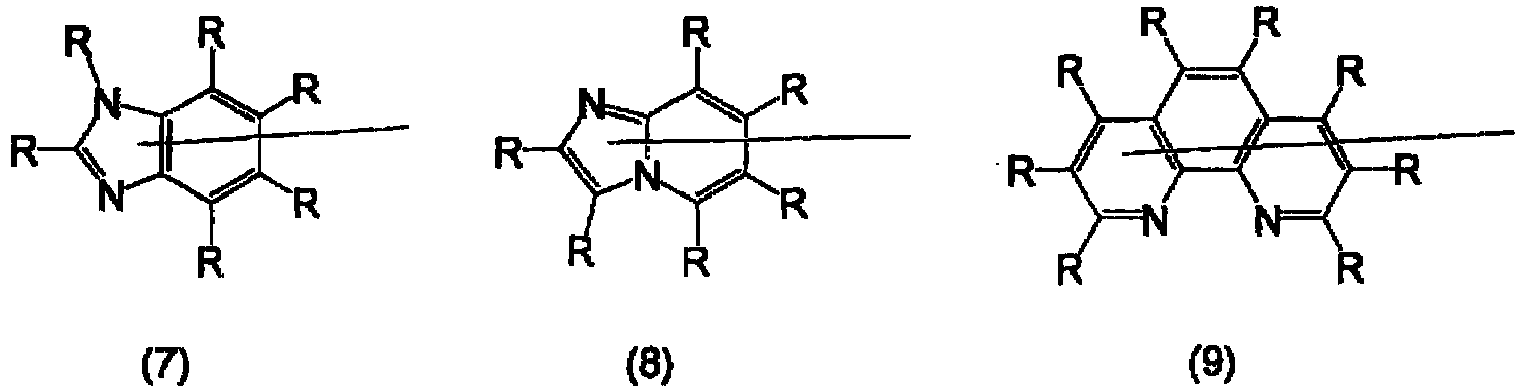
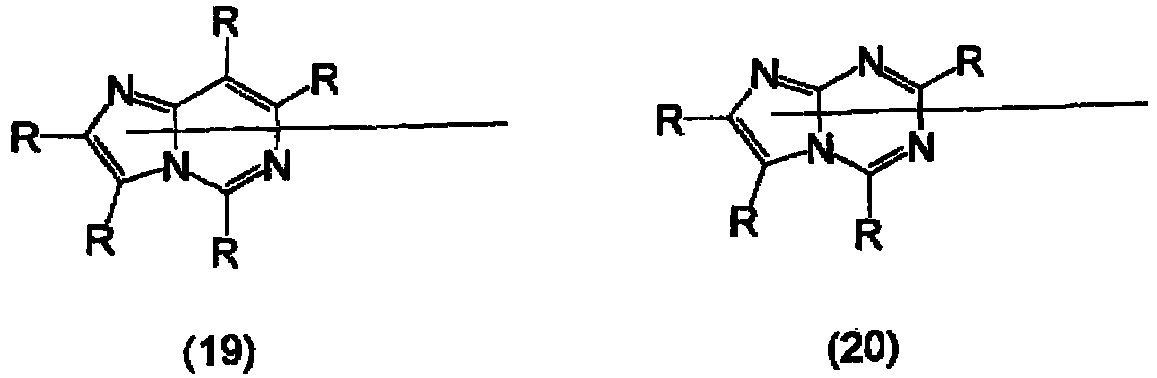
- the substituted or unsubstituted nitrogen-containing heterocyclic group represented by HAr in the formulas (1) and (21) is preferable any of the nitrogen-containing heterocyclic groups represented by the following formulas (2) to (6), more preferably any of the nitrogen-containing heterocyclic groups represented by the following formulas (7) to (20):
- R 111 to R 130 are independently a hydrogen atom or a substituents, or adjacent substituents of R 111 to R 130 are combined to form a saturated or unsaturated ring. Any one of R 111 to R 115 , any one of R 116 to R 119 , any one of R 120 to R 122 , any one of R 123 to R 128 and any one of R 127 to R 130 is a single bond, and is bonded to L 1 .
- any one of Rs which substitutes the heterocyclic skeleton of the formulas (7) to (20) is a single bond, and is bonded to L 1 .
- Other Rs are independently a hydrogen atom or a substituent, or adjacent groups thereof may be combined to form a saturated or unsaturated ring.
- HAr include the following nitrogen-containing heterocyclic groups.
- the nitrogen-containing heterocyclic derivative is represented by the following formula (31): wherein R 401 to R 416 are independently a hydrogen atom, a fluorine atom, a substituted or unsubstituted alkyl group having 1 to 10 carbon atoms, a substituted or unsubstituted cycloalkyl group having 3 to 10 carbon atoms, a substituted or unsubstituted alkylsilyl group having 3 to 30 carbon atoms, a substituted or unsubstituted arylsilyl group having 8 to 30 ring carbon atoms, a substituted or unsubstituted alkoxy group having 1 to 20 carbon atoms, a substituted or unsubstituted aryloxy group having 6 to 20 ring carbon atoms, a substituted or unsubstituted alkylamino group, a substituted or unsubstituted arylamino group, a substituted or unsubstituted aryl group having 6 to
- "c” is preferably 1, more preferably a nitrogen-containing heterocyclic derivative represented by the following formula (32): wherein R 402 to R 416 , L 1 and d are the same groups as those in the formula (31).
- "d” is preferably 1, more preferably a nitrogen-containing heterocyclic derivative represented by the following formula (33) or (34): wherein R 402 to R 414 , R 416 and L 1 are the same groups as those in the formula (31).
- R 1 to R 12 , R 201 to R 214 and R 401 to R 416 examples include a phenyl group, a naphthyl group, a phenanthryl group, a biphenyl group, a terphenyl group, a chryseny group, a benzophenanthryl group, a benzanthryl group, a benzochrysenyl group, a fluorenyl group and a fluoranthenyl group.
- R 401 to R 416 do not include an anthracene ring.
- Examples of the heterocyclic group having 5 to 30 ring atoms represented by R 1 to R 12 , R 201 to R 214 and R 401 to R 416 include a pyridinyl group, a pyrazinyl group, a pyrimidyl group, a pyridazinyl group, a triazinyl group, an indolinyl group, a quinolinyl group, an acrydinyl group, a pyrrolidinyl group, a dioxanyl group, a piperidinyl group, a morpholyl group, a piperazinyl group, a carbazolyl group, a furanyl group, a thiophenyl group, an oxazolyl group, an oxadiazolyl group, a benzoxazolyl group, a thiazolyl group, a thiadiazolyl group, a benzothiaozolyl group, a triazo
- alkyl group having 1 to 10 carbon atoms represented by R 201 to R 214 and R 401 to R 416 an ethyl group, a methyl group, an i-propyl group, a n-propyl group, an s-propyl group, a t-butyl group, a pentyl group, a hexyl group or the like can be given.
- cycloalkyl group having 3 to 8 carbon atoms represented by R 201 to R 214 and R 401 to R 416 a cyclopropyl group, a cyclobutyl group, a cyclopentyl group, a cyclohexyl group, a 4-methylcyclohexyl group or the like can be given.
- alkylsilyl group having 3 to 30 carbon atoms represented by R 201 to R 214 and R 401 to R 416 a trimethylsilyl group, a triethylsilyl group, a t-butyldimethylsilyl group, a vinyidimethylsilyl group, a propyldimethylsilyl group or the like can be given.
- arylsilyl group having 8 to 30 ring carbon atoms represented by R 201 to R 214 and R 401 to R 416 a triphenylsilyl group, a phenyldimethylsilyl group, a t-butylphenylsilyl group, a tritolylsilyl group, a trixylylsilyl group, a trinaphthylsilyl group or the like can be given.
- the alkoxy group having 1 to 20 carbon atoms represented by R 201 to R 214 and R 401 to R 416 is a group represented by -OY, and examples of Y are the same as those of the alkyl group.
- the aryloxy group having 6 to 20 ring carbon atoms represented by R 201 to R 214 and R 401 to R 416 is a group represented by -OAr, and examples of Ar are the same as those of the aryl group.
- the alkylamino group and the arylamino group represented by R 401 to R 416 are represented by -NY 1 Y 2 , and examples of Y 1 and Y 2 include a hydrogen atom and the same groups as those exemplified for the alkyl group or the aryl group as mentioned above. Y 1 and Y 2 may be different from each other.
- a divalent arylene group can be given, for example.
- a phenylene group, a naphthylene group, a biphenylene, a terphenylene group, a picenylene group, a pyrenylene group, a pentaphenylene group, a fluorenylene group, a chrysenylene group or the like can be given. If the valence of L 1 is equal to or larger than trivalent, residues corresponding to the above-mentioned divalent arylene group can be given. However, L 1 in the formula (31) do not include an anthracene ring.
- heterocyclic group having 5 to 30 ring atoms represented by L 1 if it is a divalent heterocyclic group, a pyridinlylene group, a pyrazinylene group, a pyrimidinylene group, a pyridazinylene group, a triazinylene group, an indolylene group, a quinolinylene group, an acrydinylene group, a pyrrolidinylene group, a dioxanylene group, a piperidinylene group, a morpholilene group, a piperazinylene group, a carbazolylene group, a furanylene group, a thiophenylene group, an oxazolylene group, an oxadiazolyene group, a benzoxazolylene group, a thiazolylene group, a thiadiazolylene group, a benzothiazolylene group, a triazolylene group, an imidazolylene group,
- a halogen atom As the substituent for R, a halogen atom, a hydroxyl group, a cyano group, a substituted or unsubstituted amino group, a substituted or unsubstituted alkyl group having 1 to 20 carbon atoms, a substituted or unsubstituted alkoxy group having 1 to 20 carbon atoms, a substituted or unsubstituted aryloxy group having 6 to 20 ring carbon atoms, a substituted or unsubstituted arylthio group having 6 to 20 ring carbon atoms, a substituted or unsubstituted aryl group having 6 to 50 ring carbon atoms or a substituted or unsubstituted heterocyclic group having 5 to 50 ring atoms.
- each of substituents of R 1 to R 12 , R 201 to R 214 , R 401 to R 418 , L 1 and HAr has a further substituent, as such a further substituent, the alkyl group, the alkylsilyl group, the halogenated alkyl group, the aryl group, the cycloalkyl group, the alkoxy group, the heterocyclic group, the aralkyl group, the aryloxy group, the arylthio group, the alkoxycarbonyl group, the halogen atom, the hydroxyl group, the nitro group, the cyano group, the carboxyl group, the dibenzofuranyl group, the fluorenyl group or the like, as mentioned above, can be given.
- the "unsubstituted" means that the group is substituted by a hydrogen atom.
- the hydrogen atom of the nitrogen-containing heterocyclic derivative of the invention includes protium and deutrium.
- the nitrogen-containing heterocyclic derivative of the invention be used as a material for an organic EL device. It is more preferred that the nitrogen-containing heterocyclic derivative of the invention be used as a blocking material for an organic EL device.
- Benzophenanthrene, benzochrysene and fluoranthene which are the basic skeletons of the nitrogen-containing heterocyclic derivative of the invention, have a high triplet energy, and has improved effects of confining triplet excitons.
- the material for the blocking layer which is adjacent to the emitting layer of an organic EL device, they can promote occurrence of TTF phenomenon.
- benzophenanthrene, benzochrysene and fluoranthene which are the basic skeletons of the nitrogen-containing heterocyclic derivative of the invention, have characteristics that molecular stacking within a thin film is increased due to their high planarity, whereby the electron mobility is increased. As a result, injection of electrons to the emitting layer is promoted and efficiency of electron recombination in the emitting layer is improved, thus enabling a TTF phenomenon to be caused efficiently.
- the nitrogen-containing heterocyclic derivative of the invention comprises a nitrogen-containing heterocyclic ring which has a high electron-injecting property from a metal-containing layer such as an electrode, it is possible to realize a low-voltage driving organic EL device without the need of further stacking an electron-injecting layer.
- the nitrogen-containing heterocyclic derivative of the invention can be preferably used in the electron-injecting layer and/or the electron-transporting layer.
- TTF phenomenon When a voltage is applied to an organic EL device, electrons and holes are injected from the anode and the cathode, respectively, the electrons and the holes thus injected are recombined in the emitting layer to generate excitons. As for the spin state of the excitons, singlet excitons account for 25% and triplet excitons account for 75%. In a conventionally known fluorescent device, light is emitted when singlet excitons are relaxed to the ground state. However, triplet excitons are returned to the ground state without emitting light after passing the thermal deactivation process. However, according to S.M. Bachilo et al. (J. Phys. Cem.
- TTF is a phenomenon in which singlet excitons are generated by collision and fusion of triplet excitons.
- a blocking layer which is normally used in a phosphorescence device be positioned such that it is adjacent to the emitting layer of a fluorescent device so that the blocking layer comprises the nitrogen-containing heterocyclic derivative of the invention.
- a blocking layer is not generally used since the provision thereof leads to an increase in process.
- the nitrogen-containing heterocyclic derivative of the invention By using a blocking layer which comprises the nitrogen-containing heterocyclic derivative of the invention in a fluorescent device, a TTF phenomenon is caused to occur, whereby a highly efficient organic EL device can be realized. Further, since the nitrogen-containing derivative of the invention has a high triplet energy, in a conventional phosphorescence device, it can exhibit the function of a blocking layer, and can prevent diffusion of triplet energy. In the invention, when reference is simply made to the blocking layer, it means a layer which has effects of blocking triplet energy, and it has a function different from that of a hole-blocking layer or a charge-blocking layer.
- the blocking layer which comprises the nitrogen-containing heterocyclic derivative of the invention further comprise a reductive dopant.
- the above-mentioned reductive dopant is preferably one or two or more selected from the group consisting of an alkali metal, an alkaline earth metal, a rare earth metal, an oxide of an alkali metal, a halide of an alkali metal, an oxide of an alkaline earth metal, a halide of an alkaline earth metal, an oxide of a rare earth metal, a halide of a rare earth metal, an organic complex of an alkali metal, an organic complex of an alkaline earth metal and an organic complex of a rare earth metal.
- rubrene anthracene, tetracene, pyrene, perylene or the like
- An anthracene derivative is preferable, with an anthracene derivative represented by the formula (41) being further preferably included.
- Ar 11 and Ar 12 are independently a substituted or unsubstituted aryl group having 6 to 30 ring carbon atoms or a substituted or unsubstituted heterocyclic group having 5 to 30 ring atoms; and R 301 to R 308 are independently a hydrogen atom, a fluorine atom, a substituted or unsubstituted alkyl group having 1 to 10 carbon atoms, a substituted or unsubstituted cycloalkyl group having 3 to 10 carbon atoms, a substituted or unsubstituted alkylsilyl group having 3 to 30 carbon atoms, a substituted or unsubstituted arylsilyl group having 8 to 30 ring carbon atoms, a substituted or unsubstituted alkoxy grouop having 1 to 20 carbon atoms, a substituted or unsubstituted aryloxy group having 6 to 20 ring carbon atoms, a substituted or unsubstitute
- aryl group, the heterocyclic group, the alkyl group, the cycloalkyl group, the alkylsilyl group, the arylsilyl group, the alkoxy group and aryloxy group mentioned above are the same as those of R 1 to R 12 , R 201 to R 214 , R 401 to R 416 and the like in the above-mentioned formulas (1), (21) and (31)
- the emitting layer comprising the anthracene derivative represented by the formula (41) be adjacent to the blocking layer comprising the nitrogen-containing heterocyclic derivative of the invention.
- the emitting layer is adjacent to the blocking layer which comprises the nitrogen-containing heterocyclic derivative of the invention, it is possible to enhance the luminous efficiency by utilizing a TTF phenomenon.
- the triplet energy of the compound constituting the block layer composed of the nitrogen-containing heterocyclic derivative of the invention is required to be higher than the triplet energy of a host which mainly constitutes the emitting layer. It is preferred that the nitrogen-containing heterocyclic derivative of the invention and a host and a dopant contained in the emitting layer satisfy the following formulas (1) and (2): E T ⁇ b > E T ⁇ h E T ⁇ d > E T ⁇ h (E T h, E T b and E T d are independently the triplet energy of the host material, the nitrogen-containing heterocyclic derivative of the blocking layer and the dopant.)
- FIG. 1 is a schematic constitutional view showing one example of the first embodiment of the invention.
- FIG. 2A diagrammatically shows the lowest singlet excited energy level and the lowest excited triplet energy level of each layer.
- the triplet energy means a difference in energy between the lowest excited triplet energy state and the ground state
- the singlet energy means a difference in energy between the lowest excited singlet energy state and the ground state.
- the organic EL device shown in FIG. 1 has a configuration in which an anode 10, a hole-transporting region 50, an emitting layer 20, an electron-transporting region 30 and a cathode 40 are sequentially stacked from the anode 10. It is preferred that the hole-transporting region 50 be provided between the anode 10 and the emitting layer 20.
- FIG. 10 is a schematic constitutional view showing one example of the first embodiment of the invention.
- FIG. 2A diagrammatically shows the lowest singlet excited energy level and the lowest excited triplet energy level of each layer.
- the triplet energy means a difference in energy between the lowest excited
- FIG. 2A shows an embodiment in which the electron-transporting region is formed only of a blocking layer. It should be noted that an embodiment in which the electron-transporting region which is formed only of a blocking layer does not inhibit insertion of the electron-injecting layer which has higher electron-injecting properties.
- known compounds which have conventionally been used as an electron-injecting layer can be used. Of these, a heterocyclic compound is preferable.
- FIG. 2A holes which have been injected from the anode are injected to the emitting layer through the hole-transporting region, and electrons which have been injected from the cathode are injected to the emitting layer through the electron-transporting region. Then, the holes and the electrons are recombined in the emitting layer, whereby singlet excitons and triplet excitons are generated.
- recombination There are two cases of occurrence of recombination; i.e. recombination which occurs on the host molecule and recombination which occurs on the dopant molecule. In this embodiment, as shown in FIG.
- Triplet excitons generated by the recombination on the dopant molecule are subjected to energy transfer smoothly to the host molecule. That is, singlet excitons are generated efficiently by a TTF phenomenon due to the collision of triplet excitons on the host molecule without the energy transfer of triplet excitons of the host to the dopant. Further, since the singlet energy E s d of the dopant is smaller than the singlet energy E s h of the host, singlet excitons generated by a TTF phenomenon are subjected to energy transfer from the host to the dopant, and contribute to the fluorescence emission of the dopant.
- transition from the excited triplet state to the ground state corresponds to a band gap, and in such a band gap, triplet excitons do not undergo optical deactivation, and undergo thermal deactivation.
- the relationship of the triplet energy of the host and the triplet energy of the dopant to be the above-mentioned range, singlet excitons are efficiently generated by the collision of triplet excitons before triplet excitons undergo thermal deactivation, whereby luminous efficiency is improved.
- the blocking layer is provided at a part which is adjacent to the emitting layer.
- the blocking layer prevents diffusion of triplet excitons generated in the emitting layer to the electron-transporting region to confine triplet excitons within the emitting layer to increase the density of triplet excitons, whereby a TTF phenomenon is efficiently caused.
- the triplet energy E T b of a compound forming the blocking layer be larger than E T h. It is further preferred that the triplet energy E T b be further larger than E T d. Since the blocking layer prevents triplet excitons generated in the emitting layer from being diffused to the electron-transporting zone, within the emitting layer, triplet excitons of the host become singlet excitons efficiently. These singlet excitons transfer to the dopant and undergo optical deactivation.
- the material forming the blocking layer is the nitrogen-containing heterocyclic derivative of the invention.
- the blocking layer containing the nitrogen-containing heterocyclic derivative of the invention can also have the function of electron injection and transportation.
- the reason therefor is that a lone pair of electrons mediates transfer of electrons from the adjacent layers.
- electrons which have been injected to the blocking layer easily donate electrons through the electron-transporting structure part. That is, by moving to a structure part having a lower LUMO level, they contribute electron injection to the emitting layer.
- a low-work function metal containing layer may be provided between the electron-transporting region and the cathode.
- the low-work function metal containing layer means a layer containing a low-work function metal or a low-work function metal compound. It may be formed only of a low-work function metal or a low-work function metal compound, or may be formed by adding as a donor a low-work function metal, a low-work function metal compound or a low work function metal complex to a material used as an electron-transporting layer
- a low-work function metal means a metal having a work function of 3.8 eV or less. As the metal having a work function of 3.8 eV or less, an alkali metal, an alkaline earth metal or the like can be mentioned.
- alkali metal Li, Na, K, Cs or the like can be given.
- alkaline earth metal Mg, Ca, Sr, Ba or the like can be given.
- other metals Yb, Eu, Ce or the like can be given.
- the low-work function metal compound oxides, halides, carbonates and borates of a low-work function metal are preferable.
- halides fluorides, chlorides and bromides can be given, with fluorides being preferable.
- LiF can be given as a preferable halide, for example.
- the low-work function metal complex a complex of a low-work function metal can be given, with an organic metal complex of an alkaline metal, an alkaline earth metal or a rare earth metal being preferable.
- Efficiency can be improved significantly in a blue fluorescence layer by utilizing a TTF phenomenon.
- luminous efficiency can be improved by confining triplet energy within the emitting layer.
- the phosphorescence layer it is possible to obtain effects of confining triplet energy in the emitting layer, to prevent diffusion of triplet energy, whereby improvement in luminous efficiency of a phosphorescence dopant can be attained.
- Residues were purified by silica gel column chromatography, whereby 1.0g of slightly pinky white crystals of 1-(4-bromophenyl)-2-phenyl-1H-benzimidazole were obtained (yield 52%).
- 6-(fluoranthen-3-yl)naphthalene-2-ylboronic acid pinacol ester was synthesized.
- the resulting compound was found to be the following compound 1 and had an m/e value of 496 relative to the molecular weight of 496.19.
- a reaction was conducted in the same manner as in Example 1, except that 1-(3-bromophenyl)-2-phenyl-1H-benzimidazole was used instead of 1-(4-bromophenyl)-2-phenyl-1H-benzimidazole.
- the resulting compound was found to be the following compound 2 and had an m/e value of 496 relative to the molecular weight of 496.19.
- a reaction was conducted in the same manner as in Example 1, except that 5-bromo-1-methyl-2-phenyl-1H-benzimidazole was used instead of 1-(4-bromophenyl)-2-phenyl-1H-benzimidazole.
- the resulting compound was found to be the following compound 3 and had an m/e value of 434 relative to the molecular weight of 434.18.
- the resulting compound was found to be the following compound 4 and had an m/e value of 420 relative to the molecular weight of 420.16.
- the resulting compound was found to be the following compound 5 and had an m/e value of 420 relative to the molecular weight of 420.16.
- the resulting compound was found to be the following compound 6 and had an m/e value of 546 relative to the molecular weight of 546.21.
- a reaction was conducted in the same manner as in Example 1, except that benzo[g]chrysene-10-boronic acid was used instead of benzo[c]phenanthrene-5-boronic acid and 1-(3-bromophenyl)-2-phenyl-1H-benzimidazole was used instead of 1-(4-bromophenyl)-2-phenyl-1H-benzimidazole.
- the resulting compound was found to be the following compound 7 and had an m/e value of 546 relative to the molecular weight of 546.21.
- the resulting compound was found to be the following compound 8 and had an m/e value of 484 relative to the molecular weight of 484.19.
- the resulting compound was found to be the following compound 9 and had an m/e value of 470 relative to the molecular weight of 470.18.
- the resulting compound was found to be the following compound 10 and had an m/e value of 470 relative to the molecular weight of 470.18.
- the resulting compound was found to be the following compound 11 and had an m/e value of 470 relative to the molecular weight of 470.18.
- the resulting compound was found to be the following compound 12 and had an m/e value of 470 relative to a molecular weight of 470.18.
- the resulting compound was found to be the following compound 13 and had an m/e value of 408 relative to a molecular weight of 408.16.
- the resulting compound was found to be the following compound 14 and had an m/e value of 546 relative to a molecular weight of 546.21.
- the resulting compound was found to be the following compound 18 and had an m/e value of 432 relative to a molecular weight of 432.16.
- the materials used in an organic EL device are as follows.
- a voltage was applied to the device such that the current value became 10 mA/cm 2 , and the voltage value at this time was measured.
- An EL emission spectrum at this time was measured by means of a spectroradiometer (CS-1000, manufactured by Konica Minolta Holdings, Inc.). From the resulting spectra radiance, chromaticity, current efficiency (cd/A) and external quantum efficiency (%) were calculated.
- a voltage pulse waveform (pulse width: 500 microseconds, frequency: 20 Hz) which has been output from a pulse generator (8114A, manufactured by Adilent Corporation) was applied to a device.
- EL emission was input to a photomultiplier tube (R928 manufactured by Hamamatsu Photonics K. K.), and a pulse voltage waveform and EL emission were synchronized and input to an oscilloscope (2440, manufactured by Tektronix, Inc.) to obtain a transient EL waveform.
- Ratio of emission derived from TTF was determined by analyzing this EL waveform (see Japanese Patent Application No. 2009-125883 ).
- the transient EL waveform was obtained by measuring the current density when the current efficiency (UJ) became the maximum in a current density-current efficiency curve, followed by application of a voltage pulse waveform corresponding to the current density.
- the theoretical limit of Improvement in internal quantum efficiency by a TTF phenomenon is thought to be 62.5%. In this case, the ratio of emission derived from TTF is 60%.
- the emission distribution and the outcoupling efficiency in the emission layer were determined. Thereafter, an EL spectrum measured by a spectroradiometer was divided by the thus determined outcoupling efficiency to obtain an internal EL spectrum. The ratio of the number of photons generated in the inside obtained from the spectrum and the number of electrons was taken as the internal quantum efficiency.
- An organic EL device comprising the nitrogen-containing heterocyclic derivative of the invention can be used for a display panel or an illumination panel or the like used in large-sized televisions of which the reduction in power consumption is desired.
Landscapes
- Chemical & Material Sciences (AREA)
- Organic Chemistry (AREA)
- Physics & Mathematics (AREA)
- Spectroscopy & Molecular Physics (AREA)
- Engineering & Computer Science (AREA)
- Materials Engineering (AREA)
- Electroluminescent Light Sources (AREA)
- Pyridine Compounds (AREA)
- Nitrogen Condensed Heterocyclic Rings (AREA)
- Plural Heterocyclic Compounds (AREA)
Abstract

HAr is a substituted or unsubstituted nitrogen-containing heterocyclic group; and
"a" and "b" are independently an integer of 1 to 4, and at least one of "a" and "b" is 1. Also disclosed is a nitrogen-containing heterocyclic derivative represented by the following formula (21) or (31):

Description
- The invention relates to a nitrogen-containing heterocyclic derivative and an organic electroluminescence device comprising the same.
- An organic electroluminescence (EL) device is a self-emitting device utilizing a principle that a fluorescence material emits light by energy of recombination of holes injected from an anode and electrons injected from a cathode when an electrical field is applied.
- An organic EL device is provided with a pair of electrodes of an anode and a cathode, and an organic thin film layer between them. An organic thin film layer is formed of a multilayer stack of layers having their respective functions. For example, it is a multilayer stack in which an anode, a hole-injecting layer, a hole-transporting layer, an emitting layer, a blocking layer, an electron-transporting layer and an electron-injecting layer are sequentially stacked.
- An organic EL device can be divided into two types according to its emission principle; i.e. a fluorescent device and a phosphorescence device. In the fluorescence organic EL device, emission utilizing singlet excitons is used, and in the phosphorescence organic EL device, emission utilizing triplet excitons is used. In the phosphorescence organic EL device, it is known that, in order to prevent diffusion of triplet excitons, which have a longer exciton life as compared with that of singlet excitons, to layers other than the emitting layer, a material having large triplet energy is used in a layer adjacent to the interface on the cathode side of the emitting layer, whereby a high efficiency is attained.
- Patent Document 1 discloses a technology of increasing efficiency by providing a blocking layer formed of BCP (bathocuproine), which is a phenanthroline derivative, such that it is adjacent to the emitting layer, thereby to confine triplet excitons. Further, Patent Document 2 discloses a technology of increasing efficiency and prolonging life by using a specific aromatic ring compound in a hole-blocking layer
On the other hand, in a fluorescence organic EL device, emission derived from triplet excitons has been recently reported (Non-Patent Documents 1 and 2, and Patent Document 3, for example). -
- Patent Document 1:
JP-T-2002-525808 - Patent Document 2:
USP 7018723 - Patent Document 3:
JP-A-2004-214180 -
- Non-Patent Document 1: Journal of Applied Physics, 102, 114504 (2007)
- An object of the invention is to provide a novel nitrogen-containing heterocyclic derivative which can prevent an increase in application voltage and can attain highly-efficient emission of an organic EL device by utilizing a TTF (Triplet-Triplet Fusion) phenomenon.
Further, an object of the invention is to provide an optimum blocking material to promote TTF phenomenon. - According to the invention, the following nitrogen-containing heterocyclic derivative or the like are provided.
- 1. A nitrogen-containing heterocyclic derivative represented by the following formula (1):

HAr is a substituted or unsubstituted nitrogen-containing heterocyclic group; and
"a" and "b" are independently an integer of 1 to 4, and at least one of "a" and "b" is 1. - 2. The nitrogen-containing heterocyclic derivative according to 1, wherein HAr is any of nitrogen-containing heterocyclic groups represented by the following formulas (2) to (6):


- 3. The nitrogen-containing heterocyclic derivative according to 1 or 2, wherein HAr is any of the nitrogen-containing heterocyclic groups represented by the following formulas (7) to (20):


- 4. The nitrogen-containing heterocyclic derivative according to any of 1 to 3, wherein "a" is 1 and "b" is 1.
- 5. A nitrogen-containing heterocyclic derivative represented by the following formula (21):

- L1 is a single bond, a substituted or unsubstituted "b+1" valent hydrocarbon group having 6 to 30 ring carbon atoms or a substituted or unsubstituted "b+1" valent heterocyclic group having 5 to 30 ring atoms;
- HAr is a substituted or unsubstituted nitrogen-containing heterocyclic group; and
- "a" and "b" are independently an integer of 1 to 4 and at least one of "a" and "b" is 1.
- 6. The nitrogen-containing heterocyclic derivative according to 5, wherein HAr is any of the nitrogen-containing heterocyclic groups represented by the following formulas (2) to (6):


- 7. The nitrogen-containing heterocyclic derivative according to 5 or 6, wherein HAr is any of the nitrogen-containing heterocyclic groups represented by the following formulas (7) to (20):


- 8. The nitrogen-containing heterocyclic derivative according to any of 5 to 7, wherein "a" is 1 and "b" is 1.
- 9. A nitrogen-containing heterocyclic derivative represented by the following formula (31):

L1 is a single bond, a substituted or unsubstituted "c+d" valent hydrocarbon group having 6 to 30 ring carbon atoms or a "c+d" valent heterocyclic group having 5 to 30 ring atoms; and
"c" and "d" are independently an integer of 1 to 3; provided that L1, and R401 to R416 are not an anthracene containing group. - 10. The nitrogen-containing heterocyclic derivative according to 9, wherein "c" is 1.
- 11. The nitrogen-containing heterocyclic derivative according to 9 or 10 which is represented by the following formula (32):

- 12. The nitrogen-containing heterocyclic derivative according to 11, wherein "d" is 1.
- 13. The nitrogen-containing heterocyclic derivative according to 12 which is represented by the following formula (33) or (34):


- 14. The nitrogen-containing heterocyclic derivative according to any of 1 to 13 which is a material for an organic electroluminescence device.
- 15. The nitrogen-containing heterocyclic derivative according to 14, wherein the material for an organic electroluminescence device is a material for a blocking layer.
- 16. An organic electroluminescence device comprising an anode, an emitting layer, a blocking layer and a cathode sequentially, wherein the blocking layer comprises the nitrogen-containing heterocyclic derivative according to any of 1 to 13.
- 17. An organic electroluminescence device comprising an electron-injecting layer and/or an electron-transporting layer between an emitting layer and a cathode, wherein at least one layer of the electron-injecting layer and the electron-transporting layer comprises the nitrogen-containing heterocyclic derivative according to any of 1 to 13.
- 18. The organic electroluminescence device according to 16 or 17, wherein the emitting layer comprises an anthracene derivative represented by the following formula (41):

- According to the invention, it is possible to provide a novel nitrogen-containing heterocyclic derivative which can prevent an increase in application voltage and can attain highly-efficient emission of an organic EL device utilizing TTF (Triplet-Triplet Fusion).
-
-
FIG. 1 is a view showing one example of the first embodiment of the invention; -
FIG. 2A is a view showing the relationship of energy gap of each layer of the invention; and -
FIG. 2B is a view showing the action based on the relationship of energy gap of each layer of the invention. - The nitrogen-containing heterocyclic derivative of the invention is represented by the following formula (1):
A nitrogen-containing heterocyclic derivative represented by the following formula (1):
HAr is a substituted or unsubstituted nitrogen-containing heterocyclic group; and
"a" and "b" are independently an integer of 1 to 4, and at least one of "a" and "b" is 1. - In the formula (1), when "a" is 2 or more, the 2 or more HArs may be the same or different. Similarly, when "b" is 2 or more, the benzophenanthrene parts may-be the same or different
In the formula (1), the position at which L1 is bonded to the benzophenanthrene part is preferably at R5 or R8. Since R5 and R8 are bonding positions which are highly reactive, due to the bonding of L1 and R5 or L1 and R8, the nitrogen-containing heterocyclic derivative represented by the formula (1) becomes more stable to electrons. - Further, the nitrogen-containing heterocyclic derivative of the invention is represented by the following formula (21):

L1 is a single bond, a substituted or unsubstituted "b+1" valent hydrocarbon ring group having 6 to 30 ring carbon atoms or a substituted or unsubstituted "b+1" valent heterocyclic group having 5 to 30 ring atoms;
HAr is a substituted or unsubstituted nitrogen-containing heterocyclic group; and
"a" and "b" are independently an integer of 1 to 4 and at least one of "a" and "b" is 1. - In the formula (21), when "a" is two or more, two or more HArs may independently the same or different. Similarly, when "b" is two or more, the benzochrysene parts may be the same or different.
In the formula (21), the position at which L1 is bonded to the benzochrysene part is preferably R205. Since R205 is a highly reactive bonding position, due to the bonding of L1 and R205, the nitrogen-containing heterocyclic derivative represented by the formula (21) becomes more stable to electrons. - The substituted or unsubstituted nitrogen-containing heterocyclic group represented by HAr in the formulas (1) and (21) is preferable any of the nitrogen-containing heterocyclic groups represented by the following formulas (2) to (6), more preferably any of the nitrogen-containing heterocyclic groups represented by the following formulas (7) to (20):
-


Any one of R111 to R115, any one of R116 to R119, any one of R120 to R122, any one of R123 to R128 and any one of R127 to R130 is a single bond, and is bonded to L1. -


- Specific examples of HAr include the following nitrogen-containing heterocyclic groups.





- "a" and "b" in the formulas (1) and (21) is preferably a=b=1, a=2 and b=1, or a=1 and b=2, more preferably a=b=1.
- The nitrogen-containing heterocyclic derivative is represented by the following formula (31):

L1 is a single bond, a substituted or unsubstituted "c+d" valent hydrocarbon group having 6 to 30 ring carbon atoms or a "c+d" valent heterocyclic group having 5 to 30 ring atoms; and
"c" and "d" are independently an integer of 1 to 3; provided that L1, and R401 to R416 are not an anthracene containing group. - In the formula (31), when "c" is two or more, two or more fluoranthene parts may independently be the same or different. Similarly, when "d" is two or more, the benzimidazole parts may be the same or different.
- In the formula (31), "c" is preferably 1, more preferably a nitrogen-containing heterocyclic derivative represented by the following formula (32):

- In the formula (32), "d" is preferably 1, more preferably a nitrogen-containing heterocyclic derivative represented by the following formula (33) or (34):


- Each substituent of the nitrogen-containing heterocyclic derivative of the invention will be explained hereinbelow.
Examples of the aryl group having 6 to 30 ring carbon atoms represented by R1 to R12, R201 to R214 and R401 to R416 include a phenyl group, a naphthyl group, a phenanthryl group, a biphenyl group, a terphenyl group, a chryseny group, a benzophenanthryl group, a benzanthryl group, a benzochrysenyl group, a fluorenyl group and a fluoranthenyl group.
However, R401 to R416 do not include an anthracene ring. - Examples of the heterocyclic group having 5 to 30 ring atoms represented by R1 to R12, R201 to R214 and R401 to R416 include a pyridinyl group, a pyrazinyl group, a pyrimidyl group, a pyridazinyl group, a triazinyl group, an indolinyl group, a quinolinyl group, an acrydinyl group, a pyrrolidinyl group, a dioxanyl group, a piperidinyl group, a morpholyl group, a piperazinyl group, a carbazolyl group, a furanyl group, a thiophenyl group, an oxazolyl group, an oxadiazolyl group, a benzoxazolyl group, a thiazolyl group, a thiadiazolyl group, a benzothiaozolyl group, a triazolyl group, an imidazolyl group, a benzimidazolyl group, a benzofuranyl group and a dibenzofuranyl group.
- As the alkyl group having 1 to 10 carbon atoms represented by R201 to R214 and R401 to R416, an ethyl group, a methyl group, an i-propyl group, a n-propyl group, an s-propyl group, a t-butyl group, a pentyl group, a hexyl group or the like can be given.
- As the cycloalkyl group having 3 to 8 carbon atoms represented by R201 to R214 and R401 to R416, a cyclopropyl group, a cyclobutyl group, a cyclopentyl group, a cyclohexyl group, a 4-methylcyclohexyl group or the like can be given.
- As the alkylsilyl group having 3 to 30 carbon atoms represented by R201 to R214 and R401 to R416, a trimethylsilyl group, a triethylsilyl group, a t-butyldimethylsilyl group, a vinyidimethylsilyl group, a propyldimethylsilyl group or the like can be given.
- As the arylsilyl group having 8 to 30 ring carbon atoms represented by R201 to R214 and R401 to R416, a triphenylsilyl group, a phenyldimethylsilyl group, a t-butylphenylsilyl group, a tritolylsilyl group, a trixylylsilyl group, a trinaphthylsilyl group or the like can be given.
- The alkoxy group having 1 to 20 carbon atoms represented by R201 to R214 and R401 to R416 is a group represented by -OY, and examples of Y are the same as those of the alkyl group.
- The aryloxy group having 6 to 20 ring carbon atoms represented by R201 to R214 and R401 to R416 is a group represented by -OAr, and examples of Ar are the same as those of the aryl group.
- The alkylamino group and the arylamino group represented by R401 to R416 are represented by -NY1Y2, and examples of Y1 and Y2 include a hydrogen atom and the same groups as those exemplified for the alkyl group or the aryl group as mentioned above. Y1 and Y2 may be different from each other.
- As the hydrocarbon ring group having 6 to 30 ring carbon atoms represented by L1, a divalent arylene group can be given, for example. A phenylene group, a naphthylene group, a biphenylene, a terphenylene group, a picenylene group, a pyrenylene group, a pentaphenylene group, a fluorenylene group, a chrysenylene group or the like can be given.
If the valence of L1 is equal to or larger than trivalent, residues corresponding to the above-mentioned divalent arylene group can be given. However, L1 in the formula (31) do not include an anthracene ring. - As the heterocyclic group having 5 to 30 ring atoms represented by L1, if it is a divalent heterocyclic group, a pyridinlylene group, a pyrazinylene group, a pyrimidinylene group, a pyridazinylene group, a triazinylene group, an indolylene group, a quinolinylene group, an acrydinylene group, a pyrrolidinylene group, a dioxanylene group, a piperidinylene group, a morpholilene group, a piperazinylene group, a carbazolylene group, a furanylene group, a thiophenylene group, an oxazolylene group, an oxadiazolyene group, a benzoxazolylene group, a thiazolylene group, a thiadiazolylene group, a benzothiazolylene group, a triazolylene group, an imidazolylene group, a benzimidazolylene group, a furanylene group, a dibenzofuranylene group or the like can be given.
When L1 has a valency which is equal to or larger than trivalency, as as examples of L1, residues corresponding to the above-mentioned divalent heterocyclic group can be given. - As the substituent for R, a halogen atom, a hydroxyl group, a cyano group, a substituted or unsubstituted amino group, a substituted or unsubstituted alkyl group having 1 to 20 carbon atoms, a substituted or unsubstituted alkoxy group having 1 to 20 carbon atoms, a substituted or unsubstituted aryloxy group having 6 to 20 ring carbon atoms, a substituted or unsubstituted arylthio group having 6 to 20 ring carbon atoms, a substituted or unsubstituted aryl group having 6 to 50 ring carbon atoms or a substituted or unsubstituted heterocyclic group having 5 to 50 ring atoms.
- If each of substituents of R1 to R12, R201 to R214, R401 to R418, L1 and HAr has a further substituent, as such a further substituent, the alkyl group, the alkylsilyl group, the halogenated alkyl group, the aryl group, the cycloalkyl group, the alkoxy group, the heterocyclic group, the aralkyl group, the aryloxy group, the arylthio group, the alkoxycarbonyl group, the halogen atom, the hydroxyl group, the nitro group, the cyano group, the carboxyl group, the dibenzofuranyl group, the fluorenyl group or the like, as mentioned above, can be given.
- As for each substituent of the nitrogen-containing heterocyclic derivative of the invention, the "unsubstituted" means that the group is substituted by a hydrogen atom. The hydrogen atom of the nitrogen-containing heterocyclic derivative of the invention includes protium and deutrium.
- Specific examples of the nitrogen-containing heterocyclic derivative of the invention represented by the formulas (1), (21) and (31) are given below.
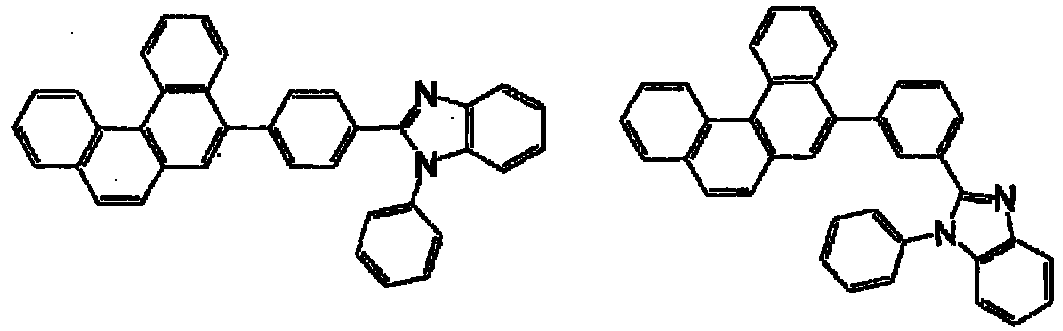


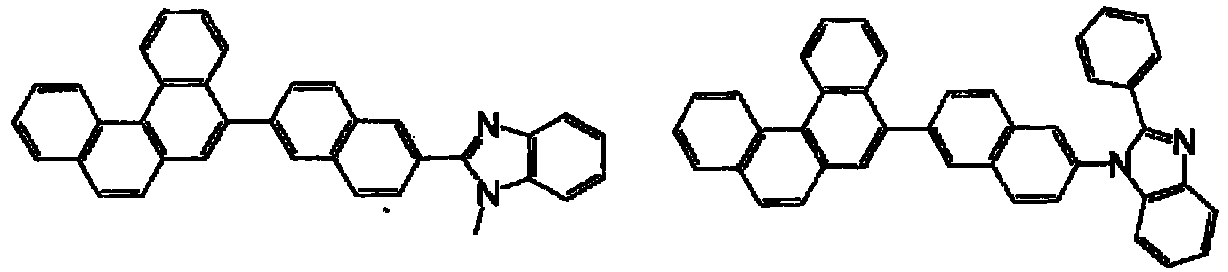


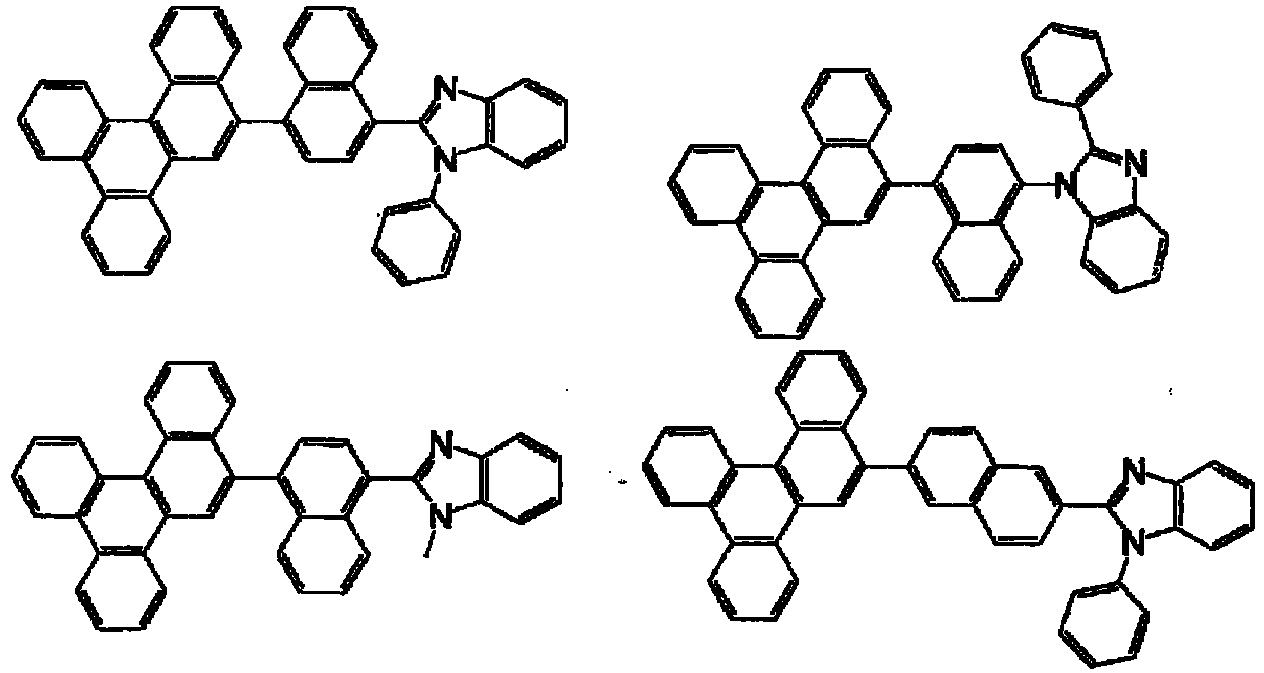

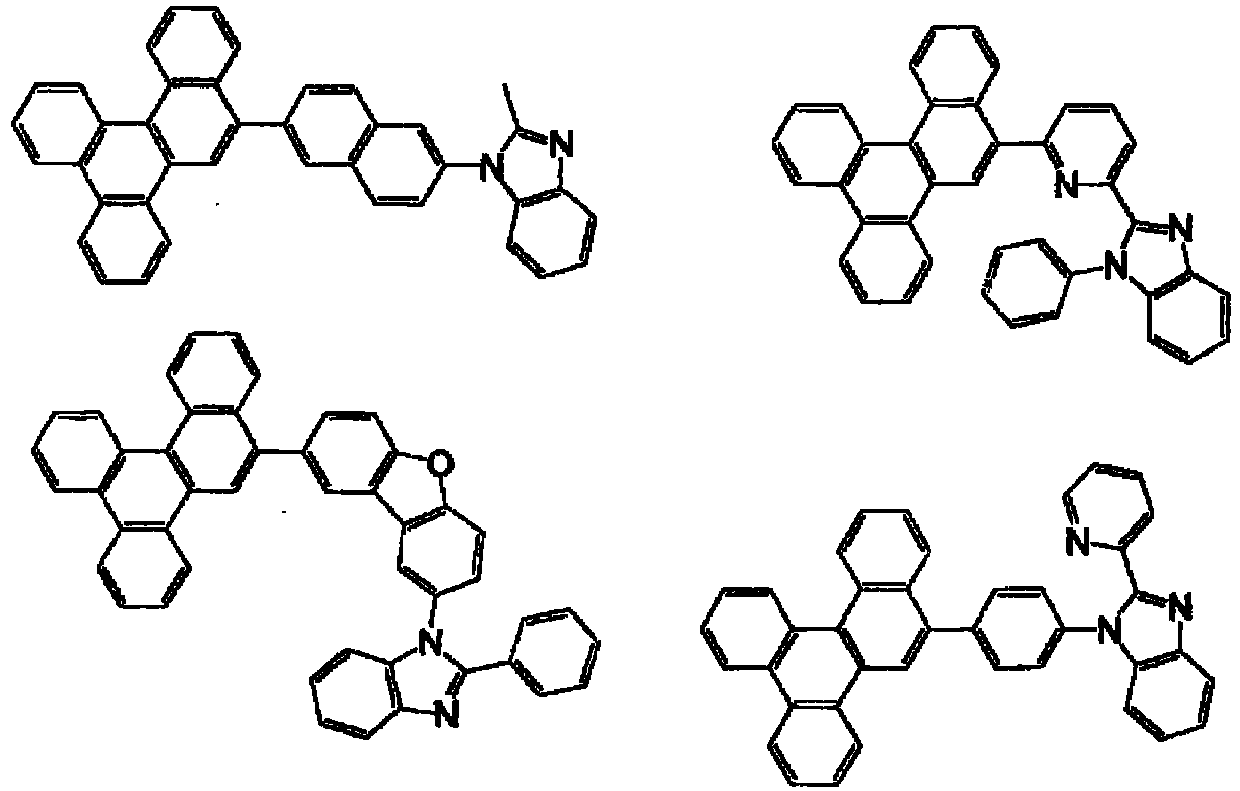


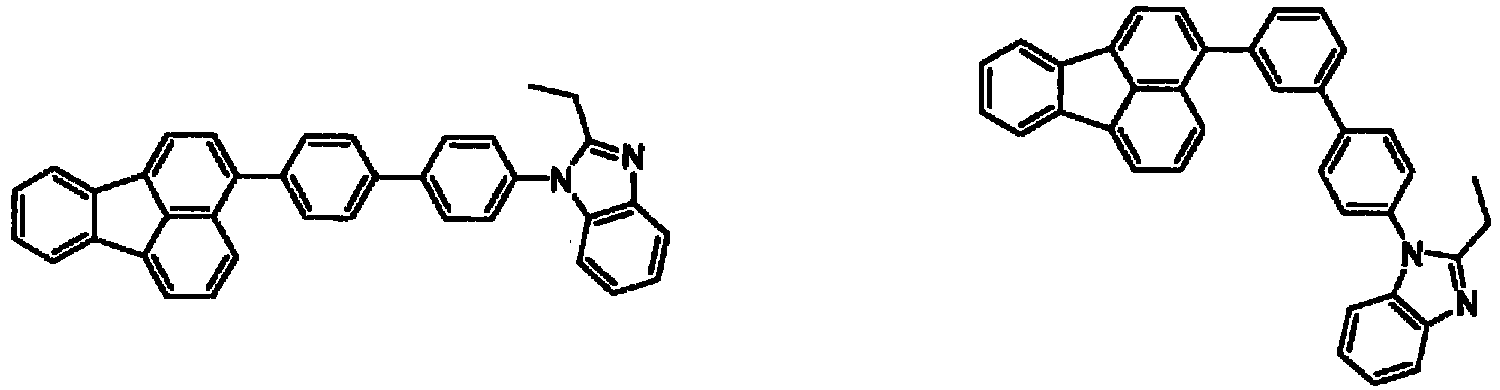





- It is preferred that the nitrogen-containing heterocyclic derivative of the invention be used as a material for an organic EL device. It is more preferred that the nitrogen-containing heterocyclic derivative of the invention be used as a blocking material for an organic EL device.
Benzophenanthrene, benzochrysene and fluoranthene, which are the basic skeletons of the nitrogen-containing heterocyclic derivative of the invention, have a high triplet energy, and has improved effects of confining triplet excitons. For example, by using as the material for the blocking layer which is adjacent to the emitting layer of an organic EL device, they can promote occurrence of TTF phenomenon. Further, benzophenanthrene, benzochrysene and fluoranthene, which are the basic skeletons of the nitrogen-containing heterocyclic derivative of the invention, have characteristics that molecular stacking within a thin film is increased due to their high planarity, whereby the electron mobility is increased. As a result, injection of electrons to the emitting layer is promoted and efficiency of electron recombination in the emitting layer is improved, thus enabling a TTF phenomenon to be caused efficiently. In addition, since the nitrogen-containing heterocyclic derivative of the invention comprises a nitrogen-containing heterocyclic ring which has a high electron-injecting property from a metal-containing layer such as an electrode, it is possible to realize a low-voltage driving organic EL device without the need of further stacking an electron-injecting layer.
Meanwhile, the nitrogen-containing heterocyclic derivative of the invention can be preferably used in the electron-injecting layer and/or the electron-transporting layer. - A brief explanation of the TTF phenomenon will be given below.
When a voltage is applied to an organic EL device, electrons and holes are injected from the anode and the cathode, respectively, the electrons and the holes thus injected are recombined in the emitting layer to generate excitons. As for the spin state of the excitons, singlet excitons account for 25% and triplet excitons account for 75%. In a conventionally known fluorescent device, light is emitted when singlet excitons are relaxed to the ground state. However, triplet excitons are returned to the ground state without emitting light after passing the thermal deactivation process. However, according to S.M. Bachilo et al. (J. Phys. Cem. A, 104, 7711 (2000)), of the initially generated 75% triplet excitons, one-fifth thereof is changed to singlet excitons.
TTF is a phenomenon in which singlet excitons are generated by collision and fusion of triplet excitons. By utilizing the TTF phenomenon, not only 25% singlet excitons which are initially generated, but also singlet excitons which are generated by collision and fusion of the triplet excitons can be utilized for emission, whereby luminous efficiency of the device can be enhanced. - In order to allow a TTF phenomenon to occur efficiently, it is necessary to confine triplet excitons which have a significantly long exciton life as compared with that of singlet excitons within the emitting layer.
In the invention, it is preferred that a blocking layer which is normally used in a phosphorescence device be positioned such that it is adjacent to the emitting layer of a fluorescent device so that the blocking layer comprises the nitrogen-containing heterocyclic derivative of the invention. In a fluorescent device which emits light by singlet excitons, which have a shorter exciton life, a blocking layer is not generally used since the provision thereof leads to an increase in process. By using a blocking layer which comprises the nitrogen-containing heterocyclic derivative of the invention in a fluorescent device, a TTF phenomenon is caused to occur, whereby a highly efficient organic EL device can be realized. Further, since the nitrogen-containing derivative of the invention has a high triplet energy, in a conventional phosphorescence device, it can exhibit the function of a blocking layer, and can prevent diffusion of triplet energy.
In the invention, when reference is simply made to the blocking layer, it means a layer which has effects of blocking triplet energy, and it has a function different from that of a hole-blocking layer or a charge-blocking layer. - It is preferred that the blocking layer which comprises the nitrogen-containing heterocyclic derivative of the invention further comprise a reductive dopant.
The above-mentioned reductive dopant is preferably one or two or more selected from the group consisting of an alkali metal, an alkaline earth metal, a rare earth metal, an oxide of an alkali metal, a halide of an alkali metal, an oxide of an alkaline earth metal, a halide of an alkaline earth metal, an oxide of a rare earth metal, a halide of a rare earth metal, an organic complex of an alkali metal, an organic complex of an alkaline earth metal and an organic complex of a rare earth metal. - In the emitting layer of the organic EL device of the invention, rubrene, anthracene, tetracene, pyrene, perylene or the like can be used. An anthracene derivative is preferable, with an anthracene derivative represented by the formula (41) being further preferably included.

R301 to R308 are independently a hydrogen atom, a fluorine atom, a substituted or unsubstituted alkyl group having 1 to 10 carbon atoms, a substituted or unsubstituted cycloalkyl group having 3 to 10 carbon atoms, a substituted or unsubstituted alkylsilyl group having 3 to 30 carbon atoms, a substituted or unsubstituted arylsilyl group having 8 to 30 ring carbon atoms, a substituted or unsubstituted alkoxy grouop having 1 to 20 carbon atoms, a substituted or unsubstituted aryloxy group having 6 to 20 ring carbon atoms, a substituted or unsubstituted aryl group having 6 to 30 ring carbon atoms or a substituted or unsubstituted heterocyclic group having 5 to 30 ring atoms. Meanwhile, specific examples of the aryl group, the heterocyclic group, the alkyl group, the cycloalkyl group, the alkylsilyl group, the arylsilyl group, the alkoxy group and aryloxy group mentioned above are the same as those of R1 to R12, R201 to R214, R401 to R416 and the like in the above-mentioned formulas (1), (21) and (31) - It is preferred that the emitting layer comprising the anthracene derivative represented by the formula (41) be adjacent to the blocking layer comprising the nitrogen-containing heterocyclic derivative of the invention. When the emitting layer is adjacent to the blocking layer which comprises the nitrogen-containing heterocyclic derivative of the invention, it is possible to enhance the luminous efficiency by utilizing a TTF phenomenon.
- When a TTF phenomenon is used, the triplet energy of the compound constituting the block layer composed of the nitrogen-containing heterocyclic derivative of the invention is required to be higher than the triplet energy of a host which mainly constitutes the emitting layer. It is preferred that the nitrogen-containing heterocyclic derivative of the invention and a host and a dopant contained in the emitting layer satisfy the following formulas (1) and (2):


(ETh, ETb and ETd are independently the triplet energy of the host material, the nitrogen-containing heterocyclic derivative of the blocking layer and the dopant.) -
FIG. 1 is a schematic constitutional view showing one example of the first embodiment of the invention.FIG. 2A diagrammatically shows the lowest singlet excited energy level and the lowest excited triplet energy level of each layer. In the invention, the triplet energy means a difference in energy between the lowest excited triplet energy state and the ground state, and the singlet energy means a difference in energy between the lowest excited singlet energy state and the ground state. The organic EL device shown inFIG. 1 has a configuration in which ananode 10, a hole-transportingregion 50, an emittinglayer 20, an electron-transportingregion 30 and acathode 40 are sequentially stacked from theanode 10. It is preferred that the hole-transportingregion 50 be provided between theanode 10 and the emittinglayer 20.FIG. 2A shows an embodiment in which the electron-transporting region is formed only of a blocking layer. It should be noted that an embodiment in which the electron-transporting region which is formed only of a blocking layer does not inhibit insertion of the electron-injecting layer which has higher electron-injecting properties. When forming an electron-injecting layer, known compounds which have conventionally been used as an electron-injecting layer can be used. Of these, a heterocyclic compound is preferable. - In
FIG. 2A , holes which have been injected from the anode are injected to the emitting layer through the hole-transporting region, and electrons which have been injected from the cathode are injected to the emitting layer through the electron-transporting region. Then, the holes and the electrons are recombined in the emitting layer, whereby singlet excitons and triplet excitons are generated. There are two cases of occurrence of recombination; i.e. recombination which occurs on the host molecule and recombination which occurs on the dopant molecule. In this embodiment, as shown inFIG. 2A , when the triplet energy of the host and the dopant is taken as ETh and ETd, respectively, it is preferred that the relationship ETh<ETd be satisfied. When this relationship is satisfied, as further shown byFIG. 2B , triplet excitons which are generated by the recombination on the host molecule do not move to a dopant having a higher triplet energy. - Triplet excitons generated by the recombination on the dopant molecule are subjected to energy transfer smoothly to the host molecule. That is, singlet excitons are generated efficiently by a TTF phenomenon due to the collision of triplet excitons on the host molecule without the energy transfer of triplet excitons of the host to the dopant. Further, since the singlet energy Esd of the dopant is smaller than the singlet energy Esh of the host, singlet excitons generated by a TTF phenomenon are subjected to energy transfer from the host to the dopant, and contribute to the fluorescence emission of the dopant. Originally, in a dopant used in a fluorescent device, transition from the excited triplet state to the ground state corresponds to a band gap, and in such a band gap, triplet excitons do not undergo optical deactivation, and undergo thermal deactivation. However, by allowing the relationship of the triplet energy of the host and the triplet energy of the dopant to be the above-mentioned range, singlet excitons are efficiently generated by the collision of triplet excitons before triplet excitons undergo thermal deactivation, whereby luminous efficiency is improved.
- In the electron-transporting region, the blocking layer is provided at a part which is adjacent to the emitting layer. The blocking layer prevents diffusion of triplet excitons generated in the emitting layer to the electron-transporting region to confine triplet excitons within the emitting layer to increase the density of triplet excitons, whereby a TTF phenomenon is efficiently caused.
- In order to prevent diffusion of triplet excitons, as shown in
FIGs. 2A and 2B , it is preferred that the triplet energy ETb of a compound forming the blocking layer be larger than ETh. It is further preferred that the triplet energy ETb be further larger than ETd. Since the blocking layer prevents triplet excitons generated in the emitting layer from being diffused to the electron-transporting zone, within the emitting layer, triplet excitons of the host become singlet excitons efficiently. These singlet excitons transfer to the dopant and undergo optical deactivation. The material forming the blocking layer is the nitrogen-containing heterocyclic derivative of the invention.
The blocking layer containing the nitrogen-containing heterocyclic derivative of the invention can also have the function of electron injection and transportation. The reason therefor is that a lone pair of electrons mediates transfer of electrons from the adjacent layers. Next, electrons which have been injected to the blocking layer easily donate electrons through the electron-transporting structure part. That is, by moving to a structure part having a lower LUMO level, they contribute electron injection to the emitting layer. - A low-work function metal containing layer may be provided between the electron-transporting region and the cathode. The low-work function metal containing layer means a layer containing a low-work function metal or a low-work function metal compound. It may be formed only of a low-work function metal or a low-work function metal compound, or may be formed by adding as a donor a low-work function metal, a low-work function metal compound or a low work function metal complex to a material used as an electron-transporting layer A low-work function metal means a metal having a work function of 3.8 eV or less. As the metal having a work function of 3.8 eV or less, an alkali metal, an alkaline earth metal or the like can be mentioned. As the alkali metal, Li, Na, K, Cs or the like can be given. As the alkaline earth metal, Mg, Ca, Sr, Ba or the like can be given. As other metals, Yb, Eu, Ce or the like can be given. As the low-work function metal compound, oxides, halides, carbonates and borates of a low-work function metal are preferable. As the halides, fluorides, chlorides and bromides can be given, with fluorides being preferable. LiF can be given as a preferable halide, for example. As the low-work function metal complex, a complex of a low-work function metal can be given, with an organic metal complex of an alkaline metal, an alkaline earth metal or a rare earth metal being preferable.
- Efficiency can be improved significantly in a blue fluorescence layer by utilizing a TTF phenomenon. However, also in a green fluorescence layer and a red fluorescence layer, luminous efficiency can be improved by confining triplet energy within the emitting layer.
In the phosphorescence layer, it is possible to obtain effects of confining triplet energy in the emitting layer, to prevent diffusion of triplet energy, whereby improvement in luminous efficiency of a phosphorescence dopant can be attained. - Other elements such as the substrate, the anode, the cathode, the hole-injecting layer, the hole-transporting layer or the like of the organic EL device of the invention can be used by appropriately selecting those stated in
PCT/JP2009/053247 PCT/JP2008/073180 US Patent Application No. 12/376, 236 US Patent Application No. 11/766,281 US Patent Application No. 12/280,364 - Benzo[c]phenanthrene-5-boronic acid was synthesized according to the following scheme:

- Under the atmosphere of argon, 230g of 1,4-dibromonaphthalene, 121g of 2-formylphenylboronic acid and 18.5g of tetrakis(triphenylphosphine)palladium(O)were placed in a flask. To the resulting mixture, 2.4 L of dimethoxyethane (DME) and 1.2 L of an aqueous 2M sodium carbonate solution were added, followed by stirring under reflux for 8 hours. After cooling to the room temperature, an aqueous phase was removed, and an organic phase was washed with water and saturated saline, and dried with magnesium sulfate. After filtering off magnesium sulfate, the organic phase was concentrated. The residues were purified by silica gel coiumn chromatography, whereby 170g (yield 67%) of 1-bromo-4-(2-formylphenyl)naphthalene as an intended product was obtained.
- Under the atmosphere of argon, 170g of 1-bromo-4-(2-formylphenyl)naphthalene, 207g of methoxymethyltriphenylphosphonium chloride and 2.0 L of tetrahydrofuran(THF) were placed, and 73.6g of potassium t-butoxide was added at room temperature during stirring. After stirring at room temperature for 2 hours, 1.5 L of water was added. The reaction solution was extracted with diethyl ether, and an aqueous phase was removed. An organic phase was washed with water and saturated saline, and dried with magnesium sulfate. After filtering off magnesium sulfate, the organic phase was concentrated. The residues were purified by silica gel column chromatography, whereby 180g (yield 99%) of 1-bromo-4-[2-(2-methoxyvinyl)phenyl]naphthalene as an intended product was obtained.
- 180g of 1-bromo-4-[2-(2-methoxyvinyl)phenyl]naphthalene and 1.0 L of dichloromethane were placed. 25 mL of methanesulfonic acid was added at room temperature while stirring. The stirring was conducted for 8 hours at room temperature. After the completion of the reaction, 1 L of an aqueous solution of 10% potassium carbonate was added. After removing an aqueous phase, an organic phase was washed with water and saturated saline, and dried with magnesium sulfate. After filtering off magnesium sulfate, the organic phase was concentrated. The residues were purified by silica gel column chromatography, whereby 24.4g (yield 15%) of 5-bromobenzo[c]phenanthrene as an intended product was obtained.
- Under the atmosphere of argon, 10.1g of 5-bromobenzo[c]phenanthrene was placed in a flask, and 400 mL of dehydrated ether was added. The reaction solution was cooled to -40°C, and 22 mL of a hexane solution of 1.6 M n-butyl lithium was added. The resultant was heated to 0°C, and stirred for 1 hour. The reaction solution was cooled to -60°C, and 10 mL of a dehydrated ether solution of 14.4g of triisopropyl borate was added dropwise. While heating the reaction solution to room temperature, stirring was continued for 5 hours. 10 mL of a 10% aqueous hydrochloric acid solution was added, followed by stirring for 1 hour. An aqueous phase was removed, and an organic phase was washed with water and saturated saline, and dried with magnesium sulfate. After filtering off magnesium sulfate, the organic phase was concentrated. The resulting solids were washed with hexane, whereby 5.37g (yield 60%) of benzo[c]phenanthrene-5-boronic acid as an intended product was obtained.
- Benzo[g]chrysene-10-boronic acid was synthesized according to the following scheme:

- Under the atmosphere of argon, 25.7g of 9-bromophenathrene, 16.5g of 2-formylphenylboronic acid and 2.31g of tetrakis(triphenylphosphine)palladium (0) were placed in a flask. To the resulting mixture, 340 mL of DME and 170 mL of an aqueous 2M sodium carbonate solution were added, followed by stirring under reflux while heating for 8 hours. After cooling to room temperature, an aqueous phase was removed. An organic phase was washed with water and saturated saline, and dried with magnesium sulfate. After filtering off magnesium sulfate, the organic phase was concentrated. The residues were purified by silica gel column chromatography, whereby 25.0g (yield 89%) of 9-(2-formylphenyl)phenanthrene as an intended product was obtained.
- Under the atmosphere of argon, 25.0g of 9-(2-formylpheny)phenanthrene, 33.4g of methoxymethyltriphenylphosphonium chloride and 300 mL of THF were placed, and 11.9g of potassium t-buthoxide was added at room temperature during stirring. After stirring at room temperature for 2 hours, 200 mL of water was added. The reaction solution was extracted with diethyl ether, and an aqueous phase was removed. An organic phase was washed with water and saturated saline, and dried with magnesium sulfate. After filtering off magnesium sulfate, the organic phase was concentrated. The residues were purified by silica gel column chromatography, whereby 24.0g (yield 87%) of 9-[2-(2-methoxyvinyl)phenyl]phenanthrene as an intended product was obtained.
- 24.0g of 9-[2-(2-methoxyvinyl)phenyl]phenanthrene and 100 mL of dichloromethane were placed. 6 drops of methanesulfonic acid was added by means of a Pasteur pipette while stirring at room temperature. The stirring was conducted at room temperature for 8 hours. After completion of the reaction, 100 mL of an aqueous 10% potassium carbonate solution was added. An aqueous phase was removed, and an organic phase was washed with saturated saline and dried with magnesium sulfate. After filtering off magnesium sulfate, the organic phase was concentrated. The residues were purified by silica gel column chromatography, whereby 5.21g (yield 25%) of benzo[g]chrysene as an intended product was obtained.
- 5.21 g of benzo[g]chrysene and 50 mL of N,N-dimethylformamide were placed in a flask. 10 mL of N,N-dimethylformamide solution of 4.00g of N-bromosuccinimide were added. The resulting solution was heated with stirring at 80°C for 8 hours. After cooling to room temperature, the reaction solution was poured to 200 mL of water. Deposited solids were filtered off, and washed with water and methanol. The resulting solids were purified by silica gel column chromatography, whereby 5.87g (yield 88%) of 10-bromobenzo[g]chrysene was obtained.
- Under the atmosphere of argon, 5.87g of 10-bromobenzo[g]chrysene was placed in a flask, and 100 mL of dehydrated ether was added. After cooling the reaction solution to -40°C, 11 mL of a 1.6M hexane solution of n-butyllithium was added. The resulting solution was heated to 0°C, followed by stirring for 1 hour. The reaction solution was cooled to -60°C, and 10 mL of a dehydrated ether solution of 7.72g of triisopropyl borate was added dropwise. The reaction solution was stirred for 5 hours while heating to room temperature. 50 mL of a 10% aqueous hydrochloric acid solution was added, followed by stirring for 1 hour. After removing an aqueous phase, and an organic phase was washed with water and saturated saline, and dried with magnesium sulfate. After filtering off magnesium sulfate, the organic phase was concentrated. The resulting solids were washed with hexane, whereby 3.18g (yield 60%) of benzo[g]chrysene-10-boronic acid as an intended product was obtained.
- 1-(4-bromophenyl)-2-phenyl-1H-benzimidazole was synthesized according to the following scheme.

- 10g (49.5 mmol) of 2-bromonitrobenzene, 13g (163 mmol) of sodium acetate and 10g (59 mmol) of 4-bromoaniline was stirred with heating at 180°C for 8 hours in the argon atmosphere. The reaction solution was cooled to room temperature, diluted with ethyl acetate, and filtrated. After concentrating the filtrate, residues were washed with methanol, whereby 3.8g (yield 22%) of orange crystals of (4-bromophenyl)-(2-nitrophenyl)amine were obtained.
- 3.8g (13 mmol) of (4-bromophenyl)-(2-nitrophenyl)amine was dissolved in 30 mL of tetrahydrofuran. The resulting solution was stirred at room temperature in the argon atmosphere. During the stirring, a solution of 11g (64 mmol) of sodium hydrosulfite/30 mL of water was added dropwise. After stirring for 5 hours, 20 mL of ethyl acetate was added, and then a solution of 2.2g (26 mmol) of sodium hydrogen carbonate/20 mL of water was added. Further, a solution of 2.5g (18 mmol) of benzoyl chloride/10 mL of ethyl acetate was added dropwise, and the resultant was stirred at room temperature for 1 hour. The resultant was extracted with ethyl acetate, and sequentially washed with an aqueous 10% potassium carbonate solution, water and saturated saline. Thereafter, the solution was dried with anhydrous sodium sulfate, and the solvent was distilled off under reduced pressure, whereby 2.1g (yield 45%) of N-[2-(4-bromophenylamino)phenyl]benzamide was obtained.
- 2.1g (5.7 mmol) of N-[2-(4-bromophenylamino)phenyl]benzamide was suspended in 30 mL of xylene. To the resulting suspension, 0.6g (2.9 mmol) of p-toluenesulfonic acid monohydrate was added, and the resultant was subjected to azeotropic dehydration while heating under reflux for 3 hours. After allowing it to be cool, ethyl acetate, methylene chloride and water were added to the reaction solution, and unsoluble matters were filtered off. An organic phase was extracted from a mother solution, washed with water and saturated saline, and dried with anhydrous sodium sulfate. The solvent was distilled off under a reduced pressure. Residues were purified by silica gel column chromatography, whereby 1.0g of slightly pinky white crystals of 1-(4-bromophenyl)-2-phenyl-1H-benzimidazole were obtained (yield 52%).
- As shown by the following synthesis scheme, a reaction was conducted in the same manner as in Synthesis Example 3, except that 3-bromoaniline was used instead of 4-bromoaniline, whereby 1-(3-bromophenyl)-2-phenyl-1H-benzimidazole was synthesized.

- According to the following synthesis scheme, 5-bromo-1-methyl-2-phenyl-1H-benzimidazole was synthesized.

- 60 mL of acetic acid was added to 5.0g (33 mmol) of N-methyl-2-nitroaniline and 5.9g (33 mmol) of N-bromosuccinimide, and the resultant was heated under reflux for 7 hours. After completion of the reaction, the reaction solution was poured to 500 mL of water, and deposited solids were filtered off. The solids which were filtered off were dissolved in ethyl acetate, and dried with magnesium sulfate. After filtration, the solvent was distilled off under reduced pressure at room temperature, whereby 7.1g (yield 93%) of orange solids of 4-bromo-N-methyl-2-nitroaniline were obtained.
- 6.8g (29 mmol) of 4-bromo-N-methyl-2-nitroaniline was dissolved in 20 mL of pyridine. To the resulting solution, 5.0g (35 mmol) of benzoyl chloride was added, and the resulting mixture was stirred with heating at 90°C for 7 hours in the atmosphere of argon. After completion of the reaction, 200 mL of ethyl acetate was added, and an organic phase was washed with an aqueous 10% hydrochloric acid solution, an aqueous 10% potassium carbonate solution and saturated saline, and then dried with magnesium sulfate. After filtration, the solvent was distilled off under reduced pressure, and residues were purified by silica gel column chromatography, whereby 9.5g (yield 96%) of greenish white solids of 4'-bromo-N-methyl-2'-nitrobenzanilide were obtained.
- 9.5g (28 mmol) of 4'-bromo-N-methyl-2'-nitrobenzanilide was dissolved in 100 mL of tetrahydrofuran. In the atmosphere of argon, while stirring at room temperature, a solution of 25g (142 mmol) of sodium hydrosulfite/90 mL of water was added. Further, 10 mL of methanol was added, followed by stirring for 3 hours. Next, 100 mL of ethyl acetate was added, and a solution of 12g (142 mmol) of sodium hydrogen carbonate /125 mL of water was added. After stirring at room temperature for 1 hour, extraction was conducted with ethyl acetate. After removing an aqueous phase, an organic phase was washed with an aqueous 10% potassium carbonate solution and saturated saline, and dried with magnesium sulfate. After filtration, the solvent was distilled off under reduced pressure, whereby 7.8g (yield 90%) of white crystals of 4'-bromo-N-methyl-2'-aminobenzanilide were obtained.
- 7.8g (26 mmol) of 4'-bromo-N-methyl-2'-aminobenzanilide was suspended in 50 mL of xylene. To the resulting suspension, 1.5g (7.7 mmol) of p-toluenesulfonic monohydrate was added, followed by heating under reflux for 7 hours. After completion of the reaction, the solution was filtrated. The resulting solids were dissolved in methylene chloride, washed with an aqueous 10% potassium chloride solution and saturated saline and dried with magnesium sulfate. The solvent was distilled off under reduced pressure. Organic matters were recovered from the filtrate in the same manner. The solids and organic matters were purified by silica gel column chromatography, whereby 6.5g (yield 89%) of white crystals of 5-bromo-1-methyl-2-phenyl-1H-benzimidazole were obtained.
- 15g (54 mmol) of 4-bromophenacyl bromide and 5.2g (55 mmol) of 2-aminopyridine were dissolved in 100 mL of ethanol. Then, 7.0g of sodium hydrogen carbonate was added, and the resultant was heated under reflux for 6 hours. After completion of the reaction, generated crystals were filtered out, washed with water and ethanol, whereby 12.5g (yield 85%) of 2-(4-bromophenyl)-imidazo[1,2-a]pyridine was obtained.

- As shown by the following synthesis scheme, a reaction was conducted in the same manner as in Synthesis Example 6, except that 3-bromophenacyl bromide was used instead of 4-bromophenacyl bromide, whereby 2-(3-bromophenyol)-midazo[1,2-a]pyridine was synthesized.

- According to the following synthesis scheme, 4-(fluoranthen-3-yl)phenylboronic acid was synthesized.

- In the atmosphere of argon, 9.1 g of fluoranthene-3-boronic acid, 10.5g of 4-bromoiodobenzene, 2.1g of tetrakis(triphenylphosphine)palladium(0), 186 mL of toluene and 74 mL of an aqueous 2M solution of sodium carbonate were placed in a flask, and stirred at 100°C for 8 hours. After cooling to room temperature, the reaction solution was extracted with toluene. After removing an aqueous phase, an organic phase was washed with saturated saline, and dried with anhydrous sodium sulfate. After filtration, the solvent was distilled off under reduced pressure, and residues were purified by silica gel column chromatography, whereby 9.2g (yield 70%) of 3-(4-bromophenyl)fluoranthene as an intended product was obtained.
- In the atmosphere of argon, 9.2g of 3-(4-bromophenyl)fluoranthene and 129 mL of tetrahydrofuran were placed in a flask. The reaction solution was cooled to -70°C, and 17.2 mL of a 1.65M hexane solution of n-butyllithium was added dropwise. Stirring was conducted at -70°C for 2 hours. To the reaction solution, 17.7 mL of triisopropyl borate was added dropwise, and the resultant was stirred at -70°C for 1 hour. While heating the reaction solution to room temperature, stirring was conducted for 5 hours. 2M hydrochloric acid was added to the reaction liquid to allow it to be acidic, and the reaction solution was extracted with ethyl acetate. After removing an aqueous phase, an organic phase was washed with saturated saline, and dried with anhydrous sodium sulfate. After filtration, the solvent was distilled off under reduced pressure, residues were washed with a hexane-ethyl acetate mixed solution, whereby 7.9g (yield 95%) of 4-(fluoranthen-3-yl)phenylboronic acid was obtained.
- As shown by the following synthesis scheme, a reaction was conducted in the same manner as in Synthesis Example 8, except that 3-iodobromobenzene was used instead of 4-bromoiodebenzene, whereby 3-(fluoranthene-3-yl)phenylboronic acid was synthesized.

- According to the following synthesis scheme, 6-(fluoranthen-3-yl)naphthalene-2-ylboronic acid pinacol ester was synthesized.

- Under the atmosphere of argon, 2.7g of fluoranthene-3-boronic acid, 2.0g of 6-bromo-2-naphthol, 0.31g of tetrakis(triphenylphosphine)palladium (0), 27 mL of 1,2-dimethoxyethane and 13.5 mL of an aqueous 2M sodium carbonate solution were placed in a flask, and the resulting mixture was stirred under reflux while heating for 4 hours. After cooling to room temperature, 2M hydrochloric acid was added to the reaction solution to allow it to be acidic, and the reaction solution was extracted with dichloromethane. An aqueous phase was removed and an organic phase was washed with saturated saline, and dried with anhydrous sodium sulfate. After filtration, the solvent was distilled off under reduced pressure, residues were dispersed and washed with dichloromethane, whereby 2.75g (yield 89%) of 6-(fluoranthen-3-yl)-2-naphthol as an intended product was obtained.
- Under the atmosphere of argon, 2.75g of 6-(fluoranthen-3-yl)-2-naphthol, 2 mL of pyridine and 80 mL of dichloromethane were placed in a flask. While cooling on ice, 2 mL of anhydrous trifluoromethanesulfonic acid was added dropwise to the reaction liquid. After stirring for 20 minutes, stirring was conducted for 3 hours while heating to room temperature. 0.5 mL of trifluoromethanesulfonic acid was added dropwise to the reaction liquid, and the resultant was stirred for 30 minutes. Water was carefully added dropwise to the reaction liquid to quench the reaction. Thereafter, 200 mL of 0.5M hydrochloric acid was added, and extraction was conducted with dichloromethane. An aqueous phase was removed, and an organic phase was dried with anhydrous sodium sulfate. After the filtration, the solvent was distilled off under reduced pressure, residues were recrystallized from toluene, whereby 3.11g (yield 82%) of 6-(fluoranthen-3-yl)-2-trifluoromethanesulfoxynaphthalene as an intended product was obtained.
- Under the atmosphere of argon, 3.11 g of 6-(fluomnthen-3-yl)-2-trifluommethanesulfoxynaphthalene, 1.83g of bispinacolatodiboron, [1,1'-bis(diphenylphosphino)ferrocene]palladium (II) dichloride dichloromethane adduct (0.27g), 1,1'-bis(diphenylphosphino)ferrocene (0.18g), potassium acetate (1.93g) and 65 mL of dimethylformamide were placed in a flask, and the resulting mixture was stirred at 80°C for 8 hours. After cooling to room temperature, water was added to the reaction liquid. Then, the mixture was extracted with toluene. The resulting toluene solution was passed through a silica gel short column, whereby the solvent of the eluent was distilled off under reduced pressure. Residues were recrystallized from toluene, whereby 1.53 g (yield 52%) of 6-(fluoranthen-3-yl)naphthalene-2-ylboronic acid pinacol ester as an intended product was obtained.
- In the atmosphere of argon, 3.0g of benzo[c]phenanthrene-5-boronic acid, 3.5g of 1-(4-bromophenyl)-2-phenyl-1H-benzimidazole, 0.231g of tetrakis(triphenylphosphine)palladium (0), 40 mL of dimethoxyethane and 20 mL of a 2M aqueous solution of sodium carbonate were placed in a flask, and the resultant was stirred under reflux with heating for 8 hours. After cooling to room temperature, the reaction solution was extracted with toluene. After removing an aqueous phase, an organic phase was washed with water and dried with magnesium sulfate. After filtration, the solvent was distilled off under reduced pressure, residues were purified by silica gel column chromatography, whereby 3.8g of pale yellow solids were obtained. As a result of mass spectroscopy, the resulting compound was found to be the following compound 1 and had an m/e value of 496 relative to the molecular weight of 496.19.

- A reaction was conducted in the same manner as in Example 1, except that 1-(3-bromophenyl)-2-phenyl-1H-benzimidazole was used instead of 1-(4-bromophenyl)-2-phenyl-1H-benzimidazole.
- As a result of mass spectroscopy, the resulting compound was found to be the following compound 2 and had an m/e value of 496 relative to the molecular weight of 496.19.

- A reaction was conducted in the same manner as in Example 1, except that 5-bromo-1-methyl-2-phenyl-1H-benzimidazole was used instead of 1-(4-bromophenyl)-2-phenyl-1H-benzimidazole.
- As a result of mass spectroscopy, the resulting compound was found to be the following compound 3 and had an m/e value of 434 relative to the molecular weight of 434.18.

- A reaction was conducted in the same manner as in Example 1, except that 2-(4-bromophenyl)-imidazo[1,2-a]pyridine was used instead of 1-(4-bromophenyl)-2-phenyl-1H-benzimidazole.
- As a result of mass spectroscopy, the resulting compound was found to be the following
compound 4 and had an m/e value of 420 relative to the molecular weight of 420.16.
- A reaction was conducted in the same manner as in Example 1, except that 2-(3-bromophenyl)-imidazo[1,2-a]pyridine was used instead of 1-(4-bromophenyl)-2-phenyl-1H-benzimidazole.
- As a result of mass spectroscopy, the resulting compound was found to be the following compound 5 and had an m/e value of 420 relative to the molecular weight of 420.16.

- A reaction was conducted in the same manner as in Example 1, except that benzo[g]chrysene-10-boronic acid was used instead of benzo[c]phenathrene-5-boronic acid.
- As a result of mass spectroscopy, the resulting compound was found to be the following compound 6 and had an m/e value of 546 relative to the molecular weight of 546.21.

- A reaction was conducted in the same manner as in Example 1, except that benzo[g]chrysene-10-boronic acid was used instead of benzo[c]phenanthrene-5-boronic acid and 1-(3-bromophenyl)-2-phenyl-1H-benzimidazole was used instead of 1-(4-bromophenyl)-2-phenyl-1H-benzimidazole.
- As a result of mass spectroscopy, the resulting compound was found to be the following compound 7 and had an m/e value of 546 relative to the molecular weight of 546.21.

- A reaction was conducted in the same manner as in Example 1, except that benzo[g]chrysene-10-boronic acid was used instead of benzo[c]phenanthrene-5-boronic acid and 5-bromo-1-methyl-2-phenyl-1H-benzimidazole was used instead of 1-(4-bromophenyl)-2-phenyl-1H-benzimidazole.
- As a result of mass spectroscopy, the resulting compound was found to be the following compound 8 and had an m/e value of 484 relative to the molecular weight of 484.19.

- A reaction was conducted in the same manner as in Example 1, except that benzo[g]chrysene-10-boronic acid was used instead of benzo[c]phenanthrene-5-boronic acid and 2-(4-bromophenyl)-imidazo[1,2-a]pyridine was used instead of 1-(4-bromophenyl)-2-phenyl-1H-benzimidazole.
- As a result of mass spectroscopy, the resulting compound was found to be the following compound 9 and had an m/e value of 470 relative to the molecular weight of 470.18.

- A reaction was conducted in the same manner as in Example 1, except that benzo[g]chrysens-10-boronic acid was used instead of benzo[c]phenathrene-5-boronic acid and 2-(4-bromophenyl)-imidazo[1,2-a]pyridine was used instead of 1-(3-bromophenyl)-2-phenyl-1H-benzimidazole.
- As a result of mass spectroscopy, the resulting compound was found to be the following
compound 10 and had an m/e value of 470 relative to the molecular weight of 470.18.
- In the atmosphere of argon, 2.7g of fluoranthene-3-boronic acid, 3.5g of 1-(4-bromophenyl)-2-phenyl-1H-benzimidazole which was synthesized in Synthesis Example 3, 0.231g of tetrakis(triphenylphosphine)palladium(0), 40 mL of dimethoxyethane and 20 mL of a 2M aqueous sodium carbonate solution were placed in a flask. The resulting mixture was stirred under reflux with heating for 8 hours. After cooling to room temperature, the reaction solution was extracted with toluene. After removing an aqueous phase, an organic phase was washed with water, and dried with magnesium sulfate. After filtration, the solvent was distilled off under reduced pressure, residues were purified by silica gel column chromatography, whereby 3.4g of pale yellow solids were obtained. As a result of mass spectroscopy, the resulting compound was found to be the following compound 11 and had an m/e value of 470 relative to the molecular weight of 470.18.

- Synthesis was conducted in the same manner as in the synthesis of the compound 11, except that 1-(3-bromophenyl)-2-phenyl-1H-benzimidazole which was synthesized in Synthesis Example 4 was used instead of 1-(4-bromophenyl)-2-phenyl-1H-benzimidazole.
- As a result of mass spectroscopy, the resulting compound was found to be the following compound 12 and had an m/e value of 470 relative to a molecular weight of 470.18.
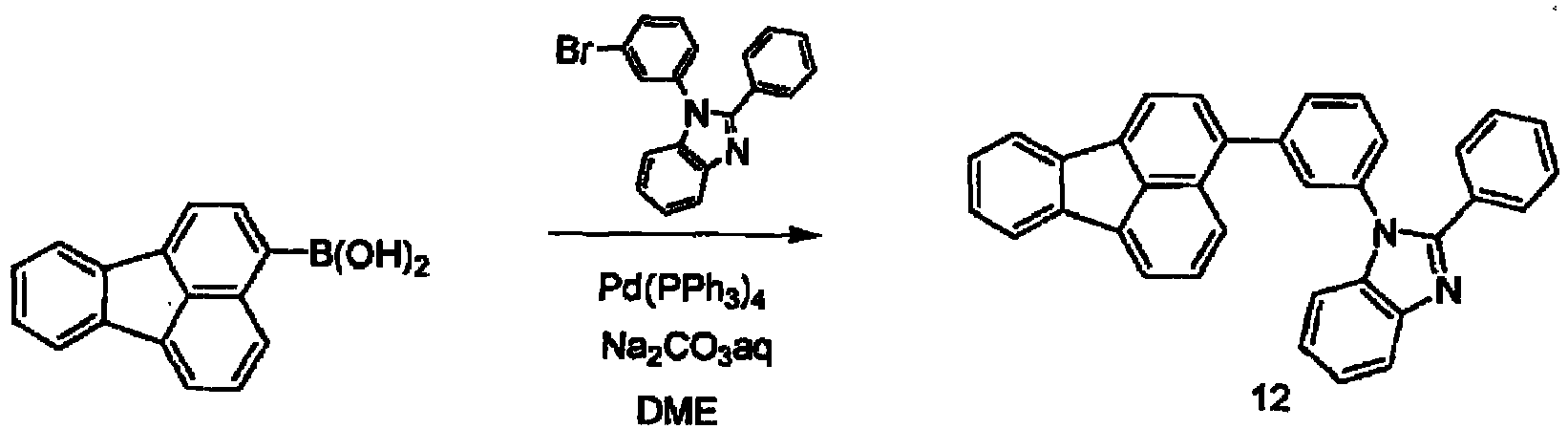
- Synthesis was conducted in the same manner as in the synthesis of the compound 11, except that 5-bromo-1-methyl-2-phenyl-1H-benzimidazole which was synthesized in Synthesis Example 5 was used instead of 1-(4-bromophenyl)-2-phenyl-1H-benzimidazole.
- As a result of mass spectroscopy, the resulting compound was found to be the following compound 13 and had an m/e value of 408 relative to a molecular weight of 408.16.

- Synthesis was conducted in the same manner as in the synthesis of the compound 11, except that 4-(fluororanthen-3-yl)phenylboronic acid which was synthesized in Synthesis Example 8 was used instead of fluoranthene-3-boronic acid.
- As a result of mass spectroscopy, the resulting compound was found to be the following compound 14 and had an m/e value of 546 relative to a molecular weight of 546.21.

- Synthesis was conducted in the same manner as in the synthesis of the compound 11, except that 3-(fluoranthen-3-yl)phenylboronic acid which was synthesized in Synthesis Example 9 was used instead of fluoranthene-3-boronic acid. As a result of mass spectroscopy, the resulting compound was found to be the following compound 15 and had an m/e value of 546 relative to a molecular weight of 546.21.

- Synthesis was conducted in the same manner as in the synthesis of the compound 11, except that 6-(fluoranthen-3-yl)naphthalene-2-ylboronic acid pinacol ester which was synthesized in Synthesis Example 10 was used instead of fluoranthene-3-boronic acid, and 1-(3-bromophenyl)-2-phenyl-1H-benzimidazole which was synthesized in Synthesis Example 4 was used instead of 1-(4-bromophenyl)-2-phenyl-1H-benzimidazole. As a result of mass spectroscopy, the resulting compound was found to be the following compound 16 and had an m/e value of 596 relative to a molecular weight of 596.23.

- Synthesis was conducted in the same manner as in the synthesis of the compound 11, except that 3-(fluoranthen-3-yl)phenylboronic acid which was synthesized in Synthesis Example 9 was used instead of fluoranthene-3-boronic acid, and 5-bromo-1-methyl-2-phenyl-1H-benzimidazole which was synthesized in Synthesis Example 5 was used instead of 1-(4-bromophenyl)-2-phenyl-1H-benzimidazole. As a result of mass spectroscopy, the resulting compound was found to be the following compound 17 and had an m/e value of 484 relative to a molecular weight of 484.19.

- A reaction was conducted in the same manner as in Example 1, except that benzo[g]chrysene-10-boronic acid was used instead of benzo[c]phenanthrene-5-boronic aid and 6-bromo-2,2'-bipyridyl was used instead of 1-(4-bromophenyl)-2-phenyl-1H-benzimidazole.
- As a result of mass spectroscopy, the resulting compound was found to be the following compound 18 and had an m/e value of 432 relative to a molecular weight of 432.16.

- The materials used in an organic EL device are as follows.
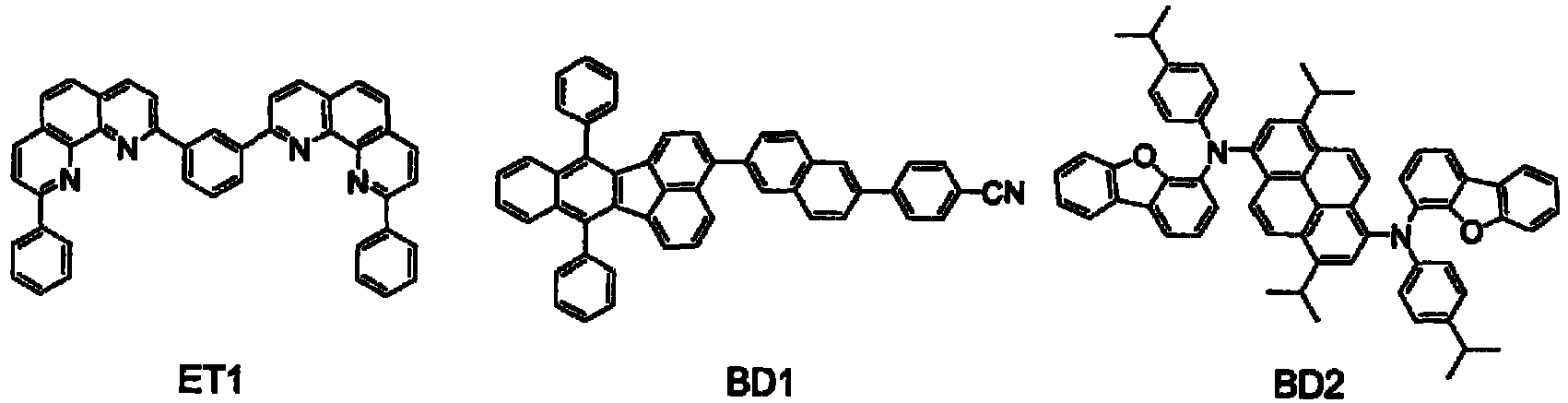
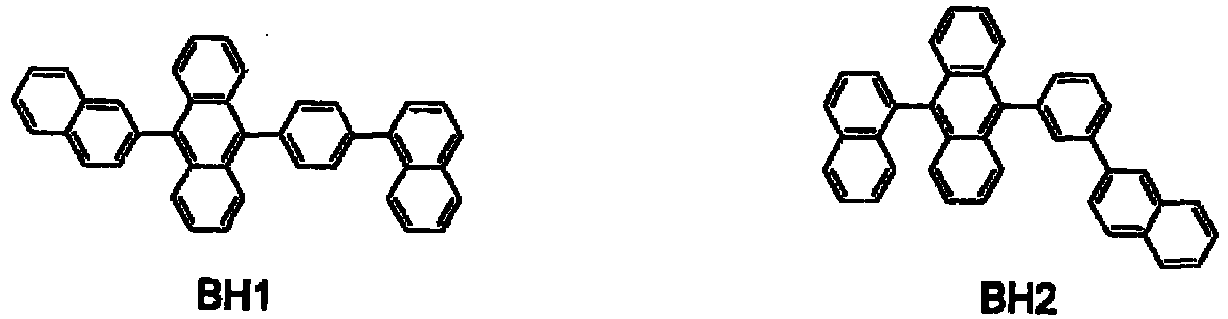


- On a substrate on which a 130 nm-thick ITO (indium tin oxide) was formed, the following materials were sequentially deposited, whereby an organic EL device was obtained. The number in parenthesis (unit: nm) indicates the film thickness.
- Anode: ITO (130)
- Hole-injecting layer: HT1 (50)
- Hole-transporting layer: HT2 (45)
- Emitting layer: BH1 and BD1 (BD1 was doped in an amount of 5%) (25)
- Blocking layer: Compound 6 (25)
- Low-work function metal containing layer. LiF (1)
- Cathode AI (80)
- The following evaluation was made on the thus obtained organic EL device. The results are shown in Table 1.
- A voltage was applied to the device such that the current value became 10 mA/cm2, and the voltage value at this time was measured. An EL emission spectrum at this time was measured by means of a spectroradiometer (CS-1000, manufactured by Konica Minolta Holdings, Inc.). From the resulting spectra radiance, chromaticity, current efficiency (cd/A) and external quantum efficiency (%) were calculated.
- A voltage pulse waveform (pulse width: 500 microseconds, frequency: 20 Hz) which has been output from a pulse generator (8114A, manufactured by Adilent Corporation) was applied to a device. EL emission was input to a photomultiplier tube (R928 manufactured by Hamamatsu Photonics K. K.), and a pulse voltage waveform and EL emission were synchronized and input to an oscilloscope (2440, manufactured by Tektronix, Inc.) to obtain a transient EL waveform. Ratio of emission derived from TTF (TTF ratio) was determined by analyzing this EL waveform (see Japanese Patent Application No.
2009-125883 - The transient EL waveform was obtained by measuring the current density when the current efficiency (UJ) became the maximum in a current density-current efficiency curve, followed by application of a voltage pulse waveform corresponding to the current density.
The theoretical limit of Improvement in internal quantum efficiency by a TTF phenomenon is thought to be 62.5%. In this case, the ratio of emission derived from TTF is 60%. - According to the method stated in
JP-A-2006-278035 - Organic EL devices were fabricated and evaluated in the same manner as in Example 19, except that the compounds shown in Table 1 were used as the host material, and the dopant material in the emitting layer and the blocking layer material. The results obtained are shown in Table 1.
Table 1 BH BD ET Voltage [V] Chromaticity L/J [cd/A] EQE [%] TTF ratio [%] x y Example 19 BH1 BD1 Compound 6 3.6 0.144 0.117 9.6 9.3 33 Example 20 BH2 BD1 Compound 6 3.7 0.143 0.116 9.9 9.7 34 Example 21 BH1 BD1 Compound 12 3.7 0.145 0.110 8.0 8.1 28 Example 22 BH2 BD1 Compound 12 3.8 0.144 0.110 8.5 8.6 28 Example 23 BH2 BD2 Compound 1 4.3 0.128 0.147 10.6 9.3 26 Example 24 BH4 BD1 Compound 15 3.9 0.143 0.118 9.0 8.8 32 Example 25 BH4 BD1 Compound 16 3.9 0.142 0.123 8.6 8.1 28 Example 26 BH4 BD1 Compound 17 3.8 0.142 0.124 10.0 9.4 31 Example 27 BH4 BD1 Compound 18 4.8 0.143 0.121 7.6 7.2 34 Com. Ex. 1 BH1 BD1 ET1 3.2 0.144 0.124 7.2 6.7 22 Com. Ex. 2 BH1 BD1 BH3 5.9 0.143 0.115 0.5 0.5 13 - An organic EL device comprising the nitrogen-containing heterocyclic derivative of the invention can be used for a display panel or an illumination panel or the like used in large-sized televisions of which the reduction in power consumption is desired.
- Although only some exemplary embodiments and/or examples of this invention have been described in detail above, those skilled in the art will readily appreciate that many modifications are possible in the exemplary embodiments and/or examples without materially departing from the novel teachings and advantages of this invention. Accordingly, all such modifications are intended to be included within the scope of this invention.
- The documents described in the specification are incorporated herein by reference in its entirety.
R301 to R308 are independently a hydrogen atom, a fluorine atom, a substituted or unsubstituted alkyl group having 1 to 10 carbon atoms, a substituted or unsubstituted cycloalkyl group having 3 to 10 carbon atoms, a substituted or unsubstituted alkylsilyl group having 3 to 30 carbon atoms, a substituted or unsubstituted arylsilyl group having 8 to 30 ring carbon atoms, a substituted or unsubstituted alkoxy grouop having 1 to 20 carbon atoms, a substituted or unsubstituted aryloxy group having 6 to 20 ring carbon atoms, a substituted or unsubstituted aryl group having 6 to 30 ring carbon atoms or a substituted or unsubstituted heterocyclic group having 5 to 30 ring atoms. 19. The organic electroluminescence device according to 18, wherein the emitting layer comprising the anthracene derivative represented by the formula (41) is adjacent to the blocking layer comprising the nitrogen-containing heterocyclic derivative.
Claims (19)
- A nitrogen-containing heterocyclic derivative represented by the following formula (1):

HAr is a substituted or unsubstituted nitrogen-containing heterocyclic group; and
"a" and "b" are independently an integer of 1 to 4, and at least one of "a" and "b" is 1. - The nitrogen-containing heterocyclic derivative according to claim 1, wherein HAr is any of nitrogen-containing heterocyclic groups represented by the following formulas (2) to (6):


- The nitrogen-containing heterocyclic derivative according to claim 1 or 2, wherein HAr is any of the nitrogen-containing heterocyclic groups represented by the following formulas (7) to (20):


- The nitrogen-containing heterocyclic derivative according to any of claims 1 to 3, wherein "a" is 1 and "b" is 1.
- A nitrogen-containing heterocyclic derivative represented by the following formula (21):
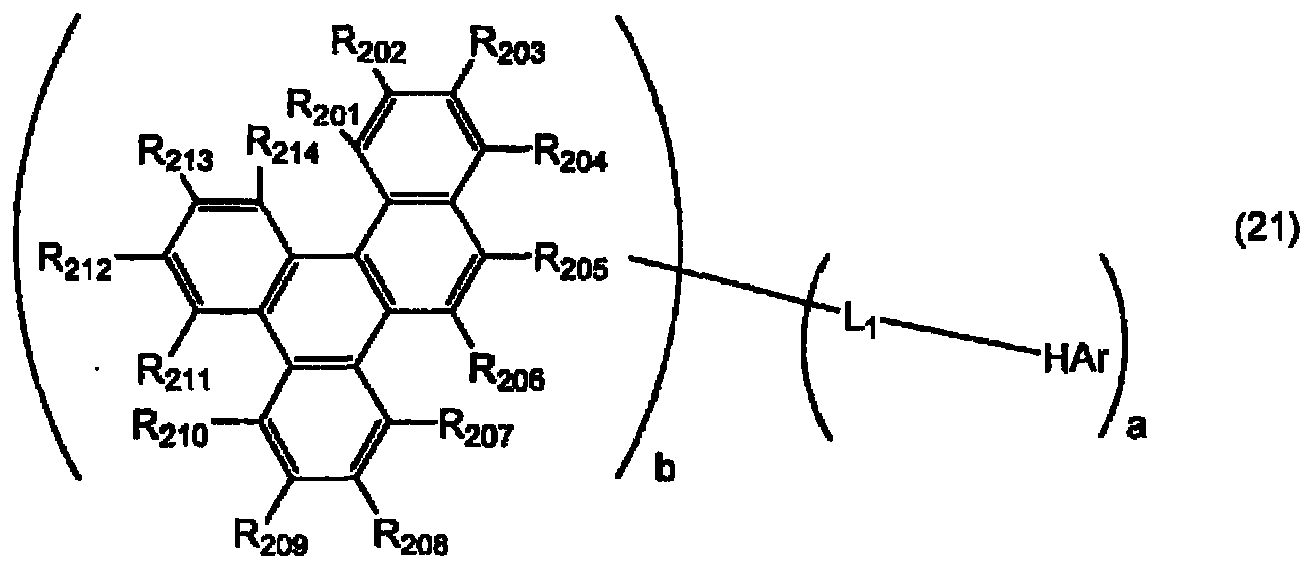
L1 is a single bond, a substituted or unsubstituted "b+1" valent hydrocarbon ring group having 6 to 30 ring carbon atoms or a substituted or unsubstituted "b+1" valent heterocyclic group having 5 to 30 ring atoms;
HAr is a substituted or unsubstituted nitrogen-cantaining heterocyclic group; and
"a" and "b" are independently an integer of 1 to 4 and at least one of "a" and "b" is 1. - The nitrogen-containing heterocyclic derivative according to claim 5, wherein HAr is any of the nitrogen-containing heterocyclic groups represented by the following formulas (2) to (6):


- The nitrogen-containing heterocyclic derivative according to claim 5 or 6, wherein HAr is any of the nitrogen-containing heterocyclic groups represented by the following formulas (7) to (20):


- The nitrogen-containing heterocyclic derivative according to any of claims 5 to 7, wherein "a" is 1 and "b" is 1.
- A nitrogen-containing heterocyclic derivative represented by the following formula (31):

L1 is a single bond, a substituted or unsubstituted "c+d" valent hydrocarbon group having 6 to 30 ring carbon atoms or a "c+d" valent heterocyclic group having 5 to 30 ring atoms; and
"c" and "d" are independently an integer of 1 to 3; provided that L1, and R401 to R416 are not an anthracene containing group. - The nitrogen-containing heterocyclic derivative according to claim 9, wherein "c" is 1.
- The nitrogen-containing heterocyclic derivative according to claim 9 or 10 which is represented by the following formula (32):

- The nitrogen-containing heterocyclic derivative according to claim 11, wherein "d" is 1.
- The nitrogen-containing heterocyclic derivative according to claim 12 which is represented by the following formula (33) or (34):
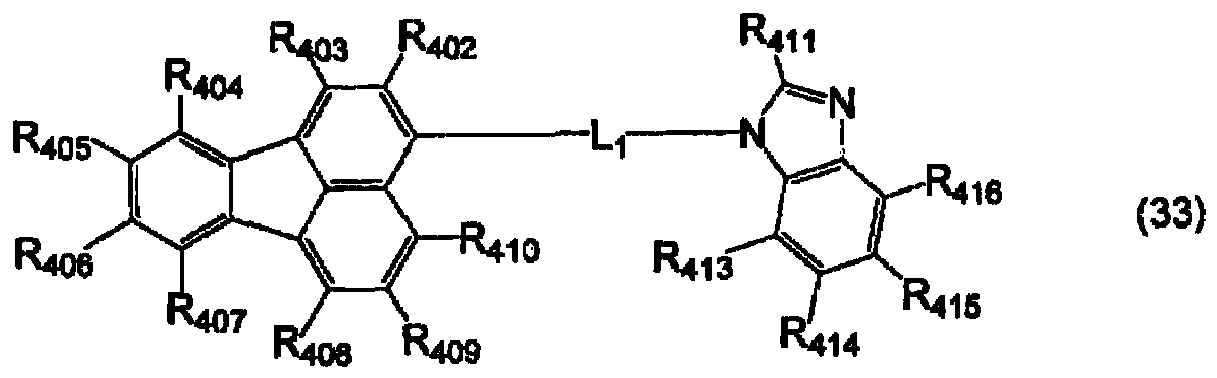

- The nitrogen-containing heterocyclic derivative according to any of claims 1 to 13 which is a material for an organic electroluminescence device.
- The nitrogen-containing heterocyclic derivative according to claim 14, wherein the material for an organic electroluminescence device is a material for a blocking layer.
- An organic electroluminescence device comprising an anode, an emitting layer, a blocking layer and a cathode sequentially, wherein the blocking layer comprises the nitrogen-containing heterocyclic derivative according to any of claims 1 to 13.
- An organic electroluminescence device comprising an electron-injecting layer and/or an electron-transporting layer between an emitting layer and a cathode, wherein at least one layer of the electron-injecting layer and the electron-transporting layer comprises the nitrogen-containing heterocyclic derivative according to any of claims 1 to 13.
- The organic electroluminescence device according to claim 16 or 17, wherein the emitting layer comprises an anthracene derivative represented by the following formula (41):

R301 to R308 are independently a hydrogen atom, a fluorine atom, a substituted or unsubstituted alkyl group having 1 to 10 carbon atoms, a substituted or unsubstituted cycloalkyl group having 3 to 10 carbon atoms, a substituted or unsubstituted alkylsilyl group having 3 to 30 carbon atoms, a substituted or unsubstituted arylsilyl group having 8 to 30 ring carbon atoms, a substituted or unsubstituted alkoxy grouop having 1 to 20 carbon atoms, a substituted or unsubstituted aryloxy group having 6 to 20 ring carbon atoms, a substituted or unsubstituted aryl group having 6 to 30 ring carbon atoms or a substituted or unsubstituted heterocyclic group having 5 to 30 ring atoms. - The organic electroluminescence device according to claim 18, wherein the emitting layer comprising the anthracene derivative represented by the formula (41) is adjacent to the blocking layer comprising the nitrogen-containing heterocyclic derivative.
Priority Applications (1)
| Application Number | Priority Date | Filing Date | Title |
|---|---|---|---|
| EP17157767.9A EP3192789A1 (en) | 2010-01-15 | 2011-01-13 | Nitrogenated heterocyclic ring derivative and organic electroluminescent element comprising same |
Applications Claiming Priority (2)
| Application Number | Priority Date | Filing Date | Title |
|---|---|---|---|
| JP2010007467 | 2010-01-15 | ||
| PCT/JP2011/000156 WO2011086935A1 (en) | 2010-01-15 | 2011-01-13 | Nitrogenated heterocyclic ring derivative and organic electroluminescent element comprising same |
Related Child Applications (2)
| Application Number | Title | Priority Date | Filing Date |
|---|---|---|---|
| EP17157767.9A Division-Into EP3192789A1 (en) | 2010-01-15 | 2011-01-13 | Nitrogenated heterocyclic ring derivative and organic electroluminescent element comprising same |
| EP17157767.9A Division EP3192789A1 (en) | 2010-01-15 | 2011-01-13 | Nitrogenated heterocyclic ring derivative and organic electroluminescent element comprising same |
Publications (3)
| Publication Number | Publication Date |
|---|---|
| EP2524913A1 true EP2524913A1 (en) | 2012-11-21 |
| EP2524913A4 EP2524913A4 (en) | 2013-06-12 |
| EP2524913B1 EP2524913B1 (en) | 2017-07-26 |
Family
ID=44304211
Family Applications (2)
| Application Number | Title | Priority Date | Filing Date |
|---|---|---|---|
| EP17157767.9A Ceased EP3192789A1 (en) | 2010-01-15 | 2011-01-13 | Nitrogenated heterocyclic ring derivative and organic electroluminescent element comprising same |
| EP11732808.8A Not-in-force EP2524913B1 (en) | 2010-01-15 | 2011-01-13 | Nitrogenated heterocyclic ring derivative and organic electroluminescent element comprising same |
Family Applications Before (1)
| Application Number | Title | Priority Date | Filing Date |
|---|---|---|---|
| EP17157767.9A Ceased EP3192789A1 (en) | 2010-01-15 | 2011-01-13 | Nitrogenated heterocyclic ring derivative and organic electroluminescent element comprising same |
Country Status (7)
| Country | Link |
|---|---|
| US (1) | US9126943B2 (en) |
| EP (2) | EP3192789A1 (en) |
| JP (1) | JP5722238B2 (en) |
| KR (1) | KR101450959B1 (en) |
| CN (1) | CN102471269B (en) |
| TW (1) | TW201137084A (en) |
| WO (1) | WO2011086935A1 (en) |
Cited By (1)
| Publication number | Priority date | Publication date | Assignee | Title |
|---|---|---|---|---|
| US10128455B2 (en) | 2013-05-16 | 2018-11-13 | Semiconductor Energy Laboratory Co., Ltd. | Light-emitting element, light-emitting device, electronic device, and lighting device |
Families Citing this family (33)
| Publication number | Priority date | Publication date | Assignee | Title |
|---|---|---|---|---|
| KR20120100709A (en) | 2010-01-15 | 2012-09-12 | 이데미쓰 고산 가부시키가이샤 | Organic electroluminescent element |
| EP3192789A1 (en) | 2010-01-15 | 2017-07-19 | Idemitsu Kosan Co., Ltd. | Nitrogenated heterocyclic ring derivative and organic electroluminescent element comprising same |
| US9324950B2 (en) | 2010-11-22 | 2016-04-26 | Idemitsu Kosan Co., Ltd. | Organic electroluminescence device |
| US8883323B2 (en) | 2010-11-22 | 2014-11-11 | Idemitsu Kosan Co., Ltd. | Organic electroluminescence device |
| CN102532034B (en) * | 2010-12-17 | 2015-03-11 | 清华大学 | Benzophenanthrene compound containing benzoglioxaline group and application thereof |
| CN103380508B (en) | 2011-11-22 | 2017-09-08 | 出光兴产株式会社 | Aromatic heterocyclic derivative, material for organic electroluminescent element, and organic electroluminescent element |
| JP5978843B2 (en) | 2012-02-02 | 2016-08-24 | コニカミノルタ株式会社 | Iridium complex compound, organic electroluminescence device material, organic electroluminescence device, lighting device and display device |
| KR101946891B1 (en) * | 2012-07-05 | 2019-02-12 | 도레이 카부시키가이샤 | Light emitting elment material and light emitting element |
| WO2014030666A1 (en) | 2012-08-24 | 2014-02-27 | コニカミノルタ株式会社 | Transparent electrode, electronic device, and method for manufacturing transparent electrode |
| US20140284580A1 (en) * | 2013-03-22 | 2014-09-25 | E-Ray Optoelectronics Techonology Co., Ltd. | Electron transporting compounds and organic electroluminescent devices using the same |
| EP2980878B1 (en) | 2013-03-29 | 2019-05-01 | Konica Minolta, Inc. | Organic electroluminescent element, and lighting device and display device which are provided with same |
| WO2014157610A1 (en) | 2013-03-29 | 2014-10-02 | コニカミノルタ株式会社 | Organic electroluminescent element, lighting device, display device, light-emitting thin film and composition for organic electroluminescent element, and light-emitting method |
| JP6269655B2 (en) | 2013-03-29 | 2018-01-31 | コニカミノルタ株式会社 | ORGANIC ELECTROLUMINESCENT ELEMENT MATERIAL, ORGANIC ELECTROLUMINESCENT ELEMENT, DISPLAY DEVICE AND LIGHTING DEVICE |
| KR101682844B1 (en) | 2013-06-04 | 2016-12-05 | 이데미쓰 고산 가부시키가이샤 | Nitrogen-containing heterocyclic derivative, organic electroluminescence element material using same, and organic electroluminescence element and electronic device using same |
| CN105993083B (en) | 2013-12-20 | 2018-07-03 | Udc 爱尔兰有限责任公司 | Efficient OLED device with extremely short decay time |
| CN104926732B (en) * | 2014-03-21 | 2017-06-13 | 昱镭光电科技股份有限公司 | Compound for organic light-emitting element and organic light-emitting element having same |
| JP2015218112A (en) * | 2014-05-14 | 2015-12-07 | ▲いく▼▲雷▼光電科技股▲分▼有限公司 | COMPOUND USED FOR ORGANIC LIGHT-EMITTING DEVICE AND ORGANIC LIGHT-EMITTING DEVICE HAVING THE COMPOUND |
| JP6627507B2 (en) * | 2014-05-28 | 2020-01-08 | 東レ株式会社 | Fluoranthene derivative, electronic device, light emitting element and photoelectric conversion element containing the same |
| KR101808677B1 (en) | 2014-06-02 | 2017-12-14 | 삼성디스플레이 주식회사 | Condensed compounds and organic light-emitting devices including the same |
| JP5831654B1 (en) | 2015-02-13 | 2015-12-09 | コニカミノルタ株式会社 | Aromatic heterocycle derivative, organic electroluminescence device using the same, illumination device and display device |
| KR102900833B1 (en) | 2015-06-03 | 2025-12-16 | 유디씨 아일랜드 리미티드 | Highly efficient oled devices with very short decay times |
| CN108727276A (en) * | 2015-12-01 | 2018-11-02 | 江苏理工学院 | The preparation method of benzimidazole derivative |
| US20180370981A1 (en) | 2015-12-21 | 2018-12-27 | Idemitsu Kosan Co., Ltd. | Hetero-condensed phenylquinazolines and their use in electronic devices |
| JP2017178919A (en) * | 2015-12-24 | 2017-10-05 | 出光興産株式会社 | Novel compound |
| JP6788314B2 (en) | 2016-01-06 | 2020-11-25 | コニカミノルタ株式会社 | Organic electroluminescence element, manufacturing method of organic electroluminescence element, display device and lighting device |
| JP6754422B2 (en) | 2016-02-24 | 2020-09-09 | 出光興産株式会社 | Organic electroluminescence devices and electronic devices |
| JP6755113B2 (en) * | 2016-04-11 | 2020-09-16 | 出光興産株式会社 | Organic electroluminescence element |
| CN106189363B (en) * | 2016-07-01 | 2018-04-10 | 湘潭大学 | One kind closes Cd (II) polymer-metal complex dye sensitizing agent and its production and use containing 2 (2 ' hydroxy phenyl) benzimidizole derivatives |
| TWI625326B (en) * | 2016-09-09 | 2018-06-01 | 昱鐳光電科技股份有限公司 | Organic electroluminescent element |
| CN110226241B (en) * | 2017-01-30 | 2022-08-30 | 出光兴产株式会社 | Organic electroluminescent element and electronic device |
| JP6846263B2 (en) * | 2017-03-31 | 2021-03-24 | 出光興産株式会社 | New compounds, organic electroluminescence devices, electronic devices |
| KR102306966B1 (en) * | 2020-01-31 | 2021-10-01 | 롬엔드하스전자재료코리아유한회사 | Organic electroluminescent compound, a plurality of host materials, and organic electroluminescent device comprising the same |
| KR102455718B1 (en) * | 2020-07-10 | 2022-10-17 | 주식회사 엘지화학 | Compound and organic light emitting device comprising the same |
Family Cites Families (56)
| Publication number | Priority date | Publication date | Assignee | Title |
|---|---|---|---|---|
| DE742326C (en) * | 1938-08-27 | 1943-12-13 | Chemische Ind Ges | Process for the production of Kuepen dyes of the fluoranthene series |
| US6830828B2 (en) | 1998-09-14 | 2004-12-14 | The Trustees Of Princeton University | Organometallic complexes as phosphorescent emitters in organic LEDs |
| US6097147A (en) | 1998-09-14 | 2000-08-01 | The Trustees Of Princeton University | Structure for high efficiency electroluminescent device |
| US7001536B2 (en) | 1999-03-23 | 2006-02-21 | The Trustees Of Princeton University | Organometallic complexes as phosphorescent emitters in organic LEDs |
| JP4876311B2 (en) | 2000-01-14 | 2012-02-15 | 東レ株式会社 | Light emitting element |
| KR100867495B1 (en) | 2000-11-24 | 2008-11-06 | 도레이 가부시끼가이샤 | Luminescent Element Material and Luminescent Element Comprising the Same |
| JP3873720B2 (en) | 2001-08-24 | 2007-01-24 | コニカミノルタホールディングス株式会社 | ORGANIC ELECTROLUMINESCENT ELEMENT MATERIAL, ORGANIC ELECTROLUMINESCENT ELEMENT AND DISPLAY DEVICE USING THE SAME |
| JP4172172B2 (en) | 2001-10-10 | 2008-10-29 | コニカミノルタホールディングス株式会社 | Organic electroluminescence device |
| JP4261855B2 (en) | 2002-09-19 | 2009-04-30 | キヤノン株式会社 | Phenanthroline compound and organic light emitting device using the same |
| JPWO2004028217A1 (en) * | 2002-09-20 | 2006-01-19 | 出光興産株式会社 | Organic electroluminescence device |
| JP2004214180A (en) | 2002-12-16 | 2004-07-29 | Canon Inc | Organic light emitting device |
| WO2004063159A1 (en) * | 2003-01-10 | 2004-07-29 | Idemitsu Kosan Co., Ltd. | Nitrogenous heterocyclic derivative and organic electroluminescent element employing the same |
| JP4595346B2 (en) | 2003-02-25 | 2010-12-08 | 東レ株式会社 | Light emitting device material and light emitting device including the same |
| JP3890317B2 (en) | 2003-04-30 | 2007-03-07 | キヤノン株式会社 | Light emitting element |
| US7018723B2 (en) | 2003-07-25 | 2006-03-28 | The University Of Southern California | Materials and structures for enhancing the performance of organic light emitting devices |
| JP2005093425A (en) | 2003-08-12 | 2005-04-07 | Toray Ind Inc | Light emitting element |
| JP2007534722A (en) * | 2004-04-29 | 2007-11-29 | チバ スペシャルティ ケミカルズ ホールディング インコーポレーテッド | Electroluminescence device |
| US20060088728A1 (en) | 2004-10-22 | 2006-04-27 | Raymond Kwong | Arylcarbazoles as hosts in PHOLEDs |
| WO2006046441A1 (en) * | 2004-10-29 | 2006-05-04 | Idemitsu Kosan Co., Ltd. | Aromatic amine compound and organic electroluminescent device using same |
| JP2006278035A (en) | 2005-03-28 | 2006-10-12 | Idemitsu Kosan Co Ltd | Luminescence distribution estimation method, luminescence distribution estimation device, luminescence distribution estimation program, recording medium, display element, and image display device |
| JP5317386B2 (en) | 2005-08-05 | 2013-10-16 | 出光興産株式会社 | Nitrogen-containing heterocyclic derivative and organic electroluminescence device using the same |
| EP1786050B1 (en) | 2005-11-10 | 2010-06-23 | Novaled AG | Doped organic semiconductor material |
| US7553558B2 (en) | 2005-11-30 | 2009-06-30 | Eastman Kodak Company | Electroluminescent device containing an anthracene derivative |
| US20070122657A1 (en) | 2005-11-30 | 2007-05-31 | Eastman Kodak Company | Electroluminescent device containing a phenanthroline derivative |
| JP2007153778A (en) * | 2005-12-02 | 2007-06-21 | Idemitsu Kosan Co Ltd | Nitrogen-containing heterocyclic derivative and organic electroluminescence device using the same |
| JP2007230951A (en) | 2006-03-02 | 2007-09-13 | Canon Inc | Silyl compound, light emitting material, and organic light emitting device using the same |
| JP4724585B2 (en) | 2006-03-31 | 2011-07-13 | キヤノン株式会社 | Organic electroluminescent device and light emitting device |
| KR101486096B1 (en) * | 2007-03-29 | 2015-01-23 | 바스프 에스이 | Heterocyclic bridged biphenyls |
| JPWO2009008198A1 (en) | 2007-07-07 | 2010-09-02 | 出光興産株式会社 | Naphthalene derivative, material for organic EL element, and organic EL element using the same |
| WO2009008205A1 (en) | 2007-07-07 | 2009-01-15 | Idemitsu Kosan Co., Ltd. | Organic electroluminescent device and material for organic electroluminescent device |
| JP5151422B2 (en) * | 2007-09-19 | 2013-02-27 | 三菱化学株式会社 | Organic electroluminescent element material, organic electroluminescent element composition, organic electroluminescent element, and organic EL display |
| JPWO2009063833A1 (en) * | 2007-11-15 | 2011-03-31 | 出光興産株式会社 | Benzochrysene derivative and organic electroluminescence device using the same |
| JP5539728B2 (en) * | 2007-11-16 | 2014-07-02 | 出光興産株式会社 | Benzochrysene derivative and organic electroluminescence device using the same |
| JP4997078B2 (en) | 2007-11-26 | 2012-08-08 | トヨタ自動車株式会社 | Robot hand |
| US8507106B2 (en) * | 2007-11-29 | 2013-08-13 | Idemitsu Kosan Co., Ltd. | Benzophenanthrene derivative and organic electroluminescent device employing the same |
| KR101528241B1 (en) | 2007-12-07 | 2015-06-15 | 삼성디스플레이 주식회사 | An aromatic cyclic compound, an organic light emitting device having an organic film containing the same, and a method for manufacturing the organic light emitting device |
| WO2009107596A1 (en) * | 2008-02-25 | 2009-09-03 | 出光興産株式会社 | Organic luminescent medium and organic el element |
| JP2009238910A (en) | 2008-03-26 | 2009-10-15 | Canon Inc | Organic light emitting device |
| JP4844585B2 (en) | 2008-04-14 | 2011-12-28 | コニカミノルタホールディングス株式会社 | Organic electroluminescence element and display device |
| KR101495547B1 (en) | 2008-04-17 | 2015-02-25 | 롬엔드하스전자재료코리아유한회사 | Novel compounds for electronic material and organic electronic device using the same |
| EP2141214A3 (en) | 2008-06-25 | 2010-02-24 | Gracel Display Inc. | Novel organic electroluminescent compounds and organic electroluminescent device using the same |
| WO2010027181A2 (en) * | 2008-09-02 | 2010-03-11 | 주식회사 두산 | Anthracene derivative and organic electroluminescence element using the same |
| KR101551207B1 (en) | 2008-09-04 | 2015-09-08 | 롬엔드하스전자재료코리아유한회사 | Novel organic electroluminescent compounds and organic electroluminescent device using the same |
| DE102008056391B4 (en) | 2008-09-26 | 2021-04-01 | Osram Oled Gmbh | Organic electronic component and process for its manufacture |
| KR101178219B1 (en) | 2008-11-21 | 2012-08-29 | 롬엔드하스전자재료코리아유한회사 | Electroluminescent device using the electroluminescent compounds |
| DE102009005746A1 (en) * | 2009-01-23 | 2010-07-29 | Merck Patent Gmbh | Materials for organic electroluminescent devices |
| JP2010199296A (en) | 2009-02-25 | 2010-09-09 | Mitsubishi Chemicals Corp | Organic electroluminescence element, organic el display and organic el lighting |
| KR20100108914A (en) | 2009-03-31 | 2010-10-08 | 다우어드밴스드디스플레이머티리얼 유한회사 | Novel organic electroluminescent compounds and organic electroluminescent device using the same |
| JP5102818B2 (en) | 2009-09-29 | 2012-12-19 | 独立行政法人科学技術振興機構 | Photoelectric conversion element using phenanthroline derivative and method for producing the same |
| DE102009047880A1 (en) | 2009-09-30 | 2011-03-31 | Osram Opto Semiconductors Gmbh | Organic electronic device and method of making the same |
| KR20110043270A (en) | 2009-10-21 | 2011-04-27 | (주)씨에스엘쏠라 | Organic light emitting compound and organic light emitting device having same |
| EP3192789A1 (en) | 2010-01-15 | 2017-07-19 | Idemitsu Kosan Co., Ltd. | Nitrogenated heterocyclic ring derivative and organic electroluminescent element comprising same |
| KR20120100709A (en) | 2010-01-15 | 2012-09-12 | 이데미쓰 고산 가부시키가이샤 | Organic electroluminescent element |
| US20120126205A1 (en) | 2010-11-22 | 2012-05-24 | Idemitsu Kosan Co., Ltd. | Organic electroluminescence device |
| JP6424002B2 (en) | 2011-10-26 | 2018-11-14 | 出光興産株式会社 | ORGANIC ELECTROLUMINESCENT DEVICE AND MATERIAL FOR ORGANIC ELECTROLUMINESCENT DEVICE |
| CN103380508B (en) | 2011-11-22 | 2017-09-08 | 出光兴产株式会社 | Aromatic heterocyclic derivative, material for organic electroluminescent element, and organic electroluminescent element |
-
2011
- 2011-01-13 EP EP17157767.9A patent/EP3192789A1/en not_active Ceased
- 2011-01-13 KR KR1020117031233A patent/KR101450959B1/en active Active
- 2011-01-13 JP JP2011549945A patent/JP5722238B2/en active Active
- 2011-01-13 US US13/389,165 patent/US9126943B2/en active Active
- 2011-01-13 WO PCT/JP2011/000156 patent/WO2011086935A1/en not_active Ceased
- 2011-01-13 EP EP11732808.8A patent/EP2524913B1/en not_active Not-in-force
- 2011-01-13 CN CN201180002699.XA patent/CN102471269B/en active Active
- 2011-01-14 TW TW100101605A patent/TW201137084A/en unknown
Cited By (2)
| Publication number | Priority date | Publication date | Assignee | Title |
|---|---|---|---|---|
| US10128455B2 (en) | 2013-05-16 | 2018-11-13 | Semiconductor Energy Laboratory Co., Ltd. | Light-emitting element, light-emitting device, electronic device, and lighting device |
| US11462701B2 (en) | 2013-05-16 | 2022-10-04 | Semiconductor Energy Laboratory Co., Ltd. | Light-emitting element, light-emitting device, electronic device, and lighting device |
Also Published As
| Publication number | Publication date |
|---|---|
| JPWO2011086935A1 (en) | 2013-05-20 |
| US9126943B2 (en) | 2015-09-08 |
| WO2011086935A1 (en) | 2011-07-21 |
| KR20120115083A (en) | 2012-10-17 |
| TW201137084A (en) | 2011-11-01 |
| EP2524913B1 (en) | 2017-07-26 |
| CN102471269A (en) | 2012-05-23 |
| CN102471269B (en) | 2016-02-03 |
| EP2524913A4 (en) | 2013-06-12 |
| JP5722238B2 (en) | 2015-05-20 |
| KR101450959B1 (en) | 2014-10-15 |
| US20120132899A1 (en) | 2012-05-31 |
| EP3192789A1 (en) | 2017-07-19 |
Similar Documents
| Publication | Publication Date | Title |
|---|---|---|
| EP2524913B1 (en) | Nitrogenated heterocyclic ring derivative and organic electroluminescent element comprising same | |
| JP7519693B2 (en) | Heterocyclic compound and organic electroluminescent device containing the same | |
| EP2525425B1 (en) | Organic electroluminescent element | |
| JP6434073B2 (en) | Organic electroluminescence device | |
| KR102261235B1 (en) | Aromatic heterocyclic derivative, material for organic electroluminescent element, and organic electroluminescent element | |
| CN113698305B (en) | Fluorene derivative, light-emitting element, light-emitting device, electronic device, and lighting device | |
| EP2709181B1 (en) | Light-emitting element material and light-emitting element | |
| EP2960958B1 (en) | Organic electroluminescence element | |
| EP2644607A1 (en) | Oxygenated fused ring derivative and organic electroluminescence element containing the same | |
| EP3282496B1 (en) | Organic electroluminescent element | |
| EP2492986A1 (en) | Organic electroluminescent element | |
| EP2597094A1 (en) | Imidazopyridine derivatives and organic electroluminescent elements containing same | |
| KR20120116269A (en) | Novel compounds for organic electronic material and organic electroluminescence device using the same | |
| KR20120116272A (en) | Novel compounds for organic electronic material and organic electroluminescence device using the same | |
| WO2013146942A1 (en) | Novel compound, material for organic electroluminescence element, and organic electroluminescence element | |
| EP2626920A1 (en) | Light emitting element material and light emitting element | |
| CN103493239A (en) | Organic Electroluminescent Devices |
Legal Events
| Date | Code | Title | Description |
|---|---|---|---|
| PUAI | Public reference made under article 153(3) epc to a published international application that has entered the european phase |
Free format text: ORIGINAL CODE: 0009012 |
|
| 17P | Request for examination filed |
Effective date: 20120131 |
|
| AK | Designated contracting states |
Kind code of ref document: A1 Designated state(s): AL AT BE BG CH CY CZ DE DK EE ES FI FR GB GR HR HU IE IS IT LI LT LU LV MC MK MT NL NO PL PT RO RS SE SI SK SM TR |
|
| DAX | Request for extension of the european patent (deleted) | ||
| A4 | Supplementary search report drawn up and despatched |
Effective date: 20130513 |
|
| RIC1 | Information provided on ipc code assigned before grant |
Ipc: C07D 235/18 20060101ALI20130506BHEP Ipc: C07D 519/00 20060101ALI20130506BHEP Ipc: C09K 11/06 20060101ALI20130506BHEP Ipc: C07D 401/14 20060101ALI20130506BHEP Ipc: C07D 405/04 20060101ALI20130506BHEP Ipc: H01L 51/50 20060101ALI20130506BHEP Ipc: C07D 213/22 20060101AFI20130506BHEP Ipc: C07D 401/04 20060101ALI20130506BHEP Ipc: C07D 403/10 20060101ALI20130506BHEP Ipc: H01L 51/00 20060101ALI20130506BHEP Ipc: C07D 471/04 20060101ALI20130506BHEP Ipc: C07D 235/08 20060101ALI20130506BHEP |
|
| 17Q | First examination report despatched |
Effective date: 20140812 |
|
| GRAP | Despatch of communication of intention to grant a patent |
Free format text: ORIGINAL CODE: EPIDOSNIGR1 |
|
| STAA | Information on the status of an ep patent application or granted ep patent |
Free format text: STATUS: GRANT OF PATENT IS INTENDED |
|
| INTG | Intention to grant announced |
Effective date: 20161124 |
|
| GRAS | Grant fee paid |
Free format text: ORIGINAL CODE: EPIDOSNIGR3 |
|
| GRAJ | Information related to disapproval of communication of intention to grant by the applicant or resumption of examination proceedings by the epo deleted |
Free format text: ORIGINAL CODE: EPIDOSDIGR1 |
|
| GRAL | Information related to payment of fee for publishing/printing deleted |
Free format text: ORIGINAL CODE: EPIDOSDIGR3 |
|
| STAA | Information on the status of an ep patent application or granted ep patent |
Free format text: STATUS: EXAMINATION IS IN PROGRESS |
|
| GRAR | Information related to intention to grant a patent recorded |
Free format text: ORIGINAL CODE: EPIDOSNIGR71 |
|
| STAA | Information on the status of an ep patent application or granted ep patent |
Free format text: STATUS: GRANT OF PATENT IS INTENDED |
|
| GRAA | (expected) grant |
Free format text: ORIGINAL CODE: 0009210 |
|
| STAA | Information on the status of an ep patent application or granted ep patent |
Free format text: STATUS: THE PATENT HAS BEEN GRANTED |
|
| INTC | Intention to grant announced (deleted) | ||
| AK | Designated contracting states |
Kind code of ref document: B1 Designated state(s): AL AT BE BG CH CY CZ DE DK EE ES FI FR GB GR HR HU IE IS IT LI LT LU LV MC MK MT NL NO PL PT RO RS SE SI SK SM TR |
|
| INTG | Intention to grant announced |
Effective date: 20170616 |
|
| REG | Reference to a national code |
Ref country code: GB Ref legal event code: FG4D |
|
| REG | Reference to a national code |
Ref country code: CH Ref legal event code: EP |
|
| REG | Reference to a national code |
Ref country code: AT Ref legal event code: REF Ref document number: 912240 Country of ref document: AT Kind code of ref document: T Effective date: 20170815 |
|
| REG | Reference to a national code |
Ref country code: IE Ref legal event code: FG4D |
|
| REG | Reference to a national code |
Ref country code: DE Ref legal event code: R096 Ref document number: 602011039934 Country of ref document: DE |
|
| REG | Reference to a national code |
Ref country code: NL Ref legal event code: MP Effective date: 20170726 |
|
| REG | Reference to a national code |
Ref country code: LT Ref legal event code: MG4D |
|
| REG | Reference to a national code |
Ref country code: AT Ref legal event code: MK05 Ref document number: 912240 Country of ref document: AT Kind code of ref document: T Effective date: 20170726 |
|
| REG | Reference to a national code |
Ref country code: FR Ref legal event code: PLFP Year of fee payment: 8 |
|
| PG25 | Lapsed in a contracting state [announced via postgrant information from national office to epo] |
Ref country code: FI Free format text: LAPSE BECAUSE OF FAILURE TO SUBMIT A TRANSLATION OF THE DESCRIPTION OR TO PAY THE FEE WITHIN THE PRESCRIBED TIME-LIMIT Effective date: 20170726 Ref country code: NL Free format text: LAPSE BECAUSE OF FAILURE TO SUBMIT A TRANSLATION OF THE DESCRIPTION OR TO PAY THE FEE WITHIN THE PRESCRIBED TIME-LIMIT Effective date: 20170726 Ref country code: LT Free format text: LAPSE BECAUSE OF FAILURE TO SUBMIT A TRANSLATION OF THE DESCRIPTION OR TO PAY THE FEE WITHIN THE PRESCRIBED TIME-LIMIT Effective date: 20170726 Ref country code: HR Free format text: LAPSE BECAUSE OF FAILURE TO SUBMIT A TRANSLATION OF THE DESCRIPTION OR TO PAY THE FEE WITHIN THE PRESCRIBED TIME-LIMIT Effective date: 20170726 Ref country code: NO Free format text: LAPSE BECAUSE OF FAILURE TO SUBMIT A TRANSLATION OF THE DESCRIPTION OR TO PAY THE FEE WITHIN THE PRESCRIBED TIME-LIMIT Effective date: 20171026 Ref country code: AT Free format text: LAPSE BECAUSE OF FAILURE TO SUBMIT A TRANSLATION OF THE DESCRIPTION OR TO PAY THE FEE WITHIN THE PRESCRIBED TIME-LIMIT Effective date: 20170726 Ref country code: SE Free format text: LAPSE BECAUSE OF FAILURE TO SUBMIT A TRANSLATION OF THE DESCRIPTION OR TO PAY THE FEE WITHIN THE PRESCRIBED TIME-LIMIT Effective date: 20170726 |
|
| PG25 | Lapsed in a contracting state [announced via postgrant information from national office to epo] |
Ref country code: PL Free format text: LAPSE BECAUSE OF FAILURE TO SUBMIT A TRANSLATION OF THE DESCRIPTION OR TO PAY THE FEE WITHIN THE PRESCRIBED TIME-LIMIT Effective date: 20170726 Ref country code: IS Free format text: LAPSE BECAUSE OF FAILURE TO SUBMIT A TRANSLATION OF THE DESCRIPTION OR TO PAY THE FEE WITHIN THE PRESCRIBED TIME-LIMIT Effective date: 20171126 Ref country code: ES Free format text: LAPSE BECAUSE OF FAILURE TO SUBMIT A TRANSLATION OF THE DESCRIPTION OR TO PAY THE FEE WITHIN THE PRESCRIBED TIME-LIMIT Effective date: 20170726 Ref country code: GR Free format text: LAPSE BECAUSE OF FAILURE TO SUBMIT A TRANSLATION OF THE DESCRIPTION OR TO PAY THE FEE WITHIN THE PRESCRIBED TIME-LIMIT Effective date: 20171027 Ref country code: BG Free format text: LAPSE BECAUSE OF FAILURE TO SUBMIT A TRANSLATION OF THE DESCRIPTION OR TO PAY THE FEE WITHIN THE PRESCRIBED TIME-LIMIT Effective date: 20171026 Ref country code: LV Free format text: LAPSE BECAUSE OF FAILURE TO SUBMIT A TRANSLATION OF THE DESCRIPTION OR TO PAY THE FEE WITHIN THE PRESCRIBED TIME-LIMIT Effective date: 20170726 Ref country code: RS Free format text: LAPSE BECAUSE OF FAILURE TO SUBMIT A TRANSLATION OF THE DESCRIPTION OR TO PAY THE FEE WITHIN THE PRESCRIBED TIME-LIMIT Effective date: 20170726 |
|
| PG25 | Lapsed in a contracting state [announced via postgrant information from national office to epo] |
Ref country code: DK Free format text: LAPSE BECAUSE OF FAILURE TO SUBMIT A TRANSLATION OF THE DESCRIPTION OR TO PAY THE FEE WITHIN THE PRESCRIBED TIME-LIMIT Effective date: 20170726 Ref country code: RO Free format text: LAPSE BECAUSE OF FAILURE TO SUBMIT A TRANSLATION OF THE DESCRIPTION OR TO PAY THE FEE WITHIN THE PRESCRIBED TIME-LIMIT Effective date: 20170726 Ref country code: CZ Free format text: LAPSE BECAUSE OF FAILURE TO SUBMIT A TRANSLATION OF THE DESCRIPTION OR TO PAY THE FEE WITHIN THE PRESCRIBED TIME-LIMIT Effective date: 20170726 |
|
| REG | Reference to a national code |
Ref country code: DE Ref legal event code: R097 Ref document number: 602011039934 Country of ref document: DE |
|
| PG25 | Lapsed in a contracting state [announced via postgrant information from national office to epo] |
Ref country code: SK Free format text: LAPSE BECAUSE OF FAILURE TO SUBMIT A TRANSLATION OF THE DESCRIPTION OR TO PAY THE FEE WITHIN THE PRESCRIBED TIME-LIMIT Effective date: 20170726 Ref country code: IT Free format text: LAPSE BECAUSE OF FAILURE TO SUBMIT A TRANSLATION OF THE DESCRIPTION OR TO PAY THE FEE WITHIN THE PRESCRIBED TIME-LIMIT Effective date: 20170726 Ref country code: SM Free format text: LAPSE BECAUSE OF FAILURE TO SUBMIT A TRANSLATION OF THE DESCRIPTION OR TO PAY THE FEE WITHIN THE PRESCRIBED TIME-LIMIT Effective date: 20170726 Ref country code: EE Free format text: LAPSE BECAUSE OF FAILURE TO SUBMIT A TRANSLATION OF THE DESCRIPTION OR TO PAY THE FEE WITHIN THE PRESCRIBED TIME-LIMIT Effective date: 20170726 |
|
| PLBE | No opposition filed within time limit |
Free format text: ORIGINAL CODE: 0009261 |
|
| STAA | Information on the status of an ep patent application or granted ep patent |
Free format text: STATUS: NO OPPOSITION FILED WITHIN TIME LIMIT |
|
| 26N | No opposition filed |
Effective date: 20180430 |
|
| PG25 | Lapsed in a contracting state [announced via postgrant information from national office to epo] |
Ref country code: SI Free format text: LAPSE BECAUSE OF FAILURE TO SUBMIT A TRANSLATION OF THE DESCRIPTION OR TO PAY THE FEE WITHIN THE PRESCRIBED TIME-LIMIT Effective date: 20170726 |
|
| REG | Reference to a national code |
Ref country code: CH Ref legal event code: PL |
|
| PG25 | Lapsed in a contracting state [announced via postgrant information from national office to epo] |
Ref country code: LU Free format text: LAPSE BECAUSE OF NON-PAYMENT OF DUE FEES Effective date: 20180113 |
|
| REG | Reference to a national code |
Ref country code: IE Ref legal event code: MM4A |
|
| REG | Reference to a national code |
Ref country code: BE Ref legal event code: MM Effective date: 20180131 |
|
| PG25 | Lapsed in a contracting state [announced via postgrant information from national office to epo] |
Ref country code: LI Free format text: LAPSE BECAUSE OF NON-PAYMENT OF DUE FEES Effective date: 20180131 Ref country code: CH Free format text: LAPSE BECAUSE OF NON-PAYMENT OF DUE FEES Effective date: 20180131 Ref country code: BE Free format text: LAPSE BECAUSE OF NON-PAYMENT OF DUE FEES Effective date: 20180131 |
|
| PG25 | Lapsed in a contracting state [announced via postgrant information from national office to epo] |
Ref country code: IE Free format text: LAPSE BECAUSE OF NON-PAYMENT OF DUE FEES Effective date: 20180113 |
|
| PG25 | Lapsed in a contracting state [announced via postgrant information from national office to epo] |
Ref country code: MC Free format text: LAPSE BECAUSE OF FAILURE TO SUBMIT A TRANSLATION OF THE DESCRIPTION OR TO PAY THE FEE WITHIN THE PRESCRIBED TIME-LIMIT Effective date: 20170726 |
|
| PG25 | Lapsed in a contracting state [announced via postgrant information from national office to epo] |
Ref country code: MT Free format text: LAPSE BECAUSE OF NON-PAYMENT OF DUE FEES Effective date: 20180113 |
|
| PG25 | Lapsed in a contracting state [announced via postgrant information from national office to epo] |
Ref country code: TR Free format text: LAPSE BECAUSE OF FAILURE TO SUBMIT A TRANSLATION OF THE DESCRIPTION OR TO PAY THE FEE WITHIN THE PRESCRIBED TIME-LIMIT Effective date: 20170726 |
|
| PG25 | Lapsed in a contracting state [announced via postgrant information from national office to epo] |
Ref country code: PT Free format text: LAPSE BECAUSE OF FAILURE TO SUBMIT A TRANSLATION OF THE DESCRIPTION OR TO PAY THE FEE WITHIN THE PRESCRIBED TIME-LIMIT Effective date: 20170726 Ref country code: HU Free format text: LAPSE BECAUSE OF FAILURE TO SUBMIT A TRANSLATION OF THE DESCRIPTION OR TO PAY THE FEE WITHIN THE PRESCRIBED TIME-LIMIT; INVALID AB INITIO Effective date: 20110113 |
|
| PG25 | Lapsed in a contracting state [announced via postgrant information from national office to epo] |
Ref country code: MK Free format text: LAPSE BECAUSE OF NON-PAYMENT OF DUE FEES Effective date: 20170726 Ref country code: CY Free format text: LAPSE BECAUSE OF FAILURE TO SUBMIT A TRANSLATION OF THE DESCRIPTION OR TO PAY THE FEE WITHIN THE PRESCRIBED TIME-LIMIT Effective date: 20170726 |
|
| PG25 | Lapsed in a contracting state [announced via postgrant information from national office to epo] |
Ref country code: AL Free format text: LAPSE BECAUSE OF FAILURE TO SUBMIT A TRANSLATION OF THE DESCRIPTION OR TO PAY THE FEE WITHIN THE PRESCRIBED TIME-LIMIT Effective date: 20170726 |
|
| PGFP | Annual fee paid to national office [announced via postgrant information from national office to epo] |
Ref country code: FR Payment date: 20201210 Year of fee payment: 11 |
|
| PGFP | Annual fee paid to national office [announced via postgrant information from national office to epo] |
Ref country code: DE Payment date: 20201229 Year of fee payment: 11 Ref country code: GB Payment date: 20210106 Year of fee payment: 11 |
|
| REG | Reference to a national code |
Ref country code: DE Ref legal event code: R119 Ref document number: 602011039934 Country of ref document: DE |
|
| GBPC | Gb: european patent ceased through non-payment of renewal fee |
Effective date: 20220113 |
|
| PG25 | Lapsed in a contracting state [announced via postgrant information from national office to epo] |
Ref country code: GB Free format text: LAPSE BECAUSE OF NON-PAYMENT OF DUE FEES Effective date: 20220113 Ref country code: DE Free format text: LAPSE BECAUSE OF NON-PAYMENT OF DUE FEES Effective date: 20220802 |
|
| PG25 | Lapsed in a contracting state [announced via postgrant information from national office to epo] |
Ref country code: FR Free format text: LAPSE BECAUSE OF NON-PAYMENT OF DUE FEES Effective date: 20220131 |