EP2522763A1 - Surface-treated metal sheet and process for producing formed article from the surface-treated metal sheet - Google Patents
Surface-treated metal sheet and process for producing formed article from the surface-treated metal sheet Download PDFInfo
- Publication number
- EP2522763A1 EP2522763A1 EP10842077A EP10842077A EP2522763A1 EP 2522763 A1 EP2522763 A1 EP 2522763A1 EP 10842077 A EP10842077 A EP 10842077A EP 10842077 A EP10842077 A EP 10842077A EP 2522763 A1 EP2522763 A1 EP 2522763A1
- Authority
- EP
- European Patent Office
- Prior art keywords
- planes
- nickel
- treated metal
- metal sheet
- layer
- Prior art date
- Legal status (The legal status is an assumption and is not a legal conclusion. Google has not performed a legal analysis and makes no representation as to the accuracy of the status listed.)
- Withdrawn
Links
Images


Classifications
-
- B—PERFORMING OPERATIONS; TRANSPORTING
- B32—LAYERED PRODUCTS
- B32B—LAYERED PRODUCTS, i.e. PRODUCTS BUILT-UP OF STRATA OF FLAT OR NON-FLAT, e.g. CELLULAR OR HONEYCOMB, FORM
- B32B15/00—Layered products comprising a layer of metal
- B32B15/01—Layered products comprising a layer of metal all layers being exclusively metallic
- B32B15/013—Layered products comprising a layer of metal all layers being exclusively metallic one layer being formed of an iron alloy or steel, another layer being formed of a metal other than iron or aluminium
- B32B15/015—Layered products comprising a layer of metal all layers being exclusively metallic one layer being formed of an iron alloy or steel, another layer being formed of a metal other than iron or aluminium the said other metal being copper or nickel or an alloy thereof
-
- B—PERFORMING OPERATIONS; TRANSPORTING
- B21—MECHANICAL METAL-WORKING WITHOUT ESSENTIALLY REMOVING MATERIAL; PUNCHING METAL
- B21C—MANUFACTURE OF METAL SHEETS, WIRE, RODS, TUBES, PROFILES OR LIKE SEMI-MANUFACTURED PRODUCTS OTHERWISE THAN BY ROLLING; AUXILIARY OPERATIONS USED IN CONNECTION WITH METAL-WORKING WITHOUT ESSENTIALLY REMOVING MATERIAL
- B21C37/00—Manufacture of metal sheets, rods, wire, tubes, profiles or like semi-manufactured products, not otherwise provided for; Manufacture of tubes of special shape
- B21C37/06—Manufacture of metal sheets, rods, wire, tubes, profiles or like semi-manufactured products, not otherwise provided for; Manufacture of tubes of special shape of tubes or metal hoses; Combined procedures for making tubes, e.g. for making multi-wall tubes
-
- B—PERFORMING OPERATIONS; TRANSPORTING
- B32—LAYERED PRODUCTS
- B32B—LAYERED PRODUCTS, i.e. PRODUCTS BUILT-UP OF STRATA OF FLAT OR NON-FLAT, e.g. CELLULAR OR HONEYCOMB, FORM
- B32B1/00—Layered products having a non-planar shape
- B32B1/08—Tubular products
-
- B—PERFORMING OPERATIONS; TRANSPORTING
- B32—LAYERED PRODUCTS
- B32B—LAYERED PRODUCTS, i.e. PRODUCTS BUILT-UP OF STRATA OF FLAT OR NON-FLAT, e.g. CELLULAR OR HONEYCOMB, FORM
- B32B15/00—Layered products comprising a layer of metal
- B32B15/01—Layered products comprising a layer of metal all layers being exclusively metallic
- B32B15/018—Layered products comprising a layer of metal all layers being exclusively metallic one layer being formed of a noble metal or a noble metal alloy
-
- C—CHEMISTRY; METALLURGY
- C25—ELECTROLYTIC OR ELECTROPHORETIC PROCESSES; APPARATUS THEREFOR
- C25D—PROCESSES FOR THE ELECTROLYTIC OR ELECTROPHORETIC PRODUCTION OF COATINGS; ELECTROFORMING; APPARATUS THEREFOR
- C25D5/00—Electroplating characterised by the process; Pretreatment or after-treatment of workpieces
- C25D5/10—Electroplating with more than one layer of the same or of different metals
- C25D5/12—Electroplating with more than one layer of the same or of different metals at least one layer being of nickel or chromium
-
- C—CHEMISTRY; METALLURGY
- C25—ELECTROLYTIC OR ELECTROPHORETIC PROCESSES; APPARATUS THEREFOR
- C25D—PROCESSES FOR THE ELECTROLYTIC OR ELECTROPHORETIC PRODUCTION OF COATINGS; ELECTROFORMING; APPARATUS THEREFOR
- C25D5/00—Electroplating characterised by the process; Pretreatment or after-treatment of workpieces
- C25D5/10—Electroplating with more than one layer of the same or of different metals
- C25D5/12—Electroplating with more than one layer of the same or of different metals at least one layer being of nickel or chromium
- C25D5/14—Electroplating with more than one layer of the same or of different metals at least one layer being of nickel or chromium two or more layers being of nickel or chromium, e.g. duplex or triplex layers
-
- C—CHEMISTRY; METALLURGY
- C25—ELECTROLYTIC OR ELECTROPHORETIC PROCESSES; APPARATUS THEREFOR
- C25D—PROCESSES FOR THE ELECTROLYTIC OR ELECTROPHORETIC PRODUCTION OF COATINGS; ELECTROFORMING; APPARATUS THEREFOR
- C25D5/00—Electroplating characterised by the process; Pretreatment or after-treatment of workpieces
- C25D5/48—After-treatment of electroplated surfaces
- C25D5/50—After-treatment of electroplated surfaces by heat-treatment
-
- C—CHEMISTRY; METALLURGY
- C25—ELECTROLYTIC OR ELECTROPHORETIC PROCESSES; APPARATUS THEREFOR
- C25D—PROCESSES FOR THE ELECTROLYTIC OR ELECTROPHORETIC PRODUCTION OF COATINGS; ELECTROFORMING; APPARATUS THEREFOR
- C25D5/00—Electroplating characterised by the process; Pretreatment or after-treatment of workpieces
- C25D5/60—Electroplating characterised by the structure or texture of the layers
- C25D5/615—Microstructure of the layers, e.g. mixed structure
- C25D5/617—Crystalline layers
-
- C—CHEMISTRY; METALLURGY
- C25—ELECTROLYTIC OR ELECTROPHORETIC PROCESSES; APPARATUS THEREFOR
- C25D—PROCESSES FOR THE ELECTROLYTIC OR ELECTROPHORETIC PRODUCTION OF COATINGS; ELECTROFORMING; APPARATUS THEREFOR
- C25D5/00—Electroplating characterised by the process; Pretreatment or after-treatment of workpieces
- C25D5/627—Electroplating characterised by the visual appearance of the layers, e.g. colour, brightness or mat appearance
-
- H—ELECTRICITY
- H01—ELECTRIC ELEMENTS
- H01M—PROCESSES OR MEANS, e.g. BATTERIES, FOR THE DIRECT CONVERSION OF CHEMICAL ENERGY INTO ELECTRICAL ENERGY
- H01M50/00—Constructional details or processes of manufacture of the non-active parts of electrochemical cells other than fuel cells, e.g. hybrid cells
- H01M50/10—Primary casings; Jackets or wrappings
- H01M50/116—Primary casings; Jackets or wrappings characterised by the material
- H01M50/124—Primary casings; Jackets or wrappings characterised by the material having a layered structure
-
- H—ELECTRICITY
- H01—ELECTRIC ELEMENTS
- H01M—PROCESSES OR MEANS, e.g. BATTERIES, FOR THE DIRECT CONVERSION OF CHEMICAL ENERGY INTO ELECTRICAL ENERGY
- H01M50/00—Constructional details or processes of manufacture of the non-active parts of electrochemical cells other than fuel cells, e.g. hybrid cells
- H01M50/10—Primary casings; Jackets or wrappings
- H01M50/116—Primary casings; Jackets or wrappings characterised by the material
- H01M50/124—Primary casings; Jackets or wrappings characterised by the material having a layered structure
- H01M50/126—Primary casings; Jackets or wrappings characterised by the material having a layered structure comprising three or more layers
- H01M50/128—Primary casings; Jackets or wrappings characterised by the material having a layered structure comprising three or more layers with two or more layers of only inorganic material
-
- B—PERFORMING OPERATIONS; TRANSPORTING
- B21—MECHANICAL METAL-WORKING WITHOUT ESSENTIALLY REMOVING MATERIAL; PUNCHING METAL
- B21D—WORKING OR PROCESSING OF SHEET METAL OR METAL TUBES, RODS OR PROFILES WITHOUT ESSENTIALLY REMOVING MATERIAL; PUNCHING METAL
- B21D31/00—Other methods for working sheet metal, metal tubes, metal profiles
-
- B—PERFORMING OPERATIONS; TRANSPORTING
- B32—LAYERED PRODUCTS
- B32B—LAYERED PRODUCTS, i.e. PRODUCTS BUILT-UP OF STRATA OF FLAT OR NON-FLAT, e.g. CELLULAR OR HONEYCOMB, FORM
- B32B2457/00—Electrical equipment
- B32B2457/10—Batteries
-
- B—PERFORMING OPERATIONS; TRANSPORTING
- B32—LAYERED PRODUCTS
- B32B—LAYERED PRODUCTS, i.e. PRODUCTS BUILT-UP OF STRATA OF FLAT OR NON-FLAT, e.g. CELLULAR OR HONEYCOMB, FORM
- B32B2597/00—Tubular articles, e.g. hoses, pipes
-
- C—CHEMISTRY; METALLURGY
- C25—ELECTROLYTIC OR ELECTROPHORETIC PROCESSES; APPARATUS THEREFOR
- C25C—PROCESSES FOR THE ELECTROLYTIC PRODUCTION, RECOVERY OR REFINING OF METALS; APPARATUS THEREFOR
- C25C3/00—Electrolytic production, recovery or refining of metals by electrolysis of melts
- C25C3/06—Electrolytic production, recovery or refining of metals by electrolysis of melts of aluminium
- C25C3/08—Cell construction, e.g. bottoms, walls, cathodes
- C25C3/12—Anodes
-
- C—CHEMISTRY; METALLURGY
- C25—ELECTROLYTIC OR ELECTROPHORETIC PROCESSES; APPARATUS THEREFOR
- C25D—PROCESSES FOR THE ELECTROLYTIC OR ELECTROPHORETIC PRODUCTION OF COATINGS; ELECTROFORMING; APPARATUS THEREFOR
- C25D21/00—Processes for servicing or operating cells for electrolytic coating
- C25D21/12—Process control or regulation
-
- C—CHEMISTRY; METALLURGY
- C25—ELECTROLYTIC OR ELECTROPHORETIC PROCESSES; APPARATUS THEREFOR
- C25D—PROCESSES FOR THE ELECTROLYTIC OR ELECTROPHORETIC PRODUCTION OF COATINGS; ELECTROFORMING; APPARATUS THEREFOR
- C25D3/00—Electroplating: Baths therefor
- C25D3/02—Electroplating: Baths therefor from solutions
- C25D3/12—Electroplating: Baths therefor from solutions of nickel or cobalt
-
- C—CHEMISTRY; METALLURGY
- C25—ELECTROLYTIC OR ELECTROPHORETIC PROCESSES; APPARATUS THEREFOR
- C25D—PROCESSES FOR THE ELECTROLYTIC OR ELECTROPHORETIC PRODUCTION OF COATINGS; ELECTROFORMING; APPARATUS THEREFOR
- C25D5/00—Electroplating characterised by the process; Pretreatment or after-treatment of workpieces
- C25D5/34—Pretreatment of metallic surfaces to be electroplated
- C25D5/36—Pretreatment of metallic surfaces to be electroplated of iron or steel
-
- C—CHEMISTRY; METALLURGY
- C25—ELECTROLYTIC OR ELECTROPHORETIC PROCESSES; APPARATUS THEREFOR
- C25D—PROCESSES FOR THE ELECTROLYTIC OR ELECTROPHORETIC PRODUCTION OF COATINGS; ELECTROFORMING; APPARATUS THEREFOR
- C25D7/00—Electroplating characterised by the article coated
- C25D7/04—Tubes; Rings; Hollow bodies
-
- C—CHEMISTRY; METALLURGY
- C25—ELECTROLYTIC OR ELECTROPHORETIC PROCESSES; APPARATUS THEREFOR
- C25D—PROCESSES FOR THE ELECTROLYTIC OR ELECTROPHORETIC PRODUCTION OF COATINGS; ELECTROFORMING; APPARATUS THEREFOR
- C25D7/00—Electroplating characterised by the article coated
- C25D7/06—Wires; Strips; Foils
- C25D7/0614—Strips or foils
-
- H—ELECTRICITY
- H01—ELECTRIC ELEMENTS
- H01M—PROCESSES OR MEANS, e.g. BATTERIES, FOR THE DIRECT CONVERSION OF CHEMICAL ENERGY INTO ELECTRICAL ENERGY
- H01M50/00—Constructional details or processes of manufacture of the non-active parts of electrochemical cells other than fuel cells, e.g. hybrid cells
- H01M50/10—Primary casings; Jackets or wrappings
- H01M50/131—Primary casings; Jackets or wrappings characterised by physical properties, e.g. gas permeability, size or heat resistance
- H01M50/134—Hardness
-
- H—ELECTRICITY
- H01—ELECTRIC ELEMENTS
- H01M—PROCESSES OR MEANS, e.g. BATTERIES, FOR THE DIRECT CONVERSION OF CHEMICAL ENERGY INTO ELECTRICAL ENERGY
- H01M50/00—Constructional details or processes of manufacture of the non-active parts of electrochemical cells other than fuel cells, e.g. hybrid cells
- H01M50/10—Primary casings; Jackets or wrappings
- H01M50/14—Primary casings; Jackets or wrappings for protecting against damage caused by external factors
- H01M50/145—Primary casings; Jackets or wrappings for protecting against damage caused by external factors for protecting against corrosion
-
- Y—GENERAL TAGGING OF NEW TECHNOLOGICAL DEVELOPMENTS; GENERAL TAGGING OF CROSS-SECTIONAL TECHNOLOGIES SPANNING OVER SEVERAL SECTIONS OF THE IPC; TECHNICAL SUBJECTS COVERED BY FORMER USPC CROSS-REFERENCE ART COLLECTIONS [XRACs] AND DIGESTS
- Y02—TECHNOLOGIES OR APPLICATIONS FOR MITIGATION OR ADAPTATION AGAINST CLIMATE CHANGE
- Y02E—REDUCTION OF GREENHOUSE GAS [GHG] EMISSIONS, RELATED TO ENERGY GENERATION, TRANSMISSION OR DISTRIBUTION
- Y02E60/00—Enabling technologies; Technologies with a potential or indirect contribution to GHG emissions mitigation
- Y02E60/10—Energy storage using batteries
-
- Y—GENERAL TAGGING OF NEW TECHNOLOGICAL DEVELOPMENTS; GENERAL TAGGING OF CROSS-SECTIONAL TECHNOLOGIES SPANNING OVER SEVERAL SECTIONS OF THE IPC; TECHNICAL SUBJECTS COVERED BY FORMER USPC CROSS-REFERENCE ART COLLECTIONS [XRACs] AND DIGESTS
- Y10—TECHNICAL SUBJECTS COVERED BY FORMER USPC
- Y10T—TECHNICAL SUBJECTS COVERED BY FORMER US CLASSIFICATION
- Y10T428/00—Stock material or miscellaneous articles
- Y10T428/12—All metal or with adjacent metals
- Y10T428/12493—Composite; i.e., plural, adjacent, spatially distinct metal components [e.g., layers, joint, etc.]
- Y10T428/12771—Transition metal-base component
- Y10T428/12861—Group VIII or IB metal-base component
- Y10T428/12944—Ni-base component
Definitions
- electro nickel plating has been popularly used for an ornamental purpose or for a corrosion prevention purpose, and is particularly used in the manufacture of battery cans, pipes and the like.
- a battery can is formed by drawing and, is usually manufactured through many steps using water-soluble emulsion as a lubricant for pressing.
- lowering of a lifetime of a mold due to wear of the mold caused by nickel powder in nickel plating is named.
- a steel sheet can be named as a substrate for the surface-treated metal sheet and, usually, a low carbon aluminum-killed hot-rolled coil is used as the substrate for the surface-treated metal sheet. Further, a coil which is manufactured using ultra-low carbon steel which contains 0.003 weight% or less of carbon, or a coil which is manufactured using non-aging continuous cast steel obtained by adding niobium and titanium to the ultra-low carbon steel is also used.
- the steel sheet After rolling oil which adheres to the steel sheet in rolling is cleaned by electrolytic cleaning, the steel sheet is annealed. Annealing may be performed by either one of continuous annealing and box annealing, and is not limited specifically. After annealing is applied to the steel sheet, a shape of the steel sheet is modified.
- the above-mentioned advantageous effects of the present invention can be realizedwhen the substrate is uniformly covered with the layer where the proportion of (200) planes is suppressed. Further, the larger a thickness of the nickel layer, the more the corrosion resistance is enhanced and hence, it is preferable that the nickel layer has a larger thickness from a viewpoint of corrosion resistance.
- the nickel layer formed with low current density is provided as a lower layer and the nickel layer formed with high current density is provided as an upper layer
- a case where the nickel layer formed with low current density is provided as an upper layer and the nickel layer formed with high current density is provided as a lower layer.
- Nickel plated steel sheets having a nickel film thickness of 3.0 ⁇ m are prepared in such a manner that the orientation rate of (200) planes of a nickel layer is changed among the respective nickel plated steel sheets, and the investigation of surface hardness is carried out in accordance with Vickers hardness (JIS Z 2244).
- a micro hardness meter (type: MVK-G2) made by AKASHI is used in the measurement of Vickers hardness. From a result of many experiments, it is found that a plating film is hardened by lowering the orientation rate of (200) planes of the nickel layer to 40% or less. It is also found that the plating film exhibits high surface hardness by setting the orientation rate of (200) planes of the nickel layer to 30% or less.
- the orientation rate of (200) planes of the nickel layer is less than 5%, it is extremely difficult to prepare the nickel plated steel sheet by plating in a stable manner, and also cleanliness in appearance is deteriorated. Accordingly, it is preferable to set the orientation rate of (200) planes of the nickel layer to 5% or more. On the other hand, when the orientation rate of (200) planes of the nickel layer exceeds 40%, surface hardness of the nickel layer is lowered. Accordingly, from a viewpoint of surface hardness, the orientation rate of (200) planes of the nickel layer is preferably set to 40% or less, more preferably 30% or less, still more preferably 5 to 40%, and still further preferably 5 to 30%.
- the orientation rate of (200) planes of the nickel layer is preferably set to 40% or less, more preferably to 30% or less, still more preferably to 5 to 40%, and still further preferably to 5 to 30%.
- a battery can which is manufactured using a nickel plated steel sheet manufactured by a manufacturing method of the present invention is named.
- a forming method of the battery can is forming by drawing, wherein usually, a water soluble emersion is used as a press lubricant, a cup is formed through 1 step and, thereafter, the cup is subjected to working through 3 to 6 steps in total so as to have a desired diameter of a battery can, and the cup is further subjected to working through 4 steps and thereby the battery can is manufactured.
- the battery can is formed such that a thickness of a can wall is increased in the direction toward an opening portion of the battery can on which an anode cap is mounted from a bottom of the battery can (a cathode terminal portion). That is, the can is formed by molding such that the film thickness of the can wall in each step is increased in the direction toward the opening portion from the bottom of the can.
- a sintered hard alloy is preferable as a material of a mold used in such press forming, a material for forming the mold is not particularly limited.
- a pipe is manufactured in such a manner that a steel sheet to which the above-mentioned plating is applied is used, a shape of the steel sheet is modified using a leveler, the steel sheet is slit into a plurality of strip sheets having a predetermined outer size using a slitter and, thereafter, the strip sheet is formed into a pipe shape by a forming machine, and edge surfaces of the strip sheet are welded to each other by high frequency induction welding so that a pipe is manufactured.
- a low carbon aluminum-killed steel sheet having a sheet thickness of 0.25mm which is manufactured through could-rolling and annealing is used as a substrate.
- the composition of a steel sheet which constitutes the substrate is as follows. C: 0.045% (mass%, applicable to other components), Mn: 0.23%, Si: 0.02%, P: 0.012%, s: 0.009%, Al: 0.063%, N: 0.0036%, balance: Fe and unavoidable impurities
- the steel sheet is subjected to alkali electrolytic degreasing and pickling by immersion into a sulfuric acid and, thereafter, dull plating is applied to the steel sheet by a watt bath under conditions where a bath temperature is set to 60°C and current density is set to 10A/dm 2 .
- a thickness of nickel plating is set to 3.0 ⁇ m.
- Nickel plated steel sheets are manufactured under conditions where a bath temperature and current density are changed from the bath temperature and the current density of the example 1, and other conditions are set equal to the conditions used in the example 1.
- Nickel plated steel sheets of examples 9 to 11 and comparison examples 10 and 11 are prepared such that nickel plating is applied to these steel sheets and, thereafter, heat treatment is applied to these steel sheets in non-oxidizing atmosphere at a temperature of 700°C for 1 minute.
- the nickel plated steel sheets of the examples 1 to 11 of the present invention where the orientation rate of (200) planes is 40% or less can obtain, as shown in Table 1 and Fig. 3 , a hardened plating film in a stable manner. Further, as shown in Table 1 and Fig. 4 , the number of rusts is small so that the nickel plated steel sheets of the examples 1 to 11 of the present invention exhibit excellent corrosion resistance. Further, even when heat treatment is performed after nickel plating, the nickel plated steel sheets of the examples 9 to 11 where the orientation rate of (200) planes is 40% or less are excellent in both hardness and corrosion resistance compared with the nickel plated steel sheets of the comparison examples 10 and 11 where the orientation rate of (200) planes exceeds 40%.
- the excellent properties of the nickel plated steel sheets of the present invention is not jeopardized. Accordingly, it is safe to say that a battery can and a pipe which are manufactured using the nickel plated steel sheet of the example of the present invention also exhibit excellent corrosion resistance. Further, the nickel plated steel sheet of the example of the present invention, as can be clearly understood from Table 1 and Fig. 3 , also exhibits sufficiently high hardness and hence, wear of a mold can be suppressed by suppressing the generation of nickel powder at the time of press forming.
- the present invention by controlling the orientation rate of (200) planes of the nickel layer, it is possible to provide a surface-treated metal sheet exhibiting excellent surface hardness and corrosion resistance, a battery can and a pipe member which are manufactured using the surface-treated metal sheet and hence, the present invention has extremely high industrial applicability.
Landscapes
- Chemical & Material Sciences (AREA)
- Electrochemistry (AREA)
- Chemical Kinetics & Catalysis (AREA)
- Engineering & Computer Science (AREA)
- Metallurgy (AREA)
- Materials Engineering (AREA)
- Organic Chemistry (AREA)
- Crystallography & Structural Chemistry (AREA)
- General Chemical & Material Sciences (AREA)
- Inorganic Chemistry (AREA)
- Mechanical Engineering (AREA)
- Electroplating Methods And Accessories (AREA)
- Sealing Battery Cases Or Jackets (AREA)
Abstract
Description
- The present invention relates to a surface-treated metal sheet having a nickel layer where the crystal orientation on (200) planes is suppressed and amethodof manufacturing a formed article using the surface-treated metal sheet.
- Conventionally, electro nickel plating has been popularly used for an ornamental purpose or for a corrosion prevention purpose, and is particularly used in the manufacture of battery cans, pipes and the like.
For example, a battery can is formed by drawing and, is usually manufactured through many steps using water-soluble emulsion as a lubricant for pressing. Here, it is necessary to apply a film which can withstand press forming to a surface of the battery can which constitutes an outer surface. As a problem which occurs during the formation of a battery can by press forming, lowering of a lifetime of a mold due to wear of the mold caused by nickel powder in nickel plating is named. The problem largely influences the productivity of the battery can and hence, there has been a demand for a surface-treated metal sheet which is provided with a hard nickel plating film which does not generate nickel powder on a surface of a battery can which constitutes an outer surface.
For this end, as disclosed in patent document 1, there has been proposed a surface-treatedmetal sheet which can enhance surface hardness by firstly applying nickel plating to a metal sheet and, thereafter, by forming a tin-nickel diffusion layer on a nickel plating layer.
On the other hand, in preventing the corrosion of a steel substrate material or a zinc alloy substrate material by nickel plating having electrically noble potential more than these materials, when a pore exists in the nickel plating layer, the corrosion of the substrate material progresses. Accordingly, it is necessary for nickel plating to make the number of pores (pin holes) which reach the substrate material as small as possible. Although it depends on a state of a substrate material, to prevent the formation of pin holes in nickel plating, it is difficult to prevent lowering of corrosion resistance caused by pin holes in plating unless a use amount of a nickel plating weight is increased to a region where the manufacture of a surface-treated metal sheet is not economical. In view of the above, it is necessary for a nickel plated steel sheet which aims at the prevention of corrosion to reduce the number of pores in a nickel plated steel sheet as much as possible.
To cope with this situation, as disclosed in patent document 2, there has been proposed a method which forms a triion tetraoxide layer in a pin hole portion formed in plating by carrying out immersion treatment where a ferrous material is immersed into an alkali solution containing oxidizing agent such as sodium nitrite or potassium acetate after nickel plating or anode electrolytic treatment. -
- Patent document 1:
JP-A-7-300695 - Patent document 2:
JP-A-5-33189 - It is an object of the present invention to provide a surface-treated metal sheet which enhances corrosion resistance thereof and a method of manufacturing a formed article using the surface-treated metal sheet
-
- (1) A surface-treated metal sheet according to claim 1 is a surface-treated metal sheet where a nickel layer is formed on a substrate, wherein the surface-treated metal sheet having the nickel layer where, with respect to the crystal plane orientations of the nickel layer, the proportion of (200) planes to (111) planes, (200) planes, (220) planes and (311) planes is 40% or less. Provided that the condition that the proportion of (200) planes in the nickel layer is 40% or less is satisfied, the nickel layer may contain a trace amount of other elements. Further, provided that the condition that the proportion of (200) planes in the nickel layer is 40% or less is not violated, heat treatment, temper rolling or the like may be applied to the surface-treated metal sheet.
- (2) The surface-treated metal sheet according to claim 2 is, in the above-mentioned (1), characterized in that the nickel layer is a dull nickel layer.
- (3) The surface-treated metal sheet according to claim 3 is, in the above-mentioned (1), characterized in that a metal layer is formed as a layer below the nickel layer.
- (4) The surface-treated metal sheet according to claim 4 is, in the above-mentioned (1), characterized in that a metal layer is formed as a layer above the nickel layer. Even when the corrosion resistance of the meal layer which is the layer above the nickel layer is bad, the surface-treated metal sheet can enhance the corrosion resistance by having the nickel layer below the metal layer.
- (5) The surface-treated metal sheet according to claim 5 is, in any one of the above-mentioned (1) to (4), characterized in that the substrate is a steel sheet.
- (6) The surface-treated metal sheet according to claim 6 is, in the above-mentioned (5), characterized in that the surface-treatedmetal sheet is a steel sheet for formingabattery can.
- (7) The surface-treated metal sheet according to claim 7 is, in the above-mentioned (5), characterized in that the surface-treated metal sheet is a steel sheet for forming a pipe.
- (8) A method of manufacturing a formed article according to claim 8 is a method of manufacturing a formed article using a surface-treated metal sheet where a nickel layer is formed on a substrate, wherein the surface-treated metal sheet having the nickel layer where the proportion of (200) planes to a total of (111) planes, (200) planes, (220) planes and (311) planes is 40% or less with respect to the crystal plane orientations of the nickel layer is worked using a mold.
- (9) The method of manufacturing a formed article according to claim 9 is, in the above-mentioned (8), characterized in that the formed article is a battery can.
- (10) The method of manufacturing a formed article according to
claim 10 is, in the above-mentioned (8), characterized in that the formed article is a pipe. - The surface-treated metal sheet described in claim 1 has the small number of pin holes in the nickel layer and hence, the surface-treated metal sheet possesses excellent corrosion resistance. Further, the nickel layer is hard and hence, the surface-treated metal sheet possesses excellent surface hardness. Accordingly, the surface-treated metal sheet can suppress wear of a mold by suppressing the generation of nickel powder at the time of press forming.
The method of manufacturing a formed article described in claim 8 where working is performed using a mold is a method of manufacturing a formed article using the above-mentioned surface-treated metal sheet and hence, nickel layer is hard and hence, the formed article possesses excellent surface hardness, and the method can suppress wear of a mold by suppressing the generation of nickel powder at the time of press forming. -
-
Fig. 1 is a cross-sectional view showing the constitution of a surface-treated metal sheet having a nickel layer. -
Fig. 2 is an explanatory view schematically showing the structure of the nickel layer of the surface-treatedmetal sheet, whereinFig. 2 (a) is a view showing the surface-treated metal sheet having the structure where orientation rate of (200) planes is randomized, andFig. 2(b) is a structural view showing the columnar structure where orientation rate of (200) planes is high. -
Fig. 3 is a graph showing a result of measurement of Vickers hardness with respect to a nickel plating steel sheet where orientation rate of (200) planes is changed. -
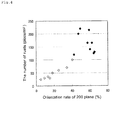
Fig. 4 is a graph showing a result of applying salt water spray test to the nickel plating steel sheet where orientation rate of (200) planes is changed. -
Fig. 1 is a cross-sectional view showing the constitution of a surface-treated metal sheet having a nickel layer.
Hereinafter, the surface-treated metal sheet according to the present invention is explained in detail in conjunction with an embodiment. - A steel sheet can be named as a substrate for the surface-treated metal sheet and, usually, a low carbon aluminum-killed hot-rolled coil is used as the substrate for the surface-treated metal sheet.
Further, a coil which is manufactured using ultra-low carbon steel which contains 0.003 weight% or less of carbon, or a coil which is manufactured using non-aging continuous cast steel obtained by adding niobium and titanium to the ultra-low carbon steel is also used. - As pretreatment before surface treatment, usually, a scale (oxide film) formed on a surface of a cold-rolled steel sheet is removed by applying electrolytic cleaning or cleaning by immersion to the cold-rolled steel sheet using an alkali solution containing caustic soda as a main agent. After the scale is removed, the steel sheet is rolled to a product thickness in a cold-rolling step.
- After rolling oil which adheres to the steel sheet in rolling is cleaned by electrolytic cleaning, the steel sheet is annealed. Annealing may be performed by either one of continuous annealing and box annealing, and is not limited specifically. After annealing is applied to the steel sheet, a shape of the steel sheet is modified.
- Next, surface treatment is applied to the substrate. As the surface treatment, although any treatment is available provided that orientation rate of (200) planes is controlled to 40% or less, nickel plating is preferably used. As a kind of nickel plating, when the surface treatment is carried out using bright plating, even when current density is not controlled, the proportion of (200) planes can be easily set to 40% or less. However, when the surface treatment is carried out using dull plating, although described in detail later, it is necessary to perform a control of lowering current density. However, when the surface treatment is carried out using bright plating, due to the addition of a sulfur compound or the like, for example, there exists a possibility that corrosion resistance of a surface-treated steel sheet is lowered in a salt water spray test or the like and hence, the dull plating is more preferable compared to the bright plating.
As a nickel plating bath, a nickel sulfate bath which is referred to as a watt bath is used in many cases. However, a sulfamic acid bath, a borofluoride bath, a chloride bath or the like may be used besides the nickel sulfate bath. In performing plating using such a bath, it is preferable to set a coating weight of nickel to a value which falls within a range from 0.5 to 5.0µm.
As an electrolytic condition for obtaining such a plating thickness, for example, when nickel plating is applied using a watt bath which is a typical example, the plating thickness can be obtained under electrolytic conditions where the bath composition contains 200 to 350g/l of nickel sulfate, 20 to 50g/l of nickel chloride and 20 to 50g/l of a boric acid, a pH is 3.6 to 4.6, a bath temperature is 40 to 70°C, and a current density is 1 to 40A/dm2. Further, a boric acid which is added as a stabilizer may be replaced with a citric acid, and the usage of a citric acid can obtain a harder nickel film compared to a case where a boric acid is used. - In performing the above-mentioned dull nickel plating, an orientation rate of nickel on (200) planes is changed by controlling current density. That is, the orientation rate of the peak on (200) planes in peaks obtained by an X-ray diffraction analysis is suppressed by lowering current density, while the orientation rate of the peak on (200) planes in peaks obtained by an X-ray diffraction analysis is adopted with priority by increasing current density. It is considered that when current density is low, the plane orientation is suppressed in electrodeposition of nickel which becomes seeds made of a complex (boric acidnickel complex in case of a watt bath). Accordingly, it is considered that nickel precipitates at random when current density is low, and the electrodeposition of nickel in one direction is generated along (200) planes when current density is high.
The orientation rate of (200) planes is calculated by a method where the orientation rate is calculated based on a result of an X-ray diffraction analysis. In the X-ray diffraction analysis, the measurement is performed using an automatic X-ray diffraction analyzer (RINT2500/PC) made by Rigaku Corporation under conditions of X-rays: Cu-40kV-200mA, divergent slit: 2 degree, scattering slit: 1degree, light receiving slit: 0.3mm. Ameasurement range is set to 40°≤2θ≤90°. - When nickel is analyzed by an X-ray diffraction analysis, nickel mainly has the orientation on four planes, that is, (111) planes, (200) planes, (220) planes and (311) planes, and peaks of orientations on the respective planes can be confirmed at 2θ of 44.5°, 51.8°, 76.3°, and 92.9° respectively. With respect to the relative intensity ratios of these planes, assuming a relative intensity ratio of the (111) planes as 100, the relative intensity ratio of the (200) planes is 42.0, the relative intensity ratio of the (220) planes is 21.0, and the relative intensity ratio of the (311) planes is 20.0. The intensity of a base line is subtracted from the maximum peak intensities (cps) of the respective planes and, thereafter, the intensities obtained by subtraction are corrected using the respective relative intensity ratios. Using the corrected values, the orientation rate of the (200) planes is obtained by calculating a rate at which the (200) planes occupies in the whole four planes (maximum peak intensity of the (200) planes/total of maximum peak intensities of (111) planes + (200) planes + (220) planes + (311) planes).
The fact that the orientation rate of (200) planes is high implies that nickel grains has columnar structure based on a directional exponent of X-rays. On the other hand, it is considered that the fact that the orientation rate on (200) planes is low, that is, the orientation rates on (111) planes, (220) planes and (311) planes are high implies that nickel grains are oriented at random in a plating film.
As shown inFig. 2 (a) and Fig. 2 (b) which are schematic views, it is considered that compared to the columnar structure which exhibits the high orientation rate on (200) planes (Fig. 2 (b) ), the structure where nickel grains are oriented at random (Fig. 2(a) ) can suppress pin holes, that is, the exposure of an iron substrate material which constitutes a background can be suppressed so that the corrosion resistance of a surface-treated metal sheet can be enhanced.
Further, it is also considered that since nickel grains are oriented at random, the number of boundaries which exist in the direction perpendicular to a surface layer, that is, in the same direction as (200) planes can be reduced so that surface hardness is also enhanced. - The above-mentioned advantageous effects of the present invention can be realizedwhen the substrate is uniformly covered with the layer where the proportion of (200) planes is suppressed. Further, the larger a thickness of the nickel layer, the more the corrosion resistance is enhanced and hence, it is preferable that the nickel layer has a larger thickness from a viewpoint of corrosion resistance.
- However, to acquire a large plating thickness with low current density, it is necessary to prolong an energization time and hence, the formation of a dull nickel plating layer with low current density may deteriorate productivity. Particularly in case of the continuous production such as the "Roll to Roll" production, a line speed is remarkably lowered and hence, productivity is deteriorated.
- Accordingly, to take into account productivity by estimating an actually used material, such a drawback can be overcome by forming a metal layer above or below a nickel layer where the proportion of (200) planes is suppressed. That is, provided that a substrate is uniformly covered with a nickel layer where the proportion of (200) planes is suppressed, the corrosion resistance which is an advantageous effect of the invention described in claim 1 can be realized and hence, another metal layer may be formed above or below the nickel layer as an upper layer or a lower layer. For example, in the "Roll to Roll" continuous production using dull nickel plating, such continuous production can be realized using (in combination), a nickel plating layer which is formed with low current density at a level where the proportion of (200) planes becomes 40% or less and a nickel plating layer which is formed with high current density for having a fixed plating thickness larger than aplating thickness of the nickel plating layer formed with low current density. Here, provided that uniform coating of the nickel layer on the substrate with low current density is ensured, it is possible to adopt either one of a case where the nickel layer formed with low current density is provided as a lower layer and the nickel layer formed with high current density is provided as an upper layer, and a case where the nickel layer formed with low current density is provided as an upper layer and the nickel layer formed with high current density is provided as a lower layer.
- Nickel plated steel sheets having a nickel film thickness of 3.0µm are prepared in such a manner that the orientation rate of (200) planes of a nickel layer is changed among the respective nickel plated steel sheets, and the investigation of surface hardness is carried out in accordance with Vickers hardness (JIS Z 2244). A micro hardness meter (type: MVK-G2) made by AKASHI is used in the measurement of Vickers hardness.
From a result of many experiments, it is found that a plating film is hardened by lowering the orientation rate of (200) planes of the nickel layer to 40% or less. It is also found that the plating film exhibits high surface hardness by setting the orientation rate of (200) planes of the nickel layer to 30% or less.
When the orientation rate of (200) planes of the nickel layer is less than 5%, it is extremely difficult to prepare the nickel plated steel sheet by plating in a stable manner, and also cleanliness in appearance is deteriorated. Accordingly, it is preferable to set the orientation rate of (200) planes of the nickel layer to 5% or more.
On the other hand, when the orientation rate of (200) planes of the nickel layer exceeds 40%, surface hardness of the nickel layer is lowered.
Accordingly, from a viewpoint of surface hardness, the orientation rate of (200) planes of the nickel layer is preferably set to 40% or less, more preferably 30% or less, still more preferably 5 to 40%, and still further preferably 5 to 30%. - Nickel plated steel sheets having a nickel film thickness of 3.0µm are prepared in such a manner that an orientation rate of (200) planes of a nickel layer is changed among the respective nickel plated steel sheets, and the corrosion resistance is investigated in accordance with a salt water spray test (JIS Z 2371).
The corrosion resistance is confirmed based on the number of red rusts (the number of pin holes formed in a plating film) after salt water spraying is performed for 4 hours.
From a result of many experiments, it is found that the number of pin holes in plating is decreased by lowering the orientation rate of (200) planes of the nickel layer to 40% orless. It is also found that the steel sheet exhibits excellent pin hole reduction effect in the salt water spray test by preferably setting the orientation rate of (200) planes of the nickel layer to 30% or less.
When the orientation rate of (200) planes of the nickel layer is less than 5%, it is extremely difficult to prepare the nickel plated steel sheet by plating in a stable manner, and also cleanliness in appearance is deteriorated. Accordingly, it is preferable to set the orientation rate of (200) planes of the nickel layer to 5% or more.
On the other hand, when the orientation rate of (200) planes of the nickel layer exceeds 40%, the number of pin holes formed in plating is increased so that the corrosion resistance of the nickel plated steel sheet is deteriorated. Further, large irregularities are found in properties and hence, it is difficult for the nickel plated steel sheets to acquire stable properties.
Accordingly, from a viewpoint of corrosion resistance, the orientation rate of (200) planes of the nickel layer is preferably set to 40% or less, more preferably to 30% or less, still more preferably to 5 to 40%, and still further preferably to 5 to 30%. - As one example of a formed article, a battery can which is manufactured using a nickel plated steel sheet manufactured by a manufacturing method of the present invention is named.
A forming method of the battery can is forming by drawing, wherein usually, a water soluble emersion is used as a press lubricant, a cup is formed through 1 step and, thereafter, the cup is subjected to working through 3 to 6 steps in total so as to have a desired diameter of a battery can, and the cup is further subjected to working through 4 steps and thereby the battery can is manufactured.
With respect to a press working condition, the battery can is formed such that a thickness of a can wall is increased in the direction toward an opening portion of the battery can on which an anode cap is mounted from a bottom of the battery can (a cathode terminal portion). That is, the can is formed by molding such that the film thickness of the can wall in each step is increased in the direction toward the opening portion from the bottom of the can.
Although a sintered hard alloy is preferable as a material of a mold used in such press forming, a material for forming the mold is not particularly limited. - A pipe is manufactured in such a manner that a steel sheet to which the above-mentioned plating is applied is used, a shape of the steel sheet is modified using a leveler, the steel sheet is slit into a plurality of strip sheets having a predetermined outer size using a slitter and, thereafter, the strip sheet is formed into a pipe shape by a forming machine, and edge surfaces of the strip sheet are welded to each other by high frequency induction welding so that a pipe is manufactured.
- The present invention is further explained in more detail using the following examples hereinafter.
- A low carbon aluminum-killed steel sheet having a sheet thickness of 0.25mm which is manufactured through could-rolling and annealing is used as a substrate.
The composition of a steel sheet which constitutes the substrate is as follows.
C: 0.045% (mass%, applicable to other components), Mn: 0.23%, Si: 0.02%, P: 0.012%, s: 0.009%, Al: 0.063%, N: 0.0036%, balance: Fe and unavoidable impurities
The steel sheet is subjected to alkali electrolytic degreasing and pickling by immersion into a sulfuric acid and, thereafter, dull plating is applied to the steel sheet by a watt bath under conditions where a bath temperature is set to 60°C and current density is set to 10A/dm2. A thickness of nickel plating is set to 3.0µm. - Nickel plated steel sheets are manufactured under conditions where a bath temperature and current density are changed from the bath temperature and the current density of the example 1, and other conditions are set equal to the conditions used in the example 1. Nickel plated steel sheets of examples 9 to 11 and comparison examples 10 and 11 are prepared such that nickel plating is applied to these steel sheets and, thereafter, heat treatment is applied to these steel sheets in non-oxidizing atmosphere at a temperature of 700°C for 1 minute.
- A result obtained by measuring Vickers hardness of the respective nickel plated steel sheets where the orientation rate of (200) planes is changed and a result of a salt spray test (4 hours) are shown in Table 1. Further, these results are shown in
Fig. 3 andFig. 4 in the form of graph. -
[Table 1] orientation rate of (200) plane s Vickers hardness number of rusts (pieces/m2 ) bath temperature (60°C) current density (A/dm 2) pH stirring by air heat treatment time example 1 5 315 25 60 1 4.3 performed - example 2 9 300 30 70 1 4.3 performed - example 3 13 312 35 70 3 4.3 performed - example 4 15 315 30 60 3 4.3 performed - example 5 18 310 50 50 1 4.3 performed - example 6 25 295 60 70 5 4.3 performed - example 7 34 280 70 50 3 4.3 performed - example 8 40 281 100 70 7 4.3 performed - example 9 5 260 40 60 1 4.3 performed 700°C× 1 main example 10 19 216 55 60 3 4.3 performed 700°C× 1 min example 11 39 195 80 60 5 4.3 performed 700°C× 1 min comparison example 1 42 283 120 50 30 4.3 performed - comparison example 2 47 280 200 60 5 4.3 performed - comparison example 3 49 250 220 60 30 4.3 performed - comparison example 4 57 270 165 50 20 4.3 performed - comparison example 5 59 242 215 60 20 4.3 performed - comparison example 6 60 270 140 50 5 4.3 performed - comparison example 7 62 260 165 70 10 4.3 performed - comparison example 8 64 245 125 60 10 4.3 performed - comparison example 9 65 250 130 70 20 4.3 performed - comparison example 10 57 185 145 60 10 4.3 performed 700°C× 1 min comparison example 11 64 179 160 60 20 4.3 performed 700°C× 1 min - It is found that the nickel plated steel sheets of the examples 1 to 11 of the present invention where the orientation rate of (200) planes is 40% or less can obtain, as shown in Table 1 and
Fig. 3 , a hardened plating film in a stable manner. Further, as shown in Table 1 andFig. 4 , the number of rusts is small so that the nickel plated steel sheets of the examples 1 to 11 of the present invention exhibit excellent corrosion resistance.
Further, even when heat treatment is performed after nickel plating, the nickel plated steel sheets of the examples 9 to 11 where the orientation rate of (200) planes is 40% or less are excellent in both hardness and corrosion resistance compared with the nickel plated steel sheets of the comparison examples 10 and 11 where the orientation rate of (200) planes exceeds 40%. That is, although a diffusion layer is formed between the steel sheet which constitutes a substrate and the nickel plating layer by performing heat treatment after nickel plating, provided that the orientation rate of (200) planes of the nickel layer is 40% or less, even when the diffusion layer exists, the excellent properties of the nickel plated steel sheets of the present invention is not jeopardized.
Accordingly, it is safe to say that a battery can and a pipe which are manufactured using the nickel plated steel sheet of the example of the present invention also exhibit excellent corrosion resistance. Further, the nickel plated steel sheet of the example of the present invention, as can be clearly understood from Table 1 andFig. 3 , also exhibits sufficiently high hardness and hence, wear of a mold can be suppressed by suppressing the generation of nickel powder at the time of press forming. - According to the present invention, by controlling the orientation rate of (200) planes of the nickel layer, it is possible to provide a surface-treated metal sheet exhibiting excellent surface hardness and corrosion resistance, a battery can and a pipe member which are manufactured using the surface-treated metal sheet and hence, the present invention has extremely high industrial applicability.
Claims (10)
- A surface-treated metal sheet where a nickel layer is formed on a substrate, wherein the proportion of (200) planes to a total of (111) planes, (200) planes, (220) planes and (311) planes with respect to the crystal plane orientations of the nickel layer is set to 40% or less.
- The surface-treated metal sheet according to claim 1, wherein the nickel layer is a dull nickel layer.
- The surface-treated metal sheet according to claim 1, wherein a metal layer is formed as a layer below the nickel layer.
- The surface-treated metal sheet according to claim 1, wherein a metal layer is formed as a layer above the nickel layer.
- The surface-treated metal sheet according to any one of claims 1 to 4, wherein the substrate is a steel sheet.
- The surface-treated metal sheet according to claim 5, wherein the surface-treated metal sheet is a steel sheet for forming a battery can.
- The surface-treated metal sheet according to claim 5, wherein the surface-treated metal sheet is a steel sheet for forming a pipe.
- A method of manufacturing a formed article using a surface-treated metal sheet where a nickel layer is formed on a substrate, wherein the surface-treated metal sheet having the nickel layer where the proportion of (200) planes to a total of (111) planes, (200) planes, (220) planes and (311) planes is set to 40% or less with respect to the crystal plane orientations of the nickel layer is worked using a mold.
- The method of manufacturing a formed article according to claim 8, wherein the formed article is a battery can.
- The method of manufacturing a formed article according to claim 8, wherein the formed article is a pipe.
Applications Claiming Priority (2)
| Application Number | Priority Date | Filing Date | Title |
|---|---|---|---|
| JP2010003413 | 2010-01-08 | ||
| PCT/JP2010/007600 WO2011083559A1 (en) | 2010-01-08 | 2010-12-28 | Surface-treated metal sheet and process for producing formed article from the surface-treated metal sheet |
Publications (2)
| Publication Number | Publication Date |
|---|---|
| EP2522763A1 true EP2522763A1 (en) | 2012-11-14 |
| EP2522763A4 EP2522763A4 (en) | 2017-03-08 |
Family
ID=44305303
Family Applications (1)
| Application Number | Title | Priority Date | Filing Date |
|---|---|---|---|
| EP10842077.9A Withdrawn EP2522763A4 (en) | 2010-01-08 | 2010-12-28 | Surface-treated metal sheet and process for producing formed article from the surface-treated metal sheet |
Country Status (6)
| Country | Link |
|---|---|
| US (2) | US9498933B2 (en) |
| EP (1) | EP2522763A4 (en) |
| JP (1) | JP5894721B2 (en) |
| KR (1) | KR101821659B1 (en) |
| CN (1) | CN102782193B (en) |
| WO (1) | WO2011083559A1 (en) |
Families Citing this family (10)
| Publication number | Priority date | Publication date | Assignee | Title |
|---|---|---|---|---|
| KR20140108214A (en) * | 2012-04-19 | 2014-09-05 | 신닛테츠스미킨 카부시키카이샤 | Steel foil and method for producing same |
| JP5646105B1 (en) | 2013-06-27 | 2014-12-24 | 日新製鋼株式会社 | Sn plated stainless steel sheet |
| EP3269847A4 (en) * | 2015-03-13 | 2018-11-07 | Toyo Kohan Co., Ltd. | Method for producing surface-treated steel sheet for battery containers, and surface-treated steel sheet for battery containers |
| CN105177649A (en) * | 2015-10-30 | 2015-12-23 | 姜少群 | Towel hanger with surface composite coating |
| CN105177653A (en) * | 2015-10-30 | 2015-12-23 | 姜少群 | Preparing method for composite coating on towel rail surface |
| DE112017004606T5 (en) * | 2016-09-13 | 2019-08-29 | Toyo Kohan Co., Ltd. | Process for producing a surface treated steel sheet for battery cases |
| JP7293828B2 (en) * | 2019-04-11 | 2023-06-20 | 富士フイルムビジネスイノベーション株式会社 | Fixing member, fixing device, and image forming apparatus |
| JP7293829B2 (en) * | 2019-04-11 | 2023-06-20 | 富士フイルムビジネスイノベーション株式会社 | Fixing member, fixing device, and image forming apparatus |
| JP7363267B2 (en) * | 2019-09-24 | 2023-10-18 | 富士フイルムビジネスイノベーション株式会社 | Fixing member, fixing device, and image forming device |
| WO2023210822A1 (en) * | 2022-04-29 | 2023-11-02 | 東洋鋼鈑株式会社 | Method for producing rolled surface-treated steel sheet, and rolled surface-treated steel sheet |
Family Cites Families (15)
| Publication number | Priority date | Publication date | Assignee | Title |
|---|---|---|---|---|
| US2315802A (en) * | 1940-04-20 | 1943-04-06 | Harshaw Chem Corp | Nickel plating |
| US3355263A (en) * | 1964-11-10 | 1967-11-28 | Kewanee Oil Co | Three-layer nickel laminate |
| SE378118B (en) * | 1974-03-14 | 1975-08-18 | Nordstjernan Rederi Ab | |
| GB2180257B (en) * | 1985-08-29 | 1989-08-23 | Toyo Kohan Co Ltd | Method for producing a thin tin and nickel plated steel sheet for welded can material |
| JPS63282290A (en) * | 1987-05-13 | 1988-11-18 | Osaka Pref Gov | Plating method for metal zinc with nickel |
| JPH0290660A (en) * | 1988-09-28 | 1990-03-30 | Kobe Steel Ltd | Semiconductor device lead frame |
| JP3189904B2 (en) | 1991-07-25 | 2001-07-16 | 臼井国際産業株式会社 | Manufacturing method of high corrosion resistant nickel plating film |
| JP2808395B2 (en) * | 1993-02-26 | 1998-10-08 | 本田技研工業株式会社 | Sliding member |
| US5576113A (en) * | 1993-06-04 | 1996-11-19 | Katayama Special Industries, Ltd. | Battery can, sheet for forming battery can, and method for manufacturing sheet |
| JP3272866B2 (en) | 1994-04-27 | 2002-04-08 | 東洋鋼鈑株式会社 | Surface treated steel sheet for alkaline battery case, alkaline battery case and alkaline battery |
| JP3405669B2 (en) * | 1997-06-10 | 2003-05-12 | 新日本製鐵株式会社 | Nickel-plated steel sheet excellent in corrosion resistance and surface appearance and method for producing the same |
| TW445663B (en) | 1998-07-24 | 2001-07-11 | Toyo Kohan Co Ltd | A method of surface treatment for a battery container, a surface treated steel sheet for a battery container, a battery container and a battery using thereof |
| DE19852202C2 (en) * | 1998-11-12 | 2002-01-24 | Hille & Mueller Gmbh & Co | Battery case made from formed, cold-rolled sheet metal and method for producing battery cases |
| JP2003277886A (en) * | 2002-03-22 | 2003-10-02 | Toyo Kohan Co Ltd | Resin-coated steel sheet for shear spun can, method of producing resin-coated steel sheet for shear spun can and shear spun can produced by using the same |
| JP4896703B2 (en) * | 2006-12-26 | 2012-03-14 | 東海ゴム工業株式会社 | Nickel electroplating film and its manufacturing method |
-
2010
- 2010-12-28 WO PCT/JP2010/007600 patent/WO2011083559A1/en not_active Ceased
- 2010-12-28 KR KR1020127019036A patent/KR101821659B1/en active Active
- 2010-12-28 EP EP10842077.9A patent/EP2522763A4/en not_active Withdrawn
- 2010-12-28 US US13/521,037 patent/US9498933B2/en active Active
- 2010-12-28 CN CN201080063526.4A patent/CN102782193B/en active Active
- 2010-12-28 JP JP2011548875A patent/JP5894721B2/en active Active
-
2016
- 2016-10-14 US US15/294,613 patent/US20170033328A1/en not_active Abandoned
Also Published As
| Publication number | Publication date |
|---|---|
| US20130086971A1 (en) | 2013-04-11 |
| JP5894721B2 (en) | 2016-03-30 |
| CN102782193B (en) | 2015-07-08 |
| JPWO2011083559A1 (en) | 2013-05-13 |
| CN102782193A (en) | 2012-11-14 |
| WO2011083559A1 (en) | 2011-07-14 |
| KR20120112613A (en) | 2012-10-11 |
| EP2522763A4 (en) | 2017-03-08 |
| US9498933B2 (en) | 2016-11-22 |
| US20170033328A1 (en) | 2017-02-02 |
| KR101821659B1 (en) | 2018-01-25 |
Similar Documents
| Publication | Publication Date | Title |
|---|---|---|
| US9498933B2 (en) | Surface-treated metal sheet and process for producing formed article from the surface-treated metal sheet | |
| EP1439240B2 (en) | Method for hot-press forming a plated steel product | |
| JP3045612B2 (en) | High corrosion resistant nickel-plated steel strip and its manufacturing method | |
| EP2684985B1 (en) | Process for producing hot-pressed member steel sheet | |
| EP2523233B1 (en) | Ni-plated steel sheet with excellent pressability for battery can | |
| EP3591098B1 (en) | Surface-treated steel sheet | |
| EP2808417B1 (en) | Steel sheet for hot press-forming, method for manufacturing the same and method for producing hot press-formed parts using the same | |
| EP2441532A1 (en) | Nickel-plated steel sheet and process for producing battery can using the nickel-plated steel sheet | |
| EP3239347A1 (en) | Zinc alloy plated steel material having excellent weldability and processed-part corrosion resistance and method of manufacturing same | |
| KR20120054563A (en) | Method for producing a steel component provided with a metal coating protecting against corrosion and steel component | |
| EP2171130B1 (en) | Method of providing a metallic coating layer | |
| US20090280350A1 (en) | Steel sheet having high plane integration and method of production of same | |
| TWI477662B (en) | Method for production of tin plated steel sheet, tin plated steel sheet and chemical conversion treatment liquid | |
| EP4685266A1 (en) | Sn-zn based-alloy plated steel material, battery case and fuel tank | |
| JP2013185199A (en) | Zinc-based electroplated steel sheet and method for manufacturing the same | |
| JP2011208247A (en) | HIGH-STRENGTH STEEL SHEET HAVING TENSILE STRENGTH 1,180 MPa OR MORE EXCELLENT IN DELAYED FRACTURE RESISTANCE | |
| EP4182495B1 (en) | Method for electrodepositing a functional or decorative chromium layer from a trivalent chromium electrolyte | |
| EP4663806A1 (en) | Hot-stamping shaped article and manufacturing method for same | |
| KR20250085212A (en) | Plated steel sheet and manufacturing method thereof | |
| CN118302564A (en) | Steel sheet for hot pressing, hot pressing member, and method for manufacturing hot pressing member | |
| JP2000273683A (en) | Sn plated steel sheet with excellent corrosion resistance and workability | |
| JPH01177316A (en) | Manufacture of steel sheet for lead frame excellent in rust resistance, formability, and platability |
Legal Events
| Date | Code | Title | Description |
|---|---|---|---|
| PUAI | Public reference made under article 153(3) epc to a published international application that has entered the european phase |
Free format text: ORIGINAL CODE: 0009012 |
|
| 17P | Request for examination filed |
Effective date: 20120724 |
|
| AK | Designated contracting states |
Kind code of ref document: A1 Designated state(s): AL AT BE BG CH CY CZ DE DK EE ES FI FR GB GR HR HU IE IS IT LI LT LU LV MC MK MT NL NO PL PT RO RS SE SI SK SM TR |
|
| DAX | Request for extension of the european patent (deleted) | ||
| RIC1 | Information provided on ipc code assigned before grant |
Ipc: H01M 2/02 20060101ALI20160922BHEP Ipc: C25D 3/12 20060101ALI20160922BHEP Ipc: B32B 15/01 20060101ALI20160922BHEP Ipc: C25D 5/14 20060101ALI20160922BHEP Ipc: C25D 7/04 20060101ALI20160922BHEP Ipc: C25D 5/12 20060101ALI20160922BHEP Ipc: C25D 5/36 20060101ALI20160922BHEP Ipc: C25D 5/50 20060101ALI20160922BHEP Ipc: C25D 21/12 20060101ALI20160922BHEP Ipc: C25D 5/26 20060101AFI20160922BHEP |
|
| RA4 | Supplementary search report drawn up and despatched (corrected) |
Effective date: 20170208 |
|
| RIC1 | Information provided on ipc code assigned before grant |
Ipc: C25D 5/50 20060101ALI20170202BHEP Ipc: C25D 5/26 20060101AFI20170202BHEP Ipc: C25D 7/04 20060101ALI20170202BHEP Ipc: B32B 15/01 20060101ALI20170202BHEP Ipc: C25D 5/12 20060101ALI20170202BHEP Ipc: C25D 5/36 20060101ALI20170202BHEP Ipc: C25D 21/12 20060101ALI20170202BHEP Ipc: C25D 5/14 20060101ALI20170202BHEP Ipc: H01M 2/02 20060101ALI20170202BHEP Ipc: C25D 3/12 20060101ALI20170202BHEP Ipc: C25C 3/12 20060101ALN20170202BHEP |
|
| 17Q | First examination report despatched |
Effective date: 20180126 |
|
| STAA | Information on the status of an ep patent application or granted ep patent |
Free format text: STATUS: THE APPLICATION IS DEEMED TO BE WITHDRAWN |
|
| 18D | Application deemed to be withdrawn |
Effective date: 20190813 |