EP2514794A1 - Pressure-sensitive adhesive tape for electrochemical device - Google Patents
Pressure-sensitive adhesive tape for electrochemical device Download PDFInfo
- Publication number
- EP2514794A1 EP2514794A1 EP11186277A EP11186277A EP2514794A1 EP 2514794 A1 EP2514794 A1 EP 2514794A1 EP 11186277 A EP11186277 A EP 11186277A EP 11186277 A EP11186277 A EP 11186277A EP 2514794 A1 EP2514794 A1 EP 2514794A1
- Authority
- EP
- European Patent Office
- Prior art keywords
- sensitive adhesive
- pressure
- adhesive tape
- electrochemical device
- acrylate
- Prior art date
- Legal status (The legal status is an assumption and is not a legal conclusion. Google has not performed a legal analysis and makes no representation as to the accuracy of the status listed.)
- Withdrawn
Links
- 239000004820 Pressure-sensitive adhesive Substances 0.000 title claims abstract description 125
- 239000000178 monomer Substances 0.000 claims abstract description 64
- 229920000058 polyacrylate Polymers 0.000 claims abstract description 53
- 239000010410 layer Substances 0.000 claims abstract description 47
- NIXOWILDQLNWCW-UHFFFAOYSA-M Acrylate Chemical compound [O-]C(=O)C=C NIXOWILDQLNWCW-UHFFFAOYSA-M 0.000 claims abstract description 45
- 239000000853 adhesive Substances 0.000 claims abstract description 28
- 230000001070 adhesive effect Effects 0.000 claims abstract description 28
- NIXOWILDQLNWCW-UHFFFAOYSA-N acrylic acid group Chemical group C(C=C)(=O)O NIXOWILDQLNWCW-UHFFFAOYSA-N 0.000 claims abstract description 24
- 125000000217 alkyl group Chemical group 0.000 claims abstract description 20
- 238000006116 polymerization reaction Methods 0.000 claims abstract description 19
- 230000009477 glass transition Effects 0.000 claims abstract description 10
- 239000002253 acid Substances 0.000 claims abstract description 9
- 125000002887 hydroxy group Chemical group [H]O* 0.000 claims abstract description 6
- 229920003023 plastic Polymers 0.000 claims abstract description 6
- 239000004033 plastic Substances 0.000 claims abstract description 6
- 239000012948 isocyanate Substances 0.000 claims description 16
- 239000003431 cross linking reagent Substances 0.000 claims description 12
- 150000002513 isocyanates Chemical class 0.000 claims description 3
- 239000011149 active material Substances 0.000 abstract description 8
- 230000001629 suppression Effects 0.000 abstract description 6
- 238000000926 separation method Methods 0.000 abstract description 5
- 230000002411 adverse Effects 0.000 abstract description 2
- -1 2-ethylhexyl group Chemical group 0.000 description 40
- 239000008151 electrolyte solution Substances 0.000 description 19
- YXFVVABEGXRONW-UHFFFAOYSA-N Toluene Chemical compound CC1=CC=CC=C1 YXFVVABEGXRONW-UHFFFAOYSA-N 0.000 description 18
- HBBGRARXTFLTSG-UHFFFAOYSA-N Lithium ion Chemical compound [Li+] HBBGRARXTFLTSG-UHFFFAOYSA-N 0.000 description 12
- 125000000524 functional group Chemical group 0.000 description 12
- 229910001416 lithium ion Inorganic materials 0.000 description 12
- XLYOFNOQVPJJNP-UHFFFAOYSA-N water Substances O XLYOFNOQVPJJNP-UHFFFAOYSA-N 0.000 description 11
- 238000004519 manufacturing process Methods 0.000 description 10
- ZWEHNKRNPOVVGH-UHFFFAOYSA-N 2-Butanone Chemical compound CCC(C)=O ZWEHNKRNPOVVGH-UHFFFAOYSA-N 0.000 description 9
- XEKOWRVHYACXOJ-UHFFFAOYSA-N Ethyl acetate Chemical compound CCOC(C)=O XEKOWRVHYACXOJ-UHFFFAOYSA-N 0.000 description 9
- 230000007797 corrosion Effects 0.000 description 8
- 238000005260 corrosion Methods 0.000 description 8
- 239000000203 mixture Substances 0.000 description 8
- 239000003505 polymerization initiator Substances 0.000 description 8
- 239000002904 solvent Substances 0.000 description 8
- OZAIFHULBGXAKX-UHFFFAOYSA-N 2-(2-cyanopropan-2-yldiazenyl)-2-methylpropanenitrile Chemical compound N#CC(C)(C)N=NC(C)(C)C#N OZAIFHULBGXAKX-UHFFFAOYSA-N 0.000 description 7
- 125000003178 carboxy group Chemical group [H]OC(*)=O 0.000 description 7
- 239000011248 coating agent Substances 0.000 description 7
- 238000000576 coating method Methods 0.000 description 7
- 238000000034 method Methods 0.000 description 7
- 239000004814 polyurethane Substances 0.000 description 7
- 229920002635 polyurethane Polymers 0.000 description 7
- WYURNTSHIVDZCO-UHFFFAOYSA-N Tetrahydrofuran Chemical compound C1CCOC1 WYURNTSHIVDZCO-UHFFFAOYSA-N 0.000 description 6
- 229910052782 aluminium Inorganic materials 0.000 description 6
- XAGFODPZIPBFFR-UHFFFAOYSA-N aluminium Chemical compound [Al] XAGFODPZIPBFFR-UHFFFAOYSA-N 0.000 description 6
- 239000003795 chemical substances by application Substances 0.000 description 6
- 230000000052 comparative effect Effects 0.000 description 6
- 239000011888 foil Substances 0.000 description 6
- 239000007788 liquid Substances 0.000 description 6
- 238000005259 measurement Methods 0.000 description 6
- 229920000642 polymer Polymers 0.000 description 6
- 238000012360 testing method Methods 0.000 description 6
- OZAIFHULBGXAKX-VAWYXSNFSA-N AIBN Substances N#CC(C)(C)\N=N\C(C)(C)C#N OZAIFHULBGXAKX-VAWYXSNFSA-N 0.000 description 5
- HRPVXLWXLXDGHG-UHFFFAOYSA-N Acrylamide Chemical compound NC(=O)C=C HRPVXLWXLXDGHG-UHFFFAOYSA-N 0.000 description 5
- 238000005227 gel permeation chromatography Methods 0.000 description 5
- 239000000243 solution Substances 0.000 description 5
- SMZOUWXMTYCWNB-UHFFFAOYSA-N 2-(2-methoxy-5-methylphenyl)ethanamine Chemical compound COC1=CC=C(C)C=C1CCN SMZOUWXMTYCWNB-UHFFFAOYSA-N 0.000 description 4
- LYCAIKOWRPUZTN-UHFFFAOYSA-N Ethylene glycol Chemical compound OCCO LYCAIKOWRPUZTN-UHFFFAOYSA-N 0.000 description 4
- YCKRFDGAMUMZLT-UHFFFAOYSA-N Fluorine atom Chemical compound [F] YCKRFDGAMUMZLT-UHFFFAOYSA-N 0.000 description 4
- 150000001252 acrylic acid derivatives Chemical class 0.000 description 4
- 239000003522 acrylic cement Substances 0.000 description 4
- 150000001875 compounds Chemical class 0.000 description 4
- 229920001577 copolymer Polymers 0.000 description 4
- 238000007334 copolymerization reaction Methods 0.000 description 4
- 238000001035 drying Methods 0.000 description 4
- 239000011737 fluorine Substances 0.000 description 4
- 229910052731 fluorine Inorganic materials 0.000 description 4
- 238000010528 free radical solution polymerization reaction Methods 0.000 description 4
- 238000007654 immersion Methods 0.000 description 4
- 239000000463 material Substances 0.000 description 4
- 239000007787 solid Substances 0.000 description 4
- 238000006467 substitution reaction Methods 0.000 description 4
- 239000000758 substrate Substances 0.000 description 4
- GOXQRTZXKQZDDN-UHFFFAOYSA-N 2-Ethylhexyl acrylate Chemical compound CCCCC(CC)COC(=O)C=C GOXQRTZXKQZDDN-UHFFFAOYSA-N 0.000 description 3
- UHOVQNZJYSORNB-UHFFFAOYSA-N Benzene Chemical compound C1=CC=CC=C1 UHOVQNZJYSORNB-UHFFFAOYSA-N 0.000 description 3
- 229920002799 BoPET Polymers 0.000 description 3
- OIFBSDVPJOWBCH-UHFFFAOYSA-N Diethyl carbonate Chemical compound CCOC(=O)OCC OIFBSDVPJOWBCH-UHFFFAOYSA-N 0.000 description 3
- JIGUQPWFLRLWPJ-UHFFFAOYSA-N Ethyl acrylate Chemical compound CCOC(=O)C=C JIGUQPWFLRLWPJ-UHFFFAOYSA-N 0.000 description 3
- KMTRUDSVKNLOMY-UHFFFAOYSA-N Ethylene carbonate Chemical compound O=C1OCCO1 KMTRUDSVKNLOMY-UHFFFAOYSA-N 0.000 description 3
- 239000005057 Hexamethylene diisocyanate Substances 0.000 description 3
- IMNFDUFMRHMDMM-UHFFFAOYSA-N N-Heptane Chemical compound CCCCCCC IMNFDUFMRHMDMM-UHFFFAOYSA-N 0.000 description 3
- 239000004743 Polypropylene Substances 0.000 description 3
- KWYUFKZDYYNOTN-UHFFFAOYSA-M Potassium hydroxide Chemical compound [OH-].[K+] KWYUFKZDYYNOTN-UHFFFAOYSA-M 0.000 description 3
- HEMHJVSKTPXQMS-UHFFFAOYSA-M Sodium hydroxide Chemical compound [OH-].[Na+] HEMHJVSKTPXQMS-UHFFFAOYSA-M 0.000 description 3
- 238000010521 absorption reaction Methods 0.000 description 3
- CQEYYJKEWSMYFG-UHFFFAOYSA-N butyl acrylate Chemical compound CCCCOC(=O)C=C CQEYYJKEWSMYFG-UHFFFAOYSA-N 0.000 description 3
- 125000004432 carbon atom Chemical group C* 0.000 description 3
- 238000004132 cross linking Methods 0.000 description 3
- 238000001125 extrusion Methods 0.000 description 3
- RRAMGCGOFNQTLD-UHFFFAOYSA-N hexamethylene diisocyanate Chemical compound O=C=NCCCCCCN=C=O RRAMGCGOFNQTLD-UHFFFAOYSA-N 0.000 description 3
- 229910003002 lithium salt Inorganic materials 0.000 description 3
- 159000000002 lithium salts Chemical class 0.000 description 3
- 229910052751 metal Inorganic materials 0.000 description 3
- 239000002184 metal Substances 0.000 description 3
- 230000035515 penetration Effects 0.000 description 3
- PNJWIWWMYCMZRO-UHFFFAOYSA-N pent‐4‐en‐2‐one Natural products CC(=O)CC=C PNJWIWWMYCMZRO-UHFFFAOYSA-N 0.000 description 3
- 229920000728 polyester Polymers 0.000 description 3
- 229920001721 polyimide Polymers 0.000 description 3
- 229920001155 polypropylene Polymers 0.000 description 3
- 238000003825 pressing Methods 0.000 description 3
- 230000002265 prevention Effects 0.000 description 3
- 239000011347 resin Substances 0.000 description 3
- 229920005989 resin Polymers 0.000 description 3
- 229910001220 stainless steel Inorganic materials 0.000 description 3
- 239000010935 stainless steel Substances 0.000 description 3
- KANZWHBYRHQMKZ-UHFFFAOYSA-N 2-ethenylpyrazine Chemical compound C=CC1=CN=CC=N1 KANZWHBYRHQMKZ-UHFFFAOYSA-N 0.000 description 2
- OMIGHNLMNHATMP-UHFFFAOYSA-N 2-hydroxyethyl prop-2-enoate Chemical compound OCCOC(=O)C=C OMIGHNLMNHATMP-UHFFFAOYSA-N 0.000 description 2
- CSCPPACGZOOCGX-UHFFFAOYSA-N Acetone Chemical compound CC(C)=O CSCPPACGZOOCGX-UHFFFAOYSA-N 0.000 description 2
- RYGMFSIKBFXOCR-UHFFFAOYSA-N Copper Chemical group [Cu] RYGMFSIKBFXOCR-UHFFFAOYSA-N 0.000 description 2
- CTQNGGLPUBDAKN-UHFFFAOYSA-N O-Xylene Chemical compound CC1=CC=CC=C1C CTQNGGLPUBDAKN-UHFFFAOYSA-N 0.000 description 2
- 239000004698 Polyethylene Substances 0.000 description 2
- 239000002202 Polyethylene glycol Substances 0.000 description 2
- 239000004642 Polyimide Substances 0.000 description 2
- 239000004721 Polyphenylene oxide Substances 0.000 description 2
- 239000004793 Polystyrene Substances 0.000 description 2
- PPBRXRYQALVLMV-UHFFFAOYSA-N Styrene Chemical compound C=CC1=CC=CC=C1 PPBRXRYQALVLMV-UHFFFAOYSA-N 0.000 description 2
- ZJCCRDAZUWHFQH-UHFFFAOYSA-N Trimethylolpropane Chemical compound CCC(CO)(CO)CO ZJCCRDAZUWHFQH-UHFFFAOYSA-N 0.000 description 2
- XXROGKLTLUQVRX-UHFFFAOYSA-N allyl alcohol Chemical compound OCC=C XXROGKLTLUQVRX-UHFFFAOYSA-N 0.000 description 2
- 230000001588 bifunctional effect Effects 0.000 description 2
- DKPFZGUDAPQIHT-UHFFFAOYSA-N butyl acetate Chemical compound CCCCOC(C)=O DKPFZGUDAPQIHT-UHFFFAOYSA-N 0.000 description 2
- 230000015556 catabolic process Effects 0.000 description 2
- 239000011889 copper foil Substances 0.000 description 2
- 238000006731 degradation reaction Methods 0.000 description 2
- 125000003438 dodecyl group Chemical group [H]C([H])([H])C([H])([H])C([H])([H])C([H])([H])C([H])([H])C([H])([H])C([H])([H])C([H])([H])C([H])([H])C([H])([H])C([H])([H])C([H])([H])* 0.000 description 2
- 239000003792 electrolyte Substances 0.000 description 2
- JBTWLSYIZRCDFO-UHFFFAOYSA-N ethyl methyl carbonate Chemical compound CCOC(=O)OC JBTWLSYIZRCDFO-UHFFFAOYSA-N 0.000 description 2
- 238000011156 evaluation Methods 0.000 description 2
- WGCNASOHLSPBMP-UHFFFAOYSA-N hydroxyacetaldehyde Natural products OCC=O WGCNASOHLSPBMP-UHFFFAOYSA-N 0.000 description 2
- 239000003999 initiator Substances 0.000 description 2
- 238000003475 lamination Methods 0.000 description 2
- UAEPNZWRGJTJPN-UHFFFAOYSA-N methylcyclohexane Chemical compound CC1CCCCC1 UAEPNZWRGJTJPN-UHFFFAOYSA-N 0.000 description 2
- 239000012046 mixed solvent Substances 0.000 description 2
- VLKZOEOYAKHREP-UHFFFAOYSA-N n-Hexane Chemical compound CCCCCC VLKZOEOYAKHREP-UHFFFAOYSA-N 0.000 description 2
- 239000007773 negative electrode material Substances 0.000 description 2
- 239000011255 nonaqueous electrolyte Substances 0.000 description 2
- 238000012856 packing Methods 0.000 description 2
- WXZMFSXDPGVJKK-UHFFFAOYSA-N pentaerythritol Chemical compound OCC(CO)(CO)CO WXZMFSXDPGVJKK-UHFFFAOYSA-N 0.000 description 2
- 229920000570 polyether Polymers 0.000 description 2
- 229920000573 polyethylene Polymers 0.000 description 2
- 229920001223 polyethylene glycol Polymers 0.000 description 2
- 229920000139 polyethylene terephthalate Polymers 0.000 description 2
- 239000005020 polyethylene terephthalate Substances 0.000 description 2
- 229920000098 polyolefin Polymers 0.000 description 2
- 229920001451 polypropylene glycol Polymers 0.000 description 2
- 229920001296 polysiloxane Polymers 0.000 description 2
- 229920002223 polystyrene Polymers 0.000 description 2
- 239000007774 positive electrode material Substances 0.000 description 2
- RUOJZAUFBMNUDX-UHFFFAOYSA-N propylene carbonate Chemical compound CC1COC(=O)O1 RUOJZAUFBMNUDX-UHFFFAOYSA-N 0.000 description 2
- 230000009257 reactivity Effects 0.000 description 2
- 239000002356 single layer Substances 0.000 description 2
- 125000004079 stearyl group Chemical group [H]C([*])([H])C([H])([H])C([H])([H])C([H])([H])C([H])([H])C([H])([H])C([H])([H])C([H])([H])C([H])([H])C([H])([H])C([H])([H])C([H])([H])C([H])([H])C([H])([H])C([H])([H])C([H])([H])C([H])([H])C([H])([H])[H] 0.000 description 2
- KZNICNPSHKQLFF-UHFFFAOYSA-N succinimide Chemical compound O=C1CCC(=O)N1 KZNICNPSHKQLFF-UHFFFAOYSA-N 0.000 description 2
- YLQBMQCUIZJEEH-UHFFFAOYSA-N tetrahydrofuran Natural products C=1C=COC=1 YLQBMQCUIZJEEH-UHFFFAOYSA-N 0.000 description 2
- DVKJHBMWWAPEIU-UHFFFAOYSA-N toluene 2,4-diisocyanate Chemical compound CC1=CC=C(N=C=O)C=C1N=C=O DVKJHBMWWAPEIU-UHFFFAOYSA-N 0.000 description 2
- 239000013638 trimer Substances 0.000 description 2
- 239000011800 void material Substances 0.000 description 2
- 239000008096 xylene Substances 0.000 description 2
- QEQBMZQFDDDTPN-UHFFFAOYSA-N (2-methylpropan-2-yl)oxy benzenecarboperoxoate Chemical compound CC(C)(C)OOOC(=O)C1=CC=CC=C1 QEQBMZQFDDDTPN-UHFFFAOYSA-N 0.000 description 1
- NALFRYPTRXKZPN-UHFFFAOYSA-N 1,1-bis(tert-butylperoxy)-3,3,5-trimethylcyclohexane Chemical compound CC1CC(C)(C)CC(OOC(C)(C)C)(OOC(C)(C)C)C1 NALFRYPTRXKZPN-UHFFFAOYSA-N 0.000 description 1
- OTMBZPVYOQYPBE-UHFFFAOYSA-N 1,1-bis(tert-butylperoxy)cyclododecane Chemical compound CC(C)(C)OOC1(OOC(C)(C)C)CCCCCCCCCCC1 OTMBZPVYOQYPBE-UHFFFAOYSA-N 0.000 description 1
- FKTHNVSLHLHISI-UHFFFAOYSA-N 1,2-bis(isocyanatomethyl)benzene Chemical compound O=C=NCC1=CC=CC=C1CN=C=O FKTHNVSLHLHISI-UHFFFAOYSA-N 0.000 description 1
- OVBFMUAFNIIQAL-UHFFFAOYSA-N 1,4-diisocyanatobutane Chemical compound O=C=NCCCCN=C=O OVBFMUAFNIIQAL-UHFFFAOYSA-N 0.000 description 1
- XTKZBPGQKMDFMC-UHFFFAOYSA-N 1-butyl-3-methylidenepyrrolidine-2,5-dione Chemical compound CCCCN1C(=O)CC(=C)C1=O XTKZBPGQKMDFMC-UHFFFAOYSA-N 0.000 description 1
- BGKQCHAKBLWCDU-UHFFFAOYSA-N 1-cyclohexyl-3-methylidenepyrrolidine-2,5-dione Chemical compound O=C1C(=C)CC(=O)N1C1CCCCC1 BGKQCHAKBLWCDU-UHFFFAOYSA-N 0.000 description 1
- BQTPKSBXMONSJI-UHFFFAOYSA-N 1-cyclohexylpyrrole-2,5-dione Chemical compound O=C1C=CC(=O)N1C1CCCCC1 BQTPKSBXMONSJI-UHFFFAOYSA-N 0.000 description 1
- GXDLZONOWLZMTG-UHFFFAOYSA-N 1-dodecyl-3-methylidenepyrrolidine-2,5-dione Chemical compound CCCCCCCCCCCCN1C(=O)CC(=C)C1=O GXDLZONOWLZMTG-UHFFFAOYSA-N 0.000 description 1
- SJLLJZNSZJHXQN-UHFFFAOYSA-N 1-dodecylpyrrole-2,5-dione Chemical compound CCCCCCCCCCCCN1C(=O)C=CC1=O SJLLJZNSZJHXQN-UHFFFAOYSA-N 0.000 description 1
- JWYVGKFDLWWQJX-UHFFFAOYSA-N 1-ethenylazepan-2-one Chemical compound C=CN1CCCCCC1=O JWYVGKFDLWWQJX-UHFFFAOYSA-N 0.000 description 1
- OSSNTDFYBPYIEC-UHFFFAOYSA-N 1-ethenylimidazole Chemical compound C=CN1C=CN=C1 OSSNTDFYBPYIEC-UHFFFAOYSA-N 0.000 description 1
- DCRYNQTXGUTACA-UHFFFAOYSA-N 1-ethenylpiperazine Chemical compound C=CN1CCNCC1 DCRYNQTXGUTACA-UHFFFAOYSA-N 0.000 description 1
- PBGPBHYPCGDFEZ-UHFFFAOYSA-N 1-ethenylpiperidin-2-one Chemical compound C=CN1CCCCC1=O PBGPBHYPCGDFEZ-UHFFFAOYSA-N 0.000 description 1
- PBDXUGSZYRYWMI-UHFFFAOYSA-N 1-ethyl-3-heptylidenepyrrolidine-2,5-dione Chemical compound CCCCCCC=C1CC(=O)N(CC)C1=O PBDXUGSZYRYWMI-UHFFFAOYSA-N 0.000 description 1
- BMZZOWWYEBTMBX-UHFFFAOYSA-N 1-ethyl-3-methylidenepyrrolidine-2,5-dione Chemical compound CCN1C(=O)CC(=C)C1=O BMZZOWWYEBTMBX-UHFFFAOYSA-N 0.000 description 1
- CSCSROFYRUZJJH-UHFFFAOYSA-N 1-methoxyethane-1,2-diol Chemical compound COC(O)CO CSCSROFYRUZJJH-UHFFFAOYSA-N 0.000 description 1
- HIDBROSJWZYGSZ-UHFFFAOYSA-N 1-phenylpyrrole-2,5-dione Chemical compound O=C1C=CC(=O)N1C1=CC=CC=C1 HIDBROSJWZYGSZ-UHFFFAOYSA-N 0.000 description 1
- NQDOCLXQTQYUDH-UHFFFAOYSA-N 1-propan-2-ylpyrrole-2,5-dione Chemical compound CC(C)N1C(=O)C=CC1=O NQDOCLXQTQYUDH-UHFFFAOYSA-N 0.000 description 1
- XMNIXWIUMCBBBL-UHFFFAOYSA-N 2-(2-phenylpropan-2-ylperoxy)propan-2-ylbenzene Chemical compound C=1C=CC=CC=1C(C)(C)OOC(C)(C)C1=CC=CC=C1 XMNIXWIUMCBBBL-UHFFFAOYSA-N 0.000 description 1
- PFHOSZAOXCYAGJ-UHFFFAOYSA-N 2-[(2-cyano-4-methoxy-4-methylpentan-2-yl)diazenyl]-4-methoxy-2,4-dimethylpentanenitrile Chemical compound COC(C)(C)CC(C)(C#N)N=NC(C)(C#N)CC(C)(C)OC PFHOSZAOXCYAGJ-UHFFFAOYSA-N 0.000 description 1
- WYGWHHGCAGTUCH-UHFFFAOYSA-N 2-[(2-cyano-4-methylpentan-2-yl)diazenyl]-2,4-dimethylpentanenitrile Chemical compound CC(C)CC(C)(C#N)N=NC(C)(C#N)CC(C)C WYGWHHGCAGTUCH-UHFFFAOYSA-N 0.000 description 1
- TXBCBTDQIULDIA-UHFFFAOYSA-N 2-[[3-hydroxy-2,2-bis(hydroxymethyl)propoxy]methyl]-2-(hydroxymethyl)propane-1,3-diol Chemical compound OCC(CO)(CO)COCC(CO)(CO)CO TXBCBTDQIULDIA-UHFFFAOYSA-N 0.000 description 1
- 125000000022 2-aminoethyl group Chemical group [H]C([*])([H])C([H])([H])N([H])[H] 0.000 description 1
- PGMMQIGGQSIEGH-UHFFFAOYSA-N 2-ethenyl-1,3-oxazole Chemical compound C=CC1=NC=CO1 PGMMQIGGQSIEGH-UHFFFAOYSA-N 0.000 description 1
- MZNSQRLUUXWLSB-UHFFFAOYSA-N 2-ethenyl-1h-pyrrole Chemical compound C=CC1=CC=CN1 MZNSQRLUUXWLSB-UHFFFAOYSA-N 0.000 description 1
- ZDHWTWWXCXEGIC-UHFFFAOYSA-N 2-ethenylpyrimidine Chemical compound C=CC1=NC=CC=N1 ZDHWTWWXCXEGIC-UHFFFAOYSA-N 0.000 description 1
- 125000000954 2-hydroxyethyl group Chemical group [H]C([*])([H])C([H])([H])O[H] 0.000 description 1
- HFCUBKYHMMPGBY-UHFFFAOYSA-N 2-methoxyethyl prop-2-enoate Chemical compound COCCOC(=O)C=C HFCUBKYHMMPGBY-UHFFFAOYSA-N 0.000 description 1
- KGIGUEBEKRSTEW-UHFFFAOYSA-N 2-vinylpyridine Chemical compound C=CC1=CC=CC=N1 KGIGUEBEKRSTEW-UHFFFAOYSA-N 0.000 description 1
- QOXOZONBQWIKDA-UHFFFAOYSA-N 3-hydroxypropyl Chemical group [CH2]CCO QOXOZONBQWIKDA-UHFFFAOYSA-N 0.000 description 1
- RDRWAAIUFCYJPH-UHFFFAOYSA-N 3-methylidene-1-octylpyrrolidine-2,5-dione Chemical compound CCCCCCCCN1C(=O)CC(=C)C1=O RDRWAAIUFCYJPH-UHFFFAOYSA-N 0.000 description 1
- FKAWETHEYBZGSR-UHFFFAOYSA-N 3-methylidenepyrrolidine-2,5-dione Chemical compound C=C1CC(=O)NC1=O FKAWETHEYBZGSR-UHFFFAOYSA-N 0.000 description 1
- UPMLOUAZCHDJJD-UHFFFAOYSA-N 4,4'-Diphenylmethane Diisocyanate Chemical compound C1=CC(N=C=O)=CC=C1CC1=CC=C(N=C=O)C=C1 UPMLOUAZCHDJJD-UHFFFAOYSA-N 0.000 description 1
- CFZDMXAOSDDDRT-UHFFFAOYSA-N 4-ethenylmorpholine Chemical compound C=CN1CCOCC1 CFZDMXAOSDDDRT-UHFFFAOYSA-N 0.000 description 1
- SXIFAEWFOJETOA-UHFFFAOYSA-N 4-hydroxy-butyl Chemical group [CH2]CCCO SXIFAEWFOJETOA-UHFFFAOYSA-N 0.000 description 1
- NLHHRLWOUZZQLW-UHFFFAOYSA-N Acrylonitrile Chemical compound C=CC#N NLHHRLWOUZZQLW-UHFFFAOYSA-N 0.000 description 1
- 239000004342 Benzoyl peroxide Substances 0.000 description 1
- OMPJBNCRMGITSC-UHFFFAOYSA-N Benzoylperoxide Chemical compound C=1C=CC=CC=1C(=O)OOC(=O)C1=CC=CC=C1 OMPJBNCRMGITSC-UHFFFAOYSA-N 0.000 description 1
- OKTJSMMVPCPJKN-UHFFFAOYSA-N Carbon Chemical compound [C] OKTJSMMVPCPJKN-UHFFFAOYSA-N 0.000 description 1
- 229920001651 Cyanoacrylate Polymers 0.000 description 1
- XDTMQSROBMDMFD-UHFFFAOYSA-N Cyclohexane Chemical compound C1CCCCC1 XDTMQSROBMDMFD-UHFFFAOYSA-N 0.000 description 1
- 239000004593 Epoxy Substances 0.000 description 1
- IMROMDMJAWUWLK-UHFFFAOYSA-N Ethenol Chemical compound OC=C IMROMDMJAWUWLK-UHFFFAOYSA-N 0.000 description 1
- 239000005058 Isophorone diisocyanate Substances 0.000 description 1
- 229910001290 LiPF6 Inorganic materials 0.000 description 1
- PEEHTFAAVSWFBL-UHFFFAOYSA-N Maleimide Chemical compound O=C1NC(=O)C=C1 PEEHTFAAVSWFBL-UHFFFAOYSA-N 0.000 description 1
- CERQOIWHTDAKMF-UHFFFAOYSA-M Methacrylate Chemical compound CC(=C)C([O-])=O CERQOIWHTDAKMF-UHFFFAOYSA-M 0.000 description 1
- MWCLLHOVUTZFKS-UHFFFAOYSA-N Methyl cyanoacrylate Chemical compound COC(=O)C(=C)C#N MWCLLHOVUTZFKS-UHFFFAOYSA-N 0.000 description 1
- NTIZESTWPVYFNL-UHFFFAOYSA-N Methyl isobutyl ketone Chemical compound CC(C)CC(C)=O NTIZESTWPVYFNL-UHFFFAOYSA-N 0.000 description 1
- UIHCLUNTQKBZGK-UHFFFAOYSA-N Methyl isobutyl ketone Natural products CCC(C)C(C)=O UIHCLUNTQKBZGK-UHFFFAOYSA-N 0.000 description 1
- WHNWPMSKXPGLAX-UHFFFAOYSA-N N-Vinyl-2-pyrrolidone Chemical compound C=CN1CCCC1=O WHNWPMSKXPGLAX-UHFFFAOYSA-N 0.000 description 1
- AFCARXCZXQIEQB-UHFFFAOYSA-N N-[3-oxo-3-(2,4,6,7-tetrahydrotriazolo[4,5-c]pyridin-5-yl)propyl]-2-[[3-(trifluoromethoxy)phenyl]methylamino]pyrimidine-5-carboxamide Chemical compound O=C(CCNC(=O)C=1C=NC(=NC=1)NCC1=CC(=CC=C1)OC(F)(F)F)N1CC2=C(CC1)NN=N2 AFCARXCZXQIEQB-UHFFFAOYSA-N 0.000 description 1
- CBENFWSGALASAD-UHFFFAOYSA-N Ozone Chemical compound [O-][O+]=O CBENFWSGALASAD-UHFFFAOYSA-N 0.000 description 1
- 239000002033 PVDF binder Substances 0.000 description 1
- 239000004696 Poly ether ether ketone Substances 0.000 description 1
- 239000004952 Polyamide Substances 0.000 description 1
- 229920002614 Polyether block amide Polymers 0.000 description 1
- 239000004695 Polyether sulfone Substances 0.000 description 1
- 239000004734 Polyphenylene sulfide Substances 0.000 description 1
- 239000004372 Polyvinyl alcohol Substances 0.000 description 1
- 229920001328 Polyvinylidene chloride Polymers 0.000 description 1
- 229920002433 Vinyl chloride-vinyl acetate copolymer Polymers 0.000 description 1
- KYIKRXIYLAGAKQ-UHFFFAOYSA-N abcn Chemical compound C1CCCCC1(C#N)N=NC1(C#N)CCCCC1 KYIKRXIYLAGAKQ-UHFFFAOYSA-N 0.000 description 1
- 239000012790 adhesive layer Substances 0.000 description 1
- 239000002390 adhesive tape Substances 0.000 description 1
- 150000001338 aliphatic hydrocarbons Chemical class 0.000 description 1
- 150000004703 alkoxides Chemical class 0.000 description 1
- 125000004183 alkoxy alkyl group Chemical group 0.000 description 1
- 125000000278 alkyl amino alkyl group Chemical group 0.000 description 1
- XYLMUPLGERFSHI-UHFFFAOYSA-N alpha-Methylstyrene Chemical compound CC(=C)C1=CC=CC=C1 XYLMUPLGERFSHI-UHFFFAOYSA-N 0.000 description 1
- 150000001408 amides Chemical class 0.000 description 1
- 238000004873 anchoring Methods 0.000 description 1
- 239000003963 antioxidant agent Substances 0.000 description 1
- 230000003078 antioxidant effect Effects 0.000 description 1
- 150000004945 aromatic hydrocarbons Chemical class 0.000 description 1
- 239000012298 atmosphere Substances 0.000 description 1
- 239000007869 azo polymerization initiator Substances 0.000 description 1
- 229920005601 base polymer Polymers 0.000 description 1
- 235000019400 benzoyl peroxide Nutrition 0.000 description 1
- 230000015572 biosynthetic process Effects 0.000 description 1
- WPKWPKDNOPEODE-UHFFFAOYSA-N bis(2,4,4-trimethylpentan-2-yl)diazene Chemical compound CC(C)(C)CC(C)(C)N=NC(C)(C)CC(C)(C)C WPKWPKDNOPEODE-UHFFFAOYSA-N 0.000 description 1
- 230000000903 blocking effect Effects 0.000 description 1
- 238000012662 bulk polymerization Methods 0.000 description 1
- 229910052799 carbon Inorganic materials 0.000 description 1
- 229920002678 cellulose Polymers 0.000 description 1
- 235000010980 cellulose Nutrition 0.000 description 1
- 150000005678 chain carbonates Chemical class 0.000 description 1
- 239000013522 chelant Substances 0.000 description 1
- ZCDOYSPFYFSLEW-UHFFFAOYSA-N chromate(2-) Chemical compound [O-][Cr]([O-])(=O)=O ZCDOYSPFYFSLEW-UHFFFAOYSA-N 0.000 description 1
- 150000005676 cyclic carbonates Chemical class 0.000 description 1
- 125000000113 cyclohexyl group Chemical group [H]C1([H])C([H])([H])C([H])([H])C([H])(*)C([H])([H])C1([H])[H] 0.000 description 1
- 125000002704 decyl group Chemical group [H]C([H])([H])C([H])([H])C([H])([H])C([H])([H])C([H])([H])C([H])([H])C([H])([H])C([H])([H])C([H])([H])C([H])([H])* 0.000 description 1
- LSXWFXONGKSEMY-UHFFFAOYSA-N di-tert-butyl peroxide Chemical compound CC(C)(C)OOC(C)(C)C LSXWFXONGKSEMY-UHFFFAOYSA-N 0.000 description 1
- IEJIGPNLZYLLBP-UHFFFAOYSA-N dimethyl carbonate Chemical compound COC(=O)OC IEJIGPNLZYLLBP-UHFFFAOYSA-N 0.000 description 1
- 230000008034 disappearance Effects 0.000 description 1
- 230000000694 effects Effects 0.000 description 1
- 238000003411 electrode reaction Methods 0.000 description 1
- 238000004945 emulsification Methods 0.000 description 1
- 125000003700 epoxy group Chemical group 0.000 description 1
- 150000002148 esters Chemical class 0.000 description 1
- UIWXSTHGICQLQT-UHFFFAOYSA-N ethenyl propanoate Chemical compound CCC(=O)OC=C UIWXSTHGICQLQT-UHFFFAOYSA-N 0.000 description 1
- 125000005448 ethoxyethyl group Chemical group [H]C([H])([H])C([H])([H])OC([H])([H])C([H])([H])* 0.000 description 1
- UHESRSKEBRADOO-UHFFFAOYSA-N ethyl carbamate;prop-2-enoic acid Chemical compound OC(=O)C=C.CCOC(N)=O UHESRSKEBRADOO-UHFFFAOYSA-N 0.000 description 1
- 125000001495 ethyl group Chemical group [H]C([H])([H])C([H])([H])* 0.000 description 1
- 239000000945 filler Substances 0.000 description 1
- 238000001879 gelation Methods 0.000 description 1
- 125000003055 glycidyl group Chemical group C(C1CO1)* 0.000 description 1
- 125000003187 heptyl group Chemical group [H]C([*])([H])C([H])([H])C([H])([H])C([H])([H])C([H])([H])C([H])([H])C([H])([H])[H] 0.000 description 1
- ACCCMOQWYVYDOT-UHFFFAOYSA-N hexane-1,1-diol Chemical compound CCCCCC(O)O ACCCMOQWYVYDOT-UHFFFAOYSA-N 0.000 description 1
- 125000004051 hexyl group Chemical group [H]C([H])([H])C([H])([H])C([H])([H])C([H])([H])C([H])([H])C([H])([H])* 0.000 description 1
- 229920001519 homopolymer Polymers 0.000 description 1
- OAKJQQAXSVQMHS-UHFFFAOYSA-N hydrazine Substances NN OAKJQQAXSVQMHS-UHFFFAOYSA-N 0.000 description 1
- 229930195733 hydrocarbon Natural products 0.000 description 1
- 125000002768 hydroxyalkyl group Chemical group 0.000 description 1
- 230000006872 improvement Effects 0.000 description 1
- 238000002347 injection Methods 0.000 description 1
- 239000007924 injection Substances 0.000 description 1
- 230000005865 ionizing radiation Effects 0.000 description 1
- 125000000959 isobutyl group Chemical group [H]C([H])([H])C([H])(C([H])([H])[H])C([H])([H])* 0.000 description 1
- ZFSLODLOARCGLH-UHFFFAOYSA-N isocyanuric acid Chemical compound OC1=NC(O)=NC(O)=N1 ZFSLODLOARCGLH-UHFFFAOYSA-N 0.000 description 1
- 125000001972 isopentyl group Chemical group [H]C([H])([H])C([H])(C([H])([H])[H])C([H])([H])C([H])([H])* 0.000 description 1
- NIMLQBUJDJZYEJ-UHFFFAOYSA-N isophorone diisocyanate Chemical compound CC1(C)CC(N=C=O)CC(C)(CN=C=O)C1 NIMLQBUJDJZYEJ-UHFFFAOYSA-N 0.000 description 1
- 125000001449 isopropyl group Chemical group [H]C([H])([H])C([H])(*)C([H])([H])[H] 0.000 description 1
- 150000002576 ketones Chemical class 0.000 description 1
- 239000000155 melt Substances 0.000 description 1
- ZQMHJBXHRFJKOT-UHFFFAOYSA-N methyl 2-[(1-methoxy-2-methyl-1-oxopropan-2-yl)diazenyl]-2-methylpropanoate Chemical compound COC(=O)C(C)(C)N=NC(C)(C)C(=O)OC ZQMHJBXHRFJKOT-UHFFFAOYSA-N 0.000 description 1
- 125000002496 methyl group Chemical group [H]C([H])([H])* 0.000 description 1
- GYNNXHKOJHMOHS-UHFFFAOYSA-N methyl-cycloheptane Natural products CC1CCCCCC1 GYNNXHKOJHMOHS-UHFFFAOYSA-N 0.000 description 1
- CWQXQMHSOZUFJS-UHFFFAOYSA-N molybdenum disulfide Chemical compound S=[Mo]=S CWQXQMHSOZUFJS-UHFFFAOYSA-N 0.000 description 1
- 125000001421 myristyl group Chemical group [H]C([*])([H])C([H])([H])C([H])([H])C([H])([H])C([H])([H])C([H])([H])C([H])([H])C([H])([H])C([H])([H])C([H])([H])C([H])([H])C([H])([H])C([H])([H])C([H])([H])[H] 0.000 description 1
- QYZFTMMPKCOTAN-UHFFFAOYSA-N n-[2-(2-hydroxyethylamino)ethyl]-2-[[1-[2-(2-hydroxyethylamino)ethylamino]-2-methyl-1-oxopropan-2-yl]diazenyl]-2-methylpropanamide Chemical compound OCCNCCNC(=O)C(C)(C)N=NC(C)(C)C(=O)NCCNCCO QYZFTMMPKCOTAN-UHFFFAOYSA-N 0.000 description 1
- 125000004108 n-butyl group Chemical group [H]C([H])([H])C([H])([H])C([H])([H])C([H])([H])* 0.000 description 1
- 125000000740 n-pentyl group Chemical group [H]C([H])([H])C([H])([H])C([H])([H])C([H])([H])C([H])([H])* 0.000 description 1
- SLCVBVWXLSEKPL-UHFFFAOYSA-N neopentyl glycol Chemical compound OCC(C)(C)CO SLCVBVWXLSEKPL-UHFFFAOYSA-N 0.000 description 1
- 238000006386 neutralization reaction Methods 0.000 description 1
- 150000002825 nitriles Chemical class 0.000 description 1
- 229920006113 non-polar polymer Polymers 0.000 description 1
- 125000001400 nonyl group Chemical group [H]C([*])([H])C([H])([H])C([H])([H])C([H])([H])C([H])([H])C([H])([H])C([H])([H])C([H])([H])C([H])([H])[H] 0.000 description 1
- 125000002347 octyl group Chemical group [H]C([*])([H])C([H])([H])C([H])([H])C([H])([H])C([H])([H])C([H])([H])C([H])([H])C([H])([H])[H] 0.000 description 1
- 239000003960 organic solvent Substances 0.000 description 1
- 230000003647 oxidation Effects 0.000 description 1
- 238000007254 oxidation reaction Methods 0.000 description 1
- 150000002978 peroxides Chemical class 0.000 description 1
- 238000000053 physical method Methods 0.000 description 1
- 239000002985 plastic film Substances 0.000 description 1
- 229920006255 plastic film Polymers 0.000 description 1
- 239000004014 plasticizer Substances 0.000 description 1
- 229920002493 poly(chlorotrifluoroethylene) Polymers 0.000 description 1
- 229920003207 poly(ethylene-2,6-naphthalate) Polymers 0.000 description 1
- 229920003223 poly(pyromellitimide-1,4-diphenyl ether) Polymers 0.000 description 1
- 229920002647 polyamide Polymers 0.000 description 1
- 229920001707 polybutylene terephthalate Polymers 0.000 description 1
- 239000004417 polycarbonate Substances 0.000 description 1
- 229920000515 polycarbonate Polymers 0.000 description 1
- 239000005023 polychlorotrifluoroethylene (PCTFE) polymer Substances 0.000 description 1
- 229920006393 polyether sulfone Polymers 0.000 description 1
- 229920002530 polyetherether ketone Polymers 0.000 description 1
- 239000011112 polyethylene naphthalate Substances 0.000 description 1
- 229920000306 polymethylpentene Polymers 0.000 description 1
- 239000011116 polymethylpentene Substances 0.000 description 1
- 229920000069 polyphenylene sulfide Polymers 0.000 description 1
- 229920005990 polystyrene resin Polymers 0.000 description 1
- 229920001343 polytetrafluoroethylene Polymers 0.000 description 1
- 239000004810 polytetrafluoroethylene Substances 0.000 description 1
- 229920002689 polyvinyl acetate Polymers 0.000 description 1
- 239000011118 polyvinyl acetate Substances 0.000 description 1
- 229920002451 polyvinyl alcohol Polymers 0.000 description 1
- 239000004800 polyvinyl chloride Substances 0.000 description 1
- 229920000915 polyvinyl chloride Polymers 0.000 description 1
- 229920002620 polyvinyl fluoride Polymers 0.000 description 1
- 239000005033 polyvinylidene chloride Substances 0.000 description 1
- 229920002981 polyvinylidene fluoride Polymers 0.000 description 1
- 238000003918 potentiometric titration Methods 0.000 description 1
- KCTAWXVAICEBSD-UHFFFAOYSA-N prop-2-enoyloxy prop-2-eneperoxoate Chemical compound C=CC(=O)OOOC(=O)C=C KCTAWXVAICEBSD-UHFFFAOYSA-N 0.000 description 1
- 125000001436 propyl group Chemical group [H]C([*])([H])C([H])([H])C([H])([H])[H] 0.000 description 1
- 230000009467 reduction Effects 0.000 description 1
- 238000002407 reforming Methods 0.000 description 1
- 150000003839 salts Chemical class 0.000 description 1
- 239000007921 spray Substances 0.000 description 1
- 239000000126 substance Substances 0.000 description 1
- 229960002317 succinimide Drugs 0.000 description 1
- 238000004381 surface treatment Methods 0.000 description 1
- 125000000999 tert-butyl group Chemical group [H]C([H])([H])C(*)(C([H])([H])[H])C([H])([H])[H] 0.000 description 1
- CIHOLLKRGTVIJN-UHFFFAOYSA-N tert‐butyl hydroperoxide Chemical compound CC(C)(C)OO CIHOLLKRGTVIJN-UHFFFAOYSA-N 0.000 description 1
- 125000002889 tridecyl group Chemical group [H]C([*])([H])C([H])([H])C([H])([H])C([H])([H])C([H])([H])C([H])([H])C([H])([H])C([H])([H])C([H])([H])C([H])([H])C([H])([H])C([H])([H])C([H])([H])[H] 0.000 description 1
- 125000002948 undecyl group Chemical group [H]C([*])([H])C([H])([H])C([H])([H])C([H])([H])C([H])([H])C([H])([H])C([H])([H])C([H])([H])C([H])([H])C([H])([H])C([H])([H])[H] 0.000 description 1
- 125000000391 vinyl group Chemical group [H]C([*])=C([H])[H] 0.000 description 1
- 229920002554 vinyl polymer Polymers 0.000 description 1
Images


Classifications
-
- C—CHEMISTRY; METALLURGY
- C09—DYES; PAINTS; POLISHES; NATURAL RESINS; ADHESIVES; COMPOSITIONS NOT OTHERWISE PROVIDED FOR; APPLICATIONS OF MATERIALS NOT OTHERWISE PROVIDED FOR
- C09J—ADHESIVES; NON-MECHANICAL ASPECTS OF ADHESIVE PROCESSES IN GENERAL; ADHESIVE PROCESSES NOT PROVIDED FOR ELSEWHERE; USE OF MATERIALS AS ADHESIVES
- C09J133/00—Adhesives based on homopolymers or copolymers of compounds having one or more unsaturated aliphatic radicals, each having only one carbon-to-carbon double bond, and at least one being terminated by only one carboxyl radical, or of salts, anhydrides, esters, amides, imides, or nitriles thereof; Adhesives based on derivatives of such polymers
- C09J133/04—Homopolymers or copolymers of esters
- C09J133/06—Homopolymers or copolymers of esters of esters containing only carbon, hydrogen and oxygen, the oxygen atom being present only as part of the carboxyl radical
- C09J133/062—Copolymers with monomers not covered by C09J133/06
- C09J133/066—Copolymers with monomers not covered by C09J133/06 containing -OH groups
-
- C—CHEMISTRY; METALLURGY
- C09—DYES; PAINTS; POLISHES; NATURAL RESINS; ADHESIVES; COMPOSITIONS NOT OTHERWISE PROVIDED FOR; APPLICATIONS OF MATERIALS NOT OTHERWISE PROVIDED FOR
- C09J—ADHESIVES; NON-MECHANICAL ASPECTS OF ADHESIVE PROCESSES IN GENERAL; ADHESIVE PROCESSES NOT PROVIDED FOR ELSEWHERE; USE OF MATERIALS AS ADHESIVES
- C09J133/00—Adhesives based on homopolymers or copolymers of compounds having one or more unsaturated aliphatic radicals, each having only one carbon-to-carbon double bond, and at least one being terminated by only one carboxyl radical, or of salts, anhydrides, esters, amides, imides, or nitriles thereof; Adhesives based on derivatives of such polymers
- C09J133/04—Homopolymers or copolymers of esters
- C09J133/06—Homopolymers or copolymers of esters of esters containing only carbon, hydrogen and oxygen, the oxygen atom being present only as part of the carboxyl radical
- C09J133/08—Homopolymers or copolymers of acrylic acid esters
-
- C—CHEMISTRY; METALLURGY
- C09—DYES; PAINTS; POLISHES; NATURAL RESINS; ADHESIVES; COMPOSITIONS NOT OTHERWISE PROVIDED FOR; APPLICATIONS OF MATERIALS NOT OTHERWISE PROVIDED FOR
- C09J—ADHESIVES; NON-MECHANICAL ASPECTS OF ADHESIVE PROCESSES IN GENERAL; ADHESIVE PROCESSES NOT PROVIDED FOR ELSEWHERE; USE OF MATERIALS AS ADHESIVES
- C09J133/00—Adhesives based on homopolymers or copolymers of compounds having one or more unsaturated aliphatic radicals, each having only one carbon-to-carbon double bond, and at least one being terminated by only one carboxyl radical, or of salts, anhydrides, esters, amides, imides, or nitriles thereof; Adhesives based on derivatives of such polymers
- C09J133/04—Homopolymers or copolymers of esters
- C09J133/06—Homopolymers or copolymers of esters of esters containing only carbon, hydrogen and oxygen, the oxygen atom being present only as part of the carboxyl radical
- C09J133/10—Homopolymers or copolymers of methacrylic acid esters
-
- C—CHEMISTRY; METALLURGY
- C09—DYES; PAINTS; POLISHES; NATURAL RESINS; ADHESIVES; COMPOSITIONS NOT OTHERWISE PROVIDED FOR; APPLICATIONS OF MATERIALS NOT OTHERWISE PROVIDED FOR
- C09J—ADHESIVES; NON-MECHANICAL ASPECTS OF ADHESIVE PROCESSES IN GENERAL; ADHESIVE PROCESSES NOT PROVIDED FOR ELSEWHERE; USE OF MATERIALS AS ADHESIVES
- C09J175/00—Adhesives based on polyureas or polyurethanes; Adhesives based on derivatives of such polymers
- C09J175/04—Polyurethanes
- C09J175/06—Polyurethanes from polyesters
-
- C—CHEMISTRY; METALLURGY
- C09—DYES; PAINTS; POLISHES; NATURAL RESINS; ADHESIVES; COMPOSITIONS NOT OTHERWISE PROVIDED FOR; APPLICATIONS OF MATERIALS NOT OTHERWISE PROVIDED FOR
- C09J—ADHESIVES; NON-MECHANICAL ASPECTS OF ADHESIVE PROCESSES IN GENERAL; ADHESIVE PROCESSES NOT PROVIDED FOR ELSEWHERE; USE OF MATERIALS AS ADHESIVES
- C09J7/00—Adhesives in the form of films or foils
- C09J7/20—Adhesives in the form of films or foils characterised by their carriers
- C09J7/22—Plastics; Metallised plastics
-
- C—CHEMISTRY; METALLURGY
- C09—DYES; PAINTS; POLISHES; NATURAL RESINS; ADHESIVES; COMPOSITIONS NOT OTHERWISE PROVIDED FOR; APPLICATIONS OF MATERIALS NOT OTHERWISE PROVIDED FOR
- C09J—ADHESIVES; NON-MECHANICAL ASPECTS OF ADHESIVE PROCESSES IN GENERAL; ADHESIVE PROCESSES NOT PROVIDED FOR ELSEWHERE; USE OF MATERIALS AS ADHESIVES
- C09J7/00—Adhesives in the form of films or foils
- C09J7/30—Adhesives in the form of films or foils characterised by the adhesive composition
-
- C—CHEMISTRY; METALLURGY
- C09—DYES; PAINTS; POLISHES; NATURAL RESINS; ADHESIVES; COMPOSITIONS NOT OTHERWISE PROVIDED FOR; APPLICATIONS OF MATERIALS NOT OTHERWISE PROVIDED FOR
- C09J—ADHESIVES; NON-MECHANICAL ASPECTS OF ADHESIVE PROCESSES IN GENERAL; ADHESIVE PROCESSES NOT PROVIDED FOR ELSEWHERE; USE OF MATERIALS AS ADHESIVES
- C09J7/00—Adhesives in the form of films or foils
- C09J7/30—Adhesives in the form of films or foils characterised by the adhesive composition
- C09J7/38—Pressure-sensitive adhesives [PSA]
-
- C—CHEMISTRY; METALLURGY
- C09—DYES; PAINTS; POLISHES; NATURAL RESINS; ADHESIVES; COMPOSITIONS NOT OTHERWISE PROVIDED FOR; APPLICATIONS OF MATERIALS NOT OTHERWISE PROVIDED FOR
- C09J—ADHESIVES; NON-MECHANICAL ASPECTS OF ADHESIVE PROCESSES IN GENERAL; ADHESIVE PROCESSES NOT PROVIDED FOR ELSEWHERE; USE OF MATERIALS AS ADHESIVES
- C09J7/00—Adhesives in the form of films or foils
- C09J7/30—Adhesives in the form of films or foils characterised by the adhesive composition
- C09J7/38—Pressure-sensitive adhesives [PSA]
- C09J7/381—Pressure-sensitive adhesives [PSA] based on macromolecular compounds obtained by reactions involving only carbon-to-carbon unsaturated bonds
- C09J7/385—Acrylic polymers
-
- H—ELECTRICITY
- H01—ELECTRIC ELEMENTS
- H01M—PROCESSES OR MEANS, e.g. BATTERIES, FOR THE DIRECT CONVERSION OF CHEMICAL ENERGY INTO ELECTRICAL ENERGY
- H01M10/00—Secondary cells; Manufacture thereof
- H01M10/04—Construction or manufacture in general
- H01M10/0468—Compression means for stacks of electrodes and separators
-
- H—ELECTRICITY
- H01—ELECTRIC ELEMENTS
- H01M—PROCESSES OR MEANS, e.g. BATTERIES, FOR THE DIRECT CONVERSION OF CHEMICAL ENERGY INTO ELECTRICAL ENERGY
- H01M50/00—Constructional details or processes of manufacture of the non-active parts of electrochemical cells other than fuel cells, e.g. hybrid cells
- H01M50/10—Primary casings; Jackets or wrappings
- H01M50/116—Primary casings; Jackets or wrappings characterised by the material
- H01M50/121—Organic material
-
- H—ELECTRICITY
- H01—ELECTRIC ELEMENTS
- H01M—PROCESSES OR MEANS, e.g. BATTERIES, FOR THE DIRECT CONVERSION OF CHEMICAL ENERGY INTO ELECTRICAL ENERGY
- H01M50/00—Constructional details or processes of manufacture of the non-active parts of electrochemical cells other than fuel cells, e.g. hybrid cells
- H01M50/10—Primary casings; Jackets or wrappings
- H01M50/116—Primary casings; Jackets or wrappings characterised by the material
- H01M50/124—Primary casings; Jackets or wrappings characterised by the material having a layered structure
-
- H—ELECTRICITY
- H01—ELECTRIC ELEMENTS
- H01M—PROCESSES OR MEANS, e.g. BATTERIES, FOR THE DIRECT CONVERSION OF CHEMICAL ENERGY INTO ELECTRICAL ENERGY
- H01M50/00—Constructional details or processes of manufacture of the non-active parts of electrochemical cells other than fuel cells, e.g. hybrid cells
- H01M50/10—Primary casings; Jackets or wrappings
- H01M50/116—Primary casings; Jackets or wrappings characterised by the material
- H01M50/124—Primary casings; Jackets or wrappings characterised by the material having a layered structure
- H01M50/126—Primary casings; Jackets or wrappings characterised by the material having a layered structure comprising three or more layers
- H01M50/129—Primary casings; Jackets or wrappings characterised by the material having a layered structure comprising three or more layers with two or more layers of only organic material
-
- H—ELECTRICITY
- H01—ELECTRIC ELEMENTS
- H01M—PROCESSES OR MEANS, e.g. BATTERIES, FOR THE DIRECT CONVERSION OF CHEMICAL ENERGY INTO ELECTRICAL ENERGY
- H01M50/00—Constructional details or processes of manufacture of the non-active parts of electrochemical cells other than fuel cells, e.g. hybrid cells
- H01M50/10—Primary casings; Jackets or wrappings
- H01M50/131—Primary casings; Jackets or wrappings characterised by physical properties, e.g. gas permeability, size or heat resistance
- H01M50/133—Thickness
-
- H—ELECTRICITY
- H01—ELECTRIC ELEMENTS
- H01M—PROCESSES OR MEANS, e.g. BATTERIES, FOR THE DIRECT CONVERSION OF CHEMICAL ENERGY INTO ELECTRICAL ENERGY
- H01M50/00—Constructional details or processes of manufacture of the non-active parts of electrochemical cells other than fuel cells, e.g. hybrid cells
- H01M50/10—Primary casings; Jackets or wrappings
- H01M50/14—Primary casings; Jackets or wrappings for protecting against damage caused by external factors
- H01M50/141—Primary casings; Jackets or wrappings for protecting against damage caused by external factors for protecting against humidity
-
- C—CHEMISTRY; METALLURGY
- C09—DYES; PAINTS; POLISHES; NATURAL RESINS; ADHESIVES; COMPOSITIONS NOT OTHERWISE PROVIDED FOR; APPLICATIONS OF MATERIALS NOT OTHERWISE PROVIDED FOR
- C09J—ADHESIVES; NON-MECHANICAL ASPECTS OF ADHESIVE PROCESSES IN GENERAL; ADHESIVE PROCESSES NOT PROVIDED FOR ELSEWHERE; USE OF MATERIALS AS ADHESIVES
- C09J2203/00—Applications of adhesives in processes or use of adhesives in the form of films or foils
- C09J2203/326—Applications of adhesives in processes or use of adhesives in the form of films or foils for bonding electronic components such as wafers, chips or semiconductors
-
- C—CHEMISTRY; METALLURGY
- C09—DYES; PAINTS; POLISHES; NATURAL RESINS; ADHESIVES; COMPOSITIONS NOT OTHERWISE PROVIDED FOR; APPLICATIONS OF MATERIALS NOT OTHERWISE PROVIDED FOR
- C09J—ADHESIVES; NON-MECHANICAL ASPECTS OF ADHESIVE PROCESSES IN GENERAL; ADHESIVE PROCESSES NOT PROVIDED FOR ELSEWHERE; USE OF MATERIALS AS ADHESIVES
- C09J2203/00—Applications of adhesives in processes or use of adhesives in the form of films or foils
- C09J2203/33—Applications of adhesives in processes or use of adhesives in the form of films or foils for batteries or fuel cells
-
- C—CHEMISTRY; METALLURGY
- C09—DYES; PAINTS; POLISHES; NATURAL RESINS; ADHESIVES; COMPOSITIONS NOT OTHERWISE PROVIDED FOR; APPLICATIONS OF MATERIALS NOT OTHERWISE PROVIDED FOR
- C09J—ADHESIVES; NON-MECHANICAL ASPECTS OF ADHESIVE PROCESSES IN GENERAL; ADHESIVE PROCESSES NOT PROVIDED FOR ELSEWHERE; USE OF MATERIALS AS ADHESIVES
- C09J2301/00—Additional features of adhesives in the form of films or foils
- C09J2301/30—Additional features of adhesives in the form of films or foils characterized by the chemical, physicochemical or physical properties of the adhesive or the carrier
- C09J2301/312—Additional features of adhesives in the form of films or foils characterized by the chemical, physicochemical or physical properties of the adhesive or the carrier parameters being the characterizing feature
-
- C—CHEMISTRY; METALLURGY
- C09—DYES; PAINTS; POLISHES; NATURAL RESINS; ADHESIVES; COMPOSITIONS NOT OTHERWISE PROVIDED FOR; APPLICATIONS OF MATERIALS NOT OTHERWISE PROVIDED FOR
- C09J—ADHESIVES; NON-MECHANICAL ASPECTS OF ADHESIVE PROCESSES IN GENERAL; ADHESIVE PROCESSES NOT PROVIDED FOR ELSEWHERE; USE OF MATERIALS AS ADHESIVES
- C09J2423/00—Presence of polyolefin
- C09J2423/006—Presence of polyolefin in the substrate
-
- C—CHEMISTRY; METALLURGY
- C09—DYES; PAINTS; POLISHES; NATURAL RESINS; ADHESIVES; COMPOSITIONS NOT OTHERWISE PROVIDED FOR; APPLICATIONS OF MATERIALS NOT OTHERWISE PROVIDED FOR
- C09J—ADHESIVES; NON-MECHANICAL ASPECTS OF ADHESIVE PROCESSES IN GENERAL; ADHESIVE PROCESSES NOT PROVIDED FOR ELSEWHERE; USE OF MATERIALS AS ADHESIVES
- C09J2433/00—Presence of (meth)acrylic polymer
-
- C—CHEMISTRY; METALLURGY
- C09—DYES; PAINTS; POLISHES; NATURAL RESINS; ADHESIVES; COMPOSITIONS NOT OTHERWISE PROVIDED FOR; APPLICATIONS OF MATERIALS NOT OTHERWISE PROVIDED FOR
- C09J—ADHESIVES; NON-MECHANICAL ASPECTS OF ADHESIVE PROCESSES IN GENERAL; ADHESIVE PROCESSES NOT PROVIDED FOR ELSEWHERE; USE OF MATERIALS AS ADHESIVES
- C09J2467/00—Presence of polyester
- C09J2467/006—Presence of polyester in the substrate
-
- Y—GENERAL TAGGING OF NEW TECHNOLOGICAL DEVELOPMENTS; GENERAL TAGGING OF CROSS-SECTIONAL TECHNOLOGIES SPANNING OVER SEVERAL SECTIONS OF THE IPC; TECHNICAL SUBJECTS COVERED BY FORMER USPC CROSS-REFERENCE ART COLLECTIONS [XRACs] AND DIGESTS
- Y02—TECHNOLOGIES OR APPLICATIONS FOR MITIGATION OR ADAPTATION AGAINST CLIMATE CHANGE
- Y02E—REDUCTION OF GREENHOUSE GAS [GHG] EMISSIONS, RELATED TO ENERGY GENERATION, TRANSMISSION OR DISTRIBUTION
- Y02E60/00—Enabling technologies; Technologies with a potential or indirect contribution to GHG emissions mitigation
- Y02E60/10—Energy storage using batteries
-
- Y—GENERAL TAGGING OF NEW TECHNOLOGICAL DEVELOPMENTS; GENERAL TAGGING OF CROSS-SECTIONAL TECHNOLOGIES SPANNING OVER SEVERAL SECTIONS OF THE IPC; TECHNICAL SUBJECTS COVERED BY FORMER USPC CROSS-REFERENCE ART COLLECTIONS [XRACs] AND DIGESTS
- Y02—TECHNOLOGIES OR APPLICATIONS FOR MITIGATION OR ADAPTATION AGAINST CLIMATE CHANGE
- Y02P—CLIMATE CHANGE MITIGATION TECHNOLOGIES IN THE PRODUCTION OR PROCESSING OF GOODS
- Y02P70/00—Climate change mitigation technologies in the production process for final industrial or consumer products
- Y02P70/50—Manufacturing or production processes characterised by the final manufactured product
-
- Y—GENERAL TAGGING OF NEW TECHNOLOGICAL DEVELOPMENTS; GENERAL TAGGING OF CROSS-SECTIONAL TECHNOLOGIES SPANNING OVER SEVERAL SECTIONS OF THE IPC; TECHNICAL SUBJECTS COVERED BY FORMER USPC CROSS-REFERENCE ART COLLECTIONS [XRACs] AND DIGESTS
- Y10—TECHNICAL SUBJECTS COVERED BY FORMER USPC
- Y10T—TECHNICAL SUBJECTS COVERED BY FORMER US CLASSIFICATION
- Y10T428/00—Stock material or miscellaneous articles
- Y10T428/26—Web or sheet containing structurally defined element or component, the element or component having a specified physical dimension
- Y10T428/263—Coating layer not in excess of 5 mils thick or equivalent
- Y10T428/264—Up to 3 mils
- Y10T428/265—1 mil or less
-
- Y—GENERAL TAGGING OF NEW TECHNOLOGICAL DEVELOPMENTS; GENERAL TAGGING OF CROSS-SECTIONAL TECHNOLOGIES SPANNING OVER SEVERAL SECTIONS OF THE IPC; TECHNICAL SUBJECTS COVERED BY FORMER USPC CROSS-REFERENCE ART COLLECTIONS [XRACs] AND DIGESTS
- Y10—TECHNICAL SUBJECTS COVERED BY FORMER USPC
- Y10T—TECHNICAL SUBJECTS COVERED BY FORMER US CLASSIFICATION
- Y10T428/00—Stock material or miscellaneous articles
- Y10T428/28—Web or sheet containing structurally defined element or component and having an adhesive outermost layer
- Y10T428/2852—Adhesive compositions
- Y10T428/2878—Adhesive compositions including addition polymer from unsaturated monomer
- Y10T428/2891—Adhesive compositions including addition polymer from unsaturated monomer including addition polymer from alpha-beta unsaturated carboxylic acid [e.g., acrylic acid, methacrylic acid, etc.] Or derivative thereof
Definitions
- the present invention relates to pressure-sensitive adhesive tapes for electrochemical devices, and in particular, relates to pressure-sensitive adhesive tapes used for parts that are in contact with an electrolytic solution or may be in contact with an electrolytic solution during the assembly of electrolytic condensers and lithium-ion batteries.
- Electrochemical devices use many pressure-sensitive adhesive tapes in their production process.
- pressure-sensitive adhesive tapes are used for various purposes such as the prevention of separator penetration due to a foreign matter, a burr, or the like, the suppression of active material separation, and the fixing of the wound end of a laminate composed of electrode plates, a separator, and the like when the laminate is wound and packed into a battery case.
- the pressure-sensitive adhesive tape used in the production process of an electrochemical device is mainly composed of a base and a pressure-sensitive adhesive layer.
- a pressure-sensitive adhesive constituting the pressure-sensitive adhesive layer an acrylic polymer that is obtained by copolymerization of an alkyl (meth)acrylate and a functional group-containing monomer is commonly used because such a polymer can achieve excellent adhesiveness by cross-linkages by an external cross-linking agent. That is because, if a pressure-sensitive adhesive tape is removed in an electrolytic solution, an active material is separated as well as a pressure-sensitive adhesive component is eluted into the electrolytic solution and reacted with an electrolyte to reduce electrolytic solution characteristics, and the battery characteristics are consequently reduced (for example, Patent Document 1).
- Patent Document 1 Japanese Unexamined Patent Application No. 11-176476
- a carboxyl group-containing monomer for example, acrylic acid
- an alkyl (meth)acrylate for forming an acrylic polymer that constitutes a pressure-sensitive adhesive layer in the pressure-sensitive adhesive tape used in the production process of an electrochemical device
- a carboxyl group-containing monomer for example, acrylic acid
- an alkyl (meth)acrylate for forming an acrylic polymer that constitutes a pressure-sensitive adhesive layer in the pressure-sensitive adhesive tape used in the production process of an electrochemical device
- the acrylic polymer that is obtained by copolymerization of the carboxyl group-containing monomer has a high water absorption rate and readily holds water in a pressure-sensitive adhesive layer, and thus, when a pressure-sensitive adhesive tape including a pressure-sensitive adhesive layer composed of the acrylic polymer that is obtained by the copolymerization of the carboxyl group-containing monomer is used especially in the production process of a lithium-ion battery, the electrode reaction is suppressed and the battery capacity is reduced because the lithium-ion battery includes the electrolytic solution containing a lithium salt having high reactivity, and hence the lithium salt immediately reductively decomposes water that is released into the electrolytic solution, as well as the carboxyl group-containing monomer degrades a nonaqueous electrolytic solution to reduce electrolytic solution characteristics, consequently the battery performance is reduced, and the battery lifetime is shortened.
- the use of a hydroxyl group-containing monomer as the functional group-containing monomer and the use of the carboxyl group-containing monomer in a limited amount maintain an excellent adhesive strength, can prevent corrosion of an electrochemical device due to the carboxyl group-containing monomer remaining in the pressure-sensitive adhesive layer in the pressure-sensitive adhesive tape, can lower a water absorption rate of the pressure-sensitive adhesive tape, and can suppress troubles in an electrochemical device that are caused by water contained in the pressure-sensitive adhesive tape itself that the control of a glass transition temperature (Tg) of the acrylic polymer to a particular range achieves an excellent shear adhesiveness; and that a pressure-sensitive adhesive tape having these features is extremely useful for electrochemical devices.
- Tg glass transition temperature
- the present invention provides a pressure-sensitive adhesive tape for an electrochemical device that includes a pressure-sensitive adhesive layer composed of an acrylic pressure-sensitive adhesive on at least one side of a plastic base.
- the acrylic pressure-sensitive adhesive includes an acrylic polymer obtained by polymerization of a monomer component containing at least an alkyl (meth)acrylate and a hydroxyl group-containing monomer.
- the acrylic polymer has an acid value of 1.0 or less and a glass transition temperature (Tg) of -40°C or more.
- the pressure-sensitive adhesive tape for an electrochemical device has a shear adhesive strength of 20 N/cm 2 or more at 23°C.
- the acrylic pressure-sensitive adhesive includes the acrylic polymer and 1 to 15 parts by weight of an isocyanate crosslinking agent based on 100 parts by weight of the acrylic polymer.
- the pressure-sensitive adhesive tape for an electrochemical device of the present invention has an excellent shear adhesive strength, can prevent corrosion of an electrochemical device, has an extremely low water absorption rate, and can suppress troubles in an electrochemical device that are caused by water contained in the pressure-sensitive adhesive tape itself. Therefore, it is applied to electrochemical devices, in particular, it is applied in the production of lithium-ion batteries to an area that is immersed in an electrolytic solution or an area that may be in contact with an electrolytic solution, and hence can suppress the degradation of battery performance and the reduction of battery lifetime as well as can achieve the prevention of separator penetration due to a foreign matter, a burr, or the like, the suppression of active material separation, and the improvement of suitable packing of an electrode into a battery case.
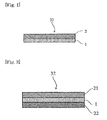
- Fig. 1 is a schematic cross-sectional view showing an example of the pressure-sensitive adhesive tape for an electrochemical device of the present invention.
- the pressure-sensitive adhesive tape 31 for an electrochemical device has a structure including a pressure-sensitive adhesive layer 2 stacked on one side of a base 1.
- Fig. 2 is a schematic cross-sectional view showing another example of the pressure-sensitive adhesive tape for an electrochemical device of the present invention.
- the pressure-sensitive adhesive tape 32 for an electrochemical device has a structure including a pressure-sensitive adhesive layer 21 stacked on one side of a base 1 and a pressure-sensitive adhesive layer 22 stacked on the other side.
- the pressure-sensitive adhesive layer of the present invention is composed of an acrylic pressure-sensitive adhesive.
- the acrylic pressure-sensitive adhesive includes an acrylic polymer (copolymer) obtained by polymerization of a monomer component that mainly includes an alkyl (meth)acrylate as a base polymer and at least includes a functional group-containing monomer for improving the adhesiveness with the main monomer.
- alkyl (meth)acrylate examples include alkyl (meth)acrylates containing a straight or branched chain alkyl group having 30 or less carbon atoms, such as a methyl group, an ethyl group, a propyl group, an isopropyl group, an n-butyl group, a t-butyl group, an isobutyl group, an amyl group, an isoamyl group, a hexyl group, a heptyl group, a cyclohexyl group, a 2-ethylhexyl group, an octyl group, an isooctyl group, a nonyl group, an isononyl group, a decyl group, an isodecyl group, an undecyl group, a lauryl group, a tridecyl group, a tetradecyl group, a stearyl group, an o
- the amount of the alkyl (meth)acrylate is 80% by weight or more (preferably 90% by weight or more and particularly preferably 95% by weight or more) based on the total weight (100% by weight) of the monomer component constituting the acrylic polymer.
- the content of alkyl (meth)acrylates containing a straight or branched chain alkyl group having 3 or less carbon atoms is 60% by weight or more (preferably 65% by weight or more) based on the total weight (100% by weight) of the monomer component constituting the acrylic polymer, and that the content of alkyl (meth)acrylates containing a straight or branched chain alkyl group having 5 or more carbon atoms is 40% by weight or less (preferably 35% by weight or less) based on the total weight (100% by weight) of the monomer component constituting the acrylic polymer, from the viewpoint of improving shear adhesive strength.
- the invention is characterized by using a hydroxy group-containing monomer as the functional group-containing monomer.
- hydroxy group-containing monomer examples include hydroxyalkyl (meth)acrylates such as 2-hydroxyethyl (meth)acrylate, 2-hydroxypropyl (meth)acrylate, 3-hydroxypropyl (meth)acrylate, 4-hydroxybutyl (meth)acrylate, and 6-hydroxyhexyl (meth)acrylate; vinyl alcohol; and allyl alcohol. These monomers may be used singly or in combination of two or more of them.
- the content of the functional group-containing monomer is, for example, about 1 to 10% by weight (preferably about 1 to 7% by weight and particularly preferably about 1 to 5% by weight) based on the total weight (100% by weight) of the monomer component constituting the acrylic polymer.
- the functional group-containing monomer having a content less than the range is likely to reduce the adhesiveness.
- the functional group-containing monomer having a content more than the range is likely to lead to gelation during polymerization.
- the monomer component constituting the acrylic polymer of the present invention may include other copolymerizable monomers in addition to the main monomer and the functional group-containing monomer.
- the copolymerizable monomer include (meth)acrylamide; (N-substituted) amide monomers such as, N,N-dimethyl(meth)acrylamide, N-butyl(meth)acrylamide, N-methylol(meth)acrylamide, and N-methylolpropane(meth)acrylamide; alkylaminoalkyl (meth)acrylate monomers such as aminoethyl (meth)acrylate, N,N-dimethlylaminoethyl (meth)acrylate, and t-butylaminoethyl (meth)acrylate; alkoxyalkyl (meth)acrylate monomers such as methoxyethyl (meth)acrylate and ethoxyethyl (meth)acrylate; maleimide monomers such as
- Examples of the copolymerizable monomer further include vinyl monomers such as vinyl propionate, N-vinylpyrrolidone, methylvinylpynolidone, vinylpyridine, vinylpiperidone, vinylpyrimidine, vinylpiperazine, vinylpyrazine, vinylpyrrole, vinylimidazole, vinyloxazole, vinylmorpholine, N-vinylearboxylic amides, styrene, ⁇ -methylstyrene, and N-vinylcaprolactam; cyanoacrylate monomers such as (meth)acrylonitrile; epoxy group-containing acrylic monomers such as glycidyl (meth)acrylate; glycol acrylate monomers such as polyethylene glycol (meth)acrylate, polypropylene glycol (meth)acrylate, methoxyethylene glycol (meth)acrylate, and methoxypolypropylene glycol (meth) acrylate and tetrahydrofurfuryl (meth)acryl
- the copolymerizable monomer may be used, for example, for reforming adhesive characteristics as necessary.
- the amount to be used is preferably, for example, about 50 parts by weight or less based on 100 parts by weight of the alkyl (meth)acrylate from the viewpoint of the stability during polymerization of the acrylic polymer.
- a polyfunctional monomer may be used as necessary for cross-linking the acrylic polymer.
- the polyfunctional monomer include hexanediol di(meth)acrylate, polyethylene glycol di(meth)acrylate, polypropylene glycol di(meth)acrylate, neopentyl glycol di(meth)acrylate, pentaerythritol di(meth)acrylate, trimethylolpropane tri(meth)acrylate, pentaerythritol tri(meth)acrylate, dipentaerythritol hexa(meth)acrylate, epoxy acrylate, polyester acrylate, and urethane acrylate. These monomers may be used singly or in combination of two or more of them.
- the amount of the polyfunctional monomer is preferably, for example, 30 parts by weight or less based on 100 parts by weight of the alkyl (meth)acrylate from the viewpoint of the stability during polymerization of the acrylic polymer.
- the acrylic polymer can be prepared by polymerization of the monomer component in accordance with a known or common polymerization method such as solution polymerization, emulsification polymerization, bulk polymerization, and polymerization by irradiation with active energy rays (active energy ray polymerization).
- a known or common polymerization method such as solution polymerization, emulsification polymerization, bulk polymerization, and polymerization by irradiation with active energy rays (active energy ray polymerization).
- the solution polymerization and the active energy ray polymerization are preferred and the solution polymerization is more preferred because such methods can produce a polymer having excellent transparency and water resistance and are low cost.
- the solution polymerization may employ various common solvents.
- solvents include organic solvents including esters such as ethyl acetate and n-butyl acetate; aromatic hydrocarbons such as toluene and benzene; aliphatic hydrocarbons such as n-hexane and n-heptane; alicyclic hydrocarbons such as cyclohexane and methylcyclohexane; and ketones such as methyl ethyl ketone and methyl isobutyl ketone. These solvents may be used singly or in combination of two or more of them.
- the polymerization of the monomer component may employ a polymerization initiator.
- the polymerization initiator is not necessarily limited and can be suitably selected from known or common initiators for use.
- Examples of polymerization initiator include oil-soluble polymerization initiators including azo polymerization initiators such as 2,2'-azobisisobutronitrile (AIBN), 2,2'-azobis(4-methoxy-2,4-dimethylvaleronitrile), 2,2'-azobis(2,4-dimethylvaleronitrile), 2,2'-azobis(2-methylbutylonitrile), 1,1'-azobis(cyclohexane-1-carbonitrile), 2,2'-azobis(2,4,4-trimethylpentane), and dimethyl 2,2'-azobis(2-methylpropionate); and peroxide polymerization initiators such as benzoyl peroxide, t-butyl hydroperoxide, di-t-butyl peroxide, t-butyl peroxybenzoate,
- the acrylic polymer of the present invention has an acid value of 1.0 or less (preferably 0 to 0.8 and particularly preferably 0 to 0.5).
- the acrylic polymer having an acid value more than the range is likely to interfere with the prevention of corrosion of an electrochemical device.
- the pressure-sensitive adhesive tape including such an acrylic polymer readily absorbs water and is likely to interfere with the suppression of troubles in an electrochemical device that are caused by water contained in the pressure-sensitive adhesive tape itself.
- the acid value of the acrylic polymer can be controlled by adjusting the content of a carboxyl group-containing monomer in the monomer component constituting the acrylic polymer.
- the acrylic polymer of the present invention has a glass transition temperature (Tg) of -40°C or more (preferably -40 to -20°C).
- Tg glass transition temperature
- the acrylic polymer having a glass transition temperature (Tg) of less than -40°C reduces the shear adhesive strength and is likely to lead to insufficient fixing of the wound end of a laminate composed of electrode plates, a separator, and the like when the laminate is wound and packed into a battery case in the production of a lithium-ion battery.
- the glass transition temperature (Tg) of the acrylic polymer can be controlled by adjusting the carbon number of an alkyl chain contained in the acrylic polymer.
- the acrylic polymer of the present invention has, for example, a weight average molecular weight of about 300,000 to 1,200,000 and preferably about 300,000 to 1,000,000.
- the acrylic polymer having a weight average molecular weight of less than 300,000 cannot achieve adhesive power and cohesive power that are required for the pressure-sensitive adhesive layer, and is likely to reduce the durability.
- the acrylic polymer having a weight average molecular weight of more than 1,200,000 increases the viscosity of the pressure-sensitive adhesive composition and may cause problems such as poor coating properties.
- the weight average molecular weight (Mw) of the acrylic polymer can be determined by gel permeation chromatography (GPC). More specifically, it can be determined by using a GPC measurement device, trade name "HLC-8120GPC” (manufactured by TOSOH CORPORATION), under the following GPC measurement conditions in terms of polystyrene molecular weight.
- GPC gel permeation chromatography
- the acrylic polymer of the present invention is preferably cross-linked by a suitable cross-linking means (for example, the addition of a cross-linking agent).
- a suitable cross-linking means for example, the addition of a cross-linking agent.
- the cross-linking treatment can provide, to the pressure-sensitive adhesive tape, a more excellent shear adhesive strength (for example, 20 N/cm 2 or more, specifically 25 N/cm 2 or more, and particularly 30 N/cm 2 or more).
- cross-linking agent examples include an epoxy compound, an isocyanate compound, a metal chelate compound, a metal alkoxide, a metal salt, an amine compound, a hydrazine compound, and an aldehyde compound.
- cross-linking agents can be selected for use depending on a functional group contained in the acrylic polymer.
- the isocyanate compound is preferably used from the viewpoint of excellent anchoring properties to a plastic base.
- Examples of the isocyanate compound include polyfunctional isocyanate compounds such as a bifunctional isocyanate compound and a trifunctional isocyanate compound.
- Examples of the bifunctional isocyanate compound include lower aliphatic diisocyanates such as butylene diisocyanate and hexamethylene diisocyanate; alicyclic diisocyanates such as cyclopentylene diisocyanate, cyclohexylene diisocyanate, and isophorone diisocyanate; and aromatic diisocyanates such as 2,4-tolylene diisocyanate, 4,4'-diphenylmethane diisocyanate, and xylylene diisocyanate.
- trifunctional isocyanate compound examples include isocyanate adducts such as a trimethylolpropane/tolylene diisocyanate trimer adduct (trade name "CORONATE L”, manufactured by NIPPON POLYURETHANE INDUSTRY CO., LTD.), a trimethylolproane/hexamethylene diisocyanate trimer adduct (trade name "CORONATE HL”, manufactured by NIPPON POLYURETHANE INDUSTRY CO., LTD.), and an isocyanurate of hexamethylene diisocyanate (trade name "CORONATE HX”, manufactured by NIPPON POLYURETHANE INDUSTRY CO., LTD.). These compounds may be used singly or in combination of two or more of them.
- the trifunctional isocyanate compound is preferred because it has excellent reactivity and can cure a polymer more immediately.
- the amount of the cross-linking agent is, for example, about 1 to 15 parts by weight and preferably about 1 to 10 parts by weight based on 100 parts by weight of the acrylic polymer.
- the cross-linking agent having an amount less than the range leads to insufficient cross-linkages by the cross-linking agent to reduce the cohesive power of the pressure-sensitive adhesive composition and may not achieve sufficient shear adhesive power.
- the cross-linking agent having an amount more than the range leads to an excessively large cohesive power of the polymer and is likely to reduce the tackiness.
- the acrylic pressure-sensitive adhesive in the present invention may include other components (for example, a tackifier, a plasticizer, a filler, and an antioxidant) in addition to the acrylic polymer and the cross-lining agent.
- a tackifier for example, a tackifier, a plasticizer, a filler, and an antioxidant
- the pressure-sensitive adhesive layer of the present invention can be formed as follows: the acrylic pressure-sensitive adhesive is diluted using a solvent (for example, toluene, xylene, ethyl acetate, and methyl ethyl ketone) as necessary to prepare a coating liquid; and the coating liquid is applied onto a base directly or onto an appropriate separator (for example, a release paper) and dried.
- a solvent for example, toluene, xylene, ethyl acetate, and methyl ethyl ketone
- the pressure-sensitive adhesive layer of the present invention may be a single layer or a laminate of two or more layers.
- each layer may have the same composition or layers having different compositions may be combined for the lamination.
- the base has the piessune-sensitive adhesive layers on both sides, these pressure-sensitive adhesive layers may have the same composition or different compositions.
- the pressure-sensitive adhesive layer of the present invention has a thickness (total thickness for a laminate of two or more layers) of 1 to 15 ⁇ m (preferably 1 to 10 ⁇ m).
- the pressure-sensitive adhesive layer having a thickness less than the range reduces the adhesive strength, and the pressure-sensitive adhesive tape may be removed in an electrolytic solution to degrade the electrolytic solution.
- the pressure-sensitive adhesive layer having a thickness more than the range leads to an excess volume in an electrochemical device to interfere with the achievement of higher capacity of the electrochemical device.
- the present invention is characterized by using a plastic base for the base.
- the material of the plastic base include polyesters (for example, polyethylene terephthalate, polyethylene naphthalate, polybutylene terephthalate, and polybutylene naphthalate), polyolefins (for example, polyethylene, polypropylene, polymethylpentene, and an ethylene-propylene copolymer), polyvinyl alcohol, polyvinylidene chloride, polyvinyl chloride, a vinyl chloride-vinyl acetate copolymer, polyvinyl acetate, polyamide, polyimide, celluloses, a fluorine resin, polyether, polyether amide, polyether nitrile, polyether ether ketone, polyphenylene sulfide, polystyrene resins (for example, polystyrene), polycarbonate, and polyethersulfone. These materials may be used singly or in combination of two or more of them.
- the base is preferably formed from a resin material selected form polyimide, polyesters such as polyethylene terephthalate, and polyolefins such as polypropylene from the viewpoint of excellent heat resistance.
- the base of the present invention may be a single layer or a laminate of two or more layers.
- each layer may have the same composition, or layers having different compositions may be combined for the lamination.
- the base may have a surface that is subjected to a common surface treatment, for example, oxidation treatment by a chemical or physical method such as chromate treatment, exposure to ozone, exposure to flame, exposure to high-voltage electric shock, and treatment with ionizing radiation, as necessary, in order to improve the adhesion with the pressure-sensitive adhesive layer and the like.
- a common surface treatment for example, oxidation treatment by a chemical or physical method such as chromate treatment, exposure to ozone, exposure to flame, exposure to high-voltage electric shock, and treatment with ionizing radiation, as necessary, in order to improve the adhesion with the pressure-sensitive adhesive layer and the like.
- the thickness of the base is not necessarily limited, but is, for example, about 25 ⁇ m or less (preferably about 5 to 25 ⁇ m).
- the base having a thickness more than the range is likely to lead to an excess volume in an electrochemical device to interfere with the achievement of higher capacity of the electrochemical device.
- the base having an excessively small thickness may lead to insufficient strength of the pressure-sensitive adhesive tape to interfere with practical use.
- the pressure-sensitive adhesive tape for an electrochemical device of the present invention includes the pressure-sensitive adhesive layer on at least one side of the base.
- the pressure-sensitive adhesive tape for an electrochemical device of the present invention can be formed by a known or common method.
- the acrylic pressure-sensitive adhesive to constitute the pressure-sensitive adhesive layer is diluted using a solvent (for example, toluene, xylene, ethyl acetate, and methyl ethyl ketone) as necessary to prepare a coating liquid; and the coating liquid is directly applied onto the base to form a pressure-sensitive adhesive layer; or the coating liquid is applied onto an appropriate separator (for example, a release paper) to form a pressure-sensitive adhesive layer, and the pressure-sensitive adhesive layer is transferred onto the base.
- the formation by transferring may leave a void (space) in the interface with the base.
- the pressure-sensitive adhesive tape may be treated with heat and pressure using an autoclave or the like to diffuse the void for disappearance.
- the application of the coating liquid may employ a common coater such as a gravure roll coater, a reverse roll coater, a kiss roll coater, a dip roll coater, a bar coater, a knife coaster, a spray coater, a comma coater, and a direct coater.
- a common coater such as a gravure roll coater, a reverse roll coater, a kiss roll coater, a dip roll coater, a bar coater, a knife coaster, a spray coater, a comma coater, and a direct coater.
- the pressure-sensitive adhesive tape for an electrochemical device of the present invention can be formed by melt extrusion of the base material and the acrylic pressure-sensitive adhesive to integrate each other.
- melt extrusion any of known techniques such as inflation method and T-die method may be employed.
- a stretching treatment in a longitudinal or transverse direction uniaxial stretching
- a sequential or simultaneous stretching treatment in longitudinal and transverse directions biaxial stretching
- the pressure-sensitive adhesive tape for an electrochemical device of the present invention can be bonded to an adherend by pressing, for example, at a pressure of about 0.5 to 10 kg/cm 2 .
- the temperature during the pressing is not necessarily limited and is, for example, about 10 to 180°C.
- the adhesive strength (with respect to an aluminum foil) after the pressing is, for example, a 180 degree peel adhesion to an aluminum foil at 25°C (in accordance with Japanese Industrial Standard Z 0237, with respect to an aluminum foil, a peeling rate of 300 mm/min, adhesive strength before immersion) of about 0.5 N/10 mm or more (preferably 1.0 N/10 mm or more and particularly preferably 1.05 to 2.5 N/10 mm).
- the pressure-sensitive adhesive tape having an adhesive strength to an aluminum foil after immersion less than the range is readily removed in an electrolytic solution when it is used in an lithium-ion battery, and thus interferes with the suppression of degradation of the electrolytic solution.
- the pressure-sensitive adhesive tape for an electrochemical device of the present invention preferably has a shear adhesive strength at 23°C of 20 N/cm 2 or more (specifically 25 N/cm 2 or more and particularly 30 N/cm 2 or more).
- the pressure-sensitive adhesive tape having a shear adhesive strength at 23°C less than the range is likely to lead to insufficient fixing of the wound end of a laminate composed of electrode plates, a separator, and the like when the laminate is wound and packed into a battery case in the production of a lithium-ion battery.
- the pressurr-sensitive adhesive tape for an electrochemical device of the present invention may include a separator (release liner) on the surface of the pressure-sensitive adhesive layer in order to protect the pressure-sensitive adhesive layer surface and to prevent blocking.
- the separator is removed when the pressure-sensitive adhesive tape for an electrochemical device of the present invention is bonded to an adherend, and is not necessarily included.
- the separator to be used is not specifically limited, and known or common release papers and the like may be used.
- Examples of the separator to be used include bases having release layers such as a plastic film and paper having a surface treated with a release agent such as a silicone release agent, a long-chain alkyl release agent, a fluorine release agent, and a molybdenum sulfide release agent; low adhesive bases composed of fluorine polymers such as polytetrafluoroethylene, polychlorotrifluoroethylene, polyvinyl fluoride, polyvinylidene fluoride, a tetrafluoroethylene-hexafluoropropylene copolymer, and a chlorofluoroethylene-vinylidene fluoride copolymer; and low adhesive bases composed of non-polar polymers such as an olefinic resin (for example, polyethylene and polypropylene).
- a release agent such as a silicone release agent, a long-chain alkyl release agent, a fluorine release agent, and a molybdenum sulfide release agent
- the separators may be provided on faces of both pressure-sensitive adhesive layers of the pressure-sensitive adhesive tape for an electrochemical device of the present invention; or the separator having a back release layer may be provided on one adhesive face, and the sheet is wound so that the back release layer of the separator will be in contact with the other face of the pressure-sensitive adhesive layer.
- the pressure-sensitive adhesive tape for an electrochemical device of the present invention is suitably used, for example, for the production of a secondary battery including a nonaqueous electrolytic solution, such as a lithium-ion battery.
- nonaqueous electrolytic solution examples include, but are not necessarily limited to, an electrolytic solution of a lithium salt such as LiPF 6 as an electrolyte dissolved in a mixed solvent of a cyclic carbonate such as propylene carbonate (PC) and ethylene carbonate (EC) and a chain carbonate such as dimethyl carbonate (DMC), ethyl methyl carbonate (EMC), and diethyl carbonate (DEC).
- a lithium salt such as LiPF 6
- PC propylene carbonate
- EC ethylene carbonate
- chain carbonate such as dimethyl carbonate (DMC), ethyl methyl carbonate (EMC), and diethyl carbonate (DEC).
- the nonaqueous electrolyte secondary battery such as a lithium-ion battery is composed of an outer can that includes a stacked electrode group in which a positive electrode plate having a positive electrode substrate coated with a positive electrode active material and a negative electrode plate having a negative electrode substrate coated with a negative electrode active material are stacked interposing a separator, or a wound electrode group in which a positive electrode plate having a positive electrode substrate coated with a positive electrode active material and a negative electrode plate having a negative electrode substrate coated with a negative electrode active material are spirally wound interposing a separator while opposing to each other, and electrode terminals out from the positive electrode plate and the negative electrode plate, and an electrolytic solution.
- the pressure-sensitive adhesive tape for an electrochemical device of the present invention can be used, for example, in the production of the nonaqueous electrolyte secondary battery such as the lithium-ion battery, to bond members constituting the battery, for example, in order to prevent separator penetration by a foreign matter, a burr, or the like, in order to suppress active material separation, and in order to improve suitable packing of the electrode into the battery case (for example, to fix a laminate composed of the positive electrode plate/the separator/the negative electrode plate or to fix the wound laminate).
- the bonding position in the members constituting the battery is not specifically limited as long as the objects can be achieved, and examples include an electrode plate, an electrode terminal, an electrode plate edge, a position in a separator to be in contact with an electrode plate edge, a boundary of a coated area and an uncoated area of an active material, and the wound end of a wound electrode group (see Fig. 3 ).
- a trifunctional isocyanate compound (trade name "CORONATE L", manufactured by NIPPON POLYURETHANE INDUSTRY CO., LTD.) was mixed in a ratio of 5 parts by weight based on the solid content to give an acrylic adhesive (1).
- the obtained acrylic adhesive (1) was applied onto a transparent polyimide film (trade name "Kapton 50H", manufactured by DU PONT-TORAY CO., LTD., a thickness of 12.5 ⁇ m) so as to have a thickness after drying of 10 ⁇ m and then dried to give a pressure-sensitive adhesive tape (1).
- a transparent polyimide film trade name "Kapton 50H", manufactured by DU PONT-TORAY CO., LTD., a thickness of 12.5 ⁇ m
- a trifunctional isocyanate compound (trade name "CORONATE L", manufactured by NIPPON POLYURETHANE INDUSTRY CO., LTD.) was mixed in a ratio of 4 parts by weight based on the solid content to give an acrylic adhesive (2).
- the obtained acrylic adhesive (2) was applied onto a transparent PET film (trade name "LUMIRROR S10", manufactured by Toray Industries Inc., a thickness of 25 ⁇ m) so as to have a thickness after drying of 10 ⁇ m and then dried to give a pressure-sensitive adhesive tape (2).
- a transparent PET film trade name "LUMIRROR S10", manufactured by Toray Industries Inc., a thickness of 25 ⁇ m
- a trifunctional isocyanate compound (trade name "CORONATE L", manufactured by NIPPON POLYURETHANE INDUSTRY CO., LTD.) was mixed in a ratio of 0.5 part by weight based on the solid content to give an acrylic pressure-sensitive adhesive (3).
- the obtained acrylic pressure-sensitive adhesive (3) was applied onto a transparent PET film (trade name "LUMIRROR S10", manufactured by Toray Industries Inc., a thickness of 25 ⁇ m) so as to have a thickness after drying of 10 ⁇ m and then dried to give a pressure-sensitive adhesive tape (3).
- a transparent PET film trade name "LUMIRROR S10", manufactured by Toray Industries Inc., a thickness of 25 ⁇ m
- a trifunctional isocyanate compound (trade name "CORONATE L", manufactured by NIPPON POLYURETHANE INDUSTRY CO., LTD.) was mixed in a ratio of 5 parts by weight based on the solid content to give an acrylic pressure-sensitive adhesive (4).
- the obtained acrylic pressure-sensitive adhesive (4) was applied onto a transparent PET film (trade name "LUMIRROR S10", manufactured by Toray Industries Inc., a thickness of 25 ⁇ m) so as to have a thickness after drying of 10 ⁇ m and then dried to give a pressure-sensitive adhesive tape (4).
- a transparent PET film trade name "LUMIRROR S10", manufactured by Toray Industries Inc., a thickness of 25 ⁇ m
- the glass transition temperature (Tg) was calculated in accordance with the Fox-Flory equation (1).
- 1 / Tg w 1 / Tg 1 + w 2 / Tg 2 + w 3 / Tg 3 + ... + w n / Tg n
- the acid value was determined in accordance with Japanese Industrial Standard K 0070-1992 (potentiometric titration). That is, to about 3 g of a dried acrylic polymer, 100 mL of acetone was added and stirred to dissolve the polymer. To the solution, 25 mL of water was added and stirred. The solution was titrated with a 0.05 mol/L sodium hydroxide solution, and the amount (mg) of potassium hydroxide that was needed for the neutralization of 1 g of the acrylic polymer was calculated as the acid value.
- Corrosion resistance performance and shear adhesive power of each pressure-sensitive adhesive tape obtained in Examples and Comparative Examples were determined in accordance with the following methods.
- Each pressure-sensitive adhesive tape obtained in Examples and Comparative Examples was cut into a size of 20 mm width and 20 mm length to prepare a test piece.
- test piece was bonded to a copper foil (a thickness of 80 ⁇ m) and left in an atmosphere at 60°C and 95% RH for 5 days. Then, the bonded face of the copper foil to the test piece was visually observed from the transparent base to determine the presence or absence of corrosion.
- Each pressure-sensitive adhesive tape obtained in Examples and Comparative Examples was cut into a size of 20 mm width and 20 mm length to prepare a test piece.
- a stainless steel plate (SUS304BA, polished with sandpaper #360) as an adherend was bonded by one reciprocal movement of a 5-kg roller, and then left at 23 ⁇ 2°C for 0.5 hour.
- test piece and the stainless steel plate were pulled in directions different to each other (in directions opposite to each other) as shown in Fig. 4 at a pulling rate of 50 mm/min to determine the load (maximum load) as the shear adhesive power.
- the measured value (unit: N/400 mm 2 ) was converted in terms of N/cm 2 .
Landscapes
- Chemical & Material Sciences (AREA)
- Chemical Kinetics & Catalysis (AREA)
- Electrochemistry (AREA)
- General Chemical & Material Sciences (AREA)
- Organic Chemistry (AREA)
- Engineering & Computer Science (AREA)
- Manufacturing & Machinery (AREA)
- Adhesive Tapes (AREA)
- Adhesives Or Adhesive Processes (AREA)
Abstract
To provide a pressure-sensitive adhesive tape for an electrochemical device that has an excellent adhesive strength and that achieves, for example, the protection of an electrode, the suppression of active material separation, and the fixing of a wound end of a laminate composed of electrode plates, a separator, and the like when the laminate is wound and packed into a battery case, without adversely affecting the electrochemical device.
The pressure-sensitive adhesive tape for an electrochemical device of the present invention includes a pressure-sensitive adhesive layer composed of an acrylic pressure-sensitive adhesive on at least one side of a plastic base. The acrylic pressure-sensitive adhesive includes an acrylic polymer that is obtained by polymerization of a monomer component containing at least an alkyl (meth)acrylate and a hydroxyl group-containing monomer. The acrylic polymer has an acid value of 1.0 or less and a glass transition temperature (Tg) of -40°C or more.
Description
- The present invention relates to pressure-sensitive adhesive tapes for electrochemical devices, and in particular, relates to pressure-sensitive adhesive tapes used for parts that are in contact with an electrolytic solution or may be in contact with an electrolytic solution during the assembly of electrolytic condensers and lithium-ion batteries.
- Electrochemical devices use many pressure-sensitive adhesive tapes in their production process. For example, in the production process of lithium-ion batteries, pressure-sensitive adhesive tapes are used for various purposes such as the prevention of separator penetration due to a foreign matter, a burr, or the like, the suppression of active material separation, and the fixing of the wound end of a laminate composed of electrode plates, a separator, and the like when the laminate is wound and packed into a battery case.
- The pressure-sensitive adhesive tape used in the production process of an electrochemical device is mainly composed of a base and a pressure-sensitive adhesive layer. For a pressure-sensitive adhesive constituting the pressure-sensitive adhesive layer, an acrylic polymer that is obtained by copolymerization of an alkyl (meth)acrylate and a functional group-containing monomer is commonly used because such a polymer can achieve excellent adhesiveness by cross-linkages by an external cross-linking agent. That is because, if a pressure-sensitive adhesive tape is removed in an electrolytic solution, an active material is separated as well as a pressure-sensitive adhesive component is eluted into the electrolytic solution and reacted with an electrolyte to reduce electrolytic solution characteristics, and the battery characteristics are consequently reduced (for example, Patent Document 1).
- However, even when a pressure-sensitive adhesive tape having an excellent adhesiveness is used, troubles may be caused in an electrochemical device to reduce the lifetime of the electrochemical device.
- Patent Document 1: Japanese Unexamined Patent Application No.
11-176476 - Therefore, it is an object of the present invention to provide a pressure-sensitive adhesive tape for an electrochemical device that has excellent adhesive strength and that achieves, for example, the protection of an electrode, the suppression of active material separation, and the fixing of a wound end of a laminate composed of electrode plates, a separator, and the like when the laminate is wound and packed into a battery case, without adversely affecting the electrochemical device.
- The inventors of the present invention have been carried out intensive studies in order to solve the problems, and as a result, have found that a carboxyl group-containing monomer (for example, acrylic acid), which is commonly used as a functional group-containing monomer together with an alkyl (meth)acrylate for forming an acrylic polymer that constitutes a pressure-sensitive adhesive layer in the pressure-sensitive adhesive tape used in the production process of an electrochemical device, may not completely copolymerized during the polymerization to leave a small amount of the monomer, and consequently the use of a pressure-sensitive adhesive tape that contains such a residual monomer for assembling an electrochemical device causes corrosion of the electrochemical device.
- It has been also found that the acrylic polymer that is obtained by copolymerization of the carboxyl group-containing monomer has a high water absorption rate and readily holds water in a pressure-sensitive adhesive layer, and thus, when a pressure-sensitive adhesive tape including a pressure-sensitive adhesive layer composed of the acrylic polymer that is obtained by the copolymerization of the carboxyl group-containing monomer is used especially in the production process of a lithium-ion battery, the electrode reaction is suppressed and the battery capacity is reduced because the lithium-ion battery includes the electrolytic solution containing a lithium salt having high reactivity, and hence the lithium salt immediately reductively decomposes water that is released into the electrolytic solution, as well as the carboxyl group-containing monomer degrades a nonaqueous electrolytic solution to reduce electrolytic solution characteristics, consequently the battery performance is reduced, and the battery lifetime is shortened.
- Then, it has been found that, in the acrylic polymer that is included in the acrylic pressure-sensitive adhesive constituting the pressure-sensitive adhesive layer of the pressure-sensitive adhesive tape for an electrochemical device and that is obtained by copolymerization of an alkyl (meth)acrylate and a functional group-containing monomer, the use of a hydroxyl group-containing monomer as the functional group-containing monomer and the use of the carboxyl group-containing monomer in a limited amount maintain an excellent adhesive strength, can prevent corrosion of an electrochemical device due to the carboxyl group-containing monomer remaining in the pressure-sensitive adhesive layer in the pressure-sensitive adhesive tape, can lower a water absorption rate of the pressure-sensitive adhesive tape, and can suppress troubles in an electrochemical device that are caused by water contained in the pressure-sensitive adhesive tape itself that the control of a glass transition temperature (Tg) of the acrylic polymer to a particular range achieves an excellent shear adhesiveness; and that a pressure-sensitive adhesive tape having these features is extremely useful for electrochemical devices. The present invention has been completed based on the findings.
- That is, the present invention provides a pressure-sensitive adhesive tape for an electrochemical device that includes a pressure-sensitive adhesive layer composed of an acrylic pressure-sensitive adhesive on at least one side of a plastic base. The acrylic pressure-sensitive adhesive includes an acrylic polymer obtained by polymerization of a monomer component containing at least an alkyl (meth)acrylate and a hydroxyl group-containing monomer. The acrylic polymer has an acid value of 1.0 or less and a glass transition temperature (Tg) of -40°C or more.
- It is preferable that the pressure-sensitive adhesive tape for an electrochemical device has a shear adhesive strength of 20 N/cm2 or more at 23°C.
- It is preferable that the acrylic pressure-sensitive adhesive includes the acrylic polymer and 1 to 15 parts by weight of an isocyanate crosslinking agent based on 100 parts by weight of the acrylic polymer.
- The pressure-sensitive adhesive tape for an electrochemical device of the present invention has an excellent shear adhesive strength, can prevent corrosion of an electrochemical device, has an extremely low water absorption rate, and can suppress troubles in an electrochemical device that are caused by water contained in the pressure-sensitive adhesive tape itself. Therefore, it is applied to electrochemical devices, in particular, it is applied in the production of lithium-ion batteries to an area that is immersed in an electrolytic solution or an area that may be in contact with an electrolytic solution, and hence can suppress the degradation of battery performance and the reduction of battery lifetime as well as can achieve the prevention of separator penetration due to a foreign matter, a burr, or the like, the suppression of active material separation, and the improvement of suitable packing of an electrode into a battery case.
-
-
Fig. 1 is a schematic cross-sectional view showing an example of the pressure-sensitive adhesive tape for an electrochemical device of the present invention. -
Fig. 2 is a schematic cross-sectional view showing another example of the pressure-sensitive adhesive tape for an electrochemical device of the present invention. -
Figs. 3 are schematic views showing usage examples of the pressure-sensitive adhesive tape for an electrochemical device of the present invention in a lithium-ion battery;Fig. (3-1 ) is a figure before use;Fig. (3-2 ) is a figure of the pressure-sensitive adhesive tapes for an electrochemical device of the present invention that are bonded to an electrode plate and the like; andFig. (3-3 ) is a figure of a wound electrode plate that is fixed with the pressure-sensitive adhesive tape for an electrochemical device of the present invention. -
Fig. 4 is a schematic view showing tensile directions of a pressure-sensitive adhesive tape and an adherend for the measurement of shear adhesive power of the pressure-sensitive adhesive tape. - Hereinafter, embodiments of the present invention will be described in detail with reference to drawings as necessary.
-
Fig. 1 is a schematic cross-sectional view showing an example of the pressure-sensitive adhesive tape for an electrochemical device of the present invention. The pressure-sensitiveadhesive tape 31 for an electrochemical device has a structure including a pressure-sensitiveadhesive layer 2 stacked on one side of abase 1. -
Fig. 2 is a schematic cross-sectional view showing another example of the pressure-sensitive adhesive tape for an electrochemical device of the present invention. The pressure-sensitiveadhesive tape 32 for an electrochemical device has a structure including a pressure-sensitive adhesive layer 21 stacked on one side of abase 1 and a pressure-sensitiveadhesive layer 22 stacked on the other side. - The pressure-sensitive adhesive layer of the present invention is composed of an acrylic pressure-sensitive adhesive. The acrylic pressure-sensitive adhesive includes an acrylic polymer (copolymer) obtained by polymerization of a monomer component that mainly includes an alkyl (meth)acrylate as a base polymer and at least includes a functional group-containing monomer for improving the adhesiveness with the main monomer.
- Examples of the alkyl (meth)acrylate include alkyl (meth)acrylates containing a straight or branched chain alkyl group having 30 or less carbon atoms, such as a methyl group, an ethyl group, a propyl group, an isopropyl group, an n-butyl group, a t-butyl group, an isobutyl group, an amyl group, an isoamyl group, a hexyl group, a heptyl group, a cyclohexyl group, a 2-ethylhexyl group, an octyl group, an isooctyl group, a nonyl group, an isononyl group, a decyl group, an isodecyl group, an undecyl group, a lauryl group, a tridecyl group, a tetradecyl group, a stearyl group, an octadecyl group, and a dodecyl group. These compounds may be used singly or in combination of two or more of them. In the present specification, "(meth)acrylate" means "acrylate" and/or "methacrylate".
- It is preferable that the amount of the alkyl (meth)acrylate is 80% by weight or more (preferably 90% by weight or more and particularly preferably 95% by weight or more) based on the total weight (100% by weight) of the monomer component constituting the acrylic polymer.
- In the invention, among them, it is preferable that the content of alkyl (meth)acrylates containing a straight or branched chain alkyl group having 3 or less carbon atoms is 60% by weight or more (preferably 65% by weight or more) based on the total weight (100% by weight) of the monomer component constituting the acrylic polymer, and that the content of alkyl (meth)acrylates containing a straight or branched chain alkyl group having 5 or more carbon atoms is 40% by weight or less (preferably 35% by weight or less) based on the total weight (100% by weight) of the monomer component constituting the acrylic polymer, from the viewpoint of improving shear adhesive strength.
- The invention is characterized by using a hydroxy group-containing monomer as the functional group-containing monomer. Examples of the hydroxy group-containing monomer include hydroxyalkyl (meth)acrylates such as 2-hydroxyethyl (meth)acrylate, 2-hydroxypropyl (meth)acrylate, 3-hydroxypropyl (meth)acrylate, 4-hydroxybutyl (meth)acrylate, and 6-hydroxyhexyl (meth)acrylate; vinyl alcohol; and allyl alcohol. These monomers may be used singly or in combination of two or more of them.
- The content of the functional group-containing monomer is, for example, about 1 to 10% by weight (preferably about 1 to 7% by weight and particularly preferably about 1 to 5% by weight) based on the total weight (100% by weight) of the monomer component constituting the acrylic polymer. The functional group-containing monomer having a content less than the range is likely to reduce the adhesiveness. The functional group-containing monomer having a content more than the range is likely to lead to gelation during polymerization.
- The monomer component constituting the acrylic polymer of the present invention may include other copolymerizable monomers in addition to the main monomer and the functional group-containing monomer. Examples of the copolymerizable monomer include (meth)acrylamide; (N-substituted) amide monomers such as, N,N-dimethyl(meth)acrylamide, N-butyl(meth)acrylamide, N-methylol(meth)acrylamide, and N-methylolpropane(meth)acrylamide; alkylaminoalkyl (meth)acrylate monomers such as aminoethyl (meth)acrylate, N,N-dimethlylaminoethyl (meth)acrylate, and t-butylaminoethyl (meth)acrylate; alkoxyalkyl (meth)acrylate monomers such as methoxyethyl (meth)acrylate and ethoxyethyl (meth)acrylate; maleimide monomers such as N-cyclohexylmaleimide, N-isopropylmaleimide, N-laurylmaleimide, and N-phenylmaleimide; itaconimide monomers such as N-mothylitaconimide, N-ethylitaconimide, N-butylitaconimide, N-octylitaconimide, N-2-ethylhexylitaconimide, N-cyclohexylitaconimide, and N-laurylitaconimide; succinimide monomers such as N-(meth)acryloyloxymethylenesuccinimide, N-(meth)acryloyl-6-oxyhexamethylenesuccinimide, and N-(meth)acryloyl-8-oxyoctamethylenesuccinimide. These monomers may be used singly or in combination of two or more of them.
- Examples of the copolymerizable monomer further include vinyl monomers such as vinyl propionate, N-vinylpyrrolidone, methylvinylpynolidone, vinylpyridine, vinylpiperidone, vinylpyrimidine, vinylpiperazine, vinylpyrazine, vinylpyrrole, vinylimidazole, vinyloxazole, vinylmorpholine, N-vinylearboxylic amides, styrene, α-methylstyrene, and N-vinylcaprolactam; cyanoacrylate monomers such as (meth)acrylonitrile; epoxy group-containing acrylic monomers such as glycidyl (meth)acrylate; glycol acrylate monomers such as polyethylene glycol (meth)acrylate, polypropylene glycol (meth)acrylate, methoxyethylene glycol (meth)acrylate, and methoxypolypropylene glycol (meth) acrylate and tetrahydrofurfuryl (meth)acrylate, fluorine (meth)acrylate, silicone (meth)acrylate, and 2-methoxyethyl acrylate. These monomers may be used singly or in combination of two or more of them.
- The copolymerizable monomer may be used, for example, for reforming adhesive characteristics as necessary. The amount to be used is preferably, for example, about 50 parts by weight or less based on 100 parts by weight of the alkyl (meth)acrylate from the viewpoint of the stability during polymerization of the acrylic polymer.
- As another copolymerizable monomer, a polyfunctional monomer may be used as necessary for cross-linking the acrylic polymer. Examples of the polyfunctional monomer include hexanediol di(meth)acrylate, polyethylene glycol di(meth)acrylate, polypropylene glycol di(meth)acrylate, neopentyl glycol di(meth)acrylate, pentaerythritol di(meth)acrylate, trimethylolpropane tri(meth)acrylate, pentaerythritol tri(meth)acrylate, dipentaerythritol hexa(meth)acrylate, epoxy acrylate, polyester acrylate, and urethane acrylate. These monomers may be used singly or in combination of two or more of them.
- The amount of the polyfunctional monomer is preferably, for example, 30 parts by weight or less based on 100 parts by weight of the alkyl (meth)acrylate from the viewpoint of the stability during polymerization of the acrylic polymer.
- The acrylic polymer can be prepared by polymerization of the monomer component in accordance with a known or common polymerization method such as solution polymerization, emulsification polymerization, bulk polymerization, and polymerization by irradiation with active energy rays (active energy ray polymerization). Among them, the solution polymerization and the active energy ray polymerization are preferred and the solution polymerization is more preferred because such methods can produce a polymer having excellent transparency and water resistance and are low cost.
- The solution polymerization may employ various common solvents. Examples of such solvents include organic solvents including esters such as ethyl acetate and n-butyl acetate; aromatic hydrocarbons such as toluene and benzene; aliphatic hydrocarbons such as n-hexane and n-heptane; alicyclic hydrocarbons such as cyclohexane and methylcyclohexane; and ketones such as methyl ethyl ketone and methyl isobutyl ketone. These solvents may be used singly or in combination of two or more of them.
- The polymerization of the monomer component may employ a polymerization initiator. The polymerization initiator is not necessarily limited and can be suitably selected from known or common initiators for use. Examples of polymerization initiator include oil-soluble polymerization initiators including azo polymerization initiators such as 2,2'-azobisisobutronitrile (AIBN), 2,2'-azobis(4-methoxy-2,4-dimethylvaleronitrile), 2,2'-azobis(2,4-dimethylvaleronitrile), 2,2'-azobis(2-methylbutylonitrile), 1,1'-azobis(cyclohexane-1-carbonitrile), 2,2'-azobis(2,4,4-trimethylpentane), and
dimethyl 2,2'-azobis(2-methylpropionate); and peroxide polymerization initiators such as benzoyl peroxide, t-butyl hydroperoxide, di-t-butyl peroxide, t-butyl peroxybenzoate, dicumyl peroxide, 1,1-bis(t-butylperoxy)-3,3,5-trimethylcyclohexane, and 1,1-bis(t-butylperoxy)cyclododecane. These polymerization initiators may be used singly or in combination of two or more of them. The amount of the polymerization initiator is not specifically limited and may be in a range for a common polymerization initiator. - The acrylic polymer of the present invention has an acid value of 1.0 or less (preferably 0 to 0.8 and particularly preferably 0 to 0.5). The acrylic polymer having an acid value more than the range is likely to interfere with the prevention of corrosion of an electrochemical device. The pressure-sensitive adhesive tape including such an acrylic polymer readily absorbs water and is likely to interfere with the suppression of troubles in an electrochemical device that are caused by water contained in the pressure-sensitive adhesive tape itself. The acid value of the acrylic polymer can be controlled by adjusting the content of a carboxyl group-containing monomer in the monomer component constituting the acrylic polymer.
- The acrylic polymer of the present invention has a glass transition temperature (Tg) of -40°C or more (preferably -40 to -20°C). The acrylic polymer having a glass transition temperature (Tg) of less than -40°C reduces the shear adhesive strength and is likely to lead to insufficient fixing of the wound end of a laminate composed of electrode plates, a separator, and the like when the laminate is wound and packed into a battery case in the production of a lithium-ion battery. The glass transition temperature (Tg) of the acrylic polymer can be controlled by adjusting the carbon number of an alkyl chain contained in the acrylic polymer.
- The acrylic polymer of the present invention has, for example, a weight average molecular weight of about 300,000 to 1,200,000 and preferably about 300,000 to 1,000,000. The acrylic polymer having a weight average molecular weight of less than 300,000 cannot achieve adhesive power and cohesive power that are required for the pressure-sensitive adhesive layer, and is likely to reduce the durability. The acrylic polymer having a weight average molecular weight of more than 1,200,000 increases the viscosity of the pressure-sensitive adhesive composition and may cause problems such as poor coating properties.
- The weight average molecular weight (Mw) of the acrylic polymer can be determined by gel permeation chromatography (GPC). More specifically, it can be determined by using a GPC measurement device, trade name "HLC-8120GPC" (manufactured by TOSOH CORPORATION), under the following GPC measurement conditions in terms of polystyrene molecular weight.
-
- Sample concentration: 0.2% by weight (in a tetrahydrofuran solution)
- Sample injection volume: 10 µL
- Eluant: tetrahydrofuran (THF)
- Flow rate: 0.6 mL/min
- Column temperature (measurement temperature): 40°C
- Column: trade name "TSKgel SuperHM-H/H4000/H3000/H2000" (manufactured by TOSOH CORPORATION)
- Detector: differential refractive index detector (RI)
- The acrylic polymer of the present invention is preferably cross-linked by a suitable cross-linking means (for example, the addition of a cross-linking agent). The cross-linking treatment can provide, to the pressure-sensitive adhesive tape, a more excellent shear adhesive strength (for example, 20 N/cm2 or more, specifically 25 N/cm2 or more, and particularly 30 N/cm2 or more).
- Examples of the cross-linking agent includes an epoxy compound, an isocyanate compound, a metal chelate compound, a metal alkoxide, a metal salt, an amine compound, a hydrazine compound, and an aldehyde compound. These cross-linking agents can be selected for use depending on a functional group contained in the acrylic polymer. In the invention, among them, the isocyanate compound is preferably used from the viewpoint of excellent anchoring properties to a plastic base.
- Examples of the isocyanate compound include polyfunctional isocyanate compounds such as a bifunctional isocyanate compound and a trifunctional isocyanate compound. Examples of the bifunctional isocyanate compound include lower aliphatic diisocyanates such as butylene diisocyanate and hexamethylene diisocyanate; alicyclic diisocyanates such as cyclopentylene diisocyanate, cyclohexylene diisocyanate, and isophorone diisocyanate; and aromatic diisocyanates such as 2,4-tolylene diisocyanate, 4,4'-diphenylmethane diisocyanate, and xylylene diisocyanate. Examples of the trifunctional isocyanate compound include isocyanate adducts such as a trimethylolpropane/tolylene diisocyanate trimer adduct (trade name "CORONATE L", manufactured by NIPPON POLYURETHANE INDUSTRY CO., LTD.), a trimethylolproane/hexamethylene diisocyanate trimer adduct (trade name "CORONATE HL", manufactured by NIPPON POLYURETHANE INDUSTRY CO., LTD.), and an isocyanurate of hexamethylene diisocyanate (trade name "CORONATE HX", manufactured by NIPPON POLYURETHANE INDUSTRY CO., LTD.). These compounds may be used singly or in combination of two or more of them.
- For the cross-linking agent in the present invention, the trifunctional isocyanate compound is preferred because it has excellent reactivity and can cure a polymer more immediately.
- The amount of the cross-linking agent is, for example, about 1 to 15 parts by weight and preferably about 1 to 10 parts by weight based on 100 parts by weight of the acrylic polymer. The cross-linking agent having an amount less than the range leads to insufficient cross-linkages by the cross-linking agent to reduce the cohesive power of the pressure-sensitive adhesive composition and may not achieve sufficient shear adhesive power. The cross-linking agent having an amount more than the range leads to an excessively large cohesive power of the polymer and is likely to reduce the tackiness.
- The acrylic pressure-sensitive adhesive in the present invention may include other components (for example, a tackifier, a plasticizer, a filler, and an antioxidant) in addition to the acrylic polymer and the cross-lining agent.
- The pressure-sensitive adhesive layer of the present invention can be formed as follows: the acrylic pressure-sensitive adhesive is diluted using a solvent (for example, toluene, xylene, ethyl acetate, and methyl ethyl ketone) as necessary to prepare a coating liquid; and the coating liquid is applied onto a base directly or onto an appropriate separator (for example, a release paper) and dried.
- The pressure-sensitive adhesive layer of the present invention may be a single layer or a laminate of two or more layers. When the pressure-sensitive adhesive layer is the laminate of two or more layers, each layer may have the same composition or layers having different compositions may be combined for the lamination. When the base has the piessune-sensitive adhesive layers on both sides, these pressure-sensitive adhesive layers may have the same composition or different compositions.
- The pressure-sensitive adhesive layer of the present invention has a thickness (total thickness for a laminate of two or more layers) of 1 to 15 µm (preferably 1 to 10 µm). The pressure-sensitive adhesive layer having a thickness less than the range reduces the adhesive strength, and the pressure-sensitive adhesive tape may be removed in an electrolytic solution to degrade the electrolytic solution. The pressure-sensitive adhesive layer having a thickness more than the range leads to an excess volume in an electrochemical device to interfere with the achievement of higher capacity of the electrochemical device.
- The present invention is characterized by using a plastic base for the base. Examples of the material of the plastic base include polyesters (for example, polyethylene terephthalate, polyethylene naphthalate, polybutylene terephthalate, and polybutylene naphthalate), polyolefins (for example, polyethylene, polypropylene, polymethylpentene, and an ethylene-propylene copolymer), polyvinyl alcohol, polyvinylidene chloride, polyvinyl chloride, a vinyl chloride-vinyl acetate copolymer, polyvinyl acetate, polyamide, polyimide, celluloses, a fluorine resin, polyether, polyether amide, polyether nitrile, polyether ether ketone, polyphenylene sulfide, polystyrene resins (for example, polystyrene), polycarbonate, and polyethersulfone. These materials may be used singly or in combination of two or more of them.
- In the invention, among them, the base is preferably formed from a resin material selected form polyimide, polyesters such as polyethylene terephthalate, and polyolefins such as polypropylene from the viewpoint of excellent heat resistance.
- The base of the present invention may be a single layer or a laminate of two or more layers. When the base is the laminate of two or more layers, each layer may have the same composition, or layers having different compositions may be combined for the lamination.
- The base may have a surface that is subjected to a common surface treatment, for example, oxidation treatment by a chemical or physical method such as chromate treatment, exposure to ozone, exposure to flame, exposure to high-voltage electric shock, and treatment with ionizing radiation, as necessary, in order to improve the adhesion with the pressure-sensitive adhesive layer and the like.
- The thickness of the base is not necessarily limited, but is, for example, about 25 µm or less (preferably about 5 to 25 µm). The base having a thickness more than the range is likely to lead to an excess volume in an electrochemical device to interfere with the achievement of higher capacity of the electrochemical device. The base having an excessively small thickness may lead to insufficient strength of the pressure-sensitive adhesive tape to interfere with practical use.
- The pressure-sensitive adhesive tape for an electrochemical device of the present invention includes the pressure-sensitive adhesive layer on at least one side of the base. The pressure-sensitive adhesive tape for an electrochemical device of the present invention can be formed by a known or common method. For example, the acrylic pressure-sensitive adhesive to constitute the pressure-sensitive adhesive layer is diluted using a solvent (for example, toluene, xylene, ethyl acetate, and methyl ethyl ketone) as necessary to prepare a coating liquid; and the coating liquid is directly applied onto the base to form a pressure-sensitive adhesive layer; or the coating liquid is applied onto an appropriate separator (for example, a release paper) to form a pressure-sensitive adhesive layer, and the pressure-sensitive adhesive layer is transferred onto the base. The formation by transferring may leave a void (space) in the interface with the base. In this case, the pressure-sensitive adhesive tape may be treated with heat and pressure using an autoclave or the like to diffuse the void for disappearance.
- The application of the coating liquid may employ a common coater such as a gravure roll coater, a reverse roll coater, a kiss roll coater, a dip roll coater, a bar coater, a knife coaster, a spray coater, a comma coater, and a direct coater.
- Alternatively, the pressure-sensitive adhesive tape for an electrochemical device of the present invention can be formed by melt extrusion of the base material and the acrylic pressure-sensitive adhesive to integrate each other. For the melt extrusion, any of known techniques such as inflation method and T-die method may be employed. After the extrusion, a stretching treatment in a longitudinal or transverse direction (uniaxial stretching) or a sequential or simultaneous stretching treatment in longitudinal and transverse directions (biaxial stretching) may be carried out.
- The pressure-sensitive adhesive tape for an electrochemical device of the present invention can be bonded to an adherend by pressing, for example, at a pressure of about 0.5 to 10 kg/cm2. The temperature during the pressing is not necessarily limited and is, for example, about 10 to 180°C.
- The adhesive strength (with respect to an aluminum foil) after the pressing is, for example, a 180 degree peel adhesion to an aluminum foil at 25°C (in accordance with Japanese Industrial Standard Z 0237, with respect to an aluminum foil, a peeling rate of 300 mm/min, adhesive strength before immersion) of about 0.5 N/10 mm or more (preferably 1.0 N/10 mm or more and particularly preferably 1.05 to 2.5 N/10 mm).
- The adhesive strength (with respect to an aluminum foil) of the pressure-sensitive adhesive tape for an electrochemical device of the present invention after the immersion in a mixed solvent of ethylene carbonate/diethyl carbonate [the former/the latter (volume ratio) = 1/1] at 60°C for 8 hours is, for example, a 180 degree peel adhesion (in accordance with Japanese Industrial Standard Z 0237, with respect to an aluminum foil, a peeling temperature of 25°C, a peeling rate of 300 mm/min, adhesive strength after immersion) of 0.5 N/10 mm or more [preferably 1.0 N/10 mm or more (for example, 1.0 to 2.5 N/10 mm)]. The pressure-sensitive adhesive tape having an adhesive strength to an aluminum foil after immersion less than the range is readily removed in an electrolytic solution when it is used in an lithium-ion battery, and thus interferes with the suppression of degradation of the electrolytic solution.
- The pressure-sensitive adhesive tape for an electrochemical device of the present invention preferably has a shear adhesive strength at 23°C of 20 N/cm2 or more (specifically 25 N/cm2 or more and particularly 30 N/cm2 or more). The pressure-sensitive adhesive tape having a shear adhesive strength at 23°C less than the range is likely to lead to insufficient fixing of the wound end of a laminate composed of electrode plates, a separator, and the like when the laminate is wound and packed into a battery case in the production of a lithium-ion battery.
- The pressurr-sensitive adhesive tape for an electrochemical device of the present invention may include a separator (release liner) on the surface of the pressure-sensitive adhesive layer in order to protect the pressure-sensitive adhesive layer surface and to prevent blocking. The separator is removed when the pressure-sensitive adhesive tape for an electrochemical device of the present invention is bonded to an adherend, and is not necessarily included. The separator to be used is not specifically limited, and known or common release papers and the like may be used. Examples of the separator to be used include bases having release layers such as a plastic film and paper having a surface treated with a release agent such as a silicone release agent, a long-chain alkyl release agent, a fluorine release agent, and a molybdenum sulfide release agent; low adhesive bases composed of fluorine polymers such as polytetrafluoroethylene, polychlorotrifluoroethylene, polyvinyl fluoride, polyvinylidene fluoride, a tetrafluoroethylene-hexafluoropropylene copolymer, and a chlorofluoroethylene-vinylidene fluoride copolymer; and low adhesive bases composed of non-polar polymers such as an olefinic resin (for example, polyethylene and polypropylene).
- When the pressure-sensitive adhesive tape for an electrochemical device of the present invention is a double-sided pressure-sensitive adhesive tape, the separators may be provided on faces of both pressure-sensitive adhesive layers of the pressure-sensitive adhesive tape for an electrochemical device of the present invention; or the separator having a back release layer may be provided on one adhesive face, and the sheet is wound so that the back release layer of the separator will be in contact with the other face of the pressure-sensitive adhesive layer.
- The pressure-sensitive adhesive tape for an electrochemical device of the present invention is suitably used, for example, for the production of a secondary battery including a nonaqueous electrolytic solution, such as a lithium-ion battery.
- Examples of the nonaqueous electrolytic solution include, but are not necessarily limited to, an electrolytic solution of a lithium salt such as LiPF6 as an electrolyte dissolved in a mixed solvent of a cyclic carbonate such as propylene carbonate (PC) and ethylene carbonate (EC) and a chain carbonate such as dimethyl carbonate (DMC), ethyl methyl carbonate (EMC), and diethyl carbonate (DEC).
- The nonaqueous electrolyte secondary battery such as a lithium-ion battery is composed of an outer can that includes a stacked electrode group in which a positive electrode plate having a positive electrode substrate coated with a positive electrode active material and a negative electrode plate having a negative electrode substrate coated with a negative electrode active material are stacked interposing a separator, or a wound electrode group in which a positive electrode plate having a positive electrode substrate coated with a positive electrode active material and a negative electrode plate having a negative electrode substrate coated with a negative electrode active material are spirally wound interposing a separator while opposing to each other, and electrode terminals out from the positive electrode plate and the negative electrode plate, and an electrolytic solution.
- The pressure-sensitive adhesive tape for an electrochemical device of the present invention can be used, for example, in the production of the nonaqueous electrolyte secondary battery such as the lithium-ion battery, to bond members constituting the battery, for example, in order to prevent separator penetration by a foreign matter, a burr, or the like, in order to suppress active material separation, and in order to improve suitable packing of the electrode into the battery case (for example, to fix a laminate composed of the positive electrode plate/the separator/the negative electrode plate or to fix the wound laminate). The bonding position in the members constituting the battery is not specifically limited as long as the objects can be achieved, and examples include an electrode plate, an electrode terminal, an electrode plate edge, a position in a separator to be in contact with an electrode plate edge, a boundary of a coated area and an uncoated area of an active material, and the wound end of a wound electrode group (see
Fig. 3 ). - Hereinafter, the present invention will be described in further detail with reference to examples, but the present invention is not intended to be limited to these examples.
- First, 70 parts by weight of ethyl acrylate, 30 parts by weight of 2-ethylhexyl acrylate, 4 parts by weight of 2-hydroxyethyl acrylate, 0.1 part by weight of 2,2'-azobisisobutyronitrile (AIBN) as an initiator, and 100 parts by weight of toluene as a solvent were mixed, and N2 substitution was carried out for 2 hours. Then, polymerization was carried out at 60°C for 6 hours to give an acrylic polymer (1) having a weight average molecular weight of 400,000 and a Tg of -36.6°C.
- To the obtained acrylic polymer (1), a trifunctional isocyanate compound (trade name "CORONATE L", manufactured by NIPPON POLYURETHANE INDUSTRY CO., LTD.) was mixed in a ratio of 5 parts by weight based on the solid content to give an acrylic adhesive (1).
- The obtained acrylic adhesive (1) was applied onto a transparent polyimide film (trade name "Kapton 50H", manufactured by DU PONT-TORAY CO., LTD., a thickness of 12.5 µm) so as to have a thickness after drying of 10 µm and then dried to give a pressure-sensitive adhesive tape (1).
- First, 60 parts by weight of ethyl acrylate, 40 parts by weight of butyl acrylate, 2 parts by weight of 2-hydioxyethyl acrylate, 0.1 part by weight of AIBN, and 100 parts by weight of toluene were mixed, and N2 substitution was carried out for 2 hours. Then, polymerization was carried out at 60°C for 6 hours to give an acrylic polymer (2) having a weight average molecular weight of 500,000 and a Tg of -34.9°C.
- To the obtained acrylic polymer (2), a trifunctional isocyanate compound (trade name "CORONATE L", manufactured by NIPPON POLYURETHANE INDUSTRY CO., LTD.) was mixed in a ratio of 4 parts by weight based on the solid content to give an acrylic adhesive (2).
- The obtained acrylic adhesive (2) was applied onto a transparent PET film (trade name "LUMIRROR S10", manufactured by Toray Industries Inc., a thickness of 25 µm) so as to have a thickness after drying of 10 µm and then dried to give a pressure-sensitive adhesive tape (2).
- First, 95 parts by weight of butyl acrylate, 5 parts by weight of acrylic acid, 0.1 part by weight of AIBN, and 100 parts by weight of an acetate ester as a solvent were mixed, and N2 substitution was carried out for 2 hours. Then, polymerization was carried out at 60°C for 6 hours to give an acrylic polymer (3) having a weight average molecular weight of 1,200,000 and a Tg of -50.3°C.
- To the obtained acrylic polymer (3), a trifunctional isocyanate compound (trade name "CORONATE L", manufactured by NIPPON POLYURETHANE INDUSTRY CO., LTD.) was mixed in a ratio of 0.5 part by weight based on the solid content to give an acrylic pressure-sensitive adhesive (3).
- The obtained acrylic pressure-sensitive adhesive (3) was applied onto a transparent PET film (trade name "LUMIRROR S10", manufactured by Toray Industries Inc., a thickness of 25 µm) so as to have a thickness after drying of 10 µm and then dried to give a pressure-sensitive adhesive tape (3).
- First, 95 parts by weight of 2-ethylhexyl acrylate, 5 parts by weight of acrylic acid, 0.1 part by weight of AIBN, and 100 parts by weight of toluene as a solvent were mixed, and N2 substitution was carried out for 2 hours. Then, polymerization was carried out at 60°C for 6 hours to give an acrylic polymer (4) having a weight average molecular weight of 500,000 and a Tg of "65.2°C.
- To the obtained acrylic polymer (4), a trifunctional isocyanate compound (trade name "CORONATE L", manufactured by NIPPON POLYURETHANE INDUSTRY CO., LTD.) was mixed in a ratio of 5 parts by weight based on the solid content to give an acrylic pressure-sensitive adhesive (4).
- The obtained acrylic pressure-sensitive adhesive (4) was applied onto a transparent PET film (trade name "LUMIRROR S10", manufactured by Toray Industries Inc., a thickness of 25 µm) so as to have a thickness after drying of 10 µm and then dried to give a pressure-sensitive adhesive tape (4).
- The glass transition temperature (Tg) was calculated in accordance with the Fox-Flory equation (1).

- n: an integer of 1 or more
- w n: weight ratio of each monomer, w1 + w2 + w3 + ... + wn = 1
- Tgn: glass transition temperature of a homopolymer derived from each monomer
- The acid value was determined in accordance with Japanese Industrial Standard K 0070-1992 (potentiometric titration). That is, to about 3 g of a dried acrylic polymer, 100 mL of acetone was added and stirred to dissolve the polymer. To the solution, 25 mL of water was added and stirred. The solution was titrated with a 0.05 mol/L sodium hydroxide solution, and the amount (mg) of potassium hydroxide that was needed for the neutralization of 1 g of the acrylic polymer was calculated as the acid value.
- Corrosion resistance performance and shear adhesive power of each pressure-sensitive adhesive tape obtained in Examples and Comparative Examples were determined in accordance with the following methods.
- Each pressure-sensitive adhesive tape obtained in Examples and Comparative Examples was cut into a size of 20 mm width and 20 mm length to prepare a test piece.
- The obtained test piece was bonded to a copper foil (a thickness of 80 µm) and left in an atmosphere at 60°C and 95% RH for 5 days. Then, the bonded face of the copper foil to the test piece was visually observed from the transparent base to determine the presence or absence of corrosion.
- Each pressure-sensitive adhesive tape obtained in Examples and Comparative Examples was cut into a size of 20 mm width and 20 mm length to prepare a test piece.
- To the pressure-sensitive adhesive layer surface of the obtained test piece, a stainless steel plate (SUS304BA, polished with sandpaper #360) as an adherend was bonded by one reciprocal movement of a 5-kg roller, and then left at 23 ± 2°C for 0.5 hour.
- After that, in a condition at a temperature of 23 ± 2°C and a humidity of 65 ± 5% RH, the test piece and the stainless steel plate were pulled in directions different to each other (in directions opposite to each other) as shown in
Fig. 4 at a pulling rate of 50 mm/min to determine the load (maximum load) as the shear adhesive power. The measured value (unit: N/400 mm2) was converted in terms of N/cm2. - The results are summarized in Table 1.
[Table 1]Table 1 Example Comparative Example 1 2 1 2 Alkyl (meth)acrylate Ethyl acrylate 70 60 Butyl acrylate 40 95 2-ethylhexyl acrylate 30 95 Functional group·containing monomer Acrylic acid 5 5 2- hydroxyethyl acrylate 4 2 Cross-linking agent CORONATE L 5 4 0.5 5 Evaluation Glass transition temperature (Tg) -36.6 -34.9 -50.3 -65.2 Acid value 0.2 0.2 16 30 Corrosion resistance performance good good poor poor Shear adhesive strength (N/cm2) 25 40 18 15 -
- 1
- Base
- 2, 21, 22
- Pressure-sensitive adhesive layer
- 3, 31, 32
- Pressure-sensitive adhesive tape for electrochemica device
- 4
- Electrode terminal
- 5
- Positive electrode plate
- 6
- Negative electrode plate
- 7
- Separator
- 8
- Active material
- 9
- Stainless steel plate (SUS304BA) as adherend
Claims (3)
- A pressure-sensitive adhesive tape for an electrochemical device comprising a pressure-sensitive adhesive layer composed of an acrylic pressure-sensitive adhesive on at least one side of a plastic base,
the acrylic pressure-sensitive adhesive including an acrylic polymer obtained by polymerization of a monomer component containing at least an alkyl (meth)acrylate and a hydroxyl group-containing monomer, and
the acrylic polymer having an acid value of 1.0 or less and a glass transition temperature (Tg) of -40°C or more. - The pressure-sensitive adhesive tape for an electrochemical device according to claim 1, wherein the pressure-sensitive adhesive tape has a shear adhesive strength of 20 N/cm2 or more at 23°C.
- The pressure-sensitive adhesive tape for an electrochemical device according to claim 1 or 2, wherein the acrylic pressure-sensitive adhesive includes the acrylic polymer and 1 to 15 parts by weight of an isocyanate crosslinking agent based on 100 parts by weight of the acrylic polymer.
Applications Claiming Priority (2)
| Application Number | Priority Date | Filing Date | Title |
|---|---|---|---|
| JP2011093784A JP2012226991A (en) | 2011-04-20 | 2011-04-20 | Adhesive tape for electrochemical device |
| JP2011093785A JP5632325B2 (en) | 2011-04-20 | 2011-04-20 | Adhesive tape for electrochemical devices |
Publications (1)
| Publication Number | Publication Date |
|---|---|
| EP2514794A1 true EP2514794A1 (en) | 2012-10-24 |
Family
ID=45044326
Family Applications (2)
| Application Number | Title | Priority Date | Filing Date |
|---|---|---|---|
| EP11186278A Withdrawn EP2514793A1 (en) | 2011-04-20 | 2011-10-24 | Pressure-sensitive adhesive tape for electrochemical device |
| EP11186277A Withdrawn EP2514794A1 (en) | 2011-04-20 | 2011-10-24 | Pressure-sensitive adhesive tape for electrochemical device |
Family Applications Before (1)
| Application Number | Title | Priority Date | Filing Date |
|---|---|---|---|
| EP11186278A Withdrawn EP2514793A1 (en) | 2011-04-20 | 2011-10-24 | Pressure-sensitive adhesive tape for electrochemical device |
Country Status (4)
| Country | Link |
|---|---|
| US (2) | US20120270042A1 (en) |
| EP (2) | EP2514793A1 (en) |
| KR (1) | KR101781645B1 (en) |
| CN (3) | CN102746800B (en) |
Cited By (1)
| Publication number | Priority date | Publication date | Assignee | Title |
|---|---|---|---|---|
| CN108260363A (en) * | 2015-08-25 | 2018-07-06 | 株式会社Lg化学 | Composite separator for electrochemical element including adhesive layer, and electrochemical element including the composite separator |
Families Citing this family (25)
| Publication number | Priority date | Publication date | Assignee | Title |
|---|---|---|---|---|
| JP2013149603A (en) * | 2011-12-20 | 2013-08-01 | Nitto Denko Corp | Pressure-sensitive adhesive tape for battery, and battery using said pressure-sensitive adhesive tape |
| WO2014069356A1 (en) * | 2012-11-05 | 2014-05-08 | 日東電工株式会社 | Adhesive tape for electrochemical devices |
| CN104073179B (en) * | 2013-03-29 | 2019-05-07 | 日东电工(上海松江)有限公司 | Adhesive tapes for electrochemical devices |
| EP2930218B1 (en) * | 2013-06-19 | 2019-10-16 | LG Chem, Ltd. | Pressure sensitive adhesive composition |
| CN105793371B (en) * | 2013-08-16 | 2019-02-15 | Lg化学株式会社 | sealing tape |
| KR101716545B1 (en) * | 2014-06-30 | 2017-03-15 | 제일모직주식회사 | Adhesive composition for optical member, optical member comprising the same and optical display comprising the same |
| JP2016125026A (en) * | 2015-01-07 | 2016-07-11 | 日東電工株式会社 | Pressure-sensitive adhesive tape |
| CN113402999A (en) * | 2015-05-29 | 2021-09-17 | 琳得科株式会社 | Adhesive sheet |
| US9668301B2 (en) * | 2015-07-03 | 2017-05-30 | Ndt Engineering & Aerospace Co., Ltd. | Wet-use plane heater using PTC constant heater-ink polymer |
| WO2017043178A1 (en) * | 2015-09-09 | 2017-03-16 | ソニー株式会社 | Secondary battery |
| WO2017091965A1 (en) * | 2015-12-01 | 2017-06-08 | 宁德新能源科技有限公司 | Structural adhesive tape |
| JP6429820B2 (en) | 2016-03-24 | 2018-11-28 | 太陽誘電株式会社 | Electrochemical devices |
| JP2017183539A (en) * | 2016-03-30 | 2017-10-05 | 太陽誘電株式会社 | Electrochemical device |
| JP6967339B2 (en) * | 2016-09-06 | 2021-11-17 | 日東電工株式会社 | Adhesive tape for battery exterior |
| JP6363684B2 (en) * | 2016-12-07 | 2018-07-25 | リンテック株式会社 | Battery adhesive sheet and lithium ion battery |
| JP6363156B2 (en) * | 2016-12-07 | 2018-07-25 | リンテック株式会社 | Battery adhesive sheet and lithium ion battery |
| JP7043361B2 (en) | 2018-07-10 | 2022-03-29 | 日東電工株式会社 | Gas adsorption sheet for secondary batteries |
| JP2020017470A (en) * | 2018-07-27 | 2020-01-30 | 株式会社クレハ | Base film, loosening prevention tape, and power storage device |
| JP6749464B1 (en) * | 2019-03-20 | 2020-09-02 | 積水化学工業株式会社 | Adhesive tape and adhesive tape roll |
| KR20210090477A (en) * | 2020-01-10 | 2021-07-20 | 에스케이이노베이션 주식회사 | Battery module with improved stability |
| US12597656B2 (en) | 2021-02-24 | 2026-04-07 | Ocella, Inc. | Assemblies and methods thereof for attaching energy storage devices to devices in need thereof |
| CN113366690A (en) * | 2021-03-31 | 2021-09-07 | 宁德新能源科技有限公司 | Electrochemical device and electronic device |
| CN115838572B (en) * | 2021-10-29 | 2024-03-26 | 宁德时代新能源科技股份有限公司 | Method for producing modified adhesive tape, secondary battery, battery module, battery pack, and electric device |
| KR20240161516A (en) * | 2023-05-04 | 2024-11-12 | 삼성에스디아이 주식회사 | Adhesive tape for secondary battery and secondary battery including the same |
| CN221861775U (en) * | 2024-02-08 | 2024-10-18 | 株式会社Aesc日本 | Battery cells, housings, battery modules and battery packs |
Citations (5)
| Publication number | Priority date | Publication date | Assignee | Title |
|---|---|---|---|---|
| JPH11176476A (en) | 1997-12-15 | 1999-07-02 | Nitto Denko Corp | Battery adhesive or pressure-sensitive adhesive, and pressure-sensitive adhesive tape or sheet |
| US20050136251A1 (en) * | 2003-12-19 | 2005-06-23 | Nitto Denko Corporation | Heat-peelable pressure-sensitive adhesive sheet |
| EP1621596A2 (en) * | 2004-07-26 | 2006-02-01 | Nitto Denko Corporation | Pressure-sensitive adhesive composition, pressure-sensitive adhesive sheets, and surface protecting film |
| EP1889887A1 (en) * | 2006-08-14 | 2008-02-20 | Nitto Denko Corporation | Adhesive sheet, process for producing the same, and method of cutting multilayered ceramic sheet |
| EP2078740A1 (en) * | 2006-11-04 | 2009-07-15 | Nitto Denko Corporation | Heat-peelable pressure-sensitive adhesive sheet and method of recovering adherend |
Family Cites Families (10)
| Publication number | Priority date | Publication date | Assignee | Title |
|---|---|---|---|---|
| JP4271756B2 (en) | 1998-12-02 | 2009-06-03 | 日東電工株式会社 | Battery adhesive or adhesive or adhesive tape sheet |
| JP2001074933A (en) * | 1999-09-01 | 2001-03-23 | Nitto Denko Corp | Surface protection film |
| JP2002138261A (en) * | 2000-11-06 | 2002-05-14 | Nitto Denko Corp | Optical film with adhesive layer |
| JP4412895B2 (en) * | 2002-12-05 | 2010-02-10 | 株式会社日本触媒 | Pressure sensitive adhesive composition |
| JP4566527B2 (en) * | 2003-08-08 | 2010-10-20 | 日東電工株式会社 | Re-peelable adhesive sheet |
| JP4562070B2 (en) * | 2004-05-14 | 2010-10-13 | 日東電工株式会社 | Adhesive composition, adhesive sheet, and surface protective film |
| JP5085028B2 (en) * | 2005-10-20 | 2012-11-28 | 日東電工株式会社 | Adhesive optical film and method for producing the same |
| KR100922684B1 (en) * | 2007-08-31 | 2009-10-19 | 제일모직주식회사 | Photocuring composition for pressure-sensitive adhesive layer and dicing tape comprising the same |
| JP2010129699A (en) * | 2008-11-26 | 2010-06-10 | Nitto Denko Corp | Dicing die-bonding film, and process for producing semiconductor device |
| JP5623020B2 (en) * | 2009-02-27 | 2014-11-12 | 日東電工株式会社 | Adhesive composition, adhesive layer, and adhesive sheet |
-
2011
- 2011-07-04 KR KR1020110065962A patent/KR101781645B1/en not_active Expired - Fee Related
- 2011-08-03 CN CN201110221355.XA patent/CN102746800B/en active Active
- 2011-08-03 CN CN201110221390.1A patent/CN102746801B/en active Active
- 2011-09-15 CN CN2011203504079U patent/CN202246521U/en not_active Expired - Lifetime
- 2011-10-06 US US13/267,247 patent/US20120270042A1/en not_active Abandoned
- 2011-10-06 US US13/267,255 patent/US20120270036A1/en not_active Abandoned
- 2011-10-24 EP EP11186278A patent/EP2514793A1/en not_active Withdrawn
- 2011-10-24 EP EP11186277A patent/EP2514794A1/en not_active Withdrawn
Patent Citations (5)
| Publication number | Priority date | Publication date | Assignee | Title |
|---|---|---|---|---|
| JPH11176476A (en) | 1997-12-15 | 1999-07-02 | Nitto Denko Corp | Battery adhesive or pressure-sensitive adhesive, and pressure-sensitive adhesive tape or sheet |
| US20050136251A1 (en) * | 2003-12-19 | 2005-06-23 | Nitto Denko Corporation | Heat-peelable pressure-sensitive adhesive sheet |
| EP1621596A2 (en) * | 2004-07-26 | 2006-02-01 | Nitto Denko Corporation | Pressure-sensitive adhesive composition, pressure-sensitive adhesive sheets, and surface protecting film |
| EP1889887A1 (en) * | 2006-08-14 | 2008-02-20 | Nitto Denko Corporation | Adhesive sheet, process for producing the same, and method of cutting multilayered ceramic sheet |
| EP2078740A1 (en) * | 2006-11-04 | 2009-07-15 | Nitto Denko Corporation | Heat-peelable pressure-sensitive adhesive sheet and method of recovering adherend |
Non-Patent Citations (4)
| Title |
|---|
| "Katalog Handbuch Feinchemikalien, product No 18,206-0", 1 January 1999, KATALOG HANDBUCH FEINCHEMIKALIEN, ALDRICH, PAGE(S) 1588, XP002594552 * |
| ERICH PENZEL ET AL: "Some properties of copolymers of vinylidene chloride with acrylates and methacrylates, Part 1", ANGEWANDTE MAKROMOLEKULARE CHEMIE. APPLIED MACROMOLECULARCHEMISTRY AND PHYSICS, WILEY VCH, WEINHEIM, DE, vol. 273, no. 4703, 1 January 1999 (1999-01-01), pages 15 - 27, XP002594551, ISSN: 0003-3146 * |
| HANS-GEORG ELIAS ED - HANS-GEORG ELIAS: "MAKROMOLEKULE , GRUNDLAGEN: STRUKTUR, SYNTHESE, EIGENSCHAFTEN, THERMISCHE UMWANDLUNGEN UND RELAXIATIONEN", 1 January 1990, MAKROMOLEKULE , GRUNDLAGEN: STRUKTUR, SYNTHESE, EIGENSCHAFTEN, HÜTHIG & WEPF VERLAG, BASEL HEIDELBERG NEW YORK, PAGE(S) 845 - 857, ISBN: 978-3-85739-101-9, XP002594550 * |
| RUDOF RIESEN ET AL: "Die Glasübergangtemperatur gemessen mit verschiedenen TA-Techniken, Teil 2: Ermittlung der Glasübergangstemperaturen", INTERNET CITATION, 1 February 2003 (2003-02-01), pages 1 - 20, XP002594785, Retrieved from the Internet <URL:http://de.mt.com/global/de/home/supportive_content/usercom/TA_UserCom18.z2vUzxjPy0vKAxrVCMLHBfbHCI45nZa0nG--.MediaFileComponent.html/tauserc18d.pdf> [retrieved on 20100802] * |
Cited By (2)
| Publication number | Priority date | Publication date | Assignee | Title |
|---|---|---|---|---|
| CN108260363A (en) * | 2015-08-25 | 2018-07-06 | 株式会社Lg化学 | Composite separator for electrochemical element including adhesive layer, and electrochemical element including the composite separator |
| CN108260363B (en) * | 2015-08-25 | 2022-02-01 | 株式会社Lg化学 | Composite separator for electrochemical element comprising adhesive layer, and electrochemical element comprising same |
Also Published As
| Publication number | Publication date |
|---|---|
| KR101781645B1 (en) | 2017-09-25 |
| EP2514793A1 (en) | 2012-10-24 |
| CN202246521U (en) | 2012-05-30 |
| CN102746800B (en) | 2016-05-04 |
| CN102746801A (en) | 2012-10-24 |
| US20120270042A1 (en) | 2012-10-25 |
| KR20120119956A (en) | 2012-11-01 |
| CN102746800A (en) | 2012-10-24 |
| US20120270036A1 (en) | 2012-10-25 |
| CN102746801B (en) | 2015-09-23 |
Similar Documents
| Publication | Publication Date | Title |
|---|---|---|
| EP2514794A1 (en) | Pressure-sensitive adhesive tape for electrochemical device | |
| JP5639733B2 (en) | Adhesive tape | |
| EP2573152A2 (en) | Pressure-sensitive adhesive tape for battery | |
| JP5982131B2 (en) | Battery adhesive tape and battery using the adhesive tape | |
| EP2784140A1 (en) | Pressure-sensitive adhesive tape for electrochemical device | |
| EP2444465A2 (en) | Optical pressure-sensitive adhesive sheet, optical film and display device | |
| US20230220248A1 (en) | Pressure-sensitive adhesive composition, pressure-sensitive adhesive layer, pressure-sensitive adhesive sheet, optical member, and touch panel | |
| CN103992753A (en) | Pressure-sensitive adhesive composition, pressure-sensitive adhesive layer, pressure-sensitive adhesive sheet, optical component and touch panel | |
| US20230220247A1 (en) | Pressure-sensitive adhesive sheet, optical member, and touch panel | |
| CN103992754A (en) | Pressure-sensitive adhesive layer for optical use, pressure-sensitive adhesive sheet, optical component and touch panel | |
| JP2012226991A (en) | Adhesive tape for electrochemical device | |
| JP2012226992A (en) | Adhesive tape for electrochemical devices | |
| EP2452991A1 (en) | Insulating tape | |
| KR20120119955A (en) | Pressure-sensitive adhesive tape for electrochemical device | |
| EP4155358A1 (en) | Pressure-sensitive adhesive sheet, optical member, and touch panel | |
| EP4574915A1 (en) | Adhesive composition, adhesive layer, adhesive sheet, optical member with adhesive layer, image display device and touch panel | |
| EP4155357A1 (en) | Pressure-sensitive adhesive composition, pressure-sensitive adhesive layer, pressure-sensitive adhesive sheet, optical member, and touch panel | |
| KR20250085715A (en) | Adhesive composition, adhesive sheet and reinforcing film |
Legal Events
| Date | Code | Title | Description |
|---|---|---|---|
| PUAI | Public reference made under article 153(3) epc to a published international application that has entered the european phase |
Free format text: ORIGINAL CODE: 0009012 |
|
| AK | Designated contracting states |
Kind code of ref document: A1 Designated state(s): AL AT BE BG CH CY CZ DE DK EE ES FI FR GB GR HR HU IE IS IT LI LT LU LV MC MK MT NL NO PL PT RO RS SE SI SK SM TR |
|
| AX | Request for extension of the european patent |
Extension state: BA ME |
|
| 17P | Request for examination filed |
Effective date: 20130422 |
|
| STAA | Information on the status of an ep patent application or granted ep patent |
Free format text: STATUS: THE APPLICATION IS DEEMED TO BE WITHDRAWN |
|
| 18D | Application deemed to be withdrawn |
Effective date: 20150501 |