EP2514755A2 - Vanadyl phthalocyanine compounds and near-infrared absorption filters using same - Google Patents
Vanadyl phthalocyanine compounds and near-infrared absorption filters using same Download PDFInfo
- Publication number
- EP2514755A2 EP2514755A2 EP10837886A EP10837886A EP2514755A2 EP 2514755 A2 EP2514755 A2 EP 2514755A2 EP 10837886 A EP10837886 A EP 10837886A EP 10837886 A EP10837886 A EP 10837886A EP 2514755 A2 EP2514755 A2 EP 2514755A2
- Authority
- EP
- European Patent Office
- Prior art keywords
- vanadyl phthalocyanine
- infrared absorption
- phthalocyanine compound
- infrared
- absorption
- Prior art date
- Legal status (The legal status is an assumption and is not a legal conclusion. Google has not performed a legal analysis and makes no representation as to the accuracy of the status listed.)
- Withdrawn
Links
- 238000010521 absorption reaction Methods 0.000 title claims abstract description 59
- YRZZLAGRKZIJJI-UHFFFAOYSA-N oxyvanadium phthalocyanine Chemical class [V+2]=O.C12=CC=CC=C2C(N=C2[N-]C(C3=CC=CC=C32)=N2)=NC1=NC([C]1C=CC=CC1=1)=NC=1N=C1[C]3C=CC=CC3=C2[N-]1 YRZZLAGRKZIJJI-UHFFFAOYSA-N 0.000 title description 24
- -1 vanadyl phthalocyanine compound Chemical class 0.000 claims abstract description 31
- 125000004432 carbon atom Chemical group C* 0.000 claims description 14
- 125000000217 alkyl group Chemical group 0.000 claims description 3
- 125000003710 aryl alkyl group Chemical group 0.000 claims description 3
- 125000003118 aryl group Chemical group 0.000 claims description 3
- 125000004122 cyclic group Chemical group 0.000 claims description 3
- 125000005843 halogen group Chemical group 0.000 claims description 3
- 150000001875 compounds Chemical class 0.000 description 21
- 238000006243 chemical reaction Methods 0.000 description 16
- 239000000049 pigment Substances 0.000 description 16
- IEQIEDJGQAUEQZ-UHFFFAOYSA-N phthalocyanine Chemical class N1C(N=C2C3=CC=CC=C3C(N=C3C4=CC=CC=C4C(=N4)N3)=N2)=C(C=CC=C2)C2=C1N=C1C2=CC=CC=C2C4=N1 IEQIEDJGQAUEQZ-UHFFFAOYSA-N 0.000 description 14
- 238000002834 transmittance Methods 0.000 description 14
- RWRDLPDLKQPQOW-UHFFFAOYSA-N Pyrrolidine Chemical compound C1CCNC1 RWRDLPDLKQPQOW-UHFFFAOYSA-N 0.000 description 9
- 230000000052 comparative effect Effects 0.000 description 9
- 238000010992 reflux Methods 0.000 description 8
- YXFVVABEGXRONW-UHFFFAOYSA-N Toluene Chemical compound CC1=CC=CC=C1 YXFVVABEGXRONW-UHFFFAOYSA-N 0.000 description 6
- 230000031700 light absorption Effects 0.000 description 6
- RMVRSNDYEFQCLF-UHFFFAOYSA-N thiophenol Chemical compound SC1=CC=CC=C1 RMVRSNDYEFQCLF-UHFFFAOYSA-N 0.000 description 6
- 125000001424 substituent group Chemical group 0.000 description 5
- 239000002952 polymeric resin Substances 0.000 description 4
- NROKBHXJSPEDAR-UHFFFAOYSA-M potassium fluoride Chemical compound [F-].[K+] NROKBHXJSPEDAR-UHFFFAOYSA-M 0.000 description 4
- 239000002243 precursor Substances 0.000 description 4
- 238000002360 preparation method Methods 0.000 description 4
- 239000002904 solvent Substances 0.000 description 4
- 229920003002 synthetic resin Polymers 0.000 description 4
- ZWEHNKRNPOVVGH-UHFFFAOYSA-N 2-Butanone Chemical compound CCC(C)=O ZWEHNKRNPOVVGH-UHFFFAOYSA-N 0.000 description 3
- WEVYAHXRMPXWCK-UHFFFAOYSA-N Acetonitrile Chemical compound CC#N WEVYAHXRMPXWCK-UHFFFAOYSA-N 0.000 description 3
- JFDZBHWFFUWGJE-UHFFFAOYSA-N benzonitrile Chemical compound N#CC1=CC=CC=C1 JFDZBHWFFUWGJE-UHFFFAOYSA-N 0.000 description 3
- 239000011248 coating agent Substances 0.000 description 3
- 238000000576 coating method Methods 0.000 description 3
- KBPLFHHGFOOTCA-UHFFFAOYSA-N 1-Octanol Chemical compound CCCCCCCCO KBPLFHHGFOOTCA-UHFFFAOYSA-N 0.000 description 2
- NXXYKOUNUYWIHA-UHFFFAOYSA-N 2,6-Dimethylphenol Chemical compound CC1=CC=CC(C)=C1O NXXYKOUNUYWIHA-UHFFFAOYSA-N 0.000 description 2
- HEDRZPFGACZZDS-UHFFFAOYSA-N Chloroform Chemical compound ClC(Cl)Cl HEDRZPFGACZZDS-UHFFFAOYSA-N 0.000 description 2
- NQRYJNQNLNOLGT-UHFFFAOYSA-N Piperidine Chemical compound C1CCNCC1 NQRYJNQNLNOLGT-UHFFFAOYSA-N 0.000 description 2
- WYURNTSHIVDZCO-UHFFFAOYSA-N Tetrahydrofuran Chemical compound C1CCOC1 WYURNTSHIVDZCO-UHFFFAOYSA-N 0.000 description 2
- 238000000862 absorption spectrum Methods 0.000 description 2
- 230000000903 blocking effect Effects 0.000 description 2
- 238000007796 conventional method Methods 0.000 description 2
- PAFZNILMFXTMIY-UHFFFAOYSA-N cyclohexylamine Chemical compound NC1CCCCC1 PAFZNILMFXTMIY-UHFFFAOYSA-N 0.000 description 2
- JQVDAXLFBXTEQA-UHFFFAOYSA-N dibutylamine Chemical compound CCCCNCCCC JQVDAXLFBXTEQA-UHFFFAOYSA-N 0.000 description 2
- 229910052751 metal Inorganic materials 0.000 description 2
- 239000002184 metal Substances 0.000 description 2
- XQZYPMVTSDWCCE-UHFFFAOYSA-N phthalonitrile Chemical class N#CC1=CC=CC=C1C#N XQZYPMVTSDWCCE-UHFFFAOYSA-N 0.000 description 2
- 235000003270 potassium fluoride Nutrition 0.000 description 2
- 239000011698 potassium fluoride Substances 0.000 description 2
- ANRHNWWPFJCPAZ-UHFFFAOYSA-M thionine Chemical compound [Cl-].C1=CC(N)=CC2=[S+]C3=CC(N)=CC=C3N=C21 ANRHNWWPFJCPAZ-UHFFFAOYSA-M 0.000 description 2
- 238000000411 transmission spectrum Methods 0.000 description 2
- 238000002371 ultraviolet--visible spectrum Methods 0.000 description 2
- OFLRJMBSWDXSPG-UHFFFAOYSA-N 3,4,5,6-tetrafluorobenzene-1,2-dicarbonitrile Chemical compound FC1=C(F)C(F)=C(C#N)C(C#N)=C1F OFLRJMBSWDXSPG-UHFFFAOYSA-N 0.000 description 1
- RZVCEPSDYHAHLX-UHFFFAOYSA-N 3-iminoisoindol-1-amine Chemical class C1=CC=C2C(N)=NC(=N)C2=C1 RZVCEPSDYHAHLX-UHFFFAOYSA-N 0.000 description 1
- ISWSIDIOOBJBQZ-UHFFFAOYSA-N Phenol Chemical compound OC1=CC=CC=C1 ISWSIDIOOBJBQZ-UHFFFAOYSA-N 0.000 description 1
- 229910021551 Vanadium(III) chloride Inorganic materials 0.000 description 1
- XHCLAFWTIXFWPH-UHFFFAOYSA-N [O-2].[O-2].[O-2].[O-2].[O-2].[V+5].[V+5] Chemical compound [O-2].[O-2].[O-2].[O-2].[O-2].[V+5].[V+5] XHCLAFWTIXFWPH-UHFFFAOYSA-N 0.000 description 1
- 239000003054 catalyst Substances 0.000 description 1
- 239000004020 conductor Substances 0.000 description 1
- 239000012043 crude product Substances 0.000 description 1
- 230000012010 growth Effects 0.000 description 1
- 150000002391 heterocyclic compounds Chemical class 0.000 description 1
- 230000007257 malfunction Effects 0.000 description 1
- 238000004519 manufacturing process Methods 0.000 description 1
- 150000002739 metals Chemical class 0.000 description 1
- 238000000034 method Methods 0.000 description 1
- 239000000203 mixture Substances 0.000 description 1
- 125000001997 phenyl group Chemical group [H]C1=C([H])C([H])=C(*)C([H])=C1[H] 0.000 description 1
- 229920003229 poly(methyl methacrylate) Polymers 0.000 description 1
- 229920000515 polycarbonate Polymers 0.000 description 1
- 239000004417 polycarbonate Substances 0.000 description 1
- 229920000728 polyester Polymers 0.000 description 1
- 239000002861 polymer material Substances 0.000 description 1
- 239000004926 polymethyl methacrylate Substances 0.000 description 1
- 229920002635 polyurethane Polymers 0.000 description 1
- 239000004814 polyurethane Substances 0.000 description 1
- 239000000047 product Substances 0.000 description 1
- 238000003756 stirring Methods 0.000 description 1
- 239000000126 substance Substances 0.000 description 1
- YLQBMQCUIZJEEH-UHFFFAOYSA-N tetrahydrofuran Natural products C=1C=COC=1 YLQBMQCUIZJEEH-UHFFFAOYSA-N 0.000 description 1
- IBYSTTGVDIFUAY-UHFFFAOYSA-N vanadium monoxide Chemical compound [V]=O IBYSTTGVDIFUAY-UHFFFAOYSA-N 0.000 description 1
- 229910001935 vanadium oxide Inorganic materials 0.000 description 1
- HQYCOEXWFMFWLR-UHFFFAOYSA-K vanadium(iii) chloride Chemical compound [Cl-].[Cl-].[Cl-].[V+3] HQYCOEXWFMFWLR-UHFFFAOYSA-K 0.000 description 1
- 125000005287 vanadyl group Chemical group 0.000 description 1
Images
Classifications
-
- C—CHEMISTRY; METALLURGY
- C07—ORGANIC CHEMISTRY
- C07F—ACYCLIC, CARBOCYCLIC OR HETEROCYCLIC COMPOUNDS CONTAINING ELEMENTS OTHER THAN CARBON, HYDROGEN, HALOGEN, OXYGEN, NITROGEN, SULFUR, SELENIUM OR TELLURIUM
- C07F9/00—Compounds containing elements of Groups 5 or 15 of the Periodic Table
-
- G—PHYSICS
- G02—OPTICS
- G02B—OPTICAL ELEMENTS, SYSTEMS OR APPARATUS
- G02B5/00—Optical elements other than lenses
- G02B5/20—Filters
- G02B5/208—Filters for use with infrared or ultraviolet radiation, e.g. for separating visible light from infrared and/or ultraviolet radiation
-
- C—CHEMISTRY; METALLURGY
- C07—ORGANIC CHEMISTRY
- C07F—ACYCLIC, CARBOCYCLIC OR HETEROCYCLIC COMPOUNDS CONTAINING ELEMENTS OTHER THAN CARBON, HYDROGEN, HALOGEN, OXYGEN, NITROGEN, SULFUR, SELENIUM OR TELLURIUM
- C07F9/00—Compounds containing elements of Groups 5 or 15 of the Periodic Table
- C07F9/005—Compounds of elements of Group 5 of the Periodic Table without metal-carbon linkages
-
- G—PHYSICS
- G02—OPTICS
- G02B—OPTICAL ELEMENTS, SYSTEMS OR APPARATUS
- G02B5/00—Optical elements other than lenses
- G02B5/20—Filters
- G02B5/22—Absorbing filters
Definitions
- This invention relates to a vanadyl phthalocyanine compound and a near-infrared absorption filter using the same, and more particularly to a novel vanadyl phthalocyanine compound having low light absorptivity in visible wavelength region and having high light absorptivity in a long wavelength region (specifically, wavelength of 950 to 1100 nm) of near-infrared wavelength region, and a near-infrared absorption filter using the same.
- Phthalocyanine compounds were originally developed as a pigment, and are thermally and chemically stable.
- the solubility and the light absorption property of the phthalocyanine compound can be varied according to its substituents which are introduced into the outer structure of the compound. Therefore, the phthalocyanine compounds are being widely used in various fields which require thermal and chemical stability.
- the compounds are used as pigments for an organic photo conductor of a laser printer, near-infrared light absorption pigments for a near-infrared absorption filter of a display device such as PDP(plasma display panel), sensitizers for a solar cell, near-infrared light absorption pigments for a near-infrared absorption filter of a house or an automobile for blocking heat, and so on.
- the usage as the near-infrared light absorption pigment for a near-infrared absorption filter is greatly increased according to rapid growths of a display device industry and an environment-related industry (for energy-saving by blocking heat).
- the near-infrared absorption pigment for a PDP must have high light absorptivity in the wavelength region of 800 to 1100 nm, but have low light absorptivity (namely, high transmittance) in visible light region, in order to absorb and block the near-infrared light which causes the malfunction of a remote controller for a display device and in order to improve color display property (color reproductivity) of the display device.
- the near-infrared absorption pigment not only phthalocyanine compound but also various compounds such as cyanine based compounds, nickel-dithionyl based compounds, diimonium based compounds and so on, can be used.
- the cyanine based compounds are not preferable because of a low heat resistance and a narrow light absorption region.
- the diimonium based compounds cannot be used in various applications because of an inferior durability to an environment such as moisture and an inferior compatibility with polymer materials, and is not suitable for coating application for preparing a near-infrared absorption filter.
- the nickel-dithionyl based compounds cannot be used in various applications because of its low solubility, even though they have an advantage of low light absorption property in visible light region.
- the phthalocyanine compounds Compared with other compounds, the phthalocyanine compounds have superior durability and whether resistance, and solubility thereof can be controlled by changing the substituents positioned at the outer structure of the compound.
- the absorptivity of the phthalocyanine compounds in the region of 800 to 950 nm can be relatively easily increased by changing the central metal thereof. Therefore, it has been known that the phthalocyanine compounds are suitable as a coating type near-infrared absorption pigment for a PDP.
- the conventional phthalocyanine compounds also have a good absorptivity in the region of 800 to 950 nm.
- the conventional phthalocyanine compounds do not have sufficient absorptivity in the region of 950 to 1000 nm which is the major part of the near infrared light generated from the PDP.
- the conventional phthalocyanine compounds have a narrow absorption wavelength region, it is necessary to use, at the same time, at least 3 kinds of pigments (phthalocyanine compounds each having a different maximum absorption wavelength) to prepare the near-infrared absorption filter.
- at least 3 kinds of pigments are used as a mixture, the product quality is difficult to control, and the manufacturing process becomes complicated.
- the present invention provides a vanadyl phthalocyanine compound represented by following Formula 1.
- a 2 , A 3 , A 6 , A 7 , A 10 , A 11 , A 14 and A 15 are SR 1 ;
- a 1 , A 4 , A 5 , A 8 , A 9 , A 12 , A 13 and A 16 are independently SR 1 , OR 2 , NHR 3 , NR 4 R 5 or a halogen atom, wherein at least four thereof are OR 2 , and one to four thereof are NR 4 R 5 ;
- R 1 , R 2 , R 3 , R 4 and R 5 are independently a substituted or unsubstituted alkyl group of 1 to 10 carbon atoms, a substituted or unsubstituted aryl group of 6 to 14 carbon atoms, or a substituted or unsubstituted aralkyl group of 7 to 20 carbon atoms, and
- R 4 and R 5 can be connected to form a cyclic structure.
- the present invention also provides a near-infrared absorption filter which comprises the vanadyl phthalocyanine compound.
- the vanadyl phthalocyanine compound of the present invention has a maximum absorption wavelength in the range of 950 to 1100 nm, and has a desirable FWHM(Full Width at Half Maximum) and a desirable absorptivity at the maximum absorption wavelength.
- a light transmittance (T%) of the compound of the present invention is 10% at the maximum absorption wavelength
- the transmittance (T%) in visible light region (at about 450 nm) is equal to or more than 75%.
- the near-infrared absorption filter can be prepared with one or two kinds of phthalocyanine compounds as the near-infrared absorption pigments.
- the compatibility problem of using at least three kinds of phthalocyanine compounds can be avoided, and the near-infrared absorption filter can be produced with a simple and economical process.
- the vanadyl phthalocyanine compound of the present invention is a near-infrared light absorbing compound which has a broad and high absorptivity in the long wavelength region (specifically, 950 to 1100 nm) of a near-infrared wavelength region and has a superior transmittance in a visible wavelength region (specifically, 400 to 700 nm), and is represented by the following Formula 1.
- a 2 , A 3 , A 6 , A 7 , A 10 , A 11 , A 14 and A 15 are SR 1 .
- a 1 , A 4 , A 5 , A 8 , A 9 , A 12 , A 13 and A 16 are independently SR 1 , OR 2 , NHR 3 , NR 4 R 5 or a halogen atom, wherein at least four (4) thereof are OR 2 , and one to four (1 ⁇ 4) thereof are NR 4 R 5 .
- R 1 , R 2 , R 3 , R 4 and R 5 are independently a substituted or unsubstituted alkyl group of 1 to 10 carbon atoms, preferably 1 to 6 carbon atoms, a substituted or unsubstituted aryl group of 6 to 14 carbon atoms, preferably 6 to 10 carbon atoms, or a substituted or unsubstituted aralkyl group of 7 to 20 carbon atoms, preferably 7 to 16 carbon atoms.
- R 4 and R 5 can be connected to form a cyclic structure, and in this case, NR 4 R 5 may form a heterocyclic compound of 4 to 20 carbon atoms, preferably 4 to 8 carbon atoms, such as pyrrolidine, piperidine, and so on.
- the vanadyl phthalocyanine compound of the present invention can be prepared by a conventional method for preparing a phthalocyanine compound, and, for example, can be prepared by a high temperature reaction of substituted dicyanobenzene or substituted diiminoisoindoline in the presence of a suitable catalyst.
- the phthalocyanine compound of the present invention can be prepared with substituted dicyanobenzene as disclosed in various papers (for example, Inorg. Chem. 1995, 34, 1636-1637 ) and patents(for example, Japanese patent Laid-open No. 1997-316049 ).
- the vanadyl phthalocyanine compound of the present invention has a maximum absorption wavelength at the region of 950 to 1000 nm, a FWHM(Full Width at Half Maximum) at the maximum absorption wavelength of 50 to 150 nm, and an absorption coefficient ( ⁇ , unit: ml/g ⁇ cm) of 50,000 to 70,000.
- the transmittance (T%) of the compound of the present invention at the maximum absorption wavelength is 10%
- the transmittance (T%) thereof at the visible wavelength region (about 450 nm) is equal to or more than 75%.
- the vanadyl phthalocyanine compound of the present invention can be used for preparing a near-infrared absorption filter according to a conventional method, and the vanadyl phthalocyanine compound works as a pigment of the near-infrared absorption filter.
- a polymer resin for preparing the near-infrared absorption filter may include almost all conventional transparent polymer resins such as polymethyl methacrylate, polyester, polycarbonate, polyurethane and so on.
- the polymer resin can be selected according to its heat resistance, weather resistance and so on with considering the specific use of the near-infrared absorption filter.
- the near-infrared absorption filter can be prepared by the steps of dissolving the near-infrared absorption pigment in a solvent, and then coating the pigment solution on the polymer resin.
- a solvent various solvents such as methylethylketone, tetrahydrofuran, chloroform, toluene, and so on, can be used.
- VOPc vanadyl (vanadium oxide) phthalocyanine
- Ph phenyl, A 2 , A 3 , A 6 , A 7 , A 10 , A 11 , A 14 and A 15 of Formula 1 are PhS) whose UV/VIS maximum absorption wavelength is 797 nm and absorption coefficient ( ⁇ ) is 103,000 ml/g ⁇ cm, was introduced into a 3-neck flask having a reflux condenser, and then reacted with 200 ml of pyrrolidine at 60 °C for 2 hours.
- vanadyl phthalocyanine compound VOPc(PhS) 8 ⁇ 2,6-(CH 3 ) 2 PhO ⁇ 4 (C 4 H 8 N) 4 The maximum absorption wavelength of the produced vanadyl phthalocyanine compound was 962 nm, and the absorption coefficient was 61,400 ml/g ⁇ cm.
- VOPc(4-CH 3 OPhS) 8 ⁇ 2,6-(CH 3 ) 2 PhO ⁇ 4 F 4 whose UV/VIS maximum absorption wavelength is 803 nm and absorption coefficient( ⁇ ) is 96,400 ml/g ⁇ cm, was introduced into a 3-neck flask having a reflux condenser, and then reacted with 200 ml of pyrrolidine at 60 °C for 2 hours.
- the maximum absorption wavelength of the produced vanadyl phthalocyanine compound was 972 nm, and the absorption coefficient was 59,200 ml/g ⁇ cm.
- VOPc(PhS) 8 ⁇ 2,6-(CH 3 ) 2 PhO ⁇ 4 F 4 10g was introduced into a 3-neck flask having a reflux condenser, and then reacted with 200 ml of dibutyl amine at 160 °C for 48 hours. After completion of the reaction, the reaction solution was filtered and vacuum-evaporated to obtain vanadyl phthalocyanine compound VOPc(PhS) 8 ⁇ 2,6-(CH 3 ) 2 PhO ⁇ 4 (C 8 H 18 N) 4 .
- the maximum absorption wavelength of the produced vanadyl phthalocyanine compound was 954 nm, and the absorption coefficient was 58,300 ml/g ⁇ cm.
- the vanadyl phthalocyanine compounds prepared in Examples 1 ⁇ 3 and Comparative Example 1 were diluted with toluene to the concentration of 10 ppm, and their UV/VIS spectra were measured, respectively.
- the UV/VIS absorption spectra of the vanadyl phthalocyanine compounds prepared in Examples 1 ⁇ 3 and Comparative Example 1 are shown in Fig. 1 , and the maximum absorption wavelength and the absorption coefficient (ml/g•cm) were calculated from Fig. 1 .
- the UV/VIS transmission spectra of the vanadyl phthalocyanine compounds prepared in Examples 1 ⁇ 3 and Comparative Example 1 are shown in Fig.
- the transmittance in the visible wavelength region means a transmittance when the transmittance at the maximum absorption wavelength is fixed to 10%.
- FWHM (nm) means a difference between the wavelengths having the absorption coefficient which corresponds to a half of the absorption coefficient at the maximum absorption wavelength.
- vanadyl phthalocyanine compounds (Examples 1 ⁇ 3) of the present invention have longer maximum absorption wavelengths, broader FWHMs and larger absorption coefficients than those of the vanadyl phthalocyanine compound of Comparative Example 1.
- vanadyl phthalocyanine compound of the present invention has a broad and high absorptivity at the long wavelength region(950 to 1100 nm) in the near-infrared wavelength region and has superior transmittance in the visible wavelength region.
- the vanadyl phthalocyanine compound of the present invention is a near-infrared absorption pigment and is useful for preparing a near-infrared absorption filter.
Landscapes
- Chemical & Material Sciences (AREA)
- Organic Chemistry (AREA)
- Physics & Mathematics (AREA)
- General Physics & Mathematics (AREA)
- Optics & Photonics (AREA)
- Health & Medical Sciences (AREA)
- Toxicology (AREA)
- Optical Filters (AREA)
- Nitrogen Condensed Heterocyclic Rings (AREA)
Abstract
Description
- This invention relates to a vanadyl phthalocyanine compound and a near-infrared absorption filter using the same, and more particularly to a novel vanadyl phthalocyanine compound having low light absorptivity in visible wavelength region and having high light absorptivity in a long wavelength region (specifically, wavelength of 950 to 1100 nm) of near-infrared wavelength region, and a near-infrared absorption filter using the same.
- Phthalocyanine compounds were originally developed as a pigment, and are thermally and chemically stable. The solubility and the light absorption property of the phthalocyanine compound can be varied according to its substituents which are introduced into the outer structure of the compound. Therefore, the phthalocyanine compounds are being widely used in various fields which require thermal and chemical stability. For example, the compounds are used as pigments for an organic photo conductor of a laser printer, near-infrared light absorption pigments for a near-infrared absorption filter of a display device such as PDP(plasma display panel), sensitizers for a solar cell, near-infrared light absorption pigments for a near-infrared absorption filter of a house or an automobile for blocking heat, and so on. Recently, among the above mentioned applications, the usage as the near-infrared light absorption pigment for a near-infrared absorption filter is greatly increased according to rapid growths of a display device industry and an environment-related industry (for energy-saving by blocking heat).
- The near-infrared absorption pigment for a PDP must have high light absorptivity in the wavelength region of 800 to 1100 nm, but have low light absorptivity (namely, high transmittance) in visible light region, in order to absorb and block the near-infrared light which causes the malfunction of a remote controller for a display device and in order to improve color display property (color reproductivity) of the display device. As the near-infrared absorption pigment, not only phthalocyanine compound but also various compounds such as cyanine based compounds, nickel-dithionyl based compounds, diimonium based compounds and so on, can be used. However, the cyanine based compounds are not preferable because of a low heat resistance and a narrow light absorption region. The diimonium based compounds cannot be used in various applications because of an inferior durability to an environment such as moisture and an inferior compatibility with polymer materials, and is not suitable for coating application for preparing a near-infrared absorption filter. Also, the nickel-dithionyl based compounds cannot be used in various applications because of its low solubility, even though they have an advantage of low light absorption property in visible light region.
- Compared with other compounds, the phthalocyanine compounds have superior durability and whether resistance, and solubility thereof can be controlled by changing the substituents positioned at the outer structure of the compound. The absorptivity of the phthalocyanine compounds in the region of 800 to 950 nm can be relatively easily increased by changing the central metal thereof. Therefore, it has been known that the phthalocyanine compounds are suitable as a coating type near-infrared absorption pigment for a PDP. The conventional phthalocyanine compounds also have a good absorptivity in the region of 800 to 950 nm. However, the conventional phthalocyanine compounds do not have sufficient absorptivity in the region of 950 to 1000 nm which is the major part of the near infrared light generated from the PDP. As the conventional phthalocyanine compounds have a narrow absorption wavelength region, it is necessary to use, at the same time, at least 3 kinds of pigments (phthalocyanine compounds each having a different maximum absorption wavelength) to prepare the near-infrared absorption filter. However, when at least 3 kinds of pigments are used as a mixture, the product quality is difficult to control, and the manufacturing process becomes complicated.
- To solve these problems, there were many attempts for preparing phthalocyanine compounds having broad and high absorptivity in the region of 950 to 1000 nm by changing the central metals or by changing the substituents. However, the absorptivity in the region of 950 to 1000 nm is not desirable when using phenol, thiophenol or various primary amine compounds as the substituents. When using other substituents, the light absorptivity in visible light region increases which deteriorates the color display property.
- Therefore, it is an object of the present invention to provide a vanadyl phthalocyanine compound having broad and high absorptivity in a long wavelength region (specifically, in the wavelength of 950 to 1100 nm) of near-infrared light region, and having superior transmittance in visible light region(specifically, in the wavelength of 400 to 700 nm).
- It is other object of the present invention to provide a near-infrared absorption filter including one or two kinds of the vanadyl phthalocyanine compounds as the near-infrared absorption pigments.
- In order to achieve these objects, the present invention provides a vanadyl phthalocyanine compound represented by following
Formula 1.
- In
Formula 1, A2, A3, A6, A7, A10, A11, A14 and A15 are SR1; A1, A4, A5, A8, A9, A12, A13 and A16 are independently SR1, OR2, NHR3, NR4R5 or a halogen atom, wherein at least four thereof are OR2, and one to four thereof are NR4R5; R1, R2, R3, R4 and R5 are independently a substituted or unsubstituted alkyl group of 1 to 10 carbon atoms, a substituted or unsubstituted aryl group of 6 to 14 carbon atoms, or a substituted or unsubstituted aralkyl group of 7 to 20 carbon atoms, and R4 and R5 can be connected to form a cyclic structure. - The present invention also provides a near-infrared absorption filter which comprises the vanadyl phthalocyanine compound.
- The vanadyl phthalocyanine compound of the present invention has a maximum absorption wavelength in the range of 950 to 1100 nm, and has a desirable FWHM(Full Width at Half Maximum) and a desirable absorptivity at the maximum absorption wavelength. When a light transmittance (T%) of the compound of the present invention is 10% at the maximum absorption wavelength, the transmittance (T%) in visible light region (at about 450 nm) is equal to or more than 75%. According to the present invention, the near-infrared absorption filter can be prepared with one or two kinds of phthalocyanine compounds as the near-infrared absorption pigments. Thus, the compatibility problem of using at least three kinds of phthalocyanine compounds, can be avoided, and the near-infrared absorption filter can be produced with a simple and economical process.
-
-
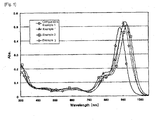
Fig. 1 is a UV/VIS absorption spectrum of vanadyl phthalocyanine compounds prepared in Examples 1~3 and Comparative Example 1. -
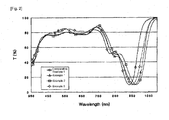
Fig. 2 is a UV/VIS transmission spectrum of vanadyl phthalocyanine compounds prepared in Examples 1~3 and Comparative Example 1. - A more complete appreciation of the invention, and many of the attendant advantages thereof, will be better appreciated by reference to the following detailed description.
- The vanadyl phthalocyanine compound of the present invention is a near-infrared light absorbing compound which has a broad and high absorptivity in the long wavelength region (specifically, 950 to 1100 nm) of a near-infrared wavelength region and has a superior transmittance in a visible wavelength region (specifically, 400 to 700 nm), and is represented by the following
Formula 1.
- In Formula 1, A2, A3, A6, A7, A10, A11, A14 and A15 are SR1. A1, A4, A5, A8, A9, A12, A13 and A16 are independently SR1, OR2, NHR3, NR4R5 or a halogen atom, wherein at least four (4) thereof are OR2, and one to four (1 ~ 4) thereof are NR4R5. R1, R2, R3, R4 and R5 are independently a substituted or unsubstituted alkyl group of 1 to 10 carbon atoms, preferably 1 to 6 carbon atoms, a substituted or unsubstituted aryl group of 6 to 14 carbon atoms, preferably 6 to 10 carbon atoms, or a substituted or unsubstituted aralkyl group of 7 to 20 carbon atoms, preferably 7 to 16 carbon atoms. R4 and R5 can be connected to form a cyclic structure, and in this case, NR4R5 may form a heterocyclic compound of 4 to 20 carbon atoms, preferably 4 to 8 carbon atoms, such as pyrrolidine, piperidine, and so on.
- The vanadyl phthalocyanine compound of the present invention can be prepared by a conventional method for preparing a phthalocyanine compound, and, for example, can be prepared by a high temperature reaction of substituted dicyanobenzene or substituted diiminoisoindoline in the presence of a suitable catalyst. Preferably, the phthalocyanine compound of the present invention can be prepared with substituted dicyanobenzene as disclosed in various papers (for example, Inorg. Chem. 1995, 34, 1636-1637) and patents(for example, Japanese patent Laid-open No.
1997-316049 - Preferably, the vanadyl phthalocyanine compound of the present invention has a maximum absorption wavelength at the region of 950 to 1000 nm, a FWHM(Full Width at Half Maximum) at the maximum absorption wavelength of 50 to 150 nm, and an absorption coefficient (ε, unit: ml/g·cm) of 50,000 to 70,000. In addition, when the transmittance (T%) of the compound of the present invention at the maximum absorption wavelength is 10%, the transmittance (T%) thereof at the visible wavelength region (about 450 nm) is equal to or more than 75%.
- The vanadyl phthalocyanine compound of the present invention can be used for preparing a near-infrared absorption filter according to a conventional method, and the vanadyl phthalocyanine compound works as a pigment of the near-infrared absorption filter. A polymer resin for preparing the near-infrared absorption filter may include almost all conventional transparent polymer resins such as polymethyl methacrylate, polyester, polycarbonate, polyurethane and so on. The polymer resin can be selected according to its heat resistance, weather resistance and so on with considering the specific use of the near-infrared absorption filter. The near-infrared absorption filter can be prepared by the steps of dissolving the near-infrared absorption pigment in a solvent, and then coating the pigment solution on the polymer resin. As the solvent, various solvents such as methylethylketone, tetrahydrofuran, chloroform, toluene, and so on, can be used.
- Hereinafter, examples and comparative examples are provided for specific explanation of the present invention. However, the present invention is not limited to the following examples.
- 10 g of vanadyl (vanadium oxide) phthalocyanine (VOPc: Oxo-Vanadium Phthalocyanine) precursor compound VOPc(PhS)8{2,6-(CH3)2PhO}4F4 (wherein, Ph = phenyl, A2, A3, A6, A7, A10, A11, A14 and A15 of
Formula 1 are PhS) whose UV/VIS maximum absorption wavelength is 797 nm and absorption coefficient (ε) is 103,000 ml/g·cm, was introduced into a 3-neck flask having a reflux condenser, and then reacted with 200 ml of pyrrolidine at 60 °C for 2 hours. After completion of the reaction, the reaction solution was filtered and vacuum-evaporated to obtain vanadyl phthalocyanine compound VOPc(PhS)8{2,6-(CH3)2PhO}4(C4H8N)4. The maximum absorption wavelength of the produced vanadyl phthalocyanine compound was 962 nm, and the absorption coefficient was 61,400 ml/g·cm. - 10g of vanadyl phthalocyanine precursor compound VOPc(4-CH3OPhS)8 {2,6-(CH3)2PhO}4F4 whose UV/VIS maximum absorption wavelength is 803 nm and absorption coefficient(ε) is 96,400 ml/g·cm, was introduced into a 3-neck flask having a reflux condenser, and then reacted with 200 ml of pyrrolidine at 60 °C for 2 hours. After completion of the reaction, the reaction solution was filtered and vacuum-evaporated to obtain vanadyl phthalocyanine compound VOPc(4-CH3OPhS)8{2,6-(CH3)2PhO}4 (C4H8N)4. The maximum absorption wavelength of the produced vanadyl phthalocyanine compound was 972 nm, and the absorption coefficient was 59,200 ml/g·cm.
- 10g of VOPc(PhS)8{2,6-(CH3)2PhO}4F4 was introduced into a 3-neck flask having a reflux condenser, and then reacted with 200 ml of dibutyl amine at 160 °C for 48 hours. After completion of the reaction, the reaction solution was filtered and vacuum-evaporated to obtain vanadyl phthalocyanine compound VOPc(PhS)8 {2,6-(CH3)2PhO}4(C8H18N)4. The maximum absorption wavelength of the produced vanadyl phthalocyanine compound was 954 nm, and the absorption coefficient was 58,300 ml/g·cm.
- 10 g of 3,4,5,6-tetrafluorophthalonitrile, 10 g of thiophenol, and 7 g of potassium fluoride were introduced into a 3-neck flask having a reflux condenser, and 30 ml of acetonitrile was added thereto as a solvent, and the reaction was carried out at room temperature for 12 hours while stirring. After completion of the reaction, 7 g of 2,6-dimethylphenol and 4 g of potassium fluoride were added into the reaction solution, and further reacted for 8 hours while refluxing. After completion of the reaction, the reaction solution was vacuum-evaporated. 20 g of the obtained crude product was added into a 3-neck flask having a reflux condenser, and reacted with 2 g of vanadium trichloride, 2 g of 1-octanol, and 30 g of benzonitrile for 8 hours while refluxing. After completion of the reaction, the reaction solution was vacuum-evaporated to obtain crude vanadyl phthalocyanine precursor VOPc(PhS)8{2,6-(CH3)2PhO}4F4. 10 g of the crude vanadyl phthalocyanine precursor and 50 ml of cyclohexylamine were added into a 3-neck flask having a reflux condenser, and reacted at 60°C for 8 hours. After completion of the reaction, the reaction solution was vacuum-evaporated to obtain vanadyl phthalocyanine compound VOPc(PhS)8{2,6-(CH3)2PhO}4(C6H11NH)4. The maximum absorption wavelength of the produced vanadyl phthalocyanine compound was 932 nm, and the absorption coefficient of the compound was 57,100 ml/g·cm.
- The vanadyl phthalocyanine compounds prepared in Examples 1~3 and Comparative Example 1 were diluted with toluene to the concentration of 10 ppm, and their UV/VIS spectra were measured, respectively. The UV/VIS absorption spectra of the vanadyl phthalocyanine compounds prepared in Examples 1~3 and Comparative Example 1 are shown in
Fig. 1 , and the maximum absorption wavelength and the absorption coefficient (ml/g•cm) were calculated fromFig. 1 . Also, the UV/VIS transmission spectra of the vanadyl phthalocyanine compounds prepared in Examples 1~3 and Comparative Example 1 are shown inFig. 2 , and the maximum absorption wavelength in the near-infrared wavelength region and the transmittance in the visible wavelength region(namely, 455 nm) were calculated fromFig. 2 , and the results were shown in Table 1. In this case, the transmittance in the visible wavelength region means a transmittance when the transmittance at the maximum absorption wavelength is fixed to 10%. FWHM (nm) means a difference between the wavelengths having the absorption coefficient which corresponds to a half of the absorption coefficient at the maximum absorption wavelength.[Table 1] Transmittance (455 nm) Transmittance (Maximum absorption wavelength) FWHM (nm) Absorption coefficient (ml/g·cm) Example 1 78.9% 10% (962 nm) 102 61,400 Example 2 76.5% 10% (972 nm) 98 59,200 Example 3 78.5% 10% (954 nm) 92 58,300 Comparative Example 1 76.7% 10% (932 nm) 79 57,100 - As shown in Table 1, the vanadyl phthalocyanine compounds (Examples 1~3) of the present invention have longer maximum absorption wavelengths, broader FWHMs and larger absorption coefficients than those of the vanadyl phthalocyanine compound of Comparative Example 1. Thus, vanadyl phthalocyanine compound of the present invention has a broad and high absorptivity at the long wavelength region(950 to 1100 nm) in the near-infrared wavelength region and has superior transmittance in the visible wavelength region.
- The vanadyl phthalocyanine compound of the present invention is a near-infrared absorption pigment and is useful for preparing a near-infrared absorption filter.
Claims (2)
- A vanadyl phthalocyanine compound represented by following Formula 1,

- A near-infrared absorption filter comprising a vanadyl phthalocyanine compound of claim 1.
Applications Claiming Priority (2)
| Application Number | Priority Date | Filing Date | Title |
|---|---|---|---|
| KR1020090126778A KR101153787B1 (en) | 2009-12-18 | 2009-12-18 | Vanadyl phthalocyanine compound and near infrared ray absorption filter using the same |
| PCT/KR2010/009015 WO2011074890A2 (en) | 2009-12-18 | 2010-12-16 | Vanadyl phthalocyanine compounds and near-infrared absorption filters using same |
Publications (2)
| Publication Number | Publication Date |
|---|---|
| EP2514755A2 true EP2514755A2 (en) | 2012-10-24 |
| EP2514755A4 EP2514755A4 (en) | 2017-04-26 |
Family
ID=44167877
Family Applications (1)
| Application Number | Title | Priority Date | Filing Date |
|---|---|---|---|
| EP10837886.0A Withdrawn EP2514755A4 (en) | 2009-12-18 | 2010-12-16 | Vanadyl phthalocyanine compounds and near-infrared absorption filters using same |
Country Status (5)
| Country | Link |
|---|---|
| US (1) | US20120271044A1 (en) |
| EP (1) | EP2514755A4 (en) |
| KR (1) | KR101153787B1 (en) |
| CN (1) | CN102762580B (en) |
| WO (1) | WO2011074890A2 (en) |
Families Citing this family (5)
| Publication number | Priority date | Publication date | Assignee | Title |
|---|---|---|---|---|
| CN102637636A (en) | 2011-08-24 | 2012-08-15 | 京东方科技集团股份有限公司 | Organic thin-film transistor array substrate, method for manufacturing same and display device |
| JP6007428B2 (en) * | 2011-10-26 | 2016-10-12 | 山田化学工業株式会社 | Phthalocyanine compound and synthesis method thereof, near-infrared absorbing dye and near-infrared absorbing material |
| JP6016507B2 (en) * | 2012-08-02 | 2016-10-26 | 株式会社日本触媒 | Phthalocyanine compound and infrared cut filter containing the same |
| KR102216990B1 (en) * | 2017-03-29 | 2021-02-22 | 도레이 카부시키가이샤 | Photosensitive composition, cured film, and organic EL display device |
| JP6922361B2 (en) * | 2017-04-07 | 2021-08-18 | Jsr株式会社 | Composition for solid-state image sensor, infrared shielding film and solid-state image sensor |
Family Cites Families (4)
| Publication number | Priority date | Publication date | Assignee | Title |
|---|---|---|---|---|
| CA2005520A1 (en) * | 1988-12-15 | 1990-06-15 | Hisato Itoh | Near infrared absorbent and display/recording materials prepared by using same |
| JP3869040B2 (en) | 1996-05-24 | 2007-01-17 | 山本化成株式会社 | Phthalonitrile compound, process for producing the same, phthalocyanine compound obtained therefrom, and use thereof |
| US7238801B2 (en) * | 2002-06-12 | 2007-07-03 | Nippon Shokubai Co., Ltd. | Phthalocyanine compound, method for production thereof, and near infrared absorbing dye and near infrared absorbing filter using same |
| JP5046515B2 (en) * | 2005-12-19 | 2012-10-10 | 株式会社日本触媒 | Phthalocyanine compound and production method and use thereof |
-
2009
- 2009-12-18 KR KR1020090126778A patent/KR101153787B1/en not_active Expired - Fee Related
-
2010
- 2010-12-16 US US13/516,218 patent/US20120271044A1/en not_active Abandoned
- 2010-12-16 WO PCT/KR2010/009015 patent/WO2011074890A2/en not_active Ceased
- 2010-12-16 EP EP10837886.0A patent/EP2514755A4/en not_active Withdrawn
- 2010-12-16 CN CN201080064114.2A patent/CN102762580B/en not_active Expired - Fee Related
Non-Patent Citations (1)
| Title |
|---|
| See references of WO2011074890A2 * |
Also Published As
| Publication number | Publication date |
|---|---|
| CN102762580B (en) | 2015-08-05 |
| WO2011074890A3 (en) | 2011-11-03 |
| WO2011074890A2 (en) | 2011-06-23 |
| KR101153787B1 (en) | 2012-06-13 |
| EP2514755A4 (en) | 2017-04-26 |
| KR20110070092A (en) | 2011-06-24 |
| US20120271044A1 (en) | 2012-10-25 |
| CN102762580A (en) | 2012-10-31 |
Similar Documents
| Publication | Publication Date | Title |
|---|---|---|
| EP1564260B1 (en) | Coloring matter absorbing near-infrared ray and filter for cutting off near-infrared ray | |
| EP2380893A2 (en) | Copper phthalocyanine compounds and near-infrared absorption filter using the same | |
| US8669358B2 (en) | Vanadium phthalocyanine compounds and near-infrared absorption filter using the same | |
| KR101709800B1 (en) | Near infrared absorbent dye and near infrared shielding filter | |
| US20120271044A1 (en) | Vanadyl phthalocyanine compounds and near-infrared absorption filters using same | |
| US9158048B2 (en) | Diimmonium-based component and near infrared absorption filter using same | |
| JP6007428B2 (en) | Phthalocyanine compound and synthesis method thereof, near-infrared absorbing dye and near-infrared absorbing material | |
| JP5046515B2 (en) | Phthalocyanine compound and production method and use thereof | |
| KR101677574B1 (en) | Phthalocyanine compound and near infrared ray absorption filter using the same | |
| EP1870438A1 (en) | Phthalocyanine compound, process for producing the same, and colored composition containing the phthalocyanine compound | |
| JP2000063691A (en) | Phthalocyanine compound and near infrared-absorbing colorant prepared by using same | |
| KR101163656B1 (en) | Diimmonium salt oligomer, preparation method and usage thereof | |
| KR20130060730A (en) | Near-infrared absorbing compound and uses of the same | |
| KR20250091741A (en) | Absorber | |
| KR20100022573A (en) | Di-(4-vinylpyridine) metal phthalocyanine compound, composition having the same, and method for preparing thereof |
Legal Events
| Date | Code | Title | Description |
|---|---|---|---|
| PUAI | Public reference made under article 153(3) epc to a published international application that has entered the european phase |
Free format text: ORIGINAL CODE: 0009012 |
|
| 17P | Request for examination filed |
Effective date: 20120625 |
|
| AK | Designated contracting states |
Kind code of ref document: A2 Designated state(s): AL AT BE BG CH CY CZ DE DK EE ES FI FR GB GR HR HU IE IS IT LI LT LU LV MC MK MT NL NO PL PT RO RS SE SI SK SM TR |
|
| DAX | Request for extension of the european patent (deleted) | ||
| A4 | Supplementary search report drawn up and despatched |
Effective date: 20170328 |
|
| RIC1 | Information provided on ipc code assigned before grant |
Ipc: G02B 5/22 20060101ALI20170322BHEP Ipc: C07F 9/00 20060101AFI20170322BHEP |
|
| STAA | Information on the status of an ep patent application or granted ep patent |
Free format text: STATUS: THE APPLICATION IS DEEMED TO BE WITHDRAWN |
|
| 18D | Application deemed to be withdrawn |
Effective date: 20171031 |