EP2511319A1 - Polyester resin for toner, toner, developer, toner cartridge, process cartridge, and image forming apparatus - Google Patents
Polyester resin for toner, toner, developer, toner cartridge, process cartridge, and image forming apparatus Download PDFInfo
- Publication number
- EP2511319A1 EP2511319A1 EP11190248A EP11190248A EP2511319A1 EP 2511319 A1 EP2511319 A1 EP 2511319A1 EP 11190248 A EP11190248 A EP 11190248A EP 11190248 A EP11190248 A EP 11190248A EP 2511319 A1 EP2511319 A1 EP 2511319A1
- Authority
- EP
- European Patent Office
- Prior art keywords
- toner
- rosin
- parts
- groups
- polyester resin
- Prior art date
- Legal status (The legal status is an assumption and is not a legal conclusion. Google has not performed a legal analysis and makes no representation as to the accuracy of the status listed.)
- Withdrawn
Links
- 229920001225 polyester resin Polymers 0.000 title claims abstract description 48
- 239000004645 polyester resin Substances 0.000 title claims abstract description 48
- 238000000034 method Methods 0.000 title claims description 87
- 230000008569 process Effects 0.000 title claims description 56
- RSWGJHLUYNHPMX-UHFFFAOYSA-N Abietic-Saeure Natural products C12CCC(C(C)C)=CC2=CCC2C1(C)CCCC2(C)C(O)=O RSWGJHLUYNHPMX-UHFFFAOYSA-N 0.000 claims abstract description 133
- KHPCPRHQVVSZAH-HUOMCSJISA-N Rosin Natural products O(C/C=C/c1ccccc1)[C@H]1[C@H](O)[C@@H](O)[C@@H](O)[C@@H](CO)O1 KHPCPRHQVVSZAH-HUOMCSJISA-N 0.000 claims abstract description 130
- KHPCPRHQVVSZAH-UHFFFAOYSA-N trans-cinnamyl beta-D-glucopyranoside Natural products OC1C(O)C(O)C(CO)OC1OCC=CC1=CC=CC=C1 KHPCPRHQVVSZAH-UHFFFAOYSA-N 0.000 claims abstract description 130
- 150000002009 diols Chemical class 0.000 claims abstract description 55
- 125000002947 alkylene group Chemical group 0.000 claims abstract description 24
- 125000004185 ester group Chemical group 0.000 claims abstract description 17
- OFOBLEOULBTSOW-UHFFFAOYSA-N Malonic acid Chemical compound OC(=O)CC(O)=O OFOBLEOULBTSOW-UHFFFAOYSA-N 0.000 claims abstract description 12
- 125000004122 cyclic group Chemical group 0.000 claims abstract description 11
- 125000000732 arylene group Chemical group 0.000 claims abstract description 7
- 125000004435 hydrogen atom Chemical group [H]* 0.000 claims abstract description 6
- 125000002496 methyl group Chemical group [H]C([H])([H])* 0.000 claims abstract description 6
- 125000002915 carbonyl group Chemical group [*:2]C([*:1])=O 0.000 claims abstract description 5
- 125000001033 ether group Chemical group 0.000 claims abstract description 5
- 125000005647 linker group Chemical group 0.000 claims abstract description 5
- 125000000472 sulfonyl group Chemical group *S(*)(=O)=O 0.000 claims abstract description 5
- 238000012546 transfer Methods 0.000 claims description 61
- 150000001875 compounds Chemical class 0.000 claims description 36
- 239000002253 acid Substances 0.000 claims description 30
- 239000004593 Epoxy Substances 0.000 claims description 25
- 239000007795 chemical reaction product Substances 0.000 claims description 15
- 238000007600 charging Methods 0.000 claims description 9
- OKTJSMMVPCPJKN-UHFFFAOYSA-N Carbon Chemical compound [C] OKTJSMMVPCPJKN-UHFFFAOYSA-N 0.000 claims description 6
- 229910052799 carbon Inorganic materials 0.000 claims description 6
- 239000002245 particle Substances 0.000 description 36
- 229920000728 polyester Polymers 0.000 description 36
- 230000015572 biosynthetic process Effects 0.000 description 33
- 238000006243 chemical reaction Methods 0.000 description 31
- 238000004898 kneading Methods 0.000 description 31
- 238000003786 synthesis reaction Methods 0.000 description 30
- -1 2-ethylhexyl Chemical group 0.000 description 28
- 239000000463 material Substances 0.000 description 26
- 229920005989 resin Polymers 0.000 description 26
- 239000011347 resin Substances 0.000 description 26
- KKEYFWRCBNTPAC-UHFFFAOYSA-N Terephthalic acid Chemical compound OC(=O)C1=CC=C(C(O)=O)C=C1 KKEYFWRCBNTPAC-UHFFFAOYSA-N 0.000 description 24
- 238000004519 manufacturing process Methods 0.000 description 20
- 239000000203 mixture Substances 0.000 description 20
- 239000000049 pigment Substances 0.000 description 20
- 239000000047 product Substances 0.000 description 16
- IISBACLAFKSPIT-UHFFFAOYSA-N bisphenol A Chemical compound C=1C=C(O)C=CC=1C(C)(C)C1=CC=C(O)C=C1 IISBACLAFKSPIT-UHFFFAOYSA-N 0.000 description 15
- 239000000843 powder Substances 0.000 description 15
- VYPSYNLAJGMNEJ-UHFFFAOYSA-N Silicium dioxide Chemical compound O=[Si]=O VYPSYNLAJGMNEJ-UHFFFAOYSA-N 0.000 description 13
- 125000003700 epoxy group Chemical group 0.000 description 13
- 239000000126 substance Substances 0.000 description 13
- 230000001476 alcoholic effect Effects 0.000 description 12
- 239000003086 colorant Substances 0.000 description 12
- 238000004140 cleaning Methods 0.000 description 11
- 238000001816 cooling Methods 0.000 description 11
- GYZLOYUZLJXAJU-UHFFFAOYSA-N diglycidyl ether Chemical class C1OC1COCC1CO1 GYZLOYUZLJXAJU-UHFFFAOYSA-N 0.000 description 11
- 238000010298 pulverizing process Methods 0.000 description 11
- 239000011230 binding agent Substances 0.000 description 10
- 239000002609 medium Substances 0.000 description 10
- KWYUFKZDYYNOTN-UHFFFAOYSA-M Potassium hydroxide Chemical compound [OH-].[K+] KWYUFKZDYYNOTN-UHFFFAOYSA-M 0.000 description 9
- 239000012736 aqueous medium Substances 0.000 description 9
- 239000003054 catalyst Substances 0.000 description 9
- 239000007809 chemical reaction catalyst Substances 0.000 description 9
- 239000003795 chemical substances by application Substances 0.000 description 9
- 230000009477 glass transition Effects 0.000 description 9
- LYCAIKOWRPUZTN-UHFFFAOYSA-N Ethylene glycol Chemical compound OCCO LYCAIKOWRPUZTN-UHFFFAOYSA-N 0.000 description 8
- 230000007613 environmental effect Effects 0.000 description 8
- QQVIHTHCMHWDBS-UHFFFAOYSA-N isophthalic acid Chemical compound OC(=O)C1=CC=CC(C(O)=O)=C1 QQVIHTHCMHWDBS-UHFFFAOYSA-N 0.000 description 8
- 239000011342 resin composition Substances 0.000 description 8
- 239000000243 solution Substances 0.000 description 8
- 239000011572 manganese Substances 0.000 description 7
- 239000002904 solvent Substances 0.000 description 7
- PXHVJJICTQNCMI-UHFFFAOYSA-N Nickel Chemical compound [Ni] PXHVJJICTQNCMI-UHFFFAOYSA-N 0.000 description 6
- HEMHJVSKTPXQMS-UHFFFAOYSA-M Sodium hydroxide Chemical compound [OH-].[Na+] HEMHJVSKTPXQMS-UHFFFAOYSA-M 0.000 description 6
- 150000007513 acids Chemical class 0.000 description 6
- MTHSVFCYNBDYFN-UHFFFAOYSA-N diethylene glycol Chemical compound OCCOCCO MTHSVFCYNBDYFN-UHFFFAOYSA-N 0.000 description 6
- 238000004821 distillation Methods 0.000 description 6
- 238000005984 hydrogenation reaction Methods 0.000 description 6
- 238000005259 measurement Methods 0.000 description 6
- 229910052751 metal Inorganic materials 0.000 description 6
- 239000002184 metal Substances 0.000 description 6
- 238000006068 polycondensation reaction Methods 0.000 description 6
- 239000002994 raw material Substances 0.000 description 6
- 239000000377 silicon dioxide Substances 0.000 description 6
- XLYOFNOQVPJJNP-UHFFFAOYSA-N water Substances O XLYOFNOQVPJJNP-UHFFFAOYSA-N 0.000 description 6
- PXKLMJQFEQBVLD-UHFFFAOYSA-N bisphenol F Chemical compound C1=CC(O)=CC=C1CC1=CC=C(O)C=C1 PXKLMJQFEQBVLD-UHFFFAOYSA-N 0.000 description 5
- 125000003178 carboxy group Chemical group [H]OC(*)=O 0.000 description 5
- 235000010187 litholrubine BK Nutrition 0.000 description 5
- 229910001220 stainless steel Inorganic materials 0.000 description 5
- 239000010935 stainless steel Substances 0.000 description 5
- DNIAPMSPPWPWGF-VKHMYHEASA-N (+)-propylene glycol Chemical compound C[C@H](O)CO DNIAPMSPPWPWGF-VKHMYHEASA-N 0.000 description 4
- PUPZLCDOIYMWBV-UHFFFAOYSA-N (+/-)-1,3-Butanediol Chemical compound CC(O)CCO PUPZLCDOIYMWBV-UHFFFAOYSA-N 0.000 description 4
- YPFDHNVEDLHUCE-UHFFFAOYSA-N 1,3-propanediol Substances OCCCO YPFDHNVEDLHUCE-UHFFFAOYSA-N 0.000 description 4
- IJGRMHOSHXDMSA-UHFFFAOYSA-N Atomic nitrogen Chemical compound N#N IJGRMHOSHXDMSA-UHFFFAOYSA-N 0.000 description 4
- WYURNTSHIVDZCO-UHFFFAOYSA-N Tetrahydrofuran Chemical compound C1CCOC1 WYURNTSHIVDZCO-UHFFFAOYSA-N 0.000 description 4
- 239000000654 additive Substances 0.000 description 4
- WERYXYBDKMZEQL-UHFFFAOYSA-N butane-1,4-diol Chemical compound OCCCCO WERYXYBDKMZEQL-UHFFFAOYSA-N 0.000 description 4
- 150000001732 carboxylic acid derivatives Chemical class 0.000 description 4
- 230000000052 comparative effect Effects 0.000 description 4
- XCJYREBRNVKWGJ-UHFFFAOYSA-N copper(II) phthalocyanine Chemical compound [Cu+2].C12=CC=CC=C2C(N=C2[N-]C(C3=CC=CC=C32)=N2)=NC1=NC([C]1C=CC=CC1=1)=NC=1N=C1[C]3C=CC=CC3=C2[N-]1 XCJYREBRNVKWGJ-UHFFFAOYSA-N 0.000 description 4
- 238000010438 heat treatment Methods 0.000 description 4
- 125000002887 hydroxy group Chemical group [H]O* 0.000 description 4
- 239000010410 layer Substances 0.000 description 4
- XNGIFLGASWRNHJ-UHFFFAOYSA-N phthalic acid Chemical compound OC(=O)C1=CC=CC=C1C(O)=O XNGIFLGASWRNHJ-UHFFFAOYSA-N 0.000 description 4
- BASFCYQUMIYNBI-UHFFFAOYSA-N platinum Chemical compound [Pt] BASFCYQUMIYNBI-UHFFFAOYSA-N 0.000 description 4
- 229920000233 poly(alkylene oxides) Polymers 0.000 description 4
- 229920000166 polytrimethylene carbonate Polymers 0.000 description 4
- 238000010334 sieve classification Methods 0.000 description 4
- MHVJRKBZMUDEEV-UHFFFAOYSA-N (-)-ent-pimara-8(14),15-dien-19-oic acid Natural products C1CCC(C(O)=O)(C)C2C1(C)C1CCC(C=C)(C)C=C1CC2 MHVJRKBZMUDEEV-UHFFFAOYSA-N 0.000 description 3
- PMYDPQQPEAYXKD-UHFFFAOYSA-N 3-hydroxy-n-naphthalen-2-ylnaphthalene-2-carboxamide Chemical compound C1=CC=CC2=CC(NC(=O)C3=CC4=CC=CC=C4C=C3O)=CC=C21 PMYDPQQPEAYXKD-UHFFFAOYSA-N 0.000 description 3
- VPWNQTHUCYMVMZ-UHFFFAOYSA-N 4,4'-sulfonyldiphenol Chemical compound C1=CC(O)=CC=C1S(=O)(=O)C1=CC=C(O)C=C1 VPWNQTHUCYMVMZ-UHFFFAOYSA-N 0.000 description 3
- BTXXTMOWISPQSJ-UHFFFAOYSA-N 4,4,4-trifluorobutan-2-one Chemical compound CC(=O)CC(F)(F)F BTXXTMOWISPQSJ-UHFFFAOYSA-N 0.000 description 3
- BQACOLQNOUYJCE-FYZZASKESA-N Abietic acid Natural products CC(C)C1=CC2=CC[C@]3(C)[C@](C)(CCC[C@@]3(C)C(=O)O)[C@H]2CC1 BQACOLQNOUYJCE-FYZZASKESA-N 0.000 description 3
- UHOVQNZJYSORNB-UHFFFAOYSA-N Benzene Chemical compound C1=CC=CC=C1 UHOVQNZJYSORNB-UHFFFAOYSA-N 0.000 description 3
- RTZKZFJDLAIYFH-UHFFFAOYSA-N Diethyl ether Chemical compound CCOCC RTZKZFJDLAIYFH-UHFFFAOYSA-N 0.000 description 3
- LFQSCWFLJHTTHZ-UHFFFAOYSA-N Ethanol Chemical compound CCO LFQSCWFLJHTTHZ-UHFFFAOYSA-N 0.000 description 3
- XEKOWRVHYACXOJ-UHFFFAOYSA-N Ethyl acetate Chemical compound CCOC(C)=O XEKOWRVHYACXOJ-UHFFFAOYSA-N 0.000 description 3
- VZCYOOQTPOCHFL-OWOJBTEDSA-N Fumaric acid Chemical compound OC(=O)\C=C\C(O)=O VZCYOOQTPOCHFL-OWOJBTEDSA-N 0.000 description 3
- IMNFDUFMRHMDMM-UHFFFAOYSA-N N-Heptane Chemical compound CCCCCCC IMNFDUFMRHMDMM-UHFFFAOYSA-N 0.000 description 3
- MUBZPKHOEPUJKR-UHFFFAOYSA-N Oxalic acid Chemical compound OC(=O)C(O)=O MUBZPKHOEPUJKR-UHFFFAOYSA-N 0.000 description 3
- GWEVSGVZZGPLCZ-UHFFFAOYSA-N Titan oxide Chemical compound O=[Ti]=O GWEVSGVZZGPLCZ-UHFFFAOYSA-N 0.000 description 3
- RTAQQCXQSZGOHL-UHFFFAOYSA-N Titanium Chemical compound [Ti] RTAQQCXQSZGOHL-UHFFFAOYSA-N 0.000 description 3
- YXFVVABEGXRONW-UHFFFAOYSA-N Toluene Chemical compound CC1=CC=CC=C1 YXFVVABEGXRONW-UHFFFAOYSA-N 0.000 description 3
- WNLRTRBMVRJNCN-UHFFFAOYSA-N adipic acid Chemical compound OC(=O)CCCCC(O)=O WNLRTRBMVRJNCN-UHFFFAOYSA-N 0.000 description 3
- 239000007864 aqueous solution Substances 0.000 description 3
- 238000010276 construction Methods 0.000 description 3
- 239000006185 dispersion Substances 0.000 description 3
- 238000007323 disproportionation reaction Methods 0.000 description 3
- 230000032050 esterification Effects 0.000 description 3
- 238000005886 esterification reaction Methods 0.000 description 3
- 230000007062 hydrolysis Effects 0.000 description 3
- 238000006460 hydrolysis reaction Methods 0.000 description 3
- 239000007788 liquid Substances 0.000 description 3
- 238000002156 mixing Methods 0.000 description 3
- 239000000178 monomer Substances 0.000 description 3
- DNIAPMSPPWPWGF-UHFFFAOYSA-N monopropylene glycol Natural products CC(O)CO DNIAPMSPPWPWGF-UHFFFAOYSA-N 0.000 description 3
- SLCVBVWXLSEKPL-UHFFFAOYSA-N neopentyl glycol Chemical compound OCC(C)(C)CO SLCVBVWXLSEKPL-UHFFFAOYSA-N 0.000 description 3
- 229910052759 nickel Inorganic materials 0.000 description 3
- 239000012299 nitrogen atmosphere Substances 0.000 description 3
- 235000013772 propylene glycol Nutrition 0.000 description 3
- 238000007142 ring opening reaction Methods 0.000 description 3
- 238000003756 stirring Methods 0.000 description 3
- 238000012360 testing method Methods 0.000 description 3
- VZCYOOQTPOCHFL-UHFFFAOYSA-N trans-butenedioic acid Natural products OC(=O)C=CC(O)=O VZCYOOQTPOCHFL-UHFFFAOYSA-N 0.000 description 3
- 230000032258 transport Effects 0.000 description 3
- DNIAPMSPPWPWGF-GSVOUGTGSA-N (R)-(-)-Propylene glycol Chemical compound C[C@@H](O)CO DNIAPMSPPWPWGF-GSVOUGTGSA-N 0.000 description 2
- ALVZNPYWJMLXKV-UHFFFAOYSA-N 1,9-Nonanediol Chemical compound OCCCCCCCCCO ALVZNPYWJMLXKV-UHFFFAOYSA-N 0.000 description 2
- 238000005160 1H NMR spectroscopy Methods 0.000 description 2
- XKZQKPRCPNGNFR-UHFFFAOYSA-N 2-(3-hydroxyphenyl)phenol Chemical compound OC1=CC=CC(C=2C(=CC=CC=2)O)=C1 XKZQKPRCPNGNFR-UHFFFAOYSA-N 0.000 description 2
- WVRNUXJQQFPNMN-VAWYXSNFSA-N 3-[(e)-dodec-1-enyl]oxolane-2,5-dione Chemical compound CCCCCCCCCC\C=C\C1CC(=O)OC1=O WVRNUXJQQFPNMN-VAWYXSNFSA-N 0.000 description 2
- MXYATHGRPJZBNA-UHFFFAOYSA-N 4-epi-isopimaric acid Natural products C1CCC(C(O)=O)(C)C2C1(C)C1CCC(C=C)(C)CC1=CC2 MXYATHGRPJZBNA-UHFFFAOYSA-N 0.000 description 2
- ZCYVEMRRCGMTRW-UHFFFAOYSA-N 7553-56-2 Chemical compound [I] ZCYVEMRRCGMTRW-UHFFFAOYSA-N 0.000 description 2
- CSCPPACGZOOCGX-UHFFFAOYSA-N Acetone Chemical compound CC(C)=O CSCPPACGZOOCGX-UHFFFAOYSA-N 0.000 description 2
- 0 CC(C1)[C@]1C1=C(CC2)C2C*1 Chemical compound CC(C1)[C@]1C1=C(CC2)C2C*1 0.000 description 2
- VTYYLEPIZMXCLO-UHFFFAOYSA-L Calcium carbonate Chemical compound [Ca+2].[O-]C([O-])=O VTYYLEPIZMXCLO-UHFFFAOYSA-L 0.000 description 2
- HEDRZPFGACZZDS-UHFFFAOYSA-N Chloroform Chemical compound ClC(Cl)Cl HEDRZPFGACZZDS-UHFFFAOYSA-N 0.000 description 2
- XDTMQSROBMDMFD-UHFFFAOYSA-N Cyclohexane Chemical compound C1CCCCC1 XDTMQSROBMDMFD-UHFFFAOYSA-N 0.000 description 2
- QUUCYKKMFLJLFS-UHFFFAOYSA-N Dehydroabietan Natural products CC1(C)CCCC2(C)C3=CC=C(C(C)C)C=C3CCC21 QUUCYKKMFLJLFS-UHFFFAOYSA-N 0.000 description 2
- NFWKVWVWBFBAOV-UHFFFAOYSA-N Dehydroabietic acid Natural products OC(=O)C1(C)CCCC2(C)C3=CC=C(C(C)C)C=C3CCC21 NFWKVWVWBFBAOV-UHFFFAOYSA-N 0.000 description 2
- IAZDPXIOMUYVGZ-WFGJKAKNSA-N Dimethyl sulfoxide Chemical compound [2H]C([2H])([2H])S(=O)C([2H])([2H])[2H] IAZDPXIOMUYVGZ-WFGJKAKNSA-N 0.000 description 2
- IAYPIBMASNFSPL-UHFFFAOYSA-N Ethylene oxide Chemical group C1CO1 IAYPIBMASNFSPL-UHFFFAOYSA-N 0.000 description 2
- XLYOFNOQVPJJNP-ZSJDYOACSA-N Heavy water Chemical compound [2H]O[2H] XLYOFNOQVPJJNP-ZSJDYOACSA-N 0.000 description 2
- UQSXHKLRYXJYBZ-UHFFFAOYSA-N Iron oxide Chemical compound [Fe]=O UQSXHKLRYXJYBZ-UHFFFAOYSA-N 0.000 description 2
- ALQSHHUCVQOPAS-UHFFFAOYSA-N Pentane-1,5-diol Chemical compound OCCCCCO ALQSHHUCVQOPAS-UHFFFAOYSA-N 0.000 description 2
- 235000008331 Pinus X rigitaeda Nutrition 0.000 description 2
- 235000011613 Pinus brutia Nutrition 0.000 description 2
- 241000018646 Pinus brutia Species 0.000 description 2
- 239000002202 Polyethylene glycol Substances 0.000 description 2
- 239000004793 Polystyrene Substances 0.000 description 2
- GOOHAUXETOMSMM-UHFFFAOYSA-N Propylene oxide Chemical compound CC1CO1 GOOHAUXETOMSMM-UHFFFAOYSA-N 0.000 description 2
- XLOMVQKBTHCTTD-UHFFFAOYSA-N Zinc monoxide Chemical compound [Zn]=O XLOMVQKBTHCTTD-UHFFFAOYSA-N 0.000 description 2
- DSVGQVZAZSZEEX-UHFFFAOYSA-N [C].[Pt] Chemical compound [C].[Pt] DSVGQVZAZSZEEX-UHFFFAOYSA-N 0.000 description 2
- 230000000996 additive effect Effects 0.000 description 2
- 239000001361 adipic acid Substances 0.000 description 2
- 235000011037 adipic acid Nutrition 0.000 description 2
- 230000002411 adverse Effects 0.000 description 2
- 150000001298 alcohols Chemical class 0.000 description 2
- PNEYBMLMFCGWSK-UHFFFAOYSA-N aluminium oxide Inorganic materials [O-2].[O-2].[O-2].[Al+3].[Al+3] PNEYBMLMFCGWSK-UHFFFAOYSA-N 0.000 description 2
- ADCOVFLJGNWWNZ-UHFFFAOYSA-N antimony trioxide Chemical compound O=[Sb]O[Sb]=O ADCOVFLJGNWWNZ-UHFFFAOYSA-N 0.000 description 2
- 125000003118 aryl group Chemical group 0.000 description 2
- TZCXTZWJZNENPQ-UHFFFAOYSA-L barium sulfate Chemical compound [Ba+2].[O-]S([O-])(=O)=O TZCXTZWJZNENPQ-UHFFFAOYSA-L 0.000 description 2
- 239000012267 brine Substances 0.000 description 2
- 239000006229 carbon black Substances 0.000 description 2
- NFWKVWVWBFBAOV-MISYRCLQSA-N dehydroabietic acid Chemical compound OC(=O)[C@]1(C)CCC[C@]2(C)C3=CC=C(C(C)C)C=C3CC[C@H]21 NFWKVWVWBFBAOV-MISYRCLQSA-N 0.000 description 2
- 229940118781 dehydroabietic acid Drugs 0.000 description 2
- 230000006866 deterioration Effects 0.000 description 2
- 238000011161 development Methods 0.000 description 2
- 238000010586 diagram Methods 0.000 description 2
- 238000000605 extraction Methods 0.000 description 2
- 239000001530 fumaric acid Substances 0.000 description 2
- XXMIOPMDWAUFGU-UHFFFAOYSA-N hexane-1,6-diol Chemical compound OCCCCCCO XXMIOPMDWAUFGU-UHFFFAOYSA-N 0.000 description 2
- UCNNJGDEJXIUCC-UHFFFAOYSA-L hydroxy(oxo)iron;iron Chemical compound [Fe].O[Fe]=O.O[Fe]=O UCNNJGDEJXIUCC-UHFFFAOYSA-L 0.000 description 2
- 239000011261 inert gas Substances 0.000 description 2
- 150000004694 iodide salts Chemical class 0.000 description 2
- 239000011630 iodine Substances 0.000 description 2
- 229910052740 iodine Inorganic materials 0.000 description 2
- BQZGVMWPHXIKEQ-UHFFFAOYSA-L iron(ii) iodide Chemical compound [Fe+2].[I-].[I-] BQZGVMWPHXIKEQ-UHFFFAOYSA-L 0.000 description 2
- MXYATHGRPJZBNA-KRFUXDQASA-N isopimaric acid Chemical compound [C@H]1([C@](CCC2)(C)C(O)=O)[C@@]2(C)[C@H]2CC[C@@](C=C)(C)CC2=CC1 MXYATHGRPJZBNA-KRFUXDQASA-N 0.000 description 2
- 239000000314 lubricant Substances 0.000 description 2
- 230000007246 mechanism Effects 0.000 description 2
- 238000002844 melting Methods 0.000 description 2
- 230000008018 melting Effects 0.000 description 2
- UKVIEHSSVKSQBA-UHFFFAOYSA-N methane;palladium Chemical compound C.[Pd] UKVIEHSSVKSQBA-UHFFFAOYSA-N 0.000 description 2
- RPNNPZHFJPXFQS-UHFFFAOYSA-N methane;rhodium Chemical compound C.[Rh] RPNNPZHFJPXFQS-UHFFFAOYSA-N 0.000 description 2
- 238000001000 micrograph Methods 0.000 description 2
- VLKZOEOYAKHREP-UHFFFAOYSA-N n-Hexane Chemical compound CCCCCC VLKZOEOYAKHREP-UHFFFAOYSA-N 0.000 description 2
- 229910052757 nitrogen Inorganic materials 0.000 description 2
- BDJRBEYXGGNYIS-UHFFFAOYSA-N nonanedioic acid Chemical compound OC(=O)CCCCCCCC(O)=O BDJRBEYXGGNYIS-UHFFFAOYSA-N 0.000 description 2
- KJFMBFZCATUALV-UHFFFAOYSA-N phenolphthalein Chemical compound C1=CC(O)=CC=C1C1(C=2C=CC(O)=CC=2)C2=CC=CC=C2C(=O)O1 KJFMBFZCATUALV-UHFFFAOYSA-N 0.000 description 2
- 229910052697 platinum Inorganic materials 0.000 description 2
- 229920001223 polyethylene glycol Polymers 0.000 description 2
- 229920001451 polypropylene glycol Polymers 0.000 description 2
- 229920002223 polystyrene Polymers 0.000 description 2
- 238000000746 purification Methods 0.000 description 2
- 239000000376 reactant Substances 0.000 description 2
- 238000001953 recrystallisation Methods 0.000 description 2
- GHMLBKRAJCXXBS-UHFFFAOYSA-N resorcinol Chemical compound OC1=CC=CC(O)=C1 GHMLBKRAJCXXBS-UHFFFAOYSA-N 0.000 description 2
- YGSDEFSMJLZEOE-UHFFFAOYSA-N salicylic acid Chemical compound OC(=O)C1=CC=CC=C1O YGSDEFSMJLZEOE-UHFFFAOYSA-N 0.000 description 2
- CXMXRPHRNRROMY-UHFFFAOYSA-N sebacic acid Chemical compound OC(=O)CCCCCCCCC(O)=O CXMXRPHRNRROMY-UHFFFAOYSA-N 0.000 description 2
- HPALAKNZSZLMCH-UHFFFAOYSA-M sodium;chloride;hydrate Chemical compound O.[Na+].[Cl-] HPALAKNZSZLMCH-UHFFFAOYSA-M 0.000 description 2
- 235000011044 succinic acid Nutrition 0.000 description 2
- HWCKGOZZJDHMNC-UHFFFAOYSA-M tetraethylammonium bromide Chemical compound [Br-].CC[N+](CC)(CC)CC HWCKGOZZJDHMNC-UHFFFAOYSA-M 0.000 description 2
- YLQBMQCUIZJEEH-UHFFFAOYSA-N tetrahydrofuran Natural products C=1C=COC=1 YLQBMQCUIZJEEH-UHFFFAOYSA-N 0.000 description 2
- 229910052719 titanium Inorganic materials 0.000 description 2
- 239000010936 titanium Substances 0.000 description 2
- ZIBGPFATKBEMQZ-UHFFFAOYSA-N triethylene glycol Chemical compound OCCOCCOCCO ZIBGPFATKBEMQZ-UHFFFAOYSA-N 0.000 description 2
- GETQZCLCWQTVFV-UHFFFAOYSA-N trimethylamine Chemical compound CN(C)C GETQZCLCWQTVFV-UHFFFAOYSA-N 0.000 description 2
- RIOQSEWOXXDEQQ-UHFFFAOYSA-N triphenylphosphine Chemical compound C1=CC=CC=C1P(C=1C=CC=CC=1)C1=CC=CC=C1 RIOQSEWOXXDEQQ-UHFFFAOYSA-N 0.000 description 2
- 229910000859 α-Fe Inorganic materials 0.000 description 2
- MHVJRKBZMUDEEV-APQLOABGSA-N (+)-Pimaric acid Chemical compound [C@H]1([C@](CCC2)(C)C(O)=O)[C@@]2(C)[C@H]2CC[C@](C=C)(C)C=C2CC1 MHVJRKBZMUDEEV-APQLOABGSA-N 0.000 description 1
- 125000006832 (C1-C10) alkylene group Chemical group 0.000 description 1
- 125000006273 (C1-C3) alkyl group Chemical group 0.000 description 1
- 125000004209 (C1-C8) alkyl group Chemical group 0.000 description 1
- XVOUMQNXTGKGMA-OWOJBTEDSA-N (E)-glutaconic acid Chemical compound OC(=O)C\C=C\C(O)=O XVOUMQNXTGKGMA-OWOJBTEDSA-N 0.000 description 1
- UWFRVQVNYNPBEF-UHFFFAOYSA-N 1-(2,4-dimethylphenyl)propan-1-one Chemical compound CCC(=O)C1=CC=C(C)C=C1C UWFRVQVNYNPBEF-UHFFFAOYSA-N 0.000 description 1
- OSNILPMOSNGHLC-UHFFFAOYSA-N 1-[4-methoxy-3-(piperidin-1-ylmethyl)phenyl]ethanone Chemical compound COC1=CC=C(C(C)=O)C=C1CN1CCCCC1 OSNILPMOSNGHLC-UHFFFAOYSA-N 0.000 description 1
- JCTXKRPTIMZBJT-UHFFFAOYSA-N 2,2,4-trimethylpentane-1,3-diol Chemical compound CC(C)C(O)C(C)(C)CO JCTXKRPTIMZBJT-UHFFFAOYSA-N 0.000 description 1
- ZJWDJIVISLUQQZ-UHFFFAOYSA-N 2,4-dimethylpentane-1,5-diol Chemical compound OCC(C)CC(C)CO ZJWDJIVISLUQQZ-UHFFFAOYSA-N 0.000 description 1
- JAHNSTQSQJOJLO-UHFFFAOYSA-N 2-(3-fluorophenyl)-1h-imidazole Chemical compound FC1=CC=CC(C=2NC=CN=2)=C1 JAHNSTQSQJOJLO-UHFFFAOYSA-N 0.000 description 1
- BXGYYDRIMBPOMN-UHFFFAOYSA-N 2-(hydroxymethoxy)ethoxymethanol Chemical compound OCOCCOCO BXGYYDRIMBPOMN-UHFFFAOYSA-N 0.000 description 1
- RWLALWYNXFYRGW-UHFFFAOYSA-N 2-Ethyl-1,3-hexanediol Chemical compound CCCC(O)C(CC)CO RWLALWYNXFYRGW-UHFFFAOYSA-N 0.000 description 1
- FWLHAQYOFMQTHQ-UHFFFAOYSA-N 2-N-[8-[[8-(4-aminoanilino)-10-phenylphenazin-10-ium-2-yl]amino]-10-phenylphenazin-10-ium-2-yl]-8-N,10-diphenylphenazin-10-ium-2,8-diamine hydroxy-oxido-dioxochromium Chemical compound O[Cr]([O-])(=O)=O.O[Cr]([O-])(=O)=O.O[Cr]([O-])(=O)=O.Nc1ccc(Nc2ccc3nc4ccc(Nc5ccc6nc7ccc(Nc8ccc9nc%10ccc(Nc%11ccccc%11)cc%10[n+](-c%10ccccc%10)c9c8)cc7[n+](-c7ccccc7)c6c5)cc4[n+](-c4ccccc4)c3c2)cc1 FWLHAQYOFMQTHQ-UHFFFAOYSA-N 0.000 description 1
- AOBIOSPNXBMOAT-UHFFFAOYSA-N 2-[2-(oxiran-2-ylmethoxy)ethoxymethyl]oxirane Chemical compound C1OC1COCCOCC1CO1 AOBIOSPNXBMOAT-UHFFFAOYSA-N 0.000 description 1
- DSKYSDCYIODJPC-UHFFFAOYSA-N 2-butyl-2-ethylpropane-1,3-diol Chemical compound CCCCC(CC)(CO)CO DSKYSDCYIODJPC-UHFFFAOYSA-N 0.000 description 1
- VNAWKNVDKFZFSU-UHFFFAOYSA-N 2-ethyl-2-methylpropane-1,3-diol Chemical compound CCC(C)(CO)CO VNAWKNVDKFZFSU-UHFFFAOYSA-N 0.000 description 1
- LXBGSDVWAMZHDD-UHFFFAOYSA-N 2-methyl-1h-imidazole Chemical compound CC1=NC=CN1 LXBGSDVWAMZHDD-UHFFFAOYSA-N 0.000 description 1
- 125000003229 2-methylhexyl group Chemical group [H]C([H])([H])C([H])([H])C([H])([H])C([H])([H])C([H])(C([H])([H])[H])C([H])([H])* 0.000 description 1
- QWGRWMMWNDWRQN-UHFFFAOYSA-N 2-methylpropane-1,3-diol Chemical compound OCC(C)CO QWGRWMMWNDWRQN-UHFFFAOYSA-N 0.000 description 1
- YLZOPXRUQYQQID-UHFFFAOYSA-N 3-(2,4,6,7-tetrahydrotriazolo[4,5-c]pyridin-5-yl)-1-[4-[2-[[3-(trifluoromethoxy)phenyl]methylamino]pyrimidin-5-yl]piperazin-1-yl]propan-1-one Chemical compound N1N=NC=2CN(CCC=21)CCC(=O)N1CCN(CC1)C=1C=NC(=NC=1)NCC1=CC(=CC=C1)OC(F)(F)F YLZOPXRUQYQQID-UHFFFAOYSA-N 0.000 description 1
- UZZYXZWSOWQPIS-UHFFFAOYSA-N 3-fluoro-5-(trifluoromethyl)benzaldehyde Chemical compound FC1=CC(C=O)=CC(C(F)(F)F)=C1 UZZYXZWSOWQPIS-UHFFFAOYSA-N 0.000 description 1
- SXFJDZNJHVPHPH-UHFFFAOYSA-N 3-methylpentane-1,5-diol Chemical compound OCCC(C)CCO SXFJDZNJHVPHPH-UHFFFAOYSA-N 0.000 description 1
- JIGUICYYOYEXFS-UHFFFAOYSA-N 3-tert-butylbenzene-1,2-diol Chemical compound CC(C)(C)C1=CC=CC(O)=C1O JIGUICYYOYEXFS-UHFFFAOYSA-N 0.000 description 1
- WPSWDCBWMRJJED-UHFFFAOYSA-N 4-[2-(4-hydroxyphenyl)propan-2-yl]phenol;oxirane Chemical compound C1CO1.C=1C=C(O)C=CC=1C(C)(C)C1=CC=C(O)C=C1 WPSWDCBWMRJJED-UHFFFAOYSA-N 0.000 description 1
- MLBYBBUZURKHAW-UHFFFAOYSA-N 4-epi-Palustrinsaeure Natural products CC12CCCC(C)(C(O)=O)C1CCC1=C2CCC(C(C)C)=C1 MLBYBBUZURKHAW-UHFFFAOYSA-N 0.000 description 1
- OTOMCGZQGBZDMC-UHFFFAOYSA-N 5-fluoro-2-methoxypyridine-4-carbaldehyde Chemical compound COC1=CC(C=O)=C(F)C=N1 OTOMCGZQGBZDMC-UHFFFAOYSA-N 0.000 description 1
- RBHIUNHSNSQJNG-UHFFFAOYSA-N 6-methyl-3-(2-methyloxiran-2-yl)-7-oxabicyclo[4.1.0]heptane Chemical compound C1CC2(C)OC2CC1C1(C)CO1 RBHIUNHSNSQJNG-UHFFFAOYSA-N 0.000 description 1
- 229910002012 Aerosil® Inorganic materials 0.000 description 1
- LCFVJGUPQDGYKZ-UHFFFAOYSA-N Bisphenol A diglycidyl ether Chemical compound C=1C=C(OCC2OC2)C=CC=1C(C)(C)C(C=C1)=CC=C1OCC1CO1 LCFVJGUPQDGYKZ-UHFFFAOYSA-N 0.000 description 1
- VHDPRABMZWIOHD-UHFFFAOYSA-N CC(C)C(C(C)C1CC2)=CC=C1C(C)(CCC1)C2C1(C)C(OCC(COCC(C)OCC(COC(C(C)(CCC1)C(CC2)C1(C)c1c2cc(C(C)C)cc1)=O)O)O)=O Chemical compound CC(C)C(C(C)C1CC2)=CC=C1C(C)(CCC1)C2C1(C)C(OCC(COCC(C)OCC(COC(C(C)(CCC1)C(CC2)C1(C)c1c2cc(C(C)C)cc1)=O)O)O)=O VHDPRABMZWIOHD-UHFFFAOYSA-N 0.000 description 1
- 239000004215 Carbon black (E152) Substances 0.000 description 1
- JOYRKODLDBILNP-UHFFFAOYSA-N Ethyl urethane Chemical compound CCOC(N)=O JOYRKODLDBILNP-UHFFFAOYSA-N 0.000 description 1
- PIICEJLVQHRZGT-UHFFFAOYSA-N Ethylenediamine Chemical compound NCCN PIICEJLVQHRZGT-UHFFFAOYSA-N 0.000 description 1
- UFHFLCQGNIYNRP-UHFFFAOYSA-N Hydrogen Chemical compound [H][H] UFHFLCQGNIYNRP-UHFFFAOYSA-N 0.000 description 1
- NHTMVDHEPJAVLT-UHFFFAOYSA-N Isooctane Chemical compound CC(C)CC(C)(C)C NHTMVDHEPJAVLT-UHFFFAOYSA-N 0.000 description 1
- FYYHWMGAXLPEAU-UHFFFAOYSA-N Magnesium Chemical compound [Mg] FYYHWMGAXLPEAU-UHFFFAOYSA-N 0.000 description 1
- PWHULOQIROXLJO-UHFFFAOYSA-N Manganese Chemical compound [Mn] PWHULOQIROXLJO-UHFFFAOYSA-N 0.000 description 1
- KGMSWPSAVZAMKR-UHFFFAOYSA-N Me ester-3, 22-Dihydroxy-29-hopanoic acid Natural products C1CCC(C(O)=O)(C)C2C1(C)C1CCC(=C(C)C)C=C1CC2 KGMSWPSAVZAMKR-UHFFFAOYSA-N 0.000 description 1
- 239000004640 Melamine resin Substances 0.000 description 1
- 229920000877 Melamine resin Polymers 0.000 description 1
- KGMSWPSAVZAMKR-ONCXSQPRSA-N Neoabietic acid Chemical compound [C@H]1([C@](CCC2)(C)C(O)=O)[C@@]2(C)[C@H]2CCC(=C(C)C)C=C2CC1 KGMSWPSAVZAMKR-ONCXSQPRSA-N 0.000 description 1
- CTQNGGLPUBDAKN-UHFFFAOYSA-N O-Xylene Chemical compound CC1=CC=CC=C1C CTQNGGLPUBDAKN-UHFFFAOYSA-N 0.000 description 1
- 240000007594 Oryza sativa Species 0.000 description 1
- 235000007164 Oryza sativa Nutrition 0.000 description 1
- MLBYBBUZURKHAW-MISYRCLQSA-N Palustric acid Chemical compound C([C@@]12C)CC[C@@](C)(C(O)=O)[C@@H]1CCC1=C2CCC(C(C)C)=C1 MLBYBBUZURKHAW-MISYRCLQSA-N 0.000 description 1
- ISWSIDIOOBJBQZ-UHFFFAOYSA-N Phenol Chemical compound OC1=CC=CC=C1 ISWSIDIOOBJBQZ-UHFFFAOYSA-N 0.000 description 1
- 239000004698 Polyethylene Substances 0.000 description 1
- 239000004743 Polypropylene Substances 0.000 description 1
- NRCMAYZCPIVABH-UHFFFAOYSA-N Quinacridone Chemical compound N1C2=CC=CC=C2C(=O)C2=C1C=C1C(=O)C3=CC=CC=C3NC1=C2 NRCMAYZCPIVABH-UHFFFAOYSA-N 0.000 description 1
- 229910052581 Si3N4 Inorganic materials 0.000 description 1
- KDYFGRWQOYBRFD-UHFFFAOYSA-N Succinic acid Natural products OC(=O)CCC(O)=O KDYFGRWQOYBRFD-UHFFFAOYSA-N 0.000 description 1
- ATJFFYVFTNAWJD-UHFFFAOYSA-N Tin Chemical compound [Sn] ATJFFYVFTNAWJD-UHFFFAOYSA-N 0.000 description 1
- WGLPBDUCMAPZCE-UHFFFAOYSA-N Trioxochromium Chemical compound O=[Cr](=O)=O WGLPBDUCMAPZCE-UHFFFAOYSA-N 0.000 description 1
- 235000010724 Wisteria floribunda Nutrition 0.000 description 1
- HCHKCACWOHOZIP-UHFFFAOYSA-N Zinc Chemical compound [Zn] HCHKCACWOHOZIP-UHFFFAOYSA-N 0.000 description 1
- ORLQHILJRHBSAY-UHFFFAOYSA-N [1-(hydroxymethyl)cyclohexyl]methanol Chemical compound OCC1(CO)CCCCC1 ORLQHILJRHBSAY-UHFFFAOYSA-N 0.000 description 1
- 150000001242 acetic acid derivatives Chemical class 0.000 description 1
- XFSBVAOIAHNAPC-WSORPINJSA-N acetylbenzoylaconine Chemical compound O([C@H]1[C@]2(O)C[C@H]3C45[C@@H]6[C@@H]([C@@]([C@H]31)(OC(C)=O)[C@@H](O)[C@@H]2OC)[C@H](OC)C4[C@]([C@@H](C[C@H]5OC)O)(COC)CN6CC)C(=O)C1=CC=CC=C1 XFSBVAOIAHNAPC-WSORPINJSA-N 0.000 description 1
- 238000007259 addition reaction Methods 0.000 description 1
- 230000002776 aggregation Effects 0.000 description 1
- 238000004220 aggregation Methods 0.000 description 1
- 125000000217 alkyl group Chemical group 0.000 description 1
- 229910052782 aluminium Inorganic materials 0.000 description 1
- XAGFODPZIPBFFR-UHFFFAOYSA-N aluminium Chemical compound [Al] XAGFODPZIPBFFR-UHFFFAOYSA-N 0.000 description 1
- 150000001412 amines Chemical class 0.000 description 1
- 150000008064 anhydrides Chemical class 0.000 description 1
- ARCGXLSVLAOJQL-UHFFFAOYSA-N anhydrous trimellitic acid Natural products OC(=O)C1=CC=C(C(O)=O)C(C(O)=O)=C1 ARCGXLSVLAOJQL-UHFFFAOYSA-N 0.000 description 1
- 125000005577 anthracene group Chemical group 0.000 description 1
- 229910052787 antimony Inorganic materials 0.000 description 1
- WATWJIUSRGPENY-UHFFFAOYSA-N antimony atom Chemical compound [Sb] WATWJIUSRGPENY-UHFFFAOYSA-N 0.000 description 1
- 150000004945 aromatic hydrocarbons Chemical class 0.000 description 1
- IRERQBUNZFJFGC-UHFFFAOYSA-L azure blue Chemical compound [Na+].[Na+].[Na+].[Na+].[Na+].[Na+].[Na+].[Na+].[Al+3].[Al+3].[Al+3].[Al+3].[Al+3].[Al+3].[S-]S[S-].[O-][Si]([O-])([O-])[O-].[O-][Si]([O-])([O-])[O-].[O-][Si]([O-])([O-])[O-].[O-][Si]([O-])([O-])[O-].[O-][Si]([O-])([O-])[O-].[O-][Si]([O-])([O-])[O-] IRERQBUNZFJFGC-UHFFFAOYSA-L 0.000 description 1
- 229910002113 barium titanate Inorganic materials 0.000 description 1
- JRPBQTZRNDNNOP-UHFFFAOYSA-N barium titanate Chemical compound [Ba+2].[Ba+2].[O-][Ti]([O-])([O-])[O-] JRPBQTZRNDNNOP-UHFFFAOYSA-N 0.000 description 1
- AYJRCSIUFZENHW-DEQYMQKBSA-L barium(2+);oxomethanediolate Chemical compound [Ba+2].[O-][14C]([O-])=O AYJRCSIUFZENHW-DEQYMQKBSA-L 0.000 description 1
- WPYMKLBDIGXBTP-UHFFFAOYSA-N benzoic acid Chemical class OC(=O)C1=CC=CC=C1 WPYMKLBDIGXBTP-UHFFFAOYSA-N 0.000 description 1
- 238000009529 body temperature measurement Methods 0.000 description 1
- OZCRKDNRAAKDAN-UHFFFAOYSA-N but-1-ene-1,4-diol Chemical compound O[CH][CH]CCO OZCRKDNRAAKDAN-UHFFFAOYSA-N 0.000 description 1
- BMRWNKZVCUKKSR-UHFFFAOYSA-N butane-1,2-diol Chemical compound CCC(O)CO BMRWNKZVCUKKSR-UHFFFAOYSA-N 0.000 description 1
- OWBTYPJTUOEWEK-UHFFFAOYSA-N butane-2,3-diol Chemical compound CC(O)C(C)O OWBTYPJTUOEWEK-UHFFFAOYSA-N 0.000 description 1
- KDYFGRWQOYBRFD-NUQCWPJISA-N butanedioic acid Chemical compound O[14C](=O)CC[14C](O)=O KDYFGRWQOYBRFD-NUQCWPJISA-N 0.000 description 1
- 125000000484 butyl group Chemical group [H]C([*])([H])C([H])([H])C([H])([H])C([H])([H])[H] 0.000 description 1
- 229910000019 calcium carbonate Inorganic materials 0.000 description 1
- AOWKSNWVBZGMTJ-UHFFFAOYSA-N calcium titanate Chemical compound [Ca+2].[O-][Ti]([O-])=O AOWKSNWVBZGMTJ-UHFFFAOYSA-N 0.000 description 1
- 238000011088 calibration curve Methods 0.000 description 1
- 150000001735 carboxylic acids Chemical class 0.000 description 1
- 239000004203 carnauba wax Substances 0.000 description 1
- 235000013869 carnauba wax Nutrition 0.000 description 1
- 229910000420 cerium oxide Inorganic materials 0.000 description 1
- 150000008280 chlorinated hydrocarbons Chemical class 0.000 description 1
- 229910000423 chromium oxide Inorganic materials 0.000 description 1
- HNEGQIOMVPPMNR-IHWYPQMZSA-N citraconic acid Chemical compound OC(=O)C(/C)=C\C(O)=O HNEGQIOMVPPMNR-IHWYPQMZSA-N 0.000 description 1
- 229940018557 citraconic acid Drugs 0.000 description 1
- 239000004927 clay Substances 0.000 description 1
- 229910052570 clay Inorganic materials 0.000 description 1
- 239000011362 coarse particle Substances 0.000 description 1
- 239000011247 coating layer Substances 0.000 description 1
- 229910017052 cobalt Inorganic materials 0.000 description 1
- 239000010941 cobalt Substances 0.000 description 1
- GUTLYIVDDKVIGB-UHFFFAOYSA-N cobalt atom Chemical compound [Co] GUTLYIVDDKVIGB-UHFFFAOYSA-N 0.000 description 1
- 239000007859 condensation product Substances 0.000 description 1
- 239000004020 conductor Substances 0.000 description 1
- 239000000470 constituent Substances 0.000 description 1
- 239000000498 cooling water Substances 0.000 description 1
- 229920001577 copolymer Polymers 0.000 description 1
- 239000011162 core material Substances 0.000 description 1
- 125000006165 cyclic alkyl group Chemical group 0.000 description 1
- 125000000113 cyclohexyl group Chemical group [H]C1([H])C([H])([H])C([H])([H])C([H])(*)C([H])([H])C1([H])[H] 0.000 description 1
- 125000001511 cyclopentyl group Chemical group [H]C1([H])C([H])([H])C([H])([H])C([H])(*)C1([H])[H] 0.000 description 1
- FOTKYAAJKYLFFN-UHFFFAOYSA-N decane-1,10-diol Chemical compound OCCCCCCCCCCO FOTKYAAJKYLFFN-UHFFFAOYSA-N 0.000 description 1
- 230000003247 decreasing effect Effects 0.000 description 1
- 230000007547 defect Effects 0.000 description 1
- 125000000664 diazo group Chemical group [N-]=[N+]=[*] 0.000 description 1
- 235000014113 dietary fatty acids Nutrition 0.000 description 1
- JVSWJIKNEAIKJW-UHFFFAOYSA-N dimethyl-hexane Natural products CCCCCC(C)C JVSWJIKNEAIKJW-UHFFFAOYSA-N 0.000 description 1
- SZXQTJUDPRGNJN-UHFFFAOYSA-N dipropylene glycol Chemical compound OCCCOCCCO SZXQTJUDPRGNJN-UHFFFAOYSA-N 0.000 description 1
- 238000007599 discharging Methods 0.000 description 1
- 239000002270 dispersing agent Substances 0.000 description 1
- 239000012153 distilled water Substances 0.000 description 1
- 229930004069 diterpene Natural products 0.000 description 1
- 125000000567 diterpene group Chemical group 0.000 description 1
- 239000006196 drop Substances 0.000 description 1
- 230000000694 effects Effects 0.000 description 1
- 239000008151 electrolyte solution Substances 0.000 description 1
- 238000007786 electrostatic charging Methods 0.000 description 1
- 238000004945 emulsification Methods 0.000 description 1
- 239000003822 epoxy resin Substances 0.000 description 1
- 125000001495 ethyl group Chemical group [H]C([H])([H])C([H])([H])* 0.000 description 1
- 238000011156 evaluation Methods 0.000 description 1
- 239000000194 fatty acid Substances 0.000 description 1
- 229930195729 fatty acid Natural products 0.000 description 1
- 150000004665 fatty acids Chemical class 0.000 description 1
- 239000010419 fine particle Substances 0.000 description 1
- 229920002313 fluoropolymer Polymers 0.000 description 1
- 239000011521 glass Substances 0.000 description 1
- SXCBDZAEHILGLM-UHFFFAOYSA-N heptane-1,7-diol Chemical compound OCCCCCCCO SXCBDZAEHILGLM-UHFFFAOYSA-N 0.000 description 1
- 125000003187 heptyl group Chemical group [H]C([*])([H])C([H])([H])C([H])([H])C([H])([H])C([H])([H])C([H])([H])C([H])([H])[H] 0.000 description 1
- 125000004051 hexyl group Chemical group [H]C([H])([H])C([H])([H])C([H])([H])C([H])([H])C([H])([H])C([H])([H])* 0.000 description 1
- 229930195733 hydrocarbon Natural products 0.000 description 1
- 150000002430 hydrocarbons Chemical class 0.000 description 1
- 239000001257 hydrogen Substances 0.000 description 1
- 229910052739 hydrogen Inorganic materials 0.000 description 1
- 230000002209 hydrophobic effect Effects 0.000 description 1
- WGCNASOHLSPBMP-UHFFFAOYSA-N hydroxyacetaldehyde Natural products OCC=O WGCNASOHLSPBMP-UHFFFAOYSA-N 0.000 description 1
- 230000001771 impaired effect Effects 0.000 description 1
- 238000002347 injection Methods 0.000 description 1
- 239000007924 injection Substances 0.000 description 1
- 150000002500 ions Chemical group 0.000 description 1
- SZVJSHCCFOBDDC-UHFFFAOYSA-N iron(II,III) oxide Inorganic materials O=[Fe]O[Fe]O[Fe]=O SZVJSHCCFOBDDC-UHFFFAOYSA-N 0.000 description 1
- 125000000959 isobutyl group Chemical group [H]C([H])([H])C([H])(C([H])([H])[H])C([H])([H])* 0.000 description 1
- 125000004491 isohexyl group Chemical group C(CCC(C)C)* 0.000 description 1
- 125000001972 isopentyl group Chemical group [H]C([H])([H])C([H])(C([H])([H])[H])C([H])([H])C([H])([H])* 0.000 description 1
- 125000001449 isopropyl group Chemical group [H]C([H])([H])C([H])(*)C([H])([H])[H] 0.000 description 1
- 150000002576 ketones Chemical class 0.000 description 1
- 238000010030 laminating Methods 0.000 description 1
- 229910052749 magnesium Inorganic materials 0.000 description 1
- 239000011777 magnesium Substances 0.000 description 1
- 239000000395 magnesium oxide Substances 0.000 description 1
- CPLXHLVBOLITMK-UHFFFAOYSA-N magnesium oxide Inorganic materials [Mg]=O CPLXHLVBOLITMK-UHFFFAOYSA-N 0.000 description 1
- AXZKOIWUVFPNLO-UHFFFAOYSA-N magnesium;oxygen(2-) Chemical compound [O-2].[Mg+2] AXZKOIWUVFPNLO-UHFFFAOYSA-N 0.000 description 1
- 229940002712 malachite green oxalate Drugs 0.000 description 1
- VZCYOOQTPOCHFL-UPHRSURJSA-N maleic acid Chemical compound OC(=O)\C=C/C(O)=O VZCYOOQTPOCHFL-UPHRSURJSA-N 0.000 description 1
- 239000011976 maleic acid Substances 0.000 description 1
- 229910052748 manganese Inorganic materials 0.000 description 1
- 239000011159 matrix material Substances 0.000 description 1
- CXKWCBBOMKCUKX-UHFFFAOYSA-M methylene blue Chemical compound [Cl-].C1=CC(N(C)C)=CC2=[S+]C3=CC(N(C)C)=CC=C3N=C21 CXKWCBBOMKCUKX-UHFFFAOYSA-M 0.000 description 1
- LVHBHZANLOWSRM-UHFFFAOYSA-N methylenebutanedioic acid Natural products OC(=O)CC(=C)C(O)=O LVHBHZANLOWSRM-UHFFFAOYSA-N 0.000 description 1
- 239000010445 mica Substances 0.000 description 1
- 229910052618 mica group Inorganic materials 0.000 description 1
- 239000012046 mixed solvent Substances 0.000 description 1
- ABMFBCRYHDZLRD-UHFFFAOYSA-N naphthalene-1,4-dicarboxylic acid Chemical compound C1=CC=C2C(C(=O)O)=CC=C(C(O)=O)C2=C1 ABMFBCRYHDZLRD-UHFFFAOYSA-N 0.000 description 1
- RXOHFPCZGPKIRD-UHFFFAOYSA-N naphthalene-2,6-dicarboxylic acid Chemical compound C1=C(C(O)=O)C=CC2=CC(C(=O)O)=CC=C21 RXOHFPCZGPKIRD-UHFFFAOYSA-N 0.000 description 1
- 125000004957 naphthylene group Chemical group 0.000 description 1
- 125000001971 neopentyl group Chemical group [H]C([*])([H])C(C([H])([H])[H])(C([H])([H])[H])C([H])([H])[H] 0.000 description 1
- 238000006386 neutralization reaction Methods 0.000 description 1
- OEIJHBUUFURJLI-UHFFFAOYSA-N octane-1,8-diol Chemical compound OCCCCCCCCO OEIJHBUUFURJLI-UHFFFAOYSA-N 0.000 description 1
- 125000002347 octyl group Chemical group [H]C([*])([H])C([H])([H])C([H])([H])C([H])([H])C([H])([H])C([H])([H])C([H])([H])C([H])([H])[H] 0.000 description 1
- 239000003921 oil Substances 0.000 description 1
- 238000000879 optical micrograph Methods 0.000 description 1
- 239000003960 organic solvent Substances 0.000 description 1
- 235000006408 oxalic acid Nutrition 0.000 description 1
- TWNQGVIAIRXVLR-UHFFFAOYSA-N oxo(oxoalumanyloxy)alumane Chemical compound O=[Al]O[Al]=O TWNQGVIAIRXVLR-UHFFFAOYSA-N 0.000 description 1
- BMMGVYCKOGBVEV-UHFFFAOYSA-N oxo(oxoceriooxy)cerium Chemical compound [Ce]=O.O=[Ce]=O BMMGVYCKOGBVEV-UHFFFAOYSA-N 0.000 description 1
- RVTZCBVAJQQJTK-UHFFFAOYSA-N oxygen(2-);zirconium(4+) Chemical compound [O-2].[O-2].[Zr+4] RVTZCBVAJQQJTK-UHFFFAOYSA-N 0.000 description 1
- FJKROLUGYXJWQN-UHFFFAOYSA-N papa-hydroxy-benzoic acid Natural products OC(=O)C1=CC=C(O)C=C1 FJKROLUGYXJWQN-UHFFFAOYSA-N 0.000 description 1
- 239000012188 paraffin wax Substances 0.000 description 1
- 235000019809 paraffin wax Nutrition 0.000 description 1
- 125000001147 pentyl group Chemical group C(CCCC)* 0.000 description 1
- 150000002978 peroxides Chemical class 0.000 description 1
- 235000019271 petrolatum Nutrition 0.000 description 1
- 125000001997 phenyl group Chemical group [H]C1=C([H])C([H])=C(*)C([H])=C1[H] 0.000 description 1
- 125000000843 phenylene group Chemical group C1(=C(C=CC=C1)*)* 0.000 description 1
- IEQIEDJGQAUEQZ-UHFFFAOYSA-N phthalocyanine Chemical compound N1C(N=C2C3=CC=CC=C3C(N=C3C4=CC=CC=C4C(=N4)N3)=N2)=C(C=CC=C2)C2=C1N=C1C2=CC=CC=C2C4=N1 IEQIEDJGQAUEQZ-UHFFFAOYSA-N 0.000 description 1
- 230000000704 physical effect Effects 0.000 description 1
- 229940099800 pigment red 48 Drugs 0.000 description 1
- 229920003229 poly(methyl methacrylate) Polymers 0.000 description 1
- 229920000767 polyaniline Polymers 0.000 description 1
- 229920005668 polycarbonate resin Polymers 0.000 description 1
- 239000004431 polycarbonate resin Substances 0.000 description 1
- 229920000647 polyepoxide Polymers 0.000 description 1
- 229920000573 polyethylene Polymers 0.000 description 1
- 239000003505 polymerization initiator Substances 0.000 description 1
- 239000004926 polymethyl methacrylate Substances 0.000 description 1
- 229920001155 polypropylene Polymers 0.000 description 1
- 229920005749 polyurethane resin Polymers 0.000 description 1
- 239000011148 porous material Substances 0.000 description 1
- 125000001436 propyl group Chemical group [H]C([*])([H])C([H])([H])C([H])([H])[H] 0.000 description 1
- 150000003242 quaternary ammonium salts Chemical class 0.000 description 1
- 229940051201 quinoline yellow Drugs 0.000 description 1
- 235000012752 quinoline yellow Nutrition 0.000 description 1
- 239000004172 quinoline yellow Substances 0.000 description 1
- IZMJMCDDWKSTTK-UHFFFAOYSA-N quinoline yellow Chemical compound C1=CC=CC2=NC(C3C(C4=CC=CC=C4C3=O)=O)=CC=C21 IZMJMCDDWKSTTK-UHFFFAOYSA-N 0.000 description 1
- 239000011541 reaction mixture Substances 0.000 description 1
- 230000009257 reactivity Effects 0.000 description 1
- 230000009467 reduction Effects 0.000 description 1
- 235000009566 rice Nutrition 0.000 description 1
- 238000005096 rolling process Methods 0.000 description 1
- 229960004889 salicylic acid Drugs 0.000 description 1
- 150000003839 salts Chemical class 0.000 description 1
- MHVJRKBZMUDEEV-KRFUXDQASA-N sandaracopimaric acid Chemical compound [C@H]1([C@](CCC2)(C)C(O)=O)[C@@]2(C)[C@H]2CC[C@@](C=C)(C)C=C2CC1 MHVJRKBZMUDEEV-KRFUXDQASA-N 0.000 description 1
- YZVSLDRKXBZOMY-KNOXWWKRSA-N sandaracopimaric acid Natural products CC(=C)[C@]1(C)CCC[C@]2(C)[C@H]3CC[C@](C)(C=C)C=C3CC[C@@H]12 YZVSLDRKXBZOMY-KNOXWWKRSA-N 0.000 description 1
- 125000002914 sec-butyl group Chemical group [H]C([H])([H])C([H])([H])C([H])(*)C([H])([H])[H] 0.000 description 1
- 125000003548 sec-pentyl group Chemical group [H]C([H])([H])C([H])([H])C([H])([H])C([H])(*)C([H])([H])[H] 0.000 description 1
- HBMJWWWQQXIZIP-UHFFFAOYSA-N silicon carbide Chemical compound [Si+]#[C-] HBMJWWWQQXIZIP-UHFFFAOYSA-N 0.000 description 1
- 229910010271 silicon carbide Inorganic materials 0.000 description 1
- HQVNEWCFYHHQES-UHFFFAOYSA-N silicon nitride Chemical compound N12[Si]34N5[Si]62N3[Si]51N64 HQVNEWCFYHHQES-UHFFFAOYSA-N 0.000 description 1
- 229920002050 silicone resin Polymers 0.000 description 1
- 238000000527 sonication Methods 0.000 description 1
- VEALVRVVWBQVSL-UHFFFAOYSA-N strontium titanate Chemical compound [Sr+2].[O-][Ti]([O-])=O VEALVRVVWBQVSL-UHFFFAOYSA-N 0.000 description 1
- 229920005792 styrene-acrylic resin Polymers 0.000 description 1
- 125000001424 substituent group Chemical group 0.000 description 1
- 238000010557 suspension polymerization reaction Methods 0.000 description 1
- 125000000999 tert-butyl group Chemical group [H]C([H])([H])C(*)(C([H])([H])[H])C([H])([H])[H] 0.000 description 1
- 229910052718 tin Inorganic materials 0.000 description 1
- 239000011135 tin Substances 0.000 description 1
- OGIDPMRJRNCKJF-UHFFFAOYSA-N titanium oxide Inorganic materials [Ti]=O OGIDPMRJRNCKJF-UHFFFAOYSA-N 0.000 description 1
- 238000004448 titration Methods 0.000 description 1
- 238000005809 transesterification reaction Methods 0.000 description 1
- NRTLTGGGUQIRRT-UHFFFAOYSA-N triethylazanium;bromide Chemical compound [Br-].CC[NH+](CC)CC NRTLTGGGUQIRRT-UHFFFAOYSA-N 0.000 description 1
- ILWRPSCZWQJDMK-UHFFFAOYSA-N triethylazanium;chloride Chemical compound Cl.CCN(CC)CC ILWRPSCZWQJDMK-UHFFFAOYSA-N 0.000 description 1
- 235000013799 ultramarine blue Nutrition 0.000 description 1
- 238000011144 upstream manufacturing Methods 0.000 description 1
- 238000009834 vaporization Methods 0.000 description 1
- 230000008016 vaporization Effects 0.000 description 1
- 125000000391 vinyl group Chemical group [H]C([*])=C([H])[H] 0.000 description 1
- 229920002554 vinyl polymer Polymers 0.000 description 1
- 239000001993 wax Substances 0.000 description 1
- 238000004804 winding Methods 0.000 description 1
- 229910052882 wollastonite Inorganic materials 0.000 description 1
- 239000010456 wollastonite Substances 0.000 description 1
- 239000002023 wood Substances 0.000 description 1
- 239000008096 xylene Substances 0.000 description 1
- 229910052725 zinc Inorganic materials 0.000 description 1
- 239000011701 zinc Substances 0.000 description 1
- 239000011787 zinc oxide Substances 0.000 description 1
- XOOUIPVCVHRTMJ-UHFFFAOYSA-L zinc stearate Chemical compound [Zn+2].CCCCCCCCCCCCCCCCCC([O-])=O.CCCCCCCCCCCCCCCCCC([O-])=O XOOUIPVCVHRTMJ-UHFFFAOYSA-L 0.000 description 1
- 229910001928 zirconium oxide Inorganic materials 0.000 description 1
Images


Classifications
-
- G—PHYSICS
- G03—PHOTOGRAPHY; CINEMATOGRAPHY; ANALOGOUS TECHNIQUES USING WAVES OTHER THAN OPTICAL WAVES; ELECTROGRAPHY; HOLOGRAPHY
- G03G—ELECTROGRAPHY; ELECTROPHOTOGRAPHY; MAGNETOGRAPHY
- G03G9/00—Developers
- G03G9/08—Developers with toner particles
- G03G9/087—Binders for toner particles
- G03G9/08742—Binders for toner particles comprising macromolecular compounds obtained otherwise than by reactions only involving carbon-to-carbon unsaturated bonds
- G03G9/08755—Polyesters
-
- C—CHEMISTRY; METALLURGY
- C08—ORGANIC MACROMOLECULAR COMPOUNDS; THEIR PREPARATION OR CHEMICAL WORKING-UP; COMPOSITIONS BASED THEREON
- C08G—MACROMOLECULAR COMPOUNDS OBTAINED OTHERWISE THAN BY REACTIONS ONLY INVOLVING UNSATURATED CARBON-TO-CARBON BONDS
- C08G63/00—Macromolecular compounds obtained by reactions forming a carboxylic ester link in the main chain of the macromolecule
- C08G63/66—Polyesters containing oxygen in the form of ether groups
- C08G63/668—Polyesters containing oxygen in the form of ether groups derived from polycarboxylic acids and polyhydroxy compounds
- C08G63/672—Dicarboxylic acids and dihydroxy compounds
-
- G—PHYSICS
- G03—PHOTOGRAPHY; CINEMATOGRAPHY; ANALOGOUS TECHNIQUES USING WAVES OTHER THAN OPTICAL WAVES; ELECTROGRAPHY; HOLOGRAPHY
- G03G—ELECTROGRAPHY; ELECTROPHOTOGRAPHY; MAGNETOGRAPHY
- G03G9/00—Developers
- G03G9/08—Developers with toner particles
- G03G9/087—Binders for toner particles
- G03G9/08775—Natural macromolecular compounds or derivatives thereof
-
- G—PHYSICS
- G03—PHOTOGRAPHY; CINEMATOGRAPHY; ANALOGOUS TECHNIQUES USING WAVES OTHER THAN OPTICAL WAVES; ELECTROGRAPHY; HOLOGRAPHY
- G03G—ELECTROGRAPHY; ELECTROPHOTOGRAPHY; MAGNETOGRAPHY
- G03G9/00—Developers
- G03G9/08—Developers with toner particles
- G03G9/087—Binders for toner particles
- G03G9/08784—Macromolecular material not specially provided for in a single one of groups G03G9/08702 - G03G9/08775
- G03G9/08791—Macromolecular material not specially provided for in a single one of groups G03G9/08702 - G03G9/08775 characterised by the presence of specified groups or side chains
-
- G—PHYSICS
- G03—PHOTOGRAPHY; CINEMATOGRAPHY; ANALOGOUS TECHNIQUES USING WAVES OTHER THAN OPTICAL WAVES; ELECTROGRAPHY; HOLOGRAPHY
- G03G—ELECTROGRAPHY; ELECTROPHOTOGRAPHY; MAGNETOGRAPHY
- G03G9/00—Developers
- G03G9/08—Developers with toner particles
- G03G9/087—Binders for toner particles
- G03G9/08784—Macromolecular material not specially provided for in a single one of groups G03G9/08702 - G03G9/08775
- G03G9/08795—Macromolecular material not specially provided for in a single one of groups G03G9/08702 - G03G9/08775 characterised by their chemical properties, e.g. acidity, molecular weight, sensitivity to reactants
Definitions
- the present invention relates to a polyester resin for a toner, a toner, a developer, a toner cartridge, a process cartridge, and an image forming apparatus.
- an image is formed by electrically charging the entire surface of a photoconductor (or a latent image holding member), exposing the surface of the photoconductor to laser light according to image information to form an electrostatic latent image, developing the electrostatic latent image with a developer including a toner to form a toner image, and transferring and fixing the toner image to the surface of a recording medium.
- a resin composition suitable for the production of an electrophotographic toner for a heat roll fixing system is disclosed, for example, in Japanese Patent No. 4505738 .
- the resin composition contains a reaction product (P) of a rosin (R) and an epoxy group-containing compound (E), and a binder resin (Q).
- An electrophotographic toner including the resin composition is substantially prevented from hot offset and has excellent low-temperature fixability.
- a polyester for a toner prepared by polycondensation of an alcoholic component with a carboxylic acid component containing a purified rosin is disclosed, for example, in JP-A-2007-137910 .
- a toner including the polyester has excellent low-temperature fixability and storability and produces less malodor.
- An object of the present invention is to provide a polyester resin for use in the production of a toner with excellent electrostatic properties.
- the polyester resin is provided for the production of a toner that has excellent electrostatic properties, compared to a case that does not contain a repeating unit derived from the diol component represented by Formula (1).
- the polyester resin is provided for the production of a toner that has excellent electrostatic properties, compared to a case where the diol component represented by Formula (1) is not a reaction product of a difunctional epoxy compound and a rosin.
- the polyester resin is provided for the production of a toner that has excellent electrostatic properties, compared to a case where the rosin is not selected from the group consisting of a purified rosin, a disproportionated rosin and a hydrogenated rosin.
- the polyester resin is provided for the production of a toner that has excellent electrostatic properties, compared to a case where the substituted or unsubstituted chained alkylene groups represented by L 1 , L 2 and L 3 does not have a total carbon number is 1 to 10
- the polyester resin is provided for the production of a toner that has excellent electrostatic properties, compared to a case where the substituted or unsubstituted cyclic alkylene groups represented by L 1 , L 2 and L 3 does not have a total carbon number is 3 to 7
- the polyester resin is provided for the production of a toner that has excellent electrostatic properties, compared to a case where the polyester resin does not have a softening temperature of 80°C to 160°C.
- the polyester resin is provided for the production of a toner that has excellent electrostatic properties, compared to a case where the polyester resin does not have an acid value of 1 mgKOH/g to 50 mgKOH/g.
- the toner has excellent electrostatic properties, compared to a case that does not have the above constitution.
- the toner has excellent electrostatic properties, compared to a case where the diol component represented by Formula (1) is not a reaction product of a difunctional epoxy compound and a rosin.
- the developer has excellent electrostatic properties, compared to a case that does not have the above configuration.
- the developer has excellent electrostatic properties, compared to a case where the diol component represented by Formula (1) is not a reaction product of a difunctional epoxy compound and a rosin.
- the toner cartridge can accommodate the toner with excellent electrostatic properties, compared to a case that does not have the above configuration.
- the process cartridge facilitates handling of the developer with excellent electrostatic properties, thereby achieving improved adaptability to image forming apparatuses having various constitutions, compared to a case that does not have the above configuration.
- the image forming apparatus can use the developer with excellent electrostatic properties, compared to a case that does not have the above configuration.
- the image forming method can use the developer with excellent electrostatic properties, compared to a case that does not have the above configuration.
- the image forming method can use the developer with excellent electrostatic properties, compared to a case where the diol component represented by Formula (1) is a reaction product of a difunctional epoxy compound and a rosin.
- the polyester resin (hereinafter, also referred to as 'specific polyester resin') for a toner according to the present exemplary embodiment contains a repeating unit derived from a dicarboxylic acid component and a repeating unit derived from a diol component represented by Formula (1): wherein each of R 1 and R 2 independently represents a hydrogen atom or a methyl group, each of L 1 , L 2 and L 3 independently represents a divalent linking group selected from the group consisting of carbonyl groups, ester groups, ether groups, sulfonyl groups, chained alkylene groups which may be substituted or unsubstituted, cyclic alkylene groups which may be substituted or unsubstituted, arylene groups which may be substituted or unsubstituted, and combinations thereof, L 1 and L 2 or L 1 and L 3 may form a ring, and each of A 1 and A 2 independently represents a rosin ester group.
- R 1 and R 2 independently represents a hydrogen atom or
- the diol component represented by Formula (1) is a compound that contains two rosin ester groups in one molecule (hereinafter, also referred to as 'specific rosin diol').
- each of R 1 and R 2 independently represents a hydrogen atom or a methyl group.
- Each of A 1 and A 2 independently represents a rosin ester group.
- the rosin ester group refers to a moiety in which a hydrogen atom is excluded from a carboxyl group included in a rosin.
- the resin composition for an electrophotographic toner described in Japanese Patent No. 4505738 contains a reaction product (P) of a rosin (R) and an epoxy group-containing compound (E), and a binder resin (Q), but the reaction product (P) includes hydroxyl groups in the molecule as a result of the reaction of carboxylic acids derived from the rosin (R) and epoxy groups derived from the epoxy group-containing compound (E).
- the amount of the reaction product (P) in the resin composition for an electrophotographic toner is limited because there is a concern that the presence of a large amount of the hydroxyl groups in the resin composition for an electrophotographic toner may adversely affect the electrostatic properties of a toner.
- the polyester for a toner described in Japanese Patent Application Laid-Open No. 2007-137910 is prepared by polycondensation of an alcoholic component with a carboxylic acid component containing a purified rosin.
- the carboxylic acid included in the rosin is weakly reactive due to its tertiary structure. This weak reactivity renders esterification between the alcoholic component and the resin difficult to occur, tending to leave unreacted rosin in the resin.
- the polyester for a toner is likely to absorb moisture. This tendency may lead to deterioration in the electrostatic properties of a toner including the polyester.
- the toner including the specific polyester according to the present exemplary embodiment has excellent electrostatic properties.
- the reason for this is unclear but is inferred as follows.
- the specific polyester of the present exemplary embodiment contains a repeating unit derived from the specific rosin diol.
- a rosin which is a base of the rosin ester groups contained in the specific rosin diol, possesses a bulky structure and is highly hydrophobic, making it difficult for the specific polyester including the rosin ester groups according to the present exemplary embodiment to contain water.
- the polyester resin has hydroxyl or carboxyl groups only at a terminal of the polyester resin in view of its structure, the amount of the rosin ester groups in the resin can be increased without the need to increase the amount of hydroxyl groups or carboxyl groups, which may adversely affect the electrostatic properties of the toner.
- the ring-opening reaction of the epoxy groups present in the difunctional epoxy compound with the carboxyl group present in the rosin is more reactive than the esterification between the alcoholic component and the rosin.
- the rosin hardly remains unreacted in the specific polyester of the present exemplary embodiment.
- the toner including the specific polyester of the present exemplary embodiment has excellent electrostatic properties.
- the following is an example of a synthetic scheme of the specific polyester according to the present exemplary embodiment.
- a difunctional epoxy compound is reacted with a rosin to synthesize the specific rosin diol, which is then subjected to polycondensation with a dicarboxylic acid component to synthesize the specific polyester of the present exemplary embodiment.
- the portion surrounded by the dashed line in the structural formula representing the specific polyester corresponds to the rosin ester group of the present exemplary embodiment.
- each of L 1 , L 2 and L 3 independently represents a divalent linking group selected from the group consisting of carbonyl groups, ester groups, ether groups, sulfonyl groups, chained alkylene groups which may be substituted or unsubstituted, cyclic alkylene groups which may be substituted or unsubstituted, arylene groups which may be substituted or unsubstituted, and combinations thereof, and L 1 and L 2 or L 1 and L 3 may form a ring.
- the chained alkylene groups represented by L 1 , L 2 and L 3 may be, for example, C 1 -C 10 alkylene groups.
- the cyclic alkylene groups represented by L 1 , L 2 and L 3 may be, for example, C 3 -C 7 cyclic alkylene groups.
- the arylene groups represented by L 1 , L 2 and L 3 may be, for example, phenylene, naphthylene and anthracene groups.
- substituents of the chained alkylene groups, the cyclic alkylene groups and the arylene groups include C 1 -C 8 alkyl groups and aryl groups.
- a linear, branched or cyclic alkyl group is preferred.
- Specific examples of such alkyl groups include methyl, ethyl, propyl, butyl, pentyl, hexyl, heptyl, octyl, isopropyl, isobutyl, s-butyl, t-butyl, isopentyl, neopentyl, 1-methylbutyl, isohexyl, 2-ethylhexyl, 2-methylhexyl, cyclopentyl, cyclohexyl and phenyl groups.
- the specific rosin diol represented by Formula (1) can be synthesized by methods known in the art, for example, by the reaction of a difunctional epoxy compound and a rosin.
- the difunctional epoxy compound that may be used in the present exemplary embodiment is an epoxy group-containing compound including two epoxy groups in one molecule.
- Examples of such difunctional epoxy compounds include diglycidyl ethers of aromatic diols, diglycidyl ethers of aromatic dicarboxylic acids, diglycidyl ethers of aliphatic diols, diglycidyl ethers of alicyclic diols, and alicyclic epoxides.
- diglycidyl ethers of aromatic diols include diglycidyl ethers of bisphenol A, derivatives of bisphenol A, such as polyalkylene oxide adducts of bisphenol A, bisphenol F, derivatives of bisphenol F, such as polyalkylene oxide adducts of bisphenol F, bisphenol S, derivatives of bisphenol S, such as polyalkylene oxide adducts of bisphenol S, resorcinol, t-butylcatechol and biphenols as aromatic diol components.
- diglycidyl ethers of aromatic dicarboxylic acids include diglycidyl ethers of terephthalic acid, isophthalic acid and phthalic acid as aromatic dicarboxylic acid components.
- diglycidyl ethers of aliphatic diols include diglycidyl ethers of ethylene glycol, 1,2-propanediol, 1,3-propanediol, 1,4-butanediol, 1,5-pentanediol, 1,6-hexanediol, neopentyl glycol, 1,9-nonanediol, diethylene glycol, triethylene glycol, polyethylene glycol, polypropylene glycol, and polytetramethylene glycol as aliphatic diol components.
- diglycidyl ethers of alicyclic diols include hydrogenated bisphenol A, derivatives of hydrogenated bisphenol A, such as polyalkylene oxide adducts of hydrogenated bisphenol A, and cyclohexanedimethanol as alicyclic diol components.
- Representative examples of the alicyclic epoxides include limonene dioxide.
- the epoxy group-containing compound may be obtained, for example, by the reaction of a diol component and an epihalohydrin.
- a higher molecular weight of the epoxy group-containing compound can be accomplished by polycondensation depending on the ratio of the diol component to the epihalohydrin.
- the reaction between the rosin and the difunctional epoxy compound is mainly carried out by the ring-opening reaction of the epoxy groups of the difunctional epoxy compound with the carboxyl group of the rosin.
- the reaction is preferably carried out at a temperature equal to or higher than the melting temperatures of both the reactants and/or a temperature where both the reactants can be homogenized.
- the reaction temperature is typically from 60°C to 200°C.
- a catalyst may be added to promote the ring-opening reaction of the epoxy groups.
- catalysts suitable for use in the reaction include: amines, such as ethylenediamine, trimethylamine and 2-methylimidazole; quaternary ammonium salts, such as triethylammonium bromide, triethylammonium chloride and butyltrimethylammonium chloride, and triphenylphosphine.
- amines such as ethylenediamine, trimethylamine and 2-methylimidazole
- quaternary ammonium salts such as triethylammonium bromide, triethylammonium chloride and butyltrimethylammonium chloride, and triphenylphosphine.
- the reaction can be carried out by various methods. Generally, the reaction may be carried out in a batch manner. In this case, the rosin and the difunctional epoxy compound are added in a predetermined ratio to a heatable flask equipped with a condenser, a stirrer, an inert gas introducing hole and a thermometer, the mixture is heat-melted, and the reaction mixture is appropriately sampled to trace the reaction. The progress of the reaction can be mainly confirmed by a reduction in acidity. The reaction can be appropriately finished at or near the stoichiometric endpoint.
- the ratio of the rosin to the difunctional epoxy compound there is no particular restriction on the ratio of the rosin to the difunctional epoxy compound. It is preferred to react the rosin and the difunctional epoxy compound in a molar ratio of 1.5-2.5:1.
- the rosin used in the present exemplary embodiment is a generic name for resin acids obtained from trees and is a naturally occurring substance that includes abietic acid, a kind of tricyclic diterpenes, and isomers thereof as major components.
- specific rosin components are palustric acid, neoabietic acid, pimaric acid, dehydroabietic acid, isopimaric acid, sandaracopimaric acid.
- the rosin used in the present exemplary embodiment is a mixture of these acids.
- Rosins are largely divided into three kinds: tall rosins obtained from pulps as raw materials, gum rosins obtained from pine trees as raw materials, and wood rosins obtained from the roots of pine trees as raw materials, by collection methods of raw materials.
- the rosin used in the present exemplary embodiment is preferably a gum rosin and/or a tall rosin for their ease of purchase.
- a purified rosin can be obtained by removing high molecular weight substances thought to be derived from peroxides of resin acids and non-saponified substances included in unpurified rosins. Any purification methods known in the art can be used without particular limitation to purify rosins, and specific examples thereof include distillation recrystallization and extraction. Purification by distillation is preferred from an industrial viewpoint. A distillation method is usually selected taking into consideration the distillation time at a temperature of 200°C to 300°C and a pressure of 6.67 kPa or below.
- Recrystallization is performed, for example, by dissolving an unpurified rosin in a good solvent, partially removing the solvent to obtain a concentrated solution, and adding a poor solvent to the solution.
- good solvents include: aromatic hydrocarbons, such as benzene, toluene and xylene; chlorinated hydrocarbons, such as chloroform; alcohols, such as lower alcohols; ketones, such as acetone; and acetates, such as ethyl acetate.
- poor solvents include hydrocarbon-based solvents, such as n-hexane, n-heptane, cyclohexane and isooctane.
- an unpurified rosin is dissolved in alkaline water to prepare an alkaline aqueous solution, the alkaline aqueous solution is extracted with an organic solvent to remove non-saponified insoluble substances, and the aqueous layer is neutralized to obtain a purified rosin.
- the rosin used in the present exemplary embodiment may be a disproportionated rosin.
- the disproportionated rosin is obtained by heating a rosin including abietic acid as a major component in the presence of a disproportionation catalyst to eliminate unstable conjugated double bonds in the molecule.
- the disproportionated rosin is a mixture of dehydroabietic acid and dihydroabietic acid as major components.
- the disproportionation catalyst may be any of those known in the art, for example: supported catalysts, such as palladium carbon, rhodium carbon and platinum carbon; metal powders, such as nickel and platinum powders; iodine; and iodides, such as iron iodide.
- the rosin used in the present exemplary embodiment may be a hydrogenated rosin obtained by eliminating unstable conjugated double bonds in the molecule.
- the hydrogenation can be performed under suitable conditions selected from hydrogenation conditions known in the art. Specifically, the hydrogenation is performed by heating a rosin under a hydrogen pressure in the presence of a hydrogenation catalyst.
- the hydrogenation catalyst may be any of those known in the art, for example: supported catalysts, such as palladium carbon, rhodium carbon and platinum carbon; metal powders, such as nickel and platinum powders; iodine; and iodides, such as iron iodide.
- the disproportionated rosin and the hydrogenated rosin may be purified in the same manner as described above before or after disproportionation and hydrogenation, respectively.
- each n represents an integer of 1 or greater.
- the dicarboxylic acid component may be selected from the group consisting of aromatic dicarboxylic acids, aliphatic dicarboxylic acids, and mixtures thereof.
- dicarboxylic acid components include: aromatic dicarboxylic acids, such as phthalic acid, isophthalic acid, terephthalic acid, 1,4-naphthalenedicarboxylic acid and 2,6-naphthalenedicarboxylic acid; aliphatic dicarboxylic acids, such as oxalic acid, malonic acid, maleic acid, fumaric acid, citraconic acid, itaconic acid, glutaconic acid, succinic acid, adipic acid, sebacic acid, azelaic acid, dimeric acids, branched C 1 -C 20 alkyl succinic acids and branched C 1 -C 20 alkenyl succinic acids; anhydrides of these acids; and C 1 -C 3 alkyl esters of these acids.
- aromatic dicarboxylic acids such as
- a combination of the specific rosin diol and another diol component may be used as the diol component.
- the content of the specific rosin diol in the diol component is preferably from 10 mole% to 100 mole%, more preferably 20 mole% to 90 mole% from the viewpoint of electrostatic properties.
- the alcoholic component other than the specific rosin diol can be selected from the group consisting of aliphatic diols, etherified diphenols and mixtures thereof so long as the performance of a toner is not deteriorated.
- aliphatic diols examples include ethylene glycol, 1,2-propanediol, 1,3-propanediol, 1,2-butanediol, 1,3-butanediol, 1,4-butanediol, 2,3-butanediol, 1,4-butenediol, 2-methyl-1,3-propanediol, 1,5-pentanediol, neopentyl glycol, 2-ethyl-2-methylpropane-1,3-diol, 2-butyl-2-ethylpropane-1,3-diol, 1,6-hexanediol, 3-methyl-1,5-pentanediol, 2-ethyl-1,3-hexanediol, 2,4-dimethyl-1,5-pentanediol, 2,2,4-trimethyl-1,3-pentanediol, 1,7-hept
- an etherified diphenol may be further used, together with the aliphatic diol.
- the etherified diphenol is a diol obtained by addition reaction of bisphenol A and an alkylene oxide.
- the alkylene oxide is ethylene oxide or propylene oxide.
- the average number of moles of the alkylene oxide added is from 2 moles to 16 moles per mole of the bisphenol A.
- the specific polyester of the present exemplary embodiment is prepared from the acid component and the alcoholic component as raw materials by methods publicly known and used in the art. Either transesterification or direct esterification can be applied. The polycondensation may also be accelerated by increasing the reaction temperature under pressure or flowing an inert gas under reduced pressure or ambient pressure. Depending on the reaction conditions, a reaction catalyst may be used to accelerate the reaction.
- the reaction catalyst may be any of those publicly known and used in the art.
- the reaction catalyst may be a compound of at least one metal selected from the group consisting of antimony, titanium, tin, zinc, aluminum and manganese.
- the reaction catalyst is preferably added in an amount of 0.01 parts by mass to 1.5 parts by mass, more preferably 0.05 parts by mass to 1.0 part by mass, based on 100 parts by mass of the acid component and the alcoholic component.
- the reaction temperature may be from 180°C to 300°C.
- the softening temperature of the specific polyester according to the present exemplary embodiment is preferably from 80°C to 160°C, more preferably from 90°C to 150°C in terms of the fixability, storability and durability of a toner.
- the glass transition temperature of the specific polyester according to the present exemplary embodiment is preferably from 35°C to 80°C, more preferably from 40°C to 70°C in terms of the fixability, storability and durability of a toner.
- the softening temperature and glass transition temperature may be easily adjusted by controlling the composition of the raw monomers, the kind of a polymerization initiator, the molecular weight of the specific polyester and the amount of the catalyst or selecting suitable reaction conditions.
- the acid value of the specific polyester according to the present exemplary embodiment is preferably from 1 mgKOH/g to 50 mgKOH/g, more preferably from 3 mgKOH/g to 30 mgKOH/g.
- the weight average molecular weight of the specific polyester according to the present exemplary embodiment is preferably from 4,000 to 1,000,000, more preferably from 7,000 to 300,000.
- polyesters that are grafted or blocked with phenol, urethane or epoxy by the methods described in Japanese Patent Application Laid-Open Nos. Hei 11-133668 , Hei 10-239903 and Hei 8-20636 .
- the specific polyester of the present exemplary embodiment can be used as a binder resin for a toner to produce a toner with excellent electrostatic properties.
- the specific polyester may be used in combination with another binder resin known in the art, for example, a vinyl resin, such as a styrene-acrylic resin, an epoxy resin, a polycarbonate resin or a polyurethane resin so long as the effects of the present exemplary embodiment are not impaired.
- the content of the specific polyester according to the present exemplary embodiment is preferably 70% by mass or more, more preferably 90% by mass, still more preferably substantially 100% by mass.
- the toner of the present exemplary embodiment contains the specific polyester of the present exemplary embodiment, and optionally, at least one component selected from coloring agents, release agents and external additives.
- the coloring agent used in the present exemplary embodiment may be a dye or a pigment.
- a pigment is preferred in terms of light fastness and water fastness.
- the coloring agent may be a pigment known in the art.
- preferred coloring agents include carbon black, aniline black, Aniline Blue, Calcoil Blue, Chrome Yellow, Ultramarine Blue, DuPont Oil Red, Quinoline Yellow, Methylene Blue Chloride, Phthalocyanine Blue, Malachite Green Oxalate, Lamp Black, Rose Bengal, quinacridone, Benzidine Yellow, C.I. Pigment Red 48:1, C.I. Pigment Red 57:1, C.I. Pigment Red 122, C.I. Pigment Red 185, C.I. Pigment Red 238, C.I. Pigment Yellow 12, C.I. Pigment Yellow 17, C.I. Pigment Yellow 180, C.I. Pigment Yellow 97, C.I. Pigment Yellow 74, C.I. Pigment Blue 15:1, and C.I. Pigment Blue 15:3.
- the content of the coloring agent in the toner of the present exemplary embodiment is preferably in the range of 1 part by mass to 30 parts by mass, based on 100 parts by mass of the binder resin. If needed, it is also effective to use a surface-treated coloring agent or a pigment dispersant.
- the color of the toner of the present exemplary embodiment can be determined by selecting the kind of the coloring agent. For example, the toner of the present exemplary embodiment may be yellow, magenta, cyan or black in color.
- release agents for use in the present exemplary embodiment include: paraffin waxes, such as low molecular weight polypropylenes, low molecular weight polyethylenes; silicone resins; rosins; rice wax; and carnauba wax.
- the melting temperatures of these release agents are preferably between 50°C and 100°C, more preferably between 60°C and 95°C.
- the content of the release agent in the toner is preferably from 0.5% by mass to 15% by mass, more preferably from 1.0% by mass to 12% by mass.
- the presence of the release agent in an amount of more than 0.5% by mass particularly prevents the occurrence of peeling defects in oilless fixing. Meanwhile, the presence of the release agent in an amount of less than 15% by mass improves image quality and reliability for image formation without causing deterioration in the flowability of the toner.
- a charge controlling agent may be used in the toner of the present exemplary embodiment.
- the charge controlling agent may be any of those known in the art, for example, azo-based metal complex compounds, metal complex compounds of salicylic acid and resin type charge controlling agents containing polar groups.
- the toner of the present exemplary embodiment may contain a white inorganic powder as the external additive for purpose of achieving improved flowability.
- suitable inorganic powders include silica powder, alumina, titanium oxide, barium titanate, magnesium titanate, calcium titanate, strontium titanate, zinc oxide, silica, clay, mica, wollastonite, diatomite, chromium oxide, cerium oxide, bengala, antimony trioxide, magnesium oxide, zirconium oxide, barium sulfate, barium carbonate, calcium carbonate, silicon carbide and silicon nitride.
- Silica powder is particularly preferred.
- the mixing proportion of the inorganic powder in the toner is typically in the range of 0.01 parts by mass to 5 parts by mass, preferably 0.01 parts by mass to 2.0 parts by mass, based on 100 parts by mass of the toner.
- the inorganic powder may be used in combination with another material known in the art, for example, silica, titanium, resin particles (such as polystyrene, PMMA and melamine resin particles) or alumina.
- the toner of the present exemplary embodiment may further include a cleaning lubricant.
- the cleaning lubricant may be a metal salt of a higher fatty acid, typified by zinc stearate, or a powder of fluorinated polymer particles.
- the shape factor SF1 of the toner according to the present exemplary embodiment is preferably in the range of 110 to 150, more preferably 120 to 140.
- SF1 is mainly quantified by analyzing a microscope image or scanning electron microscope image using an image analyzer.
- an optical microscope image of particles spread on the surface of a slide glass is inputted to a Luzex image analyzer via a video camera.
- the maximum lengths and projection areas of 100 of the particles are measured and substituted into Equation 1. The obtained values are averaged.
- the volume average particle diameter of the toner according to the present exemplary embodiment is preferably in the range of 8 ⁇ m to 15 ⁇ m, more preferably 9 ⁇ m to 14 ⁇ m, still more preferably 10 ⁇ m to 12 ⁇ m.
- the volume average particle diameter of the toner is measured using a multisizer (manufactured by Beckman Coulter, Inc.) with an aperture diameter of 50 ⁇ m. The measurement is conducted after a dispersion of the toner in an aqueous electrolyte solution (an isotonic aqueous solution) is further dispersed by sonication for at least 30 seconds or more.
- aqueous electrolyte solution an isotonic aqueous solution
- the toner particles are produced by a dry method, such as kneading-pulverization, or a wet method, such as emulsification aggregation or suspension polymerization. These methods are well known in the art. If necessary, an external additive may be added to the toner particles.
- toner-forming materials including a binder resin are kneaded to obtain a kneaded product, followed by pulverization to produce toner particles.
- the kneading-pulverization method includes a process for kneading toner-forming materials including a binder resin and a process for pulverizing the kneaded product. If needed, the kneading-pulverization method may further one or more processes, such as a process for cooling the kneaded product after the kneading process.
- toner-forming materials including a binder resin are kneaded.
- an aqueous medium for example, distilled water, ion exchanged water or an alcohol
- an aqueous medium for example, distilled water, ion exchanged water or an alcohol
- Kneaders such as single screw extruders and twin screw extruders, may be used in the kneading process.
- a kneader having a transfer screw section and two kneading sections will be explained with reference to the drawing.
- Fig. 1 is a diagram for explaining the state of a screw in an example of a screw extruder used in a method for the production of a toner according to the present exemplary embodiment.
- a screw extruder 11 includes a barrel 12 equipped with a screw (not shown), a feed port 14 through which toner-forming materials as raw materials for a toner is fed into the barrel 12, a liquid introducing port 16 through which an aqueous medium is added to the toner-forming materials in the barrel 12, and a discharge port 18 through which a kneaded product of the toner-forming materials in the barrel 12 is discharged.
- the barrel 12 is divided into a transfer screw section SA, a kneading section NA, a transfer screw section SB, a kneading section NB and a transfer screw section SC, which are located in this order from a side close to the feed port 14.
- the transfer screw section SA transports the toner-forming materials fed through the feed port 14 to the kneading section NA.
- the toner-forming materials are melt-kneaded by a first kneading process.
- the transfer screw section SB transports the melt-kneaded toner-forming materials from the kneading section NA to the kneading section NB.
- the toner-forming material is melt-kneaded by a second kneading process to form a kneaded product.
- the transfer screw section SC transports the kneaded product to the discharge port 18.
- the barrel 12 has blocks 12A to 12J provided with different temperature controlling units (not shown). That is, the blocks 12A to 12J may be controlled to different temperatures.
- Fig. 1 shows the temperatures of the blocks. Specifically, the blocks 12A and 12B are controlled to a temperature of t0°C, the blocks 12C to 12E are controlled to a temperature of t1°C, and the blocks 12F to 12J are controlled to a temperature of t2°C.
- the toner-forming materials in the kneading section NA are heated to t1°C and the toner-forming materials in the kneading section NB are heated to t2°C.
- the toner-forming materials including a binder resin are fed into the barrel 12 through the feed port 14 and are sent to the kneading section NA by the transfer screw section SA.
- the toner-forming materials are heated to the temperature (t1°C) set in the block 12C and are converted into a molten state.
- the molten toner-forming materials are sent to and introduced into the kneading section NA.
- the toner-forming materials are melt-kneaded at the temperature (t1°C) set in the blocks 12D and 12E.
- the binder resin is melted in the kneading section NA and is sheared by the screw.
- the toner-forming materials having undergone kneading in the kneading section NA are sent to the kneading section NB by the transfer screw section SB.
- aqueous medium is fed into the barrel 12 through the liquid introducing port 16 and is added to the toner-forming materials in the transfer screw section SB.
- Fig. 1 shows the state in which the aqueous medium is fed in the transfer screw section SB, but the feeding position of the aqueous medium is not limited thereto.
- the aqueous medium may be fed in the kneading section NB and may be fed in both the transfer screw section SB and the kneading section NB. That is, the feeding position and site of the aqueous medium are selected according to the intended need.
- the aqueous medium is fed into the barrel 12 through the liquid introducing port 16 and is mixed with the toner-forming materials in the barrel 12.
- the toner-forming materials are cooled down by the latent heat of vaporization of the aqueous medium and are maintained at an appropriate temperature.
- the toner-forming materials are melt-kneaded in the kneading section NB to form a kneaded product and are transported to and discharged from the discharge port 18. In this way, the toner-forming materials are kneaded using the screw extruder 11 illustrated in Fig. 1 is carried out.
- the kneaded product formed by the kneading process is cooled.
- the average cooling rate refers to an average of the cooling rates from the temperature of the kneaded product (for example, t2°C in the case using the screw extruder 11 of Fig. 1 ) after completion of the kneading process to 40°C.
- the cooling process may be carried out, for example, using a roll where cooling water or brine is circulated and a press-fit type cooling belt.
- the cooling rate is determined depending on the speed of the roll, the flow amount of the brine, the feed amount of the kneaded product, the thickness of a slab upon rolling of the kneaded product, etc.
- the thickness of the slab is preferably from 1 mm to 3 mm.
- the kneaded product cooled by the cooling process is pulverized to particles.
- a mechanical pulverizer or jet pulverizer is used in the pulverization process.
- the particles obtained by the pulverization process may be classified.
- toner particles having a volume average particle diameter in a desired range are selected, and particles having a particle diameter smaller than the lower limit of the desired range and particles having a particle diameter larger than the upper limit of the desired range are removed.
- a traditional classifier such as a centrifugal classifier or an inertial classifier, may be used in the classification process.
- Inorganic powders typified by specific silica, titania and aluminum oxide powders, as already explained, may be added and attached to the obtained toner particles for the purpose of electrostatic adjustment and imparting flowability and charge exchangeability to the toner particles.
- This external addition process is carried out, for example, by a V-type blender, a Henschel mixer or a Roedige mixer, and the inorganic powders are attached to the toner particles in divided steps.
- a sieve classification process may be carried out after the external addition process.
- the sieve classification process may be carried out, for example, using gyro shifter, a vibro classifier or a turbo classifier.
- the sieve classification coarse powders of the external additives are removed to inhibit the formation of stripes on a photoconductor, dirt in the apparatus, etc.
- the developer of the present exemplary embodiment includes at least the toner of the present exemplary embodiment.
- the toner of the present exemplary embodiment per se may be used as a single component developer.
- the toner of the present exemplary embodiment may be used as a component of a two-component developer.
- the toner of the present exemplary embodiment is used in combination with a carrier.
- the carrier may be any of those known in the art.
- the carrier may be, for example, a magnetic metal, such as iron oxide, nickel or cobalt, a magnetic oxide, such as ferrite or magnetite, a resin-coated carrier having a resin coating layer on the surface of the magnetic metal or the magnetic oxide as a core material, or a magnetic dispersion carrier.
- the carrier may be a resin dispersion carrier in which a conductive material is dispersed in a matrix resin.
- the mixing weight ratio of the toner to the carrier in the two-component developer is preferably in the range of about 1:100 to about 30:100, more preferably about 3:100 to about 20:100.
- the image forming apparatus of the present exemplary embodiment includes a latent image holding member, a charging unit configured to electrically charge the surface of the latent image holding member, a forming unit configured to form an electrostatic latent image on the surface of the latent image holding member, a developing unit configured to develop the electrostatic latent image with the developer of the present exemplary embodiment to form a toner image, a transferring unit configured to transfer the toner image to a recording medium, and a fixing unit configured to fix the toner image on the recording medium.
- the image forming apparatus of the present exemplary embodiment is used to carry out an image forming method.
- the image forming method includes a process for electrically charging the surface of a latent image holding member, a process for forming an electrostatic latent image on the surface of the latent image holding member, a process for developing the electrostatic latent image with the developer of the present exemplary embodiment to form a toner image, a process for transferring the toner image to a recording medium, and a process for fixing the toner image on the recording medium.
- a part including the developing unit may be, for example, a cartridge structure (or process cartridge) that is detachably attached to a main body of the image forming apparatus.
- the process cartridge of the present exemplary embodiment accommodates the developer of the present exemplary embodiment, includes a developing unit configured to develop an electrostatic latent image formed on a latent image holding member with the developer to form a toner image, and is detachably attached to the image forming apparatus.
- Fig. 2 is a schematic view illustrating a quadruple tandem type color image forming apparatus.
- the image forming apparatus illustrated in Fig. 2 includes first, second, third and fourth image forming units 10Y, 10M, 10C and 10K of electrophotographic mode outputting yellow (Y), magenta (M), cyan (C) and black (K) color images based on color-separated image data.
- the image forming units (hereinafter, also referred to simply as "units") 10Y, 10M, 10C and 10K are arranged in parallel at predetermined intervals in a horizontal direction.
- the units 10Y, 10M, 10C and 10K may be process cartridges that can be detachably attached to a main body of the image forming apparatus.
- an intermediate transfer belt 20 as an intermediate transfer member is installed to run on top of the units 10Y, 10M, 1OC and 10K.
- the intermediate transfer belt 20 is installed to wind a drive roller 22 and a support roller 24 in contact with the inner side thereof.
- the intermediate transfer belt 20 runs in a direction from the first unit 10Y toward the fourth unit 10K.
- the support roller 24 is pressed in a direction away from the drive roller 22 by a spring (now shown).
- a predetermined tension is given on the intermediate transfer belt 20 winding the two rollers.
- an apparatus 30 for cleaning the intermediate transfer material is provided opposite the drive roller 22.
- Developing apparatuses (or developing units) 4Y, 4M, 4C and 4K of the units 10Y, 10M, 10C and 10K can supply toners of four colors, i.e. yellow, magenta, cyan and black colors, accommodated in the toner cartridges 8Y, 8M, 8C and 8K, respectively.
- the units 1OM, 10C and 10K include parts corresponding to the parts of the first unit 10Y and designated by letters M (magenta), C (cyan) and K (black) instead of Y (yellow), respectively, and their description is omitted.
- the first unit 10Y has a photoconductor 1Y acting as a latent image holding member.
- a roller 2Y for electrically charging the surface of the photoconductor 1Y with a predetermined potential
- an apparatus 3 for exposing the electrically charged surface to a laser beam 3Y based on color-separated image signals to form an electrostatic latent image
- an apparatus (or a unit) 4Y for feeding an electrically charged toner to the electrostatic latent image to develop the electrostatic latent image
- a primary transfer roller (or a primary transfer unit) 5Y for transferring the developed toner image to the intermediate transfer belt 20
- a cleaning apparatus (or a cleaning unit) 6Y for removing the toner remaining on the surface of the photoconductor 1Y after the primary transfer are arranged around the photoconductor 1 Y.
- the primary transfer roller 5Y is arranged at the inner side of the intermediate transfer belt 20 and is installed in a position opposite the photoconductor 1Y.
- a bias power supply (not shown) is connected and apply a primary transfer bias to each of the primary transfer rollers 5Y, 5M, 5C and 5K.
- the transfer bias applied to each of the primary transfer rollers from the bias power supply is varied by a control unit (not shown).
- the surface of the photoconductor 1Y is electrically charged to about -600 V to about -800 V by the roller 2Y.
- the photoconductor 1Y is formed by laminating a photosensitive layer on a conductive base having a volume resistivity of 1x 10 -6 ⁇ cm or less at 20°C. Although the resistance of the photosensitive layer is usually high (comparable to that of general resins), the resistivity of a portion of the photosensitive layer irradiated with the laser beam 3Y tends to vary. Depending on yellow image data sent from a control unit (not shown), the exposure apparatus 3 outputs the laser beam 3Y to the surface of the electrically charged photoconductor 1Y. The laser beam 3Y is irradiated onto the surface of the photoconductor 1Y to form an electrostatic latent image in a yellow factor pattern on the surface of the photoconductor 1Y.
- the electrostatic latent image refers to an image formed on the surface of the photoconductor 1Y by electrostatic charging.
- the electrostatic latent image is formed in the form of a so-called negative latent image because electrical charges flow on the surface of irradiated portions of the photoconductor 1 Y due to the decreased resistivity of the irradiated portions but electrical charges remain on portions non-irradiated with the laser beam 3Y.
- the electrostatic latent image formed on the photoconductor 1Y is rotated up to a predetermined development position according to the running motion of the photoconductor 1Y. At the development position, the electrostatic latent image on the photoconductor 1Y is visualized (developed) by the developing apparatus 4Y.
- the yellow developer accommodated in the developing apparatus 4Y is friction-charged while agitating inside the developing apparatus 4Y, possesses the same polarity (negative polarity) as the counter charges charged on the photoconductor 1Y, and is maintained on a developer roll (or a developer holding member).
- the yellow toner is electrostatically attached to the antistatic latent image portions on the surface of the photoconductor 1Y.
- the photoconductor 1Y on which the yellow toner image is formed, runs continuously at a predetermined speed to allow the toner image developed on the photoconductor 1Y to be conveyed to a predetermined primary transfer position.
- a predetermined primary transfer bias is applied to the primary transfer roller 5Y to allow an electrostatic force directing toward the primary transfer roller 5Y from the photoconductor 1Y to act on the toner image.
- the applied transfer bias has a polarity (+) opposite to the polarity (-) of the toner.
- the applied transfer bias is controlled to about +10 ⁇ A by a control unit (not shown).
- the toner remaining on the photoconductor 1Y is removed by the cleaning apparatus 6Y and is then collected.
- the primary transfer biases applied to the primary transfer rollers 5M, 5C, 5K are controlled in substantially the same manner as in the first unit.
- the intermediate transfer belt 20, to which the yellow toner image is transferred, is sequentially conveyed from the first unit 10Y to the second, third and fourth units 10M, 10C and 10K.
- toner images of different colors overlap to form one overlapping toner image.
- a recording paper (or a transfer-receiving material) is fed at a predetermined timing into a gap between the secondary transfer roller 26 and the intermediate transfer belt 20, which are in contact with each other under pressure, through a feed mechanism and a predetermined secondary transfer bias is applied to the support roller 24.
- the applied transfer bias has the same polarity (-) as the polarity (-) of the toner and an electrostatic force directing toward the recording medium P from the intermediate transfer belt 20 acts on the overlapping toner image to allow the overlapping toner image on the intermediate transfer belt 20 to be transferred to the recording paper P.
- the secondary transfer bias is determined depending on the resistance of the secondary transferring unit, which is detected by a detecting unit (not shown), and the voltage thereof is controlled.
- the recording paper P is sent to a fixing apparatus (or a fixing unit) 28.
- the fixing apparatus the overlapping toner image is heat-melted and fixed on the recording paper P.
- the recording paper P is conveyed to the discharging unit by a convey roll (or a discharge roll) 32, completing the series of color image forming operations.
- the image forming apparatus is constructed such that the overlapping toner image is transferred to the recording paper P through the intermediate transfer belt 20, but is not limited to this construction.
- the image forming apparatus may have a construction that allows for direct transfer of the toner image from the photoconductor to the recording paper.
- Fig. 3 is a schematic view illustrating the constitution of a suitable example of a process cartridge accommodating the developer of the present exemplary embodiment.
- the process cartridge 200 is a combination of a photoconductor 107, an electrically charging roller 108, a developing apparatus 111, a photoconductor cleaning apparatus (or a cleaning unit) 113, an opening for exposure 118 and an opening for antistatic exposure 117 on a rail 116, which are integrated into one cartridge.
- the process cartridge 200 is freely attached detachably to a transfer apparatus 112, a fixing apparatus 115 and a main body of an image forming apparatus including other elements (not shown).
- the process cartridge 200 is combined with the main body to construct an image forming apparatus.
- Reference numeral 300 indicates a recording paper.
- the photoconductor 107, the electrically charging roller 108, the developing apparatus 111, the cleaning unit 113, the opening for exposure 118 and the opening for antistatic exposure 117 included in the process cartridge 200 illustrated in Fig. 3 may be selectively combined.
- the process cartridge of the present exemplary embodiment may include the developing apparatus 111 and at least one element selected from the group consisting of the photoconductor 107, the electrically charging roller 108, the developing apparatus 111, the cleaning apparatus (cleaning unit) 113, the opening for exposure 118 and the opening for antistatic exposure 117.
- the toner cartridge is attached detachably to the image forming apparatus and at least accommodates a toner that is fed into the developing unit installed in the image forming apparatus.
- the toner is the toner of the present exemplary embodiment explained already.
- the construction of the toner cartridge is not limited so long as the toner is accommodated in the toner cartridge.
- a developer may be accommodated in the toner cartridge depending on the mechanism of the image forming apparatus.
- the image forming apparatus illustrated in Fig. 2 is constructed such that the toner cartridges 8Y, 8M, 8C and 8K are attached detachably.
- the developing apparatuses 4Y, 4M, 4C and 4K are connected to corresponding toner cartridges through developer feed paths (not shown) depending on the colors thereof.
- the toner cartridges can be exchanged with new ones when the developers accommodated in the toner cartridges are substantially used up.
- a temperature corresponding to a half of the height between the starting temperature and the end temperature of the outflow is defined as the softening temperature.
- the glass transition temperature is measured using DSC-20 (manufactured by SEICO Electronics industrial Co., Ltd.) while heating 10 mg of a sample at a constant rate of 10°C/min.
- TSK standard polystyrene standard
- the acid value is measured by neutralization titration in accordance with JIS K0070. Specifically, 100 ml of a mixed solvent of diethyl ether and ethanol and drops of phenolphthalein as an indicator are added to an appropriate amount of a sample and the resulting mixture is sufficiently stirred in a water bath until the sample is completely dissolved. The solution is titrated with a 0.1 mol/l ethanolic solution of potassium hydroxide. The time when pale red of the indicator is observed for 30 sec is defined as the endpoint.
- Specific polyester resins 3-21 are synthesized in the same manner as in Synthesis Example 1 for the synthesis of specific polyester resin 1, except that the kinds of monomers are changed as shown in Tables 2 and 3. The molecular weights, acid values, glass transition temperatures and softening temperatures of specific polyester resins 3-21 are measured. The results are shown in Tables 2 and 3.
- a mixture having the following composition is kneaded using an extruder and pulverized using a surface pulverization type pulverizer. Thereafter, the particles are classified into fine and coarse particles using a turbo classifier (TC-15N, Nisshin Engineering Inc.). Middle-sized particles are obtained. This classification procedure is repeated three times to obtain magenta toner particles 1 having a volume average particle diameter of 8 ⁇ m.
- a turbo classifier TC-15N, Nisshin Engineering Inc.
- silica R812, Nippon Aerosil Co., Ltd.
- Mixing of toner 1 and the carrier is performed under summer environmental conditions (30°C, relative humidity 85%) and winter environmental conditions (5°C, relative humidity 10%).
- the amount of electric charge of developer 1 is measured using a blow off tester (Toshiba). As a result, the amount of electric charge of developer 1 is -35.0 ⁇ C/g under summer environmental conditions and is -55.7 ⁇ C/g under winter environmental conditions, whose ratio is 0.63.
- the ratio approximating 1 implies that there is no substantial difference in the amount of electric charge of developer 1 between under summer environmental conditions and under winter environmental conditions, which provides preferable results.
- Copy testing is conducted on developer 1 using an electrophotographic copier (trade name of A-color, Fuji Xerox Co., Ltd.). It is confirmed that good images are obtained even after copying 3,000 sheets of paper.
- Toner particles 2-4, toners 2-4 and developers 2-4 are obtained in the same manner as in Example 1, except that specific polyester 1 and the magenta pigment (C.I. Pigment Red 57) are changed to specific polyesters and pigments indicated in Table 1. Subsequently, the amounts of electric charge of developers 2-4 are measured in the same method as described in Example 1. The results are shown in Table 4. Copy tests are conducted on developers 2-4 in the same method as described in Example 1. It is confirmed that good images are obtained. [TABLE 1] Kind of specific polyester Pigment Example 2 2 Carbon black (Mogal L; Cabot) Example 3 3 Cyan pigment ( ⁇ type phthalocyanine: C.I. Pigment Blue 15:3 mixture) Example 4 4 Disazo Yellow; C.I. Pigment Yellow12
- Toner particles 5-21, toners 5-21 and developers 5-21 are obtained in the same manner as in Example 3, except that specific polyester 1 is changed to specific polyesters 5-21. Subsequently, the amounts of electric charge of developers 5-21 are measured in the same method as described in Example 1. The results are shown in Table 4. Copy tests are conducted on developers 5-21 in the same method as described in Example 1. It is confirmed that good images are obtained.
- a mixture having the following composition is pulverized and classified in the same manner as in Example 1 to obtain magenta toner particles 22 having a volume average particle diameter of 8 ⁇ m.
- Toner 22 and developer 22 are obtained in the same manner as in Example 1. The amount of electric charge of developer 22 is measured and the results are shown in Table 4.
- a mixture having the following composition is pulverized and classified in the same manner as in Example 1 to obtain magenta toner particles 22 having a volume average particle diameter of 8 ⁇ m.
- Toner 23 and developer 23 are obtained in the same manner as in Example 1. The amount of electric charge of developer 23 is measured and the results are shown in Table 4. [TABLE 2] Synthesis Example 1 Synthesis Example 2 Synthesis Example 3 Synthesis Example 4 Synthesis Example 5 Synthesis Example 6 Synthesis Example 7 Synthesis Example 8 Synthesis Example 9 Synthesis Example 10 Specific polyester 1 2 3 4 5 6 7 8 9 10 Acid components Terephthalic acid 53 parts 42 parts - 66 parts 66 parts 66 parts 75 parts 75 parts 75 parts 75 parts 75 parts 75 parts 75 parts 75 parts 75 parts 75 parts 75 parts 75 parts Isophthalic acid - 75 parts - - - - - - - Adipic acid - - 7 parts - - 14 parts - - - - - Dodecenylsuccini c acid - 17 parts - 27 parts 27 parts - 13 parts 13 parts 13 parts 13 parts 13 parts 13 parts 13 parts 13 parts 13 parts 13 parts Alcoholic components Specific rosin diol (1) 300 parts (30) 250 parts (5) 387 parts
Landscapes
- Physics & Mathematics (AREA)
- Spectroscopy & Molecular Physics (AREA)
- General Physics & Mathematics (AREA)
- Chemical & Material Sciences (AREA)
- Chemical Kinetics & Catalysis (AREA)
- Health & Medical Sciences (AREA)
- Medicinal Chemistry (AREA)
- Polymers & Plastics (AREA)
- Organic Chemistry (AREA)
- Developing Agents For Electrophotography (AREA)
- Polyesters Or Polycarbonates (AREA)
- Dry Development In Electrophotography (AREA)
Abstract
A polyester resin for a toner containing: a repeating unit derived from a dicarboxylic acid component; and a repeating unit derived from a diol component represented by Formula (1):
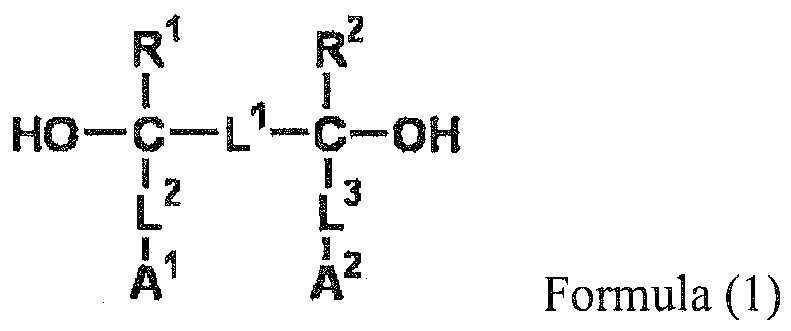
wherein each of R1 and R2 independently represents a hydrogen atom or a methyl group, each of L1, L2 and L3 independently represents a divalent linking group selected from the group consisting of carbonyl groups, ester groups, ether groups, sulfonyl groups, substituted or unsubstituted chained alkylene groups, substituted or unsubstituted cyclic alkylene groups, substituted or unsubstituted arylene groups, and combinations thereof, L1 and L2 or L1 and L3 optionally forms a ring, and each of A1 and A2 independently represents a rosin ester group.
Description
- The present invention relates to a polyester resin for a toner, a toner, a developer, a toner cartridge, a process cartridge, and an image forming apparatus.
- Similar to electrophotography, a method for visualizing image information by forming and developing an electrostatic latent image has been currently used in various fields. According to the method, an image is formed by electrically charging the entire surface of a photoconductor (or a latent image holding member), exposing the surface of the photoconductor to laser light according to image information to form an electrostatic latent image, developing the electrostatic latent image with a developer including a toner to form a toner image, and transferring and fixing the toner image to the surface of a recording medium.
- A resin composition suitable for the production of an electrophotographic toner for a heat roll fixing system is disclosed, for example, in Japanese Patent No.
4505738 - A polyester for a toner prepared by polycondensation of an alcoholic component with a carboxylic acid component containing a purified rosin is disclosed, for example, in
JP-A-2007-137910 - An object of the present invention is to provide a polyester resin for use in the production of a toner with excellent electrostatic properties.
- (1) A polyester resin for a toner including: a repeating unit derived from a dicarboxylic acid component; and a repeating unit derived from a diol component represented by Formula (1):

- (2) The polyester resin according to (1), wherein the diol component represented by Formula (1) is a reaction product of a difunctional epoxy compound and a rosin.
- (3) The polyester resin according to (2), wherein the rosin is selected from the group consisting of a purified rosin, a disproportionated rosin and a hydrogenated rosin.
- (4) The polyester resin according to (1), wherein the substituted or unsubstituted chained alkylene groups represented by L1, L2 and L3 have a total carbon number is 1 to 10.
- (5) The polyester resin according to (1), wherein the substituted or unsubstituted cyclic alkylene groups represented by L1, L2 and L3 have a total carbon number is 3 to 7.
- (6) The polyester resin according to (1), having a softening temperature of 80°C to 160°C.
- (7) The polyester resin according to (1), having an acid value of 1 mgKOH/g to 50 mgKOH/g,
- (8) A toner including the polyester resin according to (1).
- (9) The toner according to (8), wherein the diol component represented by Formula (1) is a reaction product of a difunctional epoxy compound and a rosin.
- (10) A developer including the toner according to (8).
- (11) The developer according to (10), wherein the diol component represented by Formula (1) is a reaction product of a difunctional epoxy compound and a rosin.
- (12) A toner cartridge accommodating the toner according to (8).
- (13) A process cartridge accommodating the developer according to (10), including a unit for developing an electrostatic latent image formed on a latent image holding member with the developer to form a toner image.
- (14) An image forming apparatus including: a latent image holding member; a charging unit configured to electrically charge the surface of the latent image holding member; a forming unit configured to form an electrostatic latent image on a surface of the latent image holding member; a developing unit configured to develop the electrostatic latent image with the developer according to (10) to form a toner image; a transferring unit configured to transfer the toner image to a recording medium; and a fixing unit configured to fix the toner image on the recording medium.
- (15) An image forming method including: forming an electrostatic latent image on a surface of a latent image holding member; developing the electrostatic latent image with the developer according to (10) to form a toner image; transferring the toner image to a recording medium; and fixing the toner image on the recording medium.
- (16) The image forming method according to (15), the diol component represented by Formula (1) is a reaction product of a difunctional epoxy compound and a rosin.
- According to the invention of (1), the polyester resin is provided for the production of a toner that has excellent electrostatic properties, compared to a case that does not contain a repeating unit derived from the diol component represented by Formula (1).
- According to the invention of (2), the polyester resin is provided for the production of a toner that has excellent electrostatic properties, compared to a case where the diol component represented by Formula (1) is not a reaction product of a difunctional epoxy compound and a rosin.
- According to the invention of (3), the polyester resin is provided for the production of a toner that has excellent electrostatic properties, compared to a case where the rosin is not selected from the group consisting of a purified rosin, a disproportionated rosin and a hydrogenated rosin.
- According to the invention of (4), the polyester resin is provided for the production of a toner that has excellent electrostatic properties, compared to a case where the substituted or unsubstituted chained alkylene groups represented by L1, L2 and L3 does not have a total carbon number is 1 to 10
- According to the invention of (5), the polyester resin is provided for the production of a toner that has excellent electrostatic properties, compared to a case where the substituted or unsubstituted cyclic alkylene groups represented by L1, L2 and L3 does not have a total carbon number is 3 to 7
- According to the invention of (6), the polyester resin is provided for the production of a toner that has excellent electrostatic properties, compared to a case where the polyester resin does not have a softening temperature of 80°C to 160°C.
- According to the invention of (7), the polyester resin is provided for the production of a toner that has excellent electrostatic properties, compared to a case where the polyester resin does not have an acid value of 1 mgKOH/g to 50 mgKOH/g.
- According to the invention of (8), the toner has excellent electrostatic properties, compared to a case that does not have the above constitution.
- According to the invention of (9), the toner has excellent electrostatic properties, compared to a case where the diol component represented by Formula (1) is not a reaction product of a difunctional epoxy compound and a rosin.
- According to the invention of (10), the developer has excellent electrostatic properties, compared to a case that does not have the above configuration.
- According to the invention of (11), the developer has excellent electrostatic properties, compared to a case where the diol component represented by Formula (1) is not a reaction product of a difunctional epoxy compound and a rosin.
- According to the invention of (12), the toner cartridge can accommodate the toner with excellent electrostatic properties, compared to a case that does not have the above configuration.
- According to the invention of (13), the process cartridge facilitates handling of the developer with excellent electrostatic properties, thereby achieving improved adaptability to image forming apparatuses having various constitutions, compared to a case that does not have the above configuration.
- According to the invention of (14), the image forming apparatus can use the developer with excellent electrostatic properties, compared to a case that does not have the above configuration.
- According to the invention of (15), the image forming method can use the developer with excellent electrostatic properties, compared to a case that does not have the above configuration.
- According to the invention of (16), the image forming method can use the developer with excellent electrostatic properties, compared to a case where the diol component represented by Formula (1) is a reaction product of a difunctional epoxy compound and a rosin.
- Exemplary embodiments of the present invention will be described in detail based on the following figures, wherein:
-
Fig. 1 is a diagram for explaining the state of a screw in an example of a screw extruder for use in the production of a toner according to the present exemplary embodiment; -
Fig. 2 is a schematic view illustrating the constitution of an example of an image forming apparatus according to the present exemplary embodiment; and -
Fig. 3 is a schematic view illustrating the constitution of an example of a process cartridge according to the present exemplary embodiment. - Exemplary embodiments of the polyester resin for a toner, the toner, the developer, the toner cartridge, the process cartridge and the image forming apparatus of the invention will now be described in detail.
- The polyester resin (hereinafter, also referred to as 'specific polyester resin') for a toner according to the present exemplary embodiment contains a repeating unit derived from a dicarboxylic acid component and a repeating unit derived from a diol component represented by Formula (1):

- The diol component represented by Formula (1) is a compound that contains two rosin ester groups in one molecule (hereinafter, also referred to as 'specific rosin diol'). In Formula (1), each of R1 and R2 independently represents a hydrogen atom or a methyl group. Each of A1 and A2 independently represents a rosin ester group. In the present exemplary embodiment, the rosin ester group refers to a moiety in which a hydrogen atom is excluded from a carboxyl group included in a rosin.
- In contrast, the resin composition for an electrophotographic toner described in Japanese Patent No.
4505738 4505738 - The polyester for a toner described in Japanese Patent Application Laid-Open No.
2007-137910 - Meanwhile, the toner including the specific polyester according to the present exemplary embodiment has excellent electrostatic properties. The reason for this is unclear but is inferred as follows.
- The specific polyester of the present exemplary embodiment contains a repeating unit derived from the specific rosin diol. A rosin, which is a base of the rosin ester groups contained in the specific rosin diol, possesses a bulky structure and is highly hydrophobic, making it difficult for the specific polyester including the rosin ester groups according to the present exemplary embodiment to contain water. Furthermore, since the polyester resin has hydroxyl or carboxyl groups only at a terminal of the polyester resin in view of its structure, the amount of the rosin ester groups in the resin can be increased without the need to increase the amount of hydroxyl groups or carboxyl groups, which may adversely affect the electrostatic properties of the toner. In the case where the specific rosin diol is obtained by the reaction of a rosin and a difunctional epoxy compound, the ring-opening reaction of the epoxy groups present in the difunctional epoxy compound with the carboxyl group present in the rosin is more reactive than the esterification between the alcoholic component and the rosin. In this case, the rosin hardly remains unreacted in the specific polyester of the present exemplary embodiment. For this reason, it is inferred that the toner including the specific polyester of the present exemplary embodiment has excellent electrostatic properties.
- The following is an example of a synthetic scheme of the specific polyester according to the present exemplary embodiment. As depicted in the synthetic scheme, a difunctional epoxy compound is reacted with a rosin to synthesize the specific rosin diol, which is then subjected to polycondensation with a dicarboxylic acid component to synthesize the specific polyester of the present exemplary embodiment. The portion surrounded by the dashed line in the structural formula representing the specific polyester corresponds to the rosin ester group of the present exemplary embodiment.

- Hydrolysis of the specific polyester gives the following monomers. Since the polyester is a condensation product of a dicarboxylic acid and a diol in a ratio of 1:1, the constituent components of the resin can be estimated from the hydrosates.

- In Formula (1), each of L1, L2 and L3 independently represents a divalent linking group selected from the group consisting of carbonyl groups, ester groups, ether groups, sulfonyl groups, chained alkylene groups which may be substituted or unsubstituted, cyclic alkylene groups which may be substituted or unsubstituted, arylene groups which may be substituted or unsubstituted, and combinations thereof, and L1 and L2 or L1 and L3 may form a ring.
- The chained alkylene groups represented by L1, L2 and L3 may be, for example, C1-C10 alkylene groups.
- The cyclic alkylene groups represented by L1, L2 and L3 may be, for example, C3-C7 cyclic alkylene groups.
- The arylene groups represented by L1, L2 and L3 may be, for example, phenylene, naphthylene and anthracene groups.
- Examples of substituents of the chained alkylene groups, the cyclic alkylene groups and the arylene groups include C1-C8 alkyl groups and aryl groups. A linear, branched or cyclic alkyl group is preferred. Specific examples of such alkyl groups include methyl, ethyl, propyl, butyl, pentyl, hexyl, heptyl, octyl, isopropyl, isobutyl, s-butyl, t-butyl, isopentyl, neopentyl, 1-methylbutyl, isohexyl, 2-ethylhexyl, 2-methylhexyl, cyclopentyl, cyclohexyl and phenyl groups.
- The specific rosin diol represented by Formula (1) can be synthesized by methods known in the art, for example, by the reaction of a difunctional epoxy compound and a rosin. The difunctional epoxy compound that may be used in the present exemplary embodiment is an epoxy group-containing compound including two epoxy groups in one molecule. Examples of such difunctional epoxy compounds include diglycidyl ethers of aromatic diols, diglycidyl ethers of aromatic dicarboxylic acids, diglycidyl ethers of aliphatic diols, diglycidyl ethers of alicyclic diols, and alicyclic epoxides.
- Representative examples of the diglycidyl ethers of aromatic diols include diglycidyl ethers of bisphenol A, derivatives of bisphenol A, such as polyalkylene oxide adducts of bisphenol A, bisphenol F, derivatives of bisphenol F, such as polyalkylene oxide adducts of bisphenol F, bisphenol S, derivatives of bisphenol S, such as polyalkylene oxide adducts of bisphenol S, resorcinol, t-butylcatechol and biphenols as aromatic diol components.
- Representative examples of the diglycidyl ethers of aromatic dicarboxylic acids include diglycidyl ethers of terephthalic acid, isophthalic acid and phthalic acid as aromatic dicarboxylic acid components.
- Representative examples of the diglycidyl ethers of aliphatic diols include diglycidyl ethers of ethylene glycol, 1,2-propanediol, 1,3-propanediol, 1,4-butanediol, 1,5-pentanediol, 1,6-hexanediol, neopentyl glycol, 1,9-nonanediol, diethylene glycol, triethylene glycol, polyethylene glycol, polypropylene glycol, and polytetramethylene glycol as aliphatic diol components.
- Representative examples of the diglycidyl ethers of alicyclic diols include hydrogenated bisphenol A, derivatives of hydrogenated bisphenol A, such as polyalkylene oxide adducts of hydrogenated bisphenol A, and cyclohexanedimethanol as alicyclic diol components.
- Representative examples of the alicyclic epoxides include limonene dioxide.
- The epoxy group-containing compound may be obtained, for example, by the reaction of a diol component and an epihalohydrin. A higher molecular weight of the epoxy group-containing compound can be accomplished by polycondensation depending on the ratio of the diol component to the epihalohydrin.
- In the present exemplary embodiment, the reaction between the rosin and the difunctional epoxy compound is mainly carried out by the ring-opening reaction of the epoxy groups of the difunctional epoxy compound with the carboxyl group of the rosin. The reaction is preferably carried out at a temperature equal to or higher than the melting temperatures of both the reactants and/or a temperature where both the reactants can be homogenized. Specifically, the reaction temperature is typically from 60°C to 200°C. A catalyst may be added to promote the ring-opening reaction of the epoxy groups.
- Examples of catalysts suitable for use in the reaction include: amines, such as ethylenediamine, trimethylamine and 2-methylimidazole; quaternary ammonium salts, such as triethylammonium bromide, triethylammonium chloride and butyltrimethylammonium chloride, and triphenylphosphine.
- The reaction can be carried out by various methods. Generally, the reaction may be carried out in a batch manner. In this case, the rosin and the difunctional epoxy compound are added in a predetermined ratio to a heatable flask equipped with a condenser, a stirrer, an inert gas introducing hole and a thermometer, the mixture is heat-melted, and the reaction mixture is appropriately sampled to trace the reaction. The progress of the reaction can be mainly confirmed by a reduction in acidity. The reaction can be appropriately finished at or near the stoichiometric endpoint.
- There is no particular restriction on the ratio of the rosin to the difunctional epoxy compound. It is preferred to react the rosin and the difunctional epoxy compound in a molar ratio of 1.5-2.5:1.
- The rosin used in the present exemplary embodiment is a generic name for resin acids obtained from trees and is a naturally occurring substance that includes abietic acid, a kind of tricyclic diterpenes, and isomers thereof as major components. In addition to abietic acid, specific rosin components are palustric acid, neoabietic acid, pimaric acid, dehydroabietic acid, isopimaric acid, sandaracopimaric acid. The rosin used in the present exemplary embodiment is a mixture of these acids.
- Rosins are largely divided into three kinds: tall rosins obtained from pulps as raw materials, gum rosins obtained from pine trees as raw materials, and wood rosins obtained from the roots of pine trees as raw materials, by collection methods of raw materials. The rosin used in the present exemplary embodiment is preferably a gum rosin and/or a tall rosin for their ease of purchase.
- It is preferred to purify these rosins before use. A purified rosin can be obtained by removing high molecular weight substances thought to be derived from peroxides of resin acids and non-saponified substances included in unpurified rosins. Any purification methods known in the art can be used without particular limitation to purify rosins, and specific examples thereof include distillation recrystallization and extraction. Purification by distillation is preferred from an industrial viewpoint. A distillation method is usually selected taking into consideration the distillation time at a temperature of 200°C to 300°C and a pressure of 6.67 kPa or below. Recrystallization is performed, for example, by dissolving an unpurified rosin in a good solvent, partially removing the solvent to obtain a concentrated solution, and adding a poor solvent to the solution. Examples of such good solvents include: aromatic hydrocarbons, such as benzene, toluene and xylene; chlorinated hydrocarbons, such as chloroform; alcohols, such as lower alcohols; ketones, such as acetone; and acetates, such as ethyl acetate. Examples of such poor solvents include hydrocarbon-based solvents, such as n-hexane, n-heptane, cyclohexane and isooctane. According to an extraction method, an unpurified rosin is dissolved in alkaline water to prepare an alkaline aqueous solution, the alkaline aqueous solution is extracted with an organic solvent to remove non-saponified insoluble substances, and the aqueous layer is neutralized to obtain a purified rosin.
- The rosin used in the present exemplary embodiment may be a disproportionated rosin. The disproportionated rosin is obtained by heating a rosin including abietic acid as a major component in the presence of a disproportionation catalyst to eliminate unstable conjugated double bonds in the molecule. The disproportionated rosin is a mixture of dehydroabietic acid and dihydroabietic acid as major components.
- The disproportionation catalyst may be any of those known in the art, for example: supported catalysts, such as palladium carbon, rhodium carbon and platinum carbon; metal powders, such as nickel and platinum powders; iodine; and iodides, such as iron iodide.
- The rosin used in the present exemplary embodiment may be a hydrogenated rosin obtained by eliminating unstable conjugated double bonds in the molecule. The hydrogenation can be performed under suitable conditions selected from hydrogenation conditions known in the art. Specifically, the hydrogenation is performed by heating a rosin under a hydrogen pressure in the presence of a hydrogenation catalyst. The hydrogenation catalyst may be any of those known in the art, for example: supported catalysts, such as palladium carbon, rhodium carbon and platinum carbon; metal powders, such as nickel and platinum powders; iodine; and iodides, such as iron iodide.
- The disproportionated rosin and the hydrogenated rosin may be purified in the same manner as described above before or after disproportionation and hydrogenation, respectively.
- The following are exemplary compounds of specific rosin diols suitable for use in the present exemplary embodiment are shown below, but the present exemplary embodiment is not limited thereto.


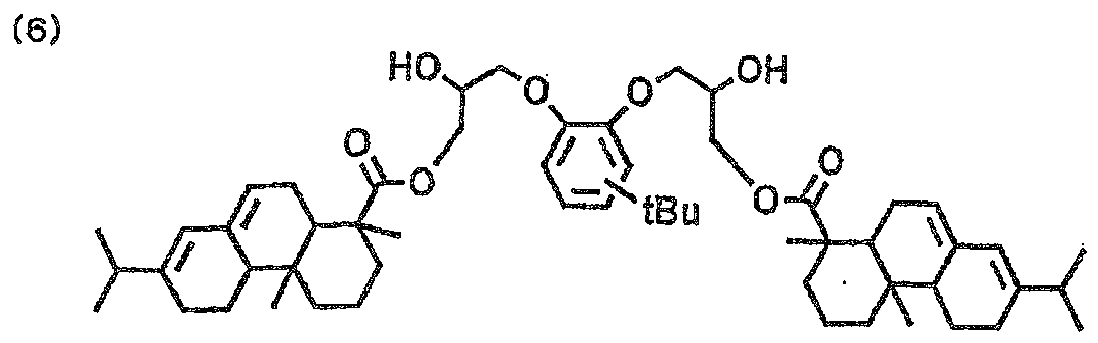
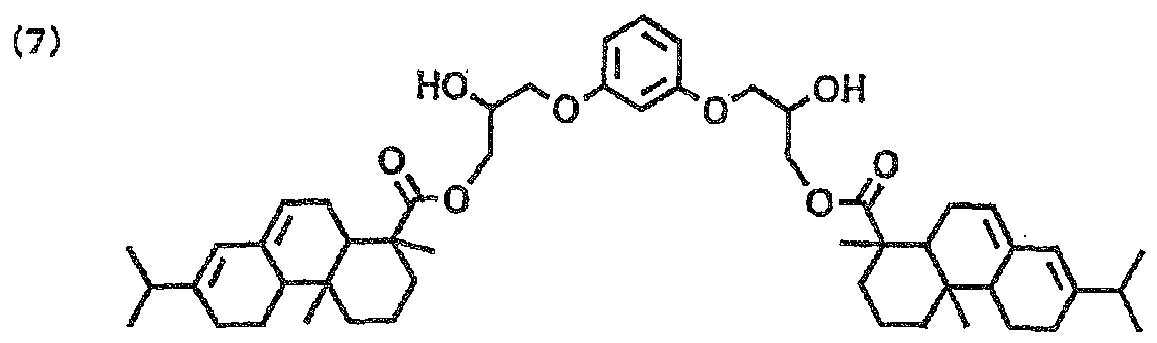


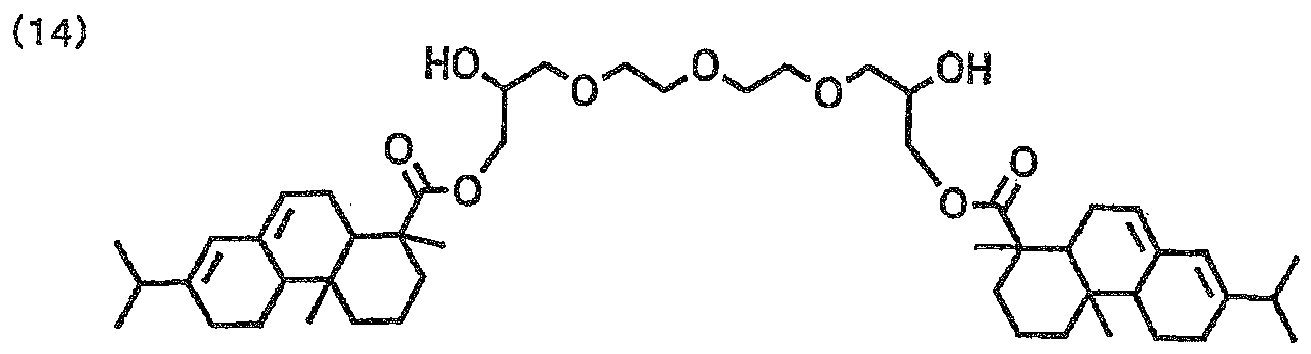


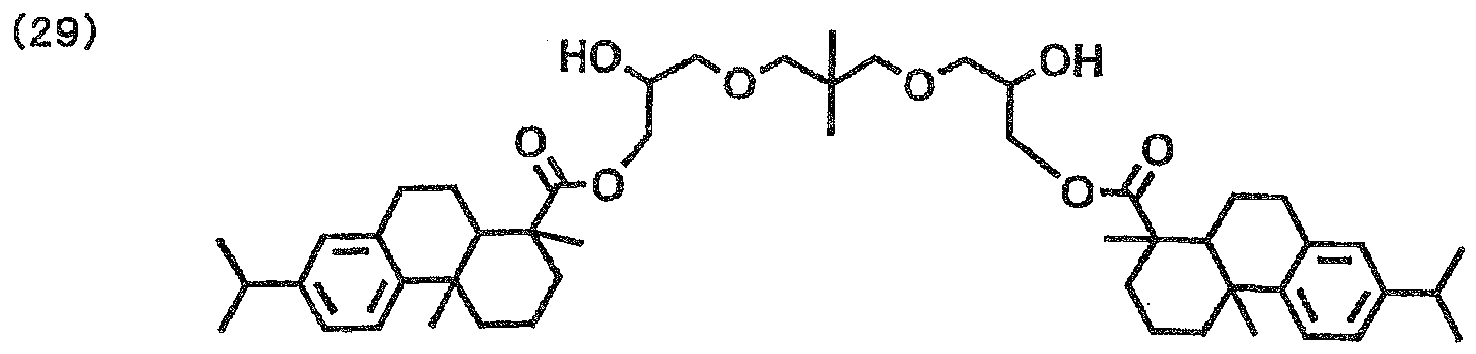
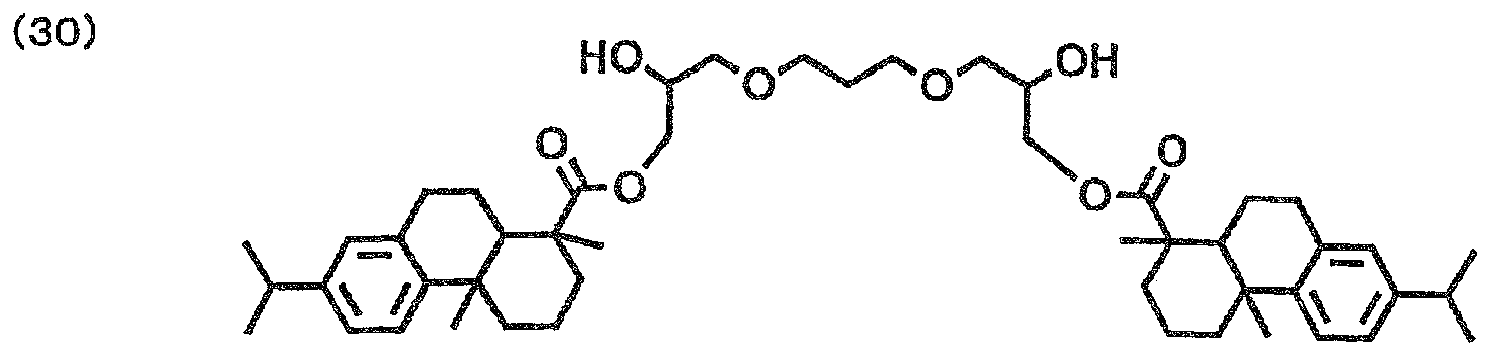


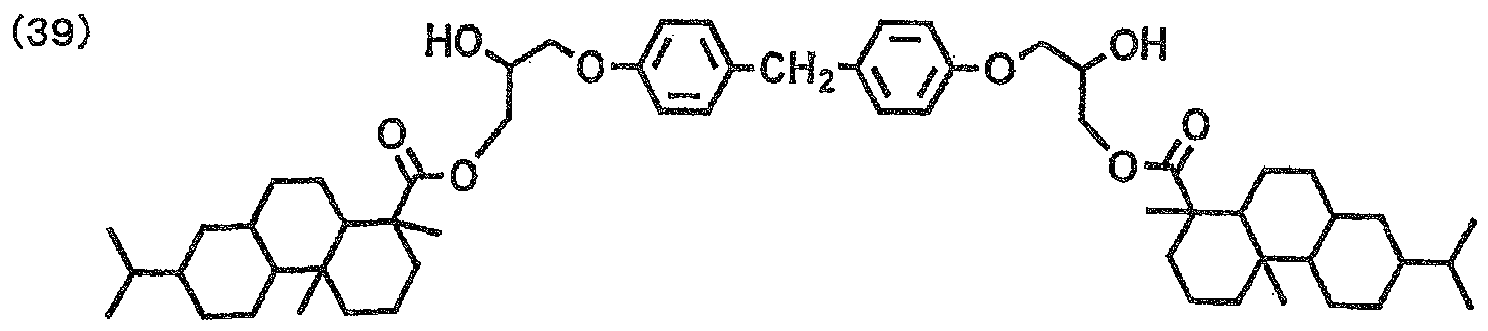


- In the exemplary compounds of the specific rosin diols, each n represents an integer of 1 or greater.
- In the present exemplary embodiment, the dicarboxylic acid component may be selected from the group consisting of aromatic dicarboxylic acids, aliphatic dicarboxylic acids, and mixtures thereof. Examples of such dicarboxylic acid components include: aromatic dicarboxylic acids, such as phthalic acid, isophthalic acid, terephthalic acid, 1,4-naphthalenedicarboxylic acid and 2,6-naphthalenedicarboxylic acid; aliphatic dicarboxylic acids, such as oxalic acid, malonic acid, maleic acid, fumaric acid, citraconic acid, itaconic acid, glutaconic acid, succinic acid, adipic acid, sebacic acid, azelaic acid, dimeric acids, branched C1-C20 alkyl succinic acids and branched C1-C20 alkenyl succinic acids; anhydrides of these acids; and C1-C3 alkyl esters of these acids. Of these, aromatic carboxylic acid compounds are preferred in terms of durability and fixability of a toner and dispersibility of a coloring agent.
- In the present exemplary embodiment, a combination of the specific rosin diol and another diol component may be used as the diol component. In the present exemplary embodiment, the content of the specific rosin diol in the diol component is preferably from 10 mole% to 100 mole%, more preferably 20 mole% to 90 mole% from the viewpoint of electrostatic properties.
- The alcoholic component other than the specific rosin diol can be selected from the group consisting of aliphatic diols, etherified diphenols and mixtures thereof so long as the performance of a toner is not deteriorated.
- Examples of the aliphatic diols include ethylene glycol, 1,2-propanediol, 1,3-propanediol, 1,2-butanediol, 1,3-butanediol, 1,4-butanediol, 2,3-butanediol, 1,4-butenediol, 2-methyl-1,3-propanediol, 1,5-pentanediol, neopentyl glycol, 2-ethyl-2-methylpropane-1,3-diol, 2-butyl-2-ethylpropane-1,3-diol, 1,6-hexanediol, 3-methyl-1,5-pentanediol, 2-ethyl-1,3-hexanediol, 2,4-dimethyl-1,5-pentanediol, 2,2,4-trimethyl-1,3-pentanediol, 1,7-heptanediol, 1,8-octanediol, 1,9-nonanediol, 1,10-decanediol, 3-hydroxy-2,2-dimethylpropyl1-3-hydroxy-2,2-dimethylpropanoate, diethylene glycol, triethylene glycol, polyethylene glycol, dipropylene glycol, and polypropylene glycol. These aliphatic diols may be used alone or in combination of two or more thereof.
- In the present exemplary embodiment, an etherified diphenol may be further used, together with the aliphatic diol. The etherified diphenol is a diol obtained by addition reaction of bisphenol A and an alkylene oxide. The alkylene oxide is ethylene oxide or propylene oxide. The average number of moles of the alkylene oxide added is from 2 moles to 16 moles per mole of the bisphenol A.
- The specific polyester of the present exemplary embodiment is prepared from the acid component and the alcoholic component as raw materials by methods publicly known and used in the art. Either transesterification or direct esterification can be applied. The polycondensation may also be accelerated by increasing the reaction temperature under pressure or flowing an inert gas under reduced pressure or ambient pressure. Depending on the reaction conditions, a reaction catalyst may be used to accelerate the reaction. The reaction catalyst may be any of those publicly known and used in the art. The reaction catalyst may be a compound of at least one metal selected from the group consisting of antimony, titanium, tin, zinc, aluminum and manganese. The reaction catalyst is preferably added in an amount of 0.01 parts by mass to 1.5 parts by mass, more preferably 0.05 parts by mass to 1.0 part by mass, based on 100 parts by mass of the acid component and the alcoholic component. The reaction temperature may be from 180°C to 300°C.
- The softening temperature of the specific polyester according to the present exemplary embodiment is preferably from 80°C to 160°C, more preferably from 90°C to 150°C in terms of the fixability, storability and durability of a toner. The glass transition temperature of the specific polyester according to the present exemplary embodiment is preferably from 35°C to 80°C, more preferably from 40°C to 70°C in terms of the fixability, storability and durability of a toner. The softening temperature and glass transition temperature may be easily adjusted by controlling the composition of the raw monomers, the kind of a polymerization initiator, the molecular weight of the specific polyester and the amount of the catalyst or selecting suitable reaction conditions.
- Taking into consideration the electrostatic properties of a toner, the acid value of the specific polyester according to the present exemplary embodiment is preferably from 1 mgKOH/g to 50 mgKOH/g, more preferably from 3 mgKOH/g to 30 mgKOH/g. Taking into consideration the durability and hot offset resistance of a toner, the weight average molecular weight of the specific polyester according to the present exemplary embodiment is preferably from 4,000 to 1,000,000, more preferably from 7,000 to 300,000.
- The specific polyester of the present exemplary embodiment may be modified. Examples of such modified polyesters include polyesters that are grafted or blocked with phenol, urethane or epoxy by the methods described in Japanese Patent Application Laid-Open Nos.
Hei 11-133668 Hei 10-239903 Hei 8-20636 - The specific polyester of the present exemplary embodiment can be used as a binder resin for a toner to produce a toner with excellent electrostatic properties. In the toner of the present exemplary embodiment, the specific polyester may be used in combination with another binder resin known in the art, for example, a vinyl resin, such as a styrene-acrylic resin, an epoxy resin, a polycarbonate resin or a polyurethane resin so long as the effects of the present exemplary embodiment are not impaired. In this case, the content of the specific polyester according to the present exemplary embodiment is preferably 70% by mass or more, more preferably 90% by mass, still more preferably substantially 100% by mass.
- The toner of the present exemplary embodiment contains the specific polyester of the present exemplary embodiment, and optionally, at least one component selected from coloring agents, release agents and external additives.
- The coloring agent used in the present exemplary embodiment may be a dye or a pigment. A pigment is preferred in terms of light fastness and water fastness.
- The coloring agent may be a pigment known in the art. Examples of preferred coloring agents include carbon black, aniline black, Aniline Blue, Calcoil Blue, Chrome Yellow, Ultramarine Blue, DuPont Oil Red, Quinoline Yellow, Methylene Blue Chloride, Phthalocyanine Blue, Malachite Green Oxalate, Lamp Black, Rose Bengal, quinacridone, Benzidine Yellow, C.I. Pigment Red 48:1, C.I. Pigment Red 57:1, C.I. Pigment Red 122, C.I. Pigment Red 185, C.I. Pigment Red 238, C.I. Pigment Yellow 12, C.I. Pigment Yellow 17, C.I. Pigment Yellow 180, C.I. Pigment Yellow 97, C.I. Pigment Yellow 74, C.I. Pigment Blue 15:1, and C.I. Pigment Blue 15:3.
- The content of the coloring agent in the toner of the present exemplary embodiment is preferably in the range of 1 part by mass to 30 parts by mass, based on 100 parts by mass of the binder resin. If needed, it is also effective to use a surface-treated coloring agent or a pigment dispersant. The color of the toner of the present exemplary embodiment can be determined by selecting the kind of the coloring agent. For example, the toner of the present exemplary embodiment may be yellow, magenta, cyan or black in color.
- Examples of release agents for use in the present exemplary embodiment include: paraffin waxes, such as low molecular weight polypropylenes, low molecular weight polyethylenes; silicone resins; rosins; rice wax; and carnauba wax. The melting temperatures of these release agents are preferably between 50°C and 100°C, more preferably between 60°C and 95°C. The content of the release agent in the toner is preferably from 0.5% by mass to 15% by mass, more preferably from 1.0% by mass to 12% by mass. The presence of the release agent in an amount of more than 0.5% by mass particularly prevents the occurrence of peeling defects in oilless fixing. Meanwhile, the presence of the release agent in an amount of less than 15% by mass improves image quality and reliability for image formation without causing deterioration in the flowability of the toner.
- A charge controlling agent may be used in the toner of the present exemplary embodiment. The charge controlling agent may be any of those known in the art, for example, azo-based metal complex compounds, metal complex compounds of salicylic acid and resin type charge controlling agents containing polar groups.
- The toner of the present exemplary embodiment may contain a white inorganic powder as the external additive for purpose of achieving improved flowability. Examples of suitable inorganic powders include silica powder, alumina, titanium oxide, barium titanate, magnesium titanate, calcium titanate, strontium titanate, zinc oxide, silica, clay, mica, wollastonite, diatomite, chromium oxide, cerium oxide, bengala, antimony trioxide, magnesium oxide, zirconium oxide, barium sulfate, barium carbonate, calcium carbonate, silicon carbide and silicon nitride. Silica powder is particularly preferred. The mixing proportion of the inorganic powder in the toner is typically in the range of 0.01 parts by mass to 5 parts by mass, preferably 0.01 parts by mass to 2.0 parts by mass, based on 100 parts by mass of the toner. The inorganic powder may be used in combination with another material known in the art, for example, silica, titanium, resin particles (such as polystyrene, PMMA and melamine resin particles) or alumina. The toner of the present exemplary embodiment may further include a cleaning lubricant. The cleaning lubricant may be a metal salt of a higher fatty acid, typified by zinc stearate, or a powder of fluorinated polymer particles.
- The shape factor SF1 of the toner according to the present exemplary embodiment is preferably in the range of 110 to 150, more preferably 120 to 140.
- The shape factor SF1 is calculated by Equation 1:

where ML represents the absolute maximum length of the toner and A represents the projection area of the toner. - SF1 is mainly quantified by analyzing a microscope image or scanning electron microscope image using an image analyzer. First, an optical microscope image of particles spread on the surface of a slide glass is inputted to a Luzex image analyzer via a video camera. The maximum lengths and projection areas of 100 of the particles are measured and substituted into Equation 1. The obtained values are averaged.
- The volume average particle diameter of the toner according to the present exemplary embodiment is preferably in the range of 8 µm to 15 µm, more preferably 9 µm to 14 µm, still more preferably 10 µm to 12 µm.
- The volume average particle diameter of the toner is measured using a multisizer (manufactured by Beckman Coulter, Inc.) with an aperture diameter of 50 µm. The measurement is conducted after a dispersion of the toner in an aqueous electrolyte solution (an isotonic aqueous solution) is further dispersed by sonication for at least 30 seconds or more.
- There is no particular restriction on the production method of the toner. For example, the toner particles are produced by a dry method, such as kneading-pulverization, or a wet method, such as emulsification aggregation or suspension polymerization. These methods are well known in the art. If necessary, an external additive may be added to the toner particles.
- According to a kneading-pulverization method, toner-forming materials including a binder resin are kneaded to obtain a kneaded product, followed by pulverization to produce toner particles.
- More specifically, the kneading-pulverization method includes a process for kneading toner-forming materials including a binder resin and a process for pulverizing the kneaded product. If needed, the kneading-pulverization method may further one or more processes, such as a process for cooling the kneaded product after the kneading process.
- Details regarding the individual processes will be provided below.
- In the kneading process, toner-forming materials including a binder resin are kneaded.
- In the kneading process, it is preferred to add an aqueous medium (for example, distilled water, ion exchanged water or an alcohol) in an amount of 0.5 parts by mass to 5 parts by mass, based on 100 parts by mass of the toner-forming materials.
- Kneaders, such as single screw extruders and twin screw extruders, may be used in the kneading process. As a non-limiting example, a kneader having a transfer screw section and two kneading sections will be explained with reference to the drawing.
-
Fig. 1 is a diagram for explaining the state of a screw in an example of a screw extruder used in a method for the production of a toner according to the present exemplary embodiment. - A
screw extruder 11 includes a barrel 12 equipped with a screw (not shown), afeed port 14 through which toner-forming materials as raw materials for a toner is fed into the barrel 12, aliquid introducing port 16 through which an aqueous medium is added to the toner-forming materials in the barrel 12, and adischarge port 18 through which a kneaded product of the toner-forming materials in the barrel 12 is discharged. - The barrel 12 is divided into a transfer screw section SA, a kneading section NA, a transfer screw section SB, a kneading section NB and a transfer screw section SC, which are located in this order from a side close to the
feed port 14. The transfer screw section SA transports the toner-forming materials fed through thefeed port 14 to the kneading section NA. In the kneading section NA, the toner-forming materials are melt-kneaded by a first kneading process. The transfer screw section SB transports the melt-kneaded toner-forming materials from the kneading section NA to the kneading section NB. In the kneading section NB, the toner-forming material is melt-kneaded by a second kneading process to form a kneaded product. The transfer screw section SC transports the kneaded product to thedischarge port 18. - Further, the barrel 12 has
blocks 12A to 12J provided with different temperature controlling units (not shown). That is, theblocks 12A to 12J may be controlled to different temperatures.Fig. 1 shows the temperatures of the blocks. Specifically, theblocks blocks 12C to 12E are controlled to a temperature of t1°C, and theblocks 12F to 12J are controlled to a temperature of t2°C. With this block configuration, the toner-forming materials in the kneading section NA are heated to t1°C and the toner-forming materials in the kneading section NB are heated to t2°C. - The toner-forming materials including a binder resin are fed into the barrel 12 through the
feed port 14 and are sent to the kneading section NA by the transfer screw section SA. The toner-forming materials are heated to the temperature (t1°C) set in theblock 12C and are converted into a molten state. The molten toner-forming materials are sent to and introduced into the kneading section NA. In the kneading section NA, the toner-forming materials are melt-kneaded at the temperature (t1°C) set in theblocks - Subsequently, the toner-forming materials having undergone kneading in the kneading section NA are sent to the kneading section NB by the transfer screw section SB.
- Subsequently, an aqueous medium is fed into the barrel 12 through the
liquid introducing port 16 and is added to the toner-forming materials in the transfer screw section SB.Fig. 1 shows the state in which the aqueous medium is fed in the transfer screw section SB, but the feeding position of the aqueous medium is not limited thereto. For example, the aqueous medium may be fed in the kneading section NB and may be fed in both the transfer screw section SB and the kneading section NB. That is, the feeding position and site of the aqueous medium are selected according to the intended need. - As described above, the aqueous medium is fed into the barrel 12 through the
liquid introducing port 16 and is mixed with the toner-forming materials in the barrel 12. The toner-forming materials are cooled down by the latent heat of vaporization of the aqueous medium and are maintained at an appropriate temperature. - Finally, the toner-forming materials are melt-kneaded in the kneading section NB to form a kneaded product and are transported to and discharged from the
discharge port 18. In this way, the toner-forming materials are kneaded using thescrew extruder 11 illustrated inFig. 1 is carried out. - In the cooling process, the kneaded product formed by the kneading process is cooled. In the cooling process, it is preferred to lower the temperature of the kneaded product to 40°C or below at an average rate of at least 4°C/sec. By this rapid temperature drop at the average rate, the dispersed state of the kneaded product immediately after completion of the kneading process is maintained. The average cooling rate refers to an average of the cooling rates from the temperature of the kneaded product (for example, t2°C in the case using the
screw extruder 11 ofFig. 1 ) after completion of the kneading process to 40°C. - Specifically, the cooling process may be carried out, for example, using a roll where cooling water or brine is circulated and a press-fit type cooling belt. When this method is used for the cooling process, the cooling rate is determined depending on the speed of the roll, the flow amount of the brine, the feed amount of the kneaded product, the thickness of a slab upon rolling of the kneaded product, etc. The thickness of the slab is preferably from 1 mm to 3 mm.
- In the pulverization process, the kneaded product cooled by the cooling process is pulverized to particles. For example, a mechanical pulverizer or jet pulverizer is used in the pulverization process.
- If needed, the particles obtained by the pulverization process may be classified. By the classification process, toner particles having a volume average particle diameter in a desired range are selected, and particles having a particle diameter smaller than the lower limit of the desired range and particles having a particle diameter larger than the upper limit of the desired range are removed. For example, a traditional classifier, such as a centrifugal classifier or an inertial classifier, may be used in the classification process.
- Inorganic powders, typified by specific silica, titania and aluminum oxide powders, as already explained, may be added and attached to the obtained toner particles for the purpose of electrostatic adjustment and imparting flowability and charge exchangeability to the toner particles. This external addition process is carried out, for example, by a V-type blender, a Henschel mixer or a Roedige mixer, and the inorganic powders are attached to the toner particles in divided steps.
- If necessary, a sieve classification process may be carried out after the external addition process. Specifically, the sieve classification process may be carried out, for example, using gyro shifter, a vibro classifier or a turbo classifier. By the sieve classification, coarse powders of the external additives are removed to inhibit the formation of stripes on a photoconductor, dirt in the apparatus, etc.
- The developer of the present exemplary embodiment includes at least the toner of the present exemplary embodiment.
- The toner of the present exemplary embodiment per se may be used as a single component developer. Alternatively, the toner of the present exemplary embodiment may be used as a component of a two-component developer. In this case, the toner of the present exemplary embodiment is used in combination with a carrier.
- There is no particular restriction on the kind of the carrier used in the two-component developer. The carrier may be any of those known in the art. The carrier may be, for example, a magnetic metal, such as iron oxide, nickel or cobalt, a magnetic oxide, such as ferrite or magnetite, a resin-coated carrier having a resin coating layer on the surface of the magnetic metal or the magnetic oxide as a core material, or a magnetic dispersion carrier. The carrier may be a resin dispersion carrier in which a conductive material is dispersed in a matrix resin.
- The mixing weight ratio of the toner to the carrier in the two-component developer is preferably in the range of about 1:100 to about 30:100, more preferably about 3:100 to about 20:100.
- Subsequently, explanation will be given concerning an image forming apparatus of the present exemplary embodiment using the developer of the present exemplary embodiment.
- The image forming apparatus of the present exemplary embodiment includes a latent image holding member, a charging unit configured to electrically charge the surface of the latent image holding member, a forming unit configured to form an electrostatic latent image on the surface of the latent image holding member, a developing unit configured to develop the electrostatic latent image with the developer of the present exemplary embodiment to form a toner image, a transferring unit configured to transfer the toner image to a recording medium, and a fixing unit configured to fix the toner image on the recording medium.
- The image forming apparatus of the present exemplary embodiment is used to carry out an image forming method. The image forming method includes a process for electrically charging the surface of a latent image holding member, a process for forming an electrostatic latent image on the surface of the latent image holding member, a process for developing the electrostatic latent image with the developer of the present exemplary embodiment to form a toner image, a process for transferring the toner image to a recording medium, and a process for fixing the toner image on the recording medium.
- In the image forming apparatus, a part including the developing unit may be, for example, a cartridge structure (or process cartridge) that is detachably attached to a main body of the image forming apparatus. The process cartridge of the present exemplary embodiment accommodates the developer of the present exemplary embodiment, includes a developing unit configured to develop an electrostatic latent image formed on a latent image holding member with the developer to form a toner image, and is detachably attached to the image forming apparatus.
- An example of the image forming apparatus according to the present exemplary embodiment will explained below, but the present exemplary embodiment is not limited thereto. Further, the main units of the image forming apparatus illustrated in the drawing will be explained, and explanation of the other units is omitted.
-
Fig. 2 is a schematic view illustrating a quadruple tandem type color image forming apparatus. The image forming apparatus illustrated inFig. 2 includes first, second, third and fourthimage forming units units - As illustrated in
Fig. 2 , anintermediate transfer belt 20 as an intermediate transfer member is installed to run on top of theunits intermediate transfer belt 20 is installed to wind adrive roller 22 and asupport roller 24 in contact with the inner side thereof. Theintermediate transfer belt 20 runs in a direction from thefirst unit 10Y toward thefourth unit 10K. Thesupport roller 24 is pressed in a direction away from thedrive roller 22 by a spring (now shown). A predetermined tension is given on theintermediate transfer belt 20 winding the two rollers. At a lateral surface of a latent image holding member of theintermediate transfer belt 20, anapparatus 30 for cleaning the intermediate transfer material is provided opposite thedrive roller 22. - Developing apparatuses (or developing units) 4Y, 4M, 4C and 4K of the
units toner cartridges - Since the four
units first unit 10Y, which is arranged upstream the running direction of the intermediate transfer belt, can be applied to the other units. The units 1OM, 10C and 10K include parts corresponding to the parts of thefirst unit 10Y and designated by letters M (magenta), C (cyan) and K (black) instead of Y (yellow), respectively, and their description is omitted. - The
first unit 10Y has aphotoconductor 1Y acting as a latent image holding member. Aroller 2Y for electrically charging the surface of thephotoconductor 1Y with a predetermined potential, an apparatus 3 for exposing the electrically charged surface to alaser beam 3Y based on color-separated image signals to form an electrostatic latent image, an apparatus (or a unit) 4Y for feeding an electrically charged toner to the electrostatic latent image to develop the electrostatic latent image, a primary transfer roller (or a primary transfer unit) 5Y for transferring the developed toner image to theintermediate transfer belt 20, and a cleaning apparatus (or a cleaning unit) 6Y for removing the toner remaining on the surface of thephotoconductor 1Y after the primary transfer are arranged around thephotoconductor 1 Y. - The
primary transfer roller 5Y is arranged at the inner side of theintermediate transfer belt 20 and is installed in a position opposite thephotoconductor 1Y. A bias power supply (not shown) is connected and apply a primary transfer bias to each of theprimary transfer rollers - Hereinafter, an explanation will be given concerning the formation operation of a yellow image in the
first unit 10Y. Prior to the operation, the surface of thephotoconductor 1Y is electrically charged to about -600 V to about -800 V by theroller 2Y. - The
photoconductor 1Y is formed by laminating a photosensitive layer on a conductive base having a volume resistivity of1x 10-6 Ωcm or less at 20°C. Although the resistance of the photosensitive layer is usually high (comparable to that of general resins), the resistivity of a portion of the photosensitive layer irradiated with thelaser beam 3Y tends to vary. Depending on yellow image data sent from a control unit (not shown), the exposure apparatus 3 outputs thelaser beam 3Y to the surface of the electrically chargedphotoconductor 1Y. Thelaser beam 3Y is irradiated onto the surface of thephotoconductor 1Y to form an electrostatic latent image in a yellow factor pattern on the surface of thephotoconductor 1Y. - The electrostatic latent image refers to an image formed on the surface of the
photoconductor 1Y by electrostatic charging. The electrostatic latent image is formed in the form of a so-called negative latent image because electrical charges flow on the surface of irradiated portions of thephotoconductor 1 Y due to the decreased resistivity of the irradiated portions but electrical charges remain on portions non-irradiated with thelaser beam 3Y. - The electrostatic latent image formed on the
photoconductor 1Y is rotated up to a predetermined development position according to the running motion of thephotoconductor 1Y. At the development position, the electrostatic latent image on thephotoconductor 1Y is visualized (developed) by the developingapparatus 4Y. - The yellow developer accommodated in the developing
apparatus 4Y is friction-charged while agitating inside the developingapparatus 4Y, possesses the same polarity (negative polarity) as the counter charges charged on thephotoconductor 1Y, and is maintained on a developer roll (or a developer holding member). When the surface of thephotoconductor 1Y passes through the developingapparatus 4Y, the yellow toner is electrostatically attached to the antistatic latent image portions on the surface of thephotoconductor 1Y. As a result, the latent image is developed with the yellow toner. Thephotoconductor 1Y, on which the yellow toner image is formed, runs continuously at a predetermined speed to allow the toner image developed on thephotoconductor 1Y to be conveyed to a predetermined primary transfer position. - When the yellow toner image on the
photoconductor 1 Y is conveyed to the primary transfer position, a predetermined primary transfer bias is applied to theprimary transfer roller 5Y to allow an electrostatic force directing toward theprimary transfer roller 5Y from thephotoconductor 1Y to act on the toner image. As a result, the toner image on thephotoconductor 1Y is transferred to theintermediate transfer belt 20. The applied transfer bias has a polarity (+) opposite to the polarity (-) of the toner. In thefirst unit 10Y, for example, the applied transfer bias is controlled to about +10 µA by a control unit (not shown). - The toner remaining on the
photoconductor 1Y is removed by the cleaning apparatus 6Y and is then collected. - The primary transfer biases applied to the
primary transfer rollers - The
intermediate transfer belt 20, to which the yellow toner image is transferred, is sequentially conveyed from thefirst unit 10Y to the second, third andfourth units - The
intermediate transfer belt 20, where the four toner images overlap while passing through the first, second, third and fourth units, reaches a secondary transfer unit including theintermediate transfer belt 20, thesupport roller 24 in contact with the inner side of theintermediate transfer belt 20 and a secondary transfer roller (or a secondary transfer unit) 26 arranged on an image holding surface of theintermediate transfer belt 20. A recording paper (or a transfer-receiving material) is fed at a predetermined timing into a gap between thesecondary transfer roller 26 and theintermediate transfer belt 20, which are in contact with each other under pressure, through a feed mechanism and a predetermined secondary transfer bias is applied to thesupport roller 24. The applied transfer bias has the same polarity (-) as the polarity (-) of the toner and an electrostatic force directing toward the recording medium P from theintermediate transfer belt 20 acts on the overlapping toner image to allow the overlapping toner image on theintermediate transfer belt 20 to be transferred to the recording paper P. The secondary transfer bias is determined depending on the resistance of the secondary transferring unit, which is detected by a detecting unit (not shown), and the voltage thereof is controlled. - Thereafter, the recording paper P is sent to a fixing apparatus (or a fixing unit) 28. In the fixing apparatus, the overlapping toner image is heat-melted and fixed on the recording paper P. After the fixing of the color image is finished, the recording paper P is conveyed to the discharging unit by a convey roll (or a discharge roll) 32, completing the series of color image forming operations.
- The image forming apparatus is constructed such that the overlapping toner image is transferred to the recording paper P through the
intermediate transfer belt 20, but is not limited to this construction. For example, the image forming apparatus may have a construction that allows for direct transfer of the toner image from the photoconductor to the recording paper. -
Fig. 3 is a schematic view illustrating the constitution of a suitable example of a process cartridge accommodating the developer of the present exemplary embodiment. As illustrated inFig. 3 , theprocess cartridge 200 is a combination of aphotoconductor 107, an electrically chargingroller 108, a developingapparatus 111, a photoconductor cleaning apparatus (or a cleaning unit) 113, an opening forexposure 118 and an opening forantistatic exposure 117 on arail 116, which are integrated into one cartridge. - The
process cartridge 200 is freely attached detachably to atransfer apparatus 112, a fixingapparatus 115 and a main body of an image forming apparatus including other elements (not shown). Theprocess cartridge 200 is combined with the main body to construct an image forming apparatus.Reference numeral 300 indicates a recording paper. - The
photoconductor 107, the electrically chargingroller 108, the developingapparatus 111, thecleaning unit 113, the opening forexposure 118 and the opening forantistatic exposure 117 included in theprocess cartridge 200 illustrated inFig. 3 may be selectively combined. For example, the process cartridge of the present exemplary embodiment may include the developingapparatus 111 and at least one element selected from the group consisting of thephotoconductor 107, the electrically chargingroller 108, the developingapparatus 111, the cleaning apparatus (cleaning unit) 113, the opening forexposure 118 and the opening forantistatic exposure 117. - Next, an explanation will be given concerning a toner cartridge.
- The toner cartridge is attached detachably to the image forming apparatus and at least accommodates a toner that is fed into the developing unit installed in the image forming apparatus. The toner is the toner of the present exemplary embodiment explained already. The construction of the toner cartridge is not limited so long as the toner is accommodated in the toner cartridge. A developer may be accommodated in the toner cartridge depending on the mechanism of the image forming apparatus.
- The image forming apparatus illustrated in
Fig. 2 is constructed such that thetoner cartridges apparatuses - The present exemplary embodiments will be explained in detail with reference to the following examples but are not limited thereto. In the examples, unless otherwise indicated, all parts and percentages are by mass.
- A sample (1 cm3) is melt and is allowed to flow out using a flow tester (CFT-500, manufactured by Shimadzu Corporation) under the following conditions: dice pore diameter = 0.5 mm, pressure load = 0.98 MPa (10 Kg/cm2), heating rate = 1°C/min. A temperature corresponding to a half of the height between the starting temperature and the end temperature of the outflow is defined as the softening temperature.
- The glass transition temperature is measured using DSC-20 (manufactured by SEICO Electronics industrial Co., Ltd.) while heating 10 mg of a sample at a constant rate of 10°C/min.
- The weight average molecular weight Mw and number average molecular weight Mn are measured using two lines of HLC-8120GPC and SC-8020 (manufactured by TOSOH Corporation, 6.0 mm ID x 15 cm) using tetrahydrofuran (THF) as the eluting solvent and an RI detector under the following conditions: sample concentration = 0.5%, flow rate = 0.6 ml/min, sample injection amount = 10 µl, temperature = 40°C. Standard calibration curves are plotted using 10 polystyrene standard (TSK standard) samples A-500, F-1, F-10, F-80, F-380, A-2500, F-4, F-40, F-128 and F-700 (TOSOH Corporation).
- The acid value is measured by neutralization titration in accordance with JIS K0070. Specifically, 100 ml of a mixed solvent of diethyl ether and ethanol and drops of phenolphthalein as an indicator are added to an appropriate amount of a sample and the resulting mixture is sufficiently stirred in a water bath until the sample is completely dissolved. The solution is titrated with a 0.1 mol/l ethanolic solution of potassium hydroxide. The time when pale red of the indicator is observed for 30 sec is defined as the endpoint. The acid value A is calculated by A=(B× f× 5.611)/S where S is the sample amount (g), B is the volume (ml) of the 0.1 mol/l ethanolic solution of potassium hydroxide, and f is the factor of the 0.1 mol/l ethanolic solution of potassium hydroxide.
- 113 parts of bisphenol A diglycidyl ether (trade name of jER828, Mitsubishi Chemical Corporation) as a difunctional epoxy compound, 200 parts of gum rosin as a rosin component, which is a product purified by distillation at 6.6 kPa and 220°C, and 0.4 parts of tetraethylammonium bromide (Tokyo Chemical Industry Co., Ltd.) as a reaction catalyst are heated in a stainless steel reaction vessel equipped with a stirrer, a heater, a condenser and a thermometer at 130°C for 4 hr. As a result of the reaction, the epoxy groups of the epoxy compound are ring-opened by the acid group of the rosin. When the acid value reaches 0.5 mgKOH/g, the reaction is stopped, yielding specific rosin diol 1 as the compound exemplified above.
- 300 parts of specific rosin diol 1 as an alcoholic component, 53 parts of terephthalic acid (Wako Pure Chemical Industries, Ltd.) as an acid component and 0.3 parts of tetra-n-butyl titanate (Tokyo Chemical Industry Co., Ltd.) as a reaction catalyst are heated with stirring in a stainless steel reaction vessel equipped with a stirrer, a heater, a thermometer, a classifier and a nitrogen introducing tube under a nitrogen atmosphere at 230°C for 7 hr. As a result of the reaction, specific rosin diol 1 is polycondensed with the terephthalic acid. When the molecular weight and acid value of the reaction product reach predetermined values, the reaction is stopped, yielding specific polyester resin 1. 2 g of specific polyester resin 1 is heated in 10 ml of deuterated dimethyl sulfoxide and 2 ml of a 7 N deuterated methanolic solution of sodium hydroxide at 150°C for 3 hr. After completion of the hydrolysis, deuterated water is added. The resin has the set values of specific rosin diol 1 and terephthalic acid, as confirmed by 1H-NMR spectroscopy.
- - Synthesis of specific rosin diol 30 - 58 parts of ethylene glycol diglycidyl ether (trade name of EX-810, Nagase ChemteX Corporation) as a difunctional epoxy compound, 200 parts of a disproportionated rosin (trade name of Pine Crystal KR614, Arakawa Chemical Industries, Ltd.) as a rosin component and 0.4 parts of tetraethylammonium bromide (Tokyo Chemical Industry Co., Ltd.) as a reaction catalyst are heated in a stainless steel reaction vessel equipped with a stirrer, a heater, a condenser and a thermometer at 130°C for 4 hr. As a result of the reaction, the epoxy groups of the epoxy compound are ring-opened by the acid group of the rosin. When the acid value reaches 0.5 mgKOH/g, the reaction is stopped, yielding
specific rosin diol 30 as the compound exemplified above. - 250 parts of
specific rosin diol 30 as an alcoholic component, 42 parts of terephthalic acid (Wako Pure Chemical Industries, Ltd.), 17 parts of dodecenylsuccinic anhydride (Tokyo Chemical Industry Co., Ltd.) and 0.3 parts of tetra-n-butyl titanate (Tokyo Chemical Industry Co., Ltd.) as a reaction catalyst are heated with stirring in a stainless steel reaction vessel equipped with a stirrer, a heater, a thermometer, a classifier and a nitrogen introducing tube under a nitrogen atmosphere at 230°C for 7 hr. As a result of the reaction,specific rosin diol 30 is polycondensed with the terephthalic acid. When the molecular weight and acid value of the reaction product reach predetermined values, the reaction is stopped, yielding specific polyester resin 2. 2 g of specific polyester resin 2 is heated in 10 ml of deuterated dimethyl sulfoxide and 2 ml of a 7 N deuterated methanolic solution of sodium hydroxide at 150°C for 3 hr. After completion of the hydrolysis, deuterated water is added. The resin has the set values ofspecific rosin diol 30, terephthalic acid and dodecenylsuccinic anhydride, as confirmed by 1H-NMR spectroscopy. - Specific polyester resins 3-21 are synthesized in the same manner as in Synthesis Example 1 for the synthesis of specific polyester resin 1, except that the kinds of monomers are changed as shown in Tables 2 and 3. The molecular weights, acid values, glass transition temperatures and softening temperatures of specific polyester resins 3-21 are measured. The results are shown in Tables 2 and 3.
- A mixture having the following composition is kneaded using an extruder and pulverized using a surface pulverization type pulverizer. Thereafter, the particles are classified into fine and coarse particles using a turbo classifier (TC-15N, Nisshin Engineering Inc.). Middle-sized particles are obtained. This classification procedure is repeated three times to obtain magenta toner particles 1 having a volume average particle diameter of 8 µm.
-
Specific polyester 1 100 parts Magenta pigment (C.I. Pigment Red 57) 3 parts - 0.5 parts of silica (R812, Nippon Aerosil Co., Ltd.) is added to 100 parts of toner particles 1, and mixed using a high-speed mixer to obtain toner 1.
- 7 parts of toner 1 is mixed with 100 parts of a carrier composed of ferrite (particle diameter = 50 µm) covered with a methyl methacrylate-styrene copolymer using a tumbler shaker mixer to obtain developer 1. Mixing of toner 1 and the carrier is performed under summer environmental conditions (30°C, relative humidity 85%) and winter environmental conditions (5°C,
relative humidity 10%). - The amount of electric charge of developer 1 is measured using a blow off tester (Toshiba). As a result, the amount of electric charge of developer 1 is -35.0 µC/g under summer environmental conditions and is -55.7 µC/g under winter environmental conditions, whose ratio is 0.63. The ratio approximating 1 implies that there is no substantial difference in the amount of electric charge of developer 1 between under summer environmental conditions and under winter environmental conditions, which provides preferable results.
- Copy testing is conducted on developer 1 using an electrophotographic copier (trade name of A-color, Fuji Xerox Co., Ltd.). It is confirmed that good images are obtained even after copying 3,000 sheets of paper.
- Toner particles 2-4, toners 2-4 and developers 2-4 are obtained in the same manner as in Example 1, except that specific polyester 1 and the magenta pigment (C.I. Pigment Red 57) are changed to specific polyesters and pigments indicated in Table 1. Subsequently, the amounts of electric charge of developers 2-4 are measured in the same method as described in Example 1. The results are shown in Table 4. Copy tests are conducted on developers 2-4 in the same method as described in Example 1. It is confirmed that good images are obtained.
[TABLE 1] Kind of specific polyester Pigment Example 2 2 Carbon black (Mogal L; Cabot) Example 3 3 Cyan pigment (β type phthalocyanine: C.I. Pigment Blue 15:3 mixture) Example 4 4 Disazo Yellow; C.I. Pigment Yellow12 - Toner particles 5-21, toners 5-21 and developers 5-21 are obtained in the same manner as in Example 3, except that specific polyester 1 is changed to specific polyesters 5-21. Subsequently, the amounts of electric charge of developers 5-21 are measured in the same method as described in Example 1. The results are shown in Table 4. Copy tests are conducted on developers 5-21 in the same method as described in Example 1. It is confirmed that good images are obtained.
- A mixture having the following composition is pulverized and classified in the same manner as in Example 1 to obtain
magenta toner particles 22 having a volume average particle diameter of 8 µm. -
- Polyester resin 1' (terephthalic acid/bisphenol A ethylene oxide adduct/cyclohexane dimethanol = 83 parts/162 parts/14 parts, glass transition temperature = 62°C, Mw = 12,000, Mn = 3,500, acid value = 12 mgKOH/g, softening temperature = 120°C): 73 parts
- Specific rosin diol 1: 27 parts
- Magenta pigment (C.I. Pigment Red 57): 3 parts
-
Toner 22 anddeveloper 22 are obtained in the same manner as in Example 1. The amount of electric charge ofdeveloper 22 is measured and the results are shown in Table 4. - A mixture having the following composition is pulverized and classified in the same manner as in Example 1 to obtain
magenta toner particles 22 having a volume average particle diameter of 8 µm. -
- Polyester resin 2' (produced as follows): 100 parts
- Magenta pigment (C.I. Pigment Red 57): 3 parts
- 20 parts of an adduct of 2 moles of ethylene oxide to bisphenol A and 207 parts of an adduct of 2 moles of propylene oxide to bisphenol A as alcoholic components, 50 parts of terephthalic acid and 19 parts of anhydrous trimellitic acid as carboxylic acid components, 225 parts of gum rosin, which is a product purified by distillation at 6.6 kPa and 220°C, and 0.4 parts of tetra-n-butyl titanate as a reaction catalyst are heated with stirring in a stainless steel reaction vessel equipped with a stirrer, a heater, a condenser and a thermometer under a nitrogen atmosphere at 230°C for 7 hr. This polycondensation yields polyester resin 2' (glass transition temperature = 52°C, Mw = 9,000, Mn = 2,800, acid value = 25 mgKOH/g, softening temperature = 109°C).
- Toner 23 and developer 23 are obtained in the same manner as in Example 1. The amount of electric charge of developer 23 is measured and the results are shown in Table 4.
[TABLE 2] Synthesis Example 1 Synthesis Example 2 Synthesis Example 3 Synthesis Example 4 Synthesis Example 5 Synthesis Example 6 Synthesis Example 7 Synthesis Example 8 Synthesis Example 9 Synthesis Example 10 Specific polyester 1 2 3 4 5 6 7 8 9 10 Acid components Terephthalic acid 53 parts 42 parts - 66 parts 66 parts 66 parts 75 parts 75 parts 75 parts 75 parts Isophthalic acid - 75 parts - - - - - - - Adipic acid - - 7 parts - - 14 parts - - - - Dodecenylsuccini c acid - 17 parts - 27 parts 27 parts - 13 parts 13 parts 13 parts 13 parts Alcoholic components Specific rosin diol (1) 300 parts (30) 250 parts (5) 387 parts (6) 360 parts (9) 312 parts (13) 246 parts (18) 471 parts (18) 282 parts (18) 235 parts (18) 282 parts 1,3-propanediol - - - 8 parts - - - - - - Hexanediol - - 12 parts - - 24 parts - 24 parts 30 parts 24 parts Neopentyl glycol - - - - 10 parts - - - - - Weight average molecular weight (Mw) 18000 15000 20000 21000 19000 22000 25000 25000 25000 25000 Number average molecular weight (Mn) 4000 3800 5500 5600 4500 5100 6500 6500 6500 6500 Acid value (mgKOH/g) 11.5 12.0 12.2 12.2 13.5 11.5 12.0 12.0 12.0 17.0 Glass transition temperature (°C) 65 60 57 60 56 55 63 55 52 55 Softening temperature (°C) 129 120 118 120 115 114 125 114 110 110 Kind of rosin in specific rosin diol Purified rosin Disproport ionated rosin Purified rosin Purified rosin Purified rosin Purified rosin Disproport ionated rosin Disproport ionated rosin Disproport ionated rosin Disproport ionated rosin [TABLE 3] Synthesis Example 11 Synthesis Example 12 Synthesis Example 13 Synthesis Example 14 Synthesis Example 15 Synthesis Example 16 Synthesis Example 17 Synthesis Example 18 Synthesis Example 19 Synthesis Example 20 Synthesis Example 21 Specific polyester 11 12 13 14 15 16 17 18 19 20 21 Acid components Terephthalic acid - - 75 parts 75 parts 83 parts 83 parts 75 parts 75 parts 83 parts 75 parts 53 parts Isophthalic acid 75 parts 75 parts - - - - - - - - - Fumaric acid 5 parts - - 5 parts - - - 5 parts - - - Dodecenylsuccinic acid - 13 parts 13 parts - - - 13 parts - - 13 parts - Alcoholic components Specific rosin diol (24) 329 parts (26) 310 parts (27) 276 parts (29) 286 parts (31) 440 parts (32) 287 parts (20) 365 parts (35) 308 parts (40) 315 parts (41) 290 parts (1) 300 parts 1,3-propanediol - - - 11 parts - - - - - - - 1,2-propanediol 8 parts - - - - - 8 parts - - - - Neopentyl glycol - 10 parts 16 parts - - - - - 10 parts - - Nonanediol - - - - - - - 16 parts - - - BPA-EO1) - - - - - 40 parts - - - 40 parts - BPA-PO2) - - - - - 23 parts - - - 23 parts - Weight average molecular weight (Mw) 19000 18000 18000 19000 21000 22000 22000 25000 19000 18000 16000 Number average molecular weight (Mn) 4500 4000 4000 4500 5100 5500 5500 6500 4500 4000 3500 Acid value (mgKOH/g) 12.0 12.2 12.2 13.5 11.5 12.0 11.5 16 10.2 12.7 20.5 Glass transition temperature (°C) 58 55 56 60 64 56 55 57 56 54 62 Softening temperature (°C) 118 114 115 120 125 115 114 118 115 113 125 Kind of rosin in specific rosin diol Disproport ionated rosin Disproport ionated rosin Disproport ionated rosin Disproport ionated rosin Disproport ionated rosin Disproport ionated rosin Disproport ionated rosin Disproport ionated rosin Hydrogenat -ed rosin Hydrogenat -ed rosin Unpurified rosin [TABLE 4] Amount of electric charge (1) Summer environmental conditions (30°C/85%) (2) Winter environmental conditions (5°C/10%) (1)/(2) Example 1 -35.0 µC/g -55.7 µC/g 0.63 Example 2 -33.5 µC/g -54.8 µC/g 0.61 Example 3 -33.8 µC/g -55.2 µC/g 0.61 Example 4 -33.2 µC/g -53.8 µC/g 0.62 Example 5 -32.2 µC/g -52.6 µC/g 0.61 Example 6 -30.8 µC/g -51.4 µC/g 0.60 Example 7 -35.1 µC/g -55.4 µC/g 0.63 Example 8 -31.0 µC/g -50.4 µC/g 0.62 Example 9 -30.2 µC/g -49.6 µC/g 0.61 Example 10 -28.1 µC/g -47.1 µC/g 0.60 Example 11 -32.0 µC/g -53.0 µC/g 0.60 Example 12 -32.4 µC/g -54.2 µC/g 0.60 Example 13 -30.6 µC/g -51.6 µC/g 0.59 Example 14 -30.7 µC/g -51.8 µC/g 0.59 Example 15 -33.8 µC/g -55.2 µC/g 0.61 Example 16 -33.2 µC/g -53.8 µC/g 0.62 Example 17 -30.4 µC/g -52.0 µC/g 0.58 Example 18 -32.0 µC/g -53.6 µC/g 0.60 Example 19 -31.9 µC/g -54.0 µC/g 0.59 Example 20 -30.3 µC/g -51.8 µC/g 0.58 Example 21 -28.8 µC/g -53.8 µC/g 0.54 Comparative Example 1 -20.9 µC/g -45.7 µC/g 0.46 Comparative Example 2 -19.2 µC/g -51.2 µC/g 0.38
Claims (13)
- A polyester resin for a toner comprising:a repeating unit derived from a dicarboxylic acid component; and a repeating unit derived from a diol component represented by Formula (1):

each of L1, L2 and L3 independently represents a divalent linking group selected from the group consisting of carbonyl groups, ester groups, ether groups, sulfonyl groups, substituted or unsubstituted chained alkylene groups, substituted or unsubstituted cyclic alkylene groups, substituted or unsubstituted arylene groups, and combinations thereof,
L1 and L2 or L1 and L3 optionally forms a ring, and
each of A1 and A2 independently represents a rosin ester group. - The polyester resin according to claim 1,
wherein the diol component represented by Formula (1) is a reaction product of a difunctional epoxy compound and a rosin. - The polyester resin according to claim 2,
wherein the rosin is selected from the group consisting of a purified rosin, a disproportionated rosin and a hydrogenated rosin. - The polyester resin according to any of claims 1 to 3,
wherein the substituted or unsubstituted chained alkylene groups represented by L1, L2 and L3 have a total carbon number is 1 to 10. - The polyester resin according to any of claims 1 to 4,
wherein the substituted or unsubstituted cyclic alkylene groups represented by L1, L2 and L3 have a total carbon number is 3 to 7. - The polyester resin according to any of claims 1 to 5, having a softening temperature of 80°C to 160°C.
- The polyester resin according to any of claims 1 to 6, having an acid value of 1 mgKOH/g to 50 mgKOH/g,
- A toner comprising the polyester resin according to any of claims 1 to 7.
- A developer comprising the toner according to claim 8.
- A toner cartridge accommodating the toner according to claim 8.
- A process cartridge accommodating the developer according to claim 9, comprising a unit for developing an electrostatic latent image formed on a latent image holding member with the developer to form a toner image.
- An image forming apparatus comprising:a latent image holding member;a charging unit configured to electrically charge the surface of the latent image holding member;a forming unit configured to form an electrostatic latent image on a surface of the latent image holding member;a developing unit configured to develop the electrostatic latent image with the developer according to claim 9 to form a toner image;a transferring unit configured to transfer the toner image to a recording medium; anda fixing unit configured to fix the toner image on the recording medium.
- An image forming method comprising:forming an electrostatic latent image on a surface of a latent image holding member;developing the electrostatic latent image with the developer according to claim 9 to form a toner image;transferring the toner image to a recording medium; andfixing the toner image on the recording medium.
Applications Claiming Priority (1)
| Application Number | Priority Date | Filing Date | Title |
|---|---|---|---|
| JP2011091570 | 2011-04-15 |
Publications (1)
| Publication Number | Publication Date |
|---|---|
| EP2511319A1 true EP2511319A1 (en) | 2012-10-17 |
Family
ID=45065749
Family Applications (1)
| Application Number | Title | Priority Date | Filing Date |
|---|---|---|---|
| EP11190248A Withdrawn EP2511319A1 (en) | 2011-04-15 | 2011-11-23 | Polyester resin for toner, toner, developer, toner cartridge, process cartridge, and image forming apparatus |
Country Status (6)
| Country | Link |
|---|---|
| US (2) | US8628902B2 (en) |
| EP (1) | EP2511319A1 (en) |
| JP (7) | JP5267701B2 (en) |
| CN (1) | CN102736459B (en) |
| MY (1) | MY164975A (en) |
| SG (1) | SG185188A1 (en) |
Cited By (4)
| Publication number | Priority date | Publication date | Assignee | Title |
|---|---|---|---|---|
| US8663889B2 (en) | 2011-04-15 | 2014-03-04 | Fuji Xerox Co., Ltd. | Polyester resin for toner, toner, developer, toner cartridge, process cartridge, and image forming apparatus |
| US8709693B2 (en) | 2012-03-19 | 2014-04-29 | Fuji Xerox Co., Ltd. | Polyester resin for toner, electrostatic charge image developing toner, electrostatic charge image developer, toner cartridge, process cartridge, image forming apparatus, and image forming method |
| US8808956B2 (en) | 2011-04-15 | 2014-08-19 | Fuji Xerox Co., Ltd. | Polyester resin for toner, toner, developer, toner cartridge, process cartridge, and image forming apparatus |
| EP3264184A4 (en) * | 2015-02-25 | 2018-08-29 | Sanyo Chemical Industries, Ltd. | Toner binder and toner |
Families Citing this family (22)
| Publication number | Priority date | Publication date | Assignee | Title |
|---|---|---|---|---|
| US8883387B2 (en) | 2011-04-15 | 2014-11-11 | Fuji Xerox Co., Ltd. | Electrostatic image developing toner and manufacturing method of the same, electrostatic image developer, toner cartridge, process cartridge, image forming apparatus, and image forming method |
| JP5310903B2 (en) * | 2011-04-15 | 2013-10-09 | 富士ゼロックス株式会社 | Toner for developing electrostatic image and method for producing the same, developer for electrostatic image, toner cartridge, process cartridge, image forming apparatus, and image forming method |
| JP5858043B2 (en) * | 2011-07-19 | 2016-02-10 | 旭硝子株式会社 | Method for producing powder of ethylene-tetrafluoroethylene copolymer |
| US8765345B2 (en) * | 2011-10-25 | 2014-07-01 | Xerox Corporation | Sustainable toners |
| KR20150013887A (en) * | 2012-06-01 | 2015-02-05 | 캐논 가부시끼가이샤 | Toner and method for manufacturing toner |
| US9068041B2 (en) * | 2012-12-18 | 2015-06-30 | Xerox Corporation | Polyester EA toner comprising furan |
| JP2015052650A (en) * | 2013-09-05 | 2015-03-19 | 富士ゼロックス株式会社 | Photoluminescent toner, electrostatic charge image developer, toner cartridge, process cartridge, image forming apparatus, and image forming method |
| JP5510603B1 (en) * | 2013-09-09 | 2014-06-04 | 富士ゼロックス株式会社 | Electrostatic image developing toner, electrostatic image developer, toner cartridge, process cartridge, image forming apparatus, and image forming method |
| US9323167B2 (en) * | 2013-10-22 | 2016-04-26 | Xerox Corporation | Sustainable polyester resin of defined acid value |
| US9377706B2 (en) * | 2013-10-22 | 2016-06-28 | Xerox Corporation | Sustainable toner and optimized process |
| JP2015089902A (en) * | 2013-11-05 | 2015-05-11 | 富士ゼロックス株式会社 | Polyester resin, electrostatic charge image developing toner, electrostatic charge image developer, toner cartridge, process cartridge, image forming apparatus and image forming method |
| US9328260B2 (en) * | 2014-01-15 | 2016-05-03 | Xerox Corporation | Polyester processes |
| WO2015119906A1 (en) | 2014-02-05 | 2015-08-13 | Amgen Inc. | Drug delivery system with electromagnetic field generator |
| JP6295705B2 (en) * | 2014-02-19 | 2018-03-20 | 富士ゼロックス株式会社 | Polyester resin for toner, toner for developing electrostatic image, developer for electrostatic image, toner cartridge, process cartridge, image forming apparatus, and image forming method |
| US20150234305A1 (en) * | 2014-02-19 | 2015-08-20 | Fuji Xerox Co., Ltd. | Polyester resin for toner, toner for electrostatic charge image development, and toner cartridge |
| JP6365042B2 (en) * | 2014-07-14 | 2018-08-01 | 富士ゼロックス株式会社 | Polyester resin for toner, toner for developing electrostatic image, developer for electrostatic image, toner cartridge, process cartridge, image forming apparatus, and image forming method |
| JP2016020432A (en) * | 2014-07-14 | 2016-02-04 | 富士ゼロックス株式会社 | Polyester resin for toner, toner for electrostatic charge image development, electrostatic charge image developer, toner cartridge, process cartridge, image forming apparatus, and image forming method |
| JP6446942B2 (en) * | 2014-09-24 | 2019-01-09 | 富士ゼロックス株式会社 | Polyester resin for toner, toner for developing electrostatic image, developer for electrostatic image, toner cartridge, process cartridge, image forming apparatus, and image forming method |
| JP2017062369A (en) * | 2015-09-25 | 2017-03-30 | 富士ゼロックス株式会社 | Image forming apparatus |
| KR20170046381A (en) | 2015-10-21 | 2017-05-02 | 에스프린팅솔루션 주식회사 | Toner for developing electrostatic image |
| JP7069809B2 (en) * | 2018-02-21 | 2022-05-18 | 富士フイルムビジネスイノベーション株式会社 | Toner for static charge image development, static charge image developer, toner cartridge, process cartridge, image forming apparatus, and image forming method. |
| US11719092B2 (en) | 2020-10-13 | 2023-08-08 | Saudi Arabian Oil Company | Systems and methods for drilling a wellbore using taggant analysis |
Citations (6)
| Publication number | Priority date | Publication date | Assignee | Title |
|---|---|---|---|---|
| JPH0820636A (en) | 1994-07-07 | 1996-01-23 | Mitsubishi Rayon Co Ltd | Cross-linked polyester resin for toner |
| JPH10239903A (en) | 1997-02-27 | 1998-09-11 | Sanyo Chem Ind Ltd | Toner binder for developing electrostatic charge image |
| JPH11133668A (en) | 1997-10-31 | 1999-05-21 | Sanyo Chem Ind Ltd | Toner binder |
| US20030203301A1 (en) * | 2002-04-30 | 2003-10-30 | Zeon Corporation | Toner for developing an electrostatic image |
| JP2006292820A (en) * | 2005-04-06 | 2006-10-26 | Dainippon Ink & Chem Inc | Resin composition for electrophotographic toner |
| JP2007137910A (en) | 2005-11-14 | 2007-06-07 | Kao Corp | Polyester for toner |
Family Cites Families (68)
| Publication number | Priority date | Publication date | Assignee | Title |
|---|---|---|---|---|
| JPS57179866A (en) | 1981-04-30 | 1982-11-05 | Canon Inc | Developing method |
| JPS5930542A (en) * | 1982-07-23 | 1984-02-18 | Arakawa Chem Ind Co Ltd | Electrophotographic toner composition |
| JPS5922919A (en) * | 1982-07-30 | 1984-02-06 | Arakawa Chem Ind Co Ltd | Rosin-based polyester resin and its manufacture |
| JPS59204848A (en) * | 1983-05-09 | 1984-11-20 | Arakawa Chem Ind Co Ltd | Toner composition for electrophotography |
| JPS608850A (en) * | 1983-06-28 | 1985-01-17 | Arakawa Chem Ind Co Ltd | Electrophotographic toner composition |
| JPS6081270A (en) * | 1983-10-12 | 1985-05-09 | Harima Kasei Kogyo Kk | How to reduce the acid value of rosin ester |
| JPS60153057A (en) * | 1984-01-21 | 1985-08-12 | Arakawa Chem Ind Co Ltd | Positively electrostatic chargeable electrophotographic toner |
| JPS60186866A (en) | 1984-03-06 | 1985-09-24 | Fuji Xerox Co Ltd | Developer |
| JPS62278569A (en) * | 1986-05-27 | 1987-12-03 | Arakawa Chem Ind Co Ltd | Electrophotographic toner composition superior in low temperature fixability |
| JPS62226161A (en) * | 1986-03-26 | 1987-10-05 | Arakawa Chem Ind Co Ltd | Electrophotographic toner composition superior in low temperature fixability |
| JPH083663B2 (en) * | 1986-11-10 | 1996-01-17 | 東洋インキ製造株式会社 | Toner composition for electrophotography having excellent low-temperature fixability |
| JPH079546B2 (en) | 1986-11-17 | 1995-02-01 | 日本合成化学工業株式会社 | Binder for toner |
| JPS63301969A (en) * | 1987-06-02 | 1988-12-08 | Ricoh Co Ltd | Liquid developer for electrostatic image development |
| JP2826855B2 (en) * | 1989-11-30 | 1998-11-18 | 株式会社リコー | Liquid developer for electrostatic image |
| JP2826852B2 (en) * | 1989-11-30 | 1998-11-18 | 株式会社リコー | Liquid developer for electrostatic image |
| JP3051767B2 (en) * | 1991-01-18 | 2000-06-12 | 花王株式会社 | Electrophotographic developer composition |
| JP3142297B2 (en) * | 1991-01-18 | 2001-03-07 | 花王株式会社 | Electrophotographic developer composition |
| JPH0782254B2 (en) * | 1991-04-04 | 1995-09-06 | 日本合成化学工業株式会社 | Binder resin for toner |
| CN1075019A (en) * | 1992-01-30 | 1993-08-04 | 王懋实 | Method for preparing colour developer for electrostatic reprography |
| JPH10307419A (en) * | 1997-05-06 | 1998-11-17 | Ricoh Co Ltd | Electrophotographic toner and method for producing the same |
| US6818370B2 (en) | 2001-11-30 | 2004-11-16 | Ricoh Company, Ltd. | Toner for developing electrostatic latent image, toner cartridge containing the toner and image forming apparatus |
| JP2004163836A (en) | 2001-11-30 | 2004-06-10 | Ricoh Co Ltd | Electrostatic image developing toner, container filled with the toner, and image forming apparatus equipped with the same |
| JP2004086005A (en) * | 2002-08-28 | 2004-03-18 | Sharp Corp | Non-magnetic one-component toner for electrophotography |
| JP4134707B2 (en) * | 2002-12-11 | 2008-08-20 | 富士ゼロックス株式会社 | Electrophotographic toner, electrophotographic developer, and image forming method |
| JP4052574B2 (en) | 2003-01-21 | 2008-02-27 | 花王株式会社 | Binder resin for toner |
| JP2005128122A (en) * | 2003-10-22 | 2005-05-19 | Toyobo Co Ltd | Polyester resin for electrostatic charge image developing toner, resin composition and toner using them |
| JP2005309178A (en) | 2004-04-23 | 2005-11-04 | Toyo Ink Mfg Co Ltd | Color toner for developing electrostatic images. |
| JP2006285195A (en) | 2005-03-11 | 2006-10-19 | Toyobo Co Ltd | Toner for electrostatic image development |
| JP2006267298A (en) | 2005-03-22 | 2006-10-05 | Fuji Xerox Co Ltd | Toner for electrostatic charge development, manufacturing method, developer for electrostatic charge development using the same, and image forming method |
| EP1744222B1 (en) | 2005-07-15 | 2011-02-02 | Ricoh Company, Ltd. | Toner, developer, image forming method, and toner container |
| JP2007240831A (en) * | 2006-03-08 | 2007-09-20 | Dainippon Ink & Chem Inc | Non-magnetic one-component electrostatic charge developing toner resin composition |
| JP4662871B2 (en) | 2006-03-17 | 2011-03-30 | 株式会社リコー | Toner for developing electrostatic image, one-component developer, image forming method, image forming apparatus and developing apparatus |
| WO2007123090A1 (en) * | 2006-04-21 | 2007-11-01 | Kao Corporation | Polyester for toner |
| JP4749212B2 (en) | 2006-04-21 | 2011-08-17 | 花王株式会社 | toner |
| JP4749241B2 (en) | 2006-06-02 | 2011-08-17 | 花王株式会社 | Toner for electrophotography |
| JP4749938B2 (en) | 2006-06-02 | 2011-08-17 | 株式会社リコー | Image forming apparatus, image forming method, and process cartridge |
| JP2008208196A (en) * | 2007-02-26 | 2008-09-11 | Toyobo Co Ltd | Pigment master batch and toner using the same |
| JP4760690B2 (en) | 2006-12-04 | 2011-08-31 | 富士ゼロックス株式会社 | Toner for developing electrostatic image, method for producing the same, electrostatic image developer, toner cartridge, process cartridge, and image forming apparatus |
| JP4858165B2 (en) * | 2006-12-28 | 2012-01-18 | 富士ゼロックス株式会社 | Electrostatic image developing toner, electrostatic image developer, toner cartridge, process cartridge, and image forming apparatus |
| JP4936448B2 (en) | 2007-01-29 | 2012-05-23 | 花王株式会社 | Polyester for toner |
| JP5090057B2 (en) | 2007-05-11 | 2012-12-05 | 株式会社リコー | Toner, and image forming apparatus and image forming method using the same |
| JP5261978B2 (en) | 2007-05-11 | 2013-08-14 | 株式会社リコー | Toner, developer, toner container, process cartridge, image forming apparatus, and image forming method |
| JP4957389B2 (en) * | 2007-05-30 | 2012-06-20 | 富士ゼロックス株式会社 | Toner for developing electrostatic image and method for producing the same, developer for developing electrostatic image, image forming method, and image forming apparatus |
| JP4874878B2 (en) * | 2007-06-20 | 2012-02-15 | 株式会社リコー | Two-component developer, image forming apparatus using the same, image forming method, and process cartridge |
| JP5054443B2 (en) * | 2007-06-20 | 2012-10-24 | 株式会社リコー | Image forming apparatus, image forming method, and process cartridge |
| JP4808694B2 (en) * | 2007-10-19 | 2011-11-02 | 株式会社リコー | Toner, developer, image forming apparatus, image forming method, and process cartridge |
| JP2009186970A (en) * | 2008-01-11 | 2009-08-20 | Seiko Epson Corp | Liquid developer and image forming apparatus |
| JP5024229B2 (en) * | 2008-03-11 | 2012-09-12 | セイコーエプソン株式会社 | Liquid developer and image forming apparatus |
| JP5224448B2 (en) * | 2008-03-19 | 2013-07-03 | 花王株式会社 | Toner for electrophotography |
| JP5473252B2 (en) * | 2008-06-02 | 2014-04-16 | 株式会社リコー | Toner, developer, and image forming method |
| JP5061052B2 (en) * | 2008-07-11 | 2012-10-31 | 日本ユピカ株式会社 | Polyester resin for toner and toner for electrostatic charge development |
| JP5315945B2 (en) | 2008-11-13 | 2013-10-16 | 株式会社リコー | Toner and developer |
| JP5168113B2 (en) * | 2008-12-04 | 2013-03-21 | 株式会社リコー | Toner, developer using the toner, image forming method using the toner or developer, and process cartridge |
| JP4623191B2 (en) * | 2008-09-26 | 2011-02-02 | 富士ゼロックス株式会社 | Toner for developing electrostatic image, developer for developing electrostatic image, toner cartridge, process cartridge, image forming apparatus |
| JP2010091875A (en) * | 2008-10-09 | 2010-04-22 | Fuji Xerox Co Ltd | Electrostatic latent image developing toner and method of manufacturing the same, electrostatic latent image developer, toner cartridge, process cartridge, and image forming apparatus |
| JP2010169842A (en) | 2009-01-22 | 2010-08-05 | Fuji Xerox Co Ltd | Electrostatic image developing green toner, electrostatic image developer, electrostatic image developing toner set, electrostatic image developer set and image forming apparatus |
| JP2010181438A (en) | 2009-02-03 | 2010-08-19 | Fuji Xerox Co Ltd | Polyester resin for electrostatic image developing toner, method for manufacturing the same, electrostatic image developing toner, electrostatic image developer, toner cartridge, process cartridge, and method and apparatus for forming image |
| JP5407377B2 (en) * | 2009-02-03 | 2014-02-05 | 富士ゼロックス株式会社 | Electrostatic image developing toner, electrostatic image developer, process cartridge, image forming method, and image forming apparatus |
| US8785098B2 (en) | 2009-02-13 | 2014-07-22 | Fuji Xerox Co., Ltd. | Transparent toner for electrostatic latent image development, method for producing the same, electrostatic latent image developer, toner cartridge, process cartridge, and image forming apparatus |
| JP2010210959A (en) * | 2009-03-10 | 2010-09-24 | Sharp Corp | Binder resin, method of manufacturing toner, and toner manufactured by this method |
| JP2011002802A (en) | 2009-05-18 | 2011-01-06 | Ricoh Co Ltd | Toner, developer, image forming method using the developer and process cartridge |
| US8431303B2 (en) | 2011-01-17 | 2013-04-30 | Xerox Corporation | Rosin-based resin and toner containing same |
| KR101815267B1 (en) | 2010-05-28 | 2018-01-04 | 니혼 유피카 가부시키가이샤 | Alcohol compound, polyester resin, unsaturated polyester resin, resin particle and electrophotography toner |
| JP5690611B2 (en) | 2011-02-18 | 2015-03-25 | 日本ユピカ株式会社 | Resin particles and toner for electrophotography |
| JP4699559B1 (en) * | 2010-05-28 | 2011-06-15 | 日本ユピカ株式会社 | Polyester resin |
| JP4699558B1 (en) | 2010-05-28 | 2011-06-15 | 日本ユピカ株式会社 | Unsaturated polyester resin |
| US8663889B2 (en) | 2011-04-15 | 2014-03-04 | Fuji Xerox Co., Ltd. | Polyester resin for toner, toner, developer, toner cartridge, process cartridge, and image forming apparatus |
| US8628902B2 (en) | 2011-04-15 | 2014-01-14 | Fuji Xerox Co., Ltd. | Polyester resin for toner, toner, developer, toner cartridge, process cartridge, and image forming apparatus |
-
2011
- 2011-11-15 US US13/296,494 patent/US8628902B2/en not_active Expired - Fee Related
- 2011-11-23 EP EP11190248A patent/EP2511319A1/en not_active Withdrawn
-
2012
- 2012-01-18 CN CN201210016691.5A patent/CN102736459B/en active Active
- 2012-03-12 SG SG2012017232A patent/SG185188A1/en unknown
- 2012-03-16 MY MYPI2012700085A patent/MY164975A/en unknown
- 2012-04-11 JP JP2012090444A patent/JP5267701B2/en not_active Expired - Fee Related
- 2012-04-13 JP JP2012092445A patent/JP5267702B2/en not_active Expired - Fee Related
- 2012-04-13 JP JP2012092447A patent/JP2012230374A/en active Pending
- 2012-04-16 JP JP2012093133A patent/JP2012230375A/en active Pending
- 2012-04-16 JP JP2012093314A patent/JP5910270B2/en not_active Expired - Fee Related
- 2012-04-16 JP JP2012092980A patent/JP2012229420A/en active Pending
- 2012-04-16 JP JP2012093429A patent/JP5910271B2/en not_active Expired - Fee Related
- 2012-09-25 US US13/626,581 patent/US8808956B2/en not_active Expired - Fee Related
Patent Citations (7)
| Publication number | Priority date | Publication date | Assignee | Title |
|---|---|---|---|---|
| JPH0820636A (en) | 1994-07-07 | 1996-01-23 | Mitsubishi Rayon Co Ltd | Cross-linked polyester resin for toner |
| JPH10239903A (en) | 1997-02-27 | 1998-09-11 | Sanyo Chem Ind Ltd | Toner binder for developing electrostatic charge image |
| JPH11133668A (en) | 1997-10-31 | 1999-05-21 | Sanyo Chem Ind Ltd | Toner binder |
| US20030203301A1 (en) * | 2002-04-30 | 2003-10-30 | Zeon Corporation | Toner for developing an electrostatic image |
| JP2006292820A (en) * | 2005-04-06 | 2006-10-26 | Dainippon Ink & Chem Inc | Resin composition for electrophotographic toner |
| JP4505738B2 (en) | 2005-04-06 | 2010-07-21 | Dic株式会社 | Resin composition for electrophotographic toner |
| JP2007137910A (en) | 2005-11-14 | 2007-06-07 | Kao Corp | Polyester for toner |
Non-Patent Citations (1)
| Title |
|---|
| DATABASE WPI Week 200702, Derwent World Patents Index; AN 2007-011587, XP002678258 * |
Cited By (5)
| Publication number | Priority date | Publication date | Assignee | Title |
|---|---|---|---|---|
| US8663889B2 (en) | 2011-04-15 | 2014-03-04 | Fuji Xerox Co., Ltd. | Polyester resin for toner, toner, developer, toner cartridge, process cartridge, and image forming apparatus |
| US8808956B2 (en) | 2011-04-15 | 2014-08-19 | Fuji Xerox Co., Ltd. | Polyester resin for toner, toner, developer, toner cartridge, process cartridge, and image forming apparatus |
| US8709693B2 (en) | 2012-03-19 | 2014-04-29 | Fuji Xerox Co., Ltd. | Polyester resin for toner, electrostatic charge image developing toner, electrostatic charge image developer, toner cartridge, process cartridge, image forming apparatus, and image forming method |
| EP3264184A4 (en) * | 2015-02-25 | 2018-08-29 | Sanyo Chemical Industries, Ltd. | Toner binder and toner |
| US10216110B2 (en) | 2015-02-25 | 2019-02-26 | Sanyo Chemical Industries, Ltd. | Toner binder and toner |
Also Published As
| Publication number | Publication date |
|---|---|
| CN102736459B (en) | 2016-12-14 |
| JP2012229419A (en) | 2012-11-22 |
| JP5267702B2 (en) | 2013-08-21 |
| JP2012229420A (en) | 2012-11-22 |
| JP5910270B2 (en) | 2016-04-27 |
| US8628902B2 (en) | 2014-01-14 |
| JP2012230375A (en) | 2012-11-22 |
| JP5910271B2 (en) | 2016-04-27 |
| MY164975A (en) | 2018-02-28 |
| US20130022906A1 (en) | 2013-01-24 |
| US20120264041A1 (en) | 2012-10-18 |
| US8808956B2 (en) | 2014-08-19 |
| JP2012229413A (en) | 2012-11-22 |
| JP2012230376A (en) | 2012-11-22 |
| JP5267701B2 (en) | 2013-08-21 |
| SG185188A1 (en) | 2012-11-29 |
| JP2012230377A (en) | 2012-11-22 |
| CN102736459A (en) | 2012-10-17 |
| JP2012230374A (en) | 2012-11-22 |
Similar Documents
| Publication | Publication Date | Title |
|---|---|---|
| US8628902B2 (en) | Polyester resin for toner, toner, developer, toner cartridge, process cartridge, and image forming apparatus | |
| US8709693B2 (en) | Polyester resin for toner, electrostatic charge image developing toner, electrostatic charge image developer, toner cartridge, process cartridge, image forming apparatus, and image forming method | |
| US8883387B2 (en) | Electrostatic image developing toner and manufacturing method of the same, electrostatic image developer, toner cartridge, process cartridge, image forming apparatus, and image forming method | |
| US8663889B2 (en) | Polyester resin for toner, toner, developer, toner cartridge, process cartridge, and image forming apparatus | |
| US8652731B2 (en) | Electrostatic image developing toner, electrostatic image developer, toner cartridge, process cartridge, image forming apparatus and image forming method | |
| JP6102065B2 (en) | Electrostatic image developing toner, electrostatic image developer, toner cartridge, process cartridge, image forming apparatus, and image forming method | |
| JP2013083919A (en) | Toner for electrostatic charge image development and manufacturing method of the same, electrostatic charge image developer, toner cartridge, process cartridge, image forming apparatus, and image forming method | |
| CN103012760B (en) | Polyester resin, toner, developing agent, toner Cartridge, handle box and imaging device | |
| US8568950B2 (en) | Polyester resin for toner, electrostatic-image-developing toner, electrostatic image developer, toner cartridge, process cartridge, image forming apparatus, and image forming method | |
| US8709692B2 (en) | Polyester resin for toner, electrostatic charge image developing toner, electrostatic charge image developer, toner cartridge, process cartridge, image forming apparatus, and image forming method | |
| US8951706B2 (en) | Electrostatic image developing toner, electrostatic developer, toner cartridge, process cartridge, image forming apparatus, and image forming method | |
| CN104844786B (en) | Polyester resin for toner, toner for developing electrostatic latent image and toner Cartridge | |
| US8852839B2 (en) | Polyester for toner, electrostatic-image developing toner, electrostatic-image developer, toner cartridge, process cartridge, image-forming apparatus, and image-forming method | |
| US9005860B2 (en) | Electrostatic-image developing toner, electrostatic image developer, toner cartridge, process cartridge, image-forming apparatus, and method for forming image | |
| JP2013127510A (en) | Polyester resin for toner, toner, developer, toner cartridge, process cartridge, and image forming apparatus | |
| JP2013199555A (en) | Polyester resin for toner, toner, developer, toner cartridge, process cartridge, and image forming apparatus |
Legal Events
| Date | Code | Title | Description |
|---|---|---|---|
| PUAI | Public reference made under article 153(3) epc to a published international application that has entered the european phase |
Free format text: ORIGINAL CODE: 0009012 |
|
| AK | Designated contracting states |
Kind code of ref document: A1 Designated state(s): AL AT BE BG CH CY CZ DE DK EE ES FI FR GB GR HR HU IE IS IT LI LT LU LV MC MK MT NL NO PL PT RO RS SE SI SK SM TR |
|
| AX | Request for extension of the european patent |
Extension state: BA ME |
|
| 17P | Request for examination filed |
Effective date: 20121114 |
|
| STAA | Information on the status of an ep patent application or granted ep patent |
Free format text: STATUS: THE APPLICATION HAS BEEN WITHDRAWN |
|
| 18W | Application withdrawn |
Effective date: 20140117 |