EP2511234A1 - Process for production of ddr-type zeolite - Google Patents
Process for production of ddr-type zeolite Download PDFInfo
- Publication number
- EP2511234A1 EP2511234A1 EP10835801A EP10835801A EP2511234A1 EP 2511234 A1 EP2511234 A1 EP 2511234A1 EP 10835801 A EP10835801 A EP 10835801A EP 10835801 A EP10835801 A EP 10835801A EP 2511234 A1 EP2511234 A1 EP 2511234A1
- Authority
- EP
- European Patent Office
- Prior art keywords
- ddr
- type zeolite
- raw material
- material solution
- producing
- Prior art date
- Legal status (The legal status is an assumption and is not a legal conclusion. Google has not performed a legal analysis and makes no representation as to the accuracy of the status listed.)
- Granted
Links
Images

Classifications
-
- C—CHEMISTRY; METALLURGY
- C01—INORGANIC CHEMISTRY
- C01B—NON-METALLIC ELEMENTS; COMPOUNDS THEREOF; METALLOIDS OR COMPOUNDS THEREOF NOT COVERED BY SUBCLASS C01C
- C01B37/00—Compounds having molecular sieve properties but not having base-exchange properties
- C01B37/02—Crystalline silica-polymorphs, e.g. silicalites dealuminated aluminosilicate zeolites
-
- C—CHEMISTRY; METALLURGY
- C01—INORGANIC CHEMISTRY
- C01B—NON-METALLIC ELEMENTS; COMPOUNDS THEREOF; METALLOIDS OR COMPOUNDS THEREOF NOT COVERED BY SUBCLASS C01C
- C01B39/00—Compounds having molecular sieve and base-exchange properties, e.g. crystalline zeolites; Their preparation; After-treatment, e.g. ion-exchange or dealumination
- C01B39/02—Crystalline aluminosilicate zeolites; Isomorphous compounds thereof; Direct preparation thereof; Preparation thereof starting from a reaction mixture containing a crystalline zeolite of another type, or from preformed reactants; After-treatment thereof
- C01B39/46—Other types characterised by their X-ray diffraction pattern and their defined composition
- C01B39/48—Other types characterised by their X-ray diffraction pattern and their defined composition using at least one organic template directing agent
Definitions
- the present invention relates to a process for producing a DDR-type zeolite usable for a catalyst, a catalyst carrier, an adsorber, a gas separation membrane, a pervaporation membrane, and the like.
- zeolites There are many kinds (types) of zeolites called LTA, MFI, MOR, AFI, FER, FAU, and DDR classified by the crystal structures.
- DDR(Deca-Dodecasil 3R) is a crystal having silica as the main component and having pores by a polyhedron containing an oxygen-containing eight-membered ring in the crystal structure.
- the pore size of the DDR-type zeolite is 4.4 ⁇ 3.6 angstrom, which is relatively small among pore sizes of various zeolites.
- the DDR-type zeolite has an inherent adsorption property with respect to low molecular gas in addition to a small pore size. Therefore, the DDR-type zeolite is used as an adsorber for separating only a specific low molecular gas.
- the DDR-type zeolite can be used as a molecular sieve membrane for low molecular gas.
- a process for producing a DDR-type zeolite there is known a process of growing crystals of the DDR-type zeolite by using 1-adamantaneamine as a structure-defining agent, using colloidal silica, ethylenediamine, and water as the raw materials, and adding DDR-type zeolite seed crystals to the raw materials for hydrothermal synthesis.
- this production process there can be produced an all silica DDR-type zeolite not containing aluminum (Patent Documents 1 and 2).
- the present invention aims to provide a DDR-type zeolite production process capable of conducting the process with materials that affect environments to a less extent, requiring a shorter hydrothermal synthesis time, not requiring continuous agitation of the raw material solution, and requiring low production costs.
- the present inventors found out a synthesis method of a DDR-type zeolite using 1-adamantaneamine hydrochloride, which has led to the completion of the present invention. That is, according to the present invention, there is provided a process for producing a DDR-type zeolite shown below.
- a process for producing a DDR-type zeolite comprising: a raw material solution preparation step of preparing a raw material solution containing 1-adamantaneamine hydrochloride, silica (SiO 2 ), and water at a 1-adamantaneamine hydrochloride / SiO 2 molar ratio of 0.002 to 0.5 and a water / SiO 2 molar ratio of 10 to 500, and a crystal growth step of subjecting the raw material solution and a DDR-type zeolite powder to a heat treatment in a state that both the raw material solution and the DDR-type zeolite powder are brought into contact with each other to grow crystals of the DDR-type zeolite by the use of the DDR-type zeolite powder as seed crystals.
- a process for producing a DDR-type zeolite of the present invention requires a shorter hydrothermal synthesis time and does not require continuous agitation of the raw material solution.
- a process for producing a DDR-type zeolite of the present invention can be conducted even without using ethylenediamine, which is pointed out as affecting the environments.
- 1-adamantaneamine hydrochloride which is widely available and inexpensive, is used in a process for producing a DDR-type zeolite of the present invention, the production costs can be made low.
- a process for producing a DDR-type zeolite of the present invention has a raw material solution preparation step of preparing a raw material solution containing 1-adamantaneamine hydrochloride, silica (SiO 2 ), and water and a crystal growth step of subjecting the raw material solution and a DDR-type zeolite powder to a heat treatment in a state that both the raw material solution and the DDR-type zeolite powder are brought into contact with each other to grow crystals of the DDR-type zeolite.
- the aforementioned raw material solution contains 1-adamantaneamine hydrochloride, SiO 2 , and water, where the 1-adamantaneamine hydrochloride / SiO 2 molar ratio is 0.002 to 0.5 and where the water / SiO 2 molar ratio is 10 to 500.
- 1-adamantaneamine serves as a substance to become a template for forming a crystal structure of the DDR-type zeolite when crystals of DDR-type zeolite grow, so-called structure-defining agent.
- 1-adamantaneamine is poorly-soluble in water. Therefore, in a process for producing a DDR-type zeolite of the present invention, 1-adamantaneamine hydrochloride is used since it has high solubility in the raw material solution.
- 1-adamantaneamine can function as a structure-defining agent in the crystal growth of the DDR-type zeolite even when it is dissolved in a raw material solution in the form of hydrochloride.
- 1-adamantaneamine hydrochloride is used instead of 1-adamantaneamine, and thereby a sufficient amount of the structure-defining agent can be dissolved in a raw material solution.
- the raw material preparation step there is prepared a raw material solution containing 1-adamantaneamine hydrochloride, silica (SiO 2 ), and water.
- the raw material solution is prepared in such a manner that the molar ratio of 1-adamantaneamine hydrochloride / SiO 2 is 0.002 to 0.5. Since the molar ratio of 1-adamantaneamine hydrochloride / SiO 2 is 0.002 or more, the amount of the structure-defining agent dissolved in the raw material solution does not become insufficient, and, as a result, the crystal growth rate of the DDR-type zeolite does not fall. On the other hand, when the 1-adamantaneamine hydrochloride / SiO 2 molar ratio is 0.5, the amount of 1-adamantaneamine hydrochloride is sufficient for maintaining the crystal growth rate of the DDR-type zeolite.
- the amount of the 1-adamantaneamine hydrochloride used can be maintained at a minimum necessary level, and thereby 1-adamantaneamine hydrochloride can be saved, which is preferable from the viewpoint of production costs.
- the raw material solution is prepared in such a manner that the molar ratio of water /SiO 2 is 10 to 500. This numerical range is suitable for crystal growth of the DDR-type zeolite.
- the raw material solution preparation step it is possible to allow the raw material solution to contain silica (SiO 2 ) by using silica sol as a raw material.
- silica sol there may be used silica sol prepared by dissolving minute powder-type silica in water or commercially available colloidal silica.
- the silica sol tends to gelate when pH is too high and when pH is too low.
- the raw material solution preparation step has a pH adjustment step of adjusting pH of the raw material solution lest the silica sol should gelate.
- a specific example of the pH adjustment step is addition of a hydroxide solution.
- a raw material solution so as to contain sodium hydroxide (NaOH) at a NaOH / 1-adamantaneamine hydrochloride molar ratio of 1.0 or less by the aforementioned pH adjustment step or the like.
- NaOH sodium hydroxide
- the raw material solution preparation step it is also possible to disperse a DDR-type zeolite powder to function as seed crystals in the raw material solution in advance.
- a process for producing a DDR-type zeolite of the present invention there is used 1-adamantaneamine hydrochloride, which is easily dissolved in water. Therefore, a process for producing a DDR-type zeolite of the present invention can be conducted even without using an additive (e.g., ethylenediamine) for dissolving 1-adamantaneamine in the raw material solution.
- an additive e.g., ethylenediamine
- crystals of the DDR-type zeolite is grown with a DDR-type zeolite powder as seed crystals by hydrothermal synthesis where a heat treatment is performed in a state that both the raw material solution and a DDR-type zeolite powder are brought into contact with each other.
- the temperature of the raw material solution is generally 100 to 170°C, preferably 120 to 170°C from the viewpoint of raising the crystal growth rate.
- the time of hydrothermal synthesis is generally 8 to 120 hours, preferably 12 to 24 hours from the viewpoint of reducing production costs.
- a process for producing a DDR-type zeolite of the present invention can employ the following embodiment with having the aforementioned characteristics.
- a process for producing a DDR-type zeolite of the present invention it is not necessary to use ethylenediamine in order to dissolve 1-adamantaneamine in the raw material solution since 1-adamantaneamine is dissolved in a raw material solution in the form of hydrochloride, which is easily dissolved in water. Therefore, in a process for producing a DDR-type zeolite of the present invention, an embodiment where the raw material solution does not contain ethylenediamine can be employed.
- this embodiment does not use ethylenediamine, which is a target substance of the PRTR system, the influence on the environments is less.
- the crystal growth step can be conducted by dispersing a DDR-type zeolite powder serving as seed crystals in the raw material solution.
- a powdery DDR-type zeolite can be produced.
- crystals of a DDR-type zeolite can be grown on the support by immersing a support in a raw material solution where a DDR-type zeolite powder is dispersed.
- a support where DDR-type zeolite crystal grains adhere can be produced.
- the DDR-type zeolite powder may be adhering or does not have to be adhering to the support before the immersion in the raw material solution.
- the crystal growth step may be conducted by immersing a support having a DDR-type zeolite powder adhering thereto in the raw material solution.
- a DDR-type zeolite membrane is formed on the support.
- the raw material solution may contain or does not have to contain the DDR-type zeolite powder.
- 1-adamantaneamine hydrochloride produced by Idemitsu Kosan, Co., Ltd.
- 1-adamantaneamine hydrochloride produced by Idemitsu Kosan, Co., Ltd.
- the 1-adamantaneamine hydrochloride was agitated by the use of a stirrer to completely dissolve it in water.
- To the 1-adamantaneamine hydrochloride aqueous solution was added 10 mass% sodium hydroxide aqueous solution, and it was agitated with a stirrer.
- silica sol (trade name: Snowtex S, produced by Nissan Chemical Industries, Ltd., with solid content concentration of 30 mass%), and it was agitated by the use of a shaker to obtain a raw material solution.
- silica sol trade name: Snowtex S, produced by Nissan Chemical Industries, Ltd., with solid content concentration of 30 mass%
- the 1-adamantaneamine hydrochloride / SiO 2 molar ratio and the water / SiO 2 molar ratio in the raw material solution in Examples 1 and 2 and the NaOH / 1-adamantaneamine hydrochloride molar ratio in the raw material solution are shown in Table 1.
- Example 1 Example 2
- Example 3 1-adamantaneamine hydrochloride / SiO 2 0.0268 0.0268 0.0268 Water/SiO 2 24.0 24.0 24.0 NaOH / 1-adamantaneamine hydrochloride 1.0 0.5 0
- a DDR-type zeolite powder composed of particle having a particle diameter of 5 ⁇ m or less was dispersed in water at a solid content concentration of 0.34 mass% to prepare a DDR-type zeolite seed crystal dispersion solution.
- To the raw material solution in the jar was added 0.8g of the DDR-type zeolite seed crystal dispersion solution, and it was slightly agitated. Then, the raw material solution was transferred to a stainless-steel pressure resistant container having a fluororesin internal cylinder having a capacity of 100ml and subjected to hydrothermal synthesis at 160°C for 16 hours. During the hydrothermal synthesis, the solution was not agitated.
- Example 1 the powdery DDR-type zeolite obtained in Example 1 will be referred to as a powdery DDR-type zeolite of Example 1. Also, regarding Example 2, the powdery DDR-type zeolite obtained will be referred to in a similar manner.
- the "diffraction peak of the DDR-type zeolite" in the X-ray diffraction means the diffraction peak described in No. 38-651 or No. 41-571 corresponding to Deca-dodecasil 3R shown in the "Powder Diffraction File” by the International Center for Diffraction Data (ICDD).
- Example 3 To the raw material solution in the jar was added 0.3g of the DDR-type zeolite seed crystal dispersion solution which was the same as in Examples 1 and 2, and it was slightly agitated. Then, the raw material solution was transferred to a stainless-steel pressure resistant container having a fluororesin internal cylinder having a capacity of 100ml. An alumina porous support was immersed in the raw material solution, and hydrothermal synthesis was performed at 135°C for 120 hours. During the hydrothermal synthesis, the solution was not agitated. After the hydrothermal synthesis, the alumina support was taken out from the fluororesin internal cylinder. The alumina support was washed with water and then dried at 80°C. Hereinbelow, the alumina support obtained in Example 3 as described above will be referred to as an alumina support after hydrothermal synthesis of Example 3.
- Example 3 Regarding the alumina support after hydrothermal synthesis of Example 3, the microstructure observation was conducted by the use of a scanning electron microscope (hereinbelow SEM). As a result, it was confirmed that a large number of crystal grains were adhering to the alumina support after hydrothermal synthesis of Example 3.
- SEM scanning electron microscope
- alumina support after hydrothermal synthesis of Example 3 evaluation of the crystal phase was conducted by X-ray diffraction.
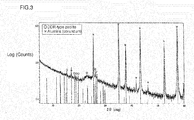
- the graph shown in Fig. 3 shows a result of X-ray analysis where the alumina support after hydrothermal synthesis of Example 3 was measured by the use of an X-ray diffractometer.
- diffraction peaks peaks shown by crosses ( ⁇ ) in Fig. 3 ) of alumina (corundum) as a component of the support
- diffraction peaks peaks shown by circles ( ⁇ ) in Fig. 3 ) of the DDR-type zeolite, and halo were detected.
- Example 3 DDR-type zeolite crystals were formed on the alumina support after hydrothermal synthesis of Example 3. In addition, in Example 3, DDR-type zeolite crystals were grown even with the raw material solution containing no sodium hydroxide (NaOH).
- the present invention can be used as a process for producing a DDR-type zeolite usable for a catalyst, a catalyst carrier, an adsorber, a gas separation membrane, a pervaporation membrane, and the like.
Landscapes
- Chemical & Material Sciences (AREA)
- Organic Chemistry (AREA)
- Life Sciences & Earth Sciences (AREA)
- General Life Sciences & Earth Sciences (AREA)
- Geology (AREA)
- Inorganic Chemistry (AREA)
- Engineering & Computer Science (AREA)
- Chemical Kinetics & Catalysis (AREA)
- Materials Engineering (AREA)
- Silicates, Zeolites, And Molecular Sieves (AREA)
Abstract
Description
- The present invention relates to a process for producing a DDR-type zeolite usable for a catalyst, a catalyst carrier, an adsorber, a gas separation membrane, a pervaporation membrane, and the like.
- 1 There are many kinds (types) of zeolites called LTA, MFI, MOR, AFI, FER, FAU, and DDR classified by the crystal structures.
- Of these, DDR(Deca-Dodecasil 3R) is a crystal having silica as the main component and having pores by a polyhedron containing an oxygen-containing eight-membered ring in the crystal structure. The pore size of the DDR-type zeolite is 4.4 × 3.6 angstrom, which is relatively small among pore sizes of various zeolites.
- The DDR-type zeolite has an inherent adsorption property with respect to low molecular gas in addition to a small pore size. Therefore, the DDR-type zeolite is used as an adsorber for separating only a specific low molecular gas. For example, the DDR-type zeolite can be used as a molecular sieve membrane for low molecular gas.
- As a process for producing a DDR-type zeolite, there is known a process of growing crystals of the DDR-type zeolite by using 1-adamantaneamine as a structure-defining agent, using colloidal silica, ethylenediamine, and water as the raw materials, and adding DDR-type zeolite seed crystals to the raw materials for hydrothermal synthesis. In this production process, there can be produced an all silica DDR-type zeolite not containing aluminum (Patent Documents 1 and 2).
-
- Patent Document 1:
JP-A-2004-83375 - Patent Document 2:
JP-A-2005-67991 - However, in a conventional process for producing a DDR-type zeolite, a long time is required for hydrothermal synthesis, and it is necessary to continuously agitate the raw material solution during the hydrothermal synthesis in order to produce a single crystal of DDR-type zeolite.
- In addition, in a conventional process for producing a DDR-type zeolite, since 1-adamantaneamine is poorly-soluble in water, the conditions of hydrothermal synthesis are improved by dissolving 1-adamantaneamine in ethylenediamine. However, since ethylenediamine is a target substance of the PRTR system [Pollutant Release and Transfer Register: System of notification of discharge amount of a chemical substance which is likely to be harmful to human health or biogeocenosis to an environment (air, water, soil) and aggregation and publication of the discharge amount of the chemical substance by the government], there is desired a process for producing a DDR-type zeolite, where ethylenediamine does not have to be used, in order to reduce the influence on the environment.
- Further, there is a demand of producing a DDR-type zeolite at low costs.
- In view of the aforementioned problems, the present invention aims to provide a DDR-type zeolite production process capable of conducting the process with materials that affect environments to a less extent, requiring a shorter hydrothermal synthesis time, not requiring continuous agitation of the raw material solution, and requiring low production costs.
- In order to solve the aforementioned problems, the present inventors found out a synthesis method of a DDR-type zeolite using 1-adamantaneamine hydrochloride, which has led to the completion of the present invention. That is, according to the present invention, there is provided a process for producing a DDR-type zeolite shown below.
- [1] A process for producing a DDR-type zeolite comprising: a raw material solution preparation step of preparing a raw material solution containing 1-adamantaneamine hydrochloride, silica (SiO2), and water at a 1-adamantaneamine hydrochloride / SiO2 molar ratio of 0.002 to 0.5 and a water / SiO2 molar ratio of 10 to 500, and a crystal growth step of subjecting the raw material solution and a DDR-type zeolite powder to a heat treatment in a state that both the raw material solution and the DDR-type zeolite powder are brought into contact with each other to grow crystals of the DDR-type zeolite by the use of the DDR-type zeolite powder as seed crystals.
- [2] The process for producing a DDR-type zeolite according to [1], wherein the raw material solution does not contain ethylenediamine.
- [3] The process for producing a DDR-type zeolite according to [1] or [2], wherein the raw material solution preparation step includes a step of preparing the raw material solution containing the silica (SiO2) by the use of silica sol and a pH adjustment step of adjusting pH of the raw material solution.
- [4] The process for producing a DDR-type zeolite according to any one of [1] to [3], wherein, in the raw material solution preparation step, the raw material solution containing sodium hydroxide (NaOH) at a NaOH /1-adamantaneamine hydrochloride molar ratio of 1.0 or less is prepared by allowing the silica (SiO2) to be contained by the use of silica sol.
- [5] The process for producing a DDR-type zeolite according to any one of [1] to [4], wherein, in the crystal growth step, the DDR-type zeolite powder is dispersed in the raw material solution to bring the raw material solution and the DDR-type zeolite powder into contact with each other.
- [6] The process for producing a DDR-type zeolite according to any one of [1] to [5], wherein, in the crystal growth step, a support is immersed in the raw material solution where the DDR-type zeolite powder is dispersed to grow crystals of the DDR-type zeolite on the support.
- [7] The process for producing a DDR-type zeolite according to any one of [1] to [4], wherein, in the crystal growth step, a support where the DDR-type zeolite powder is adhering is immersed in the raw material solution to bring the raw material solution and the DDR-type zeolite powder into contact with each other.
- A process for producing a DDR-type zeolite of the present invention requires a shorter hydrothermal synthesis time and does not require continuous agitation of the raw material solution. In addition, a process for producing a DDR-type zeolite of the present invention can be conducted even without using ethylenediamine, which is pointed out as affecting the environments. Further, since 1-adamantaneamine hydrochloride, which is widely available and inexpensive, is used in a process for producing a DDR-type zeolite of the present invention, the production costs can be made low.
-
- [
Fig. 1] Fig. 1 is a graph showing an X-ray diffraction pattern of a powdered DDR-type zeolite of Example 1. - [
Fig. 2] Fig. 2 is a graph showing an X-ray diffraction pattern of a powdered DDR-type zeolite of Example 2. - [
Fig. 3] Fig. 3 is a graph showing an X-ray diffraction pattern of an alumina support after hydrothermal synthesis of Example 3. - Hereinbelow, embodiments of the present invention will be described with referring to drawings. The present invention is by no means limited to the following embodiments, and changes, modifications, and improvements may suitably be added as long as they do not deviate from the scope of the present invention.
- A process for producing a DDR-type zeolite of the present invention has a raw material solution preparation step of preparing a raw material solution containing 1-adamantaneamine hydrochloride, silica (SiO2), and water and a crystal growth step of subjecting the raw material solution and a DDR-type zeolite powder to a heat treatment in a state that both the raw material solution and the DDR-type zeolite powder are brought into contact with each other to grow crystals of the DDR-type zeolite. The aforementioned raw material solution contains 1-adamantaneamine hydrochloride, SiO2, and water, where the 1-adamantaneamine hydrochloride / SiO2 molar ratio is 0.002 to 0.5 and where the water / SiO2 molar ratio is 10 to 500.
- 1-adamantaneamine serves as a substance to become a template for forming a crystal structure of the DDR-type zeolite when crystals of DDR-type zeolite grow, so-called structure-defining agent. However, 1-adamantaneamine is poorly-soluble in water. Therefore, in a process for producing a DDR-type zeolite of the present invention, 1-adamantaneamine hydrochloride is used since it has high solubility in the raw material solution. 1-adamantaneamine can function as a structure-defining agent in the crystal growth of the DDR-type zeolite even when it is dissolved in a raw material solution in the form of hydrochloride.
- Therefore, in a process for producing a DDR-type zeolite of the present invention, 1-adamantaneamine hydrochloride is used instead of 1-adamantaneamine, and thereby a sufficient amount of the structure-defining agent can be dissolved in a raw material solution.
- In a process for producing a DDR-type zeolite of the present invention, since a sufficient amount of the structure-defining agent is dissolved in the raw material solution, crystal growth of the DDR-type zeolite proceeds efficiently in the crystal growth step. As a result, zeolite crystals are produced in a state of very little multiphase with crystal phases other than DDR-type.
- In the raw material preparation step, there is prepared a raw material solution containing 1-adamantaneamine hydrochloride, silica (SiO2), and water.
- In this step, the raw material solution is prepared in such a manner that the molar ratio of 1-adamantaneamine hydrochloride / SiO2 is 0.002 to 0.5. Since the molar ratio of 1-adamantaneamine hydrochloride / SiO2 is 0.002 or more, the amount of the structure-defining agent dissolved in the raw material solution does not become insufficient, and, as a result, the crystal growth rate of the DDR-type zeolite does not fall. On the other hand, when the 1-adamantaneamine hydrochloride / SiO2 molar ratio is 0.5, the amount of 1-adamantaneamine hydrochloride is sufficient for maintaining the crystal growth rate of the DDR-type zeolite. Therefore, when the 1-adamantaneamine hydrochloride / SiO2 molar ratio is 0.5 or less, the amount of the 1-adamantaneamine hydrochloride used can be maintained at a minimum necessary level, and thereby 1-adamantaneamine hydrochloride can be saved, which is preferable from the viewpoint of production costs.
- In this step, the raw material solution is prepared in such a manner that the molar ratio of water /SiO2 is 10 to 500. This numerical range is suitable for crystal growth of the DDR-type zeolite.
- In the raw material solution preparation step, it is possible to allow the raw material solution to contain silica (SiO2) by using silica sol as a raw material. As the silica sol, there may be used silica sol prepared by dissolving minute powder-type silica in water or commercially available colloidal silica.
- The silica sol tends to gelate when pH is too high and when pH is too low. In the case of preparing the raw material solution by using silica sol, it is preferable that the raw material solution preparation step has a pH adjustment step of adjusting pH of the raw material solution lest the silica sol should gelate.
- A specific example of the pH adjustment step is addition of a hydroxide solution.
- It is preferable to prepare a raw material solution so as to contain sodium hydroxide (NaOH) at a NaOH / 1-adamantaneamine hydrochloride molar ratio of 1.0 or less by the aforementioned pH adjustment step or the like. This inhibits the raw material solution from having an excessively high pH condition or an excessively low pH condition, and, as a result, the tendency of gelation of the raw material solution becomes very low.
- In the raw material solution preparation step, it is also possible to disperse a DDR-type zeolite powder to function as seed crystals in the raw material solution in advance.
- In a process for producing a DDR-type zeolite of the present invention, there is used 1-adamantaneamine hydrochloride, which is easily dissolved in water. Therefore, a process for producing a DDR-type zeolite of the present invention can be conducted even without using an additive (e.g., ethylenediamine) for dissolving 1-adamantaneamine in the raw material solution.
- In the crystal growth step, crystals of the DDR-type zeolite is grown with a DDR-type zeolite powder as seed crystals by hydrothermal synthesis where a heat treatment is performed in a state that both the raw material solution and a DDR-type zeolite powder are brought into contact with each other.
- In the hydrothermal synthesis, the temperature of the raw material solution is generally 100 to 170°C, preferably 120 to 170°C from the viewpoint of raising the crystal growth rate.
- In addition, the time of hydrothermal synthesis is generally 8 to 120 hours, preferably 12 to 24 hours from the viewpoint of reducing production costs.
- A process for producing a DDR-type zeolite of the present invention can employ the following embodiment with having the aforementioned characteristics.
- In a process for producing a DDR-type zeolite of the present invention, it is not necessary to use ethylenediamine in order to dissolve 1-adamantaneamine in the raw material solution since 1-adamantaneamine is dissolved in a raw material solution in the form of hydrochloride, which is easily dissolved in water. Therefore, in a process for producing a DDR-type zeolite of the present invention, an embodiment where the raw material solution does not contain ethylenediamine can be employed.
- Since this embodiment does not use ethylenediamine, which is a target substance of the PRTR system, the influence on the environments is less.
- The crystal growth step can be conducted by dispersing a DDR-type zeolite powder serving as seed crystals in the raw material solution. In this embodiment, as a result of the crystal growth, a powdery DDR-type zeolite can be produced.
- In addition, in the crystal growth step, crystals of a DDR-type zeolite can be grown on the support by immersing a support in a raw material solution where a DDR-type zeolite powder is dispersed. In this embodiment, a support where DDR-type zeolite crystal grains adhere can be produced.
- Further, in this embodiment, the DDR-type zeolite powder may be adhering or does not have to be adhering to the support before the immersion in the raw material solution.
- The crystal growth step may be conducted by immersing a support having a DDR-type zeolite powder adhering thereto in the raw material solution. In this embodiment, as a result of crystal growth, a DDR-type zeolite membrane is formed on the support. In addition, in this embodiment, the raw material solution may contain or does not have to contain the DDR-type zeolite powder.
- Hereinbelow, the present invention will be described in more detail on the basis of Examples. However, the present invention is by not means limited to these Examples.
- Water and 0.81g of 1-adamantaneamine hydrochloride (produced by Idemitsu Kosan, Co., Ltd.) were put in a 100ml fluororesin jar and mixed together to prepare a 1-adamantaneamine hydrochloride aqueous solution. At that time, the 1-adamantaneamine hydrochloride was agitated by the use of a stirrer to completely dissolve it in water. To the 1-adamantaneamine hydrochloride aqueous solution was added 10 mass% sodium hydroxide aqueous solution, and it was agitated with a stirrer. Subsequently, to the solution was added silica sol (trade name: Snowtex S, produced by Nissan Chemical Industries, Ltd., with solid content concentration of 30 mass%), and it was agitated by the use of a shaker to obtain a raw material solution. The 1-adamantaneamine hydrochloride / SiO2 molar ratio and the water / SiO2 molar ratio in the raw material solution in Examples 1 and 2 and the NaOH / 1-adamantaneamine hydrochloride molar ratio in the raw material solution are shown in Table 1.
-
[Table 1] Example 1 Example 2 Example 3 1-adamantaneamine hydrochloride / SiO2 0.0268 0.0268 0.0268 Water/SiO2 24.0 24.0 24.0 NaOH / 1-adamantaneamine hydrochloride 1.0 0.5 0 - A DDR-type zeolite powder composed of particle having a particle diameter of 5 µm or less was dispersed in water at a solid content concentration of 0.34 mass% to prepare a DDR-type zeolite seed crystal dispersion solution. To the raw material solution in the jar was added 0.8g of the DDR-type zeolite seed crystal dispersion solution, and it was slightly agitated. Then, the raw material solution was transferred to a stainless-steel pressure resistant container having a fluororesin internal cylinder having a capacity of 100ml and subjected to hydrothermal synthesis at 160°C for 16 hours. During the hydrothermal synthesis, the solution was not agitated. After the hydrothermal synthesis, a white synthesized powder was deposited at the bottom of the fluororesin internal cylinder. The synthesized powder was collected from the bottom of the fluororesin internal cylinder. The collected synthesized powder was washed with water and then dried at 80°C. Thus, a powdery DDR-type zeolite was obtained. Hereinbelow, the powdery DDR-type zeolite obtained in Example 1 will be referred to as a powdery DDR-type zeolite of Example 1. Also, regarding Example 2, the powdery DDR-type zeolite obtained will be referred to in a similar manner.
- Regarding the powdery DDR-type zeolites of Examples 1 and 2, the crystal phases were evaluated by X-ray diffraction. As a result, only the diffraction peak of each of the DDR-type zeolites was clearly detected, and no halo was recognized in the region of 2θ= 20 to 30° (CuKα). Therefore, it was confirmed that a DDR-type zeolite perfect crystal was obtained in Examples 1 and 2. The graph shown in
Fig. 1 shows the result of X-ray analysis where the powdery DDR-type zeolite of Example 1 was measured by the use of an X-ray diffractometer (Name: MiniFlex produced by Rigaku Corporation). Likewise, the graph shown inFig. 2 shows the result of X-ray analysis of the powdery DDR-type zeolite of Example 2. Incidentally, the "diffraction peak of the DDR-type zeolite" in the X-ray diffraction means the diffraction peak described in No. 38-651 or No. 41-571 corresponding to Deca-dodecasil 3R shown in the "Powder Diffraction File" by the International Center for Diffraction Data (ICDD). - In a 100ml fluororesin jar were put 61ml of water and 0.71g of 1-adamantaneamine hydrochloride (produced by Daicel Corporation) to prepare 1-adamantaneamine hydrochloride aqueous solution. At that time, 1-adamantaneamine hydrochloride was agitated with a stirrer to be completely dissolved in water. To the 1-adamantaneamine hydrochloride aqueous solution was added silica sol (Trade name: Snowtex S, produced by Nissan Chemical Industries, Ltd., with solid content concentration of 30 mass%). Then, the solution was agitated by the use of a shaker to obtain a raw material solution. The 1-adamantaneamine hydrochloride / SiO2 molar ratio and the water / SiO2 molar ratio in the raw material solution of Example 3 are shown in Table 1.
- To the raw material solution in the jar was added 0.3g of the DDR-type zeolite seed crystal dispersion solution which was the same as in Examples 1 and 2, and it was slightly agitated. Then, the raw material solution was transferred to a stainless-steel pressure resistant container having a fluororesin internal cylinder having a capacity of 100ml. An alumina porous support was immersed in the raw material solution, and hydrothermal synthesis was performed at 135°C for 120 hours. During the hydrothermal synthesis, the solution was not agitated. After the hydrothermal synthesis, the alumina support was taken out from the fluororesin internal cylinder. The alumina support was washed with water and then dried at 80°C. Hereinbelow, the alumina support obtained in Example 3 as described above will be referred to as an alumina support after hydrothermal synthesis of Example 3.
- Regarding the alumina support after hydrothermal synthesis of Example 3, the microstructure observation was conducted by the use of a scanning electron microscope (hereinbelow SEM). As a result, it was confirmed that a large number of crystal grains were adhering to the alumina support after hydrothermal synthesis of Example 3.
- Regarding the alumina support after hydrothermal synthesis of Example 3, evaluation of the crystal phase was conducted by X-ray diffraction. The graph shown in
Fig. 3 shows a result of X-ray analysis where the alumina support after hydrothermal synthesis of Example 3 was measured by the use of an X-ray diffractometer. As a result, diffraction peaks (peaks shown by crosses (×) inFig. 3 ) of alumina (corundum) as a component of the support, diffraction peaks (peaks shown by circles (○) inFig. 3 ) of the DDR-type zeolite, and halo were detected. Therefore, it was confirmed that DDR-type zeolite crystals were formed on the alumina support after hydrothermal synthesis of Example 3. In addition, in Example 3, DDR-type zeolite crystals were grown even with the raw material solution containing no sodium hydroxide (NaOH). - The present invention can be used as a process for producing a DDR-type zeolite usable for a catalyst, a catalyst carrier, an adsorber, a gas separation membrane, a pervaporation membrane, and the like.
Claims (7)
- A process for producing a DDR-type zeolite comprising:a raw material solution preparation step of preparing a raw material solution containing 1-adamantaneamine hydrochloride, silica (SiO2), and water at a 1-adamantaneamine hydrochloride / SiO2 molar ratio of 0.002 to 0.5 and a water / SiO2 molar ratio of 10 to 500, anda crystal growth step of subjecting the raw material solution and a DDR-type zeolite powder to a heat treatment in a state that both the raw material solution and the DDR-type zeolite powder are brought into contact with each other to grow crystals of the DDR-type zeolite by the use of the DDR-type zeolite powder as seed crystals.
- The process for producing a DDR-type zeolite according to Claim 1, wherein the raw material solution does not contain ethylenediamine.
- The process for producing a DDR-type zeolite according to Claim 1 or 2, wherein the raw material solution preparation step includes a step of preparing the raw material solution containing the silica (SiO2) by the use of silica sol and a pH adjustment step of adjusting pH of the raw material solution.
- The process for producing a DDR-type zeolite according to any one of Claims 1 to 3, wherein, in the raw material solution preparation step, the raw material solution containing sodium hydroxide (NaOH) at a NaOH /1-adamantaneamine hydrochloride molar ratio of 1.0 or less is prepared by allowing the silica (SiO2) to be contained by the use of silica sol.
- The process for producing a DDR-type zeolite according to any one of Claims 1 to 4, wherein, in the crystal growth step, the DDR-type zeolite powder is dispersed in the raw material solution to bring the raw material solution and the DDR-type zeolite powder into contact with each other.
- The process for producing a DDR-type zeolite according to any one of Claims 1 to 5, wherein, in the crystal growth step, a support is immersed in the raw material solution where the DDR-type zeolite powder is dispersed to grow crystals of the DDR-type zeolite on the support.
- The process for producing a DDR-type zeolite according to any one of Claims 1 to 4, wherein, in the crystal growth step, a support where the DDR-type zeolite powder is adhering is immersed in the raw material solution to bring the raw material solution and the DDR-type zeolite powder into contact with each other.
Applications Claiming Priority (2)
| Application Number | Priority Date | Filing Date | Title |
|---|---|---|---|
| JP2009280294 | 2009-12-10 | ||
| PCT/JP2010/069726 WO2011070879A1 (en) | 2009-12-10 | 2010-11-05 | Process for production of ddr-type zeolite |
Publications (3)
| Publication Number | Publication Date |
|---|---|
| EP2511234A1 true EP2511234A1 (en) | 2012-10-17 |
| EP2511234A4 EP2511234A4 (en) | 2015-08-05 |
| EP2511234B1 EP2511234B1 (en) | 2017-12-20 |
Family
ID=44145432
Family Applications (1)
| Application Number | Title | Priority Date | Filing Date |
|---|---|---|---|
| EP10835801.1A Active EP2511234B1 (en) | 2009-12-10 | 2010-11-05 | Process for production of ddr-type zeolite |
Country Status (5)
| Country | Link |
|---|---|
| US (1) | US8545802B2 (en) |
| EP (1) | EP2511234B1 (en) |
| JP (1) | JP5695576B2 (en) |
| CN (1) | CN102639441B (en) |
| WO (1) | WO2011070879A1 (en) |
Families Citing this family (3)
| Publication number | Priority date | Publication date | Assignee | Title |
|---|---|---|---|---|
| WO2014157323A1 (en) * | 2013-03-29 | 2014-10-02 | 日本碍子株式会社 | Method for producing ddr-type zeolite crystals and method for producing ddr-type zeolite film |
| CN108246121B (en) * | 2017-04-08 | 2020-11-10 | 南京蓝恒环保设备有限公司 | Preparation method of sheet type molecular sieve membrane |
| WO2019187640A1 (en) * | 2018-03-30 | 2019-10-03 | 日本碍子株式会社 | Zeolite membrane composite body, method for producing zeolite membrane composite body, and separation method |
Family Cites Families (8)
| Publication number | Priority date | Publication date | Assignee | Title |
|---|---|---|---|---|
| GB8618773D0 (en) * | 1986-07-31 | 1986-09-10 | Ici Plc | Zeolite synthesis |
| ATE422386T1 (en) * | 2001-09-17 | 2009-02-15 | Ngk Insulators Ltd | METHOD FOR PRODUCING ZEOLITE FILM DECA-DODECASIL 3R, ZEOLITE FILM DECA-DODECASIL 3R AND COMPOSITE ZEOLITE FILM DECA-DODECASIL 3R AND PRODUCTION METHOD THEREOF |
| JP4204270B2 (en) * | 2001-09-17 | 2009-01-07 | 日本碍子株式会社 | Method for producing DDR type zeolite membrane |
| JP4204273B2 (en) * | 2002-08-09 | 2009-01-07 | 日本碍子株式会社 | DDR type zeolite membrane composite and method for producing the same |
| JP4355478B2 (en) * | 2002-08-29 | 2009-11-04 | 日本碍子株式会社 | Method for producing DDR type zeolite |
| JP4409885B2 (en) * | 2003-08-28 | 2010-02-03 | 日本碍子株式会社 | Method for producing DDR type zeolite powder |
| WO2007105407A1 (en) * | 2006-03-14 | 2007-09-20 | Ngk Insulators, Ltd. | Process for producing ddr type zeolite membrane |
| JP5421899B2 (en) * | 2008-03-12 | 2014-02-19 | 日本碍子株式会社 | Method for producing DDR type zeolite membrane |
-
2010
- 2010-11-05 JP JP2011545152A patent/JP5695576B2/en active Active
- 2010-11-05 WO PCT/JP2010/069726 patent/WO2011070879A1/en not_active Ceased
- 2010-11-05 CN CN201080053919.7A patent/CN102639441B/en active Active
- 2010-11-05 EP EP10835801.1A patent/EP2511234B1/en active Active
-
2012
- 2012-04-27 US US13/457,838 patent/US8545802B2/en active Active
Non-Patent Citations (1)
| Title |
|---|
| See references of WO2011070879A1 * |
Also Published As
| Publication number | Publication date |
|---|---|
| CN102639441B (en) | 2014-10-22 |
| EP2511234B1 (en) | 2017-12-20 |
| CN102639441A (en) | 2012-08-15 |
| JPWO2011070879A1 (en) | 2013-04-22 |
| EP2511234A4 (en) | 2015-08-05 |
| US20120213696A1 (en) | 2012-08-23 |
| US8545802B2 (en) | 2013-10-01 |
| WO2011070879A1 (en) | 2011-06-16 |
| JP5695576B2 (en) | 2015-04-08 |
Similar Documents
| Publication | Publication Date | Title |
|---|---|---|
| JP4355478B2 (en) | Method for producing DDR type zeolite | |
| US6190638B1 (en) | Molecular sieves and process for their manufacture | |
| EP2404874B1 (en) | Process for the production of ddr-type zeolite membranes | |
| KR101950552B1 (en) | Synthesis of zsm-5 crystals with improved morphology | |
| JP4204270B2 (en) | Method for producing DDR type zeolite membrane | |
| CN103657706A (en) | Preparation method of high-strength binding-agent-free multi-orifice compound ZSM-5 (Zeolite Socony Mobil-5) catalyst | |
| US8545802B2 (en) | Process for production of DDR-type zeolite | |
| EP1661616B1 (en) | Gas separating body and method for producing same | |
| CN102695674B (en) | Method for producing DDR zeolite | |
| CN104556122B (en) | Molecular sieve supported nanocrystal Y-type molecular sieve and synthesis method thereof | |
| US11214493B2 (en) | Accelerated aluminosilicate zeolite crystallization | |
| JP6052749B2 (en) | REACTION SOLUTION FOR HYDROTHERMAL SYNTHESIS AND PROCESS FOR PRODUCING ZEOLITE BULK BODY | |
| JP4409885B2 (en) | Method for producing DDR type zeolite powder | |
| Su et al. | Preparation of mordenite composite membranes with seeding |
Legal Events
| Date | Code | Title | Description |
|---|---|---|---|
| PUAI | Public reference made under article 153(3) epc to a published international application that has entered the european phase |
Free format text: ORIGINAL CODE: 0009012 |
|
| 17P | Request for examination filed |
Effective date: 20120516 |
|
| AK | Designated contracting states |
Kind code of ref document: A1 Designated state(s): AL AT BE BG CH CY CZ DE DK EE ES FI FR GB GR HR HU IE IS IT LI LT LU LV MC MK MT NL NO PL PT RO RS SE SI SK SM TR |
|
| DAX | Request for extension of the european patent (deleted) | ||
| RIC1 | Information provided on ipc code assigned before grant |
Ipc: C01B 39/48 20060101AFI20150625BHEP Ipc: C01B 37/02 20060101ALI20150625BHEP |
|
| RA4 | Supplementary search report drawn up and despatched (corrected) |
Effective date: 20150706 |
|
| 17Q | First examination report despatched |
Effective date: 20160525 |
|
| GRAP | Despatch of communication of intention to grant a patent |
Free format text: ORIGINAL CODE: EPIDOSNIGR1 |
|
| INTG | Intention to grant announced |
Effective date: 20170609 |
|
| GRAS | Grant fee paid |
Free format text: ORIGINAL CODE: EPIDOSNIGR3 |
|
| GRAA | (expected) grant |
Free format text: ORIGINAL CODE: 0009210 |
|
| AK | Designated contracting states |
Kind code of ref document: B1 Designated state(s): AL AT BE BG CH CY CZ DE DK EE ES FI FR GB GR HR HU IE IS IT LI LT LU LV MC MK MT NL NO PL PT RO RS SE SI SK SM TR |
|
| REG | Reference to a national code |
Ref country code: GB Ref legal event code: FG4D |
|
| REG | Reference to a national code |
Ref country code: CH Ref legal event code: EP |
|
| REG | Reference to a national code |
Ref country code: IE Ref legal event code: FG4D |
|
| REG | Reference to a national code |
Ref country code: AT Ref legal event code: REF Ref document number: 956197 Country of ref document: AT Kind code of ref document: T Effective date: 20180115 |
|
| REG | Reference to a national code |
Ref country code: DE Ref legal event code: R096 Ref document number: 602010047573 Country of ref document: DE |
|
| REG | Reference to a national code |
Ref country code: NL Ref legal event code: MP Effective date: 20171220 |
|
| PG25 | Lapsed in a contracting state [announced via postgrant information from national office to epo] |
Ref country code: LT Free format text: LAPSE BECAUSE OF FAILURE TO SUBMIT A TRANSLATION OF THE DESCRIPTION OR TO PAY THE FEE WITHIN THE PRESCRIBED TIME-LIMIT Effective date: 20171220 Ref country code: FI Free format text: LAPSE BECAUSE OF FAILURE TO SUBMIT A TRANSLATION OF THE DESCRIPTION OR TO PAY THE FEE WITHIN THE PRESCRIBED TIME-LIMIT Effective date: 20171220 Ref country code: SE Free format text: LAPSE BECAUSE OF FAILURE TO SUBMIT A TRANSLATION OF THE DESCRIPTION OR TO PAY THE FEE WITHIN THE PRESCRIBED TIME-LIMIT Effective date: 20171220 Ref country code: NO Free format text: LAPSE BECAUSE OF FAILURE TO SUBMIT A TRANSLATION OF THE DESCRIPTION OR TO PAY THE FEE WITHIN THE PRESCRIBED TIME-LIMIT Effective date: 20180320 |
|
| REG | Reference to a national code |
Ref country code: LT Ref legal event code: MG4D |
|
| REG | Reference to a national code |
Ref country code: AT Ref legal event code: MK05 Ref document number: 956197 Country of ref document: AT Kind code of ref document: T Effective date: 20171220 |
|
| PG25 | Lapsed in a contracting state [announced via postgrant information from national office to epo] |
Ref country code: RS Free format text: LAPSE BECAUSE OF FAILURE TO SUBMIT A TRANSLATION OF THE DESCRIPTION OR TO PAY THE FEE WITHIN THE PRESCRIBED TIME-LIMIT Effective date: 20171220 Ref country code: GR Free format text: LAPSE BECAUSE OF FAILURE TO SUBMIT A TRANSLATION OF THE DESCRIPTION OR TO PAY THE FEE WITHIN THE PRESCRIBED TIME-LIMIT Effective date: 20180321 Ref country code: HR Free format text: LAPSE BECAUSE OF FAILURE TO SUBMIT A TRANSLATION OF THE DESCRIPTION OR TO PAY THE FEE WITHIN THE PRESCRIBED TIME-LIMIT Effective date: 20171220 Ref country code: BG Free format text: LAPSE BECAUSE OF FAILURE TO SUBMIT A TRANSLATION OF THE DESCRIPTION OR TO PAY THE FEE WITHIN THE PRESCRIBED TIME-LIMIT Effective date: 20180320 Ref country code: LV Free format text: LAPSE BECAUSE OF FAILURE TO SUBMIT A TRANSLATION OF THE DESCRIPTION OR TO PAY THE FEE WITHIN THE PRESCRIBED TIME-LIMIT Effective date: 20171220 |
|
| PG25 | Lapsed in a contracting state [announced via postgrant information from national office to epo] |
Ref country code: NL Free format text: LAPSE BECAUSE OF FAILURE TO SUBMIT A TRANSLATION OF THE DESCRIPTION OR TO PAY THE FEE WITHIN THE PRESCRIBED TIME-LIMIT Effective date: 20171220 |
|
| PG25 | Lapsed in a contracting state [announced via postgrant information from national office to epo] |
Ref country code: CZ Free format text: LAPSE BECAUSE OF FAILURE TO SUBMIT A TRANSLATION OF THE DESCRIPTION OR TO PAY THE FEE WITHIN THE PRESCRIBED TIME-LIMIT Effective date: 20171220 Ref country code: SK Free format text: LAPSE BECAUSE OF FAILURE TO SUBMIT A TRANSLATION OF THE DESCRIPTION OR TO PAY THE FEE WITHIN THE PRESCRIBED TIME-LIMIT Effective date: 20171220 Ref country code: ES Free format text: LAPSE BECAUSE OF FAILURE TO SUBMIT A TRANSLATION OF THE DESCRIPTION OR TO PAY THE FEE WITHIN THE PRESCRIBED TIME-LIMIT Effective date: 20171220 Ref country code: CY Free format text: LAPSE BECAUSE OF FAILURE TO SUBMIT A TRANSLATION OF THE DESCRIPTION OR TO PAY THE FEE WITHIN THE PRESCRIBED TIME-LIMIT Effective date: 20171220 Ref country code: EE Free format text: LAPSE BECAUSE OF FAILURE TO SUBMIT A TRANSLATION OF THE DESCRIPTION OR TO PAY THE FEE WITHIN THE PRESCRIBED TIME-LIMIT Effective date: 20171220 |
|
| PG25 | Lapsed in a contracting state [announced via postgrant information from national office to epo] |
Ref country code: IS Free format text: LAPSE BECAUSE OF FAILURE TO SUBMIT A TRANSLATION OF THE DESCRIPTION OR TO PAY THE FEE WITHIN THE PRESCRIBED TIME-LIMIT Effective date: 20180420 Ref country code: IT Free format text: LAPSE BECAUSE OF FAILURE TO SUBMIT A TRANSLATION OF THE DESCRIPTION OR TO PAY THE FEE WITHIN THE PRESCRIBED TIME-LIMIT Effective date: 20171220 Ref country code: RO Free format text: LAPSE BECAUSE OF FAILURE TO SUBMIT A TRANSLATION OF THE DESCRIPTION OR TO PAY THE FEE WITHIN THE PRESCRIBED TIME-LIMIT Effective date: 20171220 Ref country code: PL Free format text: LAPSE BECAUSE OF FAILURE TO SUBMIT A TRANSLATION OF THE DESCRIPTION OR TO PAY THE FEE WITHIN THE PRESCRIBED TIME-LIMIT Effective date: 20171220 Ref country code: AT Free format text: LAPSE BECAUSE OF FAILURE TO SUBMIT A TRANSLATION OF THE DESCRIPTION OR TO PAY THE FEE WITHIN THE PRESCRIBED TIME-LIMIT Effective date: 20171220 Ref country code: SM Free format text: LAPSE BECAUSE OF FAILURE TO SUBMIT A TRANSLATION OF THE DESCRIPTION OR TO PAY THE FEE WITHIN THE PRESCRIBED TIME-LIMIT Effective date: 20171220 |
|
| REG | Reference to a national code |
Ref country code: DE Ref legal event code: R097 Ref document number: 602010047573 Country of ref document: DE |
|
| PLBE | No opposition filed within time limit |
Free format text: ORIGINAL CODE: 0009261 |
|
| STAA | Information on the status of an ep patent application or granted ep patent |
Free format text: STATUS: NO OPPOSITION FILED WITHIN TIME LIMIT |
|
| 26N | No opposition filed |
Effective date: 20180921 |
|
| PG25 | Lapsed in a contracting state [announced via postgrant information from national office to epo] |
Ref country code: DK Free format text: LAPSE BECAUSE OF FAILURE TO SUBMIT A TRANSLATION OF THE DESCRIPTION OR TO PAY THE FEE WITHIN THE PRESCRIBED TIME-LIMIT Effective date: 20171220 |
|
| PG25 | Lapsed in a contracting state [announced via postgrant information from national office to epo] |
Ref country code: SI Free format text: LAPSE BECAUSE OF FAILURE TO SUBMIT A TRANSLATION OF THE DESCRIPTION OR TO PAY THE FEE WITHIN THE PRESCRIBED TIME-LIMIT Effective date: 20171220 |
|
| REG | Reference to a national code |
Ref country code: CH Ref legal event code: PL |
|
| GBPC | Gb: european patent ceased through non-payment of renewal fee |
Effective date: 20181105 |
|
| PG25 | Lapsed in a contracting state [announced via postgrant information from national office to epo] |
Ref country code: MC Free format text: LAPSE BECAUSE OF FAILURE TO SUBMIT A TRANSLATION OF THE DESCRIPTION OR TO PAY THE FEE WITHIN THE PRESCRIBED TIME-LIMIT Effective date: 20171220 Ref country code: LU Free format text: LAPSE BECAUSE OF NON-PAYMENT OF DUE FEES Effective date: 20181105 |
|
| REG | Reference to a national code |
Ref country code: BE Ref legal event code: MM Effective date: 20181130 |
|
| REG | Reference to a national code |
Ref country code: IE Ref legal event code: MM4A |
|
| PG25 | Lapsed in a contracting state [announced via postgrant information from national office to epo] |
Ref country code: CH Free format text: LAPSE BECAUSE OF NON-PAYMENT OF DUE FEES Effective date: 20181130 Ref country code: LI Free format text: LAPSE BECAUSE OF NON-PAYMENT OF DUE FEES Effective date: 20181130 |
|
| PG25 | Lapsed in a contracting state [announced via postgrant information from national office to epo] |
Ref country code: FR Free format text: LAPSE BECAUSE OF NON-PAYMENT OF DUE FEES Effective date: 20181130 Ref country code: IE Free format text: LAPSE BECAUSE OF NON-PAYMENT OF DUE FEES Effective date: 20181105 |
|
| PG25 | Lapsed in a contracting state [announced via postgrant information from national office to epo] |
Ref country code: BE Free format text: LAPSE BECAUSE OF NON-PAYMENT OF DUE FEES Effective date: 20181130 |
|
| PG25 | Lapsed in a contracting state [announced via postgrant information from national office to epo] |
Ref country code: GB Free format text: LAPSE BECAUSE OF NON-PAYMENT OF DUE FEES Effective date: 20181105 |
|
| PG25 | Lapsed in a contracting state [announced via postgrant information from national office to epo] |
Ref country code: MT Free format text: LAPSE BECAUSE OF NON-PAYMENT OF DUE FEES Effective date: 20181105 |
|
| PG25 | Lapsed in a contracting state [announced via postgrant information from national office to epo] |
Ref country code: TR Free format text: LAPSE BECAUSE OF FAILURE TO SUBMIT A TRANSLATION OF THE DESCRIPTION OR TO PAY THE FEE WITHIN THE PRESCRIBED TIME-LIMIT Effective date: 20171220 |
|
| PG25 | Lapsed in a contracting state [announced via postgrant information from national office to epo] |
Ref country code: PT Free format text: LAPSE BECAUSE OF FAILURE TO SUBMIT A TRANSLATION OF THE DESCRIPTION OR TO PAY THE FEE WITHIN THE PRESCRIBED TIME-LIMIT Effective date: 20171220 |
|
| PG25 | Lapsed in a contracting state [announced via postgrant information from national office to epo] |
Ref country code: MK Free format text: LAPSE BECAUSE OF NON-PAYMENT OF DUE FEES Effective date: 20171220 Ref country code: HU Free format text: LAPSE BECAUSE OF FAILURE TO SUBMIT A TRANSLATION OF THE DESCRIPTION OR TO PAY THE FEE WITHIN THE PRESCRIBED TIME-LIMIT; INVALID AB INITIO Effective date: 20101105 |
|
| PG25 | Lapsed in a contracting state [announced via postgrant information from national office to epo] |
Ref country code: AL Free format text: LAPSE BECAUSE OF FAILURE TO SUBMIT A TRANSLATION OF THE DESCRIPTION OR TO PAY THE FEE WITHIN THE PRESCRIBED TIME-LIMIT Effective date: 20171220 |
|
| PGFP | Annual fee paid to national office [announced via postgrant information from national office to epo] |
Ref country code: DE Payment date: 20250930 Year of fee payment: 16 |