EP2509389A1 - Connecting electronic apparatuses in proximity having a same community relationship - Google Patents
Connecting electronic apparatuses in proximity having a same community relationship Download PDFInfo
- Publication number
- EP2509389A1 EP2509389A1 EP11008657A EP11008657A EP2509389A1 EP 2509389 A1 EP2509389 A1 EP 2509389A1 EP 11008657 A EP11008657 A EP 11008657A EP 11008657 A EP11008657 A EP 11008657A EP 2509389 A1 EP2509389 A1 EP 2509389A1
- Authority
- EP
- European Patent Office
- Prior art keywords
- bluetooth device
- proximity network
- bluetooth
- electronic apparatus
- community relationship
- Prior art date
- Legal status (The legal status is an assumption and is not a legal conclusion. Google has not performed a legal analysis and makes no representation as to the accuracy of the status listed.)
- Withdrawn
Links
- 238000000034 method Methods 0.000 claims description 24
- 230000005540 biological transmission Effects 0.000 description 8
- 230000006870 function Effects 0.000 description 5
- 238000010586 diagram Methods 0.000 description 4
- 238000005516 engineering process Methods 0.000 description 3
- 230000002618 waking effect Effects 0.000 description 3
- 238000004891 communication Methods 0.000 description 2
- 230000002708 enhancing effect Effects 0.000 description 2
- 230000002452 interceptive effect Effects 0.000 description 2
- 238000012986 modification Methods 0.000 description 2
- 230000004048 modification Effects 0.000 description 2
- 125000004122 cyclic group Chemical group 0.000 description 1
- 230000003993 interaction Effects 0.000 description 1
- 230000007246 mechanism Effects 0.000 description 1
- 230000008569 process Effects 0.000 description 1
Images



Classifications
-
- H—ELECTRICITY
- H04—ELECTRIC COMMUNICATION TECHNIQUE
- H04W—WIRELESS COMMUNICATION NETWORKS
- H04W84/00—Network topologies
- H04W84/18—Self-organising networks, e.g. ad-hoc networks or sensor networks
-
- H—ELECTRICITY
- H04—ELECTRIC COMMUNICATION TECHNIQUE
- H04W—WIRELESS COMMUNICATION NETWORKS
- H04W4/00—Services specially adapted for wireless communication networks; Facilities therefor
- H04W4/06—Selective distribution of broadcast services, e.g. multimedia broadcast multicast service [MBMS]; Services to user groups; One-way selective calling services
- H04W4/08—User group management
Definitions
- the present invention relates to a proximity network system, and more particularly, to a proximity network system used for connecting a plurality of electronic apparatuses having a same community relationship, and a connecting method thereof.
- proximity network Many practical and possible applications could be implemented by using this kind of proximity network to extend interactions among people. For example, people in the same proximity network could share documents, or use particular hand gestures that could only be done in a very small area of proximity network.
- the present invention provides a proximity network system comprising a plurality of Bluetooth devices disposed respectively in each one of the plurality of electronic apparatuses.
- the plurality of Bluetooth devices are arranged for enabling the plurality of electronic apparatuses to receive and transmit Bluetooth wireless signals with each other, wherein each Bluetooth device comprises: a community relationship module is arranged for storing a community relationship data of each Bluetooth device; an identifying module is arranged for reading the community relationship data of each Bluetooth device to identify whether each Bluetooth device has the same community relationship; and a distance detecting module is arranged for determining whether each Bluetooth device is in the proximity network.
- each electronic apparatus is allowed to receive and transmit the Bluetooth wireless signals with another electronic apparatus via the corresponding Bluetooth device.
- the present invention also discloses a proximity network connecting method used for the proximity network system, the proximity network connecting method comprising: storing a community relationship data in each Bluetooth device; reading the community relationship data of each Bluetooth device to identify whether each Bluetooth device has the same community relationship; determining whether each Bluetooth device is in the proximity network; and when the Bluetooth devices are identified to have the same community relationship with each other and are in the proximity network, each electronic apparatus is allowed to receive and transmit the Bluetooth wireless signals with another electronic apparatus via the corresponding Bluetooth device.
- the present invention also discloses an electronic apparatus used for the proximity network system.
- the electronic apparatus comprises a Bluetooth device for establishing a proximity network.
- the Bluetooth device comprises a community relationship module, an identifying module, and a distance detecting module; the community relationship module is arranged for storing a community relationship data of the Bluetooth device; the identifying module is arranged for determining whether a neighboring Bluetooth device corresponds to the community relationship data to identify whether the Bluetooth device and the neighboring Bluetooth device have a same community relationship; and a distance detecting module is arranged for detecting a distance between the Bluetooth device and the neighboring Bluetooth device to determine whether the neighboring Bluetooth device is in the proximity network. Wherein when the neighboring Bluetooth device is in the proximity network and is identified to have the same community relationship of the Bluetooth device, the electronic apparatus is allowed to establish a connection with the neighboring Bluetooth device via the Bluetooth device.
- each Bluetooth device may identify other Bluetooth devices having the same community relationship in the proximity network and may choose to connect with the Bluetooth devices for data transmission to enhance the functionality of the wireless network.
- the present invention discloses a proximity network system comprising electronic apparatuses having Bluetooth transmission capabilities to transmit/receive Bluetooth signals in the proximity network.
- the electronic apparatus may be a smart phone, portable computer, personal data assistant (PDA) or other electronic apparatuses having Bluetooth transmission capabilities or the like.
- PDA personal data assistant
- the proximity network system comprises a plurality of Bluetooth devices disposed respectively in each one of the plurality of electronic apparatuses, wherein each Bluetooth device uses a Bluetooth 4.0 standard LE link component, which is designed to reduce the number of channels for search and to increase the channel search speed. Additionally, the Bluetooth 4.0 standard LE link component saves 1 to 3mW of power consumption as compared with the traditional Bluetooth 3.0 component. Moreover, the Bluetooth 4.0 standard LE link component can work independently to communicate with another Bluetooth device of another electronic apparatus without waking up the system or the CPU of the electronic apparatus to perform the operation. Therefore, the Bluetooth device can work independently without being affected by the operating status of the electronic apparatus, thereby extending the duration of the electronic apparatus.
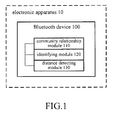
- FIG.1 illustrates a system block diagram of each electronic apparatus 10 of a proximity network system in a first embodiment of the present invention.
- a Bluetooth device 100 of each electronic apparatus 10 comprises a community relationship module 110, an identifying module 120, and a distance detecting module 130, and these modules are electrically connected with each other.
- each Bluetooth device 100 can be a processing chip, and each module can be a corresponding firmware stored in the processing chip, but each module can also be embodied in a physical circuit, a firmware or software, or a combination thereof.
- the community relationship module 110 stores a community relationship data of each Bluetooth device 100.
- the user can define at least one group and its members by him/herself, and a community relationship data corresponding to each Bluetooth device 100 is generated by using the Bluetooth device 100 to perform an apparatus matching function with other Bluetooth devices or inputting a user-defined data; in this way the user can add new member to the group and stores all the community relationship data in the community relationship module 110 for later application.
- the community relationship data can comprise a group name, member names, and identifications for Bluetooth devices corresponding to all members (such as a Bluetooth ID).
- the identifying module 120 reads the community relationship data of each Bluetooth device 100 to identify whether each Bluetooth device 100 has the same community relationship.
- the identifying module 120 receives an advertising message from each neighboring Bluetooth device 100 to identify the existence of another Bluetooth device 100; at this time the identifying module 120 may compare the community relationship data stored in the community relationship module 110 with the community relationship data provided by each existed Bluetooth device 100. Therefore, each Bluetooth device 100 having the same community relationship or having a different community relationship may be identified.
- the distance detecting module 130 determines whether each Bluetooth device 100 is in the proximity network.
- the proximity network is formed by any Bluetooth device 100 and has a covering range defined by the maximum reach of the signal transmitted by the Bluetooth device 100. Therefore, the distance detecting module 130 can detect distances of other Bluetooth devices with respect to the Bluetooth device, thereby determining whether other Bluetooth devices are in the proximity network formed by the Bluetooth device.
- the proximity network formed by the Bluetooth device 100 is in a range of 3 to 5 meters from the center of the Bluetooth device 100.
- the distance detecting module 130 can be a received signal strength indicator (RSSI) detecting module.
- RSSI received signal strength indicator
- the RSSI detecting module may obtain a corresponding received signal strength indication according to a signal strength of each neighboring Bluetooth device 100, thereby identifying a distance between the Bluetooth device 100 and each neighboring Bluetooth device, and determining whether the neighboring Bluetooth devices are in the proximity network formed by the Bluetooth device 100.
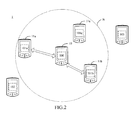
- FIG.2 illustrates an embodiment view of using the proximity network system 1 of the present invention.
- Each Bluetooth device 100 can be in an advertiser mode or a scanner mode based on a user command or its own status.
- the Bluetooth device 100 continuously sends out advertising messages; at this time, the Bluetooth device 100 may operate without the electronic apparatus 10 enabling the system or CPU, thereby reducing power consumption.
- the Bluetooth device 100 forms a proximity network N and notifies the electronic apparatus 10 to enable the system or CPU.
- the Bluetooth device 100 may perform cyclic search with respect to the proximity network N to identify the existence of neighboring Bluetooth devices.
- a proximity network N is formed in a certain area of the physical space according to the Bluetooth device 100.
- the Bluetooth device 100 receives the advertising messages from neighboring Bluetooth devices 101a, 101b, 101c, 102, 103 being in the advertiser mode, the distance detecting module 130 of the Bluetooth device 100 determines whether these neighboring Bluetooth devices 101a, 101b, 101c, 102, 103 are in the proximity network N. For example, the neighboring Bluetooth devices 101a, 101b, 101c are in the proximity network N and the neighboring Bluetooth devices 102, 103 are outside the proximity network N, so the neighboring Bluetooth devices 102, 103 are excluded by the distance detecting module 130.
- the identifying module 120 of the Bluetooth device 100 reads the community relationship data of the neighboring Bluetooth device 101a, 101b, 101c being in the advertiser mode and compares the community relationship data with the community relationship data stored in the community relationship module 110. According to the comparing result of the identifying module 120, if the community relationship data of the neighboring Bluetooth devices 101a, 101b corresponds to that stored in the community relationship module 110, and the community relationship data of the neighboring Bluetooth device 101c does not correspond to that stored in the community relationship module 110, it means that the Bluetooth device 100 and the neighboring Bluetooth devices 101a, 101b have the same community relationship, and the Bluetooth device 101c having a different community relationship may be excluded.
- the Bluetooth device 100 of electronic apparatus 10 will generate a notification message and display the notification message, for example, on a display of the electronic apparatus 10 to inform the user of the electronic apparatus 10 that the neighboring Bluetooth devices 101a, 101b having the same community relationship are in the proximity network N, which means the corresponding electronic apparatuses 11a, 11b exist in the proximity network N.
- the Bluetooth device 100 of the electronic apparatus 10 can use the Bluetooth device 100 of the electronic apparatus 10 to establish a connection with the neighboring Bluetooth devices 101a, 101b of the electronic apparatuses 11a, 11b in the proximity network N and to transmit/receive Bluetooth wireless signals with each other.
- the system or CPU of each one of the electronic apparatuses 11a, 11b can be enabled by the neighboring Bluetooth devices 101a, 101b respectively to perform subsequent operations such as interactive command input or data transmission.
- a user of an electronic apparatus can find a familiar user through the proximity network constructed by the Bluetooth device and wakes up the electronic apparatus of another user for data transmission between both parties or among many parties and also interactive operations.
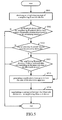
- FIG.3 illustrates a flow chart of a proximity network connecting method for the electronic apparatuses in the first embodiment of the present invention.
- the proximity network connecting method comprises step S301 to step S304, which will be described below in details.
- Step S301 obtaining an advertising message of a neighboring Bluetooth device.
- a Bluetooth device of an electronic apparatus When a Bluetooth device of an electronic apparatus is in the scanner mode, it will form a proximity network; if a neighboring Bluetooth device in the advertiser mode is near the Bluetooth device, the Bluetooth device will receive the advertising message from the neighboring Bluetooth device.
- the advertising message comprises data regarding to the neighboring Bluetooth device, such as a device name, an ID number and so on.
- Step S302 determining whether the Bluetooth device and the neighboring Bluetooth device have a same community relationship according to the advertising message.
- the identifying module of the Bluetooth device compares the received advertising message with the community relationship data stored in the community relationship module. When the relative data in the advertising message of the neighboring Bluetooth device corresponds to the group or member data of the community relationship data, the identifying module may determine that the Bluetooth device and the neighboring Bluetooth device have the same community relationship; if not, then the two Bluetooth devices do not have the same community relationship.
- Step S303 determining whether the neighboring Bluetooth device is in the proximity network.
- the Bluetooth device detects a distance between the Bluetooth and the neighboring Bluetooth device by the distance detecting module and determines whether the neighboring Bluetooth device is in the proximity network based on the detected distance.
- Step S304 establishing a connection between the Bluetooth device and the neighboring Bluetooth device.
- the Bluetooth module is allowed to establish a connection with the neighboring Bluetooth device to transmit and receive Bluetooth wireless signals with each other.
- FIG.4 illustrates a system block diagram of each electronic apparatus 10a of a proximity network system 1a in a second embodiment of the present invention.
- a Bluetooth device 100a of each electronic apparatus 10a further comprises a cryptography module 140 is arranged for storing password data corresponding to each Bluetooth device 100a in the same group.
- a user of the electronic apparatus 10a can set a connection password for preventing malicious connections. Therefore, when the user sets up a group and its members at the beginning, he/she can also stores password data corresponding to the community relationship data of each Bluetooth device 100a.
- the Bluetooth device 100a and the neighboring Bluetooth device are identified to have the same community relationship and both are in the proximity network, it is possible to query the password data of the cryptography module 140 to determine whether the obtained password data corresponds to the password data stored in the cryptography module 140; if the obtained password data is correct, the electronic apparatus 10a is allowed to transmit and receive Bluetooth wireless signals via the Bluetooth device 100a with the neighboring Bluetooth device, thereby enhancing the data transmission security.
- each electronic apparatus 10a further comprises a Wi-Fi wireless device 11 or a 3G wireless device 12.
- Each Bluetooth device 100a further comprises a recording module 150 for storing a Wi-Fi address of the Wi-Fi wireless device 11, or an International Mobile Equipment Identity (IMEI) of the 3G wireless device 12.
- the Bluetooth device 100a is suitable for transmitting signals having low power consumption and low data rate, but it can not meet the requirement of transmitting a large amount of data and providing faster data rate. Therefore, when the electronic apparatus 10a is allowed to establish an connection with the neighboring electronic apparatus, it can read the Wi-Fi address or the IMEI of the neighboring electronic apparatus via the recording module 150.
- the electronic apparatus 10a can use the Wi-Fi wireless device 11 or the 3G wireless device 12 to communicate with the neighboring electronic apparatus via different types of wireless signals.
- the electronic apparatus 10a is equipped with the Wi-Fi wireless device 11 and the 3G wireless device 12, and the Wi-Fi wireless device 11 and the 3G wireless device 12 work with a corresponding Wi-Fi recording module 151 and 3G recording module 152 of the recording module 150 respectively to provide Wi-Fi and 3G wireless transmission capabilities.
- the electronic apparatus 10a can have only one of the Wi-Fi wireless device 11 and the 3G wireless device 12, which works with the recording module 150 to provide a single type of wireless transmission capability.
- FIG.5 illustrates a flow chart of a proximity network connecting method for the electronic apparatuses in a second embodiment of the present invention.
- the proximity network connecting method comprises steps S501 to S504, which are the same as the steps S301 to S304, but the proximity network connecting method further comprises step S505 and step S506, which will be described in details.
- Step S505 determining whether a password data providing by the neighboring Bluetooth device corresponds to the password data of the Bluetooth device.
- the cryptography module of the Bluetooth device can ask the neighboring Bluetooth device to provide a corresponding password data; if the password data provided by the neighboring Bluetooth device corresponds to the password data set by the cryptography module 140, the process goes to step S504; otherwise the connection is aborted.
- Step S506 generating a notification message to inform the user of the electronic apparatus.
- the Bluetooth device is arranged for generating a notification message to inform the user of the electronic apparatus that a neighboring Bluetooth device is in the proximity network.
- This notification message can be display on a display of the electronic apparatus or be presented as a voice or sound message.
- the present invention provides a security mechanism by setting up password data for the user of the electronic apparatus; and when another electronic apparatus having the same community relationship is in the proximity network, the present invention can use a notification message to inform the user, thereby enhancing the usability and convenience of the electronic apparatus of the present invention.
- FIG.6 illustrates a flow chart of the proximity network connecting method for the proximity network system. As shown in FIG.6 , the proximity network connecting method comprises steps S601 to S604, which will be described in details.
- Step S601 storing a community relationship data in each Bluetooth device.
- Each user of each electronic apparatus can stores a community relationship data in his/her own Bluetooth device, wherein the community relationship data stores data related to at least one group and its members (Bluetooth devices).
- Step S602 reading the community relationship data of each Bluetooth device to identify whether each Bluetooth device has the same community relationship.
- Each Bluetooth device determines whether another Bluetooth device has the same community relationship with it by reading its own community relationship data to compare with a community relationship data obtained from the other Bluetooth device.
- Step S603 determining whether each Bluetooth device is in the proximity network.
- the Bluetooth device in the scanner mode may detect a distance between the Bluetooth device and each Bluetooth device by its own distance detecting module to determine whether each Bluetooth device is in the proximity network.
- Step S604 when the Bluetooth devices are identified to have the same community relationship with each other and are in the proximity network, each electronic apparatus is allowed to receive and transmit the Bluetooth wireless signals with another electronic apparatus via the corresponding Bluetooth device.
- each Bluetooth device is allowed to transmit and receive Bluetooth wireless signals with any neighboring Bluetooth device having the same community relationship and being close enough to the Bluetooth device.
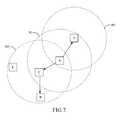
- FIG.7 illustrates a scenario view of using the proximity network system of the present invention for executing searching function.
- Any Bluetooth device of the present invention can detect whether a neighboring Bluetooth device having the same community relationship and also being in the proximity network, and if so, the Bluetooth device establishes a connection with the neighboring Bluetooth device.
- the Bluetooth device in an embodiment of the present invention, if a user wants to use a Bluetooth device A to search for a target Bluetooth device B having the same community relationship, but only identifies Bluetooth devices C and D having the same community relationship in a proximity network N1 formed by the Bluetooth device A.
- the user can use the Bluetooth device A to establish connections with the Bluetooth device C and D respectively and wakes up their corresponding electronic apparatuses, and then the proximity network N2 formed by the Bluetooth device C and the proximity network N3 formed by proximity network N3 can be searched to find whether the target Bluetooth device B exists in either proximity network.
- the Bluetooth device C will transmit relative data of the Bluetooth device B to the Bluetooth device A. Therefore, the user will know the Bluetooth device B is in a range of 3 to 5 meters around the Bluetooth device C and find the target Bluetooth device B easily. If the neighboring Bluetooth device C does not find the Bluetooth device B, then the user can keep looking for the target Bluetooth device B by the Bluetooth device C to establish connections with other Bluetooth devices (such as a Bluetooth device E) having the same community relationship with the Bluetooth device C and being in the proximity network N2 and so on. Therefore, the proximity network system of the present invention can form a chain search network to enhance the search function of the Bluetooth devices having the same community relationship.
Landscapes
- Engineering & Computer Science (AREA)
- Computer Networks & Wireless Communication (AREA)
- Signal Processing (AREA)
- Mobile Radio Communication Systems (AREA)
- Telephone Function (AREA)
Abstract
A proximity network system comprises a plurality of Bluetooth devices disposed respectively in each one of a plurality of electronic apparatuses. The plurality of Bluetooth devices are arranged for enabling the plurality of electronic apparatuses to receive and transmit Bluetooth wireless signals with each other, wherein each Bluetooth device comprises a community relationship module, an identifying module and a distance detecting module. The community relationship module stores a community relationship data of each Bluetooth device. The identifying module reads the community relationship data of each Bluetooth device to identify whether each Bluetooth device has the same community relationship. The distance detecting module determines whether each Bluetooth device is in a proximity network. When the Bluetooth devices are identified to have the same community relationship with each other and are in the proximity network, each electronic apparatus is allowed to receive and transmit the Bluetooth wireless signals with another electronic apparatus via the corresponding Bluetooth device.
Description
- The present invention relates to a proximity network system, and more particularly, to a proximity network system used for connecting a plurality of electronic apparatuses having a same community relationship, and a connecting method thereof.
- The advancement of information and communication technologies and the trend of electronic apparatuses becoming lighter, thinner, shorter and smaller have tightened the relationships of people. From the early days of heavy notebook PCs to the modern days of smart phones, mobile internet devices (MID) or tablet PCs, people now have better choices for social occasions and family gatherings. In these occasions, almost all the people have smart phones, MID or tablet PCs; therefore, it would be extremely useful to provide a proximity network to connect electronic apparatuses within a range of three to five meters, which is a suitable range for an Ad-Hoc wireless network to be effective in a social meeting or a group discussion.
- Many practical and possible applications could be implemented by using this kind of proximity network to extend interactions among people. For example, people in the same proximity network could share documents, or use particular hand gestures that could only be done in a very small area of proximity network.
- However, many issues have to be solved beforehand in order to realize this kind of proximity network. First, it is a challenge as to how to help a user of an electronic apparatus to find another electronic apparatus (and/or its user) in a range of three to five meters, and more particularly, to help the user find only people with a common view and their apparatuses. Second, it is another challenge as to how to form a group of the electronic apparatuses connected to the same proximity network to avoid the distribution from other proximity networks. Furthermore, the battery's life is very important for an electronic community apparatus. If the operation system of the electronic apparatus is waked up for searching the nearby proximity network, the electronic apparatus may consume a lot of power. When the operation system is waked up, the processing unit and the memory are waked to operate the software or firmware, which will consume the power of the battery. On the other hand, there are issues remained to solve as how to allow the electronic apparatus to identify the nearby electronic apparatus without waking up the operating system? For the nearby electronic apparatus, how to respond to the identification request without waking up the operating system?
- Therefore, it is advantageous to provide a proximity network system and a connection method thereof to solve the problems encountered currently in the information technology and communication technology fields.
- It is an object of the present invention to provide a proximity network system used for connecting a plurality of electronic apparatuses having a same community relationship in a proximity network.
- In order to achieve the above object, the present invention provides a proximity network system comprising a plurality of Bluetooth devices disposed respectively in each one of the plurality of electronic apparatuses. The plurality of Bluetooth devices are arranged for enabling the plurality of electronic apparatuses to receive and transmit Bluetooth wireless signals with each other, wherein each Bluetooth device comprises: a community relationship module is arranged for storing a community relationship data of each Bluetooth device; an identifying module is arranged for reading the community relationship data of each Bluetooth device to identify whether each Bluetooth device has the same community relationship; and a distance detecting module is arranged for determining whether each Bluetooth device is in the proximity network. Hence, when the Bluetooth devices are identified to have the same community relationship with each other and are in the proximity network, each electronic apparatus is allowed to receive and transmit the Bluetooth wireless signals with another electronic apparatus via the corresponding Bluetooth device.
- The present invention also discloses a proximity network connecting method used for the proximity network system, the proximity network connecting method comprising: storing a community relationship data in each Bluetooth device; reading the community relationship data of each Bluetooth device to identify whether each Bluetooth device has the same community relationship; determining whether each Bluetooth device is in the proximity network; and when the Bluetooth devices are identified to have the same community relationship with each other and are in the proximity network, each electronic apparatus is allowed to receive and transmit the Bluetooth wireless signals with another electronic apparatus via the corresponding Bluetooth device.
- The present invention also discloses an electronic apparatus used for the proximity network system. The electronic apparatus comprises a Bluetooth device for establishing a proximity network. The Bluetooth device comprises a community relationship module, an identifying module, and a distance detecting module; the community relationship module is arranged for storing a community relationship data of the Bluetooth device; the identifying module is arranged for determining whether a neighboring Bluetooth device corresponds to the community relationship data to identify whether the Bluetooth device and the neighboring Bluetooth device have a same community relationship; and a distance detecting module is arranged for detecting a distance between the Bluetooth device and the neighboring Bluetooth device to determine whether the neighboring Bluetooth device is in the proximity network. Wherein when the neighboring Bluetooth device is in the proximity network and is identified to have the same community relationship of the Bluetooth device, the electronic apparatus is allowed to establish a connection with the neighboring Bluetooth device via the Bluetooth device.
- Through the implementation of the present invention, each Bluetooth device may identify other Bluetooth devices having the same community relationship in the proximity network and may choose to connect with the Bluetooth devices for data transmission to enhance the functionality of the wireless network.
- All claims are incorporated in the description by reference. All subclaims referring to a main claim refer to preceding subclaims as well.
-
-
FIG.1 illustrates a system block diagram of each electronic apparatus of a proximity network system in a first embodiment of the present invention; -
FIG.2 illustrates an embodiment view of using the proximity network system of the present invention; -
FIG.3 illustrates a flow chart of a proximity network connecting method for the electronic apparatuses in the first embodiment of the present invention; -
FIG.4 illustrates a system block diagram of each electronic apparatus of a proximity network system in a second embodiment of the present invention; -
FIG.5 illustrates a flow chart of a proximity network connecting method for the electronic apparatuses in a second embodiment of the present invention; -
FIG.6 illustrates a flow chart of the proximity network connecting method for the proximity network system; and -
FIG.7 illustrates a scenario view of using the proximity network system of the present invention for executing searching function. - The present invention discloses a proximity network system comprising electronic apparatuses having Bluetooth transmission capabilities to transmit/receive Bluetooth signals in the proximity network. The electronic apparatus may be a smart phone, portable computer, personal data assistant (PDA) or other electronic apparatuses having Bluetooth transmission capabilities or the like.
- The proximity network system comprises a plurality of Bluetooth devices disposed respectively in each one of the plurality of electronic apparatuses, wherein each Bluetooth device uses a Bluetooth 4.0 standard LE link component, which is designed to reduce the number of channels for search and to increase the channel search speed. Additionally, the Bluetooth 4.0 standard LE link component saves 1 to 3mW of power consumption as compared with the traditional Bluetooth 3.0 component. Moreover, the Bluetooth 4.0 standard LE link component can work independently to communicate with another Bluetooth device of another electronic apparatus without waking up the system or the CPU of the electronic apparatus to perform the operation. Therefore, the Bluetooth device can work independently without being affected by the operating status of the electronic apparatus, thereby extending the duration of the electronic apparatus.
-
FIG.1 illustrates a system block diagram of eachelectronic apparatus 10 of a proximity network system in a first embodiment of the present invention. As shown inFIG.1 , in the proximity network system, a Bluetoothdevice 100 of eachelectronic apparatus 10 comprises acommunity relationship module 110, an identifyingmodule 120, and adistance detecting module 130, and these modules are electrically connected with each other. In an embodiment of the present invention, each Bluetoothdevice 100 can be a processing chip, and each module can be a corresponding firmware stored in the processing chip, but each module can also be embodied in a physical circuit, a firmware or software, or a combination thereof. - The
community relationship module 110 stores a community relationship data of each Bluetoothdevice 100. The user can define at least one group and its members by him/herself, and a community relationship data corresponding to each Bluetoothdevice 100 is generated by using the Bluetoothdevice 100 to perform an apparatus matching function with other Bluetooth devices or inputting a user-defined data; in this way the user can add new member to the group and stores all the community relationship data in thecommunity relationship module 110 for later application. The community relationship data can comprise a group name, member names, and identifications for Bluetooth devices corresponding to all members (such as a Bluetooth ID). - The identifying
module 120 reads the community relationship data of each Bluetoothdevice 100 to identify whether each Bluetoothdevice 100 has the same community relationship. The identifyingmodule 120 receives an advertising message from each neighboring Bluetoothdevice 100 to identify the existence of another Bluetoothdevice 100; at this time the identifyingmodule 120 may compare the community relationship data stored in thecommunity relationship module 110 with the community relationship data provided by each existed Bluetoothdevice 100. Therefore, each Bluetoothdevice 100 having the same community relationship or having a different community relationship may be identified. - The
distance detecting module 130 determines whether each Bluetoothdevice 100 is in the proximity network. The proximity network is formed by any Bluetoothdevice 100 and has a covering range defined by the maximum reach of the signal transmitted by the Bluetoothdevice 100. Therefore, thedistance detecting module 130 can detect distances of other Bluetooth devices with respect to the Bluetooth device, thereby determining whether other Bluetooth devices are in the proximity network formed by the Bluetooth device. According to the specification of the Bluetooth 4.0 standard LE link component, the proximity network formed by the Bluetoothdevice 100 is in a range of 3 to 5 meters from the center of the Bluetoothdevice 100. In this embodiment, thedistance detecting module 130 can be a received signal strength indicator (RSSI) detecting module. The RSSI detecting module may obtain a corresponding received signal strength indication according to a signal strength of each neighboring Bluetoothdevice 100, thereby identifying a distance between the Bluetoothdevice 100 and each neighboring Bluetooth device, and determining whether the neighboring Bluetooth devices are in the proximity network formed by the Bluetoothdevice 100. -
FIG.2 illustrates an embodiment view of using theproximity network system 1 of the present invention. Each Bluetoothdevice 100 can be in an advertiser mode or a scanner mode based on a user command or its own status. In the advertiser mode, the Bluetoothdevice 100 continuously sends out advertising messages; at this time, the Bluetoothdevice 100 may operate without theelectronic apparatus 10 enabling the system or CPU, thereby reducing power consumption. In the scanner mode, theBluetooth device 100 forms a proximity network N and notifies theelectronic apparatus 10 to enable the system or CPU. TheBluetooth device 100 may perform cyclic search with respect to the proximity network N to identify the existence of neighboring Bluetooth devices. - As shown in
FIG.1 andFIG.2 , when anyBluetooth device 100 is switched to the scanner mode, a proximity network N is formed in a certain area of the physical space according to theBluetooth device 100. When theBluetooth device 100 receives the advertising messages from neighboringBluetooth devices distance detecting module 130 of theBluetooth device 100 determines whether these neighboringBluetooth devices Bluetooth devices Bluetooth devices Bluetooth devices distance detecting module 130. - Then, the identifying
module 120 of theBluetooth device 100 reads the community relationship data of the neighboringBluetooth device community relationship module 110. According to the comparing result of the identifyingmodule 120, if the community relationship data of the neighboringBluetooth devices 101a, 101b corresponds to that stored in thecommunity relationship module 110, and the community relationship data of the neighboringBluetooth device 101c does not correspond to that stored in thecommunity relationship module 110, it means that theBluetooth device 100 and the neighboringBluetooth devices 101a, 101b have the same community relationship, and theBluetooth device 101c having a different community relationship may be excluded. - In an embodiment of the present invention, the
Bluetooth device 100 ofelectronic apparatus 10 will generate a notification message and display the notification message, for example, on a display of theelectronic apparatus 10 to inform the user of theelectronic apparatus 10 that the neighboringBluetooth devices 101a, 101b having the same community relationship are in the proximity network N, which means the corresponding electronic apparatuses 11a, 11b exist in the proximity network N. When the user wishes to connect to another Bluetooth device, he/she can use theBluetooth device 100 of theelectronic apparatus 10 to establish a connection with the neighboringBluetooth devices 101a, 101b of the electronic apparatuses 11a, 11b in the proximity network N and to transmit/receive Bluetooth wireless signals with each other. When theBluetooth device 100 and the neighboringBluetooth devices 101a, 101b are connected confirmatively, the system or CPU of each one of the electronic apparatuses 11a, 11b can be enabled by the neighboringBluetooth devices 101a, 101b respectively to perform subsequent operations such as interactive command input or data transmission. - Therefore, according to the specification of the Bluetooth 4.0 standard LE link component, a user of an electronic apparatus can find a familiar user through the proximity network constructed by the Bluetooth device and wakes up the electronic apparatus of another user for data transmission between both parties or among many parties and also interactive operations.
-
FIG.3 illustrates a flow chart of a proximity network connecting method for the electronic apparatuses in the first embodiment of the present invention. As shown inFIG.3 , the proximity network connecting method comprises step S301 to step S304, which will be described below in details. - Step S301: obtaining an advertising message of a neighboring Bluetooth device. When a Bluetooth device of an electronic apparatus is in the scanner mode, it will form a proximity network; if a neighboring Bluetooth device in the advertiser mode is near the Bluetooth device, the Bluetooth device will receive the advertising message from the neighboring Bluetooth device. The advertising message comprises data regarding to the neighboring Bluetooth device, such as a device name, an ID number and so on.
- Step S302: determining whether the Bluetooth device and the neighboring Bluetooth device have a same community relationship according to the advertising message. The identifying module of the Bluetooth device compares the received advertising message with the community relationship data stored in the community relationship module. When the relative data in the advertising message of the neighboring Bluetooth device corresponds to the group or member data of the community relationship data, the identifying module may determine that the Bluetooth device and the neighboring Bluetooth device have the same community relationship; if not, then the two Bluetooth devices do not have the same community relationship.
- Step S303: determining whether the neighboring Bluetooth device is in the proximity network. The Bluetooth device detects a distance between the Bluetooth and the neighboring Bluetooth device by the distance detecting module and determines whether the neighboring Bluetooth device is in the proximity network based on the detected distance.
- Step S304: establishing a connection between the Bluetooth device and the neighboring Bluetooth device. When the Bluetooth device and the neighboring Bluetooth device are determined to have the same community relationship by step S302, and the neighboring Bluetooth device is identified to be in the proximity network by step S303, the Bluetooth module is allowed to establish a connection with the neighboring Bluetooth device to transmit and receive Bluetooth wireless signals with each other.
-
FIG.4 illustrates a system block diagram of each electronic apparatus 10a of a proximity network system 1a in a second embodiment of the present invention. In another embodiment of the present invention, aBluetooth device 100a of each electronic apparatus 10a further comprises a cryptography module 140 is arranged for storing password data corresponding to eachBluetooth device 100a in the same group. For security concerns of device and network connection, a user of the electronic apparatus 10a can set a connection password for preventing malicious connections. Therefore, when the user sets up a group and its members at the beginning, he/she can also stores password data corresponding to the community relationship data of eachBluetooth device 100a. When theBluetooth device 100a and the neighboring Bluetooth device are identified to have the same community relationship and both are in the proximity network, it is possible to query the password data of the cryptography module 140 to determine whether the obtained password data corresponds to the password data stored in the cryptography module 140; if the obtained password data is correct, the electronic apparatus 10a is allowed to transmit and receive Bluetooth wireless signals via theBluetooth device 100a with the neighboring Bluetooth device, thereby enhancing the data transmission security. - Moreover, since many electronic apparatuses are equipped with Wi-Fi wireless devices and/or 3G wireless devices, in an embodiment of the present invention, each electronic apparatus 10a further comprises a Wi-Fi wireless device 11 or a
3G wireless device 12. EachBluetooth device 100a further comprises a recording module 150 for storing a Wi-Fi address of the Wi-Fi wireless device 11, or an International Mobile Equipment Identity (IMEI) of the3G wireless device 12. TheBluetooth device 100a is suitable for transmitting signals having low power consumption and low data rate, but it can not meet the requirement of transmitting a large amount of data and providing faster data rate. Therefore, when the electronic apparatus 10a is allowed to establish an connection with the neighboring electronic apparatus, it can read the Wi-Fi address or the IMEI of the neighboring electronic apparatus via the recording module 150. After the electronic apparatus 10a obtains the Wi-Fi address or the IMEI of each neighboring electronic apparatus, the electronic apparatus 10a can use the Wi-Fi wireless device 11 or the3G wireless device 12 to communicate with the neighboring electronic apparatus via different types of wireless signals. In this embodiment, the electronic apparatus 10a is equipped with the Wi-Fi wireless device 11 and the3G wireless device 12, and the Wi-Fi wireless device 11 and the3G wireless device 12 work with a corresponding Wi-Fi recording module 151 and3G recording module 152 of the recording module 150 respectively to provide Wi-Fi and 3G wireless transmission capabilities. However, in another embodiment, the electronic apparatus 10a can have only one of the Wi-Fi wireless device 11 and the3G wireless device 12, which works with the recording module 150 to provide a single type of wireless transmission capability. -
FIG.5 illustrates a flow chart of a proximity network connecting method for the electronic apparatuses in a second embodiment of the present invention. As shown inFIG.5 , the proximity network connecting method comprises steps S501 to S504, which are the same as the steps S301 to S304, but the proximity network connecting method further comprises step S505 and step S506, which will be described in details. - Step S505: determining whether a password data providing by the neighboring Bluetooth device corresponds to the password data of the Bluetooth device. Before establishing a connection, the cryptography module of the Bluetooth device can ask the neighboring Bluetooth device to provide a corresponding password data; if the password data provided by the neighboring Bluetooth device corresponds to the password data set by the cryptography module 140, the process goes to step S504; otherwise the connection is aborted.
- Step S506: generating a notification message to inform the user of the electronic apparatus. When the neighboring Bluetooth device is identified to have the corresponding community relationship and to be in the proximity network in steps S502 and S503 (and the password data provided by the neighboring Bluetooth device corresponds to the password data of the Bluetooth device in step S505), the Bluetooth device is arranged for generating a notification message to inform the user of the electronic apparatus that a neighboring Bluetooth device is in the proximity network. This notification message can be display on a display of the electronic apparatus or be presented as a voice or sound message.
- Therefore, the present invention provides a security mechanism by setting up password data for the user of the electronic apparatus; and when another electronic apparatus having the same community relationship is in the proximity network, the present invention can use a notification message to inform the user, thereby enhancing the usability and convenience of the electronic apparatus of the present invention.
-
FIG.6 illustrates a flow chart of the proximity network connecting method for the proximity network system. As shown inFIG.6 , the proximity network connecting method comprises steps S601 to S604, which will be described in details. - Step S601: storing a community relationship data in each Bluetooth device. Each user of each electronic apparatus can stores a community relationship data in his/her own Bluetooth device, wherein the community relationship data stores data related to at least one group and its members (Bluetooth devices).
- Step S602: reading the community relationship data of each Bluetooth device to identify whether each Bluetooth device has the same community relationship. Each Bluetooth device determines whether another Bluetooth device has the same community relationship with it by reading its own community relationship data to compare with a community relationship data obtained from the other Bluetooth device.
- Step S603: determining whether each Bluetooth device is in the proximity network. The Bluetooth device in the scanner mode may detect a distance between the Bluetooth device and each Bluetooth device by its own distance detecting module to determine whether each Bluetooth device is in the proximity network.
- Step S604: when the Bluetooth devices are identified to have the same community relationship with each other and are in the proximity network, each electronic apparatus is allowed to receive and transmit the Bluetooth wireless signals with another electronic apparatus via the corresponding Bluetooth device. When it is determined that each Bluetooth device has the same community relationship and is in the proximity network in steps S602 and S603, each Bluetooth device is allowed to transmit and receive Bluetooth wireless signals with any neighboring Bluetooth device having the same community relationship and being close enough to the Bluetooth device.
- Furthermore, the present invention can also provide a search function for searching devices not in the proximity network.
FIG.7 illustrates a scenario view of using the proximity network system of the present invention for executing searching function. Any Bluetooth device of the present invention can detect whether a neighboring Bluetooth device having the same community relationship and also being in the proximity network, and if so, the Bluetooth device establishes a connection with the neighboring Bluetooth device. As shown inFIG.7 , in an embodiment of the present invention, if a user wants to use a Bluetooth device A to search for a target Bluetooth device B having the same community relationship, but only identifies Bluetooth devices C and D having the same community relationship in a proximity network N1 formed by the Bluetooth device A. The user can use the Bluetooth device A to establish connections with the Bluetooth device C and D respectively and wakes up their corresponding electronic apparatuses, and then the proximity network N2 formed by the Bluetooth device C and the proximity network N3 formed by proximity network N3 can be searched to find whether the target Bluetooth device B exists in either proximity network. - If the target Bluetooth device B is found in the proximity network N2, the Bluetooth device C will transmit relative data of the Bluetooth device B to the Bluetooth device A. Therefore, the user will know the Bluetooth device B is in a range of 3 to 5 meters around the Bluetooth device C and find the target Bluetooth device B easily. If the neighboring Bluetooth device C does not find the Bluetooth device B, then the user can keep looking for the target Bluetooth device B by the Bluetooth device C to establish connections with other Bluetooth devices (such as a Bluetooth device E) having the same community relationship with the Bluetooth device C and being in the proximity network N2 and so on. Therefore, the proximity network system of the present invention can form a chain search network to enhance the search function of the Bluetooth devices having the same community relationship.
- It is noted that the above-mentioned embodiments are only for illustration, it is intended that the present invention cover modifications and variations of this invention provided they fall within the scope of the following claims and their equivalents. Therefore, it will be apparent to those skilled in the art that various modifications and variations can be made to the structure of the present invention without departing from the scope or spirit of the invention.
Claims (15)
- A proximity network system for connecting a plurality of electronic apparatuses having a same community relationship in a proximity network, the proximity network system comprising:a plurality of Bluetooth devices, disposed respectively in each one of the plurality of electronic apparatuses, arranged for enabling the plurality of electronic apparatuses to receive andtransmit Bluetooth wireless signals with each other, whereineach Bluetooth device comprises:a community relationship module, arranged for storing a community relationship data of each Bluetooth device;an identifying module, arranged for reading the community relationship data of each Bluetooth device to identify whether each Bluetooth device has the same community relationship; anda distance detecting module, arranged for determining whether each Bluetooth device is in the proximity network;when the plurality of Bluetooth devices are identified to have the same community relationship with each other and are in the proximity network, each electronic apparatus is allowed to receive and transmit the Bluetooth wireless signals with another electronic apparatus via the corresponding Bluetooth device.
- The proximity network system as claimed in claim 1, wherein each Bluetooth device comprises:a cryptography module, arranged for storing a password data, wherein each electronic apparatus is allowed to receive and transmit the Bluetooth wireless signals with another electronic apparatus via the corresponding Bluetooth device when each Bluetooth device provides the same password data.
- The proximity network system as claimed in claim 1, wherein each identifying module reads the community relationship data of each Bluetooth device when each Bluetooth device is in an advertiser mode.
- The proximity network system as claimed in claim 1, wherein each Bluetooth device comprises:a recording module, arranged for recording a Wi-Fi address of a Wi-Fi wireless device of each electronic apparatus, or an International Mobile Equipment Identity (IMEI) of a 3G wireless device.
- A proximity network connecting method for connecting a plurality of electronic apparatuses having a same community relationship in a proximity network, wherein each one of the electronic apparatuses comprises a Bluetooth device for enabling the plurality of electronic apparatuses to receive and transmit Bluetooth wireless signals with each other, the proximity network connecting method comprising:storing a community relationship data in each Bluetooth device;reading the community relationship data of each Bluetooth device to identify whether each Bluetooth device has the same community relationship;determining whether each Bluetooth device is in the proximity network; andwhen the Bluetooth devices are identified to have the same community relationship with each other and are in the proximity network, each electronic apparatus is allowed to receive and transmit the Bluetooth wireless signals with another electronic apparatus via the corresponding Bluetooth device.
- The proximity network connecting method as claimed in claim 5, further comprising:storing a password data in each Bluetooth device; andallowing each electronic apparatus to receive and transmit the Bluetooth wireless signals with another electronic apparatus via each Bluetooth device when each Bluetooth device provides the same password data.
- The proximity network connecting method as claimed in claim 5, wherein the step of reading the community relationship data of each Bluetooth device is performed when each Bluetooth device is in an advertiser mode.
- An electronic apparatus comprising a Bluetooth device for establishing a proximity network, the Bluetooth device comprising:a community relationship module, arranged for storing a community relationship data of the Bluetooth device;an identifying module, arranged for determining whether a neighboring Bluetooth device corresponds to the community relationship data to identify whether the Bluetooth device and the neighboring Bluetooth device have the same community relationship; anda distance detecting module, arranged for detecting a distance between the Bluetooth device and the neighboring Bluetooth device to determine whether the neighboring Bluetooth device is in the proximity network;wherein when the neighboring Bluetooth device is identified to have the same community relationship of the Bluetooth device and is in the proximity network, the electronic apparatus is allowed to establish a connection with the neighboring Bluetooth device via the Bluetooth device.
- The electronic apparatus as claimed in claim 8, wherein the Bluetooth device comprises:a cryptography module, arranged for storing a password data;wherein when the neighboring Bluetooth device provides the same password data, the electronic apparatus is allowed to establish a connection with the neighboring Bluetooth device via the Bluetooth device.
- The electronic apparatus as claimed in claim 8 further comprising:a Wi-Fi wireless device or a 3G wireless device, and the Bluetooth device further comprising a recording module for recording a Wi-Fi address of the Wi-Fi wireless device, or an International Mobile Equipment Identity (IMEI) of the 3G wireless device.
- The electronic apparatus as claimed in claim 8, wherein when the neighboring Bluetooth device is identified to have the same community relationship of the Bluetooth device and is in the proximity network, the Bluetooth device is arranged for generating a notification message to inform a user of the electronic apparatus.
- A proximity network connecting method for an electronic apparatus, the electronic apparatus comprising a Bluetooth device for establishing a proximity network, the proximity network connecting method comprising:obtaining an advertising message of a neighboring Bluetooth device;determining whether the Bluetooth device and the neighboring Bluetooth device have a same community relationship according to the advertising message;determining whether the neighboring Bluetooth device is in the proximity network; andwhen the neighboring Bluetooth device is identified to have the same community relationship of the Bluetooth device and is in the proximity network, establishing a connection between the Bluetooth device and the neighboring Bluetooth device.
- The proximity network connecting method as claimed in claim 12, further comprising:storing a password data in the Bluetooth device; andallowing the electronic apparatus to establish a connection with the neighboring Bluetooth device via the Bluetooth device when the neighboring Bluetooth device provides the same password data.
- The proximity network connecting method as claimed in claim 12, wherein the step of determining whether the neighboring Bluetooth device is in the proximity network is performed by detecting a received signal strength indicator (RSSI) of the neighboring Bluetooth device.
- The proximity network connecting method as claimed in claim 12, further comprising:when the neighboring Bluetooth device is identified to have the same community relationship of the Bluetooth device and is in the proximity network, generating a notification message via the Bluetooth device to inform a user of the electronic apparatus.
Applications Claiming Priority (1)
| Application Number | Priority Date | Filing Date | Title |
|---|---|---|---|
| TW100112242A TW201242281A (en) | 2011-04-08 | 2011-04-08 | Electronic apparatus, proximity network system and connecting method thereof |
Publications (1)
| Publication Number | Publication Date |
|---|---|
| EP2509389A1 true EP2509389A1 (en) | 2012-10-10 |
Family
ID=44999652
Family Applications (1)
| Application Number | Title | Priority Date | Filing Date |
|---|---|---|---|
| EP11008657A Withdrawn EP2509389A1 (en) | 2011-04-08 | 2011-10-28 | Connecting electronic apparatuses in proximity having a same community relationship |
Country Status (3)
| Country | Link |
|---|---|
| US (1) | US8699952B2 (en) |
| EP (1) | EP2509389A1 (en) |
| TW (1) | TW201242281A (en) |
Cited By (2)
| Publication number | Priority date | Publication date | Assignee | Title |
|---|---|---|---|---|
| EP2916513A1 (en) * | 2014-03-07 | 2015-09-09 | VOVB en Partners B.V. | Method for providing peer-to-peer communication using a request-response protocol |
| CN105828280A (en) * | 2016-05-10 | 2016-08-03 | 爱国者电子科技有限公司 | Data transmission method, device and system |
Families Citing this family (27)
| Publication number | Priority date | Publication date | Assignee | Title |
|---|---|---|---|---|
| KR20130096978A (en) * | 2012-02-23 | 2013-09-02 | 삼성전자주식회사 | User terminal device, server, information providing system based on situation and method thereof |
| US10785630B2 (en) | 2012-12-10 | 2020-09-22 | Nokia Technologies Oy | Method and apparatus for low energy discovery |
| US9525753B2 (en) | 2012-12-12 | 2016-12-20 | Netspective Communications Llc | Integration of devices through a social networking platform |
| US9026052B2 (en) | 2013-01-24 | 2015-05-05 | Htc Corporation | Mobile electronic device and connection establishment method between mobile electronic devices |
| US9448543B2 (en) | 2013-03-15 | 2016-09-20 | Tyfone, Inc. | Configurable personal digital identity device with motion sensor responsive to user interaction |
| US9086689B2 (en) | 2013-03-15 | 2015-07-21 | Tyfone, Inc. | Configurable personal digital identity device with imager responsive to user interaction |
| US9319881B2 (en) | 2013-03-15 | 2016-04-19 | Tyfone, Inc. | Personal digital identity device with fingerprint sensor |
| US9781598B2 (en) | 2013-03-15 | 2017-10-03 | Tyfone, Inc. | Personal digital identity device with fingerprint sensor responsive to user interaction |
| US9436165B2 (en) * | 2013-03-15 | 2016-09-06 | Tyfone, Inc. | Personal digital identity device with motion sensor responsive to user interaction |
| EP2976864A4 (en) * | 2013-03-20 | 2016-11-09 | Nokia Technologies Oy | RECOMMENDATIONS OF APPLICATION |
| US9549042B2 (en) | 2013-04-04 | 2017-01-17 | Samsung Electronics Co., Ltd. | Context recognition and social profiling using mobile devices |
| US9014634B2 (en) * | 2013-05-14 | 2015-04-21 | International Business Machines Corporation | Social network based Wi-Fi connectivity |
| GB2514817A (en) * | 2013-06-05 | 2014-12-10 | Nordic Semiconductor Asa | Digital radio communication |
| KR102138034B1 (en) * | 2013-10-08 | 2020-07-27 | 삼성전자 주식회사 | Mobile terminal and auxiliary device for mobile terminal and method for controlling the same |
| US9042912B1 (en) | 2014-02-18 | 2015-05-26 | Google Inc. | Two-pass copresence |
| KR102201616B1 (en) * | 2014-02-23 | 2021-01-12 | 삼성전자주식회사 | Method of Searching Device Between Electrical Devices |
| US9032498B1 (en) * | 2014-05-25 | 2015-05-12 | Mourad Ben Ayed | Method for changing authentication for a legacy access interface |
| US9769624B1 (en) | 2014-06-24 | 2017-09-19 | Google Inc. | Copresence permission model |
| WO2016036206A2 (en) * | 2014-09-04 | 2016-03-10 | 엘지전자(주) | Method and device for controlling device by using bluetooth low energy (le) technique |
| CN105787336A (en) * | 2014-12-23 | 2016-07-20 | 北京握奇智能科技有限公司 | Method and system for identifying Bluetooth key bound with mobile intelligent terminal |
| JP2016178385A (en) * | 2015-03-18 | 2016-10-06 | キヤノン株式会社 | Communication system, information processing apparatus, communication control method, and program |
| EP4044040B1 (en) * | 2015-08-20 | 2023-10-11 | Hewlett-Packard Development Company L.P. | Peripheral device pairing |
| JP6908970B2 (en) * | 2016-03-24 | 2021-07-28 | キヤノン株式会社 | Communication equipment and its control method and program |
| JP2018056837A (en) * | 2016-09-29 | 2018-04-05 | キヤノン株式会社 | Communication device, control method thereof and program |
| TWI790525B (en) * | 2021-01-15 | 2023-01-21 | 宏碁股份有限公司 | Bluetooth low energy device and reminding method thereof |
| DE102021116250A1 (en) | 2021-06-23 | 2022-12-29 | Ron Melz | REALTIME PRESENCE DETECTION AND RECORDING |
| CN117412401A (en) | 2022-07-07 | 2024-01-16 | 瑞昱半导体股份有限公司 | Bluetooth network establishment system and method |
Citations (6)
| Publication number | Priority date | Publication date | Assignee | Title |
|---|---|---|---|---|
| EP1249969A2 (en) * | 2001-04-09 | 2002-10-16 | Nokia Corporation | Wireless group communication system |
| WO2009013646A2 (en) * | 2007-07-26 | 2009-01-29 | Nokia Corporation | Gesture activated close-proximity communication |
| US20100069058A1 (en) * | 2008-09-16 | 2010-03-18 | Rothschild Leigh M | System and method for enabling social interactive wireless communications |
| US20100144283A1 (en) * | 2008-12-04 | 2010-06-10 | Nokia Corporation | Method and System for Creation and Control of Virtual Rendering Devices |
| US20100167711A1 (en) * | 2008-12-30 | 2010-07-01 | Motorola, Inc. | Method and system for creating communication groups |
| US20110028083A1 (en) * | 2009-07-30 | 2011-02-03 | Sony Ericsson Mobile Communications Ab | Methods, apparatuses and computer programs for media content distribution |
Family Cites Families (4)
| Publication number | Priority date | Publication date | Assignee | Title |
|---|---|---|---|---|
| JP4442027B2 (en) * | 2000-12-05 | 2010-03-31 | ソニー株式会社 | Communication system and communication method |
| WO2003009621A1 (en) | 2001-07-18 | 2003-01-30 | Miata Limited | Protection of devices |
| US20030073431A1 (en) * | 2001-10-16 | 2003-04-17 | Jheroen Dorenbosch | Transferring communications over a network |
| EP2002671A4 (en) | 2006-04-03 | 2015-07-15 | Eckey Corp | METHODS FOR DETERMINING PROXIMITY BETWEEN RADIO FREQUENCY DEVICES AND CONTROL SWITCHES |
-
2011
- 2011-04-08 TW TW100112242A patent/TW201242281A/en unknown
- 2011-10-17 US US13/274,407 patent/US8699952B2/en active Active
- 2011-10-28 EP EP11008657A patent/EP2509389A1/en not_active Withdrawn
Patent Citations (6)
| Publication number | Priority date | Publication date | Assignee | Title |
|---|---|---|---|---|
| EP1249969A2 (en) * | 2001-04-09 | 2002-10-16 | Nokia Corporation | Wireless group communication system |
| WO2009013646A2 (en) * | 2007-07-26 | 2009-01-29 | Nokia Corporation | Gesture activated close-proximity communication |
| US20100069058A1 (en) * | 2008-09-16 | 2010-03-18 | Rothschild Leigh M | System and method for enabling social interactive wireless communications |
| US20100144283A1 (en) * | 2008-12-04 | 2010-06-10 | Nokia Corporation | Method and System for Creation and Control of Virtual Rendering Devices |
| US20100167711A1 (en) * | 2008-12-30 | 2010-07-01 | Motorola, Inc. | Method and system for creating communication groups |
| US20110028083A1 (en) * | 2009-07-30 | 2011-02-03 | Sony Ericsson Mobile Communications Ab | Methods, apparatuses and computer programs for media content distribution |
Cited By (3)
| Publication number | Priority date | Publication date | Assignee | Title |
|---|---|---|---|---|
| EP2916513A1 (en) * | 2014-03-07 | 2015-09-09 | VOVB en Partners B.V. | Method for providing peer-to-peer communication using a request-response protocol |
| CN105828280A (en) * | 2016-05-10 | 2016-08-03 | 爱国者电子科技有限公司 | Data transmission method, device and system |
| CN105828280B (en) * | 2016-05-10 | 2020-04-21 | 爱国者电子科技有限公司 | Data transmission method, device and system |
Also Published As
| Publication number | Publication date |
|---|---|
| TW201242281A (en) | 2012-10-16 |
| US20120258665A1 (en) | 2012-10-11 |
| US8699952B2 (en) | 2014-04-15 |
Similar Documents
| Publication | Publication Date | Title |
|---|---|---|
| US8699952B2 (en) | Electronic apparatus, proximity network system and connecting method thereof | |
| US12349159B2 (en) | Resource scheduling method and apparatus and UE | |
| US11277744B2 (en) | Wi-Fi hotspot connection method and terminal | |
| CN105009614B (en) | Method and apparatus for using near-field communication to carry out equity WI-FI ranging | |
| US12501381B2 (en) | SSB transmission indication method and apparatus, terminal, device, and medium | |
| US8351858B2 (en) | Apparatus and method for obtaining information on bluetooth devices in a computing device using bluetooth | |
| WO2020164594A1 (en) | Measurement processing method, parameter configuration method, terminal, and network device | |
| WO2021027513A1 (en) | Antenna port mapping determination method, and terminal | |
| CN114501629B (en) | Resource allocation method, device, equipment and readable storage medium | |
| CN107146294B (en) | Method, apparatus of registering and system | |
| CN108702602A (en) | Share method, electronic equipment and the system of image | |
| CN110858996B (en) | Power control method, terminal and network equipment | |
| CN102780514A (en) | Electronic equipment, near-end network system and connection method thereof | |
| EP3595261A1 (en) | Method, apparatus and computer readable storage for communication of information by a handheld communication device in an ad-hoc network | |
| CN110022591A (en) | A kind of cell selecting method and terminal | |
| CN108924908A (en) | WiFi scanning method and device and electronic device | |
| JP5246025B2 (en) | Wireless terminal, wireless terminal control method, wireless terminal control program | |
| CN107222847B (en) | Data transmission method, device and terminal | |
| CN108848557B (en) | Output power adjusting method, device, mobile terminal and computer readable medium | |
| CN108696917B (en) | Communication connection method, device, electronic device and computer readable medium | |
| KR101662177B1 (en) | Mobile Terminal and Method Thereof for Automatically Transmitting Situation Message | |
| CN111031588B (en) | Network search method, device, terminal device and storage medium | |
| CN108566649B (en) | Network segment management method of personal hotspot and related products | |
| CA3135314C (en) | Ssb transmission indication method and apparatus, terminal, device, and medium | |
| CN108924902A (en) | Wireless network disconnects method, apparatus and electronic device |
Legal Events
| Date | Code | Title | Description |
|---|---|---|---|
| PUAI | Public reference made under article 153(3) epc to a published international application that has entered the european phase |
Free format text: ORIGINAL CODE: 0009012 |
|
| AK | Designated contracting states |
Kind code of ref document: A1 Designated state(s): AL AT BE BG CH CY CZ DE DK EE ES FI FR GB GR HR HU IE IS IT LI LT LU LV MC MK MT NL NO PL PT RO RS SE SI SK SM TR |
|
| AX | Request for extension of the european patent |
Extension state: BA ME |
|
| STAA | Information on the status of an ep patent application or granted ep patent |
Free format text: STATUS: THE APPLICATION IS DEEMED TO BE WITHDRAWN |
|
| 18D | Application deemed to be withdrawn |
Effective date: 20130411 |