EP2508875A1 - Cellular potential measurement container and production method therefor - Google Patents
Cellular potential measurement container and production method therefor Download PDFInfo
- Publication number
- EP2508875A1 EP2508875A1 EP10834509A EP10834509A EP2508875A1 EP 2508875 A1 EP2508875 A1 EP 2508875A1 EP 10834509 A EP10834509 A EP 10834509A EP 10834509 A EP10834509 A EP 10834509A EP 2508875 A1 EP2508875 A1 EP 2508875A1
- Authority
- EP
- European Patent Office
- Prior art keywords
- container
- electric potential
- measurement
- electrode
- electrodes
- Prior art date
- Legal status (The legal status is an assumption and is not a legal conclusion. Google has not performed a legal analysis and makes no representation as to the accuracy of the status listed.)
- Withdrawn
Links
- 238000005259 measurement Methods 0.000 title claims abstract description 62
- 230000001413 cellular effect Effects 0.000 title claims abstract description 47
- 238000004519 manufacturing process Methods 0.000 title claims description 10
- 239000000758 substrate Substances 0.000 claims abstract description 52
- RYGMFSIKBFXOCR-UHFFFAOYSA-N Copper Chemical compound [Cu] RYGMFSIKBFXOCR-UHFFFAOYSA-N 0.000 claims abstract description 30
- 229910052802 copper Inorganic materials 0.000 claims abstract description 30
- 239000010949 copper Substances 0.000 claims abstract description 30
- 238000000034 method Methods 0.000 claims abstract description 16
- 238000007747 plating Methods 0.000 claims abstract description 13
- 230000003313 weakening effect Effects 0.000 abstract description 3
- 210000004027 cell Anatomy 0.000 description 18
- 230000000052 comparative effect Effects 0.000 description 11
- 239000001963 growth medium Substances 0.000 description 11
- 239000012530 fluid Substances 0.000 description 10
- 239000003814 drug Substances 0.000 description 8
- 229940079593 drug Drugs 0.000 description 8
- 239000011347 resin Substances 0.000 description 8
- 229920005989 resin Polymers 0.000 description 8
- 210000004413 cardiac myocyte Anatomy 0.000 description 5
- 239000000463 material Substances 0.000 description 5
- 239000000243 solution Substances 0.000 description 5
- VZSRBBMJRBPUNF-UHFFFAOYSA-N 2-(2,3-dihydro-1H-inden-2-ylamino)-N-[3-oxo-3-(2,4,6,7-tetrahydrotriazolo[4,5-c]pyridin-5-yl)propyl]pyrimidine-5-carboxamide Chemical compound C1C(CC2=CC=CC=C12)NC1=NC=C(C=N1)C(=O)NCCC(N1CC2=C(CC1)NN=N2)=O VZSRBBMJRBPUNF-UHFFFAOYSA-N 0.000 description 4
- AFCARXCZXQIEQB-UHFFFAOYSA-N N-[3-oxo-3-(2,4,6,7-tetrahydrotriazolo[4,5-c]pyridin-5-yl)propyl]-2-[[3-(trifluoromethoxy)phenyl]methylamino]pyrimidine-5-carboxamide Chemical compound O=C(CCNC(=O)C=1C=NC(=NC=1)NCC1=CC(=CC=C1)OC(F)(F)F)N1CC2=C(CC1)NN=N2 AFCARXCZXQIEQB-UHFFFAOYSA-N 0.000 description 4
- 230000000694 effects Effects 0.000 description 4
- 239000004593 Epoxy Substances 0.000 description 3
- 239000004793 Polystyrene Substances 0.000 description 3
- 239000012980 RPMI-1640 medium Substances 0.000 description 3
- 230000004308 accommodation Effects 0.000 description 3
- 239000011521 glass Substances 0.000 description 3
- 239000002547 new drug Substances 0.000 description 3
- -1 polypropylene Polymers 0.000 description 3
- 229920002223 polystyrene Polymers 0.000 description 3
- 208000011580 syndromic disease Diseases 0.000 description 3
- 230000001988 toxicity Effects 0.000 description 3
- 231100000419 toxicity Toxicity 0.000 description 3
- 108090000862 Ion Channels Proteins 0.000 description 2
- 102000004310 Ion Channels Human genes 0.000 description 2
- KDLHZDBZIXYQEI-UHFFFAOYSA-N Palladium Chemical compound [Pd] KDLHZDBZIXYQEI-UHFFFAOYSA-N 0.000 description 2
- 239000004743 Polypropylene Substances 0.000 description 2
- 241000288906 Primates Species 0.000 description 2
- 201000010099 disease Diseases 0.000 description 2
- 208000037265 diseases, disorders, signs and symptoms Diseases 0.000 description 2
- 238000009509 drug development Methods 0.000 description 2
- 239000012777 electrically insulating material Substances 0.000 description 2
- WABPQHHGFIMREM-UHFFFAOYSA-N lead(0) Chemical compound [Pb] WABPQHHGFIMREM-UHFFFAOYSA-N 0.000 description 2
- 238000000691 measurement method Methods 0.000 description 2
- BASFCYQUMIYNBI-UHFFFAOYSA-N platinum Chemical compound [Pt] BASFCYQUMIYNBI-UHFFFAOYSA-N 0.000 description 2
- 229920000515 polycarbonate Polymers 0.000 description 2
- 239000004417 polycarbonate Substances 0.000 description 2
- 229920000728 polyester Polymers 0.000 description 2
- 229920001155 polypropylene Polymers 0.000 description 2
- 229920001187 thermosetting polymer Polymers 0.000 description 2
- 239000004925 Acrylic resin Substances 0.000 description 1
- 229920000178 Acrylic resin Polymers 0.000 description 1
- OKTJSMMVPCPJKN-UHFFFAOYSA-N Carbon Chemical compound [C] OKTJSMMVPCPJKN-UHFFFAOYSA-N 0.000 description 1
- 241000282567 Macaca fascicularis Species 0.000 description 1
- ISWSIDIOOBJBQZ-UHFFFAOYSA-N Phenol Chemical compound OC1=CC=CC=C1 ISWSIDIOOBJBQZ-UHFFFAOYSA-N 0.000 description 1
- BQCADISMDOOEFD-UHFFFAOYSA-N Silver Chemical compound [Ag] BQCADISMDOOEFD-UHFFFAOYSA-N 0.000 description 1
- 206010042434 Sudden death Diseases 0.000 description 1
- 208000018452 Torsade de pointes Diseases 0.000 description 1
- 208000002363 Torsades de Pointes Diseases 0.000 description 1
- 238000010521 absorption reaction Methods 0.000 description 1
- 239000000853 adhesive Substances 0.000 description 1
- 230000001070 adhesive effect Effects 0.000 description 1
- 230000002411 adverse Effects 0.000 description 1
- 238000004220 aggregation Methods 0.000 description 1
- 230000002776 aggregation Effects 0.000 description 1
- PNEYBMLMFCGWSK-UHFFFAOYSA-N aluminium oxide Inorganic materials [O-2].[O-2].[O-2].[Al+3].[Al+3] PNEYBMLMFCGWSK-UHFFFAOYSA-N 0.000 description 1
- 206010003119 arrhythmia Diseases 0.000 description 1
- 230000006793 arrhythmia Effects 0.000 description 1
- 229910052799 carbon Inorganic materials 0.000 description 1
- 239000006143 cell culture medium Substances 0.000 description 1
- 239000002131 composite material Substances 0.000 description 1
- 150000001875 compounds Chemical class 0.000 description 1
- 238000007796 conventional method Methods 0.000 description 1
- 238000012258 culturing Methods 0.000 description 1
- 231100000433 cytotoxic Toxicity 0.000 description 1
- 230000001472 cytotoxic effect Effects 0.000 description 1
- 238000001647 drug administration Methods 0.000 description 1
- 229940000406 drug candidate Drugs 0.000 description 1
- 238000007877 drug screening Methods 0.000 description 1
- 238000010828 elution Methods 0.000 description 1
- PCHJSUWPFVWCPO-UHFFFAOYSA-N gold Chemical compound [Au] PCHJSUWPFVWCPO-UHFFFAOYSA-N 0.000 description 1
- 229910052737 gold Inorganic materials 0.000 description 1
- 239000010931 gold Substances 0.000 description 1
- 238000001746 injection moulding Methods 0.000 description 1
- 239000002609 medium Substances 0.000 description 1
- 229910052763 palladium Inorganic materials 0.000 description 1
- 239000000123 paper Substances 0.000 description 1
- 229910052697 platinum Inorganic materials 0.000 description 1
- 208000014321 polymorphic ventricular tachycardia Diseases 0.000 description 1
- 230000001681 protective effect Effects 0.000 description 1
- 238000011160 research Methods 0.000 description 1
- 229910001925 ruthenium oxide Inorganic materials 0.000 description 1
- WOCIAKWEIIZHES-UHFFFAOYSA-N ruthenium(iv) oxide Chemical compound O=[Ru]=O WOCIAKWEIIZHES-UHFFFAOYSA-N 0.000 description 1
- 238000005070 sampling Methods 0.000 description 1
- 229910052709 silver Inorganic materials 0.000 description 1
- 239000004332 silver Substances 0.000 description 1
- 229910000679 solder Inorganic materials 0.000 description 1
- 230000002459 sustained effect Effects 0.000 description 1
- 206010042772 syncope Diseases 0.000 description 1
- 208000003663 ventricular fibrillation Diseases 0.000 description 1
- 206010047302 ventricular tachycardia Diseases 0.000 description 1
- 238000004876 x-ray fluorescence Methods 0.000 description 1
Images

Classifications
-
- C—CHEMISTRY; METALLURGY
- C12—BIOCHEMISTRY; BEER; SPIRITS; WINE; VINEGAR; MICROBIOLOGY; ENZYMOLOGY; MUTATION OR GENETIC ENGINEERING
- C12M—APPARATUS FOR ENZYMOLOGY OR MICROBIOLOGY; APPARATUS FOR CULTURING MICROORGANISMS FOR PRODUCING BIOMASS, FOR GROWING CELLS OR FOR OBTAINING FERMENTATION OR METABOLIC PRODUCTS, i.e. BIOREACTORS OR FERMENTERS
- C12M41/00—Means for regulation, monitoring, measurement or control, e.g. flow regulation
- C12M41/46—Means for regulation, monitoring, measurement or control, e.g. flow regulation of cellular or enzymatic activity or functionality, e.g. cell viability
-
- C—CHEMISTRY; METALLURGY
- C12—BIOCHEMISTRY; BEER; SPIRITS; WINE; VINEGAR; MICROBIOLOGY; ENZYMOLOGY; MUTATION OR GENETIC ENGINEERING
- C12M—APPARATUS FOR ENZYMOLOGY OR MICROBIOLOGY; APPARATUS FOR CULTURING MICROORGANISMS FOR PRODUCING BIOMASS, FOR GROWING CELLS OR FOR OBTAINING FERMENTATION OR METABOLIC PRODUCTS, i.e. BIOREACTORS OR FERMENTERS
- C12M23/00—Constructional details, e.g. recesses, hinges
- C12M23/02—Form or structure of the vessel
- C12M23/12—Well or multiwell plates
Definitions
- the present invention relates to a cellular electric potential measuring container for measuring cellular electric potential after being mounted on an electric potential measuring device, and a production method therefor.
- Drug-induced QT prolongation syndrome is a serious disease with which QT interval prolongation appears on an electrocardiogram after drug administration, and ventricular fibrillation often occurs after TdP (Torsades de pointes: non-sustained polymorphic ventricular tachycardia), resulting in syncope or sudden death.
- TdP Tesades de pointes: non-sustained polymorphic ventricular tachycardia
- non-patent literature 1 discloses a measurement method in which the effect of a drug on the activity of an ion channel is analyzed based on the change in the electric potential of a cell in a drug-administered culture solution.
- This measurement method is carried out once a cellular electric potential measuring container is mounted on an electric potential measuring device.
- This cellular electric potential measuring container includes a plurality of wells for accommodating a culture solution and cells, and a measurement electrode and a reference electrode are disposed on the bottom of each well.
- cells to be measured may weaken or die, sometimes making it impossible to precisely measure cellular electric potential.
- Non-Patent Document 1 URL: http://www.brck.co.jp/MCS/qtscreencataloguejp1.pdf
- An object of the present invention is to provide a cellular electric potential measuring container with which an accurate measurement result can be obtained without weakening or killing the cells to be measured in cellular electric potential measurement using a cellular electric potential measuring container.
- the present invention provides a container for measuring cellular electric potential after being mounted on an electric potential measuring device, comprising a container and an electrode substrate, the electrode substrate being attached to a lower end of the container so as to form a plurality of wells, wherein the container comprises a plurality of cylindrical portions whose upper and lower ends are open, the electrode substrate comprises a substrate and a plurality of measurement electrodes and a plurality of reference electrodes disposed on one surface of the substrate, the measurement electrodes and the reference electrodes at least comprise metal-plated copper wiring, a pair of a measurement electrode and a reference electrode are disposed on a bottom of each well, and the measurement electrodes and the reference electrodes are formed by a pre-plating method.
- the present invention also provides a method for producing a container for measuring cellular electric potential after being mounted on an electric potential measuring device, wherein the container comprises a container and an electrode substrate, and the electrode substrate is attached to a lower end of the container so as to form a plurality of wells, the container comprises a plurality of cylindrical portions whose upper and lower ends are open, the electrode substrate comprises a substrate and a plurality of measurement electrodes and a plurality of reference electrodes disposed on one surface of the substrate, the measurement electrodes and the reference electrodes comprise at least copper, a pair of a measurement electrode and a reference electrode are disposed on a bottom of each well, and the measurement electrodes and the reference electrodes are formed by a pre-plating method.
- the cellular electric potential measuring container of the present invention is a disposable component that is used in a system for measuring a change of cellular electric potential that occurs in response to a plurality of new drug candidate compounds in wells.
- the cellular electric potential measuring container of the present invention is used after being mounted on a dedicated electric potential measuring device (not shown in figures).
- the configuration thereof includes a plurality of wells.
- the wells are formed by attaching an electrode substrate to the lower end of a container. That is, the container serves as the side wall of the wells, and the electrode substrate serves as the bottom of the wells.
- the formed wells are fluid tight such that a fluid used in a measurement (usually a culture solution) can be accommodated.
- Both a measurement electrode and a reference electrode are disposed on the bottom of each well. Accordingly, the cellular electric potential can be measured in each well.
- the term "cell” as used herein should be understood to encompass not only a single cell but also cell mass (spheroid) formed by aggregation of
- the cellular electric potential measuring container of the present invention is disposable as stated above. Therefore, to attain an inexpensive product, it is desirable that at least the container is entirely made from resin.
- the resin is not particularly limited in the present invention as long as the resin can be molded into the container and is electrically insulating. Specific examples of the resin include polypropylene, polystyrene, polyester, polycarbonate, and the like. In particular, from the viewpoint of low material cost, high transparency, and good appearance, the resin is preferably polystyrene.
- a method for producing the container is not necessarily limited as long as the container is readily produced, but given the complex structure of the container, it is usually desirable to produce the container by injection molding.
- the upper and lower ends of the cylindrical portions are open.
- the upper end is open to accommodate a cell and a culture solution when carrying out a measurement
- the lower end is open to allow the electrode substrate, which will be described later, to serve as a bottom.
- the shape of the cylindrical portions is not particularly limited in the present invention, but it is desirably cylindrical from the viewpoint of easy production.
- the electrode substrate includes a substrate, and a plurality of measurement electrodes and a plurality of reference electrodes are disposed on one surface of the substrate.
- the substrate is composed of a so-called electrically insulating material.
- the material include polypropylene, polystyrene, polyester, fluororesin, polycarbonate, acrylic resin, paper phenol, paper epoxy, glass composites such as glass epoxy, alumina, and the like. From the viewpoint of ease of constructing the measurement electrodes and the reference electrodes, high mechanical strength, and low cost, in general, glass epoxy is often selected. However, the present invention is not limited by these materials for the substrate.
- the measurement electrode is an electrode that comes into contact with a cell and measures the ion channel activity of the cell as electric potential
- the reference electrode is an electrode that comes into contact with a fluid used in a measurement (usually a culture solution) and measures electric potential that is regarded as so-called reference electric potential.
- the measurement electrode and the reference electrode are disposed in places such that one measurement electrode and one reference electrode are present on the bottom of each well when the electrode substrate is attached to the container and wells are thus formed. As a matter of course, the measurement electrode and the reference electrode on the bottom of each well are not electrically connected.
- Examples of materials used for plating the measurement electrode and the reference electrode include gold, silver, carbon, platinum, ruthenium oxide, palladium, and the like. These materials are used for plating copper wiring formed on the substrate.
- the measurement electrode and the reference electrode are formed by a so-called pre-plating method.
- the pre-plating method refers to an electrode production method in which specific thermosetting resin paste (solder resist) is printed on a substrate having copper wiring that has been metal-plated in advance, and the thermosetting resin is cured to form protective film. Accordingly, the amount of copper eluted from the aforementioned plurality of measurement electrodes and plurality of reference electrodes to the fluid accommodated in the wells is kept small.
- the amount of copper eluted refers to the amount of copper per unit volume of culture medium increased after one electrode substrate is immersed in the culture medium during a specific period of time. More specifically:
- the fluid accommodated in wells is not particularly limited, and a culture medium that is usually used in the measurement of cellular electric potential, in which the cellular electric potential measuring container of the present invention or the like is employed, may be used. Even if some copper is contained in the culture medium, that will not be a problem because the aforementioned amount of copper eluted refers to the amount of copper increased (the amount of change). However, since copper influences the measurement of cellular electric potential as stated above, it is desirable to use a fluid that does not contain copper as the fluid used for the measurement of cellular electric potential.
- the pre-plating method itself is a technique known in the art of substrate forming.
- copper is eluted into a fluid accommodated in wells of cellular electric potential measuring containers such as the present invention.
- eluted copper weakens or kills the cells to be measured and, therefore, adversely affects the measurement of cellular electric potential.
- Attachment of the container to the electrode substrate is not particularly limited in the present invention.
- attachment may be performed using a double-sided tape or an adhesive.
- the cellular electric potential measuring container of the present invention copper is not eluted from either a measurement electrode or a reference electrode to a fluid accommodated in a well, and thus an accurate measurement result can be obtained.
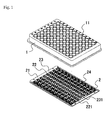
- Fig. 1 is an exploded perspective view of the cellular electric potential measuring container of the present invention.
- the cellular electric potential measuring container of the present invention is primarily composed of a container 1 and an electrode substrate 2.
- the container 1, which is made from resin, includes a plurality of cylindrical portions 11 having a cylindrical shape whose upper and lower ends are open. The structure of the inner cavity of each cylindrical portion 11 will be described later.
- Each cylindrical portion 11 constitutes the side wall of a well.
- the electrode substrate 2 forms the bottom of the wells.
- the electrode substrate 2 includes a substrate 21 composed of an electrically insulating material, and a plurality of measurement electrodes 22 and reference electrodes 23 are disposed on the substrate 21.
- the measurement electrodes 22 and the reference electrodes 23 contain at least copper.
- the measurement electrodes 22 and the reference electrodes 23 were produced by a pre-plating method.
- a measurement electrode 22 of the electrode substrate 2 in Fig. 1 is disposed substantially at the center of a reference electrode 23 that has a C shape. All of the measurement electrodes 22 and reference electrodes 23 are lead by lead wires 221 of the measurement electrodes and lead wires 231 of the reference electrodes that are independent of each other to connectors 24 arranged in-line along one side of the electrode substrate.
- the reference electrodes 23 are C-shaped is to secure space for disposing the lead wires 221 of the measurement electrodes to lead the measurement electrodes 22 to the connectors 24.
- the connectors 24 are also disposed on the opposite surface of the electrode substrate 2 (the surface on which no measurement electrodes 22 or reference electrodes 23 are disposed).
- the connectors 24 on the opposite surface of the electrode substrate 2 are electrically connected to the dedicated electric potential measuring device, thus enabling cellular electric potential to be measured.
- Example 2 The same procedure as in Example 1 was used except that a post-plating method was performed in place of a pre-plating method unlike in the production of the cellular electric potential measuring container of Example 1 above.
- Fig. 2 is an image showing cardiac muscle cells (held by Reprocell Inc.) 3 days after starting culturing using the cellular electric potential measuring container of Comparative Example 1.
- a primate ES cell culture medium Reprocell Inc.
- the cardiac muscle cells used were derived from cynomolgus monkey ES cells and were a mass of a large number of cells.
- the mass of cardiac muscle cells of the comparative example showed weakened pulses as time passed, and cells were destroyed and died within 3 days.
- the culture medium for the primate ES cells in Comparative Example 1 was discolored.
- the cardiac muscle cells in the cellular electric potential measuring container of Example 1 did not show weakened cellular pulses even after 4 days after measurement, and it was thus confirmed that the cells were alive.
- Table 1 shows results of measuring copper concentrations (mg/L) with an ICP emission spectrometer (Shimadzu Corporation: ICPS-8000) after immersing two electrode substrates having different production lots that were used for the cellular electric potential measuring containers of Example 1 (Example 1-1 and Example 1-2) and two electrode substrates having different production lots that were used for the cellular electric potential measuring containers of Comparative Example 1 (Comparative Example 1-1 and Comparative Example 1-2) in 100 mL of an RPMI1640 culture medium, and sampling 10 mL of the medium every time a specific period of time had passed.
- ICP emission spectrometer Shiadzu Corporation: ICPS-8000
- a method for measuring cellular electric potential using the cellular electric potential measuring container of the present invention can be performed in a manner comparable to a method that uses a conventional cellular electric potential measuring container.
- the present invention enables an accurate measurement of cellular electric potential without weakening or killing the cell to be measured, and therefore the present invention achieves rapid drug screening and will contribute to new drug development.
Landscapes
- Life Sciences & Earth Sciences (AREA)
- Health & Medical Sciences (AREA)
- Chemical & Material Sciences (AREA)
- Wood Science & Technology (AREA)
- Organic Chemistry (AREA)
- Engineering & Computer Science (AREA)
- Bioinformatics & Cheminformatics (AREA)
- Zoology (AREA)
- Biomedical Technology (AREA)
- Sustainable Development (AREA)
- Microbiology (AREA)
- Biotechnology (AREA)
- Biochemistry (AREA)
- General Engineering & Computer Science (AREA)
- General Health & Medical Sciences (AREA)
- Genetics & Genomics (AREA)
- Clinical Laboratory Science (AREA)
- Cell Biology (AREA)
- Analytical Chemistry (AREA)
- Apparatus Associated With Microorganisms And Enzymes (AREA)
Abstract
Description
- The present invention relates to a cellular electric potential measuring container for measuring cellular electric potential after being mounted on an electric potential measuring device, and a production method therefor.
- In current new drug development, it is necessary to discover the toxicity caused by a drug at an early stage. One known example of this toxicity is drug-induced (acquired) QT prolongation syndrome, which is a disease that causes severe arrhythmia in a patient.
- Drug-induced QT prolongation syndrome is a serious disease with which QT interval prolongation appears on an electrocardiogram after drug administration, and ventricular fibrillation often occurs after TdP (Torsades de pointes: non-sustained polymorphic ventricular tachycardia), resulting in syncope or sudden death. In fact, out of the 25 drugs whose sales were stopped in the US market after 1980, five drugs have been determined as causing drug-induced QT prolongation syndrome.
- In this regard, to discover toxicity that is caused by a drug, non-patent literature 1 discloses a measurement method in which the effect of a drug on the activity of an ion channel is analyzed based on the change in the electric potential of a cell in a drug-administered culture solution. This measurement method is carried out once a cellular electric potential measuring container is mounted on an electric potential measuring device. This cellular electric potential measuring container includes a plurality of wells for accommodating a culture solution and cells, and a measurement electrode and a reference electrode are disposed on the bottom of each well.
- However, with the foregoing measurement system, cells to be measured may weaken or die, sometimes making it impossible to precisely measure cellular electric potential.
- Non-Patent Document 1: URL: http://www.brck.co.jp/MCS/qtscreencataloguejp1.pdf
- An object of the present invention is to provide a cellular electric potential measuring container with which an accurate measurement result can be obtained without weakening or killing the cells to be measured in cellular electric potential measurement using a cellular electric potential measuring container.
- Having conducted diligent research to achieve the above-described object, the inventors found a method that suppresses elution of copper, which is highly cytotoxic, and arrived at the present invention.
- The present invention provides a container for measuring cellular electric potential after being mounted on an electric potential measuring device, comprising a container and an electrode substrate, the electrode substrate being attached to a lower end of the container so as to form a plurality of wells, wherein the container comprises a plurality of cylindrical portions whose upper and lower ends are open, the electrode substrate comprises a substrate and a plurality of measurement electrodes and a plurality of reference electrodes disposed on one surface of the substrate, the measurement electrodes and the reference electrodes at least comprise metal-plated copper wiring, a pair of a measurement electrode and a reference electrode are disposed on a bottom of each well, and the measurement electrodes and the reference electrodes are formed by a pre-plating method.
- The present invention also provides a method for producing a container for measuring cellular electric potential after being mounted on an electric potential measuring device, wherein the container comprises a container and an electrode substrate, and the electrode substrate is attached to a lower end of the container so as to form a plurality of wells, the container comprises a plurality of cylindrical portions whose upper and lower ends are open, the electrode substrate comprises a substrate and a plurality of measurement electrodes and a plurality of reference electrodes disposed on one surface of the substrate, the measurement electrodes and the reference electrodes comprise at least copper, a pair of a measurement electrode and a reference electrode are disposed on a bottom of each well, and the measurement electrodes and the reference electrodes are formed by a pre-plating method.
- The cellular electric potential measuring container of the present invention is a disposable component that is used in a system for measuring a change of cellular electric potential that occurs in response to a plurality of new drug candidate compounds in wells. The cellular electric potential measuring container of the present invention is used after being mounted on a dedicated electric potential measuring device (not shown in figures). The configuration thereof includes a plurality of wells. The wells are formed by attaching an electrode substrate to the lower end of a container. That is, the container serves as the side wall of the wells, and the electrode substrate serves as the bottom of the wells. The formed wells are fluid tight such that a fluid used in a measurement (usually a culture solution) can be accommodated. Both a measurement electrode and a reference electrode are disposed on the bottom of each well. Accordingly, the cellular electric potential can be measured in each well. The term "cell" as used herein should be understood to encompass not only a single cell but also cell mass (spheroid) formed by aggregation of a plurality of cells.
- The cellular electric potential measuring container of the present invention is disposable as stated above. Therefore, to attain an inexpensive product, it is desirable that at least the container is entirely made from resin. The resin is not particularly limited in the present invention as long as the resin can be molded into the container and is electrically insulating. Specific examples of the resin include polypropylene, polystyrene, polyester, polycarbonate, and the like. In particular, from the viewpoint of low material cost, high transparency, and good appearance, the resin is preferably polystyrene. A method for producing the container is not necessarily limited as long as the container is readily produced, but given the complex structure of the container, it is usually desirable to produce the container by injection molding.
- The upper and lower ends of the cylindrical portions are open. The upper end is open to accommodate a cell and a culture solution when carrying out a measurement, and the lower end is open to allow the electrode substrate, which will be described later, to serve as a bottom. The shape of the cylindrical portions is not particularly limited in the present invention, but it is desirably cylindrical from the viewpoint of easy production.
- Meanwhile, the electrode substrate includes a substrate, and a plurality of measurement electrodes and a plurality of reference electrodes are disposed on one surface of the substrate.
- The substrate is composed of a so-called electrically insulating material. Examples of the material include polypropylene, polystyrene, polyester, fluororesin, polycarbonate, acrylic resin, paper phenol, paper epoxy, glass composites such as glass epoxy, alumina, and the like. From the viewpoint of ease of constructing the measurement electrodes and the reference electrodes, high mechanical strength, and low cost, in general, glass epoxy is often selected. However, the present invention is not limited by these materials for the substrate.
- The measurement electrode is an electrode that comes into contact with a cell and measures the ion channel activity of the cell as electric potential, and the reference electrode is an electrode that comes into contact with a fluid used in a measurement (usually a culture solution) and measures electric potential that is regarded as so-called reference electric potential. The measurement electrode and the reference electrode are disposed in places such that one measurement electrode and one reference electrode are present on the bottom of each well when the electrode substrate is attached to the container and wells are thus formed. As a matter of course, the measurement electrode and the reference electrode on the bottom of each well are not electrically connected. Examples of materials used for plating the measurement electrode and the reference electrode include gold, silver, carbon, platinum, ruthenium oxide, palladium, and the like. These materials are used for plating copper wiring formed on the substrate.
- In the present invention, the measurement electrode and the reference electrode are formed by a so-called pre-plating method. The pre-plating method refers to an electrode production method in which specific thermosetting resin paste (solder resist) is printed on a substrate having copper wiring that has been metal-plated in advance, and the thermosetting resin is cured to form protective film. Accordingly, the amount of copper eluted from the aforementioned plurality of measurement electrodes and plurality of reference electrodes to the fluid accommodated in the wells is kept small. Here, the amount of copper eluted refers to the amount of copper per unit volume of culture medium increased after one electrode substrate is immersed in the culture medium during a specific period of time. More specifically:
- (A) If the amount of copper eluted refers to the amount of copper per unit volume of culture medium increased at 24 hours after accommodation in a well, the amount is 0.2 mg/L or less, preferably 0.1 mg/L or less, and most preferably 0.05 mg/L or less.
- (B) If the amount of copper eluted refers to the amount of copper per unit volume of culture medium increased at 48 hours after accommodation in a well, the amount is 0.4 mg/L or less, preferably 0.2 mg/L or less, and most preferably 0.1 mg/L or less.
- (C) If the amount of copper eluted refers to the amount of copper per unit volume of culture medium increased at 168 hours after accommodation in a well, the amount is 0.8 mg/L or less, preferably 0.4 mg/L or less, and most preferably 0.2 mg/L or less.
- Conventional techniques can be used to measure the copper concentration, and examples include measurement with an ICP emission spectrometer, a visible-ultraviolet spectrophotometer, an atomic absorption spectrophotometer, an ion chromatograph, an X-ray fluorescence analyzer, or the like. The fluid accommodated in wells is not particularly limited, and a culture medium that is usually used in the measurement of cellular electric potential, in which the cellular electric potential measuring container of the present invention or the like is employed, may be used. Even if some copper is contained in the culture medium, that will not be a problem because the aforementioned amount of copper eluted refers to the amount of copper increased (the amount of change). However, since copper influences the measurement of cellular electric potential as stated above, it is desirable to use a fluid that does not contain copper as the fluid used for the measurement of cellular electric potential.
- The pre-plating method itself is a technique known in the art of substrate forming. However, it has not been known heretofore that copper is eluted into a fluid accommodated in wells of cellular electric potential measuring containers such as the present invention. Furthermore, even a person skilled in the art could not predict that eluted copper weakens or kills the cells to be measured and, therefore, adversely affects the measurement of cellular electric potential.
- Attachment of the container to the electrode substrate is not particularly limited in the present invention. For example, as in conventional cellular electric potential measuring containers, attachment may be performed using a double-sided tape or an adhesive.
- With the cellular electric potential measuring container of the present invention, copper is not eluted from either a measurement electrode or a reference electrode to a fluid accommodated in a well, and thus an accurate measurement result can be obtained.
-
- [
Fig. 1] Fig. 1 is an exploded perspective view of the cellular electric potential measuring container of the present invention. - [
Fig. 2] Fig. 2 is an image showing cardiac muscle cells 3 days after the measurement of cellular electric potential using the cellular electric potential measuring container of Comparative Example 1. - Hereinbelow, embodiments of the present invention will be described using the figures, but the present invention is not construed as being limited to the embodiments described later.
-
Fig. 1 is an exploded perspective view of the cellular electric potential measuring container of the present invention. The cellular electric potential measuring container of the present invention is primarily composed of a container 1 and anelectrode substrate 2. The container 1, which is made from resin, includes a plurality ofcylindrical portions 11 having a cylindrical shape whose upper and lower ends are open. The structure of the inner cavity of eachcylindrical portion 11 will be described later. Eachcylindrical portion 11 constitutes the side wall of a well. - Meanwhile, the
electrode substrate 2 forms the bottom of the wells. Theelectrode substrate 2 includes asubstrate 21 composed of an electrically insulating material, and a plurality ofmeasurement electrodes 22 andreference electrodes 23 are disposed on thesubstrate 21. Themeasurement electrodes 22 and thereference electrodes 23 contain at least copper. Themeasurement electrodes 22 and thereference electrodes 23 were produced by a pre-plating method. Ameasurement electrode 22 of theelectrode substrate 2 inFig. 1 is disposed substantially at the center of areference electrode 23 that has a C shape. All of themeasurement electrodes 22 andreference electrodes 23 are lead bylead wires 221 of the measurement electrodes andlead wires 231 of the reference electrodes that are independent of each other toconnectors 24 arranged in-line along one side of the electrode substrate. A reason that thereference electrodes 23 are C-shaped is to secure space for disposing thelead wires 221 of the measurement electrodes to lead themeasurement electrodes 22 to theconnectors 24. Although not shown, theconnectors 24 are also disposed on the opposite surface of the electrode substrate 2 (the surface on which nomeasurement electrodes 22 orreference electrodes 23 are disposed). When the cellular electric potential measuring container of the present invention is mounted on a dedicated electric potential measuring device (not shown), theconnectors 24 on the opposite surface of theelectrode substrate 2 are electrically connected to the dedicated electric potential measuring device, thus enabling cellular electric potential to be measured. - The same procedure as in Example 1 was used except that a post-plating method was performed in place of a pre-plating method unlike in the production of the cellular electric potential measuring container of Example 1 above.
-
Fig. 2 is an image showing cardiac muscle cells (held by Reprocell Inc.) 3 days after starting culturing using the cellular electric potential measuring container of Comparative Example 1. As a fluid used in measurement, a primate ES cell culture medium (Reprocell Inc.) was used. The cardiac muscle cells used were derived from cynomolgus monkey ES cells and were a mass of a large number of cells. The mass of cardiac muscle cells of the comparative example showed weakened pulses as time passed, and cells were destroyed and died within 3 days. Also, the culture medium for the primate ES cells in Comparative Example 1 was discolored. In contrast, the cardiac muscle cells in the cellular electric potential measuring container of Example 1 did not show weakened cellular pulses even after 4 days after measurement, and it was thus confirmed that the cells were alive. - Table 1 shows results of measuring copper concentrations (mg/L) with an ICP emission spectrometer (Shimadzu Corporation: ICPS-8000) after immersing two electrode substrates having different production lots that were used for the cellular electric potential measuring containers of Example 1 (Example 1-1 and Example 1-2) and two electrode substrates having different production lots that were used for the cellular electric potential measuring containers of Comparative Example 1 (Comparative Example 1-1 and Comparative Example 1-2) in 100 mL of an RPMI1640 culture medium, and sampling 10 mL of the medium every time a specific period of time had passed.
-
Table 1 Unit : mg/L At the beginning After 24 hours After 48 hours After 168 hours Example 1-1 0.00 0.00 0.00 0.00 Example 1-2 0.00 0.00 0.00 0.00 Comparative example 1-1 0.00 0.40 0.33 0.86 Comparative example 1-2 0.00 10.80 38.00 97.40 - It is clear that absolutely no copper was eluted into the RPMI1640 culture medium in the example, whereas copper was eluted into the RPMI1640 culture medium in the comparative example.
- A method for measuring cellular electric potential using the cellular electric potential measuring container of the present invention can be performed in a manner comparable to a method that uses a conventional cellular electric potential measuring container.
- The present invention enables an accurate measurement of cellular electric potential without weakening or killing the cell to be measured, and therefore the present invention achieves rapid drug screening and will contribute to new drug development.
-
- 1
- Container
- 11
- Cylindrical portion
- 2
- Electrode substrate
- 21
- Substrate
- 22
- Measurement electrode
- 221
- Lead wire of measurement electrode
- 23
- Reference electrode
- 231
- Lead wire of reference electrode
- 24
- Connector
Claims (2)
- A container for measuring cellular electric potential after being mounted on an electric potential measuring device, comprising a container and an electrode substrate, the electrode substrate being attached to a lower end of the container so as to form a plurality of wells, wherein
the container comprises a plurality of cylindrical portions whose upper and lower ends are open,
the electrode substrate comprises a substrate and a plurality of measurement electrodes and a plurality of reference electrodes disposed on one surface of the substrate,
the measurement electrodes and the reference electrodes at least comprise metal-plated copper wiring,
a pair of a measurement electrode and a reference electrode are disposed on a bottom of each well, and
the measurement electrodes and the reference electrodes are formed by a pre-plating method. - A method for producing a container for measuring cellular electric potential after being mounted on an electric potential measuring device, wherein
the container comprises a container and an electrode substrate, and the electrode substrate is attached to a lower end of the container so as to form a plurality of wells,
the container comprises a plurality of cylindrical portions whose upper and lower ends are open,
the electrode substrate comprises a substrate and a plurality of measurement electrodes and a plurality of reference electrodes disposed on one surface of the substrate,
the measurement electrodes and the reference electrodes comprise at least copper,
a pair of a measurement electrode and a reference electrode are disposed on a bottom of each well, and
the measurement electrodes and the reference electrodes are formed by a pre-plating method.
Applications Claiming Priority (2)
| Application Number | Priority Date | Filing Date | Title |
|---|---|---|---|
| JP2009273522 | 2009-12-01 | ||
| PCT/JP2010/070839 WO2011068057A1 (en) | 2009-12-01 | 2010-11-22 | Cellular potential measurement container and production method therefor |
Publications (2)
| Publication Number | Publication Date |
|---|---|
| EP2508875A1 true EP2508875A1 (en) | 2012-10-10 |
| EP2508875A4 EP2508875A4 (en) | 2015-05-20 |
Family
ID=44114906
Family Applications (1)
| Application Number | Title | Priority Date | Filing Date |
|---|---|---|---|
| EP10834509.1A Withdrawn EP2508875A4 (en) | 2009-12-01 | 2010-11-22 | Cellular potential measurement container and production method therefor |
Country Status (4)
| Country | Link |
|---|---|
| US (1) | US8957663B2 (en) |
| EP (1) | EP2508875A4 (en) |
| JP (1) | JP5761028B2 (en) |
| WO (1) | WO2011068057A1 (en) |
Families Citing this family (1)
| Publication number | Priority date | Publication date | Assignee | Title |
|---|---|---|---|---|
| JP2014083045A (en) * | 2012-10-26 | 2014-05-12 | Kyocer Slc Technologies Corp | Gene analysis wiring board and manufacturing method for the same |
Family Cites Families (21)
| Publication number | Priority date | Publication date | Assignee | Title |
|---|---|---|---|---|
| IT1066167B (en) * | 1976-06-24 | 1985-03-04 | Centro Speriment Metallurg | METHOD FOR PRE-COATING STEEL SURFACES |
| US5198092A (en) * | 1989-04-29 | 1993-03-30 | Dragerwerk Aktiengesellschaft | Electrochemical measuring cell for determining ammonia or hydrazine in a measuring sample |
| US5676812A (en) * | 1990-03-24 | 1997-10-14 | Canon Kabushiki Kaisha | Electronic equipment with an adhesive member to intercept electromagnetic waves |
| US5454929A (en) * | 1994-06-16 | 1995-10-03 | National Semiconductor Corporation | Process for preparing solderable integrated circuit lead frames by plating with tin and palladium |
| EP1586615B1 (en) * | 1999-06-18 | 2007-08-15 | Hitachi Chemical Company, Ltd. | Adhesive, adhesive member, interconnecting substrate for semiconductor mounting having adhesive member, and semiconductor device containing the same |
| US6682649B1 (en) * | 1999-10-01 | 2004-01-27 | Sophion Bioscience A/S | Substrate and a method for determining and/or monitoring electrophysiological properties of ion channels |
| DE19948473A1 (en) * | 1999-10-08 | 2001-04-12 | Nmi Univ Tuebingen | Method and device for measuring cells in a liquid environment |
| US7615356B2 (en) | 2000-07-10 | 2009-11-10 | Vertex Pharmaceuticals (San Diego) Llc | Ion channel assay methods |
| SG87194A1 (en) * | 2000-08-17 | 2002-03-19 | Samsung Techwin Co Ltd | Lead frame and method of manufacturing the lead frame |
| WO2002047139A2 (en) * | 2000-12-04 | 2002-06-13 | Ebara Corporation | Methode of forming a copper film on a substrate |
| WO2002055653A1 (en) * | 2001-01-09 | 2002-07-18 | Matsushita Electric Industrial Co., Ltd. | Device for measuring extracellular potential, method of measuring extracellular potential by using the same and apparatus for quickly screening drug provided therewith |
| EP2420824B1 (en) * | 2001-06-29 | 2018-11-28 | Meso Scale Technologies LLC | Multi-well plate having an array of wells and kit for use in the conduct of an ECL assay |
| WO2006132116A1 (en) * | 2005-06-07 | 2006-12-14 | Matsushita Electric Industrial Co., Ltd. | Cell electric physiology measurement device and method of manufacturing the same |
| JP4254195B2 (en) * | 2002-10-15 | 2009-04-15 | 日立化成工業株式会社 | Rigid wiring board surface protective film and rigid wiring board |
| CN100372920C (en) | 2003-06-27 | 2008-03-05 | 松下电器产业株式会社 | Pharmacological assay device and system, and well container used therein |
| JP4008388B2 (en) * | 2003-06-30 | 2007-11-14 | シャープ株式会社 | Film for semiconductor carrier, semiconductor device using the same, and liquid crystal module |
| US7893359B2 (en) * | 2005-09-19 | 2011-02-22 | Industrial Technology Research Institute | Embedded capacitor core having a multiple-layer structure |
| JP2007308779A (en) * | 2006-05-22 | 2007-11-29 | Toto Ltd | Plating pretreatment method and apparatus for city water made of lead-containing copper alloy |
| EP2213721B1 (en) * | 2007-09-18 | 2016-03-02 | Reprocell, Inc. | Cell measuring vessel, extracellular potential measuring method, and chemical testing method |
| EP2457991A4 (en) * | 2009-07-24 | 2016-10-26 | Nipro Corp | CONTAINER OF CELL POTENTIAL MEASUREMENT |
| JPWO2011010721A1 (en) * | 2009-07-24 | 2013-01-07 | ニプロ株式会社 | Cell potential measuring container and manufacturing method thereof |
-
2010
- 2010-11-22 WO PCT/JP2010/070839 patent/WO2011068057A1/en not_active Ceased
- 2010-11-22 US US13/511,746 patent/US8957663B2/en not_active Expired - Fee Related
- 2010-11-22 JP JP2011544240A patent/JP5761028B2/en not_active Expired - Fee Related
- 2010-11-22 EP EP10834509.1A patent/EP2508875A4/en not_active Withdrawn
Non-Patent Citations (1)
| Title |
|---|
| See references of WO2011068057A1 * |
Also Published As
| Publication number | Publication date |
|---|---|
| JP5761028B2 (en) | 2015-08-12 |
| WO2011068057A1 (en) | 2011-06-09 |
| US20120286762A1 (en) | 2012-11-15 |
| JPWO2011068057A1 (en) | 2013-04-18 |
| EP2508875A4 (en) | 2015-05-20 |
| US8957663B2 (en) | 2015-02-17 |
Similar Documents
| Publication | Publication Date | Title |
|---|---|---|
| Dodevska et al. | A review on electrochemical microsensors for ascorbic acid detection: clinical, pharmaceutical, and food safety applications | |
| US9381515B2 (en) | Container for measuring cell potential | |
| Kaur et al. | Significance of an electrochemical sensor and nanocomposites: toward the electrocatalytic detection of neurotransmitters and their importance within the physiological system | |
| CN1209621C (en) | Analytical element, and measuring instrument and substrate determining method using the same | |
| US10996187B2 (en) | Method for simultaneously detecting glucose concentration and percentage of glycated hemoglobin in single test strip | |
| Kim et al. | Real-time direct electrochemical sensing of ascorbic acid over rat liver tissues using RuO2 nanowires on electrospun TiO2 nanofibers | |
| Acworth et al. | An introduction to HPLC-based electrochemical detection: from single electrode to multi-electrode arrays | |
| Odewunmi et al. | In-situ single-step electrochemical AgO modified graphite pencil electrode for trace determination of DL-methionine in human serum sample | |
| US8957663B2 (en) | Cellular potential measurement container and production method therefor | |
| EP2458373A1 (en) | Container for measuring cell potential and method for producing same | |
| CN112986350B (en) | Method for detecting nitrite by using AuNPs/NiNFs/ITO electrode | |
| David et al. | Electroanalysis of naringin at electroactivated pencil graphite electrode for the assessment of polyphenolics with intermediate antioxidant power | |
| Ciarrocchi et al. | Biochemical sensors for personalized therapy in Parkinson’s disease: where we stand | |
| Sunon et al. | Copper (II) phthalocyanine as an electrocatalytic electrode for cathodic detection of urinary tryptophan | |
| Townsend et al. | Microfluidic Device Using a Gold Pillar Array and Integrated Electrodes for On‐chip Endothelial Cell Immobilization, Direct RBC Contact, and Amperometric Detection of Nitric Oxide | |
| JP2011033599A (en) | Raw milk inspection apparatus | |
| CN100342230C (en) | Structure and manufacturing method of disposable electrochemical sensory test piece | |
| Amjadi et al. | A Simple Method for Melatonin Determination in the Presence of High Levels of Tryptophan using an Unmodified Carbon Paste Electrode and Square Wave Anodic Stripping Voltammetry | |
| KR20210112137A (en) | Electrochemical sensor and manufacturing method thereof | |
| TWI332575B (en) | ||
| Wang et al. | Electrochemical oxidation of flavonoids at a nano-metal oxide modified carbon paste electrodes and determination their levels in human urine | |
| Mazzara et al. | Flexible electrode based on gold nanoparticles and reduced graphene oxide for uric acid detection using linear sweep voltammetry | |
| Pedrozo-Penafiel et al. | Square wave voltammetric determination of 8-hydroxyquinoline-2-carboxaldehyde isonicotinoyl hydrazone (INHHQ), a promising metal-protein attenuating compound for the treatment of alzheimer’s disease, using a multiwalled carbon nanotube (MWCNT) modified glassy carbon electrode (GCE) | |
| JP4611889B2 (en) | Disposable electrochemical sensor strip structure and manufacturing method thereof | |
| WO2017068778A1 (en) | Electrochemical measurement device and electrochemical measurement system |
Legal Events
| Date | Code | Title | Description |
|---|---|---|---|
| PUAI | Public reference made under article 153(3) epc to a published international application that has entered the european phase |
Free format text: ORIGINAL CODE: 0009012 |
|
| 17P | Request for examination filed |
Effective date: 20120702 |
|
| AK | Designated contracting states |
Kind code of ref document: A1 Designated state(s): AL AT BE BG CH CY CZ DE DK EE ES FI FR GB GR HR HU IE IS IT LI LT LU LV MC MK MT NL NO PL PT RO RS SE SI SK SM TR |
|
| DAX | Request for extension of the european patent (deleted) | ||
| RA4 | Supplementary search report drawn up and despatched (corrected) |
Effective date: 20150420 |
|
| RIC1 | Information provided on ipc code assigned before grant |
Ipc: G01N 27/28 20060101AFI20150414BHEP Ipc: G01N 27/416 20060101ALI20150414BHEP Ipc: G01N 27/30 20060101ALI20150414BHEP Ipc: C12M 1/34 20060101ALI20150414BHEP |
|
| 17Q | First examination report despatched |
Effective date: 20160317 |
|
| GRAP | Despatch of communication of intention to grant a patent |
Free format text: ORIGINAL CODE: EPIDOSNIGR1 |
|
| INTG | Intention to grant announced |
Effective date: 20170306 |
|
| STAA | Information on the status of an ep patent application or granted ep patent |
Free format text: STATUS: THE APPLICATION IS DEEMED TO BE WITHDRAWN |
|
| 18D | Application deemed to be withdrawn |
Effective date: 20170718 |