EP2508741A1 - Method and device for the diagnosis of gaseous fluid leakages in a fuel feed circuit of an engine driven vehicle - Google Patents
Method and device for the diagnosis of gaseous fluid leakages in a fuel feed circuit of an engine driven vehicle Download PDFInfo
- Publication number
- EP2508741A1 EP2508741A1 EP12161950A EP12161950A EP2508741A1 EP 2508741 A1 EP2508741 A1 EP 2508741A1 EP 12161950 A EP12161950 A EP 12161950A EP 12161950 A EP12161950 A EP 12161950A EP 2508741 A1 EP2508741 A1 EP 2508741A1
- Authority
- EP
- European Patent Office
- Prior art keywords
- pressure
- engine
- injector
- reducer
- fluid
- Prior art date
- Legal status (The legal status is an assumption and is not a legal conclusion. Google has not performed a legal analysis and makes no representation as to the accuracy of the status listed.)
- Granted
Links
Images




Classifications
-
- F—MECHANICAL ENGINEERING; LIGHTING; HEATING; WEAPONS; BLASTING
- F02—COMBUSTION ENGINES; HOT-GAS OR COMBUSTION-PRODUCT ENGINE PLANTS
- F02D—CONTROLLING COMBUSTION ENGINES
- F02D19/00—Controlling engines characterised by their use of non-liquid fuels, pluralities of fuels, or non-fuel substances added to the combustible mixtures
- F02D19/02—Controlling engines characterised by their use of non-liquid fuels, pluralities of fuels, or non-fuel substances added to the combustible mixtures peculiar to engines working with gaseous fuels
- F02D19/021—Control of components of the fuel supply system
- F02D19/023—Control of components of the fuel supply system to adjust the fuel mass or volume flow
- F02D19/024—Control of components of the fuel supply system to adjust the fuel mass or volume flow by controlling fuel injectors
-
- F—MECHANICAL ENGINEERING; LIGHTING; HEATING; WEAPONS; BLASTING
- F02—COMBUSTION ENGINES; HOT-GAS OR COMBUSTION-PRODUCT ENGINE PLANTS
- F02B—INTERNAL-COMBUSTION PISTON ENGINES; COMBUSTION ENGINES IN GENERAL
- F02B43/00—Engines characterised by operating on gaseous fuels; Plants including such engines
- F02B43/10—Engines or plants characterised by use of other specific gases, e.g. acetylene, oxyhydrogen
-
- F—MECHANICAL ENGINEERING; LIGHTING; HEATING; WEAPONS; BLASTING
- F02—COMBUSTION ENGINES; HOT-GAS OR COMBUSTION-PRODUCT ENGINE PLANTS
- F02B—INTERNAL-COMBUSTION PISTON ENGINES; COMBUSTION ENGINES IN GENERAL
- F02B77/00—Component parts, details or accessories, not otherwise provided for
- F02B77/08—Safety, indicating, or supervising devices
- F02B77/088—Safety, indicating, or supervising devices relating to tightness
-
- F—MECHANICAL ENGINEERING; LIGHTING; HEATING; WEAPONS; BLASTING
- F02—COMBUSTION ENGINES; HOT-GAS OR COMBUSTION-PRODUCT ENGINE PLANTS
- F02D—CONTROLLING COMBUSTION ENGINES
- F02D19/00—Controlling engines characterised by their use of non-liquid fuels, pluralities of fuels, or non-fuel substances added to the combustible mixtures
- F02D19/02—Controlling engines characterised by their use of non-liquid fuels, pluralities of fuels, or non-fuel substances added to the combustible mixtures peculiar to engines working with gaseous fuels
- F02D19/025—Failure diagnosis or prevention; Safety measures; Testing
-
- F—MECHANICAL ENGINEERING; LIGHTING; HEATING; WEAPONS; BLASTING
- F02—COMBUSTION ENGINES; HOT-GAS OR COMBUSTION-PRODUCT ENGINE PLANTS
- F02D—CONTROLLING COMBUSTION ENGINES
- F02D19/00—Controlling engines characterised by their use of non-liquid fuels, pluralities of fuels, or non-fuel substances added to the combustible mixtures
- F02D19/02—Controlling engines characterised by their use of non-liquid fuels, pluralities of fuels, or non-fuel substances added to the combustible mixtures peculiar to engines working with gaseous fuels
- F02D19/026—Measuring or estimating parameters related to the fuel supply system
- F02D19/027—Determining the fuel pressure, temperature or volume flow, the fuel tank fill level or a valve position
-
- F—MECHANICAL ENGINEERING; LIGHTING; HEATING; WEAPONS; BLASTING
- F02—COMBUSTION ENGINES; HOT-GAS OR COMBUSTION-PRODUCT ENGINE PLANTS
- F02D—CONTROLLING COMBUSTION ENGINES
- F02D19/00—Controlling engines characterised by their use of non-liquid fuels, pluralities of fuels, or non-fuel substances added to the combustible mixtures
- F02D19/06—Controlling engines characterised by their use of non-liquid fuels, pluralities of fuels, or non-fuel substances added to the combustible mixtures peculiar to engines working with pluralities of fuels, e.g. alternatively with light and heavy fuel oil, other than engines indifferent to the fuel consumed
- F02D19/0602—Control of components of the fuel supply system
- F02D19/0613—Switch-over from one fuel to another
- F02D19/0615—Switch-over from one fuel to another being initiated by automatic means, e.g. based on engine or vehicle operating conditions
-
- F—MECHANICAL ENGINEERING; LIGHTING; HEATING; WEAPONS; BLASTING
- F02—COMBUSTION ENGINES; HOT-GAS OR COMBUSTION-PRODUCT ENGINE PLANTS
- F02D—CONTROLLING COMBUSTION ENGINES
- F02D19/00—Controlling engines characterised by their use of non-liquid fuels, pluralities of fuels, or non-fuel substances added to the combustible mixtures
- F02D19/06—Controlling engines characterised by their use of non-liquid fuels, pluralities of fuels, or non-fuel substances added to the combustible mixtures peculiar to engines working with pluralities of fuels, e.g. alternatively with light and heavy fuel oil, other than engines indifferent to the fuel consumed
- F02D19/0639—Controlling engines characterised by their use of non-liquid fuels, pluralities of fuels, or non-fuel substances added to the combustible mixtures peculiar to engines working with pluralities of fuels, e.g. alternatively with light and heavy fuel oil, other than engines indifferent to the fuel consumed characterised by the type of fuels
- F02D19/0642—Controlling engines characterised by their use of non-liquid fuels, pluralities of fuels, or non-fuel substances added to the combustible mixtures peculiar to engines working with pluralities of fuels, e.g. alternatively with light and heavy fuel oil, other than engines indifferent to the fuel consumed characterised by the type of fuels at least one fuel being gaseous, the other fuels being gaseous or liquid at standard conditions
-
- F—MECHANICAL ENGINEERING; LIGHTING; HEATING; WEAPONS; BLASTING
- F02—COMBUSTION ENGINES; HOT-GAS OR COMBUSTION-PRODUCT ENGINE PLANTS
- F02D—CONTROLLING COMBUSTION ENGINES
- F02D41/00—Electrical control of supply of combustible mixture or its constituents
- F02D41/30—Controlling fuel injection
- F02D41/38—Controlling fuel injection of the high pressure type
- F02D41/3809—Common rail control systems
- F02D41/3836—Controlling the fuel pressure
- F02D41/3845—Controlling the fuel pressure by controlling the flow into the common rail, e.g. the amount of fuel pumped
-
- F—MECHANICAL ENGINEERING; LIGHTING; HEATING; WEAPONS; BLASTING
- F02—COMBUSTION ENGINES; HOT-GAS OR COMBUSTION-PRODUCT ENGINE PLANTS
- F02M—SUPPLYING COMBUSTION ENGINES IN GENERAL WITH COMBUSTIBLE MIXTURES OR CONSTITUENTS THEREOF
- F02M21/00—Apparatus for supplying engines with non-liquid fuels, e.g. gaseous fuels stored in liquid form
- F02M21/02—Apparatus for supplying engines with non-liquid fuels, e.g. gaseous fuels stored in liquid form for gaseous fuels
- F02M21/0218—Details on the gaseous fuel supply system, e.g. tanks, valves, pipes, pumps, rails, injectors or mixers
- F02M21/023—Valves; Pressure or flow regulators in the fuel supply or return system
- F02M21/0239—Pressure or flow regulators therefor
-
- F—MECHANICAL ENGINEERING; LIGHTING; HEATING; WEAPONS; BLASTING
- F02—COMBUSTION ENGINES; HOT-GAS OR COMBUSTION-PRODUCT ENGINE PLANTS
- F02D—CONTROLLING COMBUSTION ENGINES
- F02D41/00—Electrical control of supply of combustible mixture or its constituents
- F02D41/22—Safety or indicating devices for abnormal conditions
- F02D2041/224—Diagnosis of the fuel system
- F02D2041/225—Leakage detection
-
- F—MECHANICAL ENGINEERING; LIGHTING; HEATING; WEAPONS; BLASTING
- F02—COMBUSTION ENGINES; HOT-GAS OR COMBUSTION-PRODUCT ENGINE PLANTS
- F02D—CONTROLLING COMBUSTION ENGINES
- F02D41/00—Electrical control of supply of combustible mixture or its constituents
- F02D41/0025—Controlling engines characterised by use of non-liquid fuels, pluralities of fuels, or non-fuel substances added to the combustible mixtures
- F02D41/0027—Controlling engines characterised by use of non-liquid fuels, pluralities of fuels, or non-fuel substances added to the combustible mixtures the fuel being gaseous
-
- Y—GENERAL TAGGING OF NEW TECHNOLOGICAL DEVELOPMENTS; GENERAL TAGGING OF CROSS-SECTIONAL TECHNOLOGIES SPANNING OVER SEVERAL SECTIONS OF THE IPC; TECHNICAL SUBJECTS COVERED BY FORMER USPC CROSS-REFERENCE ART COLLECTIONS [XRACs] AND DIGESTS
- Y02—TECHNOLOGIES OR APPLICATIONS FOR MITIGATION OR ADAPTATION AGAINST CLIMATE CHANGE
- Y02T—CLIMATE CHANGE MITIGATION TECHNOLOGIES RELATED TO TRANSPORTATION
- Y02T10/00—Road transport of goods or passengers
- Y02T10/10—Internal combustion engine [ICE] based vehicles
- Y02T10/30—Use of alternative fuels, e.g. biofuels
Definitions
- the present invention relates to a method and device for the diagnosis of gaseous fluid leakages in a fuel feed circuit of an internal combustion engine of a vehicle of the type operating both on liquid and on gaseous fuel, in accordance with the corresponding independent claims.
- bi-fuel vehicles which enable the engine to be fed either with traditional liquid fuel (petrol, ethanol, petrol-ethanol mixtures, etc.) or with gaseous fuel (LPG, methane).
- liquid fuel petrol, ethanol, petrol-ethanol mixtures, etc.
- LPG gaseous fuel
- the automobile industry is also known to be expending considerable energy in developing vehicles fed with hydrogen or hydrogen-methane mixtures (Hytane).
- Hytane hydrogen-methane mixtures
- the common characteristic of some of these fuels (used in gaseous form) is to be stored on the vehicle in liquid form under high pressure, within suitable tanks. This is the case with LPG, the pressure of which in the tank can be a number of bars.
- connection line between the tank and the injectors (usually connected to a common conduit) and through which the fuel is fed to these latter is divided into two branches by the reducer member (or simply reducer): a first branch or high pressure branch present between the tank and the reducer, and a second branch or low pressure branch between this latter and the injectors (or rather the common conduit to which these are connected).
- the high pressure branch comprises at least one valve member made to interrupt the feed when the engine is required to operate with the other fuel, such as petrol or the like, or when the engine is at rest.
- the low pressure branch comprises a pressure measurement device.
- This latter together with the controlled valve member (for example a solenoid valve) and each injector, is connected to a command and control unit which oversees the operation of the engine feed system.
- Diagnostic methods and procedures are known able to sense possible gaseous fluid leakages within a fuel feed circuit for vehicles of the aforeindicated type, said methods being usually implemented in a feed circuit in which the reducer is of the single stage type.
- An example of this method is described in FR2840025 which describes a fuel feed circuit in accordance with the introduction to the main claim.
- the method implementation comprises sensing the pressure in the high pressure branch, i.e. only at the engine inlet.
- the leakage diagnosis is carried out in the feed circuit within a period in which the circuit injectors are closed, as in the case of a period following a stoppage in engine operation with gaseous fuel, or a period of deceleration or braking during which the engine is again set for gaseous fuel feed, but with the injector operation and hence with the gaseous fuel feed to the engine temporarily reduced.
- the injectors of the aforesaid circuit are closed and the engine operates with the other fuel.
- the controlled valve member is then closed and the pressure in the low pressure branch is measured.
- An object of the present invention is to provide a method and a corresponding device able to implement the (gaseous) fluid leakage diagnosis in a circuit feeding fuel to a vehicle engine which represent improvements compared with known methods and devices.
- a particular object of the invention is to provide a method and device of the aforesaid type which enable the leakage diagnosis to be carried out in a very short time, while ensuring correct evaluation of any such leakages.
- Another object of the invention is to enable a diagnosis which is conducted frequently during vehicle use and consequently is implemented both if the main use of the vehicle is characterised by long travel runs (for example motorway travel), and if the vehicle main use is characterised by short town runs or mixed travel.
- a further object of the invention is to effect a diagnosis which can also be integrated with gaseous fuel (for example LPG) feed systems or plants for engine driven vehicles which are already circulating by means of an update of the diagnostic functions of the unit controlling the injection of this fluid into the engine.
- gaseous fuel for example LPG
- a circuit for feeding gaseous fuel to a vehicle engine M comprises a known two stage pressure reducer 1, a tank 2 for gaseous fuel possibly contained in liquid form, a first high pressure branch 3 (defined by a complex of pipes) which transfers the fuel from the tank 2 to the two stage pressure reducer 1; the branch 3 comprises a solenoid valve 4 for fuel shutoff positioned upstream of the two stage pressure reducer.
- a complex of fuel injectors 5 integrated into a common conduit 16 feeds the gaseous fuel into the engine; this complex is associated with a pressure measurement device 6 positioned on a low pressure branch 7 of the feed circuit which transfers the fuel leaving the two stage reducer 1 to the fuel injectors 5.
- This branch 7 and the conduit which defines it represent a common conduit for the injectors.
- a temperature sensor 14 is mounted in the base B of the engine M, said sensor 14 being also connected to the control unit 8.
- the interior of the two stage reducer 1 can be schematically seeb in Figure 2 where two regulation stages can be identified, indicated respectively by 9 for the high pressure stage and 15 for the low pressure stage.
- Each stage bases its operation on a regulating membrane (indicated by 11 and 12 and defining respectively the membrane of the high pressure first stage 9 and that of the low pressure second stage 15); the stages 9 and 15 are connected by an interconnection valve 13 of known type.
- the interconnection valve 13 between the two stages is operated by the second stage membrane 12.
- the reducer 1 comprises other known components, shown in Figure 2 , which however are not described as this is not necessary for understanding the invention.
- P tank represents the pressure of the fuel in the tank which is in the gaseous state in the case of methane or two-phase liquid operation and gas in the case of LPG feed.
- the pressure in the pressure tank is of the order of several bar if the fuel is LPG or of several tens of bar if the fuel is methane. This pressure is also present in the high pressure branch 3 and at the inlet of the solenoid shutoff valve 4.
- the tank pressure P tank is substantially constant during the transient variations of the engine load.
- the solenoid valve 4 When the engine is fed by gaseous fuel, the solenoid valve 4 is opened, enabling the fuel to enter the first stage 9 of the reducer 1 and to expand and gasify therein.
- the high pressure first stage 9 of the reducer is designed to reduce the fuel pressure from that of the tank to a lower pressure P ist .
- this pressure can be of about 2.6 bar absolute and be virtually constant as the engine load varies.
- the pressure is further reduced and regulated at a pressure the value P rail of which is variable according to the engine load conditions and hence to the pressure P MAP present in the intake manifold.
- this pressure can be about 2 bar absolute when the engine operates at high loads, and just above 1 bar absolute when the engine is idling.
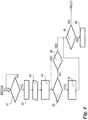
- the diagnostic method according to the invention is shown on the flow diagram of Figure 4 . Having verified the presence of precise conditions for initiating the verification stage (block 41), the command and control unit 8 switches the vehicle operation from gaseous fuel to liquid fuel, and closes the solenoid valve 4 to shut off the gaseous fuel (block 42). It will also be assumed that the vehicle is accelerating.
- the pressure differential evaluated by the command and control unit 8 (P diff ) must be less than a predefined valve corresponding to the valve open.
- the diagnosis can be carried out only if the aforestated conditions are verified. These conditions are verified in block 45 and block 46 (with regard to the aforesaid times) of Figure 4 .
- the pressure of the low pressure circuit (P rail ) at the moment of starting the fuel leakage measurement algorithm can be merely greater than a predefined minimum (P rail _ min ), without maximum pressure constraints.
- the command and control unit 8 measures the fuel leakage (block 47) and verifies any pressure reduction (P rail ) within a predetermined time (t test ) of the order of a few seconds (for example between 5 and 10). If, as shown in Figure 5b , the pressure reduction relative to the value measured at the moment t test_0 is not less than a predefined threshold ( ⁇ P rail ), a leakage is not determined (i.e. the diagnosis has given a positive result, block 48 of Figure 4 ) and the procedure is halted, engine operation with gaseous fuel feed then being restored (block 49).
- Figure 6a shows the variations of the various pressures if the circuit has been damaged and there is therefore a gaseous fuel leakage (for example in the branch 7).
- the circuit pressure does not stabilize around a substantially constant value as in the case described in Figures 5a and 5b but, because of the leakages, decreases progressively.
- the command and control unit 8 which measures the fuel leakage verifies the pressure decrease ( ⁇ P rail ) within the predetermined time (t test ) of the order of some seconds; if this decrease exceeds the predefined threshold, the leakage is noted and the procedure is halted.
- the diagnostic procedure according to the invention is started when it is certain that the two stages of the two stage reducer are hydraulically connected together and hence, if any pressure reduction ( ⁇ P rail ) exceeds a predetermined threshold value, a gas leakage in the first stage and in the second stage of the reducer is correctly diagnosed.
- a preferred method of implementing the procedure of the invention is to effect diagnosis only once for each vehicle journey, where "journey" means the period between an engine start and the next engine shut off.
- An alternative manner of implementing the procedure of the invention is to effect the diagnosis by repeating it several times within the same journey; to reduce liquid fuel consumption to a minimum, the repetition can be effected only after a sufficiently lengthy time, of the order of some tens of minutes or of some hours.
- This configuration of the diagnosis procedure enables pressure leakage measurements to be taken even if the predetermined time (t test ) within which the measurement takes place is not consecutive but can be obtained as a sum of time fractions in which P diff exceeds the threshold value such as to ensure that the interconnection valve between the two stages of the two stage reducer is definitely open; these time fractions are characterised by having an individual duration less than the predetermined time t test . In this manner the diagnosis procedure can be concluded even in situations in which the engine acceleration is briefly interrupted for a few seconds for each gear change.
- the diagnosis information obtained can be used both to indicate to the driver an irregularity which causes a leakage of gaseous fuel from the first reducer stage, and to force the electronic control unit 8 to switch engine operation exclusively to liquid fuel.
Landscapes
- Engineering & Computer Science (AREA)
- Chemical & Material Sciences (AREA)
- Combustion & Propulsion (AREA)
- Mechanical Engineering (AREA)
- General Engineering & Computer Science (AREA)
- Oil, Petroleum & Natural Gas (AREA)
- Health & Medical Sciences (AREA)
- Biomedical Technology (AREA)
- Chemical Kinetics & Catalysis (AREA)
- General Chemical & Material Sciences (AREA)
- Output Control And Ontrol Of Special Type Engine (AREA)
- Combined Controls Of Internal Combustion Engines (AREA)
- Electrical Control Of Air Or Fuel Supplied To Internal-Combustion Engine (AREA)
Abstract
Description
- The present invention relates to a method and device for the diagnosis of gaseous fluid leakages in a fuel feed circuit of an internal combustion engine of a vehicle of the type operating both on liquid and on gaseous fuel, in accordance with the corresponding independent claims.
- Particularly in recent years, the use by engine driven vehicle manufacturers of engine feed systems using gaseous fuel has been extended, whether this consists of LPG, CNG (methane), H2 (hydrogen) or mixtures of these gases. This is mainly due to the economical advantages for the user related to the use of such fuels, and to the lesser pollutant emissions of engines operating with such fuels.
- For this reason, numerous engine vehicle manufacturers, whether automobiles, commercial vehicles or other vehicle types, offer a range of so-called bi-fuel vehicles, which enable the engine to be fed either with traditional liquid fuel (petrol, ethanol, petrol-ethanol mixtures, etc.) or with gaseous fuel (LPG, methane). The automobile industry is also known to be expending considerable energy in developing vehicles fed with hydrogen or hydrogen-methane mixtures (Hytane). The common characteristic of some of these fuels (used in gaseous form) is to be stored on the vehicle in liquid form under high pressure, within suitable tanks. This is the case with LPG, the pressure of which in the tank can be a number of bars. Moreover, in contrast with liquid fuels which are stored in tanks not under pressure and hence have to be injected into the explosion chamber of an engine cylinder in atomized liquid form, those gaseous fuels stored in the liquid phase are generally gasified before being injected. This gasification generally takes place within pressure reducer members which can be single stage or two-stage and are disposed between the tank and the engine fluid fuel (gas) injectors. These components form part of the circuit for feeding said fluid to the engine. In particular, the connection line between the tank and the injectors (usually connected to a common conduit) and through which the fuel is fed to these latter is divided into two branches by the reducer member (or simply reducer): a first branch or high pressure branch present between the tank and the reducer, and a second branch or low pressure branch between this latter and the injectors (or rather the common conduit to which these are connected). The high pressure branch comprises at least one valve member made to interrupt the feed when the engine is required to operate with the other fuel, such as petrol or the like, or when the engine is at rest.
- Finally, the low pressure branch comprises a pressure measurement device. This latter, together with the controlled valve member (for example a solenoid valve) and each injector, is connected to a command and control unit which oversees the operation of the engine feed system.
- Diagnostic methods and procedures are known able to sense possible gaseous fluid leakages within a fuel feed circuit for vehicles of the aforeindicated type, said methods being usually implemented in a feed circuit in which the reducer is of the single stage type. An example of this method is described in
FR2840025 - In the test or diagnosis period, the injectors of the aforesaid circuit are closed and the engine operates with the other fuel. The controlled valve member is then closed and the pressure in the low pressure branch is measured.
- Such a solution does not enable the pressure variation in the circuit to be measured rapidly within a short time and correctly, because the difference between the pressure in the low pressure branch thereof and atmospheric pressure can be too low to enable the leakage to be sensed with certainty. This is in fact the situation when the engine operates under idling conditions or conditions in which the method of the prior patent is implemented, in such situations the pressure in the low pressure branch being just higher than atmospheric pressure. Moreover with the method described in the prior French patent any leakages in the high pressure branch cannot be evaluated directly, but only indirectly with obvious possibilities of error.
- An object of the present invention is to provide a method and a corresponding device able to implement the (gaseous) fluid leakage diagnosis in a circuit feeding fuel to a vehicle engine which represent improvements compared with known methods and devices.
- A particular object of the invention is to provide a method and device of the aforesaid type which enable the leakage diagnosis to be carried out in a very short time, while ensuring correct evaluation of any such leakages.
- Another object of the invention is to enable a diagnosis which is conducted frequently during vehicle use and consequently is implemented both if the main use of the vehicle is characterised by long travel runs (for example motorway travel), and if the vehicle main use is characterised by short town runs or mixed travel.
- A further object of the invention is to effect a diagnosis which can also be integrated with gaseous fuel (for example LPG) feed systems or plants for engine driven vehicles which are already circulating by means of an update of the diagnostic functions of the unit controlling the injection of this fluid into the engine. These and other objects which will be evident to the expert of the art are attained by a method and device in accordance with the accompanying claims.
- The present invention will be better understood from the accompanying drawings, which are provided by way of non-limiting example and in which:
-
Figure 1 is a block diagram of a gaseous fuel feed circuit for engine driven vehicles using a two stage pressure reducer; -
Figure 2 is a section through a two stage reducer used in the circuit ofFigure 1 in a particular embodiment shown by way of non-binding example; - the diagram of
Figure 3 shows schematically the pressure variations within the various circuit sections; -
Figure 4 is an exemplified block diagram of an advantageous application of a diagnostic procedure according to the invention; -
Figures 5a and5b represent the simplified variation of the pressures measured or processed in the circuit ofFigure 2 , under normal conditions without any fuel leakage in the circuit, whereFigure 5a also shows times in addition to the simplified pressure variation, whereasFigure 5b displays the allowable pressure variation range (ΔPrail) beyond which a leakage is diagnosed; -
Figures 6a and6b represent the simplified variation of the pressures measured or processed in the circuit ofFigure 3 , in the presence of abnormal conditions which cause fuel leakages, whereFigure 6a also shows times in addition to the simplified pressure variation, whereasFigure 6b displays the allowable pressure variation range (ΔPrail) beyond which a leakage is diagnosed. - With particular reference to
Figure 1 , a circuit for feeding gaseous fuel to a vehicle engine M comprises a known two stage pressure reducer 1, a tank 2 for gaseous fuel possibly contained in liquid form, a first high pressure branch 3 (defined by a complex of pipes) which transfers the fuel from the tank 2 to the two stage pressure reducer 1; the branch 3 comprises a solenoid valve 4 for fuel shutoff positioned upstream of the two stage pressure reducer. A complex offuel injectors 5 integrated into acommon conduit 16, feeds the gaseous fuel into the engine; this complex is associated with apressure measurement device 6 positioned on a low pressure branch 7 of the feed circuit which transfers the fuel leaving the two stage reducer 1 to thefuel injectors 5. This branch 7 and the conduit which defines it represent a common conduit for the injectors. - All these components are controlled and commanded by an
electronic control unit 8 connected to them byrelative interconnecting cables 10; thiscontrol unit 8 executes the diagnostic procedure according to the invention. - Finally, a
temperature sensor 14 is mounted in the base B of the engine M, saidsensor 14 being also connected to thecontrol unit 8. The interior of the two stage reducer 1 can be schematically seeb inFigure 2 where two regulation stages can be identified, indicated respectively by 9 for the high pressure stage and 15 for the low pressure stage. Each stage bases its operation on a regulating membrane (indicated by 11 and 12 and defining respectively the membrane of the high pressurefirst stage 9 and that of the low pressure second stage 15); thestages interconnection valve 13 of known type. As can be seen fromFigure 2 , in known manner theinterconnection valve 13 between the two stages is operated by thesecond stage membrane 12. When the pressure differential acting on thesecond stage membrane 12 is less than a pressure defined at the design stage, theinterconnection valve 13 between the two stages is opened and the two stages are hydraulically connected. This situation occurs when the engine operates at high loads (such as during acceleration) and requires a constant gaseous fuel feed. The reducer 1 comprises other known components, shown inFigure 2 , which however are not described as this is not necessary for understanding the invention. - With reference to
Figure 3 , Ptank represents the pressure of the fuel in the tank which is in the gaseous state in the case of methane or two-phase liquid operation and gas in the case of LPG feed. The pressure in the pressure tank is of the order of several bar if the fuel is LPG or of several tens of bar if the fuel is methane. This pressure is also present in the high pressure branch 3 and at the inlet of the solenoid shutoff valve 4. The tank pressure Ptank is substantially constant during the transient variations of the engine load. - When the engine is fed by gaseous fuel, the solenoid valve 4 is opened, enabling the fuel to enter the
first stage 9 of the reducer 1 and to expand and gasify therein. The high pressurefirst stage 9 of the reducer is designed to reduce the fuel pressure from that of the tank to a lower pressure Pist. As a non-limiting example, this pressure can be of about 2.6 bar absolute and be virtually constant as the engine load varies. - Through the low pressure
second stage 15, the pressure is further reduced and regulated at a pressure the value Prail of which is variable according to the engine load conditions and hence to the pressure PMAP present in the intake manifold. As a non-limiting example this pressure can be about 2 bar absolute when the engine operates at high loads, and just above 1 bar absolute when the engine is idling. The diagnostic method according to the invention is shown on the flow diagram ofFigure 4 . Having verified the presence of precise conditions for initiating the verification stage (block 41), the command andcontrol unit 8 switches the vehicle operation from gaseous fuel to liquid fuel, and closes the solenoid valve 4 to shut off the gaseous fuel (block 42). It will also be assumed that the vehicle is accelerating. - Under these conditions and with reference to
Figure 5a , the different pressure variations within the branches 3 and 7 and in the usual intake manifold of the engine M can be determined, this latter value being verified by a known sensor present thereat (not shown) and connected to the command andcontrol unit 8. This figure shows the variations of the: - pressure in the first stage 9 (P1st)
- pressure in the branch 7, corresponding to the pressure at the outlet of the second stage 15 (Prail)
- pressure in the intake manifold (PMAP)
- estimated pressure differential Pdiff = (Prail - PMAP).
- During acceleration, the manifold pressure increases, as does the pressure of the gaseous fuel to the second stage 15 (Prail).
- At the time t1 when the manifold pressure (PMAP) exceeds a predetermined pressure and the solenoid shutoff valve is closed (block 42) there is no further outflow of fuel in the liquid state from the tank. In this situation, the command and
control unit 8 measures and memorizes the pressure Prail. - Although the solenoid shutoff valve is closed, the
gaseous fuel injectors 5 continue to inject gas into the cylinders of the engine M and the pressure in thefirst stage 9 begins to decrease as the interconnection valve between the twostages 13 is open, as already described (block 43 ofFigure 4 ). - This results in equilibrium between the
high pressure stage 9 andlow pressure stage 15, which tend to attain an intermediate pressure (measured by 6) between the initial first stage pressure (P1st) and the second stage pressure (Prail). After a time of the order of some milliseconds, the gas injectors are closed (time tinj, block 44 ofFigure 4 ) and the engine is fed with liquid fuel. In this equilibrium state with the circuit isolated, the algorithm for measuring the fuel leakage identified at that instant by time ttest0 can be started (block 45 ofFigure 4 ), provided that the following summarized conditions are verified: - pressure value in range between two end values (Prail-Max and Prail-min), to ensure absence of possible transients;
- pressure value at a pressure sufficiently higher than that of the external environment such as to have the conditions for measuring a fuel leakage accurately and quickly.
- Moreover to ensure that the interconnection valve between the two stages of the two stage reducer is definitely open, the pressure differential evaluated by the command and control unit 8 (Pdiff) must be less than a predefined valve corresponding to the valve open.
- To these conditions there must however be preliminarily added at least one of the following (which anticipate those indicated above):
- that the vehicle has been operating with gaseous fuel feed for a certain time (typically 2-8 seconds, preferably 5 seconds) such as to ensure the absence of transients due to a recent switch between liquid fuel operation and gaseous fuel operation;
- that the temperature of the reducer 1, measured indirectly by the engine
water temperature sensor 14, is sufficiently high; this is achieved for example by measuring the engine cooling water temperature and verifying that this is higher than a predefined threshold (typically in the range 80-90°C); - that, if the cooling water temperature at the moment of engine start-up lies between two limiting threshold values (typically 15°C-40°C), a time has preferably passed (for example, for the European market about 20 minutes) during which the engine emissions are conventionally measured;
- that the engine r.p.m. is preferably less than a limit (typically at least 3500 r.p.m.) such as to ensure that the engine is not operating at very high r.p.m.
- The diagnosis can be carried out only if the aforestated conditions are verified. These conditions are verified in
block 45 and block 46 (with regard to the aforesaid times) ofFigure 4 . - In a modified implementation of the diagnostic procedure according to the invention, the pressure of the low pressure circuit (Prail) at the moment of starting the fuel leakage measurement algorithm can be merely greater than a predefined minimum (Prail_min), without maximum pressure constraints.
- With these conditions, the command and
control unit 8 measures the fuel leakage (block 47) and verifies any pressure reduction (Prail) within a predetermined time (ttest) of the order of a few seconds (for example between 5 and 10). If, as shown inFigure 5b , the pressure reduction relative to the value measured at the moment ttest_0 is not less than a predefined threshold (ΔPrail), a leakage is not determined (i.e. the diagnosis has given a positive result, block 48 ofFigure 4 ) and the procedure is halted, engine operation with gaseous fuel feed then being restored (block 49). -
Figure 6a shows the variations of the various pressures if the circuit has been damaged and there is therefore a gaseous fuel leakage (for example in the branch 7). In this case the circuit pressure does not stabilize around a substantially constant value as in the case described inFigures 5a and5b but, because of the leakages, decreases progressively. Under these conditions, as described inFigure 6b , the command andcontrol unit 8 which measures the fuel leakage verifies the pressure decrease (ΔPrail) within the predetermined time (ttest) of the order of some seconds; if this decrease exceeds the predefined threshold, the leakage is noted and the procedure is halted. - In this manner the diagnostic procedure according to the invention is started when it is certain that the two stages of the two stage reducer are hydraulically connected together and hence, if any pressure reduction (ΔPrail) exceeds a predetermined threshold value, a gas leakage in the first stage and in the second stage of the reducer is correctly diagnosed.
- To reduce the consumption of liquid fuel (petrol, ethanol, petrol-ethanol mixture, etc.) to a minimum during the test, a preferred method of implementing the procedure of the invention is to effect diagnosis only once for each vehicle journey, where "journey" means the period between an engine start and the next engine shut off. An alternative manner of implementing the procedure of the invention is to effect the diagnosis by repeating it several times within the same journey; to reduce liquid fuel consumption to a minimum, the repetition can be effected only after a sufficiently lengthy time, of the order of some tens of minutes or of some hours.
- This configuration of the diagnosis procedure enables pressure leakage measurements to be taken even if the predetermined time (ttest) within which the measurement takes place is not consecutive but can be obtained as a sum of time fractions in which Pdiff exceeds the threshold value such as to ensure that the interconnection valve between the two stages of the two stage reducer is definitely open; these time fractions are characterised by having an individual duration less than the predetermined time ttest. In this manner the diagnosis procedure can be concluded even in situations in which the engine acceleration is briefly interrupted for a few seconds for each gear change.
- With this implementation method, extremely flexible driving conditions can be ensured appropriate for carrying out the diagnosis procedure, such that the diagnosis procedure can be implemented not only when the vehicle runs at high engine loads for fairly lengthy times, but also under town driving conditions characterised by the presence of short accelerations, gear changes and frequent idling stoppages, for example in proximity to traffic lights.
- However, in both cases the test is carried out while maintaining a high pressure in the circuit under evaluation; for this reason and to limit test times the engine must be delivering power, i.e. is accelerating. In this respect, if the engine is under idling operating conditions, the pressure in the conduit is only slightly above atmospheric pressure, hence any gas leakage can be diagnosed only if the leakage is significantly large.
- The diagnosis information obtained can be used both to indicate to the driver an irregularity which causes a leakage of gaseous fuel from the first reducer stage, and to force the
electronic control unit 8 to switch engine operation exclusively to liquid fuel. - The characteristics and advantages of the invention are apparent from the description, they being mainly represented by simplicity and constructional economy by not requiring components additional to the circuit for feeding fluid gaseous fuel to an engine. Moreover, by carrying out the diagnosis during an acceleration, the times for its implementation are very short, even though enabling a reliable evaluation of any gas leakages both in the high pressure branch 3 and in the low pressure branch 7.
- Other embodiments of the invention are possible while remaining within the scope of the invention as defined by the ensuing claims.
Claims (7)
- A method for the diagnosis of gaseous fluid leakages in a circuit feeding gaseous fuel, whether consisting of LPG, CNG (methane), H2 (hydrogen) or mixtures of these gases, into an internal combustion engine (M) through at least one corresponding injector (5), said circuit comprising in addition to said injector (5) a tank (2) for said fluid in which it is contained at high pressure, a reducer member (1) for said pressure which is disposed in a connection line between said tank and said injector and which divides it into a high pressure branch (3) and a low pressure branch (7), there being disposed in said line upstream of the reducer member a controlled valve member (4) to interrupt the fluid flow to the injector (5) and a pressure measurement device (6) positioned in the low pressure branch (7), said measurement device (6), each injector (5) and said valve member (4) being connected to a command and control unit (8), said method comprising closing the valve member (4), closing each injector (5) and evaluating the variation of the fluid pressure in the line with time by means of said measurement device (6) in order to determine any leakages of said circuit downstream of the valve member, characterised in that said evaluation is carried out during a phase in which the engine (M) is under acceleration, the reducer member being a two stage reducer.
- A method as claimed in claim 1, characterised in that the closure of each injector takes place after a time of the order of some milliseconds after the closure of the valve member (4).
- A method as claimed in claim 1, characterised in that before activating the gaseous fuel leakage diagnosis, it is verified that at least one of the following preliminary characteristics exists:a. that the vehicle has been operating with gaseous fuel feed for a certain time such as to ensure the absence of transients due to a recent switch between liquid fuel operation and gaseous fuel operation;b. that the temperature of the reducer member (1) is sufficiently high, by measuring the engine cooling water temperature and verifying that this is higher than a predefined threshold;c. that, if the cooling water temperature at the moment of engine start lies between two limiting threshold values, a time has preferably passed during which the engine emissions are conventionally measured;d. that the engine r.p.m. is preferably less than a limiting value such as to ensure that the engine is not operating at very high r.p.m.
- A method as claimed in claim 3, characterised in that:- the time period of point a) is typically 2-8 seconds, preferably 5 seconds;- the water temperature threshold of point b) is 80-90°C;- the two limiting thresholds of point c) are respectively 15°C and 40°C, the emission measurement time being at least15-18 minutes;- the r.p.m. value of point d) is at least equal to 3500 r.p.m.
- A method as claimed in claims 1 and 3, characterised in that the leakage diagnosis comprises the following preliminary steps:i) verifying the existence of at least one of the preliminary characteristics;ii) closing the valve member (4) and simultaneously switching the operation of the engine (M) to liquid fuel, such as petrol, petrol/ethanol mixture or ethanol;iii) verifying that the usual two stages (9, 10) of the reducer member (1) are in communication.
- A method as claimed in claim 5, characterised by also comprising the following steps:A) measuring the pressure (Prail) in the low pressure branch (7) after closing the valve member (4) andB) memorizing said measurement and continuing to verify the variation in its value for a predetermined time, this latter being of the order of a few seconds, such as 5-10 seconds;C) if the variation in said pressure (Prail) exceeds a predefined threshold, a pressure leakage in the feed circuit is diagnosed.
- A device for implementing the method claimed in claim 1 for the diagnosis of gaseous fluid leakages in a fuel feed circuit of a vehicle internal combustion engine (M), said fluid being fed in gaseous form into each cylinder of the engine (M) through at least one corresponding injector (5), said circuit comprising in addition to said injector (5) a tank (2) for said fluid in which it is contained at high pressure, a reducer member (1) for said pressure which is disposed in a connection line between said tank and said injector and which divides it into a high pressure branch (3) and a low pressure branch (7), there being disposed in said line upstream of the reducer member a controlled valve member (4) to interrupt the fluid flow to the injector (5) and a pressure measurement device (6) positioned in the low pressure branch (7), said measurement device (6), each injector (5) and said valve member (4) being connected to a command and control unit (8) adapted to evaluate the variation of the line fluid pressure with time by means of said measurement device (6) in order to determine possible leakages in said circuit, characterised by comprising, for sensing the pressure of the gaseous fluid feed to the engine, means connected to the command and control unit (8) and arranged to enable this latter to sense an acceleration phase of the engine (M), said unit implementing said leakage diagnosis in this phase, said reducer member (1) being of the two stage type.
Priority Applications (1)
| Application Number | Priority Date | Filing Date | Title |
|---|---|---|---|
| PL12161950T PL2508741T3 (en) | 2011-04-04 | 2012-03-29 | Method and device for the diagnosis of gaseous fluid leakages in a fuel feed circuit of an engine driven vehicle |
Applications Claiming Priority (1)
| Application Number | Priority Date | Filing Date | Title |
|---|---|---|---|
| IT000547A ITMI20110547A1 (en) | 2011-04-04 | 2011-04-04 | METHOD AND DEVICE FOR DIAGNOSTICS OF GASEOUS FLUID LOSSES IN A FUEL SUPPLY CIRCUIT OF A MOTOR VEHICLE |
Publications (2)
| Publication Number | Publication Date |
|---|---|
| EP2508741A1 true EP2508741A1 (en) | 2012-10-10 |
| EP2508741B1 EP2508741B1 (en) | 2015-08-05 |
Family
ID=44120393
Family Applications (1)
| Application Number | Title | Priority Date | Filing Date |
|---|---|---|---|
| EP12161950.6A Active EP2508741B1 (en) | 2011-04-04 | 2012-03-29 | Method and device for the diagnosis of gaseous fluid leakages in a fuel feed circuit of an engine driven vehicle |
Country Status (4)
| Country | Link |
|---|---|
| EP (1) | EP2508741B1 (en) |
| ES (1) | ES2552041T3 (en) |
| IT (1) | ITMI20110547A1 (en) |
| PL (1) | PL2508741T3 (en) |
Cited By (5)
| Publication number | Priority date | Publication date | Assignee | Title |
|---|---|---|---|---|
| CN105849395A (en) * | 2013-12-26 | 2016-08-10 | 三菱重工业株式会社 | Gas fuel supply system and method for detecting abnormality of gas fuel supply system |
| CN107218139A (en) * | 2017-07-21 | 2017-09-29 | 中国第汽车股份有限公司 | The online test method of flow rate characteristic of fuel gas nozzle drift value |
| WO2025042325A1 (en) * | 2023-08-24 | 2025-02-27 | Scania Cv Ab | Method of diagnosing a fuel gas supply arrangement, control arrangement, computer program, computer-readable medium, fuel gas supply arrangement, and vehicle |
| CN120332649A (en) * | 2025-06-19 | 2025-07-18 | 浙江浙能航天氢能技术有限公司 | A method, device and electronic equipment for detecting hydrogen leakage in a hydrogen filling station |
| EP4696875A3 (en) * | 2024-04-30 | 2026-04-15 | Cummins, Inc. | System and method for detecting fuel leaks in hydrogen combustion engines |
Citations (4)
| Publication number | Priority date | Publication date | Assignee | Title |
|---|---|---|---|---|
| JPH0882250A (en) * | 1994-09-13 | 1996-03-26 | Nissan Motor Co Ltd | Vehicle gas fuel leakage prevention device |
| DE10004463A1 (en) * | 1999-06-02 | 2000-12-07 | Fujitsu Ten Ltd | Fuel injection control system for motor vehicle driven by compressed natural gas stops fuel delivery for gas pressure reduction of not more than predefined value and detected vehicle motion |
| JP2000346292A (en) * | 1999-06-01 | 2000-12-15 | Yazaki Corp | Liquefied gas vaporizer, liquefied gas vaporization method, and LPG bulk storage tank |
| FR2840025A1 (en) | 2002-05-27 | 2003-11-28 | Johnson Contr Automotive Elect | METHOD FOR DETECTING LEAKAGE IN A GAS FUEL SUPPLY CIRCUIT OF AN ENGINE |
-
2011
- 2011-04-04 IT IT000547A patent/ITMI20110547A1/en unknown
-
2012
- 2012-03-29 ES ES12161950.6T patent/ES2552041T3/en active Active
- 2012-03-29 PL PL12161950T patent/PL2508741T3/en unknown
- 2012-03-29 EP EP12161950.6A patent/EP2508741B1/en active Active
Patent Citations (4)
| Publication number | Priority date | Publication date | Assignee | Title |
|---|---|---|---|---|
| JPH0882250A (en) * | 1994-09-13 | 1996-03-26 | Nissan Motor Co Ltd | Vehicle gas fuel leakage prevention device |
| JP2000346292A (en) * | 1999-06-01 | 2000-12-15 | Yazaki Corp | Liquefied gas vaporizer, liquefied gas vaporization method, and LPG bulk storage tank |
| DE10004463A1 (en) * | 1999-06-02 | 2000-12-07 | Fujitsu Ten Ltd | Fuel injection control system for motor vehicle driven by compressed natural gas stops fuel delivery for gas pressure reduction of not more than predefined value and detected vehicle motion |
| FR2840025A1 (en) | 2002-05-27 | 2003-11-28 | Johnson Contr Automotive Elect | METHOD FOR DETECTING LEAKAGE IN A GAS FUEL SUPPLY CIRCUIT OF AN ENGINE |
Cited By (7)
| Publication number | Priority date | Publication date | Assignee | Title |
|---|---|---|---|---|
| CN105849395A (en) * | 2013-12-26 | 2016-08-10 | 三菱重工业株式会社 | Gas fuel supply system and method for detecting abnormality of gas fuel supply system |
| CN105849395B (en) * | 2013-12-26 | 2019-10-18 | 三菱重工业株式会社 | Gas fuel supply system and abnormal detection method of gas fuel supply system |
| CN107218139A (en) * | 2017-07-21 | 2017-09-29 | 中国第汽车股份有限公司 | The online test method of flow rate characteristic of fuel gas nozzle drift value |
| CN107218139B (en) * | 2017-07-21 | 2020-04-14 | 中国第一汽车股份有限公司 | On-line detection method of gas nozzle flow characteristic drift |
| WO2025042325A1 (en) * | 2023-08-24 | 2025-02-27 | Scania Cv Ab | Method of diagnosing a fuel gas supply arrangement, control arrangement, computer program, computer-readable medium, fuel gas supply arrangement, and vehicle |
| EP4696875A3 (en) * | 2024-04-30 | 2026-04-15 | Cummins, Inc. | System and method for detecting fuel leaks in hydrogen combustion engines |
| CN120332649A (en) * | 2025-06-19 | 2025-07-18 | 浙江浙能航天氢能技术有限公司 | A method, device and electronic equipment for detecting hydrogen leakage in a hydrogen filling station |
Also Published As
| Publication number | Publication date |
|---|---|
| ITMI20110547A1 (en) | 2012-10-05 |
| PL2508741T3 (en) | 2016-01-29 |
| EP2508741B1 (en) | 2015-08-05 |
| ES2552041T3 (en) | 2015-11-25 |
Similar Documents
| Publication | Publication Date | Title |
|---|---|---|
| RU2638491C2 (en) | Fuel system for gaseous fuel engine and method of adjusting pressure of gaseous fuel | |
| CN101595296B (en) | Method and device for operating a gas injection system of a gas fuel and a liquid fuel operated internal combustion engine | |
| US7661409B2 (en) | Operating method and device for a gas-operated internal combustion engine | |
| US6467466B1 (en) | Gas leakage detection and fail-safe control method for gas-fueled internal combustion engine and apparatus for implementing the same | |
| US20120310509A1 (en) | Dual fuel engine system | |
| US6830026B2 (en) | Diagnostics system for tracing leaks from a gas-supply system and for checking operation of the valves forming part of said system | |
| CN103835805B (en) | Gas fuel system and method for engine | |
| EP2508741B1 (en) | Method and device for the diagnosis of gaseous fluid leakages in a fuel feed circuit of an engine driven vehicle | |
| US20120266846A1 (en) | Dual fuel diesel engine system | |
| US9765717B2 (en) | Gaseous fuel conversion system for marine vessels, and related accessories | |
| US9624863B1 (en) | System and method for supplying fuel to engine | |
| JP2014118844A (en) | Fuel injection control device of internal combustion engine | |
| EP2009277B1 (en) | An internal combustion engine system, and a method in such an engine system | |
| JP5874622B2 (en) | Fuel injection control device for internal combustion engine | |
| US11085387B2 (en) | Systems and methods for performing engine de-rate control operation of a vehicle | |
| KR20090013362A (en) | How to diagnose fuel leakage in bi fuel vehicle | |
| KR100706370B1 (en) | Fuel system control method for emergency fuel cut off in LPI vehicle | |
| KR101358153B1 (en) | Operating procedure and device for a natural gas operated internal combustion engine | |
| WO2014091680A1 (en) | Fuel injection control device for internal combustion engine, and vehicle fuel injection system | |
| KR100716406B1 (en) | ELPIA vehicle gas injector control device and method | |
| US20150315990A1 (en) | Diesel engine combustion and temperature management system | |
| KR102767295B1 (en) | CNG Leakage Diagnostic Method for CNG Vehicles | |
| KR100663619B1 (en) | ELPIA vehicle fuel cut control device and method | |
| KR100749243B1 (en) | How Elpia diagnoses a vehicle's fuel supply line leakage | |
| KR100767517B1 (en) | How to control fuel pump of LP vehicle |
Legal Events
| Date | Code | Title | Description |
|---|---|---|---|
| PUAI | Public reference made under article 153(3) epc to a published international application that has entered the european phase |
Free format text: ORIGINAL CODE: 0009012 |
|
| AK | Designated contracting states |
Kind code of ref document: A1 Designated state(s): AL AT BE BG CH CY CZ DE DK EE ES FI FR GB GR HR HU IE IS IT LI LT LU LV MC MK MT NL NO PL PT RO RS SE SI SK SM TR |
|
| AX | Request for extension of the european patent |
Extension state: BA ME |
|
| 17P | Request for examination filed |
Effective date: 20130225 |
|
| 17Q | First examination report despatched |
Effective date: 20140530 |
|
| GRAP | Despatch of communication of intention to grant a patent |
Free format text: ORIGINAL CODE: EPIDOSNIGR1 |
|
| INTG | Intention to grant announced |
Effective date: 20150428 |
|
| GRAS | Grant fee paid |
Free format text: ORIGINAL CODE: EPIDOSNIGR3 |
|
| GRAA | (expected) grant |
Free format text: ORIGINAL CODE: 0009210 |
|
| AK | Designated contracting states |
Kind code of ref document: B1 Designated state(s): AL AT BE BG CH CY CZ DE DK EE ES FI FR GB GR HR HU IE IS IT LI LT LU LV MC MK MT NL NO PL PT RO RS SE SI SK SM TR |
|
| REG | Reference to a national code |
Ref country code: GB Ref legal event code: FG4D |
|
| REG | Reference to a national code |
Ref country code: CH Ref legal event code: EP |
|
| REG | Reference to a national code |
Ref country code: AT Ref legal event code: REF Ref document number: 740858 Country of ref document: AT Kind code of ref document: T Effective date: 20150815 |
|
| REG | Reference to a national code |
Ref country code: IE Ref legal event code: FG4D |
|
| REG | Reference to a national code |
Ref country code: DE Ref legal event code: R096 Ref document number: 602012009258 Country of ref document: DE |
|
| REG | Reference to a national code |
Ref country code: ES Ref legal event code: FG2A Ref document number: 2552041 Country of ref document: ES Kind code of ref document: T3 Effective date: 20151125 |
|
| REG | Reference to a national code |
Ref country code: AT Ref legal event code: MK05 Ref document number: 740858 Country of ref document: AT Kind code of ref document: T Effective date: 20150805 |
|
| REG | Reference to a national code |
Ref country code: LT Ref legal event code: MG4D |
|
| REG | Reference to a national code |
Ref country code: NL Ref legal event code: MP Effective date: 20150805 |
|
| PG25 | Lapsed in a contracting state [announced via postgrant information from national office to epo] |
Ref country code: LT Free format text: LAPSE BECAUSE OF FAILURE TO SUBMIT A TRANSLATION OF THE DESCRIPTION OR TO PAY THE FEE WITHIN THE PRESCRIBED TIME-LIMIT Effective date: 20150805 Ref country code: LV Free format text: LAPSE BECAUSE OF FAILURE TO SUBMIT A TRANSLATION OF THE DESCRIPTION OR TO PAY THE FEE WITHIN THE PRESCRIBED TIME-LIMIT Effective date: 20150805 Ref country code: GR Free format text: LAPSE BECAUSE OF FAILURE TO SUBMIT A TRANSLATION OF THE DESCRIPTION OR TO PAY THE FEE WITHIN THE PRESCRIBED TIME-LIMIT Effective date: 20151106 Ref country code: NO Free format text: LAPSE BECAUSE OF FAILURE TO SUBMIT A TRANSLATION OF THE DESCRIPTION OR TO PAY THE FEE WITHIN THE PRESCRIBED TIME-LIMIT Effective date: 20151105 Ref country code: FI Free format text: LAPSE BECAUSE OF FAILURE TO SUBMIT A TRANSLATION OF THE DESCRIPTION OR TO PAY THE FEE WITHIN THE PRESCRIBED TIME-LIMIT Effective date: 20150805 |
|
| PG25 | Lapsed in a contracting state [announced via postgrant information from national office to epo] |
Ref country code: AT Free format text: LAPSE BECAUSE OF FAILURE TO SUBMIT A TRANSLATION OF THE DESCRIPTION OR TO PAY THE FEE WITHIN THE PRESCRIBED TIME-LIMIT Effective date: 20150805 Ref country code: HR Free format text: LAPSE BECAUSE OF FAILURE TO SUBMIT A TRANSLATION OF THE DESCRIPTION OR TO PAY THE FEE WITHIN THE PRESCRIBED TIME-LIMIT Effective date: 20150805 Ref country code: RS Free format text: LAPSE BECAUSE OF FAILURE TO SUBMIT A TRANSLATION OF THE DESCRIPTION OR TO PAY THE FEE WITHIN THE PRESCRIBED TIME-LIMIT Effective date: 20150805 Ref country code: PT Free format text: LAPSE BECAUSE OF FAILURE TO SUBMIT A TRANSLATION OF THE DESCRIPTION OR TO PAY THE FEE WITHIN THE PRESCRIBED TIME-LIMIT Effective date: 20151207 Ref country code: IS Free format text: LAPSE BECAUSE OF FAILURE TO SUBMIT A TRANSLATION OF THE DESCRIPTION OR TO PAY THE FEE WITHIN THE PRESCRIBED TIME-LIMIT Effective date: 20151205 Ref country code: SE Free format text: LAPSE BECAUSE OF FAILURE TO SUBMIT A TRANSLATION OF THE DESCRIPTION OR TO PAY THE FEE WITHIN THE PRESCRIBED TIME-LIMIT Effective date: 20150805 |
|
| PG25 | Lapsed in a contracting state [announced via postgrant information from national office to epo] |
Ref country code: NL Free format text: LAPSE BECAUSE OF FAILURE TO SUBMIT A TRANSLATION OF THE DESCRIPTION OR TO PAY THE FEE WITHIN THE PRESCRIBED TIME-LIMIT Effective date: 20150805 |
|
| REG | Reference to a national code |
Ref country code: FR Ref legal event code: PLFP Year of fee payment: 5 |
|
| PG25 | Lapsed in a contracting state [announced via postgrant information from national office to epo] |
Ref country code: EE Free format text: LAPSE BECAUSE OF FAILURE TO SUBMIT A TRANSLATION OF THE DESCRIPTION OR TO PAY THE FEE WITHIN THE PRESCRIBED TIME-LIMIT Effective date: 20150805 Ref country code: SK Free format text: LAPSE BECAUSE OF FAILURE TO SUBMIT A TRANSLATION OF THE DESCRIPTION OR TO PAY THE FEE WITHIN THE PRESCRIBED TIME-LIMIT Effective date: 20150805 Ref country code: CZ Free format text: LAPSE BECAUSE OF FAILURE TO SUBMIT A TRANSLATION OF THE DESCRIPTION OR TO PAY THE FEE WITHIN THE PRESCRIBED TIME-LIMIT Effective date: 20150805 Ref country code: DK Free format text: LAPSE BECAUSE OF FAILURE TO SUBMIT A TRANSLATION OF THE DESCRIPTION OR TO PAY THE FEE WITHIN THE PRESCRIBED TIME-LIMIT Effective date: 20150805 |
|
| REG | Reference to a national code |
Ref country code: DE Ref legal event code: R097 Ref document number: 602012009258 Country of ref document: DE |
|
| PG25 | Lapsed in a contracting state [announced via postgrant information from national office to epo] |
Ref country code: RO Free format text: LAPSE BECAUSE OF FAILURE TO SUBMIT A TRANSLATION OF THE DESCRIPTION OR TO PAY THE FEE WITHIN THE PRESCRIBED TIME-LIMIT Effective date: 20150805 |
|
| PLBE | No opposition filed within time limit |
Free format text: ORIGINAL CODE: 0009261 |
|
| STAA | Information on the status of an ep patent application or granted ep patent |
Free format text: STATUS: NO OPPOSITION FILED WITHIN TIME LIMIT |
|
| 26N | No opposition filed |
Effective date: 20160509 |
|
| PG25 | Lapsed in a contracting state [announced via postgrant information from national office to epo] |
Ref country code: SI Free format text: LAPSE BECAUSE OF FAILURE TO SUBMIT A TRANSLATION OF THE DESCRIPTION OR TO PAY THE FEE WITHIN THE PRESCRIBED TIME-LIMIT Effective date: 20150805 Ref country code: BE Free format text: LAPSE BECAUSE OF NON-PAYMENT OF DUE FEES Effective date: 20160331 |
|
| PG25 | Lapsed in a contracting state [announced via postgrant information from national office to epo] |
Ref country code: LU Free format text: LAPSE BECAUSE OF FAILURE TO SUBMIT A TRANSLATION OF THE DESCRIPTION OR TO PAY THE FEE WITHIN THE PRESCRIBED TIME-LIMIT Effective date: 20160329 Ref country code: MC Free format text: LAPSE BECAUSE OF FAILURE TO SUBMIT A TRANSLATION OF THE DESCRIPTION OR TO PAY THE FEE WITHIN THE PRESCRIBED TIME-LIMIT Effective date: 20150805 |
|
| REG | Reference to a national code |
Ref country code: CH Ref legal event code: PL |
|
| GBPC | Gb: european patent ceased through non-payment of renewal fee |
Effective date: 20160329 |
|
| REG | Reference to a national code |
Ref country code: IE Ref legal event code: MM4A |
|
| PG25 | Lapsed in a contracting state [announced via postgrant information from national office to epo] |
Ref country code: BE Free format text: LAPSE BECAUSE OF FAILURE TO SUBMIT A TRANSLATION OF THE DESCRIPTION OR TO PAY THE FEE WITHIN THE PRESCRIBED TIME-LIMIT Effective date: 20150805 |
|
| PG25 | Lapsed in a contracting state [announced via postgrant information from national office to epo] |
Ref country code: IE Free format text: LAPSE BECAUSE OF NON-PAYMENT OF DUE FEES Effective date: 20160329 Ref country code: CH Free format text: LAPSE BECAUSE OF NON-PAYMENT OF DUE FEES Effective date: 20160331 Ref country code: GB Free format text: LAPSE BECAUSE OF NON-PAYMENT OF DUE FEES Effective date: 20160329 Ref country code: LI Free format text: LAPSE BECAUSE OF NON-PAYMENT OF DUE FEES Effective date: 20160331 |
|
| REG | Reference to a national code |
Ref country code: FR Ref legal event code: PLFP Year of fee payment: 6 |
|
| PG25 | Lapsed in a contracting state [announced via postgrant information from national office to epo] |
Ref country code: MT Free format text: LAPSE BECAUSE OF FAILURE TO SUBMIT A TRANSLATION OF THE DESCRIPTION OR TO PAY THE FEE WITHIN THE PRESCRIBED TIME-LIMIT Effective date: 20150805 |
|
| REG | Reference to a national code |
Ref country code: FR Ref legal event code: PLFP Year of fee payment: 7 |
|
| PG25 | Lapsed in a contracting state [announced via postgrant information from national office to epo] |
Ref country code: HU Free format text: LAPSE BECAUSE OF FAILURE TO SUBMIT A TRANSLATION OF THE DESCRIPTION OR TO PAY THE FEE WITHIN THE PRESCRIBED TIME-LIMIT; INVALID AB INITIO Effective date: 20120329 Ref country code: CY Free format text: LAPSE BECAUSE OF FAILURE TO SUBMIT A TRANSLATION OF THE DESCRIPTION OR TO PAY THE FEE WITHIN THE PRESCRIBED TIME-LIMIT Effective date: 20150805 Ref country code: SM Free format text: LAPSE BECAUSE OF FAILURE TO SUBMIT A TRANSLATION OF THE DESCRIPTION OR TO PAY THE FEE WITHIN THE PRESCRIBED TIME-LIMIT Effective date: 20150805 |
|
| PG25 | Lapsed in a contracting state [announced via postgrant information from national office to epo] |
Ref country code: MT Free format text: LAPSE BECAUSE OF FAILURE TO SUBMIT A TRANSLATION OF THE DESCRIPTION OR TO PAY THE FEE WITHIN THE PRESCRIBED TIME-LIMIT Effective date: 20160331 Ref country code: MK Free format text: LAPSE BECAUSE OF FAILURE TO SUBMIT A TRANSLATION OF THE DESCRIPTION OR TO PAY THE FEE WITHIN THE PRESCRIBED TIME-LIMIT Effective date: 20150805 |
|
| PG25 | Lapsed in a contracting state [announced via postgrant information from national office to epo] |
Ref country code: BG Free format text: LAPSE BECAUSE OF FAILURE TO SUBMIT A TRANSLATION OF THE DESCRIPTION OR TO PAY THE FEE WITHIN THE PRESCRIBED TIME-LIMIT Effective date: 20150805 |
|
| PG25 | Lapsed in a contracting state [announced via postgrant information from national office to epo] |
Ref country code: AL Free format text: LAPSE BECAUSE OF FAILURE TO SUBMIT A TRANSLATION OF THE DESCRIPTION OR TO PAY THE FEE WITHIN THE PRESCRIBED TIME-LIMIT Effective date: 20150805 |
|
| P01 | Opt-out of the competence of the unified patent court (upc) registered |
Effective date: 20230527 |
|
| PGFP | Annual fee paid to national office [announced via postgrant information from national office to epo] |
Ref country code: ES Payment date: 20250415 Year of fee payment: 14 |
|
| PGFP | Annual fee paid to national office [announced via postgrant information from national office to epo] |
Ref country code: IT Payment date: 20250327 Year of fee payment: 14 |
|
| PGFP | Annual fee paid to national office [announced via postgrant information from national office to epo] |
Ref country code: DE Payment date: 20260320 Year of fee payment: 15 |
|
| PGFP | Annual fee paid to national office [announced via postgrant information from national office to epo] |
Ref country code: FR Payment date: 20260323 Year of fee payment: 15 |
|
| PGFP | Annual fee paid to national office [announced via postgrant information from national office to epo] |
Ref country code: TR Payment date: 20260319 Year of fee payment: 15 |
|
| PGFP | Annual fee paid to national office [announced via postgrant information from national office to epo] |
Ref country code: PL Payment date: 20260320 Year of fee payment: 15 |