EP2508722A2 - System and method for increasing efficiency and water recovery of a combined cycle power plant - Google Patents
System and method for increasing efficiency and water recovery of a combined cycle power plant Download PDFInfo
- Publication number
- EP2508722A2 EP2508722A2 EP11192929A EP11192929A EP2508722A2 EP 2508722 A2 EP2508722 A2 EP 2508722A2 EP 11192929 A EP11192929 A EP 11192929A EP 11192929 A EP11192929 A EP 11192929A EP 2508722 A2 EP2508722 A2 EP 2508722A2
- Authority
- EP
- European Patent Office
- Prior art keywords
- turbine
- combined cycle
- power plant
- cycle power
- gas
- Prior art date
- Legal status (The legal status is an assumption and is not a legal conclusion. Google has not performed a legal analysis and makes no representation as to the accuracy of the status listed.)
- Withdrawn
Links
- 238000011084 recovery Methods 0.000 title claims abstract description 9
- XLYOFNOQVPJJNP-UHFFFAOYSA-N water Substances O XLYOFNOQVPJJNP-UHFFFAOYSA-N 0.000 title claims description 32
- 238000000034 method Methods 0.000 title description 9
- 230000031070 response to heat Effects 0.000 claims abstract description 3
- 230000005611 electricity Effects 0.000 claims description 3
- 238000011144 upstream manufacturing Methods 0.000 claims description 2
- 239000007789 gas Substances 0.000 description 50
- 239000007788 liquid Substances 0.000 description 3
- 238000012986 modification Methods 0.000 description 2
- 230000004048 modification Effects 0.000 description 2
- 230000015572 biosynthetic process Effects 0.000 description 1
- 238000002485 combustion reaction Methods 0.000 description 1
- 239000002274 desiccant Substances 0.000 description 1
Images
Classifications
-
- F—MECHANICAL ENGINEERING; LIGHTING; HEATING; WEAPONS; BLASTING
- F02—COMBUSTION ENGINES; HOT-GAS OR COMBUSTION-PRODUCT ENGINE PLANTS
- F02C—GAS-TURBINE PLANTS; AIR INTAKES FOR JET-PROPULSION PLANTS; CONTROLLING FUEL SUPPLY IN AIR-BREATHING JET-PROPULSION PLANTS
- F02C6/00—Plural gas-turbine plants; Combinations of gas-turbine plants with other apparatus; Adaptations of gas-turbine plants for special use
- F02C6/18—Plural gas-turbine plants; Combinations of gas-turbine plants with other apparatus; Adaptations of gas-turbine plants for special use using the waste heat of gas-turbine plants outside the plants themselves, e.g. gas-turbine power heat plants
-
- F—MECHANICAL ENGINEERING; LIGHTING; HEATING; WEAPONS; BLASTING
- F01—MACHINES OR ENGINES IN GENERAL; ENGINE PLANTS IN GENERAL; STEAM ENGINES
- F01K—STEAM ENGINE PLANTS; STEAM ACCUMULATORS; ENGINE PLANTS NOT OTHERWISE PROVIDED FOR; ENGINES USING SPECIAL WORKING FLUIDS OR CYCLES
- F01K21/00—Steam engine plants not otherwise provided for
- F01K21/04—Steam engine plants not otherwise provided for using mixtures of steam and gas; Plants generating or heating steam by bringing water or steam into direct contact with hot gas
- F01K21/047—Steam engine plants not otherwise provided for using mixtures of steam and gas; Plants generating or heating steam by bringing water or steam into direct contact with hot gas having at least one combustion gas turbine
-
- F—MECHANICAL ENGINEERING; LIGHTING; HEATING; WEAPONS; BLASTING
- F01—MACHINES OR ENGINES IN GENERAL; ENGINE PLANTS IN GENERAL; STEAM ENGINES
- F01K—STEAM ENGINE PLANTS; STEAM ACCUMULATORS; ENGINE PLANTS NOT OTHERWISE PROVIDED FOR; ENGINES USING SPECIAL WORKING FLUIDS OR CYCLES
- F01K23/00—Plants characterised by more than one engine delivering power external to the plant, the engines being driven by different fluids
- F01K23/02—Plants characterised by more than one engine delivering power external to the plant, the engines being driven by different fluids the engine cycles being thermally coupled
- F01K23/06—Plants characterised by more than one engine delivering power external to the plant, the engines being driven by different fluids the engine cycles being thermally coupled combustion heat from one cycle heating the fluid in another cycle
- F01K23/10—Plants characterised by more than one engine delivering power external to the plant, the engines being driven by different fluids the engine cycles being thermally coupled combustion heat from one cycle heating the fluid in another cycle with exhaust fluid of one cycle heating the fluid in another cycle
-
- F—MECHANICAL ENGINEERING; LIGHTING; HEATING; WEAPONS; BLASTING
- F22—STEAM GENERATION
- F22B—METHODS OF STEAM GENERATION; STEAM BOILERS
- F22B1/00—Methods of steam generation characterised by form of heating method
- F22B1/02—Methods of steam generation characterised by form of heating method by exploitation of the heat content of hot heat carriers
- F22B1/18—Methods of steam generation characterised by form of heating method by exploitation of the heat content of hot heat carriers the heat carrier being a hot gas, e.g. waste gas such as exhaust gas of internal-combustion engines
- F22B1/1838—Methods of steam generation characterised by form of heating method by exploitation of the heat content of hot heat carriers the heat carrier being a hot gas, e.g. waste gas such as exhaust gas of internal-combustion engines the hot gas being under a high pressure, e.g. in chemical installations
-
- F—MECHANICAL ENGINEERING; LIGHTING; HEATING; WEAPONS; BLASTING
- F05—INDEXING SCHEMES RELATING TO ENGINES OR PUMPS IN VARIOUS SUBCLASSES OF CLASSES F01-F04
- F05D—INDEXING SCHEME FOR ASPECTS RELATING TO NON-POSITIVE-DISPLACEMENT MACHINES OR ENGINES, GAS-TURBINES OR JET-PROPULSION PLANTS
- F05D2220/00—Application
- F05D2220/70—Application in combination with
- F05D2220/72—Application in combination with a steam turbine
-
- Y—GENERAL TAGGING OF NEW TECHNOLOGICAL DEVELOPMENTS; GENERAL TAGGING OF CROSS-SECTIONAL TECHNOLOGIES SPANNING OVER SEVERAL SECTIONS OF THE IPC; TECHNICAL SUBJECTS COVERED BY FORMER USPC CROSS-REFERENCE ART COLLECTIONS [XRACs] AND DIGESTS
- Y02—TECHNOLOGIES OR APPLICATIONS FOR MITIGATION OR ADAPTATION AGAINST CLIMATE CHANGE
- Y02E—REDUCTION OF GREENHOUSE GAS [GHG] EMISSIONS, RELATED TO ENERGY GENERATION, TRANSMISSION OR DISTRIBUTION
- Y02E20/00—Combustion technologies with mitigation potential
- Y02E20/16—Combined cycle power plant [CCPP], or combined cycle gas turbine [CCGT]
Definitions
- This invention relates generally to combined cycle plants, and more particularly to a system and method for increasing efficiency and water recovery of a combined cycle power plant using a gas turbine operated at a pressure ratio greater than about 30.
- a combined cycle power plant utilizes a gas turbine and a steam turbine in combination to produce power.
- the power plant is arranged such that the gas turbine is thermally connected to the steam turbine through a heat recovery steam generator ("HRSG").
- the HRSG is a non-contact heat exchanger that allows feedwater for the steam generation process to be heated by otherwise wasted gas turbine exhaust gases.
- the HRSG is always located downstream of a gas turbine in a conventional design.
- a variety of techniques have been employed to reduce the size of HRSGs for combined cycle power plants.
- One known technique includes reducing the heat transfer surface area of the HRSG, which reduces the electrical efficiency of power plants.
- a variety of techniques have also been employed to recover water from the turbine exhaust gas. Some known techniques include the use of a liquid desiccant system or air-cooled condenser.
- the HRSG for the combined cycle power plant should be smaller, resulting in reduced cost.
- the combined cycle power plant should also be capable of recovering water from the gas turbine exhaust gas in a more cost effective manner than combined cycle power plants presently using known techniques.
- the present invention resides in a combined cycle power plant comprising:
- the condensing stage may be configured to recover water from exhaust gas generated via the gas turbine, and the gas turbine, condensing stage, steam turbine and HRSG may be together configured to convert latent heat of water vapor generated from the recovered water into useful electricity.
- the heat recovery steam generator may be connected downstream from the gas turbine and upstream from the condensing turbine in the combined cycle.
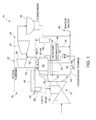
- FIG. 1 illustrates a combined cycle power plant 10 according to one embodiment.
- the power plant 10 comprises a high pressure gas turbine system 12 with a combustion system 14 and a turbine 16.
- the gas exiting turbine 16 may be at a pressure, for example, of about 45 psi for one particular application.
- the power plant 10 further comprises a steam turbine system 18.
- the steam turbine system 18 comprises a high pressure section 20, an intermediate pressure section 22, and one or more low pressure sections 24.
- the low pressure section 24 exhausts into a condenser 26.
- the steam turbine system 18 is associated with a heat recovery steam generator (HRSG) 32.
- the HRSG 32 is a counter flow heat exchanger such that as feedwater passes there through, the water is heated as the exhaust gas from turbine 16 gives up heat and becomes cooler.
- the HRSG 32 has three (3) different operating pressures (high, intermediate, and low) with means for generating steam at the various pressures and temperatures as vapor feed to the corresponding stages of the steam turbine system 18.
- the present invention is not so limited however; and it can be appreciated that other embodiments, such as those embodiments comprising a two-pressure HRSG will also work using the principles described herein.
- the steam turbine system 18 may comprise, for example, a low pressure steam turbine 34, an intermediate steam turbine 36 and a high pressure turbine 38.
- Each section 20, 22, 24 generally comprises one or more economizer, evaporators, and superheaters.
- the combined cycle power plant further comprises a low pressure condensing turbine 40.
- the temperature of the gas 42 exiting the high pressure turbine 16 is an optimized value based upon the particular application requirements. This temperature may be, for example, about 1100°F for one particular application.
- the optimized gas 42 enters the HSRG 32 to drive the bottoming cycle, where the gas is cooled down to a lower temperature that may be for example, about 180°F for one particular application.
- the cooled gas enters the low pressure condensing turbine 40 to produce more power.
- the lower pressure condensing turbine 40 expands the cooled high pressure turbine exhaust gas to about atmospheric pressure.
- the temperature of the gas leaving the low pressure turbine 40 is below the dew point, resulting in formation of water droplets in the outlet of the low pressure turbine 40.
- the wet gas exiting the low pressure turbine 40 enters a moisture separator 44 where the water is collected and where the water-depleted exhaust gas is vented to atmosphere through an exhaust gas stack 46.
- the HRSG 32 uses the heat of the turbine exhaust gas 42 to produce three (s) steam streams, a high pressure steam stream 48, an intermediate pressure steam stream 50, and a low pressure steam stream 52. These three steam streams 48, 50, 52 enter the high, intermediate and low pressure steam turbines 38, 36, 34 to produce power.
- a high pressure steam 54 stream extracted from the high pressure steam turbine 38 is injected to the gas turbine combustor 14.
- the steam stream enters the condenser 26 where the steam is condensed into liquid water.
- An appropriate amount of water is pumped 64 from the water collector 62 to the HRSG 32 where the water absorbs the heat from the high pressure gas turbine exhaust to generate the steam streams 48, 50, 52.
- the three steam streams 48, 50, 52 enter the steam turbines 38, 36, 34 to complete the bottoming cycle.
- a combined cycle power plant scheme has been described that significantly increases the efficiency of a combined cycle with a gas turbine operated at a high pressure ratio and that recovers water from the turbine exhaust gas.
- At least one known combined cycle is increased by at least three (3) percentage points and recovers water using a condensing turbine stage according to one aspect using the principles described herein.
- the HRSG is always located downstream of a gas turbine in a conventional combined cycle power plant scheme, while a HRSG is connected between a high pressure gas turbine stage and a low pressure gas turbine (condensing) stage according to embodiments described herein. Since the HRSG in the embodiments described herein recovers heat from a high pressure turbine exhaust gas to generate steam for the bottoming cycle, the size of the HRSG can be significantly reduced.
- the high pressure turbine exhaust gas may be about 50 psi, depending upon the particular turbine design and application. Since the bottoming cycle is driven by a turbine exhaust gas at a temperature of about 1100°F according to one embodiment, the bottoming cycle efficiency is increased above that achievable using a conventional combined cycle power plant scheme in which the bottoming cycle is driven by a turbine exhaust gas at a temperature between 700°F and 800°F. Further, the use of a low pressure (condensing) gas turbine in combination with a high pressure gas turbine using the principles described herein allows for expansion of gas leaving the HRSG and condensing of water from the exhaust gas. The embodiments described herein thus employ a condensing stage of a gas turbine to recover water from the turbine exhaust gas and to transform the latent heat of water vapor to useful electricity, leading to a higher combined cycle efficiency.
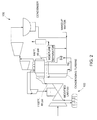
- FIG 2 illustrates an aero derivative gas turbine combined cycle power plant 100 according to one embodiment.
- the power plant 100 is a combined cycle power plant that employs an LMS 100 gas turbine produced by General Electric Company having a place of business in Schenectady, NY.
- the efficiency of the LMS 100 combined cycle has been demonstrated to increase by at least three (3) percentage points and to recover water using a condensing turbine stage when employed according to the principles described herein with reference to Figure 1 .
Landscapes
- Engineering & Computer Science (AREA)
- Chemical & Material Sciences (AREA)
- Combustion & Propulsion (AREA)
- Mechanical Engineering (AREA)
- General Engineering & Computer Science (AREA)
- Life Sciences & Earth Sciences (AREA)
- Sustainable Development (AREA)
- Sustainable Energy (AREA)
- Physics & Mathematics (AREA)
- Thermal Sciences (AREA)
- Engine Equipment That Uses Special Cycles (AREA)
Abstract
Description
- This invention relates generally to combined cycle plants, and more particularly to a system and method for increasing efficiency and water recovery of a combined cycle power plant using a gas turbine operated at a pressure ratio greater than about 30.
- A combined cycle power plant utilizes a gas turbine and a steam turbine in combination to produce power. The power plant is arranged such that the gas turbine is thermally connected to the steam turbine through a heat recovery steam generator ("HRSG"). The HRSG is a non-contact heat exchanger that allows feedwater for the steam generation process to be heated by otherwise wasted gas turbine exhaust gases. The HRSG is always located downstream of a gas turbine in a conventional design.
- A variety of techniques have been employed to reduce the size of HRSGs for combined cycle power plants. One known technique includes reducing the heat transfer surface area of the HRSG, which reduces the electrical efficiency of power plants. A variety of techniques have also been employed to recover water from the turbine exhaust gas. Some known techniques include the use of a liquid desiccant system or air-cooled condenser.
- There is a need for a combined cycle power plant that provides increased electrical efficiency in a manner that is more cost effective than presently achievable with combined cycle power plants using known techniques. The HRSG for the combined cycle power plant should be smaller, resulting in reduced cost. The combined cycle power plant should also be capable of recovering water from the gas turbine exhaust gas in a more cost effective manner than combined cycle power plants presently using known techniques.
- The present invention resides in a combined cycle power plant comprising:
- a gas turbine;
- a condensing turbine;
- a steam turbine; and
- a heat recovery steam generator (HRSG) configured to generate steam for driving the steam turbine in response to heat transferred from exhaust gas received from the gas turbine at a first temperature and to transmit the exhaust gas to the condensing turbine at a second temperature that is lower than the first temperature.
- The condensing stage may be configured to recover water from exhaust gas generated via the gas turbine, and the gas turbine, condensing stage, steam turbine and HRSG may be together configured to convert latent heat of water vapor generated from the recovered water into useful electricity.
- The heat recovery steam generator (HRSG) may be connected downstream from the gas turbine and upstream from the condensing turbine in the combined cycle.
- Embodiments of the invention will now be described, by way of example only, with reference to the accompanying drawing in which:
-
Figure 1 illustrates a combined cycle power plant according to one embodiment; and -
Figure 2 illustrates an aero derivative gas turbine combined cycle power plant according to one embodiment. - While the above-identified drawing figures set forth particular embodiments, other embodiments of the present invention are also contemplated, as noted in the discussion. In all cases, this disclosure presents illustrated embodiments of the present invention by way of representation and not limitation. Numerous other modifications and embodiments can be devised by those skilled in the art which fall within the scope and spirit of the principles of this invention.
-
Figure 1 illustrates a combinedcycle power plant 10 according to one embodiment. Thepower plant 10 comprises a high pressuregas turbine system 12 with acombustion system 14 and aturbine 16. Thegas exiting turbine 16 may be at a pressure, for example, of about 45 psi for one particular application. Thepower plant 10 further comprises asteam turbine system 18. Thesteam turbine system 18 comprises ahigh pressure section 20, anintermediate pressure section 22, and one or morelow pressure sections 24. Thelow pressure section 24 exhausts into acondenser 26. - The
steam turbine system 18 is associated with a heat recovery steam generator (HRSG) 32. The HRSG 32 is a counter flow heat exchanger such that as feedwater passes there through, the water is heated as the exhaust gas fromturbine 16 gives up heat and becomes cooler. The HRSG 32 has three (3) different operating pressures (high, intermediate, and low) with means for generating steam at the various pressures and temperatures as vapor feed to the corresponding stages of thesteam turbine system 18. The present invention is not so limited however; and it can be appreciated that other embodiments, such as those embodiments comprising a two-pressure HRSG will also work using the principles described herein. Thesteam turbine system 18 may comprise, for example, a lowpressure steam turbine 34, anintermediate steam turbine 36 and ahigh pressure turbine 38. Eachsection - The combined cycle power plant further comprises a low
pressure condensing turbine 40. The temperature of thegas 42 exiting thehigh pressure turbine 16 is an optimized value based upon the particular application requirements. This temperature may be, for example, about 1100°F for one particular application. The optimizedgas 42 enters theHSRG 32 to drive the bottoming cycle, where the gas is cooled down to a lower temperature that may be for example, about 180°F for one particular application. The cooled gas enters the lowpressure condensing turbine 40 to produce more power. The lowerpressure condensing turbine 40 expands the cooled high pressure turbine exhaust gas to about atmospheric pressure. Generally, the temperature of the gas leaving thelow pressure turbine 40 is below the dew point, resulting in formation of water droplets in the outlet of thelow pressure turbine 40. The wet gas exiting thelow pressure turbine 40 enters a moisture separator 44 where the water is collected and where the water-depleted exhaust gas is vented to atmosphere through anexhaust gas stack 46. - The HRSG 32 uses the heat of the
turbine exhaust gas 42 to produce three (s) steam streams, a highpressure steam stream 48, an intermediatepressure steam stream 50, and a lowpressure steam stream 52. These threesteam streams pressure steam turbines high pressure steam 54 stream extracted from the highpressure steam turbine 38 is injected to thegas turbine combustor 14. - Subsequent to exiting the low pressure steam turbine, the steam stream enters the
condenser 26 where the steam is condensed into liquid water. The liquid water exiting thecondenser 26 along with make-upwater 56 andwater streams water collector 62. - An appropriate amount of water is pumped 64 from the
water collector 62 to the HRSG 32 where the water absorbs the heat from the high pressure gas turbine exhaust to generate thesteam streams steam streams steam turbines - In summary explanation, a combined cycle power plant scheme has been described that significantly increases the efficiency of a combined cycle with a gas turbine operated at a high pressure ratio and that recovers water from the turbine exhaust gas. At least one known combined cycle is increased by at least three (3) percentage points and recovers water using a condensing turbine stage according to one aspect using the principles described herein. The HRSG is always located downstream of a gas turbine in a conventional combined cycle power plant scheme, while a HRSG is connected between a high pressure gas turbine stage and a low pressure gas turbine (condensing) stage according to embodiments described herein. Since the HRSG in the embodiments described herein recovers heat from a high pressure turbine exhaust gas to generate steam for the bottoming cycle, the size of the HRSG can be significantly reduced. According to one embodiment, the high pressure turbine exhaust gas may be about 50 psi, depending upon the particular turbine design and application. Since the bottoming cycle is driven by a turbine exhaust gas at a temperature of about 1100°F according to one embodiment, the bottoming cycle efficiency is increased above that achievable using a conventional combined cycle power plant scheme in which the bottoming cycle is driven by a turbine exhaust gas at a temperature between 700°F and 800°F. Further, the use of a low pressure (condensing) gas turbine in combination with a high pressure gas turbine using the principles described herein allows for expansion of gas leaving the HRSG and condensing of water from the exhaust gas. The embodiments described herein thus employ a condensing stage of a gas turbine to recover water from the turbine exhaust gas and to transform the latent heat of water vapor to useful electricity, leading to a higher combined cycle efficiency.
-
Figure 2 illustrates an aero derivative gas turbine combinedcycle power plant 100 according to one embodiment. Thepower plant 100 is a combined cycle power plant that employs anLMS 100 gas turbine produced by General Electric Company having a place of business in Schenectady, NY. The efficiency of theLMS 100 combined cycle has been demonstrated to increase by at least three (3) percentage points and to recover water using a condensing turbine stage when employed according to the principles described herein with reference toFigure 1 . - While the invention has been described in terms of various specific embodiments, those skilled in the art will recognize that the invention can be practiced with modification within the spirit and scope of the claims.
Claims (10)
- A combined cycle power plant (10) comprising:a gas turbine (16);a condensing turbine (40);a steam turbine (18); anda heat recovery steam generator (HRSG) (32) configured to generate steam for driving the steam turbine (18) in response to heat transferred from exhaust gas received from the gas turbine (16) at a first temperature and to transmit the exhaust gas to the condensing turbine (40) at a second temperature that is lower than the first temperature.
- The combined cycle power plant (10) according to claim 1, further comprising a moisture separator (44) configured to receive wet gas generated via the condensing turbine (40) and to separate water from the wet gas.
- The combined cycle power plant (10) according to claim 2, further comprising a water collector (62) configured to collect water separated via the moisture separator (44.).
- The combined cycle power plant according to claim 2, further comprising an exhaust gas stack configured to vent water-depleted exhaust gas generated via the moisture separator.
- The combined cycle power plant according to any preceding claim, wherein the gas turbine comprises a high pressure ratio gas turbine.
- The combined cycle power plant (10) according to any preceding claim, wherein the condensing turbine (40) is configured to expand the cooled gas turbine exhaust gas to about atmospheric pressure.
- The combined cycle power plant (10) according to any preceding claim, wherein the gas turbine (16) is configured to operate at a pressure ratio greater than about thirty (30).
- The combined cycle power plant (10) according to any preceding claim, wherein the gas turbine (16) is configured to exhaust gas at a pressure substantially higher than atmospheric pressure and further wherein the condensing turbine (40) is configured to exhaust gas at substantially atmospheric pressure.
- A combined cycle power plant (10) any preceding claim, wherein the heat recovery steam generator (HRSG) (32) is connected downstream from the gas turbine (16) and upstream from the condensing turbine (40) in the combined cycle.
- The combined cycle power plant (10) of any preceding claim, wherein the condensing stage (40) is configured to recover water from exhaust gas generated via the gas turbine (16), and further wherein the gas turbine (16), condensing stage (40), steam turbine (18) and HRSG (32) are together configured to convert latent heat of water vapor generated from the recovered water into useful electricity.
Applications Claiming Priority (1)
| Application Number | Priority Date | Filing Date | Title |
|---|---|---|---|
| US12/977,258 US20120159924A1 (en) | 2010-12-23 | 2010-12-23 | System and method for increasing efficiency and water recovery of a combined cycle power plant |
Publications (2)
| Publication Number | Publication Date |
|---|---|
| EP2508722A2 true EP2508722A2 (en) | 2012-10-10 |
| EP2508722A3 EP2508722A3 (en) | 2013-02-13 |
Family
ID=45318950
Family Applications (1)
| Application Number | Title | Priority Date | Filing Date |
|---|---|---|---|
| EP11192929A Withdrawn EP2508722A3 (en) | 2010-12-23 | 2011-12-12 | System and method for increasing efficiency and water recovery of a combined cycle power plant |
Country Status (3)
| Country | Link |
|---|---|
| US (1) | US20120159924A1 (en) |
| EP (1) | EP2508722A3 (en) |
| JP (1) | JP2012132452A (en) |
Families Citing this family (4)
| Publication number | Priority date | Publication date | Assignee | Title |
|---|---|---|---|---|
| JP2014169693A (en) * | 2013-10-29 | 2014-09-18 | Ecosupport Inc | Gas turbine-combined cycle power generation system |
| US10267185B2 (en) * | 2015-07-30 | 2019-04-23 | General Electric Company | System and method for controlling coolant supply to an exhaust gas |
| US10221726B2 (en) * | 2015-12-21 | 2019-03-05 | Cockerill Maintenance & Ingenierie S.A. | Condensing heat recovery steam generator |
| CN111636935A (en) * | 2019-04-15 | 2020-09-08 | 李华玉 | Single working medium steam combined cycle |
Family Cites Families (16)
| Publication number | Priority date | Publication date | Assignee | Title |
|---|---|---|---|---|
| SE9202155L (en) * | 1992-07-13 | 1993-08-16 | Bal Ab | COMBINED COMBUSTION COMBUSTION AND EXHAUST WAS |
| US5782081A (en) * | 1994-05-31 | 1998-07-21 | Pyong Sik Pak | Hydrogen-oxygen burning turbine plant |
| JP2877098B2 (en) * | 1995-12-28 | 1999-03-31 | 株式会社日立製作所 | Gas turbines, combined cycle plants and compressors |
| EP0949405B1 (en) * | 1998-04-07 | 2006-05-31 | Mitsubishi Heavy Industries, Ltd. | Turbine plant |
| JP2001107743A (en) * | 1999-10-05 | 2001-04-17 | Mitsubishi Heavy Ind Ltd | Gas turbine system and combined plant having the same |
| DE10001110A1 (en) * | 2000-01-13 | 2001-08-16 | Alstom Power Schweiz Ag Baden | Process for the recovery of water from the flue gas of a combined cycle power plant and combined cycle power plant for carrying out the process |
| GB0002257D0 (en) * | 2000-02-02 | 2000-03-22 | Rolls Royce Plc | Rotary apparatus for a gas turbine engine |
| US6397575B2 (en) * | 2000-03-23 | 2002-06-04 | General Electric Company | Apparatus and methods of reheating gas turbine cooling steam and high pressure steam turbine exhaust in a combined cycle power generating system |
| US6622470B2 (en) * | 2000-05-12 | 2003-09-23 | Clean Energy Systems, Inc. | Semi-closed brayton cycle gas turbine power systems |
| SE518504C2 (en) * | 2000-07-10 | 2002-10-15 | Evol Ingenjoers Ab Fa | Process and systems for power generation, as well as facilities for retrofitting in power generation systems |
| JP4225679B2 (en) * | 2000-11-17 | 2009-02-18 | 株式会社東芝 | Combined cycle power plant |
| EP1432889B1 (en) * | 2001-10-01 | 2006-07-12 | Alstom Technology Ltd | Method and device for the starting of emission-free gas turbine power stations |
| US7966829B2 (en) * | 2006-12-11 | 2011-06-28 | General Electric Company | Method and system for reducing CO2 emissions in a combustion stream |
| US8001760B2 (en) * | 2008-10-09 | 2011-08-23 | Mitsubishi Heavy Industries, Ltd. | Intake air heating system of combined cycle plant |
| CH700310A1 (en) * | 2009-01-23 | 2010-07-30 | Alstom Technology Ltd | Processes for CO2 capture from a combined cycle power plant and combined cycle power plant with a gas turbine with flow separation and recirculation. |
| US8286431B2 (en) * | 2009-10-15 | 2012-10-16 | Siemens Energy, Inc. | Combined cycle power plant including a refrigeration cycle |
-
2010
- 2010-12-23 US US12/977,258 patent/US20120159924A1/en not_active Abandoned
-
2011
- 2011-12-12 EP EP11192929A patent/EP2508722A3/en not_active Withdrawn
- 2011-12-20 JP JP2011278141A patent/JP2012132452A/en active Pending
Non-Patent Citations (1)
| Title |
|---|
| None |
Also Published As
| Publication number | Publication date |
|---|---|
| US20120159924A1 (en) | 2012-06-28 |
| EP2508722A3 (en) | 2013-02-13 |
| JP2012132452A (en) | 2012-07-12 |
Similar Documents
| Publication | Publication Date | Title |
|---|---|---|
| CN101842557B (en) | Method and device for converting thermal energy of a low temperature heat source into mechanical energy | |
| US6449954B2 (en) | Process and apparatus for the recovery of water from the flue gas of a combined cycle power station | |
| US6499302B1 (en) | Method and apparatus for fuel gas heating in combined cycle power plants | |
| US8567196B2 (en) | Steam turbine power plant and operating method thereof | |
| US6694740B2 (en) | Method and system for a thermodynamic process for producing usable energy | |
| US6857268B2 (en) | Cascading closed loop cycle (CCLC) | |
| US8281565B2 (en) | Reheat gas turbine | |
| EP1752617A2 (en) | Combined cycle power plant | |
| CN103026010B (en) | For the steam source of power increase and energy recovery in association circulating power generation system | |
| JP4838318B2 (en) | Power generation method and power plant | |
| SE518504C2 (en) | Process and systems for power generation, as well as facilities for retrofitting in power generation systems | |
| WO2001057379A1 (en) | Integrated gasification combined cycle power plant with kalina bottoming cycle | |
| US20190323384A1 (en) | Boilor plant and method for operating the same | |
| WO2011005343A1 (en) | Combined cycle power plant | |
| US9856754B1 (en) | Cascaded recompression closed brayton cycle system | |
| EP2508722A2 (en) | System and method for increasing efficiency and water recovery of a combined cycle power plant | |
| WO2009031747A1 (en) | Power plant having pure oxygen combustor | |
| RU2230921C2 (en) | Method of operation and steam-gas plant of power station operating on combination fuel (solid and gaseous or liquid fuel) | |
| AU2009216592B2 (en) | Integration of an air separation apparatus and of a steam reheating cycle | |
| US20150027121A1 (en) | Method to integrate regenerative rankine cycle into combined cycle applications | |
| US11313252B2 (en) | Enhanced HRSG for repowering a coal-fired electrical generating plant | |
| JP2013140001A (en) | Power generating unit comprising condensed water recovery device | |
| CN105863757A (en) | Power grid load operation method of power generation system | |
| WO1997018386A1 (en) | System and method for combustion turbine repowering of existing low superheat steam turbines | |
| RU2561354C2 (en) | Gas-steam unit operation mode |
Legal Events
| Date | Code | Title | Description |
|---|---|---|---|
| PUAI | Public reference made under article 153(3) epc to a published international application that has entered the european phase |
Free format text: ORIGINAL CODE: 0009012 |
|
| AK | Designated contracting states |
Kind code of ref document: A2 Designated state(s): AL AT BE BG CH CY CZ DE DK EE ES FI FR GB GR HR HU IE IS IT LI LT LU LV MC MK MT NL NO PL PT RO RS SE SI SK SM TR |
|
| AX | Request for extension of the european patent |
Extension state: BA ME |
|
| PUAL | Search report despatched |
Free format text: ORIGINAL CODE: 0009013 |
|
| AK | Designated contracting states |
Kind code of ref document: A3 Designated state(s): AL AT BE BG CH CY CZ DE DK EE ES FI FR GB GR HR HU IE IS IT LI LT LU LV MC MK MT NL NO PL PT RO RS SE SI SK SM TR |
|
| AX | Request for extension of the european patent |
Extension state: BA ME |
|
| RIC1 | Information provided on ipc code assigned before grant |
Ipc: F22B 1/18 20060101ALI20130110BHEP Ipc: F01K 21/04 20060101ALI20130110BHEP Ipc: F01K 23/10 20060101AFI20130110BHEP Ipc: F02C 6/18 20060101ALI20130110BHEP |
|
| STAA | Information on the status of an ep patent application or granted ep patent |
Free format text: STATUS: THE APPLICATION IS DEEMED TO BE WITHDRAWN |
|
| 18D | Application deemed to be withdrawn |
Effective date: 20130814 |