EP2508617A1 - Kit and method for identification of causative bacterium of nail tinea - Google Patents
Kit and method for identification of causative bacterium of nail tinea Download PDFInfo
- Publication number
- EP2508617A1 EP2508617A1 EP10834668A EP10834668A EP2508617A1 EP 2508617 A1 EP2508617 A1 EP 2508617A1 EP 10834668 A EP10834668 A EP 10834668A EP 10834668 A EP10834668 A EP 10834668A EP 2508617 A1 EP2508617 A1 EP 2508617A1
- Authority
- EP
- European Patent Office
- Prior art keywords
- primer
- seq
- nucleotide sequence
- set forth
- probe
- Prior art date
- Legal status (The legal status is an assumption and is not a legal conclusion. Google has not performed a legal analysis and makes no representation as to the accuracy of the status listed.)
- Granted
Links
Classifications
-
- C—CHEMISTRY; METALLURGY
- C12—BIOCHEMISTRY; BEER; SPIRITS; WINE; VINEGAR; MICROBIOLOGY; ENZYMOLOGY; MUTATION OR GENETIC ENGINEERING
- C12Q—MEASURING OR TESTING PROCESSES INVOLVING ENZYMES, NUCLEIC ACIDS OR MICROORGANISMS; COMPOSITIONS OR TEST PAPERS THEREFOR; PROCESSES OF PREPARING SUCH COMPOSITIONS; CONDITION-RESPONSIVE CONTROL IN MICROBIOLOGICAL OR ENZYMOLOGICAL PROCESSES
- C12Q1/00—Measuring or testing processes involving enzymes, nucleic acids or microorganisms; Compositions therefor; Processes of preparing such compositions
- C12Q1/68—Measuring or testing processes involving enzymes, nucleic acids or microorganisms; Compositions therefor; Processes of preparing such compositions involving nucleic acids
- C12Q1/6876—Nucleic acid products used in the analysis of nucleic acids, e.g. primers or probes
- C12Q1/6888—Nucleic acid products used in the analysis of nucleic acids, e.g. primers or probes for detection or identification of organisms
- C12Q1/6895—Nucleic acid products used in the analysis of nucleic acids, e.g. primers or probes for detection or identification of organisms for plants, fungi or algae
-
- C—CHEMISTRY; METALLURGY
- C12—BIOCHEMISTRY; BEER; SPIRITS; WINE; VINEGAR; MICROBIOLOGY; ENZYMOLOGY; MUTATION OR GENETIC ENGINEERING
- C12Q—MEASURING OR TESTING PROCESSES INVOLVING ENZYMES, NUCLEIC ACIDS OR MICROORGANISMS; COMPOSITIONS OR TEST PAPERS THEREFOR; PROCESSES OF PREPARING SUCH COMPOSITIONS; CONDITION-RESPONSIVE CONTROL IN MICROBIOLOGICAL OR ENZYMOLOGICAL PROCESSES
- C12Q1/00—Measuring or testing processes involving enzymes, nucleic acids or microorganisms; Compositions therefor; Processes of preparing such compositions
- C12Q1/68—Measuring or testing processes involving enzymes, nucleic acids or microorganisms; Compositions therefor; Processes of preparing such compositions involving nucleic acids
- C12Q1/6876—Nucleic acid products used in the analysis of nucleic acids, e.g. primers or probes
- C12Q1/6883—Nucleic acid products used in the analysis of nucleic acids, e.g. primers or probes for diseases caused by alterations of genetic material
Definitions
- the present invention relates to a kit and method for identification of causative fungi of tinea unguium (ringworm of the nail), using real-time PCR.
- Tinea unguium is caused by fungal infection of the nails in more than 90% of cases, and when serious it leads to discoloration of the nails to white or yellowish-brown, thickening, and separation from the nail bed.
- Treatment of tinea unguium employs oral antifungal drugs such as terbinafine, itraconazole and griseofulvin, and topical antifungal drugs such as imidazole-based, allylamine-based, benzylamine-based and thiocarbamic acid-based drugs.
- tinea unguium is generally more difficult to cure than tinea pedis (ringworm of the foot) or tinea corporis (ringworm of the body), and it is a particular problem that the existing topical antifungal drugs have low efficacy.
- it is essential to rapidly identify the causative fungi and accurately select an antifungal agent.
- Methods for diagnosis of tinea include KOH direct microscopic examination in which the nail or cuticle is sampled from the affected area and observed under a microscope to confirm the presence or absence of fungal elements, and culturing methods in which the sample is cultured for several weeks on selective medium and fungal species are identified by observing the microstructure of colonies or cells.
- KOH direct microscopic examination requires skill, and basically does not allow identification of fungal species.
- Culturing methods allow identification of fungal species but require long periods of time such as several weeks, have low culture-positive rates, and require skill for morphologic identification.
- tinea Another diagnosis method for tinea is, for example, one in which dermatophyte actin mRNA extracted from the nail plate of a tinea unguium patient is quantified by real-time PCR and it is attempted to detect the tinea fungus and estimate its volume (Non-patent document 2).
- this method lacks handling convenience because the target of detection is mRNA.
- Real-time PCR can be used for detection of viruses and pathogenic organisms.
- Real-time PCR is a method in which amplification of DNA by PCR and detection of amplification product by fluorescence are conducted simultaneously using a device integrating both a thermal cycler and a fluorescence detector.
- the method is advantageous because it does not require confirmation of amplification product by electrophoresis, allowing results to be obtained conveniently and rapidly, and also has low risk of contamination.
- no method has existed to date for sensitive and quantitative detection and identification of the causative fungi of tinea unguium by real-time PCR.
- causative fungi of tinea unguium can be rapidly and accurately identified by real-time PCR using a primer set and a probe specific for the ITS1 region in the ribosomal DNA of causative fungi of tinea unguium, and have completed this invention.
- the invention provides an identification kit for identification of causative fungi of tinea unguium using real-time PCR, which comprises a primer set and a probe, wherein the primer set is at least one selected from the group consisting of a primer set consisting of a primer comprising the nucleotide sequence as set forth in SEQ ID NO: 1 and a primer comprising the nucleotide sequence as set forth in SEQ ID NO: 2, and a primer set consisting of a primer comprising the nucleotide sequence as set forth in SEQ ID NO: 3 and a primer comprising the nucleotide sequence as set forth in SEQ ID NO: 4, and wherein the probe is at least one selected from the group consisting of a probe comprising the nucleotide sequence as set forth in SEQ ID NO: 5 and a probe comprising the nucleotide sequence as set forth in SEQ ID NO: 6.
- a primer set consisting of a primer comprising the nucleotide sequence as set forth in SEQ ID NO: 1 and a primer comprising the nucleotide sequence as set forth in SEQ ID NO: 2
- a primer set consisting of a primer comprising the nucleotide sequence as set forth in SEQ ID NO: 3 and a primer comprising the nucleotide sequence as set forth in SEQ ID NO: 4
- an identification kit of the invention it is possible to rapidly and accurately identify Trichophyton rubrum and Trichophyton mentagrophytes, which are the major causative fungi of tinea unguium.
- the invention also provides a method for identifying causative fungi of tinea unguium, which comprises step of extracting total DNA from a nail sample taken from a subject, a step of preparing a primer set and a probe specific to the ITS1 region of ribosomal DNA of a causative fungus of tinea unguium, and a step of amplifying the ITS1 region of ribosomal DNA of the causative fungi of tinea unguium from the extracted total DNA using real-time PCR by the primer set, while simultaneously detecting the amplified DNA by the probe, and identifying the fungal species.
- the identification method of the invention it is possible to rapidly and accurately identify causative fungi of tinea unguium.
- the primer set is preferably at least one selected from the group consisting of a primer set consisting of a primer comprising the nucleotide sequence as set forth in SEQ ID NO: 1 and a primer comprising the nucleotide sequence as set forth in SEQ ID NO: 2, and a primer set consisting of a primer comprising the nucleotide sequence as set forth in SEQ ID NO: 3 and a primer comprising the nucleotide sequence as set forth in SEQ ID NO: 4.
- primer set consisting of a primer comprising the nucleotide sequence as set forth in SEQ ID NO: 1 and a primer comprising the nucleotide sequence as set forth in SEQ ID NO: 2
- a primer set consisting of a primer comprising the nucleotide sequence as set forth in SEQ ID NO: 3 and a primer comprising the nucleotide sequence as set forth in SEQ ID NO: 4
- the primer set may also be used as a combination of 2 different types, depending on the purpose.
- the probe is preferably at least one selected from the group consisting of a probe comprising the nucleotide sequence as set forth in SEQ ID NO: 5 and a probe comprising the nucleotide sequence as set forth in SEQ ID NO: 6.
- the probe used may be a single type or a combination of 2 different types, depending on the purpose. When a combination of 2 types is used, it is possible to simultaneously identify 2 different fungal species by a single real-time PCR procedure.
- the identification kit and identification method of the invention do not require a high level of skill or a culturing time of several weeks, unlike the conventional KOH direct microscopic examination or culturing methods, and they therefore allow more convenient and rapid identification of causative fungi of tinea unguium.
- the quantitative efficiency, detection precision and fungal species specificity are improved even compared to the identification by conventional nested-PCR, and since no electrophoresis is necessary it is possible to significantly shorten the time required.
- the identification method of the invention comprises a step of extracting total DNA from a nail sample taken from a subject, a step of preparing a primer set and a probe specific to the ITS1 region of ribosomal DNA of a causative fungus of tinea unguium, and a step of amplifying the ITS1 region of ribosomal DNA of the causative fungus of tinea unguium from the extracted total DNA using real-time PCR by the primer set, while simultaneously detecting the amplified DNA by the probe, and identifying the fungal species.
- tinea unguium there are no particular restrictions on the causative fungi of tinea unguium that can be identified by the identification method of the invention, and they include Trichophyton rubrum, Trichophyton mentagrophytes, Trichophyton violaceum, Trichophyton tonsurans, Arthroderma vanbreuseghemii, Arthroderma benhamiae, Microsporum canis, Microsporum gypseum and Epidermophyton floccosum. Since Trichophyton rubrum and Trichophyton mentagrophytes constitute over 90% of the isolated causative fungi of tinea unguium, the ability to identify these 2 fungal species is highly significant for treatment of tinea unguium.
- the identification method of the invention uses as specimen a human nail from a patient having or suspected of having tinea unguium.
- the nail specimen may be taken by cutting using a nipper or clippers.
- the amount of nail specimen may be such as to allow extraction of a sufficient amount of DNA as template for real-time PCR (Real-time polymerase chain reaction).
- the thickness and humidity of the nail may vary, but an area of approximately 2 ⁇ 2 mm or an amount of about 5-10 mg may be taken.
- Extraction of the total DNA from the nail specimen may be accomplished by a common method, such as pulverization of the nail with a bead shocker and sterilization by boiling at 100°C for 10 minutes, followed by extraction with phenol/chloroform and precipitation with ethanol.
- the extracted total DNA may be quantified if necessary using a commercially available nucleic acid quantitation kit.
- the primer set to be used for the identification method of the invention is not particularly restricted so long as it is specific for the ITS1 (Internal Transcribed Spacer 1) region in ribosomal DNA of causative fungi of tinea unguium.
- the ITS1 region is a non-transcribed region, which has a more diversifiable DNA sequence in species evolution than other regions that are transcribed (such as the 28S region), and it is therefore believed to be a sequence that maintains high specificity for the fungal species.
- a person skilled in the art can appropriately design a primer set to be used for the identification method of the invention, based on the nucleotide sequence of the ITS1 region in ribosomal DNA of causative fungi of tinea unguium, using the method described in Molecular Cloning: A Laboratory Manual (3rd Ed.) Cold Spring Harbor University Press , for example.
- the length of the primers is preferably 15-30 bp and more preferably 18-25 bp, and the GC content is preferably 40-60% and more preferably about 50%.
- the Tm value is preferably set to be 5°C to 10°C higher than the desired PCR annealing temperature, and since the annealing temperature is preferably 60°C to 65°C for the identification method of the invention, the Tm value is preferably 65°C to 70°C.
- the length of the DNA sequence to be amplified by the primer set may be 50-400 bp, and is preferably no greater than about 150 bp.
- a primer set that is complementary to a specific sequence in the ITS1 region of fungal ribosomal DNA, and that specifically amplifies the ITS1 region of ribosomal DNA that is universal to fungi.
- a primer set consisting of a primer comprising the nucleotide sequence as set forth in SEQ ID NO: 1 (dermaF) and a primer comprising the nucleotide sequence as set forth in SEQ ID NO: 2 (dermaR) is preferably used since it allows amplification of the full length (approximately 350 bp) of the ITS1 region of ribosomal DNA of most fungi.
- Trichophyton rubrum and Trichophyton mentagrophytes which are the major causative fungi that constitute over 90% of the causative fungi of tinea unguium
- a specific primer set limited to these fungal species.
- a primer set consisting of a primer comprising the nucleotide sequence as set forth in SEQ ID NO: 3 (dermaF2) and a primer comprising the nucleotide sequence as set forth in SEQ ID NO: 4 (dermaR2) is preferably used since it allows specific amplification of a portion (approximately 150 bp) of the ITS1 region of ribosomal DNA of Trichophyton rubrum and Trichophyton mentagrophytes.
- Arthroderma vanbreuseghemii and Arthroderma simii which belong to same Group I in phylogenetic systematics as Trichophyton mentagrophytes, are also amplified by this primer set.
- the amplification product of this primer set has a shorter sequence than the amplification product of a universal primer set, the time required for real-time PCR can be shortened, and identification of the major causative fungi of tinea unguium can be accomplished accurately and efficiently.
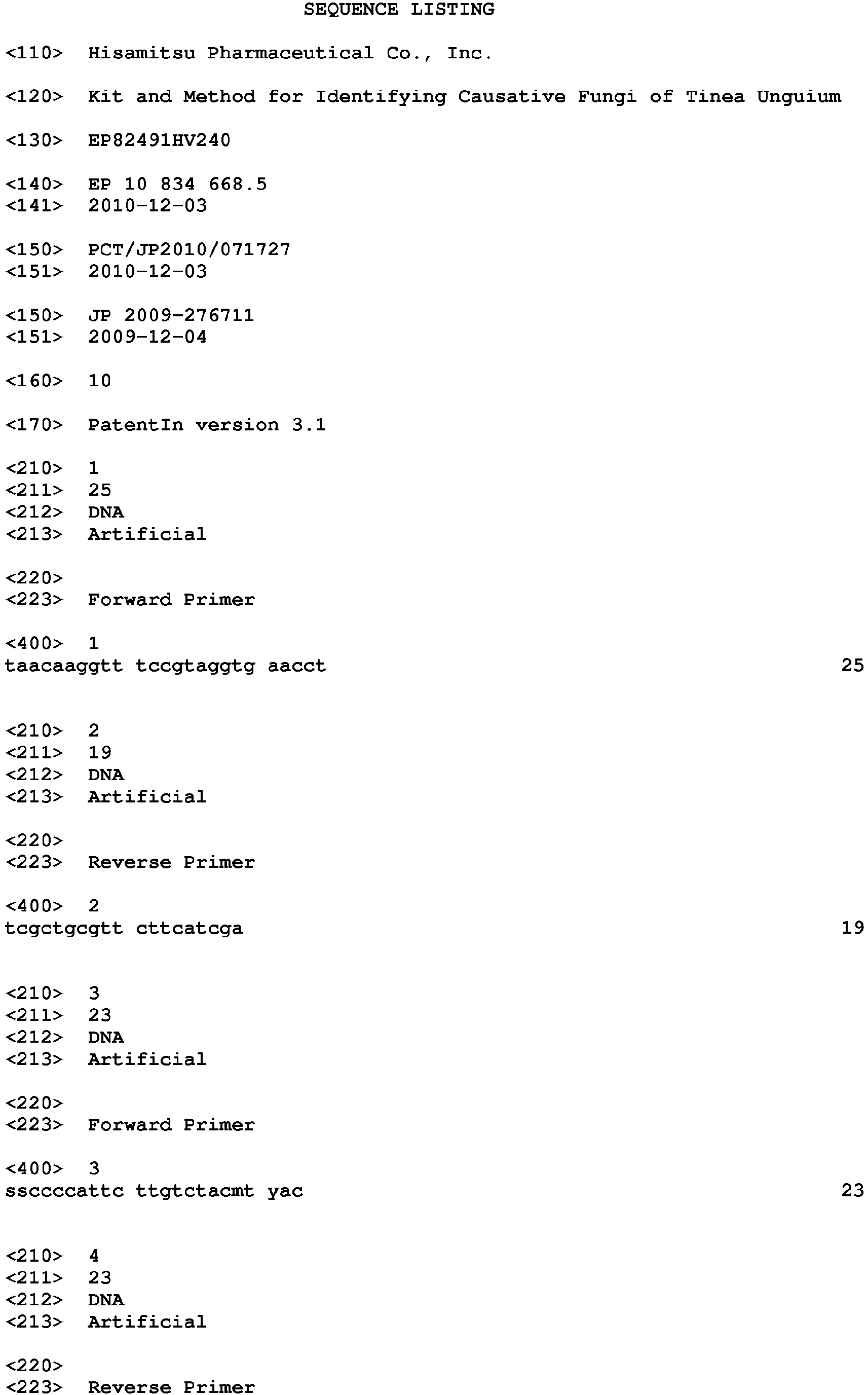
- SEQ ID NO: 1 5'-TAACAAGGTTTCCGTAGGTGAACCT-3'
- SEQ ID NO: 2 5'-TCGCTGCGTTCTTCATCGA-3'
- SEQ ID NO: 3 5'-SSCCCCATTCTTGTCTACMTYAC-3'
- SEQ ID NO: 4 5'-AACGCTCAGACTGACAGCTCTTC-3'
- the probe to be used for the identification method of the invention is not particularly restricted so long as it is specific for the ITS1 region in ribosomal DNA of causative fungi of tinea unguium.
- a person skilled in the art can find and design a probe specific to a fungal species based on the sequence of the ITS1 region in ribosomal DNA of different causative fungi of tinea unguium, using a known method such as the method of Wootton et al., for example ( Federhen S., Analysis of compositionally biased regions in sequence databases. Methods Enzymol. 1996; 266:554-71 ).
- the length of the probe is not particularly restricted, and it may vary depending on the length of the nucleotide sequence of the specific region, and on the GC content and Tm value, but it is preferably a 10-50mer.
- the Tm of the probe is preferably higher than the Tm of the primer, and more preferably it is about 10°C higher.
- an MGB Minor Groove Binder; product of Applied Biosystems, Japan
- a preferred probe that specifically hybridizes to the ITS1 region in ribosomal DNA of Trichophyton mentagrophytes is the one having the sequence as set forth in SEQ ID NO: 5. With this probe it is possible to accurately identify whether or not a species is Trichophyton mentagrophytes. Arthroderma vanbreuseghemii, which is a sexual generation of Trichophyton mentagrophytes, can also be detected with this probe, and since both have the same clinical symptoms and method of treatment, there is no need for further discrimination and identification between them in the clinic. Also, a preferred probe that specifically hybridizes to the ITS1 region in ribosomal DNA of Trichophyton rubrum is the one having the sequence as set forth in SEQ ID NO: 6.
- Trichophyton violaceum also hybridizes with this probe. These two species can be discriminated by comparing the nucleotide sequences of the ITS1 regions (GeneBank Accession No. AB520840 and AB 194246) (for example, by sequencing of the PCR amplification products), but since Trichophyton violaceum is a very rare causative fungus of tinea unguium, it is essentially unnecessary to distinguish and identify them in the clinic.
- a preferred probe that specifically hybridizes to the ITS1 region in ribosomal DNA of all fungi is the one having the sequence as set forth in SEQ ID NO: 7. This probe allows detection of superficial fungi across a wide range, and quantitation allows confirmation of the total amount of superficial fungi or the proportion of causative fungi of tinea unguium of the total fungi.
- the probe to be used in the identification method of the invention must be labeled for detection by real-time PCR.
- the labeled probe can be selected as desired by a person skilled in the art depending on the real-time PCR system, but TaqManTM probe is preferably used.
- TaqManTM probe is a probe labeled with a fluorescent dye at the 5'-end and with a quencher and MGB (Minor Groove Binder) at the 3'-end, of the nucleotide sequence that specifically hybridizes to the target DNA.
- the fluorescent dye may be FAMTM, VICTM, NEDTM, JOETM, TAMRATM, Cy-3, ROXTM, Texas RedTM, Cy-5 or the like.
- the TaqManTM probe in its original state, has a quencher on the probe, and therefore emission of fluorescence is inhibited even when irradiated with excitation light.
- the TaqManTM probe specifically hybridizes to template DNA in the annealing step, and when the TaqMan probe that has hybridized to the template is decomposed by the 5' ⁇ 3' exonuclease activity of Taq DNA polymerase during the extension reaction step, the fluorescent dye is released from the probe and inhibition by the quencher is eliminated resulting in emission of fluorescence, which is detected with the real-time PCR system. Since the detected fluorescence intensity depends on the number of copies of target DNA in the sample, the fungus DNA in the specimen can thus be quantitated.
- a primer set and a probe suited for the purpose.
- a primer set consisting of a primer comprising the nucleotide sequence as set forth in SEQ ID NO: 3 and a primer comprising the nucleotide sequence as set forth in SEQ ID NO: 4, and a probe having the sequence as set forth in SEQ ID NO: 5 and/or SEQ ID NO: 6.
- a primer set consisting of a primer comprising the nucleotide sequence as set forth in SEQ ID NO: 1 and a primer comprising the nucleotide sequence as set forth in SEQ ID NO: 2, and a probe specific to different causative fungi, such as a probe having the sequence as set forth in SEQ ID NO: 5 and/or SEQ ID NO: 6, for example.
- a probe specific to different causative fungi such as a probe having the sequence as set forth in SEQ ID NO: 5 and/or SEQ ID NO: 6, for example.
- simultaneous identification of multiple fungal species can be accomplished using a system with multiple primer sets and multiple probes (multi system). With this type of multi system, the primers and probes can potentially interfere with each other and lower the detection sensitivity, and therefore the mixing ratios and concentrations of the primers and probes used must be investigated.
- identification of species of causative fungi can be carried out in the following manner.
- the causative fungus being tested is judged to be a fungal species for which the probe is specific, and when the fluorescent dye has not been detected, the causative fungus being tested is judged not to be a fungal species for which the probe is specific.
- the type of fluorescent dye detected is used as the basis for determining that the causative fungus tested is a fungal species for which the probe labeled with that fluorescent dye is specific.
- An internal standard substance may also be used to exclude false negatives due to failure of DNA extraction or purification.
- the internal control may be appropriately selected and modified by a person skilled in the art, and for example, an internal control for RNA, developed by Vollmer et al. (Evaluation of novel broad-range real-time PCR assay for rapid detection of human pathogenic fungi in various clinical specimens. J Clin Microbiol. 2008 Jun; 46(6): 1919-26. Epub 2008 Apr 2 .) may be modified to one for DNA.
- the identification kit of the invention is an identification kit comprising a primer set and a probe, for identification of causative fungi of tinea unguium using real-time PCR.
- the primer set is at least one selected from the group consisting of primer sets comprising a primer comprising the nucleotide sequence as set forth in SEQ ID NO: 1 and a primer comprising the nucleotide sequence as set forth in SEQ ID NO: 2, and primer sets comprising a primer comprising the nucleotide sequence as set forth in SEQ ID NO: 3 and a primer comprising the nucleotide sequence as set forth in SEQ ID NO: 4, and the probe is at least one selected from the group consisting of the probe comprising the nucleotide sequence as set forth in SEQ ID NO: 5 and the probe comprising the nucleotide sequence as set forth in SEQ ID NO: 6.
- the identification kit of the invention may include, in addition to the aforementioned specific primer set and probe, also reagents generally included in real-time PCR kits, such as DNA polymerase, dNTP, buffer and positive control template. From the viewpoint of convenience of use, the reagents for PCR and fluorescence detection are preferably provided as a mixture with all in appropriate amounts.
- the identification kit of the invention preferably contains a combination of a primer set and a probe suited for the object of identification.
- a kit used for identification of major causative fungi of tinea unguium is preferably a combination of a primer set consisting of a primer comprising the nucleotide sequence as set forth in SEQ ID NO: 3 and a primer comprising the nucleotide sequence as set forth in SEQ ID NO: 4, and a probe having the sequence as set forth in SEQ ID NO: 5 and/or SEQ ID NO: 6.
- a kit used for identification of rare causative fungi preferably contains a primer set consisting of a primer comprising the nucleotide sequence as set forth in SEQ ID NO: 1 and a primer comprising the nucleotide sequence as set forth in SEQ ID NO: 2.
- kits containing multiple primer sets and probes are preferred as it allows identification of multiple causative fungi by a single real-time PCR procedure.
- the kit in order to prevent reduction in detection sensitivity by interference between the primer sets or probes, the kit preferably contains the primer sets and probes in the optimal mixing ratios and concentrations determined by a positive control.
- primer set consisting of a primer comprising the nucleotide sequence as set forth in SEQ ID NO: 1 and a primer comprising the nucleotide sequence as set forth in SEQ ID NO: 2 (dermaF/dermaR)
- primer set consisting of a primer comprising the nucleotide sequence as set forth in SEQ ID NO: 3 and a primer comprising the nucleotide sequence as set forth in SEQ ID NO: 4 (dermaF2/dermaR2).
- the primer set used for internal control was a primer set consisting of a primer comprising the nucleotide sequence as set forth in SEQ ID NO: 8 and a primer comprising the nucleotide sequence as set forth in SEQ ID NO: 9 (MS2-TM3-F/MS2-TM3-R).
- the primers were all purchased from Sigma Aldrich Japan, KK.
- dermaF 5'-TAACAAGGTTTCCGTAGGTGAACCT-3' dermaR: 5'-TCGCTGCGTTCTTCATCGA-3' dermaF2: 5'-SSCCCCATTCTTGTCTACMTYAC-3' dermaR2: 5'-AACGCTCAGACTGACAGCTCTTC-3' MS2-TM3-F: 5'- GGCTGCTCGCGGATACCC-3' MS2-TM3-R: 5'-TGAGGGAATGTGGGAACCG -3'
- TaqManTM probe labeled with FAMTM fluorescent dye at the 5'-end and with NFQ and MGB at the 3'-end of the nucleotide sequence as set forth in SEQ ID NO: 5 TME-ITS1F
- VICTM fluorescent dye at the 5'-end and with NFQ and MGB at the 3'-end of the nucleotide sequence as set forth in SEQ ID NO: 6 TRU-ITS1V
- TaqManTM probe labeled with NEDTM fluorescent dye at the 5'-end and with NFQ and MGB at the 3'-end of the nucleotide sequence as set forth in SEQ ID NO: 7 (FU-ITS1N).
- TME-ITS1F 5'-[FAM]-CTCTCTTTAGTGGCTAAAC-[NFQ-MGB]-3'
- TRU-ITS1V 5'-[VIC]CGCGCTCCCCCTGC-[NFQ-MGB]-3'
- FU-ITS1N 5'-[NED]TTYAACAAYGGATCTCT-[NFQ-MGB]-3'
- MS2-TM2-Cy5 5'-[Cy5]-ACCTCGGGTTTCCGTCTTGCTCGT-[BHQ3]-3'
- a variety of resident flora including dermatophytes were obtained from different microbial repositories.
- the fungal strains were cultured by common culturing methods and the total DNA was extracted by the phenol/chloroform method.
- the total DNA was quantitated with a Qubit quantitation kit by Invitrogen Corp., and 0.3 pg (an amount corresponding to approximately 100 copies of the ribosomal DNA gene) was used as template for real-time PCR using a 7500Fast Real-Time PCR system (Applied Biosystems, Japan).
- the composition of the reaction mixture (19 ⁇ L ⁇ 50 reaction portions) was as follows. A 19 ⁇ L portion was dispensed into each well, and the extracted DNA was added at 1 ⁇ L each.
- a primer set and a probe specific for the sequence of the ITS1 region in the ribosomal DNA of causative fungi of tinea unguium were used to examine the detection sensitivity of the identification method of the invention.
- positive controls there were used the ITS1 regions of Trichophyton rubrum, Trichophyton mentagrophytes and Aspergillus fumigatus, cloned in the pCR2.1 vector included in the TOPO TA Cloning Kit by Invitrogen Corp.
- the template concentration was diluted to determine the lower limit of detection sensitivity.
- a probabilistic PCR amplification model (Poisson process) involving a limited time and small number of molecules is applied, and this is shown by a probabilistic value, or detectability factor, instead of negative/positive. While the value will vary depending on the detection system and situation, 90-95% is applied as the borderline for detection sensitivity in a common real-time PCR detection system, and therefore in this detection system, the template concentration detected at 100% was taken as the minimum detection sensitivity. In this detection system, 3 to 50 copies of ribosomal DNA template produced results of 100% amplification. Since this corresponds to 1-2 cells of fungi such as Trichophyton species, it is presumed to be adequate sensitivity for practical use. Also, this detection sensitivity was found to be 2- to 166-fold higher sensitivity than with nested-PCR, which requires 100-500 copies.
- Dermatology patients with untreated onychomycosis were directly observed by a skilled doctor using a microscope, and the presence or absence of infection was confirmed.
- the nails of patients confirmed to have infection were disinfected with ethanol, and then the distal end of each nail was sampled by cutting with clippers or a nipper.
- the sampled nails were crushed with a Multi-beads shocker (cell disruptor) (Yasui Kikai Corp.) and boiled for 10 minutes at 100°C in filamentous fungi buffer (200 mM Tris-HCl, pH 8.0, 25 mM EDTA, 0.5% SDS, 250 mM NaCl), and then subjected to phenol/chloroform extraction followed by ethanol precipitation for extraction of the DNA.
- filamentous fungi buffer 200 mM Tris-HCl, pH 8.0, 25 mM EDTA, 0.5% SDS, 250 mM NaCl
- a 50 ⁇ L portion of the DNA was dissolved in ultrapure water and stored.
- a 25 ⁇ L portion of the obtained DNA-containing solution was used as a template DNA sample for real-time PCR in the same manner as Example 1, together with a positive control of known concentration.
- C T is data obtained from the amplification curve, and it represents the number of PCR cycles corresponding to the set threshold value.
- the amount of template can be quantitatively estimated from C T by either the calibration curve method or comparative C T method.
- the comparative C T method was used, which is suitable for large amounts of specimen, and the number of templates were calculated from it.
- the comparative C T method assumes 100% PCR efficiency, and the number of templates is estimated utilizing the difference in C T from a known positive control. This method has the disadvantage of quantitative error due to differences in amplification efficiency, but the problem is considered negligible for PCR which exhibits logarithmic behavior.
- the identification method of the invention was applied for nails from 7 healthy individuals, and since only a maximum of about 100 copies of fungal template was detected, it was assumed that about 100 copies are normally resident, and therefore values above this were used for diagnosis of tinea unguium. This level was also believed to be appropriate because the amounts of template detected in actual clinical specimens were all well above 100 copies.
- the identification method of the invention it is possible to rapidly and accurately identify causative fungi of tinea unguium, and to provide effective data on causative fungi for development of courses of treatment, and therefore the industrial applicability is significant.
Landscapes
- Chemical & Material Sciences (AREA)
- Life Sciences & Earth Sciences (AREA)
- Analytical Chemistry (AREA)
- Engineering & Computer Science (AREA)
- Organic Chemistry (AREA)
- Proteomics, Peptides & Aminoacids (AREA)
- Health & Medical Sciences (AREA)
- Biotechnology (AREA)
- Zoology (AREA)
- Wood Science & Technology (AREA)
- Immunology (AREA)
- Mycology (AREA)
- Microbiology (AREA)
- Molecular Biology (AREA)
- Botany (AREA)
- Biophysics (AREA)
- Physics & Mathematics (AREA)
- Biochemistry (AREA)
- Bioinformatics & Cheminformatics (AREA)
- General Engineering & Computer Science (AREA)
- General Health & Medical Sciences (AREA)
- Genetics & Genomics (AREA)
- Measuring Or Testing Involving Enzymes Or Micro-Organisms (AREA)
Abstract
Description
- The present invention relates to a kit and method for identification of causative fungi of tinea unguium (ringworm of the nail), using real-time PCR.
- Tinea unguium is caused by fungal infection of the nails in more than 90% of cases, and when serious it leads to discoloration of the nails to white or yellowish-brown, thickening, and separation from the nail bed. A number of causative fungi of tinea unguium exist, most of which are of two species, Trichophyton rubrum and Trichophyton mentagrophytes (Non-patent document 1). Treatment of tinea unguium employs oral antifungal drugs such as terbinafine, itraconazole and griseofulvin, and topical antifungal drugs such as imidazole-based, allylamine-based, benzylamine-based and thiocarbamic acid-based drugs. However, tinea unguium is generally more difficult to cure than tinea pedis (ringworm of the foot) or tinea corporis (ringworm of the body), and it is a particular problem that the existing topical antifungal drugs have low efficacy. In order to improve the curative effect for tinea unguium, it is essential to rapidly identify the causative fungi and accurately select an antifungal agent.
- Methods for diagnosis of tinea, including tinea unguium, include KOH direct microscopic examination in which the nail or cuticle is sampled from the affected area and observed under a microscope to confirm the presence or absence of fungal elements, and culturing methods in which the sample is cultured for several weeks on selective medium and fungal species are identified by observing the microstructure of colonies or cells. However, diagnosis by KOH direct microscopic examination requires skill, and basically does not allow identification of fungal species. Culturing methods, on the other hand, allow identification of fungal species but require long periods of time such as several weeks, have low culture-positive rates, and require skill for morphologic identification.
- Another diagnosis method for tinea is, for example, one in which dermatophyte actin mRNA extracted from the nail plate of a tinea unguium patient is quantified by real-time PCR and it is attempted to detect the tinea fungus and estimate its volume (Non-patent document 2). However, this method lacks handling convenience because the target of detection is mRNA.
- As yet another diagnosis method which allows accurate detection of causative fungi of fungus disease of the nail, there has been disclosed a method in which a first PCR and nested-PCR are conducted (Patent document 1). This method, however, requires electrophoresis and is not suitable for treatment of large amounts of specimen.
-
- [Patent document 1] Japanese Unexamined Patent Application Publication No.
2008-067605 -
- [Non-patent document 1] Nishimoto, S.: Shinkinshi (Japanese Journal of Medical Mycology) 47:103-111, 2006
- [Non-patent document 2] Tsuboi, R.: Rinpi (Japanese Journal of Clinical Dermatology) 57(5):94-97, 2003
- Real-time PCR can be used for detection of viruses and pathogenic organisms. Real-time PCR is a method in which amplification of DNA by PCR and detection of amplification product by fluorescence are conducted simultaneously using a device integrating both a thermal cycler and a fluorescence detector. The method is advantageous because it does not require confirmation of amplification product by electrophoresis, allowing results to be obtained conveniently and rapidly, and also has low risk of contamination. However, no method has existed to date for sensitive and quantitative detection and identification of the causative fungi of tinea unguium by real-time PCR.
- It is therefore an object of the present invention to provide a kit and method for identification of causative fungi of tinea unguium, which allows rapid and accurate identification of a causative fungus by real-time PCR using a primer set and a probe specific for a fungal species.
- As a result of diligent research directed toward solving the aforementioned problems, the present inventors have found that causative fungi of tinea unguium can be rapidly and accurately identified by real-time PCR using a primer set and a probe specific for the ITS1 region in the ribosomal DNA of causative fungi of tinea unguium, and have completed this invention.
- Specifically, the invention provides an identification kit for identification of causative fungi of tinea unguium using real-time PCR, which comprises a primer set and a probe, wherein the primer set is at least one selected from the group consisting of a primer set consisting of a primer comprising the nucleotide sequence as set forth in SEQ ID NO: 1 and a primer comprising the nucleotide sequence as set forth in SEQ ID NO: 2, and a primer set consisting of a primer comprising the nucleotide sequence as set forth in SEQ ID NO: 3 and a primer comprising the nucleotide sequence as set forth in SEQ ID NO: 4, and wherein the probe is at least one selected from the group consisting of a probe comprising the nucleotide sequence as set forth in SEQ ID NO: 5 and a probe comprising the nucleotide sequence as set forth in SEQ ID NO: 6.
- With a primer set consisting of a primer comprising the nucleotide sequence as set forth in SEQ ID NO: 1 and a primer comprising the nucleotide sequence as set forth in SEQ ID NO: 2, it is possible to amplify the full length of the ITS1 region of ribosomal DNA (approximately 350 bp) that is universal to fungi, and with a primer set consisting of a primer comprising the nucleotide sequence as set forth in SEQ ID NO: 3 and a primer comprising the nucleotide sequence as set forth in SEQ ID NO: 4 it is possible to specifically amplify a portion of the ITS1 region of ribosomal DNA (approximately 150 bp) of the major causative fungi, Trichophyton rubrum and Trichophyton mentagrophytes.
- With a probe comprising the nucleotide sequence as set forth in SEQ ID NO: 5, it is possible to specifically detect the ITS1 region of ribosomal DNA of Trichophyton mentagrophytes, and with a probe comprising the nucleotide sequence as set forth in SEQ ID NO: 6 it is possible to specifically detect the ITS1 region of ribosomal DNA of Trichophyton rubrum.
- Thus, with an identification kit of the invention it is possible to rapidly and accurately identify Trichophyton rubrum and Trichophyton mentagrophytes, which are the major causative fungi of tinea unguium.
- The invention also provides a method for identifying causative fungi of tinea unguium, which comprises step of extracting total DNA from a nail sample taken from a subject, a step of preparing a primer set and a probe specific to the ITS1 region of ribosomal DNA of a causative fungus of tinea unguium, and a step of amplifying the ITS1 region of ribosomal DNA of the causative fungi of tinea unguium from the extracted total DNA using real-time PCR by the primer set, while simultaneously detecting the amplified DNA by the probe, and identifying the fungal species. According to the identification method of the invention, it is possible to rapidly and accurately identify causative fungi of tinea unguium.
- In the identification method of the invention, the primer set is preferably at least one selected from the group consisting of a primer set consisting of a primer comprising the nucleotide sequence as set forth in SEQ ID NO: 1 and a primer comprising the nucleotide sequence as set forth in SEQ ID NO: 2, and a primer set consisting of a primer comprising the nucleotide sequence as set forth in SEQ ID NO: 3 and a primer comprising the nucleotide sequence as set forth in SEQ ID NO: 4. With a primer set consisting of a primer comprising the nucleotide sequence as set forth in SEQ ID NO: 1 and a primer comprising the nucleotide sequence as set forth in SEQ ID NO: 2, it is possible to identify a wider range of causative fungi, and with a primer set consisting of a primer comprising the nucleotide sequence as set forth in SEQ ID NO: 3 and a primer comprising the nucleotide sequence as set forth in SEQ ID NO: 4, it is possible to accurately and efficiently identify the 2 major causative fungi of tinea unguium, namely Trichophyton rubrum and Trichophyton mentagrophytes. The primer set may also be used as a combination of 2 different types, depending on the purpose.
- In the identification method of the invention, the probe is preferably at least one selected from the group consisting of a probe comprising the nucleotide sequence as set forth in SEQ ID NO: 5 and a probe comprising the nucleotide sequence as set forth in SEQ ID NO: 6. The probe used may be a single type or a combination of 2 different types, depending on the purpose. When a combination of 2 types is used, it is possible to simultaneously identify 2 different fungal species by a single real-time PCR procedure.
- The identification kit and identification method of the invention do not require a high level of skill or a culturing time of several weeks, unlike the conventional KOH direct microscopic examination or culturing methods, and they therefore allow more convenient and rapid identification of causative fungi of tinea unguium. In addition, the quantitative efficiency, detection precision and fungal species specificity are improved even compared to the identification by conventional nested-PCR, and since no electrophoresis is necessary it is possible to significantly shorten the time required.
- The identification method of the invention comprises a step of extracting total DNA from a nail sample taken from a subject, a step of preparing a primer set and a probe specific to the ITS1 region of ribosomal DNA of a causative fungus of tinea unguium, and a step of amplifying the ITS1 region of ribosomal DNA of the causative fungus of tinea unguium from the extracted total DNA using real-time PCR by the primer set, while simultaneously detecting the amplified DNA by the probe, and identifying the fungal species.
- There are no particular restrictions on the causative fungi of tinea unguium that can be identified by the identification method of the invention, and they include Trichophyton rubrum, Trichophyton mentagrophytes, Trichophyton violaceum, Trichophyton tonsurans, Arthroderma vanbreuseghemii, Arthroderma benhamiae, Microsporum canis, Microsporum gypseum and Epidermophyton floccosum. Since Trichophyton rubrum and Trichophyton mentagrophytes constitute over 90% of the isolated causative fungi of tinea unguium, the ability to identify these 2 fungal species is highly significant for treatment of tinea unguium.
- The identification method of the invention uses as specimen a human nail from a patient having or suspected of having tinea unguium. The nail specimen may be taken by cutting using a nipper or clippers. The amount of nail specimen may be such as to allow extraction of a sufficient amount of DNA as template for real-time PCR (Real-time polymerase chain reaction). The thickness and humidity of the nail may vary, but an area of approximately 2 × 2 mm or an amount of about 5-10 mg may be taken.
- Extraction of the total DNA from the nail specimen may be accomplished by a common method, such as pulverization of the nail with a bead shocker and sterilization by boiling at 100°C for 10 minutes, followed by extraction with phenol/chloroform and precipitation with ethanol. The extracted total DNA may be quantified if necessary using a commercially available nucleic acid quantitation kit.
- The primer set to be used for the identification method of the invention is not particularly restricted so long as it is specific for the ITS1 (Internal Transcribed Spacer 1) region in ribosomal DNA of causative fungi of tinea unguium. The ITS1 region is a non-transcribed region, which has a more diversifiable DNA sequence in species evolution than other regions that are transcribed (such as the 28S region), and it is therefore believed to be a sequence that maintains high specificity for the fungal species. A person skilled in the art can appropriately design a primer set to be used for the identification method of the invention, based on the nucleotide sequence of the ITS1 region in ribosomal DNA of causative fungi of tinea unguium, using the method described in Molecular Cloning: A Laboratory Manual (3rd Ed.) Cold Spring Harbor University Press, for example. The length of the primers is preferably 15-30 bp and more preferably 18-25 bp, and the GC content is preferably 40-60% and more preferably about 50%. The Tm value is preferably set to be 5°C to 10°C higher than the desired PCR annealing temperature, and since the annealing temperature is preferably 60°C to 65°C for the identification method of the invention, the Tm value is preferably 65°C to 70°C. The length of the DNA sequence to be amplified by the primer set may be 50-400 bp, and is preferably no greater than about 150 bp.
- In order to identify a wide range of fungal species, it is preferred to use a primer set that is complementary to a specific sequence in the ITS1 region of fungal ribosomal DNA, and that specifically amplifies the ITS1 region of ribosomal DNA that is universal to fungi. For example, a primer set consisting of a primer comprising the nucleotide sequence as set forth in SEQ ID NO: 1 (dermaF) and a primer comprising the nucleotide sequence as set forth in SEQ ID NO: 2 (dermaR) is preferably used since it allows amplification of the full length (approximately 350 bp) of the ITS1 region of ribosomal DNA of most fungi.
- On the other hand, for efficient detection and identification targeted to Trichophyton rubrum and Trichophyton mentagrophytes, which are the major causative fungi that constitute over 90% of the causative fungi of tinea unguium, it is preferred to use a specific primer set limited to these fungal species. For example, a primer set consisting of a primer comprising the nucleotide sequence as set forth in SEQ ID NO: 3 (dermaF2) and a primer comprising the nucleotide sequence as set forth in SEQ ID NO: 4 (dermaR2) is preferably used since it allows specific amplification of a portion (approximately 150 bp) of the ITS1 region of ribosomal DNA of Trichophyton rubrum and Trichophyton mentagrophytes. In addition, Arthroderma vanbreuseghemii and Arthroderma simii, which belong to same Group I in phylogenetic systematics as Trichophyton mentagrophytes, are also amplified by this primer set. Since the amplification product of this primer set has a shorter sequence than the amplification product of a universal primer set, the time required for real-time PCR can be shortened, and identification of the major causative fungi of tinea unguium can be accomplished accurately and efficiently.
- SEQ ID NO: 1: 5'-TAACAAGGTTTCCGTAGGTGAACCT-3'
SEQ ID NO: 2: 5'-TCGCTGCGTTCTTCATCGA-3'
SEQ ID NO: 3: 5'-SSCCCCATTCTTGTCTACMTYAC-3'
SEQ ID NO: 4: 5'-AACGCTCAGACTGACAGCTCTTC-3' - The probe to be used for the identification method of the invention is not particularly restricted so long as it is specific for the ITS1 region in ribosomal DNA of causative fungi of tinea unguium. A person skilled in the art can find and design a probe specific to a fungal species based on the sequence of the ITS1 region in ribosomal DNA of different causative fungi of tinea unguium, using a known method such as the method of Wootton et al., for example (Federhen S., Analysis of compositionally biased regions in sequence databases. Methods Enzymol. 1996; 266:554-71). The length of the probe is not particularly restricted, and it may vary depending on the length of the nucleotide sequence of the specific region, and on the GC content and Tm value, but it is preferably a 10-50mer. The Tm of the probe is preferably higher than the Tm of the primer, and more preferably it is about 10°C higher. For a higher Tm and greater specificity, an MGB (Minor Groove Binder; product of Applied Biosystems, Japan) may be bound thereto.
- A preferred probe that specifically hybridizes to the ITS1 region in ribosomal DNA of Trichophyton mentagrophytes is the one having the sequence as set forth in SEQ ID NO: 5. With this probe it is possible to accurately identify whether or not a species is Trichophyton mentagrophytes. Arthroderma vanbreuseghemii, which is a sexual generation of Trichophyton mentagrophytes, can also be detected with this probe, and since both have the same clinical symptoms and method of treatment, there is no need for further discrimination and identification between them in the clinic. Also, a preferred probe that specifically hybridizes to the ITS1 region in ribosomal DNA of Trichophyton rubrum is the one having the sequence as set forth in SEQ ID NO: 6. With this probe it is possible to accurately identify whether or not a species is Trichophyton rubrum. Trichophyton violaceum also hybridizes with this probe. These two species can be discriminated by comparing the nucleotide sequences of the ITS1 regions (GeneBank Accession No. AB520840 and AB 194246) (for example, by sequencing of the PCR amplification products), but since Trichophyton violaceum is a very rare causative fungus of tinea unguium, it is essentially unnecessary to distinguish and identify them in the clinic. Also, a preferred probe that specifically hybridizes to the ITS1 region in ribosomal DNA of all fungi is the one having the sequence as set forth in SEQ ID NO: 7. This probe allows detection of superficial fungi across a wide range, and quantitation allows confirmation of the total amount of superficial fungi or the proportion of causative fungi of tinea unguium of the total fungi.
- SEQ ID NO: 5: 5'-CTCTCTTTAGTGGCTAAAC-3'
SEQ ID NO: 6: 5'-CGCGCTCCCCCTGC-3'
SEQ ID NO: 7: 5'-TTYAACAAYGGATCTCT-3' - The probe to be used in the identification method of the invention must be labeled for detection by real-time PCR. The labeled probe can be selected as desired by a person skilled in the art depending on the real-time PCR system, but TaqMan™ probe is preferably used. TaqMan™ probe is a probe labeled with a fluorescent dye at the 5'-end and with a quencher and MGB (Minor Groove Binder) at the 3'-end, of the nucleotide sequence that specifically hybridizes to the target DNA. The fluorescent dye may be FAM™, VIC™, NED™, JOE™, TAMRA™, Cy-3, ROX™, Texas Red™, Cy-5 or the like.
- The TaqMan™ probe, in its original state, has a quencher on the probe, and therefore emission of fluorescence is inhibited even when irradiated with excitation light. In real-time PCR amplification reaction, however, the TaqMan™ probe specifically hybridizes to template DNA in the annealing step, and when the TaqMan probe that has hybridized to the template is decomposed by the 5'→3' exonuclease activity of Taq DNA polymerase during the extension reaction step, the fluorescent dye is released from the probe and inhibition by the quencher is eliminated resulting in emission of fluorescence, which is detected with the real-time PCR system. Since the detected fluorescence intensity depends on the number of copies of target DNA in the sample, the fungus DNA in the specimen can thus be quantitated.
- According to the invention, it is possible to select a primer set and a probe suited for the purpose. For confirmation of major causative fungi, it is preferred to use a combination of a primer set consisting of a primer comprising the nucleotide sequence as set forth in SEQ ID NO: 3 and a primer comprising the nucleotide sequence as set forth in SEQ ID NO: 4, and a probe having the sequence as set forth in SEQ ID NO: 5 and/or SEQ ID NO: 6. For identification of a wide range of fungi including rare causative fungi, it is preferred to use a combination of a primer set consisting of a primer comprising the nucleotide sequence as set forth in SEQ ID NO: 1 and a primer comprising the nucleotide sequence as set forth in SEQ ID NO: 2, and a probe specific to different causative fungi, such as a probe having the sequence as set forth in SEQ ID NO: 5 and/or SEQ ID NO: 6, for example. Instead of a system using one primer set and one probe (single system), simultaneous identification of multiple fungal species can be accomplished using a system with multiple primer sets and multiple probes (multi system). With this type of multi system, the primers and probes can potentially interfere with each other and lower the detection sensitivity, and therefore the mixing ratios and concentrations of the primers and probes used must be investigated.
- According to the invention, identification of species of causative fungi can be carried out in the following manner. For a single system, when the fluorescent dye freed from the probe has been detected, the causative fungus being tested is judged to be a fungal species for which the probe is specific, and when the fluorescent dye has not been detected, the causative fungus being tested is judged not to be a fungal species for which the probe is specific. For a multi system, since the different probes are labeled with different fluorescent dyes, the type of fluorescent dye detected is used as the basis for determining that the causative fungus tested is a fungal species for which the probe labeled with that fluorescent dye is specific. An internal standard substance (internal control) may also be used to exclude false negatives due to failure of DNA extraction or purification. The internal control may be appropriately selected and modified by a person skilled in the art, and for example, an internal control for RNA, developed by Vollmer et al. (Evaluation of novel broad-range real-time PCR assay for rapid detection of human pathogenic fungi in various clinical specimens. J Clin Microbiol. 2008 Jun; 46(6): 1919-26. Epub 2008 Apr 2.) may be modified to one for DNA.
- The identification kit of the invention is an identification kit comprising a primer set and a probe, for identification of causative fungi of tinea unguium using real-time PCR. The primer set is at least one selected from the group consisting of primer sets comprising a primer comprising the nucleotide sequence as set forth in SEQ ID NO: 1 and a primer comprising the nucleotide sequence as set forth in SEQ ID NO: 2, and primer sets comprising a primer comprising the nucleotide sequence as set forth in SEQ ID NO: 3 and a primer comprising the nucleotide sequence as set forth in SEQ ID NO: 4, and the probe is at least one selected from the group consisting of the probe comprising the nucleotide sequence as set forth in SEQ ID NO: 5 and the probe comprising the nucleotide sequence as set forth in SEQ ID NO: 6.
- The identification kit of the invention may include, in addition to the aforementioned specific primer set and probe, also reagents generally included in real-time PCR kits, such as DNA polymerase, dNTP, buffer and positive control template. From the viewpoint of convenience of use, the reagents for PCR and fluorescence detection are preferably provided as a mixture with all in appropriate amounts.
- The identification kit of the invention preferably contains a combination of a primer set and a probe suited for the object of identification. A kit used for identification of major causative fungi of tinea unguium is preferably a combination of a primer set consisting of a primer comprising the nucleotide sequence as set forth in SEQ ID NO: 3 and a primer comprising the nucleotide sequence as set forth in SEQ ID NO: 4, and a probe having the sequence as set forth in SEQ ID NO: 5 and/or SEQ ID NO: 6. A kit used for identification of rare causative fungi preferably contains a primer set consisting of a primer comprising the nucleotide sequence as set forth in SEQ ID NO: 1 and a primer comprising the nucleotide sequence as set forth in SEQ ID NO: 2.
- An identification kit containing multiple primer sets and probes is preferred as it allows identification of multiple causative fungi by a single real-time PCR procedure. In this case, in order to prevent reduction in detection sensitivity by interference between the primer sets or probes, the kit preferably contains the primer sets and probes in the optimal mixing ratios and concentrations determined by a positive control.
- The present invention will now be explained in greater detail with reference to examples, with the understanding that the invention is not meant to be limited to these examples.
- (Example 1) Fungal species specificity of primer sets and probes Primer sets and probes specific for the sequence of ITS1 region in the ribosomal DNA of causative fungi of tinea unguium were used for real-time PCR, to examine fungal species specificity. Two different primer sets were used, (1) a primer set consisting of a primer comprising the nucleotide sequence as set forth in SEQ ID NO: 1 and a primer comprising the nucleotide sequence as set forth in SEQ ID NO: 2 (dermaF/dermaR), and (2) a primer set consisting of a primer comprising the nucleotide sequence as set forth in SEQ ID NO: 3 and a primer comprising the nucleotide sequence as set forth in SEQ ID NO: 4 (dermaF2/dermaR2). The primer set used for internal control was a primer set consisting of a primer comprising the nucleotide sequence as set forth in SEQ ID NO: 8 and a primer comprising the nucleotide sequence as set forth in SEQ ID NO: 9 (MS2-TM3-F/MS2-TM3-R). The primers were all purchased from Sigma Aldrich Japan, KK.
dermaF: 5'-TAACAAGGTTTCCGTAGGTGAACCT-3'
dermaR: 5'-TCGCTGCGTTCTTCATCGA-3'
dermaF2: 5'-SSCCCCATTCTTGTCTACMTYAC-3' dermaR2: 5'-AACGCTCAGACTGACAGCTCTTC-3'
MS2-TM3-F: 5'- GGCTGCTCGCGGATACCC-3'
MS2-TM3-R: 5'-TGAGGGAATGTGGGAACCG -3' - Three different probes were used, (1) TaqMan™ probe labeled with FAM™ fluorescent dye at the 5'-end and with NFQ and MGB at the 3'-end of the nucleotide sequence as set forth in SEQ ID NO: 5 (TME-ITS1F), (2) TaqMan™ probe labeled with VIC™ fluorescent dye at the 5'-end and with NFQ and MGB at the 3'-end of the nucleotide sequence as set forth in SEQ ID NO: 6 (TRU-ITS1V) and (3) TaqMan™ probe labeled with NED™ fluorescent dye at the 5'-end and with NFQ and MGB at the 3'-end of the nucleotide sequence as set forth in SEQ ID NO: 7 (FU-ITS1N). (4) As the probe for internal control there was used TaqMan™ probe labeled with Cy5 fluorescent dye at the 5'-end and with BHQ3 at the 3'-end of the nucleotide sequence as set forth in SEQ ID NO: 10 (MS2-TM2-Cy5). NFQ (Non-fluorescent Quencher™) and BHQ3 (Black Hole Quencher 3™) are both non-fluorescent quenchers. The probes were purchased from Applied Biosystems, Japan and Sigma Aldrich Japan, KK.
TME-ITS1F: 5'-[FAM]-CTCTCTTTAGTGGCTAAAC-[NFQ-MGB]-3' TRU-ITS1V: 5'-[VIC]CGCGCTCCCCCTGC-[NFQ-MGB]-3'
FU-ITS1N: 5'-[NED]TTYAACAAYGGATCTCT-[NFQ-MGB]-3'
MS2-TM2-Cy5:
5'-[Cy5]-ACCTCGGGTTTCCGTCTTGCTCGT-[BHQ3]-3' - A variety of resident flora including dermatophytes were obtained from different microbial repositories. The fungal strains were cultured by common culturing methods and the total DNA was extracted by the phenol/chloroform method. The total DNA was quantitated with a Qubit quantitation kit by Invitrogen Corp., and 0.3 pg (an amount corresponding to approximately 100 copies of the ribosomal DNA gene) was used as template for real-time PCR using a 7500Fast Real-Time PCR system (Applied Biosystems, Japan). The composition of the reaction mixture (19 µL × 50 reaction portions) was as follows. A 19 µL portion was dispensed into each well, and the extracted DNA was added at 1 µL each.
Water 357 µL Primers (30 µM) × 4 6.5 µL × 4 ROX Reference Dye II 20 µL Probes (approx. 15 µM) × 4 20 µL × 4 Premix 500 uL Total 950 µL - The procedure for the real-time PCR system was conducted according to the manufacturer's manual. The initial hold was 95°C for 30 seconds, and the PCR reaction was conducted for 60 cycles of 95°C for 10 seconds and 60°C for 30 seconds. The results of the real-time PCR are shown in Table 1. Results with amplification (positive) are indicated by "+", and results without amplification (negative) are indicated as "-".
-
[Table 1] Primer pairs DermaF/dermaR DermaF2/dermaR 2 Probes FU-IT S 1N TRU-I TS1V TME-ITS1F TRU-IT S1V TME-ITS1F Dermatophytes Trichophyton rubrum T99 + + - + - Trichophyton rubrum T108 + + - + - Trichophyton rubrum 4-21 (Hasegawa) + + - + - Trichophyton rubrum 4-23 (Hasegawa) + + - + - Trichophyton rubrum 4-25 (Hasegawa) + + - + - Trichophyton rubrum 4-26 (Hasegawa) + + - + - Trichophyton mentagrophytes T7 + - + - + Trichophyton mentagrophytes T9 + - + - + Arthroderma vanbreuseghemii TIMM2789 + - + - + Trichophyton tonsurans T117 + - - - - Arthroderma benhamiae SM103 + - - - - Microsporum canis TDGS945 + - - - - Microsporum canis TDGS0222 + - - - - Microsporum canis TDGS0223 + - - - - Microsporum canis TDGS0269 + - - - - Microsporum gypseum TDGS0009 + - - - - Microsporum gypseum TDGS0012 + - - - - Epidermophyton floccosum 5-14 (Hasegawa) + - - - - Epidermophyton floccosum 5-22 (Hasegawa) + - - - - Other pathogenic fungi Candida albicans ATCC10231 + - - - - Candida albicans TIMM1768 + - - - - Candida albicans ATCC90028 + - - - - Candida glabrata ATCC90030 + - - - - Candida glabrata CBS138 + - - - - Candida tropicalis ATCC750 + - - - - Candida tropicalis TLCS S9/1 + - - - - Candida parapsilosis ATCC2209 + - - - - Candida parapsilosis ATCC90018 + - - - - Aspergillus fumigatus TIMM0108 + - - - - Aspergillus fumigatus JCM10253 + - - - - Aspergillus fumigatus TIMM2920 + - - - - Aspergillus flavus TIMM0059 + - - - - Aspergillus flavus TIMM2935 + - - - - Aspergillus niger TIMM0113 + - - - - Aspergillus niger TIMM2915 + - - - - Paecilomyces variotii TIMM3182 + - - - - Pseudallescherichia boydii TIMM0886 + - - - - Fusarium oxysporum TSY-0351 + - - - - Fusarium solani TSY-0403 + - - - - Fusarium verticillioides TSY-0219 + - - - - Chaetomium globosum TSY-0369 + - - - - Exophiala jeanselmei TSY-0396 + - - - - Cryptococcus neoformans ATCC90113 + - - - - Cryptococcus neoformans TJane + - - - - Trichosporon asahii CBS2479 + - - - - Rhizopus oryzae TIMM0921 + - - - - - Based on Table 1, a wide range of fungi were detected in this detection system with the dermaF/dermaR primers and FU-ITS1N probe, which amplify the full length of the ITS1 region. Also, with the dermaF/dermaR or dermaF2/dermaR2 and probe set, both Trichophyton mentagrophytes and Trichophyton rubrum were specifically detected. The fungal species-specific probes reacted only with the specific fungal species, and did not react at all with other fungal species (100% species-specific).
- A primer set and a probe specific for the sequence of the ITS1 region in the ribosomal DNA of causative fungi of tinea unguium were used to examine the detection sensitivity of the identification method of the invention. As positive controls there were used the ITS1 regions of Trichophyton rubrum, Trichophyton mentagrophytes and Aspergillus fumigatus, cloned in the pCR2.1 vector included in the TOPO TA Cloning Kit by Invitrogen Corp. The template concentration was diluted to determine the lower limit of detection sensitivity.
- In the detection system, the reproducibility was confirmed by 4 repeated replications for each concentration. The results are shown in Table 2. A single amplification is indicated by "+", and amplifications that occurred for all of the 4 measurements are indicated by "++++".
-
[Table 2] Primer pairs DermaF/dermaR DermaF2/dermaR2 Probes FU-ITS1N TRU-ITS1V TME-ITS1F TRU-ITS1V TME-ITS1F Number of DNA copies 400 ++++ ++++ ++++ ++++ ++++ 200 ++++ ++++ ++++ ++++ ++++ 100 ++++ ++++ ++++ ++++ ++++ 50 ++++ ++++ ++++ ++++ ++++ 25 ++++ + ++++ ++++ ++++ 13 ++++ ++ ++++ +++ ++++ 6 +++ + +++ + ++++ 3 +++ - +++ - +++ - In regions with very dilute template, a probabilistic PCR amplification model (Poisson process) involving a limited time and small number of molecules is applied, and this is shown by a probabilistic value, or detectability factor, instead of negative/positive. While the value will vary depending on the detection system and situation, 90-95% is applied as the borderline for detection sensitivity in a common real-time PCR detection system, and therefore in this detection system, the template concentration detected at 100% was taken as the minimum detection sensitivity. In this detection system, 3 to 50 copies of ribosomal DNA template produced results of 100% amplification. Since this corresponds to 1-2 cells of fungi such as Trichophyton species, it is presumed to be adequate sensitivity for practical use. Also, this detection sensitivity was found to be 2- to 166-fold higher sensitivity than with nested-PCR, which requires 100-500 copies.
- Dermatology patients with untreated onychomycosis were directly observed by a skilled doctor using a microscope, and the presence or absence of infection was confirmed. The nails of patients confirmed to have infection were disinfected with ethanol, and then the distal end of each nail was sampled by cutting with clippers or a nipper. The sampled nails were crushed with a Multi-beads shocker (cell disruptor) (Yasui Kikai Corp.) and boiled for 10 minutes at 100°C in filamentous fungi buffer (200 mM Tris-HCl, pH 8.0, 25 mM EDTA, 0.5% SDS, 250 mM NaCl), and then subjected to phenol/chloroform extraction followed by ethanol precipitation for extraction of the DNA. A 50 µL portion of the DNA was dissolved in ultrapure water and stored. A 25 µL portion of the obtained DNA-containing solution was used as a template DNA sample for real-time PCR in the same manner as Example 1, together with a positive control of known concentration.
- The results are shown in Table 3. In the table, CT is data obtained from the amplification curve, and it represents the number of PCR cycles corresponding to the set threshold value. The amount of template can be quantitatively estimated from CT by either the calibration curve method or comparative CT method. Here, the comparative CT method was used, which is suitable for large amounts of specimen, and the number of templates were calculated from it. The comparative CT method assumes 100% PCR efficiency, and the number of templates is estimated utilizing the difference in CT from a known positive control. This method has the disadvantage of quantitative error due to differences in amplification efficiency, but the problem is considered negligible for PCR which exhibits logarithmic behavior. Upon confirming the amplification efficiency for the clinical specimens with LinRegPCR software (Ruijter JM et al., Amplification efficiency: linking baseline and bias in the analysis of quantitative PCR data. Nucleic Acids Res. 2009 Apr; 37(6):e45. Epub 2009 Feb 22), virtually no difference was found, and it was therefore judged that the amplification efficiency using the comparative CT method was not of a problematic level and permitted the number of template copies to be estimated.
- The identification method of the invention was applied for nails from 7 healthy individuals, and since only a maximum of about 100 copies of fungal template was detected, it was assumed that about 100 copies are normally resident, and therefore values above this were used for diagnosis of tinea unguium. This level was also believed to be appropriate because the amounts of template detected in actual clinical specimens were all well above 100 copies.
- According to Table 3, all of the tinea unguium specimens in 33 cases judged to be positive by direct microscopic observation by a skilled doctor were diagnosed as positive by the identification method of the invention (detection accuracy: 100%). On the other hand, 15 specimens were identified as fungal species by culturing, of which 13 matched the determination results of the identification method of the invention. It is believed that the 2 non-matching cases may have been misidentified in culturing, since the identification method of the invention has 100% species specificity. Thus, fungal species identification by culturing was 39% while identification accuracy according to the invention was 100%. In addition, the remaining 16 cases that could not be identified as fungal species by culturing were all identified as fungal species. However, when the identification method of the invention was applied to healthy nails, absolutely no signal was detected for Trichophyton species (all 7 cases), indicating an absence of false-positive results. In Table 3, TR represents Trichophyton rubrum, TM represents Trichophyton mentagrophytes, ND represents "Not detected", and ITS1 indicates that no identification was made despite appearance of an amplification band.
-
[Table 3] Specimen (No) Physician observations Judgment m RT-PCR DermaF/dermaR DermaF2/dermaR2 Microscopic examination Culturing Ordinary PCR FU-ITS1N TME-ITS1F TRU-ITS1V TME-ITS1F TRU-ITS1V 47 + - ND TR 64 - 195 - 6250 49 + - ND TR 25000 - 200000 - 400000 54 + Unidenti-fiable TR TR 391 - 3125 - 6250 60 + TR TR TR 50000 - 100000 - 400000 64 + TR TM TM 3125 1563 - 50000 - 66 + - ITS1 TR 12500 - 25000 - 391 68 + CA ND TR 12500 - 50000 - 200000 71 + TM TM TM 3125 125000 - 100000 - 86 + - ND TR 195 - 781 - 125000 95 + - ND TR 391 781 - 125000 110 + Poor growth TM TM 49 98 - 3125 - 114 + TR TM TM 3125 6250 - 100000 - 118 - - ND TR TM 49 12 48 98 391 121 + TR TR TM TR 24 - 98 - 781 130 + - ND TR 98 - 781 - 125000 140 + - ND TR 125000 - 12500 - 50000 142 + TR TR TM TR 49 - - - 49 146 + - ND TR 781 - 781 - 6250 154 + - ND TR 20000 - 80000 - 20000 164 + - ND TR 3125 - 6250 - 6250 167 - TR TR TR 24 - 24 - 98 170 + - ND TR 781 - 391 - 3125 172 + TR TR TR 3125 - 3125 - 50000 175 + TR TR TR 100000 - 100000 - 100000 178 + TR TR TM TR 49 - 12 - 781 182 + TR TR TM TR 25000 - 25000 - 100000 185 + - ND TR TM 1563 - 1563 98 3125 191 + - ND TR 98 - 98 - 391 195 + TR TR TR 1563 - 3125 - 100000 206 + - ND TR 3 - - - 391 210 + TR TR TR 3125 - 3125 - 50000 230 + - ND TR 50000 - 25000 - 25000 237 + TR TR TR 25000 - 25000 - 25000 Negative - - - - - Positive 100000 100000 100000 100000 100000 - The results of identifying causative fungi of the tinea pedis specimens by the same method are shown in Table 4. [Table 4]
Specimen (No) Physician observations Judgment m RT-PCR DermaF/dermaR DarmaF2/dermaR2 Microscopic examination Culturing Ordinary PCR FU-ITS1F N TME-ITS1F TRU-ITS1V TME-ITS1F TRU-ITS1V 49 nail + TR TR TR 50000 - 100000 - 400000 49 skin + - ND TR 49 - 195 - 781 56 nail + TM TM TM 3125 125000 - 100000 - 56 skin + TM TM TM 25000 25000 - 100000 - 69 nail + - ND TR 195 - 781 - 12500 69 skin + - ITS I TR 3125 - 50000 - 200000 88 nail + Poor growth TM TM 49 98 - 3125 - 88 skin + TM TM TM 195 195 - 1563 - 91 nail + TR TM TM 3125 6250 - 100000 - 91 skin + TM TM TM 6250 6250 - 25000 - 95 nail + - ND TR 391 - 781 - 125000 95 skin + TM TM TM 1563 1563 - 25000 - 121 nail + TR TR TM TR 24 - 98 - 781 121 skin + - ND TR 781 - 781 - 6250 127 nail + - ND TR 20000 - 80000 - 20000 127 skin + - ND TR TM 12500 12500 1563 100000 100000 143 nail + - ND TR 781 - 391 - 3125 143 skin + TR TR Fungus 24 - - - 781 145 nail + TR TR TR 3125 - 3125 - 50000 145 skin + TR TR TR 3125 - 50000 - 400000 Negative - - - - - Positive 100000 100000 100000 100000 100000 - According to the identification method of the invention, it is possible to rapidly and accurately identify causative fungi of tinea unguium, and to provide effective data on causative fungi for development of courses of treatment, and therefore the industrial applicability is significant.
-




Claims (4)
- An identification kit for identification of causative fungi of tinea unguium using real-time PCR, which comprises a primer set and a probe,
wherein the primer set is at least one selected from the group consisting of a primer set consisting of a primer comprising the nucleotide sequence as set forth in SEQ ID NO: 1 and a primer comprising the nucleotide sequence as set forth in SEQ ID NO: 2, and a primer set consisting of a primer comprising the nucleotide sequence as set forth in SEQ ID NO: 3 and a primer comprising the nucleotide sequence as set forth in SEQ ID NO: 4, and
wherein the probe is at least one selected from the group consisting of a probe comprising the nucleotide sequence as set forth in SEQ ID NO: 5 and a probe comprising the nucleotide sequence as set forth in SEQ ID NO: 6. - A method for identifying causative fungi of tinea unguium, which comprises:a step of extracting total DNA from a nail sample taken from a subj ect,a step of preparing a primer set and a probe specific to the ITS1 region of ribosomal DNA of a causative fungus of tinea unguium, anda step of amplifying the ITS1 region of ribosomal DNA of the causative fungus of tinea unguium from the extracted total DNA using real-time PCR by the primer set, while simultaneously detecting the amplified DNA by the probe, and identifying the fungal species.
- A method for identifying causative fungi of tinea unguium according to claim 2, wherein the primer set is at least one selected from the group consisting of a primer set consisting of a primer comprising the nucleotide sequence as set forth in SEQ ID NO: 1 and a primer comprising the nucleotide sequence as set forth in SEQ ID NO: 2, and a primer set consisting of a primer comprising the nucleotide sequence as set forth in SEQ ID NO: 3 and a primer comprising the nucleotide sequence as set forth in SEQ ID NO: 4.
- A method for identifying causative fungi of tinea unguium according to claim 2 or 3, wherein the probe is at least one selected from the group consisting of a probe comprising the nucleotide sequence as set forth in SEQ ID NO: 5 and a probe comprising the nucleotide sequence as set forth in SEQ ID NO: 6.
Applications Claiming Priority (2)
| Application Number | Priority Date | Filing Date | Title |
|---|---|---|---|
| JP2009276711 | 2009-12-04 | ||
| PCT/JP2010/071727 WO2011068218A1 (en) | 2009-12-04 | 2010-12-03 | Kit and method for identification of causative bacterium of nail tinea |
Publications (3)
| Publication Number | Publication Date |
|---|---|
| EP2508617A1 true EP2508617A1 (en) | 2012-10-10 |
| EP2508617A4 EP2508617A4 (en) | 2013-05-22 |
| EP2508617B1 EP2508617B1 (en) | 2015-06-24 |
Family
ID=44115063
Family Applications (1)
| Application Number | Title | Priority Date | Filing Date |
|---|---|---|---|
| EP10834668.5A Active EP2508617B1 (en) | 2009-12-04 | 2010-12-03 | Kit and method for identification of causative bacterium of nail tinea |
Country Status (5)
| Country | Link |
|---|---|
| US (1) | US20120309005A1 (en) |
| EP (1) | EP2508617B1 (en) |
| JP (1) | JP5992685B2 (en) |
| ES (1) | ES2542205T3 (en) |
| WO (1) | WO2011068218A1 (en) |
Cited By (1)
| Publication number | Priority date | Publication date | Assignee | Title |
|---|---|---|---|---|
| WO2018060451A1 (en) * | 2016-09-30 | 2018-04-05 | Universität Zürich | Primers and probes for diagnosis of dermatophyte infection |
Families Citing this family (4)
| Publication number | Priority date | Publication date | Assignee | Title |
|---|---|---|---|---|
| CN108004337B (en) * | 2017-12-18 | 2020-07-31 | 中国人民解放军军事医学科学院微生物流行病研究所 | Kits for detection of Cryptococcus neoformans |
| JP7176682B2 (en) * | 2018-02-22 | 2022-11-22 | 佐藤製薬株式会社 | A primer set for detecting a trichophyton gene by the LAMP method, a kit containing the same, and a method for detecting trichophyton using them |
| CN111206114B (en) * | 2020-03-03 | 2023-10-03 | 杭州缔蓝生物技术有限公司 | Nine primers and kit for fluorescence PCR detection of dermatophytes |
| KR102824729B1 (en) * | 2022-05-27 | 2025-06-25 | 커넥타젠(주) | Primer set for diagnosing onychomycosis using LAMP, diagnostic method and diagnostic kit using the same |
Family Cites Families (3)
| Publication number | Priority date | Publication date | Assignee | Title |
|---|---|---|---|---|
| DK1891232T3 (en) * | 2005-06-14 | 2012-07-30 | Statens Seruminstitut | PCR diagnostics of dermatophytes and other pathogenic fungi |
| JP4936278B2 (en) | 2006-09-12 | 2012-05-23 | 良治 坪井 | Diagnosis of onychomycosis |
| JP5317430B2 (en) * | 2007-05-14 | 2013-10-16 | キヤノン株式会社 | Probe set, probe carrier, and fungal discrimination identification method |
-
2010
- 2010-12-03 WO PCT/JP2010/071727 patent/WO2011068218A1/en not_active Ceased
- 2010-12-03 ES ES10834668.5T patent/ES2542205T3/en active Active
- 2010-12-03 US US13/513,300 patent/US20120309005A1/en not_active Abandoned
- 2010-12-03 JP JP2011544341A patent/JP5992685B2/en active Active
- 2010-12-03 EP EP10834668.5A patent/EP2508617B1/en active Active
Cited By (1)
| Publication number | Priority date | Publication date | Assignee | Title |
|---|---|---|---|---|
| WO2018060451A1 (en) * | 2016-09-30 | 2018-04-05 | Universität Zürich | Primers and probes for diagnosis of dermatophyte infection |
Also Published As
| Publication number | Publication date |
|---|---|
| ES2542205T3 (en) | 2015-08-03 |
| EP2508617B1 (en) | 2015-06-24 |
| EP2508617A4 (en) | 2013-05-22 |
| US20120309005A1 (en) | 2012-12-06 |
| JPWO2011068218A1 (en) | 2013-04-18 |
| WO2011068218A1 (en) | 2011-06-09 |
| JP5992685B2 (en) | 2016-09-14 |
Similar Documents
| Publication | Publication Date | Title |
|---|---|---|
| Miyajima et al. | Rapid real-time diagnostic PCR for Trichophyton rubrum and Trichophyton mentagrophytes in patients with tinea unguium and tinea pedis using specific fluorescent probes | |
| CN112063747B (en) | Primer probe group and kit for rapidly and efficiently detecting candida otophylla based on fluorescence PCR technology and application of primer probe group and kit | |
| CN109055502B (en) | Detection method, detection kit and application of invasive fungal infection | |
| Gnat et al. | Detection and identification of dermatophytes based on currently available methods–a comparative study | |
| CN108060263B (en) | A primer-probe combination and quantitative PCR kit for simultaneous detection of three Cryptococcus species | |
| EP2508617B1 (en) | Kit and method for identification of causative bacterium of nail tinea | |
| JP2004201641A (en) | Fungus detection method | |
| CN111206114B (en) | Nine primers and kit for fluorescence PCR detection of dermatophytes | |
| Dhib et al. | Evaluation of Chitine synthase (CHS1) polymerase chain reaction assay in diagnosis of dermatophyte onychomycosis | |
| CN111961745B (en) | Method and kit for detecting multiple dermatophytes at one time | |
| US20210087641A1 (en) | Method for determining dermatophytes | |
| US11414713B2 (en) | Methods of screening for onychomycotic fungi | |
| Wang et al. | Performance of the Real Fungus‐ID kit based on multiplex RT‐PCR assay for the rapid detection and identification of Trichophyton spp. and Microsporum spp. in clinical specimens with suspected dermatophyte infection | |
| EP3757231B1 (en) | Primer set for detecting trichophyton gene by lamp method, kit including same, and method for detecting trichophyton using same | |
| CN110819709A (en) | Method for detecting CYP2C9 and VKORC1 gene polymorphism by fluorescent quantitative PCR (polymerase chain reaction) | |
| CN114958837A (en) | Primer composition, kit and method for rapidly and accurately detecting candida auricula | |
| JP5799007B2 (en) | Highly accurate detection method for ringworm | |
| EP2529034B1 (en) | Methods for the detection of fungus | |
| US11542561B2 (en) | Methods of screening for causative agents of onychodystrophy | |
| Motamedi et al. | Evaluation of different DNA extraction methods based on steel‐bullet beating for molecular diagnosis of onychomycosis | |
| JP4936278B2 (en) | Diagnosis of onychomycosis | |
| KR101425149B1 (en) | Improved method for diagnosing Mycobacterium tuberculosis using one-tube nested real-time PCR | |
| CN110819708A (en) | Method for detecting ALDH2 gene polymorphism by fluorescent quantitative PCR | |
| EP2347016A1 (en) | Method for determining the resistance status of fungi and yeasts, in particular of aspergillus fumigatus | |
| CA3298934A1 (en) | Reagents and methods for analysis of hiv |
Legal Events
| Date | Code | Title | Description |
|---|---|---|---|
| PUAI | Public reference made under article 153(3) epc to a published international application that has entered the european phase |
Free format text: ORIGINAL CODE: 0009012 |
|
| 17P | Request for examination filed |
Effective date: 20120627 |
|
| AK | Designated contracting states |
Kind code of ref document: A1 Designated state(s): AL AT BE BG CH CY CZ DE DK EE ES FI FR GB GR HR HU IE IS IT LI LT LU LV MC MK MT NL NO PL PT RO RS SE SI SK SM TR |
|
| DAX | Request for extension of the european patent (deleted) | ||
| A4 | Supplementary search report drawn up and despatched |
Effective date: 20130418 |
|
| RIC1 | Information provided on ipc code assigned before grant |
Ipc: C12Q 1/68 20060101AFI20130412BHEP Ipc: C12N 15/09 20060101ALI20130412BHEP |
|
| 17Q | First examination report despatched |
Effective date: 20140206 |
|
| GRAP | Despatch of communication of intention to grant a patent |
Free format text: ORIGINAL CODE: EPIDOSNIGR1 |
|
| INTG | Intention to grant announced |
Effective date: 20150108 |
|
| GRAS | Grant fee paid |
Free format text: ORIGINAL CODE: EPIDOSNIGR3 |
|
| GRAA | (expected) grant |
Free format text: ORIGINAL CODE: 0009210 |
|
| AK | Designated contracting states |
Kind code of ref document: B1 Designated state(s): AL AT BE BG CH CY CZ DE DK EE ES FI FR GB GR HR HU IE IS IT LI LT LU LV MC MK MT NL NO PL PT RO RS SE SI SK SM TR |
|
| REG | Reference to a national code |
Ref country code: GB Ref legal event code: FG4D |
|
| REG | Reference to a national code |
Ref country code: CH Ref legal event code: EP |
|
| REG | Reference to a national code |
Ref country code: AT Ref legal event code: REF Ref document number: 732914 Country of ref document: AT Kind code of ref document: T Effective date: 20150715 |
|
| REG | Reference to a national code |
Ref country code: IE Ref legal event code: FG4D |
|
| REG | Reference to a national code |
Ref country code: ES Ref legal event code: FG2A Ref document number: 2542205 Country of ref document: ES Kind code of ref document: T3 Effective date: 20150803 |
|
| REG | Reference to a national code |
Ref country code: DE Ref legal event code: R096 Ref document number: 602010025479 Country of ref document: DE |
|
| PG25 | Lapsed in a contracting state [announced via postgrant information from national office to epo] |
Ref country code: FI Free format text: LAPSE BECAUSE OF FAILURE TO SUBMIT A TRANSLATION OF THE DESCRIPTION OR TO PAY THE FEE WITHIN THE PRESCRIBED TIME-LIMIT Effective date: 20150624 Ref country code: HR Free format text: LAPSE BECAUSE OF FAILURE TO SUBMIT A TRANSLATION OF THE DESCRIPTION OR TO PAY THE FEE WITHIN THE PRESCRIBED TIME-LIMIT Effective date: 20150624 Ref country code: LT Free format text: LAPSE BECAUSE OF FAILURE TO SUBMIT A TRANSLATION OF THE DESCRIPTION OR TO PAY THE FEE WITHIN THE PRESCRIBED TIME-LIMIT Effective date: 20150624 Ref country code: NO Free format text: LAPSE BECAUSE OF FAILURE TO SUBMIT A TRANSLATION OF THE DESCRIPTION OR TO PAY THE FEE WITHIN THE PRESCRIBED TIME-LIMIT Effective date: 20150924 |
|
| REG | Reference to a national code |
Ref country code: FR Ref legal event code: PLFP Year of fee payment: 6 |
|
| REG | Reference to a national code |
Ref country code: AT Ref legal event code: MK05 Ref document number: 732914 Country of ref document: AT Kind code of ref document: T Effective date: 20150624 |
|
| REG | Reference to a national code |
Ref country code: LT Ref legal event code: MG4D |
|
| PG25 | Lapsed in a contracting state [announced via postgrant information from national office to epo] |
Ref country code: LV Free format text: LAPSE BECAUSE OF FAILURE TO SUBMIT A TRANSLATION OF THE DESCRIPTION OR TO PAY THE FEE WITHIN THE PRESCRIBED TIME-LIMIT Effective date: 20150624 Ref country code: GR Free format text: LAPSE BECAUSE OF FAILURE TO SUBMIT A TRANSLATION OF THE DESCRIPTION OR TO PAY THE FEE WITHIN THE PRESCRIBED TIME-LIMIT Effective date: 20150925 Ref country code: RS Free format text: LAPSE BECAUSE OF FAILURE TO SUBMIT A TRANSLATION OF THE DESCRIPTION OR TO PAY THE FEE WITHIN THE PRESCRIBED TIME-LIMIT Effective date: 20150624 Ref country code: BG Free format text: LAPSE BECAUSE OF FAILURE TO SUBMIT A TRANSLATION OF THE DESCRIPTION OR TO PAY THE FEE WITHIN THE PRESCRIBED TIME-LIMIT Effective date: 20150924 |
|
| REG | Reference to a national code |
Ref country code: NL Ref legal event code: MP Effective date: 20150624 |
|
| PG25 | Lapsed in a contracting state [announced via postgrant information from national office to epo] |
Ref country code: EE Free format text: LAPSE BECAUSE OF FAILURE TO SUBMIT A TRANSLATION OF THE DESCRIPTION OR TO PAY THE FEE WITHIN THE PRESCRIBED TIME-LIMIT Effective date: 20150624 |
|
| PG25 | Lapsed in a contracting state [announced via postgrant information from national office to epo] |
Ref country code: SK Free format text: LAPSE BECAUSE OF FAILURE TO SUBMIT A TRANSLATION OF THE DESCRIPTION OR TO PAY THE FEE WITHIN THE PRESCRIBED TIME-LIMIT Effective date: 20150624 Ref country code: RO Free format text: LAPSE BECAUSE OF NON-PAYMENT OF DUE FEES Effective date: 20150624 Ref country code: PT Free format text: LAPSE BECAUSE OF FAILURE TO SUBMIT A TRANSLATION OF THE DESCRIPTION OR TO PAY THE FEE WITHIN THE PRESCRIBED TIME-LIMIT Effective date: 20151026 Ref country code: IS Free format text: LAPSE BECAUSE OF FAILURE TO SUBMIT A TRANSLATION OF THE DESCRIPTION OR TO PAY THE FEE WITHIN THE PRESCRIBED TIME-LIMIT Effective date: 20151024 Ref country code: AT Free format text: LAPSE BECAUSE OF FAILURE TO SUBMIT A TRANSLATION OF THE DESCRIPTION OR TO PAY THE FEE WITHIN THE PRESCRIBED TIME-LIMIT Effective date: 20150624 Ref country code: CZ Free format text: LAPSE BECAUSE OF FAILURE TO SUBMIT A TRANSLATION OF THE DESCRIPTION OR TO PAY THE FEE WITHIN THE PRESCRIBED TIME-LIMIT Effective date: 20150624 Ref country code: PL Free format text: LAPSE BECAUSE OF FAILURE TO SUBMIT A TRANSLATION OF THE DESCRIPTION OR TO PAY THE FEE WITHIN THE PRESCRIBED TIME-LIMIT Effective date: 20150624 |
|
| REG | Reference to a national code |
Ref country code: DE Ref legal event code: R097 Ref document number: 602010025479 Country of ref document: DE |
|
| PG25 | Lapsed in a contracting state [announced via postgrant information from national office to epo] |
Ref country code: DK Free format text: LAPSE BECAUSE OF FAILURE TO SUBMIT A TRANSLATION OF THE DESCRIPTION OR TO PAY THE FEE WITHIN THE PRESCRIBED TIME-LIMIT Effective date: 20150624 |
|
| PLBE | No opposition filed within time limit |
Free format text: ORIGINAL CODE: 0009261 |
|
| STAA | Information on the status of an ep patent application or granted ep patent |
Free format text: STATUS: NO OPPOSITION FILED WITHIN TIME LIMIT |
|
| PG25 | Lapsed in a contracting state [announced via postgrant information from national office to epo] |
Ref country code: BE Free format text: LAPSE BECAUSE OF NON-PAYMENT OF DUE FEES Effective date: 20151231 |
|
| 26N | No opposition filed |
Effective date: 20160329 |
|
| PG25 | Lapsed in a contracting state [announced via postgrant information from national office to epo] |
Ref country code: MC Free format text: LAPSE BECAUSE OF FAILURE TO SUBMIT A TRANSLATION OF THE DESCRIPTION OR TO PAY THE FEE WITHIN THE PRESCRIBED TIME-LIMIT Effective date: 20150624 Ref country code: LU Free format text: LAPSE BECAUSE OF FAILURE TO SUBMIT A TRANSLATION OF THE DESCRIPTION OR TO PAY THE FEE WITHIN THE PRESCRIBED TIME-LIMIT Effective date: 20151203 |
|
| REG | Reference to a national code |
Ref country code: CH Ref legal event code: PL |
|
| PG25 | Lapsed in a contracting state [announced via postgrant information from national office to epo] |
Ref country code: SI Free format text: LAPSE BECAUSE OF FAILURE TO SUBMIT A TRANSLATION OF THE DESCRIPTION OR TO PAY THE FEE WITHIN THE PRESCRIBED TIME-LIMIT Effective date: 20150624 |
|
| REG | Reference to a national code |
Ref country code: IE Ref legal event code: MM4A |
|
| PG25 | Lapsed in a contracting state [announced via postgrant information from national office to epo] |
Ref country code: CH Free format text: LAPSE BECAUSE OF NON-PAYMENT OF DUE FEES Effective date: 20151231 Ref country code: LI Free format text: LAPSE BECAUSE OF NON-PAYMENT OF DUE FEES Effective date: 20151231 Ref country code: IE Free format text: LAPSE BECAUSE OF NON-PAYMENT OF DUE FEES Effective date: 20151203 |
|
| REG | Reference to a national code |
Ref country code: FR Ref legal event code: PLFP Year of fee payment: 7 |
|
| PG25 | Lapsed in a contracting state [announced via postgrant information from national office to epo] |
Ref country code: BE Free format text: LAPSE BECAUSE OF FAILURE TO SUBMIT A TRANSLATION OF THE DESCRIPTION OR TO PAY THE FEE WITHIN THE PRESCRIBED TIME-LIMIT Effective date: 20150624 |
|
| PG25 | Lapsed in a contracting state [announced via postgrant information from national office to epo] |
Ref country code: SM Free format text: LAPSE BECAUSE OF FAILURE TO SUBMIT A TRANSLATION OF THE DESCRIPTION OR TO PAY THE FEE WITHIN THE PRESCRIBED TIME-LIMIT Effective date: 20150624 Ref country code: HU Free format text: LAPSE BECAUSE OF FAILURE TO SUBMIT A TRANSLATION OF THE DESCRIPTION OR TO PAY THE FEE WITHIN THE PRESCRIBED TIME-LIMIT; INVALID AB INITIO Effective date: 20101203 |
|
| PG25 | Lapsed in a contracting state [announced via postgrant information from national office to epo] |
Ref country code: NL Free format text: LAPSE BECAUSE OF FAILURE TO SUBMIT A TRANSLATION OF THE DESCRIPTION OR TO PAY THE FEE WITHIN THE PRESCRIBED TIME-LIMIT Effective date: 20150624 Ref country code: SE Free format text: LAPSE BECAUSE OF FAILURE TO SUBMIT A TRANSLATION OF THE DESCRIPTION OR TO PAY THE FEE WITHIN THE PRESCRIBED TIME-LIMIT Effective date: 20150624 Ref country code: CY Free format text: LAPSE BECAUSE OF FAILURE TO SUBMIT A TRANSLATION OF THE DESCRIPTION OR TO PAY THE FEE WITHIN THE PRESCRIBED TIME-LIMIT Effective date: 20150624 |
|
| PG25 | Lapsed in a contracting state [announced via postgrant information from national office to epo] |
Ref country code: MT Free format text: LAPSE BECAUSE OF FAILURE TO SUBMIT A TRANSLATION OF THE DESCRIPTION OR TO PAY THE FEE WITHIN THE PRESCRIBED TIME-LIMIT Effective date: 20150624 |
|
| REG | Reference to a national code |
Ref country code: FR Ref legal event code: PLFP Year of fee payment: 8 |
|
| PG25 | Lapsed in a contracting state [announced via postgrant information from national office to epo] |
Ref country code: TR Free format text: LAPSE BECAUSE OF FAILURE TO SUBMIT A TRANSLATION OF THE DESCRIPTION OR TO PAY THE FEE WITHIN THE PRESCRIBED TIME-LIMIT Effective date: 20150624 Ref country code: MK Free format text: LAPSE BECAUSE OF FAILURE TO SUBMIT A TRANSLATION OF THE DESCRIPTION OR TO PAY THE FEE WITHIN THE PRESCRIBED TIME-LIMIT Effective date: 20150624 |
|
| PG25 | Lapsed in a contracting state [announced via postgrant information from national office to epo] |
Ref country code: AL Free format text: LAPSE BECAUSE OF FAILURE TO SUBMIT A TRANSLATION OF THE DESCRIPTION OR TO PAY THE FEE WITHIN THE PRESCRIBED TIME-LIMIT Effective date: 20150624 |
|
| P01 | Opt-out of the competence of the unified patent court (upc) registered |
Effective date: 20230522 |
|
| PGFP | Annual fee paid to national office [announced via postgrant information from national office to epo] |
Ref country code: DE Payment date: 20251028 Year of fee payment: 16 |
|
| PGFP | Annual fee paid to national office [announced via postgrant information from national office to epo] |
Ref country code: GB Payment date: 20251030 Year of fee payment: 16 |
|
| PGFP | Annual fee paid to national office [announced via postgrant information from national office to epo] |
Ref country code: IT Payment date: 20251121 Year of fee payment: 16 |
|
| PGFP | Annual fee paid to national office [announced via postgrant information from national office to epo] |
Ref country code: FR Payment date: 20251110 Year of fee payment: 16 |
|
| PGFP | Annual fee paid to national office [announced via postgrant information from national office to epo] |
Ref country code: ES Payment date: 20260108 Year of fee payment: 16 |