EP2508593A1 - Oak stave module for flavouring of wines, beers and liquors, manufacturing device and process and systems for insertion in vats - Google Patents
Oak stave module for flavouring of wines, beers and liquors, manufacturing device and process and systems for insertion in vats Download PDFInfo
- Publication number
- EP2508593A1 EP2508593A1 EP11161741A EP11161741A EP2508593A1 EP 2508593 A1 EP2508593 A1 EP 2508593A1 EP 11161741 A EP11161741 A EP 11161741A EP 11161741 A EP11161741 A EP 11161741A EP 2508593 A1 EP2508593 A1 EP 2508593A1
- Authority
- EP
- European Patent Office
- Prior art keywords
- wooden
- elements
- modules
- module
- spacers
- Prior art date
- Legal status (The legal status is an assumption and is not a legal conclusion. Google has not performed a legal analysis and makes no representation as to the accuracy of the status listed.)
- Withdrawn
Links
- 238000004519 manufacturing process Methods 0.000 title claims abstract description 37
- 238000000034 method Methods 0.000 title claims abstract description 19
- 235000014101 wine Nutrition 0.000 title claims description 22
- 235000013405 beer Nutrition 0.000 title claims description 3
- 238000003780 insertion Methods 0.000 title abstract description 10
- 230000037431 insertion Effects 0.000 title abstract description 10
- 230000008569 process Effects 0.000 title description 10
- 239000007788 liquid Substances 0.000 claims abstract description 24
- 238000007654 immersion Methods 0.000 claims abstract description 7
- 125000006850 spacer group Chemical group 0.000 claims description 33
- 238000005553 drilling Methods 0.000 claims description 15
- 239000002184 metal Substances 0.000 claims description 14
- 239000002023 wood Substances 0.000 claims description 12
- 238000003825 pressing Methods 0.000 claims description 6
- 238000013519 translation Methods 0.000 claims description 6
- 230000006835 compression Effects 0.000 claims description 3
- 238000007906 compression Methods 0.000 claims description 3
- 230000035800 maturation Effects 0.000 description 8
- 229910001220 stainless steel Inorganic materials 0.000 description 7
- 239000010935 stainless steel Substances 0.000 description 6
- 239000000047 product Substances 0.000 description 5
- 239000004033 plastic Substances 0.000 description 4
- 230000008901 benefit Effects 0.000 description 3
- 230000014759 maintenance of location Effects 0.000 description 3
- 230000000712 assembly Effects 0.000 description 2
- 238000000429 assembly Methods 0.000 description 2
- 239000007799 cork Substances 0.000 description 2
- 239000012467 final product Substances 0.000 description 2
- 238000012986 modification Methods 0.000 description 2
- 230000004048 modification Effects 0.000 description 2
- 241000220479 Acacia Species 0.000 description 1
- 241001070941 Castanea Species 0.000 description 1
- 235000014036 Castanea Nutrition 0.000 description 1
- 239000004593 Epoxy Substances 0.000 description 1
- 235000010643 Leucaena leucocephala Nutrition 0.000 description 1
- 239000004677 Nylon Substances 0.000 description 1
- 239000004743 Polypropylene Substances 0.000 description 1
- 230000009471 action Effects 0.000 description 1
- 230000032683 aging Effects 0.000 description 1
- 230000002860 competitive effect Effects 0.000 description 1
- 230000000295 complement effect Effects 0.000 description 1
- 239000000470 constituent Substances 0.000 description 1
- 238000005520 cutting process Methods 0.000 description 1
- 238000010438 heat treatment Methods 0.000 description 1
- 238000001802 infusion Methods 0.000 description 1
- 239000000463 material Substances 0.000 description 1
- 229920001778 nylon Polymers 0.000 description 1
- 238000005457 optimization Methods 0.000 description 1
- 229920000728 polyester Polymers 0.000 description 1
- -1 polypropylene Polymers 0.000 description 1
- 229920001155 polypropylene Polymers 0.000 description 1
- 230000009467 reduction Effects 0.000 description 1
- 241000894007 species Species 0.000 description 1
- 238000011514 vinification Methods 0.000 description 1
Images


Classifications
-
- C—CHEMISTRY; METALLURGY
- C12—BIOCHEMISTRY; BEER; SPIRITS; WINE; VINEGAR; MICROBIOLOGY; ENZYMOLOGY; MUTATION OR GENETIC ENGINEERING
- C12G—WINE; PREPARATION THEREOF; ALCOHOLIC BEVERAGES; PREPARATION OF ALCOHOLIC BEVERAGES NOT PROVIDED FOR IN SUBCLASSES C12C OR C12H
- C12G3/00—Preparation of other alcoholic beverages
- C12G3/04—Preparation of other alcoholic beverages by mixing, e.g. for preparation of liqueurs
- C12G3/06—Preparation of other alcoholic beverages by mixing, e.g. for preparation of liqueurs with flavouring ingredients
- C12G3/07—Flavouring with wood extracts, e.g. generated by contact with wood; Wood pretreatment therefor
Definitions
- the invention relates to a system for managing oak staves immersed in wine and liquor vats during the vinification and/or ageing process. It relates also to a module of staves to be placed in the vat and a process for manufacturing the module.
- the field of the invention is, but not limited to, the wine and liquor production industry.
- the rate and degree with which this character is imparted to the maturing product depends, among other things, upon the ratio of the internal surface of the barrel to the volume of liquid that it contains.
- the process requires the use of relatively small barrels.
- barrels are expensive, as they must be made with specific quality of wood and involve a complex manufacturing process with a lot of know-how. Their lifetime for use in wine or liquor maturation process is also quite limited, as the active constituents of the wood are ultimately all transferred to the product.
- vats allow production of larger volumes, and also a better control of the process. They can be for instance quickly emptied, cleaned and reused.
- FR 2 895 992 B1 by Conte et al. discloses a structure on which the staves are fixed.
- the structure comprises maintaining means to immobilize it into the tank.
- the staves comprise a drilling at their extremities and are pre-assembled on at least two axes, separated by spacers. The axes are terminated by clips to secure the assembly.
- the operation of putting the staves on the tank is simplified compared to FR 2 736 923 , but the pre-assemblies of staves still have to be done manually and remain a very time consuming task.
- the structure with the staves fixed on it cannot be, or at least not easily, inserted and removed from a tank full of liquid.
- a wooden module for flavouring a liquid by immersion of said module in said liquid comprising a plurality of wooden elements of a substantially elongated shape, and further comprising assembly means able to:
- the wooden elements may comprise oak staves for flavouring wine, beer and/or liquors.
- the wooden elements may also comprise staves or planks made from other wood species such as chestnut tree or acacia.
- the invention comprises a manufacturing tool for manufacturing the wooden modules of the invention, comprising a plurality of spacers arranged in at least one stack so as to constitute a series of substantially parallel guiding surfaces separated by seatings, said seatings being designed so as to be able to receive the wooden elements, said spacers having thicknesses substantially matching the desired gaps between the wooden elements in a module.
- the manufacturing tool of the invention may further comprise:
- the invention comprises a method for manufacturing the wooden modules using the manufacturing tool of the invention, comprising steps of:
- the invention comprises a system for flavouring a liquid in a vat comprising at least one wooden module of the invention, and further comprising linking elements with fastening means for fastening said wooden modules to said linking elements, said linking elements and said wooden modules being shaped so as to allow (i) maintaining gaps between the fastened wooden modules, (ii) being at least partially immersed in the liquid filling the vat, and (iii) being inserted and removed from the vat without emptying the liquid.
- the linking elements may comprise elongated elements of metal or wood, able to be fastened on a plurality of wooden modules so as to constitute a block (or a cartridge) of such wooden modules.
- the various aspects of the invention are complementary as they cover the most important aspects of a process starting with the production of the wooden modules (or oak staves modules) and extending to their utilization in the winery or the distillery. These various aspects of the invention may be seen as elements of an optimization process covering the whole production and management chain of the wooden modules with the purpose of proposing a quality product with a global cost (including production cost and utilization costs) as low as possible.
- the invention proposes a wooden module (or an oak staves module) which makes the handling of the staves much easier than with the arrangements of the prior art.
- This module may be delivered as a standalone element by the provider, so that the employees of a winery or a distillery do not need at any stage to handle individual staves. Their work is considerably simplified and they save a lot of time.
- the conception of the module is as simple as possible, as it can be made using just staves and assembly means that retain the elements so as to maintain a gap between them. There is no more need for spacing elements or the like.
- this conception makes possible the use of a simple manufacturing process which can be automated in a large extent and contributes to maintain the cost of the final product at a low level.
- the manufacturing process and the manufacturing tools are parts of the invention because they all contribute to the goals of simplification and cost reduction of the final product (the module). These goals can be reached precisely because the structure of the modules and the manufacturing process and tools were studied simultaneously to allow an efficient industrialization of the production of the modules.
- the invention proposes also systems for placing and handling the modules in the vat which allow an efficient use of these modules for the best results and the lower overall cost.
- These systems for placing and handling the modules in the vat are so designed to exploit advantageous characteristics of the modules.
- the assembly means may be substantially rigid and particularly well adapted to the fixation of hooking elements.
- These assembly means may also confer a substantial rigidity to the modules which, when fitted with drillings, may easily be lowered through same drillings on retention bars.
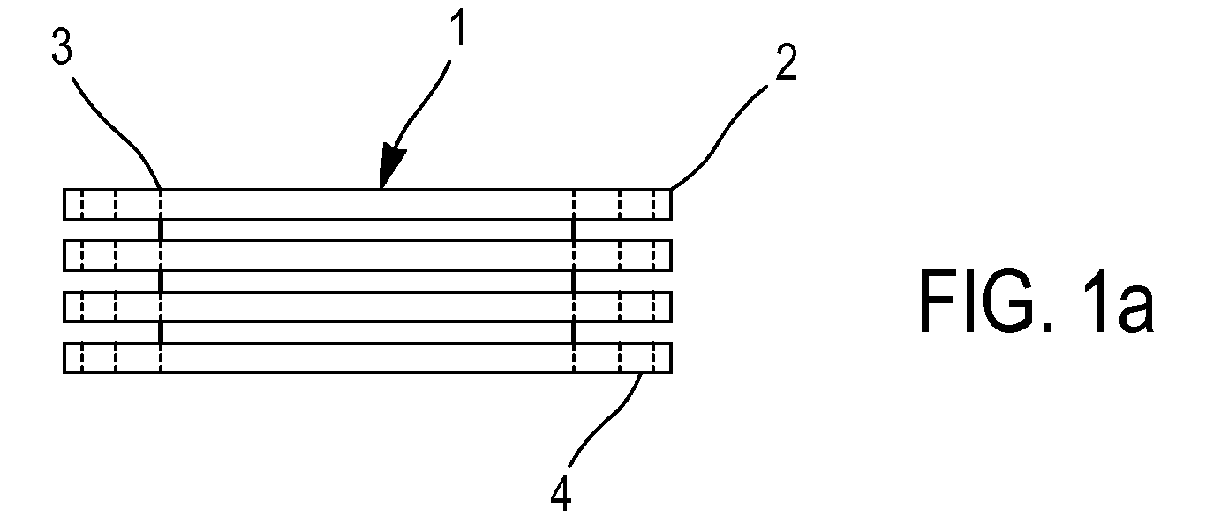
- a wooden module 1 of the invention may comprise a plurality of wooden elements 2 which are oak staves of a substantially rectangular section and a substantially rectilinear elongated shape (like planks).
- These oak staves 2 are assembled in a substantially rigid fashion in the shape of a pile by assembly means 3. Theses assembly means 3 maintain the oak staves 2 together so as to constitute a module 1 and in the same time, as they tightly hold to the staves 2, they maintain the spacing or gaps between the staves 2 without the need for other spacing elements.
- the assembly means 3 may comprise nails or screws nailed or screwed through the staves 2. Depending on the number of staves 2 of the module 1, all the staves 2 may be mailed or screwed in one shot, or, because of the limited length of the nails or the screws, they may be added to the assembly and nailed or screwed to the already assembled staves 2 in several steps.
- each stave 2 In order to obtain a good rigidity, each stave 2 must be assembled to the others on at least two points.
- modules 1 may further comprise drillings 4 which are done through the whole module 1, and which, thanks to the rigidity of the module 1, provide a convenient mean for fastening these modules 1.
- the modules 1 may comprise a various number of staves 2 of various sizes.
- a module 1 may comprise four oak staves 2 with a length of 330 mm, a width of 25 mm and a thickness of 7 mm, separated by a 3 mm gap.
- the assembly means 3 comprise stainless steel screws of 4 millimetres diameter.
- a module 1 may comprise longer staves, with dimension such as 1000 mm length, 100 mm width and 12 mm thickness. In this case, module 1 may consist from 10 to 20 or more staves.
- the wooden module 1 of the invention can be very conveniently assembled using a manufacturing tool 19, following a process which allows a large degree of automation.
- the manufacturing tool 19 comprises a plurality of spacers 10 which are mounted on translation means 12.
- the spacers 10 are separated by springs 11 which tend to enlarge the gaps between them.
- the gaps between the spacers 10 constitute a plurality of seatings.
- the oak staves 2 are inserted in these seatings. This insertion is highly facilitated by the action of the springs 11 which maintain the spacers 10 apart from each other.
- the insertion of the staves 2 is illustrated on figure 2(b) .
- the stack assembly composed of the staves 2 and the spacers 10 is compressed against the upper plate 13, to maintain tightly the staves 2 in place in the position they are expected to have in the final wooden module 1.
- the desired gaps between the staves 2 are maintained by the spacers 10.
- the compression is done with a pressing element 15 moving along an axis 16 relative to a lower plate 14.
- the pressing element 15 pushes on the lower spacer 10 and all the spacers 10 and staves 2 move towards the upper plate 13, the spacers sliding on the translation means 12.
- the module 1 is assembled by inserting (that is screwing or nailing) screws or nails 3 through the staves 2.
- the tool 19 comprises for that clearing or openings 17 in the upper plate 13 through which the assembly means 3 may be inserted, possibly through the spacers 10 which in that case comprise also openings allowing removal of the modules after assembly.
- drillings 4 may be done through the stack of staves.
- the tool 19 comprises clearing or openings 18 in the upper plate 13 for this operation.
- the module 1 is removed from the tool 19 by releasing the pressure of the pressing tool 15 and pushing away the assembled staves 2 from the spacers 10, using a lever acting from the side of the translation means 12 (which is not shown in the figure).
- the purpose of the wooden modules 1 of the invention is to be immersed in wine maturation vats (or casks or barrels), to impart to that wine "boisé" characteristics.
- modules 1 There are several convenient ways of using these modules 1. The simplest one is to put the modules 1 in the vat through an opening and let them float in the wine, attached to a link to make their removal convenient. One module 1 has a much larger surface of exchange with the wine than a single stave 2, and is easy to handle, so there is already a benefit in using it.
- Module 1 can be also be used on its own as a retrofit onto existing attachment means such a cable or metal rods running along the periphery of the vat.
- an immersion system can comprise a frame 22 (or cage or basket, possibly comprising several parts) in stainless steel.
- the frame 22 comprises bars 20 for holding the wooden modules 1, by inserting the bars 20 in the drillings 4 of the wooden modules.
- Retention means 21 such as clips, bolts, pins or locks
- Modules 1 can be added one next to the other with a space left between them, their number being only limited by the size of the vat opening and by the handling capabilities of the winery, brewery or distillery.
- FIG 4b side view
- more than one module 1 can be stacked on the bars 20, with spacers 23 between them. Longer than needed screws or nails 3, protruding from the last stave of the modules 1, can be used as spacers 23.
- Such assembly of modules 1 constitutes a bundle.
- the bars 20 are shown in transparency through the wooden modules 1.
- the bars 20 may be threaded and the retention means 21 may comprise nuts.
- the frame 22 is designed to allow convenient handling, with for instance attaching means 24 for insertion and removal from the vat.
- the weight of the structure contributes to the immersion of the modules 1 in the wine.
- Such frame system 22 has the advantage that all the elements are reusable when the modules 1 are changed.
- a system can comprise a block or a cartridge of several modules 1, maintained together with the desired gaps between them by linking elements 30.
- linking elements 30 are fixed with nails or screws 31 or the like to the wooden modules 1.
- the whole assembly forms then one block with a surface of exchange much larger than that of a single module 1. It allows simplifying the handling operations.
- the linking elements 30 may comprise bars of metal, in which case they are re-usable, or they may comprise wooden planks or oak staves, in which case the whole block is disposable.
- the linking elements 30 may also comprise plastic elements.
- the block may be let floating in the wine, or weights may be added to make it sink.
- an immersion system can comprise wooden modules 1 attached together by fastening elements 41 so as to form for instance a string or a train of modules.
- These fastening elements 41 are conveniently made of a stainless steel wire with the two extremities folded in the shape of a hook as shown on figure 6(c) .
- These hooks can be hooked on the assembly means 3 of the wooden modules 1 (the screw or the nails for instance) so as to link together at least two of such modules 1.
- the chaining elements 41 may also be made of plastic.
- a weight 42 of the shape of a disk in stainless steel with a hole on the centre can be added, with a fastening element 41 passing through the hole, to prevent the modules from floating.
- the chain of modules 1 can be fixed to the bung (or cork) 51 of the cask with an element like a pin 40, pinned on that bung 51.
- This pin 40 is shown on figure 6(b) . It is fixed on a pair of nearby assembly means 3 (comprising for instance two nails or two screws) of the wooden module 1 with pair of hooks that clip on these assembly means 3.
- This system uses rather small wooden modules 1.
- it can be easily removed from the vat 50 as it is attached to the bung 51.
- a wooden module 1 of the invention may comprise oak staves 2 disposed side-by-side and assembled by metal wires 6 (of stainless steel) forced into grooves 5 machine cut in the staves 2. So the staves 2 may be provided in roll, from which the user may take modules 1 by cutting the metal wires 6. Even if flexible, the metal wires 6 are still able to maintain the gaps between the staves, as they tightly hold in the seatings 5.
- the wooden modules 1 of the invention may be used with any means for handling them and inserting them in a vat.
- one or several wooden module 1, possibly assembled together, may be inserted in a bag, which is in turn immersed in the vat.
- This bag may be a reusable nylon, polypropylene or polyester infusion bag, with fastening means on one side allowing an easier handling, and other fastening means on an opposite side enabling attachment of weight or ballast.
Landscapes
- Life Sciences & Earth Sciences (AREA)
- Engineering & Computer Science (AREA)
- Wood Science & Technology (AREA)
- Organic Chemistry (AREA)
- Chemical & Material Sciences (AREA)
- Bioinformatics & Cheminformatics (AREA)
- Biochemistry (AREA)
- General Engineering & Computer Science (AREA)
- General Health & Medical Sciences (AREA)
- Genetics & Genomics (AREA)
- Health & Medical Sciences (AREA)
- Zoology (AREA)
- Food-Manufacturing Devices (AREA)
Abstract
The present invention concerns a wooden module for flavouring a liquid by immersion of said module in said liquid, comprising a plurality of wooden elements of a substantially elongated shape, and further comprising assembly means able to (i) assemble the wooden elements so as to constitute a standalone module, and (ii) retain the wooden elements so as to maintain a gap between successive wooden elements along said assembly means.
The present invention concerns also a manufacturing tool and a method for manufacturing the wooden modules of the invention, and systems for insertion of the wooden modules in vats.
Description
- The invention relates to a system for managing oak staves immersed in wine and liquor vats during the vinification and/or ageing process. It relates also to a module of staves to be placed in the vat and a process for manufacturing the module.
- The field of the invention is, but not limited to, the wine and liquor production industry.
- Traditionally, many wines or liquors are maturated in wooden barrels, made for instance of French or American oak for the maturation of the wine. A wood character is so imparted to the wine or the liquor, due to the contact of the liquid with the wooden walls of the barrel.
- The rate and degree with which this character is imparted to the maturing product depends, among other things, upon the ratio of the internal surface of the barrel to the volume of liquid that it contains. Thus, to be effective, the process requires the use of relatively small barrels.
- In another hand, barrels are expensive, as they must be made with specific quality of wood and involve a complex manufacturing process with a lot of know-how. Their lifetime for use in wine or liquor maturation process is also quite limited, as the active constituents of the wood are ultimately all transferred to the product.
- So the use of barrels has a strong impact on the final cost of the product, which is not compatible with the requirement of lowering the production costs to address competitive markets.
- For a better rationalization of costs and methods, the maturation of wine and liquor is frequently done in tanks or vats much larger than barrels, and made of materials impervious to liquids, such as stainless steel and epoxy coated concrete.
- These vats allow production of larger volumes, and also a better control of the process. They can be for instance quickly emptied, cleaned and reused.
- However, imparting a wooden character similar to what would have been obtained with oak barrels is often desirable for the wine and liquor production, even in tanks.
- According to a well-known technique, it may be obtained by adding in the maturation tanks pieces of oak such as planks, or staves. Theses staves have received similar heat treatment to the staves used for manufacturing barrels. The simplest way to proceed is just to put the staves in the tank and let them float at the surface of the wine or the liquor. This method has however several drawbacks:
- the total surface of wood in contact with the wine or the liquor, which is an important parameter for the control of the maturation process, is not well determined as the staves may pile up;
- an important part of the potentially available surface of wood may be lost, as the upper surface of the staves, which are floating, is not in contact with the product. So the staves are not optimally used;
- the handling of the staves, for putting them in place and to taking them out of the tank, is not easy and time consuming.
- We know also methods consisting in fixing the staves on structures immersed in the tank, in order to have the staves maintained immersed with the liquid in contact with all their surfaces.
- We know for instance the
document FR 2 736 923 A1 by Bourgeois - We know also the
document FR 2 895 992 B1 by Conte et al. FR 2 736 923 - It is an object of the invention to provide an arrangement of wood elements such as oak staves, for the maturation of wine or liquors, which is easy to handle by the staff of a winery or a distillery with a minimum of loss of time, and provides an optimal surface of contact with the liquid.
- It is another object of the invention to provide an arrangement of wood elements such as oak staves, for the maturation of wine or liquors, which can be manufactured using industrial methods, to allow minimizing the production costs.
- It is another object of the invention to provide a method for manufacturing such arrangement of wood elements.
- It is still another object of the invention to provide systems for disposing such arrangement of wood elements in tanks, and allowing insertion and removal when the tank is not empty.
- Such objects are accomplished with a wooden module for flavouring a liquid by immersion of said module in said liquid, comprising a plurality of wooden elements of a substantially elongated shape, and further comprising assembly means able to:
- assemble the wooden elements so as so constitute a standalone module,
and - retain the wooden elements so as to maintain a gap between successive wooden elements along said assembly means.
- The wooden elements may comprise oak staves for flavouring wine, beer and/or liquors.
- The wooden elements may also comprise staves or planks made from other wood species such as chestnut tree or acacia.
- According to some modes of realization:
- the wooden elements may be arranged in rows, and the assembly means may comprise at least one of the following: nail, screw, metal wire;
- the assembly means may comprise plastic elements;
- the assembly means may comprise screws and/or nails passing through the wooden elements;
- the assembly means may comprise metal wires forced into grooves machine cut in the wooden elements;
- the wooden module of the invention may further comprise drillings through the wooden elements, said drillings being substantially aligned throughout the module.
- According to another aspect, the invention comprises a manufacturing tool for manufacturing the wooden modules of the invention, comprising a plurality of spacers arranged in at least one stack so as to constitute a series of substantially parallel guiding surfaces separated by seatings, said seatings being designed so as to be able to receive the wooden elements, said spacers having thicknesses substantially matching the desired gaps between the wooden elements in a module.
- The manufacturing tool of the invention may further comprise:
- translation means on which the spacers are movably mounted, enabling movement in a direction substantially perpendicular to the guiding surfaces,
- springs placed between the spacers in order to favour the increase of the width of the seatings between said spacers (for easy introduction of the wooden elements), and
- compression means allowing pressing together the spacers and the wooden elements once inserted into the seatings.
- According to another aspect, the invention comprises a method for manufacturing the wooden modules using the manufacturing tool of the invention, comprising steps of:
- placing a plurality of wooden elements into the seatings, so as to obtain a succession of stacked wooden elements separated and maintained in place by the spacers,
- assembling the wooden element using assembly means, and
- removing the module of wooden elements from the spacers.
- According to still another aspect, the invention comprises a system for flavouring a liquid in a vat comprising at least one wooden module of the invention, and further comprising linking elements with fastening means for fastening said wooden modules to said linking elements, said linking elements and said wooden modules being shaped so as to allow (i) maintaining gaps between the fastened wooden modules, (ii) being at least partially immersed in the liquid filling the vat, and (iii) being inserted and removed from the vat without emptying the liquid.
- According to some modes of realization:
- the linking elements may comprise plastic elements;
- the linking elements may comprise a metal frame (or cage or basket, made of stainless steel) with bars, and the wooden modules may comprise drillings, so as to allow fastening the wooden modules on the frame by inserting the bars in the drillings;
- the bars may further comprise clips (or screws or bolts) for securing the wooden modules once inserted;
- the linking elements may comprise elements whose weight is adjusted so that the wooden modules are completely immersed in the liquid;
- the system may further comprise weights fastened on the linking elements, allowing maintaining below the surface of the liquid at least most of the parts of the wooden modules, or preferably all of the parts of the wooden modules.
- According to some other modes of realization:
- the linking elements may comprise a fastening element of an elongated shape with two extremities substantially in the shape a hook, said hooks being able to be hooked on the assembly means of the wooden modules so as to link together at least two of such modules;
- the system may further comprise a weight fastened on the fastening element, allowing maintaining below the surface of the liquid at least most of the parts of the wooden modules, or preferably all of the parts of the wooden modules;
- the system may further comprise an elongated element with a tip at one extremity and a hook at the other, said tip being able to be forced into the bung (or the cork) of the vat, and said hook being able to be hooked on the assembly means of the wooden modules.
- According to some other modes of realization, the linking elements may comprise elongated elements of metal or wood, able to be fastened on a plurality of wooden modules so as to constitute a block (or a cartridge) of such wooden modules.
- The various aspects of the invention are complementary as they cover the most important aspects of a process starting with the production of the wooden modules (or oak staves modules) and extending to their utilization in the winery or the distillery. These various aspects of the invention may be seen as elements of an optimization process covering the whole production and management chain of the wooden modules with the purpose of proposing a quality product with a global cost (including production cost and utilization costs) as low as possible.
- So to summarize, the invention proposes a wooden module (or an oak staves module) which makes the handling of the staves much easier than with the arrangements of the prior art. This module may be delivered as a standalone element by the provider, so that the employees of a winery or a distillery do not need at any stage to handle individual staves. Their work is considerably simplified and they save a lot of time.
- The conception of the module is as simple as possible, as it can be made using just staves and assembly means that retain the elements so as to maintain a gap between them. There is no more need for spacing elements or the like. In addition, this conception makes possible the use of a simple manufacturing process which can be automated in a large extent and contributes to maintain the cost of the final product at a low level.
- The manufacturing process and the manufacturing tools are parts of the invention because they all contribute to the goals of simplification and cost reduction of the final product (the module). These goals can be reached precisely because the structure of the modules and the manufacturing process and tools were studied simultaneously to allow an efficient industrialization of the production of the modules.
- The invention proposes also systems for placing and handling the modules in the vat which allow an efficient use of these modules for the best results and the lower overall cost. These systems for placing and handling the modules in the vat are so designed to exploit advantageous characteristics of the modules. For instance, the assembly means may be substantially rigid and particularly well adapted to the fixation of hooking elements. These assembly means may also confer a substantial rigidity to the modules which, when fitted with drillings, may easily be lowered through same drillings on retention bars.
- The methods according to embodiments of the present invention may be better understood with reference to the drawings, which are given for illustrative purposes only and are not meant to be limiting. Other aspects, goals and advantages of the invention shall be apparent from the descriptions given hereunder.
-
figure 1 shows a first mode of realization of a wooden module of the invention.Figure 1(a) shows a side view andfigure 1(b) shows a top view; -
figure 2 shows a second mode of realization of a wooden module of the invention.Figure 2(a) shows a top view andfigure 2(b) shows a side view of a wooden element alone; -
figure 3 shows a manufacturing tool for manufacturing the wooden modules of the invention.Figure 3(a) shows a front view of the tool,figure 3(b) shows a side view of the tool in with staves inserted, andfigure 3(c) shows a side view of the tool with staves inserted and the spacers compressed; -
figure 4a and 4b show respectively a front view and a side view of a first mode of realization of a system for insertion of the wooden modules in a vat; -
figure 5 shows a second mode of realization of a system for insertion of the wooden modules in a vat; -
figure 6 shows a third mode of realization of a system for insertion of the wooden modules in a cask.Figure 6(a) shows a global view, andfigure 6(b) and figure 6(c) show detailed views of maintaining elements; -
figure 7 illustrates the insertion in a vat or a cask of the system offigure 6 . - With no intention to be limitative, the detailed description will be done in the context of an application of the invention in the wine production.
- With reference to
figure 1 , awooden module 1 of the invention may comprise a plurality ofwooden elements 2 which are oak staves of a substantially rectangular section and a substantially rectilinear elongated shape (like planks). - These oak staves 2 are assembled in a substantially rigid fashion in the shape of a pile by assembly means 3. Theses assembly means 3 maintain the oak staves 2 together so as to constitute a
module 1 and in the same time, as they tightly hold to thestaves 2, they maintain the spacing or gaps between thestaves 2 without the need for other spacing elements. - The assembly means 3 may comprise nails or screws nailed or screwed through the
staves 2. Depending on the number ofstaves 2 of themodule 1, all thestaves 2 may be mailed or screwed in one shot, or, because of the limited length of the nails or the screws, they may be added to the assembly and nailed or screwed to the already assembledstaves 2 in several steps. - In order to obtain a good rigidity, each stave 2 must be assembled to the others on at least two points.
- Depending on the way the
modules 1 are used, they may further comprise drillings 4 which are done through thewhole module 1, and which, thanks to the rigidity of themodule 1, provide a convenient mean for fastening thesemodules 1. - Depending on the application, the
modules 1 may comprise a various number ofstaves 2 of various sizes. As a matter of example, amodule 1 may comprise fouroak staves 2 with a length of 330 mm, a width of 25 mm and a thickness of 7 mm, separated by a 3 mm gap. The assembly means 3 comprise stainless steel screws of 4 millimetres diameter. - In some other cases, a
module 1 may comprise longer staves, with dimension such as 1000 mm length, 100 mm width and 12 mm thickness. In this case,module 1 may consist from 10 to 20 or more staves. - With reference to
figure 3 , thewooden module 1 of the invention can be very conveniently assembled using amanufacturing tool 19, following a process which allows a large degree of automation. - The
manufacturing tool 19 comprises a plurality ofspacers 10 which are mounted on translation means 12. Thespacers 10 are separated bysprings 11 which tend to enlarge the gaps between them. The gaps between thespacers 10 constitute a plurality of seatings. - In a first step of the manufacturing process, the oak staves 2 are inserted in these seatings. This insertion is highly facilitated by the action of the
springs 11 which maintain thespacers 10 apart from each other. The insertion of thestaves 2 is illustrated onfigure 2(b) . - In a second step, the stack assembly composed of the
staves 2 and thespacers 10 is compressed against theupper plate 13, to maintain tightly thestaves 2 in place in the position they are expected to have in the finalwooden module 1. The desired gaps between thestaves 2 are maintained by thespacers 10. The compression is done with apressing element 15 moving along anaxis 16 relative to alower plate 14. Thepressing element 15 pushes on thelower spacer 10 and all thespacers 10 and staves 2 move towards theupper plate 13, the spacers sliding on the translation means 12. This step is illustrated on figure 2(c). - In a third step, the
module 1 is assembled by inserting (that is screwing or nailing) screws ornails 3 through thestaves 2. Thetool 19 comprises for that clearing oropenings 17 in theupper plate 13 through which the assembly means 3 may be inserted, possibly through thespacers 10 which in that case comprise also openings allowing removal of the modules after assembly. - Then, drillings 4 may be done through the stack of staves. The
tool 19 comprises clearing oropenings 18 in theupper plate 13 for this operation. - Finally, the
module 1 is removed from thetool 19 by releasing the pressure of thepressing tool 15 and pushing away the assembled staves 2 from thespacers 10, using a lever acting from the side of the translation means 12 (which is not shown in the figure). - As already explained, the purpose of the
wooden modules 1 of the invention is to be immersed in wine maturation vats (or casks or barrels), to impart to that wine "boisé" characteristics. - There are several convenient ways of using these
modules 1. The simplest one is to put themodules 1 in the vat through an opening and let them float in the wine, attached to a link to make their removal convenient. Onemodule 1 has a much larger surface of exchange with the wine than a single stave 2, and is easy to handle, so there is already a benefit in using it. -
Module 1 can be also be used on its own as a retrofit onto existing attachment means such a cable or metal rods running along the periphery of the vat. - However, it is usually more efficient to use assemblies of
modules 1, or system for immersion in the vat. - With reference to
figure 4 , according to a first mode of realization, an immersion system can comprise a frame 22 (or cage or basket, possibly comprising several parts) in stainless steel. Theframe 22 comprisesbars 20 for holding thewooden modules 1, by inserting thebars 20 in the drillings 4 of the wooden modules. Retention means 21 (such as clips, bolts, pins or locks) at the extremity of the bars prevent themodules 1 to move away. As shown infigure 4a (front view),Modules 1 can be added one next to the other with a space left between them, their number being only limited by the size of the vat opening and by the handling capabilities of the winery, brewery or distillery. As shown infigure 4b (side view), more than onemodule 1 can be stacked on thebars 20, with spacers 23 between them. Longer than needed screws ornails 3, protruding from the last stave of themodules 1, can be used as spacers 23. Such assembly ofmodules 1 constitutes a bundle. For sake of clarity, infigure 4b thebars 20 are shown in transparency through thewooden modules 1. - Alternatively, the
bars 20 may be threaded and the retention means 21 may comprise nuts. - The
frame 22 is designed to allow convenient handling, with for instance attaching means 24 for insertion and removal from the vat. The weight of the structure contributes to the immersion of themodules 1 in the wine. -
Such frame system 22 has the advantage that all the elements are reusable when themodules 1 are changed. - With reference to
figure 5 , according to a second mode of realization, a system can comprise a block or a cartridge ofseveral modules 1, maintained together with the desired gaps between them by linkingelements 30. These linkingelements 30 are fixed with nails or screws 31 or the like to thewooden modules 1. The whole assembly forms then one block with a surface of exchange much larger than that of asingle module 1. It allows simplifying the handling operations. - The linking
elements 30 may comprise bars of metal, in which case they are re-usable, or they may comprise wooden planks or oak staves, in which case the whole block is disposable. - The linking
elements 30 may also comprise plastic elements. - The block may be let floating in the wine, or weights may be added to make it sink.
- With reference to
figures 6 and 7 , according to a third mode of realization more related to small wooden vats, an immersion system can comprisewooden modules 1 attached together by fasteningelements 41 so as to form for instance a string or a train of modules. Thesefastening elements 41 are conveniently made of a stainless steel wire with the two extremities folded in the shape of a hook as shown onfigure 6(c) . These hooks can be hooked on the assembly means 3 of the wooden modules 1 (the screw or the nails for instance) so as to link together at least two ofsuch modules 1. - The chaining
elements 41 may also be made of plastic. - A
weight 42 of the shape of a disk in stainless steel with a hole on the centre can be added, with afastening element 41 passing through the hole, to prevent the modules from floating. - Conveniently, the chain of
modules 1 can be fixed to the bung (or cork) 51 of the cask with an element like apin 40, pinned on thatbung 51. Thispin 40 is shown onfigure 6(b) . It is fixed on a pair of nearby assembly means 3 (comprising for instance two nails or two screws) of thewooden module 1 with pair of hooks that clip on these assembly means 3. - With this disposition, as shown in
figure 7 , once pinned vertically on thebung 51, thefirst module 1 is maintained vertically into the liquid 52, and the otherchained modules 1 are maintained deep into the liquid 52, especially if the chain includesweights 42 between themodules 42. - This system uses rather small
wooden modules 1. Advantageously, it can be easily removed from thevat 50 as it is attached to thebung 51. - Again, in this system only the modules are disposable. The other elements (the
pin 40, thehooks 41 and the weights 42) may be easily cleaned and reused. - According to some modes of realization of the mounting tool 19:
- the whole mounting tool may be placed on a rotation axis, so that to be put in an horizontal position for placing the
staves 2, and then in a vertical position for pressing, nailing or screwing, and drilling; - the mounting tool may comprise
spacers 10 in fixed position, without translation means 12 and withoutsprings 11. Then the width of the seatings between thesespacers 10 should be slightly larger than the thickness of thestaves 10. - With reference to
figure 2 , according to another mode of realization of wooden module, awooden module 1 of the invention may comprise oak staves 2 disposed side-by-side and assembled by metal wires 6 (of stainless steel) forced intogrooves 5 machine cut in thestaves 2. So thestaves 2 may be provided in roll, from which the user may takemodules 1 by cutting themetal wires 6. Even if flexible, themetal wires 6 are still able to maintain the gaps between the staves, as they tightly hold in theseatings 5. - The
wooden modules 1 of the invention may be used with any means for handling them and inserting them in a vat. - For instance, one or several
wooden module 1, possibly assembled together, may be inserted in a bag, which is in turn immersed in the vat. This bag may be a reusable nylon, polypropylene or polyester infusion bag, with fastening means on one side allowing an easier handling, and other fastening means on an opposite side enabling attachment of weight or ballast. - While this invention has been described in conjunction with a number of embodiments, it is evident that many alternatives, modifications and variations would be or are apparent to those of ordinary skill in the applicable arts. Accordingly, it is intended to embrace all such alternatives, modifications, equivalents and variations that are within the spirit and scope of this invention.
Claims (15)
- Wooden module for flavouring a liquid by immersion of said module (1) in said liquid (52), comprising a plurality of wooden elements (2) of a substantially elongated shape, characterized in that it further comprises assembly means (3, 6) able to:- assemble the wooden elements (2) so as so constitute a standalone module (1), and- retain the wooden elements (2) so as to maintain a gap between successive wooden elements (2) along said assembly means (3, 6).
- Module of claim 1, characterized in that the wooden elements (2) comprise oak staves for flavouring wine, beer and/or liquors.
- Module of claim 1 or 2, characterized in that the wooden elements (2) are arranged in rows, and the assembly means (3, 6) comprise at least one of the following: nail, screw, metal wire.
- Module of claim 3, characterized in that the assembly means (3) comprise screws and/or nails passing through the wooden elements (2).
- Module of claim 3 or 4, characterized in that the assembly means comprise metal wires (6) forced into grooves (5) machine cut in the wooden elements (2).
- Module of any of the preceding claims, characterized in that it further comprises drillings (4) through the wooden elements (2), said drillings (4) being substantially aligned throughout the module (1).
- Manufacturing tool (19) for manufacturing the modules (1) of any of claims 1 to 6, characterized in that it comprises a plurality of spacers (10) arranged in at least one stack so as to constitute a series of substantially parallel guiding surfaces separated by seatings, said seatings being designed so as to be able to receive the wooden elements (2), said spacers (10) having thicknesses substantially matching the desired gaps between the wooden elements (2) in a module (1).
- Manufacturing tool of claim 7, characterized in that it further comprises:- translation means (12) on which the spacers (10) are movably mounted, enabling movement in a direction substantially perpendicular to the guiding surfaces,- springs (11) placed between the spacers (10) in order to favour the increase of the width of the seatings between said spacers (10), and- compression means (15, 16) allowing pressing together the spacers (10) and the wooden elements (2) once inserted into the seatings.
- Method for manufacturing the modules of any of claims 1 to 6, using the manufacturing tool of claim 7 or 8, characterized in that it comprises steps of:- placing a plurality of wooden elements (2) into the seatings, so as to obtain a succession of stacked wooden elements (2) separated and maintained in place by the spacers (10),- assembling the wooden element (2) using assembly means (3), and- removing the module (1) of wooden elements from the spacers (10).
- System for flavouring a liquid in a vat, comprising at least one wooden module (1) of any of claims 1 to 6, characterised in that it further comprises linking elements (22, 30, 41) with fastening means for fastening said wooden modules (1) to said linking elements (22, 30, 41), said linking elements (22, 30, 41) and said wooden modules (1) being shaped so as to allow (i) maintaining gaps between the fastened wooden modules (1), (ii) being at least partially immersed in the liquid (52) filling the vat (50), and (iii) being inserted and removed from the vat (50) without emptying the liquid (52).
- System of claim 10, characterized in that the linking elements comprise a metal frame (22) with bars (20), and the wooden modules (1) comprise drillings (4), so as to allow fastening the wooden modules (1) on the frame (22) by inserting the bars (20) in the drillings (4).
- System of claim 10 or 11, characterized in that the linking elements comprise elements whose weight is adjusted so that the wooden modules (1) are completely immersed in the liquid (52).
- System of claim 10, characterised in that the linking elements comprise a fastening element (41) of an elongated shape with two extremities substantially in the shape a hook, said hooks being able to be hooked on the assembly means (3) of the wooden modules (1) so as to link together at least two of such modules (1).
- System of claim 13, characterized in that it further comprises an elongated element (40) with a tip at one extremity and a hook at the other, said tip being able to be forced into the bung (51) of the vat (50), and said hook being able to be hooked on the assembly means (3) of the wooden modules (1).
- System of claim 10, characterised in that the linking elements comprise elongated elements of metal or wood (30), able to be fastened on a plurality of wooden modules (1) so as to constitute a block of such wooden modules (1).
Priority Applications (1)
| Application Number | Priority Date | Filing Date | Title |
|---|---|---|---|
| EP11161741A EP2508593A1 (en) | 2011-04-08 | 2011-04-08 | Oak stave module for flavouring of wines, beers and liquors, manufacturing device and process and systems for insertion in vats |
Applications Claiming Priority (1)
| Application Number | Priority Date | Filing Date | Title |
|---|---|---|---|
| EP11161741A EP2508593A1 (en) | 2011-04-08 | 2011-04-08 | Oak stave module for flavouring of wines, beers and liquors, manufacturing device and process and systems for insertion in vats |
Publications (1)
| Publication Number | Publication Date |
|---|---|
| EP2508593A1 true EP2508593A1 (en) | 2012-10-10 |
Family
ID=44310084
Family Applications (1)
| Application Number | Title | Priority Date | Filing Date |
|---|---|---|---|
| EP11161741A Withdrawn EP2508593A1 (en) | 2011-04-08 | 2011-04-08 | Oak stave module for flavouring of wines, beers and liquors, manufacturing device and process and systems for insertion in vats |
Country Status (1)
| Country | Link |
|---|---|
| EP (1) | EP2508593A1 (en) |
Cited By (4)
| Publication number | Priority date | Publication date | Assignee | Title |
|---|---|---|---|---|
| US20140010915A1 (en) * | 2012-07-09 | 2014-01-09 | Echo Bravo Llc | Wine Fermentation and Oak Extraction Method and Apparatus |
| WO2016173569A1 (en) * | 2015-04-29 | 2016-11-03 | Bouzek Michal | The wooden longitudinal profile chain piece and the way of its adjustment |
| FR3064891A1 (en) * | 2017-04-05 | 2018-10-12 | Xtrafort | DEVICE FOR PROCESSING AN ALCOHOLIC BEVERAGE |
| EP4610341A1 (en) * | 2024-02-29 | 2025-09-03 | Sordato S.r.l. | Plant and process for maturing a fermented liquid |
Citations (13)
| Publication number | Priority date | Publication date | Assignee | Title |
|---|---|---|---|---|
| US3337174A (en) * | 1964-07-16 | 1967-08-22 | Kreibaum Otto | Clamping device for piles of boards and particularly piles of lumber to be dried |
| DE2427086A1 (en) * | 1972-07-13 | 1975-12-18 | Luigi Biagioni | MACHINE FOR AUTOMATIC ASSEMBLY OF RECTANGULAR WOODEN FRAME FOR FURNITURE |
| EP0082730A2 (en) * | 1981-12-23 | 1983-06-29 | Michael Roger Bruno | A jig for framed wooden panels |
| FR2736923A1 (en) | 1995-07-20 | 1997-01-24 | Bourgeois Gerard | Wine flavouring procedure and appts. - comprises suspending strips of wood in wine after impregnating with aromatic extracts |
| FR2748258A1 (en) * | 1996-05-03 | 1997-11-07 | Viti Performance | Holder and spacer for wooden strips used to age alcoholic beverages |
| FR2785842A1 (en) * | 1998-11-16 | 2000-05-19 | Gerard Naboulet Ets | System for the automatic manufacture of box bodies utilizing a stapling or nailing process, comprises an inclined work bench assembly |
| EP1199351A2 (en) * | 2000-10-21 | 2002-04-24 | Stephan Dr. Ritter | Apparatus and process for flavouring liquid products |
| US20040005394A1 (en) * | 2002-07-03 | 2004-01-08 | Bacardi Corporation | Process and apparatus for aging rum |
| WO2004037967A1 (en) * | 2002-10-23 | 2004-05-06 | Moxon & Company Pty Limited | Wine flavouring apparatus |
| WO2005052114A1 (en) * | 2003-11-28 | 2005-06-09 | Flextank Pty Ltd | Control of oxygenation |
| FR2864965A1 (en) * | 2004-01-09 | 2005-07-15 | Euratec Europ D Assistance Tec | Wood ageing procedure for alcoholic beverages in casks consists of immersing strips of wood with origin, quantity and treatment designed to produce desired organoleptic modifications |
| FR2895992B1 (en) | 2006-01-06 | 2008-05-30 | O Soc Par Actions Simplifiee | HOLDING DEVICE FOR DOUVES FOR A VINIFICATION VESSEL |
| WO2009090532A2 (en) * | 2008-01-15 | 2009-07-23 | Stellenbosch University | Wood infused liquid consumables |
-
2011
- 2011-04-08 EP EP11161741A patent/EP2508593A1/en not_active Withdrawn
Patent Citations (13)
| Publication number | Priority date | Publication date | Assignee | Title |
|---|---|---|---|---|
| US3337174A (en) * | 1964-07-16 | 1967-08-22 | Kreibaum Otto | Clamping device for piles of boards and particularly piles of lumber to be dried |
| DE2427086A1 (en) * | 1972-07-13 | 1975-12-18 | Luigi Biagioni | MACHINE FOR AUTOMATIC ASSEMBLY OF RECTANGULAR WOODEN FRAME FOR FURNITURE |
| EP0082730A2 (en) * | 1981-12-23 | 1983-06-29 | Michael Roger Bruno | A jig for framed wooden panels |
| FR2736923A1 (en) | 1995-07-20 | 1997-01-24 | Bourgeois Gerard | Wine flavouring procedure and appts. - comprises suspending strips of wood in wine after impregnating with aromatic extracts |
| FR2748258A1 (en) * | 1996-05-03 | 1997-11-07 | Viti Performance | Holder and spacer for wooden strips used to age alcoholic beverages |
| FR2785842A1 (en) * | 1998-11-16 | 2000-05-19 | Gerard Naboulet Ets | System for the automatic manufacture of box bodies utilizing a stapling or nailing process, comprises an inclined work bench assembly |
| EP1199351A2 (en) * | 2000-10-21 | 2002-04-24 | Stephan Dr. Ritter | Apparatus and process for flavouring liquid products |
| US20040005394A1 (en) * | 2002-07-03 | 2004-01-08 | Bacardi Corporation | Process and apparatus for aging rum |
| WO2004037967A1 (en) * | 2002-10-23 | 2004-05-06 | Moxon & Company Pty Limited | Wine flavouring apparatus |
| WO2005052114A1 (en) * | 2003-11-28 | 2005-06-09 | Flextank Pty Ltd | Control of oxygenation |
| FR2864965A1 (en) * | 2004-01-09 | 2005-07-15 | Euratec Europ D Assistance Tec | Wood ageing procedure for alcoholic beverages in casks consists of immersing strips of wood with origin, quantity and treatment designed to produce desired organoleptic modifications |
| FR2895992B1 (en) | 2006-01-06 | 2008-05-30 | O Soc Par Actions Simplifiee | HOLDING DEVICE FOR DOUVES FOR A VINIFICATION VESSEL |
| WO2009090532A2 (en) * | 2008-01-15 | 2009-07-23 | Stellenbosch University | Wood infused liquid consumables |
Cited By (4)
| Publication number | Priority date | Publication date | Assignee | Title |
|---|---|---|---|---|
| US20140010915A1 (en) * | 2012-07-09 | 2014-01-09 | Echo Bravo Llc | Wine Fermentation and Oak Extraction Method and Apparatus |
| WO2016173569A1 (en) * | 2015-04-29 | 2016-11-03 | Bouzek Michal | The wooden longitudinal profile chain piece and the way of its adjustment |
| FR3064891A1 (en) * | 2017-04-05 | 2018-10-12 | Xtrafort | DEVICE FOR PROCESSING AN ALCOHOLIC BEVERAGE |
| EP4610341A1 (en) * | 2024-02-29 | 2025-09-03 | Sordato S.r.l. | Plant and process for maturing a fermented liquid |
Similar Documents
| Publication | Publication Date | Title |
|---|---|---|
| EP2508593A1 (en) | Oak stave module for flavouring of wines, beers and liquors, manufacturing device and process and systems for insertion in vats | |
| US9523068B2 (en) | Container assembly with improved retainer assembly and flavor inserts for aging a liquid | |
| US5054381A (en) | Method for contriving an insert in a receptacle, means for performing the method, and receptacles provided with such means | |
| US10590370B2 (en) | Apparatus and method for aging liquids | |
| US20170071336A1 (en) | Nesting transportable wine barrel rack | |
| EP2558374B1 (en) | A cask | |
| US10781415B2 (en) | Device for capping a barrel | |
| US20050172817A1 (en) | Rigid framed wine barrel with replaceable wood panels | |
| US9885010B2 (en) | Apparatus and method for aging liquids | |
| WO2011114331A2 (en) | Alcoholic beverage aging process system and method | |
| EP2956374A1 (en) | Composite stainless steel and wood barrel | |
| US6616002B2 (en) | Barrel with trapdoor | |
| EP4063475A1 (en) | Method and apparatus for extracting phenols from a wood barrel | |
| WO2008050306A1 (en) | Barrel | |
| US20070000929A1 (en) | Deposit for fermenting, aging or storing wine | |
| EP4267712B1 (en) | Device for the refinement of alcoholic beverages and method for the refinement of alcoholic beverages by using such a device | |
| US10946548B2 (en) | Wood treatment system and method for wood treatment | |
| EP3544466A1 (en) | Nesting transportable wine barrel rack | |
| CN210592996U (en) | Grid plastic tray | |
| WO2001076962A1 (en) | Wine vat or barrel | |
| CN209275647U (en) | A kind of bale Prewetting apparatus | |
| DE102011107294A1 (en) | Tank apparatus and a method for producing wine enabling e.g. a friendly transport of the starting material in an anaerobic environment into tank apparatus, a mash fermentation without decanting, an integrated-stemming of grapes | |
| EP3797941B1 (en) | Apparatus and method for lifting an elongated container | |
| CN209905406U (en) | Storage device for metal special effect water-based paint | |
| AU724829B1 (en) | An improved storage rack for a wine barrel |
Legal Events
| Date | Code | Title | Description |
|---|---|---|---|
| PUAI | Public reference made under article 153(3) epc to a published international application that has entered the european phase |
Free format text: ORIGINAL CODE: 0009012 |
|
| AK | Designated contracting states |
Kind code of ref document: A1 Designated state(s): AL AT BE BG CH CY CZ DE DK EE ES FI FR GB GR HR HU IE IS IT LI LT LU LV MC MK MT NL NO PL PT RO RS SE SI SK SM TR |
|
| AX | Request for extension of the european patent |
Extension state: BA ME |
|
| STAA | Information on the status of an ep patent application or granted ep patent |
Free format text: STATUS: THE APPLICATION IS DEEMED TO BE WITHDRAWN |
|
| 18D | Application deemed to be withdrawn |
Effective date: 20130411 |