EP2508570B1 - Organic metal dye, and photoelectric element and dye-sensitized solar cell using the organic metal dye - Google Patents
Organic metal dye, and photoelectric element and dye-sensitized solar cell using the organic metal dye Download PDFInfo
- Publication number
- EP2508570B1 EP2508570B1 EP10834761.8A EP10834761A EP2508570B1 EP 2508570 B1 EP2508570 B1 EP 2508570B1 EP 10834761 A EP10834761 A EP 10834761A EP 2508570 B1 EP2508570 B1 EP 2508570B1
- Authority
- EP
- European Patent Office
- Prior art keywords
- formula
- dye
- mol
- compound represented
- electrode
- Prior art date
- Legal status (The legal status is an assumption and is not a legal conclusion. Google has not performed a legal analysis and makes no representation as to the accuracy of the status listed.)
- Not-in-force
Links
- 0 CC1=CC=C(*)I1 Chemical compound CC1=CC=C(*)I1 0.000 description 13
- KROBXYQKLDNIHF-YCRREMRBSA-O C/C=[NH+]/CC(C1CC1)=C Chemical compound C/C=[NH+]/CC(C1CC1)=C KROBXYQKLDNIHF-YCRREMRBSA-O 0.000 description 1
- FCNOZIFSJAKVJH-JMMBBBACSA-N C[C@@H](C1C=C([C@@H]2N(C)C=C3C=Cc4ccccc4C3C2)N(C)CC1)C([C@@H](C)/C=C\C=C/C)=C Chemical compound C[C@@H](C1C=C([C@@H]2N(C)C=C3C=Cc4ccccc4C3C2)N(C)CC1)C([C@@H](C)/C=C\C=C/C)=C FCNOZIFSJAKVJH-JMMBBBACSA-N 0.000 description 1
- ODUAHKOWOVSHRQ-TZIYXEQSSA-N C[C@@H]1C(C2=C(C)C(/C(/C)=C/C=C(C)C)=CC2=C)=C1C Chemical compound C[C@@H]1C(C2=C(C)C(/C(/C)=C/C=C(C)C)=CC2=C)=C1C ODUAHKOWOVSHRQ-TZIYXEQSSA-N 0.000 description 1
- BSKHPKMHTQYZBB-UHFFFAOYSA-N Cc1ncccc1 Chemical compound Cc1ncccc1 BSKHPKMHTQYZBB-UHFFFAOYSA-N 0.000 description 1
Images


Classifications
-
- H—ELECTRICITY
- H01—ELECTRIC ELEMENTS
- H01G—CAPACITORS; CAPACITORS, RECTIFIERS, DETECTORS, SWITCHING DEVICES, LIGHT-SENSITIVE OR TEMPERATURE-SENSITIVE DEVICES OF THE ELECTROLYTIC TYPE
- H01G9/00—Electrolytic capacitors, rectifiers, detectors, switching devices, light-sensitive or temperature-sensitive devices; Processes of their manufacture
- H01G9/20—Light-sensitive devices
- H01G9/2059—Light-sensitive devices comprising an organic dye as the active light absorbing material, e.g. adsorbed on an electrode or dissolved in solution
-
- C—CHEMISTRY; METALLURGY
- C07—ORGANIC CHEMISTRY
- C07F—ACYCLIC, CARBOCYCLIC OR HETEROCYCLIC COMPOUNDS CONTAINING ELEMENTS OTHER THAN CARBON, HYDROGEN, HALOGEN, OXYGEN, NITROGEN, SULFUR, SELENIUM OR TELLURIUM
- C07F15/00—Compounds containing elements of Groups 8, 9, 10 or 18 of the Periodic Table
- C07F15/0006—Compounds containing elements of Groups 8, 9, 10 or 18 of the Periodic Table compounds of the platinum group
- C07F15/0046—Ruthenium compounds
- C07F15/0053—Ruthenium compounds without a metal-carbon linkage
-
- C—CHEMISTRY; METALLURGY
- C09—DYES; PAINTS; POLISHES; NATURAL RESINS; ADHESIVES; COMPOSITIONS NOT OTHERWISE PROVIDED FOR; APPLICATIONS OF MATERIALS NOT OTHERWISE PROVIDED FOR
- C09B—ORGANIC DYES OR CLOSELY-RELATED COMPOUNDS FOR PRODUCING DYES, e.g. PIGMENTS; MORDANTS; LAKES
- C09B23/00—Methine or polymethine dyes, e.g. cyanine dyes
- C09B23/14—Styryl dyes
- C09B23/148—Stilbene dyes containing the moiety -C6H5-CH=CH-C6H5
-
- C—CHEMISTRY; METALLURGY
- C09—DYES; PAINTS; POLISHES; NATURAL RESINS; ADHESIVES; COMPOSITIONS NOT OTHERWISE PROVIDED FOR; APPLICATIONS OF MATERIALS NOT OTHERWISE PROVIDED FOR
- C09B—ORGANIC DYES OR CLOSELY-RELATED COMPOUNDS FOR PRODUCING DYES, e.g. PIGMENTS; MORDANTS; LAKES
- C09B57/00—Other synthetic dyes of known constitution
- C09B57/10—Metal complexes of organic compounds not being dyes in uncomplexed form
-
- H—ELECTRICITY
- H10—SEMICONDUCTOR DEVICES; ELECTRIC SOLID-STATE DEVICES NOT OTHERWISE PROVIDED FOR
- H10K—ORGANIC ELECTRIC SOLID-STATE DEVICES
- H10K85/00—Organic materials used in the body or electrodes of devices covered by this subclass
- H10K85/30—Coordination compounds
- H10K85/341—Transition metal complexes, e.g. Ru(II)polypyridine complexes
- H10K85/344—Transition metal complexes, e.g. Ru(II)polypyridine complexes comprising ruthenium
-
- H—ELECTRICITY
- H01—ELECTRIC ELEMENTS
- H01G—CAPACITORS; CAPACITORS, RECTIFIERS, DETECTORS, SWITCHING DEVICES, LIGHT-SENSITIVE OR TEMPERATURE-SENSITIVE DEVICES OF THE ELECTROLYTIC TYPE
- H01G9/00—Electrolytic capacitors, rectifiers, detectors, switching devices, light-sensitive or temperature-sensitive devices; Processes of their manufacture
- H01G9/20—Light-sensitive devices
- H01G9/2027—Light-sensitive devices comprising an oxide semiconductor electrode
- H01G9/2031—Light-sensitive devices comprising an oxide semiconductor electrode comprising titanium oxide, e.g. TiO2
-
- Y—GENERAL TAGGING OF NEW TECHNOLOGICAL DEVELOPMENTS; GENERAL TAGGING OF CROSS-SECTIONAL TECHNOLOGIES SPANNING OVER SEVERAL SECTIONS OF THE IPC; TECHNICAL SUBJECTS COVERED BY FORMER USPC CROSS-REFERENCE ART COLLECTIONS [XRACs] AND DIGESTS
- Y02—TECHNOLOGIES OR APPLICATIONS FOR MITIGATION OR ADAPTATION AGAINST CLIMATE CHANGE
- Y02E—REDUCTION OF GREENHOUSE GAS [GHG] EMISSIONS, RELATED TO ENERGY GENERATION, TRANSMISSION OR DISTRIBUTION
- Y02E10/00—Energy generation through renewable energy sources
- Y02E10/50—Photovoltaic [PV] energy
- Y02E10/52—PV systems with concentrators
-
- Y—GENERAL TAGGING OF NEW TECHNOLOGICAL DEVELOPMENTS; GENERAL TAGGING OF CROSS-SECTIONAL TECHNOLOGIES SPANNING OVER SEVERAL SECTIONS OF THE IPC; TECHNICAL SUBJECTS COVERED BY FORMER USPC CROSS-REFERENCE ART COLLECTIONS [XRACs] AND DIGESTS
- Y02—TECHNOLOGIES OR APPLICATIONS FOR MITIGATION OR ADAPTATION AGAINST CLIMATE CHANGE
- Y02E—REDUCTION OF GREENHOUSE GAS [GHG] EMISSIONS, RELATED TO ENERGY GENERATION, TRANSMISSION OR DISTRIBUTION
- Y02E10/00—Energy generation through renewable energy sources
- Y02E10/50—Photovoltaic [PV] energy
- Y02E10/542—Dye sensitized solar cells
-
- Y—GENERAL TAGGING OF NEW TECHNOLOGICAL DEVELOPMENTS; GENERAL TAGGING OF CROSS-SECTIONAL TECHNOLOGIES SPANNING OVER SEVERAL SECTIONS OF THE IPC; TECHNICAL SUBJECTS COVERED BY FORMER USPC CROSS-REFERENCE ART COLLECTIONS [XRACs] AND DIGESTS
- Y02—TECHNOLOGIES OR APPLICATIONS FOR MITIGATION OR ADAPTATION AGAINST CLIMATE CHANGE
- Y02E—REDUCTION OF GREENHOUSE GAS [GHG] EMISSIONS, RELATED TO ENERGY GENERATION, TRANSMISSION OR DISTRIBUTION
- Y02E10/00—Energy generation through renewable energy sources
- Y02E10/50—Photovoltaic [PV] energy
- Y02E10/549—Organic PV cells
Definitions
- the concentration of the dye used in the solution or the dispersion may be appropriately adjusted according to the characteristic of the dye. Also, after the semiconductor fine particle film is supported, a time required for adsorbing the dye on the porous oxide is about 1 to 48 hours.
- a solvent used for dissolving or dispersing the dye may be ethanol, water, acetonitrile, acetone, dimethylformaldehyde or the like, but the present invention is not limited thereto.
Landscapes
- Chemical & Material Sciences (AREA)
- Organic Chemistry (AREA)
- Engineering & Computer Science (AREA)
- Power Engineering (AREA)
- Materials Engineering (AREA)
- Microelectronics & Electronic Packaging (AREA)
- Crystallography & Structural Chemistry (AREA)
- Inorganic Chemistry (AREA)
- Hybrid Cells (AREA)
- Photovoltaic Devices (AREA)
Description
- The present invention relates to an organic metal dye, and a photoelectric element, and a dye-sensitized solar cell using the same.
- A photoelectric element is an element for converting light energy into electric energy. A representative photoelectric element is a solar cell.
- A dye-sensitized solar cell, that is, a kind of solar cell, was representatively reported by Gratzel, et al in Switzerland. A dye used for the dye-sensitized solar cell may be largely divided into an organic metal dye and an organic dye according to the use or non-use of an organic metal.
- The organic dye is required to have characteristics such as a high light absorptivity, and a wide absorption wavelength band.
-
EP2112671 discloses ruthenium based dyes for dye-sensitized solar cells. - Therefore, a first object of the present invention is to provide an organic metal dye including a fused heterocyclic derivative, which has a high light absorptivity and an absorption band in a long wavelength.
- Also, a second object of the present invention is to provide a photoelectric element and a dye-sensitized solar cell, which employ an organic metal dye, and thus has improved properties.
- In accordance with an aspect of the present invention, there is provided an organic metal dye represented by one of
Formulas 4 to 87 as shown in the appendedclaim 1. - In accordance with another aspect of the present invention, there is provided a photoelectric element and a dye-sensitized solar cell, which include an organic metal dye represented by one of
Formulas 4 to 87 as shown in the appendedclaim 1. - The present invention provides an organic metal dye having a high light absorptivity and photoelectric conversion efficiency, and a photoelectric element, and a dye-sensitized solar cell using the organic metal dye.
-
-
FIG. 1 shows a dye-sensitized solar cell according to an embodiment of the present invention. -
FIG. 2 shows photoconversion efficiency according to an embodiment of the present invention. -
FIG. 3 shows NMR spectrum of Formula 8, according to an embodiment of the present invention. - Hereinafter, exemplary embodiments of the present invention will be described with reference to the accompanying drawings. In the following description, the same elements will be designated by the same reference numerals although they are shown in different drawings. Further, in the following description of the present invention, a detailed description of known functions and configurations incorporated herein will be omitted when it may make the subject matter of the present invention rather unclear.
- The present invention provides an organic metal dye represented by one of
Formulas 4 to 87 below.


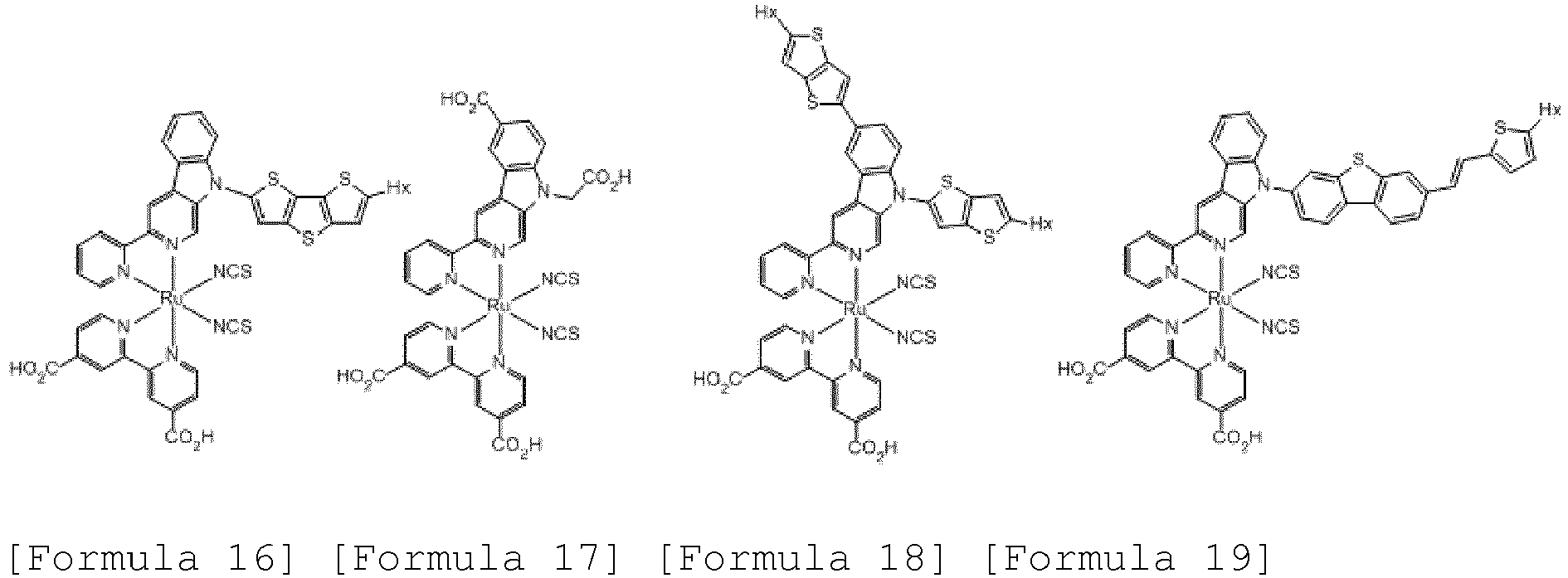


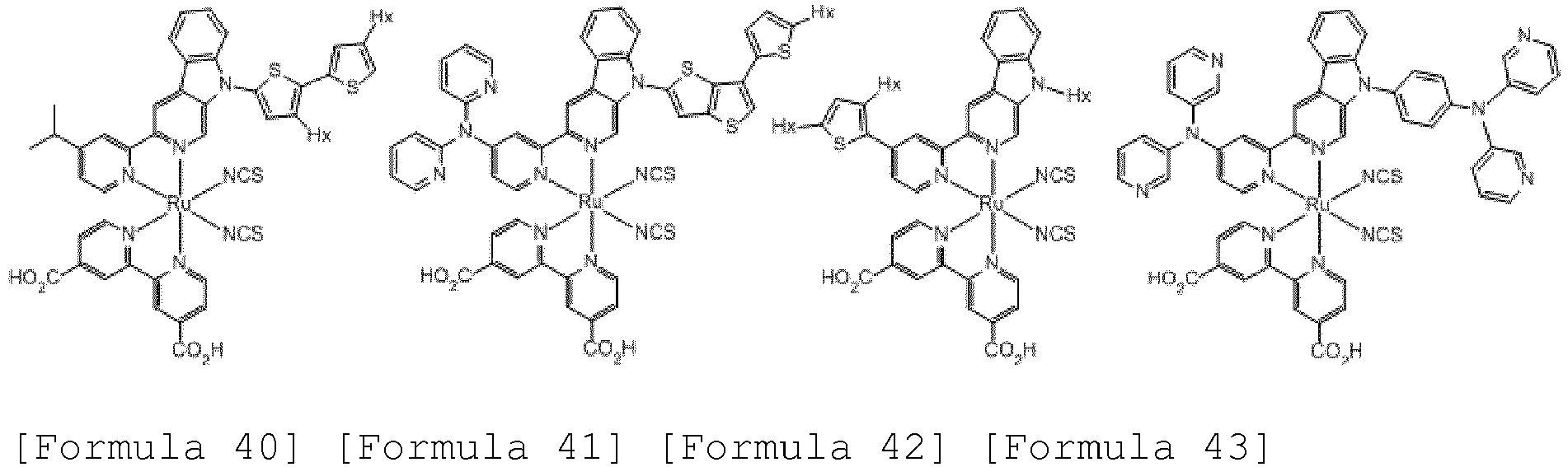


- Unlike a silicon solar cell, a dye-sensitized solar cell is a photoelectrochemical solar cell that includes photo-sensitized dye molecules capable of forming an electron-hole pair by absorbing visible light and transition metal oxide for transferring generated electrons, as main materials. The photoelectric conversion efficiency of the dye-sensitized solar cell is in proportion to the amount of electrons generated by sunlight absorption. Thus, in order to improve the efficiency, the amount of generated electrons can be increased by an increase in sunlight absorption or an increase in dye adsorption. Otherwise, in order to improve the efficiency, it is possible to inhibit generated excited electrons from being annihilated through electron-hole recombination.
- The inventors of the present invention have developed an organic metal dye represented by Formulas 4 to 87, including a fused hetero cycle, in order to achieve a higher light absorptivity.
- Meanwhile, the inventors have developed a dye-sensitized solar cell, in which the dye-sensitized solar cell includes: a first electrode; a light absorbing layer formed on any one surface of the first electrode; a second electrode that is disposed opposingly to the first electrode having the light absorbing layer formed thereon; and an electrolyte filled up in a space between the first electrode and the second electrode. Herein, in the dye-sensitized solar cell, the organic metal dye represented by
Formulas 4 to 87 may be supported by oxide semiconductor fine particles of the light absorbing layer. - Hereinafter, a dye-sensitized solar cell using the organic metal dye represented by Formulas 4 to 87 will be exemplified, but the use of the organic metal dye is not limited thereto. For example, the organic metal dye may be used in various photoelectric elements such as a photoelectric tube and a photomultiplier using a photoemissive surface, a photoelectric cell using an internal photoelectric effect, a photovoltaic cell, a photodiode or a phototransistor, a photo sensor. Herein, the photoelectric elements basically have the same or substantially the same basic structure as that of the dye-sensitized solar cell to be described later, but according to the use, components may be partially added, omitted, modified, or changed.
-
FIG. 1 shows a layered structure of a dye-sensitized solar cell according to an embodiment of the present invention. - The dye-sensitized solar cell according to an embodiment of the present invention includes: a
first electrode 101; alight absorbing layer 102 formed on any one surface of thefirst electrode 101; asecond electrode 104 that is disposed opposingly to thefirst electrode 101 having thelight absorbing layer 102 formed thereon; and anelectrolyte 103 intervened in a space between thefirst electrode 101 and thesecond electrode 104. - The
first electrode 101 is any one of two electrodes of a solar cell, and may be a conductive substrate. - The surface of the
conductive substrate 101 may be conductive. Also, as theconductive substrate 101, a conductive metal oxide (such as tin oxide) obtained by coating indium, fluorine, or antimony on the surface of glass or transparent polymer material, or a metal thin film of steel, silver, gold or the like may be used. - The light absorbing
layer 102 includes a porous oxide semiconductor fine particle film formed on theconductive substrate 101, and an organic metal dye adsorbed on the oxide semiconductor fine particle film. - The porous oxide semiconductor fine particle film includes oxide semiconductor fine particles, and is formed on the
conductive substrate 101. The oxide semiconductor fine particle film may be specifically made of an oxide of titanium, tin, zinc, tungsten, zirconium, gallium, indium, yttrium, niobium, tantalum, or vanadium. The porous oxide semiconductor fine particle film may be used alone, or in combination, and also may be coated on the surface of a semiconductor. Also, the porous oxide semiconductor fine particles may have an average particle diameter of 1 to 500 nm, in which particles of a large particle diameter and a small particle diameter may be used in combination, or used in a multi-layer structure. When the porous oxide semiconductor fine particle film is used in a multilayered structure, a recombination inhibiting layer of a porous oxide semiconductor film with a small particle diameter (a porosity of 0 to 10%) is formed on the firstconductive substrate 101, and a porous oxide semiconductor film layer with a large particle diameter (a porosity of 40 to 60%) is formed on the electron recombination inhibiting layer. - The porous oxide semiconductor fine particle film may be formed by coating a paste containing semiconductor fine particles on the
conductive substrate 101, followed by drying, hardening and firing. In this method, a semiconductor-containing paste may be dispersed in various solvents such as water, ethanol, etc. so as to form slurry, and then the slurry is coated on the substrate. The substrate coated with the slurry is fired at 400 to 600°C for about 4 hours. In the dye-sensitized solar cell according to an embodiment of the present invention, the porous oxide semiconductor fine particle film on the substrate may have a thickness of 1 to 2,000 nm, or a thickness of 1 to 500 nm. - On the formed semiconductor fine particle film, a photo sensitized organic metal dye represented by Formulas 4 to 87 is adsorbed. A method of adsorbing the photo sensitized organic metal dye represented by Formulas 4 to 87 on the semiconductor fine particle film is not particularly limited. Specifically, the dye may be adsorbed by supporting the oxide semiconductor fine particle film by a solution obtained by dissolving the compound represented by
Formulas 4 to 87 in its soluble solvent, or a dispersion obtained by dispersing the dye in a solvent. - Herein, the concentration of the dye used in the solution or the dispersion may be appropriately adjusted according to the characteristic of the dye. Also, after the semiconductor fine particle film is supported, a time required for adsorbing the dye on the porous oxide is about 1 to 48 hours. A solvent used for dissolving or dispersing the dye may be ethanol, water, acetonitrile, acetone, dimethylformaldehyde or the like, but the present invention is not limited thereto.
- In the dye to be adsorbed on the oxide, the anchoring group may be selected from the group including COOH, PO3H2, PO4H2, SO3H2, SO4H2, CONHOH and a deprotonized form thereof. As the deprotonated form, one or more terminal groups of a dye may form an anion, such as COO-, PO2- 3, PO2- 4, SO2- 3, SO2- 4, or CONHO-, and in this case may form a salt in combination with a cation. The cation may be selected from the group including ammonium, phosphonium, sulfonium, imidazolium, pyrrolidonium and pyridinium although it is not particularly limited thereto.
- The
second electrode 104 is disposed opposingly to thefirst electrode 101, and includes the same or similar conductive electrode and the same or similar conductive layer as thefirst electrode 101. The conductive layer may be made of a carbon material (such as carbon black, carbon nanotube), or platinum. One or both of thefirst electrode 101 and thesecond electrode 104 may be transparent. -
Electrolyte layer 103 is sealed by a partition wall intervened between thefirst electrode 101 and thesecond electrode 104. As a redox electrolyte used for theelectrolyte layer 103, a halogen redox electrolyte including a halogen compound using a halogen ion as a counter-ion, and halogen molecules, a metal redox electrolyte of ferrocyanide, ferrocene-ferricinium ion, or metal complex (such as cobalt complex), an organic redox electrolyte of alkyl thiol-alkyl disulphide, viologen dye, or hydroquinone-quinone, or the like may be used. Also, a halogen redox electrolyte may be used. - Also, a molecular iodine may be used. Also, as the halogen compound using a halogen ion as a counter ion, a halogenated metal salt (such as LiI, NaI, KI, CaI2, CuI, or the like), an organic ammonium salt of halogen (such as tetraalkyl ammonium iodide, imidazolium iodide, pyridium iodide or the like), or I2 may be used.
- Specific examples of the
electrolyte layer 103 are as follows, but the present invention is not limited thereto. - The
electrolyte layer 103 may include an iodine-based redox liquid electrolyte, e.g., an electrolyte solution of I3 -/I- obtained by dissolving 1-vinyl-3-hexyl-3-immidazolium iodide, 0.1 M LiI, 40 mM I2 (Iodine), and 0.2 M tert-butyl pyridine in 3-methoxypropionitrile. - Hereinafter, the present invention will be described in more detail with reference to Synthesis Examples and Comparative Test Examples. However, the following Synthesis Examples and Comparative Test Examples are only for illustrative purposes and are not intended to limit the scope of the invention.
- According to
Reaction Scheme 1 below, a compound represented by Formula 1-a was synthesized.
- A 5 L round-bottom flask was charged with 119.5 g of trifluoroacetic acid (1.05 mol), and slowly added with 250 g of 2,2'-bipyridine (1.59 mol). At room temperature, 275 g of hydrogen peroxide was slowly added thereto, followed by stirring for 4 hours. The resultant product was added with a sodium hydroxide aqueous solution until pH reached 9 to 11, and extracted with methylene chloride. Then, an organic layer was separated. After removal of moisture, and removal of a solvent by vacuum distillation, the precipitated solid was washed with ethanol, and filtered so as to provide 219 g of Formula 1-a (79.8%).
- According to
Reaction Scheme 2 below, a compound represented by Formula 1-b was synthesized.
- A 5 L round-bottom flask was charged with 219.2 g of Formula 1a (1.27 mol), and added with 1705 g of sulfuric acid, followed by stirring. 679.5 g of potassium nitride (7.98 mol) was slowly added thereto, followed by stirring at 90°C for 23 hours. The temperature was lowered down to room temperature. Then, the resultant product was slowly poured to 2.0 L of cool water, and then neutralized with a potassium hydroxide aqueous solution, and extracted with methylene chloride. Then, an organic layer was separated. After removal of moisture, and removal of a solvent by vacuum distillation, 140 g of Formula 1-b (yield 50%) was obtained.
- According to
Reaction Scheme 3 below, a compound represented by Formula 1-c was synthesized.
- A 10 L round-bottom flask was charged with 140 g of Formula 1-b (0.65 mol), added with 1.4 L of acetic acid, and at 60°C, slowly dropwise added with 2.4 L of acetyl bromide (AcBr) (19.35 mol). The resultant product was stirred under reflux at 90°C for 9 hours, cooled to room temperature, added to 2.7 L of cool water, added with a potassium hydroxide aqueous solution until pH reached 9 to 10, and extracted with methylene chloride. Then, an organic layer was separated. After removal of moisture, and removal of a solvent by vacuum distillation, 107 g of Formula 1-c (yield 66%) was obtained.
- According to
Reaction Scheme 4 below, a compound represented by Formula 1-d was synthesized.
- A 5 L round-bottom flask was substituted with nitrogen gas, and 107 g of Formula 1-c (0.43 mol) was added thereto, and dissolved by addition of 2.7 L of chloroform. At 0°C, 180.3 g of tribromophosphine
- (1.92 mol) was slowly dropwise added thereto, followed by stirring at 60°C for 2 hours. The resultant product was cooled to room temperature, added to 2 L of water, added with a sodium hydroxide aqueous solution until pH reached 11, and extracted with methylene chloride. Then, an organic layer was separated. After removal of moisture, and removal of a solvent by vacuum distillation, the precipitated solid was washed with ethanol, and filtered so as to provide 100 g of Formula 1-d brown solid (yield 99%).
- According to
Reaction Scheme 5 below, a compound represented by Formula 1-e was synthesized.
- In a 2 L round-bottom flask, 100 g of bromonitro-benzene (0.50 mol) was charged, and dissolved by 1.5 L of toluene. The resultant solution was added with 150.9 g of bis(pinacolato)diboron (0.59 mol), 12.1 g of Pd(dppf)Cl2 (0.015 mol), and 145.8 g of KOAc (1.49 mol), and refluxed for 10 hours. The solution was cooled to room temperature, and the solvent was removed by vacuum distillation. Then, the resultant solid was purified with column chromatography by using N-hexane as a developing solvent so as to provide 80 g of Formula 1-e (yield 65%).
- According to
Reaction Scheme 6 below, a compound represented by Formula 1-f was synthesized.
- A 1 L round-bottom flask was charged with 100 g of Formula 1-d (0.43 mol), 148.2 g of Formula 1-e (0.60 mol), 117 g of potassium carbonate (K2CO3) (0.85 mol), 24.6 g of Pd(PPh3)4, 200 mL of water, 500 mL of dioxane and 100 mL of tetrahydrofuran, followed by reflux for 24 hours. After the reaction was completed, the resultant product was subjected to phase separation. The aqueous phase was removed, and the organic layer was separated, and vacuum-evaporated. Then, the resultant product was purified with column chromatography using hexane and ethylacetate as developing solvents so as to provide a solid. Finally, through drying, 65.7 g of a solid (yield 55%) was obtained.
- According to
Reaction Scheme 7 below, compounds represented by Formulas 1-g and 1-h were synthesized.
- In a 1 L round-bottom flask, 65.7 g of Formula 1-f (0.24 mol), and 311.0 g of triphenylphosphine (1.19 mol), dissolved in 800 mL of o-dichlorobenzene, were refluxed for 24 hours. After the reaction was completed, the solution was cooled to room temperature, and the solvent was removed through vacuum distillation. Then, the resultant solid was purified with column chromatography using hexane and ethylacetate as developing solvents so as to provide a pale yellow solid, that is, 5.7 g of Formula 1-g (yield 9.8%), and 20.0 g of Formula 1-h (yield 34%).
- According to
Reaction Scheme 8 below, a compound represented by Formula 1-i was synthesized.
- In 100 mL round-bottom flask, 2.0 g of Formula 1-g (0.01 mol), 10.0 g of 1-bromohexane (0.06 mol), and 2.3 g of potassium hydroxide (0.04 mol) were dissolved in 50 mL of N,N-dimethylformamide, followed by reflux for 12 hours. After the reaction was completed, the solution was cooled to room temperature, and extracted with ethyl acetate. The organic layer was separated. After removal of moisture, and removal of a solvent by vacuum distillation, the resultant product was purified with column chromatography by using hexane and ethylacetate as developing solvents so as to provide 1.7 g of Formula 1-i (yield 64.5%).
- According to
Reaction Scheme 9 below, a compound represented byFormula 6 was synthesized.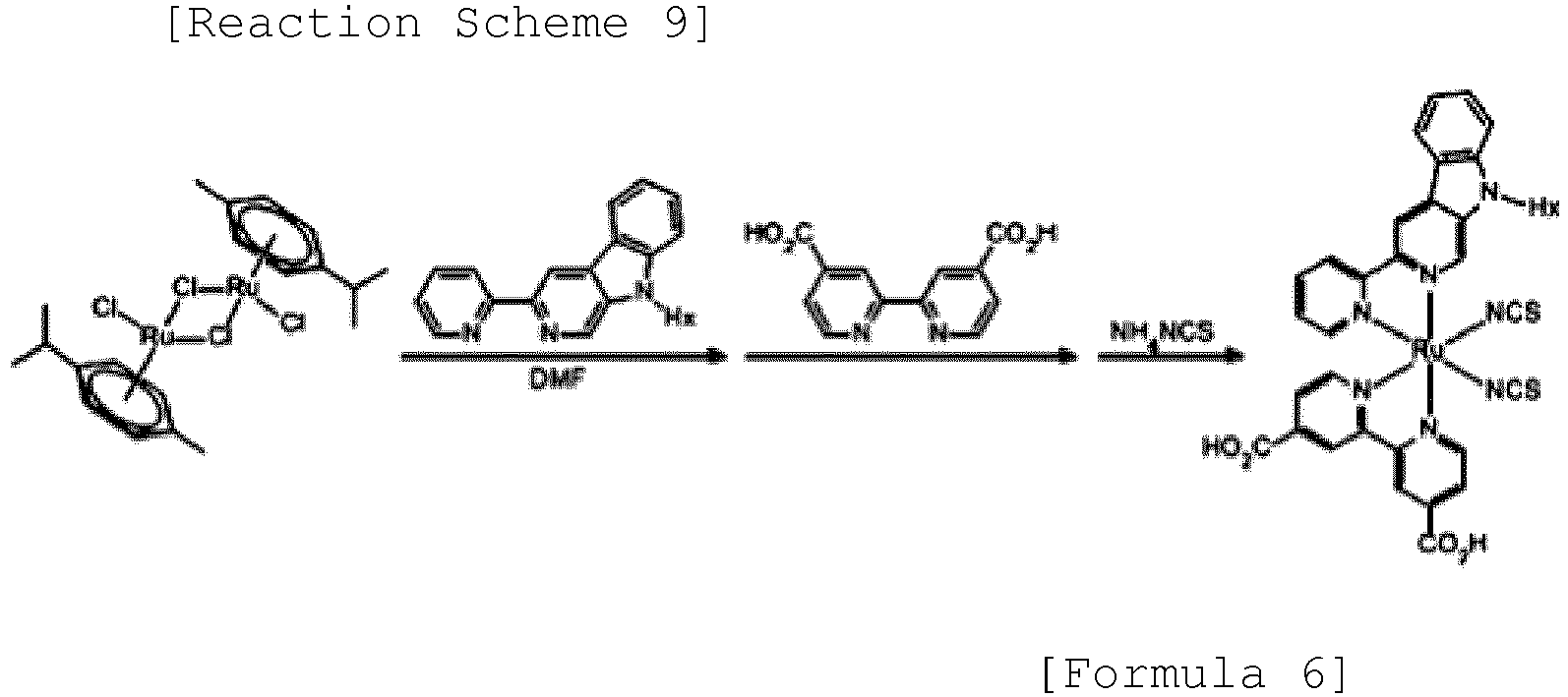
- In a 500 mL round-bottom flask, 1.5 g of dichloro(p-cymene)ruthenium(II) dimer (0.0024 mol) was dissolved in 75 mL of N,N-dimethylformamide. Herein, light was blocked. The solution was added with 1.6 g of Formula 1-i (0.0045 mol), followed by stirring at 80°C for 4 hours. The resultant solution was added with 1.7 g of 4,4'-dicarboxylic acid-2,2'-bipyridine (0.0048 mol), followed by stirring at 140°C for 4 hours. The resultant solution was added with 11.0 g of NH4NCS (0.144 mol), followed by stirring at 140°C for 4 hours. The reaction solution was cooled to room temperature, and removed under reduced pressure. Then, a solid obtained by addition of excess water was filtered. The filtered solid was washed with excess water and ethanol, and purified with column chromatography by using water as a developing solvent, and sepadex as filler so as to provide 0.4 g of Formula 6 (yield 18.4%).
- 1H NMR [DMSO, ppm] ; 9.65 (s, 1H), 9.57 (s, 1H), 9.47 (d, 1H), 9.11(s, 1H), 8.96(s, 1H), 8.57(d, 1H), 8.51(d, 1H), 7.92 (t, 1H), 7.79 (t, 1H), 7.68 (d, 1H), 7.47 (dt, 2H), 7.45(t, 1H), 1.34-1.23(m, 5H), 0.93(t, 6H), 0.76(t, 3H).
- According to
Reaction Scheme 1 below, a compound represented by Formula 2-a was synthesized.
- In a 100 mL round-bottom flask, 2.0 g of Formula 1-g (0.01 mol), 10.0 g of 1-bromohexane (0.06 mol), and 2.3 g of potassium hydroxide (0.04 mol) were dissolved in 50 mL of N,N-dimethylformamide and were refluxed for 12 hours. After the reaction was completed, the solution was cooled to room temperature, and extracted with ethyl acetate. The organic layer was separated. After removal of moisture, and removal of a solvent by vacuum distillation, the resultant product was purified with column chromatography by using hexane and ethylacetate as developing solvents so as to provide 1.7 g of Formula 2-a (yield 64.5%).
- According to
Reaction Scheme 2 below, a compound represented byFormula 8 was synthesized.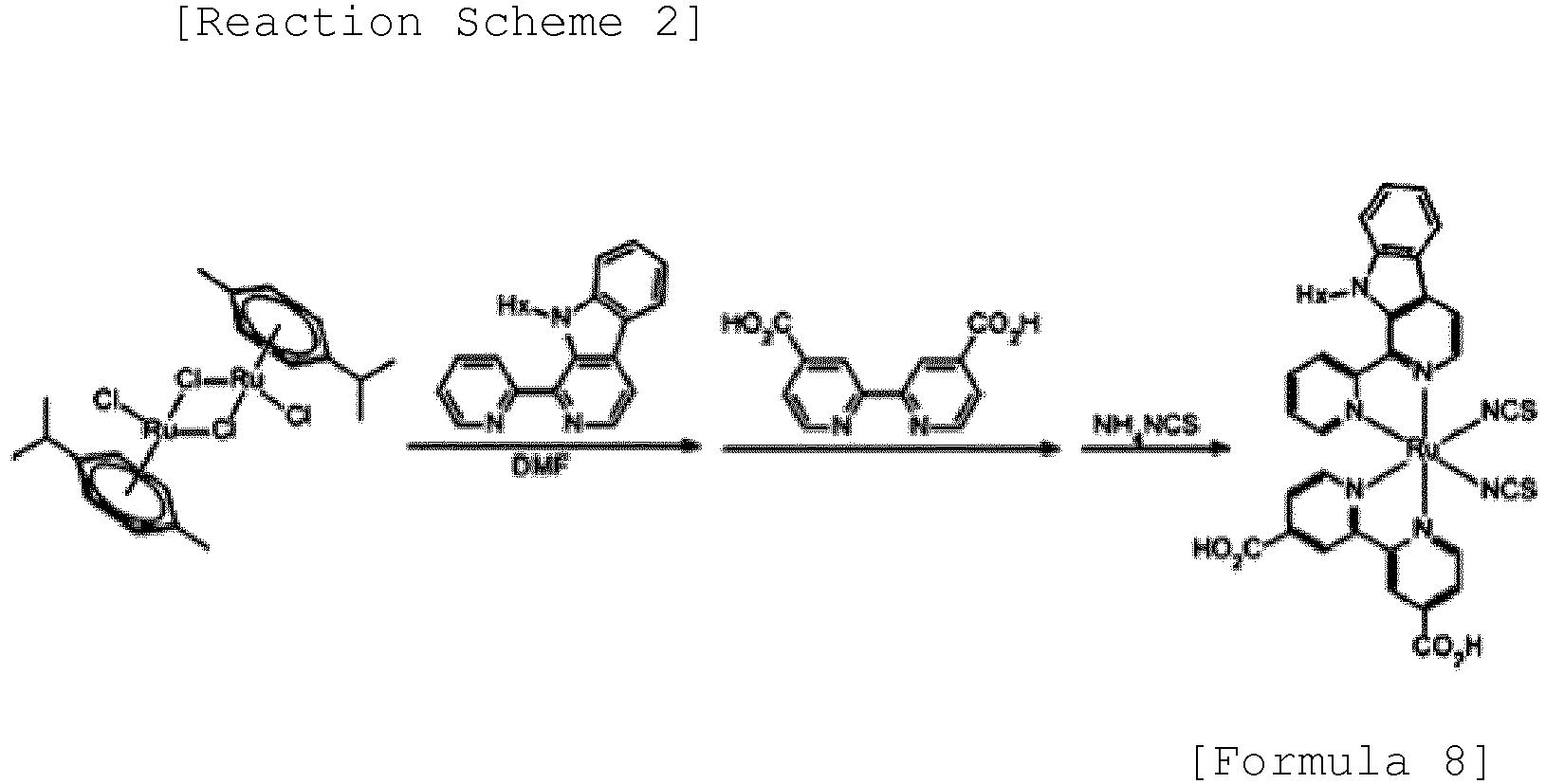
- In a 500 mL round-bottom flask, 1.5 g of dichloro(p-cymene)ruthenium(II) dimer (0.0024 mol) was dissolved in 75 mL of N,N-dimethylformamide. Herein, light was blocked. The solution was added with 1.6 g of Formula 2-a (0.0045 mol), followed by stirring at 80°C for 4 hours. The resultant solution was added with 1.7 g of 4,4'-dicarboxylic acid-2,2'-bipyridine (0.0048 mol), followed by stirring at 140°C for 4 hours. The resultant solution was added with 11.0 g of NH4NCS (0.144 mol), followed by stirring at 140°C for 4 hours. The reaction solution was cooled to room temperature, and removed under reduced pressure. Then, a solid obtained by addition of excess water was filtered. The filtered solid was washed with excess water and ethanol, and purified with column chromatography by using water as a developing solvent, and sepadex as filler so as to provide 0.4 g of Formula 6 (yield 18.4%).
- 1H NMR[DMSO, ppm]; 9.45 (d, 1H), 9.08 (d, 2H), 8.93 (s, 1H), 8.76(d, 1H), 8.50(d, 1H), 8.31(dd, 1H), 8.17(d, 1H), 8.02(t, 2H), 7.75(dd, 2H), 7.61-7.54 (m, 3H), 7.27(t, 1H), 1.35-1.27(m, 6H), 0.94(t, 4H), 0.52(t, 3H).
- According to
Reaction Scheme 1 below, a compound represented by Formula 3-a was synthesized.
- In a 1 L round-bottom flask, 116.6 g of dithieno-thiophene (0.594 mol) was dissolved in 500 mL of tetrahydrofuran (THF), followed by stirring at -78°C for 30 minutes. 371 mL of n-butyllithium (1.6 M hexane solution) (0.594 mol) was slowly dropwise added thereto, followed by stirring for 2 hours. The resultant solution was slowly added with 98 g of 1-bromohexane (0.594 mol), stirred at room temperature for 3 hours, and added with 200 mL of water. The organic layer was separated by ethyl acetate (AcEt), and the organic solvent was removed under reduced pressure so as to provide oil. The oil layer was vacuum-distillated so as to provide 96.6 g of Formula 3-a (yield 58%).
- According to
Reaction Scheme 2 below, a compound represented by Formula 3-b was synthesized.
- In a 5 L round-bottom flask, 90 g of Formula 3-a (0.321 mol) was dissolved in 1.8 L of N,N-dimethylformamide. The resultant solution was slowly added with 62.8 g of NBS (0.353 mol) at 0°C, and stirred at room temperature until a solid was precipitated. The resultant product was poured to 3.6 L of water, and the solid was filtered and purified with column chromatography using hexane as a developing solvent so as to provide 102.7 g of Formula 3-b (yield 89%).
- According to
Reaction Scheme 3 below, a compound represented by Formula 3-c was synthesized.
- In a 100 mL round-bottom flask, 2.0 g of Formula 1-g (0.01 mol), Formula 3-b of 6.3 g (0.012 mol), 2.8 g of potassium carbonate (0.02 mol), 0.4 g of copper chloride (0.004 mol), and 0.25 g of copper (0.004 mol) were dissolved in 50 mL of N,N-dimethylformamide and were refluxed for 18 hours. After the reaction was completed, the solution was cooled to room temperature, and extracted with methylene chloride. The organic layer was separated. After removal of moisture, and removal of a solvent by vacuum distillation, the resultant product was purified with column chromatography by using hexane and ethyl acetate as developing solvents so as to provide 3.4 g of Formula 3-c (yield 64%).
- According to
Reaction Scheme 4 below, a compound represented byFormula 16 was synthesized.
- In a 500 mL round-bottom flask, 1.5 g of dichloro(p-cymene)ruthenium(II) dimer (0.0024 mol) was dissolved in 75 mL of N,N-dimethylformamide. Herein, light was blocked. The solution was added with 2.4g of Formula 3-c (0.0045 mol), followed by stirring at 80°C for 4 hours. The resultant solution was added with 1.7 g of 4,4'-dicarboxylic acid-2,2'-bipyridine (0.0048 mol), followed by stirring at 140°C for 4 hours. The resultant solution was added with 11.0 g of NH4NCS (0.144 mol), followed by stirring at 140°C for 4 hours. The reaction solution was cooled to room temperature, and removed under reduced pressure. Then, a solid obtained by addition of excess water was filtered. The filtered solid was washed with excess water and ethanol, and purified with column chromatography by using water as a developing solvent, and sepadex as filler so as to provide 0.7 g of Formula 6 (yield 31.1%).
- 1H NMR [DMSO, ppm] ; 9.66(s, 1H), 9.58 (s, 1H), 9.50 (d, 1H), 9.11(d, 2H), 8.68(d, 1H), 8.43(d, 2H), 8.38(d, 1H), 7.95 (t, 2H), 7.82 (t, 1H), 7.49(dd, 3H), 7.45(t, 1H), 7.38(d, 1H), 7.30(d, 1H), 2.83(t, 2H), 1.76-1.72(m, 2H), 1.35 (t, 6H), 0.92 (t, 3H).
- According to
Reaction Scheme 1 below, a compound represented by Formula 4-a was synthesized.
- In a 5 L round-bottom flask, 165 g of 2,2'-bipyridine (1.05 mol) was dissolved in 570 mL of chloroform, and cooled down to -78°C. 389 g of m-chloroperbenzoic acid (2.25ml) dissolved in 1,520 mL of chloroform was added thereto. At room temperature, the resultant product was stirred for 12 hours, and the resultant solid was filtered. The solid was washed with methanol, and filtered. This step was repeated twice so as to provide a white solid, 172.3 g of Formula 4-a (yield 89.4%).
- According to
Reaction Scheme 2 below, a compound represented by Formula 4-b was synthesized.
- A 2 L round-bottom flask was charged with 199 g of an intermediate 28a (1.06 mol), and with 1038 g of oleum sulfuric acid (10.58 mol), followed by stirring. Fuming nitric acid was slowly dropwise added thereto, at low temperature, followed by stirring at 80°C for 12 hours. The temperature was lowered to room temperature, and the resultant product was slowly poured to 4.5 L of cool water. The resultant solid was filtered, and sufficiently washed with water so as to provide a yellow solid, 126.9 g of Formula 4-b (yield 43%).
- According to
Reaction Scheme 3 below, a compound represented by Formula 4-c was synthesized.
- A 5 L round-bottom flask was charged with 126 g of intermediate 28c (0.456 mol), and with 1.9 L of acetic acid. Then, at 40°C, 140 g of acetyl bromide (1.14 mol) was slowly added thereto. After 3 hours, the resultant product was cooled down to room temperature, and then poured to 19 L of cool water, and then neutralized with sodium hydroxide. The resultant solid was washed with methanol, and filtered. This step was repeated twice so as to provide a pale yellow solid, 116g of Formula 4-c (yield 74%).
- According to
Reaction Scheme 4 below, a compound represented by Formula 4-d was synthesized.
- A 2 L round-bottom flask was substituted with nitrogen gas, and 37 g of Formula 4-c (0.1 mol) was added thereto, and dissolved by addition of 950 mL of chloroform. At -3°C, 297 g of tribromophosphine (1.1 mol) was slowly dropwise added thereto, followed by stirring at 60°C, for 2 hours. The resultant product was cooled to room temperature, added to 1 L of water, added with caustic soda until pH reached 11, and extracted with methylene chloride. Then, an organic layer was separated. After removal of moisture, and removal of a solvent by vacuum distillation, the precipitated solid was washed with ethanol, and filtered so as to provide a pale yellow solid, 26 g of Formula 4-d (yield 77%).
- According to
Reaction Scheme 5 below, a compound represented by Formula 4-e was synthesized.
- A 500 ml round-bottom flask was charged with 25 g of Formula 4-d (0.080 mol), 47.6 g of Formula 1-e (0.191 mol), 22.1 g of potassium carbonate (K2CO3) (0.160 mol), 4.6 g of Pd(PPh3)4. 40 mL of water, 100 ml of toluene, and 100 mL of tetrahydrofuran, followed by reflux for 24 hours. After the reaction was completed, the resultant product was subjected to phase separation. The aqueous phase was removed, and the organic layer was separated, and vacuum-evaporated. Then, the resultant product was purified with column chromatography using hexane and dichloromethane as developing solvents so as to provide a solid. Finally, through drying, a white solid, 12.7 g of Formula 4-e (yield 87%) was obtained.
- According to
Reaction Scheme 6 below, compounds represented by Formulas 4-f and 4-g were synthesized.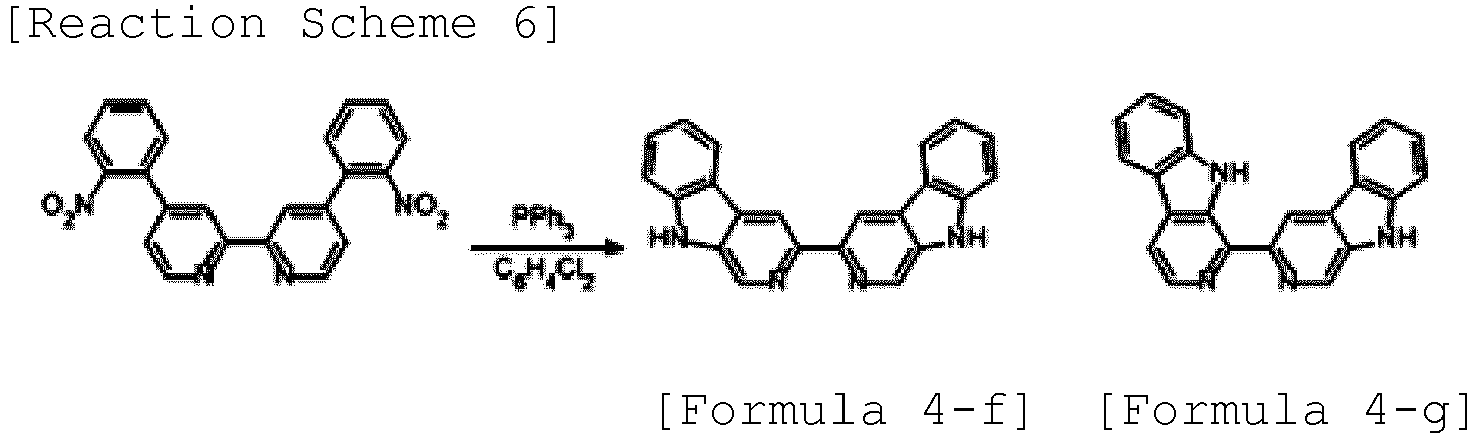
- In a 500ml round-bottom flask, 13.0 g of Formula 4-e (0.033 mol), and 42.7 g of triphenylphosphine (0.163 mol) were dissolved in 200 mL of o-dichlorobenzene, and refluxed for 24 hours. After the reaction was completed, the solution was cooled to room temperature, and the solvent was removed through vacuum distillation. Then, the resultant solid was purified with column chromatography using dichloromethane as a developing solvent so as to provide a pale yellow solid, that is, 5.9 g of Formula 4-f (yield 54%), and 2.4g of Formula 4-g (yield 22%).
- According to
Reaction Scheme 7 below, a compound represented by Formula 48 was synthesized.
- In a 250 mL round-bottom flask, 5.2 g of dichloro(p-cymene)ruthenium(II) dimer (0.0085 mol) was dissolved in 100 mL of DMF. Herein, light was blocked. The solution was added with 5.7 g of Formula 4-f (0.017ml), followed by stirring at 80°C for 4 hours. The resultant solution was added with 4.15 g of 4,4'-dicarboxylic acid-2,2'-bipyridine (0.017 mol), followed by stirring at 140°C for 4 hours. The resultant solution was added with 53.52 g of NH4NCS (0.703 mol), followed by stirring at 140°C for 4 hours. The reaction solution was cooled to room temperature, and removed under reduced pressure. Then, a solid obtained by addition of excess water was filtered. The filtered solid was washed with excess water and ethanol, and purified with column chromatography by using water as a developing solvent, and sepadex as filler so as to provide 2.36 g of Formula 48 (yield 35%).
- 1H NMR [DMSO, ppm] ; 10.41 (s, 2H), 9.43 (s, 1H), 9.36(s, 1H), 9.25(s, 1H), 9.19(s, 1H), 9.11(d, 1H), 9.06 (d, 1H), 8.87 (s, 1H), 8.77 (s, 1H), 8.59 (s, 1H), 8.45 (s, 1H), 7.63 (d, 2H), 7.58 (t, 2H), 7.38 (dd, 2H), 7.29 (dt, 2H).
- According to
Reaction Scheme 1 below, a compound represented by Formula 5-a was synthesized.
- In a 1 L round-bottom flask, 50 g of thiophene (0.594 mol) was dissolved in 500 mL of tetrahydrofuran (THF), followed by stirring at -78°C for 30 minutes. 371 mL of n-butyllithium (1.6 M hexane solution) (0.594 mol) was slowly dropwise added thereto, followed by stirring for 2 hours. The resultant solution was slowly added with 98 g of 1-bromohexane (0.594 mol), stirred at room temperature for 3 hours, and added with 200 mL of water. The organic layer was separated by ethyl acetate (AcEt), and the organic solvent was removed under reduced pressure so as to provide oil. The oil layer was vacuum-distillated so as to provide 52.2 g of Formula 5-a (yield 52%).
- According to
Reaction Scheme 2 below, a compound represented by Formula 5-b was synthesized.
- In a 1 L round-bottom flask, 52.2 g of Formula 5-a (0.310 mol) was dissolved in 500 mL of tetrahydrofuran (THF), followed by stirring at -78°C for 30 minutes. 233 mL of n-butyllithium (1.6 M hexane solution) (0.372 mol) was slowly dropwise added thereto, followed by stirring for 2 hours. The resultant solution was slowly added with 131 g of SnBu3Cl (0.403 mol), stirred at room temperature for 3 hours, and added with 200 mL of water. The organic layer was separated by ethyl acetate (AcEt), and the organic solvent was removed under reduced pressure so as to provide oil. The oil layer was vacuum distillated so as to provide 101 g of Formula 5-b (yield 71%).
- According to
Reaction Scheme 3 below, a compound represented by Formula 5-c was synthesized.
- In a 1 L round-bottom flask, 137 g of Formula 5-b (0.30 mol) and 108.5 g of 2,5-dibromothiophene (0.45 mol) were dissolved in 400 mL of DMF, followed by stirring at 85°C for 12 hours. The solution was pressure-reduced so as to remove the solvent. Then, the remaining oil was purified with column chromatography using hexane as a developing solvent so as to provide 74 g of Formula 5-c (yield 75%).
- According to
Reaction Scheme 4 below, a compound represented by Formula 5-d was synthesized.
- A 250 mL round-bottom flask was charged with 28 g 10.0 g of Formula 4-f (0.030 mol), 21.7 g of Formula 5-c (0.066 mol), 0.74 g of BINAP, 7.19 g of NaOtBu (0.07 mol), 0.27 g of palladium acetate (Pd(OAc)2), and 100 ml of toluene, followed by reflux for 24 hours. After the reaction was completed, the organic solvent was subjected to vacuum distillation. Through extraction with ethyl acetate and water, the organic layer was separated. The solvent was removed, and the obtained solid was washed with methanol, and purified with column chromatography using hexane and dichloromethane (1:1) as developing solvents. Finally, through drying, a solid, 21.4 g of Formula 5-d (yield 72%) was obtained.
- According to
Reaction Scheme 5 below, a compound represented by Formula 55 was synthesized.
- 2.5 g of Formula 55, (yield 26%) was obtained in the same manner as described in Synthesis Example of Formula 48 except that instead of Formula 4-f, Formula 5-d was used. 1H NMR[DMSO, ppm]; 9.56(d, 1H), 9.19(dt, 1H), 9.13(d, 2H), 8.97(s, 1H), 8.66(d, 1H), 8.55(s, 1H), 8.43 (t, 2H), 8.13(d, 2H), 7.71-7.69(m, 2H), 7.51(d, 1H), 7.39(d, 2H), 7.23-7.19(m, 3H), 7.15(d, 1H), 6.89(s, 1H), 1.31-1.24(m, 10H), 0.94(t, 12H), 0.75(t, 6H).
- According to
Reaction Scheme 1 below, a compound represented by Formula 6-a was synthesized.
- A 100 mL round-bottom flask was charged with 2.0 g of Formula 4-g (0.01 mol), 8.5 g of methyl iodide (0.06 mol), and 2.2 g of potassium hydroxide (0.04 mol), and added with 50 mL of N,N-dimethylformamide, followed by reflux for 12 hours. After the reaction was completed, the solution was cooled to room temperature, and extracted with ethyl acetate. The organic layer was separated. After removal of moisture, and removal of a solvent by vacuum distillation, the resultant product was purified with column chromatography by using hexane and ethylacetate as developing solvents so as to provide 2.7g of Formula 6-a, (yield 75.1%).
- According to
Reaction Scheme 2 below, a compound represented by Formula 61 was synthesized.
- In a 250 mL round-bottom flask, 2.5 g of dichloro(p-cymene)ruthenium(II) dimer (0.0037 mol) was dissolved in 70 mL of DMF. Herein, light was blocked. The solution was added with 2.7 g of Formula 6-a (0.0074 mol), followed by stirring at 80°C for 4 hours. The resultant solution was added with 2.6 g of 4,4'-dicarboxylic acid-2,2'-bipyridine (0.0074 mol), followed by stirring at 140°C for 4 hours. The resultant solution was added with 22.53 g of NH4NCS (0.296 mol), followed by stirring at 140°C for 4 hours. The reaction solution was cooled to room temperature, and removed under reduced pressure. Then, a solid obtained by addition of excess water was filtered. The filtered solid was washed with excess water and ethanol, and purified with column chromatography by using water as a developing solvent, and sepadex as filler so as to provide 0.9 g of Formula 61 (yield 31%).
- 1H NMR [DMSO, ppm] ; 9.62 (s, 1H), 9.52 (d, 1H), 9.20 (s, 1H), 9.04(m, 3H), 8.77(d, 1H), 8.64(d, 1H), 8.32(d, 1H), 8.23(d, 1H), 8.05(d, 1H), 7.75(m, 6H), 7.26(d, 1H), 4.19(s, 3H), 4.01(s, 3H), 3.16(m, 8H), 1.55(m, 8H), 1.29(m, 8H), 0.93(t, 12H).
- According to
Reaction Scheme 1 below, a compound represented by Formula 7-a was synthesized.
- In a 100 mL round-bottom flask, 2.0 g of Formula 4-f (0.006 mol), 6.4 g of Formula 3-b (0.018 mol), 3.3 g of potassium carbonate (0.024 mol), 0.2 g of copper chloride (0.0024 mol), and 0.15 g of copper (0.0024 mol) were dissolved in N,N-
dimethylformamide 20 mL and were refluxed for 18 hours. After the reaction was completed, the solution was cooled to room temperature, and extracted with methylene chloride. The organic layer was separated. After removal of moisture, and removal of a solvent by vacuum distillation, the resultant product was purified with column chromatography by using hexane and ethyl acetate as developing solvents so as to provide 3.0 g of Formula 7-a (yield 71%). - According to
Reaction Scheme 2 below, a compound represented by Formula 64 was synthesized.
- 0.5 g of Formula 64, (yield 22%) was obtained in the same manner as described in Synthesis Example of Formula 48 except that instead of Formula 4-f, Formula 7-a was used.
- 1H NMR [DMSO, ppm] ; 9.68 (s, 2H), 9.59 (s, 2H), 9.51 (d, 2H), 9.14 (s, 2H), 9.09 (s, 2H), 8.63(d, 2H), 8.57(d, 2H), 8.33 (d, 2H), 8.04 (t, 4H), 7.96 (t, 2H), 7.74 (d, 2H), 7.65-7.58(m, 6H), 7.51(t, 2H), 7.39(d, 2H), 7.33(d, 2H), 2.84(t, 4H), 1.75-1.72(m, 4H), 1.33(t, 12H), 0.94(t, 6H).
- According to
Reaction Scheme 1 below, a compound represented by Formula 8-a was synthesized.
- In a 250 mL round-bottom flask, 10.0 g of Formula 4-f (0.030 mol) was dissolved in 100 mL of N,N-dimethylformamide. The solution was added with 12.3 g of 1-bromohexane (0.075 mol) and 12.4 g of potassium carbonate (0.09 mol), followed by reflux for 6 hours. The reaction solution was cooled to room temperature, and a solid obtained by addition of excess water was filtered. The filtered solid was purified with column chromatography by using hexane/ethylacetate (1:1) as a developing solvent so as to provide 8.3 g of Formula 8-a (yield 83%).
- According to
Reaction Scheme 2 below, a compound represented by Formula 8-b was synthesized.
- In a 250 mL round-bottom flask, 15.0g of Formula 8-a (0.045 mol) was dissolved in 100 mL of N,N-dimethylformamide. The solution was cooled to 0°C, added with 20.7 g of POCl3 (0.135 mol), and stirred at room temperature for 1 hour. The solution was heated up to 90°C, and stirred for 10 hours. The solution was cooled to room temperature, and basified with addition of a potassium carbonate aqueous solution. Then, a solid obtained by addition of excess water was filtered. The filtered solid was purified with column chromatography by using hexane/ethylacetate (1:1) as a developing solvent so as to provide 9.9g of Formula 8-b (yield 57%).
- According to
Reaction Scheme 3 below, a compound represented by Formula 8-c was synthesized.
- In a 250 mL round-bottom flask, 5.0 g of Formula 8-b (0.013 mol) was dissolved in 100 mL of methylene chloride. The resultant solution was added with 2.8 g of malononitrile (CH2CN2) (0.052 mol), and 3-4 drops of triethylamine were added thereto. The solution was stirred for 3 hours, and the organic solvent was removed by vacuum distillation. Then, the resultant product was purified with column chromatography using hexane/ethylacetate (1:1) as a developing solvent so as to a yellow solid, 5.4 g of Formula 8-c (yield 85%).
- According to
Reaction Scheme 4 below, a compound represented by Formula 74 was synthesized.
- 3.7 g of Formula 74 (yield 29%) was obtained in the same manner as described in Synthesis Example of Formula 48 except that instead of Formula 4-f, Formula 8-c was used.
- 1H NMR [DMSO, ppm] ; 9.41 (s, 2H), 9.27 (d, 2H), 8. 91 (s, 2H), 8.86(s, 2H), 8.34(s, 2H), 8.11(s, 2H), 7.89(d, 2H), 7.41(d, 2H), 7.38(d, 2H), 1.34-1.27(m, 8H), 0.94(t, 12H), 0.76 (t, 6H) .
- On an indium-doped tin oxide transparent conductor, titanium oxide dispersion with a particle diameter of 5 to 15 nm was coated on an area of 1cm2 by a doctor blade method, and subjected to heat treatment (firing) at 450°C for 30 minutes so as to fabricate a porous titanium oxide thick film with a thickness of 18 µm. Then, a test piece was maintained at 80°C, and then was immersed in 0.3 mM dye dispersion having the above mentioned compounds represented by
Formula - In fabrication of a second electrode, on an indium-doped tin oxide transparent conductor, a Pt layer was deposited by sputter to a thickness of about 200 nm. For injection of an electrolyte, a drill with a diameter of 0.75 mm was used to make a fine hole. Then, the second electrode was fabricated.
- A thermoplastic polymer film with a thickness of 60 µm was compressed between the first electrode and the second electrode at 100°C for 9 seconds so as to conjugate the two electrodes to each other. Through the fine hole formed in the second electrode, a redox electrolyte was injected, and then by using a cover glass and a thermoplastic polymer film, the fine hole was sealed. Then, a dye-sensitized solar cell was fabricated. Herein, the redox electrolyte was obtained by dissolving 0.62
M 1,2-dimethyl-3-hexylimidazolium iodide, 0.5 M 2-amino-pyrimidine, 0.1 M LiI and 0.05 M I2 in an acetonitrile solvent. - In Comparative Example, a dye-sensitized solar cell was fabricated in the same manner as described in Examples 1 to 8 except that instead of the organic metal dye, conventionally well known N719 (Formula 88) was used.
- Herein, N719 is a ruthenium-based dye that has been conventionally used in a dye-sensitized solar cell, and its synthesis method is disclosed in literatures (Nazeeruddin MK, et al. "Acid-base equilibria of (2,2'-bipyridyl-4,4'-dicarboxylic acid)ruthenium(II) complexes and the effect of protonation on charge-transfer sensitization of nanocrystalline titania", Inorganic Chemistry, Vol.38, No.26, pp6298-6305, 1999).


- In order to measure the photo-conversion efficiency of a dye-sensitized solar cell according to Examples 1 to 8 and Comparative Test Example in the present invention, photo-voltage and photo-current were measured. As a light source, a Xenon lamp (Oriel, 01193) was used, and the solar condition (AM 1.5) of the Xenon lamp was corrected by a standard solar cell (Frunhofer Institute Solare Engeriessysteme, Certificate No. C-ISE369, Type of material: Mono-Si + KG filter). From the measured photo-current/voltage curve, the photo-conversion efficiency was calculated in accordance with
Mathematical equation 1 below and noted in Table 1.
- In
Mathematical equation 1, ηe represents photo-conversion efficiency (Efficiency), Jsc represents current density, Voc represents voltage, FF represents Fill factor, and Pinc represents 100 mw/cm2 (1 sun).[table 1] Dye Solvent Jsc (mA/cm 2) Voc (V) FF η (%) N719 Ethanol 14.89 0.7 0.58 6.13 Formula 6Ethanol 14.16 0.7 0.62 6.19 Formula 8Ethanol 16.58 0.72 0.59 7.05 Formula 16Ethanol 16.66 0.72 0.61 7.24 Formula 48 Ethanol 15.11 0.69 0.6 6.25 Formula 55 Ethanol 17.48 0.64 0.66 7.4 Formula 61 Ethanol 14.25 0.77 0.66 7.02 Formula 64 Ethanol 17.62 0.71 0.6 7.57 Formula 74 Ethanol 15.93 0.7 0.57 6.28 -
FIG. 2 shows photoconversion efficiency according to an embodiment of the present invention. Referring toFIG. 2 , the photoconversion efficiency of the dye-sensitized solar cell employing the organic metal dye represented byFormulas 8, 55, and 64 can be compared with the photoconversion efficiency of the dye-sensitized solar cell employing N719 (Formula 88). - In order to measure the molar extinction coefficient and the band gap of the dye-sensitized solar cell according to Examples 1 to 8 in the present invention, a UV/Vis absorption spectrometer and a Cyclic voltammetry were used.
[table 2] Dye Absmax[nm] e [M-1cm-1] HOMO (eV) LUMO (eV) Bandgap (eV) N719 524 12,329 5.45 3.85 1.6 Formula 6546 12,813 5.07 3.35 1.72 Formula 8551 15,113 5.03 3.34 1.72 Formula 16548 18,313 4.95 3.36 1.67 Formula 48 536 12,892 4.95 3.28 1.67 Formula 55 567 21,136 4.92 3.31 1.61 Formula 61 556 15,571 5.11 3.34 1.77 Formula 64 576 26, 613 5.22 3.61 1.61 Formula 74 584 14,916 5.01 3.34 1.61 -
FIG. 3 shows NMR spectrum ofFormula 8, according to an embodiment of the present invention. - As noted in Tables 1, and 2 and
FIGs. 2 , and3 , it can be seen that as compared to that in an organic metal complex employing a conventional bipyridine derivative as a ligand, in the inventive compound from Examples 1 to 8, the maximum absorption wavelength was shifted to a longer wavelength, the molar extinction coefficient was increased, and the higher photoconversion efficiency was achieved. - As described above, according to the present invention, there is provided a photo sensitized organic metal dye that shows a high molar extinction coefficient and a high photoconversion efficiency. Also, a dye-sensitized solar cell employing the organic metal dye is excellent in light absorptivity and photoelectric conversion efficiency.
- In the above description of Examples and Comparative Examples, the organic metal dye represented by
Formulas 1 to 3 was employed in the dye-sensitized solar cell. However, for the person skilled in the art, it should be understood that when the organic metal dye represented byFormulas 1 to 3 is employed in photoelectric elements other than the dye-sensitized solar cell, it is excellent in light absorptivity and photoelectric conversion efficiency. - In addition, since terms, such as "including," "comprising," and "having" mean that one or more corresponding components may exist unless they are specifically described to the contrary, it shall be construed that one or more other components can be included. All of the terminologies containing one or more technical or scientific terminologies have the same meanings that persons skilled in the art understand ordinarily unless they are not defined otherwise. A term ordinarily used like that defined by a dictionary shall be construed that it has a meaning equal to that in the context of a related description, and shall not be construed in an ideal or excessively formal meaning unless it is clearly defined in the present specification.
- The above description of the technical spirit of the present invention is illustrative only. Those skilled in the art will appreciate that various modifications, additions and substitutions are possible, without departing from the scope and spirit of the invention. Therefore, the embodiments disclosed in the present invention are intended to illustrate the scope of the technical idea of the present invention, and the scope of the present invention is not limited by the embodiment. The scope of the present invention shall be construed on the basis of the accompanying claims in such a manner that all of the technical ideas included within the scope equivalent to the claims belong to the present invention.
Claims (7)
- An organic metal dye represented by one of Formulas 4 to 87 below:


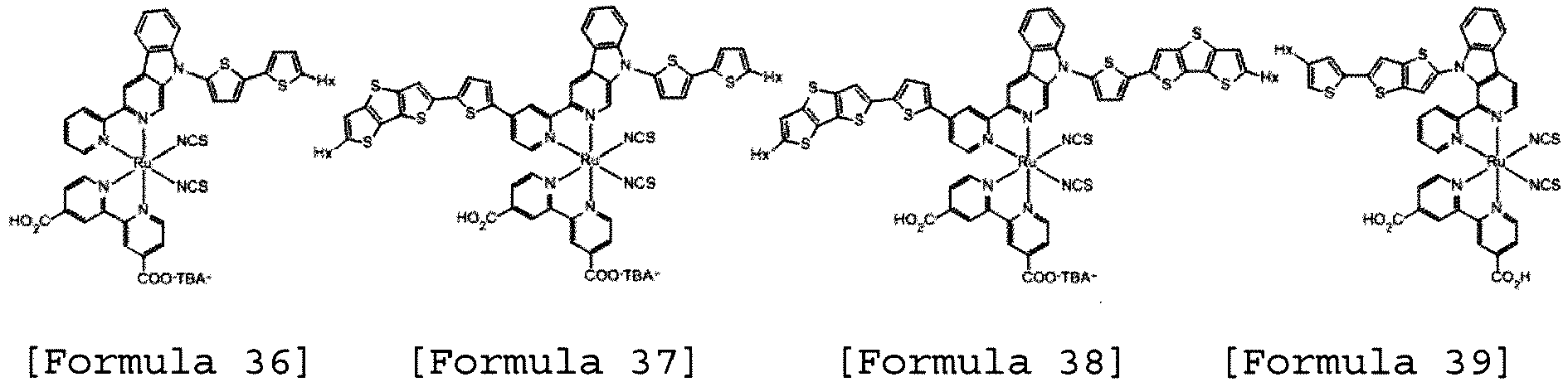


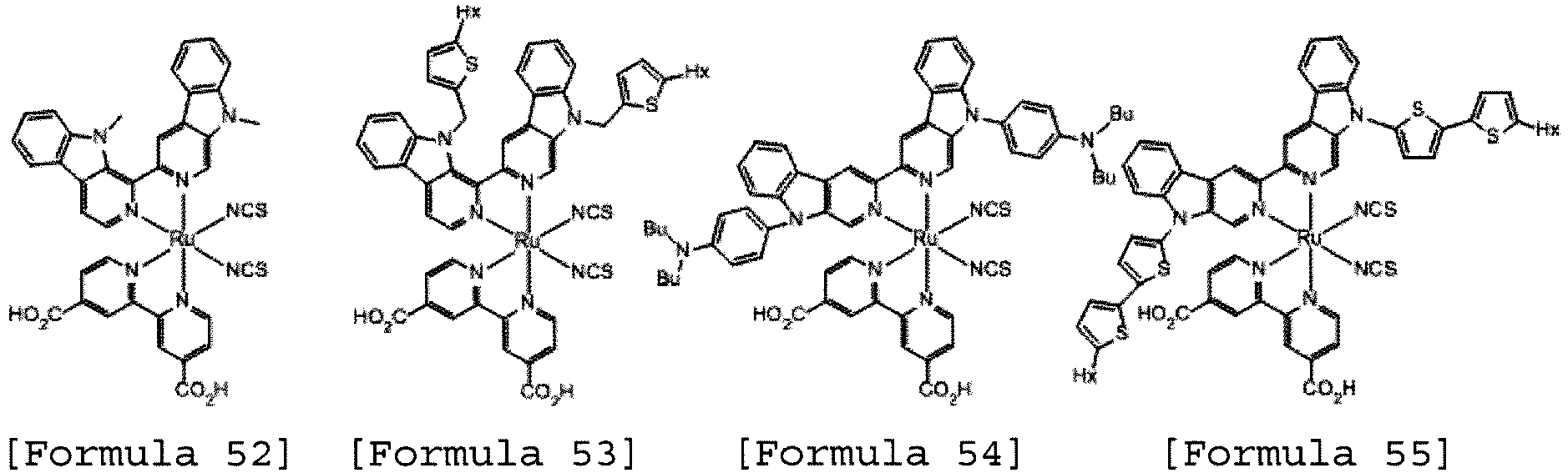


- A photoelectric element comprising a porous oxide semiconductor film comprising the organic metal dye as claimed in claim 1.
- The photoelectric element as claimed in claim 2, wherein the porous oxide semiconductor film comprises fine particles comprising, as a main material, an oxide of titanium, tin, zinc, tungsten, zirconium, gallium, indium, yttrium, niobium, tantalum, or vanadium.
- The photoelectric element as claimed in claim 3, wherein the porous oxide semiconductor film is used in a light absorbing layer formed between a first electrode and a second electrode, the second electrode being disposed opposingly to the first electrode.
- The photoelectric element as claimed in claim 4, wherein in a thickness of the light absorbing layer, a thin film has a thickness of 1 to 2,000 nm.
- The photoelectric element as claimed in any one of claims 2 to 5, which is a solar cell.
- A dye-sensitized solar cell comprising:a first electrode;a light absorbing layer formed on any one surface of the first electrode, the light absorbing layer comprising a porous film and the organic metal dye formed on the porous film, as claimed in claim 1;a second electrode that is disposed opposingly to the first electrode having the light absorbing layer formed thereon; andan electrolyte filled up in a space between the first electrode and the second electrode.
Applications Claiming Priority (2)
| Application Number | Priority Date | Filing Date | Title |
|---|---|---|---|
| KR20090118654 | 2009-12-02 | ||
| PCT/KR2010/008515 WO2011068346A2 (en) | 2009-12-02 | 2010-12-01 | Organic metal dye, and photoelectric element and dye-sensitized solar cell using the organic metal dye |
Publications (3)
| Publication Number | Publication Date |
|---|---|
| EP2508570A2 EP2508570A2 (en) | 2012-10-10 |
| EP2508570A4 EP2508570A4 (en) | 2014-04-23 |
| EP2508570B1 true EP2508570B1 (en) | 2016-08-17 |
Family
ID=44115412
Family Applications (1)
| Application Number | Title | Priority Date | Filing Date |
|---|---|---|---|
| EP10834761.8A Not-in-force EP2508570B1 (en) | 2009-12-02 | 2010-12-01 | Organic metal dye, and photoelectric element and dye-sensitized solar cell using the organic metal dye |
Country Status (5)
| Country | Link |
|---|---|
| US (1) | US9324504B2 (en) |
| EP (1) | EP2508570B1 (en) |
| JP (1) | JP5651704B2 (en) |
| KR (1) | KR101203381B1 (en) |
| WO (1) | WO2011068346A2 (en) |
Families Citing this family (36)
| Publication number | Priority date | Publication date | Assignee | Title |
|---|---|---|---|---|
| US9831447B2 (en) * | 2013-10-08 | 2017-11-28 | Universal Display Corporation | Organic electroluminescent materials and devices |
| CN106478680B (en) * | 2016-09-26 | 2018-05-29 | 广西师范大学 | The chlorination copper complex and its synthetic method of 1- (2- pyridines) -9- Cvclopropvlmethvls-B-carboline and application |
| CN106632418B (en) * | 2016-09-26 | 2018-08-10 | 广西师范大学 | Using 1- (2- pyridines) -9- octyls-B-carboline as the chlorination copper complex and its synthetic method of ligand and application |
| CN106565755B (en) * | 2016-09-26 | 2018-08-10 | 广西师范大学 | Using 1- pyridine -6- methoxy-p-carbolines as copper nitrate (II) chelate and its synthetic method of ligand and application |
| CN106432288B (en) * | 2016-09-26 | 2018-04-10 | 广西师范大学 | The copper-nitrate complex of 1 (2 pyridine) 9 (2 Benzyloxyethyl) β carbolines and synthetic method and application |
| CN106632421B (en) * | 2016-09-26 | 2018-08-28 | 广西师范大学 | The copper-nitrate complex and its synthetic method of 1- (2- pyridines) -9- (4- methylbenzyls)-B-carboline and application |
| CN106632423B (en) * | 2016-09-26 | 2018-08-10 | 广西师范大学 | The copper-nitrate complex and its synthetic method of 1- (2- pyridines) -9- (2- phenylethyls)-B-carboline and application |
| CN106478678B (en) * | 2016-09-26 | 2018-04-10 | 广西师范大学 | The copper-nitrate complex of 1 (2 pyridine) 9 (methyl of naphthalene 2) β carbolines and its synthetic method and application |
| CN106478692B (en) * | 2016-09-26 | 2018-03-20 | 广西师范大学 | Using 1 (2 pyridine) 9 benzyl β carbolines as the copper-nitrate complex and its synthetic method of part and application |
| CN106632416B (en) * | 2016-09-26 | 2018-08-28 | 广西师范大学 | Using 1- (2- pyridines) -9- isopentyl-B-carboline as the chlorination copper complex and its synthetic method of ligand and application |
| CN106478688B (en) * | 2016-09-26 | 2018-05-11 | 广西师范大学 | Using 1- (2- pyridines) -9- methyl-ss-carbolines as the chlorination copper complex and its synthetic method of ligand and application |
| CN106478682B (en) * | 2016-09-26 | 2018-06-29 | 广西师范大学 | The chlorination copper complex and its synthetic method of 1- (2- pyridines) -9- (4- luorobenzyls)-B-carboline and application |
| CN106478676B (en) * | 2016-09-26 | 2018-04-10 | 广西师范大学 | The copper-nitrate complex of 1 (2 pyridine) 9 (2 Phenoxyethyl) β carbolines and synthetic method and application |
| CN106478684B (en) * | 2016-09-26 | 2018-05-29 | 广西师范大学 | Using 1- (2- pyridines) -9- heptyl-B-carboline as the chlorination copper complex and its synthetic method of ligand and application |
| CN106632414B (en) * | 2016-09-26 | 2018-04-10 | 广西师范大学 | The chlorination copper complex of 1 (2 pyridine) 9 (2 ethoxyethyl group) β carbolines and synthetic method and application |
| CN106478683B (en) * | 2016-09-26 | 2018-06-29 | 广西师范大学 | Using 1- (2- pyridines) -9- isobutyl groups-B-carboline as the chlorination copper complex and its synthetic method of ligand and application |
| CN106478687B (en) * | 2016-09-26 | 2018-05-11 | 广西师范大学 | Using 1- (2- pyridines) -9- ethyl-beta-carbolines as the chlorination copper complex and its synthetic method of ligand and application |
| CN106478677B (en) * | 2016-09-26 | 2018-04-10 | 广西师范大学 | The chlorination copper complex of 1 (2 pyridine) 9 (2 Phenoxyethyl) β carbolines and synthetic method and application |
| CN106632420B (en) * | 2016-09-26 | 2018-08-28 | 广西师范大学 | Using 1- (2- pyridines) -9- butyl-ss-carbolines as the chlorination copper complex and its synthetic method of ligand and application |
| CN106432287B (en) * | 2016-09-26 | 2018-03-20 | 广西师范大学 | The copper-nitrate complex of 1 (2 pyridine) 9 (2 ethoxyethyl group) β carbolines and synthetic method and application |
| CN106632415B (en) * | 2016-09-26 | 2018-04-10 | 广西师范大学 | The chlorination copper complex of 1 (2 pyridine) 9 (methyl of naphthalene 2) β carbolines and its synthetic method and application |
| CN106478689B (en) * | 2016-09-26 | 2018-05-15 | 广西师范大学 | The chlorination copper complex of 1- (2- pyridines) -9- (4- methyl-benzyls)-B-carboline and its synthetic method and application |
| CN106478685B (en) * | 2016-09-26 | 2018-05-29 | 广西师范大学 | Using 1- (2- pyridines) -9- propyl-B-carboline as the chlorination copper complex and its synthetic method of ligand and application |
| CN106478681B (en) * | 2016-09-26 | 2018-06-29 | 广西师范大学 | The copper-nitrate complex and its synthetic method of 1- (2- pyridines) -9- (4- luorobenzyls)-B-carboline and application |
| CN106478686B (en) * | 2016-09-26 | 2018-03-20 | 广西师范大学 | Using 1 (2 pyridine) 9 ethyl β carbolines as the copper-nitrate complex and its synthetic method of part and application |
| CN106632422B (en) * | 2016-09-26 | 2018-08-10 | 广西师范大学 | The chlorination copper complex and its synthetic method of 1- (2- pyridines) -9- (3- phenyl propyls)-B-carboline and application |
| CN106432289B (en) * | 2016-09-26 | 2018-03-20 | 广西师范大学 | Using 1 (2 pyridine) 9 amyl group β carbolines as the chlorination copper complex and its synthetic method of part and application |
| CN106478690B (en) * | 2016-09-26 | 2018-06-22 | 广西师范大学 | The chlorination copper complex and its synthetic method of 1- (2- pyridines) -9- (4- phenyl butyls)-B-carboline and application |
| CN106632417B (en) * | 2016-09-26 | 2018-08-28 | 广西师范大学 | Using 1- (2- pyridines) -9- nonyls-B-carboline as the chlorination copper complex and its synthetic method of ligand and application |
| CN106478675B (en) * | 2016-09-26 | 2018-04-10 | 广西师范大学 | The chlorination copper complex of 1 (2 pyridine) 9 (2 Benzyloxyethyl) β carbolines and synthetic method and application |
| CN106632424B (en) * | 2016-09-26 | 2018-08-28 | 广西师范大学 | Using 1- (2- pyridines) -9- benzyls-B-carboline as the chlorination copper complex and its synthetic method of ligand and application |
| CN106632419B (en) * | 2016-09-26 | 2018-08-10 | 广西师范大学 | Using 1- (2- pyridines) -9- hexyls-B-carboline as the chlorination copper complex and its synthetic method of ligand and application |
| CN106478691B (en) * | 2016-09-26 | 2018-05-29 | 广西师范大学 | The chlorination copper complex and its synthetic method of 1- (2- pyridines) -9- (2- phenylethyls)-B-carboline and application |
| CN106478679B (en) * | 2016-09-26 | 2018-04-10 | 广西师范大学 | The copper-nitrate complex of 1 (2 pyridine) 9 Cvclopropvlmethvl β carbolines and its synthetic method and application |
| CN108383755B (en) * | 2018-01-26 | 2020-11-13 | 浙江工业大学 | A kind of synthetic method of alkene nitrile compound |
| US12035613B2 (en) | 2020-05-26 | 2024-07-09 | Universal Display Corporation | Organic electroluminescent materials and devices |
Family Cites Families (9)
| Publication number | Priority date | Publication date | Assignee | Title |
|---|---|---|---|---|
| JP4285671B2 (en) | 1999-06-14 | 2009-06-24 | 富士フイルム株式会社 | Photoelectric conversion device, photoelectrochemical cell, and metal complex dye |
| JP2003272721A (en) | 2002-03-14 | 2003-09-26 | National Institute Of Advanced Industrial & Technology | Dye-sensitized metal oxide semiconductor electrode using ruthenium complex having pyridylquinoline derivative, and solar cell using the same |
| JP4409261B2 (en) * | 2003-11-26 | 2010-02-03 | 株式会社豊田中央研究所 | Metal complex dye, photoelectrode and dye-sensitized solar cell |
| JP5008841B2 (en) * | 2005-08-02 | 2012-08-22 | 株式会社フジクラ | Electrode substrate manufacturing method, photoelectric conversion element, and dye-sensitized solar cell |
| KR20070073045A (en) | 2006-01-03 | 2007-07-10 | 삼성전자주식회사 | Dye having dispersant function and solar cell employing same |
| KR20070075186A (en) | 2006-01-12 | 2007-07-18 | 삼성전자주식회사 | Dye having dispersant function and solar cell employing same |
| KR100847554B1 (en) | 2006-11-30 | 2008-07-21 | 한국과학기술연구원 | Improved preparation of cis-di (thiocyanato) -N, N'-bis (2,2'-bipyridyl-4,4'-dicarboxylic acid) ruthenium (II) |
| EP2112671A1 (en) * | 2008-04-23 | 2009-10-28 | Sony Corporation | A dye including an anchoring group in its molecular structure |
| TWI370120B (en) * | 2008-01-31 | 2012-08-11 | Everlight Chem Ind Corp | Ruthenium complex |
-
2010
- 2010-12-01 JP JP2012541027A patent/JP5651704B2/en not_active Expired - Fee Related
- 2010-12-01 WO PCT/KR2010/008515 patent/WO2011068346A2/en not_active Ceased
- 2010-12-01 EP EP10834761.8A patent/EP2508570B1/en not_active Not-in-force
- 2010-12-01 KR KR1020100121060A patent/KR101203381B1/en not_active Expired - Fee Related
- 2010-12-01 US US13/513,103 patent/US9324504B2/en not_active Expired - Fee Related
Also Published As
| Publication number | Publication date |
|---|---|
| JP2013512304A (en) | 2013-04-11 |
| US9324504B2 (en) | 2016-04-26 |
| WO2011068346A3 (en) | 2011-11-03 |
| KR20110063336A (en) | 2011-06-10 |
| EP2508570A2 (en) | 2012-10-10 |
| WO2011068346A2 (en) | 2011-06-09 |
| US20120247546A1 (en) | 2012-10-04 |
| KR101203381B1 (en) | 2012-11-21 |
| EP2508570A4 (en) | 2014-04-23 |
| JP5651704B2 (en) | 2015-01-14 |
Similar Documents
| Publication | Publication Date | Title |
|---|---|---|
| EP2508570A2 (en) | Organic metal dye, and photoelectric element and dye-sensitized solar cell using the organic metal dye | |
| Lee et al. | Organic dyes incorporating low-band-gap chromophores based on π-extended benzothiadiazole for dye-sensitized solar cells | |
| Seo et al. | Coumarin dyes containing low-band-gap chromophores for dye-sensitised solar cells | |
| Seo et al. | Novel D–A–π–A coumarin dyes containing low band-gap chromophores for dye-sensitised solar cells | |
| Yang et al. | Efficient and stable organic DSSC sensitizers bearing quinacridone and furan moieties as a planar π-spacer | |
| Wan et al. | Phenothiazine–triphenylamine based organic dyes containing various conjugated linkers for efficient dye-sensitized solar cells | |
| Tan et al. | Highly efficient and stable organic sensitizers with duplex starburst triphenylamine and carbazole donors for liquid and quasi-solid-state dye-sensitized solar cells | |
| JP5097093B2 (en) | Dye for dye-sensitized solar cell and dye-sensitized solar cell containing the same | |
| Baik et al. | Synthesis and photovoltaic properties of novel organic sensitizers containing indolo [1, 2-f] phenanthridine for solar cell | |
| Qian et al. | Triazatruxene-based organic dyes containing a rhodanine-3-acetic acid acceptor for dye-sensitized solar cells | |
| Hua et al. | Effects of various π-conjugated spacers in thiadiazole [3, 4-c] pyridine-cored panchromatic organic dyes for dye-sensitized solar cells | |
| Zhou et al. | Triphenylamine-based organic dyes containing benzimidazole derivatives for dye-sensitized solar cells | |
| Zhang et al. | Anti-recombination organic dyes containing dendritic triphenylamine moieties for high open-circuit voltage of DSSCs | |
| Liao et al. | Novel BODIPY dyes with electron donor variety for dye-sensitized solar cells | |
| Chiu et al. | A new series of azobenzene-bridged metal-free organic dyes and application on DSSC | |
| Yu et al. | Influence of different electron acceptors in organic sensitizers on the performance of dye-sensitized solar cells | |
| Cao et al. | New D–π–A organic dyes containing a tert-butyl-capped indolo [3, 2, 1-jk] carbazole donor with bithiophene unit as π-linker for dye-sensitized solar cells | |
| Seo et al. | Dual-channel anchorable organic dye with triphenylamine-based core bridge unit for dye-sensitized solar cells | |
| Hu et al. | Rigid triarylamine-based D–A–π–A structural organic sensitizers for solar cells: the significant enhancement of open-circuit photovoltage with a long alkyl group | |
| EP2272920B1 (en) | Dye for dye-sensitized solar cell and dye-sensitized solar cell including the same | |
| Liu et al. | Synthesis and photovoltaic performances of donor–π–acceptor dyes utilizing 1, 3, 5-triazine as π spacers | |
| Tamilavan et al. | Synthesis of triphenylamine-based thiophene-(N-aryl) pyrrole-thiophene dyes for dye-sensitized solar cell applications | |
| Baheti et al. | Synthesis, optical, electrochemical and photovoltaic properties of organic dyes containing trifluorenylamine donors | |
| Sahin et al. | The synthesis and characterization of 2-(2′-pyridyl) benzimidazole heteroleptic ruthenium complex: Efficient sensitizer for molecular photovoltaics | |
| KR101791161B1 (en) | Organic Dye and Dye-Sensitized Solar Cell |
Legal Events
| Date | Code | Title | Description |
|---|---|---|---|
| PUAI | Public reference made under article 153(3) epc to a published international application that has entered the european phase |
Free format text: ORIGINAL CODE: 0009012 |
|
| 17P | Request for examination filed |
Effective date: 20120601 |
|
| AK | Designated contracting states |
Kind code of ref document: A2 Designated state(s): AL AT BE BG CH CY CZ DE DK EE ES FI FR GB GR HR HU IE IS IT LI LT LU LV MC MK MT NL NO PL PT RO RS SE SI SK SM TR |
|
| DAX | Request for extension of the european patent (deleted) | ||
| A4 | Supplementary search report drawn up and despatched |
Effective date: 20140320 |
|
| RIC1 | Information provided on ipc code assigned before grant |
Ipc: C09B 45/48 20060101AFI20140314BHEP Ipc: C09B 59/00 20060101ALI20140314BHEP Ipc: H01L 31/042 20140101ALI20140314BHEP |
|
| REG | Reference to a national code |
Ref country code: DE Ref legal event code: R079 Ref document number: 602010035707 Country of ref document: DE Free format text: PREVIOUS MAIN CLASS: C09B0045480000 Ipc: H01G0009200000 |
|
| GRAP | Despatch of communication of intention to grant a patent |
Free format text: ORIGINAL CODE: EPIDOSNIGR1 |
|
| RIC1 | Information provided on ipc code assigned before grant |
Ipc: C09B 45/48 20060101ALI20160225BHEP Ipc: H01G 9/20 20060101AFI20160225BHEP Ipc: H01L 51/46 20060101ALI20160225BHEP Ipc: C09B 59/00 20060101ALI20160225BHEP |
|
| INTG | Intention to grant announced |
Effective date: 20160309 |
|
| GRAS | Grant fee paid |
Free format text: ORIGINAL CODE: EPIDOSNIGR3 |
|
| GRAA | (expected) grant |
Free format text: ORIGINAL CODE: 0009210 |
|
| AK | Designated contracting states |
Kind code of ref document: B1 Designated state(s): AL AT BE BG CH CY CZ DE DK EE ES FI FR GB GR HR HU IE IS IT LI LT LU LV MC MK MT NL NO PL PT RO RS SE SI SK SM TR |
|
| REG | Reference to a national code |
Ref country code: GB Ref legal event code: FG4D |
|
| REG | Reference to a national code |
Ref country code: CH Ref legal event code: EP |
|
| REG | Reference to a national code |
Ref country code: IE Ref legal event code: FG4D |
|
| REG | Reference to a national code |
Ref country code: AT Ref legal event code: REF Ref document number: 821769 Country of ref document: AT Kind code of ref document: T Effective date: 20160915 |
|
| REG | Reference to a national code |
Ref country code: DE Ref legal event code: R096 Ref document number: 602010035707 Country of ref document: DE |
|
| REG | Reference to a national code |
Ref country code: NL Ref legal event code: MP Effective date: 20160817 |
|
| REG | Reference to a national code |
Ref country code: LT Ref legal event code: MG4D |
|
| REG | Reference to a national code |
Ref country code: AT Ref legal event code: MK05 Ref document number: 821769 Country of ref document: AT Kind code of ref document: T Effective date: 20160817 |
|
| PG25 | Lapsed in a contracting state [announced via postgrant information from national office to epo] |
Ref country code: NO Free format text: LAPSE BECAUSE OF FAILURE TO SUBMIT A TRANSLATION OF THE DESCRIPTION OR TO PAY THE FEE WITHIN THE PRESCRIBED TIME-LIMIT Effective date: 20161117 Ref country code: IT Free format text: LAPSE BECAUSE OF FAILURE TO SUBMIT A TRANSLATION OF THE DESCRIPTION OR TO PAY THE FEE WITHIN THE PRESCRIBED TIME-LIMIT Effective date: 20160817 Ref country code: HR Free format text: LAPSE BECAUSE OF FAILURE TO SUBMIT A TRANSLATION OF THE DESCRIPTION OR TO PAY THE FEE WITHIN THE PRESCRIBED TIME-LIMIT Effective date: 20160817 Ref country code: FI Free format text: LAPSE BECAUSE OF FAILURE TO SUBMIT A TRANSLATION OF THE DESCRIPTION OR TO PAY THE FEE WITHIN THE PRESCRIBED TIME-LIMIT Effective date: 20160817 Ref country code: NL Free format text: LAPSE BECAUSE OF FAILURE TO SUBMIT A TRANSLATION OF THE DESCRIPTION OR TO PAY THE FEE WITHIN THE PRESCRIBED TIME-LIMIT Effective date: 20160817 Ref country code: LT Free format text: LAPSE BECAUSE OF FAILURE TO SUBMIT A TRANSLATION OF THE DESCRIPTION OR TO PAY THE FEE WITHIN THE PRESCRIBED TIME-LIMIT Effective date: 20160817 Ref country code: RS Free format text: LAPSE BECAUSE OF FAILURE TO SUBMIT A TRANSLATION OF THE DESCRIPTION OR TO PAY THE FEE WITHIN THE PRESCRIBED TIME-LIMIT Effective date: 20160817 |
|
| PG25 | Lapsed in a contracting state [announced via postgrant information from national office to epo] |
Ref country code: LV Free format text: LAPSE BECAUSE OF FAILURE TO SUBMIT A TRANSLATION OF THE DESCRIPTION OR TO PAY THE FEE WITHIN THE PRESCRIBED TIME-LIMIT Effective date: 20160817 Ref country code: SE Free format text: LAPSE BECAUSE OF FAILURE TO SUBMIT A TRANSLATION OF THE DESCRIPTION OR TO PAY THE FEE WITHIN THE PRESCRIBED TIME-LIMIT Effective date: 20160817 Ref country code: PL Free format text: LAPSE BECAUSE OF FAILURE TO SUBMIT A TRANSLATION OF THE DESCRIPTION OR TO PAY THE FEE WITHIN THE PRESCRIBED TIME-LIMIT Effective date: 20160817 Ref country code: ES Free format text: LAPSE BECAUSE OF FAILURE TO SUBMIT A TRANSLATION OF THE DESCRIPTION OR TO PAY THE FEE WITHIN THE PRESCRIBED TIME-LIMIT Effective date: 20160817 Ref country code: GR Free format text: LAPSE BECAUSE OF FAILURE TO SUBMIT A TRANSLATION OF THE DESCRIPTION OR TO PAY THE FEE WITHIN THE PRESCRIBED TIME-LIMIT Effective date: 20161118 Ref country code: PT Free format text: LAPSE BECAUSE OF FAILURE TO SUBMIT A TRANSLATION OF THE DESCRIPTION OR TO PAY THE FEE WITHIN THE PRESCRIBED TIME-LIMIT Effective date: 20161219 Ref country code: AT Free format text: LAPSE BECAUSE OF FAILURE TO SUBMIT A TRANSLATION OF THE DESCRIPTION OR TO PAY THE FEE WITHIN THE PRESCRIBED TIME-LIMIT Effective date: 20160817 |
|
| PG25 | Lapsed in a contracting state [announced via postgrant information from national office to epo] |
Ref country code: RO Free format text: LAPSE BECAUSE OF FAILURE TO SUBMIT A TRANSLATION OF THE DESCRIPTION OR TO PAY THE FEE WITHIN THE PRESCRIBED TIME-LIMIT Effective date: 20160817 Ref country code: EE Free format text: LAPSE BECAUSE OF FAILURE TO SUBMIT A TRANSLATION OF THE DESCRIPTION OR TO PAY THE FEE WITHIN THE PRESCRIBED TIME-LIMIT Effective date: 20160817 |
|
| REG | Reference to a national code |
Ref country code: DE Ref legal event code: R097 Ref document number: 602010035707 Country of ref document: DE |
|
| PG25 | Lapsed in a contracting state [announced via postgrant information from national office to epo] |
Ref country code: BE Free format text: LAPSE BECAUSE OF FAILURE TO SUBMIT A TRANSLATION OF THE DESCRIPTION OR TO PAY THE FEE WITHIN THE PRESCRIBED TIME-LIMIT Effective date: 20160817 Ref country code: SM Free format text: LAPSE BECAUSE OF FAILURE TO SUBMIT A TRANSLATION OF THE DESCRIPTION OR TO PAY THE FEE WITHIN THE PRESCRIBED TIME-LIMIT Effective date: 20160817 Ref country code: SK Free format text: LAPSE BECAUSE OF FAILURE TO SUBMIT A TRANSLATION OF THE DESCRIPTION OR TO PAY THE FEE WITHIN THE PRESCRIBED TIME-LIMIT Effective date: 20160817 Ref country code: CZ Free format text: LAPSE BECAUSE OF FAILURE TO SUBMIT A TRANSLATION OF THE DESCRIPTION OR TO PAY THE FEE WITHIN THE PRESCRIBED TIME-LIMIT Effective date: 20160817 Ref country code: DK Free format text: LAPSE BECAUSE OF FAILURE TO SUBMIT A TRANSLATION OF THE DESCRIPTION OR TO PAY THE FEE WITHIN THE PRESCRIBED TIME-LIMIT Effective date: 20160817 Ref country code: BG Free format text: LAPSE BECAUSE OF FAILURE TO SUBMIT A TRANSLATION OF THE DESCRIPTION OR TO PAY THE FEE WITHIN THE PRESCRIBED TIME-LIMIT Effective date: 20161117 |
|
| PLBE | No opposition filed within time limit |
Free format text: ORIGINAL CODE: 0009261 |
|
| STAA | Information on the status of an ep patent application or granted ep patent |
Free format text: STATUS: NO OPPOSITION FILED WITHIN TIME LIMIT |
|
| 26N | No opposition filed |
Effective date: 20170518 |
|
| REG | Reference to a national code |
Ref country code: CH Ref legal event code: PL |
|
| PG25 | Lapsed in a contracting state [announced via postgrant information from national office to epo] |
Ref country code: SI Free format text: LAPSE BECAUSE OF FAILURE TO SUBMIT A TRANSLATION OF THE DESCRIPTION OR TO PAY THE FEE WITHIN THE PRESCRIBED TIME-LIMIT Effective date: 20160817 |
|
| PG25 | Lapsed in a contracting state [announced via postgrant information from national office to epo] |
Ref country code: MC Free format text: LAPSE BECAUSE OF FAILURE TO SUBMIT A TRANSLATION OF THE DESCRIPTION OR TO PAY THE FEE WITHIN THE PRESCRIBED TIME-LIMIT Effective date: 20160817 |
|
| REG | Reference to a national code |
Ref country code: FR Ref legal event code: ST Effective date: 20170831 |
|
| REG | Reference to a national code |
Ref country code: IE Ref legal event code: MM4A |
|
| PG25 | Lapsed in a contracting state [announced via postgrant information from national office to epo] |
Ref country code: LI Free format text: LAPSE BECAUSE OF NON-PAYMENT OF DUE FEES Effective date: 20161231 Ref country code: CH Free format text: LAPSE BECAUSE OF NON-PAYMENT OF DUE FEES Effective date: 20161231 Ref country code: LU Free format text: LAPSE BECAUSE OF NON-PAYMENT OF DUE FEES Effective date: 20161201 Ref country code: FR Free format text: LAPSE BECAUSE OF NON-PAYMENT OF DUE FEES Effective date: 20170102 |
|
| PG25 | Lapsed in a contracting state [announced via postgrant information from national office to epo] |
Ref country code: IE Free format text: LAPSE BECAUSE OF NON-PAYMENT OF DUE FEES Effective date: 20161201 |
|
| PG25 | Lapsed in a contracting state [announced via postgrant information from national office to epo] |
Ref country code: CY Free format text: LAPSE BECAUSE OF FAILURE TO SUBMIT A TRANSLATION OF THE DESCRIPTION OR TO PAY THE FEE WITHIN THE PRESCRIBED TIME-LIMIT Effective date: 20160817 Ref country code: HU Free format text: LAPSE BECAUSE OF FAILURE TO SUBMIT A TRANSLATION OF THE DESCRIPTION OR TO PAY THE FEE WITHIN THE PRESCRIBED TIME-LIMIT; INVALID AB INITIO Effective date: 20101201 |
|
| PG25 | Lapsed in a contracting state [announced via postgrant information from national office to epo] |
Ref country code: TR Free format text: LAPSE BECAUSE OF FAILURE TO SUBMIT A TRANSLATION OF THE DESCRIPTION OR TO PAY THE FEE WITHIN THE PRESCRIBED TIME-LIMIT Effective date: 20160817 Ref country code: MK Free format text: LAPSE BECAUSE OF FAILURE TO SUBMIT A TRANSLATION OF THE DESCRIPTION OR TO PAY THE FEE WITHIN THE PRESCRIBED TIME-LIMIT Effective date: 20160817 Ref country code: IS Free format text: LAPSE BECAUSE OF FAILURE TO SUBMIT A TRANSLATION OF THE DESCRIPTION OR TO PAY THE FEE WITHIN THE PRESCRIBED TIME-LIMIT Effective date: 20160817 |
|
| PG25 | Lapsed in a contracting state [announced via postgrant information from national office to epo] |
Ref country code: MT Free format text: LAPSE BECAUSE OF NON-PAYMENT OF DUE FEES Effective date: 20161201 |
|
| PG25 | Lapsed in a contracting state [announced via postgrant information from national office to epo] |
Ref country code: AL Free format text: LAPSE BECAUSE OF FAILURE TO SUBMIT A TRANSLATION OF THE DESCRIPTION OR TO PAY THE FEE WITHIN THE PRESCRIBED TIME-LIMIT Effective date: 20160817 |
|
| PGFP | Annual fee paid to national office [announced via postgrant information from national office to epo] |
Ref country code: GB Payment date: 20221220 Year of fee payment: 13 Ref country code: DE Payment date: 20221216 Year of fee payment: 13 |
|
| REG | Reference to a national code |
Ref country code: DE Ref legal event code: R119 Ref document number: 602010035707 Country of ref document: DE |
|
| GBPC | Gb: european patent ceased through non-payment of renewal fee |
Effective date: 20231201 |
|
| PG25 | Lapsed in a contracting state [announced via postgrant information from national office to epo] |
Ref country code: DE Free format text: LAPSE BECAUSE OF NON-PAYMENT OF DUE FEES Effective date: 20240702 |
|
| PG25 | Lapsed in a contracting state [announced via postgrant information from national office to epo] |
Ref country code: GB Free format text: LAPSE BECAUSE OF NON-PAYMENT OF DUE FEES Effective date: 20231201 |
|
| PG25 | Lapsed in a contracting state [announced via postgrant information from national office to epo] |
Ref country code: GB Free format text: LAPSE BECAUSE OF NON-PAYMENT OF DUE FEES Effective date: 20231201 Ref country code: DE Free format text: LAPSE BECAUSE OF NON-PAYMENT OF DUE FEES Effective date: 20240702 |