EP2505992A2 - Method and apparatus for measuring pH of medium solution - Google Patents
Method and apparatus for measuring pH of medium solution Download PDFInfo
- Publication number
- EP2505992A2 EP2505992A2 EP12162312A EP12162312A EP2505992A2 EP 2505992 A2 EP2505992 A2 EP 2505992A2 EP 12162312 A EP12162312 A EP 12162312A EP 12162312 A EP12162312 A EP 12162312A EP 2505992 A2 EP2505992 A2 EP 2505992A2
- Authority
- EP
- European Patent Office
- Prior art keywords
- fbs
- light beam
- wavelength
- absorbance
- absorption peak
- Prior art date
- Legal status (The legal status is an assumption and is not a legal conclusion. Google has not performed a legal analysis and makes no representation as to the accuracy of the status listed.)
- Granted
Links
- YEOSPWRTBXRGIM-UHFFFAOYSA-N C(C1)C2N1CC2 Chemical compound C(C1)C2N1CC2 YEOSPWRTBXRGIM-UHFFFAOYSA-N 0.000 description 1
Images








Classifications
-
- G—PHYSICS
- G01—MEASURING; TESTING
- G01N—INVESTIGATING OR ANALYSING MATERIALS BY DETERMINING THEIR CHEMICAL OR PHYSICAL PROPERTIES
- G01N21/00—Investigating or analysing materials by the use of optical means, i.e. using sub-millimetre waves, infrared, visible or ultraviolet light
- G01N21/75—Systems in which material is subjected to a chemical reaction, the progress or the result of the reaction being investigated
- G01N21/77—Systems in which material is subjected to a chemical reaction, the progress or the result of the reaction being investigated by observing the effect on a chemical indicator
- G01N21/78—Systems in which material is subjected to a chemical reaction, the progress or the result of the reaction being investigated by observing the effect on a chemical indicator producing a change of colour
- G01N21/80—Indicating pH value
-
- C—CHEMISTRY; METALLURGY
- C12—BIOCHEMISTRY; BEER; SPIRITS; WINE; VINEGAR; MICROBIOLOGY; ENZYMOLOGY; MUTATION OR GENETIC ENGINEERING
- C12M—APPARATUS FOR ENZYMOLOGY OR MICROBIOLOGY; APPARATUS FOR CULTURING MICROORGANISMS FOR PRODUCING BIOMASS, FOR GROWING CELLS OR FOR OBTAINING FERMENTATION OR METABOLIC PRODUCTS, i.e. BIOREACTORS OR FERMENTERS
- C12M41/00—Means for regulation, monitoring, measurement or control, e.g. flow regulation
- C12M41/26—Means for regulation, monitoring, measurement or control, e.g. flow regulation of pH
-
- G—PHYSICS
- G01—MEASURING; TESTING
- G01N—INVESTIGATING OR ANALYSING MATERIALS BY DETERMINING THEIR CHEMICAL OR PHYSICAL PROPERTIES
- G01N31/00—Investigating or analysing non-biological materials by the use of the chemical methods specified in the subgroup; Apparatus specially adapted for such methods
- G01N31/22—Investigating or analysing non-biological materials by the use of the chemical methods specified in the subgroup; Apparatus specially adapted for such methods using chemical indicators
- G01N31/221—Investigating or analysing non-biological materials by the use of the chemical methods specified in the subgroup; Apparatus specially adapted for such methods using chemical indicators for investigating pH value
-
- G—PHYSICS
- G01—MEASURING; TESTING
- G01N—INVESTIGATING OR ANALYSING MATERIALS BY DETERMINING THEIR CHEMICAL OR PHYSICAL PROPERTIES
- G01N21/00—Investigating or analysing materials by the use of optical means, i.e. using sub-millimetre waves, infrared, visible or ultraviolet light
- G01N21/17—Systems in which incident light is modified in accordance with the properties of the material investigated
- G01N21/25—Colour; Spectral properties, i.e. comparison of effect of material on the light at two or more different wavelengths or wavelength bands
- G01N21/31—Investigating relative effect of material at wavelengths characteristic of specific elements or molecules, e.g. atomic absorption spectrometry
- G01N21/314—Investigating relative effect of material at wavelengths characteristic of specific elements or molecules, e.g. atomic absorption spectrometry with comparison of measurements at specific and non-specific wavelengths
- G01N2021/3148—Investigating relative effect of material at wavelengths characteristic of specific elements or molecules, e.g. atomic absorption spectrometry with comparison of measurements at specific and non-specific wavelengths using three or more wavelengths
-
- G—PHYSICS
- G01—MEASURING; TESTING
- G01N—INVESTIGATING OR ANALYSING MATERIALS BY DETERMINING THEIR CHEMICAL OR PHYSICAL PROPERTIES
- G01N21/00—Investigating or analysing materials by the use of optical means, i.e. using sub-millimetre waves, infrared, visible or ultraviolet light
- G01N21/17—Systems in which incident light is modified in accordance with the properties of the material investigated
- G01N21/25—Colour; Spectral properties, i.e. comparison of effect of material on the light at two or more different wavelengths or wavelength bands
- G01N21/31—Investigating relative effect of material at wavelengths characteristic of specific elements or molecules, e.g. atomic absorption spectrometry
- G01N21/314—Investigating relative effect of material at wavelengths characteristic of specific elements or molecules, e.g. atomic absorption spectrometry with comparison of measurements at specific and non-specific wavelengths
- G01N2021/3181—Investigating relative effect of material at wavelengths characteristic of specific elements or molecules, e.g. atomic absorption spectrometry with comparison of measurements at specific and non-specific wavelengths using LEDs
-
- G—PHYSICS
- G01—MEASURING; TESTING
- G01N—INVESTIGATING OR ANALYSING MATERIALS BY DETERMINING THEIR CHEMICAL OR PHYSICAL PROPERTIES
- G01N2201/00—Features of devices classified in G01N21/00
- G01N2201/06—Illumination; Optics
- G01N2201/062—LED's
- G01N2201/0627—Use of several LED's for spectral resolution
Definitions
- the present invention relates to a method of measuring the pH of a cell culture solution, and also to an accurate pH measuring method and apparatus in which an influence of a predetermined component such as a cell proliferation factor of fetal bovine serum (FBS) that is contained in a medium and that has an unknown concentration is corrected.
- a predetermined component such as a cell proliferation factor of fetal bovine serum (FBS) that is contained in a medium and that has an unknown concentration is corrected.
- FBS fetal bovine serum
- the pH of a culture solution containing the cells In order to grow and proliferate cells, the pH of a culture solution containing the cells must be within a range suitable for proliferation. During preparation or storage of such a cell culture solution, however, carbon dioxide which is contained in the cell culture solution is released, and the pH is increased, so that the pH is often deviated from the proliferation suitable range.
- the pH is measured by a method in which, for example, the color change of phenol red that is contained in a cell culture solution is visually checked, or that in which the measurement is performed while pH electrodes are immersed in a cell culture solution.
- these methods have the following problems.
- Fig. 1 is a block diagram showing a pH measuring apparatus which can measure the pH of a medium solution.
- a light emitting element 1 is driven by a driving circuit 3 so as to emit light beams by using an electric power supplied from a battery 4.
- the light emitting element 1 is shown as one element in Fig. 1 , the light emitting element is actually configured by a plurality of elements respectively emitting light beams of different wavelengths. More specifically, the light emitting element 1 is configured by at least four elements such as: an element emitting a light beam of 411 nm band which is a peak of the absorbance corresponding to fetal bovine serum (FBS) ; that emitting a light beam of 430 or 560 nm band indicating a peak of the absorbance of phenol red (pH indicator); that emitting a light beam of 367 or 479 nm band indicating a value to which the absorbance is unchanged and converged irrespective of a change of the pH; and that emitting a light beam of 700 nm band in which, for example, fetal bovine serum and phenol red do not exhibit absorbance.
- LEDs are preferably used as these elements.
- the light beams emitted from the light emitting element 1 are transmitted through a solution 5 in which the pH is to be measured, and then received by a light receiving element 6, to be converted to electric signals.
- the light receiving element 6 is shown as one element in Fig. 1 , the light receiving element is actually configured by a plurality of elements respectively corresponding to the elements constituting the light emitting element 1. Photodiodes are preferably used as these elements. In the case where the light emitting element 1 is configured by four LEDs, namely, the light receiving element 6 may be configured by four photodiodes. In place of the mode where the light receiving element 6 receives light beams which have been transmitted through the measurement solution 5, the light receiving element may be disposed so as to receive light beams reflected from the measurement solution 5.
- the signals which are converted in the light receiving element 6 are amplified by an amplifier 7, and then distributed by a multiplexer 8 to filters 9 which correspond to the light wavelengths, respectively.
- the signals distributed to the filters 9 are filtered by the filters 9 to reduce noise components, digitized by an A/D converter which is not shown, and then supplied to a processing section 10.
- the processing section 10 is configured by a calculation processing device such as a CPU, a storage device, etc.
- JP-B-06-34754 describes a related-art method of measuring the pH of a cell culture solution as follows.
- the method of measuring the pH of a cell culture solution is a method in which the pH is measured based on absorption of visible light in a cell culture solution configured by: a cell culture medium; serum; and an indicator having two or more kinds of absorption peaks in the wavelength region of visible light, wherein, based on a linear relationship between the pH and the logarithms of absorbances at two wavelengths of absorption peaks that are obtained by transmitting visible light through a cell culture solution in which the pH is known, the value of the pH is obtained from the value of the logarithm of a ratio of absorbances of absorption peaks that are measured in a cell culture solution specimen in which the pH is not known.
- phenol red for detecting a change of the pH is contained at a low concentration which does not harm cells.
- phenol red In the visible light range, at such a low concentration, phenol red has peaks in the vicinities of 430 to 440 nm and 560 nm, and an isosbestic point at 480 nm.
- a pH range of 6.8 to 7.6 where cells can grow, as the pH is further lowered, the absorption peak in the vicinity of 430 to 444 nm is more increased, and that in the vicinity of 560 nm is more decreased.
- the zero level measurement is performed with a sample blank prior to measuring the sample, and the absorption levels of the blank are then subtracted from the sample reading to provide the net absorbance of the sample.
- the vicinity of the wavelength (700 nm) which shows very little absorption by the indicator is chosen as the third wavelength, and is used as means for tracking changes in the zero level. Changes in the absorption level of this wavelength channel are indicative of changes in the zero level. Therefore, the other two wavelengths which are used in the measurement are zero corrected based on the changes measured at this third wavelength.
- the optical absorbance characteristic of fetal bovine serum (FBS) is largely different from that of phenol red, and hence a measurement value obtained in the pH measuring method disclosed in JP-B-06-34754 cannot be used as it is.
- a linear relationship between the logarithms of absorbances and the pH cannot be determined unless the concentration of the serum contained in the medium is known before the measurement. In a medium containing, for example, serum the concentration of which is unknown, therefore, the pH cannot be correctly measured.
- a proliferation factor such as fetal bovine serum (FBS) contained in the cell culture solution
- a pH measuring method comprising: illuminating a medium solution with a plurality of light beams, the medium solution including: a first material which, in a wavelength region of 300 nm to 800 nm, has a first absorption peak; and a second material which, in the wavelength region of 300 nm to 800 nm, has a second absorption peak or a second convergence point where an absorbance is converged irrespective of a pH, and a third absorption peak or a third convergence point where an absorbance is converged irrespective of a pH
- the plurality of light beams including: a first light beam, a wavelength of which corresponds to the first absorption peak; a second light beam, a wavelength of which corresponds to the second absorption peak or the second convergence point; a third light beam, a wavelength of which corresponds to the third absorption peak or the third convergence point; and a fourth light beam, a wavelength of the fourth light beam at which an absorbance of at
- the pH of the medium solution may be calculated with correction using multiple regression analysis in which a logarithm of an absorbance ratio calculated from the measured absorbances is employed.
- the pH of the medium solution may be calculated with an expression including a sum of the absorbance of the first material and the absorbance of the second material.
- the expression may include one of a first function in which the pH is a variable and a second function in which an absorption coefficient is a variable.
- a ⁇ ⁇ 1 A ⁇ ⁇ 2 A ⁇ ⁇ 3 A ⁇ ⁇ 4 is measurable
- the pH may be calculated based on an absorption coefficient which is obtained by following expression:
- a ⁇ ⁇ 1 A ⁇ ⁇ 2 A ⁇ ⁇ 3 A ⁇ ⁇ 4 ⁇ FBS_ ⁇ ⁇ 1 1 0 S ⁇ ⁇ 1 ⁇ FBS_ ⁇ ⁇ 2 B 0 _ ⁇ ⁇ 2 B 1 _ ⁇ ⁇ 2 S ⁇ ⁇ 2 ⁇ FBS_ ⁇ ⁇ 3 B 0 _ ⁇ ⁇ 3 B 1 _ ⁇ ⁇ 3 S ⁇ ⁇ 3 ⁇ FBS_ ⁇ ⁇ 4 B 0 _ ⁇ ⁇ 4 B 1 _ ⁇ ⁇ 4 S ⁇ ⁇ 4 ⁇ C FBS ⁇ D ⁇ PR_ ⁇ ⁇ 1 ⁇ C PR ⁇ D C PR ⁇ D A offset
- a ⁇ ⁇ 1 A ⁇ ⁇ 2 A ⁇ ⁇ 3 A ⁇ ⁇ 4 is measurable
- a concentration of at least one of the first material and the second material may be calculated based on the expression.
- the first material may be fetal bovine serum or bovine calf serum
- the second material may be phenol red.
- the first absorption peak may be at or in a vicinity of 410 nm
- the second absorption peak may be at or in a vicinity of 430 nm
- the third absorption peak may be at or in a vicinity of 560 nm.
- a pH measuring apparatus comprising: a light emitting section configured to emit a plurality of light beams, the plurality of light beams including: a first light beam, a wavelength of which corresponds to a first absorption peak; a second light beam, a wavelength of which corresponds to a second absorption peak or a second convergence point where an absorbance is converged irrespective of a pH; a third light beam, a wavelength of which corresponds to a third absorption peak or a third convergence point where an absorbance is converged irrespective of a pH; and a fourth light beam, a wavelength of the fourth light beam at which an absorbance of at least one of a first material and a second material is converged irrespective of a pH; a light receiving section configured to measure absorbances of the wavelengths of the first to fourth light beams respectively; and a calculating section configured to calculate a pH from values of the absorbances.
- Fig. 2 is a view showing the absorbance of phenol red alone in a usual medium (DMEM) in which fetal bovine serum (FBS) does not exist, at a wavelength of 300 to 800 nm and at pHs of 6.20 to 8.25.
- DMEM fetal bovine serum
- the abscissa indicates the wavelength in the range of 300 to 800 nm
- the ordinate indicates the absorbance (ABS) in the range of 0 to 2.
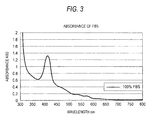
- Fig. 3 is a view showing relationships between the absorbance and the wavelength in fetal bovine serum (FBS).
- Fig. 3 is a view showing the absorbance in the case of 100% FBS.
- the abscissa indicates the wavelength in the range of 300 to 800 nm
- the ordinate indicates the absorbance (ABS) in the range of 0 to 2.
- a peak exists in the vicinity of the wavelength of 411 nm, and the absorbance is gradually reduced at the wavelengths other than it.
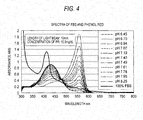
- Fig. 4 is a view showing in an overlapping manner the relationships between the absorbance and the wavelength in fetal bovine serum (FBS) of Fig. 3 , and those in Fig. 2 .
- FBS fetal bovine serum
- FBS fetal bovine serum
- Fig. 2 is a view showing relationships between the wavelength and the absorbance of phenol red at 300 to 800 nm in a medium in which fetal bovine serum (FBS) does not exist (0% FBS), at pHs of 6.20 to 8.25.
- FBS fetal bovine serum
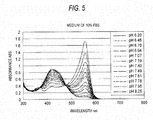
- Fig. 5 is a view showing relationships between the wavelength and the absorbance of phenol red at 300 to 800 nm in a medium in which 10% of fetal bovine serum (FBS) exists (10% FBS), at pHs of 6.20 to 8.25. As compared with Fig. 2 , when FBS is mixed, the absorption spectrum of phenol red is changed.
- FBS fetal bovine serum
- Fig. 6 is a view showing relationships between the wavelength and the absorbance of phenol red at 300 to 800 nm in a medium in which 20% of fetal bovine serum (FBS) exists (20% FBS), at pHs of 6.20 to 8.25. As compared with Fig. 2 , when FBS is further mixed, the absorption spectrum of phenol red is more changed.
- FBS fetal bovine serum
- Fig. 7 shows relationships between the logarithm ⁇ of the absorbance and the pH.
- the ordinate indicates the logarithm ⁇ of the absorbance
- ⁇ log ((A560 - A700) /(A430 - A700)), i.e. , a value which is obtained by correcting absorbances at wavelengths of 430 nm and 560 nm by the wavelength of 700 nm
- the abscissa indicates pH 6.20 to pH 8.25.
- the figure shows medium examples in which fetal bovine serum (FBS) is 0%, 10%, and 20%, respectively.
- FBS fetal bovine serum
- Fig. 8 shows a range of pH 7 to pH 7.8 which is a part of Fig. 7 showing the relationships between the logarithm ⁇ of the absorbance and the pH.
- FBS fetal bovine serum
- FBS fetal bovine serum
- calculation is performed by using the absorbance at or in a vicinity of 477 nm which is converged in the range where FBS exists at 0% to 20%, to indicate the same value, and the absorbances at 411 nm where FBS alone shows a peak, 430 nm where a first peak of phenol red exists, and 558 nm where a second peak exists.
- Fig. 9 shows relationships between an actual pH value and a calculated pH value obtained by the regression expression indicated by [Expression 1] due to multiple regression analysis.
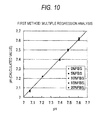
- Fig. 10 shows an example in a range of pH 7 to pH 7.6.
- DMEM a usual medium
- SkBM which is specialized in culturing of myoblast cells may be used.
- the wavelengths of the light beams emitted from the LEDs in the case where fetal bovine serum (FBS) exists in phenol red are indicated by ⁇ 1 to ⁇ 4, respectively.
- the respective absorbances A ⁇ 1 to A ⁇ 4 are indicated by the sum of the absorbance of FBS and that of phenol red as expressed by [Expression 2] below.
- a ⁇ ⁇ 1 ⁇ FBS_ ⁇ ⁇ 1 ⁇ C FBS ⁇ D + ⁇ PR_ ⁇ ⁇ 1 ⁇ C PR ⁇ D + A offset_ ⁇ ⁇ 1
- a ⁇ ⁇ 2 ⁇ FBS_ ⁇ ⁇ 2 ⁇ C FBS ⁇ D + ⁇ PR_ ⁇ ⁇ 2 ⁇ C PR ⁇ D + A offset_ ⁇ ⁇ 2
- a ⁇ ⁇ 3 ⁇ FBS_ ⁇ ⁇ 3 ⁇ C FBS ⁇ D + ⁇ PR_ ⁇ ⁇ 3 ⁇ C PR ⁇ D + A offset_ ⁇ ⁇ 3
- a ⁇ ⁇ 4 ⁇ FBS_ ⁇ ⁇ 4 ⁇ C FBS ⁇ D + ⁇ PR_ ⁇ ⁇ 4 ⁇ C PR ⁇ D + A offset_ ⁇ ⁇ 4
- a ⁇ ⁇ 1 ⁇ FBS_ ⁇ ⁇ 1 ⁇ C FBS ⁇ D + B 0 _ ⁇ ⁇ 1 ⁇ pH + B 1 _ ⁇ ⁇ 1 ⁇ C PR ⁇ D + S ⁇ ⁇ 1 ⁇
- a offset A ⁇ ⁇ 2 ⁇ FBS_ ⁇ ⁇ 2 ⁇ C FBS ⁇ D + B 0 _ ⁇ ⁇ 2 ⁇ pH + B 1 _ ⁇ ⁇ 2 ⁇ C PR ⁇ D + S ⁇ ⁇ 2 ⁇
- a offset A ⁇ ⁇ 3 ⁇ FBS_ ⁇ ⁇ 3 ⁇ C FBS ⁇ D + B 0 _ ⁇ ⁇ 3 ⁇ pH + B 1 _ ⁇ ⁇ 3 ⁇ C PR ⁇ D + S ⁇ ⁇ 3 ⁇
- a offset A ⁇ ⁇ 4 ⁇ FBS_ ⁇ ⁇ 4 ⁇ C FBS ⁇ D + B 0 _ ⁇ ⁇ 4 ⁇ pH + B 1 _ ⁇
- a ⁇ ⁇ 1 A ⁇ ⁇ 2 A ⁇ ⁇ 3 A ⁇ ⁇ 4 ⁇ FBS_ ⁇ ⁇ 1 B 0 _ ⁇ ⁇ 1 B 1 _ ⁇ ⁇ 1 S ⁇ ⁇ 1 ⁇ FBS_ ⁇ ⁇ 2 B 0 _ ⁇ ⁇ 2 B 1 _ ⁇ ⁇ 2 S ⁇ ⁇ 2 ⁇ FBS_ ⁇ ⁇ 3 B 0 _ ⁇ ⁇ 3 B 1 _ ⁇ ⁇ 3 S ⁇ ⁇ 3 ⁇ FBS_ ⁇ ⁇ 4 B 0 _ ⁇ ⁇ 4 B 1 _ ⁇ ⁇ 4 S ⁇ ⁇ 4 ⁇ C FBS ⁇ D pH ⁇ C PR ⁇ D C PR ⁇ D A offset
- a ⁇ ⁇ 1 A ⁇ ⁇ 2 A ⁇ ⁇ 3 A ⁇ ⁇ 4 is measurable
- the pH is obtained from this expression.
- the concentration of FBS, that of phenol red, and the pH can be calculated by substituting the absorbances at the wavelengths (for example, ⁇ 1 is 411 nm, ⁇ 2 is 430 nm, ⁇ 3 is 558 nm, and ⁇ 4 is 700 nm) in [Expression 6] below.
- Figs. 12 , 13 , and 14 show results of calculations by [Expression 5] above.
- the pH can be calculated irrespective of the concentrations of phenol red and FBS.
- the correction has been described by exemplifying an approximation to a linear function.
- the invention is not limited to this.
- a further wavelength may be added, and the calculation may be performed by using a 5 x 5 determinant.
- FBS fetal bovine serum
- the respective absorbances A ⁇ 1 to A ⁇ 4 in the case where the wavelengths of the light beams emitted from the LEDs are indicated by ⁇ 1 to ⁇ 4 are indicated by the sum of the absorbance and that of phenol red as expressed by [Expression 7] below.
- a ⁇ ⁇ 1 ⁇ FBS_ ⁇ ⁇ 1 ⁇ C FBS ⁇ D + ⁇ PR_ ⁇ ⁇ 1 ⁇ C PR ⁇ D + A offset_ ⁇ ⁇ 1
- a ⁇ ⁇ 2 ⁇ FBS_ ⁇ ⁇ 2 ⁇ C FBS ⁇ D + ⁇ PR_ ⁇ ⁇ 2 ⁇ C PR ⁇ D + A offset_ ⁇ ⁇ 2
- a ⁇ ⁇ 3 ⁇ FBS_ ⁇ ⁇ 3 ⁇ C FBS ⁇ D + ⁇ PR_ ⁇ ⁇ 3 ⁇ C PR ⁇ D + A offset_ ⁇ ⁇ 3
- a ⁇ ⁇ 4 ⁇ FBS_ ⁇ ⁇ 4 ⁇ C FBS ⁇ D + ⁇ PR_ ⁇ ⁇ 4 ⁇ C PR ⁇ D + A offset_ ⁇ ⁇ 4
- the determinants indicated by [Expression 8] below may be constituted as a function in which the absorption coefficient ⁇ PR_ ⁇ 1 is an unknown. [Expression 8] is identical with [Expression 3] above.
- ⁇ PR_ ⁇ ⁇ 1 ⁇ PR_ ⁇ ⁇ 2 ⁇ PR_ ⁇ ⁇ 3 ⁇ PR_ ⁇ ⁇ 4 ... Linear function of ⁇ PR_ ⁇ ⁇ 1 ⁇ FBS_ ⁇ ⁇ 1 ⁇ C FBS ⁇ D ⁇ FBS_ ⁇ ⁇ 2 ⁇ C FBS ⁇ D ⁇ FBS_ ⁇ ⁇ 3 ⁇ C FBS ⁇ D ⁇ FBS_ ⁇ ⁇ 4 ⁇ C FBS ⁇ D ...
- First material FBS ⁇ PR_ ⁇ ⁇ 1 ⁇ C PR ⁇ D ⁇ PR_ ⁇ ⁇ 2 ⁇ C PR ⁇ D ⁇ PR_ ⁇ ⁇ 3 ⁇ C PR ⁇ D ⁇ PR_ ⁇ ⁇ 4 ⁇ C PR ⁇ D ...
- Second material pH indicator A offset_ ⁇ ⁇ 1 A offset_
- a ⁇ ⁇ 1 ⁇ FBS_ ⁇ ⁇ 1 ⁇ C FBS ⁇ D + ⁇ PR_ ⁇ ⁇ 1 ⁇ C PR ⁇ D + S ⁇ ⁇ 1 ⁇ A offset
- a ⁇ ⁇ 2 ⁇ FBS_ ⁇ ⁇ 2 ⁇ C FBS ⁇ D + B 0 _ ⁇ ⁇ 2 ⁇ ⁇ PR_ ⁇ ⁇ 2 + B 1 _ ⁇ ⁇ 2 ⁇ C PR ⁇ D + S ⁇ ⁇ 2 ⁇
- a offset A ⁇ ⁇ 3 ⁇ FBS_ ⁇ ⁇ 3 ⁇ C FBS ⁇ D + B 0 _ ⁇ ⁇ 3 ⁇ ⁇ PR_ ⁇ ⁇ 3 + B 1 _ ⁇ ⁇ 3 ⁇ C PR ⁇ D + S ⁇ ⁇ 3 ⁇ A offset
- a ⁇ ⁇ 4 ⁇ FBS_ ⁇ ⁇ 4 ⁇ C FBS ⁇ D + B 0 _ ⁇ ⁇ 4 ⁇ ⁇ PR
- a ⁇ ⁇ 1 A ⁇ ⁇ 2 A ⁇ ⁇ 3 A ⁇ ⁇ 4 ⁇ FBS_ ⁇ ⁇ 1 1 0 S ⁇ ⁇ 1 ⁇ FBS_ ⁇ ⁇ 2 B 0 _ ⁇ ⁇ 2 B 1 _ ⁇ ⁇ 2 S ⁇ ⁇ 2 ⁇ FBS_ ⁇ ⁇ 3 B 0 _ ⁇ ⁇ 3 B 1 _ ⁇ ⁇ 3 S ⁇ ⁇ 3 ⁇ FBS_ ⁇ ⁇ 4 B 0 _ ⁇ ⁇ 4 B 1 _ ⁇ ⁇ 4 S ⁇ ⁇ 4 ⁇ C FBS ⁇ D ⁇ PR_ ⁇ ⁇ 1 ⁇ C PR ⁇ D C PR ⁇ D A offset
- a ⁇ ⁇ 1 A ⁇ ⁇ 2 A ⁇ ⁇ 3 A ⁇ ⁇ 4 is measurable
- the pH is obtained by enabling the absorption coefficient at ⁇ 1 to be calculated.
- ⁇ PR_ ⁇ 1 can be obtained by substituting the absorbances at the wavelengths in [Expression 11] below, and hence the concentration of FBS, that of phenol red, and the pH can be calculated.
- the absorption coefficient and the pH have the relationships shown in Fig. 17 .
- the pH can be uniquely calculated.
- the correction has been described by exemplifying an approximation to a linear function.
- the invention is not limited to this.
- a further wavelength may be added, and the calculation may be performed by using a 5 x 5 determinant.
- the wavelengths of 367 nm and 479 nm are wavelengths which may correspond respectively to convergence points where, even when the pH value is changed, absorbances are converged to the same value.
- Fig. 16 shows results of calculations by [Expression 12] (relationships between the pH and a calculated pH).
- the pH can be calculated irrespective of the concentrations of phenol red and FBS, and is well coincident with the pH which is a calculation result of [Expression 4].
- the method is particularly effective in that it does not depend on the pH range of the medium, and the stable relationships (linear function) are held.
- Phenol red and fetal bovine serum which have been exemplified as a pH indicator and a cell proliferation factor in the examples of the invention, respectively.
- the pH indicator and the cell proliferation factor are not limited to them.
- the values of the wavelengths of the light emitting element may be adequately changed in accordance with their absorption spectra.
- the pH value of the cell culture solution can be correctly measured. Even when the concentration of the FBS is momentarily changed, moreover, it is possible to measure the pH value corresponding to the change.
- FBS fetal bovine serum
Landscapes
- Life Sciences & Earth Sciences (AREA)
- Chemical & Material Sciences (AREA)
- Health & Medical Sciences (AREA)
- General Health & Medical Sciences (AREA)
- Engineering & Computer Science (AREA)
- Physics & Mathematics (AREA)
- Analytical Chemistry (AREA)
- Biochemistry (AREA)
- Zoology (AREA)
- Bioinformatics & Cheminformatics (AREA)
- Immunology (AREA)
- Pathology (AREA)
- Organic Chemistry (AREA)
- Wood Science & Technology (AREA)
- General Physics & Mathematics (AREA)
- Plasma & Fusion (AREA)
- General Engineering & Computer Science (AREA)
- Biotechnology (AREA)
- Microbiology (AREA)
- Sustainable Development (AREA)
- Chemical Kinetics & Catalysis (AREA)
- Biophysics (AREA)
- Biomedical Technology (AREA)
- Genetics & Genomics (AREA)
- Molecular Biology (AREA)
- Investigating Or Analysing Materials By Optical Means (AREA)
- Investigating Or Analysing Materials By The Use Of Chemical Reactions (AREA)
- Investigating Or Analysing Biological Materials (AREA)
- Apparatus Associated With Microorganisms And Enzymes (AREA)
Abstract
Description
- The present invention relates to a method of measuring the pH of a cell culture solution, and also to an accurate pH measuring method and apparatus in which an influence of a predetermined component such as a cell proliferation factor of fetal bovine serum (FBS) that is contained in a medium and that has an unknown concentration is corrected.
- In order to grow and proliferate cells, the pH of a culture solution containing the cells must be within a range suitable for proliferation. During preparation or storage of such a cell culture solution, however, carbon dioxide which is contained in the cell culture solution is released, and the pH is increased, so that the pH is often deviated from the proliferation suitable range.
- Therefore, the pH is measured by a method in which, for example, the color change of phenol red that is contained in a cell culture solution is visually checked, or that in which the measurement is performed while pH electrodes are immersed in a cell culture solution. However, these methods have the following problems.
- In the case where the color change of phenol red contained in a cell culture solution is visually checked, an erroneous check may be caused. This is because an error often occurs in a visual check, and serum contained in a cell culture solution, such as fetal bovine serum exhibits a yellow color, and hence a check result is sometimes confused by the coloration.
- By contrast, in the case where pH electrodes are immersed in a cell culture solution, when the pH electrodes are not sufficiently sterilized, contamination due to bacteria or the like may occur.
- As a method of measuring the pH of a cell culture solution which is free from problems such as an error due to a visual check, and contamination in the case where pH electrodes are used, the following method is known (see
JP-B-06-34754 -
Fig. 1 is a block diagram showing a pH measuring apparatus which can measure the pH of a medium solution. - In the pH measuring apparatus of the example, a
light emitting element 1 is driven by adriving circuit 3 so as to emit light beams by using an electric power supplied from abattery 4. - Although the
light emitting element 1 is shown as one element inFig. 1 , the light emitting element is actually configured by a plurality of elements respectively emitting light beams of different wavelengths. More specifically, thelight emitting element 1 is configured by at least four elements such as: an element emitting a light beam of 411 nm band which is a peak of the absorbance corresponding to fetal bovine serum (FBS) ; that emitting a light beam of 430 or 560 nm band indicating a peak of the absorbance of phenol red (pH indicator); that emitting a light beam of 367 or 479 nm band indicating a value to which the absorbance is unchanged and converged irrespective of a change of the pH; and that emitting a light beam of 700 nm band in which, for example, fetal bovine serum and phenol red do not exhibit absorbance. For example, LEDs are preferably used as these elements. - The light beams emitted from the
light emitting element 1 are transmitted through asolution 5 in which the pH is to be measured, and then received by a light receivingelement 6, to be converted to electric signals. Although thelight receiving element 6 is shown as one element inFig. 1 , the light receiving element is actually configured by a plurality of elements respectively corresponding to the elements constituting thelight emitting element 1. Photodiodes are preferably used as these elements. In the case where thelight emitting element 1 is configured by four LEDs, namely, thelight receiving element 6 may be configured by four photodiodes. In place of the mode where thelight receiving element 6 receives light beams which have been transmitted through themeasurement solution 5, the light receiving element may be disposed so as to receive light beams reflected from themeasurement solution 5. - The signals which are converted in the
light receiving element 6 are amplified by anamplifier 7, and then distributed by amultiplexer 8 tofilters 9 which correspond to the light wavelengths, respectively. - The signals distributed to the
filters 9 are filtered by thefilters 9 to reduce noise components, digitized by an A/D converter which is not shown, and then supplied to aprocessing section 10. For example, theprocessing section 10 is configured by a calculation processing device such as a CPU, a storage device, etc. -
JP-B-06-34754 - The method of measuring the pH of a cell culture solution is a method in which the pH is measured based on absorption of visible light in a cell culture solution configured by: a cell culture medium; serum; and an indicator having two or more kinds of absorption peaks in the wavelength region of visible light, wherein, based on a linear relationship between the pH and the logarithms of absorbances at two wavelengths of absorption peaks that are obtained by transmitting visible light through a cell culture solution in which the pH is known, the value of the pH is obtained from the value of the logarithm of a ratio of absorbances of absorption peaks that are measured in a cell culture solution specimen in which the pH is not known.
- In the cell culture solution, usually, phenol red for detecting a change of the pH is contained at a low concentration which does not harm cells. In the visible light range, at such a low concentration, phenol red has peaks in the vicinities of 430 to 440 nm and 560 nm, and an isosbestic point at 480 nm. In a pH range of 6.8 to 7.6 where cells can grow, as the pH is further lowered, the absorption peak in the vicinity of 430 to 444 nm is more increased, and that in the vicinity of 560 nm is more decreased. When absorption due to only the phenol red is obtained, by taking a ratio of absorption in the vicinity of 430 to 440 nm to that in the vicinity of 560 nm, the plot shows one curve, and the pH of the culture solution can be calculated from a ratio of the two peaks.
- In the related-art optical pH measurement, moreover, the zero level measurement is performed with a sample blank prior to measuring the sample, and the absorption levels of the blank are then subtracted from the sample reading to provide the net absorbance of the sample. The vicinity of the wavelength (700 nm) which shows very little absorption by the indicator is chosen as the third wavelength, and is used as means for tracking changes in the zero level. Changes in the absorption level of this wavelength channel are indicative of changes in the zero level. Therefore, the other two wavelengths which are used in the measurement are zero corrected based on the changes measured at this third wavelength.
- In the related-art method of measuring the pH of a cell culture solution disclosed in
JP-B-06-34754 - The optical absorbance characteristic of fetal bovine serum (FBS) is largely different from that of phenol red, and hence a measurement value obtained in the pH measuring method disclosed in
JP-B-06-34754 JP-B-06-34754 - It is therefore an object of the invention to provide a pH measuring method in which the pH of a cell culture solution can be correctly measured irrespective of the concentration of a proliferation factor such as fetal bovine serum (FBS) contained in the cell culture solution, and also an apparatus for measuring pH of a cell culture solution.
- In order to achieve the object, according to the invention, there is provided a pH measuring method comprising: illuminating a medium solution with a plurality of light beams, the medium solution including: a first material which, in a wavelength region of 300 nm to 800 nm, has a first absorption peak; and a second material which, in the wavelength region of 300 nm to 800 nm, has a second absorption peak or a second convergence point where an absorbance is converged irrespective of a pH, and a third absorption peak or a third convergence point where an absorbance is converged irrespective of a pH, the plurality of light beams including: a first light beam, a wavelength of which corresponds to the first absorption peak; a second light beam, a wavelength of which corresponds to the second absorption peak or the second convergence point; a third light beam, a wavelength of which corresponds to the third absorption peak or the third convergence point; and a fourth light beam, a wavelength of the fourth light beam at which an absorbance of at least one of the first material and the second material is converged irrespective of a pH; receiving transmitted or reflected light beams of the first to fourth light beams; measuring absorbances at the wavelengths of the received transmitted or reflected light beams of the first to fourth light beams respectively; and calculating a pH of the medium solution based on the measured absorbances.
- The pH of the medium solution may be calculated with correction using multiple regression analysis in which a logarithm of an absorbance ratio calculated from the measured absorbances is employed.
- The multiple regression analysis may be performed by a regression expression indicated by following expression:


- The pH of the medium solution may be calculated with an expression including a sum of the absorbance of the first material and the absorbance of the second material.
- The expression may include one of a first function in which the pH is a variable and a second function in which an absorption coefficient is a variable.
- In a case where the expression includes the first function, the pH may be calculated by following expression:

where


- In a case where the expression includes the second function, the pH may be calculated based on an absorption coefficient which is obtained by following expression:

where


- In a case where: the wavelength of the second light beam corresponds to the second convergence point; the second light beam is a light beam of 480 nm; the wavelength of the third light beam corresponds to the third convergence point; the third light beam is a light beam of 370 nm; and the fourth light beam is a light beam, a wavelength of the light beam at which the absorbances of both the first material and the second material are converged irrespective of a pH, the pH may be calculated by following expression:

- In the calculating process, a concentration of at least one of the first material and the second material may be calculated based on the expression.
- The first material may be fetal bovine serum or bovine calf serum, and the second material may be phenol red.
- The first absorption peak may be at or in a vicinity of 410 nm, the second absorption peak may be at or in a vicinity of 430 nm, and the third absorption peak may be at or in a vicinity of 560 nm.
- According to the invention, there is also provided a pH measuring apparatus incorporating the pH measuring method.
- According to the invention, there is also provided a pH measuring apparatus comprising: a light emitting section configured to emit a plurality of light beams, the plurality of light beams including: a first light beam, a wavelength of which corresponds to a first absorption peak; a second light beam, a wavelength of which corresponds to a second absorption peak or a second convergence point where an absorbance is converged irrespective of a pH; a third light beam, a wavelength of which corresponds to a third absorption peak or a third convergence point where an absorbance is converged irrespective of a pH; and a fourth light beam, a wavelength of the fourth light beam at which an absorbance of at least one of a first material and a second material is converged irrespective of a pH; a light receiving section configured to measure absorbances of the wavelengths of the first to fourth light beams respectively; and a calculating section configured to calculate a pH from values of the absorbances.
-
-
Fig. 1 is a block diagram showing the apparatus for measuring the pH of a solution. -
Fig. 2 is a view showing relationships between the absorbance and the wavelength in phenol red alone. -
Fig. 3 is a view showing relationships between the absorbance and the wavelength in fetal bovine serum (FBS) alone. -
Fig. 4 is a view showing in an overlapping manner the relationships between the absorbance and the wavelength in fetal bovine serum (FBS) alone ofFig. 3 , and those in phenol red alone ofFig. 2 . -
Fig. 5 is a view showing relationships between the wavelength and the absorbance of phenol red at 300 to 800 nm in a medium in which 10% of fetal bovine serum (FBS) exists (10% FBS), at pHs of 6.20 to 8.25. -
Fig. 6 is a view showing relationships between the wavelength and the absorbance of phenol red at 300 to 800 nm in a medium in which 20% of fetal bovine serum (FBS) exists (20% FBS), at pHs of 6.20 to 8.25. -
Fig. 7 is a view showing relationships between the logarithm Φ of the absorbance and the pH due to a difference of the concentration of fetal bovine serum (FBS). -
Fig. 8 is a view enlargedly showing a range ofpH 7 to pH 7.8 which is a part of the relationships between the logarithm Φ of the absorbance and the pH shown inFig. 7 . -
Fig. 9 is a view showing relationships between an actual pH value and a calculated pH value obtained by a regression expression indicated by [Expression 1] due to multiple regression analysis. -
Fig. 10 is a view enlargedly showing a range ofpH 7 to pH 7.6 which is a part of the relationships between an actual pH value and a calculated pH value obtained by the regression expression indicated by [Expression 1] due to multiple regression analysis. -
Fig. 11 is a view showing relationships between the absorption coefficient αPR_J of phenol red and the pH. -
Fig. 12 is a view showing results of calculations by [Expression 5] (relationships between the FBS concentration and a calculated FBS concentration). -
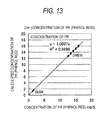
Fig. 13 is a view showing results of calculations by [Expression 5] (relationships between the concentration of phenol red and a calculated concentration of phenol red). -
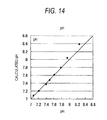
Fig. 14 is a view showing results of calculations by [Expression 5] (relationships between the pH and a calculated pH). -
Fig. 15 is a view showing results of calculations by using [Expression 12] in which the abscissa indicates the pH and the ordinate indicates the absorbance ratio. -
Fig. 16 is a view showing results of calculations by using [Expression 12] (relationships between the pH and a calculated pH). -
Fig. 17 is a view showing relationships between the absorption coefficient and the pH. - First, relationships between the absorbance and the wavelength of light both in the case where fetal bovine serum (FBS) is contained in a cell culture solution, and in the case where fetal bovine serum (FBS) is not contained in a cell culture solution, or the case of phenol red alone are shown in
Figs. 2 to 6 . -
Fig. 2 is a view showing the absorbance of phenol red alone in a usual medium (DMEM) in which fetal bovine serum (FBS) does not exist, at a wavelength of 300 to 800 nm and at pHs of 6.20 to 8.25. In the figure, the abscissa indicates the wavelength in the range of 300 to 800 nm, and the ordinate indicates the absorbance (ABS) in the range of 0 to 2. - In
Fig. 2 , peaks exist at the wavelengths of 430 nm and 560 nm, and the absorbance is substantially zero at the wavelength of 700 nm. At the wavelengths of 367 nm and 479 nm, the absorbance converges to indicate the same value at all pH values. -
Fig. 3 is a view showing relationships between the absorbance and the wavelength in fetal bovine serum (FBS). -
Fig. 3 is a view showing the absorbance in the case of 100% FBS. In the figure, the abscissa indicates the wavelength in the range of 300 to 800 nm, and the ordinate indicates the absorbance (ABS) in the range of 0 to 2. - In
Fig. 3 , a peak exists in the vicinity of the wavelength of 411 nm, and the absorbance is gradually reduced at the wavelengths other than it. -
Fig. 4 is a view showing in an overlapping manner the relationships between the absorbance and the wavelength in fetal bovine serum (FBS) ofFig. 3 , and those inFig. 2 . - Next, the influence of fetal bovine serum (FBS) exerted on the absorbance of phenol red will be discussed.
-
Fig. 2 is a view showing relationships between the wavelength and the absorbance of phenol red at 300 to 800 nm in a medium in which fetal bovine serum (FBS) does not exist (0% FBS), at pHs of 6.20 to 8.25. -
Fig. 5 is a view showing relationships between the wavelength and the absorbance of phenol red at 300 to 800 nm in a medium in which 10% of fetal bovine serum (FBS) exists (10% FBS), at pHs of 6.20 to 8.25. As compared withFig. 2 , when FBS is mixed, the absorption spectrum of phenol red is changed. -
Fig. 6 is a view showing relationships between the wavelength and the absorbance of phenol red at 300 to 800 nm in a medium in which 20% of fetal bovine serum (FBS) exists (20% FBS), at pHs of 6.20 to 8.25. As compared withFig. 2 , when FBS is further mixed, the absorption spectrum of phenol red is more changed. - As shown in
Figs. 2 ,5 , and6 , in the case where fetal bovine serum exists in some degree, the premise, which holds inFig. 2 , that, by taking a ratio of absorption in the vicinity of 430 nm to that in the vicinity of 560 nm, the plot shows one curve, and therefore the pH of a culture solution can be calculated from a ratio of two peaks of phenol red is not satisfied. Consequently, it will be seen that the pH value of a cell culture solution cannot be correctly measured. -
Fig. 7 shows relationships between the logarithm Φ of the absorbance and the pH. - In
Fig. 7 , the ordinate indicates the logarithm Φ of the absorbance, Φ = log ((A560 - A700) /(A430 - A700)), i.e. , a value which is obtained by correcting absorbances at wavelengths of 430 nm and 560 nm by the wavelength of 700 nm, and the abscissa indicates pH 6.20 to pH 8.25. The figure shows medium examples in which fetal bovine serum (FBS) is 0%, 10%, and 20%, respectively. - Next,
Fig. 8 shows a range ofpH 7 to pH 7.8 which is a part ofFig. 7 showing the relationships between the logarithm Φ of the absorbance and the pH. - In
Fig. 8 , the cases where fetal bovine serum (FBS) is 0%, 10%, and 20% can be approximated by the following expressions: - y1 = 0.9018x - 6.7154 R2 = 0.9975 (
FBS 0%),
and
- Next, correction of the influence of fetal bovine serum (FBS) will be described.
- In the application, the followings are discussed as a method of correcting the influence of fetal bovine serum (FBS).
- As a first correcting method, multiple regression analysis will be described.
- For example, the basic expression of multiple regression analysis is expressed by [Expression 1] below. In the expression, B indicates a constant, Φ indicates the absorbance ratio, and A indicates the absorbance.

- In the regression expression, calculation is performed by using the absorbance at or in a vicinity of 477 nm which is converged in the range where FBS exists at 0% to 20%, to indicate the same value, and the absorbances at 411 nm where FBS alone shows a peak, 430 nm where a first peak of phenol red exists, and 558 nm where a second peak exists.
-
Fig. 9 shows relationships between an actual pH value and a calculated pH value obtained by the regression expression indicated by [Expression 1] due to multiple regression analysis. - In the relationships between an actual pH value and a calculated pH value obtained by the regression expression, as shown in
Fig. 9 , it can be seen that the influence of a change of the concentration of fetal bovine serum (FBS) is large at the pH of 6.5 or less, and small at the pH of 7 or more. -
Fig. 10 shows an example in a range ofpH 7 to pH 7.6. - From the above results, excellent measurements can be performed by multiple regression analysis.
- As shown in
Fig. 10 , in the range ofpH 7 to pH 7.6, particularly, the relationships can be approximated by a straight line, and hence more excellent measurements are enabled. - In the above, the example in which a usual medium (DMEM) is used has been described. As a medium, instead of the usual medium (DMEM), SkBM which is specialized in culturing of myoblast cells may be used.
- In SkBM, the concentration of phenol red is about 1/10 of that of DMEM. Therefore, the influence of the absorbance of fetal bovine serum (FBS) is largely exerted, and the regression expression which is used in the above multiple regression analysis cannot be applied. In the case where the medium is SkBM, consequently, there remains the problem in that the pH cannot be correctly measured.
- As a second correcting method, matrix calculation (simultaneous expression) will be described.
- The wavelengths of the light beams emitted from the LEDs in the case where fetal bovine serum (FBS) exists in phenol red are indicated by λ1 to λ4, respectively. The respective absorbances Aλ1 to Aλ4 are indicated by the sum of the absorbance of FBS and that of phenol red as expressed by [Expression 2] below.

- As shown in
Fig. 11 , in the range ofpH 7 to pH 8.0, relationships between the absorption coefficient αPR_λ1 of phenol red and the pH can be approximated by a linear expression. In the correcting method, namely, the determinants indicated by [Expression 3] below are constituted as a function in which the pH is an unknown.

- Therefore, the absorbance Aλ1 can be expressed as [Expression 4] below.

- Here, the absorbances at the wavelengths λ1 to λ4 can be expressed by [Expression 5] below.

where


- The pH is obtained from this expression.
- According to the calculation of [Expression 1] above, the concentration of FBS, that of phenol red, and the pH can be calculated by substituting the absorbances at the wavelengths (for example, λ1 is 411 nm, λ2 is 430 nm, λ3 is 558 nm, and λ4 is 700 nm) in [Expression 6] below.

-
Figs. 12 ,13 , and14 show results of calculations by [Expression 5] above. - As apparent from the calculation results shown in
Figs. 12 to 14 , the pH can be calculated irrespective of the concentrations of phenol red and FBS. - As seen from the calculation results shown in
Fig. 14 , when the pH of the medium is in the range of 7 to 8, the calculation can be performed at an early stage, and monitoring can be continuously conducted. Therefore, this is particularly effective. However, there remains the problem in that a large error is produced outside a predetermined pH range of the medium. - The correction has been described by exemplifying an approximation to a linear function. However, the invention is not limited to this. In the case of an approximation to a quadratic function, a further wavelength may be added, and the calculation may be performed by using a 5 x 5 determinant.
- As a third correcting method, removal of the influence of fetal bovine serum (FBS) will be described.
- As described in the second correcting method, when fetal bovine serum (FBS) exists in phenol red, the respective absorbances Aλ1 to Aλ4 in the case where the wavelengths of the light beams emitted from the LEDs are indicated by λ1 to λ4 are indicated by the sum of the absorbance and that of phenol red as expressed by [Expression 7] below.

- Unlike the second correcting method, the determinants indicated by [Expression 8] below may be constituted as a function in which the absorption coefficient αPR_λ1 is an unknown. [Expression 8] is identical with [Expression 3] above.


- Therefore, the absorption coefficient αPR_λ1 can be expressed by [Expression 9] below.

- Here, the absorbances at the wavelengths λ1 to λ4 can be expressed by [Expression 10] below.

where


- The pH is obtained by enabling the absorption coefficient at λ1 to be calculated.
- According to the calculation by [Expression 5] above, αPR_λ1 can be obtained by substituting the absorbances at the wavelengths in [Expression 11] below, and hence the concentration of FBS, that of phenol red, and the pH can be calculated.
- The absorption coefficient and the pH have the relationships shown in
Fig. 17 . When the absorption coefficient αPR_λ1 is obtained, the pH can be uniquely calculated. - The correction has been described by exemplifying an approximation to a linear function. However, the invention is not limited to this. In the case of an approximation to a quadratic function, a further wavelength may be added, and the calculation may be performed by using a 5 x 5 determinant.

- As sown in
Fig. 2 , in the absorbance of phenol red, peaks exist at the wavelengths of 430 nm and 560 nm, and is substantially zero at the wavelength of 700 nm. The wavelengths of 367 nm and 479 nm are wavelengths which may correspond respectively to convergence points where, even when the pH value is changed, absorbances are converged to the same value. - In the case where the characteristics are used and the third correcting method is applied, when, in the calculation of [Expression 11], the absorbances at the wavelengths (for example, λ1 is 411 nm, λ2 is 478 nm, λ3 is 367 nm, and λ4 is 700 nm) are substituted in [Expression 12] below, elements of the matrix can be replaced with 0. Therefore, the matrix can be simplified, and the concentration of FBS, that of phenol red, and the pH can be accurately calculated.

- When results calculated by [Expression 12] are shown in
Fig. 15 while the abscissa represents the pH and the ordinate represents the absorbance ratio, it is seen that the results are substantially approximated by a straight line. -
Fig. 16 shows results of calculations by [Expression 12] (relationships between the pH and a calculated pH). - As seen from
Figs. 15 and16 , the pH can be calculated irrespective of the concentrations of phenol red and FBS, and is well coincident with the pH which is a calculation result of [Expression 4]. - The method is particularly effective in that it does not depend on the pH range of the medium, and the stable relationships (linear function) are held.
- Phenol red and fetal bovine serum (FBS) which have been exemplified as a pH indicator and a cell proliferation factor in the examples of the invention, respectively. The pH indicator and the cell proliferation factor are not limited to them. In the case where a pH indicator and a cell proliferation factor other than phenol red and fetal bovine serum (FBS) are employed, the values of the wavelengths of the light emitting element may be adequately changed in accordance with their absorption spectra.
- According to an aspect of the invention, even in the case where a proliferation factor such as fetal bovine serum (FBS) the concentration of which is unknown is contained in a cell culture solution, the pH value of the cell culture solution can be correctly measured. Even when the concentration of the FBS is momentarily changed, moreover, it is possible to measure the pH value corresponding to the change.
Claims (13)
- A pH measuring method comprising:illuminating a medium solution with a plurality of light beams,
the medium solution including:a first material which, in a wavelength region of 300 nm to 800 nm, has a first absorption peak; anda second material which, in the wavelength region of 300 nm to 800 nm, has a second absorption peak or a second convergence point where an absorbance is converged irrespective of a pH, and a third absorption peak or a third convergence point where an absorbance is converged irrespective of a pH,the plurality of light beams including:a first light beam, a wavelength of which corresponds to the first absorption peak;a second light beam, a wavelength of which corresponds to the second absorption peak or the second convergence point;a third light beam, a wavelength of which corresponds to the third absorption peak or the third convergence point; anda fourth light beam, a wavelength of the fourth light beam at which an absorbance of at least one of the first material and the second materialis converged irrespective of a pH;receiving transmitted or reflected light beams of the first to fourth light beams;measuring absorbances at the wavelengths of the received transmitted or reflected light beams of the first to fourth light beams respectively; andcalculating a pH of the medium solution based on the measured absorbances. - The pH measuring method according to claim 1, wherein the pH of the medium solution is calculated with correction using multiple regression analysis in which a logarithm of an absorbance ratio calculated from the measured absorbances is employed.
- The pH measuring method according to claim 2, wherein the multiple regression analysis is performed by a regression expression indicated by following expression:


- The pH measuring method according to claim 1, wherein the pH of the medium solution is calculated with an expression including a sum of the absorbance of the first material and the absorbance of the second material.
- The pH measuring method according to claim 4, wherein the expression includes one of a first function in which the pH is a variable and a second function in which an absorption coefficient is a variable.
- The pH measuring method according to claim 5, wherein, in a case where the expression includes the first function, the pH is calculated by following expression:

where


- The pH measuring method according to claim 5, wherein, in a case where the expression includes the second function, the pH is calculated based on an absorption coefficient which is obtained by following expression:

where


- The pH measuring method according to claim 4, wherein, in a case where:the wavelength of the second light beam corresponds to the second convergence point;the second light beam is a light beam of 480 nm;the wavelength of the third light beam corresponds to the third convergence point;the third light beam is a light beam of 370 nm; andthe fourth light beam is a light beam, a wavelength of the light beam at which the absorbances of both the first material and the second material are converged irrespective of a pH, the pH is calculated by following expression:

- The pH measuring method according to claim 4, wherein, in the calculating process, a concentration of at least one of the first material and the second material is calculated based on the expression.
- The pH measuring method according to claim 1, wherein the first material is fetal bovine serum or bovine calf serum, and the second material is phenol red.
- The pH measuring method according to claim 1, wherein the first absorption peak is at or in a vicinity of 410 nm, the second absorption peak is at or in a vicinity of 430 nm, and the third absorption peak is at or in a vicinity of 560 nm.
- A pH measuring apparatus incorporating the pH measuring method according to claim 1.
- A pH measuring apparatus comprising:a light emitting section configured to emit a plurality of light beams,
the plurality of light beams including:a first light beam, a wavelength of which corresponds to a first absorption peak;a second light beam, a wavelength of which corresponds to a second absorption peak or a second convergence point where an absorbance is converged irrespective of a pH;a third light beam, a wavelength of which corresponds to a third absorption peak or a third convergence point where an absorbance is converged irrespective of a pH; anda fourth light beam, a wavelength of the fourth light beam at which an absorbance of at least one of a first material and a second material isconverged irrespective of a pH;a light receiving section configured to measure absorbances of the wavelengths of the first to fourth light beams respectively; anda calculating section configured to calculate a pH from values of the absorbances.
Applications Claiming Priority (1)
| Application Number | Priority Date | Filing Date | Title |
|---|---|---|---|
| JP2011079705A JP5681548B2 (en) | 2011-03-31 | 2011-03-31 | Method for measuring pH of medium solution and pH measuring apparatus |
Publications (3)
| Publication Number | Publication Date |
|---|---|
| EP2505992A2 true EP2505992A2 (en) | 2012-10-03 |
| EP2505992A3 EP2505992A3 (en) | 2013-05-22 |
| EP2505992B1 EP2505992B1 (en) | 2018-09-19 |
Family
ID=46149138
Family Applications (1)
| Application Number | Title | Priority Date | Filing Date |
|---|---|---|---|
| EP12162312.8A Active EP2505992B1 (en) | 2011-03-31 | 2012-03-30 | Method and apparatus for measuring the pH of a medium solution |
Country Status (4)
| Country | Link |
|---|---|
| US (1) | US9291572B2 (en) |
| EP (1) | EP2505992B1 (en) |
| JP (1) | JP5681548B2 (en) |
| CN (1) | CN102735626B (en) |
Cited By (2)
| Publication number | Priority date | Publication date | Assignee | Title |
|---|---|---|---|---|
| CN103592246A (en) * | 2013-11-22 | 2014-02-19 | 武汉友芝友医疗科技有限公司 | Body fluid pH value test method and device |
| EP2618129B1 (en) * | 2012-01-23 | 2017-11-01 | Airbus Defence and Space GmbH | Method of determining the pH-value of an aqueous liquid and corresponding sensor arrangement |
Families Citing this family (7)
| Publication number | Priority date | Publication date | Assignee | Title |
|---|---|---|---|---|
| JP5869937B2 (en) * | 2012-03-29 | 2016-02-24 | 日本光電工業株式会社 | Method and apparatus for measuring the level of cell culture fluid |
| JP5637278B2 (en) * | 2012-11-06 | 2014-12-10 | 栗田工業株式会社 | Automatic measurement method of lysate concentration |
| CN106442330A (en) * | 2016-09-14 | 2017-02-22 | 深圳中盛智兴科技有限公司 | Liquid pH value detection method and device |
| JP7079319B2 (en) * | 2018-04-05 | 2022-06-01 | オリンパス株式会社 | Acid dissociation equilibrium estimation method, acid dissociation equilibrium estimation device, acid dissociation equilibrium estimation system, and user interface device |
| WO2021005652A1 (en) * | 2019-07-05 | 2021-01-14 | オリンパス株式会社 | Inspection method and system |
| CN110376190B (en) * | 2019-08-19 | 2020-05-19 | 世翱(上海)生物医药科技有限公司 | Spectrum-based cell culture suspension pH value detection method |
| US20220404286A1 (en) * | 2019-10-04 | 2022-12-22 | Kyocera Corporation | Ph measurement method and ph measurement device |
Citations (1)
| Publication number | Priority date | Publication date | Assignee | Title |
|---|---|---|---|---|
| JPH0634754B2 (en) | 1985-11-14 | 1994-05-11 | 住友電気工業株式会社 | Method for measuring pH of cell culture medium |
Family Cites Families (13)
| Publication number | Priority date | Publication date | Assignee | Title |
|---|---|---|---|---|
| JPH01165938A (en) * | 1987-12-23 | 1989-06-29 | Ebara Infilco Co Ltd | Detecting method and apparatus of ph |
| JPH0792432B2 (en) * | 1988-09-22 | 1995-10-09 | 株式会社東芝 | Automatic chemical analyzer |
| US6121050A (en) * | 1997-08-29 | 2000-09-19 | Han; Chi-Neng Arthur | Analyte detection systems |
| GB9719142D0 (en) * | 1997-09-09 | 1997-11-12 | Glaxo Group Ltd | Analytical method and apparatus therefor |
| US6379969B1 (en) * | 2000-03-02 | 2002-04-30 | Agilent Technologies, Inc. | Optical sensor for sensing multiple analytes |
| US7198756B2 (en) * | 2002-07-11 | 2007-04-03 | Optical Sensors Incorporated | Non-invasive measurement of pH |
| NO342836B1 (en) * | 2004-02-19 | 2018-08-13 | Schlumberger Technology Bv | Fluid Assays to Determine the pH of Formation Fluid, and Method of Making Reagent Mixture |
| JP5150837B2 (en) * | 2006-04-11 | 2013-02-27 | ウイリアム エー.クック オーストラリア ピティワイ、リミティド. | Culture state monitoring device |
| US7751863B2 (en) * | 2007-02-06 | 2010-07-06 | Glumetrics, Inc. | Optical determination of ph and glucose |
| US20080311614A1 (en) * | 2007-06-15 | 2008-12-18 | Wyeth | Methods for measuring ph in a small-scale cell culture system and predicting performance of cells in a large-scale culture system |
| JP5229806B2 (en) * | 2008-01-25 | 2013-07-03 | 独立行政法人海洋研究開発機構 | Apparatus and method for measuring carbon dioxide concentration in water |
| US7961327B1 (en) * | 2009-01-07 | 2011-06-14 | Bovaird & Co. | Optical pH sensor |
| JP5797911B2 (en) * | 2011-02-18 | 2015-10-21 | 日本光電工業株式会社 | Solution pH measurement method and solution pH measurement device |
-
2011
- 2011-03-31 JP JP2011079705A patent/JP5681548B2/en active Active
-
2012
- 2012-03-30 EP EP12162312.8A patent/EP2505992B1/en active Active
- 2012-03-31 CN CN201210093373.9A patent/CN102735626B/en active Active
- 2012-04-06 US US13/441,630 patent/US9291572B2/en active Active
Patent Citations (1)
| Publication number | Priority date | Publication date | Assignee | Title |
|---|---|---|---|---|
| JPH0634754B2 (en) | 1985-11-14 | 1994-05-11 | 住友電気工業株式会社 | Method for measuring pH of cell culture medium |
Cited By (2)
| Publication number | Priority date | Publication date | Assignee | Title |
|---|---|---|---|---|
| EP2618129B1 (en) * | 2012-01-23 | 2017-11-01 | Airbus Defence and Space GmbH | Method of determining the pH-value of an aqueous liquid and corresponding sensor arrangement |
| CN103592246A (en) * | 2013-11-22 | 2014-02-19 | 武汉友芝友医疗科技有限公司 | Body fluid pH value test method and device |
Also Published As
| Publication number | Publication date |
|---|---|
| CN102735626B (en) | 2017-06-09 |
| JP2012215428A (en) | 2012-11-08 |
| US9291572B2 (en) | 2016-03-22 |
| CN102735626A (en) | 2012-10-17 |
| US20120253692A1 (en) | 2012-10-04 |
| EP2505992A3 (en) | 2013-05-22 |
| EP2505992B1 (en) | 2018-09-19 |
| JP5681548B2 (en) | 2015-03-11 |
Similar Documents
| Publication | Publication Date | Title |
|---|---|---|
| EP2505992B1 (en) | Method and apparatus for measuring the pH of a medium solution | |
| JP6120842B2 (en) | Method and system for measuring the concentration of a substance in a body fluid | |
| CN105823739B (en) | Method for the determination of lipids and other interfering substances in body fluid samples | |
| US7663738B2 (en) | Method for automatically detecting factors that disturb analysis by a photometer | |
| US20190049468A9 (en) | Apparatus, method, and program for component measurement | |
| US20160313236A1 (en) | Method for determining the concentration of a substance in a deformable container | |
| US6372503B1 (en) | Calibrator material for instruments which measure interferents in serum and plasma specimens | |
| JP5118126B2 (en) | Fluorescence analysis | |
| EP3295159B1 (en) | Improved biosensor system analyte measurement | |
| US20120288409A1 (en) | Analysis device | |
| CA2469099A1 (en) | Spectroscopic method and apparatus for total hemoglobin measurement | |
| US20190391156A1 (en) | System and method for diagnosing sensor performance using analyte-independent ratiometric signals | |
| CN101949825B (en) | Leaf water near infrared non-destructive testing device and method in light open environment | |
| US20140361173A1 (en) | Device and Method for Identifying Refrigerants | |
| JP2024100862A (en) | System and method for signal normalization in a blood culture measurement system - Patents.com | |
| US10788416B2 (en) | Multiple wavelength light source for colorimetric measurement | |
| US9470572B2 (en) | Method and apparatus for measuring liquid level of cell culture solution | |
| US11220704B2 (en) | Method for measuring HbA1c | |
| EP0817957B1 (en) | Method for oximeter standardization and for reporting results | |
| WO2016071887A1 (en) | Method to measure glycated hemoglobin | |
| WO2025253745A1 (en) | pH MEASUREMENT DEVICE AND pH MEASUREMENT METHOD | |
| Biljak et al. | Performance of the statstrip glucose meter in inpatient management of diabetes mellitus. | |
| KR100967621B1 (en) | Measurement error correction method and device using kinetic change information | |
| JP2000146694A (en) | Spectral characteristic measuring device |
Legal Events
| Date | Code | Title | Description |
|---|---|---|---|
| PUAI | Public reference made under article 153(3) epc to a published international application that has entered the european phase |
Free format text: ORIGINAL CODE: 0009012 |
|
| AK | Designated contracting states |
Kind code of ref document: A2 Designated state(s): AL AT BE BG CH CY CZ DE DK EE ES FI FR GB GR HR HU IE IS IT LI LT LU LV MC MK MT NL NO PL PT RO RS SE SI SK SM TR |
|
| AX | Request for extension of the european patent |
Extension state: BA ME |
|
| PUAL | Search report despatched |
Free format text: ORIGINAL CODE: 0009013 |
|
| AK | Designated contracting states |
Kind code of ref document: A3 Designated state(s): AL AT BE BG CH CY CZ DE DK EE ES FI FR GB GR HR HU IE IS IT LI LT LU LV MC MK MT NL NO PL PT RO RS SE SI SK SM TR |
|
| AX | Request for extension of the european patent |
Extension state: BA ME |
|
| RIC1 | Information provided on ipc code assigned before grant |
Ipc: G01N 21/31 20060101ALI20130417BHEP Ipc: G01N 21/80 20060101AFI20130417BHEP Ipc: C12M 1/34 20060101ALI20130417BHEP Ipc: G01N 31/22 20060101ALI20130417BHEP Ipc: G01N 33/84 20060101ALI20130417BHEP |
|
| 17P | Request for examination filed |
Effective date: 20131120 |
|
| RBV | Designated contracting states (corrected) |
Designated state(s): AL AT BE BG CH CY CZ DE DK EE ES FI FR GB GR HR HU IE IS IT LI LT LU LV MC MK MT NL NO PL PT RO RS SE SI SK SM TR |
|
| GRAP | Despatch of communication of intention to grant a patent |
Free format text: ORIGINAL CODE: EPIDOSNIGR1 |
|
| STAA | Information on the status of an ep patent application or granted ep patent |
Free format text: STATUS: GRANT OF PATENT IS INTENDED |
|
| RIC1 | Information provided on ipc code assigned before grant |
Ipc: C12M 1/34 20060101ALI20180309BHEP Ipc: G01N 31/22 20060101ALI20180309BHEP Ipc: G01N 21/31 20060101ALN20180309BHEP Ipc: G01N 21/80 20060101AFI20180309BHEP |
|
| INTG | Intention to grant announced |
Effective date: 20180417 |
|
| GRAS | Grant fee paid |
Free format text: ORIGINAL CODE: EPIDOSNIGR3 |
|
| GRAA | (expected) grant |
Free format text: ORIGINAL CODE: 0009210 |
|
| STAA | Information on the status of an ep patent application or granted ep patent |
Free format text: STATUS: THE PATENT HAS BEEN GRANTED |
|
| AK | Designated contracting states |
Kind code of ref document: B1 Designated state(s): AL AT BE BG CH CY CZ DE DK EE ES FI FR GB GR HR HU IE IS IT LI LT LU LV MC MK MT NL NO PL PT RO RS SE SI SK SM TR |
|
| REG | Reference to a national code |
Ref country code: GB Ref legal event code: FG4D |
|
| REG | Reference to a national code |
Ref country code: CH Ref legal event code: EP |
|
| REG | Reference to a national code |
Ref country code: AT Ref legal event code: REF Ref document number: 1043822 Country of ref document: AT Kind code of ref document: T Effective date: 20181015 |
|
| REG | Reference to a national code |
Ref country code: IE Ref legal event code: FG4D |
|
| REG | Reference to a national code |
Ref country code: DE Ref legal event code: R096 Ref document number: 602012051185 Country of ref document: DE |
|
| REG | Reference to a national code |
Ref country code: NL Ref legal event code: MP Effective date: 20180919 |
|
| PG25 | Lapsed in a contracting state [announced via postgrant information from national office to epo] |
Ref country code: LT Free format text: LAPSE BECAUSE OF FAILURE TO SUBMIT A TRANSLATION OF THE DESCRIPTION OR TO PAY THE FEE WITHIN THE PRESCRIBED TIME-LIMIT Effective date: 20180919 Ref country code: RS Free format text: LAPSE BECAUSE OF FAILURE TO SUBMIT A TRANSLATION OF THE DESCRIPTION OR TO PAY THE FEE WITHIN THE PRESCRIBED TIME-LIMIT Effective date: 20180919 Ref country code: SE Free format text: LAPSE BECAUSE OF FAILURE TO SUBMIT A TRANSLATION OF THE DESCRIPTION OR TO PAY THE FEE WITHIN THE PRESCRIBED TIME-LIMIT Effective date: 20180919 Ref country code: GR Free format text: LAPSE BECAUSE OF FAILURE TO SUBMIT A TRANSLATION OF THE DESCRIPTION OR TO PAY THE FEE WITHIN THE PRESCRIBED TIME-LIMIT Effective date: 20181220 Ref country code: BG Free format text: LAPSE BECAUSE OF FAILURE TO SUBMIT A TRANSLATION OF THE DESCRIPTION OR TO PAY THE FEE WITHIN THE PRESCRIBED TIME-LIMIT Effective date: 20181219 Ref country code: FI Free format text: LAPSE BECAUSE OF FAILURE TO SUBMIT A TRANSLATION OF THE DESCRIPTION OR TO PAY THE FEE WITHIN THE PRESCRIBED TIME-LIMIT Effective date: 20180919 Ref country code: NO Free format text: LAPSE BECAUSE OF FAILURE TO SUBMIT A TRANSLATION OF THE DESCRIPTION OR TO PAY THE FEE WITHIN THE PRESCRIBED TIME-LIMIT Effective date: 20181219 |
|
| REG | Reference to a national code |
Ref country code: LT Ref legal event code: MG4D |
|
| PG25 | Lapsed in a contracting state [announced via postgrant information from national office to epo] |
Ref country code: HR Free format text: LAPSE BECAUSE OF FAILURE TO SUBMIT A TRANSLATION OF THE DESCRIPTION OR TO PAY THE FEE WITHIN THE PRESCRIBED TIME-LIMIT Effective date: 20180919 Ref country code: LV Free format text: LAPSE BECAUSE OF FAILURE TO SUBMIT A TRANSLATION OF THE DESCRIPTION OR TO PAY THE FEE WITHIN THE PRESCRIBED TIME-LIMIT Effective date: 20180919 Ref country code: AL Free format text: LAPSE BECAUSE OF FAILURE TO SUBMIT A TRANSLATION OF THE DESCRIPTION OR TO PAY THE FEE WITHIN THE PRESCRIBED TIME-LIMIT Effective date: 20180919 |
|
| REG | Reference to a national code |
Ref country code: AT Ref legal event code: MK05 Ref document number: 1043822 Country of ref document: AT Kind code of ref document: T Effective date: 20180919 |
|
| PG25 | Lapsed in a contracting state [announced via postgrant information from national office to epo] |
Ref country code: CZ Free format text: LAPSE BECAUSE OF FAILURE TO SUBMIT A TRANSLATION OF THE DESCRIPTION OR TO PAY THE FEE WITHIN THE PRESCRIBED TIME-LIMIT Effective date: 20180919 Ref country code: IT Free format text: LAPSE BECAUSE OF FAILURE TO SUBMIT A TRANSLATION OF THE DESCRIPTION OR TO PAY THE FEE WITHIN THE PRESCRIBED TIME-LIMIT Effective date: 20180919 Ref country code: RO Free format text: LAPSE BECAUSE OF FAILURE TO SUBMIT A TRANSLATION OF THE DESCRIPTION OR TO PAY THE FEE WITHIN THE PRESCRIBED TIME-LIMIT Effective date: 20180919 Ref country code: PL Free format text: LAPSE BECAUSE OF FAILURE TO SUBMIT A TRANSLATION OF THE DESCRIPTION OR TO PAY THE FEE WITHIN THE PRESCRIBED TIME-LIMIT Effective date: 20180919 Ref country code: IS Free format text: LAPSE BECAUSE OF FAILURE TO SUBMIT A TRANSLATION OF THE DESCRIPTION OR TO PAY THE FEE WITHIN THE PRESCRIBED TIME-LIMIT Effective date: 20190119 Ref country code: NL Free format text: LAPSE BECAUSE OF FAILURE TO SUBMIT A TRANSLATION OF THE DESCRIPTION OR TO PAY THE FEE WITHIN THE PRESCRIBED TIME-LIMIT Effective date: 20180919 Ref country code: AT Free format text: LAPSE BECAUSE OF FAILURE TO SUBMIT A TRANSLATION OF THE DESCRIPTION OR TO PAY THE FEE WITHIN THE PRESCRIBED TIME-LIMIT Effective date: 20180919 Ref country code: ES Free format text: LAPSE BECAUSE OF FAILURE TO SUBMIT A TRANSLATION OF THE DESCRIPTION OR TO PAY THE FEE WITHIN THE PRESCRIBED TIME-LIMIT Effective date: 20180919 Ref country code: EE Free format text: LAPSE BECAUSE OF FAILURE TO SUBMIT A TRANSLATION OF THE DESCRIPTION OR TO PAY THE FEE WITHIN THE PRESCRIBED TIME-LIMIT Effective date: 20180919 |
|
| PG25 | Lapsed in a contracting state [announced via postgrant information from national office to epo] |
Ref country code: PT Free format text: LAPSE BECAUSE OF FAILURE TO SUBMIT A TRANSLATION OF THE DESCRIPTION OR TO PAY THE FEE WITHIN THE PRESCRIBED TIME-LIMIT Effective date: 20190119 Ref country code: SM Free format text: LAPSE BECAUSE OF FAILURE TO SUBMIT A TRANSLATION OF THE DESCRIPTION OR TO PAY THE FEE WITHIN THE PRESCRIBED TIME-LIMIT Effective date: 20180919 Ref country code: SK Free format text: LAPSE BECAUSE OF FAILURE TO SUBMIT A TRANSLATION OF THE DESCRIPTION OR TO PAY THE FEE WITHIN THE PRESCRIBED TIME-LIMIT Effective date: 20180919 |
|
| REG | Reference to a national code |
Ref country code: DE Ref legal event code: R097 Ref document number: 602012051185 Country of ref document: DE |
|
| PLBE | No opposition filed within time limit |
Free format text: ORIGINAL CODE: 0009261 |
|
| STAA | Information on the status of an ep patent application or granted ep patent |
Free format text: STATUS: NO OPPOSITION FILED WITHIN TIME LIMIT |
|
| PG25 | Lapsed in a contracting state [announced via postgrant information from national office to epo] |
Ref country code: DK Free format text: LAPSE BECAUSE OF FAILURE TO SUBMIT A TRANSLATION OF THE DESCRIPTION OR TO PAY THE FEE WITHIN THE PRESCRIBED TIME-LIMIT Effective date: 20180919 |
|
| 26N | No opposition filed |
Effective date: 20190620 |
|
| PG25 | Lapsed in a contracting state [announced via postgrant information from national office to epo] |
Ref country code: SI Free format text: LAPSE BECAUSE OF FAILURE TO SUBMIT A TRANSLATION OF THE DESCRIPTION OR TO PAY THE FEE WITHIN THE PRESCRIBED TIME-LIMIT Effective date: 20180919 Ref country code: MC Free format text: LAPSE BECAUSE OF FAILURE TO SUBMIT A TRANSLATION OF THE DESCRIPTION OR TO PAY THE FEE WITHIN THE PRESCRIBED TIME-LIMIT Effective date: 20180919 |
|
| REG | Reference to a national code |
Ref country code: CH Ref legal event code: PL |
|
| GBPC | Gb: european patent ceased through non-payment of renewal fee |
Effective date: 20190330 |
|
| PG25 | Lapsed in a contracting state [announced via postgrant information from national office to epo] |
Ref country code: LU Free format text: LAPSE BECAUSE OF NON-PAYMENT OF DUE FEES Effective date: 20190330 |
|
| REG | Reference to a national code |
Ref country code: BE Ref legal event code: MM Effective date: 20190331 |
|
| PG25 | Lapsed in a contracting state [announced via postgrant information from national office to epo] |
Ref country code: GB Free format text: LAPSE BECAUSE OF NON-PAYMENT OF DUE FEES Effective date: 20190330 Ref country code: LI Free format text: LAPSE BECAUSE OF NON-PAYMENT OF DUE FEES Effective date: 20190331 Ref country code: IE Free format text: LAPSE BECAUSE OF NON-PAYMENT OF DUE FEES Effective date: 20190330 Ref country code: CH Free format text: LAPSE BECAUSE OF NON-PAYMENT OF DUE FEES Effective date: 20190331 |
|
| PG25 | Lapsed in a contracting state [announced via postgrant information from national office to epo] |
Ref country code: BE Free format text: LAPSE BECAUSE OF NON-PAYMENT OF DUE FEES Effective date: 20190331 Ref country code: FR Free format text: LAPSE BECAUSE OF NON-PAYMENT OF DUE FEES Effective date: 20190331 |
|
| PG25 | Lapsed in a contracting state [announced via postgrant information from national office to epo] |
Ref country code: TR Free format text: LAPSE BECAUSE OF FAILURE TO SUBMIT A TRANSLATION OF THE DESCRIPTION OR TO PAY THE FEE WITHIN THE PRESCRIBED TIME-LIMIT Effective date: 20180919 |
|
| PG25 | Lapsed in a contracting state [announced via postgrant information from national office to epo] |
Ref country code: MT Free format text: LAPSE BECAUSE OF NON-PAYMENT OF DUE FEES Effective date: 20190330 |
|
| PG25 | Lapsed in a contracting state [announced via postgrant information from national office to epo] |
Ref country code: CY Free format text: LAPSE BECAUSE OF FAILURE TO SUBMIT A TRANSLATION OF THE DESCRIPTION OR TO PAY THE FEE WITHIN THE PRESCRIBED TIME-LIMIT Effective date: 20180919 |
|
| PG25 | Lapsed in a contracting state [announced via postgrant information from national office to epo] |
Ref country code: HU Free format text: LAPSE BECAUSE OF FAILURE TO SUBMIT A TRANSLATION OF THE DESCRIPTION OR TO PAY THE FEE WITHIN THE PRESCRIBED TIME-LIMIT; INVALID AB INITIO Effective date: 20120330 |
|
| PG25 | Lapsed in a contracting state [announced via postgrant information from national office to epo] |
Ref country code: MK Free format text: LAPSE BECAUSE OF FAILURE TO SUBMIT A TRANSLATION OF THE DESCRIPTION OR TO PAY THE FEE WITHIN THE PRESCRIBED TIME-LIMIT Effective date: 20180919 |
|
| PGFP | Annual fee paid to national office [announced via postgrant information from national office to epo] |
Ref country code: DE Payment date: 20260204 Year of fee payment: 15 |