EP2505611A2 - Environmentally-friendly polyamide resin composition and molded product using same - Google Patents
Environmentally-friendly polyamide resin composition and molded product using same Download PDFInfo
- Publication number
- EP2505611A2 EP2505611A2 EP10833490A EP10833490A EP2505611A2 EP 2505611 A2 EP2505611 A2 EP 2505611A2 EP 10833490 A EP10833490 A EP 10833490A EP 10833490 A EP10833490 A EP 10833490A EP 2505611 A2 EP2505611 A2 EP 2505611A2
- Authority
- EP
- European Patent Office
- Prior art keywords
- polyamide resin
- environmentally
- parts
- weight
- resin composition
- Prior art date
- Legal status (The legal status is an assumption and is not a legal conclusion. Google has not performed a legal analysis and makes no representation as to the accuracy of the status listed.)
- Withdrawn
Links
- 229920006122 polyamide resin Polymers 0.000 title claims abstract description 98
- 239000011342 resin composition Substances 0.000 title claims abstract description 41
- 239000003365 glass fiber Substances 0.000 claims abstract description 55
- 229920000578 graft copolymer Polymers 0.000 claims abstract description 25
- 229920000098 polyolefin Polymers 0.000 claims abstract description 22
- 229920000571 Nylon 11 Polymers 0.000 claims abstract description 12
- 229920006152 PA1010 Polymers 0.000 claims abstract description 12
- 239000003795 chemical substances by application Substances 0.000 claims description 12
- 239000000654 additive Substances 0.000 claims description 10
- 230000000996 additive effect Effects 0.000 claims description 9
- NIXOWILDQLNWCW-UHFFFAOYSA-M acrylate group Chemical group C(C=C)(=O)[O-] NIXOWILDQLNWCW-UHFFFAOYSA-M 0.000 claims description 8
- 229920002292 Nylon 6 Polymers 0.000 claims description 7
- 239000003086 colorant Substances 0.000 claims description 7
- 229920002302 Nylon 6,6 Polymers 0.000 claims description 5
- 239000000945 filler Substances 0.000 claims description 5
- 239000002981 blocking agent Substances 0.000 claims description 4
- 239000002667 nucleating agent Substances 0.000 claims description 4
- NLHHRLWOUZZQLW-UHFFFAOYSA-N Acrylonitrile Chemical group C=CC#N NLHHRLWOUZZQLW-UHFFFAOYSA-N 0.000 claims description 3
- 239000006096 absorbing agent Substances 0.000 claims description 3
- 239000000853 adhesive Substances 0.000 claims description 3
- 230000001070 adhesive effect Effects 0.000 claims description 3
- 239000003242 anti bacterial agent Substances 0.000 claims description 3
- 239000002216 antistatic agent Substances 0.000 claims description 3
- 239000007822 coupling agent Substances 0.000 claims description 3
- 125000004185 ester group Chemical group 0.000 claims description 3
- 239000000835 fiber Substances 0.000 claims description 3
- 239000012760 heat stabilizer Substances 0.000 claims description 3
- 229910010272 inorganic material Inorganic materials 0.000 claims description 3
- 239000011147 inorganic material Substances 0.000 claims description 3
- 239000004611 light stabiliser Substances 0.000 claims description 3
- 239000000314 lubricant Substances 0.000 claims description 3
- 239000004014 plasticizer Substances 0.000 claims description 3
- 239000003381 stabilizer Substances 0.000 claims description 3
- 239000004094 surface-active agent Substances 0.000 claims description 3
- 235000013311 vegetables Nutrition 0.000 claims description 3
- 229920005992 thermoplastic resin Polymers 0.000 description 12
- 230000000052 comparative effect Effects 0.000 description 9
- 238000000465 moulding Methods 0.000 description 6
- CXMXRPHRNRROMY-UHFFFAOYSA-N sebacic acid Chemical compound OC(=O)CCCCCCCCC(O)=O CXMXRPHRNRROMY-UHFFFAOYSA-N 0.000 description 6
- 239000004359 castor oil Substances 0.000 description 4
- 235000019438 castor oil Nutrition 0.000 description 4
- 230000003247 decreasing effect Effects 0.000 description 4
- -1 ethylene, propylene Chemical group 0.000 description 4
- ZEMPKEQAKRGZGQ-XOQCFJPHSA-N glycerol triricinoleate Natural products CCCCCC[C@@H](O)CC=CCCCCCCCC(=O)OC[C@@H](COC(=O)CCCCCCCC=CC[C@@H](O)CCCCCC)OC(=O)CCCCCCCC=CC[C@H](O)CCCCCC ZEMPKEQAKRGZGQ-XOQCFJPHSA-N 0.000 description 4
- 239000000463 material Substances 0.000 description 4
- 238000000034 method Methods 0.000 description 4
- 239000000203 mixture Substances 0.000 description 4
- 229920003023 plastic Polymers 0.000 description 4
- 239000004033 plastic Substances 0.000 description 4
- LYCAIKOWRPUZTN-UHFFFAOYSA-N Ethylene glycol Chemical compound OCCO LYCAIKOWRPUZTN-UHFFFAOYSA-N 0.000 description 3
- OFOBLEOULBTSOW-UHFFFAOYSA-N Malonic acid Chemical compound OC(=O)CC(O)=O OFOBLEOULBTSOW-UHFFFAOYSA-N 0.000 description 3
- 238000010521 absorption reaction Methods 0.000 description 3
- 239000011248 coating agent Substances 0.000 description 3
- 238000000576 coating method Methods 0.000 description 3
- 239000008188 pellet Substances 0.000 description 3
- 230000000704 physical effect Effects 0.000 description 3
- 239000003981 vehicle Substances 0.000 description 3
- PBLZLIFKVPJDCO-UHFFFAOYSA-N 12-aminododecanoic acid Chemical compound NCCCCCCCCCCCC(O)=O PBLZLIFKVPJDCO-UHFFFAOYSA-N 0.000 description 2
- VTYYLEPIZMXCLO-UHFFFAOYSA-L Calcium carbonate Chemical compound [Ca+2].[O-]C([O-])=O VTYYLEPIZMXCLO-UHFFFAOYSA-L 0.000 description 2
- 239000004952 Polyamide Substances 0.000 description 2
- 239000004698 Polyethylene Substances 0.000 description 2
- VYPSYNLAJGMNEJ-UHFFFAOYSA-N Silicium dioxide Chemical compound O=[Si]=O VYPSYNLAJGMNEJ-UHFFFAOYSA-N 0.000 description 2
- KKEYFWRCBNTPAC-UHFFFAOYSA-N Terephthalic acid Chemical compound OC(=O)C1=CC=C(C(O)=O)C=C1 KKEYFWRCBNTPAC-UHFFFAOYSA-N 0.000 description 2
- WNLRTRBMVRJNCN-UHFFFAOYSA-N adipic acid Chemical compound OC(=O)CCCCC(O)=O WNLRTRBMVRJNCN-UHFFFAOYSA-N 0.000 description 2
- 125000002723 alicyclic group Chemical group 0.000 description 2
- 125000001931 aliphatic group Chemical group 0.000 description 2
- 150000001413 amino acids Chemical class 0.000 description 2
- OSGAYBCDTDRGGQ-UHFFFAOYSA-L calcium sulfate Chemical compound [Ca+2].[O-]S([O-])(=O)=O OSGAYBCDTDRGGQ-UHFFFAOYSA-L 0.000 description 2
- 239000004927 clay Substances 0.000 description 2
- 229920001577 copolymer Polymers 0.000 description 2
- 239000011258 core-shell material Substances 0.000 description 2
- 150000004985 diamines Chemical class 0.000 description 2
- 230000000694 effects Effects 0.000 description 2
- JBKVHLHDHHXQEQ-UHFFFAOYSA-N epsilon-caprolactam Chemical compound O=C1CCCCCN1 JBKVHLHDHHXQEQ-UHFFFAOYSA-N 0.000 description 2
- 235000013305 food Nutrition 0.000 description 2
- NAQMVNRVTILPCV-UHFFFAOYSA-N hexane-1,6-diamine Chemical compound NCCCCCCN NAQMVNRVTILPCV-UHFFFAOYSA-N 0.000 description 2
- 238000001746 injection moulding Methods 0.000 description 2
- QQVIHTHCMHWDBS-UHFFFAOYSA-N isophthalic acid Chemical compound OC(=O)C1=CC=CC(C(O)=O)=C1 QQVIHTHCMHWDBS-UHFFFAOYSA-N 0.000 description 2
- 150000003951 lactams Chemical class 0.000 description 2
- 229910052751 metal Inorganic materials 0.000 description 2
- 239000002184 metal Substances 0.000 description 2
- BDJRBEYXGGNYIS-UHFFFAOYSA-N nonanedioic acid Chemical compound OC(=O)CCCCCCCC(O)=O BDJRBEYXGGNYIS-UHFFFAOYSA-N 0.000 description 2
- UTOPWMOLSKOLTQ-UHFFFAOYSA-N octacosanoic acid Chemical compound CCCCCCCCCCCCCCCCCCCCCCCCCCCC(O)=O UTOPWMOLSKOLTQ-UHFFFAOYSA-N 0.000 description 2
- 229920002647 polyamide Polymers 0.000 description 2
- 229920005668 polycarbonate resin Polymers 0.000 description 2
- 239000004431 polycarbonate resin Substances 0.000 description 2
- 229920000573 polyethylene Polymers 0.000 description 2
- 229920000642 polymer Polymers 0.000 description 2
- KIDHWZJUCRJVML-UHFFFAOYSA-N putrescine Chemical compound NCCCCN KIDHWZJUCRJVML-UHFFFAOYSA-N 0.000 description 2
- 150000003839 salts Chemical class 0.000 description 2
- TYFQFVWCELRYAO-UHFFFAOYSA-N suberic acid Chemical compound OC(=O)CCCCCCC(O)=O TYFQFVWCELRYAO-UHFFFAOYSA-N 0.000 description 2
- ZDPHROOEEOARMN-UHFFFAOYSA-N undecanoic acid Chemical compound CCCCCCCCCCC(O)=O ZDPHROOEEOARMN-UHFFFAOYSA-N 0.000 description 2
- PXGZQGDTEZPERC-UHFFFAOYSA-N 1,4-cyclohexanedicarboxylic acid Chemical compound OC(=O)C1CCC(C(O)=O)CC1 PXGZQGDTEZPERC-UHFFFAOYSA-N 0.000 description 1
- GUOSQNAUYHMCRU-UHFFFAOYSA-N 11-Aminoundecanoic acid Chemical compound NCCCCCCCCCCC(O)=O GUOSQNAUYHMCRU-UHFFFAOYSA-N 0.000 description 1
- JCUZDQXWVYNXHD-UHFFFAOYSA-N 2,2,4-trimethylhexane-1,6-diamine Chemical compound NCCC(C)CC(C)(C)CN JCUZDQXWVYNXHD-UHFFFAOYSA-N 0.000 description 1
- DPQHRXRAZHNGRU-UHFFFAOYSA-N 2,4,4-trimethylhexane-1,6-diamine Chemical compound NCC(C)CC(C)(C)CCN DPQHRXRAZHNGRU-UHFFFAOYSA-N 0.000 description 1
- ZPXGNBIFHQKREO-UHFFFAOYSA-N 2-chloroterephthalic acid Chemical compound OC(=O)C1=CC=C(C(O)=O)C(Cl)=C1 ZPXGNBIFHQKREO-UHFFFAOYSA-N 0.000 description 1
- JZUHIOJYCPIVLQ-UHFFFAOYSA-N 2-methylpentane-1,5-diamine Chemical compound NCC(C)CCCN JZUHIOJYCPIVLQ-UHFFFAOYSA-N 0.000 description 1
- UFMBOFGKHIXOTA-UHFFFAOYSA-N 2-methylterephthalic acid Chemical compound CC1=CC(C(O)=O)=CC=C1C(O)=O UFMBOFGKHIXOTA-UHFFFAOYSA-N 0.000 description 1
- RNLHGQLZWXBQNY-UHFFFAOYSA-N 3-(aminomethyl)-3,5,5-trimethylcyclohexan-1-amine Chemical compound CC1(C)CC(N)CC(C)(CN)C1 RNLHGQLZWXBQNY-UHFFFAOYSA-N 0.000 description 1
- XUSNPFGLKGCWGN-UHFFFAOYSA-N 3-[4-(3-aminopropyl)piperazin-1-yl]propan-1-amine Chemical compound NCCCN1CCN(CCCN)CC1 XUSNPFGLKGCWGN-UHFFFAOYSA-N 0.000 description 1
- IGSBHTZEJMPDSZ-UHFFFAOYSA-N 4-[(4-amino-3-methylcyclohexyl)methyl]-2-methylcyclohexan-1-amine Chemical compound C1CC(N)C(C)CC1CC1CC(C)C(N)CC1 IGSBHTZEJMPDSZ-UHFFFAOYSA-N 0.000 description 1
- DZIHTWJGPDVSGE-UHFFFAOYSA-N 4-[(4-aminocyclohexyl)methyl]cyclohexan-1-amine Chemical compound C1CC(N)CCC1CC1CCC(N)CC1 DZIHTWJGPDVSGE-UHFFFAOYSA-N 0.000 description 1
- BDBZTOMUANOKRT-UHFFFAOYSA-N 4-[2-(4-aminocyclohexyl)propan-2-yl]cyclohexan-1-amine Chemical compound C1CC(N)CCC1C(C)(C)C1CCC(N)CC1 BDBZTOMUANOKRT-UHFFFAOYSA-N 0.000 description 1
- PMZBHPUNQNKBOA-UHFFFAOYSA-N 5-methylbenzene-1,3-dicarboxylic acid Chemical compound CC1=CC(C(O)=O)=CC(C(O)=O)=C1 PMZBHPUNQNKBOA-UHFFFAOYSA-N 0.000 description 1
- MBRGOFWKNLPACT-UHFFFAOYSA-N 5-methylnonane-1,9-diamine Chemical compound NCCCCC(C)CCCCN MBRGOFWKNLPACT-UHFFFAOYSA-N 0.000 description 1
- SLXKOJJOQWFEFD-UHFFFAOYSA-N 6-aminohexanoic acid Chemical compound NCCCCCC(O)=O SLXKOJJOQWFEFD-UHFFFAOYSA-N 0.000 description 1
- 239000002028 Biomass Substances 0.000 description 1
- 229920000049 Carbon (fiber) Polymers 0.000 description 1
- 229920003314 Elvaloy® Polymers 0.000 description 1
- VQTUBCCKSQIDNK-UHFFFAOYSA-N Isobutene Chemical group CC(C)=C VQTUBCCKSQIDNK-UHFFFAOYSA-N 0.000 description 1
- JHWNWJKBPDFINM-UHFFFAOYSA-N Laurolactam Chemical compound O=C1CCCCCCCCCCCN1 JHWNWJKBPDFINM-UHFFFAOYSA-N 0.000 description 1
- 235000004443 Ricinus communis Nutrition 0.000 description 1
- 239000004959 Rilsan Substances 0.000 description 1
- 235000021355 Stearic acid Nutrition 0.000 description 1
- GWEVSGVZZGPLCZ-UHFFFAOYSA-N Titan oxide Chemical compound O=[Ti]=O GWEVSGVZZGPLCZ-UHFFFAOYSA-N 0.000 description 1
- 229920003646 Vestamid® Terra Polymers 0.000 description 1
- QLBRROYTTDFLDX-UHFFFAOYSA-N [3-(aminomethyl)cyclohexyl]methanamine Chemical compound NCC1CCCC(CN)C1 QLBRROYTTDFLDX-UHFFFAOYSA-N 0.000 description 1
- OXIKYYJDTWKERT-UHFFFAOYSA-N [4-(aminomethyl)cyclohexyl]methanamine Chemical compound NCC1CCC(CN)CC1 OXIKYYJDTWKERT-UHFFFAOYSA-N 0.000 description 1
- 239000002253 acid Substances 0.000 description 1
- 235000011037 adipic acid Nutrition 0.000 description 1
- 239000001361 adipic acid Substances 0.000 description 1
- PNEYBMLMFCGWSK-UHFFFAOYSA-N aluminium oxide Inorganic materials [O-2].[O-2].[O-2].[Al+3].[Al+3] PNEYBMLMFCGWSK-UHFFFAOYSA-N 0.000 description 1
- 125000003368 amide group Chemical group 0.000 description 1
- 150000001412 amines Chemical class 0.000 description 1
- 229960002684 aminocaproic acid Drugs 0.000 description 1
- IMUDHTPIFIBORV-UHFFFAOYSA-N aminoethylpiperazine Chemical compound NCCN1CCNCC1 IMUDHTPIFIBORV-UHFFFAOYSA-N 0.000 description 1
- QCTBMLYLENLHLA-UHFFFAOYSA-N aminomethylbenzoic acid Chemical compound NCC1=CC=C(C(O)=O)C=C1 QCTBMLYLENLHLA-UHFFFAOYSA-N 0.000 description 1
- 229960003375 aminomethylbenzoic acid Drugs 0.000 description 1
- 150000004984 aromatic diamines Chemical class 0.000 description 1
- 125000003118 aryl group Chemical group 0.000 description 1
- 239000011324 bead Substances 0.000 description 1
- RWCCWEUUXYIKHB-UHFFFAOYSA-N benzophenone Chemical compound C=1C=CC=CC=1C(=O)C1=CC=CC=C1 RWCCWEUUXYIKHB-UHFFFAOYSA-N 0.000 description 1
- 239000012965 benzophenone Substances 0.000 description 1
- 125000000484 butyl group Chemical group [H]C([*])([H])C([H])([H])C([H])([H])C([H])([H])[H] 0.000 description 1
- 229910000019 calcium carbonate Inorganic materials 0.000 description 1
- 239000006229 carbon black Substances 0.000 description 1
- 239000004917 carbon fiber Substances 0.000 description 1
- 238000006243 chemical reaction Methods 0.000 description 1
- 229910052570 clay Inorganic materials 0.000 description 1
- 230000008602 contraction Effects 0.000 description 1
- XBZSBBLNHFMTEB-UHFFFAOYSA-N cyclohexane-1,3-dicarboxylic acid Chemical compound OC(=O)C1CCCC(C(O)=O)C1 XBZSBBLNHFMTEB-UHFFFAOYSA-N 0.000 description 1
- YQLZOAVZWJBZSY-UHFFFAOYSA-N decane-1,10-diamine Chemical compound NCCCCCCCCCCN YQLZOAVZWJBZSY-UHFFFAOYSA-N 0.000 description 1
- 239000006185 dispersion Substances 0.000 description 1
- QFTYSVGGYOXFRQ-UHFFFAOYSA-N dodecane-1,12-diamine Chemical compound NCCCCCCCCCCCCN QFTYSVGGYOXFRQ-UHFFFAOYSA-N 0.000 description 1
- 238000001035 drying Methods 0.000 description 1
- 238000003912 environmental pollution Methods 0.000 description 1
- 125000001495 ethyl group Chemical group [H]C([H])([H])C([H])([H])* 0.000 description 1
- 229940093476 ethylene glycol Drugs 0.000 description 1
- 235000012438 extruded product Nutrition 0.000 description 1
- 239000011521 glass Substances 0.000 description 1
- 229920001519 homopolymer Polymers 0.000 description 1
- 238000007654 immersion Methods 0.000 description 1
- 238000002347 injection Methods 0.000 description 1
- 239000007924 injection Substances 0.000 description 1
- 238000004519 manufacturing process Methods 0.000 description 1
- 238000005259 measurement Methods 0.000 description 1
- CERQOIWHTDAKMF-UHFFFAOYSA-M methacrylate group Chemical group C(C(=C)C)(=O)[O-] CERQOIWHTDAKMF-UHFFFAOYSA-M 0.000 description 1
- VNWKTOKETHGBQD-UHFFFAOYSA-N methane Chemical compound C VNWKTOKETHGBQD-UHFFFAOYSA-N 0.000 description 1
- 125000002496 methyl group Chemical group [H]C([H])([H])* 0.000 description 1
- 239000010445 mica Substances 0.000 description 1
- 229910052618 mica group Inorganic materials 0.000 description 1
- 238000012986 modification Methods 0.000 description 1
- 230000004048 modification Effects 0.000 description 1
- 239000000178 monomer Substances 0.000 description 1
- 235000013872 montan acid ester Nutrition 0.000 description 1
- RXOHFPCZGPKIRD-UHFFFAOYSA-N naphthalene-2,6-dicarboxylic acid Chemical compound C1=C(C(O)=O)C=CC2=CC(C(=O)O)=CC=C21 RXOHFPCZGPKIRD-UHFFFAOYSA-N 0.000 description 1
- SXJVFQLYZSNZBT-UHFFFAOYSA-N nonane-1,9-diamine Chemical compound NCCCCCCCCCN SXJVFQLYZSNZBT-UHFFFAOYSA-N 0.000 description 1
- QIQXTHQIDYTFRH-UHFFFAOYSA-N octadecanoic acid Chemical compound CCCCCCCCCCCCCCCCCC(O)=O QIQXTHQIDYTFRH-UHFFFAOYSA-N 0.000 description 1
- OQCDKBAXFALNLD-UHFFFAOYSA-N octadecanoic acid Natural products CCCCCCCC(C)CCCCCCCCC(O)=O OQCDKBAXFALNLD-UHFFFAOYSA-N 0.000 description 1
- 239000011846 petroleum-based material Substances 0.000 description 1
- 239000000049 pigment Substances 0.000 description 1
- 125000004805 propylene group Chemical group [H]C([H])([H])C([H])([*:1])C([H])([H])[*:2] 0.000 description 1
- 239000002994 raw material Substances 0.000 description 1
- 230000002787 reinforcement Effects 0.000 description 1
- 239000012744 reinforcing agent Substances 0.000 description 1
- 239000012779 reinforcing material Substances 0.000 description 1
- WBHHMMIMDMUBKC-XLNAKTSKSA-N ricinelaidic acid Chemical compound CCCCCC[C@@H](O)C\C=C\CCCCCCCC(O)=O WBHHMMIMDMUBKC-XLNAKTSKSA-N 0.000 description 1
- 229960003656 ricinoleic acid Drugs 0.000 description 1
- FEUQNCSVHBHROZ-UHFFFAOYSA-N ricinoleic acid Natural products CCCCCCC(O[Si](C)(C)C)CC=CCCCCCCCC(=O)OC FEUQNCSVHBHROZ-UHFFFAOYSA-N 0.000 description 1
- 239000000377 silicon dioxide Substances 0.000 description 1
- 229920002545 silicone oil Polymers 0.000 description 1
- 239000008117 stearic acid Substances 0.000 description 1
- 239000000454 talc Substances 0.000 description 1
- 229910052623 talc Inorganic materials 0.000 description 1
- 125000000383 tetramethylene group Chemical group [H]C([H])([*:1])C([H])([H])C([H])([H])C([H])([H])[*:2] 0.000 description 1
- 239000010409 thin film Substances 0.000 description 1
- KLNPWTHGTVSSEU-UHFFFAOYSA-N undecane-1,11-diamine Chemical compound NCCCCCCCCCCCN KLNPWTHGTVSSEU-UHFFFAOYSA-N 0.000 description 1
- 235000015112 vegetable and seed oil Nutrition 0.000 description 1
- 239000008158 vegetable oil Substances 0.000 description 1
Images
Classifications
-
- C—CHEMISTRY; METALLURGY
- C08—ORGANIC MACROMOLECULAR COMPOUNDS; THEIR PREPARATION OR CHEMICAL WORKING-UP; COMPOSITIONS BASED THEREON
- C08L—COMPOSITIONS OF MACROMOLECULAR COMPOUNDS
- C08L77/00—Compositions of polyamides obtained by reactions forming a carboxylic amide link in the main chain; Compositions of derivatives of such polymers
- C08L77/02—Polyamides derived from omega-amino carboxylic acids or from lactams thereof
-
- C—CHEMISTRY; METALLURGY
- C08—ORGANIC MACROMOLECULAR COMPOUNDS; THEIR PREPARATION OR CHEMICAL WORKING-UP; COMPOSITIONS BASED THEREON
- C08J—WORKING-UP; GENERAL PROCESSES OF COMPOUNDING; AFTER-TREATMENT NOT COVERED BY SUBCLASSES C08B, C08C, C08F, C08G or C08H
- C08J5/00—Manufacture of articles or shaped materials containing macromolecular substances
-
- C—CHEMISTRY; METALLURGY
- C08—ORGANIC MACROMOLECULAR COMPOUNDS; THEIR PREPARATION OR CHEMICAL WORKING-UP; COMPOSITIONS BASED THEREON
- C08L—COMPOSITIONS OF MACROMOLECULAR COMPOUNDS
- C08L77/00—Compositions of polyamides obtained by reactions forming a carboxylic amide link in the main chain; Compositions of derivatives of such polymers
- C08L77/06—Polyamides derived from polyamines and polycarboxylic acids
-
- C—CHEMISTRY; METALLURGY
- C08—ORGANIC MACROMOLECULAR COMPOUNDS; THEIR PREPARATION OR CHEMICAL WORKING-UP; COMPOSITIONS BASED THEREON
- C08K—Use of inorganic or non-macromolecular organic substances as compounding ingredients
- C08K2201/00—Specific properties of additives
- C08K2201/016—Additives defined by their aspect ratio
-
- C—CHEMISTRY; METALLURGY
- C08—ORGANIC MACROMOLECULAR COMPOUNDS; THEIR PREPARATION OR CHEMICAL WORKING-UP; COMPOSITIONS BASED THEREON
- C08K—Use of inorganic or non-macromolecular organic substances as compounding ingredients
- C08K7/00—Use of ingredients characterised by shape
- C08K7/02—Fibres or whiskers
- C08K7/04—Fibres or whiskers inorganic
- C08K7/14—Glass
-
- C—CHEMISTRY; METALLURGY
- C08—ORGANIC MACROMOLECULAR COMPOUNDS; THEIR PREPARATION OR CHEMICAL WORKING-UP; COMPOSITIONS BASED THEREON
- C08L—COMPOSITIONS OF MACROMOLECULAR COMPOUNDS
- C08L2205/00—Polymer mixtures characterised by other features
- C08L2205/02—Polymer mixtures characterised by other features containing two or more polymers of the same C08L -group
-
- C—CHEMISTRY; METALLURGY
- C08—ORGANIC MACROMOLECULAR COMPOUNDS; THEIR PREPARATION OR CHEMICAL WORKING-UP; COMPOSITIONS BASED THEREON
- C08L—COMPOSITIONS OF MACROMOLECULAR COMPOUNDS
- C08L51/00—Compositions of graft polymers in which the grafted component is obtained by reactions only involving carbon-to-carbon unsaturated bonds; Compositions of derivatives of such polymers
- C08L51/06—Compositions of graft polymers in which the grafted component is obtained by reactions only involving carbon-to-carbon unsaturated bonds; Compositions of derivatives of such polymers grafted on to homopolymers or copolymers of aliphatic hydrocarbons containing only one carbon-to-carbon double bond
Definitions
- This disclosure relates to an environmentally-friendly polyamide resin composition and a molded product using the same.
- thermoplastic resin when a thermoplastic resin is reinforced with a glass fiber, the thermoplastic resin has improved tensile strength and flexural strength while maintaining its intrinsic property of excellent formability. Particularly, as the thermoplastic resin has excellent flexural modulus and heat resistance, the thermoplastic resin comes to have characteristics that are appropriate for parts that continuously receive weight or have to endure continuous heat. Due to the characteristics, the thermoplastic resin reinforced with a glass fiber is being applied to a variety of parts for vehicles and electronic products.
- thermoplastic resin reinforced with a glass fiber has a considerably decreased fluidity due to the addition of the glass fiber, it has a drawback in that the temperature has to be increased during an injection molding process.
- a plastic mold product formed of the thermoplastic resin reinforced with a glass fiber may be warped or twisted to deteriorate the quality of the plastic mold product due to a contraction rate difference in an injection direction and a vertical direction in a glass fiber direction originating from the flow of the thermoplastic resin reinforced with a glass fiber.
- thermoplastic resin reinforced with a glass fiber is hardly used for parts that may be destroyed by external impact.
- thermoplastic resin is formed of a petroleum-based material, the amount of CO 2 generated is high, causing environmental pollution.
- One aspect of the present invention provides an environmentally-friendly polyamide resin composition having excellent impact resistance, hardness, heat resistance, and warpage properties.
- Another aspect of the present invention provides a molded product made using the environmentally-friendly polyamide resin composition.
- One aspect of the present invention provides an environmentally-friendly polyamide resin composition that includes (A-1) 20 to 90 parts by weight of a first polyamide resin including polyamide 11, polyamide 1010, or a combination thereof; (A-2) 0 to 50 parts by weight of a second polyamide resin including a C6 organic chain in one repeating unit; (B) 9 to 80 parts by weight of a glass fiber having a cross-sectional aspect ratio of 1.5 or more; and (C) 1 to 5 parts by weight of a branched graft copolymer including a polyolefin main chain, based on the sum, 100 parts by weight of (A-1), (A-2), (B), and (C) components.
- the first polyamide resin (A-1) may include a bio-polyamide resin derived from a vegetable fiber.
- the second polyamide resin (A-2) may include polyamide 6, polyamide 66, or a combination thereof.
- the glass fiber (B) may further include another glass fiber having a cross-sectional aspect ratio of less than 1.5.
- the branched graft copolymer including a polyolefin main chain (C) may include a polyolefin main chain on which a reactive group including a (meth)acrylate group, a modified ester group, an arylate group, an acrylonitrile group, or a combination thereof is grafted, and the reactive group may include in an amount of 5 to 50 wt% based on the total amount of the branched graft copolymer including a polyolefin main chain (C).
- the environmentally-friendly polyamide resin composition may further include 0.1 to 30 parts by weight of an additive including an antibacterial agent, a heat stabilizer, a release agent, a light stabilizer, an inorganic material additive, a surfactant, a coupling agent, a plasticizer, admixture, a weather-resistance agent, a colorant, a stabilizer, a lubricant, an antistatic agent, an colorant aid, a flameproofing agent, an ultraviolet (UV) absorber, an ultraviolet (UV) blocking agent, a filler, a nucleating agent, an adhesion aid, an adhesive, or a combination thereof, based on the sum, 100 parts by weight of the above (A-1), (A-2), (B), and (C) components.
- an additive including an antibacterial agent, a heat stabilizer, a release agent, a light stabilizer, an inorganic material additive, a surfactant, a coupling agent, a plasticizer, admixture, a weather-resistance
- Another aspect of the present invention provides a molded product made using the environmentally-friendly polyamide resin composition.
- One embodiment provides a polyamide resin composition which is not only environmentally friendly but also has excellent impact resistance, hardness, heat resistance, and warpage properties.
- the polyamide resin may be applied to a variety of molding products. Particularly, it may be usefully applied to mold housing of electronic products or mold exteriors of vehicle commodities.
- (meth)acrylate group refers to an "acrylate group” and an "methacrylate group.”
- An environmentally-friendly polyamide resin composition includes (A-1) a first polyamide resin including polyamide 11, polyamide 1010, or a combination thereof, (B) a glass fiber having a cross-sectional aspect ratio of 1.5 or more, and (C) a branched graft copolymer including a polyolefin main chain, and optionally (A-2) a second polyamide resin including a C6 organic chain in one repeating unit.
- the first polyamide resin is a bio-polyamide resin.
- the bio-polyamide resin is an environmentally-friendly material that may remarkably decrease the amount of CO 2 generated during the production of plastics, and it is vegetable fiber, specifically, non-food resources originating from castor which may be easily cultivated.
- the bio-polyamide resin satisfies the aspects of both environmentally-friendly property and application of non-food resources.
- the bio-polyamide resin may be polyamide 11, polyamide 1010, or a combination thereof.
- the polyamide 11 is manufactured from castor oil, which is vegetable oil, and since castor oil has a low absorption rate, it may be usefully applied to products requiring low dimensional stability.
- the polyamide 11 may be manufactured from ricinoleic acid of castor oil by polycondensing an undecanoic acid.
- the polyamide 1010 may be manufactured by condensing a sebacic acid obtained from castor oil and 1,10-decamethylenediamine obtained by aminating the sebacic acid, and the polyamide 1010 originates from 100% biomass.
- the polyamide 11 and the polyamide 1010 have a low moisture absorption rate, they are stable against deformation during a molding process.
- the polyamide 11 and the polyamide 1010 may not only be used alone but also used together in the form of a mixture. When they are used by being mixed together, the polyamide 11 may be included in a ratio of 50 to 99 wt% and the polyamide 1010 may be included in a ratio of 1 to 50 wt%. When the polyamide 11 and the polyamide 1010 are used in the above ratio in the mixture, impact resistance, heat resistance and hardness are improved.
- the bio-polyamide resin may be included in an amount of 20 to 90 parts by weight, specifically 25 to 80 parts by weight, based on 100 parts by weight of environmentally-friendly polyamide resin composition, that is, the total amount of 100 parts by weight of (A-1) the first polyamide resin, (A-2) the second polyamide resin, (B) the glass fiber, and (C) the branched graft copolymer.
- the environmentally-friendly polyamide resin composition has excellent environmentally-friendly property, impact resistance, hardness, and heat resistance.
- the second polyamide resin is a generally-used polyamide resin.
- the generally-used polyamide resin may be optionally added to the environmentally-friendly polyamide resin composition according to one embodiment.
- the generally-used polyamide resin includes an amide-group in the polymer main chain, and an amino acid, lactam or diamine, and dicarboxylic acid as main components that are polymerized to provide a polyamide.
- Examples of the amino acid may be 6-aminocaproic acid, 11-aminoundecanoic acid, 12-aminododecanoic acid, paraaminomethylbenzoic acid, and the like.
- Examples of the lactam may be ⁇ -caprolactam, ⁇ -laurolactam, and the like, and examples of the diamine may be aliphatic, alicyclic or aromatic diamine of tetramethylenediamine, hexamethylenediamine, 2-methylpentamethylenediamine, nonamethylenediamine, undecamethylenediamine, dodecamethylenediamine, 2,2,4-trimethylhexamethylenediamine, 2,4,4-trimethylhexamethylenediamine, 5-methylnonamethylenediamine, metaxylenediamine, paraxylenediamine, 1,3-bis(aminomethyl)cyclohexane, 1,4-bis(aminomethyl)cyclohexane, 1-amino-3-amino
- dicarboxylic acid may be aliphatic, alicyclic or aromatic dicarboxylic acid such as adipic acid, suberic acid, azelaic acid, sebacic acid, dodecane2 acid, terephthalic acid, isophthalic acid, 2-chloroterephthalic acid, 2-methylterephthalic acid, 5-methylisophthalic acid, 5-sodiumsulfoisophthalic acid, 2,6-naphthalenedicarboxylic acid, hexahydroterephthalic acid, hexahydroisophthalic acid, and the like.
- a polyamide homopolymer or copolymer derived from a raw material may be used singularly or as a mixture.
- a generally-used polyamide resin according to one embodiment may be a polyamide resin a C6 organic chain in one repeating unit thereof.
- Such a polyamide resin may be polyamide 6, polyamide 66, or a combination thereof.
- the polyamide 6 refers to polycaprolactam and it includes a C6 organic chain represented by - CH 25 CO- in one repeating unit
- the polyamide 66 refers to polyhexamethyleneadipamide and it includes a C6 organic chain represented by -CO CH 24 CO- in one repeating unit.
- the generally-used polyamide resin may be included in an amount of 0 to 50 parts by weight, specifically 5 to 50 parts by weight, and more specifically 10 to 50 parts by weight, based on 100 parts by weight of environmentally-friendly polyamide resin composition, that is, the total amount of 100 parts by weight of (A-1) the first polyamide resin, (A-2) the second polyamide resin, (B) the glass fiber, and (C) the branched graft copolymer.
- the generally-used polyamide resin is included within the range, impact resistance, hardness, heat resistance and warpage properties are improved.
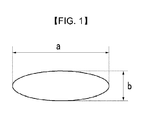
- FIG. 1 is a schematic view showing a cross-sectional aspect ratio of a glass fiber according to one embodiment.
- the aspect ratio is defined as a ratio of the longest diameter (a) to the shortest diameter (b) in a cross section of the glass fiber.
- the glass fiber used herein may have a cross-sectional aspect ratio of 1.5 or more, specifically, 2 to 8, and more specifically, 2 to 6.
- the cross-sectional aspect ratio of the glass fiber has the range, fluidity decrement of the environmentally-friendly polyamide resin composition caused by the addition of the glass fiber is remarkably decreased, and the orientation effect of the glass fiber according to the flow of the polyamide resin is so small that the warpage properties of molding products manufactured from the environmentally-friendly polyamide resin composition may be improved.
- the glass fiber may have a length of 2 to 13 mm, and specifically, it may have a length of 3 to 6 mm.
- a glass fiber having a cross-sectional diameter of 10 to 20 ⁇ m may be used.
- the above-described glass fiber having a cross-sectional aspect ratio of greater than or equal to 1.5 may be mixed and used with a glass fiber having a cross-sectional aspect ratio of less than 1.5.
- the glass fiber having a cross-sectional aspect ratio of 1.5 or more may be included in an amount of 20 to 99 wt%, and the glass fiber having a cross-sectional aspect ratio of less than 1.5 may be included in an amount of 1 to 80 wt%.
- the glass fibers are used in the mixing ratio, the workability and impact resistance of the environmentally-friendly polyamide resin composition may be maintained excellently.
- the glass fiber may be coated with a predetermined material to prevent a reaction of a polyamide resin and improve immersion degree.
- the environmentally-friendly polyamide resin composition may have different overall fluidity and impact resistance according to the kind of the coating material. If any, the kind of the material coating the surface of the glass fiber and the fluidity and impact strength of the environmentally-friendly polyamide resin composition according to the kind of the coating are obviously known to a person of an ordinary skill in the art.
- the glass fiber may be included in an amount of 9 to 80 parts by weight, specifically 20 to 70 parts by weight, based on 100 parts by weight of environmentally-friendly polyamide resin composition, that is, the total amount of 100 parts by weight of (A-1) the first polyamide resin, (A-2) the second polyamide resin, (B) the glass fiber, and (C) the branched graft copolymer.
- environmentally-friendly polyamide resin composition that is, the total amount of 100 parts by weight of (A-1) the first polyamide resin, (A-2) the second polyamide resin, (B) the glass fiber, and (C) the branched graft copolymer.
- the branched graft copolymer including a polyolefin main chain is a copolymer including a polyolefin main change grafted with a reactive group. It serves as an impact reinforcing material by improving the dispersion with a bio-polyamide resin, and it minimizes the cutting of the glass fiber by decreasing the friction with processing machine so as to improve impact resistance.
- the polyolefin that forms the main chain may be polymerized from such monomers as ethylene, propylene, isopropylene, butylene, and isobutylene. Specifically, polyethylene, polypropylene, ethylene-propylene copolymer or a combination thereof may be used to be included in an amount of greater than or equal to 70 wt% based on the total amount of the main chain.
- the reactive group grafted into the main chain may include those having partial compatibility with a bio-polyamide resin.
- a (meth)acrylate group such as methyl(meth)acrylate, ethyl(meth)acrylate, and butyl(meth)acrylate; a modified ester group such as ethyleneglycol; an arylate group; an acrylonitrile group; or a combination thereof may be used.
- the reactive group may be included in an amount of 5 to 50 wt% based on the total amount of the branched graft copolymer including the polyolefin main chain, specifically, 5 to 40 wt%.
- the reactive group is included within the range, the compatibility with the bio-polyamide resin is excellent and the effect of impact reinforcement is great so as to improve impact resistance.
- the branched graft copolymer including the polyolefin main chain may be included in an amount of 1 to 5 parts by weight, specifically 3 to 5 parts by weight, based on 100 parts by weight of environmentally-friendly polyamide resin composition, that is, the total amount of 100 parts by weight of (A-1) the first polyamide resin, (A-2) the second polyamide resin, (B) the glass fiber, and (C) the branched graft copolymer.
- the branched graft copolymer including the polyolefin main chain is included within the range, the impact resistance and hardness of the environmentally-friendly polyamide resin composition are excellent.
- the environmentally-friendly polyamide resin composition may further include an additive of an antibacterial agent, a heat stabilizer, a release agent, a light stabilizer, an inorganic material additive, surfactant, a coupling agent, a plasticizer, an admixture, a weather-resistance agent, a colorant, a stabilizer, a lubricant, an antistatic agent, a colorant aid, a flameproofing agent, an ultraviolet (UV) absorber, an ultraviolet (UV) blocking agent, a filler, a nucleating agent, an adhesion aid, an adhesive, or a combination thereof.
- an additive of an antibacterial agent a heat stabilizer, a release agent, a light stabilizer, an inorganic material additive, surfactant, a coupling agent, a plasticizer, an admixture, a weather-resistance agent, a colorant, a stabilizer, a lubricant, an antistatic agent, a colorant aid, a flameproofing agent, an ultraviolet (
- the release agent may include a fluorine-included polymer, a silicone oil, a metal salt of stearic acid, a metal salt of montanic acid, a montanic acid ester wax, or a polyethylene wax.
- the weather-resistance agent may include a benzophenone or amine weather-resistance agent, and the colorant may include a dye or pigment.
- the ultraviolet (UV) blocking agent may include titanium oxide (TiO 2 ) or carbon black, and the filler may include a glass fiber, carbon fiber, silica, mica, alumina, clay, calcium carbonate, calcium sulfate, or glass bead. When the filler is added, the properties such as a mechanical strength and a heat resistance or the like may be improved.
- the nucleating agent may include talc or clay.
- the additive may be used while it does not damage to the properties of the environmentally-friendly polyamide resin composition depending on a use.
- the additive may be added in an amount of 0 to 30 parts by weight, more specifically 0.1 to 30 parts by weight, based on 100 parts by weight of environmentally-friendly polyamide resin composition, that is, the total amount of 100 parts by weight of (A-1) the first polyamide resin, (A-2) the second polyamide resin, (B) the glass fiber, and (C) the branched graft copolymer.
- the environmentally-friendly polyamide resin composition according to one embodiment may be prepared through a method widely known to those skilled in the art.
- the components and additives may be mixed, fused in an extruder, and extruded in the form of pellets.
- a molded product is fabricated by molding the environmentally-friendly polyamide resin composition described above.
- the environmentally-friendly polyamide resin composition may be widely applied to the moldings of diverse products requiring impact resistance, hardness, heat resistance, and dimensional stability, such as, housing of mobile phones, laptops, and other small and precise electronic products, sports utilities, and exterior of vehicles.
- the environmentally-friendly polyamide resin composition according to one embodiment included the following components.
- bio-polyamide resin, a glass fiber having a cross-sectional aspect ratio of 1.5 or more, a branched graft copolymer including a polyolefin main chain, and Examples 1 to 18 optionally including a generally-used polyamide resin in accordance with one embodiment had excellent impact resistance, hardness, heat resistance, and warpage properties.
- Comparative Example 1 where a glass fiber was used in an amount out of the range suggested in one embodiment cannot be extruded and thus no physical properties were obtained
- Comparative Example 2 where bio-polyamide resin and a glass fiber were used in the amounts out of the range had deteriorated impact resistance, hardness, and heat resistance.
- Comparative Examples 3 and 4 where a branched graft copolymer including a polyolefin main chain was not used at all or was used in an amount out of the range suggested in one embodiment had deteriorated impact strength and hardness, respectively.
- Comparative Example 5 where a glass fiber having a cross-sectional aspect ratio of less than 1.5 was used had deteriorated warpage properties
- Comparative Examples 6 and 7 where a bio-polyamide resin and a branched graft copolymer including a polyolefin main chain were not used had deteriorated impact resistance and warpage properties
- Comparative Example 8 where a branched graft copolymer including a polyolefin main chain was used in an amount out of the range suggested in one embodiment had deteriorated hardness.
- the environmentally-friendly polyamide resin composition according to one embodiment is balanced in the aspects of an environmentally-friendly property and excellent physical properties of impact resistance, hardness, heat resistance, and warpage.
Landscapes
- Chemical & Material Sciences (AREA)
- Health & Medical Sciences (AREA)
- Chemical Kinetics & Catalysis (AREA)
- Medicinal Chemistry (AREA)
- Polymers & Plastics (AREA)
- Organic Chemistry (AREA)
- Engineering & Computer Science (AREA)
- Manufacturing & Machinery (AREA)
- Materials Engineering (AREA)
- Compositions Of Macromolecular Compounds (AREA)
Abstract
Description
- This application is a continuation-in-part of International Application No.
PCT/KR2010/007609, filed November 1, 2010 WO 2011/065678 , and is incorporated herein by reference in its entirety, and claims priority therefrom under 35 USC Section 120. This application also claims priority under 35 USC Section 119 from Korean Patent Application No.10-2009-0114805, filed November 25, 2009 - This disclosure relates to an environmentally-friendly polyamide resin composition and a molded product using the same.
- Generally, when a thermoplastic resin is reinforced with a glass fiber, the thermoplastic resin has improved tensile strength and flexural strength while maintaining its intrinsic property of excellent formability. Particularly, as the thermoplastic resin has excellent flexural modulus and heat resistance, the thermoplastic resin comes to have characteristics that are appropriate for parts that continuously receive weight or have to endure continuous heat. Due to the characteristics, the thermoplastic resin reinforced with a glass fiber is being applied to a variety of parts for vehicles and electronic products.
- However, since the thermoplastic resin reinforced with a glass fiber has a considerably decreased fluidity due to the addition of the glass fiber, it has a drawback in that the temperature has to be increased during an injection molding process. When the thermoplastic resin reinforced with a glass fiber is injection-molded, a plastic mold product formed of the thermoplastic resin reinforced with a glass fiber may be warped or twisted to deteriorate the quality of the plastic mold product due to a contraction rate difference in an injection direction and a vertical direction in a glass fiber direction originating from the flow of the thermoplastic resin reinforced with a glass fiber.
- Moreover, compared with the state of the thermoplastic resin before a glass fiber is added thereto, impact resistance is decreased so much that the thermoplastic resin reinforced with a glass fiber is hardly used for parts that may be destroyed by external impact.
- To overcome the problem of deteriorated impact resistance caused by the addition of the glass fiber, there is an attempt for adding an impact-reinforcing agent such as a core-shell graft copolymer to a polycarbonate resin. However, after the core-shell graft copolymer is added, the fluidity of the polycarbonate resin is deteriorated, and because of the deteriorated fluidity, the glass fiber is destroyed during an extruding process and impact resistance cannot be improved.
- Also, since the thermoplastic resin is formed of a petroleum-based material, the amount of CO2 generated is high, causing environmental pollution.
- One aspect of the present invention provides an environmentally-friendly polyamide resin composition having excellent impact resistance, hardness, heat resistance, and warpage properties.
- Another aspect of the present invention provides a molded product made using the environmentally-friendly polyamide resin composition.
- One aspect of the present invention provides an environmentally-friendly polyamide resin composition that includes (A-1) 20 to 90 parts by weight of a first polyamide resin including polyamide 11, polyamide 1010, or a combination thereof; (A-2) 0 to 50 parts by weight of a second polyamide resin including a C6 organic chain in one repeating unit; (B) 9 to 80 parts by weight of a glass fiber having a cross-sectional aspect ratio of 1.5 or more; and (C) 1 to 5 parts by weight of a branched graft copolymer including a polyolefin main chain, based on the sum, 100 parts by weight of (A-1), (A-2), (B), and (C) components.
- The first polyamide resin (A-1) may include a bio-polyamide resin derived from a vegetable fiber.
- The second polyamide resin (A-2) may include polyamide 6, polyamide 66, or a combination thereof.
- The glass fiber (B) may further include another glass fiber having a cross-sectional aspect ratio of less than 1.5.
- The branched graft copolymer including a polyolefin main chain (C) may include a polyolefin main chain on which a reactive group including a (meth)acrylate group, a modified ester group, an arylate group, an acrylonitrile group, or a combination thereof is grafted, and the reactive group may include in an amount of 5 to 50 wt% based on the total amount of the branched graft copolymer including a polyolefin main chain (C).
- The environmentally-friendly polyamide resin composition may further include 0.1 to 30 parts by weight of an additive including an antibacterial agent, a heat stabilizer, a release agent, a light stabilizer, an inorganic material additive, a surfactant, a coupling agent, a plasticizer, admixture, a weather-resistance agent, a colorant, a stabilizer, a lubricant, an antistatic agent, an colorant aid, a flameproofing agent, an ultraviolet (UV) absorber, an ultraviolet (UV) blocking agent, a filler, a nucleating agent, an adhesion aid, an adhesive, or a combination thereof, based on the sum, 100 parts by weight of the above (A-1), (A-2), (B), and (C) components.
- Another aspect of the present invention provides a molded product made using the environmentally-friendly polyamide resin composition.
- Hereinafter, further aspects of the present invention will be described in detail.
- One embodiment provides a polyamide resin composition which is not only environmentally friendly but also has excellent impact resistance, hardness, heat resistance, and warpage properties. The polyamide resin may be applied to a variety of molding products. Particularly, it may be usefully applied to mold housing of electronic products or mold exteriors of vehicle commodities.
-
-
FIG. 1 is a schematic view showing a cross-sectional aspect ratio of a glass fiber according to one embodiment. - Exemplary embodiments will hereinafter be described in detail. However, these embodiments are only exemplary, and the present invention is not limited thereto.
- In the present specification, when specific description is not provided, the term "(meth)acrylate group" refers to an "acrylate group" and an "methacrylate group."
- An environmentally-friendly polyamide resin composition according to one embodiment includes (A-1) a first polyamide resin including polyamide 11, polyamide 1010, or a combination thereof, (B) a glass fiber having a cross-sectional aspect ratio of 1.5 or more, and (C) a branched graft copolymer including a polyolefin main chain, and optionally (A-2) a second polyamide resin including a C6 organic chain in one repeating unit.
- Each component included in the environmentally-friendly polyamide resin composition according to one embodiment will hereinafter be described in detail.
- The first polyamide resin is a bio-polyamide resin.
- The bio-polyamide resin is an environmentally-friendly material that may remarkably decrease the amount of CO2 generated during the production of plastics, and it is vegetable fiber, specifically, non-food resources originating from castor which may be easily cultivated. The bio-polyamide resin satisfies the aspects of both environmentally-friendly property and application of non-food resources.
- The bio-polyamide resin may be polyamide 11, polyamide 1010, or a combination thereof.
- The polyamide 11 is manufactured from castor oil, which is vegetable oil, and since castor oil has a low absorption rate, it may be usefully applied to products requiring low dimensional stability. To be specific, the polyamide 11 may be manufactured from ricinoleic acid of castor oil by polycondensing an undecanoic acid.
- The polyamide 1010 may be manufactured by condensing a sebacic acid obtained from castor oil and 1,10-decamethylenediamine obtained by aminating the sebacic acid, and the polyamide 1010 originates from 100% biomass.
- Since the polyamide 11 and the polyamide 1010 have a low moisture absorption rate, they are stable against deformation during a molding process.
- According to one embodiment, the polyamide 11 and the polyamide 1010 may not only be used alone but also used together in the form of a mixture. When they are used by being mixed together, the polyamide 11 may be included in a ratio of 50 to 99 wt% and the polyamide 1010 may be included in a ratio of 1 to 50 wt%. When the polyamide 11 and the polyamide 1010 are used in the above ratio in the mixture, impact resistance, heat resistance and hardness are improved.
- The bio-polyamide resin may be included in an amount of 20 to 90 parts by weight, specifically 25 to 80 parts by weight, based on 100 parts by weight of environmentally-friendly polyamide resin composition, that is, the total amount of 100 parts by weight of (A-1) the first polyamide resin, (A-2) the second polyamide resin, (B) the glass fiber, and (C) the branched graft copolymer. When the bio-polyamide resin is included within the range, the environmentally-friendly polyamide resin composition has excellent environmentally-friendly property, impact resistance, hardness, and heat resistance.
- The second polyamide resin is a generally-used polyamide resin.
- The generally-used polyamide resin may be optionally added to the environmentally-friendly polyamide resin composition according to one embodiment.
- The generally-used polyamide resin includes an amide-group in the polymer main chain, and an amino acid, lactam or diamine, and dicarboxylic acid as main components that are polymerized to provide a polyamide.
- Examples of the amino acid may be 6-aminocaproic acid, 11-aminoundecanoic acid, 12-aminododecanoic acid, paraaminomethylbenzoic acid, and the like. Examples of the lactam may be ε -caprolactam, ω-laurolactam, and the like, and examples of the diamine may be aliphatic, alicyclic or aromatic diamine of tetramethylenediamine, hexamethylenediamine, 2-methylpentamethylenediamine, nonamethylenediamine, undecamethylenediamine, dodecamethylenediamine, 2,2,4-trimethylhexamethylenediamine, 2,4,4-trimethylhexamethylenediamine, 5-methylnonamethylenediamine, metaxylenediamine, paraxylenediamine, 1,3-bis(aminomethyl)cyclohexane, 1,4-bis(aminomethyl)cyclohexane, 1-amino-3-aminomethyl-3,5,5-trimethylcyclohexane, bis (4-aminocyclohexyl)methane, bis (3-methyl-4-aminocyclohexyl)methane, 2,2-bis (4-aminocyclohexyl)propane, bis(aminopropyl)piperazine, aminoethylpiperazine, and the like. Examples of the dicarboxylic acid may be aliphatic, alicyclic or aromatic dicarboxylic acid such as adipic acid, suberic acid, azelaic acid, sebacic acid, dodecane2 acid, terephthalic acid, isophthalic acid, 2-chloroterephthalic acid, 2-methylterephthalic acid, 5-methylisophthalic acid, 5-sodiumsulfoisophthalic acid, 2,6-naphthalenedicarboxylic acid, hexahydroterephthalic acid, hexahydroisophthalic acid, and the like. A polyamide homopolymer or copolymer derived from a raw material may be used singularly or as a mixture.
- A generally-used polyamide resin according to one embodiment may be a polyamide resin a C6 organic chain in one repeating unit thereof.
- Such a polyamide resin may be polyamide 6, polyamide 66, or a combination thereof. The polyamide 6 refers to polycaprolactam and it includes a C6 organic chain represented by - CH25CO- in one repeating unit, and the polyamide 66 refers to polyhexamethyleneadipamide and it includes a C6 organic chain represented by -CO CH24CO- in one repeating unit.
- By using the generally-used polyamide resin along with the above-described bio-polyamide resin, hardness and heat resistance may be improved while maintaining low moisture absorption rate.
- The generally-used polyamide resin may be included in an amount of 0 to 50 parts by weight, specifically 5 to 50 parts by weight, and more specifically 10 to 50 parts by weight, based on 100 parts by weight of environmentally-friendly polyamide resin composition, that is, the total amount of 100 parts by weight of (A-1) the first polyamide resin, (A-2) the second polyamide resin, (B) the glass fiber, and (C) the branched graft copolymer. When the generally-used polyamide resin is included within the range, impact resistance, hardness, heat resistance and warpage properties are improved.
- The glass fiber used herein has a flat cross section and has a particular aspect ratio.
FIG. 1 is a schematic view showing a cross-sectional aspect ratio of a glass fiber according to one embodiment. Referring toFIG. 1 , the aspect ratio is defined as a ratio of the longest diameter (a) to the shortest diameter (b) in a cross section of the glass fiber. - The glass fiber used herein may have a cross-sectional aspect ratio of 1.5 or more, specifically, 2 to 8, and more specifically, 2 to 6. When the cross-sectional aspect ratio of the glass fiber has the range, fluidity decrement of the environmentally-friendly polyamide resin composition caused by the addition of the glass fiber is remarkably decreased, and the orientation effect of the glass fiber according to the flow of the polyamide resin is so small that the warpage properties of molding products manufactured from the environmentally-friendly polyamide resin composition may be improved.
- The glass fiber may have a length of 2 to 13 mm, and specifically, it may have a length of 3 to 6 mm.
- Also, a glass fiber having a cross-sectional diameter of 10 to 20 µm may be used.
- According to one embodiment, the above-described glass fiber having a cross-sectional aspect ratio of greater than or equal to 1.5 may be mixed and used with a glass fiber having a cross-sectional aspect ratio of less than 1.5. When the mixture of the glass fibers is used, the glass fiber having a cross-sectional aspect ratio of 1.5 or more may be included in an amount of 20 to 99 wt%, and the glass fiber having a cross-sectional aspect ratio of less than 1.5 may be included in an amount of 1 to 80 wt%. When the glass fibers are used in the mixing ratio, the workability and impact resistance of the environmentally-friendly polyamide resin composition may be maintained excellently.
- The glass fiber may be coated with a predetermined material to prevent a reaction of a polyamide resin and improve immersion degree.
- The environmentally-friendly polyamide resin composition may have different overall fluidity and impact resistance according to the kind of the coating material. If any, the kind of the material coating the surface of the glass fiber and the fluidity and impact strength of the environmentally-friendly polyamide resin composition according to the kind of the coating are obviously known to a person of an ordinary skill in the art.
- The glass fiber may be included in an amount of 9 to 80 parts by weight, specifically 20 to 70 parts by weight, based on 100 parts by weight of environmentally-friendly polyamide resin composition, that is, the total amount of 100 parts by weight of (A-1) the first polyamide resin, (A-2) the second polyamide resin, (B) the glass fiber, and (C) the branched graft copolymer. When the glass fiber is included in the above range, the hardness and heat resistance of the environmentally-friendly polyamide resin composition are improved and the fluidity is greatly improved as well so as to secure excellent formability.
- The branched graft copolymer including a polyolefin main chain is a copolymer including a polyolefin main change grafted with a reactive group. It serves as an impact reinforcing material by improving the dispersion with a bio-polyamide resin, and it minimizes the cutting of the glass fiber by decreasing the friction with processing machine so as to improve impact resistance.
- The polyolefin that forms the main chain may be polymerized from such monomers as ethylene, propylene, isopropylene, butylene, and isobutylene. Specifically, polyethylene, polypropylene, ethylene-propylene copolymer or a combination thereof may be used to be included in an amount of greater than or equal to 70 wt% based on the total amount of the main chain.
- The reactive group grafted into the main chain may include those having partial compatibility with a bio-polyamide resin. Specifically, a (meth)acrylate group such as methyl(meth)acrylate, ethyl(meth)acrylate, and butyl(meth)acrylate; a modified ester group such as ethyleneglycol; an arylate group; an acrylonitrile group; or a combination thereof may be used.
- The reactive group may be included in an amount of 5 to 50 wt% based on the total amount of the branched graft copolymer including the polyolefin main chain, specifically, 5 to 40 wt%. When the reactive group is included within the range, the compatibility with the bio-polyamide resin is excellent and the effect of impact reinforcement is great so as to improve impact resistance.
- The branched graft copolymer including the polyolefin main chain may be included in an amount of 1 to 5 parts by weight, specifically 3 to 5 parts by weight, based on 100 parts by weight of environmentally-friendly polyamide resin composition, that is, the total amount of 100 parts by weight of (A-1) the first polyamide resin, (A-2) the second polyamide resin, (B) the glass fiber, and (C) the branched graft copolymer. When the branched graft copolymer including the polyolefin main chain is included within the range, the impact resistance and hardness of the environmentally-friendly polyamide resin composition are excellent.
- The environmentally-friendly polyamide resin composition according to one embodiment may further include an additive of an antibacterial agent, a heat stabilizer, a release agent, a light stabilizer, an inorganic material additive, surfactant, a coupling agent, a plasticizer, an admixture, a weather-resistance agent, a colorant, a stabilizer, a lubricant, an antistatic agent, a colorant aid, a flameproofing agent, an ultraviolet (UV) absorber, an ultraviolet (UV) blocking agent, a filler, a nucleating agent, an adhesion aid, an adhesive, or a combination thereof.
- The release agent may include a fluorine-included polymer, a silicone oil, a metal salt of stearic acid, a metal salt of montanic acid, a montanic acid ester wax, or a polyethylene wax. The weather-resistance agent may include a benzophenone or amine weather-resistance agent, and the colorant may include a dye or pigment. In addition, the ultraviolet (UV) blocking agent may include titanium oxide (TiO2) or carbon black, and the filler may include a glass fiber, carbon fiber, silica, mica, alumina, clay, calcium carbonate, calcium sulfate, or glass bead. When the filler is added, the properties such as a mechanical strength and a heat resistance or the like may be improved. The nucleating agent may include talc or clay.
- The additive may be used while it does not damage to the properties of the environmentally-friendly polyamide resin composition depending on a use. For example the additive may be added in an amount of 0 to 30 parts by weight, more specifically 0.1 to 30 parts by weight, based on 100 parts by weight of environmentally-friendly polyamide resin composition, that is, the total amount of 100 parts by weight of (A-1) the first polyamide resin, (A-2) the second polyamide resin, (B) the glass fiber, and (C) the branched graft copolymer.
- The environmentally-friendly polyamide resin composition according to one embodiment may be prepared through a method widely known to those skilled in the art. For example, the components and additives may be mixed, fused in an extruder, and extruded in the form of pellets.
- According to another embodiment, a molded product is fabricated by molding the environmentally-friendly polyamide resin composition described above. The environmentally-friendly polyamide resin composition may be widely applied to the moldings of diverse products requiring impact resistance, hardness, heat resistance, and dimensional stability, such as, housing of mobile phones, laptops, and other small and precise electronic products, sports utilities, and exterior of vehicles.
- The following examples illustrate the present invention in more detail. However, they are exemplary embodiments and are not limiting.
- The environmentally-friendly polyamide resin composition according to one embodiment included the following components.
-
- (A-1-1) As for polyamide 11, Rilsan KMVO of Arkema Corporation was used.
- (A-1-2) As for polyamide 1010, Vestamid Terra DS of Evonik Corporation was used.
- As for polyamide 6, TP421 0 of Zigsheng Corporation was used.
-
- (B-1) As for a glass fiber having a cross-sectional aspect ratio of 4 (the longest diameter of 28 µm and shortest diameter of 7 µm) and a length of 3 mm, CSG 3PA-820 of Nitto Boseki Corporation was used.
- (B-2) As for a glass fiber having a cross-sectional aspect ratio of 1 (diameter of 10 µm) and a length of 3 mm, P952 of Vetrotex Corporation was used.
- Elvaloy 1224AC of Dupont Corporation was used.
- The above components in amounts of shown in the following Tables 1 and 2 were extruded in a general twin-screw extruder and the extruded products were prepared in the form of pellets.
- Physical specimens were manufactured by drying pellets manufactured according to Examples 1 to 18 and Comparative Examples 1 to 8 at 100° C for 4 hours, and then injecting under the conditions of plastic temperature of 250 to 270° C and molding temperature of 60 to 80° C with a 10-oz injection molding machine. The physical properties of the physical specimens were measured in the following methods and then the measurement results were shown in the following Tables 1 and 2.
- (1) Impact strength (1/8") was measured according to ASTM D256.
- (2) Flexural hardness was measured according to ASTM D790 (2.8 mm/min).
- (3) Thermal distortion temperature was measured according to ASTM D648 (18.56 kgf).
- (4) Warpage: square specimens of 6" X 6" X 1/16" thin film were injected and their extents of warpage after discharge were decided.
- It may be seen from Tables 1 and 2 that bio-polyamide resin, a glass fiber having a cross-sectional aspect ratio of 1.5 or more, a branched graft copolymer including a polyolefin main chain, and Examples 1 to 18 optionally including a generally-used polyamide resin in accordance with one embodiment had excellent impact resistance, hardness, heat resistance, and warpage properties.
- Particularly, it may be seen that hardness and heat resistance were improved even more in case of Examples 9 to 17 using a generally-used polyamide resin such as polyamide 6 together.
- On the other hand, Comparative Example 1 where a glass fiber was used in an amount out of the range suggested in one embodiment cannot be extruded and thus no physical properties were obtained, and Comparative Example 2 where bio-polyamide resin and a glass fiber were used in the amounts out of the range had deteriorated impact resistance, hardness, and heat resistance. Also, it may be seen that Comparative Examples 3 and 4 where a branched graft copolymer including a polyolefin main chain was not used at all or was used in an amount out of the range suggested in one embodiment had deteriorated impact strength and hardness, respectively. Also, it may be seen that Comparative Example 5 where a glass fiber having a cross-sectional aspect ratio of less than 1.5 was used had deteriorated warpage properties, and Comparative Examples 6 and 7 where a bio-polyamide resin and a branched graft copolymer including a polyolefin main chain were not used had deteriorated impact resistance and warpage properties. Also, it may be seen that Comparative Example 8 where a branched graft copolymer including a polyolefin main chain was used in an amount out of the range suggested in one embodiment had deteriorated hardness.
- Therefore, it may be seen that the environmentally-friendly polyamide resin composition according to one embodiment is balanced in the aspects of an environmentally-friendly property and excellent physical properties of impact resistance, hardness, heat resistance, and warpage.
- While this disclosure has been described in connection with what is presently considered to be practical exemplary embodiments, it is to be understood that the invention is not limited to the disclosed embodiments, but, on the contrary, is intended to cover various modifications and equivalent arrangements included within the spirit and scope of the appended claims. Therefore, the aforementioned embodiments should be understood to be exemplary but not limiting the present invention in any way.
| The following parts by weight units were respectively represented based on 100 parts by weight of (A-1), (A-2), (B) and (C) components. | ||||||||||||||||||||
| unit | Examples | |||||||||||||||||||
| 1 | 2 | 3 | 4 | 5 | 6 | 7 | 8 | 9 | 10 | 11 | 12 | 13 | 14 | 15 | 16 | 17 | 18 | |||
| (A-1) | (A-1-1) | parts by weight | 24 | 34 | 48 | 58 | 66 | 76 | 86 | 50 | 19 | 29 | 38 | 48 | 57 | - | - | 29 | - | 69 |
| (A-1-2) | parts by weight | - | - | - | - | - | - | - | - | - | - | - | - | - | 29 | 48 | - | 29 | - | |
| (A-2) | parts by weight | - | - | - | - | - | - | - | - | 48 | 38 | 29 | 19 | 10 | 38 | 19 | 5 | 5 | - | |
| (B) | (B-1) | parts by weight | 72 | 62 | 48 | 38 | 29 | 19 | 9 | 49 | 29 | 29 | 29 | 29 | 29 | 29 | 29 | 62 | 62 | 30 |
| (B-2) | parts by weight | - | - | - | - | - | - | - | - | - | - | - | - | - | - | - | - | - | - | |
| (C) | parts by weight | 4 | 4 | 4 | 4 | 5 | 5 | 5 | 1 | 4 | 4 | 4 | 4 | 4 | 4 | 4 | 4 | 4 | 1 | |
| Impact strength | kg · c m/cm | 30 | 30 | 30 | 25 | 22 | 20 | 16 | 27 | 9 | 10 | 10 | 12 | 16 | 12 | 12 | 27 | 15 | 18 | |
| Flexural hardness | kgf/cm2 | 12 | 10 | 8 | 7 | 5.5 | 5.2 | 5.2 | 8.5 | 7.5 | 7 | 6.7 | 6.2 | 6.0 | 7.3 | 7.3 | 11 | 15 | 6.0 | |
| Thermal distortion Temperature | °C | 18 0 | 18 0 | 18 0 | 18 0 | 18 0 | 18 0 | 18 0 | 18 0 | 19 0 | 19 0 | 18 5 | 18 4 | 18 2 | 19 2 | 18 8 | 18 0 | 19 0 | 18 0 | |
| Warpage | - | 0 | 0 | 0 | 0 | 0 | 0 | 0 | 0 | 0 | 0 | 0 | 0 | 0 | 0 | 0 | 0 | 0 | 0 | |
| unit | Comparative Examples | |||||||||
| 1 | 2 | 3 | 4 | 5 | 6 | 7 | 8 | |||
| (A-1) | (A-1-1) | parts by weight | 14 | 91 | 70 | 64 | 67 | - | - | 66 |
| (A-1-2) | parts by weight | - | - | - | - | - | - | - | - | |
| (A-2) | parts by weight | - | - | - | - | - | 70 | 70 | - | |
| (B) | (B-1) | parts by weight | 82 | 5 | 30 | 27 | - | 30 | - | 28 |
| (B-2) | parts by weight | - | - | - | - | 29 | - | 30 | - | |
| (C) | parts by weight | 4 | 4 | - | 9 | 4 | - | - | 6 | |
| Impact strength | kg · cm/cm | Impossible to be extruded | 4 | 6 | 16 | 13 | 7 | 7 | 20 | |
| Flexural hardness | kgf/cm2 | 1.7 | 7.0 | 4.0 | 5.5 | 7.6 | 7.5 | 4.2 | ||
| Thermal distortion temperature | °C | 50 | 180 | 180 | 180 | 210 | 210 | 180 | ||
| Warpage | - | 0 | 2 | 1 | 3 | 2 | 5 | 1 | ||
Claims (8)
- An environmentally-friendly polyamide resin composition, comprising:(A-1) 20 to 90 parts by weight of a first polyamide resin including polyamide 11, polyamide 1010, or a combination thereof, based on the sum, 100 parts by weight of the (A-1), (A-2), (B), and (C) components;(A-2) 0 to 50 parts by weight of a second polyamide resin including a C6 organic chain in one repeating unit, based on the sum, 100 parts by weight of the (A-1), (A-2), (B), and (C) components;(B) 9 to 80 parts by weight of a glass fiber having a cross-sectional aspect ratio of 1.5 or more, based on the sum, 100 parts by weight of the (A-1), (A-2), (B), and (C) components; and(C) 1 to 5 parts by weight of a branched graft copolymer including a polyolefin main chain, based on the sum, 100 parts by weight of the (A-1), (A-2), (B), and (C) components
- The environmentally-friendly polyamide resin composition of claim 1, wherein the first polyamide resin (A-1) comprises a bio-polyamide resin derived from a vegetable fiber.
- The environmentally-friendly polyamide resin composition of claim 1, wherein the second polyamide resin (A-2) comprises polyamide 6, polyamide 66, or a combination thereof.
- The environmentally-friendly polyamide resin composition of claim 1, wherein the glass fiber (B) further comprises another glass fiber having a cross-sectional aspect ratio of less than 1.5.
- The environmentally-friendly polyamide resin composition of claim 1, wherein the branched graft copolymer including a polyolefin main chain (C) comprises a polyolefin main chain on which a reactive group including a (meth)acrylate group, a modified ester group, an arylate group, an acrylonitrile group, or a combination thereof is grafted.
- The environmentally-friendly polyamide resin composition of claim 5, wherein the reactive group is included in an amount of 5 to 50 wt% based on the total amount of the branched graft copolymer including a polyolefin main chain (C).
- The environmentally-friendly polyamide resin composition of claim 1, wherein the environmentally-friendly polyamide resin composition further comprises 0.1 to 30 parts by weight of an additive including an antibacterial agent, a heat stabilizer, a release agent, light stabilizer, an inorganic material additive, a surfactant, a coupling agent, a plasticizer, admixture, a weather-resistance agent, a colorant, a stabilizer, a lubricant, an antistatic agent, an colorant aid, a flameproofing agent, an ultraviolet (UV) absorber, an ultraviolet (UV) blocking agent, a filler, a nucleating agent, an adhesion aid, an adhesive, or a combination thereof, based on the sum, 100 parts by weight of the (A-1), (A-2), (B), and (C) components.
- A molded product made using the environmentally-friendly polyamide resin composition of any one of claims 1 to 7.
Applications Claiming Priority (2)
| Application Number | Priority Date | Filing Date | Title |
|---|---|---|---|
| KR20090114805 | 2009-11-25 | ||
| PCT/KR2010/007609 WO2011065678A2 (en) | 2009-11-25 | 2010-11-01 | Environmentally-friendly polyamide resin composition and molded product using same |
Publications (1)
| Publication Number | Publication Date |
|---|---|
| EP2505611A2 true EP2505611A2 (en) | 2012-10-03 |
Family
ID=44067042
Family Applications (1)
| Application Number | Title | Priority Date | Filing Date |
|---|---|---|---|
| EP10833490A Withdrawn EP2505611A2 (en) | 2009-11-25 | 2010-11-01 | Environmentally-friendly polyamide resin composition and molded product using same |
Country Status (5)
| Country | Link |
|---|---|
| US (1) | US20120232184A1 (en) |
| EP (1) | EP2505611A2 (en) |
| KR (1) | KR20110063740A (en) |
| CN (1) | CN102686673A (en) |
| WO (1) | WO2011065678A2 (en) |
Cited By (1)
| Publication number | Priority date | Publication date | Assignee | Title |
|---|---|---|---|---|
| WO2015006566A1 (en) * | 2013-07-11 | 2015-01-15 | Interface, Inc. | Bio-based polymer blends and methods of making fibers |
Families Citing this family (6)
| Publication number | Priority date | Publication date | Assignee | Title |
|---|---|---|---|---|
| CN103014903B (en) * | 2012-12-26 | 2014-12-31 | 北京服装学院 | Preparation method of bio-based polyarmide fibers |
| CN106751752A (en) * | 2016-11-11 | 2017-05-31 | 苏愉 | A kind of durable environmentally-friendly plastic |
| CN106751755A (en) * | 2016-11-11 | 2017-05-31 | 苏愉 | A kind of environmentally-friendly plastic |
| KR102162482B1 (en) * | 2016-11-21 | 2020-10-06 | 현대모비스 주식회사 | Environment friendly polyamide resin composition and molded product manufactured the same |
| CN107815106A (en) * | 2017-11-17 | 2018-03-20 | 江门市荣龙新材料科技有限公司 | Composite of high temperature resistant color inhibition long carbon chain nylon 11 and preparation method thereof |
| FI131412B1 (en) * | 2021-12-15 | 2025-04-07 | Valmet Technologies Inc | Yarn |
Family Cites Families (6)
| Publication number | Priority date | Publication date | Assignee | Title |
|---|---|---|---|---|
| DE3810519C1 (en) * | 1988-03-28 | 1989-10-12 | Ems-Inventa Ag, Zuerich, Ch | |
| US4957968A (en) * | 1988-08-09 | 1990-09-18 | Monsanto Company | Adhesive thermoplastic elastomer blends |
| US5206284A (en) * | 1989-03-17 | 1993-04-27 | Ube Industries Ltd. | Thermoplastic resin composition |
| KR100601756B1 (en) * | 2000-05-04 | 2006-07-14 | 주식회사 코오롱 | Glass Fiber Reinforced Polyamide Resin Composition |
| ES2324237T3 (en) * | 2006-12-28 | 2009-08-03 | Ems-Chemie Ag | POLYAMIDE MOLDING COMPOUNDS REINFORCED WITH FLAT GLASS FIBERS AS WELL AS INJECTION MOLDED PIECES MANUFACTURED FROM THE SAME. |
| CN101796136B (en) * | 2007-09-03 | 2012-09-26 | 尤尼吉可株式会社 | Resin composition and molded body using the same |
-
2010
- 2010-11-01 CN CN2010800531284A patent/CN102686673A/en active Pending
- 2010-11-01 WO PCT/KR2010/007609 patent/WO2011065678A2/en not_active Ceased
- 2010-11-01 EP EP10833490A patent/EP2505611A2/en not_active Withdrawn
- 2010-11-01 KR KR1020117003322A patent/KR20110063740A/en not_active Ceased
-
2012
- 2012-05-24 US US13/479,583 patent/US20120232184A1/en not_active Abandoned
Non-Patent Citations (1)
| Title |
|---|
| See references of WO2011065678A2 * |
Cited By (1)
| Publication number | Priority date | Publication date | Assignee | Title |
|---|---|---|---|---|
| WO2015006566A1 (en) * | 2013-07-11 | 2015-01-15 | Interface, Inc. | Bio-based polymer blends and methods of making fibers |
Also Published As
| Publication number | Publication date |
|---|---|
| WO2011065678A3 (en) | 2011-11-03 |
| KR20110063740A (en) | 2011-06-14 |
| CN102686673A (en) | 2012-09-19 |
| WO2011065678A2 (en) | 2011-06-03 |
| US20120232184A1 (en) | 2012-09-13 |
Similar Documents
| Publication | Publication Date | Title |
|---|---|---|
| KR101466278B1 (en) | Polyamide resin composition and molded product using the same | |
| TWI356080B (en) | Nylon-based resin composite | |
| US8476354B2 (en) | Low sink marks and excellent surface appearance reinforced polyamide compositions | |
| JP5469343B2 (en) | Glass fiber reinforced polyamide resin composition | |
| JP5407530B2 (en) | Polyamide resin composition and molded product using the same | |
| US20120232184A1 (en) | Environmentally Friendly Polyamide Resin Composition and Molded Product Using the Same | |
| TWI500696B (en) | Resin composition for coated article | |
| US11578206B2 (en) | Polyamide resin composition and molded article comprising the same | |
| JP2008106265A (en) | Polyamide resin composition and molded article comprising the same | |
| CN110446690A (en) | fiber reinforced polymer composition | |
| KR101333587B1 (en) | Polyamide-based Resin Composition with Low Thermal Expansion Coefficient | |
| CN105838063A (en) | Carbon fiber reinforced thermoplastic resin composition and molded article produced using same | |
| CN104583331A (en) | Method for producing thermoplastic resin composition, resin molded article, and plated resin molded article | |
| JP2011148997A (en) | Polyamide resin composition | |
| CN104254569A (en) | Polycarbonate resin composition with superior fluidity and molding thereof | |
| JP2020059846A (en) | Polyamide resin composition and molded article containing the same | |
| JP2007217679A (en) | Polyarylene sulfide resin composition and molded article | |
| KR100810966B1 (en) | Polyamide Resin Composites | |
| KR101777446B1 (en) | Glass fiber reinforced polyamide resin composition, and plastic molded product | |
| CN1965031A (en) | Polyamide molding compounds having improved flowability | |
| KR20180039481A (en) | The polyamide resin composition and product prepared by the same | |
| KR101266292B1 (en) | Thermoplastic resin composition | |
| KR20130078602A (en) | Thermoplastic resin composition and article comprising the same | |
| KR100853438B1 (en) | A polyamide resin composition having high heat resistance, high rigidity and excellent appearance | |
| KR101400698B1 (en) | Polyamide-based Resin Composition With Excellent Toughness |
Legal Events
| Date | Code | Title | Description |
|---|---|---|---|
| PUAI | Public reference made under article 153(3) epc to a published international application that has entered the european phase |
Free format text: ORIGINAL CODE: 0009012 |
|
| 17P | Request for examination filed |
Effective date: 20120531 |
|
| AK | Designated contracting states |
Kind code of ref document: A2 Designated state(s): AL AT BE BG CH CY CZ DE DK EE ES FI FR GB GR HR HU IE IS IT LI LT LU LV MC MK MT NL NO PL PT RO RS SE SI SK SM TR |
|
| RIN1 | Information on inventor provided before grant (corrected) |
Inventor name: JUNG, CHANG-DO Inventor name: LEE, HYUNG-TAK Inventor name: KWON, YOUNG-CHUL Inventor name: LEE, BONG-JAE Inventor name: HA, DOO-HAN |
|
| STAA | Information on the status of an ep patent application or granted ep patent |
Free format text: STATUS: THE APPLICATION HAS BEEN WITHDRAWN |
|
| 18W | Application withdrawn |
Effective date: 20121203 |