EP2504309B1 - Synthesis of acetoxyacetaldehyde - Google Patents
Synthesis of acetoxyacetaldehyde Download PDFInfo
- Publication number
- EP2504309B1 EP2504309B1 EP10792866.5A EP10792866A EP2504309B1 EP 2504309 B1 EP2504309 B1 EP 2504309B1 EP 10792866 A EP10792866 A EP 10792866A EP 2504309 B1 EP2504309 B1 EP 2504309B1
- Authority
- EP
- European Patent Office
- Prior art keywords
- compound
- process according
- mag
- ethylene glycol
- group
- Prior art date
- Legal status (The legal status is an assumption and is not a legal conclusion. Google has not performed a legal analysis and makes no representation as to the accuracy of the status listed.)
- Not-in-force
Links
- LYCAIKOWRPUZTN-UHFFFAOYSA-N Ethylene glycol Chemical compound OCCO LYCAIKOWRPUZTN-UHFFFAOYSA-N 0.000 claims description 196
- 238000000034 method Methods 0.000 claims description 67
- 239000002904 solvent Substances 0.000 claims description 63
- QTBSBXVTEAMEQO-UHFFFAOYSA-N Acetic acid Chemical compound CC(O)=O QTBSBXVTEAMEQO-UHFFFAOYSA-N 0.000 claims description 62
- 150000001875 compounds Chemical class 0.000 claims description 57
- YMWUJEATGCHHMB-UHFFFAOYSA-N Dichloromethane Chemical compound ClCCl YMWUJEATGCHHMB-UHFFFAOYSA-N 0.000 claims description 41
- XLYOFNOQVPJJNP-UHFFFAOYSA-N water Substances O XLYOFNOQVPJJNP-UHFFFAOYSA-N 0.000 claims description 39
- 229940121710 HMGCoA reductase inhibitor Drugs 0.000 claims description 33
- YXFVVABEGXRONW-UHFFFAOYSA-N Toluene Chemical compound CC1=CC=CC=C1 YXFVVABEGXRONW-UHFFFAOYSA-N 0.000 claims description 33
- XEKOWRVHYACXOJ-UHFFFAOYSA-N Ethyl acetate Chemical compound CCOC(C)=O XEKOWRVHYACXOJ-UHFFFAOYSA-N 0.000 claims description 32
- 230000015572 biosynthetic process Effects 0.000 claims description 29
- 239000000203 mixture Substances 0.000 claims description 29
- 150000003839 salts Chemical class 0.000 claims description 27
- 238000003786 synthesis reaction Methods 0.000 claims description 26
- 239000007800 oxidant agent Substances 0.000 claims description 24
- 238000001704 evaporation Methods 0.000 claims description 20
- 230000003647 oxidation Effects 0.000 claims description 18
- 238000007254 oxidation reaction Methods 0.000 claims description 18
- 238000005886 esterification reaction Methods 0.000 claims description 17
- 150000002148 esters Chemical class 0.000 claims description 17
- NBIIXXVUZAFLBC-UHFFFAOYSA-N Phosphoric acid Chemical compound OP(O)(O)=O NBIIXXVUZAFLBC-UHFFFAOYSA-N 0.000 claims description 16
- 229960000672 rosuvastatin Drugs 0.000 claims description 16
- BPRHUIZQVSMCRT-VEUZHWNKSA-N rosuvastatin Chemical compound CC(C)C1=NC(N(C)S(C)(=O)=O)=NC(C=2C=CC(F)=CC=2)=C1\C=C\[C@@H](O)C[C@@H](O)CC(O)=O BPRHUIZQVSMCRT-VEUZHWNKSA-N 0.000 claims description 16
- 230000032050 esterification Effects 0.000 claims description 15
- RQDWELNLPMBYMA-UHFFFAOYSA-N 3,4-dihydroxyhexane-2,5-dione Chemical compound CC(=O)C(O)C(O)C(C)=O RQDWELNLPMBYMA-UHFFFAOYSA-N 0.000 claims description 14
- 229910052783 alkali metal Inorganic materials 0.000 claims description 14
- 150000001340 alkali metals Chemical class 0.000 claims description 13
- 239000011541 reaction mixture Substances 0.000 claims description 13
- 239000011575 calcium Substances 0.000 claims description 12
- 238000004821 distillation Methods 0.000 claims description 12
- 238000000605 extraction Methods 0.000 claims description 12
- -1 -halo imides Chemical class 0.000 claims description 11
- 239000003125 aqueous solvent Substances 0.000 claims description 11
- 150000008280 chlorinated hydrocarbons Chemical class 0.000 claims description 11
- 239000002798 polar solvent Substances 0.000 claims description 10
- 238000002360 preparation method Methods 0.000 claims description 10
- YRIZYWQGELRKNT-UHFFFAOYSA-N 1,3,5-trichloro-1,3,5-triazinane-2,4,6-trione Chemical compound ClN1C(=O)N(Cl)C(=O)N(Cl)C1=O YRIZYWQGELRKNT-UHFFFAOYSA-N 0.000 claims description 9
- ZKQDCIXGCQPQNV-UHFFFAOYSA-N Calcium hypochlorite Chemical compound [Ca+2].Cl[O-].Cl[O-] ZKQDCIXGCQPQNV-UHFFFAOYSA-N 0.000 claims description 9
- 239000002253 acid Substances 0.000 claims description 9
- 239000003054 catalyst Substances 0.000 claims description 9
- 230000003197 catalytic effect Effects 0.000 claims description 9
- 229910052736 halogen Inorganic materials 0.000 claims description 9
- 150000002367 halogens Chemical class 0.000 claims description 9
- DKGAVHZHDRPRBM-UHFFFAOYSA-N Tert-Butanol Chemical compound CC(C)(C)O DKGAVHZHDRPRBM-UHFFFAOYSA-N 0.000 claims description 8
- WQYVRQLZKVEZGA-UHFFFAOYSA-N hypochlorite Chemical class Cl[O-] WQYVRQLZKVEZGA-UHFFFAOYSA-N 0.000 claims description 8
- 238000004519 manufacturing process Methods 0.000 claims description 8
- 229950009390 symclosene Drugs 0.000 claims description 8
- 150000003509 tertiary alcohols Chemical class 0.000 claims description 8
- 238000001914 filtration Methods 0.000 claims description 7
- 239000000546 pharmaceutical excipient Substances 0.000 claims description 7
- QAOWNCQODCNURD-UHFFFAOYSA-N Sulfuric acid Chemical compound OS(O)(=O)=O QAOWNCQODCNURD-UHFFFAOYSA-N 0.000 claims description 6
- VYGUBTIWNBFFMQ-UHFFFAOYSA-N [N+](#[C-])N1C(=O)NC=2NC(=O)NC2C1=O Chemical class [N+](#[C-])N1C(=O)NC=2NC(=O)NC2C1=O VYGUBTIWNBFFMQ-UHFFFAOYSA-N 0.000 claims description 6
- 229910052801 chlorine Inorganic materials 0.000 claims description 6
- 239000000460 chlorine Substances 0.000 claims description 6
- CEJLBZWIKQJOAT-UHFFFAOYSA-N dichloroisocyanuric acid Chemical compound ClN1C(=O)NC(=O)N(Cl)C1=O CEJLBZWIKQJOAT-UHFFFAOYSA-N 0.000 claims description 6
- 229930195733 hydrocarbon Natural products 0.000 claims description 6
- 150000002430 hydrocarbons Chemical class 0.000 claims description 6
- VLTRZXGMWDSKGL-UHFFFAOYSA-N perchloric acid Chemical compound OCl(=O)(=O)=O VLTRZXGMWDSKGL-UHFFFAOYSA-N 0.000 claims description 6
- JHJLBTNAGRQEKS-UHFFFAOYSA-M sodium bromide Chemical compound [Na+].[Br-] JHJLBTNAGRQEKS-UHFFFAOYSA-M 0.000 claims description 6
- VUZNLSBZRVZGIK-UHFFFAOYSA-N 2,2,6,6-Tetramethyl-1-piperidinol Chemical group CC1(C)CCCC(C)(C)N1O VUZNLSBZRVZGIK-UHFFFAOYSA-N 0.000 claims description 5
- 239000003377 acid catalyst Substances 0.000 claims description 5
- 239000002585 base Substances 0.000 claims description 5
- 229910052794 bromium Inorganic materials 0.000 claims description 5
- XVDWMONETMNKBK-UHFFFAOYSA-N calcium;dihypobromite Chemical compound [Ca+2].Br[O-].Br[O-] XVDWMONETMNKBK-UHFFFAOYSA-N 0.000 claims description 5
- MSXVEPNJUHWQHW-UHFFFAOYSA-N 2-methylbutan-2-ol Chemical compound CCC(C)(C)O MSXVEPNJUHWQHW-UHFFFAOYSA-N 0.000 claims description 4
- ZAMOUSCENKQFHK-UHFFFAOYSA-N Chlorine atom Chemical compound [Cl] ZAMOUSCENKQFHK-UHFFFAOYSA-N 0.000 claims description 4
- PCLIMKBDDGJMGD-UHFFFAOYSA-N N-bromosuccinimide Chemical compound BrN1C(=O)CCC1=O PCLIMKBDDGJMGD-UHFFFAOYSA-N 0.000 claims description 4
- 238000007865 diluting Methods 0.000 claims description 4
- 229930195734 saturated hydrocarbon Natural products 0.000 claims description 4
- ZGGHKIMDNBDHJB-NRFPMOEYSA-M (3R,5S)-fluvastatin sodium Chemical compound [Na+].C12=CC=CC=C2N(C(C)C)C(\C=C\[C@@H](O)C[C@@H](O)CC([O-])=O)=C1C1=CC=C(F)C=C1 ZGGHKIMDNBDHJB-NRFPMOEYSA-M 0.000 claims description 3
- WKBOTKDWSSQWDR-UHFFFAOYSA-N Bromine atom Chemical compound [Br] WKBOTKDWSSQWDR-UHFFFAOYSA-N 0.000 claims description 3
- 239000004480 active ingredient Substances 0.000 claims description 3
- 229950005357 bervastatin Drugs 0.000 claims description 3
- GDTBXPJZTBHREO-UHFFFAOYSA-N bromine Substances BrBr GDTBXPJZTBHREO-UHFFFAOYSA-N 0.000 claims description 3
- 229960005110 cerivastatin Drugs 0.000 claims description 3
- SEERZIQQUAZTOL-ANMDKAQQSA-N cerivastatin Chemical compound COCC1=C(C(C)C)N=C(C(C)C)C(\C=C\[C@@H](O)C[C@@H](O)CC(O)=O)=C1C1=CC=C(F)C=C1 SEERZIQQUAZTOL-ANMDKAQQSA-N 0.000 claims description 3
- ZADJRRFMOOACHL-WQICJITCSA-N ethyl (e,3s,5r)-7-[4-(4-fluorophenyl)spiro[chromene-2,1'-cyclopentane]-3-yl]-3,5-dihydroxyhept-6-enoate Chemical compound C12=CC=CC=C2OC2(CCCC2)C(/C=C/[C@H](O)C[C@H](O)CC(=O)OCC)=C1C1=CC=C(F)C=C1 ZADJRRFMOOACHL-WQICJITCSA-N 0.000 claims description 3
- 229960003765 fluvastatin Drugs 0.000 claims description 3
- 125000001475 halogen functional group Chemical group 0.000 claims description 3
- CUILPNURFADTPE-UHFFFAOYSA-N hypobromous acid Chemical class BrO CUILPNURFADTPE-UHFFFAOYSA-N 0.000 claims description 3
- 239000008194 pharmaceutical composition Substances 0.000 claims description 3
- 229960002797 pitavastatin Drugs 0.000 claims description 3
- VGYFMXBACGZSIL-MCBHFWOFSA-N pitavastatin Chemical compound OC(=O)C[C@H](O)C[C@H](O)\C=C\C1=C(C2CC2)N=C2C=CC=CC2=C1C1=CC=C(F)C=C1 VGYFMXBACGZSIL-MCBHFWOFSA-N 0.000 claims description 3
- 239000001117 sulphuric acid Substances 0.000 claims description 3
- 235000011149 sulphuric acid Nutrition 0.000 claims description 3
- QSJXEFYPDANLFS-UHFFFAOYSA-N Diacetyl Chemical group CC(=O)C(C)=O QSJXEFYPDANLFS-UHFFFAOYSA-N 0.000 claims description 2
- VRLDVERQJMEPIF-UHFFFAOYSA-N dbdmh Chemical compound CC1(C)N(Br)C(=O)N(Br)C1=O VRLDVERQJMEPIF-UHFFFAOYSA-N 0.000 claims description 2
- 229910052739 hydrogen Inorganic materials 0.000 claims description 2
- 229910001503 inorganic bromide Inorganic materials 0.000 claims description 2
- 229910052740 iodine Inorganic materials 0.000 claims description 2
- 150000002894 organic compounds Chemical class 0.000 claims description 2
- 125000001453 quaternary ammonium group Chemical group 0.000 claims description 2
- 159000000000 sodium salts Chemical class 0.000 claims description 2
- ZKWDCFPLNQTHSH-UHFFFAOYSA-N tribromoisocyanuric acid Chemical compound BrN1C(=O)N(Br)C(=O)N(Br)C1=O ZKWDCFPLNQTHSH-UHFFFAOYSA-N 0.000 claims description 2
- HXDLWJWIAHWIKI-UHFFFAOYSA-N 2-hydroxyethyl acetate Chemical compound CC(=O)OCCO HXDLWJWIAHWIKI-UHFFFAOYSA-N 0.000 description 81
- GUPGZURVZDIQPM-UHFFFAOYSA-N 2-oxoethyl acetate Chemical compound CC(=O)OCC=O GUPGZURVZDIQPM-UHFFFAOYSA-N 0.000 description 62
- 238000006243 chemical reaction Methods 0.000 description 37
- 229940093476 ethylene glycol Drugs 0.000 description 31
- 239000000243 solution Substances 0.000 description 18
- 239000012071 phase Substances 0.000 description 16
- GDOPTJXRTPNYNR-UHFFFAOYSA-N methyl-cyclopentane Natural products CC1CCCC1 GDOPTJXRTPNYNR-UHFFFAOYSA-N 0.000 description 15
- 238000013459 approach Methods 0.000 description 14
- 239000002609 medium Substances 0.000 description 13
- 239000002471 hydroxymethylglutaryl coenzyme A reductase inhibitor Substances 0.000 description 12
- 235000019439 ethyl acetate Nutrition 0.000 description 11
- 230000021736 acetylation Effects 0.000 description 10
- 238000006640 acetylation reaction Methods 0.000 description 10
- HEMHJVSKTPXQMS-UHFFFAOYSA-M Sodium hydroxide Chemical compound [OH-].[Na+] HEMHJVSKTPXQMS-UHFFFAOYSA-M 0.000 description 9
- 230000008020 evaporation Effects 0.000 description 9
- 239000000047 product Substances 0.000 description 9
- 239000007788 liquid Substances 0.000 description 8
- 239000000725 suspension Substances 0.000 description 8
- 238000003756 stirring Methods 0.000 description 7
- 238000005809 transesterification reaction Methods 0.000 description 7
- WEVYAHXRMPXWCK-UHFFFAOYSA-N Acetonitrile Chemical compound CC#N WEVYAHXRMPXWCK-UHFFFAOYSA-N 0.000 description 6
- 238000006389 diacetylation reaction Methods 0.000 description 6
- 230000001590 oxidative effect Effects 0.000 description 6
- 239000007858 starting material Substances 0.000 description 6
- VYPSYNLAJGMNEJ-UHFFFAOYSA-N Silicium dioxide Chemical compound O=[Si]=O VYPSYNLAJGMNEJ-UHFFFAOYSA-N 0.000 description 5
- KEAYESYHFKHZAL-UHFFFAOYSA-N Sodium Chemical compound [Na] KEAYESYHFKHZAL-UHFFFAOYSA-N 0.000 description 5
- UIIMBOGNXHQVGW-UHFFFAOYSA-M Sodium bicarbonate Chemical class [Na+].OC([O-])=O UIIMBOGNXHQVGW-UHFFFAOYSA-M 0.000 description 5
- 229910000147 aluminium phosphate Inorganic materials 0.000 description 5
- 239000003153 chemical reaction reagent Substances 0.000 description 5
- 150000002366 halogen compounds Chemical class 0.000 description 5
- 239000012457 nonaqueous media Substances 0.000 description 5
- 239000012312 sodium hydride Substances 0.000 description 5
- 229910000104 sodium hydride Inorganic materials 0.000 description 5
- WFDIJRYMOXRFFG-UHFFFAOYSA-N Acetic anhydride Chemical compound CC(=O)OC(C)=O WFDIJRYMOXRFFG-UHFFFAOYSA-N 0.000 description 4
- DGAQECJNVWCQMB-PUAWFVPOSA-M Ilexoside XXIX Chemical compound C[C@@H]1CC[C@@]2(CC[C@@]3(C(=CC[C@H]4[C@]3(CC[C@@H]5[C@@]4(CC[C@@H](C5(C)C)OS(=O)(=O)[O-])C)C)[C@@H]2[C@]1(C)O)C)C(=O)O[C@H]6[C@@H]([C@H]([C@@H]([C@H](O6)CO)O)O)O.[Na+] DGAQECJNVWCQMB-PUAWFVPOSA-M 0.000 description 4
- WGCNASOHLSPBMP-UHFFFAOYSA-N hydroxyacetaldehyde Natural products OCC=O WGCNASOHLSPBMP-UHFFFAOYSA-N 0.000 description 4
- 238000002955 isolation Methods 0.000 description 4
- ZCSHNCUQKCANBX-UHFFFAOYSA-N lithium diisopropylamide Chemical compound [Li+].CC(C)[N-]C(C)C ZCSHNCUQKCANBX-UHFFFAOYSA-N 0.000 description 4
- 229910052708 sodium Inorganic materials 0.000 description 4
- 239000011734 sodium Substances 0.000 description 4
- 239000007787 solid Substances 0.000 description 4
- UHOVQNZJYSORNB-UHFFFAOYSA-N Benzene Chemical compound C1=CC=CC=C1 UHOVQNZJYSORNB-UHFFFAOYSA-N 0.000 description 3
- 230000002378 acidificating effect Effects 0.000 description 3
- 239000006227 byproduct Substances 0.000 description 3
- 239000003795 chemical substances by application Substances 0.000 description 3
- 238000010924 continuous production Methods 0.000 description 3
- NKLCNNUWBJBICK-UHFFFAOYSA-N dess–martin periodinane Chemical compound C1=CC=C2I(OC(=O)C)(OC(C)=O)(OC(C)=O)OC(=O)C2=C1 NKLCNNUWBJBICK-UHFFFAOYSA-N 0.000 description 3
- 239000000706 filtrate Substances 0.000 description 3
- 150000002334 glycols Chemical class 0.000 description 3
- 150000004679 hydroxides Chemical class 0.000 description 3
- 239000012535 impurity Substances 0.000 description 3
- 150000002596 lactones Chemical class 0.000 description 3
- 150000007522 mineralic acids Chemical class 0.000 description 3
- 239000012454 non-polar solvent Substances 0.000 description 3
- 239000012074 organic phase Substances 0.000 description 3
- 239000003960 organic solvent Substances 0.000 description 3
- 239000002994 raw material Substances 0.000 description 3
- ORTVZLZNOYNASJ-UPHRSURJSA-N (z)-but-2-ene-1,4-diol Chemical compound OC\C=C/CO ORTVZLZNOYNASJ-UPHRSURJSA-N 0.000 description 2
- HDPNBNXLBDFELL-UHFFFAOYSA-N 1,1,1-trimethoxyethane Chemical compound COC(C)(OC)OC HDPNBNXLBDFELL-UHFFFAOYSA-N 0.000 description 2
- CSDQQAQKBAQLLE-UHFFFAOYSA-N 4-(4-chlorophenyl)-4,5,6,7-tetrahydrothieno[3,2-c]pyridine Chemical compound C1=CC(Cl)=CC=C1C1C(C=CS2)=C2CCN1 CSDQQAQKBAQLLE-UHFFFAOYSA-N 0.000 description 2
- IKHGUXGNUITLKF-UHFFFAOYSA-N Acetaldehyde Chemical class CC=O IKHGUXGNUITLKF-UHFFFAOYSA-N 0.000 description 2
- 0 C[C@](C[C@@](CC1)C[C@@](C2)[C@@]2C[C@@]1[C@@](C)*[C@@]1CC[C@@](C)CCC1)C1[C@@](C)CC[C@@]2[C@@]1C2 Chemical compound C[C@](C[C@@](CC1)C[C@@](C2)[C@@]2C[C@@]1[C@@](C)*[C@@]1CC[C@@](C)CCC1)C1[C@@](C)CC[C@@]2[C@@]1C2 0.000 description 2
- 101000928995 Caenorhabditis elegans Putative deoxyribose-phosphate aldolase Proteins 0.000 description 2
- VTYYLEPIZMXCLO-UHFFFAOYSA-L Calcium carbonate Chemical compound [Ca+2].[O-]C([O-])=O VTYYLEPIZMXCLO-UHFFFAOYSA-L 0.000 description 2
- UXVMQQNJUSDDNG-UHFFFAOYSA-L Calcium chloride Chemical compound [Cl-].[Cl-].[Ca+2] UXVMQQNJUSDDNG-UHFFFAOYSA-L 0.000 description 2
- 102100037802 Deoxyribose-phosphate aldolase Human genes 0.000 description 2
- 229910021578 Iron(III) chloride Inorganic materials 0.000 description 2
- BZLVMXJERCGZMT-UHFFFAOYSA-N Methyl tert-butyl ether Chemical compound COC(C)(C)C BZLVMXJERCGZMT-UHFFFAOYSA-N 0.000 description 2
- CBENFWSGALASAD-UHFFFAOYSA-N Ozone Chemical compound [O-][O+]=O CBENFWSGALASAD-UHFFFAOYSA-N 0.000 description 2
- WETWJCDKMRHUPV-UHFFFAOYSA-N acetyl chloride Chemical compound CC(Cl)=O WETWJCDKMRHUPV-UHFFFAOYSA-N 0.000 description 2
- 239000012346 acetyl chloride Substances 0.000 description 2
- 239000000654 additive Substances 0.000 description 2
- 150000001408 amides Chemical class 0.000 description 2
- 238000003556 assay Methods 0.000 description 2
- 238000010533 azeotropic distillation Methods 0.000 description 2
- 239000001110 calcium chloride Substances 0.000 description 2
- 229910001628 calcium chloride Inorganic materials 0.000 description 2
- 229910052799 carbon Inorganic materials 0.000 description 2
- 150000001721 carbon Chemical group 0.000 description 2
- 230000002860 competitive effect Effects 0.000 description 2
- 239000002274 desiccant Substances 0.000 description 2
- 239000012153 distilled water Substances 0.000 description 2
- 238000005516 engineering process Methods 0.000 description 2
- 150000004678 hydrides Chemical class 0.000 description 2
- JGJLWPGRMCADHB-UHFFFAOYSA-N hypobromite Chemical compound Br[O-] JGJLWPGRMCADHB-UHFFFAOYSA-N 0.000 description 2
- 238000009776 industrial production Methods 0.000 description 2
- RBTARNINKXHZNM-UHFFFAOYSA-K iron trichloride Chemical compound Cl[Fe](Cl)Cl RBTARNINKXHZNM-UHFFFAOYSA-K 0.000 description 2
- HQKMJHAJHXVSDF-UHFFFAOYSA-L magnesium stearate Chemical compound [Mg+2].CCCCCCCCCCCCCCCCCC([O-])=O.CCCCCCCCCCCCCCCCCC([O-])=O HQKMJHAJHXVSDF-UHFFFAOYSA-L 0.000 description 2
- 239000000463 material Substances 0.000 description 2
- 239000002808 molecular sieve Substances 0.000 description 2
- 239000000178 monomer Substances 0.000 description 2
- 238000006386 neutralization reaction Methods 0.000 description 2
- SYQBFIAQOQZEGI-UHFFFAOYSA-N osmium atom Chemical compound [Os] SYQBFIAQOQZEGI-UHFFFAOYSA-N 0.000 description 2
- 229940096701 plain lipid modifying drug hmg coa reductase inhibitors Drugs 0.000 description 2
- LPNYRYFBWFDTMA-UHFFFAOYSA-N potassium tert-butoxide Chemical compound [K+].CC(C)(C)[O-] LPNYRYFBWFDTMA-UHFFFAOYSA-N 0.000 description 2
- 238000000746 purification Methods 0.000 description 2
- 238000007086 side reaction Methods 0.000 description 2
- FZHAPNGMFPVSLP-UHFFFAOYSA-N silanamine Chemical class [SiH3]N FZHAPNGMFPVSLP-UHFFFAOYSA-N 0.000 description 2
- URGAHOPLAPQHLN-UHFFFAOYSA-N sodium aluminosilicate Chemical compound [Na+].[Al+3].[O-][Si]([O-])=O.[O-][Si]([O-])=O URGAHOPLAPQHLN-UHFFFAOYSA-N 0.000 description 2
- 229910000030 sodium bicarbonate Inorganic materials 0.000 description 2
- WRIKHQLVHPKCJU-UHFFFAOYSA-N sodium bis(trimethylsilyl)amide Chemical compound C[Si](C)(C)N([Na])[Si](C)(C)C WRIKHQLVHPKCJU-UHFFFAOYSA-N 0.000 description 2
- MSFGZHUJTJBYFA-UHFFFAOYSA-M sodium dichloroisocyanurate Chemical compound [Na+].ClN1C(=O)[N-]C(=O)N(Cl)C1=O MSFGZHUJTJBYFA-UHFFFAOYSA-M 0.000 description 2
- JQWHASGSAFIOCM-UHFFFAOYSA-M sodium periodate Chemical compound [Na+].[O-]I(=O)(=O)=O JQWHASGSAFIOCM-UHFFFAOYSA-M 0.000 description 2
- 150000003467 sulfuric acid derivatives Chemical class 0.000 description 2
- 239000002699 waste material Substances 0.000 description 2
- 239000010457 zeolite Substances 0.000 description 2
- VNJOEUSYAMPBAK-UHFFFAOYSA-N 2-methylbenzenesulfonic acid;hydrate Chemical compound O.CC1=CC=CC=C1S(O)(=O)=O VNJOEUSYAMPBAK-UHFFFAOYSA-N 0.000 description 1
- BVKZGUZCCUSVTD-UHFFFAOYSA-M Bicarbonate Chemical compound OC([O-])=O BVKZGUZCCUSVTD-UHFFFAOYSA-M 0.000 description 1
- FGUUSXIOTUKUDN-IBGZPJMESA-N C1(=CC=CC=C1)N1C2=C(NC([C@H](C1)NC=1OC(=NN=1)C1=CC=CC=C1)=O)C=CC=C2 Chemical compound C1(=CC=CC=C1)N1C2=C(NC([C@H](C1)NC=1OC(=NN=1)C1=CC=CC=C1)=O)C=CC=C2 FGUUSXIOTUKUDN-IBGZPJMESA-N 0.000 description 1
- 238000006546 Horner-Wadsworth-Emmons reaction Methods 0.000 description 1
- 229920002153 Hydroxypropyl cellulose Polymers 0.000 description 1
- GUBGYTABKSRVRQ-QKKXKWKRSA-N Lactose Natural products OC[C@H]1O[C@@H](O[C@H]2[C@H](O)[C@@H](O)C(O)O[C@@H]2CO)[C@H](O)[C@@H](O)[C@H]1O GUBGYTABKSRVRQ-QKKXKWKRSA-N 0.000 description 1
- 239000002879 Lewis base Substances 0.000 description 1
- 238000005684 Liebig rearrangement reaction Methods 0.000 description 1
- 229920000168 Microcrystalline cellulose Chemical class 0.000 description 1
- 229910019142 PO4 Inorganic materials 0.000 description 1
- 239000002202 Polyethylene glycol Substances 0.000 description 1
- ZLMJMSJWJFRBEC-UHFFFAOYSA-N Potassium Chemical compound [K] ZLMJMSJWJFRBEC-UHFFFAOYSA-N 0.000 description 1
- 239000005708 Sodium hypochlorite Substances 0.000 description 1
- 229920002472 Starch Polymers 0.000 description 1
- VZUAUHWZIKOMFC-ONEGZZNKSA-N [(e)-4-acetyloxybut-2-enyl] acetate Chemical compound CC(=O)OC\C=C\COC(C)=O VZUAUHWZIKOMFC-ONEGZZNKSA-N 0.000 description 1
- 150000001241 acetals Chemical class 0.000 description 1
- 239000012345 acetylating agent Substances 0.000 description 1
- 125000003668 acetyloxy group Chemical group [H]C([H])([H])C(=O)O[*] 0.000 description 1
- 150000007513 acids Chemical class 0.000 description 1
- 239000008186 active pharmaceutical agent Substances 0.000 description 1
- 150000001299 aldehydes Chemical class 0.000 description 1
- 239000007864 aqueous solution Substances 0.000 description 1
- 230000009286 beneficial effect Effects 0.000 description 1
- 239000011230 binding agent Substances 0.000 description 1
- 244000309464 bull Species 0.000 description 1
- 229910000019 calcium carbonate Inorganic materials 0.000 description 1
- 150000004649 carbonic acid derivatives Chemical class 0.000 description 1
- 230000015556 catabolic process Effects 0.000 description 1
- 238000006555 catalytic reaction Methods 0.000 description 1
- 239000001913 cellulose Chemical class 0.000 description 1
- 229920002678 cellulose Chemical class 0.000 description 1
- 235000010980 cellulose Nutrition 0.000 description 1
- 238000001816 cooling Methods 0.000 description 1
- 230000008878 coupling Effects 0.000 description 1
- 238000010168 coupling process Methods 0.000 description 1
- 238000005859 coupling reaction Methods 0.000 description 1
- 230000001955 cumulated effect Effects 0.000 description 1
- 238000006731 degradation reaction Methods 0.000 description 1
- 239000003085 diluting agent Substances 0.000 description 1
- 238000010790 dilution Methods 0.000 description 1
- 239000012895 dilution Substances 0.000 description 1
- 150000002009 diols Chemical class 0.000 description 1
- 150000002170 ethers Chemical class 0.000 description 1
- ZZIRWFZCZDOZFJ-UHFFFAOYSA-N ethyl acetate;2-methylpropan-2-ol Chemical compound CC(C)(C)O.CCOC(C)=O ZZIRWFZCZDOZFJ-UHFFFAOYSA-N 0.000 description 1
- 238000002474 experimental method Methods 0.000 description 1
- 239000012467 final product Substances 0.000 description 1
- 239000000796 flavoring agent Substances 0.000 description 1
- 229910052731 fluorine Inorganic materials 0.000 description 1
- 235000013355 food flavoring agent Nutrition 0.000 description 1
- 235000003599 food sweetener Nutrition 0.000 description 1
- 239000003205 fragrance Substances 0.000 description 1
- WJRBRSLFGCUECM-UHFFFAOYSA-N hydantoin Chemical compound O=C1CNC(=O)N1 WJRBRSLFGCUECM-UHFFFAOYSA-N 0.000 description 1
- 229940091173 hydantoin Drugs 0.000 description 1
- 230000036571 hydration Effects 0.000 description 1
- 238000006703 hydration reaction Methods 0.000 description 1
- 150000007857 hydrazones Chemical class 0.000 description 1
- BHEPBYXIRTUNPN-UHFFFAOYSA-N hydridophosphorus(.) (triplet) Chemical class [PH] BHEPBYXIRTUNPN-UHFFFAOYSA-N 0.000 description 1
- 230000007062 hydrolysis Effects 0.000 description 1
- 238000006460 hydrolysis reaction Methods 0.000 description 1
- 125000004356 hydroxy functional group Chemical group O* 0.000 description 1
- 239000001863 hydroxypropyl cellulose Substances 0.000 description 1
- 235000010977 hydroxypropyl cellulose Nutrition 0.000 description 1
- 150000007529 inorganic bases Chemical group 0.000 description 1
- 150000002576 ketones Chemical class 0.000 description 1
- 239000008101 lactose Substances 0.000 description 1
- 150000007527 lewis bases Chemical class 0.000 description 1
- 239000000314 lubricant Substances 0.000 description 1
- 235000019359 magnesium stearate Nutrition 0.000 description 1
- 238000010907 mechanical stirring Methods 0.000 description 1
- 230000001404 mediated effect Effects 0.000 description 1
- 239000008108 microcrystalline cellulose Chemical class 0.000 description 1
- 235000019813 microcrystalline cellulose Nutrition 0.000 description 1
- 229940016286 microcrystalline cellulose Drugs 0.000 description 1
- 229910052762 osmium Inorganic materials 0.000 description 1
- 238000005949 ozonolysis reaction Methods 0.000 description 1
- HVAMZGADVCBITI-UHFFFAOYSA-M pent-4-enoate Chemical compound [O-]C(=O)CCC=C HVAMZGADVCBITI-UHFFFAOYSA-M 0.000 description 1
- 235000021317 phosphate Nutrition 0.000 description 1
- 150000003004 phosphinoxides Chemical class 0.000 description 1
- XYFCBTPGUUZFHI-UHFFFAOYSA-O phosphonium Chemical compound [PH4+] XYFCBTPGUUZFHI-UHFFFAOYSA-O 0.000 description 1
- 150000003013 phosphoric acid derivatives Chemical class 0.000 description 1
- 229920000058 polyacrylate Polymers 0.000 description 1
- 229920001223 polyethylene glycol Polymers 0.000 description 1
- 239000001267 polyvinylpyrrolidone Substances 0.000 description 1
- 229920000036 polyvinylpyrrolidone Polymers 0.000 description 1
- 235000013855 polyvinylpyrrolidone Nutrition 0.000 description 1
- 229910052700 potassium Inorganic materials 0.000 description 1
- 239000011591 potassium Substances 0.000 description 1
- 239000000843 powder Substances 0.000 description 1
- 239000003755 preservative agent Substances 0.000 description 1
- 238000011084 recovery Methods 0.000 description 1
- 230000008929 regeneration Effects 0.000 description 1
- 238000011069 regeneration method Methods 0.000 description 1
- 238000000926 separation method Methods 0.000 description 1
- 239000001509 sodium citrate Substances 0.000 description 1
- NLJMYIDDQXHKNR-UHFFFAOYSA-K sodium citrate Chemical compound O.O.[Na+].[Na+].[Na+].[O-]C(=O)CC(O)(CC([O-])=O)C([O-])=O NLJMYIDDQXHKNR-UHFFFAOYSA-K 0.000 description 1
- SUKJFIGYRHOWBL-UHFFFAOYSA-N sodium hypochlorite Chemical compound [Na+].Cl[O-] SUKJFIGYRHOWBL-UHFFFAOYSA-N 0.000 description 1
- 239000008109 sodium starch glycolate Substances 0.000 description 1
- 229940079832 sodium starch glycolate Drugs 0.000 description 1
- 229920003109 sodium starch glycolate Polymers 0.000 description 1
- 239000003381 stabilizer Substances 0.000 description 1
- 239000008107 starch Substances 0.000 description 1
- 229940032147 starch Drugs 0.000 description 1
- 235000019698 starch Nutrition 0.000 description 1
- 239000000126 substance Substances 0.000 description 1
- 239000003765 sweetening agent Substances 0.000 description 1
- 238000010189 synthetic method Methods 0.000 description 1
- 239000000454 talc Substances 0.000 description 1
- 229910052623 talc Inorganic materials 0.000 description 1
- 235000012222 talc Nutrition 0.000 description 1
Images

Classifications
-
- C—CHEMISTRY; METALLURGY
- C07—ORGANIC CHEMISTRY
- C07C—ACYCLIC OR CARBOCYCLIC COMPOUNDS
- C07C67/00—Preparation of carboxylic acid esters
- C07C67/08—Preparation of carboxylic acid esters by reacting carboxylic acids or symmetrical anhydrides with the hydroxy or O-metal group of organic compounds
-
- C—CHEMISTRY; METALLURGY
- C07—ORGANIC CHEMISTRY
- C07C—ACYCLIC OR CARBOCYCLIC COMPOUNDS
- C07C67/00—Preparation of carboxylic acid esters
- C07C67/28—Preparation of carboxylic acid esters by modifying the hydroxylic moiety of the ester, such modification not being an introduction of an ester group
- C07C67/29—Preparation of carboxylic acid esters by modifying the hydroxylic moiety of the ester, such modification not being an introduction of an ester group by introduction of oxygen-containing functional groups
Definitions
- the invention belongs to the field of organic chemistry and relates to a new synthesis of statin compounds or pharmaceutically acceptable salts thereof, comprising a process for preparing acetoxyacetaldehyde.
- Acetoxyacetaldehyde (2-acetyloxyacetaldehyde, AOA) is a versatile starting material for various synthetic approaches. Although being a very simple molecule it was disclosed relatively late and proved only indirectly via hydrazones ( J. Chem. Soc. 1914, 105, 386 ; Chem. Ber. 1961, 94, 1860 ; J. Org. Chem. 1962, 27, 2920 ). In earlier synthetic methods acetyloxy ethens ( Bull. Acad. Sci. USSR 1976, 25 1545 ) and acetals ( Liebigs Ann. Chem. 1991, 1013 ) were used.
- DACB Tetrahedron Lett. 1997, 38, 3595
- allyl acetate J. Nat. Prod. 1995, 58, 1270
- WO 2009/092702 describes the preparation of AOA by ozonolysis of DACB as an intermediate in the production of statins, particularly in the production of rosuvastatin.
- Intermediate DACB can be prepared by acetylation of 2-butene-1,4-diol with acetanyhydride (Ac 2 O) or acetyl chloride (AcCl) under basic conditions ( J. Org. Chem. 1981, 46, 1734 ). Similar synthetic route for AOA synthesis, which uses 2-butene-1,4-diol as starting material and further NalO 4 as oxidant is also described in WO 08/034598 (Scheme 1).
- the object of the present invention is to provide an improved process for preparing statins and pharmaceutically acceptable salts thereof.
- the present invention provides the following items including main aspects and preferred embodiments, which respectively alone and in combination particularly contribute to solving the above object and eventually provide additional advantages:
- statin compounds or pharmaceutically acceptable salts thereof can be carried out, said synthesis comprising a new preparation of acetoxyacetaldehyde , by selecting suitable starting materials which can be converted to the desired product without the necessity of aggressive, difficult to handle and/or expensive reagents (e. g. OsO 4 , NalO 4 , ozone, silver salts, the Dess-Martin reagent) as well as without the necessity of using extreme conditions (e. g. very high temperatures and / or very low temperatures).
- suitable starting materials which can be converted to the desired product without the necessity of aggressive, difficult to handle and/or expensive reagents (e. g. OsO 4 , NalO 4 , ozone, silver salts, the Dess-Martin reagent) as well as without the necessity of using extreme conditions (e. g. very high temperatures and / or very low temperatures).
- Starting materials applied in the procedural concept according to the present invention are cheap and easily accessible.
- the process for the preparation as described above is more efficient as it allows beneficial reaction conditions due to the use of non-aqueous solvents (as a polyfunctional molecule acetoxyacetaldehyde is prone to polymerisation, hydrolysis, acetalation or hydration especially in the presence of water) providing for less by-products and thus higher purity of the products and higher yields, and/or less necessary reaction steps.
- the process as described above can further be advantageously carried out in various solvent systems or solvents and is thereby not limited to one particular solvent system or solvent, unless the reaction is significantly affected while being performed in certain particular solvent systems or solvents.
- a catalytic oxidation using an N-oxyl compound in the presence of co-oxidant can be made highly efficient when starting with monoacetylated monoethylene glycol, in particular when such monoacetylated monoethylene glycol can be provided in pure form.
- provision of monoacetylated monoethylene glycol in pure form as an intermediate of a 2 reaction step process can be ensured by monoacetylation of the starting diol using esterification or transesterification.
- a process according to present invention as defined above is suitable for continuous production of acetoxyacetaldehyde with re-usage of solvents as well as by-products in subsequent batches resulting in minimum amounts of waste material. Such continuous process is superior from ecological point of view and appropriate for large scale industrial production.
- An advantage of the present invention is the provision of a cost competitive, industrially applicable process involving the obtainment of acetoxyacetaldehyde (AOA) from derivatives of ethylene glycol.
- a whole procedure from ethylene glycol via MAG to yield AOA involves only two chemical steps.
- simple purification methods such as a distillation a material with at least 75 % assay of AOA and less than 10 % of low molecular impurities can be provided.
- the procedure allows to employ cheap raw materials like ethylene glycol, its acetylated derivatives, acetic acid, strong inorganic acids, simple active halogen containing compounds, and 2,2,6,6-tetramethylpiperidine-N-oxyl (TEMPO).
- TEMPO 2,2,6,6-tetramethylpiperidine-N-oxyl
- TEMPO as the most expensive raw material in this process can be used only in catalytic amounts.
- Acetoxyacetaldehyde is prepared by oxidation of monoacetyl ethylene glycol (MAG) with a co-oxidant (preferably active halogen, more preferably chlorine) in the presence of N-oxyls, preferably TEMPO, wherein catalytic amounts of an N-oxyl compound are sufficient.
- Said method using sodium hypochlorite in water-containing media is well known for oxidation of O-substituted glycols but if applied for preparation of AOA massive polymerisation and degradation of AOA would occur.
- a surprising finding of the present inventors is that AOA can be isolated in high yield and purity if the N-oxyl/oxidant mediated oxidation is carefully performed in suitable media, in particular if the solvent medium is non-aqueous having, at most, only limited amount of water and preferably is free or essentially free of water or contains water only at a natural level. Subsequently, isolation of AOA can in the following be accomplished by careful distillation.
- the final product is stable at temperatures below room temperature (preferably at temperatures below 10°C) and any possible polymerisation is, if present at all, very slow. Furthermore it is possible to redistill the stored compound before use to depolymerise it and to reduce impurities.
- AOA according to present invention is prepared from MAG via oxidation by N-oxyls, preferably TEMPO, with active halogen compounds as co-oxidants in non-aqueous media.
- N-oxyls preferably TEMPO
- active halogen compounds as co-oxidants in non-aqueous media.
- the preferred approach according to present invention is shown in Scheme 3 in which /X/ designates a co-oxidant that is a source of active halogen, wherein said active halogen is a halogen, preferably chlorine or bromine in oxidation state higher than -1 and is preferably but not necessarily "hypohalogenite" ( i.e . having formal oxidation state +1).
- the co-oxidant is selected from inorganic salts, preferably alkali metal and earth alkali metal hypohalogenites, preferably hypochlorites and hypobromites.
- inorganic salts preferably alkali metal and earth alkali metal hypohalogenites, preferably hypochlorites and hypobromites.
- calcium hypochlorite (Ca(OCl) 2 ) or calcium hypobromite (Ca(OBr) 2 ) are used in molar ratio of 0.5 : 1 to 1 : 1 (hypohalogenite ratio of 1 : 1 to 2 : 1), preferably in molar ratio of 0.5 : 1 to 0.65 : 1 (hypohalogenite ratio of 1 : 1 to 1.3 : 1)
- TEMPO is preferably used in catalytic amounts, most preferably in molar ratio of 0.005 : 1 to 0.05 : 1 compared to compound of formula MAG.
- Non-aqueous solvent should be a solvent or a mixture of solvents which is not susceptible to oxidation under reaction conditions applicable according to present invention and to which no additional amount of water is added.
- any content of water, if present at all, is below 0.5%, more preferably bellow 0.1%, most preferably bellow 0.01% by weight.
- a solvent generally includes a natural amount of water carried to the reaction vessel from commercial solvents, reagents and MAG from previous step, but in certain cases or if desired it is preferable to dry solvents additionally using conventional drying agents not limitingly selected from the group consisting of anhydrous sulphates, calcium chloride, calcium hydride, and/or using molecular sieves or removing water with azeotropic distillation (e.g. using dichloromethane)
- Solvents are preferably selected from the group consisting of saturated hydrocarbons, esters, tertiary alcohols, chlorinated solvents and mixtures thereof. Most preferably chlorinated hydrocarbon (such as dichloromethane) or a mixture of a tertiary alcohol and an ester (such as a combination of t-butyl alcohol with ethyl acetate or t-amyl alcohol with ethyl acetate) is used. Reaction is performed for a period of 0.5 to 24 hours, preferably for a period of 1 to 15 hours, more preferably for a period of 7 to 10 hours when inorganic hypochlorite is used or for a period of 1 to 3 hours when organic chloro compound is used.
- chlorinated hydrocarbon such as dichloromethane
- an ester such as a combination of t-butyl alcohol with ethyl acetate or t-amyl alcohol with ethyl acetate
- the oxidation is preferably performed at temperatures between -30 °C and 60 °C more preferably at temperatures between 0°C to 40°C, most preferably at about room temperature.
- reaction completion insoluble parts of suspension are filtered off and the solvent is evaporated to yield crude AOA as a yellow liquid.
- AOA is then purified, preferably using distillation.
- the present invention involves an improved synthesis of the starting monoacetyl ethylene glycol (MAG).
- MAG is a very simple molecule which can be prepared from widespread and cheap ethylene glycol (EG) but acetylation with simple acetic derivatives is limited by considerable level of side reaction of overacetylation.
- Many approaches to favour monoacetylation are known in literature such as use of equimolar amounts of more reactive acetylation agents like acetanhydride, triethyl ortoacetate, acetic esters or use of additives like FeCl 3 (Jiangsu Huagong 2003, 31 , 33), zeolites (Synlett 2003 , 2419).
- TEMPO is preferably used in catalytic amounts, most preferably in molar ratio of 0.005 : 1 to 0.05 : 1 compared to compound of formula MAG.
- Non-aqueous solvent should be a solvent or a mixture of solvents which is not susceptible to oxidation under reaction conditions applicable according to present invention and to which no additional amount of water is added.
- any content of water, if present at all, is below 0.5%, more preferably bellow 0.1 %, most preferably bellow 0.01% by weight.
- a solvent generally includes a natural amount of water carried to the reaction vessel from commercial solvents, reagents and MAG from previous step, but in certain cases or if desired it is preferable to dry solvents additionally using conventional drying agents not limitingly selected from the group consisting of anhydrous sulphates, calcium chloride, calcium hydride, and/or using molecular sieves or removing water with azeotropic distillation (e.g. using dichloromethane)
- Solvents are preferably selected from the group consisting of saturated hydrocarbons, esters, tertiary alcohols, chlorinated solvents and mixtures thereof. Most preferably chlorinated hydrocarbon (such as dichloromethane) or a mixture of a tertiary alcohol and an ester (such as a combination of t-butyl alcohol with ethyl acetate or t-amyl alcohol with ethyl acetate) is used. Reaction is performed for a period of 0.5 to 24 hours, preferably for a period of 1 to 15 hours, more preferably for a period of 7 to 10 hours when inorganic hypochlorite is used or for a period of 1 to 3 hours when organic chloro compound is used.
- chlorinated hydrocarbon such as dichloromethane
- an ester such as a combination of t-butyl alcohol with ethyl acetate or t-amyl alcohol with ethyl acetate
- the oxidation is preferably performed at temperatures between -30 °C and 60 °C more preferably at temperatures between 0°C to 40°C, most preferably at about room temperature.
- reaction completion insoluble parts of suspension are filtered off and the solvent is evaporated to yield crude AOA as a yellow liquid.
- AOA is then purified, preferably using distillation.
- MAG monoacetyl ethylene glycol
- EG ethylene glycol
- acetylation with simple acetic derivatives is limited by considerable level of side reaction of overacetylation.
- Many approaches to favour monoacetylation are known in literature such as use of equimolar amounts of more reactive acetylation agents like acetanhydride, triethyl ortoacetate, acetic esters or use of additives like FeCl 3 (Jiangsu Huagong 2003, 31 , 33), zeolites (Synlett 2003 , 2419).
- a special isolation approach according to present invention using a double set of solvents surprisingly separates the overacetylated by-product efficiently while a conversion of the diacetyl product to the wanted monoacetyl glycol enables a regeneration of overacetylated product with minor losses.
- Ethylene glycol may be converted to MAG by esterification with acetic acid optionally in the presence of strong acid catalyst (Scheme 4).
- DAG diacetyl glycol
- ethylene glycol is heated suitably with 0.1 to 10, preferably 0.3 to 0.5 molar equivalents of acetic acid in the presence of a non-volatile strong inorganic acid, preferably perchloric, phosphoric or sulphuric acid or in the presence of acidic solid supporters (e.g . Amberlist ® 15).
- a non-volatile strong inorganic acid preferably perchloric, phosphoric or sulphuric acid or in the presence of acidic solid supporters (e.g . Amberlist ® 15).
- the aforementioned process is preferably exercised at the temperatures between 0 °C to 150 °C, more preferably at temperatures between 0 °C to 50 °C, most preferably at around room temperature for a period of 1 to 24 hours.
- the main product of such reaction is MAG but considerable range of diacetylation also occurs.
- One way to limit diacetylation may be a continuous removal of formed MAG from equilibrium by continuous extraction with organic solvents Furthermore, ethylene glycol and acetic acid may be continuously added and converted to MAG. Such trials were not very successful. When apolar solvents such as hydrocarbons were used predominately less polar diacetylated product is extracted. If however solvents with properties of Lewis base, such as ethers were used, acetic acid is predominately extracted and reaction is stopped not allowing considerable acetylation to take place.
- DAG is less polar than MAG so its extraction is faster than MAG. It is therefore cumulated in organic solvent in spite of minor formation in the reaction mixture.
- Acetic acid can also be extracted by organic solvent which may stop the reaction and on the other hand may catalytically re-equilibrate the ratio of glycol components in organic extract to detriment of MAG.
- a mixture of ethylene glycol and acetic acid in molar excess compared to ethylene glycol is heated to temperatures above 100 °C, preferably to temperatures above 120 °C, most preferably to temperature of about 130 °C for a period of 1 - 10 hours, preferably for a period of 2 - 4 hours.
- the obtained glycol ratio EG : MAG : DAG after the reaction completition shows at least twice weight amount of MAG in comparison to EG or DAG preferably the weight ratio is 15-25 : 50-70 : 15-25.
- Ethylene glycol can be transformed to MAG by the process of transesterification in acidic conditions using cheap ester, preferably ethyl acetate. It is an equilibrium reaction again and all three analogues of glycol are isolated. Better approach is by using basic catalysis because the reaction is mainly directed to acetylation products. However when ethyl acetate as a transesterification reagent is used, considerable amounts of diacetylation still cannot be avoided.
- the inventors of present invention have surprisingly found that if transesterification of ethylene glycol (EG) is performed with diacetyl ethylene glycol (DAG) in basic conditions most of DAG is consumed and MAG is formed in a great excess (Scheme 5).
- DAG plays a role of acetylating agent and theoretically one mole of ethylene glycol and one mole of DAG will give two moles of MAG.
- Ethylene glycol is preferably used in amount of 1 to 2 molar equivalents, more preferably in amount of 1.05 to 1.2 molar equivalents, most preferably in amount of 1.1 to 1.15 molar equivalents compared to diacetyl ethylene glycol.
- All compounds which form ethylene glycol anion can be applied in the reaction as basic catalysts, preferably said basic catalyst is selected from the group consisting of alkali metals (preferably sodium), alkali metal and earth alkali metal alcoholates (preferably potassium tert-butylate), hydrides (preferably sodium hydride), amides (preferably lithium diisopropylamide), hydroxides (preferably sodium hydroxide) and silylamides (preferably sodium hexamethyldisilazane), most preferably sodium hydride is used.
- the reaction is preferably carried out at temperatures between 0 and 100 °C for a period of 0.5 to 10 hours, more preferably at about room temperature for a period of 1 to 2 hours.
- the reaction mixture is further optionally neutralised by using strong involatile inorganic acids such as phosphoric acid followed by dilution with water.
- the mixture of glycols prepared according to aforementioned procedures using acid catalysed acetylation, acetylation with acetic acid alone or basic catalysed transesterification is further treated according to the following extraction procedure.
- the reaction mixture which is previously diluted with water and optionally neutralised is first extracted with apolar solvent or a mixture of apolar solvents, selected from hydrocarbons, most preferably toluene, to eliminate unreacted DAG.
- apolar phase is extracted with a solvent of middle polarity or a mixture of such solvents, selected from the group consisting of esters, water immiscible ketones and chlorinated hydrocarbons, preferably dichloromethane is used.
- Solvent of medium polarity is removed by evaporation to obtain MAG with low water content.
- the apolar solvent is removed by evaporation to give mainly DAG which can be reused in the next batch.
- Polar residue can be distilled to give mainly EG which can also be reused in the next batch.
- Double extraction approach with two sets of water immiscible solvents with different polarity is more efficient when higher excess of MAG over DAG is achieved in esterification step. Said approach is therefore more suitable for basic catalysed transesterification but can also be used in various acid catalysed acetylations. Additionally most of unwanted DAG can be reused in subsequent batch resulting in most of DAG being converted to MAG. According to said procedure MAG of chromatographic purity of more than 95 % is preferably prepared.
- Evaporation residue from the extract with solvents of medium polarity, which predominantly contains MAG, is optionally purified by distillation.
- Evaporation residue from the extract with apolar solvents, which predominantly contains DAG, is optionally purified by distillation.
- DAG is reused there is no need for further purification and the presence of additional amounts of MAG and EG is acceptable.
- the recovered solvents can be used in the next batch and the whole process can be performed continuously.
- Ethylene glycol is collected, optionally redistilled and used in another batch.
- DAG is collected and can be converted to MAG in the next batch.
- Fig. 1 schematically represents this procedure and shows that most of material is consumed and only minor amounts of residues after distillation are eliminated as waste. Such continuous process is superior from ecological point of view and appropriate for large scale industrial production.
- step c) the apolar phase of step c) is evaporated, residue distilled obtaining DAG which can be recovered and reused.
- the polar phase of steps d) is distilled obtaining EG which can be recovered and reused.
- statin compounds or pharmaceutically acceptable salts thereof by synthesis routes known to or readily devisable by a person skilled in the art.
- various acetaldehydes can be converted by DERA enzymes to lactols (Scheme 6) which are 6 carbon atom synthons for side chain of various HMG CoA reductase inhibitors ("statin compounds", or simply "statins").
- step c) the apolar phase of step c) is evaporated, residue distilled obtaining DAG which can be recovered and reused.
- the polar phase of steps d) is distilled obtaining EG which can be recovered and reused.
- the acetoxyacetaldehyde then can be a useful raw material and can be subjected to further synthesis steps, preferably in order to yield different active pharmaceutical ingredients, preferably statins, by synthesis routes known to or readily devisable by a person skilled in the art.
- various acetaldehydes can be converted by DERA enzymes to lactols (Scheme 6) which are 6 carbon atom synthons for side chain of various HMG CoA reductase inhibitors ("statin compounds", or simply "statins").
- the lactol A is oxidized to the lactone B, protected with a sylyl group to the lactone C, further hydrolyzed to the hydroxy derivative D and oxidized to the aldehyde E which is suitable formation for Wittig-Horner coupling with various phosphorous compounds Stat-CH 2 -W in which Stat represents the main part of a statin or a structure which could be converted to the main part of the statin and W represents phosphonium, phosphinoxide or phosphonic ester (Scheme 8).
- Statins which can be prepared by such approach are preferably selected from the group consisting of rosuvastatin, cerivastatin, fluvastatin, pitavastatin and bervastatin, isolated in a lactone form of Formula F or in an open chain form of formula G in which Stat represents structures shown in Scheme 9, and in which X is preferably alkali metal or earth alkali metal cation.
- statins preferably rosuvastatin or pharmaceutically acceptable salts thereof as active ingredient
- first statin preferably rosuvastatin or pharmaceutically acceptable salts thereof is provided by the process as described above.
- statin preferably rosuvastatin or pharmaceutically acceptable salts thereof is suitably admixed with at least one suitable pharmaceutically acceptable excipient.
- suitable pharmaceutically acceptable excipients may be selected from the group consisting of binders, diluents, disintegrating agents, stabilizing agents, preservatives, lubricants, fragrances, flavoring agents, sweeteners and other excipients known in the field of the pharmaceutical technology.
- excipients may be selected from the group consisting of lactose, microcrystalline cellulose, cellulose derivatives, e.g.
- hydroxypropylcellulose polyacrylates, calcium carbonate, starch, colloidal silicone dioxide, sodium starch glycolate, talc, magnesium stearate, polyvinylpyrrolidone, polyethylene glycol and other excipients known in the field of the pharmaceutical technology.
- Ethylene glycol (EG) (62.1 mmol), acetic acid (46.57 mL) and H 2 SO 4 (0.29 mL) were diluted with water (93.14 mL) and carried to a reaction in a continuous extraction apparatus using benzene as an extracting solvent. The reaction was carried out for 5 days. The organic phase was collected and analyzed by TLC, which showed only DAG as main product.
- Ethylene glycol (EG) (266 mmol), acetic acid (87.5 mmol) and concentrated sulfuric acid (1.8 mmol) were stirred for 24 hours at room temperature.
- an aqueous solution of saturated NaHCO 3 (15 mL) was added and left to stir overnight.
- MAG 100 mmol
- a mixture of solvents 0.1 M in 90/10 ethyl acetate - tert-butanol
- MAG a mixture of solvents
- To a solution of MAG was then successively added calcium hypochlorite (Ca(ClO) 2 - 60 mmol), sodium bromide (5 mmol) and TEMPO (3 mmol).
- Reaction mixture was vigorously stirred (mechanical stirring) for 9 hours at room temperature.
- the fine powder filter through sieve 0,125 mm
- Reaction mixture was then filtered to remove insoluble calcium hypochlorite and the solvent was evaporated under reduced pressure. Dark-yellowish liquid was obtained with "GC (gas chromatographic) purity" of more then 40 %. Crude AOA mixture was further purified by distillation under reduced pressure (80 °C (bath) and 20 to 13 mbar) to obtain pure AOA (purity up to 92% GC, 75% assay).
Landscapes
- Chemical & Material Sciences (AREA)
- Organic Chemistry (AREA)
- Organic Low-Molecular-Weight Compounds And Preparation Thereof (AREA)
Description
- The invention belongs to the field of organic chemistry and relates to a new synthesis of statin compounds or pharmaceutically acceptable salts thereof, comprising a process for preparing acetoxyacetaldehyde.
- Acetoxyacetaldehyde (2-acetyloxyacetaldehyde, AOA) is a versatile starting material for various synthetic approaches. Although being a very simple molecule it was disclosed relatively late and proved only indirectly via hydrazones (J. Chem. Soc. 1914, 105, 386; Chem. Ber. 1961, 94, 1860; J. Org. Chem. 1962, 27, 2920). In earlier synthetic methods acetyloxy ethens (Bull. Acad. Sci. USSR 1976, 25 1545) and acetals (Liebigs Ann. Chem. 1991, 1013) were used.
- Modern approaches which enabled isolation of AOA with less impurities are based on oxidation of (E)-1,4-diacetoxy-2-butene (DACB). For example the mixture of sodium metaperiodate (NalO4) and osmium (VIII) oxide (OsO4) can be used (J. Org. Chem. 1981, 46, 1734). The reaction is carried out in presence of water.
- Further approach using DACB (Tetrahedron Lett. 1997, 38, 3595) or allyl acetate (J. Nat. Prod. 1995, 58, 1270) includes oxidation by ozone. Moreover,
WO 2009/092702 describes the preparation of AOA by ozonolysis of DACB as an intermediate in the production of statins, particularly in the production of rosuvastatin. - Intermediate DACB can be prepared by acetylation of 2-butene-1,4-diol with acetanyhydride (Ac2O) or acetyl chloride (AcCl) under basic conditions (J. Org. Chem. 1981, 46, 1734). Similar synthetic route for AOA synthesis, which uses 2-butene-1,4-diol as starting material and further NalO4 as oxidant is also described in
WO 08/034598 
-
US 2286034 describes the use of monoacetyl ethyleneglycol (MAG) as starting material. The reaction is carried out at high temperatures (200-375 °C). The reaction using the same starting material in the presence of Ag2+ salts has also been described (Can. J. Chem. 1969, 47 1649). More recent approach is based on an oxidation of MAG with Dess-Martin periodinane (Science 2004, 305, 1752). The reaction is performed in dichlorometane (DCM). Intermediate MAG is synthesized with a monoacetylation of ethylene glycol with trimethyl orthoacetate (MeC(OMe)3) in presence of toluenesulfonic acid monohydrate (Scheme 2).
- The object of the present invention is to provide an improved process for preparing statins and pharmaceutically acceptable salts thereof.
- The present invention provides the following items including main aspects and preferred embodiments, which respectively alone and in combination particularly contribute to solving the above object and eventually provide additional advantages:
- 1) A process for preparing a statin compound or pharmaceutically acceptable salt thereof, comprising the steps of
- a) carrying out a process for preparing the compound of formula AOA

providing a compound of formula MAG: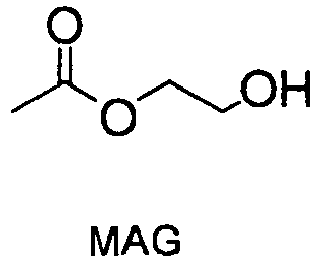
- b) subjecting the compound of formula AOA to further synthesis steps to yield a statin compound or pharmaceutically acceptable salts thereof.
- a) carrying out a process for preparing the compound of formula AOA
- 2) The process according to item (1), wherein said N-oxyl compound is 2,2,6,6-tetramethylpiperidine-N-oxyl.
- 3) The process according to item (2), wherein 2,2,6,6-tetramethylpiperidine-N-oxyl is used in catalytic amounts, preferably in molar ratio of 0.005 : 1 to 0.05 : 1 compared to compound of formula MAG
- 4) The process according to any one of items (1) to (3) wherein said co-oxidant is optionally used in the presence of a base, preferably said base is inorganic base, selected from the group consisting of hydroxides, carbonates and phosphates, most preferably the sodium hydrogenecarbonate is used.
- 5) The process according to any one of items (1) to (4), wherein said co-oxidant is a source of active halogen, preferably chlorine or bromine in oxidation state higher than -1.
- 6) The process according to any one of items (1) to (5) wherein said co-oxidant is selected from the group consisting of:
- inorganic salts, preferably selected from alkali metal and earth alkali metal hypohalogenites, said hypohalogenites are preferably selected from hyypochlorites and hypobromites, said hypochlorite is most preferably calcium hypochlorite (Ca(OCl)2) and said hypobromite is most preferably calcium hypobromite (Ca(OBr)2),
- active halogen containing organic compounds, preferably selected from the group consisting of N-halo substituted compounds selected from N-halo imides (said N-halo imide is preferably N-bromosuccinimide), N-halo hydantoins (said N-halo hydantoin is preferably 1,3-dibromo-5,5-dimethylhydantoin) and isocyanuric derivatives of formula A

- combinations thereof.
- 7) The process according to any one of items (5) to (6), further characterized in that when co-oxidant is calcium hypochlorite (Ca(OCl)2) and / or calcium hypobromite (Ca(OBr)2) said co-oxidant is used in molar ratio of 0.5 : 1 to 1 : 1, preferably in molar ratio of 0.5 : 1 to 0.65 : 1, compared to compound of formula MAG.
- 8) The process according to any one of items (5) to (7), wherein co-oxidant is a solid calcium hypochlorite in combination with inorganic or quaternary ammonium bromide, preferably said inorganic bromide is sodium bromide.
- 9) The process according to any one of items (5) to (6), further characterized in that when co-oxidant is trichloroisocyanuric acid said co-oxidant is used in molar ratio of 0.3 : 1 to 2 : 1, preferably in molar ratio of 0.8 : 1 to 1 : 1, compared to compound of formula MAG.
- 10) The process according to any one of items (1) to (9), wherein said process is performed in non-aqueous solvent, said non-aqueous solvent is preferably selected from the group consisting of saturated hydrocarbons, esters, tertiary alcohols, chlorinated solvents and mixtures thereof, more preferably non-aqueous solvent is selected from the group consisting of chlorinated hydrocarbons and mixtures of tertiary alcohols with esters, most preferably non-aqueous solvent is selected from the group consisting of dichloromethane, mixture of t-butyl alcohol with ethyl acetate and mixture of t-amyl alcohol with ethyl acetate.
- 11) The process according to item (10), wherein the content of water in said non-aqueous solvent is below 0.5 % by weight, more preferably below 0.1 % by weight, most preferably below 0.01 % by weight.
- 12) The process according to any one of items (1) to (11), wherein said compound of formula MAG

- 13) The process according to item (12) wherein said esterification of ethylene glycol is performed in the presence of acetic acid, optionally in the presence of strong acid catalyst, preferably said strong acid catalyst is selected from the group consisting of perchloric, phosphoric and sulphuric acid.
- 14) The process according to item (12) wherein said esterification of ethylene glycol is performed using diacetyl ethylene glycol in the presence of basic catalyst.
- 15) The process according to item (14), wherein ethylene glycol is used in molar ratio of 1 : 1 to 2 : 1, preferably in molar ratio of 1.05 : 1 to 1.20 : 1, most preferably in molar ratio of 1.10 : 1 to 1.15 : 1, compared to diacetyl ethylene glycol.
- 16) The process according to any one of items (14) to (15), wherein said basic catalyst is selected from the group consisting of alkali metals (preferably sodium), alkali metal alcoholates and earth alkali metal alcoholates (preferably potassium tert-butylate), hydrides (preferably sodium hydride), amides (preferably lithium diisopropylamide), hydroxides (preferably sodium hydroxide) and silylamides (preferably sodium hexamethyldisilazane), most preferably sodium hydride is used.
- 17) The process according to any one of items (12) to (16), wherein the esterification reaction of ethylene glycol is carried out by reacting ethylene glycol and acetic acid, optionally with but preferably without further acid or base catalyst, at a temperature of higher than 100°C, preferably at a temperature of higher than 120°C.
- 18) The process according to any one of items (12) - (17) further comprising the steps of:
- a) diluting the reaction mixture obtained in esterification step with water,
- b) removing diacetyl ethylene glycol by extraction from the polar solvent solution from step a) with apolar solvent selected from the group of hydrocarbons, preferably toluene is used,
- c) subsequently extracting MAG from the polar solvent solution from step b) with a solvent of medium polarity selected from the group consisting of esters and chlorinated hydrocarbons, and
- d) evaporating said solvent of medium polarity.
- 19) The process according to item (18) further characterized in that when the esterification step is performed using diacetyl ethylene glycol in the presence of basic catalyst, step a) is optionally followed by neutralisation using appropriate acid, preferably solution of phosphoric acid (85 %) is used.
- 20) The process according to any one of items (1) to (19), further comprising, after the compound of formula AOA is prepared, purifying AOA by filtration and/or isolating AOA by distillation.
- 21) A process for the preparation of a statin compound or pharmaceutically acceptable salt thereof, comprising the steps of preparing the compound of formula AOA

- a) monoacetylating of ethylene glycol by acetic acid optionally in the presence of catalytic amounts of non-volatile strong acids
- b) diluting the reaction mixture from step a) with water
- c) removing diacetyl ethylene glycol by extraction from the polar solvent solution from step b) with apolar solvent selected from the group of hydrocarbons, preferably toluene is used
- d) subsequently extracting compound of formula MAG from the polar solvent solution from step c) with a solvent of medium polarity selected from the group consisting of esters and chlorinated hydrocarbons
- e) evaporating said solvent of medium polarity
- f) oxidizing compound of formula MAG obtained in step e)

- g) filtering off insoluble parts of the reaction suspension
- h) evaporating solvents to yield crude AOA and,
- i) optionally distilling AOA
- j) subjecting the compound of formula AOA to further synthesis steps to yield a statin compound or pharmaceutically acceptable salts thereof.
- 22) A process for the preparation of a statin compound or pharmaceutically acceptable salt thereof, comprising the steps of preparing the compound of formula AOA

- a) esterification of ethylene glycol using diacetyl ethylene glycol in the presence of basic catalyst
- b) diluting the reaction mixture obtained in esterification step with water optionally followed by neutralisation using appropriate acid, preferably solution of phosphoric acid (85 %) is used
- c) removing diacetyl ethylene glycol by extraction from the polar solvent solution from step b) with apolar solvent selected from the group of hydrocarbons, preferably toluene is used
- d) subsequently extracting compound of formula MAG from the polar solvent solution from step c) with a solvent of medium polarity selected from the group consisting of esters and chlorinated hydrocarbons
- e) evaporating said solvent of medium polarity
- f) distilling evaporation residue to obtain MAG, preferably of purity above 95 % (GC) and with low content of water
- g) oxidizing compound of formula MAG obtained in step f) with N-oxyls, preferably TEMPO in the presence of active halogen compounds in non-aqueous media
- h) filtering off insoluble parts of the reaction suspension
- i) evaporating solvents to yield crude AOA and,
- j) optionally distilling AOA
- k) subjecting the compound of formula AOA to further synthesis steps to yield a statin compound or pharmaceutically acceptable salts thereof.
- 23) The process according to any one of items (21) to (22) optionally further comprising the step of evaporating of apolar phase from step c), distillation of obtained residue and obtaining DAG which can be recovered and reused.
- 24) The process according to any one of items (21) to (22) optionally further comprising the step of distillation of the polar phase from step d) and obtaining EG which can be recovered and reused.
- 25) The process according to item (1), wherein said statin compound is selected from the group consisting of rosuvastatin, cerivastatin, fluvastatin, pitavastatin and bervastatin, preferably said statin compound is rosuvastatin.
- 26) A process for the preparation of a pharmaceutical composition comprising rosuvastatin as active ingredient, comprising the steps of:
- a) preparing rosuvastatin or pharmaceutically acceptable salts thereof according to the process according to item (1), and
- b) admixing the thus prepared rosuvastatin or pharmaceutically acceptable salt thereof with at least one pharmaceutically acceptable excipient.
- According to the present invention, it has been surprisingly found that a more efficient, easier to handle and industrially applicable synthesis of statin compounds or pharmaceutically acceptable salts thereof can be carried out, said synthesis comprising a new preparation of acetoxyacetaldehyde , by selecting suitable starting materials which can be converted to the desired product without the necessity of aggressive, difficult to handle and/or expensive reagents (e. g. OsO4, NalO4, ozone, silver salts, the Dess-Martin reagent) as well as without the necessity of using extreme conditions (e. g. very high temperatures and / or very low temperatures). Starting materials applied in the procedural concept according to the present invention are cheap and easily accessible. Moreover, the process for the preparation as described above is more efficient as it allows beneficial reaction conditions due to the use of non-aqueous solvents (as a polyfunctional molecule acetoxyacetaldehyde is prone to polymerisation, hydrolysis, acetalation or hydration especially in the presence of water) providing for less by-products and thus higher purity of the products and higher yields, and/or less necessary reaction steps. The process as described above can further be advantageously carried out in various solvent systems or solvents and is thereby not limited to one particular solvent system or solvent, unless the reaction is significantly affected while being performed in certain particular solvent systems or solvents.
- In addition it has surprisingly been found that a catalytic oxidation using an N-oxyl compound in the presence of co-oxidant can be made highly efficient when starting with monoacetylated monoethylene glycol, in particular when such monoacetylated monoethylene glycol can be provided in pure form. In a preferred embodiment, provision of monoacetylated monoethylene glycol in pure form as an intermediate of a 2 reaction step process can be ensured by monoacetylation of the starting diol using esterification or transesterification. Furthermore a process according to present invention as defined above is suitable for continuous production of acetoxyacetaldehyde with re-usage of solvents as well as by-products in subsequent batches resulting in minimum amounts of waste material. Such continuous process is superior from ecological point of view and appropriate for large scale industrial production.
- As a result, desirable building block which is particularly suited for the preparation of statins or pharmaceutically acceptable salts thereof is provided by a significantly improved process.
- In the following, the present invention will be described in more detail by preferred embodiments and examples noting, however, that these embodiments, examples are presented for illustrative purposes only and shall not limit the invention in any way.
- The term "about" generally means within 10%, preferably 5% and more preferably within 1 % of a given value or range. Alternatively, the term "about" means within an acceptable standard error of the mean, when considered by one of the ordinary skill in the art.
- An advantage of the present invention is the provision of a cost competitive, industrially applicable process involving the obtainment of acetoxyacetaldehyde (AOA) from derivatives of ethylene glycol. A whole procedure from ethylene glycol via MAG to yield AOA involves only two chemical steps. With simple purification methods such as a distillation a material with at least 75 % assay of AOA and less than 10 % of low molecular impurities can be provided. The procedure allows to employ cheap raw materials like ethylene glycol, its acetylated derivatives, acetic acid, strong inorganic acids, simple active halogen containing compounds, and 2,2,6,6-tetramethylpiperidine-N-oxyl (TEMPO). TEMPO as the most expensive raw material in this process can be used only in catalytic amounts. Acetoxyacetaldehyde is prepared by oxidation of monoacetyl ethylene glycol (MAG) with a co-oxidant (preferably active halogen, more preferably chlorine) in the presence of N-oxyls, preferably TEMPO, wherein catalytic amounts of an N-oxyl compound are sufficient. Said method using sodium hypochlorite in water-containing media is well known for oxidation of O-substituted glycols but if applied for preparation of AOA massive polymerisation and degradation of AOA would occur.
- A surprising finding of the present inventors however is that AOA can be isolated in high yield and purity if the N-oxyl/oxidant mediated oxidation is carefully performed in suitable media, in particular if the solvent medium is non-aqueous having, at most, only limited amount of water and preferably is free or essentially free of water or contains water only at a natural level. Subsequently, isolation of AOA can in the following be accomplished by careful distillation. The final product is stable at temperatures below room temperature (preferably at temperatures below 10°C) and any possible polymerisation is, if present at all, very slow. Furthermore it is possible to redistill the stored compound before use to depolymerise it and to reduce impurities.
- According to particularly preferred embodiment, AOA according to present invention is prepared from MAG via oxidation by N-oxyls, preferably TEMPO, with active halogen compounds as co-oxidants in non-aqueous media. The preferred approach according to present invention is shown in Scheme 3 in which /X/ designates a co-oxidant that is a source of active halogen, wherein said active halogen is a halogen, preferably chlorine or bromine in oxidation state higher than -1 and is preferably but not necessarily "hypohalogenite" (i.e. having formal oxidation state +1).

- According to one aspect of invention the co-oxidant is selected from inorganic salts, preferably alkali metal and earth alkali metal hypohalogenites, preferably hypochlorites and hypobromites. Most preferably calcium hypochlorite (Ca(OCl)2) or calcium hypobromite (Ca(OBr)2) are used in molar ratio of 0.5 : 1 to 1 : 1 (hypohalogenite ratio of 1 : 1 to 2 : 1), preferably in molar ratio of 0.5 : 1 to 0.65 : 1 (hypohalogenite ratio of 1 : 1 to 1.3 : 1), TEMPO is preferably used in catalytic amounts, most preferably in molar ratio of 0.005 : 1 to 0.05 : 1 compared to compound of formula MAG.
- The reaction is preferably performed in non-aqueous solvent. Non-aqueous solvent according to present invention should be a solvent or a mixture of solvents which is not susceptible to oxidation under reaction conditions applicable according to present invention and to which no additional amount of water is added. Preferably any content of water, if present at all, is below 0.5%, more preferably bellow 0.1%, most preferably bellow 0.01% by weight. In a usual case a solvent generally includes a natural amount of water carried to the reaction vessel from commercial solvents, reagents and MAG from previous step, but in certain cases or if desired it is preferable to dry solvents additionally using conventional drying agents not limitingly selected from the group consisting of anhydrous sulphates, calcium chloride, calcium hydride, and/or using molecular sieves or removing water with azeotropic distillation (e.g. using dichloromethane)
- Solvents are preferably selected from the group consisting of saturated hydrocarbons, esters, tertiary alcohols, chlorinated solvents and mixtures thereof. Most preferably chlorinated hydrocarbon (such as dichloromethane) or a mixture of a tertiary alcohol and an ester (such as a combination of t-butyl alcohol with ethyl acetate or t-amyl alcohol with ethyl acetate) is used. Reaction is performed for a period of 0.5 to 24 hours, preferably for a period of 1 to 15 hours, more preferably for a period of 7 to 10 hours when inorganic hypochlorite is used or for a period of 1 to 3 hours when organic chloro compound is used. The oxidation is preferably performed at temperatures between -30 °C and 60 °C more preferably at temperatures between 0°C to 40°C, most preferably at about room temperature.
After reaction completion insoluble parts of suspension are filtered off and the solvent is evaporated to yield crude AOA as a yellow liquid. AOA is then purified, preferably using distillation. - As another aspect, the present invention involves an improved synthesis of the starting monoacetyl ethylene glycol (MAG). MAG is a very simple molecule which can be prepared from widespread and cheap ethylene glycol (EG) but acetylation with simple acetic derivatives is limited by considerable level of side reaction of overacetylation. Many approaches to favour monoacetylation are known in literature such as use of equimolar amounts of more reactive acetylation agents like acetanhydride, triethyl ortoacetate, acetic esters or use of additives like FeCl3 (Jiangsu Huagong 2003, 31, 33), zeolites (Synlett 2003, 2419). A special isolation
- TEMPO is preferably used in catalytic amounts, most preferably in molar ratio of 0.005 : 1 to 0.05 : 1 compared to compound of formula MAG.
- The reaction is preferably performed in non-aqueous solvent. Non-aqueous solvent according to present invention should be a solvent or a mixture of solvents which is not susceptible to oxidation under reaction conditions applicable according to present invention and to which no additional amount of water is added. Preferably any content of water, if present at all, is below 0.5%, more preferably bellow 0.1 %, most preferably bellow 0.01% by weight. In a usual case a solvent generally includes a natural amount of water carried to the reaction vessel from commercial solvents, reagents and MAG from previous step, but in certain cases or if desired it is preferable to dry solvents additionally using conventional drying agents not limitingly selected from the group consisting of anhydrous sulphates, calcium chloride, calcium hydride, and/or using molecular sieves or removing water with azeotropic distillation (e.g. using dichloromethane)
- Solvents are preferably selected from the group consisting of saturated hydrocarbons, esters, tertiary alcohols, chlorinated solvents and mixtures thereof. Most preferably chlorinated hydrocarbon (such as dichloromethane) or a mixture of a tertiary alcohol and an ester (such as a combination of t-butyl alcohol with ethyl acetate or t-amyl alcohol with ethyl acetate) is used. Reaction is performed for a period of 0.5 to 24 hours, preferably for a period of 1 to 15 hours, more preferably for a period of 7 to 10 hours when inorganic hypochlorite is used or for a period of 1 to 3 hours when organic chloro compound is used. The oxidation is preferably performed at temperatures between -30 °C and 60 °C more preferably at temperatures between 0°C to 40°C, most preferably at about room temperature.
After reaction completion insoluble parts of suspension are filtered off and the solvent is evaporated to yield crude AOA as a yellow liquid. AOA is then purified, preferably using distillation. - Further aspect of present invention is an improved synthesis of the starting monoacetyl ethylene glycol (MAG). MAG is a very simple molecule which can be prepared from widespread and cheap ethylene glycol (EG) but acetylation with simple acetic derivatives is limited by considerable level of side reaction of overacetylation. Many approaches to favour monoacetylation are known in literature such as use of equimolar amounts of more reactive acetylation agents like acetanhydride, triethyl ortoacetate, acetic esters or use of additives like FeCl3 (Jiangsu Huagong 2003, 31, 33), zeolites (Synlett 2003, 2419). A special isolation approach according to present invention using a double set of solvents surprisingly separates the overacetylated by-product efficiently while a conversion of the diacetyl product to the wanted monoacetyl glycol enables a regeneration of overacetylated product with minor losses.
- Ethylene glycol may be converted to MAG by esterification with acetic acid optionally in the presence of strong acid catalyst (Scheme 4).

- Esterification and transesterification in acidic conditions is an equilibrium process and such approach leads to formation of diacetyl glycol (DAG) and remaining considerable amounts of unreacted ethylene glycol.
- According to present invention in order to limit diacetylation, excess of ethylene glycol compared to acetic acid is preferably used. Thus ethylene glycol is heated suitably with 0.1 to 10, preferably 0.3 to 0.5 molar equivalents of acetic acid in the presence of a non-volatile strong inorganic acid, preferably perchloric, phosphoric or sulphuric acid or in the presence of acidic solid supporters (e.g. Amberlist® 15). The aforementioned process is preferably exercised at the temperatures between 0 °C to 150 °C, more preferably at temperatures between 0 °C to 50 °C, most preferably at around room temperature for a period of 1 to 24 hours. The main product of such reaction is MAG but considerable range of diacetylation also occurs.
- One way to limit diacetylation may be a continuous removal of formed MAG from equilibrium by continuous extraction with organic solvents Furthermore, ethylene glycol and acetic acid may be continuously added and converted to MAG. Such trials were not very successful. When apolar solvents such as hydrocarbons were used predominately less polar diacetylated product is extracted. If however solvents with properties of Lewis base, such as ethers were used, acetic acid is predominately extracted and reaction is stopped not allowing considerable acetylation to take place.
- DAG is less polar than MAG so its extraction is faster than MAG. It is therefore cumulated in organic solvent in spite of minor formation in the reaction mixture.
Acetic acid can also be extracted by organic solvent which may stop the reaction and on the other hand may catalytically re-equilibrate the ratio of glycol components in organic extract to detriment of MAG. - Further approach of limiting diacetylation is to lower the speed of reaction by reducing amount of strong acid. A slower reaction could reduce diacetylation. It has been surprisingly found that the esterification occurs even in the complete absence of strong acid if the reaction is carried out at high temperature. Acetic acid, besides being a reagent, may due to its weak acidity also have a catalytic role. Satisfactory equilibrium ratio DAG : MAG of 1:3 is reached that may form a sound base for a competitive and cheap production of MAG if an efficient separation of DAG from MAG and its further recovery is performed.
In a preferred embodiment of the present invention, a mixture of ethylene glycol and acetic acid in molar excess compared to ethylene glycol (ethylene glycol is preferably used in molar ratio of 1 : 1 to 2 : 1, more preferably in molar ratio of 1.05 : 1 to 1.20 : 1, most preferably in molar ratio of 1.10 : 1 to 1.15 : 1, compared to diacetyl ethylene glycol.) is heated to temperatures above 100 °C, preferably to temperatures above 120 °C, most preferably to temperature of about 130 °C for a period of 1 - 10 hours, preferably for a period of 2 - 4 hours. The obtained glycol ratio EG : MAG : DAG after the reaction completition shows at least twice weight amount of MAG in comparison to EG or DAG preferably the weight ratio is 15-25 : 50-70 : 15-25.
Ethylene glycol can be transformed to MAG by the process of transesterification in acidic conditions using cheap ester, preferably ethyl acetate. It is an equilibrium reaction again and all three analogues of glycol are isolated. Better approach is by using basic catalysis because the reaction is mainly directed to acetylation products. However when ethyl acetate as a transesterification reagent is used, considerable amounts of diacetylation still cannot be avoided. - The inventors of present invention have surprisingly found that if transesterification of ethylene glycol (EG) is performed with diacetyl ethylene glycol (DAG) in basic conditions most of DAG is consumed and MAG is formed in a great excess (Scheme 5). DAG plays a role of acetylating agent and theoretically one mole of ethylene glycol and one mole of DAG will give two moles of MAG. Ethylene glycol is preferably used in amount of 1 to 2 molar equivalents, more preferably in amount of 1.05 to 1.2 molar equivalents, most preferably in amount of 1.1 to 1.15 molar equivalents compared to diacetyl ethylene glycol. Preferably an excess of cheaper ethylene glycol is used to consume as much of DAG as possible. All compounds which form ethylene glycol anion can be applied in the reaction as basic catalysts, preferably said basic catalyst is selected from the group consisting of alkali metals (preferably sodium), alkali metal and earth alkali metal alcoholates (preferably potassium tert-butylate), hydrides (preferably sodium hydride), amides (preferably lithium diisopropylamide), hydroxides (preferably sodium hydroxide) and silylamides (preferably sodium hexamethyldisilazane), most preferably sodium hydride is used. The reaction is preferably carried out at temperatures between 0 and 100 °C for a period of 0.5 to 10 hours, more preferably at about room temperature for a period of 1 to 2 hours.

- The reaction mixture is further optionally neutralised by using strong involatile inorganic acids such as phosphoric acid followed by dilution with water.
- According to present invention the mixture of glycols prepared according to aforementioned procedures using acid catalysed acetylation, acetylation with acetic acid alone or basic catalysed transesterification is further treated according to the following extraction procedure. The reaction mixture which is previously diluted with water and optionally neutralised is first extracted with apolar solvent or a mixture of apolar solvents, selected from hydrocarbons, most preferably toluene, to eliminate unreacted DAG. Afterwards the polar phase is extracted with a solvent of middle polarity or a mixture of such solvents, selected from the group consisting of esters, water immiscible ketones and chlorinated hydrocarbons, preferably dichloromethane is used. Solvent of medium polarity is removed by evaporation to obtain MAG with low water content. The apolar solvent is removed by evaporation to give mainly DAG which can be reused in the next batch. Polar residue can be distilled to give mainly EG which can also be reused in the next batch. Double extraction approach with two sets of water immiscible solvents with different polarity is more efficient when higher excess of MAG over DAG is achieved in esterification step. Said approach is therefore more suitable for basic catalysed transesterification but can also be used in various acid catalysed acetylations. Additionally most of unwanted DAG can be reused in subsequent batch resulting in most of DAG being converted to MAG. According to said procedure MAG of chromatographic purity of more than 95 % is preferably prepared.
- Evaporation residue from the extract with solvents of medium polarity, which predominantly contains MAG, is optionally purified by distillation.
- Evaporation residue from the extract with apolar solvents, which predominantly contains DAG, is optionally purified by distillation. In the case that DAG is reused there is no need for further purification and the presence of additional amounts of MAG and EG is acceptable.
- In summary the recovered solvents can be used in the next batch and the whole process can be performed continuously. Ethylene glycol is collected, optionally redistilled and used in another batch. DAG is collected and can be converted to MAG in the next batch.
Fig. 1 schematically represents this procedure and shows that most of material is consumed and only minor amounts of residues after distillation are eliminated as waste. Such continuous process is superior from ecological point of view and appropriate for large scale industrial production. - d) subsequently extracting MAG from the polar solvent solution from step c) with a solvent of medium polarity selected from the group consisting of esters and chlorinated hydrocarbons
- e) optionally evaporating said solvent of medium polarity
- f) distilling evaporation residue from step e) to obtain MAG of purity above 95 % (GC) and of low content of water
- g) oxidizing MAG with N-oxyls, preferably TEMPO in the presence of active halogen compounds in non-aqueous media
- h) filtering off insoluble parts of the reaction suspension
- i) evaporating solvents to yield crude AOA and,
- j) optionally distilling AOA to give colourless or slightly yellowish liquid which predominantly contains monomer.
- Optionally the apolar phase of step c) is evaporated, residue distilled obtaining DAG which can be recovered and reused.
- Optionally the polar phase of steps d) is distilled obtaining EG which can be recovered and reused.
- The acetoxyacetaldehyde is then subjected to further synthesis steps, in order to yield statin compounds or pharmaceutically acceptable salts thereof by synthesis routes known to or readily devisable by a person skilled in the art. For example, various acetaldehydes can be converted by DERA enzymes to lactols (Scheme 6) which are 6 carbon atom synthons for side chain of various HMG CoA reductase inhibitors ("statin compounds", or simply "statins").

- d) subsequently extracting MAG from the polar solvent solution from step c) with a solvent of medium polarity selected from the group consisting of esters and chlorinated hydrocarbons
- e) optionally evaporating said solvent of medium polarity
- f) distilling evaporation residue from step e) to obtain MAG of purity above 95 % (GC) and of low content of water
- g) oxidizing MAG with N-oxyls, preferably TEMPO in the presence of active halogen compounds in non-aqueous media
- h) filtering off insoluble parts of the reaction suspension
- i) evaporating solvents to yield crude AOA and,
- j) optionally distilling AOA to give colourless or slightly yellowish liquid which predominantly contains monomer.
- Optionally the apolar phase of step c) is evaporated, residue distilled obtaining DAG which can be recovered and reused.
- Optionally the polar phase of steps d) is distilled obtaining EG which can be recovered and reused.
- The acetoxyacetaldehyde then can be a useful raw material and can be subjected to further synthesis steps, preferably in order to yield different active pharmaceutical ingredients, preferably statins, by synthesis routes known to or readily devisable by a person skilled in the art. For example, various acetaldehydes can be converted by DERA enzymes to lactols (Scheme 6) which are 6 carbon atom synthons for side chain of various HMG CoA reductase inhibitors ("statin compounds", or simply "statins").

- Lactol (R = OAc) which can be prepared from AOA can be converted to different synthons for synthesis of statins (Scheme 7).

- In a representing but not limiting example the lactol A is oxidized to the lactone B, protected with a sylyl group to the lactone C, further hydrolyzed to the hydroxy derivative D and oxidized to the aldehyde E which is suitable formation for Wittig-Horner coupling with various phosphorous compounds Stat-CH2-W in which Stat represents the main part of a statin or a structure which could be converted to the main part of the statin and W represents phosphonium, phosphinoxide or phosphonic ester (Scheme 8).

- Statins which can be prepared by such approach are preferably selected from the group consisting of rosuvastatin, cerivastatin, fluvastatin, pitavastatin and bervastatin, isolated in a lactone form of Formula F or in an open chain form of formula G in which Stat represents structures shown in Scheme 9, and in which X is preferably alkali metal or earth alkali metal cation. In the most preferred case rosuvastatin (Formula G, Stat = Stat1, X=Ca1/2) is prepared.

- For preparing a pharmaceutical composition comprising abovementioned statins, preferably rosuvastatin or pharmaceutically acceptable salts thereof as active ingredient, first statin, preferably rosuvastatin or pharmaceutically acceptable salts thereof is provided by the process as described above.
- Then, the thus prepared statin, preferably rosuvastatin or pharmaceutically acceptable salts thereof is suitably admixed with at least one suitable pharmaceutically acceptable excipient. Pharmaceutically acceptable excipients may be selected from the group consisting of binders, diluents, disintegrating agents, stabilizing agents, preservatives, lubricants, fragrances, flavoring agents, sweeteners and other excipients known in the field of the pharmaceutical technology.
Preferably, excipients may be selected from the group consisting of lactose, microcrystalline cellulose, cellulose derivatives, e.g. hydroxypropylcellulose, polyacrylates, calcium carbonate, starch, colloidal silicone dioxide, sodium starch glycolate, talc, magnesium stearate, polyvinylpyrrolidone, polyethylene glycol and other excipients known in the field of the pharmaceutical technology. - Ethylene glycol (EG) (62.1 mmol), acetic acid (46.57 mL) and H2SO4 (0.29 mL) were diluted with water (93.14 mL) and carried to a reaction in a continuous extraction apparatus using benzene as an extracting solvent. The reaction was carried out for 5 days. The organic phase was collected and analyzed by TLC, which showed only DAG as main product.
- Water phase consisting of EG (0.91 L), acetic acid (8.30 L) and 96 % H2SO4 (0.015 L) in water (16.5 L) was continuously extracted using reaction-extraction column (capacity 35 L) and tert-butyl methyl ether (60 L). Organic phase was collected and fresh tert-butyl methyl ether was used for extraction every 24 hours. After 24 hours samples where taken from water (EG : MAG : DAG = 97.7 : 1.9 : 0.0) and organic phase (EG : MAG : DAG = 88.4 : 8.2 : 0.5).
- Ethylene glycol (EG) (266 mmol), acetic acid (87.5 mmol) and concentrated sulfuric acid (1.8 mmol) were stirred for 24 hours at room temperature. To this solution an aqueous solution of saturated NaHCO3 (15 mL) was added and left to stir overnight. Then water (10 mL) was added and extracted first with toluene (2 x 50 mL) and then with CH2Cl2 (5x 50 mL). Afterwards CH2Cl2 phase was collected and evaporated yielding 8.0 g of mixture of components (EG : MAG: DAG = 1.2 : 97.7 : 1.1). Yield of MAG: 28 % per EG, 86 % per AcOH.
- Ethylene glycol (EG) (161 mmol), acetic acid (209 mmol) and Amberlist® 15 (1.71 g) were stirred for 4 days at room temperature. Then solids were removed by filtration and to filtrate water (35 mL) was added and extracted first with toluene (2x 80 mL) and then with CH2Cl2 (3x 80 mL). The CH2Cl2 phase was collected and evaporated yielding 6.3 g of mixture of components (EG : MAG: DAG = 0.5 : 97.5 : 2 ), yield of MAG 37 % per EG.
- Mixture of EG (8.06 mmol) and acetic acid (10.5 mmol) was heated at 130°C for 3 hours. After cooling the mixture of products EG : MAG : DAG in ratio 23 : 59 : 18 was obtained from which MAG was isolated using extraction procedure in Example 2 in 44 % yield, calculated per EG.
- To a mixture of EG (322 mmol) and diacetyl ethylene glycol (DAG) (290 mmol), sodium hydride (3.2 mmol) was added and left at room temperature for 1.5 hours. To this solution 85% phosphoric acid (1.6 mmol) was added dropwise and left to stir for 0.5 hour. To this mixture distilled water (60 mL) was added and extracted with toluene (2 x 80 mL). Water phase was additionally extracted with CH2Cl2 (5 x 80mL). CH2Cl2 phase was collected and solvent evaporated to yield MAG as transparent liquid (17.5 g, yield 51 % regarding MEG and GC purity >96%). Toluene phase with manly DAG can be re-used in the next batch after evaporation of solvent.
- To a mixture of EG (322 mmol) and diacetyl ethylene glycol (DAG) (290 mmol), sodium hydroxide (3.2 mmol) was added and left at room temperature for 1.5 hours. To this solution 85% phosphoric acid (1.6 mmol) was added dropwise and left to stir for 0.5 hour. To this mixture distilled water (60 mL) was added and extracted with toluene (5 x 40 mL). Water phase was additionally extracted with CH2Cl2 (8 x 80mL). CH2Cl2 phase was collected and solvent evaporated to yield MAG as transparent liquid (29.8 g, yield 49 % regarding overall yield and GC purity >98%). Toluene phase with manly DAG can be re-used in the next batch after evaporation of solvent.
- Initially, MAG (100 mmol) was diluted with a mixture of solvents (0.1 M in 90/10 ethyl acetate - tert-butanol) in batch reactor. To a solution of MAG was then successively added calcium hypochlorite (Ca(ClO)2 - 60 mmol), sodium bromide (5 mmol) and TEMPO (3 mmol). Reaction mixture was vigorously stirred (mechanical stirring) for 9 hours at room temperature. In order to ensure batch-to-batch repeatability and to achieve the highest possible MAG conversion (AOA yield), the fine powder (filter through sieve 0,125 mm) of calcium hypochlorite was used. Reaction mixture was then filtered to remove insoluble calcium hypochlorite and the solvent was evaporated under reduced pressure. Dark-yellowish liquid was obtained with "GC (gas chromatographic) purity" of more then 40 %. Crude AOA mixture was further purified by distillation under reduced pressure (80 °C (bath) and 20 to 13 mbar) to obtain pure AOA (purity up to 92% GC, 75% assay).
- To a suspension of NaHCO3 (269 mmol), trichloroisocyanuric acid (TCICA - 38.4 mmol) and MAG (45.2 mmol) in CH2Cl2 (100 mL) cooled on an ice bath TEMPO (0.48 mmol) was added at once. Reaction mixture was left to stir for 1.5 hours and then filtered through a pad of Celite®. Filtrate was concentrated under reduced pressure (rotavapor 50 mBar, T (bath) = 40 °C) and oily residue distilled (T (bath) = 80 °C, 10 mBar) to yield transparent liquid as AOA (2.96 g, purity up to 95 %).
- To a suspension of NaHCO3 (57,6 mmol), trichloroisocyanuric acid (TClCA - 7,68 mmol) and MAG (9,61 mmol) in EtOAc (48 mL) cooled on an ice bath TEMPO (0,10 mmol) was added at once. Reaction mixture was left to stir for 1.5 h and then filtered through a pad of Celite®. Filtrate was concentrated under reduced pressure (rotary evaporator 50 mBar, T (bath) = 40 °C) and solid residue formed. Sample was analysed by GC as AOA (1,05 g, purity 76 % GC area).
- To a solution of MAG (1.04 g, 10 mmol) in acetonitrile (30 mL) was added sodium citrate (0.88 g, 0.3 eq) and TEMPO (47 mg, 0.03 eq). Sodium dichloroisocyanurate (SDIC - 1.98 g, 0.9 eq) was added at once. Reaction mixture was left to stir for 1 hour and then filtered through a pad of Celite® to give AOA solution with crude GC purity of 85%.
- To a solution of MAG (1.04 g, 10 mmol) in acetonitrile (30 mL) was added sodium triisocyanurate (0.585 g, 0.3 eq) and TEMPO (47 mg, 0.03 eq). Sodium dichloroisocyanurate (SDIC - 1.54 g, 0.7 eq) was added at once. Reaction mixture was left to stir for 1 hour and then filtered through a pad of Celite® to give AOA solution with GC purity of 72%.
Claims (15)
- A process for the preparation of a statin compound or pharmaceutically acceptable salt thereof, comprising the steps ofa) carrying out a process for preparing the compound of formula AOA

providing a compound of formula MAG: b) subjecting the compound of formula AOA to further synthesis steps to yield a statin compound or pharmaceutically acceptable salts thereof.
 - The process according to claim 1, wherein said N-oxyl is 2,2,6,6-tetramethylpiperidine-N-oxyl, said 2,2,6,6-tetramethylpiperidine-N-oxyl is preferably used in catalytic amounts, more preferably in molar ratio of 0.005 : 1 to 0.05 : 1 compared to compound of formula MAG.
- The process according to claim 1 or claim 2, wherein said co-oxidant is a source of active halogen, preferably chlorine or bromine in oxidation state higher than -1.
- The process according to any one of claims 1 to 3 wherein said co-oxidant is selected from the group consisting of:- inorganic salts, preferably selected from alkali metal and earth alkali metal hypohalogenites, and,- active halogen containing organic compounds, preferably selected from the group consisting of N-halo substituted compounds selected from N-halo imides, preferaqbly N-bromosuccinimide, N-halo hydantoins, preferably 1,3-dibromo-5,5-dimethylhydantoin, and isocyanuric derivatives of formula A

- The process according to claim 4 wherein said hypohalogenites are selected from hypochlorites and hypobromites, preferably calcium hypochlorite (Ca(OCl2) and calcium hypobromite (Ca(OBr)2).
- The process according to any one of claims 3 to 4, further characterized in that when co-oxidant is calcium hypochlorite (Ca(OCl)2) and / or calcium hypobromite (Ca(OBr)2) said co-oxidant is used in molar ratio of 0.5 : 1 to 1 : 1, preferably in molar ratio of 0.5 : 1 to 0.65 : 1, compared to compound of formula MAG.
- The process according to claim 6 wherein said co-oxidant is used in combination with inorganic bromide, preferably sodium bromide, or quaternary ammonium bromide.
- The process according to any one of claims 3 to 4, further characterized in that when co-oxidant is trichloroisocyanuric acid said co-oxidant is used in molar ratio of 0.3 : 1 to 2 : 1, preferably in molar ratio of 0.8 : 1 to 1 : 1 molar equivalents, compared to compound of formula MAG.
- The process according to any one of claims 1 to 8, wherein said process is performed in non-aqueous solvent, preferably selected from the group consisting of saturated hydrocarbons, esters, tertiary alcohols, chlorinated solvents and mixtures thereof, from the group consisting of chlorinated hydrocarbons and mixtures of tertiary alcohols with esters, or from the group consisting of dichloromethane, mixture of t-butyl alcohol with ethyl acetate and mixture of t-amyl alcohol with ethyl acetate.
- The process according to any one of claims 1 to 9, wherein said compound of formula MAG

- The process according to claim 10 wherein said esterification of ethylene glycol is performed using diacetyl ethylene glycol in the presence of basic catalyst, wherein ethylene glycol is used in molar ratio of 1 : 1 to 2 : 1, preferably in molar ratio of 1.05 : 1 to 1.20 : 1, most preferably in molar ratio of 1.10 : 1 to 1.15 : 1, compared to diacetyl) ethylene glycol.
- The process according to claim 10, wherein the esterification reaction of ethylene glycol is carried out by reacting ethylene glycol and acetic acid, optionally with but preferably without further acid or base catalyst, at a temperature of higher than 100°C, preferably at a temperature of higher than 120°C.
- The process according to any one of claims 10 to 12 further comprising the steps of:a) diluting the reaction mixture obtained in esterification step with water,b) removing diacetyl ethylene glycol by extraction from the polar solvent solution from step a) with apolar solvent selected from the group of hydrocarbons, preferably toluene is used,c) subsequently extracting compound of formula MAG from the polar solvent solution from step b) with a solvent of medium polarity selected from the group consisting of esters and chlorinated hydrocarbons, andd) evaporating said solvent of medium polarity, and optionallye) purifying prepared AOA by filtration and/or isolating AOA by distillation.
- The process according to claim 1, wherein said statin compound is selected from the group consisting of rosuvastatin, cerivastatin, fluvastatin, pitavastatin and bervastatin, preferably said statin compound is rosuvastatin.
- A process for the preparation of a pharmaceutical composition comprising rosuvastatin as active ingredient, comprising the steps of:a) preparing rosuvastatin or pharmaceutically acceptable salts thereof according to the process according to claim 1, andb) admixing the thus prepared rosuvastatin or pharmaceutically acceptable salt thereof with at least one pharmaceutically acceptable excipient.
Priority Applications (2)
| Application Number | Priority Date | Filing Date | Title |
|---|---|---|---|
| EP10792866.5A EP2504309B1 (en) | 2009-11-25 | 2010-11-24 | Synthesis of acetoxyacetaldehyde |
| SI201030789T SI2504309T1 (en) | 2009-11-25 | 2010-11-24 | Synthesis of acetoxyacetaldehyde |
Applications Claiming Priority (3)
| Application Number | Priority Date | Filing Date | Title |
|---|---|---|---|
| EP09177008A EP2327683A1 (en) | 2009-11-25 | 2009-11-25 | Synthesis of acetoxyacetaldehyde |
| EP10792866.5A EP2504309B1 (en) | 2009-11-25 | 2010-11-24 | Synthesis of acetoxyacetaldehyde |
| PCT/EP2010/068117 WO2011064249A1 (en) | 2009-11-25 | 2010-11-24 | Synthesis of acetoxyacetaldehyde |
Publications (2)
| Publication Number | Publication Date |
|---|---|
| EP2504309A1 EP2504309A1 (en) | 2012-10-03 |
| EP2504309B1 true EP2504309B1 (en) | 2014-08-06 |
Family
ID=41693019
Family Applications (2)
| Application Number | Title | Priority Date | Filing Date |
|---|---|---|---|
| EP09177008A Ceased EP2327683A1 (en) | 2009-11-25 | 2009-11-25 | Synthesis of acetoxyacetaldehyde |
| EP10792866.5A Not-in-force EP2504309B1 (en) | 2009-11-25 | 2010-11-24 | Synthesis of acetoxyacetaldehyde |
Family Applications Before (1)
| Application Number | Title | Priority Date | Filing Date |
|---|---|---|---|
| EP09177008A Ceased EP2327683A1 (en) | 2009-11-25 | 2009-11-25 | Synthesis of acetoxyacetaldehyde |
Country Status (4)
| Country | Link |
|---|---|
| EP (2) | EP2327683A1 (en) |
| CN (1) | CN102712566B (en) |
| SI (1) | SI2504309T1 (en) |
| WO (1) | WO2011064249A1 (en) |
Families Citing this family (2)
| Publication number | Priority date | Publication date | Assignee | Title |
|---|---|---|---|---|
| CN108342179A (en) * | 2018-02-07 | 2018-07-31 | 袁林林 | A kind of Corrosion-Resistant Adhesive and preparation method thereof |
| NL2032224B1 (en) | 2022-06-20 | 2024-01-08 | Amt Medical B V | anastomosis clip |
Family Cites Families (4)
| Publication number | Priority date | Publication date | Assignee | Title |
|---|---|---|---|---|
| US2286034A (en) | 1939-04-04 | 1942-06-09 | Du Pont | Preparation of substituted aldehydes |
| EP1666441A1 (en) * | 2004-12-03 | 2006-06-07 | Daiso Co., Ltd. | Oxidation method for primary or secondary alcohols |
| WO2008034598A1 (en) | 2006-09-19 | 2008-03-27 | Dsm Ip Assets B.V. | Method for the synthesis of hexahydrofuro (2, 3-b) furan-3-ol compounds |
| AU2009207721B2 (en) * | 2008-01-23 | 2014-10-23 | Lek Pharmaceuticals D.D. | ((2S,4R)-4,6-dihydroxytetrahydro-2H-pyran-2-yl)methyl carboxylate and process for the production employing a 2-deoxyribose-5-phosphate aldolase |
-
2009
- 2009-11-25 EP EP09177008A patent/EP2327683A1/en not_active Ceased
-
2010
- 2010-11-24 EP EP10792866.5A patent/EP2504309B1/en not_active Not-in-force
- 2010-11-24 WO PCT/EP2010/068117 patent/WO2011064249A1/en not_active Ceased
- 2010-11-24 CN CN201080062194.8A patent/CN102712566B/en not_active Expired - Fee Related
- 2010-11-24 SI SI201030789T patent/SI2504309T1/en unknown
Also Published As
| Publication number | Publication date |
|---|---|
| SI2504309T1 (en) | 2014-12-31 |
| EP2327683A1 (en) | 2011-06-01 |
| EP2504309A1 (en) | 2012-10-03 |
| WO2011064249A1 (en) | 2011-06-03 |
| CN102712566A (en) | 2012-10-03 |
| CN102712566B (en) | 2015-11-25 |
Similar Documents
| Publication | Publication Date | Title |
|---|---|---|
| KR102638806B1 (en) | Synthesis of methacrylic acid from methacrolein-based alkyl methacrylates | |
| CN103209951B (en) | Keto-carboxylic acid, keto-carboxylic acid ester, its method of manufacture and use thereof | |
| WO2011064249A1 (en) | Synthesis of acetoxyacetaldehyde | |
| EP2264015A1 (en) | Key intermediates for the synthesis of rosuvastatin or pharmaceutically acceptable salts thereof | |
| KR101727332B1 (en) | Method for producing hydroxyalkyl(meth)acrylic acid ester | |
| JPWO2005040246A1 (en) | Acyloxyacetic acid polymer and process for producing the same | |
| WO2002050003A1 (en) | Process for the production of fluoromethyl hexafluoroisopropyl ether | |
| SU552897A3 (en) | The method of obtaining pyridine derivatives or their salts | |
| JP5468870B2 (en) | Method for producing lactone compound | |
| JP5536668B2 (en) | Preparation of diacerein | |
| US20130023681A1 (en) | Stabilized doxercalciferol and process for manufacturing the same | |
| JP5636692B2 (en) | Method for producing 5-hydroxy-1,3-dioxane and method for producing branched glycerol trimer using 5-hydroxy-1,3-dioxane obtained by the method as a raw material | |
| JPH1087546A (en) | Production of γ-halothigrin aldehyde | |
| CN112028740B (en) | Process for producing chlorohydrin | |
| JP4125916B2 (en) | Method for producing high purity ester | |
| JP5228920B2 (en) | Process for producing 1-acyloxy-3- (3,4-methylenedioxyphenyl) -1-propene compound | |
| JPH01294650A (en) | Production of ester compound | |
| JP5105825B2 (en) | Method for producing 4-hydroxy-2-adamantanone compound | |
| JP2756373B2 (en) | Method for producing 1,1,1-trifluoro-3-nitro-2-propene | |
| JP5468868B2 (en) | Method for producing lactone compound | |
| US20090131688A1 (en) | Method for the synthesis of 4-benzofuran-carboxylic acid | |
| JP5468869B2 (en) | Method for producing lactone compound | |
| JPH11315075A (en) | Production of 2-alkenyl-1,3-dioxo compound | |
| KR101521607B1 (en) | Process of isolating methyl-4-formylbenzoate and dimethylterephtalate with high yield | |
| EP0912479A1 (en) | Process for the manufacture of oxygenates |
Legal Events
| Date | Code | Title | Description |
|---|---|---|---|
| PUAI | Public reference made under article 153(3) epc to a published international application that has entered the european phase |
Free format text: ORIGINAL CODE: 0009012 |
|
| 17P | Request for examination filed |
Effective date: 20120625 |
|
| AK | Designated contracting states |
Kind code of ref document: A1 Designated state(s): AL AT BE BG CH CY CZ DE DK EE ES FI FR GB GR HR HU IE IS IT LI LT LU LV MC MK MT NL NO PL PT RO RS SE SI SK SM TR |
|
| DAX | Request for extension of the european patent (deleted) | ||
| 17Q | First examination report despatched |
Effective date: 20130524 |
|
| GRAP | Despatch of communication of intention to grant a patent |
Free format text: ORIGINAL CODE: EPIDOSNIGR1 |
|
| INTG | Intention to grant announced |
Effective date: 20140214 |
|
| GRAS | Grant fee paid |
Free format text: ORIGINAL CODE: EPIDOSNIGR3 |
|
| GRAA | (expected) grant |
Free format text: ORIGINAL CODE: 0009210 |
|
| AK | Designated contracting states |
Kind code of ref document: B1 Designated state(s): AL AT BE BG CH CY CZ DE DK EE ES FI FR GB GR HR HU IE IS IT LI LT LU LV MC MK MT NL NO PL PT RO RS SE SI SK SM TR |
|
| REG | Reference to a national code |
Ref country code: GB Ref legal event code: FG4D |
|
| REG | Reference to a national code |
Ref country code: AT Ref legal event code: REF Ref document number: 680976 Country of ref document: AT Kind code of ref document: T Effective date: 20140815 Ref country code: CH Ref legal event code: EP |
|
| REG | Reference to a national code |
Ref country code: IE Ref legal event code: FG4D |
|
| REG | Reference to a national code |
Ref country code: DE Ref legal event code: R096 Ref document number: 602010018102 Country of ref document: DE Effective date: 20140918 |
|
| REG | Reference to a national code |
Ref country code: NL Ref legal event code: T3 |
|
| REG | Reference to a national code |
Ref country code: AT Ref legal event code: MK05 Ref document number: 680976 Country of ref document: AT Kind code of ref document: T Effective date: 20140806 |
|
| REG | Reference to a national code |
Ref country code: LT Ref legal event code: MG4D |
|
| PG25 | Lapsed in a contracting state [announced via postgrant information from national office to epo] |
Ref country code: LT Free format text: LAPSE BECAUSE OF FAILURE TO SUBMIT A TRANSLATION OF THE DESCRIPTION OR TO PAY THE FEE WITHIN THE PRESCRIBED TIME-LIMIT Effective date: 20140806 Ref country code: PT Free format text: LAPSE BECAUSE OF FAILURE TO SUBMIT A TRANSLATION OF THE DESCRIPTION OR TO PAY THE FEE WITHIN THE PRESCRIBED TIME-LIMIT Effective date: 20141209 Ref country code: NO Free format text: LAPSE BECAUSE OF FAILURE TO SUBMIT A TRANSLATION OF THE DESCRIPTION OR TO PAY THE FEE WITHIN THE PRESCRIBED TIME-LIMIT Effective date: 20141106 Ref country code: ES Free format text: LAPSE BECAUSE OF FAILURE TO SUBMIT A TRANSLATION OF THE DESCRIPTION OR TO PAY THE FEE WITHIN THE PRESCRIBED TIME-LIMIT Effective date: 20140806 Ref country code: FI Free format text: LAPSE BECAUSE OF FAILURE TO SUBMIT A TRANSLATION OF THE DESCRIPTION OR TO PAY THE FEE WITHIN THE PRESCRIBED TIME-LIMIT Effective date: 20140806 Ref country code: BG Free format text: LAPSE BECAUSE OF FAILURE TO SUBMIT A TRANSLATION OF THE DESCRIPTION OR TO PAY THE FEE WITHIN THE PRESCRIBED TIME-LIMIT Effective date: 20141106 Ref country code: GR Free format text: LAPSE BECAUSE OF FAILURE TO SUBMIT A TRANSLATION OF THE DESCRIPTION OR TO PAY THE FEE WITHIN THE PRESCRIBED TIME-LIMIT Effective date: 20141107 Ref country code: SE Free format text: LAPSE BECAUSE OF FAILURE TO SUBMIT A TRANSLATION OF THE DESCRIPTION OR TO PAY THE FEE WITHIN THE PRESCRIBED TIME-LIMIT Effective date: 20140806 |
|
| PG25 | Lapsed in a contracting state [announced via postgrant information from national office to epo] |
Ref country code: IS Free format text: LAPSE BECAUSE OF FAILURE TO SUBMIT A TRANSLATION OF THE DESCRIPTION OR TO PAY THE FEE WITHIN THE PRESCRIBED TIME-LIMIT Effective date: 20141206 Ref country code: LV Free format text: LAPSE BECAUSE OF FAILURE TO SUBMIT A TRANSLATION OF THE DESCRIPTION OR TO PAY THE FEE WITHIN THE PRESCRIBED TIME-LIMIT Effective date: 20140806 Ref country code: PL Free format text: LAPSE BECAUSE OF FAILURE TO SUBMIT A TRANSLATION OF THE DESCRIPTION OR TO PAY THE FEE WITHIN THE PRESCRIBED TIME-LIMIT Effective date: 20140806 Ref country code: HR Free format text: LAPSE BECAUSE OF FAILURE TO SUBMIT A TRANSLATION OF THE DESCRIPTION OR TO PAY THE FEE WITHIN THE PRESCRIBED TIME-LIMIT Effective date: 20140806 Ref country code: RS Free format text: LAPSE BECAUSE OF FAILURE TO SUBMIT A TRANSLATION OF THE DESCRIPTION OR TO PAY THE FEE WITHIN THE PRESCRIBED TIME-LIMIT Effective date: 20140806 Ref country code: CY Free format text: LAPSE BECAUSE OF FAILURE TO SUBMIT A TRANSLATION OF THE DESCRIPTION OR TO PAY THE FEE WITHIN THE PRESCRIBED TIME-LIMIT Effective date: 20140806 Ref country code: AT Free format text: LAPSE BECAUSE OF FAILURE TO SUBMIT A TRANSLATION OF THE DESCRIPTION OR TO PAY THE FEE WITHIN THE PRESCRIBED TIME-LIMIT Effective date: 20140806 |
|
| PG25 | Lapsed in a contracting state [announced via postgrant information from national office to epo] |
Ref country code: CZ Free format text: LAPSE BECAUSE OF FAILURE TO SUBMIT A TRANSLATION OF THE DESCRIPTION OR TO PAY THE FEE WITHIN THE PRESCRIBED TIME-LIMIT Effective date: 20140806 Ref country code: EE Free format text: LAPSE BECAUSE OF FAILURE TO SUBMIT A TRANSLATION OF THE DESCRIPTION OR TO PAY THE FEE WITHIN THE PRESCRIBED TIME-LIMIT Effective date: 20140806 Ref country code: DK Free format text: LAPSE BECAUSE OF FAILURE TO SUBMIT A TRANSLATION OF THE DESCRIPTION OR TO PAY THE FEE WITHIN THE PRESCRIBED TIME-LIMIT Effective date: 20140806 Ref country code: IT Free format text: LAPSE BECAUSE OF FAILURE TO SUBMIT A TRANSLATION OF THE DESCRIPTION OR TO PAY THE FEE WITHIN THE PRESCRIBED TIME-LIMIT Effective date: 20140806 Ref country code: RO Free format text: LAPSE BECAUSE OF FAILURE TO SUBMIT A TRANSLATION OF THE DESCRIPTION OR TO PAY THE FEE WITHIN THE PRESCRIBED TIME-LIMIT Effective date: 20140806 Ref country code: SK Free format text: LAPSE BECAUSE OF FAILURE TO SUBMIT A TRANSLATION OF THE DESCRIPTION OR TO PAY THE FEE WITHIN THE PRESCRIBED TIME-LIMIT Effective date: 20140806 |
|
| REG | Reference to a national code |
Ref country code: DE Ref legal event code: R097 Ref document number: 602010018102 Country of ref document: DE |
|
| PLBE | No opposition filed within time limit |
Free format text: ORIGINAL CODE: 0009261 |
|
| STAA | Information on the status of an ep patent application or granted ep patent |
Free format text: STATUS: NO OPPOSITION FILED WITHIN TIME LIMIT |
|
| PG25 | Lapsed in a contracting state [announced via postgrant information from national office to epo] |
Ref country code: BE Free format text: LAPSE BECAUSE OF NON-PAYMENT OF DUE FEES Effective date: 20141130 Ref country code: MC Free format text: LAPSE BECAUSE OF FAILURE TO SUBMIT A TRANSLATION OF THE DESCRIPTION OR TO PAY THE FEE WITHIN THE PRESCRIBED TIME-LIMIT Effective date: 20140806 Ref country code: LU Free format text: LAPSE BECAUSE OF FAILURE TO SUBMIT A TRANSLATION OF THE DESCRIPTION OR TO PAY THE FEE WITHIN THE PRESCRIBED TIME-LIMIT Effective date: 20141124 |
|
| REG | Reference to a national code |
Ref country code: CH Ref legal event code: PL |
|
| 26N | No opposition filed |
Effective date: 20150507 |
|
| PG25 | Lapsed in a contracting state [announced via postgrant information from national office to epo] |
Ref country code: CH Free format text: LAPSE BECAUSE OF NON-PAYMENT OF DUE FEES Effective date: 20141130 Ref country code: LI Free format text: LAPSE BECAUSE OF NON-PAYMENT OF DUE FEES Effective date: 20141130 |
|
| REG | Reference to a national code |
Ref country code: IE Ref legal event code: MM4A |
|
| REG | Reference to a national code |
Ref country code: FR Ref legal event code: PLFP Year of fee payment: 6 |
|
| PG25 | Lapsed in a contracting state [announced via postgrant information from national office to epo] |
Ref country code: IE Free format text: LAPSE BECAUSE OF NON-PAYMENT OF DUE FEES Effective date: 20141124 |
|
| PG25 | Lapsed in a contracting state [announced via postgrant information from national office to epo] |
Ref country code: SM Free format text: LAPSE BECAUSE OF FAILURE TO SUBMIT A TRANSLATION OF THE DESCRIPTION OR TO PAY THE FEE WITHIN THE PRESCRIBED TIME-LIMIT Effective date: 20140806 |
|
| PG25 | Lapsed in a contracting state [announced via postgrant information from national office to epo] |
Ref country code: HU Free format text: LAPSE BECAUSE OF FAILURE TO SUBMIT A TRANSLATION OF THE DESCRIPTION OR TO PAY THE FEE WITHIN THE PRESCRIBED TIME-LIMIT; INVALID AB INITIO Effective date: 20101124 Ref country code: BE Free format text: LAPSE BECAUSE OF FAILURE TO SUBMIT A TRANSLATION OF THE DESCRIPTION OR TO PAY THE FEE WITHIN THE PRESCRIBED TIME-LIMIT Effective date: 20140806 Ref country code: TR Free format text: LAPSE BECAUSE OF FAILURE TO SUBMIT A TRANSLATION OF THE DESCRIPTION OR TO PAY THE FEE WITHIN THE PRESCRIBED TIME-LIMIT Effective date: 20140806 Ref country code: MT Free format text: LAPSE BECAUSE OF FAILURE TO SUBMIT A TRANSLATION OF THE DESCRIPTION OR TO PAY THE FEE WITHIN THE PRESCRIBED TIME-LIMIT Effective date: 20140806 |
|
| REG | Reference to a national code |
Ref country code: FR Ref legal event code: PLFP Year of fee payment: 7 |
|
| REG | Reference to a national code |
Ref country code: FR Ref legal event code: PLFP Year of fee payment: 8 |
|
| PG25 | Lapsed in a contracting state [announced via postgrant information from national office to epo] |
Ref country code: MK Free format text: LAPSE BECAUSE OF FAILURE TO SUBMIT A TRANSLATION OF THE DESCRIPTION OR TO PAY THE FEE WITHIN THE PRESCRIBED TIME-LIMIT Effective date: 20140806 |
|
| REG | Reference to a national code |
Ref country code: FR Ref legal event code: PLFP Year of fee payment: 9 |
|
| PG25 | Lapsed in a contracting state [announced via postgrant information from national office to epo] |
Ref country code: AL Free format text: LAPSE BECAUSE OF FAILURE TO SUBMIT A TRANSLATION OF THE DESCRIPTION OR TO PAY THE FEE WITHIN THE PRESCRIBED TIME-LIMIT Effective date: 20140806 |
|
| PGFP | Annual fee paid to national office [announced via postgrant information from national office to epo] |
Ref country code: NL Payment date: 20211025 Year of fee payment: 12 |
|
| PGFP | Annual fee paid to national office [announced via postgrant information from national office to epo] |
Ref country code: FR Payment date: 20211109 Year of fee payment: 12 Ref country code: GB Payment date: 20211021 Year of fee payment: 12 Ref country code: DE Payment date: 20211019 Year of fee payment: 12 |
|
| PGFP | Annual fee paid to national office [announced via postgrant information from national office to epo] |
Ref country code: SI Payment date: 20211027 Year of fee payment: 12 |
|
| REG | Reference to a national code |
Ref country code: DE Ref legal event code: R119 Ref document number: 602010018102 Country of ref document: DE |
|
| REG | Reference to a national code |
Ref country code: NL Ref legal event code: MM Effective date: 20221201 |
|
| GBPC | Gb: european patent ceased through non-payment of renewal fee |
Effective date: 20221124 |
|
| PG25 | Lapsed in a contracting state [announced via postgrant information from national office to epo] |
Ref country code: SI Free format text: LAPSE BECAUSE OF NON-PAYMENT OF DUE FEES Effective date: 20221125 Ref country code: NL Free format text: LAPSE BECAUSE OF NON-PAYMENT OF DUE FEES Effective date: 20221201 |
|
| REG | Reference to a national code |
Ref country code: SI Ref legal event code: KO00 Effective date: 20230712 |
|
| PG25 | Lapsed in a contracting state [announced via postgrant information from national office to epo] |
Ref country code: GB Free format text: LAPSE BECAUSE OF NON-PAYMENT OF DUE FEES Effective date: 20221124 Ref country code: DE Free format text: LAPSE BECAUSE OF NON-PAYMENT OF DUE FEES Effective date: 20230601 |
|
| PG25 | Lapsed in a contracting state [announced via postgrant information from national office to epo] |
Ref country code: FR Free format text: LAPSE BECAUSE OF NON-PAYMENT OF DUE FEES Effective date: 20221130 |