EP2503032A1 - A method of cleaning a surface - Google Patents
A method of cleaning a surface Download PDFInfo
- Publication number
- EP2503032A1 EP2503032A1 EP11159171A EP11159171A EP2503032A1 EP 2503032 A1 EP2503032 A1 EP 2503032A1 EP 11159171 A EP11159171 A EP 11159171A EP 11159171 A EP11159171 A EP 11159171A EP 2503032 A1 EP2503032 A1 EP 2503032A1
- Authority
- EP
- European Patent Office
- Prior art keywords
- droplet
- nanobubbles
- liquid
- solvent
- over
- Prior art date
- Legal status (The legal status is an assumption and is not a legal conclusion. Google has not performed a legal analysis and makes no representation as to the accuracy of the status listed.)
- Withdrawn
Links
- 238000000034 method Methods 0.000 title claims abstract description 27
- 238000004140 cleaning Methods 0.000 title claims abstract description 15
- 239000002101 nanobubble Substances 0.000 claims abstract description 45
- 239000007788 liquid Substances 0.000 claims abstract description 38
- 238000011109 contamination Methods 0.000 claims abstract description 8
- 239000002904 solvent Substances 0.000 claims description 19
- 238000005868 electrolysis reaction Methods 0.000 claims description 11
- 239000011159 matrix material Substances 0.000 claims description 11
- XLYOFNOQVPJJNP-UHFFFAOYSA-N water Substances O XLYOFNOQVPJJNP-UHFFFAOYSA-N 0.000 claims description 10
- 239000000356 contaminant Substances 0.000 claims description 7
- LFQSCWFLJHTTHZ-UHFFFAOYSA-N Ethanol Chemical compound CCO LFQSCWFLJHTTHZ-UHFFFAOYSA-N 0.000 claims description 6
- 239000003792 electrolyte Substances 0.000 claims description 5
- 239000012530 fluid Substances 0.000 claims description 2
- 239000002245 particle Substances 0.000 description 4
- OKKJLVBELUTLKV-UHFFFAOYSA-N Methanol Chemical compound OC OKKJLVBELUTLKV-UHFFFAOYSA-N 0.000 description 3
- QGZKDVFQNNGYKY-UHFFFAOYSA-N Ammonia Chemical compound N QGZKDVFQNNGYKY-UHFFFAOYSA-N 0.000 description 2
- 239000000758 substrate Substances 0.000 description 2
- 229910021529 ammonia Inorganic materials 0.000 description 1
- 230000015572 biosynthetic process Effects 0.000 description 1
- 230000001419 dependent effect Effects 0.000 description 1
- 238000006073 displacement reaction Methods 0.000 description 1
- 238000001900 extreme ultraviolet lithography Methods 0.000 description 1
- -1 for example Substances 0.000 description 1
- 239000011521 glass Substances 0.000 description 1
- 238000010438 heat treatment Methods 0.000 description 1
- 230000003993 interaction Effects 0.000 description 1
- 239000000463 material Substances 0.000 description 1
- BDERNNFJNOPAEC-UHFFFAOYSA-N propan-1-ol Chemical compound CCCO BDERNNFJNOPAEC-UHFFFAOYSA-N 0.000 description 1
- 239000004065 semiconductor Substances 0.000 description 1
- 238000009751 slip forming Methods 0.000 description 1
- 239000010409 thin film Substances 0.000 description 1
Images


Classifications
-
- C—CHEMISTRY; METALLURGY
- C25—ELECTROLYTIC OR ELECTROPHORETIC PROCESSES; APPARATUS THEREFOR
- C25F—PROCESSES FOR THE ELECTROLYTIC REMOVAL OF MATERIALS FROM OBJECTS; APPARATUS THEREFOR
- C25F1/00—Electrolytic cleaning, degreasing, pickling or descaling
Definitions
- the invention relates to a method of cleaning a surface using continuously generated nanobubbles.
- the invention further relates to a system for enabling cleaning a surface using continuously generated nanobubbles.
- a method of cleaning a surface using electrochemically generated nanobubbles is known from Z.Wu et al "Cleaning using nanobubbles: defouling by electrochemical generation of bubbles".
- a surface conceived to be cleaned is submerged in an electrolyte in which nanobubbles are generated.
- the nanobubbles interacting with the surface remove (part of) a thin film layer on the surface and by doing so clean the surface.
- the method of cleaning a surface comprises the steps of:
- the droplet comprises the nanobubbles generated using electrolysis.
- the surface or at least a portion of it must be conductive to form a part of the electrolysis electric circuit.
- electrolysis of water is used.
- the droplet is formed by one or more needle-like electrodes. It will be appreciated, however, that a plurality of droplets may be formed at the same time on the surface using a suitable plurality of electrodes.
- the one or more needle-like electrodes are adapted to conduct the droplet-forming liquid to the surface.
- the droplet comprises the nanobubbles generated by mixing of two solvent liquids.
- nanobubbles especially when the second liquid solvent has a lower gas solubility with respect to the first liquid solvent.
- the first solvent liquid is alcohol
- the second solvent liquid is water
- nanobubbles may be continuously formed at the surface in the controlled way.
- Suitable examples of alcohol are ethanol, propanol, methanol, etc. More details on this embodiment will be given with reference to Figure 2 .
- the droplet comprising the nanobubbles is a droplet of an electrolyte which is displaced over the surface using an electrowetting matrix, the surface forming a part of the electrowetting matrix.
- the droplet (or droplets) formed on the surface may be efficiently and controllably displaced when the surface acts as a first electrode in the electrowetting set-up. More details on this embodiment will be given with reference to Figure 3 .
- the droplet When applying the electrowetting principle, the droplet may be displaced over the surface by applying a sequence of potentials to electrodes forming the electrowetting matrix.
- a further conduit arranged in fluid communication with the droplet may be provided for conducting the liquid away from the surface.
- the contaminants accumulated in the droplet are conducted away from the surface.
- the system for enabling cleaning a surface using continuously generated nanobubbles comprises:
- Figure 1 presents in a schematic way an embodiment 10 wherein water electrolysis is applied for generating nanobubbles and displacing a droplet over the surface.
- the surface 2 may relate to any suitable surface which has to be made substantially free from surface contaminations.
- the surface 2 may relate to a surface of a wafer.
- the method of the invention is suitable for cleaning other surfaces, plain or patterned.
- extreme ultraviolet lithography reticles, glass plates, and other substrates, especially for semiconductor industry: integrated circuit, light emitting diode, flat panel display, photovoltaics, and nanotechnology-produced items may be successfully cleaned.
- a liquid droplet 3 comprising nanobubbles 3a is generated on the surface 2 .
- an electrolysis set-up is used.
- the electrolysis set-up comprises a voltage source 5 adapted to generate voltage between the surface 2 and a working electrode 4.
- the working electrode may be needle formed. It will be appreciated that for realization of the electrolysis set-up the surface 2 should be electrically conductive.
- the working liquid water may be used.
- the water may be supplied by a suitable conduit (not shown), or, alternatively, the working electrode 4 may be provided with a conduit for supplying water to the surface 2.
- the droplet of a suitable liquid for example, water
- the surface 2 will be subject to cleaning.
- the working electrode 4 may be suitably displaced.
- the displacement pattern is pre-programmed.
- a further conduit 4a is provided.
- the further conduit is displaceable in cooperation with the electrode 4.
- the new clean droplets may be generated and the cleaning procedure may be resumed. It will be appreciated that a plurality of individual droplets comprising nanobubbles may be generated and displaced in this way.
- Figure 2 presents in a schematic way an embodiment 20 wherein two solvents are used for generating nanobubbles, displacing the droplet over the surface. This particular embodiment is based on the insight that when two solvent liquids having different gas solubility are mixed in a droplet 23, generation of nanobubbles 23a will occur.
- a conduit 24 may be provided which comprises a suitable bifurcation for conducting a first solvent liquid, such as alcohol, and a second solvent liquid, such as water towards the surface 22 conceived to be cleaned.
- a first solvent liquid such as alcohol
- a second solvent liquid such as water
- the first solvent liquid may be conducted using the arm 24a and the second solvent liquid may be conducted using the arm 24b.
- a further conduit 25 is provided for removing particles from the surface .
- the supply conduit 24 and the further conduit 25 are movable in accordance with each other over the surface 22. It will be appreciated that a plurality of individual droplets comprising nanobubbles may be generated and displaced in this way.
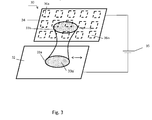
- Figure 3 presents in a schematic way an embodiment 30 wherein an electrowetting matrix is used for generating nanobubbles and displacing a droplet over the surface.
- This particular embodiment is based on the insight that electrowetting principle may be used for displacing the droplet over the surface 32, which is conceived to be cleaned.
- a suitable electrolyte such as diluted ammonia may be selected.
- the droplet having surface portions 33a, 33b and comprising nanobubbles 33a', formed between the surface 32 and the matrix 34 may be displaced.
- the matrix 34 may comprise a suitable number of electrode portions 36a, ...36n which can be energized separately by the voltage pulses. It will be also appreciated that a plurality of individual droplets may be generated and displaced over the surface 32 in this way.
Landscapes
- Chemical & Material Sciences (AREA)
- Engineering & Computer Science (AREA)
- Chemical Kinetics & Catalysis (AREA)
- Electrochemistry (AREA)
- Materials Engineering (AREA)
- Metallurgy (AREA)
- Organic Chemistry (AREA)
- Cleaning Or Drying Semiconductors (AREA)
- Cleaning By Liquid Or Steam (AREA)
Abstract
The invention relates to a method of cleaning a surface using continuously generated nanobubbles, comprising the steps of generating a droplet of a liquid comprising the nanobubbles on the surface; displacing the droplet over the surface for causing the nanobubbles to remove contaminations from the surface; conducting the liquid away from the surface for removing said contaminations. The invention further relates to a system for enabling cleaning a surface using continuously generated nanobubbles.
Description
- The invention relates to a method of cleaning a surface using continuously generated nanobubbles.
- The invention further relates to a system for enabling cleaning a surface using continuously generated nanobubbles.
- A method of cleaning a surface using electrochemically generated nanobubbles is known from Z.Wu et al "Cleaning using nanobubbles: defouling by electrochemical generation of bubbles". In the known method a surface conceived to be cleaned is submerged in an electrolyte in which nanobubbles are generated. The nanobubbles interacting with the surface remove (part of) a thin film layer on the surface and by doing so clean the surface.
- It is a disadvantage of the known method that a relatively large amount of nanobubble-generating liquid need to be used. In addition, because the surface is submerged, contaminants present in the liquid may deposit on the surface, and the removed materials can re-deoposit. Furthermore, the known method has no control of the location to be cleaned on the surface.
- It is an object of the invention to provide a method of cleaning a surface, for example a wafer, which is more efficient and wherein above disadvantages are mitigated.
- To this end the method of cleaning a surface according to the invention comprises the steps of:
- generating a droplet of a liquid comprising the nanobubbles on the surface;
- displacing the droplet over the surface for causing the nanobubbles to remove contaminants from the surface;
- conducting the liquid away from the surface for removing said contaminants.
- It is found that when the droplet comprising nanobubbles is moved over the surface particles are removed there from in a controlled and efficient way. By providing suitable means for removing liquid from the droplet, the particles are removed from the surface by the liquid flow.
- In an embodiment of the method according to the invention the droplet comprises the nanobubbles generated using electrolysis.
- It will be understood that in this embodiment the surface or at least a portion of it must be conductive to form a part of the electrolysis electric circuit. Preferably, electrolysis of water is used.
- In a suitable embodiment of the electrolysis set-up the droplet is formed by one or more needle-like electrodes. It will be appreciated, however, that a plurality of droplets may be formed at the same time on the surface using a suitable plurality of electrodes.
- In a further advantageous embodiment, the one or more needle-like electrodes are adapted to conduct the droplet-forming liquid to the surface.
- It is found advantageous to combine the liquid supply functionality and the droplet forming functionality in the needle-like electrode, which for this purpose may be provided with a suitable conduit for supplying the liquid towards the surface. It will be further appreciated that a great plurality of suitable electrolytes may be used for implementing the method according to the invention. More details on this embodiment will be given with reference to
Figure 1 . - In a still further embodiment of the method according to the invention the droplet comprises the nanobubbles generated by mixing of two solvent liquids.
- It is found then when two suitable solvents are mixed, their interaction may cause formation of nanobubbles, especially when the second liquid solvent has a lower gas solubility with respect to the first liquid solvent. For example, when the first solvent liquid is alcohol and the second solvent liquid is water, nanobubbles may be continuously formed at the surface in the controlled way. Suitable examples of alcohol are ethanol, propanol, methanol, etc. More details on this embodiment will be given with reference to
Figure 2 . - In a still further embodiment of the method according to the invention the droplet comprising the nanobubbles is a droplet of an electrolyte which is displaced over the surface using an electrowetting matrix, the surface forming a part of the electrowetting matrix.
- It is found that the droplet (or droplets) formed on the surface may be efficiently and controllably displaced when the surface acts as a first electrode in the electrowetting set-up. More details on this embodiment will be given with reference to
Figure 3 . - When applying the electrowetting principle, the droplet may be displaced over the surface by applying a sequence of potentials to electrodes forming the electrowetting matrix.
- It will be appreciated that in method according to the invention as is set forth in the foregoing, a further conduit arranged in fluid communication with the droplet may be provided for conducting the liquid away from the surface. As a result the contaminants accumulated in the droplet are conducted away from the surface.
- The system for enabling cleaning a surface using continuously generated nanobubbles, comprises:
- a body for generating a droplet of a liquid comprising the nanobubbles on the surface;
- means for displacing the droplet over the surface for causing the nanobubbles to remove contaminants from the surface;
- a conduit for conducting the liquid away from the surface for removing said contaminations.
- Further advantageous embodiments of the system according to the invention are recited in the dependent claims.
- These and other aspects of the invention will be discussed in more detail with reference to drawings, wherein like reference numerals refer to like elements. It will be appreciated that the drawings are presents for illustrative purposes and may not be used for limiting the scope of the appended claims.
-
-
Figure 1 presents in a schematic way an embodiment wherein water electrolysis is applied for generating nanobubbles and displacing the droplet over the surface. -
Figure 2 presents in a schematic way an embodiment wherein two solvents are used for generating nanobubbles and displacing the droplet over the surface. -
Figure 3 presents in a schematic way an embodiment wherein an electrowetting matrix is used for generating nanobubbles and displacing the droplet over the surface. -
Figure 1 presents in a schematic way anembodiment 10 wherein water electrolysis is applied for generating nanobubbles and displacing a droplet over the surface. Thesurface 2 may relate to any suitable surface which has to be made substantially free from surface contaminations. In particular, thesurface 2 may relate to a surface of a wafer. - It will be appreciated, however, that the method of the invention is suitable for cleaning other surfaces, plain or patterned. In particular, extreme ultraviolet lithography reticles, glass plates, and other substrates, especially for semiconductor industry: integrated circuit, light emitting diode, flat panel display, photovoltaics, and nanotechnology-produced items may be successfully cleaned.
- In accordance with the invention on the surface 2 a
liquid droplet 3 comprisingnanobubbles 3a is generated. In this particular embodiment for providing thedroplet 3 comprising continuously generatednanobubbles 3a an electrolysis set-up is used. The electrolysis set-up comprises avoltage source 5 adapted to generate voltage between thesurface 2 and a workingelectrode 4. The working electrode may be needle formed. It will be appreciated that for realization of the electrolysis set-up thesurface 2 should be electrically conductive. - For the working liquid water may be used. The water may be supplied by a suitable conduit (not shown), or, alternatively, the working
electrode 4 may be provided with a conduit for supplying water to thesurface 2. - When the working voltage is applied between the
surface 2 and theelectrode 4, the droplet of a suitable liquid, for example, water, will be generating nanobubbles which interact with thesurface 2. As a result thesurface 2 will be subject to cleaning. - For displacing the
droplet 3 comprising continuously generatednanobubbles 3a over the surface, the workingelectrode 4 may be suitably displaced. Preferably, the displacement pattern is pre-programmed. - In order to conduct the particles and contaminations removed from the surface a
further conduit 4a is provided. The further conduit is displaceable in cooperation with theelectrode 4. When the contaminated droplets are removed, the new clean droplets may be generated and the cleaning procedure may be resumed. It will be appreciated that a plurality of individual droplets comprising nanobubbles may be generated and displaced in this way. -
Figure 2 presents in a schematic way anembodiment 20 wherein two solvents are used for generating nanobubbles, displacing the droplet over the surface. This particular embodiment is based on the insight that when two solvent liquids having different gas solubility are mixed in adroplet 23, generation ofnanobubbles 23a will occur. - In accordance with the present embodiment, a
conduit 24 may be provided which comprises a suitable bifurcation for conducting a first solvent liquid, such as alcohol, and a second solvent liquid, such as water towards thesurface 22 conceived to be cleaned. - For example, the first solvent liquid may be conducted using the
arm 24a and the second solvent liquid may be conducted using thearm 24b. For removing particles from the surface afurther conduit 25 is provided. Thesupply conduit 24 and thefurther conduit 25 are movable in accordance with each other over thesurface 22. It will be appreciated that a plurality of individual droplets comprising nanobubbles may be generated and displaced in this way. -
Figure 3 presents in a schematic way anembodiment 30 wherein an electrowetting matrix is used for generating nanobubbles and displacing a droplet over the surface. This particular embodiment is based on the insight that electrowetting principle may be used for displacing the droplet over thesurface 32, which is conceived to be cleaned. - Accordingly, for the droplet a suitable electrolyte, such as diluted ammonia may be selected. When applying a suitable voltage sequence using the
voltage source 35 to thesurface 32 and theelectrowetting matrix 34, the droplet havingsurface portions nanobubbles 33a', formed between thesurface 32 and thematrix 34 may be displaced. Thematrix 34 may comprise a suitable number ofelectrode portions 36a, ...36n which can be energized separately by the voltage pulses. It will be also appreciated that a plurality of individual droplets may be generated and displaced over thesurface 32 in this way. - It will be appreciated that while specific embodiments of the invention have been described above, that the invention may be practiced otherwise than as described. In particular, it will be appreciated that still different methods may be used for generating nanobubbles, e.g., heating up the substrate, pressurize the liquid, etc. Accordingly, the invention is not limited to the methods described with reference to particular embodiments. In addition, isolated features discussed with reference to different figures may be combined.
Claims (15)
- A method of cleaning a surface using continuously generated nanobubbles, comprising the steps of:- generating a droplet of a liquid comprising the nanobubbles on the surface;- displacing the droplet over the surface for causing the nanobubbles to remove contaminants from the surface;- conducting the liquid away from the surface for removing said contaminants.
- The method according to claim 1, wherein the droplet comprises the nanobubbles generated using electrolysis.
- The method according to claim 1, wherein the droplet comprises the nanobubbles generated by mixing of two solvent liquids.
- The method according to claim 3, wherein the first solvent liquid has higher gas solubility than the second solvent, preferably wherein alcohol is used as the first solvent, and water is used as the second solvent.
- The method according to claim 1, wherein the droplet comprising the nanobubbles is a droplet of an electrolyte which is displaced over the surface using an electrowetting matrix, the surface forming a part of the electrowetting matrix.
- The method according to claim 5, wherein the droplet is displaced over the surface by applying a sequence of potentials to electrodes forming the electrowetting matrix.
- The method according to claim 2, wherein the surface to be cleaned is part of the electrolysis electric circuit.
- The method according to claim 7, wherein the droplet is being formed by one or more needle-like electrodes.
- The method according to claim 8, wherein the one or more needle-like electrodes are adapted to conduct the droplet-forming liquid to the surface.
- The method according to any one of the preceding claims, further comprising a conduit arranged in fluid communication with the droplet for conducting the liquid away from the surface.
- A system for enabling cleaning a surface using continuously generated nanobubbles, comprising:- a body for generating a droplet of a liquid comprising the nanobubbles on the surface;- means for displacing the droplet over the surface for causing the nanobubbles to remove contaminations from the surface;- a conduit for conducting the liquid away from the surface for removing said contaminations.
- The system according to claim 11, wherein the body is further arranged to conduct the liquid towards the surface.
- The system according to claim 11, wherein the surface and the body form part of an electric circuit.
- The system according to claim 13, wherein the body is adapted to conduct two different solvents towards the surface.
- The system according to any one of the preceding claims 11 - 14, further comprising a conduit arranged to remove the liquid comprising contaminations from the surface.
Priority Applications (2)
| Application Number | Priority Date | Filing Date | Title |
|---|---|---|---|
| EP11159171A EP2503032A1 (en) | 2011-03-22 | 2011-03-22 | A method of cleaning a surface |
| PCT/NL2012/050174 WO2012128627A1 (en) | 2011-03-22 | 2012-03-21 | A method of cleaning a surface |
Applications Claiming Priority (1)
| Application Number | Priority Date | Filing Date | Title |
|---|---|---|---|
| EP11159171A EP2503032A1 (en) | 2011-03-22 | 2011-03-22 | A method of cleaning a surface |
Publications (1)
| Publication Number | Publication Date |
|---|---|
| EP2503032A1 true EP2503032A1 (en) | 2012-09-26 |
Family
ID=44351645
Family Applications (1)
| Application Number | Title | Priority Date | Filing Date |
|---|---|---|---|
| EP11159171A Withdrawn EP2503032A1 (en) | 2011-03-22 | 2011-03-22 | A method of cleaning a surface |
Country Status (2)
| Country | Link |
|---|---|
| EP (1) | EP2503032A1 (en) |
| WO (1) | WO2012128627A1 (en) |
Cited By (1)
| Publication number | Priority date | Publication date | Assignee | Title |
|---|---|---|---|---|
| CN104475393A (en) * | 2014-11-24 | 2015-04-01 | 广东省农业科学院蚕业与农产品加工研究所 | Cleaning and disinfecting method for fruits and vegetables |
Families Citing this family (2)
| Publication number | Priority date | Publication date | Assignee | Title |
|---|---|---|---|---|
| EP3188849B1 (en) | 2014-09-05 | 2022-02-16 | Tennant Company | Systems and methods for supplying treatment liquids having nanobubbles |
| CN116103741B (en) * | 2021-04-06 | 2025-05-27 | 重庆立道新材料科技有限公司 | Descaling device |
Citations (2)
| Publication number | Priority date | Publication date | Assignee | Title |
|---|---|---|---|---|
| JP2009101299A (en) * | 2007-10-24 | 2009-05-14 | Fuji Xerox Co Ltd | Micro nano-bubble generation method, washing method for micro-flow passage, micro nano-bubble generation system, and micro-reactor |
| US20090120460A1 (en) * | 2007-11-09 | 2009-05-14 | Tennant Company | Soft floor pre-spray unit utilizing electrochemically-activated water and method of cleaning soft floors |
-
2011
- 2011-03-22 EP EP11159171A patent/EP2503032A1/en not_active Withdrawn
-
2012
- 2012-03-21 WO PCT/NL2012/050174 patent/WO2012128627A1/en not_active Ceased
Patent Citations (3)
| Publication number | Priority date | Publication date | Assignee | Title |
|---|---|---|---|---|
| JP2009101299A (en) * | 2007-10-24 | 2009-05-14 | Fuji Xerox Co Ltd | Micro nano-bubble generation method, washing method for micro-flow passage, micro nano-bubble generation system, and micro-reactor |
| US20110168210A1 (en) * | 2007-10-24 | 2011-07-14 | Fuji Xerox Co., Ltd. | Micro-nano bubble generating method, microchannel cleaning method, micro-nano bubble generating system, and microreactor |
| US20090120460A1 (en) * | 2007-11-09 | 2009-05-14 | Tennant Company | Soft floor pre-spray unit utilizing electrochemically-activated water and method of cleaning soft floors |
Non-Patent Citations (2)
| Title |
|---|
| WU Z H ET AL: "Cleaning using nanobubbles: Defouling by electrochemical generation of bubbles", JOURNAL OF COLLOID AND INTERFACE SCIENCE, ACADEMIC PRESS, NEW YORK, NY, US, vol. 328, no. 1, 1 December 2008 (2008-12-01), pages 10 - 14, XP025589341, ISSN: 0021-9797, [retrieved on 20080909], DOI: 10.1016/J.JCIS.2008.08.064 * |
| YANG, SHANGJIONG: "Manipulating surface nanobubbles", DISSERTATION, 9 October 2008 (2008-10-09), Twente, NL, XP002656895, Retrieved from the Internet <URL:http://dx.doi.org/10.3990/1.9789036527286> [retrieved on 20110816] * |
Cited By (1)
| Publication number | Priority date | Publication date | Assignee | Title |
|---|---|---|---|---|
| CN104475393A (en) * | 2014-11-24 | 2015-04-01 | 广东省农业科学院蚕业与农产品加工研究所 | Cleaning and disinfecting method for fruits and vegetables |
Also Published As
| Publication number | Publication date |
|---|---|
| WO2012128627A1 (en) | 2012-09-27 |
Similar Documents
| Publication | Publication Date | Title |
|---|---|---|
| Wei et al. | High-resolution ac-pulse modulated electrohydrodynamic jet printing on highly insulating substrates | |
| AU2016344171B2 (en) | Microfluidic electrowetting device apparatus having a covalently bound hydrophobic surface | |
| US9303329B2 (en) | Electrochemical deposition apparatus with remote catholyte fluid management | |
| CN106391358B (en) | Coating device and coating method | |
| CN101834118A (en) | Cleaning apparatus and cleaning method of mask member, and organic EL display | |
| JP6424232B2 (en) | Particle removal from electrochromic films using non-aqueous fluids | |
| CN112122614B (en) | A 3D printing device, working method and application based on self-excited electrostatic field-driven jet deposition | |
| EP2503032A1 (en) | A method of cleaning a surface | |
| CN102974496A (en) | Liquid coating device, pattern correcting device, tiny pattern portraying device and method for liquid coating | |
| JP4695932B2 (en) | Mold cleaning apparatus and mold cleaning method | |
| US10553876B2 (en) | Method and device for modifying catalyst layer | |
| CN107206517A (en) | Electrolytic machining device and electrochemical machining method | |
| TWI233325B (en) | Forming method of pattern, manufacturing method of apparatus, optoelectronic device and electronic machine | |
| CN110911307A (en) | Processing device, processing system, and processing method | |
| Kim et al. | Optimization of electrohydrodynamic writing technique to print collagen | |
| TWI248331B (en) | Cleaning method, maintaining method, pattern forming method and manufacturing method apparatus, optoelectronic device and electronic machine | |
| EP1525609A1 (en) | Device for etching semiconductors with a large surface area | |
| JP4573043B2 (en) | Sulfuric acid recycling cleaning system | |
| CN101233088B (en) | Method and device for removing conductive metal oxide thin film | |
| CN116446004A (en) | Localized electrochemical deposition method based on ultrafast laser surface modification | |
| CN1810389A (en) | Device and method processing substrate | |
| KR20170058685A (en) | Electro hydro dynamic inkjet apparatus | |
| WO2012090815A1 (en) | Resist removal device and resist removal method | |
| JP2006217808A (en) | Substrates for observation and droplet feeder | |
| Sun et al. | Droplet Removal by Capillary Lifting |
Legal Events
| Date | Code | Title | Description |
|---|---|---|---|
| PUAI | Public reference made under article 153(3) epc to a published international application that has entered the european phase |
Free format text: ORIGINAL CODE: 0009012 |
|
| AK | Designated contracting states |
Kind code of ref document: A1 Designated state(s): AL AT BE BG CH CY CZ DE DK EE ES FI FR GB GR HR HU IE IS IT LI LT LU LV MC MK MT NL NO PL PT RO RS SE SI SK SM TR |
|
| AX | Request for extension of the european patent |
Extension state: BA ME |
|
| STAA | Information on the status of an ep patent application or granted ep patent |
Free format text: STATUS: THE APPLICATION IS DEEMED TO BE WITHDRAWN |
|
| 18D | Application deemed to be withdrawn |
Effective date: 20130327 |