EP2500397A1 - Organic light-emitting medium - Google Patents
Organic light-emitting medium Download PDFInfo
- Publication number
- EP2500397A1 EP2500397A1 EP10830937A EP10830937A EP2500397A1 EP 2500397 A1 EP2500397 A1 EP 2500397A1 EP 10830937 A EP10830937 A EP 10830937A EP 10830937 A EP10830937 A EP 10830937A EP 2500397 A1 EP2500397 A1 EP 2500397A1
- Authority
- EP
- European Patent Office
- Prior art keywords
- substituted
- group
- unsubstituted
- carbon atoms
- ring
- Prior art date
- Legal status (The legal status is an assumption and is not a legal conclusion. Google has not performed a legal analysis and makes no representation as to the accuracy of the status listed.)
- Withdrawn
Links
- 0 *N(*)c1c(ccc2ccc3[N-][Al])c4c2c3ccc4cc1 Chemical compound *N(*)c1c(ccc2ccc3[N-][Al])c4c2c3ccc4cc1 0.000 description 8
- YXFVVABEGXRONW-UHFFFAOYSA-N Cc1ccccc1 Chemical compound Cc1ccccc1 YXFVVABEGXRONW-UHFFFAOYSA-N 0.000 description 3
- MPDYGZZKPJZXBN-UHFFFAOYSA-N C(C1)C=Cc2c1c(cc(cc1)-c3c(cccc4)c4c(-c4cccc(-c5ccccc5)c4)c4c3cccc4)c1[o]2 Chemical compound C(C1)C=Cc2c1c(cc(cc1)-c3c(cccc4)c4c(-c4cccc(-c5ccccc5)c4)c4c3cccc4)c1[o]2 MPDYGZZKPJZXBN-UHFFFAOYSA-N 0.000 description 1
- POGDUMQPHZCSIL-AJNXJIPJSA-N C/C=C(\c(cc1)c2c3c1ccc(N(c1ccccc1)c(cc1)ccc1C#N)c3C=CC2=C)/N(c1ccccc1)c(cc1)ccc1C#N Chemical compound C/C=C(\c(cc1)c2c3c1ccc(N(c1ccccc1)c(cc1)ccc1C#N)c3C=CC2=C)/N(c1ccccc1)c(cc1)ccc1C#N POGDUMQPHZCSIL-AJNXJIPJSA-N 0.000 description 1
- YXESOZMUVYIESV-UHFFFAOYSA-N N#Cc(cccc1)c1N(c1ccccc1)c1c(ccc(cc2)c3c(cc4)c2N(c2ccccc2)c2ccccc2C#N)c3c4cc1 Chemical compound N#Cc(cccc1)c1N(c1ccccc1)c1c(ccc(cc2)c3c(cc4)c2N(c2ccccc2)c2ccccc2C#N)c3c4cc1 YXESOZMUVYIESV-UHFFFAOYSA-N 0.000 description 1
- WLVIMMCYXUQCCW-UHFFFAOYSA-N c(cc1)ccc1-c(cc1)ccc1-c1c(cccc2)c2c(-c2ccc3[o]c(cccc4)c4c3c2)c2c1cccc2 Chemical compound c(cc1)ccc1-c(cc1)ccc1-c1c(cccc2)c2c(-c2ccc3[o]c(cccc4)c4c3c2)c2c1cccc2 WLVIMMCYXUQCCW-UHFFFAOYSA-N 0.000 description 1
- YGVHYLQSDXHOEY-UHFFFAOYSA-N c(cc1)ccc1-c1c(cccc2)c2c(-c2cccc(-c3c(cccc4)c4ccc3)c2)c2c1cccc2 Chemical compound c(cc1)ccc1-c1c(cccc2)c2c(-c2cccc(-c3c(cccc4)c4ccc3)c2)c2c1cccc2 YGVHYLQSDXHOEY-UHFFFAOYSA-N 0.000 description 1
- DXBHBZVCASKNBY-UHFFFAOYSA-N c1ccc(cc2c3ccccc3ccc2c2)c2c1 Chemical compound c1ccc(cc2c3ccccc3ccc2c2)c2c1 DXBHBZVCASKNBY-UHFFFAOYSA-N 0.000 description 1
- FMDKNSZYCSPSKM-UHFFFAOYSA-N c1ccc2[o]c(ccc(-c(c3c4cccc3)c(cccc3)c3c4-c3ccc(ccc4ccc5)c6c4c5ccc36)c3)c3c2c1 Chemical compound c1ccc2[o]c(ccc(-c(c3c4cccc3)c(cccc3)c3c4-c3ccc(ccc4ccc5)c6c4c5ccc36)c3)c3c2c1 FMDKNSZYCSPSKM-UHFFFAOYSA-N 0.000 description 1
Classifications
-
- C—CHEMISTRY; METALLURGY
- C09—DYES; PAINTS; POLISHES; NATURAL RESINS; ADHESIVES; COMPOSITIONS NOT OTHERWISE PROVIDED FOR; APPLICATIONS OF MATERIALS NOT OTHERWISE PROVIDED FOR
- C09K—MATERIALS FOR MISCELLANEOUS APPLICATIONS, NOT PROVIDED FOR ELSEWHERE
- C09K11/00—Luminescent materials, e.g. electroluminescent or chemiluminescent
- C09K11/06—Luminescent materials, e.g. electroluminescent or chemiluminescent containing organic luminescent materials
-
- C—CHEMISTRY; METALLURGY
- C09—DYES; PAINTS; POLISHES; NATURAL RESINS; ADHESIVES; COMPOSITIONS NOT OTHERWISE PROVIDED FOR; APPLICATIONS OF MATERIALS NOT OTHERWISE PROVIDED FOR
- C09B—ORGANIC DYES OR CLOSELY-RELATED COMPOUNDS FOR PRODUCING DYES, e.g. PIGMENTS; MORDANTS; LAKES
- C09B1/00—Dyes with anthracene nucleus not condensed with any other ring
-
- C—CHEMISTRY; METALLURGY
- C09—DYES; PAINTS; POLISHES; NATURAL RESINS; ADHESIVES; COMPOSITIONS NOT OTHERWISE PROVIDED FOR; APPLICATIONS OF MATERIALS NOT OTHERWISE PROVIDED FOR
- C09B—ORGANIC DYES OR CLOSELY-RELATED COMPOUNDS FOR PRODUCING DYES, e.g. PIGMENTS; MORDANTS; LAKES
- C09B57/00—Other synthetic dyes of known constitution
- C09B57/001—Pyrene dyes
-
- C—CHEMISTRY; METALLURGY
- C09—DYES; PAINTS; POLISHES; NATURAL RESINS; ADHESIVES; COMPOSITIONS NOT OTHERWISE PROVIDED FOR; APPLICATIONS OF MATERIALS NOT OTHERWISE PROVIDED FOR
- C09B—ORGANIC DYES OR CLOSELY-RELATED COMPOUNDS FOR PRODUCING DYES, e.g. PIGMENTS; MORDANTS; LAKES
- C09B69/00—Dyes not provided for by a single group of this subclass
- C09B69/008—Dyes containing a substituent, which contains a silicium atom
-
- H—ELECTRICITY
- H05—ELECTRIC TECHNIQUES NOT OTHERWISE PROVIDED FOR
- H05B—ELECTRIC HEATING; ELECTRIC LIGHT SOURCES NOT OTHERWISE PROVIDED FOR; CIRCUIT ARRANGEMENTS FOR ELECTRIC LIGHT SOURCES, IN GENERAL
- H05B33/00—Electroluminescent light sources
- H05B33/12—Light sources with substantially two-dimensional [2D] radiating surfaces
- H05B33/14—Light sources with substantially two-dimensional [2D] radiating surfaces characterised by the chemical or physical composition or the arrangement of the electroluminescent material, or by the simultaneous addition of the electroluminescent material in or onto the light source
-
- H—ELECTRICITY
- H10—SEMICONDUCTOR DEVICES; ELECTRIC SOLID-STATE DEVICES NOT OTHERWISE PROVIDED FOR
- H10K—ORGANIC ELECTRIC SOLID-STATE DEVICES
- H10K50/00—Organic light-emitting devices
- H10K50/10—OLEDs or polymer light-emitting diodes [PLED]
- H10K50/11—OLEDs or polymer light-emitting diodes [PLED] characterised by the electroluminescent [EL] layers
-
- H—ELECTRICITY
- H10—SEMICONDUCTOR DEVICES; ELECTRIC SOLID-STATE DEVICES NOT OTHERWISE PROVIDED FOR
- H10K—ORGANIC ELECTRIC SOLID-STATE DEVICES
- H10K85/00—Organic materials used in the body or electrodes of devices covered by this subclass
- H10K85/60—Organic compounds having low molecular weight
- H10K85/615—Polycyclic condensed aromatic hydrocarbons, e.g. anthracene
-
- H—ELECTRICITY
- H10—SEMICONDUCTOR DEVICES; ELECTRIC SOLID-STATE DEVICES NOT OTHERWISE PROVIDED FOR
- H10K—ORGANIC ELECTRIC SOLID-STATE DEVICES
- H10K85/00—Organic materials used in the body or electrodes of devices covered by this subclass
- H10K85/60—Organic compounds having low molecular weight
- H10K85/615—Polycyclic condensed aromatic hydrocarbons, e.g. anthracene
- H10K85/626—Polycyclic condensed aromatic hydrocarbons, e.g. anthracene containing more than one polycyclic condensed aromatic rings, e.g. bis-anthracene
-
- H—ELECTRICITY
- H10—SEMICONDUCTOR DEVICES; ELECTRIC SOLID-STATE DEVICES NOT OTHERWISE PROVIDED FOR
- H10K—ORGANIC ELECTRIC SOLID-STATE DEVICES
- H10K85/00—Organic materials used in the body or electrodes of devices covered by this subclass
- H10K85/60—Organic compounds having low molecular weight
- H10K85/631—Amine compounds having at least two aryl rest on at least one amine-nitrogen atom, e.g. triphenylamine
- H10K85/633—Amine compounds having at least two aryl rest on at least one amine-nitrogen atom, e.g. triphenylamine comprising polycyclic condensed aromatic hydrocarbons as substituents on the nitrogen atom
-
- C—CHEMISTRY; METALLURGY
- C09—DYES; PAINTS; POLISHES; NATURAL RESINS; ADHESIVES; COMPOSITIONS NOT OTHERWISE PROVIDED FOR; APPLICATIONS OF MATERIALS NOT OTHERWISE PROVIDED FOR
- C09K—MATERIALS FOR MISCELLANEOUS APPLICATIONS, NOT PROVIDED FOR ELSEWHERE
- C09K2211/00—Chemical nature of organic luminescent or tenebrescent compounds
- C09K2211/10—Non-macromolecular compounds
- C09K2211/1003—Carbocyclic compounds
- C09K2211/1011—Condensed systems
-
- C—CHEMISTRY; METALLURGY
- C09—DYES; PAINTS; POLISHES; NATURAL RESINS; ADHESIVES; COMPOSITIONS NOT OTHERWISE PROVIDED FOR; APPLICATIONS OF MATERIALS NOT OTHERWISE PROVIDED FOR
- C09K—MATERIALS FOR MISCELLANEOUS APPLICATIONS, NOT PROVIDED FOR ELSEWHERE
- C09K2211/00—Chemical nature of organic luminescent or tenebrescent compounds
- C09K2211/10—Non-macromolecular compounds
- C09K2211/1003—Carbocyclic compounds
- C09K2211/1014—Carbocyclic compounds bridged by heteroatoms, e.g. N, P, Si or B
-
- H—ELECTRICITY
- H10—SEMICONDUCTOR DEVICES; ELECTRIC SOLID-STATE DEVICES NOT OTHERWISE PROVIDED FOR
- H10K—ORGANIC ELECTRIC SOLID-STATE DEVICES
- H10K50/00—Organic light-emitting devices
- H10K50/80—Constructional details
- H10K50/86—Arrangements for improving contrast, e.g. preventing reflection of ambient light
Definitions
- the invention relates to an organic luminescent medium using an aromatic amine derivative and an anthracene derivative, and an organic electroluminescence device.
- an organic electroluminescence (EL) device using an organic substance is a promising solid-state emitting type inexpensive and large full-color display device, and has been extensively developed.
- an organic EL device includes an emitting layer and a pair of opposing electrodes holding the emitting layer therebetween. When an electric field is applied between the electrodes, electrons are injected from the cathode and holes are injected from the anode. Emission is a phenomenon in which the electrons recombine with the holes in the emitting layer to produce an excited state, and energy is emitted as light when the excited state returns to the ground state.
- An object of the invention is to provide an organic luminescent medium which enables an organic EL device which can emit blue light which is high in color purity and has a long lifetime.
- the following organic luminescent medium and the like are provided.
- an organic luminescent medium which can emit blue light which is high in color purity and has a long lifetime can be provided.
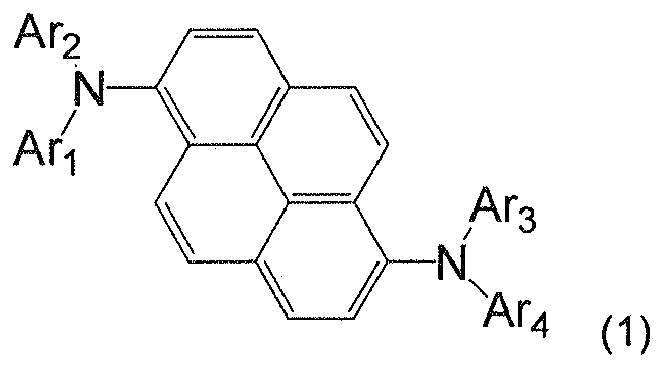
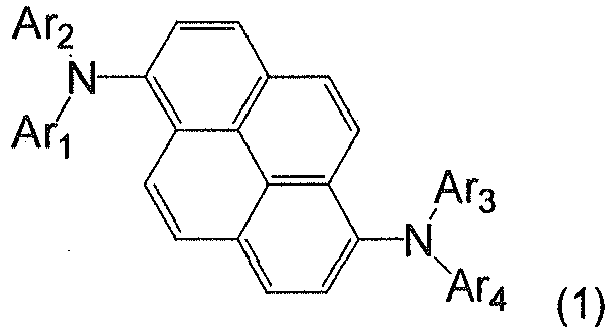
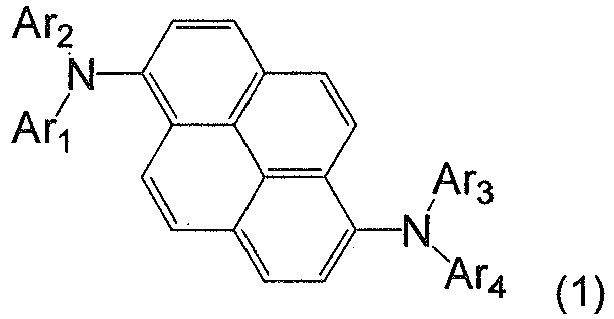
- the organic luminescent medium of the invention comprises an aromatic amine derivative represented by the following formula (1) and an anthracene derivative represented by the following formula (I): wherein in formula (1), Ar 1 to Ar 4 are independently a substituted or unsubstituted aryl group having 6 to 30 ring carbon atoms, and at least one of Ar 1 to Ar 4 is an aryl group having an electron-attracting group, in formula (I), R 101 to R 108 are independently a hydrogen atom, a fluorine atom, a substituted or unsubstituted alkyl group having 1 to 10 carbon atoms, a substituted or unsubstituted cycloalkyl group having 3 to 10 carbon atoms, a substituted or unsubstituted alkylsilyl group having 3 to 30 carbon atoms, a substituted or unsubstituted arylsilyl group having 8 to 30 ring carbon atoms, a substituted or unsubstituted alkoxy group having 1 to 20 carbon
- the organic luminescent medium of the invention comprises an aromatic amine derivative represented by the following formula (1) and an anthracene derivative represented by the following formula (II): wherein in formula (1), Ar 1 to Ar 4 are independently a substituted or unsubstituted aryl group having 6 to 30 ring carbon atoms, and at least one of Ar 1 to Ar 4 is an aryl group having an electron-attracting group, in formula (II), R 101 to R 108 are independently a hydrogen atom, a fluorine atom, a substituted or unsubstituted alkyl group having 1 to 10 carbon atoms, a substituted or unsubstituted cycloalkyl group having 3 to 10 carbon atoms, a substituted or unsubstituted alkylsilyl group having 3 to 30 carbon atoms, a substituted or unsubstituted arylsilyl group having 8 to 30 ring carbon atoms, a substituted or unsubstituted alkoxy group having 1 to
- the organic luminescent medium of the invention comprises an aromatic amine derivative represented by the following formula (1) and an anthracene derivative represented by the following formula (III): wherein in formula (1), Ar 1 to Ar 4 are independently a substituted or unsubstituted aryl group having 6 to 30 ring carbon atoms, and at least one of Ar 1 to Ar 4 is an aryl group having an electron-attracting group, in formula (III), R 101 to R 108 are independently a hydrogen atom, a fluorine atom, a substituted or unsubstituted alkyl group having 1 to 10 carbon atoms, a substituted or unsubstituted cycloalkyl group having 3 to 10 carbon atoms, a substituted or unsubstituted alkylsilyl group having 3 to 30 carbon atoms, a substituted or unsubstituted arylsilyl group having 8 to 30 ring carbon atoms, a substituted or unsubstituted alkoxy group having 1 to 20 carbon
- Ar 1 to Ar 4 are independently a substituted or unsubstituted aryl group having 6 to 30 ring carbon atoms, and at least one of Ar 1 to Ar 4 is an aryl group having an electron-attracting group.
- the electron-attracting group in formula (1) is a group having a function of decreasing the electron density. Examples thereof include a cyano group, a fluorine atom, an alkyl halide group, a nitro group and a carbonyl group. Of these, a cyano group, a fluorine atom and an alkyl halide group are preferable and a cyano group is particularly preferable. It is supposed that long lifetime of a device can be realized by trapping extra electrons with the electron-attracting group to prevent electrons from intruding into a hole transforming material, whereby deterioration of the hole transforming material can be prevented.
- aromatic amine derivative represented by formula (1) is preferably represented by the following formula (2):
- R 1 to R 10 are independently a hydrogen atom, a halogen atom, a substituted or unsubstituted alkyl group having 1 to 20 carbon atoms, a substituted or unsubstituted alkylsilyl group having 3 to 30 carbon atoms, a substituted or unsubstituted arylsilyl group having 8 to 30 ring carbon atoms, a substituted or unsubstituted alkoxy group having 1 to 20 carbon atoms, a substituted or unsubstituted aralkyl group having 6 to 20 ring carbon atoms, a substituted or unsubstituted aryl group having 6 to 10. ring carbon atoms, or an electron-attracting group. At least one of R 1 to R 5 is an electron-attracting group and at least one of R 6 to R 10 is an electron-attracting group. Ar 2 and Ar 4 may or may not have an electron-attracting group.
- one of R 1 to R 5 be an electron-attracting group and the other groups be a hydrogen atom
- one of R 6 to R 10 be an electron-attracting group and the other groups be a hydrogen atom
- ring carbon atoms means carbon atoms that form a saturated ring, unsaturated ring or aromatic ring.
- the “ring atoms” means carbon atoms and hetero atoms that form a hetero ring (including a saturated ring, unsaturated ring or aromatic ring).
- substituents in "substituted or unsubstituted" include an alkyl group, alkylsilyl group, alkyl halide group, aryl group, cycloalkyl group, alkoxy group, heterocyclic group, aralkyl group, aryloxy group, arylthio group, alkoxycarbonyl group, halogen atom, hydroxyl group, nitro group, cyano group, carboxy group, dibenzofuranyl group and fluorenyl group as described below.
- the hydrogen atom of the invention includes light hydrogen and deuterium. Specific examples of the groups in formulas (1) and (2), and the substituents are shown below.
- alkyl group examples include a methyl group, ethyl group, propyl group, isopropyl group, n-butyl group, s-butyl group, isobutyl group, t-butyl group, n-pentyl group, n-hexyl group, n-heptyl group and n-octyl group.
- the alkyl group preferably has 1 to 10 carbon atoms, more preferably 1 to 8 carbon atoms, and further preferably 1 to 6 carbon atoms.
- a methyl group, ethyl group, propyl group, isopropyl group, n-butyl group, s-butyl group, isobutyl group, t-butyl group, n-pentyl group and n-hexyl group are preferable.
- the alkylsilyl group is represented by -SiY 3 , and examples of Y are the same as those of the alkyl group.
- aryl group examples include a phenyl group, naphthyl group, anthryl group, 1-phenanthryl group, phenanthryl group, naphthacenyl group, pyrenyl group, chrysenyl group, benzo[c]phenanthryl group, benzo[g]chrysenyl group, triphenylenyl group, fluorenyl group, benzofluorenyl group, dibenzofluorenyl group, biphenylyl group, p-terphenyl-4-yl group, p-terphenyl-3-yl group, p-terphenyl-2-yl group, m-terphenyl-4-yl group, m-terphenyl-3-yl group, and m-terphenyl-2-yl group.
- the aryl group has preferably 6 to 20, more preferably 6 to 14, further preferably 6 to 10 ring carbon atoms.
- Preferable aryl groups are a
- the arylsilyl group is represented by -SiZ 3 , and examples of Z are the same as those of the aryl group.
- the alkoxy group is represented by -OY, and examples of Y are the same as those of the alkyl or aryl group.
- the aralkyl group is represented by -Y-Z, examples of Y include alkylene groups corresponding to the examples of the alkyl group, and examples of Z are the same as those of the aryl group.
- cycloalkyl group examples include a cyclopropyl group, cyclobutyl group, cyclopentyl group, cyclohexyl group, 4-methylcyclohexyl group, 1-adamantyl group, 2-adamantyl group, 1-norbornyl group and 2-norbornyl group.
- the cycloalkyl group has preferably 3 to 10 ring carbon atoms, more preferably 3 to 8 ring carbon atoms, and further preferably 3 to 6 ring carbon atoms. Specific examples of the aromatic amine derivatives are given below.
- the organic luminescent medium of the invention comprises an aromatic amine derivative represented by the following formula (1) and an anthracene derivative represented by the following formula (10):
- R 101 to R 108 are independently a hydrogen atom, a fluorine atom, a substituted or unsubstituted alkyl group having 1 to 10 carbon atoms, a substituted or unsubstituted cycloalkyl group having 3 to 10 carbon atoms, a substituted or unsubstituted alkylsilyl group having 3 to 30 carbon atoms, a substituted or unsubstituted arylsilyl group having 8 to 30 ring carbon atoms, a substituted or unsubstituted alkoxy group having 1 to 20 carbon atoms, a substituted or unsubstituted aryloxy group having 6 to 20 ring carbon atoms, a substituted or unsubstituted aryl group having 6 to 30 ring carbon atoms, or a substituted or unsub
- Ar 11 is a phenyl group substituted by a substituted or unsubstituted aryl group having 6 to 30 ring carbon atoms or a substituted or unsubstituted heterocyclic group having 5 to 30 ring atoms, a 2-naphthyl group substituted by a substituted or unsubstituted aryl group having 6 to 30 ring carbon atoms or a substituted or unsubstituted heterocyclic group having 5 to 30 ring atoms, or a heterocyclic group having 5 to 30 ring atoms substituted by a substituted or unsubstituted aryl group having 6 to 30 ring carbon atoms or a substituted or unsubstituted heterocyclic group having 5 to 30 ring atoms.
- Ar 11 is a substituted or unsubstituted fused heterocyclic group having 10 to 30 ring atoms.
- Ar 11 is a substituted or unsubstituted 2-naphthyl group.
- an anthracene derivative represented by the following formula (11) is preferable: wherein R 101 to R 108 , R 111 and b are the same as those in formula (10), and Ar 14 is a substituted or unsubstituted aryl group having 6 to 30 ring carbon atoms, a substituted or unsubstituted alkyl group having 1 to 10 carbon atoms, a substituted or unsubstituted cycloalkyl group having 3 to 10 ring carbon atoms or a substituted or unsubstituted heterocyclic group having 5 to 30 ring atoms.
- a 9,9-dimethylfluorene-1-yl group, a 9,9-dimethylfluorene-2-yl group, a 9,9-dimethylfluorene-3-yl group, a 9,9-dimethylfluorene-4-yl group, a dibenzofuran-1-yl group, a dibenzofuran-2-yl group, a dibenzofuran-3-yl group, and a dibenzofuran-4-yl group are also preferable.
- Ar 14 is a substituted or unsubstituted aryl group having 6 to 30 ring carbon atoms or a substituted or unsubstituted heterocyclic group having 5 to 30 ring atoms.
- the anthracene derivative may be one of the anthracene derivatives represented by the following formulas (12) to (18) in addition to those represented by formula (10).
- R 101 to R 108 are the same as those in formula (10), Ar 12 and Ar 13 are independently a hydrogen atom, an aryl group having 6 to 30 ring carbon atoms, or a substituted or unsubstituted heterocyclic group having 5 to 30 ring atoms, and Ar 12 may form a ring with the naphthalene ring to which Ar 12 bonds.
- Ar 12 or Ar 13 is a substituted or unsubstituted aryl group having 6 to 30 ring carbon atoms or a substituted or unsubstituted heterocyclic group having 5 to 30 ring atoms.
- Ar 12 forms a ring with the naphthalene ring to which Ar 12 bonds, and the ring is a substituted or unsubstituted fused heterocyclic group having 10 to 30 ring atoms.
- Ar 13 is a hydrogen atom.
- R 101 to R 108 , R 111 and b are the same as those in formula (10),
- Ar 15 is a substituted or unsubstituted aryl group having 6 to 30 ring carbon atoms, a substituted or unsubstituted alkyl group having 1 to 10 carbon atoms, a substituted or unsubstituted cycloalkyl group having 3 to 10 ring carbon atoms or a substituted or unsubstituted heterocyclic group having 5 to 30 ring atoms.
- Ar 15 is preferably a dibenzofuran-1-yl group, a dibenzofuran-2-yl group, a dibenzofuran-3-yl group, or a dibenzofuran-4-yl group.
- Ar 15 is a substituted or unsubstituted aryl group having 6 to 30 ring carbon atoms or a heterocyclic group having 5 to 30 ring atoms.
- R 101 to R 108 are the same as those in formula (10), Ar 16 is a substituted or unsubstituted aryl group having 6 to 30 ring carbon atoms, a substituted or unsubstituted alkyl group having 1 to 10 carbon atoms, a substituted or unsubstituted cycloalkyl group having 3 to 10 ring carbon atoms or a substituted or unsubstituted heterocyclic group having 5 to 50 ring atoms, and Ar 16 may form a ring with the benzene ring to which Ar 16 bonds, and Ar 17 is a substituted or unsubstituted aryl group having 6 to 30 ring carbon atoms, a substituted or unsubstituted alkyl group having 1 to 10 carbon atoms, a substituted or unsubstituted cycloalkyl group having 3 to 10 ring carbon atoms or a substituted or unsubstituted heterocyclic group having 5 to 30 ring atom
- Ar 16 or Ar 17 is a substituted or unsubstituted aryl group having 6 to 30 ring carbon atoms or a heterocyclic group having 5 to 30 ring atoms.
- Ar 16 forms a ring with the benzene ring to which Ar 16 bonds, and the ring is a substituted or unsubstituted fused heterocyclic group having 10 to 30 ring atoms.
- Ar 16 forms a ring with the benzene ring to which Ar 16 bonds, and the ring is a substituted or unsubstituted 2-naphthyl group.
- anthracene derivative of formula (14) the structures represented by the following formulas (14-1) to (14-3) are preferable.
- R 101 to R 108 are the same as those described above.
- R 101 to R 108 are the same as those in the formula (10).
- Ar 10 is a substituted or unsubstituted fused aromatic ring group having 10 to 20 ring carbon atoms.
- R 101 to R 108 are the same as those described above.
- Ar 5a and Ar 6a are independently a substituted or unsubstituted fused aromatic ring group having 10 to 20 ring carbon atoms.
- R 101 to R 108 are the same as those in formula (10), Ar 18 is a substituted or unsubstituted aryl group having 6 to 30 ring carbon atoms or a substituted or unsubstituted heterocyclic group having 5 to 30 ring atoms, L is a single bond, a substituted or unsubstituted arylene group having 6 to 30 ring carbon atoms or a substituted or unsubstituted divalent heterocyclic group having 5 to 30 ring atoms, R 121 is a substituted or unsubstituted aryl group having 6 to 30 ring carbon atoms, a substituted or unsubstituted heterocyclic group having 5 to 30 ring atoms, a substituted or unsubstituted alkyl group having 1 to 10 carbon atoms, a substituted or unsubstituted cycloalkyl group having 3 to 10 ring carbon atoms, a substituted or unsubstituted alkoxy
- Ar 18 is an aryl group having 6 to 30 ring carbon atoms or a heterocyclic group having 5 to 30 ring atoms which is substituted by an aryl group having 6 to 30 ring carbon atoms or a heterocyclic group having 5 to 30 ring atoms.
- L is a single bond.
- R 101 to R 108 are the same as those in formula (10), L is a single bond, a substituted or unsubstituted arylene group having 6 to 50 ring carbon atoms or a substituted or unsubstituted divalent heterocyclic group having 5 to 50 ring atoms, Ar 19 is a substituted or unsubstituted aryl group having 6 to 30 ring carbon atoms or a substituted or unsubstituted heterocyclic group having 5 to 30 ring atoms, X 11 is an oxygen atom, a sulfur atom, -NR- or -CR a R b wherein R, R a and R b are the same group as those in R 101 to R 108 , R 121 is a substituted or unsubstituted aryl group having 6 to 30 ring carbon atoms or a substituted or unsubstituted heterocyclic group having 5 to 30 ring atoms, a substituted or unsubstituted alky
- Ar 19 is an aryl group having 6 to 30 ring carbon atoms or a heterocyclic group having 5 to 30 ring atoms which is substituted by an aryl group having 6 to 30 ring carbon atoms or a heterocyclic group having 5 to 30 ring atoms.
- R 101 to R 108 are the same as those in formula (10), Ar 201 is a substituted or unsubstituted aryl group having 6 to 30 ring carbon atoms or a substituted or unsubstituted heterocyclic group having 5 to 30 ring atoms, R 201 is a substituted or unsubstituted aryl group having 6 to 30 ring carbon atoms, a substituted or unsubstituted heterocyclic group having 5 to 30 ring atoms, a substituted or unsubstituted alkyl group having 1 to 10 carbon atoms, a substituted or unsubstituted cycloalkyl group having 3 to 10 ring carbon atoms, a substituted or unsubstituted alkoxy group having 1 to 20 carbon atoms, a substituted or unsubstituted silyl group, a cyano group or a fluorine atom, and p is an integer of 0 to 4, and plural R 201 s
- Ar 20 is an aryl group having 6 to 30 ring carbon atoms or a heterocyclic group having 5 to 30 ring atoms which is substituted by an aryl group having 6 to 30 ring carbon atoms or a heterocyclic group having 5 to 30 ring atoms.
- R 101 to R 108 are the same as those in formula (10), Ar 20 and R 201 are the same as those in formula (17), R 301 is a substituted or unsubstituted aryl group having 6 to 30 ring carbon atoms or a substituted or unsubstituted heterocyclic group having 5 to 30 ring atoms, a substituted or unsubstituted alkyl group having 1 to 10 carbon atoms, a substituted or unsubstituted cycloalkyl group having 3 to 10 ring carbon atoms, a substituted or unsubstituted alkoxy group having 1 to 20 carbon atoms, a substituted or unsubstituted silyl group, a cyano group or a fluorine atom, p is an integer of 0 to 4, and plural R 201 s may be the same or different when p is an integer of 2 or more, q is an integer of 0 to 11, plural R 301 s may be the same or different when
- Examples of the aryl group having 6 to 30 ring carbon atoms of R 101 to R 108 , R 111 , R 121 , R 201 , R 301 , Ar 12 to Ar 20 and Ar 101 to Ar 106 include a phenyl group, naphthyl group, anthryl group, phenanthryl group, naphthacenyl group, pyrenyl group, chrysenyl group, benzo[c]phenanthryl group, benzo[g]chrysenyl group, benzo[a]anthryl group, triphenylenyl group, fluorenyl group, 9,9-dimethylfluorene-2-yl group, benzofluorenyl group, dibenzofluorenyl group, biphenylyl group, p-terphenyl-4-yl group, p-terphenyl-3-yl group, p-terphenyl-2-yl group, m-terphenyl-4-yl group
- an unsubstituted phenyl group, substituted phenyl group, substituted or unsubstituted aryl group having 10 to 14 ring carbon atoms for example, a 1-naphthyl group, 2-naphthyl group and 9-phenanthryl group
- substituted or unsubstituted pyrenyl group 1, 2-pyrenyl group, and 4-pyrenyl group
- the aryl group having 6 to 30 ring carbon atoms may be substituted by a substituent such as an alkyl group, cycloalkyl group, aryl group and heterocyclic group, and examples of the substituent include the same groups as the above-mentioned substituents.
- a substituent such as an alkyl group, cycloalkyl group, aryl group and heterocyclic group, and examples of the substituent include the same groups as the above-mentioned substituents.
- an aryl group and heterocyclic group are preferable.
- Examples of the fused aromatic ring group having 10 to 20 ring carbon atoms of Ar 5a , Ar 6a and Ar 10 include a 1-naphthyl group, 2-naphthyl group, 1-anthryl group, 2-anthryl group, 9-anthryl group, 1-phenanthryl group, 2-phenanthryl group, 3-phenanthryl group, 4-phenanthryl group, 9-phenanthryl group, 1-naphthacenyl group, 2-naphthacenyl group, 9-naphthacenyl group, 1-pyrenyl group, 2-pyrenyl group, 4-pyrenyl group and 2-fluorenyl group.
- 1-naphthyl group, 2-naphthyl group, 9-phenanthryl group, and fluorenyl group (2-fluorenyl group) are preferable.
- the fused aromatic ring group of Ar 201 having 16 to 30 ring carbon atoms include triphenylenyl group, pyrenyl group, chrysenyl group, benzo[c]phenanthryl group and benzo[g]chrysenyl group.
- benzo[c]phenanthryl group, benzo[g]chrysenyl group are preferable.
- the fused aromatic ring group may be substituted by a substituent such as an alkyl group, cycloalkyl group, aryl group and heterocyclic group, and examples of the substituent include the same groups as the above-mentioned substituents.
- a substituent such as an alkyl group, cycloalkyl group, aryl group and heterocyclic group, and examples of the substituent include the same groups as the above-mentioned substituents.
- an aryl group and heterocyclic group are preferable.
- Examples of the heterocyclic group having 5 to 30 ring atoms of R 101 to R 108 , R 111 , Ar 12 to Ar 20 and Ar 101 to Ar 106 include a pyrrolyl group, pyrazinyl group, pyridinyl group, indolyl group, isoindolyl group, furyl group, benzofuranyl group, isobenzofuranyl group, dibenzofuranyl group, dibenzothiophenyl group, quinolyl group, isoquinolyl group, quinoxalinyl group, carbazolyl group, phenanthrydinyl group, acridinyl group, phenanthronyl group, phenazinyl group, phenothiazinyl group, phenoxazinyl group, oxazolyl group, oxadiazolyl group, furazanyl group, thienyl group, methylpyrrolyl group, 2-t-butylpyrrolyl group
- dibenzofuranyl group, dibenzothiophenyl group and carbazolyl group are preferable.
- the fused heterocyclic group having 10 to 30 ring atoms of Ar 201 include a quinolyl group and dibenzofuranyl group, and dibenzofuranyl group is particularly preferable.
- the heterocyclic group having 5 to 30 ring atoms may be substituted by a substituent such as an alkyl group, cycloalkyl group, aryl group and heterocyclic group, and examples of the substituent include the same groups as the above-mentioned substituents.
- an aryl group and heterocyclic group are preferable.
- Examples of the alkyl group having 1 to 10 carbon atoms of R 101 to R 108 , R 111 , R 121 , R 201 , R 301 , and Ar 14 to Ar 17 include a methyl group, ethyl group, propyl group, isopropyl group, n-butyl group, s-butyl group, isobutyl group, t-butyl group, n-pentyl group, n-hexyl group, n-heptyl group, n-octyl group, hydroxymethyl group, 1-hydroxyethyl group, 2-hydroxyethyl group, 2-hydroxyisobutyl group, 1,2-dihydroxyethyl group, 1,3-dihydroxyisopropyl group, 2,3-dihydroxy-t-butyl group, 1,2,3-trihydroxypropyl group, aminomethyl group, 1-aminoethyl group, 2-aminoethyl group, 2-aminoisobuty
- the alkyl group preferably has 1 to 10 carbon atoms, more preferably 1 to 8 carbon atoms, and further preferably 1 to 6 carbon atoms. Of these, a methyl group, ethyl group, propyl group, isopropyl group, n-butyl group, s-butyl group, isobutyl group and t-butyl group are preferable.
- the alkyl group having 1 to 10 carbon atoms may be substituted by a substituent such as an alkyl group, cycloalkyl group, aryl group and heterocyclic group, and examples of the substituent include the same groups as the above-mentioned substituents. As the substituent, an aryl group and heterocyclic group are preferable.
- Examples of the cycloalkyl group having 3 to 10 ring carbon atoms of R 101 to R 108 , R 111 , R 121 R 201 , R 301 , and Ar 14 to Ar 17 include a cyclopropyl group, cyclobutyl group, cyclopentyl group, cyclohexyl group, 4-methylcyclohexyl group, 1-adamantyl group, 2-adamantyl group, 1-norbornyl group and 2-norbornyl group. Of these, cyclopentyl and cyclohexyl are preferable.
- the cycloalkyl group preferably has 3 to 10 ring carbon atoms, more preferably 3 to 8 ring carbon atoms, and further preferably 3 to 6 ring carbon atoms.
- the cycloalkyl group having 3 to 10 ring carbon atoms may be substituted by a substituent such as an alkyl group, cycloalkyl group, aryl group and heterocyclic group, and examples of the substituent include the same groups as the above-mentioned substituents.
- a substituent such as an alkyl group, cycloalkyl group, aryl group and heterocyclic group, and examples of the substituent include the same groups as the above-mentioned substituents.
- an aryl group and heterocyclic group are preferable.
- Examples of the alkylsilyl group and arylsilyl group of R 101 to R 108 , R 111 , R 121 , R 201 and R 301 include a trimethylsilyl group, triethylsilyl group, t-butyldimethylsilyl group, vinyldimethylsilyl group, propyldimethylsilyl group and triphenylsilyl group.
- the silyl group may be substituted by a substituent such as an alkyl group, cycloalkyl group, aryl group and heterocyclic group, and examples of the substituent include the same groups as the above-mentioned substituents.
- an aryl group and heterocyclic group are preferable.
- the alkoxy group having 1 to 20 carbon atoms of R 101 to R 108 , R 111 , R 121 , R 201 and R 301 is represented by -OZ, and Z is selected from the substituted or unsubstituted alkyl group of R 101 to R 108 .
- the alkyl group may be substituted by a substituent such as an alkyl group, cycloalkyl group, aryl group and heterocyclic group, and examples of the substituent include the same groups as the above-mentioned substituents.
- an aryl group and heterocyclic group are preferable.
- the aryloxy group having 6 to 20 carbon atoms of R 101 to R 108 , R 111 , R 121 , R 201 and R 301 is represented by -OZ, and Z is selected from the substituted or unsubstituted aryl group of R 101 to R 108 .
- the aryl group may be substituted by a substituent such as an alkyl group, cycloalkyl group, aryl group and heterocyclic group, and examples of the substituent include the same groups as the above-mentioned substituents.
- an aryl group and heterocyclic group are preferable.
- a device has a high efficiency and a long lifetime when an anthracene derivative having many (4 or more) aryl (arylene) groups which are bonded via single bonds between aryl groups such as the compound of formula (I) or an anthracene derivative having a fused aromatic ring group (4 rings or more) having 16 to 30 ring carbon atoms as an aryl group such as the compound of formula (II) is used, since host molecules becomes bigger in size and hence energy transfer to a dopant easily occurs.
- a device has high efficiency and a long lifetime when an anthracene derivative having a fused heterocyclic group is used, since the ring lacks ⁇ electrons, the anthracene derivative easily interacts with an electron-rich dopant having a tertiary amino group, and energy transfer tends to occur easily.
- the emission lifetime of a device can be improved by using the medium of the invention which is a combination of the aromatic amine derivative represented by formula (1) and the anthracene derivative represented by formulas (I), (II), (III) or (10) to (18).
- a device can emit blue light having a shorter wave length (for example, 460 nm or less) as compared with a conventional device if the aryl group of a diarylamino group has an electron-attracting group.
- anthracene derivative of the invention can be given as follows:
- the organic luminesent medium of the invention preferably contains the above-mentioned aromatic amine derivative as a doping material (dopant).
- the amount of the aromatic amine derivative is preferably 0.1 to 20 mass%, more preferably 1 to 10 mass%.
- the anthracene derivative is a host material and generally the total sum of a host material and a dopant material is 100 mass%.
- the organic EL device of the invention comprises one or more organic thin film layers comprising an emitting layer between an anode and a cathode. At least one layer of the organic thin film layers contains the organic thin film containing the organic luminescent medium of the invention.
- the aromatic amine derivative and the anthracene derivative may be used in a hole-injecting layer, a hole-transporting layer, an electron-injecting layer, and an electron-transporting layer in addition to an emitting layer.
- the organic EL device in which the organic thin film layer is composed of plural layers one in which layers are sequentially stacked (anode/hole-injecting layer/emitting layer/cathode), (anode/emitting layer/electron-injecting layer/cathode), (anode/hole-injecting layer/emitting layer/electron-injecting layer/cathode), (anode/hole-injecting layer/hole-transporting layer/emitting layer/electron-injecting layer/cathode) or the like can be given.
- the organic EL device By allowing the organic thin film layer to be composed of plural layers, the organic EL device can be prevented from lowering of luminance or lifetime due to quenching. If necessary, an emitting material, a doping material, a hole-injecting material or an electron-injecting material can be used in combination. Further, due to the use of a doping material, luminance or luminous efficiency may be improved.
- the hole-injecting layer, the emitting layer and the electron-injecting layer may respectively be formed of two or more layers.
- a layer which injects holes from an electrode is referred to as a hole-injecting layer
- a layer which receives holes from the hole-injecting layer and transports the holes to the emitting layer is referred to as a hole-transporting layer
- a layer which injects electrons from an electrode is referred to as an electron-injecting layer
- a layer which receives electrons from an electron-injecting layer and transports the electrons to the emitting layer is referred to as an electron-transporting layer.
- Each of these layers is selected and used according to each of the factors of a material, i.e. the energy level, heat resistance, adhesiveness to the organic layer or the metal electrode or the like.
- Examples of the material other than the above anthracene derivative which can be used in the emitting layer together with the aromatic amine derivative include, though not limited thereto, fused polycyclic aromatic compounds such as naphthalene, phenanthrene, rubrene, tetracene, pyrene, perylene, chrysene, decacyclene, coronene, tetraphenylcyclopentadiene, pentaphenylcyclopentadiene, fluorene, spirofluorene and derivatives thereof, organic metal complexes such as tris(8-quinolinolate)aluminum, triarylamine derivatives, styrylamine derivatives, stilbene derivatives, coumarin derivatives, pyrane derivatives, oxazone derivatives, benzothiazole derivatives, benzoxazole derivatives, benzimidazole derivatives, pyrazine derivatives, cinnamate derivatives, diketo-
- the hole-injecting material a compound which can transport holes, exhibits hole-injecting effects from the anode and excellent hole-injection effect for the emitting layer or the emitting material, and has an excellent capability of forming a thin film is preferable.
- Specific examples thereof include, though not limited thereto, phthalocyanine derivatives, naphthalocyanine derivatives, porphyline derivatives, benzidine-type triphenylamine, diamine-type triphenylamine, hexacyanohexaazatriphenylene, derivatives thereof, and polymer materials such as polyvinylcarbazole, polysilane and conductive polymers.
- hole-injecting materials usable in the organic EL device of the invention are phthalocyanine derivatives.
- phthalocyanine (Pc) derivative examples include, though not limited thereto, phthalocyanine derivatives such as H 2 Pc, CuPc, CoPc, NiPc, ZnPc, PdPc, FePc, MnPc, ClAlPc, ClGaPc, ClInPc, ClSnPc, Cl 2 SiPc, (HO)AlPc, (HO)GaPc, VOPc, TiOPc, MoOPc and GaPc-O-GaPc, and naphthalocyanine derivatives.
- it is also possible to sensitize carriers by adding to the hole-injecting material an electron-accepting substance such as a TCNQ derivative.
- Preferable hole-transporting materials usable in the organic EL device of the invention are aromatic tertiary amine derivatives.
- aromatic tertiary amine derivatives include, though not limited thereto, N,N'-diphenyl-N,N'-dinaphthyl-1,1'-biphenyl-4,4'-diamine, N,N,N',N'-tetrabiphenyl-1,1'-biphenyl-4,4'-diamineor an oligomer or a polymer having these aromatic tertiary amine skeletons.
- the electron-injecting material a compound which can transport electrons, exhibits electron-injecting effects from the cathode and excellent electron-injection effect for the emitting layer or the emitting material, and has an excellent capability of forming a thin film is preferable.
- further effective electron-injecting materials are a metal complex compound and a nitrogen-containing heterocyclic derivative.
- the metal complex compound include, though not limited thereto, 8-hydroxyquinolinate lithium, bis(8-hydroxyquinolinate)zinc, tris(8-hydroxyquinolinate)aluminum, tris(8-hydroxyquinolinate)gallium, bis(10-hydroxybenzo[h]quinolinate)beryllium and bis(10-hydroxybenzo[h]quinolinate)zinc.
- nitrogen-containing heterocyclic derivative examples include oxazole, thiazole, oxadiazole, thiadiazole, triazole, pyridine, pyrimidine, triazine, phenanthroline, benzoimidazole, imidazopyridine or the like are preferable, for example.
- a benzimidazole derivative, a phenanthroline derivative and an imidazopyridine derivative are preferable.
- a dopant is further contained in these electron-injecting materials, and in order to facilitate receiving electrons from the cathode, it is further preferable to dope the vicinity of the cathode interface of the second organic layer with a dopant, the representative example of which is an alkali metal.
- a dopant the representative example of which is an alkali metal.
- a donating metal, a donating metal compound and a donating metal complex can be given. These reducing dopants may be used singly or in combination of two or more.
- the emitting layer may contain, in addition to at least one of the above-mentioned aromatic amine derivatives represented by the formula (1), at least one of an emitting material, doping material, hole-injecting material, hole-transporting material and electron-injecting material in the same layer.
- an emitting material for improving stability of the organic EL device obtained by the invention to temperature, humidity, atmosphere, etc. it is also possible to prepare a protective layer on the surface of the device, and it is also possible to protect the entire device by applying silicone oil, resin, etc.
- a conductive material having a work function of more than 4 eV is suitable. Carbon, aluminum, vanadium, iron, cobalt, nickel, tungsten, silver, gold, platinum, palladium or the like, alloys thereof, oxidized metals which are used in an ITO substrate and a NESA substrate such as tin oxide and indium oxide and organic conductive resins such as polythiophene and polypyrrole are used.
- a conductive material having a work function of smaller than 4 eV is suitable.
- Magnesium, calcium, tin, lead, titanium, yttrium, lithium, ruthenium, manganese, aluminum, and lithium fluoride or the like, and alloys thereof are used, but not limited thereto.
- Representative examples of the alloys include, though not limited thereto, magnesium/silver alloys, magnesium/indium alloys and lithium/aluminum alloys.
- the amount ratio of the alloy is controlled by the temperature of the deposition source, atmosphere, vacuum degree or the like, and an appropriate ratio is selected. If necessary, the anode and the cathode each may be composed of two or more layers.
- the organic EL device of the invention in order to allow it to emit light efficiently, it is preferred that at least one of the surfaces be fully transparent in the emission wavelength region of the device.
- the substrate also be transparent.
- the transparent electrode is set such that predetermined transparency can be ensured by a method such as deposition or sputtering by using the above-mentioned conductive materials. It is preferred that the electrode on the emitting surface have a light transmittance of 10% or more.
- Each layer of the organic EL device of the invention can be formed by a dry film-forming method such as vacuum vapor deposition, sputtering, plasma, ion plating or the like or a wet film-forming method such as spin coating, dipping, flow coating or the like.
- the film thickness is not particularly limited, it is required to adjust the film thickness to an appropriate value. If the film thickness is too large, a large voltage is required to be applied in order to obtain a certain optical output, which results in a poor efficiency. If the film thickness is too small, pinholes or the like are generated, and a sufficient luminance cannot be obtained even if an electrical field is applied.
- the suitable film thickness is normally 5 nm to 10 ⁇ m, with a range of 10 nm to 0.2 ⁇ m being further preferable.
- a thin film is formed by dissolving or dispersing materials forming each layer in an appropriate solvent such as ethanol, chloroform, tetrahydrofuran and dioxane. Any of the above-mentioned solvents can be used.
- an appropriate resin or additive may be used in order to improve film-forming properties, to prevent generation of pinholes in the film, or for other purposes.
- the organic EL device of the invention can be suitably used as a planar emitting body such as a flat panel display of a wall-hanging television, backlight of a copier, a printer or a liquid crystal display, light sources for instruments, a display panel, a navigation light, or the like.
- the compound of the invention can be used not only in an organic EL device but also in the field of an electrophotographic photoreceptor, a photoelectric converting element, a solar cell and an image sensor.
- a glass substrate of 25 mm by 75 mm by 1.1 mm thick with an ITO transparent electrode (anode) (GEOMATEC CO., LTD.) was subjected to ultrasonic cleaning in isopropyl alcohol for 5 minutes, and cleaning with ozone for 30 minutes.
- the resultant substrate with transparent electrode lines was mounted on a substrate holder in a vacuum deposition device.
- compound A-1 was deposited on the surface on which the transparent electrode lines were formed to form a 50 nm-thick film so as to cover the transparent electrode.
- compound A-2 was deposited on the A-1 film to form a 45 nm-thick film.
- Compound EM13 and compound DM-1 were deposited on the A-2 film into a thickness of 20 nm such that the film thickness ratio of EM13 and DM-1 became 20:1 to form a blue emitting layer.
- the following ET-1 was deposited into a thickness of 30 nm as an electron-transporting layer.
- LiF was deposited into a thickness of 1 nm.
- Metallic Al was deposited on the LiF film into a thickness of 150 nm to form a metallic cathode, whereby an organic EL device was fabricated.
- An organic EL device was produced in the same manner as in Example 1, except that the host material and doping material shown in Tables 1 and 2 were used.
- the doping materials used in Examples and Comparative Examples are shown below.
- Example 1 Host Dopant CIEx CIEy EQE(%) Lifetime(h)
- Example 1 EM13 DM-1 0.137 0.094 7.0 3000
- Example 2 EM28 DM-1 0.137 0.094 7.0 3100
- Example 3 EM29 DM-1 0.137 0.093 6.5 2500
- Example 4 EM31 DM-1 0.137 0.094 7.0 3300
- Example 5 EM32 DM-1 0.137 0.096 6.9 3200
- Example 6 EM69 DM-1 0.137 0.096 6.8 2900
- Example 7 EM70 DM-1 0.137 0.094 6.8 2800
- Example 8 EM73 DM-1 0.137 0.096 6.9 3000
- Example 9 EM78 DM-1 0.137 0.096 6.8 2500
- Example 10 EM82 DM-1 0.137 0.096 6.7 2500
- Example 11 EM125 DM-1 0.137 0.096 6.9 2900
- Example 12 EM205 DM-1 0.137 0.096 6.9 2900
- Example 37 EM13 DM-3 0.129 0.146 7.0 3500
- Example 38 EM28 DM-3 0.129 0.146 7.0 3600
- Example 39 EM29 DM-3 0.129 0.145 6.5 3000
- Example 40 EM31 DM-3 0.129 0.146 7.0 3800
- Example 41 EM32 DM-3 0.129 0.148 6.9 3700
- Example 42 EM69 DM-3 0.129 0.148 6.8 3400
- Example 43 EM70 DM-3 0.129 0.146 6.8 3300
- Example 44 EM73 DM-3 0.129 0.148 6.9 3500
- Example 45 EM78 DM-3 0.129 0.148 6.8 3000
- Example 46 EM82 DM-3 0.129 0.148 6.7 3000
- Example 47 EM125 DM-3 0.129 0.148 6.9 3400
- Example 48 EM205 DM-3 0.129 0.148 6.7 2900
- Example 49 EM364 DM-3 0.129 0.153 6.4 2500
- Example 50 EM367 DM-3 0.129 0.148 6.7 2700
- Example 1 Compound A DM-1 0.137 0.098 6.1 1200 Com.
- Example 2 Compound B DM-1 0.137 0.096 5.9 1000 Com.
- Example 3 Compound D DM-1 0.137 0.096 6.0 1100 Com.
- Example 4 Compound A DM-2 0.137 0.100 6.3 1400 Com.
- Example 5 Compound B DM-2 0.137 0.097 6.2 1200 Com.
- Example 6 Compound D DM-2 0.137 0.098 6.2 1200 Com.
- Example 7 Compound A DM-3 0.129 0.146 6.1 1000 Com.
- Example 8 Compound B DM-3 0.129 0.150 6.1 1200 Com.
- Example 9 Compound C DM-3 0.129 0.148 6.0 1200
- the organic EL device of the invention can be suitably used as a planar emitting body such as a flat panel display of a wall television, backlight of a copier, a printer, or a liquid crystal display, light sources for instruments, a display panel, a navigation light, and the like.
Landscapes
- Chemical & Material Sciences (AREA)
- Engineering & Computer Science (AREA)
- Materials Engineering (AREA)
- Physics & Mathematics (AREA)
- Spectroscopy & Molecular Physics (AREA)
- Organic Chemistry (AREA)
- Optics & Photonics (AREA)
- Electroluminescent Light Sources (AREA)
- Organic Low-Molecular-Weight Compounds And Preparation Thereof (AREA)
- Furan Compounds (AREA)
- Indole Compounds (AREA)
Abstract
Description
- The invention relates to an organic luminescent medium using an aromatic amine derivative and an anthracene derivative, and an organic electroluminescence device.
- An organic electroluminescence (EL) device using an organic substance is a promising solid-state emitting type inexpensive and large full-color display device, and has been extensively developed. In general, an organic EL device includes an emitting layer and a pair of opposing electrodes holding the emitting layer therebetween. When an electric field is applied between the electrodes, electrons are injected from the cathode and holes are injected from the anode. Emission is a phenomenon in which the electrons recombine with the holes in the emitting layer to produce an excited state, and energy is emitted as light when the excited state returns to the ground state.
- The performance of an organic EL device has been gradually improved with improvements in emitting materials for an organic EL device. In particular, improvement in color purity of a blue-emitting organic EL device is an important factor leading to high color reproducibility of a display.
As examples of a material for an emitting layer, patent documents 1 to 8 disclose diaminopyrene derivatives. In particular, patent documents 1 and 2 disclose that a blue light emission having a short wave length can be obtained. However, there is a problem that the lifetime of the devices obtained by using these derivatives is short. -
- [Patent Document 1] Korean patent publication No.
10-2007-0115588 - [Patent Document 2] Korean patent publication No.
10-2008-0079956 - [Patent Document 3]
WO2005/108348 - [Patent Document 4]
WO2004/018588 - [Patent Document 5]
WO2004/018587 - [Patent Document 6]
WO2009/102054 - [Patent Document 7]
WO2009/102026 - [Patent Document 8]
WO2009/107596 - An object of the invention is to provide an organic luminescent medium which enables an organic EL device which can emit blue light which is high in color purity and has a long lifetime.
- According to the invention, the following organic luminescent medium and the like are provided.
- 1. An organic luminescent medium comprising an aromatic amine derivative represented by the following formula (1) and an anthracene derivative represented by the following formula (I):


in formula (I), R101 to R108 are independently a hydrogen atom, a fluorine atom, a substituted or unsubstituted alkyl group having 1 to 10 carbon atoms, a substituted or unsubstituted cycloalkyl group having 3 to 10 carbon atoms, a substituted or unsubstituted alkylsilyl group having 3 to 30 carbon atoms, a substituted or unsubstituted arylsilyl group having 8 to 30 ring carbon atoms, a substituted or unsubstituted alkoxy group having 1 to 20 carbon atoms, a substituted or unsubstituted aryloxy group having 6 to 20 ring carbon atoms, a substituted or unsubstituted aryl group having 6 to 30 ring carbon atoms, or a substituted or unsubstituted heterocyclic group having 5 to 30 atoms that form a ring (hereinafter referred to as "ring atoms"),
Ar101 to Ar104 are a substituted or unsubstituted aryl group having 6 to 30 ring carbon atoms or a substituted or unsubstituted heterocyclic group having 5 to 30 ring atoms,
X is an integer of 0 to 3, and
Y is an integer of 1 to 3. - 2. An organic luminescent medium comprising an aromatic amine derivative represented by the following formula (1) and an anthracene derivative represented by the following formula (II):


in formula (II), R101 to R108 are independently a hydrogen atom, a fluorine atom, a substituted or unsubstituted alkyl group having 1 to 10 carbon atoms, a substituted or unsubstituted cycloalkyl group having 3 to 10 carbon atoms, a substituted or unsubstituted alkylsilyl group having 3 to 30 carbon atoms, a substituted or unsubstituted arylsilyl group having 8 to 30 ring carbon atoms, a substituted or unsubstituted alkoxy group having 1 to 20 carbon atoms, a substituted or unsubstituted aryloxy group having 6 to 20 ring carbon atoms, a substituted or unsubstituted aryl group having 6 to 30 ring carbon atoms, or a substituted or unsubstituted heterocyclic group having 5 to 30 ring atoms,
Ar105 is a substituted or unsubstituted aryl group having 6 to 30 ring carbon atoms or a substituted or unsubstituted heterocyclic group having 5 to 30 ring atoms, and
Ar201 is a substituted or unsubstituted fused aromatic ring group having 16 to 30 ring carbon atoms, or a substituted or unsubstituted fused heterocyclic group having 10 to 30 ring atoms. - 3. An organic luminescent medium comprising an aromatic amine derivative represented by the following formula (1) and an anthracene derivative represented by the following formula (III):


in formula (III), R101 to R108 are independently a hydrogen atom, a fluorine atom, a substituted or unsubstituted alkyl group having 1 to 10 carbon atoms, a substituted or unsubstituted cycloalkyl group having 3 to 10 carbon atoms, a substituted or unsubstituted alkylsilyl group having 3 to 30 carbon atoms, a substituted or unsubstituted arylsilyl group having 8 to 30 ring carbon atoms, a substituted or unsubstituted alkoxy group having 1 to 20 carbon atoms, a substituted or unsubstituted aryloxy group having 6 to 20 ring carbon atoms, a substituted or unsubstituted aryl group having 6 to 30 ring carbon atoms, or a substituted or unsubstituted heterocyclic group having 5 to 30 ring atoms,
Ar106 is a substituted or unsubstituted aryl group having 6 to 30 ring carbon atoms or a substituted or unsubstituted heterocyclic group having 5 to 30 ring atoms, and
Ar301 is a substituted or unsubstituted 2-naphthyl group or a substituted or unsubstituted fluorenyl group, provided that Ar106 and Ar301 are different. - 4. An organic luminescent medium comprising an aromatic amine derivative represented by the following formula (1) and an anthracene derivative represented by the following formula (10):


in formula (10), R101 to R108 are independently a hydrogen atom, a fluorine atom, a substituted or unsubstituted alkyl group having 1 to 10 carbon atoms, a substituted or unsubstituted cycloalkyl group having 3 to 10 carbon atoms, a substituted or unsubstituted alkylsilyl group having 3 to 30 carbon atoms, a substituted or unsubstituted arylsilyl group having 8 to 30 ring carbon atoms, a substituted or unsubstituted alkoxy group having 1 to 20 carbon atoms, a substituted or unsubstituted aryloxy group having 6 to 20 ring carbon atoms, a substituted or unsubstituted aryl group having 6 to 30 ring carbon atoms, or a substituted or unsubstituted heterocyclic group having 5 to 30 ring atoms,
Ar11 is a substituted or unsubstituted phenyl group, substituted or unsubstituted 2-naphthyl group or a substituted or unsubstituted heterocyclic group having 5 to 30 ring atoms,
R111 is a substituted or unsubstituted aryl group having 6 to 30 ring carbon atoms, a substituted or unsubstituted heterocyclic group having 5 to 30 ring atoms, a substituted or unsubstituted alkyl group having 1 to 10 carbon atoms, a substituted or unsubstituted cycloalkyl group having 3 to 10 ring carbon atoms, a substituted or unsubstituted alkoxy group having 1 to 20 carbon atoms, a substituted or unsubstituted silyl group, a cyano group or a fluorine atom, and
b is an integer of 0 to 7, and plural R111s may be the same or different when b is an integer of 2 or more. - 5. The organic luminescent medium according to 4 wherein the anthracene derivative is represented by the following formula (11):

Ar14 is a substituted or unsubstituted aryl group having 6 to 30 ring carbon atoms, a substituted or unsubstituted alkyl group having 1 to 10 carbon atoms, a substituted or unsubstituted cycloalkyl group having 3 to 10 ring carbon atoms or a substituted or unsubstituted heterocyclic group having 5 to 30 ring atoms. - 6. An organic luminescent medium comprising an aromatic amine derivative represented by the following formula (1) and an anthracene derivative represented by the following formula (12):


in formula (12), R101 to R108 are independently a hydrogen atom, a fluorine atom, a substituted or unsubstituted alkyl group having 1 to 10 carbon atoms, a substituted or unsubstituted cycloalkyl group having 3 to 10 carbon atoms, a substituted or unsubstituted alkylsilyl group having 3 to 30 carbon atoms, a substituted or unsubstituted arylsilyl group having 8 to 30 ring carbon atoms, a substituted or unsubstituted alkoxy group having 1 to 20 carbon atoms, a substituted or unsubstituted aryloxy group having 6 to 20 ring carbon atoms, a substituted or unsubstituted aryl group having 6 to 30 ring carbon atoms or a substituted or unsubstituted heterocyclic group having 5 to 30 ring atoms, and
Ar12 and Ar13 are independently a hydrogen atom, an aryl group having 6 to 30 ring carbon atoms, or a substituted or unsubstituted heterocyclic group having 5 to 30 ring atoms, and Ar12 may form a ring with the naphthalene ring to which Ar12 bonds. - 7. An organic luminescent medium comprising an aromatic amine derivative represented by the following formula (1) and an anthracene derivative represented by the following formula (13):

in formula (13), R101 to R108 and R111 are independently a hydrogen atom, a fluorine atom, a substituted or unsubstituted alkyl group having 1 to 10 carbon atoms, a substituted or unsubstituted cycloalkyl group having 3 to 10 carbon atoms, a substituted or unsubstituted alkylsilyl group having 3 to 30 carbon atoms, a substituted or unsubstituted arylsilyl group having 8 to 30 ring carbon atoms, a substituted or unsubstituted alkoxy group having 1 to 20 carbon atoms, a substituted or unsubstituted aryloxy group having 6 to 20 ring carbon atoms, a substituted or unsubstituted aryl group having 6 to 30 ring carbon atoms or a substituted or unsubstituted heterocyclic group having 5 to 30 ring atoms,
Ar15 is a substituted or unsubstituted aryl group having 6 to 30 ring carbon atoms, a substituted or unsubstituted alkyl group having 1 to 10 carbon atoms, a substituted or unsubstituted cycloalkyl group having 3 to 10 ring carbon atoms or a substituted or unsubstituted heterocyclic group having 5 to 30 ring atoms, and
b is an integer of 0 to 7, and plural R111s may be the same or different when b is an integer of 2 or more. - 8. An organic luminescent medium comprising an aromatic amine derivative represented by the following formula (1) and an anthracene derivative represented by the following formula (14):


in formula (14), R101 to R108 are independently a hydrogen atom, a fluorine atom, a substituted or unsubstituted alkyl group having 1 to 10 carbon atoms, a substituted or unsubstituted cycloalkyl group having 3 to 10 carbon atoms, a substituted or unsubstituted alkylsilyl group having 3 to 30 carbon atoms, a substituted or unsubstituted arylsilyl group having 8 to 30 ring carbon atoms, a substituted or unsubstituted alkoxy group having 1 to 20 carbon atoms, a substituted or unsubstituted aryloxy group having 6 to 20 ring carbon atoms, a substituted or unsubstituted aryl group having 6 to 30 ring carbon atoms or a substituted or unsubstituted heterocyclic group having 5 to 30 ring atoms,
Ar16 is a substituted or unsubstituted aryl group having 6 to 30 ring carbon atoms, a substituted or unsubstituted alkyl group having 1 to 10 carbon atoms, a substituted or unsubstituted cycloalkyl group having 3 to 10 ring carbon atoms or a substituted or unsubstituted heterocyclic group having 5 to 50 ring atoms, and Ar16 may form a ring with the benzene ring to which Ar16 bonds, and
Ar17 is a substituted or unsubstituted aryl group having 6 to 30 ring carbon atoms, a substituted or unsubstituted alkyl group having 1 to 10 carbon atoms, a substituted or unsubstituted cycloalkyl group having 3 to 10 ring carbon atoms or a substituted or unsubstituted heterocyclic group having 5 to 30 ring atoms. - 9. An organic luminescent medium comprising an aromatic amine derivative represented by the following formula (1) and an anthracene derivative represented by the following formula (15):


in formula (15), R101 to R108 are independently a hydrogen atom, a fluorine atom, a substituted or unsubstituted alkyl group having 1 to 10 carbon atoms, a substituted or unsubstituted cycloalkyl group having 3 to 10 carbon atoms, a substituted or unsubstituted alkylsilyl group having 3 to 30 carbon atoms, a substituted or unsubstituted arylsilyl group having 8 to 30 ring carbon atoms, a substituted or unsubstituted alkoxy group having 1 to 20 carbon atoms, a substituted or unsubstituted aryloxy group having 6 to 20 ring carbon atoms, a substituted or unsubstituted aryl group having 6 to 30 ring carbon atoms, or a substituted or unsubstituted heterocyclic group having 5 to 30 ring atoms,
Ar18 is a substituted or unsubstituted aryl group having 6 to 30 ring carbon atoms or a substituted or unsubstituted heterocyclic group having 5 to 30 ring atoms,
L is a single bond, a substituted or unsubstituted arylene group having 6 to 30 ring carbon atoms or a substituted or unsubstituted divalent heterocyclic group having 5 to 30 ring atoms,
R121 is a substituted or unsubstituted aryl group having 6 to 30 ring carbon atoms, a substituted or unsubstituted heterocyclic group having 5 to 30 ring atoms, a substituted or unsubstituted alkyl group having 1 to 10 carbon atoms, a substituted or unsubstituted cycloalkyl group having 3 to 10 ring carbon atoms, a substituted or unsubstituted alkoxy group having 1 to 20 carbon atoms, a substituted or unsubstituted silyl group, a cyano group or a fluorine atom, and
n is an integer of 0 to 11, and plural R121s may be the same or different when n is an integer of 2 or more. - 10. An organic luminescent medium comprising an aromatic amine derivative represented by the following formula (1) and an anthracene derivative represented by the following formula (16):

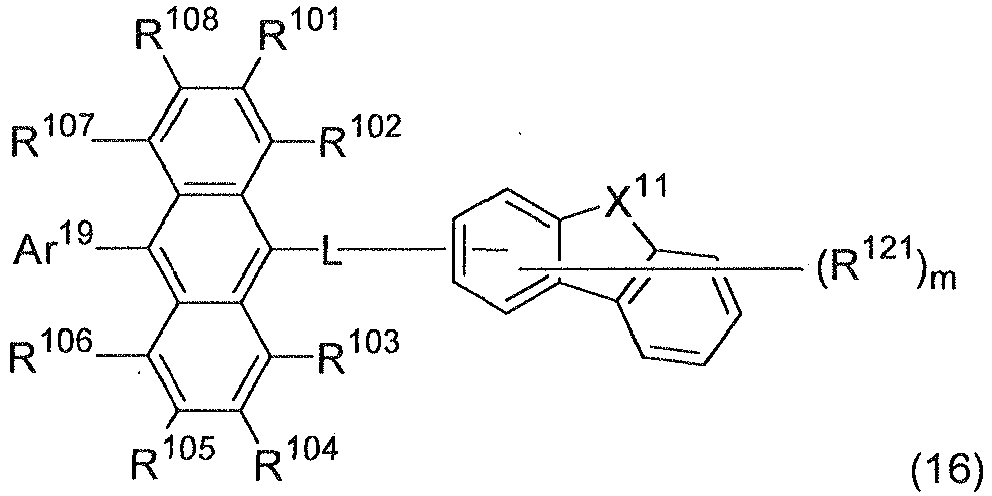
in formula (16), R101 to R108 are independently a hydrogen atom, a fluorine atom, a substituted or unsubstituted alkyl group having 1 to 10 carbon atoms, a substituted or unsubstituted cycloalkyl group having 3 to 10 carbon atoms, a substituted or unsubstituted alkylsilyl group having 3 to 30 carbon atoms, a substituted or unsubstituted arylsilyl group having 8 to 30 ring carbon atoms, a substituted or unsubstituted alkoxy group having 1 to 20 carbon atoms, a substituted or unsubstituted aryloxy group having 6 to 20 ring carbon atoms, a substituted or unsubstituted aryl group having 6 to 30 ring carbon atoms or a substituted or unsubstituted heterocyclic group having 5 to 30 ring atoms,
L is a single bond, a substituted or unsubstituted arylene group having 6 to 50 ring carbon atoms or a substituted or unsubstituted divalent heterocyclic group having 5 to 50 ring atoms,
Ar19 is a substituted or unsubstituted aryl group having 6 to 30 ring carbon atoms or a substituted or unsubstituted heterocyclic group having 5 to 30 ring atoms,
X11 is an oxygen atom, a sulfur atom, -NR- or -CRaRb, wherein R, Ra and Rb are the same group as those in R101 to R108,
R121 is a substituted or unsubstituted aryl group having 6 to 30 ring carbon atoms or a substituted or unsubstituted heterocyclic group having 5 to 30 ring atoms, a substituted or unsubstituted alkyl group having 1 to 10 carbon atoms, a substituted or unsubstituted cycloalkyl group having 3 to 10 ring carbon atoms, a substituted or unsubstituted alkoxy group having 1 to 20 carbon atoms, a substituted or unsubstituted silyl group, a cyano group or a fluorine atom, and
m is an integer of 0 to 7, and plural R121s may be the same or different when m is an integer of 2 or more. - 11. An organic luminescent medium comprising an aromatic amine derivative represented by the following formula (1) and an anthracene derivative represented by the following formula (17):


in formula (17), R101 to R108 are independently a hydrogen atom, a fluorine atom, a substituted or unsubstituted alkyl group having 1 to 10 carbon atoms, a substituted or unsubstituted cycloalkyl group having 3 to 10 carbon atoms, a substituted or unsubstituted alkylsilyl group having 3 to 30 carbon atoms, a substituted or unsubstituted arylsilyl group having 8 to 30 ring carbon atoms, a substituted or unsubstituted alkoxy group having 1 to 20 carbon atoms, a substituted or unsubstituted aryloxy group having 6 to 20 ring carbon atoms, a substituted or unsubstituted aryl group having 6 to 30 ring carbon atoms or a substituted or unsubstituted heterocyclic group having 5 to 30 ring atoms,
Ar20 is a substituted or unsubstituted aryl group having 6 to 30 ring carbon atoms or a substituted or unsubstituted heterocyclic group having 5 to 30 ring atoms,
R201 is a substituted or unsubstituted aryl group having 6 to 30 ring carbon atoms, a substituted or unsubstituted heterocyclic group having 5 to 30 ring atoms, a substituted or unsubstituted alkyl group having 1 to 10 carbon atoms, a substituted or unsubstituted cycloalkyl group having 3 to 10 ring carbon atoms, a substituted or unsubstituted alkoxy group having 1 to 20 carbon atoms, a substituted or unsubstituted silyl group, a cyano group or a fluorine atom, and
p is an integer of 0 to 4, and plural R201s may be the same or different when p is an integer of 2 or more. - 12. An organic luminescent medium comprising an aromatic amine derivative represented by the following formula (1) and an anthracene derivative represented by the following formula (18):


in formula (18), R101 to R108 are independently a hydrogen atom, a fluorine atom, a substituted or unsubstituted alkyl group having 1 to 10 carbon atoms, a substituted or unsubstituted cycloalkyl group having 3 to 10 carbon atoms, a substituted or unsubstituted alkylsilyl group having 3 to 30 carbon atoms, a substituted or unsubstituted arylsilyl group having 8 to 30 ring carbon atoms, a substituted or unsubstituted alkoxy group having 1 to 20 carbon atoms, a substituted or unsubstituted aryloxy group having 6 to 20 ring carbon atoms, a substituted or unsubstituted aryl group having 6 to 30 ring carbon atoms or a substituted or unsubstituted heterocyclic group having 5 to 30 ring atoms,
Ar20 is a substituted or unsubstituted aryl group having 6 to 30 ring carbon atoms or a substituted or unsubstituted heterocyclic group having 5 to 30 ring atoms,
R201 and R301 are a substituted or unsubstituted aryl group having 6 to 30 ring carbon atoms or a substituted or unsubstituted heterocyclic group having 5 to 30 ring atoms, a substituted or unsubstituted alkyl group having 1 to 10 carbon atoms, a substituted or unsubstituted cycloalkyl group having 3 to 10 ring carbon atoms, a substituted or unsubstituted alkoxy group having 1 to 20 carbon atoms, a substituted or unsubstituted silyl group, a cyano group or a fluorine atom,
p is an integer of 0 to 4, and plural R201s may be the same or different when p is an integer of 2 or more,
q is an integer of 0 to 11, plural R301s may be the same or different when q is an integer of 2 or more, and
adjacent substituents may form a saturated or unsaturated ring. - 13. The organic luminescent medium according to any one of 1 to 12 wherein the aromatic amine derivative is represented by the following formula (2):

R1 to R10 are independently a hydrogen atom, a halogen atom, a substituted or unsubstituted alkyl group having 1 to 20 carbon atoms, a substituted or unsubstituted alkylsilyl group having 3 to 30 carbon atoms, a substituted or unsubstituted arylsilyl group having 8 to 30 ring carbon atoms, a substituted or unsubstituted alkoxy group having 1 to 20 carbon atoms, a substituted or unsubstituted aralkyl group having 6 to 20 ring carbon atoms, a substituted or unsubstituted aryl group having 6 to 10 ring carbon atoms or an electron-attracting group, and
at least one of R1 to R5 is an electron-attracting group, and at least one of R6 to R10 is an electron-attracting group. - 14. The organic luminescent medium according to 13 wherein at least one of R1 to R5 is an electron-attracting group and the other groups are a hydrogen atom, and at least one of R6 to R10 is an electron-attracting group and the other groups are a hydrogen atom.
- 15. The organic luminescent medium according to any one of 1 to 14 wherein the electron-attracting group is a cyano group.
- 16. An organic thin film comprising the organic luminescent medium according to any one of 1 to 15.
- 17. An organic electroluminescence device comprising one or more organic thin film layers comprising an emitting layer between an anode and an cathode,
- According to the invention, an organic luminescent medium which can emit blue light which is high in color purity and has a long lifetime can be provided.
- The organic luminescent medium of the invention comprises an aromatic amine derivative represented by the following formula (1) and an anthracene derivative represented by the following formula (I):


in formula (I), R101 to R108 are independently a hydrogen atom, a fluorine atom, a substituted or unsubstituted alkyl group having 1 to 10 carbon atoms, a substituted or unsubstituted cycloalkyl group having 3 to 10 carbon atoms, a substituted or unsubstituted alkylsilyl group having 3 to 30 carbon atoms, a substituted or unsubstituted arylsilyl group having 8 to 30 ring carbon atoms, a substituted or unsubstituted alkoxy group having 1 to 20 carbon atoms, a substituted or unsubstituted aryloxy group having 6 to 20 ring carbon atoms, a substituted or unsubstituted aryl group having 6 to 30 ring carbon atoms, or a substituted or unsubstituted heterocyclic group having 5 to 30 ring atoms,
Ar101 to Ar104 are a substituted or unsubstituted aryl group having 6 to 30 ring carbon atoms or a substituted or unsubstituted heterocyclic group having 5 to 30 ring atoms,
X is an integer of 0 to 3, and
Y is an integer of 1 to 3. - The organic luminescent medium of the invention comprises an aromatic amine derivative represented by the following formula (1) and an anthracene derivative represented by the following formula (II):

in formula (II), R101 to R108 are independently a hydrogen atom, a fluorine atom, a substituted or unsubstituted alkyl group having 1 to 10 carbon atoms, a substituted or unsubstituted cycloalkyl group having 3 to 10 carbon atoms, a substituted or unsubstituted alkylsilyl group having 3 to 30 carbon atoms, a substituted or unsubstituted arylsilyl group having 8 to 30 ring carbon atoms, a substituted or unsubstituted alkoxy group having 1 to 20 carbon atoms, a substituted or unsubstituted aryloxy group having 6 to 20 ring carbon atoms, a substituted or unsubstituted aryl group having 6 to 30 ring carbon atoms, or a substituted or unsubstituted heterocyclic group having 5 to 30 ring atoms,
Ar105 is a substituted or unsubstituted aryl group having 6 to 30 ring carbon atoms or a substituted or unsubstituted heterocyclic group having 5 to 30 ring atoms, and
Ar201 is a substituted or unsubstituted fused aromatic ring group having 16 to 30 ring carbon atoms, or a substituted or unsubstituted fused heterocyclic group having 10 to 30 ring atoms. - The organic luminescent medium of the invention comprises an aromatic amine derivative represented by the following formula (1) and an anthracene derivative represented by the following formula (III):


in formula (III), R101 to R108 are independently a hydrogen atom, a fluorine atom, a substituted or unsubstituted alkyl group having 1 to 10 carbon atoms, a substituted or unsubstituted cycloalkyl group having 3 to 10 carbon atoms, a substituted or unsubstituted alkylsilyl group having 3 to 30 carbon atoms, a substituted or unsubstituted arylsilyl group having 8 to 30 ring carbon atoms, a substituted or unsubstituted alkoxy group having 1 to 20 carbon atoms, a substituted or unsubstituted aryloxy group having 6 to 20 ring carbon atoms, a substituted or unsubstituted aryl group having 6 to 30 ring carbon atoms, or a substituted or unsubstituted heterocyclic group having 5 to 30 ring atoms,
Ar106 is a substituted or unsubstituted aryl group having 6 to 30 ring carbon atoms or a substituted or unsubstituted heterocyclic group having 5 to 30 ring atoms, and
Ar301 is a substituted or unsubstituted 2-naphthyl group or a substituted or unsubstituted fluorenyl group, provided that Ar106 and Ar301 are different.
Even if they have the same structure, Ar106 and Ar301 are different when their bonding positions to the anthracene are different. - Regarding the aromatic amine derivative represented by formula (1), Ar1 to Ar4 are independently a substituted or unsubstituted aryl group having 6 to 30 ring carbon atoms, and at least one of Ar1 to Ar4 is an aryl group having an electron-attracting group.
The electron-attracting group in formula (1) is a group having a function of decreasing the electron density. Examples thereof include a cyano group, a fluorine atom, an alkyl halide group, a nitro group and a carbonyl group. Of these, a cyano group, a fluorine atom and an alkyl halide group are preferable and a cyano group is particularly preferable. It is supposed that long lifetime of a device can be realized by trapping extra electrons with the electron-attracting group to prevent electrons from intruding into a hole transforming material, whereby deterioration of the hole transforming material can be prevented. - In the invention, the aromatic amine derivative represented by formula (1) is preferably represented by the following formula (2):

- In formula (2), Ar2 and Ar4 are the same as those in formula (1).
R1 to R10 are independently a hydrogen atom, a halogen atom, a substituted or unsubstituted alkyl group having 1 to 20 carbon atoms, a substituted or unsubstituted alkylsilyl group having 3 to 30 carbon atoms, a substituted or unsubstituted arylsilyl group having 8 to 30 ring carbon atoms, a substituted or unsubstituted alkoxy group having 1 to 20 carbon atoms, a substituted or unsubstituted aralkyl group having 6 to 20 ring carbon atoms, a substituted or unsubstituted aryl group having 6 to 10. ring carbon atoms, or an electron-attracting group.
At least one of R1 to R5 is an electron-attracting group and at least one of R6 to R10 is an electron-attracting group. Ar2 and Ar4 may or may not have an electron-attracting group. - In formula (2), it is preferable that one of R1 to R5 be an electron-attracting group and the other groups be a hydrogen atom, and that one of R6 to R10 be an electron-attracting group and the other groups be a hydrogen atom.
- In the description, the "ring carbon atoms" means carbon atoms that form a saturated ring, unsaturated ring or aromatic ring. The "ring atoms" means carbon atoms and hetero atoms that form a hetero ring (including a saturated ring, unsaturated ring or aromatic ring).
Examples of substituents in "substituted or unsubstituted..." include an alkyl group, alkylsilyl group, alkyl halide group, aryl group, cycloalkyl group, alkoxy group, heterocyclic group, aralkyl group, aryloxy group, arylthio group, alkoxycarbonyl group, halogen atom, hydroxyl group, nitro group, cyano group, carboxy group, dibenzofuranyl group and fluorenyl group as described below.
The hydrogen atom of the invention includes light hydrogen and deuterium.
Specific examples of the groups in formulas (1) and (2), and the substituents are shown below. - Examples of the alkyl group include a methyl group, ethyl group, propyl group, isopropyl group, n-butyl group, s-butyl group, isobutyl group, t-butyl group, n-pentyl group, n-hexyl group, n-heptyl group and n-octyl group.
The alkyl group preferably has 1 to 10 carbon atoms, more preferably 1 to 8 carbon atoms, and further preferably 1 to 6 carbon atoms. Of these, a methyl group, ethyl group, propyl group, isopropyl group, n-butyl group, s-butyl group, isobutyl group, t-butyl group, n-pentyl group and n-hexyl group are preferable. - The alkylsilyl group is represented by -SiY3, and examples of Y are the same as those of the alkyl group.
- Examples of the aryl group include a phenyl group, naphthyl group, anthryl group, 1-phenanthryl group, phenanthryl group, naphthacenyl group, pyrenyl group, chrysenyl group, benzo[c]phenanthryl group, benzo[g]chrysenyl group, triphenylenyl group, fluorenyl group, benzofluorenyl group, dibenzofluorenyl group, biphenylyl group, p-terphenyl-4-yl group, p-terphenyl-3-yl group, p-terphenyl-2-yl group, m-terphenyl-4-yl group, m-terphenyl-3-yl group, and m-terphenyl-2-yl group.
The aryl group has preferably 6 to 20, more preferably 6 to 14, further preferably 6 to 10 ring carbon atoms. Preferable aryl groups are a phenyl group and a naphthyl group. - The arylsilyl group is represented by -SiZ3, and examples of Z are the same as those of the aryl group.
- The alkoxy group is represented by -OY, and examples of Y are the same as those of the alkyl or aryl group.
- The aralkyl group is represented by -Y-Z, examples of Y include alkylene groups corresponding to the examples of the alkyl group, and examples of Z are the same as those of the aryl group.
- Examples of the cycloalkyl group include a cyclopropyl group, cyclobutyl group, cyclopentyl group, cyclohexyl group, 4-methylcyclohexyl group, 1-adamantyl group, 2-adamantyl group, 1-norbornyl group and 2-norbornyl group.
The cycloalkyl group has preferably 3 to 10 ring carbon atoms, more preferably 3 to 8 ring carbon atoms, and further preferably 3 to 6 ring carbon atoms.
Specific examples of the aromatic amine derivatives are given below. -


- The organic luminescent medium of the invention comprises an aromatic amine derivative represented by the following formula (1) and an anthracene derivative represented by the following formula (10):


Ar11 is a substituted or unsubstituted phenyl group, substituted or unsubstituted 2-naphthyl group or a substituted or unsubstituted heterocyclic group having 5 to 30 ring atoms,
R111 is a substituted or unsubstituted aryl group having 6 to 30 ring carbon atoms, a substituted or unsubstituted heterocyclic group having 5 to 30 ring atoms, a substituted or unsubstituted alkyl group having 1 to 10 carbon atoms, a substituted or unsubstituted cycloalkyl group having 3 to 10 ring carbon atoms, a substituted or unsubstituted alkoxy group having 1 to 20 carbon atoms, a substituted or unsubstituted silyl group, a cyano group or a fluorine atom, and
b is an integer of 0 to 7, and plural R111s may be the same or different when b is an integer of 2 or more. - For example, Ar11 is a phenyl group substituted by a substituted or unsubstituted aryl group having 6 to 30 ring carbon atoms or a substituted or unsubstituted heterocyclic group having 5 to 30 ring atoms, a 2-naphthyl group substituted by a substituted or unsubstituted aryl group having 6 to 30 ring carbon atoms or a substituted or unsubstituted heterocyclic group having 5 to 30 ring atoms, or a heterocyclic group having 5 to 30 ring atoms substituted by a substituted or unsubstituted aryl group having 6 to 30 ring carbon atoms or a substituted or unsubstituted heterocyclic group having 5 to 30 ring atoms.
- For example, Ar11 is a substituted or unsubstituted fused heterocyclic group having 10 to 30 ring atoms.
- For example, Ar11 is a substituted or unsubstituted 2-naphthyl group.
- Of the anthracene derivatives represented by the formula (10), an anthracene derivative represented by the following formula (11) is preferable:

Ar14 is a substituted or unsubstituted aryl group having 6 to 30 ring carbon atoms, a substituted or unsubstituted alkyl group having 1 to 10 carbon atoms, a substituted or unsubstituted cycloalkyl group having 3 to 10 ring carbon atoms or a substituted or unsubstituted heterocyclic group having 5 to 30 ring atoms.
As Ar14 , a 9,9-dimethylfluorene-1-yl group, a 9,9-dimethylfluorene-2-yl group, a 9,9-dimethylfluorene-3-yl group, a 9,9-dimethylfluorene-4-yl group, a dibenzofuran-1-yl group, a dibenzofuran-2-yl group, a dibenzofuran-3-yl group, and a dibenzofuran-4-yl group are also preferable. - For example, Ar14 is a substituted or unsubstituted aryl group having 6 to 30 ring carbon atoms or a substituted or unsubstituted heterocyclic group having 5 to 30 ring atoms.
- The anthracene derivative may be one of the anthracene derivatives represented by the following formulas (12) to (18) in addition to those represented by formula (10).
-

Ar12 and Ar13 are independently a hydrogen atom, an aryl group having 6 to 30 ring carbon atoms, or a substituted or unsubstituted heterocyclic group having 5 to 30 ring atoms, and Ar12 may form a ring with the naphthalene ring to which Ar12 bonds. - For example, Ar12 or Ar13 is a substituted or unsubstituted aryl group having 6 to 30 ring carbon atoms or a substituted or unsubstituted heterocyclic group having 5 to 30 ring atoms.
For example, Ar12 forms a ring with the naphthalene ring to which Ar12 bonds, and the ring is a substituted or unsubstituted fused heterocyclic group having 10 to 30 ring atoms.
For example, Ar13 is a hydrogen atom. -

Ar15 is a substituted or unsubstituted aryl group having 6 to 30 ring carbon atoms, a substituted or unsubstituted alkyl group having 1 to 10 carbon atoms, a substituted or unsubstituted cycloalkyl group having 3 to 10 ring carbon atoms or a substituted or unsubstituted heterocyclic group having 5 to 30 ring atoms.
For example, Ar15 is preferably a dibenzofuran-1-yl group, a dibenzofuran-2-yl group, a dibenzofuran-3-yl group, or a dibenzofuran-4-yl group. - For example, Ar15 is a substituted or unsubstituted aryl group having 6 to 30 ring carbon atoms or a heterocyclic group having 5 to 30 ring atoms.
-

Ar16 is a substituted or unsubstituted aryl group having 6 to 30 ring carbon atoms, a substituted or unsubstituted alkyl group having 1 to 10 carbon atoms, a substituted or unsubstituted cycloalkyl group having 3 to 10 ring carbon atoms or a substituted or unsubstituted heterocyclic group having 5 to 50 ring atoms, and Ar16 may form a ring with the benzene ring to which Ar16 bonds, and
Ar17 is a substituted or unsubstituted aryl group having 6 to 30 ring carbon atoms, a substituted or unsubstituted alkyl group having 1 to 10 carbon atoms, a substituted or unsubstituted cycloalkyl group having 3 to 10 ring carbon atoms or a substituted or unsubstituted heterocyclic group having 5 to 30 ring atoms. - For example, Ar16 or Ar17 is a substituted or unsubstituted aryl group having 6 to 30 ring carbon atoms or a heterocyclic group having 5 to 30 ring atoms.
For example, Ar16 forms a ring with the benzene ring to which Ar16 bonds, and the ring is a substituted or unsubstituted fused heterocyclic group having 10 to 30 ring atoms.
For example, Ar16 forms a ring with the benzene ring to which Ar16 bonds, and the ring is a substituted or unsubstituted 2-naphthyl group. - As the anthracene derivative of formula (14), the structures represented by the following formulas (14-1) to (14-3) are preferable.

- In formula (14-1), R101 to R108 are the same as those described above.
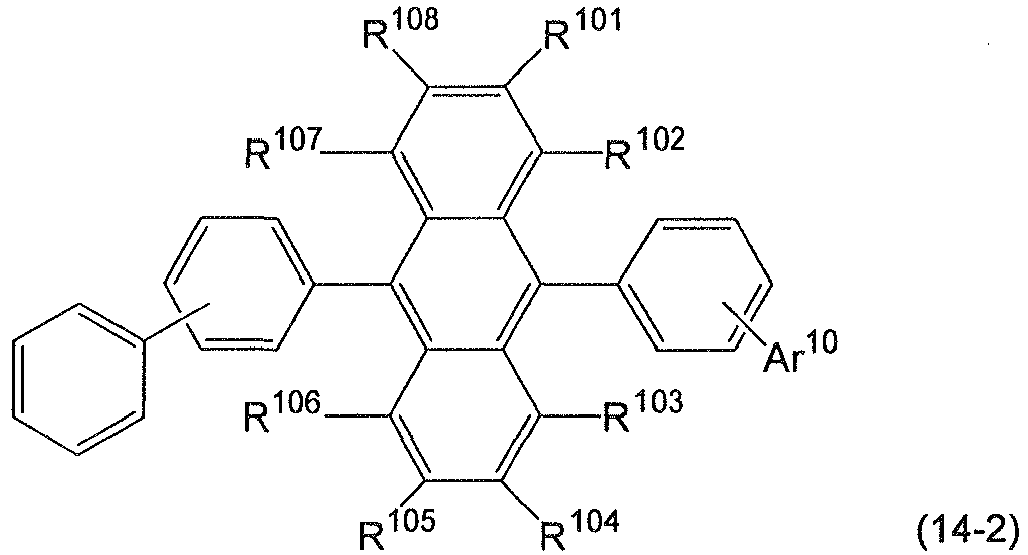
- In formula (14-2), R101 to R108 are the same as those in the formula (10). Ar10 is a substituted or unsubstituted fused aromatic ring group having 10 to 20 ring carbon atoms.

- In formula (14-3), R101 to R108 are the same as those described above. Ar5a and Ar6a are independently a substituted or unsubstituted fused aromatic ring group having 10 to 20 ring carbon atoms.
-

Ar18 is a substituted or unsubstituted aryl group having 6 to 30 ring carbon atoms or a substituted or unsubstituted heterocyclic group having 5 to 30 ring atoms,
L is a single bond, a substituted or unsubstituted arylene group having 6 to 30 ring carbon atoms or a substituted or unsubstituted divalent heterocyclic group having 5 to 30 ring atoms,
R121 is a substituted or unsubstituted aryl group having 6 to 30 ring carbon atoms, a substituted or unsubstituted heterocyclic group having 5 to 30 ring atoms, a substituted or unsubstituted alkyl group having 1 to 10 carbon atoms, a substituted or unsubstituted cycloalkyl group having 3 to 10 ring carbon atoms, a substituted or unsubstituted alkoxy group having 1 to 20 carbon atoms, a substituted or unsubstituted silyl group, a cyano group or a fluorine atom, and
n is an integer of 0 to 11, and plural R121s may be the same or different when n is an integer of 2 or more. - For example, when L is a single bond, Ar18 is an aryl group having 6 to 30 ring carbon atoms or a heterocyclic group having 5 to 30 ring atoms which is substituted by an aryl group having 6 to 30 ring carbon atoms or a heterocyclic group having 5 to 30 ring atoms.
For example, L is a single bond. -

L is a single bond, a substituted or unsubstituted arylene group having 6 to 50 ring carbon atoms or a substituted or unsubstituted divalent heterocyclic group having 5 to 50 ring atoms,
Ar19 is a substituted or unsubstituted aryl group having 6 to 30 ring carbon atoms or a substituted or unsubstituted heterocyclic group having 5 to 30 ring atoms,
X11 is an oxygen atom, a sulfur atom, -NR- or -CRaRb wherein R, Ra and Rb are the same group as those in R101 to R108,
R121 is a substituted or unsubstituted aryl group having 6 to 30 ring carbon atoms or a substituted or unsubstituted heterocyclic group having 5 to 30 ring atoms, a substituted or unsubstituted alkyl group having 1 to 10 carbon atoms, a substituted or unsubstituted cycloalkyl group having 3 to 10 ring carbon atoms, a substituted or unsubstituted alkoxy group having 1 to 20 carbon atoms, a substituted or unsubstituted silyl group, a cyano group or a fluorine atom, and
m is an integer of 0 to 7, and plural R121s may be the same or different when m is an integer of 2 or more. - For example, when L is a single bond, Ar19 is an aryl group having 6 to 30 ring carbon atoms or a heterocyclic group having 5 to 30 ring atoms which is substituted by an aryl group having 6 to 30 ring carbon atoms or a heterocyclic group having 5 to 30 ring atoms.
-

Ar201 is a substituted or unsubstituted aryl group having 6 to 30 ring carbon atoms or a substituted or unsubstituted heterocyclic group having 5 to 30 ring atoms,
R201 is a substituted or unsubstituted aryl group having 6 to 30 ring carbon atoms, a substituted or unsubstituted heterocyclic group having 5 to 30 ring atoms, a substituted or unsubstituted alkyl group having 1 to 10 carbon atoms, a substituted or unsubstituted cycloalkyl group having 3 to 10 ring carbon atoms, a substituted or unsubstituted alkoxy group having 1 to 20 carbon atoms, a substituted or unsubstituted silyl group, a cyano group or a fluorine atom, and
p is an integer of 0 to 4, and plural R201s may be the same or different when p is an integer of 2 or more. - For example, Ar20 is an aryl group having 6 to 30 ring carbon atoms or a heterocyclic group having 5 to 30 ring atoms which is substituted by an aryl group having 6 to 30 ring carbon atoms or a heterocyclic group having 5 to 30 ring atoms.
-

Ar20 and R201 are the same as those in formula (17),
R301 is a substituted or unsubstituted aryl group having 6 to 30 ring carbon atoms or a substituted or unsubstituted heterocyclic group having 5 to 30 ring atoms, a substituted or unsubstituted alkyl group having 1 to 10 carbon atoms, a substituted or unsubstituted cycloalkyl group having 3 to 10 ring carbon atoms, a substituted or unsubstituted alkoxy group having 1 to 20 carbon atoms, a substituted or unsubstituted silyl group, a cyano group or a fluorine atom,
p is an integer of 0 to 4, and plural R201s may be the same or different when p is an integer of 2 or more,
q is an integer of 0 to 11, plural R301s may be the same or different when q is an integer of 2 or more, and
adjacent substituents may form a saturated or unsaturated ring. - Examples of the aryl group having 6 to 30 ring carbon atoms of R101 to R108, R111, R121, R201, R301, Ar12 to Ar20 and Ar101 to Ar106 include a phenyl group, naphthyl group, anthryl group, phenanthryl group, naphthacenyl group, pyrenyl group, chrysenyl group, benzo[c]phenanthryl group, benzo[g]chrysenyl group, benzo[a]anthryl group, triphenylenyl group, fluorenyl group, 9,9-dimethylfluorene-2-yl group, benzofluorenyl group, dibenzofluorenyl group, biphenylyl group, p-terphenyl-4-yl group, p-terphenyl-3-yl group, p-terphenyl-2-yl group, m-terphenyl-4-yl group, m-terphenyl-3-yl group, m-terphenyl-2-yl group, tolyl group, p-t-butylphenyl group, p-(2-phenylpropyl)phenyl group, 3-methyl-2-naphthyl group, 4-methyl-1-naphthyl group, 4-methyl-1-anthryl group, 4'-methylbiphenylyl group, and 4"-t-butyl-p-terphenyl-4-yl group. The aryl group preferably has 6 to 20 ring carbon atoms, more preferably 6 to 14 ring carbon atoms and further preferably 6 to 10 ring carbon atoms.
- Of these, an unsubstituted phenyl group, substituted phenyl group, substituted or unsubstituted aryl group having 10 to 14 ring carbon atoms (for example, a 1-naphthyl group, 2-naphthyl group and 9-phenanthryl group), substituted or unsubstituted fluorenyl group (2-fluorenyl group), and substituted or unsubstituted pyrenyl group (1-pyrenyl group, 2-pyrenyl group, and 4-pyrenyl group) are preferable.
The aryl group having 6 to 30 ring carbon atoms may be substituted by a substituent such as an alkyl group, cycloalkyl group, aryl group and heterocyclic group, and examples of the substituent include the same groups as the above-mentioned substituents. As the substituent, an aryl group and heterocyclic group are preferable. - Examples of the fused aromatic ring group having 10 to 20 ring carbon atoms of Ar5a, Ar6a and Ar10 include a 1-naphthyl group, 2-naphthyl group, 1-anthryl group, 2-anthryl group, 9-anthryl group, 1-phenanthryl group, 2-phenanthryl group, 3-phenanthryl group, 4-phenanthryl group, 9-phenanthryl group, 1-naphthacenyl group, 2-naphthacenyl group, 9-naphthacenyl group, 1-pyrenyl group, 2-pyrenyl group, 4-pyrenyl group and 2-fluorenyl group. In particular, 1-naphthyl group, 2-naphthyl group, 9-phenanthryl group, and fluorenyl group (2-fluorenyl group) are preferable.
Examples of the fused aromatic ring group of Ar201 having 16 to 30 ring carbon atoms include triphenylenyl group, pyrenyl group, chrysenyl group, benzo[c]phenanthryl group and benzo[g]chrysenyl group. In particular, benzo[c]phenanthryl group, benzo[g]chrysenyl group are preferable. - The fused aromatic ring group may be substituted by a substituent such as an alkyl group, cycloalkyl group, aryl group and heterocyclic group, and examples of the substituent include the same groups as the above-mentioned substituents. As the substituent, an aryl group and heterocyclic group are preferable.
- Examples of the heterocyclic group having 5 to 30 ring atoms of R101 to R108, R111, Ar12 to Ar20 and Ar101 to Ar106 include a pyrrolyl group, pyrazinyl group, pyridinyl group, indolyl group, isoindolyl group, furyl group, benzofuranyl group, isobenzofuranyl group, dibenzofuranyl group, dibenzothiophenyl group, quinolyl group, isoquinolyl group, quinoxalinyl group, carbazolyl group, phenanthrydinyl group, acridinyl group, phenanthronyl group, phenazinyl group, phenothiazinyl group, phenoxazinyl group, oxazolyl group, oxadiazolyl group, furazanyl group, thienyl group, methylpyrrolyl group, 2-t-butylpyrrolyl group, 3-(2-phenylpropyl)pyrrolyl group, 2-methyl-1-indolyl group, 4-methyl-1-indolyl group, 2-methyl-3-indolyl group, 4-methyl-3-indolyl group, 2-t-butyl-1-indolyl group, 4-t-butyl-1-indolyl group, 2-t-butyl-3-indolyl group and 4-t-butyl-3-indolyl group. Of these, dibenzofuranyl group, dibenzothiophenyl group and carbazolyl group are preferable.
Examples of the fused heterocyclic group having 10 to 30 ring atoms of Ar201 include a quinolyl group and dibenzofuranyl group, and dibenzofuranyl group is particularly preferable.
The heterocyclic group having 5 to 30 ring atoms may be substituted by a substituent such as an alkyl group, cycloalkyl group, aryl group and heterocyclic group, and examples of the substituent include the same groups as the above-mentioned substituents. As the substituent, an aryl group and heterocyclic group are preferable. - Examples of the alkyl group having 1 to 10 carbon atoms of R101 to R108, R111, R121, R201, R301, and Ar14 to Ar17 include a methyl group, ethyl group, propyl group, isopropyl group, n-butyl group, s-butyl group, isobutyl group, t-butyl group, n-pentyl group, n-hexyl group, n-heptyl group, n-octyl group, hydroxymethyl group, 1-hydroxyethyl group, 2-hydroxyethyl group, 2-hydroxyisobutyl group, 1,2-dihydroxyethyl group, 1,3-dihydroxyisopropyl group, 2,3-dihydroxy-t-butyl group, 1,2,3-trihydroxypropyl group, aminomethyl group, 1-aminoethyl group, 2-aminoethyl group, 2-aminoisobutyl group, 1,2-diaminoethyl group, 1,3-diaminoisopropyl group, 2,3-diamino-t-butyl group, 1,2,3-triaminopropyl group, cyanomethyl group, 1-cyanoathyl group, 2-cyanoethyl group, 2-cyanoisobutyl group, 1,2-dicyanoethyl group, 1,3-dicyanoisopropyl group, 2,3-dicyano-t-butyl group and 1,2,3-tricyanopropyl group. The alkyl group preferably has 1 to 10 carbon atoms, more preferably 1 to 8 carbon atoms, and further preferably 1 to 6 carbon atoms.
Of these, a methyl group, ethyl group, propyl group, isopropyl group, n-butyl group, s-butyl group, isobutyl group and t-butyl group are preferable. The alkyl group having 1 to 10 carbon atoms may be substituted by a substituent such as an alkyl group, cycloalkyl group, aryl group and heterocyclic group, and examples of the substituent include the same groups as the above-mentioned substituents. As the substituent, an aryl group and heterocyclic group are preferable. - Examples of the cycloalkyl group having 3 to 10 ring carbon atoms of R101 to R108, R111, R121 R201, R301, and Ar14 to Ar17 include a cyclopropyl group, cyclobutyl group, cyclopentyl group, cyclohexyl group, 4-methylcyclohexyl group, 1-adamantyl group, 2-adamantyl group, 1-norbornyl group and 2-norbornyl group. Of these, cyclopentyl and cyclohexyl are preferable. The cycloalkyl group preferably has 3 to 10 ring carbon atoms, more preferably 3 to 8 ring carbon atoms, and further preferably 3 to 6 ring carbon atoms. The cycloalkyl group having 3 to 10 ring carbon atoms may be substituted by a substituent such as an alkyl group, cycloalkyl group, aryl group and heterocyclic group, and examples of the substituent include the same groups as the above-mentioned substituents. As the substituent, an aryl group and heterocyclic group are preferable.
- Examples of the alkylsilyl group and arylsilyl group of R101 to R108, R111, R121, R201 and R301 include a trimethylsilyl group, triethylsilyl group, t-butyldimethylsilyl group, vinyldimethylsilyl group, propyldimethylsilyl group and triphenylsilyl group. The silyl group may be substituted by a substituent such as an alkyl group, cycloalkyl group, aryl group and heterocyclic group, and examples of the substituent include the same groups as the above-mentioned substituents. As the substituent, an aryl group and heterocyclic group are preferable.
- The alkoxy group having 1 to 20 carbon atoms of R101 to R108, R111, R121, R201 and R301 is represented by -OZ, and Z is selected from the substituted or unsubstituted alkyl group of R101 to R108. The alkyl group may be substituted by a substituent such as an alkyl group, cycloalkyl group, aryl group and heterocyclic group, and examples of the substituent include the same groups as the above-mentioned substituents. As the substituent, an aryl group and heterocyclic group are preferable.
- The aryloxy group having 6 to 20 carbon atoms of R101 to R108, R111, R121, R201 and R301 is represented by -OZ, and Z is selected from the substituted or unsubstituted aryl group of R101 to R108. The aryl group may be substituted by a substituent such as an alkyl group, cycloalkyl group, aryl group and heterocyclic group, and examples of the substituent include the same groups as the above-mentioned substituents. As the substituent, an aryl group and heterocyclic group are preferable.
- As the substituted or unsubstituted arylene group having 6 to 30 ring carbon atoms or the substituted or unsubstituted divalent heterocyclic group having 5 to 30 ring atoms of L in formulas (10-7) and (10-8), divalent groups of the aryl group and heterocyclic group described above can be given.
- It appears that a device has a high efficiency and a long lifetime when an anthracene derivative having many (4 or more) aryl (arylene) groups which are bonded via single bonds between aryl groups such as the compound of formula (I) or an anthracene derivative having a fused aromatic ring group (4 rings or more) having 16 to 30 ring carbon atoms as an aryl group such as the compound of formula (II) is used, since host molecules becomes bigger in size and hence energy transfer to a dopant easily occurs.
- It appears that a device has high efficiency and a long lifetime when an anthracene derivative having a fused heterocyclic group is used, since the ring lacks π electrons, the anthracene derivative easily interacts with an electron-rich dopant having a tertiary amino group, and energy transfer tends to occur easily.
- In addition, even in the case of a derivative having a small number (3) of aryl (arylene) groups which bonded via single bonds; i.e. in the case of a derivative in which the host molecule thereof is small such as a derivative of formula (III), if an anthracene as the main skeleton and an aryl group which directly bonds to the main skeleton, such as a β-naphthyl group or a fluorenyl group, have high planarity, a device has a high efficiency and a long lifetime. The reason therefor is that the part easily interacts with a dopant and energy transfer tends to occur easily. In particular, the above-mentioned effect can be easily obtained when an anthracene molecule becomes less symmetrical, since crystallization hardly occurs to improve film properties.
- The emission lifetime of a device can be improved by using the medium of the invention which is a combination of the aromatic amine derivative represented by formula (1) and the anthracene derivative represented by formulas (I), (II), (III) or (10) to (18). In addition, a device can emit blue light having a shorter wave length (for example, 460 nm or less) as compared with a conventional device if the aryl group of a diarylamino group has an electron-attracting group.
- Specific examples of the anthracene derivative of the invention can be given as follows:
-


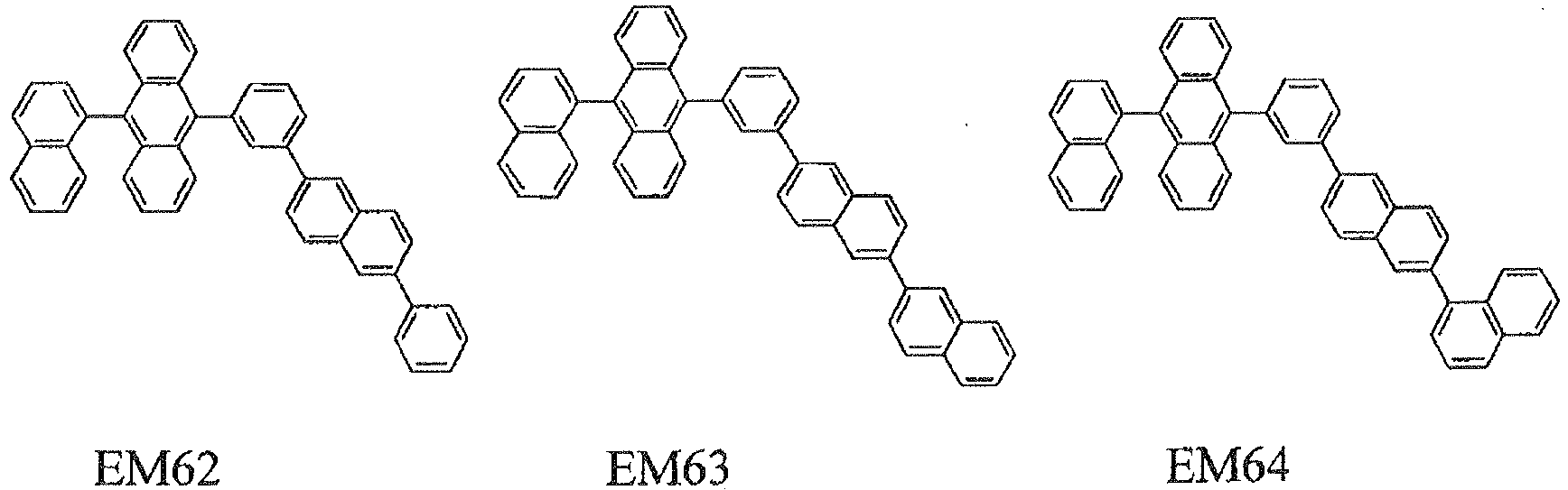


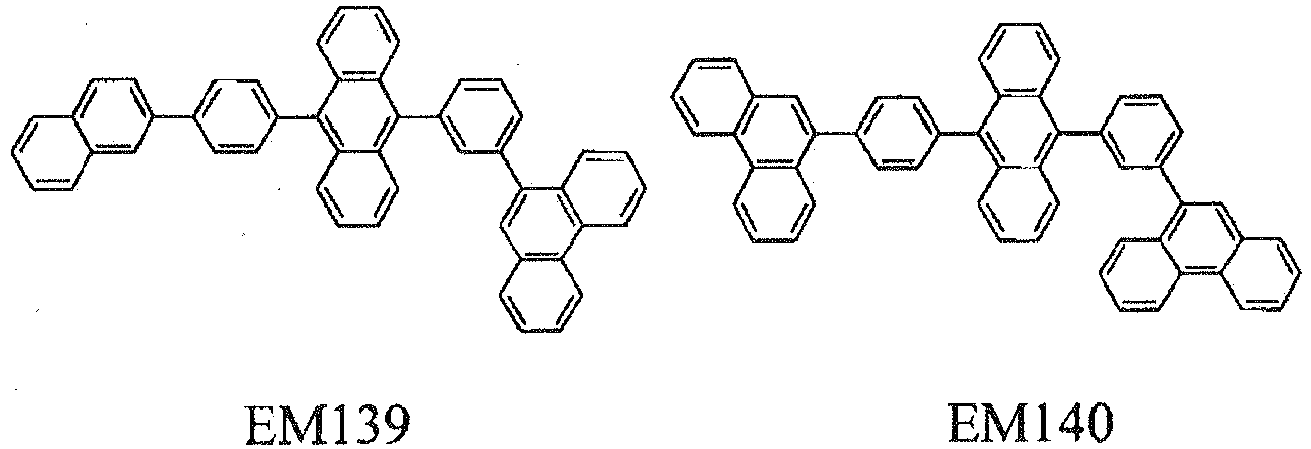


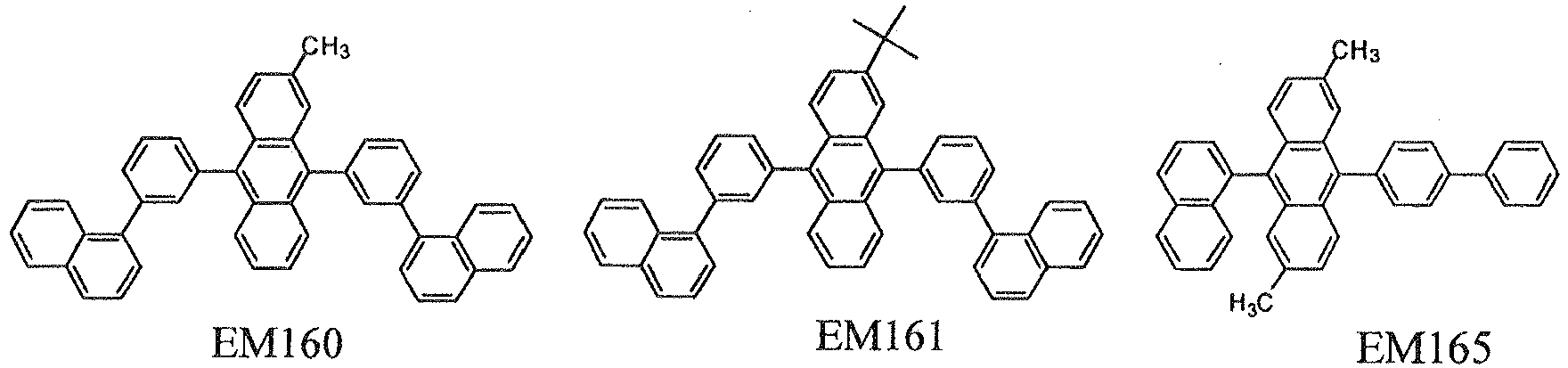








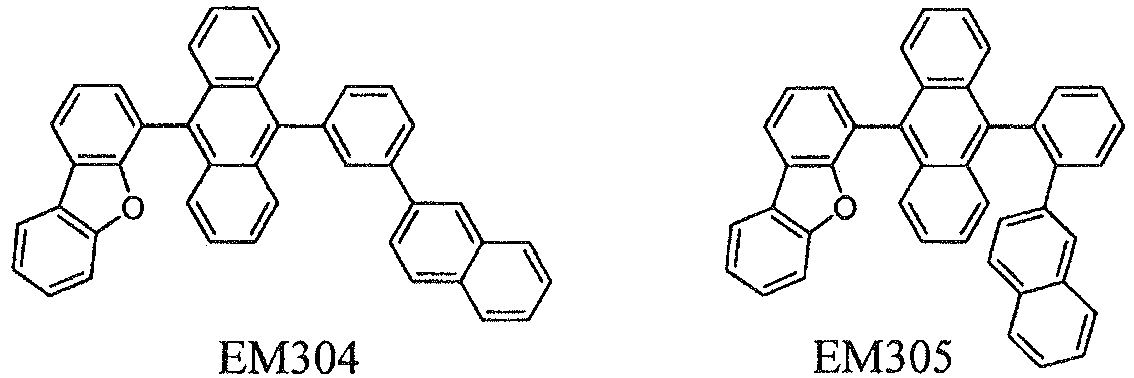
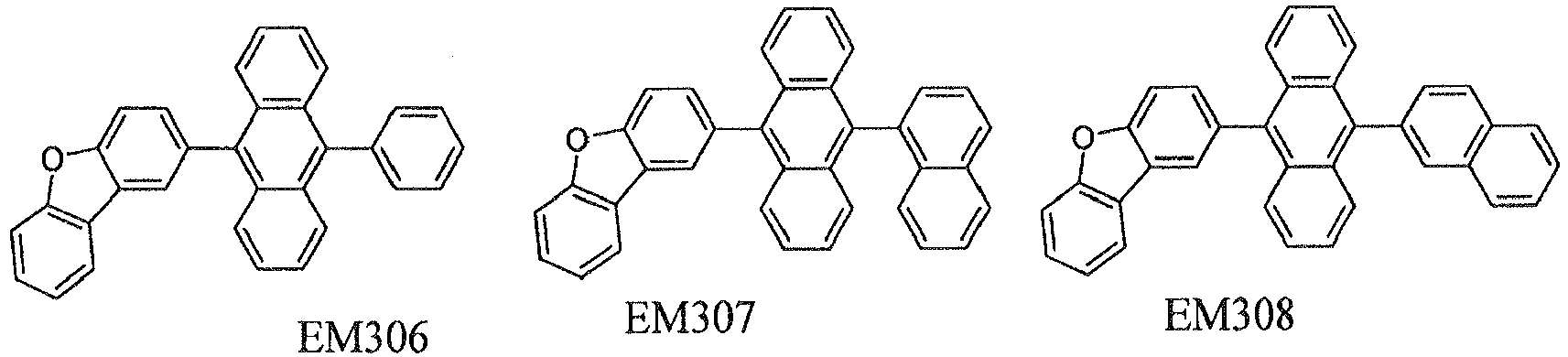








- The organic luminesent medium of the invention preferably contains the above-mentioned aromatic amine derivative as a doping material (dopant). In this case, the amount of the aromatic amine derivative is preferably 0.1 to 20 mass%, more preferably 1 to 10 mass%. In this case, the anthracene derivative is a host material and generally the total sum of a host material and a dopant material is 100 mass%.
- The organic EL device of the invention comprises one or more organic thin film layers comprising an emitting layer between an anode and a cathode. At least one layer of the organic thin film layers contains the organic thin film containing the organic luminescent medium of the invention.
- The aromatic amine derivative and the anthracene derivative may be used in a hole-injecting layer, a hole-transporting layer, an electron-injecting layer, and an electron-transporting layer in addition to an emitting layer.
- In the invention, as the organic EL device in which the organic thin film layer is composed of plural layers, one in which layers are sequentially stacked (anode/hole-injecting layer/emitting layer/cathode), (anode/emitting layer/electron-injecting layer/cathode), (anode/hole-injecting layer/emitting layer/electron-injecting layer/cathode), (anode/hole-injecting layer/hole-transporting layer/emitting layer/electron-injecting layer/cathode) or the like can be given.
- By allowing the organic thin film layer to be composed of plural layers, the organic EL device can be prevented from lowering of luminance or lifetime due to quenching. If necessary, an emitting material, a doping material, a hole-injecting material or an electron-injecting material can be used in combination. Further, due to the use of a doping material, luminance or luminous efficiency may be improved. The hole-injecting layer, the emitting layer and the electron-injecting layer may respectively be formed of two or more layers. In such case, in the hole-injecting layer, a layer which injects holes from an electrode is referred to as a hole-injecting layer, and a layer which receives holes from the hole-injecting layer and transports the holes to the emitting layer is referred to as a hole-transporting layer. Similarly, in the electron-injecting layer, a layer which injects electrons from an electrode is referred to as an electron-injecting layer and a layer which receives electrons from an electron-injecting layer and transports the electrons to the emitting layer is referred to as an electron-transporting layer. Each of these layers is selected and used according to each of the factors of a material, i.e. the energy level, heat resistance, adhesiveness to the organic layer or the metal electrode or the like.
- Examples of the material other than the above anthracene derivative which can be used in the emitting layer together with the aromatic amine derivative include, though not limited thereto, fused polycyclic aromatic compounds such as naphthalene, phenanthrene, rubrene, tetracene, pyrene, perylene, chrysene, decacyclene, coronene, tetraphenylcyclopentadiene, pentaphenylcyclopentadiene, fluorene, spirofluorene and derivatives thereof, organic metal complexes such as tris(8-quinolinolate)aluminum, triarylamine derivatives, styrylamine derivatives, stilbene derivatives, coumarin derivatives, pyrane derivatives, oxazone derivatives, benzothiazole derivatives, benzoxazole derivatives, benzimidazole derivatives, pyrazine derivatives, cinnamate derivatives, diketo-pyrrolo-pyrrole derivatives, acrylidone derivatives and quinacrylidone derivatives.
- As the hole-injecting material, a compound which can transport holes, exhibits hole-injecting effects from the anode and excellent hole-injection effect for the emitting layer or the emitting material, and has an excellent capability of forming a thin film is preferable. Specific examples thereof include, though not limited thereto, phthalocyanine derivatives, naphthalocyanine derivatives, porphyline derivatives, benzidine-type triphenylamine, diamine-type triphenylamine, hexacyanohexaazatriphenylene, derivatives thereof, and polymer materials such as polyvinylcarbazole, polysilane and conductive polymers.
- Of the hole-injecting materials usable in the organic EL device of the invention, further effective hole-injecting materials are phthalocyanine derivatives.
- Examples of the phthalocyanine (Pc) derivative include, though not limited thereto, phthalocyanine derivatives such as H2Pc, CuPc, CoPc, NiPc, ZnPc, PdPc, FePc, MnPc, ClAlPc, ClGaPc, ClInPc, ClSnPc, Cl2SiPc, (HO)AlPc, (HO)GaPc, VOPc, TiOPc, MoOPc and GaPc-O-GaPc, and naphthalocyanine derivatives.
In addition, it is also possible to sensitize carriers by adding to the hole-injecting material an electron-accepting substance such as a TCNQ derivative. - Preferable hole-transporting materials usable in the organic EL device of the invention are aromatic tertiary amine derivatives.
Examples of the aromatic tertiary amine derivative include, though not limited thereto, N,N'-diphenyl-N,N'-dinaphthyl-1,1'-biphenyl-4,4'-diamine, N,N,N',N'-tetrabiphenyl-1,1'-biphenyl-4,4'-diamineor an oligomer or a polymer having these aromatic tertiary amine skeletons. - As the electron-injecting material, a compound which can transport electrons, exhibits electron-injecting effects from the cathode and excellent electron-injection effect for the emitting layer or the emitting material, and has an excellent capability of forming a thin film is preferable.
- In the organic EL device of the invention, further effective electron-injecting materials are a metal complex compound and a nitrogen-containing heterocyclic derivative.
Examples of the metal complex compound include, though not limited thereto, 8-hydroxyquinolinate lithium, bis(8-hydroxyquinolinate)zinc, tris(8-hydroxyquinolinate)aluminum, tris(8-hydroxyquinolinate)gallium, bis(10-hydroxybenzo[h]quinolinate)beryllium and bis(10-hydroxybenzo[h]quinolinate)zinc. - As examples of the nitrogen-containing heterocyclic derivative, oxazole, thiazole, oxadiazole, thiadiazole, triazole, pyridine, pyrimidine, triazine, phenanthroline, benzoimidazole, imidazopyridine or the like are preferable, for example. Of these, a benzimidazole derivative, a phenanthroline derivative and an imidazopyridine derivative are preferable.
As a preferred embodiment, a dopant is further contained in these electron-injecting materials, and in order to facilitate receiving electrons from the cathode, it is further preferable to dope the vicinity of the cathode interface of the second organic layer with a dopant, the representative example of which is an alkali metal.
As the dopant, a donating metal, a donating metal compound and a donating metal complex can be given. These reducing dopants may be used singly or in combination of two or more. - In the organic EL device of the invention, the emitting layer may contain, in addition to at least one of the above-mentioned aromatic amine derivatives represented by the formula (1), at least one of an emitting material, doping material, hole-injecting material, hole-transporting material and electron-injecting material in the same layer. Moreover, for improving stability of the organic EL device obtained by the invention to temperature, humidity, atmosphere, etc. it is also possible to prepare a protective layer on the surface of the device, and it is also possible to protect the entire device by applying silicone oil, resin, etc.
- As the conductive material used in the anode of the organic EL device of the invention, a conductive material having a work function of more than 4 eV is suitable. Carbon, aluminum, vanadium, iron, cobalt, nickel, tungsten, silver, gold, platinum, palladium or the like, alloys thereof, oxidized metals which are used in an ITO substrate and a NESA substrate such as tin oxide and indium oxide and organic conductive resins such as polythiophene and polypyrrole are used. As the conductive material used in the cathode, a conductive material having a work function of smaller than 4 eV is suitable. Magnesium, calcium, tin, lead, titanium, yttrium, lithium, ruthenium, manganese, aluminum, and lithium fluoride or the like, and alloys thereof are used, but not limited thereto. Representative examples of the alloys include, though not limited thereto, magnesium/silver alloys, magnesium/indium alloys and lithium/aluminum alloys. The amount ratio of the alloy is controlled by the temperature of the deposition source, atmosphere, vacuum degree or the like, and an appropriate ratio is selected. If necessary, the anode and the cathode each may be composed of two or more layers.
- In the organic EL device of the invention, in order to allow it to emit light efficiently, it is preferred that at least one of the surfaces be fully transparent in the emission wavelength region of the device. In addition, it is preferred that the substrate also be transparent. The transparent electrode is set such that predetermined transparency can be ensured by a method such as deposition or sputtering by using the above-mentioned conductive materials. It is preferred that the electrode on the emitting surface have a light transmittance of 10% or more. Although no specific restrictions are imposed on the substrate as long as it has mechanical and thermal strength and transparency, a glass substrate and a transparent resin film can be given.
- Each layer of the organic EL device of the invention can be formed by a dry film-forming method such as vacuum vapor deposition, sputtering, plasma, ion plating or the like or a wet film-forming method such as spin coating, dipping, flow coating or the like. Although the film thickness is not particularly limited, it is required to adjust the film thickness to an appropriate value. If the film thickness is too large, a large voltage is required to be applied in order to obtain a certain optical output, which results in a poor efficiency. If the film thickness is too small, pinholes or the like are generated, and a sufficient luminance cannot be obtained even if an electrical field is applied. The suitable film thickness is normally 5 nm to 10 µm, with a range of 10 nm to 0.2 µm being further preferable.
- In the case of the wet film-forming method, a thin film is formed by dissolving or dispersing materials forming each layer in an appropriate solvent such as ethanol, chloroform, tetrahydrofuran and dioxane. Any of the above-mentioned solvents can be used.
- In each organic thin film layer, an appropriate resin or additive may be used in order to improve film-forming properties, to prevent generation of pinholes in the film, or for other purposes.
- The organic EL device of the invention can be suitably used as a planar emitting body such as a flat panel display of a wall-hanging television, backlight of a copier, a printer or a liquid crystal display, light sources for instruments, a display panel, a navigation light, or the like. The compound of the invention can be used not only in an organic EL device but also in the field of an electrophotographic photoreceptor, a photoelectric converting element, a solar cell and an image sensor.
- A glass substrate of 25 mm by 75 mm by 1.1 mm thick with an ITO transparent electrode (anode) (GEOMATEC CO., LTD.) was subjected to ultrasonic cleaning in isopropyl alcohol for 5 minutes, and cleaning with ozone for 30 minutes. The resultant substrate with transparent electrode lines was mounted on a substrate holder in a vacuum deposition device. First, compound A-1 was deposited on the surface on which the transparent electrode lines were formed to form a 50 nm-thick film so as to cover the transparent electrode. Subsequently, compound A-2 was deposited on the A-1 film to form a 45 nm-thick film.
Compound EM13 and compound DM-1 were deposited on the A-2 film into a thickness of 20 nm such that the film thickness ratio of EM13 and DM-1 became 20:1 to form a blue emitting layer.
On this film, the following ET-1 was deposited into a thickness of 30 nm as an electron-transporting layer. Then LiF was deposited into a thickness of 1 nm. Metallic Al was deposited on the LiF film into a thickness of 150 nm to form a metallic cathode, whereby an organic EL device was fabricated. -


- An organic EL device was produced in the same manner as in Example 1, except that the host material and doping material shown in Tables 1 and 2 were used.
The doping materials used in Examples and Comparative Examples are shown below.
- Host materials which were used in Comparative Examples are shown below.
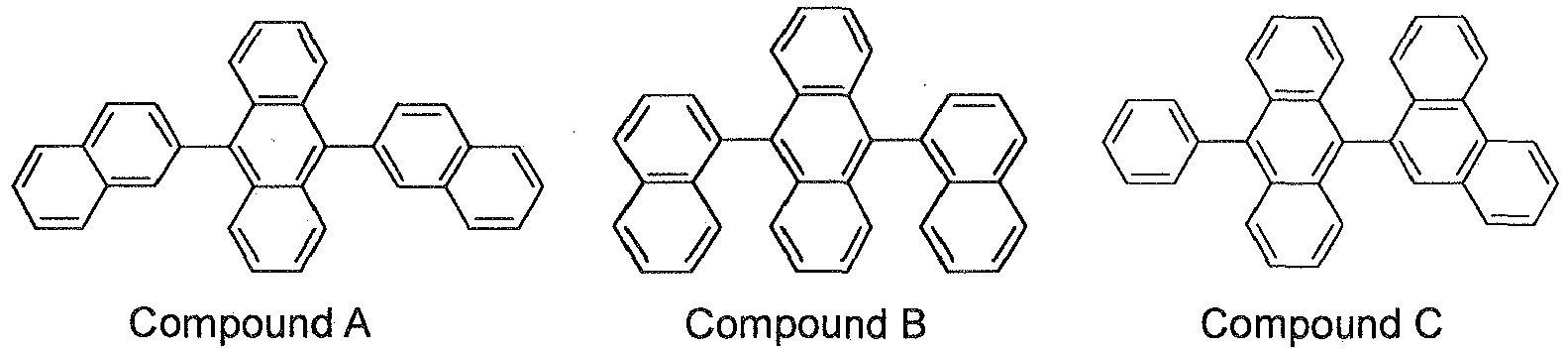

- Current having a current density of 10 mA/cm2was applied to the organic EL devices obtained were applied current having EL spectra thereof were measured with a spectroradiometer (CS1000, produced by MINOLTA), and external quantum efficiency was calculated by the following formula (1).
The lifetime of the organic EL device was evaluated by measuring the half life at 500 cd/m2 of initial luminance. The results are shown in Tables 1 and 2. -

- NP:
- Number of photons
- NE:
- Number of electrons
- π:
- Circular constant = 3.1416
- λ:
- Wavelength (nm)
- ϕ:
- Luminescence intensity (W/sr·m2·nm)
- h:
- Planck constant = 6.63 x 10⁻³⁴ (J·s)
- c:
- Light velocity = 3 x 10⁸ (m/s)
- J:
- Current density (mA/cm2)
- e:
- Charge = 1.6 x 10⁻¹⁹ (C)
-
Table 1 Host Dopant CIEx CIEy EQE(%) Lifetime(h) Example 1 EM13 DM-1 0.137 0.094 7.0 3000 Example 2 EM28 DM-1 0.137 0.094 7.0 3100 Example 3 EM29 DM-1 0.137 0.093 6.5 2500 Example 4 EM31 DM-1 0.137 0.094 7.0 3300 Example 5 EM32 DM-1 0.137 0.096 6.9 3200 Example 6 EM69 DM-1 0.137 0.096 6.8 2900 Example 7 EM70 DM-1 0.137 0.094 6.8 2800 Example 8 EM73 DM-1 0.137 0.096 6.9 3000 Example 9 EM78 DM-1 0.137 0.096 6.8 2500 Example 10 EM82 DM-1 0.137 0.096 6.7 2500 Example 11 EM125 DM-1 0.137 0.096 6.9 2900 Example 12 EM205 DM-1 0.137 0.096 6.7 2400 Example 13 EM364 DM-1 0.137 0.101 6.4 2000 Example 14 EM367 DM-1 0.137 0.096 6.7 2200 Example 15 EM361 DM-1 0.137 0.099 6.8 3100 Example 16 EM15 DM-1 0.137 0.095 6.8 2900 Example 17 EM37 DM-1 0.137 0.093 6.8 2800 Example 18 EM81 DM-1 0.137 0.094 7.0 3200 Example 19 EM13 DM-2 0.137 0.096 7.4 3100 Example 20 EM28 DM-2 0.137 0.096 7.4 3200 Example 21 EM29 DM-2 0.137 0.095 6.9 2600 Example 22 EM31 DM-2 0.137 0.096 7.4 3400 Example 23 EM32 DM-2 0.137 0.098 7.3 3300 Example 24 EM69 DM-2 0.137 0.098 7.2 3000 Example 25 EM70 DM-2 0.137 0.096 7.2 2900 Example 26 EM73 DM-2 0.137 0.098 7.3 3100 Example 27 EM78 DM-2 0.137 0.098 7.2 2600 Example 28 EM82 DM-2 0.137 0.098 7.1 2600 Example 29 EM125 DM-2 0.137 0.098 7.3 3000 Example 30 EM205 DM-2 0.137 0.098 7.1 2500 Example 31 EM364 DM-2 0.137 0.103 6.8 2100 Example 32 EM367 DM-2 0.137 0.098 7.1 2300 Example 33 EM361 DM-2 0.137 0.101 7.2 2800 Example 34 EM15 DM-2 0.137 0.098 6.9 3000 Example 35 EM37 DM-2 0.137 0.097 6.8 2900 Example 36 EM81 DM-2 0.137 0.098 6.9 3300 -
Table 2 Host Dopant CIEx CIEy EQE (%) Lifetime (h) Example 37 EM13 DM-3 0.129 0.146 7.0 3500 Example 38 EM28 DM-3 0.129 0.146 7.0 3600 Example 39 EM29 DM-3 0.129 0.145 6.5 3000 Example 40 EM31 DM-3 0.129 0.146 7.0 3800 Example 41 EM32 DM-3 0.129 0.148 6.9 3700 Example 42 EM69 DM-3 0.129 0.148 6.8 3400 Example 43 EM70 DM-3 0.129 0.146 6.8 3300 Example 44 EM73 DM-3 0.129 0.148 6.9 3500 Example 45 EM78 DM-3 0.129 0.148 6.8 3000 Example 46 EM82 DM-3 0.129 0.148 6.7 3000 Example 47 EM125 DM-3 0.129 0.148 6.9 3400 Example 48 EM205 DM-3 0.129 0.148 6.7 2900 Example 49 EM364 DM-3 0.129 0.153 6.4 2500 Example 50 EM367 DM-3 0.129 0.148 6.7 2700 Example 51 EM361 DM-3 0.129 0.148 6.8 3000 Example 52 EM15 DM-3 0.129 0.15 6.8 3500 Example 53 EM37 DM-3 0.129 0.148 6.8 3300 Example 54 EM81 DM-3 0.129 0.148 6.9 3800 Com. Example 1 Compound A DM-1 0.137 0.098 6.1 1200 Com. Example 2 Compound B DM-1 0.137 0.096 5.9 1000 Com. Example 3 Compound D DM-1 0.137 0.096 6.0 1100 Com. Example 4 Compound A DM-2 0.137 0.100 6.3 1400 Com. Example 5 Compound B DM-2 0.137 0.097 6.2 1200 Com. Example 6 Compound D DM-2 0.137 0.098 6.2 1200 Com. Example 7 Compound A DM-3 0.129 0.146 6.1 1000 Com. Example 8 Compound B DM-3 0.129 0.150 6.1 1200 Com. Example 9 Compound C DM-3 0.129 0.148 6.0 1200 - From Tables 1 and 2, it can be understood that the combination of the host material and the dopant material of the invention tends to enable an organic EL device to emit blue light which has remarkable color purity, and enables an organic EL device to have a significantly long lifetime as compared with conventional organic EL devices. As a result, a display device having a long life and high color reproducibility can be realized.
- The organic EL device of the invention can be suitably used as a planar emitting body such as a flat panel display of a wall television, backlight of a copier, a printer, or a liquid crystal display, light sources for instruments, a display panel, a navigation light, and the like.
- Although only some exemplary embodiments and/or examples of this invention have been described in detail above, those skilled in the art will readily appreciate that many modifications are possible in the exemplary embodiments and/or examples without materially departing from the novel teachings and advantages of this invention. Accordingly, all such modifications are intended to be included within the scope of this invention.
The documents described in the specification are incorporated herein by reference in its entirety.
Claims (17)
- An organic luminescent medium comprising an aromatic amine derivative represented by the following formula (1) and an anthracene derivative represented by the following formula (I):


in formula (I), R101 to R108 are independently a hydrogen atom, a fluorine atom, a substituted or unsubstituted alkyl group having 1 to 10 carbon atoms, a substituted or unsubstituted cycloalkyl group having 3 to 10 carbon atoms, a substituted or unsubstituted alkylsilyl group having 3 to 30 carbon atoms, a substituted or unsubstituted arylsilyl group having 8 to 30 ring carbon atoms, a substituted or unsubstituted alkoxy group having 1 to 20 carbon atoms, a substituted or unsubstituted aryloxy group having 6 to 20 ring carbon atoms, a substituted or unsubstituted aryl group having 6 to 30 ring carbon atoms, or a substituted or unsubstituted heterocyclic group having 5 to 30 ring atoms,
Ar101 to Ar104 are a substituted or unsubstituted aryl group having 6 to 30 ring carbon atoms or a substituted or unsubstituted heterocyclic group having 5 to 30 ring atoms,
X is an integer of 0 to 3, and
Y is an integer of 1 to 3. - An organic luminescent medium comprising an aromatic amine derivative represented by the following formula (1) and an anthracene derivative represented by the following formula (II):


in formula (II), R101 to R108 are independently a hydrogen atom, a fluorine atom, a substituted or unsubstituted alkyl group having 1 to 10 carbon atoms, a substituted or unsubstituted cycloalkyl group having 3 to 10 carbon atoms, a substituted or unsubstituted alkylsilyl group having 3 to 30 carbon atoms, a substituted or unsubstituted arylsilyl group having 8 to 30 ring carbon atoms, a substituted or unsubstituted alkoxy group having 1 to 20 carbon atoms, a substituted or unsubstituted aryloxy group having 6 to 20 ring carbon atoms, a substituted or unsubstituted aryl group having 6 to 30 ring carbon atoms, or a substituted or unsubstituted heterocyclic group having 5 to 30 ring atoms,
Ar105 is a substituted or unsubstituted aryl group having 6 to 30 ring carbon atoms or a substituted or unsubstituted heterocyclic group having 5 to 30 ring atoms, and
Ar201 is a substituted or unsubstituted fused aromatic ring group having 16 to 30 ring carbon atoms, or a substituted or unsubstituted fused heterocyclic group having 10 to 30 ring atoms. - An organic luminescent medium comprising an aromatic amine derivative represented by the following formula (1) and an anthracene derivative represented by the following formula (III):


in formula (III), R101 to R108 are independently a hydrogen atom, a fluorine atom, a substituted or unsubstituted alkyl group having 1 to 10 carbon atoms, a substituted or unsubstituted cycloalkyl group having 3 to 10 carbon atoms, a substituted or unsubstituted alkylsilyl group having 3 to 30 carbon atoms, a substituted or unsubstituted arylsilyl group having 8 to 30 ring carbon atoms, a substituted or unsubstituted alkoxy group having 1 to 20 carbon atoms, a substituted or unsubstituted aryloxy group having 6 to 20 ring carbon atoms, a substituted or unsubstituted aryl group having 6 to 30 ring carbon atoms, or a substituted or unsubstituted heterocyclic group having 5 to 30 ring atoms,
Ar106 is a substituted or unsubstituted aryl group having 6 to 30 ring carbon atoms or a substituted or unsubstituted heterocyclic group having 5 to 30 ring atoms, and
Ar301 is a substituted or unsubstituted 2-naphthyl group or a substituted or unsubstituted fluorenyl group, provided that Ar106 and Ar301 are different. - An organic luminescent medium comprising an aromatic amine derivative represented by the following formula (1) and an anthracene derivative represented by the following formula (10):


in formula (10), R101 to R108 are independently a hydrogen atom, a fluorine atom, a substituted or unsubstituted alkyl group having 1 to 10 carbon atoms, a substituted or unsubstituted cycloalkyl group having 3 to 10 carbon atoms, a substituted or unsubstituted alkylsilyl group having 3 to 30 carbon atoms, a substituted or unsubstituted arylsilyl group having 8 to 30 ring carbon atoms, a substituted or unsubstituted alkoxy group having 1 to 20 carbon atoms, a substituted or unsubstituted aryloxy group having 6 to 20 ring carbon atoms, a substituted or unsubstituted aryl group having 6 to 30 ring carbon atoms, or a substituted or unsubstituted heterocyclic group having 5 to 30 ring atoms,
Ar11 is a substituted or unsubstituted phenyl group, substituted or unsubstituted 2-naphthyl group or a substituted or unsubstituted heterocyclic group having 5 to 30 ring atoms,
R111 is a substituted or unsubstituted aryl group having 6 to 30 ring carbon atoms, a substituted or unsubstituted heterocyclic group having 5 to 30 ring atoms, a substituted or unsubstituted alkyl group having 1 to 10 carbon atoms, a substituted or unsubstituted cycloalkyl group having 3 to 10 ring carbon atoms, a substituted or unsubstituted alkoxy group having 1 to 20 carbon atoms, a substituted or unsubstituted silyl group, a cyano group or a fluorine atom, and
b is an integer of 0 to 7, and plural R111s may be the same or different when b is an integer of 2 or more. - The organic luminescent medium according to claim 4 wherein the anthracene derivative is represented by the following formula (11):

Ar14 is a substituted or unsubstituted aryl group having 6 to 30 ring carbon atoms, a substituted or unsubstituted alkyl group having 1 to 10 carbon atoms, a substituted or unsubstituted cycloalkyl group having 3 to 10 ring carbon atoms or a substituted or unsubstituted heterocyclic group having 5 to 30 ring atoms. - An organic luminescent medium comprising an aromatic amine derivative represented by the following formula (1) and an anthracene derivative represented by the following formula (12):

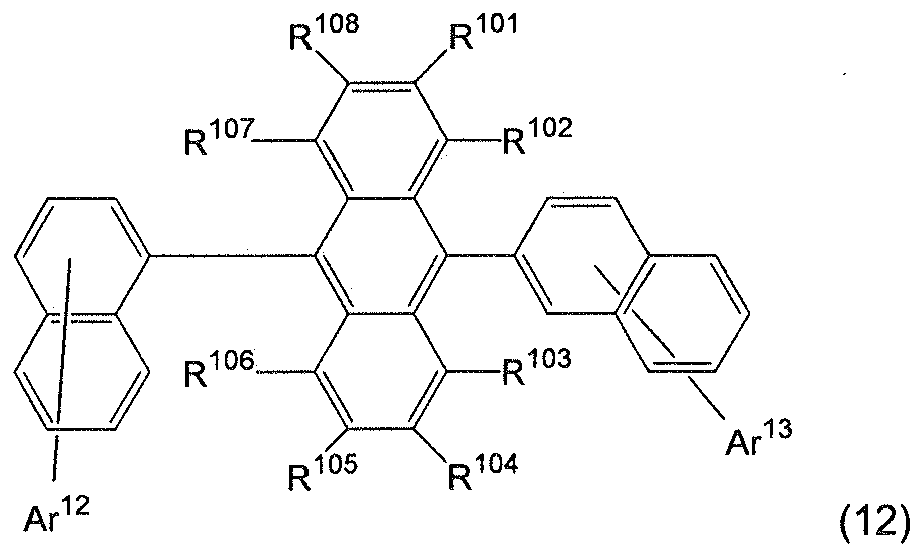
in formula (12), R101 to R108 are independently a hydrogen atom, a fluorine atom, a substituted or unsubstituted alkyl group having 1 to 10 carbon atoms, a substituted or unsubstituted cycloalkyl group having 3 to 10 carbon atoms, a substituted or unsubstituted alkylsilyl group having 3 to 30 carbon atoms, a substituted or unsubstituted arylsilyl group having 8 to 30 ring carbon atoms, a substituted or unsubstituted alkoxy group having 1 to 20 carbon atoms, a substituted or unsubstituted aryloxy group having 6 to 20 ring carbon atoms, a substituted or unsubstituted aryl group having 6 to 30 ring carbon atoms or a substituted or unsubstituted heterocyclic group having 5 to 30 ring atoms, and
Ar12 and Ar13 are independently a hydrogen atom, an aryl group having 6 to 30 ring carbon atoms, or a substituted or unsubstituted heterocyclic group having 5 to 30 ring atoms, and Ar12 may form a ring with the naphthalene ring to which Ar12 bonds. - An organic luminescent medium comprising an aromatic amine derivative represented by the following formula (1) and an anthracene derivative represented by the following formula (13):


in formula (13), R101 to R108 and R111 are independently a hydrogen atom, a fluorine atom, a substituted or unsubstituted alkyl group having 1 to 10 carbon atoms, a substituted or unsubstituted cycloalkyl group having 3 to 10 carbon atoms, a substituted or unsubstituted alkylsilyl group having 3 to 30 carbon atoms, a substituted or unsubstituted arylsilyl group having 8 to 30 ring carbon atoms, a substituted or unsubstituted alkoxy group having 1 to 20 carbon atoms, a substituted or unsubstituted aryloxy group having 6 to 20 ring carbon atoms, a substituted or unsubstituted aryl group having 6 to 30 ring carbon atoms or a substituted or unsubstituted heterocyclic group having 5 to 30 ring atoms,
Ar15 is a substituted or unsubstituted aryl group having 6 to 30 ring carbon atoms, a substituted or unsubstituted alkyl group having 1 to 10 carbon atoms, a substituted or unsubstituted cycloalkyl group having 3 to 10 ring carbon atoms or a substituted or unsubstituted heterocyclic group having 5 to 30 ring atoms, and
b is an integer of 0 to 7, and plural R111s may be the same or different when b is an integer of 2 or more. - An organic luminescent medium comprising an aromatic amine derivative represented by the following formula (1) and an anthracene derivative represented by the following formula (14):


in formula (14), R101 to R108 are independently a hydrogen atom, a fluorine atom, a substituted or unsubstituted alkyl group having 1 to 10 carbon atoms, a substituted or unsubstituted cycloalkyl group having 3 to 10 carbon atoms, a substituted or unsubstituted alkylsilyl group having 3 to 30 carbon atoms, a substituted or unsubstituted arylsilyl group having 8 to 30 ring carbon atoms, a substituted or unsubstituted alkoxy group having 1 to 20 carbon atoms, a substituted or unsubstituted aryloxy group having 6 to 20 ring carbon atoms, a substituted or unsubstituted aryl group having 6 to 30 ring carbon atoms or a substituted or unsubstituted heterocyclic group having 5 to 30 ring atoms,
Ar16 is a substituted or unsubstituted aryl group having 6 to 30 ring carbon atoms, a substituted or unsubstituted alkyl group having 1 to 10 carbon atoms, a substituted or unsubstituted cycloalkyl group having 3 to 10 ring carbon atoms or a substituted or unsubstituted heterocyclic group having 5 to 50 ring atoms, and Ar16 may form a ring with the benzene ring to which Ar16 bonds, and
Ar17 is a substituted or unsubstituted aryl group having 6 to 30 ring carbon atoms, a substituted or unsubstituted alkyl group having 1 to 10 carbon atoms, a substituted or unsubstituted cycloalkyl group having 3 to 10 ring carbon atoms or a substituted or unsubstituted heterocyclic group having 5 to 30 ring atoms. - An organic luminescent medium comprising an aromatic amine derivative represented by the following formula (1) and an anthracene derivative represented by the following formula (15):
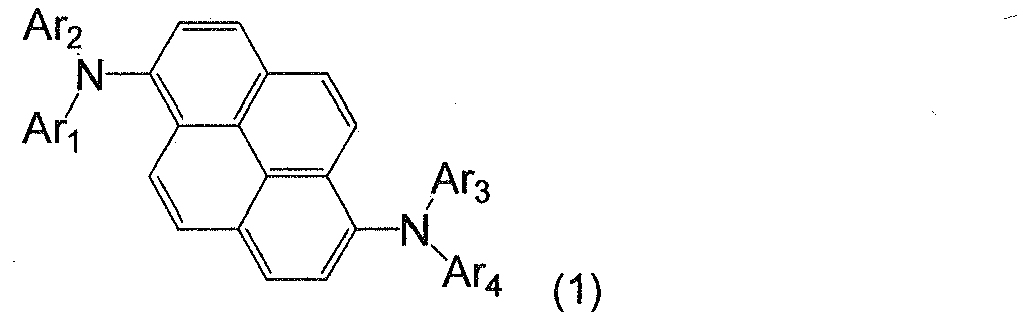

in formula (15), R101 to R108 are independently a hydrogen atom, a fluorine atom, a substituted or unsubstituted alkyl group having 1 to 10 carbon atoms, a substituted or unsubstituted cycloalkyl group having 3 to 10 carbon atoms, a substituted or unsubstituted alkylsilyl group having 3 to 30 carbon atoms, a substituted or unsubstituted arylsilyl group having 8 to 30 ring carbon atoms, a substituted or unsubstituted alkoxy group having 1 to 20 carbon atoms, a substituted or unsubstituted aryloxy group having 6 to 20 ring carbon atoms, a substituted or unsubstituted aryl group having 6 to 30 ring carbon atoms, or a substituted or unsubstituted heterocyclic group having 5 to 30 ring atoms,
Ar18 is a substituted or unsubstituted aryl group having 6 to 30 ring carbon atoms or a substituted or unsubstituted heterocyclic group having 5 to 30 ring atoms,
L is a single bond, a substituted or unsubstituted arylene group having 6 to 30 ring carbon atoms or a substituted or unsubstituted divalent heterocyclic group having 5 to 30 ring atoms,
R121 is a substituted or unsubstituted aryl group having 6 to 30 ring carbon atoms, a substituted or unsubstituted heterocyclic group having 5 to 30 ring atoms, a substituted or unsubstituted alkyl group having 1 to 10 carbon atoms, a substituted or unsubstituted cycloalkyl group having 3 to 10 ring carbon atoms, a substituted or unsubstituted alkoxy group having 1 to 20 carbon atoms, a substituted or unsubstituted silyl group, a cyano group or a fluorine atom, and
n is an integer of 0 to 11, and plural R121s may be the same or different when n is an integer of 2 or more. - An organic luminescent medium comprising an aromatic amine derivative represented by the following formula (1) and an anthracene derivative represented by the following formula (16):


in formula (16), R101 to R108 are independently a hydrogen atom, a fluorine atom, a substituted or unsubstituted alkyl group having 1 to 10 carbon atoms, a substituted or unsubstituted cycloalkyl group having 3 to 10 carbon atoms, a substituted or unsubstituted alkylsilyl group having 3 to 30 carbon atoms, a substituted or unsubstituted arylsilyl group having 8 to 30 ring carbon atoms, a substituted or unsubstituted alkoxy group having 1 to 20 carbon atoms, a substituted or unsubstituted aryloxy group having 6 to 20 ring carbon atoms, a substituted or unsubstituted aryl group having 6 to 30 ring carbon atoms or a substituted or unsubstituted heterocyclic group having 5 to 30 ring atoms,
L is a single bond, a substituted or unsubstituted arylene group having 6 to 50 ring carbon atoms or a substituted or unsubstituted divalent heterocyclic group having 5 to 50 ring atoms,
Ar19 is a substituted or unsubstituted aryl group having 6 to 30 ring carbon atoms or a substituted or unsubstituted heterocyclic group having 5 to 30 ring atoms,
X11 is an oxygen atom, a sulfur atom, -NR- or -CRaRb, wherein R, Ra and Rb are the same group as those in R101 to R108,
R121 is a substituted or unsubstituted aryl group having 6 to 30 ring carbon atoms or a substituted or unsubstituted heterocyclic group having 5 to 30 ring atoms, a substituted or unsubstituted alkyl group having 1 to 10 carbon atoms, a substituted or unsubstituted cycloalkyl group having 3 to 10 ring carbon atoms, a substituted or unsubstituted alkoxy group having 1 to 20 carbon atoms, a substituted or unsubstituted silyl group, a cyano group or a fluorine atom, and
m is an integer of 0 to 7, and plural R121s may be the same or different when m is an integer of 2 or more. - An organic luminescent medium comprising an aromatic amine derivative represented by the following formula (1) and an anthracene derivative represented by the following formula (17):


in formula (17), R101 to R108 are independently a hydrogen atom, a fluorine atom, a substituted or unsubstituted alkyl group having 1 to 10 carbon atoms, a substituted or unsubstituted cycloalkyl group having 3 to 10 carbon atoms, a substituted or unsubstituted alkylsilyl group having 3 to 30 carbon atoms, a substituted or unsubstituted arylsilyl group having 8 to 30 ring carbon atoms, a substituted or unsubstituted alkoxy group having 1 to 20 carbon atoms, a substituted or unsubstituted aryloxy group having 6 to 20 ring carbon atoms, a substituted or unsubstituted aryl group having 6 to 30 ring carbon atoms or a substituted or unsubstituted heterocyclic group having 5 to 30 ring atoms,
Ar20 is a substituted or unsubstituted aryl group having 6 to 30 ring carbon atoms or a substituted or unsubstituted heterocyclic group having 5 to 30 ring atoms,
R201 is a substituted or unsubstituted aryl group having 6 to 30 ring carbon atoms, a substituted or unsubstituted heterocyclic group having 5 to 30 ring atoms, a substituted or unsubstituted alkyl group having 1 to 10 carbon atoms, a substituted or unsubstituted cycloalkyl group having 3 to 10 ring carbon atoms, a substituted or unsubstituted alkoxy group having 1 to 20 carbon atoms, a substituted or unsubstituted silyl group, a cyano group or a fluorine atom, and
p is an integer of 0 to 4, and plural R201s may be the same or different when p is an integer of 2 or more. - An organic luminescent medium comprising an aromatic amine derivative represented by the following formula (1) and an anthracene derivative represented by the following formula (18):

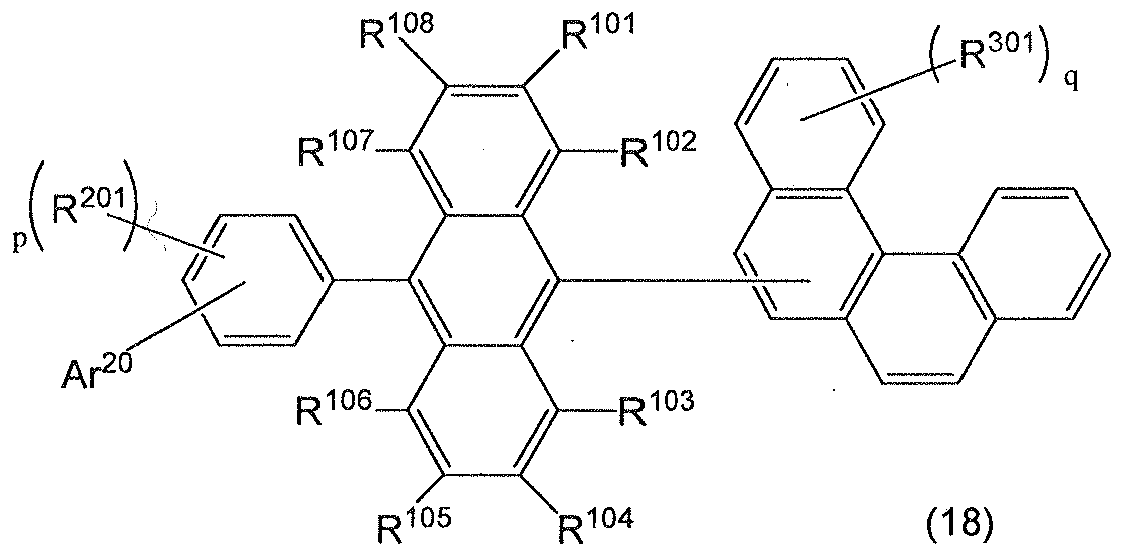
in formula (18), R101 to R108 are independently a hydrogen atom, a fluorine atom, a substituted or unsubstituted alkyl group having 1 to 10 carbon atoms, a substituted or unsubstituted cycloalkyl group having 3 to 10 carbon atoms, a substituted or unsubstituted alkylsilyl group having 3 to 30 carbon atoms, a substituted or unsubstituted arylsilyl group having 8 to 30 ring carbon atoms, a substituted or unsubstituted alkoxy group having 1 to 20 carbon atoms, a substituted or unsubstituted aryloxy group having 6 to 20 ring carbon atoms, a substituted or unsubstituted aryl group having 6 to 30 ring carbon atoms or a substituted or unsubstituted heterocyclic group having 5 to 30 ring atoms,
Ar20 is a substituted or unsubstituted aryl group having 6 to 30 ring carbon atoms or a substituted or unsubstituted heterocyclic group having 5 to 30 ring atoms,
R201 and R301 are a substituted or unsubstituted aryl group having 6 to 30 ring carbon atoms or a substituted or unsubstituted heterocyclic group having 5 to 30 ring atoms, a substituted or unsubstituted alkyl group having 1 to 10 carbon atoms, a substituted or unsubstituted cycloalkyl group having 3 to 10 ring carbon atoms, a substituted or unsubstituted alkoxy group having 1 to 20 carbon atoms, a substituted or unsubstituted silyl group, a cyano group or a fluorine atom,
p is an integer of 0 to 4, and plural R201s may be the same or different when p is an integer of 2 or more,
q is an integer of 0 to 11, plural R301s may be the same or different when q is an integer of 2 or more, and
adjacent substituents may form a saturated or unsaturated ring. - The organic luminescent medium according to any one of claims 1 to 12 wherein the aromatic amine derivative is represented by the following formula (2):

R1 to R10 are independently a hydrogen atom, a halogen atom, a substituted or unsubstituted alkyl group having 1 to 20 carbon atoms, a substituted or unsubstituted alkylsilyl group having 3 to 30 carbon atoms, a substituted or unsubstituted arylsilyl group having 8 to 30 ring carbon atoms, a substituted or unsubstituted alkoxy group having 1 to 20 carbon atoms, a substituted or unsubstituted aralkyl group having 6 to 20 ring carbon atoms, a substituted or unsubstituted aryl group having 6 to 10 ring carbon atoms or an electron-attracting group, and
at least one of R1 to R5 is an electron-attracting group, and at least one of R6 to R10 is an electron-attracting group. - The organic luminescent medium according to claim 13 wherein at least one of R1 to R5 is an electron-attracting group and the other groups are a hydrogen atom, and at least one of R6 to R10 is an electron-attracting group and the other groups are a hydrogen atom.
- The organic luminescent medium according to any one of claims 1 to 14 wherein the electron-attracting group is a cyano group.
- An organic thin film comprising the organic luminescent medium according to any one of claims 1 to 15.
- An organic electroluminescence device comprising one or more organic thin film layers comprising an emitting layer between an anode and an cathode,
wherein at least one layer of the organic thin film layers is the organic thin film according to claim 16.
Applications Claiming Priority (2)
| Application Number | Priority Date | Filing Date | Title |
|---|---|---|---|
| JP2009284970 | 2009-12-16 | ||
| PCT/JP2010/007270 WO2011074253A1 (en) | 2009-12-16 | 2010-12-15 | Organic light-emitting medium |
Publications (2)
| Publication Number | Publication Date |
|---|---|
| EP2500397A1 true EP2500397A1 (en) | 2012-09-19 |
| EP2500397A4 EP2500397A4 (en) | 2012-10-10 |
Family
ID=44167023
Family Applications (1)
| Application Number | Title | Priority Date | Filing Date |
|---|---|---|---|
| EP10830937A Withdrawn EP2500397A4 (en) | 2009-12-16 | 2010-12-15 | ORGANIC ELECTROLUMINESCENT MEDIUM |
Country Status (7)
| Country | Link |
|---|---|
| US (1) | US20120056165A1 (en) |
| EP (1) | EP2500397A4 (en) |
| JP (2) | JP5198657B2 (en) |
| KR (2) | KR20130067312A (en) |
| CN (1) | CN102232106A (en) |
| TW (1) | TW201129674A (en) |
| WO (1) | WO2011074253A1 (en) |
Families Citing this family (62)
| Publication number | Priority date | Publication date | Assignee | Title |
|---|---|---|---|---|
| EP1604974A4 (en) | 2003-03-20 | 2007-11-14 | Idemitsu Kosan Co | AROMATIC AMINE DERIVATIVE AND ORGANIC ELECTROLUMINESCENT ELEMENT PRODUCED WITH THIS DERIVATIVE |
| US8507106B2 (en) * | 2007-11-29 | 2013-08-13 | Idemitsu Kosan Co., Ltd. | Benzophenanthrene derivative and organic electroluminescent device employing the same |
| KR101930731B1 (en) * | 2011-08-24 | 2018-12-20 | 덕산네오룩스 주식회사 | Novel compound for organic electronic element, organic electronic element using the same, and electronic device thereof |
| WO2013077405A1 (en) | 2011-11-25 | 2013-05-30 | 出光興産株式会社 | Aromatic amine derivative, material for organic electroluminescent element, and organic electroluminescent element |
| KR101993491B1 (en) * | 2012-01-10 | 2019-06-26 | 제이엔씨 주식회사 | Material for light emitting layers and organic electroluminescent element using same |
| KR20130127014A (en) * | 2012-01-16 | 2013-11-22 | 롬엔드하스전자재료코리아유한회사 | Organic electroluminescent device using the organic electroluminescent compounds |
| US9312500B2 (en) | 2012-08-31 | 2016-04-12 | Idemitsu Kosan Co., Ltd. | Organic electroluminescence device |
| KR102000208B1 (en) | 2012-12-20 | 2019-07-16 | 삼성디스플레이 주식회사 | Organic light emitting device |
| KR102104357B1 (en) * | 2012-12-24 | 2020-04-27 | 엘지디스플레이 주식회사 | Blue Fluorescence Compounds and Organic Light Emitting Diode Device using the same |
| KR102030584B1 (en) * | 2013-01-08 | 2019-10-10 | 에스에프씨주식회사 | Antracene derivatives having heteroaryl substituted phenyl group and organic light-emitting diode including the same |
| KR102050484B1 (en) | 2013-03-04 | 2019-12-02 | 삼성디스플레이 주식회사 | Anthracene derivatives and organic light emitting diodes comprising the derivatives |
| US9947879B2 (en) | 2013-03-15 | 2018-04-17 | Idemitsu Kosan Co., Ltd. | Anthracene derivative and organic electroluminescence element using same |
| KR101468089B1 (en) * | 2013-04-08 | 2014-12-05 | 주식회사 엘엠에스 | Novel compound, light-emitting device including the compound and electronic device |
| KR102107106B1 (en) | 2013-05-09 | 2020-05-07 | 삼성디스플레이 주식회사 | Styryl-based compound and organic light emitting diode comprising the same |
| KR102269131B1 (en) | 2013-07-01 | 2021-06-25 | 삼성디스플레이 주식회사 | Compound and organic light emitting device comprising same |
| JP6328890B2 (en) * | 2013-07-09 | 2018-05-23 | 出光興産株式会社 | ORGANIC ELECTROLUMINESCENT ELEMENT, MATERIAL FOR ORGANIC ELECTROLUMINESCENT ELEMENT, AND ELECTRONIC DEVICE |
| KR102184674B1 (en) | 2013-08-09 | 2020-12-01 | 삼성디스플레이 주식회사 | Anthracene-based compounds and Organic light emitting device comprising the same |
| US10062850B2 (en) | 2013-12-12 | 2018-08-28 | Samsung Display Co., Ltd. | Amine-based compounds and organic light-emitting devices comprising the same |
| KR20150108330A (en) * | 2014-03-17 | 2015-09-25 | 롬엔드하스전자재료코리아유한회사 | Electron buffering material and organic electroluminescent device comprising the same |
| KR20150132795A (en) | 2014-05-16 | 2015-11-26 | 삼성디스플레이 주식회사 | Organic light emitting device |
| KR102253440B1 (en) | 2014-06-02 | 2021-05-20 | 삼성디스플레이 주식회사 | Amine-based compounds and organic light- emitting device including the same |
| KR102332591B1 (en) * | 2014-06-09 | 2021-11-30 | 삼성디스플레이 주식회사 | Organic light-emitting devices |
| KR102327086B1 (en) | 2014-06-11 | 2021-11-17 | 삼성디스플레이 주식회사 | Organic light-emitting devices |
| KR102350027B1 (en) * | 2014-07-10 | 2022-01-11 | 삼성디스플레이 주식회사 | Organic light emitting diode and organic light emitting display device including the same |
| US9902687B2 (en) | 2014-09-19 | 2018-02-27 | Idemitsu Kosan Co., Ltd. | Compound |
| KR102288348B1 (en) | 2014-09-24 | 2021-08-11 | 삼성디스플레이 주식회사 | Organic light-emitting devices |
| KR102321379B1 (en) | 2014-09-24 | 2021-11-04 | 삼성디스플레이 주식회사 | Organic light-emitting devices |
| KR102385227B1 (en) | 2014-12-02 | 2022-04-12 | 삼성디스플레이 주식회사 | Compound and organic light emitting device comprising same |
| KR102322013B1 (en) | 2014-12-12 | 2021-11-05 | 삼성디스플레이 주식회사 | Condensed-cyclic compound and organic light emitting device comprising the same |
| KR102328676B1 (en) | 2014-12-24 | 2021-11-19 | 삼성디스플레이 주식회사 | Condensed-cyclic compound and organic light emitting device comprising the same |
| KR102314468B1 (en) | 2014-12-30 | 2021-10-20 | 삼성디스플레이 주식회사 | Condensed-cyclic compound and organic light emitting device comprising the same |
| KR102343145B1 (en) | 2015-01-12 | 2021-12-27 | 삼성디스플레이 주식회사 | Condensed compound and organic light-emitting device comprising the same |
| KR102201097B1 (en) | 2015-01-20 | 2021-01-11 | 에스에프씨주식회사 | Novel organic compounds for organic light-emitting diode and organic light-emitting diode including the same |
| KR102309065B1 (en) * | 2015-01-20 | 2021-10-06 | 에스에프씨주식회사 | Novel organic compounds for organic light-emitting diode and organic light-emitting diode including the same |
| KR102149449B1 (en) * | 2015-01-20 | 2020-08-31 | 에스에프씨주식회사 | Novel organic compounds for organic light-emitting diode and organic light-emitting diode including the same |
| KR101974860B1 (en) * | 2015-02-04 | 2019-09-05 | 에스에프씨주식회사 | organic light-emitting diode with low operating voltage and long lifetime |
| KR101969415B1 (en) * | 2015-02-23 | 2019-08-13 | 에스에프씨주식회사 | organic light-emitting diode with low operating voltage and High efficiency |
| KR102176843B1 (en) * | 2015-04-23 | 2020-11-10 | 에스에프씨주식회사 | Organic Compound for organic light emitting diode and an organic light emitting diode including the same |
| KR101984787B1 (en) * | 2015-06-19 | 2019-06-03 | 주식회사 엘지화학 | Organic light emitting device |
| JPWO2017010438A1 (en) * | 2015-07-10 | 2018-02-22 | 出光興産株式会社 | Organic electroluminescence device and electronic device |
| WO2017010749A1 (en) * | 2015-07-13 | 2017-01-19 | 에스에프씨 주식회사 | Highly efficient organic light-emitting element |
| CA3002752A1 (en) | 2015-10-26 | 2017-05-04 | Oti Lumionics Inc. | Method for patterning a coating on a surface and device including a patterned coating |
| KR101900726B1 (en) * | 2016-07-14 | 2018-09-20 | 에스에프씨주식회사 | organic light-emitting diode with High efficiency |
| KR102641815B1 (en) | 2016-08-17 | 2024-02-29 | 삼성디스플레이 주식회사 | Condensed cyclic compound and organic light-emitting device comprising the same |
| CN106432260B (en) * | 2016-09-19 | 2019-05-24 | 江苏三月光电科技有限公司 | A kind of luminous organic material and its application on OLED |
| CN109415333B (en) * | 2016-12-14 | 2022-07-12 | 株式会社Lg化学 | Heterocyclic compound and organic light-emitting element comprising same |
| KR102559828B1 (en) * | 2016-12-21 | 2023-07-27 | 엘티소재주식회사 | Compound and organic light emitting device using the same |
| KR102107087B1 (en) * | 2017-03-09 | 2020-05-06 | 주식회사 엘지화학 | Organic light emitting device |
| KR102563713B1 (en) | 2017-04-26 | 2023-08-07 | 오티아이 루미오닉스 인크. | Methods of patterning the coating of a surface and apparatus comprising the patterned coating |
| KR102536248B1 (en) | 2017-06-21 | 2023-05-25 | 삼성디스플레이 주식회사 | Heterocyclic compound and organic light emitting device comprising the same |
| KR102415376B1 (en) | 2017-08-04 | 2022-07-01 | 삼성디스플레이 주식회사 | Condensed-cyclic compound and organic light emitting device comprising the same |
| US11751415B2 (en) | 2018-02-02 | 2023-09-05 | Oti Lumionics Inc. | Materials for forming a nucleation-inhibiting coating and devices incorporating same |
| KR102536246B1 (en) | 2018-03-23 | 2023-05-25 | 삼성디스플레이 주식회사 | Heterocyclic compound and organic light emitting device comprising the same |
| US12108659B2 (en) * | 2018-07-19 | 2024-10-01 | Lg Display Co., Ltd. | Organic electroluminescent device |
| JP7325731B2 (en) | 2018-08-23 | 2023-08-15 | 国立大学法人九州大学 | organic electroluminescence element |
| KR20250160226A (en) | 2019-03-07 | 2025-11-11 | 오티아이 루미오닉스 인크. | Materials for forming a nucleation-inhibiting coating and devices incorporating same |
| KR102118011B1 (en) * | 2019-03-20 | 2020-06-04 | 에스에프씨주식회사 | Organic Compound for organic light emitting diode and an organic light emitting diode including the same |
| JP7555600B2 (en) | 2019-04-18 | 2024-09-25 | オーティーアイ ルミオニクス インコーポレーテッド | Materials for forming nucleation-inhibiting coatings and devices incorporating same - Patents.com |
| JP7576337B2 (en) | 2019-05-08 | 2024-11-01 | オーティーアイ ルミオニクス インコーポレーテッド | Materials for forming nucleation-inhibiting coatings and devices incorporating same - Patents.com |
| US12113279B2 (en) | 2020-09-22 | 2024-10-08 | Oti Lumionics Inc. | Device incorporating an IR signal transmissive region |
| US11985841B2 (en) | 2020-12-07 | 2024-05-14 | Oti Lumionics Inc. | Patterning a conductive deposited layer using a nucleation inhibiting coating and an underlying metallic coating |
| EP4613746A3 (en) * | 2021-06-11 | 2025-11-19 | Tosoh Corporation | Photoelectric conversion element material for imaging element and photoelectric conversion element for imaging element |
Family Cites Families (14)
| Publication number | Priority date | Publication date | Assignee | Title |
|---|---|---|---|---|
| EP1541657B2 (en) * | 2002-07-19 | 2014-03-05 | Idemitsu Kosan Co., Ltd. | Organic electroluminescent devices and organic luminescent medium |
| WO2004018587A1 (en) | 2002-08-23 | 2004-03-04 | Idemitsu Kosan Co., Ltd. | Organic electroluminescence device and anthracene derivative |
| EP1437395B2 (en) * | 2002-12-24 | 2015-08-26 | LG Display Co., Ltd. | Organic electroluminescent device |
| WO2005108348A1 (en) | 2004-05-12 | 2005-11-17 | Idemitsu Kosan Co., Ltd. | Aromatic amine derivative, organic electroluminescent element employing the same, and process for producing aromatic amine derivative |
| JPWO2007116828A1 (en) * | 2006-04-03 | 2009-08-20 | 出光興産株式会社 | Bisanthracene derivative and organic electroluminescence device using the same |
| KR100874749B1 (en) | 2006-06-01 | 2008-12-29 | 에스에프씨 주식회사 | Blue light emitting compound and organic light emitting device using the same |
| JP5088097B2 (en) * | 2006-11-02 | 2012-12-05 | 三菱化学株式会社 | Organic electroluminescent material, organic electroluminescent device composition, organic electroluminescent device, organic EL display and color display device |
| KR100874472B1 (en) * | 2007-02-28 | 2008-12-18 | 에스에프씨 주식회사 | Blue light emitting compound and organic light emitting device using the same |
| US8512878B2 (en) * | 2007-05-08 | 2013-08-20 | Idemitsu Kosan Co., Ltd. | Diaminopyrene derivative and organic EL device using the same |
| JPWO2009102026A1 (en) | 2008-02-15 | 2011-06-16 | 出光興産株式会社 | Organic light-emitting medium and organic EL device |
| US8450727B2 (en) * | 2008-02-15 | 2013-05-28 | Idemitsu Kosan Co., Ltd. | Organic luminescent medium and organic EL device |
| WO2009107596A1 (en) | 2008-02-25 | 2009-09-03 | 出光興産株式会社 | Organic luminescent medium and organic el element |
| KR101359701B1 (en) * | 2008-12-05 | 2014-02-11 | 엘지디스플레이 주식회사 | Blue color fluorescent material and Organic electroluminescent device using the same |
| JP5673043B2 (en) * | 2010-12-03 | 2015-02-18 | 東洋インキScホールディングス株式会社 | Organic electroluminescence device |
-
2010
- 2010-12-15 EP EP10830937A patent/EP2500397A4/en not_active Withdrawn
- 2010-12-15 US US13/131,253 patent/US20120056165A1/en not_active Abandoned
- 2010-12-15 CN CN201080003397.XA patent/CN102232106A/en active Pending
- 2010-12-15 WO PCT/JP2010/007270 patent/WO2011074253A1/en not_active Ceased
- 2010-12-15 JP JP2011512331A patent/JP5198657B2/en not_active Expired - Fee Related
- 2010-12-15 KR KR1020137012403A patent/KR20130067312A/en not_active Withdrawn
- 2010-12-15 KR KR1020117008984A patent/KR20110094271A/en not_active Ceased
- 2010-12-16 TW TW099144173A patent/TW201129674A/en unknown
-
2013
- 2013-02-05 JP JP2013020132A patent/JP2013145886A/en active Pending
Also Published As
| Publication number | Publication date |
|---|---|
| EP2500397A4 (en) | 2012-10-10 |
| JPWO2011074253A1 (en) | 2013-04-25 |
| KR20130067312A (en) | 2013-06-21 |
| KR20110094271A (en) | 2011-08-23 |
| JP5198657B2 (en) | 2013-05-15 |
| US20120056165A1 (en) | 2012-03-08 |
| TW201129674A (en) | 2011-09-01 |
| CN102232106A (en) | 2011-11-02 |
| JP2013145886A (en) | 2013-07-25 |
| WO2011074253A1 (en) | 2011-06-23 |
Similar Documents
| Publication | Publication Date | Title |
|---|---|---|
| JP5198657B2 (en) | Organic luminescent medium | |
| US9923146B2 (en) | Aromatic amine derivative and organic electroluminescent element using same | |
| US10686137B2 (en) | Aromatic amine derivative, and organic electroluminescent element comprising the same | |
| EP2518787A1 (en) | Organic electroluminescent element using pyrene derivative | |
| EP2700696A1 (en) | Pyrene derivative, organic light-emitting medium, and organic electroluminescent element containing pyrene derivative or organic light-emitting medium | |
| EP1860097A1 (en) | Aromatic amine derivative and organic electroluminescence device utilizing the same | |
| US20120168733A1 (en) | Pyrene derivative and organic electroluminescent element using the same | |
| EP2518076A1 (en) | Pyrene derivative and organic electroluminescent element using the same | |
| JP5478615B2 (en) | Organic luminescent medium |
Legal Events
| Date | Code | Title | Description |
|---|---|---|---|
| PUAI | Public reference made under article 153(3) epc to a published international application that has entered the european phase |
Free format text: ORIGINAL CODE: 0009012 |
|
| 17P | Request for examination filed |
Effective date: 20110525 |
|
| AK | Designated contracting states |
Kind code of ref document: A1 Designated state(s): AL AT BE BG CH CY CZ DE DK EE ES FI FR GB GR HR HU IE IS IT LI LT LU LV MC MK MT NL NO PL PT RO RS SE SI SK SM TR |
|
| A4 | Supplementary search report drawn up and despatched |
Effective date: 20120906 |
|
| RIC1 | Information provided on ipc code assigned before grant |
Ipc: H01L 51/50 20060101ALI20120831BHEP Ipc: C07C 13/567 20060101ALI20120831BHEP Ipc: C09K 11/06 20060101AFI20120831BHEP Ipc: C07C 15/28 20060101ALI20120831BHEP |
|
| DAX | Request for extension of the european patent (deleted) | ||
| 17Q | First examination report despatched |
Effective date: 20131114 |
|
| STAA | Information on the status of an ep patent application or granted ep patent |
Free format text: STATUS: THE APPLICATION IS DEEMED TO BE WITHDRAWN |
|
| 18D | Application deemed to be withdrawn |
Effective date: 20140325 |