EP2499754B1 - Telekommunikationssystem mit einem luftgestützten kommunikationsknoten, luftgestützter kommunikationsknoten und taktischer funkknoten - Google Patents
Telekommunikationssystem mit einem luftgestützten kommunikationsknoten, luftgestützter kommunikationsknoten und taktischer funkknoten Download PDFInfo
- Publication number
- EP2499754B1 EP2499754B1 EP10773329.7A EP10773329A EP2499754B1 EP 2499754 B1 EP2499754 B1 EP 2499754B1 EP 10773329 A EP10773329 A EP 10773329A EP 2499754 B1 EP2499754 B1 EP 2499754B1
- Authority
- EP
- European Patent Office
- Prior art keywords
- node
- communication node
- airborne communication
- nrt
- network
- Prior art date
- Legal status (The legal status is an assumption and is not a legal conclusion. Google has not performed a legal analysis and makes no representation as to the accuracy of the status listed.)
- Active
Links
Images




Classifications
-
- H—ELECTRICITY
- H04—ELECTRIC COMMUNICATION TECHNIQUE
- H04B—TRANSMISSION
- H04B7/00—Radio transmission systems, i.e. using radiation field
- H04B7/14—Relay systems
- H04B7/15—Active relay systems
- H04B7/185—Space-based or airborne stations; Stations for satellite systems
- H04B7/18502—Airborne stations
- H04B7/18504—Aircraft used as relay or high altitude atmospheric platform
Definitions
- the invention relates to a telecommunications system comprising an airborne communication node.
- the invention also relates to an airborne communication node and a tactical radio node. It applies in particular to the fields of airborne telecommunications systems.
- Emerging battlefield tactical networks include a set of stand-alone nodes or host terminals that, being mobile, are sometimes within range, sometimes out of range of each other, and generally can not support each other. on a predefined fixed infrastructure in their environment.
- Nodes in an ad-hoc communications network can move, be destroyed, or new nodes can join the network.
- the network environment is mobile, wireless, dynamic and without infrastructure.
- the topology of the tactical network is called “ad-hoc" in that it evolves dynamically in time because the connectivity between the nodes can vary over time.
- nodes communicate by wireless links, they must suffer the effects of radio communications, such as for example noise, fading also called “fading” and jamming.
- Factors such as the variable quality of wireless links, loss of propagation paths, interference from multiple users, power dissipation and topology changes can become critical issues especially in urban, mountainous and mountainous environments. jungle.
- connections between nodes can also be cut or established, depending for example on the distance, the variation of the force signals due to multiple paths, weather, the presence of mountains, the presence of buildings, the loss of a knot, etc.
- An object of the invention is in particular to overcome the aforementioned drawbacks.
- the subject of the invention is a telecommunications system comprising several remote subnetworks, a subnetwork comprising at least one tactical radio node NRT acting as a bridge between said sub-network and a backbone network composed of at least an airborne communication node.
- An NRT node communicates with the airborne communication node by converting the waveform of the signals to be transmitted outside the subnet associated with it into a waveform used by the airborne communication node, said communication node airborne transmitting the signal thus received without changing the waveform to at least one NRT node belonging to another sub-network.
- the backbone network comprises at least one satellite, the airborne communication node transmitting the signals received from NRT nodes to said satellite and transmitting the signals received from the satellite to the NRT nodes.
- the waveform used between an NRT node and an airborne communication node is the same as that used between an airborne communication node and a satellite of the system.
- the invention also relates to a tactical radio node NRT associated with a sub-network.
- Said node comprises means for transmitting and receiving data between a sub-network and an airborne communication node belonging to a backbone network by converting the waveform of the signals to be transmitted outside the sub-network associated with it. a waveform used by the airborne communication node, the inverse conversion being also supported by said node.
- the invention also relates to an airborne communication node.
- Said node comprises means for transmitting data from an NRT node associated with a sub-network to an NRT node associated with another sub-network, said transmission being performed without modifying the waveform of the transmitted signals. It also includes, for example, means for transmitting data from the NRT node belonging to a sub-network to a satellite, said transmission being performed without changing the waveform of the transmitted signals.
- the airborne communication node comprises an NC network controller responsible for the allocation of radio resources to the NRT nodes.
- the invention has the particular advantage of limiting the payload of the airborne communication node and thus reduce the cost of implementation.
- the invention allows a particularly flexible deployment of an interconnection between different tactical zones.
- the figure 1 gives an example of a telecommunications system connecting different tactical zones.
- the various constituent elements of the system of said system can be classified according to their level of membership.
- an integrated battalion 100 at level 4 is based on 4 level 5 sub-battalions 101, each consisting of several sections 102, for example 4 sections deployed over an area of 50 square km.
- This type of deployment includes, for example, a total number of transmitters of the order of 200.
- VHF and UHF waveforms provide the various modes of communication within the various clusters of posts in the section (combat, reconnaissance, voice, data, situational awareness).
- the figure 2 illustrates the principle of an RTTA communications system based on at least one airborne communication node.
- a first solution is based on HF high frequency transmissions, an acronym derived from the Anglo-Saxon "High Frequency”.
- the limitations of HF transmissions are mainly related to the bit rate, usually between 800 and 4800 bits / s and the wave propagation, possible only above 80 km for ionospheric propagation.
- a second solution relies on the use of tactical SATCOM system.
- the system described below is based on one or more airborne communications nodes and is designated by the acronym RTTA in the remainder of the description, said acronym meaning Airborne Ground Tactical Network.
- the airborne communication node makes it possible to connect different tactical zones with each other or / and to connect different tactical zones to a satellite, itself allowing the implementation of communications with other tactical zones.
- the waveform used for communications between the tactical zones and the airborne node and between the airborne node and the satellite may be different, or advantageously the same.
- An example of implementation of the airborne communication node 200 is to embark a transponder in a tactical drone, usually designated by the acronym UAV from the Anglo-Saxon "Unmanned Aerial Vehicle".
- a network controller may be integrated with a land terminal or on board the UAV.
- the airborne communication node does not include transcoding means for converting a waveform used by one tactical zone to another waveform used within another tactical zone.
- the RTTA system is based not only on the use of airborne communication nodes, but also on nodes called tactical radio communication nodes NRT, said nodes can be included in a ground station. These are the NRT tactical radio communication nodes which include transcoding means. Thus, only one type of waveform can be used between the ground and the airborne communication node. The complexity of the airborne node is then advantageously reduced.
- integration with the UAV constitutes a better configuration in terms of system vulnerability.
- the RTTA and SATCOM solution can be fully integrated when the frequency band C, X, Ku, Ka is the same.
- the RTTA system provides the V / UHF tactical communications system with enhanced 30-node connectivity corresponding to Level 4, Level 5 and Section command posts within an integrated battalion.
- the RTTA system improves communications in challenging terrain such as urban, mountain or jungle environments.
- a single omnidirectional antenna is used at the airborne communication node which makes its implementation simple.
- the RTTA system then allows the implementation of iso-level and transverse communications.
- One goal is to interconnect different tactical zones 201, 202.
- the RTTA system also makes it possible to ensure continuity of communication between terminals 204, 205 within the same tactical zone, which can be of interest when the operational deployment is carried out in a mountainous country or in an urban area, for example.
- Transverse communications that is, between different levels, can be considered a nominal case, for example a level 5 sub-battalion reports to a remote level 4 battalion.
- a Level 6 section communicates with a Level 5 command post via the RTTA system, as no UHF or VHF connectivity can be achieved due to propagation obstacles.
- Iso-level communications for example between two levels can also occur when no VHF coverage is possible.
- two levels 6 can provide RTTA-based communications, still due to obstacles to propagation.
- extensions to the system can easily be included as backlinks to anchor the traffic scene.
- several communication nodes can be interconnected using SATCOM links, so an airborne communication node 200 can be connected to a terrestrial communication node 207 using a satellite 206 belonging to the SATCOM system.
- the airborne communication node can be considered as a tactical radio hub that allows access to SATCOMs.
- Remote extensions for transversal and iso-level connectivity can be realized by the RTTA via the proposed SATCOM extension.
- SATCOM connectivity is used in two main cases: when the area with different tactical zones is too extensive or when radio connectivity is impossible, for example due to various obstacles such as mountains or buildings.
- the RTTA telecommunication system can be considered as a possible alternative to SATCOM systems. It can also use the potential of SATCOM systems by interconnecting.
- the RTTA system connects 3 CP command posts at level 4, 2 CPs at level 5, and 1 CP per section so that overall connectivity of 27 knots within a deploying battalion 200 transmitters, are connected to the airborne communication node and provide the link with the tactical node via terrestrial communication nodes.
- the diagram below presents possible scenarios offered by the RTTA concept
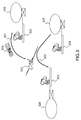
- the figure 3 gives an example of a telecommunications system architecture using an airborne communication node.
- the RTTA system can be seen as a backbone network between nodes, called NRT nodes, acting as hubs or gateways for other nodes in the network.
- NRT nodes provide intelligent routing function to subnets, and route the IP user data traffic and the incoming and outgoing control plane to the high-speed backbone network provided by the airborne communication node.
- a subnet can be used for each tactical zone, for example.
- a subnet is an ad-hoc network.
- the diameter of the tactical zone level 5 can be 50 km.
- the UAV 200 connects two tactical theaters for example by their ends.
- the figure 3 gives an example of a telecommunication system architecture comprising a backbone network allowing the interconnection of several subnetworks.
- the RTTA system comprises a backbone network composed of 2 main segments, namely the SATCOM segment 301 based on a satellite 309, and the tactical radio segment 302, these two segments being implemented thanks to an airborne communication node 300 .
- the airborne communication nodes 300 make it possible to establish ground connectivity and SATCOM, for example. It is also possible to use airborne communication nodes to obtain ground connectivity only.
- segments 301, 302 can be seen as transit networks for information relayed between tactical theaters via an intelligent routing function. This function makes it possible to match the user and control plane of the sub-network waveform in a user plane and a control plane of the satellite network waveform.
- the bit rate supported by the backbone of the RTTA may be, for example, of the order of 40 Mbps.
- Each segment includes different functions or subsystems.
- a segment comprises for example transmission subsystems, radio subsystems, resource management management subsystems.
- the architecture of the RTTA system is functionally based on at least one airborne communication node, for example embedded on board a UAV, said node having to emulate a satellite transponder but also on a plurality of tactical nodes.
- the airborne communication node 300 also called SATCOM node, makes it possible to establish ground connectivity and SATCOM connectivity.
- a second type is referred to as NRT tactical radio node 303, 304, 305 to establish connectivity between a subnet 306, 307, 308 and an airborne communication node.
- the architecture of the RTTA system is based, for example, on an all-IP architecture designed for a robust system with appropriate system redundancies.
- the main reason for these two advantages is related to the use of a packet waveform that allows a smaller granularity compared to a circuit waveform. Indeed, in the past, a circuit architecture had to have a guaranteed constant bit rate at the transmission level, but in reality the capacity of the radio channel changes permanently according to the conditions transmission (fading, jamming, etc.). With the use of a dynamic adaptive IP waveform, the guaranteed throughput can be dynamically and real-time adapted, not only to the capacity of the radio channel, but also to the operational use.
- the architecture of the RTTA system advantageously supports the mobile communications for both types of SATCOM ground segment and tactical radio.
- Frequency hopping technology can be used and thus allows an advanced level of availability of radio resources.
- the RTTA system is capable of providing transmission services even if the radio frequency band is scrambled.
- the system can be reconfigured transparently and automatically. This allows easy operation of the system and guarantees the benefit of a fully optimized system.
- the operational interest is multiple.
- SATCOM node When a SATCOM node is used and that it uses a single waveform for ground communications and satellite communications, it is possible to use the same terminal on the different strategic areas, said terminal being able to operate directly with a SATCOM connectivity or with RTTA connectivity, that is to say passing through the SATCOM airborne communication node. In some cases, this advantage becomes key, especially if strategic areas are reconfigured and this reconfiguration leads to the loss of one of the connectivities.
- SATCOM connectivity Even if there is SATCOM connectivity, the RTTA capability can be used as a coverage extension. SATCOM capacity is often saturated, the use of RTTA connectivity makes it possible to replace theater SATCOM connectivity with RTTA connectivity. As a result, some of the SATCOM capacity can be saved.
- the SATCOM node is, for example, equipped with a high gain antenna, which requires accurate pointing.
- the link budget will provide a high throughput, with a good system margin.
- the availability of RTTA will be high, even in case of significant rainfall.
- RTTA connectivity is less expensive than SATCOM connectivity.
- SATCOM connectivity is less expensive than SATCOM connectivity.
- use of smaller points allows the reuse of frequencies.
- the RTTA connectivity ensures a better quality of service, that is to say, lower delays due to the proximity of the airborne communication node to the tactical areas.
- the tactical radio node When a tactical radio node NRT is used, to achieve this cost savings, the tactical radio node is equipped with a low gain antenna, which has a low directivity. This greatly simplifies the pointing system in terms of size and mass.
- the mandatory size of an antenna suitable for SATCOM use may not be compatible with a moving system, although a mean bit rate may be achieved in SATCOM on a clear day.
- two different antennas can be used at the tactical radio node NRT, a first antenna for direct SATCOM connection and a second for the continuation of the airborne communication node.
- the figure 4 gives an example of a payload corresponding to an airborne communication node.
- the airborne communication node is part of, for example, the payload of a UAV and emulates a satellite.
- the advantage of implanting the NC controller in the UAV is the guarantee for the NRT node to have visibility with said controller, otherwise the NRT node can not establish any link.
- the radiofrequency part copies the reception signal, filters the interesting part 403, suppressing the band noise, and retransmits this signal with amplification 400. It adds, for example, DAMA signaling using an analog coupler 404.
- the modem output of the network controller (NC) is coupled 404 to the output of the transceiver in order to provide the ground modems with signaling dedicated to the operation of the modems, in particular synchronization.
- a beacon generator 405 allows the UAV to generate an analog signal that allows acquisition and tracking by the ground antenna system.
- the transponder part of the equipment embedded in the airborne communication node is strictly analog. It can use a single antenna to minimize the impact of the installation of antennas on the aircraft, or depending on the carrier platform, if the decoupling between antennas is good, two separate antennas.
- the antenna system for the embedded system will consist, for example, of one or two helical antennas providing a hemispherical coverage in circular polarization, in a small volume to integrate.
- the onboard circular polarization has the advantage that in case of linear polarization on the ground, the received signal does not depend on the orientation of the ground antennas.
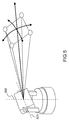
- the figure 5 gives an example of an antenna that can be used by a ground station comprising a tactical radio node NRT.
- Ground stations are composed of, for example, mobile vehicles carrying an RTTA antenna.
- the antenna is an antenna is mounted for example on a positioning system 2 axes 500, 501 to track the trajectory of the airborne communication node.
- the antenna is an active antenna operating, for example in the C-band.
- the tactical radio node can integrate, for example, means for transposing the band C to the band L, means for transposing the band L to the band C, a low band power amplifier C, a band receiver. continuation, a modem and an application software.
- the tracking system may be based in the initial acquisition phase on the knowledge of the location of the onboard system. In the tracking phase, the system may be based on a step tracking algorithm transmitted by the onboard system.
- an onboard GPS receiver to provide the location of the UAV.
- the position can be downlinked by the on-board NC controller.
- the pursuit is then an open loop pursuit.
- the figure 6 gives an example of protocol architecture that can be used for the implementation of the system according to the invention. Three protocol stacks are represented.
- a first stack 616 corresponds to the protocol layers implemented at the level of a terminal of a sub-network covering a given tactical zone, the sub-network being for example an ad-hoc type network.
- a second stack 617 corresponds to the protocol layers implemented at the NRT tactical radio nodes.
- a third stack 618 corresponds to the protocol layers implemented at a remote terminal, for example.
- a remote terminal corresponds for example to a control station having established a communication link with a communications satellite of the backbone network RTTA.
- the terminal of the ad-hoc network and the remote terminal both have an application layer 600, 601, said layers comprising, for example, voice codecs and allowing the processing of user data. These layers rely on a TCP / UDP layer 602, 603.
- the user terminal comprises a layer 604 of level 3, said layer itself comprising two sublayers, one corresponding to a routing protocol and the other to the IP, ICMP and IGMP protocols, said protocols being well known to the user. skilled person.
- the corresponding level 3 layers may optionally be implemented 606 at the NRT node if said node is in charge of a level 3 routing.
- a layer 605 of level 3 IP is also present on the remote terminal side.
- a layer 608 of level 2 is composed for example of two sub-layers LLC and MAC is implemented at the terminal of the ad-hoc network.
- the LLC sublayer is, for example, that of the 802.11 standard.
- This layer of level 2 is also implemented on the side of the NRT node 609, but may be different from that used 610, 611 on the interface between said NRT node and the remote terminal, which may be composed, for example, of a sub-slot. Ethernet layer and a MAC sub layer.
- the waveform used between the ad-hoc network terminal and the NRT node is not necessarily the same as the waveform used on the interface between the NRT node and the remote terminal.
- a physical layer ⁇ 1 612, 613 is implemented for the first interface and a physical layer ⁇ 2 614, 615 is implemented for the second interface
Landscapes
- Engineering & Computer Science (AREA)
- Physics & Mathematics (AREA)
- Astronomy & Astrophysics (AREA)
- Aviation & Aerospace Engineering (AREA)
- General Physics & Mathematics (AREA)
- Computer Networks & Wireless Communication (AREA)
- Signal Processing (AREA)
- Radio Relay Systems (AREA)
- Mobile Radio Communication Systems (AREA)
Claims (5)
- Telekommunikationssystem, das mehrere ferne Subnetze (306, 307, 308) umfasst, wobei ein Subnetz wenigstens einen taktischen NRT-Funkknoten (303, 304, 306) umfasst, der als Gateway zwischen dem Subnetz und einem Backbone-Netz bestehend aus wenigstens einem luftgestützten Kommunikationsknoten (300) fungiert, wobei das System dadurch gekennzeichnet ist, dass ein NRT-Knoten (303, 304, 306) mit dem luftgestützten Kommunikationsknoten kommuniziert, durch Umwandeln der Wellenform der Signale, die außerhalb des damit assoziierten Subnetzes zu übertragen sind, in eine Wellenform, die von dem luftgestützten Kommunikationsknoten (300) benutzt wird, wobei der luftgestützte Kommunikationsknoten das so empfangene Signal ohne die Wellenform zu modifizieren zu wenigstens einem Knoten-NRT überträgt, der zu einem anderen Subnetz gehört.
- System nach Anspruch 1, dadurch gekennzeichnet, dass das Backbone-Netz wenigstens einen Satelliten (309) umfasst, wobei der luftgestützte Kommunikationsknoten die von NRT-Knoten kommenden empfangenen Signale zu dem Satelliten überträgt und die von dem Satelliten kommenden empfangenen Signale zu den NRT-Knoten überträgt.
- System nach Anspruch 2, dadurch gekennzeichnet, dass die zwischen einem NRT-Knoten (303, 304, 306) und einem luftgestützten Kommunikationsknoten (300) benutzte Wellenform dieselbe ist wie die, die zwischen einem luftgestützten Kommunikationsknoten (300) und einem Satelliten (309) des Systems benutzt wird.
- Luftgestützter Kommunikationsknoten (300), dadurch gekennzeichnet, dass er Mittel zum Übertragen von Daten, die von einem mit einem Subnetz (306, 307, 308) assoziierten NRT-Knoten kommen, zu einem NRT-Knoten überträgt, der mit einem anderen Subnetz oder einem Satelliten (309) assoziiert ist, wobei die Übertragung ohne die Wellenform der übertragenen Signale zu modifizieren durchgeführt wird.
- Luftgestützter Kommunikationsknoten (300) nach Anspruch 4, dadurch gekennzeichnet, dass er einen Netzcontroller NC (402) umfasst, der für das Zuweisen von Funkressourcen zu den NRT-Knoten (303, 304, 306) verantwortlich ist.
Priority Applications (1)
| Application Number | Priority Date | Filing Date | Title |
|---|---|---|---|
| PL10773329T PL2499754T3 (pl) | 2009-11-13 | 2010-11-04 | System telekomunikacyjny zawierający węzeł komunikacyjny transportowany drogą powietrzną, węzeł komunikacyjny transportowany drogą powietrzną i radiowy węzeł taktyczny |
Applications Claiming Priority (2)
| Application Number | Priority Date | Filing Date | Title |
|---|---|---|---|
| FR0905475A FR2952771B1 (fr) | 2009-11-13 | 2009-11-13 | Systeme de telecommunications comprenant un noeud de communication aeroporte, noeud de communication aeroporte et noeud radio tactique |
| PCT/EP2010/066782 WO2011057936A1 (fr) | 2009-11-13 | 2010-11-04 | Systeme de telecommunications comprenant un noeud de communication aeroporte, noeud de communication aeroporte et noeud radio tactique |
Publications (2)
| Publication Number | Publication Date |
|---|---|
| EP2499754A1 EP2499754A1 (de) | 2012-09-19 |
| EP2499754B1 true EP2499754B1 (de) | 2016-10-19 |
Family
ID=42237001
Family Applications (1)
| Application Number | Title | Priority Date | Filing Date |
|---|---|---|---|
| EP10773329.7A Active EP2499754B1 (de) | 2009-11-13 | 2010-11-04 | Telekommunikationssystem mit einem luftgestützten kommunikationsknoten, luftgestützter kommunikationsknoten und taktischer funkknoten |
Country Status (7)
| Country | Link |
|---|---|
| US (1) | US20130044677A1 (de) |
| EP (1) | EP2499754B1 (de) |
| CA (1) | CA2780936A1 (de) |
| ES (1) | ES2611496T3 (de) |
| FR (1) | FR2952771B1 (de) |
| PL (1) | PL2499754T3 (de) |
| WO (1) | WO2011057936A1 (de) |
Cited By (2)
| Publication number | Priority date | Publication date | Assignee | Title |
|---|---|---|---|---|
| US11617218B2 (en) | 2021-02-09 | 2023-03-28 | Rockwell Collins, Inc. | Communication in a denied environment |
| US11653232B2 (en) | 2021-02-09 | 2023-05-16 | Rockwell Collins, Inc. | Beyond-line-of-sight communication |
Families Citing this family (13)
| Publication number | Priority date | Publication date | Assignee | Title |
|---|---|---|---|---|
| CN103488180B (zh) * | 2013-10-23 | 2016-05-18 | 南京中网卫星通信股份有限公司 | 一种无人值守车船两用型卫星动中通寻星控制装置及方法 |
| CN103747452A (zh) * | 2013-12-30 | 2014-04-23 | 重庆金美通信有限责任公司 | 一种用于机动通信骨干网络开通的方法 |
| US9363008B2 (en) * | 2014-07-22 | 2016-06-07 | International Business Machines Corporation | Deployment criteria for unmanned aerial vehicles to improve cellular phone communications |
| US9083425B1 (en) | 2014-08-18 | 2015-07-14 | Sunlight Photonics Inc. | Distributed airborne wireless networks |
| US11968022B2 (en) | 2014-08-18 | 2024-04-23 | Sunlight Aerospace Inc. | Distributed airborne wireless communication services |
| US9302782B2 (en) | 2014-08-18 | 2016-04-05 | Sunlight Photonics Inc. | Methods and apparatus for a distributed airborne wireless communications fleet |
| US8897770B1 (en) | 2014-08-18 | 2014-11-25 | Sunlight Photonics Inc. | Apparatus for distributed airborne wireless communications |
| US9596020B2 (en) | 2014-08-18 | 2017-03-14 | Sunlight Photonics Inc. | Methods for providing distributed airborne wireless communications |
| US20170146990A1 (en) * | 2015-11-19 | 2017-05-25 | Caterpillar Inc. | Augmented communication and positioning using unmanned aerial vehicles |
| US10779275B2 (en) * | 2016-06-16 | 2020-09-15 | Amimon Ltd. | Single channel bi-directional communications control |
| JP6739480B2 (ja) * | 2018-08-16 | 2020-08-12 | Hapsモバイル株式会社 | 制御装置、プログラム及び制御方法 |
| CN112130467B (zh) * | 2020-08-27 | 2021-12-07 | 中国人民解放军军事科学院国防科技创新研究院 | 基于战术前缘网络的半实物仿真系统及方法 |
| CN116017515B (zh) * | 2023-01-08 | 2025-04-18 | 吉林大学 | 一种用于丛林机动通信的自组网方法 |
Family Cites Families (22)
| Publication number | Priority date | Publication date | Assignee | Title |
|---|---|---|---|---|
| US4041389A (en) * | 1975-07-09 | 1977-08-09 | Gte Automatic Electric Laboratories Incorporated | Nonfrequency-converting microwave radio repeater using a low power consumption amplifier |
| US4242756A (en) * | 1979-05-21 | 1980-12-30 | Rockwell International Corporation | Multiline switching protection apparatus |
| CA1235751A (en) * | 1985-01-09 | 1988-04-26 | Junji Namiki | One frequency repeater for a digital microwave radio system with cancellation of transmitter-to-receiver interference |
| FR2703537B1 (fr) * | 1993-04-02 | 1995-06-09 | Sextant Avionique | Procédé pour la transmission d'informations par voie hertzienne. |
| US5847663A (en) * | 1994-03-04 | 1998-12-08 | Chasek; Norman E. | Multi purpose communications system for intelligent roadways based on time-companded, spoken advisories |
| US6222828B1 (en) * | 1996-10-30 | 2001-04-24 | Trw, Inc. | Orthogonal code division multiple access waveform format for use in satellite based cellular telecommunications |
| JPH10261987A (ja) * | 1997-03-19 | 1998-09-29 | Fujitsu Ltd | 2層構成衛星通信システム及びその静止衛星 |
| US6205320B1 (en) * | 1998-09-04 | 2001-03-20 | Richard Coleman | System for satellite to airship to gateway/customer premise equipment, and airship to airship, high data rate relay |
| US6198921B1 (en) * | 1998-11-16 | 2001-03-06 | Emil Youssefzadeh | Method and system for providing rural subscriber telephony service using an integrated satellite/cell system |
| US6768906B2 (en) * | 1999-09-13 | 2004-07-27 | Motorola, Inc. | System and technique for plane switchover in an aircraft based wireless communication system |
| BR0108782A (pt) * | 2000-02-14 | 2003-07-01 | Aerovironment Inc | Aeronave e método para controle da exposição de células solares à luz |
| WO2001078256A1 (en) * | 2000-04-06 | 2001-10-18 | Skycom Corporation | Sub-orbital relays |
| FR2819964B1 (fr) * | 2001-01-23 | 2003-04-11 | Thomson Csf | Procede de selection des applications activables au travers d'un reseau de communication aeronautique civil |
| US6856787B2 (en) * | 2002-02-12 | 2005-02-15 | Mobile Satellite Ventures, Lp | Wireless communications systems and methods using satellite-linked remote terminal interface subsystems |
| US7555297B2 (en) * | 2002-04-17 | 2009-06-30 | Aerovironment Inc. | High altitude platform deployment system |
| US20040102191A1 (en) * | 2002-11-22 | 2004-05-27 | Pewitt Nelson D | Communications system using high altitude relay platforms |
| US20050108374A1 (en) * | 2003-11-14 | 2005-05-19 | Pierzga Wayne F. | Airborne radio relay system |
| US8325591B2 (en) * | 2004-02-26 | 2012-12-04 | Qualcomm Incorporated | Suppressing cross-polarization interference in an orthogonal communication link |
| US7123169B2 (en) * | 2004-11-16 | 2006-10-17 | Northrop Grumman Corporation | Method and apparatus for collaborative aggregate situation awareness |
| IL166050A0 (en) * | 2004-12-30 | 2006-01-15 | Elta Systems Ltd | A communication system and a communication method |
| DE102006021831A1 (de) * | 2006-05-10 | 2007-11-15 | Rohde & Schwarz Gmbh & Co. Kg | Funkübertragungssystem und Verfahren für dessen Betrieb |
| US8230464B2 (en) * | 2006-09-26 | 2012-07-24 | Viasat, Inc. | DOCSIS MAC chip adapted |
-
2009
- 2009-11-13 FR FR0905475A patent/FR2952771B1/fr not_active Expired - Fee Related
-
2010
- 2010-11-04 EP EP10773329.7A patent/EP2499754B1/de active Active
- 2010-11-04 US US13/509,736 patent/US20130044677A1/en not_active Abandoned
- 2010-11-04 PL PL10773329T patent/PL2499754T3/pl unknown
- 2010-11-04 WO PCT/EP2010/066782 patent/WO2011057936A1/fr not_active Ceased
- 2010-11-04 ES ES10773329.7T patent/ES2611496T3/es active Active
- 2010-11-04 CA CA2780936A patent/CA2780936A1/en not_active Abandoned
Cited By (2)
| Publication number | Priority date | Publication date | Assignee | Title |
|---|---|---|---|---|
| US11617218B2 (en) | 2021-02-09 | 2023-03-28 | Rockwell Collins, Inc. | Communication in a denied environment |
| US11653232B2 (en) | 2021-02-09 | 2023-05-16 | Rockwell Collins, Inc. | Beyond-line-of-sight communication |
Also Published As
| Publication number | Publication date |
|---|---|
| FR2952771A1 (fr) | 2011-05-20 |
| WO2011057936A1 (fr) | 2011-05-19 |
| ES2611496T3 (es) | 2017-05-09 |
| US20130044677A1 (en) | 2013-02-21 |
| CA2780936A1 (en) | 2011-05-19 |
| FR2952771B1 (fr) | 2011-12-02 |
| EP2499754A1 (de) | 2012-09-19 |
| PL2499754T3 (pl) | 2017-04-28 |
Similar Documents
| Publication | Publication Date | Title |
|---|---|---|
| EP2499754B1 (de) | Telekommunikationssystem mit einem luftgestützten kommunikationsknoten, luftgestützter kommunikationsknoten und taktischer funkknoten | |
| Darwish et al. | LEO satellites in 5G and beyond networks: A review from a standardization perspective | |
| Xie et al. | LEO mega-constellations for 6G global coverage: Challenges and opportunities | |
| US6850732B2 (en) | Scalable satellite data communication system that provides incremental global broadband service using earth-fixed cells | |
| JP4299545B2 (ja) | 固定および移動プラットフォーム衛星サービスの組合せを備えた通信システム | |
| EP2514115B1 (de) | Hybrides weltraumsystem auf der basis einer konstellation aus satelliten mit erdnaher umlaufbahn als weltraum-repeater zur verbesserung der übertragung und des empfangs von geostationären signalen | |
| Hui et al. | A review of leo satellite communication payloads for integrated communication, navigation, and remote sensing: Opportunities, challenges, future directions | |
| CA2841399C (fr) | Dispositif et procede d'optimisation de la couverture au sol d'un systeme spatial hybride | |
| EP3782337B1 (de) | Aufrechterhaltung und verteilung eines zustands aufgrund von vorübergehenden ausfällen in einem netzwerk mit gemeinsam genutzter bandbreite | |
| Yang | Low earth orbit (LEO) mega constellations-satellite and terrestrial integrated communication networks. | |
| FR2788922A1 (fr) | Dispositif et procede de communication de donnees notamment pour avions | |
| FR2901933A1 (fr) | Systeme de communication par satellite pour communiquer des messages de donnees par paquets | |
| FR2935079A1 (fr) | Systeme hybride de communication acars | |
| Fairhurst et al. | FIRST: Future Internet—A role for satellite technology | |
| Pugliese et al. | Integrating terrestrial and non-terrestrial networks via IAB technology: System-level design and evaluation | |
| EP3038430B1 (de) | Datenübertragungssystem und -verfahren, die gleichzeitig eine land- und eine satellitenverbindung nutzen | |
| EP3632005B1 (de) | Zwischennetzwerk, bestehend aus stationen, die sich auf höhenplattformen befinden, für ein funkkommunikationssystem | |
| Vanelli-Coralli et al. | The ISICOM architecture | |
| Baiotti et al. | Advances in UAV data links: analysis of requirement evolution and implications on future equipment | |
| Morosi et al. | From Interoperability to Full Integration–the ITA NTN Project Vision | |
| Rice et al. | Ground Mobile WGS Satcom for Disadvantaged Terminals | |
| EP4207631A1 (de) | Verfahren zur konfiguration einer konstellation von sich bewegenden satelliten und kommunikationsverfahren, manager und kommunikationssystem dafür | |
| Shang et al. | Using broadband satellite systems to support aeronautical communications | |
| Madni | Routing in CubeSat networks: protocols, architectures and standards | |
| Mcintyer et al. | Military Application of Directional Mesh Networking |
Legal Events
| Date | Code | Title | Description |
|---|---|---|---|
| PUAI | Public reference made under article 153(3) epc to a published international application that has entered the european phase |
Free format text: ORIGINAL CODE: 0009012 |
|
| 17P | Request for examination filed |
Effective date: 20120511 |
|
| AK | Designated contracting states |
Kind code of ref document: A1 Designated state(s): AL AT BE BG CH CY CZ DE DK EE ES FI FR GB GR HR HU IE IS IT LI LT LU LV MC MK MT NL NO PL PT RO RS SE SI SK SM TR |
|
| DAX | Request for extension of the european patent (deleted) | ||
| 17Q | First examination report despatched |
Effective date: 20151016 |
|
| GRAP | Despatch of communication of intention to grant a patent |
Free format text: ORIGINAL CODE: EPIDOSNIGR1 |
|
| INTG | Intention to grant announced |
Effective date: 20160608 |
|
| RAP1 | Party data changed (applicant data changed or rights of an application transferred) |
Owner name: THALES |
|
| GRAS | Grant fee paid |
Free format text: ORIGINAL CODE: EPIDOSNIGR3 |
|
| GRAA | (expected) grant |
Free format text: ORIGINAL CODE: 0009210 |
|
| AK | Designated contracting states |
Kind code of ref document: B1 Designated state(s): AL AT BE BG CH CY CZ DE DK EE ES FI FR GB GR HR HU IE IS IT LI LT LU LV MC MK MT NL NO PL PT RO RS SE SI SK SM TR |
|
| REG | Reference to a national code |
Ref country code: GB Ref legal event code: FG4D Free format text: NOT ENGLISH |
|
| REG | Reference to a national code |
Ref country code: CH Ref legal event code: EP |
|
| REG | Reference to a national code |
Ref country code: AT Ref legal event code: REF Ref document number: 839114 Country of ref document: AT Kind code of ref document: T Effective date: 20161115 |
|
| REG | Reference to a national code |
Ref country code: IE Ref legal event code: FG4D Free format text: LANGUAGE OF EP DOCUMENT: FRENCH |
|
| REG | Reference to a national code |
Ref country code: FR Ref legal event code: PLFP Year of fee payment: 7 |
|
| REG | Reference to a national code |
Ref country code: DE Ref legal event code: R096 Ref document number: 602010037343 Country of ref document: DE |
|
| REG | Reference to a national code |
Ref country code: NL Ref legal event code: MP Effective date: 20161019 |
|
| REG | Reference to a national code |
Ref country code: LT Ref legal event code: MG4D |
|
| PG25 | Lapsed in a contracting state [announced via postgrant information from national office to epo] |
Ref country code: LV Free format text: LAPSE BECAUSE OF FAILURE TO SUBMIT A TRANSLATION OF THE DESCRIPTION OR TO PAY THE FEE WITHIN THE PRESCRIBED TIME-LIMIT Effective date: 20161019 Ref country code: BE Free format text: LAPSE BECAUSE OF NON-PAYMENT OF DUE FEES Effective date: 20161130 |
|
| REG | Reference to a national code |
Ref country code: AT Ref legal event code: MK05 Ref document number: 839114 Country of ref document: AT Kind code of ref document: T Effective date: 20161019 |
|
| PG25 | Lapsed in a contracting state [announced via postgrant information from national office to epo] |
Ref country code: NO Free format text: LAPSE BECAUSE OF FAILURE TO SUBMIT A TRANSLATION OF THE DESCRIPTION OR TO PAY THE FEE WITHIN THE PRESCRIBED TIME-LIMIT Effective date: 20170119 Ref country code: SE Free format text: LAPSE BECAUSE OF FAILURE TO SUBMIT A TRANSLATION OF THE DESCRIPTION OR TO PAY THE FEE WITHIN THE PRESCRIBED TIME-LIMIT Effective date: 20161019 Ref country code: LT Free format text: LAPSE BECAUSE OF FAILURE TO SUBMIT A TRANSLATION OF THE DESCRIPTION OR TO PAY THE FEE WITHIN THE PRESCRIBED TIME-LIMIT Effective date: 20161019 Ref country code: GR Free format text: LAPSE BECAUSE OF FAILURE TO SUBMIT A TRANSLATION OF THE DESCRIPTION OR TO PAY THE FEE WITHIN THE PRESCRIBED TIME-LIMIT Effective date: 20170120 |
|
| REG | Reference to a national code |
Ref country code: ES Ref legal event code: FG2A Ref document number: 2611496 Country of ref document: ES Kind code of ref document: T3 Effective date: 20170509 |
|
| PG25 | Lapsed in a contracting state [announced via postgrant information from national office to epo] |
Ref country code: IS Free format text: LAPSE BECAUSE OF FAILURE TO SUBMIT A TRANSLATION OF THE DESCRIPTION OR TO PAY THE FEE WITHIN THE PRESCRIBED TIME-LIMIT Effective date: 20170219 Ref country code: PT Free format text: LAPSE BECAUSE OF FAILURE TO SUBMIT A TRANSLATION OF THE DESCRIPTION OR TO PAY THE FEE WITHIN THE PRESCRIBED TIME-LIMIT Effective date: 20170220 Ref country code: FI Free format text: LAPSE BECAUSE OF FAILURE TO SUBMIT A TRANSLATION OF THE DESCRIPTION OR TO PAY THE FEE WITHIN THE PRESCRIBED TIME-LIMIT Effective date: 20161019 Ref country code: RS Free format text: LAPSE BECAUSE OF FAILURE TO SUBMIT A TRANSLATION OF THE DESCRIPTION OR TO PAY THE FEE WITHIN THE PRESCRIBED TIME-LIMIT Effective date: 20161019 Ref country code: HR Free format text: LAPSE BECAUSE OF FAILURE TO SUBMIT A TRANSLATION OF THE DESCRIPTION OR TO PAY THE FEE WITHIN THE PRESCRIBED TIME-LIMIT Effective date: 20161019 Ref country code: NL Free format text: LAPSE BECAUSE OF FAILURE TO SUBMIT A TRANSLATION OF THE DESCRIPTION OR TO PAY THE FEE WITHIN THE PRESCRIBED TIME-LIMIT Effective date: 20161019 Ref country code: AT Free format text: LAPSE BECAUSE OF FAILURE TO SUBMIT A TRANSLATION OF THE DESCRIPTION OR TO PAY THE FEE WITHIN THE PRESCRIBED TIME-LIMIT Effective date: 20161019 |
|
| REG | Reference to a national code |
Ref country code: CH Ref legal event code: PL |
|
| REG | Reference to a national code |
Ref country code: DE Ref legal event code: R097 Ref document number: 602010037343 Country of ref document: DE |
|
| PG25 | Lapsed in a contracting state [announced via postgrant information from national office to epo] |
Ref country code: EE Free format text: LAPSE BECAUSE OF FAILURE TO SUBMIT A TRANSLATION OF THE DESCRIPTION OR TO PAY THE FEE WITHIN THE PRESCRIBED TIME-LIMIT Effective date: 20161019 Ref country code: LI Free format text: LAPSE BECAUSE OF NON-PAYMENT OF DUE FEES Effective date: 20161130 Ref country code: DK Free format text: LAPSE BECAUSE OF FAILURE TO SUBMIT A TRANSLATION OF THE DESCRIPTION OR TO PAY THE FEE WITHIN THE PRESCRIBED TIME-LIMIT Effective date: 20161019 Ref country code: SK Free format text: LAPSE BECAUSE OF FAILURE TO SUBMIT A TRANSLATION OF THE DESCRIPTION OR TO PAY THE FEE WITHIN THE PRESCRIBED TIME-LIMIT Effective date: 20161019 Ref country code: CH Free format text: LAPSE BECAUSE OF NON-PAYMENT OF DUE FEES Effective date: 20161130 Ref country code: RO Free format text: LAPSE BECAUSE OF FAILURE TO SUBMIT A TRANSLATION OF THE DESCRIPTION OR TO PAY THE FEE WITHIN THE PRESCRIBED TIME-LIMIT Effective date: 20161019 Ref country code: MC Free format text: LAPSE BECAUSE OF FAILURE TO SUBMIT A TRANSLATION OF THE DESCRIPTION OR TO PAY THE FEE WITHIN THE PRESCRIBED TIME-LIMIT Effective date: 20161019 Ref country code: CZ Free format text: LAPSE BECAUSE OF FAILURE TO SUBMIT A TRANSLATION OF THE DESCRIPTION OR TO PAY THE FEE WITHIN THE PRESCRIBED TIME-LIMIT Effective date: 20161019 |
|
| REG | Reference to a national code |
Ref country code: IE Ref legal event code: MM4A |
|
| PLBE | No opposition filed within time limit |
Free format text: ORIGINAL CODE: 0009261 |
|
| STAA | Information on the status of an ep patent application or granted ep patent |
Free format text: STATUS: NO OPPOSITION FILED WITHIN TIME LIMIT |
|
| PG25 | Lapsed in a contracting state [announced via postgrant information from national office to epo] |
Ref country code: BG Free format text: LAPSE BECAUSE OF FAILURE TO SUBMIT A TRANSLATION OF THE DESCRIPTION OR TO PAY THE FEE WITHIN THE PRESCRIBED TIME-LIMIT Effective date: 20170119 Ref country code: SM Free format text: LAPSE BECAUSE OF FAILURE TO SUBMIT A TRANSLATION OF THE DESCRIPTION OR TO PAY THE FEE WITHIN THE PRESCRIBED TIME-LIMIT Effective date: 20161019 |
|
| 26N | No opposition filed |
Effective date: 20170720 |
|
| PG25 | Lapsed in a contracting state [announced via postgrant information from national office to epo] |
Ref country code: LU Free format text: LAPSE BECAUSE OF NON-PAYMENT OF DUE FEES Effective date: 20161130 |
|
| REG | Reference to a national code |
Ref country code: FR Ref legal event code: PLFP Year of fee payment: 8 |
|
| PG25 | Lapsed in a contracting state [announced via postgrant information from national office to epo] |
Ref country code: IE Free format text: LAPSE BECAUSE OF NON-PAYMENT OF DUE FEES Effective date: 20161104 Ref country code: SI Free format text: LAPSE BECAUSE OF FAILURE TO SUBMIT A TRANSLATION OF THE DESCRIPTION OR TO PAY THE FEE WITHIN THE PRESCRIBED TIME-LIMIT Effective date: 20161019 |
|
| REG | Reference to a national code |
Ref country code: BE Ref legal event code: MM Effective date: 20161130 |
|
| PGFP | Annual fee paid to national office [announced via postgrant information from national office to epo] |
Ref country code: PL Payment date: 20171024 Year of fee payment: 8 Ref country code: IT Payment date: 20171123 Year of fee payment: 8 |
|
| PG25 | Lapsed in a contracting state [announced via postgrant information from national office to epo] |
Ref country code: CY Free format text: LAPSE BECAUSE OF FAILURE TO SUBMIT A TRANSLATION OF THE DESCRIPTION OR TO PAY THE FEE WITHIN THE PRESCRIBED TIME-LIMIT Effective date: 20161019 Ref country code: HU Free format text: LAPSE BECAUSE OF FAILURE TO SUBMIT A TRANSLATION OF THE DESCRIPTION OR TO PAY THE FEE WITHIN THE PRESCRIBED TIME-LIMIT; INVALID AB INITIO Effective date: 20101104 |
|
| PG25 | Lapsed in a contracting state [announced via postgrant information from national office to epo] |
Ref country code: TR Free format text: LAPSE BECAUSE OF FAILURE TO SUBMIT A TRANSLATION OF THE DESCRIPTION OR TO PAY THE FEE WITHIN THE PRESCRIBED TIME-LIMIT Effective date: 20161019 Ref country code: MK Free format text: LAPSE BECAUSE OF FAILURE TO SUBMIT A TRANSLATION OF THE DESCRIPTION OR TO PAY THE FEE WITHIN THE PRESCRIBED TIME-LIMIT Effective date: 20161019 |
|
| PG25 | Lapsed in a contracting state [announced via postgrant information from national office to epo] |
Ref country code: MT Free format text: LAPSE BECAUSE OF FAILURE TO SUBMIT A TRANSLATION OF THE DESCRIPTION OR TO PAY THE FEE WITHIN THE PRESCRIBED TIME-LIMIT Effective date: 20161019 |
|
| REG | Reference to a national code |
Ref country code: FR Ref legal event code: PLFP Year of fee payment: 9 |
|
| PG25 | Lapsed in a contracting state [announced via postgrant information from national office to epo] |
Ref country code: IT Free format text: LAPSE BECAUSE OF NON-PAYMENT OF DUE FEES Effective date: 20181104 |
|
| PG25 | Lapsed in a contracting state [announced via postgrant information from national office to epo] |
Ref country code: PL Free format text: LAPSE BECAUSE OF NON-PAYMENT OF DUE FEES Effective date: 20181104 |
|
| PG25 | Lapsed in a contracting state [announced via postgrant information from national office to epo] |
Ref country code: AL Free format text: LAPSE BECAUSE OF FAILURE TO SUBMIT A TRANSLATION OF THE DESCRIPTION OR TO PAY THE FEE WITHIN THE PRESCRIBED TIME-LIMIT Effective date: 20161019 |
|
| P01 | Opt-out of the competence of the unified patent court (upc) registered |
Effective date: 20230517 |
|
| PGFP | Annual fee paid to national office [announced via postgrant information from national office to epo] |
Ref country code: DE Payment date: 20251014 Year of fee payment: 16 |
|
| PGFP | Annual fee paid to national office [announced via postgrant information from national office to epo] |
Ref country code: GB Payment date: 20251016 Year of fee payment: 16 |
|
| PGFP | Annual fee paid to national office [announced via postgrant information from national office to epo] |
Ref country code: FR Payment date: 20251023 Year of fee payment: 16 |
|
| PGFP | Annual fee paid to national office [announced via postgrant information from national office to epo] |
Ref country code: ES Payment date: 20251211 Year of fee payment: 16 |