EP2499482B1 - Device for the selective detection of benzene gas, method of obtaining it and detection of the gas therewith - Google Patents
Device for the selective detection of benzene gas, method of obtaining it and detection of the gas therewith Download PDFInfo
- Publication number
- EP2499482B1 EP2499482B1 EP10785210.5A EP10785210A EP2499482B1 EP 2499482 B1 EP2499482 B1 EP 2499482B1 EP 10785210 A EP10785210 A EP 10785210A EP 2499482 B1 EP2499482 B1 EP 2499482B1
- Authority
- EP
- European Patent Office
- Prior art keywords
- benzene
- functionalised
- sensors
- wall carbon
- decorated
- Prior art date
- Legal status (The legal status is an assumption and is not a legal conclusion. Google has not performed a legal analysis and makes no representation as to the accuracy of the status listed.)
- Not-in-force
Links
- UHOVQNZJYSORNB-UHFFFAOYSA-N Benzene Chemical compound C1=CC=CC=C1 UHOVQNZJYSORNB-UHFFFAOYSA-N 0.000 title claims description 270
- 238000001514 detection method Methods 0.000 title claims description 31
- 238000000034 method Methods 0.000 title claims description 23
- 239000007789 gas Substances 0.000 claims description 77
- OKTJSMMVPCPJKN-UHFFFAOYSA-N Carbon Chemical compound [C] OKTJSMMVPCPJKN-UHFFFAOYSA-N 0.000 claims description 50
- BASFCYQUMIYNBI-UHFFFAOYSA-N platinum Chemical compound [Pt] BASFCYQUMIYNBI-UHFFFAOYSA-N 0.000 claims description 44
- 239000002048 multi walled nanotube Substances 0.000 claims description 33
- KDLHZDBZIXYQEI-UHFFFAOYSA-N Palladium Chemical compound [Pd] KDLHZDBZIXYQEI-UHFFFAOYSA-N 0.000 claims description 31
- 239000002109 single walled nanotube Substances 0.000 claims description 31
- 239000002041 carbon nanotube Substances 0.000 claims description 30
- 229910021393 carbon nanotube Inorganic materials 0.000 claims description 30
- 229910052751 metal Inorganic materials 0.000 claims description 30
- 239000002184 metal Substances 0.000 claims description 30
- 238000005259 measurement Methods 0.000 claims description 27
- 239000010948 rhodium Substances 0.000 claims description 24
- PXHVJJICTQNCMI-UHFFFAOYSA-N Nickel Chemical compound [Ni] PXHVJJICTQNCMI-UHFFFAOYSA-N 0.000 claims description 21
- QVGXLLKOCUKJST-UHFFFAOYSA-N atomic oxygen Chemical compound [O] QVGXLLKOCUKJST-UHFFFAOYSA-N 0.000 claims description 20
- 239000001301 oxygen Substances 0.000 claims description 20
- 229910052760 oxygen Inorganic materials 0.000 claims description 20
- 229910052697 platinum Inorganic materials 0.000 claims description 20
- 229910052703 rhodium Inorganic materials 0.000 claims description 18
- MHOVAHRLVXNVSD-UHFFFAOYSA-N rhodium atom Chemical compound [Rh] MHOVAHRLVXNVSD-UHFFFAOYSA-N 0.000 claims description 16
- 230000002452 interceptive effect Effects 0.000 claims description 15
- 229910052763 palladium Inorganic materials 0.000 claims description 15
- 239000010931 gold Substances 0.000 claims description 13
- PCHJSUWPFVWCPO-UHFFFAOYSA-N gold Chemical compound [Au] PCHJSUWPFVWCPO-UHFFFAOYSA-N 0.000 claims description 12
- 229910052737 gold Inorganic materials 0.000 claims description 12
- 239000000758 substrate Substances 0.000 claims description 12
- 229910052759 nickel Inorganic materials 0.000 claims description 10
- 239000000126 substance Substances 0.000 claims description 8
- 229910052719 titanium Inorganic materials 0.000 claims description 8
- 239000010936 titanium Substances 0.000 claims description 8
- RTAQQCXQSZGOHL-UHFFFAOYSA-N Titanium Chemical compound [Ti] RTAQQCXQSZGOHL-UHFFFAOYSA-N 0.000 claims description 7
- 239000006185 dispersion Substances 0.000 claims description 7
- ZMXDDKWLCZADIW-UHFFFAOYSA-N N,N-Dimethylformamide Chemical compound CN(C)C=O ZMXDDKWLCZADIW-UHFFFAOYSA-N 0.000 claims description 6
- 238000005507 spraying Methods 0.000 claims description 5
- CSCPPACGZOOCGX-UHFFFAOYSA-N Acetone Chemical compound CC(C)=O CSCPPACGZOOCGX-UHFFFAOYSA-N 0.000 claims description 4
- 230000005495 cold plasma Effects 0.000 claims description 4
- 238000011160 research Methods 0.000 claims description 4
- 238000005336 cracking Methods 0.000 claims description 3
- 238000000151 deposition Methods 0.000 claims description 3
- 239000003960 organic solvent Substances 0.000 claims description 3
- 125000002524 organometallic group Chemical group 0.000 claims description 3
- 238000012545 processing Methods 0.000 claims description 3
- 239000000725 suspension Substances 0.000 claims description 3
- 238000005034 decoration Methods 0.000 claims description 2
- 230000008021 deposition Effects 0.000 claims description 2
- 238000002360 preparation method Methods 0.000 claims description 2
- 239000010703 silicon Substances 0.000 claims description 2
- 229910052710 silicon Inorganic materials 0.000 claims description 2
- 238000002207 thermal evaporation Methods 0.000 claims description 2
- 238000002604 ultrasonography Methods 0.000 claims description 2
- 229910010293 ceramic material Inorganic materials 0.000 claims 1
- 238000010438 heat treatment Methods 0.000 claims 1
- 230000035945 sensitivity Effects 0.000 description 12
- MWUXSHHQAYIFBG-UHFFFAOYSA-N Nitric oxide Chemical compound O=[N] MWUXSHHQAYIFBG-UHFFFAOYSA-N 0.000 description 9
- 238000000513 principal component analysis Methods 0.000 description 9
- 238000004458 analytical method Methods 0.000 description 6
- 230000000694 effects Effects 0.000 description 6
- 238000004519 manufacturing process Methods 0.000 description 6
- 230000008929 regeneration Effects 0.000 description 6
- 238000011069 regeneration method Methods 0.000 description 6
- 230000015556 catabolic process Effects 0.000 description 5
- 238000006731 degradation reaction Methods 0.000 description 5
- 150000002739 metals Chemical class 0.000 description 5
- 239000002071 nanotube Substances 0.000 description 5
- UGFAIRIUMAVXCW-UHFFFAOYSA-N Carbon monoxide Chemical compound [O+]#[C-] UGFAIRIUMAVXCW-UHFFFAOYSA-N 0.000 description 4
- 229910002091 carbon monoxide Inorganic materials 0.000 description 4
- 238000003795 desorption Methods 0.000 description 4
- JCXJVPUVTGWSNB-UHFFFAOYSA-N Nitrogen dioxide Chemical compound O=[N]=O JCXJVPUVTGWSNB-UHFFFAOYSA-N 0.000 description 3
- 239000003153 chemical reaction reagent Substances 0.000 description 3
- 229930195733 hydrocarbon Natural products 0.000 description 3
- 150000002430 hydrocarbons Chemical class 0.000 description 3
- 230000014759 maintenance of location Effects 0.000 description 3
- 238000013508 migration Methods 0.000 description 3
- 230000005012 migration Effects 0.000 description 3
- -1 NiU1 and NiU2 Chemical class 0.000 description 2
- 238000000137 annealing Methods 0.000 description 2
- 125000000219 ethylidene group Chemical group [H]C(=[*])C([H])([H])[H] 0.000 description 2
- 238000002474 experimental method Methods 0.000 description 2
- 229910044991 metal oxide Inorganic materials 0.000 description 2
- 150000004706 metal oxides Chemical class 0.000 description 2
- 239000000203 mixture Substances 0.000 description 2
- 150000002815 nickel Chemical class 0.000 description 2
- 238000011084 recovery Methods 0.000 description 2
- 238000006467 substitution reaction Methods 0.000 description 2
- 239000012855 volatile organic compound Substances 0.000 description 2
- MGWGWNFMUOTEHG-UHFFFAOYSA-N 4-(3,5-dimethylphenyl)-1,3-thiazol-2-amine Chemical compound CC1=CC(C)=CC(C=2N=C(N)SC=2)=C1 MGWGWNFMUOTEHG-UHFFFAOYSA-N 0.000 description 1
- VGGSQFUCUMXWEO-UHFFFAOYSA-N Ethene Chemical compound C=C VGGSQFUCUMXWEO-UHFFFAOYSA-N 0.000 description 1
- 239000005977 Ethylene Substances 0.000 description 1
- XUIMIQQOPSSXEZ-UHFFFAOYSA-N Silicon Chemical compound [Si] XUIMIQQOPSSXEZ-UHFFFAOYSA-N 0.000 description 1
- 150000001408 amides Chemical class 0.000 description 1
- 150000004945 aromatic hydrocarbons Chemical class 0.000 description 1
- 238000003556 assay Methods 0.000 description 1
- 239000000919 ceramic Substances 0.000 description 1
- 230000007547 defect Effects 0.000 description 1
- 238000010586 diagram Methods 0.000 description 1
- 230000007613 environmental effect Effects 0.000 description 1
- 150000002148 esters Chemical class 0.000 description 1
- 150000002170 ethers Chemical class 0.000 description 1
- 230000008020 evaporation Effects 0.000 description 1
- 238000001704 evaporation Methods 0.000 description 1
- 238000004868 gas analysis Methods 0.000 description 1
- 150000008282 halocarbons Chemical class 0.000 description 1
- 150000002576 ketones Chemical class 0.000 description 1
- 238000012417 linear regression Methods 0.000 description 1
- 230000003287 optical effect Effects 0.000 description 1
- 150000002940 palladium Chemical class 0.000 description 1
- 238000003909 pattern recognition Methods 0.000 description 1
- 238000000678 plasma activation Methods 0.000 description 1
- 150000003057 platinum Chemical class 0.000 description 1
- 239000000843 powder Substances 0.000 description 1
- 238000011002 quantification Methods 0.000 description 1
- 238000004445 quantitative analysis Methods 0.000 description 1
- 239000000376 reactant Substances 0.000 description 1
- 230000002441 reversible effect Effects 0.000 description 1
- 239000002904 solvent Substances 0.000 description 1
- 238000001179 sorption measurement Methods 0.000 description 1
- 150000003457 sulfones Chemical class 0.000 description 1
- 238000009210 therapy by ultrasound Methods 0.000 description 1
- 238000007669 thermal treatment Methods 0.000 description 1
- XOLBLPGZBRYERU-UHFFFAOYSA-N tin dioxide Chemical compound O=[Sn]=O XOLBLPGZBRYERU-UHFFFAOYSA-N 0.000 description 1
- 229910001887 tin oxide Inorganic materials 0.000 description 1
Images




Classifications
-
- C—CHEMISTRY; METALLURGY
- C01—INORGANIC CHEMISTRY
- C01B—NON-METALLIC ELEMENTS; COMPOUNDS THEREOF; METALLOIDS OR COMPOUNDS THEREOF NOT COVERED BY SUBCLASS C01C
- C01B32/00—Carbon; Compounds thereof
- C01B32/05—Preparation or purification of carbon not covered by groups C01B32/15, C01B32/20, C01B32/25, C01B32/30
-
- G—PHYSICS
- G01—MEASURING; TESTING
- G01N—INVESTIGATING OR ANALYSING MATERIALS BY DETERMINING THEIR CHEMICAL OR PHYSICAL PROPERTIES
- G01N27/00—Investigating or analysing materials by the use of electric, electrochemical, or magnetic means
- G01N27/02—Investigating or analysing materials by the use of electric, electrochemical, or magnetic means by investigating impedance
- G01N27/04—Investigating or analysing materials by the use of electric, electrochemical, or magnetic means by investigating impedance by investigating resistance
- G01N27/12—Investigating or analysing materials by the use of electric, electrochemical, or magnetic means by investigating impedance by investigating resistance of a solid body in dependence upon absorption of a fluid; of a solid body in dependence upon reaction with a fluid, for detecting components in the fluid
- G01N27/125—Composition of the body, e.g. the composition of its sensitive layer
- G01N27/127—Composition of the body, e.g. the composition of its sensitive layer comprising nanoparticles
-
- B—PERFORMING OPERATIONS; TRANSPORTING
- B82—NANOTECHNOLOGY
- B82Y—SPECIFIC USES OR APPLICATIONS OF NANOSTRUCTURES; MEASUREMENT OR ANALYSIS OF NANOSTRUCTURES; MANUFACTURE OR TREATMENT OF NANOSTRUCTURES
- B82Y15/00—Nanotechnology for interacting, sensing or actuating, e.g. quantum dots as markers in protein assays or molecular motors
-
- G—PHYSICS
- G01—MEASURING; TESTING
- G01N—INVESTIGATING OR ANALYSING MATERIALS BY DETERMINING THEIR CHEMICAL OR PHYSICAL PROPERTIES
- G01N27/00—Investigating or analysing materials by the use of electric, electrochemical, or magnetic means
- G01N27/02—Investigating or analysing materials by the use of electric, electrochemical, or magnetic means by investigating impedance
- G01N27/04—Investigating or analysing materials by the use of electric, electrochemical, or magnetic means by investigating impedance by investigating resistance
- G01N27/12—Investigating or analysing materials by the use of electric, electrochemical, or magnetic means by investigating impedance by investigating resistance of a solid body in dependence upon absorption of a fluid; of a solid body in dependence upon reaction with a fluid, for detecting components in the fluid
Definitions
- the object of this invention is to provide a device for the selective detection of benzene gas with a sensitivity in the range of ppb.
- the invention provides a device for the detection of benzene gas that is useful at ambient temperature in the presence or absence of oxygen and easy to handle.
- the invention also provides a method of obtaining or manufacturing said device, as well as a method of detecting benzene gas in an environment where it is susceptible to being present, such as, for example, the chemical industry, the petrochemical industry, petrol stations, or household, aeronautical or research applications, in the presence of other interfering gases.
- Devices have also been disclosed for the detection of benzene based on optical analysis, which use a large number of chips as chemical sensors. Each of these chips contains 10 capillaries or measurement channels, which are filled with a specific reagent of the substance to be analysed. These reagents change colour in the presence of the substance to be detected and the intensity of the change in colour provides information about the concentration thereof.
- these devices have a high cost due to the reagents used and, furthermore, only detect benzene gas in a reliable manner when the latter is present at concentrations in the order of 200 ppb or greater.
- the devices available in the market may be applied to detect benzene in the range 0-200 ppm, with a precision of 50 ppb.
- these devices still use retention tubes, with the disadvantages mentioned above.
- benzene sensors based on carbon nanotubes have also been disclosed see eg. Y. Lu et al., "A carbon nanotube sensor array for sensitive gas discrimination using principal component analysis," J. Electroanal. Chemistry, 593 (2006), pp. 105-110 .
- the proposed sensors exhibit low sensitivity toward benzene when the latter is in the presence of other components, such as interfering gases.
- the sensors based on carbon nanotubes disclosed only detect concentrations in the order of ppm.
- the devices disclosed are either not reversible and, therefore, a new device must be used for each analysis or measurement, or they have a very low response reversibility after being used for the detection of benzene.
- Benzene sensors based on metal oxides have also been disclosed in the state of the art, in particular, using gold-doped tin oxide.
- the problems associated with metal oxides are a low selectivity (the sensor responds not only to benzene, but also strongly to CO and NO 2 , amongst others); they must operate at high temperatures, between 350°C and 400°C, for a reliable, safe detection of benzene; temporary response drifts associated with changes in the structure of the active layer; and degradation of the electrodes due to the high operating temperatures; in addition to a negative effect on the response of said sensors due to the presence of humidity in the environment to be analysed.
- a device to detect benzene gas in a selective manner, which comprises a combination of sensors the active layers whereof are composed of multi- or single-wall carbon nanotubes, decorated or not with certain metal clusters.
- a second aspect of the invention is to provide a method of obtaining or manufacturing said device.
- a third aspect of the invention is to provide a method of detecting benzene gas in the presence of other interfering gases at ambient temperature.
- a fourth aspect of the invention also relates to the use of the device in accordance with the first aspect of the invention in the selective detection of benzene gas in the chemical industry, the petrochemical industry, petrol stations, or household, aeronautical or research applications.
- a first aspect of the invention provides a device for the selective detection of benzene gas, characterised in that it comprises, on a base substrate, a combination of:
- the combination of sensors in accordance with the first aspect of the invention provides a device that allows for the selective detection of benzene gas in the presence of other interfering gases.
- the addition of at least one functionalised multi- or single-wall carbon nanotube sensor decorated with platinum (Pt) clusters makes it possible to determine the concentration of benzene gas present in the environment analysed.
- Pt platinum
- the combination of sensors in the device described above provides an excellent sensitivity and selectivity toward benzene gas at ppb levels.
- the detection threshold is below 50 ppb, and it may detect concentrations of 10, 20, 30 ppb.
- the defined device exhibits excellent selectivity toward possible interfering gases, such as hydrocarbons, nitrogen oxide, carbon monoxide, amongst others, as may be verified in the figures and embodiments that follow. Therefore, the invention makes it possible to overcome the low sensitivity and low selectivity problems of the devices designed for the detection of benzene described thus far.
- the device for the selective detection of benzene gas is characterised in that it comprises a combination of sensors that consists of:
- the device for the selective detection of benzene gas is characterised in that it comprises a combination of sensors that consists of:
- said nanotubes are functionalised in an oxygen plasma.
- a device with a combination of, for example, 4 sensors: Rh, Pt and others decorated with gold, palladium, nickel or titanium, and/or undecorated, is sufficient to detect and quantify benzene gas. It is evident that a combination with a larger number of sensors (6, 8, 10, 12, etc.) will also be useful in accordance with the object of the invention.
- the means for measuring the variation in the resistance produced in the sensors due to the adsorption of gases on the surface of the functionalised carbon nanotubes are interdigitated metal electrodes.
- the preferred electrodes are made of gold or platinum.
- the base substrate comprises said interdigitated metal electrodes, and a ceramic or silicon base substrate is preferred.
- the device may additionally comprise means to cast UV light or to increase the temperature of the sensors that make up the device, so as to perform the desorption of the gases from the surface of the carbon nanotubes that has taken place during the measurement-taking (gas analysis) and thus leave the sensor in a suitable condition for a new analysis. Therefore, the device of the invention is not only single-use, with the advantages that this entails from an economic and an environmental standpoint.
- the device may additionally comprise a signal processing module. Likewise, it may also comprise other elements related to electronics and data processing known to those skilled in the art, such as microcontroller-based electronics to acquire the signals from the sensors and implement pattern recognition techniques, such as PCA, and regression models to determine the presence or absence of benzene gas and quantify it within the ppb-ppm range.
- a signal processing module may also comprise other elements related to electronics and data processing known to those skilled in the art, such as microcontroller-based electronics to acquire the signals from the sensors and implement pattern recognition techniques, such as PCA, and regression models to determine the presence or absence of benzene gas and quantify it within the ppb-ppm range.
- the multi- or single-wall carbon nanotubes that make up each sensor are functionalised in a cold plasma. It is well-known that functionalisation of multi- or single-wall carbon nanotubes makes it possible to activate the surface of the (multi- or single-wall) carbon nanotubes and thereby create defects on the surface thereof, where the metal clusters will be homogeneously deposited.
- a method of functionalising multi- or single-wall carbon nanotubes, and a specific method of depositing the metal clusters on the surface of the nanotubes are not a part of this invention.
- the functionalised multi- or single-wall carbon nanotubes may be prepared by any known functionalisation technique, although the cold plasma functionalisation technique is preferred. Therefore, in a preferred embodiment of the invention, the device used for the detection of benzene gas in accordance with the first aspect of the invention comprises multi- or single-wall carbon nanotubes functionalised in a cold plasma and decorated or not with metal clusters.
- a device for the selective detection of benzene gas which is re-usable, economical, and which allows for the quantification of the concentration of benzene gas present in the environment analysed.
- a second aspect of the invention provides a method of obtaining or manufacturing a device as defined above, characterised in that the sensors that make it up are prepared in accordance with the following steps:
- said organic solution is prepared with an aprotic organic solvent, preferably dimethylformamide or acetone, and the carbon nanotubes are in the form of powder.
- aprotic organic solvent is understood to be a solvent that is not capable of exchanging protons with the reactants, such as, for example, those belonging to the families of aromatic hydrocarbons, amides, halogenated hydrocarbons, ketones, esters, ethers or sulfones.
- the metal clusters are selected from rhodium, platinum, palladium, nickel, gold and titanium.
- the method of obtaining the device described above makes it possible to overcome the problems in the prior art related to the loss or migration of the clusters decorated on the multi- or single-wall carbon nanotubes that occurred during manufacturing of the sensor.
- the thermal annealing treatment is performed prior to decorating the carbon nanotubes with metal clusters.
- the order of the steps and the use of an ultrasound treatment step for the dispersion and an annealing or thermal treatment step when the carbon nanotubes have still not been decorated with the corresponding metal clusters prevents, but substantially reduces, the loss or migration of the metal clusters from the surface of the carbon nanotubes.
- the method of obtaining or manufacturing a sensing device for the selective detection of benzene gas in accordance with the invention makes it possible to obtain a device with better sensing properties and, therefore, a sensing device with a high reliability.
- step vi) masks will be used in order to direct the metal clusters toward the desired areas.
- Each sensor is formed by multi- or single-wall carbon nanotubes that are functionalised and, optionally, decorated with clusters of a single metal selected from those mentioned above.
- the method of obtaining the device which comprises a combination of different types of sensors provides a device with a high stability (loss or migration of the clusters is prevented), non-degradation of the electrodes, since the device of the invention operates at ambient temperature, unlike the temperature used in the sensors disclosed in the state of the art, which ranges between 350°C and 400°C, and excellent sensitivity toward the presence of interfering gases.
- a third aspect of the invention provides a method of selectively detecting the presence of benzene gas using the device defined above, characterised in that it comprises:
- desorption of the gases from the sensor is performed by applying a source of ultraviolet light for a short period of time, for example 30, 60 or 90 seconds. Said method of desorbing the gases makes it possible to significantly reduce the sensor's recovery time.
- the desorption may also be performed by increasing the sensor temperature, preferably between 100°C and 160°C, even more preferably 150°C.
- the measurements of benzene gas are performed at ambient temperature. Therefore, the device of the invention makes it possible to overcome the problems in the prior art related to the degradation of the electrodes in the device due to the high temperatures required for the correct operation thereof.
- the device of the invention may operate in the presence or absence of oxygen. It is worth noting that most existing devices for the detection of benzene disclosed in the state of the art can only operate in the presence of oxygen, since the latter participates in the regeneration of the oxide layer when taking a new measurement. Using the device of the invention, the presence or absence of oxygen does not affect the measurement-taking or the regeneration of the sensor for taking a new measurement.
- Another aspect of the invention relates to the use of said device to selectively detect benzene gas at concentrations below 100 ppb in the presence of other interfering gases and in the absence or presence of oxygen at ambient temperature.
- the device is used in the absence of oxygen. Therefore, the device of the invention has applications in the chemical industry, the petrochemical industry, petrol stations, or household, aeronautical or research applications, or any other environment susceptible to having the existence of benzene gas analysed.
- a device was prepared with a combination of 4 multi-wall carbon nanotube sensors (MWNTC) decorated with rhodium and platinum clusters, and undecorated multi-wall carbon nanotubes. They had all been functionalised with oxygen plasma.
- MNTC multi-wall carbon nanotube sensors
- the combination of sensors in the device of the invention allows for the selective, quantitative detection of benzene gas in the presence of interfering gases.
- a device was also prepared with a combination of 4 carbon nanotube sensors functionalised with oxygen and decorated with rhodium, platinum and palladium, in order to determine the effect of the substitution of a sensor based on carbon nanotubes that was not decorated with metal clusters as compared to the effect of a sensor based on carbon nanotubes decorated with palladium. See Figures 3A and 3B . It was observed that said substitution did not modify the sensitivity or the selectivity toward benzene, and it was concluded that both types of sensors have an equivalent function in the device, i.e. both sensors are insensitive toward benzene gas, which, in combination with a sensor that is sensitive to benzene gas (Rh), provided a device with high selectivity toward said gas.
- Rh benzene gas
- the equivalence between sensors was determined by means of a PCA analysis of a combination of 15 functionalised carbon nanotube sensors decorated with rhodium, platinum, palladium, gold and nickel clusters, and not decorated with metal clusters.
- the proximity in the values of the weights for the sensors containing gold (Au), nickel (Ni) and palladium (Pd) showed that said metals may be substituted or combined with one another, providing the same function to the device, i.e. reduced or null sensitivity toward benzene gas.
- the functionalised multi- or single-wall carbon nanotube sensors decorated with metal clusters selected from gold, palladium, nickel and titanium provide a response equivalent to that provided by functionalised, undecorated multi- or single-wall carbon nanotube sensors, or a mixture thereof, due to the fact that all of these sensors are insensitive toward benzene gas. It was concluded that these sensors may be substituted by others the PCA analysis whereof provides a response in the same area or very close to it, which will also mean that these sensors are not sensitive toward benzene gas.
- a combination was also assayed which included sensors containing rhodium and palladium clusters, in order to determine the concentration of benzene gas.
- the device was regenerated, in order to leave it in an optimal condition for the following measurement. See Figure 6 , where it may be observed that, following each measurement, it was heated to 150°C in order to desorb the gases and, subsequently, new measurements were taken, and so on, up to a total of 5 measurements, with equal sensitivity and selectivity (see the different intervals that indicate the device's regeneration time).
- regeneration of the device is performed by applying ultraviolet light to the sensors that contain the benzene gas adsorbed on the surface thereof. See Figure 7 , which shows repeated experiments, and where it may be observed that the regeneration times are within an interval of 60 seconds.
- the device of the invention is useful in the chemical industry, the petrochemical industry and petrol stations. It is also useful as a personal safety device to protect the staff in the above-mentioned industries that work in environments wherein benzene leaks may occur. It is worth noting that, using the device of the invention measurements may be taken in tanks, pipes or other closed environments even in the absence of oxygen.
Landscapes
- Chemical & Material Sciences (AREA)
- Nanotechnology (AREA)
- Engineering & Computer Science (AREA)
- Life Sciences & Earth Sciences (AREA)
- General Health & Medical Sciences (AREA)
- Health & Medical Sciences (AREA)
- Chemical Kinetics & Catalysis (AREA)
- Electrochemistry (AREA)
- Physics & Mathematics (AREA)
- Analytical Chemistry (AREA)
- Biochemistry (AREA)
- General Physics & Mathematics (AREA)
- Immunology (AREA)
- Pathology (AREA)
- Crystallography & Structural Chemistry (AREA)
- Molecular Biology (AREA)
- Organic Chemistry (AREA)
- Inorganic Chemistry (AREA)
- Investigating Or Analyzing Materials By The Use Of Fluid Adsorption Or Reactions (AREA)
Description
- The object of this invention is to provide a device for the selective detection of benzene gas with a sensitivity in the range of ppb. In particular, the invention provides a device for the detection of benzene gas that is useful at ambient temperature in the presence or absence of oxygen and easy to handle.
- The invention also provides a method of obtaining or manufacturing said device, as well as a method of detecting benzene gas in an environment where it is susceptible to being present, such as, for example, the chemical industry, the petrochemical industry, petrol stations, or household, aeronautical or research applications, in the presence of other interfering gases.
- In the state of the art, there are different devices for the detection of benzene gas based on photoionisation detectors (PIDs). However, these devices are not completely selective toward benzene, since they present sensitivity toward other gases and other volatile organic compounds (VOCs). However, the detection limit for benzene is not less than 100 ppb. Moreover, said devices do not present selectivity toward benzene at concentrations of a few ppb when other interfering gases are present, as may occur, for example, in the petrochemical industry.
- On the other hand, devices have been disclosed which are based on retention tubes that retain different gases with the exception of benzene. However, once again, the detection limit of benzene gas is 100 ppb and a new retention device must be used for each analysis.
- Devices have also been disclosed for the detection of benzene based on optical analysis, which use a large number of chips as chemical sensors. Each of these chips contains 10 capillaries or measurement channels, which are filled with a specific reagent of the substance to be analysed. These reagents change colour in the presence of the substance to be detected and the intensity of the change in colour provides information about the concentration thereof. However, these devices have a high cost due to the reagents used and, furthermore, only detect benzene gas in a reliable manner when the latter is present at concentrations in the order of 200 ppb or greater.
- Laboratory-scale assays have also been performed to detect benzene gas at lower concentrations, using 10.6-eV UV lamps for the ionisation, but a device has still not been found which selectively detects benzene at an industrial scale operating at ambient temperature, in the presence or absence of oxygen and in environments wherein other interfering gases are also present.
- In terms of yield, the devices available in the market may be applied to detect benzene in the range 0-200 ppm, with a precision of 50 ppb. However, these devices still use retention tubes, with the disadvantages mentioned above.
- On the other hand, benzene sensors based on carbon nanotubes have also been disclosed see eg. Y. Lu et al., "A carbon nanotube sensor array for sensitive gas discrimination using principal component analysis," J. Electroanal. Chemistry, 593 (2006), pp. 105-110. However, the proposed sensors exhibit low sensitivity toward benzene when the latter is in the presence of other components, such as interfering gases. Moreover, the sensors based on carbon nanotubes disclosed only detect concentrations in the order of ppm.
- It is worth noting that the devices disclosed are either not reversible and, therefore, a new device must be used for each analysis or measurement, or they have a very low response reversibility after being used for the detection of benzene.
- Consequently, as yet there is no device for the selective detection of benzene gas within the range of only a few ppb, which is re-usable for different measurements, operates at ambient temperature and in the presence or absence of oxygen.
- Benzene sensors based on metal oxides have also been disclosed in the state of the art, in particular, using gold-doped tin oxide. However, the problems associated with metal oxides are a low selectivity (the sensor responds not only to benzene, but also strongly to CO and NO2, amongst others); they must operate at high temperatures, between 350°C and 400°C, for a reliable, safe detection of benzene; temporary response drifts associated with changes in the structure of the active layer; and degradation of the electrodes due to the high operating temperatures; in addition to a negative effect on the response of said sensors due to the presence of humidity in the environment to be analysed.
- Consequently, as yet there is no sensing device in the state of the art for the detection of benzene gas that presents high sensitivity and selectivity in the order of ppb, which may take measurements at ambient temperature, with the energy savings that this entails, and with greater durability, since degradation of the electrodes caused by use at high temperatures is prevented. Moreover, in the state of the art there is no device with high selectivity toward benzene in the presence of other interfering gases, such as, for example, hydrocarbons such as C2H4, nitrogen oxide, carbon monoxide, amongst the most common. There also are no devices in the state of the art for the detection of benzene gas that are re-usable and maintain the sensitivity and the selectivity during several analyses or measurements.
- In accordance with the first aspect of the invention, a device is provided to detect benzene gas in a selective manner, which comprises a combination of sensors the active layers whereof are composed of multi- or single-wall carbon nanotubes, decorated or not with certain metal clusters.
- A second aspect of the invention is to provide a method of obtaining or manufacturing said device.
- A third aspect of the invention is to provide a method of detecting benzene gas in the presence of other interfering gases at ambient temperature.
- A fourth aspect of the invention also relates to the use of the device in accordance with the first aspect of the invention in the selective detection of benzene gas in the chemical industry, the petrochemical industry, petrol stations, or household, aeronautical or research applications.
-
-
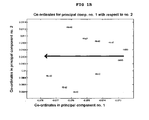
Figure 1A is a graph that shows the results of a PCA analysis (principal component analysis) with the response of a combination of 4 carbon nanotube sensors functionalised with oxygen and decorated with rhodium, platinum, and not decorated with metal clusters. The Y-axis shows the co-ordinates of the measurements made onprincipal component number 2 and the X-axis shows the co-ordinates ofprincipal component number 1.Figure 1B is an enlargement ofFigure 1A in the benzene area. The arrow indicates increasing concentrations of benzene. -
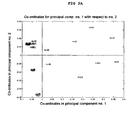
Figure 2A is a graph that shows the results of a PCA analysis with the response of a combination of 4 carbon nanotube sensors functionalised with oxygen and decorated with rhodium and not decorated with metal clusters. The Y-axis shows the co-ordinates of the measurements made onprincipal component number 2 and the X-axis shows the co-ordinates onprincipal component number 1.Figure 2B is an enlargement ofFigure 2A in the benzene area. -
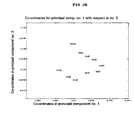
Figure 3A is a graph that shows the results of a PCA analysis with the response of a combination of 4 carbon nanotube sensors functionalised with oxygen and decorated with rhodium, platinum and palladium. The Y-axis shows the co-ordinates of the measurements made onprincipal component number 2 and the X-axis shows the co-ordinates onprincipal component number 1.Figure 3B is an enlargement ofFigure 3A in the benzene area. -
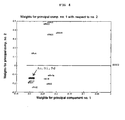
Figure 4 is a graph that shows the results of a PCA analysis with the response of a combination of 15 functionalised carbon nanotube sensors decorated with rhodium, platinum, palladium, gold and nickel clusters, and not decorated with metal clusters. The different references to said metals, such as NiU1 and NiU2, provide information about the metals that decorate the nanotubes (for example, Ni indicates nickel, R indicates rhodium, Pt indicates platinum, Ox indicates undecorated nanotubes) and to the methods used to decorate the nanotubes (U indicates cracking of organometallics, Na indicates evaporation and Al indicates colloidal suspension spraying). The Y-axis shows the weights of said sensors forprincipal component number 2 and the X-axis shows the weights forprincipal component number 1. -
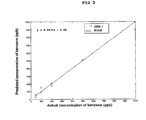
Figure 5 shows the results obtained for the prediction of the concentration of benzene gas using a PLS calibration model the inputs whereof are the responses of the sensors based on carbon nanotubes decorated with clusters of the metals described for the purpose of the invention. The Y-axis shows the concentration of benzene predicted, in ppb, and the X-axis shows the actual concentration of benzene, in ppb. -
Figure 6 shows the detection of increasing concentrations of benzene gas using a sensing device in accordance with the invention that comprises, in addition to sensors based on functionalised carbon nanotubes decorated with Rh and Pt, functionalised carbon nanotubes decorated with palladium (Pd/CNT), with the different intervals that indicate the device's regeneration time. -
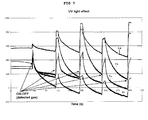
Figure 7 shows repeated experiments of the effect of the desorption of benzene gas from the functionalised carbon nanotubes decorated with Ti, Ni, Pd, or undecorated but functionalised with oxygen plasma (O2). - A first aspect of the invention provides a device for the selective detection of benzene gas, characterised in that it comprises, on a base substrate, a combination of:
- a) at least one functionalised multi- or single-wall carbon nanotube sensor (MWCNT or SWCNT) decorated with rhodium (Rh) clusters, and
- b) at least one functionalised multi- or single-wall carbon nanotube sensor decorated with metal clusters selected from gold, palladium, nickel and titanium, or undecorated, or mixtures thereof;
- Surprisingly, the combination of sensors in accordance with the first aspect of the invention provides a device that allows for the selective detection of benzene gas in the presence of other interfering gases.
- Advantageously, the addition of at least one functionalised multi- or single-wall carbon nanotube sensor decorated with platinum (Pt) clusters makes it possible to determine the concentration of benzene gas present in the environment analysed. For more details, see
Figure 1 . - Thus, the combination of sensors in the device described above provides an excellent sensitivity and selectivity toward benzene gas at ppb levels. In particular, the authors of the invention have found that the detection threshold is below 50 ppb, and it may detect concentrations of 10, 20, 30 ppb. Advantageously, the defined device exhibits excellent selectivity toward possible interfering gases, such as hydrocarbons, nitrogen oxide, carbon monoxide, amongst others, as may be verified in the figures and embodiments that follow. Therefore, the invention makes it possible to overcome the low sensitivity and low selectivity problems of the devices designed for the detection of benzene described thus far.
- In a preferred embodiment of the invention, the device for the selective detection of benzene gas is characterised in that it comprises a combination of sensors that consists of:
- a) at least one functionalised multi- or single-wall carbon nanotube sensor decorated with rhodium (Rh) clusters,
- b) at least one functionalised multi- or single-wall carbon nanotube sensor decorated with metals clusters selected from gold, palladium, nickel and titanium, and/or undecorated, and
- c) at least one functionalised multi- or single-wall carbon nanotube sensor decorated with platinum (Pt) clusters.
- In yet another preferred embodiment, the device for the selective detection of benzene gas is characterised in that it comprises a combination of sensors that consists of:
- a) at least one functionalised multi- or single-wall carbon nanotube sensor decorated with rhodium (Rh) clusters,
- b) at least one functionalised, undecorated multi- or single-wall carbon nanotube sensor, and
- c) at least one functionalised multi- or single-wall carbon nanotube sensor decorated with platinum (Pt) clusters.
- Preferably, said nanotubes are functionalised in an oxygen plasma.
- Thus, a device with a combination of, for example, 4 sensors: Rh, Pt and others decorated with gold, palladium, nickel or titanium, and/or undecorated, is sufficient to detect and quantify benzene gas. It is evident that a combination with a larger number of sensors (6, 8, 10, 12, etc.) will also be useful in accordance with the object of the invention.
- Preferably, the means for measuring the variation in the resistance produced in the sensors due to the adsorption of gases on the surface of the functionalised carbon nanotubes are interdigitated metal electrodes. The preferred electrodes are made of gold or platinum.
- The base substrate comprises said interdigitated metal electrodes, and a ceramic or silicon base substrate is preferred.
- Advantageously, the device may additionally comprise means to cast UV light or to increase the temperature of the sensors that make up the device, so as to perform the desorption of the gases from the surface of the carbon nanotubes that has taken place during the measurement-taking (gas analysis) and thus leave the sensor in a suitable condition for a new analysis. Therefore, the device of the invention is not only single-use, with the advantages that this entails from an economic and an environmental standpoint.
- The device may additionally comprise a signal processing module. Likewise, it may also comprise other elements related to electronics and data processing known to those skilled in the art, such as microcontroller-based electronics to acquire the signals from the sensors and implement pattern recognition techniques, such as PCA, and regression models to determine the presence or absence of benzene gas and quantify it within the ppb-ppm range.
- Advantageously, the multi- or single-wall carbon nanotubes that make up each sensor are functionalised in a cold plasma. It is well-known that functionalisation of multi- or single-wall carbon nanotubes makes it possible to activate the surface of the (multi- or single-wall) carbon nanotubes and thereby create defects on the surface thereof, where the metal clusters will be homogeneously deposited. A method of functionalising multi- or single-wall carbon nanotubes, and a specific method of depositing the metal clusters on the surface of the nanotubes are not a part of this invention.
- Thus, in accordance with the device described above, the functionalised multi- or single-wall carbon nanotubes may be prepared by any known functionalisation technique, although the cold plasma functionalisation technique is preferred. Therefore, in a preferred embodiment of the invention, the device used for the detection of benzene gas in accordance with the first aspect of the invention comprises multi- or single-wall carbon nanotubes functionalised in a cold plasma and decorated or not with metal clusters.
- Therefore, a device is provided for the selective detection of benzene gas which is re-usable, economical, and which allows for the quantification of the concentration of benzene gas present in the environment analysed.
- A second aspect of the invention provides a method of obtaining or manufacturing a device as defined above, characterised in that the sensors that make it up are prepared in accordance with the following steps:
- i) preparation of a dispersion of an organic solution of multi- or single-wall carbon nanotubes,
- ii) treatment of said dispersion in an ultrasound bath,
- iii) deposition on the base substrate of said dispersion treated in step ii) by aerographic spraying,
- iv) annealment of the substrate in order to fix the deposited carbon nanotubes,
- v) functionalisation of said carbon nanotubes in a reactor by treatment with oxygen plasma, and
- vi) optionally, decoration of the functionalised carbon nanotubes with the metal clusters by thermal evaporation, cracking of organometallics or colloidal suspension spraying.
- Preferably, said organic solution is prepared with an aprotic organic solvent, preferably dimethylformamide or acetone, and the carbon nanotubes are in the form of powder. In this invention, the term "aprotic organic solvent" is understood to be a solvent that is not capable of exchanging protons with the reactants, such as, for example, those belonging to the families of aromatic hydrocarbons, amides, halogenated hydrocarbons, ketones, esters, ethers or sulfones.
- Advantageously, the metal clusters are selected from rhodium, platinum, palladium, nickel, gold and titanium.
- The method of obtaining the device described above makes it possible to overcome the problems in the prior art related to the loss or migration of the clusters decorated on the multi- or single-wall carbon nanotubes that occurred during manufacturing of the sensor. Using the method of the invention, the thermal annealing treatment is performed prior to decorating the carbon nanotubes with metal clusters.
- Advantageously, the order of the steps and the use of an ultrasound treatment step for the dispersion and an annealing or thermal treatment step when the carbon nanotubes have still not been decorated with the corresponding metal clusters prevents, but substantially reduces, the loss or migration of the metal clusters from the surface of the carbon nanotubes.
- The method of obtaining or manufacturing a sensing device for the selective detection of benzene gas in accordance with the invention makes it possible to obtain a device with better sensing properties and, therefore, a sensing device with a high reliability.
- In accordance with the method of manufacturing the device of the invention, in step vi) masks will be used in order to direct the metal clusters toward the desired areas. Each sensor is formed by multi- or single-wall carbon nanotubes that are functionalised and, optionally, decorated with clusters of a single metal selected from those mentioned above.
- Advantageously, the method of obtaining the device which comprises a combination of different types of sensors provides a device with a high stability (loss or migration of the clusters is prevented), non-degradation of the electrodes, since the device of the invention operates at ambient temperature, unlike the temperature used in the sensors disclosed in the state of the art, which ranges between 350°C and 400°C, and excellent sensitivity toward the presence of interfering gases.
- A third aspect of the invention provides a method of selectively detecting the presence of benzene gas using the device defined above, characterised in that it comprises:
- taking measurements of the electrical resistance of the functionalised multi- or single-wall carbon nanotube sensors a) and b), and optionally c), which varies in response to the presence of benzene gas,
- analysing said electrical resistance in order to determine and, optionally, quantify the presence of benzene gas, and
- when taking a new measurement, applying a source of ultraviolet light to the sensor for a short period of time, or increasing the sensor temperature between 50°C and 200°C in order to desorb the gases from the sensor and leave the latter in a suitable condition for a new measurement.
- Preferably, desorption of the gases from the sensor is performed by applying a source of ultraviolet light for a short period of time, for example 30, 60 or 90 seconds. Said method of desorbing the gases makes it possible to significantly reduce the sensor's recovery time. Optionally, the desorption may also be performed by increasing the sensor temperature, preferably between 100°C and 160°C, even more preferably 150°C.
- Advantageously, the measurements of benzene gas are performed at ambient temperature. Therefore, the device of the invention makes it possible to overcome the problems in the prior art related to the degradation of the electrodes in the device due to the high temperatures required for the correct operation thereof.
- Also advantageously, the device of the invention may operate in the presence or absence of oxygen. It is worth noting that most existing devices for the detection of benzene disclosed in the state of the art can only operate in the presence of oxygen, since the latter participates in the regeneration of the oxide layer when taking a new measurement. Using the device of the invention, the presence or absence of oxygen does not affect the measurement-taking or the regeneration of the sensor for taking a new measurement.
- Another aspect of the invention relates to the use of said device to selectively detect benzene gas at concentrations below 100 ppb in the presence of other interfering gases and in the absence or presence of oxygen at ambient temperature. In a preferred embodiment, the device is used in the absence of oxygen. Therefore, the device of the invention has applications in the chemical industry, the petrochemical industry, petrol stations, or household, aeronautical or research applications, or any other environment susceptible to having the existence of benzene gas analysed.
- A device was prepared with a combination of 4 multi-wall carbon nanotube sensors (MWNTC) decorated with rhodium and platinum clusters, and undecorated multi-wall carbon nanotubes. They had all been functionalised with oxygen plasma.
- The effect provided by said combination was twofold. On the one hand, it was possible to discriminate between benzene and potential interfering gases (achievement of a selective benzene detector), as may be observed in
Figure 1A . - Various concentrations of nitrogen dioxide (6, 30, 50, 100 ppm), ethylene (3, 7, 15, 30 ppm), carbon monoxide (2, 5, 10 and 20 ppm) and benzene (50, 100, 200, 500 and 1,000 ppb) were measured. The benzene concentrations were deliberately low as compared to those of the other interfering gases. The PCA analysis (also called score diagram) shown in
Figure 1A demonstrated that, using the multi-sensor device, the different gases measured may be identified and, in particular, benzene may be discriminated. - An enlargement of
Figure 1A centred on the benzene measurement area showed the second effect of said device, i.e. that it was not only possible to discriminate benzene from the other gases, but it was also possible to determine the concentration thereof. SeeFigure 1B for more details. In fact, the measurements corresponding to the increasing concentrations of benzene are located from right to left, in a mannner quite aligned with principal component number 1 (X-axis). This showed that a linear correlation may be established between the response of the sensors and the concentration of benzene (for example, by means of a partial least squares, PLS, calibration model). Moreover, it was very relevant to find that the increasing concentrations of benzene align with the first principal component, since the latter explains over 90% of the measurement variance. Therefore, the combination of sensors in the device of the invention allows for the selective, quantitative detection of benzene gas in the presence of interfering gases. - Subsequently, a device was assayed wherein the platinum sensor had been suppressed. See
Figure 2A . A combination of 4 carbon nanotube sensors functionalised with oxygen and decorated with rhodium, and not decorated with metal clusters, was prepared. It was observed that, in the absence of platinum, the device of the invention was still capable of discriminating benzene from the other gases. However, in the absence of platinum, it was not possible to measure the different concentrations of benzene. SeeFigure 2B , where the measurements are not aligned in accordance with the concentration of benzene at different concentrations (50, 100, 200, 500 and 1,000 ppb). Therefore, it is not possible to quantify benzene in the absence of platinum. - A device was also prepared with a combination of 4 carbon nanotube sensors functionalised with oxygen and decorated with rhodium, platinum and palladium, in order to determine the effect of the substitution of a sensor based on carbon nanotubes that was not decorated with metal clusters as compared to the effect of a sensor based on carbon nanotubes decorated with palladium. See
Figures 3A and3B . It was observed that said substitution did not modify the sensitivity or the selectivity toward benzene, and it was concluded that both types of sensors have an equivalent function in the device, i.e. both sensors are insensitive toward benzene gas, which, in combination with a sensor that is sensitive to benzene gas (Rh), provided a device with high selectivity toward said gas. - The equivalence between sensors was determined by means of a PCA analysis of a combination of 15 functionalised carbon nanotube sensors decorated with rhodium, platinum, palladium, gold and nickel clusters, and not decorated with metal clusters. The proximity in the values of the weights for the sensors containing gold (Au), nickel (Ni) and palladium (Pd) showed that said metals may be substituted or combined with one another, providing the same function to the device, i.e. reduced or null sensitivity toward benzene gas. Therefore, the functionalised multi- or single-wall carbon nanotube sensors decorated with metal clusters selected from gold, palladium, nickel and titanium provide a response equivalent to that provided by functionalised, undecorated multi- or single-wall carbon nanotube sensors, or a mixture thereof, due to the fact that all of these sensors are insensitive toward benzene gas. It was concluded that these sensors may be substituted by others the PCA analysis whereof provides a response in the same area or very close to it, which will also mean that these sensors are not sensitive toward benzene gas.
- A combination was also assayed which included sensors containing rhodium and palladium clusters, in order to determine the concentration of benzene gas. A calibration model was built based on the partial least squares technique (PLS). To this end, ten available measurements from 5 different concentrations of benzene were used. The results obtained using the PLS model are shown in
Figure 5 . Said figure shows an excellent linear adjustment between the real and predicted concentration values (the slope of the adjustment is close to 1, the ordinate at the origin is close to 0 and the correlation coefficient of the adjustment is close to 1 (correlation coefficient of the linear regression = 0.9986). - Finally, the device was regenerated, in order to leave it in an optimal condition for the following measurement. See
Figure 6 , where it may be observed that, following each measurement, it was heated to 150°C in order to desorb the gases and, subsequently, new measurements were taken, and so on, up to a total of 5 measurements, with equal sensitivity and selectivity (see the different intervals that indicate the device's regeneration time). - Advantageously, regeneration of the device is performed by applying ultraviolet light to the sensors that contain the benzene gas adsorbed on the surface thereof. See
Figure 7 , which shows repeated experiments, and where it may be observed that the regeneration times are within an interval of 60 seconds. - Therefore, the device of the invention is useful in the chemical industry, the petrochemical industry and petrol stations. It is also useful as a personal safety device to protect the staff in the above-mentioned industries that work in environments wherein benzene leaks may occur. It is worth noting that, using the device of the invention measurements may be taken in tanks, pipes or other closed environments even in the absence of oxygen.
- It is concluded that, with device of the invention, the following advantages are surprisingly obtained: Excellent sensitivity, which makes it possible to detect benzene at ppb levels. The detection threshold is below 50 ppb. The detection is performed at ambient temperature, with the consequent advantages of energy savings and stability of the active layer and non-degradation of the electrodes. Excellent selectivity toward possible interfering gases, such as hydrocarbons (e. g. C2H4), nitrogen oxide, carbon monoxide, as shown by the PCA analyses. Possibility of performing a quantitative analysis of the benzene, as shown by the results of the PLS model. Adequate response and recovery times for sensors based on carbon nanotubes.
Claims (14)
- Device for the selective detection of benzene gas, characterised in that it comprises, on a base substrate, a combination of:a) at least one functionalised multi- or single-wall carbon nanotube sensor decorated with rhodium (Rh) clusters, andb) at least one functionalised multi- or single-wall carbon nanotube sensor decorated with metal clusters selected from gold, palladium, nickel and titanium, and/or undecorated;
where said base substrate further comprises means for measuring the variation in the resistance of said sensors. - Device according to claim 1, characterised in that it further comprises at least one functionalised multi- or single-wall carbon nanotube sensor decorated with platinum (Pt) clusters.
- Device according to claim 1, characterised in that said combination consists of:a) at least one functionalised multi- or single-wall carbon nanotube sensor decorated with rhodium (Rh) clusters,b) at least one functionalised multi- or single-wall carbon nanotube sensor decorated with metal clusters selected from gold, palladium, nickel and titanium, and/or undecorated, andc) at least one functionalised multi- or single-wall carbon nanotube sensor decorated with platinum (Pt) clusters.
- Device according to any of the preceding claims, characterised in that said multi- or single-wall carbon nanotubes are functionalised with cold plasma.
- Device according to claim 1, wherein said base substrate further comprises means to increase the temperature of said sensors, such as a heating element.
- Device according to claim 1, wherein said means for measuring the variation in the resistance are interdigitated metal electrodes, preferably made of gold or platinum.
- Device according to claim 1, wherein said base substrate is made of ceramic material or silicon.
- Device according to claim 1, characterised in that it comprises a signal processing module.
- Method of obtaining a device according to any of claims 1 to 8, characterised in that said sensors are prepared in accordance with the following steps:i) preparation of a dispersion in an organic solution of multi- or single-wall carbon nanotubes,ii) treatment of said dispersion in an ultrasound bath,iii) deposition on the base substrate of said dispersion prepared in step ii), by aerographic spraying,iv) annealment of the substrate in order to fix the deposited carbon nanotubes,v) functionalisation of said carbon nanotubes in a reactor by treatment with oxygen plasma, andvi) optionally, decoration of the functionalised carbon nanotubes with the corresponding metal clusters by thermal evaporation, cracking of organometallics or colloidal suspension spraying.
- Method according to claim 9, wherein said organic solution is prepared with an aprotic organic solvent, preferably dimethylformamide or acetone.
- Method for the selective detection of the presence of benzene gas in accordance with the device according to any of claims 1 to 8, characterised in that it comprises:- taking measurements of the electrical resistance of the functionalised multi- or single-wall carbon nanotube sensors a) and b), and optionally c), which varies in response to the presence of benzene gas,- analysing said electrical resistance in order to determine and, optionally, quantify the presence of benzene gas, and- when taking a new measurement, applying a source of ultraviolet light to the sensor for a short period of time or increasing the temperature of the sensor between 50°C and 200°C in order to desorb the gases from the sensor and leave it in a suitable condition for a new measurement.
- Method for the selective detection of the presence of benzene gas according to claim 11, wherein the electrical resistance of the sensors is measured at ambient temperature, in the presence or absence of oxygen.
- Use of a device according to any of claims 1 to 8, in order to selectively detect benzene gas at concentrations below 100 ppb in the presence of other interfering gases at ambient temperature.
- Use of a device according to claim 13, in the chemical industry, the petrochemical industry, petrol stations, or household, aeronautical or research applications.
Applications Claiming Priority (2)
| Application Number | Priority Date | Filing Date | Title |
|---|---|---|---|
| ES200930969A ES2359204B1 (en) | 2009-11-09 | 2009-11-09 | DEVICE FOR THE SELECTIVE DETECTION OF GAS BENZENE, PROCEDURE FOR OBTAINING AND DETECTION OF GAS WITH THE SAME. |
| PCT/IB2010/054957 WO2011055298A1 (en) | 2009-11-09 | 2010-11-02 | Device for the selective detection of benzene gas, method of obtaining it and detection of the gas therewith |
Publications (2)
| Publication Number | Publication Date |
|---|---|
| EP2499482A1 EP2499482A1 (en) | 2012-09-19 |
| EP2499482B1 true EP2499482B1 (en) | 2015-07-01 |
Family
ID=43501813
Family Applications (1)
| Application Number | Title | Priority Date | Filing Date |
|---|---|---|---|
| EP10785210.5A Not-in-force EP2499482B1 (en) | 2009-11-09 | 2010-11-02 | Device for the selective detection of benzene gas, method of obtaining it and detection of the gas therewith |
Country Status (5)
| Country | Link |
|---|---|
| US (1) | US9222905B2 (en) |
| EP (1) | EP2499482B1 (en) |
| CN (1) | CN102713593B (en) |
| ES (1) | ES2359204B1 (en) |
| WO (1) | WO2011055298A1 (en) |
Families Citing this family (6)
| Publication number | Priority date | Publication date | Assignee | Title |
|---|---|---|---|---|
| BE464785A (en) * | 1939-07-26 | |||
| US9518950B2 (en) | 2011-08-19 | 2016-12-13 | Northeastern University | Chemical sensor based on highly organized single walled carbon nanotube networks |
| CN103058173B (en) * | 2013-02-04 | 2014-08-13 | 苏州纳格光电科技有限公司 | Preparation method of nano metal oxide functionalized carbon nanotubes and gas sensor |
| WO2015167637A2 (en) * | 2014-02-05 | 2015-11-05 | North Carolina Agricultural And Technical State University | Cnt sheet substrates and transition metals deposited on same |
| CN105527321B (en) * | 2015-12-26 | 2018-10-09 | 靳职雄 | Import and export the online test method of toxic gas benzene in rubber product |
| US11462358B2 (en) | 2017-08-18 | 2022-10-04 | Northeastern University | Method of tetratenite production and system therefor |
Family Cites Families (5)
| Publication number | Priority date | Publication date | Assignee | Title |
|---|---|---|---|---|
| US6919730B2 (en) * | 2002-03-18 | 2005-07-19 | Honeywell International, Inc. | Carbon nanotube sensor |
| US7276266B1 (en) * | 2002-12-13 | 2007-10-02 | United States Of America As Represented By The Administrator Of The National Aeronautics And Space Administration (Nasa) | Functionalization of carbon nanotubes |
| CN1225653C (en) * | 2003-11-04 | 2005-11-02 | 浙江大学 | Gas sensor array for detecting indoor gas pollution |
| KR100723429B1 (en) * | 2006-07-31 | 2007-05-30 | 삼성전자주식회사 | Manufacturing Method of Gas Sensor Using Metal Ligand and Carbon Nanotube |
| CN100592082C (en) * | 2007-09-24 | 2010-02-24 | 武汉工程大学 | Formaldehyde gas-sensing material and preparation method thereof, and manufacturing method of formaldehyde gas-sensing device |
-
2009
- 2009-11-09 ES ES200930969A patent/ES2359204B1/en not_active Expired - Fee Related
-
2010
- 2010-11-02 WO PCT/IB2010/054957 patent/WO2011055298A1/en not_active Ceased
- 2010-11-02 CN CN201080055357.XA patent/CN102713593B/en not_active Expired - Fee Related
- 2010-11-02 EP EP10785210.5A patent/EP2499482B1/en not_active Not-in-force
- 2010-11-02 US US13/504,274 patent/US9222905B2/en not_active Expired - Fee Related
Also Published As
| Publication number | Publication date |
|---|---|
| ES2359204B1 (en) | 2012-03-26 |
| CN102713593B (en) | 2014-08-06 |
| CN102713593A (en) | 2012-10-03 |
| US20120247180A1 (en) | 2012-10-04 |
| ES2359204A1 (en) | 2011-05-19 |
| WO2011055298A1 (en) | 2011-05-12 |
| US9222905B2 (en) | 2015-12-29 |
| EP2499482A1 (en) | 2012-09-19 |
Similar Documents
| Publication | Publication Date | Title |
|---|---|---|
| US9791403B2 (en) | Nanoparticle-based gas sensors and methods of using the same | |
| US9222905B2 (en) | Device for the selective detection of benzene gas, method of obtaining it and detection of the gas therewith | |
| US6165347A (en) | Method of identifying a gas | |
| US8584505B2 (en) | Measuring instrument and method for detecting the content of oil, hydrocarbons and oxidizable gases in air or compressed air | |
| Pugh et al. | The gas sensing properties of zeolite modified zinc oxide | |
| CN102128870A (en) | Carbon dioxide sensor and method for generating measured gas values | |
| JP5527676B1 (en) | Carbon component measurement system in microparticulate matter | |
| US7356420B2 (en) | Analyzing system for the detection of reducing and oxidizing gases in a carrier gas with a metal-oxide-semiconductor sensor arrangement | |
| Beckers et al. | Selective room temperature nanostructured thin film alcohol sensor as a virtual sensor array | |
| US20130111974A1 (en) | Gas sensor and method for producing the same | |
| Capua et al. | Detection of triacetone triperoxide (TATP) with an array of sensors based on non-specific interactions | |
| Ashley | Electroanalytical applications in occupational and environmental health | |
| Abbas et al. | Multicomponent analysis of some environmentally important gases using semiconductor tin oxide sensors | |
| Warmer et al. | Detection of triacetone triperoxide using temperature cycled metal‐oxide semiconductor gas sensors | |
| WO2018158692A1 (en) | Formaldehyde gas sensor and method for producing the same | |
| KR102413888B1 (en) | Electric field variable gas sensor including gas molecule adsorption inducing material and manufacturing method thereof | |
| Fan et al. | A new cataluminescence-based gas sensor for simultaneously discriminating benzene and ammonia | |
| US20200209176A1 (en) | Method and device for analyzing a gas | |
| Duran et al. | Thermal desorption pre-concentrator based system to assess carbon dioxide contamination by benzene | |
| CN210572098U (en) | Measuring device for measuring the content of oil vapour or other hydrocarbons in a gas | |
| KR101133820B1 (en) | Electrochemical sensor | |
| Gwiżdż et al. | Temperature modulated response of gas sensors array-humidity interference | |
| Lv et al. | A catalytic sensor using MEMS process for methane detection in mines | |
| RU2525172C2 (en) | Sensor device | |
| WO2025090069A2 (en) | Phyllosilicate chemical gas sensor |
Legal Events
| Date | Code | Title | Description |
|---|---|---|---|
| PUAI | Public reference made under article 153(3) epc to a published international application that has entered the european phase |
Free format text: ORIGINAL CODE: 0009012 |
|
| 17P | Request for examination filed |
Effective date: 20120424 |
|
| AK | Designated contracting states |
Kind code of ref document: A1 Designated state(s): AL AT BE BG CH CY CZ DE DK EE ES FI FR GB GR HR HU IE IS IT LI LT LU LV MC MK MT NL NO PL PT RO RS SE SI SK SM TR |
|
| RIN1 | Information on inventor provided before grant (corrected) |
Inventor name: GUILLOT, JEROME Inventor name: DEMOISSON, FREDERIC, GILBERT, MICHEL Inventor name: DELGADO OLIVELLA, MARC Inventor name: FELTEN, ALEXANDRE Inventor name: LLOBET VALERO, EDUARD Inventor name: LEGHRIB, RADOUANE Inventor name: RENIERS, FRANCOIS, AMAND, BAUDOUIN Inventor name: CLAESSENS, NICOLAS, YVES Inventor name: MANSOUR, ALI Inventor name: MIGEON, HENRI-NOEEL Inventor name: PIREAUX, JEAN-JACQUES |
|
| DAX | Request for extension of the european patent (deleted) | ||
| GRAP | Despatch of communication of intention to grant a patent |
Free format text: ORIGINAL CODE: EPIDOSNIGR1 |
|
| INTG | Intention to grant announced |
Effective date: 20150123 |
|
| GRAS | Grant fee paid |
Free format text: ORIGINAL CODE: EPIDOSNIGR3 |
|
| GRAA | (expected) grant |
Free format text: ORIGINAL CODE: 0009210 |
|
| AK | Designated contracting states |
Kind code of ref document: B1 Designated state(s): AL AT BE BG CH CY CZ DE DK EE ES FI FR GB GR HR HU IE IS IT LI LT LU LV MC MK MT NL NO PL PT RO RS SE SI SK SM TR |
|
| REG | Reference to a national code |
Ref country code: GB Ref legal event code: FG4D |
|
| REG | Reference to a national code |
Ref country code: AT Ref legal event code: REF Ref document number: 734253 Country of ref document: AT Kind code of ref document: T Effective date: 20150715 Ref country code: CH Ref legal event code: EP |
|
| REG | Reference to a national code |
Ref country code: DE Ref legal event code: R096 Ref document number: 602010025611 Country of ref document: DE |
|
| REG | Reference to a national code |
Ref country code: IE Ref legal event code: FG4D |
|
| REG | Reference to a national code |
Ref country code: FR Ref legal event code: PLFP Year of fee payment: 6 |
|
| REG | Reference to a national code |
Ref country code: AT Ref legal event code: MK05 Ref document number: 734253 Country of ref document: AT Kind code of ref document: T Effective date: 20150701 |
|
| REG | Reference to a national code |
Ref country code: NL Ref legal event code: MP Effective date: 20150701 |
|
| REG | Reference to a national code |
Ref country code: LT Ref legal event code: MG4D |
|
| PG25 | Lapsed in a contracting state [announced via postgrant information from national office to epo] |
Ref country code: GR Free format text: LAPSE BECAUSE OF FAILURE TO SUBMIT A TRANSLATION OF THE DESCRIPTION OR TO PAY THE FEE WITHIN THE PRESCRIBED TIME-LIMIT Effective date: 20151002 Ref country code: NO Free format text: LAPSE BECAUSE OF FAILURE TO SUBMIT A TRANSLATION OF THE DESCRIPTION OR TO PAY THE FEE WITHIN THE PRESCRIBED TIME-LIMIT Effective date: 20151001 Ref country code: LV Free format text: LAPSE BECAUSE OF FAILURE TO SUBMIT A TRANSLATION OF THE DESCRIPTION OR TO PAY THE FEE WITHIN THE PRESCRIBED TIME-LIMIT Effective date: 20150701 Ref country code: LT Free format text: LAPSE BECAUSE OF FAILURE TO SUBMIT A TRANSLATION OF THE DESCRIPTION OR TO PAY THE FEE WITHIN THE PRESCRIBED TIME-LIMIT Effective date: 20150701 Ref country code: FI Free format text: LAPSE BECAUSE OF FAILURE TO SUBMIT A TRANSLATION OF THE DESCRIPTION OR TO PAY THE FEE WITHIN THE PRESCRIBED TIME-LIMIT Effective date: 20150701 |
|
| PG25 | Lapsed in a contracting state [announced via postgrant information from national office to epo] |
Ref country code: PT Free format text: LAPSE BECAUSE OF FAILURE TO SUBMIT A TRANSLATION OF THE DESCRIPTION OR TO PAY THE FEE WITHIN THE PRESCRIBED TIME-LIMIT Effective date: 20151102 Ref country code: RS Free format text: LAPSE BECAUSE OF FAILURE TO SUBMIT A TRANSLATION OF THE DESCRIPTION OR TO PAY THE FEE WITHIN THE PRESCRIBED TIME-LIMIT Effective date: 20150701 Ref country code: PL Free format text: LAPSE BECAUSE OF FAILURE TO SUBMIT A TRANSLATION OF THE DESCRIPTION OR TO PAY THE FEE WITHIN THE PRESCRIBED TIME-LIMIT Effective date: 20150701 Ref country code: IS Free format text: LAPSE BECAUSE OF FAILURE TO SUBMIT A TRANSLATION OF THE DESCRIPTION OR TO PAY THE FEE WITHIN THE PRESCRIBED TIME-LIMIT Effective date: 20151101 Ref country code: ES Free format text: LAPSE BECAUSE OF FAILURE TO SUBMIT A TRANSLATION OF THE DESCRIPTION OR TO PAY THE FEE WITHIN THE PRESCRIBED TIME-LIMIT Effective date: 20150701 Ref country code: HR Free format text: LAPSE BECAUSE OF FAILURE TO SUBMIT A TRANSLATION OF THE DESCRIPTION OR TO PAY THE FEE WITHIN THE PRESCRIBED TIME-LIMIT Effective date: 20150701 Ref country code: SE Free format text: LAPSE BECAUSE OF FAILURE TO SUBMIT A TRANSLATION OF THE DESCRIPTION OR TO PAY THE FEE WITHIN THE PRESCRIBED TIME-LIMIT Effective date: 20150701 Ref country code: AT Free format text: LAPSE BECAUSE OF FAILURE TO SUBMIT A TRANSLATION OF THE DESCRIPTION OR TO PAY THE FEE WITHIN THE PRESCRIBED TIME-LIMIT Effective date: 20150701 |
|
| REG | Reference to a national code |
Ref country code: DE Ref legal event code: R097 Ref document number: 602010025611 Country of ref document: DE |
|
| PG25 | Lapsed in a contracting state [announced via postgrant information from national office to epo] |
Ref country code: CZ Free format text: LAPSE BECAUSE OF FAILURE TO SUBMIT A TRANSLATION OF THE DESCRIPTION OR TO PAY THE FEE WITHIN THE PRESCRIBED TIME-LIMIT Effective date: 20150701 Ref country code: IT Free format text: LAPSE BECAUSE OF FAILURE TO SUBMIT A TRANSLATION OF THE DESCRIPTION OR TO PAY THE FEE WITHIN THE PRESCRIBED TIME-LIMIT Effective date: 20150701 Ref country code: EE Free format text: LAPSE BECAUSE OF FAILURE TO SUBMIT A TRANSLATION OF THE DESCRIPTION OR TO PAY THE FEE WITHIN THE PRESCRIBED TIME-LIMIT Effective date: 20150701 Ref country code: SK Free format text: LAPSE BECAUSE OF FAILURE TO SUBMIT A TRANSLATION OF THE DESCRIPTION OR TO PAY THE FEE WITHIN THE PRESCRIBED TIME-LIMIT Effective date: 20150701 Ref country code: DK Free format text: LAPSE BECAUSE OF FAILURE TO SUBMIT A TRANSLATION OF THE DESCRIPTION OR TO PAY THE FEE WITHIN THE PRESCRIBED TIME-LIMIT Effective date: 20150701 |
|
| PLBE | No opposition filed within time limit |
Free format text: ORIGINAL CODE: 0009261 |
|
| STAA | Information on the status of an ep patent application or granted ep patent |
Free format text: STATUS: NO OPPOSITION FILED WITHIN TIME LIMIT |
|
| PG25 | Lapsed in a contracting state [announced via postgrant information from national office to epo] |
Ref country code: RO Free format text: LAPSE BECAUSE OF FAILURE TO SUBMIT A TRANSLATION OF THE DESCRIPTION OR TO PAY THE FEE WITHIN THE PRESCRIBED TIME-LIMIT Effective date: 20150701 |
|
| 26N | No opposition filed |
Effective date: 20160404 |
|
| PG25 | Lapsed in a contracting state [announced via postgrant information from national office to epo] |
Ref country code: MC Free format text: LAPSE BECAUSE OF FAILURE TO SUBMIT A TRANSLATION OF THE DESCRIPTION OR TO PAY THE FEE WITHIN THE PRESCRIBED TIME-LIMIT Effective date: 20150701 Ref country code: LU Free format text: LAPSE BECAUSE OF FAILURE TO SUBMIT A TRANSLATION OF THE DESCRIPTION OR TO PAY THE FEE WITHIN THE PRESCRIBED TIME-LIMIT Effective date: 20151102 |
|
| REG | Reference to a national code |
Ref country code: CH Ref legal event code: PL |
|
| PG25 | Lapsed in a contracting state [announced via postgrant information from national office to epo] |
Ref country code: CH Free format text: LAPSE BECAUSE OF NON-PAYMENT OF DUE FEES Effective date: 20151130 Ref country code: LI Free format text: LAPSE BECAUSE OF NON-PAYMENT OF DUE FEES Effective date: 20151130 |
|
| REG | Reference to a national code |
Ref country code: IE Ref legal event code: MM4A |
|
| PG25 | Lapsed in a contracting state [announced via postgrant information from national office to epo] |
Ref country code: SI Free format text: LAPSE BECAUSE OF FAILURE TO SUBMIT A TRANSLATION OF THE DESCRIPTION OR TO PAY THE FEE WITHIN THE PRESCRIBED TIME-LIMIT Effective date: 20150701 |
|
| REG | Reference to a national code |
Ref country code: FR Ref legal event code: PLFP Year of fee payment: 7 |
|
| PG25 | Lapsed in a contracting state [announced via postgrant information from national office to epo] |
Ref country code: IE Free format text: LAPSE BECAUSE OF NON-PAYMENT OF DUE FEES Effective date: 20151102 |
|
| PG25 | Lapsed in a contracting state [announced via postgrant information from national office to epo] |
Ref country code: BE Free format text: LAPSE BECAUSE OF FAILURE TO SUBMIT A TRANSLATION OF THE DESCRIPTION OR TO PAY THE FEE WITHIN THE PRESCRIBED TIME-LIMIT Effective date: 20150701 |
|
| PG25 | Lapsed in a contracting state [announced via postgrant information from national office to epo] |
Ref country code: BG Free format text: LAPSE BECAUSE OF FAILURE TO SUBMIT A TRANSLATION OF THE DESCRIPTION OR TO PAY THE FEE WITHIN THE PRESCRIBED TIME-LIMIT Effective date: 20150701 Ref country code: HU Free format text: LAPSE BECAUSE OF FAILURE TO SUBMIT A TRANSLATION OF THE DESCRIPTION OR TO PAY THE FEE WITHIN THE PRESCRIBED TIME-LIMIT; INVALID AB INITIO Effective date: 20101102 Ref country code: SM Free format text: LAPSE BECAUSE OF FAILURE TO SUBMIT A TRANSLATION OF THE DESCRIPTION OR TO PAY THE FEE WITHIN THE PRESCRIBED TIME-LIMIT Effective date: 20150701 |
|
| PG25 | Lapsed in a contracting state [announced via postgrant information from national office to epo] |
Ref country code: NL Free format text: LAPSE BECAUSE OF FAILURE TO SUBMIT A TRANSLATION OF THE DESCRIPTION OR TO PAY THE FEE WITHIN THE PRESCRIBED TIME-LIMIT Effective date: 20150701 Ref country code: CY Free format text: LAPSE BECAUSE OF FAILURE TO SUBMIT A TRANSLATION OF THE DESCRIPTION OR TO PAY THE FEE WITHIN THE PRESCRIBED TIME-LIMIT Effective date: 20150701 |
|
| PG25 | Lapsed in a contracting state [announced via postgrant information from national office to epo] |
Ref country code: TR Free format text: LAPSE BECAUSE OF FAILURE TO SUBMIT A TRANSLATION OF THE DESCRIPTION OR TO PAY THE FEE WITHIN THE PRESCRIBED TIME-LIMIT Effective date: 20150701 Ref country code: MT Free format text: LAPSE BECAUSE OF FAILURE TO SUBMIT A TRANSLATION OF THE DESCRIPTION OR TO PAY THE FEE WITHIN THE PRESCRIBED TIME-LIMIT Effective date: 20150701 |
|
| REG | Reference to a national code |
Ref country code: FR Ref legal event code: PLFP Year of fee payment: 8 |
|
| PG25 | Lapsed in a contracting state [announced via postgrant information from national office to epo] |
Ref country code: MK Free format text: LAPSE BECAUSE OF FAILURE TO SUBMIT A TRANSLATION OF THE DESCRIPTION OR TO PAY THE FEE WITHIN THE PRESCRIBED TIME-LIMIT Effective date: 20150701 |
|
| PG25 | Lapsed in a contracting state [announced via postgrant information from national office to epo] |
Ref country code: AL Free format text: LAPSE BECAUSE OF FAILURE TO SUBMIT A TRANSLATION OF THE DESCRIPTION OR TO PAY THE FEE WITHIN THE PRESCRIBED TIME-LIMIT Effective date: 20150701 |
|
| PGFP | Annual fee paid to national office [announced via postgrant information from national office to epo] |
Ref country code: DE Payment date: 20191112 Year of fee payment: 10 |
|
| PGFP | Annual fee paid to national office [announced via postgrant information from national office to epo] |
Ref country code: FR Payment date: 20191115 Year of fee payment: 10 |
|
| PGFP | Annual fee paid to national office [announced via postgrant information from national office to epo] |
Ref country code: GB Payment date: 20191115 Year of fee payment: 10 |
|
| REG | Reference to a national code |
Ref country code: DE Ref legal event code: R119 Ref document number: 602010025611 Country of ref document: DE |
|
| GBPC | Gb: european patent ceased through non-payment of renewal fee |
Effective date: 20201102 |
|
| PG25 | Lapsed in a contracting state [announced via postgrant information from national office to epo] |
Ref country code: FR Free format text: LAPSE BECAUSE OF NON-PAYMENT OF DUE FEES Effective date: 20201130 |
|
| PG25 | Lapsed in a contracting state [announced via postgrant information from national office to epo] |
Ref country code: GB Free format text: LAPSE BECAUSE OF NON-PAYMENT OF DUE FEES Effective date: 20201102 Ref country code: DE Free format text: LAPSE BECAUSE OF NON-PAYMENT OF DUE FEES Effective date: 20210601 |